WO2014155804A1 - 表示媒体、及び表示装置 - Google Patents
表示媒体、及び表示装置 Download PDFInfo
- Publication number
- WO2014155804A1 WO2014155804A1 PCT/JP2013/079464 JP2013079464W WO2014155804A1 WO 2014155804 A1 WO2014155804 A1 WO 2014155804A1 JP 2013079464 W JP2013079464 W JP 2013079464W WO 2014155804 A1 WO2014155804 A1 WO 2014155804A1
- Authority
- WO
- WIPO (PCT)
- Prior art keywords
- group
- polymer
- display medium
- coating layer
- less
- Prior art date
- Legal status (The legal status is an assumption and is not a legal conclusion. Google has not performed a legal analysis and makes no representation as to the accuracy of the status listed.)
- Ceased
Links
Images


Classifications
-
- G—PHYSICS
- G02—OPTICS
- G02F—OPTICAL DEVICES OR ARRANGEMENTS FOR THE CONTROL OF LIGHT BY MODIFICATION OF THE OPTICAL PROPERTIES OF THE MEDIA OF THE ELEMENTS INVOLVED THEREIN; NON-LINEAR OPTICS; FREQUENCY-CHANGING OF LIGHT; OPTICAL LOGIC ELEMENTS; OPTICAL ANALOGUE/DIGITAL CONVERTERS
- G02F1/00—Devices or arrangements for the control of the intensity, colour, phase, polarisation or direction of light arriving from an independent light source, e.g. switching, gating or modulating; Non-linear optics
- G02F1/01—Devices or arrangements for the control of the intensity, colour, phase, polarisation or direction of light arriving from an independent light source, e.g. switching, gating or modulating; Non-linear optics for the control of the intensity, phase, polarisation or colour
- G02F1/165—Devices or arrangements for the control of the intensity, colour, phase, polarisation or direction of light arriving from an independent light source, e.g. switching, gating or modulating; Non-linear optics for the control of the intensity, phase, polarisation or colour based on translational movement of particles in a fluid under the influence of an applied field
- G02F1/166—Devices or arrangements for the control of the intensity, colour, phase, polarisation or direction of light arriving from an independent light source, e.g. switching, gating or modulating; Non-linear optics for the control of the intensity, phase, polarisation or colour based on translational movement of particles in a fluid under the influence of an applied field characterised by the electro-optical or magneto-optical effect
- G02F1/167—Devices or arrangements for the control of the intensity, colour, phase, polarisation or direction of light arriving from an independent light source, e.g. switching, gating or modulating; Non-linear optics for the control of the intensity, phase, polarisation or colour based on translational movement of particles in a fluid under the influence of an applied field characterised by the electro-optical or magneto-optical effect by electrophoresis
-
- C—CHEMISTRY; METALLURGY
- C09—DYES; PAINTS; POLISHES; NATURAL RESINS; ADHESIVES; COMPOSITIONS NOT OTHERWISE PROVIDED FOR; APPLICATIONS OF MATERIALS NOT OTHERWISE PROVIDED FOR
- C09D—COATING COMPOSITIONS, e.g. PAINTS, VARNISHES OR LACQUERS; FILLING PASTES; CHEMICAL PAINT OR INK REMOVERS; INKS; CORRECTING FLUIDS; WOODSTAINS; PASTES OR SOLIDS FOR COLOURING OR PRINTING; USE OF MATERIALS THEREFOR
- C09D4/00—Coating compositions, e.g. paints, varnishes or lacquers, based on organic non-macromolecular compounds having at least one polymerisable carbon-to-carbon unsaturated bond ; Coating compositions, based on monomers of macromolecular compounds of groups C09D183/00 - C09D183/16
-
- G—PHYSICS
- G02—OPTICS
- G02F—OPTICAL DEVICES OR ARRANGEMENTS FOR THE CONTROL OF LIGHT BY MODIFICATION OF THE OPTICAL PROPERTIES OF THE MEDIA OF THE ELEMENTS INVOLVED THEREIN; NON-LINEAR OPTICS; FREQUENCY-CHANGING OF LIGHT; OPTICAL LOGIC ELEMENTS; OPTICAL ANALOGUE/DIGITAL CONVERTERS
- G02F1/00—Devices or arrangements for the control of the intensity, colour, phase, polarisation or direction of light arriving from an independent light source, e.g. switching, gating or modulating; Non-linear optics
- G02F1/01—Devices or arrangements for the control of the intensity, colour, phase, polarisation or direction of light arriving from an independent light source, e.g. switching, gating or modulating; Non-linear optics for the control of the intensity, phase, polarisation or colour
- G02F1/165—Devices or arrangements for the control of the intensity, colour, phase, polarisation or direction of light arriving from an independent light source, e.g. switching, gating or modulating; Non-linear optics for the control of the intensity, phase, polarisation or colour based on translational movement of particles in a fluid under the influence of an applied field
- G02F1/1675—Constructional details
- G02F1/16756—Insulating layers
-
- G—PHYSICS
- G02—OPTICS
- G02F—OPTICAL DEVICES OR ARRANGEMENTS FOR THE CONTROL OF LIGHT BY MODIFICATION OF THE OPTICAL PROPERTIES OF THE MEDIA OF THE ELEMENTS INVOLVED THEREIN; NON-LINEAR OPTICS; FREQUENCY-CHANGING OF LIGHT; OPTICAL LOGIC ELEMENTS; OPTICAL ANALOGUE/DIGITAL CONVERTERS
- G02F1/00—Devices or arrangements for the control of the intensity, colour, phase, polarisation or direction of light arriving from an independent light source, e.g. switching, gating or modulating; Non-linear optics
- G02F1/01—Devices or arrangements for the control of the intensity, colour, phase, polarisation or direction of light arriving from an independent light source, e.g. switching, gating or modulating; Non-linear optics for the control of the intensity, phase, polarisation or colour
- G02F1/165—Devices or arrangements for the control of the intensity, colour, phase, polarisation or direction of light arriving from an independent light source, e.g. switching, gating or modulating; Non-linear optics for the control of the intensity, phase, polarisation or colour based on translational movement of particles in a fluid under the influence of an applied field
- G02F1/1675—Constructional details
- G02F2001/1678—Constructional details characterised by the composition or particle type
Definitions
- the present invention relates to a display medium and a display device.
- An electrophoretic display medium is known as a display medium that can be rewritten repeatedly.
- the electrophoretic display medium includes, for example, a pair of substrates, a dispersion medium sealed between the pair of substrates, and electrophoretic particles that move in the dispersion medium according to an electric field formed between the pair of substrates.
- An object of the present invention is to provide a display medium and a display device in which particles are not easily fixed to the opposite surface of a substrate.
- the display medium according to [1], wherein the metal alkoxide compound is a metal alkoxide compound containing one kind of metal atom selected from the group consisting of silicon, titanium, zirconium, and aluminum.
- the metal alkoxide compound is a polymer having a silicone chain.
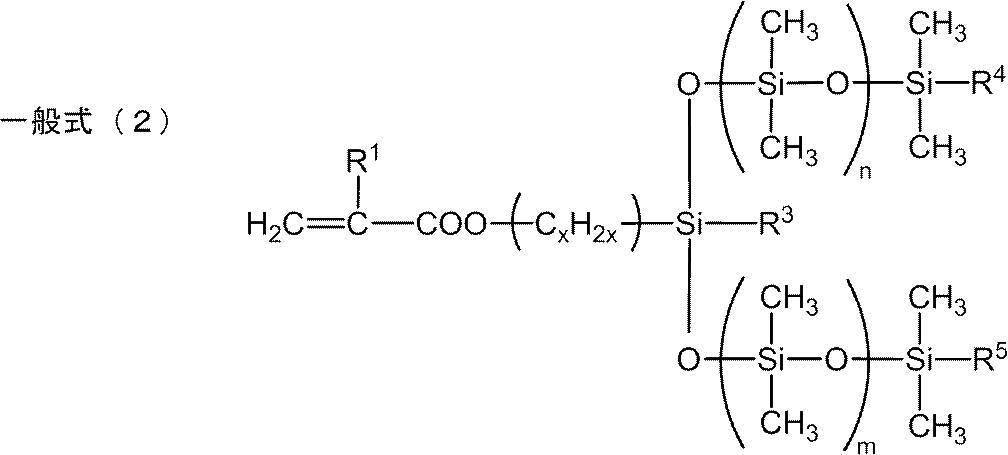
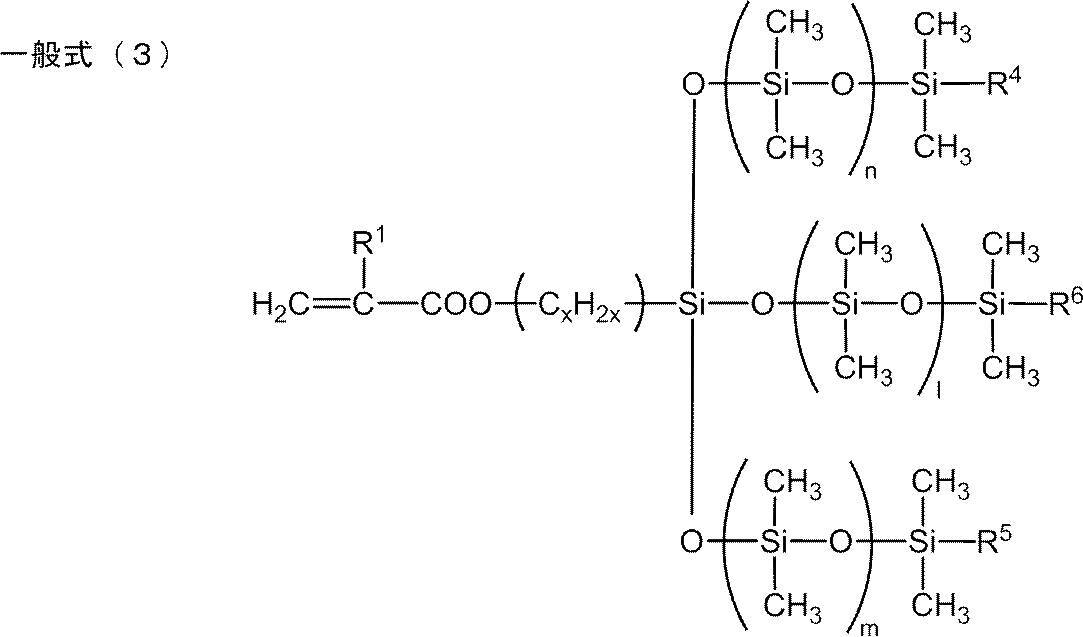
- the metal alkoxide compound is selected from the group consisting of a compound represented by the following general formula (1), a compound represented by the following general formula (2), and a compound represented by the following general formula (3).
- R 1 represents a hydrogen atom or a methyl group
- R 2 represents a hydrogen atom, an alkyl group having 1 to 4 carbon atoms, or a fluoroalkyl group having 1 to 4 carbon atoms.
- N represents an integer of 0 to 1000
- x represents an integer of 1 to 3.
- R 1 represents a hydrogen atom or a methyl group
- R 3 , R 4, and R 5 each independently represent a hydrogen atom, an alkyl group having 1 to 4 carbon atoms, or 1 carbon atom.
- m and n each independently represents an integer of 0 or more and 1000 or less
- x represents an integer of 1 or more and 3 or less.
- R 1 represents a hydrogen atom or a methyl group
- R 4 , R 5, and R 6 are each independently a hydrogen atom, an alkyl group having 1 to 4 carbon atoms, or 1 carbon atom.
- l, m and n each independently represents an integer of 0 or more and 1000 or less
- x represents an integer of 1 or more and 3 or less.
- the coating layer further includes a polymer having a hydroxyl group or a structural unit derived from a polymer having a hydroxyl group.
- the polymer having a hydroxyl group has a silicone chain.
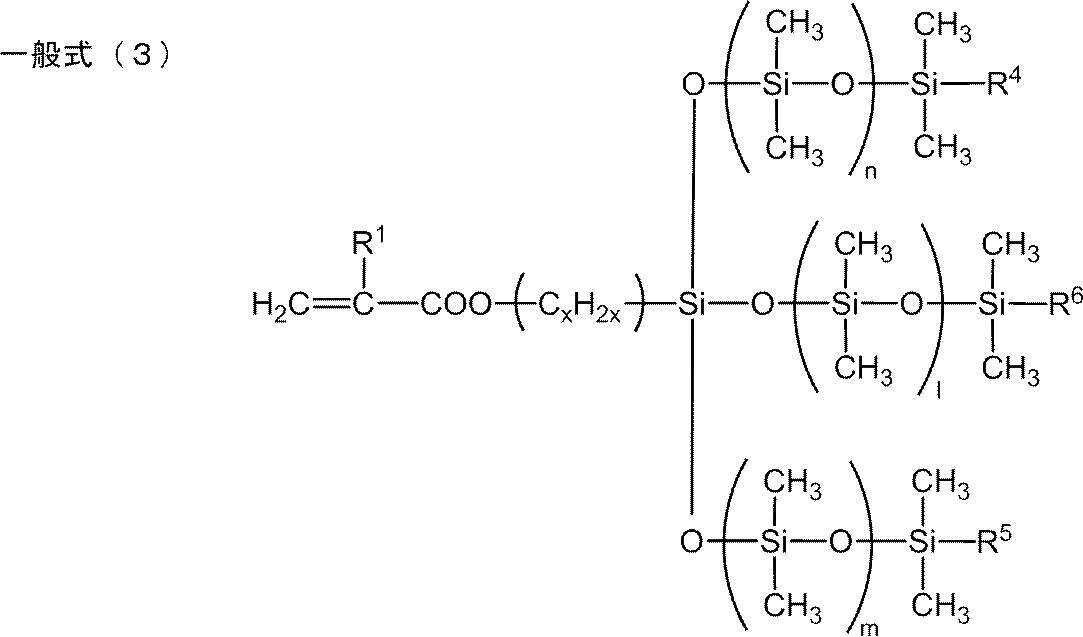
- the polymer having a hydroxyl group is selected from the group consisting of a compound represented by the following general formula (1), a compound represented by the following general formula (2), and a compound represented by the following general formula (3)
- the display medium according to [5] comprising a structural unit derived from at least one selected from the above.
- R 1 represents a hydrogen atom or a methyl group
- R 2 represents a hydrogen atom, an alkyl group having 1 to 4 carbon atoms, or a fluoroalkyl group having 1 to 4 carbon atoms.
- N represents an integer of 0 to 1000
- x represents an integer of 1 to 3.
- R 1 represents a hydrogen atom or a methyl group
- R 3 , R 4, and R 5 each independently represent a hydrogen atom, an alkyl group having 1 to 4 carbon atoms, or 1 carbon atom.
- m and n each independently represents an integer of 0 or more and 1000 or less
- x represents an integer of 1 or more and 3 or less.
- R 1 represents a hydrogen atom or a methyl group
- R 4 , R 5, and R 6 are each independently a hydrogen atom, an alkyl group having 1 to 4 carbon atoms, or 1 carbon atom.
- l, m and n each independently represents an integer of 0 or more and 1000 or less
- x represents an integer of 1 or more and 3 or less.
- a display medium comprising: the display medium according to any one of [1] to [10]; and a voltage applying unit that applies a voltage between a pair of substrates included in the display medium.
- the present invention it is possible to provide a display medium and a display device in which particles are hardly adhered to the opposite surface of the substrate.
- FIG. 1 is a schematic configuration diagram of a display device according to the present invention. It is a schematic diagram which shows the movement aspect of a particle group when a voltage is applied between the board
- a numerical range indicated using “to” indicates a range including the numerical values described before and after “to” as the minimum value and the maximum value, respectively.
- the expression “(meth) acryl” means “acryl” and “methacryl”
- the expression “(meth) acrylate” means “acrylate” and “methacrylate”
- the expression “(meth) acryloyl” means “acryloyl” and “methacryloyl”
- the notation “(meth) acryloxy” means “acryloxy” and “methacryloxy”.
- the opposing surface of the substrate refers to a surface of the substrate that faces the other substrate that is paired with the substrate.
- FIG. 1 is a schematic configuration diagram of a display device according to the present invention.
- FIG. 2A and FIG. 2B are schematic views showing the movement mode of the particle group when a voltage is applied between the substrates of the display medium in the display device according to the present invention.
- 1, 2A and 2B are diagrams focusing on one cell.
- a display medium and a display device will be described with reference to the drawing focusing on this one cell.
- the display device 10 includes a display medium 12, a voltage application unit 16 that applies a voltage to the display medium 12, and a control unit 18 that controls driving of the voltage application unit 16. Prepare.
- the display medium 12 includes a display substrate 20, a back substrate 22, a gap member 24, a dispersion medium 50, a particle group 34, and an insulating particle group 36.
- the display substrate 20 is an image display surface of the display medium 12.
- the back substrate 22 faces the display substrate 20 with a gap.
- the gap member 24 holds the substrates (between the display substrate 20 and the back substrate 22) at a predetermined interval and partitions the substrates into a plurality of cells.
- the dispersion medium 50, the particle group 34, and the insulating particle group 36 are enclosed in each cell.
- the cell is an area surrounded by the display substrate 20, the back substrate 22, and the gap member 24.
- the dispersion medium 50, the particle group 34, and the insulating particle group 36 are enclosed in the cell, and the particle group 34 and the insulating particle group 36 are dispersed in the dispersion medium 50.
- the particle group 34 moves between the display substrate 20 and the back substrate 22 through the gap of the insulating particle group 36 according to the electric field strength formed in the cell.
- the particle group 34 has a predetermined color and is previously prepared to be positively charged or negatively charged.
- the insulating particle group 36 is a particle group having an optical reflection characteristic different from that of the particle group 34 and having a low electric field response, and the particle group 34 moves between the substrates through the gap between the insulating particle groups 36. .
- the insulating particle group 36 is a particle group forming the background color of the display image.
- the color of the insulating particle group 36 is desirably white or black so as to be a background color.
- the cell is partitioned by the gap member 24 so as to correspond to each pixel when an image is displayed on the display medium 12, whereby the display medium 12 can display each pixel.
- the size of the cell is closely related to the resolution of the display medium 12, and in general, the smaller the cell, the higher the resolution of the display medium 12.
- the size of one cell for example, the length in the plate surface direction of the display substrate 20 is about 10 ⁇ m to 1 mm.
- the display medium 12 is, for example, a bulletin board, a circulation version, an electronic blackboard, an advertisement, a signboard, a flashing sign, an electronic paper, an electronic newspaper, an electronic book, and a document sheet shared with a copying machine and a printer that can store and rewrite images. Used as
- the display substrate 20 includes a support substrate 38 and a surface electrode 40 laminated on the support substrate 38.
- the back substrate 22 includes a support substrate 44 and a back electrode 46 laminated on the support substrate 44.
- the display substrate 20 has translucency. “Translucent” means that the transmittance of visible light is 60% or more.
- the back substrate 22 may or may not have translucency.
- Examples of the material of the support substrate 38 and the support substrate 44 include glass, polyethylene terephthalate resin, polycarbonate resin, acrylic resin, polyimide resin, polyester resin, epoxy resin, and polyethersulfone resin.
- the surface electrode 40 and the back electrode 46 are made of, for example, an oxide of a metal such as indium, tin, cadmium, or antimony; a composite oxide such as ITO (indium tin oxide); a metal such as gold, silver, copper, or nickel; A monolayer film, a mixed film, or a composite film made of an organic material such as polythiophene.
- the thickness of the surface electrode 40 and the back electrode 46 is preferably, for example, 100 mm or more and 2000 mm or less.
- the front electrode 40 and the back electrode 46 may be formed in a matrix shape or a stripe shape.
- the front electrode 40 and the back electrode 46 may be embedded in the support substrate 38 and the support substrate 44, respectively.
- the front electrode 40 and the back electrode 46 may be separated from the display substrate 20 and the back substrate 22 and disposed outside the display medium 12, respectively.
- the display substrate 20 and the back substrate 22 may be provided with electrodes on either side and may be driven in an active matrix.
- the support substrate 38 and the support substrate 44 may include a TFT (thin film transistor) for each pixel in order to perform active matrix driving.
- the TFT is preferably formed not on the display substrate 20 but on the back substrate 22 because wiring can be easily laminated and components can be mounted.
- the gap member 24 is made of, for example, thermoplastic resin, thermosetting resin, electron beam curable resin, photocurable resin, rubber, or metal.
- the gap member 24 may be integrally formed on one or both of the display substrate 20 and the back substrate 22.
- the support substrate 38 or the support substrate 44 is processed by an etching process, a laser processing process, a pressing process, a printing process, or the like to form the gap member 24.
- the gap member 24 is preferably colorless and transparent from the viewpoint of not adversely affecting the display image displayed on the display medium 12, and the material of the gap member 24 is, for example, a transparent resin such as polystyrene, polyester, or acrylic. desirable.
- the gap member 24 may be in the form of particles.
- the gap member 24 is preferably transparent resin particles or transparent glass particles. “Transparent” means that the transmittance of visible light is 60% or more.
- fixing means such as a combination of a bolt and a nut, a clamp, a clip, and a fixing frame are applied.
- it may be fixed by an adhesive, heat melting, ultrasonic bonding or the like.
- a coating layer 21 is provided on the opposite surface of the display substrate 20 (the surface of the display substrate 20 facing the back substrate 22).
- a coating layer 23 is provided on the opposing surface of the back substrate 22 (the surface of the back substrate 22 facing the display substrate 20).
- At least one of the coating layer 21 and the coating layer 23 is present, it is desirable that at least the coating layer 21 is present, and it is more desirable that both the coating layer 21 and the coating layer 23 are present. That is, at least one of the facing surface of the display substrate 20 and the facing surface of the back substrate 22 may be provided with a coating layer, and at least the coating surface of the display substrate 20 is desirably provided with a coating layer. More preferably, a coating layer is provided on the opposite surface. When the coating layer is provided on the opposite surface of the display substrate 20, image defects due to the adhesion of particles are suppressed. When the coating layer is provided on the opposite surface of the back substrate 22, the adhesion of particles to the substrate is suppressed, and as a result, the increase of particles that do not contribute to image display is suppressed.
- a coating layer 25 is provided on the surface of the gap member 24 facing the cell.
- the covering layer 25 may not be provided on the gap member 24, but is preferably provided.
- the coating layer 25 is provided, the adhesion of particles to the gap member 24 is suppressed, and as a result, an increase in particles that do not contribute to image display is suppressed.
- the display medium 12 is most preferably provided with a coating layer on the opposing surface of the display substrate 20, the opposing surface of the back substrate 22, and the surface of the gap member 24 facing the cell.
- the display substrate 20, the back substrate 22, and the gap member 24 are collectively referred to as “cell constituent members”.
- the facing surface of the display substrate 20, the facing surface of the back substrate 22, and the surface of the gap member 24 facing the inside of the cell are collectively referred to as “cell configuration surface”.
- the thickness of the coating layer 21, the coating layer 23, and the coating layer 25 is preferably 0.001 ⁇ m to 10 ⁇ m, and more preferably 0.01 ⁇ m to 1 ⁇ m.
- the coating layer 21, the coating layer 23, and the coating layer 25 are layers containing a polymer compound having a crosslinked structure formed by hydrolysis and condensation polymerization of a metal alkoxide compound. Since these coating layers are layers of a polymer compound having a dense cross-linked structure formed by hydrolysis and condensation polymerization of a metal alkoxide compound, the cell constituent surface is compared with coating layers formed of other types of compounds. It is considered that the particles are hardly fixed on the surface. In addition, since the polymer compound is bonded to the cell constituent member through a number of bonding points, the coating layer is difficult to peel off from the cell constituent member. It is considered that the particles are hardly fixed.
- metal alkoxide compound is not particularly limited as long as it has an alkoxy group directly bonded to a metal atom and can be hydrolyzed and polycondensed.
- metal atoms include atoms of elements classified as metals, as well as atoms of elements classified as semimetals (for example, silicon and boron). Even if it exists, the atom (for example, phosphorus) which shows metal-like property when an alkoxy group couple
- metal atoms include Si (silicon), Ti (titanium), Zr (zirconium), Al (aluminum), B (boron), P (phosphorus), Zn (zinc), Mg (magnesium), and Ge (germanium). ), Ga (gallium), Sb (antimony), Sn (tin), Ta (tantalum), V (vanadium), and the like.
- the metal alkoxide compound is desirably a compound having a group in which two or more alkoxy groups are directly bonded to a metal atom.
- metal alkoxy group a group consisting of a metal atom and one or more alkoxy groups directly bonded to the metal atom.
- the metal alkoxide compound may be a non-polymer compound or a polymer compound.
- Non-polymeric metal alkoxide compounds examples include compounds represented by the following general formula (A).
- M represents a divalent to tetravalent metal atom
- R 11 represents an alkyl group
- R 12 represents a hydrogen atom or an organic group.
- M represents a divalent metal atom
- j represents 2
- k represents 0, and two R 11 may be the same or different from each other.
- M represents a trivalent metal atom
- j represents 3
- k represents 0 or 1
- two or three R 11 s may be all the same, partially the same or different from each other.
- M represents a tetravalent metal atom
- j represents 4
- k represents 0, 1 or 2
- 2 to 4 R 11 may be all the same, partially the same or different from each other. .
- the metal atom represented by M is, for example, Si, Ti, Zr, Al, B, P, Zn, Mg, Ge, Ga, Sb, Sn, Ta, V, etc. Among them, Si, Ti, Zr and Al Is desirable, and Si is particularly desirable.
- Examples of the alkyl group represented by R 11 include alkyl groups having 1 to 5 carbon atoms (methyl group, ethyl group, n-propyl group, isopropyl group, n-butyl group, isobutyl group, sec-butyl group, tert-butyl group, n-pentyl group, isopentyl group, neopentyl group, tert-pentyl group, etc.), and an alkyl group having 1 to 4 carbon atoms is preferable.
- These alkyl groups may be substituted with a halogen atom (fluorine, chlorine, bromine, iodine).
- Examples of the organic group represented by R 12 include an alkyl group having 1 to 5 carbon atoms (preferably an alkyl group having 1 to 4 carbon atoms), an aryl group having 6 to 10 carbon atoms (preferably a phenyl group). ).
- the alkyl group and aryl group may have a substituent, and examples of the substituent include a halogen atom (fluorine, chlorine, bromine, iodine).
- metal alkoxide compound containing Si examples include tetramethoxysilane, tetraethoxysilane, tetrapropoxysilane, trimethoxysilane, triethoxysilane, tripropoxysilane, methyltrimethoxysilane, methyltriethoxysilane, and ethyltrimethoxysilane.
- tetramethoxysilane, tetraethoxysilane, methyltrimethoxysilane, methyltriethoxysilane, ethyltrimethoxysilane, ethyltriethoxysilane, dimethyldimethoxysilane, dimethyldiethoxysilane, phenyltrimethoxysilane, phenyltriethoxysilane, diphenyl Dimethoxysilane and diphenyldiethoxysilane are desirable.
- metal alkoxide compound containing Ti examples include tetramethoxy titanium, tetraethoxy titanium, tetrapropoxy titanium, tetraisopropoxy titanium, tetrabutoxy titanium, tetra-sec-butoxy titanium, and tetra-tert-butoxy titanium. It is done.
- Examples of the metal alkoxide compound containing Zr include tetramethoxyzirconium, tetraethoxyzirconium, tetrapropoxyzirconium, tetraisopropoxyzirconium, tetrabutoxyzirconium, tetra-sec-butoxyzirconium, and tetra-tert-butoxyzirconium. It is done.
- metal alkoxide compound containing Al examples include trimethoxy aluminum, triethoxy aluminum, tripropoxy aluminum, triisopropoxy aluminum, tributoxy aluminum, tri-sec-butoxy aluminum, and tri-tert-butoxy aluminum. It is done.
- metal alkoxide compound containing B examples include trimethoxyborane, triethoxyborane, tripropoxyborane, triisopropoxyborane, tributoxyborane, tri-sec-butoxyborane, and tri-tert-butoxyborane. It is done.
- metal alkoxide compound containing P examples include trimethoxyphosphine and triethoxyphosphine.
- Examples of the metal alkoxide compound containing Zn (zinc) include dimethoxy zinc and diethoxy zinc.
- Examples of the metal alkoxide compound containing Mg (magnesium) include dimethoxymagnesium and diethoxymagnesium.
- Examples of the metal alkoxide compound containing Ge (germanium) include tetraethoxygermanium and tetra-n-propoxygermanium.
- Examples of the metal alkoxide compound containing Ga (gallium) include triethoxygallium and tri-n-butoxygallium.
- Examples of the metal alkoxide compound containing Sb (antimony) include triethoxyantimony and tri-n-butoxyantimony.
- Examples of the metal alkoxide compound containing Sn (tin) include tetraethoxytin and tetra-n-propoxytin.
- metal alkoxide compound containing Ta examples include pentamethoxy tantalum and pentaethoxy tantalum.
- Examples of the metal alkoxide compound containing V (vanadium) include triethoxy vanadium and tri-n-butoxy vanadium.
- the metal alkoxide compound may be a high molecular weight compound, for example, a polymer.
- the metal alkoxide compound in this case is a polymer in which a metal alkoxy group is introduced into a side chain or a terminal.
- the polymer is referred to as “metal alkoxy group-containing polymer”.
- the metal alkoxy group-containing polymer examples include a copolymer of a polymerization component having a metal alkoxy group (referred to as “metal alkoxy group-containing polymerization component”) and a polymerization component (C) described later.
- the copolymer is a copolymer obtained by polymerizing a silicone chain-containing polymerization component (A) described later, and preferably has a silicone chain.
- the coating layer has a silicone chain, and the adhesion of particles to the cell constituting surface is more effectively suppressed by the action of the silicone chain.
- the metal alkoxy group-containing polymer may further be a copolymer obtained by polymerizing a hydroxyl group-containing polymerization component (B) described later.
- the metal alkoxy group-containing polymerization component is not particularly limited as long as it is a compound having an ethylenically unsaturated bond and at least one metal alkoxy group.
- the metal alkoxy group-containing polymerization component is preferably a polymerization component containing one metal atom selected from the group consisting of Si (silica), Ti (titanium), Zr (zirconium), and Al (aluminum), and contains Si.
- a polymerization component is particularly desirable. That is, as the metal alkoxy group-containing polymerization component, a polymerization component having an alkoxysilyl group is particularly desirable.
- the metal alkoxy group-containing polymerization component examples include 3- (meth) acryloylpropyltrimethoxysilane, 3- (meth) acryloylpropyltriethoxysilane, 3- (meth) acryloylpropylmethyldimethoxysilane, 3- (Meth) acryloylpropylmethyldiethoxysilane, 3- (meth) acryloxypropyltrimethoxysilane, 3- (meth) acryloxypropyltriethoxysilane, 3- (meth) acryloxypropylmethyldimethoxysilane, 3- (meth) ) Acryloxypropylmethyldiethoxysilane.
- the mass ratio of the metal alkoxy group-containing polymerization component in the metal alkoxy group-containing polymer is preferably 5% by mass or more and more preferably 10% by mass or more in terms of good polycondensation and binding to the cell component surface. Desirably, 20 mass% or more is more desirable, and 30 mass% or more is further desirable.
- the mass ratio is preferably 90% by mass or less, more preferably 80% by mass or less, in that the amount of alkoxy groups remaining in the coating layer is suppressed and the movement characteristics (electrophoretic characteristics) of the particles are hardly affected. 70 mass% or less is more desirable, and 60 mass% or less is further desirable. Said mass ratio is the ratio of the preparation amount of a polymerization component at the time of synthesize
- the mass ratio of the polymerization component is preferably 5% by mass or more, and more preferably 10% by mass or more.
- the content is 5% by mass or more (more desirably 10% by mass or more)
- the effect of suppressing adhesion of particles by the silicone chain is easily obtained.
- the mass ratio is preferably at most 40 mass%, more preferably at most 30 mass%. Said mass ratio is the ratio of the preparation amount of a polymerization component at the time of synthesize
- the mass ratio of the polymerization component is preferably at least 10% by mass, more preferably 20% by mass or more.
- the mass ratio is desirably 60% by mass or less, more desirably 50% by mass or less, still more desirably 40% by mass or less, and still more desirably 30% by mass or less.
- Said mass ratio is the ratio of the preparation amount of a polymerization component at the time of synthesize
- the weight average molecular weight of the metal alkoxy group-containing polymer is preferably from 1,000 to 1,000,000, more preferably from 5,000 to 500,000, and even more preferably from 10,000 to 300,000.
- the coating layer 21, the coating layer 23, and the coating layer 25 may include both a non-polymeric metal alkoxide compound and a metal alkoxy group-containing polymer.
- the coating layer is considered to be a denser and more flexible structure, and the particles are less likely to adhere to the cell constituent surface.
- a non-polymeric metal alkoxide compound and a metal alkoxy group-containing polymer are both hydrolyzed and polycondensed to form a crosslinked structure, and are bonded to the cell constituent member to form a coating layer.
- a non-polymeric metal alkoxide compound is bonded to a cell constituent member while forming a crosslinked structure by hydrolysis and condensation polymerization, and a metal alkoxy group-containing polymer is bonded to the surface of the crosslinked structure by a reaction of the metal alkoxy group.
- the coating layer is formed as a whole.
- the non-polymeric metal alkoxide compound is hydrolyzed and polycondensed to form a cross-linked structure and binds to the cell component, and the metal alkoxy group-containing polymer is located close to the cross-linked structure by intermolecular interaction.
- the coating layer is formed as a whole.
- the coating layer 21, the coating layer 23, and the coating layer 25 further include a polymer having a hydroxyl group as a constituent element.
- the polymer having a hydroxyl group is a polymer different from the metal alkoxy group-containing polymer.
- Examples of embodiments in which the coating layer 21, the coating layer 23, and the coating layer 25 include a polymer having a hydroxyl group as constituents include the following (I), (II), and combinations thereof.
- a coating layer contains the structural unit derived from the polymer which has a hydroxyl group.
- the coating layer contains a polymer itself having a hydroxyl group.
- (I) is more preferable than (II).
- the embodiment (I) includes, for example, the following (I-1) to (I-3) and combinations thereof.
- (I-1) A polymer having a hydroxyl group is bonded to a crosslinked structure formed by hydrolysis and condensation polymerization of a metal alkoxide compound by a reaction of the hydroxyl group of the polymer, and as a result, the coating layer is derived from the polymer having a hydroxyl group. Containing structural units.
- (I-2) A metal alkoxide compound and a polymer having a hydroxyl group are both hydrolyzed and polycondensed and bonded to a cell constituent member to form a coating layer. As a result, the coating layer is derived from a polymer having a hydroxyl group. Includes building blocks.
- the polymer having a hydroxyl group is bonded to the cell constituent member by the reaction of the hydroxyl group of the polymer, and as a result, the coating layer contains a structural unit derived from the polymer having a hydroxyl group.
- the embodiment of (II) includes, for example, the following (II-1) to (II-3) and combinations thereof.
- (II-1) A polymer having a hydroxyl group is located close to the cross-linked structure formed by hydrolysis and condensation polymerization of the metal alkoxide compound by intermolecular interaction, and as a result, the coating layer contains a polymer having a hydroxyl group.
- (II-2) The polymer having a hydroxyl group is located in the vicinity of the cell constituent member due to intermolecular interaction, and as a result, the coating layer contains a polymer having a hydroxyl group.
- (II-3) A polymer having a hydroxyl group is contained in the crosslinked structure formed by hydrolysis and condensation polymerization of the metal alkoxide compound, and as a result, the coating layer contains a polymer having a hydroxyl group.
- the polymer having a hydroxyl group may be a polymer having at least one hydroxyl group at the terminal or side chain, and is preferably a polymer having two or more hydroxyl groups at the terminal or side chain.
- the polymer having a hydroxyl group preferably further has a silicone chain, and more preferably has a silicone chain in the side chain.
- the coating layer has a silicone chain, and due to the action of the silicone chain, the adhesion of particles to the cell constituting surface is more effectively suppressed.
- silicone oil is used as the dispersion medium, the familiarity between the coating layer and the dispersion medium is good due to the action of the silicone chain.
- Desirable embodiments of the polymer having a hydroxyl group include, for example, a polymerization component having a silicone chain (referred to as “silicone chain-containing polymerization component (A)”) and a polymerization component having a hydroxyl group (referred to as “hydroxyl group-containing polymerization component (B)”). And a copolymer thereof.
- the copolymer may be a copolymer obtained by polymerizing together other polymerization components (referred to as “polymerization component (C)”) other than the silicone chain-containing polymerization component (A) and the hydroxyl group-containing polymerization component (B).
- silicone chain-containing polymerization component (A) examples include well-known compounds such as linear silicone compounds and branched silicone compounds.
- the silicone chain-containing polymerization component (A) may be a monomer or a macromonomer. “Macromonomer” is a general term for oligomers having a polymerizable functional group (degree of polymerization of about 2 or more and about 300 or less) and polymers, and has properties of both polymers and monomers.
- the silicone chain-containing polymerization component (A) may be used alone or in combination of two or more.
- silicone chain-containing polymerization component (A) examples include a compound represented by the following general formula (1), a compound represented by the following general formula (2), and a compound represented by the following general formula (3). Can be mentioned.
- R 1 represents a hydrogen atom or a methyl group
- R 2 represents a hydrogen atom, an alkyl group having 1 to 4 carbon atoms, or a fluoroalkyl group having 1 to 4 carbon atoms.
- N represents an integer of 0 to 1000
- x represents an integer of 1 to 3.
- R 1 represents a hydrogen atom or a methyl group
- R 3 , R 4, and R 5 each independently represent a hydrogen atom, an alkyl group having 1 to 4 carbon atoms, or 1 carbon atom.
- m and n each independently represents an integer of 0 or more and 1000 or less
- x represents an integer of 1 or more and 3 or less.
- R 1 represents a hydrogen atom or a methyl group
- R 4 , R 5, and R 6 are each independently a hydrogen atom, an alkyl group having 1 to 4 carbon atoms, or 1 carbon atom.
- l, m and n each independently represents an integer of 0 or more and 1000 or less
- x represents an integer of 1 or more and 3 or less.
- Examples of the compound represented by the general formula (1) include Silaplane FM-0711, Silaplane FM-0721, Silaplane FM-0725 manufactured by JNC; X-22-174DX, X manufactured by Shin-Etsu Chemical Co., Ltd. -22-2426, X-22-2475;
- Examples of the compound represented by the general formula (2) include MCS-M11 manufactured by Gelest. Examples of the compound represented by the general formula (3) include RTT-1011 manufactured by Gelest. The structural formulas of these compounds are shown below.
- m and n in the above structural formula are each independently an integer of 2 or more and 4 or less, and the molecular weight thereof is 800 or more and 1000 or less.
- RTT-1011 is a compound represented by the above structural formula.
- the hydroxyl group-containing polymerization component (B) is not particularly limited as long as it is a compound having an ethylenically unsaturated bond and at least one hydroxyl group. Specific examples include 2-hydroxyethyl (meth) acrylate, 2-hydroxybutyl (meth) acrylate, 2-hydroxy-3-phenoxypropyl (meth) acrylate, glycerin mono (meth) acrylate, polyethylene glycol mono (meth) acrylate.
- polymerization component (C)- examples include the following compounds.
- (Meth) acrylic acid alkyl esters such as methyl (meth) acrylate, ethyl (meth) acrylate, propyl (meth) acrylate and butyl (meth) acrylate; monoolefins such as ethylene, propylene, butylene and isobutylene; styrene, ⁇ -methyl Styrene monomers such as styrene and p-methylstyrene; vinyl esters such as vinyl acetate, vinyl propionate, vinyl benzoate and vinyl butyrate; vinyl ethers such as vinyl methyl ether, vinyl ethyl ether and vinyl butyl ether; vinyl methyl ketone Vinyl ketones such as vinyl hexyl ketone and vinyl isopropenyl ketone;
- N-ethylaminoethyl (meth) acrylate N, N-dimethylaminoethyl (meth) acrylate, N, N-diethylaminoethyl (meth) acrylate, N, N-dibutylaminoethyl (meth) acrylate, N-octyl-N (Meth) acrylates having an aliphatic amino group such as ethylaminoethyl (meth) acrylate and N, N-dihexylaminoethyl (meth) acrylate; N-methylacrylamide, N-octylacrylamide, N-phenylmethylacrylamide, (Meth) acrylics such as N-cyclohexylacrylamide, N-phenylacrylamide, Np-methoxy-phenylacrylamide, N, N-dimethylacrylamide, N, N-dibutylacrylamide, N-methyl-N-phenylacrylamide Mid
- Pyrroles such as N-vinylpyrrole; pyrrolines such as N-vinyl-2-pyrroline and N-vinyl-3-pyrroline; pyrrolidines such as N-vinylpyrrolidine, vinylpyrrolidine amino ether and N-vinyl-2-pyrrolidone Imidazoles such as N-vinyl-2-methylimidazole; imidazolines such as N-vinylimidazoline; indoles such as N-vinylindole; indolines such as N-vinylindoline; N-vinylcarbazole, 3,6- Carbazoles such as dibromo-N-vinylcarbazole; Pyridines such as 2-vinylpyridine, 4-vinylpyridine and 2-methyl-5-vinylpyrazine; Piperidines such as (meth) acrylic piperidine, N-vinylpiperidone and N-vinylpiperazine 2-vinylquinoline, 4-vinylquinoline Quino
- the hydroxyl group-containing polymerization component (B) is an essential component, and the silicone chain-containing polymerization component (A) and the polymerization component (C) are copolymerized depending on the purpose.
- the mass proportion of the hydroxyl group-containing polymerization component (B) in the polymer having a hydroxyl group is preferably 10% by mass or more, and more preferably 20% by mass or more in terms of good binding to the structure formed by the metal alkoxide compound. .
- the mass ratio is preferably 50% by mass or less, and more preferably 45% by mass or less, in that the amount of hydroxyl groups remaining in the coating layer is suppressed and the movement characteristics (electrophoretic characteristics) of the particles are hardly affected.
- Said mass ratio is a ratio of the preparation amount of a polymerization component at the time of synthesize
- the mass ratio of the polymerization component is desirably 10% by mass or more, and more desirably 20% by mass or more. When it is 10% by mass or more (more desirably 20% by mass or more), the effect of suppressing the adhesion of particles by the silicone chain is easily obtained.
- the mass ratio is preferably at most 40 mass%, more preferably at most 30 mass%. Said mass ratio is a ratio of the preparation amount of a polymerization component at the time of synthesize
- the mass ratio of the polymerization component is preferably at least 10% by mass, more preferably 20% by mass or more.
- the mass ratio is desirably 60% by mass or less, more desirably 50% by mass or less, still more desirably 40% by mass or less, and still more desirably 30% by mass or less.
- Said mass ratio is a ratio of the preparation amount of a polymerization component at the time of synthesize
- the weight average molecular weight of the polymer having a hydroxyl group is preferably from 500 to 1,000,000, more preferably from 1,000 to 500,000, and even more preferably from 10,000 to 300,000.
- the coating layer 21, the coating layer 23, and the coating layer 25 may further contain a compound other than the polymer having a hydroxyl group.
- the compound include a polymer of the polymerization component (C) and a copolymer of the silicone chain-containing polymerization component (A) and the polymerization component (C). These compounds are located close to a cross-linked structure formed by hydrolysis and polycondensation of a metal alkoxide compound, for example, by intermolecular interaction, and are included in the coating layer.
- the covering layer 21, the covering layer 23, and the covering layer 25 are formed by the following method, for example. That is, a liquid composition containing a metal alkoxide compound is prepared, and the liquid composition is held for a predetermined period of time under conditions that allow the liquid composition to be hydrolyzed.
- the mass ratio of the non-polymeric metal alkoxide compound and the metal alkoxy group-containing polymer in the liquid composition is preferably 10: 1 to 1:10.
- the mass ratio of the metal alkoxide compound to the polymer having a hydroxyl group (metal alkoxide compound: polymer having a hydroxyl group) in the liquid composition is preferably 10: 1 to 1:10.
- a silane coupling agent is desirable.
- a silane coupling agent is desirable.
- the dispersion medium 50 is desirably an insulating liquid. “Insulating” means that the volume resistivity value is 10 11 ⁇ cm or more.
- the insulating liquid examples include hexane, cyclohexane, toluene, xylene, decane, hexadecane, kerosene, paraffin, isoparaffin, silicone oil, dichloroethylene, trichloroethylene, perchloroethylene, high-purity petroleum, ethylene glycol, alcohols, ether , Esters, dimethylformamide, dimethylacetamide, dimethylsulfoxide, N-methylpyrrolidone, 2-pyrrolidone, N-methylformamide, acetonitrile, tetrahydrofuran, propylene carbonate, ethylene carbonate, benzine, diisopropylnaphthalene, olive oil, isopropanol, trichlorotrifluoro Ethane, tetrachloroethane, dibromotetrafluoroethane, and mixtures thereof are preferably used.
- silicone oil is desirable as the dispersion medium.
- a silicone oil in which a hydrocarbon group is bonded to a siloxane bond is desirable, and dimethyl silicone is particularly desirable.
- Water is also used as the dispersion medium 50 by removing impurities so that the volume resistance value is 10 3 ⁇ cm or more (preferably 10 7 ⁇ cm or more and 10 19 ⁇ cm or less, more preferably 10 10 ⁇ cm or more and 10 19 ⁇ cm or less). Can do.
- Acids, alkalis, salts, dispersion stabilizers, antioxidants, ultraviolet absorbers, antibacterial agents, preservatives, etc. may be added to the insulating liquid, provided that the volume resistivity is within the above range. It is desirable to add.
- a nonionic surfactant for the insulating liquid, a nonionic surfactant, an anionic surfactant, a cationic surfactant, an amphoteric surfactant, a fluorosurfactant, a silicone surfactant, a metal soap, Alkyl phosphates and succinimides may be added.
- Nonionic surfactants include polyoxyethylene nonyl phenyl ether, polyoxyethylene octyl phenyl ether, polyoxyethylene dodecyl phenyl ether, polyoxyethylene alkyl ether, polyoxyethylene fatty acid ester, sorbitan fatty acid ester, polyoxyethylene sorbitan Examples include fatty acid esters and fatty acid alkylolamides.
- Examples of the anionic surfactant include alkylbenzene sulfonates, alkylphenyl sulfonates, alkylnaphthalene sulfonates, higher fatty acid salts, sulfate esters of higher fatty acid esters, and sulfonic acids of higher fatty acid esters.
- Examples of the cationic surfactant include primary amine salts, secondary amine salts, tertiary amine salts, and quaternary ammonium salts.
- the addition amount of the charge control agent is desirably 0.01% by mass or more and 20% by mass or less, and more desirably 0.05% by mass or more and 10% by mass or less with respect to the total solid content of the particles dispersed in the dispersion medium.
- the content of the charge control agent is 0.01% by mass or more, the charge control effect is easily exhibited, and when it is 20% by mass or less, an excessive increase in the conductivity of the dispersion medium is suppressed.
- a polymer resin may be used in combination with the insulating liquid.
- Polymer resins include agarose, agaropectin, amylose, sodium alginate, propylene glycol alginate, carrageenan, ethyl hydroxyethyl cellulose, ethyl cellulose, carboxymethyl cellulose, cellulose acetate, agar, chitin, chitosan, silk fibroin, casein, guar gum, crown gall polysaccharide , Glycogen, glucomannan, keratin, collagen, gellan gum, gelatin, dextran, starch, tragacanth gum, hyaluronic acid, decomposed xyloglucan, pectin and other natural polymer gels; synthetic polymer gels; alcohols, ketones, ethers , Esters, amides and other polymer containing functional groups in the repeating unit (eg, polyvinyl alcohol, poly (methyl alcohol, poly
- the dispersion medium 50 may be colored by containing a colorant.
- the display medium 12 can display a color different from the color of the particle group 34.
- the display medium 12 displays white and black.
- the colorant include known colorants such as phthalocyanine copper-based cyan color material, azo-based yellow color material, azo-based magenta color material, quinacridone-based magenta color material, red color material, green color material, and blue color material. .
- the dispersion medium 50 preferably has a specific gravity at a temperature of 25 ° C. of 0.6 g / cm 3 or more and 1.2 g / cm 3 or less from the viewpoint of suppressing sedimentation of the insulating particles. 3 to 1.1 g / cm 3 or less, more preferably, 0.7 g / cm 3 or more 1.0 g / cm 3 or less is more desirable.
- the dispersion medium 50 desirably adjusts the viscosity because the particle group 34 moves in the dispersion medium 50.
- the viscosity of the dispersion medium 50 is desirably 0.1 mPa ⁇ s or more and 100 mPa ⁇ s or less at a temperature of 20 ° C. from the viewpoint of the moving speed of the particles, that is, the display speed, and is 0.1 mPa ⁇ s or more and 50 mPa ⁇ s or less. s or less is more desirable, and 0.1 mPa ⁇ s or more and 20 mPa ⁇ s or less is further desirable.
- the viscosity of the dispersion medium 50 can be adjusted by adjusting the molecular structure, molecular weight, composition, etc. of the dispersion medium.
- particle moving in dispersion medium Individual particles of the particle group 34 are positively or negatively charged.
- the particle group 34 moves in the dispersion medium 50 by applying a voltage between the surface electrode 40 and the back electrode 46 to form an electric field between the display substrate 20 and the back substrate 22.
- the change in display color on the display medium 12 is caused by the movement of the particle group 34 in the dispersion medium 50.
- the particle group 34 may include two or more types of particle groups having different colors and charging characteristics. “Different charging characteristics” means that one of the charging polarity and the charging amount is different, or both the charging polarity and the charging amount are different.
- particles of the particle group 34 glass beads; insulating metal oxide particles such as alumina and titanium oxide; thermoplastic resin particles or thermosetting resin particles; coloring on the surface of the thermoplastic resin particles or thermosetting resin particles Particles having an agent fixed; particles containing a colorant in thermoplastic resin particles or thermosetting resin particles; metal colloid particles having a plasmon coloring function; and the like.
- thermoplastic resin used for the production of particles examples include styrenes such as styrene and chlorostyrene; monoolefins such as ethylene, propylene, butylene, and isoprene; vinyls such as vinyl acetate, vinyl propionate, vinyl benzoate, and vinyl butyrate.
- Esters ⁇ -methylene aliphatics such as methyl (meth) acrylate, ethyl (meth) acrylate, butyl (meth) acrylate, dodecyl (meth) acrylate, octyl (meth) acrylate, phenyl (meth) acrylate Homopolymers or copolymers of monocarboxylic acid esters; vinyl ethers such as vinyl methyl ether, vinyl ethyl ether, vinyl butyl ether; vinyl ketones such as vinyl methyl ketone, vinyl hexyl ketone, vinyl isopropenyl ketone;
- thermosetting resins used in the production of particles include cross-linked copolymers based on divinylbenzene, cross-linked resins such as cross-linked polymethyl methacrylate, phenol resins, urea resins, melamine resins, polyester resins, silicone resins, etc. Is mentioned.
- Typical resins used in the production of the particles include polystyrene, styrene-alkyl (meth) acrylate copolymer, styrene-acrylonitrile copolymer, styrene-butadiene copolymer, and styrene-maleic anhydride copolymer.
- a resin having a charging group is suitable for charging the particles.
- the resin having a charging group is a resin having a cationic group or an anionic group.
- the cationic group imparts positive chargeability to the particles, and the anionic group imparts negative chargeability to the particles.
- Examples of the cationic group as the charging group include an amine group and a quaternary ammonium group (including salts of these groups).
- Examples of the anionic group as the charging group include a carboxyl group, a carboxylate group, a sulfonate group, a sulfonate group, a phosphate group, and a phosphate group.
- the polymer having a charging group examples include, for example, a homopolymer of a monomer having a charging group, a monomer having a charging group, and another monomer (a monomer having no charging group). And a copolymer.
- the monomer having a charging group examples include a monomer having a cationic group (referred to as “cationic monomer”) and a monomer having an anionic group (referred to as “anionic monomer”). ).
- Examples of the cationic monomer include the following monomers. N-ethylaminoethyl (meth) acrylate, N, N-dimethylaminoethyl (meth) acrylate, N, N-diethylaminoethyl (meth) acrylate, N, N-dibutylaminoethyl (meth) acrylate, N, N-hydroxy (Meth) acrylates having an aliphatic amino group such as ethylaminoethyl (meth) acrylate, N-octyl-N-ethylaminoethyl (meth) acrylate, N, N-dihexylaminoethyl (meth) acrylate; N-methyl Acrylamide, N-octylacrylamide, N-phenylmethylacrylamide, N-cyclohexylacrylamide, N-phenylacrylamide, Np-methoxy-phenylacrylamide, N,
- Examples of the cationic monomer include the following nitrogen-containing heterocyclic compounds.
- Pyrroles such as N-vinylpyrrole; pyrrolines such as N-vinyl-2-pyrroline and N-vinyl-3-pyrroline; pyrrolidines such as N-vinylpyrrolidine, vinylpyrrolidine amino ether and N-vinyl-2-pyrrolidone Imidazoles such as N-vinyl-2-methylimidazole; imidazolines such as N-vinylimidazoline; indoles such as N-vinylindole; indolines such as N-vinylindoline; N-vinylcarbazole, 3,6- Carbazoles such as dibromo-N-vinylcarbazole; Pyridines such as 2-vinylpyridine, 4-vinylpyridine and 2-methyl-5-vinylpyrazine; Piperidines such as (meth) acrylic piperidine, N-vinylpiperidone and N-
- anionic monomer examples include a carboxylic acid monomer, a sulfonic acid monomer, and a phosphoric acid monomer.
- carboxylic acid monomer examples include (meth) acrylic acid, crotonic acid, itaconic acid, maleic acid, fumaric acid, citraconic acid, and anhydrides thereof; monoalkyl esters of carboxylic acid; carboxyethyl vinyl ether, carboxypropyl vinyl ether, etc. And vinyl ethers having a carboxyl group, and salts thereof.
- sulfonic acid monomer examples include styrene sulfonic acid, 2-acrylamido-2-methylpropane sulfonic acid, 3-sulfopropyl (meth) acyclic acid ester, bis- (3-sulfopropyl) -itaconic acid ester, 2 -Sulfuric acid monoesters of hydroxyethyl (meth) acrylic acid and their salts.
- Examples of the phosphoric acid monomer include vinyl phosphonic acid, vinyl phosphate, acid phosphoxyethyl (meth) acrylate, acid phosphoxypropyl (meth) acrylate, bis (methacryloxyethyl) phosphate, diphenyl-2-methacryloyloxyethyl phosphate, Examples include diphenyl-2-acryloyloxyethyl phosphate, dibutyl-2-methacryloyloxyethyl phosphate, dibutyl-2-acryloyloxyethyl phosphate, and dioctyl-2- (meth) acryloyloxyethyl phosphate.
- Examples of other monomers include water-soluble monomers (for example, monomers having a hydroxyl group). Specific examples include hydroxyethyl (meth) acrylate, hydroxybutyl (meth) acrylate, Examples include glycerin mono (meth) acrylate, polyethylene glycol mono (meth) acrylate, and polypropylene glycol mono (meth) acrylate.
- Examples of the colorant used for producing the particles of the particle group 34 include organic pigments, inorganic pigments, and oil-soluble dyes. Specifically, for example, magnetic powder such as magnetite and ferrite; carbon black; metal oxide such as titanium oxide, magnesium oxide, and zinc oxide; phthalocyanine copper-based cyan color material, azo-based yellow color material, and azo-based magenta color material And known colorants such as quinacridone-based magenta color material, red color material, green color material, and blue color material.
- examples of the colorant include aniline blue, calcoyl blue, chrome yellow, ultramarine blue, dupont oil red, quinoline yellow, methylene blue chloride, phthalocyanine blue, malachite green oxalate, lamp black, rose bengal, C. I. Pigment red 48: 1, C.I. I. Pigment red 122, C.I. I. Pigment red 57: 1, C.I. I. Pigment yellow 97, C.I. I. Pigment blue 15: 1, C.I. I. Pigment Blue 15: 3.
- the amount of the colorant used is preferably 10% by mass or more and 99% by mass or less, and more preferably 30% by mass or more and 99% by mass or less with respect to the amount of resin contained in the particles.
- the particles of the particle group 34 may contain a charge control agent.
- a charge control agent known materials used for electrophotographic toner materials can be used. For example, cetylpyridyl chloride, quaternary ammonium salt, salicylic acid metal complex, phenol condensate, tetraphenyl compound, oxidation Examples thereof include metal particles and metal oxide particles surface-treated with various coupling agents.
- the particles of the particle group 34 may contain a magnetic material.
- a magnetic material a transparent magnetic material or a colored magnetic material is used depending on the purpose.
- the colored magnetic material include small-diameter colored magnetic powder described in JP-A-2003-131420.
- An external additive may be attached to the surface of the particles of the particle group 34.
- the color of the external additive is desirably transparent so as not to affect the color of the particle group 34.
- inorganic particles such as metal oxides such as silicon oxide (silica), titanium oxide, and alumina are used. In order to adjust the chargeability, fluidity, environment dependency, and the like of the particles of the particle group 34, these may be surface-treated with a coupling agent or silicone oil.
- coupling agents positively chargeable coupling agents such as aminosilane coupling agents, aminotitanium coupling agents, and nitrile coupling agents; silane coupling agents and titanium coupling agents that do not contain nitrogen atoms
- negatively chargeable coupling agents such as epoxy silane coupling agents and acrylic silane coupling agents.
- Silicone oils include positively charged silicone oils such as amino-modified silicone oils; negatively charged silicone oils such as ⁇ -methylsulfone-modified silicone oils; dimethyl silicone oils, alkyl-modified silicone oils, methylphenyl silicone oils, chlorophenyl silicone oils And non-chargeable silicone oils such as fluorine-modified silicone oils.
- the primary particles of the external additive are preferably 1 nm to 100 nm, more preferably 5 nm to 50 nm.
- the amount of the external additive is desirably 0.01 parts by mass or more and 3 parts by mass or less, and more desirably 0.05 parts by mass or more and 1 part by mass or less with respect to 100 parts by mass of the particles.
- the external additive may be added to any one of a plurality of types of particle groups 34, or may be added to a plurality of types or all types of particle groups 34.
- an external additive is added to the surface of all particles, it is desirable that the external additive is applied to the particle surface with impact force or the particle surface is heated to firmly fix the external additive to the particle surface. .
- formation of an aggregate in which the external additive is released from the particles and the external additives having different polarities are aggregated is suppressed, and deterioration of image quality is further suppressed.
- any conventionally known method may be used. For example, a method in which a resin is heated and melted, a pigment or a charge control agent is added and mixed and dispersed, cooled, particles are prepared using a pulverizer, and dispersed in a dispersion medium is applied. Further, a method in which particles containing a pigment and a charge control agent are prepared by a polymerization method such as suspension polymerization, emulsion polymerization, dispersion polymerization or an emulsion aggregation method and dispersed in a dispersion medium is applied.
- a polymerization method such as suspension polymerization, emulsion polymerization, dispersion polymerization or an emulsion aggregation method and dispersed in a dispersion medium is applied.
- a method of preparing particles by heating and melting a resin, a pigment, and an electric control agent in a dispersion medium, cooling the molten mixture while stirring, solidifying and precipitating using the temperature dependence of the solvent solubility of the resin Applies.
- the mass ratio of the particle group 34 (the concentration of the particle group 34) occupying in all the components enclosed in the cell is not particularly limited as long as a desired hue can be obtained. And the distance between the display substrate 20 and the back substrate 22). That is, in order to obtain a desired hue, the density is decreased as the cell becomes thicker, and the density is increased as the cell becomes thinner. In general, the concentration of the particle group 34 is 0.01% by mass or more and 50% by mass or less.
- the insulating particle group 36 is a particle group having optical reflection characteristics different from that of the particle group 34, and functions as a reflecting member that displays a color different from that of the particle group 34.
- the insulating particle group 36 is a particle group having low electric field responsiveness, and the particle group 34 moves between the substrates through the gap between the insulating particle groups 36.
- the insulating particle group 36 is, for example, a particle having a larger particle diameter than the particles of the particle group 34.
- the particles of the insulating particle group 36 may be bonded to each other while having a gap through which the particle group 34 passes.
- the insulating particle group 36 is white, for example, white pigments such as titanium oxide, silicon oxide, and zinc oxide are used, such as polystyrene, polyethylene, polypropylene, polycarbonate, polymethyl methacrylate, acrylic resin, phenol resin, and formaldehyde condensate. Particles dispersed in resin.
- a resin or pigment of a desired color may be included in the resin particle.
- the display device 10 includes a display medium 12, a voltage application unit 16 that applies a voltage to the display medium 12, and a control unit 18 that controls driving of the voltage application unit 16.
- the voltage application unit 16 is electrically connected to the front electrode 40 and the back electrode 46. Moreover, the voltage application part 16 is connected to the control part 18 so that signal transmission / reception is possible.
- both the surface electrode 40 and the back electrode 46 are electrically connected to the voltage application unit 16.
- One of the surface electrode 40 and the back electrode 46 is grounded, and the other is the voltage application unit.
- the aspect connected to 16 may be sufficient.
- the voltage application unit 16 is a voltage application device for applying a voltage to the front electrode 40 and the back electrode 46, and applies a voltage according to the control of the control unit 18 between the front electrode 40 and the back electrode 46.
- the control unit 18 stores in advance various programs such as a CPU (central processing unit) that controls the operation of the entire apparatus, a RAM (random access memory) that temporarily stores various data, and a control program that controls the entire apparatus. And a microcomputer including a ROM (read only memory).
- the dispersion medium 50 is transparent, the particle group 34 is black and negatively charged, and the insulating particle group 36 is white.
- the display medium 12 in this case displays black or white as the particle group 34 moves.
- control unit 18 outputs to the voltage application unit 16 an operation signal instructing to apply a voltage for a predetermined time so that the front electrode 40 becomes a negative electrode and the back electrode 46 becomes a positive electrode.
- the negatively charged particle group 34 moves to the back substrate 22 side and reaches the back substrate 22 (state shown in FIG. 2A).
- the color of the display medium 12 visually recognized from the display substrate 20 side is white which is the color of the insulating particle group 36.
- the control unit 18 outputs to the voltage application unit 16 an operation signal instructing to apply the voltage for a predetermined time so that the front electrode 40 becomes the positive electrode and the back electrode 46 becomes the negative electrode To do.
- the particle group 34 moves and reaches the display substrate 20 side (state shown in FIG. 2B). In this state, the color of the display medium 12 visually recognized from the display substrate 20 side is black which is the color of the particle group 34.
- the particle group 34 reaches the display substrate 20 or the back substrate 22 and is displayed. Since the opposing surface of the display substrate 20 and the opposing surface of the back substrate 22 have the coating layer 21 and the coating layer 23, it is possible to suppress the particle group 34 from adhering to both of the opposing surfaces. And high contrast are realized.
- the present invention is not limited to this.
- the aspect provided with the particle group 34 may be sufficient.
- the positively chargeable first particle group, the negatively chargeable second particle group, and the positively chargeable particles of the first particle group have different threshold voltages and A mode provided with the 3rd particle group with a large particle size is mentioned.
- the charging polarity of the magenta particles in the dispersion was evaluated by enclosing the dispersion between two electrode substrates, applying a direct current voltage, and observing the migration direction.
- Example 1 [Preparation of Coating Solution 1 for Coating Layer Formation] The following materials were mixed and hydrolyzed by stirring at 20 ° C. for 2 hours to obtain a coating solution 1 for forming a sol-like coating layer. ⁇ Tetraethoxysilane 0.62g ⁇ Ethanol 4.70g ⁇ Water 4.70g ⁇ Nitric acid aqueous solution (1N) 0.10 g
- ITO indium tin oxide
- a glass plate 50.0 mm ⁇ 50.0 mm ⁇ 0.7 mm
- ITO indium tin oxide
- Two ITO / glass substrates were produced for the display substrate and the back substrate.
- the electrode surface of the ITO / glass substrate was immersed in a 2% by mass aqueous solution of ⁇ -aminopropyltriethoxysilane for 15 minutes, rinsed with pure water, and then dried at 120 ° C. for 30 minutes.
- the coating layer forming coating solution 1 was applied to the electrode surface and heated at 120 ° C. for 60 minutes to form a coating layer having a thickness of 200 nm, thereby obtaining a display substrate and a back substrate.
- the thickness of the coating layer was measured with a Dektak 6M step gauge (manufactured by Veeco).
- a coating layer was formed in the same manner as above on the side surface (surface constituting the cell) of a fluororesin sheet (thickness 100 ⁇ m ⁇ width 20 ⁇ m), and this was used as a gap member.
- the display substrate and the back substrate were overlapped through the gap member and fixed with clips.
- a display medium 2 was produced in the same manner as in Example 1 except that the coating layer forming coating solution 1 was changed to the coating layer forming coating solution 2.
- Example 3 [Preparation of coating solution 3 for coating layer formation] The following materials were mixed and hydrolyzed by stirring at 20 ° C. for 2 hours to obtain a coating solution 3 for forming a sol-like coating layer.
- a display medium 3 was produced in the same manner as in Example 1 except that the coating layer forming coating solution 1 was changed to the coating layer forming coating solution 3.
- a display medium 4 was produced in the same manner as in Example 1 except that the coating layer forming coating solution 1 was changed to the coating layer forming coating solution 4.
- Example 5 [Preparation of polymer 2 having a hydroxyl group] 15.4 parts of Silaplane FM-0711 (manufactured by JNC, weight average molecular weight 1000) as the silicone chain-containing polymerization component (A), 21.8 parts of 2-hydroxyethyl methacrylate as the hydroxyl group-containing polymerization component (B), and 15.3 parts of methyl methacrylate as the polymerization component (C) is mixed with 100 parts of propylene glycol monomethyl ether, and 0.5 part of azobisdimethylvaleronitrile (V-65 manufactured by Wako Pure Chemical Industries, Ltd.) is added as a polymerization initiator. Then, a polymerization reaction was carried out at 55 ° C. for 10 hours to prepare a solution of polymer 2 having a hydroxyl group (solid content: 35% by mass). The weight average molecular weight of this polymer was 65,000.
- a display medium 5 was produced in the same manner as in Example 1 except that the coating layer forming coating solution 1 was changed to the coating layer forming coating solution 5.
- Example 6 [Preparation of coating solution 6 for forming a coating layer] The following materials were mixed and hydrolyzed by stirring at 20 ° C. for 2 hours to obtain a coating solution 6 for forming a sol-like coating layer. ⁇ Tetraisopropoxy titanium 0.62g ⁇ A solution of polymer 2 having a hydroxyl group 4.00 g ⁇ Ethanol 4.70g ⁇ Water 4.70g ⁇ Nitric acid aqueous solution (1N) 0.10 g
- a display medium 6 was produced in the same manner as in Example 1 except that the coating layer forming coating solution 1 was changed to the coating layer forming coating solution 6.
- Example 7 [Preparation of Coating Solution 7 for Coating Layer Formation] The following materials were mixed and hydrolyzed by stirring at 20 ° C. for 2 hours to obtain a coating solution 7 for forming a sol coating layer.
- Tetraethoxyzirconium 0.62g ⁇
- a display medium 7 was produced in the same manner as in Example 1 except that the coating layer forming coating solution 1 was changed to the coating layer forming coating solution 7.
- Example 8> [Preparation of coating layer forming coating solution 8] The following materials were mixed and hydrolyzed by stirring at 20 ° C. for 2 hours to obtain a coating solution 8 for forming a sol-like coating layer. ⁇ Tributoxyaluminum 0.62g ⁇ A solution of polymer 2 having a hydroxyl group 4.00 g ⁇ Ethanol 4.70g ⁇ Water 4.70g ⁇ Nitric acid aqueous solution (1N) 0.10 g
- a display medium 8 was produced in the same manner as in Example 1 except that the coating layer forming coating solution 1 was changed to the coating layer forming coating solution 8.
- Example 9 [Preparation of Coating Solution 9 for Coating Layer Formation] The following materials were mixed and hydrolyzed by stirring at 20 ° C. for 2 hours to obtain a coating solution 9 for forming a sol coating layer.
- Triethoxyborane 0.62g ⁇
- a display medium 9 was produced in the same manner as in Example 1 except that the coating layer forming coating solution 1 was changed to the coating layer forming coating solution 9.
- Example 10 [Preparation of coating solution 10 for forming a coating layer] The following materials were mixed and hydrolyzed by stirring at 20 ° C. for 2 hours to obtain a coating solution 10 for forming a sol-like coating layer.
- Triethoxyphosphine 0.62g ⁇
- a display medium 10 was produced in the same manner as in Example 1 except that the coating layer forming coating solution 1 was changed to the coating layer forming coating solution 10.
- Example 11 [Preparation of coating solution 11 for coating layer formation] The following materials were mixed and hydrolyzed by stirring at 20 ° C. for 2 hours to obtain a coating solution 11 for forming a sol-like coating layer. ⁇ Diethoxyzinc 0.62g ⁇ A solution of polymer 2 having a hydroxyl group 4.00 g ⁇ Ethanol 4.70g ⁇ Water 4.70g ⁇ Nitric acid aqueous solution (1N) 0.10 g
- a display medium 11 was produced in the same manner as in Example 1 except that the coating layer forming coating solution 1 was changed to the coating layer forming coating solution 11.
- a display medium C1 was produced in the same manner as in Example 1 except that the coating layer was not formed on the display substrate, the back substrate, and the gap member.
- ⁇ Comparative example 2> [Preparation of coating solution 12 for coating layer formation] The following materials were mixed and hydrolyzed by stirring at 20 ° C. for 2 hours to obtain a coating solution 12 for forming a sol coating layer.
- a display medium C2 was produced in the same manner as in Example 1 except that the coating layer forming coating solution 1 was changed to the coating layer forming coating solution 12.
- ⁇ Comparative Example 3> [Preparation of coating solution 13 for coating layer formation] The following materials were mixed and hydrolyzed by stirring at 20 ° C. for 2 hours to obtain a coating solution 13 for forming a sol-like coating layer.
- Polyisocyanate Takenate D-160N, Mitsui Chemicals
- 1.24g ⁇ Polymer 1 solution having a hydroxyl group 4.00 g ⁇ Ethanol 4.70g ⁇ Water 4.70g ⁇ Nitric acid aqueous solution (1N) 0.10 g
- a display medium C3 was produced in the same manner as in Example 1 except that the coating layer forming coating solution 1 was changed to the coating layer forming coating solution 13.
- ⁇ Comparative example 4> [Preparation of coating solution 14 for coating layer formation] The following materials were mixed and hydrolyzed by stirring at 20 ° C. for 2 hours to obtain a coating solution 14 for forming a sol coating layer.
- a display medium C4 was produced in the same manner as in Example 1 except that the coating layer forming coating solution 1 was changed to the coating layer forming coating solution 14.
- ⁇ Comparative Example 5> [Preparation of coating solution 15 for coating layer formation] The following materials were mixed and hydrolyzed by stirring at 20 ° C. for 2 hours to obtain a coating liquid 15 for forming a sol coating layer.
- Polyisocyanate Takenate D-160N, Mitsui Chemicals
- 1.24g A solution of polymer 2 having a hydroxyl group 4.00 g ⁇ Ethanol 4.70g ⁇ Water 4.70g ⁇ Nitric acid aqueous solution (1N) 0.10 g
- a display medium C5 was produced in the same manner as in Example 1 except that the coating layer forming coating solution 1 was changed to the coating layer forming coating solution 15.
- the above voltage application cycle is performed once, 100 times, and 500 times on separate display media, and each display medium is disassembled, and the cell constituent surfaces of the display substrate, the back substrate, and the gap member are visually observed and optical microscope (700 The degree of adhesion of magenta particles was confirmed.
- the evaluation criteria are as follows. The results are shown in Table 1. A: Adhesion of magenta particles is not observed even with an optical microscope. B: Adherence of magenta particles is slightly observed with an optical microscope, but is practically acceptable. C: Adherence of magenta particles is clearly recognized with the naked eye.
Landscapes
- Physics & Mathematics (AREA)
- Nonlinear Science (AREA)
- Chemical & Material Sciences (AREA)
- Optics & Photonics (AREA)
- General Physics & Mathematics (AREA)
- Life Sciences & Earth Sciences (AREA)
- Electrochemistry (AREA)
- Molecular Biology (AREA)
- Health & Medical Sciences (AREA)
- Chemical Kinetics & Catalysis (AREA)
- Engineering & Computer Science (AREA)
- Materials Engineering (AREA)
- Wood Science & Technology (AREA)
- Organic Chemistry (AREA)
- Electrochromic Elements, Electrophoresis, Or Variable Reflection Or Absorption Elements (AREA)
- Addition Polymer Or Copolymer, Post-Treatments, Or Chemical Modifications (AREA)
- Macromonomer-Based Addition Polymer (AREA)
Abstract
電極を有する一対の基板であって、少なくとも一方が透光性を有し、間隙をもって配置された一対の基板と、前記一対の基板間に封入された分散媒と、前記分散媒中に分散され、前記一対の基板間に形成された電界に応じて前記分散媒中を移動する粒子群と、前記一対の基板の対向面の少なくとも一方に設けられ、金属アルコキシド化合物の加水分解及び縮重合により形成された架橋構造を有する高分子化合物を含む被覆層と、を有する表示媒体。
Description
本発明は、表示媒体、及び表示装置に関する。
繰り返し書き換えが可能な表示媒体として、電気泳動表示媒体が知られている。電気泳動表示媒体は、例えば、一対の基板と、一対の基板間に封入された分散媒と、一対の基板間に形成された電界に応じて分散媒中を移動する泳動粒子と、を含む。
電気泳動表示媒体について、書き換えを繰り返した際の画質の低下の抑制を目的として、基板への泳動粒子の固着を抑制する技術(例えば特開2010-78826号公報)が提案されている。実用上は、基板への泳動粒子の固着をより効果的に抑制する技術が待たれている。
本発明は、基板の対向面への粒子の固着が発生しにくい表示媒体及び表示装置を提供することを課題とする。
前記課題を解決するための具体的手段は、以下のとおりである。
〔1〕電極を有する一対の基板であって、少なくとも一方が透光性を有し、間隙をもって配置された一対の基板と、一対の基板間に封入された分散媒と、分散媒中に分散され、一対の基板間に形成された電界に応じて分散媒中を移動する粒子群と、一対の基板の対向面の少なくとも一方に設けられ、金属アルコキシド化合物の加水分解及び縮重合により形成された架橋構造を有する高分子化合物を含む被覆層と、を有する表示媒体。
〔2〕金属アルコキシド化合物が、ケイ素、チタン、ジルコニウム、及びアルミニウムからなる群から選択される1種の金属原子を含む金属アルコキシド化合物である、〔1〕に記載の表示媒体。
〔3〕金属アルコキシド化合物が、シリコーン鎖を有するポリマーである、〔1〕又は〔2〕に記載の表示媒体。
〔4〕金属アルコキシド化合物が、下記一般式(1)で表される化合物、下記一般式(2)で表される化合物、及び下記一般式(3)で表される化合物からなる群から選択される少なくとも1種に由来する構成単位を含むポリマーである、〔1〕又は〔2〕に記載の表示媒体。
〔1〕電極を有する一対の基板であって、少なくとも一方が透光性を有し、間隙をもって配置された一対の基板と、一対の基板間に封入された分散媒と、分散媒中に分散され、一対の基板間に形成された電界に応じて分散媒中を移動する粒子群と、一対の基板の対向面の少なくとも一方に設けられ、金属アルコキシド化合物の加水分解及び縮重合により形成された架橋構造を有する高分子化合物を含む被覆層と、を有する表示媒体。
〔2〕金属アルコキシド化合物が、ケイ素、チタン、ジルコニウム、及びアルミニウムからなる群から選択される1種の金属原子を含む金属アルコキシド化合物である、〔1〕に記載の表示媒体。
〔3〕金属アルコキシド化合物が、シリコーン鎖を有するポリマーである、〔1〕又は〔2〕に記載の表示媒体。
〔4〕金属アルコキシド化合物が、下記一般式(1)で表される化合物、下記一般式(2)で表される化合物、及び下記一般式(3)で表される化合物からなる群から選択される少なくとも1種に由来する構成単位を含むポリマーである、〔1〕又は〔2〕に記載の表示媒体。

一般式(1)中、R1は、水素原子、又はメチル基を表し、R2は、水素原子、炭素数1以上4以下のアルキル基、又は炭素数1以上4以下のフルオロアルキル基を表し、nは、0以上1000以下の整数を表し、xは、1以上3以下の整数を表す。
一般式(2)中、R1は、水素原子、又はメチル基を表し、R3、R4及びR5はそれぞれ独立に、水素原子、炭素数1以上4以下のアルキル基、又は炭素数1以上4以下のフルオロアルキル基を表し、m及びnはそれぞれ独立に、0以上1000以下の整数を表し、xは、1以上3以下の整数を表す。
一般式(3)中、R1は、水素原子、又はメチル基を表し、R4、R5及びR6はそれぞれ独立に、水素原子、炭素数1以上4以下のアルキル基、又は炭素数1以上4以下のフルオロアルキル基を表し、l、m及びnはそれぞれ独立に、0以上1000以下の整数を表し、xは、1以上3以下の整数を表す。
〔5〕被覆層が、更に、水酸基を有するポリマー、又は、水酸基を有するポリマーに由来する構成単位を含む、〔1〕~〔4〕のいずれか1項に記載の表示媒体。
〔6〕水酸基を有するポリマーが、シリコーン鎖を有する、〔5〕に記載の表示媒体。
〔7〕水酸基を有するポリマーが、下記一般式(1)で表される化合物、下記一般式(2)で表される化合物、及び下記一般式(3)で表される化合物からなる群から選択される少なくとも1種に由来する構成単位を含む、〔5〕に記載の表示媒体。
〔6〕水酸基を有するポリマーが、シリコーン鎖を有する、〔5〕に記載の表示媒体。
〔7〕水酸基を有するポリマーが、下記一般式(1)で表される化合物、下記一般式(2)で表される化合物、及び下記一般式(3)で表される化合物からなる群から選択される少なくとも1種に由来する構成単位を含む、〔5〕に記載の表示媒体。

一般式(1)中、R1は、水素原子、又はメチル基を表し、R2は、水素原子、炭素数1以上4以下のアルキル基、又は炭素数1以上4以下のフルオロアルキル基を表し、nは、0以上1000以下の整数を表し、xは、1以上3以下の整数を表す。

一般式(2)中、R1は、水素原子、又はメチル基を表し、R3、R4及びR5はそれぞれ独立に、水素原子、炭素数1以上4以下のアルキル基、又は炭素数1以上4以下のフルオロアルキル基を表し、m及びnはそれぞれ独立に、0以上1000以下の整数を表し、xは、1以上3以下の整数を表す。
一般式(3)中、R1は、水素原子、又はメチル基を表し、R4、R5及びR6はそれぞれ独立に、水素原子、炭素数1以上4以下のアルキル基、又は炭素数1以上4以下のフルオロアルキル基を表し、l、m及びnはそれぞれ独立に、0以上1000以下の整数を表し、xは、1以上3以下の整数を表す。
〔8〕一対の基板が表示基板と背面基板であり、少なくとも表示基板の対向面に被覆層が設けられた、〔1〕~〔7〕のいずれか1項に記載の表示媒体。
〔9〕更に、一対の基板の間隙を区画する間隙部材と、間隙部材の表面に設けられ、金属アルコキシド化合物の加水分解及び縮重合により形成された架橋構造を有する高分子化合物を含む被覆層と、を有する〔1〕~〔8〕のいずれか1項に記載の表示媒体。
〔10〕分散媒が、シリコーンオイルである、〔1〕~〔9〕のいずれか1項に記載の表示媒体。
〔11〕〔1〕~〔10〕のいずれか1項に記載の表示媒体と、表示媒体が有する一対の基板の間に電圧を印加する電圧印加手段と、を備えた表示装置。
〔9〕更に、一対の基板の間隙を区画する間隙部材と、間隙部材の表面に設けられ、金属アルコキシド化合物の加水分解及び縮重合により形成された架橋構造を有する高分子化合物を含む被覆層と、を有する〔1〕~〔8〕のいずれか1項に記載の表示媒体。
〔10〕分散媒が、シリコーンオイルである、〔1〕~〔9〕のいずれか1項に記載の表示媒体。
〔11〕〔1〕~〔10〕のいずれか1項に記載の表示媒体と、表示媒体が有する一対の基板の間に電圧を印加する電圧印加手段と、を備えた表示装置。
本発明によれば、基板の対向面への粒子の固着が発生しにくい表示媒体及び表示装置が提供される。
以下に、本発明の実施の形態について説明する。これらの説明及び実施例は、本発明を例示するものであり、本発明の範囲を制限するものではない。
本明細書において「~」を用いて示された数値範囲は、「~」の前後に記載される数値をそれぞれ最小値及び最大値として含む範囲を示す。
本明細書において、「(メタ)アクリル」との表記は「アクリル」及び「メタクリル」を意味し、「(メタ)アクリレート」との表記は「アクリレート」及び「メタクリレート」を意味し、「(メタ)アクリロイル」との表記は「アクリロイル」及び「メタクリロイル」を意味し、「(メタ)アクリロキシ」との表記は「アクリロキシ」及び「メタクリロキシ」を意味する。
本発明の実施形態について図面を参照しつつ説明する。作用及び機能が同様の働きを担う部材には、全図面を通して同じ符合を付与し、重複する説明を省略する場合がある。
表示媒体が有する一対の基板において、基板の対向面とは、基板の面であって、その基板と対になる他の基板に向いた面をいう。
図1は、本発明に係る表示装置の概略構成図である。図2A及び図2Bは、本発明に係る表示装置において、表示媒体の基板間に電圧を印加した際の、粒子群の移動態様を示す模式図である。図1、図2A及び図2Bは、1つのセルに注目した図である。以下、この1つのセルに注目した図を用いて、表示媒体及び表示装置を説明する。
本発明に係る表示装置10は、図1に示すように、表示媒体12と、表示媒体12に電圧を印加する電圧印加部16と、電圧印加部16の駆動を制御する制御部18と、を備える。
〔表示媒体〕
表示媒体12は、表示基板20、背面基板22、間隙部材24、分散媒50、粒子群34、及び絶縁性粒子群36を備える。表示基板20は、表示媒体12の画像表示面である。背面基板22は、表示基板20に間隙をもって対向する。間隙部材24は、基板間(表示基板20と背面基板22の間)を所定の間隔に保持すると共に、基板間を複数のセルに区画する。分散媒50、粒子群34、及び絶縁性粒子群36は、各セル内に封入されている。
表示媒体12は、表示基板20、背面基板22、間隙部材24、分散媒50、粒子群34、及び絶縁性粒子群36を備える。表示基板20は、表示媒体12の画像表示面である。背面基板22は、表示基板20に間隙をもって対向する。間隙部材24は、基板間(表示基板20と背面基板22の間)を所定の間隔に保持すると共に、基板間を複数のセルに区画する。分散媒50、粒子群34、及び絶縁性粒子群36は、各セル内に封入されている。
上記セルとは、表示基板20と、背面基板22と、間隙部材24と、によって囲まれた領域である。セル中には分散媒50、粒子群34、及び絶縁性粒子群36が封入され、分散媒50中に粒子群34及び絶縁性粒子群36が分散している。
粒子群34は、セル内に形成された電界強度に応じて表示基板20と背面基板22との間を絶縁性粒子群36の間隙を通って移動する。以下の説明においては、粒子群34は、所定の色を有すると共に、予め正帯電又は負帯電に調製されているものとして説明する。
絶縁性粒子群36は、粒子群34とは異なる光学的反射特性を有する、電界応答性が低い粒子群であり、絶縁性粒子群36の間隙を通って、粒子群34が基板間を移動する。
絶縁性粒子群36は、表示画像の背景色をなす粒子群である。絶縁性粒子群36の色は、背景色となるように白色又は黒色が望ましい。
セルは、表示媒体12に画像を表示したときの各画素に対応するように間隙部材24によって区画されていることが望ましく、これにより、表示媒体12は画素毎の表示が可能となる。
セルの大きさは、表示媒体12の解像度と密接な関係にあり、一般に、セルが小さいほど表示媒体12の解像度は高い。セル1個の大きさは、例えば、表示基板20の板面方向の長さが10μm以上1mm以下程度である。
表示媒体12は、例えば、画像の保存及び書換えが可能な、掲示板、回覧版、電子黒板、広告、看板、点滅標識、電子ペーパー、電子新聞、電子書籍、及び複写機やプリンタと共用するドキュメントシートとして用いられる。
〔基板〕
表示基板20は、支持基板38と、支持基板38に積層した表面電極40とを有する。背面基板22は、支持基板44と、支持基板44に積層した背面電極46とを有する。
表示基板20は、支持基板38と、支持基板38に積層した表面電極40とを有する。背面基板22は、支持基板44と、支持基板44に積層した背面電極46とを有する。
表示基板20は透光性を有する。「透光性」とは、可視光の透過率が60%以上であることを意味する。背面基板22は、透光性を有していても有していなくてもよい。
支持基板38及び支持基板44の材料としては、ガラス、ポリエチレンテレフタレート樹脂、ポリカーボネート樹脂、アクリル樹脂、ポリイミド樹脂、ポリエステル樹脂、エポキシ樹脂、ポリエーテルサルフォン樹脂等が挙げられる。
表面電極40及び背面電極46は、例えば、インジウム、スズ、カドミウム、アンチモン等の金属の酸化物;ITO(酸化インジウムスズ)等の複合酸化物;金、銀、銅、ニッケル等の金属;ポリピロール、ポリチオフェン等の有機材料;を材料とする、単層膜、混合膜、又は複合膜である。表面電極40及び背面電極46の厚さは、例えば、100Å以上2000Å以下がよい。表面電極40及び背面電極46は、マトリックス状又はストライプ状に形成されていてもよい。
表面電極40及び背面電極46は、それぞれ、支持基板38及び支持基板44に埋め込んでもよい。表面電極40及び背面電極46は、それぞれ、表示基板20及び背面基板22と分離させ、表示媒体12の外部に配置してもよい。
表示基板20と背面基板22は、いずれか一方に電極を設け、アクティブマトリクス駆動をさせてもよい。
支持基板38及び支持基板44は、アクティブマトリックス駆動を実施するために、画素毎にTFT(thin film transistor)を備えていてもよい。この場合TFTは、配線の積層化及び部品実装が容易であることから、表示基板20上ではなく背面基板22上に形成することが望ましい。
〔間隙部材〕
間隙部材24は、例えば、熱可塑性樹脂、熱硬化性樹脂、電子線硬化性樹脂、光硬化性樹脂、ゴム、金属を材料とする。
間隙部材24は、例えば、熱可塑性樹脂、熱硬化性樹脂、電子線硬化性樹脂、光硬化性樹脂、ゴム、金属を材料とする。
間隙部材24は、表示基板20及び背面基板22の一方又は双方に、一体的に形成されていてもよい。この場合、支持基板38又は支持基板44を、エッチング処理、レーザー加工処理、プレス加工処理、又は印刷処理等で加工して、間隙部材24を形成する。
間隙部材24は、表示媒体12に表示される表示画像に悪影響を及ぼさない観点から無色且つ透明であることが望ましく、間隙部材24の材料は、例えば、ポリスチレン、ポリエステル、アクリル等の透明な樹脂が望ましい。間隙部材24は粒子状であってもよく、その場合、間隙部材24は、透明な樹脂粒子や透明なガラス粒子であることが望ましい。「透明」とは、可視光の透過率が60%以上であることを意味する。
表示基板20と背面基板22とを、間隙部材24を介して固定するには、ボルトとナットの組合せ、クランプ、クリップ、固定枠等の固定手段を適用する。ほかに、接着剤、熱溶融、超音波接合等により固定してもよい。
〔被覆層〕
表示基板20の対向面(表示基板20の背面基板22と向かい合う面)には、被覆層21が設けられている。背面基板22の対向面(背面基板22の表示基板20と向かい合う面)には、被覆層23が設けられている。
表示基板20の対向面(表示基板20の背面基板22と向かい合う面)には、被覆層21が設けられている。背面基板22の対向面(背面基板22の表示基板20と向かい合う面)には、被覆層23が設けられている。
被覆層21及び被覆層23は少なくとも一方が有ればよく、少なくとも被覆層21が有ることが望ましく、被覆層21及び被覆層23の両方が有ることがより望ましい。即ち、表示基板20の対向面及び背面基板22の対向面は、少なくとも一方に被覆層が設けられていればよく、少なくとも表示基板20の対向面に被覆層が設けられていることが望ましく、両対向面に被覆層が設けられていることがより望ましい。表示基板20の対向面に被覆層が設けられていると、粒子の固着に起因する画像欠陥が抑制される。背面基板22の対向面に被覆層が設けられていると、該基板への粒子の固着が抑制され、その結果、画像表示に寄与しない粒子の増加が抑制される。
間隙部材24のセル内部に向いた面には、被覆層25が設けられている。被覆層25は、間隙部材24に設けられていなくてもよいが、設けられていることが望ましい。被覆層25が設けられていると、間隙部材24への粒子の固着が抑制され、その結果、画像表示に寄与しない粒子の増加が抑制される。
表示媒体12は、表示基板20の対向面と、背面基板22の対向面と、間隙部材24のセル内部に向いた面と、に被覆層が設けられていることが最も望ましい。以下、表示基板20、背面基板22、及び間隙部材24を総称して「セル構成部材」という。以下、表示基板20の対向面、背面基板22の対向面、及び間隙部材24のセル内部に向いた面を総称して「セル構成面」という。
被覆層21、被覆層23、及び被覆層25の厚さは、0.001μm以上10μm以下が望ましく、0.01μm以上1μm以下がより望ましい。
被覆層21、被覆層23、及び被覆層25は、金属アルコキシド化合物の加水分解及び縮重合により形成された架橋構造を有する高分子化合物を含む層である。これら被覆層は、金属アルコキシド化合物の加水分解及び縮重合により形成された緻密な架橋構造を有する高分子化合物の層であるので、他種の化合物で形成された被覆層に比べて、セル構成面への粒子の固着が発生しにくいと考えられる。また、前記高分子化合物が数多くの結合点を介してセル構成部材に結合しているので、被覆層はセル構成部材から剥がれにくいものとなっており、画像表示を繰り返しても、セル構成面への粒子の固着が発生しにくいと考えられる。
金属アルコキシド化合物は、金属原子に直接結合したアルコキシ基を有し、加水分解及び縮重合し得る化合物であれば、特に制限されない。本発明において、金属原子には、金属に分類される元素の原子のほか、半金属に分類される元素の原子(例えば、ケイ素やホウ素)も含まれ、非金属に分類される元素の原子であってもアルコキシ基が結合したときに金属様性質を示す原子(例えば、リン)も含まれる。金属原子としては、例えば、Si(ケイ素)、Ti(チタン)、Zr(ジルコニウム)、Al(アルミニウム)、B(ホウ素)、P(リン)、Zn(亜鉛)、Mg(マグネシウム)、Ge(ゲルマニウム)、Ga(ガリウム)、Sb(アンチモン)、Sn(スズ)、Ta(タンタル)、V(バナジウム)等が挙げられる。
金属アルコキシド化合物は、金属原子に2個以上のアルコキシ基が直接結合している基を有する化合物であることが望ましい。
本明細書中、金属原子と、該金属原子に直接結合した1個又は複数個のアルコキシ基と、からなる基を「金属アルコキシ基」と称する。
金属アルコキシド化合物は、非ポリマー性の化合物でもよく、ポリマー性の化合物でもよい。
-非ポリマー性の金属アルコキシド化合物-
非ポリマー性の金属アルコキシド化合物としては、例えば、下記の一般式(A)で表される化合物が挙げられる。
非ポリマー性の金属アルコキシド化合物としては、例えば、下記の一般式(A)で表される化合物が挙げられる。

一般式(A)中、Mは、2価~4価の金属原子を表し、R11はアルキル基を表し、R12は水素原子又は有機基を表す。Mが2価の金属原子を表す場合、jは2を表し、kは0を表し、2個のR11は、同一でも互いに異なっていてもよい。Mが3価の金属原子を表す場合、jは3を表し、kは0又1を表し、2個又は3個のR11は、すべて同一でも一部同一でも互いに異なっていてもよい。Mが4価の金属原子を表す場合、jは4を表し、kは0、1又は2を表し、2個~4個のR11は、すべて同一でも一部同一でも互いに異なっていてもよい。
Mで表される金属原子は、例えば、Si、Ti、Zr、Al、B、P、Zn、Mg、Ge、Ga、Sb、Sn、Ta、V等であり、中でもSi、Ti、Zr及びAlが望ましく、Siが特に望ましい。
R11で表されるアルキル基としては、例えば、炭素数1以上5以下のアルキル基(メチル基、エチル基、n-プロピル基、イソプロピル基、n-ブチル基、イソブチル基、sec-ブチル基、tert-ブチル基、n-ペンチル基、イソペンチル基、ネオペンチル基、tert-ペンチル基等)が挙げられ、炭素数1以上4以下のアルキル基が望ましい。これらのアルキル基は、ハロゲン原子(フッ素、塩素、臭素、ヨウ素)で置換されていてもよい。
R12で表される有機基としては、例えば、炭素数1以上5以下のアルキル基(望ましくは炭素数1以上4以下のアルキル基)、炭素数6以上10以下のアリール基(望ましくはフェニル基)が挙げられる。アルキル基及びアリール基は置換基を有していてもよく、置換基としては、ハロゲン原子(フッ素、塩素、臭素、ヨウ素)が挙げられる。
一般式(A)で表される化合物として、具体的には、以下の化合物が挙げられる。
Si(ケイ素)を含む金属アルコキシド化合物としては、例えば、テトラメトキシシラン、テトラエトキシシラン、テトラプロポキシシラン、トリメトキシシラン、トリエトキシシラン、トリプロポキシシラン、メチルトリメトキシシラン、メチルトリエトキシシラン、エチルトリメトキシシラン、エチルトリエトキシシラン、プロピルトリメトキシシラン、プロピルトリエトキシシラン、ジメチルジメトキシシラン、ジメチルジエトキシシラン、ジエチルジメトキシシラン、ジエチルジエトキシシラン、γ-クロロプロピルトリメトキシシラン、γ-クロロプロピルトリエトキシシラン、フェニルトリメトキシシラン、フェニルトリエトキシシラン、ジフェニルジメトキシシラン、ジフェニルジエトキシシランが挙げられる。中でも、テトラメトキシシラン、テトラエトキシシラン、メチルトリメトキシシラン、メチルトリエトキシシラン、エチルトリメトキシシラン、エチルトリエトキシシラン、ジメチルジメトキシシラン、ジメチルジエトキシシラン、フェニルトリメトキシシラン、フェニルトリエトキシシラン、ジフェニルジメトキシシラン、ジフェニルジエトキシシランが望ましい。
Ti(チタン)を含む金属アルコキシド化合物としては、例えば、テトラメトキシチタン、テトラエトキシチタン、テトラプロポキシチタン、テトライソプロポキシチタン、テトラブトキシチタン、テトラ-sec-ブトキシチタン、テトラ-tert-ブトキシチタンが挙げられる。
Zr(ジルコニウム)を含む金属アルコキシド化合物としては、例えば、テトラメトキシジルコニウム、テトラエトキシジルコニウム、テトラプロポキシジルコニウム、テトライソプロポキシジルコニウム、テトラブトキシジルコニウム、テトラ-sec-ブトキシジルコニウム、テトラ-tert-ブトキシジルコニウムが挙げられる。
Al(アルミニウム)を含む金属アルコキシド化合物としては、例えば、トリメトキシアルミニウム、トリエトキシアルミニウム、トリプロポキシアルミニウム、トリイソプロポキシアルミニウム、トリブトキシアルミニウム、トリ-sec-ブトキシアルミニウム、トリ-tert-ブトキシアルミニウムが挙げられる。
B(ホウ素)を含む金属アルコキシド化合物としては、例えば、トリメトキシボラン、トリエトキシボラン、トリプロポキシボラン、トリイソプロポキシボラン、トリブトキシボラン、トリ-sec-ブトキシボラン、トリ-tert-ブトキシボランが挙げられる。
P(リン)を含む金属アルコキシド化合物としては、例えば、トリメトキシホスフィン、トリエトキシホスフィンが挙げられる。
Zn(亜鉛)を含む金属アルコキシド化合物としては、例えば、ジメトキシ亜鉛、ジエトキシ亜鉛が挙げられる。
Mg(マグネシウム)を含む金属アルコキシド化合物としては、例えば、ジメトキシマグネシウム、ジエトキシマグネシウムが挙げられる。
Ge(ゲルマニウム)を含む金属アルコキシド化合物としては、例えば、テトラエトキシゲルマニウム、テトラ-n-プロポキシゲルマニウムが挙げられる。
Ga(ガリウム)を含む金属アルコキシド化合物としては、例えば、トリエトキシガリウム、トリ-n-ブトキシガリウムが挙げられる。
Sb(アンチモン)を含む金属アルコキシド化合物としては、例えば、トリエトキシアンチモン、トリ-n-ブトキシアンチモンが挙げられる。
Sn(スズ)を含む金属アルコキシド化合物としては、例えば、テトラエトキシスズ、テトラ-n-プロポキシスズが挙げられる。
Ta(タンタル)を含む金属アルコキシド化合物としては、例えば、ペンタメトキシタンタル、ペンタエトキシタンタルが挙げられる。
V(バナジウム)を含む金属アルコキシド化合物としては、例えば、トリエトキシバナジウム、トリ-n-ブトキシバナジウムが挙げられる。
-ポリマー性の金属アルコキシド化合物-
金属アルコキシド化合物は、高分子量の化合物でもよく、例えばポリマーでもよい。この場合の金属アルコキシド化合物は、換言すると、側鎖や末端に金属アルコキシ基が導入されているポリマーである。以下、該ポリマーを「金属アルコキシ基含有ポリマー」と称する。
金属アルコキシド化合物は、高分子量の化合物でもよく、例えばポリマーでもよい。この場合の金属アルコキシド化合物は、換言すると、側鎖や末端に金属アルコキシ基が導入されているポリマーである。以下、該ポリマーを「金属アルコキシ基含有ポリマー」と称する。
金属アルコキシ基含有ポリマーとしては、例えば、金属アルコキシ基を有する重合成分(「金属アルコキシ基含有重合成分」という。)と、後述する重合成分(C)との共重合体が挙げられる。該共重合体は、さらに、後述するシリコーン鎖含有重合成分(A)をも重合した共重合体であって、シリコーン鎖を有することが望ましい。金属アルコキシ基含有ポリマーがシリコーン鎖を有すると、被覆層はシリコーン鎖を有することになり、シリコーン鎖の作用によって、セル構成面への粒子の固着がより効果的に抑制される。また、分散媒としてシリコーンオイルを用いる場合に、シリコーン鎖の作用によって、被覆層と分散媒とのなじみが良好である。金属アルコキシ基含有ポリマーは、さらに、後述する水酸基含有重合成分(B)をも重合した共重合体であってもよい。
金属アルコキシ基含有重合成分は、エチレン性不飽和結合と、少なくとも1個の金属アルコキシ基と、を有する化合物であれば特に制限されない。
金属アルコキシ基含有重合成分としては、Si(シリカ)、Ti(チタン)、Zr(ジルコニウム)及びAl(アルミニウム)からなる群から選択される1種の金属原子を含む重合成分が望ましく、Siを含む重合成分が特に望ましい。即ち、金属アルコキシ基含有重合成分としては、アルコキシシリル基を有する重合成分が特に望ましい。
金属アルコキシ基含有重合成分としては、具体的には例えば、3-(メタ)アクリロイルプロピルトリメトキシシラン、3-(メタ)アクリロイルプロピルトリエトキシシラン、3-(メタ)アクリロイルプロピルメチルジメトキシシラン、3-(メタ)アクリロイルプロピルメチルジエトキシシラン、3-(メタ)アクリロキシプロピルトリメトキシシラン、3-(メタ)アクリロキシプロピルトリエトキシシラン、3-(メタ)アクリロキシプロピルメチルジメトキシシラン、3-(メタ)アクリロキシプロピルメチルジエトキシシランが挙げられる。
金属アルコキシ基含有ポリマーに占める金属アルコキシ基含有重合成分の質量割合は、縮重合性及びセル構成部材表面への結合性が良好である点で、5質量%以上が望ましく、10質量%以上がより望ましく、20質量%以上が更に望ましく、30質量%以上が更に望ましい。上記の質量割合は、被覆層中に残存するアルコキシ基の量が抑制され、粒子の移動特性(泳動特性)に影響を及ぼしにくい点で、90質量%以下が望ましく、80質量%以下がより望ましく、70質量%以下が更に望ましく、60質量%以下が更に望ましい。上記の質量割合は、金属アルコキシ基含有ポリマーを合成する際の、重合成分の仕込み量の割合である。
金属アルコキシ基含有ポリマーがシリコーン鎖含有重合成分(A)を含む場合、該重合成分の質量割合は、5質量%以上が望ましく、10質量%以上がより望ましい。5質量%以上(より望ましくは10質量%以上)であると、シリコーン鎖による粒子の固着抑制効果が得られやすい。上記の質量割合は、多くとも、40質量%以下が望ましく、30質量%以下がより望ましい。上記の質量割合は、金属アルコキシ基含有ポリマーを合成する際の、重合成分の仕込み量の割合である。
金属アルコキシ基含有ポリマーが重合成分(C)を含む場合、該重合成分の質量割合は、少なくとも、10質量%以上が望ましく、20質量%以上がより望ましい。上記の質量割合は、多くとも、60質量%以下が望ましく、50質量%以下がより望ましく、40質量%以下が更に望ましく、30質量%以下が更に望ましい。上記の質量割合は、金属アルコキシ基含有ポリマーを合成する際の、重合成分の仕込み量の割合である。
金属アルコキシ基含有ポリマーの重量平均分子量は、1000以上100万以下が望ましく、5000以上50万以下がより望ましく、1万以上30万以下が更に望ましい。
被覆層21、被覆層23、及び被覆層25は、非ポリマー性金属アルコキシド化合物と金属アルコキシ基含有ポリマーの両方を含んでいてもよい。この場合、被覆層は、より緻密でしかも柔軟な構造体となり、セル構成面への粒子の固着がより発生しにくいと考えられる。
非ポリマー性金属アルコキシド化合物と金属アルコキシ基含有ポリマーの両方を含む被覆層の態様としては、例えば、以下の態様及びこれらの組合せが挙げられる。
・非ポリマー性金属アルコキシド化合物と金属アルコキシ基含有ポリマーとが共に加水分解及び縮重合して架橋構造を形成しつつセル構成部材に結合し、被覆層を形成する。
・非ポリマー性金属アルコキシド化合物が加水分解及び縮重合して架橋構造を形成しつつセル構成部材に結合し、さらに該架橋構造の表面に、金属アルコキシ基含有ポリマーが金属アルコキシ基の反応によって結合し、全体として被覆層を形成する。
・非ポリマー性金属アルコキシド化合物が加水分解及び縮重合して架橋構造を形成しつつセル構成部材に結合し、さらに該架橋構造に、金属アルコキシ基含有ポリマーが分子間相互作用によって近接して位置し、全体として被覆層を形成する。
・非ポリマー性金属アルコキシド化合物と金属アルコキシ基含有ポリマーとが共に加水分解及び縮重合して架橋構造を形成しつつセル構成部材に結合し、被覆層を形成する。
・非ポリマー性金属アルコキシド化合物が加水分解及び縮重合して架橋構造を形成しつつセル構成部材に結合し、さらに該架橋構造の表面に、金属アルコキシ基含有ポリマーが金属アルコキシ基の反応によって結合し、全体として被覆層を形成する。
・非ポリマー性金属アルコキシド化合物が加水分解及び縮重合して架橋構造を形成しつつセル構成部材に結合し、さらに該架橋構造に、金属アルコキシ基含有ポリマーが分子間相互作用によって近接して位置し、全体として被覆層を形成する。
-水酸基を有するポリマー-
被覆層21、被覆層23、及び被覆層25は、更に、水酸基を有するポリマーを構成要素とすることが望ましい。水酸基を有するポリマーは、金属アルコキシ基含有ポリマーとは異なるポリマーである。水酸基を有するポリマーを構成要素とすることにより、被覆層はより緻密でしかも柔軟な構造体となり、セル構成面への粒子の固着がより発生しにくいと考えられる。
被覆層21、被覆層23、及び被覆層25は、更に、水酸基を有するポリマーを構成要素とすることが望ましい。水酸基を有するポリマーは、金属アルコキシ基含有ポリマーとは異なるポリマーである。水酸基を有するポリマーを構成要素とすることにより、被覆層はより緻密でしかも柔軟な構造体となり、セル構成面への粒子の固着がより発生しにくいと考えられる。
被覆層21、被覆層23、及び被覆層25が、水酸基を有するポリマーを構成要素とする態様としては、例えば、以下の(I)、(II)、及びこれらの組合せが挙げられる。
(I)被覆層が、水酸基を有するポリマーに由来する構成単位を含む。
(II)被覆層が、水酸基を有するポリマー自体を含む。
(I)被覆層が、水酸基を有するポリマーに由来する構成単位を含む。
(II)被覆層が、水酸基を有するポリマー自体を含む。
被覆層をより緻密な構造にし得る観点で、前記(II)に比べて前記(I)が望ましい。
前記(I)の態様には、例えば、以下の(I-1)~(I-3)、及びこれらの組合せが含まれる。
(I-1)金属アルコキシド化合物の加水分解及び縮重合により形成された架橋構造に、水酸基を有するポリマーが、該ポリマーが有する水酸基の反応によって結合し、結果、被覆層が水酸基を有するポリマーに由来する構成単位を含む。
(I-2)金属アルコキシド化合物と水酸基を有するポリマーとが共に加水分解及び縮重合しつつセル構成部材に結合し、被覆層を形成することで、結果、被覆層が水酸基を有するポリマーに由来する構成単位を含む。
(I-3)水酸基を有するポリマーが、該ポリマーが有する水酸基の反応によってセル構成部材に結合し、結果、被覆層が水酸基を有するポリマーに由来する構成単位を含む。
(I-1)金属アルコキシド化合物の加水分解及び縮重合により形成された架橋構造に、水酸基を有するポリマーが、該ポリマーが有する水酸基の反応によって結合し、結果、被覆層が水酸基を有するポリマーに由来する構成単位を含む。
(I-2)金属アルコキシド化合物と水酸基を有するポリマーとが共に加水分解及び縮重合しつつセル構成部材に結合し、被覆層を形成することで、結果、被覆層が水酸基を有するポリマーに由来する構成単位を含む。
(I-3)水酸基を有するポリマーが、該ポリマーが有する水酸基の反応によってセル構成部材に結合し、結果、被覆層が水酸基を有するポリマーに由来する構成単位を含む。
前記(II)の態様には、例えば、以下の(II-1)~(II-3)、及びこれらの組合せが含まれる。
(II-1)金属アルコキシド化合物の加水分解及び縮重合により形成された架橋構造に、水酸基を有するポリマーが分子間相互作用によって近接して位置し、結果、被覆層が水酸基を有するポリマーを含む。
(II-2)水酸基を有するポリマーが、分子間相互作用によってセル構成部材に近接して位置し、結果、被覆層が水酸基を有するポリマーを含む。
(II-3)金属アルコキシド化合物の加水分解及び縮重合により形成された架橋構造の内部に、水酸基を有するポリマーが入り、結果、被覆層が水酸基を有するポリマーを含む。
(II-1)金属アルコキシド化合物の加水分解及び縮重合により形成された架橋構造に、水酸基を有するポリマーが分子間相互作用によって近接して位置し、結果、被覆層が水酸基を有するポリマーを含む。
(II-2)水酸基を有するポリマーが、分子間相互作用によってセル構成部材に近接して位置し、結果、被覆層が水酸基を有するポリマーを含む。
(II-3)金属アルコキシド化合物の加水分解及び縮重合により形成された架橋構造の内部に、水酸基を有するポリマーが入り、結果、被覆層が水酸基を有するポリマーを含む。
水酸基を有するポリマーは、末端又は側鎖に水酸基を少なくとも1個有するポリマーであればよく、末端又は側鎖に水酸基を2個以上有するポリマーであることが望ましい。水酸基を有するポリマーは、更にシリコーン鎖を有することが望ましく、側鎖にシリコーン鎖を有することがより望ましい。水酸基を有するポリマーがシリコーン鎖を有すると、被覆層はシリコーン鎖を有することになり、シリコーン鎖の作用によって、セル構成面への粒子の固着がより効果的に抑制される。また、分散媒としてシリコーンオイルを用いる場合に、シリコーン鎖の作用によって、被覆層と分散媒とのなじみが良好である。
水酸基を有するポリマーの望ましい態様としては、例えば、シリコーン鎖を有する重合成分(「シリコーン鎖含有重合成分(A)」という。)と、水酸基を有する重合成分(「水酸基含有重合成分(B)」という。)との共重合体が挙げられる。該共重合体は、シリコーン鎖含有重合成分(A)及び水酸基含有重合成分(B)以外のその他の重合成分(「重合成分(C)」という。)をも共に重合した共重合体でもよい。
-シリコーン鎖含有重合成分(A)-
シリコーン鎖含有重合成分(A)としては、直鎖型のシリコーン化合物、分岐型のシリコーン化合物等の周知の化合物が挙げられる。シリコーン鎖含有重合成分(A)は、モノマーでもよく、マクロモノマーでもよい。「マクロモノマー」とは、重合性官能基を有するオリゴマー(重合度2以上300以下程度)及びポリマーの総称であり、高分子とモノマーの両方の性質を有するものである。
シリコーン鎖含有重合成分(A)としては、直鎖型のシリコーン化合物、分岐型のシリコーン化合物等の周知の化合物が挙げられる。シリコーン鎖含有重合成分(A)は、モノマーでもよく、マクロモノマーでもよい。「マクロモノマー」とは、重合性官能基を有するオリゴマー(重合度2以上300以下程度)及びポリマーの総称であり、高分子とモノマーの両方の性質を有するものである。
シリコーン鎖含有重合成分(A)は、1種を単独で用いてもよいし、複数種を併用してもよい。
シリコーン鎖含有重合成分(A)としては、例えば、下記一般式(1)で表される化合物、下記一般式(2)で表される化合物、及び下記一般式(3)で表される化合物が挙げられる。

一般式(1)中、R1は、水素原子、又はメチル基を表し、R2は、水素原子、炭素数1以上4以下のアルキル基、又は炭素数1以上4以下のフルオロアルキル基を表し、nは、0以上1000以下の整数を表し、xは、1以上3以下の整数を表す。
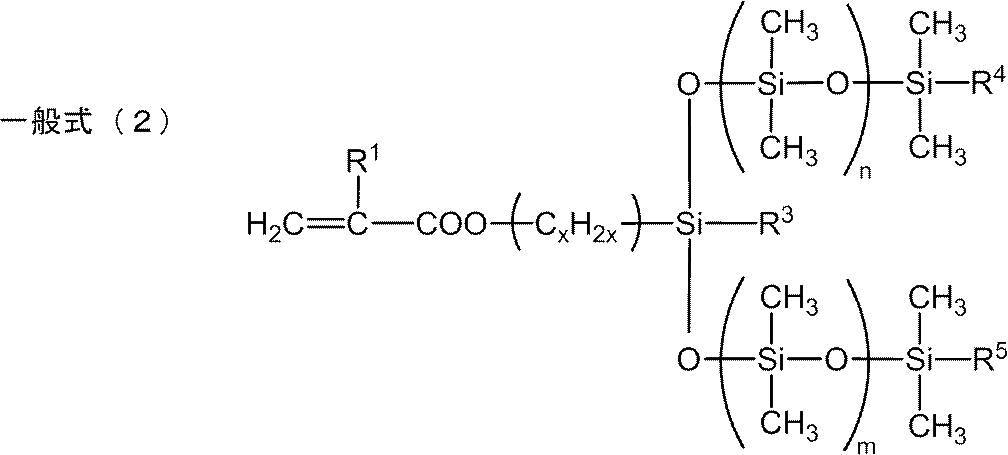
一般式(2)中、R1は、水素原子、又はメチル基を表し、R3、R4及びR5はそれぞれ独立に、水素原子、炭素数1以上4以下のアルキル基、又は炭素数1以上4以下のフルオロアルキル基を表し、m及びnはそれぞれ独立に、0以上1000以下の整数を表し、xは、1以上3以下の整数を表す。
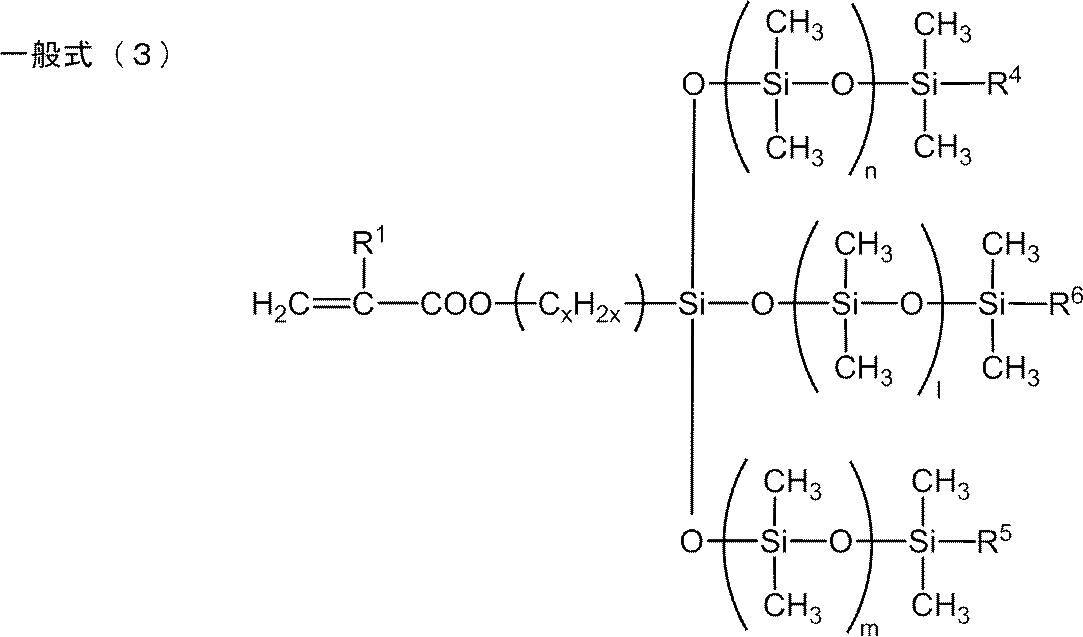
一般式(3)中、R1は、水素原子、又はメチル基を表し、R4、R5及びR6はそれぞれ独立に、水素原子、炭素数1以上4以下のアルキル基、又は炭素数1以上4以下のフルオロアルキル基を表し、l、m及びnはそれぞれ独立に、0以上1000以下の整数を表し、xは、1以上3以下の整数を表す。
一般式(1)で表される化合物としては、例えば、JNC社製のサイラプレーンFM-0711、サイラプレーンFM-0721、サイラプレーンFM-0725;信越化学工業社製のX-22-174DX、X-22-2426、X-22-2475;が挙げられる。
一般式(2)で表される化合物としては、例えば、Gelest社製のMCS-M11が挙げられる。一般式(3)で表される化合物としては、例えば、Gelest社製のRTT-1011が挙げられる。以下にこれらの化合物の構造式を示す。

MCS-M11は、上記の構造式においてm及びnがそれぞれ独立に2以上4以下の整数であり、その分子量が800以上1000以下である。

RTT-1011は、上記の構造式で表される化合物である。
-水酸基含有重合成分(B)-
水酸基含有重合成分(B)としては、エチレン性不飽和結合と、少なくとも1個の水酸基と、を有する化合物であれば特に制限されない。具体例として例えば、2-ヒドロキシエチル(メタ)アクリレート、2-ヒドロキシブチル(メタ)アクリレート、2-ヒドロキシ-3-フェノキシプロピル(メタ)アクリレート、グリセリンモノ(メタ)アクリレート、ポリエチレングリコールモノ(メタ)アクリレート、ポリプロピレングリコールモノ(メタ)アクリレート、ポリエチレングリコール-ポリプロピレングリコール-モノ(メタ)アクリレート、N,N-ヒドロキシエチルアミノエチル(メタ)アクリレート、N,N,N-トリメチル-N-(2-ヒドロキシ-3-メタクリロイルオキシプロピル)アンモニウムクロライドが挙げられる。
水酸基含有重合成分(B)としては、エチレン性不飽和結合と、少なくとも1個の水酸基と、を有する化合物であれば特に制限されない。具体例として例えば、2-ヒドロキシエチル(メタ)アクリレート、2-ヒドロキシブチル(メタ)アクリレート、2-ヒドロキシ-3-フェノキシプロピル(メタ)アクリレート、グリセリンモノ(メタ)アクリレート、ポリエチレングリコールモノ(メタ)アクリレート、ポリプロピレングリコールモノ(メタ)アクリレート、ポリエチレングリコール-ポリプロピレングリコール-モノ(メタ)アクリレート、N,N-ヒドロキシエチルアミノエチル(メタ)アクリレート、N,N,N-トリメチル-N-(2-ヒドロキシ-3-メタクリロイルオキシプロピル)アンモニウムクロライドが挙げられる。
-重合成分(C)-
重合成分(C)としては、例えば、以下の化合物が挙げられる。
重合成分(C)としては、例えば、以下の化合物が挙げられる。
メチル(メタ)アクリレート、エチル(メタ)アクリレート、プロピル(メタ)アクリレート、ブチル(メタ)アクリレート等の(メタ)アクリル酸アルキルエステル;エチレン、プロピレン、ブチレン、イソブチレン等のモノオレフィン;スチレン、α-メチルスチレン、p-メチルスチレン等のスチレン系単量体;酢酸ビニル、プロピオン酸ビニル、安息香酸ビニル、酪酸ビニル等のビニルエステル;ビニルメチルエーテル、ビニルエチルエーテル、ビニルブチルエーテル等のビニルエーテル類;ビニルメチルケトン、ビニルヘキシルケトン、ビニルイソプロペニルケトン等のビニルケトン類;
N-エチルアミノエチル(メタ)アクリレート、N,N-ジメチルアミノエチル(メタ)アクリレート、N,N-ジエチルアミノエチル(メタ)アクリレート、N,N-ジブチルアミノエチル(メタ)アクリレート、N-オクチル-N-エチルアミノエチル(メタ)アクリレート、N,N-ジヘキシルアミノエチル(メタ)アクリレート等の脂肪族アミノ基を有する(メタ)アクリレート類;N-メチルアクリルアミド、N-オクチルアクリルアミド、N-フェニルメチルアクリルアミド、N-シクロヘキシルアクリルアミド、N-フェニルアクリルアミド、N-p-メトキシ-フェニルアクリルアミド、N,N-ジメチルアクリルアミド、N,N-ジブチルアクリルアミド、N-メチル-N-フェニルアクリルアミド等の(メタ)アクリルアミド類;ジメチルアミノスチレン、ジエチルアミノスチレン、ジメチルアミノメチルスチレン、ジオクチルアミノスチレン等の含窒素基を有する芳香族置換エチレン系単量体類;ビニル-N-エチル-N-フェニルアミノエチルエーテル、ビニル-N-ブチル-N-フェニルアミノエチルエーテル、ビニルジフェニルアミノエチルエーテル、N-ビニルヒドロキシエチルベンズアミド、m-アミノフェニルビニルエーテル等の含窒素ビニルエーテル単量体類;
N-ビニルピロール等のピロール類;N-ビニル-2-ピロリン、N-ビニル-3-ピロリン等のピロリン類;N-ビニルピロリジン、ビニルピロリジンアミノエーテル、N-ビニル-2-ピロリドン等のピロリジン類;N-ビニル-2-メチルイミダゾール等のイミダゾール類;N-ビニルイミダゾリン等のイミダゾリン類;N-ビニルインドール等のインドール類;N-ビニルインドリン等のインドリン類;N-ビニルカルバゾール、3,6-ジブロム-N-ビニルカルバゾール等のカルバゾール類;2-ビニルピリジン、4-ビニルピリジン、2-メチル-5-ビニルピロジン等のピリジン類;(メタ)アクリルピペリジン、N-ビニルピペリドン、N-ビニルピペラジン等のピペリジン類;2-ビニルキノリン、4-ビニルキノリン等のキノリン類;N-ビニルピラゾール、N-ビニルピラゾリン等のピラゾール類;2-ビニルオキサゾール等のオキサゾール類;4-ビニルオキサジン、モルホリノエチル(メタ)アクリレート等のオキサジン類;
(メタ)アクリル酸、クロトン酸、イタコン酸、マレイン酸、フマル酸、シトラコン酸、及びこれらの無水物;スチレンスルホン酸、2-アクリルアミド-2-メチルプロパンスルホン酸、2-アクリルアミド-2-メチルプロパンスルホニックアシッド、3-スルホプロピル(メタ)アクリックアシッドエステル、ビス-(3-スルホプロピル)-イタコニックアシッドエステル等及びその塩;ビニルホスホン酸、ビニルホスフェート、アシッドホスホキシエチル(メタ)アクリレート、アシッドホスホキシプロピル(メタ)アクリレート、ビス(メタクリロキシエチル)ホスフェート、ジフェニル-2-メタクリロイルオキシエチルホスフェート、ジフェニル-2-アクリロイルオキシエチルホスフェート、ジブチル-2-メタクリロイルオキシエチルホスフェート、ジブチル-2-アクリロイルオキシエチルホスフェート、ジオクチル-2-(メタ)アクリロイルオキシエチルホスフェート。
水酸基を有するポリマーの重合成分として、水酸基含有重合成分(B)は必須成分であり、シリコーン鎖含有重合成分(A)及び重合成分(C)は、目的に応じて共重合する。
水酸基を有するポリマーに占める水酸基含有重合成分(B)の質量割合は、金属アルコキシド化合物が形成する構造への結合性が良好である点で、10質量%以上が望ましく、20質量%以上がより望ましい。上記の質量割合は、被覆層中に残存する水酸基の量が抑制され、粒子の移動特性(泳動特性)に影響を及ぼしにくい点で、50質量%以下が望ましく、45質量%以下がより望ましい。上記の質量割合は、水酸基を有するポリマーを合成する際の、重合成分の仕込み量の割合である。
水酸基を有するポリマーがシリコーン鎖含有重合成分(A)を含む場合、該重合成分の質量割合は、10質量%以上が望ましく、20質量%以上がより望ましい。10質量%以上(より望ましくは20質量%以上)であると、シリコーン鎖による粒子の固着抑制効果が得られやすい。上記の質量割合は、多くとも、40質量%以下が望ましく、30質量%以下がより望ましい。上記の質量割合は、水酸基を有するポリマーを合成する際の、重合成分の仕込み量の割合である。
水酸基を有するポリマーが重合成分(C)を含む場合、該重合成分の質量割合は、少なくとも、10質量%以上が望ましく、20質量%以上がより望ましい。上記の質量割合は、多くとも、60質量%以下が望ましく、50質量%以下がより望ましく、40質量%以下が更に望ましく、30質量%以下が更に望ましい。上記の質量割合は、水酸基を有するポリマーを合成する際の、重合成分の仕込み量の割合である。
水酸基を有するポリマーの重量平均分子量は、500以上100万以下が望ましく、1000以上50万以下がより望ましく、1万以上30万以下が更に望ましい。
被覆層21、被覆層23、及び被覆層25は、更に、水酸基を有するポリマー以外の化合物を含んでいてもよい。該化合物としては、例えば、重合成分(C)の重合体、シリコーン鎖含有重合成分(A)と重合成分(C)との共重合体が挙げられる。これらの化合物は、例えば、金属アルコキシド化合物の加水分解及び縮重合により形成された架橋構造に、分子間相互作用によって近接して位置し、被覆層に含まれる。
〔被覆層の形成方法〕
被覆層21、被覆層23、及び被覆層25は、例えば、以下の方法で形成される。即ち、金属アルコキシド化合物を含む液体組成物を用意し、該液体組成物を加水分解し得る条件に所定の時間保持した後、セル構成部材表面に塗布し乾燥させる。被覆層の形成に非ポリマー性金属アルコキシド化合物と金属アルコキシ基含有ポリマーの両方を用いる場合、上記液体組成物中の非ポリマー性金属アルコキシド化合物と金属アルコキシ基含有ポリマーとの質量比(非ポリマー性金属アルコキシド化合物:金属アルコキシ基含有ポリマー)は、10:1~1:10が望ましい。
被覆層21、被覆層23、及び被覆層25は、例えば、以下の方法で形成される。即ち、金属アルコキシド化合物を含む液体組成物を用意し、該液体組成物を加水分解し得る条件に所定の時間保持した後、セル構成部材表面に塗布し乾燥させる。被覆層の形成に非ポリマー性金属アルコキシド化合物と金属アルコキシ基含有ポリマーの両方を用いる場合、上記液体組成物中の非ポリマー性金属アルコキシド化合物と金属アルコキシ基含有ポリマーとの質量比(非ポリマー性金属アルコキシド化合物:金属アルコキシ基含有ポリマー)は、10:1~1:10が望ましい。
水酸基を有するポリマーをも被覆層の構成要素とする場合は、上記液体組成物に、水酸基を有するポリマーを添加する。この場合、上記液体組成物中の金属アルコキシド化合物と水酸基を有するポリマーとの質量比(金属アルコキシド化合物:水酸基を有するポリマー)は、10:1~1:10が望ましい。
被覆層を形成するセル構成部材表面は、予め処理剤で処理して、金属アルコキシド化合物と反応し得る官能基を付与しておくことが望ましい。処理剤としては、シランカップリング剤が望ましく、例えば、ビニルトリクロルシラン、ビニルトリス(β-メトキシエトキシ)シラン、ビニルトリエトキシシラン、ビニルトリメトキシシラン、γ-メタクリロキシプロピルトリメトキシシラン、γ-メルカプトプロピルトリメトキシシラン、γ-クロロプロピルトリメトキシシラン、γ-グリシドキシプロピルトリメトキシシラン、γ-グリシドキシプロピルメチルジエトキシシラン、N-β(アミノエチル)-γ-アミノプロピルトリメトキシシラン、N-β(アミノエチル)-γ-アミノプロピルメチルジメトキシシラン、γ-アミノプロピルトリエトキシシランが挙げられる。
〔分散媒〕
分散媒50は、絶縁性液体であることが望ましい。「絶縁性」とは、体積固有抵抗値が1011Ωcm以上であることを意味する。
分散媒50は、絶縁性液体であることが望ましい。「絶縁性」とは、体積固有抵抗値が1011Ωcm以上であることを意味する。
絶縁性液体としては、例えば、ヘキサン、シクロヘキサン、トルエン、キシレン、デカン、ヘキサデカン、ケロセン、パラフィン、イソパラフィン、シリコーンオイル、ジククロロエチレン、トリクロロエチレン、パークロロエチレン、高純度石油、エチレングリコール、アルコール類、エーテル類、エステル類、ジメチルホルムアミド、ジメチルアセトアミド、ジメチルスルホキシド、N-メチルピロリドン、2-ピロリドン、N-メチルホルムアミド、アセトニトリル、テトラヒドロフラン、プロピレンカーボネート、エチレンカーボネート、ベンジン、ジイソプロピルナフタレン、オリーブ油、イソプロパノール、トリクロロトリフルオロエタン、テトラクロロエタン、ジブロモテトラフルオロエタンや、これらの混合物が好適に使用される。中でも、分散媒としては、シリコーンオイルが望ましい。シリコーンオイルとしては、シロキサン結合に炭化水素基が結合したシリコーンオイル(例えば、ジメチルシリコーンオイル、ジエチルシリコーンオイル、メチルエチルシリコーンオイル、メチルフェニルシリコーンオイル、ジフェニルシリコーンオイル)が望ましく、ジメチルシリコーンが特に望ましい。
水も、体積抵抗値103Ωcm以上(望ましくは107Ωcm以上1019Ωcm以下、更に望ましくは1010Ωcm以上1019Ωcm以下)になるように不純物を除去することで、分散媒50として使用し得る。
絶縁性液体には、酸、アルカリ、塩、分散安定剤、酸化防止剤、紫外線吸収剤、抗菌剤、防腐剤等を添加してもよく、ただし、上記体積固有抵抗値の範囲となるように添加することが望ましい。
絶縁性液体には、帯電制御剤として、非イオン性界面活性剤、アニオン性界面活性剤、カチオン性界面活性剤、両性界面活性剤、フッ素系界面活性剤、シリコーン系界面活性剤、金属石鹸、アルキルリン酸エステル類、コハク酸イミド類等を添加してもよい。
非イオン性界面活性剤としては、ポリオキシエチレンノニルフェニルエーテル、ポリオキシエチレンオクチルフェニルエーテル、ポリオキシエチレンドデシルフェニルエーテル、ポリオキシエチレンアルキルエーテル、ポリオキシエチレン脂肪酸エステル、ソルビタン脂肪酸エステル、ポリオキシエチレンソルビタン脂肪酸エステル、脂肪酸アルキロールアミド等が挙げられる。アニオン性界面活性剤としては、アルキルベンゼンスルホン酸塩、アルキルフェニルスルホン酸塩、アルキルナフタリンスルホン酸塩、高級脂肪酸塩、高級脂肪酸エステルの硫酸エステル塩、高級脂肪酸エステルのスルホン酸等が挙げられる。カチオン性界面活性剤としては、第一級アミン塩、第二級アミン塩、第三級アミン塩、第四級アンモニウム塩等が挙げられる。
帯電制御剤の添加量は、分散媒に分散している全粒子固形分に対して0.01質量%以上20質量%以下が望ましく、0.05質量%以上10質量%以下がより望ましい。帯電制御剤の含有量が0.01質量%以上であると、帯電制御効果が発揮されやすく、20質量%以下であると、分散媒の過度な電導度の上昇が抑制される。
分散媒50として、絶縁性液体と共に高分子樹脂を併用してもよい。高分子樹脂としては、アガロース、アガロペクチン、アミロース、アルギン酸ナトリウム、アルギン酸プロピレングリコールエステル、カラギーナン、エチルヒドロキシエチルセルロース、エチルセルロース、カルボキシメチルセルロース、酢酸セルロース、寒天、キチン、キトサン、絹フィブロイン、カゼイン、グアーガム、クラウンゴール多糖、グリコーゲン、グルコマンナン、ケラチン、コラーゲン、ジェランガム、ゼラチン、デキストラン、デンプン、トラガカントゴム、ヒアルロン酸、分解キシログルカン、ペクチン等の天然高分子由来の高分子ゲル;合成高分子のゲル;アルコール、ケトン、エーテル、エステル、及びアミド等の官能基を繰り返し単位中に含む高分子(例えば、ポリビニルアルコール、ポリ(メタ)アクリルアミド、ポリビニルピロリドン、ポリエチレンオキシド);などが挙げられる。中でも、製造安定性、電気泳動特性等の観点から、ゼラチン、ポリビニルアルコール、ポリ(メタ)アクリルアミドが望ましい。
分散媒50は、着色剤の含有により着色していてもよい。着色剤を含有することで、表示媒体12に粒子群34の色とは異なる色を表示させ得る。例えば、分散媒50が白色を示す着色剤を含有し、粒子群34が黒色の場合には、表示媒体12において白色と黒色とを表示する。着色剤としては、フタロシアニン銅系シアン色材、アゾ系イエロー色材、アゾ系マゼンタ色材、キナクリドン系マゼンタ色材、レッド色材、グリーン色材、ブルー色材等の公知の着色剤が挙げられる。より具体的には例えば、アニリンブルー、カルコイルブルー、クロムイエロー、ウルトラマリンブルー、キノリンイエロー、メチレンブルークロリド、フタロシアニンブルー、マラカイトグリーンオキサレート、ランプブラック、ローズベンガル、C.I.ピグメント・レッド48:1、C.I.ピグメント・レッド122、C.I.ピグメント・レッド57:1、C.I.ピグメント・イエロー97、C.I.ピグメント・ブルー15:1、C.I.ピグメント・ブルー15:3が挙げられる。
分散媒50は、絶縁性粒子群の沈降を抑制する観点で、温度25℃下の比重が、0.6g/cm3以上1.2g/cm3以下であることが望ましく、0.7g/cm3以上1.1g/cm3以下がより望ましく、0.7g/cm3以上1.0g/cm3以下が更に望ましい。
分散媒50は、その中で粒子群34が移動することから、粘度を調整することが望ましい。分散媒50の粘度は、粒子の移動速度、即ち、表示速度の観点から、温度20℃下において、0.1mPa・s以上100mPa・s以下であることが望ましく、0.1mPa・s以上50mPa・s以下であることがより望ましく、0.1mPa・s以上20mPa・s以下であることが更に望ましい。分散媒50の粘度の調整は、分散媒の分子構造、分子量、組成等を調整することによって可能である。
〔分散媒中を移動する粒子群〕
粒子群34の個々の粒子は正又は負に帯電している。粒子群34は、表面電極40と背面電極46の間に電圧が印加されて表示基板20と背面基板22の間に電界が形成されることで、分散媒50中を移動する。表示媒体12における表示色の変化は、粒子群34の分散媒50中の移動によって生じる。
粒子群34の個々の粒子は正又は負に帯電している。粒子群34は、表面電極40と背面電極46の間に電圧が印加されて表示基板20と背面基板22の間に電界が形成されることで、分散媒50中を移動する。表示媒体12における表示色の変化は、粒子群34の分散媒50中の移動によって生じる。
粒子群34は、色及び帯電特性が異なる2種類以上の粒子群を含むものでもよい。「帯電特性が異なる」とは、帯電極性及び帯電量の一方が異なること、又は、帯電極性及び帯電量の双方が異なることを意味する。
粒子群34の粒子としては、ガラスビーズ;アルミナ、酸化チタン等の絶縁性の金属酸化物粒子;熱可塑性樹脂粒子又は熱硬化性樹脂粒子;熱可塑性樹脂粒子又は熱硬化性樹脂粒子の表面に着色剤を固定した粒子;熱可塑性樹脂粒子又は熱硬化性樹脂粒子の中に着色剤を含有する粒子;プラズモン発色機能を有する金属コロイド粒子;などが挙げられる。
粒子の製造に使用される熱可塑性樹脂としては、スチレン、クロロスチレン等のスチレン類;エチレン、プロピレン、ブチレン、イソプレン等のモノオレフィン;酢酸ビニル、プロピオン酸ビニル、安息香酸ビニル、酪酸ビニル等のビニルエステル;(メタ)アクリル酸メチル、(メタ)アクリル酸エチル、(メタ)アクリル酸ブチル、(メタ)アクリル酸ドデシル、(メタ)アクリル酸オクチル、(メタ)アクリル酸フェニル等のα-メチレン脂肪族モノカルボン酸エステル類;ビニルメチルエーテル、ビニルエチルエーテル、ビニルブチルエーテル等のビニルエーテル類;ビニルメチルケトン、ビニルヘキシルケトン、ビニルイソプロペニルケトン等のビニルケトン類;の単独重合体又は共重合体が挙げられる。
粒子の製造に使用される熱硬化性樹脂としては、ジビニルベンゼンを主成分とする架橋共重合体、架橋ポリメチルメタクリレート等の架橋樹脂、フェノール樹脂、尿素樹脂、メラミン樹脂、ポリエステル樹脂、シリコーン樹脂等が挙げられる。
粒子の製造に使用される代表的な樹脂としては、ポリスチレン、スチレン-(メタ)アクリル酸アルキル共重合体、スチレン-アクリロニトリル共重合体、スチレン-ブタジエン共重合体、スチレン-無水マレイン酸共重合体、ポリエチレン、ポリプロピレン、ポリエステル、ポリウレタン、エポキシ樹脂、シリコーン樹脂、ポリアミド、変性ロジン、パラフィンワックス等が挙げられる。
粒子の製造に使用される樹脂としては、粒子を帯電させるために、帯電基を有する樹脂が好適である。帯電基を有する樹脂は、カチオン性基又はアニオン性基を有する樹脂である。カチオン性基により粒子に正帯電性が付与され、アニオン性基により粒子に負帯電性が付与される。帯電基としてのカチオン性基としては、例えば、アミン基、4級アンモニウム基が挙げられる(これら基の塩も含む)。帯電基としてのアニオン性基としては、例えば、カルボキシル基、カルボン酸塩基、スルホン酸基、スルホン酸塩基、リン酸基、及びリン酸塩基が挙げられる。
帯電基を有する高分子として、具体的には、例えば、帯電基を有する単量体の単独重合体、帯電基を有する単量体と他の単量体(帯電基を有しない単量体)との共重合体が挙げられる。帯電基を有する単量体としては、例えば、カチオン性基を有する単量体(「カチオン性単量体」という。)、アニオン性基を有する単量体(「アニオン性単量体」という。)が挙げられる。
カチオン性単量体としては、例えば、以下の単量体が挙げられる。N-エチルアミノエチル(メタ)アクリレート、N,N-ジメチルアミノエチル(メタ)アクリレート、N,N-ジエチルアミノエチル(メタ)アクリレート、N,N-ジブチルアミノエチル(メタ)アクリレート、N,N-ヒドロキシエチルアミノエチル(メタ)アクリレート、N-オクチル-N-エチルアミノエチル(メタ)アクリレート、N,N-ジヘキシルアミノエチル(メタ)アクリレート等の脂肪族アミノ基を有する(メタ)アクリレート類;N-メチルアクリルアミド、N-オクチルアクリルアミド、N-フェニルメチルアクリルアミド、N-シクロヘキシルアクリルアミド、N-フェニルアクリルアミド、N-p-メトキシ-フェニルアクリルアミド、N,N-ジメチルアクリルアミド、N,N-ジブチルアクリルアミド、N-メチル-N-フェニルアクリルアミド等の(メタ)アクリルアミド類;ジメチルアミノスチレン、ジエチルアミノスチレン、ジメチルアミノメチルスチレン、ジオクチルアミノスチレン等の含窒素基を有する芳香族置換エチレン系単量体類;ビニル-N-エチル-N-フェニルアミノエチルエーテル、ビニル-N-ブチル-N-フェニルアミノエチルエーテル、トリエタノールアミンジビニルエーテル、ビニルジフェニルアミノエチルエーテル、N-ビニルヒドロキシエチルベンズアミド、m-アミノフェニルビニルエーテル等の含窒素ビニルエーテル単量体類。
カチオン性単量体としては、例えば、以下の含窒素複素環式化合物も挙げられる。N-ビニルピロール等のピロール類;N-ビニル-2-ピロリン、N-ビニル-3-ピロリン等のピロリン類;N-ビニルピロリジン、ビニルピロリジンアミノエーテル、N-ビニル-2-ピロリドン等のピロリジン類;N-ビニル-2-メチルイミダゾール等のイミダゾール類;N-ビニルイミダゾリン等のイミダゾリン類;N-ビニルインドール等のインドール類;N-ビニルインドリン等のインドリン類;N-ビニルカルバゾール、3,6-ジブロム-N-ビニルカルバゾール等のカルバゾール類;2-ビニルピリジン、4-ビニルピリジン、2-メチル-5-ビニルピロジン等のピリジン類;(メタ)アクリルピペリジン、N-ビニルピペリドン、N-ビニルピペラジン等のピペリジン類、2-ビニルキノリン、4-ビニルキノリン等のキノリン類;N-ビニルピラゾール、N-ビニルピラゾリン等のピラゾール類、2-ビニルオキサゾール等のオキサゾール類;4-ビニルオキサジン、モルホリノエチル(メタ)アクリレート等のオキサジン類。
アニオン性単量体としては、例えば、カルボン酸モノマー、スルホン酸モノマー、リン酸モノマーが挙げられる。
カルボン酸モノマーとしては、例えば、 (メタ)アクリル酸、クロトン酸、イタコン酸、マレイン酸、フマル酸、シトラコン酸、及びこれらの無水物;カルボン酸のモノアルキルエステル;カルボキシエチルビニルエーテル、カルボキシプロピルビニルエーテル等のカルボキシル基を有するビニルエーテル類、及びその塩;が挙げられる。
スルホン酸モノマーとしては、例えば、スチレンスルホン酸、2-アクリルアミド-2-メチルプロパンスルホン酸、3-スルホプロピル(メタ)アクリックアシッドエステル、ビス-(3-スルホプロピル)-イタコニックアシッドエステル、2-ヒドロキシエチル(メタ)アクリル酸の硫酸モノエステル、及びこれらの塩が挙げられる。
リン酸モノマーとしては、例えば、ビニルホスホン酸、ビニルホスフェート、アシッドホスホキシエチル(メタ)アクリレート、アシッドホスホキシプロピル(メタ)アクリレート、ビス(メタクリロキシエチル)ホスフェート、ジフェニル-2-メタクリロイルオキシエチルホスフェート、ジフェニル-2-アクリロイルオキシエチルホスフェート、ジブチル-2-メタクリロイルオキシエチルホスフェート、ジブチル-2-アクリロイルオキシエチルホスフェート、ジオクチル-2-(メタ)アクリロイルオキシエチルホスフェートが挙げられる。
他の単量体としては、例えば、水溶性単量体(例えば水酸基を有する単量体等)が挙げられ、具体的には、例えば、ヒドロキシエチル(メタ)アクリレート、ヒドロキシブチル(メタ)アクリレート、グリセリンモノ(メタ)アクリレート、ポリエチレングリコールモノ(メタ)アクリレート、ポリプロピレングリコールモノ(メタ)アクリレートが挙げられる。
粒子群34の粒子の製造に使用される着色剤としては、有機顔料、無機顔料、油溶性染料等が挙げられる。具体的には、例えば、マグネタイト、フェライト等の磁性紛;カーボンブラック;酸化チタン、酸化マグネシウム、酸化亜鉛等の金属酸化物;フタロシアニン銅系シアン色材、アゾ系イエロー色材、アゾ系マゼンタ色材、キナクリドン系マゼンタ色材、レッド色材、グリーン色材、ブルー色材等の公知の着色剤;が挙げられる。着色剤としては、より具体的には例えば、アニリンブルー、カルコイルブルー、クロムイエロー、ウルトラマリンブルー、デュポンオイルレッド、キノリンイエロー、メチレンブルークロリド、フタロシアニンブルー、マラカイトグリーンオキサレート、ランプブラック、ローズベンガル、C.I.ピグメント・レッド48:1、C.I.ピグメント・レッド122、C.I.ピグメント・レッド57:1、C.I.ピグメント・イエロー97、C.I.ピグメント・ブルー15:1、C.I.ピグメント・ブルー15:3が挙げられる。
着色剤の使用量は、粒子に含まれる樹脂の量に対し10質量%以上99質量%以下が望ましく、30質量%以上99質量%以下がより望ましい。
粒子群34の粒子は、帯電制御剤を含有してもよい。帯電制御剤としては、電子写真用トナー材料に使用される公知の材料が使用でき、例えば、セチルピリジルクロライド、第4級アンモニウム塩、サリチル酸系金属錯体、フェノール系縮合物、テトラフェニル系化合物、酸化金属粒子、各種カップリング剤により表面処理された酸化金属粒子が挙げられる。
粒子群34の粒子は、磁性材料を含有してもよい。磁性材料は、目的に応じて、透明な磁性材料又は着色した磁性材料を使用する。着色した磁性材料として、例えば、特開2003-131420号公報に記載の小径着色磁性粉が挙げられる。
粒子群34の粒子の表面には、外添剤を付着させてもよい。外添剤の色は、粒子群34の色に影響を与えないように、透明であることが望ましい。
外添剤としては、酸化ケイ素(シリカ)、酸化チタン、アルミナ等の金属酸化物等の無機粒子が用いられる。粒子群34の粒子の帯電性、流動性、及び環境依存性等を調整するために、これらをカップリング剤やシリコーンオイルで表面処理してもよい。カップリング剤としては、アミノシラン系カップリング剤、アミノチタン系カップリング剤、ニトリル系カップリング剤等の正帯電性カップリング剤;窒素原子を含まない、シラン系カップリング剤、チタン系カップリング剤、エポキシシランカップリング剤、アクリルシランカップリング剤等の負帯電性カップリング剤;が挙げられる。シリコーンオイルとしては、アミノ変性シリコーンオイル等の正帯電性シリコーンオイル;α-メチルスルホン変性シリコーンオイル等の負帯電性シリコーンオイル;ジメチルシリコーンオイル、アルキル変性シリコーンオイル、メチルフェニルシリコーンオイル、クロルフェニルシリコーンオイル、フッ素変性シリコーンオイル等の無帯電性シリコーンオイル;が挙げられる。
外添剤の一次粒子は、1nm以上100nm以下が望ましく、5nm以上50nm以下がより望ましい。
外添剤の外添量は、粒子群34の粒子の粒径と外添剤の粒径の兼ね合いで調製することが望ましい。外添剤の添加量が多過ぎると、粒子表面から外添剤の少なくとも一部が遊離し、これが他の種類の粒子の表面に付着して、所望の帯電特性が得られない。一般的には、外添剤の量は、粒子100質量部に対して、0.01質量部以上3質量部以下が望ましく、0.05質量部以上1質量部以下がより望ましい。
外添剤は、複数種類の粒子群34のいずれか1種にだけ添加してもよいし、複数種又は全種類の粒子群34に添加してもよい。全粒子の表面に外添剤を添加する場合は、粒子表面に外添剤を衝撃力で打込んだり、粒子表面を加熱して外添剤を粒子表面に強固に固着したりすることが望ましい。これにより、外添剤が粒子から遊離し異極性の外添剤が凝集した凝集体を形成することが抑制され、延いては画質劣化が抑制される。
粒子群34を作製する方法としては、従来公知のいずれの方法を用いてもよい。例えば、樹脂を加熱溶融させた後に顔料や帯電制御剤を添加して混合し分散させ、冷却した後、粉砕機を用いて粒子を調製し、分散媒に分散する方法が適用される。また、懸濁重合、乳化重合、分散重合等の重合法やエマルジョン凝集法により顔料や帯電制御剤を含む粒子を調製し、分散媒に分散する方法が適用される。また、樹脂、顔料、電制御剤を分散媒中で加熱溶融し、樹脂の溶媒溶解度の温度依存性を利用して、溶融混合物を攪拌しながら冷却し、凝固及び析出させて粒子を作製する方法が適用される。
セル中に封入されている全成分に占める粒子群34の質量割合(粒子群34の濃度)は、所望の色相が得られる濃度であれば特に限定されるものではなく、セルの厚さ(即ち、表示基板20と背面基板22との距離)に応じて調整する。即ち、所望の色相を得るために、セルが厚くなるほど濃度を低くし、セルが薄くなるほど濃度を高くする。一般的に、粒子群34の濃度は0.01質量%以上50質量%以下である。
〔絶縁性粒子群〕
絶縁性粒子群36は、粒子群34とは異なる光学的反射特性を有する粒子群であり、粒子群34とは異なる色を表示する反射部材として機能する。
絶縁性粒子群36は、粒子群34とは異なる光学的反射特性を有する粒子群であり、粒子群34とは異なる色を表示する反射部材として機能する。
絶縁性粒子群36は、電界応答性が低い粒子群であり、絶縁性粒子群36の間隙を通って、粒子群34が基板間を移動する。絶縁性粒子群36は、例えば、粒子群34の粒子よりも粒径が大きい粒子である。絶縁性粒子群36の粒子同士は、粒子群34が通過する間隙を有しつつ、互いに結合していてもよい。
絶縁性粒子群36は、白色の場合、例えば、酸化チタン、酸化ケイ素、酸化亜鉛等の白色顔料を、ポリスチレン、ポリエチレン、ポリプロピレン、ポリカーボネート、ポリメチルメタクリレート、アクリル樹脂、フェノール樹脂、ホルムアルデヒド縮合物等の樹脂に分散させた粒子である。絶縁性粒子群36が白色以外の場合は、樹脂粒子に所望の色の顔料又は染料を内包させればよい。
〔表示装置〕
表示装置10は、図1に示すように、表示媒体12と、表示媒体12に電圧を印加する電圧印加部16と、電圧印加部16の駆動を制御する制御部18と、を備える。
表示装置10は、図1に示すように、表示媒体12と、表示媒体12に電圧を印加する電圧印加部16と、電圧印加部16の駆動を制御する制御部18と、を備える。
電圧印加部16は、表面電極40及び背面電極46に電気的に接続されている。また、電圧印加部16は、制御部18に信号授受可能に接続されている。
以下、表面電極40及び背面電極46の双方が、電圧印加部16に電気的に接続された態様を説明するが、表面電極40及び背面電極46の一方が接地されており、他方が電圧印加部16に接続された態様であってもよい。
電圧印加部16は、表面電極40及び背面電極46に電圧を印加するための電圧印加装置であり、制御部18の制御に応じた電圧を表面電極40及び背面電極46間に印加する。
制御部18は、装置全体の動作を司るCPU(central processing unit)と、各種データを一時的に記憶するRAM(random access memory)と、装置全体を制御する制御プログラム等の各種プログラムが予め記憶されたROM(read only memory)と、を含むマイクロコンピュータであってもよい。
次に、表示装置10の作用を説明する。以下、分散媒50が透明であり、粒子群34が黒色で負帯電であり、絶縁性粒子群36が白色であるものとして説明する。この場合の表示媒体12は、粒子群34の移動によって黒色又は白色を表示する。
まず、表面電極40が負極となり背面電極46が正極となるように電圧を所定時間印加することを指示する動作信号を、制御部18が電圧印加部16へ出力する。電極間に印加される電圧が上昇すると、負帯電の粒子群34が背面基板22側へと移動して、背面基板22に到る(図2Aに示す状態)。このとき、表示基板20側から視認される表示媒体12の色は、絶縁性粒子群36の色である白色である。
次に、電圧の極性を反転させて、表面電極40が正極となり背面電極46が負極となるように電圧を所定時間印加することを指示する動作信号を、制御部18が電圧印加部16へ出力する。電極間に印加される電圧が上昇すると、粒子群34が移動して表示基板20側に到る(図2Bに示す状態)。この状態において表示基板20側から視認される表示媒体12の色は、粒子群34の色である黒色である。
このようにして、表示装置10では、粒子群34が表示基板20又は背面基板22に到達して付着することで表示が行われる。表示基板20の対向面及び背面基板22の対向面が被覆層21及び被覆層23を有することで、両対向面に粒子群34が固着することが抑制され、その結果、表示媒体12において色再現性や高いコントラストが実現される。
上記においては、粒子群34として1種類(1色)の粒子群を備える態様を説明したが、これに限らず、帯電極性が異なる又は閾値電圧の異なる組合せで、2種類(2色)以上の粒子群34を備える態様であってもよい。具体的には、例えば、着色粒子群34として、正帯電性の第1粒子群、負帯電性の第2粒子群、及び、正帯電性で第1粒子群の粒子とは閾値電圧が異なり且つ粒径が大きい第3粒子群を備える態様が挙げられる。
以下に実施例を挙げて、本発明をより詳細に説明するが、本発明は以下の実施例にのみ限定されるものではない。
以下の説明において、特に断りのない限り、「部」は質量基準である。
<白色粒子(絶縁性粒子)の作製>
〔分散液A1の調製〕
下記の材料を混合し、直径10mmのジルコニアボールにてボールミル粉砕を20時間行って分散液A1を調製した。
・メタクリル酸シクロヘキシル 53部
・酸化チタン(一次粒径0.3μm、石原産業社製タイペークCR63) 45部
・シクロヘキサン 5部
〔分散液A1の調製〕
下記の材料を混合し、直径10mmのジルコニアボールにてボールミル粉砕を20時間行って分散液A1を調製した。
・メタクリル酸シクロヘキシル 53部
・酸化チタン(一次粒径0.3μm、石原産業社製タイペークCR63) 45部
・シクロヘキサン 5部
〔炭酸カルシウム分散液B1の調製〕
下記の材料を混合し、直径10mmのジルコニアボールにてボールミル粉砕を20時間行って炭酸カルシウム分散液B1を調製した。
・炭酸カルシウム 40部
・水 60部
下記の材料を混合し、直径10mmのジルコニアボールにてボールミル粉砕を20時間行って炭酸カルシウム分散液B1を調製した。
・炭酸カルシウム 40部
・水 60部
〔混合液C1の調製〕
下記の材料を混合し、超音波機で脱気を10分間行い、次いで乳化機で攪拌して混合液C1を調製した。
・カルボキシメチルセルロースナトリウムの2質量%水溶液(第一工業製薬社製セロゲン(登録商標)の水溶液) 4.3g
・炭酸カルシウム分散液B1 8.5g
・20質量%食塩水 50g
下記の材料を混合し、超音波機で脱気を10分間行い、次いで乳化機で攪拌して混合液C1を調製した。
・カルボキシメチルセルロースナトリウムの2質量%水溶液(第一工業製薬社製セロゲン(登録商標)の水溶液) 4.3g
・炭酸カルシウム分散液B1 8.5g
・20質量%食塩水 50g
〔白色粒子の調製〕
分散液A1を35g、ジビニルベンゼン1g、及びアゾビスイソブチロニトリル(重合開始剤)0.35gを混合し、超音波機で脱気を10分間行った。これを、混合液C1に加え、乳化機で乳化し乳化液を調製した。この乳化液をガラス容器に入れシリコーン栓をし、注射針をシリコーン栓に刺し込んで減圧脱気を行い、窒素ガスで封入した。次に65℃で15時間反応させて粒子を調製し、粒子の分散液を得た。この分散液を冷却後、凍結乾燥(-35℃/0.1Pa/2日間)させてシクロヘキサンを除去し粒子粉を得た。次いで、粒子粉をイオン交換水中に分散し、塩酸水で炭酸カルシウムを分解し、濾過を行った。次いで、蒸留水で洗浄し、目開き20μm×25μmのナイロン篩にかけて粒度を揃えた。これを乾燥させ、体積平均粒径20μmの白色粒子(絶縁性粒子)を得た。
分散液A1を35g、ジビニルベンゼン1g、及びアゾビスイソブチロニトリル(重合開始剤)0.35gを混合し、超音波機で脱気を10分間行った。これを、混合液C1に加え、乳化機で乳化し乳化液を調製した。この乳化液をガラス容器に入れシリコーン栓をし、注射針をシリコーン栓に刺し込んで減圧脱気を行い、窒素ガスで封入した。次に65℃で15時間反応させて粒子を調製し、粒子の分散液を得た。この分散液を冷却後、凍結乾燥(-35℃/0.1Pa/2日間)させてシクロヘキサンを除去し粒子粉を得た。次いで、粒子粉をイオン交換水中に分散し、塩酸水で炭酸カルシウムを分解し、濾過を行った。次いで、蒸留水で洗浄し、目開き20μm×25μmのナイロン篩にかけて粒度を揃えた。これを乾燥させ、体積平均粒径20μmの白色粒子(絶縁性粒子)を得た。
<マゼンタ粒子の作製>
〔分散液A2の調製〕
下記の材料を混合し、直径10mmのジルコニアボールにてボールミル粉砕を20時間行って分散液A2を調製した。
・メタクリル酸シクロヘキシル 53部
・マゼンタ顔料(カーミン6B、大日精化社製) 3部
・帯電制御剤 2部
(クラリアントジャパン社製COPY CHARGE NY VP2351)
・シクロヘキサン 5部
〔分散液A2の調製〕
下記の材料を混合し、直径10mmのジルコニアボールにてボールミル粉砕を20時間行って分散液A2を調製した。
・メタクリル酸シクロヘキシル 53部
・マゼンタ顔料(カーミン6B、大日精化社製) 3部
・帯電制御剤 2部
(クラリアントジャパン社製COPY CHARGE NY VP2351)
・シクロヘキサン 5部
〔炭酸カルシウム分散液B2の調製〕
下記の材料を混合し、直径10mmのジルコニアボールにてボールミル粉砕を20時間行って炭酸カルシウム分散液B2を調製した。
・炭酸カルシウム 40部
・水 60部
下記の材料を混合し、直径10mmのジルコニアボールにてボールミル粉砕を20時間行って炭酸カルシウム分散液B2を調製した。
・炭酸カルシウム 40部
・水 60部
〔混合液C2の調製〕
下記の材料を混合し、超音波機で脱気を10分間行い、次いで乳化機で攪拌して混合液C2を調製した。
・カルボキシメチルセルロースナトリウムの2質量%水溶液(第一工業製薬社製セロゲン(登録商標)の水溶液) 4.3g
・炭酸カルシウム分散液B2 8.5g
・20質量%食塩水 50g
下記の材料を混合し、超音波機で脱気を10分間行い、次いで乳化機で攪拌して混合液C2を調製した。
・カルボキシメチルセルロースナトリウムの2質量%水溶液(第一工業製薬社製セロゲン(登録商標)の水溶液) 4.3g
・炭酸カルシウム分散液B2 8.5g
・20質量%食塩水 50g
〔マゼンタ粒子の調製〕
分散液A2を35g、ジビニルベンゼン1g、及びアゾビスイソブチロニトリル(重合開始剤)0.35gを混合し、超音波機で脱気を10分間行った。これを、混合液C2に加え、乳化機で乳化し乳化液を調製した。この乳化液をガラス容器に入れシリコーン栓をし、注射針をシリコーン栓に刺し込んで減圧脱気を行い、窒素ガスで封入した。次に60℃で10時間反応させて粒子を調製し、粒子の分散液を得た。この分散液を冷却後、凍結乾燥(-35℃/0.1Pa/2日間)させてシクロヘキサンを除去し粒子粉を得た。次いで、粒子粉をイオン交換水中に分散し、塩酸水で炭酸カルシウムを分解し、濾過を行った。次いで、蒸留水で洗浄し、これを乾燥させた。得られた粒子2部をノニオン系界面活性剤ポリオキシエチレンアルキルエーテル2部と共に、ジメチルシリコーンオイル(信越化学工業社製KF-96L-1cs)98部に投入し、攪拌分散してマゼンタ粒子の分散液を調製した。マゼンタ粒子の体積平均粒径は1μmであった。
分散液A2を35g、ジビニルベンゼン1g、及びアゾビスイソブチロニトリル(重合開始剤)0.35gを混合し、超音波機で脱気を10分間行った。これを、混合液C2に加え、乳化機で乳化し乳化液を調製した。この乳化液をガラス容器に入れシリコーン栓をし、注射針をシリコーン栓に刺し込んで減圧脱気を行い、窒素ガスで封入した。次に60℃で10時間反応させて粒子を調製し、粒子の分散液を得た。この分散液を冷却後、凍結乾燥(-35℃/0.1Pa/2日間)させてシクロヘキサンを除去し粒子粉を得た。次いで、粒子粉をイオン交換水中に分散し、塩酸水で炭酸カルシウムを分解し、濾過を行った。次いで、蒸留水で洗浄し、これを乾燥させた。得られた粒子2部をノニオン系界面活性剤ポリオキシエチレンアルキルエーテル2部と共に、ジメチルシリコーンオイル(信越化学工業社製KF-96L-1cs)98部に投入し、攪拌分散してマゼンタ粒子の分散液を調製した。マゼンタ粒子の体積平均粒径は1μmであった。
分散液中のマゼンタ粒子の帯電極性を、2枚の電極基板間に該分散液を封入し、直流電圧を印加して泳動方向を観察して評価したところ、正帯電であった。
<実施例1>
〔被覆層形成用塗布液1の調製〕
下記の材料を混合し、20℃にて2時間攪拌して加水分解を行い、ゾル状の被覆層形成用塗布液1を得た。
・テトラエトキシシラン 0.62g
・エタノール 4.70g
・水 4.70g
・硝酸水溶液(1N) 0.10g
〔被覆層形成用塗布液1の調製〕
下記の材料を混合し、20℃にて2時間攪拌して加水分解を行い、ゾル状の被覆層形成用塗布液1を得た。
・テトラエトキシシラン 0.62g
・エタノール 4.70g
・水 4.70g
・硝酸水溶液(1N) 0.10g
〔表示媒体1の作製〕
ガラス板(50.0mm×50.0mm×0.7mm)の一方の面に、電極としてITO(酸化インジウムスズ)をスパッタリング法によって50nmの厚さで成膜した。このITO/ガラス基板を、表示基板用及び背面基板用に2枚作製した。そして、ITO/ガラス基板の電極面をγ-アミノプロピルトリエトキシシランの2質量%水溶液に15分間浸漬し、純水でリンスした後、120℃にて30分間の乾燥を行った。次いで、電極面に被覆層形成用塗布液1を塗布し、120℃にて60分間の加熱を行って、厚さ200nmの被覆層を形成し、表示基板及び背面基板を得た。被覆層の厚さはDektak 6M 段差計(Veeco社製)にて測定した。
ガラス板(50.0mm×50.0mm×0.7mm)の一方の面に、電極としてITO(酸化インジウムスズ)をスパッタリング法によって50nmの厚さで成膜した。このITO/ガラス基板を、表示基板用及び背面基板用に2枚作製した。そして、ITO/ガラス基板の電極面をγ-アミノプロピルトリエトキシシランの2質量%水溶液に15分間浸漬し、純水でリンスした後、120℃にて30分間の乾燥を行った。次いで、電極面に被覆層形成用塗布液1を塗布し、120℃にて60分間の加熱を行って、厚さ200nmの被覆層を形成し、表示基板及び背面基板を得た。被覆層の厚さはDektak 6M 段差計(Veeco社製)にて測定した。
フッ素樹脂シート(厚さ100μm×幅20μm)の側面(セル構成面となる面)に上記と同様にして被覆層を形成し、これを間隙部材とした。この間隙部材を介して表示基板と背面基板とを重ね、クリップで固定した。
表示基板、背面基板、及び間隙部材で囲まれた空間(セル)に、白色粒子、マゼンタ粒子の分散液、及びジメチルシリコーンオイル(信越化学工業社製KF-96L-1cs)を、白色粒子の固形分濃度が20質量%、マゼンタ粒子の固形分濃度が1質量%となるように充填し、充填部を封止した。こうして、図1に図示した表示媒体と同様な構成の表示媒体1を得た。
<実施例2>
〔トリエトキシシラン含有ポリマー1の調製〕
金属アルコキシ基含有重合成分である3-メタクリロイルプロピルトリエトキシシラン21.8部、シリコーン鎖含有重合成分(A)であるサイラプレーンFM-0711(JNC社製、重量平均分子量1000)15.4部、及び重合成分(C)であるメチルメタクリレート15.3部を、プロピレングリコールモノメチルエーテル100部と混合し、重合開始剤としてアゾビスジメチルバレロニトリル(和光純薬工業製V-65)を0.5部添加して、55℃にて10時間重合反応させ、金属アルコキシ基含有ポリマーであるトリエトキシシラン含有ポリマー1の溶液(固形分量35質量%)を調製した。このポリマーの重量平均分子量は6.5万であった。
〔トリエトキシシラン含有ポリマー1の調製〕
金属アルコキシ基含有重合成分である3-メタクリロイルプロピルトリエトキシシラン21.8部、シリコーン鎖含有重合成分(A)であるサイラプレーンFM-0711(JNC社製、重量平均分子量1000)15.4部、及び重合成分(C)であるメチルメタクリレート15.3部を、プロピレングリコールモノメチルエーテル100部と混合し、重合開始剤としてアゾビスジメチルバレロニトリル(和光純薬工業製V-65)を0.5部添加して、55℃にて10時間重合反応させ、金属アルコキシ基含有ポリマーであるトリエトキシシラン含有ポリマー1の溶液(固形分量35質量%)を調製した。このポリマーの重量平均分子量は6.5万であった。
〔被覆層形成用塗布液2の調製〕
下記の材料を混合し、20℃にて2時間攪拌して加水分解を行い、ゾル状の被覆層形成用塗布液2を得た。
・トリエトキシシラン含有ポリマー1の溶液 4.00g
・エタノール 4.70g
・水 4.70g
・硝酸水溶液(1N) 0.10g
下記の材料を混合し、20℃にて2時間攪拌して加水分解を行い、ゾル状の被覆層形成用塗布液2を得た。
・トリエトキシシラン含有ポリマー1の溶液 4.00g
・エタノール 4.70g
・水 4.70g
・硝酸水溶液(1N) 0.10g
〔表示媒体2の作製〕
被覆層形成用塗布液1を被覆層形成用塗布液2に変更した以外は実施例1と同様の方法で表示媒体2を作製した。
被覆層形成用塗布液1を被覆層形成用塗布液2に変更した以外は実施例1と同様の方法で表示媒体2を作製した。
<実施例3>
〔被覆層形成用塗布液3の調製〕
下記の材料を混合し、20℃にて2時間攪拌して加水分解を行い、ゾル状の被覆層形成用塗布液3を得た。
・テトラエトキシシラン 0.62g
・トリエトキシシラン含有ポリマー1の溶液 4.00g
・エタノール 4.70g
・水 4.70g
・硝酸水溶液(1N) 0.10g
〔被覆層形成用塗布液3の調製〕
下記の材料を混合し、20℃にて2時間攪拌して加水分解を行い、ゾル状の被覆層形成用塗布液3を得た。
・テトラエトキシシラン 0.62g
・トリエトキシシラン含有ポリマー1の溶液 4.00g
・エタノール 4.70g
・水 4.70g
・硝酸水溶液(1N) 0.10g
〔表示媒体3の作製〕
被覆層形成用塗布液1を被覆層形成用塗布液3に変更した以外は実施例1と同様の方法で表示媒体3を作製した。
被覆層形成用塗布液1を被覆層形成用塗布液3に変更した以外は実施例1と同様の方法で表示媒体3を作製した。
<実施例4>
〔水酸基を有するポリマー1の調製〕
水酸基含有重合成分(B)である2-ヒドロキシエチルメタクリレート21.8部、及び重合成分(C)であるメチルメタクリレート30.7部を、プロピレングリコールモノメチルエーテル100部と混合し、重合開始剤としてアゾビスジメチルバレロニトリル(和光純薬工業製V-65)を0.5部添加して、55℃にて10時間重合反応させ、水酸基を有するポリマー1の溶液(固形分量35質量%)を調製した。このポリマーの重量平均分子量は6.5万であった。
〔水酸基を有するポリマー1の調製〕
水酸基含有重合成分(B)である2-ヒドロキシエチルメタクリレート21.8部、及び重合成分(C)であるメチルメタクリレート30.7部を、プロピレングリコールモノメチルエーテル100部と混合し、重合開始剤としてアゾビスジメチルバレロニトリル(和光純薬工業製V-65)を0.5部添加して、55℃にて10時間重合反応させ、水酸基を有するポリマー1の溶液(固形分量35質量%)を調製した。このポリマーの重量平均分子量は6.5万であった。
〔被覆層形成用塗布液4の調製〕
下記の材料を混合し、20℃にて2時間攪拌して加水分解を行い、ゾル状の被覆層形成用塗布液4を得た。
・テトラエトキシシラン 0.62g
・水酸基を有するポリマー1の溶液 4.00g
・エタノール 4.70g
・水 4.70g
・硝酸水溶液(1N) 0.10g
下記の材料を混合し、20℃にて2時間攪拌して加水分解を行い、ゾル状の被覆層形成用塗布液4を得た。
・テトラエトキシシラン 0.62g
・水酸基を有するポリマー1の溶液 4.00g
・エタノール 4.70g
・水 4.70g
・硝酸水溶液(1N) 0.10g
〔表示媒体4の作製〕
被覆層形成用塗布液1を被覆層形成用塗布液4に変更した以外は実施例1と同様の方法で表示媒体4を作製した。
被覆層形成用塗布液1を被覆層形成用塗布液4に変更した以外は実施例1と同様の方法で表示媒体4を作製した。
<実施例5>
〔水酸基を有するポリマー2の調製〕
シリコーン鎖含有重合成分(A)であるサイラプレーンFM-0711(JNC社製、重量平均分子量1000)15.4部、水酸基含有重合成分(B)である2-ヒドロキシエチルメタクリレート21.8部、及び重合成分(C)であるメチルメタクリレート15.3部を、プロピレングリコールモノメチルエーテル100部と混合し、重合開始剤としてアゾビスジメチルバレロニトリル(和光純薬工業製V-65)を0.5部添加して、55℃にて10時間重合反応させ、水酸基を有するポリマー2の溶液(固形分量35質量%)を調製した。このポリマーの重量平均分子量は6.5万であった。
〔水酸基を有するポリマー2の調製〕
シリコーン鎖含有重合成分(A)であるサイラプレーンFM-0711(JNC社製、重量平均分子量1000)15.4部、水酸基含有重合成分(B)である2-ヒドロキシエチルメタクリレート21.8部、及び重合成分(C)であるメチルメタクリレート15.3部を、プロピレングリコールモノメチルエーテル100部と混合し、重合開始剤としてアゾビスジメチルバレロニトリル(和光純薬工業製V-65)を0.5部添加して、55℃にて10時間重合反応させ、水酸基を有するポリマー2の溶液(固形分量35質量%)を調製した。このポリマーの重量平均分子量は6.5万であった。
〔被覆層形成用塗布液5の調製〕
下記の材料を混合し、20℃にて2時間攪拌して加水分解を行い、ゾル状の被覆層形成用塗布液5を得た。
・テトラエトキシシラン 0.62g
・水酸基を有するポリマー2の溶液 4.00g
・エタノール 4.70g
・水 4.70g
・硝酸水溶液(1N) 0.10g
下記の材料を混合し、20℃にて2時間攪拌して加水分解を行い、ゾル状の被覆層形成用塗布液5を得た。
・テトラエトキシシラン 0.62g
・水酸基を有するポリマー2の溶液 4.00g
・エタノール 4.70g
・水 4.70g
・硝酸水溶液(1N) 0.10g
〔表示媒体5の作製〕
被覆層形成用塗布液1を被覆層形成用塗布液5に変更した以外は実施例1と同様の方法で表示媒体5を作製した。
被覆層形成用塗布液1を被覆層形成用塗布液5に変更した以外は実施例1と同様の方法で表示媒体5を作製した。
<実施例6>
〔被覆層形成用塗布液6の調製〕
下記の材料を混合し、20℃にて2時間攪拌して加水分解を行い、ゾル状の被覆層形成用塗布液6を得た。
・テトライソプロポキシチタン 0.62g
・水酸基を有するポリマー2の溶液 4.00g
・エタノール 4.70g
・水 4.70g
・硝酸水溶液(1N) 0.10g
〔被覆層形成用塗布液6の調製〕
下記の材料を混合し、20℃にて2時間攪拌して加水分解を行い、ゾル状の被覆層形成用塗布液6を得た。
・テトライソプロポキシチタン 0.62g
・水酸基を有するポリマー2の溶液 4.00g
・エタノール 4.70g
・水 4.70g
・硝酸水溶液(1N) 0.10g
〔表示媒体6の作製〕
被覆層形成用塗布液1を被覆層形成用塗布液6に変更した以外は実施例1と同様の方法で表示媒体6を作製した。
被覆層形成用塗布液1を被覆層形成用塗布液6に変更した以外は実施例1と同様の方法で表示媒体6を作製した。
<実施例7>
〔被覆層形成用塗布液7の調製〕
下記の材料を混合し、20℃にて2時間攪拌して加水分解を行い、ゾル状の被覆層形成用塗布液7を得た。
・テトラエトキシジルコニウム 0.62g
・水酸基を有するポリマー2の溶液 4.00g
・エタノール 4.70g
・水 4.70g
・硝酸水溶液(1N) 0.10g
〔被覆層形成用塗布液7の調製〕
下記の材料を混合し、20℃にて2時間攪拌して加水分解を行い、ゾル状の被覆層形成用塗布液7を得た。
・テトラエトキシジルコニウム 0.62g
・水酸基を有するポリマー2の溶液 4.00g
・エタノール 4.70g
・水 4.70g
・硝酸水溶液(1N) 0.10g
〔表示媒体7の作製〕
被覆層形成用塗布液1を被覆層形成用塗布液7に変更した以外は実施例1と同様の方法で表示媒体7を作製した。
被覆層形成用塗布液1を被覆層形成用塗布液7に変更した以外は実施例1と同様の方法で表示媒体7を作製した。
<実施例8>
〔被覆層形成用塗布液8の調製〕
下記の材料を混合し、20℃にて2時間攪拌して加水分解を行い、ゾル状の被覆層形成用塗布液8を得た。
・トリブトキシアルミニウム 0.62g
・水酸基を有するポリマー2の溶液 4.00g
・エタノール 4.70g
・水 4.70g
・硝酸水溶液(1N) 0.10g
〔被覆層形成用塗布液8の調製〕
下記の材料を混合し、20℃にて2時間攪拌して加水分解を行い、ゾル状の被覆層形成用塗布液8を得た。
・トリブトキシアルミニウム 0.62g
・水酸基を有するポリマー2の溶液 4.00g
・エタノール 4.70g
・水 4.70g
・硝酸水溶液(1N) 0.10g
〔表示媒体8の作製〕
被覆層形成用塗布液1を被覆層形成用塗布液8に変更した以外は実施例1と同様の方法で表示媒体8を作製した。
被覆層形成用塗布液1を被覆層形成用塗布液8に変更した以外は実施例1と同様の方法で表示媒体8を作製した。
<実施例9>
〔被覆層形成用塗布液9の調製〕
下記の材料を混合し、20℃にて2時間攪拌して加水分解を行い、ゾル状の被覆層形成用塗布液9を得た。
・トリエトキシボラン 0.62g
・水酸基を有するポリマー2の溶液 4.00g
・エタノール 4.70g
・水 4.70g
・硝酸水溶液(1N) 0.10g
〔被覆層形成用塗布液9の調製〕
下記の材料を混合し、20℃にて2時間攪拌して加水分解を行い、ゾル状の被覆層形成用塗布液9を得た。
・トリエトキシボラン 0.62g
・水酸基を有するポリマー2の溶液 4.00g
・エタノール 4.70g
・水 4.70g
・硝酸水溶液(1N) 0.10g
〔表示媒体9の作製〕
被覆層形成用塗布液1を被覆層形成用塗布液9に変更した以外は実施例1と同様の方法で表示媒体9を作製した。
被覆層形成用塗布液1を被覆層形成用塗布液9に変更した以外は実施例1と同様の方法で表示媒体9を作製した。
<実施例10>
〔被覆層形成用塗布液10の調製〕
下記の材料を混合し、20℃にて2時間攪拌して加水分解を行い、ゾル状の被覆層形成用塗布液10を得た。
・トリエトキシホスフィン 0.62g
・水酸基を有するポリマー2の溶液 4.00g
・エタノール 4.70g
・水 4.70g
・硝酸水溶液(1N) 0.10g
〔被覆層形成用塗布液10の調製〕
下記の材料を混合し、20℃にて2時間攪拌して加水分解を行い、ゾル状の被覆層形成用塗布液10を得た。
・トリエトキシホスフィン 0.62g
・水酸基を有するポリマー2の溶液 4.00g
・エタノール 4.70g
・水 4.70g
・硝酸水溶液(1N) 0.10g
〔表示媒体10の作製〕
被覆層形成用塗布液1を被覆層形成用塗布液10に変更した以外は実施例1と同様の方法で表示媒体10を作製した。
被覆層形成用塗布液1を被覆層形成用塗布液10に変更した以外は実施例1と同様の方法で表示媒体10を作製した。
<実施例11>
〔被覆層形成用塗布液11の調製〕
下記の材料を混合し、20℃にて2時間攪拌して加水分解を行い、ゾル状の被覆層形成用塗布液11を得た。
・ジエトキシ亜鉛 0.62g
・水酸基を有するポリマー2の溶液 4.00g
・エタノール 4.70g
・水 4.70g
・硝酸水溶液(1N) 0.10g
〔被覆層形成用塗布液11の調製〕
下記の材料を混合し、20℃にて2時間攪拌して加水分解を行い、ゾル状の被覆層形成用塗布液11を得た。
・ジエトキシ亜鉛 0.62g
・水酸基を有するポリマー2の溶液 4.00g
・エタノール 4.70g
・水 4.70g
・硝酸水溶液(1N) 0.10g
〔表示媒体11の作製〕
被覆層形成用塗布液1を被覆層形成用塗布液11に変更した以外は実施例1と同様の方法で表示媒体11を作製した。
被覆層形成用塗布液1を被覆層形成用塗布液11に変更した以外は実施例1と同様の方法で表示媒体11を作製した。
<比較例1>
〔表示媒体C1の作製〕
表示基板、背面基板、及び間隙部材に被覆層を形成しなかった以外は実施例1と同様にして表示媒体C1を作製した。
〔表示媒体C1の作製〕
表示基板、背面基板、及び間隙部材に被覆層を形成しなかった以外は実施例1と同様にして表示媒体C1を作製した。
<比較例2>
〔被覆層形成用塗布液12の調製〕
下記の材料を混合し、20℃にて2時間攪拌して加水分解を行い、ゾル状の被覆層形成用塗布液12を得た。
・水酸基を有するポリマー1の溶液 4.00g
・エタノール 4.70g
・水 4.70g
・硝酸水溶液(1N) 0.10g
〔被覆層形成用塗布液12の調製〕
下記の材料を混合し、20℃にて2時間攪拌して加水分解を行い、ゾル状の被覆層形成用塗布液12を得た。
・水酸基を有するポリマー1の溶液 4.00g
・エタノール 4.70g
・水 4.70g
・硝酸水溶液(1N) 0.10g
〔表示媒体C2の作製〕
被覆層形成用塗布液1を被覆層形成用塗布液12に変更した以外は実施例1と同様の方法で表示媒体C2を作製した。
被覆層形成用塗布液1を被覆層形成用塗布液12に変更した以外は実施例1と同様の方法で表示媒体C2を作製した。
<比較例3>
〔被覆層形成用塗布液13の調製〕
下記の材料を混合し、20℃にて2時間攪拌して加水分解を行い、ゾル状の被覆層形成用塗布液13を得た。
・ポリイソシアネート(三井化学社製タケネートD-160N) 1.24g
・水酸基を有するポリマー1の溶液 4.00g
・エタノール 4.70g
・水 4.70g
・硝酸水溶液(1N) 0.10g
〔被覆層形成用塗布液13の調製〕
下記の材料を混合し、20℃にて2時間攪拌して加水分解を行い、ゾル状の被覆層形成用塗布液13を得た。
・ポリイソシアネート(三井化学社製タケネートD-160N) 1.24g
・水酸基を有するポリマー1の溶液 4.00g
・エタノール 4.70g
・水 4.70g
・硝酸水溶液(1N) 0.10g
〔表示媒体C3の作製〕
被覆層形成用塗布液1を被覆層形成用塗布液13に変更した以外は実施例1と同様の方法で表示媒体C3を作製した。
被覆層形成用塗布液1を被覆層形成用塗布液13に変更した以外は実施例1と同様の方法で表示媒体C3を作製した。
<比較例4>
〔被覆層形成用塗布液14の調製〕
下記の材料を混合し、20℃にて2時間攪拌して加水分解を行い、ゾル状の被覆層形成用塗布液14を得た。
・水酸基を有するポリマー2の溶液 4.00g
・エタノール 4.70g
・水 4.70g
・硝酸水溶液(1N) 0.10g
〔被覆層形成用塗布液14の調製〕
下記の材料を混合し、20℃にて2時間攪拌して加水分解を行い、ゾル状の被覆層形成用塗布液14を得た。
・水酸基を有するポリマー2の溶液 4.00g
・エタノール 4.70g
・水 4.70g
・硝酸水溶液(1N) 0.10g
〔表示媒体C4の作製〕
被覆層形成用塗布液1を被覆層形成用塗布液14に変更した以外は実施例1と同様の方法で表示媒体C4を作製した。
被覆層形成用塗布液1を被覆層形成用塗布液14に変更した以外は実施例1と同様の方法で表示媒体C4を作製した。
<比較例5>
〔被覆層形成用塗布液15の調製〕
下記の材料を混合し、20℃にて2時間攪拌して加水分解を行い、ゾル状の被覆層形成用塗布液15を得た。
・ポリイソシアネート(三井化学社製タケネートD-160N) 1.24g
・水酸基を有するポリマー2の溶液 4.00g
・エタノール 4.70g
・水 4.70g
・硝酸水溶液(1N) 0.10g
〔被覆層形成用塗布液15の調製〕
下記の材料を混合し、20℃にて2時間攪拌して加水分解を行い、ゾル状の被覆層形成用塗布液15を得た。
・ポリイソシアネート(三井化学社製タケネートD-160N) 1.24g
・水酸基を有するポリマー2の溶液 4.00g
・エタノール 4.70g
・水 4.70g
・硝酸水溶液(1N) 0.10g
〔表示媒体C5の作製〕
被覆層形成用塗布液1を被覆層形成用塗布液15に変更した以外は実施例1と同様の方法で表示媒体C5を作製した。
被覆層形成用塗布液1を被覆層形成用塗布液15に変更した以外は実施例1と同様の方法で表示媒体C5を作製した。
<評価>
各実施例及び各比較例の表示媒体において、表示基板の電極がマイナス、背面基板の電極がプラスとなるように両電極に50Vの電圧を印加した。各表示媒体において、マゼンタ粒子(正帯電)が表示基板側へ移動するのが観察され、各表示媒体はマゼンタ色を表示した。次に、表示基板の電極がプラス、背面基板の電極がマイナスとなるように両電極に50Vの電圧を印加した。各表示媒体において、マゼンタ粒子(正帯電)が背面基板側へ移動するのが観察され、各表示媒体は白色を表示した。
各実施例及び各比較例の表示媒体において、表示基板の電極がマイナス、背面基板の電極がプラスとなるように両電極に50Vの電圧を印加した。各表示媒体において、マゼンタ粒子(正帯電)が表示基板側へ移動するのが観察され、各表示媒体はマゼンタ色を表示した。次に、表示基板の電極がプラス、背面基板の電極がマイナスとなるように両電極に50Vの電圧を印加した。各表示媒体において、マゼンタ粒子(正帯電)が背面基板側へ移動するのが観察され、各表示媒体は白色を表示した。
上記の電圧印加サイクルを1回、100回、500回、別々の表示媒体に行い、各表示媒体を分解して、表示基板、背面基板、及び間隙部材のセル構成面を肉眼及び光学顕微鏡(700倍)にて観察し、マゼンタ粒子の付着の程度を確認した。評価基準は以下のとおりである。結果を表1に示す。
A:マゼンタ粒子の付着が光学顕微鏡でも認められない。
B:マゼンタ粒子の付着が光学顕微鏡で僅かに認められるが、実用上の許容範囲である。
C:マゼンタ粒子の付着が肉眼でもはっきりと認められる。
A:マゼンタ粒子の付着が光学顕微鏡でも認められない。
B:マゼンタ粒子の付着が光学顕微鏡で僅かに認められるが、実用上の許容範囲である。
C:マゼンタ粒子の付着が肉眼でもはっきりと認められる。

表1に示す結果から分かるとおり、本実施例は、比較例に比べて、基板の対向面への粒子の固着が発生しにくかった。また、本実施例は、画像表示を繰り返しても、基板の対向面への粒子の固着が発生しにくかった。
2013年3月25日に出願された日本国特許出願2013-062656号の開示は、その全体が参照により本明細書に取り込まれる。
本明細書に記載された全ての文献、特許出願、及び技術規格は、個々の文献、特許出願、及び技術規格が参照により取り込まれることが具体的かつ個々に記された場合と同程度に、本明細書中に参照により取り込まれる。
本明細書に記載された全ての文献、特許出願、及び技術規格は、個々の文献、特許出願、及び技術規格が参照により取り込まれることが具体的かつ個々に記された場合と同程度に、本明細書中に参照により取り込まれる。
Claims (11)
- 電極を有する一対の基板であって、少なくとも一方が透光性を有し、間隙をもって配置された一対の基板と、
前記一対の基板間に封入された分散媒と、
前記分散媒中に分散され、前記一対の基板間に形成された電界に応じて前記分散媒中を移動する粒子群と、
前記一対の基板の対向面の少なくとも一方に設けられ、金属アルコキシド化合物の加水分解及び縮重合により形成された架橋構造を有する高分子化合物を含む被覆層と、
を有する表示媒体。 - 前記金属アルコキシド化合物が、ケイ素、チタン、ジルコニウム、及びアルミニウムからなる群から選択される1種の金属原子を含む金属アルコキシド化合物である、請求項1に記載の表示媒体。
- 前記金属アルコキシド化合物が、シリコーン鎖を有するポリマーである、請求項1又は請求項2に記載の表示媒体。
- 前記金属アルコキシド化合物が、下記一般式(1)で表される化合物、下記一般式(2)で表される化合物、及び下記一般式(3)で表される化合物からなる群から選択される少なくとも1種に由来する構成単位を含むポリマーである、請求項1又は請求項2に記載の表示媒体。

一般式(1)中、R1は、水素原子、又はメチル基を表し、R2は、水素原子、炭素数1以上4以下のアルキル基、又は炭素数1以上4以下のフルオロアルキル基を表し、nは、0以上1000以下の整数を表し、xは、1以上3以下の整数を表す。
一般式(2)中、R1は、水素原子、又はメチル基を表し、R3、R4及びR5はそれぞれ独立に、水素原子、炭素数1以上4以下のアルキル基、又は炭素数1以上4以下のフルオロアルキル基を表し、m及びnはそれぞれ独立に、0以上1000以下の整数を表し、xは、1以上3以下の整数を表す。
一般式(3)中、R1は、水素原子、又はメチル基を表し、R4、R5及びR6はそれぞれ独立に、水素原子、炭素数1以上4以下のアルキル基、又は炭素数1以上4以下のフルオロアルキル基を表し、l、m及びnはそれぞれ独立に、0以上1000以下の整数を表し、xは、1以上3以下の整数を表す。 - 前記被覆層が、更に、水酸基を有するポリマー、又は、水酸基を有するポリマーに由来する構成単位を含む、請求項1~請求項4のいずれか1項に記載の表示媒体。
- 前記水酸基を有するポリマーが、シリコーン鎖を有する、請求項5に記載の表示媒体。
- 前記水酸基を有するポリマーが、下記一般式(1)で表される化合物、下記一般式(2)で表される化合物、及び下記一般式(3)で表される化合物からなる群から選択される少なくとも1種に由来する構成単位を含む、請求項5に記載の表示媒体。

一般式(1)中、R1は、水素原子、又はメチル基を表し、R2は、水素原子、炭素数1以上4以下のアルキル基、又は炭素数1以上4以下のフルオロアルキル基を表し、nは、0以上1000以下の整数を表し、xは、1以上3以下の整数を表す。
一般式(2)中、R1は、水素原子、又はメチル基を表し、R3、R4及びR5はそれぞれ独立に、水素原子、炭素数1以上4以下のアルキル基、又は炭素数1以上4以下のフルオロアルキル基を表し、m及びnはそれぞれ独立に、0以上1000以下の整数を表し、xは、1以上3以下の整数を表す。
一般式(3)中、R1は、水素原子、又はメチル基を表し、R4、R5及びR6はそれぞれ独立に、水素原子、炭素数1以上4以下のアルキル基、又は炭素数1以上4以下のフルオロアルキル基を表し、l、m及びnはそれぞれ独立に、0以上1000以下の整数を表し、xは、1以上3以下の整数を表す。 - 前記一対の基板が表示基板と背面基板であり、少なくとも該表示基板の対向面に前記被覆層が設けられた、請求項1~請求項7のいずれか1項に記載の表示媒体。
- 更に、
前記一対の基板の間隙を区画する間隙部材と、
前記間隙部材の表面に設けられ、金属アルコキシド化合物の加水分解及び縮重合により形成された架橋構造を有する高分子化合物を含む被覆層と、
を有する請求項1~請求項8のいずれか1項に記載の表示媒体。 - 前記分散媒が、シリコーンオイルである、請求項1~請求項9のいずれか1項に記載の表示媒体。
- 請求項1~請求項10のいずれか1項に記載の表示媒体と、
前記表示媒体が有する一対の基板の間に電圧を印加する電圧印加手段と、
を備えた表示装置。
Applications Claiming Priority (2)
| Application Number | Priority Date | Filing Date | Title |
|---|---|---|---|
| JP2013062656A JP2014186259A (ja) | 2013-03-25 | 2013-03-25 | 表示媒体、及び表示装置 |
| JP2013-062656 | 2013-03-25 |
Publications (1)
| Publication Number | Publication Date |
|---|---|
| WO2014155804A1 true WO2014155804A1 (ja) | 2014-10-02 |
Family
ID=51622841
Family Applications (1)
| Application Number | Title | Priority Date | Filing Date |
|---|---|---|---|
| PCT/JP2013/079464 Ceased WO2014155804A1 (ja) | 2013-03-25 | 2013-10-30 | 表示媒体、及び表示装置 |
Country Status (2)
| Country | Link |
|---|---|
| JP (1) | JP2014186259A (ja) |
| WO (1) | WO2014155804A1 (ja) |
Families Citing this family (1)
| Publication number | Priority date | Publication date | Assignee | Title |
|---|---|---|---|---|
| CN109121433A (zh) * | 2016-05-09 | 2019-01-01 | Sage电致变色显示有限公司 | 包含用于防止离子迁移的装置的电致变色装置和及其形成方法 |
Citations (3)
| Publication number | Priority date | Publication date | Assignee | Title |
|---|---|---|---|---|
| JP2009086135A (ja) * | 2007-09-28 | 2009-04-23 | Konica Minolta Business Technologies Inc | 画像表示装置 |
| JP2010078826A (ja) * | 2008-09-25 | 2010-04-08 | Fuji Xerox Co Ltd | 表示媒体、及び表示装置 |
| WO2012108197A1 (ja) * | 2011-02-08 | 2012-08-16 | 株式会社ブリヂストン | 情報表示用パネルの基板用電極およびそれを用いた情報表示用パネル |
-
2013
- 2013-03-25 JP JP2013062656A patent/JP2014186259A/ja active Pending
- 2013-10-30 WO PCT/JP2013/079464 patent/WO2014155804A1/ja not_active Ceased
Patent Citations (3)
| Publication number | Priority date | Publication date | Assignee | Title |
|---|---|---|---|---|
| JP2009086135A (ja) * | 2007-09-28 | 2009-04-23 | Konica Minolta Business Technologies Inc | 画像表示装置 |
| JP2010078826A (ja) * | 2008-09-25 | 2010-04-08 | Fuji Xerox Co Ltd | 表示媒体、及び表示装置 |
| WO2012108197A1 (ja) * | 2011-02-08 | 2012-08-16 | 株式会社ブリヂストン | 情報表示用パネルの基板用電極およびそれを用いた情報表示用パネル |
Also Published As
| Publication number | Publication date |
|---|---|
| JP2014186259A (ja) | 2014-10-02 |
Similar Documents
| Publication | Publication Date | Title |
|---|---|---|
| JP4816703B2 (ja) | 表示媒体、及び表示装置 | |
| CN101542380B (zh) | 电泳粒子、电泳粒子分散液、图像显示介质、和图像显示装置 | |
| US8704754B2 (en) | Electrophoretic driving method and display device | |
| JP5381737B2 (ja) | 表示装置 | |
| CN103026283A (zh) | 用于电泳显示器的颜料颗粒 | |
| JP5234076B2 (ja) | 表示媒体、及び表示装置 | |
| JP5532717B2 (ja) | 表示用粒子分散液、表示媒体、及び表示装置 | |
| JP5234077B2 (ja) | 表示媒体、及び表示装置 | |
| JP5353603B2 (ja) | 電気泳動粒子分散液、表示媒体、表示装置、及び電気泳動粒子 | |
| JP5316062B2 (ja) | 表示用粒子分散液、表示媒体、及び表示装置 | |
| JP5972193B2 (ja) | 表示用粒子、表示用粒子分散液、表示媒体、及び表示装置 | |
| JP4737310B2 (ja) | 表示用白色粒子、表示媒体、及び表示装置 | |
| US8404881B2 (en) | White particles for display, particle dispersion for display, display medium and display device | |
| WO2014155804A1 (ja) | 表示媒体、及び表示装置 | |
| JP5682660B2 (ja) | 表示用白色粒子、表示用粒子分散液、表示媒体、及び表示装置 | |
| JP2013174805A (ja) | 表示用粒子、表示用粒子分散液、表示媒体、及び表示装置 | |
| JP2013235262A (ja) | 表示媒体、および表示装置 | |
| JP5959321B2 (ja) | 表示用白色粒子、表示用粒子分散液、表示媒体、及び表示装置 | |
| JP5659573B2 (ja) | 表示用粒子分散液、表示媒体、及び表示装置 | |
| US7952793B2 (en) | Electrophoretic particles, electrophoretic particle dispersion, display medium and display device | |
| JP2011053539A (ja) | 電気泳動粒子分散液、表示媒体、及び表示装置 | |
| WO2013153994A1 (ja) | 表示媒体、及び表示装置 | |
| JP5332792B2 (ja) | 表示媒体、および表示装置 |
Legal Events
| Date | Code | Title | Description |
|---|---|---|---|
| 121 | Ep: the epo has been informed by wipo that ep was designated in this application |
Ref document number: 13880225 Country of ref document: EP Kind code of ref document: A1 |
|
| NENP | Non-entry into the national phase |
Ref country code: DE |
|
| 122 | Ep: pct application non-entry in european phase |
Ref document number: 13880225 Country of ref document: EP Kind code of ref document: A1 |