WO2014141544A1 - ノンアルコールビール風味麦芽飲料の製造方法 - Google Patents
ノンアルコールビール風味麦芽飲料の製造方法 Download PDFInfo
- Publication number
- WO2014141544A1 WO2014141544A1 PCT/JP2013/082084 JP2013082084W WO2014141544A1 WO 2014141544 A1 WO2014141544 A1 WO 2014141544A1 JP 2013082084 W JP2013082084 W JP 2013082084W WO 2014141544 A1 WO2014141544 A1 WO 2014141544A1
- Authority
- WO
- WIPO (PCT)
- Prior art keywords
- wort
- fermentation
- malt beverage
- producing
- flavored malt
- Prior art date
- Legal status (The legal status is an assumption and is not a legal conclusion. Google has not performed a legal analysis and makes no representation as to the accuracy of the status listed.)
- Ceased
Links
Images
Classifications
-
- C—CHEMISTRY; METALLURGY
- C12—BIOCHEMISTRY; BEER; SPIRITS; WINE; VINEGAR; MICROBIOLOGY; ENZYMOLOGY; MUTATION OR GENETIC ENGINEERING
- C12C—BEER; PREPARATION OF BEER BY FERMENTATION; PREPARATION OF MALT FOR MAKING BEER; PREPARATION OF HOPS FOR MAKING BEER
- C12C12/00—Processes specially adapted for making special kinds of beer
- C12C12/04—Beer with low alcohol content
Definitions
- the present invention relates to a non-alcohol beer-flavored malt beverage.
- beer-flavored beverages such as beers that are alcohols that substantially contain ethanol, and non-alcohol beer-flavored beverages that are soft drinks that do not substantially contain ethanol.
- the non-alcohol beer flavored beverage refers to a beer flavored beverage that does not contain an alcohol component or whose alcohol concentration is adjusted to be less than a specific value.
- Non-alcohol beer-flavored beverages include, for example, beer-flavored beverages with an alcohol content of less than 1%, which are classified as beer-taste beverages in liquor tax law in Japan.
- Non-alcoholic beer-flavored beverages have a low alcohol concentration of less than 1% by volume. In general, non-alcoholic beer-flavored drinks have lower calories than normal beer and are supported by health-conscious people.
- Non-alcoholic beer-flavored beverage production methods are roughly classified into three types: (1) ethanol removal, (2) fermentation inhibition, and (3) non-fermentation.
- (1) is made by extracting only ethanol from ordinary beer with a special device.
- (2) suppresses yeast activity by fermenting a sugar solution containing wort at a lower temperature than usual, and finishes with low ethanol.
- (3) is produced by adding wort, malt extract, sugars and flavors to drinking water.
- the method for producing a non-alcohol beer-flavored beverage by inhibiting fermentation requires energy for cooling the fermenter, and there are problems such as complicated management of the production process.
- the fermentation time is short, the wort odor is not sufficiently reduced and the wort feeling remains, which causes consumers to feel uncomfortable at the time of drinking.
- Patent Document 1 describes a non-alcohol beer-flavored malt beverage production method in which wort fermentation is performed for 5 to 30 hours while bubbling carbon dioxide gas at a low temperature of 5 ° C. or lower, actually 0 ° C. Yes.
- the non-alcohol beer-flavored malt beverage obtained by this production method has a reduced wort odor.
- the ethanol concentration is 0.06 to 0.5% by volume.
- beer-taste beverages having an ethanol concentration of less than 0.005% by volume are widely accepted by consumers, and it is desirable that the beer taste be less than 0.005% by volume.
- the fermentation temperature is higher and is about 3 to 7 ° C.
- the fermentation time is longer and is about 3 to 20 days.
- the present invention solves the above-mentioned conventional problems, and the object of the present invention is that, even in the case where fermentation is carried out at a temperature of about 3 to 7 ° C. for about 3 to 20 days, as in the beer production process, a 0.
- the object is to provide a method for producing a non-alcohol beer-flavored malt beverage that achieves a low ethanol concentration of less than 005% by volume.
- the present invention includes a step of adding yeast to wort having a Brix value of 15 to 50; and a step of fermenting wort to which yeast is added;
- a method for producing a non-alcohol beer-flavored malt beverage including
- the ethanol concentration of the said non-alcohol beer flavor malt drink is less than 0.005 volume%.
- the wort has a pH of 2-4.
- the fermentation time is 3 to 20 days.
- the addition amount of yeast is 1 * 10 ⁇ 7 > or less per ml of wort.
- the fermentation temperature is 3-7 ° C.
- fermentation is performed by a stationary culture method.
- the 2-methylbutanal concentration is reduced by 85% or more compared to before fermentation.
- the 3-methylbutanal concentration is reduced by 85% or more compared to before fermentation.
- the methional concentration is reduced by 80% or more compared to before fermentation.
- the wort maltose concentration is 5 to 50% by weight.
- the ethanol concentration of the fermentation broth is suppressed to less than 0.005% by volume.
- the causative substance of wort odor is reduced and the wort odor is actually removed.
- wort refers to a sugar solution produced by saccharification of malt and auxiliary materials, or auxiliary materials such as soybean protein degradation products.
- wort is produced by heating crushed malt, auxiliary materials such as barley, and warm water to produce saccharose.
- the sugar concentration of the wort thus produced is usually about 10 to 15 in terms of Brix value.
- the wort used for fermentation is wort with a high sugar concentration. By increasing the wort sugar concentration, the osmotic pressure increases, and the yeast growth is suppressed during fermentation.
- the sugar concentration of wort is about 10 to 60, preferably 15 to 50, more preferably 25 to 40 in terms of Brix value.
- the Brix value of the wort is less than 10, the fermentation does not sufficiently suppress the growth of the yeast, and the resulting beverage has a high alcohol concentration. If the Brix value of wort is increased beyond 50, it will be difficult to uniformly dissolve maltose.
- the sugar concentration of wort can be increased by adding sugar to wort produced by saccharification of malt, if necessary, auxiliary materials. What is necessary is just to select suitably the kind of saccharide
- maltose sucrose, fructose, glucose, lactose, oligosaccharide and the like can be mentioned. Of these, maltose is one of the preferred sugars.
- the wort used for fermentation has a maltose concentration of 5 to 50% by weight, preferably 15 to 45% by weight, more preferably 25 to 45% by weight.
- wort used for fermentation is wort having a low pH. By lowering the pH of the wort, yeast growth is suppressed when fermentation is performed.
- the pH of the wort is 2 to 4, more preferably 2.5 to 3.5.
- the yeast loses its activity.
- the pH of the wort exceeds 4
- the fermentation is performed, the growth of the yeast is not sufficiently suppressed, and the alcohol concentration of the obtained beverage becomes high.
- the pH of wort can be lowered by adding acid to wort.
- the kind of acid to be added may be appropriately selected from those that are allowed to be used for food and drink in consideration of safety. Specific examples include acetic acid, lactic acid, phosphoric acid, malic acid, citric acid, hydrochloric acid and the like. Among them, preferred acids to be added to wort are lactic acid, phosphoric acid and hydrochloric acid.
- the wort with high sugar concentration and low pH is then fermented. Specifically, wort is put into a fermenter, a predetermined amount of yeast is added to the wort, and the mixture is allowed to stand at a predetermined temperature for a predetermined period.
- yeast added to wort examples include beer yeast and sake yeast. Among them, preferred yeast is brewer's yeast.
- the amount of yeast added to the wort is 1 ⁇ 10 7 cells / ml or less, preferably 1 ⁇ 10 5 to 5 ⁇ 10 6 , more preferably 5 ⁇ 10 5 to 3 ⁇ per ml of wort. 10 6 pieces. If the amount of yeast to be added is too small, the wort odor of the obtained beverage will not be sufficiently reduced, the wort feeling will remain, and if it exceeds 1 ⁇ 10 7 per ml, the alcohol concentration of the resulting beverage will increase.
- the fermentation temperature is 0 to 10 ° C, preferably 3 to 7 ° C, more preferably 4 to 6 ° C. If the fermentation temperature is less than 0 ° C., the causative substance of the wort odor is not sufficiently consumed, and the wort odor remains in the resulting beverage. When fermentation temperature exceeds 10 degreeC, the alcohol concentration of the drink obtained will become high.
- the fermentation method used in the present invention is highly effective in suppressing the growth of yeast, produces a small amount of alcohol, and can make the fermentation time relatively long. That is, as in the case of producing beer, even when wort fermentation is performed for several weeks, for example, for one to two weeks, the ethanol concentration of the resulting beverage can be kept low.
- the fermentation time is 3 to 20 days, preferably 5 to 14 days, more preferably 7 to 11 days.
- the fermentation time is less than 3 days, the causative substance of the wort odor is not sufficiently consumed, and the wort odor remains in the obtained beverage.
- fermentation time exceeds 20 days, the alcohol concentration of the drink obtained will become high.
- the obtained fermented liquor is aged as necessary and filtered to remove yeasts, proteins and the like, thereby obtaining the desired fermented liquor having a low alcohol concentration.
- the alcohol concentration of the resulting fermentation broth is less than 1% by volume, preferably less than 0.01% by volume, more preferably less than 0.005%.
- the fermented liquor is processed in the production of ordinary fermented beverages, for example, filtration, adjustment of final concentration by degassed water, injection of carbon dioxide gas, addition of flavoring, seasoning or coloring agent, pasteurization (pasting) ), Filling (packaging) into containers (for example, barrels, cans, cans), labeling of containers, etc., as appropriate, to prepare a non-alcoholic beer-flavored malt beverage.
- ordinary fermented beverages for example, filtration, adjustment of final concentration by degassed water, injection of carbon dioxide gas, addition of flavoring, seasoning or coloring agent, pasteurization (pasting) ), Filling (packaging) into containers (for example, barrels, cans, cans), labeling of containers, etc., as appropriate, to prepare a non-alcoholic beer-flavored malt beverage.
- Example 1 The harvested barley was immersed in water to germinate properly and then dried with hot air to produce malt.
- the malt was crushed by a conventional method.
- the malt crushed material and warm water were added to the preparation tank and mixed to prepare a miche. Miche was prepared by holding at 50 ° C for 30 minutes.
- the starch was gradually saccharified using an enzyme derived from malt by gradually raising the temperature of the mash and holding it at a predetermined temperature for a certain period of time.
- the saccharification treatment was performed by holding at 64.5 ° C. for 10 minutes and at 70 ° C. for 10 minutes. After maintaining the saccharification treatment at 78 ° C. for 5 minutes, a transparent wort was obtained by filtering the miche in a wort filtration tank.
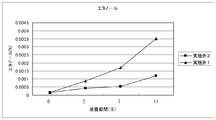
- the ethanol concentration of the fermentation broth was measured using an F kit (“F kit ethanol” (trade name) manufactured by Roche Diagnostics). The results are shown in FIG.
- the fermentation broth on the 11th day of fermentation had an ethanol concentration of 0.0035% by volume.
- the concentrations of 2-methylbutanal (2MB), 3-methylbutanal (3MB), methional, benzaldehyde (BA), phenylaldehyde (PA), and furfural as causative substances of wort odor are measured by GC / MS. It was measured. The decrease rate indicates the degree of decrease of each aldehyde on the 0th and 11th days of fermentation.
- the fermented liquid on the 0th day of fermentation, the fermented liquid on the 7th day of fermentation, and the fermented liquid on the 11th day of fermentation were subjected to sensory evaluation.
- the evaluator sampled beer and expressed the impression of taste.
- the fermentation day 0 was “wort odor, sweetness”, and the fermentation day 7 and the fermentation day 11 were “slightly grainy, sour”.
- Example 2 A fermentation broth was produced and evaluated in the same manner as in Example 1 except that the type of yeast was changed to sake yeast. The results are shown in FIG. The fermentation broth on the 11th day of fermentation had an ethanol concentration of 0.0012% by volume.
- the 0th day of fermentation was “wort smell, sweetness”
- the 11th day of fermentation was “American, sweet”.
Landscapes
- Chemical & Material Sciences (AREA)
- Life Sciences & Earth Sciences (AREA)
- Engineering & Computer Science (AREA)
- Organic Chemistry (AREA)
- Health & Medical Sciences (AREA)
- Food Science & Technology (AREA)
- General Engineering & Computer Science (AREA)
- Bioinformatics & Cheminformatics (AREA)
- Biochemistry (AREA)
- General Health & Medical Sciences (AREA)
- Genetics & Genomics (AREA)
- Wood Science & Technology (AREA)
- Zoology (AREA)
- Microbiology (AREA)
- Non-Alcoholic Beverages (AREA)
- Distillation Of Fermentation Liquor, Processing Of Alcohols, Vinegar And Beer (AREA)
- Nutrition Science (AREA)
- Polymers & Plastics (AREA)
Abstract
Description
酵母を添加した麦汁を発酵させる工程;
を包含するノンアルコールビール風味麦芽飲料の製造方法を提供する。
収穫された大麦を水に浸けて適度に発芽させた後、熱風により焙燥して、麦芽を製造した。該麦芽は常法により破砕した。次に、麦芽の破砕物及び温水を仕込槽に加えて混合してマイシェを調製した。マイシェの調製は、50℃で30分間保持することにより行った。その後、該マイシェを徐々に昇温して所定の温度で一定期間保持することにより、麦芽由来の酵素を利用して、澱粉質を糖化させた。糖化処理は、64.5℃にて10分間、70℃にて10分間保持することにより行った。糖化処理後、78℃で5分間保持した後、マイシェを麦汁濾過槽にて濾過することにより、透明な麦汁を得た。

酵母の種類を清酒酵母に変更すること以外は実施例1と同様にして発酵液を製造し、評価した。結果を図1及び表2に示す。発酵11日目の発酵液はエタノール濃度が0.0012体積%であった。

Claims (11)
- Brix値が15~50の麦汁に酵母を添加する工程;及び
酵母を添加した麦汁を発酵させる工程;
を包含するノンアルコールビール風味麦芽飲料の製造方法。 - 前記ノンアルコールビール風味麦芽飲料のエタノール濃度が0.005体積%未満である請求項1に記載の発酵低アルコールビール風味麦芽飲料の製造方法。
- 前記麦汁のpHが2~4である請求項1又は2に記載のノンアルコールビール風味麦芽飲料の製造方法。
- 発酵時間が3~20日間である請求項1~3のいずれか一項に記載のノンアルコールビール風味麦芽飲料の製造方法。
- 酵母の添加量が麦汁1mlあたり1×10⁷個以下である請求項1~4のいずれか一項に記載のノンアルコールビール風味麦芽飲料の製造方法。
- 発酵温度が3~7℃である請求項1~5のいずれか一項に記載のノンアルコールビール風味麦芽飲料の製造方法。
- 発酵が静置培養法によって行われる請求項1~6のいずれか一項に記載のノンアルコールビール風味麦芽飲料の製造方法。
- 2-メチルブタナール濃度が発酵前と比較して85%以上低減する請求項1~7のいずれか一項に記載のノンアルコールビール風味麦芽飲料の製造方法。
- 3-メチルブタナール濃度が発酵前と比較して85%以上低減する請求項1~8のいずれか一項に記載のノンアルコールビール風味麦芽飲料の製造方法。
- メチオナール濃度が発酵前と比較して80%以上低減する請求項1~9のいずれか一項に記載のノンアルコールビール風味麦芽飲料の製造方法。
- 麦汁の麦芽糖濃度が5~50重量%である請求項1~10のいずれか一項に記載のノンアルコールビール風味麦芽飲料の製造方法。
Priority Applications (4)
| Application Number | Priority Date | Filing Date | Title |
|---|---|---|---|
| AU2013382720A AU2013382720B2 (en) | 2013-03-12 | 2013-11-28 | Method for producing non-alcoholic beer-flavored malt beverage |
| CN201380074375.6A CN105007762A (zh) | 2013-03-12 | 2013-11-28 | 无酒精啤酒风味麦芽饮料的制造方法 |
| JP2015505235A JP6282631B2 (ja) | 2013-03-12 | 2013-11-28 | 発酵低アルコールビール風味麦芽飲料の製造方法 |
| KR1020157024561A KR102156458B1 (ko) | 2013-03-12 | 2013-11-28 | 논알코올 맥주 풍미 맥아 음료의 제조 방법 |
Applications Claiming Priority (2)
| Application Number | Priority Date | Filing Date | Title |
|---|---|---|---|
| JP2013-049006 | 2013-03-12 | ||
| JP2013049006 | 2013-03-12 |
Publications (1)
| Publication Number | Publication Date |
|---|---|
| WO2014141544A1 true WO2014141544A1 (ja) | 2014-09-18 |
Family
ID=51536230
Family Applications (1)
| Application Number | Title | Priority Date | Filing Date |
|---|---|---|---|
| PCT/JP2013/082084 Ceased WO2014141544A1 (ja) | 2013-03-12 | 2013-11-28 | ノンアルコールビール風味麦芽飲料の製造方法 |
Country Status (6)
| Country | Link |
|---|---|
| JP (1) | JP6282631B2 (ja) |
| KR (1) | KR102156458B1 (ja) |
| CN (1) | CN105007762A (ja) |
| AU (1) | AU2013382720B2 (ja) |
| TW (1) | TWI644621B (ja) |
| WO (1) | WO2014141544A1 (ja) |
Cited By (6)
| Publication number | Priority date | Publication date | Assignee | Title |
|---|---|---|---|---|
| JP2016111989A (ja) * | 2014-12-17 | 2016-06-23 | 日本食品化工株式会社 | 発酵麦芽飲料およびその製造方法 |
| WO2021131924A1 (ja) * | 2019-12-27 | 2021-07-01 | サントリーホールディングス株式会社 | ノンアルコールビールテイスト飲料、ノンアルコールビールテイスト飲料のコク味増強剤及び酸味低減剤、並びに、ノンアルコールビールテイスト飲料のコク味増強方法及び酸味低減方法 |
| JP2022504016A (ja) * | 2018-09-10 | 2022-01-13 | ハイネケン サプライ チェーン ベー.フェー. | 麦汁フレーバーが低減された低アルコールビール |
| JP2022508429A (ja) * | 2018-09-10 | 2022-01-19 | ハイネケン・サプライ・チェーン・ビー.ブイ. | 改善された風味を有する非アルコール性発酵ビール |
| JP2022510753A (ja) * | 2018-09-10 | 2022-01-28 | ハイネケン サプライ チェーン ベー.フェー. | 低アルコールビール |
| RU2778568C1 (ru) * | 2018-09-10 | 2022-08-22 | Хейнекен Сэпплай Чэйн Б.В. | Безалкогольное сброженное пиво с улучшенным вкусоароматом |
Families Citing this family (4)
| Publication number | Priority date | Publication date | Assignee | Title |
|---|---|---|---|---|
| BE1025860B1 (nl) * | 2017-12-08 | 2019-07-30 | Anheuser-Busch Inbev S.A. | Werkwijze voor het produceren van een gefermenteerde alcoholische drank met laag purinegehalte en een gefermenteerde alcoholische drank geproduceerd door de werkwijze |
| US12297409B2 (en) | 2018-09-10 | 2025-05-13 | Heineken Supply Chain B.V. | Foam stability |
| CN115322848A (zh) * | 2022-09-20 | 2022-11-11 | 浙江喜盈门啤酒有限公司 | 一种基于麦芽分步糖化的黑麦汁饮料酿造工艺 |
| CN118480416A (zh) * | 2024-05-14 | 2024-08-13 | 株式会社蓝鲸啤酒 | 一种无醇或低醇饮品的制备方法 |
Citations (2)
| Publication number | Priority date | Publication date | Assignee | Title |
|---|---|---|---|---|
| WO2006068191A1 (ja) * | 2004-12-21 | 2006-06-29 | Fuji Oil Company, Limited | ビール類の製造方法及びビール類製造用大豆ペプチド |
| JP2012239460A (ja) * | 2011-05-24 | 2012-12-10 | Asahi Breweries Ltd | 低アルコール発酵麦芽飲料の製造方法 |
Family Cites Families (2)
| Publication number | Priority date | Publication date | Assignee | Title |
|---|---|---|---|---|
| JP2005013142A (ja) | 2003-06-27 | 2005-01-20 | Asahi Breweries Ltd | ビールテイストを有する清涼飲料及びその製造法 |
| JP5658489B2 (ja) | 2010-06-16 | 2015-01-28 | アサヒビール株式会社 | 発酵麦芽飲料の製造方法 |
-
2013
- 2013-11-28 WO PCT/JP2013/082084 patent/WO2014141544A1/ja not_active Ceased
- 2013-11-28 CN CN201380074375.6A patent/CN105007762A/zh active Pending
- 2013-11-28 AU AU2013382720A patent/AU2013382720B2/en active Active
- 2013-11-28 KR KR1020157024561A patent/KR102156458B1/ko active Active
- 2013-11-28 JP JP2015505235A patent/JP6282631B2/ja active Active
- 2013-12-06 TW TW102144945A patent/TWI644621B/zh active
Patent Citations (2)
| Publication number | Priority date | Publication date | Assignee | Title |
|---|---|---|---|---|
| WO2006068191A1 (ja) * | 2004-12-21 | 2006-06-29 | Fuji Oil Company, Limited | ビール類の製造方法及びビール類製造用大豆ペプチド |
| JP2012239460A (ja) * | 2011-05-24 | 2012-12-10 | Asahi Breweries Ltd | 低アルコール発酵麦芽飲料の製造方法 |
Non-Patent Citations (1)
| Title |
|---|
| BRANYIK, T. ET AL.: "A review of methods of low alcohol and alcohol-free beer production.", JOURNAL OF FOOD ENGINEERING, vol. 108, no. 4, February 2012 (2012-02-01), pages 493 - 506 * |
Cited By (15)
| Publication number | Priority date | Publication date | Assignee | Title |
|---|---|---|---|---|
| JP2016111989A (ja) * | 2014-12-17 | 2016-06-23 | 日本食品化工株式会社 | 発酵麦芽飲料およびその製造方法 |
| JP2023103251A (ja) * | 2018-09-10 | 2023-07-26 | ハイネケン・サプライ・チェーン・ビー.ブイ. | 改善された風味を有する非アルコール性発酵ビール |
| JP7334237B2 (ja) | 2018-09-10 | 2023-08-28 | ハイネケン サプライ チェーン ベー.フェー. | 低アルコールビール |
| JP2022508429A (ja) * | 2018-09-10 | 2022-01-19 | ハイネケン・サプライ・チェーン・ビー.ブイ. | 改善された風味を有する非アルコール性発酵ビール |
| JP2022510753A (ja) * | 2018-09-10 | 2022-01-28 | ハイネケン サプライ チェーン ベー.フェー. | 低アルコールビール |
| RU2778568C1 (ru) * | 2018-09-10 | 2022-08-22 | Хейнекен Сэпплай Чэйн Б.В. | Безалкогольное сброженное пиво с улучшенным вкусоароматом |
| US12467022B2 (en) | 2018-09-10 | 2025-11-11 | Heineken Supply Chain B.V. | Low-alcohol beer |
| JP7317969B2 (ja) | 2018-09-10 | 2023-07-31 | ハイネケン・サプライ・チェーン・ビー.ブイ. | 改善された風味を有する非アルコール性発酵ビール |
| JP2022504016A (ja) * | 2018-09-10 | 2022-01-13 | ハイネケン サプライ チェーン ベー.フェー. | 麦汁フレーバーが低減された低アルコールビール |
| JP7378463B2 (ja) | 2018-09-10 | 2023-11-13 | ハイネケン サプライ チェーン ベー.フェー. | 麦汁フレーバーが低減された低アルコールビール |
| US12378507B2 (en) | 2018-09-10 | 2025-08-05 | Heineken Supply Chain B.V. | Non-alcoholic fermented beer having improved flavour |
| JP7743464B2 (ja) | 2018-09-10 | 2025-09-24 | ハイネケン・サプライ・チェーン・ビー.ブイ. | 改善された風味を有する非アルコール性発酵ビール |
| US12448591B2 (en) | 2018-09-10 | 2025-10-21 | Heineken Supply Chain B.V. | Low-alcohol beer with reduced wort flavor |
| US12454666B2 (en) | 2018-09-10 | 2025-10-28 | Heineken Supply Chain B.V. | Low-alcohol beer |
| WO2021131924A1 (ja) * | 2019-12-27 | 2021-07-01 | サントリーホールディングス株式会社 | ノンアルコールビールテイスト飲料、ノンアルコールビールテイスト飲料のコク味増強剤及び酸味低減剤、並びに、ノンアルコールビールテイスト飲料のコク味増強方法及び酸味低減方法 |
Also Published As
| Publication number | Publication date |
|---|---|
| AU2013382720B2 (en) | 2017-03-02 |
| AU2013382720A1 (en) | 2015-09-10 |
| KR102156458B1 (ko) | 2020-09-15 |
| TW201438603A (zh) | 2014-10-16 |
| TWI644621B (zh) | 2018-12-21 |
| JPWO2014141544A1 (ja) | 2017-02-16 |
| KR20150125949A (ko) | 2015-11-10 |
| JP6282631B2 (ja) | 2018-02-21 |
| CN105007762A (zh) | 2015-10-28 |
Similar Documents
| Publication | Publication Date | Title |
|---|---|---|
| JP6282631B2 (ja) | 発酵低アルコールビール風味麦芽飲料の製造方法 | |
| JP7462596B2 (ja) | ビールテイスト飲料 | |
| JP5763416B2 (ja) | 低アルコール発酵麦芽飲料の製造方法 | |
| KR102439291B1 (ko) | 맥주 유사 발포성 음료 | |
| WO2014097850A1 (ja) | 発酵飲料の製造方法 | |
| JP6282463B2 (ja) | 発酵麦芽飲料 | |
| JP6294660B2 (ja) | 発酵麦芽飲料 | |
| JP7710031B2 (ja) | ノンアルコールビールテイスト飲料 | |
| JP7808446B2 (ja) | ビールテイスト飲料及びその製造方法 | |
| WO2019131697A1 (ja) | 飲料およびその製造方法 | |
| JP7283873B2 (ja) | ビールテイスト飲料、ビールテイスト飲料の製造方法、及び、ビールテイスト飲料の香味向上方法 | |
| JP7181333B2 (ja) | 穀物香が低減された麦芽飲料 | |
| JP6948835B2 (ja) | 麦芽飲料及びその製造方法 | |
| JP7719263B1 (ja) | 低アルコールビール様飲料および低アルコールビール様飲料の製造方法 | |
| JP2007110910A (ja) | 発泡性飲料の製造方法と該方法により製造された発泡性飲料 | |
| JP4230302B2 (ja) | ホワイトソルガムを用いて発泡性飲料を製造する方法 | |
| RU2816894C2 (ru) | Напиток со вкусом пива | |
| JP2006204172A (ja) | ソルガム分解物を用いて発泡性飲料を製造する方法 | |
| JP2026002651A (ja) | ビール様飲料の静菌性を増強する方法 | |
| JP2024095278A (ja) | ビールテイスト飲料 | |
| WO2024143397A1 (ja) | ビールテイスト飲料 | |
| JP2024095279A (ja) | ビールテイスト飲料 | |
| JP2024095277A (ja) | ビールテイスト飲料 | |
| JP2025004556A (ja) | ビールテイスト飲料 | |
| HK40059489A (en) | Fermented malt beverage having beer taste |
Legal Events
| Date | Code | Title | Description |
|---|---|---|---|
| 121 | Ep: the epo has been informed by wipo that ep was designated in this application |
Ref document number: 13878229 Country of ref document: EP Kind code of ref document: A1 |
|
| ENP | Entry into the national phase |
Ref document number: 2015505235 Country of ref document: JP Kind code of ref document: A |
|
| ENP | Entry into the national phase |
Ref document number: 20157024561 Country of ref document: KR Kind code of ref document: A |
|
| ENP | Entry into the national phase |
Ref document number: 2013382720 Country of ref document: AU Date of ref document: 20131128 Kind code of ref document: A |
|
| NENP | Non-entry into the national phase |
Ref country code: DE |
|
| 122 | Ep: pct application non-entry in european phase |
Ref document number: 13878229 Country of ref document: EP Kind code of ref document: A1 |