WO2014129291A1 - 近赤外線吸収性組成物、およびこれを用いた近赤外線カットフィルタ、並びに、カメラモジュールおよびその製造方法 - Google Patents
近赤外線吸収性組成物、およびこれを用いた近赤外線カットフィルタ、並びに、カメラモジュールおよびその製造方法 Download PDFInfo
- Publication number
- WO2014129291A1 WO2014129291A1 PCT/JP2014/052303 JP2014052303W WO2014129291A1 WO 2014129291 A1 WO2014129291 A1 WO 2014129291A1 JP 2014052303 W JP2014052303 W JP 2014052303W WO 2014129291 A1 WO2014129291 A1 WO 2014129291A1
- Authority
- WO
- WIPO (PCT)
- Prior art keywords
- group
- compound
- formula
- infrared
- copper
- Prior art date
- Legal status (The legal status is an assumption and is not a legal conclusion. Google has not performed a legal analysis and makes no representation as to the accuracy of the status listed.)
- Ceased
Links
- 0 *P(C1CCCCC1)(c1ccccc1)=O Chemical compound *P(C1CCCCC1)(c1ccccc1)=O 0.000 description 6
- YZBOVSFWWNVKRJ-UHFFFAOYSA-M CCCCOC(c1ccccc1C([O-])=O)=O Chemical compound CCCCOC(c1ccccc1C([O-])=O)=O YZBOVSFWWNVKRJ-UHFFFAOYSA-M 0.000 description 2
- AXRSOGFYDSXLQX-UHFFFAOYSA-N OC(C(C(C(C(C(O)=O)(F)F)(F)F)(F)F)(F)F)=O Chemical compound OC(C(C(C(C(C(O)=O)(F)F)(F)F)(F)F)(F)F)=O AXRSOGFYDSXLQX-UHFFFAOYSA-N 0.000 description 1
- MUCREEUAWICQHO-UHFFFAOYSA-N OC(c(cccc1C(O)=O)c1[F]C(C(F)(F)S(O)(=O)=O)(C(F)(F)S(O)(=O)=O)F)=O Chemical compound OC(c(cccc1C(O)=O)c1[F]C(C(F)(F)S(O)(=O)=O)(C(F)(F)S(O)(=O)=O)F)=O MUCREEUAWICQHO-UHFFFAOYSA-N 0.000 description 1
Images


Classifications
-
- G—PHYSICS
- G02—OPTICS
- G02B—OPTICAL ELEMENTS, SYSTEMS OR APPARATUS
- G02B5/00—Optical elements other than lenses
- G02B5/20—Filters
- G02B5/208—Filters for use with infrared or ultraviolet radiation, e.g. for separating visible light from infrared and/or ultraviolet radiation
-
- H—ELECTRICITY
- H10—SEMICONDUCTOR DEVICES; ELECTRIC SOLID-STATE DEVICES NOT OTHERWISE PROVIDED FOR
- H10F—INORGANIC SEMICONDUCTOR DEVICES SENSITIVE TO INFRARED RADIATION, LIGHT, ELECTROMAGNETIC RADIATION OF SHORTER WAVELENGTH OR CORPUSCULAR RADIATION
- H10F39/00—Integrated devices, or assemblies of multiple devices, comprising at least one element covered by group H10F30/00, e.g. radiation detectors comprising photodiode arrays
- H10F39/80—Constructional details of image sensors
- H10F39/805—Coatings
- H10F39/8053—Colour filters
-
- G—PHYSICS
- G02—OPTICS
- G02B—OPTICAL ELEMENTS, SYSTEMS OR APPARATUS
- G02B5/00—Optical elements other than lenses
- G02B5/20—Filters
- G02B5/22—Absorbing filters
- G02B5/223—Absorbing filters containing organic substances, e.g. dyes, inks or pigments
-
- H—ELECTRICITY
- H10—SEMICONDUCTOR DEVICES; ELECTRIC SOLID-STATE DEVICES NOT OTHERWISE PROVIDED FOR
- H10F—INORGANIC SEMICONDUCTOR DEVICES SENSITIVE TO INFRARED RADIATION, LIGHT, ELECTROMAGNETIC RADIATION OF SHORTER WAVELENGTH OR CORPUSCULAR RADIATION
- H10F39/00—Integrated devices, or assemblies of multiple devices, comprising at least one element covered by group H10F30/00, e.g. radiation detectors comprising photodiode arrays
- H10F39/011—Manufacture or treatment of image sensors covered by group H10F39/12
- H10F39/024—Manufacture or treatment of image sensors covered by group H10F39/12 of coatings or optical elements
-
- H—ELECTRICITY
- H10—SEMICONDUCTOR DEVICES; ELECTRIC SOLID-STATE DEVICES NOT OTHERWISE PROVIDED FOR
- H10F—INORGANIC SEMICONDUCTOR DEVICES SENSITIVE TO INFRARED RADIATION, LIGHT, ELECTROMAGNETIC RADIATION OF SHORTER WAVELENGTH OR CORPUSCULAR RADIATION
- H10F39/00—Integrated devices, or assemblies of multiple devices, comprising at least one element covered by group H10F30/00, e.g. radiation detectors comprising photodiode arrays
- H10F39/80—Constructional details of image sensors
- H10F39/804—Containers or encapsulations
-
- H—ELECTRICITY
- H10—SEMICONDUCTOR DEVICES; ELECTRIC SOLID-STATE DEVICES NOT OTHERWISE PROVIDED FOR
- H10F—INORGANIC SEMICONDUCTOR DEVICES SENSITIVE TO INFRARED RADIATION, LIGHT, ELECTROMAGNETIC RADIATION OF SHORTER WAVELENGTH OR CORPUSCULAR RADIATION
- H10F39/00—Integrated devices, or assemblies of multiple devices, comprising at least one element covered by group H10F30/00, e.g. radiation detectors comprising photodiode arrays
- H10F39/80—Constructional details of image sensors
- H10F39/806—Optical elements or arrangements associated with the image sensors
-
- G—PHYSICS
- G02—OPTICS
- G02B—OPTICAL ELEMENTS, SYSTEMS OR APPARATUS
- G02B13/00—Optical objectives specially designed for the purposes specified below
- G02B13/001—Miniaturised objectives for electronic devices, e.g. portable telephones, webcams, PDAs, small digital cameras
- G02B13/0015—Miniaturised objectives for electronic devices, e.g. portable telephones, webcams, PDAs, small digital cameras characterised by the lens design
- G02B13/002—Miniaturised objectives for electronic devices, e.g. portable telephones, webcams, PDAs, small digital cameras characterised by the lens design having at least one aspherical surface
- G02B13/003—Miniaturised objectives for electronic devices, e.g. portable telephones, webcams, PDAs, small digital cameras characterised by the lens design having at least one aspherical surface having two lenses
Definitions
- the present invention relates to a near-infrared absorbing composition, a near-infrared cut filter using the same, a camera module, and a manufacturing method thereof.
- a CCD or CMOS image sensor which is a solid-state image sensor for color images, is used in video cameras, digital still cameras, mobile phones with camera functions, and the like. Since the solid-state imaging device uses a silicon photodiode having sensitivity to near infrared rays in the light receiving portion thereof, it is necessary to perform visibility correction, and a near-infrared cut filter (hereinafter also referred to as IR cut filter) is required. Often used.
- Patent Document 1 discloses a metal compound as a copolymer of a reaction product of (meth) acrylamide and phosphoric acid or a hydrolyzate thereof and a compound having an ethylenically unsaturated bond.
- An infrared shielding film containing an added infrared shielding resin is disclosed.
- the technique disclosed in Patent Document 1 adds a copper compound to a copolymer containing phosphoric acid and a compound having an ethylenically unsaturated bond.
- the addition amount is excessively large, a crosslinked structure starting from a copper complex or a copper compound is formed in the copolymer containing phosphoric acid, and it becomes difficult to form a thin film. Therefore, in the technique disclosed in Patent Document 1, it is not possible to increase the amount of copper compound added, and as a result, it is cured with excellent moisture resistance while maintaining high near-infrared shielding when used as a cured film.
- An object of this invention is to provide the near-infrared absorptive composition which can form the cured film excellent in moisture resistance, maintaining a high near-infrared shielding property when it is set as a cured film.
- ⁇ 1> a copper compound; A compound having a partial structure represented by the following formula (1), The near-infrared absorptive composition whose content of the said copper compound is 3 * 10 ⁇ -3> -1 mol with respect to 1g of compounds which have the partial structure shown by following formula (1).
- R 1 represents a hydrogen atom or an organic group.
- ⁇ 2> The near-infrared absorbing composition according to ⁇ 1>, wherein the content of the compound having a partial structure represented by the formula (1) is 5 to 80% by mass in the near-infrared absorbing composition.
- ⁇ 3> The near-infrared absorbing composition according to ⁇ 1> or ⁇ 2>, wherein the copper compound is a copper complex.
- the compound having a partial structure represented by the formula (1) has a structure represented by any of the following formulas (1-1) to (1-5), The near-infrared absorptive composition in any one.
- R 4 represents a hydrogen atom or a methyl group
- R 5 and R 6 each independently represents a hydrogen atom or an organic group.
- R 7 represents a hydrogen atom.
- L 1 represents a divalent linking group
- R 8 represents a hydrogen atom or an organic group
- L 2 and L 3 represent an atom or a methyl group.
- R 9 and R 10 each independently represents a hydrogen atom or an organic group
- L 4 represents a divalent linking group
- R 11 to R 14 each independently represents a hydrogen atom or an organic group.
- ⁇ 8> The near-infrared absorbing composition according to any one of ⁇ 1> to ⁇ 7>, further comprising a curable compound and a solvent.
- ⁇ 9> The near-infrared absorbing composition according to any one of ⁇ 1> to ⁇ 8>, wherein the solid content of the near-infrared absorbing composition is 35 to 90% by mass.
- ⁇ 10> The near-infrared absorbing composition according to any one of ⁇ 1> to ⁇ 9>, which is used by forming a coating film on an image sensor for a solid-state imaging device.
- ⁇ 11> a copper compound;
- R 2 represents a hydrogen atom or an organic group.
- the compound having a partial structure represented by the formula (1) is a polymer including a repeating unit having a partial structure represented by the formula (1) and a repeating unit having an epoxy group or an oxetanyl group.
- the compound having a partial structure represented by the formula (1) ′ is a polymer including a repeating unit having the partial structure represented by the formula (1) and a repeating unit having an epoxy group or an oxetanyl group.
- ⁇ 11> or ⁇ 14> The near-infrared absorptive composition as described in ⁇ 14>.
- ⁇ 16> A near-infrared cut filter produced using the near-infrared absorbing composition according to any one of ⁇ 1> to ⁇ 15>.
- ⁇ 17> A camera module having a solid-state image sensor substrate and the near-infrared cut filter according to ⁇ 16> disposed on a light receiving side of the solid-state image sensor substrate.
- a method for manufacturing a camera module having a solid-state image sensor substrate and a near-infrared cut filter disposed on a light-receiving side of the solid-state image sensor substrate comprising: forming a near-infrared cut filter by applying the near-infrared absorbing composition according to any one of ⁇ 1> to ⁇ 15> on a light-receiving side of a solid-state imaging device substrate .
- a near-infrared absorbing composition capable of forming a cured film having excellent moisture resistance while maintaining high near-infrared shielding properties when formed into a cured film.
- the polymerizable compound means a compound having a polymerizable functional group, and may be a monomer or a polymer.
- the polymerizable functional group refers to a group that participates in a polymerization reaction.
- group (atomic group) in this specification, the notation which does not describe substitution and unsubstituted includes group (atomic group) which has a substituent with the group (atomic group) which does not have a substituent.
- near-infrared light has a maximum absorption wavelength region of 700 to 2500 nm.
- the present invention is characterized in that in the near-infrared absorbing composition, a copper compound and a compound having a partial structure represented by the formula (1) are blended.
- the structure of the copper compound is distorted, and the light absorption ability in the near infrared region can be improved without absorbing the visible region. It is estimated that Furthermore, a cured film excellent in moisture resistance can be formed while maintaining a high near-infrared shielding property when formed into a cured film.
- the near-infrared absorptive composition of this invention contains a copper compound and the compound which has a partial structure shown by following formula (1), and content of the said copper compound is a part shown by following formula (1).
- the amount is 3 ⁇ 10 ⁇ 3 to 1 mol per 1 g of the compound having a structure.
- R 1 represents a hydrogen atom or an organic group.
- the near-infrared absorptive composition of this invention contains a copper compound and the compound which has a partial structure shown by said Formula (1), and content of the said copper compound is a part shown by the said Formula (1).
- Near infrared absorption capable of forming a cured film excellent in moisture resistance while maintaining a high near infrared shielding property when formed into a cured film by being 3 ⁇ 10 ⁇ 3 to 1 mol per 1 g of the compound having a structure.
- Sex compositions can be provided.
- the copper in the copper compound used in the present invention is preferably monovalent or divalent copper, and more preferably divalent copper.
- the copper content in the copper compound used in the present invention is preferably 2 to 40% by mass, more preferably 5 to 40% by mass.
- the copper compound used in the present invention is not particularly limited as long as it is a copper compound having a maximum absorption wavelength in a wavelength range of 700 nm to 1000 nm (near infrared region).
- the copper compound used in the present invention is preferably a copper complex.
- the ligand L coordinated to copper is not particularly limited as long as it can be coordinated to a copper ion.
- phosphoric acid phosphate ester, phosphone
- examples thereof include compounds having acid, phosphonic acid ester, phosphinic acid, substituted phosphinic acid, sulfonic acid, carboxylic acid, carbonyl (ester, ketone), amine, amide, sulfonamide, urethane, urea, alcohol, thiol and the like.
- phosphoric acid, phosphoric acid ester, phosphonic acid, phosphonic acid ester, phosphinic acid, substituted phosphinic acid, and sulfonic acid are preferable, and phosphoric acid ester, phosphonic acid ester, substituted phosphinic acid, and sulfonic acid are more preferable.
- Specific examples of the copper compound used in the present invention include a phosphorus-containing copper compound, a sulfonic acid copper compound, or a copper compound represented by the following formula (A).
- Specific examples of the phosphorus-containing copper compound may include compounds described in WO 2005/030898, page 5, line 27 to page 7, line 20; Incorporated in the description.
- the copper compound used in the present invention is preferably represented by the following formula (A).
- Cu (L) n1 ⁇ (X) n2 Formula (A) L represents a ligand coordinated to copper, and X does not exist or is a halogen atom, H 2 O, NO 3 , ClO 4 , SO 4 , CN, SCN, or BF 4. , PF 6 , BPh 4 (Ph represents a phenyl group) or alcohol.
- n1 and n2 each independently represents an integer of 1 to 4.
- the ligand L has a substituent containing C, N, O, and S as atoms capable of coordinating to copper, and more preferably has a group having a lone pair such as N, O, and S It is.
- the group capable of coordinating is not limited to one type in the molecule and may include two or more types, and may be dissociated or non-dissociated. In the case of non-dissociation, X is not present.
- the copper complex as an infrared absorbing substance is in the form of a copper complex (copper compound) in which a ligand is coordinated to copper as a central metal.
- Copper in the copper complex of the present invention is divalent copper, and can be obtained, for example, by mixing and reacting a compound serving as a ligand or a salt thereof with a copper component. Therefore, if it is an “infrared absorbing composition containing copper and a ligand”, it is predicted that a copper complex is formed in the composition.
- the compound that serves as the ligand or a salt thereof is not particularly limited, and preferred examples include organic acid compounds (for example, sulfonic acid compounds, carboxylic acid compounds, and phosphoric acid compounds) or salts thereof.
- the compound serving as the ligand or a salt thereof is preferably a compound containing an acid group or a salt thereof, and is preferably represented by the following general formula (i).
- R 1 represents an n-valent organic group
- X 1 represents an acid group
- n represents an integer of 1 to 6.
- the n-valent organic group is preferably a hydrocarbon group, more preferably an aliphatic hydrocarbon group or an aromatic hydrocarbon group.
- the hydrocarbon group may have a substituent, and examples of the substituent include a halogen atom (preferably a fluorine atom), a (meth) acryloyl group, and a group having an unsaturated double bond.
- an alkyl group or an aryl group is preferable, and an aryl group is more preferable.
- an alkylene group, an arylene group, and an oxyalkylene group are preferable, and an arylene group is more preferable.
- the thing corresponding to the said hydrocarbon group is preferable.
- the alkyl group and alkylene group preferably have 1 to 20 carbon atoms, more preferably 1 to 10 carbon atoms, and still more preferably 1 to 5 carbon atoms.
- the aryl group and arylene group preferably have 6 to 18 carbon atoms, more preferably 6 to 12 carbon atoms, and still more preferably 6 carbon atoms.
- X 1 is preferably at least one of an acid group containing a sulfonic acid group, a carboxylic acid group and a phosphorus atom.
- X 1 may be one kind or two or more kinds, Two or more are preferable.
- n is preferably 1 to 3, more preferably 2 or 3, and still more preferably 3.
- the molecular weight of the compound serving as the ligand or a salt thereof (a compound containing an acid group or a salt thereof) is preferably 1000 or less, preferably 70 to 1000, and more preferably 130 to 500.
- Preferred embodiments of the compound containing an acid group or a salt thereof include (1) a compound having at least one of a sulfonic acid group, a carboxylic acid group and an acid group containing a phosphorus atom, and more preferably ( 2) An embodiment having two or more acid groups, more preferably (3) an embodiment having a sulfonic acid group and a carboxylic acid group.
- the infrared absorption ability which is the ability to absorb near infrared rays, is more effectively exhibited.
- the color value can be further improved by using a compound having a sulfonic acid group and a carboxylic acid group.
- Specific examples of the compound having at least one of a sulfonic acid group, a carboxylic acid group and an acid group containing a phosphorus atom include the following.
- specific examples of the compound having a sulfonic acid group include specific examples of the sulfonic acid compound described later.
- the compound applicable to this aspect is mentioned as a preferable example among the compounds as described in aspect (2) and (3) mentioned later.
- (2) Specific examples of the compound having at least two acid groups include the following.
- the compound applicable to this aspect is mentioned as a preferable example among the compounds as described in aspect (3) mentioned later.
- Specific examples of the compound having a sulfonic acid group and a carboxylic acid group include the following.
- the specific example of the compound which has a sulfonic acid group and carboxylic acid group mentioned later is also mentioned.
- the phosphorus-containing copper complex is not particularly limited as long as it has a ligand containing a phosphorus compound as a ligand of the complex, but a copper phosphate complex, a phosphate ester copper complex, a phosphonate copper complex, a phosphone
- a copper phosphate complex, a phosphate ester copper complex, a phosphonate copper complex, a phosphone An acid ester copper complex, a phosphinic acid copper complex, and a substituted phosphinic acid copper complex are preferable, and a phosphate ester copper complex, a phosphonic acid ester copper complex, and a substituted phosphinic acid copper complex are more preferable.
- the phosphate ester copper complex has copper as a central metal and a phosphate ester compound as a ligand.
- a compound represented by the following formula (B) is more preferable.
- (HO) n -P ( O)-(OR 2 ) 3-n Formula (B)
- R 2 represents an organic group
- n represents 1 or 2.
- R 2 represents an alkyl group having 1 to 18 carbon atoms, an aryl group having 6 to 18 carbon atoms, an aralkyl group having 1 to 18 carbon atoms, or an alkenyl group having 1 to 18 carbon atoms, or —OR 2 Represents a polyoxyalkyl group having 4 to 100 carbon atoms, a (meth) acryloyloxyalkyl group having 4 to 100 carbon atoms, or a (meth) acryloyl polyoxyalkyl group having 4 to 100 carbon atoms, and n is 1 or 2) When n is 1, R 2 may be the same or different.
- R 1 and R 2 each independently represent a monovalent organic group or a divalent organic group, and may form a cyclic structure.
- the compound represented by the formula (C) and a salt thereof act as a ligand coordinated to copper.
- the ligand means other atoms, ions, atomic groups, groups, neutral molecules, etc. that are three-dimensionally arranged around the copper atom in the copper complex and bonded to the copper atom.
- R 1 and R 2 each independently represents a monovalent organic group.
- the monovalent organic group an organic group having 3 or more carbon atoms is preferable, an organic group having 5 or more carbon atoms is more preferable, and an organic group having 5 to 20 carbon atoms is more preferable.
- R 1 and R 2 may be bonded to each other to form a cyclic structure.
- R 1 and R 2 are both divalent organic groups.
- the total number of carbon atoms of the group containing a bonded cyclic structure (divalent organic group) is 3 or more, preferably 5 or more, and more preferably an organic group having 5 to 20 carbons.
- Specific examples of the monovalent organic group include, but are not limited to, linear, branched or cyclic alkyl groups, aryl groups, and heteroaryl groups.
- these groups are divalent linking groups (for example, linear, branched or cyclic alkylene groups, arylene groups, heteroarylene groups, —O—, —S—, —CO—, —COO—). , -OCO-, -SO 2- , A group via —NR— (wherein R is a hydrogen atom or an alkyl group) may be used.
- the monovalent organic group may have a substituent.
- an alkyl group having 3 to 20 carbon atoms is preferable, an alkyl group having 3 to 10 carbon atoms is more preferable, and an alkyl group having 3 to 8 carbon atoms is more preferable.
- the cyclic alkyl group may be monocyclic or polycyclic.
- a cycloalkyl group having 3 to 20 carbon atoms is preferable, a cycloalkyl group having 4 to 10 carbon atoms is more preferable, and a cycloalkyl group having 6 to 10 carbon atoms is more preferable.
- an aryl group having 6 to 18 carbon atoms is preferable, an aryl group having 6 to 14 carbon atoms is more preferable, and an aryl group having 6 to 10 carbon atoms is further preferable.
- the heteroaryl group is preferably a 5-membered ring or a 6-membered ring.
- the heteroaryl group is a single ring or a condensed ring, preferably a single ring or a condensed ring having 2 to 8 condensations, and more preferably a single ring or a condensed ring having 2 to 4 condensations.
- a heteroaryl group derived from a monocyclic or polycyclic aromatic ring containing at least one of nitrogen, oxygen and sulfur atoms is used.
- the heteroaryl ring in the heteroaryl group include oxazole ring, thiophene ring, thiathrene ring, furan ring, pyran ring, isobenzofuran ring, chromene ring, xanthene ring, phenoxazine ring, pyrrole ring, pyrazole ring, isothiazole.
- Ring isoxazole ring, pyrazine ring, pyrimidine ring, pyridazine ring, indolizine ring, isoindolizine ring, indole ring, indazole ring, purine ring, quinolidine ring, isoquinoline ring, phthalazine ring, naphthyridine ring, quinazoline ring, cinolin ring , Pteridine ring, carbazole ring, carboline ring, phenanthrine ring, acridine ring, perimidine ring, phenanthrolin ring, phthalazine ring, phenazazine ring, phenoxazine ring, and furazane ring.
- Examples of the linear, branched or cyclic alkylene group, arylene group, or heteroarylene group that is a divalent linking group include the linear, branched, or cyclic alkyl group, aryl group, or heteroaryl group described above. And a divalent linking group derived by removing one hydrogen atom from the above.
- Examples of the substituent that the monovalent organic group may have include an alkyl group, a polymerizable group (for example, a vinyl group, a (meth) acryloyl group, an epoxy group, and an oxetane group), a halogen atom, a carboxyl group, and a carboxyl group.
- Examples include acid ester groups (for example, —CO 2 CH 3 and the like), hydroxyl groups, amide groups, halogenated alkyl groups (for example, fluoroalkyl groups and chloroalkyl groups) and the like.
- the phosphoric acid diester copper complex of this invention contains the structure represented by a following formula (D).
- R 1 and R 2 each independently represent a monovalent organic group or a divalent organic group, and may form a cyclic structure. “*” Is coordinated with copper. Indicates the binding site.)
- R 1 and R 2 has the same meaning as R 1 and R 2 in the above formula (C), preferred ranges are also the same.
- the molecular weight of the phosphoric acid ester compound represented by the formula (C) is preferably 200 to 1000, more preferably 250 to 750, and further preferably 300 to 500.
- the phosphonate copper complex used in the present invention may be one having copper as a central metal and a phosphonate ester compound as a ligand.
- the phosphonic acid ester compound that forms the ligand L is more preferably a compound represented by the following formula (E).
- R 3 and R 4 each independently represents a monovalent organic group.
- the compound represented by the formula (E) and a salt thereof act as a ligand coordinated to copper.
- R 3 and R 4 in the formula (E) each independently represent a monovalent organic group.
- the monovalent organic group include, but are not limited to, a linear, branched, or cyclic alkyl group, alkenyl group, aryl group, and heteroaryl group.
- these groups are divalent linking groups (for example, an alkylene group, a cycloalkylene group, an arylene group, a heteroarylene group, —O—, —S—, —CO—, —COO—, —OCO). It may be a group via —, —SO 2 —, —NR— (wherein R is a hydrogen atom or an alkyl group).
- the monovalent organic group may have a substituent.
- the linear or branched alkyl group is preferably an alkyl group having 1 to 20 carbon atoms, more preferably an alkyl group having 1 to 10 carbon atoms, and further preferably an alkyl group having 1 to 8 carbon atoms.
- the cyclic alkyl group, aryl group and heteroaryl group have the same meanings as the cyclic alkyl group, aryl group and heteroaryl group in the formula (C), and the preferred ranges are also the same.
- the alkenyl group is preferably an alkenyl group having 2 to 10 carbon atoms, more preferably an alkenyl group having 2 to 8 carbon atoms, and further preferably an alkenyl group having 2 to 4 carbon atoms.
- Examples of the linear, branched, or cyclic alkylene group, arylene group, or heteroarylene group that is a divalent linking group include those described in the above formula (C).
- Examples of the substituent that the monovalent organic group may have include those described in the above formula (C).
- the phosphonic acid ester copper complex used by this invention contains the structure represented by a following formula (F).
- R 3 and R 4 each independently represents a monovalent organic group. “*” Represents a site that coordinates to copper.)
- R 3 and R 4 have the same meanings as R 3 and R 4 in the formula (E), and preferred ranges are also the same.
- the molecular weight of the phosphonic acid ester compound represented by the formula (E) is preferably 200 to 1000, more preferably 250 to 750, and still more preferably 300 to 500.
- the substituted phosphinic acid copper complex used in the present invention has copper as a central metal and a substituted phosphinic acid compound as a ligand.
- a compound represented by the following formula (G) is more preferable.
- R 5 and R 6 each independently represents a monovalent organic group.
- R 5 and R 6 each independently represents a monovalent organic group.
- the monovalent organic group include, but are not limited to, linear, branched or cyclic alkyl groups, aryl groups, and heteroaryl groups.
- these groups are divalent linking groups (for example, an alkylene group, a cycloalkylene group, an arylene group, a heteroarylene group, —O—, —S—, —CO—, —COO—, —OCO). It may be a group via —, —SO 2 —, —NR— (wherein R is a hydrogen atom or an alkyl group).
- the monovalent organic group may have a substituent.
- an alkyl group having 1 to 20 carbon atoms is preferable, an alkyl group having 1 to 10 carbon atoms is more preferable, and an alkyl group having 1 to 8 carbon atoms is more preferable.
- Specific examples include a methyl group, n-butyl group, 2-ethylhexyl group and the like.
- the cyclic alkyl group, aryl group, and heteroaryl group are synonymous with the cyclic alkyl group, aryl group, and heteroaryl group in the formula (C), and the preferred ranges are also the same.
- Examples of the linear, branched, or cyclic alkylene group, arylene group, or heteroarylene group that are divalent linking groups include those described in the above formula (C).
- Examples of the substituent that the monovalent organic group may have include those described in the above formula (C).
- the substituted phosphinic acid copper complex used by this invention contains the structure represented by a following formula (H).
- R 5 and R 6 each independently represents a monovalent organic group. “*” Represents a site that coordinates to copper.)
- R 5 and R 6 has the same meaning as R 5 and R 6 in the formula (G), and preferred ranges are also the same.
- the molecular weight of the substituted phosphinic acid compound represented by the formula (G) is preferably 50 to 750, more preferably 50 to 500, and still more preferably 80 to 300. Specific examples of the substituted phosphinic acid compound are shown below.
- the phosphorus-containing copper complex used in the present invention is obtained by reacting a copper component with a phosphorus-containing compound (for example, phosphate ester, phosphonate ester, substituted phosphinic acid) or a salt thereof as a ligand.
- a phosphorus-containing compound for example, phosphate ester, phosphonate ester, substituted phosphinic acid
- a salt thereof as a ligand.
- Copper salts include copper acetate, copper chloride, copper formate, copper stearate, copper benzoate, copper ethyl acetoacetate, copper pyrophosphate, copper naphthenate, copper citrate, copper nitrate, copper sulfate, copper carbonate, copper chlorate Copper (meth) acrylate and copper perchlorate are more preferable, and copper acetate, copper chloride, copper sulfate, copper benzoate, and copper (meth) acrylate are more preferable.
- the phosphorus-containing compound used in the present invention can be synthesized, for example, with reference to a known method.
- the phosphoric acid ester compound can be obtained by reacting 2-hydroxyethyl methacrylate, phenyl phosphoric acid ester and 1,3,5-triisopropylsulfonic acid chloride in a pyridine solvent.
- a metal salt is preferable, and specific examples include sodium salt, potassium salt, magnesium salt, calcium salt, borate and the like.
- the reaction ratio when the copper component is reacted with the above-described phosphorus-containing compound or salt thereof is preferably 1: 1.5 to 1: 4 in molar ratio.
- the reaction conditions for reacting the copper component with the above-described phosphorus-containing compound or salt thereof are preferably 20 to 50 ° C. and 0.5 hours or longer, for example.
- the phosphorus-containing copper complex of the present invention has a maximum absorption wavelength ( ⁇ max ) in the near-infrared wavelength region of 700 to 2500 nm, preferably has a maximum absorption wavelength of 700 to 2500 nm, more preferably 720 to 890 nm, and 730 to More preferably, 880 nm.
- the maximum absorption wavelength can be measured using, for example, Cary 5000 UV-Vis-NIR (manufactured by Agilent Technologies, Inc.).
- the phosphorus-containing copper complex of the present invention preferably has a gram absorbance of 0.04 or more (g / mL), more preferably 0.06 or more (g / mL), and 0.08 or more ( g / mL) is more preferable.
- the Gram absorbance can be calculated using, for example, a Cary 5000 UV-Vis-NIR (Spectrophotometer manufactured by Agilent Technologies).
- the copper sulfonate complex used in the present invention has copper as a central metal and a sulfonic acid compound as a ligand.
- a compound represented by the following formula (I) is more preferable.
- R 7 represents a monovalent organic group.
- the sulfonic acid represented by the formula (I) and a salt thereof act as a ligand coordinated to copper.
- Specific monovalent organic groups include, but are not limited to, linear, branched or cyclic alkyl groups, alkenyl groups, and aryl groups.
- these groups are divalent linking groups (for example, an alkylene group, a cycloalkylene group, an arylene group, —O—, —S—, —CO—, —COO—, —OCO—, —SO 2 —). , -NR- (wherein R is a hydrogen atom or an alkyl group) or the like).
- the monovalent organic group may have a substituent.
- an alkyl group having 1 to 20 carbon atoms is preferable, an alkyl group having 1 to 12 carbon atoms is more preferable, and an alkyl group having 1 to 8 carbon atoms is more preferable.
- the cyclic alkyl group may be monocyclic or polycyclic.
- a cycloalkyl group having 3 to 20 carbon atoms is preferable, a cycloalkyl group having 4 to 10 carbon atoms is more preferable, and a cycloalkyl group having 6 to 10 carbon atoms is more preferable.
- the alkenyl group is preferably an alkenyl group having 2 to 10 carbon atoms, more preferably an alkenyl group having 2 to 8 carbon atoms, and further preferably an alkenyl group having 2 to 4 carbon atoms.
- an aryl group having 6 to 18 carbon atoms is preferable, an aryl group having 6 to 14 carbon atoms is more preferable, and an aryl group having 6 to 10 carbon atoms is further preferable.
- alkylene group, cycloalkylene group, and arylene group that are divalent linking groups include divalent linking groups derived by removing one hydrogen atom from the aforementioned alkyl group, cycloalkyl group, or aryl group.
- Examples of the substituent that the monovalent organic group may have include an alkyl group, a polymerizable group (for example, a vinyl group, a (meth) acryloyl group, an epoxy group, and an oxetane group), a halogen atom, a carboxyl group, and a carboxyl group.
- Examples include acid ester groups (for example, —CO 2 CH 3 and the like), hydroxyl groups, amide groups, halogenated alkyl groups (for example, fluoroalkyl groups and chloroalkyl groups) and the like.
- the sulfonate copper complex of this invention contains the structure represented by a following formula (J). (In formula (J), R 8 represents a monovalent organic group.
- R 8 has the same meaning as R 7 in the formula (I), and the preferred range is also the same.
- the molecular weight of the sulfonic acid compound represented by the formula (I) is preferably 80 to 750, more preferably 80 to 600, and still more preferably 80 to 450.
- the copper sulfonate complex used in the present invention can be obtained by reacting a copper component with a sulfonic acid compound or a salt thereof as a ligand.
- a copper component mentioned above it is synonymous with the phosphorus containing copper complex mentioned above, and its preferable range is also the same.
- the sulfonic acid compound used in the present invention may be a commercially available sulfonic acid, or may be synthesized with reference to a known method.
- a salt of the sulfonic acid compound used in the present invention for example, a metal salt is preferable, and specific examples thereof include a sodium salt and a potassium salt.
- the reaction ratio for reacting the copper component with the above-described sulfonic acid compound or salt thereof is preferably 1: 1.5 to 1: 4 in terms of molar ratio.
- the sulfonic acid compound or a salt thereof may be one kind or two or more kinds.
- the reaction conditions for reacting the copper component with the above-described sulfonic acid compound or salt thereof are preferably 20 to 50 ° C. and 0.5 hours or longer, for example.
- about the maximum absorption wavelength and gram light absorbency of the sulfonic-acid copper complex of this invention it is synonymous with the phosphorus containing copper complex mentioned above, and its preferable range is also the same.
- R 1 represents a monovalent organic group.
- R 1 represents a monovalent organic group. Although it does not specifically limit as a monovalent organic group, For example, it is synonymous with the monovalent organic group in Formula (C) mentioned above.
- the content of the copper compound used in the present invention is 3 ⁇ 10 ⁇ 3 to 1 mol and 3 ⁇ 10 ⁇ 3 to 0.2 mol with respect to 1 g of the compound having the partial structure represented by the formula (1). Preferably, it is 3 ⁇ 10 ⁇ 3 to 0.05 mol.
- the near-infrared absorptive composition of this invention contains the copper complex mentioned above.
- the composition of the present invention is a near-infrared absorbing composition that can maintain high near-infrared shielding properties when used as a cured film by using the copper complex described above, and has excellent solubility in a solvent.
- the near-infrared absorptive composition containing a copper complex can be provided.
- the copper in the copper complex of the present invention is usually divalent copper.
- the copper component copper or a compound containing copper
- the above-described compound serving as a ligand or a salt thereof be able to.
- the compound structure which becomes a copper component and a ligand can be detected from the composition of the present invention, it can be said that a copper complex is formed in the composition of the present invention.
- a method for detecting copper and a phosphate ester compound from the composition of the present invention an ICP emission analysis method can be mentioned, and copper and a phosphate ester compound can be detected by this method.
- the compounding amount of the copper complex in the composition of the present invention is preferably 5 to 60% by mass, more preferably 10 to 40% by mass with respect to the composition of the present invention.
- the compounding amount of the copper complex in the solid content in the composition of the present invention is preferably 30 to 90% by mass, more preferably 35 to 85% by mass, and further preferably 40 to 80% by mass.
- the composition of the present invention may contain inorganic fine particles as other near-infrared absorbing compounds other than the copper compound described above. Only one type of inorganic fine particles may be used, or two or more types may be used.
- the inorganic fine particles are particles that mainly play a role of shielding (absorbing) infrared rays.
- the inorganic fine particles are preferably at least one selected from the group consisting of metal oxide particles and metal particles in terms of more excellent infrared shielding properties.
- the inorganic fine particles include indium tin oxide (ITO) particles, antimony tin oxide (ATO) particles, zinc oxide that may be doped with aluminum (ZnO that may be doped with Al), and fluorine-doped tin dioxide (Met oxide particles such as F-doped SnO 2 ) particles or niobium-doped titanium dioxide (Nb-doped TiO 2 ) particles, silver (Ag) particles, gold (Au) particles, copper (Cu) particles, nickel (Ni) particles, etc. A metal particle is mentioned.
- ITO indium tin oxide
- ATO antimony tin oxide
- ZnO zinc oxide that may be doped with aluminum
- Metal oxide particles such as F-doped SnO 2 ) particles or niobium-doped titanium dioxide (Nb-doped TiO 2 ) particles, silver (Ag) particles, gold (Au) particles, copper (Cu) particles,
- the transmittance at the exposure wavelength (365-405 nm) is high, and indium tin oxide (ITO) particles or antimony tin oxide (ATO) particles are preferable.
- the shape of the inorganic fine particles is not particularly limited, and may be a sheet shape, a wire shape, or a tube shape regardless of spherical or non-spherical.
- a tungsten oxide compound can be used as the inorganic fine particles. Specifically, a tungsten oxide compound represented by the following general formula (composition formula) (I) is more preferable.
- M x W y O z (I)
- M represents a metal
- W represents tungsten
- O oxygen
- M metals include alkali metals, alkaline earth metals, Mg, Zr, Cr, Mn, Fe, Ru, Co, Rh, Ir, Ni, Pd, Pt, Cu, Ag, Au, Zn, Cd, Al
- Examples include Ga, In, Tl, Sn, Pb, Ti, Nb, V, Mo, Ta, Re, Be, Hf, Os, and Bi.
- the metal of M is preferably an alkali metal, more preferably Rb or Cs, and even more preferably Cs.
- the metal of M may be one type or two or more types.
- x / y is 0.001 or more, infrared rays can be sufficiently shielded, and when 1.1 or less, the generation of an impurity phase in the tungsten oxide compound is more reliably avoided. Can do.
- z / y is 2.2 or more, chemical stability as a material can be further improved, and when it is 3.0 or less, infrared rays can be sufficiently shielded.
- the metal oxide is preferably cesium tungsten oxide.
- the tungsten oxide compound represented by the general formula (I) include Cs 0.33 WO 3 , Rb 0.33 WO 3 , K 0.33 WO 3 , Ba 0.33 WO 3 and the like, and Cs 0.33 WO 3 Alternatively, Rb 0.33 WO 3 is preferable, and Cs 0.33 WO 3 is still more preferable.
- the metal oxide is preferably fine particles.
- the average particle diameter of the metal oxide fine particles is preferably 800 nm or less, more preferably 400 nm or less, and even more preferably 200 nm or less. When the average particle diameter is in such a range, it becomes difficult for the metal oxide to block visible light by light scattering, and thus the translucency in the visible light region can be further ensured.
- the average particle size is preferably as small as possible, but for reasons such as ease of handling during production, the average particle size of the metal oxide is usually 1 nm or more.
- the tungsten oxide compound is available as a dispersion of tungsten fine particles such as YMF-02 manufactured by Sumitomo Metal Mining Co., Ltd., for example.
- the content of the metal oxide is preferably 0.01 to 30% by mass and more preferably 0.1 to 20% by mass with respect to the total solid mass of the composition containing the metal oxide. Preferably, it is 1 to 10% by mass.
- the near-infrared absorbing composition of the present invention is a compound having a partial structure represented by the formula (1), that is, —C ( ⁇ O) NR 1 — (R 1 represents a hydrogen atom or an organic group). contains.
- R 1 represents a hydrogen atom or an organic group.
- R 1 represents a hydrogen atom or an organic group.
- organic groups include hydrocarbon groups, Specific examples include an alkyl group or an aryl group, which is composed of an alkyl group having 1 to 20 carbon atoms, an aryl group having 6 to 20 carbon atoms, or a combination of these groups and a divalent linking group. Is preferred. Specific examples of such an organic group include —OR ′, —SR ′, or these groups and — (CH 2 ) m — (m is an integer of 1 to 10), a cyclic alkylene having 5 to 10 carbon atoms. A combination of at least one of a group, —O—, —CO—, —COO— and —NH— is preferred.
- R ′ is a hydrogen atom, a straight chain having 1 to 10 carbon atoms, a branched chain having 3 to 10 carbon atoms, or a cyclic alkyl group having 3 to 10 carbon atoms (preferably a straight chain having 1 to 7 carbon atoms).
- a group consisting of a combination with 10 alkylene groups is preferred.
- R 1 and C may be bonded to form a ring structure (heterocyclic structure).
- the hetero atom in the heterocyclic structure is a nitrogen atom in the formula (1).
- the heterocyclic structure is preferably a 5- or 6-membered ring structure, and more preferably a 5-membered ring structure.
- the heterocyclic structure may be a condensed ring, but is preferably a single ring.
- Specific examples of particularly preferable R 1 include a hydrogen atom, an alkyl group having 1 to 3 carbon atoms, and —OR ′.
- a group comprising a combination of (R ′ is a linear alkyl group having 1 to 5 carbon atoms) and — (CH 2 ) m — (m is an integer of 1 to 10, preferably m is an integer of 1 to 5).
- a group in which R 1 and C in the formula (1) are bonded to each other to form a heterocyclic structure (preferably a 5-membered ring structure).
- the compound having a partial structure represented by the formula (1) is represented by (polymer main chain structure-partial structure of the formula (1) -R 1 ), or (A-of the formula (1) It is preferably represented by the partial structure -B).
- A is a linear alkyl group having 1 to 10 carbon atoms, a branched chain having 3 to 10 carbon atoms, or a cyclic alkyl group having 3 to 10 carbon atoms.
- B represents — (CH 2 ) m — (m is an integer of 1 to 10, preferably m is an integer of 1 to 5), a partial structure of the above formula (1), and a polymerizable group. Is a group.
- the compound having a partial structure represented by the formula (1) preferably has a structure represented by any of the following formulas (1-1) to (1-5).
- R 4 represents a hydrogen atom or a methyl group
- R 5 and R 6 each independently represents a hydrogen atom or an organic group.
- R 7 represents a hydrogen atom.
- L 1 represents a divalent linking group
- R 8 represents a hydrogen atom or an organic group
- L 2 and L 3 represent an atom or a methyl group.
- R 9 and R 10 each independently represents a hydrogen atom or an organic group
- L 4 represents a divalent linking group
- R 11 to R 14 each independently represents a hydrogen atom or an organic group.
- R 5 and R 6 each independently represents a hydrogen atom or an organic group. As an organic group, it is synonymous with R ⁇ 1 > in said Formula (1), and its preferable range is also the same.
- L 1 to L 4 each represents a divalent linking group. Examples of the divalent linking group include — (CH 2 ) m — (m is an integer of 1 to 10), a cyclic alkylene group having 5 to 10 carbon atoms, —O—, —CO—, —COO—, and —NH. A combination of at least one of-is preferable, and-(CH 2 ) m- (m is an integer of 1 to 8) is more preferable.
- R 8 to R 14 each independently represents a hydrogen atom or an organic group.
- the organic group is preferably a hydrocarbon group, specifically an alkyl group or an alkenyl group.
- the alkyl group may be substituted.
- the alkyl group may be linear, branched or cyclic, but is preferably linear or cyclic.
- As the alkyl group an alkyl group having 1 to 10 carbon atoms is preferable, an alkyl group having 1 to 8 carbon atoms is more preferable, and an alkyl group having 1 to 6 carbon atoms is more preferable.
- Alkenyl groups may be substituted.
- alkenyl group an alkenyl group having 1 to 10 carbon atoms is preferable, an alkenyl group having 1 to 4 carbon atoms is more preferable, and a vinyl group is particularly preferable.
- substituent include a polymerizable group, a halogen atom, an alkyl group, a carboxylic ester group, a halogenated alkyl group, an alkoxy group, a methacryloyloxy group, an acryloyloxy group, an ether group, a sulfonyl group, a sulfide group, an amide group, Examples include an acyl group, a hydroxy group, and a carboxyl group.
- a polymerizable group for example, a vinyl group, a (meth) acryloyloxy group), a (meth) acryloyl group, an epoxy group, an aziridinyl group
- a vinyl group is more preferable.
- the compound having the partial structure represented by the formula (1) may be a monomer or a polymer, but is preferably a polymer.
- the compound having a partial structure represented by the formula (1) is preferably a compound represented by the formula (1-1) or the formula (1-2), and represented by the formula (1-1). More preferably, the compound is Moreover, when the compound which has a partial structure shown by said Formula (1) is a polymer, it is preferable to contain the partial structure shown by said Formula (1) in the side chain of a polymer.
- the molecular weight of the compound having the partial structure represented by the formula (1) is preferably 50 to 1,000,000, more preferably 500 to 500,000. By setting it as such molecular weight, the effect of this invention can be achieved more effectively.
- the content of the compound having a partial structure represented by the formula (1) is preferably 5 to 80% by mass, more preferably 10 to 60% by mass in the composition of the present invention.
- the compound having the partial structure represented by the formula (1) include compounds having the following structure or exemplified compounds below, but are not limited thereto. In the present invention, it is particularly preferable that the compound having the partial structure represented by the formula (1) is polyacrylamide.
- Specific examples of the compound having the partial structure represented by the formula (1) include water-soluble polymers.
- Preferred main chain structures include polyvinyl pyrrolidone, poly (meth) acrylamide, polyamide, polyvinyl pyrrolidone, and polyurethane. And polyurea.
- the water-soluble polymer may be a copolymer, and the copolymer may be a random copolymer.
- trade names K-30, K-85, K-90, K-30W, K-85W, K-90W manufactured by Nippon Shokubai Co., Ltd.
- poly (meth) acrylamide examples include (meth) acrylamide polymers and copolymers.
- Specific examples of acrylamide include acrylamide, N-methylacrylamide, N-ethylacrylamide, N-propylacrylamide, N-butylacrylamide, N-benzylacrylamide, N-hydroxyethylacrylamide, N-phenylacrylamide, N-tolylacrylamide, N- (hydroxyphenyl) acrylamide, N- (sulfamoylphenyl) acrylamide, N- (phenylsulfonyl) acrylamide, N- (tolylsulfonyl) acrylamide, N, N-dimethylacrylamide, N-methyl-N-phenylacrylamide, And N-hydroxyethyl-N-methylacrylamide.
- Corresponding methacrylamides can also be used in the same manner.
- water-soluble polyamide resin examples include a compound obtained by copolymerizing a polyamide resin and a hydrophilic compound.
- a water-soluble polyamide resin derivative is, for example, a water-soluble polyamide resin such as a compound obtained by substituting a hydrogen atom of an amide bond (—CONH—) with a methoxymethyl group (—CH 2 OCH 3 ) using a water-soluble polyamide resin as a raw material.
- a compound in which the structure of the amide bond is changed by substitution or addition reaction of atoms in the resin molecule.
- polyamide resin examples include so-called “n-nylon” synthesized by polymerization of ⁇ amino acid and so-called “n, m-nylon” synthesized by copolymerization of diamine and dicarboxylic acid.
- n-nylon synthesized by polymerization of ⁇ amino acid
- n, m-nylon synthesized by copolymerization of diamine and dicarboxylic acid.
- hydrophilic compounds include hydrophilic nitrogen-containing cyclic compounds and polyalkylene glycols.
- the hydrophilic nitrogen-containing cyclic compound is a compound having a tertiary amine component in the side chain or main chain, and examples thereof include aminoethylpiperazine, bisaminopropylpiperazine, ⁇ -dimethylamino ⁇ caprolactam and the like.
- the compound in which the polyamide resin and the hydrophilic compound are copolymerized at least one selected from the group consisting of, for example, a hydrophilic nitrogen-containing cyclic compound and a polyalkylene glycol is copolymerized in the main chain of the polyamide resin. Yes.
- the hydrogen bond ability of the amide bond portion of the polyamide resin is larger than that of N-methoxymethylated nylon.
- a reaction product of ⁇ -caprolactam, a hydrophilic nitrogen-containing cyclic compound and a dicarboxylic acid is available as AQ nylon A-90 manufactured by Toray Finetech Co., Ltd., and a reaction product of ⁇ -caprolactam, polyalkylene glycol and dicarboxylic acid.
- the reaction product is available as AQ nylon P-70 manufactured by Toray Finetech Co., Ltd.
- AQ nylon A-90, P-70, P-95, T-70 manufactured by Toray Industries, Inc.
- the polymer which has the partial structure shown by Formula (1) mentioned above may have crosslinking groups, such as an unsaturated double bond, an epoxy group, or an oxetanyl group.
- crosslinking groups such as an unsaturated double bond, an epoxy group, or an oxetanyl group.
- the polymer having the following repeating unit is preferably a polymer (copolymer) containing a repeating unit having an epoxy group or an oxetanyl group, and more preferably a polymer (copolymer) containing a repeating unit having an epoxy group.
- the molar ratio of the repeating unit having the partial structure represented by the formula (1) and the polymer (copolymer) containing the repeating unit having an epoxy group or an oxetanyl group is 10/90 to 90/10. It is preferably 30/70 to 70/30.
- the copolymer preferably has a weight average molecular weight of 3,000 to 1,000,000, and more preferably 5,000 to 200,000.
- the content of this polymer is preferably 10 to 75% by mass, more preferably the total solid content of the composition of the present invention excluding the solvent. Is preferably in the range of 20 to 65% by mass, particularly preferably 20 to 60% by mass.
- the near-infrared absorbing composition of the present invention is a near-infrared absorbing composition containing a copper compound and a compound having a partial structure represented by the following formula (1) ′ and having no anionic group. May be.
- R 2 represents a hydrogen atom or an organic group.
- R 2 represents a hydrogen atom or an organic group.
- An organic group is synonymous with R ⁇ 1 > in said Formula (1), and its preferable range is also the same.
- the anionic group include an acid group capable of forming a complex with copper, specifically, a carboxyl group, a sulfonic acid group, a phosphoric acid group, a phosphonic acid group, and the like.
- the compound having the partial structure represented by the formula (1) ′ and having no anionic group is preferably a compound having no sulfonic acid group and no phosphoric acid group.
- the compound having the partial structure represented by the formula (1) ′ and having no anionic group is preferably a compound having the partial structure represented by the formula (1) described above.
- the copper compound and the anionic group form a complex when the amount of the copper compound added is increased.
- a thin film is formed using the near-infrared absorbing composition. It becomes difficult. Therefore, it is not possible to increase the amount of copper compound added, and it is possible to obtain a near-infrared absorbing composition capable of forming a cured film excellent in moisture resistance while maintaining high near-infrared shielding properties when used as a cured film. It will disappear.
- the composition of the present invention may contain a solvent. Only one type of solvent or two or more types of solvents may be used.
- the solid content of the near-infrared absorbing composition is preferably 35 to 90% by mass, and more preferably 38 to 80% by mass. That is, the solvent is preferably contained in a proportion of 10 to 65% by mass with respect to the composition of the present invention, more preferably in a proportion of 20 to 62% by mass with respect to the composition of the present invention. It is particularly preferred that it is contained in a proportion of 30 to 60% by mass with respect to the composition.
- the composition of the present invention may contain water or an aqueous solvent.
- the composition of the present invention contains water or an aqueous solvent
- the solid content of the near infrared ray absorbing composition is preferably 10 to 80% by mass, more preferably 15 to 70% by mass. That is, water or an aqueous solvent is preferably contained in an amount of 20 to 90% by mass relative to the composition of the present invention, and more preferably 30 to 85% by mass based on the composition of the present invention.
- water or an aqueous solvent is preferably contained in an amount of 20 to 90% by mass relative to the composition of the present invention, and more preferably 30 to 85% by mass based on the composition of the present invention.
- Suitable examples of the solvent include water-based solvents such as water and alcohols.
- preferred examples of the solvent used in the present invention include organic solvents, ketones, esters, aromatic hydrocarbons, halogenated hydrocarbons, dimethylformamide, dimethylacetamide, dimethylsulfoxide, and sulfolane. . These may be used alone or in combination of two or more.
- Examples include a mixed solution composed of two or more selected from cyclohexanone, ethyl carbitol acetate, butyl carbitol acetate, ethylene glycol monobutyl ether acetate, propylene glycol monomethyl ether, and propylene glycol monomethyl ether acetate.
- alcohols aromatic hydrocarbons, and halogenated hydrocarbons
- esters, ketones, and ethers include those described in JP 2012-208494 A, paragraph 0497 (corresponding to US Patent Application Publication No. 2012/0235099, [0609]).
- acetic acid-n-amyl, ethyl propionate, dimethyl phthalate, ethyl benzoate, methyl sulfate, acetone, methyl isobutyl ketone, diethyl ether, ethylene glycol monobutyl ether acetate and the like can be mentioned.
- the composition of the present invention preferably contains a curable compound.
- the curable compound may be a polymerizable compound or a non-polymerizable compound such as a binder.
- a thermosetting compound may be sufficient, and a photocurable compound may be sufficient, but since the reaction rate is higher, the thermosetting composition is preferable.
- Examples of the curable compound include compounds having a polymerizable group (hereinafter sometimes referred to as “polymerizable compound”). Such a compound group is widely known in the industrial field, and these can be used without particular limitation in the present invention. These may be any of chemical forms such as a monomer, an oligomer, a prepolymer, and a polymer.
- the polymerizable compound may be monofunctional or polyfunctional, but is preferably polyfunctional. By including a polyfunctional compound, the near-infrared shielding property and heat resistance can be further improved.
- the number of functional groups is not particularly defined, but 2 to 8 functional groups are preferable.
- curable compound contained in the composition of the present invention When a curable compound is contained in the composition of the present invention, preferred forms of the curable compound include the following.
- the present invention is not limited to the following forms.
- (1) The curable compound contained in the composition of the present invention is (meth) acrylate.
- (2) The curable compound contained in the composition of the present invention is a polyfunctional (meth) acrylate.
- (3) The curable compound contained in the composition of the present invention is a tri- to hexafunctional (meth) acrylate.
- the curable compound contained in the composition of the present invention is a polybasic acid-modified acrylic oligomer.
- the curable compound contained in the composition of the present invention is an epoxy resin.
- (6) The curable compound contained in the composition of the present invention is a polyfunctional epoxy resin.
- a polymerizable compound is a monomer having a polymerizable group (polymerizable monomer) or an oligomer having a polymerizable group (polymerizable oligomer) (hereinafter, polymerizable with a polymerizable monomer).
- polymerizable monomers are sometimes referred to as “polymerizable monomers”.
- Examples of the polymerizable monomer include unsaturated carboxylic acids (for example, acrylic acid, methacrylic acid, itaconic acid, crotonic acid, isocrotonic acid, maleic acid, etc.), esters thereof, and amides. These are esters of saturated carboxylic acids and aliphatic polyhydric alcohol compounds, and amides of unsaturated carboxylic acids and aliphatic polyvalent amine compounds.
- a dehydration condensation reaction product with a carboxylic acid is also preferably used.
- a substitution reaction product of an unsaturated carboxylic acid ester or amide having a detachable substituent such as a tosyloxy group and a monofunctional or polyfunctional alcohol, amine or thiol is also suitable.
- the compounds described in paragraph numbers 0095 to 0108 of JP-A-2009-288705 can be preferably used in the present invention.
- the polymerizable monomer or the like is also preferably a compound having at least one addition-polymerizable ethylene group and having an ethylenically unsaturated group having a boiling point of 100 ° C. or higher under normal pressure.
- monofunctional (meth) acrylate, bifunctional (meth) acrylate, trifunctional or higher (meth) acrylate (for example, 3 to 6 functional (meth) acrylate) is preferable.
- Examples thereof include monofunctional acrylates and methacrylates such as polyethylene glycol mono (meth) acrylate, polypropylene glycol mono (meth) acrylate, and phenoxyethyl (meth) acrylate; Polyethylene glycol di (meth) acrylate, trimethylolethane tri (meth) acrylate, neopentyl glycol di (meth) acrylate, pentaerythritol tri (meth) acrylate, pentaerythritol tetra (meth) acrylate, dipentaerythritol penta (meth) acrylate , Ethylene with polyfunctional alcohols such as dipentaerythritol hexa (meth) acrylate, hexanediol (meth) acrylate, trimethylolpropane tri (acryloyloxypropyl) ether, tri (acryloyloxyethyl) isocyanurate,
- ethyleneoxy-modified pentaerythritol tetraacrylate (commercially available NK ester ATM-35E; manufactured by Shin-Nakamura Chemical Co., Ltd.), dipentaerythritol triacrylate (commercially available KAYARAD D-330; Nippon Kayaku) Manufactured by Yakuhin Co., Ltd.), dipentaerythritol tetraacrylate (as a commercial product, KAYARAD D-320; manufactured by Nippon Kayaku Co., Ltd.), dipentaerythritol penta (meth) acrylate (as a commercially available product, KAYARAD D-310; Nippon Kayaku) Co., Ltd.), dipentaerythritol hexa (meth) acrylate (as a commercial product, KAYARAD DPHA; manufactured by Nippon Kayaku Co., Ltd.), and these (meth)
- oligomer types can also be used.
- the polymerizable compound include polyfunctional (meth) acrylates obtained by reacting a polyfunctional carboxylic acid with a compound having a cyclic ether group such as glycidyl (meth) acrylate and an ethylenically unsaturated group.
- Polymers can also be used. Examples of the compound having a boiling point of 100 ° C.
- the polymerizable monomer used in the present invention is preferably a polymerizable monomer represented by the following general formulas (MO-1) to (MO-6).
- MO-1 polymerizable monomer represented by the following general formulas (MO-1) to (MO-6).
- each of n is 0 to 14 and m is 1 to 8.
- R, T, and Z present in a molecule may be the same or different.
- T is an oxyalkylene group
- m is preferably 1 to 5, and more preferably 1 to 3.
- R preferably has the following four structures.
- R is more preferably the following two structures among the above four structures.
- Specific examples of the radically polymerizable monomer represented by the above general formulas (MO-1) to (MO-6) include compounds described in paragraph numbers 0248 to 0251 of JP-A No. 2007-26979. Can also be suitably used in the present invention.
- examples of the polymerizable monomer include the polymerizable monomers described in paragraph 0477 of JP2012-208494A (corresponding to [0585] of the corresponding US Patent Application Publication No. 2012/0235099). The contents are incorporated herein.
- Diglycerin EO (ethylene oxide) modified (meth) acrylate commercially available product is M-460; manufactured by Toa Gosei). Pentaerythritol tetraacrylate (manufactured by Shin-Nakamura Chemical Co., Ltd., A-TMMT) and 1,6-hexanediol diacrylate (manufactured by Nippon Kayaku Co., Ltd., KAYARAD HDDA) are also preferable. These oligomer types can also be used. Examples thereof include RP-1040 (manufactured by Nippon Kayaku Co., Ltd.).
- the polymerizable monomer is a polyfunctional monomer and may have an acid group such as a carboxyl group, a sulfonic acid group, or a phosphoric acid group. Therefore, if an ethylenic compound has an unreacted carboxyl group like the case where it is a mixture, this can be utilized as it is. If necessary, an acid group may be introduced by reacting a hydroxyl group of the ethylenic compound with a non-aromatic carboxylic acid anhydride.
- non-aromatic carboxylic acid anhydride examples include tetrahydrophthalic anhydride, alkylated tetrahydrophthalic anhydride, hexahydrophthalic anhydride, alkylated hexahydrophthalic anhydride, succinic anhydride, anhydrous Maleic acid is mentioned.
- the monomer having an acid group is an ester of an aliphatic polyhydroxy compound and an unsaturated carboxylic acid, and a non-aromatic carboxylic acid anhydride is reacted with an unreacted hydroxyl group of the aliphatic polyhydroxy compound.
- a polyfunctional monomer having an acid group is preferred.
- these esters those in which the aliphatic polyhydroxy compound is pentaerythritol and / or dipentaerythritol are particularly preferred.
- Examples of commercially available products include Aronix series M-305, M-510, and M-520 as polybasic acid-modified acrylic oligomers manufactured by Toagosei Co., Ltd.
- a preferable acid value of the polyfunctional monomer having an acid group is 0.1 to 40 mg-KOH / g, and particularly preferably 5 to 30 mg-KOH / g.
- the polyfunctional monomer which has a caprolactone modified structure is not particularly limited as long as it has a caprolactone-modified structure in the molecule.
- Examples of the polyfunctional monomer having a caprolactone-modified structure include trimethylolethane, ditrimethylolethane, trimethylolpropane, ditrimethylolpropane, pentaerythritol, dipentaerythritol, tripentaerythritol, glycerin, diglycerol, trimethylol.
- ⁇ -caprolactone-modified polyfunctional (meth) acrylates obtained by esterifying polyhydric alcohols such as melamine with (meth) acrylic acid and ⁇ -caprolactone.
- a polyfunctional monomer having a caprolactone-modified structure represented by the following formula (1) is preferable.
- R 1 represents a hydrogen atom or a methyl group
- m represents a number of 1 or 2
- “*” represents a bond.
- R 1 represents a hydrogen atom or a methyl group, and “*” represents a bond.
- the polyfunctional monomer which has a caprolactone modified structure can be used individually or in mixture of 2 or more types.
- polymerizable monomer or the like in the present invention is preferably at least one selected from the group of compounds represented by the following general formula (i) or (ii).
- each E independently represents — ((CH 2 ) y CH 2 O) — or — ((CH 2 ) y CH (CH 3 ) O) —.
- Y each independently represents an integer of 0 to 10
- each X independently represents an acryloyl group, a methacryloyl group, a hydrogen atom or a carboxyl group.
- the total number of acryloyl groups and methacryloyl groups is 3 or 4
- each m independently represents an integer of 0 to 10
- the total of each m is an integer of 0 to 40. However, when the total of each m is 0, any one of X is a carboxyl group.
- the total number of acryloyl groups and methacryloyl groups is 5 or 6, each n independently represents an integer of 0 to 10, and the total of each n is an integer of 0 to 60. However, when the total of each n is 0, any one of X is a carboxyl group.
- m is preferably an integer of 0 to 6, and more preferably an integer of 0 to 4.
- the total of each m is preferably an integer of 2 to 40, more preferably an integer of 2 to 16, and particularly preferably an integer of 4 to 8.
- n is preferably an integer of 0 to 6, and more preferably an integer of 0 to 4.
- the total of each n is preferably an integer of 3 to 60, more preferably an integer of 3 to 24, and particularly preferably an integer of 6 to 12.
- — ((CH 2 ) y CH 2 O) — or — ((CH 2 ) y CH (CH 3 ) O) — represents a terminal on the oxygen atom side. Is preferred in which X is bonded to X.
- the compounds represented by the general formula (i) or (ii) may be used alone or in combination of two or more.
- a form in which all six Xs are acryloyl groups is preferable.
- the compound represented by the general formula (i) or (ii) includes a step of bonding a ring-opening skeleton to a pentaerythritol or dipentaerythritol by a ring-opening addition reaction with ethylene oxide or propylene oxide. It can be synthesized from the step of introducing a (meth) acryloyl group by reacting, for example, (meth) acryloyl chloride with the terminal hydroxyl group of the ring skeleton. Each step is a well-known step, and a person skilled in the art can easily synthesize a compound represented by the general formula (i) or (ii).
- a pentaerythritol derivative and / or a dipentaerythritol derivative is more preferable.
- Specific examples include compounds represented by the following formulas (a) to (f) (hereinafter also referred to as “exemplary compounds (a) to (f)”).
- exemplary compounds (a), (f) b), (e) and (f) are preferred.
- Examples of commercially available monomers such as polymerizable monomers represented by the general formulas (i) and (ii) include SR-494, a tetrafunctional acrylate having four ethyleneoxy chains manufactured by Sartomer, manufactured by Nippon Kayaku Co., Ltd. DPCA-60, which is a hexafunctional acrylate having six pentyleneoxy chains, and TPA-330, which is a trifunctional acrylate having three isobutyleneoxy chains.
- Examples of the polymerizable monomer include urethane acrylates described in JP-B-48-41708, JP-A-51-37193, JP-B-2-32293, and JP-B-2-16765, and JP-B-58- Urethane compounds having an ethylene oxide skeleton described in JP-A-49860, JP-B-56-17654, JP-B-62-39417, and JP-B-62-39418 are also suitable. Furthermore, as polymerizable monomers, addition polymerizable monomers having an amino structure or a sulfide structure in the molecule described in JP-A-63-277653, JP-A-63-260909, and JP-A-1-105238 are used.
- urethane oligomers UAS-10, UAB-140 (Sanyo Kokusaku Pulp Co., Ltd.), UA-7200 (Shin Nakamura Chemical Co., Ltd.), DPHA-40H (Nippon Kayaku Co., Ltd.), UA -306H, UA-306T, UA-306I, AH-600, T-600, AI-600 (manufactured by Kyoeisha) and the like.
- a polyfunctional thiol compound having two or more mercapto (SH) groups in the same molecule is also suitable. Particularly preferred are those represented by the following general formula (I).
- R 1 is an alkyl group
- R 2 is an n-valent aliphatic group that may contain atoms other than carbon
- R 0 is an alkyl group that is not hydrogen (H)
- n represents 2 to 4
- polyfunctional thiol compound represented by the general formula (I) examples include 1,4-bis (3-mercaptobutyryloxy) butane [formula (II)], 1, 3, 5 having the following structural formula: Tris (3-mercaptobutyloxyethyl) -1,3,5-triazine-2,4,6 (1H, 3H, 5H) -trione [formula (III)] and pentaerythritol tetrakis (3-mercaptobutyrate ) [Formula (IV)] and the like. These polyfunctional thiols can be used alone or in combination.
- a polymerizable monomer or oligomer having two or more epoxy groups or oxetanyl groups in the molecule as the polymerizable monomer. Specific examples of these will be described collectively in the column of the compound having an epoxy group or oxetanyl group described later.
- the 2nd preferable aspect of the composition of this invention contains the polymer which has a polymeric group in a side chain as a polymeric compound.
- the polymerizable group include an ethylenically unsaturated double bond group, an epoxy group, and an oxetanyl group. The latter is described collectively in the column of the compound having an epoxy group or oxetanyl group described later.
- the polymer having an ethylenically unsaturated bond in the side chain is a high polymer having at least one selected from functional groups represented by any one of the following general formulas (1) to (3) as an unsaturated double bond moiety. Molecular compounds are preferred.
- R 1 to R 3 each independently represents a hydrogen atom or a monovalent organic group.
- R 1 preferably includes a hydrogen atom or an alkyl group, and among them, a hydrogen atom and a methyl group are preferable because of high radical reactivity.
- R 2 and R 3 are each independently a hydrogen atom, halogen atom, amino group, carboxyl group, alkoxycarbonyl group, sulfo group, nitro group, cyano group, alkyl group, aryl group, alkoxy group, aryloxy Group, alkylamino group, arylamino group, alkylsulfonyl group, arylsulfonyl group, and the like.
- a hydrogen atom, a carboxyl group, an alkoxycarbonyl group, an alkyl group, and an aryl group are preferable because of high radical reactivity.
- X represents an oxygen atom, a sulfur atom, or —N (R 12 ) —
- R 12 represents a hydrogen atom or a monovalent organic group.
- R 12 include an alkyl group. Among them, R 12 is preferably a hydrogen atom, a methyl group, an ethyl group, or an isopropyl group because of high radical reactivity.
- examples of the substituent that can be introduced include an alkyl group, an alkenyl group, an alkynyl group, an aryl group, an alkoxy group, an aryloxy group, a halogen atom, an amino group, an alkylamino group, an arylamino group, a carboxyl group, an alkoxycarbonyl group, A sulfo group, a nitro group, a cyano group, an amide group, an alkylsulfonyl group, an arylsulfonyl group and the like can be mentioned.
- R 4 to R 8 each independently represents a hydrogen atom or a monovalent organic group.
- R 4 to R 8 are preferably hydrogen atom, halogen atom, amino group, dialkylamino group, carboxyl group, alkoxycarbonyl group, sulfo group, nitro group, cyano group, alkyl group, aryl group, alkoxy group, aryl Examples thereof include an oxy group, an alkylamino group, an arylamino group, an alkylsulfonyl group, and an arylsulfonyl group, and among them, a hydrogen atom, a carboxyl group, an alkoxycarbonyl group, an alkyl group, and an aryl group are more preferable.
- Y represents an oxygen atom, a sulfur atom, or —N (R 12 ) —.
- R 12 has the same meaning as R 12 in general formula (1), and preferred examples are also the same.
- R 9 is preferably a hydrogen atom or an alkyl group which may have a substituent.
- a hydrogen atom or a methyl group has high radical reactivity.
- R 10 and R 11 are each independently a hydrogen atom, halogen atom, amino group, dialkylamino group, carboxyl group, alkoxycarbonyl group, sulfo group, nitro group, cyano group, alkyl group, aryl group, alkoxy group, An aryloxy group, an alkylamino group, an arylamino group, an alkylsulfonyl group, an arylsulfonyl group, and the like can be mentioned.
- a hydrogen atom, a carboxyl group, an alkoxycarbonyl group, an alkyl group, and an aryl group have high radical reactivity. preferable.
- Z represents an oxygen atom, a sulfur atom, —N (R 13 ) —, or a phenylene group.
- R 13 include an alkyl group, and among them, a methyl group, an ethyl group, and an isopropyl group are preferable because of high radical reactivity.
- the structural unit containing the functional group represented by the general formulas (1) to (3) is contained in an amount of 20 mol% to 95 mol in one molecule. It is preferable that it is a compound containing in less than%. More preferably, it is 25 to 90 mol%. More preferably, it is the range of 30 mol% or more and less than 85 mol%.
- the synthesis of the polymer compound having the structural unit containing the groups represented by the general formulas (1) to (3) is performed based on the synthesis method described in paragraph Nos. 0027 to 0057 of JP-A No. 2003-262958. be able to. Of these, the synthesis method 1) in the publication is preferred.
- the polymer having an ethylenically unsaturated bond used in the present invention may further have an acid group.
- the acid group in the present application is one having a dissociable group having a pKa of 14 or less.
- the polymer containing an acid group and an ethylenically unsaturated bond in the side chain can be obtained, for example, by adding an ethylenically unsaturated group-containing epoxy compound to the carboxyl group of an alkali-soluble polymer having a carboxyl group.
- the polymer having a carboxyl group 1) a polymer obtained by radical polymerization or ion polymerization of a monomer having a carboxyl group, 2) radical polymerization or ion polymerization of a monomer having an acid anhydride to hydrolyze or half-esterify the acid anhydride unit. And 3) an epoxy acrylate obtained by modifying an epoxy polymer with an unsaturated monocarboxylic acid and an acid anhydride.
- vinyl polymer having a carboxyl group examples include (meth) acrylic acid, 2-succinoyloxyethyl methacrylate, 2-malenoyloxyethyl methacrylate, 2-phthaloyl methacrylate, which are monomers having a carboxyl group.
- maleic anhydride is copolymerized with styrene, ⁇ -methylstyrene, etc., and the maleic anhydride unit part is half-esterified with monohydric alcohols such as methanol, ethanol, propanol, butanol, hydroxyethyl (meth) acrylate, or water. Also included are hydrolyzed polymers.
- a polymer having a carboxyl group particularly a (meth) acrylic acid (co) polymer containing (meth) acrylic acid is preferable.
- these copolymers include methyl methacrylate / methacrylic acid copolymers described in JP-A-60-208748, and methyl methacrylate / methyl acrylate / methacrylic acid described in JP-A-60-214354.
- the polymer containing an acid group and a polymerizable group in the side chain in the present invention has an unsaturated double bond moiety as a structural unit represented by any one of the following general formulas (1-1) to (3-1).
- a polymer compound having at least one selected is preferable.
- a 1 , A 2 , and A 3 each independently represents an oxygen atom, a sulfur atom, or —N (R 21 ) —, and R 21 Represents an alkyl group.
- G 1 , G 2 and G 3 each independently represent a divalent organic group.
- X and Z each independently represent an oxygen atom, a sulfur atom, or —N (R 22 ) —, and R 22 represents an alkyl group.
- Y represents an oxygen atom, a sulfur atom, a phenylene group, or —N (R 23 ) —, and R 23 represents an alkyl group.
- R 1 to R 20 each independently represents a monovalent substituent.
- R 1 to R 3 each independently represents a monovalent substituent.
- R 1 to R 3 include a hydrogen atom and an alkyl group which may further have a substituent.
- R 1 and R 2 are preferably a hydrogen atom
- R 3 is a hydrogen atom or a methyl group.
- R 4 to R 6 each independently represents a monovalent substituent.
- R 4 include a hydrogen atom or an alkyl group which may further have a substituent. Among them, a hydrogen atom, a methyl group, and an ethyl group are preferable.
- R 5 and R 6 are each independently a hydrogen atom, a halogen atom, an alkoxycarbonyl group, a sulfo group, a nitro group, a cyano group, an alkyl group which may further have a substituent, or a substituent.
- An arylsulfonyl group may be mentioned.
- a hydrogen atom, an alkoxycarbonyl group, an alkyl group which may further have a substituent, and an aryl group which may further have a substituent are preferable.
- the substituent that can be introduced include a methoxycarbonyl group, an ethoxycarbonyl group, an isopropyloxycarbonyl group, a methyl group, an ethyl group, and a phenyl group.
- a 1 represents an oxygen atom, a sulfur atom, or —N (R 21 ) —
- X represents an oxygen atom, a sulfur atom, or N— (R 22 ) —.
- examples of R 21 and R 22 include an alkyl group.
- G 1 represents a divalent organic group.
- G 1 is preferably an alkylene group. More preferable examples include an alkylene group having 1 to 20 carbon atoms, a cycloalkylene group having 3 to 20 carbon atoms, and an aromatic group having 6 to 20 carbon atoms. Among them, a linear or branched group having 1 to 10 carbon atoms is preferable. An alkylene group, a cycloalkylene group having 3 to 10 carbon atoms, and an aromatic group having 6 to 12 carbon atoms are more preferable in view of performance such as strength and developability.
- the substituent in G 1 is preferably a hydroxyl group.
- R 7 to R 9 each independently represents a monovalent substituent.
- R 7 to R 9 include a hydrogen atom and an alkyl group which may further have a substituent.
- R 7 and R 8 are preferably a hydrogen atom
- R 9 is a hydrogen atom or a methyl group.
- R 10 to R 12 each independently represents a monovalent substituent.
- R 10 to R 12 include a hydrogen atom, a halogen atom, a dialkylamino group, an alkoxycarbonyl group, a sulfo group, a nitro group, a cyano group, an alkyl group that may further have a substituent, and a substituent.
- An arylsulfonyl group which may be substituted may be mentioned.
- a hydrogen atom, an alkoxycarbonyl group, an alkyl group which may further have a substituent, and an aryl group which may further have a substituent are preferable.
- substituent that can be introduced include those listed in the general formula (1-1).
- a 2 each independently represents an oxygen atom, a sulfur atom, or —N (R 21 ) —, and examples of R 21 include a hydrogen atom or an alkyl group.
- G 2 represents a divalent organic group.
- G 2 is preferably an alkylene group. More preferable examples include an alkylene group having 1 to 20 carbon atoms, a cycloalkylene group having 3 to 20 carbon atoms, and an aromatic group having 6 to 20 carbon atoms. Among them, a linear or branched group having 1 to 10 carbon atoms is preferable.
- An alkylene group, a cycloalkylene group having 3 to 10 carbon atoms, and an aromatic group having 6 to 12 carbon atoms are more preferable in view of performance such as strength and developability.
- the substituent for G 2 is preferably a hydroxyl group.
- Y represents an oxygen atom, a sulfur atom, —N (R 23 ) — or a phenylene group, and examples of R 23 include a hydrogen atom or an alkyl group.
- R 13 to R 15 each independently represents a monovalent substituent.
- R 13 to R 15 include a hydrogen atom and an alkyl group, among which R 13 and R 14 are preferably a hydrogen atom, and R 15 is preferably a hydrogen atom or a methyl group.
- R 16 to R 20 each independently represents a monovalent substituent. Examples of R 16 to R 20 include a hydrogen atom, a halogen atom, a dialkylamino group, an alkoxycarbonyl group, a sulfo group, a nitro group, a cyano group, an alkyl group that may further have a substituent, and a substituent.
- substituents thereof include an arylsulfonyl group which may have a hydrogen atom, an alkoxycarbonyl group, an alkyl group which may further have a substituent, and an aryl group which may further have a substituent.
- Examples of the substituent that can be introduced include those listed in the general formula (1).
- a 3 represents an oxygen atom, a sulfur atom, or —N (R 21 ) —
- Z represents an oxygen atom, a sulfur atom, or —N (R 22 ) —.
- G 3 represents a divalent organic group.
- G 3 is preferably an alkylene group. More preferable examples include an alkylene group having 1 to 20 carbon atoms, a cycloalkylene group having 3 to 20 carbon atoms, and an aromatic group having 6 to 20 carbon atoms. Among them, a linear or branched group having 1 to 10 carbon atoms is preferable. An alkylene group, a cycloalkylene group having 3 to 10 carbon atoms, and an aromatic group having 6 to 12 carbon atoms are more preferable in view of performance such as strength and developability.
- the substituent for G 3 is preferably a hydroxyl group.
- the polymer having an acid group and an ethylenically unsaturated bond in the side chain has an acid value in the range of 20 to 300 mgKOH / g, preferably 40 to 200 mgKOH / g, more preferably 60 to 150 mgKOH / g.
- the polymer having a polymerizable group in the side chain used in the present invention is also preferably a polymer having an ethylenically unsaturated bond and a urethane group in the side chain (hereinafter sometimes referred to as “urethane polymer”).
- the urethane polymer has a structural unit represented by a reaction product of at least one diisocyanate compound represented by the following general formula (4) and at least one diol compound represented by the general formula (5).
- a polyurethane polymer having a basic skeleton hereinafter sometimes referred to as “specific polyurethane polymer” as appropriate).
- X 0 and Y 0 each independently represent a divalent organic residue.
- At least one of the diisocyanate compound represented by the general formula (4) and the diol compound represented by the general formula (5) is represented by the general formulas (1) to (3) in which the unsaturated double bond portion is represented. ) Group represented by the above general formulas (1) to (3) as a reaction product of the diisocyanate compound and the diol compound.
- a specific polyurethane polymer in which is introduced is produced. According to this method, the specific polyurethane polymer according to the present invention can be produced more easily than the substitution and introduction of a desired side chain after the reaction of the polyurethane polymer.
- Diisocyanate compound The diisocyanate compound represented by the above general formula (4) is obtained, for example, by subjecting a triisocyanate compound to 1 equivalent of a monofunctional alcohol or monofunctional amine compound having an unsaturated group. There are products that are produced.
- the triisocyanate compound for example, compounds described in JP-A 2009-265518, paragraphs 00099 to 0105 can be referred to, and the contents thereof are incorporated in the present specification.
- a method for introducing an unsaturated group into the side chain of the polyurethane polymer a method using a diisocyanate compound containing an unsaturated group in the side chain as a raw material for producing the polyurethane polymer is suitable.
- Examples of a diisocyanate compound obtained by addition reaction of a triisocyanate compound with one equivalent of a monofunctional alcohol having a unsaturated group or a monofunctional amine compound having an unsaturated group in the side chain include, for example, JP 2009-265518 A, paragraphs 0107 to 0114 and the like can be referred to, and the contents thereof are incorporated in the present specification.
- the specific polyurethane polymer used in the present invention includes, for example, the above-mentioned diisocyanate compound containing an unsaturated group from the viewpoint of improving compatibility with other components in the polymerizable composition and improving storage stability.
- Other diisocyanate compounds can be copolymerized.
- diisocyanate compound to be copolymerized examples include the following.
- Preferred is a diisocyanate compound represented by the following general formula (6).
- OCN-L 1 -NCO General formula (6) L 1 represents a divalent aliphatic or aromatic hydrocarbon group. If necessary, L 1 may contain other functional groups that do not react with isocyanate groups, such as ester, urethane, amide, and ureido groups.
- Specific examples of the diisocyanate compound represented by the general formula (6) include those shown below.
- Diol Compound As the diol compound represented by the general formula (5), a polyether diol compound, a polyester diol compound, a polycarbonate diol compound, and the like are widely used.
- a method for introducing an unsaturated group into the side chain of the polyurethane polymer in addition to the above-described method, a method using a diol compound containing an unsaturated group in the side chain as a raw material for producing the polyurethane polymer is also suitable. is there.
- Such a diol compound may be a commercially available one such as trimethylolpropane monoallyl ether, a halogenated diol compound, a triol compound, an aminodiol compound, a carboxylic acid containing an unsaturated group, and an acid. It may be a compound that is easily produced by a reaction with a chloride, isocyanate, alcohol, amine, thiol, or halogenated alkyl compound. As specific examples of these compounds, compounds described in paragraphs 0122 to 0125 of JP2009-265518A can be referred to, and the contents thereof are incorporated in the present specification.
- R 1 to R 3 each independently represents a hydrogen atom or a monovalent organic group
- A represents a divalent organic residue
- X represents an oxygen atom, a sulfur atom, or — Represents N (R 12 ) —
- R 12 represents a hydrogen atom or a monovalent organic group.
- R 1 ⁇ R 3 and X in the general formula (G) said a general formula (1) the same meaning as R 1 ⁇ R 3 and X in preferred embodiments versa.
- the specific polyurethane polymer used in the present invention is, for example, the above-mentioned diol compound containing an unsaturated group from the viewpoint of improving compatibility with other components in the polymerizable composition and improving storage stability.
- Diol compounds other than can be copolymerized examples include the polyether diol compounds, polyester diol compounds, and polycarbonate diol compounds described above.
- polyether diol compound examples include compounds represented by the following formulas (7), (8), (9), (10) and (11), and random copolymerization of ethylene oxide and propylene oxide having a hydroxyl group at the terminal. Coalescence is mentioned.
- R 14 represents a hydrogen atom or a methyl group
- X 1 represents the following group.
- A, b, c, d, e, f, and g each represents an integer of 2 or more, preferably an integer of 2 to 100.
- polyether diol compounds represented by the above formulas (7) to (11) specifically, compounds described in paragraphs 0137 to 0140 of JP2009-265518A can be referred to, and the contents thereof are described in the present specification. Embedded in.
- random copolymer of ethylene oxide and propylene oxide having a hydroxyl group at the terminal include the following. Sanyo Chemical Industries, Ltd. (trade name) New Pole 50HB-100, New Pole 50HB-260, New Pole 50HB-400, New Pole 50HB-660, New Pole 50HB-2000, New Pole 50HB-5100, etc. .
- polyester diol compound examples include compounds represented by formulas (12) and (13).
- L 2 , L 3 and L 4 may be the same or different and each represents a divalent aliphatic or aromatic hydrocarbon group, and L 5 is a divalent aliphatic carbonization.
- L 2 to L 4 each represent an alkylene group, an alkenylene group, an alkynylene group, or an arylene group
- L 5 represents an alkylene group.
- L 2 to L 5 may contain other functional groups that do not react with the isocyanate group, such as ether, carbonyl, ester, cyano, olefin, urethane, amide, ureido group, or halogen atom.
- n1 and n2 are each an integer of 2 or more, preferably an integer of 2 to 100.
- the polycarbonate diol compound there is a compound represented by the formula (14).
- L 6 may be the same or different and each represents a divalent aliphatic or aromatic hydrocarbon group.
- L 6 represents an alkylene group, an alkenylene group, an alkynylene group or an arylene group.
- other functional groups that do not react with the isocyanate group such as ether, carbonyl, ester, cyano, olefin, urethane, amide, ureido group, or halogen atom may be present in L 6 .
- n3 is an integer of 2 or more, and preferably represents an integer of 2 to 100.
- a diol compound having a substituent that does not react with an isocyanate group can be used in combination for the synthesis of the specific polyurethane polymer.
- Examples of such diol compounds include those shown below.
- L 7 and L 8 may be the same or different, and each may have a substituent (for example, an alkyl group, an aralkyl group, an aryl group, an alkoxy group, an aryloxy group, or —F, And a divalent aliphatic hydrocarbon group, aromatic hydrocarbon group or heterocyclic group which may have a halogen atom such as —Cl, —Br, —I, etc.). If necessary, L 7 and L 8 may have another functional group that does not react with an isocyanate group, such as a carbonyl group, an ester group, a urethane group, an amide group, or a ureido group. Note that L 7 and L 8 may form a ring.
- a diol compound having a carboxyl group can be used in combination with the diol compound.
- diol compounds include those represented by the following formulas (17) to (19).
- R 15 is a hydrogen atom, a substituent (for example, a cyano group, a nitro group, a halogen atom such as —F, —Cl, —Br, —I, etc.), —CONH 2 , —COOR 16 , —OR 16 , —NHCONHR 16 , —NHCOOR 16 , —NHCOR 16 , —OCONHR 16 (wherein R 16 represents an alkyl group having 1 to 10 carbon atoms and an aralkyl group having 7 to 15 carbon atoms).
- a substituent for example, a cyano group, a nitro group, a halogen atom such as —F, —Cl, —Br, —I, etc.
- R 16 represents an alkyl group having 1 to 10 carbon atoms and an aralkyl group having 7 to 15 carbon atoms.
- an alkyl group, an aralkyl group, an aryl group, an alkoxy group, and an aryloxy group which may have a hydrogen atom, an alkyl group having 1 to 8 carbon atoms, and a carbon number of 6 Represents ⁇ 15 aryl groups.
- L 9 , L 10 and L 11 may be the same or different from each other, and may have a single bond or a substituent (for example, alkyl, aralkyl, aryl, alkoxy and halogeno groups are preferred).
- L 9 to L 11 may have other functional groups that do not react with isocyanate groups, such as carbonyl, ester, urethane, amide, ureido, and ether groups.
- a ring may be formed by 2 or 3 of R 15 , L 7 , L 8 and L 9 .
- Ar represents a trivalent aromatic hydrocarbon group, preferably an aromatic group having 6 to 15 carbon atoms.
- diol compound having a carboxyl group represented by the above formulas (17) to (19) include those shown below. 3,5-dihydroxybenzoic acid, 2,2-bis (hydroxymethyl) propionic acid, 2,2-bis (2-hydroxyethyl) propionic acid, 2,2-bis (3-hydroxypropyl) propionic acid, bis ( Hydroxymethyl) acetic acid, bis (4-hydroxyphenyl) acetic acid, 2,2-bis (hydroxymethyl) butyric acid, 4,4-bis (4-hydroxyphenyl) pentanoic acid, tartaric acid, N, N-dihydroxyethylglycine, N N-bis (2-hydroxyethyl) -3-carboxy-propionamide and the like.
- the polyurethane polymer having an ethylenically unsaturated bond group in the side chain is a polymer having a carboxyl group in the side chain. More specifically, a polyurethane polymer having an ethylenically unsaturated bond group in the side chain of 0.3 meq / g or more and a carboxyl group in the side chain of 0.4 meq / g or more is used as the binder polymer of the present invention. Particularly preferably used.
- a compound obtained by ring-opening a tetracarboxylic dianhydride represented by the following formulas (20) to (22) with a diol compound may be used in combination with the synthesis of the specific polyurethane polymer. it can.
- L 12 may have a single bond or a substituent (eg, alkyl, aralkyl, aryl, alkoxy, halogeno, ester, amide groups are preferred).
- a substituent eg, alkyl, aralkyl, aryl, alkoxy, halogeno, ester, amide groups are preferred.
- R 17 and R 18 may be the same or different and each represents a hydrogen atom, an alkyl group, an aralkyl group, an aryl group, an alkoxy group or a halogeno group, preferably a hydrogen atom or an alkyl having 1 to 8 carbon atoms. Group, an aryl group having 6 to 15 carbon atoms, an alkoxy group having 1 to 8 carbon atoms, or a halogeno group. Two of L 12 , R 17 and R 18 may be bonded to form a ring.
- R 19 and R 20 may be the same or different and each represents a hydrogen atom, an alkyl group, an aralkyl group, an aryl group or a halogeno group, preferably a hydrogen atom, an alkyl group having 1 to 8 carbon atoms, or a carbon number Represents 6 to 15 aryl groups.
- Two of L 12 , R 19 and R 20 may be bonded to form a ring.
- L 13 and L 14 may be the same or different and each represents a single bond, a double bond or a divalent aliphatic hydrocarbon group, preferably a single bond, a double bond or a methylene group.
- A represents a mononuclear or polynuclear aromatic ring. Preferably, it represents an aromatic ring having 6 to 18 carbon atoms.
- Examples of a method for introducing a compound obtained by ring-opening these tetracarboxylic dianhydrides with a diol compound into a polyurethane polymer include the following methods. a) A method of reacting an alcohol-terminated compound obtained by ring-opening tetracarboxylic dianhydride with a diol compound and a diisocyanate compound. b) A method of reacting an alcohol-terminated urethane compound obtained by reacting a diisocyanate compound under an excess of a diol compound with tetracarboxylic dianhydride.
- the specific polyurethane polymer that can be used in the present invention is synthesized by adding the above-mentioned diisocyanate compound and diol compound to an aprotic solvent and adding a known catalyst having an activity corresponding to the reactivity thereof, followed by heating.
- the molar ratio (M a : M b ) of the diisocyanate and diol compound used in the synthesis is preferably 1: 1 to 1.2: 1.
- the diisocyanate and diol compounds used in the synthesis are treated with alcohols or amines to synthesize products having desired physical properties such as molecular weight or viscosity so that no isocyanate groups remain.
- the ethylenically unsaturated bond contained in the specific polyurethane polymer according to the present invention it is preferable to contain 0.3 meq / g or more of the ethylenically unsaturated bond group in the side chain in terms of equivalent. More preferably, the content is 35 to 1.50 meq / g.
- the molecular weight of the specific polyurethane polymer according to the present invention is preferably 10,000 or more in terms of weight average molecular weight, and more preferably in the range of 40,000 to 200,000.
- styrene polymer having an ethylenically unsaturated bond in the side chain
- styrene polymer a styrene polymer having an ethylenically unsaturated bond in the side chain
- styrene polymer a styrenic double bond (styrene) represented by the following general formula (23): And ⁇ -methylstyrene double bonds) and those having at least one of vinylpyridinium groups represented by the following general formula (24) are more preferable.
- R 21 represents a hydrogen atom or a methyl group.
- R 22 represents any substitutable atom or atomic group.
- k represents an integer of 0 to 4.
- the styrenic double bond represented by the general formula (23) is connected to the polymer main chain through a single bond or a connecting group consisting of an arbitrary atom or atomic group, and the way of bonding is particularly There is no limit.
- description in paragraphs 0179 to 0181 of JP2009-265518A can be referred to, and the contents thereof are described in the present specification. Incorporated into.
- R 23 represents a hydrogen atom or a methyl group.
- R 24 represents any substitutable atom or atomic group.
- m represents an integer of 0 to 4.
- a ⁇ represents an anion.
- the pyridinium ring may take the form of benzopyridinium fused with a benzene ring as a substituent, and in this case, includes a quinolinium group and an isoquinolinium group.
- the vinylpyridinium group represented by the general formula (24) is connected to the polymer main chain through a single bond or a connecting group consisting of an arbitrary atom or atomic group, and there is no particular limitation on the way of bonding. Absent. JP-A-2009-265518, paragraph 0184 and the like can be referred to for preferable examples of the repeating unit of the polymer compound having the functional group represented by the general formula (24), and the contents thereof are incorporated in the present specification. .
- One of the methods for synthesizing the styrenic polymer is a monomer having a functional group represented by the general formula (23) or (24) and having a functional group copolymerizable with another copolymer component.
- the method of copolymerizing each other using a well-known copolymerization method is mentioned.
- the styrenic polymer may be a homopolymer having only one of the functional groups represented by the general formulas (23) and (24), either one, or A copolymer having two or more types of both functional groups may be used.
- a copolymer with other copolymerization monomers not containing these functional groups may be a copolymer with other copolymerization monomers not containing these functional groups.
- a carboxy group-containing monomer for the purpose of, for example, imparting solubility to an aqueous alkaline solution to the polymer, such as acrylic acid, methacrylic acid, acrylic acid 2-carboxyethyl ester.
- examples include 2-carboxyethyl methacrylate, crotonic acid, maleic acid, fumaric acid, maleic acid monoalkyl ester, fumaric acid monoalkyl ester, 4-carboxystyrene and the like.
- the proportion of the repeating unit having the functional group represented by the general formula (23) and / or the general formula (24) in the entire copolymer composition Is preferably 20% by mass or more, and more preferably 40% by mass or more. In this range, a highly sensitive crosslinking system can be obtained.
- the molecular weight of the styrenic polymer is preferably in the range of 10,000 to 300,000 in terms of weight average molecular weight, more preferably in the range of 15,000 to 200,000, and most preferably in the range of 20,000 to It is in the range of 150,000.
- Examples of the polymer having an ethylenically unsaturated bond in the other side chain include the following.
- Examples of the novolak polymer having an ethylenically unsaturated group in the side chain include, for example, a polymer described in JP-A-9-269596 and an ethylenically unsaturated group in the side chain using the method described in JP-A-2002-62648. Examples thereof include a polymer having a saturated bond introduced therein.
- Examples of the acetal polymer having an ethylenically unsaturated bond in the side chain include polymers described in JP-A No. 2002-162741.
- polyamide-based polymer having an ethylenically unsaturated bond in the side chain for example, the polymer described in Japanese Patent Application No. 2003-321022 or the polyamide polymer cited therein is disclosed in JP-A-2002-62648.
- examples thereof include a polymer having an ethylenically unsaturated bond introduced into the side chain by the described method.
- examples of the polyimide polymer having an ethylenically unsaturated bond in the side chain include, for example, a polymer described in Japanese Patent Application No. 2003-339785, or a polyimide polymer cited therein, and a method described in JP-A-2002-62648.
- polymers having an ethylenically unsaturated bond introduced in the side chain for example, the polymer described in Japanese Patent Application No. 2003-339785, or a polyimide polymer cited therein, and a method described in JP-A-2002-62648.
- the third preferred embodiment of the present invention includes a compound having an epoxy group or an oxetanyl group as the polymerizable compound.
- the compound having an epoxy group or oxetanyl group include a polymer having an epoxy group in the side chain, and a polymerizable monomer or oligomer having two or more epoxy groups in the molecule, and a bisphenol A type epoxy resin, Bisphenol F type epoxy resin, phenol novolac type epoxy resin, cresol novolac type epoxy resin, aliphatic epoxy resin and the like can be mentioned.
- a monofunctional or polyfunctional glycidyl ether compound is also exemplified, and a polyfunctional aliphatic glycidyl ether compound is preferred. These compounds may be used as commercial products or can be obtained by introducing an epoxy group into the side chain of the polymer.
- JP 2012-155288 A paragraph 0191 can be referred to, and the contents thereof are incorporated in the present specification.
- commercially available products include polyfunctional aliphatic glycidyl ether compounds such as Denacol EX-212L, EX-214L, EX-216L, EX-321L, and EX-850L (manufactured by Nagase ChemteX Corporation). These are low chlorine products.
- EX-212, EX-214, EX-216, EX-321, EX-850, etc. which are not low chlorine products, can be used in the same manner.
- ADEKA RESIN EP-4000S, EP-4003S, EP-4010S, EP-4010S, EP-4011S (above, manufactured by ADEKA Corporation), NC-2000, NC-3000, NC-7300, XD-1000, EPPN-501, EPPN-502 (above, manufactured by ADEKA Co., Ltd.), JER1031S, and the like are also included.
- commercially available phenol novolac type epoxy resins include JER-157S65, JER-152, JER-154, JER-157S70 (above, manufactured by Mitsubishi Chemical Corporation) and the like.
- polymer having an oxetanyl group in the side chain and the polymerizable monomer or oligomer having two or more oxetanyl groups in the molecule include Aronoxetane OXT-121, OXT-221, OX-SQ, PNOX ( As described above, Toagosei Co., Ltd.) can be used.
- the introduction reaction includes tertiary amines such as triethylamine and benzylmethylamine, quaternary ammonium salts such as dodecyltrimethylammonium chloride, tetramethylammonium chloride, tetraethylammonium chloride, pyridine,
- the reaction can be carried out in an organic solvent at a reaction temperature of 50 to 150 ° C. for several to several tens of hours using triphenylphosphine as a catalyst.
- the amount of the alicyclic epoxy unsaturated compound introduced is preferably controlled so that the acid value of the obtained polymer is in a range satisfying 5 to 200 KOH ⁇ mg / g.
- the weight average molecular weight is preferably in the range of 500 to 5,000,000, more preferably 1000 to 500,000.
- the epoxy unsaturated compound those having a glycidyl group as an epoxy group such as glycidyl (meth) acrylate and allyl glycidyl ether can also be used.
- Preferred as the epoxy unsaturated compound is an unsaturated compound having an alicyclic epoxy group.
- description of Unexamined-Japanese-Patent No. 2009-265518 Paragraph 0045 etc. can be considered, and these content is integrated in this-application specification.
- the structure, details of usage methods such as single use or combination, addition amount and the like can be arbitrarily set in accordance with the final performance design of the near-infrared absorbing composition.
- a structure having a high unsaturated group content per molecule is preferable, and in many cases, a bifunctional or higher functionality is preferable.
- a tri- or higher functional one is preferable. It is also effective to adjust both sensitivity and strength by using different functional groups and different polymerizable groups (for example, acrylic ester, methacrylic ester, styrene compound, vinyl ether compound).
- polymerizable compounds are also an important factor for compatibility and dispersibility with other components (eg, metal oxides, dyes, polymerization initiators) contained in the near-infrared absorbing composition.
- the compatibility can be improved by using a low-purity compound or using two or more kinds in combination.
- a specific structure may be selected from the viewpoint of improving adhesion to a hard surface such as a support.
- the addition amount of the curable compound in the composition of the present invention is in the range of 1 to 80% by mass, more preferably 5 to 50% by mass, particularly preferably 7 to 40% by mass, based on the total solid content excluding the solvent. It is. Only one type of polymerizable compound may be used, or two or more types may be used, and in the case of two or more types, the total amount falls within the above range.
- a binder polymer can be included in addition to the polymerizable compound, if necessary, for the purpose of improving film properties.
- an alkali-soluble resin is preferably used. By containing an alkali-soluble resin, it is effective in improving heat resistance and fine adjustment of coating suitability.
- the alkali-soluble resin the description in paragraphs 0558 to 0571 of JP2012-208494A (corresponding to [0685] to [0700] of the corresponding US Patent Application Publication No. 2012/0235099) can be referred to and the contents thereof can be referred to. Is incorporated herein.
- the content of the binder polymer in the present invention is preferably 1 to 80% by mass, more preferably 5 to 50% by mass, and more preferably 7 to 30% by mass with respect to the total solid content of the composition. More preferably it is.
- the composition of the present invention may contain a surfactant. Only one type of surfactant may be used, or two or more types may be combined.
- the addition amount of the surfactant is preferably 0.0001 to 2% by mass, more preferably 0.005 to 1.0% by mass, and still more preferably based on the solid content of the composition of the present invention. 0.01 to 0.1% by mass.
- various surfactants such as a fluorine-based surfactant, a nonionic surfactant, a cationic surfactant, an anionic surfactant, and a silicone-based surfactant can be used.
- the composition of the present invention contains at least one of a fluorine-based surfactant and a silicone-based surfactant, so that liquid properties (particularly fluidity) when prepared as a coating solution are further improved. .
- the uniformity of coating thickness and the liquid-saving property are further improved. That is, when a film is formed using a coating liquid to which a composition containing at least one of a fluorosurfactant and a silicone surfactant is applied, the interfacial tension between the coated surface and the coating liquid is reduced. Thereby, the wettability to the coated surface is improved, and the coating property to the coated surface is improved. For this reason, even when a thin film of about several ⁇ m is formed with a small amount of liquid, it is effective in that it is possible to more suitably form a film having a uniform thickness with small thickness unevenness.
- the fluorine content in the fluorosurfactant is preferably 3 to 40% by mass, more preferably 5 to 30% by mass, and particularly preferably 7 to 25% by mass.
- a fluorosurfactant having a fluorine content within this range is effective in terms of uniformity of coating film thickness and liquid-saving properties, and has good solubility in near-infrared absorbing compositions. .
- fluorosurfactant examples include Megafac F171, F172, F173, F176, F176, F177, F141, F142, F143, F144, R30, F437, F479, F482, F554, F780, R08 (above, manufactured by DIC Corporation), Florard FC430, FC431, FC171 (above, manufactured by Sumitomo 3M Limited), Surflon S-382, S-141, S- 145, SC-101, SC-103, SC-104, SC-105, SC-106, SC1068, SC-381, SC-383, S393, KH-40 (above, manufactured by Asahi Glass Co., Ltd.) ), EFtop EF301, EF303, EF351, EF352 (above, manufactured by Gemco), PF636, PF656 PF6320, PF6520, PF7002 (OMNOVA Co., Ltd.), and the like.
- a polymer having a fluoroaliphatic group is also preferable.
- a polymer having a fluoroaliphatic group has a fluoroaliphatic group, and the fluoroaliphatic group is produced by a telomerization method (also referred to as a telomer method) or an oligomerization method (also referred to as an oligomer method).
- a telomerization method also referred to as a telomer method
- an oligomerization method also referred to as an oligomer method
- fluorine-based surfactants obtained from the obtained fluoroaliphatic compounds.
- the “telomerization method” means a method for synthesizing a compound having 1 to 2 active groups in a molecule by polymerizing a low molecular weight substance.
- the “oligomerization method” means a method of converting a monomer or a mixture of monomers into an oligomer.
- the fluoroaliphatic group in the present invention include —CF 3 group, —C 2 F 5 group, —C 3 F 7 group, —C 4 F 9 group, —C 5 F 11 group, —C 6 F 13 Group, -C 7 F 15 group, -C 8 F 17 group, C 9 F 19 group, C 10 F 21 group. From the viewpoint of compatibility and coatability, -C 2 F 5 group, -C 3 F 7 group, —C 4 F 9 group, —C 5 F 11 group, —C 6 F 13 group, —C 7 F 15 group, —C 8 F 17 group are preferred.
- the fluoroaliphatic compound in the present invention can be synthesized by the method described in JP-A-2002-90991.
- the polymer having a fluoroaliphatic group in the present invention includes a copolymer of a monomer having a fluoroaliphatic group in the present invention and (poly (oxyalkylene)) acrylate and / or (poly (oxyalkylene)) methacrylate. preferable.
- the copolymer may be randomly distributed or may be block copolymerized.
- poly (oxyalkylene) group examples include a poly (oxyethylene) group, a poly (oxypropylene) group, a poly (oxybutylene) group, and the like, and a block of poly (oxyethylene, oxypropylene, and oxyethylene). It may be a unit having different chain lengths in the same chain length, such as a (linkage) group or a poly (block connection body of oxyethylene and oxypropylene) group.
- a copolymer of a monomer having a fluoroaliphatic group and (poly (oxyalkylene)) acrylate (or methacrylate) is not only a binary copolymer but also a monomer having two or more different fluoroaliphatic groups, Further, it may be a ternary or higher copolymer obtained by copolymerizing two or more different (poly (oxyalkylene)) acrylates (or methacrylates) at the same time.
- Examples of commercially available surfactants containing a polymer having a fluoroaliphatic group in the present invention include, for example, paragraph 0552 of JP2012-208494A (corresponding to [0678] of the corresponding US Patent Application Publication No. 2012/0235099). ) And the like, the contents of which are incorporated herein.
- MegaFuck F-781 manufactured by Dainippon Ink & Chemicals, Inc.
- acrylate (or methacrylate) having C 6 F 13 group (poly (oxyethylene)) acrylate (or methacrylate) and (poly (oxypropylene) )) Copolymer with acrylate (or methacrylate), Copolymer of acrylate (or methacrylate) with C 8 F 17 group and (poly (oxyalkylene)) acrylate (or methacrylate), C 8 F 17 group
- a copolymer of acrylate (or methacrylate), (poly (oxyethylene)) acrylate (or methacrylate) and (poly (oxypropylene)) acrylate (or methacrylate), or the like can be used.
- Nonionic surfactants include polyoxyethylene alkyl ether, polyoxyethylene alkyl allyl ether, polyoxyethylene fatty acid ester, sorbitan fatty acid ester, polyoxyethylene sorbitan fatty acid ester, polyoxyethylene alkylamine, glycerin fatty acid ester, oxyethylene Examples thereof include oxypropylene block copolymers, acetylene glycol surfactants, and acetylene polyoxyethylene oxide. These can be used alone or in combination of two or more.
- Specific product names include Surfinol 61, 82, 104, 104E, 104H, 104A, 104BC, 104DPM, 104PA, 104PG-50, 104S, 420, 440, 465, 485, 504, CT-111, CT- 121, CT-131, CT-136, CT-141, CT-151, CT-171, CT-324, DF-37, DF-58, DF-75, DF-110D, DF-210, GA, OP- 340, PSA-204, PSA-216, PSA-336, SE, SE-F, TG, GA, Dinol 604 (Nippon Chemical Co., Ltd.
- E1010 is preferable.
- nonionic surfactants include nonionic surfactants described in JP 2012-208494 A, paragraph 0553 (corresponding US Patent Application Publication No. 2012/0235099 [0679]) and the like.
- Specific examples of the cationic surfactant include a cationic surfactant described in paragraph 0554 of JP2012-208494A (corresponding to [0680] of the corresponding US Patent Application Publication No. 2012/0235099). The contents of which are incorporated herein by reference.
- Specific examples of the anionic surfactant include W004, W005, W017 (manufactured by Yusho Co., Ltd.) and the like.
- silicone surfactant examples include silicone surfactants described in paragraph 0556 of JP2012-208494A (corresponding to [0682] of the corresponding US Patent Application Publication No. 2012/0235099). The contents of which are incorporated herein by reference.
- Toray Silicone SF8410 “Same SF8427”, “Same SH8400”, “ST80PA”, “ST83PA”, “ST86PA” manufactured by Toray Dow Corning Co., Ltd.
- TSF-400 manufactured by Momentive Performance Materials, Inc.
- TEZ-410 Momentive Performance Materials, Inc.
- TSF-4446 manufactured by Shin-Etsu Silicone Co., Ltd.
- Shin-Etsu Silicone Co., Ltd. are also exemplified.
- the composition of the present invention may contain a polymerization initiator. Only one type of polymerization initiator may be used, or two or more types may be used, and in the case of two or more types, the total amount falls within the following range.
- the content of the polymerization initiator is preferably 0.01 to 30% by mass, more preferably 0.1 to 20% by mass, and particularly preferably 0.1 to 15% by mass.
- the polymerization initiator is not particularly limited as long as it has the ability to initiate polymerization of the polymerizable compound by light or heat, or both, and can be appropriately selected according to the purpose. Of these, the polymerization initiator is preferably a photopolymerizable compound. When polymerization is initiated by light, those having photosensitivity to visible light from the ultraviolet region are preferred. In addition, when the polymerization is initiated by heat, a polymerization initiator that decomposes at 150 to 250 ° C. is preferable.
- the polymerization initiator that can be used in the present invention is preferably a compound having at least an aromatic group.
- Onium salt compounds organoboron salt compounds, disulfone compounds, thiol compounds, and the like. From the viewpoint of sensitivity, oxime compounds, acetophenone compounds, ⁇ -aminoketone compounds, trihalomethyl compounds, hexaarylbiimidazole compounds, and thiol compounds are preferred.
- acetophenone compounds trihalomethyl compounds, hexaarylbiimidazole compounds, and oxime compounds
- paragraphs 0506 to 0510 of JP2012-208494A corresponding to US Patent Application Publication No. 2012/0235099. [0622 to 0628]) and the like can be referred to, and the contents thereof are incorporated in the present specification.
- oxime compound having a specific substituent as disclosed in JP 2007-26997A and an oxime compound having a thioaryl group as disclosed in JP 2009-191061 A can be given.
- oxime compound a compound represented by the following formula (1) is also preferable.
- the oxime N—O bond may be an (E) oxime compound, a (Z) oxime compound, or a mixture of (E) and (Z) isomers.
- the formula (OX-1) after paragraph 0513 of JP2012-208494A (corresponding to [0632] of the corresponding US Patent Application Publication No. 2012/235099) or The description of the compound represented by (OX-2) can be referred to, and the contents thereof are incorporated in the present specification.
- R and B each independently represent a monovalent substituent, A represents a divalent organic group, and Ar represents an aryl group.
- the monovalent substituent represented by R is preferably a monovalent nonmetallic atomic group.
- the monovalent nonmetallic atomic group include an alkyl group having 1 to 30 carbon atoms, an aryl group having 6 to 30 carbon atoms, an acyl group having 2 to 20 carbon atoms, an alkoxycarbonyl group having 2 to 20 carbon atoms, and a carbon number. Examples thereof include 2 to 20 aryloxycarbonyl groups, heterocyclic groups, alkylthiocarbonyl groups, and arylthiocarbonyl groups.
- the monovalent substituent represented by B represents an aryl group, a heterocyclic group, an arylcarbonyl group, or a heterocyclic carbonyl group.
- Examples of the divalent organic group represented by A include an alkylene group having 1 to 12 carbon atoms, a cyclohexylene group, and an alkynylene group. These groups may have one or more substituents.
- the substituent mentioned above may be further substituted by another substituent.
- the substituent include a halogen atom, an aryloxy group, an alkoxycarbonyl group or an aryloxycarbonyl group, an acyloxy group, an acyl group, an alkyl group, and an aryl group.
- the oxime compound preferably has a maximum absorption wavelength in a wavelength region of 350 nm to 500 nm, more preferably has an absorption wavelength in a wavelength region of 360 nm to 480 nm, and has a high absorbance at 365 nm and 455 nm. Particularly preferred.
- the oxime compound preferably has a molar extinction coefficient at 365 nm or 405 nm of 3,000 to 300,000, more preferably 5,000 to 300,000, more preferably 10,000 to 200, from the viewpoint of sensitivity. Is particularly preferred.
- a known method can be used for the molar extinction coefficient of the compound. For example, in a UV-visible spectrophotometer (Varian Inc., Carry-5 spctrophotometer) using an ethyl acetate solvent at a concentration of 0.01 g / L. It is preferable to measure.
- the photopolymerization initiator is more preferably a compound selected from the group consisting of oxime compounds, acetophenone compounds, and acylphosphine compounds.
- oxime compounds an aminoacetophenone initiator described in JP-A-10-291969, an acylphosphine oxide initiator described in Japanese Patent No. 4225898, an oxime initiator described above, and an oxime initiator as described above,
- the compounds described in JP-A-2001-233842 can also be used.
- the oxime compound commercially available products IRGACURE-OXE01 (manufactured by BASF) and IRGACURE-OXE02 (manufactured by BASF) can be used.
- acetophenone-based initiator commercially available products IRGACURE-907, IRGACURE-369, and IRGACURE-379 (trade names: all manufactured by BASF Japan Ltd.) can be used.
- acylphosphine initiator commercially available products such as IRGACURE-819 and DAROCUR-TPO (trade names: both manufactured by BASF Japan Ltd.) can be used.
- the composition of the present invention may contain a thermal radical generator.
- a thermal radical generator When an ethylenically unsaturated compound such as the aforementioned compound having at least one ethylenically unsaturated double bond is contained, it is preferable to contain a thermal radical generator.
- a known thermal radical generator can be used as the thermal radical generator in the present invention.
- the thermal radical generator is a compound that generates radicals by heat energy and initiates or accelerates the polymerization reaction of the polymerizable compound.
- Preferred thermal radical generators include aromatic ketones, onium salt compounds, organic peroxides, thio compounds, hexaarylbiimidazole compounds, ketoxime ester compounds, acylphosphine oxide compounds, borate compounds, azinium compounds, metallocene compounds, Examples include active ester compounds, compounds having a carbon halogen bond, azo compounds, and bibenzyl compounds.
- thermal radical generator examples include Irgacure 184, Irgacure 369, Irgacure 379, Irgacure 651, Irgacure 907, Irgacure 819 (manufactured by BASF), Darocur 4265, Darocur TPO (and above, Merck).
- Perhexa H Perhexa HC, Perhexa C, Perhexa V, Perhexa 22, Perbutyl H, Parkyl D, Perbutyl P, Perbutyl C, Perbutyl D, Perhexyl D, Perhexa 25B, Perhexine 25B, Parroyl L, Nipper BW, Nipper BMT-K40, Niper BMT-M, Perbutyl PV, Perhexa 25O, Peroc O, Perhexyl O, Perbutyl O, Perbutyl L, Perbutyl 355, Perhexyl I, Perbutyl I, Perbuchi E, Perhexa 25Z, Perbutyl A, Perhexyl Z, Perbutyl ZT, Perbutyl Z (above, manufactured by NOF Corporation) and the like.
- a thermal radical generator may be used individually by 1 type, and it is also possible to use 2 or more types together.
- the addition amount of the thermal radical generator in the composition of the present invention is preferably 0.05 to 15% by weight, more preferably 0.1 to 10% by weight, based on the total solid content of the composition. preferable.
- a thermal acid generator can be used in order to further improve the heat resistance and hardness of the resulting cured film.
- examples thereof include onium salts such as sulfonium salts, benzothiazonium salts, ammonium salts, and phosphonium salts.
- the sulfonium salt include alkylsulfonium salts, benzylsulfonium salts, dibenzylsulfonium salts, substituted benzylsulfonium salts, benzothiazonium salts, and the like.
- a sulfonium salt or a benzothiazonium salt is preferably used as the thermal acid generator.
- Examples of these commercially available products include Sun-Aid SI-L85, SI-L110, SI-L110L, SI-L145, SI-L150, SI-L160 (manufactured by Sanshin Chemical Industry Co., Ltd.). Is mentioned.
- a thermal acid generator may be used individually by 1 type, and can also use 2 or more types together.
- the addition amount of the thermal acid generator in the composition of the present invention is preferably 0.05 to 15% by weight, more preferably 0.1 to 10% by weight, based on the total solid content of the composition. preferable.
- composition of the present invention in addition to the essential components and the preferred additives, other components may be appropriately selected according to the purpose as long as the effects of the present invention are not impaired.
- other components that can be used in combination include a binder polymer, a dispersant, a sensitizer, a crosslinking agent, a curing accelerator, a filler, a thermosetting accelerator, a thermal polymerization inhibitor, and a plasticizer.
- Surface adhesion promoters and other auxiliaries for example, conductive particles, fillers, antifoaming agents, flame retardants, leveling agents, release promoters, antioxidants, perfumes, surface tension modifiers, chain transfer agents Etc. may be used in combination.
- composition of the present invention can be liquid, for example, a near-infrared cut filter can be easily manufactured by directly applying and drying the composition of the present invention. Insufficient manufacturing suitability can be improved.
- the use of the near-infrared absorptive composition of this invention is not specifically limited,
- substrate For the near-infrared cut filter in the light-receiving side of a solid-state image sensor board
- substrate for the near-infrared cut filter with respect to a wafer level lens
- substrate For the near infrared cut filter on the back surface side (the side opposite to the light receiving side), and the like, and preferably for the light shielding film on the light receiving side of the solid-state imaging device substrate.
- the near-infrared absorbing composition of the present invention contains a copper compound and the structure of the above formula (1), has a film thickness of 200 ⁇ m or less, and has a visible light transmittance of 90% or more.
- a filter is preferred.
- the viscosity of the near-infrared absorbing composition of the present invention is preferably in the range of 1 mPa ⁇ s to 3000 mPa ⁇ s, more preferably 10 mPa ⁇ s to 2000 mPa ⁇ s, when an infrared cut layer is formed by coating. It is the range below s, More preferably, it is the range of 100 mPa * s or more and 1500 mPa * s or less.
- the near-infrared absorbing composition of the present invention is for a near-infrared cut filter on the light-receiving side of a solid-state imaging device substrate, and when an infrared cut layer is formed by coating, from the viewpoint of thick film formability and uniform coatability, It is preferably in the range of 10 mPa ⁇ s to 3000 mPa ⁇ s, more preferably in the range of 500 mPa ⁇ s to 1500 mPa ⁇ s, and most preferably in the range of 700 mPa ⁇ s to 1400 mPa ⁇ s.
- the total solid content of the near-infrared absorbing composition of the present invention varies depending on the coating method, but it is preferably 1 to 50% by mass, more preferably 1 to 30% by mass with respect to the composition. More preferably, it is 10 to 30% by mass.
- This invention is good also as a laminated body which has the near-infrared cut layer and dielectric multilayer film which hardened the said near-infrared absorptive composition.
- a transparent support, a near-infrared cut layer, and a dielectric multilayer film are provided in this order;
- a near-infrared cut layer, a transparent support, and a dielectric multilayer film are provided in that order.
- the transparent support include a glass substrate and a transparent resin substrate.
- the dielectric multilayer film is a film having an ability to reflect and / or absorb near infrared rays.
- the dielectric multilayer film for example, ceramic can be used.
- a noble metal film having absorption in the near infrared region may be used in consideration of the thickness and the number of layers so that the visible light transmittance of the near infrared cut filter is not affected.
- a configuration in which high refractive index material layers and low refractive index material layers are alternately stacked can be suitably used as the dielectric multilayer film.
- a material constituting the high refractive index material layer a material having a refractive index of 1.7 or more can be used, and a material having a refractive index range of 1.7 to 2.5 is usually selected.
- a material constituting the low refractive index material layer a material having a refractive index of 1.6 or less can be used, and a material having a refractive index range of 1.2 to 1.6 is usually selected.
- the thicknesses of the high-refractive index material layer and the low-refractive index material layer are usually 0.1 ⁇ to 0.5 ⁇ of the infrared wavelength ⁇ (nm) to be blocked.
- ⁇ infrared wavelength
- the thickness is out of the above range, the product (n ⁇ d) of the refractive index (n) and the film thickness (d) is significantly different from the optical film thickness calculated by ⁇ / 4, and the optical characteristics of reflection and refraction are different. The relationship is broken, and it tends to be difficult to control blocking / transmission of a specific wavelength.
- the number of laminated layers in the dielectric multilayer film is preferably 5 to 50 layers, more preferably 10 to 45 layers.
- a method for forming the dielectric multilayer film is not particularly limited.
- a high-refractive index material layer and a low-refractive index material layer are alternately formed by a method in which a film is formed and bonded to the film with an adhesive, or directly on the film by a CVD method, a sputtering method, a vacuum deposition method, or the like.
- a method of forming a dielectric multilayer film laminated on the substrate is not particularly limited.
- the dielectric multilayer film is deposited on both sides of the substrate.
- the surface of the substrate on which the dielectric multilayer film is deposited is exposed to ultraviolet rays. It is possible to take a method such as irradiation with radiation. In addition, when irradiating a radiation, you may irradiate while performing the vapor deposition of a dielectric multilayer, and you may irradiate separately after vapor deposition.
- the present invention provides a step of forming a film by applying (preferably coating or printing, more preferably applicator coating) the near infrared absorbing composition of the present invention on the light-receiving side of a solid-state imaging device substrate, and a drying step.
- the present invention also relates to a method for manufacturing a near-infrared cut filter. About a film thickness, laminated structure, etc., it can select suitably according to the objective.
- the support may be a transparent substrate made of glass or the like, a solid-state image sensor substrate, or another substrate (for example, a glass substrate 30 described later) provided on the light-receiving side of the solid-state image sensor substrate.
- a layer such as a flattening layer provided on the light receiving side of the solid-state imaging device substrate may be used.
- the method of applying the near-infrared absorbing composition (coating liquid) on the support can be carried out by using, for example, a spin coater, a slit spin coater, a slit coater, screen printing, applicator application, or the like.
- the drying conditions of the coating film vary depending on each component, the type of solvent, the ratio of use, etc., but are usually 60 ° C. to 150 ° C. for 30 seconds to 15 minutes.
- the thickness of the film is not particularly limited and can be appropriately selected depending on the purpose.
- the thickness of the film is, for example, preferably 1 ⁇ m to 500 ⁇ m, more preferably 1 ⁇ m to 300 ⁇ m, and particularly preferably 1 ⁇ m to 200 ⁇ m. In the present invention, even in the case where such a thin film is used, the near-infrared light shielding property can be maintained.
- the method for forming a near-infrared cut filter using the near-infrared absorbing composition of the present invention may include other steps. There is no restriction
- the heating temperature in the preheating step and the postheating step is usually 80 ° C. to 200 ° C., and preferably 90 ° C. to 150 ° C.
- the heating time in the preheating step and the postheating step is usually 30 seconds to 240 seconds, and preferably 60 seconds to 180 seconds.
- the curing process is a process of curing the formed film as necessary, and the mechanical strength of the near-infrared cut filter is improved by performing this process.
- limiting in particular as said hardening process Although it can select suitably according to the objective, For example, a whole surface exposure process, a whole surface heat processing, etc. are mentioned suitably.
- “exposure” is used to include not only light of various wavelengths but also irradiation of radiation such as electron beams and X-rays.
- the exposure is preferably performed by irradiation of radiation, and as the radiation that can be used for the exposure, ultraviolet rays such as electron beams, KrF, ArF, g rays, h rays, i rays and visible light are particularly preferably used. Of these, KrF, g-line, h-line, and i-line are preferable. Examples of the exposure method include stepper exposure and exposure with a high-pressure mercury lamp. Exposure is preferably 5 ⁇ 3000mJ / cm 2, more preferably 10 ⁇ 2000mJ / cm 2, particularly preferably 50 ⁇ 1000mJ / cm 2.
- Examples of the entire surface exposure processing method include a method of exposing the entire surface of the formed film.
- the near-infrared absorbing composition contains a polymerizable compound
- the entire surface exposure promotes the curing of the polymerization component in the film formed of the composition, the film further cures, and the mechanical strength, Durability is improved.
- an apparatus which performs the said whole surface exposure Although it can select suitably according to the objective, For example, UV exposure machines, such as an ultrahigh pressure mercury lamp, are mentioned suitably.
- the heating temperature in the entire surface heating is preferably 80 ° C. to 250 ° C., more preferably 120 ° C. to 250 ° C.
- the heating time in the entire surface heating is preferably 3 minutes to 180 minutes, more preferably 5 minutes to 120 minutes.
- this invention is a camera module which has a solid-state image sensor board
- the said near-infrared cut filter is a near-infrared cut filter of this invention. It also relates to the camera module.
- FIG. 1 and FIG. 2 common parts are denoted by common reference numerals.
- “upper”, “upper”, and “upper” refer to the side far from the silicon substrate 10, and “lower”, “lower”, and “lower” are closer to the silicon substrate 10. Point to.
- FIG. 1 is a schematic cross-sectional view illustrating a configuration of a camera module including a solid-state imaging device.
- a camera module 200 shown in FIG. 1 is connected to a circuit board 70 that is a mounting board via solder balls 60 that are connection members.
- the camera module 200 is provided on the first main surface side (light receiving side) of the solid-state image sensor substrate 100 and the solid-state image sensor substrate 100 provided with an image sensor section on the first main surface of the silicon substrate.
- a flattening layer (not shown in FIG.
- the present invention is a method of manufacturing a camera module having a solid-state image pickup device substrate and a near-infrared cut filter disposed on the light-receiving side of the solid-state image pickup device substrate.
- the present invention also relates to a step of forming a film by applying the near infrared absorbing composition. Therefore, in the camera module according to the present embodiment, for example, the near-infrared cut filter 42 can be formed by forming a film by applying the near-infrared absorbing composition of the present invention on the planarizing layer.
- the method of forming the near infrared cut filter 42 by applying the near infrared absorbing composition is as described above.
- the incident light h ⁇ from the outside passes through the imaging lens 40, the near-infrared cut filter 42, the glass substrate 30, and the planarization layer in order, and then reaches the imaging device portion of the solid-state imaging device substrate 100. It has become.
- the camera module 200 is connected to the circuit board 70 via a solder ball 60 (connection material) on the second main surface side of the solid-state imaging device substrate 100.
- the glass substrate 30 may be omitted, and the near infrared cut filter may be provided directly on the planarization layer, or the planarization layer may be omitted and the near infrared cut filter may be provided on the glass substrate 30. .
- FIG. 2 is an enlarged cross-sectional view of the solid-state imaging device substrate 100 in FIG.
- the solid-state image sensor substrate 100 includes a silicon substrate 10 as a base, an image sensor 12, an interlayer insulating film 13, a base layer 14, a red color filter 15R, a green color filter 15G, a blue color filter 15B, an overcoat 16, a micro
- the lens 17, the light shielding film 18, the insulating film 22, the metal electrode 23, the solder resist layer 24, the internal electrode 26, and the element surface electrode 27 are configured. However, the solder resist layer 24 may be omitted.
- the description of the solid-state image pickup device substrate 100 after paragraph 0245 of JP 2012-068418 A (corresponding US Patent Application Publication No. 2012/068292 specification [0407]) can be referred to. Is incorporated herein by reference.
- Copper compound> represents a copper complex having the following two structures as ligands.
- “-” represents a site that coordinates to copper.
- copper compounds A-1 to A-4 indicate sulfonic acid copper complexes having the following two structures as ligands.
- Copper compounds A-5 and A-6 represent phosphorus-containing copper complexes having the following two structures as ligands.
- Copper compounds A-7 and A-8 represent copper complexes containing a carboxylic acid group.
- Copper compound A-1 the following compound Copper compound A-2: the following compound Copper compound A-3: the following compound Copper compound A-4: the following compound Copper compound A-5: the following compound Copper compound A-6: the following compound Copper compound A-7: the following compound Copper compound A-8: the following compound
- B-1 Compound having the following structure: Polyacrylamide (ALDRICH, aqueous solution)
- B-2 Compound having the following structure (weight average molecular weight: 100,000)
- B-3 Compound having the following structure (weight average molecular weight: 50,000)
- B-4 Compound having the following structure: Polyvinylpyrrolidone K-30W (manufactured by Nippon Shokubai Co., Ltd.)
- B-5 Compound having the following structure (weight average molecular weight: 50,000)
- B-6 Compound having the following structure (weight average molecular weight: 50,000)
- B-7 Compound having the following structure (weight average molecular weight: 50,000) ⁇ Curable compound>
- C-1 KAYARAD D-320: (Nippon Kayaku Co., Ltd., dipentaerythritol t
- the near-infrared absorbing compositions of Examples 1 to 24 can form a cured film excellent in moisture resistance while maintaining high near-infrared shielding properties when formed into a cured film. did it.
- the content of the copper compound is preferably 3 ⁇ 10 ⁇ 3 to 1 mol with respect to 1 g of the compound having a partial structure represented by the following formula (1), and 3 ⁇ 10 ⁇ 3 to 1 ⁇ 10 ⁇ 2.
- the molar ratio is more preferably 6 ⁇ 10 ⁇ 3 to 7 ⁇ 10 ⁇ 3 mol.
- Example 25 The following compound was mixed and the near-infrared absorptive composition of Example 25 was prepared. -10 parts by mass of a copper complex having the following sulfophthalic acid as a ligand-10 parts by mass of a compound represented by the formula (1)-80 parts by mass of a solvent (water) (Method of synthesizing copper sulfophthalate complex) A 53% aqueous solution of sulfophthalic acid was dissolved in methanol, and the temperature of this solution was raised to 50 ° C., and then copper hydroxide was added and reacted at 50 ° C. for 2 hours.
- a solvent water
- Example 26 >> The following compound was mixed and the near-infrared absorptive composition of Example 26 was prepared. -10 parts by mass of the above copper sulfosulfate complex-10 parts by mass of the following binder A-80 parts by mass of solvent (water)
- Binder A The following compound
- Example 26 an example was prepared in the same manner as in Example 26 except that a copper complex obtained by reacting a compound (ligand raw material) shown in Table 2 below and a copper component was used instead of the sulfophthalic acid copper complex.
- 27 to 51 near-infrared absorbing compositions were prepared. In the near-infrared absorbing compositions of Examples 27 to 51, it was confirmed that the near-infrared absorbing ability was further increased as compared with Examples 1 to 24.
- the ligand raw material (acid) is used to obtain the copper complex described above. “-” Means that compound (ii) is not used.
Landscapes
- Physics & Mathematics (AREA)
- General Physics & Mathematics (AREA)
- Optics & Photonics (AREA)
- Health & Medical Sciences (AREA)
- Toxicology (AREA)
- Optical Filters (AREA)
- Chemical & Material Sciences (AREA)
- Solid State Image Pick-Up Elements (AREA)
- Laminated Bodies (AREA)
- Engineering & Computer Science (AREA)
- Materials Engineering (AREA)
- Organic Chemistry (AREA)
Abstract
近赤外線吸収性組成物は、銅化合物と、下記式(1)で示される部分構造を有する化合物とを含有し、前記銅化合物の含有量が、下記式(1)で示される部分構造を有する化合物1gに対して3×10⁻³~1モルである。(式(1)中、R1は水素原子または有機基を表す。)
Description
本発明は、近赤外線吸収性組成物、およびこれを用いた近赤外線カットフィルタ、並びに、カメラモジュールおよびその製造方法に関する。
ビデオカメラ、デジタルスチルカメラ、カメラ機能付き携帯電話などにはカラー画像の固体撮像素子であるCCDやCMOSイメージセンサが用いられている。固体撮像素子はその受光部において近赤外線に感度を有するシリコンフォトダイオードを使用しているために、視感度補正を行うことが必要であり、近赤外線カットフィルタ(以下、IRカットフィルタともいう)を用いることが多い。
近赤外線カットフィルタの材料として、特許文献1には、(メタ)アクリルアミドとリン酸との反応物又はその加水分解物と、エチレン性不飽和結合を有する化合物との共重合体に、金属化合物を添加してなる赤外線遮断性樹脂を含む赤外線遮断性フィルムが開示されている。
近赤外線カットフィルタの材料として、特許文献1には、(メタ)アクリルアミドとリン酸との反応物又はその加水分解物と、エチレン性不飽和結合を有する化合物との共重合体に、金属化合物を添加してなる赤外線遮断性樹脂を含む赤外線遮断性フィルムが開示されている。
本願発明者が鋭意検討を行った結果、特許文献1に開示された技術では、リン酸とエチレン性不飽和結合を有する化合物を含む共重合体に銅化合物を添加しているため、銅化合物の添加量を多くしすぎると、リン酸を含む共重合体中に銅錯体または銅化合物を起点とした架橋構造が形成されてしまい、薄膜を形成することが困難になってしまう。そのため、特許文献1に開示された技術では、銅化合物の添加量を多くすることができず、その結果、硬化膜としたときに高い近赤外線遮蔽性を維持しつつ、耐湿性に優れた硬化膜を形成できる近赤外線吸収性組成物が得られないことが分かった。
本発明は、硬化膜としたときに高い近赤外線遮蔽性を維持しつつ、耐湿性に優れた硬化膜を形成できる近赤外線吸収性組成物を提供することを目的とする。
本発明は、硬化膜としたときに高い近赤外線遮蔽性を維持しつつ、耐湿性に優れた硬化膜を形成できる近赤外線吸収性組成物を提供することを目的とする。
かかる状況のもと、本発明者が鋭意検討を行った結果、近赤外線吸収性組成物中に、-C(=O)NR1-(R1は水素原子または有機基を表す。)の部分構造を有する化合物と、該化合物に対して一定量の銅化合物を配合することにより、上記課題を解決しうることを見出した。
具体的には、以下の手段<1>により、好ましくは、手段<2>~<16>により、上記課題は解決された。
<1>銅化合物と、
下記式(1)で示される部分構造を有する化合物とを含有し、
前記銅化合物の含有量が、下記式(1)で示される部分構造を有する化合物1gに対して3×10⁻³~1モルである、近赤外線吸収性組成物。

式(1)中、R1は水素原子または有機基を表す。
<2>前記式(1)で示される部分構造を有する化合物の含有量が、前記近赤外線吸収性組成物中5~80質量%である、<1>に記載の近赤外線吸収性組成物。
<3>前記銅化合物が銅錯体である、<1>または<2>に記載の近赤外線吸収性組成物。
<4>前記式(1)で示される部分構造を有する化合物がポリマーである、<1>~<3>のいずれかに記載の近赤外線吸収性組成物。
<5>前記ポリマーの側鎖に前記式(1)で示される部分構造を含有する、<4>に記載の近赤外線吸収性組成物。
<6>前記式(1)で示される部分構造を有する化合物が、下記式(1-1)~(1-5)のいずれかで表される構造を有する、<1>~<5>のいずれかに記載の近赤外線吸収性組成物。
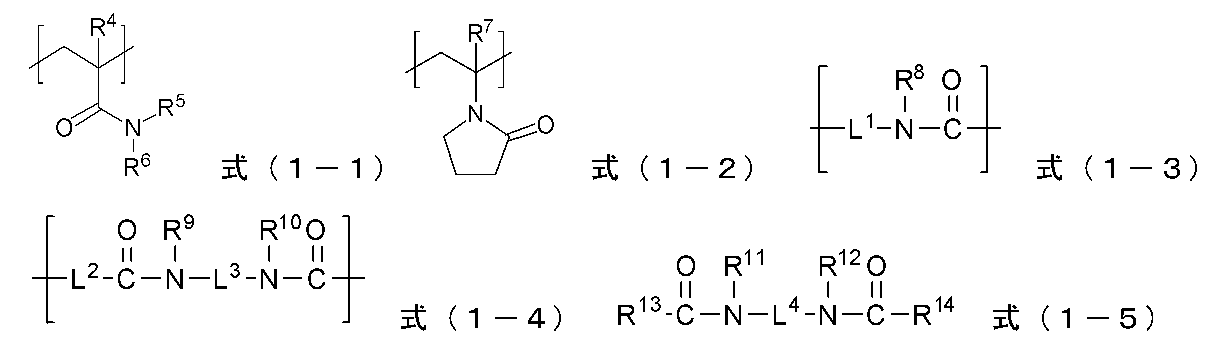
(式(1-1)中、R4は水素原子またはメチル基を表し、R5およびR6はそれぞれ独立して水素原子または有機基を表す。式(1-2)中、R7は水素原子またはメチル基を表す。式(1-3)中、L1は二価の連結基を表し、R8は水素原子または有機基を表す。式(1-4)中、L2およびL3はそれぞれ独立して二価の連結基を表し、R9およびR10はそれぞれ独立して水素原子または有機基を表す。式(1-5)中、L4は二価の連結基を表し、R11~R14はそれぞれ独立して水素原子または有機基を表す。)
<7>前記式(1)で示される部分構造を有する化合物が前記式(1-1)で表される化合物である、<6>に記載の近赤外線吸収性組成物。
<8>硬化性化合物および溶剤をさらに含有する、<1>~<7>のいずれかに記載の近赤外線吸収性組成物。
<9>前記近赤外線吸収性組成物の固形分が35~90質量%である、<1>~<8>のいずれかに記載の近赤外線吸収性組成物。
<10>固体撮像素子用イメージセンサ上に塗膜形成して用いられる、<1>~<9>のいずれかに記載の近赤外線吸収性組成物。
<11>銅化合物と、
下記式(1)’で示される部分構造を有し、かつ、アニオン性基を有しない化合物とを含有する、近赤外線吸収性組成物。

式(1)’中、R2は水素原子または有機基を表す。
<12>式(1)で示される部分構造を有する化合物が、エポキシ基またはオキセタニル基をさらに含有する、<1>~<10>のいずれかに記載の近赤外線吸収性組成物。
<13>前記式(1)で示される部分構造を有する化合物が、前記式(1)で示される部分構造を有する繰り返し単位とエポキシ基またはオキセタニル基を有する繰り返し単位とを含む重合体である、<1>~<10>のいずれかに記載の近赤外線吸収性組成物。
<14>前記式(1)’で示される部分構造を有する化合物が、エポキシ基またはオキセタニル基をさらに含有する、<11>に記載の近赤外線吸収性組成物。
<15>前記式(1)’で示される部分構造を有する化合物が、前記式(1)で示される部分構造を有する繰り返し単位とエポキシ基またはオキセタニル基を有する繰り返し単位とを含む重合体である、<11>または<14>に記載の近赤外線吸収性組成物。
<16><1>~<15>のいずれかに記載の近赤外線吸収性組成物を用いて作成された近赤外線カットフィルタ。
<17>固体撮像素子基板と、前記固体撮像素子基板の受光側に配置された<16>に記載の近赤外線カットフィルタとを有するカメラモジュール。
<18>固体撮像素子基板と、前記固体撮像素子基板の受光側に配置された近赤外線カットフィルタとを有するカメラモジュールの製造方法であって、
固体撮像素子基板の受光側において、<1>~<15>のいずれかに記載の近赤外線吸収性組成物を塗布することにより前記近赤外線カットフィルタを形成する工程を有する、カメラモジュールの製造方法。
具体的には、以下の手段<1>により、好ましくは、手段<2>~<16>により、上記課題は解決された。
<1>銅化合物と、
下記式(1)で示される部分構造を有する化合物とを含有し、
前記銅化合物の含有量が、下記式(1)で示される部分構造を有する化合物1gに対して3×10⁻³~1モルである、近赤外線吸収性組成物。
<2>前記式(1)で示される部分構造を有する化合物の含有量が、前記近赤外線吸収性組成物中5~80質量%である、<1>に記載の近赤外線吸収性組成物。
<3>前記銅化合物が銅錯体である、<1>または<2>に記載の近赤外線吸収性組成物。
<4>前記式(1)で示される部分構造を有する化合物がポリマーである、<1>~<3>のいずれかに記載の近赤外線吸収性組成物。
<5>前記ポリマーの側鎖に前記式(1)で示される部分構造を含有する、<4>に記載の近赤外線吸収性組成物。
<6>前記式(1)で示される部分構造を有する化合物が、下記式(1-1)~(1-5)のいずれかで表される構造を有する、<1>~<5>のいずれかに記載の近赤外線吸収性組成物。
<7>前記式(1)で示される部分構造を有する化合物が前記式(1-1)で表される化合物である、<6>に記載の近赤外線吸収性組成物。
<8>硬化性化合物および溶剤をさらに含有する、<1>~<7>のいずれかに記載の近赤外線吸収性組成物。
<9>前記近赤外線吸収性組成物の固形分が35~90質量%である、<1>~<8>のいずれかに記載の近赤外線吸収性組成物。
<10>固体撮像素子用イメージセンサ上に塗膜形成して用いられる、<1>~<9>のいずれかに記載の近赤外線吸収性組成物。
<11>銅化合物と、
下記式(1)’で示される部分構造を有し、かつ、アニオン性基を有しない化合物とを含有する、近赤外線吸収性組成物。
<12>式(1)で示される部分構造を有する化合物が、エポキシ基またはオキセタニル基をさらに含有する、<1>~<10>のいずれかに記載の近赤外線吸収性組成物。
<13>前記式(1)で示される部分構造を有する化合物が、前記式(1)で示される部分構造を有する繰り返し単位とエポキシ基またはオキセタニル基を有する繰り返し単位とを含む重合体である、<1>~<10>のいずれかに記載の近赤外線吸収性組成物。
<14>前記式(1)’で示される部分構造を有する化合物が、エポキシ基またはオキセタニル基をさらに含有する、<11>に記載の近赤外線吸収性組成物。
<15>前記式(1)’で示される部分構造を有する化合物が、前記式(1)で示される部分構造を有する繰り返し単位とエポキシ基またはオキセタニル基を有する繰り返し単位とを含む重合体である、<11>または<14>に記載の近赤外線吸収性組成物。
<16><1>~<15>のいずれかに記載の近赤外線吸収性組成物を用いて作成された近赤外線カットフィルタ。
<17>固体撮像素子基板と、前記固体撮像素子基板の受光側に配置された<16>に記載の近赤外線カットフィルタとを有するカメラモジュール。
<18>固体撮像素子基板と、前記固体撮像素子基板の受光側に配置された近赤外線カットフィルタとを有するカメラモジュールの製造方法であって、
固体撮像素子基板の受光側において、<1>~<15>のいずれかに記載の近赤外線吸収性組成物を塗布することにより前記近赤外線カットフィルタを形成する工程を有する、カメラモジュールの製造方法。
本発明によれば、硬化膜としたときに高い近赤外線遮蔽性を維持しつつ、耐湿性に優れた硬化膜を形成できる近赤外線吸収性組成物を提供することができる。
以下において、本発明の内容について詳細に説明する。尚、本願明細書において「~」とはその前後に記載される数値を下限値および上限値として含む意味で使用される。
本明細書中において、“(メタ)アクリレート”はアクリレートおよびメタクリレートを表し、“(メタ)アクリル”はアクリルおよびメタクリルを表し、“(メタ)アクリロイル”はアクリロイルおよびメタクリロイルを表す。また、本明細書中において、“単量体”と“モノマー”とは同義である。単量体は、オリゴマーおよびポリマーと区別され、重量平均分子量が2,000以下の化合物をいう。
本明細書中において、重合性化合物とは、重合性官能基を有する化合物のことをいい、単量体であっても、ポリマーであってもよい。重合性官能基とは、重合反応に関与する基をいう。
本明細書における基(原子団)の表記において、置換および無置換を記していない表記は、置換基を有さない基(原子団)と共に置換基を有する基(原子団)をも包含する。
本明細書における近赤外線とは、極大吸収波長領域が700~2500nmのものをいう。
本発明は、近赤外線吸収性組成物中において、銅化合物と、式(1)で示される部分構造を有する化合物を配合することを特徴とする。このメカニズムは定かではないが、このような本発明の組成物とすることにより、銅化合物の構造が歪んで、可視領域は吸光せずに近赤外領域の吸光能力を向上させることが可能になると推定される。さらに、硬化膜としたときに高い近赤外線遮蔽性を維持しつつ、耐湿性に優れた硬化膜を形成できる。
本明細書中において、“(メタ)アクリレート”はアクリレートおよびメタクリレートを表し、“(メタ)アクリル”はアクリルおよびメタクリルを表し、“(メタ)アクリロイル”はアクリロイルおよびメタクリロイルを表す。また、本明細書中において、“単量体”と“モノマー”とは同義である。単量体は、オリゴマーおよびポリマーと区別され、重量平均分子量が2,000以下の化合物をいう。
本明細書中において、重合性化合物とは、重合性官能基を有する化合物のことをいい、単量体であっても、ポリマーであってもよい。重合性官能基とは、重合反応に関与する基をいう。
本明細書における基(原子団)の表記において、置換および無置換を記していない表記は、置換基を有さない基(原子団)と共に置換基を有する基(原子団)をも包含する。
本明細書における近赤外線とは、極大吸収波長領域が700~2500nmのものをいう。
本発明は、近赤外線吸収性組成物中において、銅化合物と、式(1)で示される部分構造を有する化合物を配合することを特徴とする。このメカニズムは定かではないが、このような本発明の組成物とすることにより、銅化合物の構造が歪んで、可視領域は吸光せずに近赤外領域の吸光能力を向上させることが可能になると推定される。さらに、硬化膜としたときに高い近赤外線遮蔽性を維持しつつ、耐湿性に優れた硬化膜を形成できる。
<近赤外線吸収性組成物の第1の実施の形態>
本発明の近赤外線吸収性組成物は、銅化合物と、下記式(1)で示される部分構造を有する化合物とを含有し、前記銅化合物の含有量が、下記式(1)で示される部分構造を有する化合物1gに対して3×10⁻³~1モルである。

(式(1)中、R1は水素原子または有機基を表す。)
本発明の近赤外線吸収性組成物は、銅化合物と、前記式(1)で示される部分構造を有する化合物とを含有し、前記銅化合物の含有量が、上記式(1)で示される部分構造を有する化合物1gに対して3×10⁻³~1モルであることにより、硬化膜としたときに高い近赤外線遮蔽性を維持しつつ、耐湿性に優れた硬化膜を形成できる近赤外線吸収性組成物を提供することができる。
本発明の近赤外線吸収性組成物は、銅化合物と、下記式(1)で示される部分構造を有する化合物とを含有し、前記銅化合物の含有量が、下記式(1)で示される部分構造を有する化合物1gに対して3×10⁻³~1モルである。
本発明の近赤外線吸収性組成物は、銅化合物と、前記式(1)で示される部分構造を有する化合物とを含有し、前記銅化合物の含有量が、上記式(1)で示される部分構造を有する化合物1gに対して3×10⁻³~1モルであることにより、硬化膜としたときに高い近赤外線遮蔽性を維持しつつ、耐湿性に優れた硬化膜を形成できる近赤外線吸収性組成物を提供することができる。
<<銅化合物>>
本発明に用いられる銅化合物における銅は、1価または2価の銅が好ましく、2価の銅がより好ましい。
本発明に用いられる銅化合物中の銅含有量は、好ましくは2~40質量%であり、より好ましくは5~40質量%である。
本発明で用いる銅化合物は、波長700nm~1000nmの範囲内(近赤外線領域)に極大吸収波長を有する銅化合物であれば特に制限はない。
本発明で用いる銅化合物は、銅錯体であることが好ましい。
本発明で用いる銅化合物が銅錯体である場合、銅に配位する配位子Lとしては、銅イオンと配位結合可能であれば特に限定されないが、例えば、リン酸、リン酸エステル、ホスホン酸、ホスホン酸エステル、ホスフィン酸、置換ホスフィン酸、スルホン酸、カルボン酸、カルボニル(エステル、ケトン)、アミン、アミド、スルホンアミド、ウレタン、ウレア、アルコール、チオールなどを有する化合物が挙げられる。これらの中でも、リン酸、リン酸エステル、ホスホン酸、ホスホン酸エステル、ホスフィン酸、置換ホスフィン酸、スルホン酸が好ましく、リン酸エステル、ホスホン酸エステル、置換ホスフィン酸、スルホン酸がより好ましい。
本発明で用いる銅化合物の具体例としては、リン含有銅化合物、スルホン酸銅化合物または下記式(A)で表される銅化合物が挙げられる。リン含有銅化合物として具体的には、例えば、WO2005/030898号公報の第5頁第27行目~第7頁第20行目に記載された化合物を参酌することができ、これらの内容は本願明細書に組み込まれる。
本発明に用いられる銅化合物における銅は、1価または2価の銅が好ましく、2価の銅がより好ましい。
本発明に用いられる銅化合物中の銅含有量は、好ましくは2~40質量%であり、より好ましくは5~40質量%である。
本発明で用いる銅化合物は、波長700nm~1000nmの範囲内(近赤外線領域)に極大吸収波長を有する銅化合物であれば特に制限はない。
本発明で用いる銅化合物は、銅錯体であることが好ましい。
本発明で用いる銅化合物が銅錯体である場合、銅に配位する配位子Lとしては、銅イオンと配位結合可能であれば特に限定されないが、例えば、リン酸、リン酸エステル、ホスホン酸、ホスホン酸エステル、ホスフィン酸、置換ホスフィン酸、スルホン酸、カルボン酸、カルボニル(エステル、ケトン)、アミン、アミド、スルホンアミド、ウレタン、ウレア、アルコール、チオールなどを有する化合物が挙げられる。これらの中でも、リン酸、リン酸エステル、ホスホン酸、ホスホン酸エステル、ホスフィン酸、置換ホスフィン酸、スルホン酸が好ましく、リン酸エステル、ホスホン酸エステル、置換ホスフィン酸、スルホン酸がより好ましい。
本発明で用いる銅化合物の具体例としては、リン含有銅化合物、スルホン酸銅化合物または下記式(A)で表される銅化合物が挙げられる。リン含有銅化合物として具体的には、例えば、WO2005/030898号公報の第5頁第27行目~第7頁第20行目に記載された化合物を参酌することができ、これらの内容は本願明細書に組み込まれる。
本発明で用いる銅化合物は、下記式(A)で表されるものが好ましい。
Cu(L)n1・(X)n2 式(A)
上記式(A)中、Lは、銅に配位する配位子を表し、Xは、存在しないか、ハロゲン原子、H2O、NO3、ClO4、SO4、CN、SCN、BF4、PF6、BPh4(Phはフェニル基を表す)又はアルコールを表す。n1、n2は、各々独立に1~4の整数を表す。
配位子Lは、銅に配位可能な原子としてC、N、O、Sを含む置換基を有するものであり、さらに好ましくはNやO、Sなどの孤立電子対を持つ基を有するものである。配位可能な基は分子内に1種類に限定されず、2種以上を含んでも良く、解離しても非解離でも良い。非解離の場合、Xは存在しない。
Cu(L)n1・(X)n2 式(A)
上記式(A)中、Lは、銅に配位する配位子を表し、Xは、存在しないか、ハロゲン原子、H2O、NO3、ClO4、SO4、CN、SCN、BF4、PF6、BPh4(Phはフェニル基を表す)又はアルコールを表す。n1、n2は、各々独立に1~4の整数を表す。
配位子Lは、銅に配位可能な原子としてC、N、O、Sを含む置換基を有するものであり、さらに好ましくはNやO、Sなどの孤立電子対を持つ基を有するものである。配位可能な基は分子内に1種類に限定されず、2種以上を含んでも良く、解離しても非解離でも良い。非解離の場合、Xは存在しない。
赤外線吸収物質としての銅錯体は、中心金属の銅に配位子が配位した銅錯体(銅化合物)の形態となっている。本発明の銅錯体における銅は2価の銅であり、例えば、銅成分に対して、配位子となる化合物またはその塩を混合・反応等させて得ることができる。よって、「銅と配位子とを含有する赤外線吸収性組成物」であれば、組成物中で銅錯体を形成していることが予見される。
上記配位子となる化合物またはその塩としては、特に限定されないが、例えば、有機酸化合物(例えば、スルホン酸化合物、カルボン酸化合物、リン酸化合物)またはその塩などが好適に挙げられる。
上記配位子となる化合物またはその塩は、酸基またはその塩を含有する化合物であることが好ましく、下記一般式(i)で表されることが好ましい。
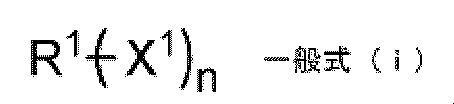
(一般式(i)中、R1はn価の有機基を表し、X1は酸基を表し、nは1~6の整数を表す。)
一般式(i)中、n価の有機基は、炭化水素基が好ましく、脂肪族炭化水素基または芳香族炭化水素基がより好ましい。炭化水素基は、置換基を有していてもよく、置換基としては、ハロゲン原子(好ましくはフッ素原子)、(メタ)アクリロイル基、不飽和二重結合を有する基が挙げられる。
上記炭化水素基が1価の場合、アルキル基またはアリール基が好ましく、アリール基がより好ましい。2価の場合、アルキレン基、アリーレン基、オキシアルキレン基が好ましく、アリーレン基がより好ましい。また3価以上の場合には、上記炭化水素基に対応するものが好ましい。
上記アルキル基及びアルキレン基の炭素数は、1~20が好ましく、1~10がより好ましく、1~5がさらに好ましい。
上記アリール基及びアリーレン基の炭素数は、6~18が好ましく、6~12がより好ましく、6がさらに好ましい。
一般式(i)中、X1は、スルホン酸基、カルボン酸基およびリン原子を含有する酸基のうちの少なくとも1つが好ましい。X1は、1種単独でも2種以上であってもよいが、
2種以上であることが好ましい。
一般式(i)中、nは、1~3が好ましく、2または3がより好ましく、3がさらに好ましい。
上記配位子となる化合物またはその塩(酸基またはその塩を含有する化合物)の分子量は、1000以下が好ましく、70~1000が好ましく、130~500がより好ましい。
一般式(i)中、n価の有機基は、炭化水素基が好ましく、脂肪族炭化水素基または芳香族炭化水素基がより好ましい。炭化水素基は、置換基を有していてもよく、置換基としては、ハロゲン原子(好ましくはフッ素原子)、(メタ)アクリロイル基、不飽和二重結合を有する基が挙げられる。
上記炭化水素基が1価の場合、アルキル基またはアリール基が好ましく、アリール基がより好ましい。2価の場合、アルキレン基、アリーレン基、オキシアルキレン基が好ましく、アリーレン基がより好ましい。また3価以上の場合には、上記炭化水素基に対応するものが好ましい。
上記アルキル基及びアルキレン基の炭素数は、1~20が好ましく、1~10がより好ましく、1~5がさらに好ましい。
上記アリール基及びアリーレン基の炭素数は、6~18が好ましく、6~12がより好ましく、6がさらに好ましい。
一般式(i)中、X1は、スルホン酸基、カルボン酸基およびリン原子を含有する酸基のうちの少なくとも1つが好ましい。X1は、1種単独でも2種以上であってもよいが、
2種以上であることが好ましい。
一般式(i)中、nは、1~3が好ましく、2または3がより好ましく、3がさらに好ましい。
上記配位子となる化合物またはその塩(酸基またはその塩を含有する化合物)の分子量は、1000以下が好ましく、70~1000が好ましく、130~500がより好ましい。
酸基またはその塩を含有する化合物の好ましい態様としては、(1)スルホン酸基、カルボン酸基およびリン原子を含有する酸基のうち少なくとも1種を有する化合物が挙げられ、より好ましくは、(2)酸基を2つ以上有する態様であり、さらに好ましくは、(3)スルホン酸基とカルボン酸基を有する態様である。これらの態様では、近赤外線を吸収する能力である赤外線吸収能がより効果的に発揮される。さらに、スルホン酸基およびカルボン酸基を有する化合物を用いることにより、色価をより向上させることができる。
(1)スルホン酸基、カルボン酸基およびリン原子を含有する酸基のうち少なくとも1種を有する化合物の具体例としては以下のものが挙げられる。また、スルホン酸基を有する化合物の具体例としては、後述するスルホン酸化合物の具体例も挙げられる。また、後述する態様(2)、(3)に記載の化合物のうち、本態様に該当する化合物も好ましい例として挙げられる。
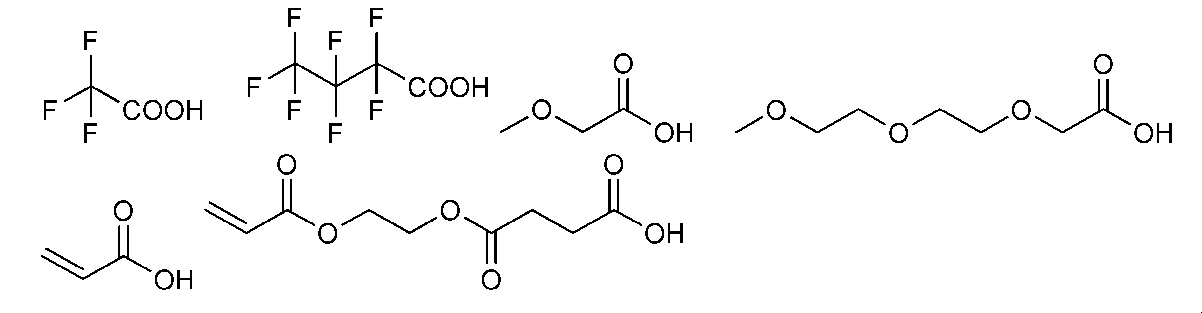
(2)酸基を少なくとも2以上有する化合物の具体例としては以下のものが挙げられる。また、後述する態様(3)に記載の化合物のうち、本態様に該当する化合物も好ましい例として挙げられる。
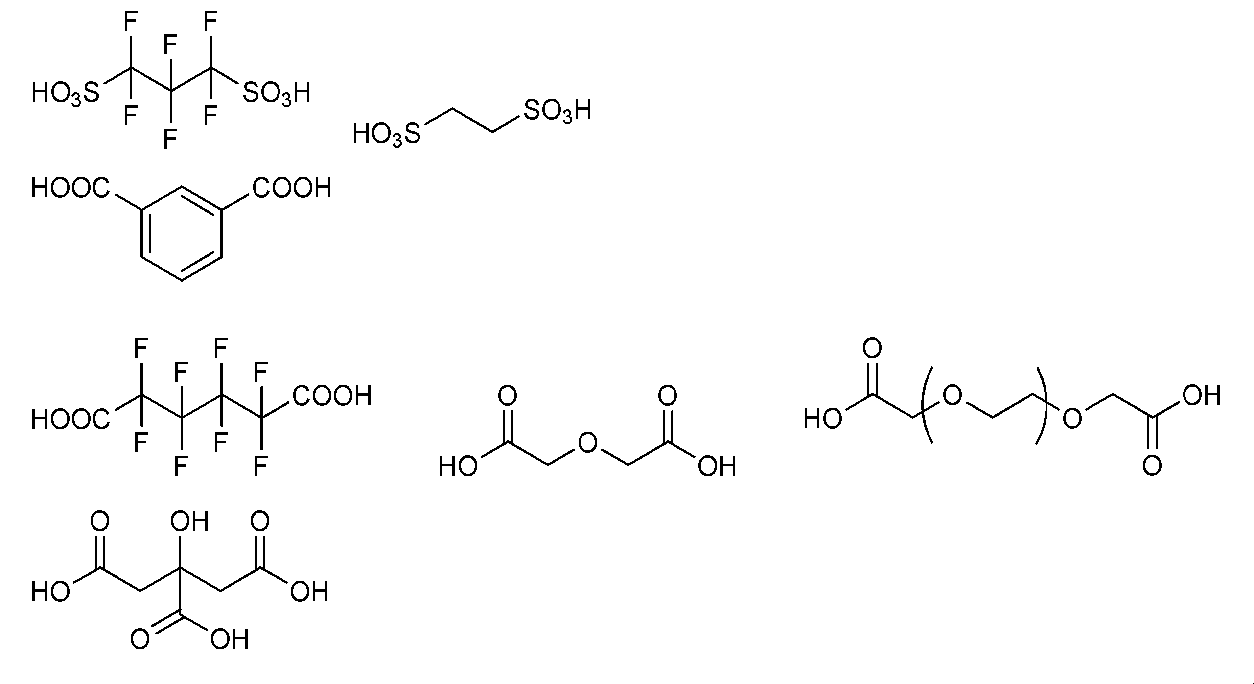
(3)スルホン酸基およびカルボン酸基を有する化合物の具体例としては以下のものが挙げられる。また、後述するスルホン酸基およびカルボン酸基を有する化合物の具体例も挙げられる。
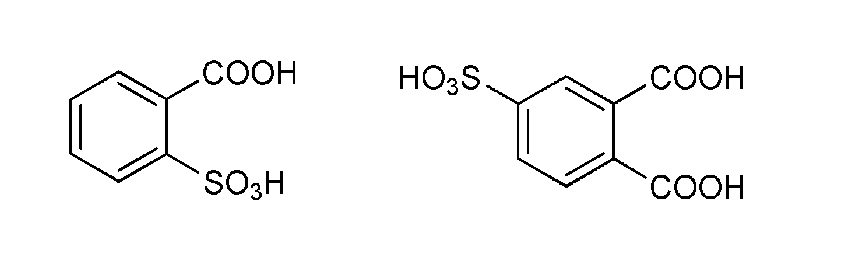
(1)スルホン酸基、カルボン酸基およびリン原子を含有する酸基のうち少なくとも1種を有する化合物の具体例としては以下のものが挙げられる。また、スルホン酸基を有する化合物の具体例としては、後述するスルホン酸化合物の具体例も挙げられる。また、後述する態様(2)、(3)に記載の化合物のうち、本態様に該当する化合物も好ましい例として挙げられる。
以下、本発明で用いられる銅化合物、および配位子Lを形成する化合物について、詳細に説明する。
<<リン含有銅錯体>>
リン含有銅錯体としては、錯体の配位子としてリン化合物を含有する配位子を有していれば、特に制限されないが、リン酸銅錯体、リン酸エステル銅錯体、ホスホン酸銅錯体、ホスホン酸エステル銅錯体、ホスフィン酸銅錯体、置換ホスフィン酸銅錯体であることが好ましく、リン酸エステル銅錯体、ホスホン酸エステル銅錯体、置換ホスフィン酸銅錯体であることがより好ましい。
<<リン含有銅錯体>>
リン含有銅錯体としては、錯体の配位子としてリン化合物を含有する配位子を有していれば、特に制限されないが、リン酸銅錯体、リン酸エステル銅錯体、ホスホン酸銅錯体、ホスホン酸エステル銅錯体、ホスフィン酸銅錯体、置換ホスフィン酸銅錯体であることが好ましく、リン酸エステル銅錯体、ホスホン酸エステル銅錯体、置換ホスフィン酸銅錯体であることがより好ましい。
<<<リン酸エステル銅錯体>>>
リン酸エステル銅錯体は、銅を中心金属としリン酸エステル化合物を配位子とするものである。
配位子Lを形成するリン酸エステル化合物としては下記式(B)で表される化合物がより好ましい。
(HO)n-P(=O)-(OR2)3-n 式(B)
上記式(B)中、R2は有機基を示し、nは1または2を表す。
(式中、R2は炭素数1~18のアルキル基、炭素数6~18のアリール基、炭素数1~18のアラルキル基、または炭素数1~18のアルケニル基を表すか、-OR2が、炭素数4~100のポリオキシアルキル基、炭素数4~100の(メタ)アクリロイルオキシアルキル基、または、炭素数4~100の(メタ)アクリロイルポリオキシアルキル基を表し、nは1または2を表す。)
nが1のとき、R2はそれぞれ同一でもよいし、異なっていてもよい。
リン酸エステル銅錯体は、銅を中心金属としリン酸エステル化合物を配位子とするものである。
配位子Lを形成するリン酸エステル化合物としては下記式(B)で表される化合物がより好ましい。
(HO)n-P(=O)-(OR2)3-n 式(B)
上記式(B)中、R2は有機基を示し、nは1または2を表す。
(式中、R2は炭素数1~18のアルキル基、炭素数6~18のアリール基、炭素数1~18のアラルキル基、または炭素数1~18のアルケニル基を表すか、-OR2が、炭素数4~100のポリオキシアルキル基、炭素数4~100の(メタ)アクリロイルオキシアルキル基、または、炭素数4~100の(メタ)アクリロイルポリオキシアルキル基を表し、nは1または2を表す。)
nが1のとき、R2はそれぞれ同一でもよいし、異なっていてもよい。
本発明で用いられるリン酸エステル化合物としては、リン酸モノエステル(前記式(B)中のn=2)、リン酸ジエステル(前記式(B)中のn=1)が挙げられるが、近赤外線遮蔽性と溶解性の観点から、リン酸ジエステルが好ましく、下記式(C)で表される化合物が好ましい。

(式(C)中、R1、R2は、各々独立に、1価の有機基または2価の有機基を示し、環状構造を形成してもよい。)
前記式(C)で表される化合物およびその塩は、銅に配位する配位子として作用する。ここで、配位子とは、銅錯体の中で銅原子の周囲に立体的に配置されて銅原子と結合している他の原子、イオン、原子団、基、中性分子などのことをいう。
前記式(C)中の、R1、R2は、各々独立に1価の有機基を示す。1価の有機基としては、炭素数が3以上の有機基が好ましく、炭素数5以上の有機基がより好ましく、炭素数5~20の有機基がさらに好ましい。
また、前記式(C)において、R1およびR2同士が互いに結合して環状構造を形成していてもよい。この場合、R1、R2はいずれも2価の有機基となる。結合した環状構造を含む基(2価の有機基)の炭素原子の合計数は3以上であり、炭素数5以上が好ましく、炭素数5~20の有機基がより好ましい。
具体的な1価の有機基としては、特に限定されないが、直鎖状、分岐状または環状のアルキル基、アリール基、ヘテロアリール基を挙げることができる。ここで、これらの基は、2価の連結基(例えば、直鎖状、分岐状または環状のアルキレン基、アリーレン基、ヘテロアリーレン基、-O-、-S-、-CO-、-COO-、-OCO-、-SO2-、
-NR-(Rは水素原子あるいはアルキル基)など)を介した基であってもよい。また1価の有機基は置換基を有していてもよい。
前記式(C)中の、R1、R2は、各々独立に1価の有機基を示す。1価の有機基としては、炭素数が3以上の有機基が好ましく、炭素数5以上の有機基がより好ましく、炭素数5~20の有機基がさらに好ましい。
また、前記式(C)において、R1およびR2同士が互いに結合して環状構造を形成していてもよい。この場合、R1、R2はいずれも2価の有機基となる。結合した環状構造を含む基(2価の有機基)の炭素原子の合計数は3以上であり、炭素数5以上が好ましく、炭素数5~20の有機基がより好ましい。
具体的な1価の有機基としては、特に限定されないが、直鎖状、分岐状または環状のアルキル基、アリール基、ヘテロアリール基を挙げることができる。ここで、これらの基は、2価の連結基(例えば、直鎖状、分岐状または環状のアルキレン基、アリーレン基、ヘテロアリーレン基、-O-、-S-、-CO-、-COO-、-OCO-、-SO2-、
-NR-(Rは水素原子あるいはアルキル基)など)を介した基であってもよい。また1価の有機基は置換基を有していてもよい。
直鎖状または分枝状のアルキル基としては、炭素数3~20のアルキル基が好ましく、炭素数3~10のアルキル基がより好ましく、炭素数3~8のアルキル基がさらに好ましい。
環状のアルキル基は、単環、多環のいずれであってもよい。環状のアルキル基としては、炭素数3~20のシクロアルキル基が好ましく、炭素数4~10のシクロアルキル基がより好ましく、炭素数6~10のシクロアルキル基がさらに好ましい。
アリール基としては、炭素数6~18のアリール基が好ましく、炭素数6~14のアリール基がより好ましく、炭素数6~10のアリール基がさらに好ましい。
ヘテロアリール基としては、5員環または6員環が好ましい。また、ヘテロアリール基は、単環または縮合環であり、単環または縮合数が2~8の縮合環が好ましく、単環または縮合数が2~4の縮合環がより好ましい。
具体的には、窒素、酸素、硫黄原子の少なくとも一つを含有する単環、または多環芳香族環から誘導されるヘテロアリール基が用いられる。ヘテロアリール基中のヘテロアリール環としては、例えば、オキゾール環、チオフェン環、チアスレン環、フラン環、ピラン環、イソベンゾフラン環、クロメン環、キサンテン環、フェノキサジン環、ピロール環、ピラゾール環、イソチアゾール環、イソオキサゾール環、ピラジン環、ピリミジン環、ピリダジン環、インドリジン環、イソインドリジン環、インドール環、インダゾール環、プリン環、キノリジン環、イソキノリン環、フタラジン環、ナフチリジン環、キナゾリン環、シノリン環、プテリジン環、カルバゾール環、カルボリン環、フェナンスリン環、アクリジン環、ペリミジン環、フェナンスロリン環、フタラジン環、フェナルザジン環、フェノキサジン環、フラザン環等が挙げられる。
環状のアルキル基は、単環、多環のいずれであってもよい。環状のアルキル基としては、炭素数3~20のシクロアルキル基が好ましく、炭素数4~10のシクロアルキル基がより好ましく、炭素数6~10のシクロアルキル基がさらに好ましい。
アリール基としては、炭素数6~18のアリール基が好ましく、炭素数6~14のアリール基がより好ましく、炭素数6~10のアリール基がさらに好ましい。
ヘテロアリール基としては、5員環または6員環が好ましい。また、ヘテロアリール基は、単環または縮合環であり、単環または縮合数が2~8の縮合環が好ましく、単環または縮合数が2~4の縮合環がより好ましい。
具体的には、窒素、酸素、硫黄原子の少なくとも一つを含有する単環、または多環芳香族環から誘導されるヘテロアリール基が用いられる。ヘテロアリール基中のヘテロアリール環としては、例えば、オキゾール環、チオフェン環、チアスレン環、フラン環、ピラン環、イソベンゾフラン環、クロメン環、キサンテン環、フェノキサジン環、ピロール環、ピラゾール環、イソチアゾール環、イソオキサゾール環、ピラジン環、ピリミジン環、ピリダジン環、インドリジン環、イソインドリジン環、インドール環、インダゾール環、プリン環、キノリジン環、イソキノリン環、フタラジン環、ナフチリジン環、キナゾリン環、シノリン環、プテリジン環、カルバゾール環、カルボリン環、フェナンスリン環、アクリジン環、ペリミジン環、フェナンスロリン環、フタラジン環、フェナルザジン環、フェノキサジン環、フラザン環等が挙げられる。
2価の連結基である直鎖状、分岐状または環状のアルキレン基、アリーレン基、あるいはヘテロアリーレン基としては、上述した直鎖状、分岐状または環状のアルキル基、アリール基、あるいはヘテロアリール基から水素原子を1個除いて誘導される2価の連結基が挙げられる。
1価の有機基が有していてもよい置換基としては、アルキル基、重合性基(例えば、ビニル基、(メタ)アクリロイル基、エポキシ基、オキセタン基など)、ハロゲン原子、カルボキシル基、カルボン酸エステル基(例えば、-CO2CH3など)、水酸基、アミド基、ハロゲン化アルキル基(例えば、フルオロアルキル基、クロロアルキル基)などが例示される。
また、本発明のリン酸ジエステル銅錯体は、下記式(D)で表される構造を含有する。

(式(D)中、R1、R2は、各々独立に、1価の有機基または2価の有機基を示し、環状構造を形成してもよい。「*」は、銅と配位結合する部位を示す。)
式(D)中、R1およびR2は、前記式(C)中におけるR1およびR2と同義であり、好ましい範囲も同様である。
前記式(C)で表されるリン酸エステル化合物の分子量は、200~1000が好ましく、250~750がより好ましく、300~500がさらに好ましい。
式(D)中、R1およびR2は、前記式(C)中におけるR1およびR2と同義であり、好ましい範囲も同様である。
前記式(C)で表されるリン酸エステル化合物の分子量は、200~1000が好ましく、250~750がより好ましく、300~500がさらに好ましい。
リン酸エステル化合物の具体例を以下に示す。
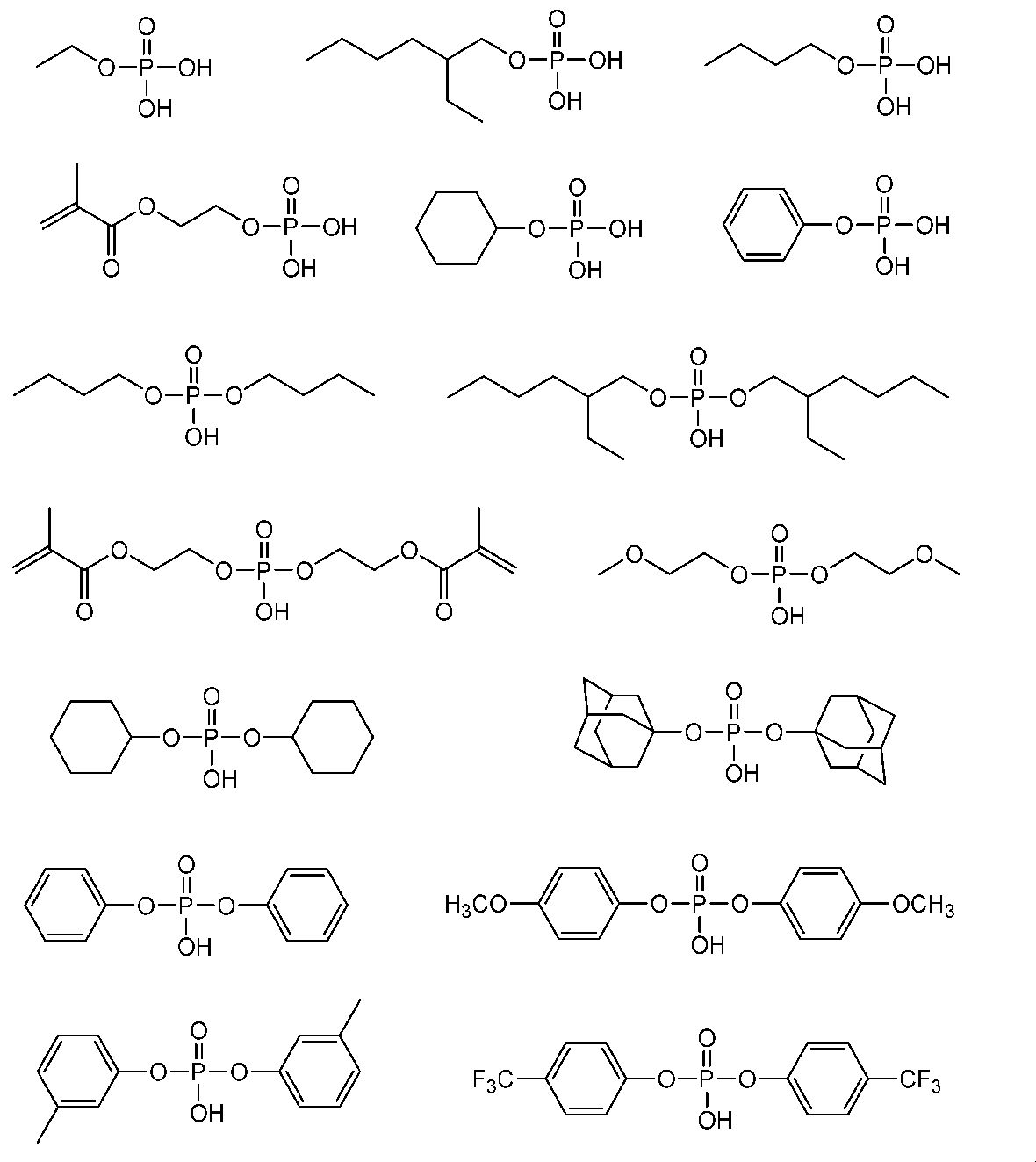
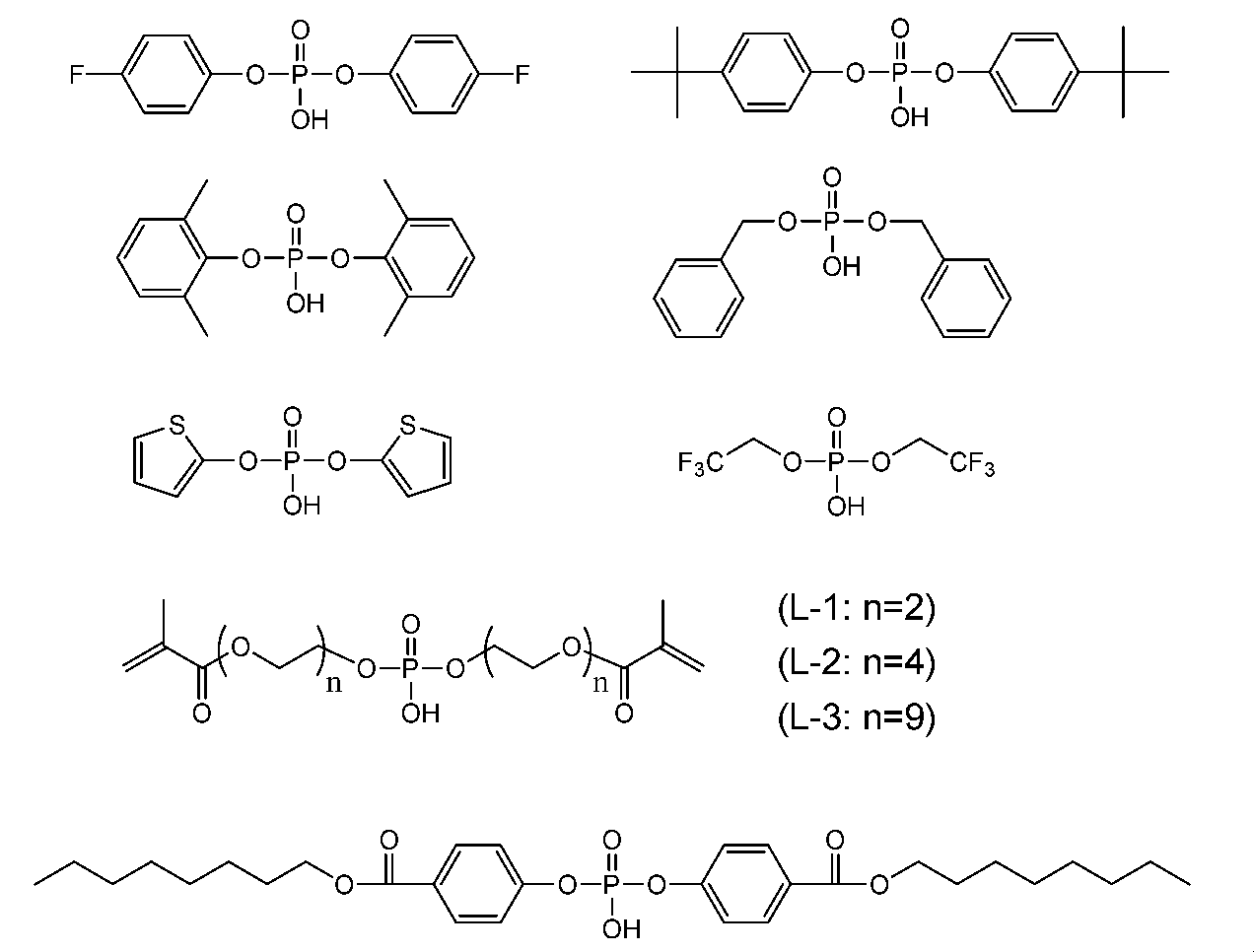

<<<ホスホン酸エステル銅錯体>>>
本発明で用いられるホスホン酸エステル銅錯体は、銅を中心金属としホスホン酸エステル化合物を配位子とするものであってもよい。
配位子Lを形成するホスホン酸エステル化合物としては下記式(E)で表される化合物がより好ましい。

(式(E)中、R3、R4は、各々独立に、1価の有機基を示す。)
式(E)で表される化合物およびその塩は、銅に配位する配位子として作用する。
本発明で用いられるホスホン酸エステル銅錯体は、銅を中心金属としホスホン酸エステル化合物を配位子とするものであってもよい。
配位子Lを形成するホスホン酸エステル化合物としては下記式(E)で表される化合物がより好ましい。
式(E)で表される化合物およびその塩は、銅に配位する配位子として作用する。
式(E)中の、R3、R4は、各々独立に1価の有機基を示す。具体的な1価の有機基としては、特に限定されないが、直鎖状、分枝状または環状のアルキル基、アルケニル基、アリール基、ヘテロアリール基を挙げることができる。ここで、これらの基は、途中に2価の連結基(例えば、アルキレン基、シクロアルキレン基、アリーレン基、ヘテロアリーレン基、-O-、-S-、-CO-、-COO-、-OCO-、-SO2-、-NR-(Rは水素原子あるいはアルキル基)など)を介した基であってもよい。また1価の有機基は置換基を有していてもよい。
直鎖状または分枝状のアルキル基としては、炭素数1~20のアルキル基が好ましく、炭素数1~10のアルキル基がより好ましく、炭素数1~8のアルキル基がさらに好ましい。
環状のアルキル基、アリール基、ヘテロアリール基としては、前記式(C)中の環状のアルキル基、アリール基、ヘテロアリール基と同義であり、好ましい範囲も同様である。
アルケニル基としては、炭素数2~10のアルケニル基が好ましく、炭素数2~8のアルケニル基がより好ましく、炭素数2~4のアルケニル基がさらに好ましい。具体的には、ビニル基、1-プロペニル基、1-ブテニル基などが例示される。
2価の連結基である直鎖状、分枝状または環状のアルキレン基、アリーレン基、あるいはヘテロアリーレン基としては、前記式(C)で記載したものが挙げられる。
1価の有機基が有していてもよい置換基としては、前記式(C)で記載したものが挙げられる。
直鎖状または分枝状のアルキル基としては、炭素数1~20のアルキル基が好ましく、炭素数1~10のアルキル基がより好ましく、炭素数1~8のアルキル基がさらに好ましい。
環状のアルキル基、アリール基、ヘテロアリール基としては、前記式(C)中の環状のアルキル基、アリール基、ヘテロアリール基と同義であり、好ましい範囲も同様である。
アルケニル基としては、炭素数2~10のアルケニル基が好ましく、炭素数2~8のアルケニル基がより好ましく、炭素数2~4のアルケニル基がさらに好ましい。具体的には、ビニル基、1-プロペニル基、1-ブテニル基などが例示される。
2価の連結基である直鎖状、分枝状または環状のアルキレン基、アリーレン基、あるいはヘテロアリーレン基としては、前記式(C)で記載したものが挙げられる。
1価の有機基が有していてもよい置換基としては、前記式(C)で記載したものが挙げられる。
また、本発明で用いられるホスホン酸エステル銅錯体は、下記式(F)で表される構造を含有する。

(式(F)中、R3およびR4は、各々独立に、1価の有機基を示す。「*」は、銅と配位結合する部位を示す。)
前記式(F)中、R3およびR4は、前記式(E)中におけるR3およびR4と同義であり、好ましい範囲も同様である。
前記式(E)で表されるホスホン酸エステル化合物の分子量は、200~1000が好ましく、250~750がより好ましく、300~500がさらに好ましい。
前記式(F)中、R3およびR4は、前記式(E)中におけるR3およびR4と同義であり、好ましい範囲も同様である。
前記式(E)で表されるホスホン酸エステル化合物の分子量は、200~1000が好ましく、250~750がより好ましく、300~500がさらに好ましい。
ホスホン酸エステル化合物の具体例を以下に示す。

<<<置換ホスフィン酸銅錯体>>>
本発明で用いられる置換ホスフィン酸銅錯体は、銅を中心金属とし置換ホスフィン酸化合物を配位子とするものである。配位子Lを形成する置換ホスフィン酸化合物としては下記式(G)で表される化合物がより好ましい。

(式(G)中、R5およびR6は、各々独立に、1価の有機基を示す。)
本発明で用いられる置換ホスフィン酸銅錯体は、銅を中心金属とし置換ホスフィン酸化合物を配位子とするものである。配位子Lを形成する置換ホスフィン酸化合物としては下記式(G)で表される化合物がより好ましい。
式(G)で表される化合物およびその塩は、銅に配位する配位子として作用する。
式(G)中の、R5およびR6は、各々独立に1価の有機基を示す。具体的な1価の有機基としては、特に限定されないが、直鎖状、分岐状または環状のアルキル基、アリール基、ヘテロアリール基を挙げることができる。ここで、これらの基は、途中に2価の連結基(例えば、アルキレン基、シクロアルキレン基、アリーレン基、ヘテロアリーレン基、-O-、-S-、-CO-、-COO-、-OCO-、-SO2-、-NR-(Rは水素原子あるいはアルキル基)など)を介した基であってもよい。また1価の有機基は置換基を有していてもよい。
直鎖状または分岐状のアルキル基としては、炭素数1~20のアルキル基が好ましく、炭素数1~10のアルキル基がより好ましく、炭素数1~8のアルキル基がさらに好ましい。具体的には、メチル基、n-ブチル基、2-エチルヘキシル基などが例示される。
環状のアルキル基、アリール基、ヘテロアリール基は、前記式(C)中の環状のアルキル基、アリール基、ヘテロアリール基と同義であり、好ましい範囲も同様である。
2価の連結基である直鎖状、分岐状または環状のアルキレン基、アリーレン基、あるいはヘテロアリーレン基としては、前記式(C)で記載したものが挙げられる。
1価の有機基が有していてもよい置換基としては、前記式(C)で記載したものが挙げられる。
式(G)中の、R5およびR6は、各々独立に1価の有機基を示す。具体的な1価の有機基としては、特に限定されないが、直鎖状、分岐状または環状のアルキル基、アリール基、ヘテロアリール基を挙げることができる。ここで、これらの基は、途中に2価の連結基(例えば、アルキレン基、シクロアルキレン基、アリーレン基、ヘテロアリーレン基、-O-、-S-、-CO-、-COO-、-OCO-、-SO2-、-NR-(Rは水素原子あるいはアルキル基)など)を介した基であってもよい。また1価の有機基は置換基を有していてもよい。
直鎖状または分岐状のアルキル基としては、炭素数1~20のアルキル基が好ましく、炭素数1~10のアルキル基がより好ましく、炭素数1~8のアルキル基がさらに好ましい。具体的には、メチル基、n-ブチル基、2-エチルヘキシル基などが例示される。
環状のアルキル基、アリール基、ヘテロアリール基は、前記式(C)中の環状のアルキル基、アリール基、ヘテロアリール基と同義であり、好ましい範囲も同様である。
2価の連結基である直鎖状、分岐状または環状のアルキレン基、アリーレン基、あるいはヘテロアリーレン基としては、前記式(C)で記載したものが挙げられる。
1価の有機基が有していてもよい置換基としては、前記式(C)で記載したものが挙げられる。
また、本発明で用いられる置換ホスフィン酸銅錯体は、下記式(H)で表される構造を含有する。

(式(H)中、R5およびR6は、各々独立に、1価の有機基を示す。「*」は、銅と配位結合する部位を示す。)
前記式(H)中、R5およびR6は、前記式(G)中におけるR5およびR6と同義であり、好ましい範囲も同様である。
前記式(G)で表される置換ホスフィン酸化合物の分子量は、50~750が好ましく、50~500がより好ましく、80~300がさらに好ましい。
置換ホスフィン酸化合物の具体例を以下に示す。
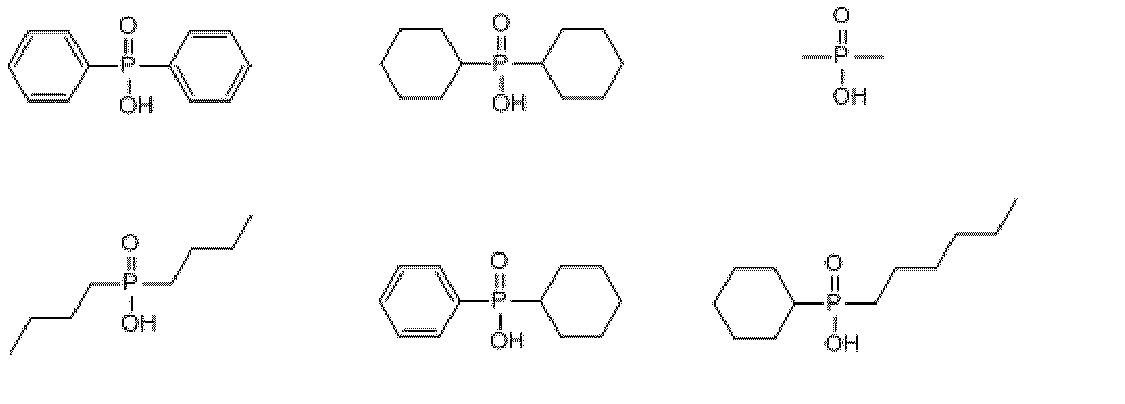
前記式(H)中、R5およびR6は、前記式(G)中におけるR5およびR6と同義であり、好ましい範囲も同様である。
前記式(G)で表される置換ホスフィン酸化合物の分子量は、50~750が好ましく、50~500がより好ましく、80~300がさらに好ましい。
置換ホスフィン酸化合物の具体例を以下に示す。
本発明に用いられるリン含有銅錯体は、銅成分に対して、配位子となるリン含有化合物(例えば、リン酸エステル、ホスホン酸エステル、置換ホスフィン酸など)あるいはその塩とを反応させることにより得ることができる。
上述した銅成分としては、銅または銅を含む化合物を用いることができる。銅を含む化合物としては、例えば、酸化銅や銅塩を用いることができる。銅塩は、1価または2価の銅が好ましく、2価の銅がより好ましい。銅塩としては、酢酸銅、塩化銅、ギ酸銅、ステアリン酸銅、安息香酸銅、エチルアセト酢酸銅、ピロリン酸銅、ナフテン酸銅、クエン酸銅、硝酸銅、硫酸銅、炭酸銅、塩素酸銅、(メタ)アクリル酸銅、過塩素酸銅がより好ましく、酢酸銅、塩化銅、硫酸銅、安息香酸銅、(メタ)アクリル酸銅がさらに好ましい。
本発明に用いられるリン含有化合物は、例えば、公知の方法を参照して、合成することができる。
例えば、前記リン酸エステル化合物は、2-ヒドロキシエチルメタクリレート、フェニルリン酸エステルおよび1,3,5-トリイソプロピルスルホン酸クロリドをピリジン溶媒中で反応させることにより得ることができる。
本発明で用いられるリン含有化合物の塩としては、例えば金属塩が好ましく、具体的には、ナトリウム塩、カリウム塩、マグネシウム塩、カルシウム塩、ホウ酸塩等が挙げられる。
銅成分と、上述したリン含有化合物またはその塩とを反応させる際の反応比率としては、モル比率で1:1.5~1:4とすることが好ましい。
また、銅成分と、上述したリン含有化合物またはその塩とを反応させる際の反応条件は、例えば、20~50℃で、0.5時間以上とすることが好ましい。
上述した銅成分としては、銅または銅を含む化合物を用いることができる。銅を含む化合物としては、例えば、酸化銅や銅塩を用いることができる。銅塩は、1価または2価の銅が好ましく、2価の銅がより好ましい。銅塩としては、酢酸銅、塩化銅、ギ酸銅、ステアリン酸銅、安息香酸銅、エチルアセト酢酸銅、ピロリン酸銅、ナフテン酸銅、クエン酸銅、硝酸銅、硫酸銅、炭酸銅、塩素酸銅、(メタ)アクリル酸銅、過塩素酸銅がより好ましく、酢酸銅、塩化銅、硫酸銅、安息香酸銅、(メタ)アクリル酸銅がさらに好ましい。
本発明に用いられるリン含有化合物は、例えば、公知の方法を参照して、合成することができる。
例えば、前記リン酸エステル化合物は、2-ヒドロキシエチルメタクリレート、フェニルリン酸エステルおよび1,3,5-トリイソプロピルスルホン酸クロリドをピリジン溶媒中で反応させることにより得ることができる。
本発明で用いられるリン含有化合物の塩としては、例えば金属塩が好ましく、具体的には、ナトリウム塩、カリウム塩、マグネシウム塩、カルシウム塩、ホウ酸塩等が挙げられる。
銅成分と、上述したリン含有化合物またはその塩とを反応させる際の反応比率としては、モル比率で1:1.5~1:4とすることが好ましい。
また、銅成分と、上述したリン含有化合物またはその塩とを反応させる際の反応条件は、例えば、20~50℃で、0.5時間以上とすることが好ましい。
本発明のリン含有銅錯体は、近赤外線波長領域700~2500nmに極大吸収波長(λmax)を有するが、700~2500nmに極大吸収波長を有することが好ましく、720~890nmがより好ましく、730~880nmがさらに好ましい。極大吸収波長は、例えば、Cary 5000 UV-Vis-NIR(分光光度計 アジレント・テクノロジー株式会社製)を用いて測定することができる。
また、本発明のリン含有銅錯体は、グラム吸光度が0.04以上(g/mL)であることが好ましく、0.06以上(g/mL)であることがより好ましく、0.08以上(g/mL)であることがさらに好ましい。
グラム吸光度は、例えば、Cary 5000 UV-Vis-NIR(分光光度計 アジレント・テクノロジー株式会社製)装置を用いて算出することができる。
また、本発明のリン含有銅錯体は、グラム吸光度が0.04以上(g/mL)であることが好ましく、0.06以上(g/mL)であることがより好ましく、0.08以上(g/mL)であることがさらに好ましい。
グラム吸光度は、例えば、Cary 5000 UV-Vis-NIR(分光光度計 アジレント・テクノロジー株式会社製)装置を用いて算出することができる。
<<スルホン酸銅錯体>>
本発明で用いられるスルホン酸銅錯体は、銅を中心金属としスルホン酸化合物を配位子とするものである。
配位子としてのスルホン酸化合物としては、下記式(I)で表される化合物がより好ましい。
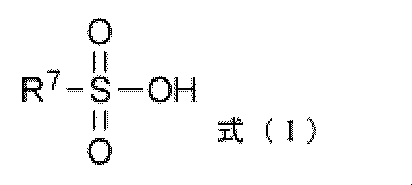
(式(I)中、R7は1価の有機基を表す。)
式(I)で表されるスルホン酸およびその塩は、銅に配位する配位子として作用する。
具体的な1価の有機基としては、特に限定されないが、直鎖状、分岐状または環状のアルキル基、アルケニル基、アリール基を挙げることができる。ここで、これらの基は、2価の連結基(例えば、アルキレン基、シクロアルキレン基、アリーレン基、-O-、-S-、-CO-、-COO-、-OCO-、-SO2-、-NR-(Rは水素原子あるいはアルキル基)など)を介した基であってもよい。また1価の有機基は置換基を有していてもよい。
直鎖状または分岐状のアルキル基としては、炭素数1~20のアルキル基が好ましく、炭素数1~12のアルキル基がより好ましく、炭素数1~8のアルキル基がさらに好ましい。
環状のアルキル基は、単環、多環のいずれであってもよい。環状のアルキル基としては、炭素数3~20のシクロアルキル基が好ましく、炭素数4~10のシクロアルキル基がより好ましく、炭素数6~10のシクロアルキル基がさらに好ましい。アルケニル基としては、炭素数2~10のアルケニル基が好ましく、炭素数2~8のアルケニル基がより好ましく、炭素数2~4のアルケニル基がさらに好ましい。
アリール基としては、炭素数6~18のアリール基が好ましく、炭素数6~14のアリール基がより好ましく、炭素数6~10のアリール基がさらに好ましい。
本発明で用いられるスルホン酸銅錯体は、銅を中心金属としスルホン酸化合物を配位子とするものである。
配位子としてのスルホン酸化合物としては、下記式(I)で表される化合物がより好ましい。
式(I)で表されるスルホン酸およびその塩は、銅に配位する配位子として作用する。
具体的な1価の有機基としては、特に限定されないが、直鎖状、分岐状または環状のアルキル基、アルケニル基、アリール基を挙げることができる。ここで、これらの基は、2価の連結基(例えば、アルキレン基、シクロアルキレン基、アリーレン基、-O-、-S-、-CO-、-COO-、-OCO-、-SO2-、-NR-(Rは水素原子あるいはアルキル基)など)を介した基であってもよい。また1価の有機基は置換基を有していてもよい。
直鎖状または分岐状のアルキル基としては、炭素数1~20のアルキル基が好ましく、炭素数1~12のアルキル基がより好ましく、炭素数1~8のアルキル基がさらに好ましい。
環状のアルキル基は、単環、多環のいずれであってもよい。環状のアルキル基としては、炭素数3~20のシクロアルキル基が好ましく、炭素数4~10のシクロアルキル基がより好ましく、炭素数6~10のシクロアルキル基がさらに好ましい。アルケニル基としては、炭素数2~10のアルケニル基が好ましく、炭素数2~8のアルケニル基がより好ましく、炭素数2~4のアルケニル基がさらに好ましい。
アリール基としては、炭素数6~18のアリール基が好ましく、炭素数6~14のアリール基がより好ましく、炭素数6~10のアリール基がさらに好ましい。
2価の連結基であるアルキレン基、シクロアルキレン基、アリーレン基としては、前述のアルキル基、シクロアルキル基、アリール基から水素原子を1個除いて誘導される2価の連結基が挙げられる。
1価の有機基が有していてもよい置換基としては、アルキル基、重合性基(例えば、ビニル基、(メタ)アクリロイル基、エポキシ基、オキセタン基など)、ハロゲン原子、カルボキシル基、カルボン酸エステル基(例えば、-CO2CH3など)、水酸基、アミド基、ハロゲン化アルキル基(例えば、フルオロアルキル基、クロロアルキル基)などが例示される。
また、本発明のスルホン酸銅錯体は、下記式(J)で表される構造を含有する。

(式(J)中、R8は、1価の有機基を示す。「*」は、銅と配位結合する部位を示す。
)
前記式(J)中、R8は、前記式(I)中におけるR7と同義であり、好ましい範囲も同様である。
前記式(I)で表されるスルホン酸化合物の分子量は、80~750が好ましく、80~600がより好ましく、80~450がさらに好ましい。
また、本発明のスルホン酸銅錯体は、下記式(J)で表される構造を含有する。
)
前記式(J)中、R8は、前記式(I)中におけるR7と同義であり、好ましい範囲も同様である。
前記式(I)で表されるスルホン酸化合物の分子量は、80~750が好ましく、80~600がより好ましく、80~450がさらに好ましい。
式(I)で表されるスルホン酸化合物の具体例を以下に示すが、本発明はこれらに限定されるものではない。
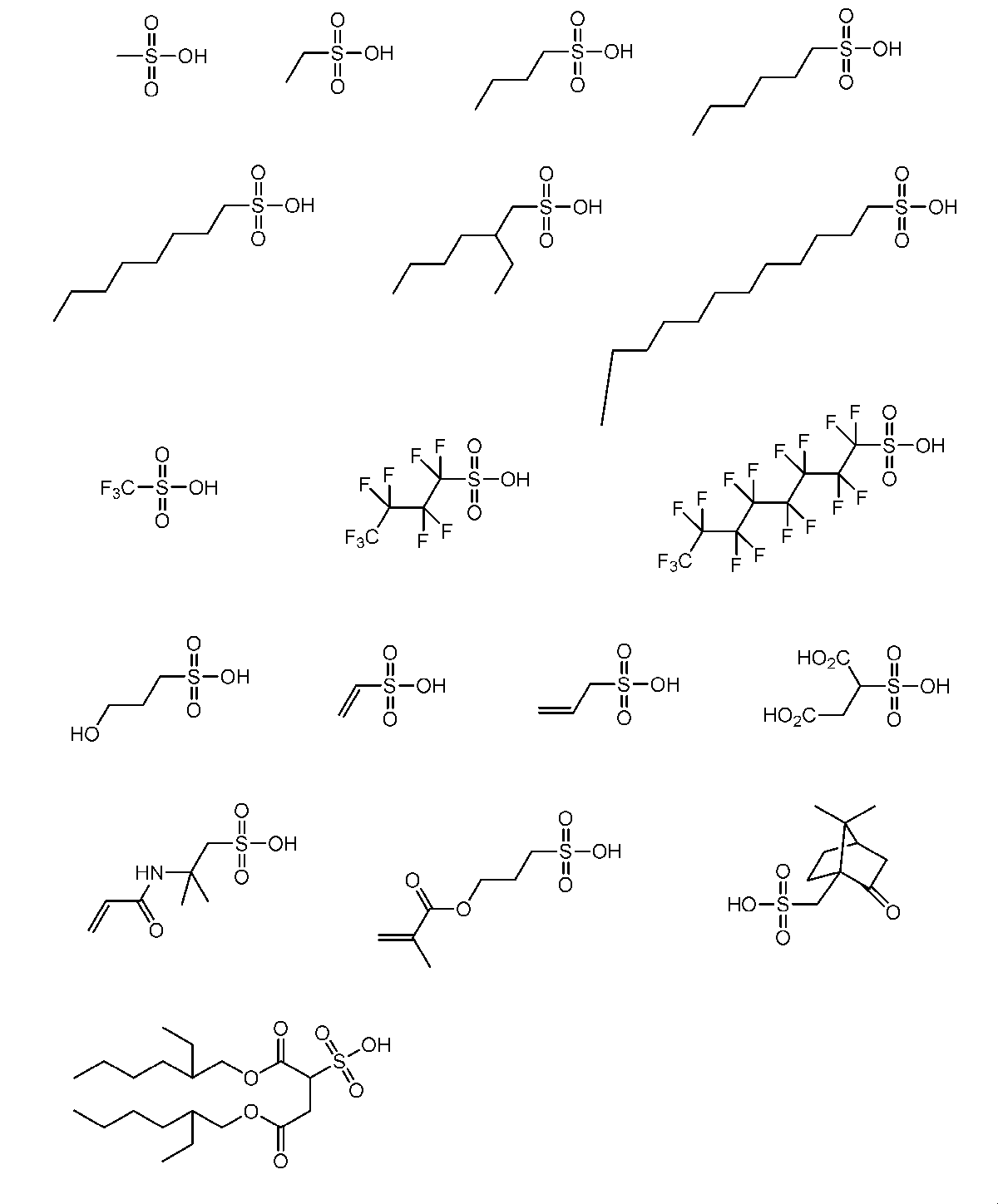

本発明に用いられるスルホン酸銅錯体は、銅成分に対して、配位子となるスルホン酸化合物あるいはその塩とを反応させることにより得ることができる。
上述した銅成分としては、上述したリン含有銅錯体と同義であり、好ましい範囲も同様である。
本発明に用いられるスルホン酸化合物は、市販のスルホン酸を用いることもできるし、公知の方法を参照して、合成することもできる。
本発明で用いられるスルホン酸化合物の塩としては、例えば金属塩が好ましく、具体的には、ナトリウム塩、カリウム塩等が挙げられる。
銅成分と、上述したスルホン酸化合物またはその塩とを反応させる際の反応比率としては、モル比率で1:1.5~1:4とすることが好ましい。この際、スルホン酸化合物またはその塩は、1種類でも良いし、2種類以上を用いても良い。
また、銅成分と、上述したスルホン酸化合物またはその塩とを反応させる際の反応条件は、例えば、20~50℃で、0.5時間以上とすることが好ましい。
本発明のスルホン酸銅錯体の極大吸収波長およびグラム吸光度については、上述したリン含有銅錯体と同義であり、好ましい範囲も同様である。
上述した銅成分としては、上述したリン含有銅錯体と同義であり、好ましい範囲も同様である。
本発明に用いられるスルホン酸化合物は、市販のスルホン酸を用いることもできるし、公知の方法を参照して、合成することもできる。
本発明で用いられるスルホン酸化合物の塩としては、例えば金属塩が好ましく、具体的には、ナトリウム塩、カリウム塩等が挙げられる。
銅成分と、上述したスルホン酸化合物またはその塩とを反応させる際の反応比率としては、モル比率で1:1.5~1:4とすることが好ましい。この際、スルホン酸化合物またはその塩は、1種類でも良いし、2種類以上を用いても良い。
また、銅成分と、上述したスルホン酸化合物またはその塩とを反応させる際の反応条件は、例えば、20~50℃で、0.5時間以上とすることが好ましい。
本発明のスルホン酸銅錯体の極大吸収波長およびグラム吸光度については、上述したリン含有銅錯体と同義であり、好ましい範囲も同様である。
<<その他の銅化合物>>
本発明で用いられる銅化合物としては、上述したもの以外に、カルボン酸エステルを配位子とする銅化合物を用いてもよい。なお、本発明がこれらに限定されるものではないことは言うまでもない。例えば、下記式(K)で表される化合物が好ましい。
本発明で用いられる銅化合物としては、上述したもの以外に、カルボン酸エステルを配位子とする銅化合物を用いてもよい。なお、本発明がこれらに限定されるものではないことは言うまでもない。例えば、下記式(K)で表される化合物が好ましい。

式(K)中、R1は1価の有機基を表す。1価の有機基としては、特に限定されないが、例えば、上述した式(C)中の1価の有機基と同義である。
本発明に用いられる銅化合物の含有量は、前記式(1)で示される部分構造を有する化合物1gに対して3×10⁻³~1モルであり、3×10⁻³~0.2モルであることが好ましく、3×10⁻³~0.05モルであることがより好ましい。前記式(1)で示される部分構造を有する化合物1gに対して1モル以下とすることにより、本発明の近赤外線吸収性組成物を硬化したときに、銅化合物を起点とした架橋構造が形成されてしまうことを抑制できる。これにより、本発明の近赤外線吸収性組成物中に一定量以上の銅化合物を添加した場合にも、薄膜を形成することができる。例えば、本発明の近赤外線吸収性組成物を用いた近赤外線カットフィルタは、200μm以下の薄膜とすることができる。
本発明の近赤外線吸収性組成物は、上述した銅錯体を含有することが好ましい。本発明の組成物は、上述した銅錯体を用いることにより、硬化膜としたときに高い近赤外線遮蔽性を維持できる近赤外線吸収性組成物であって、かつ、溶剤への溶解性に優れた銅錯体を含む近赤外線吸収性組成物を提供することができる。
本発明の銅錯体における銅は通常2価の銅であり、例えば銅成分(銅または銅を含む化合物)に対して、上述した配位子となる化合物またはその塩を混合・反応等させて得ることができる。ここで、本発明の組成物中から銅成分と配位子となる化合物構造を検出できれば、本発明の組成物中において銅錯体が形成されているといえる。例えば、本発明の組成物中から銅とリン酸エステル化合物を検出する方法としては、ICP発光分析法が挙げられ、この方法によって銅とリン酸エステル化合物を検出することができる。
本発明の組成物中の銅錯体の配合量は、本発明の組成物に対し、5~60質量%の割合で銅錯体を含有することが好ましく、より好ましくは10~40質量%である。
銅錯体の、本発明の組成物中の固形分中の配合量は、30~90質量%が好ましく、35~85質量%がより好ましく、40~80質量%がさらに好ましい。
本発明の銅錯体における銅は通常2価の銅であり、例えば銅成分(銅または銅を含む化合物)に対して、上述した配位子となる化合物またはその塩を混合・反応等させて得ることができる。ここで、本発明の組成物中から銅成分と配位子となる化合物構造を検出できれば、本発明の組成物中において銅錯体が形成されているといえる。例えば、本発明の組成物中から銅とリン酸エステル化合物を検出する方法としては、ICP発光分析法が挙げられ、この方法によって銅とリン酸エステル化合物を検出することができる。
本発明の組成物中の銅錯体の配合量は、本発明の組成物に対し、5~60質量%の割合で銅錯体を含有することが好ましく、より好ましくは10~40質量%である。
銅錯体の、本発明の組成物中の固形分中の配合量は、30~90質量%が好ましく、35~85質量%がより好ましく、40~80質量%がさらに好ましい。
(無機微粒子)
本発明の組成物は、上述した銅化合物以外の他の近赤外線吸収性化合物として、無機微粒子を含んでいてもよい。無機微粒子は、1種のみを用いてもよいし、2種以上を用いてもよい。
無機微粒子は、主に、赤外線を遮光(吸収)する役割を果たす粒子である。無機微粒子としては、赤外線遮光性がより優れる点で、金属酸化物粒子及び金属粒子からなる群から選択される少なくとも1つであることが好ましい。
無機微粒子としては、例えば、酸化インジウムスズ(ITO)粒子、酸化アンチモンスズ(ATO)粒子、アルミニウムによりドープされていてもよい酸化亜鉛(AlによりドープされてもよいZnO)粒子、フッ素ドープ二酸化スズ(FドープSnO2)粒子又はニオブドープ二酸化チタン(NbドープTiO2)粒子などの金属酸化物粒子や、銀(Ag)粒子、金(Au)粒子、銅(Cu)粒子又はニッケル(Ni)粒子などの金属粒子が挙げられる。なお、赤外線遮光性とフォトリソグラフィ性能とを両立するためには、露光波長(365-405nm)の透過率が高い方が望ましく、酸化インジウムスズ(ITO)粒子又は酸化アンチモンスズ(ATO)粒子が好ましい。
無機微粒子の形状は特に制限されず、球状、非球状を問わず、シート状、ワイヤー状、チューブ状であってもよい。
また無機微粒子としては酸化タングステン系化合物が使用でき、具体的には、下記一般式(組成式)(I)で表される酸化タングステン系化合物であることがより好ましい。
MxWyOz・・・(I)
Mは金属、Wはタングステン、Oは酸素を表す。
0.001≦x/y≦1.1
2.2≦z/y≦3.0
Mの金属としては、アルカリ金属、アルカリ土類金属、Mg、Zr、Cr、Mn、Fe、Ru、Co、Rh、Ir、Ni、Pd、Pt、Cu、Ag、Au、Zn、Cd、Al、Ga、In、Tl、Sn、Pb、Ti、Nb、V、Mo、Ta、Re、Be、Hf、Os、Biが挙げられる。Mの金属としては、アルカリ金属であることが好ましく、Rb又はCsであることがより好ましく、Csであることがさらに好ましい。Mの金属は1種でも2種以上でも良い。
x/yが0.001以上であることにより、赤外線を十分に遮蔽することができ、1.1以下であることにより、酸化タングステン系化合物中に不純物相が生成されることをより確実に回避することできる。
z/yが2.2以上であることにより、材料としての化学的安定性をより向上させることができ、3.0以下であることにより赤外線を十分に遮蔽することができる。
金属酸化物は、セシウム酸化タングステンであることが好ましい。
上記一般式(I)で表される酸化タングステン系化合物の具体例としては、Cs0.33WO3、Rb0.33WO3、K0.33WO3、Ba0.33WO3などを挙げることができ、Cs0.33WO3又はRb0.33WO3であることが好ましく、Cs0.33WO3であることが更により好ましい。
金属酸化物は微粒子であることが好ましい。金属酸化物の微粒子の平均粒子径は、800nm以下であることが好ましく、400nm以下であることがより好ましく、200nm以下であることが更に好ましい。平均粒子径がこのような範囲であることによって、金属酸化物が光散乱によって可視光を遮断しにくくなることから、可視光領域における透光性をより確実にすることができる。光散乱を回避する観点からは、平均粒子径は小さいほど好ましいが、製造時における取り扱い容易性などの理由から、金属酸化物の平均粒子径は、通常、1nm以上である。
酸化タングステン系化合物は、例えば、住友金属鉱山株式会社製のYMF-02などのタングステン微粒子の分散物として入手可能である。
金属酸化物の含有量は、金属酸化物を含有する組成物の全固形分質量に対して、0.01~30質量%であることが好ましく、0.1~20質量%であることがより好ましく、1~10質量%であることがさらに好ましい。
本発明の組成物は、上述した銅化合物以外の他の近赤外線吸収性化合物として、無機微粒子を含んでいてもよい。無機微粒子は、1種のみを用いてもよいし、2種以上を用いてもよい。
無機微粒子は、主に、赤外線を遮光(吸収)する役割を果たす粒子である。無機微粒子としては、赤外線遮光性がより優れる点で、金属酸化物粒子及び金属粒子からなる群から選択される少なくとも1つであることが好ましい。
無機微粒子としては、例えば、酸化インジウムスズ(ITO)粒子、酸化アンチモンスズ(ATO)粒子、アルミニウムによりドープされていてもよい酸化亜鉛(AlによりドープされてもよいZnO)粒子、フッ素ドープ二酸化スズ(FドープSnO2)粒子又はニオブドープ二酸化チタン(NbドープTiO2)粒子などの金属酸化物粒子や、銀(Ag)粒子、金(Au)粒子、銅(Cu)粒子又はニッケル(Ni)粒子などの金属粒子が挙げられる。なお、赤外線遮光性とフォトリソグラフィ性能とを両立するためには、露光波長(365-405nm)の透過率が高い方が望ましく、酸化インジウムスズ(ITO)粒子又は酸化アンチモンスズ(ATO)粒子が好ましい。
無機微粒子の形状は特に制限されず、球状、非球状を問わず、シート状、ワイヤー状、チューブ状であってもよい。
また無機微粒子としては酸化タングステン系化合物が使用でき、具体的には、下記一般式(組成式)(I)で表される酸化タングステン系化合物であることがより好ましい。
MxWyOz・・・(I)
Mは金属、Wはタングステン、Oは酸素を表す。
0.001≦x/y≦1.1
2.2≦z/y≦3.0
Mの金属としては、アルカリ金属、アルカリ土類金属、Mg、Zr、Cr、Mn、Fe、Ru、Co、Rh、Ir、Ni、Pd、Pt、Cu、Ag、Au、Zn、Cd、Al、Ga、In、Tl、Sn、Pb、Ti、Nb、V、Mo、Ta、Re、Be、Hf、Os、Biが挙げられる。Mの金属としては、アルカリ金属であることが好ましく、Rb又はCsであることがより好ましく、Csであることがさらに好ましい。Mの金属は1種でも2種以上でも良い。
x/yが0.001以上であることにより、赤外線を十分に遮蔽することができ、1.1以下であることにより、酸化タングステン系化合物中に不純物相が生成されることをより確実に回避することできる。
z/yが2.2以上であることにより、材料としての化学的安定性をより向上させることができ、3.0以下であることにより赤外線を十分に遮蔽することができる。
金属酸化物は、セシウム酸化タングステンであることが好ましい。
上記一般式(I)で表される酸化タングステン系化合物の具体例としては、Cs0.33WO3、Rb0.33WO3、K0.33WO3、Ba0.33WO3などを挙げることができ、Cs0.33WO3又はRb0.33WO3であることが好ましく、Cs0.33WO3であることが更により好ましい。
金属酸化物は微粒子であることが好ましい。金属酸化物の微粒子の平均粒子径は、800nm以下であることが好ましく、400nm以下であることがより好ましく、200nm以下であることが更に好ましい。平均粒子径がこのような範囲であることによって、金属酸化物が光散乱によって可視光を遮断しにくくなることから、可視光領域における透光性をより確実にすることができる。光散乱を回避する観点からは、平均粒子径は小さいほど好ましいが、製造時における取り扱い容易性などの理由から、金属酸化物の平均粒子径は、通常、1nm以上である。
酸化タングステン系化合物は、例えば、住友金属鉱山株式会社製のYMF-02などのタングステン微粒子の分散物として入手可能である。
金属酸化物の含有量は、金属酸化物を含有する組成物の全固形分質量に対して、0.01~30質量%であることが好ましく、0.1~20質量%であることがより好ましく、1~10質量%であることがさらに好ましい。
<前記式(1)で示される部分構造を有する化合物>
本発明の近赤外線吸収性組成物は、前記式(1)で示される部分構造、すなわち、-C(=O)NR1-(R1は水素原子または有機基を表す。)を有する化合物を含有する。このような部分構造を有する化合物を配合することにより、本発明の近赤外線吸収性組成物を硬化膜としたときに近赤外線遮蔽性を向上させ、耐湿性を向上させることができる。
本発明の近赤外線吸収性組成物は、前記式(1)で示される部分構造、すなわち、-C(=O)NR1-(R1は水素原子または有機基を表す。)を有する化合物を含有する。このような部分構造を有する化合物を配合することにより、本発明の近赤外線吸収性組成物を硬化膜としたときに近赤外線遮蔽性を向上させ、耐湿性を向上させることができる。
前記式(1)中、R1は水素原子または有機基を表す。有機基としては、炭化水素基、
具体的には、アルキル基またはアリール基が挙げられ、炭素数が1~20のアルキル基、炭素数が6~20のアリール基、またはこれらの基と二価の連結基との組み合わせからなるものが好ましい。
このような有機基の具体例としては、-OR’、-SR’、またはこれらの基と-(CH2)m-(mは1~10の整数)、炭素数5~10の環状のアルキレン基、-O-、-CO-、-COO-および-NH-の少なくとも1つとの組み合わせからなるものが好ましい。ここで、R’は、水素原子、炭素数が1~10の直鎖、炭素数が3~10の分岐または炭素数が3~10の環状のアルキル基(好ましくは炭素数1~7の直鎖、炭素数3~7の分岐または炭素数が3~7の環状のアルキル基)、炭素数が6~10のアリール基、または、炭素数が6~10のアリール基と炭素数が1~10のアルキレン基との組み合わせからなる基が好ましい。
また、前記式(1)中、R1とCとが結合して環構造(ヘテロ環構造)を形成していてもよい。ヘテロ環構造中におけるヘテロ原子は、前記式(1)中の窒素原子である。ヘテロ環構造は、5または6員環構造が好ましく、5員環構造がより好ましい。ヘテロ環構造は、縮合環であってもよいが、単環が好ましい。
特に好ましいR1の具体例としては、水素原子、炭素数1~3のアルキル基、-OR’
(R’は炭素数が1~5の直鎖のアルキル基)と-(CH2)m-(mは1~10の整数、好ましくはmは1~5の整数)との組み合わせからなる基、前記式(1)中のR1とCとが結合してヘテロ環構造(好ましくは5員環構造)を形成した基が挙げられる。
具体的には、アルキル基またはアリール基が挙げられ、炭素数が1~20のアルキル基、炭素数が6~20のアリール基、またはこれらの基と二価の連結基との組み合わせからなるものが好ましい。
このような有機基の具体例としては、-OR’、-SR’、またはこれらの基と-(CH2)m-(mは1~10の整数)、炭素数5~10の環状のアルキレン基、-O-、-CO-、-COO-および-NH-の少なくとも1つとの組み合わせからなるものが好ましい。ここで、R’は、水素原子、炭素数が1~10の直鎖、炭素数が3~10の分岐または炭素数が3~10の環状のアルキル基(好ましくは炭素数1~7の直鎖、炭素数3~7の分岐または炭素数が3~7の環状のアルキル基)、炭素数が6~10のアリール基、または、炭素数が6~10のアリール基と炭素数が1~10のアルキレン基との組み合わせからなる基が好ましい。
また、前記式(1)中、R1とCとが結合して環構造(ヘテロ環構造)を形成していてもよい。ヘテロ環構造中におけるヘテロ原子は、前記式(1)中の窒素原子である。ヘテロ環構造は、5または6員環構造が好ましく、5員環構造がより好ましい。ヘテロ環構造は、縮合環であってもよいが、単環が好ましい。
特に好ましいR1の具体例としては、水素原子、炭素数1~3のアルキル基、-OR’
(R’は炭素数が1~5の直鎖のアルキル基)と-(CH2)m-(mは1~10の整数、好ましくはmは1~5の整数)との組み合わせからなる基、前記式(1)中のR1とCとが結合してヘテロ環構造(好ましくは5員環構造)を形成した基が挙げられる。
前記式(1)で示される部分構造を有する化合物は、(重合体の主鎖構造-前記式(1)の部分構造-R1)で表されるか、(A-前記式(1)の部分構造-B)で表されることが好ましい。ここで、Aは、炭素数が1~10の直鎖、炭素数が3~10の分岐、または、炭素数3~10の環状のアルキル基である。また、Bは、-(CH2)m-(mは1~10の整数、好ましくはmは1~5の整数)と、前記式(1)の部分構造と、重合性基との組み合わせからなる基である。
また、前記式(1)で示される部分構造を有する化合物は、下記式(1-1)~(1-5)のいずれかで表される構造を有することが好ましい。
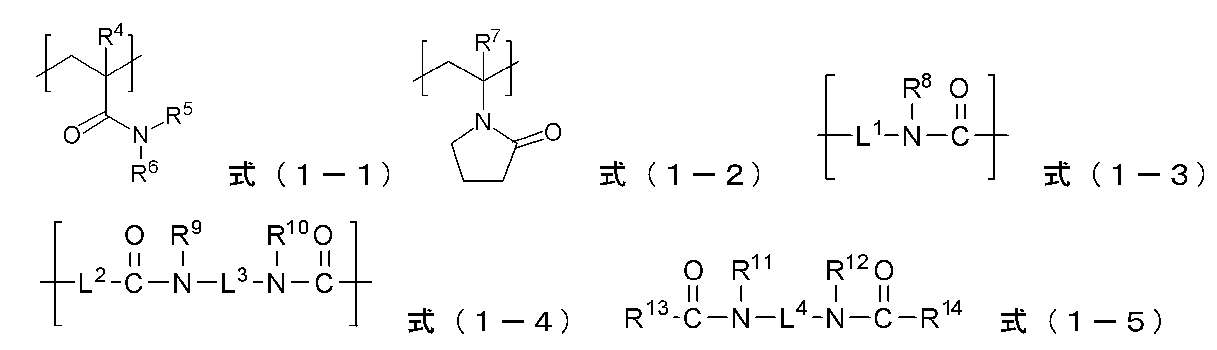
(式(1-1)中、R4は水素原子またはメチル基を表し、R5およびR6はそれぞれ独立して水素原子または有機基を表す。式(1-2)中、R7は水素原子またはメチル基を表す。式(1-3)中、L1は二価の連結基を表し、R8は水素原子または有機基を表す。式(1-4)中、L2およびL3はそれぞれ独立して二価の連結基を表し、R9およびR10はそれぞれ独立して水素原子または有機基を表す。式(1-5)中、L4は二価の連結基を表し、R11~R14はそれぞれ独立して水素原子または有機基を表す。)
前記式(1-1)中、R5およびR6はそれぞれ独立して水素原子または有機基を表す。有機基としては、前記式(1)中のR1と同義であり、好ましい範囲も同様である。
前記式(1-3)~(1-5)中、L1~L4は二価の連結基を表す。二価の連結基としては、-(CH2)m-(mは1~10の整数)、炭素数5~10の環状のアルキレン基、-O-、-CO-、-COO-および-NH-の少なくとも1つとの組み合わせからなるものが好ましく、-(CH2)m-(mは1~8の整数)であることがより好ましい。
前記式(1-3)~(1-5)中、R8~R14はそれぞれ独立して水素原子または有機基を表す。有機基としては、炭化水素基、具体的にはアルキル基またはアルケニル基であることが好ましい。
アルキル基は、置換されていてもよい。また、アルキル基は、直鎖状、分枝状、環状のいずれであってもよいが、直鎖状または環状のものが好ましい。アルキル基としては、炭素数1~10のアルキル基が好ましく、炭素数1~8のアルキル基がより好ましく、炭素数1~6のアルキル基がより好ましい。
アルケニル基は、置換されていてもよい。アルケニル基としては、炭素数1~10のアルケニル基が好ましく、炭素数1~4のアルケニル基がより好ましく、ビニル基が特に好ましい。
置換基としては、例えば、重合性基、ハロゲン原子、アルキル基、カルボン酸エステル基、ハロゲン化アルキル基、アルコキシ基、メタクリロイルオキシ基、アクリロイルオキシ基、エーテル基、スルホニル基、スルフィド基、アミド基、アシル基、ヒドロキシ基、カルボキシル基などが例示される。これらの置換基の中でも、重合性基(例えば、ビニル基、(メタ)アクリロイルオキシ基)、(メタ)アクリロイル基、エポキシ基、アジリジニル基など)が好ましく、ビニル基がより好ましい。
前記式(1-3)~(1-5)中、L1~L4は二価の連結基を表す。二価の連結基としては、-(CH2)m-(mは1~10の整数)、炭素数5~10の環状のアルキレン基、-O-、-CO-、-COO-および-NH-の少なくとも1つとの組み合わせからなるものが好ましく、-(CH2)m-(mは1~8の整数)であることがより好ましい。
前記式(1-3)~(1-5)中、R8~R14はそれぞれ独立して水素原子または有機基を表す。有機基としては、炭化水素基、具体的にはアルキル基またはアルケニル基であることが好ましい。
アルキル基は、置換されていてもよい。また、アルキル基は、直鎖状、分枝状、環状のいずれであってもよいが、直鎖状または環状のものが好ましい。アルキル基としては、炭素数1~10のアルキル基が好ましく、炭素数1~8のアルキル基がより好ましく、炭素数1~6のアルキル基がより好ましい。
アルケニル基は、置換されていてもよい。アルケニル基としては、炭素数1~10のアルケニル基が好ましく、炭素数1~4のアルケニル基がより好ましく、ビニル基が特に好ましい。
置換基としては、例えば、重合性基、ハロゲン原子、アルキル基、カルボン酸エステル基、ハロゲン化アルキル基、アルコキシ基、メタクリロイルオキシ基、アクリロイルオキシ基、エーテル基、スルホニル基、スルフィド基、アミド基、アシル基、ヒドロキシ基、カルボキシル基などが例示される。これらの置換基の中でも、重合性基(例えば、ビニル基、(メタ)アクリロイルオキシ基)、(メタ)アクリロイル基、エポキシ基、アジリジニル基など)が好ましく、ビニル基がより好ましい。
また、前記式(1)で示される部分構造を有する化合物は、モノマーであってもポリマーであってもよいが、ポリマーであることが好ましい。前記式(1)で示される部分構造を有する化合物は、前記式(1-1)または前記式(1-2)で表される化合物であることが好ましく、前記式(1-1)で表される化合物であることがより好ましい。
また、前記式(1)で示される部分構造を有する化合物がポリマーである場合、ポリマーの側鎖に前記式(1)で示される部分構造を含有することが好ましい。
また、前記式(1)で示される部分構造を有する化合物がポリマーである場合、ポリマーの側鎖に前記式(1)で示される部分構造を含有することが好ましい。
前記式(1)で示される部分構造を有する化合物の分子量は、好ましくは50~1,000,000であり、より好ましくは500~500,000である。このような分子量とすることにより、本発明の効果をより効果的に達成できる。
前記式(1)で示される部分構造を有する化合物の含有量は、本発明の組成物中5~80質量%であることが好ましく、10~60質量%であることがより好ましい。
前記式(1)で示される部分構造を有する化合物の含有量は、本発明の組成物中5~80質量%であることが好ましく、10~60質量%であることがより好ましい。
前記式(1)で示される部分構造を有する化合物の具体例としては、下記構造を有する化合物または下記例示化合物が挙げられるが、これらに限定されるものではない。本発明では、特に、前記式(1)で示される部分構造を有する化合物がポリアクリルアミドであることが好ましい。
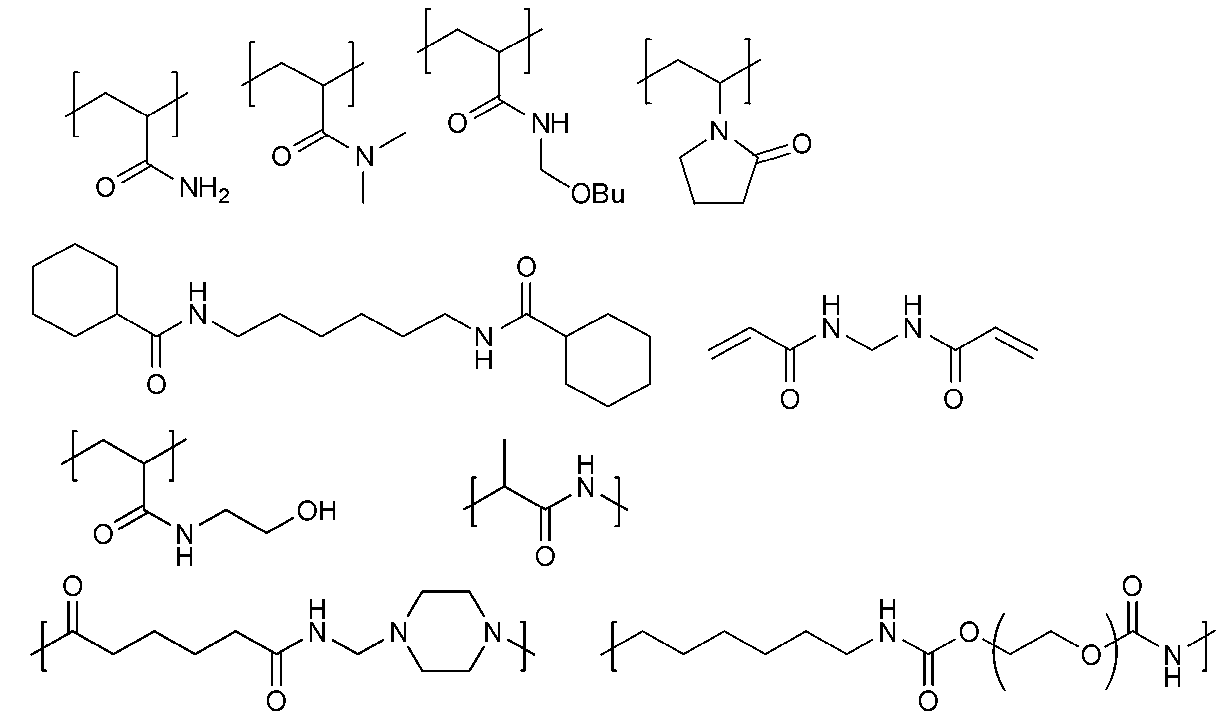
また、前記式(1)で示される部分構造を有する化合物の具体例としては、水溶性ポリマーが挙げられ、好ましい主鎖構造としては、ポリビニルピロリドン、ポリ(メタ)アクリルアミド、ポリアミド、ポリビニルピロリドン、ポリウレタン、ポリウレアが挙げられる。水溶性ポリマーは共重合体であってもよく、該共重合体はランダム共重合体であってもよい。
ポリビニルピロリドンとしては、商品名K-30、K-85、K-90、K-30W、K-85W、K-90W(日本触媒社製)が使用できる。
ポリビニルピロリドンとしては、商品名K-30、K-85、K-90、K-30W、K-85W、K-90W(日本触媒社製)が使用できる。
ポリ(メタ)アクリルアミドとしては、(メタ)アクリルアミドの重合体、共重合体が挙げられる。アクリルアミドの具体例としては、アクリルアミド、N-メチルアクリルアミド、N-エチルアクリルアミド、N-プロピルアクリルアミド、N-ブチルアクリルアミド、N-ベンジルアクリルアミド、N-ヒドロキシエチルアクリルアミド、N-フェニルアクリルアミド、N-トリルアクリルアミド、N-(ヒドロキシフェニル)アクリルアミド、N-(スルファモイルフェニル)アクリルアミド、N-(フェニルスルホニル)アクリルアミド、N-(トリルスルホニル)アクリルアミド、N,N-ジメチルアクリルアミド、N-メチル-N-フェニルアクリルアミド、N-ヒドロキシエチル-N-メチルアクリルアミド等が挙げられる。またこれらに対応するメタクリルアミドも同様に使用できる。
水溶性ポリアミド樹脂としては、特に、ポリアミド樹脂と親水性化合物とが共重合した化合物が挙げられる。水溶性ポリアミド樹脂の誘導体とは、例えば、水溶性ポリアミド樹脂を原料としてアミド結合(-CONH-)の水素原子をメトキシメチル基(-CH2OCH3)で置換した化合物のように、水溶性ポリアミド樹脂分子中の原子が置換される又は付加反応することにより、アミド結合の構造が変化した化合物をいう。
ポリアミド樹脂としては、例えば、ωアミノ酸の重合で合成される所謂「n-ナイロン」やジアミンとジカルボン酸の共重合で合成される所謂「n,m-ナイロン」が挙げられる。中でも、親水性付与の観点から、ジアミンとジカルボン酸の共重合体が好ましく、ε-カプロラクタムとジカルボン酸との反応生成物がより好ましい。
親水性化合物としては、親水性含窒素環状化合物、ポリアルキレングリコール等が挙げられる。
ここで、親水性含窒素環状化合物とは、側鎖または主鎖に第3級アミン成分を有する化合物であって、例えばアミノエチルピペラジン、ビスアミノプロピルピペラジン、α-ジメチルアミノεカプロラクタム等が挙げられる。
一方、ポリアミド樹脂と親水性化合物とが共重合した化合物には、ポリアミド樹脂の主鎖に、例えば、親水性含窒素環状化合物およびポリアルキレングリコールからなる群より選択される少なくとも一つが共重合されている。このため、ポリアミド樹脂のアミド結合部の水素結合能力は、N-メトキシメチル化ナイロンに対して大きい。
ポリアミド樹脂と親水性化合物とが共重合した化合物の中でも、1)ε-カプロラクタムと親水性含窒素環状化合物とジカルボン酸との反応生成物、及び、2)ε-カプロラクタムとポリアルキレングリコールとジカルボン酸との反応生成物が好ましい。
これらは、例えば東レファインテック(株)より「AQナイロン」という商標で市販されている。ε-カプロラクタムと親水性含窒素環状化合物とジカルボン酸との反応生成物は、東レファインテック(株)製AQナイロンA-90として入手可能であり、ε-カプロラクタムとポリアルキレングリコールとジカルボン酸との反応生成物は、東レファインテック(株)製AQナイロンP-70として入手可能である。AQナイロンA-90、P-70、P-95、T-70(東レ社製)が使用できる。
ポリアミド樹脂としては、例えば、ωアミノ酸の重合で合成される所謂「n-ナイロン」やジアミンとジカルボン酸の共重合で合成される所謂「n,m-ナイロン」が挙げられる。中でも、親水性付与の観点から、ジアミンとジカルボン酸の共重合体が好ましく、ε-カプロラクタムとジカルボン酸との反応生成物がより好ましい。
親水性化合物としては、親水性含窒素環状化合物、ポリアルキレングリコール等が挙げられる。
ここで、親水性含窒素環状化合物とは、側鎖または主鎖に第3級アミン成分を有する化合物であって、例えばアミノエチルピペラジン、ビスアミノプロピルピペラジン、α-ジメチルアミノεカプロラクタム等が挙げられる。
一方、ポリアミド樹脂と親水性化合物とが共重合した化合物には、ポリアミド樹脂の主鎖に、例えば、親水性含窒素環状化合物およびポリアルキレングリコールからなる群より選択される少なくとも一つが共重合されている。このため、ポリアミド樹脂のアミド結合部の水素結合能力は、N-メトキシメチル化ナイロンに対して大きい。
ポリアミド樹脂と親水性化合物とが共重合した化合物の中でも、1)ε-カプロラクタムと親水性含窒素環状化合物とジカルボン酸との反応生成物、及び、2)ε-カプロラクタムとポリアルキレングリコールとジカルボン酸との反応生成物が好ましい。
これらは、例えば東レファインテック(株)より「AQナイロン」という商標で市販されている。ε-カプロラクタムと親水性含窒素環状化合物とジカルボン酸との反応生成物は、東レファインテック(株)製AQナイロンA-90として入手可能であり、ε-カプロラクタムとポリアルキレングリコールとジカルボン酸との反応生成物は、東レファインテック(株)製AQナイロンP-70として入手可能である。AQナイロンA-90、P-70、P-95、T-70(東レ社製)が使用できる。
本発明では、不飽和二重結合、エポキシ基またはオキセタニル基などの架橋基を有する重合体をさらに含有することが好ましい。また、上述した式(1)で示される部分構造を有する重合体が、不飽和二重結合、エポキシ基またはオキセタニル基などの架橋基を有してもよい。これにより、硬化膜としたときの製膜性(クラックやそりの抑制)および耐湿性をより良好にすることができる。具体的には、下記の繰り返し単位を有する重合体(共重合体)が挙げられる。下記繰り返し単位を有する重合体としては、エポキシ基またはオキセタニル基を有する繰り返し単位を含む重合体(共重合体)が好ましく、エポキシ基を有する繰り返し単位を含む重合体(共重合体)がより好ましい。
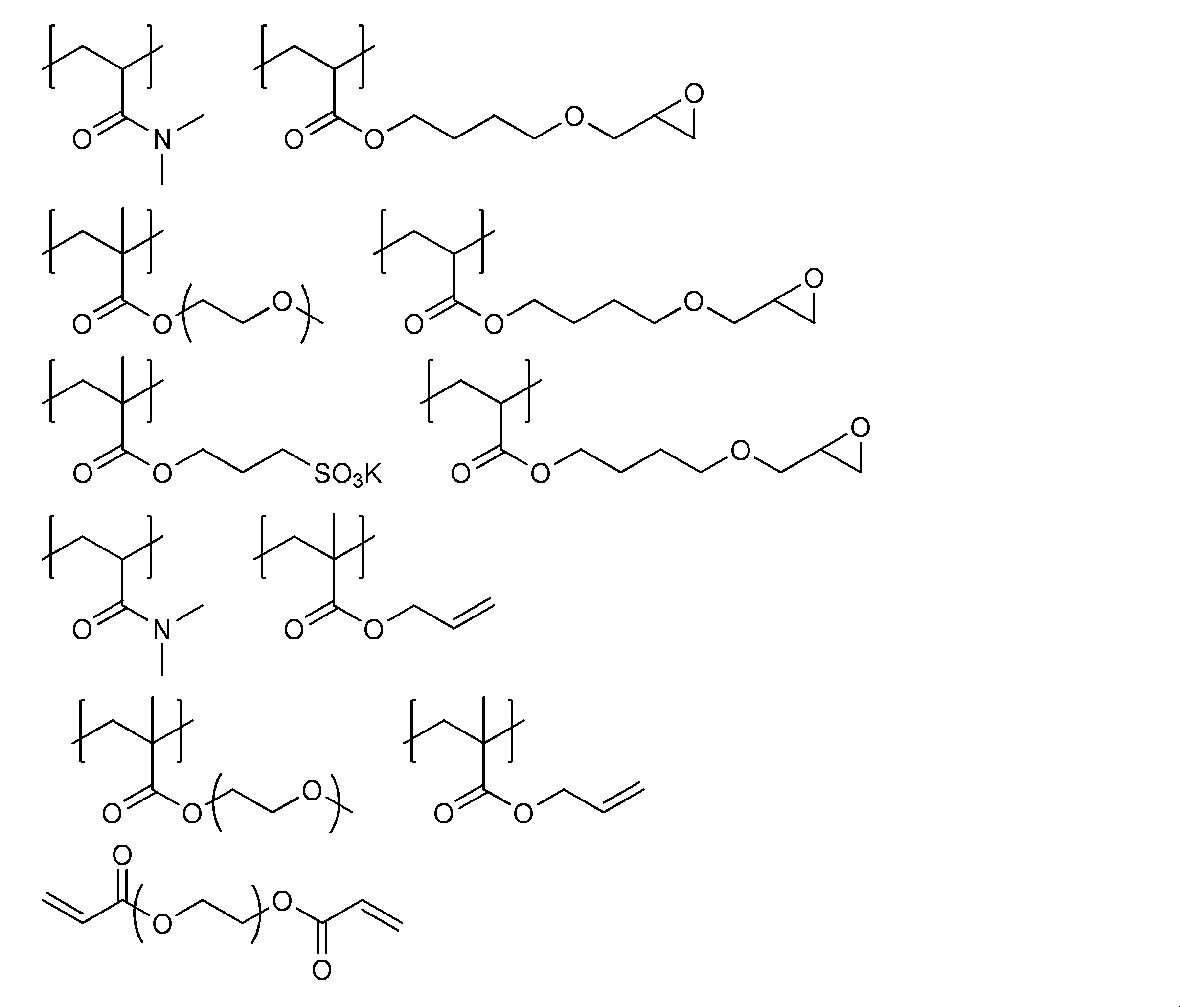
上述した式(1)で示される部分構造を有する繰り返し単位とエポキシ基またはオキセタニル基を有する繰り返し単位を含む重合体(共重合体)のモル比は、10/90~90/10であることが好ましく、30/70~70/30であることがより好ましい。上記共重合体の重量平均分子量は、3,000~1,000,000であることが好ましく、5,000~200,000であることがより好ましい。
架橋基を有する繰り返し単位を含む重合体(共重合体)を用いる場合、この重合体の含有率は溶剤を除いた本発明の組成物の全固形分に対して10~75質量%、より好ましくは20~65質量%、特に好ましくは20~60質量%の範囲とすることが好ましい。
架橋基を有する繰り返し単位を含む重合体(共重合体)を用いる場合、この重合体の含有率は溶剤を除いた本発明の組成物の全固形分に対して10~75質量%、より好ましくは20~65質量%、特に好ましくは20~60質量%の範囲とすることが好ましい。
<近赤外線吸収性組成物の第2の実施の形態>
本発明の近赤外線吸収性組成物は、銅化合物と、下記式(1)’で示される部分構造を有し、かつ、アニオン性基を有しない化合物を含有する近赤外線吸収性組成物であってもよい。

(式(1)’中、R2は水素原子または有機基を表す。)
本発明の近赤外線吸収性組成物は、銅化合物と、下記式(1)’で示される部分構造を有し、かつ、アニオン性基を有しない化合物を含有する近赤外線吸収性組成物であってもよい。
<前記式(1)’で示される部分構造を有し、かつ、アニオン性基を有しない化合物>
前記式(1)’中、R2は水素原子または有機基を表す。有機基は、前記式(1)中のR1と同義であり、好ましい範囲も同様である。
アニオン性基としては、例えば銅と錯体を形成し得る酸基、具体的には、カルボキシル基、スルホン酸基、リン酸基、ホスホン酸基等が挙げられる。特に、前記式(1)’で示される部分構造を有し、かつ、アニオン性基を有しない化合物としては、スルホン酸基およびリン酸基を有しない化合物であることが好ましい。
例えば、前記式(1)’で示される部分構造を有し、かつ、アニオン性基を有しない化合物としては、上述した前記式(1)で示される部分構造を有する化合物が好ましい。
アニオン性基を有する化合物を用いると、銅化合物の添加量を多くしたときに、銅化合物とアニオン性基とが錯体を形成してしまう結果、近赤外線吸収性組成物を用いて薄膜を形成することが困難になってしまう。そのため、銅化合物の添加量を多くすることができず、硬化膜としたときに高い近赤外線遮蔽性を維持しつつ、耐湿性に優れた硬化膜を形成できる近赤外線吸収性組成物が得られなくなってしまう。
前記式(1)’中、R2は水素原子または有機基を表す。有機基は、前記式(1)中のR1と同義であり、好ましい範囲も同様である。
アニオン性基としては、例えば銅と錯体を形成し得る酸基、具体的には、カルボキシル基、スルホン酸基、リン酸基、ホスホン酸基等が挙げられる。特に、前記式(1)’で示される部分構造を有し、かつ、アニオン性基を有しない化合物としては、スルホン酸基およびリン酸基を有しない化合物であることが好ましい。
例えば、前記式(1)’で示される部分構造を有し、かつ、アニオン性基を有しない化合物としては、上述した前記式(1)で示される部分構造を有する化合物が好ましい。
アニオン性基を有する化合物を用いると、銅化合物の添加量を多くしたときに、銅化合物とアニオン性基とが錯体を形成してしまう結果、近赤外線吸収性組成物を用いて薄膜を形成することが困難になってしまう。そのため、銅化合物の添加量を多くすることができず、硬化膜としたときに高い近赤外線遮蔽性を維持しつつ、耐湿性に優れた硬化膜を形成できる近赤外線吸収性組成物が得られなくなってしまう。
<溶剤>
本発明の組成物は、溶剤を含んでいてもよい。溶剤は1種類のみでも、2種類以上でもよい。本発明の組成物は、近赤外線吸収性組成物の固形分が35~90質量%であることが好ましく、38~80質量%であることがより好ましい。すなわち、溶剤は、本発明の組成物に対し10~65質量%の割合で含まれることが好ましく、本発明の組成物に対し20~62質量%の割合で含まれることがより好ましく、本発明の組成物に対し30~60質量%の割合で含まれることが特に好ましい。
また、本発明の組成物は、水または水系溶媒を含んでいてもよい。水または水系溶媒は1種類のみでも、2種類以上でもよい。
本発明の組成物が水または水系溶媒を含む場合は、近赤外線吸収性組成物の固形分が10~80質量%であることが好ましく、15~70質量%であることがより好ましい。すなわち、水または水系溶媒は、本発明の組成物に対し20~90質量%含むことが好ましく、本発明の組成物に対し30~85質量%含まれることがより好ましい。 本発明で用いられる溶剤は、特に制限はなく、本発明の組成物の各成分を均一に溶解或いは分散しうるものであれば、目的に応じて適宜選択することができる。溶剤としては、例えば、水、アルコール類などの水系溶媒が好適に挙げられる。また、その他、本発明で用いられる溶剤は、有機溶剤、ケトン類、エステル類、芳香族炭化水素類、ハロゲン化炭化水素類、ジメチルホルムアミド、ジメチルアセトアミド、ジメチルスルホオキサイド、スルホラン等が好適に挙げられる。これらは、1種単独で使用してもよく、2種以上を併用してもよい。2種以上を併用する場合、特に好ましくは、3-エトキシプロピオン酸メチル、3-エトキシプロピオン酸エチル、エチルセロソルブアセテート、乳酸エチル、ジエチレングリコールジメチルエーテル、酢酸ブチル、3-メトキシプロピオン酸メチル、2-ヘプタノン、シクロヘキサノン、エチルカルビトールアセテート、ブチルカルビトールアセテート、エチレングリコールモノブチルエーテルアセテート、プロピレングリコールモノメチルエーテル、およびプロピレングリコールモノメチルエーテルアセテートから選択される2種以上で構成される混合溶液が挙げられる。
アルコール類、芳香族炭化水素類、ハロゲン化炭化水素類の具体例としては、特開2012-194534号公報段落0136等に記載のものが挙げられ、この内容は本願明細書に組み込まれる。また、エステル類、ケトン類、エーテル類の具体例としては、特開2012-208494号公報段落0497(対応する米国特許出願公開第2012/0235099号明細書の[0609])に記載のものが挙げられ、さらに、酢酸-n-アミル、プロピオン酸エチル、フタル酸ジメチル、安息香酸エチル、硫酸メチル、アセトン、メチルイソブチルケトン、ジエチルエーテル、エチレングリコールモノブチルエーテルアセテートなどが挙げられる。
本発明の組成物は、溶剤を含んでいてもよい。溶剤は1種類のみでも、2種類以上でもよい。本発明の組成物は、近赤外線吸収性組成物の固形分が35~90質量%であることが好ましく、38~80質量%であることがより好ましい。すなわち、溶剤は、本発明の組成物に対し10~65質量%の割合で含まれることが好ましく、本発明の組成物に対し20~62質量%の割合で含まれることがより好ましく、本発明の組成物に対し30~60質量%の割合で含まれることが特に好ましい。
また、本発明の組成物は、水または水系溶媒を含んでいてもよい。水または水系溶媒は1種類のみでも、2種類以上でもよい。
本発明の組成物が水または水系溶媒を含む場合は、近赤外線吸収性組成物の固形分が10~80質量%であることが好ましく、15~70質量%であることがより好ましい。すなわち、水または水系溶媒は、本発明の組成物に対し20~90質量%含むことが好ましく、本発明の組成物に対し30~85質量%含まれることがより好ましい。 本発明で用いられる溶剤は、特に制限はなく、本発明の組成物の各成分を均一に溶解或いは分散しうるものであれば、目的に応じて適宜選択することができる。溶剤としては、例えば、水、アルコール類などの水系溶媒が好適に挙げられる。また、その他、本発明で用いられる溶剤は、有機溶剤、ケトン類、エステル類、芳香族炭化水素類、ハロゲン化炭化水素類、ジメチルホルムアミド、ジメチルアセトアミド、ジメチルスルホオキサイド、スルホラン等が好適に挙げられる。これらは、1種単独で使用してもよく、2種以上を併用してもよい。2種以上を併用する場合、特に好ましくは、3-エトキシプロピオン酸メチル、3-エトキシプロピオン酸エチル、エチルセロソルブアセテート、乳酸エチル、ジエチレングリコールジメチルエーテル、酢酸ブチル、3-メトキシプロピオン酸メチル、2-ヘプタノン、シクロヘキサノン、エチルカルビトールアセテート、ブチルカルビトールアセテート、エチレングリコールモノブチルエーテルアセテート、プロピレングリコールモノメチルエーテル、およびプロピレングリコールモノメチルエーテルアセテートから選択される2種以上で構成される混合溶液が挙げられる。
アルコール類、芳香族炭化水素類、ハロゲン化炭化水素類の具体例としては、特開2012-194534号公報段落0136等に記載のものが挙げられ、この内容は本願明細書に組み込まれる。また、エステル類、ケトン類、エーテル類の具体例としては、特開2012-208494号公報段落0497(対応する米国特許出願公開第2012/0235099号明細書の[0609])に記載のものが挙げられ、さらに、酢酸-n-アミル、プロピオン酸エチル、フタル酸ジメチル、安息香酸エチル、硫酸メチル、アセトン、メチルイソブチルケトン、ジエチルエーテル、エチレングリコールモノブチルエーテルアセテートなどが挙げられる。
<硬化性化合物>
本発明の組成物は、硬化性化合物を含むことが好ましい。しかしながら、銅錯体自体が重合性基を有する硬化性化合物の場合には、必ずしも必要ではない。硬化性化合物としては、重合性化合物であってもよいし、バインダー等の非重合性化合物であってもよい。また、硬化性化合物としては、熱硬化性化合物であってもよいし、光硬化性化合物であってもよいが、熱硬化性組成物の方が反応率が高いため好ましい。
本発明の組成物は、硬化性化合物を含むことが好ましい。しかしながら、銅錯体自体が重合性基を有する硬化性化合物の場合には、必ずしも必要ではない。硬化性化合物としては、重合性化合物であってもよいし、バインダー等の非重合性化合物であってもよい。また、硬化性化合物としては、熱硬化性化合物であってもよいし、光硬化性化合物であってもよいが、熱硬化性組成物の方が反応率が高いため好ましい。
<<重合性基を有する化合物>>
硬化性化合物としては、重合性基を有する化合物(以下、「重合性化合物」ということがある)が挙げられる。このような化合物群は当該産業分野において広く知られているものであり、本発明においてはこれらを特に限定なく用いることができる。これらは、例えば、モノマー、オリゴマー、プレポリマー、ポリマーなどの化学的形態のいずれであってもよい。
重合性化合物は、単官能であっても多官能であってもよいが、好ましくは、多官能である。多官能化合物を含むことにより、近赤外線遮蔽性および耐熱性をより向上させることができる。官能基の数は特に定めるものではないが、2~8官能が好ましい。
硬化性化合物としては、重合性基を有する化合物(以下、「重合性化合物」ということがある)が挙げられる。このような化合物群は当該産業分野において広く知られているものであり、本発明においてはこれらを特に限定なく用いることができる。これらは、例えば、モノマー、オリゴマー、プレポリマー、ポリマーなどの化学的形態のいずれであってもよい。
重合性化合物は、単官能であっても多官能であってもよいが、好ましくは、多官能である。多官能化合物を含むことにより、近赤外線遮蔽性および耐熱性をより向上させることができる。官能基の数は特に定めるものではないが、2~8官能が好ましい。
本発明の組成物に硬化性化合物が含有される場合、硬化性化合物の好ましい形態としては下記のものが挙げられる。本発明は、以下の形態に限定されるものではない。
(1)本発明の組成物に含有される硬化性化合物が(メタ)アクリレートである。
(2)本発明の組成物に含有される硬化性化合物が多官能の(メタ)アクリレートである。
(3)本発明の組成物に含有される硬化性化合物が3~6官能の(メタ)アクリレートである。
(4)本発明の組成物に含有される硬化性化合物が多塩基酸変性アクリルオリゴマーである。
(5)本発明の組成物に含有される硬化性化合物がエポキシ樹脂である。
(6)本発明の組成物に含有される硬化性化合物が多官能のエポキシ樹脂である。
(1)本発明の組成物に含有される硬化性化合物が(メタ)アクリレートである。
(2)本発明の組成物に含有される硬化性化合物が多官能の(メタ)アクリレートである。
(3)本発明の組成物に含有される硬化性化合物が3~6官能の(メタ)アクリレートである。
(4)本発明の組成物に含有される硬化性化合物が多塩基酸変性アクリルオリゴマーである。
(5)本発明の組成物に含有される硬化性化合物がエポキシ樹脂である。
(6)本発明の組成物に含有される硬化性化合物が多官能のエポキシ樹脂である。
<<A:重合性モノマーおよび重合性オリゴマー>>
本発明の組成物の第一の好ましい実施態様は、重合性化合物として、重合性基を有するモノマー(重合性モノマー)または重合性基を有するオリゴマー(重合性オリゴマー)(以下、重合性モノマーと重合性オリゴマーを合わせて「重合性モノマー等」ということがある。)を含む。
本発明の組成物の第一の好ましい実施態様は、重合性化合物として、重合性基を有するモノマー(重合性モノマー)または重合性基を有するオリゴマー(重合性オリゴマー)(以下、重合性モノマーと重合性オリゴマーを合わせて「重合性モノマー等」ということがある。)を含む。
重合性モノマー等の例としては、不飽和カルボン酸(例えば、アクリル酸、メタクリル酸、イタコン酸、クロトン酸、イソクロトン酸、マレイン酸など)やそのエステル類、アミド類が挙げられ、好ましくは、不飽和カルボン酸と脂肪族多価アルコール化合物とのエステル、および不飽和カルボン酸と脂肪族多価アミン化合物とのアミド類である。ヒドロキシル基やアミノ基、メルカプト基等の求核性置換基を有する不飽和カルボン酸エステル或いはアミド類と、単官能若しくは多官能イソシアネート類或いはエポキシ類との付加反応物や、単官能若しくは多官能のカルボン酸との脱水縮合反応物等も好適に使用される。また、イソシアネート基やエポキシ基等の親電子性置換基を有する不飽和カルボン酸エステル或いはアミド類と、単官能若しくは多官能のアルコール類、アミン類、チオール類との付加反応物、更に、ハロゲン基やトシルオキシ基等の脱離性置換基を有する不飽和カルボン酸エステル或いはアミド類と、単官能若しくは多官能のアルコール類、アミン類、チオール類との置換反応物も好適である。
別の例として、上記の不飽和カルボン酸の代わりに、不飽和ホスホン酸、スチレン等のビニルベンゼン誘導体、ビニルエーテル、アリルエーテル等に置き換えた化合物群を使用することも可能である。
これらの具体的な化合物としては、特開2009-288705号公報の段落番号0095~段落番号0108に記載されている化合物を本発明においても好適に用いることができる。
別の例として、上記の不飽和カルボン酸の代わりに、不飽和ホスホン酸、スチレン等のビニルベンゼン誘導体、ビニルエーテル、アリルエーテル等に置き換えた化合物群を使用することも可能である。
これらの具体的な化合物としては、特開2009-288705号公報の段落番号0095~段落番号0108に記載されている化合物を本発明においても好適に用いることができる。
前記重合性モノマー等は、少なくとも1個の付加重合可能なエチレン基を有する、常圧下で100℃以上の沸点を持つエチレン性不飽和基を持つ化合物も好ましい。具体的には、単官能(メタ)アクリレート、2官能(メタ)アクリレート、3官能以上の(メタ)アクリレート(例えば、3~6官能の(メタ)アクリレート)が好ましい。
その例としては、ポリエチレングリコールモノ(メタ)アクリレート、ポリプロピレングリコールモノ(メタ)アクリレート、フェノキシエチル(メタ)アクリレート、等の単官能のアクリレートやメタアクリレート;
ポリエチレングリコールジ(メタ)アクリレート、トリメチロールエタントリ(メタ)アクリレート、ネオペンチルグリコールジ(メタ)アクリレート、ペンタエリスリトールトリ(メタ)アクリレート、ペンタエリスリトールテトラ(メタ)アクリレート、ジペンタエリスリトールペンタ(メタ)アクリレート、ジペンタエリスリトールヘキサ(メタ)アクリレート、ヘキサンジオール(メタ)アクリレート、トリメチロールプロパントリ(アクリロイルオキシプロピル)エーテル、トリ(アクリロイロキシエチル)イソシアヌレート、グリセリンやトリメチロールエタン等の多官能アルコールにエチレンオキサイドやプロピレンオキサイドを付加させた後(メタ)アクリレート化したもの;
特公昭48-41708号、特公昭50-6034号、特開昭51-37193号各公報に記載されているようなウレタン(メタ)アクリレート類、特開昭48-64183号、特公昭49-43191号、特公昭52-30490号各公報に記載されているポリエステルアクリレート類、エポキシポリマーと(メタ)アクリル酸との反応生成物であるエポキシアクリレート類等の多官能のアクリレートやメタアクリレートおよびこれらの混合物を挙げることができる。
その例としては、ポリエチレングリコールモノ(メタ)アクリレート、ポリプロピレングリコールモノ(メタ)アクリレート、フェノキシエチル(メタ)アクリレート、等の単官能のアクリレートやメタアクリレート;
ポリエチレングリコールジ(メタ)アクリレート、トリメチロールエタントリ(メタ)アクリレート、ネオペンチルグリコールジ(メタ)アクリレート、ペンタエリスリトールトリ(メタ)アクリレート、ペンタエリスリトールテトラ(メタ)アクリレート、ジペンタエリスリトールペンタ(メタ)アクリレート、ジペンタエリスリトールヘキサ(メタ)アクリレート、ヘキサンジオール(メタ)アクリレート、トリメチロールプロパントリ(アクリロイルオキシプロピル)エーテル、トリ(アクリロイロキシエチル)イソシアヌレート、グリセリンやトリメチロールエタン等の多官能アルコールにエチレンオキサイドやプロピレンオキサイドを付加させた後(メタ)アクリレート化したもの;
特公昭48-41708号、特公昭50-6034号、特開昭51-37193号各公報に記載されているようなウレタン(メタ)アクリレート類、特開昭48-64183号、特公昭49-43191号、特公昭52-30490号各公報に記載されているポリエステルアクリレート類、エポキシポリマーと(メタ)アクリル酸との反応生成物であるエポキシアクリレート類等の多官能のアクリレートやメタアクリレートおよびこれらの混合物を挙げることができる。
中でも、重合性化合物としては、エチレンオキシ変性ペンタエリスリトールテトラアクリレート(市販品としてはNKエステルATM-35E;新中村化学社製)、ジペンタエリスリトールトリアクリレート(市販品としては KAYARAD D-330;日本化薬株式会社製)、ジペンタエリスリトールテトラアクリレート(市販品としては KAYARAD D-320;日本化薬株式会社製)、ジペンタエリスリトールペンタ(メタ)アクリレート(市販品としては KAYARAD D-310;日本化薬株式会社製)、ジペンタエリスリトールヘキサ(メタ)アクリレート(市販品としては KAYARAD DPHA ;日本化薬株式会社製)、及びこれらの(メタ)アクリロイル基がエチレングリコール、プロピレングリコール残基を介している構造が好ましい。また、これらのオリゴマータイプも使用できる。
重合性化合物としては、多官能カルボン酸にグリシジル(メタ)アクリレート等の環状エーテル基とエチレン性不飽和基を有する化合物を反応させて得られる多官能(メタ)アクリレートなども挙げることができる。
また、その他の好ましい重合性モノマー等として、特開2010-160418、特開2010-129825、特許4364216等に記載される、フルオレン環を有し、エチレン性重合性基を2官能以上有する化合物、カルドポリマーも使用することが可能である。
また、常圧下で100℃以上の沸点を有し、少なくとも一つの付加重合可能なエチレン性不飽和基を持つ化合物としては、特開2008-292970号公報の段落番号0254~0257に記載の化合物も好適である。
特開平10-62986号公報において一般式(1)および(2)としてその具体例と共に記載の、前記多官能アルコールにエチレンオキサイドやプロピレンオキサイドを付加させた後に(メタ)アクリレート化した化合物も、重合性モノマーとして用いることができる。
重合性化合物としては、多官能カルボン酸にグリシジル(メタ)アクリレート等の環状エーテル基とエチレン性不飽和基を有する化合物を反応させて得られる多官能(メタ)アクリレートなども挙げることができる。
また、その他の好ましい重合性モノマー等として、特開2010-160418、特開2010-129825、特許4364216等に記載される、フルオレン環を有し、エチレン性重合性基を2官能以上有する化合物、カルドポリマーも使用することが可能である。
また、常圧下で100℃以上の沸点を有し、少なくとも一つの付加重合可能なエチレン性不飽和基を持つ化合物としては、特開2008-292970号公報の段落番号0254~0257に記載の化合物も好適である。
特開平10-62986号公報において一般式(1)および(2)としてその具体例と共に記載の、前記多官能アルコールにエチレンオキサイドやプロピレンオキサイドを付加させた後に(メタ)アクリレート化した化合物も、重合性モノマーとして用いることができる。
本発明で用いる重合性モノマーは、下記一般式(MO-1)~(MO-6)で表される重合性モノマーであることが好ましい。
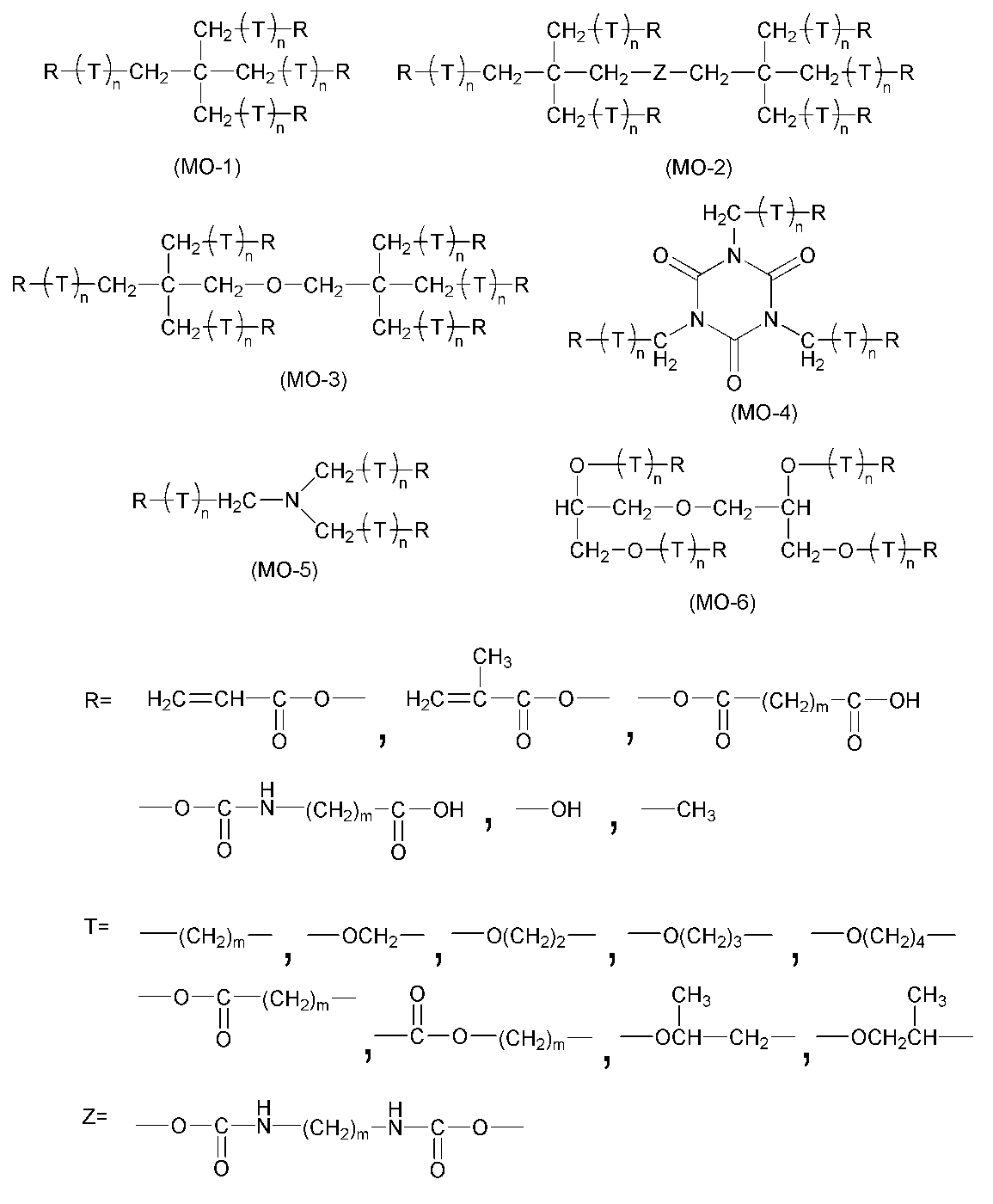
(式中、nはそれぞれ0~14であり、mはそれぞれ1~8である。一分子内に複数存在するR、TおよびZは、それぞれ、同一であっても、異なっていてもよい。Tがオキシアルキレン基の場合には、炭素原子側の末端がRに結合する。Rのうち少なくとも1つは、重合性基である。)
nは0~5が好ましく、1~3がより好ましい。
mは1~5が好ましく、1~3がより好ましい。
Rは、以下の四つの構造が好ましい。

Rは、上記四つの構造のうち以下二つの構造がより好ましい。
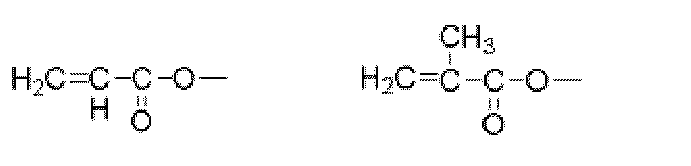
上記一般式(MO-1)~(MO-6)で表される、ラジカル重合性モノマーの具体例としては、特開2007-269779号公報の段落番号0248~段落番号0251に記載されている化合物を本発明においても好適に用いることができる。
nは0~5が好ましく、1~3がより好ましい。
mは1~5が好ましく、1~3がより好ましい。
Rは、以下の四つの構造が好ましい。
中でも、重合性モノマー等としては、特開2012-208494号公報段落0477(対応する米国特許出願公開第2012/0235099号明細書の[0585])に記載の重合性モノマー等が挙げられ、これらの内容は本願明細書に組み込まれる。ジグリセリンEO(エチレンオキシド)変性(メタ)アクリレート(市販品としては M-460;東亜合成製)が好ましい。ペンタエリスリトールテトラアクリレート(新中村化学製、A-TMMT)、1,6-ヘキサンジオールジアクリレート(日本化薬社製、KAYARAD HDDA)も好ましい。これらのオリゴマータイプも使用できる。
例えば、RP-1040(日本化薬株式会社製)などが挙げられる。
例えば、RP-1040(日本化薬株式会社製)などが挙げられる。
重合性モノマー等としては、多官能モノマーであって、カルボキシル基、スルホン酸基、リン酸基等の酸基を有していてもよい。従って、エチレン性化合物が、混合物である場合のように未反応のカルボキシル基を有するものであれば、これをそのまま利用することができる。必要に応じて、上述のエチレン性化合物のヒドロキシル基に非芳香族カルボン酸無水物を反応させて酸基を導入しても良い。この場合、使用される非芳香族カルボン酸無水物の具体例としては、無水テトラヒドロフタル酸、アルキル化無水テトラヒドロフタル酸、無水ヘキサヒドロフタル酸、アルキル化無水ヘキサヒドロフタル酸、無水コハク酸、無水マレイン酸が挙げられる。
本発明において、酸基を有するモノマーとしては、脂肪族ポリヒドロキシ化合物と不飽和カルボン酸とのエステルであり、脂肪族ポリヒドロキシ化合物の未反応のヒドロキシル基に非芳香族カルボン酸無水物を反応させて酸基を持たせた多官能モノマーが好ましい。このエステルにおいて、脂肪族ポリヒドロキシ化合物がペンタエリスリトールおよび/またはジペンタエリスリトールであるものが特に好ましい。市販品としては、例えば、東亞合成株式会社製の多塩基酸変性アクリルオリゴマーとして、アロニックスシリーズのM-305、M-510、M-520などが挙げられる。
酸基を有する多官能モノマーの好ましい酸価は、0.1~40mg-KOH/gであり、特に好ましくは5~30mg-KOH/gである。異なる酸基の多官能モノマーを2種以上併用する場合、或いは酸基を有しない多官能モノマーを併用する場合、全体の多官能モノマーとしての酸価が上記範囲に入るように調整することが好ましい。
酸基を有する多官能モノマーの好ましい酸価は、0.1~40mg-KOH/gであり、特に好ましくは5~30mg-KOH/gである。異なる酸基の多官能モノマーを2種以上併用する場合、或いは酸基を有しない多官能モノマーを併用する場合、全体の多官能モノマーとしての酸価が上記範囲に入るように調整することが好ましい。
また、重合性モノマー等としては、カプロラクトン変性構造を有する多官能性単量体を含有することが好ましい。
カプロラクトン変性構造を有する多官能性単量体としては、その分子内にカプロラクトン変性構造を有する限り特に限定されるものではない。カプロラクトン変性構造を有する多官能性単量体としては、例えば、トリメチロールエタン、ジトリメチロールエタン、トリメチロールプロパン、ジトリメチロールプロパン、ペンタエリスリトール、ジペンタエリスリトール、トリペンタエリスリトール、グリセリン、ジグリセロール、トリメチロールメラミン等の多価アルコールと、(メタ)アクリル酸およびε-カプロラクトンとをエステル化することにより得られる、ε-カプロラクトン変性多官能(メタ)アクリレートを挙げることができる。なかでも下記式(1)で表されるカプロラクトン変性構造を有する多官能性単量体が好ましい。
カプロラクトン変性構造を有する多官能性単量体としては、その分子内にカプロラクトン変性構造を有する限り特に限定されるものではない。カプロラクトン変性構造を有する多官能性単量体としては、例えば、トリメチロールエタン、ジトリメチロールエタン、トリメチロールプロパン、ジトリメチロールプロパン、ペンタエリスリトール、ジペンタエリスリトール、トリペンタエリスリトール、グリセリン、ジグリセロール、トリメチロールメラミン等の多価アルコールと、(メタ)アクリル酸およびε-カプロラクトンとをエステル化することにより得られる、ε-カプロラクトン変性多官能(メタ)アクリレートを挙げることができる。なかでも下記式(1)で表されるカプロラクトン変性構造を有する多官能性単量体が好ましい。



このようなカプロラクトン変性構造を有する多官能性単量体は、例えば、日本化薬(株)からKAYARAD DPCAシリーズとして市販されており、DPCA-20(上記式(1)~(3)においてm=1、式(2)で表される基の数=2、R1が全て水素原子である化合物)、DPCA-30(同式、m=1、式(2)で表される基の数=3、R1が全て水素原子である化合物)、DPCA-60(同式、m=1、式(2)で表される基の数=6、R1が全て水素原子である化合物)、DPCA-120(同式においてm=2、式(2)で表される基の数=6、R1が全て水素原子である化合物)等を挙げることができる。
本発明において、カプロラクトン変性構造を有する多官能性単量体は、単独でまたは2種以上を混合して使用することができる。
本発明において、カプロラクトン変性構造を有する多官能性単量体は、単独でまたは2種以上を混合して使用することができる。
また、本発明における重合性モノマー等としては、下記一般式(i)または(ii)で表される化合物の群から選択される少なくとも1種であることも好ましい。

前記一般式(i)および(ii)中、Eは、各々独立に、-((CH2)yCH2O)-、または-((CH2)yCH(CH3)O)-を表し、yは各々独立に0~10の整数を表し、Xは各々独立にアクリロイル基、メタクリロイル基、水素原子またはカルボキシル基を表す。
前記一般式(i)中、アクリロイル基およびメタクリロイル基の合計は3個または4個であり、mは各々独立に0~10の整数を表し、各mの合計は0~40の整数である。但し、各mの合計が0の場合、Xのうちいずれか1つはカルボキシル基である。
前記一般式(ii)中、アクリロイル基およびメタクリロイル基の合計は5個または6個であり、nは各々独立に0~10の整数を表し、各nの合計は0~60の整数である。但し、各nの合計が0の場合、Xのうちいずれか1つはカルボキシル基である。
前記一般式(i)中、アクリロイル基およびメタクリロイル基の合計は3個または4個であり、mは各々独立に0~10の整数を表し、各mの合計は0~40の整数である。但し、各mの合計が0の場合、Xのうちいずれか1つはカルボキシル基である。
前記一般式(ii)中、アクリロイル基およびメタクリロイル基の合計は5個または6個であり、nは各々独立に0~10の整数を表し、各nの合計は0~60の整数である。但し、各nの合計が0の場合、Xのうちいずれか1つはカルボキシル基である。
前記一般式(i)中、mは、0~6の整数が好ましく、0~4の整数がより好ましい。また、各mの合計は、2~40の整数が好ましく、2~16の整数がより好ましく、4~8の整数が特に好ましい。
前記一般式(ii)中、nは、0~6の整数が好ましく、0~4の整数がより好ましい。また、各nの合計は、3~60の整数が好ましく、3~24の整数がより好ましく、6~12の整数が特に好ましい。
また、一般式(i)または一般式(ii)中の-((CH2)yCH2O)-または-((CH2)yCH(CH3)O)-は、酸素原子側の末端がXに結合する形態が好ましい。
前記一般式(ii)中、nは、0~6の整数が好ましく、0~4の整数がより好ましい。また、各nの合計は、3~60の整数が好ましく、3~24の整数がより好ましく、6~12の整数が特に好ましい。
また、一般式(i)または一般式(ii)中の-((CH2)yCH2O)-または-((CH2)yCH(CH3)O)-は、酸素原子側の末端がXに結合する形態が好ましい。
前記一般式(i)または(ii)で表される化合物は1種単独で用いてもよいし、2種以上併用してもよい。特に、一般式(ii)において、6個のX全てがアクリロイル基である形態が好ましい。
前記一般式(i)または(ii)で表される化合物は、ペンタエリスリト-ルまたはジペンタエリスリト-ルにエチレンオキシドまたはプロピレンオキシドを開環付加反応により開環骨格を結合する工程と、開環骨格の末端水酸基に、例えば(メタ)アクリロイルクロライドを反応させて(メタ)アクリロイル基を導入する工程と、から合成することができる。各工程は良く知られた工程であり、当業者は容易に一般式(i)または(ii)で表される化合物を合成することができる。
前記一般式(i)または(ii)で表される化合物の中でも、ペンタエリスリトール誘導体および/またはジペンタエリスリトール誘導体がより好ましい。
具体的には、下記式(a)~(f)で表される化合物(以下、「例示化合物(a)~(f)」ともいう。)が挙げられ、中でも、例示化合物(a)、(b)、(e)、(f)が好ましい。
具体的には、下記式(a)~(f)で表される化合物(以下、「例示化合物(a)~(f)」ともいう。)が挙げられ、中でも、例示化合物(a)、(b)、(e)、(f)が好ましい。

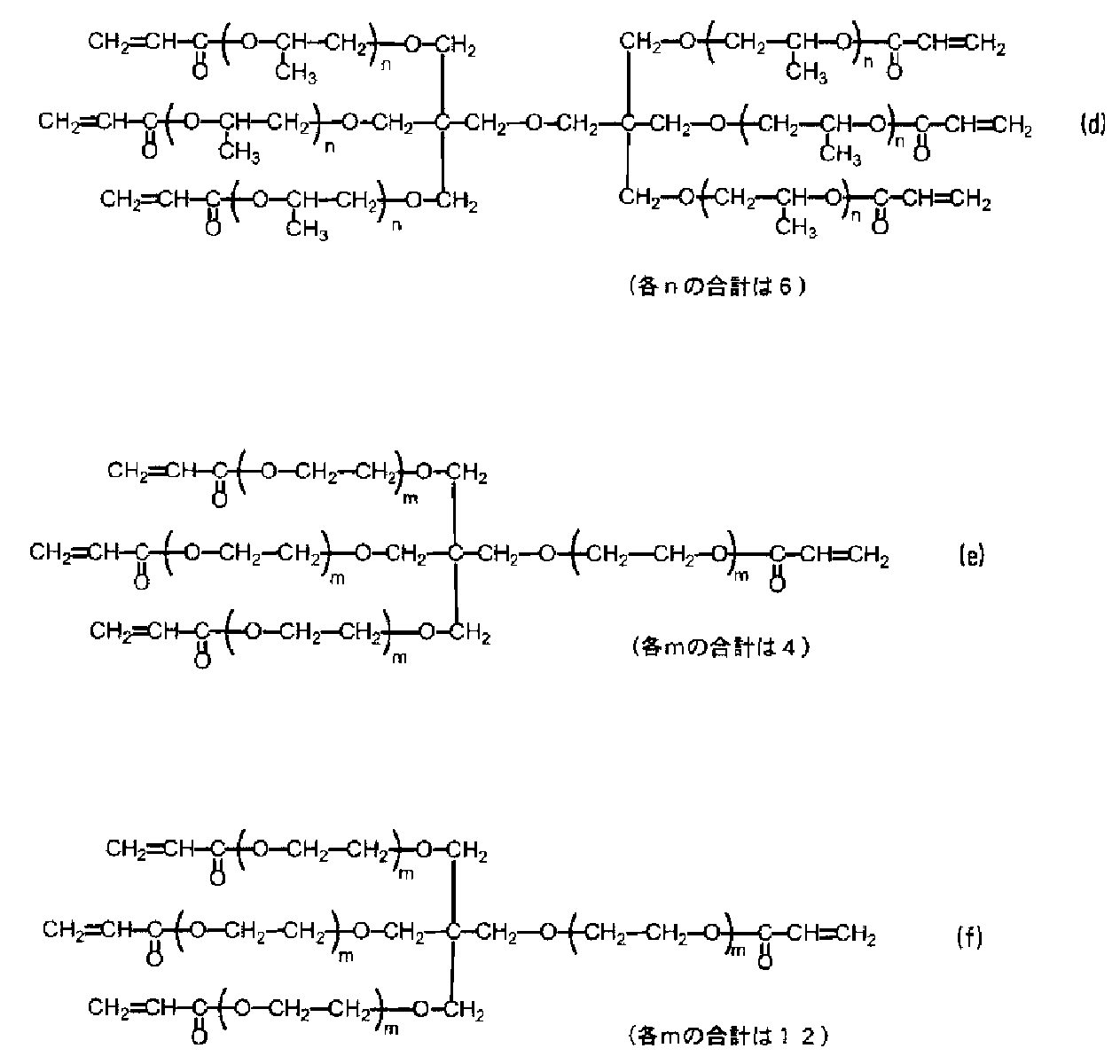
一般式(i)、(ii)で表される重合性モノマー等の市販品としては、例えばサートマー社製のエチレンオキシ鎖を4個有する4官能アクリレートであるSR-494、日本化薬株式会社製のペンチレンオキシ鎖を6個有する6官能アクリレートであるDPCA-60、イソブチレンオキシ鎖を3個有する3官能アクリレートであるTPA-330などが挙げられる。
また、重合性モノマー等としては、特公昭48-41708号、特開昭51-37193号、特公平2-32293号、特公平2-16765号に記載されたウレタンアクリレート類や、特公昭58-49860号、特公昭56-17654号、特公昭62-39417号、特公昭62-39418号に記載されたエチレンオキサイド系骨格を有するウレタン化合物類も好適である。更に、重合性モノマー等として、特開昭63-277653号、特開昭63-260909号、特開平1-105238号に記載された、分子内にアミノ構造やスルフィド構造を有する付加重合性モノマー類を用いることによって、非常に感光スピードに優れた硬化性組成物を得ることができる。
重合性モノマー等の市販品としては、ウレタンオリゴマーUAS-10、UAB-140(山陽国策パルプ社製)、UA-7200(新中村化学社製)、DPHA-40H(日本化薬社製)、UA-306H、UA-306T、UA-306I、AH-600、T-600、AI-600(共栄社製)などが挙げられる。
重合性モノマー等の市販品としては、ウレタンオリゴマーUAS-10、UAB-140(山陽国策パルプ社製)、UA-7200(新中村化学社製)、DPHA-40H(日本化薬社製)、UA-306H、UA-306T、UA-306I、AH-600、T-600、AI-600(共栄社製)などが挙げられる。
重合性モノマー等としては、同一分子内に2個以上のメルカプト(SH)基を有する多官能チオール化合物も好適である。特に、下記一般式(I)で表すものが好ましい。

上記一般式(I)で表される多官能チオール化合物としては例えば、下記の構造式を有する1,4-ビス(3-メルカプトブチリルオキシ)ブタン〔式(II)〕、1,3,5-トリス(3-メルカプトブチルオキシエチル)-1,3,5-トリアジン-2,4,6(1H,3H,5H)-トリオン〔式(III)〕、およびペンタエリスリトール テトラキス(3-メルカプトブチレート)〔式(IV)〕等が挙げられる。これらの多官能チオールは1種または複数組み合わせて使用することが可能である。

本発明では、重合性モノマー等として、分子内に2個以上のエポキシ基またはオキセタニル基を有する重合性モノマーまたはオリゴマーを用いることも好ましい。これらの具体例については、後述のエポキシ基またはオキセタニル基を有する化合物の欄にてまとめて述べる。
<<B:側鎖に重合性基を有するポリマー>>
本発明の組成物の第二の好ましい態様は、重合性化合物として、側鎖に重合性基を有するポリマーを含む。
重合性基としては、エチレン性不飽和二重結合基、エポキシ基やオキセタニル基が挙げられる。後者は、後述のエポキシ基またはオキセタニル基を有する化合物の欄にてまとめて述べる。
本発明の組成物の第二の好ましい態様は、重合性化合物として、側鎖に重合性基を有するポリマーを含む。
重合性基としては、エチレン性不飽和二重結合基、エポキシ基やオキセタニル基が挙げられる。後者は、後述のエポキシ基またはオキセタニル基を有する化合物の欄にてまとめて述べる。
側鎖にエチレン性不飽和結合を有するポリマーとしては、不飽和二重結合部分として、下記一般式(1)~(3)のいずれかで表される官能基から選ばれる少なくとも一つを有する高分子化合物が好ましい。

上記一般式(1)において、Rl~R3はそれぞれ独立に、水素原子または1価の有機基を表す。R1としては、好ましくは、水素原子またはアルキル基などが挙げられ、なかでも、水素原子、メチル基が、ラジカル反応性が高いことから好ましい。また、R2、R3としては、それぞれ独立に、水素原子、ハロゲン原子、アミノ基、カルボキシル基、アルコキシカルボニル基、スルホ基、ニトロ基、シアノ基、アルキル基、アリール基、アルコキシ基、アリールオキシ基、アルキルアミノ基、アリールアミノ基、アルキルスルホニル基、アリールスルホニル基などが挙げられ、なかでも、水素原子、カルボキシル基、アルコキシカルボニル基、アルキル基、アリール基がラジカル反応性が高いことから好ましい。
Xは、酸素原子、硫黄原子、または-N(R12)-を表し、R12は、水素原子または1価の有機基を表す。R12としては、アルキル基などが挙げられ、なかでも、R12としては、水素原子、メチル基、エチル基、イソプロピル基がラジカル反応性が高いことから好ましい。
ここで、導入し得る置換基としては、アルキル基、アルケニル基、アルキニル基、アリール基、アルコキシ基、アリーロキシ基、ハロゲン原子、アミノ基、アルキルアミノ基、アリールアミノ基、カルボキシル基、アルコキシカルボニル基、スルホ基、ニトロ基、シアノ基、アミド基、アルキルスルホニル基、アリールスルホニル基などが挙げられる。

上記一般式(2)において、R4~R8は、それぞれ独立に水素原子または1価の有機基を表す。R4~R8としては、好ましくは、水素原子、ハロゲン原子、アミノ基、ジアルキルアミノ基、カルボキシル基、アルコキシカルボニル基、スルホ基、ニトロ基、シアノ基、アルキル基、アリール基、アルコキシ基、アリールオキシ基、アルキルアミノ基、アリールアミノ基、アルキルスルホニル基、アリールスルホニル基などが挙げられ、なかでも、水素原子、カルボキシル基、アルコキシカルボニル基、アルキル基、アリール基がより好ましい。
導入し得る置換基としては、一般式(1)と同様のものが例示される。また、Yは、酸素原子、硫黄原子、または-N(R12)-を表す。R12は、一般式(1)のR12の場合と同義であり、好ましい例も同様である。

上記一般式(3)において、R9としては、好ましくは、水素原子または置換基を有してもよいアルキル基などが挙げられ、なかでも、水素原子、メチル基が、ラジカル反応性が高いことから好ましい。R10、R11としては、それぞれ独立に、水素原子、ハロゲン原子、アミノ基、ジアルキルアミノ基、カルボキシル基、アルコキシカルボニル基、スルホ基、ニトロ基、シアノ基、アルキル基、アリール基、アルコキシ基、アリールオキシ基、アルキルアミノ基、アリールアミノ基、アルキルスルホニル基、アリールスルホニル基などが挙げられ、なかでも、水素原子、カルボキシル基、アルコキシカルボニル基、アルキル基、アリール基がラジカル反応性が高いことから好ましい。
ここで、導入し得る置換基としては、一般式(1)と同様のものが例示される。また、Zは、酸素原子、硫黄原子、-N(R13)-、またはフェニレン基を表す。R13としては、アルキル基などが挙げられ、なかでも、メチル基、エチル基、イソプロピル基がラジカル反応性が高いことから好ましい。
本発明における側鎖にエチレン性不飽和結合を含有するポリマーとしては、前記一般式(1)~(3)で表される官能基を含む構成単位を、1分子中に20モル%以上95モル%未満の範囲で含む化合物であることが好ましい。より好ましくは、25~90モル%である。更に好ましくは30モル%以上85モル%未満の範囲である。
前記一般式(1)~(3)で表される基を含む構造単位を有する高分子化合物の合成は、特開2003-262958号公報の段落番号0027~0057に記載の合成方法に基づいて行なうことができる。この中では、同公報中の合成方法1)によるのが好ましい。
本発明で用いるエチレン性不飽和結合を有するポリマーは、さらに、酸基を有してもよい。
本願における酸基とは、pKaが14以下の解離性基を有するものであり、例えば、-COOH、-SO3H、-PO3H2、-OSO3H、-OPO2H2、-PhOH、-SO2H、-SO2NH2、-SO2NHCO-、-SO2NHSO2-等が挙げられ、なかでも-COOH、-SO3H、-PO3H2が好ましく、-COOHがさらに好ましい。
本願における酸基とは、pKaが14以下の解離性基を有するものであり、例えば、-COOH、-SO3H、-PO3H2、-OSO3H、-OPO2H2、-PhOH、-SO2H、-SO2NH2、-SO2NHCO-、-SO2NHSO2-等が挙げられ、なかでも-COOH、-SO3H、-PO3H2が好ましく、-COOHがさらに好ましい。
側鎖に酸基とエチレン性不飽和結合を含有するポリマーは、例えばカルボキシル基を有するアルカリ可溶性ポリマーのカルボキシル基にエチレン性不飽和基含有エポキシ化合物を付加させることにより得ることができる。
カルボキシル基を有するポリマーとしては1)カルボキシル基を有するモノマーをラジカル重合あるいはイオン重合させたポリマー、2)酸無水物を有するモノマーをラジカル重合あるいはイオン重合させ酸無水物ユニットを加水分解もしくはハーフエステル化させたポリマー、3)エポキシポリマーを不飽和モノカルボン酸および酸無水物で変性させたエポキシアクリレート等が挙げられる。
カルボキシル基を有するビニル系ポリマーの具体例としては、カルボキシル基を有するモノマーである(メタ)アクリル酸、メタクリル酸2-サクシノイルオキシエチル、メタクリル酸2-マレイノイルオキシエチル、メタクリル酸2-フタロイルオキシエチル、メタクリル酸2-ヘキサヒドロフタロイルオキシエチル、マレイン酸、フマル酸、イタコン酸、クロトン酸等の不飽和カルボン酸を単独重合させたポリマーや、これらの不飽和カルボン酸をスチレン、α-メチルスチレン、(メタ)アクリル酸メチル、(メタ)アクリル酸エチル、(メタ)アクリル酸プロピル、(メタ)アクリル酸イソプロピル、(メタ)アクリル酸ブチル、酢酸ビニル、アクリロニトリル、(メタ)アクリルアミド、グリシジル(メタ)アクリレート、アリルグリシジルエーテル、エチルアクリル酸グリシジル、クロトン酸グリシジルエーテル、(メタ)アクリル酸クロライド、ベンジル(メタ)アクリレート、ヒドロキシエチル(メタ)アクリレート、N-メチロールアクリルアミド、N,N-ジメチルアクリルアミド、N-メタクリロイルモルホリン、N,N-ジメチルアミノエチル(メタ)アクリレート、N,N-ジメチルアミノエチルアクリルアミドなどカルボキシル基を有さないビニルモノマーと共重合させたポリマーが挙げられる。
また、無水マレイン酸をスチレン、α-メチルスチレン等と共重合させ、無水マレイン酸ユニット部分をメタノール、エタノール、プロパノール、ブタノール、ヒドロキシエチル(メタ)アクリレート等の一価アルコールでハーフエステル化あるいは水により加水分解させたポリマーも挙げられる。
以上の中では、カルボキシル基を有するポリマー、特に、(メタ)アクリル酸を含有する(メタ)アクリル酸(共)重合ポリマーが好ましい。これらの共重合体としては、例えば、特開昭60-208748号公報記載のメタクリル酸メチル/メタクリル酸共重合体、特開昭60-214354号公報記載のメタクリル酸メチル/アクリル酸メチル/メタクリル酸共重合体、特開平5-36581号公報記載のメタクリル酸ベンジル/メタクリル酸メチル/メタクリル酸/アクリル酸2-エチルヘキシル共重合体、特開平5-333542号公報記載のメタクリル酸メチル/メタクリル酸n-ブチル/アクリル酸2-エチルヘキシル/メタクリル酸共重合体、特開平7-261407号公報記載のスチレン/メタクリル酸メチル/アクリル酸メチル/メタクリル酸共重合体、特開平10-110008号公報記載のメタクリル酸メチル/アクリル酸n-ブチル/アクリル酸2-エチルヘキシル/メタクリル酸共重合体、特開平10-198031号公報記載のメタクリル酸メチル/アクリル酸n-ブチル/アクリル酸2-エチルヘキシル/スチレン/メタクリル酸共重合体等を挙げることができる。
本発明における側鎖に酸基と重合性基を含有するポリマーは、不飽和二重結合部分として、下記一般式(1-1)~(3-1)のいずれかで表される構造単位から選ばれる少なくとも一つを有する高分子化合物が好ましい。

前記一般式(1-1)~(3-1)において、A1、A2、およびA3は、それぞれ独立に、酸素原子、硫黄原子、または-N(R21)-を表し、R21はアルキル基を表す。G1、
G2、およびG3は、それぞれ独立に2価の有機基を表す。XおよびZは、それぞれ独立に酸素原子、硫黄原子、または-N(R22)-を表し、R22はアルキル基を表す。Yは、酸素原子、硫黄原子、フェニレン基、または-N(R23)-を表し、R23はアルキル基を表す。R1~R20は、それぞれ独立に1価の置換基を表す。
G2、およびG3は、それぞれ独立に2価の有機基を表す。XおよびZは、それぞれ独立に酸素原子、硫黄原子、または-N(R22)-を表し、R22はアルキル基を表す。Yは、酸素原子、硫黄原子、フェニレン基、または-N(R23)-を表し、R23はアルキル基を表す。R1~R20は、それぞれ独立に1価の置換基を表す。
前記一般式(1-1)において、R1~R3はそれぞれ独立に1価の置換基を表す。R1~R3としては例えば、水素原子、置換基を更に有してもよいアルキル基などが挙げられ、中でも、R1、R2は水素原子が好ましく、R3は水素原子およびメチル基が好ましい。
R4~R6はそれぞれ独立に、1価の置換基を表す。R4としては、水素原子または置換基を更に有してもよいアルキル基などが挙げられ、中でも、水素原子、メチル基、エチル基が好ましい。R5、R6としては、それぞれ独立に、水素原子、ハロゲン原子、アルコキシカルボニル基、スルホ基、ニトロ基、シアノ基、置換基を更に有してもよいアルキル基、置換基を更に有してもよいアリール基、置換基を更に有してもよいアルコキシ基、置換基を更に有してもよいアリールオキシ基、置換基を更に有してもよいアルキルスルホニル基、置換基を更に有してもよいアリールスルホニル基などが挙げられ、中でも、水素原子、アルコキシカルボニル基、置換基を更に有してもよいアルキル基、置換基を更に有してもよいアリール基が好ましい。
ここで、導入しうる置換基としては、メトキシカルボニル基、エトキシカルボニル基、イソプロピオキシカルボニル基、メチル基、エチル基、フェニル基等が挙げられる。
A1は、酸素原子、硫黄原子、または、-N(R21)-を表し、Xは、酸素原子、硫黄原子、またはN-(R22)-を表す。ここで、R21、R22としては、アルキル基が挙げられる。
G1は、2価の有機基を表す。G1としては、アルキレン基が好ましい。より好ましくは、炭素数1~20のアルキレン基、炭素数3~20のシクロアルキレン基、炭素数6~20の芳香族基などが挙げられ、中でも、炭素数1~10の直鎖状あるいは分岐アルキレン基、炭素数3~10のシクロアルキレン基、炭素数6~12の芳香族基が強度、現像性等の性能上、さらに好ましい。
ここで、G1における置換基としては、水酸基が好ましい。
R4~R6はそれぞれ独立に、1価の置換基を表す。R4としては、水素原子または置換基を更に有してもよいアルキル基などが挙げられ、中でも、水素原子、メチル基、エチル基が好ましい。R5、R6としては、それぞれ独立に、水素原子、ハロゲン原子、アルコキシカルボニル基、スルホ基、ニトロ基、シアノ基、置換基を更に有してもよいアルキル基、置換基を更に有してもよいアリール基、置換基を更に有してもよいアルコキシ基、置換基を更に有してもよいアリールオキシ基、置換基を更に有してもよいアルキルスルホニル基、置換基を更に有してもよいアリールスルホニル基などが挙げられ、中でも、水素原子、アルコキシカルボニル基、置換基を更に有してもよいアルキル基、置換基を更に有してもよいアリール基が好ましい。
ここで、導入しうる置換基としては、メトキシカルボニル基、エトキシカルボニル基、イソプロピオキシカルボニル基、メチル基、エチル基、フェニル基等が挙げられる。
A1は、酸素原子、硫黄原子、または、-N(R21)-を表し、Xは、酸素原子、硫黄原子、またはN-(R22)-を表す。ここで、R21、R22としては、アルキル基が挙げられる。
G1は、2価の有機基を表す。G1としては、アルキレン基が好ましい。より好ましくは、炭素数1~20のアルキレン基、炭素数3~20のシクロアルキレン基、炭素数6~20の芳香族基などが挙げられ、中でも、炭素数1~10の直鎖状あるいは分岐アルキレン基、炭素数3~10のシクロアルキレン基、炭素数6~12の芳香族基が強度、現像性等の性能上、さらに好ましい。
ここで、G1における置換基としては、水酸基が好ましい。
前記一般式(2-1)において、R7~R9はそれぞれ独立に、1価の置換基を表す。R7~R9としては例えば、水素原子、置換基を更に有してもよいアルキル基などが挙げられ、中でも、R7、R8は水素原子が好ましく、R9は水素原子およびメチル基が好ましい。
R10~R12は、それぞれ独立に1価の置換基を表す。R10~R12としては、例えば、水素原子、ハロゲン原子、ジアルキルアミノ基、アルコキシカルボニル基、スルホ基、ニトロ基、シアノ基、置換基を更に有してもよいアルキル基、置換基を更に有してもよいアリール基、置換基を更に有してもよいアルコキシ基、置換基を更に有してもよいアリールオキシ基、置換基を更に有してもよいアルキルスルホニル基、置換基を更に有してもよいアリールスルホニル基などが挙げられ、中でも、水素原子、アルコキシカルボニル基、置換基を更に有してもよいアルキル基、置換基を更に有してもよいアリール基が好ましい。
ここで、導入可能な置換基としては、一般式(1-1)において挙げたものが同様に例示される。
A2は、それぞれ独立して、酸素原子、硫黄原子、または、-N(R21)-を表し、R21としては、水素原子またはアルキル基などが挙げられる。
G2は、2価の有機基を表す。G2としては、アルキレン基が好ましい。より好ましくは、炭素数1~20のアルキレン基、炭素数3~20のシクロアルキレン基、炭素数6~20の芳香族基などが挙げられ、中でも、炭素数1~10の直鎖状あるいは分岐アルキレン基、炭素数3~10のシクロアルキレン基、炭素数6~12の芳香族基が強度、現像性等の性能上、さらに好ましい。G2における置換基としては、水酸基が好ましい。
Yは、酸素原子、硫黄原子、-N(R23)-またはフェニレン基を表し、R23としては、水素原子またはアルキル基などが挙げられる。
R10~R12は、それぞれ独立に1価の置換基を表す。R10~R12としては、例えば、水素原子、ハロゲン原子、ジアルキルアミノ基、アルコキシカルボニル基、スルホ基、ニトロ基、シアノ基、置換基を更に有してもよいアルキル基、置換基を更に有してもよいアリール基、置換基を更に有してもよいアルコキシ基、置換基を更に有してもよいアリールオキシ基、置換基を更に有してもよいアルキルスルホニル基、置換基を更に有してもよいアリールスルホニル基などが挙げられ、中でも、水素原子、アルコキシカルボニル基、置換基を更に有してもよいアルキル基、置換基を更に有してもよいアリール基が好ましい。
ここで、導入可能な置換基としては、一般式(1-1)において挙げたものが同様に例示される。
A2は、それぞれ独立して、酸素原子、硫黄原子、または、-N(R21)-を表し、R21としては、水素原子またはアルキル基などが挙げられる。
G2は、2価の有機基を表す。G2としては、アルキレン基が好ましい。より好ましくは、炭素数1~20のアルキレン基、炭素数3~20のシクロアルキレン基、炭素数6~20の芳香族基などが挙げられ、中でも、炭素数1~10の直鎖状あるいは分岐アルキレン基、炭素数3~10のシクロアルキレン基、炭素数6~12の芳香族基が強度、現像性等の性能上、さらに好ましい。G2における置換基としては、水酸基が好ましい。
Yは、酸素原子、硫黄原子、-N(R23)-またはフェニレン基を表し、R23としては、水素原子またはアルキル基などが挙げられる。
前記一般式(3-1)において、R13~R15はそれぞれ独立に、1価の置換基を表す。R13~R15としては例えば、水素原子、アルキル基などが挙げられ、中でも、R13、R14は水素原子が好ましく、R15は水素原子およびメチル基が好ましい。
R16~R20は、それぞれ独立に1価の置換基を表す。R16~R20としては、例えば、水素原子、ハロゲン原子、ジアルキルアミノ基、アルコキシカルボニル基、スルホ基、ニトロ基、シアノ基、置換基を更に有してもよいアルキル基、置換基を更に有してもよいアリール基、置換基を更に有してもよいアルコキシ基、置換基を更に有してもよいアリールオキシ基、置換基を更に有してもよいアルキルスルホニル基、および置換基を更に有してもよいアリールスルホニル基などが挙げられ、中でも、水素原子、アルコキシカルボニル基、置換基を更に有してもよいアルキル基、および置換基を更に有してもよいアリール基が好ましい。導入しうる置換基としては、一般式(1)においてあげたものが例示される。
A3は、酸素原子、硫黄原子、または-N(R21)-を表し、Zは、酸素原子、硫黄原子、または-N(R22)-を表す。R21、R22としては、一般式(1)におけるのと同様のものが挙げられる。
G3は、2価の有機基を表す。G3としては、アルキレン基が好ましい。より好ましくは、炭素数1~20のアルキレン基、炭素数3~20のシクロアルキレン基、炭素数6~20の芳香族基などが挙げられ、中でも、炭素数1~10の直鎖状あるいは分岐アルキレン基、炭素数3~10のシクロアルキレン基、炭素数6~12の芳香族基が強度、現像性等の性能上、さらに好ましい。G3における置換基としては、水酸基が好ましい。
R16~R20は、それぞれ独立に1価の置換基を表す。R16~R20としては、例えば、水素原子、ハロゲン原子、ジアルキルアミノ基、アルコキシカルボニル基、スルホ基、ニトロ基、シアノ基、置換基を更に有してもよいアルキル基、置換基を更に有してもよいアリール基、置換基を更に有してもよいアルコキシ基、置換基を更に有してもよいアリールオキシ基、置換基を更に有してもよいアルキルスルホニル基、および置換基を更に有してもよいアリールスルホニル基などが挙げられ、中でも、水素原子、アルコキシカルボニル基、置換基を更に有してもよいアルキル基、および置換基を更に有してもよいアリール基が好ましい。導入しうる置換基としては、一般式(1)においてあげたものが例示される。
A3は、酸素原子、硫黄原子、または-N(R21)-を表し、Zは、酸素原子、硫黄原子、または-N(R22)-を表す。R21、R22としては、一般式(1)におけるのと同様のものが挙げられる。
G3は、2価の有機基を表す。G3としては、アルキレン基が好ましい。より好ましくは、炭素数1~20のアルキレン基、炭素数3~20のシクロアルキレン基、炭素数6~20の芳香族基などが挙げられ、中でも、炭素数1~10の直鎖状あるいは分岐アルキレン基、炭素数3~10のシクロアルキレン基、炭素数6~12の芳香族基が強度、現像性等の性能上、さらに好ましい。G3における置換基としては、水酸基が好ましい。
エチレン性不飽和結合と酸基を有する構成単位の好ましい例としては、特開2009-265518号公報段落0060~0063等の記載を参酌でき、これらの内容は本願明細書に組み込まれる。
本発明における側鎖に酸基とエチレン性不飽和結合を含有するポリマーは、酸価が20~300mgKOH/g、好ましくは40~200mgKOH/g、より好ましくは60~150mgKOH/gの範囲である。
本発明で用いる側鎖に重合性基を有するポリマーは、側鎖にエチレン性不飽和結合とウレタン基を有するポリマー(以下、「ウレタンポリマー」ということがある)であることも好ましい。
ウレタンポリマーは、下記一般式(4)で表されるジイソシアネート化合物の少なくとも1種と、一般式(5)で表されるジオール化合物の少なくとも1種と、の反応生成物で表される構造単位を基本骨格とするポリウレタンポリマー(以下、適宜「特定ポリウレタンポリマー」ということがある)である。
ウレタンポリマーは、下記一般式(4)で表されるジイソシアネート化合物の少なくとも1種と、一般式(5)で表されるジオール化合物の少なくとも1種と、の反応生成物で表される構造単位を基本骨格とするポリウレタンポリマー(以下、適宜「特定ポリウレタンポリマー」ということがある)である。
OCN-X0-NCO 一般式(4)
HO-Y0-OH 一般式(5)
HO-Y0-OH 一般式(5)
一般式(4)および(5)中、X0、Y0は、それぞれ独立に2価の有機残基を表す。
上記一般式(4)で表されるジイソシアネート化合物、および、一般式(5)で表されるジオール化合物の少なくともどちらか一方が、上記不飽和二重結合部分を示す一般式(1)~(3)で表される基のうち少なくとも1つを有していれば、当該ジイソシアネート化合物と当該ジオール化合物との反応生成物として、側鎖に上記一般式(1)~(3)で表される基が導入された特定ポリウレタンポリマーが生成される。かかる方法によれば、ポリウレタンポリマーの反応生成後に所望の側鎖を置換、導入するよりも、容易に本発明に係る特定ポリウレタンポリマーを製造することができる。
1)ジイソシアネート化合物
上記一般式(4)で表されるジイソシアネート化合物としては、例えば、トリイソシアネート化合物と、不飽和基を有する単官能のアルコールまたは単官能のアミン化合物1当量とを付加反応させて得られる生成物がある。
トリイソシアネート化合物としては、例えば特開2009-265518号公報段落0099~0105等の記載の化合物を参酌でき、これらの内容は本願明細書に組み込まれる。
ここで、ポリウレタンポリマーの側鎖に不飽和基を導入する方法としては、ポリウレタンポリマー製造の原料として、側鎖に不飽和基を含有するジイソシアネート化合物を用いる方法が好適である。トリイソシアネート化合物と不飽和基を有する単官能のアルコールまたは単官能のアミン化合物1当量とを付加反応させることにより得ることできるジイソシアネート化合物であって、側鎖に不飽和基を有するものとしては、例えば、特開2009-265518号公報段落0107~0114等の記載の化合物を参酌でき、これらの内容は本願明細書に組み込まれる。
本発明で使用される特定ポリウレタンポリマーは、例えば、重合性組成物中の他の成分との相溶性を向上させ、保存安定性を向上させるといった観点から、上述の不飽和基を含有するジイソシアネート化合物以外のジイソシアネート化合物を共重合させることができる。
上記一般式(4)で表されるジイソシアネート化合物としては、例えば、トリイソシアネート化合物と、不飽和基を有する単官能のアルコールまたは単官能のアミン化合物1当量とを付加反応させて得られる生成物がある。
トリイソシアネート化合物としては、例えば特開2009-265518号公報段落0099~0105等の記載の化合物を参酌でき、これらの内容は本願明細書に組み込まれる。
ここで、ポリウレタンポリマーの側鎖に不飽和基を導入する方法としては、ポリウレタンポリマー製造の原料として、側鎖に不飽和基を含有するジイソシアネート化合物を用いる方法が好適である。トリイソシアネート化合物と不飽和基を有する単官能のアルコールまたは単官能のアミン化合物1当量とを付加反応させることにより得ることできるジイソシアネート化合物であって、側鎖に不飽和基を有するものとしては、例えば、特開2009-265518号公報段落0107~0114等の記載の化合物を参酌でき、これらの内容は本願明細書に組み込まれる。
本発明で使用される特定ポリウレタンポリマーは、例えば、重合性組成物中の他の成分との相溶性を向上させ、保存安定性を向上させるといった観点から、上述の不飽和基を含有するジイソシアネート化合物以外のジイソシアネート化合物を共重合させることができる。
共重合させるジイソシアネート化合物としては下記のものを挙げることができる。好ましいものは、下記一般式(6)で表されるジイソシアネート化合物である。
OCN-L1-NCO 一般式(6)
一般式(6)中、L1は2価の脂肪族または芳香族炭化水素基を表す。必要に応じ、L1中にはイソシアネート基と反応しない他の官能基、例えばエステル、ウレタン、アミド、ウレイド基が含まれていてもよい。
上記一般式(6)で表されるジイソシアネート化合物としては、具体的には以下に示すものが含まれる。
2,4-トリレンジイソシアネート、2,4-トリレンジイソシアネートの二量体、2,6-トリレンジイソシアネート、p-キシリレンジイソシアネート、m-キシリレンジイソシアネート、4,4’-ジフェニルメタンジイソシアネート、1,5-ナフチレンジイソシアネート、3,3’-ジメチルビフェニル-4,4’-ジイソシアネート等のような芳香族ジイソシアネート化合物;
ヘキサメチレンジイソシアネート、トリメチルヘキサメチレンジイソシアネート、リジンジイソシアネート、ダイマー酸ジイソシアネート等のような脂肪族ジイソシアネート化合物;イソホロンジイソシアネート、4,4’-メチレンビス(シクロヘキシルイソシアネート)、メチルシクロヘキサン-2,4(または2,6)ジイソシアネート、1,3-(イソシアネートメチル)シクロヘキサン等のような脂環族ジイソシアネート化合物;
1,3-ブチレングリコール1モルとトリレンジイソシアネート2モルとの付加体等のようなジオールとジイソシアネートとの反応物であるジイソシアネート化合物;
等が挙げられる。
OCN-L1-NCO 一般式(6)
一般式(6)中、L1は2価の脂肪族または芳香族炭化水素基を表す。必要に応じ、L1中にはイソシアネート基と反応しない他の官能基、例えばエステル、ウレタン、アミド、ウレイド基が含まれていてもよい。
上記一般式(6)で表されるジイソシアネート化合物としては、具体的には以下に示すものが含まれる。
2,4-トリレンジイソシアネート、2,4-トリレンジイソシアネートの二量体、2,6-トリレンジイソシアネート、p-キシリレンジイソシアネート、m-キシリレンジイソシアネート、4,4’-ジフェニルメタンジイソシアネート、1,5-ナフチレンジイソシアネート、3,3’-ジメチルビフェニル-4,4’-ジイソシアネート等のような芳香族ジイソシアネート化合物;
ヘキサメチレンジイソシアネート、トリメチルヘキサメチレンジイソシアネート、リジンジイソシアネート、ダイマー酸ジイソシアネート等のような脂肪族ジイソシアネート化合物;イソホロンジイソシアネート、4,4’-メチレンビス(シクロヘキシルイソシアネート)、メチルシクロヘキサン-2,4(または2,6)ジイソシアネート、1,3-(イソシアネートメチル)シクロヘキサン等のような脂環族ジイソシアネート化合物;
1,3-ブチレングリコール1モルとトリレンジイソシアネート2モルとの付加体等のようなジオールとジイソシアネートとの反応物であるジイソシアネート化合物;
等が挙げられる。
2)ジオール化合物
上記一般式(5)で表されるジオール化合物としては、広くは、ポリエーテルジオール化合物、ポリエステルジオール化合物、ポリカーボネートジオール化合物等が挙げられる。
ここで、ポリウレタンポリマーの側鎖に不飽和基を導入する方法としては、前述の方法の他に、ポリウレタンポリマー製造の原料として、側鎖に不飽和基を含有するジオール化合物を用いる方法も好適である。そのようなジオール化合物は、例えば、トリメチロールプロパンモノアリルエーテルのように市販されているものでもよいし、ハロゲン化ジオール化合物、トリオール化合物、アミノジオール化合物と、不飽和基を含有するカルボン酸、酸塩化物、イソシアネート、アルコール、アミン、チオール、ハロゲン化アルキル化合物との反応により容易に製造される化合物であってもよい。これら化合物の具体的な例として、特開2009-265518号公報段落0122~0125等の記載の化合物を参酌でき、これらの内容は本願明細書に組み込まれる。
上記一般式(5)で表されるジオール化合物としては、広くは、ポリエーテルジオール化合物、ポリエステルジオール化合物、ポリカーボネートジオール化合物等が挙げられる。
ここで、ポリウレタンポリマーの側鎖に不飽和基を導入する方法としては、前述の方法の他に、ポリウレタンポリマー製造の原料として、側鎖に不飽和基を含有するジオール化合物を用いる方法も好適である。そのようなジオール化合物は、例えば、トリメチロールプロパンモノアリルエーテルのように市販されているものでもよいし、ハロゲン化ジオール化合物、トリオール化合物、アミノジオール化合物と、不飽和基を含有するカルボン酸、酸塩化物、イソシアネート、アルコール、アミン、チオール、ハロゲン化アルキル化合物との反応により容易に製造される化合物であってもよい。これら化合物の具体的な例として、特開2009-265518号公報段落0122~0125等の記載の化合物を参酌でき、これらの内容は本願明細書に組み込まれる。
また、本発明におけるより好ましいポリマーとして、ポリウレタンの合成に際して、エチレン性不飽和結合基を有するジオール化合物の少なくとも1つとして、下記一般式(G)で表されるジオール化合物を用いて得られたポリウレタン樹脂を挙げることができる。

前記一般式(G)中、R1~R3はそれぞれ独立に水素原子または1価の有機基を表し、Aは2価の有機残基を表し、Xは、酸素原子、硫黄原子、または-N(R12)-を表し、R12は、水素原子、または1価の有機基を表す。
なお、この一般式(G)におけるR1~R3およびXは、前記一般式(1)におけるR1~R3およびXと同義であり、好ましい態様もまた同様である。
このようなジオール化合物に由来するポリウレタンポリマーを用いることにより、立体障害の大きい2級アルコールに起因するポリマー主鎖の過剰な分子運動が抑制される。このため、層の被膜強度の向上が達成できるものと考えられる。
特定ポリウレタンポリマーの合成に好適に用いられる一般式(G)で表されるジオール化合物の具体例としては、特開2009-265518号公報段落0129~0131等の記載の化合物を参酌でき、これらの内容は本願明細書に組み込まれる。
なお、この一般式(G)におけるR1~R3およびXは、前記一般式(1)におけるR1~R3およびXと同義であり、好ましい態様もまた同様である。
このようなジオール化合物に由来するポリウレタンポリマーを用いることにより、立体障害の大きい2級アルコールに起因するポリマー主鎖の過剰な分子運動が抑制される。このため、層の被膜強度の向上が達成できるものと考えられる。
特定ポリウレタンポリマーの合成に好適に用いられる一般式(G)で表されるジオール化合物の具体例としては、特開2009-265518号公報段落0129~0131等の記載の化合物を参酌でき、これらの内容は本願明細書に組み込まれる。
本発明で使用される特定ポリウレタンポリマーは、例えば、重合性組成物中の他の成分との相溶性を向上させ、保存安定性を向上させるといった観点から、上述の不飽和基を含有するジオール化合物以外のジオール化合物を共重合させることができる。
そのようなジオール化合物としては、例えば、上述したポリエーテルジオール化合物、ポリエステルジオール化合物、ポリカーボネートジオール化合物を挙げることできる。
そのようなジオール化合物としては、例えば、上述したポリエーテルジオール化合物、ポリエステルジオール化合物、ポリカーボネートジオール化合物を挙げることできる。
ポリエーテルジオール化合物としては、下記式(7)、(8)、(9)、(10)、(11)で表される化合物、および、末端に水酸基を有するエチレンオキシドとプロピレンオキシドとのランダム共重合体が挙げられる。
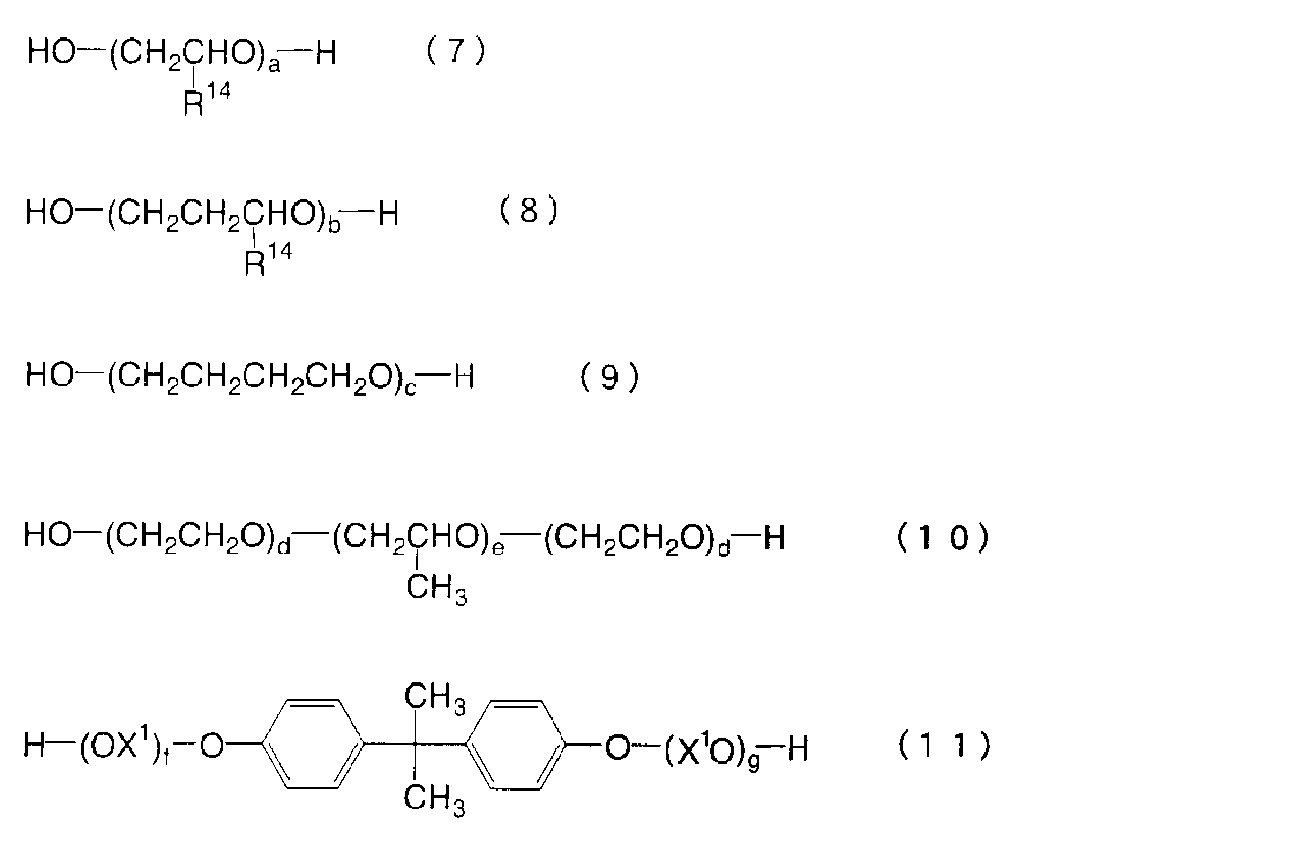
式(7)~(11)中、R14は水素原子またはメチル基を表し、X1は以下の基を表す。また、a、b、c、d、e、f、gはそれぞれ2以上の整数を表し、好ましくは2~100の整数である。

上記式(7)~(11)で表されるポリエーテルジオール化合物としては具体的に、特開2009-265518号公報段落0137~0140等の記載の化合物を参酌でき、これらの内容は本願明細書に組み込まれる。
末端に水酸基を有するエチレンオキシドとプロピレンオキシドとのランダム共重合体としては、具体的には以下に示すものが挙げられる。
三洋化成工業(株)製、(商品名)ニューポール50HB-100、ニューポール50HB-260、ニューポール50HB-400、ニューポール50HB-660、ニューポール50HB-2000、ニューポール50HB-5100等である。
三洋化成工業(株)製、(商品名)ニューポール50HB-100、ニューポール50HB-260、ニューポール50HB-400、ニューポール50HB-660、ニューポール50HB-2000、ニューポール50HB-5100等である。
ポリエステルジオール化合物としては、式(12)、(13)で表される化合物が挙げられる。

式(12)、(13)中、L2、L3およびL4はそれぞれ同一でも相違してもよく2価の脂肪族または芳香族炭化水素基を表し、L5は2価の脂肪族炭化水素基を表す。好ましくは、L2~L4は、それぞれアルキレン基、アルケニレン基、アルキニレン基、アリーレン基を表し、L5はアルキレン基を表す。またL2~L5中にはイソシアネート基と反応しない他の官能基、例えばエーテル、カルボニル、エステル、シアノ、オレフィン、ウレタン、アミド、ウレイド基またはハロゲン原子等が存在していてもよい。n1、n2はそれぞれ2以上の整数であり、好ましくは2~100の整数を表す。
ポリカーボネートジオール化合物としては、式(14)で表される化合物がある。
ポリカーボネートジオール化合物としては、式(14)で表される化合物がある。

式(14)中、L6はそれぞれ同一でも相違してもよく2価の脂肪族または芳香族炭化水素基を表す。好ましくは、L6はアルキレン基、アルケニレン基、アルキニレン基、アリーレン基を表す。またL6中にはイソシアネート基と反応しない他の官能基、例えばエーテル、カルボニル、エステル、シアノ、オレフィン、ウレタン、アミド、ウレイド基またはハロゲン原子等が存在していてもよい。n3は2以上の整数であり、好ましくは2~l00の整数を表す。
上記式(12)、(13)または(14)で表される具体的なジオール化合物としては、特開2009-265518号公報段落0148~0150等の記載の化合物を参酌でき、これらの内容は本願明細書に組み込まれる。
また、特定ポリウレタンポリマーの合成には、上記ジオール化合物の他に、イソシアネート基と反応しない置換基を有するジオール化合物を併用することもできる。このようなジオール化合物としては、例えば、以下に示すものが含まれる。
HO-L7-O-CO-L8-CO-O-L7-OH (15)
HO-L8-CO-O-L7-OH (16)
HO-L8-CO-O-L7-OH (16)
式(15)、(16)中、L7、L8はそれぞれ同一でも相違していてもよく、置換基(例えば、アルキル基、アラルキル基、アリール基、アルコキシ基、アリーロキシ基、または-F、-Cl、-Br、-I等のハロゲン原子などの各基が含まれる。)を有していてもよい2価の脂肪族炭化水素基、芳香族炭化水素基または複素環基を表す。必要に応じ、L7、L8中にイソシアネート基と反応しない他の官能基、例えば、カルボニル基、エステル基、ウレタン基、アミド基、ウレイド基などを有していてもよい。なおL7、L8で環を形成してもよい。
更に、特定ポリウレタンポリマーの合成には、上記ジオール化合物の他に、カルボキシル基を有するジオール化合物を併用することもできる。
このようなジオール化合物としては、例えば、以下の式(17)~(19)に示すものが含まれる。
このようなジオール化合物としては、例えば、以下の式(17)~(19)に示すものが含まれる。
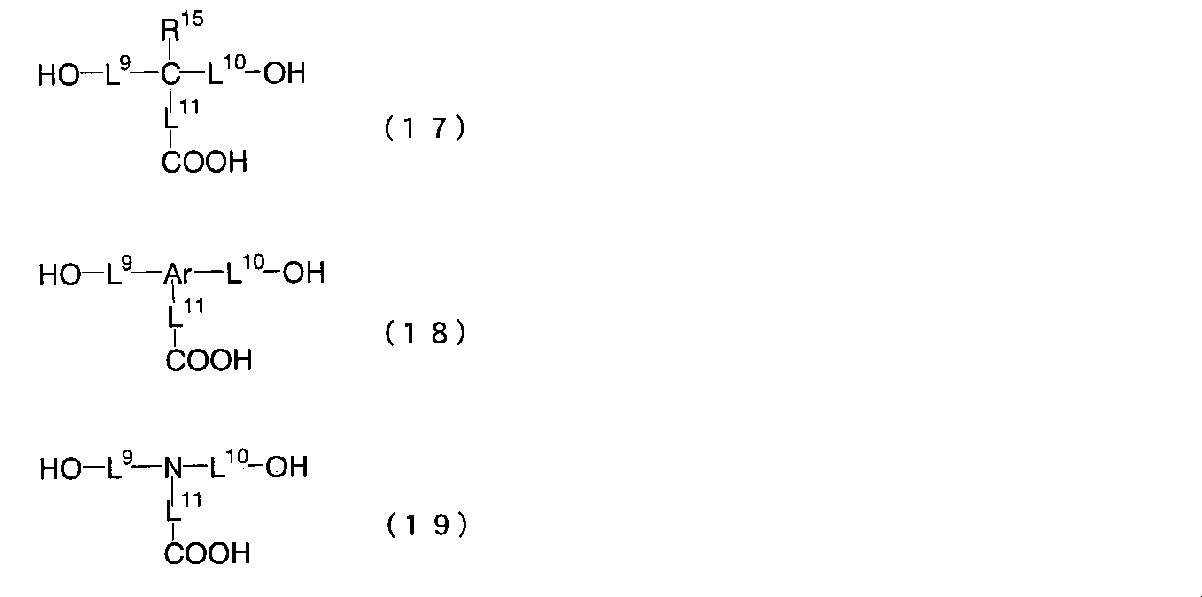
式(17)~(19)中、R15は水素原子、置換基(例えば、シアノ基、ニトロ基、または-F、-Cl、-Br、-I等のハロゲン原子、-CONH2、-COOR16、-OR16、-NHCONHR16、-NHCOOR16、-NHCOR16、-OCONHR16(ここで、R16は炭素数1~10のアルキル基、炭素数7~15のアラルキル基を表す。)などの各基が含まれる。)を有していてもよいアルキル基、アラルキル基、アリール基、アルコキシ基、アリーロキシ基を表し、好ましくは水素原子、炭素数1~8個のアルキル基、炭素数6~15個のアリール基を表す。L9、L10、L11はそれぞれ同一でも相違していてもよく、単結合、置換基(例えば、アルキル、アラルキル、アリール、アルコキシ、ハロゲノの各基が好ましい。)を有していてもよい2価の脂肪族または芳香族炭化水素基を表し、好ましくは炭素数1~20個のアルキレン基、炭素数6~15個のアリーレン基、さらに好ましくは炭素数1~8個のアルキレン基を表す。また必要に応じ、L9~L11中にイソシアネート基と反応しない他の官能基、例えばカルボニル、エステル、ウレタン、アミド、ウレイド、エーテル基を有していてもよい。なおR15、L7、L8、L9のうちの2または3個で環を形成してもよい。
Arは三価の芳香族炭化水素基を表し、好ましくは炭素数6~15個の芳香族基を表す。
Arは三価の芳香族炭化水素基を表し、好ましくは炭素数6~15個の芳香族基を表す。
上記式(17)~(19)で表されるカルボキシル基を有するジオール化合物としては具体的には以下に示すものが含まれる。
3,5-ジヒドロキシ安息香酸、2,2-ビス(ヒドロキシメチル)プロピオン酸、2,2-ビス(2-ヒドロキシエチル)プロピオン酸、2,2-ビス(3-ヒドロキシプロピル)プロピオン酸、ビス(ヒドロキシメチル)酢酸、ビス(4-ヒドロキシフェニル)酢酸、2,2-ビス(ヒドロキシメチル)酪酸、4,4-ビス(4-ヒドロキシフェニル)ペンタン酸、酒石酸、N,N-ジヒドロキシエチルグリシン、N,N―ビス(2-ヒドロキシエチル)-3-カルボキシ-プロピオンアミド等である。
3,5-ジヒドロキシ安息香酸、2,2-ビス(ヒドロキシメチル)プロピオン酸、2,2-ビス(2-ヒドロキシエチル)プロピオン酸、2,2-ビス(3-ヒドロキシプロピル)プロピオン酸、ビス(ヒドロキシメチル)酢酸、ビス(4-ヒドロキシフェニル)酢酸、2,2-ビス(ヒドロキシメチル)酪酸、4,4-ビス(4-ヒドロキシフェニル)ペンタン酸、酒石酸、N,N-ジヒドロキシエチルグリシン、N,N―ビス(2-ヒドロキシエチル)-3-カルボキシ-プロピオンアミド等である。
このようなカルボキシル基の存在により、ポリウレタンポリマーに水素結合性とアルカリ可溶性といった特性を付与できるため好ましい。具体的には、前記側鎖にエチレン性不飽和結合基を有するポリウレタンポリマーが、さらに側鎖にカルボキシル基を有するポリマーである。より具体的には、側鎖にエチレン性不飽和結合基を0.3meq/g以上有し、且つ、側鎖にカルボキシル基を0.4meq/g以上有するポリウレタンポリマーが、本発明のバインダーポリマーとして特に好ましく用いられる。
また、特定ポリウレタンポリマーの合成には、上記ジオールの他に、下記の式(20)~(22)で表されるテトラカルボン酸二無水物をジオール化合物で開環させた化合物を併用することもできる。

式(20)~(22)中、L12は、単結合、置換基(例えばアルキル、アラルキル、アリール、アルコキシ、ハロゲノ、エステル、アミドの各基が好ましい。)を有していてもよい2価の脂肪族または芳香族炭化水素基、-CO-、-SO-、-SO2-、-O-またはS-を表し、好ましくは単結合、炭素数1~15個の2価の脂肪族炭化水素基、-CO-、-SO2-、-O-または-S-を表す。R17、R18は同一でも相違していてもよく、水素原子、アルキル基、アラルキル基、アリール基、アルコキシ基、またはハロゲノ基を表し、好ましくは、水素原子、炭素数1~8個のアルキル基、炭素数6~15個のアリール基、炭素数1~8個のアルコキシ基またはハロゲノ基を表す。またL12、R17、R18のうちの2つが結合して環を形成してもよい。
R19、R20は同一でも相違していてもよく、水素原子、アルキル基、アラルキル基、アリール基またはハロゲノ基を表し、好ましくは水素原子、炭素数1~8個のアルキル基、または炭素数6~15個のアリール基を表す。またL12、R19、R20のうちの2つが結合して環を形成してもよい。L13、L14は同一でも相違していてもよく、単結合、二重結合、または2価の脂肪族炭化水素基を表し、好ましくは単結合、二重結合、またはメチレン基を表す。Aは単核または多核の芳香環を表す。好ましくは炭素数6~18個の芳香環を表す。
上記式(20)、(21)または(22)で表される化合物としては、具体的には特開2009-265518号公報段落0163~0164等の記載を参酌でき、これらの内容は本願明細書に組み込まれる。
これらのテトラカルボン酸二無水物をジオール化合物で開環された化合物をポリウレタンポリマー中に導入する方法としては、例えば以下の方法がある。
a)テトラカルボン酸二無水物をジオール化合物で開環させて得られたアルコール末端の化合物と、ジイソシアネート化合物とを反応させる方法。
b)ジイソシアネート化合物をジオール化合物過剰の条件下で反応させ得られたアルコール末端のウレタン化合物と、テトラカルボン酸二無水物とを反応させる方法。
a)テトラカルボン酸二無水物をジオール化合物で開環させて得られたアルコール末端の化合物と、ジイソシアネート化合物とを反応させる方法。
b)ジイソシアネート化合物をジオール化合物過剰の条件下で反応させ得られたアルコール末端のウレタン化合物と、テトラカルボン酸二無水物とを反応させる方法。
また、このとき開環反応に使用されるジオール化合物としては、具体的には特開2009-265518号公報段落0166等の記載を参酌でき、これらの内容は本願明細書に組み込まれる。
本発明に用い得る特定ポリウレタンポリマーは、上記ジイソシアネート化合物およびジオール化合物を、非プロトン性溶剤中、それぞれの反応性に応じた活性の公知の触媒を添加し、加熱することにより合成される。合成に使用されるジイソシアネートおよびジオール化合物のモル比(Ma:Mb)は、1:1~1.2:1が好ましい。合成に使用されるジイソシアネートおよびジオール化合物は、アルコール類またはアミン類等で処理することにより、分子量あるいは粘度といった所望の物性の生成物が、最終的にイソシアネート基が残存しない形で合成される。
本発明に係る特定ポリウレタンポリマー中に含まれるエチレン性不飽和結合の導入量としては、当量で言えば、側鎖にエチレン性不飽和結合基を0.3meq/g以上含有することが好ましく、0.35~1.50meq/g含有することがより好ましい。
本発明に係る特定ポリウレタンポリマーの分子量としては、好ましくは重量平均分子量で10,000以上であり、より好ましくは40,000~200,000の範囲である。
本発明では、側鎖にエチレン性不飽和結合を有するスチレン系ポリマー(以下、「スチレン系ポリマー」ということがある)も好ましく、下記一般式(23)で表されるスチレン性二重結合(スチレンおよびαメチルスチレン系二重結合)、および、下記一般式(24)で表されるビニルピリジニウム基のうち少なくとも一方を有するものがより好ましい。

一般式(23)中、R21は水素原子またはメチル基を表す。R22は置換可能な任意の原子または原子団を表す。kは0~4の整数を表す。
なお、一般式(23)で表されるスチレン性二重結合は、単結合、或いは、任意の原子または原子団からなる連結基を介してポリマー主鎖と連結しており、結合の仕方について特に制限はない。
一般式(23)で表される官能基を有する高分子化合物の繰り返し単位としての好ましい例は、特開2009-265518号公報段落0179~0181等の記載を参酌でき、これらの内容は本願明細書に組み込まれる。
なお、一般式(23)で表されるスチレン性二重結合は、単結合、或いは、任意の原子または原子団からなる連結基を介してポリマー主鎖と連結しており、結合の仕方について特に制限はない。
一般式(23)で表される官能基を有する高分子化合物の繰り返し単位としての好ましい例は、特開2009-265518号公報段落0179~0181等の記載を参酌でき、これらの内容は本願明細書に組み込まれる。
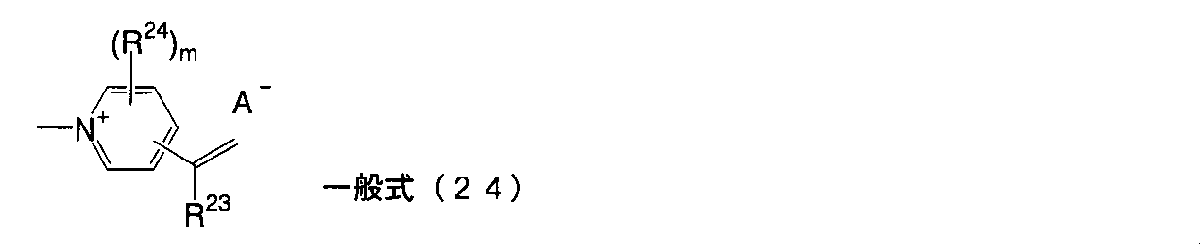
一般式(24)中、R23は水素原子またはメチル基を表す。R24は置換可能な任意の原子または原子団を表す。mは0~4の整数を表す。A-はアニオンを表す。また、ピリジニウム環は置換基としてベンゼン環を縮合したベンゾピリジニウムの形をとっても良く、この場合に於いてはキノリニウム基およびイソキノリニウム基を含む。
なお、一般式(24)で表されるビニルピリジニウム基は、単結合、或いは、任意の原子または原子団からなる連結基を介してポリマー主鎖と連結しており、結合の仕方について特に制限はない。
一般式(24)で表される官能基を有する高分子化合物の繰り返し単位として好ましい例は、特開2009-265518号公報段落0184等の記載を参酌でき、これらの内容は本願明細書に組み込まれる。
なお、一般式(24)で表されるビニルピリジニウム基は、単結合、或いは、任意の原子または原子団からなる連結基を介してポリマー主鎖と連結しており、結合の仕方について特に制限はない。
一般式(24)で表される官能基を有する高分子化合物の繰り返し単位として好ましい例は、特開2009-265518号公報段落0184等の記載を参酌でき、これらの内容は本願明細書に組み込まれる。
スチレン系ポリマーを合成する方法の一つとしては、前記一般式(23)または(24)で表される官能基を有し、且つ、他の共重合成分と共重合可能な官能基を有するモノマー同士を公知の共重合法を用いて共重合する方法が挙げられる。ここで、スチレン系ポリマーは、一般式(23)および(24)で表される官能基のうち、いずれか一方のうち1種類のみを有するホモポリマーであっても良いし、いずれか一方、または、双方の官能基のうちそれぞれ2種類以上を有する共重合体であってもよい。
さらに、これらの官能基を含まない他の共重合モノマーとの共重合体であっても良い。この場合の他の共重合モノマーとしては、例えば該ポリマーにアルカリ水溶液に対する可溶性を付与する目的等で、カルボキシ基含有モノマーを選択することが好ましく、アクリル酸、メタクリル酸、アクリル酸2-カルボキシエチルエステル、メタクリル酸2-カルボキシエチルエステル、クロトン酸、マレイン酸、フマル酸、マレイン酸モノアルキルエステル、フマル酸モノアルキルエステル、4-カルボキシスチレン等のような例が挙げられる。
カルボキシ基を有するモノマー以外にも共重合体中に他のモノマー成分を導入して(多元)共重合体として合成、使用することも好ましい。こうした場合に共重合体中に組み込むことが出来るモノマーとしては、特開2009-265518号公報段落0187等の記載を参酌でき、これらの内容は本願明細書に組み込まれる。
スチレン系ポリマーとして上記のような共重合体を使用する場合、全共重合体組成中に占める一般式(23)および/または一般式(24)で表される官能基を有する繰り返し単位の割合としては、20質量%以上であることが好ましく、40質量%以上であることがより好ましい。この範囲において、高感度な架橋系が得られる。
スチレン系ポリマーの分子量としては、好ましくは重量平均分子量で10,000~300,000の範囲であり、より好ましくは、15,000~200,000の範囲であり、最も好ましくは、20,000~150,000の範囲である。
その他の側鎖にエチレン性不飽和結合を有するポリマーとしては、以下のものが挙げられる。
側鎖にエチレン性不飽和基を有するノボラックポリマーとしては、例えば、特開平9-269596号公報に記載のポリマーに、特開2002-62648公報に記載の方法を用いて、側鎖にエチレン性不飽和結合を導入したポリマー等が挙げられる。
また、側鎖にエチレン性不飽和結合を有するアセタールポリマーとしては、例えば、特開2002-162741公報に記載のポリマー等が挙げられる。
さらに、側鎖にエチレン性不飽和結合を有するポリアミド系ポリマーとしては、例えば、特願2003-321022公報に記載のポリマー、またはその中で引用されているポリアミドポリマーに、特開2002-62648公報に記載の方法で側鎖にエチレン性不飽和結合を導入したポリマー等が挙げられる。
側鎖にエチレン性不飽和結合を有するポリイミドポリマーとしては、例えば、特願2003-339785公報に記載のポリマー、またはその中で引用されているポリイミドポリマーに、特開2002-62648公報に記載の方法で側鎖にエチレン性不飽和結合を導入したポリマー等が挙げられる。
側鎖にエチレン性不飽和基を有するノボラックポリマーとしては、例えば、特開平9-269596号公報に記載のポリマーに、特開2002-62648公報に記載の方法を用いて、側鎖にエチレン性不飽和結合を導入したポリマー等が挙げられる。
また、側鎖にエチレン性不飽和結合を有するアセタールポリマーとしては、例えば、特開2002-162741公報に記載のポリマー等が挙げられる。
さらに、側鎖にエチレン性不飽和結合を有するポリアミド系ポリマーとしては、例えば、特願2003-321022公報に記載のポリマー、またはその中で引用されているポリアミドポリマーに、特開2002-62648公報に記載の方法で側鎖にエチレン性不飽和結合を導入したポリマー等が挙げられる。
側鎖にエチレン性不飽和結合を有するポリイミドポリマーとしては、例えば、特願2003-339785公報に記載のポリマー、またはその中で引用されているポリイミドポリマーに、特開2002-62648公報に記載の方法で側鎖にエチレン性不飽和結合を導入したポリマー等が挙げられる。
<<C:エポキシ基またはオキセタニル基を有する化合物>>
本発明の第三の好ましい態様は、重合性化合物として、エポキシ基またはオキセタニル基を有する化合物を含む。エポキシ基またはオキセタニル基を有する化合物としては、具体的には側鎖にエポキシ基を有するポリマー、および分子内に2個以上のエポキシ基を有する重合性モノマーまたはオリゴマーがあり、ビスフェノールA型エポキシ樹脂、ビスフェノールF型エポキシ樹脂、フェノールノボラック型エポキシ樹脂、クレゾールノボラック型エポキシ樹脂、脂肪族エポキシ樹脂等を挙げることができる。単官能または多官能グリシジルエーテル化合物も挙げられ、多官能脂肪族グリシジルエーテル化合物が好ましい。
これらの化合物は、市販品を用いてもよいし、ポリマーの側鎖へエポキシ基を導入することによっても得られる。
本発明の第三の好ましい態様は、重合性化合物として、エポキシ基またはオキセタニル基を有する化合物を含む。エポキシ基またはオキセタニル基を有する化合物としては、具体的には側鎖にエポキシ基を有するポリマー、および分子内に2個以上のエポキシ基を有する重合性モノマーまたはオリゴマーがあり、ビスフェノールA型エポキシ樹脂、ビスフェノールF型エポキシ樹脂、フェノールノボラック型エポキシ樹脂、クレゾールノボラック型エポキシ樹脂、脂肪族エポキシ樹脂等を挙げることができる。単官能または多官能グリシジルエーテル化合物も挙げられ、多官能脂肪族グリシジルエーテル化合物が好ましい。
これらの化合物は、市販品を用いてもよいし、ポリマーの側鎖へエポキシ基を導入することによっても得られる。
市販品としては、例えば、特開2012-155288号公報段落0191等の記載を参酌でき、これらの内容は本願明細書に組み込まれる。
市販品としては、デナコール EX-212L、EX-214L、EX-216L、EX-321L、EX-850L(以上、ナガセケムテックス(株)製)等の多官能脂肪族グリシジルエーテル化合物が挙げられる。これらは、低塩素品である。一方、低塩素品ではない、EX-212、EX-214、EX-216、EX-321、EX-850なども同様に使用できる。
その他にも、ADEKA RESIN EP-4000S、同EP-4003S、同EP-4010S、同EP-4011S(以上、(株)ADEKA製)、NC-2000、NC-3000、NC-7300、XD-1000、EPPN-501、EPPN-502(以上、(株)ADEKA製)、JER1031S等も挙げられる。
さらに、フェノールノボラック型エポキシ樹脂の市販品として、JER-157S65、JER-152、JER-154、JER-157S70(以上、三菱化学(株)製)等が挙げられる。
市販品としては、デナコール EX-212L、EX-214L、EX-216L、EX-321L、EX-850L(以上、ナガセケムテックス(株)製)等の多官能脂肪族グリシジルエーテル化合物が挙げられる。これらは、低塩素品である。一方、低塩素品ではない、EX-212、EX-214、EX-216、EX-321、EX-850なども同様に使用できる。
その他にも、ADEKA RESIN EP-4000S、同EP-4003S、同EP-4010S、同EP-4011S(以上、(株)ADEKA製)、NC-2000、NC-3000、NC-7300、XD-1000、EPPN-501、EPPN-502(以上、(株)ADEKA製)、JER1031S等も挙げられる。
さらに、フェノールノボラック型エポキシ樹脂の市販品として、JER-157S65、JER-152、JER-154、JER-157S70(以上、三菱化学(株)製)等が挙げられる。
側鎖にオキセタニル基を有するポリマー、および上述の分子内に2個以上のオキセタニル基を有する重合性モノマーまたはオリゴマーの具体例としては、アロンオキセタンOXT-121、OXT-221、OX-SQ、PNOX(以上、東亞合成(株)製)を用いることができる。
ポリマー側鎖へ導入して合成する場合、導入反応は、例えばトリエチルアミン、ベンジルメチルアミン等の3級アミン、ドデシルトリメチルアンモニウムクロライド、テトラメチルアンモニウムクロライド、テトラエチルアンモニウムクロライド、等の4級アンモニウム塩、ピリジン、トリフェニルフォスフィン等を触媒として有機溶剤中、反応温度50~150℃で数~数十時間反応させることにより行える。脂環式エポキシ不飽和化合物の導入量は得られるポリマーの酸価が5~200KOH・mg/gを満たす範囲になるように制御すると好ましい。また、重量平均分子量は500~5,000,000、更には1000~500,000の範囲が好ましい。
エポキシ不飽和化合物としてはグリシジル(メタ)アクリレートやアリルグリシジルエーテル等のエポキシ基としてグリシジル基を有するものも使用可能である。エポキシ不飽和化合物として好ましいものは、脂環式エポキシ基を有する不飽和化合物である。このようなものとしては例えば特開2009-265518号公報段落0045等の記載を参酌でき、これらの内容は本願明細書に組み込まれる。
エポキシ不飽和化合物としてはグリシジル(メタ)アクリレートやアリルグリシジルエーテル等のエポキシ基としてグリシジル基を有するものも使用可能である。エポキシ不飽和化合物として好ましいものは、脂環式エポキシ基を有する不飽和化合物である。このようなものとしては例えば特開2009-265518号公報段落0045等の記載を参酌でき、これらの内容は本願明細書に組み込まれる。
これらの重合性化合物について、その構造や、単独使用か併用か、添加量等の使用方法の詳細は、近赤外線吸収性組成物の最終的な性能設計にあわせて任意に設定できる。例えば、感度の観点では、1分子あたりの不飽和基含量が多い構造が好ましく、多くの場合は2官能以上が好ましい。近赤外線カットフィルタの強度を高める観点では、3官能以上のものがよい。異なる官能数・異なる重合性基(例えばアクリル酸エステル、メタクリル酸エステル、スチレン系化合物、ビニルエーテル系化合物)のものを併用することで、感度と強度の両方を調節する方法も有効である。近赤外線吸収性組成物に含有される他の成分(例えば、金属酸化物、色素、重合開始剤)との相溶性、分散性に対しても、重合性化合物の選択・使用法は重要な要因であり、例えば、低純度化合物の使用や2種以上の併用により相溶性を向上させうる。また、支持体などの硬質表面との密着性を向上させる観点で特定の構造を選択することもあり得る。
本発明の組成物中における硬化性化合物の添加量は、溶剤を除いた全固形分に対して1~80質量%、より好ましくは5~50質量%、特に好ましくは7~40質量%の範囲である。
重合性化合物は、1種類のみでも2種類以上でもよく、2種類以上の場合は合計量が上記範囲となる。
重合性化合物は、1種類のみでも2種類以上でもよく、2種類以上の場合は合計量が上記範囲となる。
<バインダーポリマー>
本発明においては、皮膜特性向上などの目的で、必要に応じて、上記重合性化合物に加えて、バインダーポリマーを含むことができる。バインダーポリマーとしては、アルカリ可溶性樹脂が好ましく用いられる。アルカリ可溶性樹脂を含有することにより、耐熱性などの向上や、塗布適性の微調整に効果がある。
アルカリ可溶性樹脂としては、特開2012-208494号公報段落0558~0571(対応する米国特許出願公開第2012/0235099号明細書の[0685]~[0700])以降の記載を参酌でき、これらの内容は本願明細書に組み込まれる。
本発明においては、皮膜特性向上などの目的で、必要に応じて、上記重合性化合物に加えて、バインダーポリマーを含むことができる。バインダーポリマーとしては、アルカリ可溶性樹脂が好ましく用いられる。アルカリ可溶性樹脂を含有することにより、耐熱性などの向上や、塗布適性の微調整に効果がある。
アルカリ可溶性樹脂としては、特開2012-208494号公報段落0558~0571(対応する米国特許出願公開第2012/0235099号明細書の[0685]~[0700])以降の記載を参酌でき、これらの内容は本願明細書に組み込まれる。
本発明におけるバインダーポリマーの含有量は、組成物の全固形分中に対して、1~80質量%であることが好ましく、5~50質量%であることがより好ましく、7~30質量%であることがさらに好ましい。
<界面活性剤>
本発明の組成物は、界面活性剤を含んでいてもよい。界面活性剤は、1種のみを用いてもよいし、2種類以上を組み合わせてもよい。界面活性剤の添加量は、本発明の組成物の固形分に対して、好ましくは0.0001~2質量%であり、より好ましくは0.005~1.0質量%であり、さらに好ましくは、0.01~0.1質量%である。
界面活性剤としては、フッ素系界面活性剤、ノニオン系界面活性剤、カチオン系界面活性剤、アニオン系界面活性剤、シリコーン系界面活性剤などの各種界面活性剤を使用できる。
本発明の組成物は、界面活性剤を含んでいてもよい。界面活性剤は、1種のみを用いてもよいし、2種類以上を組み合わせてもよい。界面活性剤の添加量は、本発明の組成物の固形分に対して、好ましくは0.0001~2質量%であり、より好ましくは0.005~1.0質量%であり、さらに好ましくは、0.01~0.1質量%である。
界面活性剤としては、フッ素系界面活性剤、ノニオン系界面活性剤、カチオン系界面活性剤、アニオン系界面活性剤、シリコーン系界面活性剤などの各種界面活性剤を使用できる。
特に、本発明の組成物は、フッ素系界面活性剤、およびシリコーン系界面活性剤の少なくともいずれかを含有することで、塗布液として調製したときの液特性(特に、流動性)がより向上する。これによって、塗布厚の均一性や省液性がより改善する。
即ち、フッ素系界面活性剤およびシリコーン系界面活性剤の少なくともいずれかを含有する組成物を適用した塗布液を用いて膜形成する場合においては、被塗布面と塗布液との界面張力を低下させることにより、被塗布面への濡れ性が改善され、被塗布面への塗布性が向上する。このため、少量の液量で数μm程度の薄膜を形成した場合であっても、厚みムラの小さい均一厚の膜形成をより好適に行える点で有効である。
即ち、フッ素系界面活性剤およびシリコーン系界面活性剤の少なくともいずれかを含有する組成物を適用した塗布液を用いて膜形成する場合においては、被塗布面と塗布液との界面張力を低下させることにより、被塗布面への濡れ性が改善され、被塗布面への塗布性が向上する。このため、少量の液量で数μm程度の薄膜を形成した場合であっても、厚みムラの小さい均一厚の膜形成をより好適に行える点で有効である。
フッ素系界面活性剤中のフッ素含有率は、3~40質量%が好適であり、より好ましくは5~30質量%であり、特に好ましくは7~25質量%である。フッ素含有率がこの範囲内であるフッ素系界面活性剤は、塗布膜の厚さの均一性や省液性の点で効果的であり、近赤外線吸収性組成物中における溶解性も良好である。
フッ素系界面活性剤としては、例えば、メガファックF171、同F172、同F173、同F176、同F177、同F141、同F142、同F143、同F144、同R30、同F437、同F479、同F482、同F554、同F780、同R08(以上、DIC(株)製)、フロラードFC430、同FC431、同FC171(以上、住友スリーエム(株)製)、サーフロンS-382、同S-141、同S-145、同SC-101、同SC-103、同SC-104、同SC-105、同SC1068、同SC-381、同SC-383、同S393、同KH-40(以上、旭硝子(株)製)、エフトップEF301、同EF303、同EF351、同EF352(以上、ジェムコ(株)製)、PF636、PF656、PF6320、PF6520、PF7002(OMNOVA社製)等が挙げられる。
フッ素系界面活性剤としては、フルオロ脂肪族基を有する重合体も好ましい。フルオロ脂肪族基を有する重合体としては、フルオロ脂肪族基を有し、該フルオロ脂肪族基が、テロメリゼーション法(テロマー法ともいわれる)、またはオリゴメリゼーション法(オリゴマー法ともいわれる)によって製造されたフルオロ脂肪族化合物から得られたフッ素系界面活性剤が例示される。
ここで、「テロメリゼーション法」とは、低分子量の物質を重合させて分子内に1~2個の活性基を有する化合物の合成方法を意味する。また、「オリゴメゼーション法」とは、単量体または単量体類の混合物をオリゴマーに転化する方法を意味する。
本発明におけるフルオロ脂肪族基としては、例えば、-CF3基、-C2F5基、-C3F7基、-C4F9基、-C5F11基、-C6F13基、-C7F15基、-C8F17基、C9F19基、C10F21基が挙げられ、相溶性・塗布性の点から、-C2F5基、-C3F7基、-C4F9基、-C5F11基、-C6F13基、-C7F15基、-C8F17基が好ましい。
ここで、「テロメリゼーション法」とは、低分子量の物質を重合させて分子内に1~2個の活性基を有する化合物の合成方法を意味する。また、「オリゴメゼーション法」とは、単量体または単量体類の混合物をオリゴマーに転化する方法を意味する。
本発明におけるフルオロ脂肪族基としては、例えば、-CF3基、-C2F5基、-C3F7基、-C4F9基、-C5F11基、-C6F13基、-C7F15基、-C8F17基、C9F19基、C10F21基が挙げられ、相溶性・塗布性の点から、-C2F5基、-C3F7基、-C4F9基、-C5F11基、-C6F13基、-C7F15基、-C8F17基が好ましい。
本発明におけるフルオロ脂肪族化合物は、特開2002-90991号公報に記載された方法によって合成することが出来る。
本発明におけるフルオロ脂肪族基を有する重合体としては、本発明におけるフルオロ脂肪族基を有するモノマーと(ポリ(オキシアルキレン))アクリレートおよび/または(ポリ(オキシアルキレン))メタクリレートとの共重合体が好ましい。該共重合体は、不規則に分布しているものでも、ブロック共重合していてもよい。また、前記ポリ(オキシアルキレン)基としては、ポリ(オキシエチレン)基、ポリ(オキシプロピレン)基、ポリ(オキシブチレン)基などが挙げられ、ポリ(オキシエチレンとオキシプロピレンとオキシエチレンとのブロック連結体)基やポリ(オキシエチレンとオキシプロピレンとのブロック連結体)基など同じ鎖長内に異なる鎖長のアルキレンを有するようなユニットでもよい。さらに、フルオロ脂肪族基を有するモノマーと(ポリ(オキシアルキレン))アクリレート(またはメタクリレート)との共重合体は2元共重合体ばかりでなく、異なる2種以上のフルオロ脂肪族基を有するモノマーや、異なる2種以上の(ポリ(オキシアルキレン))アクリレート(またはメタクリレート)などを同時に共重合した3元系以上の共重合体でもよい。
本発明におけるフルオロ脂肪族基を有する重合体としては、本発明におけるフルオロ脂肪族基を有するモノマーと(ポリ(オキシアルキレン))アクリレートおよび/または(ポリ(オキシアルキレン))メタクリレートとの共重合体が好ましい。該共重合体は、不規則に分布しているものでも、ブロック共重合していてもよい。また、前記ポリ(オキシアルキレン)基としては、ポリ(オキシエチレン)基、ポリ(オキシプロピレン)基、ポリ(オキシブチレン)基などが挙げられ、ポリ(オキシエチレンとオキシプロピレンとオキシエチレンとのブロック連結体)基やポリ(オキシエチレンとオキシプロピレンとのブロック連結体)基など同じ鎖長内に異なる鎖長のアルキレンを有するようなユニットでもよい。さらに、フルオロ脂肪族基を有するモノマーと(ポリ(オキシアルキレン))アクリレート(またはメタクリレート)との共重合体は2元共重合体ばかりでなく、異なる2種以上のフルオロ脂肪族基を有するモノマーや、異なる2種以上の(ポリ(オキシアルキレン))アクリレート(またはメタクリレート)などを同時に共重合した3元系以上の共重合体でもよい。
本発明におけるフルオロ脂肪族基を有する重合体を含む市販の界面活性剤としては、例えば、特開2012-208494号公報段落0552(対応する米国特許出願公開第2012/0235099号明細書の[0678])等に記載の界面活性剤が挙げられ、これらの内容は本願明細書に組み込まれる。また、メガファックF-781(大日本インキ化学工業(株)製)、C6F13基を有するアクリレート(またはメタクリレート)と(ポリ(オキシエチレン))アクリレート(またはメタクリレート)と(ポリ(オキシプロピレン))アクリレート(またはメタクリレート)との共重合体、C8F17基を有するアクリレート(またはメタクリレート)と(ポリ(オキシアルキレン))アクリレート(またはメタクリレート)との共重合体、C8F17基を有するアクリレート(またはメタクリレート)と(ポリ(オキシエチレン))アクリレート(またはメタクリレート)と(ポリ(オキシプロピレン))アクリレート(またはメタクリレート)との共重合体、などを使用することができる。
ノニオン系界面活性剤としては、ポリオキシエチレンアルキルエーテル、ポリオキシエチレンアルキルアリルエーテル、ポリオキシエチレン脂肪酸エステル、ソルビタン脂肪酸エステル、ポリオキシエチレンソルビタン脂肪酸エステル、ポリオキシエチレンアルキルアミン、グリセリン脂肪酸エステル、オキシエチレンオキシプロピレンブロックコポリマー、アセチレングリコール系界面活性剤、アセチレン系ポリオキシエチレンオキシド等が挙げられる。これらは単独あるいは2種以上を用いることができる。
具体的な商品名としては、サーフィノール61,82,104,104E、104H、104A、104BC、104DPM、104PA、104PG-50、104S、420,440,465,485,504、CT-111,CT-121,CT-131,CT-136,CT-141,CT-151,CT-171,CT-324,DF-37,DF-58,DF-75,DF-110D,DF-210,GA,OP-340,PSA-204,PSA-216,PSA-336,SE,SE-F,TG、GA、ダイノール604(以上、日信化学(株)及びAirProducts&Chemicals社)、オルフィンA,B,AK-02,CT-151W,E1004,E1010,P,SPC,STG,Y,32W、PD-001、PD-002W、PD-003、PD-004、EXP.4001、EXP.4036、EXP.4051、AF-103、AF-104、SK-14、AE-3(以上、日信化学(株))、アセチレノールE00、E13T、E40、E60、E81、E100、E200(以上全て商品名、川研ファインケミカル(株)社製)等を挙げることができる。なかでも、オルフィンE1010が好適である。
その他、ノニオン系界面活性剤として具体的には、特開2012-208494号公報段落0553(対応する米国特許出願公開第2012/0235099号明細書の[0679])等に記載のノニオン系界面活性剤が挙げられ、これらの内容は本願明細書に組み込まれる。
カチオン系界面活性剤として具体的には、特開2012-208494号公報段落0554(対応する米国特許出願公開第2012/0235099号明細書の[0680])に記載のカチオン系界面活性剤が挙げられ、これらの内容は本願明細書に組み込まれる。
アニオン系界面活性剤として具体的には、W004、W005、W017(裕商(株)社製)等が挙げられる。
具体的な商品名としては、サーフィノール61,82,104,104E、104H、104A、104BC、104DPM、104PA、104PG-50、104S、420,440,465,485,504、CT-111,CT-121,CT-131,CT-136,CT-141,CT-151,CT-171,CT-324,DF-37,DF-58,DF-75,DF-110D,DF-210,GA,OP-340,PSA-204,PSA-216,PSA-336,SE,SE-F,TG、GA、ダイノール604(以上、日信化学(株)及びAirProducts&Chemicals社)、オルフィンA,B,AK-02,CT-151W,E1004,E1010,P,SPC,STG,Y,32W、PD-001、PD-002W、PD-003、PD-004、EXP.4001、EXP.4036、EXP.4051、AF-103、AF-104、SK-14、AE-3(以上、日信化学(株))、アセチレノールE00、E13T、E40、E60、E81、E100、E200(以上全て商品名、川研ファインケミカル(株)社製)等を挙げることができる。なかでも、オルフィンE1010が好適である。
その他、ノニオン系界面活性剤として具体的には、特開2012-208494号公報段落0553(対応する米国特許出願公開第2012/0235099号明細書の[0679])等に記載のノニオン系界面活性剤が挙げられ、これらの内容は本願明細書に組み込まれる。
カチオン系界面活性剤として具体的には、特開2012-208494号公報段落0554(対応する米国特許出願公開第2012/0235099号明細書の[0680])に記載のカチオン系界面活性剤が挙げられ、これらの内容は本願明細書に組み込まれる。
アニオン系界面活性剤として具体的には、W004、W005、W017(裕商(株)社製)等が挙げられる。
シリコーン系界面活性剤としては、例えば、特開2012-208494号公報段落0556(対応する米国特許出願公開第2012/0235099号明細書の[0682])等に記載のシリコーン系界面活性剤が挙げられ、これらの内容は本願明細書に組み込まれる。また、東レ・ダウコーニング(株)製「トーレシリコーンSF8410」、「同SF8427」、「同SH8400」、「ST80PA」、「ST83PA」、「ST86PA」、モメンティブ・パフォーマンス・マテリアルズ社製「TSF-400」、「TSF-401」、「TSF-410」、「TSF-4446」、信越シリコーン株式会社製「KP321」、「KP323」、「KP324」、「KP340」等も例示される。
<重合開始剤>
本発明の組成物は、重合開始剤を含んでいてもよい。重合開始剤は1種類のみでも、2種類以上でもよく、2種類以上の場合は、合計量が下記範囲となる。重合開始剤の含有量は、0.01~30質量%が好ましく、0.1~20質量%がより好ましく、0.1~15質量%が特に好ましい。
重合開始剤としては、光、熱のいずれか或いはその双方により重合性化合物の重合を開始する能力を有する限り、特に制限はなく、目的に応じて適宜選択することができる。なかでも、重合開始剤としては光重合性化合物であることが好ましい。光で重合を開始させる場合、紫外線領域から可視の光線に対して感光性を有するものが好ましい。
また、熱で重合を開始させる場合には、150~250℃で分解する重合開始剤が好ましい。
本発明の組成物は、重合開始剤を含んでいてもよい。重合開始剤は1種類のみでも、2種類以上でもよく、2種類以上の場合は、合計量が下記範囲となる。重合開始剤の含有量は、0.01~30質量%が好ましく、0.1~20質量%がより好ましく、0.1~15質量%が特に好ましい。
重合開始剤としては、光、熱のいずれか或いはその双方により重合性化合物の重合を開始する能力を有する限り、特に制限はなく、目的に応じて適宜選択することができる。なかでも、重合開始剤としては光重合性化合物であることが好ましい。光で重合を開始させる場合、紫外線領域から可視の光線に対して感光性を有するものが好ましい。
また、熱で重合を開始させる場合には、150~250℃で分解する重合開始剤が好ましい。
本発明に用いうる重合開始剤としては、少なくとも芳香族基を有する化合物であることが好ましく、例えば、アシルホスフィン化合物、アセトフェノン系化合物、α-アミノケトン化合物、ベンゾフェノン系化合物、ベンゾインエーテル系化合物、ケタール誘導体化合物、チオキサントン化合物、オキシム化合物、ヘキサアリールビイミダゾール化合物、トリハロメチル化合物、アゾ化合物、有機過酸化物、ジアゾニウム化合物、ヨードニウム化合物、スルホニウム化合物、アジニウム化合物、ベンゾインエーテル系化合物、ケタール誘導体化合物、メタロセン化合物等のオニウム塩化合物、有機硼素塩化合物、ジスルホン化合物、チオール化合物などが挙げられる。
感度の観点から、オキシム化合物、アセトフェノン系化合物、α-アミノケトン化合物、トリハロメチル化合物、ヘキサアリールビイミダゾール化合物、および、チオール化合物が好ましい。
感度の観点から、オキシム化合物、アセトフェノン系化合物、α-アミノケトン化合物、トリハロメチル化合物、ヘキサアリールビイミダゾール化合物、および、チオール化合物が好ましい。
アセトフェノン系化合物、トリハロメチル化合物、ヘキサアリールビイミダゾール化合物、オキシム化合物としては、具体的には、特開2012-208494号公報段落0506~0510(対応する米国特許出願公開第2012/0235099号明細書の[0622~0628])等の記載を参酌でき、これらの内容は本願明細書に組み込まれる。
好ましくは更に、特開2007-231000公報、および、特開2007-322744公報に記載される環状オキシム化合物に対しても好適に用いることができる。
他にも、特開2007-269779公報に示される特定置換基を有するオキシム化合物や、特開2009-191061公報に示されるチオアリール基を有するオキシム化合物が挙げられる。
他にも、特開2007-269779公報に示される特定置換基を有するオキシム化合物や、特開2009-191061公報に示されるチオアリール基を有するオキシム化合物が挙げられる。
具体的には、オキシム化合物としては、下記式(1)で表される化合物も好ましい。なお、オキシムのN-O結合が(E)体のオキシム化合物であっても、(Z)体のオキシム化合物であっても、(E)体と(Z)体との混合物であってもよい。下記式(1)で表される化合物については、特開2012-208494号公報段落0513(対応する米国特許出願公開第2012/235099号明細書の[0632])以降の式(OX-1)または(OX-2)で表される化合物の説明を参酌でき、これらの内容は本願明細書に組み込まれる。

(式(1)中、RおよびBは各々独立に一価の置換基を表し、Aは2価の有機基を表し、Arはアリール基を表す。)
前記Rで表される一価の置換基としては、一価の非金属原子団であることが好ましい。前記一価の非金属原子団としては、炭素数1~30のアルキル基、炭素数6~30のアリール基、炭素数2~20のアシル基、炭素数2~20のアルコキシカルボニル基、炭素数2~20のアリールオキシカルボニル基、複素環基、アルキルチオカルボニル基、アリールチオカルボニル基等が挙げられる。
前記Bで表される一価の置換基としては、アリール基、複素環基、アリールカルボニル基、または、複素環カルボニル基を表す。
前記Aで表される2価の有機基としては、炭素数1~12のアルキレン基、シクロヘキシレン基、アルキニレン基が挙げられる。
これらの基は、1以上の置換基を有していてもよい。また、前述した置換基は、更に他の置換基で置換されていてもよい。置換基としてはハロゲン原子、アリールオキシ基、アルコキシカルボニル基またはアリールオキシカルボニル基、アシルオキシ基、アシル基、アルキル基、アリール基等が挙げられる。
前記Rで表される一価の置換基としては、一価の非金属原子団であることが好ましい。前記一価の非金属原子団としては、炭素数1~30のアルキル基、炭素数6~30のアリール基、炭素数2~20のアシル基、炭素数2~20のアルコキシカルボニル基、炭素数2~20のアリールオキシカルボニル基、複素環基、アルキルチオカルボニル基、アリールチオカルボニル基等が挙げられる。
前記Bで表される一価の置換基としては、アリール基、複素環基、アリールカルボニル基、または、複素環カルボニル基を表す。
前記Aで表される2価の有機基としては、炭素数1~12のアルキレン基、シクロヘキシレン基、アルキニレン基が挙げられる。
これらの基は、1以上の置換基を有していてもよい。また、前述した置換基は、更に他の置換基で置換されていてもよい。置換基としてはハロゲン原子、アリールオキシ基、アルコキシカルボニル基またはアリールオキシカルボニル基、アシルオキシ基、アシル基、アルキル基、アリール基等が挙げられる。
好適に用いられるオキシム化合物の具体例としては、特開2012-032556号公報段落0033、特開2012-122045号公報段落0033等の記載を参酌でき、これらの内容は本願明細書に組み込まれる。(PIox-1)~(PIox-13)を以下に示すが、本発明はこれらに限定されるものではない。
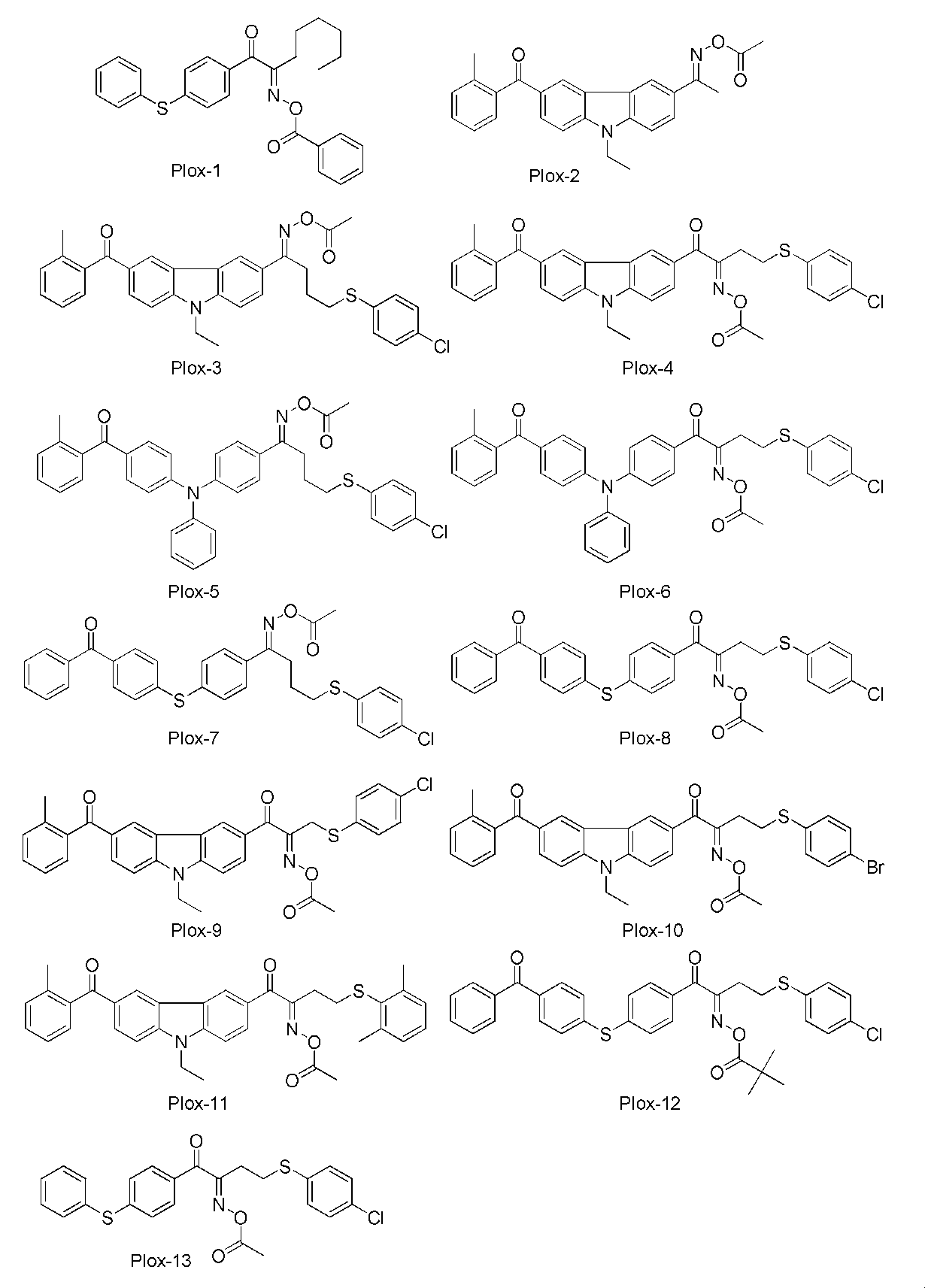
オキシム化合物は、350nm~500nmの波長領域に極大吸収波長を有するものでることが好ましく、360nm~480nmの波長領域に吸収波長を有するものであることがより好ましく、365nmおよび455nmの吸光度が高いものが特に好ましい。
オキシム化合物は、365nmまたは405nmにおけるモル吸光係数が、感度の観点から、3,000~300,000であることが好ましく、5,000~300,000であることがより好ましく、10,000~200,000であることが特に好ましい。
化合物のモル吸光係数は、公知の方法を用いることができるが、例えば、紫外可視分光光度計(Varian社製Carry-5 spctrophotometer)にて、酢酸エチル溶剤を用い、0.01g/Lの濃度で測定することが好ましい。
オキシム化合物は、365nmまたは405nmにおけるモル吸光係数が、感度の観点から、3,000~300,000であることが好ましく、5,000~300,000であることがより好ましく、10,000~200,000であることが特に好ましい。
化合物のモル吸光係数は、公知の方法を用いることができるが、例えば、紫外可視分光光度計(Varian社製Carry-5 spctrophotometer)にて、酢酸エチル溶剤を用い、0.01g/Lの濃度で測定することが好ましい。
光重合開始剤としては、オキシム化合物、アセトフェノン系化合物、および、アシルホスフィン化合物からなる群より選択される化合物が更に好ましい。例えば、特開平10-291969号公報に記載のアミノアセトフェノン系開始剤、特許第4225898号公報に記載のアシルホスフィンオキシド系開始剤、および、既述のオキシム系開始剤、更にオキシム系開始剤として、特開2001-233842号公報に記載の化合物も用いることができる。
オキシム化合物としては、市販品であるIRGACURE-OXE01(BASF社製)、IRGACURE-OXE02(BASF社製)を用いることができる。アセトフェノン系開始剤としては、市販品であるIRGACURE-907、IRGACURE-369、および、IRGACURE-379(商品名:いずれもBASFジャパン社製)を用いることができる。またアシルホスフィン系開始剤としては市販品であるIRGACURE-819やDAROCUR-TPO(商品名:いずれもBASFジャパン社製)を用いることができる。
オキシム化合物としては、市販品であるIRGACURE-OXE01(BASF社製)、IRGACURE-OXE02(BASF社製)を用いることができる。アセトフェノン系開始剤としては、市販品であるIRGACURE-907、IRGACURE-369、および、IRGACURE-379(商品名:いずれもBASFジャパン社製)を用いることができる。またアシルホスフィン系開始剤としては市販品であるIRGACURE-819やDAROCUR-TPO(商品名:いずれもBASFジャパン社製)を用いることができる。
(熱ラジカル発生剤)
本発明の組成物は、熱ラジカル発生剤を含んでいてもよい。前述の少なくとも1個のエチレン性不飽和二重結合を有する化合物のようなエチレン性不飽和化合物を含有する場合には、熱ラジカル発生剤を含有することが好ましい。
本発明における熱ラジカル発生剤としては、公知の熱ラジカル発生剤を用いることができる。熱ラジカル発生剤は、熱のエネルギーによってラジカルを発生し、重合性化合物の重合反応を開始又は促進させる化合物である。
好ましい熱ラジカル発生剤としては、芳香族ケトン類、オニウム塩化合物、有機過酸化物、チオ化合物、ヘキサアリールビイミダゾール化合物、ケトオキシムエステル化合物、アシルホスフィンオキシド化合物、ボレート化合物、アジニウム化合物、メタロセン化合物、活性エステル化合物、炭素ハロゲン結合を有する化合物、アゾ系化合物、ビベンジル化合物等が挙げられる。
本発明の組成物は、熱ラジカル発生剤を含んでいてもよい。前述の少なくとも1個のエチレン性不飽和二重結合を有する化合物のようなエチレン性不飽和化合物を含有する場合には、熱ラジカル発生剤を含有することが好ましい。
本発明における熱ラジカル発生剤としては、公知の熱ラジカル発生剤を用いることができる。熱ラジカル発生剤は、熱のエネルギーによってラジカルを発生し、重合性化合物の重合反応を開始又は促進させる化合物である。
好ましい熱ラジカル発生剤としては、芳香族ケトン類、オニウム塩化合物、有機過酸化物、チオ化合物、ヘキサアリールビイミダゾール化合物、ケトオキシムエステル化合物、アシルホスフィンオキシド化合物、ボレート化合物、アジニウム化合物、メタロセン化合物、活性エステル化合物、炭素ハロゲン結合を有する化合物、アゾ系化合物、ビベンジル化合物等が挙げられる。
熱ラジカル発生剤の具体例としては、イルガキュアー184、イルガキュアー369、イルガキュアー379、イルガキュアー651、イルガキュアー907、イルガキュアー819(以上、BASF社製)、ダロキュアー4265、ダロキュアーTPO(以上、メルク社製)、パーヘキサH、パーヘキサHC、パーヘキサC、パーヘキサV、パーヘキサ22、パーブチルH、パークミルD、パーブチルP、パーブチルC、パーブチルD、パーヘキシルD、パーヘキサ25B、パーヘキシン25B、パーロイルL、ナイパーBW、ナイパーBMT-K40、ナイパーBMT-M、パーブチルPV、パーヘキサ25O、パーオクO、パーヘキシルO、パーブチルO、パーブチルL、パーブチル355、パーヘキシルI、パーブチルI、パーブチルE、パーヘキサ25Z、パーブチルA、パーヘキシルZ、パーブチルZT、パーブチルZ(以上、日本油脂(株)製)等が挙げられる。
熱ラジカル発生剤は、1種を単独で用いてもよいし、2種以上を併用することも可能である。
本発明の組成物における熱ラジカル発生剤の添加量は、組成物の全固形分に対して、0.05~15重量%であることが好ましく、0.1~10重量%であることがより好ましい。
本発明の組成物における熱ラジカル発生剤の添加量は、組成物の全固形分に対して、0.05~15重量%であることが好ましく、0.1~10重量%であることがより好ましい。
(熱酸発生剤)
本発明の組成物は、得られる硬化膜の耐熱性や硬度をより向上させるため熱酸発生剤を用いることができる。その例としては、スルホニウム塩、ベンゾチアゾニウム塩、アンモニウム塩、ホスホニウム塩などのオニウム塩を挙げることができる。スルホニウム塩の例として、例えばアルキルスルホニウム塩、ベンジルスルホニウム塩、ジベンジルスルホニウム塩、置換ベンジルスルホニウム塩、ベンゾチアゾニウム塩などを挙げることができる。
熱酸発生剤としては、スルホニウム塩またはベンゾチアゾニウム塩が好ましく用いられ、特に4-アセトキシフェニルジメチルスルホニウムヘキサフルオロアルセネート、ベンジル-4-ヒドロキシフェニルメチルスルホニウムヘキサフルオロアンチモネート、4-アセトキシフェニルベンジルメチルスルホニウムヘキサフルオロアンチモネート、ジベンジル-4-ヒドロキシフェニルスルホニウムヘキサフルオロアンチモネート、4-アセトキシフェニルベンジルスルホニウムヘキサフルオロアンチモネートまたは3-ベンジルベンゾチアゾリウムヘキサフルオロアンチモネートが好ましく用いられる。
これらの市販品としては、例えばサンエイドSI-L85、同SI-L110、同SI-L110L、同SI-L145、同SI-L150、同SI-L160(以上、三新化学工業(株)製)などが挙げられる。
本発明の組成物は、得られる硬化膜の耐熱性や硬度をより向上させるため熱酸発生剤を用いることができる。その例としては、スルホニウム塩、ベンゾチアゾニウム塩、アンモニウム塩、ホスホニウム塩などのオニウム塩を挙げることができる。スルホニウム塩の例として、例えばアルキルスルホニウム塩、ベンジルスルホニウム塩、ジベンジルスルホニウム塩、置換ベンジルスルホニウム塩、ベンゾチアゾニウム塩などを挙げることができる。
熱酸発生剤としては、スルホニウム塩またはベンゾチアゾニウム塩が好ましく用いられ、特に4-アセトキシフェニルジメチルスルホニウムヘキサフルオロアルセネート、ベンジル-4-ヒドロキシフェニルメチルスルホニウムヘキサフルオロアンチモネート、4-アセトキシフェニルベンジルメチルスルホニウムヘキサフルオロアンチモネート、ジベンジル-4-ヒドロキシフェニルスルホニウムヘキサフルオロアンチモネート、4-アセトキシフェニルベンジルスルホニウムヘキサフルオロアンチモネートまたは3-ベンジルベンゾチアゾリウムヘキサフルオロアンチモネートが好ましく用いられる。
これらの市販品としては、例えばサンエイドSI-L85、同SI-L110、同SI-L110L、同SI-L145、同SI-L150、同SI-L160(以上、三新化学工業(株)製)などが挙げられる。
熱酸発生剤は、1種を単独で用いてもよいし、2種以上を併用することも可能である。
本発明の組成物における熱酸発生剤の添加量は、組成物の全固形分に対して、0.05~15重量%であることが好ましく、0.1~10重量%であることがより好ましい。
本発明の組成物における熱酸発生剤の添加量は、組成物の全固形分に対して、0.05~15重量%であることが好ましく、0.1~10重量%であることがより好ましい。
<その他の成分>
本発明の組成物には、前記必須成分や前記好ましい添加剤に加え、本発明の効果を損なわない限りにおいて、目的に応じてその他の成分を適宜選択して用いてもよい。
併用可能なその他の成分としては、例えば、バインダーポリマー、分散剤、増感剤、架橋剤、硬化促進剤、フィラー、熱硬化促進剤、熱重合禁止剤、可塑剤などが挙げられ、更に基材表面への密着促進剤およびその他の助剤類(例えば、導電性粒子、充填剤、消泡剤、難燃剤、レベリング剤、剥離促進剤、酸化防止剤、香料、表面張力調整剤、連鎖移動剤など)を併用してもよい。
これらの成分を適宜含有させることにより、目的とする近赤外線吸収フィルタの安定性、膜物性などの性質を調整することができる。
これらの成分は、例えば、特開2012-003225号公報の段落番号0183~、特開2008-250074号公報の段落番号0101~0102、特開2008-250074号公報の段落番号0103~0104、特開2008-250074号公報の段落番号0107~0109等の記載を参酌でき、これらの内容は本願明細書に組み込まれる。
本発明の組成物には、前記必須成分や前記好ましい添加剤に加え、本発明の効果を損なわない限りにおいて、目的に応じてその他の成分を適宜選択して用いてもよい。
併用可能なその他の成分としては、例えば、バインダーポリマー、分散剤、増感剤、架橋剤、硬化促進剤、フィラー、熱硬化促進剤、熱重合禁止剤、可塑剤などが挙げられ、更に基材表面への密着促進剤およびその他の助剤類(例えば、導電性粒子、充填剤、消泡剤、難燃剤、レベリング剤、剥離促進剤、酸化防止剤、香料、表面張力調整剤、連鎖移動剤など)を併用してもよい。
これらの成分を適宜含有させることにより、目的とする近赤外線吸収フィルタの安定性、膜物性などの性質を調整することができる。
これらの成分は、例えば、特開2012-003225号公報の段落番号0183~、特開2008-250074号公報の段落番号0101~0102、特開2008-250074号公報の段落番号0103~0104、特開2008-250074号公報の段落番号0107~0109等の記載を参酌でき、これらの内容は本願明細書に組み込まれる。
本発明の組成物は、液状とすることができるため、例えば、本発明の組成物を直接塗布し、乾燥させることにより近赤外線カットフィルタを容易に製造でき、上記した従来の近赤外線カットフィルタにおける不充分な製造適性を改善することができる。
本発明の近赤外線吸収性組成物の用途は、特に限定されないが、固体撮像素子基板の受光側における近赤外線カットフィルタ用(例えば、ウエハーレベルレンズに対する近赤外線カットフィルタ用など)、固体撮像素子基板の裏面側(受光側とは反対側)における近赤外線カットフィルタ用などを挙げることができ、固体撮像素子基板の受光側における遮光膜用であることが好ましい。特に、本発明の近赤外線吸収性組成物を、固体撮像素子用イメージセンサ上に直接塗布し塗膜形成することが好ましい。
特に、本発明の近赤外線吸収性組成物は、銅化合物と、前記式(1)の構造を含有し、膜厚が200μm以下であり、可視光透過率が90%以上である、近赤外線カットフィルタとすることが好ましい。
また、本発明の近赤外線吸収性組成物の粘度は、塗布により赤外線カット層を形成する場合、1mPa・s以上3000mPa・s以下の範囲にあることが好ましく、より好ましくは10mPa・s以上2000mPa・s以下の範囲であり、さらに好ましくは100mPa・s以上1500mPa・s以下の範囲である。
本発明の近赤外線吸収性組成物が、固体撮像素子基板の受光側における近赤外線カットフィルタ用であって、塗布により赤外線カット層を形成する場合、厚膜形成性と均一塗布性の観点から、10mPa・s以上3000mPa・s以下の範囲にあることが好ましく、より好ましくは、500mPa・s以上1500mPa・s以下の範囲であり、最も好ましくは、700mPa・s以上1400mPa・s以下の範囲である。
本発明の近赤外線吸収性組成物の全固形分は、塗布方法により変更されるが、組成物に対して1~50質量%であることが好ましく、1~30質量%であることがより好ましく、10~30質量%であることがさらに好ましい。
特に、本発明の近赤外線吸収性組成物は、銅化合物と、前記式(1)の構造を含有し、膜厚が200μm以下であり、可視光透過率が90%以上である、近赤外線カットフィルタとすることが好ましい。
また、本発明の近赤外線吸収性組成物の粘度は、塗布により赤外線カット層を形成する場合、1mPa・s以上3000mPa・s以下の範囲にあることが好ましく、より好ましくは10mPa・s以上2000mPa・s以下の範囲であり、さらに好ましくは100mPa・s以上1500mPa・s以下の範囲である。
本発明の近赤外線吸収性組成物が、固体撮像素子基板の受光側における近赤外線カットフィルタ用であって、塗布により赤外線カット層を形成する場合、厚膜形成性と均一塗布性の観点から、10mPa・s以上3000mPa・s以下の範囲にあることが好ましく、より好ましくは、500mPa・s以上1500mPa・s以下の範囲であり、最も好ましくは、700mPa・s以上1400mPa・s以下の範囲である。
本発明の近赤外線吸収性組成物の全固形分は、塗布方法により変更されるが、組成物に対して1~50質量%であることが好ましく、1~30質量%であることがより好ましく、10~30質量%であることがさらに好ましい。
本発明は、上記近赤外線吸収性組成物を硬化させた近赤外線カット層と誘電体多層膜を有する積層体としてもよい。例えば、(i)透明支持体、近赤外線カット層、誘電体多層膜が該順に設けられた態様、(ii) 近赤外線カット層、透明支持体、誘電体多層膜が該順に設けられた態様がある。上記透明支持体としては、ガラス基板や透明樹脂基板が挙げられる。
上記誘電体多層膜は、近赤外線を反射および/または吸収する能力を有する膜である。
上記誘電体多層膜は、近赤外線を反射および/または吸収する能力を有する膜である。
誘電体多層膜の材料としては、例えばセラミックを用いることができる。あるいは、近赤外域に吸収を有する貴金属膜を近赤外線カットフィルタの可視光の透過率に影響のないよう、厚みと層数を考慮して用いてもよい。
誘電体多層膜としては具体的には、高屈折率材料層と低屈折率材料層とを交互に積層した構成を好適に用いることができる。
高屈折率材料層を構成する材料としては、屈折率が1.7以上の材料を用いることができ、屈折率の範囲が1.7~2.5の材料が通常選択される。
この材料としては、例えば、酸化チタン(チタニア)、酸化ジルコニウム、五酸化タンタル、五酸化ニオブ、酸化ランタン、酸化イットリウム、酸化亜鉛、硫化亜鉛、酸化インジウムや、これら酸化物を主成分とし酸化チタン、酸化錫および/または酸化セリウムなどを少量含有させたものが挙げられる。これらの中でも、酸化チタン(チタニア)が好ましい。
低屈折率材料層を構成する材料としては、屈折率が1.6以下の材料を用いることができ、屈折率の範囲が1.2~1.6の材料が通常選択される。
この材料としては、例えば、シリカ、アルミナ、フッ化ランタン、フッ化マグネシウムおよび六フッ化アルミニウムナトリウムが挙げられる。これらの中でも、シリカが好ましい。
これら高屈折率材料層および低屈折率材料層の各層の厚みは、通常、遮断しようとする赤外線波長λ(nm)の0.1λ~0.5λの厚みである。厚みが上記範囲外になると、屈折率(n)と膜厚(d)との積(n×d)がλ/4で算出される光学的膜厚と大きく異なって反射・屈折の光学的特性の関係が崩れてしまい、特定波長の遮断・透過をコントロールしにくい傾向にある。
また、誘電体多層膜における積層数は、好ましくは5~50層であり、より好ましくは10~45層である。
誘電体多層膜としては具体的には、高屈折率材料層と低屈折率材料層とを交互に積層した構成を好適に用いることができる。
高屈折率材料層を構成する材料としては、屈折率が1.7以上の材料を用いることができ、屈折率の範囲が1.7~2.5の材料が通常選択される。
この材料としては、例えば、酸化チタン(チタニア)、酸化ジルコニウム、五酸化タンタル、五酸化ニオブ、酸化ランタン、酸化イットリウム、酸化亜鉛、硫化亜鉛、酸化インジウムや、これら酸化物を主成分とし酸化チタン、酸化錫および/または酸化セリウムなどを少量含有させたものが挙げられる。これらの中でも、酸化チタン(チタニア)が好ましい。
低屈折率材料層を構成する材料としては、屈折率が1.6以下の材料を用いることができ、屈折率の範囲が1.2~1.6の材料が通常選択される。
この材料としては、例えば、シリカ、アルミナ、フッ化ランタン、フッ化マグネシウムおよび六フッ化アルミニウムナトリウムが挙げられる。これらの中でも、シリカが好ましい。
これら高屈折率材料層および低屈折率材料層の各層の厚みは、通常、遮断しようとする赤外線波長λ(nm)の0.1λ~0.5λの厚みである。厚みが上記範囲外になると、屈折率(n)と膜厚(d)との積(n×d)がλ/4で算出される光学的膜厚と大きく異なって反射・屈折の光学的特性の関係が崩れてしまい、特定波長の遮断・透過をコントロールしにくい傾向にある。
また、誘電体多層膜における積層数は、好ましくは5~50層であり、より好ましくは10~45層である。
誘電体多層膜の形成方法としては、特に制限はないが、例えば、CVD法、スパッタ法、真空蒸着法などにより、高屈折率材料層と低屈折率材料層とを交互に積層した誘電体多層膜を形成し、これを前記膜に接着剤で張り合わせる方法や、前記膜上に直接、CVD法、スパッタ法、真空蒸着法などにより、高屈折率材料層と低屈折率材料層とを交互に積層した誘電体多層膜を形成する方法を挙げることができる。
誘電体多層膜を蒸着した際に基板にソリが生じてしまう場合には、これを解消するために、基板両面へ誘電体多層膜を蒸着する、基板の誘電体多層膜を蒸着した面に紫外線等の放射線を照射する等の方法をとる事ができる。なお、放射線を照射する場合、誘電体多層膜の蒸着を行いながら照射してもよいし、蒸着後別途照射してもよい。
誘電体多層膜を蒸着した際に基板にソリが生じてしまう場合には、これを解消するために、基板両面へ誘電体多層膜を蒸着する、基板の誘電体多層膜を蒸着した面に紫外線等の放射線を照射する等の方法をとる事ができる。なお、放射線を照射する場合、誘電体多層膜の蒸着を行いながら照射してもよいし、蒸着後別途照射してもよい。
本発明は、固体撮像素子基板の受光側において、本発明の近赤外線吸収性組成物を適用(好ましくは塗布や印刷、さらに好ましくはアプリケータ塗布)することにより膜を形成する工程、乾燥する工程を有する、近赤外線カットフィルタの製造方法にも関する。膜厚、積層構造などについては、目的に応じて適宜選択することができる。
支持体は、ガラスなどからなる透明基板であっても、固体撮像素子基板であっても、固体撮像素子基板の受光側に設けられた別の基板(例えば後述のガラス基板30)であっても、固体撮像素子基板の受光側に設けられた平坦化層等の層であっても良い。
近赤外線吸収性組成物(塗布液)を支持体上に塗布する方法は、例えば、スピンコーター、スリットスピンコーター、スリットコーター、スクリーン印刷、アプリケータ塗布等を用いることにより実施できる。
また、塗膜の乾燥条件としては、各成分、溶剤の種類、使用割合等によっても異なるが、通常60℃~150℃の温度で30秒間~15分間程度である。
近赤外線吸収性組成物(塗布液)を支持体上に塗布する方法は、例えば、スピンコーター、スリットスピンコーター、スリットコーター、スクリーン印刷、アプリケータ塗布等を用いることにより実施できる。
また、塗膜の乾燥条件としては、各成分、溶剤の種類、使用割合等によっても異なるが、通常60℃~150℃の温度で30秒間~15分間程度である。
前記膜の厚みとしては、特に制限はなく、目的に応じて適宜選択することができる。前記膜の厚みとしては、例えば、1μm~500μmが好ましく、1μm~300μmがより好ましく、1μm~200μmが特に好ましい。本発明では、このような薄い膜とした場合でも、近赤外線遮光性を維持することができる。
本発明の近赤外線吸収性組成物を用いて近赤外線カットフィルタを形成する方法は、その他の工程を含んでいても良い。その他の工程としては、特に制限はなく、目的に応じて適宜選択することができる。その他の工程としては、例えば、基材の表面処理工程、前加熱工程(プリベーク工程)、硬化処理工程、後加熱工程(ポストベーク工程)などが挙げられる。
<前加熱工程・後加熱工程>
前加熱工程および後加熱工程における加熱温度は、通常、80℃~200℃であり、90℃~150℃であることが好ましい。
前加熱工程および後加熱工程における加熱時間は、通常、30秒~240秒であり、60秒~180秒であることが好ましい。
前加熱工程および後加熱工程における加熱温度は、通常、80℃~200℃であり、90℃~150℃であることが好ましい。
前加熱工程および後加熱工程における加熱時間は、通常、30秒~240秒であり、60秒~180秒であることが好ましい。
<硬化処理工程>
硬化処理工程は、必要に応じ、形成された前記膜に対して硬化処理を行う工程であり、この処理を行うことにより、近赤外線カットフィルタの機械的強度が向上する。
前記硬化処理工程としては、特に制限はなく、目的に応じて適宜選択することができるが、例えば、全面露光処理、全面加熱処理などが好適に挙げられる。ここで、本発明において「露光」とは、各種波長の光のみならず、電子線、X線などの放射線照射をも包含する意味で用いられる。
露光は放射線の照射により行うことが好ましく、露光に際して用いることができる放射線としては、特に、電子線、KrF、ArF、g線、h線、i線等の紫外線や可視光が好ましく用いられる。なかでも、KrF、g線、h線、i線が好ましい。
露光方式としては、ステッパー露光や、高圧水銀灯による露光などが挙げられる。
露光量は5~3000mJ/cm2が好ましく、10~2000mJ/cm2がより好ましく、50~1000mJ/cm2が特に好ましい。
硬化処理工程は、必要に応じ、形成された前記膜に対して硬化処理を行う工程であり、この処理を行うことにより、近赤外線カットフィルタの機械的強度が向上する。
前記硬化処理工程としては、特に制限はなく、目的に応じて適宜選択することができるが、例えば、全面露光処理、全面加熱処理などが好適に挙げられる。ここで、本発明において「露光」とは、各種波長の光のみならず、電子線、X線などの放射線照射をも包含する意味で用いられる。
露光は放射線の照射により行うことが好ましく、露光に際して用いることができる放射線としては、特に、電子線、KrF、ArF、g線、h線、i線等の紫外線や可視光が好ましく用いられる。なかでも、KrF、g線、h線、i線が好ましい。
露光方式としては、ステッパー露光や、高圧水銀灯による露光などが挙げられる。
露光量は5~3000mJ/cm2が好ましく、10~2000mJ/cm2がより好ましく、50~1000mJ/cm2が特に好ましい。
全面露光処理の方法としては、例えば、形成された前記膜の全面を露光する方法が挙げられる。近赤外線吸収性組成物が重合性化合物を含有する場合、全面露光により、上記組成物で形成される膜中の重合成分の硬化が促進され、前記膜の硬化が更に進行し、機械的強度、耐久性が改良される。
前記全面露光を行う装置としては、特に制限はなく、目的に応じて適宜選択することができるが、例えば、超高圧水銀灯などのUV露光機が好適に挙げられる。
前記全面露光を行う装置としては、特に制限はなく、目的に応じて適宜選択することができるが、例えば、超高圧水銀灯などのUV露光機が好適に挙げられる。
また、全面加熱処理の方法としては、形成された前記膜の全面を加熱する方法が挙げられる。全面加熱により、パターンの膜強度が高められる。
全面加熱における加熱温度は、80℃~250℃が好ましく、120℃~250℃がより好ましい。該加熱温度が120℃以上であれば、加熱処理によって膜強度が向上し、250℃以下であれば、前記膜中の成分の分解が生じ、膜質が弱く脆くなることを防止できる。
全面加熱における加熱時間は、3分~180分が好ましく、5分~120分がより好ましい。
全面加熱を行う装置としては、特に制限はなく、公知の装置の中から、目的に応じて適宜選択することができ、例えば、ドライオーブン、ホットプレート、IRヒーターなどが挙げられる。
全面加熱における加熱温度は、80℃~250℃が好ましく、120℃~250℃がより好ましい。該加熱温度が120℃以上であれば、加熱処理によって膜強度が向上し、250℃以下であれば、前記膜中の成分の分解が生じ、膜質が弱く脆くなることを防止できる。
全面加熱における加熱時間は、3分~180分が好ましく、5分~120分がより好ましい。
全面加熱を行う装置としては、特に制限はなく、公知の装置の中から、目的に応じて適宜選択することができ、例えば、ドライオーブン、ホットプレート、IRヒーターなどが挙げられる。
また、本発明は、固体撮像素子基板と、前記固体撮像素子基板の受光側に配置された近赤外線カットフィルタとを有するカメラモジュールであって、前記近赤外線カットフィルタが本発明の近赤外線カットフィルタである、カメラモジュールにも関する。
以下、本発明の実施形態に係るカメラモジュールを、図1および図2を参照しながら説明するが、本発明は以下の具体例によって限定されることはない。
なお、図1および図2にわたり、共通する部分には共通する符号を付す。
また、説明に際し、「上」、「上方」および「上側」は、シリコン基板10から見て遠い側を指し、「下」、「下方」および「下側」は、はシリコン基板10に近い側を指す。
なお、図1および図2にわたり、共通する部分には共通する符号を付す。
また、説明に際し、「上」、「上方」および「上側」は、シリコン基板10から見て遠い側を指し、「下」、「下方」および「下側」は、はシリコン基板10に近い側を指す。
図1は、固体撮像素子を備えたカメラモジュールの構成を示す概略断面図である。
図1に示すカメラモジュール200は、実装基板である回路基板70に接続部材であるハンダボール60を介して接続されている。
詳細には、カメラモジュール200は、シリコン基板の第1の主面に撮像素子部を備えた固体撮像素子基板100と、固体撮像素子基板100の第1の主面側(受光側)に設けられた平坦化層(図1には不図示)と、平坦化層の上に設けられた近赤外線カットフィルタ42と、近赤外線カットフィルタ42の上方に配置され内部空間に撮像レンズ40を有するレンズホルダー50と、固体撮像素子基板100およびガラス基板30の周囲を囲うように配置された遮光兼電磁シールド44と、を備えて構成されている。なお、平坦化層の上には、ガラス基板30(光透過性基板)を設けてもよい。各部材は、接着剤20、45により接着されている。
本発明は、固体撮像素子基板と、前記固体撮像素子基板の受光側に配置された近赤外線カットフィルタとを有するカメラモジュールの製造方法であって、固体撮像素子基板の受光側において、上記本発明の近赤外線吸収性組成物を適用することにより膜を形成する工程にも関する。
よって、本実施形態に係るカメラモジュールにおいては、例えば、平坦化層の上に、本発明の近赤外線吸収性組成物を塗布することにより膜を形成して、近赤外線カットフィルタ42を形成できる。近赤外線吸収性組成物を塗布して近赤外線カットフィルタ42形成する方法は前記した通りである。
カメラモジュール200では、外部からの入射光hνが、撮像レンズ40、近赤外線カットフィルタ42、ガラス基板30、平坦化層を順次透過した後、固体撮像素子基板100の撮像素子部に到達するようになっている。また、カメラモジュール200は、固体撮像素子基板100の第2の主面側で、ハンダボール60(接続材料)を介して回路基板70に接続されている。
カメラモジュール200は、ガラス基板30を省略し、平坦化層に直接近赤外線カットフィルタを設けてもよく、平坦化層を省略し、ガラス基板30上に近赤外線カットフィルタを設けるようにしてもよい。
図1に示すカメラモジュール200は、実装基板である回路基板70に接続部材であるハンダボール60を介して接続されている。
詳細には、カメラモジュール200は、シリコン基板の第1の主面に撮像素子部を備えた固体撮像素子基板100と、固体撮像素子基板100の第1の主面側(受光側)に設けられた平坦化層(図1には不図示)と、平坦化層の上に設けられた近赤外線カットフィルタ42と、近赤外線カットフィルタ42の上方に配置され内部空間に撮像レンズ40を有するレンズホルダー50と、固体撮像素子基板100およびガラス基板30の周囲を囲うように配置された遮光兼電磁シールド44と、を備えて構成されている。なお、平坦化層の上には、ガラス基板30(光透過性基板)を設けてもよい。各部材は、接着剤20、45により接着されている。
本発明は、固体撮像素子基板と、前記固体撮像素子基板の受光側に配置された近赤外線カットフィルタとを有するカメラモジュールの製造方法であって、固体撮像素子基板の受光側において、上記本発明の近赤外線吸収性組成物を適用することにより膜を形成する工程にも関する。
よって、本実施形態に係るカメラモジュールにおいては、例えば、平坦化層の上に、本発明の近赤外線吸収性組成物を塗布することにより膜を形成して、近赤外線カットフィルタ42を形成できる。近赤外線吸収性組成物を塗布して近赤外線カットフィルタ42形成する方法は前記した通りである。
カメラモジュール200では、外部からの入射光hνが、撮像レンズ40、近赤外線カットフィルタ42、ガラス基板30、平坦化層を順次透過した後、固体撮像素子基板100の撮像素子部に到達するようになっている。また、カメラモジュール200は、固体撮像素子基板100の第2の主面側で、ハンダボール60(接続材料)を介して回路基板70に接続されている。
カメラモジュール200は、ガラス基板30を省略し、平坦化層に直接近赤外線カットフィルタを設けてもよく、平坦化層を省略し、ガラス基板30上に近赤外線カットフィルタを設けるようにしてもよい。
図2は、図1中の固体撮像素子基板100を拡大した断面図である。
固体撮像素子基板100は、基体であるシリコン基板10、撮像素子12、層間絶縁膜13、ベース層14、赤色のカラーフィルタ15R、緑色のカラーフィルタ15G、青色のカラーフィルタ15B、オーバーコート16、マイクロレンズ17、遮光膜18、絶縁膜22、金属電極23、ソルダレジスト層24、内部電極26、および素子面電極27を備えて構成されている。
但し、ソルダレジスト層24は省略されていてもよい。
固体撮像素子基板100については、特開2012-068418号公報段落0245(対応する米国特許出願公開第2012/068292号明細書の[0407])以降の固体撮像素子基板100の説明を参酌でき、これらの内容は本願明細書に組み込まれる。
固体撮像素子基板100は、基体であるシリコン基板10、撮像素子12、層間絶縁膜13、ベース層14、赤色のカラーフィルタ15R、緑色のカラーフィルタ15G、青色のカラーフィルタ15B、オーバーコート16、マイクロレンズ17、遮光膜18、絶縁膜22、金属電極23、ソルダレジスト層24、内部電極26、および素子面電極27を備えて構成されている。
但し、ソルダレジスト層24は省略されていてもよい。
固体撮像素子基板100については、特開2012-068418号公報段落0245(対応する米国特許出願公開第2012/068292号明細書の[0407])以降の固体撮像素子基板100の説明を参酌でき、これらの内容は本願明細書に組み込まれる。
以下に実施例を挙げて本発明をさらに具体的に説明する。以下の実施例に示す材料、使用量、割合、処理内容、処理手順等は、本発明の趣旨を逸脱しない限り、適宜、変更することができる。従って、本発明の範囲は以下に示す具体例に限定されるものではない。
本実施例において、以下の略号を採用した。
<銅化合物>
下記化合物は、下記2つの構造をそれぞれ配位子として有する銅錯体を示す。下記化合物中、「-」は、銅と配位結合する部位を示す。例えば、銅化合物A-1~A-4では、下記2つの構造を配位子とするスルホン酸銅錯体を示す。銅化合物A-5、A-6では、下記2つの構造を配位子とするリン含有銅錯体を示す。銅化合物A-7、A-8では、カルボン酸基を含有する銅錯体を示す。
銅化合物A-1:下記化合物

銅化合物A-2:下記化合物

銅化合物A-3:下記化合物

銅化合物A-4:下記化合物

銅化合物A-5:下記化合物

銅化合物A-6:下記化合物

銅化合物A-7:下記化合物

銅化合物A-8:下記化合物
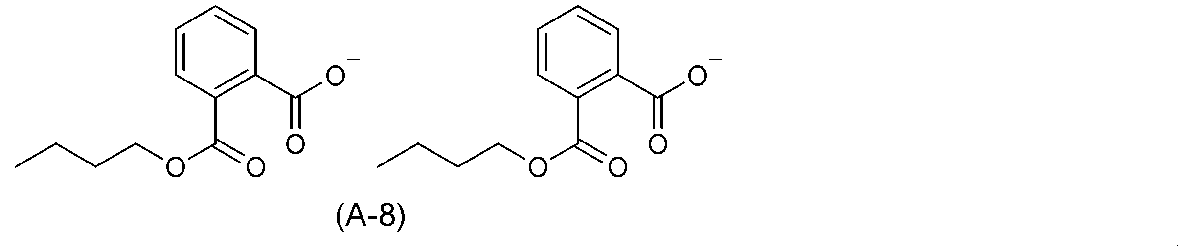
<銅化合物>
下記化合物は、下記2つの構造をそれぞれ配位子として有する銅錯体を示す。下記化合物中、「-」は、銅と配位結合する部位を示す。例えば、銅化合物A-1~A-4では、下記2つの構造を配位子とするスルホン酸銅錯体を示す。銅化合物A-5、A-6では、下記2つの構造を配位子とするリン含有銅錯体を示す。銅化合物A-7、A-8では、カルボン酸基を含有する銅錯体を示す。
銅化合物A-1:下記化合物
(銅化合物A-1の合成例)
上述したスルホン酸化合物A-1をメタノールに溶解した。この溶液を50℃に昇温した後、酢酸銅のメタノール溶液を滴下し、50℃にて2時間反応させた。反応終了後、エバポレータにて発生した酢酸及び溶剤を留去することで銅化合物A-1を得た。
スルホン酸化合物A-1を上述したスルホン酸化合物A-2~A-4、リン含有化合物A-5、A-6及びカルボン酸基を含有する化合物A-7、A-8に変更したこと以外は、銅化合物体A-1の場合と同様にして、銅化合物A-2~A-8を得た。
上述したスルホン酸化合物A-1をメタノールに溶解した。この溶液を50℃に昇温した後、酢酸銅のメタノール溶液を滴下し、50℃にて2時間反応させた。反応終了後、エバポレータにて発生した酢酸及び溶剤を留去することで銅化合物A-1を得た。
スルホン酸化合物A-1を上述したスルホン酸化合物A-2~A-4、リン含有化合物A-5、A-6及びカルボン酸基を含有する化合物A-7、A-8に変更したこと以外は、銅化合物体A-1の場合と同様にして、銅化合物A-2~A-8を得た。
<前記式(1)の構造を含有する化合物>
前記式(1)の構造を含有する化合物として、下記B-1~B-7で示されるRC(=O)NR部分構造を含有する化合物を用いた。
B-1:下記構造を有する化合物:ポリアクリルアミド(ALDRICH社製,水溶液)

B-2:下記構造を有する化合物(重量平均分子量:100,000)

B-3:下記構造を有する化合物(重量平均分子量:50,000)

B-4:下記構造を有する化合物:ポリビニルピロリドンK-30W(日本触媒社製)

B-5:下記構造を有する化合物(重量平均分子量:50,000)

B-6:下記構造を有する化合物(重量平均分子量:50,000)

B-7:下記構造を有する化合物(重量平均分子量:50,000)

<硬化性化合物>
C-1:KAYARAD D-320:(日本化薬社製、ジペンタエリスリトールテトラアクリレート)
C-2:M-510:(東亞合成社製、多塩基酸変性アクリルオリゴマー)
C-3:M-520:(東亞合成社製、多塩基酸変性アクリルオリゴマー)
C-4:DPCA-60:(日本化薬社製、ペンチレンオキシ鎖を6個有する6官能アクリレート)
C-5:JER157S65:エポキシ樹脂(ジャパンエポキシレジン社製)
C-6:NKエステルATM-35E:エチレンオキシ変性ペンタエリスリトールテトラアクリレート(重合性化合物)(新中村化学社製)
C-7:EX-321:エポキシ樹脂(ナガセケムテックス社製)
<その他の化合物>
D-1:サンエイドSI-110L(三新化学工業社製,熱酸発生剤)
D-2:下記化合物:パーブチルZ(日油社製)

<溶剤>
MeOH:メタノールEtOH:エタノール
前記式(1)の構造を含有する化合物として、下記B-1~B-7で示されるRC(=O)NR部分構造を含有する化合物を用いた。
B-1:下記構造を有する化合物:ポリアクリルアミド(ALDRICH社製,水溶液)
C-1:KAYARAD D-320:(日本化薬社製、ジペンタエリスリトールテトラアクリレート)
C-2:M-510:(東亞合成社製、多塩基酸変性アクリルオリゴマー)
C-3:M-520:(東亞合成社製、多塩基酸変性アクリルオリゴマー)
C-4:DPCA-60:(日本化薬社製、ペンチレンオキシ鎖を6個有する6官能アクリレート)
C-5:JER157S65:エポキシ樹脂(ジャパンエポキシレジン社製)
C-6:NKエステルATM-35E:エチレンオキシ変性ペンタエリスリトールテトラアクリレート(重合性化合物)(新中村化学社製)
C-7:EX-321:エポキシ樹脂(ナガセケムテックス社製)
<その他の化合物>
D-1:サンエイドSI-110L(三新化学工業社製,熱酸発生剤)
D-2:下記化合物:パーブチルZ(日油社製)
MeOH:メタノールEtOH:エタノール
<近赤外線吸収性組成物の評価>
<<近赤外線吸収性組成物の調製>>
上記の化合物を表1に記載のように組み合わせて、実施例1~24の近赤外線吸収性組成物を調製した。なお、実施例の添加量は下記の通りであり、表1中の「-」は下記の化合物が添加されないことを意味する。
・銅化合物 40質量部
・前記式(1)で表される化合物 20質量部
・硬化性化合物 35質量部
・その他の化合物 5質量部
・溶剤 100質量部
<<近赤外線吸収性組成物の調製>>
上記の化合物を表1に記載のように組み合わせて、実施例1~24の近赤外線吸収性組成物を調製した。なお、実施例の添加量は下記の通りであり、表1中の「-」は下記の化合物が添加されないことを意味する。
・銅化合物 40質量部
・前記式(1)で表される化合物 20質量部
・硬化性化合物 35質量部
・その他の化合物 5質量部
・溶剤 100質量部
<<近赤外線カットフィルタの作成>>
実施例で調製した近赤外線吸収性組成物の各々を、アプリケータ塗布法(YOSHIMITS SEIKI製のベーカーアプリケーター、YBA-3型をスリット幅250μmに調整して使用)を用いて、ガラス基板上にアプリケータ塗布し、100℃、120秒間の前加熱(プリベーク)を行った。その後、全てのサンプルについて、180℃、180秒間、ホットプレートで加熱して、膜厚70μmの近赤外線カットフィルタを得た。
<<近赤外線遮蔽性評価>>
上記のようにして得た近赤外線カットフィルタにおける波長800nmの透過率を分光光度計U-4100(日立ハイテクノロジーズ社製)を用いて測定した。近赤外線遮蔽性を以下の基準で評価した。結果を以下の表1に示す。
A:800nmの透過率≦5%
B:5%<800nmの透過率≦7%
C:7%<800nmの透過率≦10%
D:10%<800nmの透過率
実施例で調製した近赤外線吸収性組成物の各々を、アプリケータ塗布法(YOSHIMITS SEIKI製のベーカーアプリケーター、YBA-3型をスリット幅250μmに調整して使用)を用いて、ガラス基板上にアプリケータ塗布し、100℃、120秒間の前加熱(プリベーク)を行った。その後、全てのサンプルについて、180℃、180秒間、ホットプレートで加熱して、膜厚70μmの近赤外線カットフィルタを得た。
<<近赤外線遮蔽性評価>>
上記のようにして得た近赤外線カットフィルタにおける波長800nmの透過率を分光光度計U-4100(日立ハイテクノロジーズ社製)を用いて測定した。近赤外線遮蔽性を以下の基準で評価した。結果を以下の表1に示す。
A:800nmの透過率≦5%
B:5%<800nmの透過率≦7%
C:7%<800nmの透過率≦10%
D:10%<800nmの透過率
<<耐湿性評価>>
上記のようにして得た近赤外線カットフィルタを60℃/90%Hの高温高湿下で1時間放置した。耐湿性試験前と耐湿性試験後とのそれぞれにおいて、近赤外線カットフィルタの波長700~1400nmにおける最大吸光度(Absλmax)と、波長400~700nmにおける最小吸光度(Absλmin)とを、分光光度計U-4100(日立ハイテクノロジーズ社製)を用いて測定し、「Absλmax/Absλmin」で表される吸光度比を求めた。
|(試験前における吸光度比-試験後における吸光度比)/試験前における吸光度比×100|(%)で表される吸光度比変化率を以下の基準で評価した。
A:吸光度比変化率≦2%
B:2%<吸光度比変化率≦4%
C:4%<吸光度比変化率≦7%
D:7%<吸光度比変化率
上記のようにして得た近赤外線カットフィルタを60℃/90%Hの高温高湿下で1時間放置した。耐湿性試験前と耐湿性試験後とのそれぞれにおいて、近赤外線カットフィルタの波長700~1400nmにおける最大吸光度(Absλmax)と、波長400~700nmにおける最小吸光度(Absλmin)とを、分光光度計U-4100(日立ハイテクノロジーズ社製)を用いて測定し、「Absλmax/Absλmin」で表される吸光度比を求めた。
|(試験前における吸光度比-試験後における吸光度比)/試験前における吸光度比×100|(%)で表される吸光度比変化率を以下の基準で評価した。
A:吸光度比変化率≦2%
B:2%<吸光度比変化率≦4%
C:4%<吸光度比変化率≦7%
D:7%<吸光度比変化率

上記表1から明らかなとおり、実施例1~24の近赤外線吸収性組成物は、硬化膜としたときに高い近赤外線遮蔽性を維持しつつ、耐湿性に優れた硬化膜を形成することができた。銅化合物の含有量は、下記式(1)で示される部分構造を有する化合物1gに対して、3×10⁻³~1モルであることが好ましく、3×10⁻³~1×10⁻²モルであることがより好ましく、6×10⁻³~7×10⁻³モルであることがさらに好ましい。
<<実施例25>>
下記の化合物を混合して、実施例25の近赤外線吸収性組成物を調製した。
・下記スルホフタル酸を配位子として有する銅錯体 10質量部
・前記式(1)で表される化合物 10質量部
・溶剤(水) 80質量部

(スルホフタル酸銅錯体の合成方法)
スルホフタル酸53%水溶液をメタノールに溶かし、この溶液を50℃に昇温した後、水酸化銅を加え50℃で2時間反応させた。反応終了後、エバポレータにて溶剤及び発生した水を留去することで銅錯体A(8.57g)を得た。
実施例25の近赤外線吸収性組成物では、実施例1~24と比較して近赤外線吸収能がさらに高まることが確認された。
下記の化合物を混合して、実施例25の近赤外線吸収性組成物を調製した。
・下記スルホフタル酸を配位子として有する銅錯体 10質量部
・前記式(1)で表される化合物 10質量部
・溶剤(水) 80質量部
スルホフタル酸53%水溶液をメタノールに溶かし、この溶液を50℃に昇温した後、水酸化銅を加え50℃で2時間反応させた。反応終了後、エバポレータにて溶剤及び発生した水を留去することで銅錯体A(8.57g)を得た。
実施例25の近赤外線吸収性組成物では、実施例1~24と比較して近赤外線吸収能がさらに高まることが確認された。
<<実施例26>>
下記の化合物を混合して、実施例26の近赤外線吸収性組成物を調製した。
・上記スルホフタル酸銅錯体 10質量部
・下記バインダーA 10質量部
・溶剤(水) 80質量部
下記の化合物を混合して、実施例26の近赤外線吸収性組成物を調製した。
・上記スルホフタル酸銅錯体 10質量部
・下記バインダーA 10質量部
・溶剤(水) 80質量部
バインダーA:下記化合物

<<実施例27~51>>
実施例26において、スルホフタル酸銅錯体に代えて下記表2に記載の化合物(配位子原料)と銅成分と反応させた銅錯体を用いたこと以外は実施例26と同様にして、実施例27~51の近赤外線吸収性組成物を調製した。
実施例27~51の近赤外線吸収性組成物では、実施例1~24と比較してさらに近赤外線吸収能が高まることが確認された。
下記表2中、配位子原料(酸)とは、上述した銅錯体を得るために用いられるものである。また、「-」は、化合物(ii)が使用されないことを表す。

実施例26において、スルホフタル酸銅錯体に代えて下記表2に記載の化合物(配位子原料)と銅成分と反応させた銅錯体を用いたこと以外は実施例26と同様にして、実施例27~51の近赤外線吸収性組成物を調製した。
実施例27~51の近赤外線吸収性組成物では、実施例1~24と比較してさらに近赤外線吸収能が高まることが確認された。
下記表2中、配位子原料(酸)とは、上述した銅錯体を得るために用いられるものである。また、「-」は、化合物(ii)が使用されないことを表す。
10 シリコン基板
12 撮像素子
13 層間絶縁膜
14 ベース層
15 カラーフィルタ
16 オーバーコート
17 マイクロレンズ
18 遮光膜、
20 接着剤
22 絶縁膜
23 金属電極
24 ソルダレジスト層
26 内部電極
27 素子面電極、
30 ガラス基板
40 撮像レンズ
42 近赤外線カットフィルタ
44 遮光兼電磁シールド
45 接着剤
46 平坦化層、
50 レンズホルダー
60 ハンダボール
70 回路基板
100 固体撮像素子基板
12 撮像素子
13 層間絶縁膜
14 ベース層
15 カラーフィルタ
16 オーバーコート
17 マイクロレンズ
18 遮光膜、
20 接着剤
22 絶縁膜
23 金属電極
24 ソルダレジスト層
26 内部電極
27 素子面電極、
30 ガラス基板
40 撮像レンズ
42 近赤外線カットフィルタ
44 遮光兼電磁シールド
45 接着剤
46 平坦化層、
50 レンズホルダー
60 ハンダボール
70 回路基板
100 固体撮像素子基板
Claims (18)
- 銅化合物と、
下記式(1)で示される部分構造を有する化合物とを含有し、
前記銅化合物の含有量が、下記式(1)で示される部分構造を有する化合物1gに対して3×10⁻³~1モルである、近赤外線吸収性組成物。

- 前記式(1)で示される部分構造を有する化合物の含有量が、前記近赤外線吸収性組成物中5~80質量%である、請求項1に記載の近赤外線吸収性組成物。
- 前記銅化合物が銅錯体である、請求項1または2に記載の近赤外線吸収性組成物。
- 前記式(1)で示される部分構造を有する化合物がポリマーである、請求項1~3のいずれか1項に記載の近赤外線吸収性組成物。
- 前記ポリマーの側鎖に前記式(1)で示される部分構造を含有する、請求項4に記載の近赤外線吸収性組成物。
- 前記式(1)で示される部分構造を有する化合物が、下記式(1-1)~(1-5)のいずれかで表される構造を有する、請求項1~5のいずれか1項に記載の近赤外線吸収性組成物。
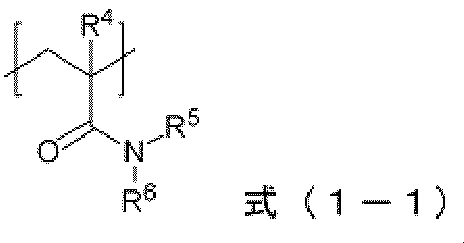
式(1-2)中、R7は水素原子またはメチル基を表す。
式(1-3)中、L1は二価の連結基を表し、R8は水素原子または有機基を表す。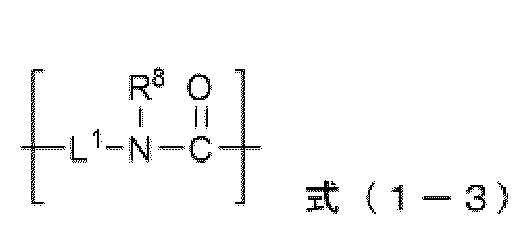
式(1-4)中、L2およびL3はそれぞれ独立して二価の連結基を表し、R9およびR10はそれぞれ独立して水素原子または有機基を表す。
式(1-5)中、L4は二価の連結基を表し、R11~R14はそれぞれ独立して水素原子または有機基を表す。
- 前記式(1)で示される部分構造を有する化合物が前記式(1-1)で表される化合物である、請求項6に記載の近赤外線吸収性組成物。
- 硬化性化合物および溶剤をさらに含有する、請求項1~7のいずれか1項に記載の近赤外線吸収性組成物。
- 前記近赤外線吸収性組成物の固形分が35~90質量%である、請求項1~8のいずれか1項に記載の近赤外線吸収性組成物。
- 固体撮像素子用イメージセンサ上に塗膜形成して用いられる、請求項1~9のいずれか1項に記載の近赤外線吸収性組成物。
- 銅化合物と、
下記式(1)’で示される部分構造を有し、かつ、アニオン性基を有しない化合物とを含有する、近赤外線吸収性組成物。

- 前記式(1)で示される部分構造を有する化合物が、エポキシ基またはオキセタニル基をさらに含有する、請求項1~10のいずれか1項に記載の近赤外線吸収性組成物。
- 前記式(1)で示される部分構造を有する化合物が、前記式(1)で示される部分構造を有する繰り返し単位とエポキシ基またはオキセタニル基を有する繰り返し単位とを含む重合体である、請求項1~10のいずれか1項に記載の近赤外線吸収性組成物。
- 前記式(1)’で示される部分構造を有する化合物が、エポキシ基またはオキセタニル基をさらに含有する、請求項11に記載の近赤外線吸収性組成物。
- 前記式(1)’で示される部分構造を有する化合物が、前記式(1)で示される部分構造を有する繰り返し単位とエポキシ基またはオキセタニル基を有する繰り返し単位とを含む重合体である、請求項11または14に記載の近赤外線吸収性組成物。
- 請求項1~15のいずれか1項に記載の近赤外線吸収性組成物を用いて作成された近赤外線カットフィルタ。
- 固体撮像素子基板と、前記固体撮像素子基板の受光側に配置された請求項16に記載の近赤外線カットフィルタとを有するカメラモジュール。
- 固体撮像素子基板と、前記固体撮像素子基板の受光側に配置された近赤外線カットフィルタとを有するカメラモジュールの製造方法であって、
固体撮像素子基板の受光側において、請求項1~15のいずれか1項に記載の近赤外線吸収性組成物を塗布することにより近赤外線カットフィルタを形成する工程を有する、カメラモジュールの製造方法。
Priority Applications (3)
| Application Number | Priority Date | Filing Date | Title |
|---|---|---|---|
| CN201480004079.3A CN104903758B (zh) | 2013-02-19 | 2014-01-31 | 近红外线吸收性组合物及使用其的近红外线截止滤波器、以及照相机模块及其制造方法 |
| KR1020157018728A KR20150097618A (ko) | 2013-02-19 | 2014-01-31 | 근적외선 흡수성 조성물, 및 이를 이용한 근적외선 차단 필터, 및 카메라 모듈과 그 제조 방법 |
| US14/793,456 US9698186B2 (en) | 2013-02-19 | 2015-07-07 | Near-infrared-absorbing composition, near-infrared cut-off filter using same, camera module, and manufacturing method therefor |
Applications Claiming Priority (4)
| Application Number | Priority Date | Filing Date | Title |
|---|---|---|---|
| JP2013-030488 | 2013-02-19 | ||
| JP2013030488 | 2013-02-19 | ||
| JP2013-153990 | 2013-07-24 | ||
| JP2013153990 | 2013-07-24 |
Related Child Applications (1)
| Application Number | Title | Priority Date | Filing Date |
|---|---|---|---|
| US14/793,456 Continuation US9698186B2 (en) | 2013-02-19 | 2015-07-07 | Near-infrared-absorbing composition, near-infrared cut-off filter using same, camera module, and manufacturing method therefor |
Publications (1)
| Publication Number | Publication Date |
|---|---|
| WO2014129291A1 true WO2014129291A1 (ja) | 2014-08-28 |
Family
ID=51391088
Family Applications (1)
| Application Number | Title | Priority Date | Filing Date |
|---|---|---|---|
| PCT/JP2014/052303 Ceased WO2014129291A1 (ja) | 2013-02-19 | 2014-01-31 | 近赤外線吸収性組成物、およびこれを用いた近赤外線カットフィルタ、並びに、カメラモジュールおよびその製造方法 |
Country Status (6)
| Country | Link |
|---|---|
| US (1) | US9698186B2 (ja) |
| JP (1) | JP5957022B2 (ja) |
| KR (1) | KR20150097618A (ja) |
| CN (1) | CN104903758B (ja) |
| TW (1) | TWI594974B (ja) |
| WO (1) | WO2014129291A1 (ja) |
Cited By (3)
| Publication number | Priority date | Publication date | Assignee | Title |
|---|---|---|---|---|
| WO2018168231A1 (ja) * | 2017-03-14 | 2018-09-20 | 富士フイルム株式会社 | 近赤外線カットフィルタ、近赤外線カットフィルタの製造方法、固体撮像素子、カメラモジュールおよび画像表示装置 |
| US11161989B2 (en) | 2018-05-28 | 2021-11-02 | Samsung Electronics Co., Ltd. | Near-infrared absorbing composition, optical structure, and camera module and electronic device comprising the same |
| TWI794099B (zh) * | 2022-01-11 | 2023-02-21 | 南韓商三星電機股份有限公司 | 透鏡以及包括其之透鏡組合件 |
Families Citing this family (7)
| Publication number | Priority date | Publication date | Assignee | Title |
|---|---|---|---|---|
| JP6524786B2 (ja) * | 2015-04-27 | 2019-06-05 | Jsr株式会社 | ポジ型感放射線性樹脂組成物、赤外線遮蔽膜、その形成方法、及び固体撮像素子、照度センサー |
| JP6602387B2 (ja) * | 2015-09-14 | 2019-11-06 | 富士フイルム株式会社 | 近赤外線吸収組成物、膜、近赤外線カットフィルタおよび固体撮像素子 |
| JP6514840B2 (ja) * | 2017-03-22 | 2019-05-15 | 日本板硝子株式会社 | 紫外線及び赤外線吸収性組成物並びに紫外線及び赤外線吸収フィルタ |
| WO2018221150A1 (ja) | 2017-06-02 | 2018-12-06 | 富士フイルム株式会社 | 硬化性組成物、膜、近赤外線カットフィルタ、固体撮像素子、画像表示装置および赤外線センサ |
| KR102491492B1 (ko) | 2018-07-26 | 2023-01-20 | 삼성전자주식회사 | 근적외선 흡수 조성물, 근적외선 흡수 필름, 및 이를 포함하는 카메라 모듈 및 전자 장치 |
| KR102736145B1 (ko) | 2019-03-14 | 2024-11-28 | 삼성전자주식회사 | 근적외선 흡수 조성물, 광학 구조체, 및 이를 포함하는 카메라 모듈 및 전자 장치 |
| CN115316389B (zh) * | 2022-07-09 | 2024-02-23 | 浙江工业大学 | 一种二甘醇酸盐抗菌剂的制备与应用 |
Citations (4)
| Publication number | Priority date | Publication date | Assignee | Title |
|---|---|---|---|---|
| WO1999026952A1 (en) * | 1997-11-21 | 1999-06-03 | Kureha Kagaku Kogyo Kabushiki Kaisha | Phosphate compounds and process for producing the same, phosphate/copper compounds and process for producing the same, substance absorbing near infrared and composition absorbing near infrared, and application product thereof |
| WO2004006336A1 (ja) * | 2002-07-09 | 2004-01-15 | Toppan Printing Co., Ltd. | 固体撮像素子及びその製造方法 |
| JP2008091535A (ja) * | 2006-09-29 | 2008-04-17 | Fujifilm Corp | 固体撮像素子 |
| JP2011227528A (ja) * | 2008-11-06 | 2011-11-10 | Uni-Chemical Co Ltd | 赤外線遮断性樹脂 |
Family Cites Families (8)
| Publication number | Priority date | Publication date | Assignee | Title |
|---|---|---|---|---|
| JPH069818A (ja) * | 1992-06-22 | 1994-01-18 | Tokyo Seihin Kaihatsu Kenkyusho:Kk | 有機光学材料 |
| JP3195854B2 (ja) * | 1993-04-30 | 2001-08-06 | ダイセル化学工業株式会社 | 近赤外線吸収ポリカーボネート系樹脂積層体およびその成形体 |
| US7084472B2 (en) * | 2002-07-09 | 2006-08-01 | Toppan Printing Co., Ltd. | Solid-state imaging device and manufacturing method therefor |
| US20050163958A1 (en) * | 2003-11-13 | 2005-07-28 | Yuji Nakatsugawa | Optical filter and display using the same |
| DE602006004313D1 (de) * | 2005-02-22 | 2009-01-29 | Asahi Glass Co Ltd | Haftklebemasse, haftklebefilm sowie optisches filter |
| JP4942303B2 (ja) * | 2005-03-16 | 2012-05-30 | リンテック株式会社 | 粘着剤組成物 |
| JP4931197B2 (ja) * | 2006-08-24 | 2012-05-16 | リケンテクノス株式会社 | 粘着剤組成物およびそれを用いた粘着シート部材 |
| KR101474351B1 (ko) * | 2008-11-28 | 2014-12-18 | 제이에스알 가부시끼가이샤 | 근적외선 컷 필터 및, 이를 구비하는 고체 촬상 장치 및 카메라 모듈 |
-
2014
- 2014-01-31 CN CN201480004079.3A patent/CN104903758B/zh not_active Expired - Fee Related
- 2014-01-31 WO PCT/JP2014/052303 patent/WO2014129291A1/ja not_active Ceased
- 2014-01-31 KR KR1020157018728A patent/KR20150097618A/ko not_active Ceased
- 2014-02-14 JP JP2014026717A patent/JP5957022B2/ja not_active Expired - Fee Related
- 2014-02-19 TW TW103105383A patent/TWI594974B/zh not_active IP Right Cessation
-
2015
- 2015-07-07 US US14/793,456 patent/US9698186B2/en not_active Expired - Fee Related
Patent Citations (4)
| Publication number | Priority date | Publication date | Assignee | Title |
|---|---|---|---|---|
| WO1999026952A1 (en) * | 1997-11-21 | 1999-06-03 | Kureha Kagaku Kogyo Kabushiki Kaisha | Phosphate compounds and process for producing the same, phosphate/copper compounds and process for producing the same, substance absorbing near infrared and composition absorbing near infrared, and application product thereof |
| WO2004006336A1 (ja) * | 2002-07-09 | 2004-01-15 | Toppan Printing Co., Ltd. | 固体撮像素子及びその製造方法 |
| JP2008091535A (ja) * | 2006-09-29 | 2008-04-17 | Fujifilm Corp | 固体撮像素子 |
| JP2011227528A (ja) * | 2008-11-06 | 2011-11-10 | Uni-Chemical Co Ltd | 赤外線遮断性樹脂 |
Cited By (4)
| Publication number | Priority date | Publication date | Assignee | Title |
|---|---|---|---|---|
| WO2018168231A1 (ja) * | 2017-03-14 | 2018-09-20 | 富士フイルム株式会社 | 近赤外線カットフィルタ、近赤外線カットフィルタの製造方法、固体撮像素子、カメラモジュールおよび画像表示装置 |
| JPWO2018168231A1 (ja) * | 2017-03-14 | 2019-12-26 | 富士フイルム株式会社 | 近赤外線カットフィルタ、近赤外線カットフィルタの製造方法、固体撮像素子、カメラモジュールおよび画像表示装置 |
| US11161989B2 (en) | 2018-05-28 | 2021-11-02 | Samsung Electronics Co., Ltd. | Near-infrared absorbing composition, optical structure, and camera module and electronic device comprising the same |
| TWI794099B (zh) * | 2022-01-11 | 2023-02-21 | 南韓商三星電機股份有限公司 | 透鏡以及包括其之透鏡組合件 |
Also Published As
| Publication number | Publication date |
|---|---|
| US9698186B2 (en) | 2017-07-04 |
| CN104903758B (zh) | 2017-05-24 |
| KR20150097618A (ko) | 2015-08-26 |
| CN104903758A (zh) | 2015-09-09 |
| TW201433564A (zh) | 2014-09-01 |
| JP5957022B2 (ja) | 2016-07-27 |
| JP2015043062A (ja) | 2015-03-05 |
| US20150311244A1 (en) | 2015-10-29 |
| TWI594974B (zh) | 2017-08-11 |
Similar Documents
| Publication | Publication Date | Title |
|---|---|---|
| JP6129763B2 (ja) | 近赤外線吸収性組成物、近赤外線カットフィルタおよびその製造方法、並びに、カメラモジュールおよびその製造方法 | |
| JP5946389B2 (ja) | 近赤外線吸収性組成物、これを用いた近赤外線カットフィルタ及びその製造方法、並びに、カメラモジュール及びその製造方法 | |
| JP5957022B2 (ja) | 近赤外線吸収性組成物、これを用いた近赤外線カットフィルタおよびその製造方法、並びに、カメラモジュールおよびその製造方法 | |
| JP6110325B2 (ja) | 近赤外線吸収性組成物、これを用いた近赤外線カットフィルタおよびその製造方法、並びに、カメラモジュールおよびその製造方法 | |
| WO2015012322A1 (ja) | 近赤外線吸収性組成物、これを用いた近赤外線カットフィルタおよびその製造方法、カメラモジュールおよびその製造方法、ならびに固体撮像素子 | |
| JP6159291B2 (ja) | 近赤外線吸収性組成物、これを用いた近赤外線カットフィルタおよびその製造方法、並びに、カメラモジュール | |
| JP6178148B2 (ja) | 近赤外線吸収性組成物、これを用いた近赤外線カットフィルタおよびその製造方法、並びに、カメラモジュールおよびその製造方法 | |
| JP2014139617A (ja) | 近赤外線吸収性組成物、これを用いた近赤外線カットフィルタおよびその製造方法、並びに、カメラモジュールおよびその製造方法 | |
| JP6061804B2 (ja) | 近赤外線吸収性組成物、これを用いた近赤外線カットフィルタおよびその製造方法、並びに、カメラモジュールおよびその製造方法 | |
| JP2014139616A (ja) | リン酸ジエステル銅錯体、近赤外線吸収性組成物、これを用いた近赤外線カットフィルタおよびその製造方法、並びに、カメラモジュールおよびその製造方法 |
Legal Events
| Date | Code | Title | Description |
|---|---|---|---|
| 121 | Ep: the epo has been informed by wipo that ep was designated in this application |
Ref document number: 14754886 Country of ref document: EP Kind code of ref document: A1 |
|
| ENP | Entry into the national phase |
Ref document number: 20157018728 Country of ref document: KR Kind code of ref document: A |
|
| NENP | Non-entry into the national phase |
Ref country code: DE |
|
| 122 | Ep: pct application non-entry in european phase |
Ref document number: 14754886 Country of ref document: EP Kind code of ref document: A1 |