WO2014126186A1 - 5-オキソプロリナーゼ、5-オキソプロリナーゼ遺伝子、および5-オキソプロリナーゼの製造方法 - Google Patents
5-オキソプロリナーゼ、5-オキソプロリナーゼ遺伝子、および5-オキソプロリナーゼの製造方法 Download PDFInfo
- Publication number
- WO2014126186A1 WO2014126186A1 PCT/JP2014/053426 JP2014053426W WO2014126186A1 WO 2014126186 A1 WO2014126186 A1 WO 2014126186A1 JP 2014053426 W JP2014053426 W JP 2014053426W WO 2014126186 A1 WO2014126186 A1 WO 2014126186A1
- Authority
- WO
- WIPO (PCT)
- Prior art keywords
- oxoprolinase
- protein
- activity
- gene
- enzyme
- Prior art date
- Legal status (The legal status is an assumption and is not a legal conclusion. Google has not performed a legal analysis and makes no representation as to the accuracy of the status listed.)
- Ceased
Links
Images





Classifications
-
- C—CHEMISTRY; METALLURGY
- C12—BIOCHEMISTRY; BEER; SPIRITS; WINE; VINEGAR; MICROBIOLOGY; ENZYMOLOGY; MUTATION OR GENETIC ENGINEERING
- C12Y—ENZYMES
- C12Y305/00—Hydrolases acting on carbon-nitrogen bonds, other than peptide bonds (3.5)
- C12Y305/02—Hydrolases acting on carbon-nitrogen bonds, other than peptide bonds (3.5) in cyclic amides (3.5.2)
- C12Y305/02009—5-Oxoprolinase (ATP-hydrolysing) (3.5.2.9)
-
- A—HUMAN NECESSITIES
- A23—FOODS OR FOODSTUFFS; TREATMENT THEREOF, NOT COVERED BY OTHER CLASSES
- A23L—FOODS, FOODSTUFFS OR NON-ALCOHOLIC BEVERAGES, NOT OTHERWISE PROVIDED FOR; PREPARATION OR TREATMENT THEREOF
- A23L2/00—Non-alcoholic beverages; Dry compositions or concentrates therefor; Preparation or treatment thereof
- A23L2/52—Adding ingredients
- A23L2/66—Proteins
-
- A—HUMAN NECESSITIES
- A23—FOODS OR FOODSTUFFS; TREATMENT THEREOF, NOT COVERED BY OTHER CLASSES
- A23L—FOODS, FOODSTUFFS OR NON-ALCOHOLIC BEVERAGES, NOT OTHERWISE PROVIDED FOR; PREPARATION OR TREATMENT THEREOF
- A23L27/00—Spices; Flavouring agents or condiments; Artificial sweetening agents; Table salts; Dietetic salt substitutes; Preparation or treatment thereof
- A23L27/20—Synthetic spices, flavouring agents or condiments
- A23L27/21—Synthetic spices, flavouring agents or condiments containing amino acids
- A23L27/22—Synthetic spices, flavouring agents or condiments containing amino acids containing glutamic acids
-
- A—HUMAN NECESSITIES
- A23—FOODS OR FOODSTUFFS; TREATMENT THEREOF, NOT COVERED BY OTHER CLASSES
- A23L—FOODS, FOODSTUFFS OR NON-ALCOHOLIC BEVERAGES, NOT OTHERWISE PROVIDED FOR; PREPARATION OR TREATMENT THEREOF
- A23L27/00—Spices; Flavouring agents or condiments; Artificial sweetening agents; Table salts; Dietetic salt substitutes; Preparation or treatment thereof
- A23L27/20—Synthetic spices, flavouring agents or condiments
- A23L27/24—Synthetic spices, flavouring agents or condiments prepared by fermentation
-
- C—CHEMISTRY; METALLURGY
- C12—BIOCHEMISTRY; BEER; SPIRITS; WINE; VINEGAR; MICROBIOLOGY; ENZYMOLOGY; MUTATION OR GENETIC ENGINEERING
- C12N—MICROORGANISMS OR ENZYMES; COMPOSITIONS THEREOF; PROPAGATING, PRESERVING, OR MAINTAINING MICROORGANISMS; MUTATION OR GENETIC ENGINEERING; CULTURE MEDIA
- C12N9/00—Enzymes; Proenzymes; Compositions thereof; Processes for preparing, activating, inhibiting, separating or purifying enzymes
- C12N9/14—Hydrolases (3)
- C12N9/78—Hydrolases (3) acting on carbon to nitrogen bonds other than peptide bonds (3.5)
- C12N9/86—Hydrolases (3) acting on carbon to nitrogen bonds other than peptide bonds (3.5) acting on amide bonds in cyclic amides, e.g. penicillinase (3.5.2)
-
- C—CHEMISTRY; METALLURGY
- C12—BIOCHEMISTRY; BEER; SPIRITS; WINE; VINEGAR; MICROBIOLOGY; ENZYMOLOGY; MUTATION OR GENETIC ENGINEERING
- C12P—FERMENTATION OR ENZYME-USING PROCESSES TO SYNTHESISE A DESIRED CHEMICAL COMPOUND OR COMPOSITION OR TO SEPARATE OPTICAL ISOMERS FROM A RACEMIC MIXTURE
- C12P13/00—Preparation of nitrogen-containing organic compounds
- C12P13/04—Alpha- or beta- amino acids
- C12P13/14—Glutamic acid; Glutamine
-
- C—CHEMISTRY; METALLURGY
- C12—BIOCHEMISTRY; BEER; SPIRITS; WINE; VINEGAR; MICROBIOLOGY; ENZYMOLOGY; MUTATION OR GENETIC ENGINEERING
- C12P—FERMENTATION OR ENZYME-USING PROCESSES TO SYNTHESISE A DESIRED CHEMICAL COMPOUND OR COMPOSITION OR TO SEPARATE OPTICAL ISOMERS FROM A RACEMIC MIXTURE
- C12P17/00—Preparation of heterocyclic carbon compounds with only O, N, S, Se or Te as ring hetero atoms
- C12P17/10—Nitrogen as only ring hetero atom
-
- C—CHEMISTRY; METALLURGY
- C12—BIOCHEMISTRY; BEER; SPIRITS; WINE; VINEGAR; MICROBIOLOGY; ENZYMOLOGY; MUTATION OR GENETIC ENGINEERING
- C12P—FERMENTATION OR ENZYME-USING PROCESSES TO SYNTHESISE A DESIRED CHEMICAL COMPOUND OR COMPOSITION OR TO SEPARATE OPTICAL ISOMERS FROM A RACEMIC MIXTURE
- C12P41/00—Processes using enzymes or microorganisms to separate optical isomers from a racemic mixture
- C12P41/006—Processes using enzymes or microorganisms to separate optical isomers from a racemic mixture by reactions involving C-N bonds, e.g. nitriles, amides, hydantoins, carbamates, lactames, transamination reactions, or keto group formation from racemic mixtures
Definitions
- the present invention relates to a 5-oxoprolinase, a 5-oxoprolinase gene, and a method for producing 5-oxoprolinase.
- yeast extract or fermented seasoning L- released from protein raw materials such as soybean, wheat, gelatin and casein by enzymatic degradation with endopeptidase and exopeptidase, or chemical degradation with acid. It has been reported that glutamic acid (“umami” component) changes to L-pyroglutamic acid (without umami) by non-enzymatic reaction in the presence of heat and pressure, resulting in a decrease in umami. (Non-Patent Document 1). As a measure against this problem, an enzyme-decomposable seasoning that causes 5-oxoprolinase to act on these foods has been proposed (Patent Document 1). 5-Oxopurinase disclosed in Patent Document 1 is derived from baker's yeast, and there is no description of its amino acid sequence.
- 5-Oxoprolinase (5-oxoprolinase) is classified as EC 3.5.2.9 according to the classification criteria by the International Biochemical Union's Enzyme Committee, and pyroglutamase, It is an enzyme also called glutamic acid hydrolase (pyroglutamate hydrolase) or pyrrolidone carboxylic acid hydrolase (L-pyrrolidone carboxylic acid).
- 5-oxoprolinase is also called L-pyroglutamic acid (L-pyroglutamic acid, 5-oxoproline, 5-oxoproline, 5-oxo-L-proline, (S) -5-oxopyrrolidine-2-carboxylic acid, etc. )
- H 2 O and ATP to catalyze a reaction that produces L-glutamic acid and phosphoric acid, known as umami components.
- 5-oxoprolinase can produce L-glutamic acid from L-pyroglutamic acid, and thus acts on foods and drinks containing L-pyroglutamic acid. Therefore, it is expected that the umami taste is improved by increasing the L-glutamic acid content in the food and drink.
- 5-oxoprolinase that is expected in addition to improving the umami taste of foods and drinks, for example, by utilizing the fact that 5-oxoprolinase specifically acts on the L form, it is possible to use a racemate of pyroglutamic acid or glutamic acid. And separation of optical isomers from the body. Furthermore, 5-oxoprolinase can be used for the purpose of quantifying L-pyroglutamic acid contained in food, serum, urine and the like. Thus, 5-oxoprolinase is expected to have various industrial uses.
- 5-oxoprolinase activity has been confirmed from several species, and enzyme extraction and enzymological properties have been analyzed.
- rat liver (non-patent document 2), kidney (non-patent document 3)), pseudomonas (non-patent document 4), wheat germ (non-patent document 5), alkaligenes (non-patent document)
- the 5-oxoprolinase of literature 6 is known.
- 5-oxoprolinase protein is forcibly expressed in baker's yeast (Non-patent Document 7).
- 5-oxoprolinase including the above-mentioned various known enzymes is mass-produced as a product that can be used industrially.
- 5-oxoprolinase that has not been commercially available and can be suitably used for various applications.
- the present invention can be suitably used for various uses such as 5-oxoprolinase, for example, for improving the umami taste of foods and drinks, separating optical isomers from racemates, quantifying L-pyroglutamic acid, etc. It is an object to provide a 5-oxoprolinase that can be produced.
- the present inventors have intensively studied and have found that a novel 5-aminoprolinase having significantly different enzymological properties from microorganisms belonging to the genus Aspergillus has been reported. -Oxoprolinase was found and the gene encoding this enzyme protein was isolated. Further, a microorganism containing the 5-oxoprolinase gene or a microorganism capable of producing 5-oxoprolinase is cultured in a medium, and 5-oxoprolinase is collected from the resulting culture. The present invention has been completed by finding that it has properties that can be suitably used in industrial applications.
- the present invention relates to the following.
- a protein having an amino acid sequence in which one or several amino acids are added, deleted or substituted in any one of the amino acid sequences represented by any one and having 5-oxoprolinase activity (2) has the following enzymatic properties: And a protein having 5-oxoprolinase activity.
- a transformant or transductant comprising the recombinant vector according to (7) above.
- a method for producing 5-oxoprolinase comprising culturing the transformant or transductant described in (8) above in a medium, and collecting 5-oxoprolinase from the resulting culture.
- the umami taste improving agent for food-drinks containing the protein which has, or the transformant or transductant of said (8) description.
- a food or drink containing L-pyroglutamic acid and a protein contained in the umami taste improving agent described in (10) above are mixed, or a food or drink containing L-pyroglutamic acid is improved in umami taste described in (10)
- the manufacturing method of food-drinks with umami taste including fermenting using the transformant or transductant contained in an agent.
- a method for separating L-pyroglutamic acid and D-pyroglutamic acid comprising the following steps: (i) the protein having 5-oxoprolinase activity according to any one of (1) to (4) above or a protein having 5-oxoprolinase activity according to (5) or (6) above in a solution containing L-pyroglutamic acid and D-pyroglutamic acid A step of hydrolyzing L-pyroglutamic acid into L-glutamic acid by allowing a protein having 5-oxoprolinase activity encoded by the gene of (ii) a step of separating L-glutamic acid and D-pyroglutamic acid produced in step (i), Including said method.
- the present invention it is possible to provide a novel 5-oxoprolinase that can be suitably used for the various uses described above.
- the 5-oxoprolinase of the present invention is less susceptible to changes in pH than known enzymes and can be used over a wide range of pH.
- the 5-oxoprolinase of the present invention has a high affinity for a substrate.
- microorganisms derived from the 5-oxoprolinase of the present invention include Aspergillus sojae, Aspergillus oryzae, Aspergillus tamarii, etc., as miso, soy sauce, sake, It is a microorganism that has been used for a long time in the manufacture of various brewed foods such as shochu and has a long dietary experience. It is.
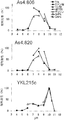
- FIG. 3 is a graph showing the optimum pH of 5-oxoprolinase of the present invention and yeast-derived 5-oxoprolinase.
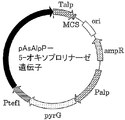
- FIG. 3 is a diagram showing the pH stability of 5-oxoprolinase of the present invention and yeast-derived 5-oxoprolinase. It is a figure which shows the outline of the structure of the plasmid pAsAlpP for cassette production for Aspergillus genus expression.
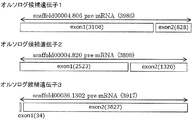
- Examples of 5-oxoprolinase ortholog candidate genes include scaffold0000000006, scaffold00004.820, and scaffoldold00036.1302.
- FIG. 2 is a prediction diagram of an exon-intron structure of a 5-oxoprolinase ortholog candidate gene of Aspergillus sojae.
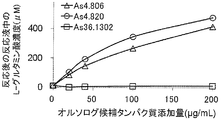
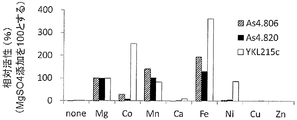
- FIG. 3 is a graph showing the relationship between the amount of three Aspergillus soya-derived 5-oxoprolinase ortholog candidate proteins expressed in Aspergillus spp. And the concentration of L-glutamic acid in the reaction solution after the reaction. It is a figure which shows the relationship between the kind of monovalent cation added to the reaction system, and relative activity.
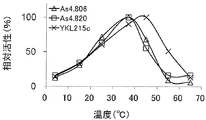
- FIG. 3 is a graph showing optimum temperatures of 5-oxoprolinase of the present invention and yeast-derived 5-oxoprolinase.
- FIG. 3 is a graph showing temperature stability of 5-oxoprolinase of the present invention and yeast-derived 5-oxoprolinase.
- FIG. 6 is a graph showing the relationship between the amount of Aspergillus oryzae-derived 5-oxoprolinase ortholog candidate protein expressed in Aspergillus sp. And the concentration of L-glutamic acid in the reaction solution after the reaction.
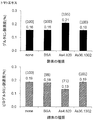
- FIG. 3 is a graph showing the relationship between the glutamic acid concentration and the pyroglutamic acid concentration in the reaction solution after the reaction between the tomato extract diluted solution and 5-oxoprolinase of the present invention. (In parentheses, relative values are shown when no enzyme is added.)
- FIG. 3 is a graph showing the relationship between the glutamic acid concentration and pyroglutamic acid concentration in the reaction solution after the reaction of the concentrated soy sauce diluted solution and the 5-oxoprolinase of the present invention. (In parentheses, relative values are shown when no enzyme is added.)
- the activity of the 5-oxoprolinase of the present invention (hereinafter referred to as “the present enzyme” depending on the context) is determined by FEMS Yeast Res. (Vol. 10, pp. 394 to 401, 2010) can be measured by a modified method.
- the enzyme activity is calculated by measuring L-glutamic acid produced by hydrolysis of the intramolecular amide bond of L-pyroglutamic acid.
- a method using an enzyme acting on L-glutamic acid such as L-glutamic acid oxidase, liquid chromatography or the like can be used.
- the following measuring method can be used.
- the reaction solution after heating if necessary, the supernatant obtained by centrifugation (15,000 ⁇ g, 10 minutes) may be used for the measurement of L-glutamic acid.
- Other reagents described in the present specification are Wako Pure Chemical Industries, Nacalai Tesque, Sigma, Dojindo Laboratories, Becton Dickinson, Nippon Pharmaceutical Co., Ltd. unless otherwise specified. For reagents manufactured by Takara Bio Inc., and those with distinct purity, special grade reagents are used.
- L-glutamic acid detection kit II manufactured by Yamasa Shoyu Co., Ltd., containing L-glutamic acid oxidase
- 0.02 mL of the enzyme reaction solution was used to detect L-glutamic acid in the kit.
- the L-glutamic acid concentration in the enzyme reaction solution is calculated based on a calibration curve using an L-glutamic acid sample (measured value).
- the unit of enzyme activity is defined as 1 unit (U) for the amount of enzyme that produces 1 ⁇ mol of L-glutamic acid per minute under the conditions described above.
- [Glu] is the L-glutamic acid concentration (measured value) in the enzyme reaction solution
- [Glu blank] is the L of the reaction solution to which 50 mM Tris-HCl buffer (pH 8.0) is added instead of the substrate solution.
- -Glutamic acid concentration (blank value) [enzyme] represents the concentration of 5-oxoprolinase in the reaction solution
- 60 represents a fraction of one hour.
- the 5-oxoprolinase of the present invention has the following enzymatic properties:
- Optimum pH and stable pH range When measuring the activity of the enzyme at each pH using the above-mentioned measurement method 1 and changing the pH of the buffer solution, the optimum pH of the enzyme is pH 7.0 to The pH is 8.0 (see FIG. 1). As shown in FIG. 1, the enzyme can retain 70% or more of the maximum activity in the optimum pH range.
- the stable pH range of this enzyme is pH 6. 0 to 9.0 (see FIG. 2).
- the enzyme can retain 70% or more of the maximum activity when treated in the stable pH range.
- this enzyme is almost completely inactivated when treated under pH conditions of pH 5.0 or lower and pH 11.0 or higher.
- Optimal temperature range When measuring method 1 is used to change the temperature during the reaction and the activity at each temperature is measured, the optimal temperature of the enzyme is 37 ° C. (see FIG. 9).
- Substrate specificity This enzyme specifically hydrolyzes L-pyroglutamic acid to L-glutamic acid and does not hydrolyze D-pyroglutamic acid.
- the affinity of the 5-oxoprolinase of the present invention is expressed as the Km value for L-pyroglutamic acid
- the Km value of one ortholog of the enzyme (As 4.806, described later) Is 93 ⁇ M
- another ortholog of this enzyme (As 4.820, described later) has a Km value of 76 ⁇ M.
- the 5-oxoprolinase of the present invention is not limited by its origin as long as it has the enzymatic properties described herein, but in one embodiment, the 5-oxoprolinase of the present invention contains Preferably, it is a protein derived from a microorganism, more preferably a protein derived from a filamentous fungus, more preferably a filamentous fungus belonging to the genus Aspergillus, for example, Aspergillus oryzae, Aspergillus sojae Proteins derived from Aspergillus tamarii, Aspergillus niger and the like.
- Aspergillus oryzae, Aspergillus soya, Aspergillus tamari and Aspergillus niger have long been used in the production of brewed foods such as miso, soy sauce, sake and shochu in Japan. It is a particularly important microorganism in the industry because of its high reliability in use safety.
- the 5-oxoprolinase of the present invention includes 5-oxoprolinase obtained by a gene recombination technique.
- the 5-oxoprolinase of the present invention is a protein having the amino acid sequence represented by any of SEQ ID NOs: 1 and 2.
- a protein having the amino acid sequence represented by any one of SEQ ID NOs: 1 and 2 is obtained by cloning a 5-oxoprolinase gene derived from chromosomal DNA or cDNA of a filamentous fungus belonging to the genus Aspergillus. It can also be obtained by expression in a vector-host system.
- the present invention has an amino acid sequence having 5-oxoprolinase activity, wherein one to several amino acids are added, deleted or substituted in the amino acid sequence represented by any of SEQ ID NOs: 1 and 2. Also includes proteins. "Amino acid sequence in which one or several (plural) amino acids are added, deleted or substituted” means that any of SEQ ID NOs: 1 and 2 is used as long as the desired 5-oxoprolinase activity is obtained. It means that a sequence different from the amino acid sequence may be added to the represented amino acid sequence, and a part of the amino acid sequence may be deleted or substituted.
- one or several amino acids means 1-10, such as 1-9, such as 1-8, such as 1-7, such as 1-6, such as 1 Refers to ⁇ 5, for example 1-4, for example 1-3 amino acids.
- amino acid sequence represented by any of SEQ ID NOs: 1 and 2 is deleted, 5-oxoproline having the same enzymatic properties as the 5-oxoprolinase of the present invention Proteins having an amino acid sequence having such additions, deletions, substitutions and the like are also included in the present invention as long as they exhibit the activity of the enzyme.
- the 5-oxoprolinase of the present invention is 80% or more, preferably 85% or more, more preferably 90%, more preferably 95% or more, with the amino acid sequence represented by any of SEQ ID NOs: 1 and 2. More preferably, it includes a protein having an amino acid sequence showing 98% or more, more preferably 99% or more sequence identity.
- the 5-oxoprolinase gene of the present invention is a 5-oxoprolinase gene encoding a protein having the above enzymatic properties.
- the 5-oxoprolinase gene of the present invention is a 5-oxoprolinase gene having a base sequence represented by any of SEQ ID NOs: 56 and 57.
- the 5-oxoprolinase gene of the present invention is a 5-oxoprolinase gene that is introduced into a host and spliced into a gene encoding a protein having the above enzymatic properties after transcription of the gene.
- Examples of such a gene include a 5-oxoprolinase gene having a base sequence represented by any of SEQ ID NOs: 4 and 5.
- the 5-oxoprolinase gene of the present invention is complementary to DNA consisting of the base sequence represented by any of SEQ ID NOs: 4, 5, 56 and 57 as long as it encodes a protein having 5-oxoprolinase activity. Also included is a 5-oxoprolinase gene that hybridizes with DNA comprising a basic nucleotide sequence under stringent conditions and encodes a protein having 5-oxoprolinase activity.
- the “stringent conditions” are conditions in which a specific hybrid signal is clearly distinguished from a non-specific hybrid signal.
- the hybridization system used, the type, sequence and length of the probe It depends on. Such conditions can be determined by changing the hybridization temperature, washing temperature and salt concentration. For example, when even a non-specific hybrid signal is detected strongly, the specificity can be increased by raising the hybridization and washing temperature and, if necessary, lowering the washing salt concentration. If no specific hybrid signal is detected, the hybrid can be stabilized by lowering the hybridization and washing temperature and, if necessary, raising the washing salt concentration. Such optimization can be easily performed by researchers in this technical field.
- hybridization is 5 ⁇ SSC, 1.0% (w / v), a nucleic acid hybridization blocking reagent (Boehringer Mannheim), Perform overnight (about 8-16 hours) using 0.1% (w / v) N-lauroyl sarcosine, 0.02% (w / v) SDS. Washing is performed using 0.1 to 0.5 ⁇ SSC, 0.1% (w / v) SDS, preferably 0.1 ⁇ SSC, 0.1% (w / v) SDS, twice for 15 minutes. Do.
- the temperature for performing hybridization and washing is 65 ° C or higher, preferably 68 ° C or higher.
- the 5-oxoprolinase gene of the present invention is 80% or more, preferably 85% or more, more preferably 90%, with DNA comprising the base sequence represented by any of SEQ ID NOs: 4, 5, 56 and 57. More preferably, a 5-oxoprolinase gene encoding a protein having a sequence identity of 95% or more, more preferably 98% or more, more preferably 99% or more and having a function of 5-oxoprolinase. Include.
- a person skilled in the art can search, for example, a sequence showing high sequence identity from a database using a program described above. These are available, for example, on the website of the National Center for Biotechnology Information (http://blast.ncbi.nlm.nih.gov/Blast.cgi).
- Each of the above methods is usually used to search a sequence showing sequence identity from a database.
- Genetyx network version version 11.0.6 As a means for determining the sequence identity of individual sequences, Genetyx network version version 11.0.6. Homology analysis (manufactured by Genetics) can also be used. This method is based on the Lipman-Pearson method (Science 227: 1435-1441, 1985).
- CDS or ORF a region encoding a protein
- the gene encoding 5-oxoprolinase of the present invention can be inserted into various appropriate known vectors. Furthermore, a transformant or a transductant into which a recombinant vector (recombinant DNA) containing a 5-oxoprolinase gene has been introduced can be produced by introducing this vector into appropriate known hosts. Methods for obtaining these genes, methods for obtaining gene sequences and amino acid sequence information, methods for producing various vectors, and methods for producing transformants are known to those skilled in the art, and an example will be described later.
- chromosomal DNA or mRNA can be extracted from microbial cells having various ability to produce 5-oxoprolinase and various cells by a conventional method, for example, the method described in Current Protocols in Molecular Biology (WILEY Interscience, 1989). it can.
- cDNA can be synthesized using mRNA as a template.
- a chromosomal DNA or cDNA library can be prepared using the chromosomal DNA or cDNA thus obtained.
- the 5-oxoprolinase gene can be obtained by cloning using a chromosomal DNA derived from a microorganism having the gene or a gene derived from cDNA as a template.
- microorganisms derived from such genes include filamentous fungi, preferably filamentous fungi belonging to the genus Aspergillus, more preferably Aspergillus sojae NBRC 4239 strain and the like. More specifically, first, an Aspergillus sojae NBRC4239 strain is cultured, and the resulting cells are frozen in liquid nitrogen and then physically ground using a mortar or the like to obtain a fine powder.
- a chromosomal DNA fraction is extracted from the cell piece by a conventional method.
- a commercially available chromosomal DNA extraction kit can be used for the extraction operation.
- DNA is amplified by performing polymerase chain reaction (hereinafter referred to as “PCR”) using the chromosomal DNA as a template and a synthetic primer complementary to the 5 ′ end sequence and the 3 ′ end sequence.
- PCR polymerase chain reaction
- a primer having any sequence may be used as long as a DNA fragment containing the gene can be amplified. Examples thereof include primers represented by SEQ ID NOs: 7 and 8, SEQ ID NOs: 9 and 10, and SEQ ID NOs: 11 and 12, designed with reference to the genome sequence of Aspergillus sojae.
- the DNA containing the target gene fragment is amplified by appropriate PCR such as 5'RACE method or 3'RACE method, and these are ligated to obtain DNA containing the full length target gene. Can do.
- a 5-oxoprolinase gene in addition to obtaining from a microorganism, it is also possible to construct a 5-oxoprolinase gene using a chemical synthesis method.
- Confirmation of the amplification product amplified by PCR and the base sequence in the chemically synthesized gene can be performed, for example, as follows. First, a DNA whose sequence is to be confirmed is inserted into an appropriate vector according to a normal method to produce a recombinant DNA.
- a commercially available kit such as TA Cloning Kit (manufactured by Invitrogen), or pUC18 (manufactured by Takara Bio Inc.), pUC119 (manufactured by Takara Bio Inc.), pBR322 (manufactured by Takara Bio Inc.), pBluescript SK + ( Commercially available plasmid vector DNA such as Stratagene) or pYES2 / CT (Invitrogen), or commercially available bacteriophage vector DNA such as ⁇ EMBL3 (Stratagene) can be used.
- TA Cloning Kit manufactured by Invitrogen
- pUC18 manufactured by Takara Bio Inc.
- pUC119 manufactured by Takara Bio Inc.
- pBR322 manufactured by Takara Bio Inc.
- pBluescript SK + Commercially available plasmid vector DNA such as Stratagene
- pYES2 / CT Invitrogen
- commercially available bacteriophage vector DNA such as ⁇ EMBL
- the recombinant DNA is used to transform host cells, for example, Escherichia coli K-12 strain, preferably JM109 strain (Takara Bio), DH5 ⁇ strain (Takara Bio). .
- the recombinant DNA contained in the obtained transformant is purified using QIAGEN Plasmid Mini Kit (manufactured by QIAGEN) or the like.
- the base sequence of each gene inserted into the recombinant DNA is determined by the dideoxy method (Methods in Enzymology, 101, 20-78, 1983) or the like.
- analysis can be performed using Li-COR MODEL 4200L sequencer (manufactured by Aroka), 370 DNA sequence system (manufactured by PerkinElmer), CEQ2000XL DNA analysis system (manufactured by Beckman), and the like.
- the translated polypeptide that is, the amino acid sequence of 5-oxoprolinase protein is determined.
- a recombinant vector containing a 5-oxoprolinase gene is constructed by joining a PCR amplification product containing a 5-oxoprolinase gene and various vectors in a form capable of expressing the 5-oxoprolinase gene. be able to. That is, for example, a DNA fragment containing a 5-oxoprolinase gene can be excised with an appropriate restriction enzyme and inserted into a plasmid cleaved with an appropriate restriction enzyme.
- a DNA fragment containing the gene having a sequence homologous to the plasmid added to both ends and a plasmid-derived DNA fragment amplified by inverse PCR are ligated using In-Fusion Advantage PCR Cloning Kit (Clontech). Can be obtained.
- a method for transforming a microorganism using the recombinant vector obtained as described above varies depending on the microorganism used as a host and the type of the recombinant vector, but a known method can be used as appropriate. For example, a method for direct insertion into the host chromosome by using homologous recombination or transposon, and a method for introduction into the host by ligation onto a vector such as a plasmid, cosmid, phage, virus, artificial chromosome, etc. Etc.
- sequences upstream of the recombination site on the chromosome sequences homologous to the downstream region, appropriate promoters and terminators, and the 5-oxoprolinase gene are linked to each other in the genome of the filamentous fungus. Can be inserted. Transformants by self-cloning can be obtained by forced expression in the host under the control of their own high expression promoter.
- high expression promoter examples include a promoter region of an ⁇ -amylase gene (amy), a TEF1 promoter region which is a translation elongation factor, an alkaline protease gene (alp) promoter region and the like in the case of a microorganism belonging to a filamentous fungus.
- amy ⁇ -amylase gene
- alp alkaline protease gene
- the cloned 5-oxoprolinase gene is transformed into a vector such as a plasmid, cosmid, phage, virus, chromosomal integration type, artificial chromosome or the like used for transformation of prokaryotic cells or eukaryotic cells by a conventional method.
- a host corresponding to each vector can be transformed or transduced by a conventional method.
- any suitable vector-host system can be used as long as it can produce 5-oxoprolinase in the host, and the filamentous fungus expression vector pST14 (Mol. Gen. Genet. 218) can be used. 99-104, 1989) and filamentous fungal systems, yeast expression vectors [YEpFLAG-1 (manufactured by SIGMA), pYES2 (manufactured by Invitrogen), pYD1 (manufactured by Invitrogen), pAUR123 (manufactured by Takara Bio)] and yeast Saccharomyces cerevisiae system, E.
- yeast expression vectors [YEpFLAG-1 (manufactured by SIGMA), pYES2 (manufactured by Invitrogen), pYD1 (manufactured by Invitrogen), pAUR123 (manufactured by Takara Bio)] and yeast Saccharomyces cerevisiae system, E.
- coli expression vector (pBluescript II (Stratagene), pUC (Takara Bio) pET (Invitrogen), pRSET (Invitrogen), pTE Stratagene)) and Escherichia coli systems and the like.
- the vector may contain a marker gene for enabling selection of transformed cells.
- the marker gene include genes that complement the auxotrophy of the host, such as URA3, pyrG, and niaD, or resistance genes to drugs such as ampicillin, kanamycin, and oligomycin.
- the recombinant vector preferably contains a promoter or other control sequence (for example, an enhancer sequence, terminator sequence, polyadenylation sequence, etc.) capable of expressing the gene of the present invention in a host cell.
- the promoter include a suitable inducible promoter or constitutive promoter, and specific examples include GAL1 promoter, alp promoter, amyB promoter, lac promoter, and the like.
- the function necessary for the expression of the 5-oxoprolinase gene is not necessarily required when the DNA fragment containing the 5-oxoprolinase gene to be inserted has the function.
- a tag for purification can also be attached.
- purification using a nickel column can be enabled by appropriately connecting a linker sequence upstream or downstream of the 5-oxoprolinase gene and connecting 6 or more codons of a base sequence encoding histidine.
- Transformant or transductant host Any organism can be used as the host cell as long as it can produce this enzyme by transformation or transduction with a recombinant vector containing the 5-oxoprolinase gene.
- eukaryotes such as Escherichia coli or yeast
- microorganisms such as other bacteria, filamentous fungi, actinomycetes, or animal cells can be used, but not limited thereto.
- Examples of lower eukaryotic host cells include filamentous fungi and yeast.
- Examples of microorganisms classified into filamentous fungi include the genus Aspergillus, the genus Neurospora, the genus Penicillium, the genus Fusarium, the genus Trichoderma, and the genus Mucor. Examples include filamentous fungi.
- Specific preferred microorganisms that can be classified into these genera and produce 5-oxoprolinase used in the present invention include Aspergillus sojae, Aspergillus oryzae, Aspergillus oryzae, Examples include Aspergillus nidulans, Aspergillus niger, and Penicillium chrysogenum.
- Aspergillus sojae NBRC4239 strain is mentioned.
- a known method such as a method using polyethylene glycol and calcium chloride after protoplastization (Mol. Gen. Genet. 218, 99-104, 1989) can be used.
- microorganisms classified as yeast include yeasts belonging to the genus Zygosaccharomyces, the saccharomyces genus, the Pichia genus, the Candida genus, and the like.
- Specific preferred microorganisms that can be classified into these genera and produce 5-oxoprolinase used in the present invention include Zygosaccharomyces rouxii, Saccharomyces cerevisiae, and Saccharomyces.
- -Pombe Saccharomyces pombe
- Pichia pastoris Piichia pastoris
- Candida antarctica etc.
- Zygosaccharomyces rouxii NBRC1876 strain can be mentioned.
- a known method for example, a method using lithium acetate (Meth. Mol. Cell. Biol., 5, 255-269 (1995)) or electroporation (J Microbiol Methods 55 (2003). 481-484) and the like can be preferably used, but the present invention is not limited to this, and transformation may be performed by using various arbitrary methods including the spheroplast method and the glass bead method.
- Examples of higher eukaryotic host cells include insect cells and mammalian cells. More specifically, silkworm cells (Sf9 cell), Chinese hamster ovary cells (Chinese hamster ovarian cell: CHO cell) (all distributed from ATCC) and the like.
- silkworm cells Sf9 cell
- Chinese hamster ovary cells Choinese hamster ovarian cell: CHO cell
- As a method for transformation into mammalian cells calcium phosphate method, electroporation method, lipofection method, microinjection method, virus vector method, etc. can be used, but the method is not limited to this. You just need to make a change.
- prokaryotic host cells include microorganisms belonging to the genus Escherichia, such as Escherichia coli K-12, preferably BL21 (DE3), JM109, DH5 ⁇ (all of which are Takara Bio) Etc.). They can be transformed or transduced to obtain host cells into which DNA has been introduced (transformants).
- a method for transferring a recombinant vector into such a host cell for example, a method for transferring a recombinant DNA in the presence of calcium ion or an electroporation method can be used.
- a commercially available competent cell for example, ECOS Competent Escherichia coli BL21 (DE3); manufactured by Nippon Gene Co., Ltd. may be used.
- the 5-oxoprolinase of the present invention can be produced using various known enzyme production methods.
- a 5-oxoprolinase-producing microorganism can be cultured in a medium to produce the desired 5-oxoprolinase, and the enzyme can be collected from the culture or the cultured cells.
- the present invention also includes a 5-oxoprolinase gene of the present invention or a recombinant vector containing the 5-oxoprolinase gene, culturing a microorganism capable of producing 5-oxoprolinase, and culturing 5-oxoprolinase from the culture. The enzyme can be collected.
- microorganism can be used as a microorganism used to produce the enzyme, as long as it has the ability to produce the enzyme, regardless of whether or not genetic recombination is performed.
- microorganisms such as filamentous fungi and actinomycetes or animal cells can be used. Specific examples include Escherichia coli belonging to the genus Escherichia, yeast belonging to the genus Saccharomyces, filamentous fungi belonging to the genus Aspergillus, mammalian cells and the like. Specific examples include Aspergillus oryzae RIB40 (ATCC 42149) strain, Aspergillus sojae NBRC 4239 strain, and the like.
- mutant strain of the strain It is also possible to use a mutant strain of the strain.
- a method for obtaining a mutant strain of the strain for example, a method of causing mutation in the original strain using a radioisotope, ultraviolet light, nitrosoguanidine or the like can be used.
- the microorganism used for the production of the present enzyme may have the ability to produce the present enzyme and at the same time have the ability to produce another conventional 5-oxoprolinase.
- the present enzyme when the present enzyme is produced by recombination, there may be assumed a case where another type of 5-oxoprolinase of the host itself originally possessed by the microorganism used as the host is also produced.
- culturing under various culturing conditions can be performed according to the purpose.
- -Enzyme production can be carried out by arbitrarily changing the production ratio of oxoprolinase, or any desired 5-oxoprolinase can be obtained using any known separation and purification technique, or A crude product of 5-oxoprolinase containing this enzyme can also be obtained without going through a special separation and purification step.
- a normal solid culture method or liquid culture method can be employed.
- any of a synthetic medium or a natural medium can be used as long as it contains a normal medium for culturing microorganisms, that is, a carbon source, a nitrogen source, an inorganic substance, and other nutrients in an appropriate ratio.
- any assimilable carbon compound may be used.
- glucose, maltose, starch hydrolyzate, glycerin, fructose, molasses and the like are used.
- the nitrogen source may be any available nitrogen compound, such as yeast extract, tryptone, peptone, soyton, meat extract, corn steep liquor, soy flour, soybean or wheat bran leachate, amino acid, ammonium sulfate, Examples thereof include ammonium nitrate.
- the inorganic substance examples include various salts such as sodium chloride, potassium chloride, magnesium sulfate, manganese chloride, ferrous sulfate, potassium dihydrogen phosphate, dipotassium hydrogen phosphate, sodium carbonate, sodium acetate, calcium chloride and the like. You may add vitamins, an antifoamer, etc. as needed. In addition, if there are nutrient sources and components that can be added to improve the production amount of the 5-oxoprolinase of the present invention, they may be used alone or in combination.
- a promoter inducer such as galactose or isopropyl-1-thio- ⁇ -galactoside (IPTG) is added as necessary to produce 5-oxoprolinase.
- IPTG isopropyl-1-thio- ⁇ -galactoside
- Culture conditions vary depending on the microorganism to be cultured.
- the initial pH of the medium can be adjusted to pH 5 to 10, culture temperature 20 to 40 ° C., culture time 10 to 25 hours, or 1 to 7 days. It is carried out by culturing, shaking culture, static culture, etc.
- 2% (w / v) dextrin, 1% (w / v) polypeptone, 0.5% (w / v) KH as an example of a culture medium and culture conditions for culturing microorganisms of the genus Aspergillus 2 PO 4 , 0.05% (w / v) MgSO 4 .7H 2 O, 0.1% (w / v) casamino acid, which becomes slightly acidic without pH adjustment) at 30 ° C. and 120 rpm
- Examples include shaking culture for 2 to 4 days.
- a culture medium and culture conditions for culturing yeast As an example of a culture medium and culture conditions for culturing yeast, a culture medium of 2% (w / v) bactopeptone, 1% (w / v) bacto yeast extract, 2% (w / v) glucose was used. And shaking culture at 30 ° C. and 200 rpm for 24 hours.
- E. coli is cultured at a culture temperature of 10 to 42 ° C., preferably at a culture temperature of about 25 ° C. for 4 to 24 hours, more preferably at a culture temperature of about 25 ° C. for 4 to 8 hours. What is necessary is just to implement by culture
- a medium containing various sugars, amino acids, inorganic salts, vitamins, serum, growth hormone, etc. examples include culture or shaking culture. If necessary, it can be cultured in an incubator supplied with 5% carbon dioxide.
- Commercially available culture media manufactured by Nissui Pharmaceutical Co., Ltd., Invitrogen, Sigma-Aldrich, etc. may also be used.
- a normal enzyme collecting means can be used.
- the cells can be separated by filtration or centrifugation, and the culture solution containing 5-oxoprolinase can be recovered as a crude enzyme solution. it can.
- the microbial cells are separated from the culture by, for example, filtration, centrifugation, etc., and 5-oxoprolinase is collected from the microbial cells.
- a method of destroying bacterial cells using a disruption means such as an ultrasonic crusher, French press, dynomill, mortar, a method of lysing bacterial cell walls using a cell wall lytic enzyme such as lysozyme, Triton X-100, etc.
- a method of extracting an enzyme from bacterial cells using a surfactant or the like may be employed alone or in combination, and then the insoluble material may be removed by filtration or centrifugation to obtain a crude enzyme solution.
- a normal protein purification method can be used. Specifically, for example, ammonium sulfate salting out method, organic solvent precipitation method, ion exchange chromatography, hydrophobic chromatography, gel filtration chromatography, adsorption chromatography, affinity chromatography (eg, nickel column), electrophoresis method, etc. Can be used alone or in appropriate combination.
- the 5-oxoprolinase of the present invention works well at pH 7.0 to 8.0, it can be suitably used for applications / use processes in a wide pH range including a neutral range. Furthermore, since the stable pH range of the 5-oxoprolinase of the present invention is wide, even when this enzyme is used as a quantitative reagent, food processing aid, etc., it is not easily affected by changes in pH environment. Have advantages.
- the 5-oxoprolinase of the present invention has an optimum temperature range in the intermediate temperature range. Therefore, when the 5-oxoprolinase of the present invention is used as a reagent or in food processing, etc., it can exert a predetermined effect without heating more than necessary, and is incorporated in foods and reagents. Thus, when the reaction is performed, it can be expected that heat denaturation of various components in foods and reagents can be suppressed.
- this enzyme works well even if it is not heated more than necessary, but has a certain heat resistance and can coexist with the heating step used in food processing etc. It can be said that this is also suitable for practical use.
- the 5-oxoprolinase of the present invention has a certain heat resistance and is rapidly sterilized under heat sterilization conditions widely used in normal seasoning production, for example, at a temperature of 95 ° C. Therefore, it is not necessary to incorporate a special heating step for inactivating the enzyme during the production process.
- the Km value of this enzyme with respect to L-pyroglutamic acid is small, the reaction can be catalyzed more efficiently, and shortening of the reaction time and reduction of the amount of enzyme used can be expected.
- 5-oxoprolinase As described above, there has been no report that 5-oxoprolinase has been put to practical use for foods or reagents. However, the present invention is not limited to the characteristics of known enzymes reported in several literatures. 5-oxoprolinase is superior in the above points and has superiority in application to various uses.
- the food or drink containing L-pyroglutamic acid and the present enzyme are contacted or mixed, or the food or drink containing L-pyroglutamic acid is fermented by a microorganism expressing the present enzyme, thereby By hydrolyzing L-pyroglutamic acid in the product and converting it to L-glutamic acid, which is important as a taste component, a food or drink product having an excellent taste power that has not been obtained conventionally can be obtained.
- increasing the L-glutamic acid concentration and / or decreasing the L-pyroglutamic acid concentration contained in the food and drink is referred to as improving the umami taste of the food and drink.
- L-glutamic acid is converted to L-pyroglutamic acid by a non-enzymatic reaction in the presence of heat or pressure. Therefore, this enzyme can also be used to maintain the umami taste of foods and drinks by hydrolyzing L-glutamic acid in foods and drinks into L-pyroglutamic acid again to L-glutamic acid. Such maintenance of umami shall also be included in the improvement of umami referred to in the present specification.
- this enzyme can be used as an umami improving agent for converting L-pyroglutamic acid having no umami taste into L-glutamic acid, and a microorganism expressing this enzyme can be used as a microorganism for producing a fermented food rich in umami taste.
- the microorganism is preferably a microorganism that highly expresses this enzyme or a microorganism that has a high enzyme activity.
- the food and drink to which this enzyme can be applied is not particularly limited as long as it contains L-glutamic acid or L-pyroglutamic acid.
- vegetables such as tomato and Chinese cabbage, grains such as flour, mushrooms such as mushrooms and shiitake mushrooms, soybeans, etc.
- Beans such as seaweed, seaweed such as kelp, various fermented foods such as seaweed, soy sauce, fish sauce, miso, bonito, shavings and various processed foods including canned foods, retort foods, instant foods and frozen foods.
- the umami improving agent of the present invention contains the enzyme in any suitable form.
- the enzyme can be in the form of a dissolved state (including a diluted state and a concentrated state), a gel, a solid powder, a granule and the like.
- the umami improving agent of the present invention contains a transformant or a transductant (microorganism) that expresses the enzyme.
- the microorganism expressing this enzyme can be in any form such as a culture solution, a culture, a suspension, a solid powder, or a granule.
- the umami taste improving agent of the present invention may contain any other components such as excipients and stabilizers as necessary.
- the details of the amount of 5-oxoprolinase added and the enzyme treatment conditions suitable for the production of umami-flavored foods and foods with improved umami taste depend on the food / beverage products to be processed and the required L-glutamic acid concentration. These may be set as appropriate.
- the concentration of L-glutamic acid in foods and drinks can be measured using known means such as enzymatic methods and chromatography. What is necessary is just to perform well-known sensory evaluation.
- the threshold value of L-glutamic acid concentration at which humans feel umami is said to be about 0.03%, but it is influenced by the coexisting components and the effect is considered to be synergistic. Since this enzyme works well at pH 7.0 to 8.0, it can be used in a wide pH range including neutral range. Although many foods generally have low pH, this enzyme can be widely used for processing such foods and drinks.
- microorganisms When using this enzyme in foods or drinks, or when fermenting foods and drinks using microorganisms that produce this enzyme, obtain this enzyme from microorganisms that can be safely used in foods or drinks, It is also important to ferment food and drink using available microorganisms. Aspergillus oryzae and Aspergillus sojae, which are examples of microorganisms derived from this enzyme, have high enzyme productivity and are highly reliable for long-term safety. It has long been used in the production of brewed foods such as miso, soy sauce and sake. Such microorganisms can be suitably used in the application of processing food and drink.
- the 5-oxoprolinase of the present invention can also be used for the measurement of L-pyroglutamic acid.
- a sample whose L-pyroglutamic acid content is to be measured is ultrafiltered to remove a protein component, and a solution appropriately diluted with 50 mM Tris-HCl buffer (pH 8.0) is used as a measurement solution.
- a solution appropriately diluted with 50 mM Tris-HCl buffer (pH 8.0) is used as a measurement solution.
- Amicon Ultra-0.5 mL 10K manufactured by Millipore
- the solution for measurement is reacted with the present enzyme in the presence of ATP, monovalent cation, divalent cation to cause the reaction from L-pyroglutamic acid to L-glutamic acid, and L-glutamic acid produced by the reaction is removed.
- the L-pyroglutamic acid concentration in the specimen can be calculated by measuring by the method of Measurement Method 1.
- the enzyme concentration and reaction time can be appropriately set.
- arbitrary components can also be mix
- This enzyme uses L-pyroglutamic acid as a substrate, and D-pyroglutamic acid does not become a substrate.
- D-glutamic acid and D-pyroglutamic acid are important starting materials for the production of chemicals, food additives, and agricultural chemicals, but the production process requires organic synthesis, racemic resolution, etc. It is expensive compared to the racemate.
- L-pyroglutamic acid as an impurity with this enzyme, high-purity D-pyroglutamic acid is obtained, and D-glutamic acid is obtained by hydrolyzing the obtained D-pyroglutamic acid by any method. Obtainable.
- L-pyroglutamic acid is specifically converted to L-glutamic acid.
- a method for separating L-glutamic acid and D-pyroglutamic acid a conventional method for separating compounds can be used. Specifically, for example, reverse phase chromatography, ion exchange chromatography, crystallization method and the like can be used. A method including such a series of steps is referred to herein as a method for resolving racemic pyroglutamic acid.
- modification such as derivatization may be appropriately performed in the resolution of the racemate.
- Confirmation of conversion of L-pyroglutamic acid to L-glutamic acid is performed by detecting the residual amount of L-pyroglutamic acid, or DL-pyroglutamic acid, DL-glutamic acid, and L-glutamic acid are measured. It can also be done. For example, DL-pyroglutamic acid is separated by liquid chromatography, derivatized with bromothymol blue, the degree of ultraviolet absorption is detected, and can be calculated from a calibration curve using a standard.
- L-glutamic acid is a measurement method As shown by 1, it can be measured by an enzymatic method using L-glutamate oxidase.
- L-pyroglutamic acid converted into L-glutamic acid by the present enzyme in the DL-pyroglutamic acid mixed solution is the concentration of L-glutamic acid generated after the reaction, or the DL-pyroglutamic acid concentration before the reaction and the DL-pyroglutamic acid concentration after the reaction. It can be calculated from the difference in pyroglutamic acid concentration.
- sequence information of these three regions was used as a clue to search for 5-oxoprolinase orthologue candidate molecules in Aspergillus, and the following operations were advanced.
- NUCLEI Lysis Solution heated to 65 ° C. was added to 300 ⁇ L of the powdered cell piece of about 1 spatula, vortexed, and incubated at 65 ° C. for 15 minutes. Next, RNase (manufactured by Nippon Gene) was added so as to be 50 ⁇ g / mL, and the mixture was incubated at 37 ° C. for 15 minutes. Thereafter, 125 ⁇ L of Protein Precipitation Solution (manufactured by Promega) was added, vortexed vigorously for 20 seconds, and centrifuged at 14,000 ⁇ g for 5 minutes.
- RNase manufactured by Nippon Gene
- the resulting supernatant was mixed with 300 ⁇ L of isopropanol, and the precipitate obtained by centrifuging at 11,000 ⁇ g for 3 minutes was rinsed with 70% ethanol, whereby genomic DNA derived from Aspergillus soja NBRC4239 strain was recovered.
- TE (10 mM Tris-HCl (pH 7.5), 1 mM EDTA) was added to this genomic DNA, and incubated at 50 ° C. for 5 minutes to dissolve, thereby preparing a genomic DNA solution having a desired concentration.
- DNA fragments (approximately 4000 base pairs) considered to be DNA fragments of the three types of 5-oxoprolinase orthologue candidate genes amplified by PCR are separated in a 1% agarose gel, respectively, and QIAquick Gel Extraction Kit (QIAGEN) For purification.
- pAsN a plasmid vector derived from pUC19, was used as a cloning vector.
- pAsN contains, at the LacZ locus of pUC19, an Aspergillus soya-derived nitrate reductase gene (including a promoter region and a terminator region), an Aspergillus soya-derived tef1 gene promoter region (Ptef1, upstream 748 bp, SEQ ID NO: 15), and Aspergillus A vector prepared by introducing a terminator region (Talp, downstream 800 bp, SEQ ID NO: 16) of a soya-derived alkaline protease gene.
- pAsN as a template and the primers for inverse PCR of SEQ ID NOS: 13 and 14, the sequence of a plasmid containing Talp on the 5 ′ side and Ptefl on the 3 ′ side is amplified as a DNA fragment by PCR, and then the DNA fragment Were separated in a 1% agarose gel and purified using the QIAquick Gel Extraction Kit.
- the DNA fragments considered to be the three kinds of purified 5-oxoprolinase orthologue candidate DNA fragments were ligated to the plasmid pAsN-derived DNA fragments, respectively. did.
- a recombinant plasmid was obtained in which a DNA fragment considered to be a DNA fragment of a 5-oxoprolinase ortholog candidate gene amplified by PCR was ligated between the Ptef1 region and the Talp region of plasmid pAsN, respectively.
- each of the recombinant plasmids was extracted from the transformant, and each DNA sequence inserted into the plasmid was analyzed.
- the DNA fragments considered as the DNA fragment of the 5-oxoprolinase ortholog candidate gene are the sequences of scaffold00004.806, scaffold0000000420, and scaffold00036.1302, respectively, present in the genomic DNA of Aspergillus soja NBRC4239 strain. Confirmed to match.
- the respective plasmids are pAsN-4.806 pre mRNA, pAsN-4.820 pre mRNA, respectively.
- PAsN-36.1302 pre mRNA.
- each 5-oxoprolinase ortholog candidate gene in the three types of recombinant plasmids (pAsN-4.806, pAsN-4.820, pAsN-36.1302) obtained by the above-described method is located upstream.
- Ptefl is a promoter for expressing a 5-oxoprolinase ortholog candidate gene
- Talp is a sequence complementary to the downstream region of the gene homologous recombination site.
- Aspergillus soya NBRC4239 strain genomic DNA was used as a template, and the promoter region of the alkaline protease gene (Palp, upstream 1515 bp, SEQ ID NO: 21) was amplified by PCR.
- Aspergillus soja NBRC4239 strain genomic DNA was used as a template, SEQ ID NO: 22
- the peripheral region of the gene that complements uridine requirement (pyrG, upstream 407 bp, coding region 896 bp and 1838 bp including downstream 535 bp, SEQ ID NO: 24) was amplified by PCR using primers 23 and 23.
- nucleotides 166 to 393 of plasmid pUC19 base numbers are restriction enzyme maps attached to the reagents
- the sequence including MCS, replication origin, and ampicillin resistance gene
- Prime Star Max manufactured by Takara Bio Inc. was used as a reaction reagent, and an extension reaction was performed according to the attached protocol.
- Each DNA fragment amplified by the PCR was separated in a 1% agarose gel and purified using a QIAquick Gel Extraction Kit (manufactured by QIAGEN). Each primer is added with about 15 bp of the same sequence as the adjacent DNA fragment when the DNA fragments are ligated in the following operation, using In-Fusion Advantage PCR Cloning Kit (Clontech). , Each can be linked.
- a Palp, pyrG, Ptef1, 5-oxoprolinase ortholog candidate gene (scaffold00004.806, scaffold0000000420, or scaffold00036.1302) is located upstream of the multi-cloning site (MCS) of pUC19.
- MCS multi-cloning site
- the recombinant plasmid is extracted from the transformant, and each DNA sequence inserted into the plasmid is analyzed.
- the sequences of candidate enzyme orthologs (scaffold00004.806, scuffold00004.820, or scaffold00036.1302) match scuffold00004806, scaffold00004.820, and scaffold00030004.130.130.13030130.130.13030130.13030130.130.130.130.130.130.130.130.130.130.130.130.130.130.130.130.130.130.130.130.130.130. It was confirmed.
- the respective plasmids are pAsAlpP-4.806 pre mRNA, pAsAlpP-4.820 pre mRNA and pAsAlpP-36. It was named 1302 pre mRNA.
- CDS sequence excluding introns
- a region predicted to be an exon was amplified by PCR, and exon 1 and exon 2 were linked. That is, using the plasmid pAsAlpP-4.806 pre mRNA prepared above as a template and using the primers of SEQ ID NOs: 17 and 27, the exon 1 region of scaffold00004.806 in which Ptef1 was ligated upstream was converted to SEQ ID NO: 30 and The exon 2 region of scaffold00004.806 was amplified by PCR using 31 primers.
- PCR was performed to amplify the sequence of the plasmid containing Talp on the 5 ′ side and Palp and pyrG on the 3 ′ side using primers for inverse PCR of SEQ ID NOS: 13 and 23. A DNA fragment was obtained.
- Prime Star Max as a reaction reagent, an extension reaction was performed according to the attached protocol.
- the DNA fragment amplified by the above PCR was separated in a 1% agarose gel, purified by QIAquick Gel Extraction Kit, and exon 1 region where Ptef1 was linked upstream of each of the three types of 5-oxoprolinase ortholog candidate genes.
- Intron prediction sequences of orthologue candidate genes for three types of 5-oxoprolinases by ligating the DNA fragment of exon 2 and the DNA fragment of exon 2 region to a DNA fragment derived from a plasmid using In-Fusion Advantage PCR Cloning Kit A plasmid in which the sequence excluding was incorporated was obtained.
- the recombinant plasmids correspond to the names of the gene sequences found in the database search, scaffold00004.806, scaffold00004.820, and scaffold00036.1302, pAsAlpP-4.806 CDS, pAsAlpP-4.820CDS, And pAsAlpP-36.1302 CDS.
- a His tag fusion protein expression plasmid was constructed.
- the three types of plasmids pAsAlpP-4.806 CDS, pAsAlpP-4.820 CDS, and pAsAlpP-36.1302 CDS prepared above were used as templates, respectively, SEQ ID NO: 36 and 31, SEQ ID NO: 37 and 33, SEQ ID NO: 38 and Using the 35 primers, a 24-base sequence encoding 8 histidine sequences was added to the 5 ′ side of the 5-oxoprolinase ortholog candidate gene (scaffold00004.806, scaffold00004.820, and scaffold00036.1302). Three types of DNA fragments were amplified by PCR.
- PCR was performed using the primers for inverse PCR of SEQ ID NOS: 13 and 14, and the sequence on the plasmid side containing Talp on the 5 ′ side, Palp, pyrG and Ptef1 on the 3 ′ side. Amplified by Using Prime Star Max as a reaction reagent, an extension reaction was performed according to the attached protocol.
- Each DNA fragment amplified by the above PCR was separated in a 1% agarose gel, purified using QIAquick Gel Extraction Kit, and 8 histidines on the 5 ′ side of the CDS of 3 types of 5-oxoprolinase orthologue genes.
- 5-oxoprolinase ortholog in which a 24-base sequence encoding 8 sequences of Palp, pyrG, Ptef1, and histidine was added upstream of the multi-cloning site (MCS) of pUC19.
- MCS multi-cloning site
- the recombinant plasmid was extracted from the transformant, and each DNA sequence inserted into the plasmid was analyzed.
- the CDS of the candidate gene for 5-oxoprolinase ortholog to which a 24-base sequence encoding the sequences of Palp, pyrG, Ptef1, and histidine was added, and the sequence of Talp are the genome of Aspergillus soja NBRC4239 strain. It was confirmed to match the sequence on the DNA.
- a His tag sequence is added to three 5-oxoprolinase ortholog candidate genes (scaffold00004.806, scaffold00004.820, and scaffold00036.1302), and it is predicted to be an intron. An operation to remove the sequence to be performed was performed.
- the plasmids each containing the three kinds of genes that have undergone the above operations are associated with the names of the derived gene sequences scaffold00004.806, scaffold00004.820, and scaffold00036.1302, pAsAlpP-His-4.806 CDS, pAsAlpP- His-4.820 CDS and pAsAlpP-His-36.1302 CDS were named.
- Each of the CDS region and the DNA fragment to which Talp was ligated was amplified by PCR.
- KOD Dash Neo manufactured by TOYOBO
- Mastercycler gradient manufactured by Eppendorf
- the three amplified DNA fragments (for each 5-oxoprolinase ortholog candidate gene, the CDS region of the 5-oxoprolinase ortholog candidate gene to which Palp, pyrG, Ptef1, His tag sequence was added, and Talp were linked. DNA fragment) is dissolved in TE after ethanol precipitation to prepare a DNA solution having a desired concentration.
- a pyrG-disrupted strain derived from Aspergillus soja NBRC4239 strain (48 bp upstream of pyrG gene, coding region 896 bp, downstream) 240 bp deficient strain).
- Aspergillus soya NBRC4239 strain (conidia of pyrG disruption strain derived from Aspergillus soja NBRC4239 strain cultured on Malt plate, about 1/10 in 9 cm petri dish) used for transformation is suspended in 0.01% Tween80 solution.
- PD medium supplemented with uridine to 10 mM (2% (w / v) dextrin, 1% (w / v) polypeptone, 0.5% (w / v) KH 2 PO 4 , 0.05% ( w / v) MgSO 4 .7H 2 O, 0.1% (w / v) casamino acid) was inoculated into 150 mL, and cultured with shaking for about 18 hours.
- a sequence in which the CDS region of the 5-oxoprolinase ortholog candidate gene in which pyrG, Ptef1, and His tag sequences are added to the alkaline protease locus of the NBRC4239 strain is linked.
- These strains can be grown on a uridine-free medium by introducing pyrG, which is a gene that complements uridine requirement, so that a strain into which the target gene has been introduced can be selected.
- the transformant was a strain introduced into the target gene locus by colony PCR. That is, the conidia of the transformant scraped with a toothpick are suspended in TE and used as a template for PCR.
- the sandwiched region was amplified by PCR.
- KOD FX manufactured by TOYOBO
- an extension reaction was performed according to the attached protocol.
- alkaline protease gene (alp, 1389 bp, SEQ ID NO: 45) of the alkaline protease locus in the genomic DNA of Aspergillus soja NBRC4239 strain
- pyrG, Ptefl, and His tag sequences were added in the transformant strain.
- homologous recombination was performed at the alkaline protease locus in the transformant. Confirmed that it was.
- Aspergillus transformants by each 5-oxoprolinase ortholog candidate gene correspond to the names of the genes derived from scaffold00004.806, scaffold00004.820, and scaffoldold00036.1302, respectively, NBRC4239-His-4.806. They were named CDS strain, NBRC4239-His-4.820 CDS strain, and NBRC4239-His-36.1302 CDS strain.
- the N-terminal His-tagged 5-oxoprolinase ortholog candidate protein can be purified using a Ni column by a conventional method. That is, aspergillus transformants (NBRC4239-His-4.806 CDS strain, NBRC4239-His-4.820 CDS strain, and NBRC4239-His-36.1302 CDS strain) by a 5-oxoprolinase ortholog candidate gene Conidia were collected in PD medium (2% (w / v) dextrin, 1% (w / v) polypeptone, 0.5% (w / v) KH 2 PO 4 , 0.05% (w / v) MgSO 4. ⁇ Inoculated to 7H 2 O, 0.1% (w / v) casamino acid) at 1 ⁇ 10 5 cells / mL, cultured at 30 ° C. and 120 rpm for 2 days, and collected by filtration did.
- aspergillus transformants NBRC4239-His
- this bacterial cell extract was applied to a Ni-NTA Superflow column (manufactured by QIAGEN) to bind a His tag fusion 5-oxoprolinase ortholog candidate protein, washed with an extraction buffer containing 20 mM of imidazole, A fraction containing 5-oxoprolinase ortholog candidate protein eluted with an extraction buffer containing 250 mM imidazole was obtained. If necessary, the fraction containing the 5-oxoprolinase orthologue candidate protein was further concentrated using Amicon Ultra-0.5 mL 10K (manufactured by Millipore). The fraction containing 5-oxoprolinase ortholog candidate protein was dialyzed against an extraction buffer to obtain a purified enzyme solution.
- each 4-oxoprolinase ortholog candidate protein is assigned to As 4.806, As 4.820, As 36.1302, corresponding to the names of the genes derived (scaffold 00004.806, scuffold 00004.820, and scaffold00036.1302). Is written.
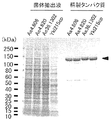
- FIG. 5 shows the result of CBB staining of the gel after completion of the electrophoresis. This confirmed that the 5-oxoprolinase ortholog candidate proteins (As 4.806, As 4.820, As 36.1302) were purified with high purity. The molecular weight was about 140 kDa (the part marked with a black triangle), which was consistent with the size calculated from the gene sequence disclosed in the present invention.
- a yeast extract OXP1 / YKL215c which is a known 5-oxoprolinase, was prepared in the same manner as described below, and a bacterial cell extract and a purified protein solution were prepared, and an equivalent of 100 ⁇ L of the bacterial cell extract and 1 ⁇ g of purified protein were electrophoresed. It was used for.
- the obtained supernatant was mixed with 300 ⁇ L of isopropanol, and the precipitate obtained by centrifugation at 17,000 ⁇ g for 10 minutes was rinsed with 70% ethanol to recover yeast-derived genomic DNA.
- An appropriate amount of TE was added to the collected genomic DNA, and the resultant was incubated at 50 ° C. for 5 minutes to dissolve, thereby preparing a genomic DNA solution having a desired concentration.
- yeast OXP1 / YKL215c Cloning of yeast OXP1 / YKL215c and preparation of yeast transformant Using the genomic DNA of Saccharomyces cerevisiae INVsc1 as a template and the primers shown in SEQ ID NOs: 46 and 47, the recognition sequence of restriction enzyme SacI and histidine on the 5 ′ side A coding region (3861 bp, SEQ ID NO: 48) of OXP1 / YKL215c in which a recognition sequence for the restriction enzyme XhoI was added to the 3 ′ side and a 24-base sequence encoding 8 sequences was amplified by PCR. Using Prime Star Max (manufactured by Takara Bio Inc.) as a reaction reagent and Mastercycler gradient (manufactured by Eppendorf) as an apparatus, an extension reaction was performed according to the protocol attached to the reaction reagent kit.
- Prime Star Max manufactured by Takara Bio Inc.
- Mastercycler gradient Man
- a DNA fragment considered to be OXP1 / YKL215c added with a restriction enzyme recognition sequence and a 24-base sequence encoding 8 histidine sequences amplified by the above PCR was separated in 1% agarose gel, and QIAquick Gel Extraction Kit (QIAGEN) and purified with restriction enzymes SacI (Takara Bio) and XhoI (BioLabs), separated in 1% agarose gel, and again using QIA quick Gel Extraction Kit Purified.
- the purified DNA fragment is ligated to the SacI-XhoI site of the yeast expression plasmid pYES2 / CT (manufactured by Invitrogen) using ligation high ver2 (manufactured by TOYOBO), thereby preparing a yeast transformant.
- a recombinant plasmid pYES2-His-YKL215c was constructed.
- E. coli strain JM109 was transformed by the conventional method using the recombinant plasmid pYES2-His-YKL215c, and the previous recombinant plasmid pYES2-His-YKL215c was extracted from the transformant and inserted into the plasmid. DNA sequence analysis was performed. As a result of the analysis, it was confirmed that the DNA fragment considered to be OXP1 / YKL215c to which the 24-base sequence encoding the above eight histidine sequences was added matches the sequence of Saccharomyces cerevisiae OXP1 / YKL215c.
- Saccharomyces cerevisiae INVsc1 strain was transformed using EasyComp (trademark) Transformation kit (manufactured by Invitrogen) according to the attached manual, and uracil-free medium was obtained by expression of URA3, a uracil synthesis gene encoded by pYES2 / CT.
- EasyComp trademark Transformation kit
- uracil-free medium was obtained by expression of URA3, a uracil synthesis gene encoded by pYES2 / CT.
- the yeast transformant by OXP1 / YKL215c was selected using as an index that uracil becomes non-requiring by being able to grow on the plant.
- the yeast transformant by OXP1 / YKL215c was preliminarily cultured in a liquid medium (0.67% (w / v), amino acid-free yeast nitrogen base (Becton Dickinson), 0.192% (w / V) Shake culture was performed at 30 ° C. for 24 hours in uracil-free yeast synthetic dropout medium additive (manufactured by Sigma), 2.0% (w / v) raffinose).
- liquid medium for main culture (0.67% (w / v) amino acid-free yeast nitrogen base, 0.192% (w / v) uracil-free yeast synthetic dropout medium additive, 2.5% (W / v) D-galactose, 0.75% (w / v) raffinose) diluted 10-fold, cultured at 30 ° C. for 12-18 hours, and centrifuged at 500 ⁇ g for 1-5 minutes Was recovered.
- the collected cells are extracted buffer containing 50 mM Tris, 300 mM NaCl, 20% (w / v) glycerol, 0.5 mM L-pyroglutamic acid, pH 8. 1/10 to 1/20 of the culture solution.
- the collected cells are frozen in liquid nitrogen and ground using a mortar and pestle to form fine powdery cell pieces, and then 1/10 to 1/25 amount of 2 mM PMSF is added to the culture solution. Suspended in the containing extraction buffer.
- the centrifugal supernatants of the two types of crushed cell suspensions were filtered through a 0.2 ⁇ m filter to obtain a cell extract (crude enzyme solution). Thereafter, the bacterial cell extract is applied to a Ni-NTA Superflow column (QIAGEN) to bind the His tag fusion OXP1 / YKL215c protein, washed with an extraction buffer containing 20 mM imidazole, and then eluted with an extraction buffer containing 250 mM. A fraction containing OXP1 / YKL215c protein was obtained.
- the OXP1 / YKL215c protein-containing fraction was further concentrated using Amicon Ultra-0.5 mL 10K (Millipore).
- the OXP1 / YKL215c protein-containing fraction was dialyzed against an extraction buffer to obtain a purified enzyme solution.
- the enzyme purification yielded 55 to 200 ⁇ g of OXP1 / YKL215c protein (hereinafter referred to as “YKL215c”) per 100 ml of culture.
- FIG. 5 shows the result of CBB staining of the gel after completion of the electrophoresis. This confirmed that YKL215c was purified with high purity. The molecular weight was about 140 kDa, which was consistent with the size calculated from the amino acid sequence of YKL215c (1286 amino acids, SEQ ID NO: 55).
- the amount of each protein was subjected to electrophoresis with 100 ⁇ L of the culture solution in the cell extract, and 1 ⁇ g of protein in the purified protein solution.
- L-pyroglutamic acid solution [50 mM Tris, 0.625 mM L-pyroglutamic acid, pH 8.0] 0.08 mL and the above 5-oxopropylate diluted to 200 ⁇ g / mL with 50 mM Tris-HCl buffer (pH 8.0)
- a 0.02 mL solution of a candidate enzyme ortholog (As 4.806, As 4.820, and As36.1302) was mixed, and an enzyme reaction was performed at 37 ° C. for 1 hour.
- L-pyroglutamic acid solution [50 mM Tris, 0.625 mM L-pyroglutamic acid, pH 8.0] 0.08 mL and YKL215c solution 0 diluted to 50 ⁇ g / mL with 50 mM Tris-HCl buffer (pH 8.0) 0 0.02 mL was mixed and the enzyme reaction was performed at 37 ° C. for 1 hour. The reaction solution was heated at 100 ° C. for 3 minutes to stop the enzyme reaction, and then the L-glutamic acid concentration in the enzyme reaction solution was measured.
- L-glutamic acid detection kit II manufactured by Yamasa Shoyu Co., Ltd.
- 0.02 mL of the enzyme reaction solution was mixed with 0.15 mL of the coloring reagent for L-glutamic acid detection of the kit.
- the absorbance at 600 nm after the reaction at room temperature for 20 to 30 minutes was measured.
- the L-glutamic acid concentration in the enzyme reaction solution was calculated using a calibration curve with an L-glutamic acid standard, and the presence or absence of enzyme activity was examined from the L-glutamic acid concentration in the reaction solution.
- the 5-oxoprolinase activity was confirmed using the yeast-derived 5-oxoprolinase yeast ortholog protein YKL215c according to the following procedure.
- Enzymatic activity can be calculated by enzymatically measuring the degree of increase in L-glutamic acid resulting from hydrolysis of the intramolecular amide bond of L-pyroglutamic acid.
- Substrate solution [50 mM Tris, 0.625 mM L-pyroglutamic acid (MP Biomedicals), 6.25 mM ATP (ORIENTAL YEAST), 12.5 mM MgCl2, 187.5 mM KCl, pH 8.0] 0.08 mL, 0.02 mL of each 5-oxoprolinase orthologue candidate protein (As 4.806, As 4.820, and As36.1302) solution (diluted to 200 ⁇ g / mL using 50 mM Tris-HCl buffer (pH 8.0)) Were mixed, and an enzyme reaction was carried out at 37 ° C. for 1 hour.
- L-pyroglutamic acid Since L-pyroglutamic acid is strongly acidic, it was dissolved in a buffer solution, adjusted to the pH at the time of use, and then mixed with other reagents to prepare a substrate solution. Specifically, 10 mmol of L-pyroglutamic acid and 10 mmol of Tris were dissolved in about 80 mL of water, adjusted to pH 8 with hydrochloric acid, and made up to 100 mL. Similarly, in the following examples, a reagent in which L-pyroglutamic acid was dissolved in various buffers was used after dissolving L-pyroglutamic acid in various buffers to adjust the pH at the time of use. .
- the reagents described in this specification are manufactured by Wako Pure Chemical Industries, Ltd., Nacalai Tesque, Sigma, Dojindo Laboratories, Becton Dickinson, Nippon Pharmaceutical
- the reagents manufactured by Takara Bio Co., Ltd. and those with distinct purity special grade reagents were used.
- a substrate solution [50 mM Tris, 0.625 mM L-pyroglutamic acid, 6.25 mM ATP, 12.5 mM MgCl 2 , 187.5 mM KCl, pH 8.0] and a YKL215c solution (50 mM Tris- 0.02 mL of HCl buffer (pH 8.0 diluted to 200 ⁇ g / mL) was mixed, and an enzyme reaction was performed at 37 ° C. for 1 hour.
- a substrate solution 50 mM Tris, 0.625 mM L-pyroglutamic acid, 6.25 mM ATP, 12.5 mM MgCl 2 , 187.5 mM KCl, pH 8.0
- a YKL215c solution 50 mM Tris- 0.02 mL of HCl buffer (pH 8.0 diluted to 200 ⁇ g / mL) was mixed, and an enzyme reaction was performed at 37 ° C. for 1 hour.
- each enzyme reaction solution was heated at 100 ° C. for 3 minutes to stop the enzyme reaction, and the L-glutamic acid concentration in the enzyme reaction solution was measured.
- Yamasa L-glutamic acid detection kit II manufactured by Yamasa Shoyu Co., Ltd.
- 0.05 mL of the enzyme reaction solution was mixed with 0.15 mL of the coloring reagent for L-glutamic acid detection of the kit. After mixing, the absorbance at 600 nm after the reaction at room temperature for 20 to 30 minutes was measured (measured value).
- the buffer and each of the 5-oxoprolinase ortholog candidate proteins (As 4.806, As 4.820, And As36.1302), or yeast ortholog protein YKL215c solution (diluted to 200 ⁇ g / mL using 50 mM Tris-HCl buffer (pH 8.0)), and reacted at 37 ° C. for 1 hour.
- the L-glutamic acid concentration in the liquid was measured (blank value). Based on the obtained “blank value” and “measured value”, the activity of 5-oxoprolinase was calculated based on the following formula.
- the unit of enzyme activity was defined as 1 unit (U), which is the amount of enzyme that produces 1 ⁇ mol of L-glutamic acid per minute under the conditions described above.
- [Glu] is the L-glutamic acid concentration (measured value) in the enzyme reaction solution
- [Glu blank] is the L of the reaction solution to which 50 mM Tris-HCl buffer (pH 8.0) is added instead of the substrate solution.
- -Glutamic acid concentration (blank value) [enzyme] represents the concentration of 5-oxoprolinase in the reaction solution
- 60 represents a fraction of one hour.
- Table 1 shows the results of examining the activity of 5-oxoprolinase calculated based on the above activity measurement method for each Aspergillus soya-derived 5-oxoprolinase ortholog candidate protein and yeast-derived ortholog protein YKL215c.
- YKL215c, As 4.806, and As 4.820 are reactions that convert L-pyroglutamic acid to L-glutamic acid in the presence of ATP, monovalent cation potassium ion, and divalent cation magnesium ion. It was confirmed to have an activity that catalyzes, ie, 5-oxoprolinase activity.
- the Aspergillus soja derived 5-oxoprolinase candidate protein As36.1302 reacts with L-pyroglutamic acid even in the presence of ATP, monovalent cation potassium ion, and divalent cation magnesium ion.
- the L-glutamic acid concentration in the reaction solution did not increase, and 5-oxoprolinase activity could not be detected.
- Aspergillus soja-derived 5-oxoprolinase ortholog candidate protein (As36.1302) solution diluted in 50 mM Tris-HCl buffer (pH 8.0) to 100, 200, 500, and 1000 ⁇ g / mL
- Tris-HCl buffer Aspergillus soya-derived 5-oxoprolinase ortholog (As 4.806, As 4.820) solutions diluted to 100, 200, 500, and 1000 ⁇ g / mL with a liquid (pH 8.0) were prepared, and 0.02 mL each.
- FIG. 6 shows the relationship between the amount of added protein and the L-glutamic acid concentration for each of the Aspergillus soya-derived 5-oxoprolinase ortholog and 5-oxoprolinase ortholog candidate proteins.
- the concentration of L-glutamic acid increased in As 4.806 (plotted with white triangles in the figure) and As 4.820 (plotted with white circles in the figure) depending on the added protein concentration. .
- As 4.806 and As 4.820 are 5-oxoprolinase Aspergillus sojae. It turned out to be an ortholog.
- amino acid sequences encoded by the open reading frame predicted from the sequences of SEQ ID NOs: 56, 57, and 58, corresponding to the amino acid sequences of As 4.806, As 4.820, and As36.1302, are shown in SEQ ID NOs: 1, 2, and 3, respectively. Shown in
- Each 5-oxoprolinase is A. of Example 1 unless otherwise specified. 7. 5-oxoprolinase (As 4.806 and As 4.820) derived from Aspergillus soya obtained by the method described in 1) and B. of Example 1 Of 3. The yeast-derived 5-oxoprolinase YKL215c obtained by the method described in 1) was used.
- ATP requisition property C.I. 2 As 4.806 and As4.820 were found to have 5-oxoprolinase activity in the presence of ATP, monovalent cation potassium ion, and divalent cation magnesium ion. Therefore, it was investigated whether ATP is a cofactor necessary for catalyzing the reaction from L-pyroglutamic acid to L-glutamic acid.
- C.I. 2 in addition to a substrate solution [50 mM Tris, 0.625 mM L-pyroglutamic acid, 6.25 mM ATP, 12.5 mM MgCl 2 , 187.5 mM KCl, pH 8.0], a substrate not containing ATP
- the solution [50 mM Tris, 0.625 mM L-pyroglutamic acid, 12.5 mM MgCl 2 , 187.5 mM KCl, pH 8.0] was used, and the aforementioned Aspergillus soja derived 5-oxoprolinase (As 4.806 and As 4.820). ) Reaction with the solution was carried out.
- Example 1 The concentration of L-glutamic acid in the reaction solution was measured, and C. of Example 1 was determined from the obtained L-glutamic acid concentration. 2. Based on the formula described, the activity of 5-oxoprolinase was calculated. The unit of enzyme activity was defined as 1 unit (U), which is the amount of enzyme that produces 1 ⁇ mol of L-glutamic acid per minute under the conditions of this test.
- Each Aspergillus soya-derived 5-oxoprolinase was reacted with L-pyroglutamic acid in the presence or absence of ATP, and the activity of 5-oxoprolinase calculated based on the above activity measurement method is shown in Table 3. Shown in As a result, 5-oxoprolinase activity was detected in the presence of ATP, but 5-oxoprolinase activity was not detected in both As 4.806 and As 4.820 in the absence of ATP.
- 5-oxoprolinase As 4.806 and As 4.820 of the present invention are ATP-requiring 5-oxoprolinases.
- a substrate solution [50 mM Tris, 0.625 mM L-pyroglutamic acid, 6.25 mM ATP, 12.5 mM MgCl 2 , 187.5 mM KCl, pH 8.0]
- a substrate solution containing no potassium ions [ 50 mM Tris, 0.625 mM L-pyroglutamic acid, 6.25 mM ATP, 12.5 mM MgCl 2 , pH 8.0]
- substrate solution without magnesium ions [50 mM Tris, 0.625 mM L-pyroglutamic acid, 6.25 mM ATP, 187.5 mM KCl, pH 8.0] was prepared.
- the aforementioned Aspergillus soya-derived 5-oxoprolinase (As 4.806 and As 4.820) solution diluted to 50 ⁇ g / mL with 50 mM Tris-HCl buffer (pH 8.0) was prepared. 0.08 mL of the three types of substrate solutions and 0.02 mL of the two types of enzyme solutions were mixed, and an enzyme reaction was performed at 37 ° C. for 1 hour. C. of Example 1 2. According to the method described, the concentration of L-glutamic acid in the solution after the enzyme reaction was measured, and the activity of 5-oxoprolinase was calculated.
- Each Aspergillus soya-derived 5-oxoprolinase was reacted with L-pyroglutamic acid in the presence or absence of ATP, and the activity of 5-oxoprolinase calculated based on the above activity measurement method is shown in Table 4. It was shown to. As a result, 5-oxoprolinase activity was detected in the presence of both potassium ions and magnesium ions, but both As 4.806 and As 4.820 were present in the absence of potassium ions or in the absence of magnesium ions. No 5-oxoprolinase activity was detected.
- 5-oxoprolinase As 4.806 and As 4.820 of the present invention are monovalent cation-requiring and divalent cation-requiring 5-oxoprolinases.
- a substrate solution containing no monovalent cation [50 mM Tris, 0.625 mM L-pyroglutamic acid, 6.25 mM ATP, 12.5 mM MgSO 4 , pH 8.0]
- a substrate solution containing KCl [50 mM Tris, 0.625 mM L-pyroglutamic acid, 6.25 mM ATP, 12.5 mM MgSO 4 , 187.5 mM KCl, pH 8.0]
- substrate solution containing NH 4 Cl [50 mM Tris, 0.625 mM L-pyro Glutamic acid, 6.25 mM ATP, 12.5 mM MgSO 4 , 187.5 mM NH 4 Cl, pH 8.0]
- substrate solution containing CsCl [50 mM Tris, 0.625 mM L-pyroglutamic acid, 6.25 mM ATP, 12.5 mM MgSO 4 , 187.5 mM C
- a substrate solution containing no divalent cation [50 mM Tris, 0.625 mM L-pyroglutamic acid, 6.25 mM ATP, 187.5 mM KCl, pH 8.0]
- a substrate solution containing MgSO 4 [50 mM Tris, 0.625 mM L-pyroglutamic acid, 6.25 mM ATP, 187.5 mM KCl, 12.5 mM MgSO 4 , pH 8.0]
- substrate solution containing CoSO 4 [50 mM Tris, 0.625 mM L-pyroglutamic acid 6.25 mM ATP, 187.5 mM KCl, 12.5 mM CoSO 4 , pH 8.0]
- substrate solution containing MnSO 4 [50 mM Tris, 0.625 mM L-pyroglutamic acid, 6.25 mM ATP, 187.5 mM KCl, 12.5 mM MnSO 4 , pH 8.0]
- the deproteinized fraction was subjected to ion exchange chromatography, and the separated amino acid was detected by a post-label method using ninhydrin.
- the L-glutamic acid concentration in the solution after the enzyme reaction was calculated using a calibration curve with an L-glutamic acid sample, and the presence or absence of the enzyme activity was examined.
- the yeast-derived 5-oxoprolinase YKL215c diluted to 600 ⁇ g / mL with 0.09 mL of the substrate solution prepared with the buffers having different pHs and 50 mM Tris-HCl buffer (pH 8.0) buffer. 0.01 mL of the solution was mixed and an enzyme reaction was performed at 37 ° C. for 1 hour. C. of Example 1 2.
- the L-glutamic acid concentration in the solution after the enzyme reaction was measured, and the measured value at pH at which the L-glutamic acid concentration was the highest was 100, and the relative activities were compared.
- the above-mentioned 5-oxoprolinase As 4.806 and As 4.820 derived from Aspergillus soya according to the present invention showed the highest activity at pH 7.0 or pH 8.0, and reached pH 7.0-8.0. It had an appropriate pH.
- the relative activity of As 4.806 was highest at pH 7.0, and its peripheral region showed 70% or more of the maximum relative activity value in the range of pH 7.0-9.0. Therefore, it was considered that it can be suitably used within this range.
- the relative activity of the known yeast-derived 5-oxoprolinase YKL215c was highest at pH 10.0, and at pH 9.5 or less, and at pH 10.5 or more, the activity was 70% or less of the maximum relative activity value. It became. Furthermore, in the range of pH 7.0-8.0 where Aspergillus soya-derived 5-oxoprolinase As 4.806 and As 4.820 can be suitably used, the activity was only 40% or less of the maximum relative activity value. From the above, it was considered that the 5-oxoprolinase derived from Aspergillus soya according to the present invention is more suitable for practical use in the neutral region than the known enzymes.
- the above-described 5-oxoprolinase As 4.806 and As 4.820 derived from Aspergillus soya according to the present invention had a maximum relative activity value of 70 in the range of pH 6.0 to 9.0 after treatment at 4 ° C. for 16 hours. % Of the remaining activity, it was considered that the stable pH range of Aspergillus soya-derived 5-oxoprolinase is pH 6.0 to 9.0. Further, it was found that when stored at pH 5.0 or lower and pH 11.0 or higher, it was almost completely deactivated.
- the yeast-derived 5-oxoprolinase YKL215c which is the reference enzyme, exhibited a residual activity of 70% or more of the maximum relative activity value in the pH range of 9.0 to 10.0.
- the stable pH range was considered to be pH 9.0-10.0.
- the stable pH range of Aspergillus soya-derived 5-oxoprolinase of the present invention ranges from a weakly acidic region to a weakly alkaline region, and in a wider pH range including a neutral to acidic region than the known enzyme YKL215c. It was found that the stability of was high.
- Optimum temperature In the determination of the optimum temperature, C.I. 2.
- the 5-oxoprolinase activity detection reaction solution described in 1) was incubated at 4, 15, 25, 37, 45, 55, and 65 ° C. for 1 hour. 2.
- the L-glutamic acid concentration was measured. The measured value at the temperature with the highest L-glutamic acid concentration was taken as 100, and the relative activities were compared.
- yeast-derived 5-oxoprolinase YKL215c (plotted with a cross in the figure) showed a maximum relative activity at around 45 ° C. and 90% of the maximum relative activity at around 37 ° C. At 25 ° C. or lower and 55 ° C. or higher, the maximum relative activity was 80% or less. Therefore, the optimum temperature of YKL215c was considered to be around 45 ° C.
- the above-mentioned 5-oxoprolinase As 4.806 derived from Aspergillus soja according to the present invention has a residual activity of 80% or more after heat treatment at 37 ° C. for 15 minutes. It was found to be stable up to about 37 ° C.
- the Aspergillus soya-derived 5-oxoprolinase As4.820 (plotted with open squares in the figure) of the present invention has a residual activity of 80% or more after heat treatment at 45 ° C., and is stable up to about 45 ° C.
- yeast-derived 5-oxoprolinase YKL215c (plotted with x in the figure) has a residual activity of 80% or more after heat treatment at 45 ° C. and is stable up to about 45 ° C.
- Km value for L-pyroglutamic acid In order to examine the affinity of this enzyme for the substrate L-pyroglutamic acid, the C.I. 2. In the described activity measurement method, the activity was measured by changing the concentration of L-pyroglutamic acid as a substrate, and the Michaelis constant (Km) was calculated using Hanes-Woolf Plot.
- the 5-oxoprolinase As 4.806 of the present invention had a Km value of 93 ⁇ M for L-pyroglutamic acid, and As4.820 had a Km value of 76 ⁇ M for L-pyroglutamic acid.
- the 5-oxoprolinase of the present invention has a Km value several to 6 times lower than that of the known yeast 5-oxoprolinase, indicating that it is an enzyme having a high affinity. It is expected that the reaction can proceed.
- Substrate specificity As the 4.oxoprolinase of the present invention, As 4.806 and As 4.820, specifically react with L-pyroglutamic acid and hydrolyze, D-pyroglutamic acid is a substrate. Confirmed not to. In the determination of substrate specificity, the presence or absence of 5-oxoprolinase activity was determined by the production of glutamic acid and the decrease of pyroglutamic acid.
- substrate solution [50 mM Tris, 2.5 mM L-pyroglutamic acid, 6.25 mM ATP, 12.5 mM MgCl 2 , 187.5 mM KCl, pH 8.0]
- L-pyroglutamic acid were added to D- Substrate solution [50 mM Tris, 2.5 mM D-pyroglutamic acid (manufactured by MP Biomedicals, production number 156461), 6.25 mM ATP, 12.5 mM MgCl 2 , 187.5 mM KCl, pH 8.0] changed to pyroglutamic acid Prepared.
- D- Substrate solution [50 mM Tris, 2.5 mM D-pyroglutamic acid (manufactured by MP Biomedicals, production number 156461), 6.25 mM ATP, 12.5 mM MgCl 2 , 187.5 mM KCl, pH 8.0] changed to pyroglutamic acid Prepared.
- a deproteinized fraction was prepared by ultrafiltration using Amicon Ultra-0.5 mL 10K (manufactured by Millipore).
- the deproteinized fraction was subjected to ion exchange chromatography, and the separated organic acid was detected by a post-label method using bromothymol blue.
- a calibration curve with a pyroglutamic acid standard the pyroglutamic acid concentration in the solution after the enzyme reaction was calculated, and the presence or absence of a decrease in the pyroglutamic acid concentration was examined. The results are shown in FIG.
- 5-oxoprolinase As 4.806 and As 4.820 use L-pyroglutamic acid as a substrate and do not use D-pyroglutamic acid as a substrate.
- the optimum pH of the 5-oxoprolinase of the present invention is different from that of the known 5-oxoprolinase, it provides different uses and usage scenes.
- the known enzymes having stability are particularly excellent when used under mildly acidic to neutral to weakly alkaline conditions, which are difficult to improve. For example, as an example of use under such pH conditions, it can be assumed during the actual use process of various food processing, and other new use scenes that could not be suitably used with known enzymes Is expected to provide.
- the 5-oxoprolinase of the present invention is less susceptible to changes in the pH of the test environment when used in applications such as reagents or food processing, and is considered easy to handle and use. Therefore, it can be said that it is superior to the known 5-oxoprolinase. Because of these characteristics, the versatility spreads, so it can be used suitably for applications and processes that are difficult to use with the known 5-oxoprolinase. It can be said that it contributes to.
- the 5-oxoprolinase of the present invention has an advantage that the Km value for L-pyroglutamic acid is small, the reaction can be catalyzed more efficiently, and the reaction time can be shortened and the amount of enzyme used can be reduced.
- Example 1 (Production of Aspergillus-derived 5-oxoprolinase by yeast) C. of Example 1 2. It is confirmed that the 5-oxoprolinase As 4.806 and As 4.820 derived from Aspergillus soya according to the present invention obtained in (1) above can be produced using a heterologous host yeast as a host. Regarding the Aspergillus soya-derived 5-oxoprolinase ortholog candidate As36.1302, which could not be confirmed, it was confirmed that a protein having activity was obtained by using yeast as a host.
- the plasmid pAsAlpP-4. Into which the sequence of the 5-oxoprolinase ortholog gene (scaffold00004.806, scaffold00004.820) and the 5-oxoprolinase ortholog candidate gene (scaffold00036.1302) obtained in step 1 were introduced.
- pAsAlpP-4.820 a 24 base sequence encoding the restriction enzyme KpnI recognition sequence and 8 histidine sequences on the 5 ′ side using the primers shown in SEQ ID NOs: 51 and 52 using CDS as a template and the 3 ′ side A CDS DNA fragment of scaffold00004.820 added with a restriction enzyme NotI recognition sequence was amplified by PCR.
- pAsAlpP-36.1302 Using CDS as a template and using the primers shown in SEQ ID NOs: 53 and 54, a 24-base sequence encoding the recognition sequence of restriction enzyme EcoRI and 8 histidine sequences on the 5 ′ side, 3 ′ side A CDS DNA fragment of scaffold00036.1302, to which a recognition sequence for restriction enzyme NotI was added, was amplified by PCR.
- the three types of DNA fragments amplified by the PCR were separated in a 1% agarose gel, purified using QIAquick Gel Extraction Kit (manufactured by QIAGEN), restriction enzyme EcoRI (manufactured by NEB), KpnI-HF ( BioLabs) and NotI (Takara Bio) were cut, separated in 1% agarose gel, and purified again using QIA quick Gel Extraction Kit.
- the purified DNA fragment was ligated to the EcoRI-NotI site and KpnI-NotI site of pYES2 / CT (manufactured by Invitrogen) using ligation high ver2 (manufactured by TOYOBO) and put into the multicloning site of pYES2 / CT.
- 5-oxoprolinase ortholog gene and a 5-oxoprolinase ortholog candidate gene to which a 24 base sequence encoding 8 histidine sequences is added on the 5 ′ side.
- Three types of recombinant plasmids for preparing yeast transformants incorporating CDS were obtained.
- the recombinant plasmid was extracted from the transformant, and the DNA sequence inserted into the plasmid was analyzed.
- the CDS sequence of the 5-oxoprolinase ortholog candidate gene in which a 24-base sequence encoding 8 sequences of histidine was added on the 5 ′ side matches the sequence on the genomic DNA of Aspergillus soja NBRC4239 strain Confirmed to do.
- the plasmids containing the three kinds of genes that have undergone the above operations are assigned to pYES2-His-4.806, pYES2-His, corresponding to the names of the derived gene sequences, scaffold00004.806, scaffold00004.820, and scaffold00036.1302. -4.820, and pYES2-His-36.1302.
- a Saccharomyces cerevisiae INVsc1 strain was transformed using EasyComp (trademark) Transformation kit (manufactured by Invitrogen) according to the attached manual, and uracil-free medium was obtained by expression of URA3, a uracil synthesis gene encoded by pYES2 / CT.
- yeast transformants were selected based on the 5-oxoprolinase gene derived from Aspergillus sojae and the 5-oxoprolinase ortholog candidate gene.
- Yeast transformants with three types of Aspergillus soja derived 5-oxoprolinase gene and 5-oxoprolinase ortholog candidate gene correspond to the names of derived genes, scaffold00004.806, scaffold0000000420, and scaffold00036.1302. They were named INVsc1-His-4.806 CDS strain, INVsc1-His-4.820 CDS strain, and INVsc1-His-36.1302 CDS strain, respectively.
- 5-oxopro Expression of linase and 5-oxoprolinase ortholog candidate proteins can be induced, and can be purified using a Ni column by a conventional method.
- INVsc1-His-4.806 CDS strain INVsc1-His-4.806 CDS strain
- INVsc1-His-4.820 CDS strain INVsc1-His-36.1302 CDS strain
- preculture liquid medium 0.67% (w / v ) Amino acid-free yeast nitrogen base (Becton Dickinson), 0.192% (w / v) Additive for uracil-free yeast synthesis dropout medium (Sigma), 2.0% (w / v) ) Shaking culture in raffinose at 30 ° C. for 24 hours.
- liquid medium for main culture 0.67% (w / v) amino acid-free yeast nitrogen base, 0.192% (w / v) uracil-free yeast synthetic dropout medium additive, 2.5% (W / v) D-galactose, 0.75% (w / v) raffinose), diluted 10-fold, cultured at 30 ° C. for 12-18 hours, and centrifuged at 1,500 ⁇ g for 1-5 minutes The cells were collected.
- the collected cells are extracted buffer containing 50 mM Tris, 300 mM NaCl, 20% (w / v) glycerol, 0.1 mM DTT, 0.5 mM L, 1/10 to 1/20 of the culture solution.
- -Suspended in pyroglutamic acid (pH 8.0) added with dedicated glass beads for multi-bead shocker (manufactured by Yasui Kikai Co., Ltd.) having a diameter of 0.5 mm, and crushed using multi-bead shocker (manufactured by Yasui Kikai Co., Ltd.) (2000 rpm ) After crushing for 60 seconds, standing for 30 seconds, this was repeated 8 times).
- the centrifuged supernatant of the disrupted cell suspension was filtered through a 0.2 ⁇ m filter to obtain a cell extract.
- this bacterial cell extract is applied to a Ni-NTA Superflow column (manufactured by QIAGEN) to bind His tag fusion 5-oxoprolinase and His tag fusion 5-oxoprolinase ortholog candidate protein, and extraction containing 20 mM imidazole. After washing with a buffer, a His-tag fusion protein-containing fraction eluted with an extraction buffer containing 250 mM was obtained.
- the three His-tag fusion protein-containing fractions were further concentrated using Amicon Ultra-0.5 mL 10K (Millipore), and then dialyzed against an extraction buffer to obtain a purified enzyme solution.
- the respective His tag-fused 5-oxoprolinase and His-tag fused 5-oxoprolinase ortholog candidate proteins are named corresponding to the names of the genes (scaffold00004.806, scaffold00004.820, and scaffold00036.1302), They are represented as SC-As 4.806, SC-As 4.820, and SC-As 36.1302.
- the enzyme purification described above yielded 10-20 ⁇ g of protein for SC-As 4.806, 75-400 ⁇ g for SC-As 4.820, and 10-20 ⁇ g for SC-As 36.1302 per 100 ml of culture.
- Aspergillus soya-derived 5-oxoprolinase SC-As 4.806, SC-As 4.820, and yeast-derived 5-oxoprolinase YKL215c expressed in yeast were reacted with a substrate solution. 5-oxoprolinase activity was detected.
- Aspergillus soya-derived 5-oxoprolinase As4.806 and As4.820 exhibit 5-oxoprolinase activity both when expressed in yeast, and are also expressed with activity when heterologously expressed. It was confirmed that it was possible.
- the plasmid pAsAlpP-His-4.806 CDS into which CDS of 5-oxoprolinase ortholog gene (scaffold00004.806 and scaffold00004.820) to which a 24-base sequence encoding 8 histidine sequences was added was introduced.
- pAsAlpP-His-4.820 CDS a DNA fragment of each gene amplified by PCR was introduced into pET-22b (+) (manufactured by Novagen) to obtain an E. coli expression plasmid.
- the sequence excluding the region between the restriction enzyme sites NdeI and NotI of the plasmid pET-22b (+) was amplified by PCR.
- Prime Star Max manufactured by Takara Bio Inc.
- Mastercycler gradient manufactured by Eppendorf
- Each DNA fragment amplified by the PCR was separated in a 1% agarose gel and purified using a QIAquick Gel Extraction Kit (manufactured by QIAGEN).
- Each of the DNA fragments obtained by adding a 24-base sequence encoding 8 histidine sequences to the 5 'side of the CDS of two types of 5-oxoprolinase orthologue candidate genes was restricted using In-Fusion Advantage PCR Cloning Kit.
- the recombinant plasmid was extracted from the transformant, and the DNA sequence inserted into the plasmid was analyzed.
- the CDS sequence of the 5-oxoprolinase ortholog candidate gene in which a 24-base sequence encoding 8 sequences of histidine was added on the 5 ′ side matches the sequence on the genomic DNA of Aspergillus soja NBRC4239 strain Confirmed to do.
- the plasmids containing the two kinds of genes that have undergone the above-described operations correspond to the names of the derived gene sequences scaffold00004.806 and scaffold00004.820, respectively, pET-22b (+)-His-4.806 CDS, and It was named pET-22b (+)-His-4.820 CDS.
- the E. coli ECOS TM competent E. coli BL21 (DE3) strain (Nippon Gene Co., Ltd.) was transformed by a conventional method, and the expression of the ampicillin resistance gene encoded by pET-22b (+) allowed to grow in an ampicillin-supplemented medium, using 5-oxoproli from Aspergillus soja as an index. An Escherichia coli transformant with a nuclease gene was selected.
- the Escherichia coli transformants with each Aspergillus soya-derived 5-oxoprolinase gene correspond to the names of the derived genes, scaffold00004.806, and scaffold00004.820, respectively, BL21-His-4.806 CDS strain, and BL21-His-4.820 was named CDS strain.
- the BL21-His-4.806 CDS strain and the BL21-His-4.820 CDS strain were mixed with LB liquid medium (1.0% (w / v) polypeptone (Becton) containing 50 ⁇ g / mL ampicillin. -Dickinson), 0.5% (w / v) yeast extract (Becton Dickinson), 0.5% (w / v) NaCl (manufactured by Wako Pure Chemical Industries, Ltd.) at 30 ° C overnight.
- LB liquid medium (1.0% (w / v) polypeptone (Becton) containing 50 ⁇ g / mL ampicillin. -Dickinson), 0.5% (w / v) yeast extract (Becton Dickinson), 0.5% (w / v) NaCl (manufactured by Wako Pure Chemical Industries, Ltd.) at 30 ° C overnight.
- the collected cells are frozen in liquid nitrogen, ground using a mortar and pestle to form fine powdered cell pieces, and then an extraction buffer (50 mM Tris) containing 1/12 volume of 2 mM PMSF. , 300 mM NaCl, 20% (w / v) glycerol, 0.5 mM L-pyroglutamic acid, pH 8.0), and sonication was performed to reduce the viscosity of the suspension.
- the centrifuged supernatant of the disrupted cell suspension was filtered through a 0.2 ⁇ m filter to obtain a cell extract.
- this bacterial cell extract is applied to a Ni-NTA Superflow column (QIAGEN) to bind His-tagged 5-oxoprolinase, washed with an extraction buffer containing 20 mM imidazole, and then eluted with an extraction buffer containing 250 mM. A fraction containing His-tag fusion protein was obtained.
- each His tag fusion 5-oxoprolinase will be referred to as EC-As 4.806 and EC-As 4.820, corresponding to the names of the genes derived (scaffold00004.806 and scaffold00004.820).
- the enzyme purification described above yielded 55 ⁇ g of protein for EC-As 4.806 and 63 ⁇ g of protein for EC-As 4.820 per 100 ml of culture.
- the 5-oxoprolinase of the present invention can be produced without limiting the host to filamentous fungi such as Aspergillus.
- the possibility of heterologous expression is advantageous in selecting a host for the purpose of increasing the expression level and in confirming at the protein level when the enzyme is improved, and contributes to the practical significance of the present invention.
- the transformant of Aspergillus soya NBRC4239 of the present invention obtained in Step 5 from Aspergillus soja and the transformant of As 4.806 and As4.820 in solid culture using wheat bran.
- a protein having activity can be produced;
- Ascertained aspergillus soya-derived 5-oxoprolinase ortholog candidate protein As36.1302 for which activity was not confirmed in S. cerevisiae solid protein culture using wheat bran was carried out to confirm the acquisition of the active protein. It was.
- Example 1 A. of Example 1 is described. Of 6. 5 ⁇ 10 6 conidia of the NBRC4239-His-4.806 CDS strain, the NBRC4239-His-4.820 CDS strain, and the NBRC4239-His-36.1302 CDS strain obtained in the above are used in the above-mentioned 80% watering wheat bran. The cells were cultured in a solid medium and cultured at 30 ° C. When the mycelium grew, it was cared for and cultured again. Cultures cultured for 42 hours showing a form in which mycelia had progressed and almost no conidia were present were collected and frozen in liquid nitrogen.
- a fine powdery cell piece obtained by grinding 1 g of the collected wheat bran culture in liquid nitrogen using a mortar and pestle was used as an extraction buffer (50 mM Tris, 300 mM NaCl, 20 mL) containing 10 mL of 2 mM PMSF. % (W / v) glycerol, 0.5 mM L-pyroglutamic acid, pH 8.0).
- the centrifugal supernatant of the obtained suspension was filtered through a 0.2 ⁇ m filter to obtain a wheat bran culture extract.
- the wheat bran culture extract is applied to a Ni-NTA Superflow column (manufactured by QIAGEN) to bind His tag fused 5-oxoprolinase and His tag fused 5-oxoprolinase ortholog candidate protein, and 20 mM imidazole is added. After washing with the extraction buffer containing, a His-tag fusion protein-containing fraction eluted with an extraction buffer containing 250 mM was obtained.
- the three His-tag fusion protein-containing fractions were further concentrated using Amicon Ultra-0.5 mL 10K (Millipore), and then dialyzed against an extraction buffer to obtain a purified enzyme solution.
- the His tag-fused 5-oxoprolinase protein and the His-tag-fused 5-oxoprolinase orthologue candidate protein correspond to the names of the genes (scaffold00004.806, scaffold00004.820, and scaffold00036.1302), respectively.
- the above enzyme purification yielded 43 ⁇ g of protein for As 4.806-solid, 57 ⁇ g for As 4.820-solid, and 47 ⁇ g for As36.1302-solid per 100 ml of culture.
- Example 1 of the above-described fifth embodiment Confirmation of activity of 5-oxoprolinase and 5-oxoprolinase candidate protein derived from Aspergillus soya purified from wheat bran culture obtained by 1 in Example 5 above. Aspergillus soya-derived 5-oxoprolinase (As 4.806-solid and As 4.820-solid) and 5-oxoprolinase ortholog candidate protein (As36.1302-solid) obtained from Wheat bran culture In Example 1, C.I. 2. The 5-oxoprolinase activity was measured according to the method described in 1. The results are shown in Table 7.
- the Aspergillus soya-derived 5-oxoprolinase ortholog candidate protein As36.1302-solid expressed up to wheat bran does not increase the L-glutamate concentration due to the reaction with the substrate solution, and the 5-oxoprolinase activity is detected.
- the 5-oxoprolinase ortholog candidate protein As36.1302 derived from Aspergillus soja does not show 5-oxoprolinase activity even when expressed up to wheat bran.
- a gene AO090103000443 (3843 bp) represented by SEQ ID NO: 65 was found as a sequence region having relatively high gene sequence identity.
- the amino acid sequence encoded by the open reading frame predicted from the DNA sequence of AO090103000443 is shown in SEQ ID NO: 66.
- NUCLEI Lysis Solution heated to 65 ° C. was added to 300 ⁇ L of the powdered cell piece of about 1 spatula, vortexed, and incubated at 65 ° C. for 15 minutes. Next, RNase (manufactured by Nippon Gene) was added so as to be 50 ⁇ g / mL, and the mixture was incubated at 37 ° C. for 15 minutes. Thereafter, 125 ⁇ L of Protein Precipitation Solution (manufactured by Promega) was added, vortexed vigorously for 20 seconds, and centrifuged at 14,000 ⁇ g for 5 minutes.
- RNase manufactured by Nippon Gene
- the resulting supernatant was mixed with 300 ⁇ L of isopropanol, and the precipitate obtained by centrifugation at 11,000 ⁇ g for 3 minutes was rinsed with 70% ethanol to collect genomic DNA derived from Aspergillus oryzae RIB40 strain.
- TE (10 mM Tris-HCl (pH 7.5), 1 mM EDTA) was added to this genomic DNA, and incubated at 50 ° C. for 5 minutes to dissolve, thereby preparing a genomic DNA solution having a desired concentration.
- Experiment 2-2 Aspergillus oryzae 5-oxoprolinase ortholog candidate using the genomic DNA obtained by the above method and using the primers of SEQ ID NOs: 68 and 69, and adding a 24-base sequence encoding 8 histidine sequences on the 5 ′ side
- the sequence of pre mRNA of gene AO090103000443 was amplified by PCR.
- Prime Star Max manufactured by Takara Bio Inc.
- Mastercycler gradient manufactured by Eppendorf
- a DNA fragment considered to be pre mRNA of AO090103000443 to which a 24-base sequence encoding 8 histidine sequences amplified by PCR was added was separated in a 1% agarose gel, and QIAquick Gel Extraction Kit (manufactured by QIAGEN) The product was purified using As a cloning vector, A. of Example 1 was used. 4.
- a DNA fragment considered to be a DNA fragment of the Aspergillus oryzae 5-oxoprolinase ortholog candidate gene AO090103000443 pre mRNA was ligated between the Ptef1 region and the Talp region of the plasmid pAsAlpP, and a recombinant plasmid for producing a gonococcal transformant was prepared. Obtained.
- the obtained recombinant plasmid was named pAsAlpP-AO090100004443 pre mRNA corresponding to AO090103000443, which is the name of the gene derived from it.
- Escherichia coli JM109 strain was transformed by a conventional method, and then the recombinant plasmid was extracted from the transformant, and each DNA sequence inserted into the plasmid was analyzed.
- the DNA fragment considered to be a DNA fragment of the above-mentioned 5-oxoprolinase ortholog candidate gene AO090103000443 pre mRNA should match the sequence of AO090103000443 (SEQ ID NO: 67) present in the genomic DNA of Aspergillus oryzae RIB40 strain. It was confirmed.
- the DNA fragment amplified as described above (the 5-oxoprolinase ortholog candidate gene AO090103000443 pre mRNA added with Palp, pyrG, Ptef1, and His tag sequences, and the DNA fragment to which Talp was ligated) were dissolved in TE after ethanol precipitation. Then, a DNA solution having a desired concentration was prepared and used for transformation of a pyrG-disrupted strain derived from Aspergillus soja NBRC4239 strain (48 bp upstream of the pyrG gene, coding region 896 bp, downstream 240 bp deletion strain) according to the following procedure.
- Aspergillus soya NBRC4239 strain (conidia of pyrG disruption strain derived from Aspergillus soja NBRC4239 strain cultured on Malt plate, about 1/10 in 9 cm petri dish) used for transformation is suspended in 0.01% Tween80 solution.
- PD medium supplemented with uridine to 10 mM (2% (w / v) dextrin, 1% (w / v) polypeptone, 0.5% (w / v) KH 2 PO 4 , 0.05% ( w / v) MgSO 4 .7H 2 O, 0.1% (w / v) casamino acid) was inoculated into 150 mL, and cultured with shaking for about 18 hours.
- DNA fragments (Palp, pyrG, Ptefl, His-tag sequence added 5-oxoprolinase ortholog candidate gene AO090103000443 pre mRNA added with PCR for transformation, and Transformation was performed by the protoplast-PEG method using a TE solution (DNA fragment to which Talp was linked) (about 10 ⁇ g of DNA / 20 ⁇ L).
- a sequence in which a 5-oxoprolinase ortholog candidate gene AO090103000443 pre mRNA added with pyrG, Ptef1, and His tag sequences at the alkaline protease locus of NBRC4239 strain is introduced.
- These strains can be grown on a uridine-free medium by introducing pyrG, which is a gene that complements uridine requirement, so that a strain into which the target gene has been introduced can be selected.
- the transformant was a strain introduced into the target gene locus by colony PCR. That is, the conidia of the transformant scraped with a toothpick are suspended in TE and used as a template for PCR.
- the sandwiched region was amplified by PCR.
- KOD FX manufactured by TOYOBO
- an extension reaction was performed according to the attached protocol.
- alkaline protease gene (alp, 1389 bp, SEQ ID NO: 45) of the alkaline protease locus in the genomic DNA of Aspergillus soja NBRC4239 strain
- pyrG, Ptefl, and His tag sequences were added in the transformant strain.
- -Homologous recombination in the alkaline protease locus in the transformant by detecting a signal of about 7 kbp indicating the presence of DNA (about 6.6 kbp) linked to oxoprolinase ortholog candidate gene AO090100004443 pre mRNA Confirmed that it was.
- the N-terminal His-tagged 5-oxoprolinase candidate protein can be purified using a Ni column by a conventional method. That is, conidia of Aspergillus genus transformant (NBRC4239-His-AO090103000443 pre mRNA strain) by Aspergillus oryzae 5-oxoprolinase ortholog candidate gene were transformed into PD medium (2% (w / v) dextrin, 1% (W / v) Polypeptone, 0.5% (w / v) KH 2 PO 4 , 0.05% (w / v) MgSO 4 .7H 2 O, 0.1% (w / v) casamino acid) The cells were inoculated to 1 ⁇ 10 5 cells / mL, cultured at 30 ° C. and 120 rpm for 2 days, and the cells were collected by filtration.
- the collected bacterial cells are frozen in liquid nitrogen and ground using a mortar and pestle to obtain fine powdered bacterial cell fragments in an extraction buffer (50 mM Tris) containing 1/13 volume of 2 mM PMSF. , 300 mM NaCl, 20% (w / v) glycerol, 0.5 mM L-pyroglutamic acid, pH 8.0).
- the centrifugal supernatant of the obtained suspension was filtered through a 0.2 ⁇ m filter to obtain a bacterial cell extract (crude enzyme solution).
- this bacterial cell extract was applied to a Ni-NTA Superflow column (manufactured by QIAGEN) to bind a His tag fusion 5-oxoprolinase ortholog candidate protein, washed with an extraction buffer containing 20 mM of imidazole, A fraction containing 5-oxoprolinase ortholog candidate protein eluted with an extraction buffer containing 250 mM imidazole was obtained. If necessary, the fraction containing the 5-oxoprolinase orthologue candidate protein was further concentrated using Amicon Ultra-0.5 mL 10K (manufactured by Millipore). The fraction containing 5-oxoprolinase ortholog candidate protein was dialyzed against an extraction buffer to obtain a purified enzyme solution.
- the L-glutamic acid concentration increased depending on the concentration of the added AO090103000443 protein, and it was revealed that the 5-oxoprolinase ortholog of Aspergillus oryzae.
- the 5-oxoprolinase of the present invention can be used to improve the umami taste of food and drink by using it for processing food and drink. That is, when pyroglutamic acid is hydrolyzed with 5-oxoprolinase in foods and drinks rich in pyroglutamic acid, a large amount of glutamic acid, which is important as a taste component, can be liberated and has an unprecedented excellent taste power. It is expected that food and drink can be obtained.
- Tomato extract (manufactured by Laico Red, Brix 60%) was diluted with Milli-Q water and adjusted to pH 8 with 1M KOH.
- the 5-oxoprolinase used in the reaction was the same as in Example 3, 2.
- Yeast-expressed Aspergillus soya-derived 5-oxoprolinase SC-As4.820 obtained according to the method described in Example 1 was used.
- the activity of 5-oxoprolinase was measured according to the method described and used in the reaction solution with tomato extract.
- Example 1 For reference, 0.16 mL of tomato extract diluted solution [8-fold diluted matto extract, 6.25 mM ATP, pH 8.0] and 10 mM Tris-HCl buffer (instead of the 5-oxoprolinase ortholog protein solution ( pH 8.0), bovine serum albumin (hereinafter referred to as BSA) solution (diluted to 1200 ⁇ g / mL with 10 mM Tris-HCl buffer (pH 8.0)), or A. of Example 1. 7. 0.04 mL of As36.1302 solution (diluted to 1200 ⁇ g / mL using 10 mM Tris-HCl buffer (pH 8.0)) obtained according to the method described above, and mixed at 37 ° C. for 4 hours Went.
- BSA bovine serum albumin
- a deproteinized fraction was prepared by ultrafiltration using Amicon Ultra-0.5 mL 10K (manufactured by Millipore). The deproteinized fraction was subjected to ion exchange chromatography, and the separated organic acid was detected by a post-label method using bromothymol blue. Using a calibration curve with a pyroglutamic acid standard, the pyroglutamic acid concentration in the solution after the enzyme reaction was calculated, and the presence or absence of a decrease in the pyroglutamic acid concentration was examined.
- the tomato extract which is a food having a high pyroglutamic acid content
- 5-oxoprolinase derived from Aspergillus sojae was treated with 5-oxoprolinase derived from Aspergillus sojae to increase the glutamic acid concentration by the above-described series of methods.
- a deproteinized fraction was prepared by ultrafiltration using Amicon Ultra-0.5 mL 10K (manufactured by Millipore). The deproteinized fraction was subjected to ion exchange chromatography, and the separated organic acid was detected by a post-label method using bromothymol blue. Using a calibration curve with a pyroglutamic acid standard, the pyroglutamic acid concentration in the solution after the enzyme reaction was calculated, and the presence or absence of a decrease in the pyroglutamic acid concentration was examined.
- soy sauce which is a food having a high pyroglutamic acid content
- 5-oxoprolinase derived from Aspergillus sp.
- Racemates have the same chemical and physical properties and are difficult to distinguish under normal conditions.
- a method of forming and separating diastereomers using an optical resolution agent, a method of crystallization, and a method of using an optical resolution column are used, but it is necessary to select a method that is more suitable for the substance rather than a universal method.
- this enzyme uses L-pyroglutamic acid as a substrate, and D-pyroglutamic acid does not become a substrate. By utilizing this property, racemic pyroglutamic acid can be optically resolved.
- Example 3 A yeast-expressed Aspergillus soya-derived 5-oxoprolinase SC-As4.820 solution (diluted with a 50 mM Tris-HCl buffer (pH 8.0), which will be described later) obtained according to the method described above was prepared. 0.4 mL of the two kinds of substrate solutions and 0.1 mL of the two kinds of enzyme solutions were mixed, and an enzyme reaction was performed at 37 ° C. for 4 hours.
- reaction solution was filtered through a PVDF filter having a pore size of 0.45 ⁇ m to prepare a deproteinized fraction, which was subjected to a column CAPCELL PAK C18 MGIII (Shiseido, 20 ⁇ 250 mm) for reverse phase chromatography.
- eluent A (0.1% trichloroacetic acid aqueous solution
- eluent B (0.1% trichloroacetic acid / 80% acetonitrile solution
- the ratio of eluent B is gradually increased. This gave an elution fraction.
- L-pyroglutamic acid can be obtained again by treating an L-glutamic acid solution under acidic conditions at high temperature and pressure. From the above, it was shown that by using this enzyme, it is possible to separate L-pyroglutamic acid and D-pyroglutamic acid from the racemic form of pyroglutamic acid.
- pyroglutamic acid may be contained in a fraction containing a peak with a fast retention time
- L-glutamic acid may be contained in a fraction containing a peak with a slow retention time.
- the peak position is determined in advance using a standard substance (pyroglutamic acid or L-glutamic acid), and L-pyroglutamic acid and D-pyroglutamic acid are separated from the racemic form of pyroglutamic acid by the same procedure as described above. Can be separated.
- the 5-oxoprolinase gene of the present invention is a gene isolated from Aspergillus spp. When used for processing foods and drinks, the use of 5-oxoprolinase genes and proteins derived from Aspergillus spp. Is considered to be extremely useful in industry, leading to food safety and security.
Landscapes
- Chemical & Material Sciences (AREA)
- Life Sciences & Earth Sciences (AREA)
- Engineering & Computer Science (AREA)
- Organic Chemistry (AREA)
- Health & Medical Sciences (AREA)
- Zoology (AREA)
- Wood Science & Technology (AREA)
- Bioinformatics & Cheminformatics (AREA)
- Genetics & Genomics (AREA)
- Biotechnology (AREA)
- General Engineering & Computer Science (AREA)
- General Health & Medical Sciences (AREA)
- Biochemistry (AREA)
- Microbiology (AREA)
- General Chemical & Material Sciences (AREA)
- Polymers & Plastics (AREA)
- Nutrition Science (AREA)
- Chemical Kinetics & Catalysis (AREA)
- Food Science & Technology (AREA)
- Molecular Biology (AREA)
- Medicinal Chemistry (AREA)
- Analytical Chemistry (AREA)
- Biomedical Technology (AREA)
- Proteomics, Peptides & Aminoacids (AREA)
- Enzymes And Modification Thereof (AREA)
- Micro-Organisms Or Cultivation Processes Thereof (AREA)
- General Preparation And Processing Of Foods (AREA)
- Seasonings (AREA)
- Coloring Foods And Improving Nutritive Qualities (AREA)
Abstract
飲食品のうま味向上や、ラセミ体からの光学異性体の分離、L-ピログルタミン酸の定量等の用途に好適に使用できる5-オキソプロリナーゼを提供する。 アスペルギルス属に属する微生物由来の5-オキソプロリナーゼ、それをコードする5-オキソプロリナーゼ遺伝子。5-オキソプロリナーゼ遺伝子を含有する微生物または該5-オキソプロリナーゼ生産能を有する微生物を培地に培養し、得られる培養物から本発明の5-オキソプロリナーゼを採取できる。 公知の酵素よりもpH変化の影響を受けにくく、広範なpHで用いることができ、安定性が高い中温域温度条件下で良好に作用し、基質との親和性も高い5-オキソプロリナーゼを提供できる。加えて、本発明の5-オキソプロリナーゼは長い食経験のあるアスペルギルス属菌由来であるため、飲食品の加工という用途に対しても安全性が高いという利点を有する。
Description
本発明は、5-オキソプロリナーゼ、5-オキソプロリナーゼ遺伝子、および5-オキソプロリナーゼの製造法に関する。
しょうゆ、酵母エキス、あるいは発酵調味料等の製造において、エンドペプチダーゼおよびエキソペプチダーゼによる酵素的分解、あるいは酸による化学的分解等により、大豆、小麦、ゼラチン、カゼイン等の蛋白質原料から遊離されるL-グルタミン酸(「うま味」成分)が、熱や圧力の存在下、非酵素的な反応によってL-ピログルタミン酸(うま味を有さない)へと変化し、その結果、うま味が低下してしまう現象が報告されている(非特許文献1)。この課題に対する方策として、これらの食品に5-オキソプロリナーゼを作用させる酵素分解型調味料が提案されている(特許文献1)。特許文献1に開示されている5-オキソプリナーゼはパン酵母由来であり、そのアミノ酸配列の記載はない。
5-オキソプロリナーゼ(5-oxoprolinase、5-oxo-L-prolinase)は、国際生化学連合の酵素委員会による分類基準においてEC 3.5.2.9に分類され、ピログルタマーゼ(pyroglutamase)、ピログルタミン酸加水分解酵素(pyroglutamic hydrolase、pyroglutamate hydrolase)、ピロリドンカルボン酸加水分解酵素(L-pyrrolidone carboxylate)とも称される酵素である。5-オキソプロリナーゼは、L-ピログルタミン酸(L-pyroglutamic acid、5-オキソプロリン、5-oxoproline、5-oxo-L-proline、(S)-5-オキソピロリジン-2-カルボン酸等ともいう)をH2OおよびATPの存在下で加水分解し、うま味成分として知られているL-グルタミン酸とリン酸を生成する反応を触媒する。
L-ピログルタミン酸+2H2O+ATP → L-グルタミン酸+ADP+リン酸
上述の通り、5-オキソプロリナーゼは、L-ピログルタミン酸からL-グルタミン酸を生成できるので、L-ピログルタミン酸を含有する飲食品に作用させることにより、該飲食品中のL-グルタミン酸含有量を増加させて、うま味を向上させることが期待される。
上述の通り、5-オキソプロリナーゼは、L-ピログルタミン酸からL-グルタミン酸を生成できるので、L-ピログルタミン酸を含有する飲食品に作用させることにより、該飲食品中のL-グルタミン酸含有量を増加させて、うま味を向上させることが期待される。
また、飲食品のうま味向上以外に期待される5-オキソプロリナーゼの用途としては、例えば、5-オキソプロリナーゼがL体に特異的に作用することを利用して、ピログルタミン酸やグルタミン酸のラセミ体からの光学異性体の分離が挙げられる。さらに、食品、血清、尿中等に含まれるL-ピログルタミン酸を定量する目的で、5-オキソプロリナーゼを利用することも可能である。このように、5-オキソプロリナーゼには、多岐に渡る産業上の用途が期待される。
これまでに、いくつかの生物種から、5-オキソプロリナーゼ活性が確認され、酵素の抽出や酵素学的性質の解析がなされている。例えば、ラット(肝臓(非特許文献2)、腎臓(非特許文献3))、シュードモナス(Pseudomonsas)属(非特許文献4)、小麦胚芽(非特許文献5)、アルカリゲネス(Alcaligenes)属(非特許文献6)の5-オキソプロリナーゼが知られている。また、パン酵母において、5-オキソプロリナーゼタンパク質を強制発現させた例がある(非特許文献7)。
しかし、先に述べたような多岐にわたる用途が期待されている酵素であるにも関わらず、今日まで、上述の各種公知の酵素を含め、5-オキソプロリナーゼが産業上利用可能な製品として量産され、市販されている実績はなく、各種用途に好適に利用可能な5-オキソプロリナーゼが提供されることが強く望まれている。
醤油の化学と技術、栃倉辰六郎編、181頁,日本醸造協会
Scand. J. Clin. Lab. Invest. 32, 233-237, 1973
Proc. Nat. Acad. Sci USA 68, 2982-2985,1971
Biochem. Biophys. Res. Commun. 56, 90-96, 1974
Plant Physiol. 62, 798-801, 1978
Agric. Biol. Chem. 52, 735-741, 1988
FEMS Yeast Res. 10, 394-401, 2010
本発明は、各種用途に好適に利用可能な5-オキソプロリナーゼ、例えば、飲食品のうま味向上や、ラセミ体からの光学異性体の分離、L-ピログルタミン酸の定量等の用途に好適に使用できる5-オキソプロリナーゼを提供することを課題とする。
上記課題を解決するために、本発明者等は、鋭意検討の結果、アスペルギルス属に属する微生物から、従来報告されていた各種5-オキソプロリナーゼとは酵素学的性質が顕著に異なる新規な5-オキソプロリナーゼを見出し、この酵素タンパク質をコードする遺伝子を単離した。さらに、この5-オキソプロリナーゼ遺伝子を含有する微生物又は該5-オキソプロリナーゼ生産能を有する微生物を培地に培養し、得られる培養物から5-オキソプロリナーゼを採取して、この酵素が各種産業上の用途において好適に利用可能な性質を有していることを見出し、本発明を完成した。
即ち、本発明は、以下に関する。
(1)以下の(a)または(b)の5-オキソプロリナーゼ活性を有するタンパク質。
(a)配列番号1および2のいずれかで表されるアミノ酸配列と80%以上の配列同一性を示すアミノ酸配列を有し5-オキソプロリナーゼ活性を有するタンパク質
(b)配列番号1および2のいずれかで表されるアミノ酸配列において1もしくは数個のアミノ酸が、付加、欠失もしくは置換されたアミノ酸配列を有し5-オキソプロリナーゼ活性を有するタンパク質
(2)下記の酵素学的性質を有し、5-オキソプロリナーゼ活性を有するタンパク質。
i)作用:L-ピログルタミン酸をL-グルタミン酸に変換する
ii)分子量:タンパク質のポリペプチド鎖部分の分子量が約140kDaである
iii)至適pH:pH7.0~pH8.0である
iv)安定pH:pH6.0~pH9.0である
v)温度安定性:Tris-HCl緩衝液(pH8.0)中、37℃で15分間処理後に80%以上の活性が残存する
vi)至適温度:Tris-HCl緩衝液(pH8.0)中、25℃~45℃である
vii)ATP、1価カチオン、および2価カチオン要求性を示す
(3)アスペルギルス属に属する微生物由来である、上記(2)に記載の5-オキソプロリナーゼ活性を有するタンパク質。
(4)アスペルギルス・ソーヤ(Aspergillus sojae)由来である、上記(3)に記載の5-オキソプロリナーゼ活性を有するタンパク質。
(5)以下の(c)または(d)の5-オキソプロリナーゼ活性を有するタンパク質をコードする5-オキソプロリナーゼ遺伝子。
(c)配列番号1および2のいずれかで表されるアミノ酸配列と80%以上の配列同一性を示すアミノ酸配列を有し5-オキソプロリナーゼ活性を有するタンパク質
(d)配列番号1および2のいずれかで表されるアミノ酸配列において1もしくは数個のアミノ酸が、付加、欠失もしくは置換されたアミノ酸配列を有し5-オキソプロリナーゼ活性を有するタンパク質
(6)以下の(e)または(f)のDNAを有する5-オキソプロリナーゼ活性を有するタンパク質をコードする5-オキソプロリナーゼ遺伝子。
(e)配列番号4、5、56および57のいずれかで表される塩基配列を有するDNA
(f)配列番号4、5、56および57のいずれかで表される塩基配列からなるDNAと相補的な塩基配列からなるDNAとストリンジェントな条件下でハイブリダイズし、かつ5-オキソプロリナーゼ活性を有するタンパク質をコードするDNA
(7)上記(5)または(6)記載の5-オキソプロリナーゼ遺伝子を含む組換えベクター。
(8)上記(7)記載の組換えベクターを含む形質転換体または形質導入体。
(9)上記(8)記載の形質転換体または形質導入体を培地に培養し、得られる培養物から5-オキソプロリナーゼを採取することを特徴とする5-オキソプロリナーゼの製造法。
(10)上記(1)~(4)のいずれかに記載の5-オキソプロリナーゼ活性を有するタンパク質、上記(5)もしくは(6)に記載の遺伝子によりコードされる5-オキソプロリナーゼ活性を有するタンパク質、または上記(8)記載の形質転換体もしくは形質導入体を含む、飲食品用のうま味改善剤。
(11)L-ピログルタミン酸を含有する飲食品と上記(10)記載のうま味改善剤に含まれるタンパク質を混合する、または、L-ピログルタミン酸を含有する飲食品を上記(10)記載のうま味改善剤に含まれる形質転換体または形質導入体を用いて発酵させることを含む、うま味のある飲食品の製造方法。
(12)L-ピログルタミン酸とD-ピログルタミン酸の分割方法であって、以下の工程、
(i) L-ピログルタミン酸およびD-ピログルタミン酸を含む溶液に、上記(1)~(4)のいずれかに記載の5-オキソプロリナーゼ活性を有するタンパク質または(5)もしくは(6)に記載の遺伝子によりコードされる5-オキソプロリナーゼ活性を有するタンパク質を作用させ、L-ピログルタミン酸をL-グルタミン酸へと加水分解する工程、および
(ii)工程(i)において生成したL-グルタミン酸とD-ピログルタミン酸を分離する工程、
を含む前記方法。
(a)配列番号1および2のいずれかで表されるアミノ酸配列と80%以上の配列同一性を示すアミノ酸配列を有し5-オキソプロリナーゼ活性を有するタンパク質
(b)配列番号1および2のいずれかで表されるアミノ酸配列において1もしくは数個のアミノ酸が、付加、欠失もしくは置換されたアミノ酸配列を有し5-オキソプロリナーゼ活性を有するタンパク質
(2)下記の酵素学的性質を有し、5-オキソプロリナーゼ活性を有するタンパク質。
i)作用:L-ピログルタミン酸をL-グルタミン酸に変換する
ii)分子量:タンパク質のポリペプチド鎖部分の分子量が約140kDaである
iii)至適pH:pH7.0~pH8.0である
iv)安定pH:pH6.0~pH9.0である
v)温度安定性:Tris-HCl緩衝液(pH8.0)中、37℃で15分間処理後に80%以上の活性が残存する
vi)至適温度:Tris-HCl緩衝液(pH8.0)中、25℃~45℃である
vii)ATP、1価カチオン、および2価カチオン要求性を示す
(3)アスペルギルス属に属する微生物由来である、上記(2)に記載の5-オキソプロリナーゼ活性を有するタンパク質。
(4)アスペルギルス・ソーヤ(Aspergillus sojae)由来である、上記(3)に記載の5-オキソプロリナーゼ活性を有するタンパク質。
(5)以下の(c)または(d)の5-オキソプロリナーゼ活性を有するタンパク質をコードする5-オキソプロリナーゼ遺伝子。
(c)配列番号1および2のいずれかで表されるアミノ酸配列と80%以上の配列同一性を示すアミノ酸配列を有し5-オキソプロリナーゼ活性を有するタンパク質
(d)配列番号1および2のいずれかで表されるアミノ酸配列において1もしくは数個のアミノ酸が、付加、欠失もしくは置換されたアミノ酸配列を有し5-オキソプロリナーゼ活性を有するタンパク質
(6)以下の(e)または(f)のDNAを有する5-オキソプロリナーゼ活性を有するタンパク質をコードする5-オキソプロリナーゼ遺伝子。
(e)配列番号4、5、56および57のいずれかで表される塩基配列を有するDNA
(f)配列番号4、5、56および57のいずれかで表される塩基配列からなるDNAと相補的な塩基配列からなるDNAとストリンジェントな条件下でハイブリダイズし、かつ5-オキソプロリナーゼ活性を有するタンパク質をコードするDNA
(7)上記(5)または(6)記載の5-オキソプロリナーゼ遺伝子を含む組換えベクター。
(8)上記(7)記載の組換えベクターを含む形質転換体または形質導入体。
(9)上記(8)記載の形質転換体または形質導入体を培地に培養し、得られる培養物から5-オキソプロリナーゼを採取することを特徴とする5-オキソプロリナーゼの製造法。
(10)上記(1)~(4)のいずれかに記載の5-オキソプロリナーゼ活性を有するタンパク質、上記(5)もしくは(6)に記載の遺伝子によりコードされる5-オキソプロリナーゼ活性を有するタンパク質、または上記(8)記載の形質転換体もしくは形質導入体を含む、飲食品用のうま味改善剤。
(11)L-ピログルタミン酸を含有する飲食品と上記(10)記載のうま味改善剤に含まれるタンパク質を混合する、または、L-ピログルタミン酸を含有する飲食品を上記(10)記載のうま味改善剤に含まれる形質転換体または形質導入体を用いて発酵させることを含む、うま味のある飲食品の製造方法。
(12)L-ピログルタミン酸とD-ピログルタミン酸の分割方法であって、以下の工程、
(i) L-ピログルタミン酸およびD-ピログルタミン酸を含む溶液に、上記(1)~(4)のいずれかに記載の5-オキソプロリナーゼ活性を有するタンパク質または(5)もしくは(6)に記載の遺伝子によりコードされる5-オキソプロリナーゼ活性を有するタンパク質を作用させ、L-ピログルタミン酸をL-グルタミン酸へと加水分解する工程、および
(ii)工程(i)において生成したL-グルタミン酸とD-ピログルタミン酸を分離する工程、
を含む前記方法。
本明細書は本願の優先権の基礎である日本国特許出願2013-027844号の明細書および/または図面に記載される内容を包含する。
本発明によれば、上述の各種用途に好適に利用できる新規な5-オキソプロリナーゼを提供できる。本発明の一態様において、本発明の5-オキソプロリナーゼは、公知の酵素よりもpH変化の影響を受けにくく、広範なpHで用いることができる。さらに、本発明の一態様において、本発明の5-オキソプロリナーゼは、基質との親和性も高い。加えて、本発明の5-オキソプロリナーゼの由来微生物の例であるアスペルギルス・ソーヤ(Aspergillus sojae)やアスペルギルス・オリゼ(Aspergillus oryzae)、アスペルギルス・タマリ(Aspergillus Tamarii)等は、味噌・醤油・日本酒・焼酎などの各種醸造食品の製造に古くから使われ、長い食経験のある微生物であり、特に、飲食品への利用という用途に対しては、安全の観点からも優れており、産業上極めて有用である。
以下、本発明を詳細に説明する。
(5-オキソプロリナーゼの活性測定法)
本発明の5-オキソプロリナーゼ(以下、文脈により「本酵素」という)の活性は、FEMS Yeast Res.(Vol.10、394頁~401頁、2010年)に記載の方法を改変した方法により測定することができる。本方法においては、L-ピログルタミン酸の分子内アミド結合が加水分解されて生じるL-グルタミン酸を測定することにより酵素活性を算出する。L-グルタミン酸量の測定には、L-グルタミン酸オキシダーゼ等、L-グルタミン酸に働く酵素を用いた方法や、液体クロマトグラフィー等を用いることができ、例えば、下記の測定法を用いることができる。
本発明の5-オキソプロリナーゼ(以下、文脈により「本酵素」という)の活性は、FEMS Yeast Res.(Vol.10、394頁~401頁、2010年)に記載の方法を改変した方法により測定することができる。本方法においては、L-ピログルタミン酸の分子内アミド結合が加水分解されて生じるL-グルタミン酸を測定することにより酵素活性を算出する。L-グルタミン酸量の測定には、L-グルタミン酸オキシダーゼ等、L-グルタミン酸に働く酵素を用いた方法や、液体クロマトグラフィー等を用いることができ、例えば、下記の測定法を用いることができる。
[測定法1]
基質溶液〔50mM Tris、0.625mM L-ピログルタミン酸(MP Biomedicals社製、製造番号102781)、6.25mM ATP、12.5mM MgCl2、187.5mM KCl、pH8.0〕0.08mLと、活性測定対象の酵素溶液(50mM Tris-HCl緩衝液(pH8.0)で任意の濃度に希釈して調製する)0.02mLを混合し、37℃で1時間酵素反応を行わせる。次いで、前記酵素反応液を100℃、3分間加熱して酵素反応を停止後、酵素反応液中のL-グルタミン酸濃度を測定する。加熱後の反応液は、必要に応じ、遠心分離(15,000×g、10分間)した上清をL-グルタミン酸の測定に用いてもよい。なお、その他本明細書に記載の試薬は、特に記載のない限り、和光純薬工業社製、ナカライテスク社製、Sigma社製、同仁化学研究所社製、ベクトン・ディッキンソン社製、日本製薬社製、タカラバイオ社製等の試薬、純度に区別のあるものは特級グレードの試薬を用いる。
基質溶液〔50mM Tris、0.625mM L-ピログルタミン酸(MP Biomedicals社製、製造番号102781)、6.25mM ATP、12.5mM MgCl2、187.5mM KCl、pH8.0〕0.08mLと、活性測定対象の酵素溶液(50mM Tris-HCl緩衝液(pH8.0)で任意の濃度に希釈して調製する)0.02mLを混合し、37℃で1時間酵素反応を行わせる。次いで、前記酵素反応液を100℃、3分間加熱して酵素反応を停止後、酵素反応液中のL-グルタミン酸濃度を測定する。加熱後の反応液は、必要に応じ、遠心分離(15,000×g、10分間)した上清をL-グルタミン酸の測定に用いてもよい。なお、その他本明細書に記載の試薬は、特に記載のない限り、和光純薬工業社製、ナカライテスク社製、Sigma社製、同仁化学研究所社製、ベクトン・ディッキンソン社製、日本製薬社製、タカラバイオ社製等の試薬、純度に区別のあるものは特級グレードの試薬を用いる。
L-グルタミン酸の定量には、「ヤマサL-グルタミン酸検出キットII」(ヤマサ醤油社製、L-グルタミン酸オキシダーゼが含まれる)を用い、酵素反応液0.02mLに対し、前記キットのL-グルタミン酸検出用発色試薬0.15mLを混合、あるいは、酵素反応液0.03mLに対し、L-グルタミン酸検出用発色試薬0.12mLを混合し、20~30分間、室温で反応後の600nmの吸光度を測定し、L-グルタミン酸標品による検量線に基づいて、酵素反応液中のL-グルタミン酸濃度を算出する(測定値)。また、前記基質溶液の代わりに緩衝液を加えて同様に反応を行い、反応液中のL-グルタミン酸濃度を算出する(ブランク値)。得られた「ブランク値」と「測定値」から下式に基づいて、5-オキソプロリナーゼの活性が計算できる。酵素活性の単位は、前述の条件下で1分間に1μmolのL-グルタミン酸を生成する酵素量を1単位(U)と定義する。

なお、式中の[Glu]は酵素反応液におけるL-グルタミン酸濃度(測定値)、[Glu blank]は50mM Tris-HCl緩衝液(pH8.0)を基質溶液の代わりに添加した反応液のL-グルタミン酸濃度(ブランク値)、[enzyme]は反応液中の5-オキソプロリナーゼの濃度、60は1時間の分数を表す。
(本発明の5-オキソプロリナーゼの酵素学的性質)
実施の一態様においては、本発明の5-オキソプロリナーゼは、以下の酵素学的性質を有する。
実施の一態様においては、本発明の5-オキソプロリナーゼは、以下の酵素学的性質を有する。
(1)作用:分子内アミド結合を有するL-ピログルタミン酸を加水分解する。
(反応例:
L-ピログルタミン酸+2H2O+ATP → L-グルタミン酸+ADP+リン酸)
(2)要求性:本酵素は、ATP、1価カチオン、2価カチオン要求性を示す。
L-ピログルタミン酸+2H2O+ATP → L-グルタミン酸+ADP+リン酸)
(2)要求性:本酵素は、ATP、1価カチオン、2価カチオン要求性を示す。
(3)至適pHおよび安定pH範囲:前述の測定法1を用い、緩衝液のpHを変化させ、各pHにおいて本酵素の活性を測定したとき、本酵素の至適pHはpH7.0~pH8.0である(図1参照)。図1に示す通り、本酵素は前記至適pH範囲において、最大活性の70%以上を保持し得る。
また、本酵素液を、測定法1を用い、pH4.0~11.0の範囲において、4℃、16時間処理した後の残存活性を測定した場合において、本酵素の安定pH範囲はpH6.0~9.0である(図2参照)。図2に示す通り、本酵素は前記安定pH範囲で処理した場合において、最大活性の70%以上を保持し得る。また、本酵素はpH5.0以下およびpH11.0以上のpH条件下で処理した場合には、ほぼ完全に失活する。
(4)至適温度範囲:測定法1を用い、反応時の温度を変化させ、各温度における活性を測定した場合において、本酵素の至適温度は37℃である(図9参照)。
(5)温度安定性:前記測定法1を用い、Tris-HCl緩衝液(pH8.0)中、各温度で15分間処理後の残存活性を測定した場合において、本酵素は37℃で15分間処理後に80%以上の活性を保持する。
(6)分子量:SDSポリアクリルアミドゲル電気泳動法により測定した結果、本酵素の分子量は約140kDaである。
(7)基質特異性:本酵素はL-ピログルタミン酸を特異的にL-グルタミン酸に加水分解し、D-ピログルタミン酸は加水分解しない。
なお、実施の一態様においては、本発明の5-オキソプロリナーゼの親和性をL-ピログルタミン酸に対するKm値として表した場合において、本酵素のひとつのオルソログ(As4.806、後述)ではKm値は93μM、本酵素の別のひとつのオルソログ(As4.820、後述)ではKm値は76μMである。
(本発明の5-オキソプロリナーゼの由来)
本発明の5-オキソプロリナーゼは、本明細書記載の酵素学的性質を有する限り、その由来により限定されるものではないが、実施の一態様において、本発明の5-オキソプロリナーゼは、好ましくは微生物由来のタンパク質であり、さらに好ましくは糸状菌由来のタンパク質であり、さらに好ましくはアスペルギルス(Aspergillus)属に属する糸状菌、例えば、アスペルギルス・オリゼ(Aspergillus oryzae)、アスペルギルス・ソーヤ(Aspergillus sojae)、アスペルギルス・タマリ(Aspergillus tamarii)、アスペルギルス・ニガー(Aspergillus niger)等由来のタンパク質である。
本発明の5-オキソプロリナーゼは、本明細書記載の酵素学的性質を有する限り、その由来により限定されるものではないが、実施の一態様において、本発明の5-オキソプロリナーゼは、好ましくは微生物由来のタンパク質であり、さらに好ましくは糸状菌由来のタンパク質であり、さらに好ましくはアスペルギルス(Aspergillus)属に属する糸状菌、例えば、アスペルギルス・オリゼ(Aspergillus oryzae)、アスペルギルス・ソーヤ(Aspergillus sojae)、アスペルギルス・タマリ(Aspergillus tamarii)、アスペルギルス・ニガー(Aspergillus niger)等由来のタンパク質である。
アスペルギルス・オリゼ、アスペルギルス・ソーヤ、アスペルギルス・タマリおよびアスペルギルス・ニガーは、味噌・醤油・日本酒・焼酎などの、日本における醸造食品の製造に古くから使われてきており、高い酵素生産性と、長年の利用による安全性に対する信頼の高さから、産業上特に重要な微生物である。
さらに、本発明の5-オキソプロリナーゼは、遺伝子組換え技術により得られる5-オキソプロリナーゼも含むものである。
(本発明の5-オキソプロリナーゼのアミノ酸配列)
実施の一態様において、本発明の5-オキソプロリナーゼは、配列番号1および2のいずれかに表されるアミノ酸配列を有するタンパク質である。例えば、配列番号1および2のいずれかに表されるアミノ酸配列を有するタンパク質は、アスペルギルス(Aspergillus)属に属する糸状菌の染色体DNAまたはcDNA由来の5-オキソプロリナーゼ遺伝子をクローニングし、これを適当なベクター-宿主系に導入して発現させることにより得ることもできる。
実施の一態様において、本発明の5-オキソプロリナーゼは、配列番号1および2のいずれかに表されるアミノ酸配列を有するタンパク質である。例えば、配列番号1および2のいずれかに表されるアミノ酸配列を有するタンパク質は、アスペルギルス(Aspergillus)属に属する糸状菌の染色体DNAまたはcDNA由来の5-オキソプロリナーゼ遺伝子をクローニングし、これを適当なベクター-宿主系に導入して発現させることにより得ることもできる。
さらに、本発明は、5-オキソプロリナーゼ活性を有し、配列番号1および2のいずれかで表されるアミノ酸配列において1から数個のアミノ酸が付加、欠失もしくは置換されたアミノ酸配列を有するタンパク質も包含する。「1もしくは数個(複数)のアミノ酸が付加、欠失もしくは置換されたアミノ酸配列」とあるのは、目的とする5-オキソプロリナーゼ活性が得られる限り、配列番号1および2のいずれかで表されるアミノ酸配列に、該アミノ酸配列とは異なる配列が付加されてもよく、また、該アミノ酸配列の一部が欠失または置換されてもよいことを意味する。アミノ酸の付加、欠失もしくは置換に関し、1もしくは数個のアミノ酸とは、1~10個、例えば1~9個、例えば1~8個、例えば1~7個、例えば1~6個、例えば1~5個、例えば1~4個、例えば1~3個のアミノ酸をいう。例えば、配列番号1および2のいずれかで表されるアミノ酸配列の第1番目のメチオニンが欠失しても、本発明の5-オキソプロリナーゼと同様の酵素学的性質を有する5-オキソプロリナーゼ活性を示す限り、かかる付加・欠失・置換等を有するアミノ酸配列を有するタンパク質も本発明に含まれる。また、本発明の5-オキソプロリナーゼは、配列番号1および2のいずれかで表されるアミノ酸配列と80%以上、好ましくは85%以上、より好ましくは90%、さらに好ましくは95%以上、さらに好ましくは98%以上、さらに好ましくは99%以上の配列同一性を示すアミノ酸配列を有するタンパク質を包含する。
(本発明の5-オキソプロリナーゼ遺伝子)
実施の一態様としては、本発明の5-オキソプロリナーゼ遺伝子は、上記酵素学的性質を有するタンパク質をコードする5-オキソプロリナーゼ遺伝子である。
実施の一態様としては、本発明の5-オキソプロリナーゼ遺伝子は、上記酵素学的性質を有するタンパク質をコードする5-オキソプロリナーゼ遺伝子である。
また、実施の一態様としては、本発明の5-オキソプロリナーゼ遺伝子は配列番号56および57のいずれかで表される塩基配列を有する5-オキソプロリナーゼ遺伝子である。
さらには、本発明の5-オキソプロリナーゼ遺伝子は、宿主に導入し、該遺伝子の転写後に、上記酵素学的性質を有するタンパク質をコードする遺伝子へとスプライシングされる5-オキソプロリナーゼ遺伝子である。そのような遺伝子には、例えば、配列番号4および5のいずれかで表される塩基配列を有する5-オキソプロリナーゼ遺伝子が挙げられる。
また、本発明の5-オキソプロリナーゼ遺伝子は、5-オキソプロリナーゼ活性を有するタンパク質をコードする限り、配列番号4、5、56および57のいずれかで表される塩基配列からなるDNAと相補的な塩基配列からなるDNAとストリンジェントな条件下でハイブリダイズし、かつ5-オキソプロリナーゼ活性を有するタンパク質をコードする5-オキソプロリナーゼ遺伝子をも包含する。
前記「ストリンジェントな条件」とは、特異的なハイブリッドのシグナルが非特異的なハイブリッドのシグナルと明確に識別される条件であり、使用するハイブリダイゼーションの系と、プローブの種類、配列および長さによって異なる。そのような条件は、ハイブリダイゼーションの温度を変えること、洗浄の温度および塩濃度を変えることにより決定可能である。例えば、非特異的なハイブリッドのシグナルまで強く検出されてしまう場合には、ハイブリダイゼーションおよび洗浄の温度を上げると共に、必要により洗浄の塩濃度を下げることにより特異性を上げることができる。また、特異的なハイブリッドのシグナルも検出されない場合には、ハイブリダイゼーションおよび洗浄の温度を下げると共に、必要により洗浄の塩濃度を上げることにより、ハイブリッドを安定化させることができる。このような最適化は、本技術分野の研究者が容易に行い得るものである。
ストリンジェントな条件の具体例としては、例えば、プローブとしてDNAプローブを用い、ハイブリダイゼーションは、5×SSC、1.0%(w/v) 核酸ハイブリダイゼーション用ブロッキング試薬(ベーリンガ・マンハイム社製)、0.1%(w/v) N-ラウロイルサルコシン、0.02%(w/v) SDSを用い、一晩(8~16時間程度)で行う。洗浄は、0.1~0.5×SSC、0.1%(w/v) SDS、好ましくは0.1×SSC 、0.1%(w/v) SDSを用い、15分間、2回行う。ハイブリダイゼーションおよび洗浄を行う温度は65℃以上、好ましくは68℃以上である。
また、本発明の5-オキソプロリナーゼ遺伝子は、配列番号4、5、56および57のいずれかで表される塩基配列からなるDNAと80%以上、好ましくは85%以上、より好ましくは90%以上、さらに好ましくは95%以上、さらに好ましくは98%以上、さらに好ましくは99%以上の配列同一性を示し、かつ5-オキソプロリナーゼの機能を有するタンパク質をコードする5-オキソプロリナーゼ遺伝子も包含する。
(配列同一性を算出するための手段)
2つのアミノ酸配列または塩基配列における配列同一性を算出するためのプログラムとしては、例えば、Karlin および Altschulのアルゴリズム(Proc. Natl. Acad. Sci. USA 87:2264-2268、1990およびProc.Natl. Acad. Sci. USA 90:5873-5877、1993)が知られており、このアルゴリズムを用いたBLASTプログラムがAltschul等によって開発されている(J. Mol. Biol. 215:403-410、1990)。さらに、BLASTより感度よく配列同一性を決定するプログラムであるGapped BLASTも知られている(Nucleic Acids Res. 25:3389-3402、1997)。したがって、当業者は例えば上記のプログラムを利用して、与えられた配列に対し、高い配列同一性を示す配列をデータベース中から検索することができる。これらは、例えば、米国National Center for Biotechnology Informationのインターネット上のウェブサイト(http://blast.ncbi.nlm.nih.gov/Blast.cgi)において利用可能である。
2つのアミノ酸配列または塩基配列における配列同一性を算出するためのプログラムとしては、例えば、Karlin および Altschulのアルゴリズム(Proc. Natl. Acad. Sci. USA 87:2264-2268、1990およびProc.Natl. Acad. Sci. USA 90:5873-5877、1993)が知られており、このアルゴリズムを用いたBLASTプログラムがAltschul等によって開発されている(J. Mol. Biol. 215:403-410、1990)。さらに、BLASTより感度よく配列同一性を決定するプログラムであるGapped BLASTも知られている(Nucleic Acids Res. 25:3389-3402、1997)。したがって、当業者は例えば上記のプログラムを利用して、与えられた配列に対し、高い配列同一性を示す配列をデータベース中から検索することができる。これらは、例えば、米国National Center for Biotechnology Informationのインターネット上のウェブサイト(http://blast.ncbi.nlm.nih.gov/Blast.cgi)において利用可能である。
上記の各方法は、データベース中から配列同一性を示す配列を検索するために通常的に用いられるが、個別の配列の配列同一性を決定する手段としては、Genetyxネットワーク版 version 11.0.6(ゼネティックス社製)のホモロジー解析を用いることもできる。この方法は、Lipman-Pearson法(Science 227:1435-1441、1985)に基づくものである。塩基配列の配列同一性を解析する際は、可能であればタンパク質をコードしている領域(CDSまたはORF)を用いる。
(遺伝子工学的手法による5-オキソプロリナーゼ遺伝子のクローニング)
本発明の5-オキソプロリナーゼをコードする遺伝子は、適当な公知の各種ベクター中に挿入することができる。さらに、このベクターを適当な公知の各宿主に導入して、5-オキソプロリナーゼ遺伝子を含む組換えベクター(組換え体DNA)が導入された形質転換体または形質導入体を作製できる。これらの遺伝子の取得方法や、遺伝子配列、アミノ酸配列情報の取得方法、各種ベクターの製造方法や形質転換体の作製方法は、当業者にとって公知であり、一例を後述する。
本発明の5-オキソプロリナーゼをコードする遺伝子は、適当な公知の各種ベクター中に挿入することができる。さらに、このベクターを適当な公知の各宿主に導入して、5-オキソプロリナーゼ遺伝子を含む組換えベクター(組換え体DNA)が導入された形質転換体または形質導入体を作製できる。これらの遺伝子の取得方法や、遺伝子配列、アミノ酸配列情報の取得方法、各種ベクターの製造方法や形質転換体の作製方法は、当業者にとって公知であり、一例を後述する。
本発明の5-オキソプロリナーゼ遺伝子をクローニングするには、通常一般的に用いられている遺伝子のクローニング方法を適宜用いることができる。例えば、5-オキソプロリナーゼ生産能を有する微生物菌体や種々の細胞から、常法、例えば、Current Protocols in Molecular Biology (WILEY Interscience、1989)記載の方法により、染色体DNAまたはmRNAを抽出することができる。さらにmRNAを鋳型としてcDNAを合成することができる。このようにして得られた染色体DNAまたはcDNAを用いて、染色体DNAまたはcDNAのライブラリーを作製することができる。
一態様において、5-オキソプロリナーゼ遺伝子は、該遺伝子を有する微生物由来の染色体DNAまたはcDNA由来の遺伝子を鋳型としたクローニングにより、得ることができる。そのような遺伝子の由来微生物として、例えば、糸状菌、好ましくはアスペルギルス(Aspergillus)属に属する糸状菌、さらに好ましくは、アスペルギルス・ソーヤ(Aspergillus sojae) NBRC4239株等が挙げられる。より詳細には、まず、アスペルギルス・ソーヤ(Aspergillus sojae)NBRC4239株を培養し、得られた菌体を液体窒素中で凍結させた後、乳鉢等を用いて物理的に磨砕することにより細かい粉末状の菌体片とし、該菌体片から通常の方法により染色体DNA画分を抽出する。該抽出操作には、市販の染色体DNA抽出キットが利用できる。
次いで、前記染色体DNAを鋳型として、5’末端配列および3’末端配列に相補的な合成プライマーを用いてポリメラーゼ連鎖反応(以下「PCR」と表記する)を行うことにより、DNAを増幅する。プライマーとしては、該遺伝子を含むDNA断片の増幅が可能であれば、いかなる配列のプライマーを用いてもよい。その例としては、アスペルギルス・ソーヤ(Aspergillus sojae)のゲノム配列を参考として設計した配列番号7および8、配列番号9および10、および配列番号11および12で表されるプライマー等が挙げられる。作製したプライマーDNAを用いて、5’RACE法や3’RACE法などの適当なPCRにより、目的の遺伝子断片を含むDNAを増幅させ、これらを連結させて全長の目的遺伝子を含むDNAを得ることができる。
また、一態様においては、微生物から取得する以外に、化学合成法を用いて5-オキソプロリナーゼ遺伝子を構築することも可能である。
PCRにより増幅された増幅産物や、化学合成した遺伝子における塩基配列の確認は、例えば以下のように行うことができる。まず、配列を確認したいDNAを通常の方法に準じて適当なベクターに挿入して組換え体DNAを作製する。ベクターへのクローニングには、TA Cloning Kit(Invitrogen社製)等の市販のキット、あるいは、pUC18(タカラバイオ社製)、pUC119(タカラバイオ社製)、pBR322(タカラバイオ社製)、pBluescript SK+(Stratagene社製)、pYES2/CT(Invitrogen社製)等の市販のプラスミドベクターDNA、λEMBL3(Stratagene社製)等の市販のバクテリオファージベクターDNAが使用できる。該組換え体DNAを用いて、宿主細胞、例えば、大腸菌エシェリヒア・コリ(Escherichia coli) K-12株、好ましくはJM109株(タカラバイオ社製)、DH5α株(タカラバイオ社製)を形質転換する。得られた形質転換体に含まれる組換え体DNAを、QIAGEN Plasmid Mini Kit(QIAGEN社製)等を用いて精製する。
そして、該組換え体DNAに挿入されている各遺伝子の塩基配列の決定を、ジデオキシ法(Methods in Enzymology、101、20-78、1983)等により行う。具体的な配列解析装置としては、例えば、Li-COR MODEL 4200Lシークエンサー(アロカ社製)、370DNAシークエンスシステム(パーキンエルマー社製)、CEQ2000XL DNAアナリシスシステム(ベックマン社製)等を用いて解析できる。そして、決定された塩基配列を元に、翻訳されるポリペプチド、すなわち、5-オキソプロリナーゼタンパク質のアミノ酸配列が確定される。
(5-オキソプロリナーゼ遺伝子を含む組換えベクターの構築)
本発明の5-オキソプロリナーゼ遺伝子を含む組換えベクター(組換え体DNA)を構築し、該組換えベクターにより形質転換または形質導入を行うことにより、本酵素を生産し得る組換え微生物を取得することができる。該組み換え微生物は、本酵素を効率的に生産するための一手法としても有用である。
本発明の5-オキソプロリナーゼ遺伝子を含む組換えベクター(組換え体DNA)を構築し、該組換えベクターにより形質転換または形質導入を行うことにより、本酵素を生産し得る組換え微生物を取得することができる。該組み換え微生物は、本酵素を効率的に生産するための一手法としても有用である。
5-オキソプロリナーゼ遺伝子を含む組換えベクターは、5-オキソプロリナーゼ遺伝子を含むPCR増幅産物と、各種ベクターとを、5-オキソプロリナーゼ遺伝子の発現が可能な形で結合することにより構築することができる。すなわち、例えば適当な制限酵素で5-オキソプロリナーゼ遺伝子を含むDNA断片を切り出し、適当な制限酵素で切断したプラスミドに挿入することにより構築することができる。あるいは、プラスミドと相同的な配列を両末端に付加した該遺伝子を含むDNA断片と、インバースPCRにより増幅したプラスミド由来のDNA断片を、In-Fusion Advantage PCR Cloning Kit(Clontech社製)を用いて連結させることにより得ることがができる。
(形質変換体または形質導入体の取得)
上記のようにして得られた組換えベクターを用いて微生物を形質転換する方法は、宿主として用いる微生物および該組換えベクターの種類により異なるが、公知の方法を適宜用いることができる。例えば、相同組換えやトランスポゾンを利用することにより宿主の染色体上に直接的に挿入する手法、およびプラスミド、コスミド、ファージ、ウイルス、人工染色体等のベクター上に連結することにより宿主内に導入する手法などが挙げられる。
上記のようにして得られた組換えベクターを用いて微生物を形質転換する方法は、宿主として用いる微生物および該組換えベクターの種類により異なるが、公知の方法を適宜用いることができる。例えば、相同組換えやトランスポゾンを利用することにより宿主の染色体上に直接的に挿入する手法、およびプラスミド、コスミド、ファージ、ウイルス、人工染色体等のベクター上に連結することにより宿主内に導入する手法などが挙げられる。
相同組換えを利用する方法では、染色体上の組換え部位の上流領域、下流領域と相同な配列、適当なプロモーターおよびターミネーターと、5-オキソプロリナーゼ遺伝子とを連結し、糸状菌のゲノム中に挿入することができる。自身の高発現プロモーター制御下で宿主に強制発現することにより、セルフクローニングによる形質転換体を得ることができる。高発現プロモーターは、例えば、糸状菌に属する微生物の場合、α-アミラーゼ遺伝子(amy)のプロモーター領域、翻訳伸長因子であるTEF1プロモーター領域、アルカリプロテアーゼ遺伝子(alp)プロモーター領域等が挙げられる。
ベクターを利用する方法では、クローニングした5-オキソプロリナーゼ遺伝子を、常法により、原核細胞もしくは真核細胞の形質転換に用いられるプラスミド、コスミド、ファージ、ウイルス、染色体組込み型、人工染色体等のベクターに組み込み、各々のベクターに対応する宿主を常法により形質転換または形質導入することができる。
そのような、好適なベクター-宿主系としては、宿主中で5-オキソプロリナーゼを生産させ得るものであればいかなるものでも用いることができ、糸状菌発現ベクターpST14(Mol.Gen.Genet. 218、99-104、1989)および糸状菌の系、酵母発現ベクター〔YEpFLAG-1(SIGMA社製)、pYES2(Invitrogen社製)、pYD1(Invitrogen社製)、pAUR123(タカラバイオ社製)〕および酵母サッカロマイセス・セレビシエ(Saccharomyces cerevisiae)の系、大腸菌発現ベクター〔pBluescriptII(Stratagene社製)、pUC(タカラバイオ社製)pET(Invitrogen社製)、pRSET(Invitrogen社製)、pTE(Stratagene社製)〕および大腸菌エシェリヒア・コリ(Escherichia coli)の系等が挙げられる。
また、上記ベクターには、形質転換された細胞を選択することを可能にするためのマーカー遺伝子が含まれていてもよい。マーカー遺伝子としては、例えば、URA3、pyrG、niaDのような、宿主の栄養要求性を相補する遺伝子、またはアンピシリン、カナマイシンあるいはオリゴマイシン等の薬剤に対する抵抗遺伝子等が挙げられる。また、組換えベクターは、宿主細胞中で本発明の遺伝子を発現することのできるプロモーターまたはその他の制御配列(例えば、エンハンサー配列、ターミネーター配列、ポリアデニル化配列等)を含むことが望ましい。プロモーターとしては、適当な誘導プロモーターまたは構成的プロモーターが挙げられ、具体的には、例えば、GAL1プロモーター、alpプロモーター、amyBプロモーター、lacプロモーター等が挙げられる。但し、5-オキソプロリナーゼ遺伝子の発現に必要な機能については、挿入する5-オキソプロリナーゼ遺伝子を含むDNA断片が、その機能を有している場合は必ずしも必要ではない。また、共形質転換法により形質転換を行う場合には、ベクターDNA上に必ずしもマーカー遺伝子を有する必要はない。また、精製のためのタグをつけることもできる。例えば、5-オキソプロリナーゼ遺伝子の上流、もしくは下流に適宜リンカー配列を接続し、ヒスチジンをコードする塩基配列を6コドン以上接続することにより、ニッケルカラムを用いた精製を可能にすることができる。
(形質変換体または形質導入体の宿主)
宿主細胞としては、5-オキソプロリナーゼ遺伝子を含む組換えベクターによる形質転換または形質導入により、本酵素を生産することができる生物であればいかなる生物も用いることができ、原核細胞、真核細胞、または真核生物、例えば大腸菌または酵母の他、他の細菌、糸状菌、放線菌等の微生物あるいは動物細胞が使用できるがこれに限られない。
宿主細胞としては、5-オキソプロリナーゼ遺伝子を含む組換えベクターによる形質転換または形質導入により、本酵素を生産することができる生物であればいかなる生物も用いることができ、原核細胞、真核細胞、または真核生物、例えば大腸菌または酵母の他、他の細菌、糸状菌、放線菌等の微生物あるいは動物細胞が使用できるがこれに限られない。
下等真核宿主細胞の一例としては、糸状菌や酵母が挙げられる。糸状菌に分類される微生物としては、例えばアスペルギルス(Aspergillus)属、ニューロスポラ(Neurospora)属、ペニシリウム属(Penicillium)、フザリウム(Fusarium)属、トリコデルマ(Trichoderma)属またはムコール(Mucor)属などに属する糸状菌が挙げられる。これらの属に分類される微生物であって、本発明に用いる5-オキソプロリナーゼを生産する具体的な好ましい微生物としては、アスペルギルス・ソーヤ(Aspergillus sojae)、アスペルギルス・オリゼ(Aspergillus oryzae)、アスペルギルス・ニドゥランス(Aspergillus nidulans)、アスペルギルス・ニガー(Aspergillus niger)、ペニシリウム・クリソゲナム(Penicillium chrysogenum)などが挙げられる。より具体的には、アスペルギルス・ソーヤ(Aspergillus sojae) NBRC4239株が挙げられる。糸状菌への形質転換方法としては、公知の方法、例えば、プロトプラスト化した後ポリエチレングリコールおよび塩化カルシウムを用いる方法(Mol.Gen.Genet. 218、99-104、1989)を用いることができる。
酵母に分類される微生物としては、例えば、チゴサッカロマイセス(Zygosaccharomyces)属、サッカロマイセス(Saccharomyces)属、ピキア(Pichia)属、カンジダ(Candida)属などに属する酵母が挙げられる。これらの属に分類される微生物であって、本発明に用いる5-オキソプロリナーゼを生産する具体的な好ましい微生物としては、チゴサッカロマイセス・ルキシー(Zygosaccharomyces rouxii)、サッカロマイセス・セレビシエ(Saccharomyces cerevisiae)、サッカロマイセス・ポンベ(Saccharomyces pombe)、ピキア・パストリス(Pichia pastoris)、カンジダ・アンタークティカ(Candida antarctica)等が挙げられる。より具体的には、Zygosaccharomyces rouxii NBRC1876株が挙げられる。酵母への形質転換方法としては、公知の方法、例えば、酢酸リチウムを用いる方法(Meth. Mol. Cell. Biol.、 5、 255-269(1995))やエレクトロポレーション(J Microbiol Methods 55 (2003)481-484)等を好適に用いることができるが、これに限定されず、スフェロプラスト法やガラスビーズ法等を含む各種任意の手法を用いて形質転換を行えば良い。
高等真核宿主細胞の一例としては、昆虫細胞、哺乳類細胞が挙げられる。より具体的には、カイコの細胞(Sf9 cell)、チャイニーズハムスター卵巣細胞(Chinese hamster ovarian cell : CHO cell)(いずれもATCCより分与)などが挙げられる。哺乳類細胞への形質転換方法としては、リン酸カルシウム法、エレクトロポレーション法、リポフェクション法、マイクロインジェクション法、ウイルスベクター法等を用いることができるが、これに限定されず、各種任意の手法を用いて形質転換を行えば良い。
原核宿主細胞の一例としては、エシェリヒア(Escherichia)属に属する微生物、例えばエシェリヒア・コリ(Escherichia coli) K-12株、好ましくは、BL21(DE3)株、JM109株、DH5α株(いずれも、タカラバイオ社製)等が挙げられる。それらを形質転換し、または、それらに形質導入して、DNAが導入された宿主細胞(形質転換体)を得ることができる。こうした宿主細胞に組換えベクターを移入する方法としては、例えば、カルシウムイオンの存在下で組換えDNAの移入を行う方法やエレクトロポレーション法を用いることができる。さらには市販のコンピテントセル(例えばECOS Competent エシェリヒア・コリ BL21(DE3);ニッポンジーン社製)を用いても良い。
(本発明の5-オキソプロリナーゼの製造)
本発明の5-オキソプロリナーゼは、各種公知の酵素生産方法を用いて製造することができる。例えば、5-オキソプロリナーゼ生産微生物を培地中で培養して目的とする5-オキソプロリナーゼを産生させ、培養物あるいは培養菌体内部より酵素を採取することができる。また、本発明の5-オキソプロリナーゼ遺伝子または該5-オキソプロリナーゼ遺伝子を含む組換えベクターを包含し、5-オキソプロリナーゼ生産能を有する微生物を培養し、該培養物より5-オキソプロリナーゼを採取することができる。
本発明の5-オキソプロリナーゼは、各種公知の酵素生産方法を用いて製造することができる。例えば、5-オキソプロリナーゼ生産微生物を培地中で培養して目的とする5-オキソプロリナーゼを産生させ、培養物あるいは培養菌体内部より酵素を採取することができる。また、本発明の5-オキソプロリナーゼ遺伝子または該5-オキソプロリナーゼ遺伝子を含む組換えベクターを包含し、5-オキソプロリナーゼ生産能を有する微生物を培養し、該培養物より5-オキソプロリナーゼを採取することができる。
本酵素を製造するために使用される微生物としては、本酵素の生産能を有する限り、遺伝子組換えの有無に関わらず、いかなる微生物を使用してもよく、大腸菌または酵母の他、他の細菌、糸状菌、放線菌等の微生物あるいは動物細胞が使用できる。具体的には、エシェリヒア(Escherichia)属に属する大腸菌、サッカロマイセス(Saccharomyces)属に属する酵母、アスペルギルス(Aspergillus)属に属する糸状菌、哺乳類細胞などが挙げられる。具体的には、例えば、アスペルギルス・オリゼ(Aspergillus oryzae) RIB40(ATCC 42149)株、アスペルギルス・ソーヤ(Aspergillus sojae) NBRC4239株等を挙げることができる。また、該菌株の変異株を用いることも可能である。該菌株の変異株を得る方法としては、例えば、ラジオアイソトープ、紫外線、ニトロソグアニジン等を用いて原株に突然変異を起こさせる方法を用いることができる。
当然のことながら、本酵素の生産に使用する微生物は、本酵素の生産能を有すると同時に、従来の別種の5-オキソプロリナーゼの生産能を兼ね備えたものであってもよい。例えば、組換えにより本酵素を生産させる際に、宿主として使用する微生物が本来保有している宿主自身の別種の5-オキソプロリナーゼも同時に生産される場合等が想定される。また、本来、本酵素を含む複数種の両方の5-オキソプロリナーゼの生産能を兼ね備えた微生物や、ある種の5-オキソプロリナーゼの生産能を有する微生物に、本酵素を含む複数種の5-オキソプロリナーゼをコードする遺伝子を導入して複数種の5-オキソプロリナーゼの生産能を兼ね備えさせる場合等も想定される。
このような複数種の5-オキソプロリナーゼの生産能を兼ね備えた微生物を用いて5-オキソプロリナーゼを生産する場合には、各種の培養条件下で培養することによって、目的に応じ、各5-オキソプロリナーゼの生産比率を任意に変化させて酵素生産させることも可能であるし、任意の公知の分離精製技術を利用して所望の5-オキソプロリナーゼのみを得ることもできるし、あるいは、特段の分離精製工程を経ることなく、本酵素を含む5-オキソプロリナーゼ粗精製物を得ることもできる。
上記の微生物を培地に培養し、得られる培養物から本酵素を採取する。培養法は、通常の固体培養法もしくは液体培養法を採用することができる。
培地は、微生物を培養する通常の培地、すなわち炭素源、窒素源、無機物、その他の栄養素を適切な割合で含有するものであれば、合成培地または天然培地のいずれでも使用できる。
炭素源としては、同化可能な炭素化合物であればよく、例えば、グルコース、マルトース、デンプン加水分解物、グリセリン、フルクトース、糖蜜等が使用される。また、窒素源としては、利用可能な窒素化合物であればよく、例えば、酵母エキス、トリプトン、ペプトン、ソイトン、肉エキス、コーンスティープリカー、大豆粉、大豆もしくは小麦ふすま侵出液、アミノ酸、硫酸アンモニウム、硝酸アンモニウム等が挙げられる。無機物としては、食塩、塩化カリウム、硫酸マグネシウム、塩化マンガン、硫酸第一鉄、リン酸二水素カリウム、リン酸水素二カリウム、炭酸ナトリウム、酢酸ナトリウム、塩化カルシウム等の種々の塩類が挙げられる。必要に応じてビタミン類、消泡剤などを添加してもよい。その他にも、添加することにより本発明の5-オキソプロリナーゼ製造量を向上させることができる栄養源や成分があれば、単独で、あるいは組み合わせて用いてもよい。また、形質転換微生物の場合は必要に応じて、ガラクトース、イソプロピル-1-チオ-β-ガラクトシド(IPTG)などのプロモーターの誘導物質を添加し、5-オキソプロリナーゼの生産を行う。これらの培地成分は、単独で、または適宜組み合わせて用いることができる。
培養条件は、培養する微生物により異なる。例えば、培地の初発pHは、pH5~10に調整し、培養温度は、20~40℃、培養時間は、10~25時間、あるいは1~7日間等、適宜設定することができ、通気撹拌深部培養、振盪培養、静地培養などにより実施する。
例えば、アスペルギルス(Aspergillus)属の微生物を培養する場合の培地および培養条件の一例として、2%(w/v) デキストリン、1%(w/v) ポリペプトン、0.5%(w/v) KH2PO4、0.05%(w/v) MgSO4・7H2O、0.1%(w/v) カザミノ酸、pH調整せず弱酸性になる)を用いた、30℃、120rpmで2~4日間の振盪培養が挙げられる。酵母を培養する場合の培地および培養条件の一例として、2%(w/v) バクトペプトン、1%(w/v) バクトイースト・エクストラクト、2%(w/v) グルコースの培地を用いた、30℃、200rpmで24時間の振盪培養が挙げられる。例えば、大腸菌の培養は、10~42℃の培養温度、好ましくは25℃前後の培養温度で4~24時間、さらに好ましくは25℃前後の培養温度で4~8時間、通気攪拌深部培養、振盪培養、静置培養等により実施すればよい。哺乳類細胞や昆虫細胞の培養では、それぞれの細胞に合わせて、各種糖、アミノ酸、無機塩、ビタミン、血清、成長ホルモン等を混合した培地を選択する、37℃で1~7日間の、静置培養、あるいは振盪培養が挙げられる。必要に応じて、5%二酸化炭素の供給されるインキュベーター内で、培養することができる。また、市販の培養用培地(日水製薬社製、Invitrogen社製、Sigma-Aldrich社製等)を用いてもよい。
酵素生産微生物の培養終了後、培養物から5-オキソプロリナーゼを採取するには、通常の酵素の採取手段を用いることができる。例えば、5-オキソプロリナーゼが菌体外部に放出される場合には、濾過または遠心分離等により菌体を分離して、5-オキソプロリナーゼを含む培養液を粗酵素液として回収することができる。
あるいは、5-オキソプロリナーゼが菌体内に存在する場合には、培養物から、例えば、濾過、遠心分離などの操作により菌体を分離し、この菌体から5-オキソプロリナーゼを採取するのが好ましい。例えば、超音波破砕機、フレンチプレス、ダイノミル、乳鉢などの破壊手段を用いて菌体を破壊する方法、リゾチームなどの細胞壁溶解酵素を用いて菌体細胞壁を溶解する方法、トリトンX-100などの界面活性剤を用いて菌体から酵素を抽出する方法などを単独または組み合わせて採用し、次いで、濾過または遠心分離などにより不溶物を取りのぞき、粗酵素液を得ることができる。
得られた粗酵素液から、5-オキソプロリナーゼをさらに精製するには、通常のタンパク質精製法を使用することができる。具体的には、例えば、硫安塩析法、有機溶媒沈澱法、イオン交換クロマトグラフィー、疎水クロマトグラフィー、ゲル濾過クロマトグラフィー、吸着クロマトグラフィー、アフィニティークロマトグラフィー(例えば、ニッケルカラム等)、電気泳動法等が挙げられ、単独または適宜組み合わせて用いることができる。
(本発明の5-オキソプロリナーゼの各種用途への応用における優位性)
本発明の5-オキソプロリナーゼは、pH7.0~8.0で良好に作用するため、中性域を含む広範なpH域における用途・使用工程に対して好適に使用することができる。また、本発明の5-オキソプロリナーゼの安定pH範囲は広範にわたるため、本酵素を定量試薬、食品加工用助剤等として利用する場合にも、pH環境が変化したときの影響を受けにくいという利点を有する。
本発明の5-オキソプロリナーゼは、pH7.0~8.0で良好に作用するため、中性域を含む広範なpH域における用途・使用工程に対して好適に使用することができる。また、本発明の5-オキソプロリナーゼの安定pH範囲は広範にわたるため、本酵素を定量試薬、食品加工用助剤等として利用する場合にも、pH環境が変化したときの影響を受けにくいという利点を有する。
また、本発明の5-オキソプロリナーゼは、至適温度範囲が中温領域にある。そのため、試薬として、あるいは、食品加工等に本発明の5-オキソプロリナーゼを使用するにあたり、必要以上に加温することなく、所定の作用効果を奏することができ、食品中や試薬中に配合して反応を行わせる際に、食品中や試薬中の各種成分の熱変性等を少なく抑えられることも期待できる。
上記の通り、本酵素は、必要以上に加温しなくても良好に作用する一方で、一定の耐熱性を有しており、食品加工等に使用するにあたり行われる加熱工程との共存も可能であるという点でも、実用化に適しているといえる。
なお、本発明の5-オキソプロリナーゼは、上述の通り、一定の耐熱性を有しつつ、通常の調味料製造等で広く用いられる加熱殺菌条件、例えば、達温95℃等の条件では迅速に完全に失活するため、製造工程中に、本酵素失活のための特別の加熱工程を組み入れる必要を生じない。
さらに、本酵素のL-ピログルタミン酸に対するKm値は小さく、より効率的に反応を触媒でき、反応時間の短縮や酵素の使用量低減も期待できる。
以上、これまでに5-オキソプロリナーゼが食品用や試薬用に実用化されたという報告はないが、いくつかの文献で報告されている公知の酵素の特性等と比較した限りでも、本発明の5-オキソプロリナーゼは上記のような点で優れており、各種用途への応用における優位性を有する。
(各種用途における応用に向けた、本発明の5-オキソプロリナーゼの製造上の工夫)
各種用途における応用に向けて、本発明の5-オキソプロリナーゼを製造する際には、後の工程においてよりよい効果を奏することを意図して、当業者として想定可能な各種の製造段階の工夫を採用することもできる。
各種用途における応用に向けて、本発明の5-オキソプロリナーゼを製造する際には、後の工程においてよりよい効果を奏することを意図して、当業者として想定可能な各種の製造段階の工夫を採用することもできる。
例えば、特定のpHでの粉末化やセンサー等への固定化、高温での加熱などが想定される用途、特定の成分の除去や添加が好まれる配合で製剤化する場合、あるいは、本酵素の特性とは異なる特定範囲のpHや温度条件が好適であることがわかっている別の酵素や試薬成分と共存させる必要がある場合、等、必要に応じ、上流の製造工程における条件設定を個別に最適化することもできる。
(本発明の5-オキソプロリナーゼを用いた、飲食品の製造)
上述のように得られた本発明の5-オキソプロリナーゼを用いて各種飲食品を加工することにより、L-グルタミン酸をより高い濃度にて含有する、うま味のある飲食品やうま味の改善された飲食品を製造することができる。具体的には、L-ピログルタミン酸を含有する飲食品と本酵素とを接触もしくは混合する、または、L-ピログルタミン酸を含有する飲食品を本酵素を発現する微生物により発酵させることにより、前記飲食品中のL-ピログルタミン酸を加水分解し、呈味成分として重要なL-グルタミン酸に変換することにより、従来にない優れた呈味力を有する飲食品を得ることができる。本願明細書において飲食品に含まれるL-グルタミン酸濃度を高めることおよび/またはL-ピログルタミン酸濃度を低下させることを、飲食品のうま味の改善という。L-グルタミン酸は熱や圧力の存在下で非酵素的反応によってL-ピログルタミン酸へと変化する。したがって本酵素は、飲食品中のL-グルタミン酸がL-ピログルタミン酸へと変化したものを、再度L-グルタミン酸へと加水分解することにより飲食品のうま味を維持するために用いることもできる。このような、うま味の維持も本願明細書にいう、うま味の改善に包含されるものとする。
上述のように得られた本発明の5-オキソプロリナーゼを用いて各種飲食品を加工することにより、L-グルタミン酸をより高い濃度にて含有する、うま味のある飲食品やうま味の改善された飲食品を製造することができる。具体的には、L-ピログルタミン酸を含有する飲食品と本酵素とを接触もしくは混合する、または、L-ピログルタミン酸を含有する飲食品を本酵素を発現する微生物により発酵させることにより、前記飲食品中のL-ピログルタミン酸を加水分解し、呈味成分として重要なL-グルタミン酸に変換することにより、従来にない優れた呈味力を有する飲食品を得ることができる。本願明細書において飲食品に含まれるL-グルタミン酸濃度を高めることおよび/またはL-ピログルタミン酸濃度を低下させることを、飲食品のうま味の改善という。L-グルタミン酸は熱や圧力の存在下で非酵素的反応によってL-ピログルタミン酸へと変化する。したがって本酵素は、飲食品中のL-グルタミン酸がL-ピログルタミン酸へと変化したものを、再度L-グルタミン酸へと加水分解することにより飲食品のうま味を維持するために用いることもできる。このような、うま味の維持も本願明細書にいう、うま味の改善に包含されるものとする。
すなわち本酵素はうま味のないL-ピログルタミン酸をL-グルタミン酸に変換するうま味改善剤として利用でき、本酵素を発現する微生物はうま味に富んだ発酵食品を製造するための微生物として利用できる。微生物は好ましくは本酵素を高発現する微生物、または本酵素活性の高い微生物である。
本酵素を適用できる飲食品としてはL-グルタミン酸またはL-ピログルタミン酸を含むものであれば特に限定されないが、例えばトマトや白菜等の野菜、小麦粉等の穀類、マッシュルームやシイタケ等のキノコ類、大豆等の豆類、昆布等の海草、海苔、しょうゆ、魚醤、味噌、鰹節、削り節等の各種発酵食品や缶詰、レトルト食品、インスタント食品、冷凍食品を含む各種加工食品等が挙げられる。
ある実施形態において本発明のうま味改善剤は、本酵素を任意の適当な形態で含む。例えば本酵素は溶解状態(希釈状態および濃縮状態を含む)、ゲル、固形粉末、顆粒等の形態であり得る。別の実施形態において、本発明のうま味改善剤は本酵素を発現する形質転換体または形質導入体(微生物)を含有する。この場合、本酵素を発現する微生物は培養液、培養物、懸濁物、固形粉末、顆粒等の任意の形態とすることができる。本発明のうま味改善剤は賦形剤や安定化剤等の、任意の他の成分を必要に応じて含み得る。
うま味のある飲食品やうま味の改善された飲食品の製造にあたり好適な5-オキソプロリナーゼの添加量や酵素処理条件の詳細は、加工対象の飲食品および要求するL-グルタミン酸の濃度に応じて、適宜設定すればよい。本酵素の酵素反応の進行状況を検証したり、発酵後のうま味向上の評価は、飲食品中のL-グルタミン酸濃度を、酵素法やクロマトグラフィー等の公知の手段を用いて測定したり、各種公知の官能評価を行えばればよい。なお、一般に、ヒトがうま味を感じるL-グルタミン酸濃度の域値は0.03%程度といわれるが、共存成分による影響を受け、その効果は相乗的であると考えられる。本酵素はpH7.0~8.0で良好に作用するため、中性域を含む広範なpH域において使用できる。食品は一般に低pHのものが多いが、本酵素はこうした飲食品の加工に広く用いることができる。
本酵素を飲食品に利用し、あるいは、本酵素の生産微生物を用いて飲食品を発酵させる場合には、飲食品に安全に利用できる微生物から本酵素を取得することや、飲食品に安全に利用できる微生物を用いて飲食品を発酵させることも重要である。本酵素の由来微生物の一例である、アスペルギルス・オリゼ(Aspergillus oryzae)およびアスペルギルス・ソーヤ(Aspergillus sojae)は、高い酵素生産性と、長年の利用による安全性に対する信頼性が高い麹カビ(黄麹菌)に属し、味噌・しょうゆ・日本酒等、日本における醸造食品の製造にも古くから使われている。このような微生物は、飲食品を加工するという用途において、好適に用いることができる。
(本発明の5-オキソプロリナーゼを用いた、L-ピログルタミン酸測定用試薬の製造)
本発明の5-オキソプロリナーゼは、L-ピログルタミン酸の測定に用いることもできる。例えば、L-ピログルタミン酸含量を測定したい検体を限外濾過して、タンパク質成分を除き、50mM Tris-HCl緩衝液(pH8.0)で適宜希釈した溶液を測定用の溶液とする。限外濾過には、Amicon Ultra-0.5mL 10K (Millipore社製)等を使用できる。該測定用の溶液をATP、1価カチオン、2価カチオンの存在下で本酵素と反応させることにより、L-ピログルタミン酸からL-グルタミン酸への反応を行わせ、反応により生じたL-グルタミン酸を、例えば、測定法1の方法で測定することにより、検体中のL-ピログルタミン酸濃度を算出できる。反応に際しては、適宜、酵素濃度と反応時間を設定することができる。また、測定用試薬中には、防腐剤、緩衝液、安定剤等、本酵素の反応に直接的に関与しない諸成分を含め、任意の成分を配合することもできる。
本発明の5-オキソプロリナーゼは、L-ピログルタミン酸の測定に用いることもできる。例えば、L-ピログルタミン酸含量を測定したい検体を限外濾過して、タンパク質成分を除き、50mM Tris-HCl緩衝液(pH8.0)で適宜希釈した溶液を測定用の溶液とする。限外濾過には、Amicon Ultra-0.5mL 10K (Millipore社製)等を使用できる。該測定用の溶液をATP、1価カチオン、2価カチオンの存在下で本酵素と反応させることにより、L-ピログルタミン酸からL-グルタミン酸への反応を行わせ、反応により生じたL-グルタミン酸を、例えば、測定法1の方法で測定することにより、検体中のL-ピログルタミン酸濃度を算出できる。反応に際しては、適宜、酵素濃度と反応時間を設定することができる。また、測定用試薬中には、防腐剤、緩衝液、安定剤等、本酵素の反応に直接的に関与しない諸成分を含め、任意の成分を配合することもできる。
(本発明の5-オキソプロリナーゼを用いた、ラセミ体の分割)
本酵素は、L-ピログルタミン酸を基質とし、D-ピログルタミン酸は基質とはならない。D-グルタミン酸やD-ピログルタミン酸は薬品や食品添加物、農薬の生成における重要な出発物質であるが、その製造工程には有機合成やラセミ体の分割等が必要であるため、L-体やラセミ体と比較して、高価である。本酵素により、不純物となるL-ピログルタミン酸を加水分解することにより、高純度のD-ピログルタミン酸を得、得られたD-ピログルタミン酸を任意の方法により加水分解することにより、D-グルタミン酸を得ることができる。
本酵素は、L-ピログルタミン酸を基質とし、D-ピログルタミン酸は基質とはならない。D-グルタミン酸やD-ピログルタミン酸は薬品や食品添加物、農薬の生成における重要な出発物質であるが、その製造工程には有機合成やラセミ体の分割等が必要であるため、L-体やラセミ体と比較して、高価である。本酵素により、不純物となるL-ピログルタミン酸を加水分解することにより、高純度のD-ピログルタミン酸を得、得られたD-ピログルタミン酸を任意の方法により加水分解することにより、D-グルタミン酸を得ることができる。
例えば、L-ピログルタミン酸とD-ピログルタミン酸の混合液について、測定法1に準じた反応液中で本酵素と反応させることにより、L-ピログルタミン酸を特異的にL-グルタミン酸に変換する。L-グルタミン酸とD-ピログルタミン酸を分離する方法は、通常の化合物の分離方法を用いることができる。具体的には、例えば、逆相クロマトグラフィー、イオン交換クロマトグラフィー、結晶化法等を用いることができる。こうした一連の工程を含む方法を本願明細書においてラセミ体のピログルタミン酸の分割方法という。また、ラセミ体の分割において適宜、誘導体化等の修飾を行うこともできる。
L-ピログルタミン酸がL-グルタミン酸へと変換されたことの確認は、L-ピログルタミン酸の残存量を検出することにより行うか、または、DL-ピログルタミン酸、DL-グルタミン酸、およびL-グルタミン酸を測定することにより行うこともできる。例えば、DL-ピログルタミン酸は、液体クロマトグラフィーで分離、ブロモチモールブルーによる誘導体化後、紫外線吸収程度を検出し、標品を用いた検量線から算出することができ、L-グルタミン酸は、測定法1で示すように、L-グルタミン酸オキシダーゼを用いた酵素法により測定することができる。DL-ピログルタミン酸混合液中において本酵素によりL-グルタミン酸へと変換されたL-ピログルタミン酸は、反応後に生じたL-グルタミン酸濃度、あるいは、反応前のDL-ピログルタミン酸濃度と反応後のDL-ピログルタミン酸濃度の差から算出することができる。
以下、実施例により、本発明をさらに具体的に説明する。ただし、本発明の技術的範囲は、それらの例により何ら限定されるものではない。
(A.アスペルギルス属に属する微生物からの5-オキソプロリナーゼオルソログ候補タンパク質の取得)
1.アスペルギルス・ソーヤにおける5-オキソプロリナーゼオルソログ候補遺伝子の検索
ラット5-オキソプロリナーゼ(NCBI Reference Sequence: NP_446356.1)、およびその酵母オルソログであるOXP1/YKL215c(NCBI Reference Sequence: NP_012707.1)のタンパク質配列データを用い、それらと比較的配列同一性の高い遺伝子を、糸状菌に属するアスペルギルス属菌から探索することを試みた。検索にはBlastプログラム(tblastn)を用いた。アスペルギルス属菌のDNAデータとしては、アスペルギルス・ソーヤ(Aspergillus sojae) NBRC4239株のゲノム配列(DDBJ/EMBL/GenBank DNA databases、 Accession numbers for the 65 scaffold sequences; DF093557-DF093585、DNA RESEARCH 18,165-176,2011)を用いた。
1.アスペルギルス・ソーヤにおける5-オキソプロリナーゼオルソログ候補遺伝子の検索
ラット5-オキソプロリナーゼ(NCBI Reference Sequence: NP_446356.1)、およびその酵母オルソログであるOXP1/YKL215c(NCBI Reference Sequence: NP_012707.1)のタンパク質配列データを用い、それらと比較的配列同一性の高い遺伝子を、糸状菌に属するアスペルギルス属菌から探索することを試みた。検索にはBlastプログラム(tblastn)を用いた。アスペルギルス属菌のDNAデータとしては、アスペルギルス・ソーヤ(Aspergillus sojae) NBRC4239株のゲノム配列(DDBJ/EMBL/GenBank DNA databases、 Accession numbers for the 65 scaffold sequences; DF093557-DF093585、DNA RESEARCH 18,165-176,2011)を用いた。
検索の結果、比較的遺伝子配列の同一性が高かった配列領域として、配列番号4~6で示す3つの遺伝子(scaffold00004.806、scaffold00004.820、およびscaffold00036.1302)がみつかった。
遺伝情報処理ソフトウェアGenetyxネットワーク版 version 11.0.6(ゼネティックス社製)によりアミノ酸レベルでの配列同一性の比較を行うと、前記scaffold00004.806、scaffold00004.820、およびscaffold00036.1302と、ラット5-オキソプロリナーゼとの配列同一性は、それぞれ51.5%、55.2%、48.6%、酵母オルソログOXP1/YKL215cとの配列同一性は、それぞれ51.1%、54.1%、46.9%であった。
これら3領域の配列情報をアスペルギルス属菌における5-オキソプロリナーゼオルソログ候補分子探索の手がかりとすることとし、以下の操作を進めた。
2.アスペルギルス・ソーヤ(Aspergillus sojae)からのゲノムDNA抽出
アスペルギルス・ソーヤ NBRC4239株をバッフル付き三角フラスコにて、PD培地(2%(w/v) デキストリン、1%(w/v) ポリペプトン、0.5%(w/v) KH2PO4、0.05%(w/v) MgSO4・7H2O、0.1%(w/v) カザミノ酸)中、30℃で1~2日間振盪培養し、濾過により菌体を回収した。回収して得た菌体を、液体窒素中で凍結させ乳鉢と乳棒を用いて磨砕し、細かい粉末状の菌体片とした。
アスペルギルス・ソーヤ NBRC4239株をバッフル付き三角フラスコにて、PD培地(2%(w/v) デキストリン、1%(w/v) ポリペプトン、0.5%(w/v) KH2PO4、0.05%(w/v) MgSO4・7H2O、0.1%(w/v) カザミノ酸)中、30℃で1~2日間振盪培養し、濾過により菌体を回収した。回収して得た菌体を、液体窒素中で凍結させ乳鉢と乳棒を用いて磨砕し、細かい粉末状の菌体片とした。
65℃に温めたNuclei Lysis Solution(Promega社製) 300μLにスパーテル1杯程度の前記粉末状の菌体片を加え、ボルテックスした後、65℃で15分間、インキュベートした。次いで、50μg/mLとなるようにRNase(ニッポンジーン社製)を添加し、37℃で15分間インキュベートした。その後、Protein Precipitation Solution(Promega社製) 125μLを加え、20秒間、激しくボルテックスし、14,000×gで5分間遠心した。得られた上清をイソプロパノール300μLと混合し、11,000×gで3分間遠心して得た沈殿を、70%エタノールでリンスすることにより、アスペルギルス・ソーヤ NBRC4239株由来のゲノムDNAを回収した。このゲノムDNAにTE(10mM Tris-HCl(pH7.5)、1mM EDTA)を加え、50℃、5分間インキュベートして溶解することにより、所望の濃度のゲノムDNA溶液を調製した。
3.アスペルギルス・ソーヤにおける5-オキソプロリナーゼのオルソログ候補遺伝子のクローニング
上記で得られたゲノムDNAを鋳型に、アスペルギルス・ソーヤの3つの5-オキソプロリナーゼオルソログ候補遺伝子(scaffold00004.806、scaffold00004.820、およびscaffold00036.1302)をPCRによりそれぞれ増幅することを試みた。具体的には、scaffold00004.806には配列番号7および8、scaffold00004.820には配列番号9および10、scaffold00036.1302には配列番号11および12のプライマーを用い、反応試薬としてPrime Star Max(タカラバイオ社製)、装置としてMastercycler gradient(eppendorf社製)を用い、反応試薬キットに添付されたプロトコールに従って伸長反応を行った。前記のPCRにより増幅した3種類の5-オキソプロリナーゼオルソログ候補遺伝子のDNA断片と考えられるDNA断片(約4000塩基対)は、それぞれ1%アガロースゲル中で分離し、QIAquick Gel Extraction Kit(QIAGEN社製)を用いて精製した。また、クローニング用のベクターとして、pUC19由来のプラスミドベクターであるpAsNを用いた。pAsNは、pUC19のLacZ遺伝子座に、アスペルギルス・ソーヤ由来硝酸還元酵素遺伝子(プロモーター領域、ターミネーター領域を含む)、アスペルギルス・ソーヤ由来tef1遺伝子のプロモーター領域(Ptef1、上流748bp、配列番号15)、およびアスペルギルス・ソーヤ由来アルカリプロテアーゼ遺伝子のターミネーター領域(Talp、下流800bp、配列番号16)を導入することにより作製したベクターである。pAsNを鋳型とし、配列番号13および14のインバースPCR用のプライマーを用いて、PCRにより、5‘側にTalp、および3’側にPtef1を含むプラスミドの配列をDNA断片として増幅し、次いでDNA断片を1%アガロースゲル中で分離、QIAquick Gel Extraction Kitを用いて精製した。
上記で得られたゲノムDNAを鋳型に、アスペルギルス・ソーヤの3つの5-オキソプロリナーゼオルソログ候補遺伝子(scaffold00004.806、scaffold00004.820、およびscaffold00036.1302)をPCRによりそれぞれ増幅することを試みた。具体的には、scaffold00004.806には配列番号7および8、scaffold00004.820には配列番号9および10、scaffold00036.1302には配列番号11および12のプライマーを用い、反応試薬としてPrime Star Max(タカラバイオ社製)、装置としてMastercycler gradient(eppendorf社製)を用い、反応試薬キットに添付されたプロトコールに従って伸長反応を行った。前記のPCRにより増幅した3種類の5-オキソプロリナーゼオルソログ候補遺伝子のDNA断片と考えられるDNA断片(約4000塩基対)は、それぞれ1%アガロースゲル中で分離し、QIAquick Gel Extraction Kit(QIAGEN社製)を用いて精製した。また、クローニング用のベクターとして、pUC19由来のプラスミドベクターであるpAsNを用いた。pAsNは、pUC19のLacZ遺伝子座に、アスペルギルス・ソーヤ由来硝酸還元酵素遺伝子(プロモーター領域、ターミネーター領域を含む)、アスペルギルス・ソーヤ由来tef1遺伝子のプロモーター領域(Ptef1、上流748bp、配列番号15)、およびアスペルギルス・ソーヤ由来アルカリプロテアーゼ遺伝子のターミネーター領域(Talp、下流800bp、配列番号16)を導入することにより作製したベクターである。pAsNを鋳型とし、配列番号13および14のインバースPCR用のプライマーを用いて、PCRにより、5‘側にTalp、および3’側にPtef1を含むプラスミドの配列をDNA断片として増幅し、次いでDNA断片を1%アガロースゲル中で分離、QIAquick Gel Extraction Kitを用いて精製した。
そして、精製した3種類の5-オキソプロリナーゼオルソログ候補遺伝子のDNA断片と考えられるDNA断片を、In-Fusion Advantage PCR Cloning Kit(Clontech社製)を用いて、プラスミドpAsN由来のDNA断片とそれぞれ連結した。これにより、PCRにより増幅した5-オキソプロリナーゼオルソログ候補遺伝子のDNA断片と考えられるDNA断片を、プラスミドpAsNのPtef1領域およびTalp領域の間にそれぞれ連結した組換えプラスミドを得た。
これらの組換えプラスミドを用いて大腸菌JM109株を定法により形質転換後、該形質転換体から前記組換えプラスミドをそれぞれ抽出し、該プラスミド中に挿入された各DNA配列の解析を行った。解析の結果、前記の5-オキソプロリナーゼオルソログ候補遺伝子のDNA断片と考えられるDNA断片は、それぞれアスペルギルス・ソーヤNBRC4239株のゲノムDNAに存在するscaffold00004.806、scaffold00004.820、およびscaffold00036.1302の配列と一致することを確認した。
データベース検索で見出された遺伝子配列の名称であるscaffold00004.806、scaffold00004.820、およびscaffold00036.1302に対応させて、各プラスミドをそれぞれ、pAsN-4.806 pre mRNA、pAsN-4.820 pre mRNA、pAsN-36.1302 pre mRNAと名付けた。
4.アスペルギルス属菌用発現ベクターの作製
アスペルギルス・ソーヤNBRC4239株ゲノムDNAに、上述の方法により取得した5-オキソプロリナーゼのオルソログ候補遺伝子を導入するために、形質転換用DNA断片作製用のプラスミドを下記のように作製した。アスペルギルス・ソーヤNBRC4239株ゲノムDNA上の遺伝子組換え部位としては、アスペルギルス属菌の生育に影響を与えないことを確認したアルカリプロテアーゼ遺伝子座を選択した。
アスペルギルス・ソーヤNBRC4239株ゲノムDNAに、上述の方法により取得した5-オキソプロリナーゼのオルソログ候補遺伝子を導入するために、形質転換用DNA断片作製用のプラスミドを下記のように作製した。アスペルギルス・ソーヤNBRC4239株ゲノムDNA上の遺伝子組換え部位としては、アスペルギルス属菌の生育に影響を与えないことを確認したアルカリプロテアーゼ遺伝子座を選択した。
まず、上述の方法により取得した3種の組換えプラスミド(pAsN-4.806、pAsN-4.820、pAsN-36.1302)中の各5-オキソプロリナーゼオルソログ候補遺伝子を、その上流に位置するPtef1領域および下流に位置するTalp領域とともに、配列番号17および18のプライマーを用いてPCRによりそれぞれ増幅した。Ptef1は、5-オキソプロリナーゼオルソログ候補遺伝子を発現させる際のプロモーターであり、Talpは、遺伝子相同組換え部位の下流領域と相補的な配列である。
また、遺伝子相同組換え部位の上流領域と相補的な配列として、アスペルギルス・ソーヤNBRC4239株ゲノムDNAを鋳型とし、配列番号19および20のプライマーを用いてアルカリプロテアーゼ遺伝子のプロモーター領域(Palp、上流1515bp、配列番号21)をPCRにより増幅した。また、後述の形質転換の操作において、形質転換体が得られたことを確認するために用いる、宿主の栄養要求性を相補する遺伝子として、アスペルギルス・ソーヤNBRC4239株ゲノムDNAを鋳型とし、配列番号22および23のプライマーを用いてウリジン要求性を相補する遺伝子周辺領域(pyrG、上流407bp、コード領域896bpおよび下流535bpを含む1838bp、配列番号24)をPCRにより増幅した。
さらに、プラスミドpUC19(タカラバイオ社製)を鋳型として、配列番号25および26のインバースPCR用のプライマーを用いてプラスミドpUC19の166塩基目~393塩基目(塩基番号は試薬に添付された制限酵素地図による)を除いた配列(MCS、複製開始点、アンピシリン耐性遺伝子を含む)をPCRにより増幅した。なお、反応試薬としてPrime Star Max(タカラバイオ社製)を用い、添付されたプロトコールに従って伸長反応を行った。
前記のPCRにより増幅したそれぞれのDNA断片を1%アガロースゲル中で分離、QIAquick Gel Extraction Kit(QIAGEN社製)を用いて精製した。前記の各プライマーには、次の操作でDNA断片どうしを連結させる際に隣接するDNA断片と同一の配列15bp程度が付加されており、In-Fusion Advantage PCR Cloning Kit(Clontech社製)を用いて、それぞれを連結することができる。すなわち、pUC19由来のDNA断片とPalpのDNA断片、PalpのDNA断片とpyrGのDNA断片、pyrGのDNA断片とPtef1のDNA断片、Ptef1のDNA断片と5-オキソプロリナーゼオルソログ候補遺伝子(scaffold00004.806、scaffold00004.820、あるいはscaffold00036.1302)のDNA断片、5-オキソプロリナーゼオルソログ候補遺伝子のDNA断片とTalpのDNA断片、およびTalpのDNA断片とpUC19由来のDNA断片を連結することができる。これにより、図3に示すように、pUC19のマルチクローニングサイト(MCS)の上流に、Palp、pyrG、Ptef1、5-オキソプロリナーゼオルソログ候補遺伝子(scaffold00004.806、scaffold00004.820、あるいはscaffold00036.1302)、およびTalpの配列が順に連結された3種の組換えプラスミドを取得した。
該組換えプラスミドを用いて大腸菌JM109株を定法により形質転換後、該形質転換体から前記組換えプラスミドをそれぞれ抽出し、該プラスミド中に挿入された各DNA配列の解析を行い、5-オキソプロリナーゼオルソログ候補遺伝子(scaffold00004.806、scaffold00004.820、あるいはscaffold00036.1302)の配列が、アスペルギルス・ソーヤNBRC4239株のゲノムDNAに存在するscaffold00004.806、scaffold00004.820、およびscaffold00036.1302の配列と一致することを確認した。
由来する遺伝子配列の名称であるscaffold00004.806、scaffold00004.820、およびscaffold00036.1302に対応させて、各プラスミドをそれぞれ、pAsAlpP-4.806 pre mRNA、pAsAlpP-4.820 pre mRNAおよびpAsAlpP-36.1302 pre mRNAと名付けた。
5.アスペルギルス・ソーヤにおける5-オキソプロリナーゼオルソログ候補遺伝子のCDS配列の取得とHisタグ配列の付加
上述の3種の5-オキソプロリナーゼオルソログ候補遺伝子のエクソン-イントロン構造を予測すると、いずれの遺伝子中にも2つのエクソンと1つのイントロンが存在すると考えられた(図4参照)。具体的には、scaffold00004.806(オルソログ候補遺伝子1、配列番号4)の3986塩基のうち3109番から3158番が、scaffold00004.820(オルソログ候補遺伝子2、配列番号5)の3899塩基のうち2524番から2579番が、scaffold00036.1302(オルソログ候補遺伝子3、配列番号6)の3917塩基のうち35番から90番が、それぞれイントロンであると予測された。
上述の3種の5-オキソプロリナーゼオルソログ候補遺伝子のエクソン-イントロン構造を予測すると、いずれの遺伝子中にも2つのエクソンと1つのイントロンが存在すると考えられた(図4参照)。具体的には、scaffold00004.806(オルソログ候補遺伝子1、配列番号4)の3986塩基のうち3109番から3158番が、scaffold00004.820(オルソログ候補遺伝子2、配列番号5)の3899塩基のうち2524番から2579番が、scaffold00036.1302(オルソログ候補遺伝子3、配列番号6)の3917塩基のうち35番から90番が、それぞれイントロンであると予測された。
イントロンを除いた配列(以下、CDSと表記する)を得るために、PCRによりエクソンと予測される領域を増幅し、エクソン1とエクソン2を連結した。すなわち、上記で作製したプラスミドpAsAlpP-4.806 pre mRNAを鋳型とし、配列番号17および27のプライマーを用いて、上流側にPtef1が連結されたscaffold00004.806のエクソン1領域を、配列番号30および31のプライマーを用いて、scaffold00004.806のエクソン2領域をPCRにより増幅した。pAsAlpP-4.820 pre mRNAを鋳型とし、配列番号17および28のプライマーを用いて、上流側にPtef1が連結されたscaffold00004.820のエクソン1領域を、配列番号32および33のプライマーを用いて、scaffold00004.820のエクソン2領域をPCRにより増幅した。pAsAlpP-36.1302 pre mRNAを鋳型とし、配列番号17および29のプライマーを用いて、上流側にPtef1が連結されたscaffold00036.1302のエクソン1領域を、配列番号34および35のプライマーを用いて、scaffold00036.1302のエクソン2領域をPCRにより増幅した。また、pAsAlpP-4.820 pre mRNAを鋳型とし、配列番号13および23のインバースPCR用のプライマーを用いて5‘側にTalp、3’側にPalpおよびpyrGを含むプラスミドの配列をPCRにより増幅し、DNA断片を得た。反応試薬としてPrime Star Maxを用い、添付されたプロトコールに従って伸長反応を行った。
前記のPCRにより増幅したDNA断片を1%アガロースゲル中で分離、QIAquick Gel Extraction Kitにより精製し、3種類の5-オキソプロリナーゼオルソログ候補遺伝子それぞれについて、上流側にPtef1が連結されたエクソン1領域のDNA断片およびエクソン2領域のDNA断片を、In-Fusion Advantage PCR Cloning Kitを用いて、プラスミド由来のDNA断片に連結することにより、3種類の5-オキソプロリナーゼのオルソログ候補遺伝子のイントロン予測配列を除いた配列を組み込んだプラスミドを得た。
該組換えプラスミドを、データベース検索で見出された遺伝子配列の名称であるscaffold00004.806、scaffold00004.820、およびscaffold00036.1302に対応させて、pAsAlpP-4.806 CDS、pAsAlpP-4.820 CDS、およびpAsAlpP-36.1302 CDSと名付けた。
次に、発現させたタンパク質の精製過程を簡略化するために、Hisタグ融合タンパク質発現用プラスミドの構築を行った。上記で作製した3種類のプラスミドpAsAlpP-4.806 CDS、pAsAlpP-4.820 CDS、およびpAsAlpP-36.1302 CDSを鋳型とし、それぞれ配列番号36および31、配列番号37および33、配列番号38および35のプライマーを用いて、5-オキソプロリナーゼオルソログ候補遺伝子(scaffold00004.806、scaffold00004.820、およびscaffold00036.1302)CDSの5’側にヒスチジン8個の配列をコードする24塩基の配列を付加した3種類のDNA断片をPCRにより増幅した。
また、pAsAlpP-4.806 pre mRNAを鋳型とし、配列番号13および14のインバースPCR用のプライマーを用いて5‘側にTalp、3’側にPalp、pyrGおよびPtef1を含むプラスミド側の配列をPCRにより増幅した。反応試薬としてPrime Star Maxを用い、添付されたプロトコールに従って伸長反応を行った。
前記のPCRにより増幅したそれぞれのDNA断片を1%アガロースゲル中で分離、QIAquick Gel Extraction Kitを用いて精製し、3種類の5-オキソプロリナーゼオルソログ候補遺伝子のCDSの5’側にヒスチジン8個の配列をコードする24塩基の配列を付加したDNA断片それぞれを、In-Fusion Advantage PCR Cloning Kitを用いて、5‘側にTalp、3’側にPalp、pyrGおよびPtef1を含むプラスミド由来のDNA断片に連結することにより、pUC19のマルチクローニングサイト(MCS)の上流に、Palp、pyrG、Ptef1、ヒスチジン8個の配列をコードする24塩基の配列を付加した5-オキソプロリナーゼオルソログ候補遺伝子(scaffold00004.806、scaffold00004.820、あるいはscaffold00036.1302)のCDS、およびTalpの配列が順に連結された3種の組換えプラスミドを取得した。
該組換えプラスミドを用いて大腸菌JM109株を定法により形質転換後、該形質転換体から前記組換えプラスミドをそれぞれ抽出し、該プラスミド中に挿入された各DNA配列の解析を行った。解析の結果、Palp、pyrG、Ptef1、ヒスチジン8個の配列をコードする24塩基の配列を付加した5-オキソプロリナーゼオルソログ候補遺伝子のCDS、およびTalpのそれぞれの配列がアスペルギルス・ソーヤNBRC4239株のゲノムDNA上の配列と一致することを確認した。
以上のようにして、3種の5-オキソプロリナーゼオルソログ候補遺伝子(scaffold00004.806、scaffold00004.820、およびscaffold00036.1302))に対し、Hisタグ配列を付加し、かつ、イントロンであることが予測される配列を除去する操作を行った。
上記操作を経た3種の遺伝子をそれぞれ含むプラスミドを、由来する遺伝子配列の名称であるscaffold00004.806、scaffold00004.820、およびscaffold00036.1302に対応させて、pAsAlpP-His-4.806 CDS、pAsAlpP-His-4.820 CDS、およびpAsAlpP-His-36.1302 CDSと名付けた。
6.アスペルギルス・ソーヤNBRC4239株の5-オキソプロリナーゼオルソログ候補遺伝子形質転換体の取得
上記のように作製したpAsAlpP-His-4.806 CDSを鋳型として、配列番号39および40のプライマーを用い、Palp、pyrG、Ptef1、Hisタグ配列を付加した5-オキソプロリナーゼオルソログ候補遺伝子scaffold00004.806のCDS領域、およびTalpが連結されたDNA断片を、pAsAlpP-His-4.820 CDSを鋳型として、配列番41および40のプライマーを用い、Palp、pyrG、Ptef1、Hisタグ配列を付加した5-オキソプロリナーゼオルソログ候補遺伝子scaffold00004.820のCDS領域、およびTalpが連結されたDNA断片を、pAsAlpP-His-36.1302 CDSを鋳型として、配列番41および42のプライマーを用い、Palp、pyrG、Ptef1、Hisタグ配列を付加した5-オキソプロリナーゼオルソログ候補遺伝子scaffold00036.1302のCDS領域、およびTalpが連結されたDNA断片を、それぞれPCRにより増幅した。なお、反応試薬としてKOD Dash Neo(TOYOBO社製)、装置としてMastercycler gradient(eppendorf社製)を用い、反応試薬キットに添付されたプロトコールに従って伸長反応を行った。
上記のように作製したpAsAlpP-His-4.806 CDSを鋳型として、配列番号39および40のプライマーを用い、Palp、pyrG、Ptef1、Hisタグ配列を付加した5-オキソプロリナーゼオルソログ候補遺伝子scaffold00004.806のCDS領域、およびTalpが連結されたDNA断片を、pAsAlpP-His-4.820 CDSを鋳型として、配列番41および40のプライマーを用い、Palp、pyrG、Ptef1、Hisタグ配列を付加した5-オキソプロリナーゼオルソログ候補遺伝子scaffold00004.820のCDS領域、およびTalpが連結されたDNA断片を、pAsAlpP-His-36.1302 CDSを鋳型として、配列番41および42のプライマーを用い、Palp、pyrG、Ptef1、Hisタグ配列を付加した5-オキソプロリナーゼオルソログ候補遺伝子scaffold00036.1302のCDS領域、およびTalpが連結されたDNA断片を、それぞれPCRにより増幅した。なお、反応試薬としてKOD Dash Neo(TOYOBO社製)、装置としてMastercycler gradient(eppendorf社製)を用い、反応試薬キットに添付されたプロトコールに従って伸長反応を行った。
上記増幅した3種のDNA断片(5-オキソプロリナーゼオルソログ候補遺伝子それぞれについて、Palp、pyrG、Ptef1、Hisタグ配列を付加した5-オキソプロリナーゼオルソログ候補遺伝子のCDS領域、およびTalpが連結されたDNA断片)は、エタノール沈殿後、TEに溶解して、所望の濃度のDNA溶液を調製し、下記の手順でアスペルギルス・ソーヤNBRC4239株由来pyrG破壊株(pyrG遺伝子の上流48bp、コード領域896bp、下流240bp欠損株)の形質転換に用いた。
まず、形質転換に用いるアスペルギルス・ソーヤNBRC4239株(マルツプレートに培養したアスペルギルス・ソーヤNBRC4239株由来pyrG破壊株の分生子、9cmシャーレに10分の1程度)を、0.01% Tween80溶液に懸濁し、10mMとなるようにウリジンを添加したPD培地(2%(w/v) デキストリン、1%(w/v) ポリペプトン、0.5%(w/v) KH2PO4、0.05%(w/v) MgSO4・7H2O、0.1%(w/v) カザミノ酸)150mLに植菌し、18時間程度、振盪培養した。培養後、濾過により菌体を回収し、形質転換用にPCRにより増幅しておいたDNA断片(3種の5-オキソプロリナーゼオルソログ候補遺伝子それぞれについて、Palp、pyrG、Ptef1、Hisタグ配列を付加した5-オキソプロリナーゼオルソログ候補遺伝子のCDS領域、およびTalpが連結されたDNA断片)のTE溶液(DNA10μg程度/20μL)を用いて、プロトプラスト-PEG法により、形質転換を行った。
得られた各形質転換体においては、NBRC4239株のアルカリプロテアーゼ遺伝子座にpyrG、Ptef1、およびHisタグ配列を付加した5-オキソプロリナーゼオルソログ候補遺伝子のCDS領域が連結された配列がそれぞれ導入される。これらの株は、ウリジン要求性を相補する遺伝子であるpyrGが導入されることにより、ウリジン無添加培地に生育できるようになることで、目的の遺伝子が導入された株を選択できる。
さらに、該形質転換体について、コロニーPCRにより目的の遺伝子座に遺伝子導入された株であることの確認を行なった。すなわち、爪楊枝で掻きとった該形質転換体の分生子をTEに懸濁してPCRの鋳型とし、配列番号43および44のプライマーを用い、アルカリプロテアーゼ遺伝子座の上流237塩基目から下流277塩基目に挟まれた領域をPCRにより増幅した。反応試薬には、KOD FX (TOYOBO社製)を用い、94℃、5分間の熱処理後、添付されたプロトコールに従って伸長反応を行った。その結果、アスペルギルス・ソーヤNBRC4239株のゲノムDNAのアルカリプロテアーゼ遺伝子座のアルカリプロテアーゼ遺伝子(alp、1389bp、配列番号45)に換えて、形質転換体株では、pyrG、Ptef1、Hisタグ配列を付加した5-オキソプロリナーゼオルソログ候補遺伝子のCDS領域が連結されたDNA(約6.6kbp)の存在を示す約7kbpのシグナルが検出されたことにより、前記の形質転換体ではアルカリプロテアーゼ遺伝子座において相同組換えされたことを確認した。
上記の方法により、3種のアスペルギルス・ソーヤ由来5-オキソプロリナーゼオルソログ候補遺伝子に各々由来する遺伝子による形質転換体(5-オキソプロリナーゼオルソログ候補遺伝子によるアスペルギルス属菌形質転換体)を取得することができた。各5-オキソプロリナーゼオルソログ候補遺伝子によるアスペルギルス属菌形質転換体は、由来する遺伝子の名称であるscaffold00004.806、scaffold00004.820、およびscaffold00036.1302に対応させて、それぞれNBRC4239-His-4.806 CDS株、NBRC4239-His-4.820 CDS株、およびNBRC4239-His-36.1302 CDS株と名付けた。
7.アスペルギルス・ソーヤ由来5-オキソプロリナーゼオルソログ候補タンパク質の取得
上記のようにして取得した5-オキソプロリナーゼオルソログ候補遺伝子によるアスペルギルス属菌形質転換体のゲノムDNAに導入された、5-オキソプロリナーゼ候補遺伝子の上流にはヒスチジン8個の配列をコードする24塩基の配列が付加されており、アスペルギルス属菌形質転換体を培養することにより、N末側にヒスチジン8個のタグが融合された5-オキソプロリナーゼオルソログ候補タンパク質を発現させることができる。
上記のようにして取得した5-オキソプロリナーゼオルソログ候補遺伝子によるアスペルギルス属菌形質転換体のゲノムDNAに導入された、5-オキソプロリナーゼ候補遺伝子の上流にはヒスチジン8個の配列をコードする24塩基の配列が付加されており、アスペルギルス属菌形質転換体を培養することにより、N末側にヒスチジン8個のタグが融合された5-オキソプロリナーゼオルソログ候補タンパク質を発現させることができる。
該N末Hisタグ融合5-オキソプロリナーゼオルソログ候補タンパク質は、定法によりNiカラムを用いて精製することができる。すなわち、5-オキソプロリナーゼオルソログ候補遺伝子によるアスペルギルス属菌形質転換体(NBRC4239-His-4.806 CDS株、NBRC4239-His-4.820 CDS株、およびNBRC4239-His-36.1302 CDS株)の分生子を、PD培地(2%(w/v) デキストリン、1%(w/v) ポリペプトン、0.5%(w/v) KH2PO4、0.05%(w/v) MgSO4・7H2O、0.1%(w/v) カザミノ酸)に1×10⁵個/mLとなるように植菌し、30℃、120rpmで、2日間培養し、濾過により菌体を回収した。
回収した菌体を液体窒素中で凍結させ、乳鉢と乳棒を用いて磨砕して得た細かい粉末状の菌体片を、培養液の1/10~1/20量の2mM PMSFを含む抽出バッファー(50mM Tris、300mM NaCl、20%(w/v) グリセロール、0.5mM L-ピログルタミン酸、pH8.0)に懸濁した。得られた懸濁液の遠心上清を0.2μmのフィルターで濾過し、菌体抽出液(粗酵素溶液)とした。
その後、この菌体抽出液の一部を、Ni-NTA Superflowカラム(QIAGEN社製)に供してHisタグ融合5-オキソプロリナーゼオルソログ候補タンパク質を結合させ、イミダゾール20mMを含む抽出バッファーで洗浄後、イミダゾール250mMを含む抽出バッファーで溶出された5-オキソプロリナーゼオルソログ候補タンパク質含有画分を得た。なお、必要に応じて、Amicon Ultra-0.5mL 10K (Millipore社製)を用いて、前記5-オキソプロリナーゼオルソログ候補タンパク質含有画分をさらに濃縮した。5-オキソプロリナーゼオルソログ候補タンパク質含有画分は、抽出バッファーに対して透析を行い、精製酵素溶液とした。
上記の酵素の精製操作により、培養100mLあたり、100~300μgの5-オキソプロリナーゼオルソログ候補タンパク質が得られた。以下、それぞれの5-オキソプロリナーゼオルソログ候補タンパク質を、由来する遺伝子の名称(scaffold00004.806、scaffold00004.820、およびscaffold00036.1302))に対応して、As4.806、As4.820、As36.1302と表記する。
8.各5-オキソプロリナーゼオルソログ候補タンパク質のSDS-PAGEによる精製度の確認
As4.806、As4.820、As36.1302をそれぞれ含む上記形質転換体由来の菌体抽出液(5-オキソプロリナーゼオルソログ候補タンパク質粗酵素溶液)、および精製タンパク質(精製酵素溶液)の一部を、SDS-ポリアクリルアミドゲル電気泳動に供した。電気泳動はLaemmliの方法に従い、トリスSDSβMEサンプル処理液(コスモバイオ社製)を添加し、100℃、5分間の熱処理後、アクリルアミド5-20%のグラジェントゲル(和光純薬工業社製)、Tris-Glycine SDS Running buffer(Invitrogen社製)を用いて泳動した。泳動終了後にゲルのCBB染色を行った結果を図5に示す。これにより、5-オキソプロリナーゼオルソログ候補タンパク質(As4.806、As4.820、As36.1302)が、高い純度で精製されていることを確認した。分子量は約140kDa(黒三角でマークした部分)であり、本発明中に開示した遺伝子の配列から算出される大きさと一致していた。
As4.806、As4.820、As36.1302をそれぞれ含む上記形質転換体由来の菌体抽出液(5-オキソプロリナーゼオルソログ候補タンパク質粗酵素溶液)、および精製タンパク質(精製酵素溶液)の一部を、SDS-ポリアクリルアミドゲル電気泳動に供した。電気泳動はLaemmliの方法に従い、トリスSDSβMEサンプル処理液(コスモバイオ社製)を添加し、100℃、5分間の熱処理後、アクリルアミド5-20%のグラジェントゲル(和光純薬工業社製)、Tris-Glycine SDS Running buffer(Invitrogen社製)を用いて泳動した。泳動終了後にゲルのCBB染色を行った結果を図5に示す。これにより、5-オキソプロリナーゼオルソログ候補タンパク質(As4.806、As4.820、As36.1302)が、高い純度で精製されていることを確認した。分子量は約140kDa(黒三角でマークした部分)であり、本発明中に開示した遺伝子の配列から算出される大きさと一致していた。
なお、各タンパク質の量は、アスペルギルス・ソーヤ由来酵素の菌体抽出液では湿菌500μg相当、アスペルギルス・ソーヤ由来酵素の精製タンパク質溶液ではタンパク質1μgを電気泳動に供した。参照として、公知の5-オキソプロリナーゼである酵母オルソログOXP1/YKL215cについて、後述する手順で同様に菌体抽出液と精製タンパク質溶液を調製し、菌体抽出液100μL相当、精製タンパク質1μgを電気泳動に供した。
(B.酵母由来5-オキソプロリナーゼの取得)
本発明の5-オキソプロリナーゼの諸性質を公知酵素と比較するための参照用酵素として、本発明と同様に微生物由来の5-オキソプロリナーゼのオルソログタンパク質として報告されている酵母由来のOXP1/YKL215cを調製した。なお、酵母からの前記5-オキソプロリナーゼの取得に関しては、FEMS Yeast Res.(Vol.10、394頁~401頁、2010年)等に開示されている手順等に準じて各種操作を行った。
本発明の5-オキソプロリナーゼの諸性質を公知酵素と比較するための参照用酵素として、本発明と同様に微生物由来の5-オキソプロリナーゼのオルソログタンパク質として報告されている酵母由来のOXP1/YKL215cを調製した。なお、酵母からの前記5-オキソプロリナーゼの取得に関しては、FEMS Yeast Res.(Vol.10、394頁~401頁、2010年)等に開示されている手順等に準じて各種操作を行った。
1.サッカロマイセス・セレビシエ(Saccharomyces cerevisiae)からのゲノムDNA抽出
サッカロマイセス・セレビシエ INVsc1株(Invitrogen社製)をYPD培地(1%(w/v) イーストエキストラクト、2%(w/v) ペプトン、2%(w/v) D-グルコース)で一晩、振盪培養後、13,000×g、1分間の遠心により菌体を回収した。回収した菌体を、滅菌milli-Q水で洗浄した後、Nuclei Lysis Solution(Promega社製) 300μLと直径0.5mmのマルチビーズショッカー用専用グラスビーズ(安井器械社製)を加え、ビーズショッカー(安井器械社製)により破砕した(2000rpm、60秒間破砕後、30秒間静置、これを8回繰り返した)。その後、65℃で15分間インキュベートした後、50μg/mLとなるようにRNase(ニッポンジーン社製)を添加、37℃で15分間インキュベートした。Protein Precipitation Solution(Promega社製) 125μLを加え、10秒間、激しくボルテックスし、17,000×gで3分間遠心した。
サッカロマイセス・セレビシエ INVsc1株(Invitrogen社製)をYPD培地(1%(w/v) イーストエキストラクト、2%(w/v) ペプトン、2%(w/v) D-グルコース)で一晩、振盪培養後、13,000×g、1分間の遠心により菌体を回収した。回収した菌体を、滅菌milli-Q水で洗浄した後、Nuclei Lysis Solution(Promega社製) 300μLと直径0.5mmのマルチビーズショッカー用専用グラスビーズ(安井器械社製)を加え、ビーズショッカー(安井器械社製)により破砕した(2000rpm、60秒間破砕後、30秒間静置、これを8回繰り返した)。その後、65℃で15分間インキュベートした後、50μg/mLとなるようにRNase(ニッポンジーン社製)を添加、37℃で15分間インキュベートした。Protein Precipitation Solution(Promega社製) 125μLを加え、10秒間、激しくボルテックスし、17,000×gで3分間遠心した。
得られた上清をイソプロパノール300μLと混合し、17,000×gで10分間遠心して得た沈殿を、70%エタノールでリンスすることにより、酵母由来ゲノムDNAを回収した。回収したゲノムDNAに対して適量のTEを加え、50℃、5分間インキュベートして溶解することにより、所望の濃度のゲノムDNA溶液を調製した。
2.酵母OXP1/YKL215cのクローニングと酵母形質転換体の作製
サッカロマイセス・セレビシエ INVsc1株のゲノムDNAを鋳型とし、配列番号46および47に示したプライマーを用いて、5’側に制限酵素SacIの認識配列およびヒスチジン8個の配列をコードする24塩基の配列、3’側に制限酵素XhoIの認識配列を付加した、OXP1/YKL215cのコード領域(3861bp、配列番号48)をPCRにより増幅した。反応試薬としてPrime Star Max(タカラバイオ社製)、装置としてMastercycler gradient(eppendorf社製)を用い、反応試薬キットに添付されたプロトコールに従って伸長反応を行った。
サッカロマイセス・セレビシエ INVsc1株のゲノムDNAを鋳型とし、配列番号46および47に示したプライマーを用いて、5’側に制限酵素SacIの認識配列およびヒスチジン8個の配列をコードする24塩基の配列、3’側に制限酵素XhoIの認識配列を付加した、OXP1/YKL215cのコード領域(3861bp、配列番号48)をPCRにより増幅した。反応試薬としてPrime Star Max(タカラバイオ社製)、装置としてMastercycler gradient(eppendorf社製)を用い、反応試薬キットに添付されたプロトコールに従って伸長反応を行った。
前記のPCRにより増幅した、制限酵素認識配列およびヒスチジン8個の配列をコードする24塩基の配列を付加したOXP1/YKL215cと考えられるDNA断片を、1%アガロースゲル中で分離し、QIAquick Gel Extraction Kit(QIAGEN社製)を用いて精製し、制限酵素SacI(タカラバイオ社製)およびXhoI(BioLabs社製)で切断後、1%アガロースゲル中で分離し、QIA quick Gel Extraction Kitを用いて、再度精製した。精製された前記DNA断片を、ligation high ver2(TOYOBO社製)を用いて、酵母発現用プラスミドpYES2/CT(Invitrogen社製)のSacI-XhoIサイトに連結することにより、酵母形質転換体作製用の組換えプラスミドpYES2-His-YKL215cを構築した。
次いで、前記組換えプラスミドpYES2-His-YKL215cを用いて、大腸菌JM109株を定法により形質転換し、該形質転換体から前期組換えプラスミドpYES2-His-YKL215cを抽出し、該プラスミド中に挿入されたDNA配列解析を行った。解析の結果、上記のヒスチジン8個の配列をコードする24塩基の配列を付加したOXP1/YKL215cと考えられるDNA断片は、サッカロマイセス・セレビシエOXP1/YKL215cの配列と一致することを確認した。
次いで、前記プラスミドpYES2-His-YKL215cを用いて、S.c.EasyComp(商標) Transformation kit(Invitrogen社製)を用い、添付のマニュアルに従って、サッカロマイセス・セレビシエ INVsc1株を形質転換し、pYES2/CTにコードされたウラシル合成遺伝子であるURA3の発現により、ウラシル無添加培地に生育できるようになることで、ウラシル非要求性となることを指標に、OXP1/YKL215cによる酵母形質転換体を選抜した。
3.酵母OXP1/YKL215cタンパク質の取得
上記のようにして取得したOXP1/YKL215cによる酵母形質転換体に導入されたプラスミド中のOXP1/YKL215c遺伝子の上流には、ヒスチジン8個の配列をコードする24塩基の配列が付加されており、酵母形質転換体をガラクトースの存在下で培養することにより、N末側にヒスチジン8個のタグが融合されたOXP1/YKL215cタンパク質を発現誘導することができる。該N末Hisタグ融合OXP1/YKL215cタンパク質は、定法によりNiカラムを用いて精製することができる。
上記のようにして取得したOXP1/YKL215cによる酵母形質転換体に導入されたプラスミド中のOXP1/YKL215c遺伝子の上流には、ヒスチジン8個の配列をコードする24塩基の配列が付加されており、酵母形質転換体をガラクトースの存在下で培養することにより、N末側にヒスチジン8個のタグが融合されたOXP1/YKL215cタンパク質を発現誘導することができる。該N末Hisタグ融合OXP1/YKL215cタンパク質は、定法によりNiカラムを用いて精製することができる。
すなわち、前記のOXP1/YKL215cによる酵母形質転換体を、前培養用液体培地(0.67%(w/v) アミノ酸不含有イーストニトロゲンベース (ベクトン・ディッキンソン社製)、0.192%(w/v) ウラシル不含有酵母合成ドロップアウト培地用添加物 (sigma社製)、2.0%(w/v) ラフィノース)中、30℃で24時間、振盪培養した。その後、本培養用液体培地(0.67%(w/v)アミノ酸不含有イーストニトロゲンベース、0.192%(w/v)ウラシル不含有酵母合成ドロップアウト培地用添加物、2.5%(w/v)D-ガラクトース、0.75%(w/v)ラフィノース)で10倍に希釈し、30℃で12~18時間培養し、500×g、1~5分間の遠心により菌体を回収した。回収した菌体は、培養液の1/10~1/20量の2mM PMSFを含む抽出バッファー(50mM Tris、300mM NaCl、20%(w/v) グリセロール、0.5mM L-ピログルタミン酸、pH8.0)に懸濁し、マルチビーズショッカーを用いて破砕した。あるいは、前記回収した菌体を液体窒素中で凍結させ乳鉢と乳棒を用いて磨砕し、細かい粉末状の菌体片とした後に、培養液の1/10~1/25量の2mM PMSFを含む抽出バッファーに懸濁した。
前記2種類の破砕菌体懸濁液の遠心上清を0.2μmのフィルターで濾過し、菌体抽出液(粗酵素溶液)とした。その後、この菌体抽出液をNi-NTA Superflowカラム(QIAGEN社製)に供してHisタグ融合OXP1/YKL215cタンパク質を結合させ、イミダゾール20mMを含む抽出バッファーで洗浄後、250mMを含む抽出バッファーで溶出されるOXP1/YKL215cタンパク質含有画分を得た。
なお、必要に応じて、Amicon Ultra-0.5mL 10K (Millipore社製)を用いて前記OXP1/YKL215cタンパク質含有画分をさらに濃縮した。OXP1/YKL215cタンパク質含有画分は、抽出バッファーに対して透析を行い、精製酵素溶液とした。上記の酵素精製により、培養100mlあたり、55~200μgのOXP1/YKL215cタンパク質(以下、「YKL215c」と表記する)が得られた。
4.OXP1/YKL215cのSDS-PAGEによる精製度の確認
OXP1/YKL215cによる酵母形質転換体由来の菌体抽出液(粗酵素溶液)、および精製タンパク質(精製酵素溶液)の一部を、SDS-ポリアクリルアミドゲル電気泳動に供した。電気泳動はLaemmliの方法に従い、トリスSDSβMEサンプル処理液(コスモバイオ社製)を添加し、100℃、5分間の熱処理後、アクリルアミド5-20%のグラジェントゲル(和光純薬工業社製)、Tris-Glycine SDS Running buffer(Invitrogen社製)を用いて泳動した。泳動終了後にゲルのCBB染色を行った結果を図5に示す。これにより、YKL215cが、高い純度で精製されていることを確認した。分子量は約140kDaであり、YKL215cのアミノ酸配列(1286アミノ酸、配列番号55)から算出される大きさと一致していた。
OXP1/YKL215cによる酵母形質転換体由来の菌体抽出液(粗酵素溶液)、および精製タンパク質(精製酵素溶液)の一部を、SDS-ポリアクリルアミドゲル電気泳動に供した。電気泳動はLaemmliの方法に従い、トリスSDSβMEサンプル処理液(コスモバイオ社製)を添加し、100℃、5分間の熱処理後、アクリルアミド5-20%のグラジェントゲル(和光純薬工業社製)、Tris-Glycine SDS Running buffer(Invitrogen社製)を用いて泳動した。泳動終了後にゲルのCBB染色を行った結果を図5に示す。これにより、YKL215cが、高い純度で精製されていることを確認した。分子量は約140kDaであり、YKL215cのアミノ酸配列(1286アミノ酸、配列番号55)から算出される大きさと一致していた。
なお、各タンパク質の量は、菌体抽出液では培養液100μL相当、精製タンパク質溶液ではタンパク質1μgを電気泳動に供した。
(C.アスペルギルス属菌中で発現させたアスペルギルス・ソーヤ由来5-オキソプロリナーゼオルソログ候補タンパク質の活性確認)
1.5-オキソプロリナーゼオルソログ候補タンパク質とL-ピログルタミン酸との反応によるL-グルタミン酸生成活性の検出
上述のA.の7.により得られたアスペルギルス・ソーヤ由来5-オキソプロリナーゼオルソログ候補タンパク質(As4.806、As4.820、およびAs36.1302)、および上述のB.の3.により得られた酵母由来5-オキソプロリナーゼ酵母オルソログタンパク質YKL215cを用いて、以下の手順に従って、5-オキソプロリナーゼ活性を確認した。
1.5-オキソプロリナーゼオルソログ候補タンパク質とL-ピログルタミン酸との反応によるL-グルタミン酸生成活性の検出
上述のA.の7.により得られたアスペルギルス・ソーヤ由来5-オキソプロリナーゼオルソログ候補タンパク質(As4.806、As4.820、およびAs36.1302)、および上述のB.の3.により得られた酵母由来5-オキソプロリナーゼ酵母オルソログタンパク質YKL215cを用いて、以下の手順に従って、5-オキソプロリナーゼ活性を確認した。
L-ピログルタミン酸溶液〔50mM Tris、0.625mM L-ピログルタミン酸、pH8.0〕0.08mLと、50mM Tris-HCl緩衝液(pH8.0)で200μg/mLに希釈した前記の5-オキソプロリナーゼオルソログ候補タンパク質(As4.806、As4.820、およびAs36.1302)溶液0.02mLを混合し、37℃で1時間の酵素反応を行った。参照として、L-ピログルタミン酸溶液〔50mM Tris、0.625mM L-ピログルタミン酸、pH8.0〕0.08mLと、50mM Tris-HCl緩衝液(pH8.0)で200μg/mLに希釈したYKL215c溶液0.02mLを混合し、37℃で1時間の酵素反応を行った。前記の反応液を100℃、3分間加熱して酵素反応を停止後、酵素反応液中のL-グルタミン酸濃度を測定した。
L-グルタミン酸の定量には、「ヤマサL-グルタミン酸検出キットII」(ヤマサ醤油社製)を用い、酵素反応液0.02mLに対して前記キットのL-グルタミン酸検出用発色試薬0.15mLを混合し、室温で20~30分間反応後の600nmの吸光度を測定した。L-グルタミン酸標品による検量線を用いて、酵素反応液中のL-グルタミン酸濃度を算出し、反応液中のL-グルタミン酸濃度から酵素の活性の有無を調べた。
その結果、アスペルギルス・ソーヤ由来5-オキソプロリナーゼオルソログ候補タンパク質(As4.806、As4.820、およびAs36.1302)、および5-オキソプロリナーゼ酵母オルソログタンパク質YKL215cのいずれを反応に用いた場合にも、反応液中のL-グルタミン酸は検出限界(5μM)以下であった。すなわち、反応液中に添加したL-ピログルタミン酸(0.5mM)のほとんどがL-グルタミン酸へと変換されておらず、5-オキソプロリナーゼ活性は検出できなかった。
2.ATPおよび金属イオンの存在下における、5-オキソプロリナーゼオルソログ候補タンパク質とL-ピログルタミン酸との反応と活性の検出
上記の結果を受けて、発明者らは、L-ピログルタミン酸からL-グルタミン酸への変換において、リン酸化を伴う反応機構が存在する可能性を予想した。また、ATP要求性の酵素は、その触媒活性に金属イオンの存在を要求する場合がある。5-オキソプロリナーゼオルソログ候補タンパク質とL-ピログルタミン酸との反応によりL-グルタミン酸への変換を検出できなかった要因は、反応系に補助因子が不足していることであるとも考えられた。そこで、次に、5-オキソプロリナーゼオルソログ候補タンパク質と基質であるL-ピログルタミン酸との反応を、ATP及び金属イオンの存在下で行った。
上記の結果を受けて、発明者らは、L-ピログルタミン酸からL-グルタミン酸への変換において、リン酸化を伴う反応機構が存在する可能性を予想した。また、ATP要求性の酵素は、その触媒活性に金属イオンの存在を要求する場合がある。5-オキソプロリナーゼオルソログ候補タンパク質とL-ピログルタミン酸との反応によりL-グルタミン酸への変換を検出できなかった要因は、反応系に補助因子が不足していることであるとも考えられた。そこで、次に、5-オキソプロリナーゼオルソログ候補タンパク質と基質であるL-ピログルタミン酸との反応を、ATP及び金属イオンの存在下で行った。
具体的には、上述のA.の7.により得られたアスペルギルス・ソーヤ由来5-オキソプロリナーゼオルソログ候補タンパク質(As4.806、As4.820、およびAs36.1302)、および上述のB.の3.により得られた酵母由来5-オキソプロリナーゼ酵母オルソログタンパク質YKL215cを用いて、以下の手順に従って、5-オキソプロリナーゼ活性を確認した。なお、酵素の活性測定に関しては、FEMS Yeast Res.(Vol.10、394頁~401頁、2010年)に記載の方法を改変した方法により測定した。L-ピログルタミン酸の分子内アミド結合が加水分解されて生じるL-グルタミン酸の増加程度を酵素学的に測定することにより酵素活性を算出することができる。
基質溶液〔50mM Tris、0.625mM L-ピログルタミン酸(MP Biomedicals社製)、6.25mM ATP(ORIENTAL YEAST社製)、12.5mM MgCl2、187.5mM KCl、pH8.0〕0.08mLと、前記の各5-オキソプロリナーゼオルソログ候補タンパク質(As4.806、As4.820、およびAs36.1302)溶液(50mM Tris-HCl緩衝液(pH8.0)を用いて200μg/mLに希釈)0.02mLをそれぞれ混合し、37℃で1時間の酵素反応を行った。なお、L-ピログルタミン酸は強酸性を示すため、緩衝液に溶解して、使用時のpHに調整後、他の試薬と混合して基質溶液の調製を行った。具体的には、L-ピログルタミン酸 10mmolとTris 10mmolを水80mL程度に溶解し、塩酸でpH8に調整後、100mLにメスアップした。同様に、以降の実施例においても、L-ピログルタミン酸を様々な緩衝液中に溶解した試薬は、L-ピログルタミン酸を各種緩衝液に溶解後に、使用時のpHになるよう調整して用いた。
その他、本明細書に記載の試薬は、特に記載のない限り、和光純薬工業社製、ナカライテスク社製、Sigma社製、同仁化学研究所社製、ベクトン・ディッキンソン社製、日本製薬社製、タカラバイオ社製等の試薬、純度に区別のあるものは特級グレードの試薬を用いた。
また、参照として、基質溶液〔50mM Tris、0.625mM L-ピログルタミン酸、6.25mM ATP、12.5mM MgCl2、187.5mM KCl、pH8.0〕0.08mLと、YKL215c溶液(50mM Tris-HCl緩衝液(pH8.0)で200μg/mLに希釈)0.02mLを混合し、37℃で1時間の酵素反応を行った。
反応後、前記の各酵素反応液を100℃、3分間加熱して酵素反応を停止後、酵素反応液中のL-グルタミン酸濃度を測定した。
L-グルタミン酸の定量には、「ヤマサL-グルタミン酸検出キットII」(ヤマサ醤油社製)を用い、前記酵素反応液0.02mLに対して前記キットのL-グルタミン酸検出用発色試薬0.15mLを混合し、室温で20~30分間反応後の600nmの吸光度を測定した(測定値)。また、前記基質溶液の代わりに、50mM Tris-HCl緩衝液(pH8.0)0.08mLを用い、該緩衝液と前記の各5-オキソプロリナーゼオルソログ候補タンパク質(As4.806、As4.820、およびAs36.1302)、または酵母オルソログタンパク質YKL215c溶液(50mM Tris-HCl緩衝液(pH8.0)を用いて200μg/mLに希釈)をそれぞれ混合し、37℃で1時間反応を行った後、反応液中のL-グルタミン酸濃度を測定した(ブランク値)。得られた「ブランク値」と「測定値」から下式に基づいて、5-オキソプロリナーゼの活性を計算した。酵素活性の単位は、前述の条件下で1分間に1μmolのL-グルタミン酸を生成する酵素量を1単位(U)と定義した。

なお、式中の[Glu]は酵素反応液におけるL-グルタミン酸濃度(測定値)、[Glu blank]は50mM Tris-HCl緩衝液(pH8.0)を基質溶液の代わりに添加した反応液のL-グルタミン酸濃度(ブランク値)、[enzyme]は反応液中の5-オキソプロリナーゼの濃度、60は1時間の分数を表す。
各アスペルギルス・ソーヤ由来5-オキソプロリナーゼオルソログ候補タンパク質、および酵母由来オルソログタンパク質YKL215cについて、上記活性測定法に基づいて算出した5-オキソプロリナーゼの活性を調べた結果を表1に示す。

上述のC.の1.に示したように、いずれの精製タンパク質もTris-HCl緩衝液との反応では、反応液中のL-グルタミン酸濃度は検出限界以下であったが、表1に示すように、アスペルギルス・ソーヤ由来5-オキソプロリナーゼ候補タンパク質As4.806およびAs4.820の精製タンパク質を基質溶液と反応させた場合には、公知の5-オキソプロリナーゼであるYKL215cと同様に、反応液中のL-グルタミン酸濃度が100μM以上に上昇した。
このことから、YKL215c、As4.806、およびAs4.820は、ATP、1価カチオンであるカリウムイオン、および2価カチオンであるマグネシウムイオンの存在下、L-ピログルタミン酸をL-グルタミン酸に変換する反応を触媒する活性、つまり、5-オキソプロリナーゼ活性を持つことが確認された。
一方で、アスペルギルス・ソーヤ由来5-オキソプロリナーゼ候補タンパク質As36.1302では、ATP、1価カチオンであるカリウムイオン、および2価カチオンであるマグネシウムイオンの存在下でも、L-ピログルタミン酸との反応により反応液中のL-グルタミン酸濃度は上昇せず、5-オキソプロリナーゼ活性は検出できなかった。
5-オキソプロリナーゼオルソログ候補タンパク質As36.1302の5-オキソプロリナーゼ活性が検出されなかった要因として、酵素の力価が低く酵素量が不足していたことも予想されたので、反応液中の酵素量をさらに増やして同様に活性の有無の確認をした。
50mM Tris-HCl緩衝液(pH8.0)で100、200、500、および1000μg/mLに希釈した前記のアスペルギルス・ソーヤ由来5-オキソプロリナーゼオルソログ候補タンパク質(As36.1302)溶液、Tris-HCl緩衝液(pH8.0)で100、200、500、および1000μg/mLに希釈した前記のアスペルギルス・ソーヤ由来5-オキソプロリナーゼオルソログ(As4.806、As4.820)溶液を調製し、それぞれ0.02mLを、基質溶液〔50mM Tris、0.625mM L-ピログルタミン酸、6.25mM ATP、12.5mM MgCl2、187.5mM KCl、pH8.0〕0.08mLと混合し、37℃で1時間の酵素反応を行った。上述、C.の2.記載の方法に準じ、酵素反応後の溶液中のL-グルタミン酸濃度を測定し、酵素の活性の有無を調べた。各アスペルギルス・ソーヤ由来5-オキソプロリナーゼオルソログおよび5-オキソプロリナーゼオルソログ候補タンパク質について、タンパク質添加量とL-グルタミン酸濃度の関係は図6に示す通りであった。
図6に示すように、As4.806(図中白抜き三角印でプロット)およびAs4.820(図中白抜き丸印でプロット)では、添加したタンパク質濃度依存的にL-グルタミン酸濃度が上昇した。
一方で、5-オキソプロリナーゼオルソログ候補タンパク質As36.1302(図中白抜き四角印でプロット)を添加した反応系においては、添加量を200μg/mLまで増やしても、反応液中のL-グルタミン酸濃度が上昇せず、5-オキソプロリナーゼ活性は検出できなかった。
これにより、上記の一連の手法により、同程度の配列同一性を示す3つの候補遺伝子から取得してきた3種のタンパク質のうち、As4.806、As4.820が5-オキソプロリナーゼのアスペルギルス・ソーヤオルソログであることが判明した。
As4.806、As4.820およびAs36.1302のアミノ酸配列に相当する、配列番号56、57および58の各配列から予想されるオープンリーディングフレームにコードされるアミノ酸配列を、配列番号1、2および3に示す。
(アスペルギルス属菌由来5-オキソプロリナーゼの酵素学的性質)
実施例1において活性が確認された本発明の5-オキソプロリナーゼであるAs4.806およびAs4.820の酵素の諸性質を、下記のように調べた。また、参照酵素として、公知の5-オキソプロリナーゼである酵母由来YKL215cについても、同様に酵素の諸性質を調べた。それらの結果は、表2に示す通りである。
実施例1において活性が確認された本発明の5-オキソプロリナーゼであるAs4.806およびAs4.820の酵素の諸性質を、下記のように調べた。また、参照酵素として、公知の5-オキソプロリナーゼである酵母由来YKL215cについても、同様に酵素の諸性質を調べた。それらの結果は、表2に示す通りである。
なお、各5-オキソプロリナーゼは、特に記載しない限り、実施例1のA.の7.に記載の方法により得られたアスペルギルス・ソーヤ由来5-オキソプロリナーゼ(As4.806、およびAs4.820)、および実施例1のB.の3.に記載の方法により得られた酵母由来5-オキソプロリナーゼYKL215cを用いた。
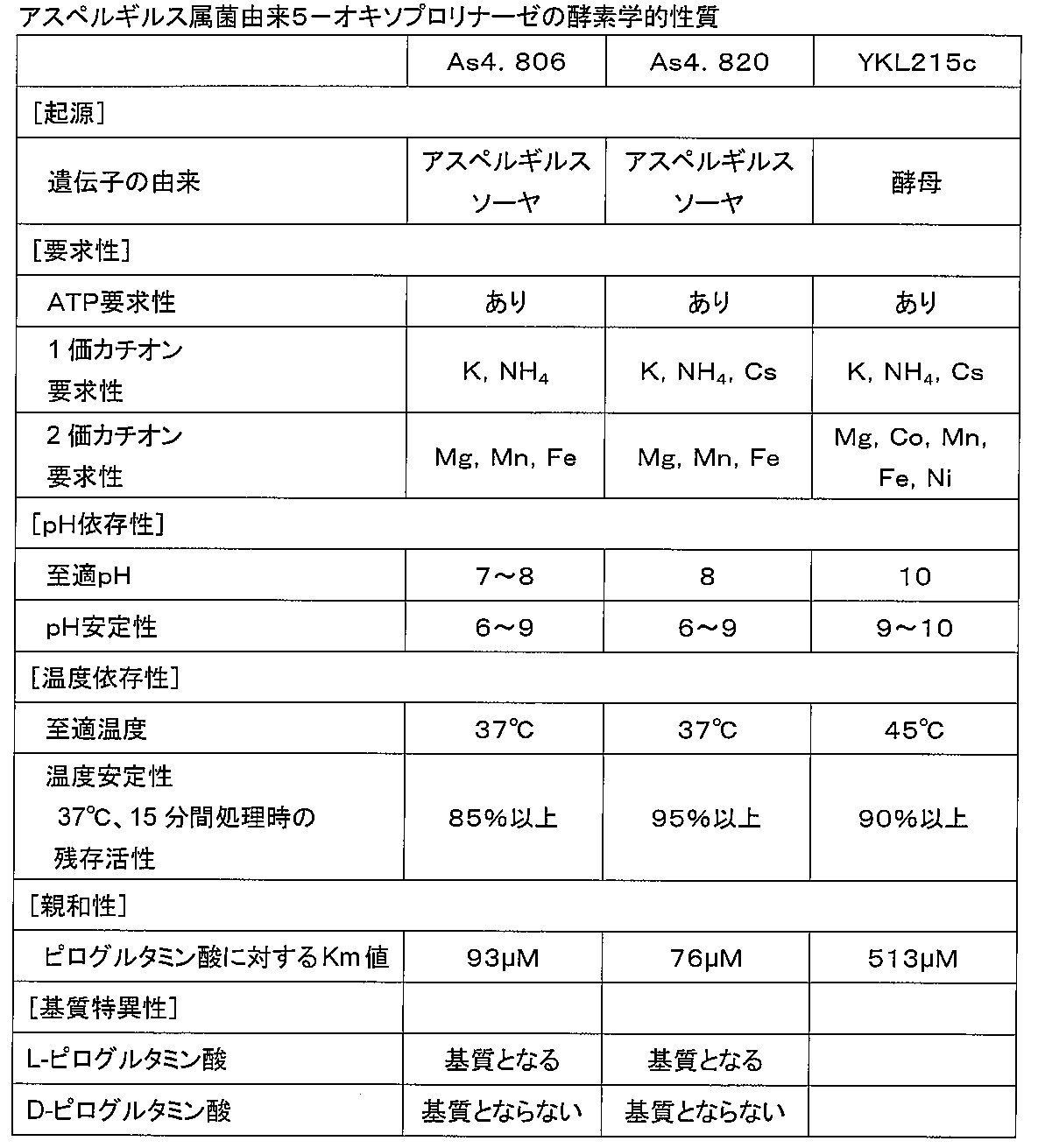
(1)ATP要求性
上述の実施例1のC.の2.において、As4.806およびAs4.820は、ATP、1価カチオンであるカリウムイオン、および2価カチオンであるマグネシウムイオンの存在下で、5-オキソプロリナーゼ活性を持つことがわかった。そこで、ATPがL-ピログルタミン酸からL-グルタミン酸への反応を触媒するために必要な補助因子であるのかどうかを調べた。
上述の実施例1のC.の2.において、As4.806およびAs4.820は、ATP、1価カチオンであるカリウムイオン、および2価カチオンであるマグネシウムイオンの存在下で、5-オキソプロリナーゼ活性を持つことがわかった。そこで、ATPがL-ピログルタミン酸からL-グルタミン酸への反応を触媒するために必要な補助因子であるのかどうかを調べた。
具体的には、実施例1のC.の2.記載の方法に準じて、基質溶液〔50mM Tris、0.625mM L-ピログルタミン酸、6.25mM ATP、12.5mM MgCl2、187.5mM KCl、pH8.0〕に加えて、ATPを含まない基質溶液〔50mM Tris、0.625mM L-ピログルタミン酸、12.5mM MgCl2、187.5mM KCl、pH8.0〕を用い、前記のアスペルギルス・ソーヤ由来5-オキソプロリナーゼ(As4.806およびAs4.820)溶液との反応を行った。該反応液中のL-グルタミン酸の濃度を測定し、得られたL-グルタミン酸濃度から実施例1のC.の2.記載の式に基づいて、5-オキソプロリナーゼの活性を計算した。酵素活性の単位は、本試験の条件下で1分間に1μmolのL-グルタミン酸を生成する酵素量を1単位(U)と定義した。
各アスペルギルス・ソーヤ由来5-オキソプロリナーゼについて、ATPの存在、あるいは非存在下でL-ピログルタミン酸との反応を行い、上記活性測定法に基づいて算出した5-オキソプロリナーゼの活性を表3に示す。その結果、ATP存在下では5-オキソプロリナーゼ活性が検出されたが、ATP非存在下では、As4.806およびAs4.820のどちらも、5-オキソプロリナーゼ活性は検出されなかった。
このことから、本発明の5-オキソプロリナーゼAs4.806およびAs4.820はATP要求性の5-オキソプロリナーゼであることがわかった。
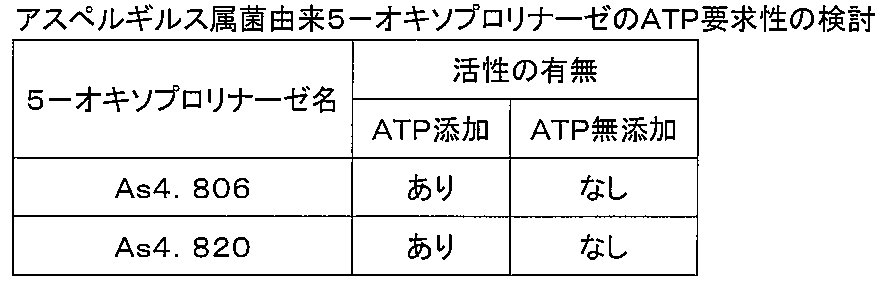
(2)1価カチオン、2価カチオン要求性
上述の実施例1のC.の2.において、本発明の5-オキソプロリナーゼであるAs4.806およびAs4.820は、ATP、1価カチオンであるカリウムイオン、および2価カチオンであるマグネシウムイオンの存在下で、5-オキソプロリナーゼ活性を持つことがわかった。そこで、1価カチオン、および2価カチオンがL-ピログルタミン酸からL-グルタミン酸への反応を触媒するために必要な補助因子であるのかどうかを調べた。
上述の実施例1のC.の2.において、本発明の5-オキソプロリナーゼであるAs4.806およびAs4.820は、ATP、1価カチオンであるカリウムイオン、および2価カチオンであるマグネシウムイオンの存在下で、5-オキソプロリナーゼ活性を持つことがわかった。そこで、1価カチオン、および2価カチオンがL-ピログルタミン酸からL-グルタミン酸への反応を触媒するために必要な補助因子であるのかどうかを調べた。
具体的には、まず、基質溶液〔50mM Tris、0.625mM L-ピログルタミン酸、6.25mM ATP、12.5mM MgCl2、187.5mM KCl、pH8.0〕、カリウムイオンを含まない基質溶液〔50mM Tris、0.625mM L-ピログルタミン酸、6.25mM ATP、12.5mM MgCl2、pH8.0〕、およびマグネシウムイオンを含まない基質溶液〔50mM Tris、0.625mM L-ピログルタミン酸、6.25mM ATP、187.5mM KCl、pH8.0〕を調製した。次に、50mM Tris-HCl緩衝液(pH8.0)で200μg/mLに希釈した前記のアスペルギルス・ソーヤ由来5-オキソプロリナーゼ(As4.806およびAs4.820)溶液を調製した。前記3種類の基質溶液0.08mLと、前記2種類の酵素溶液0.02mLとを、それぞれを混合し、37℃で1時間の酵素反応を行った。実施例1のC.の2.記載の方法に準じ、該酵素反応後の溶液中のL-グルタミン酸濃度を測定し、5-オキソプロリナーゼの活性を計算した。
各アスペルギルス・ソーヤ由来5-オキソプロリナーゼについて、ATPの存在、あるいは非存在下でL-ピログルタミン酸との反応を行い、上記活性測定法に基づいて算出した5-オキソプロリナーゼの活性を表4に示した。その結果、カリウムイオンとマグネシウムイオンの両者の存在下では5-オキソプロリナーゼ活性が検出されたが、カリウムイオン非存在下、あるいはマグネシウムイオン非存在下では、As4.806およびAs4.820のどちらも、5-オキソプロリナーゼ活性は検出されなかった。
このことから、本発明の5-オキソプロリナーゼAs4.806およびAs4.820は、1価カチオン要求性、かつ2価カチオン要求性の5-オキソプロリナーゼであることがわかった。

次いで、As4.806およびAs4.820によるL-ピログルタミン酸からL-グルタミン酸への反応を触媒することのできる、1価カチオン、および2価カチオンの種類を調べた。
1価カチオンの種類の検討では、1価カチオンを含まない基質溶液〔50mM Tris、0.625mM L-ピログルタミン酸、6.25mM ATP、12.5mM MgSO4、pH8.0〕、KClを含む基質溶液〔50mM Tris、0.625mM L-ピログルタミン酸、6.25mM ATP、12.5mM MgSO4、187.5mM KCl、pH8.0〕、NH4Clを含む基質溶液〔50mM Tris、0.625mM L-ピログルタミン酸、6.25mM ATP、12.5mM MgSO4、187.5mM NH4Cl、pH8.0〕、CsClを含む基質溶液〔50mM Tris、0.625mM L-ピログルタミン酸、6.25mM ATP、12.5mM MgSO4、187.5mM CsCl、pH8.0〕、LiClを含む基質溶液〔50mM Tris、0.625mM L-ピログルタミン酸、6.25mM ATP、12.5mM MgSO4、187.5mM LiCl、pH8.0〕、NaClを含む基質溶液〔50mM Tris、0.625mM L-ピログルタミン酸、6.25mM ATP、12.5mM MgSO4、187.5mM NaCl、pH8.0〕をそれぞれ調製した。50mM Tris-HCl緩衝液(pH8.0)で300μg/mLに希釈した前記のアスペルギルス・ソーヤ由来5-オキソプロリナーゼ(As4.806およびAs4.820)溶液を調製し、それぞれ0.02mLと、前記6種類の基質溶液0.08mLとを混合し、37℃で1時間の酵素反応を行った。参照として、50mM Tris(pH8.0)緩衝液で300μg/mLに希釈した前記の酵母由来5-オキソプロリナーゼYKL215c溶液0.02mLと、前記6種類の基質溶液0.08mLとを混合し、37℃で1時間の酵素反応を行った。実施例1のC.の2.記載の方法に準じ、該酵素反応後の溶液中のL-グルタミン酸濃度を測定し、酵素の活性の有無を調べた。
その結果、図7で示す通り、添加することによって、As4.806(図中白地に黒の斜線のバー)およびAs4.820(図中黒のバー)の5-オキソプロリナーゼ活性が検出される1価カチオンが複数確認された。カリウムイオンの他にも、アンモニウムイオン、セシウムイオンなどを添加した場合に、活性が検出された。特に、アンモニウムイオンを添加することにより比較的高い活性が検出された。参照酵素であるYKL215c(図中白のバー)では、アンモニウムイオンおよびセシウムイオンを添加した場合に、活性が検出された。各カチオンの濃度検討を行うことにより、5-オキソプロリナーゼによるL-ピログルタミン酸からL-グルタミン酸への反応を触媒することができる1価カチオンを、カリウムイオン以外にも選択できると考えられる。
2価カチオンの種類の検討では、2価カチオンを含まない基質溶液〔50mM Tris、0.625mM L-ピログルタミン酸、6.25mM ATP、187.5mM KCl、pH8.0〕、MgSO4を含む基質溶液〔50mM Tris、0.625mM L-ピログルタミン酸、6.25mM ATP、187.5mM KCl、12.5mM MgSO4、pH8.0〕、CoSO4を含む基質溶液〔50mM Tris、0.625mM L-ピログルタミン酸、6.25mM ATP、187.5mM KCl、12.5mM CoSO4、pH8.0〕、MnSO4を含む基質溶液〔50mM Tris、0.625mM L-ピログルタミン酸、6.25mM ATP、187.5mM KCl、12.5mM MnSO4、pH8.0〕、Ca(CH3COOH)2を含む基質溶液〔50mM Tris、0.625mM L-ピログルタミン酸、6.25mM ATP、187.5mM KCl、12.5mM Ca(CH3COOH)2、pH8.0〕、FeSO4を含む基質溶液〔50mM Tris、0.625mM L-ピログルタミン酸、6.25mM ATP、187.5mM KCl、12.5mM FeSO4、pH8.0〕、NiSO4を含む基質溶液〔50mM Tris、0.625mM L-ピログルタミン酸、6.25mM ATP、187.5mM KCl、12.5mM NiSO4、pH8.0〕、CuSO4を含む基質溶液〔50mM Tris、0.625mM L-ピログルタミン酸、6.25mM ATP、187.5mM KCl、12.5mM CuSO4、pH8.0〕、ZnSO4を含む基質溶液〔50mM Tris、0.625mM L-ピログルタミン酸、6.25mM ATP、187.5mM KCl、12.5mM ZnSO4、pH8.0〕をそれぞれ調製した。50mM Tris-HCl緩衝液(pH8.0)で300μg/mLに希釈した前記のアスペルギルス・ソーヤ由来5-オキソプロリナーゼ(As4.806およびAs4.820)溶液を調製し、それぞれ0.02mLと、前記9種類の基質溶液0.08mLとを混合し、37℃で1時間の酵素反応を行った。
参照として、50mM Tris-HCl緩衝液(pH8.0)で300μg/mLに希釈した前記の酵母由来5-オキソプロリナーゼYKL215c溶液0.02mLと、前記9種類の基質溶液0.08mLとを混合し、37℃で1時間の酵素反応を行った。前記の反応液を100℃、3分間加熱して酵素反応を停止後、該反応液に1M HClを5μL加えて混合し、Amicon Ultra-0.5mL 10K (Millipore社製)用いた、限外濾過により、除タンパク質画分を調製した。該除タンパク質画分を、イオン交換クロマトグラフィーに供し、分離後のアミノ酸をニンヒドリンによるポストラベル法で検出した。L-グルタミン酸標品による検量線を用いて、前記の酵素反応後の溶液中のL-グルタミン酸濃度を算出し、酵素の活性の有無を調べた。
その結果、図8で示す通り、添加することによって、As4.806(図中白地に黒の斜線のバー)およびAs4.820(図中黒のバー)の5-オキソプロリナーゼ活性が検出される2価カチオンが複数確認された。マグネシウムイオンの他にも、マンガンイオン、または鉄イオンなどを添加した場合に、比較的高い活性が検出された。参照酵素であるYKL215c(図中白のバー)では、コバルトイオン、マンガンイオン、鉄イオンまたはニッケルイオンを添加した場合に、活性が検出された。各カチオンの濃度検討を行うことにより、5-オキソプロリナーゼによるL-ピログルタミン酸からL-グルタミン酸への反応を触媒することができる2価カチオンを、マグネシウムイオン以外にも選択できると考えられる。
(3)至適pH
本発明の5-オキソプロリナーゼであるAs4.806およびAs4.820における至適pHを調べた。結果を図1に示す。
本発明の5-オキソプロリナーゼであるAs4.806およびAs4.820における至適pHを調べた。結果を図1に示す。
具体的には、55.6mM Tris-HCl緩衝液(pH8.0、9.0、図中黒丸印でプロット)、55.6mM クエン酸-NaOH緩衝液バッファー(pH4.0、pH5.0、pH6.0、図中黒四角印でプロット)、55.6mM リン酸-NaOH緩衝液(pH6.0、pH7.0、pH8.0、図中白抜き三角印でプロット)、55.6mM HEPES-NaOH緩衝液(pH7.0、pH8.0、図中×印でプロット)、55.6mM グリシン-NaOH緩衝液(pH9.0、H9.5、pH10.0、pH10.5、図中白抜き斜め四角印でプロット)、55.6mM CHES-NaOH緩衝液(pH9.0、pH10.0、図中白抜き四角印でプロット)、55.6mM CAPS-NaOH緩衝液(pH10.0、pH11.0、図中米印でプロット)でpH調整した基質溶液(0.556mM L-ピログルタミン酸、5.56mM ATP、11.1mM MgCl2、166.7mM KClを含む)0.09mLと、50mM Tris-HCl緩衝液(pH8.0)で400μg/mLに希釈した前記の5-オキソプロリナーゼオルソログ候補タンパク質(As4.806、As4.820)溶液0.01mLを混合し、37℃で1時間の酵素反応を行った。
参照として、前記のpHの異なる緩衝液で調製した基質溶液0.09mLと、50mM Tris-HCl緩衝液(pH8.0)緩衝液で600μg/mLに希釈した前記の酵母由来5-オキソプロリナーゼYKL215c溶液0.01mLを混合し、37℃で1時間の酵素反応を行った。実施例1のC.の2.記載の方法に準じ、酵素反応後の溶液中のL-グルタミン酸濃度を測定し、最もL-グルタミン酸濃度が高いpHにおける測定値を100とし、相対活性を比較した。
その結果、上記の本発明のアスペルギルス・ソーヤ由来の5-オキソプロリナーゼAs4.806およびAs4.820は、pH7.0もしくはpH8.0において最も高い活性を示し、pH7.0-8.0に至適pHを有していた。個別にみると、As4.806の相対活性が最も高かったのはpH7.0においてであり、その周辺域として、pH7.0-9.0の範囲で最大相対活性値の70%以上を示したことから、この範囲で好適に使用できると考えられた。
また、As4.820の相対活性が最も高かったのはpH8.0においてであり、その周辺域として、pH7.0-9.0の範囲で最大相対活性値の70%以上を示したことから、この範囲で好適に使用できると考えられた。
一方、公知の酵母由来5-オキソプロリナーゼYKL215cの相対活性が最も高かったのはpH10.0においてであり、pH9.5以下、およびpH10.5以上では、最大相対活性値の70%以下の活性となった。さらに、アスペルギルス・ソーヤ由来の5-オキソプロリナーゼAs4.806およびAs4.820が好適に使用できるpH7.0-8.0の範囲では、最大相対活性値の40%以下の活性しか示さなかった。以上より、本発明のアスペルギルス・ソーヤ由来5-オキソプロリナーゼは、公知の酵素と比較して、中性領域での実用に適していると考えられた。
(4)pH安定性
本発明の5-オキソプロリナーゼであるAs4.806およびAs4.820について、pH4.0~11.0の範囲におけるpH安定性を調べた。結果を図2に示す。
本発明の5-オキソプロリナーゼであるAs4.806およびAs4.820について、pH4.0~11.0の範囲におけるpH安定性を調べた。結果を図2に示す。
具体的には、100mM Tris-HCl緩衝液(pH8.0、9.0、図中黒丸印でプロット)、100mM クエン酸-NaOH緩衝液バッファー(pH4.0、pH5.0、pH6.0、図中黒四角印でプロット)、100mM リン酸-NaOH緩衝液(pH6.0、pH7.0、pH8.0、図中白抜き三角印でプロット)、100mM HEPES-NaOH緩衝液(pH7.0、pH8.0、図中×印でプロット)、100mM グリシン-NaOH緩衝液(pH9.0、H9.5、pH10.0、pH10.5、図中白抜き斜め四角印でプロット)、100mM CHES-NaOH緩衝液(pH9.0、pH10.0、図中白抜き四角印でプロット)、100mM CAPS-NaOH緩衝液(pH10.0、pH11.0、図中米印でプロット)0.015mLと、50mM Tris-HCl緩衝液(pH8.0)で600μg/mLに希釈した前記のアスペルギルス・ソーヤ由来5-オキソプロリナーゼ(As4.806およびAs4.820)溶液0.015mLを、それぞれを混合し、4℃で16時間保存した。該As4.806およびAs4.820を4℃で保存した溶液0.01mLと基質溶液〔50mM Tris、0.556mM L-ピログルタミン酸、5.56mM ATP、11.1mM MgCl2、166.7mM KCl、pH8.0〕0.09mLを混合し、37℃で1時間の酵素反応を行った。
参照として、前記のpHの異なる各種100mMの緩衝液0.015mLと、50mM Tris-HCl緩衝液(pH8.0)で200μg/mLに希釈した前記の酵母由来5-オキソプロリナーゼYKL215c溶液0.015mLを、それぞれを混合し、4℃で16時間保存した。該YKL215cを4℃で保存した溶液0.01mLと基質溶液〔50mM CHES、0.556mM L-ピログルタミン酸、5.56mM ATP、11.1mM MgCl2、166.7mM KCl、pH10.0〕0.09mLを混合し、37℃で1時間の酵素反応を行った。前記の酵素反応させた溶液は、100℃、3分間加熱して酵素反応を停止後、遠心した(15,000×g、10分間)上清をL-グルタミン酸の測定用の検体として得た。該L-グルタミン酸測定用の検体は、実施例1のC.の2.記載の方法に準じ、酵素反応後の溶液中のL-グルタミン酸濃度を測定し、最もL-グルタミン酸濃度が高いpHにおける測定値を100とし、相対活性を比較した。
その結果、上記の本発明のアスペルギルス・ソーヤ由来5-オキソプロリナーゼAs4.806およびAs4.820は、4℃、16時間処理後に、pH6.0~9.0の範囲で最大相対活性値の70%以上の残存活性を示したことから、アスペルギルス・ソーヤ由来5-オキソプロリナーゼの安定pH範囲は、pH6.0~9.0であると考えらえた。また、pH5.0以下およびpH11.0以上で保存した場合には、ほぼ完全に失活することがわかった。
なお、参照酵素である酵母由来5-オキソプロリナーゼYKL215cは、pH9.0~10.0の範囲で最大相対活性値の70%以上の残存活性を示したことから、酵母由来5-オキソプロリナーゼの安定pH範囲は、pH9.0~10.0であると考えられた。
以上より、本発明のアスペルギルス・ソーヤ由来5-オキソプロリナーゼの安定pH範囲は、弱酸性領域から弱アルカリ性に渡っており、公知の酵素YKL215cよりも中性~酸性域を含む広範のpH範囲での安定性が高いことがわかった。
(5)至適温度
至適温度の決定では、実施例1のC.の2.に記載の5-オキソプロリナーゼ活性検出反応液を、4、15、25、37、45、55、65℃で1時間インキュベートし、実施例1のC.の2.に記載の方法に準じ、L-グルタミン酸濃度を測定した。最もL-グルタミン酸濃度が高い温度における測定値を100とし、相対活性を比較した。
至適温度の決定では、実施例1のC.の2.に記載の5-オキソプロリナーゼ活性検出反応液を、4、15、25、37、45、55、65℃で1時間インキュベートし、実施例1のC.の2.に記載の方法に準じ、L-グルタミン酸濃度を測定した。最もL-グルタミン酸濃度が高い温度における測定値を100とし、相対活性を比較した。
図9に示すとおり、本発明のアスペルギルス・ソーヤ由来の5-オキソプロリナーゼAs4.806(図中白抜き三角印でプロット)およびAs4.820(図中白抜き四角印でプロット)では、37℃付近で最大相対活性を示し、25℃以下および45℃以上では最大相対活性の80%以下を示したことから、As4.806およびAs4.820の至適温度は37℃付近であると考えられた。
なお、酵母由来5-オキソプロリナーゼYKL215c(図中×印でプロット)では、45℃付近で最大相対活性を、37℃付近で最大相対活性の90%の活性を示した。25℃以下および55℃以上では最大相対活性の80%以下を示した。よって、YKL215cの至適温度は45℃付近であると考えられた。
(6)温度安定性
温度安定性の検討では、50mM Tris-HCl緩衝液(pH8.0)で希釈した本発明の5-オキソプロリナーゼ(As4.806またはAs4.820)溶液0.03mLを、4、37、45、50、55、60、65、70℃で15分間インキュベートした後、基質溶液〔50mM Tris、0.714mM L-ピログルタミン酸、7.14mM ATP、14.2mM MgCl2、214.3mM KCl、pH8.0〕0.07mLと混合し、37℃で1時間の酵素反応を行った。実施例1のC.の2.記載の方法に準じ、酵素反応後の溶液中のL-グルタミン酸濃度を測定し、熱処理せずに4℃で保存した酵素の反応液における測定値を100とし、相対活性を比較した。
温度安定性の検討では、50mM Tris-HCl緩衝液(pH8.0)で希釈した本発明の5-オキソプロリナーゼ(As4.806またはAs4.820)溶液0.03mLを、4、37、45、50、55、60、65、70℃で15分間インキュベートした後、基質溶液〔50mM Tris、0.714mM L-ピログルタミン酸、7.14mM ATP、14.2mM MgCl2、214.3mM KCl、pH8.0〕0.07mLと混合し、37℃で1時間の酵素反応を行った。実施例1のC.の2.記載の方法に準じ、酵素反応後の溶液中のL-グルタミン酸濃度を測定し、熱処理せずに4℃で保存した酵素の反応液における測定値を100とし、相対活性を比較した。
図10に示す通り、上記の本発明のアスペルギルス・ソーヤ由来の5-オキソプロリナーゼAs4.806(図中白抜き三角印でプロット)は、37℃、15分間の熱処理後に80%以上の残存活性を有しており、約37℃まで安定であることがわかった。
本発明のアスペルギルス・ソーヤ由来の5-オキソプロリナーゼAs4.820(図中白抜き四角印でプロット)では、45℃の熱処理後に80%以上の残存活性を有しており、約45℃まで安定であることがわかった。また、酵母由来5-オキソプロリナーゼYKL215c(図中×印でプロット)では、45℃の熱処理後に80%以上の残存活性を有しており、約45℃まで安定であることがわかった。
以上より、As4.806およびAs4.820において、反応至適温度である37℃においては活性の低下は検出されず、安定的に酵素反応を行うことができることがわかった。
(7)L-ピログルタミン酸に対するKm値
基質であるL-ピログルタミン酸に対する本酵素の親和性を調べるために、前記、実施例1のC.の2.記載の活性測定法において、基質であるL-ピログルタミン酸濃度を変化させて活性測定を行い、Hanes-Woolf Plotを用いて、ミカエリス定数(Km)を算定した。
基質であるL-ピログルタミン酸に対する本酵素の親和性を調べるために、前記、実施例1のC.の2.記載の活性測定法において、基質であるL-ピログルタミン酸濃度を変化させて活性測定を行い、Hanes-Woolf Plotを用いて、ミカエリス定数(Km)を算定した。
その結果、本発明の5-オキソプロリナーゼAs4.806のL-ピログルタミン酸に対するKm値は93μM、As4.820のL-ピログルタミン酸に対するKm値は76μMであった。
これに対し、酵母由来5-オキソプロリナーゼYKL215cのL-ピログルタミン酸に対するKm値は513μMであった。
すなわち、本発明の5-オキソプロリナーゼは、公知の酵母5-オキソプロリナーゼよりもKm値が数~6倍低く、親和性の高い酵素であることを示しており、より効率的に基質との反応を進行させることができることが期待される。
(8)基質特異性
本発明の5-オキソプロリナーゼであるAs4.806およびAs4.820がL-ピログルタミン酸に特異的に反応して加水分解するのに対し、D-ピログルタミン酸を基質とはしないことを確認した。基質特異性の決定では、グルタミン酸の生成とピログルタミン酸の減少により、5-オキソプロリナーゼ活性の有無を決定した。
本発明の5-オキソプロリナーゼであるAs4.806およびAs4.820がL-ピログルタミン酸に特異的に反応して加水分解するのに対し、D-ピログルタミン酸を基質とはしないことを確認した。基質特異性の決定では、グルタミン酸の生成とピログルタミン酸の減少により、5-オキソプロリナーゼ活性の有無を決定した。
具体的には、実施例1のC.の2.記載の方法に準じて、基質溶液〔50mM Tris、2.5mM L-ピログルタミン酸、6.25mM ATP、12.5mM MgCl2、187.5mM KCl、pH8.0〕、およびL-ピログルタミン酸をD-ピログルタミン酸に変えた基質溶液〔50mM Tris、2.5mM D-ピログルタミン酸(MP Biomedicals社製、製造番号156461)、6.25mM ATP、12.5mM MgCl2、187.5mM KCl、pH8.0〕を調製した。次に、実施例5の2.記載の方法に準じて取得した小麦ふすまで生産したアスペルギルス・ソーヤ由来5-オキソプロリナーゼAs4.806-solid溶液(後述、50mM Tris-HCl緩衝液(pH8.0)を用いて7.68unit/1200μg/mLに希釈)、および実施例3の2.記載の方法に準じて取得した酵母発現アスペルギルス・ソーヤ由来5-オキソプロリナーゼSC-As4.820溶液(後述、50mM Tris-HCl緩衝液(pH8.0)を用いて12.75unit/1500μg/mLに希釈)を調製した。前記2種類の基質溶液0.28mLと、前記2種類の酵素溶液0.07mLとをそれぞれを混合し、37℃で4時間の酵素反応を行った。
また、参照として、前記2種類の基質溶液0.28mLと酵素を含まない10mM Tris-HCl緩衝液(pH8.0)0.07mLとをそれぞれを混合し、37℃で4時間の酵素反応を行った。
反応後、該反応液0.04mLに0.022M HClを360μL加えて混合し、Amicon Ultra-0.5mL 10K (Millipore社製)を用いた限外濾過により、除タンパク質画分を調製した。該除タンパク質画分をイオン交換クロマトグラフィーに供し、分離後のアミノ酸をニンヒドリンによるポストラベル法で検出した。グルタミン酸標品による検量線を用いて、前記の酵素反応後の溶液中のグルタミン酸濃度を算出し、酵素の活性の有無を調べた。
続いて、該反応液をAmicon Ultra-0.5mL 10K (Millipore社製)用いた限外濾過により、除タンパク質画分を調製した。該除タンパク質画分をイオン交換クロマトグラフィーに供し、分離後の有機酸をブロモチモールブルーによるポストラベル法で検出した。ピログルタミン酸標品による検量線を用いて、前記の酵素反応後の溶液中のピログルタミン酸濃度を算出し、ピログルタミン酸濃度の減少の有無を調べた。結果を図11に示す。
図11で示すように、L-ピログルタミン酸とAs4.806-solidを反応させたとき、あるいはL-ピログルタミン酸とSC-As4.820を反応させたときに反応液中のグルタミン酸濃度が上昇し(図中上段、黒のバー)、ピログルタミン酸濃度が減少した(図中下段、黒のバー)。一方で、D-ピログルタミン酸とそれぞれの5-オキソプロリナーゼを反応させたときにはグルタミン酸濃度はほとんど変化せず(図中上段、白地に黒の斜線のバー)、ピログルタミン酸の減少も見られなかった(図中下段、白地に黒の斜線のバー)。
これにより、5-オキソプロリナーゼAs4.806、及びAs4.820はL-ピログルタミン酸を基質とし、D-ピログルタミン酸を基質としないことが示された。
上述のように本発明の5-オキソプロリナーゼは、至適pHが公知の5-オキソプロリナーゼと異なることから、異なる用途、使用場面を提供し、特に、アルカリ性に偏った至適pHやpH安定性を有する公知酵素では効果を上げにくかった弱酸性~中性~弱アルカリ性条件下の使用において特に優れている。例えば、そのようなpH条件下での使用の例としては、各種食品加工の実際の使用工程中等を想定することができ、それ以外にも、公知酵素では好適に使用できなかった新たな使用場面を提供することが期待される。
また、本発明の5-オキソプロリナーゼは、試薬あるいは食品加工等の用途に利用する場合に、試験環境のpHが変化したときの影響を受けにくく、その取扱いが容易で利用しやすいと考えられることから、公知の5-オキソプロリナーゼよりも優れているといえる。このような特性により汎用性が広がることから、公知の5-オキソプロリナーゼでは使用しにくかった用途・使用工程に対しでも好適に使用することができ、5-オキソプロリナーゼの実用化のバリエーション化に貢献するものであるといえる。
さらに、本発明の5-オキソプロリナーゼは、L-ピログルタミン酸に対するKm値は小さく、より効率的に反応を触媒でき、反応時間の短縮や酵素の使用量低減も期待できる利点を有する。
(アスペルギルス属菌由来5-オキソプロリナーゼの酵母による生産)
実施例1のC.の2.で取得した本発明のアスペルギルス・ソーヤ由来5-オキソプロリナーゼAs4.806およびAs4.820を、異種宿主である酵母を宿主としても生産できることを確認すること、さらに、上述の実施例においては活性を確認できなかったアスペルギルス・ソーヤ由来5-オキソプロリナーゼオルソログ候補As36.1302について、酵母を宿主とすることにより活性を持ったタンパク質を取得することについて、確認を行った。
実施例1のC.の2.で取得した本発明のアスペルギルス・ソーヤ由来5-オキソプロリナーゼAs4.806およびAs4.820を、異種宿主である酵母を宿主としても生産できることを確認すること、さらに、上述の実施例においては活性を確認できなかったアスペルギルス・ソーヤ由来5-オキソプロリナーゼオルソログ候補As36.1302について、酵母を宿主とすることにより活性を持ったタンパク質を取得することについて、確認を行った。
1.アスペルギルス・ソーヤ由来5-オキソプロリナーゼ遺伝子および5-オキソプロリナーゼオルソログ候補遺伝子の酵母発現用プラスミドの作製と酵母形質転換体の取得
実施例1のA.の5.で取得した5-オキソプロリナーゼオルソログ遺伝子(scaffold00004.806、scaffold00004.820)、および5-オキソプロリナーゼオルソログ候補遺伝子(scaffold00036.1302)のイントロン予測配列を除いた配列を導入したプラスミドpAsAlpP-4.806 CDS、pAsAlpP-4.820 CDS、pAsAlpP-36.1302 CDSから、PCRにより増幅した各遺伝子のDNA断片をpYES2/CT(Invitrogen社製)に導入することにより、酵母発現用プラスミドを得た。
実施例1のA.の5.で取得した5-オキソプロリナーゼオルソログ遺伝子(scaffold00004.806、scaffold00004.820)、および5-オキソプロリナーゼオルソログ候補遺伝子(scaffold00036.1302)のイントロン予測配列を除いた配列を導入したプラスミドpAsAlpP-4.806 CDS、pAsAlpP-4.820 CDS、pAsAlpP-36.1302 CDSから、PCRにより増幅した各遺伝子のDNA断片をpYES2/CT(Invitrogen社製)に導入することにより、酵母発現用プラスミドを得た。
具体的には、pAsAlpP-4.806 CDSを鋳型とし、配列番号49および50に示したプライマーを用いて、5’側に制限酵素EcoRIの認識配列およびヒスチジン8個の配列をコードする24塩基の配列、3’側に制限酵素NotIの認識配列を付加したscaffold00004.806のCDSのDNA断片をPCRにより増幅した。pAsAlpP-4.820 CDSを鋳型とし、配列番号51および52に示したプライマーを用いて、5’側に制限酵素KpnIの認識配列およびヒスチジン8個の配列をコードする24塩基の配列、3’側に制限酵素NotIの認識配列を付加したscaffold00004.820のCDSのDNA断片をPCRにより増幅した。pAsAlpP-36.1302 CDSを鋳型とし、配列番号53および54に示したプライマーを用いて、5’側に制限酵素EcoRIの認識配列およびヒスチジン8個の配列をコードする24塩基の配列、3’側に制限酵素NotIの認識配列を付加したscaffold00036.1302のCDSのDNA断片をPCRにより増幅した。
反応試薬としてPrime Star Max(タカラバイオ社製)、装置としてMastercycler gradient(eppendorf社製)を用い、反応試薬キットに添付されたプロトコールに従って伸長反応を行った。
前記のPCRにより増幅した3種類のDNA断片を、1%アガロースゲル中で分離し、QIAquick Gel Extraction Kit(QIAGEN社製)を用いて精製し、制限酵素EcoRI(NEB社製)、KpnI-HF(BioLabs社製)、およびNotI(タカラバイオ社製)で切断後、1%アガロースゲル中で分離し、QIA quick Gel Extraction Kitを用いて、再度精製した。精製された前記DNA断片を、ligation high ver2(TOYOBO社製)を用いて、pYES2/CT(Invitrogen社製)のEcoRI-NotIサイト、KpnI-NotIサイトに連結し、pYES2/CTのマルチクローニングサイトに5’側にヒスチジン8個の配列をコードする24塩基の配列を付加した5-オキソプロリナーゼオルソログ遺伝子および5-オキソプロリナーゼオルソログ候補遺伝子(scaffold00004.806、scaffold00004.820、あるいはscaffold00036.1302)のCDSを組み込んだ、3種類の酵母形質転換体作製用の組換えプラスミドを得た。
該組換えプラスミドを用いて大腸菌JM109株を定法により形質転換後、該形質転換体から前記組換えプラスミドをそれぞれ抽出し、該プラスミド中に挿入されたDNA配列の解析を行った。解析の結果、5’側にヒスチジン8個の配列をコードする24塩基の配列を付加した5-オキソプロリナーゼオルソログ候補遺伝子のCDSの配列が、アスペルギルス・ソーヤNBRC4239株のゲノムDNA上の配列と一致することを確認した。上記操作を経た3種の遺伝子をそれぞれ含むプラスミドを、由来する遺伝子配列の名称であるscaffold00004.806、scaffold00004.820、およびscaffold00036.1302に対応させて、pYES2-His-4.806、pYES2-His-4.820、およびpYES2-His-36.1302と名付けた。
前記3種類のプラスミドpYES2-His-4.806 CDS、pYES2-His-4.820 CDS、およびpYES2-His-36.1302 CDSを用いて、S.c.EasyComp(商標)Transformation kit(Invitrogen社製)を用い、添付のマニュアルに従って、サッカロマイセス・セレビシエ INVsc1株を形質転換し、pYES2/CTにコードされたウラシル合成遺伝子であるURA3の発現により、ウラシル無添加培地に生育できるようになることで、ウラシル非要求性となることを指標に、アスペルギルス・ソーヤ由来5-オキソプロリナーゼ遺伝子および5-オキソプロリナーゼオルソログ候補遺伝子による酵母形質転換体を選抜した。3種類のアスペルギルス・ソーヤ由来5-オキソプロリナーゼ遺伝子および5-オキソプロリナーゼオルソログ候補遺伝子による酵母形質転換体は、由来する遺伝子の名称であるscaffold00004.806、scaffold00004.820、およびscaffold00036.1302に対応させて、それぞれINVsc1-His-4.806 CDS株、INVsc1-His-4.820 CDS株、およびINVsc1-His-36.1302 CDS株と名付けた。
2.酵母発現アスペルギルス・ソーヤ由来5-オキソプロリナーゼおよびオルソログ候補タンパク質の取得
上記のようにして取得したアスペルギルス・ソーヤ由来5-オキソプロリナーゼ遺伝子および5-オキソプロリナーゼオルソログ候補遺伝子による酵母形質転換体INVsc1-His-4.806 CDS株、INVsc1-His-4.820 CDS株、およびINVsc1-His-36.1302 CDS株に導入されたプラスミド中の、5-オキソプロリナーゼ遺伝子および5-オキソプロリナーゼオルソログ候補遺伝子の上流には、ヒスチジン8個の配列をコードする24塩基の配列が付加されており、酵母形質転換体をガラクトースの存在下で培養することにより、N末側にヒスチジン8個のタグが融合された5-オキソプロリナーゼおよび5-オキソプロリナーゼオルソログ候補タンパク質を発現誘導することができ、定法によりNiカラムを用いて精製することができる。すなわち、前記のINVsc1-His-4.806 CDS株、INVsc1-His-4.820 CDS株、およびINVsc1-His-36.1302 CDS株を、前培養用液体培地(0.67%(w/v) アミノ酸不含有イーストニトロゲンベース (ベクトン・ディッキンソン社製)、0.192%(w/v) ウラシル不含有酵母合成ドロップアウト培地用添加物 (sigma社製)、2.0%(w/v) ラフィノース)中、30℃で24時間、振盪培養した。その後、本培養用液体培地(0.67%(w/v)アミノ酸不含有イーストニトロゲンベース、0.192%(w/v)ウラシル不含有酵母合成ドロップアウト培地用添加物、2.5%(w/v)D-ガラクトース、0.75%(w/v)ラフィノース)で10倍に希釈し、30℃で12~18時間培養し、1,500×g、1~5分間の遠心により菌体を回収した。
上記のようにして取得したアスペルギルス・ソーヤ由来5-オキソプロリナーゼ遺伝子および5-オキソプロリナーゼオルソログ候補遺伝子による酵母形質転換体INVsc1-His-4.806 CDS株、INVsc1-His-4.820 CDS株、およびINVsc1-His-36.1302 CDS株に導入されたプラスミド中の、5-オキソプロリナーゼ遺伝子および5-オキソプロリナーゼオルソログ候補遺伝子の上流には、ヒスチジン8個の配列をコードする24塩基の配列が付加されており、酵母形質転換体をガラクトースの存在下で培養することにより、N末側にヒスチジン8個のタグが融合された5-オキソプロリナーゼおよび5-オキソプロリナーゼオルソログ候補タンパク質を発現誘導することができ、定法によりNiカラムを用いて精製することができる。すなわち、前記のINVsc1-His-4.806 CDS株、INVsc1-His-4.820 CDS株、およびINVsc1-His-36.1302 CDS株を、前培養用液体培地(0.67%(w/v) アミノ酸不含有イーストニトロゲンベース (ベクトン・ディッキンソン社製)、0.192%(w/v) ウラシル不含有酵母合成ドロップアウト培地用添加物 (sigma社製)、2.0%(w/v) ラフィノース)中、30℃で24時間、振盪培養した。その後、本培養用液体培地(0.67%(w/v)アミノ酸不含有イーストニトロゲンベース、0.192%(w/v)ウラシル不含有酵母合成ドロップアウト培地用添加物、2.5%(w/v)D-ガラクトース、0.75%(w/v)ラフィノース)で10倍に希釈し、30℃で12~18時間培養し、1,500×g、1~5分間の遠心により菌体を回収した。
回収した菌体は、培養液の1/10~1/20量の2mM PMSFを含む抽出バッファー(50mM Tris、300mM NaCl、20%(w/v) グリセロール、0.1 mM DTT、0.5mM L-ピログルタミン酸、pH8.0)に懸濁し、直径0.5mmのマルチビーズショッカー用専用グラスビーズ(安井器械社製)を加えて、マルチビーズショッカー(安井器械社製)を用いて破砕した(2000rpm、60秒間破砕後、30秒間静置、これを8回繰り返した)。破砕後の菌体懸濁液の遠心上清を0.2μmのフィルターで濾過し、菌体抽出液とした。
その後、この菌体抽出液をNi-NTA Superflowカラム(QIAGEN社製)に供してHisタグ融合5-オキソプロリナーゼおよびHisタグ融合5-オキソプロリナーゼオルソログ候補タンパク質を結合させ、イミダゾール20mMを含む抽出バッファーで洗浄後、250mMを含む抽出バッファーで溶出されるHisタグ融合タンパク質含有画分を得た。
なお、前記3種類のHisタグ融合タンパク質含有画分は、Amicon Ultra-0.5mL 10K (Millipore社製)を用いてさらに濃縮後、抽出バッファーに対して透析を行い、精製酵素溶液を得た。以下、それぞれのHisタグ融合5-オキソプロリナーゼおよびHisタグ融合5-オキソプロリナーゼオルソログ候補タンパク質を、由来する遺伝子の名称(scaffold00004.806、scaffold00004.820、およびscaffold00036.1302)に対応して、SC-As4.806、SC-As4.820、SC-As36.1302と表記する。上記の酵素精製により、培養100mlあたり、SC-As4.806では10~20μg、SC-As4.820では75~400μg、SC-As36.1302では10~20μgのタンパク質が得られた。
3.酵母発現アスペルギルス・ソーヤ由来5-オキソプロリナーゼの活性確認
上述の実施例3の2.により得られた、酵母で発現させたアスペルギルス・ソーヤ由来5-オキソプロリナーゼタンパク質(SC-As4.806およびSC-As4.820)および5-オキソプロリナーゼオルソログ候補タンパク質(SC-As36.1302)、実施例1のB.の3.により得られた酵母由来5-オキソプロリナーゼYKL215cについて、実施例1のC.の2.に記載の方法に準じて、5-オキソプロリナーゼ活性を測定した。結果を表5に示す。
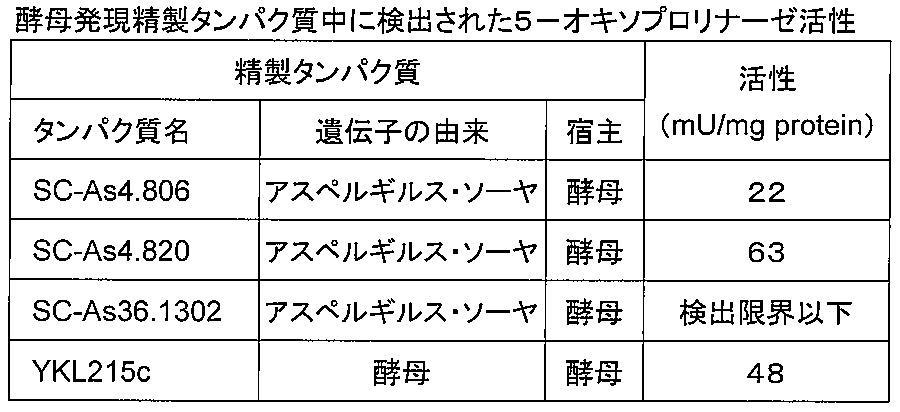
上述の実施例3の2.により得られた、酵母で発現させたアスペルギルス・ソーヤ由来5-オキソプロリナーゼタンパク質(SC-As4.806およびSC-As4.820)および5-オキソプロリナーゼオルソログ候補タンパク質(SC-As36.1302)、実施例1のB.の3.により得られた酵母由来5-オキソプロリナーゼYKL215cについて、実施例1のC.の2.に記載の方法に準じて、5-オキソプロリナーゼ活性を測定した。結果を表5に示す。
表5に示すように、酵母で発現させたアスペルギルス・ソーヤ由来5-オキソプロリナーゼSC-As4.806、SC-As4.820、および酵母由来5-オキソプロリナーゼYKL215cは、基質溶液との反応により、5-オキソプロリナーゼ活性が検出された。このことから、アスペルギルス・ソーヤ由来5-オキソプロリナーゼAs4.806、As4.820は、酵母で発現させた場合にも5-オキソプロリナーゼ活性を示し、異種発現した場合にも活性を持って発現可能であることが確認された。
また、酵母で発現させたアスペルギルス・ソーヤ由来5-オキソプロリナーゼオルソログ候補タンパク質SC-As36.1302では、基質溶液との反応によりL-グルタミン酸濃度が上昇せず、5-オキソプロリナーゼ活性は検出されなかった。すなわち、アスペルギルス・ソーヤ由来5-オキソプロリナーゼオルソログ候補タンパク質As36.1302は、酵母で発現させた場合にも5-オキソプロリナーゼ活性を示さないことが確認された。
(アスペルギルス属菌由来5-オキソプロリナーゼの大腸菌による生産)
酵母由来5-オキソプロリナーゼYKL215cは、大腸菌で発現させることができなかったと報告されている(FEMS Yeast Res. 10, 394-401, 2010)。しかし、麹菌由来ピログルタミン酸開環酵素に関しては不明であり、活性を保持した酵素の大腸菌での発現・大量精製が可能となれば、性能評価に用いる酵素が容易に得られるようになる。実施例1のC.の2.で取得した本発明のアスペルギルス・ソーヤ由来5-オキソプロリナーゼAs4.806およびAs4.820を、異種宿主である大腸菌を宿主としても生産できることについて、確認を行った。
酵母由来5-オキソプロリナーゼYKL215cは、大腸菌で発現させることができなかったと報告されている(FEMS Yeast Res. 10, 394-401, 2010)。しかし、麹菌由来ピログルタミン酸開環酵素に関しては不明であり、活性を保持した酵素の大腸菌での発現・大量精製が可能となれば、性能評価に用いる酵素が容易に得られるようになる。実施例1のC.の2.で取得した本発明のアスペルギルス・ソーヤ由来5-オキソプロリナーゼAs4.806およびAs4.820を、異種宿主である大腸菌を宿主としても生産できることについて、確認を行った。
1.アスペルギルス・ソーヤ由来5-オキソプロリナーゼ遺伝子の大腸菌発現用プラスミドの作製と大腸菌形質転換体の取得
実施例1のA.の5.で取得した、ヒスチジン8個の配列をコードする24塩基の配列を付加した5-オキソプロリナーゼオルソログ遺伝子(scaffold00004.806、およびscaffold00004.820)のCDSを導入したプラスミドpAsAlpP-His-4.806 CDS、pAsAlpP-His-4.820 CDSから、PCRにより増幅した各遺伝子のDNA断片をpET-22b(+)(Novagen社製)に導入することにより、大腸菌発現用プラスミドを得た。
実施例1のA.の5.で取得した、ヒスチジン8個の配列をコードする24塩基の配列を付加した5-オキソプロリナーゼオルソログ遺伝子(scaffold00004.806、およびscaffold00004.820)のCDSを導入したプラスミドpAsAlpP-His-4.806 CDS、pAsAlpP-His-4.820 CDSから、PCRにより増幅した各遺伝子のDNA断片をpET-22b(+)(Novagen社製)に導入することにより、大腸菌発現用プラスミドを得た。
具体的には、pAsAlpP-His-4.806 CDSを鋳型とし、配列番号59および60に示したプライマーを用いて、5’側にヒスチジン8個の配列をコードする24塩基の配列を付加したscaffold00004.806のCDSのDNA断片を、pAsAlpP-His-4.820 CDSを鋳型とし、配列番号61および62に示したプライマーを用いて、5’側にヒスチジン8個の配列をコードする24塩基の配列を付加したscaffold00004.820のCDSのDNA断片をPCRにより増幅した。
さらに、プラスミドpET-22b(+)を鋳型として、配列番号63および64のインバースPCR用プライマーを用いて、プラスミドpET-22b(+)の制限酵素サイトNdeIとNotIで挟まれた領域を除いた配列をPCRにより増幅した。なお、反応試薬としてPrime Star Max(タカラバイオ社製)、装置としてMastercycler gradient(eppendorf社製)を用い、反応試薬キットに添付されたプロトコールに従って伸長反応を行った。
前記のPCRにより増幅したそれぞれのDNA断片を、1%アガロースゲル中で分離し、QIAquick Gel Extraction Kit(QIAGEN社製)を用いて精製した。2種類の5-オキソプロリナーゼオルソログ候補遺伝子のCDSの5’側にヒスチジン8個の配列をコードする24塩基の配列を付加したDNA断片それぞれを、In-Fusion Advantage PCR Cloning Kitを用いて、制限酵素サイトNdeIとNotIで挟まれた領域を除いたプラスミドpET-22b(+)に連結することにより、プラスミドpET-22b(+)のマルチクローニングサイト(MCS)のNdeIとNotIに挟まれた領域に5’側にヒスチジン8個の配列をコードする24塩基の配列を付加した5-オキソプロリナーゼオルソログ遺伝子(scaffold00004.806、あるいはscaffold00004.820)のCDSを組み込んだ、2種類の大腸菌形質転換体作製用の組換えプラスミドを得た。
該組換えプラスミドを用いて大腸菌JM109株を定法により形質転換後、該形質転換体から前記組換えプラスミドをそれぞれ抽出し、該プラスミド中に挿入されたDNA配列の解析を行った。解析の結果、5’側にヒスチジン8個の配列をコードする24塩基の配列を付加した5-オキソプロリナーゼオルソログ候補遺伝子のCDSの配列が、アスペルギルス・ソーヤNBRC4239株のゲノムDNA上の配列と一致することを確認した。上記操作を経た2種の遺伝子をそれぞれ含むプラスミドを、由来する遺伝子配列の名称であるscaffold00004.806、およびscaffold00004.820に対応させて、pET-22b(+)-His-4.806 CDS、およびpET-22b(+)-His-4.820 CDSと名付けた。
前記2種類のプラスミドpET-22b(+)-His-4.806 CDS、およびpET-22b(+)-His-4.820 CDSを用いて、大腸菌ECOS(商標)コンピテント大腸菌BL21(DE3)株(ニッポンジーン社製)を定法により形質転換し、pET-22b(+)にコードされたアンピシリン耐性遺伝子の発現によりアンピシリン添加培地に生育できるようになることを指標に、アスペルギルス・ソーヤ由来5-オキソプロリナーゼ遺伝子による大腸菌形質転換体を選抜した。各アスペルギルス・ソーヤ由来5-オキソプロリナーゼ遺伝子による大腸菌形質転換体は、由来する遺伝子の名称であるscaffold00004.806、およびscaffold00004.820に対応させて、それぞれBL21-His-4.806 CDS株、およびBL21-His-4.820 CDS株と名付けた。
2.大腸菌発現アスペルギルス属菌由来5-オキソプロリナーゼタンパク質の取得
上記のようにして取得したアスペルギルス・ソーヤ由来5-オキソプロリナーゼ遺伝子による大腸菌形質転換体BL21-His-4.806 CDS株、およびBL21-His-4.820 CDS株に導入された、プラスミド中の5-オキソプロリナーゼ遺伝子および5-オキソプロリナーゼオルソログ候補遺伝子の上流には、ヒスチジン8個の配列をコードする24塩基の配列が付加されており、大腸菌形質転換体をIPTGの存在下で培養することにより、N末側にヒスチジン8個のタグが融合された5-オキソプロリナーゼタンパク質を発現誘導することができ、定法によりNiカラムを用いて精製することができる。すなわち、前記のBL21-His-4.806 CDS株、およびBL21-His-4.820 CDS株を、50μg/mLのアンピシリンを含有するLB液体培地(1.0%(w/v)ポリペプトン(ベクトン・ディッキンソン社製)、0.5%(w/v)イーストエキス(ベクトン・ディッキンソン社製)、0.5%(w/v)NaCl(和光純薬社製)中、30℃で一晩、振盪培養した。50μg/mLのアンピシリンを含有するLB液体培地で100倍に希釈して3.0時間振盪培養し、その後、0.1mMとなるようにIPTGを添加して、さらに30℃で2.5~3.0時間、振盪培養した。5,000×g、3分間の遠心により菌体を回収した。
上記のようにして取得したアスペルギルス・ソーヤ由来5-オキソプロリナーゼ遺伝子による大腸菌形質転換体BL21-His-4.806 CDS株、およびBL21-His-4.820 CDS株に導入された、プラスミド中の5-オキソプロリナーゼ遺伝子および5-オキソプロリナーゼオルソログ候補遺伝子の上流には、ヒスチジン8個の配列をコードする24塩基の配列が付加されており、大腸菌形質転換体をIPTGの存在下で培養することにより、N末側にヒスチジン8個のタグが融合された5-オキソプロリナーゼタンパク質を発現誘導することができ、定法によりNiカラムを用いて精製することができる。すなわち、前記のBL21-His-4.806 CDS株、およびBL21-His-4.820 CDS株を、50μg/mLのアンピシリンを含有するLB液体培地(1.0%(w/v)ポリペプトン(ベクトン・ディッキンソン社製)、0.5%(w/v)イーストエキス(ベクトン・ディッキンソン社製)、0.5%(w/v)NaCl(和光純薬社製)中、30℃で一晩、振盪培養した。50μg/mLのアンピシリンを含有するLB液体培地で100倍に希釈して3.0時間振盪培養し、その後、0.1mMとなるようにIPTGを添加して、さらに30℃で2.5~3.0時間、振盪培養した。5,000×g、3分間の遠心により菌体を回収した。
回収した菌体は液体窒素中で凍結させ、乳鉢と乳棒を用いて磨砕し、細かい粉末状の菌体片とした後に、培養液の1/12量の2mM PMSFを含む抽出バッファー(50mM Tris、300mM NaCl、20%(w/v) グリセロール、0.5mM L-ピログルタミン酸、pH8.0)に懸濁し、懸濁液の粘度を下げるために、超音波処理を行った。破砕後の菌体懸濁液の遠心上清を0.2μmのフィルターで濾過し、菌体抽出液とした。
その後、この菌体抽出液をNi-NTA Superflowカラム(QIAGEN社製)に供してHisタグ融合5-オキソプロリナーゼを結合させ、イミダゾール20mMを含む抽出バッファーで洗浄後、250mMを含む抽出バッファーで溶出されるHisタグ融合タンパク質含有画分を得た。
なお、前記2種類のHisタグ融合タンパク質含有画分は、Amicon Ultra-0.5mL 10K (Millipore社製)を用いてさらに濃縮後、抽出バッファーに対して透析を行い、精製酵素溶液を得た。以下、それぞれのHisタグ融合5-オキソプロリナーゼを、由来する遺伝子の名称(scaffold00004.806、およびscaffold00004.820)に対応して、EC-As4.806、およびEC-As4.820と表記する。上記の酵素精製により、培養100mlあたり、EC-As4.806では55μg、EC-As4.820では63μgのタンパクが得られた。
3.大腸菌発現アスペルギルス属菌由来5-オキソプロリナーゼの活性確認
上述の実施例4の2.により得られた、大腸菌で発現させたアスペルギルス・ソーヤ由来5-オキソプロリナーゼタンパク質(EC-As4.806およびEC-As4.820)について、実施例1のC.の2.に記載の方法に準じて、5-オキソプロリナーゼ活性を測定した。結果を表6に示す。
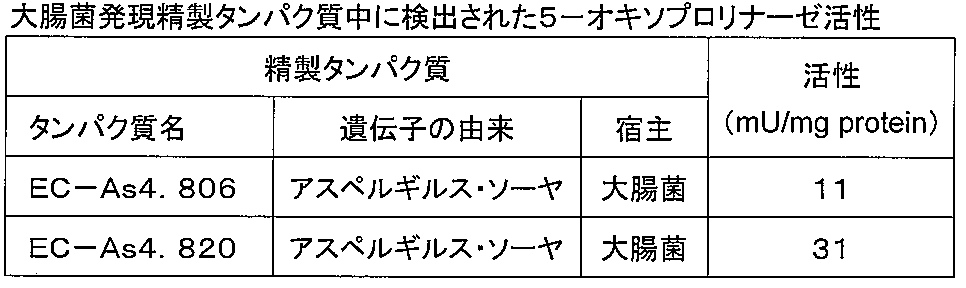
上述の実施例4の2.により得られた、大腸菌で発現させたアスペルギルス・ソーヤ由来5-オキソプロリナーゼタンパク質(EC-As4.806およびEC-As4.820)について、実施例1のC.の2.に記載の方法に準じて、5-オキソプロリナーゼ活性を測定した。結果を表6に示す。
表6に示すように、大腸菌で発現させたアスペルギルス・ソーヤ由来5-オキソプロリナーゼEC-As4.806、およびEC-As4.820は、基質溶液との反応により、5-オキソプロリナーゼ活性が検出された。このことから、アスペルギルス・ソーヤ由来5-オキソプロリナーゼAs4.806、およびAs4.820は、大腸菌で発現させた場合にも5-オキソプロリナーゼ活性を示し、異種発現した場合にも活性を持って発現可能であることが確認された。また、麹菌由来ピログルタミン酸開環酵素機能を持つためには糖鎖が不要であることも明らかとなり、活性を保持した酵素の大腸菌での発現・大量精製が可能となれば、性能評価に用いる酵素が容易に得られるようになる。
上述のように本発明の5-オキソプロリナーゼは、宿主をアスペルギルス属菌等の糸状菌に限定されることなく、生産することができる。異種発現が可能であることは、発現量増加を目的とした宿主の選択や、酵素の改良時のタンパク質レベルでの確認の際に有利であり、本発明の実用上の有意性に貢献する。
(アスペルギルス属菌に発現させたアスペルギルス属菌由来5-オキソプロリナーゼおよび5-オキソプロリナーゼオルソログ候補タンパク質の固体培養における生産)
味噌・醤油・日本酒・焼酎などの各種醸造食品の製造では、麹菌を固体培養して麹を作製する。一般的に、固体培養と液体培養とでは、異なる発現パターンを示すことが知られており、酵素の発現量や比活性も液体培養とは異なる可能性があると考えられる。
味噌・醤油・日本酒・焼酎などの各種醸造食品の製造では、麹菌を固体培養して麹を作製する。一般的に、固体培養と液体培養とでは、異なる発現パターンを示すことが知られており、酵素の発現量や比活性も液体培養とは異なる可能性があると考えられる。
そこで、実施例1のA.の6.で取得した本発明のアスペルギルス・ソーヤNBRC4239株のアスペルギルス・ソーヤ由来5-オキソプロリナーゼAs4.806による形質転換体およびAs4.820による形質転換体を、小麦ふすまを用いた固体培養で培養することにより活性を持ったタンパク質を生産できることを確認すること、さらに、実施例1のC.の2.においては活性を確認できなかったアスペルギルス・ソーヤ由来5-オキソプロリナーゼオルソログ候補タンパク質As36.1302について、小麦ふすまを用いた固体培養を行うことにより、活性を持ったタンパク質を取得することについて確認を行った。
1.小麦ふすま培養物からのアスペルギルス・ソーヤ由来5-オキソプロリナーゼおよび5-オキソプロリナーゼ候補タンパク質の取得
実施例1のA.の6.で取得したアスペルギルス・ソーヤ由来5-オキソプロリナーゼ遺伝子によるアスペルギルス属菌形質転換体NBRC4239-His-4.806 CDS株、NBRC4239-His-4.820 CDS株、および5-オキソプロリナーゼオルソログ候補遺伝子によるアスペルギルス属菌形質転換体NBRC4239-His-36.1302 CDS株のゲノムDNAに導入された、5-オキソプロリナーゼ遺伝子および5-オキソプロリナーゼオルソログ候補遺伝子の上流には、ヒスチジン8個の配列をコードする24塩基の配列が付加されており、アスペルギルス属菌形質転換体を培養することによりN末側にヒスチジン8個のタグが融合された5-オキソプロリナーゼおよび5-オキソプロリナーゼオルソログ候補タンパク質を発現誘導することができ、定法によりNiカラムを用いて精製することができる。
実施例1のA.の6.で取得したアスペルギルス・ソーヤ由来5-オキソプロリナーゼ遺伝子によるアスペルギルス属菌形質転換体NBRC4239-His-4.806 CDS株、NBRC4239-His-4.820 CDS株、および5-オキソプロリナーゼオルソログ候補遺伝子によるアスペルギルス属菌形質転換体NBRC4239-His-36.1302 CDS株のゲノムDNAに導入された、5-オキソプロリナーゼ遺伝子および5-オキソプロリナーゼオルソログ候補遺伝子の上流には、ヒスチジン8個の配列をコードする24塩基の配列が付加されており、アスペルギルス属菌形質転換体を培養することによりN末側にヒスチジン8個のタグが融合された5-オキソプロリナーゼおよび5-オキソプロリナーゼオルソログ候補タンパク質を発現誘導することができ、定法によりNiカラムを用いて精製することができる。
まず、小麦ふすま10gに対して水8mLを加え、150mL 三角フラスコに5gずつ入れてオートクレーブすることにより、80%散水小麦ふすま固体培地を作製した。次に、実施例1のA.の6.で取得したNBRC4239-His-4.806 CDS株、NBRC4239-His-4.820 CDS株、およびNBRC4239-His-36.1302 CDS株の分生子5×10⁶個を、前述の80%散水小麦ふすま固体培地に培養し、30℃で培養した。菌糸が伸びてきた頃に手入れをし、再び培養した。菌糸の伸長が進んでおり、分生子はほとんど存在しない形態を示した42時間培養した培養物を回収し、液体窒素で凍結した。
回収した小麦ふすま培養物1gを、液体窒素中で乳鉢と乳棒を用いて磨砕して得た細かい粉末状の菌体片を、10mLの2mM PMSFを含む抽出バッファー(50mM Tris、300mM NaCl、20%(w/v) グリセロール、0.5mM L-ピログルタミン酸、pH8.0)に懸濁した。得られた懸濁液の遠心上清を0.2μmのフィルターで濾過し、小麦ふすま培養物抽出液とした。
その後、この小麦ふすま培養物抽出液をNi-NTA Superflowカラム(QIAGEN社製)に供してHisタグ融合5-オキソプロリナーゼおよびHisタグ融合5-オキソプロリナーゼオルソログ候補タンパク質を結合させ、イミダゾール20mMを含む抽出バッファーで洗浄後、250mMを含む抽出バッファーで溶出されるHisタグ融合タンパク質含有画分を得た。
なお、前記3種類のHisタグ融合タンパク質含有画分は、Amicon Ultra-0.5mL 10K (Millipore社製)を用いてさらに濃縮後、抽出バッファーに対して透析を行い、精製酵素溶液を得た。以下、それぞれのHisタグ融合5-オキソプロリナーゼタンパク質およびHisタグ融合5-オキソプロリナーゼオルソログ候補タンパク質を、由来する遺伝子の名称(scaffold00004.806、scaffold00004.820、およびscaffold00036.1302)に対応して、As4.806-solid、As4.820-solid、As36.1302-solidと表記する。上記の酵素精製により、培養100mlあたり、As4.806-solidでは43μg、As4.820-solidでは57μg、As36.1302-solidでは47μgのタンパク質が得られた。
2.上述の実施例5の1.により得られた、小麦ふすま培養物から精製したアスペルギルス・ソーヤ由来5-オキソプロリナーゼおよび5-オキソプロリナーゼ候補タンパク質の活性確認
上述の実施例5の1.により得られた、小麦ふすま培養物から精製したアスペルギルス・ソーヤ由来5-オキソプロリナーゼ(As4.806-solidおよびAs4.820-solid)および5-オキソプロリナーゼオルソログ候補タンパク質(As36.1302-solid)について、実施例1のC.の2.に記載の方法に準じて、5-オキソプロリナーゼ活性を測定した。結果を表7に示す。

上述の実施例5の1.により得られた、小麦ふすま培養物から精製したアスペルギルス・ソーヤ由来5-オキソプロリナーゼ(As4.806-solidおよびAs4.820-solid)および5-オキソプロリナーゼオルソログ候補タンパク質(As36.1302-solid)について、実施例1のC.の2.に記載の方法に準じて、5-オキソプロリナーゼ活性を測定した。結果を表7に示す。
表7に示すように、小麦ふすま培養物から精製したアスペルギルス・ソーヤ由来5-オキソプロリナーゼタンパク質As4.806-solid、およびAs4.820-solidは、基質溶液との反応によりグルタミン酸濃度が上昇した。このことから、アスペルギルス・ソーヤ由来5-オキソプロリナーゼAs4.806、およびAs4.820は、小麦ふすまで発現させた場合にも5-オキソプロリナーゼ活性を示し、活性を持って生産可能であることが確認された。
また、小麦ふすまで発現させたアスペルギルス・ソーヤ由来5-オキソプロリナーゼオルソログ候補タンパク質As36.1302-solidでは、基質溶液との反応によりL-グルタミン酸濃度が上昇せず、5-オキソプロリナーゼ活性は検出されなかった。すなわち、アスペルギルス・ソーヤ由来5-オキソプロリナーゼオルソログ候補タンパク質As36.1302は、小麦ふすまで発現させた場合にも5-オキソプロリナーゼ活性を示さないことが確認された。
さらに、小麦ふすまで生産したアスペルギルス・ソーヤ由来5-オキソプロリナーゼAs4.806-solidは、液体培養時の数倍以上に高い活性を保ったまま発現させることができることが示され、固体培養時に効率的にグルタミン酸の生産が可能であることが示唆された。
(アスペルギルス・オリゼからの5-オキソプロリナーゼオルソログ候補タンパク質の取得)
1.アスペルギルス・オリゼにおける5-オキソプロリナーゼオルソログ候補遺伝子の検索
アスペルギルス・ソーヤの5-オキソプロリナーゼAs4.820のタンパク質の配列データを用い、それらと比較的配列同一性の高い遺伝子を、アスペルギルス・オリゼから探索することを試みた。検索にはBlastプログラム(tblastn)を用いた。アスペルギルス・オリゼのDNAデータとしては、アスペルギルス・オリゼ(Aspergillus oryzae) RIB40株のゲノム配列(独立行政法人 製品評価技術基盤機構のデータベース:DOGAN、Nature 438(7071),1157-1161,2005)を用いた。
1.アスペルギルス・オリゼにおける5-オキソプロリナーゼオルソログ候補遺伝子の検索
アスペルギルス・ソーヤの5-オキソプロリナーゼAs4.820のタンパク質の配列データを用い、それらと比較的配列同一性の高い遺伝子を、アスペルギルス・オリゼから探索することを試みた。検索にはBlastプログラム(tblastn)を用いた。アスペルギルス・オリゼのDNAデータとしては、アスペルギルス・オリゼ(Aspergillus oryzae) RIB40株のゲノム配列(独立行政法人 製品評価技術基盤機構のデータベース:DOGAN、Nature 438(7071),1157-1161,2005)を用いた。
検索の結果、比較的遺伝子配列同一性が高かった配列領域として、配列番号65で示す遺伝子AO090103000443(3843bp)がみつかった。AO090103000443のDNA配列から予想されるオープンリーディングフレームにコードされるアミノ酸配列を配列番号66に示す。
遺伝情報処理ソフトウェアGenetyxネットワーク版 version 11.0.6(ゼネティックス社製)によりアミノ酸レベルでの配列同一性の比較を行うと、AO090103000443とアスペルギルス・ソーヤの5-オキソプロリナーゼAs4.820との配列同一性は99.0%であり、アスペルギルス・オリゼの5-オキソプロリナーゼオルソログであることが示唆された。また、AO090103000443とラット5-オキソプロリナーゼとの配列同一性は55.0%、酵母由来5-オキソプロリナーゼであるOXP/YKL215cとの配列同一性は54.1%であった。これは実施例1のC.の2.で5-オキソプロリナーゼ活性のあることが示されたアスペルギルス・ソーヤの5-オキソプロリナーゼAs4.820とラット5-オキソプロリナーゼとの配列同一性51.5%、およびAs4.820と酵母オルソログ5-オキソプロリナーゼとの配列同一性51.1%と同程度であることからも、AO090103000443がアスペルギルス・オリゼの5-オキソプロリナーゼオルソログであることが示唆された。
そこで、AO090103000443のDNA配列情報を利用して、AO090103000443にコードされるタンパク質の5-オキソプロリナーゼ活性の有無を確認する実験を進めた。
2.アスペルギルス・オリゼ(Aspergillus oryzae)からのゲノムDNA抽出
アスペルギルス・オリゼ RIB40株をバッフル付き三角フラスコにて、PD培地(2%(w/v) デキストリン、1%(w/v) ポリペプトン、0.5%(w/v) KH2PO4、0.05%(w/v) MgSO4・7H2O、0.1%(w/v) カザミノ酸)中、30℃で1~2日間振盪培養し、濾過により菌体を回収した。回収して得た菌体を、液体窒素中で凍結させ乳鉢と乳棒を用いて磨砕し、細かい粉末状の菌体片とした。
アスペルギルス・オリゼ RIB40株をバッフル付き三角フラスコにて、PD培地(2%(w/v) デキストリン、1%(w/v) ポリペプトン、0.5%(w/v) KH2PO4、0.05%(w/v) MgSO4・7H2O、0.1%(w/v) カザミノ酸)中、30℃で1~2日間振盪培養し、濾過により菌体を回収した。回収して得た菌体を、液体窒素中で凍結させ乳鉢と乳棒を用いて磨砕し、細かい粉末状の菌体片とした。
65℃に温めたNuclei Lysis Solution(Promega社製) 300μLにスパーテル1杯程度の前記粉末状の菌体片を加え、ボルテックスした後、65℃で15分間、インキュベートした。次いで、50μg/mLとなるようにRNase(ニッポンジーン社製)を添加し、37℃で15分間インキュベートした。その後、Protein Precipitation Solution(Promega社製) 125μLを加え、20秒間、激しくボルテックスし、14,000×gで5分間遠心した。得られた上清をイソプロパノール300μLと混合し、11,000×gで3分間遠心して得た沈殿を、70%エタノールでリンスすることにより、アスペルギルス・オリゼ RIB40株由来のゲノムDNAを回収した。このゲノムDNAにTE(10mM Tris-HCl(pH7.5)、1mM EDTA)を加え、50℃、5分間インキュベートして溶解することにより、所望の濃度のゲノムDNA溶液を調製した。
3.アスペルギルス・オリゼにおける5-オキソプロリナーゼオルソログ候補遺伝子のクローニングとアスペルギルス属菌用発現ベクターの作製
上述のアスペルギルス・オリゼの5-オキソプロリナーゼオルソログ候補遺伝子AO090103000443のエクソン-イントロン構造を予測すると、アスペルギルス・ソーヤの5-オキソプロリナーゼオルソログ遺伝子と同様に、2つのエクソンと1つのイントロンが存在すると考えられた。具体的には、配列番号67で示したの3899塩基のうち2524番から2579番がイントロンであると予測され、スプライシングにより配列番号65のCDSが生成されると予想された。本実験では、予測されたイントロンの配列を除去せずに配列番号67で示されるpre mRNAの配列を次の操作に用いた。
上述のアスペルギルス・オリゼの5-オキソプロリナーゼオルソログ候補遺伝子AO090103000443のエクソン-イントロン構造を予測すると、アスペルギルス・ソーヤの5-オキソプロリナーゼオルソログ遺伝子と同様に、2つのエクソンと1つのイントロンが存在すると考えられた。具体的には、配列番号67で示したの3899塩基のうち2524番から2579番がイントロンであると予測され、スプライシングにより配列番号65のCDSが生成されると予想された。本実験では、予測されたイントロンの配列を除去せずに配列番号67で示されるpre mRNAの配列を次の操作に用いた。
実験6の2.により取得したゲノムDNAを鋳型に、配列番号68および69のプライマーを用いて、5’側にヒスチジン8個の配列をコードする24塩基の配列を付加したアスペルギルス・オリゼの5-オキソプロリナーゼオルソログ候補遺伝子AO090103000443のpre mRNAの配列をPCRにより増幅した。反応試薬としてPrime Star Max(タカラバイオ社製)、装置としてMastercycler gradient(eppendorf社製)を用い、反応試薬キットに添付されたプロトコールに従って伸長反応を行った。前記のPCRにより増幅したヒスチジン8個の配列をコードする24塩基の配列を付加したAO090103000443のpre mRNAと考えられるDNA断片は、1%アガロースゲル中で分離し、QIAquick Gel Extraction Kit(QIAGEN社製)を用いて精製した。また、クローニング用のベクターとして、実施例1のA.の4.で作製した組換えプラスミドpAsAlpP-4.806 pre mRNA(pUC19のマルチクローニングサイト(MCS)の上流に、Palp、pyrG、Ptef1、5-オキソプロリナーゼオルソログ候補遺伝子scaffold00004.806のpre mRNA、およびTalpの配列が順に連結された組換えプラスミド)を鋳型とし、配列番号13および23のインバースPCR用のプライマーを用いて5‘側にTalp、3’側にPalp、pyrGおよびPtef1を含むプラスミド側の配列をPCRにより増幅した。次いでDNA断片を1%アガロースゲル中で分離、QIAquick Gel Extraction Kitを用いて精製した。
上記のようにして取得した2種類のDNA断片をIn-Fusion Advantage PCR Cloning Kit(Clontech社製)を用いて連結し、5’側にヒスチジン8個の配列をコードする24塩基の配列を付加したアスペルギルス・オリゼの5-オキソプロリナーゼオルソログ候補遺伝子AO090103000443 pre mRNAのDNA断片と考えられるDNA断片を、プラスミドpAsAlpPのPtef1領域およびTalp領域の間に連結し、麹菌形質転換体作製用の組換えプラスミドを得た。得られた組換えプラスミドは、由来する遺伝子の名称であるAO090103000443に対応させて、pAsAlpP-AO090103000443 pre mRNAと名付けた。
この組換えプラスミドを用いて大腸菌JM109株を定法により形質転換後、該形質転換体から前記組換えプラスミドをそれぞれ抽出し、該プラスミド中に挿入された各DNA配列の解析を行った。解析の結果、前記の5-オキソプロリナーゼオルソログ候補遺伝子AO090103000443 pre mRNAのDNA断片と考えられるDNA断片は、アスペルギルス・オリゼRIB40株のゲノムDNAに存在するAO090103000443の配列(配列番号67)と一致することを確認した。
4.アスペルギルス・ソーヤNBRC4239株のアスペルギルス・オリゼ由来5-オキソプロリナーゼオルソログ候補遺伝子による形質転換体の取得
上記のように作製したpAsAlpP-AO090103000443 pre mRNAを鋳型として、配列番41および40のプライマーを用い、Palp、pyrG、Ptef1、Hisタグ配列を付加した5-オキソプロリナーゼオルソログ候補遺伝子AO090103000443 pre mRNA、およびTalpが連結されたDNA断片をPCRにより増幅した。なお、反応試薬としてKOD Dash Neo(TOYOBO社製)、装置としてMastercycler gradient(eppendorf社製)を用い、反応試薬キットに添付されたプロトコールに従って伸長反応を行った。
上記のように作製したpAsAlpP-AO090103000443 pre mRNAを鋳型として、配列番41および40のプライマーを用い、Palp、pyrG、Ptef1、Hisタグ配列を付加した5-オキソプロリナーゼオルソログ候補遺伝子AO090103000443 pre mRNA、およびTalpが連結されたDNA断片をPCRにより増幅した。なお、反応試薬としてKOD Dash Neo(TOYOBO社製)、装置としてMastercycler gradient(eppendorf社製)を用い、反応試薬キットに添付されたプロトコールに従って伸長反応を行った。
上記ように増幅したDNA断片(Palp、pyrG、Ptef1、Hisタグ配列を付加した5-オキソプロリナーゼオルソログ候補遺伝子AO090103000443 pre mRNA、およびTalpが連結されたDNA断片)は、エタノール沈殿後、TEに溶解して、所望の濃度のDNA溶液を調製し、下記の手順でアスペルギルス・ソーヤNBRC4239株由来pyrG破壊株(pyrG遺伝子の上流48bp、コード領域896bp、下流240bp欠損株)の形質転換に用いた。
まず、形質転換に用いるアスペルギルス・ソーヤNBRC4239株(マルツプレートに培養したアスペルギルス・ソーヤNBRC4239株由来pyrG破壊株の分生子、9cmシャーレに10分の1程度)を、0.01% Tween80溶液に懸濁し、10mMとなるようにウリジンを添加したPD培地(2%(w/v) デキストリン、1%(w/v) ポリペプトン、0.5%(w/v) KH2PO4、0.05%(w/v) MgSO4・7H2O、0.1%(w/v) カザミノ酸)150mLに植菌し、18時間程度、振盪培養した。培養後、濾過により菌体を回収し、形質転換用にPCRにより増幅しておいたDNA断片(Palp、pyrG、Ptef1、Hisタグ配列を付加した5-オキソプロリナーゼオルソログ候補遺伝子AO090103000443 pre mRNA、およびTalpが連結されたDNA断片)のTE溶液(DNA10μg程度/20μL)を用いて、プロトプラスト-PEG法により、形質転換を行った。
得られた各形質転換体においては、NBRC4239株のアルカリプロテアーゼ遺伝子座にpyrG、Ptef1、およびHisタグ配列を付加した5-オキソプロリナーゼオルソログ候補遺伝子AO090103000443 pre mRNAが連結された配列がそれぞれ導入される。これらの株は、ウリジン要求性を相補する遺伝子であるpyrGが導入されることにより、ウリジン無添加培地に生育できるようになることで、目的の遺伝子が導入された株を選択できる。
さらに、該形質転換体について、コロニーPCRにより目的の遺伝子座に遺伝子導入された株であることの確認を行なった。すなわち、爪楊枝で掻きとった該形質転換体の分生子をTEに懸濁してPCRの鋳型とし、配列番号43および44のプライマーを用い、アルカリプロテアーゼ遺伝子座の上流237塩基目から下流277塩基目に挟まれた領域をPCRにより増幅した。反応試薬には、KOD FX (TOYOBO社製)を用い、94℃、5分間の熱処理後、添付されたプロトコールに従って伸長反応を行った。その結果、アスペルギルス・ソーヤNBRC4239株のゲノムDNAのアルカリプロテアーゼ遺伝子座のアルカリプロテアーゼ遺伝子(alp、1389bp、配列番号45)に換えて、形質転換体株では、pyrG、Ptef1、Hisタグ配列を付加した5-オキソプロリナーゼオルソログ候補遺伝子AO090103000443 pre mRNAが連結されたDNA(約6.6kbp)の存在を示す約7kbpのシグナルが検出されたことにより、前記の形質転換体ではアルカリプロテアーゼ遺伝子座において相同組換えされたことを確認した。
上記の方法により、アスペルギルス・オリゼ由来5-オキソプロリナーゼオルソログ候補遺伝子に由来する遺伝子による形質転換体(アスペルギルス・オリゼの5-オキソプロリナーゼオルソログ候補遺伝子によるアスペルギルス属菌形質転換体)を取得することができた。該形質転換体は、由来する遺伝子の名称AO090103000443に対応させて、NBRC4239-His-AO090103000443 pre mRNA株と名付けた。
5.アスペルギルス・オリゼ由来5-オキソプロリナーゼオルソログ候補タンパク質の取得
上記のようにして取得したアスペルギルス・オリゼの5-オキソプロリナーゼオルソログ候補遺伝子によるアスペルギルス属菌形質転換体のゲノムDNAに導入された、5-オキソプロリナーゼ候補遺伝子の上流にはヒスチジン8個の配列をコードする24塩基の配列が付加されており、アスペルギルス属菌形質転換体を培養することにより、N末側にヒスチジン8個のタグが融合された5-オキソプロリナーゼ候補タンパク質を発現させることができる。
上記のようにして取得したアスペルギルス・オリゼの5-オキソプロリナーゼオルソログ候補遺伝子によるアスペルギルス属菌形質転換体のゲノムDNAに導入された、5-オキソプロリナーゼ候補遺伝子の上流にはヒスチジン8個の配列をコードする24塩基の配列が付加されており、アスペルギルス属菌形質転換体を培養することにより、N末側にヒスチジン8個のタグが融合された5-オキソプロリナーゼ候補タンパク質を発現させることができる。
該N末Hisタグ融合5-オキソプロリナーゼ候補タンパク質は、定法によりNiカラムを用いて精製することができる。すなわち、アスペルギルス・オリゼの5-オキソプロリナーゼオルソログ候補遺伝子によるアスペルギルス属菌形質転換体(NBRC4239-His-AO090103000443 pre mRNA株)の分生子を、PD培地(2%(w/v) デキストリン、1%(w/v) ポリペプトン、0.5%(w/v) KH2PO4、0.05%(w/v) MgSO4・7H2O、0.1%(w/v) カザミノ酸)に1×10⁵個/mLとなるように植菌し、30℃、120rpmで、2日間培養し、濾過により菌体を回収した。
回収した菌体を液体窒素中で凍結させ、乳鉢と乳棒を用いて磨砕して得た細かい粉末状の菌体片を、培養液の1/13量の2mM PMSFを含む抽出バッファー(50mM Tris、300mM NaCl、20%(w/v) グリセロール、0.5mM L-ピログルタミン酸、pH8.0)に懸濁した。得られた懸濁液の遠心上清を0.2μmのフィルターで濾過し、菌体抽出液(粗酵素溶液)とした。
その後、この菌体抽出液の一部を、Ni-NTA Superflowカラム(QIAGEN社製)に供してHisタグ融合5-オキソプロリナーゼオルソログ候補タンパク質を結合させ、イミダゾール20mMを含む抽出バッファーで洗浄後、イミダゾール250mMを含む抽出バッファーで溶出された5-オキソプロリナーゼオルソログ候補タンパク質含有画分を得た。なお、必要に応じて、Amicon Ultra-0.5mL 10K (Millipore社製)を用いて、前記5-オキソプロリナーゼオルソログ候補タンパク質含有画分をさらに濃縮した。5-オキソプロリナーゼオルソログ候補タンパク質含有画分は、抽出バッファーに対して透析を行い、精製酵素溶液とした。
上記の酵素の精製操作により、培養100mLあたり283μgの5-オキソプロリナーゼオルソログ候補タンパク質が得られた。
6.アスペルギルス属菌で発現させたアスペルギルス・オリゼ由来5-オキソプロリナーゼ候補タンパク質の活性確認
上述の実施例6の5.により得られたアスペルギルス・オリゼ由来5-オキソプロリナーゼ候補タンパク質について、実施例1のC.の2.に記載の方法に準じて、5-オキソプロリナーゼ活性を測定した。タンパク質添加量とL-グルタミン酸濃度の関係は図12に示す通りであった。
上述の実施例6の5.により得られたアスペルギルス・オリゼ由来5-オキソプロリナーゼ候補タンパク質について、実施例1のC.の2.に記載の方法に準じて、5-オキソプロリナーゼ活性を測定した。タンパク質添加量とL-グルタミン酸濃度の関係は図12に示す通りであった。
図12に示すように、添加したAO090103000443タンパク質の濃度依存的にL-グルタミン酸濃度が上昇し、アスペルギルス・オリゼの5-オキソプロリナーゼオルソログであることが判明した。
このことから、アスペルギルス属菌由来の5-オキソプロリナーゼはアスペルギルス・ソーヤに限定されることなく、相同性の高い分子がアスペルギルス属菌に広く存在することが示された。
本発明の5-オキソプロリナーゼを飲食品の加工に用いることにより、飲食品のうま味向上に使用できると考えられる。すなわち、ピログルタミン酸を多く含んだ飲食品中で、5-オキソプロリナーゼによりピログルタミン酸を加水分解処理すると、呈味成分として重要なグルタミン酸を大量に遊離でき、従来にない優れた呈味力を有する飲食品を得ることができると予想される。
そこで、以下の手順に従って、ピログルタミン酸含量が高い食品であるトマトエキス、およびしょうゆをアスペルギルス属菌由来の5-オキソプロリナーゼで処理することにより、グルタミン酸濃度を上昇させる効果を調べた。
(A.アスペルギルス属菌由来の5-オキソプロリナーゼによるトマトエキス中のグルタミン酸量の増加)
トマトエキス(ライコレッド社製、Brix 60%)はミリQ水で希釈し、1M KOHによりpH8に調整した。反応に用いた5-オキソプロリナーゼは、実施例3の2.記載の方法に準じて取得した酵母発現アスペルギルス・ソーヤ由来5-オキソプロリナーゼSC-As4.820を、実施例1のC.の2.記載の方法に準じて5-オキソプロリナーゼの活性を測定し、トマトエキスとの反応液に用いた。
トマトエキス(ライコレッド社製、Brix 60%)はミリQ水で希釈し、1M KOHによりpH8に調整した。反応に用いた5-オキソプロリナーゼは、実施例3の2.記載の方法に準じて取得した酵母発現アスペルギルス・ソーヤ由来5-オキソプロリナーゼSC-As4.820を、実施例1のC.の2.記載の方法に準じて5-オキソプロリナーゼの活性を測定し、トマトエキスとの反応液に用いた。
具体的には、トマトエキス希釈液〔8倍希釈したマトエキス、6.25mM ATP、pH8.0〕0.16mLと、実施例3の2.記載の方法に準じて取得した5-オキソプロリナーゼオルソログタンパク質SC-As4.820溶液(10mM Tris-HCl緩衝液(pH8.0)を用いて10.6unit/1200μg/mLに希釈)0.04mLをそれぞれ混合し、37℃で4時間の酵素反応を行った。
また、参照として、トマトエキス希釈液〔8倍希釈したマトエキス、6.25mM ATP、pH8.0〕0.16mLと、前記5-オキソプロリナーゼオルソログタンパク質溶液の代わりに、10mM Tris-HCl緩衝液(pH8.0)、牛血清アルブミン(以下、BSAと表記する)溶液(10mM Tris-HCl緩衝液(pH8.0)を用いて1200μg/mLに希釈)、あるいは実施例1のA.の7.記載の方法に準じて取得したAs36.1302溶液(10mM Tris-HCl緩衝液(pH8.0)を用いて、1200μg/mLに希釈)0.04mLをそれぞれ混合し、37℃で4時間の酵素反応を行った。
反応後、前記の反応液にミリQ水を0.4mL加えて3倍希釈液を調製した。該希釈液は、Amicon Ultra-0.5mL 10K (Millipore社製)用いた限外濾過により、除タンパク質画分を調製した。該除タンパク質画分をイオン交換クロマトグラフィーに供し、分離後の有機酸をブロモチモールブルーによるポストラベル法で検出した。ピログルタミン酸標品による検量線を用いて、前記の酵素反応後の溶液中のピログルタミン酸濃度を算出し、ピログルタミン酸濃度の減少の有無を調べた。続いて、該希釈液0.12mLに0.03M HClを0.28mL加えて混合し、Amicon Ultra-0.5mL 10K (Millipore社製)用いた限外濾過により除タンパク質画分を調製した。該除タンパク質画分をイオン交換クロマトグラフィーに供し、分離後のアミノ酸をニンヒドリンによるポストラベル法で検出した。グルタミン酸標品による検量線を用いて、前記の酵素反応後の溶液中のグルタミン酸濃度を算出し、酵素の活性の有無を調べた。
その結果、図13で示す通り、希釈したトマトエキスにSC-As4.820を添加することによって反応液中のグルタミン酸濃度が上昇し(図中白のバー)で、ピログルタミン酸濃度が減少した(図中白地に黒の斜線のバー)。
一方で、SC-As4.820の代わりに、10mM Tris-HCl緩衝液(pH8.0)、BSA溶液、および実施例1のC.の2.で示すように50mM Tris-HCl緩衝液(pH8.0)中で5-オキソプロリナーゼ活性を示さなかったAs36.1302溶液を添加しても、反応液中のグルタミン酸濃度が上昇せず、ピログルタミン酸濃度にもほとんど変化がなく、5-オキソプロリナーゼ活性は検出できなかった。
これにより、上記一連の手法により、ピログルタミン酸含量が高い食品であるトマトエキスをアスペルギルス・ソーヤ由来の5-オキソプロリナーゼで処理することにより、グルタミン酸濃度を上昇させる効果があることが示された。
(B.アスペルギルス属菌由来の5-オキソプロリナーゼによるしょうゆ中のグルタミン酸量の増加)
濃口しょうゆ(キッコーマン社製、特選丸大豆しょうゆ)はミリQ水で希釈し、1M KOHによりpH8に調整した。反応に用いた5-オキソプロリナーゼは、実施例3の2.記載の方法に準じて取得した酵母発現アスペルギルス・ソーヤ由来5-オキソプロリナーゼSC-As4.820を、実施例1のC.の2.記載の方法に準じて5-オキソプロリナーゼの活性を測定し、濃口しょうゆとの反応液に用いた。
濃口しょうゆ(キッコーマン社製、特選丸大豆しょうゆ)はミリQ水で希釈し、1M KOHによりpH8に調整した。反応に用いた5-オキソプロリナーゼは、実施例3の2.記載の方法に準じて取得した酵母発現アスペルギルス・ソーヤ由来5-オキソプロリナーゼSC-As4.820を、実施例1のC.の2.記載の方法に準じて5-オキソプロリナーゼの活性を測定し、濃口しょうゆとの反応液に用いた。
具体的には、濃口しょうゆ希釈液〔3倍希釈した濃口しょうゆ、6.25mM ATP、pH8.0〕0.16mLと、実施例3の2.記載の方法に準じて取得した5-オキソプロリナーゼオルソログタンパク質SC-As4.820溶液(10mM Tris-HCl緩衝液(pH8.0)を用いて4.43unit/600μg/mLに希釈)0.04mLをそれぞれ混合し、37℃で4時間の酵素反応を行った。
また、参照として、濃口しょうゆ希釈液〔3倍希釈した濃口しょうゆ、6.25mM ATP、pH8.0〕0.16mLと、前記5-オキソプロリナーゼオルソログタンパク質溶液の代わりに、10mM Tris-HCl緩衝液(pH8.0)、BSA溶液(10mM Tris-HCl緩衝液(pH8.0)を用いて1200μg/mLに希釈)、あるいは実施例1のA.の7.記載の方法に準じて取得したAs36.1302溶液(10mM Tris-HCl緩衝液(pH8.0)を用いて600μg/mLに希釈)0.04mLをそれぞれ混合し、37℃で4時間の酵素反応を行った。
反応後、前記の反応液にミリQ水を0.4mL加えて3倍希釈液を調製した。該希釈液は、Amicon Ultra-0.5mL 10K (Millipore社製)用いた限外濾過により、除タンパク質画分を調製した。該除タンパク質画分をイオン交換クロマトグラフィーに供し、分離後の有機酸をブロモチモールブルーによるポストラベル法で検出した。ピログルタミン酸標品による検量線を用いて、前記の酵素反応後の溶液中のピログルタミン酸濃度を算出し、ピログルタミン酸濃度の減少の有無を調べた。続いて、該希釈液0.12mLに0.03M HClを0.28mL加えて混合し、Amicon Ultra-0.5mL 10K (Millipore社製)用いた限外濾過により、除タンパク質画分を調製した。該除タンパク質画分をイオン交換クロマトグラフィーに供し、分離後のアミノ酸をニンヒドリンによるポストラベル法で検出した。グルタミン酸標品による検量線を用いて、前記の酵素反応後の溶液中のグルタミン酸濃度を算出し、酵素の活性の有無を調べた。
その結果、図14で示す通り、希釈した濃口しょうゆにSC-As4.820を添加することによって反応液中のグルタミン酸濃度が上昇し(図中白のバー)、ピログルタミン酸濃度が減少した(図中白地に黒の斜線のバー)。
一方で、SC-As4.820の代わりに、10mM Tris-HCl緩衝液(pH8.0)、BSA溶液、および実施例1のC.の2.で示すように50mM Tris-HCl緩衝液(pH8.0)中で5-オキソプロリナーゼ活性を示さなかったAs36.1302溶液(10mM Tris-HCl緩衝液(pH8.0)を用いて1200μg/mLに希釈)を添加しても、反応液中のグルタミン酸濃度が上昇せず、5-オキソプロリナーゼ活性は検出できなかった。
これにより、上記一連の手法により、ピログルタミン酸含量が高い食品であるしょうゆをアスペルギルス属菌由来の5-オキソプロリナーゼで処理することにより、グルタミン酸濃度を上昇させる効果があることが示された。
以上の結果より、ピログルタミン酸を多く含んだ飲食品中で、本発明の5-オキソプロリナーゼによりピログルタミン酸を呈味成分として重要なグルタミン酸に加水分解処理することができ、従来にない優れた呈味力を有する飲食品を得ることができると予想される。
(本発明の5-オキソプロリナーゼを用いた、ラセミ体の分割)
ラセミ体は化学的、物理的性質が同じであり、通常の条件下では区別が難しい。光学分割剤を用いジアステレオマーを形成させ分離する方法、結晶化よる方法、光学分割用カラムを用いる方法が用いられるが、万能な方法ではなく、物質により適した方法を選択する必要がある。実施例2に示したとおり、本酵素は、L-ピログルタミン酸を基質とし、D-ピログルタミン酸は基質とはならない。この性質を利用してラセミ体のピログルタミン酸を光学分割することができる。
ラセミ体は化学的、物理的性質が同じであり、通常の条件下では区別が難しい。光学分割剤を用いジアステレオマーを形成させ分離する方法、結晶化よる方法、光学分割用カラムを用いる方法が用いられるが、万能な方法ではなく、物質により適した方法を選択する必要がある。実施例2に示したとおり、本酵素は、L-ピログルタミン酸を基質とし、D-ピログルタミン酸は基質とはならない。この性質を利用してラセミ体のピログルタミン酸を光学分割することができる。
一例として、次の手順を用いることができる。具体的には、実施例1のC.の2.記載の方法に準じて、L-ピログルタミン酸とD-ピログルタミン酸の混合液〔50mM Tris、2.5mM L-ピログルタミン酸、2.5mM D-ピログルタミン酸、6.25mM ATP、12.5mM MgCl2、187.5mM KCl、pH8.0〕、および、実施例3の2.記載の方法に準じて取得した酵母発現アスペルギルス・ソーヤ由来5-オキソプロリナーゼSC-As4.820溶液(後述、50mM Tris-HCl緩衝液(pH8.0)を用いて希釈)を調製した。前記2種類の基質溶液0.4mLと、前記2種類の酵素溶液0.1mLとをそれぞれを混合し、37℃で4時間の酵素反応を行った。
反応後、該反応液をポアサイズ0.45μmのPVDFフィルターで濾過して除タンパク質画分を調製し、逆相クロマトグラフィー用のカラムCAPCELL PAK C18 MGIII(資生堂、20×250mm)に供した。反応液を注入後、溶離液として溶離液A(0.1% トリクロロ酢酸水溶液)と溶離液B(0.1% トリクロロ酢酸/80% アセトニトリル溶液)を用い、溶離液Bの割合を次第に上昇させることにより溶出画分を得た。該溶出液の210nmの紫外線吸収を測定すると、2つのピークが検出された。それぞれのピークに相当する複数の画分を混合し、定法により、エバポレーターで濃縮した。該濃縮画分について、実施例2の(8)に記載の方法に準じて、グルタミン酸、およびピログルタミン酸の濃度を測定した。また、実施例1のC.の2.に記載の方法に準じて、L-グルタミン酸濃度を測定した。
その結果、保持時間の早いピークを含む画分ではグルタミン酸(L-グルタミン酸とほぼ同じ濃度)が検出され、ピログルタミン酸は検出されなかったことから、L-グルタミン酸が分取できたことを確認した。保持時間の遅いピークを含む画分では、グルタミン酸は検出されずピログルタミン酸が検出された。また、L-ピログルタミン酸を検出すると検出限界以下であったことから、保持時間の遅いピークを含む画分ではL-ピログルタミン酸は存在せず、D-ピログルタミン酸が高純度で得られたことを確認した。L-グルタミン酸溶液は、酸性条件下、高温高圧下で処理することにより、再びL-ピログルタミン酸が得られることが知られている。以上により、本酵素を使用することにより、ピログルタミン酸のラセミ体から、L-ピログルタミン酸とD-ピログルタミン酸の分割が可能であることが示された。
用いるカラムの種類によっては保持時間の早いピークを含む画分にピログルタミン酸が含まれ、保持時間の遅いピークを含む画分にL-グルタミン酸が含まれ得る。この場合は、予め標準物質(ピログルタミン酸またはL-グルタミン酸)を用いてピーク位置を決定しておき、上記と同様の手順でピログルタミン酸のラセミ体から、L-ピログルタミン酸とD-ピログルタミン酸とを分離することができる。
本酵素を飲食品に利用し、あるいは、本酵素の生産微生物を用いて飲食品を発酵させる場合には、飲食品に安全に利用できる微生物から本酵素を取得することや、飲食品に安全に利用できる微生物を用いて飲食品を発酵させることも重要である。本発明の5-オキソプロリナーゼ遺伝子は、食経験のあるアスペルギルス属菌から単離された遺伝子である。飲食品の加工への使用の際には、アスペルギルス属菌由来の5-オキソプロリナーゼ遺伝子、タンパク質を使用することは食の安心安全につながり、産業上極めて有用であると考えられる。
本明細書で引用した全ての刊行物、特許および特許出願をそのまま参考として本明細書にとり入れるものとする。
Claims (12)
- 以下の(a)または(b)の5-オキソプロリナーゼ活性を有するタンパク質。
(a)配列番号1および2のいずれかで表されるアミノ酸配列と80%以上の配列同一性を示すアミノ酸配列を有し5-オキソプロリナーゼ活性を有するタンパク質
(b)配列番号1および2のいずれかで表されるアミノ酸配列において1もしくは数個のアミノ酸が、付加、欠失もしくは置換されたアミノ酸配列を有し5-オキソプロリナーゼ活性を有するタンパク質 - 下記の酵素学的性質を有し、5-オキソプロリナーゼ活性を有するタンパク質。
i)作用:L-ピログルタミン酸をL-グルタミン酸に変換する
ii)分子量:タンパク質のポリペプチド鎖部分の分子量が約140kDaである
iii)至適pH:pH7.0~pH8.0である
iv)安定pH:pH6.0~pH9.0である
v)温度安定性:Tris-HCl緩衝液(pH8.0)中、37℃で15分間処理後に80%以上の活性が残存する
vi)至適温度:Tris-HCl緩衝液(pH8.0)中、25℃~45℃である
vii)ATP、1価カチオン、および2価カチオン要求性を示す - アスペルギルス属に属する微生物由来である、請求項2に記載の5-オキソプロリナーゼ活性を有するタンパク質。
- アスペルギルス・ソーヤ(Aspergillus sojae)由来である、請求項3に記載の5-オキソプロリナーゼ活性を有するタンパク質。
- 以下の(c)または(d)の5-オキソプロリナーゼ活性を有するタンパク質をコードする5-オキソプロリナーゼ遺伝子。
(c)配列番号1および2のいずれかで表されるアミノ酸配列と80%以上の配列同一性を示すアミノ酸配列を有し5-オキソプロリナーゼ活性を有するタンパク質
(d)配列番号1および2のいずれかで表されるアミノ酸配列において1もしくは数個のアミノ酸が、付加、欠失もしくは置換されたアミノ酸配列を有し5-オキソプロリナーゼ活性を有するタンパク質 - 以下の(e)または(f)のDNAを有する、5-オキソプロリナーゼ活性を有するタンパク質をコードする5-オキソプロリナーゼ遺伝子。
(e)配列番号4、5、56および57のいずれかで表される塩基配列を有するDNA
(f)配列番号4、5、56および57のいずれかで表される塩基配列からなるDNAと相補的な塩基配列からなるDNAとストリンジェントな条件下でハイブリダイズし、かつ5-オキソプロリナーゼ活性を有するタンパク質をコードするDNA - 請求項5または6記載の5-オキソプロリナーゼ遺伝子を含む組換えベクター。
- 請求項7記載の組換えベクターを含む形質転換体または形質導入体。
- 請求項8記載の形質転換体または形質導入体を培地に培養し、得られる培養物から5-オキソプロリナーゼを採取することを特徴とする5-オキソプロリナーゼの製造法。
- 請求項1~4のいずれか1項に記載の5-オキソプロリナーゼ活性を有するタンパク質、請求項5もしくは6に記載の遺伝子によりコードされる5-オキソプロリナーゼ活性を有するタンパク質、または請求項8記載の形質転換体もしくは形質導入体を含む、飲食品用のうま味改善剤。
- L-ピログルタミン酸を含有する飲食品と請求項10記載のうま味改善剤に含まれるタンパク質を混合する、または、L-ピログルタミン酸を含有する飲食品を請求項10記載のうま味改善剤に含まれる形質転換体または形質導入体を用いて発酵させることを含む、うま味のある飲食品の製造方法。
- L-ピログルタミン酸とD-ピログルタミン酸の分割方法であって、以下の工程、
(i) L-ピログルタミン酸およびD-ピログルタミン酸を含む溶液に、請求項1~4のいずれか1項に記載の5-オキソプロリナーゼ活性を有するタンパク質または請求項5もしくは6に記載の遺伝子によりコードされる5-オキソプロリナーゼ活性を有するタンパク質を作用させ、L-ピログルタミン酸をL-グルタミン酸へと加水分解する工程、および
(ii)工程(i)において生成したL-グルタミン酸とD-ピログルタミン酸を分離する工程、
を含む前記方法。
Priority Applications (1)
| Application Number | Priority Date | Filing Date | Title |
|---|---|---|---|
| JP2015500301A JP6656919B2 (ja) | 2013-02-15 | 2014-02-14 | 5−オキソプロリナーゼ、5−オキソプロリナーゼ遺伝子、および5−オキソプロリナーゼの製造方法 |
Applications Claiming Priority (2)
| Application Number | Priority Date | Filing Date | Title |
|---|---|---|---|
| JP2013027844 | 2013-02-15 | ||
| JP2013-027844 | 2013-02-15 |
Publications (1)
| Publication Number | Publication Date |
|---|---|
| WO2014126186A1 true WO2014126186A1 (ja) | 2014-08-21 |
Family
ID=51354185
Family Applications (1)
| Application Number | Title | Priority Date | Filing Date |
|---|---|---|---|
| PCT/JP2014/053426 Ceased WO2014126186A1 (ja) | 2013-02-15 | 2014-02-14 | 5-オキソプロリナーゼ、5-オキソプロリナーゼ遺伝子、および5-オキソプロリナーゼの製造方法 |
Country Status (2)
| Country | Link |
|---|---|
| JP (1) | JP6656919B2 (ja) |
| WO (1) | WO2014126186A1 (ja) |
Cited By (2)
| Publication number | Priority date | Publication date | Assignee | Title |
|---|---|---|---|---|
| CN109312279A (zh) * | 2016-04-01 | 2019-02-05 | 福瑞托-雷北美有限公司 | 风味增强的饮料产品以及增强其风味的方法 |
| JP2024006086A (ja) * | 2022-06-30 | 2024-01-17 | キッコーマン株式会社 | L-ピログルタミン酸開環酵素 |
Citations (3)
| Publication number | Priority date | Publication date | Assignee | Title |
|---|---|---|---|---|
| JPS5937947B2 (ja) * | 1978-07-11 | 1984-09-12 | 財団法人野田産業科学研究所 | 新規ピログルタミン酸ヒドロラ−ゼ及びその酸素を用いたl−ヒログルタミン酸の定量方法 |
| JPH08252075A (ja) * | 1995-03-16 | 1996-10-01 | Ajinomoto Co Inc | 酵素分解型調味料 |
| JPH1066566A (ja) * | 1996-08-28 | 1998-03-10 | Ichibiki Kk | ストレプトミセス属の生産するl−グルタミン酸・l−ピログルタミン酸相互変換酵素とその製造法 |
Family Cites Families (2)
| Publication number | Priority date | Publication date | Assignee | Title |
|---|---|---|---|---|
| JPS5626396B2 (ja) * | 1974-03-11 | 1981-06-18 | ||
| JPS5937947A (ja) * | 1982-08-24 | 1984-03-01 | 坂田 圓三 | 寝たきり病人・老人用ベツト |
-
2014
- 2014-02-14 WO PCT/JP2014/053426 patent/WO2014126186A1/ja not_active Ceased
- 2014-02-14 JP JP2015500301A patent/JP6656919B2/ja active Active
Patent Citations (3)
| Publication number | Priority date | Publication date | Assignee | Title |
|---|---|---|---|---|
| JPS5937947B2 (ja) * | 1978-07-11 | 1984-09-12 | 財団法人野田産業科学研究所 | 新規ピログルタミン酸ヒドロラ−ゼ及びその酸素を用いたl−ヒログルタミン酸の定量方法 |
| JPH08252075A (ja) * | 1995-03-16 | 1996-10-01 | Ajinomoto Co Inc | 酵素分解型調味料 |
| JPH1066566A (ja) * | 1996-08-28 | 1998-03-10 | Ichibiki Kk | ストレプトミセス属の生産するl−グルタミン酸・l−ピログルタミン酸相互変換酵素とその製造法 |
Non-Patent Citations (4)
| Title |
|---|
| DATABASE NCBI 26 February 2014 (2014-02-26), "Oxoprolinase.", accession no. 2TY24 * |
| DATABASE NCBI 26 February 2014 (2014-02-26), NIERMAN, W. C.: "Aspergillus flavus NRRL3357 scf_1106286417242, whole genome shotgun sequence.", accession no. W _002477251 * |
| MOCHIZUKI, K.: "Purification and characterization of 5-oxo-L-prolinase from Paecilomyces varioti F-1, an ATP-dependent hydrolase active with L-2-oxothiazolidine-4- carboxylic acid", ARCHIVES OF MICROBIOLOGY, vol. 172, 1999, pages 182 - 185 * |
| ZHAO, G. ET AL.: "Comparative proteome analysis of Aspergillus oryzae 3.042 and A. oryzae 100-8 strains: Towards the production of different soy sauce flavors", JOURNAL OF PROTEOMICS, vol. 75, 2012, pages 3914 - 3924 * |
Cited By (3)
| Publication number | Priority date | Publication date | Assignee | Title |
|---|---|---|---|---|
| CN109312279A (zh) * | 2016-04-01 | 2019-02-05 | 福瑞托-雷北美有限公司 | 风味增强的饮料产品以及增强其风味的方法 |
| EP3440184A4 (en) * | 2016-04-01 | 2019-12-18 | Frito-Lay North America, Inc. | TASTE-ENHANCED BEVERAGE PRODUCT AND METHOD FOR ENHANCING THE TASTE OF IT |
| JP2024006086A (ja) * | 2022-06-30 | 2024-01-17 | キッコーマン株式会社 | L-ピログルタミン酸開環酵素 |
Also Published As
| Publication number | Publication date |
|---|---|
| JP6656919B2 (ja) | 2020-03-04 |
| JPWO2014126186A1 (ja) | 2017-02-02 |
Similar Documents
| Publication | Publication Date | Title |
|---|---|---|
| JP6460152B2 (ja) | 新規なグルコース脱水素酵素 | |
| US9260699B2 (en) | Glucose dehydrogenase | |
| US9506042B2 (en) | Glucose dehydrogenase | |
| JP7210577B2 (ja) | セレノネインの製造方法 | |
| CN107532185B (zh) | 羟基-l-哌可酸的制造方法 | |
| CN102203248A (zh) | 鞣酸酶、编码其的基因及其制造法 | |
| Matsushita‐Morita et al. | Characterization of recombinant prolyl aminopeptidase from Aspergillus oryzae | |
| Matsushita-Morita et al. | Overexpression and characterization of an extracellular leucine aminopeptidase from Aspergillus oryzae | |
| JP2017169585A (ja) | 新規なグルコース脱水素酵素 | |
| JP5344857B2 (ja) | 糸状菌プロテアーゼの生産方法 | |
| JP4370395B2 (ja) | タンナーゼ、その遺伝子及びタンナーゼの製造法 | |
| JP6264289B2 (ja) | 新規なグルコース脱水素酵素 | |
| JP6656919B2 (ja) | 5−オキソプロリナーゼ、5−オキソプロリナーゼ遺伝子、および5−オキソプロリナーゼの製造方法 | |
| US10087473B2 (en) | Method for manufacturing cis-5-hydroxy-L-pipecolic acid | |
| JPWO2019168062A1 (ja) | 新規酵素及びそれを用いたペントシジンの測定方法 | |
| JP6144967B2 (ja) | エタノールアミンオキシダーゼ | |
| JP2020501525A (ja) | グルタチオンレダクターゼ | |
| US6818426B2 (en) | (R)-2,3-butanediol dehydrogenase | |
| Wang et al. | Characterization of a novel (R)-mandelate dehydrogenase from Pseudomonas putida NUST506 | |
| CN110358807A (zh) | 果糖基赖氨酸的测定方法 | |
| JPWO2015064517A1 (ja) | ギ酸脱水素酵素とその利用 | |
| JP2009296958A (ja) | 高発現プロモーター | |
| Gayda et al. | Glycerol oxidase from the fungus Botrytis allii: purification, characterization and bioanalytical application | |
| JP6036826B2 (ja) | Nad依存型グルコースデヒドロゲナーゼおよびその製造方法 |
Legal Events
| Date | Code | Title | Description |
|---|---|---|---|
| 121 | Ep: the epo has been informed by wipo that ep was designated in this application |
Ref document number: 14752155 Country of ref document: EP Kind code of ref document: A1 |
|
| ENP | Entry into the national phase |
Ref document number: 2015500301 Country of ref document: JP Kind code of ref document: A |
|
| NENP | Non-entry into the national phase |
Ref country code: DE |
|
| 122 | Ep: pct application non-entry in european phase |
Ref document number: 14752155 Country of ref document: EP Kind code of ref document: A1 |