WO2014123399A1 - 인간 페리틴 유래 융합폴리펩티드 - Google Patents
인간 페리틴 유래 융합폴리펩티드 Download PDFInfo
- Publication number
- WO2014123399A1 WO2014123399A1 PCT/KR2014/001094 KR2014001094W WO2014123399A1 WO 2014123399 A1 WO2014123399 A1 WO 2014123399A1 KR 2014001094 W KR2014001094 W KR 2014001094W WO 2014123399 A1 WO2014123399 A1 WO 2014123399A1
- Authority
- WO
- WIPO (PCT)
- Prior art keywords
- fusion polypeptide
- polypeptide
- ferritin
- fusion
- present
- Prior art date
- Legal status (The legal status is an assumption and is not a legal conclusion. Google has not performed a legal analysis and makes no representation as to the accuracy of the status listed.)
- Ceased
Links
Classifications
-
- C—CHEMISTRY; METALLURGY
- C07—ORGANIC CHEMISTRY
- C07K—PEPTIDES
- C07K14/00—Peptides having more than 20 amino acids; Gastrins; Somatostatins; Melanotropins; Derivatives thereof
- C07K14/435—Peptides having more than 20 amino acids; Gastrins; Somatostatins; Melanotropins; Derivatives thereof from animals; from humans
- C07K14/46—Peptides having more than 20 amino acids; Gastrins; Somatostatins; Melanotropins; Derivatives thereof from animals; from humans from vertebrates
- C07K14/47—Peptides having more than 20 amino acids; Gastrins; Somatostatins; Melanotropins; Derivatives thereof from animals; from humans from vertebrates from mammals
-
- C—CHEMISTRY; METALLURGY
- C07—ORGANIC CHEMISTRY
- C07K—PEPTIDES
- C07K2319/00—Fusion polypeptide
-
- C—CHEMISTRY; METALLURGY
- C07—ORGANIC CHEMISTRY
- C07K—PEPTIDES
- C07K2319/00—Fusion polypeptide
- C07K2319/20—Fusion polypeptide containing a tag with affinity for a non-protein ligand
Definitions
- the present invention relates to a fusion pulleypeptide, and more particularly to a polypeptide consisting of 5 to 30 amino acids between the first to the third amino acid of the fourth loop of the human-derived ferritin monomer. It relates to a fusion polypeptide to which the fragment is fused.
- Cage proteins are proteins that can form macromolecules of tens to hundreds of times the molecular weight of monoliths by the precise self-assembly of low molecular weight monoliths.
- virus caps id protein, ferritin, heat shock protein, and Dps protein are the equivalents, and each of the units that make up the cage has a very regular and precise interaction with adjacent ones.
- the interior is empty. • It has the characteristic of separating inside and outside by the same properties as the container of the cage protein, so it is frequently used in medicine as a drug carrier.
- Ferritin is a protein in the cell that stores and releases iron.
- Ferritin generally forms a hollow spherical cage in vivo, and the cage is composed of 24 subunits, which are divided into heavy chains and light chains according to their structure.
- a fusion polypeptide is inserted between a specific portion of light diain of human-derived ferritin by inserting a polypeptide fragment that binds to a specific molecule, cell or tissue.
- the polypeptide fragment binds very effectively to a desired molecule, cell or tissue, and forms a protein cage well.
- Another object of the present invention is to provide a ferritin protein comprising the fusion polypeptide.
- Another object of the present invention is to provide a polynucleotide encoding the fusion polypeptide.
- Another object of the present invention is to provide an expression vector comprising the polynucleotide.
- Another object of the present invention is to provide a transformant transformed with the expression vector.
- Another object of the present invention is to provide a protein cage containing the fusion pullipeptide.
- Another object of the present invention is to provide a pharmaceutical composition for preventing or treating interleukin-4 mediated disease comprising the fusion polypeptide as an active ingredient.
- Another object of the invention is to administer an effective amount of the fusion polypeptide to an individual in need thereof. It is to provide a method for preventing or treating disease.
- Another object of the present invention is to provide a use for the preparation of an interleukin-4 mediated disease prevention or treatment of the fusion polypeptide.
- Another object of the present invention is a therapeutic agent for asthma comprising a fusion pulleypeptide consisting of an amino acid sequence represented by a sequence selected from the group consisting of SEQ ID NOs: 2 to 5, 23, 25, 27, 29, and 31 as an active ingredient.
- the present invention provides a first polypeptide fragment comprising 5 to 30 amino acids between the first to fifth amino acids of the fourth loop of a human-derived ferritin monomer.
- a first polypeptide fragment comprising 5 to 30 amino acids between the first to fifth amino acids of the fourth loop of a human-derived ferritin monomer.
- fused fusion pulleypeptides are fused.
- the present invention provides a ferritin protein comprising the fusion pulley peptide.
- the present invention provides a polynucleotide that is amplifying the fusion polypeptide.
- the present invention provides an expression vector comprising the polynucleotide.
- the present invention provides a transformant transformed with the expression vector.
- the present invention provides a protein cage comprising the fusion polypeptide.
- the present invention provides a drug delivery system comprising the fusion polypeptide as an active ingredient.
- the present invention provides a pharmaceutical composition for preventing or treating interleukin-4 mediated disease comprising the fusion polypeptide as an active ingredient ⁇
- the present invention provides a method for preventing or treating intertukin-4 mediated disease, comprising administering to the individual in need thereof an effective amount of the fusion polypeptide.
- the present invention provides a use of the fusion polypeptide for the preparation of a prophylactic or therapeutic agent for interleucom- 4- mediated disease.
- the present invention provides the sequence numbers 2 to 5, 23,
- An amino acid sequence represented by a sequence selected from the group consisting of 25, 27, 29, and 31 provides a therapeutic agent for asthma comprising the tourzine fusion polypeptide as an active ingredient.
- the present invention provides a fused pulley peptide in which 5 to 30 first pulleypeptide fragments are fused between first to fifth amino acids of a fourth loop of a human-derived ferritin monomer.
- Ferritin is a protein in the cell that stores and releases iron.
- Ferritin is generally in the form of a hollow spherical cage in vivo.
- the cage consists of 24 ferritin monomers.
- the ferritin monomers are classified into heavy and light chains according to their structure. Are distinguished.
- the ferritin monomers of the present invention may be all irrespective of the structure of the ferritin monomer, preferably a ferritin light chain, and more preferably, the amino acid sequence represented by SEQ ID NO: 1. It may be made of a polypeptide.
- the amino acid sequence represented by SEQ ID NO: 1 is a light chain of human-derived ferritin protein.
- the structure of ferritin monomer is a form in which five alpha helix structures are sequentially connected, and an amorphous polypeptide portion connecting polypeptides of each alpha helix structure is called a loop.
- the fourth loop of the present invention refers to a loop located between polypeptides of the fourth and fifth alpha-phachelix structures of the human-derived ferritin monomer.
- the fusion polypeptide of the present invention is characterized in that the first polypeptide ⁇ fragment is fused between 5 to 30 amino acids between the first to fifth amino acids of the fourth loop of the human-derived ferritin monomer.
- the first ful polypeptide of the present invention is between the first to fifth amino acids of the fourth loop of the human-derived ferritin monomer
- the first ful polypeptide may be fused anywhere, for example, the first and second amino acids. In between, between the second and third amino acids, between the third and fourth amino acids, or between the fourth and fifth amino acids.
- fusion polypeptide is between the 154th and 158th amino acids of the amino acid sequence represented by SEQ ID NO: 1,
- the amino acid sequence represented by SEQ ID NO: 1 may be between the 154 th and 155 th amino acids, between the 155 th and 156 th amino acids, between the 156 th and 157 th amino acids, or between the 157 th and 158 th amino acids.
- the fusion polypeptide of the present invention may be fused to the first polypeptide fragment, and some of the first to fifth amino acids of the fourth loop may be deleted.
- the first polypeptide fragment may be substituted with some of the first to fifth amino acids of the fourth loop.
- one of the first to fifth amino acids of the fourth loop may be substituted with the first polypeptide fragment of the present invention, and a plurality may be substituted with the first polypeptide fragment of the present invention.
- the fusion polypeptide consisting of amino acids represented by SEQ ID NO: 2 or SEQ ID NO: 3 of the embodiment of the present invention is a crab polypeptide polypeptide is fused between the 154th and 155th amino acid, the 155th amino acid is deleted.
- the fusion polypeptide of the present invention is characterized by specifically binding to a desired substance.
- the target material refers to a binding aff inity ⁇ : visible material with the first or the second polypeptide fragment fused to the fusion polypeptide of the present invention.
- the desired material may be of any kind, and includes both in vivo materials and ex vivo materials.
- In vivo materials include organs, tissues, cell surface receptors, intracellular proteins including enzymes, intercellular materials, nucleic acids, externally toxic substances, therapeutic substances, and test substances. .
- In vitro materials include materials fixing supports (various resins, sulfide glasses, folates, films) for various tests, or both organic and inorganic compounds to be tested.
- the researchers of the present invention are fusion polypeptides made by fusing a poly 3 ⁇ 4 fragment between the first to fifth amino acids of the fourth loop of a human-derived ferritin monomer represented by SEQ ID NO: 1. Or a combination of the fusion polypeptide and another ferritin monomer to form a spherical cage, and a structure in which the polypeptide fragment contained in the fusion polypeptide of the present invention protrudes out of the cage is made of a desired substance. It was confirmed that the specific binding to.
- the target specific binding capacity of the fused polypeptide fragment is greatly improved, resulting in a low concentration. It has been found to be possible to combine with the material. This is the first disclosure in the present invention.
- the first pulley peptide fragment of the present invention is a fourth loop of a human derived ferritin monomer.
- Polypeptide fused between the first to fifth amino acids of the loop with no limitation on the length or constituent amino acid sequence, preferably 5 to 30 It may consist of amino acids.
- first polypeptide fragment of the present invention may be represented by the following general formula (I).
- XI and X3 are each a linker consisting of 1 to 3 arbitrary amino acids, and X2 is an active polypeptide consisting of 1 to 28 arbitrary amino acids.
- the first polypeptide fragment may be a pulley peptide fragment having any amino acid sequence, and may preferably include an active polypeptide.
- the active polypeptide is a peptide exhibiting the intended activity, and may be, for example, a peptide exhibiting activity of binding to a specific molecule, cell or tissue.
- the first polypeptide fragment may include a linker.
- the linker is for attaching the active polypeptide to a specific portion of the light chain of the human-derived ferritin (ierr in) protein represented by SEQ ID NO: 1, consisting of 1 to several amino acids, preferably 1 It may consist of three to any amino acid, and more preferably may be a cleavage site of a specific protein restriction enzyme.
- linker XI is glycine-serine and X3 may be glycine-proline or glycine-glycine-proline.
- the length of the active polypeptide is not limited as long as it maintains the backbone structure of the fusion polypeptide, and may be, for example, composed of 5 to 28 arbitrary amino acids, preferably 7 to 9 arbitrary amino acids. It may be an active polypeptide derived from amino acids of.
- the active polypeptide is SEQ ID NO: 6 (APIS), SEQ ID NO: 7
- the fusion polypeptide of the present invention is the fourth loop of the human-derived ferritin monomer.
- a first polypeptide fragment consisting of 5 to 30 amino acids is fused between the first to fifth amino acids of a loop, and further, at the N terminus of the fusion polypeptide. May be a further fusion of a second polypeptide fragment consisting of 5 to 30 amino acids
- the second polypeptide fragment is a polypeptide fused to the N-terminus of the human-derived ferritin monomer of the present invention and is not limited in length or constituent amino acid sequence, but preferably may be composed of any of 5 to 30 amino acids. have . It is also desirable not to interfere with the binding between the fusion polypeptide or between the fusion polypeptide and a human derived parine monomer.
- the second polypeptide fragment may include the same active polypeptide as the first polypeptide fragment, or may include a different active polypeptide than the first polypeptide fragment.
- a fusion polypeptide in which the first polypeptide fragment and the second pullipeptide fragment are fused between the first to fifth sub-arnoic acid and the N-terminus of the fourth loop of a human-derived ferritin monomer, respectively, is the first polypeptide fragment. It binds more effectively to the molecule, cell or tissue of interest than the fused polypeptide.
- the fusion polypeptide of the present invention is preferably an amino acid sequence or sequence number represented by any one selected from the group consisting of SEQ ID NO: 2 to SEQ ID NO: 5
- It may be a fusion polypeptide, characterized in that consisting of the amino acid sequence represented by the sequence selected from the group consisting of 23, 25, 27, 29 and 31.
- polypeptide fragment of the present invention may be preferably characterized in that it does not interfere with the binding between the fusion polypeptide or between the fusion polypeptide and a human-derived parine monomer.
- the fusion polypeptides of the present invention can be used alone without binding between the fusion pulley peptides or between the fusion polypeptides and other ferritin monomers, but the binding between the fusion polypeptides such as ferritin or between the fusion polypeptides and other ferritin monomers is not possible.
- polypeptide fragments of the present invention may be used as the It is preferred not to interfere with the binding between the polytide and the human derived parine monomer.
- the fusion polypeptide of the present invention is not limited thereto, but is preferably inserted into a conventional vector designed to express an external gene so that the fusion polypeptide can be expressed. It can be mass produced by professional engineering method.
- the vector may be appropriately selected or newly produced according to the type and characteristics of the host cell for producing a protein.
- the method of transforming the vector into a host cell and a method of producing a recombinant protein from the transformant can be easily carried out by conventional methods. Such methods of selecting, producing, transforming and expressing recombinant proteins can be easily performed by those skilled in the art, and some modifications in the conventional methods are included in the present invention. do.
- the present invention provides a polynucleotide encoding the fusion polypeptide of the present invention.
- the polynucleotide of the present invention may be any nucleotide sequence as long as it encodes a fusion polypeptide with the present invention, but is preferably represented by any one nucleotide sequence selected from the group consisting of SEQ ID NO: 9 to SEQ ID NO: 12. It may be.
- the fusion polypeptide may be represented by a base sequence selected from the group consisting of SEQ ID NO: 24, 26, 28, 30 and 32.
- ⁇ 104> In the present invention are to provide an expression vector comprising a replicon nucleotide of the present invention.
- the expression vector of the present invention is characterized by including the polynucleotide of the present invention, and the kind thereof includes, but is not limited to, a fulllasmid vector, a cosmid vector, a bacteriophage vector and a viral vector.
- Expression vectors of the present invention can be conventional and expression vectors, which are targeted to membranes in addition to expression control sequences such as promoters, operators, initiation codons, termination codons, polyadenylation signals and enhancers (promoters). Or a signal sequence or leader sequence for secretion and may be prepared in various ways according to the purpose.
- the promoter of the expression vector may be constitutive or inducible.
- the vector also includes a selection marker for selecting a host cell containing the vector and, in the case of a replicable vector, a replication source.
- the present invention provides a transformant transformed with the expression vector of the present invention.
- the transformant of the present invention is characterized by being transformed with the expression vector of the present invention. Transformation with the expression vector can be carried out by transformation techniques known to those skilled in the art. Preferably, microprojectile bombardment, electric layer Electroporation, calcium phosphate (CaP0 4 ) precipitation, calcium chloride (CaCl 2 ) precipitation,
- PEG-mediated fusion, microinjection and liposome-mediated methods may be used, and the transformants may be Escherichia coli, Bacillus subtilis. Is), Streptomyces, Pseudomonas, Proteus mirabilis, Staphylococcus, Arobacterium tumef aciens, but It is not limited to this.
- the present invention provides a protein cage comprising the fusion polypeptide of the present invention.
- the present invention also provides a ferritin protein comprising the fusion polypeptide of the present invention.
- Protein cages are formed by precise self-assembly of low molecular weight monoliths and are cages of spaced proteins. Virus caps id proteins, ferritin, heat shock proteins, and Dps proteins are ' corresponding ' .
- the protein cage of the present invention is characterized by comprising the fusion polypeptide of the present invention as a monolith (monomer, monomer) constituting the protein cage.
- Protein K of the Invention. Paper may be composed of only the fusion polypeptide of the present invention or in combination with the fusion polypeptide of the present invention and other ferritin protein monomers.
- the ferritin protein of the present invention is produced by a defect of a ferritin protein monomer, and is generally in the form of a spherical cage in vivo.
- the ferritin protein of the present invention may be a complex protein in which the fusion polypeptide of the present invention is regularly arranged as a unit, more preferably, the fusion polypeptide of the present invention.
- Twenty-four may be formed through regular arrangement in three dimensions.
- a cassette was prepared by putting BamHl and Apal restriction enzyme sites in a human ferritin light chain, and two API peptides were inserted between the cassettes.
- An expression vector was prepared in E. coli expression vector pET28a, and E. coli was transformed with the expression vector to mass-produce fusion pullipeptides.
- the prepared protein was separated and purified using affinity column. As a result of analyzing the purified protein by SDS-PAGE, it was confirmed that the fusion polypeptide of the present invention was prepared.
- the prepared fusion polypeptide is a wild type and
- the active polypeptide contained in the fusion polypeptide prepared above exhibited the intended activity and whether it binds to the IL-4 receptor.
- the API peptide used as the active polypeptide has a property of binding to the IL-4 receptor.
- the fusion polypeptide of the present invention which is an API peptide-bound ferritin, and a wild type ferritin that does not bind an API peptide, to A549 cells expressing IL-4, while combining well, it was confirmed that the wild type of the API which have not joined Perry is not binding.
- a fusion polypeptide was prepared in which the first and second polypeptide fragments containing the API peptide as the active polypeptide between the first to fifth a.mino acids of the loop and at the N terminus were prepared.
- Another embodiment of the present invention compared the binding strength of the fusion polypeptide fused only to the first polypeptide fragment and the fusion polypeptide fused to the first and second polypeptide fragments.
- the first and the second was a check that the polypeptide fragment is fused to a fusion polypeptide that increase binding affinity at least 10-fold compared to the fusion peptide replicon first replicon peptidomimetic de fragments only the fusion.
- the fusion polypeptide to which the first and second polypeptide fragments are fused is confirmed by electron microscopic observation to form a protein cage.
- the fusion polypeptides in which the first and second polypeptide fragments of the present invention are fused may form the protein cage as well as the human-derived ferritin monomers or the fusion pooled peptides in which only the first polypeptide fragment of the present invention is fused. Confirmed.
- the fusion polypeptide of the present invention forms a cage well and improves the binding force of the active polypeptide contained therein.
- a fusion polypeptide in which the first polypeptide and the second polypeptide are different from each other was prepared, and cage formation and target binding force were measured. API and others. Integrin. After fusion of the RGD peptide that binds to alphavbeta3 protein, SPR analysis of integrin aiphavbeta3 protein and binding capacity was confirmed to bind integrin alphavbeta3 in a concentration-dependent manner. In addition, FPLC analysis and electron microscopic observation confirmed the formation of the cage.
- the present invention provides a drug delivery system comprising the fusion polypeptide of the present invention as a favorable component.
- the drug delivery system of the present invention is characterized by including the fusion polypeptide of the present invention as an active ingredient.
- the drug may be, for example, a drug having a therapeutic or prophylactic activity for a specific disease or a diagnostic drug.
- the specific disease may be any disease that can be treated or prevented by drugs.
- the particular disease may be cancer, allergy, arteriosclerosis or asthma.
- the drug may be any known substance such as a chemical synthetic compound, a protein therapeutic agent, a nucleic acid, and preferably a nucleic acid such as a chemical synthetic compound for treating cancer, allergy, arteriosclerosis or asthma, a protein therapeutic agent, or siRNA.
- the fusion pullipeptide of the present invention may form a protein cage and may contain a drug in the formed protein cage.
- the fusion polypeptide of the present invention can specifically bind to a molecule, cell or tissue that is exposed to the active pulley peptide to the outside when the protein cage is formed, thereby selectively delivering the drug to the molecule, cell or tissue It can be used as a drug delivery system.
- first polypeptide fragment or the second poly fused to the fused pulley peptide of the present invention may be composed of a drug-binding polypeptide, in which case the fusion polypeptide of the present invention may be used as a drug delivery system in which the drug is delivered in combination with the first or second polypeptide fragments.
- the fusion pullipeptide of the present invention may be prepared by constructing a polypeptide having excellent therapeutic, diagnosing, and prophylactic efficacy of a specific disease with the first polypeptide fragment or the second polypeptide fragment of the present invention, in this case, the present invention.
- the fusion polypeptide of may be used as a drug delivery system for delivering the first polypeptide fragment or the second pulley peptide fragment which is a drug.
- the drug delivery system of the present invention can target various cells, tissues, and diseases according to the type of polypeptide fragment fused to the fusion polypeptide of the present invention.
- SEQ ID NO: that specifically binds to the interleukin-4 receptor as part of a first or second bolopeptide fragment fused to the fusion polypeptide of the present invention.
- a fusion polypeptide was prepared comprising the peptide represented by 6 or SEQ ID NO: 7 and confirmed that they specifically bind to the interleukin® tetrareceptor.
- the drug delivery system of the present invention may preferably be a drug delivery system specifically targeting the interleukin-4 receptor, and more preferably the drug delivery system of the present invention is SEQ ID NO: 2 to 5, 23, It may be a drug delivery system comprising a fusion polypeptide consisting of an amino acid sequence represented by a sequence selected from the group consisting of 25, 27, 29 and 31 as an active ingredient.
- an asthma animal model was prepared, and a ferritin cage containing AP-1 and a control (ferritin cage not containing AP-1) were administered to determine whether asthma was inhibited.
- the group treated with the ferritin cage containing AP-1 had asthma symptoms such as airway hypertrophy (AH), inflammatory cell count, eosinophil count, and glycoprotein secretion levels in the bronchial alveolar lavage fluid (BAL). It was confirmed that this was alleviated.
- the present invention provides an asthma therapeutic agent comprising a fusion polypeptide consisting of an amino acid sequence represented by a sequence selected from the group consisting of SEQ ID NOs: 2 to 5, 23, 25, 27, 29, and 31 as an active ingredient.
- the AP ⁇ 1 is a peptide that specifically binds to the interleukin-4 receptor.
- the fusion polypeptide of the present invention including the AP-1 specifically binds to the interleu 3 ⁇ 4-4 receptor. Therefore, the fusion pullipeptide of the present invention competitively binds to the interleukin-4 receptor and interleukin-4, and thus can be used for the treatment of diseases mediated by interleukin-4.
- the present invention is an interleukin-4 containing the fusion polypeptide as an active ingredient.
- compositions for preventing or treating a mediated disease are provided.
- the present invention also provides a method for preventing or treating interleukin-4 mediated disease, comprising administering an effective amount of the fusion polypeptide to a subject in need thereof.
- the present invention provides an interleukin ⁇ 4-mediated disease of the fusion polypeptide . It provides a use for the prevention or for the preparation of treatments.
- the pharmaceutical composition according to the present invention may include the fusion polypeptide of the present invention alone or further include one or more pharmaceutically acceptable carriers.
- “effective amount” means the amount that refers to the amount representing the more banung cheungbun in the treatment of wind directly to the interleukin-4 mediated condition in comparison to the negative control.
- the 'subject' may be an animal, preferably a mammal, particularly an animal including a human, or may be a cell, tissue, organ or the like derived from the animal.
- the subject may be a patient in need of treatment.
- “Pharmaceutically acceptable” means physiologically acceptable and when administered to humans, does not inhibit the action of the active ingredient and usually does not cause allergic reactions such as gastrointestinal disorders, dizziness or similar reactions. Speaking of nontoxic compositions. All.
- composition of the present invention is characterized by comprising the present invention and the fusion polypeptide as an active ingredient, preferably comprising a sequence selected from the group consisting of SEQ ID NO: 2 to 5, 23, 25, 27, 29 and 31 It may be a composition comprising as an active ingredient a fusion polypeptide consisting of the amino acid sequence shown.
- Interleukin-4 is a cytokine with various immunoregulatory functions secreted by ⁇ ⁇ helper-! ⁇ Th2) lymphocytes, eosinophils, mast cells.
- IL-4 receptors are present on the surface of T lymphocytes, B lymphocytes, and CD34 bone marrow cells. (Nelms, Annu Rev Iunol, 1999; 17: 701-738).
- the IL-4 receptor is composed of two types, the complex of IL-4 receptor ⁇ chain and IL-2 receptor ye chain, and the type 2 complex of IL-4 receptor ⁇ chain and IL-13 receptor al hex. There are branches.
- IL-4 phosphorylates and activates STAT6 signaling protein through intracellular janus kinase, and activated STAT6 migrates to the nucleus in the form of a dimer to regulate the expression of several genes related to IL-4. Increase inflammation.
- Janus kinase may be used to activate AKT / PKB to increase cell survival (Nehns et al., Annu Rev I unol, 1999; 17: 701-738).
- IL-4 induces na ⁇ ve T-helpers (naive Th) to differentiate into Th2 lymphocytes and induces the production of cytokines such as IL-4, IL-5, IL-9, IL-13 do.
- IL-4 is known to play an important role in airway obstruction and inflammation by promoting the expression of mucin gene mucin (mucin) gene (Paul, Blood, 1991; 77: 1859—1870).
- mucin gene mucin (mucin) gene (Paul, Blood, 1991; 77: 1859—1870).
- IL-4 is a key substance in allergic inflammatory reactions. Therefore, it can be usefully applied to the treatment of allergic diseases if it can properly inhibit the effects regulated by IL-4.
- IL-4 is found in atherosclerotic tissues at higher concentrations than in normal tissues, and in vascular endothelial cells. Induces expression of VCAM-1 and MCP-1 to promote the migration of monocytes, T lymphocytes, basophils and eosinophils to inflammatory sites (Sasaguri et al., Atherosclerosis, 1998; 138: 247-253; Lee et al. , J Mol Cell Cardiol, 2001; 33: 83-94).
- IL-4 plays a role in the development of atherosclerosis and may be effective in treating or preventing atherosclerosis if it can antagonize the action of IL-4.
- IL-4 is found at higher concentrations than normal tissue in several cancer tissues, and it has been reported that large amounts of IL-4 are produced in tumor-infiltrating lymphocytes (TILs) (Shurin, Springer Semin). I'unopathol, 1999; 21: 339). IL-4 acts on chronic lymphocytic leukemia B cells to induce resistance of these cells to apoptosis (Dancescu, J Exp Med, 1992; 176: 1319).
- IL-4 is also synthesized in tumor cells and cancer stem cells, and recently, it has been reported to confer cancer cell resistance to apoptosis through IL-4 receptor on the surface of cancer cells (Todaro, Cell Death Differ, 2008; 15: 762-772; Todaro, Cell Stem Cell, 2007, 1: 389-402).
- IL-4 receptors are non-small cell lung cancer.
- cancer cells such as brain tumors, breast cancer, bladder cancer, pancreatic cancer, kidney cancer, prostate cancer, kidney cancer and kaposi's sarcoma, are expressed more than 3 ⁇ 4 more than normal cells. Given the anticancer drug resistance of cancer cells by IL-4 receptors and the high level of expression in cancer cells, IL-4 receptors are promising targets for cancer targets.
- Immunex has developed a soluble form IL-4 receptor, Nuvance, and has been clinically tested as a treatment for asthma. It is also a monoclonal antibody against IL-4 by GlaxoSmithKline. pascolizumab was developed and conducted in clinical trials but was discontinued. Bayer has been developing clinical trials of pitrakinra, a modified form of IL-4 with two mutations. Sunesis Pharm. Inc. has developed and is conducting clinical trials of triphenyl compound (W00198245), an antagonistic compound of IL-4.
- the interleukin-4 mediated disease of the present invention may be preferably selected from the group of cancer, allergy, atherosclerosis and asthma.
- the cancer includes squamous cell carcinoma, uterine cancer, cervical cancer, prostate cancer, head and neck cancer, pancreatic cancer, brain tumor, breast cancer, liver cancer, skin cancer, esophageal cancer, testicular cancer, kidney cancer, colon cancer, rectal cancer, stomach cancer, kidney cancer.
- Cancer, including bladder cancer, ovarian cancer, bile duct cancer, gallbladder cancer, and the like are preferred, but are not limited thereto.
- the fusion polypeptide may be administered in various oral and parenteral dosage forms during clinical administration, and when formulated, commonly used layering extender, binder, and humectant. It may be prepared using diluents or excipients such as disintegrants and surfactants.
- Solid formulations for oral administration include tablets, patients, powders, granules, capsules, troches Agents, and the like, which may be prepared by mixing at least one excipient, for example, starch, carbonate, sucrose, lactose or gelatin, with one or more fusion polypeptides of the present invention. .
- excipients for example, starch, carbonate, sucrose, lactose or gelatin
- lubricants such as magnesium stearate, talc and the like may also be used.
- Liquid preparations for oral administration include suspensions, solutions, emulsions, or syrups.In addition to the commonly used simple diluents, water and liquid paraffin, various excipients such as wetting agents, sweeteners, and fragrance preservatives are included. Can be.
- Preparations for parenteral administration include sterile aqueous solutions, non-aqueous solvents, suspensions, emulsions, lyophilized preparations, and suppositories.
- the therapeutic composition of the present invention comprises a 3 ⁇ 4 physiologically acceptable carrier, excipient or stabilizer (Remington: The Science and Practice of Pharmacy, 19th Edition, Alfonso, R., ed, Mack Publishing Co. (Easton, PA: 1995)) and antibodies with the desired purity can be prepared in the form of lyophilized cakes or aqueous solutions for storage.
- Acceptable carriers, excipients or stabilizers are nontoxic to recipients at the dosages and concentrations employed, and include monolayer solutions such as phosphoric acid, citric acid and other organic acids; Antioxidants including ascorbic acid; Low molecular weight (less than about 10 residues) polypeptides; Proteins, such as serum albumin, gelatin or immunoglobulins; Hydrophilic polymers such as polyvinylpyridone; Amino acids such as glycine, glutamine, asparagine, arginine or lysine; Monosaccharides, disaccharides, and other carbohydrates including glucose, mannose, or dextrins; Chelating agents such as EOTA; Sugar alcohols such as manny or sorbbi; Salt-forming counterions such as sodium; And / or nonionic surfactants such as tween, polyuronics or polyethylene glycol (PEG).
- monolayer solutions such as phosphoric acid, citric acid and other organic acids
- Antioxidants including ascorbic acid
- the administration of the fusion polypeptide of the present invention to a human body may be administered to a patient in a single dose, and the fractionated treatment protocol administered for a long time in multiple doses. May be administered).
- the pharmaceutical composition of the present invention may vary in the amount of the active ingredient depending on the extent of the disease.
- the dosage of the fusion polypeptide of the present invention may be about O.Olmg to lOOmg, most preferably O.OOlmg to 10mg per kg of patient body weight per day.
- the pharmaceutical composition according to the present invention is not particularly limited to its formulation, route of administration and method of administration as long as the effect of the present invention is shown.
- compositions of the present invention can be administered to any mammal, including humans.
- it can be administered orally or parenterally.
- Parenteral administration methods include, but are not limited to, intravenous, intramuscular, intraarterial, intramedullary, intradural, intracardiac, transdermal, subcutaneous, intraperitoneal, intranasal, intestinal, topical, sublingual, or rectal administration. Can be.
- compositions of the present invention may be prepared by methods known in the art as powders, granules, tablets, pills, sugar tablets, capsulants, liquid gels, syrups, slurries, suspensions, and the like.
- Formulation can be 3 ⁇ 4.
- Formulations for parenteral administration may be formulated by methods known in the art in the form of injections, creams, lotions, external ointments, oils, humectants, gels, aerosols and nasal inhalants. These formulations are described in Remington's Pharmaceutical Science, 15th Edition, 1975. Mack Publishing Company, East on, Pennsylvania 18042, Chapter 87: Blaug, Seymour, which are commonly known prescriptions.
- the pharmaceutical composition of the present invention may be used alone or in combination with methods using surgery, hormone therapy, chemotherapy and biological response modifiers for the prevention or treatment of intertukin-4 mediated diseases. .
- the present invention provides a fourth loop of the human-derived ferritin monomer.
- fusion polypeptides in which a polypeptide fragment consisting of 5 to 30 amino acids is fused between the first to fifth amino acids of a loop.
- the fusion polypeptide of the present invention is capable of encapsulating an active substance therein by forming a protein cage, and is effective in diagnosing a disease and developing a therapeutic agent by improving the binding ability of a fragment of a polypeptide to a specific molecule, cell or tissue. .
- Figure 1 is a schematic diagram of the API peptide in the fourth loop of the human ferritin light chain (API in the GG cassette or GP cassette: APIS or the sequence of AP1L).
- Figure 2 is a result of electrophoresis of purified fusion protein in which the API peptide is inserted (A: ferritin with APIS inserted into the GG cassette, B: ferritin with AP1L inserted into the GG cassette, C: GP cassette Ferritin with APIS inserted into the compound; D: ferritin with AP1L inserted into the GP cassette).
- A ferritin with APIS inserted into the GG cassette
- B ferritin with AP1L inserted into the GG cassette
- C GP cassette Ferritin with APIS inserted into the compound
- D ferritin with AP1L inserted into the GP cassette
- Fig. 3 is a graph of FPLCXFast Protein Liquid Chromatography results of the expressed fusion protein (FTL: human ferritin light chain, FTL-GG-AP1S: GG ferritin with APIS inserted in the cassette, FTL-GG-AP1L: GG). Ferritin with AP1L inserted in the cassette, FTL-GP-AP1S: Ferritin with APIS inserted in the GP cassette, FTL-GP-AP1L: Ferritin with AP1L inserted in the GP cassette).
- Figure 4 is an electron micrograph of the protein Cage formed from the resulting fusion protein (A: wild type ferritin without the API, B: ferritin with the APIS inserted into the GG cassette, C: GG cassette Ferritin with AP1L inserted, D: Ferritin with APIS inserted in GP cassette, E: Ferritin with AP1L inserted in GP cassette).
- FIG. 5 is a graph of FACS measurement results for confirming IL-4 receptor binding of glutinin to which an API peptide is inserted (A: ferritin with APIS inserted into a GG cassette, and B: AP1L inserted into a GG cassette).
- FTL wild type human-derived ferritin binding: Human-derived feratin with API binding
- blocking IL-4 receptor antibody
- Figure 6 is a confocal microscopy photograph to confirm the binding of the IL-4 receptor of ferritin in which the API peptide was inserted (A: wild type ferritin without B, API: inserted into the API GS cassette) Ferritin with C1 inserted into the GG cassette, ferritin with D1 inserted into the GP cassette, D: ferritin with AP1L inserted into the GP cassette, DAPI: 4 ', 6-diafnidino-2 -phenyh ' ndoie stained cells, 488: A! exa Fluor 488 donkey anti-goat IgG-specific image, merge: DAPI and 488 images combined).
- FIG. 7 is a photograph of microscopic observation for confirming that uptake of ferritin in which an API peptide is inserted into cells by IL-4 receptor binding (A: wild type ferritin without B, API: GG) Ferritin with APIS inserted in cassette, C: GG cassette Ferritin with APIL inserted in D, ferritin with APIS inserted in GP cassette, E: ferritin with AP1L inserted in GP cassette).
- A wild type ferritin without B, API: GG
- C GG cassette
- Ferritin with APIL inserted in D ferritin with APIS inserted in GP cassette
- E ferritin with AP1L inserted in GP cassette
- FIG. 8 shows the results of surface plasmon resonance analysis for measuring the binding force between the API peptide and IL-4 receptor.
- Fig. 9 shows the results of surface pullazmon resonance analysis for measuring IL-4 receptor binding ability of ferritin containing API peptide (A (GGAPIS): ferritin with APIS inserted into GG cassette, B (GGAPIL): Ferrin, C (GPAPIS): Ferritin with APIS inserted in GP cassette, D (GPAPIL): Ferritin with AP1L inserted in GP cassette).
- A GGAPIS
- B GGAPIL
- C Ferritin with APIS inserted in GP cassette
- D GPAPIL
- GGAP1S APIS inserted into GG cassette.
- GGAP1L ferritin with AP1L inserted in the GG cassette
- GPAP1S ferritin with APIS inserted in the GP cassette
- GPAP1L ferritin with AP1L inserted in the GP cassette
- Figure 11 is a photograph of the SDS-PAGE experiment confirmed the expression of the peptide-containing ferritin prepared.
- ⁇ i98> shows the experimental results of FTL-RGILAPl (lane 1; marker, lane 2; uninduced lysate, lane 3. lane; induced lysate, lane 4 ', lysate supernant, 53 ⁇ 4 lane; pel let urea extrat ion, lane 6; Elute fraction.
- ⁇ > (D) is the experimental result of FTL-GRGDSP_AP1 (lane 1 uninduced lysate, lane 2; induced lysate, lane 3; lysate supernant, lane 4 '; pel let urea extrat ion, lane 5 Elute fraction , 6 ' lane; Marker).
- FIG. 12 shows a bioelectron representation of a cage formed by a ferritin peptide comprising an API. It is a picture confirmed through microscopic examination.
- (A) is a photograph confirming the cage formation of FTL—AP1_GRD through a biological transmission electron microscope.
- (B) is a photograph confirming the cage formation of FTL-AP1 GRGDSP through a biological transmission electron microscope.
- (C) is a photograph confirming the cage formation of the FTL-API® API through a biological transmission electron microscope.
- (D) is a photograph confirming the cage formation of the FTL-AP1 'API through a biological transmission electron microscope.
- Fig. 13 is a graph of results of cell-binding experiments using FACS (FTL (black): ferritin without API peptide inserted, FTL-AP1 (lime green): ferritin with one API peptide inserted, FTL-AP1_AP1 ( red): the API peptide is inserted into two places ferritin, FL1-H:. 'fluorescence intensity per cell (the fluorescence intensity per cell), counts: the number of cells).
- FIG. 14 is a surface plasmon resonance for comparing the binding force of FTL-AP1 and FTL-AP1_AP1.
- FIG. 15 is a graph showing FPUXFast Protein Liquid-Chromatography results of expressed fusion proteins (Y axis: absorbance at 280 nm (mRU), X axis: elution volume (ml), GRGDSP: API and GRGDSP).
- FIG. 16 shows the result of analyzing the binding force between the integrin alphavbeta3 and ferritin in which the RGD peptide was inserted by surface polar resonance (SPR: Surface lasmon resonance) (RGD (S1) + AP1S (S3) _FTL: RGD and API peptides) Inserted ferritin, GRGDSP (S1) + AP1S (S3) _FTL: ferritin with GRGDSP and API peptide inserted).
- SPR Surface lasmon resonance
- FIG. 17 shows the results of animal experiments confirming that asthma symptoms were alleviated by the ferritin cage (cysAPl-PBNC) in which API peptide was inserted.
- Data is the mean and measurement standard error of three independent experiments. SEM shows significant change in comparison with AP0 + wt FTL: p ⁇ 0.05 Saline: Saline treated group, APO + wtFTL: Wild type ferritin cage was administered after asthma induction.
- AP0 + 157cysAPl-PBNC the ferritin cage with API after asthma induction).
- ⁇ 2i2> (a) Induced asthma using A. oryzae protease (AP0) mixed with OVA as allergen
- AP0 A. oryzae protease
- OVA OVA
- FlexiVent system was also used to measure airway hyper-responsiveness.
- B BAL (bronchoalveolar lavage) cell contraction results.
- Glycine and Proline which are the fourth loop region
- BamHI and Apal restriction enzyme sites were inserted to prepare a cassette, and the API peptide was inserted into the cassette.
- the amino acid sequence of the API peptide inserted two kinds of peptides, RKRLDRN (APIS) and CRKRLDRNC (AP1L).
- pET28a (+) an expression vector of Escherichia coli, was used.
- the primer of Table 1 was used, followed by mixing molar raiio with ⁇ : 1 and diluting the final concentration to lpmoi / u.
- the mixed sequences were incubated at 95 ° C for 5 minutes in a heat block, and then the silver was slowly lowered to room temperature to make double stranded API genes.
- pET28a (+) expression vector was treated with Ndel, Xhol restriction enzyme (purchased from TA ARA) at 37 ° C. for 2 hours, and purified, followed by binding to the API gene using T4 DNA Hgase.
- An API peptide was known to bind IL-4 receptors between the 4th and 5th ⁇ -helix of the human ferritin light chain, between the 4th ' loop region of Glycine and Glycine, and between the Glycine and Proline. .
- the position where the API peptide was inserted is a protruding part that protrudes out when the 24mer is formed.
- restriction enzyme sites of BamHI and Apal were made to insert not only API peptides, but also were prepared in a cassette format (FIG. 1).
- E. coli was transformed with the prepared expression vector to mass produce fusion proteins.
- the expression vector in which the APIS and AP1L genes were inserted into the GG cassette and the expression vector in which the APIS and AP1L genes were inserted into the GP cassette were transformed into BL21 host cells, and then raised at 37 ° C in the LB medium, and 03 ⁇ 4 00 value. When this reached 0.5, expression was induced using IPTG lmM. After culturing for 18 hours at 20 ° C, cells were harvested and the cells were destroyed using lysis buffer (50mM Tris, lOOmM NaCl, ImM EDTA, 1% tripton X-100, ltnM PMSF, 0.5mM DTT).
- lysis buffer 50mM Tris, lOOmM NaCl, ImM EDTA, 1% tripton X-100, ltnM PMSF, 0.5mM DTT.
- ferritin without the API peptide After ferritin without the API peptide, only the dissolved part was used for purification, and the ferritin with the API peptide was dissolved in binding buffer (20mM Tris, 500mM NaCl, 5mM imidazole) containing 8M urea in Ni. The urea was slowly removed on -NTA bead and purified by refolding the protein.
- the protein was purified purely using affinity chromatography, and the molecular weight of the purified protein was confirmed by denaturing SDS-PAGE electrophoresis.
- affinity chromatography was performed using a Ni-NTA column and washed with protein loading with wash buffer (20 mM Tris, 500 mM NaCl, 20 mM imidazole).
- wash buffer (20 mM Tris, 500 mM NaCl, 20 mM imidazole.
- the protein attached to the column was eluted with elution buffer (20mM Tris, 150raM NaCl, 180mM Histidine) and confirmed by electrophoresis.
- FPLC was performed to confirm whether the ferratin protein in which the API peptide was inserted forms cage protein as in the wild type.
- FPLC used a Superdex 200 10/300 GL column (GE Healthcare), an injection volume of 50ul, and a buffer of 20mM Tris—HC1 (8.0), 150mM NaCl, 180mM Histidine. Wild-type ferritin (molecular weight 440kDa), BSA (molecular weight 67kDa), ovalbumin (45kDa), Chymotrypsin A (25 da) and Ribonuclease A (13Kda) were used to prepare the standard curve.
- Biopermeation electron microscopy was performed to confirm that the ferritin containing the API peptide formed the cage well.
- the concentration of each sample was 0.1 mg / ml and photographed by KBSI.
- the samples were negative stained with uranyl acetate and tecnai manufactured by FEI.
- A549 cells were grown on a 100 mm diameter plate until the confluence reached a maximum of 80%. Wash the plated cells twice with PBS, remove the cells from the plate with Trypsin / EDTA, and 2xl0 5 / 100ul cells are suspended in PBS containing 1% bovine serum albumin (BSA) and incubated at 4 ° C for 30 minutes. It was. Human IL-4 Ra antibody ( ⁇ 230) was diluted 1: 1000 in PBS buffer containing 13 ⁇ 4 BSA and incubated at 4 ° C for 1 hour to block IL-4 receptor. The experiment was divided into two groups, which did not perform the above blocking process and two groups, which did not.
- BSA bovine serum albumin
- API-inserted ferritin and API-inserted ferritin were diluted in 20mM Tris, 150mM NaCl, 180raM Histidine buffer at a concentration of 400nM, and then bound at 4 ° C for 20 minutes.
- ferritin light chain antibody D-18, sc-14420
- PBS buffer containing 1% BSA at a ratio of 1: 400 and incubated on ice for 30 minutes.
- Alexa Fluor 488 donkey ant i-goat IgG (H + L) ant ibody was diluted 1: 200 in PBS buffer containing BSA and incubated on ice for 30 minutes.
- the cells were suspended in 500ul PBS and subjected to FACS.
- the IL-4 receptor is expressed a lot.
- A549 cells were grown on a 100 mm diameter plate until the cell density was 80% of the maximum. After washing the plated cell twice with PBS,
- Alexa Fluor 488 donkey ant i-goat IgG (H + L) antibody was diluted in PBS buffer containing ⁇ % BSA at a ratio of 1: 200 and incubated on ice for 30 minutes.
- PFA paraformaldehyde
- the wild type did not bind to the A549 cell, but the four types of ferritin inserted with the API were confirmed to bind well to the membrane of the cell (FIG. 6).
- the seeding of lxlo 200ul in an 8 well slide chamber was grown overnight to allow for good adhesion to the chamber. After two washes with PBS, no API is inserted.
- the inserted ferritin was ligated in 20 mM Tris, 150 mM NaCl, 180 mM Histidine buffer at a concentration of 400 nM, and then incubated at 37 ° C for 1 hour. After washing twice with PBS, add cold stored Methanol and incubate at 20 ° C for 20 minutes to make the cell membrane permeable. After washing twice with PBS, 13 ⁇ 4 PBS containing BSA was added and blocked for 30 minutes at room temperature.
- Buffers were 20 mM Tris-HCl pH8.0, 150 mM NaCl, 180 raM Histidine, 62.5 ug / ml BSA,
- 0.005% tween 20 was used for filtering and degasing, and 0,65 ⁇ , 1.3 ⁇ , 2.6 ⁇ , 5.2 ⁇ , 10.4 ⁇ , 20.8 ⁇ , The mixture was flowed for 3 minutes at a concentration of 41.6 nM, and the homologous buffer was flowed for 3 minutes. 2M NaCl for 1 min : Regeneration was performed by washing off the remaining protein without dissociation. Specific binding values were plotted by subtracting right channel values from left channel values at concentrations from 0.65nM to 10.4nM.
- the buffer was l () mM Hepes pH8.4,
- the binding graph measured the RU value representing the amount of bound protein by subtracting the blank (buf fer) value and the reference channel (right channel) from the scrubber software.
- the binding RU (Req) measured at each concentration was determined using KaleidaGraph software.
- the K D value is for the R values of the association phage to reach near-equilibrium values (Req) .
- the K D value was calculated as 5.54xl0 _3 .
- the affinity of the API-inserted ferritin with IL-4 receptor is 10 5 ⁇ 10 6 times better than that of API peptide.
- AP1-S ferritin without Cysteine on both sides binds fast and concentration dependently associat ion (Ka) and dissociat ion (Kd), whereas AP1-L ferritin with Cysteine at both ends.
- API peptide was further inserted into the fusion polypeptide prepared in Example 1.
- API peptides were inserted between the 4th and 5th ⁇ ⁇ helix of the human ferritin light chain, that is, between the 4th loop region Glycine and Glycine (GG cassette), and the N-terminal clones with the API peptide (short form APIS).
- FTL-AP1 'API fusion polypeptide in which two API peptides were inserted into one ferritin monomer was prepared.
- the fusion polypeptide used was a fusion polypeptide (FTL_GG-AP1S) in which APIS was folded into a GG cassette, and was named ⁇ -APl.
- the amino acid sequence of the additionally inserted API is RKRLDR, which is APIS, and the inserted position is the N-terminus of the fusion polypeptide.
- FTL-GG-APIS FTL-API
- 3 ⁇ 4 fusion polypeptide was named FTL-AP1_AP1.
- fusion protein was prepared in which API peptide and RGD peptide were linked to the human ferritin light chain.
- One ferritin monomer was inserted by inserting the API peptide into the N-terminal of the done RGD peptide between the 4th and 5th ⁇ -helix of the human ferritin light chain, ie between the 4th loop region Glycine and Glycine (GG cassette).
- a fusion polypeptide (FTL—AP1_RGD) into which an API peptide and an RGD peptide were inserted was prepared, and the FTL-RGD-AP1 fusion polypeptide was prepared by integrating the API peptide and the RGD peptide.
- the forward primer having the sequence of the API peptide and the linker sequence (GGGSG) and the reverse primer having the base sequence of the FTL are used, and the FTL-GG ⁇ APIS construct is used as a template.
- the gene of the fusion protein was amplified by PCR (denaturat ion 95 ° C (30sec), annealing temp. 60 ° C (30sec), extension temp. 72 ° C (lmin), 35 cycles).
- the PCR amplification product was checked for size and extracted through agarose gel electrophoresis (gel extraction). Since Ndel, Xhol (purchased TAKARA) was used to process the amplified gene for 2 hours at 37 ° C.
- pET28a (+) expression vector was also treated with the same restriction enzyme and purified. T4 DNA ligase The gene was bound using. The insertion of the gene was verified by sequencing.
- E. coli was transformed with the prepared expression vector to produce a large amount of fusion protein.
- FTL-RGD_AP1, FTL-GRGDSP—API, FTL-APl-RGD, FTL-AP1-GRGDSP, FTL-AP1-AP1 Gene expression vector of each gene was transformed into BL21 host cell, and then transformed into LB medium. When grown at ° C and the 0D 600 value reaches 0.5, expression was induced using IPTG ImM. After 18 more hours of culture at 201 :, the cells were harvested and the cells were disrupted using lysis buffer (50mM Tris, 100 mM NaCl, ImM EDTA, 1% tripton X-100, ImM PMSF, 0.5mM DTT).
- lysis buffer 50mM Tris, 100 mM NaCl, ImM EDTA, 1% tripton X-100, ImM PMSF, 0.5mM DTT.
- Cell pellets were dissolved in binding buffer (20mM Tris, 500mM NaCl, 5mM imidazole) containing 8M urea, and then purified by refolding the protein by slowly removing urea on Ni-NTA bead.
- the protein was purified purely using affinity chromatography and the molecular weight of the purified protein was confirmed by denaturing SDS-PAGE electrophoresis.
- affinity chromatography was performed using a Ni—NTA column and washed with protein loading with wash buffer (20 mM Tris, 500 mM NaCl, 20 mM imidazole).
- wash buffer (20 mM Tris, 500 mM NaCl, 20 mM imidazole.
- Elut ion buffer (20mM Tris, 150mM NaCl, 180mM Histidine) eluted the protein from the column and confirmed by electrophoresis.
- the purified protein of about 23 kDa was confirmed in SDS-PAGE.
- the concentration of each sample was 0.2mg / ml, and the photographing was taken by KBSI by the same method as in Example ⁇ 2-2>.
- the A549 cells were grown on a 100 pie plate until the confluence was about 80%. Wash the plated cells twice with PBS, remove the cells from the plate with Trypsin / EDTA, and incubation at 4 ° C for 30 minutes by suspending 2xl0 5 / 100ul cells in PBS containing 1% bovine serum albumin (BSA). It was. After washing twice with PBS, FTL-AP1 and FTL-AP1_AP1 were diluted in 20mM Tris, 150mM NaCl, 180mM Histidine buffer at concentrations of 400nM, 200nM and 40nM, and then bound for 20 minutes in c.
- BSA bovine serum albumin
- ferritin light chain antibody (D-18, sc-14420) was added to the PBS burr containing 1% BSA at a ratio of 1: 400. Diluted in fur and incubated for 30 minutes on ice. After washing twice with PBS, Alexa Fluor 488 donkey ant i-goat IgG (H + L) antibody was distilled in PBS buffer containing 13 ⁇ 4 BSA at a ratio of 1: 200 and incubated on ice for 30 minutes. After washing twice with PBS, the cells were suspended in 500ul PBS and subjected to FACS.
- FTL-AP1_AP1 was decreased at 400 nM and 200 nM.
- Buffer was used by filtering and degasing 10mM Hepes pH7.4, 150mM NaCl, 180mM Histidine, ImM MgCl 2 , 0.005% tween 20, and wild type ferritin and RGD-inserted ferritin 0.65 ⁇ , 1.3 ⁇ , The concentrations of 2.6 ⁇ , 5.2 ⁇ , 10.4 ⁇ , 20.8 ⁇ , and 41.6 ⁇ were flowed for 3 minutes, and the homologous buffer was flowed for 3 minutes. Regeneration was performed by washing 2 M NaCl for 1 minute to wash the remaining protein without dissociation. Specific binding values were plotted by subtracting right channel values from left channel values at concentrations from 0.65nM to 10.4nM.
- the binding graph shows the RU value representing the amount of bound protein by subtracting the blank (buf fer) value and the reference channel (ri ht channel) using the scrubber software. K D value was obtained using the software.
- ⁇ 35 i> was the inspection surface plasmon resonance analysis for FTL- API and compare the binding affinity FTL-AP1 eu API.
- the method was the same as in Example ⁇ 5-1>, and the FTL-AP1 concentration was analyzed by binding at 0.26 ⁇ ⁇ , ⁇ .041 ⁇ , 2.083 ⁇ , and 4.166 ⁇ , respectively, and the concentration of FTL-AP1_AP1 was 0.520 nM. , 1.0 1 nM, 2.083 nM, 4.166 nM after binding and fractionation.
- Wild-type C57BL / 6J mice were transferred to Jackson Laboratory (Bar Harbor, ME, USA). Were purchased from a sterile breeding facility. All animals were freely supplied with the PMI Lab Diet and water. Six to eight weeks old female mice were used in the experiment. The management of experimental animals and experimental procedures were carried out with the approval of KAIST's Animal Experimental Ethics Committee.
- mice Allergen (APO) of Aldrich) and egg oval bum in (0VA, 0.5 mg / mL in PBS, Sigma-Aldr ich) were used in combination immediately before administration at l: 9 (v / v) to induce asthma.
- Mice performed four intraperitoneal sensitizations and intranasal induction with 50 uL allergen every four days (0, 4, 8, 12, 16).
- mice were anesthetized with isoflurane inhalation (Abbott Laboratory, Abbott Park, IL, USA).
- AP-1 retained ferritin cage GG-AP1L, 157cysAPl-PBNC
- wt FTL ferritin cage
- AHR In order to measure allergic asthma phenotype, AHR, BAL cytology, BAL glycoprotein assay, and lung histopathology test were performed by conventional methods (Lee, SH, et al. (2003) Nat. Med. 9, 128111286.). It was.
- the AHR is the FlexiVent system.
- mice were connected to the FlexiVent system via an intratracheal cannula.
- mice were treated with methacholine (Sigma-) as an inhaler.
- BAL bronchoalveolar lavage
- ferritin-administered group which includes the water API of eosinophils, was significantly reduced compared to the control ferritin (see FIG. 17, c).
- the mucin standard (Sigma-Aldrich) was prepared by diluting the sequential two-fold in PBS, and the BAL fluid sample was started in the same manner as 1: 100 and twice in sequential order. Diluted.
- the reaction was carried out at 2 ° C for 2 hours. After reaction and washing, the plates were mocked with 200ul of 0.2% I-block (Applied Biosystems, Foster City, CA, USA) and reacted at 37 ° C for 2 hours. After washing, 40ul of biotinylated jacal in (5ug / mL glycoprotein binding lectin, Vector Laboratories, Burlingame, CA, USA) was administered and reacted overnight at 4 ° C. The next day after washing, 40ul of alkaline phosphatase conjugated streptavidin (1: 1000 dilution, BD Biosciences) was added and reacted for 30 minutes at actual weight.
- I-block Applied Biosystems, Foster City, CA, USA
- ferritin-containing group exhibited an alleviation of asthma symptoms. This suggests that ferritin cages act effectively as drug carriers.
- the present invention provides a polypeptide comprising 5-30 amino acids between the first and fifth amino acids of the fourth loop of a human derived ferritin monomer.
- the fusion polypeptide of the present invention is capable of encapsulating an active substance therein by forming a protein cage, and is very effective in diagnosing a disease and developing a therapeutic agent by greatly improving the binding strength of a polypeptide fragment with a specific molecule, cell or tissue. Industrial availability is high.
Landscapes
- Chemical & Material Sciences (AREA)
- Health & Medical Sciences (AREA)
- Life Sciences & Earth Sciences (AREA)
- Organic Chemistry (AREA)
- Biochemistry (AREA)
- Gastroenterology & Hepatology (AREA)
- Zoology (AREA)
- Biophysics (AREA)
- General Health & Medical Sciences (AREA)
- Genetics & Genomics (AREA)
- Medicinal Chemistry (AREA)
- Molecular Biology (AREA)
- Proteomics, Peptides & Aminoacids (AREA)
- Toxicology (AREA)
- Peptides Or Proteins (AREA)
Abstract
본 발명은 융합폴리펩티드에 관한 것으로, 더욱 상세하게는 인간 유래 페리틴 모노머의 4번째 루프 (loop)의 첫 번째 내지 다섯 번째 아미노산 사이에 5개 내지 30개의 아미노산으로 이루어진 폴리펩티드단편이 융합된 융합폴리펩티드에 관한 것이다. 본 발명의 융합폴리펩티드는 단백질 케이지를 형성하여 내부에 유효물질의 봉입이 가능하며, 폴리펩티드단편의 특정 분자, 세포 또는 조직과의 결합력을 매우 향상시켜 질병의 진단, 치료제 개발에 효과적이다.
Description
【명세서】
【발명의 명칭】
인간페리틴 유래 융합폴리펩티드
【기술분야】
<ι> 본 출원은 2013년 2월 8일에 출원된 대한민국 특허출원 제 1으 2013-0014510호
(출원번호)를 우선권으로주장하고, 상기 명세서 전체는 본 출원와참고문헌이다.
<2> 본 발명은 융합풀리펩티드에 관한 것으로, 더욱 상세하게는 인간 유래 페리 틴 모노머의 4번째 루프 (loop)의 첫 번째 내지 다삿 번째 아미노산 사이에 5개 내 지 30개의 아미노산으로 이루어진 폴리펩타드단편이 융합된 융합폴리펩티드에 관한 것이다.
<3>
【배경기술 I
<4> 케이지 (cage) 단백질은 저분자량 단일체들의 정밀한 자가조립 성질에 의하여 단일체 분자량의 수십에서 수백 배의 거대분자를 형성할 수 있는 단백질이다. 자연 계에서 바이러스 caps id 단백질, 페리틴, heat shock protein, Dps 단백질이 이에 해당되며 케이지 (cage)를 구성하는 각각의 단일체들은 인접 단일체들과 매우 규칙 적이고 정밀한 상호작용을 이루고 있고 케이자 (cage)의 내부는 비어있는 구조이다. • 상기와 같은 케이지 단백질의 용기 (container)와 같은 성질에 의해 내부와 외부가 격리되는 특징을 가지고 있어, 약물 전달체로 의학분야에서 활용 빈도가높다.
<5> 케이지 단백질 응용 물질 수송 분야는 바이러스성 수송체 (viral vector)와 비 바이러스성 수송체 (ηοη-viral· vector)에 대한 연구가 활발하게 진행되고 있다. 현재까지 바이러스성 수송체로는 아데노바이러스 (adenovirus) 등이 많이 연구되고 있고 비 바이러스성 수송체로는 페리틴, heat shock protein 등에 관하여 연구되고 있다. 그러나 기존의 바이러스성 수송체일 경우에는 바이러스 자체가 소유하는 유 전자에 의한 체내 안전성 문제가 제기되어 왔다.
<6> 페리틴은 단백질은 세포내 단백질의 일종으로 철을 저장하고 , 방출하는 역할 을 한다. 페리틴은 일반적으로 생체 내에서 속이 빈 구형의 케이지 (cage) 형태를 하고 있으며, 상기 케이지는 24개의 subunit으로 구성되며, subunit은 그 구조에 따라 heavy chain과 light chain으로 구분된다.
<?> 인간유래 페리틴 단백질은 바이러스성 수송체가 가지는 안정성의 문제는 없 으나, 임의의 부위에 타겟팅 부위 (targeting moiety)를 결합시키는 경우 특이적 결 합력이 떨어지거나, 케이지를 형성하지 아니하는 문제가 있다. 따라서 케이지를 형
성에 문제가 없으면서 , 부착되는 타겟팅 부위의 특이적 af f inity를 높여 효과적으 . 로 표적에 전달 할 수 있는 융합폴리펩티드 개발이 시급한 실정이다 .
<8>
【발명의 상세한 설명】
【기술적 과제: I
<9> 이에 본 발명자들은 유효물질의 효과적인 전달을 위한 새로운 방법에 관하여 연구하던 중 인간유래 페리틴의 l ight diain의 특정부위 사이에 특정 분자 , 세포 또는 조직에 결합하는 폴리 펩티드단편을 삽입하여 융합폴리펩티드를 제조하는 경우 상기 폴리펩티드단편이 목적하는 분자, 세포 또는 조직에 매우 효과적으로 결합하 며, 단백질 케이지를 잘 형성하는 것을 발견하여 본 발명올 완성하였다 . '
<10>
<π> 따라서 본 발명의 목적은 인간 유래 페리틴 모노머의 4번째 투프 ( loop)의 첫 번째 내지 다섯 번째 아미노산 사이에 5개 내지 30개의 아미노산으로 이루어진 제 1 폴리펩티드단편이 융합된 융합풀리펩티드를 제공하는 것이다 .
<12>
<13> 본 발명의 다른 목적은 상기 융합폴리 펩티드를 포함하는 페리 틴 단백질을 제 공하는 것이다.
<14>
<15> 본 발명의 다른 목적은 상기 융합폴리펩티드를 암호화하는 폴리뉴클레오티드 를 제공하는 것이다 .
<16>
<17> 본 발명의 다른 목적은 상기 폴리뉴클레오티드를 포함하는 발현백터를 제공 하는 것이다.
<18>
<19> 본 발명의 다른 목적은 상기 발현백터로 형질 전환된 형질전환체를 제공하는 것이다.
<20>
<21> 본 발명의 다른 목적은 상기 융합풀리펩티드를 포함하는 단백질 케이지를 제 공하는 것이다.
<22>
<23> 본 발명의 다론 목적은 상기 융합폴리펩티드를 유효성분으로 포함하는 약물 전달시스템을 제공하는 것이다 .
<24>
<25> 본 발명의 다른 목적은 상기 융합폴리펩티드를 유효성분으로 포함하는 인터 루긴 -4 메개 질병 예방 또는 치료용 약학적 조성물을 제공하는 것이다.
<26>
<27> 본 발명의 다른 목적은 상기 융합폴리펩티드를 이를 필요로 하는 개체에 유 효량으로 투여하는 단계를 포함하는 인터투킨 -4 매개 . 질병 예방 또는 치료 방법올 제공하는 것이다 .
<28>
<29> 본 발명의 다른 목적은 상기 융합폴리펩티드의 인터루킨— 4 매개 질병 예방 또는 치료제 제조를 위한 용도를 제공하는 것이다 .
<30>
<31> 본 발명 의 다른 목적은 서열번호 2 내지 5, 23, 25, 27, 29 및 31로 이루어 진 군에서 선택된 서열로 표시되는 아미노산 서 열로 이루어진 융합풀리펩티드를 ^ 효성분으로 포함하는 천식 치료제를 제공하는 것이다.
<32>
【기술적 해결방법】 ' .
<33> 상기의 목적을 달성하기 위하여 , 본 발명은 인간 유래 페리틴 모노머의 4번 째 루프 ( loop)의 첫 번째 내지 다섯 번째 아미노산 사이에 5개 내지 30개의 아미노 산으로 이투어진 제 1폴리펩티드단편이 융합된 융합풀리펩티드를 제공한다.
<34>
<35 본 발명의 다른 목적을 달성하기 위하여 , 본 발명은 상기 융합풀리펩티드를 포함하는 페리틴 단백질을 제공한다 .
<36>
<37> 본 발명의 다른 목적을 달성하기 위하여, 본 발명은 상기 융합플리펩티드를 암¾화하는 폴리뉴클레오티드를 제공한다.
<38>
<39> 본 발명의 다른 목적을 달성하기 위하여 , 본 발명은 상기 폴리뉴클레오티드 를 포함하는 발현백터를 제공한다.
<40>
<41> 본 발명의 다른 목적을 달성하기 위하여 , 본 발명은 상기 발현백터로 형질 전환된 형질전환체를 제공한다.
<43> 본 발명의 다론 목적을 달성하기 위하여, 본 발명은 상기 융합폴리펩티드를 포함하는 단백질 케이지를 제공한다.
<44>
<45> 본 발명의 다른 목적을 달성하기 위하여 본 발명은 상기 융합폴리펩티드를 유효성분으로 포함하는 약물전달시스템을 제공한다 .
<46>
<47> 본 발명의 다른 목적을 달성하기 위하여 본 발명은 상기 융합폴리펩티드를 유효성분으로 포함하는 인터루킨 -4 매개 질병 예방 또는 치료용 약학적 조성물올 제공한^^
<48>
<49> . 본 발명의 다른 목적을 달성하기 위하여 본 발명은 상기 융합폴리펩티드를 이를 필요로 하는 개체에 유효량으로 투여하는 단계를 포함하는 인터투킨 -4 매개 질병 예방 또는 치료 방법을 제공한다 . \
<50>
<51> 본 발명의 다른 목적을 달성하기 위하여 본 발명은 상기 융합폴리펩티드의 인터루 ¾_4 매개 질병 예방 또는 치료제 제조를 위한 용도를 제공한다 .
<52>
<53> 본 발명의 다른 목적을 달성하기 위하여 본 발명은 서 열번호 2 내지 5, 23 ,
25, 27 , 29 및 31로 이루어진 군에서 선택된 서열로 표시되는 아미노산 서열로 이 투어진 융합폴리펩티드를 유효성분으로 포함하는 천식 치료제를 제공한다 .
<54>
<55> 이하 본 발명을 상세히 설명한다.
<56>
<57> 본 발명은 인간 유래 페리틴 모노머의 4번째 루프 ( loop)의 첫 번째 내지 다 섯 번째 아미노산 사이에 5개 내지 30개의 제 1풀리펩티드단편이 융합된 융합풀리펩 티드를 제공한다.
<58>
<59> 페리틴 (ferri t in)은 단백질은 세포내 단백질의 일종으로 철을 저장하고, 방 출하는 역할을 한다. 페리틴은 일반적으로 생체 내에서 속이 빈 구형의 케이지 (cage) 형 태를 하고 있으며 , 상기 케이지는 24개의 페리틴 모노머 (monomer)로 구성 되며 , 상기 페리틴 모노머는 그 구조에 따라 heavy chain과 l ight chain으로 구분 된다.
<60> : 본 발명의 페리틴 모노머는 페리틴 모노머의 구조에 상관없이 모두 가능하 며, 바람직하게는 페리틴 라이트 체인 (light chain) 일 수 있으며, 더욱 바람직하 게는 서열번호 1로 표시되는 아미노산 서열로 이루어진 폴리펩티드 일 수 있다. 서 열번호 1로 표시되는 아미노산 서열은 인간유래 페리틴 (ferritin) 단백질의 light chain이다.
<61>
<62> 페리틴 모노머의 구조는 5개의 알파헬릭스 (alpha helix) 구조가 순차적으로 연결된 형태미며, 각각의 알파헬릭스 구조의 폴리펩티드를 연결하는 비정형 폴리펩 티드부분을 루프 (loop)라고 한다.
<63> 본 발명의 4번째 루프는 인간유래 페리틴 모노머의 네 번째와 다섯 번째 알 파헬릭스 구조의 폴리펩티드사이에 위치하는 루프를 말한다.
<64> 본 발명의 융합폴리펩티드는 인간 유래 페리틴 모노머의 4번째 루프의 첫 번 째 내지 다섯 번째 아미노산사이에 5개 내지 30개의 아미노산으로 구성된 제 1플리 펩티^단편아융합된 것을 특징으로 한다.
<65>
<66> 본 발명의 융합폴리펩티드는 인간 유래 페리틴 모노머의 4번째 루프의 첫 번 째 내지 다섯 번째 아미노산 사이이면, 어디라도 제 1풀뫼펩티드단편이 융합될 수 있으며 예를 들어, 첫 번째와두 번째 아미노산 사이, 두 번째 와 세 번째 아미노 산사이, 세 번째와 네 번째 아미노산사이 또는 네 번째와 다섯 번째 아미노산 사 이 일 수 있다.
<67> 본, 발명 융합폴리펩티드의 인간 유래 페리틴 모노머의 4번째 '루프 (loop)의 첫 번째 내지 다섯 번째 아미노산 사이는 서열번호 1로 표시되는 아미노산 서열의 154번째 내지 158번째 아미노산사이이며, 예를 들어, 서열번호 1로 표시되는 아미 노산 서열의 154번째와 155번째 아미노산 사이, 155번째 와 156번째 아미노산 사 이, 156번째와 157번째 아미노산 사이 또는 157번째와 158번째 아미노산 사이 일 수 있다.
<68> 또한 본 발명의 융합폴리펩티드는 제 1폴리펩티드단편이 융합되며, 4번째 루 프의 첫 번째 내지 다섯 번째 아미노산 중 일부가 결실될 수 있다. 또는 제 1폴리펩 티드단편이 상기 4번째 루프의 첫 번째 내지 다섯 번째 아미노산 중 일부로 치환될 수 있다. 이러한 결실 또는 치환이 있어도, 융합풀리펩티드의 구조에는 큰 변화가 없어, 융합폴리펩티드 간 또는 융합폴리펩티드와 인간 유래 패리틴 모노머 간의 결 합이 잘 이루어지며, 융합된 제 1폴리펩티드단편의 결합 특이성 향상도유지된다.
<69> 결실은 상기 4번째 루프의 첫 번째 내지 다섯 번째 아미노산 증 하나가 결실 될 수도 있으며 , 복수개가 결실 될 수도 있다. 상기 치환은 상기 4번째 루프의 첫 번째 내지 다섯 번째 아미노산 중 하나가 본 발명의 제 1폴리펩티드단편으로 치환 될 수도 있으며 , 복수개가 본 발명의 제 1폴리펩티드단편으로 치환 될 수도 있다. 본 발명 실시 예의 서 열번호 2 또는 서 열번호 3으로 표시되는 아미노산으로 이루어 진 융합폴리펩티드는 게 1폴리 펩티드단편이 154번째와 155번째 아미노산 사이에 융 합되며 , 155번째 아미노산 이 결실되 었다 .
<70> 또한 본 발명의 융합폴리펩티드는 목적하는 물질에 특이적으로 결합하는 것 을 특징으로 한다 . 상기 목적하는 물질은 본 발명 융합폴리펩티드에 융합된 제 1 또 는 게 2폴리펩티드단편과 결합친화력 (binding aff inity)^: 보이는 물질을 말한다 .
<71> 상기 목적하는 물질은 어떠 한 종류도 가능하며, 생체 내 물질과 생체 외 물 질을 모두 포함한다 . 생체 내 물질은 생체 내 장기, 조직, 세포 세포 표면의 수용 체 (receptor ) , 효소를 포함한 세포내 단백질, 세포간 물질, 핵산, 외부로부터 들어 은 독성물질 , 치료물질, 검사용 물질을 모두 포함한다 .
<72> 생체 외 물질은 다양한 시험을 위한 물질 고정용 지지체 (각종 레진, 술라이 드 글라스, 폴레이트 , 필름) 또는 각종 시험 대상인 유기 , 무기 화합물을 모두 포 함한다 .
<73
<74> 본 발명 의 연구진은 서 열번호 1로 표시되는 인간 유래 페리틴 모노머의 4번 째 루프의 첫 번째 내지 다섯 번째 아미노산 사이에 폴리 ¾티드단편을 융합시켜 만 든 융합폴리펩티드는 상기 융합풀리펩티드 간 또는 상기 융합폴리펩티드와 다른 페 리틴 모노머와 결합하여 구형의 케이지 (cage)를 형성하며, 이패 본 발명의 융합폴 리펩티드에 포함된 플리펩티드단편이 케이지 바깥쪽으로 돌출되는 구조가 만들어 져 , 목적하는 물질에 특이적으로 결합할 수 있게 하는 점을 확인하였다. 특히, 본 발명의 융합폴리펩티드와 같이 플리펩티드단편을 페리틴 모노머의 4번째 루프의 첫 번째 내지 다섯 번째 아미노산 사이에 융합시키는 경우 융합된 폴리펩티드단편의 표적 특이적 결합력 이 매우 향상되어, 월둥히 낮은 농도의 물질과도 결합이 가능하 게 한다는 것을 밝혀내었다. 이와 같은 점은 본 발명에서 최초로 공개되는 것 이다.
<75>
<76> 본 발명의 제 1풀리 펩티드단편은 인간 유래 페리틴 모노머의 4번째 루프
( loop)의 첫 번째 내지 다섯 번째 아미노산 사이에 융합되는 폴리펩티드로 그 길이 나 구성 아미노산 배열에는 제한이 없으나 , 바람직하게는 임의의 5개 내지 30개의
아미노산으로 이루어진 것일 수 있다.
<77>
<78> 한편 본 발명의 제 1폴리펩티드단편은 하기 서열 일반식 (I)로 표시되는 것일 수 있다.
<79> 일반식 (I)
<80> [N말단 -XI— X2-X3-C말단]
<81> 상기 XI 및 X3은 각각 1개 내지 3개의 임의의 아미노산으로 이루어진 링커이 며, 상기 X2는 1개 내지 28개의 임의의 아미노산으로 이루어진 활성폴리펩티드이 다.
<82> 상기 제 1폴리펩티드단편은 임의의 아미노산서열을 가지는 풀리펩티드단편일 수 있으며, 바람직하게는 활성폴리펩티드를 포함할수 있다.
<83> 상기 활성폴리펩티드는 의도한 활성 (activity)을 나타내는 펩타이드로 예를 들어, 특정한 분자, 세포 또는 조직 (tissue)과 결합하는 활성을 나타내는 펩타이드 일 수 있다.
<84> 또한 상기 제 1폴리펩티드단편은 링커를 포함할수 있다. 상기 링커는 활성폴 리펩티드를 서열번호 1로 표시되는 인간유래 페리틴 (ierr in) 단백질의 light chain의 특정부위에 부착시키기 위한 것으로, 1개 내지 수 개의 아미노산으로 이루 어지며, 바람직하게는 1개 내지 3개의 임의의 아미노산으로 이루어질 수 있으며, 더욱 바람직하게는특정 단백질 제한효소의 절단부위일 수 있다.
<85> 바람직하게는 상기 링커 XI은 글리신—세린이며, X3은글리신—프를린 또는 글 리신ᅳ글리신ᅳ프롤린일 수 있다.
<86> 상기 활성폴리펩티드의 길이는 융합폴리펩티드의 골격구조를 유지하는 한 그 제한이 없으며, 예를 들어 5개 내지 28개의 임의의 아미노산으로 이투어질 수 있으 며, 바람직하게는 7개 내지 9개의 임의의 아미노산으로 이투어진 활성폴리펩티드일 수 있다.
<87> 가장 바람직하게는 상기 활성폴리펩티드는 서열번호 6 (APIS), 서열번호 7
(AP1L), 서열번호 33 (RGD) 및 서열번호 34 (GRGDSP)로 이루어진 ?에서 선택된 서 열로표시되는 활성 폴리펩티드일 수 있다.
<88>
<89> 한편 본 발명의 융합폴리펩티드는 인간 유래 페리틴 모노머의 4번째 루프
(loop)의 첫 번째 내지 다섯 번째 아미노산 사이에 5개 내지 30개의 아미노산으로 이루어진 제 1폴리펩티드단편이 융합되며, 추가로 상기 융합폴리펩티드의 N 말단에
5개 내지 30개의 아미노산으로 이루어진 제 2폴리펩티드단편이 추가로 융합된 것 일 수 있다 ·
<90>
<9i> 상기 제 2폴리펩티드단편은 본 발명의 인간 유래 페리틴 모노머의 N 말단에 융합되는 폴리펩티드로 그 길이나 구성 아미노산 배열에는 제한이 없으나, 바람직 하게는 임의의 5개 내지 30개의 아미노산으로 이루어진 것일 수 있다 . 또한 상기 융합 폴리펩티드 간 또는 상기 융합 폴리팹티드와 인간 유래 패리틴 모노머 간의 결합을 방해하지 않는 것이 바람직하디
<92> 상기 제 2폴리펩티드단편은 계 1폴리펩티드단편과 동일한 활성폴리펩티드를 포 함하거나, 제 1폴리펩티드단편과 상이한 활성폴라펩티드를 포함할 수 있다 .
<93> 인간 유래 페리틴 모노머의 4번째 루프 ( loop)의 첫 번째 내지 다섯 번째 아 며노산 사이 및 N 말단에 제 1폴리펩티드단편 및 제 2풀리펩티드단편이 각각 융합된 융합폴리펩티드는 제 1폴리펩티드단편만 융합된 융합폴리펩티드에 비하여 목적하는 분자, 세포 또는 조직에 더욱 효과적으로 결합한다 .
<94> . 상기 본 발명의 융합폴리펩티드는 바람직하게는 서열번호 2 내지 서열번호 5 로 이루어진 군에서 선택된 어느 하나로 표시되는 아미노산 서열 또는 서열번호
23, 25 , 27 , 29 및 31로 이루어진 군에서 선택된 서열로 표시되는 아미노산 서 열로 이루어진 것을 특징으로 하는 융합폴리펩티드 일 수 있다.
<95>
<96> 한편 본 발명의 폴리펩티드단편은 바람직하게는 상기 융합 폴리펩티드 간 또는 상기 융합 플리펩티드와 인간 유래 패리틴 모노머 간의 결합을 방해하지 않는 것을 특징으로 할 수 있다.
<97> 본 발명의 융합폴리펩티드는 상기 융합풀리 펩티드 간 또는 융합플리펩티드와 다른 페리틴 모노머 간의 결합 없이 단독으로 사용이 가능하나, 페리틴과 같이 융 합훌리펩티드 간 또는 융합폴리펩티드와 다른 페리틴 모노머 간의 결합을 통하여 다이머, 트라이머를 형성하거나, 또는 수개의 모노머가 케이지 단백질을 형성하여 새로운 기능을 나타내거나, 다른 물질과의 결합 특이성을 더욱 높일 수 있으므로 , 본 발명의 폴리펩티드단편은 상기 융합 폴리펩티드간 또는 상기 융합 폴리템티드와 인간 유래 패리 틴 모노머 간의 결합을 방해하지 않는 것이 바람직하다.
<98>
<99> 본 발명의 융합폴리펩티드는 이에 한정되지 않지만 바람직하게는 외부 유전 자를 발현할 수 있는 용도로 제작된 통상의 백터에 발현 가능하도록 삽입하여, 유
전공학적인 방법으로 대량 생산할 수 있다. 상기 백터는 단백질을 생산하기 위한 숙주세포의 종류 및 특성에 따라 적절히 선택하거나, 신규로 제작할 수 있다. 상기 백터를 숙주세포에 형질전환하는 방법 및 형질전환체로부터 재조합 단백질을 생산 하는 방법은 통상의 방법으로 용이하게 실시 할 수 있다. 상기한 백터의 선택, 제 작, 형질전환 및 재조합 단백질의 발현 등의 방법은, 본원발명이 속하는 기술분야 의 당업자라면 용이하게 실시할 수 있으며, 통상의 방법에서 일부의 변형도 본원발 명에 포함된다.
<100>
<101> 한편 본 발명은 본 발명의 융합폴리펩티드를 암호화하는 플리뉴클레오티드를 제공한다.
<102> 본 발명의 폴리뉴클레오티드는 본 발명와융합폴리펩티드를 암호화하는 것이 면 어떠한 염기서열의 것도 가능하나, 바람직하게는 서열번호 9 내지 서열번호 12 로 이투어진 군에서 선택된 어느 하나의 염기서열로 표시되는 것일 수 있다. 또한 상기 융합플리펩티드는 서열번호 24, 26, 28, 30 및 32로 이루어진 군에서 선택된 염기서열로 표시되는 것 일 수 있다.
<103>
<104> 한편 본 발명은 본 발명의 플리뉴클레오티드를 포함하는 발현백터를 제공한 다.
<105> 본 발명의 발현백터는본 발명의 폴리뉴클레오티드를 포함하는 것을 특징으 로 하며, 그 종류는 풀라스미드 백터, 코즈미드 백터, 박테리오파아지 백터 및 바 이러스 백터 등을 포함하나 이에 제한되지 않는다. 본 발명의 발현백터는 통상와 발현백터일 수 있으며, 발현백터는 프로모터, 오파레이터, 개시코돈, 종결코돈, 폴 리아데닐화 시그널 및 인핸서 (촉진유전자) 같은 발현 조절 서열 외에도 막 표적화 . 또는 분비를 위한 시그널 서열 또는 리더 서열을 포함하며 목적에 따라 다양하게 제조될 수 있다. 상기 발현백터의 프로모터는 구성적 (constitutive) 또는 유도성 (inducible)일 수 있다. 또한 상기 백터는 백터를 함유하는 숙주 세포를 선택하기 위한선택 마커를포함하고, 복제 가능한 백터인 경우복제기원을포함한다.
<106>
<107> 한편 본 발명은본 발명의 발현백터로 형질전환된 형질전환체를 제공한다.
<108> 본 발명의 형질전환체는 본 발명의 발현백터로 형질전환 된 것을 특징으로 한다. 상기 발현백터로 형질전환하는 것은 당업자에게 공지된 형질전환기술에 의해 수행될 수 있다. 바람직하。게는 미세사출법 (microprojectile bombardment), 전기층
격유전자전달법 (electroporation), 인산 칼슘 (CaP04) 침전, 염화칼슘 (CaCl2) 침전,
PEG-매개 융합법 (PEG-mediated fusion), 미세주입법 (microinjection) 및 리포좀 매 개법 (liposome-mediated method)을 이용할 수 있으며, 상기 형질전환체는 대장균 (Escherichia coli), 바실러스 서브틸리스 (Bacillus subtiᅵ is), 스트랩토마이세스 (Streptomyces), 슈도모나스 (Pseudomonas) , 프로테우스 미라빌리스 (Proteus mirabilis), 스타필로코쿠스 (Staphylococcus), 아 로박테리움 투메파시엔스 (Agrobacterium tumef aciens)일 수 있으나, 이로 제한되는 것은 아니다.
<109>
<Π0> 한편 본 발명은 본 발명의 융합폴리펩티드를 포함하는 단백질 케이지를 제공 한다. 또한 본 발명은 본 발명의 융합폴리펩티드를 포함하는 페리틴 단백질을 제공 한다.
<m> 단백질 케이지 (Protein cage)는 저분자량 단일체들의 정밀한 자가조립 성질 에 의하여 형성되며, 내부에 공간을 가지는 단백질로 된 케이지이다. 바이러스 caps id 단백질, 페리틴, heat shock protein, Dps 단백질이 이에 '해당'된다. 본 발 명의 단백질 케이지는 본 발명의 융합폴리펩티드를 상기 단백질 케이지를 구성하는 단일체 (모노머, monomer)로 포함하는 것을 특징으로 한다. 본 발명의 단백질 케이 . 지는 본 발명의 융합폴리펩티드만으로, 또는 본 발명의 융합폴리펩티드 및 다른 페 리틴 단백질 모노머와의 조합으로 구성될 수 있다.
<112>
<U3> 본 발명의 페리틴 단백질은 페리틴 단백질 모노머의 결함에 의해 만들어지는 것으로 일반적으로 생체 내에서 구형의 케이지 형태를 하고 있다.
<114> 본 발명의 페리틴 단백질은 본 발명의 융합폴리펩티드가 단위체로서 규칙적 으로 배열된 복합 단백질일 수 있으며, 더 바람직하게는 본 발명의 융합플리펩티드
24개가 3차원적으로규칙적으로 배열을 통해 형성된 것일 수 있다.
<115>
<Π6> 본 발명의 일실시예에서는 인간 페리틴 light chain에 BamHl, Apal 제한효소 사이트를 넣어 카세트를 제조하고, 두 종류의 API 펩타이드를 카세트 사이에 삽입 하였다. 이를 대장균 발현백터 pET28a에 넣어 발현백터를 제조하고, 상기 발현백터 로 대장균을 형질전환 하여 융합풀리펩티드를 대량 생산하였다. 제조된 단백질을 affinity ¾럼을 이용하여 분리, 정제하였다. 상기 정제된 단백질을 SDS-PAGE로 분 석 결과본 발명의 융합폴리펩티드가 제조된 것을 확인하였다.
<Π8> 본 발명의 다른 일실시예에서는 상기 제조된 용합폴리펩티드가 wild type과
. 동일하게 cage를 형성하는지 FPLC 및 전자현미경 촬영을 통하여 확인하였다. 그 결 과본 발명의 융합폴리펩티드는 cage를 잘 형성하는 것을 확인하였다.
<119>
<120> 본 발명의 다론 일실시예에서는 상기 제조된 융합폴리펩티드에 포함된 활성 폴리펩티드가 의도된 활성을 나타내는지 확인하여 위하여 IL-4 receptor에 binding 하는지 여부를 확인하였다. 실시예에서 활성 폴리펩티드로 사용된 API 펩타이드 IL-4 receptor에 binding하는 특성이 있다. API 펩타이드가 결합된 페리틴인 본 발 명의 융합폴리펩티드 및 API 펩타이드가 결합하지 않은 wild type의 페리틴을 IL-4 를 많이 발현하는 A549 세포에 결합시킨 결과, API이 결합된 본 발명의 융합폴리펩 티드는 잘 결합하는 반면, API이 결합되지 아니한 wild type의 페리된은 결합하지 않는 '것을 확인하였다 .
<121>
<122> 본. 발명의 다른 일실시예에서는 상기 API이 결합된 본 발명의 융합풀리펩티 드가 A549세포내로 침투하는지 여부를 공초점 현미경 관찰로 확인하였다. 그 결과 본 발명의 융합폴리펩티드는 대상 세포에 결합 후 세포내로 잘 uptake되는 것을 확 인하였다.
<1.23>
<124> 본 발명의 다른 일실사예에서는 본 발명의 융합폴리펩티드에 의하여 활성폴 리펩티드의 결합력이 증가하는지 여부를 표면 풀라즈몬 공명 분석을 통하여 확인하 였다. 실험결과 API이 포함된 본 발명의 융합폴리펩티드는 API 펩타이드 단독에 미 하여 105~106배 더 IL-4 receptor와의 결합력 (affinity)이 높아진 것을 확인하였다.
<125>
<126> 한편 본 발명의 다른 일실시예에서는 인간 유래 페리틴 모노머의 4번째 투프
(loop)의 첫 번째 내지 다섯 번째 아.미노산 사이 및 N 말단에 API 펩티드가 활 폴 리펩티드로서 포함된 제 1 및 제 2플리펩티드단편을 융합한 융합폴리펩티드를 제조하 였다.
<127> 본 발명의 다른 일실시예께서는 상기 제 1 및 제 2폴리펩티드단편이 융합된 융 합풀리펩티드와 제 1폴리펩티드단편만이 융합된 융합폴리펩티드의 결합력을 비교하 였다. '그 결과 제 1 및 제 2폴리펩티드단편이 융합된 융합폴리펩티드가 제 1플리펩티 드단편만이 융합된 융합플리펩티드에 비하여 결합력이 10배 이상 증가되는 것을 확 인하였다.
<128> 본 발명의 다른 일실시 예에서는 상기 제 1 및 제 2폴리펩티드단편이 융합된 융 합폴리펩티드가 단백질 케이지를 잘 형성하는지 전자현미경 관찰을 통하여 확인하
. 였다 . 그 결과 본 발명의 제 1 및 제 2폴리펩티드단편이 융합된 융합플리 펩티드는 인 간유래 페리틴 모노머 또는 본 발명의 제 1폴리펩티드단편만이 융합된 융합풀리펩티 드와 동일하게 단백질 케이지를 잘 형성하는 것을 확인하였다.
<129> 이로서 본 발명의 융합폴리펩티드는 cage를 잘 형성하며 , 내부에 포함되는 활성폴리 펩티드의 결합력을 향상시키는 것을 확인하였다 .
<130>
<131> 본 발명 의 다른 일실시 예에서는 제 1폴리펩티드와 제 2폴리펩티드가 서로 상이 한 융합폴리펩티드를 제조하여 cage 형성 및 target 결합력을 측정하였다 . API 외 . 에 인테그린 . alphavbeta3 단백질에 결합하는 RGD 펩타이드를 융합한 후, 인테그린 aiphavbeta3단백질과 결합력을 SPR로 분석한 결과, 인테그린 alphavbeta3에 농도 의존적으로 결합하는 것을 확인하였다. 또한 FPLC 분석 및 전자현미경 관찰을 통하 여 cage를 형성하는 것을 확인하였다.
<132>
<133> 따라서 본 발명은 본 발명의 융합폴리 티드를 유호성분으로 포함하는 약물 전달시스템을 제공한다.
<134> 본 발명의 약물전달시스템은 본 발명의 융합폴리펩티드를 유효성분으로 포함 하는 것을 특징으로 한다.
<135> 상기 약물은 예를 들어 특정 질병 의 치료 또는 예방 활성이 있는 약물 또는 진단용 약물일 수 있다. 상기 특정 질병은 약물에 의한 치료 또는 예방이 가능한 어떠한 질병도 가능하다. 바람직하게는 상기 특정 질병은 암, 알레르기 , 동맥경화 또는 천식 일 수 있다. 상기 약물은 화학적 합성 화합물 , 단백질 치료제 , 핵산 등 알려진 어떠한 종류의 물질도 가능하며, 바람직하게는 암, 알레르기, 동맥경화 또 는 천식 치료용 화학적 합성 화합물, 단백질 치료제 , siRNA 등의 핵산 일 수 있다.
<136>
<137> 본 발명의 융합풀리펩티드는 단백질 케이지를 형성할 수 있으며, 약물을 형 성된 단백질 케이지 내부에 포함할 수 있다 . 또한 본 발명의 융합폴리펩티드는 단 백질 케이지 형성시 활성풀리펩티드를 외부로 노출시켜 이와 결합하는 분자, 세포 또는 조직과 특이적으로 결합할 수 있으므로, 약물을 상기 분자, 세포 또는 조직에 선택적으로 전달하는 약물전달시스템으로 사용할 수 있다.
<138> 또한 본 발명의 융합풀리펩티드에 융합되는 제 1폴리펩티드단편 또는 제 2폴리
펩티드단편이 약물이 결합가능한 폴리펩티드로 구성될 수 있으며, 이 경우 본 발명 의 융합폴리펩티드는 약물이 상기 제 1훌리펩티드단편 또는 제 2폴리펩티드단편에 결 합하여 전달되는 약물전달시스템으로사용될 수 있다.
<B9> 또한 본 발명의 융합풀리펩티드는 특정 질병의 치료, 진단, 예방 효력이 밌 는 폴리펩티드를 본 발명의 제 1폴리펩티드단편 또는 제 2폴리펩티드단편으로 구성하 여 제조 될 수 있으며, 이 경우 본 발명의 융합폴리펩티드는 약물인 상기 제 1폴리 펩티드단편 또는 제 2풀리펩티드단편을 전달하는 약물전달시스템으로 사용될 수 있 다.
<140>
<141> 본 발명의 약물전달시스템은 본 발명의 융합폴리펩티드에 융합되는 폴리펩티 드단편의 종류에 따라 다양한 세포, 조직, 질병올 표적할수 있다.
<142> 본 발명의 일실시예에서는 본 발명의 융합플리펩티드에 융합되는 제 1 또는 제 2볼리펩티드단편의 일부로서 인터루킨 -4 수용체와 특이적으로 결합하는 서열번호
6 또는 서열번호 7로 표시되는 펩티드를 포함하여 융합폴리펩티드를 제조하고 이들 이 인터루킨ᅳ 4수용체와특이적으로 결합하는 것을 확인하였다.
<143> 따라서 본 발명의 약물전달시스템은 바람직하게는 인터루킨 -4수용체를 특이 적으로 표적하는 약물전달시스템일 수 있으며, 더욱 바람직하게는 본 발명의 약물 전달시스템은 서열번호 2 내지 5, 23, 25, 27, 29 및 31로 이루어진 군에서 선택된 서열로 표시되는 아미노산 서열로 이루어진 융합폴리¾티드를 유효성분으로 포함하 는 약물전달시스템일 수 있다.
<144
<145> 본 발명의 다른 일실시예에서는 천식 동물모델을 제조하고, AP-1이 포함된 페리틴 cage와 대조군 (AP-1이 포함되지 아니한 페리틴 cage)을 투여하여 천식 억제 여부를 확인하였다.
<146> 그 결과, AP— 1이 포함된 페리틴 cage를 투여한 군의 경우 대조군에 비하여 기도 과반웅성 (AH ), 기관지폐포세척액 (BAL) 내의 염증세포 수, 호산구 수, glycoprotein 분비 수준등 천식 증상이 완화되는 것을 확인하였다.
<147>
<148> 따라서 본 발명은 서열번호 2 내지 5, 23, 25, 27, 29 및 31로 이루어진 군 에서 선택된 서열로 표시되는 아미노산 서열로 이루어진 융합폴리펩티드를 유효성 분으로 포함하는 천식 치료제를 제공한다.
cl49>
<150> 상기 APᅳ 1은 인터루킨 -4 수용체에 특이적으로 결합하는 펩타이드로 본 발명 의 다른 실시예에서 상기 AP-1이 포함된 본 발명의 융합폴리펩티드가 인터루 ¾-4 수용체에 특이적으로 결합함을 확인하였다.. 따라서 본 발명의 융합풀리펩티드는 인 터루킨 -4 수용체에 인터루킨 -4와 경쟁적으로 결합하므로 인터루킨— 4에 의해 매개되 는 질병의 치료 용도로사용될 수 있다.
<151> 따라서 본 발명은 상기 융합폴리펩티드를 유효성분으로 포함하는 인터루킨 -4
매개 질병 예방또는 치료용 약학적 조성물을 제공한다.
<152> 또한 본 발명은 상기 융합폴리펩티드를 이를 필요로 하는 개체에 유효량으로 투여하는 단계를 포함하는 인터루킨 -4 매개 질병 예방 또는 치료 방법을 제공한다.
<153> 또한 본 발명은 상기 융합폴리펩티드의 인터루킨ᅳ4 매개 질병 .예방 또는 치 료제 제조를 위한 용도를 제공한다.
<154>
<155> 본 발명에 따른 약학적 조성물은 본 발명의 융합폴리펩티드를 단독으로 포함 하거나 하나 이상의 약학적으로 허용되는 담체를 추가로 포함할 수 있다. 상기에서 "유효량" 이란 음성 대조군에 비해 그 이상의 반웅을 나타내는 양을 말하며 바람 직하게는 인터루킨 -4 매개 질병을 치료하기에 층분한 양을 말한다'.
<156> 상기 '개체 (subject)'란 동물, 바람직하게는 포유동물, 특히 인간을 포함하 는 동물일 수 있으며, 동물에서 유래한 세포, 조직, 기관 등일 수도 있다. 상기 개 체는 치료가 필요한환자 (patient)일 수 있다.
<157> 상기에서 "약학적으로 허용되는" 이란 생리학적으로 허용되고 인간에게 투 여될 때, 활성성분의 작용을 저해하지 않으며 통상적으로 위장 장애 , 현기증과 같 은 알레르기 반웅 또는 이와 유사한 반웅올 일으키지 않는 비독성의 조성물을 말한 . 다.
<158>
<159> 본 발명의 조성물은 본 발명와융합폴리펩티드를 유효성분으로 포함하는 것 을 특징으로 하며, 바람직하게는 서열번호 2 내지 5, 23, 25, 27, 29 및 31로 이루 어진 군에서 선택된 서열로 표시되는 아미노산 서열로 이루어진 융합폴리펩티드를 유효성분으로 포함하는조성물일 수 있다.
<160>
=i6i> 인터루킨 -4(interleukin-4, IL-4)는 丁ᅳ헬퍼 -! ^^ Th2) 림프구, 호산 구, 비만세포 등에서 분비되는 다양한 면역조절 기능을 가진 사이토카인이다. IL-4 수용체는 정상세포 중 T 림프구, B 림프구, CD34 골수세포 등의 세포표면에 존재한
다 (Nelms, Annu Rev I隱 unol , 1999;17: 701-738 ) . IL-4 수용체는 IL-4 수용체 α 사 슬과 IL-2 수용체 ye 사슬이 복합체를 이룬 제 1형과, IL-4 수용체 α 사슬과 IL- 13 수용체 al 사술이 복합체를 이룬 제 2형의 두 가지 형태가 있다. IL-4와 수용체 가 결합하면 세포 내 야누스 키나제 (janus kinase)를 통하여 STAT6 신호단백질을 인산화 및 활성화시키고, 활성화된 STAT6은 이합체 형태로 핵으로 이동하여 IL-4와 관련 있는 여러 유전자의 발현을 조절하여 염증을 증가시킨다. 또한, 야누스 키나 제를톰하여 AKT/PKB를 활성화시켜 세포의 생존반응을 증가시 ¾다고 한다 (Nehns et al., Annu Rev I瞧 unol, 1999; 17: 701-738) . IL-4는 나이브 T-헬퍼 (naive T— helper, naive Th)를 Th2 림프구로 분화를 유도하고, IL-4, IL-5, IL-9, IL— 13과 같은 사이 토카인들의 생산을 유도한다. 또한, B 림프구에 의한 IgE(immunogk)bin E)의 분비 를 유도한다. 특히 천식에서는 IL-4가 점액단백질인 뮤신 (mucin) 유전자의 발현 유 도와 점액분비를 촉진시켜 기도 폐색과 염증에 중요한 역할을 한다고 알려져 있다 (Paul , Blood, 1991; 77:1859—1870). 이와 같이 IL-4는 알레르기성 염증반응의 핵 심 물질이다. 따라서, IL— 4에 의해 조절되는 효과를 적절히 저해할 수 있으면 알레 르기성 질병의 치료에 유용하게 적용될 수 있을 것으로 생각된다.
<162> 한편 IL—4는 동맥경화 조직에서 정상조직 보다 높은 농도로 발견되며, 혈관 내피세포에서. VCAM-1 및 MCP-1의 발현을 유도하여 염증부위로 단핵구, T 림프구, 호염기구 및 호산구 등의 이동을 촉진시킨다 (Sasaguri et al., Atherosclerosis, 1998;138:247-253; Lee et al. , J Mol Cell Cardiol, 2001;33:83-94). 보다 중요하 게는, LDL 수용체 또는 ApoE 단백질이 유전적으로 결핍된 동맥경화모델 쥐에 IL-4 를 유전적으로 결핍시키면 대동맥의 동멕경화 병변의 크기가 줄어든다고 보고되었 다 (Davenport et al . , Am J Pathol , 2003; 163: 1117-1125; King et al . , Arterioscler Thromb Vase Biol, 2002;22:456-461). 이와 같이 IL-4는 동맥경화 발 생과정에 역할을 하며 IL-4의 작용을 길항할 수 있다면 동맥경화의 치료 또는 예방 에 효과가 있을 것이다.
<163> 또한, IL— 4는 여러 암 조직에서 정상조직 보다 높은 농도로 발견되며, 종양 침윤 림프구 (tumor— infiltrating lymphocytes, TILs)에서 다량의 IL-4가 생성되는 것이 보고되었다 (Shurin, Springer Semin I隱 unopathol, 1999 ;21: 339 ) . IL-4는 만 성 임파성 백혈병 B 세포에 작용하여 이들 세포의 세포사멸에 대한 저항성을 유발 한다 (Dancescu, J Exp Med, 1992; 176: 1319) . 또한, IL-4는 종양세포 및 암 줄기세 포에서도 합성되며, 암세포 표면의 IL-4 수용체를 통하여 세포사멸에 대한 암세포 의 저항성을 부여하는 것이 최근 보고되었다 (Todaro, Cell Death Differ,
2008;15:762-772; Todaro, Cell Stem Cell, 2007,1:389-402). IL-4 수용체는 비소 세포 폐암. 뇌종양, 유방암, 방광암, 췌장암, 신장암, 전립선암, 신장암 및 카포시 육종 (kaposi's sarcoma) 등의 여러 암세포에서 정상세포에서 보다 ¾씬 더 많이 발 현된다. IL-4 수용체에 의한 암세포의 항암제 내성 획득 및 암세포에서의 높은 발 현 정도를 고려할 때, IL-4 수용체는 암표적올 위한 유망한 표적이라고 볼 수 있 다. 현재 IL-4 자체를 일부 변형시킨 다음 이를 슈도모나스 독소 (psuedomonas toxin)와 결합한융합단백질을 이용하여 암세포를 표적하여 세포 내로 독소를 집어 넣어 암세포를 사멸시키는 연구 등이 보고되었다 (Joshi, Cancer Res ,2001 ;61 :8058- 8061; Garland, J I誦 unother, 2005 ;28 :376-381; ioi , Cancer Res, 2005; 65: 8388- 8396; Kawakami , Clin Cancer Res, 2002;8:3503-3511).
<164> 한편,: IL-4 자체에 대한 다양한 형태의 길항제가 천식 등의 치료제로 개발이 된 바 있다. 이의 일 예로, 이뮤넥스 사는 분비형 (soluble form) IL-4 수용체인 Nuvance를 개발하여 천식 치료제로서 임상시험을 하였으나 치료 효과가 부족하여 중단되었다. 또한, 글락소스미스클라인 사에 의해 IL-4에 대한 단클론항체인. pascolizumab이 개발되어 임상시험을 하였으나 중단되었다. 바이엘 사는 두 개의 돌연변이를 가진 변형된 형태의 IL-4 단백질인 피트라킨라 (pitrakinra)를 개발하여 임상시험을 하고 있다. 수네시스 (Sunesis Pharm. Inc) 사는 IL-4의 길항작용을 가 진 화합물인 트리페닐 화합물 (W00198245)을 개발하여 임상시험을하고 있다.
<165>
<166> 따라서 본 발명의 인터루킨 -4 매개 질병은 바람직하게는 암, 알레르기, 동맥 경화및 천식으로 이투어진 군에서 선택된 것 일 수 있다.
<167
<168> 상기 암은 편평 상피세포암, 자궁암, 자궁경부암, 전립선암, 두경부암, 췌장 암 , 뇌종양, 유방암, 간암 , 피부암, 식도암, 고환암, 신장암 , 대장암 , 직장암 , 위 암, 신장암, 방광암, 난소암, 담관암, 담낭암 등을 포함하는 암 등이 바람직하나 이에 한정되지는 않는다.
<169>
<170> 본 발명에 따른 약학적 조성물에 있어서, 상기 융합폴리펩타이드는 임상 투 여시에 경구 및 비경구의 여러 가지 제형으로 투여될 수 있는데, 제제화할 경우에 는 보통사용하는 층전제 증량제, 결합제, 습윤제, 붕해제ᅳ 계면활성제 등의 희석 제 또는부형제를사용하여 제조될 수 있다.
<Π1> 경구투여를 위한 고형 제제에는 정제, 환자, 산제, 과립제, 캡슬제, 트로키
제 등이 포함되며, 이러한 제제는 하나 이상의 본 발명의 융합폴리펩티드에 적어도 하나 이상의 부형제 예를 들어, 전분, 탄산칼슴, 수크로오스 (sucrose) 또는 락토오 스 (lactose) 또는 젤라틴 등을 섞어 조제될 수 있다. 또한, 단순한 부형제 외에 스 테아린산 마그네슘, 탈크 등과 같은 윤활제들도 사용될 수 있다. 경구 투여를 위한 액상 제제로는 현탁제, 내용액제, 유제 또는 시럽제 등이 해당되는데, 흔히 사용되 는 단순 희석제인 물, 리퀴드 파라핀 이외에 여러 가지 부형제, 예를 들어 습윤제, 감미제, 방향제 보존제 등이 포함될 수 있다.
<Π2> 비경구 투여를 위한 제제에는 멸균된 수용액, 비수성용제, 현탁용제, 유제, 동결건조제제, 좌제가 포함된다.
<173> 본 발명의 치료용 조성물을 ¾의의 생리학적으로 허용가능한 담체 , 부형제 또는 안정화제 (Remington: The Science and Practice of Pharmacy , 19th Edition, Alfonso, R. , ed, Mack Publishing Co.(Easton, PA: 1995))와 바람직한 순도를 갖 는 항체를 흔합하여 저장하기 위해 동결건조된 케이크 또는 수용액의 형태로 제조 할 수 있다. 허용가능한 담체, 부형제 또는 안정화제는 사용된 투여량 및 농도에서 수용자에게 비독성이고, 완층용액, 예를 들어 인산, 시트르산 및 다른 유기산; 아 스코르브산을 비롯한 항산화제; 저분자량 (약 10개 미만의 잔기) 폴리펩티드; 단백 질, 예를 돌어 혈청 알부민, 젤라틴 또는 면역글로불린; 친수성 중합체, 예를 들어 플리비닐피를리돈; 아미노산, 예를 들어 글리신, 글루타민, 아스파라긴, 아르기닌 또는 리신; 단당류, 이당류, 및 글루코스, 만노스 또는 덱스트린을 비롯한 다른 탄 수화물; 킬레이트제 , 예를 들어 EOTA; 당 알콜, 예를 들어 만니를 또는 소르비를; 염 -형성 반대이온, 예를 들어 나트륨; 및 (또는) 비이온성 계면활성제, 예를 들어 트원, 폴루로닉스 또는 폴리에틸렌 글리콜 (PEG)이 포함된다.
<174>
<175> 또한, 본 발명의 융합폴리펩티드의 인체에 대한 투여는 단일 투여량 (single dose)으로 환자에게 투여될 수 있으며, 다중 투여량 (multiple dose)으로 장기간투 여되는 분할 치료 방법 (fractionated treatment protocol)에 의해 투여될 수 있다. 본 발명의 약학적 조성물은 질환의 정도에 따라 유효성분의 함량올 달리할 수 있 다. 바람직하게 본 발명의 융합폴리펩티드의 투여량은 1일당 환자 체중 1kg 당 약 O.OOOlmg 내지 lOOmg, 가장 바람직하게는 O.OOlmg 내지 10mg일 수 있다. 투여량은 연령, 체증, 건강 상태, 성별, 질환의 중증도, 식이 및 배설율등 다양한 요인들을 고려하여 환자에 대한 유효 투여량이 결정되는 것이므로, 이러한 점을 고려할 때 당 분야의 통상적인 지식을 가진 자라면 상기 본 발명 조성물의 특정한 용도에 따
른 적절한 유효 투여량을 결정할 수 있을 것이다. 본 발명에 따른 약학적 조성물은 본 발명의 효과를 보이는 한 그 제형, 투여 경로 및 투여 방법에 특별히 제한되지 아니한다 .
<176
<177> 본 발명의 조성물은 인간을 비롯한 포유동물에 어떠한 방법으로도 투여할수 있다. 예를 들면, 경구 또는 비경구적으로 투여할 수 있다. 비경구적인 투여방법으 로는 이에 한정되지는 않으나, 정맥내, 근육내, 동맥내, 골수내, 경막내, 심장내, 경피, 피하, 복강내, 비강내, 장관, 국소, 설하또는 직장내 투여일 수 있다.
<178> . 본 발명의 약학적 조성물은 상술한 바와 같은 투여 경로에 따라 경구 투여용
" 또는 비경구 투여용 제제로 제형화 할수 있다.
<179> 경구 투여용 제제의 경우에 본 발명의 조성물은 분말, 과립, 정제, 환제, 당 의정제, 캡술제, 액제 겔제, 시럽제, 슬러리제, 현탁액 등으로 당업계에 공지된 방법을 이용하여 제형화 ¾ 수 있다. 비경구 투여용 제제의 경우에는 주사제, 크림 제, 로션제, 외용연고제, 오일제, 보습제, 겔제, 에어로졸 및 비강 흡입제의 형태 로 당업계에 공지된 방법으로 제형화할 수 있다. 이들 제형은 모든 제약 화학에 일 반적으로 공지된 처방서인 문헌 (Remington's Pharmaceutical Science, 15th Edition, 1975. Mack Publishing Company, East on, Pennsylvania 18042 , Chapter 87: Blaug, Seymour)에 기재되어 있다.
<180>
<181> 본 발명의 약학적 조성물은 인터투킨 -4 매개 질병의 예방 또는 치료를 위하 여 단독으로, 또는,수술, 호르몬 치료, 화학 치료 및 생물학적 반응 조절제를 사용 하는방법들과 병용하여 사용할 수 있다.
<182>
[유리한효과】
<183> 이상 살펴본 바와 같이, 본 발명은 인간유래 페리틴 모노머의 4번째 루프
(loop)의 첫 번째 내지 다섯 번째 아미노산 사이에 5개 내지 30개의 아미노산으로 이루어진 폴리펩티드단편이 융합된 융합폴리펩티드를 제공한다. 본 발명의 융합폴 리펩티드는 단백질 케이지를 형성하여 내부에 유효물질의 봉입이 가능하며, 플리펩 티드단편의 특정 분자, 세포 또는 조직과의 결합력을 데우 향상시켜 질병의 진단, 치료제 개발에 효과적이다.
<184>
【도면의 간단한설명】
<185> 도 1은 인간 페리틴 light chain의 4번째 loop에 API 펩타이드를 넣은모식 도이다 (GG cassette또는 GP cassette 내의 API : APIS또는 AP1L의 서열).
<186> 도 2는 API 펩타이드가 삽입된 융합단백질을 정제하여 전기영동한 결과사진 이다 (A : GG 카세트에 APIS가 삽입된 페리틴, B : GG 카세트에 AP1L이 삽입된 페리 틴, C : GP 카세트에 APIS가 삽입된 페리틴, D : GP 카세트에 AP1L아 삽입된 페리 틴).
<187> 도 3은 발현된 융합단백질의 FPLCXFast Protein Liquid Chromatography) 결 과 그래프이다 (FTL : 인간 페리틴 Light chain, FTL-GG-AP1S : GG 카세트에 APIS가 삽입된 페리틴, FTL-GG-AP1L : GG 카세트에 AP1L이 삽입된 페리틴, FTL-GP-AP1S : GP 카세트에 APIS가 삽입된 페리틴, FTL-GP-AP1L : GP 카세트에 AP1L이 삽입된 페 리틴).
<188> 도 4는 생성된 융합단백질로 형성된 단백질 Cage의 전자현미경 사진 촬영 결 과이다 (A : API이 삽입되지 않은 wild type 페리틴, B : GG 카세트에 APIS가 삽입 된 페리틴, C : GG 카세트에 AP1L이 삽입된 페리틴, D : GP 카세트에 APIS가 삽입 된 페리틴, E : GP카세트에 AP1L이 삽입된 페리틴).
<189 도 5는 API 펩타이드를 삽입한뛔리틴의 IL-4 receptor 결합여부를 확인하기 위한 FACS 측정 결과그래프이다 (A : GG카세트에 APIS가 삽입된 페리틴, B : GG 카 세트에 AP1L이 삽입된 페리틴, C : GP 카세트에 APIS가 삽입된 페리틴, D : GP 카 세트에 AP1L이 삽입된 페리틴, FTL : wild type 인간유래 페리틴 binding : API이 결합된 인간유래 페라틴, blocking : IL-4 receptor 항체로 IL-4 receptor를 blocking시킨 후 실험한 결과, FL1 H : 세포당 형광강도 (the fluorescence intensity per cell), count : 세포수)
<i90> 도 6은 API 펩타이드를 삽입한 페리틴의 IL-4 receptor 결합여부를 확인하가 위한 공초점 현미경 관찰 결과사진이다 (A : API이 삽입되지 않은 wild type 페리 틴 , B : GG 카세트에 APIS가 삽입된 페리틴, C : GG 카세트에 AP1L아 삽입된 페리 틴, D : GP 카세트에 APIS가 삽입된 페리틴, E : GP 카세트에 AP1L이 삽입된 페리 틴, DAPI : 4' ,6-diafnidino-2-phenyh'ndoie로 세포를 염색한 이미지, 488 : A!exa Fluor 488 donkey anti-goat IgG특이적 촬영을 한 이미지, merge : DAPI과 488 이 미지를 합친 것).
<i9i> 도 7은 API 펩타이드를 삽입한 페리틴이 IL-4 receptor 결합에 의해 세포 내 부로 uptake되는 것을 확인하기 위한 현미경 관찰 결과사진이다 (A : API이 삽입되 지 않은 wild type 페리틴, B : GG 카세트에 APIS가 삽입된 페리틴, C : GG 카세트
에 APIL이 삽입된 페리틴, D : GP 카세트에 APIS가 삽입된 페리틴, E : GP 카세트 에 AP1L이 삽입된 페리틴). -
<192> 도 8은 API 펩타이드와 IL-4 receptor의 결합력을 측정하기 위한 표면 플라 즈몬 공명 분석 결과 이다.
<193> 도 9는 API 펩타이드를 삽입한 페리틴의 IL-4 receptor 결합력 측정을 위한 표면 풀라즈몬 공명 분석 결과이다 (A(GGAPIS) : GG 카세트에 APIS가 삽입된 페리 틴, B(GGAPIL) : GG 카세트에 AP1L이 삽입된 페리린, C(GPAPIS) : GP 카세트에 APIS가삽입된 페리틴, D(GPAPIL) : GP 카세트에 AP1L이 삽입된 페리틴).
<194> 도 10은 4종류의 API 펩타이드를 삽입한 페리틴의 IL-4 rec ?tor와의 결합력 을 비교하기 위한 농도별 표면 플라즈몬 공명 분석 결과를 분석한 그래프이다 (GGAP1S : GG 카세트에 APIS가 삽입된 떼리틴, GGAP1L : GG 카세트에 AP1L이 삽입 된 페리틴, GPAP1S : GP 카세트에 APIS가 삽입된 페리틴, GPAP1L : GP 카세트에 AP1L이 삽입된 페리틴).
<195> 도 11은 제조한 펩타이드 함유 페리틴 발현을 확인한 SDS-PAGE실험결과 사진 이다. ,
<i96> (A)는 FTL-AP1_RGD의 실험결과이다 (1번 lane ; marker , 2번 lane ; lysate supernant , 3번 lane ; lysate pel let , 4번 lane ; Elute fraction 2, 5번 lane ;
Elute fraction 3, 6번 lane ; Elute fraction 4) .
<i97> (B)는 FTL-APl-GRGDSP의 실험결과이다 (1번 lane ; lysate supernant , 2번 lane ; lysate pel let , 3번 lane ; marker , 4번 lane ; Elute fraction 2, 5번 lane ; Elute fraction 3, 6번 lane ; Elute fraction 4) .
<i98> (C)는 FTL-RGILAPl의 실험결과이다 (1번 lane ; marker , 2번 lane ; un induced lysate, 3번. lane ; induced lysate, 4번 lane', lysate supernant , 5¾ lane ; pel let urea extrat ion, 6번 lane ; Elute fraction).
< > (D)는 FTL-GRGDSP_AP1의 실험결과이다 (1번 lane uninduced lysate, 2번 lane ; induced lysate, 3번 lane ; lysate supernant , 4번 lane '; pel let urea extrat ion, 5번 lane Elute fraction, 6번' lane ; Marker ) .
<2oo> (E)는 FTL-AP1_AP1의 실험결과이다 (1번 lane ; marker , 2번 lane ; induced lysate, .3번 lane ; lysate supernant , 4번 lane ]ysate pe ei).
<20i> (F)는 FTL—AP1_AP1 펩타이드 발현을 확인한 SDS-PAGE실험결과사진이다 (M :
Size마커, E2-E8 : 분리정제된 FTLᅳ AP1_AP1 텝타이드를로딩한 레인).
<202> 도 12는 API을 포함하는 페리틴 펩타이드가 cage를 형성한 것을 생물전자현
미경을 통하여 확인한사진이다.
<203> (A)는 FTL— AP1_GRD의 cage 형성을 생물 투과 전자현미경을 통하여 확인한사 진이다.
<204> (B)는 FTL-AP1ᅳ GRGDSP의 cage 형성을 생물 투과 전자현미경을 통하여 확인한 사진이다.
<205> (C)는 FTL— APIᅳ API의 cage 형성을 생물 투과 전자현미경을 통하여 확인한사 진이다.
<206> (D) 는 FTL-AP1ᅳ API의 cage 형성을 생물 투과 전자현미경을 통하여 확인한 사진이다.
<207> 도 13은 FACS를 이용한 세포.결합 실험 결과 그래프이다 (FTL (검은색) : API 펩타이드가 삽입되지 아니한 페리틴, FTL-AP1 (연두색) : API 펩타이드가 하나 삽입 된 페리틴, FTL-AP1_AP1 (빨간색) : API 펩타이드가 두 군데 삽입된 페리틴, . FL1-H : '세포당 형광강도 (the fluorescence intensity per cell), counts : 세포수).
<20s> ' 도 14는 FTL-AP1과 FTL-AP1_AP1의 결합력 비교를 위한,표면 플라스몬 공명
(SPR: Surf ace plasmon resonance) 분석결과이다 (FTL-AP1 : API 펩타이드가 하나 삽 입된 페리틴과 IL-4 receptor의 결합력 분석 결과, FTL-AP1_AP1 : API 펩타이드가 두 군데 삽입된 페리틴과 IL-4 receptor의 결합력 분석 결과).
<209> 도 15는 발현된 융합단백질의 FPUXFast Protein Liquid- Chromatography) 결 과 그래프이다 (Y 축 : 280nm에서의 흡광도 (mRU), X 축 : elution volume(ml), GRGDSP : API 및 GRGDSP가 삽입된 FTL-AP1ᅳ GRGDSP 페리틴, RGD : API 및 RGD가 삽 입된 FTL— AP1—RGD페리틴, STD : Standard).
<2io 도 16은 인테그린 alphavbeta3과 RGD 펩타이드가 삽입된 페리틴의 결합력을 표면 폴라스몬 공명 (SPR:Surface lasmon resonance)으로 분석한 결과이다 (RGD(S1)+AP1S(S3)_FTL : RGD 및 API 펩타이드가 삽입된 페리틴, GRGDSP(S1)+AP1S(S3)_FTL : GRGDSP및 API 펩타이드가삽입된 페리틴).
157
<2ΐι> 도 17은 API 펩타이드가삽입된 페리틴 cage( cysAPl-PBNC)에 의해 천식 증 상이 완화 되는 것을 확인한 동물 실험 결과이다 (Data는 3번의 독립적인 실험을 통 한 결과의 평균 및 측정표준오차 (SEM)를 표시한 것이다. 는 AP0+ wt FTL과 비교하여 p<0.05 유의적으로 변화한 것을 표시한 것이다. Saline : 식염수 처리군, APO+wtFTL : 천식 유도 후 API이 포함되지 않은 야생형 페리틴 cage를 투여한 군, AP0+157cysAPl-PBNC : 천식 유도후 API이 포함된 페리틴 cage를 투여한군).
<2i2> (a) OVA가혼합된 A. oryzae protease (AP0)를 allergen으로 하여 천식을 유
도한 푸 FlexiVent system으로 崖 (기도 과반응성, airway hyper-responsiveness) 을측정한 결과이다.
<2i3> (b) BAL (기관지폐포세척 , bronchoalveolar lavage) 세포 수축정 결과이다.
<2i4> (c) BAL호산구 (eosinophils) 세포 수 측정 결과이다.
<215> ; (d) BAL fluid 내의 glycoprotein분비량측정 결과이다.
<216> (e) 실험대상 마우스 폐 조직 관찰 결과사진이다.
<217
【발명의 실시를 위한 형태】
<21.8> 이하 본 발명을 상세히 설명한다 .
<219> 단, 하기 실시예는 본 발명을 예시하는 것일 뿐, 본 발명의 내용이 하기 실 시예에 한정되는 것은 아니다.
<220>
<221> <실시예 1>
<222> 발현백터 제조및 정제
<223>
<224> <1ᅳ1>발현백터의 제조
<225> human ferritin light chain에 ΑΡΓ펩타이드가 연결된 융합 단백질을 제조하 기 위하여 유전자 채조합방법을 이용하였다.
<226> 구체적으로 4번째 loop지역인 Glycine과 Glycine사이, Glycine과 Proline사 이에 API 펩타이드를 삽입하기 위하여 BamHI과 Apal의 제한효소 사이트를 집어넣어 카세트형식으로 제조하고 API 펩타이드를 카세트에 삽입하였다.
<227> 이 때 API 펩타이드의 아미노산서열은 RKRLDRN (APIS)와 CRKRLDRNC (AP1L)인 두 가지 종류의 펩타이드를 삽입하였다. 발현백터는 대장균의 발현백터인 pET28a(+)를 사용하였다. API 펩타이드의 염기서열을 합성하기 위하여 표 1의 프라 이머를사용한 후, molar raiio를 : ί:1로 하여 섞은 후 최종 농도가 lpmoi/uᅵ가 되 게 희석하였다. 그리고 섞은 염기서열을 95°C에 5분정도 heat block에서 incubation한 후 서서히 은도를 상온까지 내려서 double strand의 API의 유전자를 만들었다. pET28a(+) 발현백터를 Ndel, Xhol 제한효소 (TA ARA 구입)를 이용하여 37°C에서 2시간동안 처리를 하고 정제를 한 후 T4 DNA Hgase를 이용하여 상기 API 유전자를 결합시켰다.
<228>
<229> 【표 1】

<230>
<23i> human ferritin light chain의 4번째와 5번째 α-helix사이, 즉 4번째 'loop 지역인 Glycine과 Glycine사이, Glycine과 Proline사이에 IL-4 receptor와 잘 binding하는 것으로 알려진 API peptide를 삽입하였다. API peptide를 삽입한 위치 는 24mer를 형성하였을 때 밖으로 돌출되는 부분으로서 삽입하기 좋은 위치이다. 또한 API peptide뿐만 아니라 다른 것도 삽입할 수 있도록 BamHI과 Apal의 제한효 소사이트를 만들어 카세트 형식으로 제작하였다 (도 1).
<232>
<233> <1-2>백터의 발현 및 분리정제
<234> 제조된 발현백터로 대장균을 형질 전환하여 융합단백질을 대량 생산하였다.
구체적으로 GG카세트에 APIS, AP1L유전자가 삽입된 발현백터와 GP 카세트에 APIS, AP1L유전자가 삽입된 발현백터를 BL21 숙주세포에 형질변환을 시킨 후, LB배지에서 37°C에서 키운 후 0¾00값이 0.5에 도달하면 IPTG lmM을 이용하여 발현을 유도하였 다. 이 후 20°C에서 18시간을 더 배양한 후 세포를 수거하고 lysis 버퍼 (50mM Tris, lOOmM NaCl , ImM EDTA, 1% tripton X-100, ltnM PMSF, 0.5mM DTT)를 이용하여 세포를 파괴한 후 API 펩타이드를 넣지 않은 페리틴은 용해된 부분만을 정제에 이 용하였고, API 펩타이드가 삽입된 페리틴은 세표의 pel let을 8M urea가 들어간 binding 버퍼 (20mM Tris, 500mM NaCl , 5mM imidazole)로 용해한 후 Ni-NTA bead상 에서 urea를서서히 제거하여 protein을 refolding시켜서 정제하였다.
<235> 상기 정제를 위하여 affinity 크로마토그래피를 이용하여 단백질을 순수하게 정제하고 정제된 단백질의 분자량을 변성 SDS-PAGE 전기영동을 통해 확인하였다.
구체적으로 affinity 크로마토그래피는 Ni-NTA 컬럼을 사용하였으며 wash 버퍼 (20mM Tris, 500mM NaCl, 20mM imidazole)로 단백질 로딩 후 wash하였다. elution 버퍼 (20mM Tris, 150raM NaCl, 180mM Histidine)로 컬럼에 붙어있는 단백질을 용출 시킨 후 전기영동을통하여 확인하였다.
<236>
<237> 그:결과, [도 2]에서 보는 바와 같이 약 23kDa의 protein이 정제된 것올
SDS-PAGE에서 확인할 수 있었다.
<238>
<239> <실시예 2>
<240> API펩타이드삽입 폐리틴의 Cage형성 테스트
<241>
<242> <2-1> 고속 단백질 액체 크로마토그래피 (FPLC: Fast Protein Liquid
Chromatography)를 이용한폐리틴 단백질 형성 테스트
<243>. API 펩타이드를 삽입한 페라틴 단백질이 wild type과 마찬가지로 cage 단백 질을 형성하는지 여부를 확인하기 위하여 FPLC를 시행하였다.
<244> FPLC는 Superdex 200 10/300 GL column (GE Healthcare)을 이용하였고, injection volume은 50ul 이었으며 버퍼는 20mM Tris— HC1 (8.0) , 150mM NaCl , 180mM Histidine을 사용하였다. standard curve를 제작하기 위하여 wild—type 페리틴 (분 자량 440kDa), BSA (분자량 67kDa), ovalbumin(45kDa) , Chymotrypsin A (25 da) , Ribonuclease A (13Kda)을사용하였다.
<245>
<246> 그 결과 [도 3]에서 보는 바와 같이 4가지 protein모두 cage를 잘 형성하는 것으로 확인 되었다. API이 삽입된 페리틴이 wild type에 비해 size가 작게 보이지 만, elution volume 10~llml사이에서 peak가 형성되는 것을 확인하였다.
<247>
<248> <2"2>생물투과 전자현미경
<249> API peptide를 삽입한 페리틴이 cage를 잘 형성하는지 확인하기 위하여 생물 투과전자현미경을 찍었다. 각 sample의 농도는 0.1mg/ml로 만들어 기초과학지원연 구원 (KBSI)에 의뢰해 사진을 찍었다. sample은 uranyl acetate로 negative staining을 하고, FEI제조사의 tecnai기계로 시행되었다.
<250>
<25i> 실험 결과, FPLC와 같은 결과로 wild type과 마찬가지로 cage를 잘 형성하는
것을 확인하였다 (도 4).
<252>
<253> <실시예 3>
<254> 세포 결합테스트
<255>
<256> <3-1>유세포분석기 (FACS)를 이용한세포 결합 테스트
<257> API peptide를 삽입한 페리틴이 IL-4 receptor에 binding하는지 확인하기 위 하여, IL-4 receptor가많이 발현하고 있는 A549 cell을 이용하였다.
<258> 먼저 A549 cell을 직경 100麵 플레이트에 세포밀집도 (confluence)가 최대치 와 80%정도 될 때까지 키웠다. plated cell을 PBS로 두 번 wash하고 Trypsin/EDTA 로 cell을 plate에서 떼어낸 후 2xl05/100ul cell을 1% bovine serum albumin(BSA) 이 포함된 PBS에 suspension하여 4°C에서 30분 동안 incubat ion하였다. human IL-4 Ra antibody (翻 230)를 1:1000으로 1¾ BSA가 포함된 PBS 버퍼에 회석한 후 4°C에 서 1시간 incubat ion하여 IL-4 receptor를 blocking하였다. 실험은 위의 blocking 과정을 시행한 그룹과 시행하지 않은 두 그룹으로 나누고 아래의 실험은 두 그룹 모두 동일하게 진행하였다. PBS로 두 번 wash한 후 API이 삽입되지 않은 페리틴과 API이 삽입된 페리틴을 400nM의 농도로 20mM Tris, 150mM NaCl, 180raM Histidine 버퍼에 희석한 후 4°C에서 20분 binding시켰다. PBS로 두 번 wash한 후 ferritin light chain antibody(D-18,sc-14420)를 1:400와 비율로 1% BSA가 포함된 PBS 버퍼 에 희석하여 30분 동안 얼음에서 incubat ion하였다. PBS로 두 번 wash한 후 Alexa Fluor 488 donkey ant i -goat IgG(H+L) ant ibody(invitrogen, 미국)를 1:200의 비율 로 BSA가 포함된 PBS 버퍼에 희석하여 30분 동안 ice에서 incubat ion하였다 .PBS 로 두 번 wash하고 500ul PBS에 cell을 suspension한후 FACS를 시행하였다.
<259>
<260> 실험결과 [도 5]에서 보는 바와 같이, IL-4 receptor가 많이 발현하고 있는
A549 cell에서 API이 삽입된 4종류의 페리틴은 모두 잘 binding하였고, wild type ferritin은 binding 하지 않았다. IL-4 receptor antibody를 이용하여 IL-4 receptor를 blocking시킨 후, binding test를 했을 경우에는 API이 삽입된 4종류의 페리틴 모두 binding하는 정도가 감소하였다. 이는 API이 삽입된 페리틴이 IL-4 receptor에 특이적으로 binding 함을 의미한다.
<261>
<262> <3-2>공초점 현미경 (confocal microscope)을 이용한세포 결합 테스트
<263> API peptide를 삽입한 페리틴이 IL-4 receptor에 binding하는지 확인하기 위 하여, IL-4 receptor가 많이 발현하고 있는 A549 cell을 이용하여 confocal . microscopy로 확인하였다.
<264> 먼저 A549 cell을 직경 100mm 플레이트에 세포밀집도 (confluence)가 최대치 의 80%정도 될 때까지 키웠다. plated cell을 PBS로 두 번 wash한 후,
Trypsin/EDTA로 cell을 plate에서 떼어낸 후, 2xl05/100ul cell을 1% bovine serum albumin(BSA)이 포함된 PBS에 suspension한 후 4°C에서 30분간 incubat ion하였다. PBS로 두 번 wash한 후 API이 삽입되지 않은 페리틴과 API이 삽입된 페리틴을 400nM의 농도로 20mM Tris, 150mM NaCl, 180mM Histidine 버퍼에 회석한 후 4°C에 서 20분 binding시켰다 . PBS로 두 번 wash한 후 ferritin light chain antibody (D-18,sc— 14420)를 1:400의 비율로 1¾ BSA가 포함된 PBS 버퍼에 회석하여 30분 동 안 얼음에서 incubat ion하였다. PBS로 두 번 wash한 후 Alexa Fluor 488 donkey ant i -goat IgG(H+L) antibody를 1:200의 비율로 ί% BSA가 포함된 PBS 버퍼에 희석 하여 30분 동안 ice에서 incubat ion하였다. PBS로 두 번 wash한 후, cell을 fixation하기 위하여 4% 파라포름알데히드 (PFA)를 넣은 후 cell을 suspension 하여 8 well slide chamber에 넣고 lOOOrpm으로 10분 간 centri fuge를 돌려 cell을 chamber에 부착시켰다.
<265> PBS로 두 번 wash한 후 어두운 곳에서 DAPK 4' ,6-diamidino-2- phenyl indole)를 3분 동안 incubat ion하여 cell을 염색하고, ant i fade reagent로 mounting하여 cover glass를 덮고 Z-stack 방식으로 confocal microscopy를 확인하 였다.
<266> FACS결과와 마찬가지로 wild type은 A549 cell에 결합하지 않았지만, API이 삽입된 4종류의 페리틴은 cell의 membrane에 모두 잘 결합하는 것을 확인하였다 (도 6).
<267>
<268 <실시예 4>
<269> 수용체매개 세포내섭취 (receptor mediated endocvtosis)
<270>
<271> API 펩타이드를 삽입한 페리틴이 A549 cell에 발현하고 있는 IL-4 receptor 를 통해 cell 안으로 uptake가잘 되는지를 확인하고자본 실험을 시행하였다.
<272> 8 well slide chamber에 lxlo 200ul을 seeding하고 overnight으로 키워서 chamber에 잘 부착되도톡 하였다. PBS로 두 번 wash한 후 API이 삽입되지 않은 페
리틴과 삽입된 페리된을 400nM의 농도로 20mM Tris, 150mM NaCl, 180mM Histidine 버퍼에 회석한 후 37°C에서 1시간 incubation하였다. PBS로 두 번 wash한 후 차갑 게 보관된 Methanol을 넣고 20°C에서 20분 동안 incubation하여 cell membrane을 permeable하게 만든다 . PBS로 두 번 wash한 후 1¾가 BSA가 포함된 PBS를 넣고 상온 에서 30분 동안 blocking하였다. PBS로 두 번 wash한 후 anti His-probe (H-15) Alexa Fluor 647 antibody를 1:40의 비율로 PBS에 회석하여 4°C에서 overnight으로 incubation하였다. PBS로 두 번 wash한 후 어두운 곳에서 DAPI를 3분 동안 incubation하여 cell을 염색하고, anti fade reagent로 mounting하여 cover glass를 덮고 confocal microscopy를 확인했다.
<273>
<274> 그 결과 [도 기에서 보여지는 바와 같이 API이 삽입된 4종류의 페리틴이 cell안의 cytos 로 uptake가 됨을 확인할수 있었다.
<275> "
<276> <실시예 5>
<277> 활성 폴리펩티드의 결합력 분석
<278>
<279> <5-1>표면 플라스몬공명 (SPR: Surf ace plasmon resonance) 분석
<280> 분석을 위하여 0.74mg/ml농도의 IL-4 receptor 단백질 50u l 200mM소듐 아 세테이트 (NaOAC, sodium acetate, H 4.0)를 50ul넣어서 섞어준 후 20mM sodium acetate buffer가 되도록 H20로총 volume 500ul가 되게 만들었다.
<28i> Carboxymethyl dextran chip의 각 channel ( left , right)에 40mM EDC(N-(3-
Dimethylaminopropyl )-N'-ethylcarbodi imide hydrochloride)/ lOmM NHS (N—Hydroxy— succinimide)을 7분 홀려 표면을 activation시¾ 후 준비된 IL-4 receptor 단백질 200ul을 left channel에 7분 동안 홀려주어 i腿 obilization 하였다. 이때 right channel은 reference channel로 사용하였다. Left channel과 right channel의 두 channel을 미 반응된 표면을 비특이적 흡착을 즐이기 위해 1M ethanolamine pH8.5 용액으로 7분 동안 흘려서 blocking하였다. 모든 실험은 25°C의 온도에서 진행하였 고, 흐름속도는 25ul/min으로 하였다.
<282>
<283> 버퍼는 20mM Tris-HCl pH8.0, 150mM NaCl , 180raM Histidine, 62.5ug/ml BSA,
0.005% tween 20을 filtering, degasing을 하여 사용하였고, wild type ferritin과 API이 삽입된 페뫼틴올 각각 0·65ηΜ, 1.3η , 2.6ηΜ, 5.2ηΜ, 10.4ηΜ, 20.8ηΜ,
41.6nM의 농도로 3분 동안 흘려주고, 상동의 버퍼를 3분간 흘려주었다. 2M NaCl을 1분 동안 : 홀려서 해리되지 않고 남아있는 단백질을 씻어주는 regeneration을 하였 다. 0.65nM부터 10.4nM까지의 농도에서 left channel 값에서 right channel 값을 빼서 특이적인 binding 값을 graph로 나타내었다.
<284> API 펩타이드와 IL-4R의 Kd값을 구하기 위해서 버퍼는 l()mM Hepes pH8.4,
150mM NaCl, 3.4mM EDTA, 62.5ug/ml BSA, 0.005% t ween 20을 filtering, degasing 을 하여 사용하였고, API 펩타이드를 3.125uM, 6.25uM, 12.5uM, 25uM, 50uM의 농도 로 3분 동안 홀려주고 상동의 버퍼를 3분 동안 흘려주었다. 2M NaCl을 1분 동안 홀 려서 해리되지 않고 남아있는 단백질을 씻어주는 regeneration을 하였다. 각 농도 에서 left channel 값에서 right channel 값을 빼서 특이적인 binding 값을 graph 로 나타내었다 (도 8참조).
<285> binding graph는 scrubber software를 이용하여 Blank(buf fer)값과 reference channel (right channel)올 빼주어 결합된 단백질 양을 표현하는 RU값올 측정하였다. 각 농도에서 측정된 결합 RU(Req)를 KaleidaGraph software를 사용하 여 value를 구하였다. 이때, KD 값은 near-equilibrium values (Req)에 도달하기 위한 association phage의 R values를 위해서 .충분한 시간의 association phage 값 을 측정하여 ¾의 10배 범위내의 각각 단백질의 4~5개 이상의 다른 농도와 SPR에서 측정된 Req를 plotting한 후 방정식 ml/(l+m2/m0) ;ml=l;m2=l (ml; Vmax, m2; Kd)을 사용하여 curve fitting 한후 KD를 구하였다.
<286>
<287> 앞선 논문에서 IL-4와 IL-4 receptor의 값은 3.82χ1( 10정도로 알려져 있다
(Andrews AL, Hoi lo ay JW, Hoi gate ST, Davies DE. J Immunol . 2006 Jun 15; 176(12) :7456-7461.).
<288> 측정된 API의 농도별 결합 RU로 API peptide와 IL-4 receptor의 KD값을 계산 한 결과, KD값은 5.54xl0_3으로 계산되었다.
<289>
<290> 【표 2】

-3
AP-1 peptide 5.54x10
GiS-APlS 1.19x10
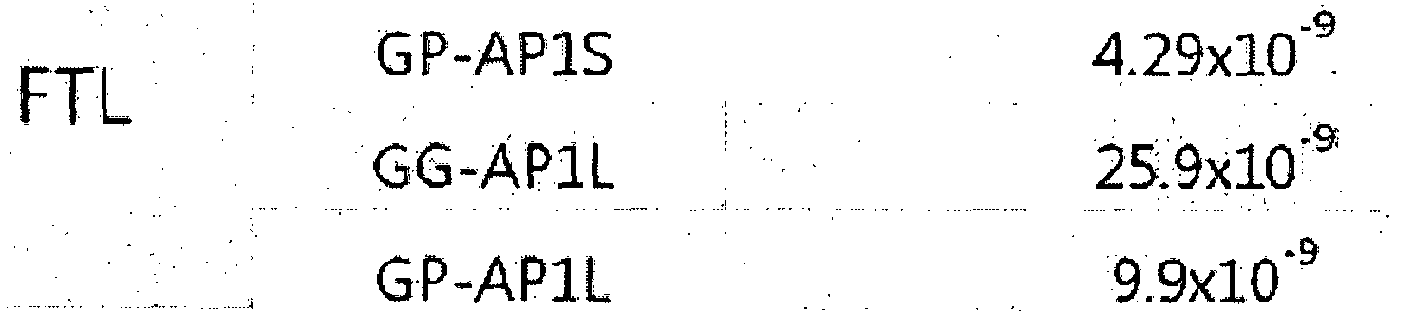
<292> 이에 반해 API이 삽입된 페리틴의 ¾값은 위의 [표 2]와 같이 계산되었다.
API이 삽입된 페리틴의 IL— 4 receptor와의 affinity가 API peptide에 비해 105~106 배 정도 좋아진 것을 알 수 있다. 4종류의 API이 삽입된 ferritin mutant간의 binding peak의 차이가 있었는데 AP1-S가 삽입된 페리틴과 AP1-L이 삽입된 페리틴 의 association과 dissociation의 pattern이 다름을 알 수 있다. 양쪽에 Cysteine 이 없는 AP1-S ferritin은 associat ion(Ka)과 dissociat ion(Kd)이 빠르며 농도 dependent하게 saturation되면서 binding하는 반면, 양 끝에 Cysteine이 있는 AP1- L ferritin은. 그에 비해 낮은 농도에서는 associat ion과 dissociat ion이 AP1-S ferritin 과 크게 다르지 않게 binding하였고, RIP} 차이가 없었지만 농도가 높아 짐에 따라 RU값이 많이 binding하고 dissociation이 느린 것으로 확인되었다 (도 9).
<293>
<294> <5-2>농도에 따른결합력 분석 (SPR analysis)
<295> 4종류의 API이 삽입된 ferritin mutant들이 IL-4 receptor 와 binding 하는 정도의 차이를 비교하기 위해 SPR분석을 하였다. 실험방법은 실시예 <5-1>과 같이 진행하였으며, 으 65nM부터 41.6nM까지의 농도에 따라 나타난 RU값을 GraphPad prism 4 프로그램을사용하여 그래프로 나타내었다.
<296> 그 결과, APIS가 삽입된 페리틴은 농도가 증가할수록 addictive하게 RU값이 증가하지만, AP1L이 삽입된 페리틴은 농도가 증가할수록 RU값이 significant하게 증가하는 것을 볼 수 있다. AP1L이 삽입된 페리틴이 APIS가 삽입된 페리틴보다 농 도가 증가할수록 RU값이 증가하는 정도가 훨씬 증가함을 확인할수 있었다 (도 10).
<실시예 6>
N말단에 제 2폴리펩티드단편이 융합된 페리틴 제조를위한발현백터 채조및
<6-1>발현백터의 제조
실시예 1에서 제조한 융합 폴리펩티드에 API 펩타이드를 추가로 삽입하였다. human ferritin light chain의 4번째와 5번째 αᅳ helix사이, 즉 4번째 loop지역인 Glycine과 Glycine사이 (GG 카세트)에 API 펩타이드 (short form인 APIS)가 삽입된 clone와 N-terminal에 API 펩타이드를 추가로 삽입하여서 하나의 페리틴 모노머에 API펩타이드가 2군데 삽입된 융합폴리펩티드 (FTL-AP1ᅳ API)를 제작하였다.
사용된 융합폴리펩티드는 GG 카세트에 APIS를 접어 넣은 융합폴리펩티드 (FTL_GG-AP1S)이며, 실시예에서 ΠΙ-APl·으로 명명하였다. 추가로 삽입되는 API의 아미노산 서열은 APIS인 RKRLDR 이며 삽입되는 위치는 융합폴리펩티드의 N-말단이 다. 실시예에서 FTL— GG— APIS(FTL-API)의 N-말단에 APIS를 융합시 ¾ 융합폴리펩티드 는 FTL-AP1_AP1으로 명명하였다.
또한 human ferritin light chain에 API 펩타이드 및 RGD 펩타이드가 연결된 융합 단백질을 제조하였다.
human ferritin light chain의 4번째와 5번째 α-helix사이, 즉 4번째 loop 지역인 Glycine과 Glycine사이 (GG 카세트)에 RGD 펩타이드가 삽입된 done의 N- terminal에 API 펩타이드를 삽입하여서 하나의 페리틴 모노머에 API 펩타이드와 RGD 펩타이드가 삽입된 융합폴리펩티드 (FTL— AP1_RGD)를 제작하고 API 펩타이드와 RGD 펩타이드 자리를 바꾸어 삽입하여 FTL-RGD-AP1 융합폴리펩티드를 제작하였다. 아래의 표 3과 같이 API 펩타이드의 서열과 linker의 서열 (GGGSG)을 가지는 정방향 프라이머와 FTL의 염기서열을 가지는 역방향 프라이머를 이용하고 FTL— GG一 APIS construct를 주형 (template)으로 사용하여 본 발명의 융합 단백질의 유전자를 PCR(denaturat ion 95 °C (30sec) , annealing temp. 60°C(30sec) , extension temp. 72 °C(lmin), 35 cycles)로 증폭하였다. 상기 PCR 증폭산물을 아가로스 젤 (agarose gel) 전기영동을 통해 크기를 확인하고 추출 (gel extraction)하였다. 이후 Ndel , Xhol (TAKARA 구입)를 이용하여 37°C에서 2시간동안 증폭된 유전자를 처리하였다. pET28a (+) 발현백터 역시 동일한 제한효소처리를 하고 정제를 한 후 T4 DNA ligase
를 이용하여 상기 유전자를 결합시켰다. 유전자의 삽입여부는 sequencing을 통해 검증하였다.
<308>
<309> 【표 3】 '
<3io> FTL-AP1_AP1제조를 위한프라이머 조합

<311>
<312> <6-2> 백터의 발현 및 분리정제
<313> 제조된 발현백터로 대장균을 형질 전환하여 융합단백질올 대량 생산하였다.
FTL-RGD_AP1, FTL-GRGDSP— API, FTL-APl-RGD, FTL-AP1-GRGDSP, FTL-AP1-AP1 각각의 유전자가 삼빕된 발현백터를 BL21 숙주세포에 형질변환을 시킨 후, LB배지에서 37 °C에서 키운 후 0D600값이 0.5에 도달하면 IPTG ImM을 이용하여 발현을 유도하였다. 이 후 201:에서 18시간을 더 배양한 후 세포를 수거하고 lysis 버퍼 (50mM Tris, lOOmM NaCl , ImM EDTA, 1% tripton X-100, ImM PMSF, 0.5mM DTT)를 이용하여 세포 를 파괴한 후 세포의 pellet을 8M urea가 들어간 binding 버퍼 (20mM Tris, 500mM NaCl, 5mM imidazole)로 용해한 후 Ni-NTA bead상에서 urea를 서서히 제거하여 protein을 refolding시켜서 정제하였다.
<314> 상기 정제를 위하여 affinity크로마토그래피를 이용하여 단백질을 순수하게 정제하고 정제된 단백질의 분자량을 변성 SDS-PAGE 전기영동을 통해 확인하였다. 구체적으로 affinity 크로마토그래피는 Ni— NTA 컬럼을 사용하였으며 wash 버퍼 (20mM Tris, 500mM NaCl , 20mM imidazole)로 단백질 로딩 후 wash하였다 . elut ion 버퍼 (20mM Tris, 150mM NaCl , 180mM Histidine)로 컬럼에 붙어있는 단백질을 용출 시킨 후 전기영동을통하여 확인하였다.
<315>
<316> 그 결과, [도 11] 및 에서 보는 바와 같이 약 23kDa의 protein이 정제된 것 을 SDS-PAGE에서 확인할수 있었다.
<317>
<318> <실시예 1> .
<3i9> 펩타이드삽입 페리틴의 Cage 형성 테스트
<320>
<32i> <7-l> 고속 단백질 액체 크로마토그래피 (FPLC: Fast Protein Liquid
Chromatography)를 이용한페리틴 단백질 형성 테스트
<322>
<323> 실시예 <2-1>에서와동일한 방법으로 FPLC를 시행하였다.
<324> 그 결과 [도 15]에서 보는 바와 같이 펩타이드를 삽입한 FTL-AP1-RGD와 FTL-
AP1-GRGDSP 둘 다 cage를 잘 형성하는 것으로 확인 되었다. 펩타이드가 삽입된 페 리틴이 wild type에 비해 size가 작게 보이지만, elution volume 10~llml사이에서 peak가 형성되는 것을 확인하였다.
<325>
<326> <7-2>생물투과 전자현미경 관찰
<327> 펩타이드를 삽입한 페리틴들이 cage를 잘 형성하는지 확인하기 위하여 생물 투과전자현미경 촬영을 하였다.
<328> 각 sample의 농도는 0.2mg/ml로 만들었으며, 촬영은 실시예 <2-2>에서와 동 일한 방법으로 기초과학지원연구원 (KBSI)에 의뢰하여 촬영을 하였다.
<329>
<330> 실험결과, FPLC와 같은 결과로 wild type과 마찬가지로 cage를 잘 형성하는 것을 확인하였다 ([도 12] 참조).
<331>
<332> <실시예 8>
<333> FACS를 이용한세포결합실험
<334>
<335> API peptide를 두 군데 삽입한 페리틴 (FTL-AP1_AP1)이 IL-4 receptor에 잘 결합하는지 비교하기 위하며, IL-4 receptor가 많이 발현하고 있는 A549 cell을 이 용하여 실시예 <3-1>과동일한방법으로 세포결합실험을 하였다.
<336> 먼저 A549 cell을 100파이 플레이트에 confluence가 80%정도 될 때까지 키웠 다. plated cell을 PBS로 두 번 wash하고 Trypsin/EDTA로 cell을 plate에서 떼어낸 후 2xl05/100ul cell을 1% bovine serum albumin(BSA)이 포함된 PBS에 suspension하 여 4°C에서 30분 동안 incubation하였다. PBS로 두 번 wash한 후 FTL-AP1과 FTL- AP1_AP1을 400nM, 200nM, 40nM의 농도로 20mM Tris, 150mM NaCl, 180mM Histidine 버퍼에 희석한 후 c에서 20분 binding시켰다. PBS로 두 번 wash한 후 ferritin light chain antibody (D-18,sc-14420)를 1:400의 비율로 1% BSA가 포함된 PBS 버
퍼에 희석하여 30분 동안 ice에서 incubation하였다. PBS로 두 번 wash한 후 Alexa Fluor 488 donkey ant i -goat IgG(H+L) antibody를 1:200의 비율로 1¾ BSA가 포함된 PBS 버퍼에 회석하여 30분 동안 ice에서 incubation하였다. PBS로 두 번 wash하고 500ul PBS에 cell을 suspension한후 FACS를 시행하였다.
<337> 실험 결과, [도 13]에서 보는 바와 같이 , 400nM과 200nM에서 FTL-AP1_AP1이
FTL-AP1보다 IL-4 receptor에 더 많이 결합하는 것을 확인하였다.
<338>
<339> <실시예 9>
<340> 표면 ¾라스몬공명 (SPR: Surf ace plasmon resonance) 분석
<341>
<342> <9-l> RGD 펩타이드 및 API 펩타이드가 삽입된 인간 페리틴의 인테그린 alphavbeta3과의 결합력 분석
<343> 분석을 위하여 0.25mg/ml농도의 alphavbeta3 단백질 35ul에 200mM소듐 아세 테이트 (NaOAC, sodium acetate, H 4.0)를 35ul넣어서 섞어준 후 20mM sodium acetate buffer가되도록 ◦로총 volume 350ul가되게 만들었다.
<344> Carboxymethyl dextran chip의 각 channeKleft , right)에 40mM EDC(N-(3-
Dimethylaminopropyl )-Ν' -ethyl carbodi imide hydrochloride)/ lOmM NHS (Nᅳ Hydroxy— succinimide)을 7분 홀려 표면올 activation 시킨 후 준비된 alphavbe 3 단백질 200ul을 left channel에 7분 동안 홀려주어 immobilization 하였다. 이때 right chsnnel은 reference channel로 사용하였다. Left channel과 right channel의 두 channel을 미 반응된 표면을 비특이적 흡착을 줄이기 위해 1M ethanolamine pH8.5 용액으로 7분 동안 홀려서 blocking하였다. 모든 실험은 25°C의 온도에서 진행하였 고, 흐름속도는 25ul/min으로 하였다.
<345> 버퍼는 10mM Hepes pH7.4, 150mM NaCl , 180mM Histidine, ImM MgCl2, 0.005% tween 20을 filtering, degasing을 하여 사용하였고, wild type 페리틴과 RGD가삽 입된 페리틴을 각각 0.65ηΜ, 1.3ηΜ, 2.6ηΜ, 5.2ηΜ, 10.4ηΜ, 20.8ηΜ, 41.6ηΜ의 농도 로 3분 동안 흘려주고, 상동의 버퍼를 3분간 흘려주었다. 2Μ NaCl을 1분 동안 흘려 서 해리되지 않고 남아있는 단백질을 씻어주는 regeneration을 하였다. 0.65nM부터 10.4nM까지의 농도에서 left channel 값에서 right channel 값을 빼서 특이적인 binding 값을 graph로 나타내었다.
<346> Binding graph는 scrubber software를 이용하여 Blank(buf fer)값과 reference channel (ri ht channel)을 빼주어 결합된 단백질 양을 표현하는 RU값을
정하였고 상기의 software를 이용해 KD value를 구하였다.
<347> : 측정된 RGD가 삽입된 페리틴의 농도별 결합 RU로 RGD가 삽입된 페리틴과 alphavbeta3의 ¾값을 계산한 결과, 값은 6.86χ10—8으로 계산되 었다.
<348> 실험 결과, [도 16]에서 보는 바와— 이 FTL-RGD-AP1과 FTL-GRGDSP— API이 인 테그린 alphavbeta3 농도에 의존적으로 binding함을 알 수 있다 .
<349>
<350> <9-2> FTL-APlJ Pl의 결합력 비교 축정
<35 i> ' FTL— API과 FTL-AP1ᅳ API의 결합력 비교를 위하여 표면 플라스몬 공명 분석을 실사하였다 . 방법은 실시 예 <5-1>과 등일한 방법으로 하였으며 , FTL-AP1농도는 0.26ηΜ, Γ.041ηΜ, 2.083ηΜ, 4. 166ηΜ에서 각각 binding하여 분석하고 , FTL-AP1_AP1 의 농도는 0.520nM, 1.0 1nM , 2.083nM, 4.166nM에서 binding한 후 분삭하였다.
<352> _
<353> 실험결과 [도 14] 및 [표 4]에서 보는 바와 같이, FTL-AP1의 ¾값은 443pM이 고 , FTL-AP1ᅳ API의 KD값은 45.8pM로 FTL— AP1_AP1의 결합력 이 FTL-AP1에 비하여 10배 정도 증가한 것을 확안하였다 .
<354>
<355> [표 4】 .

<357>
<358> <실시예 10>
<359> 유효물질 전달 실험
<360>
<361> 본 발명의 페리 틴 유래 융합폴리펩티드의 약물전달체 효과를 확인하기 위하 여, 페리틴 cage에 삽입된 API펩타이드가 천식에 효과가 있는지 동물실험을 통하여 ' 확인하였다.
<362>
<363> <10-1> 천식 동물모델 제조
<364> 야생형 C57BL/6J 마우스를 Jackson Laboratory(Bar Harbor , ME, USA)으로부
터 구입하여 무균 사육 시설에서 사육하였다. 모든 동물은 정상식이 (PMI Lab Diet) 및 물을 자유 공급 하였다. 실험에는 6~8주령 female 마우스가사용되었다. 실험동 물의 관리 및 실험 절차는 KAIST의 동물실험윤리위원회 ()의 승인 하에 진행되었다.
<365> 천식 유도는 기존 방법 (Corry DB, Folkesson HG, Warnock ML, Erie DJ,
Matt hay MA, et al. (1996) J Exp Med 183: 109117.)에 의해 진행되었다.
<366> 간단히 설명하면, Aspergillus oryzae ' protease (lmg/mL in PBS, Sigma—
Aldrich) 및 계란 oval bum in(0VA, 0.5 mg/mL in PBS, Sigma-Aldr ich)의 allergen(APO)을 l:9(v/v)로 투여직전 흔합하여 사용하여 천식을 유도하였다. 마우 스는 50uL의 allergen로 4회의 복강 내 감작 (intraperitoneal sensitizations) 및 비강 내 유도 (intranasal challenge)를 매 4일 (0, 4, 8, 12, 16)마다 수행하였다. 비강 내 유도를 위하여 마우스는 isoflurane 흡입 (Abbott Laboratory, Abbott Park, IL, USA)으로 간이 마취 하였다. 알레르기 유도 1시간 전 PBS에 lmg/ml로 희 석된 AP— 1 보유 페리틴 cage (GG-AP1L, 157cysAPl-PBNC) 또는 AP-1이 삽입되지 아 니한 페리틴 cage(wt FTL)를 50uI/4 투여하였다.
<367>
<368> <10— 2>천식 증상유발시험
<369> 알레르기성 천식 표현형 측정을 위하여, AHR, BAL cytology, BAL glycoprotein assay, 및 lung histopathology 시험을 기존 방법 (Lee, S. H. , et al. (2003) Nat. Med. 9, 128111286.)에 의해 수행하였다.
<370> 간단히 설명하면, 마지막 비강 내 유도 16시간 후, AHR는 FlexiVent system
(SCIREQ Inc. , Montreal , Canada)으로 측정하였다. pentobarbital sodium (Hanlim Pharma Co., Seoul , Korea, 60mg/kg)으로 마취한 후, 20게이지 캐뉼러 삽관 후 마 우스는 기관 내 캐뉼러를 통하여 FlexiVent system과 연결되었다.
<37i> pancuronium bromide (Sigma-Aldr ich, 1 mg/kg)으로 마비入 1킨 후, 마우스는 호기말양압 (positive end expiratory pressure) 3 Cm¾0에서 일회 환기량 lOmL/kg으 로 150회 /min의 호흡속도로 호흡시켰다.
<372> 폐 저항을 측정하기 위하여 마우스는 흡입기로 methacholine (Sigma-
Aldrich)를 증가량흡입 시켰다 (0 = normal saline only, 1, 3, 9, 18, 27 mg/mL) .
<373>
<374> <10-3>천식 증상측정 시험
<375> 기도 저항은 각 증가량의 methacholine흡입후 기준치로 회복시켰다.
<376> 이푸'기도 과반웅성 (AHR, airway hyper-responsiveness), BAL cytology, and
secreted glycoprotein assays를 기존 방법 (Lee, S. H. et al . , (2004) J. Allergy Clin. Immunol . 113, 72778.)에 따라측정하였다.
<377>
<378> 측정 결과, [도 17a]에서 보는 바와 같이, API을 포함하는 페리틴을 투여한
157
군 (AP0+ cysAPl-PBNC)이 대조군 페리틴에 비하여 기도 과반응성 (AHR, airway hyper— responsiveness)이 현저하게 억제되는 것을 확인하였다.
<379> 또한 기관지폐포세척액 (bronchoalveolar lavage(BAL) fluid) 내의 염증 세포
157 특히 호산구 (eosinophils)의 수도 API을 포함하는 페리틴을 투여한 군( cysAPl- PBNC)이 대조군 페리틴에 비하여 현저하게 감소하는 것을 확인하였다 ([도 17 , c] 참조).
<380>
<38i> <10-4> BAL fluid내의 glycoprotein분비 측정
<382> 분비된 glycoprotein의 수준은 기존의 방법 (Lee, S. H. et al. , (2004) J.
Allergy Clin, Immunol. 113, 72778.)에 따라 변형된 ELISA로 측 ^되었다.
<383> 간단히 설명하면, 뮤신 standard (돼지 위 유래, Sigma-Aldrich)를 PBS로 2배 씩 순차적으로 희석하여 준비하고, BAL fluid 샘플은 1:100에서 시작하여 동일하 게 PBS로 2배씩 순차적으로 희석하였다.
<384> 각 샘폴 40ul을 ELISA plate(Greiner, Kremsmunster, Austria)에 옮긴 후 37
°C에서 2시간 동안 반응시켰다. 반응 및 세척 후 plate는 200ul의 0.2% I -block (Applied Biosystems, Foster City, CA, USA)으로 Mock하고, 37°C에서 2시간 동안 반웅시켰다. 세척 후 40ul의 biotinylated jacal in(5ug/mL glycoprotein binding lectin, Vector Laboratories, Burlingame, CA, USA)을 투여한 후 4°C에서 밤새 반 응시켰다. 다음날 세척 후 40ul의 alkaline phosphatase가 conjugate 된 streptavidin (1:1000 dilution, BD Biosciences)올 추가하고, 실은에서 30분간 반 응시켰다. 반응 종료 후 마지막 세척을 하고, 70ul의 alkaline phosphatase substrate (5 mmol in 0.1 mol/L alkaline buffer , Sigma— Aldrich)를 투여하고, 뮤 신 standard 커브가 명백해질 때까지 발색 시킨 후, 40ul의 0.5N sodium hydroxide 를 추가하여 반웅을 중단시킨 후 405nm 파장에서 ELISA reader (BioRad, Hercules, CA, USA)로 흡광도를측정하였다.
<385>
<386> 측정 결과, 분비된 BAL fluid 내의 glycoprotein의 양도 API을 포함하는 페
리틴을 투여한 군( cysAPl-PBNC)에서 현저히 감소하는 것을 확인하였다 ([도 17d] 참조).
<387>
<388> <10-5>현미경 조직 관찰
<389> 마지막으로 실험 마우스를 희생시켜' periodic acid Schiff (PAS)로 염색된 폐 슬라이드 표본을 제조한 후, infla隱 atory cell 및 goblet cell의 변화를 관찰 하였다. (arrowhead: mucin-positive goblet cell, arrow-' inflammatory eel 1 )
<390>
<39i> 그 결과, 기관지주위 염증세포 (peribronchial inflammatory cell, 화살표 표 시) 및 점액 생산 goblet 세포 (mucus一 producing goblet cell, arrowhead 표入 1)의 수가 API을 포함하는 페리틴을 투여한 군에서 현저히 감소하는 것을 확안하였다([ 도 17e] 참조).
<392>
<393> 이러한 결과를 종합하면, API을 포함하는 페리틴을 투여한 군에서 천식 증상 완화 효과가 나타나는 것을 확인하였다. 이는 페리틴 cage가 약물 전달체로서 효과 적으로 작용한다는 것을 시사한다.
<394>
【산업상 이용가능성】
<395> 따라서, 본 발명은 인간 유래 페리틴 모노머의 4번째 루프 (loop)의 첫 번째 내지 다섯 번째 아미노산사이에 5개 내지 30개의.아미노산으로 이투어진 폴리펩티
—드단편이 융합된 융합폴리펩티드를 제공한다. 본 발명의 융합폴리¾티드는 단백질 케이지를 형성하여 내부에 유효물질의 봉입이 가능하며, 폴리펩티드단편의 특정 분 자, 세포 또는 조직과의 결합력을 매우 향상시켜 질병의 진단, 치료제 개발에 효과 적이어서 산업상 이용가능성이 높다.
Claims
[청구의 범위】
【청구항 1】
인간 유래 페리틴 모노머의 4번째 루프 (loop)의 첫 번째 내지 다섯 번째 아 미노산 사이에 5개 내지 30개의 아미노산으로 이루어진 제 1폴리펩티드단편이 융합 된 융합플리펩티드. ί청구항 2】
제 1항에 있어서, 상기 융합플리펩티드는 상기 인간유래 페리틴 모노머의 Ν 말단에 5개 내지 30개의 아미노산으로 이루어잔 제 2폴리펩티드단편이 추가로 융합 된 것을 특징으로 하는 융합플리펩티드.
【청구항 3】
제 1항에 있어서, 상기 인간 유래 페리틴 모노머는 인간 유래 페리틴 라이트 체인 (light chain)인 것을 특징으로 하는 융합폴리펩티드.
【청구항 4】
제 1항에 있어서, 상기 인간유래 페리틴 모노머는서열번호 1로 표시되는 아 미노산서열로 이루어진 폴리펩티드인 것을 특징으로 하는융합폴리펩티드.
【청구항 5】 '
제 1항에 있어서, 상기 인간 유래 페리틴 모노머의 4번째 투프 (loop)의 첫 번 째 내지 다섯 번째 아미노산사이는 서열번호 1로 표시되는 아미노산 서열의 154번 째 내지 158번째 아미노산사이인 것을 특징으로 하는 융합폴리펩티드.
【청구항 6】
제 1항에 있어서, 상기 융합폴리펩티드는 서열번호 1로 표시되는 아미노산서 열의 154번째 내지 158번째 아미노산 사이에 5개 내지 30개의 아미노산으로 이루어 진 제 1폴리펩티드단편이 융합되며, 상기 서열번호 1로 표시되는 아미노산 서열의 154번째 내지 158번째 아미노산 중 일부가 결실되는 것을 특징으로 하는 융합폴리 펩티드,
【청구항 7]
제 1항에 있어서, 상기 제 1폴리펩티드단편은
하기 서열 일반식 (I)로 표시되는 것을 특징으로 하는 융합폴리펩티드.
일반식 (I)
[N말단 -X1-X2— X3-C말단]
상기 XI 및 X3은 각각 1개 내지 3개의 임의의 아미노산으로 이루어진 링커이 며, 상기 X2는 1개 내지 28개의 임의의 아미노산으로 이루어진 활성폴리펩티드이 다.
【청구항 8】
겨) 7항에 있어서, 상기 링커는 제한효소 절단부위인 것을 특징으로 하는 융합 폴리펩티드.
【청구항 9】
제 7항에 있어서, 상기 XI은 글리신 -세린이며, X3은 글리신-프를린 또는 글리 신 -글리신-프를린인 것을 특징으로 하는융합폴리펩티드.
【청구항 10】
제 7항에 있어서, 상기 X2는 7개 내지 9개의 임의의 아미노산으로 이루어진 활성 폴리펩티드인 것을특징으로 하는 융합폴리펩티드.
[청구항 11】
제 7항에 있어서, 상기 X2는서열번호 6, 7, 33, 34로 이루어진 군에서 선택 된 서열로 표시되는 활성 폴리펩티드인 것을 특징으로 하는 융합폴리펩티드.
【청구항 12】
제 1항에 있어서, 상기 융합폴리펩티드는서열번호 2 내지 서열번호 5로 이루 어진 군에서 선택된 어느 하나로 표시되는 아미노산 서열로 이루어진 것을 특징으 로 하는 융합폴리펩티드.
【청구항 13】
제 2항에 있어서, 상기 융합폴리펩티드는 서열번호 23, 25, 27, 29 및 31로 이루어진 군에서 선택된 서열로 표시되는 아미노산 서열로 이루어진 것올 특징으로
하는 융합플리펩티드 .
[청구항 14】
제 1항 또는 제 2항에 있어서, 상기 제 1폴리펩티드단편 또는 제 2풀리펩티드단 편은 상기 융합폴리펩티드 간 또는 상기 융합폴리 펩티드와 인간 유래 패리틴 모노 머 간의 결합을 방해하지 않는 것을 특징으로 하는 융합폴리펩티드 .
【청구항 15】
제 1항 내지 제 13항 중 어느 한 항의 융합풀리펩티드를 포함하는 페리틴 단백 질 .
【청구항 16】
제 1항 내지 제 13항 중 어느 한 항의 융합폴리펩티드를 암호화하는 폴리뉴클 레오티드 .
【청구항 17】
제 16항의 폴리뉴클레오티 H를 포함하는 발현백터 .
【청구항 18】
제 17항의 발현백터로 형 질전환된 형질전환체 .
【청구항 19】
제 I항 내지 제 13항 중 어느 한 항의 융합폴리 펩티드를 포함하는 단백질 케이
【청구항 20】
제 1항 내지 제 13항 중 어느 한 항에 있어서, 상기 융합폴리펩티드는 목적하 는 물질에 특이적으로 결합하는 것을 특징으로 하는 융합플리펩티드 .
【청구항 21】
제 1항 또는 제 2항의 융합폴리펩티드를 유효성분으로 포함하는 약물전달시스 템 .
【청구항 22】
제 21항에 있어서, 상기 약물천달시스템은 인터투킨ᅳ4 수용체를 특이적으로 표적하는 것을 특징으로 하는 약물전달시스템.
【청구항 23】 .
제 21항에 있어서, 상기 융합풀리펩티드는 서열번호 2 내지 5, 23, 25, 27, 29 및 31로 이루어진 군에서 선택된 서열로 표시되는 아미노산 서열로 이루어진 것 을 특징으로하는 약물전달시스템.
[청구항 24】
제 1항 또는 제 2항의 융합폴리펩티드를 유효성분으로 포함하는 인터루킨 -4 매 개 질병 예방또는치료용 약학적 조성불.
【청구항 25】
제 24항에 있어서, 상기 융합폴리펩티드는 서열번호 2 내지 5, 23, 25, 27, 29 및 31로 이.루어 ¾ 군에서 선택된 서열로 표시되는 아미노산 서열로 이루어진 것 을 특징으로 하는조성물.
【청구항 26】
제 24항에 있어서, 상기 인터루 ¾— 4 매개 질병은 암, 알레르기, 동맥경화 및 천식으로 이루어진 군에서 선택된 것을 특징으로 하는 조성물.
【청구항 27】
제 1항 또는 제 2항의 융합폴리펩티드를 이를 필요로 하는 개체에 유효량으로 투여하는 단계를 포함하는 인터투킨 -4 매개 질병 예방또는 치료 방법 .
【청구항 28】
제 1항또는 제 2항의 융합폴리펩티드의 인터투킨ᅳ 4 매개 질병 예방 또는 치료 제 제조를 위한 용도.
【청구항 291
서열번호 2 내지 5, 23, 25, 27, 29 및 31로 이루어진 군에서 선택된 서열로 표시되는 아미노산 서열로 이루어잔융합폴리펩티드를 유효성분으로 포함하는 천식 치료제.
Priority Applications (1)
| Application Number | Priority Date | Filing Date | Title |
|---|---|---|---|
| US14/820,865 US9920105B2 (en) | 2013-02-08 | 2015-08-07 | Human ferritin-derived fusion polypeptide |
Applications Claiming Priority (2)
| Application Number | Priority Date | Filing Date | Title |
|---|---|---|---|
| KR20130014510 | 2013-02-08 | ||
| KR10-2013-0014510 | 2013-02-08 |
Related Child Applications (1)
| Application Number | Title | Priority Date | Filing Date |
|---|---|---|---|
| US14/820,865 Continuation US9920105B2 (en) | 2013-02-08 | 2015-08-07 | Human ferritin-derived fusion polypeptide |
Publications (1)
| Publication Number | Publication Date |
|---|---|
| WO2014123399A1 true WO2014123399A1 (ko) | 2014-08-14 |
Family
ID=51299942
Family Applications (1)
| Application Number | Title | Priority Date | Filing Date |
|---|---|---|---|
| PCT/KR2014/001094 Ceased WO2014123399A1 (ko) | 2013-02-08 | 2014-02-10 | 인간 페리틴 유래 융합폴리펩티드 |
Country Status (3)
| Country | Link |
|---|---|
| US (1) | US9920105B2 (ko) |
| KR (1) | KR101604375B1 (ko) |
| WO (1) | WO2014123399A1 (ko) |
Families Citing this family (12)
| Publication number | Priority date | Publication date | Assignee | Title |
|---|---|---|---|---|
| KR101741594B1 (ko) * | 2015-06-30 | 2017-05-30 | 경북대학교 산학협력단 | 암세포 및 종양관련 대식세포를 동시에 표적하는 융합 펩타이드를 유효성분으로 포함하는 항암 및 암 전이 억제용 약학적 조성물 |
| KR101888675B1 (ko) * | 2015-09-02 | 2018-08-14 | 경북대학교 산학협력단 | 인간 유래 페리틴 모노머 단편 및 이를 이용한 융합폴리펩티드 |
| KR101811050B1 (ko) * | 2015-09-02 | 2017-12-21 | 경북대학교 산학협력단 | 항염증성 폴리펩티드와 페리틴 모노머 단편이 접합된 융합폴리펩티드 및 이를 유효성분으로 포함하는 염증성 질환 예방 및 치료용 약학적 조성물 |
| CN111712574B (zh) * | 2018-02-21 | 2024-06-18 | 味之素株式会社 | 融合蛋白 |
| CN112912385A (zh) | 2018-10-29 | 2021-06-04 | 味之素株式会社 | 包封有有机化合物的铁蛋白的制造方法 |
| US12577292B2 (en) * | 2019-03-07 | 2026-03-17 | Kyungpook National University Industry-Academic Cooperation Foundation | Ferritin nanocage for multi-displaying trail trimer and cancer-targeting peptide and use thereof as anticancer agent |
| WO2021045210A1 (ja) | 2019-09-05 | 2021-03-11 | 味の素株式会社 | ペプチド内包フェリチン |
| KR20210053252A (ko) * | 2019-11-01 | 2021-05-11 | (주)셀레메디 | 면역 관문 분자와 결합 가능한 분자가 융합된 단백질 및 이의 용도 |
| WO2021086158A1 (ko) * | 2019-11-01 | 2021-05-06 | (주)셀레메디 | 질환 항원이 융합된 단백질 및 이의 용도 |
| WO2021086159A1 (ko) * | 2019-11-01 | 2021-05-06 | (주)셀레메디 | 면역 관문 분자와 결합 가능한 분자가 융합된 단백질 및 이의 용도 |
| EP4163294A4 (en) | 2020-06-09 | 2024-07-24 | Ajinomoto Co., Inc. | MODIFIED FERRITIN AND METHOD FOR PRODUCING SAME |
| WO2022196675A1 (ja) | 2021-03-16 | 2022-09-22 | 味の素株式会社 | 複合体またはその塩、およびその製造方法 |
Citations (2)
| Publication number | Priority date | Publication date | Assignee | Title |
|---|---|---|---|---|
| KR20070089236A (ko) * | 2004-12-24 | 2007-08-30 | 도꾸리쯔교세이호징 가가꾸 기쥬쯔 신꼬 기꼬 | 나노흑연 구조체-금속 나노입자 복합체 |
| KR20120118186A (ko) * | 2011-04-18 | 2012-10-26 | 경북대학교 산학협력단 | 활성 폴리펩타이드의 결합 친화력 및 결합 특이성을 증강시키는 단백질 골격 모듈 |
Family Cites Families (1)
| Publication number | Priority date | Publication date | Assignee | Title |
|---|---|---|---|---|
| US6376524B1 (en) | 2000-06-21 | 2002-04-23 | Sunesis Pharmaceuticals, Inc. | Triphenyl compounds as interleukin-4 antagonists |
-
2014
- 2014-02-10 KR KR1020140015142A patent/KR101604375B1/ko active Active
- 2014-02-10 WO PCT/KR2014/001094 patent/WO2014123399A1/ko not_active Ceased
-
2015
- 2015-08-07 US US14/820,865 patent/US9920105B2/en active Active
Patent Citations (2)
| Publication number | Priority date | Publication date | Assignee | Title |
|---|---|---|---|---|
| KR20070089236A (ko) * | 2004-12-24 | 2007-08-30 | 도꾸리쯔교세이호징 가가꾸 기쥬쯔 신꼬 기꼬 | 나노흑연 구조체-금속 나노입자 복합체 |
| KR20120118186A (ko) * | 2011-04-18 | 2012-10-26 | 경북대학교 산학협력단 | 활성 폴리펩타이드의 결합 친화력 및 결합 특이성을 증강시키는 단백질 골격 모듈 |
Non-Patent Citations (5)
| Title |
|---|
| GOLLAN, T. J. ET AL.: "Redirecting retroviral tropism by insertion of short, nondisruptive peptide ligands into envelope.", J. VIROL., vol. 76, no. 7, April 2002 (2002-04-01), pages 3558 - 3563 * |
| HART, S. L. ET AL.: "Cell binding and internalization by filamentous phage displaying a cyclic Arg-Gly-Asp-containing peptide.", J. BIOL. CHEM., vol. 269, no. 17, 29 April 1994 (1994-04-29), pages 12468 - 12474 * |
| HONG, H. Y. ET AL.: "Phage display selection of peptides that home to atherosclerotic plaques : IL -4 receptor as a candidate target in atherosclerosis.", J. CELL MOL. MED., vol. 12, no. 5B, October 2008 (2008-10-01), pages 2003 - 2014 * |
| KRAMER, R. M.: "Engineered Protein Cages for Nanomaterial Synthesis.", J. AM. CHEM. SOC., vol. 126, no. 41, 20 October 2004 (2004-10-20), pages 13282 - 13286 * |
| WU, X. L. ET AL.: "Tumor-targeting peptide conjugated pH-responsive micelles as a potential drug carrier for cancer therapy.", BIOCONJUG. CHEM., vol. 21, no. 2, 17 February 2010 (2010-02-17), pages 208 - 213 * |
Also Published As
| Publication number | Publication date |
|---|---|
| US20160060307A1 (en) | 2016-03-03 |
| KR20140101319A (ko) | 2014-08-19 |
| US9920105B2 (en) | 2018-03-20 |
| KR101604375B1 (ko) | 2016-03-25 |
Similar Documents
| Publication | Publication Date | Title |
|---|---|---|
| WO2014123399A1 (ko) | 인간 페리틴 유래 융합폴리펩티드 | |
| US11879002B2 (en) | Bi-specific therapeutic proteins, in vivo methods of use thereof and encoding nucleic acids thereof | |
| JP5941497B2 (ja) | Cxcケモカイン受容体4(cxcr4)拮抗性ポリペプチド | |
| US20190365851A1 (en) | Syndecan-2 compositions and methods of use | |
| US9504731B2 (en) | Therapeutic agent, treatment method and inspection method for diseases caused by activation of neutrophils | |
| CN105524176B (zh) | 双特异性融合蛋白 | |
| CN105744944A (zh) | 免疫系统调节器 | |
| CN102775490A (zh) | 具有趋化活性的分泌蛋白及其应用 | |
| KR101575194B1 (ko) | 인간 페리틴 유래 융합폴리펩티드 | |
| CN103204921A (zh) | 具有趋化活性的分泌蛋白及其编码序列和用途 | |
| CN104232590A (zh) | 一种卵泡抑素样蛋白1的单克隆抗体及其应用 | |
| EP2984169A1 (en) | Potent inhibitors of human matriptase derived from mcoti-ii variants | |
| KR102942705B1 (ko) | Lag-3에 결합하는 펩타이드 및 이의 용도 | |
| Raffensperger et al. | Endothelial GDF15 deficiency enhances barrier function and mitigates pulmonary fibrosis | |
| CN100436470C (zh) | 一种识别肿瘤细胞的多肽ot10、编码ot10的多核苷酸及用途 | |
| TW202237178A (zh) | 調節宿主細胞表面與sars—cov—2交互作用之方法 | |
| HK40058660A (en) | Bi-specific therapeutic proteins for tissue repair | |
| HK40107422A (zh) | 用於调节宿主细胞表面与sars-cov-2相互作用的方法 | |
| WO2023152144A1 (en) | Protein z variants binding thymic stromal lymphopoietin and their medical use | |
| WO2009070957A1 (fr) | Inhibiteur de l'interaction entre blys et ngr et son utilisation | |
| HK1258376B (en) | Bi-specific therapeutic proteins for tissue repair |
Legal Events
| Date | Code | Title | Description |
|---|---|---|---|
| 121 | Ep: the epo has been informed by wipo that ep was designated in this application |
Ref document number: 14749569 Country of ref document: EP Kind code of ref document: A1 |
|
| NENP | Non-entry into the national phase |
Ref country code: DE |
|
| 122 | Ep: pct application non-entry in european phase |
Ref document number: 14749569 Country of ref document: EP Kind code of ref document: A1 |