WO2014123200A1 - 光学ガラス、熱間成形品およびその製造方法、ならびに光学素子およびその製造方法 - Google Patents
光学ガラス、熱間成形品およびその製造方法、ならびに光学素子およびその製造方法 Download PDFInfo
- Publication number
- WO2014123200A1 WO2014123200A1 PCT/JP2014/052799 JP2014052799W WO2014123200A1 WO 2014123200 A1 WO2014123200 A1 WO 2014123200A1 JP 2014052799 W JP2014052799 W JP 2014052799W WO 2014123200 A1 WO2014123200 A1 WO 2014123200A1
- Authority
- WO
- WIPO (PCT)
- Prior art keywords
- glass
- optical
- mass
- range
- content
- Prior art date
- Legal status (The legal status is an assumption and is not a legal conclusion. Google has not performed a legal analysis and makes no representation as to the accuracy of the status listed.)
- Ceased
Links
Images

Classifications
-
- C—CHEMISTRY; METALLURGY
- C03—GLASS; MINERAL OR SLAG WOOL
- C03C—CHEMICAL COMPOSITION OF GLASSES, GLAZES OR VITREOUS ENAMELS; SURFACE TREATMENT OF GLASS; SURFACE TREATMENT OF FIBRES OR FILAMENTS MADE FROM GLASS, MINERALS OR SLAGS; JOINING GLASS TO GLASS OR OTHER MATERIALS
- C03C3/00—Glass compositions
- C03C3/12—Silica-free oxide glass compositions
- C03C3/16—Silica-free oxide glass compositions containing phosphorus
- C03C3/21—Silica-free oxide glass compositions containing phosphorus containing titanium, zirconium, vanadium, tungsten or molybdenum
-
- C—CHEMISTRY; METALLURGY
- C03—GLASS; MINERAL OR SLAG WOOL
- C03B—MANUFACTURE, SHAPING, OR SUPPLEMENTARY PROCESSES
- C03B11/00—Pressing molten glass or performed glass reheated to equivalent low viscosity without blowing
- C03B11/12—Cooling, heating, or insulating the plunger, the mould, or the glass-pressing machine; cooling or heating of the glass in the mould
- C03B11/122—Heating
-
- C—CHEMISTRY; METALLURGY
- C03—GLASS; MINERAL OR SLAG WOOL
- C03B—MANUFACTURE, SHAPING, OR SUPPLEMENTARY PROCESSES
- C03B23/00—Re-forming shaped glass
- C03B23/0013—Re-forming shaped glass by pressing
-
- C—CHEMISTRY; METALLURGY
- C03—GLASS; MINERAL OR SLAG WOOL
- C03B—MANUFACTURE, SHAPING, OR SUPPLEMENTARY PROCESSES
- C03B40/00—Preventing adhesion between glass and glass or between glass and the means used to shape it, hold it or support it
- C03B40/04—Preventing adhesion between glass and glass or between glass and the means used to shape it, hold it or support it using gas
-
- C—CHEMISTRY; METALLURGY
- C03—GLASS; MINERAL OR SLAG WOOL
- C03B—MANUFACTURE, SHAPING, OR SUPPLEMENTARY PROCESSES
- C03B7/00—Distributors for the molten glass; Means for taking-off charges of molten glass; Producing the gob, e.g. controlling the gob shape, weight or delivery tact
- C03B7/10—Cutting-off or severing the glass flow with the aid of knives or scissors or non-contacting cutting means, e.g. a gas jet; Construction of the blades used
- C03B7/12—Cutting-off or severing a free-hanging glass stream, e.g. by the combination of gravity and surface tension forces
-
- C—CHEMISTRY; METALLURGY
- C03—GLASS; MINERAL OR SLAG WOOL
- C03C—CHEMICAL COMPOSITION OF GLASSES, GLAZES OR VITREOUS ENAMELS; SURFACE TREATMENT OF GLASS; SURFACE TREATMENT OF FIBRES OR FILAMENTS MADE FROM GLASS, MINERALS OR SLAGS; JOINING GLASS TO GLASS OR OTHER MATERIALS
- C03C3/00—Glass compositions
- C03C3/04—Glass compositions containing silica
- C03C3/062—Glass compositions containing silica with less than 40% silica by weight
- C03C3/064—Glass compositions containing silica with less than 40% silica by weight containing boron
- C03C3/068—Glass compositions containing silica with less than 40% silica by weight containing boron containing rare earths
-
- C—CHEMISTRY; METALLURGY
- C03—GLASS; MINERAL OR SLAG WOOL
- C03C—CHEMICAL COMPOSITION OF GLASSES, GLAZES OR VITREOUS ENAMELS; SURFACE TREATMENT OF GLASS; SURFACE TREATMENT OF FIBRES OR FILAMENTS MADE FROM GLASS, MINERALS OR SLAGS; JOINING GLASS TO GLASS OR OTHER MATERIALS
- C03C3/00—Glass compositions
- C03C3/12—Silica-free oxide glass compositions
- C03C3/14—Silica-free oxide glass compositions containing boron
- C03C3/15—Silica-free oxide glass compositions containing boron containing rare earths
-
- C—CHEMISTRY; METALLURGY
- C03—GLASS; MINERAL OR SLAG WOOL
- C03C—CHEMICAL COMPOSITION OF GLASSES, GLAZES OR VITREOUS ENAMELS; SURFACE TREATMENT OF GLASS; SURFACE TREATMENT OF FIBRES OR FILAMENTS MADE FROM GLASS, MINERALS OR SLAGS; JOINING GLASS TO GLASS OR OTHER MATERIALS
- C03C3/00—Glass compositions
- C03C3/12—Silica-free oxide glass compositions
- C03C3/14—Silica-free oxide glass compositions containing boron
- C03C3/15—Silica-free oxide glass compositions containing boron containing rare earths
- C03C3/155—Silica-free oxide glass compositions containing boron containing rare earths containing zirconium, titanium, tantalum or niobium
-
- C—CHEMISTRY; METALLURGY
- C03—GLASS; MINERAL OR SLAG WOOL
- C03C—CHEMICAL COMPOSITION OF GLASSES, GLAZES OR VITREOUS ENAMELS; SURFACE TREATMENT OF GLASS; SURFACE TREATMENT OF FIBRES OR FILAMENTS MADE FROM GLASS, MINERALS OR SLAGS; JOINING GLASS TO GLASS OR OTHER MATERIALS
- C03C3/00—Glass compositions
- C03C3/12—Silica-free oxide glass compositions
- C03C3/16—Silica-free oxide glass compositions containing phosphorus
- C03C3/19—Silica-free oxide glass compositions containing phosphorus containing boron
-
- G—PHYSICS
- G02—OPTICS
- G02B—OPTICAL ELEMENTS, SYSTEMS OR APPARATUS
- G02B1/00—Optical elements characterised by the material of which they are made; Optical coatings for optical elements
-
- G—PHYSICS
- G02—OPTICS
- G02B—OPTICAL ELEMENTS, SYSTEMS OR APPARATUS
- G02B3/00—Simple or compound lenses
- G02B3/02—Simple or compound lenses with non-spherical faces
-
- C—CHEMISTRY; METALLURGY
- C03—GLASS; MINERAL OR SLAG WOOL
- C03B—MANUFACTURE, SHAPING, OR SUPPLEMENTARY PROCESSES
- C03B2215/00—Press-moulding glass
- C03B2215/40—Product characteristics
- C03B2215/46—Lenses, e.g. bi-convex
-
- C—CHEMISTRY; METALLURGY
- C03—GLASS; MINERAL OR SLAG WOOL
- C03B—MANUFACTURE, SHAPING, OR SUPPLEMENTARY PROCESSES
- C03B2215/00—Press-moulding glass
- C03B2215/66—Means for providing special atmospheres, e.g. reduced pressure, inert gas, reducing gas, clean room
-
- G—PHYSICS
- G02—OPTICS
- G02B—OPTICAL ELEMENTS, SYSTEMS OR APPARATUS
- G02B3/00—Simple or compound lenses
-
- G—PHYSICS
- G02—OPTICS
- G02B—OPTICAL ELEMENTS, SYSTEMS OR APPARATUS
- G02B3/00—Simple or compound lenses
- G02B3/0006—Arrays
-
- G—PHYSICS
- G02—OPTICS
- G02B—OPTICAL ELEMENTS, SYSTEMS OR APPARATUS
- G02B5/00—Optical elements other than lenses
- G02B5/04—Prisms
-
- G—PHYSICS
- G02—OPTICS
- G02B—OPTICAL ELEMENTS, SYSTEMS OR APPARATUS
- G02B5/00—Optical elements other than lenses
- G02B5/18—Diffraction gratings
Definitions
- the present invention relates to an optical glass, a hot-formed product and a manufacturing method thereof, and an optical element and a manufacturing method thereof.
- a method of manufacturing a lens constituting an optical system a method of cold working a glass material or a cold working of a glass molded product obtained by reheat press molding is known.
- cold working refers to machining such as grinding and polishing.
- Japanese Patent Application Laid-Open No. 2007-269584 discloses a boric acid-based optical glass.
- a method for obtaining a preform of an optical element (preform) by separating an appropriate amount from the flowing molten glass into a molten glass lump and forming the molten glass lump before the glass lump is cooled and solidified is a heat treatment.
- This is called the inter-forming method.
- a method of forming an optical functional surface of a lens by press-molding a preform without undergoing mechanical processing such as grinding and polishing is called a precision press-molding method.
- These hot molding methods and precision press molding methods are mainly used to stably supply a large amount of aspherical lenses using high-performance glass at a low cost.
- JP-A-2002-249337 includes a boric acid-rare earth optical glass exhibiting high refractive index and low dispersion characteristics. It is disclosed.
- optical glass having a high refractive index and low dispersion characteristic is suitable as a lens constituting an optical system.
- it is important to suppress the occurrence of striae due to volatilization during glass melting, the reduction of optical characteristic fluctuations, and the coloring due to contamination from the melting crucible material.
- the prior art has room for improvement in this regard.
- one embodiment of the present invention provides a high-quality optical glass having high refractive index and low dispersion characteristics. Furthermore, one aspect of the present invention provides a hot-formed product made of the above-described optical glass and a manufacturing method thereof, and an optical element and a manufacturing method thereof.
- one embodiment of the present invention is Containing P 2 O 5 , B 2 O 3 and rare earth oxide as essential components,
- P 2 O 5 content is in the range of more than 0% by mass and less than 0.79% by mass
- B 2 O 3 content is in the range of 20-40% by mass
- the total content of the rare earth oxide and the oxide selected from the group consisting of Ta 2 O 5 , WO 3 , TiO 2 , Nb 2 O 5 and Bi 2 O 3 is in the range of 35 to 70% by mass
- the refractive index nd is in the range of 1.72 to 1.83;
- glass A P 2 O 5 more than 0 mass% and less than 0.79 mass% B 2 O 3 20-40 mass% Rare earth oxide 35-60% by mass Including
- the refractive index nd is in the range of 1.72 to 1.83;
- the present inventor has intensively studied to obtain the above optical glass. As a result, it has been newly found that the liquidus temperature can be greatly reduced by introducing a very small amount of P in a boric acid-rare earth optical glass. Since the optical glass having a low liquidus temperature can prevent the volatilization during the melting of the glass and the contamination by the melting crucible material, it is possible to reduce the occurrence of striae, the reduction in the optical characteristics, and the coloring.
- a boric acid-rare earth optical glass having high refractive index and low dispersion characteristics can be provided. Furthermore, according to one aspect, a hot-formed product and an optical element made of the above-described optical glass are also provided.
- optical glass The optical glass according to one embodiment of the present invention includes the above-described glasses A and B. The details will be described below. Unless otherwise specified, the following description applies to both glasses A and B. Hereinafter, the details of the optical glass according to one embodiment of the present invention will be described.
- the glass composition of the optical glass is displayed on the basis of oxide.
- the “oxide-based glass composition” refers to a glass composition obtained by converting all glass raw materials to be decomposed during melting and existing as oxides in the optical glass. Unless otherwise specified, the glass composition is displayed on a mass basis.
- the glass composition in the present invention is determined by ICP-AES (Inductively Coupled Plasma-Atomic Emission Spectrometry).
- the analysis value obtained by this analysis method includes a measurement error of about ⁇ 5%.
- the content of the constituent component of 0% means that the constituent component is substantially not included, and that the content of the constituent component is about the impurity level or less. Point to.
- the above optical glass contains P 2 O 5 more than 0% and less than 0.79%.
- P 2 O 5 the liquidus temperature of the boric acid-rare earth optical glass having high refractive index and low dispersion characteristics can be greatly reduced as compared with the case where P is not contained.
- the P 2 O 5 content is 0.79% or more, a phenomenon in which crystals are precipitated on the glass after melting and solidifying is observed. This is presumed to be a precipitate produced by the reaction of P and rare earth elements. Therefore, in order to obtain a homogeneous optical glass, the above-mentioned optical glass has a P 2 O 5 content of less than 0.79%.
- P 2 O 5 containing more than 0% indicates that P 2 O 5 is contained exceeding the impurity level.
- the above-mentioned optical glass is a boric acid-rare earth optical glass and contains 20 to 40% of B 2 O 3 as an essential component.
- B 2 O 3 is a glass network-forming oxide and has an effect of enhancing the stability of the above-described optical glass containing a rare earth oxide. If the content is less than 20%, the stability of the glass is lowered, so 20% or more, preferably 22% or more, more preferably 24% or more is introduced. On the other hand, if it is introduced in excess of 40%, the refractive index and chemical durability tend to decrease, so B 2 O 3 is 40% or less, preferably 37% or less, more preferably 35% or less.
- the rare earth oxide is a component having an action of imparting high refractive index and low dispersion characteristics while maintaining the devitrification stability of the glass.
- Glass B is a boric acid-rare earth optical glass and contains one or more rare earth oxides. In the glass B, when the content of the rare earth oxide is less than 35%, the above-mentioned effects cannot be obtained sufficiently, and when it exceeds 60%, the devitrification stability tends to be lowered. Therefore, the glass B contains 35 to 60% of rare earth oxide as an essential component.
- the rare earth oxide content in the glass B is preferably 38% or more, more preferably 40% or more, 67 % Or less is preferable, and 65% or less is more preferable.
- the glass A also contains at least one rare earth oxide as an essential component.
- the total content of rare earth oxides and oxides selected from the group consisting of Ta 2 O 5 , WO 3 , TiO 2 , Nb 2 O 5 and Bi 2 O 3 contained as optional components is 35% or more, preferably 40% or more from the viewpoint of obtaining high refractive index and low dispersion characteristics while maintaining the devitrification stability of the glass. More preferably, it is 45% or more.
- the total content of the rare earth oxide and the oxide selected from the above group in the glass A is 70% or less, preferably 65% or less, preferably 60% The following is more preferable.
- the rare earth oxide content in the glass A is preferably in the range of 35 to 60%.
- the rare earth oxide content in the glass A is more preferably 38% or more, further preferably 40% or more, more preferably 67% or less, and 65% or less. More preferably.
- Ln 2 O 3 (Ln is at least one kind of rare earth element selected from the group consisting of Y, La, Gd, Yb, and Lu) can be introduced from the viewpoint of obtaining the above-mentioned effects satisfactorily.
- at least one of La 2 O 3 and Gd 2 O 3 is more preferably introduced, and at least La 2 O 3 is more preferably introduced.
- the total amount of the rare earth oxide can be La 2 O 3 .
- the preferable introduction amount of La 2 O 3 in the glass A and the glass B is 20 to 45%, and a more preferable introduction amount is in the range of 25 to 35%.
- the preferable introduction amount of Gd 2 O 3 in the glass A and the glass B is in the range of 0 to 30%, and more preferably 20 to 30%.
- Y 2 O 3 content may be 0%.
- the Y 2 O 3 content is preferably in the range of 1 to 10%, more preferably in the range of 1 to 6%.
- the ZnO content is preferably 2% or more, more preferably 4% or more, further preferably 5% or more, and more preferably more than 10%. preferable.
- the ZnO content is preferably 25% or less, more preferably 22% or less, and 20% or less. Is more preferable.
- Both glasses A and B are boric acid-rare earth optical glasses and contain B 2 O 3 as an essential component as a former component.
- B 2 O 3 SiO 2 that is a former component can also be included.
- the SiO 2 content in the glass A and the glass B is, for example, 0.5% or more, and can be 1% or more. Further, SiO 2 content is, for example, 10% or less, may be 8% or less. From the viewpoint of lowering the glass transition temperature, the mass ratio of ZnO to the total content of the former components B 2 O 3 and SiO 2 [ZnO / (B 2 O 3 + SiO 2 )] should be more than 0.11. Is preferred.
- the mass ratio [ZnO / (B 2 O 3 + SiO 2 )] is preferably 1.1 or less, more preferably 1.0 or less, and further Preferably it is 0.70 or less, More preferably, it is 0.50 or less.
- the alkali metal oxide is an effective component for lowering the glass transition temperature, but when introduced in a large amount, the devitrification stability tends to decrease. Therefore, the alkali metal oxide content in the optical glass is preferably in the range of 0 to 10%. From the viewpoint of effectively reducing the glass transition temperature, the content is more preferably 0.1% or more, and further preferably 0.2% or more. From the viewpoint of maintaining good devitrification stability, the content is more preferably 8% or less, and even more preferably 6% or less.
- the total amount of the alkali metal oxide can be Li 2 O.
- the Li 2 O content in the above optical glass is preferably 0.1% or more, more preferably 0.2% or more, and 0.3% or more. More preferably.
- the Li 2 O content is preferably 1.5% or less, more preferably 1.0% or less, and 0.6% or less. Is more preferable.
- the Li 2 O content may be 0%.
- the Na 2 O content of the optical glass described above can be, for example, 0.1% or more, preferably 0.2% or more, and more preferably 0.3% or more.
- the K 2 O content can be, for example, 0.1% or more, preferably 0.2% or more, and more preferably 0.3% or more.
- the Na 2 O content can be, for example, 9% or less, preferably 8% or less, and more preferably 7% or less.
- the K 2 O content can be, for example, 9% or less, preferably 8% or less, and more preferably 7% or less.
- All the divalent components of MgO, CaO, SrO, and BaO are components that can be introduced to lower the glass transition temperature.
- the amount of each introduced is preferably 0.1% or more, preferably 0.2% or more, and 0.3% or less. Preferably, it is more preferably 10% or less.
- the total content of divalent components is preferably 0.1% or more, more preferably 0.2% or more, and preferably 0.3% or less, More preferably, it is 10% or less.
- Al 2 O 3 is a component that can be introduced to improve the high temperature viscosity and chemical durability of the glass and to lower the liquidus temperature. From the viewpoint of obtaining these effects satisfactorily, the Al 2 O 3 content of the optical glass is preferably 0.1% or more, more preferably 0.2% or more, and 10% or less. It is preferable to be 8% or less.
- Ta 2 O 5 , WO 3 , TiO 2 , Nb 2 O 5 , and Bi 2 O 3 are all components that can be introduced to improve the stability and refractive index of glass.
- Glass A and glass B may or may not contain one or more selected from the group consisting of Ta 2 O 5 , WO 3 , TiO 2 , Nb 2 O 5 and Bi 2 O 3 . Further, the total content of the oxide selected from the above group and the rare earth oxide in the glass A is as described above.
- the Ta 2 O 5 content is preferably 0.5% or more, and 0.7% or more.
- the content of WO 3 is preferably 0.5% or more, more preferably 0.7% or more, and preferably 10% or less, and 8% or less. More preferred.
- the TiO 2 content is preferably 0.2% or more, more preferably 0.5% or more, further preferably 0.7% or more, and 10% or less. It is preferable to make it 8% or less.
- the Nb 2 O 5 content is preferably 0.4% or more, more preferably 0.5% or more, still more preferably 0.7% or more, and 10%. The content is preferably set to 8% or less, and more preferably 8% or less.
- Bi 2 O 3 is preferably 0.5% or more, more preferably 0.7% or more, preferably 10% or less, and 8% or less. More preferred.
- ZrO 2 is also an optional component that can be introduced into the glass A and the glass B in order to improve the stability and refractive index of the glass.
- Glass A and glass B may or may not contain ZrO 2 .
- the ZrO 2 content is preferably 0.5% or more, and 0.7% or more. Is more preferably 1% or more, further preferably 3% or more, preferably 10% or less, and more preferably 8% or less.
- the above-mentioned optical glass can also contain a clarifier selected from the group consisting of SnO 2 and Sb 2 O 3 .
- the content of each component can be about 0 to 1%.
- the above optical glass is a high refractive index low dispersion optical glass having a refractive index nd in the range of 1.72 to 1.83 and an Abbe number ⁇ d in the range of 45 to 55.
- the lower limit of the refractive index nd is more preferably 1.74 or more, still more preferably 1.75 or more, and the upper limit is more preferably 1.81 or less, still more preferably 1.79 or less. It is. More preferably it is less than 1.78.
- the Abbe number ⁇ d is more preferably at least 46, even more preferably at least 48, and the upper limit is more preferably at most 53, still more preferably at most 51.
- the optical glass having the above refractive index nd and Abbe number ⁇ d is useful in an optical system.
- the glass used for precision press molding has a glass transition temperature (Tg) from the viewpoint of suppressing damage to the mold itself and the release film provided on the molding surface of the mold due to the high temperature environment during press molding. ) Is desired to be lowered.
- the optical glass described above is suitable for precision press molding because it exhibits a relatively low glass transition temperature of 640 ° C. or lower.
- Tg glass transition temperature
- Tg glass transition temperature
- it is 630 degrees C or less, More preferably, it is 625 degrees C or less, More preferably, it is 620 degrees C or less.
- limiting in particular about the minimum of glass transition temperature Tg Usually, it is 400 degreeC or more.
- the above-mentioned optical glass can show a low liquidus temperature by containing a very small amount of P as compared with the case where P is not contained.
- the liquidus temperature by reducing the liquidus temperature, it is possible to prevent contamination by the crucible material that volatilizes or melts during glass melting, and therefore it is possible to suppress striae generation, reduction of optical property fluctuations, and coloring.
- the glass having a low liquidus temperature is suitable for hot forming as described later.
- the above-described optical glass is an optical glass having high refractive index and low dispersion characteristics and suitable for hot forming and precision press forming.
- Optical glass is prepared by weighing and preparing raw materials such as oxides, carbonates, sulfates, nitrates and hydroxides so that the desired glass composition can be obtained. It can be obtained by heating, melting, defoaming and stirring to make a molten glass free of bubbles and molding it. Specifically, it can be made using a known melting method.
- One embodiment of the present invention provides: A hot-formed article made of the optical glass described above; and A method for producing a hot-formed product comprising a step of obtaining a molded product by hot-molding the optical glass described above, About.
- the optical glass described above can exhibit a lower liquidus temperature than when it does not contain P, the temperature at which the molten glass flows out during hot forming can be lowered. Thereby, it can prevent that a crystal
- Hot forming is a forming method for obtaining a molded product from molten glass without undergoing cold processing such as grinding and polishing.
- a glass material from which the above optical glass can be obtained is melted, clarified and stirred to produce a uniform molten glass.
- the molten glass is allowed to flow out from a platinum or platinum alloy pipe to produce a glass lump from a predetermined amount of molten glass, and a hot-formed product is formed using the glass lump.
- the molten glass is continuously discharged from the outlet of the above-mentioned pipe, and the tip portion of the glass that has flowed out of the outlet is separated to obtain a predetermined amount of glass lump.
- the obtained glass lump is formed into a preform shape while the glass is in a temperature range where plastic deformation is possible.
- Examples of the method for separating the tip portion of the outflow glass include a dropping method and a descending cutting method.
- the separated glass tip is received by a molding die in which gas is ejected from a concave molding surface, and is molded into a preform such as a sphere or an ellipsoid by levitation and rotation by the wind pressure of the gas. .
- a molding method is called a floating molding method.
- a method of obtaining a preform by press-molding a molten glass lump with a lower mold and an upper mold is also known, and can be used for the above-described hot forming.
- the hot-formed product thus manufactured may be provided with a known release film on the surface as necessary.
- the hot-formed product is made of optical glass having a glass transition temperature particularly suitable for precision press molding, it can be suitably used as a preform for precision press molding.
- the precision press molding will be described later.
- optical element and manufacturing method thereof Another aspect of the present invention is: An optical element comprising the optical glass described above; and A method of manufacturing an optical element, including a step of obtaining an optical element by precision press-molding the above hot-formed product, About.
- the precision press molding method is also called a mold optics molding method, and is already well known in the technical field to which the present invention belongs.
- a surface that transmits, refracts, diffracts, or reflects light rays of the optical element is called an optical functional surface.
- a lens surface such as an aspherical surface of an aspherical lens or a spherical surface of a spherical lens corresponds to an optical function surface.
- the precision press molding method is a method of forming an optical functional surface by press molding by precisely transferring a molding surface of a press mold to glass. That is, it is not necessary to add machining such as grinding or polishing to finish the optical functional surface.
- the precision press molding method is suitable for manufacturing optical elements such as lenses, lens arrays, diffraction gratings, and prisms, and is particularly suitable as a method for manufacturing an aspheric lens with high productivity.
- the above-mentioned hot-formed product has a glass transition temperature Tg as low as 640 ° C. or lower, and can be pressed at a relatively low temperature as glass press-molding. Therefore, since the burden on the molding surface of the press mold is reduced, the life of the mold can be extended. Moreover, since it can also have the devitrification stability which was excellent, the devitrification of glass can be prevented effectively also in a reheating and a press process. Furthermore, a series of steps for obtaining a final product from glass melting can be performed with high productivity.
- the preform having a clean surface was reheated so that the viscosity of the glass constituting the preform was in the range of 10 5 to 10 11 Pa ⁇ s, and reheated.
- the preform is press-molded with a mold having an upper mold and a lower mold.
- a mold release film may be provided on the molding surface of the mold as necessary.
- the press molding is preferably performed in an atmosphere of nitrogen gas or inert gas in order to prevent oxidation of the molding surface of the mold.
- the press-molded product is taken out from the mold and gradually cooled as necessary.
- the molded product is an optical element such as a lens, an optical thin film may be coated on the surface as necessary.
- the refractive index nd is in the range of 1.72 to 1.83
- the Abbe number ⁇ d is in the range of 45 to 55
- the glass transition temperature is 640 ° C. or less, which is suitable for precision press molding.
- Highly accurate and highly productive optical elements such as lenses, lens arrays, diffraction gratings, and prisms made of high refractive index low dispersion boric acid optical glass suitable for hot forming because they can exhibit a low liquidus temperature be able to.
- optical glass and comparative examples In order to obtain optical glasses having the compositions shown in Tables 1 and 2, glass raw materials such as oxides, carbonates, sulfates, nitrates and hydroxides corresponding to the respective glass components are used. 250 to 300 g was weighed at a predetermined ratio and mixed well to obtain a blended batch. This was put in a platinum crucible and the glass was melted in air for 2 to 4 hours while stirring at 1200 to 1250 ° C. After melting, the molten glass is poured into a 40 ⁇ 70 ⁇ 15 mm carbon mold, allowed to cool to the glass transition temperature, immediately put into an annealing furnace, annealed for about 1 hour in the glass transition temperature range, and room temperature in the furnace. Each optical glass was produced. The refractive index, Abbe number, glass transition temperature, and crystal melting temperature of each optical glass were measured by the following methods.
- Refractive index (nd) and Abbe number ( ⁇ d) The measurement was performed on the optical glass obtained at a slow cooling rate of ⁇ 30 ° C./hour.
- Glass transition temperature Tg The temperature was increased by a differential scanning calorimeter (DSC (Differential Scanning Calorimetry)) at a heating rate of 10 ° C./min.
- Crystal melting temperature (crystal melting start temperature, crystal melting peak temperature) In this example, the crystal melting temperature was used as an index of the liquidus temperature.
- the crystal melting temperature (crystal melting start temperature, crystal melting peak temperature) was measured by DSC measurement at a heating rate of 10 ° C./min.
- FIG. 1 is an example of a DSC chart.
- the vertical axis represents DSC and the horizontal axis represents temperature (T).
- the DSC chart has regions that exhibit glass transition, crystallization, and crystal melting.
- the crystal melting start temperature is a temperature at which DSC begins to rise in the crystal melting region
- the crystal melting peak temperature is the temperature at which DSC in the crystal melting region shows a peak.
- the crystal melting peak temperature or the crystal melting start temperature which is a liquid phase temperature index, can be determined relatively easily and with high accuracy.
- the high-quality and homogenized molten glass from which the optical glasses of Examples and Comparative Examples shown in Table 1 and Table 2 were obtained was continuously discharged from a platinum alloy pipe.
- the molten glass flowing out was dropped from the pipe outlet, received one after another by a plurality of preform molding dies, and a plurality of spherical preforms were molded by a floating molding method.
- Comparative Example 3 a large number of crystals were observed in Comparative Example 3 and later with a P 2 O 5 content of 0.87% or more. Therefore, characteristic measurement was impossible. Further, in Comparative Example 5 having a P 2 O 5 content of 1.73%, white turbidity was visually observed.
- the following acceleration test was performed on glass samples having P 2 O 5 contents of more than 0% and less than 0.79% (optical glasses of Examples 25 to 30; mass 30 to 40 g). After the glass was melted and cooled in a crucible, a glass having a diameter of 30 to 40 mm and a thickness of about 5 to 10 mm was produced. The prepared glass was introduced into a test furnace and stored for a certain period of time, and then the presence or absence of crystals in the glass was observed using an optical microscope at a magnification of 10 to 100 times. The storage time was 1-2 hours. The observation area was the central part of the glass excluding the periphery of about 5 mm.
- the crystal here refers to what is not vitrified, and includes a mixture of glass and crystal.
- the storage temperature was the molten glass outflow temperature (temperature A) and the temperature A minus 10 ° C. (temperature B) when manufacturing a hot preform or a strip product as a base material for the cold preform.
- the temperature A is set to 1040 ° C., for example. Since temperature B is lower than temperature A, it is a condition where crystals are likely to precipitate. What was not observed after testing at temperature A was a glass sample with a P 2 O 5 content between 0.04% and 0.44%. Further, what was not observed after the test at the temperature B was a glass sample having a P 2 O 5 content of 0.09% to 0.44%.
- the preferable range of the P 2 O 5 content is more than 0% and 0.44% or less, and the more preferable range is 0.09% to 0.44%.
- the decrease in the crystal melting start temperature and the crystal melting peak temperature when the trace amount P demonstrated in the examples is included is remarkable in that the molding temperature of the glass can be decreased or the outflow temperature of the molten glass can be decreased. This shows the effect. If the glass forming temperature can be lowered, the viscosity of the molten glass increases. This is because when the viscosity of the molten glass increases, the occurrence of striae, optical characteristic fluctuations, and the like are suppressed. Also, coloring due to contamination from the crucible material can be prevented.
- the optical glass having a low liquidus temperature can be flowed out at a low temperature, the temperature when the molten glass flows out can be lowered.
- the temperature when the molten glass flows out can be lowered.
- a preform was produced by using a descending cutting method instead of the dropping method. Similarly, devitrification was not observed in the preform obtained by the descending cutting method, and a preform with high mass accuracy was obtained. Moreover, the trace at the time of isolation
- Examples relating to optical elements The preforms obtained in the above-mentioned examples were subjected to aspherical precision press molding using a precision press molding apparatus to obtain aspherical lenses.
- the obtained aspherical lens was a highly accurate lens and had the refractive index nd and Abbe number ⁇ d shown in Tables 1 and 2.
- the cavity shape of the mold By designing the cavity shape of the mold to a predetermined shape, other optical components such as a spherical lens can be similarly produced by precision press molding.
- the oxide-based glass composition contains 20 to 40% by weight of B 2 O 3 , rare earth oxides and Ta 2 O 5 , WO 3 , TiO 2 , Nb 2 O 5 , and Bi 2 O.
- the total content of the oxide selected from the group consisting of 3 is in the range of 35 to 70% by mass (glass A) or 35 to 60% by mass of rare earth oxide (glass B).
- P 2 O 5 in an amount of more than 0% by mass and less than 0.79%, an optical glass that can exhibit a lower liquidus temperature than that in the case of not including this is provided.
- An optical glass exhibiting a low liquidus temperature is suitable for producing a molded product by hot forming.
- the above-mentioned refractive index nd is in the range of 1.72 to 1.83
- the Abbe number ⁇ d is in the range of 45 to 55
- the glass has a glass transition temperature Tg of 640 ° C. or lower. Yes, suitable for precision press molding.
- the above optical glass can contain 2 to 25% by mass of ZnO. Further, the above optical glass can contain 0 to 10% by mass of an alkali metal oxide. Since ZnO and alkaline earth oxide are components having an action of lowering the glass transition temperature, it is preferable to introduce one or both into the optical glass described above.
- a hot-formed product made of the above-described optical glass is provided.
- a method for producing a hot-formed product including a step of obtaining a molded product by hot-molding the optical glass described above.
- the above hot-formed product can be a preform for precision press molding.
- an optical element made of the above-described optical glass is also provided.
- an optical element manufacturing method including a step of obtaining an optical element by precision press-molding the above hot-formed product.
- a hot-formed product made of the above-described optical glass having a relatively low glass transition temperature of 640630 ° C. is suitable for precision press molding because it can be pressed at a relatively low temperature.
- P 2 O 5 content is in the range of more than 0% by mass and less than 0.79% by mass
- ZnO content is in the range of 2-25% by mass
- B 2 O 3 content is in the range of 20-40% by mass
- the total content of the rare earth oxide and the oxide selected from the group consisting of Ta 2 O 5 , WO 3 , TiO 2 , Nb 2 O 5 and Bi 2 O 3 is in the range of 35 to 70% by mass
- the refractive index nd is in the range of 1.72 to 1.83, and Optical glass having an Abbe number ⁇ d in the range of 45 to 55;
- the refractive index nd is in the range of 1.72 to 1.
- Another aspect is: Containing P 2 O 5 , B 2 O 3 and rare earth oxide as essential components, P 2 O 5 content is in the range of more than 0% by mass and 0.44% by mass or less, B 2 O 3 content is in the range of 20-40% by mass, The total content of the rare earth oxide and the oxide selected from the group consisting of Ta 2 O 5 , WO 3 , TiO 2 , Nb 2 O 5 and Bi 2 O 3 is in the range of 35 to 70% by mass;
- the refractive index nd is in the range of 1.72 to 1.83; Optical glass having an Abbe number ⁇ d in the range of 45 to 55; In the oxide-based glass composition, P 2 O 5 more than 0% by mass and 0.44% by mass or less B 2 O 3 20-40% by mass Rare earth oxide 35-60% by mass Including The refractive index nd is in the range of 1.72 to 1.83; Optical glass having an Abbe number ⁇ d in the range of 45 to 55, About.
- the present invention is useful in the field of manufacturing glass optical elements such as lenses.
Landscapes
- Chemical & Material Sciences (AREA)
- Engineering & Computer Science (AREA)
- Organic Chemistry (AREA)
- Materials Engineering (AREA)
- Life Sciences & Earth Sciences (AREA)
- Chemical Kinetics & Catalysis (AREA)
- General Chemical & Material Sciences (AREA)
- Geochemistry & Mineralogy (AREA)
- Physics & Mathematics (AREA)
- Optics & Photonics (AREA)
- General Physics & Mathematics (AREA)
- Manufacturing & Machinery (AREA)
- Glass Compositions (AREA)
Abstract
Description
更に本発明の一態様は、上述の光学ガラスからなる熱間成形品およびその製造方法、ならびに光学素子およびその製造方法を提供する。
P2O5、B2O3および希土類酸化物を必須成分として含み、
酸化物基準のガラス組成において、
P2O5含有量が0質量%超かつ0.79質量%未満の範囲であり、
B2O3含有量が20~40質量%の範囲であり、
希土類酸化物とTa2O5、WO3、TiO2、Nb2O5およびBi2O3からなる群から選ばれる酸化物との合計含有量が35~70質量%の範囲であり、
屈折率ndが1.72~1.83の範囲であり、
アッベ数νdが45~55の範囲であり、かつ
ガラス転移温度Tgが640℃以下である光学ガラス(以下、「ガラスA」と記載する。);
P2O5 0質量%超かつ0.79質量%未満
B2O3 20~40質量%
希土類酸化物 35~60質量%
を含み、
屈折率ndが1.72~1.83の範囲であり、
アッベ数νdが45~55の範囲であり、かつ
ガラス転移温度Tgが640℃以下である光学ガラス(以下、「ガラスB」と記載する。);
に関する。
本発明者は上述の光学ガラスを得るために鋭意検討を重ねた。その結果、ホウ酸-希土類系光学ガラスにおいてごく微量のPを導入することにより、液相温度を大きく低下させることができることを新たに見出した。液相温度が低い光学ガラスは、ガラス熔解の際の揮発や熔解を行うルツボ材料による汚染を防止できるため、脈理発生や光学特性変動の低減、および着色を抑制することができる。
本発明の一態様にかかる光学ガラスは、上述のガラスAおよびBを包含する。以下、その詳細について説明する。特記しない限り、下記記載は、ガラスAおよびBの両ガラスに適用される。
以下、本発明の一態様にかかる光学ガラスの詳細について説明する。
前述の通り、本発明では光学ガラスのガラス組成を酸化物基準で表示する。ここで「酸化物基準のガラス組成」とは、ガラス原料が熔融時にすべて分解されて光学ガラス中で酸化物として存在するものとして換算することにより得られるガラス組成をいうものとする。また、特記しない限り、ガラス組成は質量基準で表示するものとする。
本発明におけるガラス組成は、ICP-AES(Inductively Coupled Plasma-Atomic Emission Spectrometry)により求められたものである。また、本分析方法により求められた分析値は、±5%程度の測定誤差を含んでいる。
また、本明細書および本発明において、構成成分の含有量が0%とは、この構成成分を実質的に含まないことを意味し、この構成成分の含有量が不純物レベル程度以下であることを指す。
一方、ガラスAも、希土類酸化物を必須成分として一種以上含む。ガラスAにおいて、希土類酸化物と任意成分として含まれるTa2O5、WO3、TiO2、Nb2O5およびBi2O3からなる群から選ばれる酸化物の合計含有量(希土類酸化物+Ta2O5+WO3+TiO2+Nb2O5+Bi2O3)は、ガラスの失透安定性を維持しつつ高屈折率低分散特性を得る観点から、35%以上であり、好ましくは40%以上であり、より好ましくは45%以上である。また、ガラスの失透安定性維持の観点から、ガラスAにおける希土類酸化物および上記群から選ばれる酸化物の合計含有量は、70%以下であり、65%以下であることが好ましく、60%以下であることがより好ましい。
また、ガラスAにおける希土類酸化物の含有量は、35~60%の範囲であることが好ましい。上記理由から、ガラスAにおける希土類酸化物の含有量は、38%以上であることがより好ましく、40%以上であることが更に好ましく、67%以下であることがより好ましく、65%以下であることが更に好ましい。
ガラスAおよびガラスBは、Ta2O5、WO3、TiO2、Nb2O5およびBi2O3からなる群から選ばれる一種以上を含むことができ、または含まなくてもよい。また、ガラスAにおける上記群から選ばれる酸化物と希土類酸化物との合計含有量については、先に記載した通りである。
ガラスAおよびガラスBにおいて、失透安定性を維持しつつこれらの効果を良好に得る観点からは、Ta2O5含有量は、0.5%以上とすることが好ましく、0.7%以上とすることがより好ましく、10%以下とすることが好ましく、8%以下とすることがより好ましい。
同様の観点から、WO3含有量は、0.5%以上とすることが好ましく、0.7%以上とすることがより好ましく、10%以下とすることが好ましく、8%以下とすることがより好ましい。
同様の観点から、TiO2含有量は、0.2%以上とすることが好ましく、0.5%以上とすることがより好ましく、0.7%以上とすることが更に好ましく、10%以下とすることが好ましく、8%以下とすることがより好ましい。
同様の観点から、Nb2O5含有量は、0.4%以上とすることが好ましく、0.5%以上とすることがより好ましく、0.7%以上とすることが更に好ましく、10%以下とすることが好ましく、8%以下とすることがより好ましい。
同様の観点から、Bi2O3は、0.5%以上とすることが好ましく、0.7%以上とすることがより好ましく、10%以下とすることが好ましく、8%以下とすることがより好ましい。
ガラスAおよびガラスBにおいて、失透安定性を維持しつつその効果を良好に得る観点からは、ZrO2含有量は、0.5%以上とすることが好ましく、0.7%以上とすることがより好ましく、1%以上とすることが更に好ましく、3%以上とすることがいっそう好ましく、10%以下とすることが好ましく、8%以下とすることがより好ましい。
上述の光学ガラスは、1.72~1.83の範囲の屈折率ndおよび45~55の範囲のアッベ数νdを有する高屈折率低分散光学ガラスである。屈折率ndは、下限については、より好ましくは1.74以上であり、更に好ましくは1.75以上であり、上限については、より好ましくは1.81以下であり、更に好ましくは1.79以下である。いっそう好ましくは1.78未満である。一方、アッベ数νdは、下限については、より好ましくは46以上であり、更に好ましくは48以上であり、上限については、より好ましくは53以下であり、更に好ましくは51以下である。以上の屈折率ndおよびアッベ数νdを有する光学ガラスは、光学系において有用である。
本発明の一態様は、
上述の光学ガラスからなる熱間成形品;および、
上述の光学ガラスを熱間成形することにより成形品を得る工程を含む熱間成形品の製造方法、
に関する。
本発明の他の一態様は、
上述の光学ガラスからなる光学素子;および、
上述の熱間成形品を精密プレス成形することにより光学素子を得る工程を含む光学素子の製造方法、
に関する。
表1および表2に示す組成の光学ガラスが得られるように、各ガラス成分に対応する酸化物、炭酸塩、硫酸塩、硝酸塩、水酸化物等のガラス原料を所定の割合に250~300g秤量し、十分に混合して調合バッチとした。これを白金ルツボに入れ、1200~1250℃で攪拌しながら空気中で2~4時間、ガラスの熔解を行った。熔解後、熔融ガラスを40×70×15mmのカーボンの金型に流し、ガラス転移温度まで放冷してから直ちにアニール炉に入れ、ガラスの転移温度範囲で約1時間アニールして炉内で室温まで放冷し、各光学ガラスを作製した。
下記方法により、各光学ガラスの屈折率、アッベ数、ガラス転移温度、および結晶融解温度を測定した。
(1)屈折率(nd)およびアッべ数(νd)
徐冷降温速度を-30℃/時にして得られた光学ガラスについて測定した。
(2)ガラス転移温度Tg
示差走査熱量計(DSC(Differential Scanning Calorimetry))測定により、昇温速度10℃/分にして測定した。
(3)結晶融解温度(結晶融解開始温度、結晶融解ピーク温度)
本実施例においては、液相温度の指標として結晶融解温度を用いた。結晶融解温度(結晶融解開始温度、結晶融解ピーク温度)は、DSC測定により昇温速度10℃/分にして測定した。図1はDSCチャートの一例である。縦軸はDSC、横軸は温度(T)である。DSCチャートは、ガラス転移、結晶化、結晶融解を示す領域を有する。図1に示すように、結晶融解開始温度は結晶融解領域においてDSCが上昇し始める温度であり、結晶融解ピーク温度は結晶融解領域におけるDSCがピークを示す温度である。
DSC測定では、比較的簡易かつ高精度に液相温度の指標となる結晶融解ピーク温度または結晶融解開始温度を求めることができる。

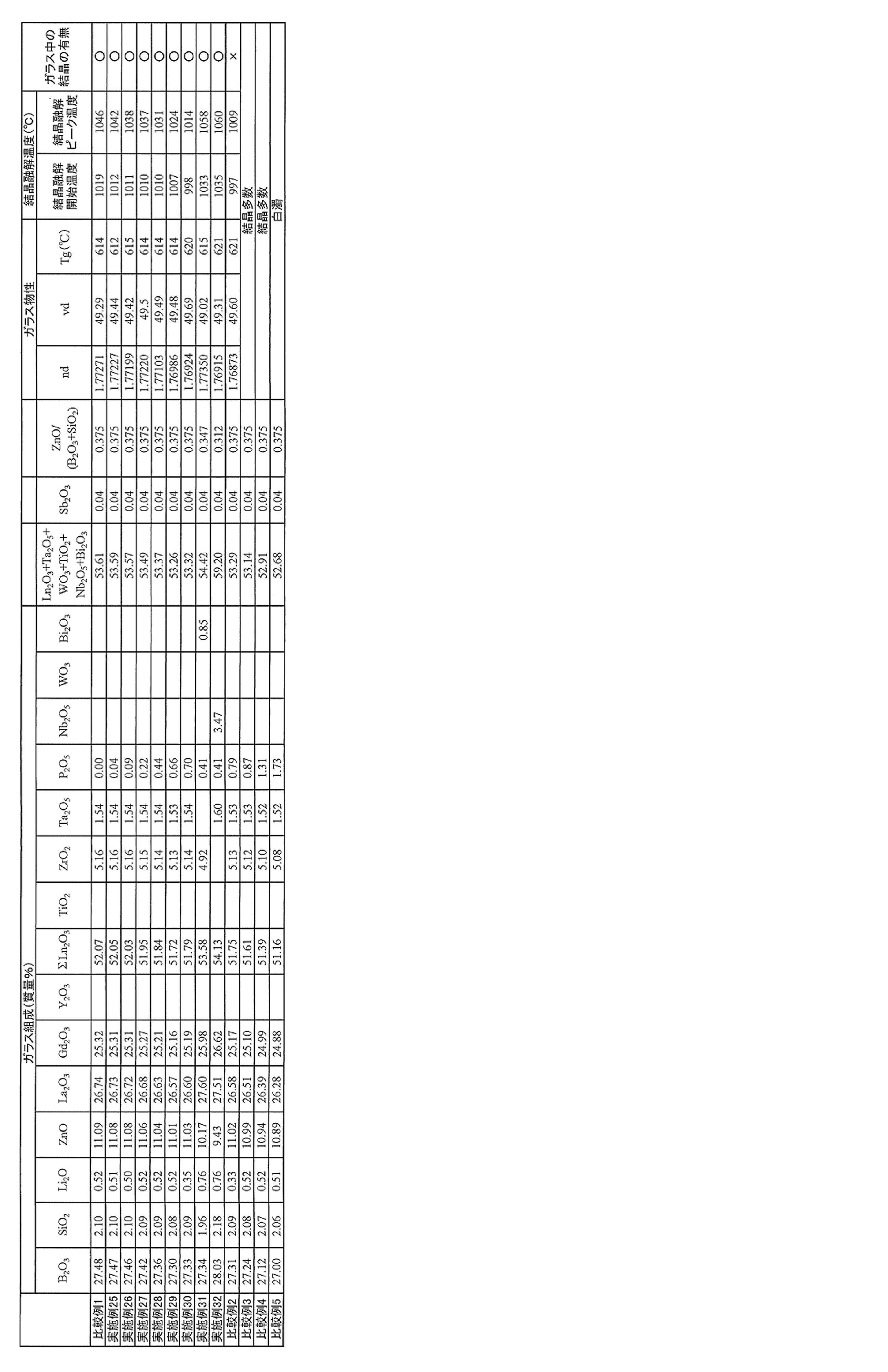
これに対し、P2O5含有量が0.79%以上の比較例2~5の光学ガラスから得られたプリフォームには顕微鏡観察により結晶の析出が確認された。特に、P2O5含有量0.87%以上の比較例3以降では、結晶が多く確認された。そのため、特性測定が不能であった。さらに、P2O5含有量1.73%の比較例5では、目視で白濁が生じていた。
・微量のPを添加することにより液相温度を低下させることが可能であること、および
・P2O5含有量が0.79%以上になると結晶析出によりガラスの均質性が著しく低下すること、が確認された。
ガラスを溶融しルツボ内で冷却後、直径30~40mm、厚さ5~10mm程度のガラスを作製した。作製したガラスを試験炉に導入し、一定時間保管した後、光学顕微鏡を用い倍率10~100倍でガラス中の結晶の有無を観察した。保管時間は、1~2時間とした。観察領域は、周縁5mm程度を除く、ガラス中央部とした。また、ここでいう結晶とは、ガラス化していないものを指し、ガラスと結晶が混在しているものも含むものとする。保管温度は、熱間プリフォーム、または冷間プリフォームの母材となるストリップ品等を製造する際の溶融ガラスの流出温度(温度A)と、温度Aマイナス10℃(温度B)とした。ここでは、温度Aは例えば1040℃とした。なお、温度Bは温度Aよりも低温のため、結晶が析出しやすい条件である。
温度Aでの試験後において結晶が観察されなかったものは、P2O5含有量0.04%~0.44%の間のガラス試料であった。さらに、温度Bでの試験後においても結晶が観察されなかったものは、P2O5含有量0.09%~0.44%の間のガラス試料であった。温度Aおよび温度Bにおいて、P2O5含有量が0.44%を超えるガラス試料で結晶が析出した理由は、この組成領域では液相温度低下の効果よりも、Pと希土類元素との反応による結晶析出のし易さの方が優勢であるためと考えられる。他方、温度Bにおいて、P2O5含有量が0.09%未満の試料で結晶が析出した理由は、この組成領域では液相温度の低下の度合いが小さいためと考えられる。すなわち、P2O5含有量0.09%~0.44%の範囲は、液相温度が低下され、かつ結晶析出が抑制できる、特に際立った効果を示す範囲である。よって、P2O5含有量の好ましい範囲は0%超かつ0.44%以下であり、さらに好ましい範囲は0.09%~0.44%である。
実施例で実証された微量Pを含ませた場合の結晶融解開始温度や結晶融解ピーク温度の低下は、ガラスの成形温度を低下させる、または溶融ガラスの流出温度の低下させることができる点で顕著な効果を示すものである。ガラスの成形温度を低下させることができれば、熔融ガラスの粘性が高まる。熔融ガラスの粘性が高まれば、脈理の発生や光学特性変動等が抑制されるためである。また、ルツボ材料からの汚染による着色も防止することができる。さらに、液相温度が低い光学ガラスは、低温で流出させることができるため、熔融ガラスを流出する際の温度を低くすることができる。ここでの温度を低くすることにより、熱間成形によってプリフォームを製造する際や冷間プリフォームの母材となるストリップ品を製造する際に結晶が析出することを防ぐことができる。
上述の実施例で得られたプリフォームを、精密プレス成形装置を用いて非球面精密プレス成形することにより非球面レンズを得た。得られた非球面レンズは、きわめて精度の高いレンズであり、表1および表2に示す屈折率ndおよびアッベ数νdを有していた。
成形型のキャビティ形状を所定の形状に設計することによって、球面レンズなどその他の光学部品も同様に精密プレス成形により作製することができる。
加えて上述の屈折率ndが1.72~1.83の範囲であり、アッベ数νdが45~55の範囲である高屈折率低分散特性を有し、ガラス転移温度Tgが640℃以下であり精密プレス成形に好適である。
P2O5、B2O3および希土類酸化物を必須成分として含み、
酸化物基準のガラス組成において、
P2O5含有量が0質量%超かつ0.79質量%未満の範囲であり、
ZnO含有量が2~25質量%の範囲であり、
B2O3含有量が20~40質量%の範囲であり、
希土類酸化物とTa2O5、WO3、TiO2、Nb2O5およびBi2O3からなる群から選ばれる酸化物との合計含有量が35~70質量%の範囲であり、
屈折率ndが1.72~1.83の範囲であり、かつ、
アッベ数νdが45~55の範囲である光学ガラス;
酸化物基準のガラス組成において、
P2O5 0質量%超かつ0.79質量%未満
ZnO 2~25質量%
B2O3 20~40質量%
希土類酸化物 35~60質量%
を含み、
屈折率ndが1.72~1.83の範囲であり、かつ、
アッベ数νdが45~55の範囲である光学ガラス、
も提供される。
P2O5、B2O3および希土類酸化物を必須成分として含み、
P2O5含有量が0質量%超かつ0.44質量%以下の範囲であり、
B2O3含有量が20~40質量%の範囲であり、
希土類酸化物とTa2O5、WO3、TiO2、Nb2O5およびBi2O3からなる群から選ばれる酸化物との合計含有量が35~70質量%の範囲であり、
屈折率ndが1.72~1.83の範囲であり、
アッベ数νdが45~55の範囲である光学ガラス;
酸化物基準のガラス組成において、
P2O5 0質量%超かつ0.44質量%以下
B2O3 20~40質量%
希土類酸化物 35~60質量%
を含み、
屈折率ndが1.72~1.83の範囲であり、
アッベ数νdが45~55の範囲である光学ガラス、
に関する。
Claims (10)
- P2O5、B2O3および希土類酸化物を必須成分として含み、
酸化物基準のガラス組成において、
P2O5含有量が0質量%超かつ0.79質量%未満の範囲であり、
B2O3含有量が20~40質量%の範囲であり、
希土類酸化物とTa2O5、WO3、TiO2、Nb2O5およびBi2O3からなる群から選ばれる酸化物との合計含有量が35~70質量%の範囲であり、
屈折率ndが1.72~1.83の範囲であり、
アッベ数νdが45~55の範囲であり、かつ
ガラス転移温度Tgが640℃以下である光学ガラス。 - 酸化物基準のガラス組成において、
P2O5 0質量%超かつ0.79質量%未満
B2O3 20~40質量%
希土類酸化物 35~60質量%
を含み、
屈折率ndが1.72~1.83の範囲であり、
アッベ数νdが45~55の範囲であり、かつ
ガラス転移温度Tgが640℃以下である光学ガラス。 - ZnO含有量が2~25質量%の範囲である請求項1または2に記載の光学ガラス。
- アルカリ金属酸化物含有量が0~10質量%の範囲である請求項1~3のいずれか1項に記載の光学ガラス。
- 熱間成形に供されるガラスである請求項1~4のいずれか1項に記載の光学ガラス。
- 請求項1~5のいずれか1項に記載の光学ガラスからなる熱間成形品。
- 精密プレス成形用プリフォームである請求項6に記載の熱間成形品。
- 請求項1~5のいずれか1項に記載の光学ガラスからなる光学素子。
- 請求項1~5のいずれか1項に記載の光学ガラスを熱間成形することにより成形品を得る工程を含む熱間成形品の製造方法。
- 請求項7に記載の熱間成形品を精密プレス成形することにより光学素子を得る工程を含む光学素子の製造方法。
Priority Applications (4)
| Application Number | Priority Date | Filing Date | Title |
|---|---|---|---|
| US14/766,270 US9434637B2 (en) | 2013-02-06 | 2014-02-06 | Optical glass, hot-molded article and method of manufacturing the same, optical element and method of manufacturing the same |
| CN201480007214.XA CN104995144B (zh) | 2013-02-06 | 2014-02-06 | 光学玻璃、热成型品及其制造方法、以及光学元件及其制造方法 |
| JP2014560805A JP6338537B2 (ja) | 2013-02-06 | 2014-02-06 | 光学ガラス、熱間成形品およびその製造方法、ならびに光学素子およびその製造方法 |
| KR1020157018611A KR102160323B1 (ko) | 2013-02-06 | 2014-02-06 | 광학 유리, 열간 성형품 및 그 제조 방법, 그리고 광학 소자 및 그 제조 방법 |
Applications Claiming Priority (2)
| Application Number | Priority Date | Filing Date | Title |
|---|---|---|---|
| JP2013021338 | 2013-02-06 | ||
| JP2013-021338 | 2013-02-06 |
Publications (1)
| Publication Number | Publication Date |
|---|---|
| WO2014123200A1 true WO2014123200A1 (ja) | 2014-08-14 |
Family
ID=51299791
Family Applications (1)
| Application Number | Title | Priority Date | Filing Date |
|---|---|---|---|
| PCT/JP2014/052799 Ceased WO2014123200A1 (ja) | 2013-02-06 | 2014-02-06 | 光学ガラス、熱間成形品およびその製造方法、ならびに光学素子およびその製造方法 |
Country Status (6)
| Country | Link |
|---|---|
| US (1) | US9434637B2 (ja) |
| JP (1) | JP6338537B2 (ja) |
| KR (1) | KR102160323B1 (ja) |
| CN (1) | CN104995144B (ja) |
| TW (1) | TWI622563B (ja) |
| WO (1) | WO2014123200A1 (ja) |
Cited By (2)
| Publication number | Priority date | Publication date | Assignee | Title |
|---|---|---|---|---|
| CN105731788A (zh) * | 2014-12-26 | 2016-07-06 | Hoya株式会社 | 玻璃、压制成型用玻璃材料、光学元件坯件及光学元件 |
| JP2019511445A (ja) * | 2016-03-07 | 2019-04-25 | 成都光明光▲電▼股▲分▼有限公司 | 光学ガラス及び光学素子 |
Families Citing this family (3)
| Publication number | Priority date | Publication date | Assignee | Title |
|---|---|---|---|---|
| CN107986607B (zh) * | 2017-11-17 | 2020-08-25 | 瑞声精密制造科技(常州)有限公司 | 玻璃产品的热成型方法及热成型设备 |
| ES2980180T3 (es) | 2018-11-26 | 2024-09-30 | Owens Corning Intellectual Capital Llc | Composición de fibra de vidrio de alto rendimiento con módulo de elasticidad mejorado |
| CA3117986A1 (en) | 2018-11-26 | 2020-06-04 | Owens Corning Intellectual Capital, Llc | High performance fiberglass composition with improved specific modulus |
Citations (3)
| Publication number | Priority date | Publication date | Assignee | Title |
|---|---|---|---|---|
| JP2002249337A (ja) * | 2001-02-20 | 2002-09-06 | Hoya Corp | 光学ガラス、プレス成形予備体および光学部品 |
| JP2007269584A (ja) * | 2006-03-31 | 2007-10-18 | Ohara Inc | 光学ガラス |
| US20110237419A1 (en) * | 2007-09-28 | 2011-09-29 | Ohara Inc. | Optical glass |
Family Cites Families (11)
| Publication number | Priority date | Publication date | Assignee | Title |
|---|---|---|---|---|
| US7138348B2 (en) * | 2001-07-03 | 2006-11-21 | Kabushiki Kaisha Ohara | Optical glass |
| TW200303995A (en) * | 2002-02-22 | 2003-09-16 | Nippon Sheet Glass Co Ltd | Planar lens and its producing method |
| JP2004175632A (ja) * | 2002-11-28 | 2004-06-24 | Hikari Glass Co Ltd | 光学ガラス |
| TW200642979A (en) * | 2005-04-28 | 2006-12-16 | Ohara Kk | Optical glass |
| CN101389576A (zh) * | 2006-02-24 | 2009-03-18 | 旭硝子株式会社 | 光学玻璃和透镜 |
| JP4847769B2 (ja) * | 2006-03-24 | 2011-12-28 | Hoya株式会社 | 光学ガラス、精密プレス成形用プリフォームおよびその製造方法、光学素子およびその製造方法 |
| TW200813467A (en) * | 2006-06-13 | 2008-03-16 | Asahi Glass Co Ltd | Optical glass and lens using the same |
| JP5594807B2 (ja) * | 2007-09-25 | 2014-09-24 | 株式会社オハラ | 光学ガラス |
| CN102320739B (zh) * | 2007-09-29 | 2015-04-01 | 株式会社小原 | 光学玻璃 |
| JP5602987B2 (ja) * | 2007-10-12 | 2014-10-08 | 株式会社オハラ | 光学ガラス |
| CN102574727B (zh) * | 2009-10-15 | 2015-06-24 | 旭硝子株式会社 | 有机led元件的散射层用玻璃以及使用该玻璃的有机led元件 |
-
2014
- 2014-02-06 TW TW103103889A patent/TWI622563B/zh active
- 2014-02-06 KR KR1020157018611A patent/KR102160323B1/ko not_active Expired - Fee Related
- 2014-02-06 JP JP2014560805A patent/JP6338537B2/ja active Active
- 2014-02-06 US US14/766,270 patent/US9434637B2/en not_active Expired - Fee Related
- 2014-02-06 CN CN201480007214.XA patent/CN104995144B/zh active Active
- 2014-02-06 WO PCT/JP2014/052799 patent/WO2014123200A1/ja not_active Ceased
Patent Citations (3)
| Publication number | Priority date | Publication date | Assignee | Title |
|---|---|---|---|---|
| JP2002249337A (ja) * | 2001-02-20 | 2002-09-06 | Hoya Corp | 光学ガラス、プレス成形予備体および光学部品 |
| JP2007269584A (ja) * | 2006-03-31 | 2007-10-18 | Ohara Inc | 光学ガラス |
| US20110237419A1 (en) * | 2007-09-28 | 2011-09-29 | Ohara Inc. | Optical glass |
Cited By (2)
| Publication number | Priority date | Publication date | Assignee | Title |
|---|---|---|---|---|
| CN105731788A (zh) * | 2014-12-26 | 2016-07-06 | Hoya株式会社 | 玻璃、压制成型用玻璃材料、光学元件坯件及光学元件 |
| JP2019511445A (ja) * | 2016-03-07 | 2019-04-25 | 成都光明光▲電▼股▲分▼有限公司 | 光学ガラス及び光学素子 |
Also Published As
| Publication number | Publication date |
|---|---|
| US20150376051A1 (en) | 2015-12-31 |
| CN104995144B (zh) | 2020-05-08 |
| TWI622563B (zh) | 2018-05-01 |
| KR102160323B1 (ko) | 2020-09-25 |
| JP6338537B2 (ja) | 2018-06-06 |
| KR20150114944A (ko) | 2015-10-13 |
| TW201446692A (zh) | 2014-12-16 |
| JPWO2014123200A1 (ja) | 2017-02-02 |
| CN104995144A (zh) | 2015-10-21 |
| US9434637B2 (en) | 2016-09-06 |
Similar Documents
| Publication | Publication Date | Title |
|---|---|---|
| JP4093524B2 (ja) | 光学ガラス、プレス成形予備体および光学部品 | |
| JP6382256B2 (ja) | 光学ガラスおよびその利用 | |
| TWI618684B (zh) | Optical glass, optical glass blank, glass material for press molding, optical element, and manufacturing method thereof | |
| JP4140775B2 (ja) | 光学ガラス、精密プレス成形用プリフォームおよびその製造方法、ならびに光学素子およびその製造方法 | |
| JP5931173B2 (ja) | 光学ガラスおよびその利用 | |
| JP5867507B2 (ja) | 光学ガラス | |
| JP6587276B2 (ja) | 光学ガラス、光学ガラスブランク、プレス成型用ガラス素材、光学素子、およびそれらの製造方法 | |
| KR102265764B1 (ko) | 광학 유리, 광학 소자 블랭크, 프레스 성형용 유리 소재, 광학 소자, 및 그것들의 제조 방법 | |
| JP5986938B2 (ja) | 光学ガラス、精密プレス成形用ガラス素材、光学素子およびその製造方法 | |
| JP2003020249A (ja) | 光学ガラス | |
| JP6338537B2 (ja) | 光学ガラス、熱間成形品およびその製造方法、ならびに光学素子およびその製造方法 | |
| JP4003874B2 (ja) | 光学ガラス、プレス成形用プリフォームおよび光学部品 | |
| JP6694229B2 (ja) | ガラス | |
| WO2014129510A1 (ja) | 光学ガラス、光学ガラスブランク、プレス成型用ガラス素材、光学素子、およびそれらの製造方法 | |
| JP6444021B2 (ja) | 光学ガラス、光学ガラスブランク、プレス成型用ガラス素材、光学素子、およびそれらの製造方法 | |
| JP6472657B2 (ja) | ガラス、プレス成形用ガラス素材、光学素子ブランク、および光学素子 | |
| JP5902327B2 (ja) | 光学ガラス、プレス成形予備体および光学部品 | |
| JP2006315954A (ja) | 光学ガラス、プレス成形予備体および光学部品 | |
| JP5734245B2 (ja) | 光学ガラス、プレス成形予備体および光学部品 | |
| JP5734246B2 (ja) | 光学ガラス、プレス成形予備体および光学部品 | |
| JP2011116650A (ja) | 光学ガラス | |
| JP2006321717A (ja) | 光学ガラス、プレス成形用プリフォームおよび光学部品 |
Legal Events
| Date | Code | Title | Description |
|---|---|---|---|
| 121 | Ep: the epo has been informed by wipo that ep was designated in this application |
Ref document number: 14748483 Country of ref document: EP Kind code of ref document: A1 |
|
| ENP | Entry into the national phase |
Ref document number: 20157018611 Country of ref document: KR Kind code of ref document: A |
|
| ENP | Entry into the national phase |
Ref document number: 2014560805 Country of ref document: JP Kind code of ref document: A |
|
| NENP | Non-entry into the national phase |
Ref country code: DE |
|
| WWE | Wipo information: entry into national phase |
Ref document number: 14766270 Country of ref document: US |
|
| 122 | Ep: pct application non-entry in european phase |
Ref document number: 14748483 Country of ref document: EP Kind code of ref document: A1 |