WO2014115804A1 - 洗浄剤用の酵素製剤及び液体洗浄剤ならびにこれらの製造方法 - Google Patents
洗浄剤用の酵素製剤及び液体洗浄剤ならびにこれらの製造方法 Download PDFInfo
- Publication number
- WO2014115804A1 WO2014115804A1 PCT/JP2014/051376 JP2014051376W WO2014115804A1 WO 2014115804 A1 WO2014115804 A1 WO 2014115804A1 JP 2014051376 W JP2014051376 W JP 2014051376W WO 2014115804 A1 WO2014115804 A1 WO 2014115804A1
- Authority
- WO
- WIPO (PCT)
- Prior art keywords
- component
- mass
- liquid
- enzyme preparation
- detergent
- Prior art date
- Legal status (The legal status is an assumption and is not a legal conclusion. Google has not performed a legal analysis and makes no representation as to the accuracy of the status listed.)
- Ceased
Links
Classifications
-
- C—CHEMISTRY; METALLURGY
- C11—ANIMAL OR VEGETABLE OILS, FATS, FATTY SUBSTANCES OR WAXES; FATTY ACIDS THEREFROM; DETERGENTS; CANDLES
- C11D—DETERGENT COMPOSITIONS; USE OF SINGLE SUBSTANCES AS DETERGENTS; SOAP OR SOAP-MAKING; RESIN SOAPS; RECOVERY OF GLYCEROL
- C11D3/00—Other compounding ingredients of detergent compositions covered in group C11D1/00
- C11D3/16—Organic compounds
- C11D3/38—Products with no well-defined composition, e.g. natural products
- C11D3/386—Preparations containing enzymes, e.g. protease or amylase
-
- C—CHEMISTRY; METALLURGY
- C11—ANIMAL OR VEGETABLE OILS, FATS, FATTY SUBSTANCES OR WAXES; FATTY ACIDS THEREFROM; DETERGENTS; CANDLES
- C11D—DETERGENT COMPOSITIONS; USE OF SINGLE SUBSTANCES AS DETERGENTS; SOAP OR SOAP-MAKING; RESIN SOAPS; RECOVERY OF GLYCEROL
- C11D3/00—Other compounding ingredients of detergent compositions covered in group C11D1/00
- C11D3/16—Organic compounds
- C11D3/20—Organic compounds containing oxygen
- C11D3/2075—Carboxylic acids-salts thereof
- C11D3/2086—Hydroxy carboxylic acids-salts thereof
-
- C—CHEMISTRY; METALLURGY
- C11—ANIMAL OR VEGETABLE OILS, FATS, FATTY SUBSTANCES OR WAXES; FATTY ACIDS THEREFROM; DETERGENTS; CANDLES
- C11D—DETERGENT COMPOSITIONS; USE OF SINGLE SUBSTANCES AS DETERGENTS; SOAP OR SOAP-MAKING; RESIN SOAPS; RECOVERY OF GLYCEROL
- C11D3/00—Other compounding ingredients of detergent compositions covered in group C11D1/00
- C11D3/16—Organic compounds
- C11D3/34—Organic compounds containing sulfur
- C11D3/3472—Organic compounds containing sulfur additionally containing -COOH groups or derivatives thereof
-
- C—CHEMISTRY; METALLURGY
- C11—ANIMAL OR VEGETABLE OILS, FATS, FATTY SUBSTANCES OR WAXES; FATTY ACIDS THEREFROM; DETERGENTS; CANDLES
- C11D—DETERGENT COMPOSITIONS; USE OF SINGLE SUBSTANCES AS DETERGENTS; SOAP OR SOAP-MAKING; RESIN SOAPS; RECOVERY OF GLYCEROL
- C11D3/00—Other compounding ingredients of detergent compositions covered in group C11D1/00
- C11D3/16—Organic compounds
- C11D3/34—Organic compounds containing sulfur
- C11D3/3481—Organic compounds containing sulfur containing sulfur in a heterocyclic ring, e.g. sultones or sulfolanes
-
- C—CHEMISTRY; METALLURGY
- C11—ANIMAL OR VEGETABLE OILS, FATS, FATTY SUBSTANCES OR WAXES; FATTY ACIDS THEREFROM; DETERGENTS; CANDLES
- C11D—DETERGENT COMPOSITIONS; USE OF SINGLE SUBSTANCES AS DETERGENTS; SOAP OR SOAP-MAKING; RESIN SOAPS; RECOVERY OF GLYCEROL
- C11D3/00—Other compounding ingredients of detergent compositions covered in group C11D1/00
- C11D3/16—Organic compounds
- C11D3/38—Products with no well-defined composition, e.g. natural products
- C11D3/386—Preparations containing enzymes, e.g. protease or amylase
- C11D3/38663—Stabilised liquid enzyme compositions
Definitions
- the present invention relates to an enzyme preparation for a cleaning agent, a liquid cleaning agent, and a method for producing them.
- This application claims priority based on Japanese Patent Application No. 2013-012448 filed in Japan on January 25, 2013, the contents of which are incorporated herein by reference.
- a detergent used for washing textile products such as clothes and fabrics usually contains a surfactant as a cleaning component.
- a surfactant for the purpose of imparting various functions to detergents, for example, a variety of detergent builders such as alkaline agents, enzymes, hydrotropes, antiseptics, antibacterial agents, fluorescent brighteners, dyes, fragrances, antioxidants, etc.
- Various additives are blended.
- enzymes are one of the important additives. Low temperature, low bath ratio (amount of washing liquid with respect to the object to be washed), washing with low detergent concentration, It is used as an additive that exhibits high detergency even under conditions such as washing.
- an object of the present invention is to provide an enzyme preparation for a detergent that can further enhance the activity stability of the enzyme in the liquid detergent, a liquid detergent containing the enzyme preparation, and a method for producing the same.
- the present invention has the following aspects.
- An enzyme preparation for a detergent comprising (a1) component: protease and (a2) component: at least one component selected from thiazole compounds and sulfur-containing amino acids.
- a liquid detergent comprising the enzyme preparation for detergent according to [1] and a surfactant.
- a liquid detergent comprising the enzyme preparation for detergent according to [2] and a surfactant.
- a method for producing a liquid detergent according to [3], which comprises mixing the component (a1) and the component (a2) to obtain an enzyme preparation for the detergent A method for producing a liquid detergent, comprising: a detergent preparation step comprising mixing the enzyme preparation for the detergent and the surfactant.
- a method for producing a liquid detergent comprising: an enzyme preparation step comprising: and a detergent preparation step comprising mixing the enzyme preparation for the detergent and the surfactant.
- the activity stability of the enzyme in the liquid detergent can be further increased.
- the liquid detergent of the present invention includes an enzyme preparation for detergent (hereinafter sometimes referred to as component (A)) and a surfactant (hereinafter sometimes referred to as component (B)).
- component (A) an enzyme preparation for detergent
- component (B) a surfactant
- the viscosity of the liquid detergent (viscosity at 25 ° C.) is not particularly limited, but is preferably 15 to 300 mPa ⁇ s. If a viscosity is below the said upper limit, the permeability to the textiles which are to-be-washed objects will increase at the time of application cleaning.
- the viscosity of the liquid detergent is a value (measurement condition: rotor No. 2, rotation speed 30 rpm, viscosity after 10 rotations) measured by a B-type viscometer (manufactured by TOKIMEC).
- the viscosity is defined as a value at 25 ° C. unless otherwise specified. That is, even if the value is outside the range specified in the present specification, it is included in the scope of the present invention as long as it is a viscosity value within the range specified in the present specification when corrected to a value at 25 ° C.
- the pH of the liquid detergent is preferably 4-9, more preferably 6-9. If pH is in the said range, application
- pH (25 degreeC) in this-application specification shows the value measured with a pH meter (HM-30G, Toa DKK Corporation) etc.
- pH is defined as a value at 25 ° C. unless otherwise specified. That is, even if the pH value is outside the range specified in the present specification, it is included in the scope of the present invention as long as the pH value is within the range specified in the present specification when corrected to the pH value at 25 ° C. .
- component (A) is an enzyme preparation for a detergent, and is a mixture of (a1) component: protease and (a2) component: at least one component selected from thiazole compounds and sulfur-containing amino acids.
- the component (A) is a mixture of the component (a1) and the component (a2), so that the enzyme activity stability in the liquid detergent is more excellent.
- the component (A) may be a mixture of the component (a1) and the component (a2), and may be a liquid or a solid.
- the pH of the liquid enzyme preparation is preferably, for example, 3 to 11, and more preferably 4 to 10. Outside the above range, the component (a1) may be denatured.
- the component (a1) may be a protease.
- the component (a2) described later binds to the active center of the component (a1) by having the structure. It is preferable because it can be considered.
- a commercially available protease preparation can be used as the component (a1).
- protease preparations include, for example, Savinase 16L, Savinase Ultra 16L, Savinase Ultra 16XL, Everase 16L Type EX, Everase Ultra 16L, Esperase 8L, Alcalase 2.5L, Alcalase 2.5L, Alcalase 2.5L, Alcalase 2.5L, Alcalase 2.5L 5L, Liquanase Ultra 2.5XL, Coronase 48L (all are trade names, manufactured by Novozymes), Perfect L, Purefect OX, Properase L (all are trade names, manufactured by Genencor). These (a1) components may be used alone, or two or more components may be used in combination.
- the content of the component (a1) in the component (A) is appropriately determined according to the dosage form of the component (A) and the type of the component (a1).
- the content of the component (a1) in the liquid enzyme preparation is, for example, preferably 0.1 to 20% by mass relative to the total mass of the liquid enzyme preparation. 15 mass% is more preferable. If the amount is less than the above lower limit, in order to achieve the effect of blending the component (a1), a large amount of the component (A) must be blended with the cleaning agent, making it difficult to achieve a blending balance with other components of the cleaning agent. There is a fear. Above the upper limit, the component (a1) tends to precipitate.
- the mass of (a1) component is the conversion value as a protein amount.
- the amount of protein is a value measured by the LOWRY method.
- a measuring method by the LOWRY method for example, a method using a protein assay LOWRY kit manufactured by Nakarai Tex Co., Ltd. may be mentioned.
- the component (a2) is at least one component selected from thiazole compounds and sulfur-containing amino acids.
- the component (a2) is at least one component selected from thiazole compounds and sulfur-containing amino acids.
- This action can be enhanced by mixing the component (a1) and the component (a2) before mixing the component (a1) with a surfactant or the like. Since the component (a1) is blended in the liquid detergent in a state where the activity stability is enhanced, the active stability state is maintained in the liquid detergent. When the liquid cleaning agent is dispersed in water to form a cleaning liquid, the liquid cleaning agent is diluted with a large amount of water to separate the component (a2) from the component (a1), and the enzyme (a1) is sufficient in the cleaning liquid. It is thought that it exhibits activity.
- thiazole compounds include 5-chloro-2-methyl-4-isothiazolin-3-one, 2-methyl-4-isothiazolin-3-one, 2-n-octyl-4-isothiazolin-3-one, 4, 5-dichloro-2-n-octyl-4-isothiazolin-3-one, 2-ethyl-4-isothiazolin-3-one, 4,5-dichloro-2-cyclohexyl-4-isothiazolin-3-one, 5- Isothiazolone compounds such as chloro-2-ethyl-4-isothiazolin-3-one, 5-chloro-2-t-octyl-4-isothiazolin-3-one, and 1,2-benzisothiazolin-3-one; 4-thiazolidinedione, 3-methyl-1,3-thiazoline-2,4-dione, 5- (4-amino-3-methoxybenzyl) -2,4-thiazolidine Thiazol
- thiazole compounds include Proxel XL (trade name, 1,2-benzisothiazolin-3-one, manufactured by Arch Chemicals), Caisson CG (trade name, 5-chloro-2-methyl-4-isothiazoline-3 -ON, manufactured by Rohm and Haas). These thiazole compounds may be used singly or in combination of two or more components.
- the sulfur-containing amino acid may be a naturally-occurring sulfur-containing amino acid or a sulfur-containing amino acid obtained by synthesis.
- naturally occurring sulfur-containing amino acids include cysteine, methionine, cystine, glutathione and the like. Of these, cysteine and methionine are preferable, and cysteine is more preferable.
- These sulfur-containing amino acids may be used alone, or two or more components may be used in combination.
- one type of component may be used alone, or two or more types of components may be used in combination.
- the content of the component (a2) in the component (A) is determined in consideration of the dosage form of the component (A), the type of the component (a1) or the component (a2), and the like.
- the content of the component (a2) in the liquid enzyme preparation is preferably 0.01 to 5% by mass relative to the total mass of the liquid enzyme preparation, 0.05 to 3 mass% is more preferable. If it is more than the said lower limit, (a2) component will become easy to adsorb
- the mass ratio represented by the mass of the component (a2) / ⁇ the mass of the component (a1) + the mass of the component (a2) ⁇ (hereinafter sometimes referred to as a2 / (a1 + a2) ratio) is: 0.001 to 0.5 is preferable, 0.005 to 0.3 is more preferable, and 0.01 to 0.2 is more preferable.
- the ratio a2 / (a1 + a2) is equal to or higher than the lower limit, the component (a2) is easily adsorbed on the active site of the component (a1), and the activity stability of the component (a1) can be further improved. Above the upper limit, precipitation may occur in the case of a liquid enzyme preparation.
- the component (A) may contain an optional component other than the components (a1) to (a2) (hereinafter sometimes referred to as an optional component of an enzyme preparation) as long as the effects of the present invention are not impaired.
- an enzyme preparation optional component at least one component selected from hydroxycarboxylic acid and its alkali metal salt (component (a3)), an enzyme (arbitrary enzyme) other than component (a1), a pH adjuster, water, a solvent, Examples thereof include boric acid compounds.
- the solvent propylene glycol is preferable.
- Component (a3) at least one component selected from hydroxycarboxylic acids and alkali metal salts thereof
- Component (A) may be a mixture of component (a3): at least one component selected from hydroxycarboxylic acid and alkali metal salts thereof.
- component (a3) examples include hydroxycarboxylic acids such as lactic acid, tartaric acid, citric acid, and gluconic acid, and alkali metal salts thereof.
- alkali metal As an alkali metal which comprises a component, sodium, potassium, etc. are mentioned.
- the content of the component (a3) in the component (A) is determined in consideration of the type of the component (a3), and is preferably, for example, 5 to 57% by mass with respect to the total mass of the component (A). 10 to 50% by mass is more preferable. If the amount is less than the lower limit, the activity stability may not be further improved. If the amount exceeds the upper limit, precipitation may occur in the case of a liquid enzyme preparation.
- the mass ratio represented by the mass of the component (a1) / the mass of the component (a3) (hereinafter sometimes referred to as a1 / a3 ratio) is preferably 0.005 to 10, preferably 01 to 5 is more preferable, and 0.01 to 2 is even more preferable. If the a1 / a3 ratio is less than the lower limit, the activity of the component (a1) in the cleaning liquid may be reduced. If the ratio exceeds the upper limit, the activity stability of the component (a1) in the liquid detergent is further improved. May not be possible.
- the mass ratio represented by the mass of the component (a2) / the mass of the component (a3) (hereinafter sometimes referred to as a2 / a3 ratio) is preferably 0.001-2. 003 to 1 is more preferable, and 0.01 to 0.5 is more preferable. If the a2 / a3 ratio is less than the lower limit, precipitation may occur in the case of a liquid enzyme preparation, and if it exceeds the upper limit, the activity stability due to the component (a3) may not be further improved.
- the optional enzyme examples include lipase and cellulase.
- the enzyme activity (proteolytic action) of the component (a1) is suppressed. For this reason, even if it has an arbitrary enzyme, an arbitrary enzyme is hard to be decomposed
- the pH adjuster may be any pH adjuster conventionally used in liquid detergents, such as acids such as hydrochloric acid and sulfuric acid, sodium hydroxide, potassium hydroxide, monoethanolamine, diethanolamine, monoethanolamine. And the like.
- water When the component (A) is a liquid enzyme preparation, water functions as a dispersion medium for the liquid enzyme preparation.
- the content of water in the component (A) is, for example, 10 to 90% by mass with respect to the total mass of the component (A).
- the manufacturing method of (A) component should just be a method of mixing (a1) component and (a2) component, and is suitably selected according to the dosage form etc. of (A) component.
- the manufacturing method in case (A) component is a liquid enzyme formulation, the method of mixing (a1) component, (a2) component, an enzyme formulation arbitrary component as needed, and water is mentioned, for example. .
- a manufacturing method in case a component is a solid enzyme preparation (solid enzyme preparation), for example, the obtained liquid enzyme preparation is freeze-dried or dried under reduced pressure to obtain a powdery solid enzyme preparation Is mentioned.
- the method for producing the component (A) may include a step of mixing the component (a1), the component (a2), the optional component of the enzyme preparation as necessary, and water.
- the method for producing the component (A) may further include a step of freeze-drying or drying under reduced pressure the mixture obtained by the mixing step.
- the blending amount of the (a1) component in the enzyme dispersion in which the (a1) component and the (a2) component are dispersed is the total amount of the enzyme dispersion.
- the content is preferably 0.1 to 20% by mass, more preferably 1 to 15% by mass, based on the mass. If the amount is less than the above lower limit value, the blending amount of the component (a1) is too small, so that the effect of the component (a1) in the obtained component (A) may not be exerted, and if the amount exceeds the upper limit value, precipitation may occur.
- the compounding quantity of (a1) component is the conversion value as a protein amount.
- the amount of the component (a2) in the enzyme dispersion is preferably 0.01 to 5% by mass, more preferably 0.05 to 0.3% by mass, based on the total mass of the enzyme dispersion. If the amount is less than the lower limit, the activity stability of the component (a1) may not be sufficiently increased, and if it exceeds the upper limit, precipitation may occur in the enzyme dispersion or the liquid detergent.
- the a2 / (a1 + a2) ratio in the enzyme dispersion is preferably 0.001 to 0.5, more preferably 0.005 to 0.3, and more preferably 0.01 to 0.2.
- the component (a2) When the ratio a2 / (a1 + a2) is equal to or higher than the lower limit, the component (a2) is easily adsorbed on the active site of the component (a1), and the activity stability of the component (a1) can be further improved. Above the upper limit, precipitation may occur in the case of a liquid enzyme preparation.
- the temperature at which the component (a1) and the component (a2) are mixed is determined in consideration of the type of the component (a1) and the like, and is preferably 5 to 35 ° C., for example.
- the pH of the enzyme dispersion is preferably 3 to 11, for example, and more preferably 4 to 10. Outside the above range, the enzyme activity of component (a1) may be reduced.
- the components (a1) to (a3) may be previously charged in a mixing device and mixed, or the components (a1) and (a2) may be mixed in advance. It may be mixed and mixed with the component (a3).
- the component (a2) and the component (a3) may be mixed in advance, and this may be mixed with the component (a1), or the component (a1) and the component (a3) may be mixed in advance, ) Component may be mixed.
- “mixing” means a state in which each component is uniformly dispersed.
- a known mixing apparatus can be used, and for example, a stirring tank having paddle blades can be used.
- the component (a1) and the component (a2) are mixed in advance and mixed with the component (a3), so that the component (a2) acts on the active site of the component (a1), and then the component (a1) Since the component a3) can be coated, it is presumed that the activity stability of the component (a1) can be further improved. That is, as a method for producing the component (A), the step of previously mixing the component (a1) and the component (a2), the mixture obtained by mixing the component (a1) and the component (a2), a3) a step of mixing the components.
- the component (A) in which the component (a3) is blended is preferably mixed with the component (B) in as short a time as possible after the component (a3) is blended. This is because the component (A) containing the component (a3) may cause precipitation during storage.
- the “short time” here is preferably within 24 hours.
- the amount of the component (a3) in the enzyme dispersion is preferably 5 to 57% by mass, more preferably 10 to 50% by mass, based on the total mass of the enzyme dispersion. If the amount is less than the lower limit, the activity stability may not be further improved, and if it exceeds the upper limit, precipitation may occur in the enzyme dispersion or the liquid detergent.
- the a1 / a3 ratio in the enzyme dispersion is preferably 0.005 to 10, more preferably 0.01 to 5, and still more preferably 0.01 to 2. If the a1 / a3 ratio is less than the above lower limit, the component (a3) is too much and the activity of the component (a1) in the cleaning liquid may be reduced. If the ratio exceeds the upper limit, the component (a3) is too small. Therefore, the activity stability of the component (a1) in the liquid detergent may not be further improved.
- the content of the component (A) in the liquid cleaning agent is determined in consideration of the content of the component (a1) in the component (A).
- the content of the component (a1) in the liquid cleaning agent is , Preferably in an amount of 0.001 to 0.2% by weight, more preferably 0.01 to 0.15% by weight, more preferably 0.02 to 0.1% by weight based on the total weight of the liquid detergent. % Is more preferred. If the amount is less than the lower limit, the amount of the liquid detergent dispersed in the cleaning liquid increases. If the amount exceeds the upper limit, the liquid stability of the liquid detergent may be lowered.
- the component (B) may be any surfactant that has been conventionally used in liquid detergents, and examples thereof include nonionic surfactants, anionic surfactants, cationic surfactants, and amphoteric surfactants. Among these, nonionic surfactants and anionic surfactants are preferable from the viewpoint of increasing detergency.
- the content of the component (B) in the liquid detergent is determined in consideration of the type of the component (B) and the like, and is preferably 0.1 to 70% by mass with respect to the total mass of the liquid detergent, It is more preferably 5 to 65% by mass, and further preferably 10 to 60% by mass.
- the nonionic surfactant may be any nonionic surfactant that has been conventionally used in liquid detergents, such as polyoxyalkylene type nonionic surfactants, alkylphenols, higher fatty acids (for example, having 8 to 22 carbon atoms).
- Fatty acid) or higher amines for example, amines having 8 to 22 carbon atoms
- alkylene oxide adducts polyoxyethylene polyoxypropylene block copolymers
- fatty acid alkanolamines for example, amines having 8 to 22 carbon atoms
- fatty acid alkanolamides for example, fatty acid alkanolamides
- Body polyhydric alcohol fatty acid ether, alkyl (or alkenyl) amine oxide, alkylene oxide adduct of hydrogenated castor oil, sugar fatty acid ester, N-alkyl polyhydroxy fatty acid amide, alkyl glycoside and the like.
- one type of component may be used alone, or two or more types of components may be used in combination.
- the nonionic surfactant is preferably a polyoxyalkylene type nonionic surfactant in terms of viscosity and liquid stability.
- the polyoxyalkylene type nonionic surfactant include a compound represented by the following general formula (I) (hereinafter sometimes referred to as compound (I)).
- R 1 is a hydrocarbon group having 8 to 22 carbon atoms; —X— is a divalent linking group; R 2 is a hydrogen atom, an alkyl group having 1 to 6 carbon atoms, or carbon.
- EO is an oxyethylene group; s is a number from 3 to 20 representing the average number of repetitions of EO; PO is an oxypropylene group; t is the average number of repetitions of PO It is a number from 0 to 6 representing ]
- the hydrocarbon group of R 1 has 8 to 22 carbon atoms, preferably 10 to 18 carbon atoms.
- the hydrocarbon group for R 1 may be linear or branched, and may or may not have an unsaturated bond.
- Examples of —X— include linking groups such as —O—, —COO—, and —CONH—.
- the alkyl group in R 2 has 1 to 6 carbon atoms, preferably 1 to 3 carbon atoms.
- the carbon number of the alkenyl group in R 2 is 2 to 6, and preferably 2 to 3.
- Compound (I) in which —X— is —O—, —COO— or —CONH— is a primary or secondary higher (eg, having 8 to 22 carbon atoms) alcohol (R 1 —OH), higher (eg, , Fatty acid amide (R 1 -CONH) having 8 to 22 carbon atoms or higher fatty acid (R 1 -COOH) or higher (for example, 8 to 22 carbon atoms) can be obtained as a raw material.
- s is a number from 3 to 20 that represents the average number of EO repeats (that is, the average number of moles of ethylene oxide added), and is preferably from 5 to 18. If it exceeds the above upper limit value, the HLB value may become too high and the detergency against sebum may be reduced, and if it is less than the above lower limit value, odor may be deteriorated.
- t is a number from 0 to 6 which represents the average number of repeating POs (that is, the average number of moles of propylene oxide added), and preferably 0 to 3. Above the upper limit, the liquid stability of the liquid detergent at high temperatures tends to be reduced.
- the addition method of ethylene oxide and propylene oxide is not particularly limited, and may be, for example, a random addition method or a block addition method.
- Block addition methods include, for example, a method of adding propylene oxide after adding ethylene oxide, a method of adding propylene oxide after adding propylene oxide, an ethylene oxide addition, adding propylene oxide, and further adding ethylene oxide. The method of adding etc. is mentioned.
- the addition mole number distribution of ethylene oxide or propylene oxide is not particularly limited.
- the added mole number distribution is likely to vary depending on the reaction method in producing the nonionic surfactant.
- a general alkali catalyst such as sodium hydroxide or potassium hydroxide
- the distribution of the number of moles of ethylene oxide or propylene oxide added is relatively wide. It tends to be.
- specific alkoxylation such as magnesium oxide added with metal ions such as Al 3+ , Ga 3+ , In 3+ , Tl 3+ , Co 3+ , Sc 3+ , La 3+ , Mn 2+, etc.
- the “average number of moles added” means the number of moles of ethylene oxide or propylene oxide reacted with 1 mole of alcohol used.
- the “average added mole number” can be determined by NMR.
- R 1 When —X— is —O—, the carbon number of R 1 is preferably 10 to 22, more preferably 10 to 20, and still more preferably 10 to 18.
- R 2 When —X— is —O—, R 2 is preferably a hydrogen atom.
- R 1 When —X— is —COO—, the carbon number of R 1 is preferably 9 to 21, and more preferably 11 to 21.
- R 2 is preferably an alkyl group having 1 to 6 carbon atoms or an alkenyl group having 2 to 6 carbon atoms, and more preferably an alkyl group having 1 to 3 carbon atoms.
- Examples of the compound (I) in which —X— is —O— or —COO— include, for example, Diadol (trade name, C13 (C represents the number of carbon atoms; the same shall apply hereinafter) manufactured by Mitsubishi Chemical Corporation), Shell Corporation. Add 12 mole equivalent or 15 mole equivalent of ethylene oxide to alcohol such as Neodol (trade name, mixture of C12 and C13), Sasol 23 (trade name, mixture of C12 and C13) manufactured by Sasol.
- Nonionic surfactant to which ethylene oxide is added (trade name: Lutensol TO7, manufactured by BASF);
- Nonionic surfactant obtained by adding 7 moles of ethylene oxide to C10 alcohol obtained by subjecting pentanol to the gerbet reaction (trade name: Lutensol XL70, manufactured by BASF);
- -X- is -COO-
- R 2 is an alkyl group having 1 to 6 carbon atoms
- t is 0, that is, a polyoxyethylene fatty acid alkyl ester is
- MEE polyoxyethylene fatty acid methyl ester
- R 2 is a methyl group is more preferable.
- a polyoxyethylene fatty acid alkyl ester particularly MEE, is a nonionic surfactant having a weak molecular orientation and an unstable micelle in an aqueous solution system. For this reason, it is speculated that polyoxyethylene fatty acid alkyl ester does not cause gelation or the like at a high concentration, and can increase the solubility in water even if it is blended in a large amount by a single type in a liquid detergent.
- the concentration of polyoxyethylene fatty acid alkyl ester in the cleaning liquid becomes uniform quickly and comes into contact with the object to be washed at an arbitrary concentration from the initial stage of cleaning. It is thought that it exhibits high cleaning power.
- the narrow ratio indicating the distribution ratio of compounds having different numbers of added moles of ethylene oxide is preferably 20% by mass or more based on the total mass of the polyoxyethylene fatty acid alkyl ester.
- the upper limit of the narrow ratio is preferably 80% by mass or less with respect to the total mass of the polyoxyethylene fatty acid alkyl ester. That is, the narrow rate is 20 to 80% by mass, and more preferably 20 to 60% by mass with respect to the total mass of the polyoxyethylene fatty acid alkyl ester.
- the higher the narrow ratio the better the detergency can be obtained, but if it is too high, the liquid stability at low temperatures may be lowered, so 30 to 45% by mass is more preferable.
- the cleaning power, rinsing property and liquid stability of the liquid detergent can be further improved.
- the detergency can be increased by increasing the desired component (ethylene oxide adduct having the desired number of moles of added ethylene oxide). This is because, after the production of the polyoxyethylene fatty acid alkyl ester, the raw material fatty acid ester (a compound in which s and t in the formula (I) are 0) and by-products (for example, s in the formula (I) is 1).
- the ratio of the total of fatty acid esters in which s and t are 0 and by-products in which s is 1 or 2 and t is 0 (hereinafter referred to as this The ratio may be referred to as Y0-2) is preferably 0.5% by mass or less, and more preferably 0.2% by mass or less, based on the total mass of the polyoxyethylene fatty acid alkyl ester. If Y0-2 is 0.5% by mass or less, a liquid detergent with less raw material odor of the component (B) can be obtained.
- the narrow rate of polyoxyalkylene type nonionic surfactants such as polyoxyethylene fatty acid alkyl esters is a value determined by the following mathematical formula (S).
- S max represents the number of added moles of alkylene oxide (value of s + t) in the alkylene oxide adduct most present in the polyoxyalkylene type nonionic surfactant.
- i represents the number of added moles of alkylene oxide.
- Yi represents the proportion (% by mass) of the content of the alkylene oxide adduct having an added mole number of alkylene oxide present in the entire component represented by the formula (S).
- the narrow rate can be controlled by, for example, a method for producing a polyoxyethylene fatty acid alkyl ester.
- the production method of the polyoxyethylene fatty acid alkyl ester is not particularly limited.
- a method of adding ethylene oxide to a fatty acid alkyl ester using a surface-modified composite metal oxide catalyst special feature). No. 2000-144179.
- the surface-modified composite metal oxide catalyst for example, metal ions (Al 3+ , Ga 3+ , In 3+ , Tl 3+ , Co 3+ , surface-modified with a metal hydroxide or the like are used.
- a composite metal oxide catalyst such as magnesium oxide, a metal hydroxide and a metal alkoxide.
- a hydrotalcite calcined product catalyst In the production method using such a composite metal oxide catalyst, the narrow ratio of the resulting polyoxyethylene fatty acid alkyl ester is relatively high.
- the ratio of at least one component selected from the group consisting of metal hydroxide and metal alkoxide to 0.5 to 10 parts by mass with respect to 100 parts by mass of the composite metal oxide. The amount is preferably mass parts, more preferably 1 to 5 mass parts.
- the object to be cleaned can be cleaned with a small amount of the liquid cleaning agent and the container for the liquid cleaning agent can be made compact.
- the gelation region is small even at a high concentration
- the compound (B) is a secondary alcohol in which ethylene oxide is added to a secondary alcohol.
- Grade alcohol ethoxylate for example, Softanol series manufactured by Nippon Shokubai Co., Ltd.
- MEE are preferable. Since these gelation regions are small even at high concentrations, gelation hardly occurs even if the content in the liquid detergent is increased.
- nonionic surfactant one type of component may be used alone, or two or more types of components may be used in combination.
- a secondary alcohol ethoxylate or MEE and a primary alcohol ethoxylate obtained by adding ethylene oxide to a primary alcohol may be used in combination.
- the secondary alcohol ethoxylate or MEE is used in combination with the primary alcohol ethoxylate
- the component (B) (mass of secondary alcohol ethoxylate or mass of MEE) / (of primary alcohol ethoxylate)
- the mass ratio represented by (mass) is preferably 3/7 to 10/0, more preferably 5/5 to 10/0, and still more preferably 7/3 to 10/0.
- the content of the nonionic surfactant in the liquid detergent is preferably 0.1% by mass or more, more preferably 0.1 to 70% by mass, and more preferably 5 to 65% by mass with respect to the total mass of the liquid detergent. More preferred is 10 to 60% by mass. If it is more than the said lower limit, the compounding effect of nonionic surfactant will be easy to be acquired, and if it is below the said upper limit, the increase in the viscosity of the liquid detergent in low temperature can be suppressed more.
- Any anionic surfactant may be used as long as it is conventionally used for a liquid detergent, for example, a linear alkylbenzene sulfonic acid or a salt thereof; an ⁇ -olefin sulfonate; a linear or branched alkyl sulfate ester.
- these salts include alkali metal salts such as sodium and potassium, alkaline earth metal salts such as magnesium, and alkanolamine salts such as monoethanolamine salt and diethanolamine salt.
- linear alkylbenzene sulfonic acid or a salt thereof a linear alkyl benzene sulfonic acid or a salt thereof having a linear alkyl group having 8 to 16 carbon atoms is preferable, and a linear alkyl benzene sulfonic acid or a salt thereof having 10 to 14 carbon atoms is more preferable.
- the ⁇ -olefin sulfonate is preferably an ⁇ -olefin sulfonate having 10 to 20 carbon atoms.
- the alkyl sulfate ester salt is preferably an alkyl sulfate ester salt having 10 to 20 carbon atoms.
- the alkyl ether sulfate ester salt or alkenyl ether sulfate ester salt has a linear or branched alkyl group having 10 to 20 carbon atoms, or a linear or branched alkenyl group having 10 to 20 carbon atoms, and an average of 1 Alkyl ether sulfates or alkenyl ether sulfates with addition of ⁇ 10 moles of ethylene oxide (ie, polyoxyethylene alkyl ether sulfates or polyoxyethylene alkenyl ether sulfates) are preferred.
- alkane sulfonate examples include alkane sulfonates having an alkyl group having 10 to 20 carbon atoms, preferably 14 to 17 carbon atoms. Among them, secondary alkane sulfonates are preferable.
- the ⁇ -sulfo fatty acid ester salt is preferably an ⁇ -sulfo fatty acid ester salt having 10 to 20 carbon atoms. Among these, linear alkylbenzene sulfonic acid or a salt thereof, alkane sulfonate, polyoxyethylene alkyl ether sulfate, and ⁇ -olefin sulfonate are more preferable. In these anionic surfactants, one type of component may be used alone, or two or more types of components may be used in combination.
- the content of the anionic surfactant in the liquid detergent is preferably 0.1% by mass or more, more preferably 0.1 to 35% by mass, and more preferably 1 to 25% by mass with respect to the total mass of the liquid detergent. More preferred is 2 to 20% by mass. If it is more than the said lower limit, detergency can be improved more, and if it is below the said upper limit, modification
- the mass ratio represented by the mass of the nonionic surfactant / the mass of the anionic surfactant (hereinafter referred to as the nonionic / anionic ratio). 2) to 10/0, preferably 3/7 to 10/0, and more preferably 4/6 to 10/0.
- the activity stability of the component (a1) may be reduced.
- Examples of the cationic surfactant include an alkyltrimethylammonium salt, a dialkyldimethylammonium salt, an alkylbenzyldimethylammonium salt, and an alkylpyridinium salt cationic surfactant.
- Examples of these salts include alkali metal salts such as sodium and potassium, alkaline earth metal salts such as magnesium, and alkanolamine salts such as monoethanolamine salt and diethanolamine salt.
- amphoteric surfactants examples include alkylbetaine type amphoteric surfactants, alkylamide betaine type amphoteric surfactants, imidazoline type amphoteric surfactants, alkylaminosulfone type amphoteric surfactants, and alkylaminocarboxylic acid type amphoteric surfactants.
- the liquid detergent may contain optional components other than the components (A) to (B) (hereinafter sometimes referred to as “cleaner optional components”) as long as the effects of the present invention are not impaired.
- cleaning optional components for example, one or more components selected from thiazole compounds and sulfur-containing amino acids (component (C)); calcium compounds (component (D)); hydroxycarboxylic acids and alkali metal salts thereof
- component (E)) one or more selected components (component (E)); enzyme (arbitrary enzyme) other than component (a1); pH adjusting agent; water; carbonate or bicarbonate of alkali metal salt, alkali metal silicate, Inorganic builders such as alkali metal sulfates and aluminosilicates; Organic builders such as aminocarboxylates, hydroxyaminocarboxylates, polyacrylates, salts of acrylic acid-maleic acid copolymers, salts of polyacetal carboxylic acids A polymer derived from at least one selected from the group consisting of acrylic acid (
- the optional enzyme in the optional component of the cleaning agent is the same as the optional enzyme in the optional component of the enzyme preparation, and the pH adjuster in the optional component of the cleaning agent is the same as the pH adjuster in the optional component of the enzyme preparation.
- the liquid detergent may newly contain at least one component selected from the component (C): a thiazole compound and a sulfur-containing amino acid.
- the activity stability of the component (a1) in the liquid detergent can be further improved.
- the component similar to (a2) component is mentioned.
- the content of the component (C) in the liquid detergent is 0.001 to 0.00 with respect to the total mass of the liquid detergent in the total with the component (a2) (hereinafter sometimes referred to as a2 + C amount). 2 mass% is preferable, 0.01 to 0.05 mass% is more preferable, and 0.01 to 0.03 mass% is further preferable. If the amount of a2 + C is less than the lower limit, the activity stability of the component (a1) may be reduced. If the amount exceeds the upper limit, the enzyme activity of the component (a1) in the cleaning liquid is suppressed, and the liquid detergent Detergency may be reduced.
- the mass ratio represented by the mass of (a2 + C) / ⁇ the mass of the component (a1) + the mass of (a2 + C) ⁇ (hereinafter sometimes referred to as (a2 + C) / (a1 + a2 + C) ratio) is 0. .05 to 0.8 is preferable, and 0.1 to 0.6 is more preferable. If the (a2 + C) / (a1 + a2 + C) ratio is less than the above lower limit value, the amount of a2 + C is too small, and the activity stability of the component (a1) in the liquid detergent may not be sufficiently increased. Since the amount of a2 + C is too large, the enzyme activity of the component (a1) in the cleaning liquid is suppressed, and the cleaning power of the liquid cleaning agent may be reduced.
- the liquid detergent may contain (D) component: calcium compound.
- component (D) component calcium compound.
- the activity stability of the component (a1) can be further improved.
- the component (D) include inorganic compounds such as calcium chloride, and organic compounds such as calcium formate, calcium lactate, calcium gluconate, and calcium acetate.
- the content of the component (D) in the liquid detergent is, for example, preferably 0.1 to 15 mmol / L, more preferably 0.2 to 10 mmol / L as the molar concentration of calcium ions with respect to the total volume of the liquid detergent, 0.5 to 3 mmol / L is more preferable. If the amount is less than the lower limit value, the activity stability of the component (a1) may not be further improved. If the value exceeds the upper limit value, the liquid stability of the liquid cleaning agent decreases, or the component (a1) in the cleaning solution There is a risk that the enzyme activity of the enzyme may decrease.
- the mass ratio represented by component (a1) / [Ca in component (D)] (hereinafter sometimes referred to as a1 / D ratio) is preferably from 0.01 to 100, preferably 05 to 20 is more preferable.
- a1 / D ratio is less than the above lower limit, the component (D) is excessively increased, the activity of the component (a1) in the cleaning liquid is suppressed, and the cleaning power of the liquid cleaning agent may be reduced. If it exceeds the above upper limit value, the activity stability of the component (a1) in the liquid detergent may not be further improved.
- the liquid detergent may newly contain at least one component selected from the component (E): hydroxycarboxylic acid and its alkali metal salt.
- the activity stability of the component (a1) in the liquid detergent can be further improved.
- the component similar to (a3) component is mentioned.
- the content of the component (E) in the liquid detergent is 0.1 to 5% by mass with respect to the total mass of the liquid detergent in the total with the component (a3) (hereinafter sometimes referred to as a3 + E amount). It is preferably 0.15 to 2% by mass, more preferably 0.2 to 1.5% by mass. If the amount of a3 + E is less than the lower limit, the activity stability may not be further improved. If the amount exceeds the upper limit, the activity of the component (a1) in the cleaning liquid is suppressed, and the cleaning power of the liquid cleaning agent is reduced. There is a risk.
- the mass ratio represented by the mass of the component (a1) / the mass of (a3 + E) (hereinafter sometimes referred to as a1 / (a3 + E) ratio) is preferably 0.005 to 10, preferably 01 to 5 is more preferable, and 0.01 to 2 is even more preferable. If the a1 / (a3 + E) ratio is less than the above lower limit, the activity of the component (a1) in the cleaning liquid may be suppressed, and the cleaning power of the liquid cleaning agent may be reduced. In some cases, the activity stability of the component (a1) may not be further improved.
- the mass ratio represented by the mass of (a2 + C) / mass of (a3 + E) (hereinafter sometimes referred to as (a2 + C) / (a3 + E) ratio) is preferably 0.001 to 2, preferably 0. 0.003 to 1 is more preferable, and 0.01 to 0.5 is even more preferable. If the (a2 + C) / (a3 + E) ratio is less than the lower limit, the activity stability may not be further improved, and if it exceeds the upper limit, precipitation may occur.
- the manufacturing method of a liquid detergent is equipped with the enzyme preparation process which obtains (A) component, and the detergent preparation process which mixes (A) component and (B) component.
- the enzyme preparation preparation step is the same as the above-described method for producing the component (A). That is, the enzyme preparation preparation step includes a step of mixing the component (a1), the component (a2), and an optional component of the enzyme preparation as necessary.
- the enzyme preparation preparation process when (A) component mixes (a3) component as an enzyme preparation arbitrary component, the step of mixing (a1) component and (a2) component, the (a1) component and the above It is preferable to include a step of further mixing the component (a3) with the mixture obtained by mixing the component (a2).
- the cleaning agent preparation step may be a step capable of mixing the component (A) and the component (B).
- the cleaning agent preparation step preferably includes a step of mixing water as a dispersion medium, the component (A), the component (B), and an optional cleaning agent component as necessary. Furthermore, the cleaning agent preparation step further mixes the component (A) with the step of previously mixing the cleaning agent optional component with the component (B) and the mixture obtained by mixing the cleaning agent optional component and the component (B). More preferably, the method includes a step.
- “mixing” means a state in which each component is uniformly dispersed.
- the temperature condition for mixing the component (A) and the component (B) is determined in consideration of the type of the component (a1) and the like, and is preferably 5 to 35 ° C., for example.
- the pH at the time of mixing the component (A) and the component (B) is preferably 3 to 11, for example, and more preferably 4 to 10. Outside the above range, the activity of component (a1) may be reduced.
- the mixing time of component (A) and component (B) is preferably 10 minutes to 60 minutes.
- the components (A) to (C) may be charged into a mixing device and mixed, or the components (C) and (C
- the component (B) may be mixed in advance and mixed with the component (A), or the component (C) and the component (A) may be mixed in advance and mixed with the component (B).
- mixing the component (A) and the component (C) in advance and mixing this with the component (B) preferable.
- the cleaning agent preparation step when the liquid cleaning agent contains the component (C) as a cleaning agent optional component a step of previously mixing the component (A) and the component (C), the component (A) and the component It is preferable to include a step of further mixing the component (B) with the mixture obtained by mixing the component (C).
- the blending amount of component (C) in the cleaning agent preparation step is preferably such that the amount of a2 + C in the liquid cleaning agent is 0.001 to 0.2% by mass with respect to the total mass of the liquid cleaning agent. An amount of from 01 to 0.05% by mass is more preferable, and an amount of from 0.01 to 0.03% by mass is more preferable. If the amount of a2 + C is less than the lower limit, the activity stability of the component (a1) may not be further improved. If the amount exceeds the upper limit, the activity of the component (a1) in the cleaning liquid is suppressed, and the liquid washing The detergency of the agent may be reduced.
- (D) component is mix
- the component (a1) in the component (A) may agglomerate due to contact with the component (D) having a high concentration. That is, as the cleaning agent preparation step when the liquid cleaning agent contains the component (D) as a cleaning agent optional component, the step of previously mixing the component (D) and the component (B), the component (D) and the component It is preferable to include a step of further mixing the component (A) with the mixture obtained by mixing the component (B).
- the component (E) and the component (A) may be mixed in advance, and this may be mixed with the component (B).
- a component and (B) component may be mixed previously and this may be mixed with (A) component. That is, as the cleaning agent preparation step when the liquid cleaning agent contains the component (E) as a cleaning agent optional component, the step of previously mixing the component (E) and the component (A), the component (E) and the component
- the process which mixes (A) component may be further included in the mixture which mixed the component.
- the blending amount of the component (E) in the cleaning agent preparation step is preferably such that the amount of a3 + E in the liquid cleaning agent is 0.1 to 5% by mass relative to the total mass of the liquid cleaning agent, An amount of 2% by mass is more preferable, and an amount of 0.2 to 1.5% by mass is more preferable. If the amount of a3 + E is less than the lower limit, the activity stability may not be further improved, and if it exceeds the upper limit, the activity of the component (a1) in the cleaning liquid is suppressed, and the cleaning power of the liquid cleaning agent is reduced. May decrease.
- the method of using the liquid cleaner that is, the method of cleaning using the liquid cleaner is the same as the method of using a general liquid cleaner.
- a method in which a liquid cleaning agent is placed in water together with the object to be cleaned and washed in a washing machine a method in which the liquid cleaning agent is directly applied to the object to be cleaned, a liquid cleaning agent dissolved in water to form a cleaning liquid, and the cleaning liquid
- a method of immersing the washing product For example, after apply
- textiles such as clothing, a cloth, a sheet, a curtain, a carpet, are preferable.
- the enzyme preparation for a cleaning agent of the present invention a decrease in enzyme activity in the liquid cleaning agent is well suppressed, and the activity stability in the liquid cleaning agent can be further increased.
- (A1) component protease and (A2) component: at least one component selected from thiazole compounds and sulfur-containing amino acids; (A3) component: at least one component selected from hydroxycarboxylic acids and alkali metal salts thereof;
- An enzyme preparation for a detergent containing water For the total mass of the enzyme preparation, The component (a1) is 0.1 to 20% by mass, The component (a2) is 0.01 to 5% by mass, Examples thereof include enzyme preparations for detergents, wherein the component (a3) is 5 to 57% by mass, the water is 10 to 90% by mass, and the total amount of each component does not exceed 100% by mass.
- (A1) component protease and (A2) component: at least one component selected from isothiazolone compounds, thiazolidinedione compounds, thiamine compounds, cysteine, methionine, cystine, and glutathione; (A3) component: at least one component selected from lactic acid, tartaric acid, citric acid, gluconic acid and alkali metal salts thereof;
- An enzyme preparation for a detergent containing water For the total mass of the enzyme preparation, The component (a1) is 0.1 to 20% by mass, The component (a2) is 0.01 to 5% by mass, Examples thereof include enzyme preparations for detergents, wherein the component (a3) is 5 to 57% by mass, the water is 10 to 90% by mass, and the total amount of each component does not exceed 100% by mass.
- (A1) component protease and (A2) component: at least one component selected from isothiazolone compounds, thiazolidinedione compounds, thiamine compounds, cysteine, methionine, cystine, and glutathione; (A3) component: at least one component selected from lactic acid, tartaric acid, citric acid, gluconic acid and alkali metal salts thereof;
- An enzyme preparation for a detergent containing water For the total mass of the enzyme preparation, The component (a1) is 0.1 to 20% by mass, The component (a2) is 0.01 to 5% by mass, Examples thereof include enzyme preparations for detergents, wherein the component (a3) is 5 to 57% by mass, the water is 10 to 90% by mass, and the total amount of each component does not exceed 100% by mass.
- component an enzyme preparation for a cleaning agent
- component surfactant
- component at least one component selected from thiazole compounds and sulfur-containing amino acids
- component calcium compounds
- component at least one selected from hydroxycarboxylic acids and alkali metal salts thereof
- the enzyme preparation is (A1) component: protease and (A2) component: at least one component selected from thiazole compounds and sulfur-containing amino acids; (A3) component: at least one component selected from hydroxycarboxylic acids and alkali metal salts thereof;
- component (a1) is 0.1 to 20% by mass
- Examples thereof include liquid detergents that are enzyme preparations for detergents in which the component (a2) is 0.01 to 5% by mass and the component (a3) is 5 to 57% by mass.
- component an enzyme preparation for a cleaning agent
- component surfactant
- component at least one component selected from thiazole compounds and sulfur-containing amino acids
- component calcium compounds
- component at least one selected from hydroxycarboxylic acids and alkali metal salts thereof
- the enzyme preparation is (A1) component: protease and (A2) component: at least one component selected from thiazole compounds and sulfur-containing amino acids; (A3) component: at least one component selected from hydroxycarboxylic acids and alkali metal salts thereof;
- component (a1) is 0.1 to 20% by mass
- An enzyme preparation for a detergent wherein the component (a2) is 0.01 to 5% by mass and the component (a3) is 5 to 57% by mass;
- For the total mass of the liquid detergent examples thereof include
- aspects of the invention include: And (a1) component: protease, and (a2) component: use for producing a detergent for an enzyme preparation comprising at least one component selected from thiazole compounds and sulfur-containing amino acids.
- the enzyme preparation is (A1) component: protease and (A2) component: at least one component selected from thiazole compounds and sulfur-containing amino acids; (A3) component: at least one component selected from hydroxycarboxylic acids and alkali metal salts thereof; Including water, For the total mass of the enzyme preparation, The component (a1) is 0.1 to 20% by mass, The component (a2) is 0.01 to 5% by mass, Producing a detergent for the enzyme preparation, wherein the component (a3) is 5 to 57% by mass, the water is 10 to 90% by mass, and the total amount of the components does not exceed 100% by mass. Use to do.
- the enzyme preparation is (A1) component: protease and (A2) component: at least one component selected from isothiazolone compounds, thiazolidinedione compounds, thiamine compounds, cysteine, methionine, cystine, and glutathione; (A3) component: at least one component selected from lactic acid, tartaric acid, citric acid, gluconic acid and alkali metal salts thereof; Including water, For the total mass of the enzyme preparation, The component (a1) is 0.1 to 20% by mass, The component (a2) is 0.01 to 5% by mass, Producing a detergent for the enzyme preparation, wherein the component (a3) is 5 to 57% by mass, the water is 10 to 90% by mass, and the total amount of the components does not exceed 100% by mass. Use to do.
- Caisson CG (trade name): 5-chloro-2-methyl-4-isothiazolin-3-one, manufactured by Rohm and Haas.
- ⁇ (a2 ′) component Comparative product of (a2) component ⁇ Benzalkonium chloride: ARCARD CB (trade name), manufactured by Lion Akzo Corporation.
- Alanine L-alanine (trade name), manufactured by Kanto Chemical Co., Inc.
- ⁇ (B) component> C1214 MEE-EO15 a mixture of 8 parts by mass of C 11 H 23 CO (OCH 2 CH 2 ) 15 OCH 3 and 2 parts by mass of C 13 H 27 CO (OCH 2 CH 2 ) 15 OCH 3 .
- a nonionic surfactant obtained by adding an average of 15 moles of ethylene oxide to a mixture of 8 parts by weight of methyl laurate and 2 parts by weight of methyl myristate.
- C1214AE-EO15 (I) In the formula, R 1 is a linear alkyl group having 12 to 14 carbon atoms, R 2 is a hydrogen atom, s is 15, and t is 0.
- Nonionic surfactant obtained by adding an average of 15 moles of ethylene oxide to natural alcohol CO1270 (C12 / C14 7/3 (mass ratio), manufactured by Procter & Gamble Co.).
- LAS-H linear alkylbenzene sulfonic acid, Rypon LH-200 (trade name), manufactured by Lion Corporation.
- ⁇ (C) component> Proxel XL (trade name): 1,2-benzisothiazolin-3-one, manufactured by Arch Chemicals. Cysteine: L-cysteine (trade name), manufactured by Kanto Chemical Co., Inc. Thiamine: Thiamine (trade name), manufactured by Tokyo Chemical Industry Co., Ltd. Caisson CG (trade name): 5-chloro-2-methyl-4-isothiazolin-3-one, manufactured by Rohm and Haas.
- ⁇ (D) component> Calcium chloride Calcium chloride dihydrate (trade name), manufactured by Kanto Chemical Co., Inc.
- ⁇ (E) component> Sodium lactate: Sodium lactate (trade name), manufactured by Kanto Chemical Co., Inc.
- ⁇ Detergent optional component The mass% described at the end of each component indicates the content during liquid cleaning.
- Monoethanolamine (MEA) manufactured by Nippon Shokubai Co., Ltd.
- BHT Dibutylhydroxytoluene
- Ethanol specific alcohol 95-degree synthesis (trade name), manufactured by Nippon Alcohol Sales Co., Ltd.) ... 8% by mass.
- Perfume fragment composition A described in Tables 11 to 18 of JP-A-2002-146399: 0.5% by mass.
- PTS Paratoluenesulfonic acid
- Examples 1 to 21, 23 to 25, Comparative Examples 1 to 5, Reference Examples 1 to 2 In accordance with the compositions shown in Tables 1 to 4, liquid detergents of respective examples were obtained by the following procedure.
- the compounding amount of each component in the table is a pure conversion amount (protein amount for the component (a1)). Moreover, the component whose compounding quantity is not described in the table
- surface is not mix
- the component (a3) was added and stirred to obtain 3.1 g of the component (A) in each example (enzyme preparation step).
- the liquid temperature was 20 ⁇ 5 ° C.
- an external appearance is evaluated and the result is shown in a table
- Example 22 In the enzyme preparation step, a liquid detergent was obtained in the same manner as in Example 1 except that the components (a1) and (a3) were mixed and then the component (a2) was mixed. About (A) component, an external appearance is evaluated and the result is shown in a table
- 5 g of a 0.44 mol / L aqueous solution of TCA was added to 1 g of each sample solution, and after stirring for 10 seconds with a vortex mixer, 5 g of protease substrate was added and stirred for 10 seconds with a vortex mixer. Next, the precipitate was removed with a 0.45 ⁇ m filter, and the filtrate was recovered. The collected filtrate was measured for absorbance at a wavelength of 275 nm (absorbance B) with UV-160.
- the remaining rate of protease activity (%) was obtained by the following formula (1), and the obtained value was classified into the following evaluation criteria.
- the absorbance value at 275 nm of each sample assigned to the equation (1) is a value obtained by dividing the absorbance value at 600 nm measured at the same time in order to exclude scattered light such as bubbles from the absorbance.
- Protease activity remaining rate (%) ⁇ (Absorbance A of the product stored at 37 ° C.) ⁇ (Absorbance B of the product stored at 37 ° C.) ⁇ / ⁇ (Absorbance A of the product stored at 4 ° C.) ⁇ (Absorbance B of the product stored at 4 ° C.) ⁇ ⁇ 100 (1)
- Cellulase activity was measured for the liquid detergent stored at 37 ° C for 4 weeks after preparation (37 ° C stored product) and the liquid detergent stored at 4 ° C for 4 weeks (stored at 4 ° C) according to the following procedure.
- the titer of each liquid detergent was calculated
- the obtained swelling liquid was filtered with a filter, washed 3 times with 400 mL of acetone, and 7 times with 1000 mL of MilliQ water. To this, 2000 mL of MilliQ water was added to form a cellulase substrate.
- a sample solution was prepared in the same manner as “ ⁇ Protease activity stability>” described above. 2 mL of the sample solution, 2 mL of 0.1 M phosphate buffer, and 2 mL of cellulase substrate were placed in a centrifuge tube, and the mixture was allowed to react for 60 minutes in a 50 ° C. water bath with stirring. Then, 1 mL of 2 mass% NaOH aqueous solution was added and reaction was stopped.
- the coloring reagent PAHBAH solution was prepared by adding 1.5 g of (+)-potassium sodium tartrate tetrahydrate and 0.193 g of Bismuth (III) acetate to 1.5 g of PAHBAH (4-Hydroxybenzhydride, Sigma, No. H-9882).
- a standard enzyme solution was prepared by the following procedure, and a calibration curve was prepared.
- 0.175 g of standard enzyme (5700 ECU / g) was dissolved in 1 L of 0.1 mol / L phosphate buffer to obtain a mother liquor.
- This mother liquor is diluted stepwise with 0.1 mol / L phosphate buffer, 0.1 mol / L phosphate buffer alone, mother solution 250-fold diluted solution, 50-fold diluted solution, 25-fold diluted solution, 12.
- a 5-step standard solution of a 5-fold diluted solution was prepared.
- This standard solution was treated in the same manner as the sample solution, the absorbance at a wavelength of 410 nm was measured, and a calibration curve was prepared. The titer of the sample solution was determined from the obtained calibration curve, and the cellulase residual rate (%) was determined from the following equation (2). The obtained cellulase residual ratio was classified into the following evaluation criteria.
- Cellulase activity remaining rate (%) titer of a product stored at 37 ° C./4 titer of a product stored at 4 ° C. ⁇ 100 (2)
- protease activity stability was “C” to “A”.
- Example 1 using the component (a3) the activity stability of the protease was increased as compared with Examples 8 and 11 in which the component (a3) was not used.
- the enzyme preparation for a cleaning agent of the present invention is extremely useful industrially because it can further enhance the activity stability of the liquid cleaning agent.
Landscapes
- Chemical & Material Sciences (AREA)
- Life Sciences & Earth Sciences (AREA)
- Engineering & Computer Science (AREA)
- Chemical Kinetics & Catalysis (AREA)
- Oil, Petroleum & Natural Gas (AREA)
- Wood Science & Technology (AREA)
- Organic Chemistry (AREA)
- Health & Medical Sciences (AREA)
- Emergency Medicine (AREA)
- Detergent Compositions (AREA)
Abstract
(a1)成分:プロテアーゼと、(a2)成分:チアゾール系化合物及び含硫アミノ酸から選択される少なくとも1つの成分とを含む洗浄剤用の酵素製剤。
Description
本発明は、洗浄剤用の酵素製剤及び液体洗浄剤ならびにこれらの製造方法に関する。
本願は、2013年1月25日に、日本に出願された特願2013-012448号に基づき優先権を主張し、その内容をここに援用する。
本願は、2013年1月25日に、日本に出願された特願2013-012448号に基づき優先権を主張し、その内容をここに援用する。
衣料、布帛等の繊維製品の洗濯に用いられる洗浄剤には、通常、洗浄成分として界面活性剤が配合されている。洗浄剤には、各種機能の付与を目的として、例えば、アルカリ剤等の洗浄性ビルダー、酵素、ハイドロトロープ剤、防腐剤、抗菌剤、蛍光増白剤、色素、香料、酸化防止剤等の多様な添加剤が配合されている。
洗浄剤に配合される添加剤の中でも、酵素は重要な添加剤の一つであり、低温、低浴比(被洗物に対する洗浄液の量)、低い洗浄剤濃度での洗濯、短時間での洗濯等の条件下でも、高い洗浄力を発揮する添加剤として活用されている。
洗浄剤に配合される添加剤の中でも、酵素は重要な添加剤の一つであり、低温、低浴比(被洗物に対する洗浄液の量)、低い洗浄剤濃度での洗濯、短時間での洗濯等の条件下でも、高い洗浄力を発揮する添加剤として活用されている。
近年、洗浄液中での溶け残りがない等の理由から、液体洗浄剤の需要が拡大しており、この液体洗浄剤に、酵素が配合されることがある。
しかし、液体洗浄剤中の酵素活性の安定性(活性安定性)は、粉末洗浄剤等の固形洗浄剤における活性安定性に比べて低く、経時的に酵素活性が低下し、洗浄力を十分に高められないという問題がある。これは、酵素が自己消化等によって、次第に失活するためである。
このため、洗浄剤に用いられる酵素には、ホウ素化合物やギ酸等の安定化剤が配合されているものの、これらの安定化剤が配合された酵素を用いても、液体洗浄剤中での活性安定性は十分とはいえない。
従来、液体洗浄剤中での酵素活性の安定化を図るために、種々の技術が提案されている。
例えば、非イオン性界面活性剤と、アニオン界面活性剤と、プロテアーゼと、チアゾール系化合物とをそれぞれ特定量含有する液体洗浄剤組成物が提案されている(例えば、特許文献1)。
しかし、液体洗浄剤中の酵素活性の安定性(活性安定性)は、粉末洗浄剤等の固形洗浄剤における活性安定性に比べて低く、経時的に酵素活性が低下し、洗浄力を十分に高められないという問題がある。これは、酵素が自己消化等によって、次第に失活するためである。
このため、洗浄剤に用いられる酵素には、ホウ素化合物やギ酸等の安定化剤が配合されているものの、これらの安定化剤が配合された酵素を用いても、液体洗浄剤中での活性安定性は十分とはいえない。
従来、液体洗浄剤中での酵素活性の安定化を図るために、種々の技術が提案されている。
例えば、非イオン性界面活性剤と、アニオン界面活性剤と、プロテアーゼと、チアゾール系化合物とをそれぞれ特定量含有する液体洗浄剤組成物が提案されている(例えば、特許文献1)。
しかしながら、液体洗浄剤には、配合されている酵素のさらなる活性安定性の向上が求められている。
そこで、本発明は、液体洗浄剤における酵素の活性安定性をより高められる洗浄剤用の酵素製剤、及び前記酵素製剤を含む液体洗浄剤ならびにこれらの製造方法を提供することを目的とする。
そこで、本発明は、液体洗浄剤における酵素の活性安定性をより高められる洗浄剤用の酵素製剤、及び前記酵素製剤を含む液体洗浄剤ならびにこれらの製造方法を提供することを目的とする。
本発明は、以下の態様を有する。
[1](a1)成分:プロテアーゼと、(a2)成分:チアゾール系化合物及び含硫アミノ酸から選択される少なくとも1つの成分と、を含む洗浄剤用の酵素製剤。
[2]さらに、(a3)成分:ヒドロキシカルボン酸及びそのアルカリ金属塩から選択される少なくとも1つの成分を含む[1]に記載の洗浄剤用の酵素製剤。
[3][1]に記載の洗浄剤用の酵素製剤と、界面活性剤とを含む液体洗浄剤。
[4][2]に記載の洗浄剤用の酵素製剤と、界面活性剤とを含む液体洗浄剤。
[5][1]に記載の洗浄剤用の酵素製剤の製造方法であって、前記(a1)成分と前記(a2)成分とを混合することを含む、洗浄剤用の酵素製剤の製造方法。
[6][2]に記載の洗浄剤用の酵素製剤の製造方法であって、前記(a1)成分と前記(a2)成分と前記(a3)成分とを混合することを含む、洗浄剤用の酵素製剤の製造方法。
[7]前記(a1)成分と前記(a2)成分とを混合し、次いで前記混合物に(a3)成分を混合することを含む、[6]に記載の洗浄剤用の酵素製剤の製造方法。
[8][3]に記載の液体洗浄剤の製造方法であって、前記(a1)成分と前記(a2)成分とを混合して洗浄剤用の酵素製剤を得ることを含む酵素調製工程と、前記洗浄剤用の酵素製剤と前記界面活性剤とを混合することを含む洗浄剤調製工程と、を備える、液体洗浄剤の製造方法。
[9][4]に記載の液体洗浄剤の製造方法であって、前記(a1)成分と前記(a2)成分と前記(a3)成分とを混合して洗浄剤用の酵素製剤を得ることを含む酵素調製工程と、前記洗浄剤用の酵素製剤と前記界面活性剤とを混合することを含む洗浄剤調製工程と、を備える、液体洗浄剤の製造方法 。
[10]前記酵素調製工程は、前記(a1)成分と前記(a2)成分とを混合し、次いで前記混合物に前記(a3)成分を混合することを含む、[9]に記載の液体洗浄剤の製造方法。
[1](a1)成分:プロテアーゼと、(a2)成分:チアゾール系化合物及び含硫アミノ酸から選択される少なくとも1つの成分と、を含む洗浄剤用の酵素製剤。
[2]さらに、(a3)成分:ヒドロキシカルボン酸及びそのアルカリ金属塩から選択される少なくとも1つの成分を含む[1]に記載の洗浄剤用の酵素製剤。
[3][1]に記載の洗浄剤用の酵素製剤と、界面活性剤とを含む液体洗浄剤。
[4][2]に記載の洗浄剤用の酵素製剤と、界面活性剤とを含む液体洗浄剤。
[5][1]に記載の洗浄剤用の酵素製剤の製造方法であって、前記(a1)成分と前記(a2)成分とを混合することを含む、洗浄剤用の酵素製剤の製造方法。
[6][2]に記載の洗浄剤用の酵素製剤の製造方法であって、前記(a1)成分と前記(a2)成分と前記(a3)成分とを混合することを含む、洗浄剤用の酵素製剤の製造方法。
[7]前記(a1)成分と前記(a2)成分とを混合し、次いで前記混合物に(a3)成分を混合することを含む、[6]に記載の洗浄剤用の酵素製剤の製造方法。
[8][3]に記載の液体洗浄剤の製造方法であって、前記(a1)成分と前記(a2)成分とを混合して洗浄剤用の酵素製剤を得ることを含む酵素調製工程と、前記洗浄剤用の酵素製剤と前記界面活性剤とを混合することを含む洗浄剤調製工程と、を備える、液体洗浄剤の製造方法。
[9][4]に記載の液体洗浄剤の製造方法であって、前記(a1)成分と前記(a2)成分と前記(a3)成分とを混合して洗浄剤用の酵素製剤を得ることを含む酵素調製工程と、前記洗浄剤用の酵素製剤と前記界面活性剤とを混合することを含む洗浄剤調製工程と、を備える、液体洗浄剤の製造方法 。
[10]前記酵素調製工程は、前記(a1)成分と前記(a2)成分とを混合し、次いで前記混合物に前記(a3)成分を混合することを含む、[9]に記載の液体洗浄剤の製造方法。
本発明の洗浄剤用の酵素製剤によれば、液体洗浄剤における酵素の活性安定性をより高めることができる。
(液体洗浄剤)
本発明の液体洗浄剤は、洗浄剤用の酵素製剤(以下、(A)成分ということがある。)と、界面活性剤(以下、(B)成分ということがある。)と、を含む。
本発明の液体洗浄剤は、洗浄剤用の酵素製剤(以下、(A)成分ということがある。)と、界面活性剤(以下、(B)成分ということがある。)と、を含む。
液体洗浄剤の粘度(25℃における粘度)は、特に限定されないが、15~300mPa・sが好ましい。粘度が上記上限値以下であれば、塗布洗浄の際に、被洗物である繊維製品への浸透性が高まる。
なお、液体洗浄剤の粘度は、B型粘度計(TOKIMEC社製)により測定される値(測定条件:ロータNo.2、回転数30rpm、10回転後の粘度)である。
本明細書において、粘度は、特に断りのない限り、25℃における値で定義する。すなわち、本明細書に規定した範囲外の値であっても、25℃における値に補正したとき本明細書に規定した範囲の粘度の値であれば、それらは本発明の範囲に含まれる。
なお、液体洗浄剤の粘度は、B型粘度計(TOKIMEC社製)により測定される値(測定条件:ロータNo.2、回転数30rpm、10回転後の粘度)である。
本明細書において、粘度は、特に断りのない限り、25℃における値で定義する。すなわち、本明細書に規定した範囲外の値であっても、25℃における値に補正したとき本明細書に規定した範囲の粘度の値であれば、それらは本発明の範囲に含まれる。
液体洗浄剤のpHは4~9が好ましく、6~9がより好ましい。pHが上記範囲内であれば、塗布洗浄力がより高まる。なお、本願明細書におけるpH(25℃)は、pHメーター(HM-30G、東亜ディーケーケー株式会社製)等により測定される値を示す。
本明細書において、pHは、特に断りのない限り、25℃における値で定義する。すなわち、本明細書に規定した範囲外のpH値であっても、25℃におけるpH値に補正したとき本明細書に規定した範囲のpH値であれば、それらは本発明の範囲に含まれる。
本明細書において、pHは、特に断りのない限り、25℃における値で定義する。すなわち、本明細書に規定した範囲外のpH値であっても、25℃におけるpH値に補正したとき本明細書に規定した範囲のpH値であれば、それらは本発明の範囲に含まれる。
<(A)成分:洗浄剤用の酵素製剤>
(A)成分は、洗浄剤用の酵素製剤であり、(a1)成分:プロテアーゼと、(a2)成分:チアゾール系化合物及び含硫アミノ酸から選択される少なくとも1つの成分との混合物である。(A)成分は、(a1)成分と(a2)成分との混合物であることで、液体洗浄剤中における酵素の活性安定性により優れる。
(A)成分は、洗浄剤用の酵素製剤であり、(a1)成分:プロテアーゼと、(a2)成分:チアゾール系化合物及び含硫アミノ酸から選択される少なくとも1つの成分との混合物である。(A)成分は、(a1)成分と(a2)成分との混合物であることで、液体洗浄剤中における酵素の活性安定性により優れる。
(A)成分は、(a1)成分と(a2)成分との混合物であればよく、液体でもよいし、固体でもよい。
(A)成分が液体(液体酵素製剤)である場合、液体酵素製剤のpHは、例えば、3~11が好ましく、4~10がより好ましい。上記範囲外では(a1)成分が変性するおそれがある。
(A)成分が液体(液体酵素製剤)である場合、液体酵素製剤のpHは、例えば、3~11が好ましく、4~10がより好ましい。上記範囲外では(a1)成分が変性するおそれがある。
≪(a1)成分:プロテアーゼ≫
(a1)成分は、プロテアーゼであればよく、例えば、活性部位にセリンを有するセリンプロテアーゼであれば、前記構造を有することにより、後述する(a2)成分が(a1)成分の活性中心に結合することができると考えられるので好ましい。
また、(a1)成分としては、市販のプロテアーゼ製剤を用いることができる。市販のプロテアーゼ製剤としては、例えば、Savinase16L、Savinase Ultra 16L、Savinase Ultra 16XL、Everlase 16L TypeEX、Everlase Ultra 16L、Esperase 8L、Alcalase 2.5L、Alcalase Ultra 2.5L、Liquanase 2.5L、Liquanase Ultra 2.5L、Liquanase Ultra 2.5XL、Coronase 48L(いずれも商品名、ノボザイムズ社製)、Purafect L、Purafect OX、Properase L(いずれも商品名、ジェネンコア社製)等が挙げられる。これらの(a1)成分は、1種類の成分単独で用いられてもよいし、2種類以上の成分が組み合わされて用いられてもよい。
(a1)成分は、プロテアーゼであればよく、例えば、活性部位にセリンを有するセリンプロテアーゼであれば、前記構造を有することにより、後述する(a2)成分が(a1)成分の活性中心に結合することができると考えられるので好ましい。
また、(a1)成分としては、市販のプロテアーゼ製剤を用いることができる。市販のプロテアーゼ製剤としては、例えば、Savinase16L、Savinase Ultra 16L、Savinase Ultra 16XL、Everlase 16L TypeEX、Everlase Ultra 16L、Esperase 8L、Alcalase 2.5L、Alcalase Ultra 2.5L、Liquanase 2.5L、Liquanase Ultra 2.5L、Liquanase Ultra 2.5XL、Coronase 48L(いずれも商品名、ノボザイムズ社製)、Purafect L、Purafect OX、Properase L(いずれも商品名、ジェネンコア社製)等が挙げられる。これらの(a1)成分は、1種類の成分単独で用いられてもよいし、2種類以上の成分が組み合わされて用いられてもよい。
(A)成分中の(a1)成分の含有量は、(A)成分の剤形や(a1)成分の種類に応じて適宜決定される。(A)成分が液体酵素製剤である場合、液体酵素製剤中の(a1)成分の含有量は、例えば、液体酵素製剤の総質量に対して、0.1~20質量%が好ましく、1~15質量%がより好ましい。上記下限値未満では、(a1)成分を配合した効果を奏するために、洗浄剤に(A)成分を多量に配合しなければならず、洗浄剤の他の成分との配合バランスを取りにくくなるおそれがある。上記上限値超では、(a1)成分が沈殿しやすくなる。
なお、(a1)成分の質量は、タンパク質量としての換算値である。タンパク質量は、LOWRY法で測定される値である。LOWRY法による測定方法としては、例えば、ナカライテクス株式会社製のプロテインアッセイLOWRYキットを用いた方法が挙げられる。
なお、(a1)成分の質量は、タンパク質量としての換算値である。タンパク質量は、LOWRY法で測定される値である。LOWRY法による測定方法としては、例えば、ナカライテクス株式会社製のプロテインアッセイLOWRYキットを用いた方法が挙げられる。
≪(a2)成分:チアゾール系化合物及び含硫アミノ酸から選択される少なくとも1つの成分≫
(a2)成分は、チアゾール系化合物及び含硫アミノ酸から選択される少なくとも1つの成分である。(a1)成分は(a2)成分と混合されることで、液体洗浄剤における(a1)成分の活性安定性を高めることができる。
(a1)成分と(a2)成分との混合物である(A)成分を用いることで、液体洗浄剤における活性安定性を高めることができる理由は定かでないが、以下のように推測できる。
(a2)成分は、(a1)成分の活性中心に作用して、(a1)成分の自己消化を抑制することにより、液体洗浄剤における活性安定性を高めていると考えられる。この作用は、(a1)成分を界面活性剤等と混合する前に、(a1)成分と(a2)成分とを混合することで高めることができる。(a1)成分は、活性安定性が高められた状態で液体洗浄剤に配合されるため、液体洗浄剤中で、活性安定性の高い状態を維持する。そして、液体洗浄剤が、水に分散されて洗浄液となった際には、多量の水で希釈されて(a1)成分から(a2)成分が離れ、洗浄液中で(a1)成分が十分な酵素活性を発揮すると考えられる。
(a2)成分は、チアゾール系化合物及び含硫アミノ酸から選択される少なくとも1つの成分である。(a1)成分は(a2)成分と混合されることで、液体洗浄剤における(a1)成分の活性安定性を高めることができる。
(a1)成分と(a2)成分との混合物である(A)成分を用いることで、液体洗浄剤における活性安定性を高めることができる理由は定かでないが、以下のように推測できる。
(a2)成分は、(a1)成分の活性中心に作用して、(a1)成分の自己消化を抑制することにより、液体洗浄剤における活性安定性を高めていると考えられる。この作用は、(a1)成分を界面活性剤等と混合する前に、(a1)成分と(a2)成分とを混合することで高めることができる。(a1)成分は、活性安定性が高められた状態で液体洗浄剤に配合されるため、液体洗浄剤中で、活性安定性の高い状態を維持する。そして、液体洗浄剤が、水に分散されて洗浄液となった際には、多量の水で希釈されて(a1)成分から(a2)成分が離れ、洗浄液中で(a1)成分が十分な酵素活性を発揮すると考えられる。
チアゾール系化合物としては、5-クロロ-2-メチル-4-イソチアゾリン-3-オン、2-メチル-4-イソチアゾリン-3-オン、2-n-オクチル-4-イソチアゾリン-3-オン、4,5-ジクロロ-2-n-オクチル-4-イソチアゾリン-3-オン、2-エチル-4-イソチアゾリン-3-オン、4,5-ジクロロ-2-シクロヘキシル-4-イソチアゾリン-3-オン、5-クロロ-2-エチル-4-イソチアゾリン-3-オン、5-クロロ-2-t-オクチル-4-イソチアゾリン-3-オン、1,2-ベンゾイソチアゾリン-3-オン等のイソチアゾロン系化合物;2,4-チアゾリジンジオン、3-メチル-1,3-チアゾリン-2,4-ジオン、5-(4-アミノ-3-メトキシベンジル)-2,4-チアゾリジンジオン等のチアゾリジンジオン系化合物;3-((4-アミノ-2-メチルピリミジン-5-イル)メチル)-5-(2-ヒドロキシエチル)-4-メチルチアゾール-3-イウム・クロリド、5-(2-ヒドロキシエチル)-3-((4-ヒドロキシ-2-メチル-5-ピリミジニル)メチル)-4-メチルチアゾール-3-イウム・クロリド、3-(((1,4-ジヒドロ-2-メチル-4-オキソピリミジン)-5-イル)メチル)-5-(2-ヒドロキシエチル)-4-メチルチアゾール-3-イウム・クロリド、5-(2-ヒドロキシエチル)-3-((4-ヒドロキシ-2-メチル-5-ピリミジニル)メチル)-4-メチルチアゾール-3-イウム・クロリド等のチアミン系化合物;等が挙げられる。
中でも、5-クロロ-2-メチル-4-イソチアゾリン-3-オン、2-メチル-4-イソチアゾリン-3-オン、1,2-ベンゾイソチアゾリン-3-オン、2,4-チアゾリジンジオン、3-((4-アミノ-2-メチルピリミジン-5-イル)メチル)-5-(2-ヒドロキシエチル)-4-メチルチアゾール-3-イウム・クロリドが好ましく、1,2-ベンゾイソチアゾリン-3オン、3-((4-アミノ-2-メチルピリミジン-5-イル)メチル)-5-(2-ヒドロキシエチル)-4-メチルチアゾール-3-イウム・クロリドがより好ましい。
中でも、5-クロロ-2-メチル-4-イソチアゾリン-3-オン、2-メチル-4-イソチアゾリン-3-オン、1,2-ベンゾイソチアゾリン-3-オン、2,4-チアゾリジンジオン、3-((4-アミノ-2-メチルピリミジン-5-イル)メチル)-5-(2-ヒドロキシエチル)-4-メチルチアゾール-3-イウム・クロリドが好ましく、1,2-ベンゾイソチアゾリン-3オン、3-((4-アミノ-2-メチルピリミジン-5-イル)メチル)-5-(2-ヒドロキシエチル)-4-メチルチアゾール-3-イウム・クロリドがより好ましい。
チアゾール系化合物の市販品としては、プロキセルXL(商品名、1,2-ベンゾイソチアゾリン-3-オン、アーチケミカルズ製)、ケーソンCG(商品名、5-クロロ-2-メチル-4-イソチアゾリン-3-オン、ローム・アンド・ハース社製)等が挙げられる。これらのチアゾール系化合物は、1種類の成分単独で用いられてもよいし、2種以上の成分が組み合わされて用いられてもよい。
含硫アミノ酸としては、天然に存在する含硫アミノ酸でもよく、合成により得られる含硫アミノ酸でもよい。
天然に存在する含硫アミノ酸としては、システイン、メチオニン、シスチン、グルタチオン等が挙げられる。中でも、システイン、メチオニンが好ましく、システインがより好ましい。
これらの含硫アミノ酸は、1種類の成分単独で用いられてもよいし、2種以上の成分が組み合わされて用いられてもよい。
天然に存在する含硫アミノ酸としては、システイン、メチオニン、シスチン、グルタチオン等が挙げられる。中でも、システイン、メチオニンが好ましく、システインがより好ましい。
これらの含硫アミノ酸は、1種類の成分単独で用いられてもよいし、2種以上の成分が組み合わされて用いられてもよい。
上述の(a2)成分は、1種類の成分が単独で用いられてもよいし、2種以上の成分が組み合わされて用いられてもよい。
(A)成分中の(a2)成分の含有量は、(A)成分の剤形や(a1)成分又は(a2)成分の種類等を勘案して決定される。(A)成分が液体酵素製剤である場合、液体酵素製剤中の(a2)成分の含有量は、液体酵素製剤の総質量に対して、0.01~5質量%が好ましく、0.05~3質量%がより好ましい。上記下限値以上であれば、(a2)成分が(a1)成分の活性部位に吸着しやすくなり、(a1)成分の活性安定性のさらなる向上を図ることができる。上記上限値超では、液体酵素製剤に沈殿が生じる場合がある。
(A)成分中、(a2)成分の質量/{(a1)成分の質量+(a2)成分の質量}で表される質量比(以下、a2/(a1+a2)比ということがある)は、0.001~0.5が好ましく、0.005~0.3がより好ましく、0.01~0.2がより好ましい。a2/(a1+a2)比が上記下限値以上であれば、(a2)成分が(a1)成分の活性部位に吸着しやすくなり、(a1)成分の活性安定性のさらなる向上を図ることができる。上記上限値超では、液体酵素製剤の場合、沈殿が生じる場合がある。
≪任意成分≫
(A)成分は、本発明の効果を損なわない範囲で、(a1)~(a2)成分以外の任意成分(以下、酵素製剤任意成分ということがある)を含有してもよい。酵素製剤任意成分としては、ヒドロキシカルボン酸及びそのアルカリ金属塩から選択される少なくとも1つの成分((a3)成分)、(a1)成分以外の酵素(任意酵素)、pH調整剤、水、溶剤、ホウ酸化合物等が挙げられる。
溶剤としては、プロピレングリコールが好ましい。
(A)成分は、本発明の効果を損なわない範囲で、(a1)~(a2)成分以外の任意成分(以下、酵素製剤任意成分ということがある)を含有してもよい。酵素製剤任意成分としては、ヒドロキシカルボン酸及びそのアルカリ金属塩から選択される少なくとも1つの成分((a3)成分)、(a1)成分以外の酵素(任意酵素)、pH調整剤、水、溶剤、ホウ酸化合物等が挙げられる。
溶剤としては、プロピレングリコールが好ましい。
[(a3)成分:ヒドロキシカルボン酸及びそのアルカリ金属塩から選択される少なくとも1つの成分]
(A)成分は、(a3)成分:ヒドロキシカルボン酸及びそのアルカリ金属塩から選択される少なくとも1つの成分が混合されていてもよい。(a3)成分を混合することで、液体洗浄剤における活性安定性のさらなる向上を図ることができる。
(A)成分は、(a3)成分:ヒドロキシカルボン酸及びそのアルカリ金属塩から選択される少なくとも1つの成分が混合されていてもよい。(a3)成分を混合することで、液体洗浄剤における活性安定性のさらなる向上を図ることができる。
(a3)成分としては、乳酸、酒石酸、クエン酸、グルコン酸等のヒドロキシカルボン酸及びこれらのアルカリ金属塩等が挙げられる。(a3)成分を構成するアルカリ金属としては、ナトリウム、カリウム等が挙げられる。
(A)成分中の(a3)成分の含有量は、(a3)成分の種類等を勘案して決定され、例えば、(A)成分の総質量に対して、5~57質量%が好ましく、10~50質量%がより好ましい。上記下限値未満では、活性安定性のさらなる向上を図れないおそれがあり、上記上限値超では、液体酵素製剤の場合、沈殿が生じるおそれがある。
(A)成分中、(a1)成分の質量/(a3)成分の質量で表される質量比(以下、a1/a3比ということがある。)は、0.005~10が好ましく、0.01~5がより好ましく、0.01~2がさらに好ましい。a1/a3比が上記下限値未満では、洗浄液中での(a1)成分の活性が低下するおそれがあり、上記上限値超では、液体洗浄剤中における(a1)成分の活性安定性のさらなる向上を図れない場合がある。
(A)成分中、(a2)成分の質量/(a3)成分の質量で表される質量比(以下、a2/a3比ということがある。)は、0.001~2が好ましく、0.003~1がより好ましく、0.01~0.5がさらに好ましい。a2/a3比が上記下限値未満では、液体酵素製剤の場合、沈殿が生じるおそれがあり、上記上限値超では、(a3)成分による活性安定性のさらなる向上を図れないおそれがある。
[任意酵素]
任意酵素としては、リパーゼ、セルラーゼ等が挙げられる。(A)成分中又は液体洗浄剤中で、(a1)成分の酵素活性(タンパク質分解作用)は抑制されている。このため、任意酵素を併有しても、任意酵素は、(a1)成分により分解されにくく、その活性を長期に維持できる。
任意酵素としては、リパーゼ、セルラーゼ等が挙げられる。(A)成分中又は液体洗浄剤中で、(a1)成分の酵素活性(タンパク質分解作用)は抑制されている。このため、任意酵素を併有しても、任意酵素は、(a1)成分により分解されにくく、その活性を長期に維持できる。
[pH調整剤]
pH調整剤としては、従来、液体洗浄剤に用いられているpH調整剤であればよく、例えば、塩酸、硫酸等の酸、水酸化ナトリウム、水酸化カリウム、モノエタノールアミン、ジエタノールアミン、モノエタノールアミン等の塩基等が挙げられる。
pH調整剤としては、従来、液体洗浄剤に用いられているpH調整剤であればよく、例えば、塩酸、硫酸等の酸、水酸化ナトリウム、水酸化カリウム、モノエタノールアミン、ジエタノールアミン、モノエタノールアミン等の塩基等が挙げられる。
[水]
水は、(A)成分が液体酵素製剤である場合、液体酵素製剤の分散媒として機能する。(A)成分中の水の含有量は、例えば、(A)成分の総質量に対して、10~90質量%とされる。
水は、(A)成分が液体酵素製剤である場合、液体酵素製剤の分散媒として機能する。(A)成分中の水の含有量は、例えば、(A)成分の総質量に対して、10~90質量%とされる。
≪(A)成分の製造方法≫
(A)成分の製造方法は、(a1)成分と(a2)成分とを混合する方法であればよく、(A)成分の剤形等に応じて適宜選択される。
(A)成分が液体酵素製剤である場合の製造方法としては、例えば、(a1)成分と、(a2)成分と、必要に応じて酵素製剤任意成分と、水とを混合する方法が挙げられる。
(A)成分が固体の酵素製剤(固体酵素製剤)である場合の製造方法としては、例えば、得られた液体酵素製剤に凍結乾燥又は減圧乾燥を施して、粉体の固体酵素製剤を得る方法が挙げられる。
即ち、(A)成分の製造方法は、(a1)成分と、(a2)成分と、必要に応じて酵素製剤任意成分と、水と、を混合する工程を含んでもよい。(A)成分の製造方法は、さらに、前記混合する工程により得られた混合物を凍結乾燥又は減圧乾燥する工程を含んでもよい。
(A)成分の製造方法は、(a1)成分と(a2)成分とを混合する方法であればよく、(A)成分の剤形等に応じて適宜選択される。
(A)成分が液体酵素製剤である場合の製造方法としては、例えば、(a1)成分と、(a2)成分と、必要に応じて酵素製剤任意成分と、水とを混合する方法が挙げられる。
(A)成分が固体の酵素製剤(固体酵素製剤)である場合の製造方法としては、例えば、得られた液体酵素製剤に凍結乾燥又は減圧乾燥を施して、粉体の固体酵素製剤を得る方法が挙げられる。
即ち、(A)成分の製造方法は、(a1)成分と、(a2)成分と、必要に応じて酵素製剤任意成分と、水と、を混合する工程を含んでもよい。(A)成分の製造方法は、さらに、前記混合する工程により得られた混合物を凍結乾燥又は減圧乾燥する工程を含んでもよい。
水中で(a1)成分と(a2)成分とを混合する際、(a1)成分と(a2)成分とが分散された酵素分散液中の(a1)成分の配合量は、酵素分散液の総質量に対して、0.1~20質量%が好ましく、1~15質量%がより好ましい。上記下限値未満では、(a1)成分の配合量が少なすぎるため、得られる(A)成分における(a1)成分の効果が発揮されにくいおそれがあり、上記上限値超では沈殿を生じるおそれがある。なお、(a1)成分の配合量は、タンパク質量としての換算値である。
酵素分散液中の(a2)成分の配合量は、酵素分散液の総質量に対して、0.01~5質量%が好ましく、0.05~0.3質量%がより好ましい。上記下限値未満では(a1)成分の活性安定性を十分に高められないおそれがあり、上記上限値超では酵素分散液又は液体洗浄剤において沈殿を生じるおそれがある。
酵素分散液中のa2/(a1+a2)比は、0.001~0.5が好ましく、0.005~0.3がより好ましく、0.01~0.2がより好ましい。a2/(a1+a2)比が上記下限値以上であれば、(a2)成分が(a1)成分の活性部位に吸着しやすくなり、(a1)成分の活性安定性のさらなる向上を図ることができる。上記上限値超では、液体酵素製剤の場合、沈殿が生じる場合がある。
酵素分散液中の(a2)成分の配合量は、酵素分散液の総質量に対して、0.01~5質量%が好ましく、0.05~0.3質量%がより好ましい。上記下限値未満では(a1)成分の活性安定性を十分に高められないおそれがあり、上記上限値超では酵素分散液又は液体洗浄剤において沈殿を生じるおそれがある。
酵素分散液中のa2/(a1+a2)比は、0.001~0.5が好ましく、0.005~0.3がより好ましく、0.01~0.2がより好ましい。a2/(a1+a2)比が上記下限値以上であれば、(a2)成分が(a1)成分の活性部位に吸着しやすくなり、(a1)成分の活性安定性のさらなる向上を図ることができる。上記上限値超では、液体酵素製剤の場合、沈殿が生じる場合がある。
(a1)成分と(a2)成分とを混合する温度は、(a1)成分の種類等を勘案して決定され、例えば、5~35℃が好ましい。
酵素分散液のpHは、例えば、3~11が好ましく、4~10がより好ましい。上記範囲外では(a1)成分の酵素活性が低下するおそれがある。
酵素分散液のpHは、例えば、3~11が好ましく、4~10がより好ましい。上記範囲外では(a1)成分の酵素活性が低下するおそれがある。
(A)成分に(a3)成分を配合する場合、予め(a1)~(a3)成分を混合装置に仕込み、これを混合してもよいし、(a1)成分と(a2)成分とを予め混合し、これを(a3)成分と混合してもよい。あるいは、(a2)成分と(a3)成分とを予め混合し、これを(a1)成分と混合してもよいし、(a1)成分と(a3)成分とを予め混合し、これを(a2)成分と混合してもよい。
なお、ここでいう「混合」とは、各成分を均一に分散させた状態を意味する。混合に用いる装置としては、公知の混合装置を用いることができ、例えばパドル翼を有する撹拌槽を用いることができる。
中でも、液体洗浄剤における活性安定性のさらなる向上を図る観点から、(a1)成分と(a2)成分とを予め混合し、これを(a3)成分と混合することが好ましい。
(a1)成分と(a2)成分とを予め混合し、これを(a3)成分と混合することで、(a2)成分を(a1)成分の活性部位に作用させ、次いで(a1)成分を(a3)成分が被覆できるため、(a1)成分の活性安定性のさらなる向上を図ることができると推測される。
即ち、(A)成分の製造方法としては、(a1)成分と、(a2)成分とを予め混合する工程と、前記(a1)成分と前記(a2)成分とを混合した混合物に、さらに(a3)成分を混合する工程と、を含むことが好ましい。
なお、(a3)成分が配合された(A)成分は、(a3)成分が配合された後、できるだけ短時間で(B)成分と混合されることが好ましい。(a3)成分を含有する(A)成分は保存中に沈殿を生じる場合があるためである。
なお、ここでいう「短時間」とは、24時間以内であることが好ましい。
なお、ここでいう「混合」とは、各成分を均一に分散させた状態を意味する。混合に用いる装置としては、公知の混合装置を用いることができ、例えばパドル翼を有する撹拌槽を用いることができる。
中でも、液体洗浄剤における活性安定性のさらなる向上を図る観点から、(a1)成分と(a2)成分とを予め混合し、これを(a3)成分と混合することが好ましい。
(a1)成分と(a2)成分とを予め混合し、これを(a3)成分と混合することで、(a2)成分を(a1)成分の活性部位に作用させ、次いで(a1)成分を(a3)成分が被覆できるため、(a1)成分の活性安定性のさらなる向上を図ることができると推測される。
即ち、(A)成分の製造方法としては、(a1)成分と、(a2)成分とを予め混合する工程と、前記(a1)成分と前記(a2)成分とを混合した混合物に、さらに(a3)成分を混合する工程と、を含むことが好ましい。
なお、(a3)成分が配合された(A)成分は、(a3)成分が配合された後、できるだけ短時間で(B)成分と混合されることが好ましい。(a3)成分を含有する(A)成分は保存中に沈殿を生じる場合があるためである。
なお、ここでいう「短時間」とは、24時間以内であることが好ましい。
酵素分散液中の(a3)成分の配合量は、酵素分散液の総質量に対して、5~57質量%が好ましく、10~50質量%がより好ましい。上記下限値未満では活性安定性のさらなる向上を図れないおそれがあり、上記上限値超では酵素分散液又は液体洗浄剤において沈殿を生じるおそれがある。
酵素分散液中のa1/a3比は、0.005~10が好ましく、0.01~5がより好ましく、0.01~2がさらに好ましい。a1/a3比が上記下限値未満では、(a3)成分が多すぎて、洗浄液中での(a1)成分の活性が低下するおそれがあり、上記上限値超では、(a3)成分が少なすぎるため、液体洗浄剤中における(a1)成分の活性安定性のさらなる向上を図れない場合がある。
酵素分散液中のa1/a3比は、0.005~10が好ましく、0.01~5がより好ましく、0.01~2がさらに好ましい。a1/a3比が上記下限値未満では、(a3)成分が多すぎて、洗浄液中での(a1)成分の活性が低下するおそれがあり、上記上限値超では、(a3)成分が少なすぎるため、液体洗浄剤中における(a1)成分の活性安定性のさらなる向上を図れない場合がある。
液体洗浄剤中の(A)成分の含有量は、(A)成分中の(a1)成分の含有量等を勘案して決定され、例えば、液体洗浄剤中の(a1)成分の含有量が、液体洗浄剤の総質量に対して、0.001~0.2質量%となる量が好ましく、0.01~0.15質量%となる量がより好ましく、0.02~0.1質量%となる量がより好ましい。上記下限値未満では、洗浄液に分散させる液体洗浄剤の量が多くなり、上記上限値超では、液体洗浄剤の液安定性が低下するおそれがある。
<(B)成分:界面活性剤>
(B)成分としては、従来、液体洗浄剤に用いられている界面活性剤であればよく、例えば、ノニオン界面活性剤、アニオン界面活性剤、カチオン界面活性剤、両性界面活性剤等が挙げられ、中でも、洗浄力を高める観点から、ノニオン界面活性剤、及びアニオン界面活性剤が好ましい。
液体洗浄剤中の(B)成分の含有量は、(B)成分の種類等を勘案して決定され、例えば、液体洗浄剤の総質量に対して、0.1~70質量%が好ましく、5~65質量%がより好ましく、10~60質量%がさらに好ましい。
(B)成分としては、従来、液体洗浄剤に用いられている界面活性剤であればよく、例えば、ノニオン界面活性剤、アニオン界面活性剤、カチオン界面活性剤、両性界面活性剤等が挙げられ、中でも、洗浄力を高める観点から、ノニオン界面活性剤、及びアニオン界面活性剤が好ましい。
液体洗浄剤中の(B)成分の含有量は、(B)成分の種類等を勘案して決定され、例えば、液体洗浄剤の総質量に対して、0.1~70質量%が好ましく、5~65質量%がより好ましく、10~60質量%がさらに好ましい。
≪ノニオン界面活性剤≫
ノニオン界面活性剤としては、従来、液体洗浄剤に用いられているノニオン界面活性剤であればよく、例えば、ポリオキシアルキレン型ノニオン界面活性剤、アルキルフェノール、高級脂肪酸(例えば、炭素数8~22の脂肪酸)又は高級アミン(例えば、炭素数8~22のアミン)等のアルキレンオキシド付加体、ポリオキシエチレンポリオキシプロピレンブロックコポリマー、脂肪酸アルカノールアミン、脂肪酸アルカノールアミド、多価アルコール脂肪酸エステル又はそのアルキレンオキシド付加体、多価アルコール脂肪酸エーテル、アルキル(又はアルケニル)アミンオキシド、硬化ヒマシ油のアルキレンオキシド付加体、糖脂肪酸エステル、N-アルキルポリヒドロキシ脂肪酸アミド、アルキルグリコシド等が挙げられる。これらのノニオン界面活性剤は、1種類の成分が単独で用いられてもよいし、2種類以上の成分が組み合わされて用いられてもよい。
ノニオン界面活性剤としては、従来、液体洗浄剤に用いられているノニオン界面活性剤であればよく、例えば、ポリオキシアルキレン型ノニオン界面活性剤、アルキルフェノール、高級脂肪酸(例えば、炭素数8~22の脂肪酸)又は高級アミン(例えば、炭素数8~22のアミン)等のアルキレンオキシド付加体、ポリオキシエチレンポリオキシプロピレンブロックコポリマー、脂肪酸アルカノールアミン、脂肪酸アルカノールアミド、多価アルコール脂肪酸エステル又はそのアルキレンオキシド付加体、多価アルコール脂肪酸エーテル、アルキル(又はアルケニル)アミンオキシド、硬化ヒマシ油のアルキレンオキシド付加体、糖脂肪酸エステル、N-アルキルポリヒドロキシ脂肪酸アミド、アルキルグリコシド等が挙げられる。これらのノニオン界面活性剤は、1種類の成分が単独で用いられてもよいし、2種類以上の成分が組み合わされて用いられてもよい。
ノニオン界面活性剤としては、上記の中でも、粘度及び液安定性の点で、ポリオキシアルキレン型ノニオン界面活性剤が好ましい。
ポリオキシアルキレン型ノニオン界面活性剤としては、例えば、下記一般式(I)で表される化合物(以下、化合物(I)ということがある。)が挙げられる。
ポリオキシアルキレン型ノニオン界面活性剤としては、例えば、下記一般式(I)で表される化合物(以下、化合物(I)ということがある。)が挙げられる。
R1-X-(EO)s(PO)t-R2 ・・・(I)
[(I)式中、R1は炭素数8~22の炭化水素基であり;-X-は2価の連結基であり;R2は水素原子、炭素数1~6のアルキル基又は炭素数2~6のアルケニル基であり;EOはオキシエチレン基であり;sはEOの平均繰り返し数を表す3~20の数であり;POはオキシプロピレン基であり;tはPOの平均繰り返し数を表す0~6の数である。]
(I)式中、R1の炭化水素基の炭素数は、8~22であり、10~18が好ましい。R1の炭化水素基は、直鎖であっても分岐鎖であってもよく、不飽和結合を有していても有していなくてもよい。
-X-としては、-O-、-COO-、-CONH-等の連結基が挙げられる。
R2におけるアルキル基の炭素数は、1~6であり、1~3が好ましい。
R2におけるアルケニル基の炭素数は、2~6であり、2~3が好ましい。
-X-としては、-O-、-COO-、-CONH-等の連結基が挙げられる。
R2におけるアルキル基の炭素数は、1~6であり、1~3が好ましい。
R2におけるアルケニル基の炭素数は、2~6であり、2~3が好ましい。
-X-が-O-、-COO-又は-CONH-である化合物(I)は、1級もしくは2級の高級(例えば、炭素数8~22)アルコール(R1-OH)、高級(例えば、炭素数8~22)脂肪酸(R1-COOH)又は高級(例えば、炭素数8~22)脂肪酸アミド(R1-CONH)を原料として得られる。
sは、EOの平均繰り返し数(即ち、エチレンオキシドの平均付加モル数)を表す3~20の数であり、5~18が好ましい。上記上限値超では、HLB値が高くなりすぎて皮脂に対する洗浄力が低下するおそれがあり、上記下限値未満では、臭気の劣化を生じるおそれがある。
tは、POの平均繰り返し数(即ち、プロピレンオキシドの平均付加モル数)を表す0~6の数であり、0~3が好ましい。上記上限値超では、液体洗浄剤の高温下での液安定性が低下する傾向にある。
tが1以上の場合、即ち、化合物(I)が、EO及びPOを有する場合、エチレンオキシド及びプロピレンオキシドの付加方法は、特に限定されず、例えば、ランダム付加方法でもよく、ブロック付加方法でもよい。ブロック付加方法としては、例えば、エチレンオキシドを付加した後、プロピレンオキシドを付加する方法、プロピレンオキシドを付加した後、エチレンオキシドを付加する方法、エチレンオキシドを付加した後、プロピレオキシドを付加し、さらにエチレンオキシドを付加する方法等が挙げられる。
tは、POの平均繰り返し数(即ち、プロピレンオキシドの平均付加モル数)を表す0~6の数であり、0~3が好ましい。上記上限値超では、液体洗浄剤の高温下での液安定性が低下する傾向にある。
tが1以上の場合、即ち、化合物(I)が、EO及びPOを有する場合、エチレンオキシド及びプロピレンオキシドの付加方法は、特に限定されず、例えば、ランダム付加方法でもよく、ブロック付加方法でもよい。ブロック付加方法としては、例えば、エチレンオキシドを付加した後、プロピレンオキシドを付加する方法、プロピレンオキシドを付加した後、エチレンオキシドを付加する方法、エチレンオキシドを付加した後、プロピレオキシドを付加し、さらにエチレンオキシドを付加する方法等が挙げられる。
エチレンオキシド又はプロピレンオキシドの付加モル数分布は特に限定されない。
付加モル数分布は、ノニオン界面活性剤を製造する際の反応方法によって変動しやすい。例えば、一般的な水酸化ナトリウムや水酸化カリウム等のアルカリ触媒を用いて、エチレンオキシドやプロピレンオキシドを疎水性原料に付加させた際には、エチレンオキシド又はプロピレンオキシドの付加モル数分布が比較的広い分布となる傾向にある。また、特公平6-15038号公報に記載のAl3+、Ga3+、In3+、Tl3+、Co3+、Sc3+、La3+、Mn2+等の金属イオンを添加した酸化マグネシウム等の特定のアルコキシル化触媒を用いて、エチレンオキシドやプロピレンオキシドを疎水基原料に付加させた際には、エチレンオキシドやプロピレンオキシドの付加モル数分布が比較的狭い分布となる傾向にある。
ここで、「平均付加モル数」とは、使用するアルコール1モルに対して反応させるエチレンオキシド又はプロピレンオキシドのモル数を意味する。
「平均付加モル数」は、NMRにより求めることができる。
付加モル数分布は、ノニオン界面活性剤を製造する際の反応方法によって変動しやすい。例えば、一般的な水酸化ナトリウムや水酸化カリウム等のアルカリ触媒を用いて、エチレンオキシドやプロピレンオキシドを疎水性原料に付加させた際には、エチレンオキシド又はプロピレンオキシドの付加モル数分布が比較的広い分布となる傾向にある。また、特公平6-15038号公報に記載のAl3+、Ga3+、In3+、Tl3+、Co3+、Sc3+、La3+、Mn2+等の金属イオンを添加した酸化マグネシウム等の特定のアルコキシル化触媒を用いて、エチレンオキシドやプロピレンオキシドを疎水基原料に付加させた際には、エチレンオキシドやプロピレンオキシドの付加モル数分布が比較的狭い分布となる傾向にある。
ここで、「平均付加モル数」とは、使用するアルコール1モルに対して反応させるエチレンオキシド又はプロピレンオキシドのモル数を意味する。
「平均付加モル数」は、NMRにより求めることができる。
化合物(I)としては、特に、-X-が-O-である化合物(アルコール型ノニオン界面活性剤)、又は、-X-が-COO-であり、R2が炭素数1~6のアルキル基もしくは炭素数2~6のアルケニル基である化合物(脂肪酸アルキル(アルケニル)エステル)が好ましい。
-X-が-O-である場合、R1の炭素数は10~22が好ましく、10~20がより好ましく、10~18がさらに好ましい。
-X-が-O-である場合、R2は、水素原子が好ましい。
-X-が-O-である場合、R2は、水素原子が好ましい。
-X-が-COO-である場合、R1の炭素数は9~21が好ましく、11~21がより好ましい。
-X-が-COO-である場合、R2は炭素数1~6のアルキル基又は炭素数2~6のアルケニル基が好ましく、炭素数1~3のアルキル基がより好ましい。
-X-が-COO-である場合、R2は炭素数1~6のアルキル基又は炭素数2~6のアルケニル基が好ましく、炭素数1~3のアルキル基がより好ましい。
-X-が-O-又は-COO-である化合物(I)としては、例えば、三菱化学株式会社製のDiadol(商品名、C13(Cは炭素数を示す。以下同様。))、Shell社製のNeodol(商品名、C12とC13との混合物)、Sasol社製のSafol23(商品名、C12とC13との混合物)等のアルコールに対して、12モル相当、又は15モル相当のエチレンオキシドを付加したノニオン界面活性剤;プロクター・アンド・ギャンブル社製のCO-1214又はCO-1270(商品名)等の天然アルコールに対して、12モル相当又は15モル相当のエチレンオキシドを付加したノニオン界面活性剤;ブテンを3量化して得られるC12アルケンをオキソ法に供して得られるC13アルコールに対して、7モル相当のエチレンオキシドを付加したノニオン界面活性剤(商品名:Lutensol TO7、BASF社製);ペンタノールをガーベット反応に供して得られるC10アルコールに対して、9モル相当のエチレンオキシドを付加したノニオン界面活性剤(商品名:Lutensol XP90、BASF社製);ペンタノールをガーベット反応に供して得られるC10アルコールに対して、7モル相当のエチレンオキシドを付加したノニオン界面活性剤(商品名:Lutensol XL70、BASF社製);ペンタノールをガーベット反応に供して得られるC10アルコールに対して、6モル相当のエチレンオキシドを付加したノニオン界面活性剤(商品名:Lutensol XA60、BASF社製);炭素数12~14の第2級アルコールに対して、9モル相当又は15モル相当のエチレンオキシドを付加したノニオン界面活性剤(商品名:ソフタノール90、ソフタノール150、株式会社日本触媒製);ヤシ脂肪酸メチル(ラウリン酸/ミリスチン酸=8/2)に対して、アルコキシル化触媒を用いて、15モル相当のエチレンオキシドを付加したノニオン界面活性剤(ポリオキシエチレンヤシ脂肪酸メチルエステル(EO15モル))等が挙げられる。
化合物(I)としては、上記の中でも、-X-が-COO-でありR2が炭素数1~6のアルキル基であり、tが0である化合物、即ち、ポリオキシエチレン脂肪酸アルキルエステルが好ましく、R2がメチル基であるポリオキシエチレン脂肪酸メチルエステル(以下、MEEということがある)がより好ましい。
ノニオン界面活性剤としてポリオキシエチレン脂肪酸アルキルエステルを用いることで、液体洗浄剤の水への溶解性を高め、洗浄力を高めることができる。加えて、液体洗浄剤中の(B)成分の含有量を高めても、粘度の著しい増大(ゲル化)が生じにくく、良好な流動性を有する濃縮型の液体洗浄剤を得ることができる。
ポリオキシエチレン脂肪酸アルキルエステル、特にMEEは、水溶液系中で分子同士の配向性が弱く、ミセルが不安定なノニオン界面活性剤である。このため、ポリオキシエチレン脂肪酸アルキルエステルは、高濃度でゲル化等を生じず、1種単独で多量に液体洗浄剤中に配合されても、水への溶解性を高めることができると推測される。従って、ポリオキシエチレン脂肪酸アルキルエステルを含む液体洗浄剤が水に分散されると、洗浄液中のポリオキシエチレン脂肪酸アルキルエステルの濃度が速やかに均一となり、洗浄初期から任意の濃度で被洗物と接して高い洗浄力を発揮すると考えられる。
ノニオン界面活性剤としてポリオキシエチレン脂肪酸アルキルエステルを用いることで、液体洗浄剤の水への溶解性を高め、洗浄力を高めることができる。加えて、液体洗浄剤中の(B)成分の含有量を高めても、粘度の著しい増大(ゲル化)が生じにくく、良好な流動性を有する濃縮型の液体洗浄剤を得ることができる。
ポリオキシエチレン脂肪酸アルキルエステル、特にMEEは、水溶液系中で分子同士の配向性が弱く、ミセルが不安定なノニオン界面活性剤である。このため、ポリオキシエチレン脂肪酸アルキルエステルは、高濃度でゲル化等を生じず、1種単独で多量に液体洗浄剤中に配合されても、水への溶解性を高めることができると推測される。従って、ポリオキシエチレン脂肪酸アルキルエステルを含む液体洗浄剤が水に分散されると、洗浄液中のポリオキシエチレン脂肪酸アルキルエステルの濃度が速やかに均一となり、洗浄初期から任意の濃度で被洗物と接して高い洗浄力を発揮すると考えられる。
ポリオキシエチレン脂肪酸アルキルエステルにおいて、エチレンオキシドの付加モル数が異なる化合物の分布の割合を示すナロー率は、ポリオキシエチレン脂肪酸アルキルエステルの総質量に対して、20質量%以上が好ましい。ナロー率の上限値は実質的にポリオキシエチレン脂肪酸アルキルエステルの総質量に対して、80質量%以下が好ましい。即ち、ナロー率は、ポリオキシエチレン脂肪酸アルキルエステルの総質量に対して、20~80質量%であり、20~60質量%がより好ましい。ナロー率が高いほど良好な洗浄力が得られるが、高すぎると低温での液安定性が低下するおそれがあるため、30~45質量%がさらに好ましい。
前記ナロー率が30質量%以上、好ましくは55質量%以上であれば、液体洗浄剤の洗浄力、濯ぎ性、液安定性をより高めることができる。加えて、(B)成分の原料臭気の少ない液体洗浄剤を得られやすくなる。さらに、所望の成分(所望とするエチレンオキシドの付加モル数を有するエチレンオキシド付加体)が多くなることにより洗浄力を高めることができる。これは、ポリオキシエチレン脂肪酸アルキルエステルの製造後に、原料の脂肪酸エステル((I)式中のs及びtが0である化合物)や、副生成物(例えば、(I)式中のsが1又は2であり、tが0であるエチレンオキシド付加体)等の不純物が少なくなるためであると考えられる。
ポリオキシエチレン脂肪酸アルキルエステル中に不純物として含まれる化合物の内、s及びtが0である脂肪酸エステルと、sが1又は2でtが0である副生成物との合計の割合(以下、この割合をY0-2ということがある)は、ポリオキシエチレン脂肪酸アルキルエステルの総質量に対して、0.5質量%以下が好ましく、0.2質量%以下がより好ましい。Y0-2が0.5質量%以下であれば、(B)成分の原料臭気のより少ない液体洗浄剤を得ることができる。
前記ナロー率が30質量%以上、好ましくは55質量%以上であれば、液体洗浄剤の洗浄力、濯ぎ性、液安定性をより高めることができる。加えて、(B)成分の原料臭気の少ない液体洗浄剤を得られやすくなる。さらに、所望の成分(所望とするエチレンオキシドの付加モル数を有するエチレンオキシド付加体)が多くなることにより洗浄力を高めることができる。これは、ポリオキシエチレン脂肪酸アルキルエステルの製造後に、原料の脂肪酸エステル((I)式中のs及びtが0である化合物)や、副生成物(例えば、(I)式中のsが1又は2であり、tが0であるエチレンオキシド付加体)等の不純物が少なくなるためであると考えられる。
ポリオキシエチレン脂肪酸アルキルエステル中に不純物として含まれる化合物の内、s及びtが0である脂肪酸エステルと、sが1又は2でtが0である副生成物との合計の割合(以下、この割合をY0-2ということがある)は、ポリオキシエチレン脂肪酸アルキルエステルの総質量に対して、0.5質量%以下が好ましく、0.2質量%以下がより好ましい。Y0-2が0.5質量%以下であれば、(B)成分の原料臭気のより少ない液体洗浄剤を得ることができる。
ポリオキシエチレン脂肪酸アルキルエステル等のポリオキシアルキレン型ノニオン界面活性剤のナロー率は、下記の数式(S)で求められる値である。

(S)式において、Smaxは、ポリオキシアルキレン型ノニオン界面活性剤中に最も多く存在するアルキレンオキシド付加体におけるアルキレンオキシドの付加モル数(s+tの値)を示す。
iはアルキレンオキシドの付加モル数を示す。
Yiは、(S)式で表される成分全体の中に存在するアルキレンオキシドの付加モル数がiであるアルキレンオキシド付加体の含有量の割合(質量%)を示す。
iはアルキレンオキシドの付加モル数を示す。
Yiは、(S)式で表される成分全体の中に存在するアルキレンオキシドの付加モル数がiであるアルキレンオキシド付加体の含有量の割合(質量%)を示す。
前記ナロー率は、例えば、ポリオキシエチレン脂肪酸アルキルエステルの製造方法等によって制御することができる。
ポリオキシエチレン脂肪酸アルキルエステルの製造方法としては、特に制限されるものではないが、例えば、表面改質された複合金属酸化物触媒を用いて、脂肪酸アルキルエステルに酸化エチレンを付加重合させる方法(特開2000-144179号公報参照)が挙げられる。
前記の表面改質された複合金属酸化物触媒の好適な例としては、例えば、金属水酸化物等により表面改質された、金属イオン(Al3+、Ga3+、In3+、Tl3+、Co3+、Sc3+、La3+、Mn2+等)が添加された酸化マグネシウム等の複合金属酸化物触媒や、金属水酸化物及び金属アルコキシド等からなる群から選択される少なくとも1つの成分により表面改質されたハイドロタルサイトの焼成物触媒等が挙げられる。このような複合金属酸化物触媒を用いた製造方法においては、得られるポリオキシエチレン脂肪酸アルキルエステルのナロー率が比較的高くなる。
前記複合金属酸化物触媒の表面改質においては、複合金属酸化物100質量部に対して、金属水酸化物及び金属アルコキシドからなる群から選択される少なくとも1つの成分の割合を0.5~10質量部とすることが好ましく、1~5質量部とすることがより好ましい。
ポリオキシエチレン脂肪酸アルキルエステルの製造方法としては、特に制限されるものではないが、例えば、表面改質された複合金属酸化物触媒を用いて、脂肪酸アルキルエステルに酸化エチレンを付加重合させる方法(特開2000-144179号公報参照)が挙げられる。
前記の表面改質された複合金属酸化物触媒の好適な例としては、例えば、金属水酸化物等により表面改質された、金属イオン(Al3+、Ga3+、In3+、Tl3+、Co3+、Sc3+、La3+、Mn2+等)が添加された酸化マグネシウム等の複合金属酸化物触媒や、金属水酸化物及び金属アルコキシド等からなる群から選択される少なくとも1つの成分により表面改質されたハイドロタルサイトの焼成物触媒等が挙げられる。このような複合金属酸化物触媒を用いた製造方法においては、得られるポリオキシエチレン脂肪酸アルキルエステルのナロー率が比較的高くなる。
前記複合金属酸化物触媒の表面改質においては、複合金属酸化物100質量部に対して、金属水酸化物及び金属アルコキシドからなる群から選択される少なくとも1つの成分の割合を0.5~10質量部とすることが好ましく、1~5質量部とすることがより好ましい。
液体洗浄剤中の(B)成分の含有量を高めることで、少量の液体洗浄剤で被洗物を洗浄できる、液体洗浄剤の容器をコンパクトにできる、といった利点が得られる。液体洗浄剤中の(B)成分の含有量を高める場合、高濃度においてもゲル化領域が小さく、配合しやすい点で、(B)成分としては、第2級アルコールにエチレンオキシドを付加した第2級アルコールエトキシレート(例えば、株式会社日本触媒社製のソフタノールシリーズ)やMEEが好ましい。これらは、高濃度においてもゲル化領域が小さいため、液体洗浄剤中の含有量を高めてもゲル化を生じにくい。
ノニオン界面活性剤は、1種の成分が単独で用いられてもよいし、2種以上の成分が組み合わされて用いられてもよい。
例えば、ノニオン界面活性剤としては、第2級アルコールエトキシレートやMEEと、第1級アルコールにエチレンオキシドを付加した第1級アルコールエトキシレートとが併用されてもよい。
第2級アルコールエトキシレート又はMEEと第1級アルコールエトキシレートとを併用する場合、(B)成分中、(第2級アルコールエトキシレートの質量又はMEEの質量)/(第1級アルコールエトキシレートの質量)で表される質量比は、3/7~10/0が好ましく、5/5~10/0がより好ましく、7/3~10/0がさらに好ましい。
例えば、ノニオン界面活性剤としては、第2級アルコールエトキシレートやMEEと、第1級アルコールにエチレンオキシドを付加した第1級アルコールエトキシレートとが併用されてもよい。
第2級アルコールエトキシレート又はMEEと第1級アルコールエトキシレートとを併用する場合、(B)成分中、(第2級アルコールエトキシレートの質量又はMEEの質量)/(第1級アルコールエトキシレートの質量)で表される質量比は、3/7~10/0が好ましく、5/5~10/0がより好ましく、7/3~10/0がさらに好ましい。
液体洗浄剤中のノニオン界面活性剤の含有量は、液体洗浄剤の総質量に対して、0.1質量%以上が好ましく、0.1~70質量%がより好ましく、5~65質量%がさらに好ましく、10~60質量%が特に好ましい。上記下限値以上であれば、ノニオン界面活性剤の配合効果を得られやすく、上記上限値以下であれば、低温における液体洗浄剤の粘度の増大をより抑制できる。
≪アニオン界面活性剤≫
アニオン界面活性剤としては、従来、液体洗浄剤に用いられているものであればよく、例えば、直鎖アルキルベンゼンスルホン酸又はその塩;α-オレフィンスルホン酸塩;直鎖又は分岐鎖のアルキル硫酸エステル塩;アルキルエーテル硫酸エステル塩又はアルケニルエーテル硫酸エステル塩;アルキル基を有するアルカンスルホン酸塩;α-スルホ脂肪酸エステル塩;高級脂肪酸塩、アルキルエーテルカルボン酸塩、ポリオキシアルキレンエーテルカルボン酸塩、アルキル(又はアルケニル)アミドエーテルカルボン酸塩、アシルアミノカルボン酸塩等のカルボン酸型アニオン界面活性剤;アルキルリン酸エステル塩、ポリオキシアルキレンアルキルリン酸エステル塩、ポリオキシアルキレンアルキルフェニルリン酸エステル塩、グリセリン脂肪酸エステルモノリン酸エステル塩等のリン酸エステル型アニオン界面活性剤;等が挙げられる。これらの塩としては、ナトリウム、カリウム等のアルカリ金属塩、マグネシウム等のアルカリ土類金属塩、モノエタノールアミン塩、ジエタノールアミン塩等のアルカノールアミン塩等が挙げられる。
アニオン界面活性剤としては、従来、液体洗浄剤に用いられているものであればよく、例えば、直鎖アルキルベンゼンスルホン酸又はその塩;α-オレフィンスルホン酸塩;直鎖又は分岐鎖のアルキル硫酸エステル塩;アルキルエーテル硫酸エステル塩又はアルケニルエーテル硫酸エステル塩;アルキル基を有するアルカンスルホン酸塩;α-スルホ脂肪酸エステル塩;高級脂肪酸塩、アルキルエーテルカルボン酸塩、ポリオキシアルキレンエーテルカルボン酸塩、アルキル(又はアルケニル)アミドエーテルカルボン酸塩、アシルアミノカルボン酸塩等のカルボン酸型アニオン界面活性剤;アルキルリン酸エステル塩、ポリオキシアルキレンアルキルリン酸エステル塩、ポリオキシアルキレンアルキルフェニルリン酸エステル塩、グリセリン脂肪酸エステルモノリン酸エステル塩等のリン酸エステル型アニオン界面活性剤;等が挙げられる。これらの塩としては、ナトリウム、カリウム等のアルカリ金属塩、マグネシウム等のアルカリ土類金属塩、モノエタノールアミン塩、ジエタノールアミン塩等のアルカノールアミン塩等が挙げられる。
直鎖アルキルベンゼンスルホン酸又はその塩としては、直鎖アルキル基の炭素数が8~16の直鎖アルキルベンゼンスルホン酸又はその塩が好ましく、炭素数10~14の直鎖アルキルベンゼンスルホン酸又はその塩がより好ましい。
α-オレフィンスルホン酸塩としては、炭素数10~20のα-オレフィンスルホン酸塩が好ましい。
アルキル硫酸エステル塩としては、炭素数10~20のアルキル硫酸エステル塩が好ましい。
アルキルエーテル硫酸エステル塩又はアルケニルエーテル硫酸エステル塩としては、炭素数10~20の直鎖もしくは分岐鎖のアルキル基、又は炭素数10~20の直鎖もしくは分岐鎖のアルケニル基を有し、平均1~10モルのエチレンオキシドを付加したアルキルエーテル硫酸エステル塩又はアルケニルエーテル硫酸エステル塩(即ち、ポリオキシエチレンアルキルエーテル硫酸エステル塩又はポリオキシエチレンアルケニルエーテル硫酸エステル塩)が好ましい。
アルカンスルホン酸塩としては、炭素数10~20、好ましくは14~17のアルキル基を有するアルカンスルホン酸塩が挙げられ、中でも、2級アルカンスルホン酸塩が好ましい。
α-スルホ脂肪酸エステル塩としては、炭素数10~20のα-スルホ脂肪酸エステル塩が好ましい。
これらの中でも、直鎖アルキルベンゼンスルホン酸又はその塩、アルカンスルホン酸塩、ポリオキシエチレンアルキルエーテル硫酸塩、及びα-オレフィンスルホン酸塩がより好ましい。
これらのアニオン界面活性剤は、1種類の成分が単独で用いられてもよいし、2種類以上の成分が組み合わされて用いられてもよい。
α-オレフィンスルホン酸塩としては、炭素数10~20のα-オレフィンスルホン酸塩が好ましい。
アルキル硫酸エステル塩としては、炭素数10~20のアルキル硫酸エステル塩が好ましい。
アルキルエーテル硫酸エステル塩又はアルケニルエーテル硫酸エステル塩としては、炭素数10~20の直鎖もしくは分岐鎖のアルキル基、又は炭素数10~20の直鎖もしくは分岐鎖のアルケニル基を有し、平均1~10モルのエチレンオキシドを付加したアルキルエーテル硫酸エステル塩又はアルケニルエーテル硫酸エステル塩(即ち、ポリオキシエチレンアルキルエーテル硫酸エステル塩又はポリオキシエチレンアルケニルエーテル硫酸エステル塩)が好ましい。
アルカンスルホン酸塩としては、炭素数10~20、好ましくは14~17のアルキル基を有するアルカンスルホン酸塩が挙げられ、中でも、2級アルカンスルホン酸塩が好ましい。
α-スルホ脂肪酸エステル塩としては、炭素数10~20のα-スルホ脂肪酸エステル塩が好ましい。
これらの中でも、直鎖アルキルベンゼンスルホン酸又はその塩、アルカンスルホン酸塩、ポリオキシエチレンアルキルエーテル硫酸塩、及びα-オレフィンスルホン酸塩がより好ましい。
これらのアニオン界面活性剤は、1種類の成分が単独で用いられてもよいし、2種類以上の成分が組み合わされて用いられてもよい。
液体洗浄剤中のアニオン界面活性剤の含有量は、液体洗浄剤の総質量に対して、0.1質量%以上が好ましく、0.1~35質量%がより好ましく、1~25質量%がさらに好ましく、2~20質量%が特に好ましい。上記下限値以上であれば、洗浄力をより高めることができ、上記上限値以下であれば、(a1)成分の変性をより良好に抑制できる。
(B)成分として、ノニオン界面活性剤とアニオン界面活性剤とを併用する場合、ノニオン界面活性剤の質量/アニオン界面活性剤の質量で表される質量比(以下、ノニオン/アニオン比ということがある。)は、2/8~10/0が好ましく、3/7~10/0がより好ましく、4/6~10/0がさらに好ましい。ノニオン/アニオン比が下限値未満では、(a1)成分の活性安定性が低下するおそれがある。
カチオン界面活性剤としては、例えば、アルキルトリメチルアンモニウム塩、ジアルキルジメチルアンモニウム塩、アルキルベンジルジメチルアンモニウム塩、アルキルピリジニウム塩の陽イオン性界面活性剤等が挙げられる。
これらの塩としては、ナトリウム、カリウム等のアルカリ金属塩、マグネシウム等のアルカリ土類金属塩、モノエタノールアミン塩、ジエタノールアミン塩等のアルカノールアミン塩等が挙げられる。
これらの塩としては、ナトリウム、カリウム等のアルカリ金属塩、マグネシウム等のアルカリ土類金属塩、モノエタノールアミン塩、ジエタノールアミン塩等のアルカノールアミン塩等が挙げられる。
両性界面活性剤としては、例えば、アルキルベタイン型両性界面活性剤、アルキルアミドベタイン型両性界面活性剤、イミダゾリン型両性界面活性剤、アルキルアミノスルホン型両性界面活性剤、アルキルアミノカルボン酸型両性界面活性剤、アルキルアミドカルボン酸型両性界面活性剤、アミドアミノ酸型両性界面活性剤、リン酸型両性界面活性剤等が挙げられる。
<任意成分>
液体洗浄剤は、本発明の効果を損なわない範囲で、(A)~(B)成分以外の任意成分(以下、洗浄剤任意成分ということがある。)を含有してもよい。洗浄剤任意成分としては、例えば、チアゾール系化合物及び含硫アミノ酸から選択される1種以上の成分((C)成分);カルシウム化合物((D)成分);ヒドロキシカルボン酸及びそのアルカリ金属塩から選択される1種以上の成分((E)成分);(a1)成分以外の酵素(任意酵素);pH調整剤;水;アルカリ金属塩の炭酸塩又は重炭酸塩、アルカリ金属ケイ酸塩、アルカリ金属の硫酸塩、アルミノケイ酸塩等の無機ビルダー;アミノカルボン酸塩、ヒドロキシアミノカルボン酸塩、ポリアクリル酸塩、アクリル酸-マレイン酸共重合体の塩、ポリアセタールカルボン酸の塩等の有機ビルダー;香料;色素;蛍光増白剤;酵素安定剤;アクリル酸及びマレイン酸からなる群から選択される少なくとも1つから誘導されるポリマー、ポリビニルアルコール、カルボキシメチルセルロース等のポリマー類;ケーキング防止剤;消泡剤;還元剤;金属イオン捕捉剤;漂白剤;漂白活性化剤;漂白活性化触媒;低級(炭素数1~4)アルコール、グリコールエーテル系溶剤及び多価アルコール等の水溶性溶剤等が挙げられる。
液体洗浄剤は、本発明の効果を損なわない範囲で、(A)~(B)成分以外の任意成分(以下、洗浄剤任意成分ということがある。)を含有してもよい。洗浄剤任意成分としては、例えば、チアゾール系化合物及び含硫アミノ酸から選択される1種以上の成分((C)成分);カルシウム化合物((D)成分);ヒドロキシカルボン酸及びそのアルカリ金属塩から選択される1種以上の成分((E)成分);(a1)成分以外の酵素(任意酵素);pH調整剤;水;アルカリ金属塩の炭酸塩又は重炭酸塩、アルカリ金属ケイ酸塩、アルカリ金属の硫酸塩、アルミノケイ酸塩等の無機ビルダー;アミノカルボン酸塩、ヒドロキシアミノカルボン酸塩、ポリアクリル酸塩、アクリル酸-マレイン酸共重合体の塩、ポリアセタールカルボン酸の塩等の有機ビルダー;香料;色素;蛍光増白剤;酵素安定剤;アクリル酸及びマレイン酸からなる群から選択される少なくとも1つから誘導されるポリマー、ポリビニルアルコール、カルボキシメチルセルロース等のポリマー類;ケーキング防止剤;消泡剤;還元剤;金属イオン捕捉剤;漂白剤;漂白活性化剤;漂白活性化触媒;低級(炭素数1~4)アルコール、グリコールエーテル系溶剤及び多価アルコール等の水溶性溶剤等が挙げられる。
洗浄剤任意成分における任意酵素は、酵素製剤任意成分における任意酵素と同じであり、洗浄剤任意成分におけるpH調整剤は、酵素製剤任意成分におけるpH調整剤と同じである。
≪(C)成分:チアゾール系化合物及び含硫アミノ酸から選択される少なくとも1つの成分≫
液体洗浄剤は、(A)成分中の(a2)成分以外に、新たに(C)成分:チアゾール系化合物及び含硫アミノ酸から選択される少なくとも1つの成分を含有してもよい。新たに(C)成分を含有することで、液体洗浄剤中での(a1)成分の活性安定性のさらなる向上を図ることができる。
(C)成分としては、(a2)成分と同様の成分が挙げられる。
液体洗浄剤は、(A)成分中の(a2)成分以外に、新たに(C)成分:チアゾール系化合物及び含硫アミノ酸から選択される少なくとも1つの成分を含有してもよい。新たに(C)成分を含有することで、液体洗浄剤中での(a1)成分の活性安定性のさらなる向上を図ることができる。
(C)成分としては、(a2)成分と同様の成分が挙げられる。
液体洗浄剤中の(C)成分の含有量は、(a2)成分との合計(以下、a2+C量ということがある。)において、液体洗浄剤の総質量に対して、0.001~0.2質量%が好ましく、0.01~0.05質量%がより好ましく、0.01~0.03質量%がさらに好ましい。a2+C量が上記下限値未満では、(a1)成分の活性安定性が低下するおそれがあり、上記上限値超では、洗浄液中での(a1)成分の酵素活性が抑制されて、液体洗浄剤の洗浄力が低下するおそれがある。
液体洗浄剤中、(a2+C)の質量/{(a1)成分の質量+(a2+C)の質量}で表される質量比(以下、(a2+C)/(a1+a2+C)比ということがある)は、0.05~0.8が好ましく、0.1~0.6がより好ましい。(a2+C)/(a1+a2+C)比が上記下限値未満では、a2+C量が少なすぎるため液体洗浄剤中における(a1)成分の活性安定性を十分に高めることができないおそれがあり、上記上限値超では、a2+C量が多くなりすぎるため、洗浄液中での(a1)成分の酵素活性が抑制されて、液体洗浄剤の洗浄力が低下するおそれがある。
≪(D)成分:カルシウム化合物≫
液体洗浄剤は、(D)成分:カルシウム化合物を含有してもよい。(D)成分を含有することで、(a1)成分の活性安定性のさらなる向上を図ることができる。
(D)成分としては、塩化カルシウム等の無機化合物、ギ酸カルシウム、乳酸カルシウム、グルコン酸カルシウム、酢酸カルシウム等の有機化合物等が挙げられる。
液体洗浄剤は、(D)成分:カルシウム化合物を含有してもよい。(D)成分を含有することで、(a1)成分の活性安定性のさらなる向上を図ることができる。
(D)成分としては、塩化カルシウム等の無機化合物、ギ酸カルシウム、乳酸カルシウム、グルコン酸カルシウム、酢酸カルシウム等の有機化合物等が挙げられる。
液体洗浄剤中の(D)成分の含有量は、例えば、液体洗浄剤の総体積に対するカルシウムイオンのモル濃度として0.1~15mmol/Lが好ましく、0.2~10mmol/Lがより好ましく、0.5~3mmol/Lがさらに好ましい。上記下限値未満では、(a1)成分の活性安定性のさらなる向上を図れない場合があり、上記上限値超では、液体洗浄剤の液安定性が低下したり、洗浄液中での(a1)成分の酵素活性が低下するおそれがある。
液体洗浄剤中、(a1)成分/[(D)成分中のCa]で表される質量比(以下、a1/D比ということがある。)は、0.01~100が好ましく、0.05~20がより好ましい。a1/D比が上記下限値未満では、(D)成分が多くなりすぎて、洗浄液中での(a1)成分の活性が抑制されて、液体洗浄剤の洗浄力が低下するおそれがある。上記上限値超では、液体洗浄剤中における(a1)成分の活性安定性のさらなる向上を図れないおそれがある。
≪(E)成分:ヒドロキシカルボン酸及びそのアルカリ金属塩から選択される少なくとも1つの成分≫
液体洗浄剤は、(A)成分中の(a3)成分以外に、新たに(E)成分:ヒドロキシカルボン酸及びそのアルカリ金属塩から選択される少なくとも1つの成分を含有してもよい。新たに(E)成分を含有することで、液体洗浄剤中での(a1)成分の活性安定性のさらなる向上を図ることができる。
(E)成分としては、(a3)成分と同様の成分が挙げられる。
液体洗浄剤は、(A)成分中の(a3)成分以外に、新たに(E)成分:ヒドロキシカルボン酸及びそのアルカリ金属塩から選択される少なくとも1つの成分を含有してもよい。新たに(E)成分を含有することで、液体洗浄剤中での(a1)成分の活性安定性のさらなる向上を図ることができる。
(E)成分としては、(a3)成分と同様の成分が挙げられる。
液体洗浄剤中の(E)成分の含有量は、(a3)成分との合計(以下、a3+E量ということがある)において、液体洗浄剤の総質量に対して、0.1~5質量%が好ましく、0.15~2質量%がより好ましく、0.2~1.5質量%がさらに好ましい。a3+E量が上記下限値未満では、活性安定性のさらなる向上を図れないおそれがあり、上記上限値超では、洗浄液中での(a1)成分の活性が抑制され、液体洗浄剤の洗浄力が低下するおそれがある。
液体洗浄剤中、(a1)成分の質量/(a3+E)の質量で表される質量比(以下、a1/(a3+E)比ということがある。)は、0.005~10が好ましく、0.01~5がより好ましく、0.01~2がさらに好ましい。a1/(a3+E)比が上記下限値未満では、洗浄液中での(a1)成分の活性が抑制され、液体洗浄剤の洗浄力が低下するおそれがあり、上記上限値超では、液体洗浄剤中における(a1)成分の活性安定性のさらなる向上を図れない場合がある。
液体洗浄剤中、(a2+C)の質量/(a3+E)の質量で表される質量比(以下、(a2+C)/(a3+E)比ということがある。)は、0.001~2が好ましく、0.003~1がより好ましく、0.01~0.5がさらに好ましい。(a2+C)/(a3+E)比が上記下限値未満では、活性安定性のさらなる向上を図れないおそれがあり、上記上限値超では、沈殿を生じるおそれがある。
<液体洗浄剤の製造方法>
液体洗浄剤の製造方法は、(A)成分を得る酵素調製工程と、(A)成分と(B)成分とを混合する洗浄剤調製工程とを備える。
液体洗浄剤の製造方法は、(A)成分を得る酵素調製工程と、(A)成分と(B)成分とを混合する洗浄剤調製工程とを備える。
酵素製剤調製工程は、前述した(A)成分の製造方法と同じである。
即ち、酵素製剤調製工程は、(a1)成分と、(a2)成分と、必要に応じて酵素製剤任意成分とを混合する工程を含む。
なお、(A)成分が酵素製剤任意成分として(a3)成分を配合する場合の酵素製剤調製工程は、(a1)成分と(a2)成分とを混合する工程と、前記(a1)成分と前記(a2)成分とを混合した混合物に、さらに(a3)成分を混合する工程を含むことが好ましい。
洗浄剤調製工程は、(A)成分と(B)成分とを混合できる工程であればよい。
洗浄剤調製工程としては、例えば、分散媒である水と、(A)成分と、(B)成分と、必要に応じて洗浄剤任意成分とを混合する方法が挙げられる。
この際、任意成分を(B)成分と予め混合する方法が好ましい。
即ち、洗浄剤調製工程は、分散媒である水と、(A)成分と、(B)成分と、必要に応じて洗浄剤任意成分とを混合する工程を含むことが好ましい。更に、洗浄剤調製工程は、洗浄剤任意成分を(B)成分と予め混合する工程と、前記洗浄剤任意成分と前記(B)成分とを混合した混合物に、さらに(A)成分を混合する工程を含むことがより好ましい。
なお、ここでいう「混合」とは、各成分を均一に分散させた状態を意味する。
即ち、酵素製剤調製工程は、(a1)成分と、(a2)成分と、必要に応じて酵素製剤任意成分とを混合する工程を含む。
なお、(A)成分が酵素製剤任意成分として(a3)成分を配合する場合の酵素製剤調製工程は、(a1)成分と(a2)成分とを混合する工程と、前記(a1)成分と前記(a2)成分とを混合した混合物に、さらに(a3)成分を混合する工程を含むことが好ましい。
洗浄剤調製工程は、(A)成分と(B)成分とを混合できる工程であればよい。
洗浄剤調製工程としては、例えば、分散媒である水と、(A)成分と、(B)成分と、必要に応じて洗浄剤任意成分とを混合する方法が挙げられる。
この際、任意成分を(B)成分と予め混合する方法が好ましい。
即ち、洗浄剤調製工程は、分散媒である水と、(A)成分と、(B)成分と、必要に応じて洗浄剤任意成分とを混合する工程を含むことが好ましい。更に、洗浄剤調製工程は、洗浄剤任意成分を(B)成分と予め混合する工程と、前記洗浄剤任意成分と前記(B)成分とを混合した混合物に、さらに(A)成分を混合する工程を含むことがより好ましい。
なお、ここでいう「混合」とは、各成分を均一に分散させた状態を意味する。
(A)成分と(B)成分とを混合する際の温度条件は、(a1)成分の種類等を勘案して決定され、例えば、5~35℃が好ましい。
(A)成分と(B)成分とを混合する際のpHは、例えば、3~11が好ましく、4~10がより好ましい。上記範囲外では(a1)成分の活性が低下するおそれがある。
(A)成分と(B)成分とを混合する際の時間としては、10分間~60分間が好ましい。
(A)成分と(B)成分とを混合する際のpHは、例えば、3~11が好ましく、4~10がより好ましい。上記範囲外では(a1)成分の活性が低下するおそれがある。
(A)成分と(B)成分とを混合する際の時間としては、10分間~60分間が好ましい。
なお、液体洗浄剤に洗浄剤任意成分として(C)成分を配合する場合は、(A)~(C)成分を混合装置に仕込み、これを混合してもよいし、(C)成分と(B)成分とを予め混合し、これを(A)成分と混合してもよいし、(C)成分と(A)成分とを予め混合し、これを(B)成分と混合してもよい。中でも、液体洗浄剤中での(a1)成分の活性安定性のさらなる向上を図る観点から、(A)成分と(C)成分とを予め混合し、これを(B)成分と混合することが好ましい。
即ち、液体洗浄剤に洗浄剤任意成分として(C)成分を含む場合の洗浄剤調製工程としては、(A)成分と(C)成分とを予め混合する工程と、前記(A)成分と前記(C)成分とを混合した混合物に、さらに(B)成分を混合する工程と、を含むことが好ましい。
即ち、液体洗浄剤に洗浄剤任意成分として(C)成分を含む場合の洗浄剤調製工程としては、(A)成分と(C)成分とを予め混合する工程と、前記(A)成分と前記(C)成分とを混合した混合物に、さらに(B)成分を混合する工程と、を含むことが好ましい。
洗浄剤調製工程における(C)成分の配合量は、液体洗浄剤中のa2+C量が、液体洗浄剤の総質量に対して、0.001~0.2質量%となる量が好ましく、0.01~0.05質量%となる量がより好ましく、0.01~0.03質量%となる量がさらに好ましい。a2+C量が上記下限値未満では、(a1)成分の活性安定性のさらなる向上を図れないおそれがあり、上記上限値超では、洗浄液中での(a1)成分の活性が抑制されて、液体洗浄剤の洗浄力が低下するおそれがある。
液体洗浄剤に洗浄剤任意成分として(D)成分を配合する場合、(D)成分と(B)成分とを予め混合し、これを(A)成分と混合することが好ましい。(D)成分と(A)成分とを予め混合すると、(A)成分中で、(a1)成分が高濃度の(D)成分と接触して凝集するおそれがある。
即ち、液体洗浄剤に洗浄剤任意成分として(D)成分を含む場合の洗浄剤調製工程としては、(D)成分と(B)成分とを予め混合する工程と、前記(D)成分と前記(B)成分とを混合した混合物に、さらに(A)成分を混合する工程と、を含むことが好ましい。
即ち、液体洗浄剤に洗浄剤任意成分として(D)成分を含む場合の洗浄剤調製工程としては、(D)成分と(B)成分とを予め混合する工程と、前記(D)成分と前記(B)成分とを混合した混合物に、さらに(A)成分を混合する工程と、を含むことが好ましい。
液体洗浄剤に洗浄剤任意成分として(E)成分を配合する場合、(E)成分と(A)成分とを予め混合し、これを(B)成分と混合してもよいし、(E)成分と(B)成分とを予め混合し、これを(A)成分と混合してもよい。
即ち、液体洗浄剤に洗浄剤任意成分として(E)成分を含む場合の洗浄剤調製工程としては、(E)成分と(A)成分とを予め混合する工程と、前記(E)成分と前記(A)成分とを混合した混合物に、さらに(B)成分を混合する工程とを含んでもよく、(E)成分と(B)成分とを予め混合する工程と、前記(E)成分と前記(B)成分とを混合した混合物に、さらに(A)成分を混合する工程とを含んでもよい。
洗浄剤調製工程における(E)成分の配合量は、液体洗浄剤中のa3+E量が、液体洗浄剤の総質量に対して、0.1~5質量%となる量が好ましく、0.15~2質量%となる量がより好ましく、0.2~1.5質量%となる量がさらに好ましい。a3+E量が上記下限値未満では、活性安定性のさらなる向上を図れないおそれがあり、上記上限値超では、洗浄液中での(a1)成分の活性が抑制されて、液体洗浄剤の洗浄力が低下するおそれがある。
即ち、液体洗浄剤に洗浄剤任意成分として(E)成分を含む場合の洗浄剤調製工程としては、(E)成分と(A)成分とを予め混合する工程と、前記(E)成分と前記(A)成分とを混合した混合物に、さらに(B)成分を混合する工程とを含んでもよく、(E)成分と(B)成分とを予め混合する工程と、前記(E)成分と前記(B)成分とを混合した混合物に、さらに(A)成分を混合する工程とを含んでもよい。
洗浄剤調製工程における(E)成分の配合量は、液体洗浄剤中のa3+E量が、液体洗浄剤の総質量に対して、0.1~5質量%となる量が好ましく、0.15~2質量%となる量がより好ましく、0.2~1.5質量%となる量がさらに好ましい。a3+E量が上記下限値未満では、活性安定性のさらなる向上を図れないおそれがあり、上記上限値超では、洗浄液中での(a1)成分の活性が抑制されて、液体洗浄剤の洗浄力が低下するおそれがある。
<液体洗浄剤の使用方法>
液体洗浄剤の使用方法、即ち、液体洗浄剤を用いた洗浄方法は、一般的な液体洗浄剤の使用方法と同様である。
例えば、液体洗浄剤を被洗物と共に水に入れ、洗濯機で洗浄する方法、液体洗浄剤を被洗物に直接塗布する方法、液体洗浄剤を水に溶解して洗浄液とし、この洗浄液に被洗物を浸漬する方法等が挙げられる。また、液体洗浄剤を被洗物に塗布し、適宜放置した後、洗濯機等を用いて洗浄してもよい。
被洗物としては、特に限定されないが、例えば、衣料、布帛、シーツ、カーテン、絨毯等の繊維製品が好ましい。
液体洗浄剤の使用方法、即ち、液体洗浄剤を用いた洗浄方法は、一般的な液体洗浄剤の使用方法と同様である。
例えば、液体洗浄剤を被洗物と共に水に入れ、洗濯機で洗浄する方法、液体洗浄剤を被洗物に直接塗布する方法、液体洗浄剤を水に溶解して洗浄液とし、この洗浄液に被洗物を浸漬する方法等が挙げられる。また、液体洗浄剤を被洗物に塗布し、適宜放置した後、洗濯機等を用いて洗浄してもよい。
被洗物としては、特に限定されないが、例えば、衣料、布帛、シーツ、カーテン、絨毯等の繊維製品が好ましい。
上述した通り、本発明の洗浄剤用の酵素製剤によれば、液体洗浄剤中での酵素活性の低下が良好に抑制され、液体洗浄剤における活性安定性をより高めることができる。
本発明の洗浄剤用の酵素製剤のその他の態様としては、
(a1)成分:プロテアーゼと、
(a2)成分:チアゾール系化合物及び含硫アミノ酸から選択される少なくとも1つの成分と、
(a3)成分:ヒドロキシカルボン酸及びそのアルカリ金属塩から選択される少なくとも1つの成分と、
水と、を含む洗浄剤用の酵素製剤であり、
前記酵素製剤の総質量に対して、
前記(a1)成分が0.1~20質量%、
前記(a2)成分が0.01~5質量%、
前記(a3)成分が5~57質量%、及び
前記水が10~90質量%であり、かつ
前記各成分の合計量が100質量%を越えない洗浄剤用の酵素製剤が挙げられる。
(a1)成分:プロテアーゼと、
(a2)成分:チアゾール系化合物及び含硫アミノ酸から選択される少なくとも1つの成分と、
(a3)成分:ヒドロキシカルボン酸及びそのアルカリ金属塩から選択される少なくとも1つの成分と、
水と、を含む洗浄剤用の酵素製剤であり、
前記酵素製剤の総質量に対して、
前記(a1)成分が0.1~20質量%、
前記(a2)成分が0.01~5質量%、
前記(a3)成分が5~57質量%、及び
前記水が10~90質量%であり、かつ
前記各成分の合計量が100質量%を越えない洗浄剤用の酵素製剤が挙げられる。
本発明の洗浄剤用の酵素製剤のその他の態様としては、
(a1)成分:プロテアーゼと、
(a2)成分:イソチアゾロン系化合物、チアゾリジンジオン系化合物、チアミン系化合物、システイン、メチオニン、シスチン、及びグルタチオンから選択される少なくとも1つの成分と、
(a3)成分:乳酸、酒石酸、クエン酸、グルコン酸及びこれらのアルカリ金属塩から選択される少なくとも1つの成分と、
水と、を含む洗浄剤用の酵素製剤であり、
前記酵素製剤の総質量に対して、
前記(a1)成分が0.1~20質量%、
前記(a2)成分が0.01~5質量%、
前記(a3)成分が5~57質量%、及び
前記水が10~90質量%であり、かつ
前記各成分の合計量が100質量%を越えない洗浄剤用の酵素製剤が挙げられる。
(a1)成分:プロテアーゼと、
(a2)成分:イソチアゾロン系化合物、チアゾリジンジオン系化合物、チアミン系化合物、システイン、メチオニン、シスチン、及びグルタチオンから選択される少なくとも1つの成分と、
(a3)成分:乳酸、酒石酸、クエン酸、グルコン酸及びこれらのアルカリ金属塩から選択される少なくとも1つの成分と、
水と、を含む洗浄剤用の酵素製剤であり、
前記酵素製剤の総質量に対して、
前記(a1)成分が0.1~20質量%、
前記(a2)成分が0.01~5質量%、
前記(a3)成分が5~57質量%、及び
前記水が10~90質量%であり、かつ
前記各成分の合計量が100質量%を越えない洗浄剤用の酵素製剤が挙げられる。
本発明の洗浄剤用の酵素製剤のその他の態様としては、
(a1)成分:プロテアーゼと、
(a2)成分:イソチアゾロン系化合物、チアゾリジンジオン系化合物、チアミン系化合物、システイン、メチオニン、シスチン、及びグルタチオンから選択される少なくとも1つの成分と、
(a3)成分:乳酸、酒石酸、クエン酸、グルコン酸及びこれらのアルカリ金属塩から選択される少なくとも1つの成分と、
所望によりその他の成分と、
水と、を含む洗浄剤用の酵素製剤であり、
前記酵素製剤の総質量に対して、
前記(a1)成分が0.1~20質量%、
前記(a2)成分が0.01~5質量%、
前記(a3)成分が5~57質量%、及び
前記水が10~90質量%であり、かつ
前記各成分の合計量が100質量%を越えない洗浄剤用の酵素製剤が挙げられる。
(a1)成分:プロテアーゼと、
(a2)成分:イソチアゾロン系化合物、チアゾリジンジオン系化合物、チアミン系化合物、システイン、メチオニン、シスチン、及びグルタチオンから選択される少なくとも1つの成分と、
(a3)成分:乳酸、酒石酸、クエン酸、グルコン酸及びこれらのアルカリ金属塩から選択される少なくとも1つの成分と、
所望によりその他の成分と、
水と、を含む洗浄剤用の酵素製剤であり、
前記酵素製剤の総質量に対して、
前記(a1)成分が0.1~20質量%、
前記(a2)成分が0.01~5質量%、
前記(a3)成分が5~57質量%、及び
前記水が10~90質量%であり、かつ
前記各成分の合計量が100質量%を越えない洗浄剤用の酵素製剤が挙げられる。
本発明の液体洗浄剤のその他の態様としては、
(A)成分:洗浄剤用の酵素製剤と、
(B)成分:界面活性剤と、
(C)成分:チアゾール系化合物及び含硫アミノ酸から選択される少なくとも1つの成分、(D)成分:カルシウム化合物、及び(E)成分:ヒドロキシカルボン酸及びそのアルカリ金属塩から選択される少なくとも1つの成分、からなる群から選択される少なくとも1つの成分と、
水と、を含む液体洗浄剤であり、
前記酵素製剤は、
(a1)成分:プロテアーゼと、
(a2)成分:チアゾール系化合物及び含硫アミノ酸から選択される少なくとも1つの成分と、
(a3)成分:ヒドロキシカルボン酸及びそのアルカリ金属塩から選択される少なくとも1つの成分と、
所望によりその他の成分と、を含み、かつ
前記酵素製剤の総質量に対して、
前記(a1)成分が0.1~20質量%、
前記(a2)成分が0.01~5質量%、及び
前記(a3)成分が5~57質量%である洗浄剤用の酵素製剤である
液体洗浄剤が挙げられる。
(A)成分:洗浄剤用の酵素製剤と、
(B)成分:界面活性剤と、
(C)成分:チアゾール系化合物及び含硫アミノ酸から選択される少なくとも1つの成分、(D)成分:カルシウム化合物、及び(E)成分:ヒドロキシカルボン酸及びそのアルカリ金属塩から選択される少なくとも1つの成分、からなる群から選択される少なくとも1つの成分と、
水と、を含む液体洗浄剤であり、
前記酵素製剤は、
(a1)成分:プロテアーゼと、
(a2)成分:チアゾール系化合物及び含硫アミノ酸から選択される少なくとも1つの成分と、
(a3)成分:ヒドロキシカルボン酸及びそのアルカリ金属塩から選択される少なくとも1つの成分と、
所望によりその他の成分と、を含み、かつ
前記酵素製剤の総質量に対して、
前記(a1)成分が0.1~20質量%、
前記(a2)成分が0.01~5質量%、及び
前記(a3)成分が5~57質量%である洗浄剤用の酵素製剤である
液体洗浄剤が挙げられる。
本発明の液体洗浄剤のその他の態様としては、
(A)成分:洗浄剤用の酵素製剤と、
(B)成分:界面活性剤と、
(C)成分:チアゾール系化合物及び含硫アミノ酸から選択される少なくとも1つの成分、(D)成分:カルシウム化合物、及び(E)成分:ヒドロキシカルボン酸及びそのアルカリ金属塩から選択される少なくとも1つの成分、からなる群から選択される少なくとも1つの成分と、
水と、を含む液体洗浄剤であり、
前記酵素製剤は、
(a1)成分:プロテアーゼと、
(a2)成分:チアゾール系化合物及び含硫アミノ酸から選択される少なくとも1つの成分と、
(a3)成分:ヒドロキシカルボン酸及びそのアルカリ金属塩から選択される少なくとも1つの成分と、
所望によりその他の成分と、を含み、かつ
前記酵素製剤の総質量に対して、
前記(a1)成分が0.1~20質量%、
前記(a2)成分が0.01~5質量%、及び
前記(a3)成分が5~57質量%である洗浄剤用の酵素製剤であり、
前記液体洗浄剤の総質量に対して、
前記(a1)成分の含有量が、0.001~0.2質量%、及び
前記(B)成分の含有量が0.1~70質量%である液体洗浄剤が挙げられる。
(A)成分:洗浄剤用の酵素製剤と、
(B)成分:界面活性剤と、
(C)成分:チアゾール系化合物及び含硫アミノ酸から選択される少なくとも1つの成分、(D)成分:カルシウム化合物、及び(E)成分:ヒドロキシカルボン酸及びそのアルカリ金属塩から選択される少なくとも1つの成分、からなる群から選択される少なくとも1つの成分と、
水と、を含む液体洗浄剤であり、
前記酵素製剤は、
(a1)成分:プロテアーゼと、
(a2)成分:チアゾール系化合物及び含硫アミノ酸から選択される少なくとも1つの成分と、
(a3)成分:ヒドロキシカルボン酸及びそのアルカリ金属塩から選択される少なくとも1つの成分と、
所望によりその他の成分と、を含み、かつ
前記酵素製剤の総質量に対して、
前記(a1)成分が0.1~20質量%、
前記(a2)成分が0.01~5質量%、及び
前記(a3)成分が5~57質量%である洗浄剤用の酵素製剤であり、
前記液体洗浄剤の総質量に対して、
前記(a1)成分の含有量が、0.001~0.2質量%、及び
前記(B)成分の含有量が0.1~70質量%である液体洗浄剤が挙げられる。
本発明のその他の態様としては、
(a1)成分:プロテアーゼと、(a2)成分:チアゾール系化合物及び含硫アミノ酸から選択される少なくとも1つの成分と、を含む酵素製剤の洗浄剤を製造するための使用、が挙げられる。
(a1)成分:プロテアーゼと、(a2)成分:チアゾール系化合物及び含硫アミノ酸から選択される少なくとも1つの成分と、を含む酵素製剤の洗浄剤を製造するための使用、が挙げられる。
本発明のその他の態様としては、
酵素製剤の洗浄剤を製造するための使用であって、
前記酵素製剤は、
(a1)成分:プロテアーゼと、
(a2)成分:チアゾール系化合物及び含硫アミノ酸から選択される少なくとも1つの成分と、
(a3)成分:ヒドロキシカルボン酸及びそのアルカリ金属塩から選択される少なくとも1つの成分と、
水と、を含み、
前記酵素製剤の総質量に対して、
前記(a1)成分が0.1~20質量%、
前記(a2)成分が0.01~5質量%、
前記(a3)成分が5~57質量%、及び
前記水が10~90質量%であり、かつ
前記各成分の合計量が100質量%を越えない酵素製剤である
前記酵素製剤の洗浄剤を製造するための使用が挙げられる。
酵素製剤の洗浄剤を製造するための使用であって、
前記酵素製剤は、
(a1)成分:プロテアーゼと、
(a2)成分:チアゾール系化合物及び含硫アミノ酸から選択される少なくとも1つの成分と、
(a3)成分:ヒドロキシカルボン酸及びそのアルカリ金属塩から選択される少なくとも1つの成分と、
水と、を含み、
前記酵素製剤の総質量に対して、
前記(a1)成分が0.1~20質量%、
前記(a2)成分が0.01~5質量%、
前記(a3)成分が5~57質量%、及び
前記水が10~90質量%であり、かつ
前記各成分の合計量が100質量%を越えない酵素製剤である
前記酵素製剤の洗浄剤を製造するための使用が挙げられる。
本発明のその他の態様としては、
酵素製剤の洗浄剤を製造するための使用であって、
前記酵素製剤は、
(a1)成分:プロテアーゼと、
(a2)成分:イソチアゾロン系化合物、チアゾリジンジオン系化合物、チアミン系化合物、システイン、メチオニン、シスチン、及びグルタチオンから選択される少なくとも1つの成分と、
(a3)成分:乳酸、酒石酸、クエン酸、グルコン酸及びこれらのアルカリ金属塩から選択される少なくとも1つの成分と、
水と、を含み、
前記酵素製剤の総質量に対して、
前記(a1)成分が0.1~20質量%、
前記(a2)成分が0.01~5質量%、
前記(a3)成分が5~57質量%、及び
前記水が10~90質量%であり、かつ
前記各成分の合計量が100質量%を越えない酵素製剤である
前記酵素製剤の洗浄剤を製造するための使用が挙げられる。
酵素製剤の洗浄剤を製造するための使用であって、
前記酵素製剤は、
(a1)成分:プロテアーゼと、
(a2)成分:イソチアゾロン系化合物、チアゾリジンジオン系化合物、チアミン系化合物、システイン、メチオニン、シスチン、及びグルタチオンから選択される少なくとも1つの成分と、
(a3)成分:乳酸、酒石酸、クエン酸、グルコン酸及びこれらのアルカリ金属塩から選択される少なくとも1つの成分と、
水と、を含み、
前記酵素製剤の総質量に対して、
前記(a1)成分が0.1~20質量%、
前記(a2)成分が0.01~5質量%、
前記(a3)成分が5~57質量%、及び
前記水が10~90質量%であり、かつ
前記各成分の合計量が100質量%を越えない酵素製剤である
前記酵素製剤の洗浄剤を製造するための使用が挙げられる。
以下、実施例を示して本発明を詳細に説明するが、本発明は以下の記載によって限定されるものではない。
(使用原料)
<(A)成分>
≪(a1)成分≫
コロナーゼ:コロナーゼ48L(商品名)、ノボザイムズ社製。
ピュラフェクト:ピュラフェクト4000L(商品名)、ジェネンコア社製。
≪(a1’)成分:(a1)成分の比較品≫
セルラーゼ:ケアエンザイムプレミアム4500L(商品名)、ノボザイムズ社製。
≪(a2)成分≫
プロキセルXL(商品名):1,2-ベンゾイソチアゾリン-3-オン、アーチケミカルズ製。
システイン:L-システイン(商品名)、関東化学株式会社製。
チアミン:チアミン(商品名)、東京化成工業株式会社製。
ケーソンCG(商品名):5-クロロ-2-メチル-4-イソチアゾリン-3-オン、ローム・アンド・ハース社製。
≪(a2’)成分:(a2)成分の比較品≫
塩化ベンザルコニウム:アーカードCB(商品名)、ライオンアクゾ株式会社製。
アラニン:L-アラニン(商品名)、関東化学株式会社製。
≪(a3)成分≫
乳酸ナトリウム:乳酸ナトリウム(商品名)、関東化学株式会社製。
<(A)成分>
≪(a1)成分≫
コロナーゼ:コロナーゼ48L(商品名)、ノボザイムズ社製。
ピュラフェクト:ピュラフェクト4000L(商品名)、ジェネンコア社製。
≪(a1’)成分:(a1)成分の比較品≫
セルラーゼ:ケアエンザイムプレミアム4500L(商品名)、ノボザイムズ社製。
≪(a2)成分≫
プロキセルXL(商品名):1,2-ベンゾイソチアゾリン-3-オン、アーチケミカルズ製。
システイン:L-システイン(商品名)、関東化学株式会社製。
チアミン:チアミン(商品名)、東京化成工業株式会社製。
ケーソンCG(商品名):5-クロロ-2-メチル-4-イソチアゾリン-3-オン、ローム・アンド・ハース社製。
≪(a2’)成分:(a2)成分の比較品≫
塩化ベンザルコニウム:アーカードCB(商品名)、ライオンアクゾ株式会社製。
アラニン:L-アラニン(商品名)、関東化学株式会社製。
≪(a3)成分≫
乳酸ナトリウム:乳酸ナトリウム(商品名)、関東化学株式会社製。
<(B)成分>
C1214MEE-EO15:C11H23CO(OCH2CH2)15OCH3を8質量部と、C13H27CO(OCH2CH2)15OCH3を2質量部との混合物。ラウリン酸メチル8質量部とミリスチン酸メチル2質量部との混合物にエチレンオキシドを平均15モル付加したノニオン界面活性剤。
EOPOノニオン:天然アルコールCO1270(C12/C14=7/3(質量比)、プロクター・アンド・ギャンブル社製)に、8モルのエチレンオキシドと、2モルのプロピレンオキシドと、8モルのエチレンオキシドとをこの順でブロック付加して得られたノニオン界面活性剤。
C1214AE-EO15:(I)式中、R1が炭素数12~14の直鎖のアルキル基、R2が水素原子、sが15、tが0のアルコールエトキシレート。天然アルコールCO1270(C12/C14=7/3(質量比)、プロクター・アンド・ギャンブル社製)に平均15モルのエチレンオキシドを付加したノニオン界面活性剤。
LAS-H:直鎖アルキルベンゼンスルホン酸、ライポンLH-200(商品名)、ライオン株式会社製。
C1214MEE-EO15:C11H23CO(OCH2CH2)15OCH3を8質量部と、C13H27CO(OCH2CH2)15OCH3を2質量部との混合物。ラウリン酸メチル8質量部とミリスチン酸メチル2質量部との混合物にエチレンオキシドを平均15モル付加したノニオン界面活性剤。
EOPOノニオン:天然アルコールCO1270(C12/C14=7/3(質量比)、プロクター・アンド・ギャンブル社製)に、8モルのエチレンオキシドと、2モルのプロピレンオキシドと、8モルのエチレンオキシドとをこの順でブロック付加して得られたノニオン界面活性剤。
C1214AE-EO15:(I)式中、R1が炭素数12~14の直鎖のアルキル基、R2が水素原子、sが15、tが0のアルコールエトキシレート。天然アルコールCO1270(C12/C14=7/3(質量比)、プロクター・アンド・ギャンブル社製)に平均15モルのエチレンオキシドを付加したノニオン界面活性剤。
LAS-H:直鎖アルキルベンゼンスルホン酸、ライポンLH-200(商品名)、ライオン株式会社製。
<(C)成分>
プロキセルXL(商品名):1,2-ベンゾイソチアゾリン-3-オン、アーチケミカルズ製。
システイン:L-システイン(商品名)、関東化学株式会社製。
チアミン:チアミン(商品名)、東京化成工業株式会社製。
ケーソンCG(商品名):5-クロロ-2-メチル-4-イソチアゾリン-3-オン、ローム・アンド・ハース社製。
<(C’)成分:(C)成分の比較品>
塩化ベンザルコニウム:アーカードCB(商品名)、ライオンアクゾ株式会社製。
アラニン:L-アラニン(商品名)、関東化学株式会社製。
プロキセルXL(商品名):1,2-ベンゾイソチアゾリン-3-オン、アーチケミカルズ製。
システイン:L-システイン(商品名)、関東化学株式会社製。
チアミン:チアミン(商品名)、東京化成工業株式会社製。
ケーソンCG(商品名):5-クロロ-2-メチル-4-イソチアゾリン-3-オン、ローム・アンド・ハース社製。
<(C’)成分:(C)成分の比較品>
塩化ベンザルコニウム:アーカードCB(商品名)、ライオンアクゾ株式会社製。
アラニン:L-アラニン(商品名)、関東化学株式会社製。
<(D)成分>
塩化カルシウム:塩化カルシウム2水塩(商品名)、関東化学株式会社製。
塩化カルシウム:塩化カルシウム2水塩(商品名)、関東化学株式会社製。
<(E)成分>
乳酸ナトリウム:乳酸ナトリウム(商品名)、関東化学株式会社製。
乳酸ナトリウム:乳酸ナトリウム(商品名)、関東化学株式会社製。
<洗浄剤任意成分>
各成分の末尾に記載の質量%は、液体洗浄中の含有量を示す。
モノエタノールアミン(MEA)(株式会社日本触媒製)・・・1質量%。
ジブチルヒドロキシトルエン(BHT)(SUMILZER BHT-R(商品名)、住友化学株式会社製)・・・0.05質量%。
エタノール(特定アルコール95度合成(商品名)、日本アルコール販売株式会社製)・・・8質量%。
香料(特開2002-146399号公報の表11~18に記載の香料組成物A)・・・0.5質量%。
パラトルエンスルホン酸(PTS)(協和発酵工業株式会社製)・・・1質量%。
色素(緑色3号、癸巳化成株式会社製)・・・0.0005質量%。
各成分の末尾に記載の質量%は、液体洗浄中の含有量を示す。
モノエタノールアミン(MEA)(株式会社日本触媒製)・・・1質量%。
ジブチルヒドロキシトルエン(BHT)(SUMILZER BHT-R(商品名)、住友化学株式会社製)・・・0.05質量%。
エタノール(特定アルコール95度合成(商品名)、日本アルコール販売株式会社製)・・・8質量%。
香料(特開2002-146399号公報の表11~18に記載の香料組成物A)・・・0.5質量%。
パラトルエンスルホン酸(PTS)(協和発酵工業株式会社製)・・・1質量%。
色素(緑色3号、癸巳化成株式会社製)・・・0.0005質量%。
(実施例1~21、23~25、比較例1~5、参考例1~2)
表1~4の組成に従い、以下の手順で各例の液体洗浄剤を得た。表中の各成分の配合量は、純分換算量((a1)成分についてはタンパク質量)である。また、表中に配合量が記載されていない成分は、配合されていない。
まず、50mLビーカーに、(a1)成分及び(a1’)成分からなる群から選択される少なくとも1つの成分と、(a2)成分又は(a2’)成分と、水を入れ、20分間攪拌した。次いで、(a3)成分を加え、攪拌して、各例の(A)成分3.1gを得た(酵素調製工程)。本工程においては、液温を20±5℃とした。得られた(A)成分について、外観を評価し、その結果を表中に示す。
表1~4の組成に従い、以下の手順で各例の液体洗浄剤を得た。表中の各成分の配合量は、純分換算量((a1)成分についてはタンパク質量)である。また、表中に配合量が記載されていない成分は、配合されていない。
まず、50mLビーカーに、(a1)成分及び(a1’)成分からなる群から選択される少なくとも1つの成分と、(a2)成分又は(a2’)成分と、水を入れ、20分間攪拌した。次いで、(a3)成分を加え、攪拌して、各例の(A)成分3.1gを得た(酵素調製工程)。本工程においては、液温を20±5℃とした。得られた(A)成分について、外観を評価し、その結果を表中に示す。
500mLビーカーに、水20質量%相当量と、(B)成分と、(C)成分又は(C’)成分と、(D)成分と、(E)成分と、MEA及びPTS以外の洗浄剤任意成分とを入れ、これを10~15℃の温度条件で攪拌して、洗剤液を得た。洗剤液を20±5℃とし、(A)成分を加え、混合した。次いで、MEA及びPTSを加え、水の残部を加えて、各例の液体洗浄剤(pH7)500gを得た(洗浄剤調製工程)。得られた液体洗浄剤について、外観、プロテアーゼの活性安定性、及びセルラーゼの活性安定性を評価し、その結果を表中に示す。なお、本方法の液体洗浄剤の製造方法を表中「α」と記載した。
(実施例22)
酵素調製工程において、(a1)成分と(a3)成分とを混合し、次いで、(a2)成分を混合した以外は、実施例1と同様にして、液体洗浄剤を得た。(A)成分について、外観を評価し、その結果を表中に示す。また、得られた液体洗浄剤について、外観、プロテアーゼの活性安定性、及びセルラーゼの活性安定性を評価し、その結果を表中に示す。なお、本方法の液体洗浄剤の製造方法を表中「β」と記載した。
酵素調製工程において、(a1)成分と(a3)成分とを混合し、次いで、(a2)成分を混合した以外は、実施例1と同様にして、液体洗浄剤を得た。(A)成分について、外観を評価し、その結果を表中に示す。また、得られた液体洗浄剤について、外観、プロテアーゼの活性安定性、及びセルラーゼの活性安定性を評価し、その結果を表中に示す。なお、本方法の液体洗浄剤の製造方法を表中「β」と記載した。
(評価方法)
<(A)成分の外観>
酵素調製工程で得られた(A)成分を目視で観察し、下記評価基準に従って外観を評価した。
≪評価基準≫
A:ビーカーの底部に沈殿物が認められない。
B:ビーカーの底部に沈殿物が認められるが、ビーカーを軽く振ることで沈殿が消失した。
C:ビーカーの底部に沈殿物が認められ、ビーカーを軽く振っても沈殿が消失しない。
<(A)成分の外観>
酵素調製工程で得られた(A)成分を目視で観察し、下記評価基準に従って外観を評価した。
≪評価基準≫
A:ビーカーの底部に沈殿物が認められない。
B:ビーカーの底部に沈殿物が認められるが、ビーカーを軽く振ることで沈殿が消失した。
C:ビーカーの底部に沈殿物が認められ、ビーカーを軽く振っても沈殿が消失しない。
<液体洗浄剤の外観>
各例の液体洗浄剤100mLを透明のガラス瓶(広口規格瓶、PS-No.11)に入れ、蓋を閉めて密封し、これを恒温槽(37℃)中で30日間保存した。保存後、液体洗浄剤を目視で観察し、下記評価基準に従って外観を評価した。
≪評価基準≫
A:ガラス瓶の底部に沈殿物が認められない。
B:ガラス瓶の底部に沈殿物が認められるが、ガラス瓶を軽く振ることで沈殿が消失した。
C:ガラス瓶の底部に沈殿物が認められ、ガラス瓶を軽く振っても沈殿が消失しない。又は、製造された直後において、ゲル化又は白濁していた。
各例の液体洗浄剤100mLを透明のガラス瓶(広口規格瓶、PS-No.11)に入れ、蓋を閉めて密封し、これを恒温槽(37℃)中で30日間保存した。保存後、液体洗浄剤を目視で観察し、下記評価基準に従って外観を評価した。
≪評価基準≫
A:ガラス瓶の底部に沈殿物が認められない。
B:ガラス瓶の底部に沈殿物が認められるが、ガラス瓶を軽く振ることで沈殿が消失した。
C:ガラス瓶の底部に沈殿物が認められ、ガラス瓶を軽く振っても沈殿が消失しない。又は、製造された直後において、ゲル化又は白濁していた。
<プロテアーゼの活性安定性>
製造後、37℃で4週間保存した液体洗浄剤(37℃保存品)及び4℃で4週間保存した液体洗浄剤(4℃保存品)について、下記の手順でプロテアーゼ活性を測定した。
ミルクカゼイン(Casein、Bovine Milk、Carbohydrate and Fatty Acid Free/Calbiochem(登録商標))を1N水酸化ナトリウム水容液(1mol/L水酸化ナトリウム溶液(1N)、関東化学株式会社製)に溶解し、pHを10.5とした。これを0.05Mホウ酸(ホウ酸(特級)、関東化学株式会社製)水溶液で、ミルクカゼインの濃度が0.6質量%になるよう希釈して、プロテアーゼ基質とした。
各例の液体洗浄剤1gを3°DH硬水(塩化カルシウム(特級、関東化学株式会社製)で硬度を調整)で25倍(質量比)に希釈した溶液をサンプル溶液とした。
サンプル溶液1gに、プロテアーゼ基質5gを添加し、ボルテックスミキサーで10秒間攪拌した後、37℃、30分間静置した。その後、TCA(トリクロロ酢酸(特級)、関東化学株式会社製)の0.44mol/L水溶液5gを添加し、ボルテックスミキサーで10秒間攪拌した後、20℃、30分間静置して、酵素反応を停止した。次いで、析出物を0.45μmフィルターで除去し、ろ液を回収した。
回収したろ液について、波長275nmにおける吸光度(吸光度A)を、株式会社島津製作所社製の紫外可視分光光度計UV-160で測定した。吸光度Aが大きいほど、ろ液中に存在するチロシン(プロテアーゼがプロテアーゼ基質を分解することにより産生)の量が多かったことを示す。
別途、各サンプル溶液1gに、TCAの0.44mol/L水溶液5gを添加し、ボルテックスミキサーで10秒間攪拌した後、プロテアーゼ基質5gを添加し、ボルテックスミキサーで10秒間攪拌した。次いで、析出物を0.45μmフィルターで除去し、ろ液を回収した。回収したろ液について、波長275nmの吸光度(吸光度B)を、UV-160で測定した。
得られた吸光度に基づき、下記式(1)により、プロテアーゼ活性残存率(%)を求め、求めた値を下記評価基準に分類した。
なお、(1)式に代入した各試料の275nmにおける吸光度の値は、気泡等の散乱光を吸光度から除外するため、同時に測定した600nmの吸光度値を除した値である。
製造後、37℃で4週間保存した液体洗浄剤(37℃保存品)及び4℃で4週間保存した液体洗浄剤(4℃保存品)について、下記の手順でプロテアーゼ活性を測定した。
ミルクカゼイン(Casein、Bovine Milk、Carbohydrate and Fatty Acid Free/Calbiochem(登録商標))を1N水酸化ナトリウム水容液(1mol/L水酸化ナトリウム溶液(1N)、関東化学株式会社製)に溶解し、pHを10.5とした。これを0.05Mホウ酸(ホウ酸(特級)、関東化学株式会社製)水溶液で、ミルクカゼインの濃度が0.6質量%になるよう希釈して、プロテアーゼ基質とした。
各例の液体洗浄剤1gを3°DH硬水(塩化カルシウム(特級、関東化学株式会社製)で硬度を調整)で25倍(質量比)に希釈した溶液をサンプル溶液とした。
サンプル溶液1gに、プロテアーゼ基質5gを添加し、ボルテックスミキサーで10秒間攪拌した後、37℃、30分間静置した。その後、TCA(トリクロロ酢酸(特級)、関東化学株式会社製)の0.44mol/L水溶液5gを添加し、ボルテックスミキサーで10秒間攪拌した後、20℃、30分間静置して、酵素反応を停止した。次いで、析出物を0.45μmフィルターで除去し、ろ液を回収した。
回収したろ液について、波長275nmにおける吸光度(吸光度A)を、株式会社島津製作所社製の紫外可視分光光度計UV-160で測定した。吸光度Aが大きいほど、ろ液中に存在するチロシン(プロテアーゼがプロテアーゼ基質を分解することにより産生)の量が多かったことを示す。
別途、各サンプル溶液1gに、TCAの0.44mol/L水溶液5gを添加し、ボルテックスミキサーで10秒間攪拌した後、プロテアーゼ基質5gを添加し、ボルテックスミキサーで10秒間攪拌した。次いで、析出物を0.45μmフィルターで除去し、ろ液を回収した。回収したろ液について、波長275nmの吸光度(吸光度B)を、UV-160で測定した。
得られた吸光度に基づき、下記式(1)により、プロテアーゼ活性残存率(%)を求め、求めた値を下記評価基準に分類した。
なお、(1)式に代入した各試料の275nmにおける吸光度の値は、気泡等の散乱光を吸光度から除外するため、同時に測定した600nmの吸光度値を除した値である。
プロテアーゼ活性残存率(%)={(37℃保存品の吸光度A)-(37℃保存品の吸光度B)}/{(4℃保存品の吸光度A)-(4℃保存品の吸光度B)}×100 ・・・(1)
≪評価基準≫
A:85%以上。
B:75%以上85%未満。
C:65%以上75%未満。
D:65%未満。
A:85%以上。
B:75%以上85%未満。
C:65%以上75%未満。
D:65%未満。
<セルラーゼの活性安定性>
製造後、37℃で4週間保存した液体洗浄剤(37℃保存品)及び4℃で4週間保存した液体洗浄剤(4℃保存品)について、下記手順によりセルラーゼ活性を測定し、標準酵素を用いた検量線から各液体洗浄剤の力価を求めた。
セルロースパウダーであるアビセル(Fluka社製、No.11365)20gに85質量%リン酸溶液600mLを加え、アイスバスで冷やしながらスターラーでゆっくり攪拌し、そこにアセトン400mLを加えて膨潤させた。得られた膨潤液をフィルターでろ過し、アセトン400mLで3回洗い、MilliQ水1000mLで7回洗った。これにMilliQ水2000mLを加えてセルラーゼ基質とした。
前述の「<プロテアーゼの活性安定性>」と同様にして、サンプル溶液を調製した。
遠沈管にサンプル溶液2mL、0.1Mリン酸バッファー2mL、及びセルラーゼ基質2mLを入れ、攪拌しながら50℃のウォーターバスに60分間つけて反応させた。その後、2質量%NaOH水溶液1mLを加えて反応を停止させた。これを遠心分離(4000rpm、10分)し、上清を採取した。この上清4mLに発色試薬PAHBAH溶液2mLを加え、100℃で8分間煮沸して、グルコース還元糖と発色試薬とを反応させた。
その後、氷浴で冷やし、波長410nmにおける吸光度を測定した。
なお、発色試薬PAHBAH溶液は、PAHBAH(4-Hydroxybenzhydrazide、Sigma社製、No.H-9882)1.5gに(+)-酒石酸カリウムナトリウム四水和物5.0gとBismuth(III)acetate0.193gとを添加し、2質量%NaOH水溶液で100mLにメスアップしたものである。
別途、以下の手順で標準酵素溶液を調製し、検量線を作成した。
標準酵素(5700ECU/g)0.175gを0.1mol/Lリン酸バッファー1Lに溶解させ、母液とした。この母液を、0.1mol/Lリン酸バッファーを用いて段階的に希釈し、0.1mol/Lリン酸バッファーのみ、母液の250倍希釈溶液、50倍希釈溶液、25倍希釈溶液、12.5倍希釈溶液の5段階のスタンダード溶液を調製した。このスタンダード溶液について、サンプル溶液と同様に処理し、波長410nmの吸光度を測定し、検量線を作成した。得られた検量線からサンプル溶液の力価を求め、下記(2)式より、セルラーゼ残存率(%)を求めた。求められたセルラーゼ残存率を下記評価基準に分類した。
製造後、37℃で4週間保存した液体洗浄剤(37℃保存品)及び4℃で4週間保存した液体洗浄剤(4℃保存品)について、下記手順によりセルラーゼ活性を測定し、標準酵素を用いた検量線から各液体洗浄剤の力価を求めた。
セルロースパウダーであるアビセル(Fluka社製、No.11365)20gに85質量%リン酸溶液600mLを加え、アイスバスで冷やしながらスターラーでゆっくり攪拌し、そこにアセトン400mLを加えて膨潤させた。得られた膨潤液をフィルターでろ過し、アセトン400mLで3回洗い、MilliQ水1000mLで7回洗った。これにMilliQ水2000mLを加えてセルラーゼ基質とした。
前述の「<プロテアーゼの活性安定性>」と同様にして、サンプル溶液を調製した。
遠沈管にサンプル溶液2mL、0.1Mリン酸バッファー2mL、及びセルラーゼ基質2mLを入れ、攪拌しながら50℃のウォーターバスに60分間つけて反応させた。その後、2質量%NaOH水溶液1mLを加えて反応を停止させた。これを遠心分離(4000rpm、10分)し、上清を採取した。この上清4mLに発色試薬PAHBAH溶液2mLを加え、100℃で8分間煮沸して、グルコース還元糖と発色試薬とを反応させた。
その後、氷浴で冷やし、波長410nmにおける吸光度を測定した。
なお、発色試薬PAHBAH溶液は、PAHBAH(4-Hydroxybenzhydrazide、Sigma社製、No.H-9882)1.5gに(+)-酒石酸カリウムナトリウム四水和物5.0gとBismuth(III)acetate0.193gとを添加し、2質量%NaOH水溶液で100mLにメスアップしたものである。
別途、以下の手順で標準酵素溶液を調製し、検量線を作成した。
標準酵素(5700ECU/g)0.175gを0.1mol/Lリン酸バッファー1Lに溶解させ、母液とした。この母液を、0.1mol/Lリン酸バッファーを用いて段階的に希釈し、0.1mol/Lリン酸バッファーのみ、母液の250倍希釈溶液、50倍希釈溶液、25倍希釈溶液、12.5倍希釈溶液の5段階のスタンダード溶液を調製した。このスタンダード溶液について、サンプル溶液と同様に処理し、波長410nmの吸光度を測定し、検量線を作成した。得られた検量線からサンプル溶液の力価を求め、下記(2)式より、セルラーゼ残存率(%)を求めた。求められたセルラーゼ残存率を下記評価基準に分類した。
セルラーゼ活性残存率(%)=37℃保存品の力価/4℃保存品の力価×100 ・・・(2)
≪評価基準≫
A:85%以上。
B:75%以上85%未満。
C:65%以上75%未満。
D:65%未満。
A:85%以上。
B:75%以上85%未満。
C:65%以上75%未満。
D:65%未満。

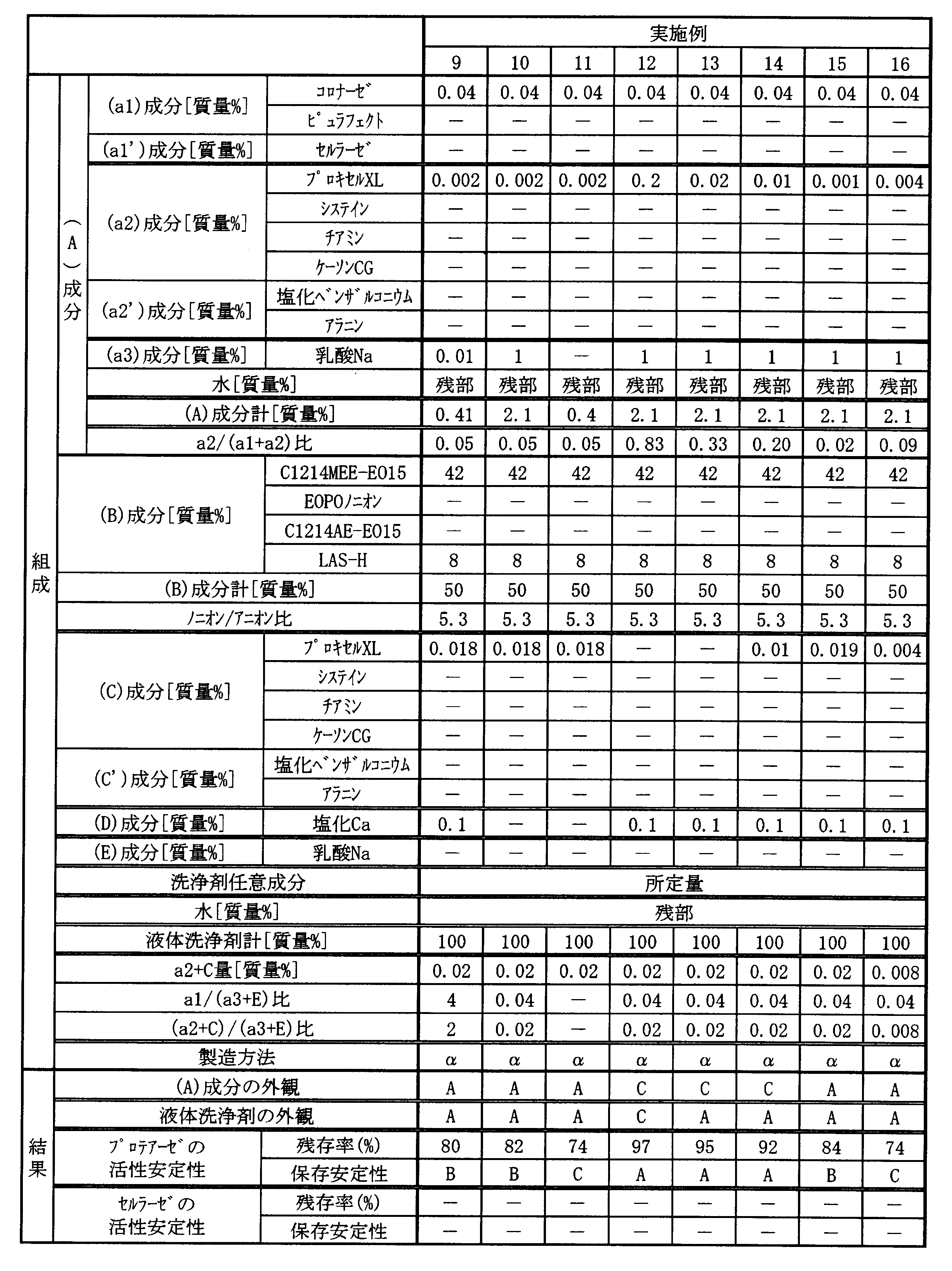
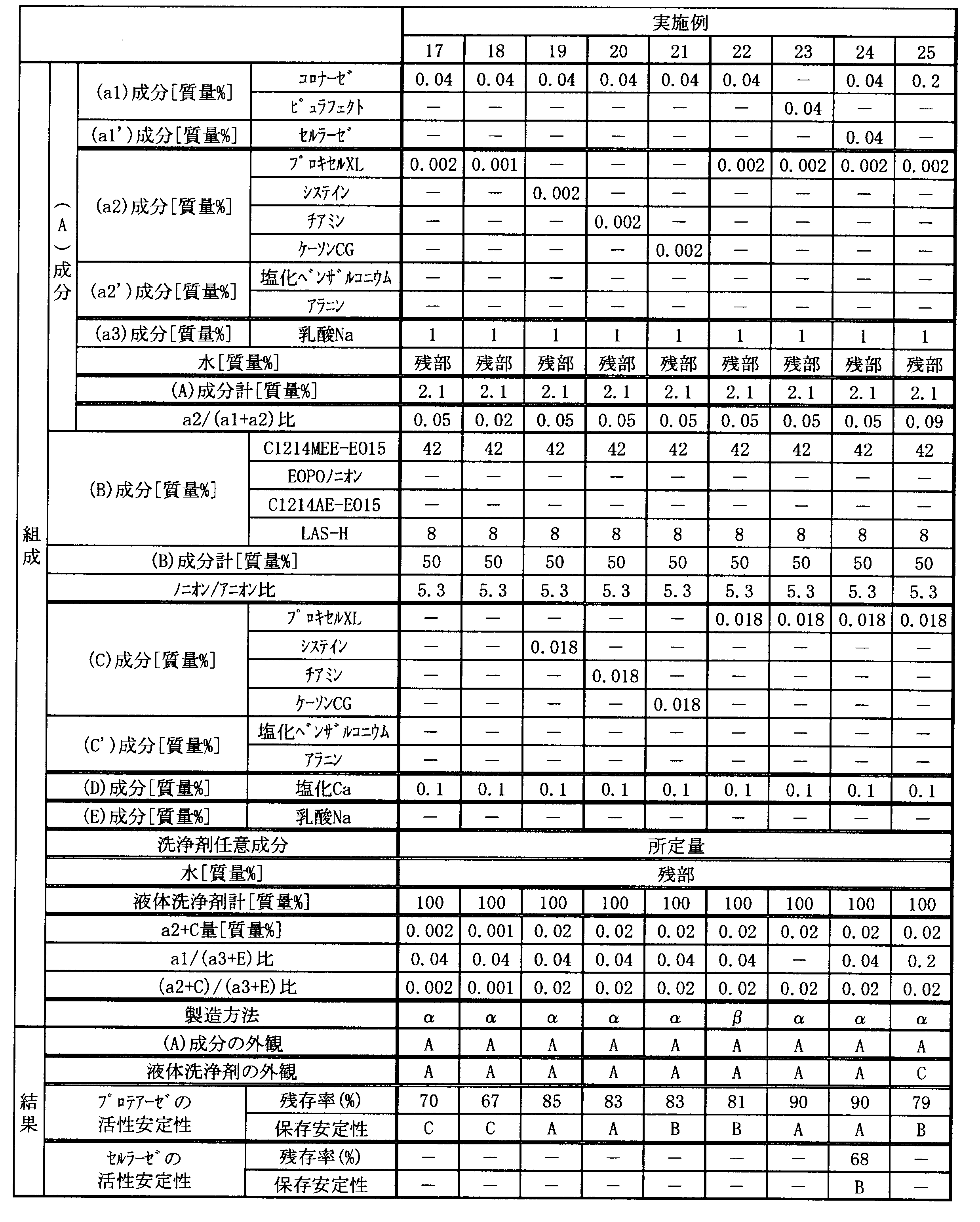
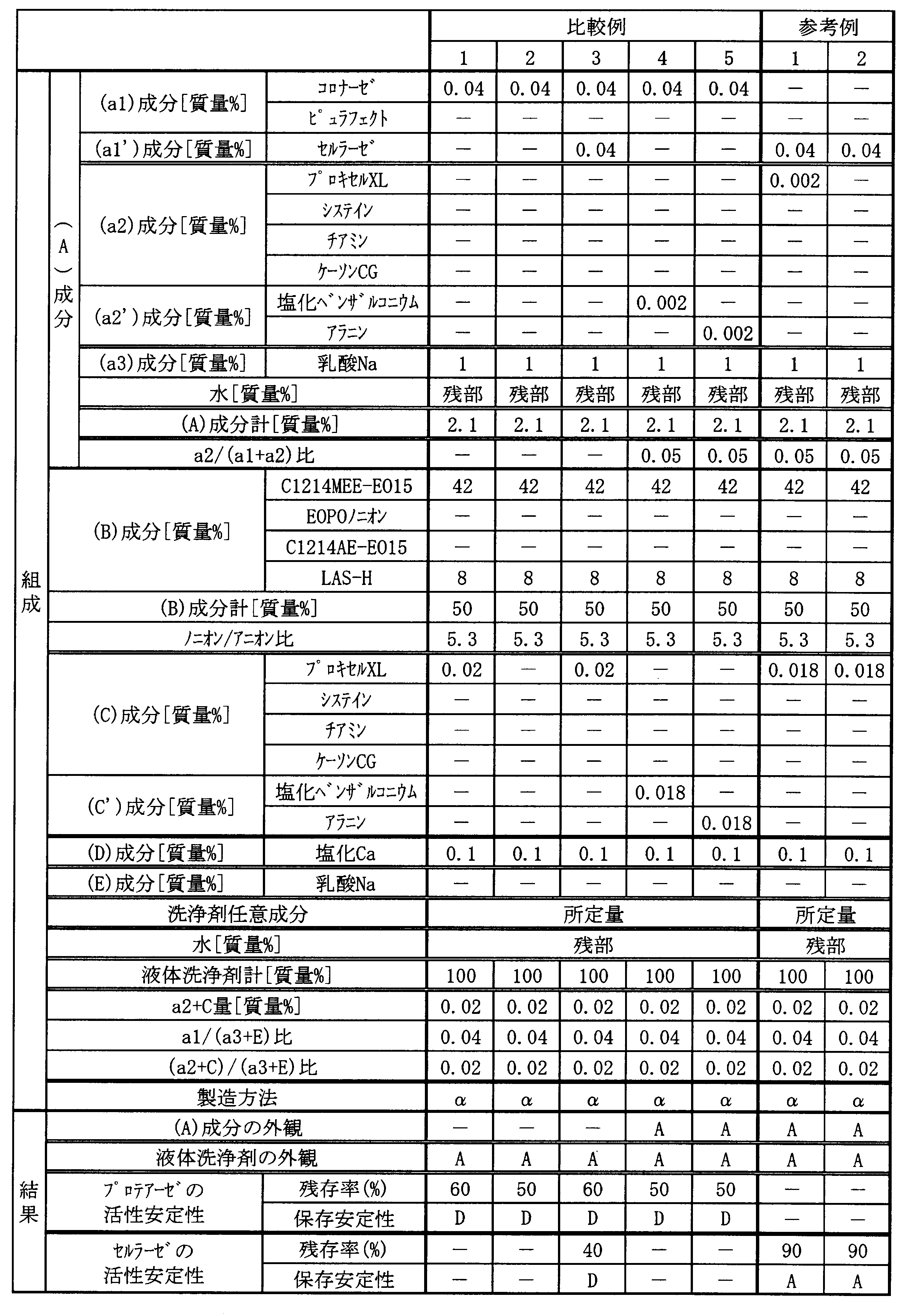
表1~4に示すように、本発明を適用した実施例1~25は、プロテアーゼの活性安定性が「C」~「A」であった。
中でも、(a3)成分を用いた実施例1は、(a3)成分を用いていない実施例8、11に比べて、プロテアーゼの活性安定性が高まっていた。
(a1)成分と(a2)成分とを混合した後、(a3)成分を混合して(A)成分を製造した実施例1は、(a1)成分と(a3)成分とを混合した後、(a2)成分を混合して(A)成分を製造した実施例22に比べて、プロテアーゼの活性安定性が高まっていた。
一方、(a2)成分を用いていない比較例1~3、(a2)成分に換えて(a2’)成分を用いた比較例4~5は、プロテアーゼの活性安定性が「D」であった。加えて、実施例1と比較例1との比較において、(A)成分に(a2)成分を用いた実施例1(即ち、酵素調製工程を備える)は、(C)成分のみを用いた比較例1(即ち、酵素調製工程を備えない)に比べて、プロテアーゼの活性安定性を顕著に高められた。
実施例24と比較例3との比較において、(a2)成分を用いた実施例24は、(a2)成分を用いていない比較例3に比べて、セルラーゼの活性安定性を顕著に高められた。
これらの結果から、本発明を適用することで、液体洗浄剤中における酵素の活性安定性をより高めることができることが判った。
なお、(a1)成分を用いず(a1’)成分(セルラーゼ)を用いた参考例1~2は、(a2)成分の有無にかかわらず、セルラーゼの活性安定性が高かった。
中でも、(a3)成分を用いた実施例1は、(a3)成分を用いていない実施例8、11に比べて、プロテアーゼの活性安定性が高まっていた。
(a1)成分と(a2)成分とを混合した後、(a3)成分を混合して(A)成分を製造した実施例1は、(a1)成分と(a3)成分とを混合した後、(a2)成分を混合して(A)成分を製造した実施例22に比べて、プロテアーゼの活性安定性が高まっていた。
一方、(a2)成分を用いていない比較例1~3、(a2)成分に換えて(a2’)成分を用いた比較例4~5は、プロテアーゼの活性安定性が「D」であった。加えて、実施例1と比較例1との比較において、(A)成分に(a2)成分を用いた実施例1(即ち、酵素調製工程を備える)は、(C)成分のみを用いた比較例1(即ち、酵素調製工程を備えない)に比べて、プロテアーゼの活性安定性を顕著に高められた。
実施例24と比較例3との比較において、(a2)成分を用いた実施例24は、(a2)成分を用いていない比較例3に比べて、セルラーゼの活性安定性を顕著に高められた。
これらの結果から、本発明を適用することで、液体洗浄剤中における酵素の活性安定性をより高めることができることが判った。
なお、(a1)成分を用いず(a1’)成分(セルラーゼ)を用いた参考例1~2は、(a2)成分の有無にかかわらず、セルラーゼの活性安定性が高かった。
本発明の洗浄剤用の酵素製剤は、液体洗浄剤における活性安定性をより高めることができるので、産業上極めて有用である。
Claims (10)
- (a1)成分:プロテアーゼと、(a2)成分:チアゾール系化合物及び含硫アミノ酸から選択される少なくとも1つの成分と、を含む洗浄剤用の酵素製剤。
- さらに、(a3)成分:ヒドロキシカルボン酸及びそのアルカリ金属塩から選択される少なくとも1つの成分を含む、請求項1に記載の洗浄剤用の酵素製剤。
- 請求項1に記載の洗浄剤用の酵素製剤と、界面活性剤とを含む液体洗浄剤。
- 請求項2に記載の洗浄剤用の酵素製剤と、界面活性剤とを含む液体洗浄剤。
- 請求項1に記載の洗浄剤用の酵素製剤の製造方法であって、 前記(a1)成分と前記(a2)成分とを混合することを含む洗浄剤用の酵素製剤の製造方法。
- 請求項2に記載の洗浄剤用の酵素製剤の製造方法であって、 前記(a1)成分と前記(a2)成分と前記(a3)成分とを混合することを含む洗浄剤用の酵素製剤の製造方法。
- 前記(a1)成分と前記(a2)成分とを混合し、次いで前記混合物に(a3)成分を混合することを含む、請求項6に記載の洗浄剤用の酵素製剤の製造方法。
- 請求項3に記載の液体洗浄剤の製造方法であって、
前記(a1)成分と前記(a2)成分とを混合して洗浄剤用の酵素製剤を得る酵素調製工程と、
前記洗浄剤用の酵素製剤と前記界面活性剤とを混合する洗浄剤調製工程と、を備える、
液体洗浄剤の製造方法。 - 請求項4に記載の液体洗浄剤の製造方法であって、
前記(a1)成分と前記(a2)成分と前記(a3)成分とを混合して洗浄剤用の酵素製剤を得る酵素調製工程と、
前記洗浄剤用の酵素製剤と前記界面活性剤とを混合する洗浄剤調製工程と、を備える、
液体洗浄剤の製造方法。 - 前記酵素調製工程は、前記(a1)成分と前記(a2)成分とを混合し、次いで前記混合物に(a3)成分を混合することを含む、請求項9に記載の液体洗浄剤の製造方法。
Priority Applications (1)
| Application Number | Priority Date | Filing Date | Title |
|---|---|---|---|
| JP2014558612A JPWO2014115804A1 (ja) | 2013-01-25 | 2014-01-23 | 液体洗浄剤及びその製造方法 |
Applications Claiming Priority (2)
| Application Number | Priority Date | Filing Date | Title |
|---|---|---|---|
| JP2013012448 | 2013-01-25 | ||
| JP2013-012448 | 2013-01-25 |
Publications (1)
| Publication Number | Publication Date |
|---|---|
| WO2014115804A1 true WO2014115804A1 (ja) | 2014-07-31 |
Family
ID=51227593
Family Applications (1)
| Application Number | Title | Priority Date | Filing Date |
|---|---|---|---|
| PCT/JP2014/051376 Ceased WO2014115804A1 (ja) | 2013-01-25 | 2014-01-23 | 洗浄剤用の酵素製剤及び液体洗浄剤ならびにこれらの製造方法 |
Country Status (2)
| Country | Link |
|---|---|
| JP (1) | JPWO2014115804A1 (ja) |
| WO (1) | WO2014115804A1 (ja) |
Citations (5)
| Publication number | Priority date | Publication date | Assignee | Title |
|---|---|---|---|---|
| JP2007524747A (ja) * | 2004-02-25 | 2007-08-30 | ビーエーエスエフ アクチェンゲゼルシャフト | 水中に良好に再分散可能なポリマー粉末の製造方法 |
| WO2011024862A1 (ja) * | 2009-08-31 | 2011-03-03 | 三洋化成工業株式会社 | タンパク質水溶液の安定化剤、この安定化剤を含有するタンパク質水溶液及び液体洗剤組成物、並びに、この安定化剤を用いるタンパク質の安定化方法 |
| JP2011515449A (ja) * | 2008-03-26 | 2011-05-19 | ノボザイムス アクティーゼルスカブ | 安定化された液体酵素組成物 |
| WO2011134809A1 (en) * | 2010-04-26 | 2011-11-03 | Novozymes A/S | Enzyme granules |
| WO2012033222A1 (ja) * | 2010-09-10 | 2012-03-15 | ライオン株式会社 | 液体洗浄剤組成物 |
-
2014
- 2014-01-23 JP JP2014558612A patent/JPWO2014115804A1/ja active Pending
- 2014-01-23 WO PCT/JP2014/051376 patent/WO2014115804A1/ja not_active Ceased
Patent Citations (5)
| Publication number | Priority date | Publication date | Assignee | Title |
|---|---|---|---|---|
| JP2007524747A (ja) * | 2004-02-25 | 2007-08-30 | ビーエーエスエフ アクチェンゲゼルシャフト | 水中に良好に再分散可能なポリマー粉末の製造方法 |
| JP2011515449A (ja) * | 2008-03-26 | 2011-05-19 | ノボザイムス アクティーゼルスカブ | 安定化された液体酵素組成物 |
| WO2011024862A1 (ja) * | 2009-08-31 | 2011-03-03 | 三洋化成工業株式会社 | タンパク質水溶液の安定化剤、この安定化剤を含有するタンパク質水溶液及び液体洗剤組成物、並びに、この安定化剤を用いるタンパク質の安定化方法 |
| WO2011134809A1 (en) * | 2010-04-26 | 2011-11-03 | Novozymes A/S | Enzyme granules |
| WO2012033222A1 (ja) * | 2010-09-10 | 2012-03-15 | ライオン株式会社 | 液体洗浄剤組成物 |
Also Published As
| Publication number | Publication date |
|---|---|
| JPWO2014115804A1 (ja) | 2017-01-26 |
Similar Documents
| Publication | Publication Date | Title |
|---|---|---|
| JP5902622B2 (ja) | 液体洗浄剤組成物 | |
| JP6275122B2 (ja) | 液体洗浄剤 | |
| JP6726755B2 (ja) | 衣料用液体洗浄剤 | |
| KR102426322B1 (ko) | 히드록시카르복실산, 비-이온성 계면활성제 및 효소를 함유하는 산 액체 압축 세척제 | |
| CN1216576A (zh) | N-酰基乙二胺三乙酸类表面活性剂作为酶可配伍的表面活性剂、稳定剂和活化剂 | |
| WO2014077403A1 (ja) | 繊維製品処理剤及び繊維製品の処理方法 | |
| US20150267153A1 (en) | Process for producing low-in-water to water-free detergent or cleaning agents | |
| KR102126646B1 (ko) | 세제, 특히 식기세척 세제 | |
| KR101900978B1 (ko) | 액체 세정제 조성물 | |
| JP7138552B2 (ja) | 繊維製品用の液体洗浄剤組成物 | |
| KR102093985B1 (ko) | 액체 세정제 | |
| JPWO2011052501A1 (ja) | 液体洗浄剤組成物およびその製造方法 | |
| JP6188239B2 (ja) | 液体洗浄剤 | |
| ES2725612T3 (es) | Composición de detergente y prelavado que contiene enzima y métodos de uso | |
| WO2014115804A1 (ja) | 洗浄剤用の酵素製剤及び液体洗浄剤ならびにこれらの製造方法 | |
| JP2002167600A (ja) | 液体洗浄剤組成物 | |
| TWI701326B (zh) | 衣料用液體洗淨劑 | |
| JPS62269689A (ja) | 酸素の安定化法 | |
| JP7061845B2 (ja) | 衣料用液体洗浄剤組成物 | |
| JP2011162730A (ja) | 自動食器洗い洗浄機用液体洗剤組成物 | |
| JP7531344B2 (ja) | 繊維製品の洗濯方法 | |
| KR20240125546A (ko) | 액체 세정제 물품 | |
| JP2012036387A (ja) | 界面活性剤含有組成物及びこれを含んでなる液体洗剤組成物 | |
| JP2024035328A (ja) | 繊維製品用液体洗浄剤組成物 | |
| US20150315529A1 (en) | Low-water to water-free liquid cleaning agent |
Legal Events
| Date | Code | Title | Description |
|---|---|---|---|
| 121 | Ep: the epo has been informed by wipo that ep was designated in this application |
Ref document number: 14743897 Country of ref document: EP Kind code of ref document: A1 |
|
| ENP | Entry into the national phase |
Ref document number: 2014558612 Country of ref document: JP Kind code of ref document: A |
|
| NENP | Non-entry into the national phase |
Ref country code: DE |
|
| 122 | Ep: pct application non-entry in european phase |
Ref document number: 14743897 Country of ref document: EP Kind code of ref document: A1 |