WO2014112586A1 - ポリオキシアルキレン変性ビニルアルコール系重合体を含有する組成物 - Google Patents
ポリオキシアルキレン変性ビニルアルコール系重合体を含有する組成物 Download PDFInfo
- Publication number
- WO2014112586A1 WO2014112586A1 PCT/JP2014/050808 JP2014050808W WO2014112586A1 WO 2014112586 A1 WO2014112586 A1 WO 2014112586A1 JP 2014050808 W JP2014050808 W JP 2014050808W WO 2014112586 A1 WO2014112586 A1 WO 2014112586A1
- Authority
- WO
- WIPO (PCT)
- Prior art keywords
- group
- formula
- poa
- represented
- block
- Prior art date
- Legal status (The legal status is an assumption and is not a legal conclusion. Google has not performed a legal analysis and makes no representation as to the accuracy of the status listed.)
- Ceased
Links
- 0 C*(C)(C)*(C)(*)C#N Chemical compound C*(C)(C)*(C)(*)C#N 0.000 description 1
Classifications
-
- C—CHEMISTRY; METALLURGY
- C09—DYES; PAINTS; POLISHES; NATURAL RESINS; ADHESIVES; COMPOSITIONS NOT OTHERWISE PROVIDED FOR; APPLICATIONS OF MATERIALS NOT OTHERWISE PROVIDED FOR
- C09D—COATING COMPOSITIONS, e.g. PAINTS, VARNISHES OR LACQUERS; FILLING PASTES; CHEMICAL PAINT OR INK REMOVERS; INKS; CORRECTING FLUIDS; WOODSTAINS; PASTES OR SOLIDS FOR COLOURING OR PRINTING; USE OF MATERIALS THEREFOR
- C09D133/00—Coating compositions based on homopolymers or copolymers of compounds having one or more unsaturated aliphatic radicals, each having only one carbon-to-carbon double bond, and at least one being terminated by only one carboxyl radical, or of salts, anhydrides, esters, amides, imides, or nitriles thereof; Coating compositions based on derivatives of such polymers
- C09D133/24—Homopolymers or copolymers of amides or imides
-
- C—CHEMISTRY; METALLURGY
- C08—ORGANIC MACROMOLECULAR COMPOUNDS; THEIR PREPARATION OR CHEMICAL WORKING-UP; COMPOSITIONS BASED THEREON
- C08F—MACROMOLECULAR COMPOUNDS OBTAINED BY REACTIONS ONLY INVOLVING CARBON-TO-CARBON UNSATURATED BONDS
- C08F216/00—Copolymers of compounds having one or more unsaturated aliphatic radicals, each having only one carbon-to-carbon double bond, and at least one being terminated by an alcohol, ether, aldehydo, ketonic, acetal or ketal radical
- C08F216/02—Copolymers of compounds having one or more unsaturated aliphatic radicals, each having only one carbon-to-carbon double bond, and at least one being terminated by an alcohol, ether, aldehydo, ketonic, acetal or ketal radical by an alcohol radical
- C08F216/04—Acyclic compounds
- C08F216/06—Polyvinyl alcohol ; Vinyl alcohol
-
- C—CHEMISTRY; METALLURGY
- C08—ORGANIC MACROMOLECULAR COMPOUNDS; THEIR PREPARATION OR CHEMICAL WORKING-UP; COMPOSITIONS BASED THEREON
- C08F—MACROMOLECULAR COMPOUNDS OBTAINED BY REACTIONS ONLY INVOLVING CARBON-TO-CARBON UNSATURATED BONDS
- C08F218/00—Copolymers of compounds having one or more unsaturated aliphatic radicals, each having only one carbon-to-carbon double bond, and at least one being terminated by an acyloxy radical of a saturated carboxylic acid, of carbonic acid or of a haloformic acid
- C08F218/02—Esters of monocarboxylic acids
- C08F218/04—Vinyl esters
- C08F218/08—Vinyl acetate
-
- C—CHEMISTRY; METALLURGY
- C08—ORGANIC MACROMOLECULAR COMPOUNDS; THEIR PREPARATION OR CHEMICAL WORKING-UP; COMPOSITIONS BASED THEREON
- C08F—MACROMOLECULAR COMPOUNDS OBTAINED BY REACTIONS ONLY INVOLVING CARBON-TO-CARBON UNSATURATED BONDS
- C08F220/00—Copolymers of compounds having one or more unsaturated aliphatic radicals, each having only one carbon-to-carbon double bond, and only one being terminated by only one carboxyl radical or a salt, anhydride ester, amide, imide or nitrile thereof
- C08F220/02—Monocarboxylic acids having less than ten carbon atoms; Derivatives thereof
- C08F220/52—Amides or imides
- C08F220/54—Amides, e.g. N,N-dimethylacrylamide or N-isopropylacrylamide
- C08F220/58—Amides, e.g. N,N-dimethylacrylamide or N-isopropylacrylamide containing oxygen in addition to the carbonamido oxygen, e.g. N-methylolacrylamide, N-(meth)acryloylmorpholine
-
- C—CHEMISTRY; METALLURGY
- C08—ORGANIC MACROMOLECULAR COMPOUNDS; THEIR PREPARATION OR CHEMICAL WORKING-UP; COMPOSITIONS BASED THEREON
- C08F—MACROMOLECULAR COMPOUNDS OBTAINED BY REACTIONS ONLY INVOLVING CARBON-TO-CARBON UNSATURATED BONDS
- C08F290/00—Macromolecular compounds obtained by polymerising monomers on to polymers modified by introduction of aliphatic unsaturated end or side groups
- C08F290/02—Macromolecular compounds obtained by polymerising monomers on to polymers modified by introduction of aliphatic unsaturated end or side groups on to polymers modified by introduction of unsaturated end groups
- C08F290/06—Polymers provided for in subclass C08G
- C08F290/062—Polyethers
-
- C—CHEMISTRY; METALLURGY
- C08—ORGANIC MACROMOLECULAR COMPOUNDS; THEIR PREPARATION OR CHEMICAL WORKING-UP; COMPOSITIONS BASED THEREON
- C08K—Use of inorganic or non-macromolecular organic substances as compounding ingredients
- C08K5/00—Use of organic ingredients
- C08K5/04—Oxygen-containing compounds
- C08K5/06—Ethers; Acetals; Ketals; Ortho-esters
-
- C—CHEMISTRY; METALLURGY
- C08—ORGANIC MACROMOLECULAR COMPOUNDS; THEIR PREPARATION OR CHEMICAL WORKING-UP; COMPOSITIONS BASED THEREON
- C08L—COMPOSITIONS OF MACROMOLECULAR COMPOUNDS
- C08L71/00—Compositions of polyethers obtained by reactions forming an ether link in the main chain; Compositions of derivatives of such polymers
- C08L71/02—Polyalkylene oxides
-
- C—CHEMISTRY; METALLURGY
- C09—DYES; PAINTS; POLISHES; NATURAL RESINS; ADHESIVES; COMPOSITIONS NOT OTHERWISE PROVIDED FOR; APPLICATIONS OF MATERIALS NOT OTHERWISE PROVIDED FOR
- C09D—COATING COMPOSITIONS, e.g. PAINTS, VARNISHES OR LACQUERS; FILLING PASTES; CHEMICAL PAINT OR INK REMOVERS; INKS; CORRECTING FLUIDS; WOODSTAINS; PASTES OR SOLIDS FOR COLOURING OR PRINTING; USE OF MATERIALS THEREFOR
- C09D171/00—Coating compositions based on polyethers obtained by reactions forming an ether link in the main chain; Coating compositions based on derivatives of such polymers
- C09D171/02—Polyalkylene oxides
Definitions
- the present invention relates to a composition containing a vinyl alcohol polymer containing a monomer unit having a polyoxyalkylene group.
- a vinyl alcohol polymer (hereinafter sometimes abbreviated as “PVA”) is a few crystalline water-soluble polymers, and has excellent film-forming properties, interface properties, and strength properties. For this reason, PVA is widely used as a raw material for thickeners, paper coating agents, adhesives, fiber processing agents, binders, emulsion stabilizers, films, fibers and the like. Moreover, in order to improve the specific performance of PVA, development of modified PVA by controlling crystallinity, introducing functional groups, and the like has been performed. Furthermore, a PVA-boric acid crosslinking solution in which boric acid or the like is added to PVA to cause a crosslinking reaction is used for the purpose of controlling shape retention performance or improving the strength of the PVA matrix.
- the content of the POA group and the POA group It has been proposed to improve the temperature-sensitive thickening by adjusting the number of repeating units of the oxyalkylene group (see JP 2008-291120 A and JP 10-338714 A).
- PVA having such a POA group exhibits temperature-sensitive thickening, the change in viscosity due to the temperature is insufficient, and it is difficult for temperature-sensitive thickening to occur at low concentrations, or the viscosity does not increase even at low temperatures. There are inconveniences such as high handling and poor handling. Under such circumstances, it is required to improve the handling property at low temperature and the temperature-sensitive thickening.
- JP 2008-291120 A Japanese Patent Laid-Open No. 10-338714
- the present invention has been made based on the above-mentioned circumstances, and aims to provide a composition that can exhibit excellent temperature-sensitive thickening that has a low viscosity at low temperatures and is excellent in handleability, and that rapidly thickens as the temperature rises. To do.
- a vinyl alcohol polymer containing a monomer unit having a polyoxyalkylene group (hereinafter sometimes abbreviated as “POA-modified PVA”), and a surfactant;
- the polyoxyalkylene group includes a block represented by the following formula (1) (hereinafter also referred to as “block (1)”),
- block (1) The structural unit of the block is 50 mol% or more based on the polyoxyalkylene group,
- the content of the monomer unit is 0.05 mol% or more and 10 mol% or less with respect to the monomer unit of the vinyl alcohol polymer, and the viscosity average polymerization degree of the vinyl alcohol polymer is 150 or more and 5,000.
- the saponification degree is 40 mol% or more and 99.99 mol% or less
- the surfactant is a composition represented by the following formula (I).
- one of R 1 and R 2 is a methyl group or an ethyl group, and the other is a hydrogen atom.
- M represents the number of repeating units and is an integer of 10 to 40.
- the plurality of R 1 and R 2 may be the same or different.
- R 3 is an alkylene group having 3 to 5 carbon atoms.
- R 4 is a single bond or an alkylene group having 1 to 5 carbon atoms.
- X 1 is a hydrogen atom or an organic group.
- X 2 is a hydrophilic group, x is an integer of 1 to 100. When x is 2 or more, a plurality of R 3 each independently satisfy the above definition.
- the aqueous solution of the composition contains a POA-modified PVA having a polyoxyalkylene group containing a block having the above specific structure and a surfactant having the above specific structure, so that the viscosity is low and the handling property is increased at a low temperature. Then, an excellent temperature-sensitive thickening that sharply thickens can be exhibited.
- the POA-modified PVA can have a hydrophobic interaction with the surfactant having the specific structure by including the block having the specific structure.
- the hydrophobicity of this surfactant is considered to change depending on the temperature.
- the hydrophobic interaction between the POA groups is small at low temperatures, and the surfactant does not affect the hydrophobic interaction between the POA groups.
- the composition has a low viscosity and excellent handleability at low temperatures.
- a stronger intermolecular crosslinking structure is formed by the interaction between the POA groups due to the intervention of the surfactant. As a result, the composition rapidly thickens as the temperature increases.
- the solubility of the composition in water, the temperature-sensitive viscosity increase, and the like are further improved. Can be made. Thus, it is thought that the said composition exhibits the above-mentioned outstanding temperature-sensitive viscosity increase by having the said structure.
- the hydrophilic group of X 2 is a carboxyl group or a salt thereof, a sulfonic acid group or a salt thereof, or a group represented by the following formula (II).
- y is an integer of 1 or more and 200 or less.
- hydrophilic group of the X 2 With such a specific hydrophilic group, the interaction of POA groups and the surfactant described above is considered to be strong, as a result, the composition is excellent due to an increase in the temperature-sensitive viscous .
- the organic group of X 1 is an alkyl group having 1 to 29 carbon atoms or a hydrophilic group.
- Hydrophilic group of the above X 1 is a group represented by the following formula (III).
- z is an integer of 1 or more and 200 or less.
- the polyoxyalkylene group preferably further includes a block represented by the following formula (2) (hereinafter also referred to as “block (2)”).
- block (2) a block represented by the following formula (2) (hereinafter also referred to as “block (2)”).
- n represents the number of repeating units and is an integer of 1 to 50.)
- the monomer unit preferably has the polyoxyalkylene group in the side chain.
- the above-described interaction is considered to be further strengthened, and as a result, the temperature-sensitive thickening of the composition is further improved.
- the block represented by the above formula (1) is located on the main chain side from the block represented by the above formula (2). It is considered that the above-described interaction is further strengthened by having each of the blocks at the specific position, and as a result, the temperature-sensitive thickening of the composition is further improved.
- the block represented by the above formula (1) and the block represented by the above formula (2) are directly bonded.
- these blocks are located adjacent to each other, it is considered that the above-described interaction is further strengthened, and as a result, the temperature-sensitive thickening of the composition is further improved.
- the POA-modified PVA is preferably obtained by saponifying a copolymer of an unsaturated monomer represented by the following formula (3) and a vinyl ester monomer.
- Y is a group that includes the block represented by Formula (1) and may include the block represented by Formula (2).
- R 5 represents a hydrogen atom or An alkyl group having 1 to 8 carbon atoms
- R 6 is a hydrogen atom or a methyl group
- X is —O—, —CH 2 —O—, —CO—, — (CH 2 ) k —, —COO. - or -CO-NR 7 - and it .
- R 7 is .k a hydrogen atom or an alkyl group having 1 to 4 carbon atoms, is an integer of 1-15).
- the POA-modified PVA contained in the composition is obtained by saponifying the copolymer of the specific monomer, adjustment of the saponification degree of the POA-modified PVA is facilitated, and the temperature sensitivity is increased. The viscosity and the like can be further increased.
- the mass ratio of the surfactant to the POA-modified PVA is preferably 3/100 or more and 70/100 or less.
- the composition is excellent in handling property at low temperature and temperature-sensitive thickening, it is suitably used as a coating agent such as a paper coating agent and a glass fiber coating agent.
- the composition is excellent in handleability at low temperatures and temperature-sensitive thickening, it is suitably used as a thickening agent for various emulsion adhesives.
- the composition of the present invention has a low viscosity at a low temperature and excellent handleability, and can exhibit an excellent temperature-sensitive thickening that rapidly increases as the temperature rises. Therefore, the composition is suitably used as a coating agent, a thickener and the like.
- composition has a POA group containing a block represented by the formula (1) described in detail below, and the content of the monomer unit having this POA group (hereinafter also referred to as “POA group modification rate”). ), PVA having a specific range of saponification degree and viscosity average polymerization degree (hereinafter also referred to as “POA-modified PVA”) and a surfactant, the viscosity is low at low temperatures and excellent in handleability. Excellent temperature-sensitive thickening can be achieved.
- POA group modification rate PVA having a specific range of saponification degree and viscosity average polymerization degree
- surfactant a surfactant
- the POA-modified PVA can have a hydrophobic interaction with the surfactant having the specific structure by including the block having the specific structure.
- the hydrophobicity of this surfactant is considered to change depending on the temperature. Since the POA-modified PVA has a block having the above specific structure, the hydrophobic interaction between the POA groups is small at low temperatures, and the surfactant does not affect the hydrophobic interaction between the POA groups. As a result, the composition has a low viscosity and excellent handleability at low temperatures.
- a stronger intermolecular crosslinking structure is formed by the interaction between the POA groups due to the intervention of the surfactant.
- the composition rapidly thickens as the temperature increases. Further, by setting the content of the monomer unit and the viscosity average polymerization degree and saponification degree of the POA-modified PVA within the specific ranges, the solubility of the composition in water, the temperature-sensitive viscosity increase, and the like are further improved. Can be made. Thus, it is thought that the said composition exhibits the above-mentioned outstanding temperature-sensitive viscosity increase by having the said structure.
- the composition usually further contains water.
- the composition may be one in which the POA-modified PVA, the surfactant and water are simultaneously dissolved, or a composition obtained by adding a surfactant to a POA-modified PVA aqueous solution.
- the composition can also include a water-containing solvent.
- the water-containing solvent is composed of water and a solvent other than water.
- the composition may contain an optional component in addition to the above components as long as the effects of the present invention are not impaired. Hereinafter, these components will be described in detail.
- the POA-modified PVA contains a monomer unit having a polyoxyalkylene group containing a block represented by the above formula (1) (hereinafter also referred to as “block (1)”).
- the content ratio of the structural unit of the block (1) to the polyoxyalkylene group that is, the ratio of the structural unit of the block (1) to the total structural units of the polyoxyalkylene group needs to be 50 mol% or more. 50 mol% or more and 99 mol% or less is preferable, and 60 mol% or more and 95 mol% or less is more preferable.
- the “block” refers to a portion composed of a chain structure of predetermined structural units.
- one of R 1 and R 2 is a methyl group or an ethyl group, and the other is a hydrogen atom.
- m represents the number of repeating units and is an integer of 10 or more and 40 or less.
- a plurality of R 1 and R 2 may be the same or different.
- Examples of the block (1) include a polyoxypropylene block in which the number of repeating units of oxypropylene units is m, a polyoxybutylene block in which the number of repeating units of oxybutylene units is m, and the like.
- the number m of repeating units of the oxyalkylene unit in the block (1) needs to be an integer of 10 to 40, preferably 15 to 38, and more preferably 20 to 35. When m is less than 10, the temperature-sensitive thickening due to the interaction between the POA group and the surfactant is not sufficiently exhibited.
- R 1 and R 2 in the above formula (1) is a methyl group or an ethyl group, and the other is a hydrogen atom.
- R 1 is a methyl group and R 2 is a hydrogen atom because the POA-modified PVA is easy to produce.
- the polyoxyalkylene group preferably further includes a block represented by the above formula (2) (hereinafter also referred to as “block (2)”).
- block (2) a block represented by the above formula (2)
- the monomer unit when the monomer unit further includes the block (2) in addition to the block (1), the temperature-sensitive thickening due to the interaction between the POA group and the surfactant is improved.
- n represents the number of repeating units and is an integer of 1 to 50.
- Block (2) is a (poly) oxyethylene block in which the number of repeating units of oxyethylene units is n.
- the number n of repeating units of oxyethylene units in the block (2) is preferably 3 or more and 40 or less, and more preferably 5 or more and 10 or less. When n exceeds 40, the interaction between POA groups decreases, and the temperature-sensitive thickening may not be sufficiently exhibited.
- the polyoxyalkylene group may further include a block (a) different from the block (1) and the block (2).
- the said composition can also improve temperature-sensitive thickening by further including a block (a).
- Examples of the block (a) include a polyoxypentylene block, a polyoxyhexylene block, a polyoxystyrene block, a polyalkylene block, and a polyoxyethylene block having 51 to 70 repeating units.
- the polyoxyalkylene group may be contained in any of the main chain, the side chain, and the terminal of the POA-modified PVA. From the viewpoint of enhancing the above-mentioned interaction and the viewpoint of ease of synthesis, the side chain or the terminal may be included. It is preferable that it is contained in.
- the “main chain” refers to the longest chain among the chains formed by bonding a plurality of atoms constituting the POA-modified PVA.
- “Side chain” refers to a chain other than the main chain in the POA-modified PVA.
- the block (1) is on the main chain side and the opposite side of the block (2). Although it may be located at any position, it is preferably located at the main chain side. Further, in this case, it is preferable that the block (1) and the block (2) are directly coupled.
- the POA-modified PVA is a copolymer containing a monomer unit containing a POA group and a vinyl alcohol unit (—CH 2 —CHOH—), and may further contain other monomer units.
- the method for producing the POA-modified PVA contained in the composition is not particularly limited, but the POA-modified vinyl ester system obtained by copolymerizing an unsaturated monomer containing a POA group and a vinyl ester monomer is obtained. A method of saponifying the polymer is preferred.
- the unsaturated monomer containing a POA group is preferably an unsaturated monomer represented by the following formula (3).
- Y is a group that includes a block represented by Formula (1) and may include a block represented by Formula (2).
- R 5 is a hydrogen atom or an alkyl group having 1 to 8 carbon atoms.
- R 6 is a hydrogen atom or a methyl group.
- X is —O—, —CH 2 —O—, —CO—, — (CH 2 ) k —, —COO— or —CO—NR 7 —.
- R 7 is a hydrogen atom or an alkyl group having 1 to 4 carbon atoms.
- k is an integer of 1 to 15.
- Examples of the alkyl group having 1 to 8 carbon atoms represented by R 5 include a methyl group, an ethyl group, a propyl group, and a butyl group.
- R 5 is preferably a hydrogen atom, a methyl group or a butyl group, more preferably a hydrogen atom or a methyl group.
- X when X is asymmetric, that is, —CH 2 —O—, —COO—, or —CO—NR 7 —, the direction of X may be any.
- X -O -, - CH 2 -O -, - CO-NR 7 - are preferred, -CO-NR 7 -, more preferably, -CO-NH- is more preferred.
- R 7 is preferably a hydrogen atom.
- the direction of the group represented by Y (the arrangement of the block (1), the block (2), etc.) is as described above.
- unsaturated monomers represented by the above formula (3) unsaturated monomers represented by the following formulas (3-1) to (3-3) are more preferable, and the following formula (3-1) The unsaturated monomer represented by is more preferable.
- R 1 , R 2 and m are the same as in the above formula (1).
- n is the same as in the above formula (2).
- R 5 , R 6 and X are the same as in the above formula (3).
- B indicates that both adjacent units are formed by block copolymerization.
- R 5 in the above formula (3) is a hydrogen atom
- R 6 is a hydrogen atom or a methyl group
- examples include polyoxyalkylene mono (meth) acrylamide, polyoxyalkylene mono (meth) allyl ether, polyoxyalkylene monovinyl ether, polyoxyalkylene mono (meth) acrylate and the like.
- R 1 in the block (1) is a methyl group and R 2 is a hydrogen atom
- polyoxypropylene (poly) oxyethylene monoacrylamide polyoxypropylene (poly) oxyethylene monomethacrylamide
- polyoxy Propylene (poly) oxyethylene monoallyl ether polyoxypropylene (poly) oxyethylene monomethallyl ether
- polyoxypropylene (poly) oxyethylene monovinyl ether polyoxypropylene (poly) oxyethylene monoacrylate
- polyoxypropylene (poly ) Oxyethylene monomethacrylate etc.
- R 1 is an ethyl group and R 2 is a hydrogen atom
- polyoxybutylene (poly) oxyethylene monoacrylamide polyoxybutylene (poly) oxyethylene monomethacrylamide
- polyoxybutylene (poly) oxyethylene monoallyl ether examples include polyoxybutylene (poly) oxyethylene monomethallyl ether, polyoxybutylene (poly) oxyethylene monovinyl ether, polyoxybutylene (poly) oxyethylene monoacrylate, polyoxybutylene (poly) oxyethylene monomethacrylate, and the like.
- polyoxypropylene (poly) oxyethylene monoacrylamide, polyoxypropylene (poly) oxyethylene monomethacrylamide, polyoxypropylene (poly) oxyethylene monovinyl ether, polyoxypropylene (poly) oxyethylene monoallyl ether are Preferably used.
- the unsaturated monomer when R 5 in the above formula (3) is an alkyl group having 1 to 8 carbon atoms
- the unsaturated monomer exemplified when R 5 is a hydrogen atom specifically, the unsaturated monomer exemplified when R 5 is a hydrogen atom.
- the terminal hydroxyl group is substituted with an alkoxy group having 1 to 8 carbon atoms.
- the terminal hydroxyl group of polyoxypropylene (poly) oxyethylene monomethacrylamide, polyoxypropylene (poly) oxyethylene monoallyl ether, polyoxypropylene (poly) oxyethylene monovinyl ether is replaced with a methoxy group or an ethoxy group
- the unsaturated monomer is preferably used.
- the temperature at which the unsaturated monomer represented by the above formula (3) is copolymerized with the vinyl ester monomer is not particularly limited, but is preferably 0 ° C or higher and 200 ° C or lower, and 30 ° C or higher and 140 ° C or lower. Is more preferable.
- the copolymerization temperature is lower than 0 ° C., it is difficult to obtain a sufficient polymerization rate.
- polymerizes is higher than 200 degreeC, it is difficult to obtain POA modified PVA which has the POA group modification rate prescribed
- a method for controlling the temperature employed in the copolymerization to 0 ° C. or more and 200 ° C. or less, for example, by controlling the polymerization rate the heat generated by the polymerization is balanced with the heat released from the surface of the reactor. And a method of controlling by an external jacket using an appropriate heat medium. The latter method is preferable from the viewpoint of safety.
- the polymerization method employed for the copolymerization of the unsaturated monomer represented by the above formula (3) and the vinyl ester monomer is batch polymerization, semi-batch polymerization, continuous polymerization, or semi-continuous polymerization. Either is acceptable.
- As the polymerization method an arbitrary method can be adopted from known methods such as a bulk polymerization method, a solution polymerization method, a suspension polymerization method, and an emulsion polymerization method. Among these, a bulk polymerization method or a solution polymerization method in which polymerization is performed in the absence of a solvent or in the presence of an alcohol solvent is preferable.
- an emulsion polymerization method is employed.
- the alcohol solvent used in the bulk polymerization method or the solution polymerization method for example, methanol, ethanol, n-propanol or the like can be used. Two or more of these solvents may be used in combination.
- azo initiators As the initiator used for copolymerization, conventionally known azo initiators, peroxide initiators, redox initiators and the like may be appropriately selected according to the polymerization method.
- the azo initiator include 2,2′-azobisisobutyronitrile, 2,2′-azobis (2,4-dimethylvaleronitrile), 2,2′-azobis (4-methoxy-2,4- Dimethyl valeronitrile) and the like
- peroxide initiators include perisopropyl compounds such as diisopropyl peroxydicarbonate, di-2-ethylhexyl peroxydicarbonate, diethoxyethyl peroxydicarbonate; t-butyl Perester compounds such as peroxyneodecanate, ⁇ -cumylperoxyneodecanate, and t-butylperoxydecanate; acetylcyclohexylsulfonyl peroxide; 2,4,4-tri
- the initiator can be combined with potassium persulfate, ammonium persulfate, hydrogen peroxide, or the like to form an initiator.
- the redox initiator include a combination of the above-described peroxide and a reducing agent such as sodium hydrogen sulfite, sodium hydrogen carbonate, tartaric acid, L-ascorbic acid, Rongalite and the like.
- Vinyl ester monomers used for copolymerization include vinyl formate, vinyl acetate, vinyl propionate, vinyl butyrate, vinyl isobutyrate, vinyl pivalate, vinyl versatate, vinyl caproate, vinyl caprylate, and lauric acid. Examples thereof include vinyl, vinyl palmitate, vinyl stearate, vinyl oleate, vinyl benzoate and the like. Of these, vinyl acetate is most preferred.
- monomers such as ethylene, propylene, n-butene, and isobutylene; acrylic acid and salts thereof; acrylic acid esters; methacrylic acid and salts thereof; methacrylic acid esters; acrylamide; N-methylacrylamide, N-ethylacrylamide, N, N-dimethylacrylamide, diacetoneacrylamide, acrylamidepropanesulfonic acid and its salt, acrylamidepropyldimethylamine and its salt or quaternary salt, N-methylolacrylamide and its derivative, etc.
- ⁇ -olefins such as ethylene, propylene, n-butene, and isobutylene
- acrylic acid and salts thereof acrylic acid esters
- methacrylic acid and salts thereof methacrylic acid esters
- acrylamide N-methylacrylamide, N-ethylacrylamide, N, N-dimethylacrylamide, diacetoneacrylamide, acrylamidepropanesulfonic acid and its salt, acrylamidepropy
- a monomer giving an ⁇ -olefin unit may be copolymerized within a range not impairing the effect of the present invention.
- the content of the ⁇ -olefin unit is preferably 1 mol% or more and 20 mol% or less.
- the present invention is used for the purpose of adjusting the degree of polymerization of the resulting POA-modified vinyl ester polymer upon copolymerization of the unsaturated monomer represented by the above formula (3) and the vinyl ester monomer.
- Copolymerization may be carried out in the presence of a chain transfer agent as long as the effects of the invention are not impaired.
- Chain transfer agents include aldehydes such as acetaldehyde and propionaldehyde; ketones such as acetone and methyl ethyl ketone; mercaptans such as 2-hydroxyethanethiol; halogenated hydrocarbons such as trichloroethylene and perchloroethylene; sodium phosphinate 1 And phosphinic acid salts such as hydrates. Of these, aldehydes and ketones are preferred.
- the addition amount of the chain transfer agent may be determined according to the chain transfer constant of the added chain transfer agent and the degree of polymerization of the target POA-modified vinyl ester polymer. Usually, 0.1 mass% or more and 10 mass% or less are preferable with respect to a vinyl ester-type monomer.
- the saponification reaction of the POA-modified vinyl ester polymer may be an alcoholysis decomposition reaction using a conventionally known basic catalyst such as sodium hydroxide, potassium hydroxide, sodium methoxide, or an acidic catalyst such as p-toluenesulfonic acid. Hydrolysis reactions can be applied.
- the solvent that can be used in this reaction include alcohols such as methanol and ethanol; esters such as methyl acetate and ethyl acetate; ketones such as acetone and methyl ethyl ketone; aromatic hydrocarbons such as benzene and toluene. These may be used alone or in combination of two or more. Among them, it is convenient and preferable to perform the saponification reaction using methanol or a methanol / methyl acetate mixed solution as a solvent and sodium hydroxide as a catalyst.
- the POA group modification rate of the POA-modified PVA must be 0.05 mol% or more and 10 mol% or less, preferably 0.1 mol% or more and 5 mol% or less, preferably 0.1 mol% or more and 2 mol%. The following is more preferable, and 0.15 mol% or more and 1.5 mol% or less is more preferable.
- the POA group modification rate exceeds 10 mol%, the proportion of POA groups contained in one molecule of the POA-modified PVA increases, so the water solubility of the POA-modified PVA decreases and the temperature-sensitive viscosity increases.
- the POA group modification rate is less than 0.05 mol%, the water solubility of the POA modified PVA is excellent, but since the proportion of POA groups contained in one molecule of the POA modified PVA is low, the POA group and the surfactant The temperature-sensitive thickening due to the interaction is reduced.
- the POA group modification rate is the ratio (mol%) of the number of moles of monomer units having POA groups including the block (1) to the number of moles of all monomer units constituting the POA-modified PVA.
- the POA group modification rate may be determined from POA-modified PVA or may be determined from the precursor POA-modified vinyl ester copolymer, which can be determined by proton NMR.
- the POA group modification rate can be calculated by the following method. That is, for example, when obtaining from a precursor POA-modified vinyl ester polymer (POA-modified polyvinyl acetate), specifically, first, a POA-modified vinyl ester polymer using a mixed solvent of n-hexane / acetone. After the reprecipitation purification is sufficiently performed three times or more, drying is performed under reduced pressure at 50 ° C.
- the POA group modification rate can be calculated using the following formula.
- m represents the number of repeating units of oxypropylene units.
- POA group modification rate (mol%) [(Area of peak ⁇ / 3 m) / ⁇ Area of peak ⁇ + (Area of peak ⁇ / 3 m) ⁇ ] ⁇ 100
- the POA group modification rate can be easily determined by appropriately changing the calculation target peak or calculation formula.
- the viscosity average polymerization degree (P) of the POA-modified PVA used in the present invention (hereinafter sometimes abbreviated as “polymerization degree”) is measured according to JIS K6726. That is, after re-saponifying and purifying the above PVA, it is obtained from the intrinsic viscosity [ ⁇ ] (unit: deciliter / g) measured in water at 30 ° C. by the following formula.
- the apparent viscosity average degree of polymerization of the whole PVA after mixing is made into the viscosity average degree of polymerization in that case.
- Degree of polymerization ([ ⁇ ] ⁇ 10 3 /8.29) (1 / 0.62)
- the degree of polymerization of the POA-modified PVA needs to be 150 or more and 5,000 or less, preferably 150 or more and 4,000 or less, more preferably 200 or more and 3,500 or less, and further preferably 200 or more and 3,000 or less.
- the degree of polymerization exceeds 5,000, the productivity of the POA-modified PVA is lowered, which is not practical.
- the saponification degree of the POA-modified PVA needs to be 40 mol% or more and 99.99 mol% or less, preferably 50 mol% or more and 99.9 mol% or less, and more preferably 60 mol% or more and 99 mol% or less.
- the saponification degree of the POA-modified PVA is a value that can be measured according to JIS-K6726.
- the surfactant contained in the composition is a compound represented by the following formula (I).
- R 3 is an alkylene group having 3 to 5 carbon atoms.
- R 4 is a single bond or an alkylene group having 1 to 5 carbon atoms.
- X 1 is a hydrogen atom or an organic group.
- X 2 is a hydrophilic group.
- x is an integer of 1 to 100. When x is 2 or more, a plurality of R 3 each independently satisfy the above definition.
- the hydrophilic group of X 2 is a carboxyl group or a salt thereof, a sulfonic acid group or a salt thereof, or a group represented by the following formula (II).
- the counter cation in the carboxyl group salt or the sulfonic acid group salt include alkali metal cations such as sodium and potassium; alkaline earth metal cations such as calcium and barium; ammonium ions and the like.
- the hydrophilic group of the X 2 With such a specific hydrophilic group, the interaction of POA groups and the surfactant described above is considered to be strong, as a result, the composition is excellent due to an increase in the temperature-sensitive viscous .
- X 2 is preferably a sulfonic acid or a salt thereof, or a group represented by the following formula (II), and more preferably a group represented by the following formula (II).
- y is an integer of 1 to 200.
- Y is preferably an integer of 2 or more, 100 or less, more preferably an integer of 2 or more and 40 or less, and further preferably an integer of 3 or more and 20 or less.
- the organic group of X 1 is an alkyl group having 1 to 29 carbon atoms or a hydrophilic group.
- the alkyl group having 1 to 29 carbon atoms of X 1 is preferably an alkyl group having 1 to 18 carbon atoms, and more preferably an alkyl group having 1 to 10 carbon atoms.
- Hydrophilic group of the above X 1 is a group represented by the following formula (III).
- z is an integer of 1 or more and 200 or less.
- Z is preferably an integer of 2 or more, 100 or less, more preferably an integer of 2 or more and 40 or less, and further preferably an integer of 3 or more and 20 or less.
- X 1 is a hydrogen atom, a hydrophilic group represented by the above formula (III), or an alkyl group having 1 to 29 carbon atoms. It is considered that the above-mentioned interaction becomes stronger when X 1 is a hydrogen atom or the specific group, and the composition is more excellent in temperature-sensitive thickening.
- Examples of the alkylene group having 3 to 5 carbon atoms represented by R 3 include a propanediyl group, a butanediyl group, and a pentanediyl group. Of these, a propanediyl group and a butanediyl group are preferable, and a 1,2-propanediyl group and a 1,4-butanediyl group are more preferable from the viewpoint that the surfactant has appropriate hydrophobicity.
- Examples of the alkylene group having 1 to 5 carbon atoms represented by R 4 include a methylene group, an ethanediyl group, and a propanediyl group.
- R 4 is preferably a single bond.
- X is preferably an integer of 2 to 60, more preferably an integer of 2 to 50, and still more preferably an integer of 3 to 30.
- the surfactant is not particularly limited as long as it is a compound having a structure represented by the above formula (I).
- Diblock copolymers or random copolymers such as polyethylene glycol-polypropylene glycol, polyethylene glycol-polytetramethylene glycol, polyethylene glycol-polybutylene glycol, polyethylene glycol-polypentylene glycol; Triblock copolymers such as polyethylene glycol-polypropylene glycol-polyethylene glycol, polyethylene glycol-polytetramethylene glycol-polyethylene glycol, polyethylene glycol-polybutylene glycol-polyethylene glycol, polyethylene glycol-polypentylene glycol-polyethylene glycol; Polypropylene glycol-sulfate sodium salt, polytetramethylene glycol-sulfate sodium salt, polybutylene glycol-sulfate sodium salt, polypentylene glycol-sulfate sodium salt; Examples include polyethylene glycol-poly
- a diblock copolymer of polyethylene glycol-polypropylene glycol, polyethylene glycol-polypropylene glycol-polyethylene glycol A triblock copolymer is preferable, and a polyethylene glycol-polypropylene glycol-polyethylene glycol triblock copolymer is more preferable.
- the mass ratio of the surfactant contained in the composition to the POA-modified PVA is preferably from 3/100 to 70/100, and from 5/100 to 50. / 100 or less is more preferable, and 10/100 or more and 25/100 or less is more preferable.
- ⁇ Solvent> It does not specifically limit as said solvent which the said composition may contain, Water, an organic solvent, etc. are mentioned. Among these, at least a part of the solvent is water, that is, a water-containing solvent is preferable.
- the content of water in the solvent is preferably 10% by mass or more, more preferably 40% by mass or more, and further preferably 70% by mass or more.
- organic solvent for example, alcohol solvents, such as methanol and ethanol; Ester solvents such as methyl acetate and ethyl acetate; Ether solvents such as diethyl ether, 1,4-dioxane, methyl cellosolve, cellosolve, butyl cellosolve, methyl-t-butyl ether, butyl carbitol; Ketone solvents such as acetone and diethyl ketone; Glycol solvents such as ethylene glycol, propylene glycol, diethylene glycol, triethylene glycol; Glycol ether solvents such as diethylene glycol monomethyl ether, triethylene glycol monomethyl ether, propylene glycol monomethyl ether, 3-methoxy-3-methyl-1-butanol; Examples thereof include glycol ester solvents such as ethylene glycol monomethyl ether acetate, propylene glycol monomethyl ether acetate, diethylene glycol monobutyl ether a
- the ratio ⁇ 2 / ⁇ 1 between the viscosity ⁇ 1 at 20 ° C. and the viscosity ⁇ 2 at 50 ° C. Is preferably 2 or more, more preferably 5 or more, still more preferably 10 or more, and particularly preferably 100 or more. Further, the viscosity ratio ⁇ 2 / ⁇ 1 is preferably 2,000 or less, and more preferably 1,000 or less.
- the composition includes various plasticizers, antifoaming agents, ultraviolet absorbers, fillers, pH adjusters, water resistance, as long as the effects of the present invention are not impaired. It may contain additives such as an agent and a fluorescent brightening agent.
- composition is not limited to the above-described POA-modified PVA, but other various water-soluble polymers such as various types of PVA, starch, carboxymethyl cellulose, methyl cellulose, hydroxymethyl cellulose, hydroxyethyl cellulose, and hydroxypropyl cellulose. May be contained.
- the composition can be prepared, for example, by mixing the POA-modified PVA, the surfactant, water, and optional components at a predetermined ratio.
- a method of mixing these components is not particularly limited, and POA-modified PVA may be added to a mixture of a surfactant and water, or a surfactant may be added to a POA-modified PVA solution.
- As the solution temperature at the time of the heating for example, 80 ° C. or more and 95 ° C. or less is adopted.
- composition is excellent in handleability because the increase in viscosity at low temperatures is suppressed even when the concentration of POA-modified PVA is high, and the viscosity increases rapidly at high temperatures and exhibits excellent temperature-sensitive thickening. In applications where temperature fluctuation is assumed, it can be suitably used as a viscosity modifier. Therefore, the composition comprises a coating agent such as a paper coating agent and a glass fiber coating agent; a thickener such as various emulsion adhesives; a viscosity modifier, a temperature-sensitive binder, a gelling agent, and a temperature-sensitive adhesive. It can be suitably used as an agent or the like.
- sizing agent for example, internally added sizing agent; fiber processing agent; dye; metal or glass surface coating agent; coating agent such as anti-fogging agent; adhesive such as wood, paper, aluminum foil, plastic; non-woven binder; fibrous binder; Binders for building materials such as gypsum board and fiberboard; Additives for urea resin adhesives; Additives for cement and mortar; Hot melt adhesives; Various adhesives such as pressure sensitive adhesives; Ethylene, vinyl acetate, vinyl chloride Dispersants for emulsion polymerization of various ethylenically unsaturated monomers such as: Stabilizers for pigment dispersion such as paints and adhesives; Various ethylenic properties such as vinyl chloride, vinylidene chloride, styrene, (meth) acrylic acid, vinyl acetate Dispersion stabilizer for suspension polymerization of unsaturated monomers; molded products such as fibers, films, sheets, pipes, tubes, water-soluble fibers, and temporary
- parts and% represent parts by mass and mass%, respectively.
- Viscosity average degree of polymerization and degree of saponification The viscosity average polymerization degree and saponification degree of PVA were determined by the method described in JIS-K6726.
- the POA group modification rate of PVA was determined by the method using proton NMR described above.
- the proton NMR was measured using JEOL GX-500 (500 MHz).
- the arrangement of the oxypropylene unit and the oxyethylene unit is a block shape, and the block of the oxypropylene unit is located on the X side with respect to the block of the oxyethylene unit.) 3.7 g is charged and nitrogen bubbling is performed. Then, the system was purged with nitrogen for 30 minutes. Moreover, the solution which made the density
- AIBN 2,2′-azobisisobutyronitrile
- alkaline solution (10% methanol solution of sodium hydroxide) was added to 386 g of POA-modified PVAc methanol solution prepared by adding methanol to this solution (100.0 g of POA-modified PVAc in the solution).
- POA modified PVAc concentration in saponified solution 25%, molar ratio of sodium hydroxide to vinyl acetate units in POA modified PVAc 0.03 After adding the alkaline solution, a gel-like material was formed in about 1 minute. This was pulverized with a pulverizer and allowed to stand at 40 ° C. for 1 hour to allow saponification to proceed, and then 500 g of methyl acetate was added to remain. The alkali was neutralized.
- PVA1 had a viscosity average polymerization degree of 3,000, a saponification degree of 98 mol%, and a POA group modification rate of 0.2 mol%.
- Table 1 shows the production conditions
- Table 4 shows the measurement results of the degree of polymerization, the degree of saponification, and the POA group modification rate.
- POA-modified PVAc POA-modified vinyl ester polymer
- an alkali solution 10% methanol solution of sodium hydroxide
- a methanol solution of POA-modified PVAc prepared by adding methanol thereto 120.0 g of POA-modified PVAc in the solution.
- Saponification was carried out (POA modified PVAc concentration in saponified solution 25%, molar ratio of sodium hydroxide to vinyl acetate units in POA modified PVAc 0.03). After adding the alkaline solution, a gel-like material was formed in about 1 minute.
- PVA14 had a viscosity average polymerization degree of 2,400, a saponification degree of 98 mol%, and a POA group modification rate of 0.2 mol%.
- Table 1 shows the production conditions
- Table 4 shows the measurement results of the degree of polymerization, the degree of saponification, and the POA group modification rate.
- the oxypropylene unit and the oxyethylene unit are each arranged in a block shape, and the positions of the polyoxyethylene block and the polyoxypropylene block are as described in the above formula. .
- saponification was carried out (the concentration of unmodified PVAc in the saponified solution was 25 mass%, the molar ratio of sodium hydroxide to the vinyl acetate unit in the unmodified PVAc was 0.03).
- a gel-like material was formed in about 1 minute after the addition of the alkaline solution. This was pulverized with a pulverizer and allowed to stand at 40 ° C. for 1 hour to proceed with saponification, and then 500 g of methyl acetate was added to remove the remaining alkali. Neutralized.
- the obtained composition was subjected to solubility evaluation and solution evaluation (viscosity at 20 ° C. and viscosity at 50 ° C., and a viscosity ratio between the viscosity at 20 ° C. and the viscosity at 50 ° C.) according to the following methods.
- solubility evaluation and solution evaluation viscosity at 20 ° C. and viscosity at 50 ° C., and a viscosity ratio between the viscosity at 20 ° C. and the viscosity at 50 ° C.
- Example 2 to 25 and Comparative Examples 1 to 15 Each composition was prepared in the same manner as in Example 1 except that the types of PVA and surfactant used, and the mass ratio of the surfactant and PVA were as shown in Table 4.
- Table 3 shows the types of surfactants used.
- surfactants A to E are surfactants represented by the formula (I).
- Viscosity evaluation (Viscosity at 20 ° C. and viscosity at 50 ° C.) Using a BL-type viscometer, the viscosity (mPa ⁇ s) of each composition prepared above was measured under the conditions of a rotor rotation speed of 6 rpm, 20 ° C. and 50 ° C., and the viscosity at 20 ° C. was ⁇ 1 at 50 ° C. the viscosity was ⁇ 2.
- thermosensitive thickening The viscosity ratio ( ⁇ 2 / ⁇ 1 ) between ⁇ 1 and ⁇ 2 measured as described above was calculated, and the temperature-sensitive thickening was evaluated according to the following criteria. In addition, when the following evaluation is A to C, it can be said that the temperature-sensitive thickening is excellent.
- Example 1 in which the degree of polymerization of POA-modified PVA, the POA group modification rate, the degree of saponification, the structure of the monomer units contained, the type of surfactant, and the mass ratio of the surfactant to the POA-modified PVA were specified. 2, 5 to 8, 10 to 13, 17 to 19 and 24 have been found to exhibit particularly excellent temperature-sensitive thickening (the solubility evaluation is A or more, and the temperature-sensitive thickening). Is greater than or equal to B).
- the composition of the present invention has a low viscosity at a low temperature and excellent handleability, and can exhibit an excellent temperature-sensitive thickening that rapidly increases as the temperature rises. Therefore, the composition is suitably used as a coating agent, a thickener and the like.
Landscapes
- Chemical & Material Sciences (AREA)
- Organic Chemistry (AREA)
- Chemical Kinetics & Catalysis (AREA)
- Health & Medical Sciences (AREA)
- Medicinal Chemistry (AREA)
- Polymers & Plastics (AREA)
- Life Sciences & Earth Sciences (AREA)
- Engineering & Computer Science (AREA)
- Materials Engineering (AREA)
- Wood Science & Technology (AREA)
- Compositions Of Macromolecular Compounds (AREA)
- Emulsifying, Dispersing, Foam-Producing Or Wetting Agents (AREA)
Abstract
低温では粘度が低く取扱性に優れ、温度が上昇すると急激に増粘する優れた感温増粘性を発揮できる組成物の提供を目的とする。本発明は、ポリオキシアルキレン基を有する単量体単位を含むビニルアルコール系重合体、及び界面活性剤を含有し、上記ポリオキシアルキレン基が下記式(1)で表されるブロックを含み、上記ブロックの構成単位が上記ポリオキシアルキレン基に対して50モル%以上であり、上記単量体単位の含有率がビニルアルコール系重合体の単量体単位に対して0.05モル%以上10モル%以下、上記ビニルアルコール系重合体の粘度平均重合度が150以上5,000以下かつけん化度が40モル%以上99.99モル%以下であり、上記界面活性剤が、下記式(I)で表される化合物である組成物である。
Description
本発明は、ポリオキシアルキレン基を有する単量体単位を含むビニルアルコール系重合体を含有する組成物に関する。
ビニルアルコール系重合体(以下、「PVA」と略記することもある)は、数少ない結晶性の水溶性高分子であり、優れた造膜性、界面特性及び強度特性を有する。このため、PVAは増粘剤、紙用塗工剤、接着剤、繊維加工剤、バインダー、エマルジョン安定剤、フィルム及び繊維等の原料等として広く利用されている。またPVAの特定の性能を向上させるために、結晶性の制御、官能基の導入等による変性PVAの開発が行われている。さらに、PVAにホウ酸等を添加して架橋反応を起こさせたPVA-ホウ酸架橋溶液は、形状保持性能をコントロールしたり、PVAマトリックスの強度を向上させる等の目的で用いられている。しかし、ホウ素の毒性等の理由から、近年ではホウ酸等の使用量が規制され始めており、PVA-ホウ酸架橋溶液に代わる、温度により粘度を制御することができるPVA及びこれを含有する組成物が求められている。
そこで、温度変化に対するPVAの溶液粘度の挙動を制御する方法として、ポリオキシアルキレン基(以下、「POA基」と略記することがある)を有するPVAにおいて、POA基の含有量やPOA基中のオキシアルキレン基の繰返し単位数を調節することにより感温増粘性を向上させることが提案されている(特開2008-291120号公報及び特開平10-338714号公報参照)。しかしながら、このようなPOA基を有するPVAは、感温増粘性を示すもののその温度による粘度の変化が不十分であり、また、低濃度では感温増粘性が発現し難かったり、低温でも粘度が高く取扱性が悪い等の不都合がある。このような中、低温での取扱性及び感温増粘性を向上させることが求められている。
本発明は上述の事情に基づいてなされたものであり、低温では粘度が低く取扱性に優れ、温度が上昇すると急激に増粘する優れた感温増粘性を発揮できる組成物の提供を目的とする。
上記課題を解決するためになされた発明は、
ポリオキシアルキレン基を有する単量体単位を含むビニルアルコール系重合体(以下、「POA変性PVA」と略記することがある)、及び
界面活性剤
を含有し、
上記ポリオキシアルキレン基が下記式(1)で表されるブロック(以下、「ブロック(1)」ともいう)を含み、
上記ブロックの構成単位が上記ポリオキシアルキレン基に対して50モル%以上であり、
上記単量体単位の含有率がビニルアルコール系重合体の単量体単位に対して0.05モル%以上10モル%以下、上記ビニルアルコール系重合体の粘度平均重合度が150以上5,000以下かつけん化度が40モル%以上99.99モル%以下であり、
上記界面活性剤が、下記式(I)で表される化合物である組成物である。

(式(1)中、R1及びR2は、いずれか一方がメチル基又はエチル基であり、他方が水素原子である。mは、繰り返し単位数を表し、10以上40以下の整数である。複数のR1及びR2は、それぞれ同一でも異なっていてもよい。)

(式(I)中、R3は、炭素数3~5のアルキレン基である。R4は、単結合又は炭素数1~5のアルキレン基である。X1は、水素原子又は有機基である。X2は、親水基である。xは、1以上100以下の整数である。xが2以上の場合、複数存在するR3は、それぞれ独立して上記定義を満たす。)
ポリオキシアルキレン基を有する単量体単位を含むビニルアルコール系重合体(以下、「POA変性PVA」と略記することがある)、及び
界面活性剤
を含有し、
上記ポリオキシアルキレン基が下記式(1)で表されるブロック(以下、「ブロック(1)」ともいう)を含み、
上記ブロックの構成単位が上記ポリオキシアルキレン基に対して50モル%以上であり、
上記単量体単位の含有率がビニルアルコール系重合体の単量体単位に対して0.05モル%以上10モル%以下、上記ビニルアルコール系重合体の粘度平均重合度が150以上5,000以下かつけん化度が40モル%以上99.99モル%以下であり、
上記界面活性剤が、下記式(I)で表される化合物である組成物である。
当該組成物の水溶液は、上記特定構造のブロックを含むポリオキシアルキレン基を有するPOA変性PVA及び上記特定構造の界面活性剤を含有することで、低温では粘度が低く取扱性に優れ、温度が上昇すると急激に増粘する優れた感温増粘性を発揮することができる。当該組成物が上記効果を奏するメカニズムの詳細は明らかになっていないが、例えば以下のように推察することができる。すなわち、上記POA変性PVAは、上記特定構造のブロックを含むことで上記特定構造の界面活性剤と疎水性相互作用をすることができる。ここで、この界面活性剤は、温度によって疎水性が変化すると考えられる。POA変性PVAが上記特定構造のブロックを有することで、低温ではPOA基同士の疎水性相互作用が小さく、また、界面活性剤もこのPOA基同士の疎水性相互作用に影響を与えない。その結果、当該組成物は、低温では粘度が低く取扱性に優れる。一方、高温では、上記POA基同士の直接の疎水性相互作用に加え、上記界面活性剤の介在による上記POA基同士の相互作用によって、より強固な分子間架橋構造が形成される。その結果、当該組成物は温度が上昇すると急激に増粘する。また、上記単量体単位の含有率、並びに上記POA変性PVAの粘度平均重合度及びけん化度を上記特定範囲とすることで、当該組成物の水に対する溶解性、感温増粘性等をさらに向上させることができる。このように、当該組成物は、上記構成を有することで、上述の優れた感温増粘性を発揮すると考えられる。
上記X2の親水基は、カルボキシル基若しくはその塩、スルホン酸基若しくはその塩又は下記式(II)で表される基である。

(式(II)中、yは、1以上200以下の整数である。)
上記X2の親水基を、このような特定の親水基とすることで、上述のPOA基及び界面活性剤の相互作用が強くなると考えられ、その結果、当該組成物は感温増粘性により優れる。
上記X1の有機基は、炭素数1~29のアルキル基又は親水基である。上記X1の有機基を上記特定の基とすることで、上述の相互作用がより強くなると考えられ、当該組成物は、感温増粘性により優れる。
上記X1の親水性基は、下記式(III)で表される基である。

(式(III)中、zは、1以上200以下の整数である。)
上記X1を上記特定の基とすることで、上述の相互作用がより強くなると考えられ、当該組成物は感温増粘性により優れる。
上記ポリオキシアルキレン基は、下記式(2)で表されるブロック(以下、「ブロック(2)」ともいう)をさらに含むことが好ましい。

(式(2)中、nは、繰り返し単位数を表し、1以上50以下の整数である。)
上記ポリオキシアルキレン基が上記ブロック(2)をさらに含むことで、上述の相互作用がより強くなると考えられ、その結果、当該組成物の感温増粘性がより向上する。
上記単量体単位は、上記ポリオキシアルキレン基を側鎖に有することが好ましい。上記単量体単位が上記ポリオキシアルキレン基を側鎖に有することで、上述の相互作用がさらに強くなると考えられ、その結果、当該組成物の感温増粘性がより向上する。
上記式(1)で表されるブロックは、上記式(2)で表されるブロックより主鎖側に位置することが好ましい。上記それぞれのブロックを上記特定の位置に有することで、上述の相互作用がさらに強くなると考えられ、その結果、当該組成物の感温増粘性がさらに向上する。
上記式(1)で表されるブロックと上記式(2)で表されるブロックとが直接結合することが好ましい。これらのブロックが隣接して位置することで、上述の相互作用がさらに強くなると考えられ、その結果、当該組成物の感温増粘性がさらに向上する。
上記POA変性PVAは、下記式(3)で表される不飽和単量体とビニルエステル系単量体との共重合体をけん化することにより得られるものであることが好ましい。

(式(3)中、Yは、上記式(1)で表されるブロックを含み、上記式(2)で表されるブロックを含んでいてもよい基である。R5は、水素原子又は炭素数1~8のアルキル基である。R6は、水素原子又はメチル基である。Xは-O-、-CH2-O-、-CO-、-(CH2)k-、-COO-又は-CO-NR7-である。R7は、水素原子又は炭素数1~4のアルキル基である。kは、1~15の整数である。)
当該組成物が含有するPOA変性PVAが上記特定の単量体の共重合体をけん化することにより得られるものであることで、上記POA変性PVAのけん化度等の調整が容易となり、感温増粘性等をさらに高めることができる。
上記界面活性剤の上記POA変性PVAに対する質量比としては、3/100以上70/100以下が好ましい。界面活性剤とPOA変性PVAとの質量比を上記範囲とすることにより、当該組成物の感温増粘性をさらに高めることができる。
当該組成物は、低温での取扱性及び感温増粘性に優れるので、紙用コーティング剤、グラスファイバー用コーティング剤等のコーティング剤として好適に用いられる。
当該組成物は、低温での取扱性及び感温増粘性に優れるので、各種エマルジョン系接着剤等の増粘剤として好適に用いられる。
本発明の組成物は、低温では粘度が低く取扱性に優れ、温度が上昇すると急激に増粘する優れた感温増粘性を発揮できる。従って、当該組成物は、コーティング剤、増粘剤等として好適に用いられる。
以下、本発明の組成物の実施形態について詳説する。
<組成物>
当該組成物は、以下に詳説する上記式(1)で表されるブロックを含むPOA基を有し、このPOA基を有する単量体単位の含有率(以下、「POA基変性率」ともいう)、けん化度及び粘度平均重合度が特定範囲のPVA(以下、「POA変性PVA」ともいう)及び界面活性剤を含有することで、低温では粘度が低く取扱性に優れ、温度が上昇すると急激に増粘する優れた感温増粘性を発揮できる。当該組成物が上記効果を奏するメカニズムの詳細は明らかになっていないが、例えば以下のように推察することができる。すなわち、上記POA変性PVAは、上記特定構造のブロックを含むことで上記特定構造の界面活性剤と疎水性相互作用をすることができる。ここで、この界面活性剤は、温度によって疎水性が変化すると考えられる。POA変性PVAが上記特定構造のブロックを有することで、低温ではPOA基同士の疎水性相互作用が小さく、また、界面活性剤もこのPOA基同士の疎水性相互作用に影響を与えない。その結果、当該組成物は、低温では粘度が低く取扱性に優れる。一方、高温では、上記POA基同士の直接の疎水性相互作用に加え、上記界面活性剤の介在による上記POA基同士の相互作用によって、より強固な分子間架橋構造が形成される。その結果、当該組成物は温度が上昇すると急激に増粘する。また、上記単量体単位の含有率、並びに上記POA変性PVAの粘度平均重合度及びけん化度を上記特定範囲とすることで、当該組成物の水に対する溶解性、感温増粘性等をさらに向上させることができる。このように、当該組成物は、上記構成を有することで、上述の優れた感温増粘性を発揮すると考えられる。
当該組成物は、以下に詳説する上記式(1)で表されるブロックを含むPOA基を有し、このPOA基を有する単量体単位の含有率(以下、「POA基変性率」ともいう)、けん化度及び粘度平均重合度が特定範囲のPVA(以下、「POA変性PVA」ともいう)及び界面活性剤を含有することで、低温では粘度が低く取扱性に優れ、温度が上昇すると急激に増粘する優れた感温増粘性を発揮できる。当該組成物が上記効果を奏するメカニズムの詳細は明らかになっていないが、例えば以下のように推察することができる。すなわち、上記POA変性PVAは、上記特定構造のブロックを含むことで上記特定構造の界面活性剤と疎水性相互作用をすることができる。ここで、この界面活性剤は、温度によって疎水性が変化すると考えられる。POA変性PVAが上記特定構造のブロックを有することで、低温ではPOA基同士の疎水性相互作用が小さく、また、界面活性剤もこのPOA基同士の疎水性相互作用に影響を与えない。その結果、当該組成物は、低温では粘度が低く取扱性に優れる。一方、高温では、上記POA基同士の直接の疎水性相互作用に加え、上記界面活性剤の介在による上記POA基同士の相互作用によって、より強固な分子間架橋構造が形成される。その結果、当該組成物は温度が上昇すると急激に増粘する。また、上記単量体単位の含有率、並びに上記POA変性PVAの粘度平均重合度及びけん化度を上記特定範囲とすることで、当該組成物の水に対する溶解性、感温増粘性等をさらに向上させることができる。このように、当該組成物は、上記構成を有することで、上述の優れた感温増粘性を発揮すると考えられる。
当該組成物は、通常、さらに水を含有する。当該組成物は、上記POA変性PVA、界面活性剤及び水を同時溶解したものであってもよいし、POA変性PVA水溶液に界面活性剤を添加したものであってもよい。また、当該組成物は水含有溶媒も含むことができる。ここで、水含有溶媒は、水と、水以外の溶媒からなるものである。当該組成物は、本発明の効果を損なわない限り、上記成分に加えて、任意成分を含有していてもよい。以下、これらの成分について詳述する。
<POA変性PVA>
上記POA変性PVAは、上記式(1)で表されるブロック(以下、「ブロック(1)」ともいう)を含むポリオキシアルキレン基を有する単量体単位を含有する。このブロック(1)の構成単位の上記ポリオキシアルキレン基に対する含有割合、すなわち、ブロック(1)の構成単位のポリオキシアルキレン基の全構成単位に対する割合としては、50モル%以上である必要があり、50モル%以上99モル%以下が好ましく、60モル%以上95モル%以下がさらに好ましい。ここで「ブロック」とは、所定の構成単位の連鎖構造からなる部分をいう。
上記POA変性PVAは、上記式(1)で表されるブロック(以下、「ブロック(1)」ともいう)を含むポリオキシアルキレン基を有する単量体単位を含有する。このブロック(1)の構成単位の上記ポリオキシアルキレン基に対する含有割合、すなわち、ブロック(1)の構成単位のポリオキシアルキレン基の全構成単位に対する割合としては、50モル%以上である必要があり、50モル%以上99モル%以下が好ましく、60モル%以上95モル%以下がさらに好ましい。ここで「ブロック」とは、所定の構成単位の連鎖構造からなる部分をいう。
式(1)中、R1及びR2は、いずれか一方がメチル基又はエチル基であり、他方が水素原子である。mは、繰り返し単位数を表し、10以上40以下の整数である。複数のR1及びR2は、それぞれ同一でも異なっていてもよい。
ブロック(1)としては、オキシプロピレン単位の繰り返し単位数がmであるポリオキシプロピレンブロック、オキシブチレン単位の繰り返し単位数がmであるポリオキシブチレンブロック等が挙げられる。
ブロック(1)中のオキシアルキレン単位の繰り返し単位数mとしては、10以上40以下の整数である必要があり、15以上38以下が好ましく、20以上35以下がより好ましい。mが10未満の場合、上述のPOA基及び界面活性剤の相互作用に起因する感温増粘性が十分に発現しない。
上記式(1)のR1及びR2は、いずれか一方がメチル基又はエチル基であり、他方が水素原子である。これらのうち、R1がメチル基で、R2が水素原子であることが、上記POA変性PVAを製造し易いため好ましい。
また、上記ポリオキシアルキレン基は、上記式(2)で表されるブロック(以下、「ブロック(2)」ともいう)をさらに含むことが好ましい。当該組成物は、上記単量体単位がブロック(1)に加えてブロック(2)をさらに含むことで、POA基及び界面活性剤の相互作用に起因する感温増粘性が向上する。
式(2)中、nは、繰り返し単位数を表し、1以上50以下の整数である。
ブロック(2)は、オキシエチレン単位の繰り返し単位数がnである(ポリ)オキシエチレンブロックである。
ブロック(2)中のオキシエチレン単位の繰り返し単位数nとしては3以上40以下がより好ましく、5以上10以下がさらに好ましい。nが40を超えると、POA基同士の相互作用が低下し、感温増粘性が十分に発現しない場合がある。
上記ポリオキシアルキレン基は、上記ブロック(1)及びブロック(2)とは異なるブロック(a)をさらに含んでいてもよい。当該組成物は、ブロック(a)をさらに含むことによって感温増粘性を向上させることもできる。このブロック(a)としては、例えば、ポリオキシペンチレンブロック、ポリオキシへキシレンブロック、ポリオキシスチレンブロック、ポリアルキレンブロック、繰り返し単位数51以上70以下のポリオキシエチレンブロック等が挙げられる。
上記ポリオキシアルキレン基は、上記POA変性PVAの主鎖、側鎖及び末端のいずれに含まれていてもよいが、上述の相互作用を強める観点及び合成容易性の観点からは、側鎖あるいは末端に含まれることが好ましい。ここで「主鎖」とは、POA変性PVAを構成する複数の原子が結合されてなる鎖のうち、最も長いものをいう。「側鎖」とは、POA変性PVAにおける鎖のうち、主鎖以外のものをいう。
また、上記ポリオキシアルキレン基が側鎖に含まれ、かつブロック(1)とブロック(2)とを共に含む場合、ブロック(1)はブロック(2)に対し、主鎖側及びその反対側のいずれに位置してもよいが、主鎖側に位置することが好ましい。さらに、この場合、ブロック(1)とブロック(2)とは直接結合していることが好ましい。このようなブロック(1)とブロック(2)の位置とすることにより、上述の相互作用をさらに強めることができ、その結果、当該組成物の感温増粘性をさらに向上させることができる。
上記POA変性PVAは、POA基を含む単量体単位とビニルアルコール単位(-CH2-CHOH-)とを含む共重合体であり、さらに他の単量体単位を有していてもよい。
(POA変性PVAの製造)
当該組成物に含有されるPOA変性PVAの製造方法は特に制限されないが、POA基を含む不飽和単量体とビニルエステル系単量体との共重合を行い、得られたPOA変性ビニルエステル系重合体をけん化する方法が好ましい。
当該組成物に含有されるPOA変性PVAの製造方法は特に制限されないが、POA基を含む不飽和単量体とビニルエステル系単量体との共重合を行い、得られたPOA変性ビニルエステル系重合体をけん化する方法が好ましい。
ここで、POA基を含む不飽和単量体としては、下記式(3)で表される不飽和単量体が好ましい。

式(3)中、Yは、上記式(1)で表されるブロックを含み、上記式(2)で表されるブロックを含んでいてもよい基である。R5は、水素原子又は炭素数1~8のアルキル基である。R6は、水素原子又はメチル基である。Xは-O-、-CH2-O-、-CO-、-(CH2)k-、-COO-又は-CO-NR7-である。R7は、水素原子又は炭素数1~4のアルキル基である。kは、1~15の整数である。
上記R5で表される炭素数1~8のアルキル基としては、メチル基、エチル基、プロピル基、ブチル基等が挙げられる。上記R5としては、水素原子、メチル基、ブチル基が好ましく、水素原子、メチル基がより好ましい。
上記式(3)において上記Xが非対称、すなわち-CH2-O-、-COO-又は-CO-NR7-の場合、Xの向きはいずれでもよい。上記Xとしては、-O-、-CH2-O-、-CO-NR7-が好ましく、-CO-NR7-がより好ましく、-CO-NH-がさらに好ましい。上記R7としては、水素原子が好ましい。
上記Yで表される基の向き(ブロック(1)、ブロック(2)の配置等)としては、上記説明したとおりである。
上記式(3)で表される不飽和単量体としては、下記式(3-1)~(3-3)で表される不飽和単量体がより好ましく、下記式(3-1)で表される不飽和単量体がさらに好ましい。

式(3-1)~(3-3)中、R1、R2及びmは上記式(1)と同様である。nは、上記式(2)と同様である。R5、R6及びXは上記式(3)と同様である。「b」は、両隣の単位がブロック共重合により形成されることを示す。
上記式(3)で表される不飽和単量体としては、上記式(3)のR5が水素原子、R6が水素原子又はメチル基で、ブロック(2)を有するものとして、例えば、ポリオキシアルキレンモノ(メタ)アクリルアミド、ポリオキシアルキレンモノ(メタ)アリルエーテル、ポリオキシアルキレンモノビニルエーテル、ポリオキシアルキレンモノ(メタ)アクリレート等が挙げられる。
具体的には、ブロック(1)におけるR1がメチル基かつR2が水素原子の場合として、ポリオキシプロピレン(ポリ)オキシエチレンモノアクリルアミド、ポリオキシプロピレン(ポリ)オキシエチレンモノメタクリルアミド、ポリオキシプロピレン(ポリ)オキシエチレンモノアリルエーテル、ポリオキシプロピレン(ポリ)オキシエチレンモノメタアリルエーテル、ポリオキシプロピレン(ポリ)オキシエチレンモノビニルエーテル、ポリオキシプロピレン(ポリ)オキシエチレンモノアクリレート、ポリオキシプロピレン(ポリ)オキシエチレンモノメタクリレート等が、
R1がエチル基かつR2が水素原子の場合として、ポリオキシブチレン(ポリ)オキシエチレンモノアクリルアミド、ポリオキシブチレン(ポリ)オキシエチレンモノメタクリルアミド、ポリオキシブチレン(ポリ)オキシエチレンモノアリルエーテル、ポリオキシブチレン(ポリ)オキシエチレンモノメタアリルエーテル、ポリオキシブチレン(ポリ)オキシエチレンモノビニルエーテル、ポリオキシブチレン(ポリ)オキシエチレンモノアクリレート、ポリオキシブチレン(ポリ)オキシエチレンモノメタクリレート等が挙げられる。
具体的には、ブロック(1)におけるR1がメチル基かつR2が水素原子の場合として、ポリオキシプロピレン(ポリ)オキシエチレンモノアクリルアミド、ポリオキシプロピレン(ポリ)オキシエチレンモノメタクリルアミド、ポリオキシプロピレン(ポリ)オキシエチレンモノアリルエーテル、ポリオキシプロピレン(ポリ)オキシエチレンモノメタアリルエーテル、ポリオキシプロピレン(ポリ)オキシエチレンモノビニルエーテル、ポリオキシプロピレン(ポリ)オキシエチレンモノアクリレート、ポリオキシプロピレン(ポリ)オキシエチレンモノメタクリレート等が、
R1がエチル基かつR2が水素原子の場合として、ポリオキシブチレン(ポリ)オキシエチレンモノアクリルアミド、ポリオキシブチレン(ポリ)オキシエチレンモノメタクリルアミド、ポリオキシブチレン(ポリ)オキシエチレンモノアリルエーテル、ポリオキシブチレン(ポリ)オキシエチレンモノメタアリルエーテル、ポリオキシブチレン(ポリ)オキシエチレンモノビニルエーテル、ポリオキシブチレン(ポリ)オキシエチレンモノアクリレート、ポリオキシブチレン(ポリ)オキシエチレンモノメタクリレート等が挙げられる。
これらのうち、ポリオキシプロピレン(ポリ)オキシエチレンモノアクリルアミド、ポリオキシプロピレン(ポリ)オキシエチレンモノメタクリルアミド、ポリオキシプロピレン(ポリ)オキシエチレンモノビニルエーテル、ポリオキシプロピレン(ポリ)オキシエチレンモノアリルエーテルが好適に用いられる。
上記式(3)のR5が炭素数1以上8以下のアルキル基の場合の不飽和単量体としては、具体的には、R5が水素原子の場合に例示した上記不飽和単量体の末端の水酸基を炭素数1以上8以下のアルコキシ基に置換したもの等が挙げられる。これらの中でも、ポリオキシプロピレン(ポリ)オキシエチレンモノメタクリルアミド、ポリオキシプロピレン(ポリ)オキシエチレンモノアリルエーテル、ポリオキシプロピレン(ポリ)オキシエチレンモノビニルエーテルの末端の水酸基をメトキシ基又はエトキシ基に置換した不飽和単量体が好適に用いられる。
上記式(3)で示される不飽和単量体とビニルエステル系単量体との共重合を行う際の温度は特に限定されないが、0℃以上200℃以下が好ましく、30℃以上140℃以下がより好ましい。共重合を行う温度が0℃より低い場合は、十分な重合速度が得られにくい。また、重合を行う温度が200℃より高い場合、本発明で規定するPOA基変性率を有するPOA変性PVAが得られにくい。共重合を行う際に採用される温度を0℃以上200℃以下に制御する方法としては、例えば、重合速度を制御することで、重合による発熱と反応器の表面からの放熱とのバランスをとる方法や、適当な熱媒を用いた外部ジャケットにより制御する方法等が挙げられる。安全性の面からは後者の方法が好ましい。
上記式(3)で示される不飽和単量体とビニルエステル系単量体との共重合を行うのに採用される重合方式としては、回分重合、半回分重合、連続重合、半連続重合のいずれでもよい。重合方法としては、塊状重合法、溶液重合法、懸濁重合法、乳化重合法等公知の方法の中から、任意の方法を採用することができる。その中でも、無溶媒又はアルコール系溶媒存在下で重合を行う塊状重合法や溶液重合法が好ましい。高重合度の共重合物の製造を目的とする場合は乳化重合法が採用される。塊状重合法又は溶液重合法に用いられるアルコール系溶媒としては、例えばメタノール、エタノール、n-プロパノール等を用いることができる。またこれらの溶媒は2種以上を併用してもよい。
共重合に使用される開始剤としては、重合方法に応じて従来公知のアゾ系開始剤、過酸化物系開始剤、レドックス系開始剤等を適宜選択すればよい。アゾ系開始剤としては、2,2’-アゾビスイソブチロニトリル、2,2’-アゾビス(2,4-ジメチルバレロニトリル)、2,2’-アゾビス(4-メトキシ-2,4-ジメチルバレロニトリル)等が挙げられ、過酸化物系開始剤としては、ジイソプロピルパーオキシジカーボネート、ジ-2-エチルヘキシルパーオキシジカーボネート、ジエトキシエチルパーオキシジカーボネート等のパーカーボネート化合物;t-ブチルパーオキシネオデカネート、α-クミルパーオキシネオデカネート、t-ブチルパーオキシデカネート等のパーエステル化合物;アセチルシクロヘキシルスルホニルパーオキシド;2,4,4-トリメチルペンチル-2-パーオキシフェノキシアセテート等が挙げられる。さらには、上記開始剤に過硫酸カリウム、過硫酸アンモニウム、過酸化水素等を組み合わせて開始剤とすることもできる。また、レドックス系開始剤としては、上記の過酸化物と亜硫酸水素ナトリウム、炭酸水素ナトリウム、酒石酸、L-アスコルビン酸、ロンガリット等の還元剤とを組み合わせたものが挙げられる。
また、上記式(3)で示される不飽和単量体とビニルエステル系単量体との共重合を高い温度で行った場合、ビニルエステル系単量体の分解に起因するPOA変性PVAの着色等が見られることがある。その場合には着色防止の目的で重合系に酒石酸のような酸化防止剤を1ppm以上100ppm以下(ビニルエステル系単量体の質量に対して)程度添加してもよい。
共重合に使用されるビニルエステル系単量体としては、ギ酸ビニル、酢酸ビニル、プロピオン酸ビニル、酪酸ビニル、イソ酪酸ビニル、ピバリン酸ビニル、バーサチック酸ビニル、カプロン酸ビニル、カプリル酸ビニル、ラウリン酸ビニル、パルミチン酸ビニル、ステアリン酸ビニル、オレイン酸ビニル、安息香酸ビニル等が挙げられる。これらのうち、酢酸ビニルが最も好ましい。
上記式(3)で示される不飽和単量体とビニルエステル系単量体との共重合に際して、本発明の効果を損なわない範囲で他の単量体を共重合してもよい。使用しうる単量体としては、例えば、エチレン、プロピレン、n-ブテン、イソブチレン等のα-オレフィン;アクリル酸及びその塩;アクリル酸エステル類;メタクリル酸及びその塩;メタクリル酸エステル類;アクリルアミド;N-メチルアクリルアミド、N-エチルアクリルアミド、N,N-ジメチルアクリルアミド、ジアセトンアクリルアミド、アクリルアミドプロパンスルホン酸及びその塩、アクリルアミドプロピルジメチルアミン及びその塩又はその4級塩、N-メチロールアクリルアミド及びその誘導体等のアクリルアミド誘導体;メタクリルアミド;N-メチルメタクリルアミド、N-エチルメタクリルアミド、メタクリルアミドプロパンスルホン酸及びその塩、メタクリルアミドプロピルジメチルアミン及びその塩又はその4級塩、N-メチロールメタクリルアミド及びその誘導体等のメタクリルアミド誘導体;メチルビニルエーテル、エチルビニルエーテル、n-プロピルビニルエーテル、i-プロピルビニルエーテル、n-ブチルビニルエーテル、i-ブチルビニルエーテル、t-ブチルビニルエーテル、ドデシルビニルエーテル、ステアリルビニルエーテル、2,3-ジアセトキシ-1-ビニルオキシプロパン等のビニルエーテル類;アクリロニトリル、メタクリロニトリル等のニトリル類;塩化ビニル、フッ化ビニル等のハロゲン化ビニル類;塩化ビニリデン、フッ化ビニリデン等のハロゲン化ビニリデン類;酢酸アリル、2,3-ジアセトキシ-1-アリルオキシプロパン、塩化アリル等のアリル化合物;マレイン酸、イタコン酸、フマル酸等の不飽和ジカルボン酸及びその塩又はそのエステル;ビニルトリメトキシシラン等のビニルシリル化合物;酢酸イソプロペニル等が挙げられる。
さらに、他の単量体として、本発明の効果を損なわない範囲で、α-オレフィン単位を与える単量体を共重合してもよい。上記α-オレフィン単位の含有量としては、1モル%以上20モル%以下が好ましい。
また、上記式(3)で示される不飽和単量体とビニルエステル系単量体との共重合に際し、得られるPOA変性ビニルエステル系重合体の重合度を調節すること等を目的として、本発明の効果を損なわない範囲で、連鎖移動剤の存在下で共重合を行ってもよい。連鎖移動剤としては、アセトアルデヒド、プロピオンアルデヒド等のアルデヒド類;アセトン、メチルエチルケトン等のケトン類;2-ヒドロキシエタンチオール等のメルカプタン類;トリクロロエチレン、パークロロエチレン等のハロゲン化炭化水素類;ホスフィン酸ナトリウム1水和物等のホスフィン酸塩類等が挙げられる。これらのうち、アルデヒド類及びケトン類が好ましい。連鎖移動剤の添加量は、添加する連鎖移動剤の連鎖移動定数及び目的とするPOA変性ビニルエステル系重合体の重合度に応じて決定すればよい。通常、ビニルエステル系単量体に対して0.1質量%以上10質量%以下が好ましい。
POA変性ビニルエステル系重合体のけん化反応には、従来公知の水酸化ナトリウム、水酸化カリウム、ナトリウムメトキシド等の塩基性触媒又はp-トルエンスルホン酸等の酸性触媒を用いた加アルコール分解反応ないし加水分解反応を適用することができる。この反応に使用しうる溶媒としては、メタノール、エタノール等のアルコール類;酢酸メチル、酢酸エチル等のエステル類;アセトン、メチルエチルケトン等のケトン類;ベンゼン、トルエン等の芳香族炭化水素等が挙げられる。これらは単独で、又は2種以上を組み合わせて用いてもよい。中でもメタノール又はメタノール/酢酸メチル混合溶液を溶媒とし、水酸化ナトリウムを触媒に用いてけん化反応を行うのが簡便であり好ましい。
上記POA変性PVAのPOA基変性率としては、0.05モル%以上10モル%以下である必要があり、0.1モル%以上5モル%以下が好ましく、0.1モル%以上2モル%以下がより好ましく、0.15モル%以上1.5モル%以下がさらに好ましい。POA基変性率が10モル%を超えると、POA変性PVA一分子あたりに含まれるPOA基の割合が高くなるため、POA変性PVAの水溶性が低下し、感温増粘性が低下する。一方POA基変性率が0.05モル%未満の場合、POA変性PVAの水溶性は優れているものの、POA変性PVA一分子あたりに含まれるPOA基の割合が低いため、POA基及び界面活性剤の相互作用に起因する感温増粘性が低下する。
POA基変性率は、POA変性PVAを構成する全単量体単位のモル数に対する、ブロック(1)を含むPOA基を有する単量体単位のモル数の割合(モル%)である。POA基変性率は、POA変性PVAから求めてもよいし、その前駆体であるPOA変性ビニルエステル系合重合体から求めてもよく、いずれもプロトンNMRで求めることができる。
上記POA変性PVAがビニルアルコール単位、酢酸ビニル単位及び上記式(3-1)で表される不飽和単量体単位としてのポリオキシプロピレン(ポリ)オキシエチレンモノメタクリルアミド単位のみからなる場合は、下記方法によりPOA基変性率を算出することができる。すなわち、例えば、前駆体であるPOA変性ビニルエステル系重合体(POA変性ポリ酢酸ビニル)から求める場合、具体的には、まず、n-ヘキサン/アセトン混合溶媒を用いてPOA変性ビニルエステル系重合体の再沈精製を3回以上十分に行った後、50℃の減圧下で乾燥を2日間行い、分析用のPOA変性ビニルエステル系重合体のサンプルを作製する。次に、このサンプルをCDCl3に溶解させ、プロトンNMRを用いて室温で測定する。そして、ビニルエステル系単量体の主鎖メチンのプロトンに由来するピークα(4.7~5.2ppm)の面積とオキシプロピレン単位の末端メチル基のプロトンに由来するピークβ(0.8~1.0ppm)の面積とから下記式を用いてPOA基変性率を算出することができる。なお、下記式中のmはオキシプロピレン単位の繰り返し単位数を表す。
POA基変性率(モル%)=[(ピークβの面積/3m)/{ピークαの面積+(ピークβの面積/3m)}]×100
POA基変性率(モル%)=[(ピークβの面積/3m)/{ピークαの面積+(ピークβの面積/3m)}]×100
POA変性PVAが上記構造以外の構造を有する場合であっても、算出の対象とするピークや算出式を適宜変更することにより、上記POA基変性率を容易に求めることができる。
本発明に使用されるPOA変性PVAの粘度平均重合度(P)(以下、「重合度」と略記することがある)は、JIS K6726に準じて測定される。すなわち、上記PVAを再けん化し、精製した後、30℃の水中で測定した極限粘度[η](単位:デシリットル/g)から次式により求められる。POA変性PVAとして、2種以上のPVAを混合して用いる場合は、混合後のPVA全体の見掛け上の粘度平均重合度をその場合の粘度平均重合度とする。
重合度=([η]×103/8.29)(1/0.62)
重合度=([η]×103/8.29)(1/0.62)
上記POA変性PVAの重合度は150以上5,000以下である必要があり、150以上4,000以下が好ましく、200以上3,500以下がより好ましく、200以上3,000以下がさらに好ましい。重合度が5,000を超えると、上記POA変性PVAの生産性が低下して実用的でない。
上記POA変性PVAのけん化度は、40モル%以上99.99モル%以下である必要があり、50モル%以上99.9モル%以下が好ましく、60モル%以上99モル%以下がより好ましい。けん化度が40モル%未満の場合には、上記POA変性PVAの水溶性が低下する。一方、けん化度が99.99モル%を超えると、POA変性PVAの生産が困難になるので実用的でない。なお、上記POA変性PVAのけん化度は、JIS-K6726に準じて測定し得られる値である。
<界面活性剤>
当該組成物が含有する界面活性剤は、下記式(I)で表される化合物である。
当該組成物が含有する界面活性剤は、下記式(I)で表される化合物である。

式(I)中、R3は、炭素数3~5のアルキレン基である。R4は、単結合又は炭素数1~5のアルキレン基である。X1は、水素原子又は有機基である。X2は、親水基である。xは、1以上100以下の整数である。xが2以上の場合、複数存在するR3は、それぞれ独立して上記定義を満たす。
上記X2の親水基は、カルボキシル基若しくはその塩、スルホン酸基若しくはその塩又は下記式(II)で表される基である。ここで、カルボキシル基の塩又はスルホン酸基の塩におけるカウンターカチオンとしては、例えばナトリウム、カリウム等のアルカリ金属のカチオン;カルシウム、バリウム等のアルカリ土類金属のカチオン;アンモニウムイオン等が挙げられる。上記X2の親水基を、このような特定の親水基とすることで、上述のPOA基及び界面活性剤の相互作用が強くなると考えられ、その結果、当該組成物は感温増粘性により優れる。これらのうち、上記X2は、スルホン酸若しくはその塩又は下記式(II)で表される基であることが好ましく、下記式(II)で表される基であることがより好ましい。

式(II)中、yは、1以上200以下の整数である。
上記yとしては、2以上100以下の整数であることが好ましく、2以上40以下の整数であることがより好ましく、3以上20以下の整数であることがさらに好ましい。
上記X1の有機基は、炭素数1~29のアルキル基又は親水基である。
上記X1の炭素数1~29のアルキル基としては、炭素数1~18のアルキル基が好ましく、炭素数1~10のアルキル基がより好ましい。
上記X1の親水基は、下記式(III)で表される基である。

式(III)中、zは、1以上200以下の整数である。
上記zとしては、2以上100以下の整数であることが好ましく、2以上40以下の整数であることがより好ましく、3以上20以下の整数であることがさらに好ましい。
上記X1は、水素原子、上記式(III)で表される親水基、炭素数1~29のアルキル基である。上記X1が水素原子又は上記特定の基とすることで、上述の相互作用がより強くなると考えられ、当該組成物は、感温増粘性により優れる。
上記R3で表される炭素数3~5のアルキレン基としては、プロパンジイル基、ブタンジイル基、ペンタンジイル基が挙げられる。これらのうち、界面活性剤が適度な疎水性を有する観点から、プロパンジイル基、ブタンジイル基が好ましく、1,2-プロパンジイル基、1,4-ブタンジイル基がより好ましい。
上記R4で表される炭素数1~5のアルキレン基としては、メチレン基、エタンジイル基、プロパンジイル基等が挙げられる。なお上記R4としては、単結合が好ましい。
上記xとしては、2以上60以下の整数が好ましく、2以上50以下の整数がより好ましく、3以上30以下の整数がさらに好ましい。
上記界面活性剤としては、上記式(I)で表される構造を有する化合物であれば特に限定されないが、例えば、
ポリエチレングリコール-ポリプロピレングリコール、ポリエチレングリコール-ポリテトラメチレングリコール、ポリエチレングリコール-ポリブチレングリコール、ポリエチレングリコール-ポリペンチレングリコール等のジブロック共重合体又はランダム共重合体;
ポリエチレングリコール-ポリプロピレングリコール-ポリエチレングリコール、ポリエチレングリコール-ポリテトラメチレングリコール-ポリエチレングリコール、ポリエチレングリコール-ポリブチレングリコール-ポリエチレングリコール、ポリエチレングリコール-ポリペンチレンレングリコール-ポリエチレングリコール等のトリブロック共重合体;
ポリプロピレングリコール-硫酸エステルナトリウム塩、ポリテトラメチレングリコール-硫酸エステルナトリウム塩、ポリブチレングリコール-硫酸エステルナトリウム塩、ポリペンチレングリコール-硫酸エステルナトリウム塩;
ポリエチレングリコール-ポリプロピレングリコール-アルキルエーテル等が挙げられる。これらのうち、当該組成物の低温での優れた取扱性及び優れた感温増粘性をより一層高める観点から、ポリエチレングリコール-ポリプロピレングリコールのジブロック共重合体、ポリエチレングリコール-ポリプロピレングリコール-ポリエチレングリコールのトリブロック共重合体が好ましく、ポリエチレングリコール-ポリプロピレングリコール-ポリエチレングリコールのトリブロック共重合体がより好ましい。
ポリエチレングリコール-ポリプロピレングリコール、ポリエチレングリコール-ポリテトラメチレングリコール、ポリエチレングリコール-ポリブチレングリコール、ポリエチレングリコール-ポリペンチレングリコール等のジブロック共重合体又はランダム共重合体;
ポリエチレングリコール-ポリプロピレングリコール-ポリエチレングリコール、ポリエチレングリコール-ポリテトラメチレングリコール-ポリエチレングリコール、ポリエチレングリコール-ポリブチレングリコール-ポリエチレングリコール、ポリエチレングリコール-ポリペンチレンレングリコール-ポリエチレングリコール等のトリブロック共重合体;
ポリプロピレングリコール-硫酸エステルナトリウム塩、ポリテトラメチレングリコール-硫酸エステルナトリウム塩、ポリブチレングリコール-硫酸エステルナトリウム塩、ポリペンチレングリコール-硫酸エステルナトリウム塩;
ポリエチレングリコール-ポリプロピレングリコール-アルキルエーテル等が挙げられる。これらのうち、当該組成物の低温での優れた取扱性及び優れた感温増粘性をより一層高める観点から、ポリエチレングリコール-ポリプロピレングリコールのジブロック共重合体、ポリエチレングリコール-ポリプロピレングリコール-ポリエチレングリコールのトリブロック共重合体が好ましく、ポリエチレングリコール-ポリプロピレングリコール-ポリエチレングリコールのトリブロック共重合体がより好ましい。
当該組成物が含有する上記界面活性剤のPOA変性PVAに対する質量比(界面活性剤の質量/ビニルアルコール系重合体の質量)は、3/100以上70/100以下が好ましく、5/100以上50/100以下がより好ましく、10/100以上25/100以下がさらに好ましい。界面活性剤とPOA変性PVAとの質量比を上記範囲とすることで、当該組成物の低温での取扱性及び感温増粘性をさらに高めることができる。
<溶媒>
当該組成物が含有してもよい上記溶媒としては、特に限定されず、水、有機溶媒等が挙げられる。これらのうち、溶媒の少なくとも一部が水である、すなわち水含有溶媒が好ましい。
当該組成物が含有してもよい上記溶媒としては、特に限定されず、水、有機溶媒等が挙げられる。これらのうち、溶媒の少なくとも一部が水である、すなわち水含有溶媒が好ましい。
上記溶媒における水の含有割合としては、10質量%以上が好ましく、40質量%以上がより好ましく、70質量%以上がさらに好ましい。
上記有機溶媒としては、特に限定されないが、例えば
メタノール、エタノール等のアルコール系溶媒;
酢酸メチル、酢酸エチル等のエステル系溶媒;
ジエチルエーテル、1,4-ジオキサン、メチルセロソルブ、セロソルブ、ブチルセロソルブ、メチル-t-ブチルエーテル、ブチルカルビトール等のエーテル系溶媒;
アセトン、ジエチルケトン等のケトン系溶媒;
エチレングリコール、プロピレングリコール、ジエチレングリコール、トリエチレングリコール等のグリコール系溶媒;
ジエチレングリコールモノメチルエーテル、トリエチレングリコールモノメチルエーテル、プロピレングリコールモノメチルエーテル、3-メトキシ-3-メチル-1-ブタノール等のグリコールエーテル系溶媒;
エチレングリコールモノメチルエーテルアセテート、プロピレングリコールモノメチルエーテルアセテート、ジエチレングリコールモノブチルエーテルアセテート、ジエチレングリコールモノエチルエーテルアセテート等のグリコールエステル系溶媒などが挙げられる。
メタノール、エタノール等のアルコール系溶媒;
酢酸メチル、酢酸エチル等のエステル系溶媒;
ジエチルエーテル、1,4-ジオキサン、メチルセロソルブ、セロソルブ、ブチルセロソルブ、メチル-t-ブチルエーテル、ブチルカルビトール等のエーテル系溶媒;
アセトン、ジエチルケトン等のケトン系溶媒;
エチレングリコール、プロピレングリコール、ジエチレングリコール、トリエチレングリコール等のグリコール系溶媒;
ジエチレングリコールモノメチルエーテル、トリエチレングリコールモノメチルエーテル、プロピレングリコールモノメチルエーテル、3-メトキシ-3-メチル-1-ブタノール等のグリコールエーテル系溶媒;
エチレングリコールモノメチルエーテルアセテート、プロピレングリコールモノメチルエーテルアセテート、ジエチレングリコールモノブチルエーテルアセテート、ジエチレングリコールモノエチルエーテルアセテート等のグリコールエステル系溶媒などが挙げられる。
POA変性PVAの2質量%水溶液の粘度を、ロータ回転数が6rpmの条件でBL型粘度計により測定したとき、20℃における粘度η1と50℃における粘度η2との比η2/η1としては、2以上が好ましく、5以上がより好ましく、10以上がさらに好ましく、100以上が特に好ましい。また、粘度比η2/η1としては、2,000以下が好ましく、1,000以下がより好ましい。
<任意成分>
[添加剤]
当該組成物は、POA変性PVA、上記特定の界面活性剤及び溶媒以外に、本発明の効果を損なわない限り、各種可塑剤、消泡剤、紫外線吸収剤、充填材、pH調整剤、耐水化剤、蛍光増白剤等の添加剤を含有していてもよい。
[添加剤]
当該組成物は、POA変性PVA、上記特定の界面活性剤及び溶媒以外に、本発明の効果を損なわない限り、各種可塑剤、消泡剤、紫外線吸収剤、充填材、pH調整剤、耐水化剤、蛍光増白剤等の添加剤を含有していてもよい。
[他の水溶性高分子]
当該組成物は、本発明の効果を損なわない限り、上述のPOA変性PVA以外の公知の各種PVA、澱粉、カルボキシメチルセルロース、メチルセルロース、ヒドロキシメチルセルロース、ヒドロキシエチルセルロース、ヒドロキシプロピルセルロース等の他の水溶性高分子を含有していてもよい。
当該組成物は、本発明の効果を損なわない限り、上述のPOA変性PVA以外の公知の各種PVA、澱粉、カルボキシメチルセルロース、メチルセルロース、ヒドロキシメチルセルロース、ヒドロキシエチルセルロース、ヒドロキシプロピルセルロース等の他の水溶性高分子を含有していてもよい。
<組成物の調製方法>
当該組成物は、例えば上記POA変性PVA、上記界面活性剤、水、及び任意成分を所定の割合で混合することにより調製することができる。これらの成分を混合する方法としては、特に限定されず、界面活性剤と水とを混合した混合物にPOA変性PVAを加えてもよいし、POA変性PVA溶液に界面活性剤を加えてもよい。なお、溶解性を高めるために、加熱しながら撹拌してもよい。上記加熱の際の溶液温度としては、例えば80℃以上95℃以下が採用される。
当該組成物は、例えば上記POA変性PVA、上記界面活性剤、水、及び任意成分を所定の割合で混合することにより調製することができる。これらの成分を混合する方法としては、特に限定されず、界面活性剤と水とを混合した混合物にPOA変性PVAを加えてもよいし、POA変性PVA溶液に界面活性剤を加えてもよい。なお、溶解性を高めるために、加熱しながら撹拌してもよい。上記加熱の際の溶液温度としては、例えば80℃以上95℃以下が採用される。
<組成物の用途>
当該組成物は、POA変性PVAを高濃度とした場合においても低温での粘度の上昇が抑えられるため取扱性に優れ、高温にすると急激に粘度が上昇し優れた感温増粘性を発揮するため、温度変動が想定される用途において、粘度調整剤として好適に用いることができる。従って、当該組成物は、紙用コーティング剤、グラスファイバー用コーティング剤等のコーティング剤;各種エマルジョン系接着剤等の増粘剤;粘度調整剤、感温性バインダー、ゲル化剤、感温性接着剤等として好適に用いることができる。その他、例えば内添サイズ剤;繊維加工剤;染料;金属やガラスの表面コート剤;防曇剤等の被覆剤;木材、紙、アルミ箔、プラスチック等の接着剤;不織布バインダー;繊維状バインダー;石膏ボード及び繊維板等の建材用バインダー;尿素樹脂系接着剤の添加剤;セメント及びモルタル用添加剤;ホットメルト型接着剤;感圧接着剤等の各種接着剤;エチレン、酢酸ビニル、塩化ビニル等の各種エチレン系不飽和単量体の乳化重合用分散剤;塗料、接着剤等の顔料分散用安定剤;塩化ビニル、塩化ビニリデン、スチレン、(メタ)アクリル酸、酢酸ビニル等の各種エチレン性不飽和単量体の懸濁重合用分散安定剤;繊維、フィルム、シート、パイプ、チューブ、水溶性繊維、暫定皮膜等の成形物;疎水性樹脂への親水性付与剤;土質改良剤;土質安定剤等を構成する成分として用いることができる。
当該組成物は、POA変性PVAを高濃度とした場合においても低温での粘度の上昇が抑えられるため取扱性に優れ、高温にすると急激に粘度が上昇し優れた感温増粘性を発揮するため、温度変動が想定される用途において、粘度調整剤として好適に用いることができる。従って、当該組成物は、紙用コーティング剤、グラスファイバー用コーティング剤等のコーティング剤;各種エマルジョン系接着剤等の増粘剤;粘度調整剤、感温性バインダー、ゲル化剤、感温性接着剤等として好適に用いることができる。その他、例えば内添サイズ剤;繊維加工剤;染料;金属やガラスの表面コート剤;防曇剤等の被覆剤;木材、紙、アルミ箔、プラスチック等の接着剤;不織布バインダー;繊維状バインダー;石膏ボード及び繊維板等の建材用バインダー;尿素樹脂系接着剤の添加剤;セメント及びモルタル用添加剤;ホットメルト型接着剤;感圧接着剤等の各種接着剤;エチレン、酢酸ビニル、塩化ビニル等の各種エチレン系不飽和単量体の乳化重合用分散剤;塗料、接着剤等の顔料分散用安定剤;塩化ビニル、塩化ビニリデン、スチレン、(メタ)アクリル酸、酢酸ビニル等の各種エチレン性不飽和単量体の懸濁重合用分散安定剤;繊維、フィルム、シート、パイプ、チューブ、水溶性繊維、暫定皮膜等の成形物;疎水性樹脂への親水性付与剤;土質改良剤;土質安定剤等を構成する成分として用いることができる。
以下、本発明を実施例により、さらに詳細に説明する。以下の実施例及び比較例において、特に断りがない場合、部及び%はそれぞれ質量部及び質量%を示す。
下記製造例により得られたPVAについて、以下の方法に従って物性値を測定した。
[粘度平均重合度及びけん化度]
PVAの粘度平均重合度及びけん化度は、JIS-K6726に記載の方法により求めた。
PVAの粘度平均重合度及びけん化度は、JIS-K6726に記載の方法により求めた。
[POA基変性率(単量体単位の含有率)]
PVAのPOA基変性率は、上述のプロトンNMRを用いた方法により求めた。なお、プロトンNMRは、JEOL GX-500(500MHz)を用いて測定した。
PVAのPOA基変性率は、上述のプロトンNMRを用いた方法により求めた。なお、プロトンNMRは、JEOL GX-500(500MHz)を用いて測定した。
[製造例1]PVA1の製造
撹拌機、還流冷却管、窒素導入管、単量体滴下口及び開始剤の添加口を備えた3Lの反応器に、酢酸ビニル900g、メタノール100g、POA基を有する不飽和単量体である単量体A(単量体Aは上記式(3-1)で示され、R1、R2、R5、R6、X、m及びnは表2に示すとおりである。オキシプロピレン単位とオキシエチレン単位の配置はブロック状であり、オキシプロピレン単位のブロックがオキシエチレン単位のブロックに対して上記X側に位置する。)3.7gを仕込み、窒素バブリングをしながら30分間系内を窒素置換した。また、ディレー溶液として単量体Aをメタノールに溶解して濃度20%とした溶液を調製し、窒素ガスのバブリングにより窒素置換した。反応器の昇温を開始し、内温が60℃となったところで、2,2’-アゾビスイソブチロニトリル(AIBN)0.25gを添加し重合を開始した。ディレー溶液を滴下して重合溶液中のモノマー組成(酢酸ビニルと単量体Aの比率)が一定となるようにしながら、60℃で3時間重合した後、冷却して重合を停止した。重合を停止するまでに使用した単量体の総量は17gであった。また重合停止時の固形分濃度は26.2%であった。続いて30℃、減圧下でメタノールを時々添加しながら未反応の酢酸ビニルの除去を行い、POA変性ビニルエステル系重合体(POA変性PVAc)のメタノール溶液(濃度35%)を得た。さらに、これにメタノールを加えて調製したPOA変性PVAcのメタノール溶液386g(溶液中のPOA変性PVAc100.0g)に、14.0gのアルカリ溶液(水酸化ナトリウムの10%メタノール溶液)を添加してけん化を行った(けん化溶液のPOA変性PVAc濃度25%、POA変性PVAc中の酢酸ビニル単位に対する水酸化ナトリウムのモル比0.03)。アルカリ溶液を添加後、約1分でゲル状物が生成したので、これを粉砕器にて粉砕し、40℃で1時間放置してけん化を進行させた後、酢酸メチル500gを加えて残存するアルカリを中和した。フェノールフタレイン指示薬を用いて中和が終了したことを確認した後、濾別して白色固体を得、これにメタノール2,000gを加えて室温で3時間放置する洗浄操作を行った。この洗浄操作を3回繰り返した後、遠心脱液して得られた白色固体を乾燥機中65℃で2日間放置して乾燥し、POA変性PVA(PVA1)を得た。PVA1の粘度平均重合度3,000、けん化度は98モル%、POA基変性率は0.2モル%であった。製造条件を表1に、重合度、けん化度及びPOA基変性率の測定結果を表4にそれぞれ示す。
撹拌機、還流冷却管、窒素導入管、単量体滴下口及び開始剤の添加口を備えた3Lの反応器に、酢酸ビニル900g、メタノール100g、POA基を有する不飽和単量体である単量体A(単量体Aは上記式(3-1)で示され、R1、R2、R5、R6、X、m及びnは表2に示すとおりである。オキシプロピレン単位とオキシエチレン単位の配置はブロック状であり、オキシプロピレン単位のブロックがオキシエチレン単位のブロックに対して上記X側に位置する。)3.7gを仕込み、窒素バブリングをしながら30分間系内を窒素置換した。また、ディレー溶液として単量体Aをメタノールに溶解して濃度20%とした溶液を調製し、窒素ガスのバブリングにより窒素置換した。反応器の昇温を開始し、内温が60℃となったところで、2,2’-アゾビスイソブチロニトリル(AIBN)0.25gを添加し重合を開始した。ディレー溶液を滴下して重合溶液中のモノマー組成(酢酸ビニルと単量体Aの比率)が一定となるようにしながら、60℃で3時間重合した後、冷却して重合を停止した。重合を停止するまでに使用した単量体の総量は17gであった。また重合停止時の固形分濃度は26.2%であった。続いて30℃、減圧下でメタノールを時々添加しながら未反応の酢酸ビニルの除去を行い、POA変性ビニルエステル系重合体(POA変性PVAc)のメタノール溶液(濃度35%)を得た。さらに、これにメタノールを加えて調製したPOA変性PVAcのメタノール溶液386g(溶液中のPOA変性PVAc100.0g)に、14.0gのアルカリ溶液(水酸化ナトリウムの10%メタノール溶液)を添加してけん化を行った(けん化溶液のPOA変性PVAc濃度25%、POA変性PVAc中の酢酸ビニル単位に対する水酸化ナトリウムのモル比0.03)。アルカリ溶液を添加後、約1分でゲル状物が生成したので、これを粉砕器にて粉砕し、40℃で1時間放置してけん化を進行させた後、酢酸メチル500gを加えて残存するアルカリを中和した。フェノールフタレイン指示薬を用いて中和が終了したことを確認した後、濾別して白色固体を得、これにメタノール2,000gを加えて室温で3時間放置する洗浄操作を行った。この洗浄操作を3回繰り返した後、遠心脱液して得られた白色固体を乾燥機中65℃で2日間放置して乾燥し、POA変性PVA(PVA1)を得た。PVA1の粘度平均重合度3,000、けん化度は98モル%、POA基変性率は0.2モル%であった。製造条件を表1に、重合度、けん化度及びPOA基変性率の測定結果を表4にそれぞれ示す。
[製造例2~13、16~22、24及び25]
(PVA2~13、16~22、24及び25の製造)
酢酸ビニル及びメタノール(重合開始前)の仕込み量、重合時に使用するPOA基を有する不飽和単量体の種類(表2)、その使用量及び重合率、けん化時におけるPOA変性PVAcの濃度、酢酸ビニル単位に対する水酸化ナトリウムのモル比を表1に示すように変更したこと以外は、製造例1と同様の方法により各POA変性PVA(PVA2~13、16~22、24及び25)を製造した。製造条件を表1に、重合度、けん化度及びPOA基変性率を表4にそれぞれ示す。
(PVA2~13、16~22、24及び25の製造)
酢酸ビニル及びメタノール(重合開始前)の仕込み量、重合時に使用するPOA基を有する不飽和単量体の種類(表2)、その使用量及び重合率、けん化時におけるPOA変性PVAcの濃度、酢酸ビニル単位に対する水酸化ナトリウムのモル比を表1に示すように変更したこと以外は、製造例1と同様の方法により各POA変性PVA(PVA2~13、16~22、24及び25)を製造した。製造条件を表1に、重合度、けん化度及びPOA基変性率を表4にそれぞれ示す。
[製造例14](PVA14の製造)
撹拌機、還流冷却管、窒素導入管及び開始剤の添加口を備えた3Lの反応器に、酢酸ビニル850g、メタノール150g、POA基を有する不飽和単量体である単量体I(単量体Iは上記式(3-1)で表され、R1、R2、R5、R6、X、m及びnは表2に示すとおりである。オキシプロピレン単位とオキシエチレン単位の配置はブロック状であり、オキシプロピレン単位のブロックがオキシエチレン単位のブロックに対して上記X側に位置する。)42gを仕込み、窒素バブリングをしながら30分間系内を窒素置換した。反応器の昇温を開始し、内温が60℃となったところで、2,2’-アゾビスイソブチロニトリル(AIBN)0.25gを添加して重合を開始し、60℃で3時間重合した後、冷却して重合を停止した。重合停止時の固形分濃度は25.5%であった。続いて30℃、減圧下でメタノールを時々添加しながら未反応の酢酸ビニルモノマーの除去を行い、POA変性ビニルエステル系重合体(POA変性PVAc)のメタノール溶液(濃度30%)を得た。さらに、これにメタノールを加えて調製したPOA変性PVAcのメタノール溶液463.2g(溶液中のPOA変性PVAc120.0g)に、16.7gのアルカリ溶液(水酸化ナトリウムの10%メタノール溶液)を添加してけん化を行った(けん化溶液のPOA変性PVAc濃度25%、POA変性PVAc中の酢酸ビニル単位に対する水酸化ナトリウムのモル比0.03)。アルカリ溶液を添加後、約1分でゲル状物が生成したので、これを粉砕器にて粉砕し、40℃で1時間放置してけん化を進行させた後、酢酸メチル500gを加えて残存するアルカリを中和した。フェノールフタレイン指示薬を用いて中和が終了したことを確認した後、濾別して白色固体を得、これにメタノール2,000gを加えて室温で3時間放置する洗浄操作を行った。この洗浄操作を3回繰り返した後、遠心脱液して得られた白色固体を乾燥機中65℃で2日間放置して乾燥し、POA変性PVA(PVA14)を得た。PVA14の粘度平均重合度は2,400、けん化度は98モル%、POA基変性率は0.2モル%であった。製造条件を表1に、重合度、けん化度及びPOA基変性率の測定結果を表4にそれぞれ示す。
撹拌機、還流冷却管、窒素導入管及び開始剤の添加口を備えた3Lの反応器に、酢酸ビニル850g、メタノール150g、POA基を有する不飽和単量体である単量体I(単量体Iは上記式(3-1)で表され、R1、R2、R5、R6、X、m及びnは表2に示すとおりである。オキシプロピレン単位とオキシエチレン単位の配置はブロック状であり、オキシプロピレン単位のブロックがオキシエチレン単位のブロックに対して上記X側に位置する。)42gを仕込み、窒素バブリングをしながら30分間系内を窒素置換した。反応器の昇温を開始し、内温が60℃となったところで、2,2’-アゾビスイソブチロニトリル(AIBN)0.25gを添加して重合を開始し、60℃で3時間重合した後、冷却して重合を停止した。重合停止時の固形分濃度は25.5%であった。続いて30℃、減圧下でメタノールを時々添加しながら未反応の酢酸ビニルモノマーの除去を行い、POA変性ビニルエステル系重合体(POA変性PVAc)のメタノール溶液(濃度30%)を得た。さらに、これにメタノールを加えて調製したPOA変性PVAcのメタノール溶液463.2g(溶液中のPOA変性PVAc120.0g)に、16.7gのアルカリ溶液(水酸化ナトリウムの10%メタノール溶液)を添加してけん化を行った(けん化溶液のPOA変性PVAc濃度25%、POA変性PVAc中の酢酸ビニル単位に対する水酸化ナトリウムのモル比0.03)。アルカリ溶液を添加後、約1分でゲル状物が生成したので、これを粉砕器にて粉砕し、40℃で1時間放置してけん化を進行させた後、酢酸メチル500gを加えて残存するアルカリを中和した。フェノールフタレイン指示薬を用いて中和が終了したことを確認した後、濾別して白色固体を得、これにメタノール2,000gを加えて室温で3時間放置する洗浄操作を行った。この洗浄操作を3回繰り返した後、遠心脱液して得られた白色固体を乾燥機中65℃で2日間放置して乾燥し、POA変性PVA(PVA14)を得た。PVA14の粘度平均重合度は2,400、けん化度は98モル%、POA基変性率は0.2モル%であった。製造条件を表1に、重合度、けん化度及びPOA基変性率の測定結果を表4にそれぞれ示す。
[製造例15及び23]
(PVA15及び23の製造)
重合時に使用するPOA基を有する不飽和単量体の種類(表2)及びその使用量を表1に示すように変更したこと以外は、製造例14と同様の方法により各POA変性PVA(PVA15及び23)を製造した。これらのPOA変性PVAの重合度、けん化度及びPOA基変性率の測定結果を表4に示す。
(PVA15及び23の製造)
重合時に使用するPOA基を有する不飽和単量体の種類(表2)及びその使用量を表1に示すように変更したこと以外は、製造例14と同様の方法により各POA変性PVA(PVA15及び23)を製造した。これらのPOA変性PVAの重合度、けん化度及びPOA基変性率の測定結果を表4に示す。
[製造例26及び27]
(PVA26及び27の製造)
重合時に使用するPOA基を有する不飽和単量体として、下記式(3-2-1)で表される不飽和単量体(化合物(3-2-1))及び下記式(4)で表される不飽和単量体(化合物(4))をそれぞれ使用し、その使用量、酢酸ビニル及びメタノール(重合開始前)の仕込み量を表1に示すように変更したこと以外は、製造例1と同様の方法により各POA変性PVA(PVA26及び27)を製造した。これらのPOA変性PVAの粘度平均重合度、けん化度、POA基変性率の測定結果を表4に示す。
(PVA26及び27の製造)
重合時に使用するPOA基を有する不飽和単量体として、下記式(3-2-1)で表される不飽和単量体(化合物(3-2-1))及び下記式(4)で表される不飽和単量体(化合物(4))をそれぞれ使用し、その使用量、酢酸ビニル及びメタノール(重合開始前)の仕込み量を表1に示すように変更したこと以外は、製造例1と同様の方法により各POA変性PVA(PVA26及び27)を製造した。これらのPOA変性PVAの粘度平均重合度、けん化度、POA基変性率の測定結果を表4に示す。

上記化合物(3-2-1)における、オキシプロピレン単位とオキシエチレン単位はそれぞれブロック状に配置されており、ポリオキシエチレンブロックとポリオキシプロピレンブロックの位置は上記式に記載されているとおりである。

上記化合物(4)において、「r」は、2種類の単位がランダムに配置されていることを示す。
[製造例28]
(PVA28の製造)
撹拌機、還流冷却管、窒素導入管及び開始剤の添加口を備えた3Lの反応器に、酢酸ビニル700g、メタノール300gを仕込み、窒素バブリングをしながら30分間系内を窒素置換した。反応器の昇温を開始し、内温が60℃となったところで、2,2’-アゾビスイソブチロニトリル(AIBN)0.25gを添加して重合を開始し、60℃で3時間重合した後冷却して重合を停止した。重合停止時の固形分濃度は17.0質量%であった。続いて30℃、減圧下でメタノールを時々添加しながら未反応の酢酸ビニルモノマーの除去を行い、無変性ビニルエステル系重合体(無変性PVAc)のメタノール溶液(濃度30質量%)を得た。さらに、これにメタノールを加えて調製した無変性PVAcのメタノール溶液477.2g(溶液中の無変性PVAc120.0g)に、16.7gのアルカリ溶液(水酸化ナトリウムの10質量%メタノール溶液)を添加してけん化を行った(けん化溶液の無変性PVAc濃度25質量%、無変性PVAc中の酢酸ビニル単位に対する水酸化ナトリウムのモル比0.03)。アルカリ溶液を添加後約1分でゲル状物が生成したので、これを粉砕器にて粉砕し、40℃で1時間放置してけん化を進行させた後、酢酸メチル500gを加え残存するアルカリを中和した。フェノールフタレイン指示薬を用いて中和が終了したことを確認した後、濾別して白色固体を得、これにメタノール2,000gを加えて室温で3時間放置洗浄した。上記の洗浄操作を3回繰り返した後、遠心脱液して得られた白色固体を乾燥機中65℃で2日間放置して乾燥し、無変性PVA(PVA28)を得た。PVA28の重合度は1,700、けん化度は98.5モル%であった。この無変性PVAの製造条件を表1に、重合度、けん化度及びPOA基変性率を表4にそれぞれ示す。
(PVA28の製造)
撹拌機、還流冷却管、窒素導入管及び開始剤の添加口を備えた3Lの反応器に、酢酸ビニル700g、メタノール300gを仕込み、窒素バブリングをしながら30分間系内を窒素置換した。反応器の昇温を開始し、内温が60℃となったところで、2,2’-アゾビスイソブチロニトリル(AIBN)0.25gを添加して重合を開始し、60℃で3時間重合した後冷却して重合を停止した。重合停止時の固形分濃度は17.0質量%であった。続いて30℃、減圧下でメタノールを時々添加しながら未反応の酢酸ビニルモノマーの除去を行い、無変性ビニルエステル系重合体(無変性PVAc)のメタノール溶液(濃度30質量%)を得た。さらに、これにメタノールを加えて調製した無変性PVAcのメタノール溶液477.2g(溶液中の無変性PVAc120.0g)に、16.7gのアルカリ溶液(水酸化ナトリウムの10質量%メタノール溶液)を添加してけん化を行った(けん化溶液の無変性PVAc濃度25質量%、無変性PVAc中の酢酸ビニル単位に対する水酸化ナトリウムのモル比0.03)。アルカリ溶液を添加後約1分でゲル状物が生成したので、これを粉砕器にて粉砕し、40℃で1時間放置してけん化を進行させた後、酢酸メチル500gを加え残存するアルカリを中和した。フェノールフタレイン指示薬を用いて中和が終了したことを確認した後、濾別して白色固体を得、これにメタノール2,000gを加えて室温で3時間放置洗浄した。上記の洗浄操作を3回繰り返した後、遠心脱液して得られた白色固体を乾燥機中65℃で2日間放置して乾燥し、無変性PVA(PVA28)を得た。PVA28の重合度は1,700、けん化度は98.5モル%であった。この無変性PVAの製造条件を表1に、重合度、けん化度及びPOA基変性率を表4にそれぞれ示す。
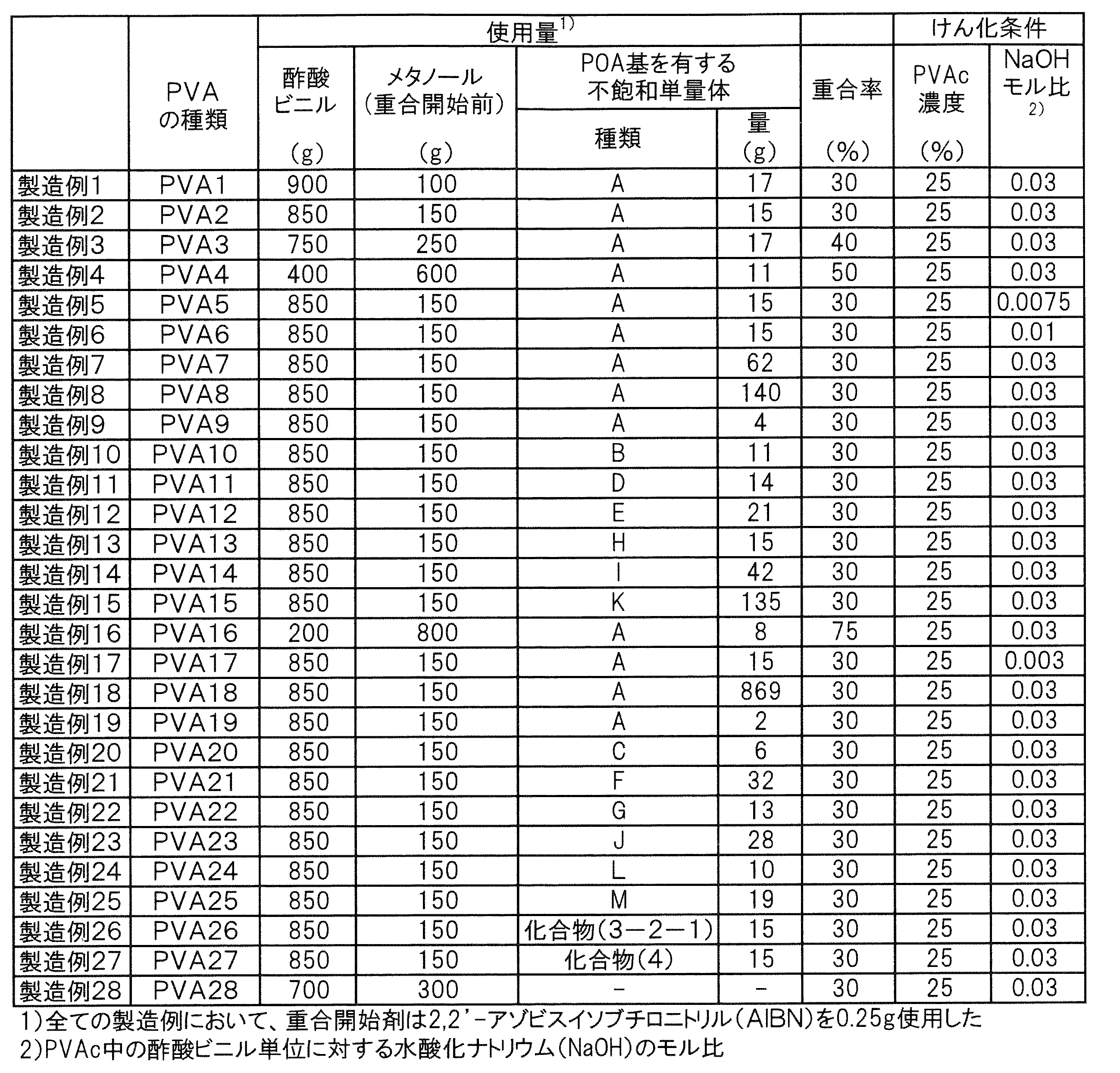

<組成物の調製>
[実施例1]
界面活性剤としてのポリエチレングリコール-ポリプロピレングリコール-ポリエチレングリコールのトリブロック共重合体(表3の界面活性剤A)0.4gと、2gのPVA1との質量比(界面活性剤の質量/POA変性PVAの質量)=20/100である混合物に対して、蒸留水98gを室温で加え、スリーワンモーターを用いて30分間撹拌した。次に、この溶液を撹拌しながら90℃まで昇温し、そのまま1時間撹拌した後、室温まで冷却し、PVA1を2質量%の濃度で含有する組成物を得た。得られた組成物について、下記方法に従って、溶解性評価、溶液評価(20℃における粘度及び50℃における粘度、並びに20℃における粘度と50℃における粘度との粘度比)を行った。結果を表4に示す。
[実施例1]
界面活性剤としてのポリエチレングリコール-ポリプロピレングリコール-ポリエチレングリコールのトリブロック共重合体(表3の界面活性剤A)0.4gと、2gのPVA1との質量比(界面活性剤の質量/POA変性PVAの質量)=20/100である混合物に対して、蒸留水98gを室温で加え、スリーワンモーターを用いて30分間撹拌した。次に、この溶液を撹拌しながら90℃まで昇温し、そのまま1時間撹拌した後、室温まで冷却し、PVA1を2質量%の濃度で含有する組成物を得た。得られた組成物について、下記方法に従って、溶解性評価、溶液評価(20℃における粘度及び50℃における粘度、並びに20℃における粘度と50℃における粘度との粘度比)を行った。結果を表4に示す。
[実施例2~25及び比較例1~15]
用いたPVA及び界面活性剤の種類、並びに界面活性剤とPVAとの質量比を表4に示すとおりにした以外は、実施例1と同様にして各組成物を調製した。使用した界面活性剤の種類を表3に示す。なお、表3中の界面活性剤A~Eは、式(I)で表される界面活性剤である。
用いたPVA及び界面活性剤の種類、並びに界面活性剤とPVAとの質量比を表4に示すとおりにした以外は、実施例1と同様にして各組成物を調製した。使用した界面活性剤の種類を表3に示す。なお、表3中の界面活性剤A~Eは、式(I)で表される界面活性剤である。

<評価>
上記実施例及び比較例で得られた各組成物について、下記方法により溶解性評価及び粘度評価を行った。評価結果を表4に示す。なお、表4中の「-」は、界面活性剤を添加しなかったことを示す。また、表4中の「※1」は、PVAが完全には溶解せず、評価できなかったことを示す。
上記実施例及び比較例で得られた各組成物について、下記方法により溶解性評価及び粘度評価を行った。評価結果を表4に示す。なお、表4中の「-」は、界面活性剤を添加しなかったことを示す。また、表4中の「※1」は、PVAが完全には溶解せず、評価できなかったことを示す。
[溶解性評価]
上記調製した各組成物の状態を目視で観察し、水への溶解性を以下の基準に従って判定した。なお、下記評価がA又はBの場合、実用性に優れると言える。
A:透明な溶液
B:若干のにごりあり
C:白濁溶液
D:溶け残りあり
上記調製した各組成物の状態を目視で観察し、水への溶解性を以下の基準に従って判定した。なお、下記評価がA又はBの場合、実用性に優れると言える。
A:透明な溶液
B:若干のにごりあり
C:白濁溶液
D:溶け残りあり
[粘度評価]
(20℃における粘度及び50℃における粘度)
BL型粘度計を用いて、ロータ回転数6rpm、20℃及び50℃の条件下で上記調製した各組成物の粘度(mPa・s)を測定し、20℃における粘度をη1、50℃における粘度をη2とした。
(20℃における粘度及び50℃における粘度)
BL型粘度計を用いて、ロータ回転数6rpm、20℃及び50℃の条件下で上記調製した各組成物の粘度(mPa・s)を測定し、20℃における粘度をη1、50℃における粘度をη2とした。
(感温増粘性)
上記のようにして測定されたη1とη2との粘度比(η2/η1)を算出し、以下の基準に従って、感温増粘性を評価した。なお、下記評価がA~Cの場合、感温増粘性に優れると言える。
A:30以上
B:15以上30未満
C:3以上15未満
D:1以上3未満
E:1未満
上記のようにして測定されたη1とη2との粘度比(η2/η1)を算出し、以下の基準に従って、感温増粘性を評価した。なお、下記評価がA~Cの場合、感温増粘性に優れると言える。
A:30以上
B:15以上30未満
C:3以上15未満
D:1以上3未満
E:1未満

表4に示されるように、実施例1~25の組成物は、20℃では粘度が低く取扱性に優れ、50℃では急激に増粘し優れた感温増粘性を発揮することが分かる。さらに、POA変性PVAの重合度、POA基変性率、けん化度、含有する単量体単位の構造、界面活性剤の種類及び界面活性剤と上記POA変性PVAとの質量比を特定した実施例1、2、5~8、10~13、17~19及び24の組成物は、特に優れた感温増粘性を発揮することが分かった(溶解性評価がA以上であり、かつ感温増粘性がB以上)。
一方、PVAが規定の要件(重合度、単量体単位の種類、POA基変性率及びけん化度)を満たさない場合(比較例1~6、12、14、15)や、界面活性剤の構造が規定の要件を満たさない場合(比較例7~10)、界面活性剤を使用しない場合(比較例11及び13)は、溶解性や感温増粘性が不十分であること等が観察された。
本発明の組成物は、低温では粘度が低く取扱性に優れ、温度が上昇すると急激に増粘する優れた感温増粘性を発揮できる。従って、当該組成物は、コーティング剤、増粘剤等として好適に用いられる。
Claims (9)
- ポリオキシアルキレン基を有する単量体単位を含むビニルアルコール系重合体、及び
界面活性剤
を含有し、
上記ポリオキシアルキレン基が、下記式(1)で表されるブロックを含み、
上記ブロックの構成単位が上記ポリオキシアルキレン基に対し50モル%以上であり、
上記単量体単位の含有率がビニルアルコール系重合体の単量体単位に対して0.05モル%以上10モル%以下、上記ビニルアルコール系重合体の粘度平均重合度が150以上5,000以下かつけん化度が40モル%以上99.99モル%以下であり、
上記界面活性剤が、下記式(I)で表される化合物である組成物。




- 上記ポリオキシアルキレン基が、下記式(2)で表されるブロックをさらに含む請求項1に記載の組成物。

- 上記単量体単位が、上記ポリオキシアルキレン基を側鎖に有する請求項1に記載の組成物。
- 上記式(1)で表されるブロックが、上記式(2)で表されるブロックより主鎖側に位置する請求項3に記載の組成物。
- 上記式(1)で表されるブロックと上記式(2)で表されるブロックとが直接結合する請求項4に記載の組成物。
- 上記ビニルアルコール系重合体が、下記式(3)で表される不飽和単量体とビニルエステル系単量体との共重合体をけん化することにより得られる請求項1に記載の組成物。

- 上記界面活性剤の上記ビニルアルコール系重合体に対する質量比が、3/100以上70/100以下である請求項1に記載の組成物。
- コーティング剤として用いられる請求項1に記載の組成物。
- 増粘剤として用いられる請求項1に記載の組成物。
Applications Claiming Priority (2)
| Application Number | Priority Date | Filing Date | Title |
|---|---|---|---|
| JP2013007824 | 2013-01-18 | ||
| JP2013-007824 | 2013-01-18 |
Publications (1)
| Publication Number | Publication Date |
|---|---|
| WO2014112586A1 true WO2014112586A1 (ja) | 2014-07-24 |
Family
ID=51209675
Family Applications (1)
| Application Number | Title | Priority Date | Filing Date |
|---|---|---|---|
| PCT/JP2014/050808 Ceased WO2014112586A1 (ja) | 2013-01-18 | 2014-01-17 | ポリオキシアルキレン変性ビニルアルコール系重合体を含有する組成物 |
Country Status (1)
| Country | Link |
|---|---|
| WO (1) | WO2014112586A1 (ja) |
Cited By (1)
| Publication number | Priority date | Publication date | Assignee | Title |
|---|---|---|---|---|
| CN112004881A (zh) * | 2018-04-27 | 2020-11-27 | 株式会社可乐丽 | 聚乙烯醇膜和使用其而得的偏振膜的制备方法 |
Citations (10)
| Publication number | Priority date | Publication date | Assignee | Title |
|---|---|---|---|---|
| JP2001253993A (ja) * | 2000-03-10 | 2001-09-18 | Nippon Synthetic Chem Ind Co Ltd:The | ポリビニルアルコール系フィルム及びその製造方法 |
| JP2001354452A (ja) * | 2000-06-07 | 2001-12-25 | Nippon Synthetic Chem Ind Co Ltd:The | ガラス繊維用処理剤 |
| WO2002085634A1 (fr) * | 2001-04-18 | 2002-10-31 | Asahi Kasei Kabushiki Kaisha | Emulsion et liquide de revetement et support d'enregistrement utilisant cette emulsion |
| JP2008524393A (ja) * | 2004-12-21 | 2008-07-10 | バクスター・インターナショナル・インコーポレイテッド | ポリアルコキシスルホネート表面改変因子 |
| WO2011040377A1 (ja) * | 2009-09-29 | 2011-04-07 | 株式会社クラレ | ビニルアルコール系重合体を含有する増粘剤 |
| JP2011126931A (ja) * | 2009-12-15 | 2011-06-30 | Kuraray Co Ltd | 分散液および感熱記録材料 |
| WO2012124746A1 (ja) * | 2011-03-17 | 2012-09-20 | 株式会社クラレ | 変性ビニルアルコール系重合体溶液及びこの製造方法 |
| WO2013015185A1 (ja) * | 2011-07-22 | 2013-01-31 | 株式会社クラレ | ポリオキシアルキレン変性ビニルアルコール系重合体およびその用途 |
| WO2013054834A1 (ja) * | 2011-10-14 | 2013-04-18 | 株式会社クラレ | アルキル変性ビニルアルコール系重合体溶液 |
| WO2013125678A1 (ja) * | 2012-02-24 | 2013-08-29 | 株式会社クラレ | 増粘剤 |
-
2014
- 2014-01-17 WO PCT/JP2014/050808 patent/WO2014112586A1/ja not_active Ceased
Patent Citations (10)
| Publication number | Priority date | Publication date | Assignee | Title |
|---|---|---|---|---|
| JP2001253993A (ja) * | 2000-03-10 | 2001-09-18 | Nippon Synthetic Chem Ind Co Ltd:The | ポリビニルアルコール系フィルム及びその製造方法 |
| JP2001354452A (ja) * | 2000-06-07 | 2001-12-25 | Nippon Synthetic Chem Ind Co Ltd:The | ガラス繊維用処理剤 |
| WO2002085634A1 (fr) * | 2001-04-18 | 2002-10-31 | Asahi Kasei Kabushiki Kaisha | Emulsion et liquide de revetement et support d'enregistrement utilisant cette emulsion |
| JP2008524393A (ja) * | 2004-12-21 | 2008-07-10 | バクスター・インターナショナル・インコーポレイテッド | ポリアルコキシスルホネート表面改変因子 |
| WO2011040377A1 (ja) * | 2009-09-29 | 2011-04-07 | 株式会社クラレ | ビニルアルコール系重合体を含有する増粘剤 |
| JP2011126931A (ja) * | 2009-12-15 | 2011-06-30 | Kuraray Co Ltd | 分散液および感熱記録材料 |
| WO2012124746A1 (ja) * | 2011-03-17 | 2012-09-20 | 株式会社クラレ | 変性ビニルアルコール系重合体溶液及びこの製造方法 |
| WO2013015185A1 (ja) * | 2011-07-22 | 2013-01-31 | 株式会社クラレ | ポリオキシアルキレン変性ビニルアルコール系重合体およびその用途 |
| WO2013054834A1 (ja) * | 2011-10-14 | 2013-04-18 | 株式会社クラレ | アルキル変性ビニルアルコール系重合体溶液 |
| WO2013125678A1 (ja) * | 2012-02-24 | 2013-08-29 | 株式会社クラレ | 増粘剤 |
Cited By (2)
| Publication number | Priority date | Publication date | Assignee | Title |
|---|---|---|---|---|
| CN112004881A (zh) * | 2018-04-27 | 2020-11-27 | 株式会社可乐丽 | 聚乙烯醇膜和使用其而得的偏振膜的制备方法 |
| CN112004881B (zh) * | 2018-04-27 | 2023-03-10 | 株式会社可乐丽 | 聚乙烯醇膜和使用其而得的偏振膜的制备方法 |
Similar Documents
| Publication | Publication Date | Title |
|---|---|---|
| CN101910214B (zh) | 乙烯醇系聚合物及含有其的膜 | |
| JP6691641B2 (ja) | 変性ビニルアルコール系重合体とその製造方法 | |
| JP5525110B2 (ja) | アルキル変性ビニルアルコール系重合体溶液 | |
| JP5496215B2 (ja) | ビニルアルコール系重合体を含有する増粘剤 | |
| JP5943822B2 (ja) | 高分子系界面活性剤 | |
| JP5788969B2 (ja) | 変性ビニルアルコール系重合体溶液及びこの製造方法 | |
| JP5566645B2 (ja) | 泥水用分散剤 | |
| CN114206962B (zh) | 乙烯醇类嵌段共聚物及其制造方法 | |
| JP5937497B2 (ja) | アルキル変性ビニルアルコール系重合体溶液及びこの製造方法 | |
| JP5981527B2 (ja) | 増粘剤 | |
| JP5501345B2 (ja) | 水性接着剤 | |
| JP6027419B2 (ja) | アルケニル変性ビニルアルコール系重合体及びこれを含む増粘剤 | |
| WO2016013221A1 (ja) | ビニルアルコール系共重合体及びそれを含有する組成物並びに乳化重合用分散安定剤 | |
| JP5937495B2 (ja) | アルキル変性ビニルアルコール系重合体溶液及びこの製造方法 | |
| JP6184706B2 (ja) | アルキル変性ビニルアルコール系重合体組成物 | |
| JP5886133B2 (ja) | ビニルアルコール系重合体及びこれを含む水溶液 | |
| WO2025009505A1 (ja) | 変性ポリビニルアルコール系重合体、水溶性フィルム、水溶性繊維、及びバリア性包装材料 |
Legal Events
| Date | Code | Title | Description |
|---|---|---|---|
| 121 | Ep: the epo has been informed by wipo that ep was designated in this application |
Ref document number: 14740337 Country of ref document: EP Kind code of ref document: A1 |
|
| NENP | Non-entry into the national phase |
Ref country code: DE |
|
| 122 | Ep: pct application non-entry in european phase |
Ref document number: 14740337 Country of ref document: EP Kind code of ref document: A1 |
|
| NENP | Non-entry into the national phase |
Ref country code: JP |