WO2014098042A1 - 熱可塑性ポリイミド - Google Patents
熱可塑性ポリイミド Download PDFInfo
- Publication number
- WO2014098042A1 WO2014098042A1 PCT/JP2013/083653 JP2013083653W WO2014098042A1 WO 2014098042 A1 WO2014098042 A1 WO 2014098042A1 JP 2013083653 W JP2013083653 W JP 2013083653W WO 2014098042 A1 WO2014098042 A1 WO 2014098042A1
- Authority
- WO
- WIPO (PCT)
- Prior art keywords
- polyimide
- thermoplastic polyimide
- group
- dianhydride
- alicyclic structure
- Prior art date
- Legal status (The legal status is an assumption and is not a legal conclusion. Google has not performed a legal analysis and makes no representation as to the accuracy of the status listed.)
- Ceased
Links
Classifications
-
- C—CHEMISTRY; METALLURGY
- C08—ORGANIC MACROMOLECULAR COMPOUNDS; THEIR PREPARATION OR CHEMICAL WORKING-UP; COMPOSITIONS BASED THEREON
- C08G—MACROMOLECULAR COMPOUNDS OBTAINED OTHERWISE THAN BY REACTIONS ONLY INVOLVING UNSATURATED CARBON-TO-CARBON BONDS
- C08G73/00—Macromolecular compounds obtained by reactions forming a linkage containing nitrogen with or without oxygen or carbon in the main chain of the macromolecule, not provided for in groups C08G12/00 - C08G71/00
- C08G73/06—Polycondensates having nitrogen-containing heterocyclic rings in the main chain of the macromolecule
- C08G73/10—Polyimides; Polyester-imides; Polyamide-imides; Polyamide acids or similar polyimide precursors
- C08G73/1003—Preparatory processes
- C08G73/1007—Preparatory processes from tetracarboxylic acids or derivatives and diamines
- C08G73/101—Preparatory processes from tetracarboxylic acids or derivatives and diamines containing chain terminating or branching agents
- C08G73/1014—Preparatory processes from tetracarboxylic acids or derivatives and diamines containing chain terminating or branching agents in the form of (mono)anhydrid
-
- C—CHEMISTRY; METALLURGY
- C08—ORGANIC MACROMOLECULAR COMPOUNDS; THEIR PREPARATION OR CHEMICAL WORKING-UP; COMPOSITIONS BASED THEREON
- C08G—MACROMOLECULAR COMPOUNDS OBTAINED OTHERWISE THAN BY REACTIONS ONLY INVOLVING UNSATURATED CARBON-TO-CARBON BONDS
- C08G73/00—Macromolecular compounds obtained by reactions forming a linkage containing nitrogen with or without oxygen or carbon in the main chain of the macromolecule, not provided for in groups C08G12/00 - C08G71/00
- C08G73/06—Polycondensates having nitrogen-containing heterocyclic rings in the main chain of the macromolecule
- C08G73/10—Polyimides; Polyester-imides; Polyamide-imides; Polyamide acids or similar polyimide precursors
- C08G73/1046—Polyimides containing oxygen in the form of ether bonds in the main chain
- C08G73/105—Polyimides containing oxygen in the form of ether bonds in the main chain with oxygen only in the diamino moiety
-
- C—CHEMISTRY; METALLURGY
- C08—ORGANIC MACROMOLECULAR COMPOUNDS; THEIR PREPARATION OR CHEMICAL WORKING-UP; COMPOSITIONS BASED THEREON
- C08G—MACROMOLECULAR COMPOUNDS OBTAINED OTHERWISE THAN BY REACTIONS ONLY INVOLVING UNSATURATED CARBON-TO-CARBON BONDS
- C08G73/00—Macromolecular compounds obtained by reactions forming a linkage containing nitrogen with or without oxygen or carbon in the main chain of the macromolecule, not provided for in groups C08G12/00 - C08G71/00
- C08G73/06—Polycondensates having nitrogen-containing heterocyclic rings in the main chain of the macromolecule
- C08G73/10—Polyimides; Polyester-imides; Polyamide-imides; Polyamide acids or similar polyimide precursors
- C08G73/1075—Partially aromatic polyimides
- C08G73/1078—Partially aromatic polyimides wholly aromatic in the diamino moiety
-
- C—CHEMISTRY; METALLURGY
- C08—ORGANIC MACROMOLECULAR COMPOUNDS; THEIR PREPARATION OR CHEMICAL WORKING-UP; COMPOSITIONS BASED THEREON
- C08J—WORKING-UP; GENERAL PROCESSES OF COMPOUNDING; AFTER-TREATMENT NOT COVERED BY SUBCLASSES C08B, C08C, C08F, C08G or C08H
- C08J2300/00—Characterised by the use of unspecified polymers
- C08J2300/22—Thermoplastic resins
Definitions
- the present invention relates to a thermoplastic polyimide excellent in transparency, heat resistance, melt heat stability, solvent non-volatility and the like and a thermoplastic polyimide molded body obtained by melt extrusion molding of the thermoplastic polyimide.
- Polyimide has excellent properties in terms of heat resistance, mechanical properties, chemical resistance, electrical properties, etc., so it is widely used in the fields of automobiles, aerospace industry, electricity, electronics, batteries, etc. Yes.
- Polyimide is generally a thermosetting resin that does not have a clear glass transition temperature, while having a characteristic of excellent heat resistance.
- a special method such as sintering is used. There must be.
- a complicated and complicated processing step such as cutting out a target shape from a polyimide block using a cutting machine such as an NC lathe is required.
- a cutting machine such as an NC lathe
- Patent Document 1 describes a thermoplastic polyimide having a 3,3 ', 4,4'-diphenyl ether tetracarboxylic acid skeleton as a basic skeleton.
- Patent Document 1 discloses a method for imidizing a polyamic acid resin solution, which is a polyimide precursor, in a solution as a method for producing polyimide.
- Patent Document 2 describes a transparent polyimide using a 3,4,3 ′, 4′-dicyclohexyltetracarboxylic dianhydride skeleton, and the production method thereof includes solution casting of a polyamic acid solution.
- Patent Document 3 describes a method of obtaining a polyimide by imidizing a polyamic acid resin having an aliphatic tetracarboxylic acid skeleton in a solution.
- Patent Document 1 Since the polyimide described in Patent Document 1 has a high glass transition temperature and crystallinity, it is difficult to obtain a molten state at the upper limit of the melting temperature in a normal industrial process, and the molding method is usually a solvent cast. Limited by law. In addition, the polyimide obtained because it has many aromatic skeletons also has problems in color tone and transparency.
- Patent Document 2 is a technique for forming a polyamic acid solution by a solvent casting method (solution casting method) in order to obtain a polyimide film, but only a thin film can be produced.
- a solvent casting method solution casting method
- problems such as limited applications and poor productivity due to the time required to dry the solvent.
- the polyamic acid solution is easily hydrolyzed by moisture in the air, there is a problem in that the molecular weight changes during storage and the viscosity decreases.
- the imidization ratio of polyimide is insufficient, and the primary amino group remains at the terminal, so that the heat stability is insufficient, There was also a problem that it could cause coloring.
- Patent Document 3 describes a solvent casting method in which polyimide is mixed with a solvent in a solution state.
- Patent Document 2 only a thin film can be produced, and its use Is limited, it takes time to dry the solvent, and therefore the cost is high, and further, the primary amino group remains at the end of the polyimide, which causes coloring. Problems were also found. Also, in the method of obtaining a polyimide molded body by melt-molding a polyimide solution mixed with a solvent, since the solvent is contained in polyimide, problems such as remarkable foaming at the time of melting and generation of flammable gas may occur. This point also needs improvement.
- Patent Document 4 describes that a polyimide having excellent solubility in an organic solvent is obtained by controlling the three-dimensional structure of a polyimide having an alicyclic structure.
- Patent Document 4 a conventional molding method using a solvent casting method is used, and there are problems as described in Patent Documents 2 and 3 above.
- Polyimides having an alicyclic structure as described in Patent Documents 2 to 4 are thermoplastic, and since they are excellent in transparency and heat resistance, they should be used as polyimide films for applications such as flexible devices and organic EL.
- productivity is insufficient with methods such as the solvent casting method conventionally used for molding polyimide, and it is difficult to thicken the polyimide film only as a thin film, It has been found that there are problems such as the possibility of generating flammable gases.
- the present inventors can solve the problems in the solvent casting method as described above by a melt extrusion molding method, but on the other hand, a polyimide having an alicyclic structure as described in Patent Documents 2 to 4. Was found not to have melt heat stability to the extent that melt extrusion can be applied.
- An object of the present invention is to provide a thermoplastic polyimide excellent in transparency, heat resistance, melt heat stability, solvent non-volatility, and the like, and a thermoplastic polyimide molded body obtained by melt extrusion molding the thermoplastic polyimide. .
- the present inventors have excellent melt heat stability that can be applied to melt extrusion molding by increasing the imidization rate and increasing the amino group sealing rate. As a result, the inventors have found that a polyimide can be obtained. That is, the gist of the present invention resides in the following [1] to [9].
- thermoplastic polyimide having an alicyclic structure, a terminal amino group sealing rate of 95.0% or more, and an imidization rate of 95.8% or more.
- thermoplastic polyimide according to [1], wherein the weight average molecular weight (Mw) is 10,000 to 500,000.
- thermoplastic polyimide according to [1] or [2], wherein the alicyclic structure is a cyclohexane ring structure.
- thermoplastic polyimide according to any one of [1] to [3], wherein the alicyclic structure is a structure adjacent to and sharing two carbon atoms with the imide ring structure.
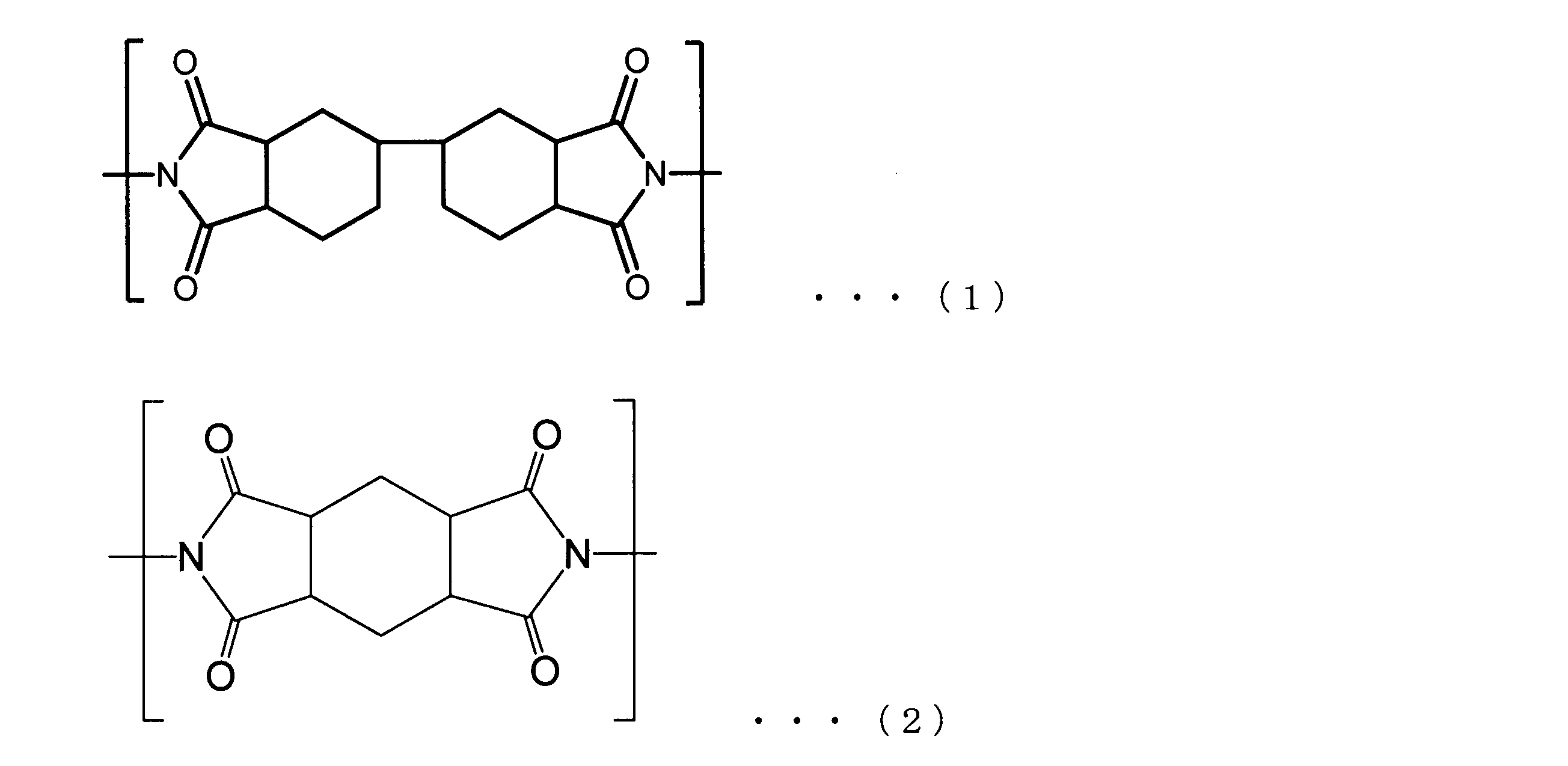
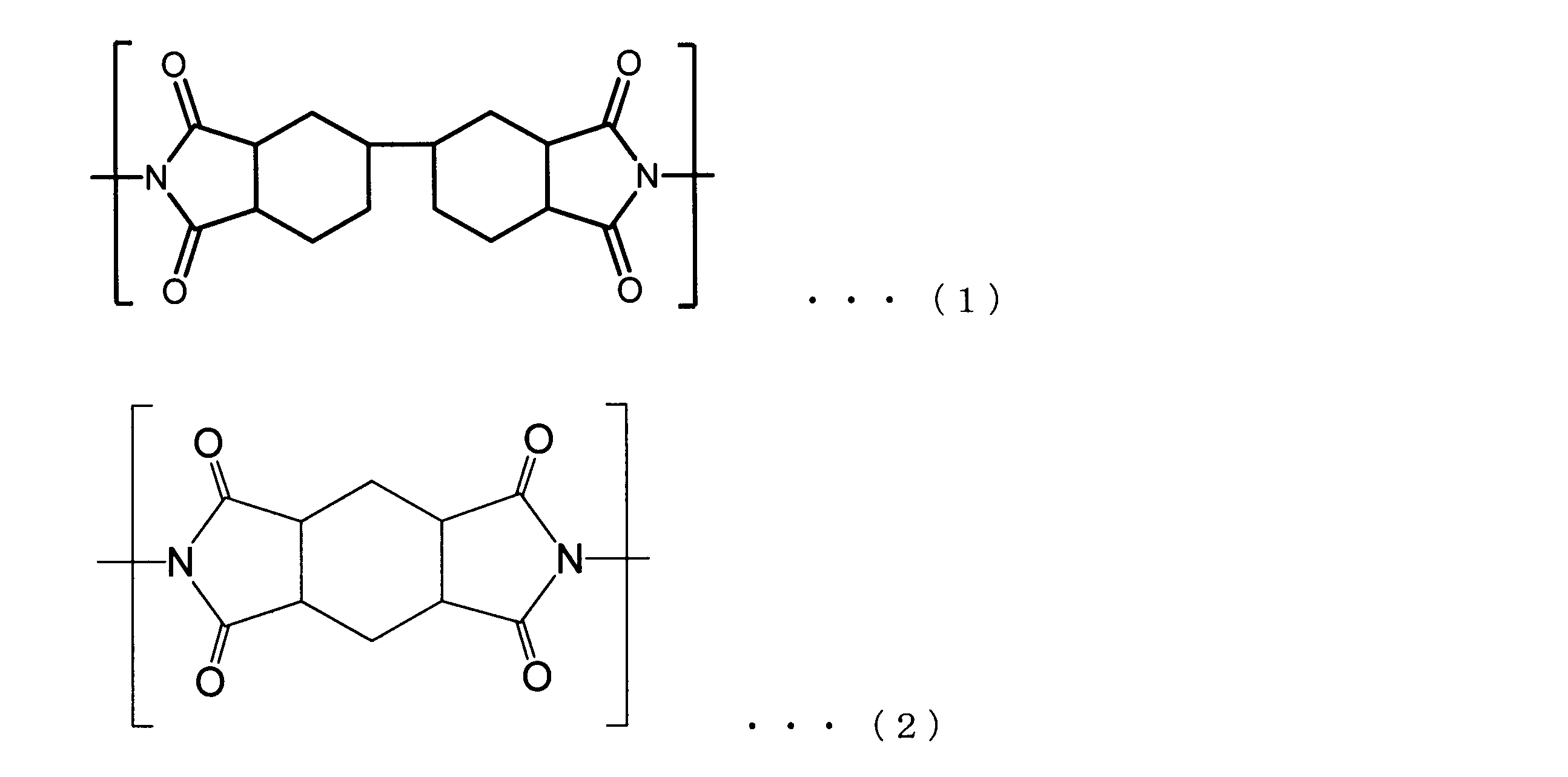
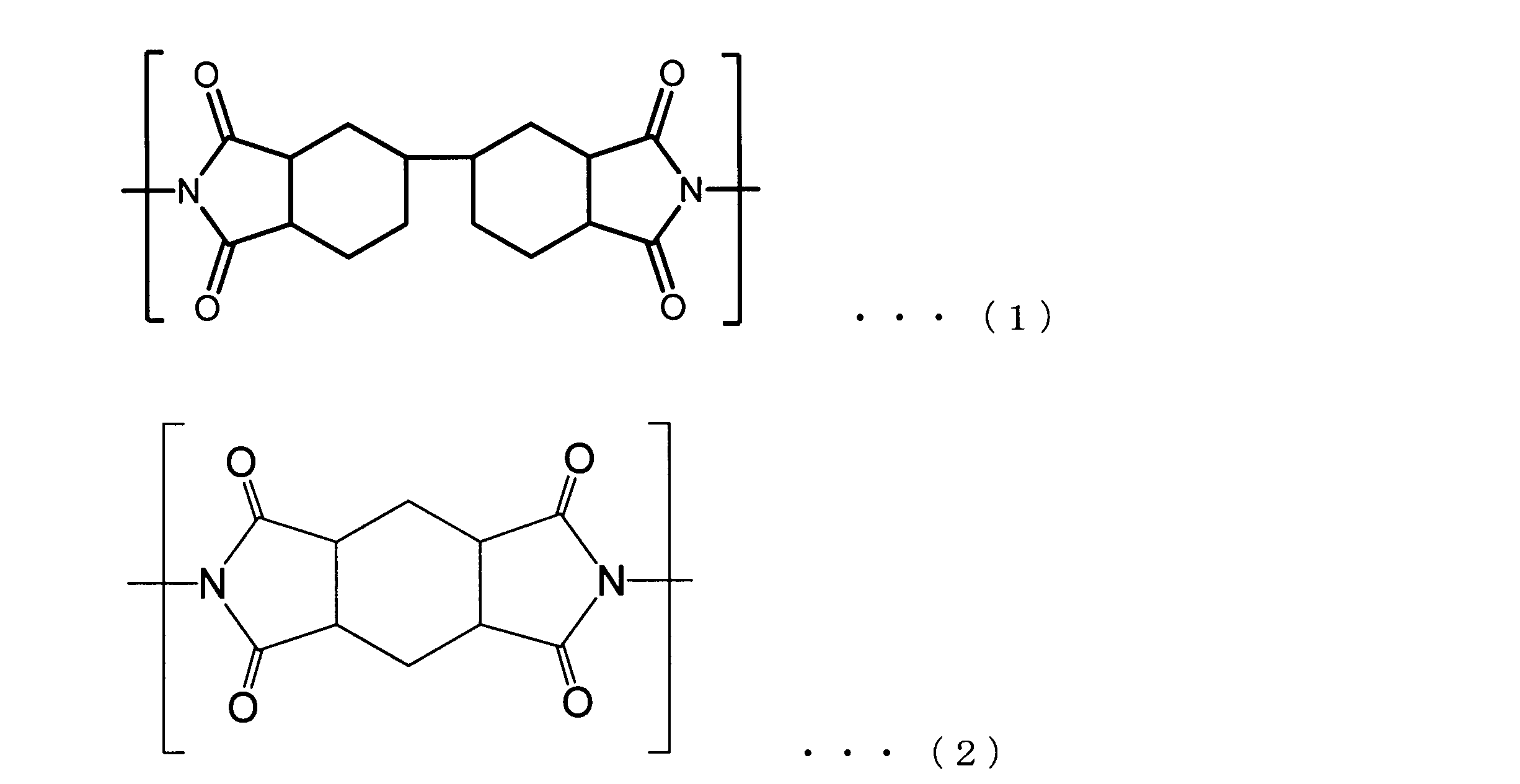
- the alicyclic structure has at least one of a structural unit represented by the following formula (1) and a structural unit represented by the following formula (2): The thermoplastic polyimide as described.
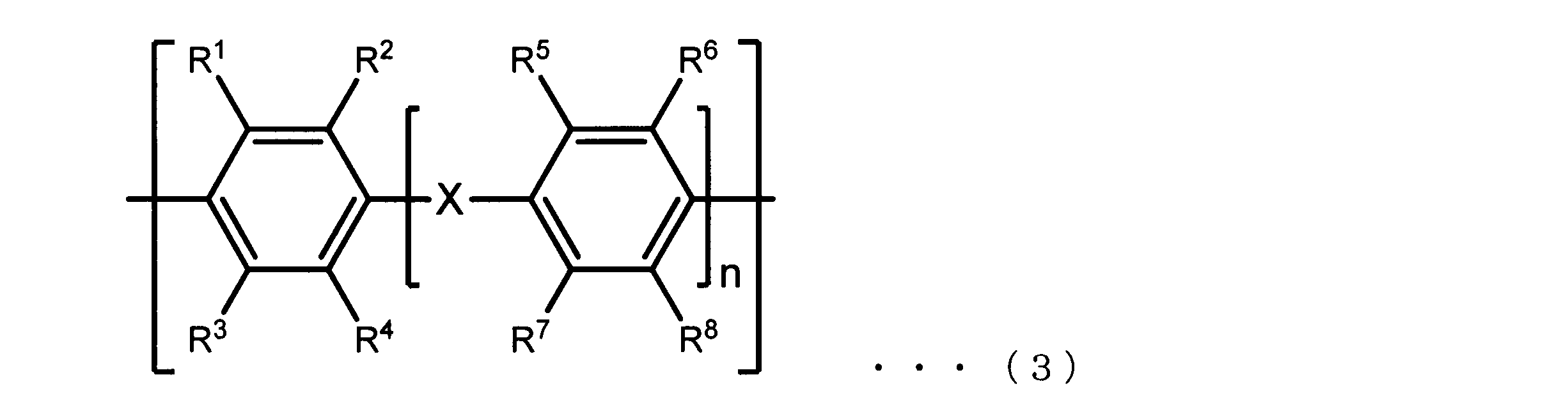
- thermoplastic polyimide according to any one of [1] to [5], further having a structural unit represented by the following formula (3).
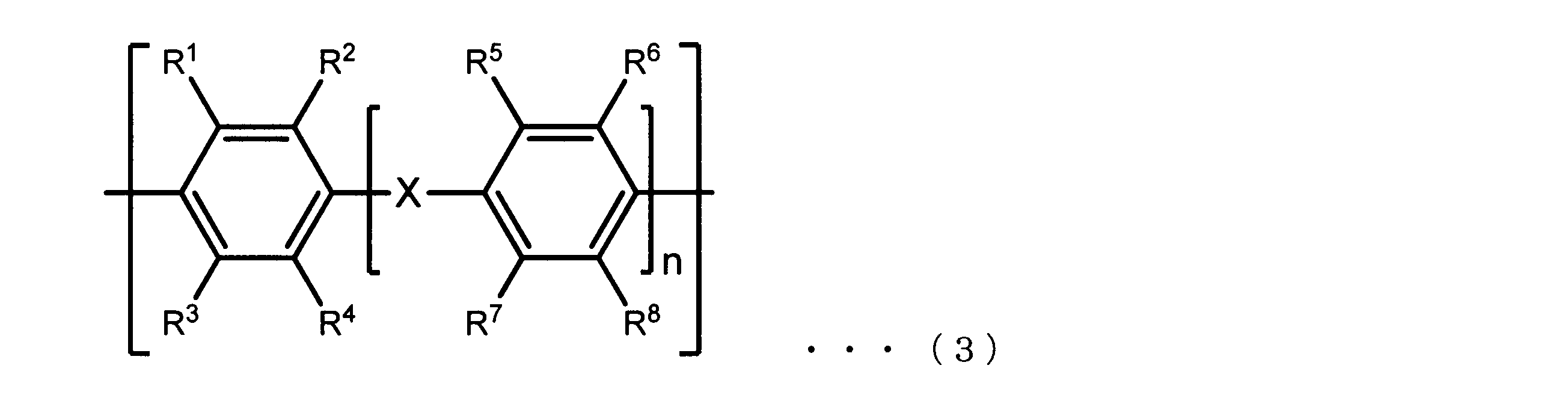
- R 1 to R 8 may be different from each other, and are a hydrogen atom, an alkyl group having 1 to 4 carbon atoms, a fluoroalkyl group having 1 to 4 carbon atoms, or a hydroxyl group, and X is Direct bond, oxygen atom, sulfur atom, alkylene group having 1 to 4 carbon atoms, sulfonyl group, sulfinyl group, sulfide group, carbonyl group, amide group, ester group or secondary amino group, n is an integer of 0 to 4 .
- thermoplastic polyimide according to any one of [1] to [6], wherein a complex shear viscosity ( ⁇ * ) at 310 ° C. is 1 ⁇ 10 2 to 5 ⁇ 10 5 Pa ⁇ s.
- thermoplastic polyimide according to any one of [1] to [7], wherein the rate of change of the complex shear viscosity before and after 60 minutes at 310 ° C. is 300% or less.
- thermoplastic polyimide molded body obtained by melt extrusion molding the thermoplastic polyimide according to any one of [1] to [8].
- thermoplastic polyimide that is excellent in transparency, heat resistance, solvent non-volatility, etc., and particularly excellent in melt heat stability so that melt extrusion molding is possible.
- thermoplastic polyimide molded object obtained by melt-extruding this thermoplastic polyimide is provided.
- thermoplastic polyimide The thermoplastic polyimide of the present invention has an alicyclic structure, the terminal amino group sealing rate is 95.0% or more, and the imidization rate is 95.8% or more.
- thermoplastic polyimide of the present invention has an effect that the thermal stability of the melt is remarkably excellent as compared with the conventional polyimide having an alicyclic structure as described in Patent Documents 2 to 4. According to detailed investigations by the present inventors, in Patent Documents 2 to 4, imidization does not proceed sufficiently, amic acid remains, and the terminal amino group sealing rate is not sufficient. I understood it. In such a thermoplastic polyimide, when it is heated to 300 ° C. or higher, a reaction occurs between the amic acid in the polyimide molecule and the terminal amino group, and a reaction between the amic acids between the polyimide molecules occurs. Etc. are considered to affect the heat stability of melting.
- the thermoplastic polyimide of the present invention has an alicyclic structure.
- the alicyclic structure is not particularly limited, but is usually an alicyclic structure having 5 to 12 carbon atoms, preferably an alicyclic structure having 6 to 10 carbon atoms, and particularly preferably a cyclohexane ring structure. Since the thermoplastic polyimide of the present invention has an alicyclic structure, it becomes a polyimide having thermoplasticity and excellent transparency.
- the “alicyclic structure” in the present invention is meant to include those having a hetero atom in the ring structure, but preferred is an alicyclic structure having no hetero atom in the ring structure.
- thermoplastic polyimide of the present invention can usually be obtained using a carboxylic dianhydride (hereinafter referred to as “acid dianhydride”) diamine compound as a raw material, as will be described later.
- acid dianhydride carboxylic dianhydride
- the alicyclic structure in the thermoplastic polyimide of the present invention may be derived from an acid dianhydride or a diamine compound, but preferably an alicyclic structure derived from an acid dianhydride. It is a structure.
- the alicyclic structure is preferably adjacent to the imide ring structure sharing two carbon atoms.
- the transparency based on the alicyclic structure and the heat resistance and chemical stability derived from the imide ring structure are easy to achieve at the same time.
- Preferred examples of the structure in which the alicyclic structure is adjacent to and sharing two carbon atoms with the imide ring structure include those in which the alicyclic structure is a cyclohexane ring structure (structure represented by the following formula (4)). Can be mentioned.
- the structural unit represented by the structural unit represented by following structural formula (1) and the structural unit represented by following formula (2) has at least one of the structural unit represented by the structural unit represented by following structural formula (1) and the structural unit represented by following formula (2) as an alicyclic structure in the thermoplastic polyimide of this invention.
- the structural unit represented by the formula (1) can usually be introduced from an acid dianhydride represented by the formula (5) described later, and the structural unit represented by the formula (2) is Usually, it can introduce
- thermoplastic polyimide of the present invention has a terminal amino group sealing rate of 95.0% or more and an imidation rate of 95.8% or more, so that it is excellent enough to enable melt extrusion molding. Melting heat stability can be obtained.
- thermoplastic polyimide of the present invention has a terminal amino group sealing rate of preferably 96.0% or more, more preferably 97.0% or more, from the viewpoint of further improving the melt heat stability. Yes, and more preferably 98.0% or more.
- the upper limit of the sealing ratio of the terminal amino group of the thermoplastic polyimide is not limited and is usually 100%.
- the terminal amino group sealing rate is the ratio of the acid dianhydride and diamine compound used as raw materials, the amount and type of terminal blocking agent used in the terminal blocking reaction step, and the chemical imidation reaction step. It can be controlled by the type of catalyst and dehydrating agent and the amount of these used. In addition, the terminal amino group sealing rate can be determined by 1 H-NMR measurement. Specific examples thereof are shown in Examples. In the present invention, “sealing the terminal amino group” means not only that the hydrogen atom bonded to the terminal primary amino group is replaced by the terminal blocking agent, but also in the chemical imidation reaction step. It is used in the meaning including unintended end capping, such as reaction between a terminal amino group and a dehydration condensing agent.
- thermoplastic polyimide of the present invention has an imidation ratio of preferably 96.0% or more, more preferably 96.5% or more, from the viewpoint of further improving the melt heat stability. More preferably, it is 97.0% or more, and particularly preferably 98.0% or more.
- the upper limit of the imidization ratio of the thermoplastic polyimide is not limited and is usually 100%.
- the imidization rate can be controlled by the conditions of the terminal blocking step, the chemical imidation reaction step, and the like, as will be described later.
- the imidization rate can be increased by using a relatively large amount of the dehydration condensing agent used in the chemical imidation reaction step as described later.
- the imidization ratio of the thermoplastic polyimide of the present invention is determined by 1 H-NMR measurement, and specific examples thereof are shown in Examples. If the imidation ratio cannot be determined by 1 H-NMR measurement, it can be determined by NMR measurement based on atoms other than hydrogen atoms.
- thermoplastic polyimide of the present invention preferably has a structural unit represented by the following formula (3). It is preferable to have the structural unit represented by the formula (3) because heat resistance and toughness tend to be better.
- R 1 to R 8 may be different from each other and are a hydrogen atom, an alkyl group having 1 to 4 carbon atoms, a fluoroalkyl group having 1 to 4 carbon atoms, or a hydroxyl group. Among these, a hydrogen atom or a methyl group is preferable.
- X is a direct bond, an oxygen atom, a sulfur atom, an alkylene group having 1 to 4 carbon atoms, a sulfonyl group, a sulfinyl group, a sulfide group, a carbonyl group, an amide group, an ester group, or a secondary amino group.
- a direct bond, an oxygen atom, a sulfur atom, an alkylene group having 1 to 4 carbon atoms, a sulfonyl group, or an amide group is preferable, and an oxygen atom is particularly preferable.
- n is an integer of 0-4. n is preferably an integer of 1 to 4.
- R 1 to R 8 , X, and n are not necessarily all the same.
- n is an integer of 2 or more, X may have a different structure.
- thermoplastic polyimide of the present invention may have other structural units in addition to the structural units represented by the formulas (1) to (3) listed above.
- Other structural units can be introduced based on raw materials other than the compounds represented by formulas (5) to (7) listed in the production method described later.
- the thermoplastic polyimide of the present invention has a weight average molecular weight (Mw) of preferably 10,000 or more, more preferably 30,000 or more, particularly preferably 45,000 or more, while preferably 500, 000 or less, more preferably 300,000 or less, still more preferably 150,000 or less, and particularly preferably 130,000 or less.
- Mw weight average molecular weight
- the weight average molecular weight of the polyimide is not less than the above lower limit value, it is preferable from the viewpoint of toughness when a polyimide molded body is obtained, and when it is not more than the above upper limit value, it is preferable from the viewpoint of fluidity and moldability.
- the weight average molecular weight of the thermoplastic polyimide of the present invention can be measured by a gel permeation chromatography method (GPC method). More detailed conditions for GPC measurement will be described in the examples below.
- the thermoplastic polyimide of the present invention preferably has a complex shear viscosity ( ⁇ * ) at 310 ° C. of 1 ⁇ 10 2 Pa ⁇ s or more, more preferably 1 ⁇ 10 3 Pa ⁇ s or more, and 5 ⁇ . it is preferably 10 5 Pa ⁇ s or less, and more preferably less 1 ⁇ 10 5 Pa ⁇ s. It is preferable that the complex shear viscosity is in the above-mentioned range in order to obtain appropriate fluidity for molding.
- the complex shear viscosity can be controlled by the molecular weight, the molecular composition, etc. Usually, the complex shear viscosity increases as the molecular weight increases.
- the complex shear viscosity can be measured by the method described in Examples below.
- thermoplastic polyimide of the present invention is excellent in melt heat stability.
- the thermoplastic polyimide of the present invention has an initial complex shear viscosity ( ⁇ * 0 ) immediately after melting at 310 ° C. for 60 minutes and a complex shear viscosity ( ⁇ * 60 ) after 60 minutes.
- the change rate of the complex shear viscosity is preferably 300% or less, more preferably 200% or less, and still more preferably 100% or less.
- the rate of change of the complex shear viscosity indicates the flow stability during melting.
- the change rate of the complex shear viscosity is not more than the above upper limit, and it is preferable because the film thickness can be easily controlled when the film is formed.
- the lower limit of the rate of change in complex shear viscosity is usually 0.
- the rate of change in complex shear viscosity tends to decrease as the terminal amino group sealing rate increases.
- the thermoplastic polyimide of the present invention has a glass transition temperature (Tg) by a DMS method (dynamic thermomechanical measuring device) of preferably 150 ° C. or higher, more preferably 200 ° C. or higher, particularly preferably 250 ° C. or higher. It is. It is preferable from a heat resistant viewpoint that a glass transition temperature is more than the said lower limit.
- the upper limit of the glass transition temperature is not particularly limited, but is usually 350 ° C. or lower.
- the glass transition temperature by DMS method can be measured by the method as described in an Example mentioned later.
- the thermoplastic polyimide of the present invention preferably has a coefficient of thermal expansion of 100 ppm / ° C. or less, more preferably 70 ppm / ° C. or less in the range of 100 to 200 ° C. It is preferable that the coefficient of thermal expansion is not more than the above upper limit in that a polyimide molded body with high dimensional accuracy can be produced.
- thermoplastic polyimide Although the method for producing the thermoplastic polyimide of the present invention is not limited, for example, after undergoing a thermal imidization reaction step as a specific acid dianhydride and a specific diamine compound and raw materials described below, an end-capping reaction step and It can be obtained through a chemical imidization step.
- the end-capping reaction step and the chemical imidization step can be performed in any order, and these may be performed simultaneously, but after the end-capping reaction step, the chemical imidation reaction step may be performed. preferable.
- the thermoplastic polyimide of the present invention can be usually obtained using an acid dianhydride and a diamine compound as raw materials.
- a compound having an alicyclic structure is used for at least one of an acid dianhydride and a diamine compound, but using an acid dianhydride having an alicyclic structure is a raw material procurement, It is preferable from the viewpoint of productivity and the like.
- thermoplastic polyimide of the present invention an acid dianhydride represented by the following formula (5) (hereinafter sometimes referred to as “H-BPDA”) and an acid dianhydride represented by the following formula (6): It is preferable to use at least one of anhydrides (hereinafter sometimes referred to as “H-PMDA”).
- H-BPDA is a known compound and can be obtained, for example, by the method described in Japanese Patent Application Laid-Open No. 2011-45877.
- H-PMDA is also a known compound and can be obtained, for example, by the method described in Japanese Patent Application Laid-Open No. 2009-191253.
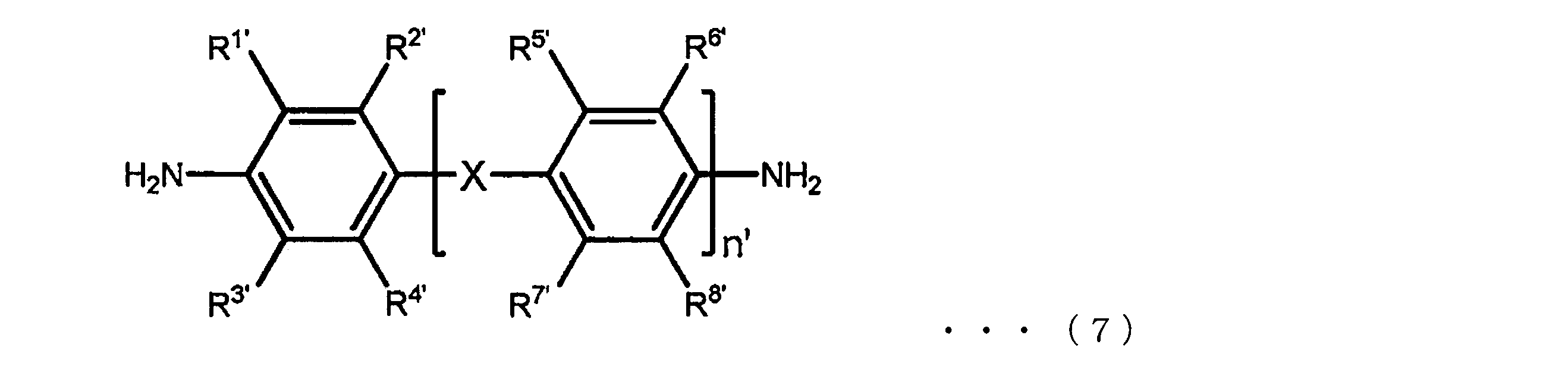
- thermoplastic polyimide of the present invention it is preferable to use a diamine compound represented by the following formula (7) as a raw material for the thermoplastic polyimide of the present invention.
- R 1 ′ to R 8 ′ are defined in the same manner as R 1 to R 8 in the formula (3), and X ′ is defined in the same manner as X.
- N ′ is defined similarly to n.
- Examples of the diamine compound represented by the formula (7) include 4,4′-diaminodiphenyl ether (hereinafter sometimes referred to as ODA), 2,2′-dimethyl-4,4′-diaminobiphenyl, 1,4-bis (4-aminophenoxy) benzene, 2,2-bis (4- (4-aminophenoxy) phenyl) propane, 2,2-bis (4- (4-aminophenoxy) phenyl) hexafluoropropane 2,2-bis [4- (4-aminophenoxy) phenyl] propane, 4,4′-bis (4-aminophenoxy) biphenyl, 2,2′-bis (trifluoromethyl) -4,4′- Diaminobiphenyl, 4,4'-diaminobenzoylanilide, 4-aminophenyl-4-aminobenzoate, bis (4-aminophenyl) terephthalate Bis (4- (4-aminophenoxy) phenyl)
- 4,4'-diaminodiphenyl ether, 2,2'-dimethyl-4,4'-diaminobiphenyl, 2,2'-bis (trifluoromethyl) -4,4'-diaminobiphenyl and the like are preferable.
- These acid dianhydrides may be used alone or in combination of two or more.
- an acid dianhydride other than H-BPDA and H-PMDA may be used in combination.
- acid dianhydrides other than H-BPDA and H-PMDA include ethylenetetracarboxylic dianhydride, butanetetracarboxylic dianhydride, cyclopentanetetracarboxylic dianhydride, 1,2,3,4- Cyclohexanetetracarboxylic dianhydride, pyromellitic dianhydride, 1,1-bis (2,3-dicarboxyphenyl) ethane dianhydride, bis (2,3-dicarboxyphenyl) methane dianhydride, bis (3,4-dicarboxyphenyl) methane dianhydride, 3,3 ′, 4,4′-biphenyltetracarboxylic dianhydride, 2,2-bis (3,4-dicarboxyphenyl) propane dianhydride 2,2-bis (3,4-dicarboxyphenyl) propane dianhydride 2,
- acid dianhydrides other than H-BPDA and H-PMDA are usually 20 mol% or less, preferably 10 mol% or less, more preferably 5 mol% or less, based on all acid dianhydrides used as raw materials. Used in
- the thermoplastic polyimide of the present invention may be used together with a diamine compound other than the diamine compound represented by the formula (7) as a raw material.
- diamine compounds other than the diamine compound represented by the formula (7) include 1,2-phenylene diamine, 1,3-phenylene diamine, 3,4′-diaminodiphenyl ether, 1,3′-bis (4- Aminophenoxy) benzene, 1,3-bis (3-aminophenoxy) benzene, 4,4′-bis (3-aminophenoxy) benzophenone, 4,4′-bis (3-aminophenoxy) biphenyl, 1,3- Bis [4- (3-aminophenoxy) benzoyl] benzene, bis (4- (3-aminophenoxy) phenyl) sulfone, 1,3-bis (4-aminophenoxy) neopentane, bis (4-amino-3-carboxy) Phenyl) methane, 1,4-dia
- a diamine compound other than the diamine compound represented by the formula (7) is used, it is usually 20 mol% or less, preferably 10 mol% or less, more preferably 5 mol% or less, based on all diamine compounds used as raw materials. Used in
- the usage ratio of the acid dianhydride and the diamine compound used as raw materials is preferably 0.8 mol or more of the diamine compound with respect to 1 mol of the acid dianhydride. More preferably more than 0.0 mol. On the other hand, it is preferably used at 1.2 mol or less, more preferably 1.1 mol or less.
- the ratio of the acid dianhydride used as the raw material to the diamine compound is in such a range, a polyimide having a large molecular weight is easily obtained, and the toughness of the polyimide is obtained, which is preferable.
- the terminal amino group is controlled to be more than the terminal of the acid anhydride, and finally obtained by end-capping this. It is preferable in order to increase the sealing rate of the terminal amino group of the polyimide obtained.
- a sealing agent having an amino group it is because there is.
- the “thermal imidation reaction step” means a step of performing an imidization reaction (condensation and dehydration cyclization reaction) by mixing and heating the above-mentioned raw materials and, if necessary, a solvent and a catalyst. .
- Examples of the solvent used in the thermal imidization reaction include N, N-dimethylformamide, N, N-dimethylacetamide, N-methyl-2-pyrrolidone, and dimethyl sulfoxide. Among these, N, N-dimethylacetamide, N-methyl-2-pyrrolidone and the like are preferable. These solvents may be used alone or in combination of two or more. In addition, it is preferable to leave the solvent used here as it is, and to perform terminal blocking reaction or chemical imidation reaction.
- Catalysts used in the thermal imidation reaction include trimethylamine, triethylamine, tripropylamine, tributylamine, triethanolamine, pyridine, N, N-dimethylethanolamine, N, N-diethylethanolamine, triethylenediamine, and N-methyl.
- Examples include pyrrolidine, N-ethylpyrrolidine, N-methylpiperidine, N-ethylpiperidine, imidazole, quinoline, isoquinoline and the like. These catalysts may be used alone or in combination of two or more.
- the reaction temperature in the thermal imidization reaction is preferably 120 to 200 ° C, more preferably 130 to 190 ° C.
- the thermal imidization reaction may be performed under normal pressure (0.1 MPa), reduced pressure, or increased pressure, but is usually performed under normal pressure.
- the reaction time for the thermal imidization reaction is usually 2 hours or longer, preferably 4 to 20 hours.
- the thermal imidation reaction is preferably performed in an inert gas atmosphere, for example, preferably in a nitrogen atmosphere. Furthermore, in order to allow the thermal imidization reaction to proceed sufficiently, it is preferable to remove water generated by the imidization reaction, and when an azeotropic dehydrating agent such as toluene or xylene is added to the solvent, the water removal efficiency is improved. Can do.
- End-capping reaction step means a step of capping a terminal amino group of polyimide with a terminal capping agent.
- the end capping agent used in the end capping reaction step is not particularly limited as long as it reacts with an amino group to form a stable structure.
- phthalic anhydride succinic anhydride
- 1,2- Acid anhydrides such as cyclohexanedicarboxylic acid anhydride, 4-methylcyclohexane-1,2-dicarboxylic acid anhydride, (2-methyl-2-propenyl) succinic acid anhydride
- organic acid chlorides such as benzoic acid chloride It is done.
- the end capping agents mentioned above may be used alone or in combination.
- an amine compound such as 3-aminophenylacetylene, aniline, cyclohexylamine can also be used as the terminal blocking agent.
- the sealing of the terminal acid anhydride group does not correspond to the sealing of the terminal amino group in the present invention.
- the amount of the end-capping agent used is preferably an equivalent number of 1 to 10 times the difference between the number of moles of the diamine compound used as a raw material and the number of moles of acid dianhydride (the amount of unreacted primary amino group). More preferably, the number of equivalents is 2 to 8 times.
- the amount of the terminal blocking agent used is not less than the above lower limit value, it is preferable for increasing the sealing rate of the terminal amino group. This is preferable.
- increasing the usage-amount of terminal blocker is preferable in order to raise the sealing rate of a terminal amino group.
- the end capping reaction is preferably performed in a solvent.
- the solvent used in the end-capping reaction include N, N-dimethylformamide, N, N-dimethylacetamide, N-methyl-2-pyrrolidone, dimethyl sulfoxide and the like. Among these, N, N-dimethylacetamide, N-methyl-2-pyrrolidone and the like are preferable. These solvents may be used alone or in combination of two or more.
- the reaction temperature in the end-capping reaction step is usually 80 to 200 ° C, preferably 120 to 200 ° C.
- the thermal imidization reaction may be performed under normal pressure (0.1 MPa), reduced pressure, or increased pressure, but is usually performed under normal pressure.
- the reaction time for the end-capping reaction is usually 1 hour or longer, preferably 2 to 10 hours.
- the “chemical imidation reaction step” usually means a step of mixing a polyimide, an organic amine compound, and a dehydrating condensing agent in a solvent to perform an imidization reaction.
- organic amine compounds used in the chemical imidation reaction step include tertiary alkylamines such as trimethylamine, triethylamine, tripropylamine, and tributylamine; triethanolamine, N, N-dimethylethanolamine, N, N-diethyl Alkanolamines such as ethanolamine; alkylenediamines such as triethylenediamine; pyridines such as pyridine; pyrrolidines such as N-methylpyrrolidine and N-ethylpyrrolidine; piperidines such as N-methylpiperidine and N-ethylpiperidine; Examples thereof include imidazoles such as imidazole; quinolines such as quinoline and isoquinoline.
- tertiary alkylamines such as trimethylamine, triethylamine, tripropylamine, and tributylamine
- triethanolamine N, N-dimethylethanolamine, N, N-diethyl Alkanolamines such as
- the amount of the organic amine compound used is preferably 0.1% by weight or more and less than 15% by weight, more preferably 0.5% by weight or more and less than 5% by weight, based on the solid content of the polyimide resin.
- Examples of the dehydration condensing agent used in the chemical imidation reaction step include acid anhydrides such as acetic anhydride, trifluoroacetic anhydride, and chloroacetic anhydride; N, N— such as N, N-dicyclohexylcarbodiimide and N, N-diphenylcarbodiimide. Examples thereof include 2-substituted carbodiimide.
- acid anhydrides such as acetic anhydride, trifluoroacetic anhydride, and chloroacetic anhydride
- N, N— such as N, N-dicyclohexylcarbodiimide and N, N-diphenylcarbodiimide.
- Examples thereof include 2-substituted carbodiimide.
- These dehydrating agents may be used alone or in combination of two or more.
- the amount of the dehydrating agent used is preferably 0.1% by weight or more, more preferably 0.5% by weight or more based on the solid content of the polyimide
- thermoplastic polyimide of the invention it is preferable to use a large amount of a dehydrating condensing agent, and specifically, it is preferable to use 15% by weight or more.
- the upper limit of the amount of the dehydrating condensing agent is preferably 30% by weight or less, more preferably 25% by weight or less.
- Examples of the solvent used in the chemical imidation reaction step include N, N-dimethylformamide, N, N-dimethylacetamide, N-methyl-2-pyrrolidone, dimethyl sulfoxide and the like. Among these, N, N-dimethylacetamide, N-methyl-2-pyrrolidone and the like are preferable. These solvents may be used alone or in combination of two or more.
- the reaction temperature in the chemical imidation reaction step is usually 40 to 200 ° C., preferably 50 to 160 ° C.
- the chemical imidization reaction may be performed under normal pressure (0.1 MPa), under reduced pressure, or under pressure, but is usually performed under normal pressure.
- the reaction time for the chemical imidization reaction is usually 30 minutes or longer, preferably 1 to 6 hours.
- thermoplastic polyimide of this invention in the range which does not impair the effect of this invention.
- additives include an antioxidant, an ultraviolet absorber, a light stabilizer, and an antistatic agent.
- antioxidants examples include phenol-based antioxidants, sulfur-based antioxidants, and phosphorus-based antioxidants. These antioxidants may be used alone or in combination of two or more.
- a polyimide molded body can be obtained by molding the thermoplastic polyimide of the present invention.
- the method for molding the thermoplastic polyimide molded body is not particularly limited.
- the molding method can be adopted according to various applications, and examples thereof include an extrusion molding method, an injection molding method, a hollow molding method, and a compression molding method.
- the thermoplastic polyimide formed body formed by these methods can be processed by a processing method such as a lamination molding method, a roll processing method, a stretching processing method, a stamp processing method, or a hot press method.
- a processing method such as a lamination molding method, a roll processing method, a stretching processing method, a stamp processing method, or a hot press method.
- the thermoplastic polyimide of the present invention is remarkably excellent in melt heat stability, so that it is possible to perform molding by melt extrusion molding. From the viewpoint, it is preferable because it can be efficiently produced.
- thermoplastic polyimide molded body There are no particular restrictions on the molding conditions of the thermoplastic polyimide molded body.
- a single screw extruder or a twin screw extruder can be used.
- the temperature of the cylinder of the extruder is usually 280 ° C. to 380 ° C., and the polyimide extruded from the die is cooled by a cooling roll.
- the temperature of the cooling roll is usually 0 ° C. to 60 ° C.
- thermoplastic polyimide molded body of the present invention is excellent in transparency.
- the transparency of the thermoplastic polyimide molded body is evaluated by the total light transmittance according to JIS K7105 (1981), preferably 70% or more, more preferably 75% or more, still more preferably 80% or more, Particularly preferably, it is 85% or more.
- the thickness of the thermoplastic polyimide film at this time is not particularly limited, but is usually 0.01 to 10 mm, preferably 0.02 to 5 mm, and particularly preferably 0.03 to 1 mm.
- thermoplastic polyimide molded body obtained from the thermoplastic polyimide of the present invention is excellent in transparency, heat resistance, solvent resistance, moldability, solvent non-volatility, and the like. For this reason, the application to a wide use is possible not only for the film use which is a typical use of a polyimide molded object.
- flexible solar cell members for example, flexible solar cell members, display members, IC packaging trays, IC manufacturing trays, IC sockets, wafer carriers, connectors, sockets, hard disk carriers, liquid crystal display carriers, crystal oscillator manufacturing trays, copier separation Claw, heat insulation bearing for copy machine, gear for copy machine, thrust washer, transmission ring, piston ring, oil seal ring, bearing retainer, pump gear, conveyor chain, slide bush for stretch machine, heat-resistant insulating tape, heat-resistant adhesive tape, high density It can be used for a magnetic recording base, a capacitor or a film for a flexible printed circuit board.
- the molded product of the structural member reinforced with glass fiber, carbon fiber, etc., the bobbin of a small coil, or the terminal insulation tube for example.
- it can be used for the production of laminated materials such as insulating spacers, magnetic head spacers or transformer spacers.
- it can be used for manufacture of enamel coating materials such as electric wire / cable insulation coating materials, low-temperature storage tanks, space insulation materials, and integrated circuits.
- it can be used for the production of heat-resistant yarns, woven fabrics or nonwoven fabrics.
- Terminal amino group sealing rate The terminal amino group sealing rate was determined by 1 H-NMR measurement as follows. The integrated value of the ortho-position peak (6.75 ppm) with respect to the terminal amino group by the ODA constitutional unit in the polyimide is S 1 , and the integrated value of the peak (7.61 ppm) shifted by sealing the amino terminal is S 2 . did. From these values, the terminal amino group sealing rate was determined by the following formula.
- the polystyrene equivalent weight average molecular weight of the polyimide according to the present invention was determined by gel permeation chromatography (GPC) by the following method. First, GPC of standard polystyrene was measured under the following conditions to prepare a calibration curve. Subsequently, GPC of the sample (polyimide) was measured under the same conditions, and an average molecular weight in terms of polystyrene was obtained.
- GPC gel permeation chromatography
- Example 1-1 In a reactor equipped with a dry nitrogen gas introduction tube, a condenser, a condenser, and a stirrer, 60.0 parts by weight of H-BPDA obtained in Synthesis Example 1 and 40.0 of 4,4-diaminodiphenyl ether (ODA) were added. Part by weight, 200 parts by weight of N, N-dimethylacetamide and 95 parts by weight of toluene were added. Subsequently, the inside of a reactor was made into nitrogen atmosphere, internal temperature was heated to 145 degreeC, and the thermal imidation reaction was performed. Water generated accompanying imidization was removed azeotropically with toluene. When heating, refluxing, and stirring were continued for 12 hours, generation of water was not observed.
- ODA 4,4-diaminodiphenyl ether
- Example 1-2 A polyimide was obtained in the same manner as in Example 1-1 except that the raw material composition was changed to the composition shown in Table 1 in Example 1-1. Table 1 shows the physical properties of the obtained polyimide.
- Example 1-3 A polyimide was obtained in the same manner as in Example 1-1 except that pyridine was used instead of triethylamine in Example 1-1 and the raw material composition was changed to the composition shown in Table 1-1.
- Table 1 shows the physical properties of the obtained polyimide.
- Example 1-4 In a reactor equipped with a dry nitrogen gas inlet tube, a condenser, a condenser, and a stirrer, 59.1 parts by weight of H-BPDA obtained in Synthesis Example 1 and 40.9 parts of 4,4-diaminodiphenyl ether (ODA) were obtained. Part by weight, 200 parts by weight of N, N-dimethylacetamide and 95 parts by weight of toluene were added. Subsequently, the inside of a reactor was made into nitrogen atmosphere, the internal temperature was heated to 145 degreeC, and the water generated with imidation was removed azeotropically with toluene. When heating, refluxing, and stirring were continued for 12 hours, generation of water was not observed.
- ODA 4,4-diaminodiphenyl ether
- Examples 1-5 to 1-7> A polyimide was obtained in the same manner as in Example 1-1 except that the raw material composition was changed to the composition shown in Table 1 in Example 1-1. Table 1 shows the physical properties of the obtained polyimides.
- Example 1-8> In a reactor equipped with a dry nitrogen gas introduction tube, a condenser, a condenser, and a stirrer, 60.0 parts by weight of H-BPDA obtained in Synthesis Example 1 and 40.0 of 4,4-diaminodiphenyl ether (ODA) were added. Part by weight, 200 parts by weight of N, N-dimethylacetamide and 95 parts by weight of toluene were added. Subsequently, the inside of a reactor was made into nitrogen atmosphere, the internal temperature was heated to 145 degreeC, and the water generated with imidation was removed azeotropically with toluene. When heating, refluxing, and stirring were continued for 12 hours, generation of water was not observed.
- ODA 4,4-diaminodiphenyl ether
- Example 1-9 A polyimide was obtained in the same manner as in Example 1-1 except that the raw material composition was changed to the composition shown in Table 1 in Example 1-4. Table 1 shows the physical properties of the obtained polyimide.
- Example 1-10> A polyimide was obtained in the same manner as in Example 1-1 except that the raw material composition was changed to the composition shown in Table 1 in Example 1-1. Table 1 shows the physical properties of the obtained polyimide.
- Example 1-11> A polyimide was obtained in the same manner as in Example 1-1 except that the raw material composition was changed to the composition shown in Table 1 in Example 1-8. Table 1 shows the physical properties of the obtained polyimide.
- Example 1-1 the raw material composition was changed to the composition shown in Table 2, and the production was performed in the same manner as in Example 1-1 except that the terminal blocking step and the chemical imidization step were not performed. It was.
- Table 2 shows the physical properties of the obtained polyimide.
- Example 2-1 The polyimide obtained in Example 1-1 was supplied to a single screw extruder, melted at 330 ° C., extruded onto a cooling roll set at 120 ° C., and cooled and solidified to obtain a polyimide film having a thickness of 100 ⁇ m. . Said evaluation was performed about the obtained polyimide film. The results are shown in Table 3.
- Example 2-2 The polyimide obtained in Example 1-2 was supplied to a biaxial stretching extruder, and the resin strand obtained by melting at 330 ° C. was cooled with water, and then the strand was cut with a pelletizer to obtain polyimide pellets.
- the obtained polyimide pellets were supplied to a single screw extruder, melted at 330 ° C., then extruded onto a cooling roll set at 120 ° C., and cooled and solidified to obtain a polyimide film having a thickness of 100 ⁇ m. Said evaluation was performed about the obtained polyimide film. The results are shown in Table 3.
- Example 2-3 A polyimide film was obtained in the same manner as in Example 2-2 except that the thickness of the polyimide film was 50 ⁇ m. Moreover, said evaluation was performed about the obtained polyimide film. The results are shown in Table 3.
Landscapes
- Chemical & Material Sciences (AREA)
- Health & Medical Sciences (AREA)
- Chemical Kinetics & Catalysis (AREA)
- Medicinal Chemistry (AREA)
- Polymers & Plastics (AREA)
- Organic Chemistry (AREA)
- Macromolecular Compounds Obtained By Forming Nitrogen-Containing Linkages In General (AREA)
- Extrusion Moulding Of Plastics Or The Like (AREA)
Abstract
Description
即ち、本発明の要旨は以下の[1]~[9]に存する。
本発明の熱可塑性ポリイミドは、脂環構造を有し、末端アミノ基の封止率が95.0%以上であり、かつイミド化率が95.8%以上であるものである。
本発明の熱可塑性ポリイミドは、脂環構造を有する。この脂環構造は特に制限されないが、通常、炭素数5~12の脂環構造であり、好ましくは炭素数6~10の脂環構造であり、特に好ましいのはシクロヘキサン環構造である。本発明の熱可塑性ポリイミドは脂環構造を有することにより、熱可塑性を有し、また、透明性に優れたポリイミドとなる。なお、本発明における「脂環構造」には環構造中にヘテロ原子を有するものも含む意味で用いられるが、好ましいものは環構造中にヘテロ原子を有さない脂環構造である。



本発明の熱可塑性ポリイミドは重量平均分子量(Mw)が、好ましくは10,000以上であり、より好ましくは30,000以上であり、特に好ましくは45,000以上であり、一方、好ましくは500,000以下であり、より好ましくは300,000以下であり、更に好ましくは150,000以下であり、特に好ましくは130,000以下である。ポリイミドの重量平均分子量が上記下限値以上であるとポリイミド成形体としたときの靭性の観点で好ましく、一方、上記上限値以下であると流動性、成形性の観点で好ましい。なお、本発明の熱可塑性ポリイミドの重量平均分子量はゲル浸透クロマトグラフィー法(GPC法)により測定することができる。GPC測定のより詳しい条件等については後掲の実施例に記載する。
(複素せん断粘度の変化率)=[(η* 60-η* 0)/η* 0]×100
本発明の熱可塑性ポリイミドを製造する方法は制限されないが、例えば、以下に説明する特定の酸二無水物と特定のジアミン化合物と原料として熱イミド化反応工程を経た後、末端封止反応工程及び/又は化学イミド化工程を経て得ることができる。なお、末端封止反応工程と化学イミド化工程とは順不同で行なうことができ、また、これらは同時に行なってもよいが、末端封止反応工程を経た後、化学イミド化反応工程を経ることが好ましい。
本発明の熱可塑性ポリイミドは、原料として、通常、酸二無水物とジアミン化合物を用いて得ることができる。本発明の熱可塑性ポリイミドの原料には、酸二無水物とジアミン化合物の少なくとも1つに脂環構造を有する化合物が用いられるが、脂環構造を有する酸二無水物を用いることが原料調達、生産性等の観点から好ましい。

本発明において「熱イミド化反応工程」とは、前記の原料と、必要に応じて溶媒と触媒を混合して加熱することによりイミド化反応(縮合及び脱水環化反応)を行う工程を意味する。
本発明において「末端封止反応工程」とは、末端封止剤によりポリイミドの末端アミノ基を封止する工程を意味する。
本発明において「化学イミド化反応工程」とは、通常、ポリイミドと有機アミン化合物及び脱水縮合剤を溶媒中で混合してイミド化反応を行う工程を意味する。
本発明の熱可塑性ポリイミドには、本発明の効果を損なわない範囲で各種添加剤を配合してもよい。添加剤としては例えば、酸化防止剤、紫外線吸収剤、光安定剤、帯電防止剤等が挙げられる。
本発明の熱可塑性ポリイミドを成形することによりポリイミド成形体を得ることができる。
本発明において、熱可塑性ポリイミド成形体の成形方法は特に制限されない。成形方法は各種用途に合わせて採用することができ、例えば、押出成形法、射出成形法、中空成形法、圧縮成型法等が挙げられる。更に、これらの方法により形成して得られた熱可塑性ポリイミド形成体は積層成形法、ロール加工法、延伸加工法、スタンプ加工法、熱プレス法等の加工方法により加工することができる。これらの中でも本発明の熱可塑性ポリイミドは前述の通り、溶融熱安定性に顕著に優れることから、溶融押出成形による成形を行うことが可能であり、また、溶融押出成形は製造時間、工程数等の観点で効率的に製造ができることから好ましい。
本発明の熱可塑性ポリイミド成形体は透明性に優れたものである。熱可塑性ポリイミド成形体の透明性はJIS K7105(1981年)による全光線透過率により評価され、好ましくは70%以上であり、より好ましくは75%以上であり、更に好ましくは80%以上であり、特に好ましくは85%以上である。このときの熱可塑性ポリイミドフィルムの厚みは特に制限されないが、通常、0.01~10mmであり、好ましくは0.02~5mmであり、特に好ましくは0.03~1mmである。
本発明の熱可塑性ポリイミドから得られる熱可塑性ポリイミド成形体は、透明性、耐熱性、耐溶剤性、成形性、溶媒不揮発性等に優れたものである。このため、ポリイミド成形体の代表的な用途であるフィルム用途だけでなく、幅広い用途への応用が可能である。例えば、フレキシブル太陽電池用部材、ディスプレイ用部材、IC包装用トレー、IC製造工程用トレー、ICソケット、ウェハーキャリア、コネクター、ソケット、ハードディスクキャリア、液晶ディスプレイキャリア、水晶発振器製造用トレー、コピー機用分離爪、コピー機用断熱軸受け、コピー機用ギア、スラストワッシャー、トランスミッションリング、ピストンリング、オイルシールリング、ベアリングリテーナー、ポンプギア、コンベアチェーン、ストレッチマシン用スライドブッシュ、耐熱絶縁テープ、耐熱粘着テープ、高密度磁気記録ベース、コンデンサー又はフレキシブルプリント基板用のフィルム等に用いることができる。また、例えばガラス繊維や炭素繊維等で補強した構造部材、小型コイルのボビン又は端末絶縁用チューブの成形品の製造にも用いられる。また、絶縁スペーサー、磁気ヘッドスペーサー又はトランスのスペーサー等の積層材の製造に用いることができる。また、電線・ケーブル絶縁被覆材、低温貯蔵タンク、宇宙断熱材又は集積回路等のエナメルコーティング材の製造に用いることができる。更に耐熱性を有する糸、織物又は不織布等の製造にも用いることができる。
以下の実施例において製造したポリイミドの構造、物性等の評価方法は以下の通りである。
末端アミノ基の封止率は1H-NMR測定を行い、以下のようにして求めた。
ポリイミド中のODA構成単位による末端アミノ基に対してオルト位ピーク(6.75ppm)の積分値をS1、アミノ末端が封止されてシフトしたピーク(7.61ppm)の積分値をS2とした。これらの値から以下の式により末端アミノ基の封止率を求めた。
(末端アミノ基の封止率)=100×[S2/(S1+S2)]
(1H-NMR測定条件)
溶媒:DMF-d7(N,N-ジメチルホルムアミド-d7)
周波数:400MHz
標準物質:DMF-d7 2.74ppm
積算回数:256回
緩和時間:1秒
イミド化率は、末端アミノ基の封止率の測定において得られたNMRチャートより以下のようにしてアミック酸残存率から求めた。
ポリイミド中のH-BPDA構成単位のうち5つのプロトンが1.0~2.0ppmに観測された。
該ピーク群の積分値の合計をS3とした。ポリイミド中に残存するアミック酸構造のアミド水素によるピーク(9.3~10.3ppm)の積分値をS4とした。これらの値から以下の式によりイミド化率を求めた。
(イミド化率)=100×[1-(5S4/S3)]
本発明に係るポリイミドのポリスチレン換算の重量平均分子量は、ゲル浸透クロマトグラフィー(GPC)により、下記の方法で求めた。先ず、下記の条件で標準ポリスチレンのGPCを測定し、検量線を作成した。引き続き同一の条件により試料(ポリイミド)のGPCを測定し、ポリスチレン換算の平均分子量を求めた。
(GPC測定条件)
カラム:昭和電工社製Shodex AD-80M/S 3本
プレカラム:昭和電工社製Shodex KF-G 1本
溶媒:N,N-ジメチルホルムアミド(LiBr 50mmol/Lを含む)
流速:1.0mL/min
温度:カラム35℃
試料濃度:0.5重量%
検出器:UV検出器
較正試料:単分散標準ポリスチレン
回転型レオメータ(TAインスツルメント社製、ARES-100)を用い、下記測定条件にて周波数1Hzにおける初期複素せん断粘度(η* 0)及び60分後の複素せん断粘度(η* 60)を測定した。
(回転型レオメータ測定条件)
回転型レオメータ(ARES)の時間分散測定の冶具には直径25mmの水平プレートを用いた。
測定温度:310℃
角周波数:1rad/s
歪:1%
予熱時間:5分
測定時間:0~60分
<合成例1>
3,3’,4,4’-ビフェニルテトラカルボン酸二無水物(三菱化学株式会社製)150重量部を、水593重量部に水酸化ナトリウム83.3重量部を溶解させた溶液に溶解して、3,3’,4,4’-ビフェニルテトラカルボン酸四ナトリウム塩の水溶液を作製し、この塩をルテニウム/カーボン触媒を用いて10MPaG(大気に対する相対圧力)、120℃で芳香環を水素化した。次いで49%硫酸水溶液429重量部を滴下し、析出した固体を濾過することにより、3,3’,4,4’-ビシクロヘキシルテトラカルボン酸(H-BTC)を得た。
<実施例1-1>
乾燥窒素ガス導入管、冷却器、凝縮器、攪拌機を備えた反応器に、合成例1で得られたH-BPDAを60.0重量部、4,4-ジアミノジフェニルエーテル(ODA)を40.0重量部、N,N-ジメチルアセトアミド200重量部及びトルエン95重量部を加えた。次いで、反応器内を窒素雰囲気とし、内温を145℃まで加熱して熱イミド化反応を行った。イミド化に伴って発生する水をトルエンと共に共沸除去した。12時間加熱、還流、攪拌を続けると、水の発生は認められなくなった。
実施例1-1において、原料組成を表1に示す組成に変更した以外は実施例1-1と同様にして製造し、ポリイミドを得た。得られたポリイミドの物性を表1に示す。
実施例1-1において、トリエチルアミンの代わりにピリジンを用い、原料組成を表1-1に示す組成に変更した以外は実施例1-1と同様にして製造し、ポリイミドを得た。得られたポリイミドの物性を表1に示す。
乾燥窒素ガス導入管、冷却器、凝縮器、攪拌機を備えた反応器に、合成例1で得られたH-BPDAを59.1重量部、4,4-ジアミノジフェニルエーテル(ODA)を40.9重量部、N,N-ジメチルアセトアミド200重量部及びトルエン95重量部を加えた。次いで、反応器内を窒素雰囲気とし、内温を145℃まで加熱して、イミド化に伴って発生する水をトルエンと共に共沸除去した。12時間加熱、還流、攪拌を続けると、水の発生は認められなくなった。
実施例1-1において、原料組成を表1に示す組成に変更した以外は実施例1-1と同様にして製造し、ポリイミドを得た。得られたそれぞれのポリイミドの物性を表1に示す。
乾燥窒素ガス導入管、冷却器、凝縮器、攪拌機を備えた反応器に、合成例1で得られたH-BPDAを60.0重量部、4,4-ジアミノジフェニルエーテル(ODA)を40.0重量部、N,N-ジメチルアセトアミド200重量部及びトルエン95重量部を加えた。次いで、反応器内を窒素雰囲気とし、内温を145℃まで加熱して、イミド化に伴って発生する水をトルエンと共に共沸除去した。12時間加熱、還流、攪拌を続けると、水の発生は認められなくなった。
実施例1-4において、原料組成を表1に示す組成に変更した以外は実施例1-1と同様にして製造し、ポリイミドを得た。得られたポリイミドの物性を表1に示す。
実施例1-1において、原料組成を表1に示す組成に変更した以外は実施例1-1と同様にして製造し、ポリイミドを得た。得られたポリイミドの物性を表1に示す。
実施例1-8において、原料組成を表1に示す組成に変更した以外は実施例1-1と同様にして製造し、ポリイミドを得た。得られたポリイミドの物性を表1に示す。
実施例1-1において、原料組成を表2に示す組成に変更し、末端封止工程及び化学イミド化工程を行なわなかったこと以外は実施例1-1と同様にして製造し、ポリイミドを得た。得られたポリイミドの物性を表2に示す。


以下の実施例において製造したポリイミドの構造、物性等の評価方法は以下の通りである。
動的熱機械測定装置(SIIナノテクノロジー株式会社製、DMS/SS6100)を用い、下記の測定条件にてサンプルの振動荷重に対するサンプルの貯蔵弾性率、損失弾性率を測定し、損失正接よりガラス転移温度(Tg)を求めた。Tgが高いほど耐熱性に優れたものと評価される。
(DMS測定条件)
試験片の貯蔵弾性率(E’)を損失弾性率(E”)で除した損失正接(tanδ)のピークトップをガラス転移温度と定義した。
測定温度範囲:50℃~400℃(昇温速度:2℃/min)
引張り加重:5g
サンプル形状:10mm×10mm
サンプル厚:表3に記載
ポリイミドフィルムについて、JIS規格K7105(1981年)に従い、全光線透過率を測定した。全光線透過率が高いほど透明性に優れたものと評価され、全光線透過率が70%以上であれば合格とした。
示差熱-熱重量測定装置(SIIナノテクノロジー株式会社製TG/DTA6200)を用いて次の測定条件にしたがって測定した。ポリイミド片又はポリイミド溶融成形体20mgを40℃から100℃まで、昇温速度20℃/分で加温した後に、100℃で30分間静置した。その後、100℃から350℃まで、昇温速度10℃/分で加温し、150℃から300℃までの重量減少を残留溶媒含有量と定義した。この値が低いほど溶媒不揮発性に優れたものと評価される。
<実施例2-1>
実施例1-1で得られたポリイミドを単軸押出機に供給し、330℃で溶融した後、120℃に設定した冷却ロール上に押出し、冷却固化させて厚さ100μmのポリイミドフィルムを得た。得られたポリイミドフィルムについて、前記の評価を行なった。その結果を表3に示す。
実施例1-2で得られたポリイミドを二軸延伸押出機に供給し、330℃で溶融して得られた樹脂ストランドを水冷後、ストランドをペレタイザーでカットし、ポリイミドペレットを得た。得られたポリイミドペレットを単軸押出機に供給し、330℃で溶融した後、120℃に設定した冷却ロール上に押出し、冷却固化させて厚さ100μmのポリイミドフィルムを得た。得られたポリイミドフィルムについて、前記の評価を行なった。その結果を表3に示す。
ポリイミドフィルムの厚さが50μmとなるようにした以外は、実施例2-2と同様に実施してポリイミドフィルムを得た。また、得られたポリイミドフィルムについて、前記の評価を行った。その結果を表3に示す。

Claims (9)
- 脂環構造を有し、末端アミノ基の封止率が95.0%以上であり、かつイミド化率が95.8%以上である熱可塑性ポリイミド。
- 重量平均分子量(Mw)が10,000~500,000である、請求項1に記載の熱可塑性ポリイミド。
- 前記脂環構造がシクロヘキサン環構造である、請求項1又は2に記載の熱可塑性ポリイミド。
- 前記脂環構造がイミド環構造と2つの炭素原子を共有して隣接した構造である、請求項1乃至3のいずれか1項に記載の熱可塑性ポリイミド。
- 前記脂環構造として、下記式(1)で表される構造単位及び下記式(2)で表される構造単位の少なくとも一方を有する、請求項1乃至4のいずれか1項に記載の熱可塑性ポリイミド。
- 下記式(3)で表される構造単位をさらに有する、請求項1乃至5のいずれか1項に記載の熱可塑性ポリイミド。
- 310℃における複素せん断粘度(η*)が1×10²~5×10⁵Pa・sである、請求項1乃至6のいずれか1項に記載の熱可塑性ポリイミド。
- 310℃で60分間経過前後での複素せん断粘度の変化率が300%以下である、請求項1乃至7のいずれか1項に記載の熱可塑性ポリイミド。
- 請求項1乃至8のいずれか1項に記載の熱可塑性ポリイミドを溶融押出成形して得られる、熱可塑性ポリイミド成形体。
Priority Applications (4)
| Application Number | Priority Date | Filing Date | Title |
|---|---|---|---|
| KR1020187036454A KR20180136582A (ko) | 2012-12-17 | 2013-12-16 | 열가소성 폴리이미드 |
| CN201380065789.2A CN104870522A (zh) | 2012-12-17 | 2013-12-16 | 热塑性聚酰亚胺 |
| JP2014553136A JP6365307B2 (ja) | 2012-12-17 | 2013-12-16 | 熱可塑性ポリイミド |
| KR1020157012505A KR20150097472A (ko) | 2012-12-17 | 2013-12-16 | 열가소성 폴리이미드 |
Applications Claiming Priority (2)
| Application Number | Priority Date | Filing Date | Title |
|---|---|---|---|
| JP2012-274901 | 2012-12-17 | ||
| JP2012274901 | 2012-12-17 |
Publications (1)
| Publication Number | Publication Date |
|---|---|
| WO2014098042A1 true WO2014098042A1 (ja) | 2014-06-26 |
Family
ID=50978371
Family Applications (1)
| Application Number | Title | Priority Date | Filing Date |
|---|---|---|---|
| PCT/JP2013/083653 Ceased WO2014098042A1 (ja) | 2012-12-17 | 2013-12-16 | 熱可塑性ポリイミド |
Country Status (5)
| Country | Link |
|---|---|
| JP (1) | JP6365307B2 (ja) |
| KR (2) | KR20150097472A (ja) |
| CN (1) | CN104870522A (ja) |
| TW (1) | TW201431908A (ja) |
| WO (1) | WO2014098042A1 (ja) |
Cited By (4)
| Publication number | Priority date | Publication date | Assignee | Title |
|---|---|---|---|---|
| JP2014133887A (ja) * | 2012-12-14 | 2014-07-24 | Mitsubishi Chemicals Corp | ポリイミド樹脂組成物 |
| CN104945825A (zh) * | 2015-05-27 | 2015-09-30 | 嘉兴市博尔塑胶有限公司 | 高耐候、高强度箱包布涂覆用tpe组合物及其制备方法 |
| JP2019151741A (ja) * | 2018-03-02 | 2019-09-12 | 三菱ケミカル株式会社 | ポリイミド樹脂を含む樹脂組成物 |
| WO2019203353A1 (ja) * | 2018-04-20 | 2019-10-24 | 宇部興産株式会社 | ポリイミド、積層体およびそれらを含む電子デバイス |
Families Citing this family (4)
| Publication number | Priority date | Publication date | Assignee | Title |
|---|---|---|---|---|
| KR102494637B1 (ko) * | 2016-09-30 | 2023-02-02 | 스미또모 가가꾸 가부시키가이샤 | 폴리이미드계 고분자 바니시의 제조방법, 폴리이미드계 고분자 필름의 제조방법, 및, 투명 폴리이미드계 고분자 필름 |
| CN114096508B (zh) * | 2021-08-23 | 2023-08-15 | 河北海力恒远新材料股份有限公司 | 一种3,3′,4,4′-二环己基四甲酸的制备方法、酸性废水的处理方法 |
| CN116535644A (zh) * | 2023-05-10 | 2023-08-04 | 清华大学 | 高温静电储能用聚合物薄膜及其应用 |
| CN118221936A (zh) * | 2024-04-17 | 2024-06-21 | 中国科学院化学研究所 | 一种聚酰亚胺的高性能制备方法与应用 |
Citations (3)
| Publication number | Priority date | Publication date | Assignee | Title |
|---|---|---|---|---|
| JP2010037401A (ja) * | 2008-08-01 | 2010-02-18 | Jsr Corp | ポリイミド、その製造方法、及びポリイミドフィルムの製造方法 |
| JP2012180471A (ja) * | 2011-03-02 | 2012-09-20 | Hitachi Chemical Co Ltd | 樹脂組成物 |
| JP2012251080A (ja) * | 2011-06-03 | 2012-12-20 | Mitsui Chemicals Inc | 新規ポリイミドおよびその用途 |
-
2013
- 2013-12-16 CN CN201380065789.2A patent/CN104870522A/zh active Pending
- 2013-12-16 WO PCT/JP2013/083653 patent/WO2014098042A1/ja not_active Ceased
- 2013-12-16 JP JP2014553136A patent/JP6365307B2/ja active Active
- 2013-12-16 KR KR1020157012505A patent/KR20150097472A/ko not_active Ceased
- 2013-12-16 KR KR1020187036454A patent/KR20180136582A/ko not_active Ceased
- 2013-12-17 TW TW102146827A patent/TW201431908A/zh unknown
Patent Citations (3)
| Publication number | Priority date | Publication date | Assignee | Title |
|---|---|---|---|---|
| JP2010037401A (ja) * | 2008-08-01 | 2010-02-18 | Jsr Corp | ポリイミド、その製造方法、及びポリイミドフィルムの製造方法 |
| JP2012180471A (ja) * | 2011-03-02 | 2012-09-20 | Hitachi Chemical Co Ltd | 樹脂組成物 |
| JP2012251080A (ja) * | 2011-06-03 | 2012-12-20 | Mitsui Chemicals Inc | 新規ポリイミドおよびその用途 |
Cited By (5)
| Publication number | Priority date | Publication date | Assignee | Title |
|---|---|---|---|---|
| JP2014133887A (ja) * | 2012-12-14 | 2014-07-24 | Mitsubishi Chemicals Corp | ポリイミド樹脂組成物 |
| CN104945825A (zh) * | 2015-05-27 | 2015-09-30 | 嘉兴市博尔塑胶有限公司 | 高耐候、高强度箱包布涂覆用tpe组合物及其制备方法 |
| JP2019151741A (ja) * | 2018-03-02 | 2019-09-12 | 三菱ケミカル株式会社 | ポリイミド樹脂を含む樹脂組成物 |
| WO2019203353A1 (ja) * | 2018-04-20 | 2019-10-24 | 宇部興産株式会社 | ポリイミド、積層体およびそれらを含む電子デバイス |
| US11898009B2 (en) | 2018-04-20 | 2024-02-13 | Ube Corporation | Polyimide, laminate, and electronic device including same |
Also Published As
| Publication number | Publication date |
|---|---|
| JPWO2014098042A1 (ja) | 2017-01-12 |
| TW201431908A (zh) | 2014-08-16 |
| CN104870522A (zh) | 2015-08-26 |
| KR20180136582A (ko) | 2018-12-24 |
| JP6365307B2 (ja) | 2018-08-01 |
| KR20150097472A (ko) | 2015-08-26 |
Similar Documents
| Publication | Publication Date | Title |
|---|---|---|
| JP6365307B2 (ja) | 熱可塑性ポリイミド | |
| JP6165153B2 (ja) | ポリイミド及びその成形体 | |
| KR101890451B1 (ko) | 폴리아미드이미드 용액 및 폴리아미드이미드막 | |
| CN102884107B (zh) | 具有改善的耐热性和在高温范围内的伸长率的全芳族聚酰亚胺树脂的制备方法 | |
| JP6485996B2 (ja) | ポリイミド共重合体オリゴマー、ポリイミド共重合体、およびそれらの製造方法 | |
| KR102422752B1 (ko) | 신규 테트라카르복시산 이무수물, 및 산이무수물로부터 얻어지는 폴리이미드 및 폴리이미드 공중합체 | |
| CN105315665A (zh) | 聚酰亚胺前体组合物、制备聚酰亚胺前体的方法、聚酰亚胺成形体及其制备方法 | |
| KR101230418B1 (ko) | 가교화된 폴리이미드 필름 및 그 제조 방법 | |
| CN114015044A (zh) | 一种无色透明聚酰亚胺树脂薄膜及其制备方法 | |
| WO2012128165A1 (ja) | 2-フェニル-4,4'-ジアミノジフェニルエーテル類を用いた成形性に優れたレジントランスファー成形用末端変性イミドオリゴマー、その混合物、およびそれらを含むワニス、ならびに、レジントランスファー成形により作製された耐熱性に優れるそれらの硬化樹脂およびそれらの繊維強化硬化樹脂 | |
| KR102184617B1 (ko) | 용매 가용형 폴리이미드 공중합체 | |
| JP2014133887A (ja) | ポリイミド樹脂組成物 | |
| JP2016196630A (ja) | 新規なポリイミド共重合体 | |
| KR20160051812A (ko) | 폴리아릴렌설피드 필름 및 그 제조 방법 | |
| JP2013014759A (ja) | ポリイミド樹脂成形体及びその製造方法 | |
| JP2010235859A (ja) | ポリイミド系材料、フィルム及び組成物、並びにその製造方法 | |
| JP2986644B2 (ja) | ポリイミド樹脂組成物 | |
| JP6718678B2 (ja) | ポリイミド共重合体及びそれを用いた成形体 | |
| JP2012162619A (ja) | 新規ポリイソイミド樹脂及びその製造方法並びにポリイミド樹脂の製造方法。 | |
| JPWO2019065521A1 (ja) | ポリイミド、ポリイミドワニス、及びポリイミドフィルム | |
| CN110628065B (zh) | 透明树脂膜的制造方法 | |
| Zhang et al. | Synthesis of thermoplastic poly (ester-imide) s with excellent dimensional stability, good melt processability and high transparency | |
| US20230127585A1 (en) | Thermoplastic composition and method of preparing the same | |
| CN113574098A (zh) | 无色透明树脂薄膜的制造方法 | |
| JP7728543B2 (ja) | 特定の組成を有するポリアミド酸、ワニス、硬化物、複合材料 |
Legal Events
| Date | Code | Title | Description |
|---|---|---|---|
| 121 | Ep: the epo has been informed by wipo that ep was designated in this application |
Ref document number: 13865998 Country of ref document: EP Kind code of ref document: A1 |
|
| ENP | Entry into the national phase |
Ref document number: 2014553136 Country of ref document: JP Kind code of ref document: A |
|
| ENP | Entry into the national phase |
Ref document number: 20157012505 Country of ref document: KR Kind code of ref document: A |
|
| NENP | Non-entry into the national phase |
Ref country code: DE |
|
| 122 | Ep: pct application non-entry in european phase |
Ref document number: 13865998 Country of ref document: EP Kind code of ref document: A1 |