WO2014069641A1 - レンズシートの製造方法 - Google Patents
レンズシートの製造方法 Download PDFInfo
- Publication number
- WO2014069641A1 WO2014069641A1 PCT/JP2013/079784 JP2013079784W WO2014069641A1 WO 2014069641 A1 WO2014069641 A1 WO 2014069641A1 JP 2013079784 W JP2013079784 W JP 2013079784W WO 2014069641 A1 WO2014069641 A1 WO 2014069641A1
- Authority
- WO
- WIPO (PCT)
- Prior art keywords
- layer
- thermoplastic resin
- lens
- sheet
- bowl
- Prior art date
- Legal status (The legal status is an assumption and is not a legal conclusion. Google has not performed a legal analysis and makes no representation as to the accuracy of the status listed.)
- Ceased
Links
Images
Classifications
-
- B—PERFORMING OPERATIONS; TRANSPORTING
- B29—WORKING OF PLASTICS; WORKING OF SUBSTANCES IN A PLASTIC STATE IN GENERAL
- B29C—SHAPING OR JOINING OF PLASTICS; SHAPING OF MATERIAL IN A PLASTIC STATE, NOT OTHERWISE PROVIDED FOR; AFTER-TREATMENT OF THE SHAPED PRODUCTS, e.g. REPAIRING
- B29C59/00—Surface shaping of articles, e.g. embossing; Apparatus therefor
- B29C59/02—Surface shaping of articles, e.g. embossing; Apparatus therefor by mechanical means, e.g. pressing
- B29C59/04—Surface shaping of articles, e.g. embossing; Apparatus therefor by mechanical means, e.g. pressing using rollers or endless belts
- B29C59/046—Surface shaping of articles, e.g. embossing; Apparatus therefor by mechanical means, e.g. pressing using rollers or endless belts for layered or coated substantially flat surfaces
-
- B—PERFORMING OPERATIONS; TRANSPORTING
- B29—WORKING OF PLASTICS; WORKING OF SUBSTANCES IN A PLASTIC STATE IN GENERAL
- B29C—SHAPING OR JOINING OF PLASTICS; SHAPING OF MATERIAL IN A PLASTIC STATE, NOT OTHERWISE PROVIDED FOR; AFTER-TREATMENT OF THE SHAPED PRODUCTS, e.g. REPAIRING
- B29C48/00—Extrusion moulding, i.e. expressing the moulding material through a die or nozzle which imparts the desired form; Apparatus therefor
- B29C48/03—Extrusion moulding, i.e. expressing the moulding material through a die or nozzle which imparts the desired form; Apparatus therefor characterised by the shape of the extruded material at extrusion
- B29C48/07—Flat, e.g. panels
- B29C48/08—Flat, e.g. panels flexible, e.g. films
-
- B—PERFORMING OPERATIONS; TRANSPORTING
- B29—WORKING OF PLASTICS; WORKING OF SUBSTANCES IN A PLASTIC STATE IN GENERAL
- B29C—SHAPING OR JOINING OF PLASTICS; SHAPING OF MATERIAL IN A PLASTIC STATE, NOT OTHERWISE PROVIDED FOR; AFTER-TREATMENT OF THE SHAPED PRODUCTS, e.g. REPAIRING
- B29C48/00—Extrusion moulding, i.e. expressing the moulding material through a die or nozzle which imparts the desired form; Apparatus therefor
- B29C48/16—Articles comprising two or more components, e.g. co-extruded layers
- B29C48/18—Articles comprising two or more components, e.g. co-extruded layers the components being layers
-
- B—PERFORMING OPERATIONS; TRANSPORTING
- B29—WORKING OF PLASTICS; WORKING OF SUBSTANCES IN A PLASTIC STATE IN GENERAL
- B29C—SHAPING OR JOINING OF PLASTICS; SHAPING OF MATERIAL IN A PLASTIC STATE, NOT OTHERWISE PROVIDED FOR; AFTER-TREATMENT OF THE SHAPED PRODUCTS, e.g. REPAIRING
- B29C48/00—Extrusion moulding, i.e. expressing the moulding material through a die or nozzle which imparts the desired form; Apparatus therefor
- B29C48/25—Component parts, details or accessories; Auxiliary operations
- B29C48/88—Thermal treatment of the stream of extruded material, e.g. cooling
- B29C48/911—Cooling
- B29C48/9135—Cooling of flat articles, e.g. using specially adapted supporting means
- B29C48/914—Cooling drums
-
- B—PERFORMING OPERATIONS; TRANSPORTING
- B29—WORKING OF PLASTICS; WORKING OF SUBSTANCES IN A PLASTIC STATE IN GENERAL
- B29C—SHAPING OR JOINING OF PLASTICS; SHAPING OF MATERIAL IN A PLASTIC STATE, NOT OTHERWISE PROVIDED FOR; AFTER-TREATMENT OF THE SHAPED PRODUCTS, e.g. REPAIRING
- B29C48/00—Extrusion moulding, i.e. expressing the moulding material through a die or nozzle which imparts the desired form; Apparatus therefor
- B29C48/25—Component parts, details or accessories; Auxiliary operations
- B29C48/88—Thermal treatment of the stream of extruded material, e.g. cooling
- B29C48/918—Thermal treatment of the stream of extruded material, e.g. cooling characterized by differential heating or cooling
- B29C48/9185—Thermal treatment of the stream of extruded material, e.g. cooling characterized by differential heating or cooling in the direction of the stream of the material
-
- B—PERFORMING OPERATIONS; TRANSPORTING
- B29—WORKING OF PLASTICS; WORKING OF SUBSTANCES IN A PLASTIC STATE IN GENERAL
- B29C—SHAPING OR JOINING OF PLASTICS; SHAPING OF MATERIAL IN A PLASTIC STATE, NOT OTHERWISE PROVIDED FOR; AFTER-TREATMENT OF THE SHAPED PRODUCTS, e.g. REPAIRING
- B29C59/00—Surface shaping of articles, e.g. embossing; Apparatus therefor
- B29C59/02—Surface shaping of articles, e.g. embossing; Apparatus therefor by mechanical means, e.g. pressing
- B29C59/04—Surface shaping of articles, e.g. embossing; Apparatus therefor by mechanical means, e.g. pressing using rollers or endless belts
-
- B—PERFORMING OPERATIONS; TRANSPORTING
- B29—WORKING OF PLASTICS; WORKING OF SUBSTANCES IN A PLASTIC STATE IN GENERAL
- B29C—SHAPING OR JOINING OF PLASTICS; SHAPING OF MATERIAL IN A PLASTIC STATE, NOT OTHERWISE PROVIDED FOR; AFTER-TREATMENT OF THE SHAPED PRODUCTS, e.g. REPAIRING
- B29C48/00—Extrusion moulding, i.e. expressing the moulding material through a die or nozzle which imparts the desired form; Apparatus therefor
- B29C48/03—Extrusion moulding, i.e. expressing the moulding material through a die or nozzle which imparts the desired form; Apparatus therefor characterised by the shape of the extruded material at extrusion
- B29C48/07—Flat, e.g. panels
Definitions
- the present invention relates to a method for manufacturing a lens sheet comprising a plurality of parallel-shaped lenses arranged in parallel on the surface of a resin sheet, and in particular, the present invention relates to an aspect of a saddle-shaped lens in which the resin sheet is particularly thick.
- the present invention relates to a method for suitably producing a lens sheet having a high ratio.
- a lens sheet having a plurality of bowl-shaped lenses arranged in parallel on the surface of a resin sheet is known.
- the shape of the saddle-shaped lens include a semi-cylindrical lens and a triangular prism prism lens having an apex angle of 90 degrees (see Patent Documents 1 to 4).
- it is usually required to increase the aspect ratio of the bowl-shaped lens that is, (the height of the bowl-shaped lens) / (the pitch of the bowl-shaped lens)).
- Examples of the method for producing the lens sheet include a method of extrusion molding or injection molding of a thermoplastic resin, and a method of photocuring molding of an ultraviolet curable resin. Among them, the method of extruding a thermoplastic resin is excellent from the viewpoint of continuous productivity.
- one of the uses of the lens sheet is a light guide plate used in a liquid crystal display device or the like.
- the size of the apparatus has been increased in such applications, and accordingly, it is required to increase the thickness of the resin sheet in order to ensure the strength of the light guide plate.
- An object of the present invention is to provide a method for producing a lens sheet by extrusion molding using a thermoplastic resin, which is suitable for a large light guide plate and the like, and has a thick resin sheet, a high aspect ratio of a bowl-shaped lens, and an extrusion width. It is an object of the present invention to provide a method capable of industrially easily manufacturing a lens sheet that is uniform in the direction.
- thermoplastic resin Extruded and made of a thermoplastic resin (A), the volume per unit length is y (y is a positive number), and the first layer as the surface layer and the thermoplastic resin (B)
- a method for extrusion production of a lens sheet A method for extrusion production of a lens sheet.
- a lens sheet having a thick resin sheet and a high aspect ratio of a bowl-shaped lens suitable for a large light guide plate or the like for example, a resin sheet having a thickness of 2.5 to 15 mm and a bowl-like shape.
- a lens sheet having a lens aspect ratio of 0.3 to 1.0 can be easily produced industrially.
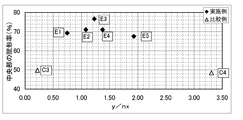
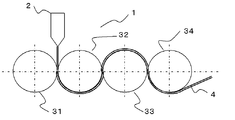
- FIG. 6 is a diagram showing the relationship between the shaping rate at the center of the saddle-shaped lens of Examples 1 to 5 and Comparative Examples 3 and 4 and y / nx. It is the schematic of the extrusion machine which manufactured the lens sheet of the Example and the comparative example.
- the MFR of the thermoplastic resin (B) used in the production method of the present invention is smaller than the MFR of the thermoplastic resin (A). That is, when the MFR of the thermoplastic resin (A) is MFR (A) and the MFR of the thermoplastic resin (B) is MFR (B), the value of MFR (A) / MFR (B) exceeds 1.
- the value of MFR (A) / MFR (B) is preferably in the range of 1.5 to 40, more preferably in the range of 2 to 30, and still more preferably in the range of 3 to 20. When the value of MFR (A) / MFR (B) exceeds 1, the aspect ratio of the bowl-shaped lens can be increased.
- the value of MFR (A) / MFR (B) is preferably 40 or less.
- MFR is a value measured under conditions of 230 ° C. and a load of 37.3 N according to ISO1133.
- MFR (A) is preferably in a higher range than the thermoplastic resin used in conventional extrusion molding from the viewpoint of filling the thermoplastic resin (A) into the grooves of the shaping mold as much as possible.
- a range of 7 to 50 g / 10 minutes is preferable, a range of 7 to 30 g / 10 minutes is more preferable, a range of 10 to 25 g / 10 minutes is further preferable, and a range of 10 to 20 g / 10 minutes is particularly preferable. If the MFR (A) is smaller than 7 g / 10 minutes, the shaping rate of the obtained lens sheet may be reduced.
- the extrusion amount of the thermoplastic resin (A) at the time of extrusion molding is unstable. It may become.
- the description of connecting two numerical values with “ ⁇ ” means the two numerical values and the range between them.
- MFR (B) is preferably in the range of 0.2 to 5 g / 10 minutes, more preferably in the range of 0.4 to 4 g / 10 minutes, and 0.5 to 3 g / 10 minutes from the viewpoint of the operational stability of extrusion molding. More preferred is a range of minutes. If the MFR (B) is smaller than 0.2 g / 10 minutes, the pressure of the molten resin in the extruder becomes too high, and the extruder may be damaged. If the MFR (B) is larger than 5 g / 10 minutes, the thickness of the lens sheet obtained Samurai may increase.
- thermoplastic resin (A) and the thermoplastic resin (B) are extruded and formed from the thermoplastic resin (A) and the surface layer, the first layer, and the thermoplastic resin (B). A molten multilayer sheet comprising the second layer adjacently is obtained.
- thermoplastic resin (A) and the thermoplastic resin (B) there are no particular restrictions on the conditions for extrusion molding of the thermoplastic resin (A) and the thermoplastic resin (B).
- the thermoplastic resin (A) and the thermoplastic resin (B) are each melted in a cylinder of an extruder, laminated in an extrusion die, and then extruded to obtain a molten multilayer sheet.
- the extrusion die a multi-manifold die having a plurality of manifolds is used from the viewpoint of making the thickness of each layer uniform.
- the thermoplastic resin constituting each layer is supplied to separate flow paths inside the die, and the resin constituting each layer is spread separately in the width direction of the plate. After that, they are merged and extruded near the discharge port of the die. Therefore, in the multi-manifold die, the thickness of each layer can be made uniform in the width direction of the plate even if the fluidity of the resin is different.
- the temperature (molding temperature) at which the thermoplastic resin (A) and the thermoplastic resin (B) are melted is usually 130, for example, more than the deflection temperature under load of the thermoplastic resin (A) and the thermoplastic resin (B). It is preferable to increase the temperature by ⁇ 180 ° C.
- the molding temperature of the thermoplastic resin (A) and the thermoplastic resin (B) may be different.
- the molding temperature of the thermoplastic resin (A) is changed to the molding temperature of the thermoplastic resin (B). Higher than that.
- the multi-manifold die usually has a heater for heating each thermoplastic resin.
- the heater of the multi-manifold die may be different for each thermoplastic resin, and in that case, the temperature (molding temperature) of the heater of each thermoplastic resin can be changed.
- the temperature of the heater in contact with the thermoplastic resin (A) serving as the first layer is usually higher by a temperature difference of 5 to 40 ° C. than the temperature of the heater in contact with the thermoplastic resin (B) of the multi-manifold die.
- the temperature difference is more preferably 10 to 35 ° C., more preferably 15 to 30 ° C. Warpage of the lens sheet obtained by setting the temperature difference to 40 ° C. or less is less likely to occur.
- the extrusion amount of the thermoplastic resin (A) is not particularly limited, but may be 5 to 100 kg / hour, for example.
- the extrusion amount of the thermoplastic resin (B) is not particularly limited, but can be 50 to 400 kg / hour, for example.
- the ratio of the extrusion amount of the thermoplastic resin (A) and the thermoplastic resin (B) can be, for example, 1: 2 to 1:50.
- extrusion speed of the melted multilayer sheet there is no particular limitation on the extrusion speed of the melted multilayer sheet, but it can be, for example, 0.1 to 10 m / min.
- the volume y per unit length of the first layer can be adjusted by the extrusion amount of each thermoplastic resin used and the thickness of the multilayered sheet in a molten state adjusted by the width of the discharge port of the multi-manifold die.
- thermoplastic resin (A) and the thermoplastic resin (B) may be added to an antioxidant, a thermal deterioration inhibitor, an ultraviolet absorber, a light stabilizer, a lubricant, a release agent, if necessary. Molding agents, antistatic agents, polymer processing aids, flame retardants, dyes and pigments, light diffusing agents, impact resistance modifiers, phosphors, and the like may be added.
- the thickness of the molten multilayer sheet obtained in this step is usually preferably in the range of 2 to 20 mm, and more preferably in the range of 2.5 to 10 mm. If the thickness is less than 2 mm, the strength of the resin sheet may be insufficient. If the thickness is more than 20 mm, the cooling and curing of the formed concavo-convex pattern does not proceed quickly, and the bowl-shaped lens is deformed after peeling from the shaping mold. Tend.
- the thickness ratio between the first layer and the second layer of the molten multilayer sheet obtained in this step can be, for example, 1: 2 to 1:50.
- the volume per unit length of the first layer is defined as y.
- the first layer is a surface layer of the molten multilayer sheet, and is in close contact with the shaping mold in the second step. As a result, the first layer becomes at least a part of the n bowl-shaped lenses formed in the second step.
- the second layer may be a surface layer of a melted multilayer sheet, or may be covered with another layer. That is, the multilayer sheet in the molten state may include layers other than the first layer and the second layer.
- Such another layer may be made of the thermoplastic resin (A) or the thermoplastic resin (B), or may be made of another thermoplastic resin.
- a third layer made of a thermoplastic resin (A) is used as another layer, and a three-layer composite arranged in the order of the first layer / second layer / third layer is used.
- a layer sheet is preferable.
- the extrusion amount of the third layer is preferably in the range of 0.9 to 1.1 times the extrusion amount of the first layer. It is more preferable to make it equal to the extrusion amount.
- the shaping mold having a plurality of grooves whose volume per unit length is x satisfying the formula (1) is obtained from the first layer of the multilayered sheet in the molten state obtained in the first step. N pieces of saddle-shaped lenses are formed in close contact with the surface. At this time, it is preferable that a pressing die is closely attached to the other surface of the molten multilayer sheet.
- Examples of the shape of the shaping die and the pressing die include a belt shape and a roll shape.
- the total volume per unit length of the groove of the shaping mold required for forming n bowl-shaped lenses is nx.
- the value of y / nx in the formula (1) is in the range of 0.7 to 2.0, preferably in the range of 1.05 to 1.4, and preferably 1.2 to 1 from the viewpoint of realizing a high shaping rate. A range of .3 is more preferred.
- the number n of hook-shaped lenses of the lens sheet of the present invention is determined as (width of lens sheet to be manufactured) / (pitch of hook-shaped lenses).
- r is the total extrusion amount per unit time of all thermoplastic resins used, and the thermoplastic resin (A) per unit time.
- the extrusion amount is r 1
- the value of y / nx can be adjusted by adjusting the ratio r 1 / r, and y / nx increases as r 1 / r increases.
- the value of y / nx determines how much the first layer fills the volume in the groove of the shaping mold. That is, when the value of y / nx exceeds 1, only the thermoplastic resin (A) fills the groove, and in the obtained lens sheet, the first layer is part of the bowl-shaped lens and the resin sheet, and the second layer Can form a resin sheet. On the other hand, if the value of y / nx is less than 1, the entire amount of the thermoplastic resin (A) and a part of the thermoplastic resin (B) are filled in the groove, and the first layer of the lens sheet obtained is a bowl-shaped lens. The second layer can form a part of a bowl-shaped lens and a resin sheet.
- the manufacturing method of the present invention achieves the object by adjusting the ratio of forming the hook-shaped lens in the first layer and the ratio of forming the first layer in the hook-shaped lens.
- the temperature of the shaping mold is preferably in the range of the deflection temperature under load of the thermoplastic resin (A) ⁇ 10 ° C. from the viewpoint of filling the shaping mold with the thermoplastic resin (A) as much as possible. If the temperature of the shaping mold is less than 10 ° C below the deflection temperature under load of the thermoplastic resin (A), the resin will not be sufficiently filled in the shaping mold. The resin is not smoothly released from the mold, and a trouble that the resin sheet is wound around the roll occurs or a surface defect called a release mark is generated.
- the temperature of the pressing mold is in the range of (the deflection temperature under load of the thermoplastic resin (B) ⁇ 20 ° C.) to (the deflection temperature under load of the thermoplastic resin (B)) from the viewpoint of sufficiently cooling the thermoplastic resin (B). Is preferred.
- the deflection temperature under load of the thermoplastic resin (A) and the thermoplastic resin (B) is measured according to ISO75-2.
- the pitch of the shaping mold to be used is usually preferably in the range of 0.05 to 1.0 mm, more preferably in the range of 0.1 to 0.8 mm. preferable.
- the sheet molded product obtained after the second step is usually cut in a direction perpendicular to the extrusion direction, and the length is adjusted to obtain a lens sheet. Further, the width may be adjusted by appropriately cutting both ends in the extrusion width direction parallel to the extrusion direction.
- the shaping molds used are as follows.
- the surface shape of the shaping mold was transferred using a two-component curable silicone resin, the cross-sectional shape was observed with a microscope, and the groove pitch and depth were measured.
- the cross-sectional shape of the groove of the shaping mold roll was a semi-elliptical shape having a pitch of 0.4 mm and a depth of 0.231 mm.
- the area of the semi-elliptical groove was calculated from the pitch and depth of the obtained groove, and the volume per unit length x (m 3 / m) was further calculated.
- x was 0.14 ⁇ 10 ⁇ 6 m 3 / m.
- the obtained lens sheet was evaluated by the following method.
- (1) Height of bowl-shaped lens A cross section perpendicular to the extrusion direction of the lens sheet was observed with a microscope, and a distance parallel to the thickness direction from the top to the valley of the bowl-shaped lens was measured.
- the height measured at the center in the extrusion width direction is the height of the bowl-shaped lens at the center, and the end measured at a distance of 600 mm from the center in the extrusion width direction to the end in one extrusion width direction.
- the height of the bowl-shaped lens was measured.
- Thickness of the third layer was measured by observing a cross section perpendicular to the extrusion direction of the sheet with a microscope.
- the thickness measured at the central portion in the extrusion width direction is the thickness of the third layer in the central portion, and the end portion is measured at a location 600 mm away from the central portion in the extrusion width direction to the end portion in one extrusion width direction. The thickness of the third layer.
- FIG. 2 is a schematic view of the extruder 1 used in Examples and Comparative Examples.
- the extrusion molding machine 1 includes an extrusion screw section (not shown), a multilayer extrusion T-type multi-manifold die 2, a pressing mold roll 31, a shaping mold roll 32, and cooling rolls 33 and 34.
- On the surface of the shaping mold roll 32 3250 grooves extending along the outer periphery of the roll are provided.
- the surfaces of the pressing die roll 31 and the cooling rolls 33 and 34 are smooth.
- the molten belt-like resin is discharged downward from the molten resin discharge portion of the multilayer extrusion T-type multi-manifold die 2.
- the pressing mold roll 31 and the shaping mold roll 32 face each other so as to sandwich the molten resin and are arranged in parallel and horizontally with each other.
- the cooling rolls 33 and 34 are arranged in parallel with the pressing mold roll 31 and the shaping mold roll 32 so that the respective rotation axes are located on the same plane.
- Acrylic resin (b): “Parapet EH” manufactured by Kuraray Co., Ltd., MFR 1.3 g / 10 min (catalog value measured at 230 ° C.
- deflection temperature under load 93 ° C (measuring condition: according to ISO 75-2, with annealing, catalog value measured with a load of 1.82 MPa), specific gravity 1.19.
- Example 1 Acrylic resin (a) and acrylic resin (b) are charged into an extruder, the acrylic resin (a) is heated to 260 ° C., the acrylic resin (b) is heated to 245 ° C., and the length in the extrusion width direction in which the molten resin is discharged. Is laminated in the order of acrylic resin (a), acrylic resin (b) and acrylic resin (a) in a multilayer extrusion T-type multi-manifold die having a length of about 1500 mm, and acrylic resin (a) is laminated in the first layer, acrylic resin ( A molten multilayer sheet having the second layer b) and the third layer acrylic resin (a) was extruded.
- the extrusion rate of acrylic resin (a) (first layer and third layer) was 20 kg / hour, and the extrusion rate of acrylic resin (b) (second layer) was 200 kg / hour.
- the molten multilayer sheet is supplied between a pressing mold roll 31 and a shaping mold roll 32 which are arranged parallel to each other with a distance of 3 mm to shape the lens shape, and then the cooling roll 33. , 34, and a sheet molded product having a plurality of bowl-shaped lenses arranged on the surface was obtained.
- the width of the sheet molded product was approximately 1.4 (m).
- the surface temperature of the pressing mold roll 31 is 80 ° C.
- the surface temperature of the shaping mold roll 32 is 100 ° C.
- the surface temperature of the cooling roll 33 is 100 ° C.
- the surface temperature of the cooling roll 34 is 70 ° C.
- the extrusion speed of the lens sheet. was 0.8 m / min.
- the value of y / nx was 0.750.
- the obtained sheet molded product was cut at a length of 1.3 m perpendicular to the extrusion direction. Moreover, the both ends of the extrusion width direction parallel to the extrusion direction were cut at equal widths to obtain a lens sheet having a width of 1.3 m.
- the pitch of the bowl-shaped lens of the lens sheet obtained as described above is 0.4 mm
- the thickness of the resin sheet is 2.8 mm
- the height of the bowl-shaped lens at the center is 0.16 mm
- the bowl-shaped lens at the end The height of the lens was 0.159 mm
- the aspect ratio of the saddle-shaped lens was 0.400
- the shaping ratio of the central portion and the end portion was 69%.
- the thickness of the third layer at the center was 0.136 mm
- the thickness of the third layer at the end was 0.135 mm.
- Example 2 Examples except that the extrusion rate of the acrylic resin (a) (the first layer and the third layer) was 28.8 kg / hour and the extrusion rate of the acrylic resin (b) (the second layer) was 182.3 kg / hour, respectively.
- a lens sheet was produced in the same manner as in Example 1.
- y / nx was 1.081.
- the pitch of the bowl-shaped lens of the lens sheet obtained as described above is 0.4 mm
- the thickness of the resin sheet is 2.8 mm
- the height of the bowl-shaped lens at the center is 0.164 mm
- the bowl-shaped lens at the end the extrusion rate of the acrylic resin (a) (the first layer and the third layer) was 28.8 kg / hour
- the extrusion rate of the acrylic resin (b) (the second layer) was 182.3 kg / hour
- the height of the lens was 0.162 mm, the aspect ratio of the bowl-shaped lens was 0.410, the shaping ratio at the center was 71%, and the shaping ratio at the end was 70%.
- the thickness of the third layer at the center was 0.196 mm, and the thickness of the third layer at the end was 0.194 mm.
- Example 3 Except for the extrusion rate of acrylic resin (a) (first layer and third layer) being 32 kg / hour and the extrusion rate of acrylic resin (b) (second layer) being 176 kg / hour, the same as in Example 1.
- a lens sheet was manufactured.
- y / nx was 1.230.
- the pitch of the bowl-shaped lenses of the lens sheet obtained as described above is 0.4 mm
- the thickness of the resin sheet is 2.8 mm
- the height of the bowl-shaped lenses at the center and the end is 0.177 mm
- the aspect ratio was 0.443, and the forming ratio of the central portion and the end portion was 77%.
- the thickness of the third layer at the center was 0.223 mm
- the thickness of the third layer at the end was 0.222 mm.
- Example 4 Examples except that the extrusion rate of the acrylic resin (a) (first layer and third layer) was 36.8 kg / hr and the extrusion rate of the acrylic resin (b) (second layer) was 164.4 kg / hr, respectively.
- a lens sheet was produced in the same manner as in Example 1. As a result, y / nx was 1.379.
- the pitch of the bowl-shaped lens of the lens sheet obtained as described above is 0.4 mm
- the thickness of the resin sheet is 2.8 mm
- the height of the bowl-shaped lens at the center is 0.164 mm
- the bowl-shaped lens at the end is
- the height of the lens was 0.166 mm
- the aspect ratio of the bowl-shaped lens was 0.410
- the shaping ratio at the center was 71%
- the shaping ratio at the end was 72%.
- the thickness of the third layer at the center and at the end was 0.25 mm.
- Example 5 Example 1 except that the extrusion rate of the acrylic resin (a) (first layer and third layer) was 51.5 kg / hour and the extrusion rate of the acrylic resin (b) (second layer) was 137 kg / hour, respectively. Similarly, a lens sheet was manufactured. As a result, y / nx was 1.930.
- the pitch of the bowl-shaped lens of the lens sheet obtained as described above is 0.4 mm
- the thickness of the resin sheet is 2.8 mm
- the height of the bowl-shaped lens at the center is 0.156 mm
- the bowl-shaped lens at the end The height of the lens was 0.157 mm
- the aspect ratio of the bowl-shaped lens was 0.390
- the shaping ratio at the center and the end was 68%.
- the thickness of the third layer at the center was 0.35 mm
- the thickness of the third layer at the end was 0.348 mm.
- Comparative Example 1 Acrylic resin (b) was charged into an extruder and heated to 245 ° C., and a molten sheet was extruded from a T-type multi-manifold die at an extrusion rate of 240 kg / hour. Next, the molten sheet is supplied between a pressing mold roll 31 and a shaping mold roll 32 which are arranged parallel to each other at a distance of 3 mm to shape the lens shape, and then the cooling rolls 33 and 34 are used. A lens sheet having a plurality of bowl-shaped lenses arranged on the surface was manufactured.
- the surface temperature of the pressing mold roll 31 is 80 ° C.
- the surface temperature of the shaping mold roll 32 is 100 ° C.
- the surface temperature of the cooling roll 33 is 100 ° C.
- the surface temperature of the cooling roll 34 is 70 ° C.
- the extrusion speed of the lens sheet. was 0.8 m / min.
- the pitch of the bowl-shaped lenses of the lens sheet obtained as described above is 0.4 mm
- the thickness of the resin sheet is 2.9 mm
- the height of the bowl-shaped lenses at the center and the end is 0.100 mm
- the bowl-shaped lenses The aspect ratio was 0.250, and the forming ratio of the central portion and the end portion was 43%.
- Comparative Example 2 The lens was the same as in Comparative Example 1 except that the amount of the acrylic resin (b) extruded was 160 kg / hr and the pressing mold roll 31 and the shaping mold roll 32 were spaced apart by 2 mm and arranged parallel to each other. Sheet 4 was produced.
- the pitch of the bowl-shaped lenses of the lens sheet obtained as described above is 0.4 mm
- the thickness of the resin sheet is 1.9 mm
- the height of the bowl-shaped lenses at the center and the end is 0.150 mm
- the bowl-shaped lenses The aspect ratio was 0.375
- the forming ratio of the central portion and the end portion was 65%.
- a lens sheet was produced in the same manner as in Example 1. As a result, y / nx was 0.221.
- the pitch of the bowl-shaped lens of the lens sheet obtained as described above is 0.4 mm
- the thickness of the resin sheet is 2.9 mm
- the height of the bowl-shaped lens in the center is 0.115 mm
- the bowl-shaped lens at the end The height of the lens was 0.113 mm
- the aspect ratio of the bowl-shaped lens was 0.288
- the shaping ratio at the center was 50%
- the shaping ratio at the end was 49%.
- the thickness of the third layer at the center and end was 0.040 mm.
- a lens sheet was produced in the same manner as in Example 1.
- y / nx was 3.309.
- the pitch of the bowl-shaped lenses of the lens sheet obtained as described above is 0.4 mm
- the thickness of the resin sheet is 2.9 mm
- the height of the bowl-shaped lenses at the center and the end is 0.112 mm
- the aspect ratio was 0.280, and the forming ratio of the central portion and the end portion was 48%.
- the thickness of the third layer at the center was 0.600 mm
- the thickness of the third layer at the end was 0.597 mm.
- Comparative Example 5 A lens sheet was produced in the same manner as in Comparative Example 1 except that the acrylic resin (a) was used instead of the acrylic resin (b), and the resin was heated to 260 ° C. and extruded. The molten sheet extruded from the T-type multi-manifold die frequently broke and could not be stably manufactured. Further, the obtained lens sheet was not practical because the shape of the bowl-shaped lens was uneven.
- Comparative Example 6 A lens sheet was produced in the same manner as in Example 3 except that the multilayer extrusion T-type multi-manifold die was changed to a multilayer extrusion T-type feed block die. As a result, y / nx was 1.230.
- the pitch of the bowl-shaped lens of the lens sheet obtained as described above is 0.4 mm
- the thickness of the resin sheet is 2.8 mm
- the height of the bowl-shaped lens at the center is 0.165 mm
- the bowl-shaped lens at the end The height of the lens was 0.114 mm
- the aspect ratio of the bowl-shaped lens was 0.413
- the shaping ratio at the center was 71%
- the shaping ratio at the end was 49%.
- the thickness of the third layer at the center was 0.230 mm
- the thickness of the third layer at the end was 0.088 mm.
- Table 1 shows the y / nx values of the lens sheets obtained in Examples and Comparative Examples, and the height, aspect ratio, shaping ratio, etc. of the saddle-shaped lens.
- FIG. 1 shows the relationship between the shaping ratio of the central portion of the saddle-shaped lens and y / nx in the lens sheets obtained in Examples 1 to 5 and Comparative Examples 3 and 4.
- E1 to E5 in FIG. 1 indicate Example 1, Example 2, Example 3, Example 4, and Example 5 in order
- C3 and C4 indicate Comparative Example 3 and Comparative Example 4, respectively.
- the lens sheet produced only with the acrylic resin (b) has a low shaping ratio and a low aspect ratio of the bowl-shaped lens, and the tendency is particularly large when the resin sheet is thick.
- Comparative Example 5 it can be seen from Comparative Example 5 that a lens sheet produced only with the acrylic resin (a) cannot be stably produced, and the shape of the lens becomes non-uniform.
- Comparative Example 6 it can be seen from Comparative Example 6 that the lens sheet that did not use the multi-manifold die has a difference in the thickness of the layer made of the acrylic resin (a) in the extrusion width direction, and the shaping rate becomes non-uniform.
- Extruder 2 Multi-layer extrusion T die 31: Pressing die roll 32: Shaping die roll 33, 34: Cooling roll 4: Lens sheet
Landscapes
- Engineering & Computer Science (AREA)
- Mechanical Engineering (AREA)
- Physics & Mathematics (AREA)
- Thermal Sciences (AREA)
- Extrusion Moulding Of Plastics Or The Like (AREA)
Abstract
Description
また、芯体とパターン部材との間に熱緩衝部材を配したパターンロールを賦形金型として用いて、押出成形した溶融状態のシートにパターン部材の形状を転写する方法が知られており、アスペクト比0.5のプリズムレンズを厚さ1mmの樹脂シートに配列したレンズシートの製造例が開示されている(特許文献6参照)。
また、特許文献6に記載の方法では、熱緩衝部材によって効率よく樹脂シートに熱が伝わるので、樹脂シートの厚さが厚い場合、形成した凹凸パターンの冷却、硬化が速やかに進まず、パターンロールから剥がした後に畝状レンズが変形する傾向があり、問題となる。
[1]熱可塑性樹脂(A)と、前記熱可塑性樹脂(A)よりもMFR(ISO1133に準じ、230℃、荷重37.3Nの条件で測定した値)の小さい熱可塑性樹脂(B)とを押出成形して、熱可塑性樹脂(A)からなり、単位長さあたりの体積がy(yは正数である)であり、かつ表層である第1層と、熱可塑性樹脂(B)からなる第2層とを隣接して備える溶融状態の複層シートをマルチマニホールドダイにより得る第1工程;および、
単位長さあたりの容積が下記式(1)を満足するx(xは正数である)である溝を複数有する賦形金型を、第1工程で得られた溶融状態の複層シートの第1層からなる表面に密着させて、n個(nは自然数である)の畝状レンズを形成する第2工程;
を含むレンズシートの押出製造方法。
0.7≦y/nx≦2.0 (1)
[2]前記y,n,xが下記式(2)を満足することを特徴とする[1]に記載のレンズシートの押出製造方法。
1.05≦y/nx≦1.4 (2)
本発明の製造方法で用いる熱可塑性樹脂(B)のMFRは熱可塑性樹脂(A)のMFRよりも小さい。すなわち、熱可塑性樹脂(A)のMFRをMFR(A)とし、熱可塑性樹脂(B)のMFRをMFR(B)としたとき、MFR(A)/MFR(B)の値は1を超える。MFR(A)/MFR(B)の値は、1.5~40の範囲が好ましく、2~30の範囲がより好ましく、3~20の範囲がさらに好ましい。MFR(A)/MFR(B)の値が1を超えることで、畝状レンズのアスペクト比を高められる。得られるレンズシートの厚さの均一性を高める観点から、MFR(A)/MFR(B)の値が40以下であることが好ましい。なお、本明細書においては、MFRとは、ISO1133に準じ、230℃、荷重37.3Nの条件で測定した値である。
なお本明細書中で2つの数値を「~」で結ぶ記載は該2つの数値およびその間の範囲を意味する。
第1工程では、熱可塑性樹脂(A)と、熱可塑性樹脂(B)とを押出成形して、熱可塑性樹脂(A)からなり表層である第1層と、熱可塑性樹脂(B)からなる第2層とを隣接して備える溶融状態の複層シートを得る。
本願で用いるマルチマニホールドダイで複層シートを製造する場合、各層を構成する熱可塑性樹脂はダイ内部の別々の流路へ供給され、各層を構成する樹脂は別々に板の幅方向へ広げられたのち、ダイの吐出口近傍で合流されて押出される。そのため、マルチマニホールドダイでは、樹脂の流動性が異なっていても各層の厚みを板の幅方向で均一にすることができる。
第2工程では、単位長さあたりの容積が式(1)を満足するxである溝を複数有する賦形金型を、第1工程で得られた溶融状態の複層シートの第1層からなる表面に密着させて、n個の畝状レンズを形成する。この際、溶融状態の複層シートの他の表面には、押付金型を密着させることが好ましい。
押付金型の温度は、熱可塑性樹脂(B)を十分冷却する観点から、(熱可塑性樹脂(B)の荷重たわみ温度-20℃)~(熱可塑性樹脂(B)の荷重たわみ温度)の範囲が好ましい。
なお、熱可塑性樹脂(A)および熱可塑性樹脂(B)の荷重たわみ温度は、ISO75-2にしたがって測定される。
賦形金型の表面形状を2液硬化型シリコーン樹脂を用いて転写し、その断面形状を顕微鏡で観察して、溝のピッチと深さを測定した。この結果、賦形金型ロールの溝の断面形状はピッチが0.4mm、深さが0.231mmの半楕円形であった。
また、得られた溝のピッチと深さから半楕円形状の溝の面積を算出し、さらに単位長さあたりの容積x(m3/m)を算出した。この結果、xは0.14×10-6m3/mであった。
(1)畝状レンズの高さ
レンズシートの押し出し方向に垂直な断面を顕微鏡で観察し、畝状レンズの頂部から谷部までの厚さ方向と平行な距離を測定した。押出幅方向の中央部にて測定したものを中央部の畝状レンズの高さとし、押出幅方向の中央部から一方の押出幅方向の端部へ600mm離れた場所にて測定したものを端部の畝状レンズの高さとした。
(2)樹脂シートの厚さ
レンズシートの押し出し方向に垂直な断面を顕微鏡で観察し、畝状レンズの谷部から第三層の表面までの距離を測定した。
(3)y/nxの算出
熱可塑性樹脂(A)の押出量Q(kg/時)、レンズシートの押出速度v(m/分)、熱可塑性樹脂(A)の比重ρ(g/cm3)から下記式により第1層の単位長さあたりの体積y(m3/m)を算出した。
y=Q/(60000×ρ×v)(m3/m)
算出したyと、形成した畝状レンズの数nおよび前記算出したx(m3/m)より、y/nxを算出した。
(4)畝状レンズのピッチ
レンズシートの押し出し方向に垂直な断面を顕微鏡で観察し、畝状レンズの頂部から隣り合う畝状レンズの頂部までの距離を測定した。
(5)畝状レンズのアスペクト比
前記(1)で測定した中央部の畝状レンズの高さを前記(4)で測定した畝状レンズのピッチで除し、アスペクト比とした。
(6)賦形率(%)
賦形金型の溝の深さに対する、前記(1)で測定した中央部および端部の畝状レンズの高さの百分率を求めて中央部および端部の賦形率(%)とした。
(7)第3層の厚さ
シートの押し出し方向に垂直な断面を顕微鏡で観察して測定した。押出幅方向の中央部にて測定したものを中央部の第3層の厚さとし、押出幅方向の中央部から一方の押出幅方向の端部へ600mm離れた場所にて測定したものを端部の第三層の厚さとした。
押付金型ロール31、冷却ロール33、34の表面は滑らかである。多層押出T型マルチマニホールドダイ2の溶融樹脂吐出部から溶融した帯状の樹脂が下方に吐出される。押付金型ロール31と賦形金型ロール32とは溶融樹脂を挟むように対向して互いに平行に、水平に配置される。冷却ロール33、34は押付金型ロール31および賦形金型ロール32と平行に、それぞれの回転軸が同一平面に位置するように配置される。
アクリル樹脂(a):(株)クラレ製、「パラペットGH」、MFR=10(ISO1133に準じ、230℃、荷重37.3Nで測定されたカタログ値)、荷重たわみ温度=95℃(ISO75-2に準じ、アニール有り、荷重1.82MPaで測定されたカタログ値)、比重1.19。
アクリル樹脂(b):(株)クラレ製、「パラペットEH」、MFR=1.3g/10分(ISO1133に準じ、230℃、荷重37.3Nで測定されたカタログ値)、荷重たわみ温度=93℃(測定条件:ISO75-2に準じ、アニール有り、荷重1.82MPaで測定されたカタログ値)、比重1.19。
押出成形機にアクリル樹脂(a)およびアクリル樹脂(b)を仕込み、アクリル樹脂(a)を260℃、アクリル樹脂(b)を245℃に加熱し、溶融樹脂が吐出される押出幅方向の長さが約1500mmの多層押出T型マルチマニホールドダイ内で、アクリル樹脂(a)、アクリル樹脂(b)、アクリル樹脂(a)の順に積層し、アクリル樹脂(a)を第1層、アクリル樹脂(b)を第2層、アクリル樹脂(a)を第3層とする溶融状態の複層シートを押し出した。アクリル樹脂(a)(第1層および第3層)の押出量はそれぞれ20kg/時、アクリル樹脂(b)(第2層)の押出量は200kg/時とした。
次いで、かかる溶融状態の複層シートを、3mm離間して互いに平行に配置した押付金型ロール31と賦形金型ロール32との間に供給してレンズ形状を賦形し、次いで冷却ロール33、34に密着させ、表面に複数の畝状レンズを配列したシート成形品を得た。シート成形品の幅はおよそ1.4(m)であった。
押付金型ロール31の表面温度は80℃、賦形金型ロール32の表面温度は100℃、冷却ロール33の表面温度は100℃、冷却ロール34の表面温度は70℃、レンズシートの押出速度は0.8m/分であった。
y/nxの値は0.750となった。
アクリル樹脂(a)(第1層および第3層)の押出量をそれぞれ28.8kg/時、アクリル樹脂(b)(第2層)の押出量を182.3kg/時とした以外は実施例1と同様にしてレンズシートを製造した。この結果、y/nxは1.081となった。以上のようにして得たレンズシートの畝状レンズのピッチは0.4mm、樹脂シートの厚さは2.8mm、中央部の畝状レンズの高さは0.164mm、端部の畝状レンズの高さは0.162mm、畝状レンズのアスペクト比は0.410、中央部の賦形率は71%、端部の賦形率は70%であった。中央部の第3層の厚さは0.196mm、端部の第3層の厚さは0.194mmだった。
アクリル樹脂(a)(第1層および第3層)の押出量をそれぞれ32kg/時、アクリル樹脂(b)(第2層)の押出量を176kg/時とした以外は実施例1と同様にしてレンズシートを製造した。この結果、y/nxは1.230となった。以上のようにして得たレンズシートの畝状レンズのピッチは0.4mm、樹脂シートの厚さは2.8mm、中央部および端部の畝状レンズの高さは0.177mm、畝状レンズのアスペクト比は0.443、中央部および端部の賦形率は77%であった。中央部の第3層の厚さは0.223mm、端部の第3層の厚さは0.222mmだった。
アクリル樹脂(a)(第1層および第3層)の押出量をそれぞれ36.8kg/時、アクリル樹脂(b)(第2層)の押出量を164.4kg/時とした以外は実施例1と同様にしてレンズシートを製造した。この結果、y/nxは1.379となった。以上のようにして得たレンズシートの畝状レンズのピッチは0.4mm、樹脂シートの厚さは2.8mm、中央部の畝状レンズの高さは0.164mm、端部の畝状レンズの高さは0.166mm、畝状レンズのアスペクト比は0.410、中央部の賦形率は71%、端部の賦形率は72%であった。中央部および端部の第3層の厚さは0.25mmだった。
アクリル樹脂(a)(第1層および第3層)の押出量をそれぞれ51.5kg/時、アクリル樹脂(b)(第2層)の押出量を137kg/時とした以外は実施例1と同様にしてレンズシートを製造した。この結果、y/nxは1.930となった。以上のようにして得たレンズシートの畝状レンズのピッチは0.4mm、樹脂シートの厚さは2.8mm、中央部の畝状レンズの高さは0.156mm、端部の畝状レンズの高さは0.157mm、畝状レンズのアスペクト比は0.390、中央部および端部の賦形率は68%であった。中央部の第3層の厚さは0.35mm、端部の第3層の厚さは0.348mmだった。
押出成形機にアクリル樹脂(b)を仕込み、245℃に加熱し、押出量240kg/時でT型マルチマニホールドダイから溶融状態のシートを押し出した。次いで、かかる溶融状態のシートを、3mm離間して互いに平行に配置した押付金型ロール31と賦形金型ロール32との間に供給してレンズ形状を賦形し、次いで冷却ロール33、34に密着させ、表面に複数の畝状レンズを配列したレンズシートを製造した。押付金型ロール31の表面温度は80℃、賦形金型ロール32の表面温度は100℃、冷却ロール33の表面温度は100℃、冷却ロール34の表面温度は70℃、レンズシートの押出速度は0.8m/分であった。
以上のようにして得たレンズシートの畝状レンズのピッチは0.4mm、樹脂シートの厚さは2.9mm、中央部および端部の畝状レンズの高さは0.100mm、畝状レンズのアスペクト比は0.250、中央部および端部の賦形率は43%であった。
アクリル樹脂(b)の押出量を160kg/時とし、押付金型ロール31と賦形金型ロール32との間を2mm離間して互いに平行に配置した以外は、比較例1と同様にしてレンズシート4を製造した。
以上のようにして得たレンズシートの畝状レンズのピッチは0.4mm、樹脂シートの厚さは1.9mm、中央部および端部の畝状レンズの高さは0.150mm、畝状レンズのアスペクト比は0.375、中央部および端部の賦形率は65%であった。
アクリル樹脂(a)(第1層および第3層)の押出量をそれぞれ5.9kg/時、アクリル樹脂(b)(第2層)の押出量を228.2kg/時とした以外は実施例1と同様にしてレンズシートを製造した。この結果、y/nxは0.221となった。以上のようにして得たレンズシートの畝状レンズのピッチは0.4mm、樹脂シートの厚さは2.9mm、中央部の畝状レンズの高さは0.115mm、端部の畝状レンズの高さは0.113mm、畝状レンズのアスペクト比は0.288、中央部の賦形率は50%、端部の賦形率は49%であった。中央部および端部の第3層の厚さは0.040mmだった。
アクリル樹脂(a)(第1層および第3層)の押出量をそれぞれ88.2kg/時、アクリル樹脂(b)(第2層)の押出量を63.5kg/時とした以外は実施例1と同様にしてレンズシートを製造した。この結果、y/nxは3.309となった。以上のようにして得たレンズシートの畝状レンズのピッチは0.4mm、樹脂シートの厚さは2.9mm、中央部および端部の畝状レンズの高さは0.112mm、畝状レンズのアスペクト比は0.280、中央部および端部の賦形率は48%であった。中央部の第3層の厚さは0.600mm、端部の第3層の厚さは0.597mmだった。
アクリル樹脂(b)に代えてアクリル樹脂(a)を使用し、260℃に加熱して押し出した以外は比較例1と同様にしてレンズシートを製造した。T型マルチマニホールドダイから押し出された溶融状態のシートが頻繁に破断して安定的な製造ができなかった。また、得られたレンズシートは畝状レンズの形状が不均一で実用に耐えるものではなかった。
多層押出T型マルチマニホールドダイを多層押出T型フィードブロックダイに変えた以外は実施例3と同様にしてレンズシートを製造した。この結果、y/nxは1.230となった。以上のようにして得たレンズシートの畝状レンズのピッチは0.4mm、樹脂シートの厚さは2.8mm、中央部の畝状レンズの高さは0.165mm、端部の畝状レンズの高さは0.114mm、畝状レンズのアスペクト比は0.413、中央部の賦形率は71%、端部の賦形率は49%であった。中央部の第3層の厚さは0.230mm、端部の第3層の厚さは0.088mmだった。

図1中のE1~E5は順に実施例1、実施例2、実施例3、実施例4、実施例5について示しており、C3、C4は、それぞれ比較例3、比較例4について示している。
図1および表1から、実施例1~5で得られたレンズシートは比較例3および4で得られたレンズシートに比べて、賦形率および畝状レンズのアスペクト比が高いことが分かる。
また比較例1および2から、アクリル樹脂(b)のみで作製したレンズシートは、賦形率および畝状レンズのアスペクト比が低く、特に樹脂シートの厚さが厚い場合にその傾向が大きいことが分かる。
また比較例5から、アクリル樹脂(a)のみで作製したレンズシートは安定的に生産できず、レンズの形状も不均一となることが分かる。
また比較例6から、マルチマニホールドダイを使用しなかったレンズシートはアクリル樹脂(a)からなる層の厚さが押出幅方向で差があり、賦形率が不均一となることが分かる。
以上の結果から、本発明のレンズシートの製造方法によれば、樹脂シートの厚さが3.0mmと厚い場合であっても高い賦形率を実現でき、畝状レンズのアスペクト比が高いレンズシートが得られることが分かる。
2:多層押し出しT型ダイ
31:押付金型ロール
32:賦形金型ロール
33、34:冷却ロール
4:レンズシート
Claims (2)
- 熱可塑性樹脂(A)と、前記熱可塑性樹脂(A)よりもMFR(ISO1133に準じ、230℃、荷重37.3Nの条件で測定した値)の小さい熱可塑性樹脂(B)とを押出成形して、熱可塑性樹脂(A)からなり、単位長さあたりの体積がy(yは正数である)であり、かつ表層である第1層と、熱可塑性樹脂(B)からなる第2層とを隣接して備える溶融状態の複層シートをマルチマニホールドダイにより得る第1工程;および、
単位長さあたりの容積が下記式(1)を満足するx(xは正数である)である溝を複数有する賦形金型を、第1工程で得られた溶融状態の複層シートの第1層からなる表面に密着させて、n個(nは自然数である)の畝状レンズを形成する第2工程;
を含むレンズシートの押出製造方法。
0.7≦y/nx≦2.0 (1) - 前記y,n,xが下記式(2)を満足することを特徴とする請求項1に記載のレンズシートの押出製造方法。
1.05≦y/nx≦1.4 (2)
Priority Applications (3)
| Application Number | Priority Date | Filing Date | Title |
|---|---|---|---|
| JP2014544613A JP6046737B2 (ja) | 2012-11-01 | 2013-11-01 | レンズシートの製造方法 |
| CN201380057299.8A CN104755247A (zh) | 2012-11-01 | 2013-11-01 | 透镜片的制造方法 |
| KR1020157011079A KR101749842B1 (ko) | 2012-11-01 | 2013-11-01 | 렌즈 시트의 제조 방법 |
Applications Claiming Priority (2)
| Application Number | Priority Date | Filing Date | Title |
|---|---|---|---|
| JP2012241491 | 2012-11-01 | ||
| JP2012-241491 | 2012-11-01 |
Publications (1)
| Publication Number | Publication Date |
|---|---|
| WO2014069641A1 true WO2014069641A1 (ja) | 2014-05-08 |
Family
ID=50627533
Family Applications (1)
| Application Number | Title | Priority Date | Filing Date |
|---|---|---|---|
| PCT/JP2013/079784 Ceased WO2014069641A1 (ja) | 2012-11-01 | 2013-11-01 | レンズシートの製造方法 |
Country Status (5)
| Country | Link |
|---|---|
| JP (1) | JP6046737B2 (ja) |
| KR (1) | KR101749842B1 (ja) |
| CN (1) | CN104755247A (ja) |
| TW (1) | TWI590941B (ja) |
| WO (1) | WO2014069641A1 (ja) |
Families Citing this family (1)
| Publication number | Priority date | Publication date | Assignee | Title |
|---|---|---|---|---|
| CN110650932A (zh) * | 2017-06-08 | 2020-01-03 | 株式会社可乐丽 | 夹层玻璃用中间膜的再利用方法 |
Citations (4)
| Publication number | Priority date | Publication date | Assignee | Title |
|---|---|---|---|---|
| JPH04327937A (ja) * | 1991-04-26 | 1992-11-17 | Sekisui Chem Co Ltd | エンボス付きのポリカーボネートシート及びその製造方法 |
| JPH07290552A (ja) * | 1993-12-24 | 1995-11-07 | Roehm Gmbh | プラスチックパネルを押し出す方法、プラスチックパネルからなるフレネルレンズおよびこのフレネルレンズを有するソーラーコレクタ |
| JP2012144033A (ja) * | 2010-07-01 | 2012-08-02 | Sumitomo Chemical Co Ltd | 樹脂シートの製造方法 |
| JP2013176982A (ja) * | 2012-02-01 | 2013-09-09 | Sumitomo Chemical Co Ltd | 形状転写樹脂シートの製造方法及び樹脂シート |
Family Cites Families (6)
| Publication number | Priority date | Publication date | Assignee | Title |
|---|---|---|---|---|
| US3241429A (en) * | 1962-05-14 | 1966-03-22 | Pid Corp | Pictorial parallax panoramagram units |
| JP3158476B2 (ja) * | 1991-03-28 | 2001-04-23 | 凸版印刷株式会社 | 両面レンチキュラーシートの製造方法 |
| JPH0831025A (ja) * | 1994-07-18 | 1996-02-02 | Canon Inc | 光学的情報記録媒体用基板の製造方法及びその製造装置 |
| CN100478155C (zh) * | 2003-03-04 | 2009-04-15 | 可乐丽股份有限公司 | 光学片的制造方法和光学片 |
| JP4835320B2 (ja) * | 2006-08-11 | 2011-12-14 | 住友化学株式会社 | レンズ形状賦型用積層フィルム及びレンズフィルム |
| US20100188751A1 (en) * | 2009-01-29 | 2010-07-29 | 3M Innovative Properties Company | Optical films with internally conformable layers and method of making the films |
-
2013
- 2013-11-01 KR KR1020157011079A patent/KR101749842B1/ko not_active Expired - Fee Related
- 2013-11-01 TW TW102139685A patent/TWI590941B/zh not_active IP Right Cessation
- 2013-11-01 JP JP2014544613A patent/JP6046737B2/ja not_active Expired - Fee Related
- 2013-11-01 CN CN201380057299.8A patent/CN104755247A/zh active Pending
- 2013-11-01 WO PCT/JP2013/079784 patent/WO2014069641A1/ja not_active Ceased
Patent Citations (4)
| Publication number | Priority date | Publication date | Assignee | Title |
|---|---|---|---|---|
| JPH04327937A (ja) * | 1991-04-26 | 1992-11-17 | Sekisui Chem Co Ltd | エンボス付きのポリカーボネートシート及びその製造方法 |
| JPH07290552A (ja) * | 1993-12-24 | 1995-11-07 | Roehm Gmbh | プラスチックパネルを押し出す方法、プラスチックパネルからなるフレネルレンズおよびこのフレネルレンズを有するソーラーコレクタ |
| JP2012144033A (ja) * | 2010-07-01 | 2012-08-02 | Sumitomo Chemical Co Ltd | 樹脂シートの製造方法 |
| JP2013176982A (ja) * | 2012-02-01 | 2013-09-09 | Sumitomo Chemical Co Ltd | 形状転写樹脂シートの製造方法及び樹脂シート |
Also Published As
| Publication number | Publication date |
|---|---|
| CN104755247A (zh) | 2015-07-01 |
| JP6046737B2 (ja) | 2016-12-21 |
| JPWO2014069641A1 (ja) | 2016-09-08 |
| KR20150064141A (ko) | 2015-06-10 |
| KR101749842B1 (ko) | 2017-06-21 |
| TW201422407A (zh) | 2014-06-16 |
| TWI590941B (zh) | 2017-07-11 |
Similar Documents
| Publication | Publication Date | Title |
|---|---|---|
| KR20120109570A (ko) | 공압출 다이 및 시스템, 공압출된 물품을 제조하는 방법 및 이에 의해 제조된 공압출된 물품 | |
| CN102271893A (zh) | 共挤出模头、使用该模头的挤出方法以及由其制成的挤出制品 | |
| RU2017114990A (ru) | Промежуточная пленка для многослойного стекла, рулонное изделие, многослойное стекло, способ изготовления промежуточной пленки для многослойного стекла и способ изготовления рулонного изделия | |
| JP6630673B2 (ja) | 光学シートおよびその製造方法 | |
| JP4042096B2 (ja) | 樹脂成形品の製造装置及び方法 | |
| JP2012532041A (ja) | 押出ダイ要素、押出ダイ、及び多層押出品から多重縞の押出品を製造する方法 | |
| JPWO2012102178A1 (ja) | 樹脂フィルムの製造方法及び製造装置 | |
| JP6046737B2 (ja) | レンズシートの製造方法 | |
| CN101563203B (zh) | 用于制造光学薄膜的设备和方法 | |
| JP5445929B2 (ja) | 結晶性樹脂板の製造方法 | |
| EA034090B1 (ru) | Многослойное сотовое полотно или панель на основе полипропилена, содержащее центральную термоформованную пленку | |
| EA038351B1 (ru) | Ячеистый слоистый лист или панель на основе полипропилена с центральными термоформованными пленками | |
| CN110435195A (zh) | 一种asa/pvc多层瓦共挤生产线及生产方法 | |
| CN101801637A (zh) | 用于制造模塑板的方法和装置 | |
| CN102189679A (zh) | 表面形状转印树脂片材的制造方法 | |
| JP2010253696A (ja) | エンボス転写用熱可塑性樹脂シート、熱可塑性樹脂製エンボスシート、および、熱可塑性樹脂製エンボスシートの製造方法 | |
| CN107148331A (zh) | 垫片堆叠件发泡模具 | |
| CN106182727A (zh) | 导光板生产线 | |
| CN103240872A (zh) | 形状转印树脂片的制造方法以及树脂片 | |
| JP2023001059A (ja) | 多層積層合流装置 | |
| CN210415601U (zh) | 一种asa/pvc多层瓦共挤生产线 | |
| JP5666345B2 (ja) | 樹脂被覆基板の製造装置および製造方法 | |
| CN205075307U (zh) | 一种多层模具 | |
| KR20090091067A (ko) | 전사 수지 시트의 제조 방법 및 전사 수지 시트의 제조 장치 | |
| CN119704636A (zh) | 一种非聚氯乙烯木塑板材形变控制装置、生产线及应用 |
Legal Events
| Date | Code | Title | Description |
|---|---|---|---|
| 121 | Ep: the epo has been informed by wipo that ep was designated in this application |
Ref document number: 13850487 Country of ref document: EP Kind code of ref document: A1 |
|
| ENP | Entry into the national phase |
Ref document number: 2014544613 Country of ref document: JP Kind code of ref document: A |
|
| ENP | Entry into the national phase |
Ref document number: 20157011079 Country of ref document: KR Kind code of ref document: A |
|
| NENP | Non-entry into the national phase |
Ref country code: DE |
|
| 122 | Ep: pct application non-entry in european phase |
Ref document number: 13850487 Country of ref document: EP Kind code of ref document: A1 |