WO2014069478A1 - ネガ型感光性樹脂組成物、樹脂硬化膜、隔壁および光学素子 - Google Patents
ネガ型感光性樹脂組成物、樹脂硬化膜、隔壁および光学素子 Download PDFInfo
- Publication number
- WO2014069478A1 WO2014069478A1 PCT/JP2013/079310 JP2013079310W WO2014069478A1 WO 2014069478 A1 WO2014069478 A1 WO 2014069478A1 JP 2013079310 W JP2013079310 W JP 2013079310W WO 2014069478 A1 WO2014069478 A1 WO 2014069478A1
- Authority
- WO
- WIPO (PCT)
- Prior art keywords
- group
- film
- substrate
- cured
- cured resin
- Prior art date
- Legal status (The legal status is an assumption and is not a legal conclusion. Google has not performed a legal analysis and makes no representation as to the accuracy of the status listed.)
- Ceased
Links
Images





Classifications
-
- G—PHYSICS
- G03—PHOTOGRAPHY; CINEMATOGRAPHY; ANALOGOUS TECHNIQUES USING WAVES OTHER THAN OPTICAL WAVES; ELECTROGRAPHY; HOLOGRAPHY
- G03F—PHOTOMECHANICAL PRODUCTION OF TEXTURED OR PATTERNED SURFACES, e.g. FOR PRINTING, FOR PROCESSING OF SEMICONDUCTOR DEVICES; MATERIALS THEREFOR; ORIGINALS THEREFOR; APPARATUS SPECIALLY ADAPTED THEREFOR
- G03F7/00—Photomechanical, e.g. photolithographic, production of textured or patterned surfaces, e.g. printing surfaces; Materials therefor, e.g. comprising photoresists; Apparatus specially adapted therefor
- G03F7/004—Photosensitive materials
- G03F7/038—Macromolecular compounds which are rendered insoluble or differentially wettable
- G03F7/0385—Macromolecular compounds which are rendered insoluble or differentially wettable using epoxidised novolak resin
-
- B—PERFORMING OPERATIONS; TRANSPORTING
- B32—LAYERED PRODUCTS
- B32B—LAYERED PRODUCTS, i.e. PRODUCTS BUILT-UP OF STRATA OF FLAT OR NON-FLAT, e.g. CELLULAR OR HONEYCOMB, FORM
- B32B27/00—Layered products comprising a layer of synthetic resin
- B32B27/16—Layered products comprising a layer of synthetic resin specially treated, e.g. irradiated
-
- B—PERFORMING OPERATIONS; TRANSPORTING
- B32—LAYERED PRODUCTS
- B32B—LAYERED PRODUCTS, i.e. PRODUCTS BUILT-UP OF STRATA OF FLAT OR NON-FLAT, e.g. CELLULAR OR HONEYCOMB, FORM
- B32B27/00—Layered products comprising a layer of synthetic resin
- B32B27/18—Layered products comprising a layer of synthetic resin characterised by the use of special additives
- B32B27/20—Layered products comprising a layer of synthetic resin characterised by the use of special additives using fillers, pigments, thixotroping agents
-
- B—PERFORMING OPERATIONS; TRANSPORTING
- B32—LAYERED PRODUCTS
- B32B—LAYERED PRODUCTS, i.e. PRODUCTS BUILT-UP OF STRATA OF FLAT OR NON-FLAT, e.g. CELLULAR OR HONEYCOMB, FORM
- B32B27/00—Layered products comprising a layer of synthetic resin
- B32B27/18—Layered products comprising a layer of synthetic resin characterised by the use of special additives
- B32B27/24—Layered products comprising a layer of synthetic resin characterised by the use of special additives using solvents or swelling agents
-
- B—PERFORMING OPERATIONS; TRANSPORTING
- B32—LAYERED PRODUCTS
- B32B—LAYERED PRODUCTS, i.e. PRODUCTS BUILT-UP OF STRATA OF FLAT OR NON-FLAT, e.g. CELLULAR OR HONEYCOMB, FORM
- B32B27/00—Layered products comprising a layer of synthetic resin
- B32B27/18—Layered products comprising a layer of synthetic resin characterised by the use of special additives
- B32B27/26—Layered products comprising a layer of synthetic resin characterised by the use of special additives using curing agents
-
- C—CHEMISTRY; METALLURGY
- C08—ORGANIC MACROMOLECULAR COMPOUNDS; THEIR PREPARATION OR CHEMICAL WORKING-UP; COMPOSITIONS BASED THEREON
- C08F—MACROMOLECULAR COMPOUNDS OBTAINED BY REACTIONS ONLY INVOLVING CARBON-TO-CARBON UNSATURATED BONDS
- C08F290/00—Macromolecular compounds obtained by polymerising monomers on to polymers modified by introduction of aliphatic unsaturated end or side groups
- C08F290/02—Macromolecular compounds obtained by polymerising monomers on to polymers modified by introduction of aliphatic unsaturated end or side groups on to polymers modified by introduction of unsaturated end groups
- C08F290/06—Polymers provided for in subclass C08G
-
- G—PHYSICS
- G02—OPTICS
- G02F—OPTICAL DEVICES OR ARRANGEMENTS FOR THE CONTROL OF LIGHT BY MODIFICATION OF THE OPTICAL PROPERTIES OF THE MEDIA OF THE ELEMENTS INVOLVED THEREIN; NON-LINEAR OPTICS; FREQUENCY-CHANGING OF LIGHT; OPTICAL LOGIC ELEMENTS; OPTICAL ANALOGUE/DIGITAL CONVERTERS
- G02F1/00—Devices or arrangements for the control of the intensity, colour, phase, polarisation or direction of light arriving from an independent light source, e.g. switching, gating or modulating; Non-linear optics
- G02F1/01—Devices or arrangements for the control of the intensity, colour, phase, polarisation or direction of light arriving from an independent light source, e.g. switching, gating or modulating; Non-linear optics for the control of the intensity, phase, polarisation or colour
- G02F1/13—Devices or arrangements for the control of the intensity, colour, phase, polarisation or direction of light arriving from an independent light source, e.g. switching, gating or modulating; Non-linear optics for the control of the intensity, phase, polarisation or colour based on liquid crystals, e.g. single liquid crystal display cells
- G02F1/133—Constructional arrangements; Operation of liquid crystal cells; Circuit arrangements
- G02F1/1333—Constructional arrangements; Manufacturing methods
- G02F1/1335—Structural association of cells with optical devices, e.g. polarisers or reflectors
- G02F1/133509—Filters, e.g. light shielding masks
- G02F1/133514—Colour filters
- G02F1/133516—Methods for their manufacture, e.g. printing, electro-deposition or photolithography
-
- G—PHYSICS
- G03—PHOTOGRAPHY; CINEMATOGRAPHY; ANALOGOUS TECHNIQUES USING WAVES OTHER THAN OPTICAL WAVES; ELECTROGRAPHY; HOLOGRAPHY
- G03F—PHOTOMECHANICAL PRODUCTION OF TEXTURED OR PATTERNED SURFACES, e.g. FOR PRINTING, FOR PROCESSING OF SEMICONDUCTOR DEVICES; MATERIALS THEREFOR; ORIGINALS THEREFOR; APPARATUS SPECIALLY ADAPTED THEREFOR
- G03F7/00—Photomechanical, e.g. photolithographic, production of textured or patterned surfaces, e.g. printing surfaces; Materials therefor, e.g. comprising photoresists; Apparatus specially adapted therefor
- G03F7/004—Photosensitive materials
- G03F7/0046—Photosensitive materials with perfluoro compounds, e.g. for dry lithography
-
- G—PHYSICS
- G03—PHOTOGRAPHY; CINEMATOGRAPHY; ANALOGOUS TECHNIQUES USING WAVES OTHER THAN OPTICAL WAVES; ELECTROGRAPHY; HOLOGRAPHY
- G03F—PHOTOMECHANICAL PRODUCTION OF TEXTURED OR PATTERNED SURFACES, e.g. FOR PRINTING, FOR PROCESSING OF SEMICONDUCTOR DEVICES; MATERIALS THEREFOR; ORIGINALS THEREFOR; APPARATUS SPECIALLY ADAPTED THEREFOR
- G03F7/00—Photomechanical, e.g. photolithographic, production of textured or patterned surfaces, e.g. printing surfaces; Materials therefor, e.g. comprising photoresists; Apparatus specially adapted therefor
- G03F7/004—Photosensitive materials
- G03F7/027—Non-macromolecular photopolymerisable compounds having carbon-to-carbon double bonds, e.g. ethylenic compounds
-
- G—PHYSICS
- G03—PHOTOGRAPHY; CINEMATOGRAPHY; ANALOGOUS TECHNIQUES USING WAVES OTHER THAN OPTICAL WAVES; ELECTROGRAPHY; HOLOGRAPHY
- G03F—PHOTOMECHANICAL PRODUCTION OF TEXTURED OR PATTERNED SURFACES, e.g. FOR PRINTING, FOR PROCESSING OF SEMICONDUCTOR DEVICES; MATERIALS THEREFOR; ORIGINALS THEREFOR; APPARATUS SPECIALLY ADAPTED THEREFOR
- G03F7/00—Photomechanical, e.g. photolithographic, production of textured or patterned surfaces, e.g. printing surfaces; Materials therefor, e.g. comprising photoresists; Apparatus specially adapted therefor
- G03F7/004—Photosensitive materials
- G03F7/027—Non-macromolecular photopolymerisable compounds having carbon-to-carbon double bonds, e.g. ethylenic compounds
- G03F7/028—Non-macromolecular photopolymerisable compounds having carbon-to-carbon double bonds, e.g. ethylenic compounds with photosensitivity-increasing substances, e.g. photoinitiators
-
- G—PHYSICS
- G03—PHOTOGRAPHY; CINEMATOGRAPHY; ANALOGOUS TECHNIQUES USING WAVES OTHER THAN OPTICAL WAVES; ELECTROGRAPHY; HOLOGRAPHY
- G03F—PHOTOMECHANICAL PRODUCTION OF TEXTURED OR PATTERNED SURFACES, e.g. FOR PRINTING, FOR PROCESSING OF SEMICONDUCTOR DEVICES; MATERIALS THEREFOR; ORIGINALS THEREFOR; APPARATUS SPECIALLY ADAPTED THEREFOR
- G03F7/00—Photomechanical, e.g. photolithographic, production of textured or patterned surfaces, e.g. printing surfaces; Materials therefor, e.g. comprising photoresists; Apparatus specially adapted therefor
- G03F7/004—Photosensitive materials
- G03F7/038—Macromolecular compounds which are rendered insoluble or differentially wettable
-
- G—PHYSICS
- G03—PHOTOGRAPHY; CINEMATOGRAPHY; ANALOGOUS TECHNIQUES USING WAVES OTHER THAN OPTICAL WAVES; ELECTROGRAPHY; HOLOGRAPHY
- G03F—PHOTOMECHANICAL PRODUCTION OF TEXTURED OR PATTERNED SURFACES, e.g. FOR PRINTING, FOR PROCESSING OF SEMICONDUCTOR DEVICES; MATERIALS THEREFOR; ORIGINALS THEREFOR; APPARATUS SPECIALLY ADAPTED THEREFOR
- G03F7/00—Photomechanical, e.g. photolithographic, production of textured or patterned surfaces, e.g. printing surfaces; Materials therefor, e.g. comprising photoresists; Apparatus specially adapted therefor
- G03F7/004—Photosensitive materials
- G03F7/075—Silicon-containing compounds
- G03F7/0755—Non-macromolecular compounds containing Si-O, Si-C or Si-N bonds
-
- B—PERFORMING OPERATIONS; TRANSPORTING
- B32—LAYERED PRODUCTS
- B32B—LAYERED PRODUCTS, i.e. PRODUCTS BUILT-UP OF STRATA OF FLAT OR NON-FLAT, e.g. CELLULAR OR HONEYCOMB, FORM
- B32B2457/00—Electrical equipment
- B32B2457/20—Displays, e.g. liquid crystal displays, plasma displays
Definitions
- the present invention relates to a negative photosensitive resin composition, a cured resin film, a partition, and an optical element.
- an optical element such as an organic EL (Electro-Luminescence) element
- a method of pattern printing by an inkjet (IJ) method using an organic layer such as a light emitting layer as a dot may be used.
- IJ inkjet
- a partition is provided along the outline of the dot to be formed, and an ink containing the material of the organic layer is injected into a partition (hereinafter also referred to as “opening”) surrounded by the partition. This is dried and / or heated to form dots having a desired pattern.
- the upper surface of the partition wall has ink repellency while preventing the ink from being mixed between adjacent dots and the dot forming opening surrounded by the partition wall including the partition wall side surface. It must have ink affinity.
- a partition wall having ink repellency on the upper surface for example, a partition corresponding to a dot pattern is formed by a photolithography method using a photosensitive resin composition to which an ink repellent agent that moves to the upper surface during manufacture is added. The method is known.
- This method has a problem in that a residue of the photosensitive resin composition containing an ink repellent agent tends to remain in the opening after development, and the ink affinity of the opening cannot be ensured by the residue. Therefore, the development residue in the opening is usually removed by performing UV (ultraviolet light) / O 3 (ozone) irradiation treatment on the entire surface of the substrate before ink injection.
- UV / O 3 irradiation treatment the upper surface of the partition wall may be removed at the same time as the development residue in the opening is removed. It was difficult.
- Patent Document 1 discloses that the surface free energy is sufficiently small, the partition wall to be formed has good ink repellency on the upper surface, and UV / O 3 irradiation treatment is performed.
- a negative photosensitive resin composition containing a silicone-based ink repellent agent composed of a hydrolyzed condensate of a fluorine-containing hydrolyzable silane compound that maintains good ink repellency even after passing is disclosed.
- the photosensitive resin composition described in Patent Document 1 has become UV / O 3 irradiation treatment assumes, from the viewpoint of the manufacturing process simplification, ink affinity excellent even without UV / O 3 irradiation There has been a demand for a photosensitive composition capable of forming the inside of the opening.
- the present invention can impart good ink repellency to the cured resin film, particularly the upper surface of the partition wall, and the ink repellent agent remains in the opening surrounded by the partition wall without UV / O 3 irradiation treatment. It is an object of the present invention to provide a negative photosensitive resin composition that is difficult, allows the ink to spread evenly and uniformly, and ensures good adhesion to the substrate on which the ink is formed.
- the present invention provides a cured resin film, a negative photosensitive resin composition, a partition, and an optical element having the following configurations [1] to [12].
- [1] A cured resin film formed on a substrate, In composition analysis by X-ray photoelectron spectroscopy (XPS), the value [F / C] of the ratio of fluorine atom concentration to carbon atom concentration on the surface of the resin cured film is 0.1 or more, In mass analysis in the thickness direction of the cured resin film by time-of-flight secondary ion mass spectrometry (TOF-SIMS) using Ar clusters as sputter ions, the intensity profile of Si 2 O 5 H ⁇ In the thickness range excluding the surface area defined in (1) below, the thickness excluding the surface area and the interface area has a maximum strength in the interface area with the substrate defined in (2) below.
- TOF-SIMS time-of-flight secondary ion mass spectrometry
- the value of the ratio of the maximum value of the intensity to the minimum value of magnitude in the range [Si 2 O 5 H - maximum / Si 2 O 5 H - minimum is 10 or less than 1, and in the mass spectrometer, Si 2 O 5 H with respect to the average value of the intensity - - the C in the thickness range excluding the interface region between the surface region and the substrate of the cured resin film the ratio of the average value of the intensity of, [Si 2 O 5 H - mean / C - cured resin film, wherein the average value] is 0.001 or more.
- the surface region of the cured resin film is a region from the surface of the cured resin film to the position of 100 nm from the surface to the substrate side.
- the interface region between the cured resin film and the substrate is the cured resin at the starting point of the increase in the strength of secondary ions of the main component or specific component of the substrate in mass analysis in the thickness direction in TOF-SIMS. This is a region from the position from the film surface to the position from the surface of the cured resin film at the end point of the increase in the intensity of the secondary ions of the main component or specific component of the substrate.
- [8] A cured resin film characterized by being formed using the negative photosensitive resin composition according to any one of [2] to [7].
- [9] A cured resin film of [8] formed on a substrate, In composition analysis by X-ray photoelectron spectroscopy (XPS), the value [F / C] of the ratio of fluorine atom concentration to carbon atom concentration on the surface of the resin cured film is 0.1 or more, In mass analysis in the thickness direction of the cured resin film by time-of-flight secondary ion mass spectrometry (TOF-SIMS) using Ar clusters as sputter ions, the intensity profile of Si 2 O 5 H ⁇ In the thickness range excluding the surface area defined in (1) below, the thickness excluding the surface area and the interface area has a maximum strength in the interface area with the substrate defined in (2) below.
- TOF-SIMS time-of-flight secondary ion mass spectrometry
- the value of the ratio of the maximum value of the intensity to the minimum value of magnitude in the range [Si 2 O 5 H - maximum / Si 2 O 5 H - minimum is 10 or less than 1, and in the mass spectrometer, Si 2 O 5 H with respect to the average value of the intensity - - the C in the thickness range excluding the interface region between the surface region and the substrate of the cured resin film the ratio of the average value of the intensity of, [Si 2 O 5 H - mean / C - cured resin film, wherein the average value] is 0.001 or more.
- the surface region of the cured resin film is a region from the surface of the cured resin film to the position of 100 nm from the surface to the substrate side.
- the interface region between the cured resin film and the substrate is the cured resin at the starting point of the increase in the strength of secondary ions of the main component or specific component of the substrate in mass analysis in the thickness direction in TOF-SIMS. This is a region from the position from the film surface to the position from the surface of the cured resin film at the end point of the increase in the intensity of the secondary ions of the main component or specific component of the substrate.
- the negative photosensitive resin composition of the present invention can impart good ink repellency to the cured resin film, particularly the upper surface of the partition wall, and UV / O 3 irradiation treatment is performed in the opening surrounded by the partition wall. Even without the ink repellent, it is difficult for the ink repellent to remain, and the ink can be spread evenly and uniformly. Furthermore, good adhesiveness with the resin cured film obtained, especially the board
- the cured resin film and the partition wall of the present invention have excellent ink repellency on the top surface and excellent adhesion to the substrate.
- the optical element of the present invention is an optical element having dots that are accurately formed by uniformly spreading ink uniformly and uniformly in openings that are partitioned by a partition wall having excellent adhesion to a substrate.
- (meth) acryloyl group is a general term for “methacryloyl group” and “acryloyl group”.
- the (meth) acryloyloxy group, (meth) acrylic acid, (meth) acrylate, (meth) acrylamide, and (meth) acrylic resin also conform to this.
- the group represented by the formula (x) may be simply referred to as a group (x).
- the compound represented by the formula (y) may be simply referred to as the compound (y).
- the expressions (x) and (y) indicate arbitrary expressions.
- the “side chain” is a group other than a hydrogen atom or a halogen atom bonded to a carbon atom constituting a main chain in a polymer in which a repeating unit constitutes the main chain.
- total solid content of the photosensitive resin composition in the present specification refers to a component that forms a cured film described later among components contained in the photosensitive resin composition. Obtained from residue after heating for hours to remove solvent. The total solid content can also be calculated from the charged amount.
- a film made of a cured product of a composition containing resin as a main component is referred to as a “resin cured film”.
- a film coated with the photosensitive resin composition is referred to as “coating film”, and a film obtained by drying the film is referred to as “dry film”.
- a film obtained by curing the “dry film” is a “resin cured film”.
- the “resin cured film” may be simply referred to as “cured film”.
- the resin cured film may be in the form of a partition formed in a shape that partitions a predetermined region into a plurality of sections. For example, the following “ink” is injected into the partitions partitioned by the partition walls, that is, the openings surrounded by the partition walls to form “dots”.
- the “ink” in the present specification is a generic term for a liquid having an optical and / or electrical function after being dried, cured, or the like.
- optical elements such as organic EL elements, color filters of liquid crystal elements, and organic TFT (Thin Film Transistor) arrays
- dots as various constituent elements are printed by the ink jet (IJ) method using the ink for forming the dots. There are things to do.
- IJ ink jet
- the “ink” in this specification includes ink used for such applications.
- ink repellency is a property of repelling the above ink and has both water repellency and oil repellency.
- the ink repellency can be evaluated by, for example, a contact angle when ink is dropped.
- “Ink affinity” is a property opposite to ink repellency, and can be evaluated by the contact angle when ink is dropped as in the case of ink repellency.
- the ink affinity can be evaluated by evaluating the degree of ink wetting and spreading (ink wetting and spreading property) when ink is dropped on a predetermined standard.
- Dot in the present specification indicates a minimum region of the optical element that can be modulated.
- an optical element such as an organic EL element, a color filter of a liquid crystal element, and an organic TFT array
- the surface area of the cured resin film is an area from the surface of the cured resin film to the position of 100 nm from the surface to the substrate side (hereinafter also simply referred to as “surface area”).
- the interface region between the cured resin film and the substrate is the cured resin at the starting point of the increase in the strength of secondary ions of the main component or specific component of the substrate in mass analysis in the thickness direction in TOF-SIMS. Starting from the position from the film surface, the region from the resin cured film surface to the position at which the strength of the secondary ions of the main component or specific component of the substrate ends (hereinafter also simply referred to as “interface region”). ).
- the “surface” of the cured resin film refers to a main surface opposite to the substrate side of the cured resin film.
- the “upper surface” of the partition wall or the cured resin film has the same meaning as the surface.
- the resin cured film of the present invention has the characteristics (I) as the surface characteristics with respect to the film composition, the characteristics (II) as the characteristics in the interface region with the substrate, and the surface region of the resin cured film. In the region excluding the interface region (hereinafter also referred to as “the inside of the resin cured film”), it has the characteristic (III). Due to the characteristics of such composition, the cured resin film of the present invention has excellent liquid repellency on the surface and excellent adhesion at the substrate interface.
- the thickness of the cured resin film of the present invention is not particularly limited as long as it has properties corresponding to (I) to (III) on the surface, interface region, and inside, as described above.
- the thickness of the cured resin film is appropriately selected depending on the application, and is preferably 0.2 to 50 ⁇ m, and particularly preferably 0.2 to 10 ⁇ m.
- the cured resin film of the present invention has, on its surface, the value of the ratio of fluorine atom concentration to carbon atom concentration in composition analysis by XPS, [F / C] (hereinafter simply referred to as [F / C]. Is 0.1 or more.
- [F / C] on the surface of the cured resin film obtained by XPS composition analysis is 0.1 or more, sufficient liquid repellency is exhibited on the surface of the cured resin film. That is, when [F / C] on the surface of the cured resin film is less than 0.1, the amount of F is insufficient and liquid repellency is not exhibited.
- [F / C] on the surface of the cured resin film is more preferably 0.12 or more, and most preferably 0.15 or more.
- the upper limit of [F / C] on the surface of the cured resin film is not particularly limited. However, when the F concentration on the surface of the cured resin film is too high, the curability of the surface is lowered, and thus [F / C] is preferably 3 or less.
- a conventional method may be used for XPS analysis of the surface of the cured resin film.
- the following conditions may be mentioned as conditions for XPS analysis of the surface of the cured resin film using Quanta-SXM manufactured by ULVAC-PHI as an apparatus.
- X-ray source Al K ⁇ X-ray beam size: about 20 ⁇ m ⁇ Measurement area: about 20 ⁇ m ⁇ Detection angle: 45 ° from the sample surface Measurement peak: F1s, C1s Measurement time (as Acquired Time): within 5 minutes
- the cured resin film of the present invention has a strength profile of Si 2 O 5 H ⁇ in the thickness direction of the cured resin film by TOF-SIMS.
- the maximum value of strength hereinafter referred to as “Si 2 O 5 H — maximum value”
- the value of the ratio of the maximum value of the strength to the minimum value of the strength in the thickness range excluding the surface region and the interface region hereinafter referred to as “Si 2 O 5 H — minimum value” [Si 2 O 5 H ⁇ maximum value / Si 2 O 5 H ⁇ minimum value] exceeds 1 and is 10 or less.
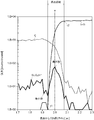
- FIG. 1 shows the results of mass spectrometry in the thickness direction of the film by TOF-SIMS as an example of the cured resin film of the present invention.
- 2 shows an enlarged view of the vicinity of the interface between the cured resin film and the substrate in the analysis result of FIG.
- FIG. 1 shows an apparatus manufactured by ION-TOF, manufactured by TOF. Co., Ltd., for a partition wall B made of a cured resin film obtained in Example 1 of an embodiment to be described later.
- the results of TOF-SIMS analysis using SIMS5 and Ar clusters as sputter ions are shown below. The conditions at that time are as follows.
- the horizontal axis of the thickness direction profile of the cured resin film obtained by the TOF-SIMS analysis is usually given as the sputtering time.
- the sputtering time As a method for converting the sputtering time into the distance (thickness) from the surface as shown on the horizontal axis of FIG. 1 and FIG. 2, the thickness (film thickness) of the resin cured film measured in advance and the surface of the resin cured film from the following There is a method of conversion using the sputtering time to the interface between the cured resin film and the substrate defined in the method.
- the method for measuring the thickness of the cured resin film is not particularly limited.
- the film thickness can be measured by electron microscope observation of a cross section of the cured resin film.
- the thickness of the cured resin film is a laser microscope (manufactured by Keyence Corporation, apparatus name: VK-8500) as described later.
- the time was converted to distance by the sputtering time from the film thickness and the surface of the cured resin film to the interface between the cured resin film and the substrate defined below.
- the acquisition of the profile is interrupted during measurement of the cured resin film, the depth of the obtained analysis crater is measured with a stylus-type film thickness meter, and the sputter on the cured resin film is measured.
- FIG. 2 in the thickness direction of the resin cured film is analyzed by TOF-SIMS, C - (. Figure 1, in Figure 2, indicated by dotted lines) the intensity profile of the secondary ions, Si 2 O 5 H - secondary ion intensity profile (FIG. 1, in FIG. 2, indicated by a thick solid line.) and InO 2 - intensity profile of the secondary ions (Fig. 1, in FIG. 2, indicated by the thin solid line.) 3
- the intensity profile of the species is shown.
- the horizontal axis represents the distance (thickness) from the surface
- the position of thickness “0” is the surface of the cured resin film
- the surface area is from 0 to 0.1 ⁇ m (100 nm) in thickness.
- Carbon atoms which is a main component of the resin cured film C - are analyzed as secondary ions.
- the transparent electrode made of indium tin oxide (ITO) film on the surface on the substrate side is formed, the main components of the substrate side InO 2 - as secondary ion Be analyzed.
- the interface region between the cured resin film and the substrate starts from the rise start point (indicated by t1 in FIG. 2) of the intensity profile of InO 2 ⁇ that is the secondary ion of the main component of the substrate. This refers to the area up to the rising end point (indicated by t2 in FIG. 2).
- the intensity of InO 2 ⁇ at t1 is I t1
- the intensity of InO 2 ⁇ at t2 is I t2
- a point in the interface region having an intensity of (I t2 ⁇ I t1 ) / 2 is the interface (in FIG. T.)
- the distance from the surface of the cured resin film to this interface is the film thickness.
- the interface region, the resin cured film composed mainly C - secondary ion and the substrate surface mainly composed of InO 2 - relationship between the strengths of the secondary ions is a region change places completely.
- the intensity profile of the secondary ions on the substrate side by TOF-SIMS used for specifying the interface region is not limited to the intensity profile of the secondary ions of the main component constituting the substrate.
- the intensity profile of secondary ions on the substrate side is obtained using a specific component other than the main component.
- the specific component is a component that is not contained in the cured resin film, and preferably has a secondary ion intensity by TOF-SIMS that is a certain value or more at the end point of the increase.
- the minimum value of magnitude in thickness except surface area and surface area coverage (internal resin cured film) Si 2 O 5 H - minimum value
- Si 2 O 5 H - minimum value Si 2 O 5 H - minimum for Si 2 O 5 H - ratio of the maximum value [Si 2 O 5 H - maximum / Si 2 O 5 H - Minimum becomes 3.2 .
- the above [Si 2 O 5 H ⁇ maximum value / Si 2 O 5 H ⁇ minimum value] is more than 1 and 10 or less.
- the strength of Si 2 O 5 H ⁇ by TOF-SIMS is used as an index indicating the abundance of a component containing Si atoms (hereinafter also referred to as Si component) in the cured resin film.
- Si 2 O 5 H — can be treated as a representative Si component peak derived from a partial hydrolysis condensate of a hydrolyzable silane compound mixture such as compound (D), and the cured resin film of the present invention It became an index representing the composition characteristics of
- Si 2 O 5 H ⁇ maximum value / Si 2 O 5 H ⁇ minimum value is preferably 1.1 to 10, particularly preferably 1.1 to 8.
- the cured resin film of the present invention is, in the mass analysis by TOF-SIMS, a thickness range excluding the surface area of the cured resin film and the interface area with the substrate, that is, C ⁇ in the cured resin film.
- the ratio of the average value of the intensity of, - the Si 2 O 5 H to the average value of the intensity is [Si 2 O 5 H - average value - average value / C] is 0.001 or more.
- FIG. 1 shows that the C ⁇ intensity profile inside the cured resin film takes a substantially constant value at a high level. Therefore, in the present invention, the abundance of the Si component shown in the Si 2 O 5 H ⁇ strength profile inside the cured resin film is compared with the C ⁇ strength profile, that is, the above [Si 2 O 5 H ⁇ Average value / C - average value].
- the exposure method is not limited to the following.
- SAICAS Surface And Interfacial Cutting Analysis System
- SAICAS Surface And Interfacial Cutting Analysis System
- an exposure method using XPS or TOF-SIMS is performed by using a sputtering gun built in the apparatus such as argon, cesium, oxygen, gallium, gold, etc.
- a sputtering gun built in the apparatus such as argon, cesium, oxygen, gallium, gold, etc.
- the thin film on the upper part of the (resin cured film) can be removed to expose the partition wall surface.
- a gap is formed above and below the partition by dissolving both or one of the electrodes sandwiched between the top and bottom of the partition (cured resin film) with acid or alkali.
- the partition wall surface can be exposed by a method of making and peeling the laminate.
- the cured resin film of the present invention is not particularly limited as long as it is a cured resin film formed on a substrate and has the compositional characteristics (I) to (III) described above by analysis using XPS and TOF-SIMS. .
- the cured resin film of the present invention having such characteristics can be formed on a substrate using, for example, the negative photosensitive resin composition of the present invention described below.
- the negative photosensitive resin composition of the present invention comprises a photocurable alkali-soluble resin or alkali-soluble monomer (A), a photopolymerization initiator (B), and an ink repellent agent (C) having a fluorine atom.
- a hydrolyzable silane compound having a hydrolyzable silane compound having a mercapto group and a hydrolyzable group and / or a hydrolyzable silane compound having a group having an ethylenic double bond and a hydrolyzable group It is a partially hydrolyzed condensate of M1) and contains a compound (D) that does not contain a fluorine atom.
- the negative photosensitive resin composition of the present invention further contains a crosslinking agent (E), a solvent (F), a colorant (G), and other optional components as necessary.
- E crosslinking agent
- F solvent
- G colorant
- Alkali-soluble resin or alkali-soluble monomer (A) The alkali-soluble resin will be described with a symbol (AP) and the alkali-soluble monomer with a symbol (AM).
- the alkali-soluble resin (AP) a photosensitive resin having an acidic group and an ethylenic double bond in one molecule is preferable.
- the exposed portion of the negative photosensitive resin composition is polymerized and cured by radicals generated from the photopolymerization initiator (B). The exposed portion thus cured is not removed with an alkaline developer.
- the alkali-soluble resin (AP) has an acidic group in the molecule, the non-exposed portion of the uncured negative photosensitive resin composition can be selectively removed with an alkaline developer.
- the cured film can be in the form of a partition that partitions a predetermined region into a plurality of sections.
- Examples of the acidic group include a carboxy group, a phenolic hydroxyl group, a sulfo group, and a phosphoric acid group. These may be used alone or in combination of two or more.
- Examples of the ethylenic double bond include double bonds having an addition polymerization property such as a (meth) acryloyl group, an allyl group, a vinyl group, a vinyloxy group, and a vinyloxyalkyl group. These may be used alone or in combination of two or more.
- some or all of the hydrogen atoms possessed by the ethylenic double bond may be substituted with an alkyl group such as a methyl group.
- the alkali-soluble resin (AP) includes a resin (A-1) having a side chain having an acidic group and a side chain having an ethylenic double bond, and an acidic group and an ethylenic double bond introduced into the epoxy resin.
- Resin (A-2) and the like may be used alone or in combination of two or more.
- Resin (A-1) can be synthesized, for example, by the following method (i) or (ii).
- a monomer having a reactive group other than an acidic group in the side chain, such as a hydroxyl group and an epoxy group, and a monomer having an acidic group in the side chain are copolymerized and reacted.
- a copolymer having a side chain having a functional group and a side chain having an acidic group is obtained.
- this copolymer is reacted with a compound having a functional group capable of bonding to the reactive group and an ethylenic double bond.
- the amount of the acidic group remaining after the reaction with the functional group capable of bonding to the acidic group and the compound having an ethylenic double bond React.
- the method (i) is preferably used.
- the method (i) will be specifically described.
- Monomers having a hydroxyl group as a reactive group include 2-hydroxyethyl (meth) acrylate, 2-hydroxypropyl (meth) acrylate, neopentyl glycol mono (meth) acrylate, glycerin mono (meth) acrylate, 2-hydroxy Examples include ethyl vinyl ether, 2-hydroxyethyl allyl ether, N-hydroxymethyl (meth) acrylamide, N, N-bis (hydroxymethyl) (meth) acrylamide and the like.
- the monomer having an acidic group to be copolymerized is a monomer having a phosphate group in addition to a monomer having a carboxy group described below. -(Meth) acryloyloxyethyl phosphate and the like. Copolymerization of a monomer having a hydroxyl group as a reactive group and a monomer having an acidic group can be performed by a conventionally known method.
- Examples of the compound having an ethylenic double bond and a functional group capable of bonding to a hydroxyl group to be reacted with the obtained copolymer include an acid anhydride having an ethylenic double bond, an isocyanate group and an ethylenic double bond.
- Examples of the acid anhydride having an ethylenic double bond include maleic anhydride, itaconic anhydride, citraconic anhydride, methyl-5-norbornene-2,3-dicarboxylic anhydride, 3,4,5,6-tetrahydrophthal And acid anhydride, cis-1,2,3,6-tetrahydrophthalic anhydride, and 2-buten-1-ylsuccinic anhydride.
- Examples of the compound having an isocyanate group and an ethylenic double bond include 2- (meth) acryloyloxyethyl isocyanate and 1,1-bis ((meth) acryloyloxymethyl) ethyl isocyanate.
- Examples of the compound having an acyl chloride group and an ethylenic double bond include (meth) acryloyl chloride.
- Examples of the monomer having an epoxy group as a reactive group include glycidyl (meth) acrylate and 3,4-epoxycyclohexylmethyl (meth) acrylate.
- a monomer having an acidic group to be copolymerized with a monomer having an epoxy group as a reactive group the same monomer as described in the monomer having a hydroxyl group as a reactive group can be used, Copolymerization of a monomer having an epoxy group as a reactive group and a monomer having an acidic group can also be performed by a conventionally known method.
- Examples of the compound having an ethylenic double bond and a functional group capable of bonding to an epoxy group to be reacted with the obtained copolymer include a compound having a carboxy group and an ethylenic double bond.
- Specific examples of such compounds include (meth) acrylic acid, vinyl acetic acid, crotonic acid, itaconic acid, maleic acid, fumaric acid, cinnamic acid and their salts, and monoesters in the case of dibasic acids.
- a carboxy group may be introduced into the resin (A-1) by reacting the hydroxyl group generated here with an acid anhydride in which the dehydration condensation part of the carboxylic acid forms part of the cyclic structure.
- Monomers having a carboxy group as a reactive group include (meth) acrylic acid, vinyl acetic acid, crotonic acid, itaconic acid, maleic acid, fumaric acid, cinnamic acid and their salts, and monobasic acid in the case of dibasic acids. Examples include esters. In addition, these monomers are used also as a monomer which has the acidic group mentioned above.
- the monomer When using a monomer having a carboxy group as a reactive group, the monomer is polymerized as described above.
- the compound having an ethylenic double bond and a functional group capable of bonding to a carboxy group to be reacted with the obtained polymer include compounds having an epoxy group and an ethylenic double bond. Examples of such compounds include glycidyl (meth) acrylate and 3,4-epoxycyclohexylmethyl (meth) acrylate.
- the amount of the functional group capable of bonding to the carboxy group and the compound having an ethylenic double bond to be reacted with the polymer having a carboxy group is such that the carboxy group in the polymer becomes an acidic group after the reaction. The amount remaining in the chain.
- Resin (A-2) is synthesized by reacting an epoxy resin with a compound having a carboxy group and an ethylenic double bond, which will be described later, and then reacting with a polyvalent carboxylic acid or an anhydride thereof. Can do. Specifically, an ethylenic double bond is introduced into the epoxy resin by reacting an epoxy resin with a compound having a carboxy group and an ethylenic double bond. Next, a carboxyl group can be introduced by reacting a polycarboxylic acid or an anhydride thereof with an epoxy resin into which an ethylenic double bond has been introduced.
- the epoxy resin is not particularly limited, and bisphenol A type epoxy resin, bisphenol F type epoxy resin, phenol novolac type epoxy resin, cresol novolac type epoxy resin, trisphenol methane type epoxy resin, epoxy resin having a naphthalene skeleton, the following formula ( An epoxy resin having a biphenyl skeleton represented by A-2a), a fluorenyl-substituted bisphenol A type epoxy resin represented by the following formula (A-2b), and a biphenyl skeleton represented by the following formula (A-2c) An epoxy resin etc. are mentioned.
- v is an integer of 1 to 50, preferably an integer of 2 to 10.
- the hydrogen atoms of the benzene ring are each independently an alkyl group having 1 to 12 carbon atoms or a halogen atom. Or a part of hydrogen atoms may be substituted with a phenyl group which may be substituted with a substituent.
- R 31 , R 32 , R 33 and R 34 are each independently a hydrogen atom, a chlorine atom or an alkyl group having 1 to 5 carbon atoms, and w is 0 or 1 An integer of ⁇ 10.
- the hydrogen atoms of the benzene ring are each independently an alkyl group having 1 to 12 carbon atoms, a halogen atom, or a phenyl group in which some of the hydrogen atoms may be substituted with a substituent.
- Z is an integer of 0 or 1 to 10).
- epoxy resins represented by the formulas (A-2a) to (A-2c) are reacted with a compound having a carboxy group and an ethylenic double bond and then reacted with a polyvalent carboxylic acid anhydride. It is preferable to use a mixture of a dicarboxylic acid anhydride and a tetracarboxylic dianhydride as the polyvalent carboxylic acid anhydride.
- (meth) acrylic acid vinyl acetic acid, crotonic acid, itaconic acid, maleic acid, fumaric acid, cinnamic acid and their salts
- dibasic acids as compounds having a carboxy group and an ethylenic double bond Monoesters are preferred, and (meth) acrylic acid is particularly preferred.
- alkali-soluble resin (AP) peeling of the cured film during development can be suppressed, and a high-resolution dot pattern can be obtained, and the linearity of the pattern when the dots are linear is good.
- resin (A-2) it is preferable to use the resin (A-2).
- Examples of the resin (A-2) include a resin in which an acidic group and an ethylenic double bond are introduced into a bisphenol A type epoxy resin, a resin in which an acidic group and an ethylenic double bond are introduced into a bisphenol F type epoxy resin, phenol Resin with acid group and ethylenic double bond introduced into novolac type epoxy resin, resin with acid group and ethylenic double bond introduced into cresol novolac type epoxy resin, acid group and ethylene into trisphenol methane type epoxy resin A resin into which an acidic double bond is introduced, or a resin in which an acidic group and an ethylenic double bond are introduced into the epoxy resins represented by the formulas (A-2a) to (A-2c) is particularly preferable.
- alkali-soluble monomer for example, a monomer (A-3) having a side chain having an acidic group and a side chain having an ethylenic double bond is preferably used.
- the acidic group and the ethylenic double bond are the same as those of the alkali-soluble resin (AM).
- Examples of the monomer (A-3) include 2,2,2-triacryloyloxymethylethylphthalic acid.
- the alkali-soluble resin or alkali-soluble monomer (A) contained in the negative photosensitive resin composition may be used alone or in combination of two or more.
- the content of the alkali-soluble resin or alkali-soluble monomer (A) in the total solid content in the negative photosensitive resin composition is preferably 5 to 80% by mass, particularly preferably 10 to 60% by mass. When the content ratio is in the above range, the photo-curing property and developability of the negative photosensitive resin composition are good.
- the photopolymerization initiator (B) in the present invention is not particularly limited as long as it is a compound having a function as a photopolymerization initiator, and a compound that generates a radical by light is preferable.
- Examples of the photopolymerization initiator (B) include ⁇ -diketones such as methylphenylglyoxylate and 9,10-phenanthrenequinone; acyloins such as benzoin; benzoin methyl ether, benzoin ethyl ether, benzoin isopropyl ether, and the like.
- thioxanthones such as thioxanthone, 2-chlorothioxanthone, 2-methylthioxanthone, 2,4-dimethylthioxanthone, isopropylthioxanthone, 2,4-diethylthioxanthone; benzophenone, 4,4'-bis (dimethylamino) Benzophenones such as benzophenone and 4,4′-bis (diethylamino) benzophenone; acetophenone, 2- (4-toluenesulfonyloxy) -2-phenylacetophenone, p-dimethylaminoacetophene Non, 2,2′-dimethoxy-2-phenylacetophenone, p-methoxyacetophenone, 2-methyl-1- [4- (methylthio) phenyl] -2-morpholinopropan-1-one, 2-benzyl-2- Acetophenones such as dimethyla
- photopolymerization initiators (B) benzophenones, aminobenzoic acids, aliphatic amines, and thiol compounds are preferably used together with other radical initiators because they may exhibit a sensitizing effect.
- examples of the photopolymerization initiator (B) include 2-methyl-1- [4- (methylthio) phenyl] -2-morpholinopropan-1-one, 2-benzyl-2-dimethylamino-1- (4-morpho Linophenyl) -butan-1-one, 1,2-octanedione, 1- [4- (phenylthio)-, 2- (O-benzoyloxime), ethanone 1- [9-ethyl-6- (2-methyl) Benzoyl) -9H-carbazol-3-yl] -1- (O-acetyloxime) or 2,4-diethylthioxanthone is preferred.
- combinations of these with benzophenones for example, 4,4′-bis (
- the content of the photopolymerization initiator (B) in the total solid content in the negative photosensitive resin composition is preferably 0.1 to 50% by mass, more preferably 0.5 to 30% by mass, and 5 to 15% by mass. % Is particularly preferred. When the content ratio is in the above range, the photo-curing property and developability of the negative photosensitive resin composition are good.
- the ink repellent agent (C) having a fluorine atom in the present invention has a property of transferring to the upper surface (upper surface transferability) and ink repellency in the process of forming a cured film using a negative photosensitive resin composition containing the same.
- the upper layer portion including the upper surface of the resulting cured film is a layer in which the ink repellent agent (C) is present at a high concentration (hereinafter, also referred to as “ink repellent layer”).
- ink repellent layer is selectively imparted to the upper surface of the cured film.
- the content of fluorine atoms in the ink repellent agent (C) is preferably 1 to 40% by mass, more preferably 5 to 35% by mass, and particularly preferably 10 to 30% by mass.
- the fluorine atom content of the ink repellent agent (C) is at least the lower limit of the above range, good ink repellency can be imparted to the upper surface of the cured film, and when it is at most the upper limit, the negative photosensitive resin composition Good compatibility with other components in the product.
- the ink repellent agent (C) include the following ink repellent agent (C1) and ink repellent agent (C2).
- Ink-repellent agent (C1) Partially hydrolyzed condensate of hydrolyzable silane compound mixture (M2) containing a hydrolyzable silane compound having a fluoroalkylene group and / or a fluoroalkyl group and a hydrolyzable group.
- Ink repellent agent (C2) a compound having a main chain of a hydrocarbon chain and a side chain having a fluorine atom.
- the ink repellent agent (C1) and the ink repellent agent (C2) are used alone or in combination.
- the ink repellent agent (C1) is a partial hydrolysis condensate of the hydrolyzable silane compound mixture (M2) (hereinafter also simply referred to as “mixture (M2)”).
- the mixture (M2) contains, as an essential component, a hydrolyzable silane compound having a fluoroalkylene group and / or a fluoroalkyl group and a hydrolyzable group (hereinafter also referred to as “hydrolyzable silane compound (s1)”).
- hydrolyzable silane compound (s1) optionally containing a hydrolyzable silane compound other than the hydrolyzable silane compound (s1).
- hydrolyzable silane compound (s2) a hydrolyzable silane compound in which four hydrolyzable groups are bonded to a silicon atom.
- Hydrolyzable silane compound (s3) a hydrolyzable silane compound having a group having an ethylenic double bond and a hydrolyzable group and containing no fluorine atom.
- Hydrolyzable silane compound (s4) a hydrolyzable silane compound having only a hydrocarbon group and a hydrolyzable group as a group bonded to a silicon atom.
- Hydrolyzable silane compound (s5) a hydrolyzable silane compound having a mercapto group and a hydrolyzable group and containing no fluorine atom.
- hydrolyzable silane compounds (s1) to (s5) will be described.
- the ink repellent agent (C1) in the present invention has a fluorine atom in the form of a fluoroalkylene group and / or a fluoroalkyl group by using the hydrolyzable silane compound (s1). Has ink properties.
- the hydrolyzable silane compound (s1) is selected from the group consisting of a fluoroalkyl group, a perfluoroalkylene group and a perfluoroalkyl group. It is more preferable to have at least one, and it is particularly preferable to have a perfluoroalkyl group.
- a perfluoroalkyl group containing an etheric oxygen atom is also preferred. That is, the most preferable compound as the hydrolyzable silane compound (s1) is a compound having a perfluoroalkyl group and / or a perfluoroalkyl group containing an etheric oxygen atom.
- hydrolyzable group examples include an alkoxy group, a halogen atom, an acyl group, an isocyanate group, an amino group, and a group in which at least one hydrogen of the amino group is substituted with an alkyl group.
- a hydroxyl group sianol group
- a hydrolysis reaction is formed by a hydrolysis reaction, and further, a reaction that forms a Si—O—Si bond by a condensation reaction between molecules facilitates smooth progress.
- a methoxy group, an ethoxy group, and a chlorine atom are more preferable, and a methoxy group and an ethoxy group are particularly preferable.
- a hydrolysable silane compound (s1) may be used individually by 1 type, or may use 2 or more types together.
- hydrolyzable silane compound (s1) a compound represented by the following formula (cx-1) is preferable.
- R F11 is a divalent organic group having 1 to 16 carbon atoms which may contain an etheric oxygen atom, including at least one fluoroalkylene group.
- R H11 is a hydrocarbon group having 1 to 6 carbon atoms.
- a is 1 or 2
- b is 0 or 1
- a + b is 1 or 2.
- A is a fluorine atom or a group represented by the following formula (Ia).
- R H12 is a hydrocarbon group having 1 to 6 carbon atoms. c is 0 or 1; X 11 and X 12 are hydrolyzable groups. If X 11 there are a plurality, they may be the same or different from each other. If X 12 there are a plurality, they may be the same or different from each other. When a plurality of AR F11 are present, these may be different from each other or the same.
- the compound (cx-1) is a fluorine-containing hydrolyzable silane compound having one or two bifunctional or trifunctional hydrolyzable silyl groups.
- R H11 and R H12 are preferably a hydrocarbon group having 1 to 3 carbon atoms, and particularly preferably a methyl group.
- a is 1 and b is 0 or 1.
- Specific examples and preferred embodiments of X 11 and X 12 are as described above.
- hydrolyzable silane compound (s1) a compound represented by the following formula (cx-1a) is particularly preferable.
- DR F12 -Q 11 -SiX 11 3 (cx-1a) In the formula (cx-1a), each symbol is as follows.
- R F12 is a perfluoroalkylene group which may contain an etheric oxygen atom having 2 to 15 carbon atoms.
- D is a fluorine atom or a group represented by the following formula (Ib).
- X 11 and X 12 are hydrolyzable groups.
- the three X 11 may be different from each other or the same.
- the three X 12 may be different from each other or the same.
- Q 11 and Q 12 represent a divalent organic group containing no fluorine atom having 1 to 10 carbon atoms.
- R F12 is preferably a perfluoroalkylene group having 4 to 8 carbon atoms and a perfluoroalkylene group containing an etheric oxygen atom having 4 to 10 carbon atoms.
- a perfluoroalkylene group having 4 to 8 carbon atoms is more preferred, and a perfluoroalkylene group having 6 carbon atoms is particularly preferred.
- R F12 represents a perfluoroalkylene group having 3 to 15 carbon atoms and a perfluoroalkyl group containing an etheric oxygen atom having 3 to 15 carbon atoms.
- An alkylene group is preferred, and a perfluoroalkylene group having 4 to 6 carbon atoms is particularly preferred.
- the ink repellent agent (C1) has good ink repellency, and the compound (cx-1a) is excellent in solubility in a solvent.
- R F12 examples include a linear structure, a branched structure, a ring structure, a structure having a partial ring, and the like, and a linear structure is preferable.
- R F12 include the following groups. - (CF 2) 4 -, - (CF 2) 6 -, - (CF 2) 8 -, -CF 2 CF 2 OCF 2 CF 2 OCF 2 -, - CF 2 CF 2 OCF 2 CF 2 OCF 2 CF 2 -, - CF 2 CF 2 OCF 2 CF 2 OCF 2 CF 2 OCF 2 -, - CF 2 CF 2 OCF 2 CF 2 OCF 2 CF 2 OCF 2 CF 2 OCF 2 -, - CF 2 CF 2 OCF 2 CF 2 OCF 2 CF 2 OCF 2 CF 2 OCF 2 CF 2 —.
- Q 11 and Q 12 indicate that Si is bonded to the right bond and R F12 is bonded to the left bond, specifically, — (CH 2 ) i1 — (i1 is 1 to 5) Integer)), —CH 2 O (CH 2 ) i2 — (i2 is an integer of 1 to 4), —SO 2 NR 1 — (CH 2 ) i3 — (R 1 is a hydrogen atom, a methyl group, or an ethyl group) , I3 is an integer of 1 to 4, and the total number of carbon atoms of R 1 and (CH 2 ) i3 is an integer of 4 or less.), — (C ⁇ O) —NR 1 — (CH 2 ) i4 — (R 1 is the same as above, i4 is an integer of 1 to 4, and the total number of carbon atoms of R 1 and (CH 2 ) i4 is an integer of 4 or less). Is preferred. As Q 11 and Q 12 , —
- Q 11 and Q 12 are preferably groups represented by — (CH 2 ) i1 —. i1 is more preferably an integer of 2 to 4, and i1 is particularly preferably 2.
- Q 11 and Q 12 include — (CH 2 ) i1 —, —CH 2 O (CH 2 ) i2 —, —SO 2 NR 1 — ( Groups represented by CH 2 ) i3 — and — (C ⁇ O) —NR 1 — (CH 2 ) i4 — are preferred.
- — (CH 2 ) i1 — is more preferable, i1 is more preferably an integer of 2 to 4, and i1 is particularly preferably 2.
- D is a fluorine atom
- specific examples of the compound (cx-1a) include the following compounds. F (CF 2 ) 4 CH 2 CH 2 Si (OCH 3 ) 3 , F (CF 2 ) 6 CH 2 CH 2 Si (OCH 3 ) 3 , F (CF 2 ) 6 CH 2 CH 2 CH 2 Si (OCH 3 ) 3 , F (CF 2 ) 8 CH 2 CH 2 Si (OCH 3 ) 3 , F (CF 2) 3 OCF ( CF 3) CF 2 O (CF 2) 2 CH 2 CH 2 Si (OCH 3) 3, F (CF 2) 2 O ( CF 2) 2 O (CF 2) 2 CH 2 CH 2 Si (OCH 3) 3.
- the content of the hydrolyzable silane compound (s1) in the mixture (M2) is such that the fluorine atom content in the partially hydrolyzed condensate obtained from the mixture is 1 to 40% by mass, more preferably 5 to 35% by mass, The ratio is preferably 10 to 30% by mass.
- the content ratio of the hydrolyzable silane compound (s1) is not less than the lower limit of the above range, good ink repellency can be imparted to the upper surface of the cured film. Compatibility with the decomposable silane compound is improved.
- the ink repellent agent (C1) In the cured film obtained by curing the negative photosensitive resin composition containing the ink repellent agent (C1) by adding the hydrolyzable silane compound (s2) to the mixture (M2) in the present invention, the ink repellent agent ( The film-forming property after C1) shifts to the upper surface can be improved. That is, since the number of hydrolyzable groups in the hydrolyzable silane compound (s2) is large, the ink repellent agent (C1) is well condensed after moving to the upper surface, and a thin film is formed on the entire upper surface. It is considered to be an ink layer.
- hydrolyzable silane compound (s2) in the mixture (M2), the ink repellent agent (C1) is easily dissolved in the hydrocarbon solvent.
- a hydrolysable silane compound (s2) may be used individually by 1 type, or may use 2 or more types together.
- hydrolyzable group those similar to the hydrolyzable group of the hydrolyzable silane compound (s1) can be used.
- the hydrolyzable silane compound (s2) can be represented by the following formula (cx-2). SiX 2 4 (cx-2) In formula (cx-2), X 2 represents a hydrolyzable group, and four X 2 may be different from each other or the same. As X 2 , the same groups as those for X 11 and X 12 are used.
- the compound (cx-2) include the following compounds. Further, as the compound (cx-2), a partial hydrolysis-condensation product obtained by partial hydrolysis-condensation of a plurality of them in advance may be used as necessary. Si (OCH 3 ) 4 , Si (OCH 2 CH 3 ) 4 , A partially hydrolyzed condensate of Si (OCH 3 ) 4 (for example, methyl silicate 51 (trade name) manufactured by Colcoat Co.), Partially hydrolyzed condensate of Si (OCH 2 CH 3 ) 4 (for example, ethyl silicate 40 and ethyl silicate 48 (both trade names) manufactured by Colcoat).
- Si (OCH 3 ) 4 for example, methyl silicate 51 (trade name) manufactured by Colcoat Co.
- Partially hydrolyzed condensate of Si (OCH 2 CH 3 ) 4 for example, ethyl silicate 40 and ethyl silicate 48 (both trade names) manufactured by Colcoat).
- the content of the hydrolyzable silane compound (s2) in the mixture (M2) is preferably 0.01 to 5 mol, particularly 0.05 to 3 mol, relative to 1 mol of the hydrolyzable silane compound (s1). preferable.
- the content ratio is not less than the lower limit of the above range, the film forming property of the ink repellent agent (C1) is good, and when it is not more than the upper limit value, the ink repellent property of the ink repellent agent (C1) is good.
- a hydrolysable silane compound (s3) may be used individually by 1 type, or may use 2 or more types together.
- hydrolyzable group those similar to the hydrolyzable group of the hydrolyzable silane compound (s1) can be used.
- group having an ethylenic double bond a (meth) acryloyloxy group and a vinylphenyl group are preferable, and a (meth) acryloyloxy group is particularly preferable.
- hydrolyzable silane compound (s3) a compound represented by the following formula (cx-3) is preferable.
- Y is a group having an ethylenic double bond.
- Q 3 is a divalent organic group containing no fluorine atom having 1 to 6 carbon atoms.
- R H3 is a hydrocarbon group having 1 to 6 carbon atoms.
- X 3 is a hydrolyzable group.
- g is 1 or 2
- h is 0 or 1
- g + h is 1 or 2.
- R H3 the same groups as R H11 and R H12 are used.
- X 3 the same groups as those for X 11 and X 12 are used.
- the content of the hydrolyzable silane compound (s3) in the mixture (M2) is preferably 0.1 to 5 mol, particularly 0.5 to 4 mol, relative to 1 mol of the hydrolyzable silane compound (s1). preferable.
- the content ratio is not less than the lower limit of the above range, the upper surface transferability of the ink repellent agent (C1) is good, and the ink repellent agent (C1) has fixability in the ink repellent layer including the upper surface after the upper surface shift.
- the storage stability of the ink repellent agent (C1) is good.
- the amount is not more than the upper limit, the ink repellency of the ink repellent (C1) is good.
- a bulge may be formed at the end of the upper surface of the partition wall obtained by curing the negative photosensitive resin composition. This is a microscopic level observed with a scanning electron microscope (SEM) or the like. The present inventor has confirmed that the content of F and / or Si is higher than that of the other portions in this excitement.
- the present inventor replaces a part of the hydrolyzable silane compound (s2) with a hydrolyzable silane compound (s4) having a small number of hydrolyzable groups.
- a hydrolyzable silane compound (s4) having a small number of hydrolyzable groups it was found that the occurrence of the swell can be suppressed.
- the film forming property of the ink repellent agent (C1) is increased by a reaction between silanol groups generated by the hydrolyzable silane compound (s2) having a large number of hydrolyzable groups.
- the above climax is considered to occur.
- hydrolyzable group those similar to the hydrolyzable group of the hydrolyzable silane compound (s1) can be used.
- a hydrolysable silane compound (s4) may be used individually by 1 type, or may use 2 or more types together.
- hydrolyzable silane compound (s4) a compound represented by the following formula (cx-4) is preferable.
- R H4 is a hydrocarbon group having 1 to 20 carbon atoms.
- X 4 is a hydrolyzable group.
- j is an integer of 1 to 3, preferably 2 or 3. When a plurality of R H4 are present, these may be different from each other or the same. If X 4 there are a plurality, they may be the same or different from each other.
- R H4 examples include an aliphatic hydrocarbon group having 1 to 20 carbon atoms or an aromatic hydrocarbon group having 6 to 10 carbon atoms when j is 1, and an alkyl group having 1 to 10 carbon atoms. Group, phenyl group and the like are preferable. When j is 2 or 3, R H4 is preferably a hydrocarbon group having 1 to 6 carbon atoms, more preferably a hydrocarbon group having 1 to 3 carbon atoms.
- X 4 the same groups as those for X 11 and X 12 are used.
- Ph represents a phenyl group.
- the content of the hydrolyzable silane compound (s4) in the mixture (M2) is preferably 0.05 to 5 mol, particularly 0.3 to 3 mol, relative to 1 mol of the hydrolyzable silane compound (s1). preferable.
- the content ratio is equal to or higher than the lower limit of the above range, it is possible to suppress the bulge of the end of the partition upper surface.
- the amount is not more than the upper limit, the ink repellency of the ink repellent (C1) is good.
- hydrolyzable silane compound (s5) By using the hydrolyzable silane compound (s5), the negative photosensitive resin composition can be cured with a lower exposure amount.
- the mercapto group in the hydrolyzable silane compound (s5) has chain transferability and is easily combined with the ethylenic double bond or the like of the alkali-soluble resin or alkali-soluble monomer (A) to promote photocuring. This is probably because of this.
- the hydrolyzable silane compound (s5) containing a mercapto group has a pKa of about 10, and is easily deprotonated, that is, dissociated in an alkaline solution.
- a hydrolysable silane compound (s5) may be used individually by 1 type, or may use 2 or more types together.
- the hydrolyzable group those similar to the hydrolyzable group of the hydrolyzable silane compound (s1) can be used.
- hydrolyzable silane compound (s5) a compound represented by the following formula (cx-5) is preferable.
- Q 5 is a divalent organic group not containing a fluorine atom having 1 to 10 carbon atoms.
- R H5 is a hydrocarbon group having 1 to 6 carbon atoms.
- X 5 is a hydrolyzable group.
- p is 1 or 2
- q is 0 or 1
- p + q is 1 or 2.
- X 5 the same groups as those described above for X 11 and X 12 are used.
- Q 5 is preferably an alkylene group having 1 to 10 carbon atoms, more preferably an alkylene group having 1 to 5 carbon atoms, and particularly preferably an alkylene group having 1 to 3 carbon atoms.
- R H5 the same groups as R H11 and R H12 are used.
- Specific examples of the compound (cx-5) include HS— (CH 2 ) 3 —Si (OCH 3 ) 3 , HS— (CH 2 ) 3 —Si (CH 3 ) (OCH 3 ) 2 and the like.
- the content of the hydrolyzable silane compound (s5) in the mixture (M2) is preferably 0.125 to 18 mol, particularly 0.125 to 8 mol, relative to 1 mol of the hydrolyzable silane compound (s1). preferable.
- the content ratio is at least the lower limit of the above range, the negative photosensitive resin composition can be cured with a lower exposure amount. Moreover, alkali solubility is improved and developability is good.
- the amount is not more than the upper limit, the ink repellency of the ink repellent (C1) is good.
- the mixture (M2) can optionally contain one or more hydrolyzable silane compounds other than the hydrolyzable silane compounds (s1) to (s5).
- hydrolyzable silane compounds include hydrolyzable silane compounds that have an alkylene oxide group and a hydrolyzable group and do not contain a fluorine atom.
- CH 3 O (C 2 H 4 O) k Si (OCH 3 ) 3 polyoxyethylene group-containing trimethoxysilane) (here, k is, for example, about 10) and the like. It is done.
- the ink repellent agent (C1) is a partial hydrolysis-condensation product of the mixture (M2).
- An example of the ink repellent agent (C1) includes the compound (cx-1a), optionally includes the compounds (cx-2) to (cx-5), and the group D in the compound (cx-1a) is a fluorine atom.
- An average composition formula of the ink repellent agent (C11) which is a partial hydrolysis-condensation product of a certain mixture (M2) is shown in the following formula (Ic).
- n1 to n5 represent the mole fraction of each structural unit relative to the total molar amount of the structural units.
- n1> 0, n2 ⁇ 0, n3 ⁇ 0, n4 ⁇ 0, n5 ⁇ 0, and n1 + n2 + n3 + n4 + n5 1.
- D is a fluorine atom.
- the ink repellent agent (C11) is actually a product (partially hydrolyzed condensate) in which a hydrolyzable group or silanol group remains, it is difficult to express this product by a chemical formula.
- the average composition formula represented by the formula (Ic) is a chemical formula when it is assumed that all of the hydrolyzable groups or silanol groups are siloxane bonds in the ink repellent agent (C11).
- the units derived from the compounds (cx-1a), (cx-2) to (cx-5) are presumed to be randomly arranged.
- n1: n2: n3: n4: n5 represents preparation of the compounds (cx-1a) and (cx-2) to (cx-5) in the mixture (M2) Consistent with composition.
- the molar ratio of each component is designed from the balance of the effect of each component.
- n1 is preferably 0.02 to 0.4 in such an amount that the fluorine atom content in the ink repellent agent (C11) falls within the above-mentioned preferable range.
- n2 is preferably from 0 to 0.98, particularly preferably from 0.05 to 0.6.
- n3 is preferably 0 to 0.8, particularly preferably 0.2 to 0.5.
- the preferred molar ratio of the above components is the same even when the mixture (M2) contains a hydrolyzable silane compound (s1) and optionally contains hydrolyzable silane compounds (s2) to (s5).
- the preferable amounts of the hydrolyzable silane compounds (s1) to (s5) in the mixture (M2) for obtaining the ink repellent agent (C1) correspond to the preferable ranges of n1 to n5, respectively.
- the ink repellent agent (C1) can be produced by hydrolyzing and condensing the mixture (M2) described above by a known method. In this reaction, it is preferable to use a commonly used inorganic acid such as hydrochloric acid, sulfuric acid, nitric acid and phosphoric acid, or an organic acid such as acetic acid, oxalic acid and maleic acid as a catalyst. Moreover, you may use alkali catalysts, such as sodium hydroxide and tetramethylammonium hydroxide (TMAH), as needed.
- TMAH tetramethylammonium hydroxide
- a known solvent can be used for the above reaction. You may mix
- the ink repellent agent (C2) is a compound having a main chain of a hydrocarbon chain and a side chain having a fluorine atom.
- the mass average molecular weight (Mw) of the ink repellent agent (C2) is preferably from 100 to 1,000,000, particularly preferably from 5,000 to 100,000. When the mass average molecular weight (Mw) is not less than the lower limit, the ink repellent agent (C2) is unlikely to move to the upper surface when a cured film is formed using the negative photosensitive resin composition. If it is less than the upper limit, the solubility of the ink repellent agent (C2) in the solvent will be good.
- the ink repellent agent (C2) is preferably a polymer containing a side chain having a fluoroalkyl group which may contain an etheric oxygen atom and / or a fluoroalkyl group which may contain an etheric oxygen atom. .
- the fluoroalkyl group may be linear or branched. Specific examples of the fluoroalkyl group include the following structures. -CF 3 , -CF 2 CF 3 , -CF 2 CHF 2 ,-(CF 2 ) 2 CF 3 ,-(CF 2 ) 3 CF 3 ,-(CF 2 ) 4 CF 3 ,-(CF 2 ) 5 CF 3 ,-(CF 2 ) 6 CF 3 ,-(CF 2 ) 7 CF 3 ,-(CF 2 ) 8 CF 3 ,-(CF 2 ) 9 CF 3 ,-(CF 2 ) 11 CF 3 ,-(CF 2 ) 15 CF 3 .
- fluoroalkyl group containing an etheric oxygen atom examples include the following structures. -CF (CF 3 ) O (CF 2 ) 5 CF 3 , -CF 2 O (CF 2 CF 2 O) r1 CF 3, —CF (CF 3 ) O (CF 2 CF (CF 3 ) O) r 2 C 6 F 13 , And —CF (CF 3 ) O (CF 2 CF (CF 3 ) O) r3 C 3 F 7 .
- r1 is an integer of 1 to 8
- r2 is an integer of 1 to 4
- r3 is an integer of 1 to 5.
- the fluoroalkyl group is preferably a perfluoroalkyl group from the viewpoint of good ink repellency.
- the number of carbon atoms in the fluoroalkyl group is preferably 4-15. If it is the said range, it is excellent in ink repellency, and when manufacturing an ink repellent agent (C2), the compatibility of the monomer which has a fluoroalkyl group, and monomers other than this monomer mentioned later becomes better.
- the ink repellent agent (C2) is preferably a polymer having a polymer unit containing a fluoroalkyl group.
- the polymer unit having a fluoroalkyl group is preferably introduced into the polymer by polymerizing a polymerizable monomer having a fluoroalkyl group.
- a fluoroalkyl group can also be introduce
- the hydrocarbon chain constituting the main chain of the ink repellent agent (C2) specifically, a main chain obtained by polymerization of a monomer having an ethylenic double bond, —Ph—CH 2 — (however, Ph Represents a benzene skeleton.) And a novolak-type main chain composed of repeating units.
- the ink repellent agent (C2) is obtained by polymerization of a monomer having an ethylenic double bond, a monomer having an ethylenic double bond and a fluoroalkyl group alone or as necessary And other monomers having an ethylenic double bond may be polymerized.
- the main chain of the ink repellent agent (C2) is a main chain obtained by polymerization of a monomer having an ethylenic double bond will be described.
- CH 2 CR 4 COOR 5 R f
- CH 2 CR 4 COOR 6 NR 4 SO 2 R f
- CH 2 CR 4 COOR 6 NR 4 COR f
- R f represents a fluoroalkyl group
- R 4 represents a hydrogen atom, a halogen atom other than a fluorine atom or a methyl group
- R 5 represents a single bond or a divalent organic group having 1 to 6 carbon atoms
- R 6 represents A divalent organic group having 1 to 6 carbon atoms is shown.
- the preferred embodiment of the fluoroalkyl group represented by R f is the same as described above.
- As the halogen atom represented by R 4 a chlorine atom is preferable.
- R 5 is, -CH 2 -, - CH 2 CH 2 -, - CH (CH 3) -, - CH 2 CH 2 CH 2 -, - C (CH 3) 2 -, - CH (CH 2 CH 3 ) —, —CH 2 CH 2 CH 2 CH 2 —, —CH (CH 2 CH 2 CH 3 ) —, —CH 2 (CH 2 ) 3 CH 2 — and —CH (CH 2 CH (CH 3 ) 2 ) —.
- the above polymerizable monomers may be used alone or in combination of two or more.
- the ink repellent agent (C2) is preferably a polymer containing a side chain having an acidic group from the viewpoint that the alkali solubility of the ink repellent agent (C2) is good.
- An acidic group may be contained in the side chain having a fluoroalkyl group.
- As the acidic group at least one acidic group selected from the group consisting of a carboxy group, a phenolic hydroxyl group and a sulfo group or a salt thereof is preferable.
- the ink repellent agent (C2) has photocrosslinkability and is contained in each other or in the negative photosensitive resin composition in the upper layer of the cured film in the production process of the cured film obtained by curing the negative photosensitive resin composition.
- a polymer containing a side chain having an ethylenic double bond is preferred.
- a polymer containing two or more ethylenic double bonds in one side chain is particularly preferred.
- the side chain having a fluoroalkyl group may contain an ethylenic double bond.
- side chain having a fluoroalkyl group there may be a side chain having an ethylenic double bond and not having a fluoroalkyl group.
- a (meth) acryloyloxy group and a vinylphenyl group are preferable, and a (meth) acryloyloxy group is particularly preferable.
- the ink repellent agent (C2) may be a polymer including a side chain having an alkylene oxide group.
- the alkylene oxide group may be contained in the form of a polyoxyalkylene chain (POA chain) in which a plurality of alkylene oxide groups are linked.
- POA chain polyoxyalkylene chain
- the alkylene oxide group itself does not have photocrosslinkability
- the ink repellent agent (C2) having an alkylene oxide group is mutually in the upper layer or in the negative type in the process of producing a cured film, as in the case of having an ethylenic double bond.
- alkylene oxide group Since the alkylene oxide group has hydrophilicity, it also has an effect of improving wettability with respect to the developer.
- An alkylene oxide group may be contained in the side chain having a fluoroalkyl group. In addition to the side chain having a fluoroalkyl group, there may be a side chain having an alkylene oxide group and not having a fluoroalkyl group.
- the ink repellent agent (C2) may include one or more side chains among a side chain having an acidic group, a side chain having an ethylenic double bond, and a side chain having an alkylene oxide group.
- One side chain may contain two or more of an acidic group, an ethylenic double bond, and an alkylene oxide group.
- the ink repellent agent (C2) can include a side chain having an acid group, a side chain having an ethylenic double bond, and a side chain having any group other than a side chain having an alkylene oxide group.
- a monomer having a fluoroalkyl group and a monomer having an acidic group and not having a fluoroalkyl group are copolymerized.
- the method is preferred.
- an acidic group can also be introduce
- Examples of the monomer having a carboxy group include (meth) acrylic acid, vinyl acetic acid, crotonic acid, itaconic acid, maleic acid, fumaric acid, cinnamic acid, and salts thereof. These may be used alone or in combination of two or more.
- Examples of the monomer having a phenolic hydroxyl group include o-hydroxystyrene, m-hydroxystyrene, and p-hydroxystyrene.
- One or more hydrogen atoms of these benzene rings are one or more hydrogen atoms of alkyl groups such as methyl, ethyl and n-butyl, alkoxy groups such as methoxy, ethoxy and n-butoxy, halogen atoms and alkyl groups.
- a halogen atom is substituted with a haloalkyl group, a nitro group, a cyano group, or an amide group.
- Examples of the monomer having a sulfo group include vinyl sulfonic acid, styrene sulfonic acid, (meth) allyl sulfonic acid, 2-hydroxy-3- (meth) allyloxypropane sulfonic acid, (meth) acrylic acid-2-sulfoethyl, Examples include (meth) acrylic acid-2-sulfopropyl, 2-hydroxy-3- (meth) acryloxypropanesulfonic acid, 2- (meth) acrylamido-2-methylpropanesulfonic acid, and salts thereof.
- the monomer having a hydroxyl group examples include 2-hydroxyethyl (meth) acrylate, 2-hydroxypropyl (meth) acrylate, 3-hydroxypropyl (meth) acrylate, 4-hydroxybutyl (meth) acrylate, 5- Hydroxypentyl (meth) acrylate, 6-hydroxyhexyl (meth) acrylate, 4-hydroxycyclohexyl (meth) acrylate, neopentyl glycol mono (meth) acrylate, 3-chloro-2-hydroxypropyl (meth) acrylate, glycerin mono ( (Meth) acrylate, 2-hydroxyethyl vinyl ether, 4-hydroxybutyl vinyl ether, cyclohexanediol monovinyl ether, 2-hydroxyethyl allyl ether, N-hydroxymethyl (meta) Acrylamide, and N, N- bis (hydroxymethyl) (meth) acrylamide. These may be used alone or in combination of two or more.
- the monomer having a hydroxyl group may be a monomer having a polyoxyalkylene chain (POA chain) whose terminal is a hydroxyl group.
- POA chain polyoxyalkylene chain
- CH 2 CHOCH 2 C 6 H 10 CH 2 O (C 2 H 4 O) k1 H
- CH 2 CHOC 4 H 8 O (C 2 H 4 O) k1 H
- CH 2 CHCOOC 2 H 4 O (C 2 H 4 O) k1 H
- CH 2 C (CH 3) COOC 2 H 4 O (C 2 H 4 O) k1 H
- CH 2 CHCOOC 2 H 4 O (C 2 H 4 O) k2 ( C 3 H 6 O) k3 H
- CH 2 C (CH 3) COOC 2 H 4 O (C 2 H 4 O) k2 (C 3 H 6 O) k3 H
- CH 2 C (CH 3) COOC 2 H 4 O (C 2 H 4 O) k2 (C 3 H 6 O) k3 H
- k1 is an integer of 1 to 100
- k2 is an integer of 0 to 100
- k3 is an integer of 1 to 100
- k2 + k3 is 1 to 100.
- Examples of the acid anhydride include acid anhydrides of compounds having two or more carboxy groups in one molecule. Examples include pivalic anhydride and trimellitic anhydride. In addition, maleic anhydride, itaconic anhydride, citraconic anhydride, phthalic anhydride, 3-methylphthalic anhydride, methyl-5-norbornene-2,3-dicarboxylic anhydride, 3,4,5,6-tetrahydrophthalic anhydride And acid anhydrides having an ethylenic double bond such as cis-1,2,3,6-tetrahydrophthalic anhydride and 2-buten-1-yl succinic anhydride. These may be used alone or in combination of two or more.
- the compound having a hydroxyl group may be a compound having one or more hydroxyl groups.
- compounds having one hydroxyl group in the molecule are preferred. These may be used alone or in combination of two or more.
- a side chain containing an acidic group, a side chain containing an acidic group and an ethylenic double bond, or a side chain containing an acidic group and an alkylene oxide group can be introduced.
- Monomers that do not contain a hydroxyl group and an acidic group and have a polyoxyalkylene chain can also be used.
- CH 2 CR 71 —COO—W— (R 72 —O) k4 —R 73 (POA-1)
- CH 2 CR 71 —OW— (R 72 —O) k4 —R 73 (POA-2)
- R 71 represents a hydrogen atom, a chlorine atom, a bromine atom, an iodine atom, a cyano group, an alkyl group having 1 to 20 carbon atoms, or an aryl group having 7 to 20 carbon atoms)
- the side chains having an acidic group the side chain having an ethylenic double bond, and the side chain having an alkylene oxide group
- a known monomer and reaction by appropriately selecting a known monomer and reaction according to a desired composition
- Fluoroalkyl group containing one or more side chains and having a fluorine atom preferably a fluoroalkyl group optionally containing an etheric oxygen atom and / or a fluoroalkyl optionally containing an etheric oxygen atom
- An ink repellent agent (C2) can be obtained as a polymer containing a side chain having a group.
- the side chain having a fluorine atom in the benzene skeleton (Ph) constituting the main chain is usually used.
- a group having an acidic group, a group having an ethylenic double bond, and an alkylene oxide group are used as the ink repellent agent (C2).
- the side chain having a fluorine atom is preferably a side chain having a fluoroalkyl group which may contain an etheric oxygen atom and / or a fluoroalkyl group which may contain an etheric oxygen atom.
- the ink repellent agent (C2) having a main chain obtained by polymerization of the monomer having the ethylenic double bond described above. The same thing is mentioned. Also in this case, it is preferable to molecularly design the ink repellent agent (C2) so that the fluorine atom content in the ink repellent agent (C2) is within the above-mentioned preferable range.
- Such an ink repellent agent (C2) may be produced by polymerizing a monomer in which each of the above groups has been previously introduced into a benzene skeleton, and reacting sites, specifically, hydroxyl group, amino group, mercapto After obtaining a polymer having a group, a sulfonic acid group, a carboxylic acid group, a carbonyl group, an ethylenic double bond, etc., the above groups are introduced into the polymer by a modification method in which a compound is appropriately reacted with the reaction site. May be.
- the content of the ink repellent agent (C) in the total solid content in the negative photosensitive resin composition is preferably 0.06 to 15% by mass, more preferably 0.13 to 5% by mass, and 0.25 to 1 .5% by mass is particularly preferred.
- the content ratio is at least the lower limit of the above range, the upper surface of the cured film formed from the negative photosensitive resin composition has excellent ink repellency. Adhesiveness of a cured film and a base material becomes it favorable that it is below the upper limit of the said range.
- the compound (D) in the present invention includes a hydrolyzable silane compound having a mercapto group and a hydrolyzable group and / or a hydrolyzable silane compound having a group having an ethylenic double bond and a hydrolyzable group. It is a partial hydrolysis condensate of the hydrolyzable silane compound mixture (M1) and is a compound that does not contain a fluorine atom.
- the compound (D) in the present invention has upper surface transferability in the process of forming a cured film using a negative photosensitive resin composition containing the compound, and the ink repellent agent (C) is applied to the upper surface of the cured film.
- the negative photosensitive resin composition is applied to a base material to form a coating film, and then usually undergoes a drying process to become a cured film by exposure. Between the formation of the coating film and before exposure, the ink repellent agent (C) and the compound (D) move to the upper layer of the coating film.
- the ink repellent agent (C) moves faster to the upper layer than the compound (D), but some of the ink repellent agent (C) is left in the middle layer without being able to move to the upper layer.
- the compound (D) moves slowly to the upper layer, the compound (D) moves uniformly to the upper layer as a whole, and therefore, it is considered that the compound (D) moves together with the ink repellent (C) left in the middle layer during the transfer to the upper layer.
- the ink repellent agent (C) and the compound (D) transferred to the upper layer are located in the uppermost layer including the upper surface of the ink repellent agent (C) having a fluorine atom, and the compound (D) is layered immediately below the ink repellent agent (C).
- the negative photosensitive resin composition contains the compound (D) together with the ink repellent agent (C), a cured film having excellent ink repellency on the upper surface can be obtained as described above. .
- the coating film masks the part corresponding to a dot and is exposed.
- the exposed portion is cured by exposure to form a partition, and the non-exposed portion is removed by subsequent development to become an opening for dot formation.
- the ink repellent agent (C) is transferred to the upper layer before the exposure by the action of the compound (D).
- the agent (C) hardly remains.
- the ink repellent agent (C) is hardly present on the side surface of the partition wall cured by exposure.
- the top surface of the partition wall has excellent ink repellency, and an opening including the side surface of the partition wall without UV / O 3 irradiation treatment. Has ink affinity and allows the ink to spread evenly and uniformly.
- the compound (D) is a partial hydrolysis condensate of the hydrolyzable silane compound mixture (M1) (hereinafter also simply referred to as “mixture (M1)”) and does not contain a fluorine atom. Therefore, all the hydrolyzable silane compounds contained in the mixture (M1) do not contain fluorine atoms.
- the hydrolyzable silane compound having a mercapto group and a hydrolyzable group and containing no fluorine atom in the mixture (M1) corresponds to the hydrolyzable silane compound (s5) used for the production of the ink repellent agent (C1). .
- the hydrolyzable silane compound (s5) in the mixture (M1) can be the same as in the case of the ink repellent agent (C1), including preferred embodiments.
- the hydrolyzable silane compound having a group having an ethylenic double bond and a hydrolyzable group in the mixture (M1) and containing no fluorine atom is a hydrolyzable used in the production of the ink repellent agent (C1). It corresponds to a silane compound (s3).
- the hydrolyzable silane compound (s3) in the mixture (M1) can be the same as in the case of the ink repellent agent (C1), including preferred embodiments.
- the mixture (M1) contains a hydrolyzable silane compound (s5) and / or a hydrolyzable silane compound (s3).
- the mixture (M1) may contain one of the hydrolyzable silane compound (s5) and the hydrolyzable silane compound (s3), or may contain both.
- the hydrolyzable silane compound (s5) is contained, one kind may be used alone, or two or more kinds may be used in combination. The same applies to the hydrolyzable silane compound (s3).
- the content of the hydrolyzable silane compound (s5) and / or the hydrolyzable silane compound (s3) in the mixture (M1) is preferably 1 to 100 mol%, preferably 20 to 70 mol, based on the total amount of the mixture (M1). % Is particularly preferred.
- the content of the hydrolyzable silane compound (s5) is in the range of 0 to 80 mol% with respect to the total amount of the mixture (M1), and the content of the hydrolyzable silane compound (s3) is the total amount of the mixture (M1). It is particularly preferably in the range of 0 to 80 mol%, and in total 20 to 70 mol%.
- the mixture (M1) optionally has a hydrolyzable silane compound (s2), an epoxy group and a hydrolyzable group in addition to the hydrolyzable silane compound (s5) and / or the hydrolyzable silane compound (s3). It is preferable to contain a hydrolyzable silane compound containing no fluorine atom (hereinafter referred to as hydrolyzable silane compound (s6)).
- the hydrolyzable silane compound (s2) in the mixture (M1) is used as a component for improving the film-forming property as in the case of the ink repellent agent (C1). It can be the same as that of the hydrolyzable silane compound (s2).
- the content of the hydrolyzable silane compound (s2) in the mixture (M1) is preferably from 0 to 99 mol%, particularly preferably from 15 to 80 mol%, based on the total amount of the mixture (M1).
- a hydrolysable silane compound (s2) may be used individually by 1 type, or may use 2 or more types together.
- X 6 is a hydrolyzable group. s is 1 or 2, t is 0 or 1, and s + t is 1 or 2. When a plurality of EQ 6 are present, these may be different from each other or the same. If X 6 is present a plurality, they may be the same or different from each other.
- X 6 the same group as X 11 and X 12 is used.
- Q 6 is preferably an alkylene group having 1 to 10 carbon atoms, more preferably an alkylene group having 1 to 5 carbon atoms, and particularly preferably an alkylene group having 1 to 3 carbon atoms.
- R H6 the same groups as those described above for R H11 and R H12 are used.
- the compound (cx-6) include E- (CH 2 ) 2 —Si (OCH 3 ) 3 , E— (CH 2 ) 3 —Si (OCH 3 ) 3 , E— (CH 2 ) 3 — Si (OCH 2 CH 3 ) 3 , E- (CH 2 ) 3 —Si (CH 3 ) (OCH 2 CH 3 ) 2 and the like can be mentioned.
- 2- (3,4-epoxycyclohexyl) ethyltrimethoxysilane, 3-glycidoxypropyltrimethoxysilane, 3-glycidoxypropyltriethoxysilane, 3-glycidoxypropylmethyldiethoxysilane Etc. are preferred.
- the mixture (M1) may further optionally contain the hydrolyzable silane compound (s4) described in the ink repellent agent (C1) and other hydrolyzable silane compounds.
- the average composition formula represented by the formula (D1) is a chemical formula assuming that all of the hydrolyzable groups or silanol groups in the compound (D1) are siloxane bonds.
- the units derived from the compounds (cx-1a) and (cx-2) to (cx-5) are presumed to be randomly arranged.
- m1: m2: m3: m4 represents the compounds (cx-3), (cx-5), (cx-2), (cx ⁇ ) in the mixture (M1). This is consistent with the charged composition of 6).
- the molar ratio of each component is designed from the balance of the effect of each component. The specific molar ratio can be converted from the mol% of each component described above.
- the preferred molar ratio of each of the above components is that the mixture (M1) contains the hydrolyzable silane compound (s5) and / or the hydrolyzable silane compound (s3), and the hydrolyzable silane compound (s2), (s6 ) Can be applied in the same manner. That is, the preferable amounts of the hydrolyzable silane compounds (s5), (s3), (s2), and (s6) in the mixture (M1) for obtaining the compound (D) are within the preferable ranges of m1 to m4, respectively. Equivalent to.
- the mass average molecular weight (Mw) of the compound (D) is preferably 150 or more, preferably 3,000 or less, and particularly preferably 500 to 2,000. When the mass average molecular weight (Mw) is at least the lower limit value, the compound (D) is less likely to shift to the upper surface when a cured film is formed using the negative photosensitive resin composition. The solubility to the solvent of a compound (D) becomes it favorable that it is below an upper limit. The mass average molecular weight (Mw) of the compound (D) can be adjusted by the production conditions.
- Compound (D) can be produced by subjecting the above-mentioned mixture (M1) to hydrolysis and condensation by a known method.
- a commonly used inorganic acid such as hydrochloric acid, sulfuric acid, nitric acid and phosphoric acid, or an organic acid such as acetic acid, oxalic acid and maleic acid
- a known solvent can be used for the above reaction. You may mix
- a compound (D) may be used individually by 1 type, or may use 2 or more types together.
- the content ratio of the compound (D) in the total solid content in the negative photosensitive resin composition is preferably 0.001 to 20% by mass, more preferably 0.01 to 10% by mass, and 0.05 to 5% by mass. Is particularly preferred.
- the content ratio is at least the lower limit of the above range, the upper surface of the cured film formed from the negative photosensitive resin composition has excellent ink repellency, and when the cured film is a partition wall, the opening is Has ink affinity and excellent wettability of ink. Storage stability will become favorable as it is below the upper limit of the said range.
- the crosslinking agent (E) optionally contained in the negative photosensitive resin composition of the present invention is a compound having two or more ethylenic double bonds in one molecule and no acidic group.
- the curability of the negative photosensitive resin composition at the time of exposure is improved, and a cured film can be formed even with a low exposure amount.
- a crosslinking agent (E) may be used individually by 1 type, or may use 2 or more types together.
- the content of the crosslinking agent (E) in the total solid content in the negative photosensitive resin composition is preferably 10 to 60% by mass, particularly preferably 20 to 55% by mass.
- solvent (F) When the negative photosensitive resin composition of the present invention contains the solvent (F), the viscosity is reduced, and the negative photosensitive resin composition can be easily applied to the substrate surface. As a result, a coating film of a negative photosensitive resin composition having a uniform film thickness can be formed.
- a known solvent is used as the solvent (F).
- a solvent (F) may be used individually by 1 type, or may use 2 or more types together.
- Examples of the solvent (F) include alkylene glycol alkyl ethers, alkylene glycol alkyl ether acetates, alcohols, and solvent naphtha.
- at least one solvent selected from the group consisting of alkylene glycol alkyl ethers, alkylene glycol alkyl ether acetates, and alcohols is preferable, propylene glycol monomethyl ether acetate, propylene glycol monomethyl ether, diethylene glycol ethyl methyl ether, and More preferred is at least one solvent selected from the group consisting of 2-propanol.
- Coloring agent (G) may be used alone or in combination of two or more.
- the content of the colorant (G) in the total solid content is preferably 15 to 65% by mass, and 20 to 50%. Mass% is particularly preferred.
- the negative photosensitive resin composition obtained when it is in the above range has good sensitivity, and the formed partition has excellent light shielding properties.
- the negative photosensitive resin composition in the present invention may further include a thermal crosslinking agent, a polymer dispersant, a dispersion aid, a silane coupling agent, fine particles, a phosphoric acid compound, a curing accelerator, a thickener, if necessary.
- You may contain 1 type (s) or 2 or more types of other additives, such as a plasticizer, an antifoamer, a leveling agent, a repellency inhibitor, and a ultraviolet absorber.
- the negative photosensitive resin composition of the present invention can be obtained by mixing predetermined amounts of the above components. If the negative photosensitive resin composition of the present invention is used, it is possible to produce a cured resin film having good ink repellency on the upper surface, in particular, a partition wall.
- the resulting cured resin film is excellent in adhesion to the substrate on which the cured film is formed.
- the partition wall is excellent in adhesion to the substrate, so that peeling during development is suppressed and a partition wall that gives an optical element with high resolution can be obtained. Further, at that time, the ink repellent agent hardly remains in the opening surrounded by the partition wall, and an opening capable of uniformly spreading the ink evenly without the UV / O 3 irradiation treatment can be obtained.
- the cured resin film of the second embodiment of the present invention is formed using the above-described negative photosensitive resin composition of the present invention.
- the cured resin film of the second embodiment of the present invention for example, applied the negative photosensitive resin composition of the present invention to the surface of a substrate such as a substrate, and dried to remove the solvent or the like as necessary. Thereafter, it is obtained by curing by exposure.
- the partition wall of the present invention is a partition wall made of the above-described cured resin film of the present invention formed so as to partition the substrate surface into a plurality of sections for forming dots.
- the partition wall is obtained by masking a portion to be a dot formation partition before exposure, developing after exposure. By development, an unexposed portion is removed by masking, and an opening corresponding to a dot forming section is formed together with a partition.
- a negative photosensitive resin composition is applied to one entire main surface of the substrate 1 to form a coating film 21.
- the ink repellent agent (C) and the compound (D) are totally dissolved and uniformly dispersed in the coating film 21.
- the ink repellent agent (C) and the compound (D) are schematically shown and do not actually exist in such a particle shape.
- the coating film 21 is dried to form a dry film 22.
- the drying method include heat drying, reduced pressure drying, and reduced pressure heat drying.
- the heating temperature is preferably 50 to 120 ° C.
- the ink repellent agent (C) and the compound (D) move to the upper layer of the dry film.
- the behavior of the ink repellent agent (C) and the compound (D) during the transfer is as described above, and the ink repellent agent (C) and the compound (D) transferred to the upper layer are ink repellent agents having fluorine atoms.
- the dry film 22 is exposed to light through a photomask 30 having a masking portion 31 having a shape corresponding to the opening surrounded by the partition walls.
- the film after the dry film 22 is exposed is referred to as an exposure film 23.
- the exposed portion 23 ⁇ / b> A is photocured, and the non-exposed portion 23 ⁇ / b> B is in the same state as the dry film 22.
- excimer laser such as visible light; ultraviolet light; far ultraviolet light; KrF excimer laser light, ArF excimer laser light, F 2 excimer laser light, Kr 2 excimer laser light, KrAr excimer laser light, and Ar 2 excimer laser light.
- Examples include light; X-ray; electron beam.
- the light to be irradiated is preferably light having a wavelength of 100 to 600 nm, more preferably light having a wavelength of 300 to 500 nm, and particularly preferably light containing i-line (365 nm), h-line (405 nm), or g-line (436 nm). Moreover, you may cut light below 330 nm as needed.
- Examples of the exposure method include whole-surface batch exposure, scan exposure, and the like. You may expose in multiple times with respect to the same location. At this time, the multiple exposure conditions may or may not be the same. Exposure amount, In any of the above exposure method, for example, preferably 5 ⁇ 1,000mJ / cm 2, more preferably 5 ⁇ 500mJ / cm 2, more preferably 5 ⁇ 300mJ / cm 2, 5 ⁇ 200mJ / cm 2 is particularly preferable, and 5 to 50 mJ / cm 2 is most preferable.
- the exposure amount is appropriately optimized depending on the wavelength of light to be irradiated, the composition of the negative photosensitive resin composition, the thickness of the coating film, and the like.
- the exposure time per unit area is not particularly limited, and is designed from the exposure power of the exposure apparatus to be used, the required exposure amount, and the like. In the case of scan exposure, the exposure time is determined from the light scanning speed.
- the exposure time per unit area is usually about 1 to 60 seconds.
- FIG. 4D shows a state after the non-exposed portion 23B is removed by development.
- the ink repellent agent (C) and the compound (D) are transferred to the upper layer, and the ink repellent agent (C) and the compound (D) are hardly present in the lower layer.
- the ink repellent (C) and the compound (D) hardly remain in the opening 5 because they are dissolved and removed by the alkali developer in the state.
- the uppermost layer including the upper surface is the ink repellent layer 4A.
- the ink repellent agent (C) may be present in a high concentration as it is to form an ink repellent layer.
- the ink repellent agent (C) may be mutually and / or It is photocured together with other photocuring components to form an ink repellent layer 4A in which the ink repellent agent (C) is firmly bonded.
- the compound (D) gathers at a high concentration, and a photocured layer 4B is formed together with each other and / or other photocuring components.
- the partition 4 may be further heated after development.
- the heating temperature is preferably 130 to 250 ° C.
- the partition 4 is hardened by heating. Further, the ink repellent agent (C) is more firmly bonded in the ink repellent layer 4A.
- the cured resin film and partition walls of the present invention thus obtained have good ink repellency on the top surface and excellent adhesion to the substrate.
- the ink repellent hardly remains in the opening after development, and therefore the ink wettability in the opening can be sufficiently ensured even without the UV / O 3 irradiation treatment.
- the width of the partition formed from the negative photosensitive resin composition of the present invention is preferably 100 ⁇ m or less, and particularly preferably 20 ⁇ m or less.
- the distance between adjacent partition walls (pattern width) is preferably 300 ⁇ m or less, and particularly preferably 100 ⁇ m or less.
- the height of the partition wall is preferably 0.05 to 50 ⁇ m, particularly preferably 0.2 to 10 ⁇ m.
- the partition wall of the present invention is used, pattern printing by the IJ method can be performed with precision as described above. Therefore, the partition of the present invention is useful as a partition for an optical element having a partition located between a plurality of dots and adjacent dots on the substrate surface where the dots are formed by the IJ method.
- the optical element of the present invention is an optical element having a plurality of dots and a partition wall of the present invention located between adjacent dots on the substrate surface.
- the dots are preferably formed by the IJ method.
- the manufacturing method of the optical element of this invention is not limited to the following.
- 5A to 5B schematically show a method of manufacturing an optical element using the partition 4 formed on the substrate 1 shown in FIG. 4D.
- the partition 4 on the substrate 1 is formed so that the opening 5 matches the dot pattern of the optical element to be manufactured.
- the ink 10 is dropped from the inkjet head 9 into the opening 5 surrounded by the partition wall 4, and a predetermined amount of ink 10 is injected into the opening 5.
- a well-known ink for optical elements is appropriately selected and used in accordance with the dot function.
- the optical element 12 in which 11 is formed is obtained.
- the optical element of the present invention can spread the ink uniformly and uniformly in the openings partitioned by the partition wall during the manufacturing process. It is an optical element having.
- optical elements examples include organic EL elements, liquid crystal element color filters, and organic TFT array elements.
- An organic TFT array element has a plurality of dots arranged in a matrix in plan view, each dot is provided with a TFT as a pixel electrode and a switching element for driving the pixel electrode, and an organic semiconductor as a semiconductor layer including a TFT channel layer An element in which a layer is used.
- the organic TFT array element is provided as a TFT array substrate in an organic EL element or a liquid crystal element.
- An organic EL element can be manufactured as follows, for example.
- a light-transmitting electrode such as tin-doped indium oxide (ITO) is formed on a light-transmitting substrate such as glass by a sputtering method or the like.
- the translucent electrode is patterned as necessary.
- partition walls are formed in a lattice shape in plan view along the outline of each dot by photolithography including coating, exposure and development.
- the materials of the hole injection layer, the hole transport layer, the light emitting layer, the hole blocking layer, and the electron injection layer are applied and dried in the dots by the IJ method, and these layers are sequentially stacked.
- the kind and number of organic layers formed in the dots are appropriately designed.
- a reflective electrode such as aluminum is formed by vapor deposition or the like.
- Examples of the negative photosensitive resin composition of the present invention are shown in Examples 1 to 29, and Comparative Examples are shown in Examples 31 to 35.
- Examples of the cured resin film according to the first embodiment of the present invention are shown in Examples 1 to 29 and Example 33.
- the column is kept at 37 ° C., tetrahydrofuran is used as the eluent, the flow rate is 0.2 mL / min, and a 0.5% tetrahydrofuran solution of the measurement sample is used. 40 ⁇ L was injected.
- fluorine atom content The content of fluorine atoms was calculated by 19 F NMR measurement using 1,4-ditrifluoromethylbenzene as a standard substance.
- Alkali-soluble resin (AP) Alkali-soluble resin (A1) composition: A cresol novolac epoxy resin is reacted with acrylic acid and then 1,2,3,6-tetrahydrophthalic anhydride, and a resin into which an acryloyl group and a carboxy group are introduced is purified with hexane Composition (solid content 70% by mass, solvent naphtha 30% by mass) of the obtained resin (alkali-soluble resin (A1), acid value 60 mgKOH / g).
- Alkali-soluble resin (A2) composition A bisphenol A type epoxy resin is reacted with acrylic acid and then 1,2,3,6-tetrahydrophthalic anhydride, and the resin introduced with acryloyl group and carboxy group is purified with hexane Composition (solid content 70% by mass, solvent naphtha 30% by mass) of the obtained resin (alkali-soluble resin (A2), acid value 98 mgKOH / g).
- Alkali-soluble resin (A3) composition A fluorene-type epoxy resin was reacted with acrylic acid and then 1,2,3,6-tetrahydrophthalic anhydride, and a resin into which an acryloyl group and a carboxy group were introduced was purified with hexane. Composition of resin (alkali-soluble resin (A3), acid value 60 mgKOH / g) (solid content 55% by mass, PGMEA 45% by mass).
- IR907 Trade name; IRGACURE907, 2-methyl-1- [4- (methylthio) phenyl] -2-morpholinopropan-1-one (manufactured by BASF).
- OXE02 trade name; IRGACURE OXE 02, ethanone 1- [9-ethyl-6- (2-methylbenzoyl) -9H-carbazol-3-yl] -1- (O-acetyloxime) (manufactured by BASF).
- IR819 Trade name; IRGACURE 819, bis (2,4,6-trimethylbenzoyl) -phenylphosphine oxide (manufactured by BASF).
- IR369 Trade name: IRGACURE 369, 2-benzyl-2-dimethylamino-1- (4-morpholinophenyl) -butan-1-one (manufactured by BASF).
- EAB 4,4′-bis (diethylamino) benzophenone (manufactured by Tokyo Chemical Industry Co., Ltd.).
- C4 ⁇ -Cl acrylate CH 2 ⁇ C (Cl) COOCH 2 CH 2 (CF 2 ) 4 F.
- MAA methacrylic acid.
- 2-HEMA 2-hydroxyethyl methacrylate.
- IBMA isobornyl methacrylate.
- V-65 (manufactured by Wako Pure Chemical Industries, 2,2′-azobis (2,4-dimethylvaleronitrile)).
- n-DM n-dodecyl mercaptan.
- BEI Karenz BEI (manufactured by Showa Denko KK, 1,1- (bisacryloyloxymethyl) ethyl isocyanate).
- AOI Karenz AOI (manufactured by Showa Denko KK, 2-acryloyloxyethyl isocyanate).
- DBTDL Dibutyltin dilaurate.
- TBQ t-butyl-p-benzoquinone.
- MEK 2-butanone.
- (Crosslinking agent (E)) A9530: Trade name; NK ester A-9530, manufactured by Shin-Nakamura Chemical Co., Ltd., a mixture of dipentaerythritol hexaacrylate and dipentaerythritol pentaacrylate.
- A95550 Trade name; NK ester A-9550, manufactured by Shin-Nakamura Chemical Co., Ltd., a mixture of dipentaerythritol hexaacrylate and dipentaerythritol pentaacrylate.
- A9300 Trade name; NK ester A-9300, manufactured by Shin-Nakamura Chemical Co., Ltd., tris (2-acryloxyethyl) isocyanurate.
- A-DPH trade name; NK ester A-DPH, manufactured by Shin-Nakamura Chemical Co., Ltd., dipentaerythritol hexaacrylate.
- the component of the reaction liquid was measured with the gas chromatography, and it confirmed that each compound as a raw material became below a detection limit.
- the results of measuring the number average molecular weight (Mn) and the mass average molecular weight (Mw) of the obtained compound (D-1) are shown in Table 1 together with the charged amount of the raw material hydrolyzable silane compound used in the production.
- the silane compound means a hydrolyzable silane compound.
- Table 2 shows the amount of raw material hydrolyzable silane compound used in the production of the obtained ink repellent agent (C1-1).
- the silane compound means a hydrolyzable silane compound.
- Example 1 Production of negative photosensitive resin composition and production of cured film, partition wall A, partition wall B] (Manufacture of negative photosensitive resin composition) 1.18 g of the compound (D-1) solution, 1.18 g of the ink repellent (C1-1) solution, 14.04 g of the alkali-soluble resin (A1) composition, 9.83 g of A9530, 1.12 g of IR907 , 0.98 g of EAB, 70.7 g of PGME, 5.5 g of IPA, and 5.5 g of water were placed in a 200 cm 3 stirring vessel and stirred for 3 hours to produce a negative photosensitive resin composition 1. .
- a portion (opening formation portion) where an opening of 2.5 cm ⁇ 5 cm surrounded by a partition wall having a width of 20 ⁇ m can be formed, and a line (partition wall) having a length of 1.3 cm starts from a width of 1 ⁇ m, in units of 1 ⁇ m
- those having 15 points where lines can be formed that is, 15 points where lines having a width of 1 to 15 ⁇ m and a length of 1.3 cm can be formed (line forming points) were used.
- the distance between the dry film and the photomask was 50 ⁇ m.
- the glass substrate with the dried film after the exposure treatment was developed by immersing in a 2.38% tetramethylammonium hydroxide aqueous solution for 40 seconds, and the unexposed portion was washed away with water and dried. Next, this was heated on a hot plate at 230 ° C. for 60 minutes to obtain a partition wall A as a cured film having an opening corresponding to the masking portion of the photomask.
- a transparent electrode of ITO (thickness: 150 nm) is formed on the surface of the glass substrate after cleaning by sputtering, and the resulting transparent substrate surface of the glass substrate with the transparent electrode is formed. Except for applying the negative photosensitive resin composition 1 obtained above using a spinner, in the same manner as in the production of the partition wall A, on the ITO transparent electrode of the glass substrate with the ITO transparent electrode. A partition wall B was produced. The obtained partition wall B has the same wettability, ink repellency, and resolution as the partition wall A.
- the negative photosensitive resin composition 1 obtained above was applied to the surface of the same glass substrate as that of the partition wall A using a spinner, and then dried on a hot plate at 100 ° C. for 2 minutes to form a film. A dry film having a thickness of 2.4 ⁇ m was formed. The obtained dried film was irradiated all at once with UV light of an ultrahigh pressure mercury lamp having an exposure power (exposure output) in terms of 365 nm of 25 mW / cm 2 (exposure amount was 40 mJ / cm 2 ). During the exposure, light of 330 nm or less was cut.
- PGMEA contact angles on the partition walls A and the cured film obtained above were measured by the following method to evaluate ink repellency.
- PGMEA droplets were placed on the partition wall A or three upper surfaces of the cured film by a sessile drop method, and each PGMEA droplet was measured.
- the droplet was about 2 ⁇ L / droplet, and the measurement was performed at 20 ° C.
- the contact angle was determined from the average value of 3 measurements.
- the negative photosensitive resin composition 1 was stored at room temperature (20 to 25 ° C.) for 20 days. Then, after visually observing the state (transparent or cloudy) of the negative photosensitive resin composition 1, the partition wall A and the cured film (however, the size of the glass substrate is 7. 5 cm square). During the production, the presence or absence of foreign matter on the film surface was observed visually and with a laser microscope in the state of the coating film.
- partition wall A and cured film Appearance of the obtained partition wall A and cured film, presence or absence of foreign matter on the surface of the film, and observation with a laser microscope, partition wall A and cured formed from the negative photosensitive resin composition 1 before storage as described above
- the following criteria were evaluated in comparison with the film (however, the size of the glass substrate was changed to 7.5 cm square).
- Example 2 to 29 and Examples 31 to 35 In Example 1, except that the negative photosensitive resin composition was changed to the compositions shown in Tables 4 to 6, the negative photosensitive resin composition, the partition wall A, and the cured film were produced in the same manner. Similar evaluations were made. The evaluation results are shown in Tables 4-6.
- the ratio of the solvent (F) means the ratio of each solvent in the total amount of the solvent (F).
- partition walls B were formed using the negative photosensitive resin composition shown in Table 6 on the ITO transparent electrode of the glass substrate with the ITO transparent electrode. Manufactured.
- the negative photosensitive resin composition of the present invention is sufficiently cured even at a low exposure amount, and can impart good ink repellency to the cured resin film, particularly the upper surface of the partition wall, and It can be seen that the ink repellent agent does not easily remain in the opening surrounded by the partition walls without the UV / O 3 irradiation treatment, and has characteristics that allow the ink to spread uniformly and uniformly.
- Quantera-SXM manufactured by ULVAC-PHI X-ray source Al K ⁇ X-ray beam size: about 20 ⁇ m ⁇ Measurement area: about 20 ⁇ m ⁇ Detection angle: 45 ° from the sample surface Measurement peak: F1s, C1s Measurement time (as Acquired Time): within 5 minutes Pass energy: 224 eV Analysis software: MultiPak
- [F / C] of the partition wall B of the example manufactured in Example 1 was 0.43.
- the partition wall B produced using the negative photosensitive resin composition of the comparative example not containing the compound (D) had an F / C of 0.39.
- Ink repellency was 48 degrees in Example 1, 48 degrees in Example 31, and 10 degrees or less in Example 35 as evaluation of the partition wall A equivalent to the partition wall B. It is thought that Example 35 was 10 degrees or less because [F / C] was insufficient.
- the partition wall B produced in Examples 1 and 31 was analyzed in the thickness direction by TOF-SIMS.
- the partition wall B had a thickness of 2.0 ⁇ m as measured using a laser microscope (manufactured by Keyence Corporation, apparatus name: VK-8500).
- the equipment and conditions used for the TOF-SIMS analysis are as follows.
- Apparatus TOF. Manufactured by ION-TOF.
- the partition wall resolution in Example 1 was 5 ⁇ m as an evaluation of the partition wall A equivalent to the partition wall B, whereas the partition wall resolution in Example 31 was 15 ⁇ m.
- the reason for the decrease in resolution in Example 31 is that the partition walls of Example 31 have a large [Si 2 O 5 H ⁇ maximum value / Si 2 O 5 H ⁇ minimum value] exceeding 10, and the inside of the resin cured film and the substrate of the resin cured film It is considered that there is a large difference in the amount of Si component present in the interface region between the two. That is, it is considered that the resolution is lowered due to cohesive failure occurring in the interface region of the cured resin film with the substrate.
- the negative photosensitive resin composition of the present invention is suitable as a composition for forming barrier ribs when performing pattern printing by the IJ method in optical elements such as organic EL elements, color filters of liquid crystal elements, and organic TFT arrays.
- the partition wall of the present invention is a partition wall (bank) for pattern printing of an organic layer such as a light emitting layer by an IJ method in an organic EL element, or a partition wall for pattern printing of a color filter by a IJ method in a liquid crystal element ( This partition can also be used as a black matrix (BM).
- the partition wall of the present invention can also be used as a partition wall for printing a conductor pattern or a semiconductor pattern by an IJ method in an organic TFT array.
Landscapes
- Physics & Mathematics (AREA)
- General Physics & Mathematics (AREA)
- Spectroscopy & Molecular Physics (AREA)
- Chemical & Material Sciences (AREA)
- Nonlinear Science (AREA)
- Medicinal Chemistry (AREA)
- Health & Medical Sciences (AREA)
- Organic Chemistry (AREA)
- Polymers & Plastics (AREA)
- Chemical Kinetics & Catalysis (AREA)
- Engineering & Computer Science (AREA)
- Optics & Photonics (AREA)
- Mathematical Physics (AREA)
- Manufacturing & Machinery (AREA)
- Crystallography & Structural Chemistry (AREA)
- Materials For Photolithography (AREA)
- Electroluminescent Light Sources (AREA)
- Laminated Bodies (AREA)
- Macromonomer-Based Addition Polymer (AREA)
Abstract
Description
本発明は、基板との密着性に優れる隔壁で仕切られた開口部にインクがムラなく均一に濡れ広がることで、精度よく形成されたドットを有する光学素子の提供を目的とする。
[1] 基板上に形成された樹脂硬化膜であって、
X線光電子分光法(XPS)による組成分析において、前記樹脂硬化膜の表面における炭素原子濃度に対するフッ素原子濃度の比の値[F/C]が0.1以上であり、
Arクラスターをスパッタイオンに用いた飛行時間型二次イオン質量分析法(TOF-SIMS)による前記樹脂硬化膜の厚み方向における質量分析において、Si2O5H-の強度プロファイルが、前記樹脂硬化膜の下記(1)で規定される表面領域を除く厚み範囲において、下記(2)で規定される前記基板との界面領域に強度の最大値を有し、前記表面領域と前記界面領域を除く厚み範囲における強度の最小値に対する前記強度の最大値の比の値[Si2O5H-最大値/Si2O5H-最小値]が1を超え10以下であり、かつ
前記質量分析において、前記樹脂硬化膜の表面領域および前記基板との界面領域を除く厚み範囲におけるC-の強度の平均値に対するSi2O5H-の強度の平均値の比の値、[Si2O5H-平均値/C-平均値]が0.001以上であることを特徴とする樹脂硬化膜。
(1)前記樹脂硬化膜の表面領域とは前記樹脂硬化膜の表面を起点として該表面から基板側に100nmの位置までの領域である。
(2)前記樹脂硬化膜の前記基板との界面領域とは、TOF-SIMSにおける厚み方向の質量分析において、前記基板の主成分または特有成分の二次イオンの強度の上昇開始点における前記樹脂硬化膜表面からの位置を起点として、前記基板の主成分または特有成分の二次イオンの強度の上昇終了点における前記樹脂硬化膜表面からの位置までの領域である。
光重合開始剤(B)と、
フッ素原子を有する撥インク剤(C)と、
メルカプト基と加水分解性基とを有する加水分解性シラン化合物および/またはエチレン性二重結合を有する基と加水分解性基とを有する加水分解性シラン化合物を含む加水分解性シラン化合物混合物(M1)の部分加水分解縮合物であり、フッ素原子を含有しない化合物(D)と
を含むことを特徴とするネガ型感光性樹脂組成物。
[4] 前記撥インク剤(C)が、フルオロアルキレン基および/またはフルオロアルキル基と加水分解性基とを有する加水分解性シラン化合物を含む加水分解性シラン化合物混合物(M2)の部分加水分解縮合物である、[2]または[3]のネガ型感光性樹脂組成物。
[5] 前記加水分解性シラン化合物混合物(M2)が、ケイ素原子に4個の加水分解性基が結合した加水分解性シラン化合物を含む、[4]のネガ型感光性樹脂組成物。
[6] さらに、1分子中に2個以上のエチレン性二重結合を有し、酸性基を有しない架橋剤(E)を含む、[2]~[5]のいずれかのネガ型感光性樹脂組成物。
[7] さらに、溶媒(F)を含む、[2]~[6]のいずれかのネガ型感光性樹脂組成物。
[9] 基板上に形成された[8]の樹脂硬化膜であって、
X線光電子分光法(XPS)による組成分析において、前記樹脂硬化膜の表面における炭素原子濃度に対するフッ素原子濃度の比の値[F/C]が0.1以上であり、
Arクラスターをスパッタイオンに用いた飛行時間型二次イオン質量分析法(TOF-SIMS)による前記樹脂硬化膜の厚み方向における質量分析において、Si2O5H-の強度プロファイルが、前記樹脂硬化膜の下記(1)で規定される表面領域を除く厚み範囲において、下記(2)で規定される前記基板との界面領域に強度の最大値を有し、前記表面領域と前記界面領域を除く厚み範囲における強度の最小値に対する前記強度の最大値の比の値[Si2O5H-最大値/Si2O5H-最小値]が1を超え10以下であり、かつ
前記質量分析において、前記樹脂硬化膜の表面領域および前記基板との界面領域を除く厚み範囲におけるC-の強度の平均値に対するSi2O5H-の強度の平均値の比の値、[Si2O5H-平均値/C-平均値]が0.001以上であることを特徴とする樹脂硬化膜。
(1)前記樹脂硬化膜の表面領域とは前記樹脂硬化膜の表面を起点として該表面から基板側に100nmの位置までの領域である。
(2)前記樹脂硬化膜の前記基板との界面領域とは、TOF-SIMSにおける厚み方向の質量分析において、前記基板の主成分または特有成分の二次イオンの強度の上昇開始点における前記樹脂硬化膜表面からの位置を起点として、前記基板の主成分または特有成分の二次イオンの強度の上昇終了点における前記樹脂硬化膜表面からの位置までの領域である。
[11] 基板表面に複数のドットと隣接するドット間に位置する隔壁とを有する光学素子であって、前記隔壁が前記[10]の隔壁で形成されていることを特徴とする光学素子。
[12] 前記ドットがインクジェット法で形成されていることを特徴とする[11]の光学素子。
本発明の樹脂硬化膜および隔壁は、上面に良好な撥インク性を有するとともに基板との密着性に優れる。
本発明の光学素子は、基板との密着性に優れる隔壁で仕切られた開口部にインクがムラなく均一に濡れ広がることで、精度よく形成されたドットを有する光学素子である。
本明細書において、式(y)で表される化合物を、単に化合物(y)と記載することがある。
ここで、式(x)、式(y)は、任意の式を示している。
本明細書においては、感光性樹脂組成物を塗布した膜を「塗膜」、それを乾燥させた膜を「乾燥膜」という。該「乾燥膜」を硬化させて得られる膜は「樹脂硬化膜」である。また、本明細書においては、「樹脂硬化膜」を単に「硬化膜」ということもある。
有機EL素子、液晶素子のカラーフィルタおよび有機TFT(Thin Film Transistor)アレイ等の光学素子においては、各種構成要素としてのドットを、該ドット形成用のインクを用いてインクジェット(IJ)法によりパターン印刷することがある。本明細書における「インク」には、かかる用途に用いられるインクが含まれる。
本発明の第1の実施形態の樹脂硬化膜は、基板上に形成された下記(I)~(III)の特性を有する樹脂硬化膜である。
(I)XPS(x-ray photoelectron spectroscopy)による組成分析において、前記樹脂硬化膜の表面における炭素原子濃度に対するフッ素原子濃度の比の値、[F/C]が0.1以上である。
(II)Arクラスターをスパッタイオンに用いたTOF-SIMS(time-of-flight secondary ion mass spectrometry)による前記樹脂硬化膜の厚み方向における質量分析において、Si2O5H-の強度プロファイルが、前記樹脂硬化膜の下記(1)で規定される表面領域を除く厚み範囲において、下記(2)で規定される前記基板との界面領域に強度の最大値を有し、前記表面領域と前記界面領域を除く厚み範囲における強度の最小値に対する前記強度の最大値の比の値[Si2O5H-最大値/Si2O5H-最小値]が1を超え10以下である。
(III)前記TOF-SIMSによる質量分析において、前記樹脂硬化膜の表面領域および前記基板との界面領域を除く厚み範囲におけるC-の強度の平均値に対するSi2O5H-の強度の平均値の比の値、[Si2O5H-平均値/C-平均値]が0.001以上である。
(2)前記樹脂硬化膜の前記基板との界面領域とは、TOF-SIMSにおける厚み方向の質量分析において、前記基板の主成分または特有成分の二次イオンの強度の上昇開始点における前記樹脂硬化膜表面からの位置を起点として、前記基板の主成分または特有成分の二次イオンの強度の上昇終了点における前記樹脂硬化膜表面からの位置までの領域(以下、単に「界面領域」ともいう。)である。
なお、本明細書において、樹脂硬化膜の「表面」とは樹脂硬化膜の基板側とは反対側の主面をいう。本明細書における、隔壁や樹脂硬化膜の「上面」とは、該表面と同じ意味である。
本発明の樹脂硬化膜は、その表面において、XPSによる組成分析における炭素原子濃度に対するフッ素原子濃度の比の値、[F/C](以下、単に[F/C]ということもある。)が0.1以上である。
(分析条件)
X線源:Al Kα
X線のビームサイズ:約20μmφ
測定エリア:約20μmφ
検出角:試料面から45°
測定ピーク:F1s、C1s
測定時間(Acquired Timeとして):5分以内
パスエネルギー:224eV
解析ソフト:MultiPak
本発明の樹脂硬化膜は、TOF-SIMSによる前記樹脂硬化膜の厚み方向における質量分析において、Si2O5H-の強度プロファイルが、前記樹脂硬化膜の表面領域を除く厚み範囲において、前記基板との界面領域に強度の最大値(以下、この値を「Si2O5H-最大値」という。)を有する。また、前記表面領域と前記界面領域を除く厚み範囲における強度の最小値(以下、この値を「Si2O5H-最小値」という。)に対する前記強度の最大値の比の値[Si2O5H-最大値/Si2O5H-最小値]が1を超え10以下である。
一次イオン種:Bi3 ++
一次イオンの加速電圧:25kV
一次イオンの電流値:0.2pA(@10kHz)
一次イオンのラスターサイズ:150×150μm2
一次イオンのバンチング:有
スパッタイオン種:Arクラスター(おおよそAr1500)
スパッタイオンの加速電圧:10kV
スパッタイオンの電流値:8.5nA(@10kHz)
スパッタイオンのラスターサイズ:450×450μm2
C-二次イオンの質量数:12
Si2O5H-二次イオンの質量数:137
InO2 -二次イオンの質量数:147
深さ方向プロファイルのプロットの間隔:界面領域の領域内で8点以上プロット
本発明の樹脂硬化膜は上記TOF-SIMSによる質量分析において、樹脂硬化膜の表面領域および基板との界面領域を除く厚み範囲、すなわち樹脂硬化膜内部におけるC-の強度の平均値に対するSi2O5H-の強度の平均値の比の値、[Si2O5H-平均値/C-平均値]が0.001以上である。
本発明のネガ型感光性樹脂組成物は、光硬化性を有するアルカリ可溶性樹脂またはアルカリ可溶性単量体(A)と、光重合開始剤(B)と、フッ素原子を有する撥インク剤(C)と、メルカプト基と加水分解性基とを有する加水分解性シラン化合物および/またはエチレン性二重結合を有する基と加水分解性基とを有する加水分解性シラン化合物を含む加水分解性シラン化合物混合物(M1)の部分加水分解縮合物であり、フッ素原子を含有しない化合物(D)とを含有する。
本発明のネガ型感光性樹脂組成物は、さらに必要に応じて、架橋剤(E)、溶媒(F)、着色剤(G)、その他の任意成分を含有する。
以下、各成分について説明する。
アルカリ可溶性樹脂には符号(AP)、アルカリ可溶性単量体には符号(AM)を付して、それぞれ説明する。
エチレン性二重結合としては、(メタ)アクリロイル基、アリル基、ビニル基、ビニルオキシ基およびビニルオキシアルキル基等の付加重合性を有する二重結合が挙げられる。これらは1種を単独で用いても2種以上を併用してもよい。なお、エチレン性二重結合が有する水素原子の一部または全てが、メチル基等のアルキル基で置換されていてもよい。
(i)側鎖に酸性基以外の反応性基、例えば、水酸基、およびエポキシ基等の反応性基を有する単量体と、側鎖に酸性基を有する単量体とを共重合させ、反応性基を有する側鎖と、酸性基を有する側鎖とを有する共重合体を得る。次いで、この共重合体と、上記反応性基に対して結合し得る官能基およびエチレン性二重結合を有する化合物を反応させる。または、側鎖にカルボキシ基等の酸性基を有する単量体を共重合させた後、酸性基に対して結合し得る官能基およびエチレン性二重結合を有する化合物を反応後に酸性基が残る量、反応させる。
なお、(i)および(ii)は溶媒中で実施することが好ましい。
エチレン性二重結合を有する酸無水物としては、無水マレイン酸、無水イタコン酸、無水シトラコン酸、メチル-5-ノルボルネン-2,3-ジカルボン酸無水物、3,4,5,6-テトラヒドロフタル酸無水物、cis-1,2,3,6-テトラヒドロフタル酸無水物、および2-ブテン-1-イルサクシニックアンハイドライド等が挙げられる。
イソシアナート基とエチレン性二重結合とを有する化合物としては、2-(メタ)アクリロイルオキシエチルイソシアネート、および1,1-ビス((メタ)アクリロイルオキシメチル)エチルイソシアネート等が挙げられる。
塩化アシル基とエチレン性二重結合とを有する化合物としては、(メタ)アクリロイルクロライド等が挙げられる。
反応性基としてエポキシ基を有する単量体と共重合させる酸性基を有する単量体としては、上記水酸基を反応性基として有する単量体で説明したのと同様の単量体が使用でき、エポキシ基を反応性基として有する単量体と酸性基を有する単量体の共重合についても、従来公知の方法で行うことができる。
具体的には、エポキシ樹脂と、カルボキシ基とエチレン性二重結合を有する化合物とを反応させることにより、エポキシ樹脂にエチレン性二重結合が導入される。次に、エチレン性二重結合が導入されたエポキシ樹脂に多価カルボン酸またはその無水物を反応させることにより、カルボキシ基を導入することができる。

(式(A-2a)中、vは1~50の整数であり、2~10の整数が好ましい。またベンゼン環の水素原子はそれぞれ独立に、炭素原子数1~12のアルキル基、ハロゲン原子、または、一部の水素原子が置換基で置換されていてもよいフェニル基で置換されていてもよい。)

(式(A-2b)中、R31、R32、R33およびR34は、それぞれ独立に、水素原子、塩素原子または炭素原子数が1~5のアルキル基であり、wは0または1~10の整数である。)

(式(A-2c)中、ベンゼン環の水素原子はそれぞれ独立に炭素原子数1~12のアルキル基、ハロゲン原子、または、一部の水素原子が置換基で置換されていてもよいフェニル基で置換されていてもよい。zは0または1~10の整数である。)
樹脂(A-2)としては、ビスフェノールA型エポキシ樹脂に酸性基とエチレン性二重結合とを導入した樹脂、ビスフェノールF型エポキシ樹脂に酸性基とエチレン性二重結合とを導入した樹脂、フェノールノボラック型エポキシ樹脂に酸性基とエチレン性二重結合とを導入した樹脂、クレゾールノボラック型エポキシ樹脂に酸性基とエチレン性二重結合とを導入した樹脂、トリスフェノールメタン型エポキシ樹脂に酸性基とエチレン性二重結合とを導入した樹脂、または式(A-2a)~(A-2c)で表されるエポキシ樹脂に酸性基とエチレン性二重結合とを導入した樹脂が特に好ましい。
単量体(A-3)としては、2,2,2-トリアクリロイルオキシメチルエチルフタル酸等が挙げられる。
ネガ型感光性樹脂組成物における全固形分中のアルカリ可溶性樹脂またはアルカリ可溶性単量体(A)の含有割合は、5~80質量%が好ましく、10~60質量%が特に好ましい。含有割合が上記範囲であると、ネガ型感光性樹脂組成物の光硬化性および現像性が良好である。
本発明における光重合開始剤(B)は、光重合開始剤としての機能を有する化合物であれば特に制限されず、光によりラジカルを発生する化合物が好ましい。
光重合開始剤(B)としては、2-メチル-1-[4-(メチルチオ)フェニル]-2-モルフォリノプロパン-1-オン、2-ベンジル-2-ジメチルアミノ-1-(4-モルフォリノフェニル)-ブタン-1-オン、1,2-オクタンジオン,1-[4-(フェニルチオ)-,2-(O-ベンゾイルオキシム)、エタノン1-[9-エチル-6-(2-メチルベンゾイル)-9H-カルバゾール-3-イル]-1-(O-アセチルオキシム)、または2,4-ジエチルチオキサントンが好ましい。さらに、これらとベンゾフェノン類、例えば、4,4’-ビス(ジエチルアミノ)ベンゾフェノンとの組み合わせが特に好ましい。
光重合開始剤(B)は、1種を単独で用いても2種以上を併用してもよい。
本発明におけるフッ素原子を有する撥インク剤(C)は、これを含有するネガ型感光性樹脂組成物を用いて硬化膜を形成する過程で上面に移行する性質(上面移行性)および撥インク性を有する。撥インク剤(C)を用いることで、得られる硬化膜の上面を含む上層部は、撥インク剤(C)が高濃度に存在する層(以下、「撥インク層」ということもある。)となり、硬化膜上面に選択的に撥インク性が付与される。
撥インク剤(C1);フルオロアルキレン基および/またはフルオロアルキル基と加水分解性基とを有する加水分解性シラン化合物を含む加水分解性シラン化合物混合物(M2)の部分加水分解縮合物。
撥インク剤(C2);主鎖が炭化水素鎖であり、フッ素原子を有する側鎖を含む化合物。
撥インク剤(C1)および撥インク剤(C2)は、単独で、または組み合わせて用いられる。本発明のネガ型感光性樹脂組成物においては、特に撥インク剤(C1)を用いることが好ましい。
撥インク剤(C1)は、加水分解性シラン化合物混合物(M2)(以下、単に「混合物(M2)」ともいう。)の部分加水分解縮合物である。該混合物(M2)は、フルオロアルキレン基および/またはフルオロアルキル基と加水分解性基とを有する加水分解性シラン化合物(以下、「加水分解性シラン化合物(s1)」ともいう。)を必須成分として含み、任意に加水分解性シラン化合物(s1)以外の加水分解性シラン化合物を含む。混合物(M2)が任意に含有する加水分解性シラン化合物としては、以下の加水分解性シラン化合物(s2)~(s5)が好ましい。
加水分解性シラン化合物(s2);ケイ素原子に4個の加水分解性基が結合した加水分解性シラン化合物。
加水分解性シラン化合物(s3);エチレン性二重結合を有する基と加水分解性基とを有し、フッ素原子を含まない加水分解性シラン化合物。
加水分解性シラン化合物(s4);ケイ素原子に結合する基として炭化水素基と加水分解性基のみを有する加水分解性シラン化合物。
加水分解性シラン化合物(s5);メルカプト基と加水分解性基とを有し、フッ素原子を含まない加水分解性シラン化合物。
以下、加水分解性シラン化合物(s1)~(s5)について説明する。
本発明における撥インク剤(C1)は、加水分解性シラン化合物(s1)を用いることで、フッ素原子をフルオロアルキレン基および/またはフルオロアルキル基の形で有し、これにより上記上面移行性と撥インク性を有する。加水分解性シラン化合物(s1)が有するこれらの性質をより高いレベルとするためには、加水分解性シラン化合物(s1)は、フルオロアルキル基、ペルフルオロアルキレン基およびペルフルオロアルキル基からなる群から選ばれる少なくとも1種を有することがより好ましく、ペルフルオロアルキル基を有することが特に好ましい。また、エーテル性酸素原子を含むペルフルオロアルキル基も好ましい。すなわち、加水分解性シラン化合物(s1)として最も好ましい化合物は、ペルフルオロアルキル基および/またはエーテル性酸素原子を含むペルフルオロアルキル基を有する化合物である。
加水分解性シラン化合物(s1)は、1種を単独で用いても2種以上を併用してもよい。
(A-RF11)a-Si(RH11)bX11 (4-a-b) …(cx-1)
式(cx-1)中、各記号は以下のとおりである。
RF11は、少なくとも1つのフルオロアルキレン基を含む、エーテル性酸素原子を含んでいてもよい炭素原子数1~16の2価の有機基である。
RH11は炭素原子数1~6の炭化水素基である。
aは1または2、bは0または1、a+bは1または2である。
Aはフッ素原子または下式(Ia)で表される基である。
-Si(RH12)cX12 (3-c) …(Ia)
RH12は炭素原子数1~6の炭化水素基である。
cは0または1である。
X11およびX12は加水分解性基である。
X11が複数個存在する場合、これらは互いに異なっていても同一であってもよい。
X12が複数個存在する場合、これらは互いに異なっていても同一であってもよい。
A-RF11が複数個存在する場合、これらは互いに異なっていても同一であってもよい。
式(cx-1)中、aが1であり、bが0または1であることが特に好ましい。
X11およびX12の具体例および好ましい様態は上記のとおりである。
D-RF12-Q11-SiX11 3 …(cx-1a)
式(cx-1a)中、各記号は以下のとおりである。
RF12は炭素原子数2~15のエーテル性酸素原子を含んでいてもよいペルフルオロアルキレン基である。
Dはフッ素原子または下式(Ib)で表される基である。
-Q12-SiX12 3 …(Ib)
X11およびX12は加水分解性基である。
3個のX11は互いに異なっていても同一であってもよい。
3個のX12は互いに異なっていても同一であってもよい。
Q11およびQ12は炭素原子数1~10のフッ素原子を含まない2価の有機基を示す。
また、式(cx-1a)においてDが基(Ib)である場合、RF12は、炭素原子数3~15のペルフルオロアルキレン基、および、炭素原子数3~15のエーテル性酸素原子を含むペルフルオロアルキレン基が好ましく、炭素原子数4~6のペルフルオロアルキレン基が特に好ましい。
-(CF2)4-、-(CF2)6-、-(CF2)8-、
-CF2CF2OCF2CF2OCF2-、-CF2CF2OCF2CF2OCF2CF2-、-CF2CF2OCF2CF2OCF2CF2OCF2CF2OCF2-、-CF2CF2OCF2CF2OCF2CF2OCF2CF2OCF2CF2-。
-CF2CF2CF2OCF2-、-CF2CF2CF2OCF2CF2-、-CF2CF2CF2OCF(CF3)-、-CF2CF2CF2OCF(CF3)CF2-、-CF2CF2CF2OCF(CF3)CF2OCF2CF2-、-CF2CF2CF2OCF(CF3)CF2OCF(CF3)-、-CF2CF2CF2OCF(CF3)CF2OCF(CF3)CF2-、-CF2OCF(CF3)CF2OCF(CF3)-、-CF2CF2OCF(CF3)CF2OCF(CF3)-。
RF12がエーテル性酸素原子を含むペルフルオロアルキル基である場合、Q11およびQ12としては、-(CH2)i1-、-CH2O(CH2)i2-、-SO2NR1-(CH2)i3-、および-(C=O)-NR1-(CH2)i4-で表される基が好ましい。この場合においても、-(CH2)i1-がより好ましく、i1が2~4の整数がさらに好ましく、i1は2が特に好ましい。
F(CF2)4CH2CH2Si(OCH3)3、
F(CF2)6CH2CH2Si(OCH3)3、
F(CF2)6CH2CH2CH2Si(OCH3)3、
F(CF2)8CH2CH2Si(OCH3)3、
F(CF2)3OCF(CF3)CF2O(CF2)2CH2CH2Si(OCH3)3、
F(CF2)2O(CF2)2O(CF2)2CH2CH2Si(OCH3)3。
(CH3O)3SiCH2CH2(CF2)4CH2CH2Si(OCH3)3、
(CH3O)3SiCH2CH2(CF2)6CH2CH2Si(OCH3)3、
(CH3O)3SiCH2CH2(CF2)6CH2CH2CH2Si(OCH3)3、
(CH3O)3SiCH2CH2(CF2)2OCF2(CF3)CFO(CF2)2OCF(CF3)CF2O(CF2)2CH2CH2Si(OCH3)3。
本発明における混合物(M2)に加水分解性シラン化合物(s2)を含ませることで、撥インク剤(C1)を含むネガ型感光性樹脂組成物を硬化してなる硬化膜において、撥インク剤(C1)が上面移行した後の造膜性を高められる。すなわち、加水分解性シラン化合物(s2)中の加水分解性基の数が多いことから、上面移行した後に撥インク剤(C1)同士が良好に縮合し、上面全体に薄い膜を形成して撥インク層となると考えられる。
また、混合物(M2)に加水分解性シラン化合物(s2)を含ませることで、撥インク剤(C1)は炭化水素系の溶媒に溶解しやすくなる。
加水分解性シラン化合物(s2)は、1種を単独で用いても2種以上を併用してもよい。
SiX2 4 …(cx-2)
式(cx-2)中、X2は加水分解性基を示し、4個のX2は互いに異なっていても同一であってもよい。X2としては、前記X11およびX12と同様の基が用いられる。
Si(OCH3)4、Si(OCH2CH3)4、
Si(OCH3)4の部分加水分解縮合物(例えば、コルコート社製のメチルシリケート51(商品名))、
Si(OCH2CH3)4の部分加水分解縮合物(例えば、コルコート社製のエチルシリケート40、エチルシリケート48(いずれも商品名))。
本発明における混合物(M2)に、加水分解性シラン化合物(s3)を含ませることで、エチレン性二重結合を有する基を介して撥インク剤(C1)同士あるいは撥インク剤(C1)とネガ型感光性樹脂組成物が含有するエチレン性二重結合を有する他成分との(共)重合が可能となる。これにより、ネガ型感光性樹脂組成物を硬化してなる硬化膜の製造において、撥インク剤(C1)の硬化膜上層、すなわち撥インク層における定着性を向上できる。特に、隔壁製造においては、現像を行う際に、撥インク剤(C1)が撥インク層から脱離したり、撥インク層の上面が剥がれたりするのを充分に抑制できる。
加水分解性シラン化合物(s3)は、1種を単独で用いても2種以上を併用してもよい。
エチレン性二重結合を有する基としては、(メタ)アクリロイルオキシ基およびビニルフェニル基が好ましく、(メタ)アクリロイルオキシ基が特に好ましい。
(Y-Q3)g-Si(RH3)hX3 (4-g-h) …(cx-3)
式(cx-3)中の記号は、以下のとおりである。
Yはエチレン性二重結合を有する基である。
Q3は炭素原子数1~6のフッ素原子を含まない2価の有機基である。
RH3は炭素原子数1~6の炭化水素基である。
X3は加水分解性基である。
gは1または2、hは0または1、g+hは1または2である。
Y-Q3が複数個存在する場合、これらは互いに異なっていても同一であってもよい。
X3が複数個存在する場合、これらは互いに異なっていても同一であってもよい。
X3としては、前記X11およびX12と同様の基が用いられる。
Q3の具体例としては、炭素原子数2~6のアルキレン基およびフェニレン基等が挙げられる。なかでも、-(CH2)3-が好ましい。
gが1であり、hが0または1であることが好ましい。
化合物(cx-3)は、1種を単独で用いても2種以上を併用してもよい。
CH2=C(CH3)COO(CH2)3Si(OCH3)3、
CH2=C(CH3)COO(CH2)3Si(OC2H5)3、
CH2=CHCOO(CH2)3Si(OCH3)3、
CH2=CHCOO(CH2)3Si(OC2H5)3、
[CH2=C(CH3)COO(CH2)3]CH3Si(OCH3)2、
[CH2=C(CH3)COO(CH2)3]CH3Si(OC2H5)2。
本発明における混合物(M2)において加水分解性シラン化合物(s2)を用いる場合、ネガ型感光性樹脂組成物を硬化してなる隔壁において、その上面の端部に盛り上がりが形成される場合がある。これは、走査型電子顕微鏡(SEM)等によって観察されるレベルの微小なものである。本発明者は、この盛り上がりにおいて、他の部分よりもFおよび/またはSiの含有量が多いことを確認した。
加水分解基の数の多い加水分解性シラン化合物(s2)によって生成されるシラノール基同士の反応により、撥インク剤(C1)の造膜性が増す。しかしながら、その反応性が高いが故に、上記盛り上がりが起こると考えられる。そして、加水分解性シラン化合物(s2)の一部を加水分解基の数の少ない加水分解性シラン化合物(s4)に置き換えることで、シラノール基同士の反応が抑えられ、上記盛り上がりの発生が抑えられると考えられる。
加水分解性シラン化合物(s4)は、1種を単独で用いても2種以上を併用してもよい。
(RH4)j-SiX4 (4-j) …(cx-4)
式(cx-4)中、各記号は以下のとおりである。
RH4は炭素原子数1~20の炭化水素基である。
X4は加水分解性基である。
jは1~3の整数であり、好ましくは2または3である。
RH4が複数個存在する場合、これらは互いに異なっていても同一であってもよい。
X4が複数個存在する場合、これらは互いに異なっていても同一であってもよい。
X4としては、前記X11およびX12と同様の基が用いられる。
(CH3)3-Si-OCH3、(CH3CH2)3-Si-OCH2CH3、(CH3)3-Si-OCH2CH3、(CH3CH2)3-Si-OCH3、(CH3)2-Si-(OCH3)2、(CH3)2-Si-(OCH2CH3)2、(CH3CH2)2-Si-(OCH2CH3)2、(CH3CH2)2-Si-(OCH3)2、Ph-Si(OCH2CH3)3、C10H21-Si(OCH3)3。
加水分解性シラン化合物(s5)を用いることで、ネガ型感光性樹脂組成物において、より低露光量での硬化が可能となる。加水分解性シラン化合物(s5)中のメルカプト基が連鎖移動性を有し、上記アルカリ可溶性樹脂またはアルカリ可溶性単量体(A)の有するエチレン性二重結合等と結び付きやすく、光硬化を促進させるためと考えられる。
また、メルカプト基を含む加水分解性シラン化合物(s5)はpKaが10程度であり、アルカリ溶液中で脱プロトン、すなわち解離しやすい。ここで、pKa=-log10Kaで表され、式中、Kaは酸解離定数を示す。そのため、メルカプト基が、ネガ型感光性樹脂組成物の現像時のアルカリ可溶性を高めると考えられる。
加水分解性シラン化合物(s5)は、1種を単独で用いても2種以上を併用してもよい。
加水分解性基としては、加水分解性シラン化合物(s1)の加水分解性基と同様のものを用いることができる。
(HS-Q5)p-Si(RH5)qX5 (4-p-q) …(cx-5)
式(cx-5)中、各記号は以下のとおりである。
Q5は炭素原子数1~10のフッ素原子を含まない2価の有機基である。
RH5は炭素原子数1~6の炭化水素基である。
X5は加水分解性基である。
pは1または2、qは0または1、p+qは1または2である。
HS-Q5が複数個存在する場合、これらは互いに異なっていても同一であってもよい。
X5が複数個存在する場合、これらは互いに異なっていても同一であってもよい。
Q5としては、炭素原子数1~10のアルキレン基が好ましく、炭素原子数1~5のアルキレン基がより好ましく、炭素原子数1~3のアルキレン基が特に好ましい。
RH5としては、前記RH11およびRH12と同様の基が用いられる。
混合物(M2)は、任意に加水分解性シラン化合物(s1)~(s5)以外の加水分解性シラン化合物を1種または2種以上含むことができる。
その他の加水分解性シラン化合物としては、アルキレンオキシド基と加水分解性基を有し、フッ素原子を含まない加水分解性シラン化合物が挙げられる。具体的には、例えば、CH3O(C2H4O)kSi(OCH3)3(ポリオキシエチレン基含有トリメトキシシラン)(ここで、kは例えば約10である。)等が挙げられる。
撥インク剤(C1)は、混合物(M2)の部分加水分解縮合物である。撥インク剤(C1)の一例として、化合物(cx-1a)を含み、化合物(cx-2)~(cx-5)を任意で含み、化合物(cx-1a)中の基Dがフッ素原子である混合物(M2)の部分加水分解縮合物である、撥インク剤(C11)の平均組成式を下式(Ic)に示す。
式(Ic)中、n1~n5は構成単位の合計モル量に対する各構成単位のモル分率を示す。n1>0、n2≧0、n3≧0、n4≧0、n5≧0、n1+n2+n3+n4+n5=1である。その他の各符号は、上述のとおりである。ただし、Dはフッ素原子である。
各成分のモル比は、各成分の効果のバランスから設計される。
n1は、撥インク剤(C11)におけるフッ素原子の含有率が上記好ましい範囲となる量において、0.02~0.4が好ましい。
n2は、0~0.98が好ましく、0.05~0.6が特に好ましい。
n3は、0~0.8が好ましく、0.2~0.5が特に好ましい。
n4は、0~0.5が好ましく、0.05~0.3が特に好ましい。
n5は、0~0.9が好ましく、0.05~0.8がより好ましく、0.05~0.4が特に好ましい。
なお、上記各成分の好ましいモル比は、化合物(cx-1a)中のDが基(Ib)である場合も同様である。
質量平均分子量(Mw)が下限値以上であると、ネガ型感光性樹脂組成物を用いて硬化膜を形成する際に、撥インク剤(C1)が上面移行しにくい。上限値未満であると、撥インク剤(C1)の溶媒への溶解性が良好になる。
撥インク剤(C1)の質量平均分子量(Mw)は、製造条件により調節できる。
この反応には、通常用いられる塩酸、硫酸、硝酸およびリン酸等の無機酸、あるいは、酢酸、シュウ酸およびマレイン酸等の有機酸を触媒として用いることが好ましい。また、必要に応じて水酸化ナトリウム、水酸化テトラメチルアンモニウム(TMAH)等のアルカリ触媒を用いてもよい。
上記反応には公知の溶媒を用いることができる。
上記反応で得られる撥インク剤(C1)は、溶媒とともにネガ型感光性樹脂組成物に配合してもよい。
撥インク剤(C2)は、主鎖が炭化水素鎖であり、フッ素原子を有する側鎖を含む化合物である。撥インク剤(C2)の質量平均分子量(Mw)は、100~1,000,000が好ましく、5,000~100,000が特に好ましい。質量平均分子量(Mw)が下限値以上であると、ネガ型感光性樹脂組成物を用いて硬化膜を形成する際に、撥インク剤(C2)が上面移行しにくい。上限値未満であると、撥インク剤(C2)の溶媒への溶解性が良好になる。
フルオロアルキル基の具体例としては、以下の構造が挙げられる。
-CF3、-CF2CF3、-CF2CHF2、-(CF2)2CF3、-(CF2)3CF3、-(CF2)4CF3、-(CF2)5CF3、-(CF2)6CF3、-(CF2)7CF3、-(CF2)8CF3、-(CF2)9CF3、-(CF2)11CF3、-(CF2)15CF3。
-CF(CF3)O(CF2)5CF3、
-CF2O(CF2CF2O)r1CF3、
-CF(CF3)O(CF2CF(CF3)O)r2C6F13、
および-CF(CF3)O(CF2CF(CF3)O)r3C3F7。
上記式中、r1は1~8の整数、r2は1~4の整数、r3は1~5の整数である。
フルオロアルキル基の炭素原子数は4~15が好ましい。上記範囲であれば、撥インク性に優れ、また、撥インク剤(C2)を製造する際に、フルオロアルキル基を有する単量体と後述する該単量体以外の単量体との相溶性が良好となる。
撥インク剤(C2)を、エチレン性二重結合を有する単量体の重合で得る場合には、エチレン性二重結合を有するとともにフルオロアルキル基を有する単量体を単独で、または必要に応じてその他のエチレン性二重結合を有する単量体と重合させればよい。以下、撥インク剤(C2)の主鎖が、エチレン性二重結合を有する単量体の重合で得られる主鎖の場合について説明する。
上記式中、Rfはフルオロアルキル基を、R4は水素原子、フッ素原子以外のハロゲン原子またはメチル基を、R5は単結合または炭素数1~6の2価有機基を、R6は炭素数1~6の2価有機基を、それぞれ示す。Rfが示すフルオロアルキル基の好ましい態様は上記と同様である。R4が示すハロゲン原子としては、塩素原子が好ましい。
R5、R6の具体例としては、-CH2-、-CH2CH2-、-CH(CH3)-、-CH2CH2CH2-、-C(CH3)2-、-CH(CH2CH3)-、-CH2CH2CH2CH2-、-CH(CH2CH2CH3)-、-CH2(CH2)3CH2-および-CH(CH2CH(CH3)2)-が挙げられる。
上記の重合性単量体は単独で用いても2種以上を併用してもよい。
なお、フルオロアルキル基を有する側鎖に酸性基が含まれていてもよい。また、フルオロアルキル基を有する側鎖とは別に、酸性基を有し、フルオロアルキル基を有しない側鎖があってもよい。
酸性基としては、カルボキシ基、フェノール性水酸基およびスルホ基からなる群から選ばれる少なくとも1つの酸性基またはその塩が好ましい。
1つの側鎖に2以上のエチレン性二重結合を含む重合体が特に好ましい。
なお、フルオロアルキル基を有する側鎖にエチレン性二重結合が含まれていてもよい。また、フルオロアルキル基を有する側鎖とは別に、エチレン性二重結合を有し、フルオロアルキル基を有しない側鎖があってもよい。エチレン性二重結合を有する基としては、(メタ)アクリロイルオキシ基およびビニルフェニル基が好ましく、(メタ)アクリロイルオキシ基が特に好ましい。
アルキレンオキシド基自体は光架橋性を有しないが、アルキレンオキシド基を有する撥インク剤(C2)は、エチレン性二重結合を有する場合と同様に、硬化膜の製造過程において上層で互いにあるいはネガ型感光性樹脂組成物が含有する他成分と結合することで、撥インク剤(C2)の定着性を向上できる。アルキレンオキシド基は親水性を有するので、現像液に対する濡れ性を高める効果もある。
なお、フルオロアルキル基を有する側鎖にアルキレンオキシド基が含まれていてもよい。また、フルオロアルキル基を有する側鎖とは別に、アルキレンオキシド基を有し、フルオロアルキル基を有しない側鎖があってもよい。
撥インク剤(C2)は、酸性基を有する側鎖、エチレン性二重結合を有する側鎖、およびアルキレンオキシド基を有する側鎖以外の任意の基を有する側鎖を含むことができる。
例えば、CH2=CHOCH2C6H10CH2O(C2H4O)k1H、CH2=CHOC4H8O(C2H4O)k1H、CH2=CHCOOC2H4O(C2H4O)k1H、CH2=C(CH3)COOC2H4O(C2H4O)k1H、CH2=CHCOOC2H4O(C2H4O)k2(C3H6O)k3HおよびCH2=C(CH3)COOC2H4O(C2H4O)k2(C3H6O)k3H等が挙げられる。これらは単独で用いても2種以上を併用してもよい。
上記式中、k1は1~100の整数、k2は0~100の整数、k3は1~100の整数、k2+k3は1~100である。
CH2=CR71-COO-W-(R72-O)k4-R73 …(POA-1)、
CH2=CR71-O-W-(R72-O)k4-R73 …(POA-2)
(式(POA-1)、(POA-2)中、R71は、水素原子、塩素原子、臭素原子、ヨウ素原子、シアノ基、炭素数1~20のアルキル基、炭素数7~20のアリール基で置換されたアルキル基、炭素数6~20のアリール基、または炭素数3~20のシクロアルキル基、である。R72は炭素原子数1~5のアルキレン基である。R73は炭素原子数1~4のアルキル基である。Wは、単結合または炭素数が1~10のフッ素原子を有しない2価の有機基である。k4は6~30の整数である。)
本発明における化合物(D)は、メルカプト基と加水分解性基とを有する加水分解性シラン化合物および/またはエチレン性二重結合を有する基と加水分解性基とを有する加水分解性シラン化合物を含む加水分解性シラン化合物混合物(M1)の部分加水分解縮合物であり、フッ素原子を含有しない化合物である。
混合物(M1)におけるメルカプト基と加水分解性基とを有しフッ素原子を含まない加水分解性シラン化合物は、上記撥インク剤(C1)の製造に用いる加水分解性シラン化合物(s5)に相当する。混合物(M1)における加水分解性シラン化合物(s5)は、好ましい態様を含めて、撥インク剤(C1)の場合と同様とできる。
混合物(M1)における加水分解性シラン化合物(s2)は、上記撥インク剤(C1)の場合と同様、造膜性を高める成分として用いられ、好ましい態様を含めて、撥インク剤(C1)における加水分解性シラン化合物(s2)と同様とできる。混合物(M1)における加水分解性シラン化合物(s2)の含有量は、混合物(M1)の全量に対して0~99モル%が好ましく、15~80モル%が特に好ましい。加水分解性シラン化合物(s2)は、1種を単独で用いても2種以上を併用してもよい。
(E-Q6)s-Si(RH6)tX6 (4-s-t) …(cx-6)
式(cx-6)中、各記号は以下のとおりである。
Eはエポキシ基、グリシドキシ基または3,4-エポキシシクロヘキシル基である。
Q6は炭素原子数1~10のフッ素原子を含まない2価の有機基である。
RH6は炭素原子数1~6の炭化水素基である。
X6は加水分解性基である。
sは1または2、tは0または1、s+tは1または2である。
E-Q6が複数個存在する場合、これらは互いに異なっていても同一であってもよい。
X6が複数個存在する場合、これらは互いに異なっていても同一であってもよい。
Q6としては、炭素原子数1~10のアルキレン基が好ましく、炭素原子数1~5のアルキレン基がより好ましく、炭素原子数1~3のアルキレン基が特に好ましい。
RH6としては、前記RH11およびRH12と同様の基が用いられる。
混合物(M11)は、加水分解性シラン化合物(s5)として化合物(cx-5)および/または加水分解性シラン化合物(s3)として化合物(cx-3)を含有し、任意に加水分解性シラン化合物(s2)として化合物(cx-2)を加水分解性シラン化合物(s6)として化合物(cx-6)を含有する。
式(D1)中、m1~m4は構成単位の合計モル量に対する各構成単位のモル分率を示す。m1>0またはm2>0であり、m3≧0、m4≧0、m1+m2+m3+m4=1である。その他の各符号は、上述のとおりである。
質量平均分子量(Mw)が下限値以上であると、ネガ型感光性樹脂組成物を用いて硬化膜を形成する際に、化合物(D)が上面移行しにくい。上限値以下であると、化合物(D)の溶媒への溶解性が良好になる。
化合物(D)の質量平均分子量(Mw)は、製造条件により調節できる。
この反応には、通常用いられる塩酸、硫酸、硝酸およびリン酸等の無機酸、あるいは、酢酸、シュウ酸およびマレイン酸等の有機酸を触媒として用いることが好ましい。
上記反応には公知の溶媒を用いることができる。
上記反応で得られる化合物(D)は、溶媒とともにネガ型感光性樹脂組成物に配合してもよい。
ネガ型感光性樹脂組成物における全固形分中の化合物(D)の含有割合は、0.001~20質量%が好ましく、0.01~10質量%がより好ましく、0.05~5質量%が特に好ましい。含有割合が上記範囲の下限値以上であると、ネガ型感光性樹脂組成物から形成される硬化膜の上面は優れた撥インク性を有するとともに、硬化膜が隔壁である場合に、開口部は親インク性を有しインクの濡れ広がり性に優れる。上記範囲の上限値以下であると、貯蔵安定性が良好になる。
本発明のネガ型感光性樹脂組成物が任意に含有する架橋剤(E)は、1分子中に2個以上のエチレン性二重結合を有し酸性基を有しない化合物である。ネガ型感光性樹脂組成物が架橋剤(E)を含むことにより、露光時におけるネガ型感光性樹脂組成物の硬化性が向上し、低い露光量でも硬化膜を形成することができる。
架橋剤(E)は、1種を単独で用いても2種以上を併用してもよい。
本発明のネガ型感光性樹脂組成物は、溶媒(F)を含有することで粘度が低減され、ネガ型感光性樹脂組成物の基材表面への塗布がしやすくなる。その結果、均一な膜厚のネガ型感光性樹脂組成物の塗膜が形成できる。
溶媒(F)としては公知の溶媒が用いられる。溶媒(F)は、1種を単独で用いても2種以上を併用してもよい。
本発明のネガ型感光性樹脂組成物は、用途に応じて、硬化膜、特には隔壁に遮光性を付与する場合に、着色剤(G)を含有する。本発明における着色剤(G)としては、カーボンブラック、アニリンブラック、アントラキノン系黒色顔料およびペリレン系黒色顔料、具体的には、C.I.ピグメントブラック1、6、7、12、20、31等が挙げられる。赤色顔料、青色顔料および緑色顔料等の有機顔料および/または無機顔料の混合物を用いることもできる。
本発明におけるネガ型感光性樹脂組成物はさらに、必要に応じて、熱架橋剤、高分子分散剤、分散助剤、シランカップリング剤、微粒子、リン酸化合物、硬化促進剤、増粘剤、可塑剤、消泡剤、レベリング剤、ハジキ防止剤および紫外線吸収剤等の他の添加剤を1種または2種以上含有してもよい。
本発明のネガ型感光性樹脂組成物を用いれば、上面に良好な撥インク性を有する樹脂硬化膜、特には隔壁の製造が可能である。得られる樹脂硬化膜は該硬化膜が形成される基板との密着性に優れる。特に隔壁においては、基板との密着性に優れることから現像中の剥がれが抑制されて、解像度の高い光学素子を与える隔壁が得られる。また、その際、隔壁で囲まれた開口部内には撥インク剤が残存しにくく、UV/O3照射処理なしでも、インクがムラなく均一に濡れ広がることが可能な開口部が得られる。
本発明の第2の実施形態の樹脂硬化膜は、上記の本発明のネガ型感光性樹脂組成物を用いて形成される。本発明の第2の実施形態の樹脂硬化膜は、例えば、基板等の基材の表面に本発明のネガ型感光性樹脂組成物を塗布し、必要に応じて乾燥して溶媒等を除去した後、露光することで硬化して得られる。本発明のネガ型感光性樹脂組成物を用いて基板上に形成される樹脂硬化膜は、XPSおよびTOF-SIMSを用いた分析において、表面特性として(I)の特性を有し、基板との界面領域における特性として(II)の特性を有するとともに、樹脂硬化膜内部において(III)の特性を備えた本発明の第1の実施形態の樹脂硬化膜の範疇の樹脂硬化膜である。
この乾燥過程において、撥インク剤(C)と化合物(D)は乾燥膜の上層に移行する。移行の際の撥インク剤(C)と化合物(D)の挙動は上に説明したとおりであり、上層に移行した撥インク剤(C)と化合物(D)は、フッ素原子を有する撥インク剤(C)が上面を含む最上層に位置し、その下層に化合物(D)が位置する関係となる。なお、ネガ型感光性樹脂組成物が、溶媒(F)を含有しない場合であっても、塗膜内で撥インク剤(C)と化合物(D)の上面移行は同様に達成される。
照射する光としては、波長100~600nmの光が好ましく、300~500nmの光がより好ましく、i線(365nm)、h線(405nm)またはg線(436nm)を含む光が特に好ましい。また、必要に応じて330nm以下の光をカットしてもよい。
露光量は、上記いずれの露光方式においても、例えば、5~1,000mJ/cm2が好ましく、5~500mJ/cm2がより好ましく、5~300mJ/cm2がさらに好ましく、5~200mJ/cm2が特に好ましく、5~50mJ/cm2が最も好ましい。なお、露光量は、照射する光の波長、ネガ型感光性樹脂組成物の組成および塗膜の厚さ等により、適宜好適化される。
単位面積当たりの露光時間は通常1~60秒程度である。
本発明の光学素子は、基板表面に複数のドットと隣接するドット間に位置する上記本発明の隔壁とを有する光学素子である。本発明の光学素子においてドットはIJ法により形成されることが好ましい。
図5A~5Bは、上記図4Dに示す基板1上に形成された隔壁4を用いて光学素子を製造する方法を模式的に示すものである。ここで、基板1上の隔壁4は、開口部5が、製造しようとする光学素子のドットのパターンに一致するように形成されたものである。
本発明の光学素子は、本発明の隔壁を用いることで、製造過程において隔壁で仕切られた開口部にインクがムラなく均一に濡れ広がることが可能であり、これにより精度よく形成されたドットを有する光学素子である。
有機TFTアレイ素子は、有機EL素子あるいは液晶素子等に、TFTアレイ基板として備えられる。
ガラス等の透光性基板にスズドープ酸化インジウム(ITO)等の透光性電極をスパッタ法等によって成膜する。この透光性電極は必要に応じてパターニングされる。
次に、本発明のネガ型感光性樹脂組成物を用い、塗布、露光および現像を含むフォトリソグラフィ法により、各ドットの輪郭に沿って、平面視格子状に隔壁を形成する。
次に、ドット内に、IJ法により、正孔注入層、正孔輸送層、発光層、正孔阻止層および電子注入層の材料をそれぞれ塗布および乾燥して、これらの層を順次積層する。ドット内に形成される有機層の種類および数は適宜設計される。
最後に、アルミニウム等の反射電極を蒸着法等によって形成する。
[数平均分子量(Mn)、質量平均分子量(Mw)]
ゲルパーミエーションクロマトグラフィ法により、ポリスチレンを標準物質として、数平均分子量(Mn)および質量平均分子量(Mw)を測定した。ゲルパーミエーションクロマトグラフィとしては、HPLC-8220GPC(東ソー社製)を使用した。カラムとしては、shodex LF-604を3本、接続したものを使用した。検出器としては、RI検出器を使用した。標準物質としては、EasiCal PS1(Polymer Laboratories社製)を使用した。さらに、数平均分子量および質量平均分子量を測定する際は、カラムを37℃で保持し、溶離液としては、テトラヒドロフランを用い、流速を0.2mL/分とし、測定サンプルの0.5%テトラヒドロフラン溶液40μLを注入した。
フッ素原子の含有率は、1,4-ジトリフルオロメチルベンゼンを標準物質として、19F NMR測定により算出した。
エチレン性二重結合の含有量は、原料の配合割合から算出した。
[酸価]
酸価は、原料の配合割合から理論的に算出した。
以下の各例において用いた化合物の略号を以下に示す。
アルカリ可溶性樹脂(A1)組成物:クレゾールノボラック型エポキシ樹脂をアクリル酸、次いで1,2,3,6-テトラヒドロ無水フタル酸を反応させて、アクリロイル基とカルボキシ基とを導入した樹脂をヘキサンで精製した樹脂(アルカリ可溶性樹脂(A1)、酸価60mgKOH/g)の組成物(固形分70質量%、ソルベントナフサ30質量%)。
アルカリ可溶性樹脂(A2)組成物:ビスフェノールA型エポキシ樹脂をアクリル酸、次いで1,2,3,6-テトラヒドロ無水フタル酸を反応させて、アクリロイル基とカルボキシ基とを導入した樹脂をヘキサンで精製した樹脂(アルカリ可溶性樹脂(A2)、酸価98mgKOH/g)の組成物(固形分70質量%、ソルベントナフサ30質量%)。
アルカリ可溶性樹脂(A3)組成物:フルオレン型エポキシ樹脂をアクリル酸、次いで1,2,3,6-テトラヒドロ無水フタル酸を反応させて、アクリロイル基とカルボキシ基とを導入した樹脂をヘキサンで精製した樹脂(アルカリ可溶性樹脂(A3)、酸価60mgKOH/g)の組成物(固形分55質量%、PGMEA45質量%)。
IR907:商品名;IRGACURE907、2-メチル-1-[4-(メチルチオ)フェニル]-2-モルフォリノプロパン-1-オン(BASF社製)。
OXE02:商品名;IRGACURE OXE 02、エタノン1-[9-エチル-6-(2-メチルベンゾイル)-9H-カルバゾール-3-イル]-1-(O-アセチルオキシム)(BASF社製)。
IR819:商品名;IRGACURE 819、ビス(2,4,6-トリメチルベンゾイル)-フェニルフォスフィンオキサイド(BASF社製)。
IR369:商品名:IRGACURE 369、2-ベンジル-2-ジメチルアミノ-1-(4-モルフォリノフェニル)-ブタン-1-オン(BASF社製)。
EAB:4,4'-ビス(ジエチルアミノ)ベンゾフェノン(東京化成工業社製)。
化合物(cx-1)に相当する化合物(cx-11):CF3(CF2)5CH2CH2Si(OCH3)3(公知の方法で製造した。)。
化合物(cx-1)に相当する化合物(cx-12):CF3(CF2)7CH2CH2Si(OCH3)3(公知の方法で製造した。)。
化合物(cx-1)に相当する化合物(cx-13):CF3(CF2)3CH2CH2Si(OCH3)3(公知の方法で製造した。)。
化合物(cx-2)に相当する化合物(cx-21):Si(OC2H5)4(コルコート社製)。
化合物(cx-3)に相当する化合物(cx-31):CH2=CHCOO(CH2)3Si(OCH3)3(東京化成工業社製)。
化合物(cx-4)に相当する化合物(cx-41):(CH3)3SiOCH3(東京化成工業社製)。
化合物(cx-4)に相当する化合物(cx-42):Ph-Si(OCH2CH3)3(式中Phはフェニル基を示す、商品名;KBE-103、信越化学工業社製)
化合物(cx-4)に相当する化合物(cx-43):C10H21-Si(OCH3)3(商品名;KBM-3103C、信越化学工業社製)
化合物(cx-5)に相当する化合物(cx-51):HS(CH2)3Si(OCH3)3(商品名;KBM-803、信越化学工業社製)。
化合物(cx-6)に相当する化合物(cx-61):Ep-CH2O(CH2)3Si(OCH3)3(式中Epはエポキシ基を示す、商品名;KBM-403、信越化学工業社製)。
C6FMA:CH2=C(CH3)COOCH2CH2(CF2)6F。
C4α-Clアクリレート:CH2=C(Cl)COOCH2CH2(CF2)4F。
MAA:メタクリル酸。
2-HEMA:2-ヒドロキシエチルメタクリレート。
IBMA:イソボルニルメタクリレート。
V-65:(和光純薬社製、2,2’-アゾビス(2,4-ジメチルバレロニトリル))。
n-DM:n-ドデシルメルカプタン。
BEI:カレンズBEI(昭和電工社製、1,1-(ビスアクリロイルオキシメチル)エチルイソシアネート)。
AOI:カレンズAOI(昭和電工社製、2-アクリロイルオキシエチルイソシアネート)。
DBTDL:ジブチル錫ジラウレート。
TBQ:t-ブチル-p-ベンゾキノン。
MEK:2-ブタノン。
A9530:商品名;NKエステル A-9530、新中村化学工業社製、ジペンタエリスリトールヘキサアクリレートとジペンタエリスリトールペンタアクリレートの混合品。
A9550:商品名;NKエステル A-9550、新中村化学工業社製、ジペンタエリスリトールヘキサアクリレートとジペンタエリスリトールペンタアクリレートの混合品。
A9300:商品名;NKエステル A-9300、新中村化学工業社製、トリス(2-アクリロキシエチル)イソシアヌレート。
A-DPH:商品名;NKエステル A-DPH、新中村化学工業社製、ジペンタエリスリトールヘキサアクリレート。
PGMEA:プロピレングリコールモノメチルエーテルアセテート
PGME:プロピレングリコールモノメチルエーテル
EDM:ジエチレングリコールエチルメチルエーテル
IPA:2-プロパノール
化合物(D)および比較のために用いた化合物(D)に分類されない非フッ素加水分解性シラン化合物の部分加水分解縮合物としての化合物(Dx)を以下のようにして合成した。
撹拌機を備えた100cm3の三口フラスコに、化合物(cx-21)の3g、化合物(cx-51)の2.82gを入れて、加水分解性シラン化合物混合物を得た。次いで、この混合物にPGMEの17.5gを入れて、原料溶液とした。
得られた原料溶液に、1%硝酸水溶液を3.63g滴下した。滴下終了後、室温で24時間撹拌して、化合物(D-1)のPGME溶液(化合物(D-1)濃度:10質量%、以下、「化合物(D-1)溶液」ともいう。)を得た。
なお、反応終了後、反応液の成分をガスクロマトグラフィで測定し、原料としての各化合物が検出限界以下になったことを確認した。
得られた化合物(D-1)の数平均分子量(Mn)、質量平均分子量(Mw)を測定した結果を、製造に用いた原料加水分解性シラン化合物の仕込み量等とともに表1に示す。表1中、シラン化合物は、加水分解性シラン化合物を意味する。
原料組成を以下の表1に示すものとした以外は、合成例1と同様にして、化合物(D-2)~(D-8)、(Dx-1)、(Dx-2)のPGME溶液(いずれも化合物濃度:10質量%、以下、各溶液を「(D-2)溶液」~「(D-8)溶液」、「(Dx-1)溶液」、「(Dx-2)溶液」ともいう。)を得た。
得られた各化合物の数平均分子量(Mn)、質量平均分子量(Mw)を測定した結果を、製造に用いた原料加水分解性シラン化合物の仕込み量等とともに表1に示す。

撥インク剤(C1)および撥インク剤(C2)を以下のとおり合成、または準備した。
撹拌機を備えた1,000cm3の三口フラスコに、化合物(cx-11)の15g、化合物(cx-21)の20g、化合物(cx-31)の27g入れて、加水分解性シラン化合物混合物を得た。次いで、この混合物にPGMEの284.3gを入れて、原料溶液とした。
得られた原料溶液に、1%塩酸水溶液を30g滴下した。滴下終了後、40℃で5時間撹拌して、撥インク剤(C1-1)のPGME溶液(撥インク剤(C1-1)濃度:10質量%、以下、「撥インク剤(C1-1)溶液」ともいう。)を得た。
得られた撥インク剤(C1-1)の製造に用いた原料加水分解性シラン化合物の仕込み量等を表2に示す。表2中、シラン化合物は、加水分解性シラン化合物を意味する。また、得られた撥インク剤(C1-1)の数平均分子量(Mn)、質量平均分子量(Mw)、フッ素原子の含有率、C=Cの含有量および酸価を測定した結果を、表3に示す。
原料組成を表2に示すものとした以外は、合成例21と同様にして、撥インク剤(C1-2)~(C1-7)の溶液(いずれも化合物濃度:10質量%、以下、各溶液を「撥インク剤(C1-2)」~「(C1-10)溶液」ともいう。)を得た。
得られた各撥インク剤の製造に用いた原料加水分解性シラン化合物の仕込み量等を表2に示す。また、得られた撥インク剤の数平均分子量(Mn)、質量平均分子量(Mw)、フッ素原子の含有率、C=Cの含有量および酸価を測定した結果を、表3に示す。

撹拌機を備えた内容積1,000cm3のオートクレーブに、MEKの415.1g、C6FMAの81.0g、MAAの18.0g、2-HEMAの81.0g、重合開始剤V-65の5.0gおよびn-DMの4.7gを仕込み、窒素雰囲気下で撹拌しながら、50℃で24時間重合させ、さらに70℃にて5時間加熱し、重合開始剤を不活性化し、共重合体の溶液を得た。共重合体は、数平均分子量が5,540、質量平均分子量が13,200であった。
得られた撥インク剤(C2-1)の数平均分子量(Mn)、質量平均分子量(Mw)、フッ素原子の含有率、エチレン性二重結合の含有量、酸価を表3に示す。
撥インク剤(C2-2)として、メガファックRS102(商品名、DIC社製):下記式(C2F)で示される繰り返し単位を有する重合体であり、n/m=3~4である。)を準備した。
撥インク剤(C2-2)の数平均分子量(Mn)、質量平均分子量(Mw)、フッ素原子の含有率、エチレン性二重結合の含有量、酸価を表3に示す。
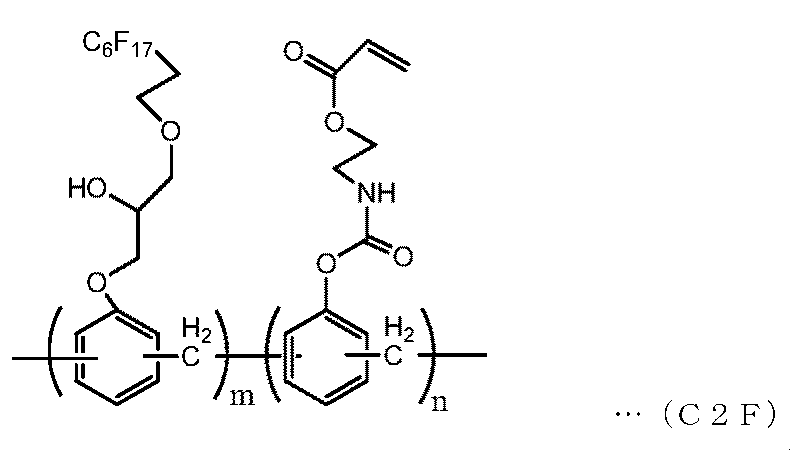
撹拌機を備えた内容積1,000cm3のオートクレーブに、C4α-Clアクリレートの317.5g、MAAの79.4g、IBMAの47.7g、2-HEMAの52.94g、n-DMの4.6gおよびMEKの417.7gを入れ、窒素雰囲気下で撹拌しながら、50℃で24時間重合させ、さらに70℃にて5時間加熱し、重合開始剤を不活性化し、共重合体の溶液を得た。共重合体は、数平均分子量が5,060、質量平均分子量が8,720であった。固形分濃度を測定すると30重量%であった。
得られた撥インク剤(C2-3)の数平均分子量(Mn)、質量平均分子量(Mw)、フッ素原子の含有率、エチレン性二重結合の含有量、酸価を表3に示す。
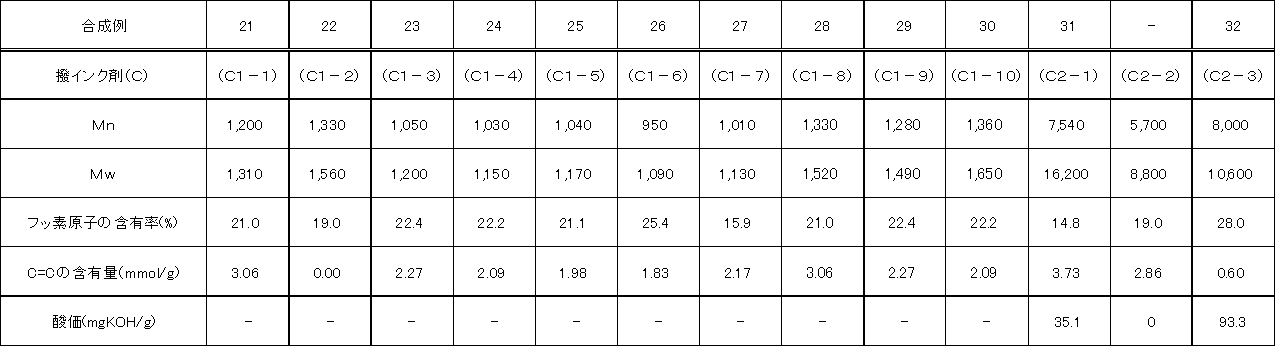
(ネガ型感光性樹脂組成物の製造)
化合物(D-1)溶液の1.18g、撥インク剤(C1-1)溶液の1.18g、アルカリ可溶性樹脂(A1)組成物の14.04g、A9530の9.83g、IR907の1.12g、EABの0.98g、PGMEの70.7g、IPAの5.5g、水の5.5gを200cm3の撹拌用容器に入れ、3時間撹拌してネガ型感光性樹脂組成物1を製造した。
10cm四方のガラス基板をエタノールで30秒間超音波洗浄し、次いで、5分間のUV/O3処理を行った。UV/O3処理には、UV/O3発生装置としてPL2001N-58(センエンジニアリング社製)を使用した。254nm換算の光パワー(光出力)は10mW/cm2であった。
上記隔壁Aの製造において、洗浄後のガラス基板表面にITOの透光性電極(厚み:150nm)をスパッタ法によって成膜し、得られた透光性電極付きガラス基板の透光性電極表面にスピンナを用いて、上記で得られたネガ型感光性樹脂組成物1を塗布する以外は、上記隔壁Aの製造と同様にして、ITO透光性電極付きガラス基板のITO透光性電極上に隔壁Bを製造した。得られた隔壁Bは、隔壁Aと同等のインクの濡れ広がり性、撥インク性、解像度を有するものである。
隔壁Aの製造時と同じガラス基板の表面に、スピンナを用いて、上記で得られたネガ型感光性樹脂組成物1を塗布した後、100℃で2分間、ホットプレート上で乾燥させ、膜厚2.4μmの乾燥膜を形成した。得られた乾燥膜に対して、365nm換算の露光パワー(露光出力)が25mW/cm2である超高圧水銀ランプのUV光を全面一括で照射した(露光量は40mJ/cm2)。露光の際に、330nm以下の光はカットした。
(評価1)
<隔壁Aの膜厚>
レーザ顕微鏡(キーエンス社製、装置名:VK-8500)を用いて測定した。
液状エポキシME-562(商品名、日本ペルノックス社製)の6.25g、硬化剤HV-562(商品名、日本ペルノックス社製)の6.25g、3-ブチレングリコールジアセテートの33.75gおよび4-ブチロラクトンの3.75gを、スターラーを用いて1時間攪拌混合し、表面張力が35mN/mになるまで撹拌しながら水を加え、インクを調製した。
○(良好):開口部の全面がインクで濡れている。
×(不良):開口部の一部がインクをはじいている。
上記で得られた隔壁Aおよび硬化膜上面のPGMEA接触角を下記の方法で測定し、撥インク性の評価とした。
静滴法により、JIS R3257「基板ガラス表面のぬれ性試験方法」に準拠して、隔壁Aまたは硬化膜上面3ヶ所にPGMEA滴を載せ、各PGMEA滴について測定した。液滴は約2μL/滴とし、測定は20℃で行った。接触角は、3測定値の平均値から求めた。
上記隔壁Aの製造時に、2.38%テトラメチル水酸化アンモニウム水溶液に40秒間浸漬して現像した後、ライン形成箇所で残った隔壁Aのラインで最も細いラインの太さを現像度とした。単位をμmで示す。
ネガ型感光性樹脂組成物1を室温(20~25℃)で20日間保管した。その後、ネガ型感光性樹脂組成物1の状態(透明または白濁)を目視により観察した後、上記隔壁Aと硬化膜と同様にして隔壁Aおよび硬化膜(ただし、ガラス基板の大きさを7.5cm四方とする)を製造した。なお、製造途中、塗膜の状態で、膜表面の異物の有無を目視、およびレーザ顕微鏡で観察した。
○:塗膜をレーザ顕微鏡で観察した場合に粒子状の異物が確認できる。
△:塗膜を目視で観察した場合に粒子状の異物が確認できる。
×:保管後のネガ型感光性樹脂組成物が白濁する。
例1において、ネガ型感光性樹脂組成物を表4~6に示す組成に変更した以外は、同様の方法で、ネガ型感光性樹脂組成物および隔壁A、硬化膜を製造し、例1と同様の評価を行った。評価結果を表4~6に示す。溶媒(F)の比率は、溶媒(F)全体量中の各溶媒の比率を意味する。また、例31および例35においては、例1と同様にして、ITO透光性電極付きガラス基板のITO透光性電極上に表6に示すネガ型感光性樹脂組成物を用いて隔壁Bを製造した。

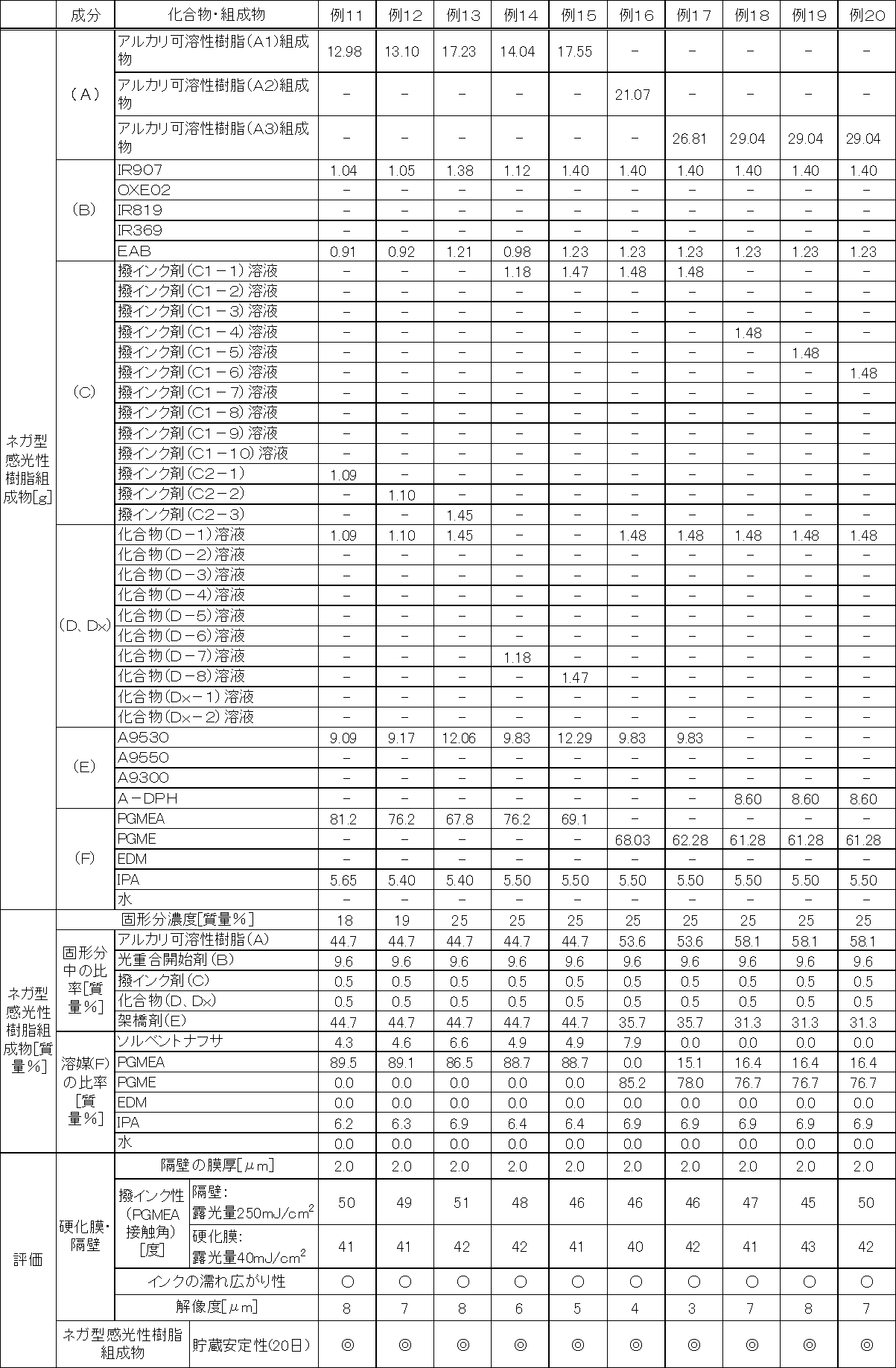
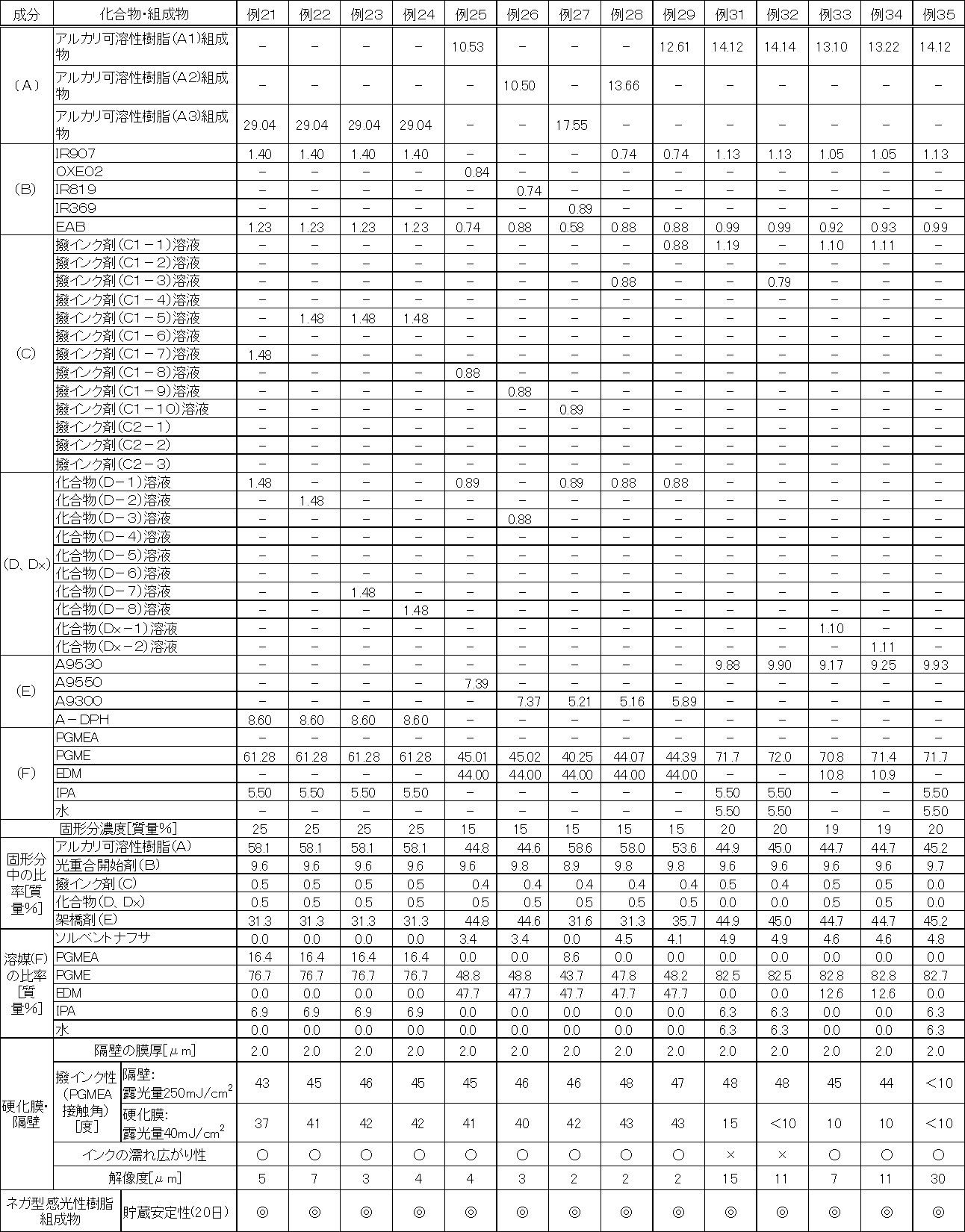
一方、化合物(D)を用いないネガ型感光性樹脂組成物を用いた例31および32では、通常の露光量で硬化させた隔壁上面は撥インク性が充分であったものの、インクの濡れ広がり性が不充分であり、低露光量で硬化させた硬化膜上面の撥インク性も不充分であった。
また、化合物(D)の代わりに化合物(Dx)を用いたネガ型感光性樹脂組成物を用いた例33、34では、インクの濡れ広がり性に優れており、通常の露光量で硬化させた隔壁上面は撥インク性が充分であったものの、低露光量で硬化させた硬化膜上面の撥インク性が不充分であった。
さらに、撥インク剤(C)および化合物(D)を用いないネガ型感光性樹脂組成物を用いた例35では、インクの濡れ広がり性に優れているものの、低露光量で硬化させた硬化膜上面および、通常の露光量で硬化させた隔壁上面は共にほぼ撥インク性を有しないものであった。
一方、例31、32、34で得られた樹脂硬化膜としての隔壁は、隔壁上面の撥インク性に優れるものの、基板との密着性が充分でないことから充分な解像度が得られていない。例35で得られた樹脂硬化膜としての隔壁は、隔壁上面の撥インク性が充分でなく、さらに基板との密着性が充分でないことから充分な解像度が得られていない。
例1および例31、例35で作製した隔壁Bの表面をXPSで分析した。XPSの分析に用いた装置および条件は以下のとおりである。
X線源:Al Kα
X線のビームサイズ:約20μmφ
測定エリア:約20μmφ
検出角:試料面から45°
測定ピーク:F1s、C1s
測定時間(Acquired Timeとして):5分以内
パスエネルギー:224eV
解析ソフト:MultiPak

例1および例31で作製した隔壁BをTOF-SIMSにより厚み方向に分析した。なお、隔壁Bはレーザ顕微鏡(キーエンス社製、装置名:VK-8500)を用いて測定した膜厚がいずれも、2.0μmであった。TOF-SIMSの分析に用いた装置および条件は以下のとおりである。
一次イオン種:Bi3 ++
一次イオンの加速電圧:25kV
一次イオンの電流値:0.2pA(@10kHz)
一次イオンのラスターサイズ:150×150μm2
一次イオンのバンチング:有
スパッタイオン種:Arクラスター(おおよそAr1500)
スパッタイオンの加速電圧:10kV
スパッタイオンの電流値:8.5nA(@10kHz)
スパッタイオンのラスターサイズ:450×450μm2
C-二次イオンの質量数:12
Si2O5H-二次イオンの質量数:137
InO2 -二次イオンの質量数:147
厚み方向プロファイルのプロットの間隔:界面領域内で8点以上のプロット数

本発明の隔壁は、有機EL素子において、発光層等の有機層をIJ法にてパターン印刷するための隔壁(バンク)、あるいは液晶素子においてカラーフィルタをIJ法にてパターン印刷するための隔壁(この隔壁はブラックマトリクス(BM)を兼ねることができる。)等として利用できる。
本発明の隔壁はまた、有機TFTアレイにおいて導体パターンまたは半導体パターンをIJ法にてパターン印刷するための隔壁等として利用できる。
本発明の隔壁は例えば、TFTのチャネル層をなす有機半導体層、ゲート電極、ソース電極、ドレイン電極、ゲート配線、およびソース配線等をIJ法にてパターン印刷するための隔壁等として利用できる。
なお、2012年10月31日に出願された日本特許出願2012-239880号の明細書、特許請求の範囲、図面および要約書の全内容をここに引用し、本発明の明細書の開示として、取り入れるものである。
Claims (12)
- 基板上に形成された樹脂硬化膜であって、
X線光電子分光法(XPS)による組成分析において、前記樹脂硬化膜の表面における炭素原子濃度に対するフッ素原子濃度の比の値[F/C]が0.1以上であり、
Arクラスターをスパッタイオンに用いた飛行時間型二次イオン質量分析法(TOF-SIMS)による前記樹脂硬化膜の厚み方向における質量分析において、Si2O5H-の強度プロファイルが、前記樹脂硬化膜の下記(1)で規定される表面領域を除く厚み範囲において、下記(2)で規定される前記基板との界面領域に強度の最大値を有し、前記表面領域と前記界面領域を除く厚み範囲における強度の最小値に対する前記強度の最大値の比の値[Si2O5H-最大値/Si2O5H-最小値]が1を超え10以下であり、かつ
前記質量分析において、前記樹脂硬化膜の表面領域および前記基板との界面領域を除く厚み範囲におけるC-の強度の平均値に対するSi2O5H-の強度の平均値の比の値、[Si2O5H-平均値/C-平均値]が0.001以上であることを特徴とする樹脂硬化膜。
(1)前記樹脂硬化膜の表面領域とは前記樹脂硬化膜の表面を起点として該表面から基板側に100nmの位置までの領域である。
(2)前記樹脂硬化膜の前記基板との界面領域とは、TOF-SIMSにおける厚み方向の質量分析において、前記基板の主成分または特有成分の二次イオンの強度の上昇開始点における前記樹脂硬化膜表面からの位置を起点として、前記基板の主成分または特有成分の二次イオンの強度の上昇終了点における前記樹脂硬化膜表面からの位置までの領域である。 - 光硬化性を有するアルカリ可溶性樹脂またはアルカリ可溶性単量体(A)と、
光重合開始剤(B)と、
フッ素原子を有する撥インク剤(C)と、
メルカプト基と加水分解性基とを有する加水分解性シラン化合物および/またはエチレン性二重結合を有する基と加水分解性基とを有する加水分解性シラン化合物を含む加水分解性シラン化合物混合物(M1)の部分加水分解縮合物であり、フッ素原子を含有しない化合物(D)と
を含むことを特徴とするネガ型感光性樹脂組成物。 - 前記撥インク剤(C)中のフッ素原子の含有率が1~40質量%である、請求項2に記載のネガ型感光性樹脂組成物。
- 前記撥インク剤(C)が、フルオロアルキレン基および/またはフルオロアルキル基と加水分解性基とを有する加水分解性シラン化合物を含む加水分解性シラン化合物混合物(M2)の部分加水分解縮合物である、請求項2または3に記載のネガ型感光性樹脂組成物。
- 前記加水分解性シラン化合物混合物(M2)が、ケイ素原子に4個の加水分解性基が結合した加水分解性シラン化合物を含む、請求項4に記載のネガ型感光性樹脂組成物。
- さらに、1分子中に2個以上のエチレン性二重結合を有し、酸性基を有しない架橋剤(E)を含む、請求項2~5のいずれか一項に記載のネガ型感光性樹脂組成物。
- さらに、溶媒(F)を含む、請求項2~6のいずれか一項に記載のネガ型感光性樹脂組成物。
- 請求項2~7のいずれか一項に記載のネガ型感光性樹脂組成物を用いて形成されることを特徴とする樹脂硬化膜。
- 基板上に形成された請求項8に記載の樹脂硬化膜であって、
X線光電子分光法(XPS)による組成分析において、前記樹脂硬化膜の表面における炭素原子濃度に対するフッ素原子濃度の比の値[F/C]が0.1以上であり、
Arクラスターをスパッタイオンに用いた飛行時間型二次イオン質量分析法(TOF-SIMS)による前記樹脂硬化膜の厚み方向における質量分析において、Si2O5H-の強度プロファイルが、前記樹脂硬化膜の下記(1)で規定される表面領域を除く厚み範囲において、下記(2)で規定される前記基板との界面領域に強度の最大値を有し、前記表面領域と前記界面領域を除く厚み範囲における強度の最小値に対する前記強度の最大値の比の値[Si2O5H-最大値/Si2O5H-最小値]が1を超え10以下であり、かつ
前記質量分析において、前記樹脂硬化膜の表面領域および前記基板との界面領域を除く厚み範囲におけるC-の強度の平均値に対するSi2O5H-の強度の平均値の比の値、[Si2O5H-平均値/C-平均値]が0.001以上であることを特徴とする樹脂硬化膜。
(1)前記樹脂硬化膜の表面領域とは前記樹脂硬化膜の表面を起点として該表面から基板側に100nmの位置までの領域である。
(2)前記樹脂硬化膜の前記基板との界面領域とは、TOF-SIMSにおける厚み方向の質量分析において、前記基板の主成分または特有成分の二次イオンの強度の上昇開始点における前記樹脂硬化膜表面からの位置を起点として、前記基板の主成分または特有成分の二次イオンの強度の上昇終了点における前記樹脂硬化膜表面からの位置までの領域である。 - 基板表面をドット形成用の複数の区画に仕切る形に形成された隔壁であって、請求項1、8または9に記載の樹脂硬化膜からなることを特徴とする隔壁。
- 基板表面に複数のドットと隣接するドット間に位置する隔壁とを有する光学素子であって、前記隔壁が請求項10に記載の隔壁で形成されていることを特徴とする光学素子。
- 前記ドットがインクジェット法で形成されていることを特徴とする請求項11に記載の光学素子。
Priority Applications (4)
| Application Number | Priority Date | Filing Date | Title |
|---|---|---|---|
| CN201380057147.8A CN104781074B (zh) | 2012-10-31 | 2013-10-29 | 负型感光性树脂组合物、树脂固化膜、分隔壁以及光学元件 |
| JP2014544530A JP6341093B2 (ja) | 2012-10-31 | 2013-10-29 | ネガ型感光性樹脂組成物、樹脂硬化膜、隔壁および光学素子 |
| KR1020157008343A KR102107964B1 (ko) | 2012-10-31 | 2013-10-29 | 네거티브형 감광성 수지 조성물, 수지 경화막, 격벽 및 광학 소자 |
| US14/688,366 US9459529B2 (en) | 2012-10-31 | 2015-04-16 | Negative photosensitive resin composition, cured resin film, partition walls and optical element |
Applications Claiming Priority (2)
| Application Number | Priority Date | Filing Date | Title |
|---|---|---|---|
| JP2012239880 | 2012-10-31 | ||
| JP2012-239880 | 2012-10-31 |
Related Child Applications (1)
| Application Number | Title | Priority Date | Filing Date |
|---|---|---|---|
| US14/688,366 Continuation US9459529B2 (en) | 2012-10-31 | 2015-04-16 | Negative photosensitive resin composition, cured resin film, partition walls and optical element |
Publications (1)
| Publication Number | Publication Date |
|---|---|
| WO2014069478A1 true WO2014069478A1 (ja) | 2014-05-08 |
Family
ID=50627380
Family Applications (1)
| Application Number | Title | Priority Date | Filing Date |
|---|---|---|---|
| PCT/JP2013/079310 Ceased WO2014069478A1 (ja) | 2012-10-31 | 2013-10-29 | ネガ型感光性樹脂組成物、樹脂硬化膜、隔壁および光学素子 |
Country Status (6)
| Country | Link |
|---|---|
| US (1) | US9459529B2 (ja) |
| JP (1) | JP6341093B2 (ja) |
| KR (1) | KR102107964B1 (ja) |
| CN (1) | CN104781074B (ja) |
| TW (1) | TWI629566B (ja) |
| WO (1) | WO2014069478A1 (ja) |
Cited By (8)
| Publication number | Priority date | Publication date | Assignee | Title |
|---|---|---|---|---|
| WO2015194822A1 (ko) * | 2014-06-18 | 2015-12-23 | 주식회사 동진쎄미켐 | 광반응성 실란 커플링제를 포함하는 네거티브 감광성 수지 조성물 |
| JP2016085883A (ja) * | 2014-10-27 | 2016-05-19 | ローム アンド ハース エレクトロニック マテリアルズ エルエルシーRohm and Haas Electronic Materials LLC | 有機金属材料および方法 |
| JP2016122153A (ja) * | 2014-12-25 | 2016-07-07 | 株式会社カネカ | 新規感光性樹脂組成物とその応用 |
| JPWO2015093415A1 (ja) * | 2013-12-17 | 2017-03-16 | 旭硝子株式会社 | ネガ型感光性樹脂組成物、樹脂硬化膜、隔壁および光学素子 |
| WO2018116914A1 (ja) * | 2016-12-22 | 2018-06-28 | 旭硝子株式会社 | ネガ型感光性樹脂組成物 |
| JP2021175784A (ja) * | 2020-02-25 | 2021-11-04 | 住友ベークライト株式会社 | ポリマー溶液、感光性樹脂組成物 |
| WO2021256441A1 (ja) * | 2020-06-17 | 2021-12-23 | Agc株式会社 | 隔壁用硬化性組成物、隔壁の修復方法、隔壁、および光学素子 |
| WO2025079585A1 (ja) * | 2023-10-13 | 2025-04-17 | 東亞合成株式会社 | 硬化性組成物、硬化物、ハードコート剤、ハードコート、物品及び積層体 |
Families Citing this family (2)
| Publication number | Priority date | Publication date | Assignee | Title |
|---|---|---|---|---|
| KR102303994B1 (ko) * | 2014-10-20 | 2021-09-23 | 삼성디스플레이 주식회사 | 유기발광 표시기판의 제조방법 |
| KR102361573B1 (ko) * | 2018-03-09 | 2022-02-10 | 동우 화인켐 주식회사 | 흑색 감광성 수지 조성물, 이를 사용하여 제조된 블랙 매트릭스, 컬럼 스페이서 또는 블랙 컬럼 스페이서를 포함하는 컬러필터, 및 상기 컬러필터를 포함하는 표시장치 |
Citations (4)
| Publication number | Priority date | Publication date | Assignee | Title |
|---|---|---|---|---|
| JP2009053445A (ja) * | 2007-08-27 | 2009-03-12 | The Inctec Inc | カラーフィルタ保護膜用樹脂組成物、及びカラーフィルタ |
| JP2010237545A (ja) * | 2009-03-31 | 2010-10-21 | Fujifilm Corp | 感光性組成物、感光性フィルム、感光性積層体、永久パターン形成方法、及びプリント基板 |
| WO2012077770A1 (ja) * | 2010-12-10 | 2012-06-14 | 旭硝子株式会社 | ネガ型感光性樹脂組成物、光学素子用隔壁およびその製造方法、該隔壁を有する光学素子の製造方法、ならびに、撥インク剤溶液 |
| WO2012132755A1 (ja) * | 2011-03-31 | 2012-10-04 | 旭硝子株式会社 | ネガ型感光性樹脂組成物および塗膜 |
Family Cites Families (9)
| Publication number | Priority date | Publication date | Assignee | Title |
|---|---|---|---|---|
| JP4146058B2 (ja) * | 2000-03-24 | 2008-09-03 | 富士フイルム株式会社 | ネガ型平版印刷版の作製方法 |
| WO2004042474A1 (ja) * | 2002-11-06 | 2004-05-21 | Asahi Glass Company, Limited | ネガ型感光性樹脂組成物 |
| JP4599053B2 (ja) * | 2003-11-27 | 2010-12-15 | 富士フイルム株式会社 | インクジェット記録ヘッド |
| JP4818712B2 (ja) * | 2004-12-28 | 2011-11-16 | 大日本印刷株式会社 | 表示素子用黒色樹脂組成物、及び表示素子用部材 |
| JP5181725B2 (ja) * | 2008-02-27 | 2013-04-10 | 日本ゼオン株式会社 | 感光性樹脂組成物、積層体及びその製造方法並びに電子部品 |
| TWI388929B (zh) | 2008-08-01 | 2013-03-11 | Asahi Glass Co Ltd | A negative photosensitive composition, a partition member for an optical element using the same, and an optical element having the partition wall |
| JP2011039404A (ja) * | 2009-08-17 | 2011-02-24 | Asahi Glass Co Ltd | 光学素子隔壁形成用感光性組成物、これを用いたブラックマトリックスおよびその製造方法、並びにカラーフィルタの製造方法 |
| JP2011048195A (ja) * | 2009-08-27 | 2011-03-10 | Asahi Glass Co Ltd | 光学素子隔壁形成用感光性組成物、これを用いたブラックマトリックスおよびその製造方法、並びにカラーフィルタオンアレイの製造方法 |
| JP5771905B2 (ja) * | 2010-05-12 | 2015-09-02 | Jsr株式会社 | 液浸露光用感放射線性樹脂組成物、硬化パターン形成方法及び硬化パターン |
-
2013
- 2013-10-29 WO PCT/JP2013/079310 patent/WO2014069478A1/ja not_active Ceased
- 2013-10-29 CN CN201380057147.8A patent/CN104781074B/zh active Active
- 2013-10-29 JP JP2014544530A patent/JP6341093B2/ja active Active
- 2013-10-29 KR KR1020157008343A patent/KR102107964B1/ko active Active
- 2013-10-30 TW TW102139325A patent/TWI629566B/zh active
-
2015
- 2015-04-16 US US14/688,366 patent/US9459529B2/en active Active
Patent Citations (4)
| Publication number | Priority date | Publication date | Assignee | Title |
|---|---|---|---|---|
| JP2009053445A (ja) * | 2007-08-27 | 2009-03-12 | The Inctec Inc | カラーフィルタ保護膜用樹脂組成物、及びカラーフィルタ |
| JP2010237545A (ja) * | 2009-03-31 | 2010-10-21 | Fujifilm Corp | 感光性組成物、感光性フィルム、感光性積層体、永久パターン形成方法、及びプリント基板 |
| WO2012077770A1 (ja) * | 2010-12-10 | 2012-06-14 | 旭硝子株式会社 | ネガ型感光性樹脂組成物、光学素子用隔壁およびその製造方法、該隔壁を有する光学素子の製造方法、ならびに、撥インク剤溶液 |
| WO2012132755A1 (ja) * | 2011-03-31 | 2012-10-04 | 旭硝子株式会社 | ネガ型感光性樹脂組成物および塗膜 |
Cited By (16)
| Publication number | Priority date | Publication date | Assignee | Title |
|---|---|---|---|---|
| JPWO2015093415A1 (ja) * | 2013-12-17 | 2017-03-16 | 旭硝子株式会社 | ネガ型感光性樹脂組成物、樹脂硬化膜、隔壁および光学素子 |
| CN106462070A (zh) * | 2014-06-18 | 2017-02-22 | 株式会社东进世美肯 | 包含光反应性硅烷偶联剂的负型感光性树脂组合物 |
| TWI677755B (zh) * | 2014-06-18 | 2019-11-21 | 南韓商東進世美肯有限公司 | 包含光反應性矽烷偶合劑之負型感光性樹脂組成物 |
| WO2015194822A1 (ko) * | 2014-06-18 | 2015-12-23 | 주식회사 동진쎄미켐 | 광반응성 실란 커플링제를 포함하는 네거티브 감광성 수지 조성물 |
| JP2016085883A (ja) * | 2014-10-27 | 2016-05-19 | ローム アンド ハース エレクトロニック マテリアルズ エルエルシーRohm and Haas Electronic Materials LLC | 有機金属材料および方法 |
| JP2016122153A (ja) * | 2014-12-25 | 2016-07-07 | 株式会社カネカ | 新規感光性樹脂組成物とその応用 |
| JP7010240B2 (ja) | 2016-12-22 | 2022-01-26 | Agc株式会社 | ネガ型感光性樹脂組成物 |
| WO2018116914A1 (ja) * | 2016-12-22 | 2018-06-28 | 旭硝子株式会社 | ネガ型感光性樹脂組成物 |
| JPWO2018116914A1 (ja) * | 2016-12-22 | 2019-10-24 | Agc株式会社 | ネガ型感光性樹脂組成物 |
| JP2021175784A (ja) * | 2020-02-25 | 2021-11-04 | 住友ベークライト株式会社 | ポリマー溶液、感光性樹脂組成物 |
| JP7585658B2 (ja) | 2020-02-25 | 2024-11-19 | 住友ベークライト株式会社 | ポリマー溶液、感光性樹脂組成物 |
| JPWO2021256441A1 (ja) * | 2020-06-17 | 2021-12-23 | ||
| WO2021256441A1 (ja) * | 2020-06-17 | 2021-12-23 | Agc株式会社 | 隔壁用硬化性組成物、隔壁の修復方法、隔壁、および光学素子 |
| JP7663098B2 (ja) | 2020-06-17 | 2025-04-16 | Agc株式会社 | 隔壁用硬化性組成物、隔壁の修復方法、隔壁、および光学素子 |
| TWI889848B (zh) * | 2020-06-17 | 2025-07-11 | 日商Agc股份有限公司 | 阻隔壁用硬化性組合物、阻隔壁之修復方法、阻隔壁、及光學元件 |
| WO2025079585A1 (ja) * | 2023-10-13 | 2025-04-17 | 東亞合成株式会社 | 硬化性組成物、硬化物、ハードコート剤、ハードコート、物品及び積層体 |
Also Published As
| Publication number | Publication date |
|---|---|
| KR20150082192A (ko) | 2015-07-15 |
| TW201426192A (zh) | 2014-07-01 |
| CN104781074A (zh) | 2015-07-15 |
| US20150219992A1 (en) | 2015-08-06 |
| JPWO2014069478A1 (ja) | 2016-09-08 |
| CN104781074B (zh) | 2017-02-15 |
| TWI629566B (zh) | 2018-07-11 |
| US9459529B2 (en) | 2016-10-04 |
| KR102107964B1 (ko) | 2020-05-07 |
| JP6341093B2 (ja) | 2018-06-13 |
Similar Documents
| Publication | Publication Date | Title |
|---|---|---|
| JP6350287B2 (ja) | ネガ型感光性樹脂組成物、樹脂硬化膜、隔壁及び光学素子 | |
| JP6341093B2 (ja) | ネガ型感光性樹脂組成物、樹脂硬化膜、隔壁および光学素子 | |
| JP6398774B2 (ja) | ネガ型感光性樹脂組成物、樹脂硬化膜、隔壁および光学素子 | |
| JP5910629B2 (ja) | ネガ型感光性樹脂組成物、硬化膜、隔壁およびブラックマトリックスとその製造方法、カラーフィルタならびに有機el素子 | |
| JP6115471B2 (ja) | ネガ型感光性樹脂組成物、隔壁、ブラックマトリックス及び光学素子 | |
| JP6065915B2 (ja) | ネガ型感光性樹脂組成物、硬化膜、隔壁、及び光学素子 | |
| CN103765314B (zh) | 负型感光性树脂组合物、分隔壁以及光学元件 | |
| KR101026094B1 (ko) | 네가티브형 감광성 수지 조성물 | |
| WO2015190294A1 (ja) | 撥インク剤、ネガ型感光性樹脂組成物、隔壁および光学素子 | |
| JP6020557B2 (ja) | ネガ型感光性樹脂組成物、硬化膜、隔壁および光学素子 | |
| WO2015093415A1 (ja) | ネガ型感光性樹脂組成物、樹脂硬化膜、隔壁および光学素子 | |
| WO2018116914A1 (ja) | ネガ型感光性樹脂組成物 | |
| WO2014046210A1 (ja) | 部分加水分解縮合物およびこれを用いた撥インク剤 |
Legal Events
| Date | Code | Title | Description |
|---|---|---|---|
| 121 | Ep: the epo has been informed by wipo that ep was designated in this application |
Ref document number: 13851900 Country of ref document: EP Kind code of ref document: A1 |
|
| ENP | Entry into the national phase |
Ref document number: 2014544530 Country of ref document: JP Kind code of ref document: A |
|
| ENP | Entry into the national phase |
Ref document number: 20157008343 Country of ref document: KR Kind code of ref document: A |
|
| NENP | Non-entry into the national phase |
Ref country code: DE |
|
| 122 | Ep: pct application non-entry in european phase |
Ref document number: 13851900 Country of ref document: EP Kind code of ref document: A1 |