WO2014058014A1 - 有機無機複合シリカナノ粒子及びその製造方法 - Google Patents
有機無機複合シリカナノ粒子及びその製造方法 Download PDFInfo
- Publication number
- WO2014058014A1 WO2014058014A1 PCT/JP2013/077594 JP2013077594W WO2014058014A1 WO 2014058014 A1 WO2014058014 A1 WO 2014058014A1 JP 2013077594 W JP2013077594 W JP 2013077594W WO 2014058014 A1 WO2014058014 A1 WO 2014058014A1
- Authority
- WO
- WIPO (PCT)
- Prior art keywords
- organic
- silica
- inorganic composite
- copolymer
- silica nanoparticles
- Prior art date
- Legal status (The legal status is an assumption and is not a legal conclusion. Google has not performed a legal analysis and makes no representation as to the accuracy of the status listed.)
- Ceased
Links
Images



Classifications
-
- C—CHEMISTRY; METALLURGY
- C08—ORGANIC MACROMOLECULAR COMPOUNDS; THEIR PREPARATION OR CHEMICAL WORKING-UP; COMPOSITIONS BASED THEREON
- C08K—Use of inorganic or non-macromolecular organic substances as compounding ingredients
- C08K3/00—Use of inorganic substances as compounding ingredients
- C08K3/34—Silicon-containing compounds
- C08K3/36—Silica
-
- B—PERFORMING OPERATIONS; TRANSPORTING
- B82—NANOTECHNOLOGY
- B82Y—SPECIFIC USES OR APPLICATIONS OF NANOSTRUCTURES; MEASUREMENT OR ANALYSIS OF NANOSTRUCTURES; MANUFACTURE OR TREATMENT OF NANOSTRUCTURES
- B82Y30/00—Nanotechnology for materials or surface science, e.g. nanocomposites
-
- C—CHEMISTRY; METALLURGY
- C01—INORGANIC CHEMISTRY
- C01B—NON-METALLIC ELEMENTS; COMPOUNDS THEREOF; METALLOIDS OR COMPOUNDS THEREOF NOT COVERED BY SUBCLASS C01C
- C01B33/00—Silicon; Compounds thereof
- C01B33/113—Silicon oxides; Hydrates thereof
- C01B33/12—Silica; Hydrates thereof, e.g. lepidoic silicic acid
- C01B33/14—Colloidal silica, e.g. dispersions, gels, sols
- C01B33/145—Preparation of hydroorganosols, organosols or dispersions in an organic medium
-
- C—CHEMISTRY; METALLURGY
- C01—INORGANIC CHEMISTRY
- C01B—NON-METALLIC ELEMENTS; COMPOUNDS THEREOF; METALLOIDS OR COMPOUNDS THEREOF NOT COVERED BY SUBCLASS C01C
- C01B33/00—Silicon; Compounds thereof
- C01B33/113—Silicon oxides; Hydrates thereof
- C01B33/12—Silica; Hydrates thereof, e.g. lepidoic silicic acid
- C01B33/18—Preparation of finely divided silica neither in sol nor in gel form; After-treatment thereof
-
- C—CHEMISTRY; METALLURGY
- C08—ORGANIC MACROMOLECULAR COMPOUNDS; THEIR PREPARATION OR CHEMICAL WORKING-UP; COMPOSITIONS BASED THEREON
- C08G—MACROMOLECULAR COMPOUNDS OBTAINED OTHERWISE THAN BY REACTIONS ONLY INVOLVING UNSATURATED CARBON-TO-CARBON BONDS
- C08G83/00—Macromolecular compounds not provided for in groups C08G2/00 - C08G81/00
- C08G83/001—Macromolecular compounds containing organic and inorganic sequences, e.g. organic polymers grafted onto silica
-
- C—CHEMISTRY; METALLURGY
- C08—ORGANIC MACROMOLECULAR COMPOUNDS; THEIR PREPARATION OR CHEMICAL WORKING-UP; COMPOSITIONS BASED THEREON
- C08K—Use of inorganic or non-macromolecular organic substances as compounding ingredients
- C08K3/00—Use of inorganic substances as compounding ingredients
- C08K3/32—Phosphorus-containing compounds
-
- C—CHEMISTRY; METALLURGY
- C08—ORGANIC MACROMOLECULAR COMPOUNDS; THEIR PREPARATION OR CHEMICAL WORKING-UP; COMPOSITIONS BASED THEREON
- C08K—Use of inorganic or non-macromolecular organic substances as compounding ingredients
- C08K9/00—Use of pretreated ingredients
- C08K9/08—Ingredients agglomerated by treatment with a binding agent
-
- C—CHEMISTRY; METALLURGY
- C08—ORGANIC MACROMOLECULAR COMPOUNDS; THEIR PREPARATION OR CHEMICAL WORKING-UP; COMPOSITIONS BASED THEREON
- C08L—COMPOSITIONS OF MACROMOLECULAR COMPOUNDS
- C08L87/00—Compositions of unspecified macromolecular compounds, obtained otherwise than by polymerisation reactions only involving unsaturated carbon-to-carbon bonds
-
- C—CHEMISTRY; METALLURGY
- C09—DYES; PAINTS; POLISHES; NATURAL RESINS; ADHESIVES; COMPOSITIONS NOT OTHERWISE PROVIDED FOR; APPLICATIONS OF MATERIALS NOT OTHERWISE PROVIDED FOR
- C09K—MATERIALS FOR MISCELLANEOUS APPLICATIONS, NOT PROVIDED FOR ELSEWHERE
- C09K3/00—Materials not provided for elsewhere
- C09K3/14—Anti-slip materials; Abrasives
- C09K3/1436—Composite particles, e.g. coated particles
-
- B—PERFORMING OPERATIONS; TRANSPORTING
- B82—NANOTECHNOLOGY
- B82Y—SPECIFIC USES OR APPLICATIONS OF NANOSTRUCTURES; MEASUREMENT OR ANALYSIS OF NANOSTRUCTURES; MANUFACTURE OR TREATMENT OF NANOSTRUCTURES
- B82Y40/00—Manufacture or treatment of nanostructures
-
- C—CHEMISTRY; METALLURGY
- C08—ORGANIC MACROMOLECULAR COMPOUNDS; THEIR PREPARATION OR CHEMICAL WORKING-UP; COMPOSITIONS BASED THEREON
- C08G—MACROMOLECULAR COMPOUNDS OBTAINED OTHERWISE THAN BY REACTIONS ONLY INVOLVING UNSATURATED CARBON-TO-CARBON BONDS
- C08G77/00—Macromolecular compounds obtained by reactions forming a linkage containing silicon with or without sulfur, nitrogen, oxygen or carbon in the main chain of the macromolecule
- C08G77/04—Polysiloxanes
- C08G77/045—Polysiloxanes containing less than 25 silicon atoms
-
- C—CHEMISTRY; METALLURGY
- C08—ORGANIC MACROMOLECULAR COMPOUNDS; THEIR PREPARATION OR CHEMICAL WORKING-UP; COMPOSITIONS BASED THEREON
- C08K—Use of inorganic or non-macromolecular organic substances as compounding ingredients
- C08K3/00—Use of inorganic substances as compounding ingredients
- C08K3/32—Phosphorus-containing compounds
- C08K2003/329—Phosphorus containing acids
Definitions
- the present invention forms an aggregate by self-organizing a copolymer comprising an amorphous polyamine and a nonionic polymer chain and a compound having an acidic group, and by a sol-gel reaction using the aggregate as a template,
- the present invention relates to a silica nanoparticle in which a copolymer and a compound having an acidic group are introduced into a silica matrix, and the entire particle is formed into an organic-inorganic composite, and a method for producing the same.
- Silica nanoparticles are used in a wide range of industrial fields, including resin fillers and catalysts.
- such silica nanoparticles have been variously studied for the introduction of organic components and the control of monodisperse particle size depending on the properties required for various applications.
- a conventional method for producing conventional monodispersed silica nanoparticles is a Stover method in which spherical nanoparticles are obtained by performing a sol-gel reaction of alkoxysilane in a mixed solution of alcohol, high-concentration ammonia and water (for example, refer nonpatent literature 1).
- organic-inorganic composite silica nanoparticles having a monodispersity that can be used in a wide range of fields as transparent resin fillers and abrasive fillers and having a particle size of 50 nm or less
- the template design is not good for silica deposition, there is a problem in terms of low production efficiency.
- the silica nanoparticle synthesis technology has a uniform particle size, and the particle size can be controlled within the range of 5 to 30 nm, the organic component is complexed to the silica matrix, and the whole particle is composed of the organic component and silica. No fine organic-inorganic composite silica nanoparticles are synthesized.
- an organic component (polymer) is introduced into a silica matrix, and the entire particle is a composite of an organic component and an inorganic component (silica).
- An object is to provide organic-inorganic composite silica nanoparticles having excellent monodispersibility within a range of 5 to 100 nm, and to provide a simple and efficient method for producing the silica nanoparticles.
- the present inventors have obtained a compound having an acidic functional group in a copolymer (A) comprising an amorphous polyamine chain and a nonionic polymer chain in a solvent.
- (B) is added, an aggregate can be easily obtained, the aggregate has a core / shell structure, and the core is a complex formed by the interaction between a polyamine and a compound (B) having an acidic functional group
- the shell is a nonionic polymer chain in the copolymer (A), the shell layer functions to stabilize the aggregate as nanoparticles, and the aggregate is used as a catalyst for silica deposition.
- the present invention is characterized by containing a copolymer (A) comprising an amorphous polyamine chain and a nonionic polymer chain, a compound (B) having an acidic group, and silica (C).
- A a copolymer comprising an amorphous polyamine chain and a nonionic polymer chain
- B a compound having an acidic group
- silica C
- An organic-inorganic composite silica nanoparticle and a simple and efficient production method thereof are also provided.
- the organic / inorganic composite silica nanoparticles obtained by the present invention have a particle size excellent in monodispersity of 100 nm or less, particularly within a range of 5 to 20 nm by designing self-organization of a copolymer and a compound having an acidic group. These are ultra-fine organic / inorganic composite silica nanoparticles. Unlike the conventional core / shell type silica fine particles, the organic-inorganic composite silica nanoparticles of the present invention have a hybrid structure at a molecular level in which a copolymer which is an organic component is homogeneously introduced into a silica matrix.
- the organic-inorganic composite silica nanoparticles have a chemical or physical function derived from polyamine.
- polyamine is a strong ligand
- metal ions can be concentrated in silica.
- polyamine is also a reducing agent
- silica / noble metal composite nanoparticles can be synthesized by reducing concentrated noble metal ions to metal atoms.
- polyamine is a cationic polymer, it has functions such as sterilization and virus resistance. Therefore, the composite nanoparticles can also exhibit these functions.
- the ultra-fine organic / inorganic composite silica nanoparticles of the present invention are applied in many fields such as abrasive fillers, resin fillers, metal ion / nanometal / metal oxide carriers, catalysts, antibacterial agents and cosmetics. Is possible.
- the production method of the present invention by using a reaction method imitating silica synthesis in a biological system, it is excellent in monodispersity and has a polyamine function under mild reaction conditions such as low temperature and neutrality. Ultra-fine organic / inorganic composite silica nanoparticles can be produced in a short time.
- the manufacturing method has a low environmental load, a simple production process, and a structural design corresponding to various uses.
- the excellent monodispersibility means that the width of the particle size distribution of the nanoparticles is narrow, and the mixing ratio of particles larger and / or smaller than the target average particle size is small. , Means less. Accordingly, for example, it is possible to expect a technical effect that troubles are less likely to occur due to more large particles mixed or more small particles mixed. Specifically, for example, when used as a hard coat filler, if a larger amount of large particles are mixed, the light scattering state becomes different and the transparency tends to be lower, which is not preferable. Also, when used as a catalyst, if a large amount of large particles are mixed, the specific surface area per unit becomes small, which may reduce the catalyst efficiency. Moreover, when there are too many small particles, storage stability may deteriorate.
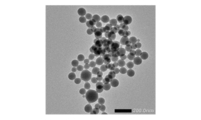
- FIG. 2 is a transmission electron micrograph of organic-inorganic composite silica nanoparticles obtained in Example 1.
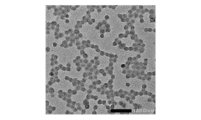
- FIG. 2 is a transmission electron micrograph of organic-inorganic composite silica nanoparticles obtained in Example 2.
- FIG. 4 is a transmission electron micrograph of silica nanoparticles obtained in Comparative Example 2.
- 2 is a transmission electron micrograph of branched organic-inorganic composite silica nanoparticles obtained in Example 7.
- FIG. 6 is a transmission electron micrograph of organic-inorganic composite silica nanoparticles having cavities obtained in Example 8.
- FIG. 2 is a transmission electron micrograph of organic-inorganic composite silica nanoparticles obtained in Example 10.
- FIG. 10 is a transmission electron micrograph of organic-inorganic composite silica nanoparticles obtained in Example 1.
- silica silicon oxide
- three important conditions are essential. These are (1) a template for inducing a shape, (2) a scaffold for performing a sol-gel reaction, and (3) a catalyst for hydrolyzing and polymerizing a silica source.
- a copolymer (A) comprising an amorphous polyamine chain and a nonionic polymer chain and a compound (B) having an acidic group are used. It is characterized by.
- the compound (B) having an acidic group was added to the solution of the copolymer (A)
- the polyamine chain in the copolymer (A) and the compound (B) having an acidic group interacted and crosslinked. Form a complex.
- the nonionic polymer chain in the copolymer (A) has no interaction with the compound (B) having an acidic group and dissolves as a molecule in the solvent. Stabilize as particles.
- a stable aggregate can be easily formed by mixing the copolymer (A) having a polyamine and the compound (B) having an acidic group.
- the structure of the aggregate has not been completely elucidated yet, it may have the following structure.
- the aggregate has a core / shell structure, the core is a complex formed by the interaction of the polyamine and the compound (B) having an acidic group, and the shell layer is a nonionic polymer chain in the copolymer. It consists of
- a stable association product obtained as described above is used as a reaction field, and a sol-gel reaction of a silica source is performed in a solvent by a catalytic effect of the association product, so that the copolymer (A) is introduced into a silica matrix.
- the present inventors have found that monodisperse ultrafine organic-inorganic composite silica nanoparticles in which the copolymer (A) and silica (C) are combined over the entire particle can be produced.
- “excellent in monodispersity” can be said to be that the width of the particle size distribution represented by the following formula (1) is 15% or less.
- Width of particle size distribution (standard deviation of particle size) ⁇ 100 / average particle size (average value of particle size) (1)
- the “average particle size” and “standard deviation” of the particles are the average value and standard deviation calculated from the measured diameters of the diameters of 100 particles produced under the same conditions under an electron microscope. Say.
- the polyamine in the copolymer (A) is not crystallized alone, but is cross-linked by the interaction between the amino group and the acidic group when coexisting with the compound (B) having an acidic group.
- the polyamine in the copolymer (A) is not crystallized alone, but is cross-linked by the interaction between the amino group and the acidic group when coexisting with the compound (B) having an acidic group.
- Polyvinylpyridine chains can be used.
- the molecular weight of the polyamine chain portion is not particularly limited as long as it is within a range in which a stable aggregate can be formed by interaction with the compound (B) having an acidic group.
- the number of repeating units of the polymer units is preferably in the range of 5 to 10,000, and more preferably in the range of 10 to 8,000.
- the molecular structure of the polyamine chain moiety is not particularly limited, and may be, for example, linear, branched, star-shaped, or comb-shaped.
- a polyamine chain having a branched structure is preferable from the viewpoint of efficiently forming an aggregate as a template during silica precipitation.
- the skeleton of the polyamine chain may be an amine homopolymer or a copolymer of two or more kinds of amines.
- polymer units other than amines may be present in the skeleton of the polyamine chain as long as a stable aggregate can be formed by interaction with the compound (B) having an acidic group.
- the proportion of other polymerized units in the skeleton of the polyamine chain is preferably 50 mol% or less, more preferably 30 mol% or less, and more preferably 15 mol%. % Is most preferred.
- the nonionic polymer chain in the copolymer (A) is not particularly limited as long as it can be dissolved in a solvent that forms an aggregate without interacting with amines or acidic groups.
- a water-soluble polymer chain such as polyethylene glycol, polyacrylamide, or polyvinylpyrrolidone
- hydrophobic organic medium it is preferably a hydrophobic polymer chain such as polyacrylate or polystyrene.
- a polyalkylene glycol chain as the nonionic polymer chain from the viewpoint that it is preferably performed in an aqueous medium.
- the length of these polymer chains is not particularly limited as long as the aggregate can be stabilized in the nano size, but in order to form the aggregate suitably, the repeating unit of the polymerization unit of the nonionic polymer chain The number is preferably in the range of 5 to 100,000, and more preferably in the range of 10 to 10,000.
- the bonding state of the polyamine chain and the nonionic polymer chain is not particularly limited as long as it is a stable chemical bond.
- it is bonded by coupling to the end of the polyamine or grafted onto the polyamine skeleton. You may combine by.
- the ratio of the polyamine chain and the nonionic polymer chain in the copolymer (A) is not particularly limited as long as the aggregate can be formed.
- the proportion of the polyamine chain is preferably in the range of 5 to 90% by mass in the copolymer, more preferably in the range of 10 to 70% by mass, and more preferably in the range of 15 to 60%. Most preferably, it is in the range of mass%.
- the compound (B) having an acidic group used in the present invention has a physical cross-linked structure (for example, hydrogen bond) with the amine in the copolymer (A) in a solvent that forms an aggregate. As long as it can form a stable association between the copolymer (A) composed of a polyamine and a nonionic polymer chain and the compound (B) having an acidic group.
- a bifunctional or higher polyfunctional acidic compound (b1) can be suitably used.
- the polyfunctional acidic compound (b1) any of an inorganic polyfunctional acidic compound and an organic polyfunctional acidic compound may be used, and a bifunctional or higher polyphosphate compound or a bifunctional or higher functional compound may be used. Examples thereof include a carboxylic acid compound and a polysulfonic acid compound having a bifunctional or higher functionality.
- any acidic compound having a valence of 2 or more can be suitably used.
- examples thereof include phosphoric acid, diphosphoric acid, polyphosphoric acid, sulfuric acid, boric acid, and disulfuric acid.
- organic acids for example, tartaric acid, antimony tartaric acid, maleic acid, cyclohexane tricarbonyl acid, cyclohexane hexacarbonyl acid, adamantane dicarboxylic acid, adipic acid, azelec acid, sebacic acid, undecanedioic acid, di (ethylene glycol) Aliphatic acids such as bis (carboxymethyl) ether, tri (ethylene glycol) bis (carboxymethyl) ether, aromatic or aliphatic sulfonic acids such as terephthalic acid, biphenyldicarboxylic acid, oxybisbenzoic acid, pipepes (PIPES), Acid yellow, acid blue, acid red, direct blue, direct yellow, direct red series dyes, poly (acrylic acid), poly (methacrylic acid), poly Styrene sulfonic acid) polymeric acids such as, acidification of RNA, and the like DNA oligomers.
- organic acids for example, tartaric
- the monofunctional acidic compound (b2) having hydrophobic chains capable of being hydrophobically bonded to each other is preferable.
- the acidic group hydrogen bonds with the nitrogen atom of the polyamine, but the hydrophobic chains can assemble with each other through a hydrophobic bond, and as a result, physically between the polyamines within the molecule or between multiple molecules. Can form a cross-link and obtain an aggregate.
- the monofunctional acidic compound (b2) having hydrophobic chains capable of being hydrophobically bonded to each other include acidic surfactants and the like, for example, long-chain alkyl sulfosan, long-chain alkyl carboxylic acid, long-chain Alkyl phosphoric acids can be used, and the alkyl chain length is preferably 6 to 22 carbon atoms.
- the compound (B) having an acidic group may be a nanoparticle (b3) having a plurality of acidic groups on the surface, and the size of the particle is smaller than the size of the target silica nanoparticle, and the copolymer (A) Can be suitably used as long as a stable aggregate can be formed.
- the material of the nanoparticles having a plurality of acidic groups may be a polymer, a metal, or an oxide.
- the compound (B) having an acidic group used in the present invention those having various functionalities can be appropriately selected and used, and any functional molecule can be introduced into the obtained silica nanoparticles.
- the functional molecule used as the compound (B) having an acidic group it is particularly preferable to use a fluorescent compound.
- the fluorescent compound is used, the resulting silica nanoparticles also exhibit fluorescence, It can be suitably used in application fields.
- Examples of the fluorescent compound include tetraphenylporphyrin tetracarboxylic acid, pyrene dicarboxylic acids, pyrene disulfonic acid, pyrene tetrasulfonic acid, tetraphenyl porphyrin tetrasulfonic acid, tetraphenyl porphyrin tetraphosphonic acid, phthalocyanine tetrasulfonic acid, and the like.
- a compound having strong luminescence can be mentioned.
- the use ratio of the compound (B) having an acidic group may be within a range in which a stable aggregate is obtained, but the amine unit in the copolymer (A) and the compound (B) having an acidic group in the compound (B) may be used.
- the ratio with the acidic group is preferably in the range of 4/1 to 0.1 / 1 in terms of a molar ratio represented by amine units / acidic groups, and the ratio is in the range of 2/1 to 0.1 / 1. Is more preferable, and the range of 0.6 / 1 to 0.15 / 1 is most preferable.
- organic-inorganic composite silica nanoparticles of the present invention are those in which the above-mentioned copolymer (A) and compound (B) having an acidic group are introduced into a silica matrix, and the entire particles are composited with polymer / silica.
- the organic-inorganic composite silica nanoparticles of the present invention preferably have a particle size in the range of 5 to 100 nm, and in particular, ultrafine organic-inorganic composite silica nanoparticles in the range of 5 to 20 nm can be suitably obtained.
- the particle size of the silica nanoparticles depends on the preparation of the aggregate [for example, the type of copolymer (A) used, the length of the polymer chain, the number and type of acidic groups in the compound (B) having acidic groups, the type of solvent Etc.], and the type of silica source used and the sol-gel reaction conditions.
- the organic-inorganic composite silica nanoparticles have extremely excellent monodispersity, and in particular, the width of the particle size distribution can be ⁇ 15% or less with respect to the average particle size.
- the shape of the organic-inorganic composite silica nanoparticles of the present invention is basically a densely packed sphere, but it can be branched or spherical with cavities by changing the synthesis conditions.
- the shape of the particles can be adjusted by adjusting aggregates or sol-gel reaction conditions.
- the content of silica in the organic-inorganic composite silica nanoparticles of the present invention varies within a certain range depending on the reaction conditions and the like. can do.
- the content of silica can be changed by changing the amount of polyamine in the copolymer (A) used in the sol-gel reaction, the amount of aggregate, the amount of silica source used, the sol-gel reaction time and temperature, etc. .
- the organic-inorganic composite silica nanoparticles of the present invention contain a nonionic polymer chain used for stabilizing the aggregate in the surface layer of the nanoparticles. Therefore, the polymer chain basically exists on the surface of the silica nanoparticles of the present invention.
- the organic-inorganic composite silica nanoparticles may be organic-inorganic composite silica nanoparticles that are structurally coated with a nonionic polymer chain (for example, polyethylene glycol).
- the organic-inorganic composite silica nanoparticles of the present invention can be modified with polysilsesquioxane by performing a sol-gel reaction using organosilane after silica deposition. Therefore, the organic-inorganic composite silica nanoparticles of the present invention exhibit excellent monodispersity and can maintain high sol stability in a solvent. By having polysulfesquioxane in such organic / inorganic composite silica nanoparticles, it is re-introduced into the medium again after baking at 400 ° C. or lower or after drying to form a powder. Can be dispersed.
- the organic-inorganic composite silica nanoparticles of the present invention can adsorb highly concentrated metal ions by polyamine chains present in the silica matrix. Further, since the polyamine is a cation, the organic-inorganic composite silica nanoparticles of the present invention can adsorb and immobilize various ionic substances such as anionic biomaterials. Furthermore, the nonionic polymer chain in the copolymer (A) can be imparted with the intended function, or the structure of the nonionic polymer chain can be easily controlled, so that various functions are imparted. It is possible.
- Examples of function addition include immobilization of fluorescent substances.
- a polymer in which a small amount of fluorescent substances, pyrenes, porphyrins and the like are immobilized on a polyamine chain in a small amount the functional residue can be incorporated into silica nanoparticles.
- fluorescent dyes such as porphyrins, phthalocyanines, pyrenes having acidic groups such as carboxylic acid groups and sulfonic acid groups in the base of the polyamine chain, these can be incorporated into the nanoparticles.
- the organic-inorganic composite silica nanoparticles of the present invention can be dried and used as a powder, and can also be used as a filler for other compounds such as resins. It is also possible to blend into other compounds as a dispersion or sol obtained by redispersing the dried powder in a solvent.
- the method for producing organic-inorganic composite silica nanoparticles of the present invention is a method characterized by forming silica (C) in the presence of the aforementioned copolymer (A) and compound (B) having an acidic group. . Furthermore, after forming the silica in the said process, it can also contain polysilsesquioxane in particle
- the copolymer (A) and the compound (B) having an acidic group are mixed in a solvent.
- the polyamine in the copolymer (A) and the compound (B) having an acidic group are physically cross-linked by hydrogen bonding to form a complex, and at the same time, the noni in the copolymer (A).
- the on-state polymer chain is thought to stabilize the complex formed in the nano-size range and form a stable aggregate in the solvent.
- the solvent for forming the aggregate is not particularly limited as long as it can form a stable aggregate.
- the organic solvent can be mentioned.
- the above organic solvents can be used alone or in combination. From the viewpoints of productivity, environment, cost, etc., it is preferable to use alcohol, more preferably ethanol.
- a sol-gel reaction is performed by adding a silica source. Since this reaction requires water, water is included in the aggregate or in the solvent. Water may be added when the aggregate is formed, or may be added after the aggregate is formed.
- the silica source is a solution or dispersion containing an aqueous medium, the solution / dispersion can be added as it is.
- the amount of water in the aggregate solution may be such that the volume ratio (water / other solvent) is in the range of 5/5 to 0.05 / 9.95 from the viewpoint of favorable progress of the sol-gel reaction. A range of 2/8 to 0.1 / 9.9 is more preferable.
- the concentration of the copolymer (A) at the time of preparing the aggregate can be preferably set as long as it basically does not cause fusion between the aggregates.
- a preferable concentration range is 0.05 to 15% by mass, and a more preferable concentration range is 0.5 to 10% by mass.
- Formation of an aggregate by physical crosslinking of polyamine and acid in the solvent of the present invention and stabilization of the complex by the nonionic polymer chain in copolymer (A) is simple in terms of process. However, it is also possible to change the physical cross-linking to a covalent cross-link and obtain an aggregate-like one.
- an aldehyde crosslinking agent, an epoxy crosslinking agent, an acid chloride, an acid anhydride, or an ester crosslinking agent containing two or more functional groups capable of reacting with the amino group of polyamine at room temperature can be used.
- aldehyde crosslinking agent examples include malonyl aldehyde, succinyl aldehyde, glutaryl aldehyde, adifoyl aldehyde, phthaloyl aldehyde, isophthaloyl aldehyde, terephthaloyl aldehyde, and the like.
- the epoxy crosslinking agent examples include polyethylene glycol diglycidyl ether, bisphenol A diglycidyl ether, glycidyl chloride, and glycidyl bromide.
- Examples of the acid chlorides include malonyl chloride, succinyl chloride, glutaryl chloride, adifoyl chloride, phthaloyl chloride, isophthaloyl chloride, terephthaloyl chloride, and the like.
- Examples of the acid anhydride include phthalic anhydride, succinic anhydride, glutaric anhydride, and the like.
- the ester crosslinking agent malonic acid methyl ester, succinic acid methyl ester, glutaric acid methyl ester, phthaloic acid methyl ester, polyethylene glycol carboxylic acid methyl ester, or the like may be used.
- the method for producing the organic-inorganic composite silica nanoparticles of the present invention comprises, following the aggregate formation step, a silica formation step, that is, a step of performing a sol-gel reaction of a silica source using the aggregate in the presence of water as a template.
- a silica formation step that is, a step of performing a sol-gel reaction of a silica source using the aggregate in the presence of water as a template.
- polysilsesquioxane can be included in the organic-inorganic composite silica nanoparticles by performing a sol-gel reaction using organosilane after silica deposition.
- organic-inorganic composite silica nanoparticles can be easily obtained by mixing an aggregate solution and a silica source.
- the silica source include water glass, tetraalkoxysilanes, tetraalkoxysilane oligomers, and the like.
- tetraalkoxysilanes examples include tetramethoxysilane, tetraethoxysilane, tetrapropoxysilane, tetrabutoxysilane, and tetra-t-butoxysilane.
- tetraalkoxysilane oligomers examples include tetramethoxysilane tetramer, tetramethoxysilane heptamer, tetraethoxysilane pentamer, tetraethoxysilane decamer, and the like.
- sol-gel reaction that gives organic-inorganic composite silica nanoparticles does not occur in the continuous phase of the solvent, but proceeds selectively only in the aggregate domain. Accordingly, the reaction conditions are arbitrary as long as the aggregate is not disassembled.
- the amount of silica source is not particularly limited with respect to the amount of aggregates.
- the ratio between the aggregate and the silica source can be set appropriately.
- the amount of organosilane is preferably 50% by mass or less based on the amount of silica source, More preferably, it is 30 mass% or less.
- organic silane examples include alkyltrialkoxysilanes, dialkylalkoxysilanes, and trialkylalkoxysilanes.
- alkyltrialkoxysilanes include methyltrimethoxysilane, methyltriethoxysilane, ethyltrimethoxysilane, ethyltriethoxysilane, n-propyltrimethoxysilane, n-propyltriethoxysilane, and iso-propyltrimethoxysilane.
- dialkylalkoxysilanes examples include dimethyldimethoxysilane, dimethyldiethoxysilane, and diethyldiethoxysilane.
- trialkylalkoxysilanes include trimethylmethoxysilane and trimethylethoxysilane.
- the temperature of the sol-gel reaction with the silica source and the temperature of the sol-gel reaction with the organic silane are not particularly limited, and can be arbitrarily set in the range of 0 to 100 ° C. because an aqueous medium is used. It is preferably in the range of ° C. In order to increase the reaction efficiency, it is more preferable to set the reaction temperature in the range of 50 to 70 ° C.
- the sol-gel reaction time in the silica source varies from 1 minute to several weeks and can be arbitrarily selected. However, in the case of methoxysilanes having high reaction activity of water glass or alkoxysilane, the reaction time may be 1 minute to 24 hours. In order to increase the reaction efficiency, it is more preferable to set the reaction time to 30 minutes to 5 hours. In the case of ethoxysilanes and butoxysilanes having low reaction activity, the sol-gel reaction time is preferably 5 hours or longer, and the time can be set to about one week.
- the time for the sol-gel reaction with organosilane is preferably in the range of 3 hours to 1 week depending on the reaction temperature.
- the production method of the present invention it is possible to obtain monodisperse organic-inorganic composite silica nanoparticles having a uniform particle size that do not aggregate with each other.
- the particle size distribution of the obtained organic-inorganic composite silica nanoparticles varies depending on the production conditions and the target particle size, but ⁇ 15% or less with respect to the target particle size (average particle size). Products in the range of ⁇ 10% or less can be manufactured.
- organic-inorganic composite silica nanoparticles obtained in this way can be made into silica nanoparticles from which a part or all of the copolymer (A) has been removed by firing, if necessary.
- Silica nanoparticles having a characteristic nanostructure obtained from organic-inorganic composite silica nanoparticles produced using the production method of the present invention can be widely applied as functional nanoparticles.
- the copolymer (A) and the compound (B) having an acidic group are introduced into the silica matrix, and the particle size is reduced.
- Organic-inorganic composite silica nanoparticles having a monodispersibility within a range of 5 to 100 nm can be obtained.
- organic-inorganic composite silica nanoparticles having polysilsesquioxane can also be obtained, and application as a resin filler or abrasive filler can be expected.
- the organic-inorganic composite silica nanoparticles of the present invention can immobilize and concentrate various substances with polyamines present in the silica matrix, and functionalize the surface of the silica particles with nonionic polymer chains present in the surface layer. It is also possible. As described above, the organic-inorganic composite silica nanoparticles of the present invention can immobilize and concentrate metals and biomaterials in nano-sized spheres, and functional polymers can be modified on the particle surface. It is a useful material in various fields such as environmentally friendly products.
- the method for producing silica nanoparticles of the present invention is extremely easy compared to the widely used production methods such as the known Stover method, ultrafine organic-inorganic composite silica nanoparticles that cannot be produced by the Stover method can be produced. High expectations are placed on applications regardless of industry or domain. In addition to the general application area of silica materials, it is also a useful material in areas where polyamines are applied.
- Synthesis example 2 In Synthesis Example 1, 0.44 mol of polyallylamine (manufactured by Nittobo Co., Ltd.) having an average molecular weight of 15,000 is used instead of branched polyethyleneimine (manufactured by Nippon Shokubai Co., Ltd.) having an average molecular weight of 10,000. A polymer (hereinafter referred to as A-2) was synthesized. The obtained copolymer (A-2) was 25.7 g.
- Example 1 0.1 g of the copolymer (A-1) synthesized in Synthesis Example 1 was dissolved in a mixed solvent of ethanol (4.5 mL) and water (0.5 mL). By adding 0.41 mL of a 10% aqueous phosphoric acid solution to the obtained copolymer (A-1) solution, an aggregate of the copolymer (A-1) and phosphoric acid was obtained. To the dispersion solution of this aggregate, 0.50 mL of MS51 (methoxysilane tetramer) was added as a silica source.
- MS51 methoxysilane tetramer
- the obtained dispersion was allowed to stand at room temperature (20 to 30 ° C.) for 1 week, and organic-inorganic composite silica nanoparticles were obtained.
- the dispersion was a stable sol solution.
- the silica content in the nanoparticles was ⁇ 68%, and the solid content of the sol dispersion solution was 8.8%.
- the obtained organic-inorganic composite silica nanoparticles had a particle size of ⁇ 16 nm and were spherical particles with excellent monodispersibility (FIG. 1) (the width of the particle size distribution was 10% or less. there were).
- the X-ray small angle scattering measurement was performed using the aggregate dispersion solution of copolymer (A-1) and phosphoric acid synthesized in Example 1, and the average size was 12.0 nm. On the other hand, no clear scattering peak was observed in the vicinity of 5-15 nm in the solution containing only the copolymer (A-1) before adding phosphoric acid. This strongly suggests that an aggregate is formed by self-assembly of the copolymer (A-1) and phosphoric acid.
- the organic-inorganic composite silica nanoparticles synthesized in Example 1 were also evaluated by X-ray small angle scattering measurement. The particle size was 17 nm as calculated from the scattering of the sample. This almost coincides with the result of TEM observation.
- sol-gel reaction was traced using NMR measurement. As a result, it was confirmed that hydrolysis of MS51 was almost completed within 24 hours. This suggests that the polyethyleneimine that is the aggregate core or a complex composed of polyethyleneimine and phosphoric acid functions as a catalyst in the sol-gel reaction.
- Example 2 To the dispersion solution of the aggregates synthesized in Example 1, 0.50 mL of MS51 was added as a silica source. The obtained dispersion solution was allowed to stand at 60 ° C. for 6 hours to obtain organic-inorganic composite silica nanoparticles. Since the sol-gel reaction was performed at a higher temperature than in Example 1, the synthesis time of the organic-inorganic composite silica nanoparticles could be shortened. By TEM observation, the obtained organic-inorganic composite silica nanoparticles were confirmed to be spherical particles having a particle size of ⁇ 17 nm and excellent monodispersity (FIG. 2) (the width of the particle size distribution was 10% or less). there were).
- Comparative Example 1 0.5 mL of MS51 was added into a mixed solvent of ethanol (4.5 mL) and water (0.5 mL). The resulting solution was allowed to stand at room temperature for 48 hours, and no silica deposition was observed. Since there is no association of the copolymer (A), which is a template having a catalytic function for the sol-gel reaction, and phosphoric acid in the solution, no silica is precipitated.
- Comparative Example 2 0.1 g of branched polyethyleneimine (molecular weight: 10,000, manufactured by Nippon Shokubai Co., Ltd.) was dissolved in a mixed solvent of ethanol (4.5 mL) and water (0.5 mL). 0.75 mL of 10% phosphoric acid aqueous solution was added to the obtained branched polyethyleneimine solution to obtain a white dispersion. To this dispersion, 1.0 mL of MS51 was added as a silica source, and the resulting dispersion was allowed to stand at room temperature for 48 hours.
- Comparative Example 3 0.1 g of the copolymer (A-1) synthesized in Synthesis Example 1 was dissolved in a mixed solvent of ethanol (4.5 mL) and water (0.5 mL). To the obtained copolymer (A-1) solution, 0.50 mL of MS51 was added as a silica source. When the obtained dispersion solution was allowed to stand at room temperature for 30 minutes, the dispersion solution gelled. This is because phosphoric acid is not added, so that an aggregate that is a template cannot be formed in the sol-gel reaction, and the sol-gel reaction generally proceeds in the solution. it is conceivable that.
- Example 3 0.1 g of the copolymer (A-2) obtained in Synthesis Example 2 was dissolved in a mixed solvent of ethanol (4.5 mL) and water (0.5 mL). By using a 10% phosphoric acid aqueous solution for the solution of the obtained copolymer (A-2) and adjusting the pH of the solution to near neutrality, the association between the copolymer (A-2) and phosphoric acid is achieved. Coalescence was obtained. To this dispersion of aggregates, 0.50 mL of MS51 was added as a silica source. The obtained dispersion solution was allowed to stand at room temperature for 1 week, and then organic-inorganic composite silica nanoparticles were obtained.
- the obtained organic / inorganic composite silica nanoparticles were confirmed to be spherical particles having a particle size of several tens to 30 nm and excellent monodispersibility (the width of the particle size distribution was 10% or less). ).
- Example 4 To the dispersion solution of the aggregates synthesized in Example 1, 0.50 mL of MS51 was added as a silica source. The obtained dispersion was allowed to stand at room temperature for 24 hours, and then 50 ⁇ L of trimethylmethoxysilane was added. The dispersion was allowed to stand at room temperature for another week to obtain organic-inorganic composite silica nanoparticles having polysilsesquioxane.
- the obtained organic-inorganic composite silica nanoparticles were confirmed to be spherical particles having a particle size of 14 to 15 nm and excellent monodispersibility (the width of the particle size distribution was 10% or less).
- the obtained organic-inorganic composite silica nanoparticles modified with polysilsesquioxane were evaluated for sol stability in an ethanol solvent, the sol solution (solid content: 9.6%) It showed high sol stability without gelation, aggregation and sedimentation. This indicates that the polysilsesquioxane contained in the nanoparticles suppressed the gelation of the organic-inorganic composite silica nanoparticles.
- Example 5 To the dispersion solution of the aggregates synthesized in Example 1, 0.50 mL of MS51 was added as a silica source. The obtained dispersion was allowed to stand at 35 ° C. for 4 hours, and then 50 ⁇ L of trimethylmethoxysilane was added. The dispersion was allowed to stand at 60 ° C. for a further 24 hours to obtain organic-inorganic composite silica nanoparticles having polysilsesquioxane. From Example 3, since the sol-gel reaction was performed at a higher temperature, the synthesis time of the organic-inorganic composite silica nanoparticles could be shortened. By TEM observation, the obtained organic-inorganic composite silica nanoparticles were confirmed to be spherical particles having a particle size of 12 to 14 nm and excellent monodispersity (the width of the particle size distribution was 10% or less). .
- Example 6 0.1 g of the copolymer (A-1) obtained in Synthesis Example 1 was dissolved in a mixed solvent of ethanol (4.5 mL) and water (0.5 mL). By adding 0.82 mL of 10% phosphoric acid aqueous solution to the obtained copolymer (A-1) solution, an association product of the copolymer (A-1) and phosphoric acid was obtained. To this dispersion of aggregates, 0.25 mL of MS51 was added as a silica source. The obtained dispersion was allowed to stand at 35 ° C.
- organic-inorganic composite silica nanoparticles having polysilsesquioxane As estimated from the charged amount, the silica content in the nanoparticles was ⁇ 36%, and the solid content of the sol dispersion solution was ⁇ 8.4%. As a result of TEM observation, it was confirmed that the obtained organic-inorganic composite silica nanoparticles were branched, and the network thickness was 20 to 60 nm (FIG. 4). By reducing the molar ratio of ethyleneimine to phosphoric acid and reducing the amount of silica source used, branched organic-inorganic composite silica nanoparticles were formed.
- Example 7 0.1 g of the copolymer (A-1) synthesized in Synthesis Example 1 was dissolved in a mixed solvent of ethanol (4.5 mL) and water (0.5 mL). By adding 1.2 mL of a 10% phosphoric acid aqueous solution to the obtained copolymer (A-1) solution, an association product of the copolymer (A-1) and phosphoric acid was obtained. To this dispersion of aggregates, 1.0 mL of MS51 was added as a silica source. The obtained dispersion was allowed to stand at 35 ° C.
- organic-inorganic composite silica nanoparticles having polysilsesquioxane As estimated from the charged amount, the silica content in the nanoparticles was ⁇ 50%, and the solid content of the sol dispersion solution was ⁇ 24%.
- the obtained organic-inorganic composite silica nanoparticles had a particle size of 18 to 22 nm and were spherical particles having monodisperse cavities (FIG. 5) (the width of the particle size distribution was 10 % Or less).
- Example 8 To the dispersion solution of the aggregates synthesized in Example 1, 1.0 mL of MS51 was added as a silica source. The obtained dispersion was allowed to stand at 35 ° C. for 4 hours, and then 400 ⁇ L of trimethylmethoxysilane was added. The dispersion was allowed to stand at 60 ° C. for a further 24 hours to obtain organic-inorganic composite silica nanoparticles having polysilsesquioxane. As estimated from the charged amount, the silica content in the nanoparticles was ⁇ 51%, and the solid content of the sol dispersion was ⁇ 24%.
- the obtained organic-inorganic composite silica nanoparticles were confirmed to be spherical particles having a particle size of 17 to 20 nm and excellent in monodispersity (the width of the particle size distribution was 10% or less). .
- Example 9 To the dispersion solution of the aggregate synthesized in Example 1, 0.25 mL of MS51 was added as a silica source. The obtained dispersion was allowed to stand at 35 ° C. for 4 hours, and then 100 ⁇ L of trimethylmethoxysilane was added. The dispersion was allowed to stand at 60 ° C. for a further 24 hours to obtain organic-inorganic composite silica nanoparticles having polysilsesquioxane. As estimated from the charged amount, the content of silica in the composite nanoparticles was ⁇ 32%, and the solid content of the sol dispersion was ⁇ 9.4%.
- the obtained organic-inorganic composite silica nanoparticles were confirmed to be spherical particles having a particle size of 20 to 30 nm and excellent monodispersity (FIG. 6) (width of particle size distribution is 10% or less) Met).
- Example 10 0.05 g of the copolymer (A-1) synthesized in Synthesis Example 1 was dissolved in a mixed solvent of ethanol (4.7 mL) and water (0.3 mL). By using a 10% phosphoric acid aqueous solution for the solution of the obtained copolymer (A-1) and adjusting the pH of the solution to 7.0, the association between the copolymer (A-1) and phosphoric acid is achieved. Coalescence was obtained. To this dispersion of aggregates, 0.125 mL of MS51 was added as a silica source. The obtained dispersion was allowed to stand at 35 ° C. for 4 hours, and then 50 ⁇ L of trimethylmethoxysilane was added.
- the dispersion was allowed to stand at 60 ° C. for a further 24 hours to obtain organic-inorganic composite silica nanoparticles having polysilsesquioxane.
- the obtained organic-inorganic composite silica nanoparticles were confirmed to be spherical particles having a particle size of 9 to 11 nm and excellent monodispersity (the width of the particle size distribution was 10% or less). .
- Example 11 0.2 g of the copolymer (A-1) synthesized in Synthesis Example 1 was dissolved in a mixed solvent of ethanol (4.7 mL) and water (0.3 mL) (4% copolymer (A-1) )concentration). By using a 10% phosphoric acid aqueous solution for the solution of the obtained copolymer (A-1) and adjusting the pH of the solution to 7.0, the association between the copolymer (A-1) and phosphoric acid is achieved. Coalescence was obtained. To this dispersion of aggregates, 0.5 mL of MS51 was added as a silica source. The obtained dispersion was allowed to stand at 35 ° C.
- organic-inorganic composite silica nanoparticle shape was a spherical particle having a particle size of 10 to 13 nm and excellent in monodispersity (the width of the particle size distribution was 10% or less). ).
Landscapes
- Chemical & Material Sciences (AREA)
- Organic Chemistry (AREA)
- Engineering & Computer Science (AREA)
- Health & Medical Sciences (AREA)
- Polymers & Plastics (AREA)
- Medicinal Chemistry (AREA)
- Chemical Kinetics & Catalysis (AREA)
- Inorganic Chemistry (AREA)
- Nanotechnology (AREA)
- Materials Engineering (AREA)
- Composite Materials (AREA)
- Physics & Mathematics (AREA)
- Crystallography & Structural Chemistry (AREA)
- General Physics & Mathematics (AREA)
- Condensed Matter Physics & Semiconductors (AREA)
- Dispersion Chemistry (AREA)
- Silicon Compounds (AREA)
- Compositions Of Macromolecular Compounds (AREA)
- Other Resins Obtained By Reactions Not Involving Carbon-To-Carbon Unsaturated Bonds (AREA)
Abstract
Description
具体的には、例えば、ハードコートフィラーとして用いる場合、大きな粒子がより多く混入すれば、光散乱状態が異なったものとなる上、透明性がより低くなりやすくなるので好ましくない。
また、触媒として用いる場合も、大きな粒子が多く混入すれば単位当たりの比表面積が小さくなるため、触媒効率が低下する恐れがある。また、小さな粒子が多すぎる場合は、保存安定性が悪化する可能性がある。
「単分散性に優れる」とは、具体的には、以下の式(1)で表される粒径分布の幅が15%以下であるということが出来る。
粒径分布の幅=(粒子径の標準偏差)×100/平均粒径(粒子径の平均値)・・・(1)
粒子の「平均粒径」及び「標準偏差」とは、同一条件下で製造された100個の粒子の直径を電子顕微鏡観察下において計測し、計測された直径から算出される平均値及び標準偏差をいう。
本発明において、共重合体(A)中のポリアミンは、単独では結晶化することなく、酸性基を有する化合物(B)と共存させた場合にアミノ基と酸性基との相互作用によって架橋しコンプレックス(会合体)を形成できれば特に限定されず、例えば、分岐状ポリエチレンイミン鎖、ポリアリルアミン鎖、ポリ[2-(ジイソプロピルアミノ)エチルメタクリレート)]鎖、ポリ[2-(ジメチルアミノ)エチルメタクリレート]鎖、ポリビニルピリジン鎖などが使用できる。これらの中でも、水を含む媒体に溶解するものを用いるとより微小な会合体となることから好ましく、更に目的とする有機無機複合シリカナノ粒子を効率的に製造できる観点により、分岐状ポリエチレンイミン鎖を用いることが望ましい。また、ポリアミン鎖部分の分子量は、酸性基を有する化合物(B)との相互作用によって安定な会合体を形成できる範囲であれば特に制限されないが、好適に会合体を形成する観点から、ポリアミン鎖の重合単位の繰り返し単位数が5~10,000の範囲であることが好ましく、特に10~8,000の範囲であることが好ましい。
本発明において使用する酸性基を有する化合物(B)は、会合体を形成する溶媒中で、上記の共重合体(A)中のアミンとの間に、物理的な架橋構造(例えば水素結合)を構成して、ポリアミンとノ二オン性ポリマー鎖とからなる共重合体(A)と酸性基を有する化合物(B)との安定な会合体を形成できるものであればよい。
本発明の有機無機複合シリカナノ粒子は、シリカマトリックスに前述の共重合体(A)と酸性基を有する化合物(B)とが導入され、粒子全体がポリマー/シリカで複合されたものである。
本発明の有機無機複合シリカナノ粒子の製造方法は、前述の共重合体(A)、酸性基を有する化合物(B)の存在下で、シリカ(C)を形成する工程を特徴とする方法である。さらに、前記工程中にシリカを形成させた後、有機シランのゾルゲル反応を行う工程を有することで、粒子中にポリシルセスキオキサンを含有させることもできる。
合成した有機無機複合シリカナノ粒子のゾル溶液をエタノールで希釈し、それを炭素蒸着された銅グリッドに乗せ、サンプルを日本電子株式会社製、JEM-2200FSにて観察を行った。
共重合体(A)と酸性基を有する化合物(B)からなる会合体溶液、または有機無機複合シリカナノ粒子のゾル液を小角散乱(リガク製、TTRII)で測定し、散乱曲線のNANO-Solver解析により粒子径を見積もった。
共重合体(A)と酸性基を有する化合物(B)からなる会合体溶液にシリカソースを加えた後に、その分散溶液にDMSO-d6キャピラリーを挿入し、それを測定用試料として、日本電子製JNM-ECA600用いて1H-NMRと29Si-NMR測定を行った。
合成例1
窒素雰囲気下、数平均分子量が5,000のポリエチレングリコール(アルドリッチ社製)20.0g(4.0mmol)、ピリジン3.2g(40.0mmol)、クロロホルム20mlの混合溶液に、p-トルエンスルホン酸クロライド3.8g(20.0mmol)を含むクロロホルム(30ml)溶液を、氷冷撹拌しながら30分間滴下した。滴下終了後、浴槽温度40℃でさらに4時間攪拌した。反応終了後、クロロホルム50mlを加えて反応液を希釈した。引き続き、5%塩酸水溶液100ml、飽和炭酸水素ナトリウム水溶液100ml、そして飽和食塩水溶液100mlで順次に洗浄した後、硫酸マグネシウムで乾燥し、濾過、減圧濃縮した。得られた固形物をヘキサンで数回洗浄した後、濾過、80℃で減圧乾燥して、トシル化された生成物20.8gを得た。
合成例2
合成例1において、平均分子量が10,000の分岐状ポリエチレンイミン(日本触媒社製)の代わりに、平均分子量が15,000のポリアリルアミン(日東紡社製)を0.44mol使用し、の共重合体(以下、A-2)を合成した。得られた共重合体(A-2)は25.7gであった。
実施例1
合成例1で合成した共重合体(A-1)の0.1gをエタノール(4.5mL)と水(0.5mL)との混合溶媒中に溶解した。得られた共重合体(A-1)の溶液に10%リン酸水溶液の0.41mLを加えることで、共重合体(A-1)とリン酸との会合体を得た。この会合体の分散溶液にMS51(メトキシシランの4量体)の0.50mLをシリカソースとして加えた。得られた分散溶液を室温(20~30℃)にて1週間で静置した後、有機無機複合シリカナノ粒子を得た。分散液は安定なゾル液であった。仕込み量から見積もることにより、ナノ粒子中のシリカの含有量は~68%であり、ゾル分散溶液の固形分は8.8%であった。TEM観察により、得られた有機無機複合シリカナノ粒子は粒径が~16nmであり、単分散性に優れた球状粒子であることを確認した(図1)(粒径分布の幅は10%以下であった)。
実施例1で合成した会合体の分散溶液に、MS51の0.50mLをシリカソースとして加えた。得られた分散溶液を60℃にて6時間静置することで、有機無機複合シリカナノ粒子を得た。実施例1より、高い温度でゾルゲル反応を行ったために、有機無機複合シリカナノ粒子の合成時間を短縮することができた。TEM観察により、得られた有機無機複合シリカナノ粒子は粒径が~17nmであり、単分散性に優れた球状粒子であることを確認した(図2)(粒径分布の幅は10%以下であった)。
MS51の0.5mLをエタノール(4.5mL)と水(0.5mL)との混合溶媒中に加えた。得られた溶液を室温で48時間静置後、シリカの析出は見られなかった。溶液中にゾルゲル反応に触媒機能を持つテンプレートである共重合体(A)とリン酸とからなる会合体が存在しないために、シリカの析出は発生しない。
分岐状ポリエチレンイミン(分子量1,0000、日本触媒社製)の0.1gをエタノール(4.5mL)と水(0.5mL)との混合溶媒中に溶解した。得られた分岐状ポリエチレンイミンの溶液に10%リン酸水溶液の0.75mLを加えて、白色分散溶液を得た。この分散溶液にMS51の1.0mLをシリカソースとして加え、得られた分散溶液を室温にて48時間静置した。このように得たサンプルにTEM観察を行ったところ、粒径が50nmから300nmまでの広い範囲にある球状シリカ粒子形成することが分かった(図3)。これはノ二イオン性ポリマー鎖であるポリエチレングリコールが存在しないために、ポリエチレンイミンとリン酸とのコンプレックスを50nm以下のサイズで安定化することができないことを示す。
合成例1で合成した共重合体(A-1)の0.1gをエタノール(4.5mL)と水(0.5mL)との混合溶媒中に溶解した。得られた共重合体(A-1)の溶液にMS51の0.50mLをシリカソースとして加えた。得られた分散溶液を室温にて30分静置したところ、分散溶液がゲル化した。これはリン酸を添加しないために、ゾルゲル反応にテンプレートである会合体形成することができなく、ゾルゲル反応は溶液中全般的に進行した結果、ナノ粒子の形成はなく、全体としてゲル化したものと考えられる。
合成例2で得た共重合体(A-2)の0.1gをエタノール(4.5mL)と水(0.5mL)との混合溶媒中に溶解した。得られた共重合体(A-2)の溶液に10%リン酸水溶液を用いて、溶液のpHを中性付近に調節することで、共重合体(A-2)とリン酸との会合体を得た。この会合体の分散溶液にMS51の0.50mLをシリカソースとして加えた。得られた分散溶液を室温にて1週間で静置した後、有機無機複合シリカナノ粒子を得た。TEM観察により、得られた有機無機複合シリカナノ粒子は粒径が数10-30nmであり、単分散性に優れた球状粒子であることを確認した(粒径分布の幅は10%以下であった)。
実施例4
実施例1で合成した会合体の分散溶液にMS51の0.50mLをシリカソースとして加えた。得られた分散溶液を室温にて24時間静置した後、トリメチルメトキシシランの50μLを加えた。その分散溶液を室温にてさらに1週間静置することで、ポリシルセスキオキサンを有する有機無機複合シリカナノ粒子を得た。TEM観察により、得られた有機無機複合シリカナノ粒子は粒径が14~15nmであり、単分散性に優れた球状粒子であることを確認した(粒径分布の幅は10%以下であった)。得られたポリシルセスキオキサンで修飾された有機無機複合シリカナノ粒子はエタノール溶媒中でのゾル安定性を評価したところ、ゾル溶液(固形分9.6%)は3が月経過しても、ゲル化や凝集や沈降なく、高いゾル安定性を示した。これはナノ粒子に含有させたポリシルセスキオキサンが、有機無機複合シリカナノ粒子のゲル化を抑制したことを示す。
実施例1で合成した会合体の分散溶液にMS51の0.50mLをシリカソースとして加えた。得られた分散溶液を35℃にて4時間静置した後、トリメチルメトキシシランの50μLを加えた。その分散溶液を60℃でさらに24時間静置することで、ポリシルセスキオキサンを有する有機無機複合シリカナノ粒子を得た。実施例3より、高い温度でゾルゲル反応を行うために、有機無機複合シリカナノ粒子の合成時間を短縮することができた。TEM観察により、得られた有機無機複合シリカナノ粒子は粒径が12~14nmであり、単分散性に優れた球状粒子であることを確認した(粒径分布の幅は10%以下であった)。
実施例6
合成例1で得た共重合体(A-1)の0.1gをエタノール(4.5mL)と水(0.5mL)との混合溶媒中に溶解した。得られた共重合体(A-1)の溶液に10%リン酸水溶液の0.82mLを加えることで、共重合体(A-1)とリン酸との会合体を得た。この会合体の分散溶液にMS51の0.25mLをシリカソースとして加えた。得られた分散溶液を35℃にて4時間で静置した後、トリメチルメトキシシランの100μLを加えた。その分散溶液を35℃でさらに24時間静置することで、ポリシルセスキオキサンを有する有機無機複合シリカナノ粒子を得た。仕込み量から見積もることにより、ナノ粒子中のシリカ含有量は~36%であり、ゾル分散溶液の固形分は~8.4%であった。TEM観察により、得られた有機無機複合シリカナノ粒子の形状は枝分かれ状であり、そのネットワークの太さは20~60nmであることが確認できた(図4)。エチレンイミン対リン酸のモル比を下げる事とシリカソースの使用量を減らすことで、枝分かれ状有機無機複合シリカナノ粒子形成ができた。
実施例7
合成例1で合成した共重合体(A-1)の0.1gをエタノール(4.5mL)と水(0.5mL)との混合溶媒中に溶解した。得られた共重合体(A-1)の溶液に10%リン酸水溶液の1.2mLを加えることで、共重合体(A-1)とリン酸との会合体を得た。この会合体の分散溶液にMS51の1.0mLをシリカソースとして加えた。得られた分散溶液を35℃にて4時間で静置した後、トリメチルメトキシシランの400μLを加えた。その分散溶液を60℃でさらに24時間静置することで、ポリシルセスキオキサンを有する有機無機複合シリカナノ粒子を得た。仕込み量から見積もることにより、ナノ粒子中のシリカ含有量は~50%であり、ゾル分散溶液の固形分は~24%であった。TEM観察により、得られた有機無機複合シリカナノ粒子形状は粒径が18~22nmであり、単分散性の空洞を有する球状粒子であることを確認した(図5)(粒径分布の幅は10%以下であった)。
実施例1で合成した会合体の分散溶液にMS51の1.0mLをシリカソースとして加えた。得られた分散溶液を35℃にて4時間で静置した後、トリメチルメトキシシランの400μLを加えた。その分散溶液を60℃でさらに24時間静置することで、ポリシルセスキオキサンを有する有機無機複合シリカナノ粒子を得た。仕込み量から見積もることにより、ナノ粒子中にシリカの含有量は~51%であり、ゾル分散溶液の固形分は~24%であった。TEM観察により、得られた有機無機複合シリカナノ粒子は粒径が17~20nmであり、単分散性に優れた球状粒子であることを確認した(粒径分布の幅は10%以下であった)。
実施例1で合成した会合体の分散溶液にMS51の0.25mLをシリカソースとして加えた。得られた分散溶液を35℃にて4時間で静置した後、トリメチルメトキシシランの100μLを加えた。その分散溶液を60℃でさらに24時間静置することで、ポリシルセスキオキサンを有する有機無機複合シリカナノ粒子を得た。仕込み量から見積もることにより、複合体ナノ粒子中にシリカの含有量は~32%であり、ゾル分散溶液の固形分は~9.4%であった。TEM観察により、得られた有機無機複合シリカナノ粒子は粒径が20~30nmであり、単分散性に優れた球状粒子であることを確認した(図6)(粒径分布の幅は10%以下であった)。
合成例1で合成した共重合体(A-1)の0.05gをエタノール(4.7mL)と水(0.3mL)との混合溶媒中に溶解した。得られた共重合体(A-1)の溶液に10%リン酸水溶液を用いて、溶液のpHを7.0まで調節することで、共重合体(A-1)とリン酸との会合体を得た。この会合体の分散溶液にMS51の0.125mLをシリカソースとして加えた。得られた分散溶液を35℃にて4時間で静置した後、トリメチルメトキシシランの50μLを加えた。その分散溶液を60℃でさらに24時間静置することで、ポリシルセスキオキサンを有する有機無機複合シリカナノ粒子を得た。TEM観察により、得られた有機無機複合シリカナノ粒子は粒径が9~11nmであり、単分散性に優れた球状粒子であることを確認した(粒径分布の幅は10%以下であった)。
合成例1で合成した共重合体(A-1)の0.2gをエタノール(4.7mL)と水(0.3mL)との混合溶媒中に溶解した(4%共重合体(A-1)濃度)。得られた共重合体(A-1)の溶液に10%リン酸水溶液を用いて、溶液のpHを7.0まで調節することで、共重合体(A-1)とリン酸との会合体を得た。この会合体の分散溶液にMS51の0.5mLをシリカソースとして加えた。得られた分散溶液を35℃にて4時間で静置した後、トリメチルメトキシシランの200μLを加えた。その分散溶液を60℃でさらに48時間静置することで、ポリシルセスキオキサンを有する有機無機複合シリカナノ粒子を得た。TEM観察により、得られた有機無機複合シリカナノ粒子形状は粒径が10~13nmであり、単分散性に優れた球状粒子であることを確認した(粒径分布の幅は10%以下であった)。
Claims (10)
- 非晶性のポリアミン鎖とノ二オン性ポリマー鎖とからなる共重合体(A)と、酸性基を有する化合物(B)と、シリカ(C)とを含有することを特徴とする有機無機複合シリカナノ粒子。
- シリカ(C)のマトリックス中に共重合体(A)が複合化されてなるものである請求項1記載の有機無機複合シリカナノ粒子。
- 更にポリシルセスキオキサン(D)を含有する請求項1又は2記載の有機無機複合シリカナノ粒子。
- 前記非晶性のポリアミン鎖が分岐状ポリエチレンイミン鎖である請求項1~3の何れか1項記載の有機無機複合シリカナノ粒子。
- 平均粒径が5~100nmであり、単分散性である請求項1~4の何れか1項記載の有機無機複合シリカナノ粒子。
- 請求項1~5の何れか1項記載の有機無機複合シリカナノ粒子を有する分散液。
- 非晶性のポリアミン鎖とノ二オン性ポリマー鎖とからなる共重合体(A)と、酸性基を有する化合物(B)とを媒体中で会合させた後、水の存在下で前記会合体を反応場としてシリカソースのゾルゲル反応を行う工程を有することを特徴とする有機無機複合シリカナノ粒子の製造方法。
- 更に、有機シランのゾルゲル反応を行う工程を有する請求項7記載の有機無機複合シリカナノ粒子の製造方法。
- 非晶性のポリアミン鎖とノ二オン性ポリマー鎖とからなる共重合体(A)と、酸性基を有する化合物(B)とを媒体中で会合させた後、水の存在下で前記会合体を反応場としてシリカソースのゾルゲル反応を行う工程を有することを特徴とする有機無機複合シリカナノ粒子を有する分散液の製造方法。
- 更に、有機シランのゾルゲル反応を行う工程を有する請求項9記載の有機無機複合シリカナノ粒子を有する分散液の製造方法。
Priority Applications (2)
| Application Number | Priority Date | Filing Date | Title |
|---|---|---|---|
| JP2014527400A JP5621950B2 (ja) | 2012-10-10 | 2013-10-10 | 有機無機複合シリカナノ粒子及びそれを有する分散液、並びにそれらの製造方法 |
| US14/433,953 US20150291764A1 (en) | 2012-10-10 | 2013-10-10 | Organic-inorganic hybrid silica nanoparticle and method for producing same |
Applications Claiming Priority (2)
| Application Number | Priority Date | Filing Date | Title |
|---|---|---|---|
| JP2012-225044 | 2012-10-10 | ||
| JP2012225044 | 2012-10-10 |
Publications (1)
| Publication Number | Publication Date |
|---|---|
| WO2014058014A1 true WO2014058014A1 (ja) | 2014-04-17 |
Family
ID=50477480
Family Applications (1)
| Application Number | Title | Priority Date | Filing Date |
|---|---|---|---|
| PCT/JP2013/077594 Ceased WO2014058014A1 (ja) | 2012-10-10 | 2013-10-10 | 有機無機複合シリカナノ粒子及びその製造方法 |
Country Status (3)
| Country | Link |
|---|---|
| US (1) | US20150291764A1 (ja) |
| JP (1) | JP5621950B2 (ja) |
| WO (1) | WO2014058014A1 (ja) |
Cited By (7)
| Publication number | Priority date | Publication date | Assignee | Title |
|---|---|---|---|---|
| JP2016080367A (ja) * | 2014-10-09 | 2016-05-16 | 株式会社パイロットコーポレーション | ガスセンサ用ゲル状組成物 |
| KR20180046115A (ko) * | 2016-10-27 | 2018-05-08 | 한국과학기술연구원 | 폴리에틸렌이민-실리카 복합체의 제조방법 및 그에 의해 제조된 폴리에틸렌이민-실리카 복합체 |
| CN108640121A (zh) * | 2018-05-31 | 2018-10-12 | 李兵峰 | 改性纳米二氧化硅、制备方法及在制备去甲醛产品中的应用 |
| WO2021010243A1 (ja) * | 2019-07-16 | 2021-01-21 | Dic株式会社 | 中空ナノ粒子、中空シリカナノ粒子及びそれらの製造方法 |
| JP2021532163A (ja) * | 2018-08-06 | 2021-11-25 | レモネックス インコーポレイテッドLemonex Inc. | 免疫反応物質送達体 |
| JP2022064862A (ja) * | 2020-10-14 | 2022-04-26 | 三星エスディアイ株式会社 | タングステンパターンウエハ研磨用cmpスラリー組成物およびそれを用いたタングステンパターンウエハの研磨方法 |
| JPWO2024043081A1 (ja) * | 2022-08-23 | 2024-02-29 |
Families Citing this family (3)
| Publication number | Priority date | Publication date | Assignee | Title |
|---|---|---|---|---|
| TW201422528A (zh) * | 2012-10-10 | 2014-06-16 | Dainippon Ink & Chemicals | 芯-殼型二氧化矽奈米粒子及其製造方法、以及利用其之中空二氧化矽奈米粒子之製造方法及依該製法所得之中空二氧化矽奈米粒子 |
| EP3974493B1 (en) * | 2020-01-30 | 2023-03-08 | LG Chem, Ltd. | Hollow particles, preparation method therefor, and heat-radiating fluid composition comprising same |
| CN117915895A (zh) * | 2021-07-28 | 2024-04-19 | 思凯制药有限公司 | 由有机材料、无机材料或其盐组成的无定形纳米分子缔合物及其制备方法 |
Citations (4)
| Publication number | Priority date | Publication date | Assignee | Title |
|---|---|---|---|---|
| JPH10330638A (ja) * | 1997-05-28 | 1998-12-15 | Basf Ag | 複合顔料、その製法、変性金属酸化物ナノ粒子、その製法及び着色法 |
| WO2005078021A1 (ja) * | 2004-02-18 | 2005-08-25 | Kawamura Institute Of Chemical Research | 有機無機複合ナノファイバ、有機無機複合構造体及びこれらの製造方法 |
| WO2006106760A1 (ja) * | 2005-04-01 | 2006-10-12 | Kawamura Institute Of Chemical Research | ポリアミンを含む単分散性シリカ微粒子及びその製造方法 |
| JP2009024124A (ja) * | 2007-07-23 | 2009-02-05 | Kawamura Inst Of Chem Res | ポリマー/シリカ複合ナノ構造体、ポリマー/金属類/シリカ複合ナノ構造体及びシリカ系無機構造体の製造方法 |
-
2013
- 2013-10-10 JP JP2014527400A patent/JP5621950B2/ja active Active
- 2013-10-10 WO PCT/JP2013/077594 patent/WO2014058014A1/ja not_active Ceased
- 2013-10-10 US US14/433,953 patent/US20150291764A1/en not_active Abandoned
Patent Citations (4)
| Publication number | Priority date | Publication date | Assignee | Title |
|---|---|---|---|---|
| JPH10330638A (ja) * | 1997-05-28 | 1998-12-15 | Basf Ag | 複合顔料、その製法、変性金属酸化物ナノ粒子、その製法及び着色法 |
| WO2005078021A1 (ja) * | 2004-02-18 | 2005-08-25 | Kawamura Institute Of Chemical Research | 有機無機複合ナノファイバ、有機無機複合構造体及びこれらの製造方法 |
| WO2006106760A1 (ja) * | 2005-04-01 | 2006-10-12 | Kawamura Institute Of Chemical Research | ポリアミンを含む単分散性シリカ微粒子及びその製造方法 |
| JP2009024124A (ja) * | 2007-07-23 | 2009-02-05 | Kawamura Inst Of Chem Res | ポリマー/シリカ複合ナノ構造体、ポリマー/金属類/シリカ複合ナノ構造体及びシリカ系無機構造体の製造方法 |
Non-Patent Citations (7)
Cited By (12)
| Publication number | Priority date | Publication date | Assignee | Title |
|---|---|---|---|---|
| JP2016080367A (ja) * | 2014-10-09 | 2016-05-16 | 株式会社パイロットコーポレーション | ガスセンサ用ゲル状組成物 |
| KR20180046115A (ko) * | 2016-10-27 | 2018-05-08 | 한국과학기술연구원 | 폴리에틸렌이민-실리카 복합체의 제조방법 및 그에 의해 제조된 폴리에틸렌이민-실리카 복합체 |
| CN108640121A (zh) * | 2018-05-31 | 2018-10-12 | 李兵峰 | 改性纳米二氧化硅、制备方法及在制备去甲醛产品中的应用 |
| JP2021532163A (ja) * | 2018-08-06 | 2021-11-25 | レモネックス インコーポレイテッドLemonex Inc. | 免疫反応物質送達体 |
| JP7688394B2 (ja) | 2018-08-06 | 2025-06-04 | レモネックス インコーポレイテッド | 免疫反応物質送達体 |
| US12343406B2 (en) | 2018-08-06 | 2025-07-01 | Lemonex Inc. | Immunoreactant carrier |
| WO2021010243A1 (ja) * | 2019-07-16 | 2021-01-21 | Dic株式会社 | 中空ナノ粒子、中空シリカナノ粒子及びそれらの製造方法 |
| JP6886609B1 (ja) * | 2019-07-16 | 2021-06-16 | Dic株式会社 | 中空ナノ粒子及びその製造方法、並びに、中空シリカナノ粒子の製造方法 |
| JP2022064862A (ja) * | 2020-10-14 | 2022-04-26 | 三星エスディアイ株式会社 | タングステンパターンウエハ研磨用cmpスラリー組成物およびそれを用いたタングステンパターンウエハの研磨方法 |
| US12516220B2 (en) | 2020-10-14 | 2026-01-06 | Samsung Sdi Co., Ltd. | CMP slurry composition for polishing tungsten pattern wafer and method of polishing tungsten pattern wafer using the same |
| JP7814882B2 (ja) | 2020-10-14 | 2026-02-17 | 三星エスディアイ株式会社 | タングステンパターンウエハ研磨用cmpスラリー組成物およびそれを用いたタングステンパターンウエハの研磨方法 |
| JPWO2024043081A1 (ja) * | 2022-08-23 | 2024-02-29 |
Also Published As
| Publication number | Publication date |
|---|---|
| JPWO2014058014A1 (ja) | 2016-09-05 |
| US20150291764A1 (en) | 2015-10-15 |
| JP5621950B2 (ja) | 2014-11-12 |
Similar Documents
| Publication | Publication Date | Title |
|---|---|---|
| JP5621950B2 (ja) | 有機無機複合シリカナノ粒子及びそれを有する分散液、並びにそれらの製造方法 | |
| JP5673895B1 (ja) | コア−シェル型ナノ粒子及びその製造方法 | |
| Pandey et al. | Sol–gel derived organic–inorganic hybrid materials: synthesis, characterizations and applications | |
| AU2007294173B2 (en) | Novel nanoparticles | |
| Rahman et al. | Synthesis of silica nanoparticles by sol‐gel: size‐dependent properties, surface modification, and applications in silica‐polymer nanocomposites—a review | |
| Hu et al. | Organic-inorganic nanocomposites synthesized via miniemulsion polymerization | |
| Akbari et al. | Synthesis of poly (ethylene glycol)(PEG) grafted silica nanoparticles with a minimum adhesion of proteins via one-pot one-step method | |
| WO2014057976A1 (ja) | コア-シェル型シリカナノ粒子及びその製造方法、並びにこれを利用した中空シリカナノ粒子の製造方法及び該製法により得られる中空シリカナノ粒子 | |
| JP5600718B2 (ja) | 中空シリカナノ粒子の製造方法 | |
| WO2016149711A1 (en) | Silica nanostructures, large-scale fabrication methods, and applications thereof | |
| CN112105447A (zh) | 气体分离膜的制造方法 | |
| US7645828B2 (en) | Monodisperse silica spheres containing polyamine and process for producing the same | |
| JP6102393B2 (ja) | 中空シリカナノ粒子の製造方法 | |
| CN100532459C (zh) | 有机无机复合纳米纤维、有机无机复合结构体以及它们的制备方法 | |
| Penelas et al. | Controlling dispersion, stability and polymer content on PDEGMA-functionalized core-brush silica colloids | |
| JP4226016B2 (ja) | ポリアミンを含む単分散性シリカ微粒子及びその製造方法 | |
| Zhou et al. | A novel method for preparing silver/poly (siloxane‐b‐methyl methacrylate) nanocomposites with multiple properties in the DMF‐toluene mixture solvent | |
| JP5617891B2 (ja) | コア−シェル型シリカナノ粒子及びその製造方法 | |
| JP6119348B2 (ja) | コア−シェル型シリカ複合粒子及びその製造方法 | |
| Rhee et al. | Interconnected assembly of ZrO 2@ SiO 2 nanoparticles with dimensional selectivity and refractive index tunability | |
| JP4101271B2 (ja) | 針状表面微粒子及びその製造方法 | |
| Gupta | Functionalized metal oxides based polymer nanocomposites | |
| KR102038069B1 (ko) | 고분자-실리카 나노복합체의 제조방법 | |
| WO2007010937A1 (ja) | 針状表面微粒子及びその製造方法 | |
| CN1712457A (zh) | 一步法合成聚合物修饰的超顺磁Fe3 O4纳米粒子 |
Legal Events
| Date | Code | Title | Description |
|---|---|---|---|
| 121 | Ep: the epo has been informed by wipo that ep was designated in this application |
Ref document number: 13845216 Country of ref document: EP Kind code of ref document: A1 |
|
| ENP | Entry into the national phase |
Ref document number: 2014527400 Country of ref document: JP Kind code of ref document: A |
|
| WWE | Wipo information: entry into national phase |
Ref document number: 14433953 Country of ref document: US |
|
| NENP | Non-entry into the national phase |
Ref country code: DE |
|
| 122 | Ep: pct application non-entry in european phase |
Ref document number: 13845216 Country of ref document: EP Kind code of ref document: A1 |