WO2014045682A1 - 乳化剤含有油脂組成物及び乳化剤含有油脂組成物の製造方法 - Google Patents
乳化剤含有油脂組成物及び乳化剤含有油脂組成物の製造方法 Download PDFInfo
- Publication number
- WO2014045682A1 WO2014045682A1 PCT/JP2013/068718 JP2013068718W WO2014045682A1 WO 2014045682 A1 WO2014045682 A1 WO 2014045682A1 JP 2013068718 W JP2013068718 W JP 2013068718W WO 2014045682 A1 WO2014045682 A1 WO 2014045682A1
- Authority
- WO
- WIPO (PCT)
- Prior art keywords
- emulsifier
- acid
- oil
- fat composition
- fatty acid
- Prior art date
- Legal status (The legal status is an assumption and is not a legal conclusion. Google has not performed a legal analysis and makes no representation as to the accuracy of the status listed.)
- Ceased
Links
Classifications
-
- A—HUMAN NECESSITIES
- A23—FOODS OR FOODSTUFFS; TREATMENT THEREOF, NOT COVERED BY OTHER CLASSES
- A23D—EDIBLE OILS OR FATS, e.g. MARGARINES, SHORTENINGS OR COOKING OILS
- A23D9/00—Other edible oils or fats, e.g. shortenings or cooking oils
- A23D9/007—Other edible oils or fats, e.g. shortenings or cooking oils characterised by ingredients other than fatty acid triglycerides
- A23D9/013—Other fatty acid esters, e.g. phosphatides
-
- C—CHEMISTRY; METALLURGY
- C11—ANIMAL OR VEGETABLE OILS, FATS, FATTY SUBSTANCES OR WAXES; FATTY ACIDS THEREFROM; DETERGENTS; CANDLES
- C11B—PRODUCING, e.g. BY PRESSING RAW MATERIALS OR BY EXTRACTION FROM WASTE MATERIALS, REFINING OR PRESERVING FATS, FATTY SUBSTANCES, e.g. LANOLIN, FATTY OILS OR WAXES; ESSENTIAL OILS; PERFUMES
- C11B3/00—Refining fats or fatty oils
- C11B3/02—Refining fats or fatty oils by chemical reaction
- C11B3/04—Refining fats or fatty oils by chemical reaction with acids
-
- C—CHEMISTRY; METALLURGY
- C11—ANIMAL OR VEGETABLE OILS, FATS, FATTY SUBSTANCES OR WAXES; FATTY ACIDS THEREFROM; DETERGENTS; CANDLES
- C11B—PRODUCING, e.g. BY PRESSING RAW MATERIALS OR BY EXTRACTION FROM WASTE MATERIALS, REFINING OR PRESERVING FATS, FATTY SUBSTANCES, e.g. LANOLIN, FATTY OILS OR WAXES; ESSENTIAL OILS; PERFUMES
- C11B3/00—Refining fats or fatty oils
- C11B3/10—Refining fats or fatty oils by adsorption
Definitions
- the present invention relates to an emulsifier-containing oil / fat composition and a method for producing an emulsifier-containing oil / fat composition.
- the present invention when producing an emulsifier-containing oil and fat composition using an emulsifier containing a soap component, is prepared by reducing the soap component (addition and mixing of emulsifiers and fats, etc.), during storage and transportation It is related with the manufacturing method of the emulsifier containing oil-fat composition which can improve precipitation of a part of emulsifier component in etc., and an emulsifier containing oil-fat composition.
- various emulsifiers are used for applications such as improved cold resistance, improved cooking suitability, improved releasability, and antibacterial properties.
- sucrose fatty acid esters, polyglycerin fatty acid esters, and sorbitan fatty acid esters have good flavor and are widely used (Patent Documents 1 to 3).
- fats and oils containing emulsifiers tend to absorb moisture, the water in the fats and oils increases, and the emulsifier may precipitate together with the water.
- sucrose fatty acid esters tend to precipitate highly hydrophilic components such as hydrophilic sucrose monofatty acid esters and sucrose difatty acid esters in fats and oils. Furthermore, even when the moisture does not increase, when the product is stored for a long period of time, a problem may occur in which some hydrophilic components gather and precipitate at the oil / fat interface. Moreover, in the case where nitrogen or the like is blown for a long period of time when the oil and fat and the emulsifier are mixed, precipitation may occur, and it is necessary to cope by removing the precipitate. These phenomena may occur in the same manner with polyglycerin fatty acid esters and sorbitan fatty acid esters.
- Sucrose fatty acid ester, polyglycerin fatty acid ester, and sorbitan fatty acid ester are synthesized in the production process using alkali as a catalyst (see Patent Document 4). These alkali catalysts react with raw fatty acids or fatty acid alkyl esters to form fatty acid soaps. Since these fatty acid soaps are also emulsifiers, they are expected to affect the emulsifying action, but there has been no knowledge that they affect the precipitation of the emulsifier.
- the present invention provides an emulsifier-containing oil / fat composition in which precipitation (addition / mixing of emulsifier and oil / fat etc.), storage of emulsifier-containing oil / fat composition, precipitation of some emulsifier components during transportation, etc. is improved, and the emulsifier-containing composition It is providing the manufacturing method of an oil-fat composition.
- the present inventors have found that the above-mentioned problems can be solved by reducing the soap content in the emulsifier-containing oil and fat composition, and have completed the present invention. Specifically, the following are provided.
- an acid treatment step is performed, and the emulsifier-containing oil / fat composition contains A method for producing an emulsifier-containing oil and fat composition, wherein the soap content is reduced to 5 ppm or less.
- an acid treatment step is performed, and the emulsifier-containing oil / fat composition
- the soap content in the product is reduced to 5 ppm or less, precipitation of hydrophilic components can be suppressed.
- it is not necessary to remove precipitates in the emulsifier-containing oil / fat composition product during preparation such as when an emulsifier is added / mixed to the oil / fat, during storage of the emulsifier-containing oil / fat composition, and during transportation.
- the emulsifier-containing oil / fat composition of the present invention performs an acid treatment step in the method for producing an emulsifier-containing oil / fat composition containing one or more emulsifiers selected from sucrose fatty acid ester, polyglycerin fatty acid ester, and sorbitan fatty acid ester,
- the soap content in the emulsifier-containing oil / fat composition is reduced to 5 ppm or less.
- an emulsifier component that precipitates during storage and transportation is a part of the hydrophilic component in the emulsifier and a small amount.
- precipitation of the emulsifier is promoted, so it is necessary to reduce the soap component.
- one or more emulsifiers selected from sucrose fatty acid esters, polyglycerin fatty acid esters, and sorbitan fatty acid esters can be used, and commercially available products can be used.
- Polyglycerin and sorbitan can be used in which fatty acid or fatty acid alkyl ester is reacted with an alkali catalyst.
- the alkali catalyst used in the synthesis reacts with a fatty acid or the like, and remains about 1000 to 20000 ppm as a fatty acid soap.
- the soap content in the present invention is a value measured by the “standard oil analysis test method (2.6.2-1996 soap) established by the Japan Oil Chemical Society”, sodium soap present in the emulsifier-containing oil and fat composition, It represents potassium soap or the like as sodium oleate.
- the total amount of one or more emulsifiers selected from sucrose fatty acid esters, polyglycerin fatty acid esters, and sorbitan fatty acid esters used in the present invention is preferably 0.1 to 10% by mass.
- the amount of the emulsifier component that precipitates during preparation, storage, and transportation is a small amount with respect to the emulsifier (for example, 0.1 to 7% by mass or less based on the amount of the added emulsifier). If the amount of the emulsifier is less than 0.1% by mass with respect to the emulsifier-containing oil or fat, precipitation does not occur or does not cause a problem.
- the amount of emulsifier is 0.1 to 5.0% by mass, more preferably 0.3 to 1.5% by mass, and most preferably 0.5 to 1.2% by mass in the emulsifier-containing oil and fat composition. % By mass.
- sucrose fatty acid ester, polyglycerin fatty acid ester and sorbitan fatty acid ester are used, but other emulsifiers such as monoglycerin fatty acid ester, organic acid monoglyceride, polysorbate, propylene glycol fatty acid ester, lecithin and the like can be blended. it can.
- the amount is preferably 0.1 to 10% by mass in total, including one or more emulsifiers selected from sucrose fatty acid esters, polyglycerin fatty acid esters, and sorbitan fatty acid esters.
- the emulsifier used in the present invention preferably has an HLB value of 0 to 9 from the viewpoint of solubility in fats and oils.
- the smaller the HLB value (the Griffin calculation method is used in the present invention. Griffin formula: HLB 20 ⁇ ⁇ (molecular weight of hydrophilic portion) / (total molecular weight) ⁇ ), the stronger the lipophilicity.
- the HLB value of the emulsifier is more preferably 7 or less from the viewpoint of solubility in fats and oils.
- the most preferred HLB value is 0-3.
- the HLB value of an emulsifier may be additive, an HLB value of 9 or more may be included, but the average HLB value of the added emulsifier is preferably 9 or less. It is preferable not to add an emulsifier having an HLB value of 9 or more.
- the emulsifier used in the present invention is likely to be crystallized when there are many saturated fatty acids in its constituent fatty acids, so that a large amount of unsaturated fatty acids is preferable for preventing crystallization of the emulsifier, oleic acid, linoleic acid, linolenic acid, An unsaturated fatty acid such as erucic acid is preferred.
- the unsaturated fatty acid is preferably 50% by mass or more in the constituent fatty acid of the emulsifier, and more preferably 70% by mass or more in the constituent fatty acid of the emulsifier.
- the fats and oils used in the present invention are not particularly limited, and animal and vegetable fats and oils, fractionated oils, mixed oils, hydrogenated oils, and the like can be used.
- animal and vegetable fats and oils include soybean oil, rapeseed oil, high oleic rapeseed oil, sunflower oil, high oleic sunflower oil, olive oil, safflower oil, high oleic safflower oil, corn oil, cottonseed oil, rice oil, beef fat, milk fat, fish oil, palm Oil, palm oil, palm kernel oil, etc. are mentioned. Since what solidifies at 20 degreeC needs to melt
- the fats and oils used in the present invention are preferably contained in an emulsifier-containing fat and oil composition in an amount of 90% by mass or more, more preferably 95.0 to 99.9% by mass. 98.5 to 99.7% by mass is more preferable, and 98.8 to 99.5% by mass is most preferable.
- the emulsifier-containing oil / fat composition may contain components (food additives, etc.) used for other general edible oils and fats, if necessary, in addition to the above-described emulsifiers and fats.
- these components include an oxidation / deterioration inhibitor and a crystal modifier.
- the oxidation / deterioration preventing agent include tocopherols, flavone derivatives, kojic acid, gallic acid derivatives, catechins and esters thereof, fucic acid, gossypol, sesamol, terpenes, and silicone.
- Spices and coloring components can also be added.
- spices include capsaicin, anethole, eugenol, cineol, gingerone and the like.
- the coloring component include carotene and astaxanthin.
- the above components are preferably added to the fat in advance, but may be added to the fat at the same time as or before or after the emulsifier.
- An emulsifier and an oil / fat are mixed to obtain an emulsifier-containing oil / fat composition, but it is important that the emulsifier is uniformly dissolved, and the mixing method is not particularly limited.
- a mixing method after diluting an emulsifier with fats and oils to obtain a diluted solution, a method of adding the diluted solution to the fats and oils is preferable.
- an emulsifier is in the form of a paste or has a high viscosity, it is preferably heated to 50 to 120 ° C. as necessary.
- the amount of soap remaining due to the synthesis reaction of sucrose fatty acid ester, polyglycerin fatty acid ester, and sorbitan fatty acid ester can be reduced in the acid treatment step.
- the acid in addition to an acid selected from citric acid, malic acid, acetic acid, lactic acid, ascorbic acid and phosphoric acid, an adsorbent having an acidic surface can be used.
- Citric acid, malic acid, lactic acid, ascorbic acid, and the like may be added as a hydrate or an aqueous solution. However, when the water content of the fat or oil increases significantly, it is preferably carried out while removing the water under reduced pressure. Further, it may be added as a solid.
- the precipitated acid and salt are filtered if necessary.
- the acid can be filled in a column and an emulsifier or an emulsifier-containing oil and fat composition can be passed therethrough.
- the adsorbent having an acidic surface is preferably, for example, a cation exchange resin, activated clay, or acid clay.
- the emulsifier is subjected to an acid treatment step, and then the emulsifier and the fat / oil are mixed to obtain an emulsifier-containing fat / oil composition.
- an acid treatment step is simultaneously performed to obtain an emulsifier-containing fat / oil composition.
- the soap content in the emulsifier-containing oil and fat composition is reduced to 5 ppm or less from the viewpoint of suppressing the precipitation of the emulsifier.
- the quantity of the acid used at an acid treatment process according to the amount of soap in an emulsifier suitably, Preferably it is preferable to use more than the molar equivalent of soap.
- the soap content in the emulsifier does not contribute much, and the soap content in the emulsifier-containing oil and fat composition does not exceed 5 ppm.
- the soap content in the emulsified oil / fat composition is more preferably 3 ppm or less, and still more preferably 2 ppm or less. Most preferably, it cannot be detected by the “Japan Oil Chemists' Society Standard Oil and Fat Analysis Test Method (2.6.2-1996 soap)”.
- the emulsifier-containing oil and fat composition obtained in the present invention is used in a wide range of applications.
- stir-fry fried noodles, stir-fried vegetables, etc.
- fried food tempura, croquettes, tonkatsu, etc.
- raw food mayonnaise, dressing, etc.
- spray application spray oil on ingredients and heat in an oven or microwave
- food It can be used as a release oil.
- Ryoto Sugar Ester O-170 oleic acid purity of about 80%, manufactured by Mitsubishi Chemical Foods Co., Ltd.
- Example 1 0.1% by mass of citric acid / monohydrate is added to the emulsifier-containing oil / fat composition of Comparative Example 1 with respect to the emulsifier-containing oil / fat composition, treated at 100 ° C. under reduced pressure (about 3000 Pa) for 1 hour, and filtered. did.
- Example 2 16 g of citric acid / monohydrate was added to 200 g of sucrose oleate having an HLB value of 1 (Ryoto Sugar Ester O-170: oleic acid purity of about 80%, manufactured by Mitsubishi Chemical Foods Co., Ltd.), and the pressure was reduced at 100 ° C. ( It was treated at about 3000 Pa) for 1 hour and filtered. 160 g of citric acid-treated sucrose oleate was added to 19840 g of purified rapeseed oil (Nisshin Canola Oil: Nisshin Oillio Group, Inc.) sealed at 40 ° C. under a nitrogen atmosphere while stirring with a propeller. Although the addition time was 2 minutes, the mixture was further stirred with a propeller for 30 minutes. Nitrogen was blown (3 L / min) during propeller stirring.
- sucrose oleate having an HLB value of 1 (Ryoto Sugar Ester O-170: oleic acid purity of about 80%, manufactured by Mitsubishi Chemical Foods Co
- sucrose erucic acid ester with HLB value 2 (Ryoto Sugar Ester ER290: erucic acid purity about 90%, manufactured by Mitsubishi Chemical Foods Co., Ltd.), or sucrose oleic acid ester with HLB value 1 ( Ryoto Sugar Ester O-170: oleic acid purity of about 80%, manufactured by Mitsubishi Chemical Foods Co., Ltd., heated at 60 ° C and sealed in a nitrogen atmosphere at 40 ° C refined rapeseed oil (Nisshin Canola Oil: Nisshin Oilio) The product was added to a group company) while stirring with a propeller. Although the addition time was about 5 seconds, the mixture was further stirred for 24 hours with a propeller to obtain an emulsifier-containing oil and fat composition.
- Example 3 To the emulsifier-containing oil / fat composition of Comparative Example 3, 0.1% by mass of citric acid monohydrate was added to the emulsifier-containing oil / fat composition, followed by filtration to obtain an emulsifier-containing oil / fat composition.
- Example 4 To the emulsifier-containing oil / fat composition of Comparative Example 4, phosphoric acid was added in an amount of 0.005% by mass relative to the emulsifier-containing oil / fat composition, followed by filtration to obtain an emulsifier-containing oil / fat composition.
- Example 5 To the emulsifier composition of Comparative Example 5, 0.5% of activated clay (Galleon Earth: manufactured by Mizusawa Chemical Co., Ltd.) was added and stirred at 100 ° C. for 15 minutes while reducing the pressure. Then, it filtered and obtained the emulsifier containing oil-fat composition.
- activated clay Galleon Earth: manufactured by Mizusawa Chemical Co., Ltd.
- the soap content is measured by the “Standard Method for Analyzes of Oils and Fats Established by the Japan Oil Chemists' Society (2.6.2-1996 soap)”, and sodium soap, potassium soap, etc. present in the oil-and-fat composition containing emulsifiers as sodium oleate. It was expressed in ppm (mass ratio).
Landscapes
- Chemical & Material Sciences (AREA)
- Life Sciences & Earth Sciences (AREA)
- Oil, Petroleum & Natural Gas (AREA)
- Engineering & Computer Science (AREA)
- Chemical Kinetics & Catalysis (AREA)
- Wood Science & Technology (AREA)
- Microbiology (AREA)
- Organic Chemistry (AREA)
- General Chemical & Material Sciences (AREA)
- Food Science & Technology (AREA)
- Polymers & Plastics (AREA)
- Edible Oils And Fats (AREA)
- Fats And Perfumes (AREA)
Description
本発明は、乳化剤含有油脂組成物及び乳化剤含有油脂組成物の製造方法に関するものである。具体的には、本発明は、石鹸分を含む乳化剤を用いて乳化剤含有油脂組成物を製造するにあたり、石鹸分を低減することで調合(乳化剤と油脂の添加・混合等)、保存、輸送時等における一部の乳化剤成分の沈殿を改善できる乳化剤含有油脂組成物及び乳化剤含有油脂組成物の製造方法に関する。
炒め油、フライ油、スプレー油など、水相を含まない油脂組成物において、耐冷性向上、調理適性改善、離型性向上、抗菌性などの用途で様々な乳化剤が用いられている。特にショ糖脂肪酸エステル、ポリグリセリン脂肪酸エステル、ソルビタン脂肪酸エステルは、風味も良好で広く用いられている(特許文献1~3)。しかし、乳化剤を含む油脂は吸湿しやすく、油脂中の水分が増加し、水分とともに乳化剤が沈殿することがある。例えば、ショ糖脂肪酸エステルは、油脂中において親水性のショ糖モノ脂肪酸エステル、ショ糖ジ脂肪酸エステル等の親水性の高い成分が沈殿しやすい。さらに、水分が増加しない場合でも、製品を長期に保管する場合に、油脂の界面に一部の親水性成分が集まり、沈殿するなどの問題が発生することがあった。また、油脂と乳化剤を混合時に窒素等を長期に吹き込むなどの場合において、沈殿が発生することがあり、沈殿物を除去することで対応する必要があった。これらの現象は、ポリグリセリン脂肪酸エステル、ソルビタン脂肪酸エステルでも同様に発生することがあった。
ショ糖脂肪酸エステル、ポリグリセリン脂肪酸エステル、ソルビタン脂肪酸エステルは、製造過程で、アルカリを触媒とし、エステルを合成する(特許文献4参照)。これらのアルカリ触媒は、原料の脂肪酸もしくは脂肪酸アルキルエステルと反応し、脂肪酸石鹸となる。これら脂肪酸石鹸は、乳化剤ともなるため乳化作用に対しては影響を及ぼすことが予想されるが、乳化剤の沈殿現象に影響を及ぼすとの知見はなかった。
本発明は、調合(乳化剤と油脂の添加・混合等)、乳化剤含有油脂組成物の保存、輸送時等における一部の乳化剤成分の沈殿が改善された乳化剤含有油脂組成物の提供及び該乳化剤含有油脂組成物の製造方法を提供することである。
本発明者らは、上記課題を達成するため、乳化剤含有油脂組成物中の石鹸分を低減することにより上記課題が解決できることを見出し、本発明を完成するに至った。具体的には、以下のものを提供する。
(1)ショ糖脂肪酸エステル、ポリグリセリン脂肪酸エステル、ソルビタン脂肪酸エステルから選ばれる1種以上の乳化剤を含有する乳化剤含有油脂組成物の製造方法において、酸処理工程を行い、乳化剤含有油脂組成物中の石鹸分を5ppm以下に低下させることを特徴とする乳化剤含有油脂組成物の製造方法。
(2)前記乳化剤含有油脂組成物が、前記乳化剤を0.1~10.0質量%含有することを特徴とする(1)に記載の製造方法。
(3)前記乳化剤のHLB値が0~9であることを特徴とする(1)又は(2)に記載の製造方法。
(4)前記酸処理工程がクエン酸、リンゴ酸、酢酸、乳酸、アスコルビン酸、リン酸から選ばれる酸を用いることを特徴とする(1)~(3)のいずれかに記載の製造方法。
(5)前記酸処理工程が陽イオン交換樹脂、活性白土、酸性白土から選ばれる吸着剤を用いることを特徴とする(1)~(3)のいずれかに記載の製造方法。
(6)前記酸処理工程が、乳化剤と油脂の混合以後の工程であることを特徴とする(1)~(5)のいずれかに記載の製造方法。
(7)前記酸処理工程が、乳化剤と油脂の混合前の工程であることを特徴とする(1)~(5)のいずれかに記載の製造方法。
(8)(1)~(7)のいずれかに記載の製造方法で得られ、石鹸分が5ppm以下であることを特徴とする乳化剤含有油脂組成物。
(2)前記乳化剤含有油脂組成物が、前記乳化剤を0.1~10.0質量%含有することを特徴とする(1)に記載の製造方法。
(3)前記乳化剤のHLB値が0~9であることを特徴とする(1)又は(2)に記載の製造方法。
(4)前記酸処理工程がクエン酸、リンゴ酸、酢酸、乳酸、アスコルビン酸、リン酸から選ばれる酸を用いることを特徴とする(1)~(3)のいずれかに記載の製造方法。
(5)前記酸処理工程が陽イオン交換樹脂、活性白土、酸性白土から選ばれる吸着剤を用いることを特徴とする(1)~(3)のいずれかに記載の製造方法。
(6)前記酸処理工程が、乳化剤と油脂の混合以後の工程であることを特徴とする(1)~(5)のいずれかに記載の製造方法。
(7)前記酸処理工程が、乳化剤と油脂の混合前の工程であることを特徴とする(1)~(5)のいずれかに記載の製造方法。
(8)(1)~(7)のいずれかに記載の製造方法で得られ、石鹸分が5ppm以下であることを特徴とする乳化剤含有油脂組成物。
本発明によれば、ショ糖脂肪酸エステル、ポリグリセリン脂肪酸エステル、ソルビタン脂肪酸エステルから選ばれる1種以上の乳化剤を含有する乳化剤含有油脂組成物の製造方法において、酸処理工程を行い、乳化剤含有油脂組成物中の石鹸分を5ppm以下に低下させることで、親水性成分の沈殿を抑えることができる。さらに、乳化剤を油脂に添加・混合するときなどの調合時、乳化剤含有油脂組成物の保管時、輸送時等における乳化剤含有油脂組成物製品中の沈殿物の除去等が不要になる。
以下、本発明を詳しく説明する。本発明の乳化剤含有油脂組成物は、ショ糖脂肪酸エステル、ポリグリセリン脂肪酸エステル、ソルビタン脂肪酸エステルから選ばれる1種以上の乳化剤を含有する乳化剤含有油脂組成物の製造方法において、酸処理工程を行い、乳化剤含有油脂組成物中の石鹸分を5ppm以下に低下させることを特徴とする。一般的に乳化剤を溶解させた油脂において、保存、輸送時に析出する乳化剤成分は、乳化剤中の一部の親水性成分であり、少量である。この時、乳化剤含有油脂組成物中に存在する石鹸分が存在すると乳化剤の沈殿を促進するので、石鹸分を低下させる必要がある。
本発明では、ショ糖脂肪酸エステル、ポリグリセリン脂肪酸エステル、ソルビタン脂肪酸エステルから選ばれる1種以上の乳化剤を用いることができ、これらは、市販品を用いることができるが、市販品と同様にショ糖、ポリグリセリン、ソルビタンを脂肪酸あるいは脂肪酸アルキルエステルとアルカリ触媒で反応させたものを用いることができる。合成で用いたアルカリ触媒は、脂肪酸等と反応し、脂肪酸石鹸として約1000~20000ppm残存する。
なお、本発明における石鹸分は、「日本油化学会制定 基準油脂分析試験法(2.6.2-1996 セッケン)」で測定した値であり、乳化剤含有油脂組成物中に存在するナトリウム石鹸、カリウム石鹸等をオレイン酸ナトリウムとして表したものである。
なお、本発明で用いるショ糖脂肪酸エステル、ポリグリセリン脂肪酸エステル、ソルビタン脂肪酸エステルから選ばれる1種以上の乳化剤は合計0.1~10質量%含有することが好ましい。一般的に乳化剤を溶解させた油脂において、調合、保存、輸送時に析出する乳化剤成分は、乳化剤に対して少量(例えば添加乳化剤量に対して0.1~7質量%以下)である。乳化剤量が乳化剤含有油脂に対して0.1質量%未満では、沈殿は発生しないか問題にならない量であり、10質量%以上では、石鹸分低減の効果が劣る。好ましくは、乳化剤量は乳化剤含有油脂組成物中に0.1~5.0質量%であり、より好ましくは0.3~1.5質量%であり、最も好ましくは0.5~1.2質量%である。
本発明では、ショ糖脂肪酸エステル、ポリグリセリン脂肪酸エステル、ソルビタン脂肪酸エステルを用いるが、これ以外の乳化剤、例えばモノグリセリン脂肪酸エステル、有機酸モノグリセリド、ポリソルベート、プロピレングリコール脂肪酸エステル、レシチン等を配合することができる。その量は、ショ糖脂肪酸エステル、ポリグリセリン脂肪酸エステル、ソルビタン脂肪酸エステルから選ばれる1種以上の乳化剤も含めて、乳化剤合計で0.1~10質量%含有することが好ましい。
なお、本発明で用いる乳化剤は、HLB値が0~9であることが油脂への溶解性の点で好ましい。HLB値(本発明においてはGriffinの算出法を用いる。グリフィン式:HLB=20×{(親水部分の分子量)/(全分子量)})は、小さい程、親油性が強いことを示す。本発明において、乳化剤のHLB値は、7以下であることが油脂への溶解性の点でより好ましい。最も好ましいHLB値は0~3である。なお、乳化剤のHLB値は加成性が成り立つため、HLB値が9以上のものを含んでもよいが、添加される乳化剤の平均HLB値は9以下であることが好ましい。HLB値が9以上の乳化剤を添加しないことが好ましい。
本発明で用いる乳化剤は、その構成脂肪酸中に飽和脂肪酸が多いと結晶化しやすくなるため、不飽和脂肪酸が多いことが乳化剤の結晶化を防止するうえで好ましく、オレイン酸、リノール酸、リノレン酸、エルカ酸等の不飽和脂肪酸であることが好ましい。また、不飽和脂肪酸は、乳化剤の構成脂肪酸中50質量%以上であることが好ましく、乳化剤の構成脂肪酸中70質量%以上がより好ましい。
本発明で用いる油脂は、特に限定するものではなく、動植物油脂および、その分別油、混合油、水素添加油等を用いることができる。動植物油脂としては、例えば、大豆油、なたね油、ハイオレイックなたね油、ひまわり油、ハイオレイックひまわり油、オリーブ油、サフラワー油、ハイオレイックサフラワー油、コーン油、綿実油、米油、牛脂、乳脂、魚油、ヤシ油、パーム油、パーム核油などが挙げられる。20℃で固形化するものは、使用時に加熱により溶解させる必要があるので、20℃で液状である液状油の使用が好ましい。また、乳化剤との混合は精製工程の後に行うことが好ましいので、精製油脂を用いることが好ましい。
本発明で用いる油脂は、乳化剤含有油脂組成物中に90質量%以上含むことが好ましく、より好ましくは95.0~99.9質量%である。98.5~99.7質量%がさらに好ましく、98.8~99.5質量%が最も好ましい。
乳化剤含有油脂組成物は、前述の乳化剤と油脂以外に必要に応じて、他の一般的な食用油脂に用いられる成分(食品添加物など)を含有させることができる。これらの成分としては、例えば、酸化・劣化防止剤、結晶調整剤等が挙げられる。酸化・劣化防止剤としては、例えば、トコフェロール類、フラボン誘導体、コウジ酸、没食子酸誘導体、カテキンおよびそのエステル、フキ酸、ゴシポール、セサモール、テルペン類、シリコーン等が挙げられる。また、香辛料や着色成分等も添加することができる。香辛料としては、例えば、カプサイシン、アネトール、オイゲノール、シネオール、ジンゲロン等が挙げられる。着色成分としては、例えば、カロテン、アスタキサンチン等が挙げられる。
上記成分は、油脂に予め添加含有させておくのが好ましいが、乳化剤と同時又はその前後に油脂に加えてもよい。
乳化剤と油脂を混合し、乳化剤含有油脂組成物を得るが、乳化剤が均一に溶解することが重要であり、混合方法は特に限定するものではない。例えば、混合方法として、乳化剤を油脂で希釈して希釈液を得た後、当該希釈液を油脂に添加する方法が好ましい。なお、一般に乳化剤はペースト状もしくは粘度が高いため、必要に応じて50~120℃に加温することが好ましい。油脂に乳化剤を添加する場合、プロペラを有するタンクにおいて油脂に乳化剤を添加しながら混合する方法、タンクの上下または左右等にポンプを有する配管で結合し、油脂を循環しながら乳化剤を添加・混合する方法などがある。混合は乳化剤の添加と同時に行ってもよく、添加後に混合してもよい。さらに、酸化防止もしくは、撹拌の効率化のために窒素を混合液中に吹き込んでもよい。なお、ここで気泡が多量に発生すると、沈殿を生じることがあるので、酸処理工程を事前に行わない場合は、窒素の吹込み等を制限することが好ましい。
<酸処理工程>
本発明では、ショ糖脂肪酸エステル、ポリグリセリン脂肪酸エステル、ソルビタン脂肪酸エステルの合成反応により残存する石鹸の量を酸処理工程で低下することができる。酸としては、クエン酸、リンゴ酸、酢酸、乳酸、アスコルビン酸、リン酸から選ばれる酸の他、表面が酸性である吸着剤を用いることができる。クエン酸、リンゴ酸、乳酸、アスコルビン酸等は、水和物や水溶液で添加してもよいが、油脂の水分量が著しく上昇する場合には、減圧で水分を除去しながら行うことが好ましい。また、固体のまま添加してもよい。添加後、必要に応じて、沈殿する酸および塩をろ過する。また、クエン酸、リンゴ酸、乳酸、アスコルビン酸等を水溶液にせず、直接用いる場合、酸をカラムに充填し、乳化剤あるいは乳化剤含有油脂組成物を通液させることができる。
本発明では、ショ糖脂肪酸エステル、ポリグリセリン脂肪酸エステル、ソルビタン脂肪酸エステルの合成反応により残存する石鹸の量を酸処理工程で低下することができる。酸としては、クエン酸、リンゴ酸、酢酸、乳酸、アスコルビン酸、リン酸から選ばれる酸の他、表面が酸性である吸着剤を用いることができる。クエン酸、リンゴ酸、乳酸、アスコルビン酸等は、水和物や水溶液で添加してもよいが、油脂の水分量が著しく上昇する場合には、減圧で水分を除去しながら行うことが好ましい。また、固体のまま添加してもよい。添加後、必要に応じて、沈殿する酸および塩をろ過する。また、クエン酸、リンゴ酸、乳酸、アスコルビン酸等を水溶液にせず、直接用いる場合、酸をカラムに充填し、乳化剤あるいは乳化剤含有油脂組成物を通液させることができる。
なお、表面が酸性である吸着剤としては、例えば、陽イオン交換樹脂、活性白土、酸性白土等が好ましい。
酸処理工程は、乳化剤に対して酸処理工程を行い、その後、乳化剤と油脂を混合して、乳化剤含有油脂組成物を得る。または、乳化剤と油脂を混合する際に同時に酸処理工程を行い、乳化剤含有油脂組成物を得る。または、乳化剤と油脂を混合した後に酸処理工程を行ってもよい。なお、乳化剤は粘度が高いため50~120℃で加温して酸処理を行うことが好ましい。
本発明で得られた乳化剤含有油脂組成物は、乳化剤含有油脂組成物中の石鹸分が5ppm以下に低下したものであることが乳化剤の沈殿を抑制する点で好ましい。酸処理工程で用いる酸の量は、適宜、乳化剤中の石鹸量に応じて調整すればよく、好ましくは、石鹸分のモル等量以上用いることが好ましい。ショ糖脂肪酸エステル、ポリグリセリン脂肪酸エステル、ソルビタン脂肪酸エステルに抗酸化作用を高めるため、トコフェロール等と微量のリン酸を添加する場合があるが、抗酸化作用を高める目的で添加するリン酸の量では、乳化剤中の石鹸分低減にあまり寄与せず、乳化剤含有油脂組成物中の石鹸分が5ppm以上になることはない。また、同様に油脂の精製工程の最後にクエン酸を数十ppm添加することもあるが、クエン酸が油脂に溶解することなく除去されるものが多く、石鹸分を低下させる効果はほとんどない。乳化時含有油脂組成物中の石鹸分は、より好ましくは3ppm以下であり、さらに好ましくは2ppm以下である。最も好ましくは、「日本油化学会制定 基準油脂分析試験法(2.6.2-1996 セッケン)」で検出できないことである。
本発明で得られた乳化剤含有油脂組成物は、広範な用途で使用される。例えば、炒め物(焼きそば、野菜炒め等)、揚げ物(天ぷら、コロッケ、トンカツ等)、生食(マヨネーズ、ドレッシング等)、スプレー用途(油を食材にスプレーしてオーブンや電子レンジで加熱する)、食用離型油等に用いることができる。
次に、実施例及び比較例を挙げ、本発明を更に詳しく説明するが、本発明はこれらに何ら制限されるものではない。
<比較例1>
HLB値1のショ糖オレイン酸エステル(リョートーシュガーエステルO-170:オレイン酸純度約80% 三菱化学フーズ株式会社製)160gを60℃で加温し、窒素雰囲気下で密閉された40℃の精製菜種油(日清キャノーラ油:日清オイリオグループ株式会社製)19840gにプロペラで撹拌しながら添加した。添加時間は2分間であったが、さらに、プロペラで30分間撹拌を行い、乳化剤含有油脂組成物を得た。
HLB値1のショ糖オレイン酸エステル(リョートーシュガーエステルO-170:オレイン酸純度約80% 三菱化学フーズ株式会社製)160gを60℃で加温し、窒素雰囲気下で密閉された40℃の精製菜種油(日清キャノーラ油:日清オイリオグループ株式会社製)19840gにプロペラで撹拌しながら添加した。添加時間は2分間であったが、さらに、プロペラで30分間撹拌を行い、乳化剤含有油脂組成物を得た。
<比較例2>
HLB値1のショ糖オレイン酸エステル(リョートーシュガーエステルO-170:オレイン酸純度約80% 三菱化学フーズ株式会社製)160gを60℃で加温し、窒素雰囲気下で密閉された40℃の精製菜種油(日清キャノーラ油:日清オイリオグループ株式会社製)19840gにプロペラで撹拌しながら添加した。添加時間は2分間であったが、さらに、プロペラで30分間撹拌を行った。プロペラ撹拌時に窒素の吹込み(3L/min)を行ったところ微量の沈殿物が浮遊していた(沈殿物は約3g)。
HLB値1のショ糖オレイン酸エステル(リョートーシュガーエステルO-170:オレイン酸純度約80% 三菱化学フーズ株式会社製)160gを60℃で加温し、窒素雰囲気下で密閉された40℃の精製菜種油(日清キャノーラ油:日清オイリオグループ株式会社製)19840gにプロペラで撹拌しながら添加した。添加時間は2分間であったが、さらに、プロペラで30分間撹拌を行った。プロペラ撹拌時に窒素の吹込み(3L/min)を行ったところ微量の沈殿物が浮遊していた(沈殿物は約3g)。
<実施例1>
比較例1の乳化剤含有油脂組成物にクエン酸・一水和物を乳化剤含有油脂組成物に対して0.1質量%添加し、100℃、減圧(約3000Pa)で1時間処理を行い、ろ過した。
比較例1の乳化剤含有油脂組成物にクエン酸・一水和物を乳化剤含有油脂組成物に対して0.1質量%添加し、100℃、減圧(約3000Pa)で1時間処理を行い、ろ過した。
<実施例2>
HLB値1のショ糖オレイン酸エステル(リョートーシュガーエステルO-170:オレイン酸純度約80% 三菱化学フーズ株式会社製)200gにクエン酸・一水和物を16g添加し、100℃で減圧(約3000Pa)で1時間処理し、ろ過した。クエン酸処理したショ糖オレイン酸エステル160gを窒素雰囲気下で密閉された40℃の精製菜種油(日清キャノーラ油:日清オイリオグループ株式会社製)19840gにプロペラで撹拌しながら添加した。添加時間は2分間であったが、さらに、プロペラで30分間撹拌を行った。プロペラ撹拌時に窒素の吹込み(3L/min)を行った。
HLB値1のショ糖オレイン酸エステル(リョートーシュガーエステルO-170:オレイン酸純度約80% 三菱化学フーズ株式会社製)200gにクエン酸・一水和物を16g添加し、100℃で減圧(約3000Pa)で1時間処理し、ろ過した。クエン酸処理したショ糖オレイン酸エステル160gを窒素雰囲気下で密閉された40℃の精製菜種油(日清キャノーラ油:日清オイリオグループ株式会社製)19840gにプロペラで撹拌しながら添加した。添加時間は2分間であったが、さらに、プロペラで30分間撹拌を行った。プロペラ撹拌時に窒素の吹込み(3L/min)を行った。
<比較例3~4>
表2の配合になるように、HLB値2のショ糖エルカ酸エステル(リョートーシュガーエステルER290:エルカ酸純度約90% 三菱化学フーズ株式会社製)、又はHLB値1のショ糖オレイン酸エステル(リョートーシュガーエステルO-170:オレイン酸純度約80% 三菱化学フーズ株式会社製)を60℃で加温し、窒素雰囲気下で密閉された40℃の精製菜種油(日清キャノーラ油:日清オイリオグループ株式会社製)にプロペラで撹拌しながら添加した。添加時間は約5秒であったが、さらに、プロペラで24時間撹拌を行い、乳化剤含有油脂組成物を得た。
表2の配合になるように、HLB値2のショ糖エルカ酸エステル(リョートーシュガーエステルER290:エルカ酸純度約90% 三菱化学フーズ株式会社製)、又はHLB値1のショ糖オレイン酸エステル(リョートーシュガーエステルO-170:オレイン酸純度約80% 三菱化学フーズ株式会社製)を60℃で加温し、窒素雰囲気下で密閉された40℃の精製菜種油(日清キャノーラ油:日清オイリオグループ株式会社製)にプロペラで撹拌しながら添加した。添加時間は約5秒であったが、さらに、プロペラで24時間撹拌を行い、乳化剤含有油脂組成物を得た。
<実施例3>
比較例3の乳化剤含有油脂組成物にクエン酸・一水和物を乳化剤含有油脂組成物に対して0.1質量%添加し、ろ過し、乳化剤含有油脂組成物を得た。
比較例3の乳化剤含有油脂組成物にクエン酸・一水和物を乳化剤含有油脂組成物に対して0.1質量%添加し、ろ過し、乳化剤含有油脂組成物を得た。
<実施例4>
比較例4の乳化剤含有油脂組成物にリン酸を乳化剤含有油脂組成物に対して0.005質量%添加し、ろ過し、乳化剤含有油脂組成物を得た。
比較例4の乳化剤含有油脂組成物にリン酸を乳化剤含有油脂組成物に対して0.005質量%添加し、ろ過し、乳化剤含有油脂組成物を得た。
<比較例5>
表3の配合になるように、HLB値5.1のモノオレイン酸ソルビタン(サンソフトNo.81S:太陽化学株式会社製)、HLB約7のデカグリセリンオレイン酸エステルを60℃で加温混合し、乳化剤混合液を得た。窒素雰囲気下で密閉された40℃の精製菜種油(日清キャノーラ油:日清オイリオグループ株式会社製)にプロペラで撹拌しながら乳化剤混合液を添加した。プロペラで24時間撹拌を行い、乳化剤含有油脂組成物を得た。
表3の配合になるように、HLB値5.1のモノオレイン酸ソルビタン(サンソフトNo.81S:太陽化学株式会社製)、HLB約7のデカグリセリンオレイン酸エステルを60℃で加温混合し、乳化剤混合液を得た。窒素雰囲気下で密閉された40℃の精製菜種油(日清キャノーラ油:日清オイリオグループ株式会社製)にプロペラで撹拌しながら乳化剤混合液を添加した。プロペラで24時間撹拌を行い、乳化剤含有油脂組成物を得た。
<実施例5>
比較例5の乳化剤組成物に、活性白土(ガレオンアース:水澤化学工業株式会社製)を0.5%添加し、減圧しながら100℃で15分間撹拌した。その後、ろ過を行い、乳化剤含有油脂組成物を得た。
比較例5の乳化剤組成物に、活性白土(ガレオンアース:水澤化学工業株式会社製)を0.5%添加し、減圧しながら100℃で15分間撹拌した。その後、ろ過を行い、乳化剤含有油脂組成物を得た。
[石鹸分]
石鹸分は、「日本油化学会制定 基準油脂分析試験法(2.6.2-1996 セッケン)」で測定し、乳化剤含有油脂組成物中に存在するナトリウム石鹸、カリウム石鹸等をオレイン酸ナトリウムとしてppm(質量割合)で表した。
石鹸分は、「日本油化学会制定 基準油脂分析試験法(2.6.2-1996 セッケン)」で測定し、乳化剤含有油脂組成物中に存在するナトリウム石鹸、カリウム石鹸等をオレイン酸ナトリウムとしてppm(質量割合)で表した。
[保存試験]
比較例1~5、及び実施例1~5の乳化剤含有組成物の状態を確認し(調合直後の状態)、1000gPET容器に充填し、3か月間保管した。なお、保存前の状態で沈殿物がある場合は、ろ過を行った。3か月保存後の状態(沈殿物の有無)を確認した。結果を表1~3に示す。
比較例1~5、及び実施例1~5の乳化剤含有組成物の状態を確認し(調合直後の状態)、1000gPET容器に充填し、3か月間保管した。なお、保存前の状態で沈殿物がある場合は、ろ過を行った。3か月保存後の状態(沈殿物の有無)を確認した。結果を表1~3に示す。
[フライ適性]
乳化剤含有組成物600gを用いて、トンカツ5枚を3回揚げて、泡立ちを日清キャノーラ油と比較した。なお、トンカツは、もも肉(約35g/1切)を小麦粉、卵、パン粉の順につけ、180℃で4分揚げた。
乳化剤含有組成物600gを用いて、トンカツ5枚を3回揚げて、泡立ちを日清キャノーラ油と比較した。なお、トンカツは、もも肉(約35g/1切)を小麦粉、卵、パン粉の順につけ、180℃で4分揚げた。
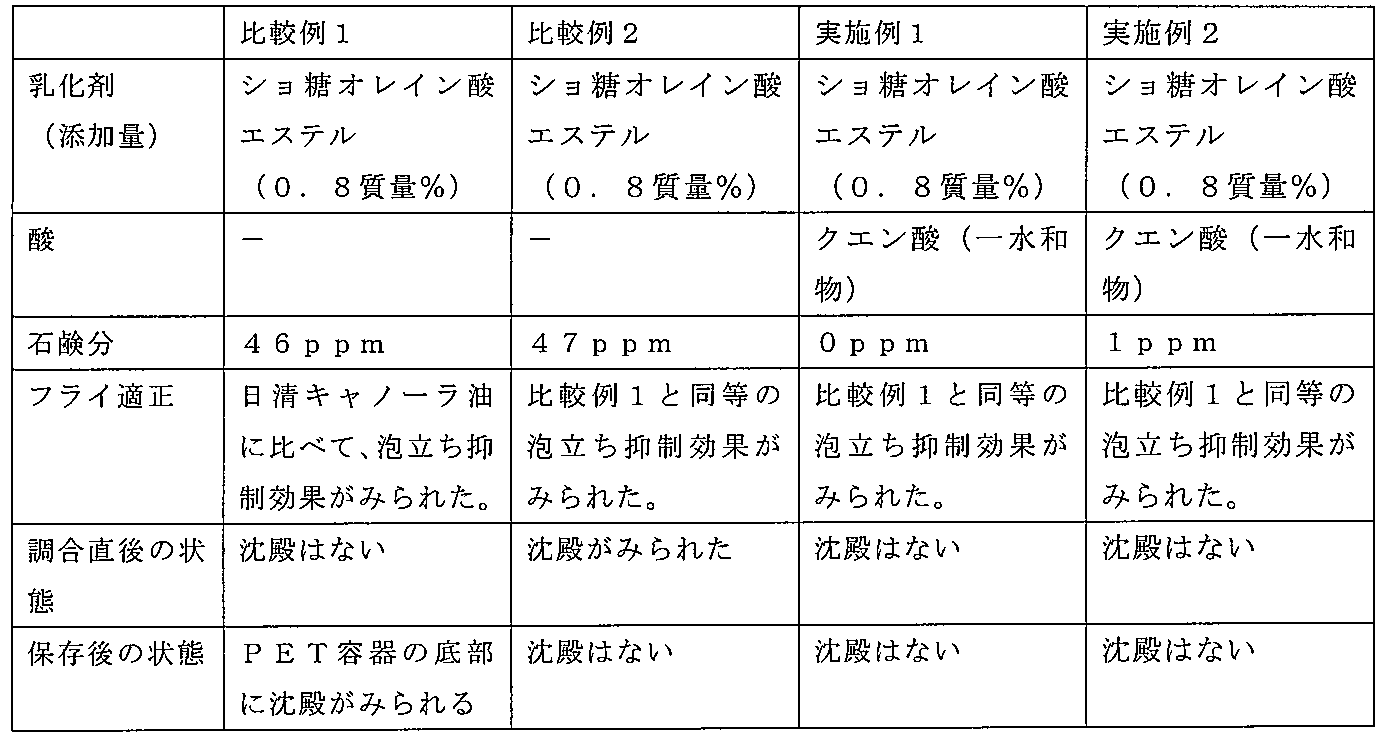
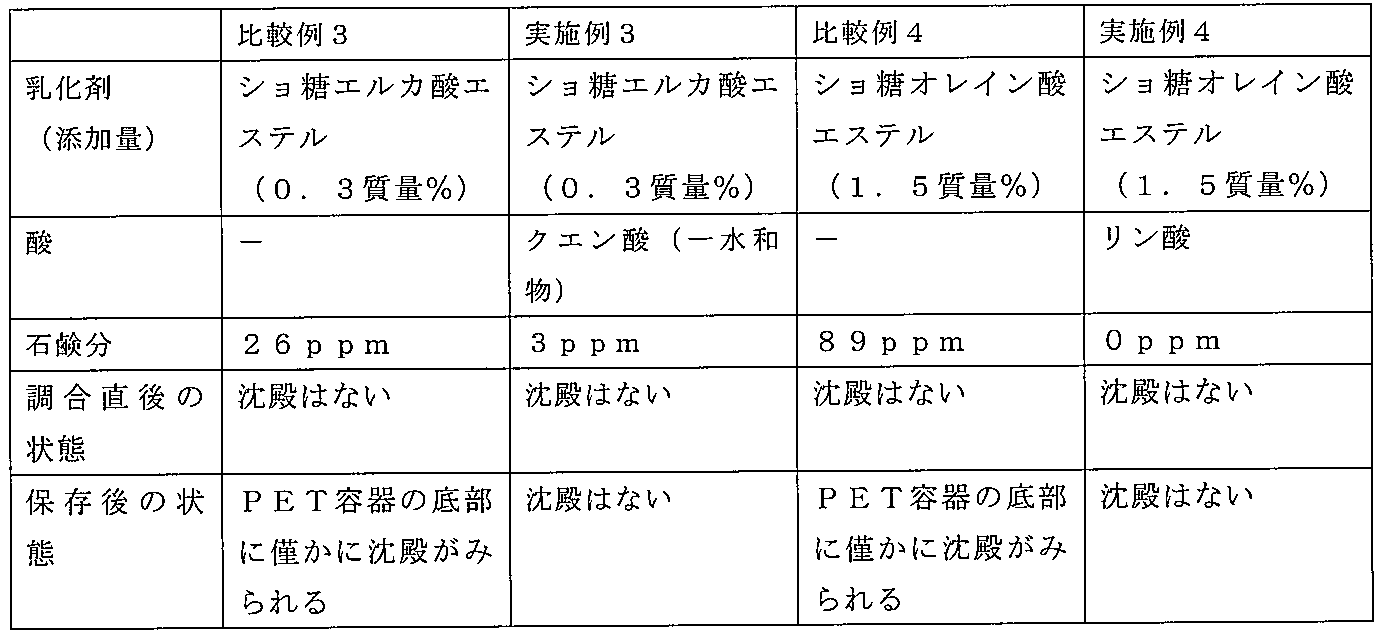
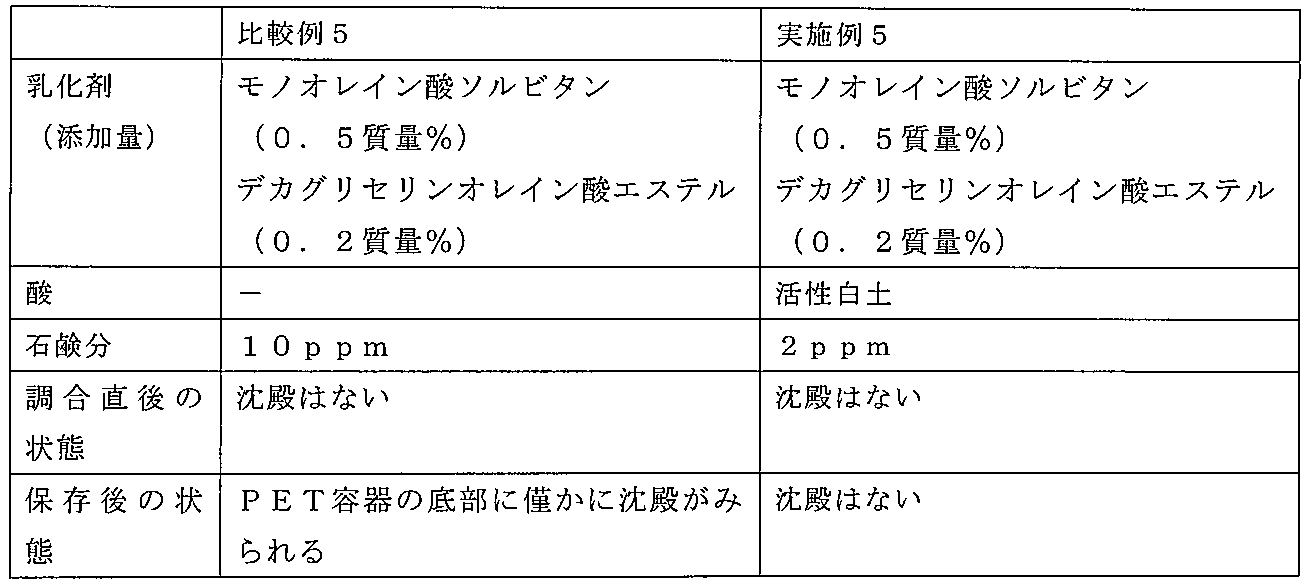
表1の結果によると実施例1~2の乳化剤含有油脂組成物は、比較例1~2と比べて、フライ適性を損なうこともなく、沈殿の発生が抑制されていることがわかった。また、表2~3から、実施例3~5も比較例3~5と比べて、沈殿の発生が抑制されていることがわかった。
Claims (8)
- ショ糖脂肪酸エステル、ポリグリセリン脂肪酸エステル、ソルビタン脂肪酸エステルから選ばれる1種以上の乳化剤を含有する乳化剤含有油脂組成物の製造方法において、酸処理工程を行い、乳化剤含有油脂組成物中の石鹸分を5ppm以下に低下させることを特徴とする乳化剤含有油脂組成物の製造方法。
- 前記乳化剤含有油脂組成物が、前記乳化剤を0.1~10.0質量%含有することを特徴とする請求項1に記載の製造方法。
- 前記乳化剤のHLB値が0~9であることを特徴とする請求項1又は2に記載の製造方法。
- 前記酸処理工程がクエン酸、リンゴ酸、酢酸、乳酸、アスコルビン酸、リン酸から選ばれる酸を用いることを特徴とする請求項1~3のいずれか1項に記載の製造方法。
- 前記酸処理工程が陽イオン交換樹脂、活性白土、酸性白土から選ばれる吸着剤を用いることを特徴とする請求項1~3のいずれか1項に記載の製造方法。
- 前記酸処理工程が、乳化剤と油脂の混合以後の工程であることを特徴とする請求項1~5のいずれか1項に記載の製造方法。
- 前記酸処理工程が、乳化剤と油脂の混合前の工程であることを特徴とする請求項1~5のいずれか1項に記載の製造方法。
- 請求項1~7のいずれか1項に記載の製造方法で得られ、石鹸分が5ppm以下であることを特徴とする乳化剤含有油脂組成物。
Applications Claiming Priority (2)
| Application Number | Priority Date | Filing Date | Title |
|---|---|---|---|
| JP2012-208149 | 2012-09-21 | ||
| JP2012208149 | 2012-09-21 |
Publications (1)
| Publication Number | Publication Date |
|---|---|
| WO2014045682A1 true WO2014045682A1 (ja) | 2014-03-27 |
Family
ID=50341008
Family Applications (1)
| Application Number | Title | Priority Date | Filing Date |
|---|---|---|---|
| PCT/JP2013/068718 Ceased WO2014045682A1 (ja) | 2012-09-21 | 2013-07-09 | 乳化剤含有油脂組成物及び乳化剤含有油脂組成物の製造方法 |
Country Status (2)
| Country | Link |
|---|---|
| JP (1) | JP6234724B2 (ja) |
| WO (1) | WO2014045682A1 (ja) |
Families Citing this family (1)
| Publication number | Priority date | Publication date | Assignee | Title |
|---|---|---|---|---|
| JP6467134B2 (ja) * | 2014-01-31 | 2019-02-06 | 花王株式会社 | 油脂組成物 |
Citations (5)
| Publication number | Priority date | Publication date | Assignee | Title |
|---|---|---|---|---|
| JP2004313176A (ja) * | 2002-12-20 | 2004-11-11 | J-Oil Mills Inc | 食用油脂組成物およびそれを用いた食品の製造方法 |
| JP2004359784A (ja) * | 2003-06-04 | 2004-12-24 | Kao Corp | 油脂組成物 |
| JP2006290887A (ja) * | 2005-04-11 | 2006-10-26 | Dongbu Hannong Chemical Co Ltd | 脂溶性不飽和脂質を水溶性脂質へ転換する転換率を向上させる方法 |
| WO2010093038A1 (ja) * | 2009-02-16 | 2010-08-19 | 日清オイリオグループ株式会社 | 乳化剤含有食用油脂組成物の工業的製造方法 |
| JP2010227021A (ja) * | 2009-03-27 | 2010-10-14 | Nisshin Oillio Group Ltd | 食用油脂の製造方法 |
Family Cites Families (2)
| Publication number | Priority date | Publication date | Assignee | Title |
|---|---|---|---|---|
| JP5700503B2 (ja) * | 2009-09-07 | 2015-04-15 | 日清オイリオグループ株式会社 | グリセリド組成物及び該グリセリド組成物の製造方法 |
| JP2011144343A (ja) * | 2009-12-15 | 2011-07-28 | Kao Corp | 精製油脂の製造方法 |
-
2013
- 2013-07-09 JP JP2013143323A patent/JP6234724B2/ja active Active
- 2013-07-09 WO PCT/JP2013/068718 patent/WO2014045682A1/ja not_active Ceased
Patent Citations (5)
| Publication number | Priority date | Publication date | Assignee | Title |
|---|---|---|---|---|
| JP2004313176A (ja) * | 2002-12-20 | 2004-11-11 | J-Oil Mills Inc | 食用油脂組成物およびそれを用いた食品の製造方法 |
| JP2004359784A (ja) * | 2003-06-04 | 2004-12-24 | Kao Corp | 油脂組成物 |
| JP2006290887A (ja) * | 2005-04-11 | 2006-10-26 | Dongbu Hannong Chemical Co Ltd | 脂溶性不飽和脂質を水溶性脂質へ転換する転換率を向上させる方法 |
| WO2010093038A1 (ja) * | 2009-02-16 | 2010-08-19 | 日清オイリオグループ株式会社 | 乳化剤含有食用油脂組成物の工業的製造方法 |
| JP2010227021A (ja) * | 2009-03-27 | 2010-10-14 | Nisshin Oillio Group Ltd | 食用油脂の製造方法 |
Also Published As
| Publication number | Publication date |
|---|---|
| JP2014077118A (ja) | 2014-05-01 |
| JP6234724B2 (ja) | 2017-11-22 |
Similar Documents
| Publication | Publication Date | Title |
|---|---|---|
| JP5088347B2 (ja) | 食感改良油脂組成物 | |
| CN103547163B (zh) | 油脂组合物 | |
| JP4767919B2 (ja) | 油脂組成物および該油脂組成物を含有する飲食物 | |
| JP6129584B2 (ja) | 加熱調理用油脂組成物及び該加熱調理用油脂組成物の製造方法 | |
| JP6518165B2 (ja) | 加熱調理用油脂組成物およびその製造方法、ならびに加熱調理用油脂の加熱による劣化を抑制する方法 | |
| JP6058927B2 (ja) | フライ用油脂組成物 | |
| JP5274592B2 (ja) | 加熱調理用油脂組成物およびその製造方法、ならびに加熱調理用油脂組成物用の酸価上昇抑制剤 | |
| TWI733878B (zh) | 抑制食品之不良臭味的組成物、該組成物之製造方法、包含該組成物之食品以及抑制食品之不良臭味的方法 | |
| EP3213640B1 (en) | Long-chain polyunsaturated fatty-acid-containing fat and food containing same | |
| JP6234724B2 (ja) | 乳化剤含有油脂組成物及び乳化剤含有油脂組成物の製造方法 | |
| JP6029908B2 (ja) | 乳化剤含有油脂組成物及び乳化剤含有油脂組成物の製造方法 | |
| JP6804253B2 (ja) | 加熱調理用油脂組成物及びその製造方法、並びに加熱調理用油脂の加熱による劣化を抑制する方法 | |
| JP4651327B2 (ja) | 離型油 | |
| JP6689049B2 (ja) | 加熱調理用油脂組成物およびその製造方法、ならびに加熱調理用油脂の加熱による劣化を抑制する方法 | |
| JP6512811B2 (ja) | 分離液状調味料 | |
| TW201811183A (zh) | 油炸物用油脂組成物、油炸物用油脂組成物的製造方法、油炸物的製造方法及對油炸物賦予起司風味的方法 | |
| JP5086312B2 (ja) | 麺類の製造方法 | |
| JP2006055080A (ja) | 練り込み用油脂組成物およびそれを用いた食品 | |
| TWI572288B (zh) | 鬆散性改善用油脂組合物、利用該油脂組合物的非焙烤食品及非焙烤食品的製造方法 | |
| JP7753138B2 (ja) | 油脂及び油溶性機能性成分用酸化防止剤の製造方法 | |
| JP2003313583A (ja) | 泡立ち抑制効果を有する油脂組成物 | |
| JP6910712B2 (ja) | から揚げ様食品製造用油脂組成物及びその製造方法。 | |
| JP6817014B2 (ja) | 抗酸化剤、抗酸化剤を含有する油脂組成物およびこれを含有する油性食品 | |
| WO2023210454A1 (ja) | 酸化防止剤組成物及び食用油脂 | |
| JP2006055064A (ja) | 食用油脂製造方法 |
Legal Events
| Date | Code | Title | Description |
|---|---|---|---|
| 121 | Ep: the epo has been informed by wipo that ep was designated in this application |
Ref document number: 13838569 Country of ref document: EP Kind code of ref document: A1 |
|
| NENP | Non-entry into the national phase |
Ref country code: DE |
|
| 122 | Ep: pct application non-entry in european phase |
Ref document number: 13838569 Country of ref document: EP Kind code of ref document: A1 |