WO2014042406A2 - 철 칼코게나이드 나노복합체 및 이의 제조방법 - Google Patents
철 칼코게나이드 나노복합체 및 이의 제조방법 Download PDFInfo
- Publication number
- WO2014042406A2 WO2014042406A2 PCT/KR2013/008181 KR2013008181W WO2014042406A2 WO 2014042406 A2 WO2014042406 A2 WO 2014042406A2 KR 2013008181 W KR2013008181 W KR 2013008181W WO 2014042406 A2 WO2014042406 A2 WO 2014042406A2
- Authority
- WO
- WIPO (PCT)
- Prior art keywords
- nanocomposite
- fese
- iron
- iron chalcogenide
- acid
- Prior art date
- Legal status (The legal status is an assumption and is not a legal conclusion. Google has not performed a legal analysis and makes no representation as to the accuracy of the status listed.)
- Ceased
Links
Images




Classifications
-
- B—PERFORMING OPERATIONS; TRANSPORTING
- B82—NANOTECHNOLOGY
- B82B—NANOSTRUCTURES FORMED BY MANIPULATION OF INDIVIDUAL ATOMS, MOLECULES, OR LIMITED COLLECTIONS OF ATOMS OR MOLECULES AS DISCRETE UNITS; MANUFACTURE OR TREATMENT THEREOF
- B82B1/00—Nanostructures formed by manipulation of individual atoms or molecules, or limited collections of atoms or molecules as discrete units
-
- B—PERFORMING OPERATIONS; TRANSPORTING
- B82—NANOTECHNOLOGY
- B82Y—SPECIFIC USES OR APPLICATIONS OF NANOSTRUCTURES; MEASUREMENT OR ANALYSIS OF NANOSTRUCTURES; MANUFACTURE OR TREATMENT OF NANOSTRUCTURES
- B82Y30/00—Nanotechnology for materials or surface science, e.g. nanocomposites
-
- C—CHEMISTRY; METALLURGY
- C01—INORGANIC CHEMISTRY
- C01B—NON-METALLIC ELEMENTS; COMPOUNDS THEREOF; METALLOIDS OR COMPOUNDS THEREOF NOT COVERED BY SUBCLASS C01C
- C01B19/00—Selenium; Tellurium; Compounds thereof
- C01B19/04—Binary compounds including binary selenium-tellurium compounds
-
- B—PERFORMING OPERATIONS; TRANSPORTING
- B82—NANOTECHNOLOGY
- B82B—NANOSTRUCTURES FORMED BY MANIPULATION OF INDIVIDUAL ATOMS, MOLECULES, OR LIMITED COLLECTIONS OF ATOMS OR MOLECULES AS DISCRETE UNITS; MANUFACTURE OR TREATMENT THEREOF
- B82B3/00—Manufacture or treatment of nanostructures by manipulation of individual atoms or molecules, or limited collections of atoms or molecules as discrete units
-
- C—CHEMISTRY; METALLURGY
- C01—INORGANIC CHEMISTRY
- C01B—NON-METALLIC ELEMENTS; COMPOUNDS THEREOF; METALLOIDS OR COMPOUNDS THEREOF NOT COVERED BY SUBCLASS C01C
- C01B19/00—Selenium; Tellurium; Compounds thereof
- C01B19/007—Tellurides or selenides of metals
-
- C—CHEMISTRY; METALLURGY
- C09—DYES; PAINTS; POLISHES; NATURAL RESINS; ADHESIVES; COMPOSITIONS NOT OTHERWISE PROVIDED FOR; APPLICATIONS OF MATERIALS NOT OTHERWISE PROVIDED FOR
- C09K—MATERIALS FOR MISCELLANEOUS APPLICATIONS, NOT PROVIDED FOR ELSEWHERE
- C09K11/00—Luminescent materials, e.g. electroluminescent or chemiluminescent
- C09K11/08—Luminescent materials, e.g. electroluminescent or chemiluminescent containing inorganic luminescent materials
- C09K11/60—Luminescent materials, e.g. electroluminescent or chemiluminescent containing inorganic luminescent materials containing iron, cobalt or nickel
-
- C—CHEMISTRY; METALLURGY
- C09—DYES; PAINTS; POLISHES; NATURAL RESINS; ADHESIVES; COMPOSITIONS NOT OTHERWISE PROVIDED FOR; APPLICATIONS OF MATERIALS NOT OTHERWISE PROVIDED FOR
- C09K—MATERIALS FOR MISCELLANEOUS APPLICATIONS, NOT PROVIDED FOR ELSEWHERE
- C09K11/00—Luminescent materials, e.g. electroluminescent or chemiluminescent
- C09K11/08—Luminescent materials, e.g. electroluminescent or chemiluminescent containing inorganic luminescent materials
- C09K11/88—Luminescent materials, e.g. electroluminescent or chemiluminescent containing inorganic luminescent materials containing selenium, tellurium or unspecified chalcogen elements
- C09K11/881—Chalcogenides
-
- C—CHEMISTRY; METALLURGY
- C01—INORGANIC CHEMISTRY
- C01P—INDEXING SCHEME RELATING TO STRUCTURAL AND PHYSICAL ASPECTS OF SOLID INORGANIC COMPOUNDS
- C01P2002/00—Crystal-structural characteristics
- C01P2002/70—Crystal-structural characteristics defined by measured X-ray, neutron or electron diffraction data
- C01P2002/72—Crystal-structural characteristics defined by measured X-ray, neutron or electron diffraction data by d-values or two theta-values, e.g. as X-ray diagram
-
- C—CHEMISTRY; METALLURGY
- C01—INORGANIC CHEMISTRY
- C01P—INDEXING SCHEME RELATING TO STRUCTURAL AND PHYSICAL ASPECTS OF SOLID INORGANIC COMPOUNDS
- C01P2002/00—Crystal-structural characteristics
- C01P2002/80—Crystal-structural characteristics defined by measured data other than those specified in group C01P2002/70
- C01P2002/84—Crystal-structural characteristics defined by measured data other than those specified in group C01P2002/70 by UV- or VIS- data
-
- C—CHEMISTRY; METALLURGY
- C01—INORGANIC CHEMISTRY
- C01P—INDEXING SCHEME RELATING TO STRUCTURAL AND PHYSICAL ASPECTS OF SOLID INORGANIC COMPOUNDS
- C01P2002/00—Crystal-structural characteristics
- C01P2002/80—Crystal-structural characteristics defined by measured data other than those specified in group C01P2002/70
- C01P2002/85—Crystal-structural characteristics defined by measured data other than those specified in group C01P2002/70 by XPS, EDX or EDAX data
-
- C—CHEMISTRY; METALLURGY
- C01—INORGANIC CHEMISTRY
- C01P—INDEXING SCHEME RELATING TO STRUCTURAL AND PHYSICAL ASPECTS OF SOLID INORGANIC COMPOUNDS
- C01P2002/00—Crystal-structural characteristics
- C01P2002/80—Crystal-structural characteristics defined by measured data other than those specified in group C01P2002/70
- C01P2002/88—Crystal-structural characteristics defined by measured data other than those specified in group C01P2002/70 by thermal analysis data, e.g. TGA, DTA, DSC
-
- C—CHEMISTRY; METALLURGY
- C01—INORGANIC CHEMISTRY
- C01P—INDEXING SCHEME RELATING TO STRUCTURAL AND PHYSICAL ASPECTS OF SOLID INORGANIC COMPOUNDS
- C01P2004/00—Particle morphology
- C01P2004/01—Particle morphology depicted by an image
-
- C—CHEMISTRY; METALLURGY
- C01—INORGANIC CHEMISTRY
- C01P—INDEXING SCHEME RELATING TO STRUCTURAL AND PHYSICAL ASPECTS OF SOLID INORGANIC COMPOUNDS
- C01P2004/00—Particle morphology
- C01P2004/01—Particle morphology depicted by an image
- C01P2004/04—Particle morphology depicted by an image obtained by TEM, STEM, STM or AFM
-
- C—CHEMISTRY; METALLURGY
- C01—INORGANIC CHEMISTRY
- C01P—INDEXING SCHEME RELATING TO STRUCTURAL AND PHYSICAL ASPECTS OF SOLID INORGANIC COMPOUNDS
- C01P2004/00—Particle morphology
- C01P2004/51—Particles with a specific particle size distribution
- C01P2004/52—Particles with a specific particle size distribution highly monodisperse size distribution
-
- C—CHEMISTRY; METALLURGY
- C01—INORGANIC CHEMISTRY
- C01P—INDEXING SCHEME RELATING TO STRUCTURAL AND PHYSICAL ASPECTS OF SOLID INORGANIC COMPOUNDS
- C01P2004/00—Particle morphology
- C01P2004/60—Particles characterised by their size
- C01P2004/64—Nanometer sized, i.e. from 1-100 nanometer
Definitions
- the present invention relates to an iron chalcogenide nanocomposite having a photoluminescence property and a method of manufacturing the same.
- Transition metal chalcogenides are attracting attention because of their unique structure and electrical properties for a variety of applications including thermoelectrics, magnetic semiconductors, superconductors, quantum dots, sensors and photoelectric conversion devices.
- thermoelectrics thermoelectrics
- magnetic semiconductors magnetic semiconductors
- superconductors quantum dots
- sensors photoelectric conversion devices.
- a significant number of high quality metal chalcogenide nanostructures have been fabricated by colloidal synthesis, and most of the previous studies have studied 2-4 semiconductors such as CdSe, CdS, ZnS, ZnSe, CdTe, CdSe, ZnS, Ag 2 Se, NiSe, Ag 2 S Emphasis was placed on nanostructures and their optical properties were investigated.
- iron selenide has two stoichiometric phases, FeSe and FeSe 2 .
- FeSe forms crystals in the form of squares or hexagons
- FeSe 2 forms crystals in a cube or tetragonal structure.
- Phase-selective synthesis has been attempted involving both phases of Fe 2+ ions.
- These iron selenides have a direct bandgap (1.23eV), have excellent conductivity, optical, electrical and magnetic properties, and may be superconductors with the properties of semiconductors or even ferromagnetic / ferrimagnetic metals.
- PbO-type FeSe exists only in the narrow synthetic section of 50.6 ⁇ 51.0%. Iron elements are known to be superconductors when they have very precise composition and specific structural features. NiAs FeSe is also a very unusual 1: 1 Fe-Se compound, which is present in the 42.0-50.5% of the synthetic region and is not a superconductor.
- 1 Fe-Se compound which is present in the 42.0-50.5% of the synthetic region and is not a superconductor.
- studies on the other potentials of the optical properties of semiconductor iron chalcogenide nanostructures are insufficient. In the present situation, the synthesis of iron chalcogenide nanocomposites having high photoluminescence properties has not been achieved.
- the present invention is to provide a method for producing an iron chalcogenide nanocomposite to solve the problem.
- the present invention for solving the above problems
- the present invention relates to an iron chalcogenide nanocomposite having photoluminescence properties.
- the iron chalcogenide nanocomposite of the present invention may be considered as an environmentally friendly alternative to the photoluminescent material by having a high photoluminescence property even when no heavy metal is included. There is an effect that can be applied to a variety of fields.
- the iron chalcogenide production method according to the present invention is expected to be applicable to other metal chalcogenide synthesis method.
- FIG. 3 (top) TEM-EDX analysis of FeSe and FeSe 2 ; (Bottom) XRD patterns of FeSe (black curve, bottom) and FeSe 2 (red curve, top).
- Figure 4 shows the size distribution histogram of FeSe synthesized in one embodiment of the present invention.
- Figure 5 shows the size distribution histogram of FeSe 2 synthesized in one embodiment of the present invention.
- FeSe and FeSe 2 are TEM images of FeSe and FeSe 2 ((a) FeSe (b) FeSe 2 (insertion is STEM photo, scale bar is 200nm); HRTEM photograph ((c) FeSe (d) FeSe 2 ) is shown.
- FIG. 7 is a, b, c) TEM image of FeSe nanocomposite (see X axis at + 60 °, 0 °, ⁇ 51 °, respectively); (d, e, f) TEM images of FeSe 2 nanocomposites (+ 57 °, 0 °, ⁇ 54 °, respectively); 1) -6) 3D TEM morphological images at different viewing angles of FeSe nanocomposites; 7) ⁇ 12) 3D TEM morphological images at different viewing angles of FeSe 2 nanocomposites.
- TGA 12 shows the thermogravimetric analysis (TGA) characteristics in nitrogen gas of FeSe.
- FIG. 13 shows the thermogravimetric analysis (TGA) in the nitrogen gas of FeSe 2 .
- Figure 15 shows the fluorescence of FeSe (right), FeSe 2 (left) in the bottle.
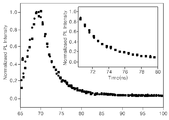
- 16 shows the fluorescence lifetime spectrometer spectra of FeSe and FeSe 2 .
- FIG. 17 shows ( ⁇ h ⁇ ) 1/2 dependence on h ⁇ of the synthesized FeSe and FeSe 2 nanocomposites.
- FIG. 18 shows absorbance and fluorescence spectra of FeSe measured at different reaction times (0.5, 2 hours).
- the present invention relates to an iron chalcogenide nanocomposite having, as one aspect, photoluminescence properties.
- the nanocomposite is characterized in that it has a NiAs type crystal.
- the chalcogen is S, Se or Te, more preferably the iron chalcogenide is FeSe or FeSe 2 .
- the present invention relates to a method for producing an iron chalcogenide nanocomposite, comprising: (a) dissolving a Fe precursor in an organic solvent to form a Fe solution; (b) dissolving chalcogen powder or chalcogen precursor in an organic solvent to form a chalcogen solution; (c) injecting the Fe solution dropwise into the chalcogen solution to prepare a mixed solution in which iron chalcogenide is formed; And (d) purifying iron chalcogenide from the mixed solution.
- This invention relates to a method for synthesizing iron chalcogenide by preparing two different solutions, iron solution and chalcogen solution, respectively, and then preparing a mixed solution by applying a thermal injection method.
- the organic solvent of the step (a) or (b) is heated to 100 ⁇ 140 °C.
- the organic solvent is an ether compound (C n OC n , C n : hydrocarbon, 4 ⁇ n ⁇ 30), hydrocarbons (C n H 2n + 2 , 7 ⁇ n ⁇ 30), unsaturated hydrocarbons (C n H 2n , 7 ⁇ n ⁇ 30) and an organic acid (C n COOH, C n : hydrocarbon, 5 ⁇ n ⁇ 30).
- the ether compound is trioctylphosphine oxide (TOPO), alkylphosphine (alkylphosphine), octyl ether, benzyl ether and phenyl ether
- TOPO trioctylphosphine oxide
- alkylphosphine alkylphosphine
- octyl ether benzyl ether
- phenyl ether phenyl ether
- the hydrocarbons are preferably selected from the group consisting of hexadecane, heptadecane and octadecane.
- the unsaturated hydrocarbons are preferably selected from the group consisting of octane, heptadecein, and octadecane.
- the organic acid is selected from the group consisting of oleic acid (oleic acid), lauric acid (lauric acid), stearic acid (stearic acid), mysteric acid and hexadecanoic acid (hexadecanoic acid). It is preferable.
- the mixed solution is heated at 250 to 400 ° C. to prepare a mixed solution in which iron chalcogenide is formed. Characterized in that. Since the precursor elements such as chalcogen or chalcogen precursors and iron ions have high volatility, they are heated to the above temperature range to form a uniformly organized complex. In one embodiment of the present invention, the precursor is heated at 330 ° C.
- the step (c) it can be prepared by adding and mixing the surfactant, in order to avoid unwanted precipitation and easily collect the final product, multi-purpose such as oleyl amine, octadecylamine, trioctylphosphine One or more selected from the group consisting of oleic acid, lauric acid, stearic acid, mysteric acid and hexadecanoic acid, not surfactants It is more preferable that it is an organic acid.
- the use of such surfactants makes it easier to collect the final product on the inner wall of the glass flask at high temperatures, unlike conventional methods using conventional multipurpose surfactants.
- the Fe precursor and the chalcogen or chalcogen precursor are used in a molar ratio of 1: 1 to 2, thereby adjusting the amount of such precursors to provide different types of photoluminescence characteristics. Eggplant will be able to form iron chalcogenide.
- the chalcogen is S, Se or Te, more preferably the iron chalcogenide is FeSe or FeSe 2 .
- High resolution transmission electron microscopy (HR-TEM) photographs and energy dispersion spectra (EDS) were performed using JEOL (JEM-3010, Boston, USA), which operates accelerated at 200 kV.
- Samples for TEM analysis were prepared by drop-casting the ultrastructured carbon coated copper grid by diluting the nanostructured solution in nucleic acid or toluene.
- the three-dimensional TEM (3D-TEM) was characterized by electronic form in the TEM field (EM912 ⁇ , Carl zeiss, Germany) operating at 120 kV). All BF (bright) -TEM images were obtained with zero loss filtered images.
- Fluorescence microscopy was used by depositing a drop of colloidal solution on a glass substrate and covering it with a coverslip (Leica, Heidelberg, Germany).
- PL (photoluminescence) intensity was measured by a fluorescence spectrometer (Hitachi F-7000, Japan).
- the absorbance of the nanocomposites was measured by UV / Vis spectroscopy (Scinco, S310, Korea).
- the fluorescence lifetime ( ⁇ ) of each sample was measured at 380 nm excitation wavelength using a light emitting diode (TM-200 LED strobe Lifetime spectrophotometer 3113, PTI Inc., USA).
- the mixed solution (AB mixed solution) gradually becomes colorless again (see FIG. 2A).
- the temperature was reduced to 110 ° C., and again placed in a vacuum for 20 minutes, and the AB mixed solution was further heated at 330 ° C. for 2 hours.
- remove the reaction heating mantle and connect the reaction tubes to cool the AB mixture solution at room temperature, transfer the final AB mixture solution to the test tube, add 5 mL of hexane and 15 mL ethanol, and then mix the mixture at 8500 rpm. Centrifuged for 0.5 hour. The clean supernatant was discarded and the precipitate was dispersed again in nucleic acid, then the final product was purified several times and dispersed in hexane to give FeSe.
- FIG. 1 schematically shows the synthesis process.
- Figure 3 shows the TEM-EDX analysis results (top) and XRD pattern (bottom) of FeSe, FeSe 2 synthesized by the above embodiment, in particular the element ratio (Fe: Se of the nanocomposite synthesized TEM-EDX analysis results) ) Is 1: 1.05 and 1: 2.17, respectively.
- the element ratio Fe: Se of the nanocomposite synthesized TEM-EDX analysis results
- FeSe 2 nanoparticles that are well associated with the reference crystal structure type FeSe It can be seen that it shows a stronger and more distinguishable form than nanoparticles. This is due to the crystallinity of the nanocomposite. Since the crystallinity is greatly improved as the amount of Se precursor increases, it is determined that the amount of Se precursor can determine not only the final product synthesized but also the crystallinity.
- the crystallinity of nanomaterials is determined from the phase change or heating conditions (temperature, heating time) of the precursor in the reaction. From these results, the nanocrystals have a uniform size distribution. Since it is synthesized, this size difference is believed to arise from the amount of Se element and the phase separation mechanism during the synthesis process. In addition, since the heating process in the above embodiment was controlled under exactly the same conditions, it is determined that the amount of Se precursor used in the mixing is an important factor for improving the crystallinity.
- FIG. 6 is a result of confirming the crystal structure of the FeSe, FeSe 2 synthesized by transmission electron microscope (TEM), scanning electron microscope and high-resolution transmission electron microscope (HR-TEM),
- Figure 7 is a three-dimensional transmission electron microscope (3D- TEM) showed the result, and it was confirmed that the phase crystal of hexagonal structure was shown.
- the white lines shown in c and d of FIG. 6 indicate the spacing between adjacent lattice lines as the nanoparticle crystals grow, and it can be seen that the respective inner planes correspond to FeSe (002) and FeSe 2 (011) distances.
- thermogravimetric analysis TGA
- FeSe thermogravimetric analysis
- FeSe 2 the decomposition initiation temperature was about 155 ° C and 247 ° C, respectively
- the decomposition completion temperature was about 605 ° C and 807 ° C, respectively, and there was about 80% mass loss in the final decomposition product. Comparing this decomposition process, FeSe 2 nanocomposites are more stable than FeSe nanocomposites.
- FIG. 14 to 17 show optical and electrical characteristics of FeSe and FeSe 2 nanocomposites.
- an absorption band (a) was observed at a wavelength peak of about 300 nm and FeSe and FeSe at room temperature in an n-hexane solution.
- the strong photoluminescence (PL) bands of the 2 nanocomposites were measured at 447 nm and 462 nm wavelength peaks, respectively.
- Figure 15 shows a fluorescence photograph was it shown in the nanoparticle solution bottled bar, This shows that no matter strong luminescence of FeSe x nanocomposites with other types of FeSe x. Referring to FIG.
- the bandwidth has a relatively sharp inversion width of 100 nm, which mainly contributes to the size distribution of the nanocomposites, and the quantum yield of each nanocomposite is approximately when rhodamine B is used as a standard. 20% (FeSe) and 16% (FeSe 2 ).
- the fluorescence lifetime ( ⁇ ) of each nanocomposite is 3.07 ⁇ 0.023 ns (FeSe) and 2.54 ⁇ 0.018 ns (FeSe 2 ), respectively.
- the bandwidth of the nanoparticles was estimated by using the relationship of ( ⁇ h ⁇ ) 1/2 versus h ⁇ based on the optical observation of the nanoparticles.
- ⁇ absorbance
- h Planck's constant
- ⁇ frequency (FIG. 17). This means that the energy bandwidth of FeSe x is in the range of 2.25 to 2.51 eV and is slightly wider than the reference. These results may be from nanosize effect and crystal structure.
- the nanocomposites produced by the present invention exhibit high photoluminescence without heavy metals and can be replaced with environmentally friendly photoluminescence materials, and the synthesized nanocomposites may be useful for better bandgap engineering of semiconductor nanoparticles. It is considered to be. Moreover, the synthetic approach is expected to have tremendous potential for regulating the synthesis of other metal chalcogenides.
Landscapes
- Chemical & Material Sciences (AREA)
- Engineering & Computer Science (AREA)
- Organic Chemistry (AREA)
- Nanotechnology (AREA)
- Inorganic Chemistry (AREA)
- Crystallography & Structural Chemistry (AREA)
- Materials Engineering (AREA)
- Physics & Mathematics (AREA)
- General Physics & Mathematics (AREA)
- Condensed Matter Physics & Semiconductors (AREA)
- Composite Materials (AREA)
- Manufacturing & Machinery (AREA)
- Compounds Of Iron (AREA)
- Luminescent Compositions (AREA)
- Battery Electrode And Active Subsutance (AREA)
Abstract
본 발명은 철 칼코게나이드 나노복합체 및 이의 제조방법에 관한 것으로, 보다 구체적으로는 광루미네선스 특성을 가지는 철 칼코게나이드 나노복합체와, (a) 유기용매에 Fe 전구체를 용해시켜 Fe 용액을 형성하는 단계; (b) 유기용매에, 칼코겐 분말 또는 칼코겐 전구체를 용해시켜 칼코겐 용액을 형성하는 단계; (c) 상기 Fe 용액을 상기 칼코겐 용액에 적상주입하여 철 칼코게나이드가 형성된 혼합용액을 제조하는 단계; 및 (d) 상기 혼합용액으로부터 철 칼코게나이드를 정제하는 단계;를 포함하는 철 칼코게나이드 나노복합체의 제조방법에 관한 것이다.
Description
본 발명은 광루미네선스 특성을 갖는 철 칼코게나이드 나노복합체 및 이의 제조방법에 관한 것이다.
전이금속 칼코겐화물(칼코게나이드)은 열전, 자성반도체, 초전도체, 양자점, 센서와 광전변환소자를 포함하는 다양한 응용에 쓰이는 독특한 구조와 전기적 특성 때문에 주목되고 있다. 상당한 수의 고품질 금속 칼코겐화 나노구조는 콜로이드 합성법으로 제조되어왔고, 종래 대부분 연구는 CdSe, CdS, ZnS, ZnSe, CdTe, CdSe, ZnS, Ag2Se, NiSe, Ag2S와 같은 2-4 반도체 나노구조에 중점을 두었고 그들의 광학적 특성을 조사하였다.
그러나 다른 잠재적인 반도체 금속 칼코겐화 나노구조에 관해 특히 합성단계에서 상-선택성 문제를 가지는 물질에 대해서는 최근에야 연구가 이루어지고 있다. 그 예로서 철 셀렌화물은 FeSe 와 FeSe2의 두 가지 화학량론적 상을 가진다. FeSe 는 사각형 또는 육각형으로 결정체를 이루는 반면 FeSe2는 정육면체나 사방정계(백철석 모양) 구조로 결정체를 이룬다. 두 가지 상 모두 Fe2+ 이온을 포함하는 상-선택적 합성이 시도되고 있다. 이러한 철 셀렌화물은 직접적인 밴드갭(1.23eV)을 가지며 우수한 전도성, 광학적, 전기적, 자기적 성질을 가지고 있고, 반도체 또는 심지어 강자성/ 페리자성 금속의 특성을 가진 초전도체가 될 수도 있다. 예를 들어 PbO형의 FeSe는 오로지 50.6~51.0%의 좁은 합성구간에서 존재한다. 철 요소는 매우 정확한 구성과 특정 구조특징을 가질 때 초전도체가 된다고 알려져 있다. NiAs형의 FeSe는 또한 아주 흔치않은 1:1 Fe-Se 화합물로 42.0~50.5% 의 합성구간에서 존재하며 이는 초전도체가 아니다. 그러나 현재까지는 몇 안 되는 종류의 철 셀렌화물이 알려져 있을 뿐이고, PbO형의 FeSe 나노입자 합성을 위한 많은 노력들이 있었음에도 불구하고 반도체 철 칼코겐화 나노구조의 광학 특성에 대한 다른 잠재성에 대한 연구는 부족한 실정이며, 더욱이 높은 광루미네선스 특성을 가지는 철 칼코겐화 나노복합체의 합성은 이루어진 바 없는 실정이다.
이에 본 발명에서는, 광루미네선스 특성을 가지는 철 칼코게나이드 나노복합체를 제공하는 것을 그 해결과제로 한다.
또한, 본 발명은 철 칼코게나이드 나노복합체를 제조하는 방법을 제공하는 것을 그 해결과제로 한다.
상술한 과제를 해결하기 위한 본 발명은
일 양태로서, 광루미네선스 특성을 갖는 것을 특징으로 하는 철 칼코게나이드 나노복합체에 관한 것이다.
다른 양태로서, 본 발명은
(a) 유기용매에 Fe 전구체를 용해시켜 Fe 용액을 형성하는 단계;
(b) 유기용매에, 칼코겐 분말 또는 칼코겐 전구체를 용해시켜 칼코겐 용액을 형성하는 단계;
(c) 상기 Fe 용액을 상기 칼코겐 용액에 적상주입하여 철 칼코게나이드가 형성된 혼합용액을 제조하는 단계; 및
(d) 상기 혼합용액으로부터 철 칼코게나이드를 정제하는 단계;를 포함하는 철 칼코게나이드 나노복합체의 제조방법에 관한 것이다.
상술한 바와 같이 본 발명의 철 칼코게나이드 나노복합체는 중금속이 포함되지 않아도 높은 광루미네선스 특성을 가짐으로써 광루미네선스 물질에 대해 환경친화적인 대체물로서 고려될 수 있는 것으로 판단되며, 반도체를 비롯한 다양한 분야에 응용될 수 있는 효과가 있다. 또한 본 발명에 따른 철 칼코게나이드 제조방법은 다른 금속 칼코게나이드 합성방법에 적용될 수 있을 것으로 기대된다.
도 1은 본 발명의 일 실시예에 따른 FeSex(x=1,2)의 합성방법을 개략적으로 나타낸 것이다.
도 2는 (a) FeSe와 FeSe2나노입자 용액; (b) 나노입자의 광루미네선스 사진을 나타낸 것이다.
도 3은 (위) FeSe와 FeSe2의 TEM-EDX 분석결과; (아래) FeSe(검정 곡선, 아래)와 FeSe2(빨강 곡선, 위)의 XRD 패턴을 나타낸 것이다.
도 4는 본 발명의 일 실시예에서 합성된 FeSe의 크기분포 히스토그램을 나타낸 것이다.
도 5는 본 발명의 일 실시예에서 합성된 FeSe2의 크기분포 히스토그램을 나타낸 것이다.
도 6은 FeSe와 FeSe2의 TEM사진((a)FeSe (b)FeSe2 (삽입도는 STEM사진, 스케일바는 200nm)); HRTEM 사진((c) FeSe (d) FeSe2)을 나타낸 것이다.
도 7은 a, b, c) FeSe 나노복합체의 TEM 사진 (각각 +60°, 0°, -51° 에서 X 축 참조) ; (d, e, f) FeSe2 나노복합체의 TEM 사진 (각각 +57°, 0°, -54°); 1)~6) FeSe 나노복합체의 다른 시야 각에서의 3D TEM 형태학적 이미지; 7)~12) FeSe2 나노복합체의 다른 시야 각에서의 3D TEM 형태학적 이미지를 나타낸 것이다.
도 8 내지 도 11은 가열시간(합성 공정)에 따른 FeSe(좌), FeSe2(우) 나노복합체의 TEM 사진을 나타낸 것으로, 각각 0h, 0.5h, 1h, 1.5h일 때의 TEM 사진을 나타낸 것이다.
도 12는 FeSe의 질소가스 내에서 열중량분석(TGA) 특성을 나타낸 것이다.
도 13은 FeSe2의 질소가스 내에서 열중량분석(TGA) 특성을 나타낸 것이다.
도 14는 FeSe, FeSe2의 UV 와 PL 세기를 나타낸 것이다.
도 15는 병에 담긴 FeSe(우), FeSe2(좌)의 형광사진을 나타낸 것이다.
도 16은 FeSe, FeSe2의 형광수명 분광기 스펙트라를 나타낸 것이다.
도 17은 합성된 FeSe, FeSe2 나노복합체의 hυ에 대한 (αhυ) 1/2 의존성을 나타낸 것이다.
도 18은 반응 시간을 다르게 하여(0.5, 2시간) 측정한 FeSe의 흡광도와 형광 스펙트라를 나타낸 것이다.
도 19는 반응 시간을 다르게 하여(0.5, 2시간) 측정한 FeSe2의 흡광도와 형광 스펙트라를 나타낸 것이다.
본 발명은 일 양태로서 광루미네선스 특성을 갖는 것을 특징으로 하는 철 칼코게나이드 나노복합체에 관한 것이다.
바람직하게는 상기 나노복합체는 NiAs형 상 결정을 갖는 것을 특징으로 한다.
또한 바람직하게는 상기 칼코겐은 S, Se 또는 Te인 것으로, 더욱 바람직하게는 상기 철 칼코게나이드는 FeSe 또는 FeSe2이다.
다른 양태로서 본 발명은, 철 칼코게나이드 나노복합체의 제조방법에 관한 것으로서, (a) 유기용매에 Fe 전구체를 용해시켜 Fe 용액을 형성하는 단계; (b) 유기용매에, 칼코겐 분말 또는 칼코겐 전구체를 용해시켜 칼코겐 용액을 형성하는 단계; (c) 상기 Fe 용액을 상기 칼코겐 용액에 적상주입하여 철 칼코게나이드가 형성된 혼합용액을 제조하는 단계; 및 (d) 상기 혼합용액으로부터 철 칼코게나이드를 정제하는 단계;를 포함하는 것을 특징으로 한다. 이러한 본원발명은 두 개의 다른 용액인 철 용액과 칼코겐 용액을 각각 준비한 다음 열상주입방법을 적용하여 혼합용액을 제조함으로써 철 칼코게나이드를 합성하는 방법에 관한 것이다.
따라서 바람직하게는 상기 (a)단계 또는 (b)단계의 상기 유기용매가 100~140℃로 가열되는 것을 특징으로 한다.
이 때, 유기 용매는, 에테르계 화합물(CnOCn, Cn:탄화수소, 4≤n≤30), 탄화수소류(CnH2n+2, 7≤n≤30), 불포화 탄화수소류(CnH2n, 7≤n≤30) 및 유기산(CnCOOH, Cn:탄화수소, 5≤n≤30)으로 이루어진 군에서 선택되는 것이 바람직하다.
더욱 바람직하게는, 상기 에테르계 화합물은, 트리옥틸포스핀 옥사이드(trioctylphosphine oxide, TOPO), 알킬포스핀(alkylphosphine), 옥틸 에테르(octyl ether), 벤질 에테르(benzyl ether) 및 페닐 에테르(phenyl ether)으로 이루어진 군에서 하나 이상 선택될 수 있다. 또한 상기 탄화수소류는, 헥사 데칸, 헵타 데칸 및 옥타 데칸으로 이루어진 군에서 하나 이상 선택되는 것이 바람직하다. 또한 상기 불포화 탄화수소류는, 옥테인, 헵타데세인 및 옥타데세인으로 이루어진 군에서 하나 이상 선택되는 것이 바람직하다. 또한 상기 유기산은, 올레산(oleic acid), 라우르산(lauric acid), 스테아르산(stearic acid), 미스테르산(mysteric acid) 및 헥사데카노익산(hexadecanoic acid)으로 이루어진 군에서 하나 이상 선택되는 것이 바람직하다.
또한 본 발명에 있어서 바람직하게는 상기 (c) 단계는, 상기 Fe 용액을 상기 칼코겐 용액에 적상주입한 후, 혼합된 용액을 250~400℃에서 가열하여 철 칼코게나이드가 형성된 혼합용액을 제조하는 것을 특징으로 한다. 이는 칼코겐 또는 칼코겐 전구체, 철 이온 등의 전구요소가 높은 휘발성을 가지므로 균일하게 조직화된 복합체 형성을 위해서는 상기 온도범위로 가열하는 것으로, 본 발명의 일 실시예에서는 330℃에서 가열하도록 하였다.
또한 바람직하게는, 상기 (c)단계에서 계면활성제를 첨가·혼합하여 제조할 수 있는데, 원하지 않는 침전을 피하고 쉽게 최종 산물을 모으기 위해서는, 올레일 아민, 옥타데실아민, 트리옥틸포스파인과 같은 다목적 계면활성제가 아니라, 올레산(oleic acid), 라우르산(lauric acid), 스테아르산(stearic acid), 미스테르산(mysteric acid) 및 헥사데카노익산(hexadecanoic acid)으로 이루어진 군에서 하나 이상 선택되는 유기산인 것이 더욱 바람직하다. 이러한 계면활성제를 이용할 경우 기존의 다목적 계면활성제를 사용하는 합성법과 달리 높은 온도에서 유리 플라스크의 내부 벽에서 최종산물을 쉽게 모을 수 있게 된다.
또한 바람직하게는, 상기 Fe 전구체와, 칼코겐 또는 칼코겐 전구체는 1:1~2의 몰비로 사용되는 것을 특징으로 하는 바, 이러한 전구요소의 양을 조절함으로써 다른 형태의 광루미네선스 특성을 가지는 철 칼코게나이드를 형성할 수 있게 되는 것이다.
이 때, 상기 칼코겐은 S, Se 또는 Te이며, 더욱 바람직하게는 상기 철 칼코게나이드는 FeSe 또는 FeSe2이다.
이하, 실시예를 참고로 하여 본 발명을 보다 상세하게 설명한다. 하기의 실시예는 본 발명을 구체적으로 설명하려는 것이며, 하기의 실시예에 의하여 본 발명의 범위가 제한되지는 않는다.
<실시예>
재료:
아세트산 철(II) (Fe (acac)2), 로다민B (RhB 98%), 셀레늄 분말(Se 평균직경, 100mesh), 옥타데센(ODE, 98%), 올레산(OA, 98%) 및 올레일아민 (OLA, technical grade 98%) (Sigma-Aldich)(용액에 OA와 OLA를 첨가하기 전에 O2를 제거하기 위해서 상온에서 2시간 동안 진공에서 흡입하여 준비하였다.)
장치:
고해상도 투과전자현미경(HR-TEM)사진과 에너지 분산 스펙트럼(EDS)은 200 kV 전압에서 가속되어 작동하는 JEOL (JEM-3010, Boston, USA)을 이용하였다.
TEM분석을 위한 시료는 핵산이나 톨루엔 안에서 나노구조 용액을 묽혀 초미세 카본 코팅된 구리 그리드 위에 드롭-캐스팅에 의해 준비되었다. 3차원 각도의 TEM (3D-TEM)은 TEM 필드 (EM912Ω, Carl zeiss, Germany) operating at 120kV)에서 전자 형태를 통해 특성을 나타냈다. 모든 BF(밝은 장)-TEM 사진은 제로손실로 여과된 사진으로 얻었다.
주사전자현미경(SEM) 사진은 20 KV의 전압에서 Hitachi S-4700로 얻었다.
XRD 분석 시료는 Cu-Kα 방사선 유리 기판 위에 FeSex(x=1,2) 나노구조 용액을 드롭-캐스팅 또는 딥 코팅으로 수집하였다.
형광 현미경 사진은 콜로이드 용액의 한 방울을 유리 기판에 증착하여 커버슬립으로 덮어서 사용하였다(Leica, Heidelberg, Germany).
PL(photoluminescence) 세기는 형광분광기(Hitachi F-7000, Japan)로 측정하였다.
나노복합체의 흡광도는 UV/Vis 분광기(Scinco, S310, Korea)로 측정되었다.
각 시료의 형광 수명(τ)은 발광다이오드(TM-200 LED strobe Lifetime spectrophotometer 3113, PTI Inc., USA)를 사용하여 380nm 들뜸 파장에서 측정되었다.
FeSe
x
(x=1,2)나노복합체의 제조:
모든 합성은 슐랭크 라인 장치를 사용하였다. 목이 3개인 둥근플라스크를 히팅 맨틀(EMA 1000/CEB1, Barnstead/ Electrothermal, Britain)에 둔 후, 하나의 목은 응축기에 연결하고 다른 두 개는 막으로 봉하며, 온도는 맨틀 히팅 시스템으로 조절되도록 하였다.
FeSe
x
(x=1)의 합성
먼저, 0.04 mM의 Fe(acac)2, 2mL OA 및 7mL ODE를 상온에서 혼합한 후 120℃에서 2시간동안 가열하여, 최종적으로 제조된 용액은 모두 잘 용해되었고 그 색은 짙은 적색이 되었다. 이 용액은 A용액으로 표시하였다.
다음으로 1mL ODE와 0.04 mM의 Se 미세분말을 다른 분리되어있는 플라스크에 섞고 금속 이온이 용액에 완전히 용해되도록 진공-펌프에서 120℃를 유지하여 0.5시간동안 둔 후, 플라스크 내에서 원치 않는 산화를 방지하기 위해 합성반응의 나머지를 질소기체로 제거하였다. 이 용액은 B용액으로 표시하고 330℃에서 1시간 이상 가열하고, 온도를 내려 120℃에서 1시간 이상 유지하도록 하면, Se 분말이 ODE에 완전히 용해되기 때문에 색깔은 점차 무색으로 변하게 된다.
이후, 주사기로 계산된 양의 상기 B용액을, 강하게 교반하면서 빠르게 A용액에 주입하여 혼합하면, 혼합된 용액(AB 혼합용액)은 다시 점진적으로 무색으로 변하게 된다(도 2a 참고). 0.5시간 경과 후 온도가 110℃로 감소하고, 다시 20분 동안 진공에 둔 후, 상기 AB 혼합용액을 다시 330℃에서 2시간 가열하였다. 그 다음, 반응 히팅 맨틀을 제거하고 상온에서 AB혼합용액을 식히기 위해 반응 관을 연결하고, 최종 AB혼합용액을 시험관에 옮긴 후, 여기에 5mL의 헥산과 15mL의 에탄올을 더한 후, 혼합물을 8500rpm에서 0.5시간동안 원심분리시켰다. 깨끗한 상청액을 버리고 침전물을 다시 핵산에 분산시킨 다음, 최종산물을 여러 번 정제하고 헥산에 분산시켜 FeSe를 얻었다.
FeSe
x
(x=2)의 합성
AB혼합용액 제조시 2mL의 B용액을 더한 것을 제외하고는 상기 FeSex(x=1)와 동일한 방법으로 합성하였다.
결과
도 1에 상기 합성과정을 개략적으로 나타내었다. 이하, 도면을 참고하여 상기 합성된 나노복합체 FeSex(x=1, 2)에 대한 결과를 설명하기로 한다.
도 2는 상기 실시예에 의하여 합성된 나노복합체의 사진을 나타낸 것으로, B용액에 A용액을 적상주입한 후, 혼합용액을 가열하는 동안 최종적으로 FeSex(x=1, 2)가 형성됨을 용액의 색이 노르스름한 색 또는 황갈색이 되는 것으로 변화됨을 관찰할 수 있었고(a), 합성된 FeSex(x=1, 2)는 365nm파장의 자외선을 쬐었을 때 광루미네선스 특성을 나타냄을 확인할 수 있었다(b).
도 3은 상기 실시예에 의하여 합성된 FeSe, FeSe2의 TEM-EDX 분석결과(위)와 XRD패턴(아래)을 나타낸 것으로, 특히 TEM-EDX 분석결과 합성된 나노복합체의 원소비(Fe:Se)가 각각 1:1.05 와 1: 2.17임을 확인할 수 있었다. 이는, FeSex(x=1, 2)의 합성에 있어 전구체 요소의 몰비가 나노복합체의 구성을 결정함을 의미하는 것이다. 또한, 상기 XRD 패턴을 보면 FeSe (JCPDS 03-0533)와 FeSe2(JCPDS21-0432) 각각에 대한 모든 회절 피크는 기준 결정구조 형태와 잘 연관이 되어있는 바, FeSe2나노입자의 회절 피크가 FeSe 나노입자보다 강하고 더 구분 가능한 형태를 보임을 확인할 수 있다. 이는 나노복합체의 결정도에 기인한 것으로, 이러한 결정도는 Se 전구체 양이 증가하면서 매우 향상되므로, Se전구체의 양이 합성된 최종산물뿐만 아니라 결정도를 결정할 수 있는 것을 의미하는 것으로 판단된다.
도 4 및 도 5는 각각 합성된 FeSe, FeSe2의 크기 분포를 나타낸 것으로, FeSe나노복합체의 평균크기는 FeSe2나노복합체보다 약간 큰 것을 확인할 수 있었다. 나노복합체의 직경은 FeSe는 36±4.1 nm, FeSe2는 32±5.3 nm이었다. 일반적으로 나노물질의 결정도는 반응에서 전구체의 상변화 또는 가열조건(온도, 가열 시간) 으로부터 결정되는데, 상기 결과로부터 균일한 크기분포를 가지며 두 나노복합체는 핵생성, 결정성장단계에 있어서 같은 조건에서 합성되었으므로, 이러한 크기 차이는 Se요소의 양과 합성과정 동안의 상 분리 기전으로부터 발생한 것으로 판단된다. 아울러, 상기 실시예에서 가열과정은 정확히 같은 조건에서 조절되었기 때문에 혼합에서 사용된 Se전구체의 양이 결정도를 향상하는 데 중요 요소인 것으로 판단된다.
도 6은 합성된 FeSe, FeSe2의 결정구조를 투과전자현미경(TEM), 주사투과전자현미경 및 고해상도 투과전자현미경(HR-TEM)으로 확인한 결과를, 도 7은 3차원 투과 전자 현미경(3D-TEM)으로 확인한 결과를 나타낸 것으로, 육각형 구조의 상 결정을 나타냄을 확인할 수 있었다. 도 6의 c 와 d 내에 표기된 하얀 선은 나노입자 결정 성장에 따른 인접한 격자간의 간격을 나타내며 이를 통해 각각의 내부 평면이 FeSe (002), FeSe2 (011) 거리에 해당한다는 것을 알 수 있다.
도 8 내지 도 11은 각 합성단계에서 나노복합체가 성장하는 일련의 TEM 사진을 나타낸것으로, 이러한 복합과정을 통한 최종 생산물은 육각형 구조의 형태 육각형 NiAs형 상 결정에 해당하며, FeSe와 FeSe2사이에 약간의 구조적 차이가 있는 것은, 다른 양의 요소와 연관되어있는 것으로 판단된다.
도 12 및 도 13은 FeSe, FeSe2의 질소 가스 내에서 열 중량분석(TGA) 특성을 나타낸 것으로, 상온에서부터 600℃(FeSe)와 800℃(FeSe2)까지 1분에 15℃씩 증가시키며 열 중량분석의 결과, 분해 시작 온도는 각각 대략 155℃와 247℃이고 분해 완료 온도는 대략 각각 605℃와 807℃였으며, 최종 분해 산물에서 80% 정도의 질량손실이 있었다. 이러한 분해과정을 비교하면, FeSe2 나노복합체는 FeSe나노복합체보다 더 안정하다는 것을 의미한다.
도 14 내지 도 17은 FeSe, FeSe2 나노복합체의 광학, 전기적 특성을 나타낸 것으로, 도 14를 참고하면, 흡수밴드(a)는 약 300nm 파장 피크에서 관찰되었으며 n-헥산 용액 내 상온에서 FeSe와 FeSe2 나노복합체의 강한 광루미네선스(PL)밴드는 각각 447nm와 462nm 파장 피크에서 측정되었다. 도 15에는 병에 든 나노입자용액의 형광 사진을 나타내었는 바, 이는 FeSex의 다른 종류와 상관없이 강한 루미네선스의 FeSex 나노복합체임을 보여주는 것이다. 도 16을 참고하면, 주로 나노복합체의 크기 분포에 기여하는 100nm의 반전치전폭을 가지며 대역폭은 상대적으로 날카로운 것을 확인할 수 있고, 표준물질로 로다민B를 사용했을 때 각 나노복합체의 양자 수율은 대략 20% (FeSe)와 16% (FeSe2)이다. 또한 각 나노복합체의 형광 수명(τ)은 각각 3.07±0.023 ns (FeSe)와 2.54±0.018 ns (FeSe2)이다. 나노입자의 광학적 관찰을 기본으로 하여 (αhυ)1/2대 hυ의 관계를 사용함으로써 나노입자의 대역폭을 추정하였다. α는 흡광도, h는 플랑크상수, υ는 주파수이다(도 17). 이는 FeSex의 에너지 대역폭이 2.25~2.51 eV의 범위임을 의미하며 참조보다 약간 더 넓은 것으로 나타났다. 이와 같은 결과는 나노크기효과와 결정 구조로부터 발생한 것일 것으로 사료된다.
도 18 및 도 19는 FeSe, FeSe2의 나노입자 성장과정에서 PL특성을 조사한 결과를 나타낸 것으로, 반응시간에 따라 점진적인 PL스펙트라의 적색이동이 나타났는 바, 나노입자의 성장에 해당함을 의미한다.
상술한 바와 같이 본 발명에 의하여 제조된 FeSex(x=1,2) 나노 복합체는 각각 447nm, 462nm의 피크파장에서 높은 형광과 30nm정도의 직경을 가지는 새로운 결정 특성을 보였으며 이는 2.25~2.15 eV의 대역에 해당함을 확인할 수 있었는 바, 중금속(Cd, Pb) 없이도 높은 루미네선스를 나타내므로 광루미네선스 물질에 대해 환경친화적인 대체물로서 고려될 수 있는 것으로 판단된다.
본 발명에 의하여 제조되는 나노복합체는 중금속 없이도 높은 광루미네선스를 나타내는 바 환경친화적인 광루미네선스 물질로 대체될 수 있고, 합성된 나노복합체는 반도체 나노입자의 더 나은 밴드갭 공학에 유용할 것으로 사료된다. 더욱이 합성적 접근은 다른 금속 칼코겐화물의 합성을 조절하는 것에도 엄청난 잠재력을 가질 것으로 기대된다.
Claims (17)
- 광루미네선스 특성을 갖는 것을 특징으로 하는 철 칼코게나이드 나노복합체.
- 제 1 항에 있어서,상기 나노복합체는 NiAs형 상 결정을 갖는 것을 특징으로 하는 철 칼코게나이드 나노복합체.
- 제 1 항에 있어서,상기 칼코겐은 S, Se 또는 Te인 것을 특징으로 하는 철 칼코게나이드 나노복합체.
- 제 1 항에 있어서,상기 철 칼코게나이드는 FeSe 또는 FeSe2인 것을 특징으로 하는 철 칼코게나이드 나노복합체.
- (a) 유기용매에 Fe 전구체를 용해시켜 Fe 용액을 형성하는 단계;(b) 유기용매에, 칼코겐 분말 또는 칼코겐 전구체를 용해시켜 칼코겐 용액을 형성하는 단계;(c) 상기 Fe 용액을 상기 칼코겐 용액에 적상주입하여 철 칼코게나이드가 형성된 혼합용액을 제조하는 단계; 및(d) 상기 혼합용액으로부터 철 칼코게나이드를 정제하는 단계;를 포함하는 철 칼코게나이드 나노복합체의 제조방법.
- 제 5 항에 있어서,상기 (a)단계 또는 (b)단계의 상기 유기용매가 100~140℃로 가열되는 것을 특징으로 하는 철 칼코게나이드 나노복합체의 제조방법.
- 제 5 항에 있어서,상기 (a)단계 또는 (b)단계의 유기 용매는, 에테르계 화합물(CnOCn, Cn:탄화수소, 4≤n≤30), 탄화수소류(CnH2n+2, 7≤n≤30), 불포화 탄화수소류(CnH2n, 7≤n≤30) 및 유기산(CnCOOH, Cn:탄화수소, 5≤n≤30)으로 이루어진 군에서 선택되는 것을 특징으로 하는 철 칼코게나이드 나노복합체의 제조방법.
- 제 7 항에 있어서,상기 에테르계 화합물은, 트리옥틸포스핀 옥사이드(trioctylphosphine oxide, TOPO), 알킬포스핀(alkylphosphine), 옥틸 에테르(octyl ether), 벤질 에테르(benzyl ether) 및 페닐 에테르(phenyl ether)으로 이루어진 군에서 하나 이상 선택되는 것을 특징으로 하는 철 칼코게나이드 나노복합체의 제조방법.
- 제 7 항에 있어서,상기 탄화수소류는, 헥사 데칸, 헵타 데칸 및 옥타 데칸으로 이루어진 군에서 하나 이상 선택되는 것을 특징으로 하는 철 칼코게나이드 나노복합체의 제조방법.
- 제 7 항에 있어서,상기 불포화 탄화수소류는, 옥테인, 헵타데세인 및 옥타데세인으로 이루어진 군에서 하나 이상 선택되는 것을 특징으로 하는 철 칼코게나이드 나노복합체의 제조방법.
- 제 7 항에 있어서,상기 유기산은, 올레산(oleic acid), 라우르산(lauric acid), 스테아르산(stearic acid), 미스테르산(mysteric acid) 및 헥사데카노익산(hexadecanoic acid)으로 이루어진 군에서 하나 이상 선택되는 것을 특징으로 하는 철 칼코게나이드 나노복합체의 제조방법.
- 제 7 항에 있어서,상기 (c) 단계는, 상기 Fe 용액을 상기 칼코겐 용액에 적상주입한 후, 혼합된 용액을 250~400℃에서 가열하여 철 칼코게나이드가 형성된 혼합용액을 제조하는 것을 특징으로 하는 철 칼코게나이드 복합체의 제조방법.
- 제 7 항에 있어서,상기 (c)단계에서 계면활성제를 첨가·혼합하는 것을 특징으로 하는 철 칼코게나이드 나노복합체의 제조방법.
- 제 13 항에 있어서,상기 계면활성제는 올레산(oleic acid), 라우르산(lauric acid), 스테아르산(stearic acid), 미스테르산(mysteric acid) 및 헥사데카노익산(hexadecanoic acid)으로 이루어진 군에서 하나 이상 선택되는 유기산인 것을 특징으로 하는 철 칼코게나이드 나노복합체의 제조방법.
- 제 7 항에 있어서,상기 Fe 전구체 및 칼코겐 전구체는 1 : 1~2의 몰비로 사용되는 것을 특징으로 하는 철 칼코게나이드 나노복합체의 제조방법.
- 제 7 항에 있어서,상기 칼코겐은 S, Se 또는 Te인 것을 특징으로 하는 철 칼코게나이드 나노복합체의 제조방법.
- 제 16 항에 있어서,상기 철 칼코게나이드는 FeSe 또는 FeSe2인 것을 특징으로 하는 철 칼코게나이드 나노복합체의 제조방법.
Priority Applications (2)
| Application Number | Priority Date | Filing Date | Title |
|---|---|---|---|
| CN201380059090.5A CN104781184B (zh) | 2012-09-12 | 2013-09-10 | 铁硫族化合物纳米复合体及其制造方法 |
| US14/442,251 US9751761B2 (en) | 2012-09-12 | 2013-09-10 | Iron chalcogenide nanocomposite and method for preparing same |
Applications Claiming Priority (2)
| Application Number | Priority Date | Filing Date | Title |
|---|---|---|---|
| KR1020120101089A KR101412995B1 (ko) | 2012-09-12 | 2012-09-12 | 철 칼코게나이드 나노복합체 및 이의 제조방법 |
| KR10-2012-0101089 | 2012-09-12 |
Publications (2)
| Publication Number | Publication Date |
|---|---|
| WO2014042406A2 true WO2014042406A2 (ko) | 2014-03-20 |
| WO2014042406A3 WO2014042406A3 (ko) | 2014-05-08 |
Family
ID=50278809
Family Applications (1)
| Application Number | Title | Priority Date | Filing Date |
|---|---|---|---|
| PCT/KR2013/008181 Ceased WO2014042406A2 (ko) | 2012-09-12 | 2013-09-10 | 철 칼코게나이드 나노복합체 및 이의 제조방법 |
Country Status (4)
| Country | Link |
|---|---|
| US (1) | US9751761B2 (ko) |
| KR (1) | KR101412995B1 (ko) |
| CN (1) | CN104781184B (ko) |
| WO (1) | WO2014042406A2 (ko) |
Families Citing this family (11)
| Publication number | Priority date | Publication date | Assignee | Title |
|---|---|---|---|---|
| KR102328901B1 (ko) * | 2015-06-26 | 2021-11-18 | 고려대학교 산학협력단 | 용액합성법을 이용한 상분리된 텔러륨 납-황화 납 나노분말의 제조방법 및 이로부터 제조된 상분리된 텔러륨 납-황화 납 나노분말 |
| CN106057476B (zh) * | 2016-08-10 | 2018-11-20 | 三峡大学 | 一种染料敏化太阳能电池FeSe2/Fe对电极的制备方法 |
| CN107475744B (zh) * | 2017-08-10 | 2019-08-30 | 中国石油大学(华东) | 一种二硒化铁纳米复合材料及其合成方法与应用 |
| KR102710590B1 (ko) | 2018-01-23 | 2024-09-27 | 삼성전자주식회사 | 반도체 나노결정 입자 및 그 제조 방법 |
| WO2020222249A1 (en) * | 2019-05-02 | 2020-11-05 | Council Of Scientific & Industrial Research | A process for the synthesis of nanoparticles of transition metal chalcogenides |
| CN110280205B (zh) * | 2019-06-26 | 2021-12-21 | 江西理工大学 | 一种磁性硒掺杂铁硫复合物及其制备方法和应用 |
| CN113562703B (zh) * | 2020-04-28 | 2023-08-01 | 北京大学 | 卤素诱导生长超薄铁硒化合物纳米片 |
| CN112960653B (zh) * | 2021-01-29 | 2022-07-22 | 青岛科技大学 | 一种硫掺杂的硒化铁纳米棒材料及其制备方法和应用 |
| CN115207344B (zh) * | 2021-04-12 | 2023-05-05 | 南京工业大学 | 一种FexSey@CN复合材料的制备及其电化学储能应用 |
| CN114538388B (zh) * | 2022-04-15 | 2023-06-16 | 合肥工业大学 | 一种组成可控的硒化锌纳米线的制备方法 |
| CN116002632B (zh) * | 2023-01-09 | 2024-07-26 | 武汉大学 | 一种氮掺杂碳包覆的FeSe2及其制备方法与应用 |
Family Cites Families (2)
| Publication number | Priority date | Publication date | Assignee | Title |
|---|---|---|---|---|
| CN101559931B (zh) * | 2009-05-19 | 2010-11-03 | 武汉理工大学 | 硒化亚铁纳米花的制备方法 |
| CN101759162B (zh) * | 2010-01-11 | 2011-10-12 | 中山大学 | 单分散四方晶相硒化铁纳米片的低温液相合成方法 |
-
2012
- 2012-09-12 KR KR1020120101089A patent/KR101412995B1/ko active Active
-
2013
- 2013-09-10 US US14/442,251 patent/US9751761B2/en active Active
- 2013-09-10 CN CN201380059090.5A patent/CN104781184B/zh not_active Expired - Fee Related
- 2013-09-10 WO PCT/KR2013/008181 patent/WO2014042406A2/ko not_active Ceased
Non-Patent Citations (4)
| Title |
|---|
| JOUANNE, M. ET AL. SOLID STATE COMMUNICATIONS vol. 83, 1992, pages 1061 - 1064 * |
| KVASHNINA, K.O. ET AL.: 'Article ID: 012191' JOURNAL OF PHYSICS: CONFERENCE SERIES. vol. 190, 2009, * |
| OYLER, K.D. ET AL. CHEM. MATER. vol. 21, 2009, pages 3655 - 3661 * |
| SINES, I.T. ET AL. J. AM. CHEM. SOC. vol. 133, 2011, pages 1294 - 1297 * |
Also Published As
| Publication number | Publication date |
|---|---|
| CN104781184B (zh) | 2017-04-26 |
| US20160280543A1 (en) | 2016-09-29 |
| WO2014042406A3 (ko) | 2014-05-08 |
| CN104781184A (zh) | 2015-07-15 |
| KR101412995B1 (ko) | 2014-06-27 |
| KR20140034573A (ko) | 2014-03-20 |
| US9751761B2 (en) | 2017-09-05 |
Similar Documents
| Publication | Publication Date | Title |
|---|---|---|
| WO2014042406A2 (ko) | 철 칼코게나이드 나노복합체 및 이의 제조방법 | |
| Srivastava et al. | Persistent luminescent sub-10 nm Cr doped ZnGa 2 O 4 nanoparticles by a biphasic synthesis route | |
| US7387833B2 (en) | Luminescent materials consisting of nanocrystals with core/shell structure and method for preparing same | |
| TWI636951B (zh) | 核心/殼奈米晶體量子點之一步合成 | |
| Sun et al. | Anionic surfactant-assisted hydrothermal synthesis of high-aspect-ratio ZnO nanowires and their photoluminescence property | |
| Kumbhakar et al. | Tailoring of structural and photoluminescence emissions by Mn and Cu co-doping in 2D nanostructures of ZnS for the visualization of latent fingerprints and generation of white light | |
| EP3555228A1 (en) | Semiconducting light emitting nanoparticle | |
| KR20190104583A (ko) | 가시 형광을 발하는 Cd 를 포함하지 않는 콜로이달 양자 도트 및 그 제조 방법 | |
| JP5698679B2 (ja) | コロイドナノ結晶の低温合成 | |
| Qian et al. | Columnar Gd 2 O 3: Eu 3+/Tb 3+ phosphors: Preparation, luminescence properties and growth mechanism | |
| Yu et al. | Synthesis and photoluminescence properties of Bi2S3 nanowires via surfactant micelle-template inducing reaction | |
| US7608237B2 (en) | Synthesis of nanostructured materials using liquid crystalline templates | |
| Qiao et al. | Synthesis of ZnO quantum dots and their agglomeration mechanisms along with emission spectra based on ageing time and temperature | |
| Yang et al. | Dual-emission Mn-doped CsPbCl3 QDs in collaboration with CsPbBr3 QDs applied in excitation-sensitive flexible anti-counterfeiting technologies | |
| Chan et al. | Mechanistic studies of CsPbBr 3 superstructure formation | |
| Yu et al. | Precursor induced synthesis of hierarchical nanostructured ZnO | |
| Li et al. | Structural and photoluminescence of Mn-doped ZnO single-crystalline nanorods grown via solvothermal method | |
| Liu et al. | Synthesis and optical properties of cubic In2S3 hollow nanospheres | |
| El Mir et al. | Photoconversion from UV-to-yellow in Mn doped zinc silicate nanophosphor material | |
| CN110408382B (zh) | 核壳半导体纳米片、其制备方法及其应用 | |
| EP3892703B1 (en) | Method for preparing perovskite nanocrystal particles by means of fluid mold | |
| Li et al. | Photoluminescence enhancement of ZnO nanocrystallites with BN capsules | |
| Wei et al. | A CTAB-mediated antisolvent vapor route to shale-like Cs 4 PbBr 6 microplates showing an eminent photoluminescence | |
| US20060240590A1 (en) | Controlled synthesis of nanowires, nanodiscs, and nanostructured materials using liquid crystalline templates | |
| Li et al. | One-pot self-assembly of flower-like Cu 2 S structures with near-infrared photoluminescent properties |
Legal Events
| Date | Code | Title | Description |
|---|---|---|---|
| WWE | Wipo information: entry into national phase |
Ref document number: 14442251 Country of ref document: US |
|
| 122 | Ep: pct application non-entry in european phase |
Ref document number: 13837328 Country of ref document: EP Kind code of ref document: A2 |