WO2014021174A1 - 液晶配向剤、液晶配向膜、液晶表示素子及び液晶表示素子の製造方法 - Google Patents
液晶配向剤、液晶配向膜、液晶表示素子及び液晶表示素子の製造方法 Download PDFInfo
- Publication number
- WO2014021174A1 WO2014021174A1 PCT/JP2013/070103 JP2013070103W WO2014021174A1 WO 2014021174 A1 WO2014021174 A1 WO 2014021174A1 JP 2013070103 W JP2013070103 W JP 2013070103W WO 2014021174 A1 WO2014021174 A1 WO 2014021174A1
- Authority
- WO
- WIPO (PCT)
- Prior art keywords
- liquid crystal
- group
- carbon atoms
- polysiloxane
- aligning agent
- Prior art date
- Legal status (The legal status is an assumption and is not a legal conclusion. Google has not performed a legal analysis and makes no representation as to the accuracy of the status listed.)
- Ceased
Links
- 0 CC(C(Oc(ccc(CCC[S-]=*)c1)c1OC)=O)=C Chemical compound CC(C(Oc(ccc(CCC[S-]=*)c1)c1OC)=O)=C 0.000 description 1
- RRAFCDWBNXTKKO-UHFFFAOYSA-N COc1cc(CC=C)ccc1O Chemical compound COc1cc(CC=C)ccc1O RRAFCDWBNXTKKO-UHFFFAOYSA-N 0.000 description 1
Classifications
-
- C—CHEMISTRY; METALLURGY
- C08—ORGANIC MACROMOLECULAR COMPOUNDS; THEIR PREPARATION OR CHEMICAL WORKING-UP; COMPOSITIONS BASED THEREON
- C08G—MACROMOLECULAR COMPOUNDS OBTAINED OTHERWISE THAN BY REACTIONS ONLY INVOLVING UNSATURATED CARBON-TO-CARBON BONDS
- C08G77/00—Macromolecular compounds obtained by reactions forming a linkage containing silicon with or without sulfur, nitrogen, oxygen or carbon in the main chain of the macromolecule
- C08G77/04—Polysiloxanes
- C08G77/20—Polysiloxanes containing silicon bound to unsaturated aliphatic groups
-
- G—PHYSICS
- G02—OPTICS
- G02F—OPTICAL DEVICES OR ARRANGEMENTS FOR THE CONTROL OF LIGHT BY MODIFICATION OF THE OPTICAL PROPERTIES OF THE MEDIA OF THE ELEMENTS INVOLVED THEREIN; NON-LINEAR OPTICS; FREQUENCY-CHANGING OF LIGHT; OPTICAL LOGIC ELEMENTS; OPTICAL ANALOGUE/DIGITAL CONVERTERS
- G02F1/00—Devices or arrangements for the control of the intensity, colour, phase, polarisation or direction of light arriving from an independent light source, e.g. switching, gating or modulating; Non-linear optics
- G02F1/01—Devices or arrangements for the control of the intensity, colour, phase, polarisation or direction of light arriving from an independent light source, e.g. switching, gating or modulating; Non-linear optics for the control of the intensity, phase, polarisation or colour
- G02F1/13—Devices or arrangements for the control of the intensity, colour, phase, polarisation or direction of light arriving from an independent light source, e.g. switching, gating or modulating; Non-linear optics for the control of the intensity, phase, polarisation or colour based on liquid crystals, e.g. single liquid crystal display cells
- G02F1/133—Constructional arrangements; Operation of liquid crystal cells; Circuit arrangements
- G02F1/1333—Constructional arrangements; Manufacturing methods
- G02F1/1337—Surface-induced orientation of the liquid crystal molecules, e.g. by alignment layers
- G02F1/133711—Surface-induced orientation of the liquid crystal molecules, e.g. by alignment layers by organic films, e.g. polymeric films
-
- G—PHYSICS
- G02—OPTICS
- G02F—OPTICAL DEVICES OR ARRANGEMENTS FOR THE CONTROL OF LIGHT BY MODIFICATION OF THE OPTICAL PROPERTIES OF THE MEDIA OF THE ELEMENTS INVOLVED THEREIN; NON-LINEAR OPTICS; FREQUENCY-CHANGING OF LIGHT; OPTICAL LOGIC ELEMENTS; OPTICAL ANALOGUE/DIGITAL CONVERTERS
- G02F1/00—Devices or arrangements for the control of the intensity, colour, phase, polarisation or direction of light arriving from an independent light source, e.g. switching, gating or modulating; Non-linear optics
- G02F1/01—Devices or arrangements for the control of the intensity, colour, phase, polarisation or direction of light arriving from an independent light source, e.g. switching, gating or modulating; Non-linear optics for the control of the intensity, phase, polarisation or colour
- G02F1/13—Devices or arrangements for the control of the intensity, colour, phase, polarisation or direction of light arriving from an independent light source, e.g. switching, gating or modulating; Non-linear optics for the control of the intensity, phase, polarisation or colour based on liquid crystals, e.g. single liquid crystal display cells
- G02F1/133—Constructional arrangements; Operation of liquid crystal cells; Circuit arrangements
- G02F1/1333—Constructional arrangements; Manufacturing methods
- G02F1/1337—Surface-induced orientation of the liquid crystal molecules, e.g. by alignment layers
- G02F1/133742—Surface-induced orientation of the liquid crystal molecules, e.g. by alignment layers for homeotropic alignment
Definitions
- the present invention relates to a liquid crystal alignment agent containing polysiloxane obtained by reacting alkoxysilane, a liquid crystal alignment film obtained from the liquid crystal alignment agent, and a liquid crystal display device having the liquid crystal alignment film.
- the VA method includes an MVA method (Multi Vertical Alignment) in which protrusions for controlling the direction in which the liquid crystal is tilted are formed on the TFT substrate or the color filter substrate, and a direction in which the liquid crystal is tilted by an electric field by forming a slit in the ITO electrode of the substrate.
- MVA method Multi Vertical Alignment
- a PVA (Patterned Vertical Alignment) system to be controlled is known.
- PSA Polymer Sustained Alignment
- the PSA system is a technology that has attracted attention in recent years.
- a photopolymerizable compound is added to a liquid crystal, and after manufacturing the liquid crystal panel, an electric field is applied to irradiate the liquid crystal panel with UV (ultraviolet rays) in a state where the liquid crystal is tilted.
- UV ultraviolet
- the polymerizable compound is photopolymerized to fix the alignment direction of the liquid crystal, causing a pretilt and improving the response speed.
- a liquid crystal alignment agent using a polymer in which a photoreactive side chain is introduced into a polymer molecule is applied to a substrate, and a liquid crystal layer in contact with the liquid crystal alignment film obtained by baking is provided.
- a technique capable of obtaining a liquid crystal display element having a high response speed without adding a polymerizable compound to the liquid crystal by creating a liquid crystal display element by irradiating ultraviolet rays while applying a voltage Patent Document 2.
- the vertical alignment force In the VA mode in which the vertical alignment is performed, a strong vertical alignment force is required for the vertical alignment.
- the response speed after UV irradiation becomes slow when the vertical alignment force is improved.
- the vertical alignment force decreases. That is, the vertical alignment force and the response speed improvement after UV irradiation have a trade-off relationship.
- the object of the present invention is to use a liquid crystal to which no polymerizable compound is added, and also in a liquid crystal display element of a method that improves the response speed after UV irradiation by treating in the same manner as the PSA method, without reducing the vertical alignment force, Liquid crystal alignment agent capable of forming liquid crystal alignment film capable of improving response speed after UV irradiation, liquid crystal alignment film obtained from the liquid crystal alignment agent, liquid crystal display element having the liquid crystal alignment film, and method for producing liquid crystal display element Is to provide.
- R 1 Si (OR 2 ) 3 (1) (R 1 represents the structure of the following formula (2), and R 2 represents an alkyl group having 1 to 5 carbon atoms.)
- Y 1 is a single bond, — (CH 2 ) a — (a is an integer of 1 to 15), —O—, —CH 2 O—, —COO— or —OCO—.
- Y 2 is a straight or branched hydrocarbon group having 3 to 8 carbon atoms containing a single bond or a double bond, or — (CR 17 R 18 ) b — (b is an integer of 1 to 15 R 17 and R 18 each independently represents a hydrogen atom or an alkyl group having 1 to 3 carbon atoms.
- Y 3 is a single bond, — (CH 2 ) c — (c is 1 to 15)
- Y 4 is a divalent group selected from a single bond, a benzene ring, a cyclohexyl ring, and a heterocyclic ring, —O—, —CH 2 O—, —COO—, or —OCO—.
- a cyclic group or a divalent organic group having 12 to 25 carbon atoms having a steroid skeleton, and any hydrogen on these cyclic groups The atom is substituted with an alkyl group having 1 to 3 carbon atoms, an alkoxyl group having 1 to 3 carbon atoms, a fluorine-containing alkyl group having 1 to 3 carbon atoms, a fluorine-containing alkoxyl group having 1 to 3 carbon atoms, or a fluorine atom.
- Y 5 is a divalent cyclic group selected from the group consisting of a benzene ring, a cyclohexyl ring and a heterocyclic ring, and any hydrogen atom on these cyclic groups is an alkyl group having 1 to 3 carbon atoms.
- n1 is an integer of 0 to 4 it .
- Y 6 represents a hydrogen atom, an alkyl group having 1 to 18 carbon atoms, a fluorine-containing alkyl group having 1 to 18 carbon atoms, a fluorine-containing alkoxyl group 1-18 alkoxyl group or a carbon number of 1 to 18 carbon atoms )
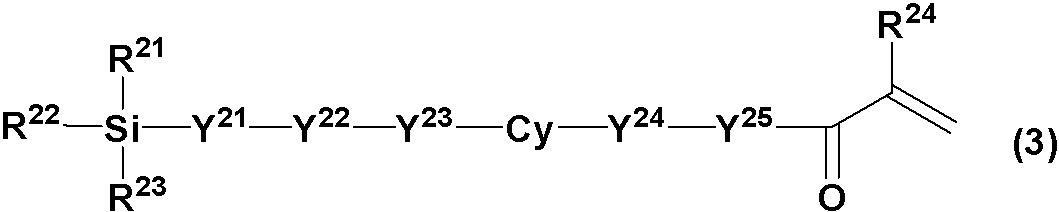
- R 21 , R 22 , R 23 are each independently —OCH 3 , —OC 2 H 5 , —OCH (CH 3 ) 2 , —OC (CH 3 ) 3 , —CH 3 , —Ph, —Cl , -OCOCH 3 , -OH, -H, or a combination thereof
- R 24 represents a hydrogen atom or a methyl group
- Y 21 contains a single bond or a double bond.
- Y 22 represents a single bond, —O—, —CO—, —COO—, —OCO—, —NH—, — N (CH 3 ) —, —NPh—, —NHCO—, —N (CH 3 ) CO—, —NPhCO—, —NHSO 2 —, —N (CH 3 ) SO 2 —, —NPhSO 2 —, —S -, - SO 2 -, - NHCONH -, - N (CH 3) CONH -, - NP CONH -, - NHCOO-, and, .Y 23 is a single bond represents a bond group selected from -OCONH-, or, .Y 24 representing a linear or branched hydrocarbon group having 1 to 8 carbon atoms Represents a single bond or a linear or branched hydrocarbon group having 1 to 8 carbon atoms
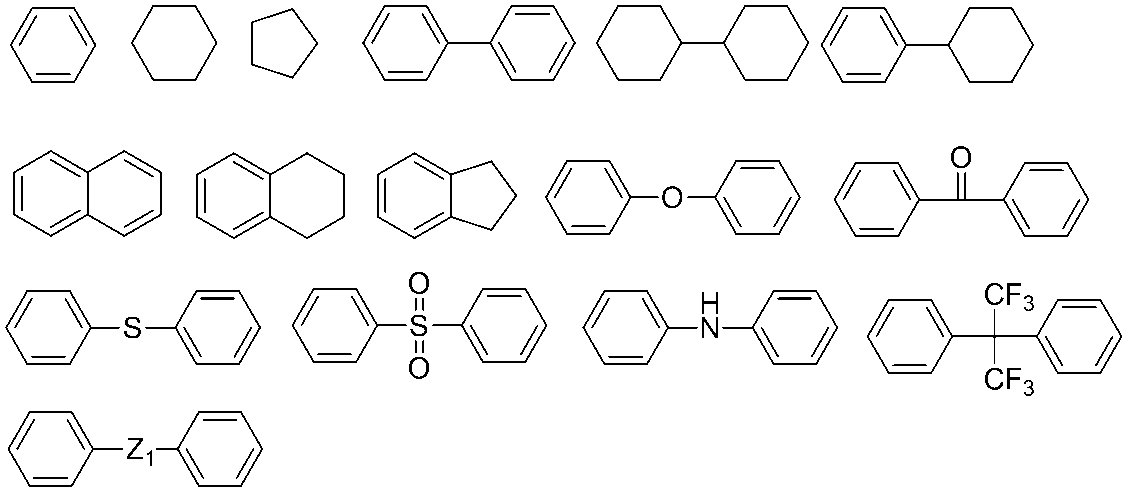
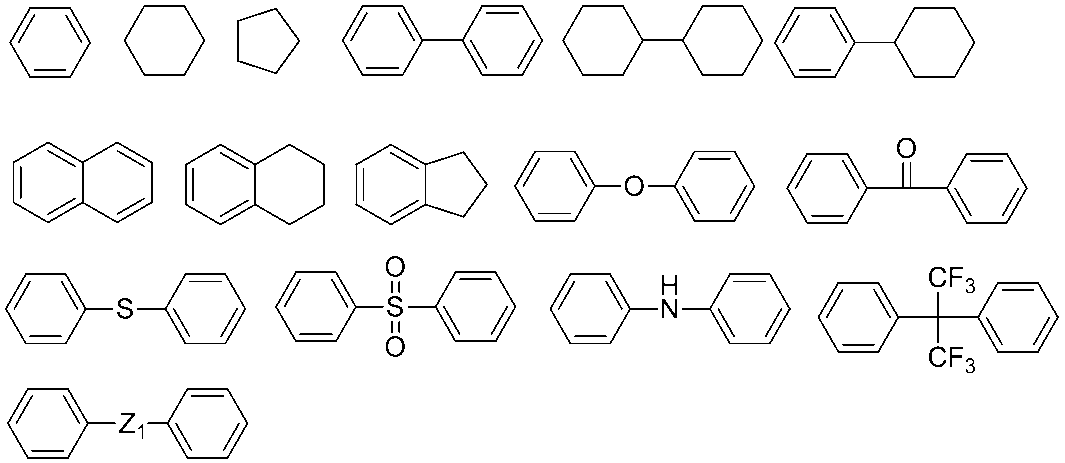
- Cy is a divalent cyclic group selected from the following and bonded at an arbitrary substitution position. And any hydrogen atom on the cyclic group is substituted with one selected from an alkyl group having 1 to 3 carbon atoms, an alkoxy group having 1 to 3 carbon atoms, a cyano group, a fluorine atom, and a chlorine atom. May be.
- Z 1 represents an aromatic ring group or a linear or branched divalent hydrocarbon group having 1 to 18 carbon atoms which may contain an aliphatic ring group.
- At least one of polysiloxane (A) and polysiloxane (B) is a polysiloxane obtained by further reacting an alkoxysilane component containing an alkoxysilane represented by the following formula (6): [1] The liquid crystal aligning agent according to any one of [3].
- R 13 is a hydrogen atom, or a hydrogen atom or a carbon atom of 1 to 1 carbon atoms that may be substituted with a hetero atom, a halogen atom, an amino group, a glycidoxy group, a mercapto group, an isocyanate group, or a ureido group.
- 10 is a hydrocarbon group
- R 14 is an alkyl group having 1 to 5 carbon atoms
- n2 represents an integer of 0 to 3.
- a liquid crystal alignment film obtained by applying the liquid crystal aligning agent according to any one of [1] to [4] to a substrate and baking it.
- liquid crystal aligning agent according to any one of [1] to [4] is applied, and UV is irradiated in a state where a voltage is applied to a liquid crystal cell in which the liquid crystal is sandwiched between two baked substrates.
- a liquid crystal display device comprising the device manufactured as described above.
- a liquid crystal cell is produced by applying the liquid crystal aligning agent according to any one of [1] to [4] and sandwiching the liquid crystal between two baked substrates, and a voltage is applied to the liquid crystal cell.
- the manufacturing method of the liquid crystal display element which has the process of irradiating with UV.
- a liquid crystal aligning agent, a liquid crystal aligning film obtained from the liquid crystal aligning agent, a liquid crystal display element having the liquid crystal aligning film, and a method for manufacturing the liquid crystal display element can be provided.
- polysiloxane (A) This invention is invention about the liquid crystal aligning agent containing polysiloxane (A). And polysiloxane (A) is polysiloxane obtained by making the alkoxysilane component containing the alkoxysilane represented by the said Formula (3) react with the alkoxysilane represented by the said Formula (1).
- Y 1 is a single bond, — (CH 2 ) a — (a is an integer of 1 to 15), —O—, —CH 2 O—, —COO— or —OCO—.
- a single bond, — (CH 2 ) a — (a is an integer of 1 to 15), —O—, —CH 2 O— or —COO— can be selected. It is preferable from the viewpoint of facilitating the synthesis of the chain structure. It is more preferable to select any one of a single bond, — (CH 2 ) a — (a is an integer of 1 to 10), —O—, —CH 2 O— or —COO—.
- Y 2 is a straight or branched hydrocarbon group having 3 to 8 carbon atoms containing a single bond or a double bond, or — (CR 17 R 18 ) b — (b is 1 And R 17 and R 18 each independently represents a hydrogen atom or an alkyl group having 1 to 3 carbon atoms.
- — (CH 2 ) b — (b is an integer of 1 to 10) is preferable from the viewpoint of significantly improving the response speed of the liquid crystal display element.
- Y 3 is a single bond, — (CH 2 ) c — (where c is an integer of 1 to 15), —O—, —CH 2 O—, —COO— or —OCO—.
- c is an integer of 1 to 15
- a single bond, — (CH 2 ) c — (c is an integer of 1 to 15), —O—, —CH 2 O—, —COO— or —OCO— is selected. This is preferable from the viewpoint of facilitating the synthesis of the side chain structure.
- Y 4 is a cyclic group selected from the group consisting of a single bond, a benzene ring, a cyclohexane ring and a heterocyclic ring, and any hydrogen atom on these cyclic groups has 1 to May be substituted with any one of an alkyl group having 3 carbon atoms, an alkoxyl group having 1 to 3 carbon atoms, a fluorine-containing alkyl group having 1 to 3 carbon atoms, a fluorine-containing alkoxyl group having 1 to 3 carbon atoms, or a fluorine atom.
- Y 4 may be a divalent organic group selected from organic groups having 12 to 25 carbon atoms having a steroid skeleton. Among these, an organic group having 12 to 25 carbon atoms having any one of a benzene ring, a cyclohexane ring, and a steroid skeleton is preferable.
- Y 5 is a divalent cyclic group selected from the group consisting of a benzene ring, a cyclohexane ring, and a heterocyclic ring, and any hydrogen atom on these cyclic groups has a carbon number of 1 to May be substituted with any one of an alkyl group having 3 carbon atoms, an alkoxyl group having 1 to 3 carbon atoms, a fluorine-containing alkyl group having 1 to 3 carbon atoms, a fluorine-containing alkoxyl group having 1 to 3 carbon atoms, or a fluorine atom.
- n1 is an integer of 0-4. Preferably, it is an integer of 0-2.
- Y 6 is an alkyl group having 1 to 18 carbon atoms, a fluorine-containing alkyl group having 1 to 18 carbon atoms, an alkoxyl group having 1 to 18 carbon atoms, or a fluorine-containing alkoxyl group having 1 to 18 carbon atoms One of them. Among them, it is any one of an alkyl group having 1 to 18 carbon atoms, a fluorine-containing alkyl group having 1 to 10 carbon atoms, an alkoxyl group having 1 to 18 carbon atoms, or a fluorine-containing alkoxyl group having 1 to 10 carbon atoms. Is preferred.
- it is either an alkyl group having 1 to 12 carbon atoms or an alkoxyl group having 1 to 12 carbon atoms. More preferably, it is either an alkyl group having 1 to 9 carbon atoms or an alkoxyl group having 1 to 9 carbon atoms.
- R 2 of the alkoxysilane represented by the formula (1) is an alkyl group having 1 to 5 carbon atoms, preferably 1 to 3 carbon atoms. More preferably, R 2 is a methyl group or an ethyl group.
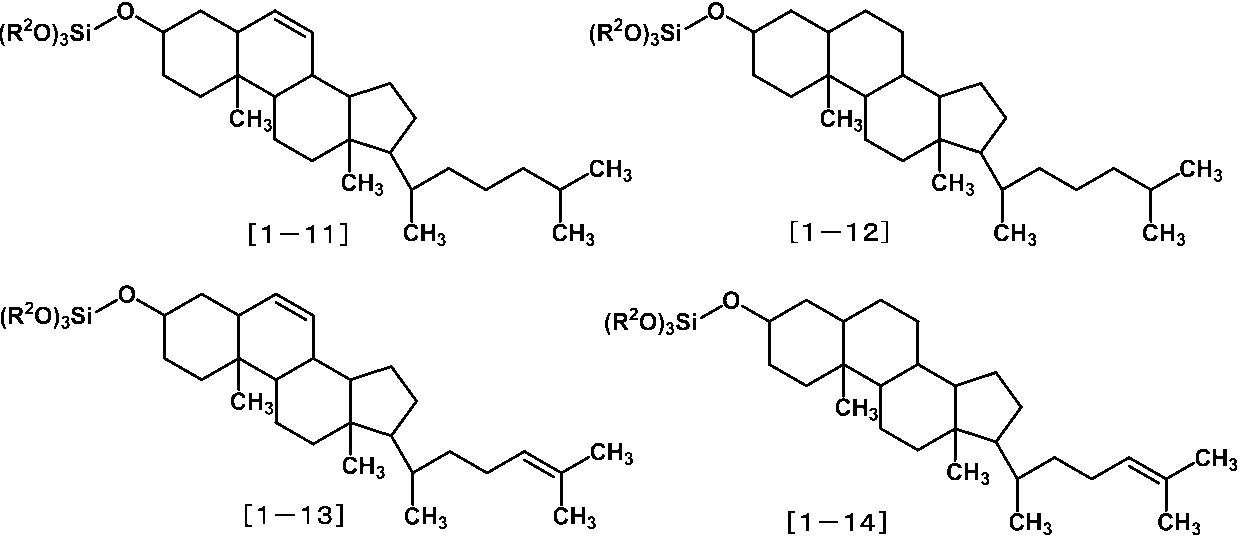
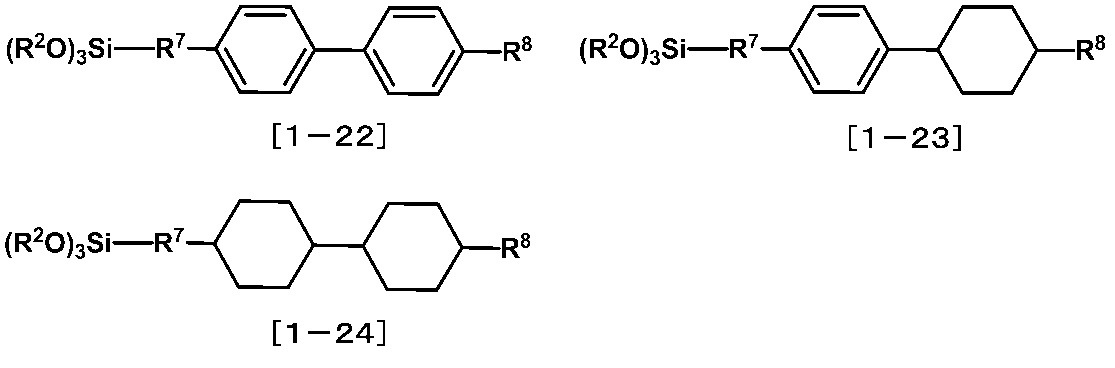
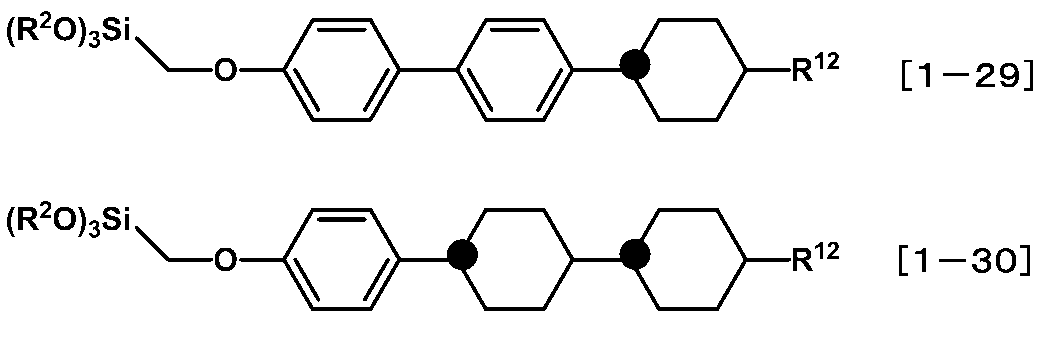
- alkoxysilane represented by the formula (1) include formulas [1-1] to [1-31], but are not limited thereto.
- R 2 in formula [1-1] - [1-31] is the same as R 2 in the formula (1).
- R 5 represents —O—, —OCH 2 —, —CH 2 O—, —COOCH 2 — or —CH 2 OCO—
- R 6 represents An alkyl group having 1 to 22 carbon atoms, an alkoxy group, a fluorine-containing alkyl group, or a fluorine-containing alkoxy group.
- R 7 represents a single bond, —COO—, —OCO—, —COOCH 2 —, —CH 2 OCO—, — (CH 2 ) n O— ( n represents an integer of 1 to 5), —OCH 2 — or CH 2 —
- R 8 represents an alkyl group having 1 to 22 carbon atoms, an alkoxy group, a fluorine-containing alkyl group or a fluorine-containing alkoxy group.
- R 9 represents —COO—, —OCO—, —COOCH 2 —, —CH 2 OCO—, —CH 2 O—, —OCH 2 —, — CH 2 - or -O- are shown
- R 10 is fluorine, cyano, trifluoromethane group, a nitro group, an azo group, a formyl group, an acetyl group, an acetoxy group or a hydroxyl group).
- R 11 is an alkyl group having 3 to 12 carbon atoms, and the cis-trans isomerism of 1,4-cyclohexylene is a trans isomer.
- R 12 is an alkyl group having 3 to 12 carbon atoms, and the cis-trans isomerism of 1,4-cyclohexylene is a trans isomer. .
- B 4 is an alkyl group having 3 to 20 carbon atoms which may be substituted with a fluorine atom
- B 3 is a 1,4-cyclohexylene group or a 1,4-phenylene group
- B 2 is an oxygen atom or —COO— * (where a bond marked with “*” is bonded to B 3 )
- B 1 is an oxygen atom or —COO— * (where “*” ”Is a bond with (CH 2 ) a 2 ).
- a 1 is an integer of 0 or 1
- a 2 is an integer of 2 to 10
- a 3 is an integer of 0 or 1.
- the alkoxysilane represented by the formula (1) is soluble in a solvent when a siloxane polymer (polysiloxane) is used, liquid crystal alignment when a liquid crystal alignment film is used, pretilt angle characteristics, voltage holding ratio, accumulated charge. Depending on the characteristics, one kind or a mixture of two or more kinds can be used. Further, it can be used in combination with an alkoxysilane containing a long-chain alkyl group having 10 to 18 carbon atoms.
- Such an alkoxysilane represented by the formula (1) can be produced by a known method as described in, for example, JP-A-61-286393.
- the alkoxysilane represented by the formula (1) is preferably 1 mol% or more in order to obtain good liquid crystal alignment in all alkoxysilanes used for obtaining the polysiloxane (A), that is, in the alkoxysilane component. . More preferably, it is 1.5 mol% or more. More preferably, it is 2 mol% or more. Further, in order to obtain sufficient curing characteristics of the liquid crystal alignment film to be formed, 30 mol% or less is preferable. More preferably, it is 25 mol% or less.
- R 24 of the alkoxysilane represented by the formula (3) represents a hydrogen atom or a methyl group.
- Y 21 of the alkoxysilane represented by the formula (3) is a linear or branched hydrocarbon group having 1 to 8 carbon atoms which may contain a single bond or a double bond.
- Y 21 is a single bond or a linear hydrocarbon group having 3 to 5 carbon atoms.
- Y 22 of the alkoxysilane represented by the formula (3) is a single bond, —O—, —CO—, —COO—, —OCO—, —NH—, —N (CH 3 ) —, —NPh—, —NHCO—, —N (CH 3 ) CO—, —NPhCO—, —NHSO 2 —, —N (CH 3 ) SO 2 —, —NPhSO 2 —, —S—, —SO 2 —, —NHCONH—, It is a linking group selected from —N (CH 3 ) CONH—, —NPhCONH—, —NHCOO—, and —OCONH—.
- Y 22 is a single bond.
- Y 23 is a single bond or a linear or branched hydrocarbon group having 1 to 8 carbon atoms, and preferably Y 23 is a single bond.
- Y 24 is a single bond or a linear or branched hydrocarbon group having 1 to 8 carbon atoms, and preferably Y 24 is a single bond or a linear hydrocarbon group having 1 to 3 carbon atoms. It is.
- Y 25 is a single bond, —O—, or —NZ 2 —.
- Z 2 represents a hydrogen atom, a linear or branched hydrocarbon group having 1 to 18 carbon atoms, an aromatic ring group, or an aliphatic ring group.
- Y 25 is a single bond, —O— or —NH—.
- Cy represents a divalent cyclic group selected from the following and bonded at an arbitrary substitution position, and an arbitrary hydrogen atom on these cyclic groups is an alkyl group having 1 to 3 carbon atoms, or 1 to 3 carbon atoms. May be substituted with one selected from an alkoxy group, a cyano group, a fluorine atom, and a chlorine atom.
- Cy is a benzene ring or a biphenyl ring.
- a divalent cyclic group formed by bonding at an arbitrary substitution position means that the position of two bonds of the following cyclic group may be arbitrary.
- Z 1 represents an aromatic ring group or a linear or branched divalent hydrocarbon group having 1 to 18 carbon atoms which may contain an aliphatic ring group.
- the alkoxysilane represented by the formula (1) and the alkoxysilane represented by the formula (3) may each be one type or two or more types.
- a polysiloxane (A) obtained by reacting such an alkoxysilane represented by the formula (1) and an alkoxysilane represented by the formula (3) and introducing a specific side chain and a photoreactive group is used.
- the liquid crystal aligning agent can achieve both response speed characteristics and good vertical alignment (vertical alignment force), and both characteristics are remarkably good, it is expressed by the formula (1).
- the liquid crystal aligning agent of the present invention is less expensive than an expensive polyimide, the liquid crystal aligning agent of the present invention can be manufactured at low cost and has high versatility.
- the blending ratio of each alkoxysilane is not particularly limited, but the alkoxysilane represented by the formula (1) is preferably a total alkoxysilane as a raw material used for obtaining the polysiloxane (A), that is, in the alkoxysilane component, It is 2 to 20 mol%, particularly preferably 3 to 15 mol%.
- the alkoxysilane represented by the formula (3) is preferably 5 to 30 mol% in the alkoxysilane component used to obtain the polysiloxane (A).
- an alkoxysilane represented by the above formula (4) is also used as a raw material. can do. That is, alkoxysilane represented by the above formula (4) can also be used as the alkoxysilane component used to obtain polysiloxane (A).
- R 3 of the alkoxysilane represented by the formula (4) is an alkyl group in which a hydrogen atom is substituted with an acryl group, an acryloxy group, a methacryl group, a methacryloxy group, or a styryl group.
- the number of substituted hydrogen atoms is one or more, preferably one.
- the alkyl group preferably has 1 to 30 carbon atoms, more preferably 1 to 20 carbon atoms. More preferably, it is 1-10.
- R 4 of the alkoxysilane represented by the formula (4) is an alkyl group having 1 to 5 carbon atoms, preferably 1 to 3 carbon atoms, and particularly preferably 1 to 2 carbon atoms.
- alkoxysilane represented by Formula (4) is not limited to these.
- the alkoxysilane represented by the formula (4) is preferably 5 to 80 mol%, particularly preferably 10 to 70 mol%, in the alkoxysilane component used for obtaining the polysiloxane (A). Further, the alkoxysilane represented by the formula (4) may be one type or two or more types.
- alkoxysilane represented by the above formula (6) can also be used as a raw material. That is, as the alkoxysilane component used for obtaining the polysiloxane (A), an alkoxysilane represented by the above formula (6) can also be used. Since the alkoxysilane represented by the formula (6) can impart various properties to the polysiloxane, one or more types can be selected and used according to the required properties.
- the alkoxysilane represented by the formula (6) is preferably 1 to 20 mol% in the alkoxy component used for obtaining the polysiloxane.
- R 13 of the alkoxysilane represented by the formula (6) is a hydrogen atom, or the hydrogen atom may be substituted with a hetero atom, a halogen atom, an amino group, a glycidoxy group, a mercapto group, an isocyanate group, or a ureido group.
- R 14 represents an alkyl group having 1 to 5 carbon atoms, preferably 1 to 3 carbon atoms, and n2 represents an integer of 0 to 3, preferably 0 to 2.
- alkoxysilane represented by the formula (6) are given below, but are not limited thereto.
- 3- (2-aminoethylaminopropyl) trimethoxysilane 3- (2-aminoethylaminopropyl) triethoxysilane, 2-aminoethylaminomethyltrimethoxysilane, 2- (2-aminoethylthioethyl) Triethoxysilane, 3-mercaptopropyltriethoxysilane, mercaptomethyltrimethoxysilane, vinyltriethoxysilane, 3-isocyanatopropyltriethoxysilane, trifluoropropyltrimethoxysilane, chloropropyltriethoxysilane, bromopropyltriethoxysilane, 3-mercaptopropyltrimethoxysilane, dimethyldiethoxysilane, dimethyldimethoxysilane, diethy
- the alkoxysilane in which n2 is 0 is tetraalkoxysilane.
- Tetraalkoxysilane easily undergoes a polycondensation reaction with the alkoxysilane represented by the formulas (1), (3) and (4), so that the polysiloxane (A) contained in the liquid crystal aligning agent of the present invention is obtained. preferable.
- tetramethoxysilane, tetraethoxysilane, tetrapropoxysilane or tetrabutoxysilane is more preferable, and tetramethoxysilane or tetraethoxysilane is particularly preferable.
- the alkoxysilane represented by the formula (6) in which n2 is 1 to 3 is preferably 1 to 20 mol%, particularly preferably 1 to 10 mol, in the alkoxysilane component used to obtain the polysiloxane (A). %.
- the alkoxysilane represented by the formula (6) in which n2 is 0 is preferably 1 to 50 mol%, particularly preferably 5 to 40 mol in the alkoxysilane component used for obtaining the polysiloxane (A). %.
- the alkoxysilane represented by Formula (6) may be one type or two or more types.
- the liquid crystal aligning agent of this invention may contain other polysiloxane with polysiloxane (A).
- the other polysiloxane include polysiloxane (B), which is a polysiloxane obtained by reacting an alkoxysilane component containing an alkoxysilane represented by the above formula (5).
- the polysiloxane component that is a raw material of the polysiloxane (B) preferably contains 20 to 100 mol%, more preferably 50 to 100%, of the polysiloxane represented by the formula (5).
- alkoxysilane represented by the formula (5) tetramethoxysilane, tetraethoxysilane, tetrapropoxysilane or tetrabutoxysilane is preferable, and tetramethoxysilane or tetraethoxysilane is particularly preferable.
- the polysiloxane (B) is a polysiloxane obtained by reacting an alkoxysilane component containing an alkoxysilane represented by the formula (7) in addition to the alkoxysilane represented by the formula (5). May be.
- a liquid crystal aligning agent containing a polysiloxane (B) obtained by reacting an alkoxysilane component containing an alkoxysilane represented by the formula (7) has a particularly high vertical alignment force and is desirable.
- R 16 of the alkoxysilane represented by the formula (7) is an alkyl group having 1 to 5 carbon atoms.
- the alkyl group preferably has 1 to 4 carbon atoms, more preferably 1 to 3 carbon atoms.
- R 17 of the alkoxysilane represented by the formula (7) is an alkyl group having 1 to 5 carbon atoms, preferably 1 to 3 carbon atoms, and particularly preferably 1 to 2 carbon atoms.
- alkoxysilane represented by Formula (7) is not limited to these.
- methyltriethoxysilane, methyltrimethoxysilane, dimethyltrimethoxysilane, dimethyltriethoxysilane, n-propyltrimethoxysilane, and n-propyltriethoxysilane are examples of these.
- the polysiloxane (B) is a polysiloxane obtained by reacting an alkoxysilane component containing the alkoxysilane represented by the above formula (4) in addition to the alkoxysilane represented by the formula (5). There may be.
- the alkoxy represented by the formula (4) is used.
- Silane is preferably at least 10 mol%, more preferably at least 20 mol%, still more preferably at least 30 mol% in the alkoxysilane component used to obtain polysiloxane (B).
- 75 mol% or less is preferable.
- the polysiloxane (B) is represented by the above formula (6) as long as the effects of the present invention are not impaired for the purpose of imparting various properties such as adhesion to the substrate and improvement in affinity with liquid crystal molecules. It may be a polysiloxane obtained by reacting an alkoxysilane component containing an alkoxysilane.
- the alkoxysilane represented by the formula (6) is preferably 1 to 20 mol%, particularly preferably 1 to 10 mol%, in the alkoxysilane component used for obtaining the polysiloxane (B).
- alkoxysilane represented by formula (5) an alkoxysilane represented by formula (6), an alkoxysilane represented by formula (7), or a formula (4) that is a raw material of polysiloxane (B).
- Each of the alkoxysilanes may be one type or two or more types.
- the blending ratio of the polysiloxane of the liquid crystal aligning agent containing polysiloxane (A) and other polysiloxane such as polysiloxane (B) is not particularly limited, but is based on the total amount of polysiloxane contained in the liquid crystal aligning agent.
- the polysiloxane (A) is preferably 10% by mass or more.
- polysiloxane (A): polysiloxane (B) 10: 90 to 50:50 in terms of mass ratio.
- the method for obtaining the polysiloxane used in the present invention is not particularly limited, and an alkoxysilane component may be reacted.
- an alkoxysilane component containing an alkoxysilane represented by the above formula (1) and an alkoxysilane represented by the formula (3) as an essential component is reacted in an organic solvent (for example, (Polycondensation reaction).
- organic solvent for example, (Polycondensation reaction).
- polysiloxane is obtained as a solution in which such an alkoxysilane component is polycondensed and uniformly dissolved in an organic solvent.
- Examples of the method of polycondensing alkoxysilane to obtain polysiloxane include a method of hydrolyzing and condensing alkoxysilane in a solvent such as alcohol or glycol.
- the hydrolysis / condensation reaction may be either partial hydrolysis or complete hydrolysis. In the case of complete hydrolysis, theoretically, it is sufficient to add 0.5 times mole of water of all alkoxy groups in the alkoxysilane, but it is usually preferable to add an excess amount of water more than 0.5 times mole.
- the amount of water used in the above reaction can be appropriately selected as desired, but it is usually preferably 0.5 to 2.5 times mol of all alkoxy groups in alkoxysilane.
- acids such as hydrochloric acid, sulfuric acid, nitric acid, acetic acid, formic acid, succinic acid, maleic acid, fumaric acid, alkalis such as ammonia, methylamine, ethylamine, ethanolamine, triethylamine, etc.
- Catalysts such as metal salts such as hydrochloric acid, sulfuric acid and nitric acid are used.
- a method of heating and polycondensing a mixture of alkoxysilane, a solvent and oxalic acid can be mentioned. Specifically, after adding oxalic acid to alcohol in advance to obtain an alcohol solution of oxalic acid, the alkoxysilane is mixed while the solution is heated. In that case, the amount of succinic acid used is preferably 0.2 to 2 mol with respect to 1 mol of all alkoxy groups of the alkoxysilane. Heating in this method can be performed at a liquid temperature of 50 to 180 ° C. A method of heating for several tens of minutes to several tens of hours under reflux is preferred so that the liquid does not evaporate or volatilize.
- a plurality of types of alkoxysilanes are used.
- a mixture of alkoxysilanes in advance may be mixed, or a plurality of types of alkoxysilanes may be sequentially mixed. That is, there is no limitation on the order in which the alkoxysilane components are reacted.
- the alkoxysilane components may be reacted at once, or after some alkoxysilanes are reacted, other alkoxysilanes are added. You may make it react.
- an alkoxysilane represented by formula (1), an alkoxysilane represented by formula (3), and an alkoxysilane represented by formula (4) may be mixed and subjected to a polycondensation reaction.
- the alkoxysilane represented by the formula (3) is added and reacted. May be.
- the solvent used for polycondensation of alkoxysilane (hereinafter also referred to as polymerization solvent) is not particularly limited as long as it can dissolve alkoxysilane. Moreover, even when alkoxysilane does not melt
- Such a polymerization solvent include alcohols such as methanol, ethanol, propanol, butanol, diacetone alcohol, ethylene glycol, diethylene glycol, propylene glycol, dipropylene glycol, hexylene glycol, 1,3-propanediol, 1,2-butanediol, 1,3-butanediol, 1,4-butanediol, 2,3-butanediol, 1,2-pentanediol, 1,3-pentanediol, 1,4-pentanediol, 1 , 5-pentanediol, 2,4-pentanediol, 2,3-pentanediol, glycols such as 1,6-hexanediol, ethylene glycol monomethyl ether, ethylene glycol monoethyl ether, ethylene glycol monopropyl ether Ethylene glycol monobutyl ether,
- a plurality of the above polymerization solvents may be mixed and used.
- the polysiloxane polymerization solution (hereinafter also referred to as polymerization solution) obtained by the above method is a concentration obtained by converting silicon atoms of all alkoxysilanes charged as raw materials into SiO 2 (hereinafter referred to as SiO 2 conversion concentration). ) Is preferably 20% by mass or less, more preferably 5 to 15% by mass. By selecting an arbitrary concentration within this concentration range, gel formation can be suppressed and a homogeneous solution can be obtained.
- the liquid crystal aligning agent of the present invention is a solution containing the above-described polysiloxane (A) and, if necessary, other polysiloxane and other components.
- Other polysiloxanes such as polysiloxane (A), polysiloxane (B) added as necessary, and other components may be in a uniformly mixed state.
- a reaction solution such as a polysiloxane polymerization solution obtained by the above method may be used as a liquid crystal aligning agent as it is, or if necessary, a reaction solution such as a polysiloxane polymerization solution obtained by the above method may be used.
- the liquid crystal aligning agent may be condensed, diluted by adding a solvent, or substituted with another solvent.
- a solvent selected from the group consisting of the above-mentioned polysiloxane polymerization solvent and additive solvent is used.
- the additive solvent is not particularly limited as long as the polysiloxane is uniformly dissolved, and one kind or a plurality of kinds can be arbitrarily selected and used.
- Specific examples of such an additive solvent include ketones such as acetone, methyl ethyl ketone, and methyl isobutyl ketone, and esters such as methyl acetate, ethyl acetate, and ethyl lactate. These solvents can improve the applicability when the liquid crystal aligning agent is applied onto the substrate by adjusting the viscosity of the liquid crystal aligning agent, or by spin coating, flexographic printing, ink jetting or the like.
- the content of polysiloxane in the liquid crystal aligning agent is preferably 0.5 to 15% by mass, more preferably 1 to 6% by mass in terms of SiO 2 equivalent concentration. Be in the range of such terms of SiO 2 concentration, easy to obtain a desired film thickness by a single coating, easy pot life sufficient solution is obtained.
- a solvent selected from the group consisting of the above-mentioned polysiloxane polymerization solvent and additive solvent can be used.
- liquid crystal aligning agent of the present invention other components other than polysiloxane, such as inorganic fine particles, metalloxane oligomers, metalloxane polymers, leveling agents, and further surfactants, etc., as long as the effects of the present invention are not impaired. May be included.
- the inorganic fine particles fine particles such as silica fine particles, alumina fine particles, titania fine particles, or magnesium fluoride fine particles are preferable, and those in a colloidal solution state are particularly preferable.
- This colloidal solution may be a dispersion of inorganic fine particles in a dispersion medium, or a commercially available colloidal solution.
- the inclusion of inorganic fine particles makes it possible to impart the surface shape of the formed cured film and other functions.
- the inorganic fine particles preferably have an average particle size of 0.001 to 0.2 ⁇ m, more preferably 0.001 to 0.1 ⁇ m. When the average particle diameter of the inorganic fine particles exceeds 0.2 ⁇ m, the transparency of the cured film formed using the prepared coating liquid may be lowered.
- the dispersion medium for inorganic fine particles examples include water and organic solvents.
- the colloidal solution it is preferable that the pH or pKa is adjusted to 1 to 10 from the viewpoint of the stability of the coating solution for forming a film. More preferably, it is 2-7.
- Organic solvents used for the dispersion medium of the colloidal solution include alcohols such as methanol, propanol, butanol, ethylene glycol, propylene glycol, butanediol, pentanediol, hexylene glycol, diethylene glycol, dipropylene glycol, ethylene glycol monopropyl ether, Ketones such as methyl ethyl ketone and methyl isobutyl ketone; aromatic hydrocarbons such as toluene and xylene; amides such as dimethylformamide, dimethylacetamide and N-methylpyrrolidone; esters such as ethyl acetate, butyl acetate and ⁇ -butyrolactone; Examples include ethers such as tetrahydrofuran and 1,4-dioxane. Of these, alcohols or ketones are preferred. These organic solvents can be used alone or in admixture of two or more as a dispersion medium.
- metalloxane oligomer and metalloxane polymer single or composite oxide precursors such as silicon, titanium, aluminum, tantalum, antimony, bismuth, tin, indium, and zinc are used.
- the metalloxane oligomer or metalloxane polymer may be a commercially available product or may be obtained from a monomer such as a metal alkoxide, nitrate, hydrochloride, or carboxylate by a conventional method such as hydrolysis.
- metalloxane oligomers and metalloxane polymers include siloxane oligomers or siloxanes such as methyl silicate 51, methyl silicate 53A, ethyl silicate 40, ethyl silicate 48, EMS-485, and SS-101 manufactured by Colcoat.
- siloxane oligomers or siloxanes such as methyl silicate 51, methyl silicate 53A, ethyl silicate 40, ethyl silicate 48, EMS-485, and SS-101 manufactured by Colcoat.
- titanoxane oligomers such as polymers and titanium-n-butoxide tetramer manufactured by Kanto Chemical Co., Inc. You may use these individually or in mixture of 2 or more types.
- leveling agents and surfactants can be used, and commercially available products are particularly preferred because they are readily available.
- the method of mixing the above-mentioned other components with polysiloxane may be simultaneous with or after polysiloxane, and is not particularly limited.
- the liquid crystal aligning film of this invention is obtained using the liquid crystal aligning agent of this invention. Since the liquid crystal aligning agent of this invention contains said polysiloxane (A), the obtained liquid crystal aligning film of this invention uses the liquid crystal which does not add a polymeric compound, processes like a PSA system, and after UV irradiation Even in a liquid crystal display element of a type that improves the response speed of the film, the response speed after UV irradiation can be improved without reducing the vertical alignment force.
- the liquid crystal aligning agent of this invention contains said polysiloxane (A)
- the obtained liquid crystal aligning film of this invention uses the liquid crystal which does not add a polymeric compound, processes like a PSA system, and after UV irradiation Even in a liquid crystal display element of a type that improves the response speed of the film, the response speed after UV irradiation can be improved without reducing the vertical alignment force.
- a cured film obtained by applying the liquid crystal aligning agent of the present invention to a substrate, drying as necessary, and performing firing can be used as it is as a liquid crystal aligning film.
- this cured film is subjected to orientation treatment, specifically, rubbing, irradiation with polarized light or light of a specific wavelength, treatment with ion beam, etc., voltage applied to the liquid crystal display element after filling with liquid crystal. It is also possible to irradiate UV in the applied state.
- the substrate on which the liquid crystal aligning agent is applied is not particularly limited as long as it is a highly transparent substrate, but a substrate on which a transparent electrode for driving liquid crystal is formed on the substrate is preferable.
- glass plate polycarbonate, poly (meth) acrylate, polyethersulfone, polyarylate, polyurethane, polysulfone, polyether, polyetherketone, trimethylpentene, polyolefin, polyethylene terephthalate, (meth) acrylonitrile, tri
- plastic plates such as acetyl cellulose, diacetyl cellulose, and acetate butyrate cellulose, and substrates on which transparent electrodes are formed.
- liquid crystal aligning agent examples include spin coating, printing, ink jet, spraying, roll coating, and the like.In terms of productivity, the transfer printing method is widely used industrially. The present invention is also preferably used.
- the drying process after applying the liquid crystal aligning agent is not necessarily required, but if the time from application to baking is not constant for each substrate, or if baking is not performed immediately after application, a drying process is included. It is preferable.
- the drying is not particularly limited as long as the solvent is removed to such an extent that the shape of the coating film is not deformed by transporting the substrate or the like.
- a method of drying on a hot plate at a temperature of 40 ° C. to 150 ° C., preferably 60 ° C. to 100 ° C., for 0.5 to 30 minutes, preferably 1 to 5 minutes can be mentioned.
- the coating film formed by applying the liquid crystal aligning agent by the above method can be baked to obtain a cured film.
- the firing temperature can be any temperature of 100 ° C. to 350 ° C., preferably 140 ° C. to 300 ° C., more preferably 150 ° C. to 230 ° C., and still more preferably 160 ° C. to 220 ° C. It is. Firing can be performed at an arbitrary time of 5 minutes to 240 minutes. The time is preferably 10 to 90 minutes, more preferably 20 to 80 minutes.
- a generally known method such as a hot plate, a hot air circulation oven, an IR oven, a belt furnace or the like can be used.
- the polycondensation of the polysiloxane in the liquid crystal alignment film proceeds in the baking step.
- the thickness of the cured film can be selected as necessary, but is preferably 5 nm or more, more preferably 10 nm or more because the reliability of the liquid crystal display element can be easily obtained. Moreover, when the thickness of the cured film is preferably 300 nm or less, more preferably 150 nm or less, the power consumption of the liquid crystal display element does not become extremely large, which is suitable.
- the liquid crystal display element of the present invention can be obtained by forming a liquid crystal alignment film on a substrate by the above method and then preparing a liquid crystal cell by a known method.
- a method is generally employed in which a pair of substrates on which a liquid crystal alignment film is formed are fixed with a sealant with a spacer interposed therebetween, and liquid crystal is injected and sealed.
- the size of the spacer used is 1 to 30 ⁇ m, preferably 2 to 10 ⁇ m.
- the method for injecting the liquid crystal is not particularly limited, and examples thereof include a vacuum method for injecting the liquid crystal after reducing the pressure inside the produced liquid crystal cell, and a dropping method for sealing after dropping the liquid crystal.
- the acrylic and methacrylic groups in the liquid crystal alignment film are polymerized and cross-linked in situ, so that the liquid crystal
- the applied voltage is 5 to 50 Vp-p, preferably 5 to 30 Vp-p.
- the UV irradiation amount to be irradiated is 1 to 60 J, but is preferably 40 J or less. The smaller the UV irradiation amount, the lowering of reliability due to the destruction of the members constituting the liquid crystal display can be suppressed, and the UV irradiation time It is preferable because the manufacturing tact can be increased by reducing.
- the substrate used for the liquid crystal display element is not particularly limited as long as it is a highly transparent substrate, but is usually a substrate on which a transparent electrode for driving liquid crystal is formed. Specific examples are the same as those of the substrate described in ⁇ Liquid crystal alignment film> above. Standard electrode patterns such as PVA and MVA and protrusion patterns can also be used. Similar to the PSA type liquid crystal display, it can be operated even in a structure in which a line / slit electrode pattern of 1 to 10 ⁇ m is formed on one side substrate and no slit pattern or protrusion pattern is formed on the opposite substrate. The liquid crystal display can simplify the manufacturing process and provide high transmittance.
- a device in which a transistor device is formed between an electrode for driving a liquid crystal and a substrate is used.
- a transmissive liquid crystal element it is common to use a substrate as described above.
- a material such as aluminum that reflects light only on one substrate may be used. It is possible to use an opaque substrate such as a silicon wafer.
- TEOS tetraethoxysilane
- C18 octadecyltriethoxysilane
- MPMS 3-methacryloxypropyltrimethoxysilane
- M8MS 3-methacryloxyoctyltrimethoxysilane
- MTES methyltriethoxysilane
- HG 2-methyl-2,4-pentanediol ( (Alternative name: hexylene glycol)
- BCS 2-butoxyethanol
- UPS 3-ureidopropyltriethoxysilane
- THF tetrahydrofuran
- DMF N, N-dimethylformamide
- ⁇ Synthesis Example 1> ⁇ Synthesis of polysiloxane (A)> In a 200 mL four-necked reaction flask equipped with a thermometer and a reflux tube, 15.9 g of HG, 7.9 g of BCS, 17.50 g of TEOS, and 3. compound (c) obtained in Compound Synthesis Example 1 were used. 5 g, 19.9 g of MPMS, and 3.5 g of the compound (e) obtained in Compound Synthesis Example 2 were mixed to prepare an alkoxysilane monomer solution.
- a solution prepared by mixing 7.9 g of HG, 4.0 g of BCS, 10.8 g of water, and 1.8 g of oxalic acid as a catalyst was added dropwise to the solution over 30 minutes at room temperature, and further stirred at room temperature for 30 minutes. After heating using an oil bath and refluxing for 30 minutes, a prepared mixture of 0.6 g of a methanol solution with a UPS content of 92% by mass, 0.3 g of HG and 0.1 g of BCS was prepared. added. The mixture was further refluxed for 30 minutes and then allowed to cool to obtain a polysiloxane solution having a SiO 2 equivalent concentration of 12% by mass.
- the mixture was heated using an oil bath and refluxed for 30 minutes, and a prepared mixture of 0.6 g of a methanol solution having a UPS content of 92% by mass, 0.3 g of HG, and 0.1 g of BCS was added.
- the mixture was further refluxed for 30 minutes and then allowed to cool to obtain a polysiloxane solution having a SiO 2 equivalent concentration of 12% by mass.
- liquid crystal aligning agent intermediate (S1) and liquid crystal aligning agent intermediate (U1) were mixed at a mass ratio of 3: 7, and a liquid crystal aligning agent [K1] having a SiO 2 equivalent concentration of 4% by mass was obtained. Obtained.
- the obtained liquid crystal aligning agent intermediate (S2) and the liquid crystal aligning agent intermediate (U1) obtained in Synthesis Example 1 were mixed at a mass ratio of 3: 7, and the SiO 2 equivalent concentration was 4% by mass.
- a liquid crystal aligning agent [K2] was obtained.
- a solution prepared by mixing 7.2 g of HG, 3.6 g of BCS, 10.8 g of water and 1.8 g of oxalic acid as a catalyst in advance over 30 minutes was added dropwise to this solution over 30 minutes, and further stirred at room temperature for 30 minutes. Thereafter, the mixture was heated using an oil bath and refluxed for 60 minutes, followed by cooling to obtain a polysiloxane solution having a SiO 2 equivalent concentration of 12% by mass.
- liquid crystal aligning agent intermediate (S3) and the liquid crystal aligning agent intermediate (U1) obtained in Synthesis Example 1 were mixed at a mass ratio of 3: 7, and the SiO 2 equivalent concentration was 4% by mass.
- a liquid crystal aligning agent [K3] was obtained.
- the resulting polysiloxane solution 10.0 g were mixed BCS20.0G, give in terms of SiO 2 concentration of the liquid crystal aligning agent intermediates 4% by weight of (S4).
- liquid crystal aligning agent intermediate (S4) and the liquid crystal aligning agent intermediate (U1) obtained in Synthesis Example 1 were mixed at a mass ratio of 3: 7, and the SiO 2 equivalent concentration was 4% by mass.
- a liquid crystal aligning agent [K4] was obtained.
- liquid crystal aligning agent intermediate (S5) and the liquid crystal aligning agent intermediate (U1) obtained in Synthesis Example 1 were mixed at a mass ratio of 3: 7, and the SiO 2 equivalent concentration was 4% by mass.
- a liquid crystal aligning agent [L1] was obtained.
- ⁇ Comparative Synthesis Example 2> Prepare a solution of alkoxysilane monomer by mixing 22.6 g of HG, 7.5 g of BCS, 39.2 g of TEOS, and 4.2 g of C18 in a 200 mL four-necked reaction flask equipped with a thermometer and a reflux tube. did. A solution prepared by previously mixing 11.3 g of HG, 3.8 g of BCS, 10.8 g of water and 0.2 g of oxalic acid as a catalyst was added dropwise to this solution over 30 minutes at room temperature, and further stirred at room temperature for 30 minutes.
- liquid crystal aligning agent intermediate (S6) and the liquid crystal aligning agent intermediate (U1) obtained in Synthesis Example 1 were mixed at a mass ratio of 3: 7, and the SiO 2 equivalent concentration was 4% by mass.
- a liquid crystal aligning agent [L2] was obtained.
- liquid crystal aligning agent intermediate (S7) and the liquid crystal aligning agent intermediate (U1) obtained in Synthesis Example 1 were mixed at a mass ratio of 3: 7, and the SiO 2 equivalent concentration was 4% by mass.
- a liquid crystal aligning agent [L3] was obtained.
- Example 1 The liquid crystal aligning agent [K1] obtained in Synthesis Example 1 was spin-coated on the ITO surface of an ITO electrode substrate on which an ITO electrode pattern having a pixel size of 100 ⁇ 300 microns and a line / space of 5 microns was formed. . After drying for 2 minutes on a hot plate at 80 ° C., baking was performed in a hot air circulation oven at 200 ° C. for 30 minutes to form a liquid crystal alignment film having a thickness of 100 nm. Further, the liquid crystal aligning agent [K1] obtained in Synthesis Example 1 was spin-coated on the ITO surface on which the electrode pattern was not formed, dried on a hot plate at 80 ° C.
- a liquid crystal cell 1 was prepared by injecting liquid crystal MLC-6608 (trade name, manufactured by Merck) into the empty cell by vacuum injection. The response speed characteristics of the liquid crystal cell 1 were measured by the method described later.
- the above-mentioned liquid crystal cell 1 (that is, a liquid crystal cell not irradiated with UV 5J from the outside of the liquid crystal cell with a DC voltage of 20 V applied) was annealed in a circulation oven at 100 ° C. for 30 minutes. .
- the extracted liquid crystal cell was observed with a microscope in a state where the polarizing plate was in a crossed Nicol state, and the state of the domain, which was an alignment disorder of the liquid crystal, was observed.
- the results are also shown in Table 1. When the liquid crystal alignment force is low, many domains are observed after annealing, and when the liquid crystal alignment is high, no domains are observed after annealing.
- Example 2 A liquid crystal cell was prepared in the same manner as in Example 1 except that the liquid crystal aligning agent [K1] was changed to the liquid crystal aligning agent [K2] obtained in Synthesis Example 2, and the response speed was measured. A domain that is The results are shown in Table 1.
- Example 3 A liquid crystal cell was prepared in the same manner as in Example 1 except that the liquid crystal aligning agent [K1] was changed to the liquid crystal aligning agent [K3] obtained in Synthesis Example 3, and the response speed was measured. A domain that is The results are shown in Table 1.
- Example 4 A liquid crystal cell was prepared in the same manner as in Example 1 except that the liquid crystal aligning agent [K1] was changed to the liquid crystal aligning agent [K4] obtained in Synthesis Example 4, and the response speed was measured. A domain that is The results are shown in Table 1.
- Example 5 A liquid crystal cell was prepared in the same manner as in Example 1 except that the liquid crystal aligning agent [K1] was changed to the liquid crystal aligning agent [K5] obtained in Synthesis Example 5, and the response speed was measured. A domain that is The results are shown in Table 1.
- Example 6 A liquid crystal cell was prepared in the same manner as in Example 1 except that the liquid crystal aligning agent [K1] was changed to the liquid crystal aligning agent [K6] obtained in Synthesis Example 6, and the response speed was measured. A domain that is The results are shown in Table 1.
- the liquid crystal display element produced using the liquid crystal aligning agent of the present invention is a liquid crystal display element of a system that improves the response speed after UV irradiation by using a liquid crystal to which a polymerizable compound is not added and treating in the same manner as the PSA system.
- the response speed after UV irradiation can be improved without reducing the vertical alignment force. Therefore, it is useful for a TFT (thin film transistor) liquid crystal display element, a TN (Twisted Nematic) liquid crystal display element, a VA liquid crystal display element and the like manufactured by the above method.
Landscapes
- Physics & Mathematics (AREA)
- Chemical & Material Sciences (AREA)
- Nonlinear Science (AREA)
- Chemical Kinetics & Catalysis (AREA)
- Health & Medical Sciences (AREA)
- Medicinal Chemistry (AREA)
- Polymers & Plastics (AREA)
- Organic Chemistry (AREA)
- Crystallography & Structural Chemistry (AREA)
- Mathematical Physics (AREA)
- General Physics & Mathematics (AREA)
- Optics & Photonics (AREA)
- Spectroscopy & Molecular Physics (AREA)
- Liquid Crystal (AREA)
- Silicon Polymers (AREA)
Description
〔1〕下記のポリシロキサン(A)を含有する液晶配向剤。
ポリシロキサン(A):下記式(1)で表されるアルコキシシラン、及び、下記式(3)で表されるアルコキシシランを含有するアルコキシシラン成分を反応させて得られるポリシロキサン
(R1は下記式(2)の構造を表し、R2は炭素数1~5のアルキル基を表す。)



R3Si(OR4)3 (4)
(R3は、水素原子が、アクリル基、アクリロキシ基、メタクリル基、メタクリロキシ基又はスチリル基で置換された炭素数1~30のアルキル基であり、R4は炭素数1~5のアルキル基を表す。)
ポリシロキサン(B):下記式(5)で表されるアルコキシシランを含有するアルコキシシラン成分を反応させて得られるポリシロキサン
Si(OR15)4 (5)
(R15は炭素数1~5のアルキル基を表す。)
(式(6)中、R13は、水素原子、又は、水素原子がヘテロ原子、ハロゲン原子、アミノ基、グリシドキシ基、メルカプト基、イソシアネート基、ウレイド基で置換されていてもよい炭素数1~10の炭化水素基であり、R14は炭素数1~5のアルキル基であり、n2は0~3の整数を表す。)
<ポリシロキサン(A)>
本発明は、ポリシロキサン(A)を含有する液晶配向剤についての発明である。そして、ポリシロキサン(A)は、上記式(1)で表されるアルコキシシランと、上記式(3)で表されるアルコキシシランを含有するアルコキシシラン成分を反応させて得られるポリシロキサンである。







また、本発明の液晶配向剤は、ポリシロキサン(A)と共に、その他のポリシロキサンを含有していてもよい。その他のポリシロキサンとしては、上記式(5)で表されるアルコキシシランを含有するアルコキシシラン成分を反応させて得られるポリシロキサンであるポリシロキサン(B)が挙げられる。ポリシロキサン(B)の原料であるポリシロキサン成分は、式(5)で表されるポリシロキサンを、20~100モル%含有することが好ましく、50~100%含有していることがさらに好ましい。
R16Si(OR17)3 (7)
本発明に用いるポリシロキサンを得る方法は特に限定されず、アルコキシシラン成分を反応させればよい。例えば、ポリシロキサン(A)においては、上記した式(1)で表されるアルコキシシラン及び式(3)で表されるアルコキシシランを必須成分とするアルコキシシラン成分を、有機溶媒中で反応(例えば重縮合反応)させて得られる。通常、ポリシロキサンは、このようなアルコキシシラン成分を重縮合して、有機溶媒に均一に溶解した溶液として得られる。
本発明の液晶配向剤は、上述したポリシロキサン(A)、必要に応じて、その他のポリシロキサンやその他の成分を含有する溶液である。ポリシロキサン(A)、必要に応じて加えられるポリシロキサン(B)等のその他のポリシロキサンやその他の成分が均一に混合した状態であればよい。例えば、上記の方法で得られたポリシロキサンの重合溶液等の反応液をそのまま液晶配向剤としてもよいし、必要に応じて、上記の方法で得られたポリシロキサンの重合溶液等の反応液を、濃縮したり、溶媒を加えて希釈したり又は他の溶媒に置換して、液晶配向剤としてもよい。その際、溶媒としては、上述したポリシロキサンの重合溶媒および添加溶媒からなる群から選ばれる溶媒が用いられる。添加溶媒は、ポリシロキサンが均一に溶解している限りにおいて特に限定されず、一種でも複数種でも任意に選択して用いることができる。このような添加溶媒の具体例としては、アセトン、メチルエチルケトン、メチルイソブチルケトン等のケトン類、酢酸メチル、酢酸エチル、乳酸エチル等のエステル類が挙げられる。これらの溶媒は、液晶配向剤の粘度の調整、又はスピンコート、フレキソ印刷、インクジェット等で液晶配向剤を基板上に塗布する際の塗布性を向上できる。
本発明の液晶配向膜は、本発明の液晶配向剤を用いて得られる。本発明の液晶配向剤は上記のポリシロキサン(A)を含有するため、得られる本発明の液晶配向膜は、重合性化合物を添加しない液晶を用いて、PSA方式と同様に処理しUV照射後の応答速度を向上させる方式の液晶表示素子においても、垂直配向力を低下させることなく、UV照射後の応答速度を向上させることができる。
本発明の液晶表示素子は、上記の方法により、基板に液晶配向膜を形成した後、公知の方法で液晶セルを作製して得ることができる。液晶セル作製の一例を挙げると、液晶配向膜が形成された1対の基板を、スペーサーを挟んで、シール剤で固定し、液晶を注入して封止する方法が一般的である。その際、用いるスペーサーの大きさは1~30μmであるが、好ましくは2~10μmである。
TEOS:テトラエトキシシラン
C18:オクタデシルトリエトキシシラン
MPMS:3-メタクリロキシプロピルトリメトキシシラン
M8MS:3-メタクリロキシオクチルトリメトキシシラン
MTES:メチルトリエトキシシラン
HG:2-メチル-2,4-ペンタンジオール(別名:ヘキシレングリコール)
BCS:2-ブトキシエタノール
UPS:3-ウレイドプロピルトリエトキシシラン
THF:テトラヒドロフラン
DMF:N,N-ジメチルホルムアミド
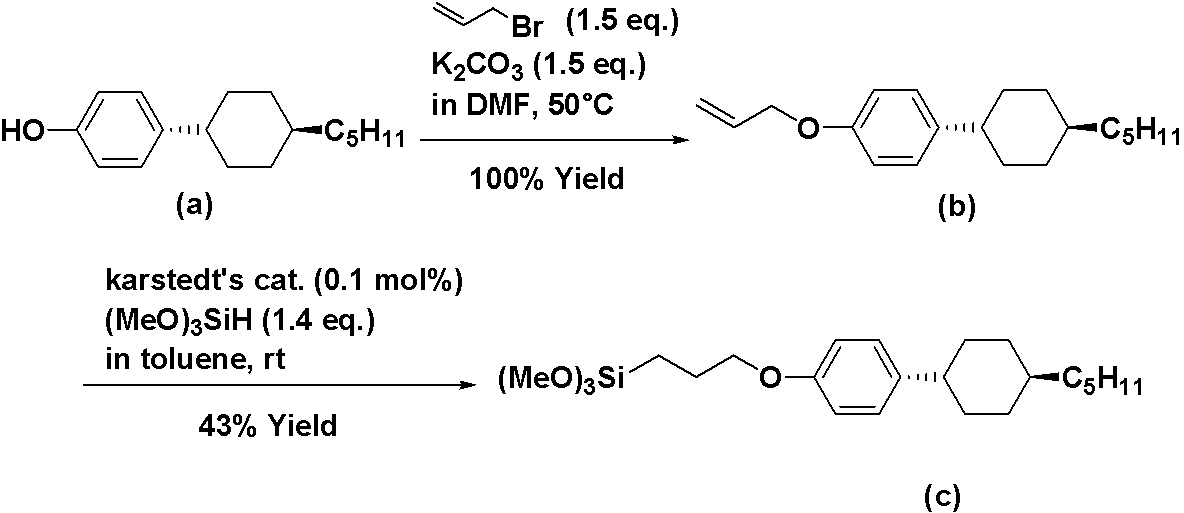
1H-NMR(400MHz) in CDCl3:0.90ppm(t, J = 7.2 Hz, 3H), 0.99-1.09ppm(m, 2H), 1.18-1.46ppm(m, 11H), 1.84-1.89ppm(m, 4H), 2.37-2.44ppm(m, 1H), 4.51ppm(dt, J = 5.4 Hz, 1.6 Hz, 2H), 5.26ppm(dq, J = 10.6 Hz, 1.6 Hz, 1H), 5.40ppm(dq, J = 17.2 Hz, 1.6 Hz, 1H), 6.07ppm(ddd, J = 17.2 Hz, 10.6 Hz, 5.4 Hz, 1H), 6.83ppm(dd, J = 8.8 Hz, 2.9 Hz, 2H), 7.10ppm(dd, J = 8.8 Hz, 2.9 Hz, 2H)
1H-NMR(400MHz) in CDCl3:0.76-0.82ppm(m, 2H), 0.89ppm(t, J = 7.2 Hz, 3H), 0.98-1.08ppm(m, 2H), 1.18-1.45ppm(m, 11H), 1.84-1.93ppm(m, 6H), 2.36-2.43ppm(m, 1H), 3.58ppm(s, 9H), 3.91ppm(t, J = 6.8 Hz, 2H), 6.81ppm(d, J = 8.8 Hz, 2H), 7.08ppm(d, J = 8.8 Hz, 2H)
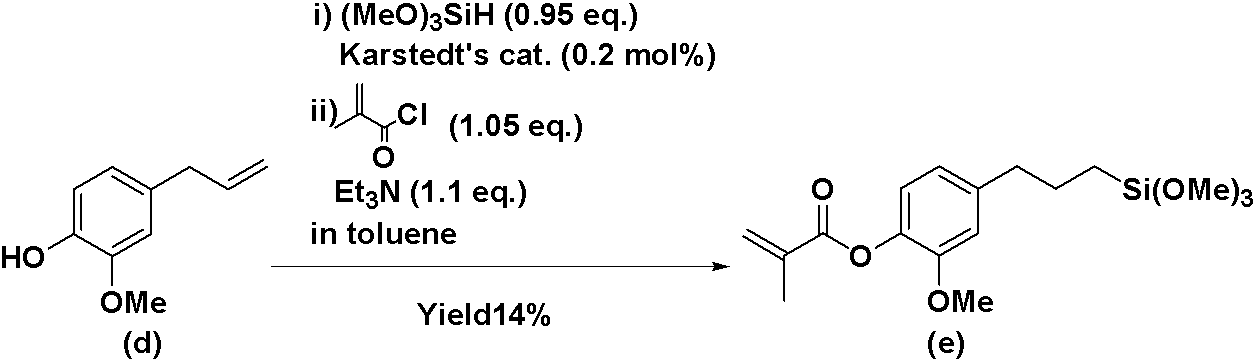
1H-NMR(400MHz) in CDCl3: 0.67-0.72ppm(m, 2H), 1.72-1.78ppm(m, 2H), 2.06ppm(s, 3H), 2.63ppm(t, J = 7.6 Hz, 2H), 3.57ppm(s, 9H), 3.80ppm(s, 3H), 5.73ppm(t, J = 1.6 Hz, 1H), 6.35ppm(t, J = 1.6 Hz, 1H), 6.74-6.79ppm(m, 2H), 6.94ppm(d, J = 7.6 Hz, 1H)
<ポリシロキサン(A)の合成>
温度計、還流管を備え付けた200mLの四つ口反応フラスコ中でHGを15.9g、BCSを7.9g、TEOSを17.50g、化合物合成例1で得られた化合物(c)を3.5g、MPMSを19.9g、及び化合物合成例2で得られた化合物(e)を3.5g混合して、アルコキシシランモノマーの溶液を調製した。この溶液に、予めHG7.9g、BCS4.0g、水10.8g及び触媒として蓚酸1.8gを混合した溶液を、室温下で30分かけて滴下し、さらに室温で30分間撹拌した。その後オイルバスを用いて加熱して30分間還流させた後、予め準備しておいたUPS含有量92質量%のメタノール溶液0.6g、0.3gのHG及び0.1gのBCSの混合液を加えた。更に30分間還流させてから放冷してSiO2換算濃度が12質量%のポリシロキサン溶液を得た。
温度計、還流管を備え付けた200mLの四つ口反応フラスコ中でHGを23.8g、BCSを7.9g、TEOSを37.1g、及びMTESを3.6g混合して、アルコキシシランモノマーの溶液を調製した。この溶液に、予めHG11.9g、BCS4.0g、水10.8g及び触媒として蓚酸0.4gを混合した溶液を、室温下で30分かけて滴下し、さらに室温で30分間撹拌した。その後オイルバスを用いて加熱して30分間還流させた後、予め準備しておいたUPS含有量92質量%のメタノール溶液0.6g、HG0.3g及びBCS0.1gの混合液を加えた。更に30分間還流させてから放冷してSiO2換算濃度が12質量%のポリシロキサン溶液を得た。
得られた液晶配向剤中間体(S1)と液晶配向剤中間体(U1)を、質量比で3:7の比率で混合し、SiO2換算濃度が4質量%の液晶配向剤[K1]を得た。
温度計、還流管を備え付けた200mLの四つ口反応フラスコ中でHGを15.4g、BCSを7.7g、TEOSを17.50g、化合物合成例1で得られた化合物(c)を9.8g、MPMSを17.4g、及び化合物合成例2で得られた化合物(e)を7.1g混合して、アルコキシシランモノマーの溶液を調製した。この溶液に、予めHG7.7g、BCS3.8g、水10.8g及び触媒として蓚酸1.8gを混合した溶液を、室温下で30分かけて滴下し、さらに室温で30分間撹拌した。その後オイルバスを用いて加熱して60分間還流させてから放冷してSiO2換算濃度が12質量%のポリシロキサン溶液を得た。
温度計、還流管を備え付けた200mLの四つ口反応フラスコ中でHGを14.5g、BCSを7.2g、TEOSを17.50g、化合物合成例1で得られた化合物(c)を9.8g、MPMSを12.4g、及び化合物合成例2で得られた化合物(e)を14.2g混合して、アルコキシシランモノマーの溶液を調製した。この溶液に、予めHG7.2g、BCS3.6g、水10.8g及び触媒として蓚酸1.8gを混合した溶液を、室温下で30分かけて滴下し、さらに室温で30分間撹拌した。その後オイルバスを用いて加熱して60分間還流させてから放冷してSiO2換算濃度が12質量%のポリシロキサン溶液を得た。
温度計、還流管を備え付けた200mLの四つ口反応フラスコ中でHGを13.5g、BCSを6.8g、TEOSを17.50g、化合物合成例1で得られた化合物(c)を9.8g、及びMPMSを7.25g、及び化合物合成例2で得られた化合物(e)を21.3g混合して、アルコキシシランモノマーの溶液を調製した。この溶液に、予めHG6.7g、BCS3.4g、水10.8g及び触媒として蓚酸1.8gを混合した溶液を、室温下で30分かけて滴下し、さらに室温で30分間撹拌した。その後オイルバスを用いて加熱して60分間還流させてから放冷してSiO2換算濃度が12質量%のポリシロキサン溶液を得た。
温度計、還流管を備え付けた200mLの四つ口反応フラスコ中でHGを15.8g、BCSを5.3g、TEOSを23.8g、化合物合成例1で得られた化合物(c)を9.8g、及び化合物合成例2で得られた化合物(e)を21.3g混合して、アルコキシシランモノマーの溶液を調製した。この溶液に、予めHG7.9g、BCS2.6g、水10.8g及び触媒として蓚酸1.8gを混合した溶液を、室温下で30分かけて滴下し、さらに室温で30分間撹拌した。その後オイルバスを用いて加熱して60分間還流させてから放冷してSiO2換算濃度が12質量%のポリシロキサン溶液を得た。
温度計、還流管を備え付けた200mLの四つ口反応フラスコ中でHGを16.1g、BCSを5.4g、TEOSを21.7g、化合物合成例1で得られた化合物(c)を9.8g、及びMPMSを5.0g、及び化合物合成例2で得られた化合物(e)を17.7g混合して、アルコキシシランモノマーの溶液を調製した。この溶液に、予めHG8.1g、BCS2.6g、水10.8g及び触媒として蓚酸1.8gを混合した溶液を、室温下で30分かけて滴下し、さらに室温で30分間撹拌した。その後オイルバスを用いて加熱して60分間還流させてから放冷してSiO2換算濃度が12質量%のポリシロキサン溶液を得た。
温度計、還流管を備え付けた200mLの四つ口反応フラスコ中でHGを16.3g、BCSを8.2g、TEOSを17.50g、化合物合成例1で得られた化合物(c)を9.8g、及びMPMSを22.4g混合して、アルコキシシランモノマーの溶液を調製した。この溶液に、予めHG8.2g、BCS4.1g、水10.8g及び触媒として蓚酸1.8gを混合した溶液を、室温下で30分かけて滴下し、さらに室温で30分間撹拌した。その後オイルバスを用いて加熱して30分間還流させた後、予め準備したUPS含有量92質量%のメタノール溶液0.6g、0.3gのHG及び0.1gのBCSの混合液を加えた。更に30分間還流させてから放冷してSiO2換算濃度が12質量%のポリシロキサン溶液を得た。
温度計、還流管を備え付けた200mLの四つ口反応フラスコ中でHG22.6g、BCSを7.5g、TEOSを39.2g、及びC18を4.2g混合して、アルコキシシランモノマーの溶液を調製した。この溶液に、予めHG11.3g、BCS3.8g、水10.8g及び触媒として蓚酸0.2gを混合した溶液を、室温下で30分かけて滴下し、さらに室温で30分間撹拌した。その後オイルバスを用いて加熱して30分間還流させた後、予め準備したUPS含有量92質量%のメタノール溶液0.6g、HG0.3g及びBCS0.1gの混合液を加えた。更に30分間還流させてから放冷してSiO2換算濃度が12質量%のポリシロキサン溶液を得た。
温度計、還流管を備え付けた200mLの四つ口反応フラスコ中でHG20.4g、BCSを6.8g、TEOSを22.5g、C18を4.2g、及びMPMSを19.9g混合して、アルコキシシランモノマーの溶液を調製した。この溶液に、予めHG10.2g、BCS3.4g、水10.8g及び触媒として蓚酸1.3gを混合した溶液を、室温下で30分かけて滴下し、さらに室温で30分間撹拌した。その後オイルバスを用いて加熱して30分間還流させた後、予め準備したUPS含有量92質量%のメタノール溶液0.6g、HG0.3g及びBCS0.1gの混合液を加えた。更に30分間還流させてから放冷してSiO2換算濃度が12質量%のポリシロキサン溶液を得た。
温度計、還流管を備え付けた200mLの四つ口反応フラスコ中でHGを16.3g、BCSを8.2g、TEOSを17.50g、化合物合成例1で得られた化合物(c)を9.8g、及びMPMSを22.4g混合して、アルコキシシランモノマーの溶液を調製した。この溶液に、予めHG8.2g、BCS4.1g、水10.8g及び触媒として蓚酸1.8gを混合した溶液を、室温下で30分かけて滴下し、さらに室温で30分間撹拌した。その後オイルバスを用いて加熱して30分間還流させた後、予め準備したUPS含有量92質量%のメタノール溶液0.6g、0.3gのHG及び0.1gのBCSの混合液を加えた。更に30分間還流させてから放冷してSiO2換算濃度が12質量%のポリシロキサン溶液を得た。
合成例1で得られた液晶配向剤[K1]を、画素サイズが100×300ミクロンで、ライン/スペースがそれぞれ5ミクロンのITO電極パターンが形成されているITO電極基板のITO面にスピンコートした。80℃のホットプレートで2分間乾燥した後、200℃の熱風循環式オーブンで30分間焼成を行い、膜厚100nmの液晶配向膜を形成した。また、合成例1で得られた液晶配向剤[K1]を、電極パターンが形成されていないITO面にスピンコートし、80℃のホットプレートで2分間乾燥した後、上記基板同様に200℃の熱風循環式オーブンで30分間焼成を行い、膜厚100nmの液晶配向膜を形成した。これらの2枚の基板を用意し、一方の基板の液晶配向膜面上に4μmのビーズスペーサーを散布した後、その上からシール剤を印刷した。他方の基板の液晶配向膜面を内側にし、張り合わせた後、シール剤を硬化させて空セルを作製した。液晶MLC-6608(メルク社製商品名)を、空セルに減圧注入法によって、前記液晶を注入した液晶セル1を作製した。この液晶セル1の応答速度特性を、後述する方法により測定した。
液晶配向剤[K1]を合成例2で得られた液晶配向剤[K2]に変更した以外は、実施例1と同様にして液晶セルを作製し、応答速度を測定し、アニール後の配向乱れであるドメインを観察した。その結果を表1に示した。
液晶配向剤[K1]を合成例3で得られた液晶配向剤[K3]に変更した以外は、実施例1と同様にして液晶セルを作製し、応答速度を測定し、アニール後の配向乱れであるドメインを観察した。その結果を表1に示した。
液晶配向剤[K1]を合成例4で得られた液晶配向剤[K4]に変更した以外は、実施例1と同様にして液晶セルを作製し、応答速度を測定し、アニール後の配向乱れであるドメインを観察した。その結果を表1に示した。
液晶配向剤[K1]を合成例5で得られた液晶配向剤[K5]に変更した以外は、実施例1と同様にして液晶セルを作製し、応答速度を測定し、アニール後の配向乱れであるドメインを観察した。その結果を表1に示した。
液晶配向剤[K1]を合成例6で得られた液晶配向剤[K6]に変更した以外は、実施例1と同様にして液晶セルを作製し、応答速度を測定し、アニール後の配向乱れであるドメインを観察した。その結果を表1に示した。
液晶配向剤[K1]を比較合成例1で得られた液晶配向剤[L1]に変更した以外は、実施例1と同様にして液晶セルを作製し、応答速度を測定し、アニール後の配向乱れであるドメインを観察した。その結果を表1に示した。
液晶配向剤[K1]を比較合成例2で得られた液晶配向剤[L2]に変更した以外は、実施例1と同様にして液晶セルを作製し、応答速度を測定し、アニール後の配向乱れであるドメインを観察した。その結果を表1に示した。
液晶配向剤[K1]を比較合成例3で得られた液晶配向剤[L3]に変更した以外は、実施例1と同様にして液晶セルを作製し、応答速度を測定し、アニール後の配向乱れであるドメインを観察した。その結果を表1に示した。
液晶配向剤[K1]を比較合成例4で得られた液晶配向剤[L4]に変更した以外は、実施例1と同様にして液晶セルを作製し、応答速度を測定し、アニール後の配向乱れであるドメインを観察した。その結果を表1に示した。
液晶セルに、±5VのAC(交流)電圧、周波数1kHzの矩形波を印加した際の、液晶パネルの輝度の時間変化をオシロスコープにて取り込んだ。電圧を印加していない時の輝度を0%、±5Vの電圧を印加し、飽和した輝度の値を100%として、輝度が10%から90%まで変化する時間を立ち上がりの応答速度とした。

Claims (8)
- 下記のポリシロキサン(A)を含有することを特徴とする液晶配向剤。
ポリシロキサン(A):下記式(1)で表されるアルコキシシラン、及び、下記式(3)で表されるアルコキシシランを含有するアルコキシシラン成分を反応させて得られるポリシロキサン
R1Si(OR2)3 (1)
(R1は下記式(2)の構造を表し、R2は炭素数1~5のアルキル基を表す。)

- アルコキシシラン成分が、さらに下記式(4)で表されるアルコキシシランを含有することを特徴とする請求項1に記載の液晶配向剤。
R3Si(OR4)3 (4)
(R3は、水素原子が、アクリル基、アクリロキシ基、メタクリル基、メタクリロキシ基又はスチリル基で置換された炭素数1~30のアルキル基であり、R4は炭素数1~5のアルキル基を表す。) - さらに、下記のポリシロキサン(B)を含有することを特徴とする請求項1又は2に記載の液晶配向剤。
ポリシロキサン(B):下記式(5)で表されるアルコキシシランを含有するアルコキシシラン成分を反応させて得られるポリシロキサン
Si(OR15)4 (5)
(R15は炭素数1~5のアルキル基を表す。) - ポリシロキサン(A)及びポリシロキサン(B)の少なくとも一つが、さらに、下記式(6)で表されるアルコキシシランを含有するアルコキシシラン成分を反応させて得られるポリシロキサンであることを特徴とする請求項1~3のいずれかに記載の液晶配向剤。
(R13)n2Si(OR14)4-n (6)
(式(6)中、R13は、水素原子、又は、水素原子がヘテロ原子、ハロゲン原子、アミノ基、グリシドキシ基、メルカプト基、イソシアネート基、ウレイド基で置換されていてもよい炭素数1~10の炭化水素基であり、R14は炭素数1~5のアルキル基であり、n2は0~3の整数を表す。) - 請求項1~4のいずれかに記載の液晶配向剤を基板に塗布し、焼成して得られることを特徴とする液晶配向膜。
- 請求項5に記載の液晶配向膜を有することを特徴とする液晶表示素子。
- 請求項1~4のいずれかに記載の液晶配向剤を塗布し、焼成された2枚の基板で液晶が挟持された液晶セルに、電圧を印加した状態でUVを照射して作製したものを具備することを特徴とする液晶表示素子。
- 請求項1~4のいずれかに記載の液晶配向剤を塗布し、焼成した2枚の基板で液晶を挟持して液晶セルを作製し、この液晶セルに電圧を印加した状態でUVを照射する工程を有することを特徴とする液晶表示素子の製造方法。
Priority Applications (3)
| Application Number | Priority Date | Filing Date | Title |
|---|---|---|---|
| KR1020157004753A KR102133066B1 (ko) | 2012-07-31 | 2013-07-24 | 액정 배향제, 액정 배향막, 액정 표시 소자 및 액정 표시 소자의 제조 방법 |
| JP2014528098A JPWO2014021174A1 (ja) | 2012-07-31 | 2013-07-24 | 液晶配向剤、液晶配向膜、液晶表示素子及び液晶表示素子の製造方法 |
| CN201380051035.1A CN104685411B (zh) | 2012-07-31 | 2013-07-24 | 液晶取向剂、液晶取向膜、液晶显示元件及液晶显示元件的制造方法 |
Applications Claiming Priority (2)
| Application Number | Priority Date | Filing Date | Title |
|---|---|---|---|
| JP2012169909 | 2012-07-31 | ||
| JP2012-169909 | 2012-07-31 |
Publications (1)
| Publication Number | Publication Date |
|---|---|
| WO2014021174A1 true WO2014021174A1 (ja) | 2014-02-06 |
Family
ID=50027852
Family Applications (1)
| Application Number | Title | Priority Date | Filing Date |
|---|---|---|---|
| PCT/JP2013/070103 Ceased WO2014021174A1 (ja) | 2012-07-31 | 2013-07-24 | 液晶配向剤、液晶配向膜、液晶表示素子及び液晶表示素子の製造方法 |
Country Status (5)
| Country | Link |
|---|---|
| JP (1) | JPWO2014021174A1 (ja) |
| KR (1) | KR102133066B1 (ja) |
| CN (1) | CN104685411B (ja) |
| TW (1) | TWI534511B (ja) |
| WO (1) | WO2014021174A1 (ja) |
Cited By (1)
| Publication number | Priority date | Publication date | Assignee | Title |
|---|---|---|---|---|
| WO2017102053A2 (en) | 2015-12-17 | 2017-06-22 | Merck Patent Gmbh | Cinnamic acid derivatives |
Citations (3)
| Publication number | Priority date | Publication date | Assignee | Title |
|---|---|---|---|---|
| JP2010217866A (ja) * | 2009-02-19 | 2010-09-30 | Jsr Corp | 液晶配向剤、液晶表示素子およびその製造方法 |
| WO2010126108A1 (ja) * | 2009-05-01 | 2010-11-04 | 日産化学工業株式会社 | ケイ素系液晶配向剤、液晶配向膜及び液晶表示素子 |
| WO2012165354A1 (ja) * | 2011-05-27 | 2012-12-06 | 日産化学工業株式会社 | ケイ素系液晶配向剤、液晶配向膜及び液晶表示素子 |
Family Cites Families (5)
| Publication number | Priority date | Publication date | Assignee | Title |
|---|---|---|---|---|
| JP4504626B2 (ja) | 2003-03-31 | 2010-07-14 | シャープ株式会社 | 液晶表示装置及びその製造方法 |
| KR100956675B1 (ko) * | 2007-12-07 | 2010-05-10 | 제일모직주식회사 | 액정 배향제, 이를 포함하는 액정 배향막, 및 이를포함하는 액정 표시 장치 |
| CN102084288B (zh) * | 2008-06-04 | 2013-08-14 | 日产化学工业株式会社 | 硅系液晶取向剂、液晶取向膜及液晶显示元件 |
| JP2011095967A (ja) | 2009-10-29 | 2011-05-12 | Yamaha Corp | バス共有システム |
| JP5780389B2 (ja) * | 2010-07-02 | 2015-09-16 | Jsr株式会社 | 液晶表示素子の製造方法 |
-
2013
- 2013-07-24 CN CN201380051035.1A patent/CN104685411B/zh active Active
- 2013-07-24 KR KR1020157004753A patent/KR102133066B1/ko active Active
- 2013-07-24 JP JP2014528098A patent/JPWO2014021174A1/ja active Pending
- 2013-07-24 WO PCT/JP2013/070103 patent/WO2014021174A1/ja not_active Ceased
- 2013-07-31 TW TW102127429A patent/TWI534511B/zh active
Patent Citations (3)
| Publication number | Priority date | Publication date | Assignee | Title |
|---|---|---|---|---|
| JP2010217866A (ja) * | 2009-02-19 | 2010-09-30 | Jsr Corp | 液晶配向剤、液晶表示素子およびその製造方法 |
| WO2010126108A1 (ja) * | 2009-05-01 | 2010-11-04 | 日産化学工業株式会社 | ケイ素系液晶配向剤、液晶配向膜及び液晶表示素子 |
| WO2012165354A1 (ja) * | 2011-05-27 | 2012-12-06 | 日産化学工業株式会社 | ケイ素系液晶配向剤、液晶配向膜及び液晶表示素子 |
Cited By (1)
| Publication number | Priority date | Publication date | Assignee | Title |
|---|---|---|---|---|
| WO2017102053A2 (en) | 2015-12-17 | 2017-06-22 | Merck Patent Gmbh | Cinnamic acid derivatives |
Also Published As
| Publication number | Publication date |
|---|---|
| TWI534511B (zh) | 2016-05-21 |
| TW201411251A (zh) | 2014-03-16 |
| CN104685411A (zh) | 2015-06-03 |
| CN104685411B (zh) | 2017-05-31 |
| JPWO2014021174A1 (ja) | 2016-07-21 |
| KR20150038300A (ko) | 2015-04-08 |
| KR102133066B1 (ko) | 2020-07-10 |
Similar Documents
| Publication | Publication Date | Title |
|---|---|---|
| JP6079626B2 (ja) | ケイ素系液晶配向剤、液晶配向膜及び液晶表示素子 | |
| JP5605359B2 (ja) | ケイ素系液晶配向剤、液晶配向膜及び液晶表示素子 | |
| KR101419962B1 (ko) | 규소계 액정 배향제 및 액정 배향막 | |
| JP6398973B2 (ja) | 液晶配向剤、液晶配向膜及び液晶表示素子 | |
| JP6107661B2 (ja) | ケイ素系液晶配向剤、液晶配向膜及び液晶表示素子 | |
| JP5761180B2 (ja) | 液晶配向剤、液晶配向膜及び液晶表示素子 | |
| CN102713744B (zh) | 硅类液晶取向剂、液晶取向膜及液晶显示元件 | |
| JP6459513B2 (ja) | 液晶配向剤、液晶配向膜及び液晶表示素子 | |
| JP5999084B2 (ja) | ケイ素系液晶配向剤、液晶配向膜及び液晶表示素子 | |
| WO2014021174A1 (ja) | 液晶配向剤、液晶配向膜、液晶表示素子及び液晶表示素子の製造方法 |
Legal Events
| Date | Code | Title | Description |
|---|---|---|---|
| 121 | Ep: the epo has been informed by wipo that ep was designated in this application |
Ref document number: 13825956 Country of ref document: EP Kind code of ref document: A1 |
|
| ENP | Entry into the national phase |
Ref document number: 2014528098 Country of ref document: JP Kind code of ref document: A |
|
| NENP | Non-entry into the national phase |
Ref country code: DE |
|
| ENP | Entry into the national phase |
Ref document number: 20157004753 Country of ref document: KR Kind code of ref document: A |
|
| 122 | Ep: pct application non-entry in european phase |
Ref document number: 13825956 Country of ref document: EP Kind code of ref document: A1 |