WO2014021166A1 - ブロックイソシアネート化合物の製造方法 - Google Patents
ブロックイソシアネート化合物の製造方法 Download PDFInfo
- Publication number
- WO2014021166A1 WO2014021166A1 PCT/JP2013/070042 JP2013070042W WO2014021166A1 WO 2014021166 A1 WO2014021166 A1 WO 2014021166A1 JP 2013070042 W JP2013070042 W JP 2013070042W WO 2014021166 A1 WO2014021166 A1 WO 2014021166A1
- Authority
- WO
- WIPO (PCT)
- Prior art keywords
- isocyanate compound
- group
- blocked isocyanate
- iii
- oxime
- Prior art date
- Legal status (The legal status is an assumption and is not a legal conclusion. Google has not performed a legal analysis and makes no representation as to the accuracy of the status listed.)
- Ceased
Links
Classifications
-
- C—CHEMISTRY; METALLURGY
- C07—ORGANIC CHEMISTRY
- C07C—ACYCLIC OR CARBOCYCLIC COMPOUNDS
- C07C269/00—Preparation of derivatives of carbamic acid, i.e. compounds containing any of the groups, the nitrogen atom not being part of nitro or nitroso groups
- C07C269/02—Preparation of derivatives of carbamic acid, i.e. compounds containing any of the groups, the nitrogen atom not being part of nitro or nitroso groups from isocyanates with formation of carbamate groups
-
- C—CHEMISTRY; METALLURGY
- C07—ORGANIC CHEMISTRY
- C07C—ACYCLIC OR CARBOCYCLIC COMPOUNDS
- C07C265/00—Derivatives of isocyanic acid
- C07C265/14—Derivatives of isocyanic acid containing at least two isocyanate groups bound to the same carbon skeleton
-
- C—CHEMISTRY; METALLURGY
- C07—ORGANIC CHEMISTRY
- C07C—ACYCLIC OR CARBOCYCLIC COMPOUNDS
- C07C271/00—Derivatives of carbamic acids, i.e. compounds containing any of the groups, the nitrogen atom not being part of nitro or nitroso groups
- C07C271/60—Derivatives of carbamic acids, i.e. compounds containing any of the groups, the nitrogen atom not being part of nitro or nitroso groups having oxygen atoms of carbamate groups bound to nitrogen atoms
Definitions
- the present invention relates to a method for producing a blocked isocyanate compound which is a block body of a (meth) acryloyl group-containing isocyanate which is suitably used as a raw material monomer for various coating agents, adhesives, molding materials and the like. More specifically, the present invention relates to a production method capable of avoiding a decrease in product purity due to polymerization reaction or side reaction in industrial production and obtaining a block isocyanate compound with high purity.
- This application claims priority based on Japanese Patent Application No. 2012-168544 filed in Japan on July 30, 2012, the contents of which are incorporated herein by reference.
- a blocked isocyanate compound is obtained by reacting an isocyanato group with an active hydrogen group-containing compound (blocking agent) to inactivate the reactivity of the isocyanato group. When heated, the blocking agent dissociates to regenerate the isocyanato group. It has the nature of By blocking the isocyanate group of the curing agent, it can be pre-blended with the main agent having an active hydrogen group, so the blocked isocyanate compound is widely used in coating agents, adhesives, molding materials, etc. Yes.
- Blocking agents that block isocyanato groups include alcohols, phenols, lactams, oximes, acetoacetic acid alkyl esters, malonic acid alkyl esters, phthalimides, imidazoles, hydrogen chloride, hydrogen cyanide, sodium bisulfite, etc. It has been known.
- Patent Document 1 discloses a method for producing a blocked isocyanate compound by reacting 2-acryloyloxyethyl isocyanate and methyl ethyl ketone oxime in a tetrahydrofuran solvent.
- Patent Document 2 discloses a method for producing a blocked isocyanate compound by reacting 2-methacryloyloxyethyl isocyanate with methyl ethyl ketone oxime using methyl ethyl ketone as a solvent.
- the reaction can be smoothly advanced at a relatively low temperature.
- the use of a solvent is not preferable in terms of environmental burden, and requires a purification process, which increases the number of manufacturing processes and increases costs.
- the solvent used in the reaction is included in the product as an impurity, the product blocked isocyanate compound may not be widely used as a raw material monomer for various coating agents, adhesives, molding materials, etc. was there. From such a point, the manufacturing method which obtains a highly purified block isocyanate compound without using a solvent was calculated
- Patent Document 3 does not require a purification step by supplying methacryloyloxyethyl isocyanate to a place where solid pyrazole is slurried in advance using a blocked isocyanate compound as a dispersion medium. An efficient method for producing a blocked isocyanate compound is shown.
- Patent Document 3 is a manufacturing method related to a raw material that is a solid, and no reference has been made to an optimal manufacturing method when the raw material is a liquid.
- the present invention has been made in view of the above circumstances, and a manufacturing method that can reduce the burden on the environment when a liquid raw material is used, and can simplify the manufacturing process and manufacturing equipment. The purpose is to provide.
- the present invention adopts the following configuration.
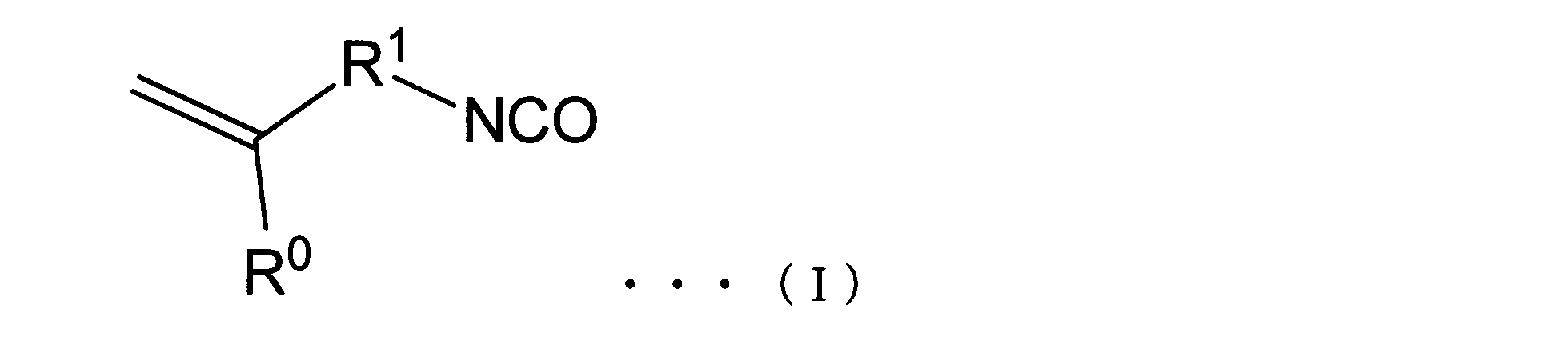
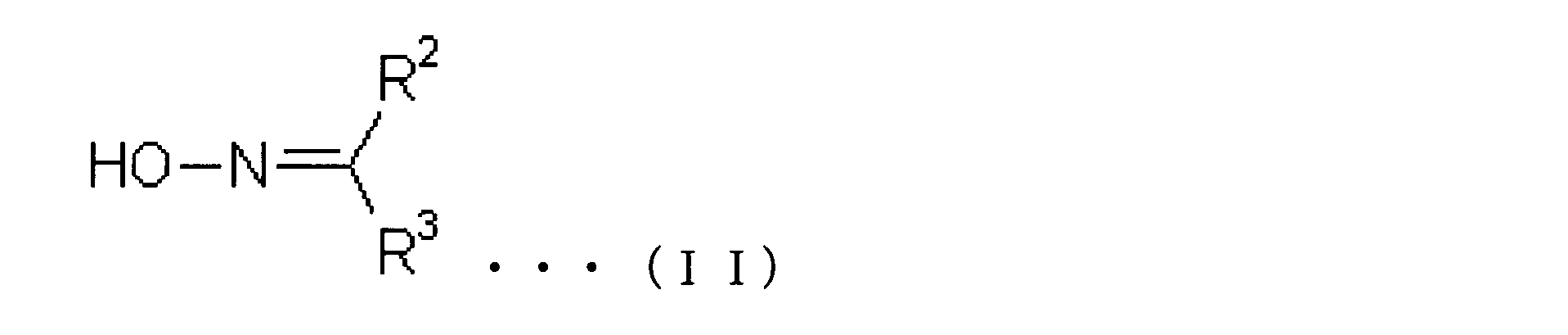
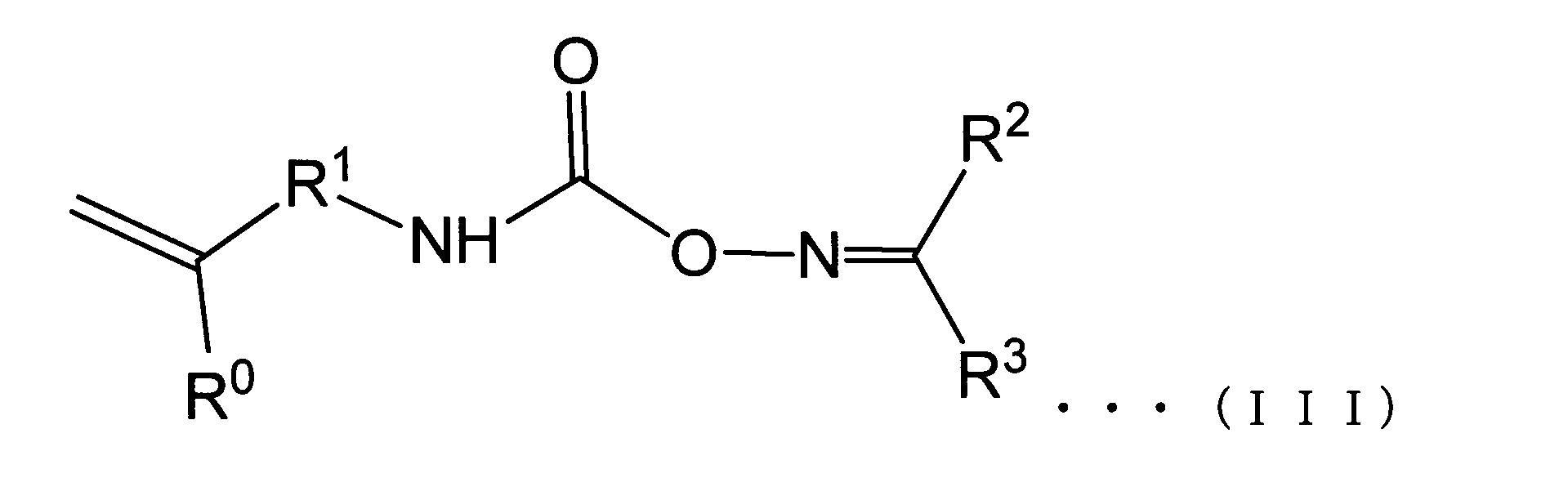
- a (meth) acryloyl group-containing isocyanate compound represented by the following general formula (I) is reacted with an oxime compound represented by the following general formula (II) to represent the following general formula (III).
- a blocked isocyanate compound characterized in that a solvent is not used in the production process, or the blocked isocyanate compound represented by the general formula (III) is used as a substitute for the solvent. Manufacturing method.
- R 0 is a methyl group or a hydrogen atom
- R 1 is —CO— or —COOR 4 —
- R 4 is an alkyl group having 1 to 10 carbon atoms which may contain an ether bond and / or a phenylene group. An alkylene group.
- R 2 and R 3 are each independently any one group selected from the group consisting of a methyl group, an ethyl group, an n-propyl group, an n-butyl group, and an n-pentyl group. ]
- R 0 to R 3 are the same as those in formulas (I) and (II). ]
- a blocked isocyanate compound represented by the general formula (III) is used as a solvent, and a (meth) acryloyl group-containing isocyanate compound represented by the general formula (I) and the general formula (II)
- the oxime compound represented by the general formula (II) is used in an amount of 0.5 to 2.0 times by mole.
- the blocked isocyanate compound produced according to the present invention does not use a solvent, the product produced using the blocked isocyanate compound does not contain a solvent. Therefore, the blocked isocyanate compound can be suitably used in a wide range of fields such as various coating agents, adhesives and molding materials.
- the method for producing a blocked isocyanate compound represented by the following general formula (III) according to the present invention contains a (meth) acryloyl group represented by the following general formula (I).
- An isocyanate compound (hereinafter referred to as (meth) acryloyl group-containing isocyanate compound (I)) is reacted with an oxime compound represented by the following general formula (II) (hereinafter referred to as oxime compound (II)).
- oxime compound (II) an oxime compound represented by the following general formula (II) (hereinafter referred to as oxime compound (II)).
- R 0 is a methyl group or a hydrogen atom
- R 1 is —CO— or —COOR 4 —
- R 4 is an alkylene group having 1 to 10 carbon atoms which may contain an ether bond
- R 2 and R 3 are each independently any one group selected from the group consisting of a methyl group, an ethyl group, an n-propyl group, an n-butyl group, and an n-pentyl group.
- “does not use a solvent” means that (i) neither an active solvent nor an inert solvent is added to the reaction system, and (ii) the solvent added to the reaction system is a reaction product. (Iii) The amount of the solvent added to the reaction system does not affect the physical properties of the product even if the solvent remains in the product. It means one of things. Specifically, (ii) and (iii) indicate that the amount of the solvent contained in the product is less than about 1% by mass.
- R 0 in the blocked isocyanate compound (III) is a methyl group or a hydrogen atom. Among these, a hydrogen atom is preferable.
- R 1 in the blocked isocyanate compound (III) is —CO— or —COOR 4 —. Of these, —COOR 4 — is preferable.
- R 4 in the —COOR 4 — is an alkylene group having 1 to 10 carbon atoms which may contain an ether bond and / or a phenylene group. Among these, R 4 is preferably an alkylene group having 1 to 5 carbon atoms which may contain an ether bond.
- the alkylene group for R 4 is preferably a linear or branched alkylene group.
- Specific examples of the linear alkylene group include a methylene group, an ethylene group, a propylene group, a butylene group, a pentylene group, a hexylene group, a heptylene group, an octylene group, a nonylene group, and a decanylene group.
- the branched alkylene group examples include —C (CH 3 ) 2 —, —CH (CH 3 ) —, —CH (CH 2 CH 3 ) —, —C (CH 3 ) (CH 2 CH 3 ) —, —C (CH 3 ) (CH 2 CH 2 CH 3 ) —, —C (CH 2 CH 3 ) 2 — and the like; —CH (CH 3 ) CH 2 —, —CH (CH 3 ) CH (CH 3 ) —, —C (CH 3 ) 2 CH 2 —, —CH (CH 2 CH 3 ) CH 2 —, —C (CH 2 CH 3 ) 2 —CH 2 — and the like can be mentioned.
- the alkylene group in R 4 is more preferably a linear alkylene group, particularly preferably an alkylene group having 1 to 5 carbon atoms, and most preferably a methylene group or an ethylene group.
- the alkylene group having 1 to 10 carbon atoms which may contain an ether bond in R 4 means that an oxygen atom may be inserted between the carbon-carbon bonds in the alkylene group having 1 to 10 carbon atoms, — (CH 2 ) a — (O) b — (CH 2 ) c — (O) d — (CH 2 ) e — is represented.
- a + c + e represents an integer of 1 to 10
- a and c represent 0 or an integer of 1 or more
- b and d represent 0 or 1, and when d is 0, e is also 0.
- alkylene group having 1 to 10 carbon atoms which may contain an ether bond specifically, —CH 2 —O— (CH 2 ) 3 —, — (CH 2 ) 2 —O— (CH 2 ) 2 —, — (CH 2 ) 3 —O—CH 2 —, —CH 2 —O— (CH 2 ) 2 —, — (CH 2 ) 2 —O—CH 2 —, —CH 2 —O—CH 2 — are preferred.
- the alkylene group having 1 to 10 carbon atoms which may contain a phenylene group in R 4 means that a phenylene group may be inserted between carbon-carbon bonds in the alkylene group having 1 to 10 carbon atoms, — (CH 2 ) n — (Ph) m — (CH 2 ) 1 — (Ph) n — (CH 2 ) o — is represented.
- Ph represents an unsubstituted 1,2-phenylene, 1,3-phenylene, or 1,4-phenylene group
- n + 1 + o represents an integer of 1 to 10
- n and l are integers of 0 or 1 or more M and n represent 0 or 1, and when n is 0, o is also 0.
- the alkylene group having 1 to 10 carbon atoms which may contain a phenylene group is preferably one having a total carbon number of 10 or less, n + 1 represents an integer of 1 to 4, and o represents 0.
- —CH 2 —Ph— (CH 2 ) 3 —, — (CH 2 ) 2 —Ph— (CH 2 ) 2 —, — (CH 2 ) 3 —Ph—CH 2 —, —CH 2 —Ph— (CH 2 ) 2 —, — (CH 2 ) 2 —Ph—CH 2 —, —CH 2 —Ph—CH 2 — are preferred, —CH 2 —Ph— (CH 2 ) 3 —, — ( CH 2 ) 2 —Ph— (CH 2 ) 2 —, — (CH 2 ) 3 —Ph—CH 2 —, —CH 2 —Ph— (CH 2 ) 2 — are more preferred, and — (CH 2 ) 2
- R 4 for example, —Ph—O—, — (CH 2 ) 2 —Ph—O—, —Ph—O— (CH 2 ) 2 —, — (CH 2 ) 2 —Ph—O— ( It may contain both the ether bond and the phenylene bond, such as CH 2 ) 2 —.
- R 2 and R 3 in the blocked isocyanate compound (III) are each independently selected from the group consisting of a methyl group, an ethyl group, an n-propyl group, an n-butyl group, and an n-pentyl group.
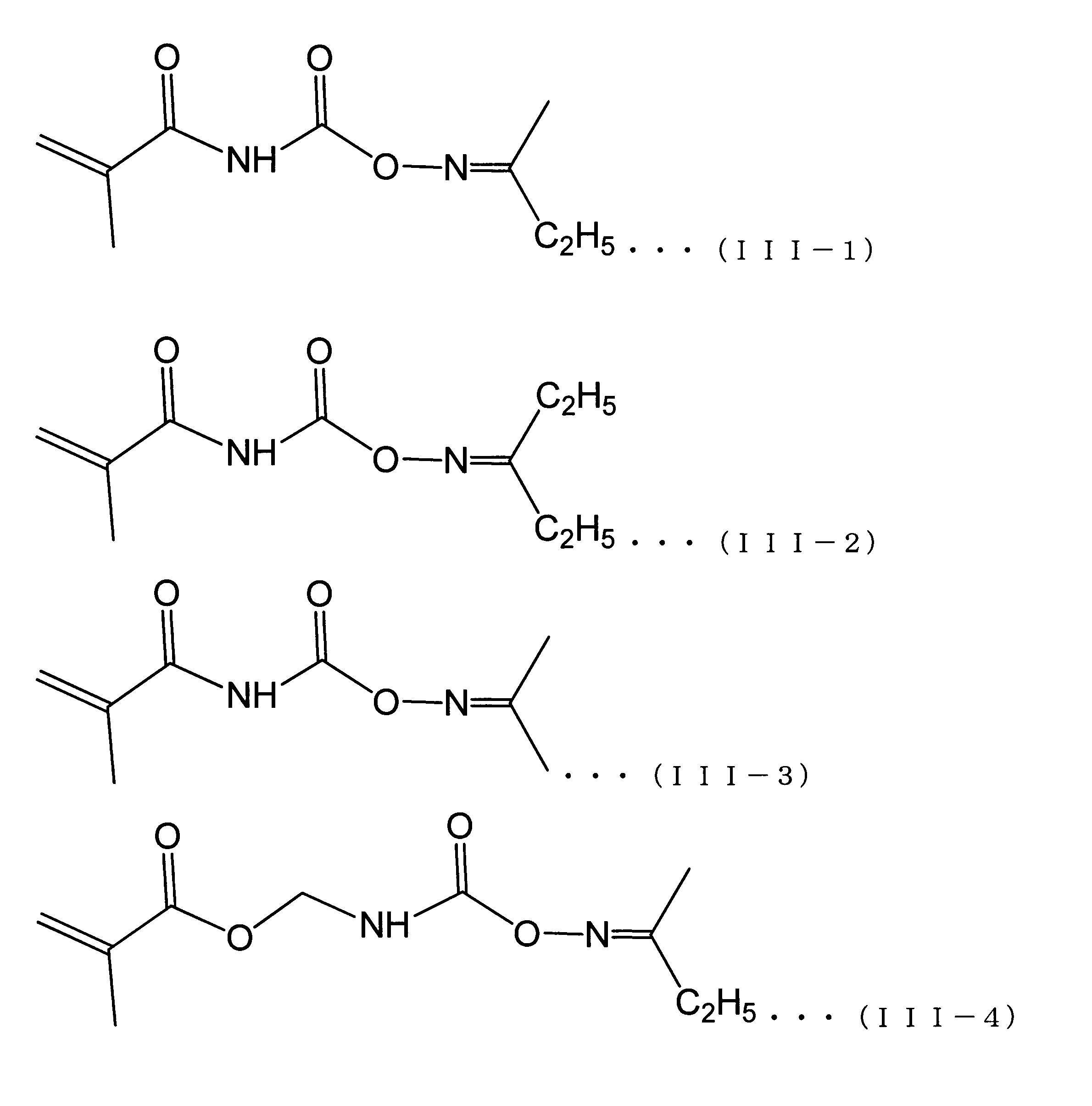
- examples of the blocked isocyanate compound (III) include compounds represented by the following formulas (III-1) to (III-9).
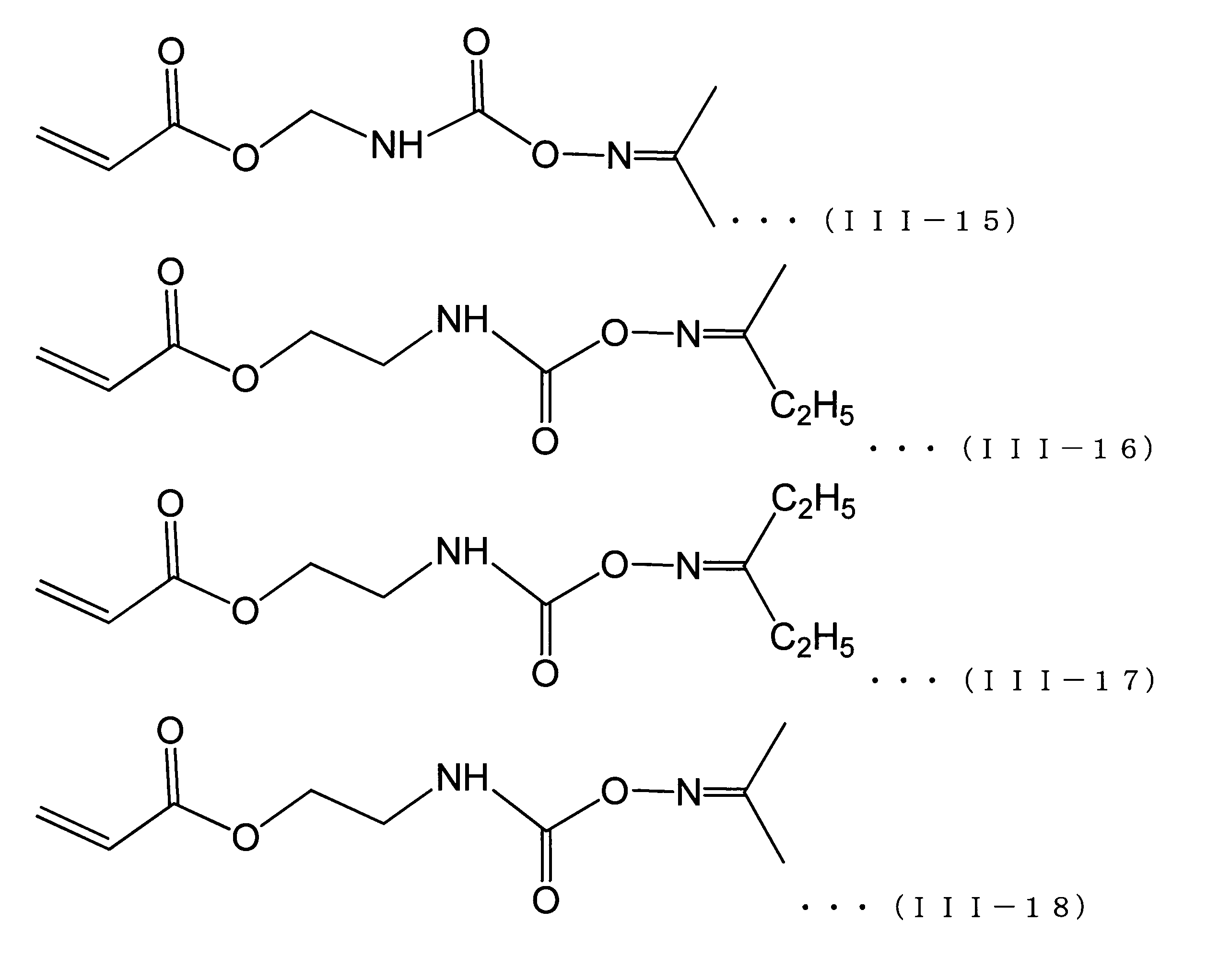
- examples of the blocked isocyanate compound (III) include compounds represented by the following formulas (III-10) to (III-18).
- the compounds represented by the formulas (III-7) to (III-9) and the compounds represented by the formulas (III-16) to (III-18) are preferable.
- the compounds represented by the formulas (III-16) to (III-18) are more preferred, and the compound represented by the formula (III-16) is particularly preferred from the viewpoint that the production method of (1) can be suitably applied.
- the blocked isocyanate compound (III) is used in place of the solvent.
- the solvent include, for example, toluene, xylene, ethyl acetate, butyl acetate, tetrahydrofuran, hexane, methylene chloride, methyl ethyl ketone, methyl isobutyl ketone, alcohol, acetone, hexane, benzene, cyclohexanone, diethyl ether, acetonitrile, dimethylformamide.
- examples include dimethyl sulfoxide and water.
- the production method of the present invention since it is not necessary to use a conventional solvent, it is excellent in safety to the environment, and the production process and production equipment can be simplified.
- the method for producing a blocked isocyanate compound (III) comprises reacting a (meth) acryloyl group-containing isocyanate compound (I) with an oxime compound (II).
- the “(meth) acryloyl group” means an acryloyl group in which a hydrogen atom is bonded to the ⁇ -position, or an acryloyl group in which a methyl group is bonded to the ⁇ -position.
- R 0 in the (meth) acryloyl group-containing isocyanate compound (I) is a methyl group or a hydrogen atom, and a hydrogen atom is preferable from the viewpoint of suitably applying the production method of the present invention described later.
- R 1 in the (meth) acryloyl group-containing isocyanate compound (I) is —CO— or —COOR 4 —.
- a preferred embodiment of R 1 is as described above for the blocked isocyanate compound (III).
- Examples of the (meth) acryloyl group-containing isocyanate compound (I) include 2-isocyanatoethyl (meth) acrylate, 3-isocyanatopropyl (meth) acrylate, 2-isocyanato-1-methylethyl (meth) acrylate, and methacryloyloxy. Examples thereof include ethoxyethyl isocyanate, 2-isocyanatoethyl (meth) acrylate is preferred, and 2-isocyanatoethyl acrylate is more preferred.
- (meth) acrylate means an acrylate having a hydrogen atom bonded to the ⁇ -position or a methacrylate having a methyl group bonded to the ⁇ -position.
- the (meth) acryloyl group-containing isocyanate compound (I) used in the present invention is produced by a conventionally known method.
- R 2 and R 3 in the oxime compound (II) are each independently one selected from the group consisting of a methyl group, an ethyl group, an n-propyl group, an n-butyl group, and an n-pentyl group.
- Examples of the oxime compound (II) include dimethyl ketone oxime, diethyl ketone oxime, and methyl ethyl ketone oxime, and methyl ethyl ketone oxime is preferable.
- the oxime compound (II) used in the present invention is produced by a conventionally known method.
- the reaction temperature of the (meth) acryloyl group-containing isocyanate compound (I) and the oxime compound (II) should be a temperature at which the compounds (I) and (II) are liquid. Specifically, although it varies depending on the type of each compound, it is preferably ⁇ 10 ° C. to 90 ° C., more preferably ⁇ 10 ° C. to 60 ° C., and most preferably ⁇ 10 ° C. to 30 ° C. In such a temperature range, the blocked isocyanate compound can be obtained efficiently and almost no by-product is produced, so that the blocked isocyanate compound can be obtained with high purity.
- the reaction temperature includes the reaction temperature when the oxime compound (II) and / or the (meth) acryloyl group-containing isocyanate compound (I) is added dropwise or the like.
- the reaction temperature is ⁇ 10 ° C. or higher, the reaction rate is not slow and the productivity is not affected, so that a blocked isocyanate compound can be obtained efficiently.
- the reaction temperature is 90 ° C. or lower, the blocked isocyanate compound (III) can be obtained with high purity because there is no possibility of gelation due to polymerization of the acryloyl group.
- the reaction is preferably performed until the oxime compound (II) or the acryloyl group-containing isocyanate compound (I) is almost consumed.
- the reaction time is not particularly limited, but is preferably 1 hour or longer, and more preferably 3 hours or longer.
- the disappearance of the acryloyl group-containing isocyanate compound (I) can be carried out, for example, by confirming that the absorption based on the NCO group is below the detection limit as a result of IR measurement.
- the reaction time includes the time for adding the oxime compound (II) and / or the acryloyl group-containing isocyanate compound (I) dropwise.
- the reaction is preferably carried out in a state where the residual of the oxime compound (II) is always minimal or absent in the reaction system, and more preferably in a state of always 1.0% by mass or less.
- the amount of the oxime compound in the system can be measured by, for example, high performance liquid chromatography.
- the absence of the oxime compound in the system indicates that the oxime compound has not been left in the system, for example, as a result of high performance liquid chromatography analysis. This can be done by confirming that it is below the detection limit.
- the oxime compound (II) in a 0.5 to 2.0-fold molar amount with respect to the (meth) acryloyl group-containing isocyanate compound (I).
- the reaction is more preferably carried out in an amount of 0.8 to 1.2 times the molar amount, particularly preferably 0.95 to 1.05 times the molar amount.
- the reaction ratio of these compounds is theoretically 1: 1 (molar ratio), but the reaction can proceed smoothly by reacting at a molar ratio in the above range.
- a polymerization inhibitor to the reaction system.
- the polymerization inhibitor reacts quickly with the free radicals generated from the monomer, so that the polymerization reaction by the free radicals can be stabilized.
- the polymerization inhibitor commonly used ones such as phenothiazine, p-methoxyphenol, 2,6-ditertiarybutyl-4-methylphenol (BHT) can be used.
- the method of charging the polymerization inhibitor is not particularly limited, but for example, a method of charging into the reactor together with the oxime compound; a method of mixing with the acryloyl group-containing isocyanate compound and charging into the reactor; Examples include a method of adding to both the oxime compound and the acryloyl group-containing isocyanate compound, and charging the resulting mixture into the reactor; and a method of charging the resulting blocked isocyanate compound after completion of the reaction.
- the blocked isocyanate compound (III) without polymerizing the (meth) acryloyl group-containing isocyanate compound (I), in the presence of a polymerization inhibitor, the oxime compound (II) and the above-mentioned It is preferable to react with the (meth) acryloyl group-containing isocyanate compound (I).
- the amount of the polymerization inhibitor used varies depending on the types of the oxime compound (II) and the (meth) acryloyl group-containing isocyanate compound (I), but the (meth) acryloyl group-containing isocyanate compound (I) and the oxime.
- the blocked isocyanate compound (III) obtained by reaction with the system compound (II) is preferably used in a proportion of 10 to 20000 ppm, more preferably in a proportion of 50 to 10000 ppm, and an amount of 100 to 5000 ppm. It is particularly preferred to be used.
- the blocked isocyanate compound (III) may be produced by a method that does not use a solvent as described above. However, the blocked isocyanate compound (III) is used in place of a conventional solvent, and the compound in the compound (III) is used. It is preferable to further prepare the blocked isocyanate compound (III) by reacting (I) with the compound (II).
- the blocked isocyanate compound (III) By using the blocked isocyanate compound (III) as a solvent, the blocked isocyanate compound can be obtained without requiring a purification step.
- the order in which the raw materials are added into the reaction system is not particularly limited, and examples thereof include the following methods. (1) The blocked isocyanate compound (III) and the oxime compound (II) are charged into a reactor and mixed, and then the (meth) acryloyl group-containing isocyanate compound (I) is added to the reactor.
- the blocked isocyanate compound (III) and the (meth) acryloyl group-containing isocyanate compound (I) are charged into a reactor and mixed, and then the blocked isocyanate compound (III) and the oxime compound (
- the blocked isocyanate (III) is initially charged in a reactor (1), (3), (4), ( 6) is preferred.
- the “empty reactor” refers to a reactor in which neither the compound (I) (II) as a raw material nor the product (III) is supplied.
- Other components such as a polymerization inhibitor and an additive may be charged in the reactor in advance.
- the method (7) is preferred.
- the following points can be considered as the reason.
- an excessive oxime compound is present in the system. Therefore, the oxime compound tends to generate impurities by Michael addition reaction to the (meth) acryloyl group.
- the amount of the oxime compound remaining in the system can be suppressed to the minimum amount.
- the risk that the acryloyl group-containing isocyanate compound undergoes self-polymerization can be suppressed.
- Specific examples of the method (7) in which the isocyanate compound (I) and the oxime compound (II) are simultaneously added to the reactor include the following methods.
- (7) -1 A method of simultaneously adding the isocyanate compound (I) and the oxime compound (II) into an empty reactor;
- (7) -2 A method of simultaneously adding a mixture of the isocyanate compound (I) and the blocked isocyanate compound (III) and the oxime compound (II) into an empty reactor;
- (7) -3 A mixture of the isocyanate compound (I) and the blocked isocyanate compound (III) and a mixture of the oxime compound (II) and the blocked isocyanate compound (III) are simultaneously added into an empty reactor.
- a method of simultaneously adding to the inside; (7) -7 The blocked isocyanate compound (III) is charged into a reactor, and a mixture of the isocyanate compound (I) and the blocked isocyanate compound (III), the oxime compound (II), and the blocked isocyanate.
- a method of simultaneously adding a mixture of compound (III) into a reactor; (7) -8 The blocked isocyanate compound (III) is charged into a reactor, and the mixture of the isocyanate compound (I), the oxime compound (II) and the blocked isocyanate compound (III) is added to the reactor.
- the present inventor has found that the acryloyl group is more likely to generate a by-product due to the Michael addition reaction with the blocking agent as compared to the methacryloyl group and the like.
- the present inventors have found that the method (7) in which the raw materials are added simultaneously in the reaction system using the acrylolyl group-containing isocyanate is very effective.
- the blocked isocyanate compound (III) When the blocked isocyanate compound (III) is used as a solvent, the same oxime compound (II) and (meth) acryloyl group-containing isocyanate compound (I) used in preparing the compound (III) are used. ) Are preferably used.
- the amount of the compound (III) used is not particularly limited, but it is preferably 0.01 to 50 times by mole with respect to the oxime compound (II). It is more preferable to use 0.01 to 10 times mol, and particularly preferable to use 0.01 to 5 times mol. When the amount used is 0.01 times mol or more, for example, there is no possibility that the reaction rate becomes slow, and the effect as a solvent is exhibited. When the amount used is 50 times mol or less, the productivity of the product does not decrease.
- an unreacted oxime compound (II), an unreacted (meth) acryloyl group-containing isocyanate compound (I), or an impurity derived from the oxime compound (II) is hardly contained, and high purity is achieved.
- the blocked isocyanate compound (III) can be obtained as a product.
- the ratio of the unreacted oxime compound (II) contained in the product obtained by the present invention is preferably 1.0% by mass or less, and the unreacted acryloyl group-containing isocyanate compound ( The proportion of I) is preferably 1000 ppm by mass or less.
- the unreacted raw material, impurities, or remaining polymerization inhibitor may be removed and purified by a usual method.
- the oxime compound When the oxime compound remains in the product, a reaction occurs between the product and the oxime compound to generate impurities. That is, in a product with low purity, there may be a problem that the purity is acceleratedly lowered with the passage of time with respect to the product with high purity. Also from this point, it is preferable that the purity of the product is as high as possible. According to the production method of the present invention, such a problem can be solved.
- the blocked isocyanate compound can be obtained efficiently and there is almost no production of by-products, so that the compound can be obtained with high purity.
- the production method of the present invention described above is a method that does not use a solvent such as toluene or xylene, and therefore no solvent remains in the resulting product. Therefore, the blocked isocyanate compound (III) can be suitably used as various coating agents, adhesives, raw material monomers for molding materials, and the like.
- Example 1 In a 2 L separable flask equipped with a stirrer, a condenser, and a thermometer, 150.0 g of 2- (O- [1′-methylpropylideneamino] oxycarbonylamino) ethyl acrylate, 2,6-ditertiary butyl- 4-methylphenol (BHT) 0.11 g was added and the temperature was adjusted to 10 ° C.
- BHT 2,6-ditertiary butyl- 4-methylphenol
- GC analysis conditions GC device: Agilent GC 6850 Column: Agilent DB-1 (Part No. 123-1033E) Injection temperature: 300 ° C Column temperature: 50 °C ⁇ (10 °C / min) ⁇ 320 °C Detector temperature: 300 ° C Carrier-gas: He He flow rate: 1.2 mL / min Sampling conditions: 0.1 g / 1.5 mL dichloromethane internal standard substance: o-dichlorobenzene internal standard substance Weight: 0.1 g / 1.5 mL dichloromethane detector: FID
- AOI-BM represents 2- (O- [1′-methylpropylideneamino] oxycarbonylamino) ethyl acrylate
- AOI represents 2- (acryloyloxyethyl isocyanate
- MEKO represents methyl ethyl ketone.
- BHT represents 2,6-ditertiarybutyl-4-methylphenol
- AOI urea D represents a dimer of AOI.
- Example 2 In a 2 L separable flask equipped with a stirrer, a condenser, and a thermometer, 150.0 g of 2- (O- [1′-methylpropylideneamino] oxycarbonylamino) ethyl acrylate, 2,6-ditertiary butyl- 4-methylphenol (BHT) 0.11 g was added and the temperature was adjusted to 10 ° C.
- BHT 2,6-ditertiary butyl- 4-methylphenol
- Example 3 In a 200 mL three-necked flask, there are placed 14.3 g of 2- (O- [1′-methylpropylideneamino] oxycarbonylamino) ethyl acrylate and 43.56 g (0.50 mol) of methyl ethyl ketone oxime (MEKO). The temperature was adjusted to ° C. Thereto, 71.0 g (0.50 mol) of 2- (acryloyloxyethyl isocyanate) was added dropwise over 5 hours using a 50 mL dropping funnel, and the mixture was stirred for 1 hour while adjusting the internal temperature to 20 ° C.
- 2- (O- [1′-methylpropylideneamino] oxycarbonylamino) ethyl acrylate 43.56 g (0.50 mol) of methyl ethyl ketone oxime (MEKO). The temperature was adjusted to ° C. Thereto, 71.0 g (0.50 mol)
- AOI-BM could be obtained with a high purity of 98% or more.
- 2- (acryloyloxyethyl isocyanate and methyl ethyl ketone oxime are simultaneously supplied to 2- (O- [1′-methylpropylideneamino] oxycarbonylamino) ethyl acrylate at the same dropping rate.
- Example 4 In the same manner as in Example 1, 2- (O- [1′-methylpropylideneamino] oxycarbonylamino) ethyl acrylate was produced. Immediately after the start of dropwise addition of methyl ethyl ketone oxime and 2-acryloyloxyethyl isocyanate to the reactor, the time was 0 hours (0 h), and the composition in the reaction system at the time of 0 h, 1 h, 2 h, 5 h, 6 h was analyzed by HPLC and GC. . The results are shown in Table 2.
- GC analysis was used to quantify only the amount of BHT, and other compositions were quantified using HPLC.
- GC analysis conditions and HPLC analysis conditions are the same as in Example 1.
- AOI-BM represents 2- (O- [1′-methylpropylideneamino] oxycarbonylamino) ethyl acrylate
- AOI represents 2-acryloyloxyethyl isocyanate
- MEKO represents methyl ethyl ketone oxime.
- BHT represents 2,6-ditertiarybutyl-4-methylphenol
- AOI urea D represents a dimer of AOI.
- Example 5 In the same manner as in Example 2, 2- (O- [1′-methylpropylideneamino] oxycarbonylamino) ethyl acrylate was produced. Immediately after the start of dropwise addition of methyl ethyl ketone oxime and 2-acryloyloxyethyl isocyanate to the reactor, the time was 0 hours (0 h), and the composition in the reaction system at 0 h, 5 h, and 6 h was analyzed by HPLC and GC. The results are shown in Table 2. (The end of 2-acryloyloxyethyl isocyanate was dropped for 5 hours (5h) and the end of reaction was 6 hours (6h)). Only the BHT amount was determined by GC analysis, and other compositions were determined using HPLC. did. GC analysis conditions and HPLC analysis conditions are the same as in Example 1.
- Example 6 In a 2 L separable flask equipped with a stirrer, a condenser, and a thermometer, 148.2 g of methyl ethyl ketone oxime (MEKO) and 0.19 g of 2,6-ditertiary butyl-4-methylphenol (BHT) were placed at 10 ° C. The temperature was adjusted. Subsequently, while adjusting the internal temperature to 20 ° C., 240.0 g of 2-acryloyloxyethyl isocyanate (manufactured by Showa Denko KK; product name Karenz AOI (registered trademark)) was dropped over 5 hours using a dropping funnel. did.
- MEKO methyl ethyl ketone oxime
- BHT 2,6-ditertiary butyl-4-methylphenol
- AOI-BM represents 2- (O- [1′-methylpropylideneamino] oxycarbonylamino) ethyl acrylate
- AOI represents 2-acryloyloxyethyl isocyanate
- MEKO represents methyl ethyl ketone oxime
- BHT represents 2,6-ditertiarybutyl-4-methylphenol
- AOI urea D represents a dimer of AOI.
- Example 7 A 2 L separable flask equipped with a stirrer, a condenser, and a thermometer was charged with 616 g of methyl ethyl ketone oxime (MEKO) and 1.0 g of 2,6-ditertiarybutyl-4-methylphenol (BHT) and cooled to 5 ° C. . Subsequently, while adjusting the internal temperature to 20 ° C., 1086 g of 2-methacryloyloxyethyl isocyanate (manufactured by Showa Denko KK; product name Karenz MOI (registered trademark)) was dropped using a dropping funnel over 4 hours.
- MEKO methyl ethyl ketone oxime
- BHT 2,6-ditertiarybutyl-4-methylphenol
- MOI-BM represents 2- (O- [1′-methylpropylideneamino] oxycarbonylamino) ethyl methacrylate
- MOI represents 2-methacryloyloxyethyl isocyanate
- MEKO represents methyl ethyl ketone.
- BHT represents 2,6-ditertiarybutyl-4-methylphenol
- MOI urea D represents a dimer of MOI.
- the product since no solvent is used, the product does not contain a solvent and can be suitably used for various applications.
- 2- (acryloyloxyethyl isocyanate and 2- (O- [1′-methylpropylideneamino] oxycarbonylamino) ethyl acrylate were mixed with 2- (acryloyloxyethyl isocyanate).
- impurities derived from methyl ethyl ketone oxime were generated as compared with the production methods of Examples 1 and 2 in which methyl ethyl ketone oxime was simultaneously supplied.
- Example 7 using 2-methacryloyloxyethyl isocyanate, generation of such impurities was not confirmed.
- the solvent is not included in the product because the solvent is not used, and the product can be suitably used for various applications.
- the production method of the present invention is suitably used for the production of a blocked isocyanate compound containing an acryloyl group, and simultaneously supplies an acryloyl group-containing isocyanate compound and an oxime compound into the blocked isocyanate compound containing an acryloyl group. By doing so, generation of impurities can be suppressed.
Landscapes
- Chemical & Material Sciences (AREA)
- Organic Chemistry (AREA)
- Organic Low-Molecular-Weight Compounds And Preparation Thereof (AREA)
- Polyurethanes Or Polyureas (AREA)
Description
本願は、2012年7月30日に、日本に出願された特願2012-168544号に基づき優先権を主張し、その内容をここに援用する。
例えば特許文献1には、テトラヒドロフラン溶媒中、2-アクリロイルオキシエチルイソシアネートとメチルエチルケトンオキシムを反応させ、ブロックイソシアネート化合物を製造する方法が開示されている。
また、特許文献2には、メチルエチルケトンを溶媒として用い、2-メタアクリロイルオキシエチルイソシアネートとメチルエチルケトンオキシムを反応させ、ブロックイソシアネート化合物の製造方法が開示されている。
さらに、反応に用いた溶媒が不純物として生成物に含まれてしまった場合、生成物であるブロックイソシアネート化合物を各種コーティング剤、接着剤、成形材料等の原料モノマーとして幅広く使用することができない可能性があった。このような点から、溶媒を用いずに高純度のブロックイソシアネート化合物を得る製造方法が求められていた。
本発明は、上記事情に鑑みてなされたものであって、液体の原料を用いた場合に環境への負荷を低減できるとともに、製造工程や製造設備を簡易なものとすることができる製造方法を提供することを目的とする。
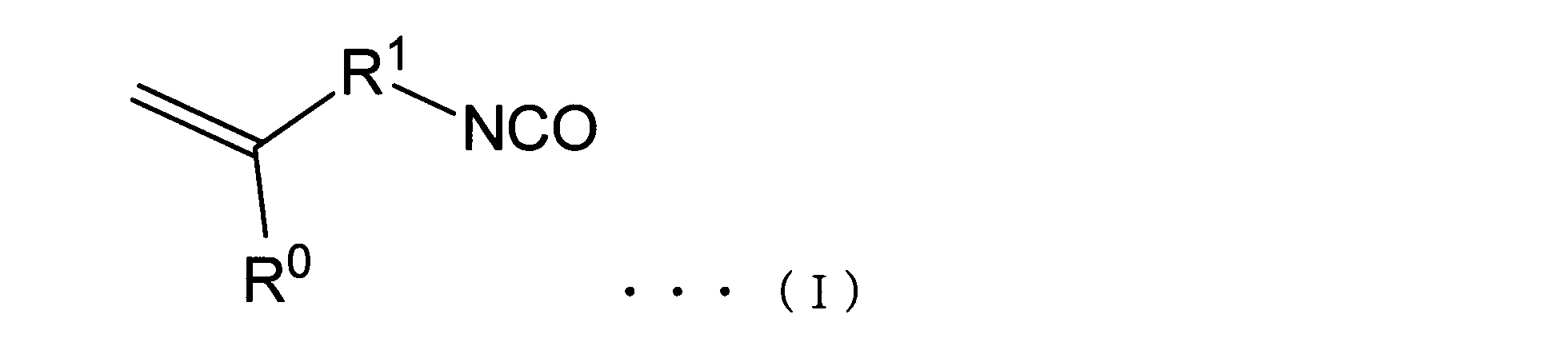
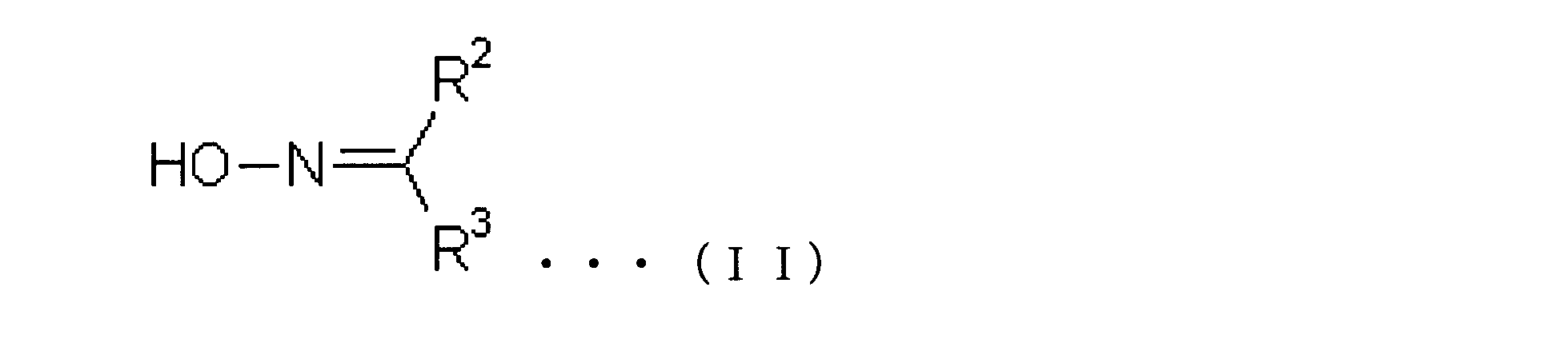
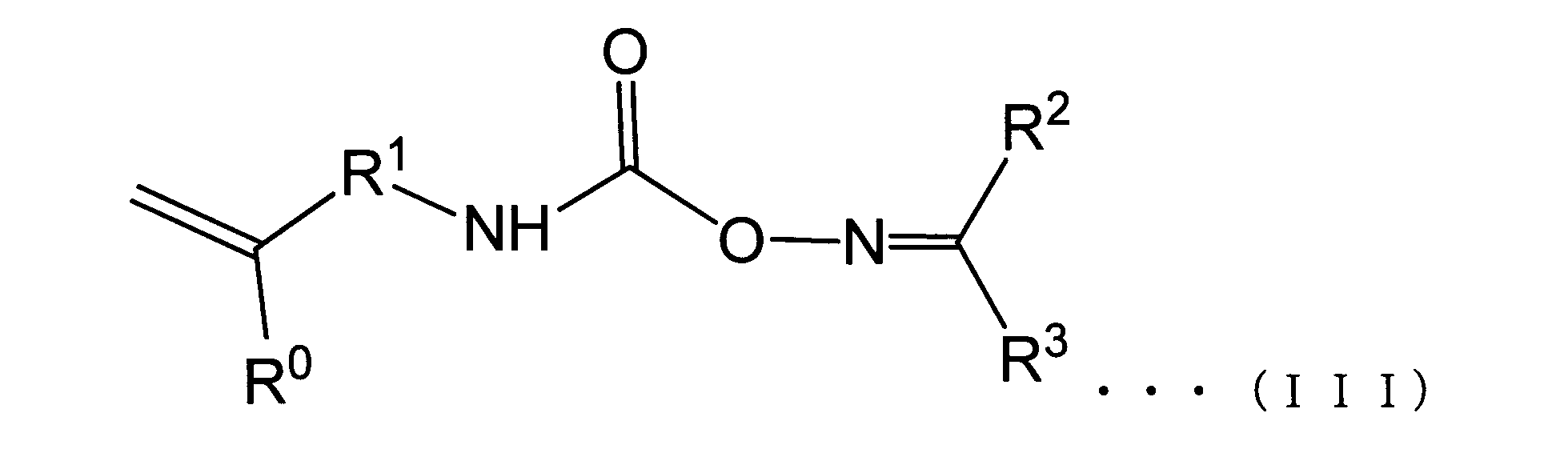
本発明に係る下記一般式(III)で表されるブロックイソシアネート化合物(以下、ブロックイソシアネート化合物(III)という。)の製造方法は、下記一般式(I)で表される(メタ)アクリロイル基含有イソシアネート化合物(以下、(メタ)アクリロイル基含有イソシアネート化合物(I)という。)と、下記一般式(II)で表されるオキシム系化合物(以下、オキシム系化合物(II)という。)とを反応させ、前記ブロックイソシアネート化合物(III)を製造する方法であって、製造工程において溶媒を用いないか、又は、前記ブロックイソシアネート化合物(III)を溶媒の代わりとして用いる製造方法である。


前記ブロックイソシアネート化合物(III)におけるR1は、-CO-又は-COOR4-である。中でも、-COOR4-が好ましい。
前記-COOR4-におけるR4は、エーテル結合及び/又はフェニレン基を含んでもよい炭素数1~10のアルキレン基である。中でもR4は、エーテル結合を含んでもよい炭素数1~5のアルキレン基が好ましい。
直鎖状のアルキレン基としては、具体的には、メチレン基、エチレン基、プロピレン基、ブチレン基、ペンチレン基、ヘキシレン基、ヘプチレン基、オクチレン基、ノニレン基、デカニレン基等が挙げられる。
分岐鎖状のアルキレン基としては、具体的には、-C(CH3)2-、-CH(CH3)-、-CH(CH2CH3)-、-C(CH3)(CH2CH3)-、-C(CH3)(CH2CH2CH3)-、-C(CH2CH3)2-等;-CH(CH3)CH2-、-CH(CH3)CH(CH3)-、-C(CH3)2CH2-、-CH(CH2CH3)CH2-、-C(CH2CH3)2-CH2-等が挙げられる。
中でも、R4におけるアルキレン基としては、直鎖状のアルキレン基がより好ましく、炭素数1~5のアルキレン基が特に好ましく、メチレン基、エチレン基が最も好ましい。
ここで、a+c+eは1~10の整数を表し、a及びcは0又は1以上の整数を表し、b及びdは0又は1を表し、dが0のときeも0である。
エーテル結合を含んでもよい炭素数1~10のアルキレン基として、具体的には、-CH2-O-(CH2)3-、-(CH2)2-O-(CH2)2-、-(CH2)3-O-CH2-、-CH2-O-(CH2)2-、-(CH2)2-O-CH2-、-CH2-O-CH2-が好ましく、-CH2-O-(CH2)3-、-(CH2)2-O-(CH2)2-、-(CH2)3-O-CH2-、-CH2-O-(CH2)2-がより好ましく、-(CH2)2-O-(CH2)2-が特に好ましい。
ここで、Phは非置換の1,2-フェニレン、1,3-フェニレン、又は1,4-フェニレン基を示し、n+l+oは1~10の整数を表し、n及びlは0又は1以上の整数を表し、m及びnは0又は1を表し、nが0のときoも0である。
フェニレン基を含んでもよい炭素数1~10のアルキレン基としては、総炭素数が10以下のものが好ましく、n+lは1~4の整数を表し、且つ、oは0を表すものがより好ましい。
具体的には、-CH2-Ph-(CH2)3-、-(CH2)2-Ph-(CH2)2-、-(CH2)3-Ph-CH2-、-CH2-Ph-(CH2)2-、-(CH2)2-Ph-CH2-、-CH2-Ph-CH2-が好ましく、-CH2-Ph-(CH2)3-、-(CH2)2-Ph-(CH2)2-、-(CH2)3-Ph-CH2-、-CH2-Ph-(CH2)2-がより好ましく、-(CH2)2-Ph-(CH2)2-が特に好ましい。


尚、本明細書および本特許請求の範囲において、「(メタ)アクリロイル基」とは、α位に水素原子が結合したアクリロイル基、又はα位にメチル基が結合したアクリロイル基を意味する。
前記(メタ)アクリロイル基含有イソシアネート化合物(I)におけるR1は、-CO-又は-COOR4-である。R1の好ましい様態は、前記ブロックイソシアネート化合物(III)において前述したとおりである。
尚、本明細書および本特許請求の範囲において、(メタ)アクリレートとは、α位に水素原子が結合したアクリレート、又はα位にメチル基が結合したメタクリレートを意味する。
本発明において用いられる前記(メタ)アクリロイル基含有イソシアネート化合物(I)は、従来公知の方法により製造される。
前記オキシム系化合物(II)としては、ジメチルケトンオキシム、ジエチルケトンオキシム、メチルエチルケトンオキシム等が挙げられ、メチルエチルケトンオキシムが好ましい。
本発明において用いられるオキシム系化合物(II)は、従来公知の方法により製造される。
このような温度範囲の場合、効率良くブロックイソシアネート化合物が得られるとともに、副生物の生成がほとんどないため、該ブロックイソシアネート化合物を高純度で得ることができる。
尚、この反応温度には、前記オキシム系化合物(II)及び/又は前記(メタ)アクリロイル基含有イソシアネート化合物(I)を滴下等により添加する際の反応温度も含まれる。
反応温度が-10℃以上の場合、反応速度が遅くならず、生産性に影響を与えることがないため、効率良くブロックイソシアネート化合物が得ることができる。
反応温度が90℃以下の場合、アクリロイル基の重合によりゲル化するおそれがないため、前記ブロックイソシアネート化合物(III)を高純度で得ることができる。
尚、この反応時間には、前記オキシム系化合物(II)及び/又は前記アクリロイル基含有イソシアネート化合物(I)を滴下等により添加する時間も含まれる。
これら化合物の反応比率は、理論的には1:1(モル比)であるが、上記範囲のモル比で反応させることにより、反応を円滑に進行させることができる。
重合禁止剤の投入方法は特に制限されるものではないが、例えば、前記オキシム系化合物とともに反応器内へ投入する方法;前記アクリロイル基含有イソシアネート化合物と混合させ、反応器内へ投入する方法;前記オキシム系化合物及び前記アクリロイル基含有イソシアネート化合物の両方に添加し、それぞれ反応器内へ投入する方法;さらに反応終了後、生成したブロックイソシアネート化合物へ投入する方法;等を挙げることができる。
前記(メタ)アクリロイル基含有イソシアネート化合物(I)同士を重合させることなく、前記ブロックイソシアネート化合物(III)を製造するためには、重合禁止剤の存在下で、前記オキシム系化合物(II)と前記(メタ)アクリロイル基含有イソシアネート化合物(I)とを反応させることが好ましい。
重合禁止剤を10ppm以上の割合で用いる場合、前記ブロックイソシアネート化合物(III)を製造する際に、前記(メタ)アクリロイル基含有イソシアネート化合物(I)の(メタ)アクリロイル基の重合が効率良く抑制される。
重合禁止剤を20000ppm以内の割合で用いる場合、前記ブロックイソシアネート化合物(III)が有する前記(メタ)アクリロイル基含有イソシアネート化合物(I)由来の(メタ)アクリロイル基の反応性がよい。
(1)前記ブロックイソシアネート化合物(III)と、前記オキシム系化合物(II)とを反応器内へ仕込んで混合し、次いで、前記(メタ)アクリロイル基含有イソシアネート化合物(I)を反応器へ添加し、前記アクリロイル基含有イソシアネート化合物(I)及び前記オキシム系化合物(II)を反応させる方法;
(2)前記オキシム系化合物(II)を反応器内へ仕込み、次いで、前記ブロックイソシアネート化合物(III)と前記(メタ)アクリロイル基含有イソシアネート化合物(I)の混合物を反応器へ添加し、前記(メタ)アクリロイル基含有イソシアネート化合物(I)及び前記オキシム系化合物(II)を反応させる方法;
(3)前記ブロックイソシアネート化合物(III)と、前記オキシム系化合物(II)とを反応器内へ仕込んで混合し、次いで、前記ブロックイソシアネート化合物(III)と前記(メタ)アクリロイル基含有イソシアネート化合物(I)の混合物を反応器へ添加し、前記(メタ)アクリロイル基含有イソシアネート化合物(I)及び前記オキシム系化合物(II)を反応させる方法;
(4)前記ブロックイソシアネート化合物(III)と、前記(メタ)アクリロイル基含有イソシアネート化合物(I)とを反応器内へ仕込んで混合し、次いで、前記オキシム系化合物(II)を反応器へ添加し前記(メタ)アクリロイル基含有イソシアネート化合物(I)及び前記オキシム系化合物(II)を反応させる方法;
(5)前記(メタ)アクリロイル基含有イソシアネート化合物(I)を反応器内へ仕込み、次いで、前記ブロックイソシアネート化合物(III)と前記オキシム系化合物(II)の混合物を反応器へ添加し、前記(メタ)アクリロイル基含有イソシアネート化合物(I)及びオキシム系化合物(II)を反応させる方法;
(6)前記ブロックイソシアネート化合物(III)と、前記(メタ)アクリロイル基含有イソシアネート化合物(I)とを反応器内へ仕込んで混合し、次いで、前記ブロックイソシアネート化合物(III)と前記オキシム系化合物(II)の混合物を反応器へ添加し、前記(メタ)アクリロイル基含有イソシアネート化合物(I)及びオキシム系化合物(II)を反応させる方法;
(7)前記ブロックイソシアネート化合物(III)を仕込んだ反応器、又は空の反応器に、前記イソシアネート化合物(I)と前記オキシム系化合物(II)を、同時に添加する方法;
尚、上記「空の反応器」とは、原料となる化合物(I)(II)及び生成物となる(III)のいずれもが供給されていない反応器のことを指す。重合禁止剤や添加剤等の他成分は、予め反応器に仕込まれていても構わない。
前記(1)~前記(3)の方法のように、反応器中にオキシム系化合物を仕込んでおき、(メタ)アクリロイル基含有イソシアネート化合物を加える方法では、系内に過剰のオキシム系化合物が存在する状態となるため、オキシム系化合物が(メタ)アクリロイル基に対してマイケル付加反応し不純物を生成しやすい。
また、前記(4)~(6)のように、(メタ)アクリロイル基含有イソシアネート化合物を反応器中に仕込んでおき、オキシム系化合物を加える方法では、系内におけるオキシム系化合物の残存量は最小に抑えられるため、(1)~(3)の方法における上記のような不純物生成の問題点を解決することができる。
しかしながら、(メタ)アクリロイル基含有イソシアネート化合物は反応性官能基を2つ有しているため反応性が非常に高く、これを反応器中に予め大量に仕込んでおくことは暴走反応につながるリスクが高く、工業的な製造方法としては好ましくない。
一方、前記(7)の方法のように、オキシム系化合物と(メタ)アクリロイル基含有イソシアネート化合物を同時に系内に供給する方法では、系内に残存するオキシム系化合物を最小量に抑えることができ、かつアクリロイル基含有イソシアネート化合物が自己重合するリスクも抑えることができる。
(7)-1 前記イソシアネート化合物(I)と前記オキシム系化合物(II)を、空の反応器内に同時に添加する方法;
(7)-2 前記イソシアネート化合物(I)と前記ブロックイソシアネート化合物(III)の混合物と、前記オキシム系化合物(II)を、空の反応器内に同時に添加する方法;
(7)-3 前記イソシアネート化合物(I)と前記ブロックイソシアネート化合物(III)の混合物と、前記オキシム系化合物(II)と前記ブロックイソシアネート化合物(III)の混合物を、空の反応器内に同時に添加する方法;
(7)-4 前記イソシアネート化合物(I)と、前記オキシム系化合物(II)と前記ブロックイソシアネート化合物(III)の混合物を、空の反応器内に同時に添加する方法;
(7)-5 前記ブロックイソシアネート化合物(III)を反応器内に仕込んでおき、前記イソシアネート化合物(I)と前記オキシム系化合物(II)を、反応器内に同時に添加する方法;
(7)-6 前記ブロックイソシアネート化合物(III)を反応器内に仕込んでおき、前記イソシアネート化合物(I)と前記ブロックイソシアネート化合物(III)の混合物と、前記オキシム系化合物(II)を、反応器内に同時に添加する方法;
(7)-7 前記ブロックイソシアネート化合物(III)を反応器内に仕込んでおき、前記イソシアネート化合物(I)と前記ブロックイソシアネート化合物(III)の混合物と、前記オキシム系化合物(II)と前記ブロックイソシアネート化合物(III)の混合物を、反応器内に同時に添加する方法;
(7)-8 前記ブロックイソシアネート化合物(III)を反応器内に仕込んでおき、前記イソシアネート化合物(I)と、前記オキシム系化合物(II)と前記ブロックイソシアネート化合物(III)の混合物を、反応器内に同時に添加する方法;
この際も前述と同様に、攪拌効率の面からは、反応器内にブロックイソシアネート化合物(III)をはじめに仕込んでおく、(7)-5~(7)-8の方法が好ましい。
不純物低減の観点からは、上記と同じ理由より(7)-1、(7)-2、(7)-5、(7)-6が好ましい。
中でも最も好ましい方法は、(7)-5ある。
これに対して、本発明者は、アクリロリル基含有イソシアネートを用いた反応系において、原料を同時添加する前記(7)の方法が非常に有効であることを見出した。
用いる量が0.01倍モル以上の場合、例えば反応速度が遅くなるおそれがなく、溶媒としての効果が発揮される。
用いる量が50倍モル以下の場合、生成物の生産性が低下するおそれがない。
具体的には、本発明により得られる生成物が含有する未反応のオキシム系化合物(II)の割合は、常に1.0質量%以下であることが好ましく、未反応のアクリロイル基含有イソシアネート化合物(I)の割合は1000質量ppm以下であることが好ましい。
上記の未反応原料、不純物、あるいは残存した重合禁止剤等は、通常の方法により除去し、精製する工程を有していてもよい。

攪拌器、コンデンサ、及び温度計を備えた2Lセパラブルフラスコに、アクリル酸2‐(O-[1’‐メチルプロピリデンアミノ] オキシカルボニルアミノ)エチル150.0g、2,6-ジターシャリーブチル-4-メチルフェノール(BHT)0.11gを入れ、10℃に温調した。続いて、2-(アクリロイルオキシエチルイソシアネート(昭和電工株式会社製;製品名カレンズAOI(登録商標))141.1g(1.00mol)、メチルエチルケトンオキシム(MEKO)87.1g(1.00mol)を、それぞれ滴下漏斗を用いて、5時間かけて同時に滴下した。滴下終了後、内温20℃に調整しながら1時間攪拌することで、アクリル酸2‐(O-[1’‐メチルプロピリデンアミノ] オキシカルボニルアミノ)エチルを得た。
生成物の組成を、HPLCおよびGCによって分析した結果を、表1に示す。
尚、GCにてBHT量のみ定量し、他組成物についてはHPLCを用いて定量した。GC分析条件及びHPLC分析条件を以下に示す。
GC装置:Agilent GC 6850
カラム:Agilent DB-1(PartNo.123-1033E)
インジェクション温度:300℃
カラム温度:50℃⇒(10℃/min)⇒320℃
ディテクター温度:300℃
キャリア-ガス:He
He流速:1.2mL/min
サンプリング条件:0.1g/1.5mLジクロロメタン
内部標準物質:o-ジクロロベンゼン
内部標準物質重量:0.1g/1.5mLジクロロメタン
検出器:FID
装置:Agilent Technologies(1200Sreies)
カラム:KF-801×4
溶媒:THF
流速:0.8mL/min
オーブン温度:40℃
検出器:RI
攪拌器、コンデンサ、及び温度計を備えた2Lセパラブルフラスコに、アクリル酸2‐(O-[1’‐メチルプロピリデンアミノ] オキシカルボニルアミノ)エチル150.0g、2,6-ジターシャリーブチル-4-メチルフェノール(BHT)0.11gを入れ、10℃に温調した。続いて、2-(アクリロイルオキシエチルイソシアネート(昭和電工株式会社製;製品名カレンズAOI(登録商標))141.1g(1.00mol)、メチルエチルケトンオキシム(MEKO)87.1g(1.00mol)を、それぞれ滴下漏斗を用いて、同時に滴下した。その際、2-(アクリロイルオキシエチルイソシアネートを5時間、メチルエチルケトンオキシムを4時間で滴下し終わるように、調製しながら滴下速度を一定にして滴下した。2-(アクリロイルオキシエチルイソシアネートの滴下終了後、内温を20℃に調整しながら1時間攪拌することで、アクリル酸2‐(O-[1’‐メチルプロピリデンアミノ] オキシカルボニルアミノ)エチルを得た。
生成物の組成を、HPLCおよびGCによって分析した結果を、表1に示す。
尚、GC分析にてBHT量のみ定量し、他組成物についてはHPLCを用いて定量した。GC分析条件及びHPLC分析条件は、実施例1と同様である。
200mLの3つ口フラスコに、アクリル酸2‐(O-[1’‐メチルプロピリデンアミノ] オキシカルボニルアミノ)エチル14.3gとメチルエチルケトンオキシム(MEKO)43.56g(0.50mol)を入れ、10℃に温調した。そこに、2-(アクリロイルオキシエチルイソシアネート71.0g(0.50mol)を、50mL滴下漏斗を用い5時間かけて滴下した。滴下終了後、内温を20℃に調整しながら1時間攪拌することで、アクリル酸2‐(O-[1’‐メチルプロピリデンアミノ] オキシカルボニルアミノ)エチルを得た。
生成物の組成を、HPLCおよびGCによって分析した結果を、表1に示す。
尚、GC分析にてBHT量のみ定量し、他組成物についてはHPLCを用いて定量した。GC分析条件及びHPLC分析条件は、実施例1と同様である。
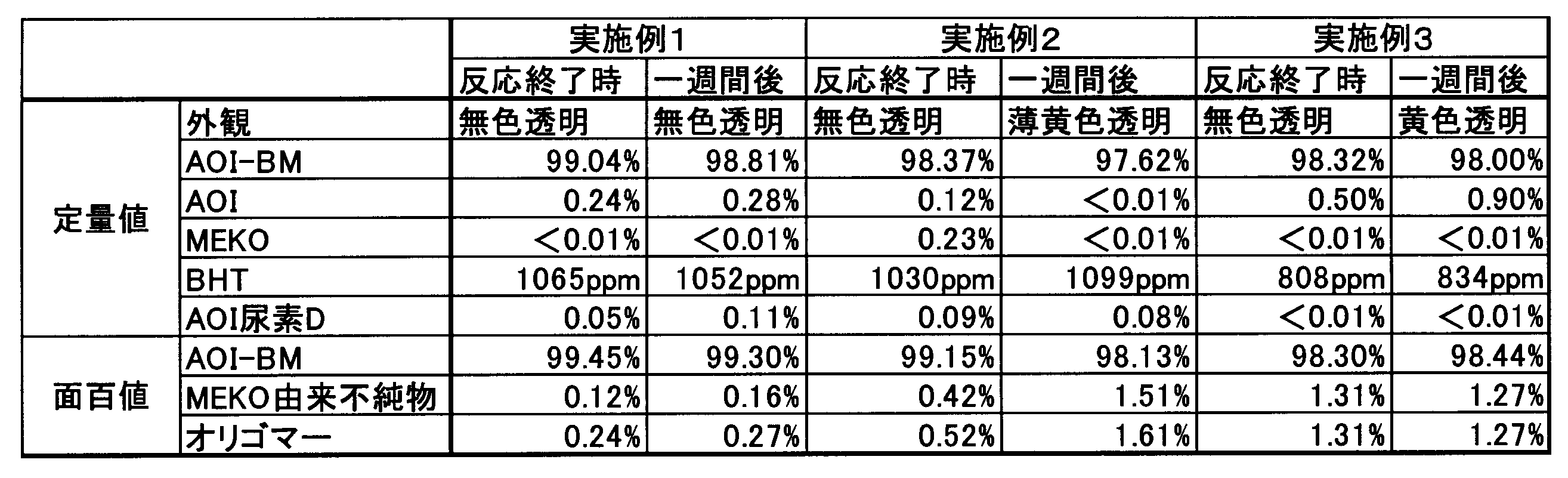
詳細には、アクリル酸2‐(O-[1’‐メチルプロピリデンアミノ] オキシカルボニルアミノ)エチル中に、2-(アクリロイルオキシエチルイソシアネートと、メチルエチルケトンオキシムを同じ滴下速度で、同時に供給する実施例1の製造方法によれば、2-(アクリロイルオキシエチルイソシアネートと、メチルエチルケトンオキシムを異なる滴下速度で、同時に供給する実施例2の製造方法よりも、高い純度でアクリル酸2‐(O-[1’‐メチルプロピリデンアミノ] オキシカルボニルアミノ)エチルを製造できることが確認された。
更に、実施例1の製造方法によれば、2-(アクリロイルオキシエチルイソシアネートと、メチルエチルケトンオキシムを同時に供給しない実施例3の製造方法よりも、高い純度でアクリル酸2‐(O-[1’‐メチルプロピリデンアミノ] オキシカルボニルアミノ)エチルを製造できることが確認された。
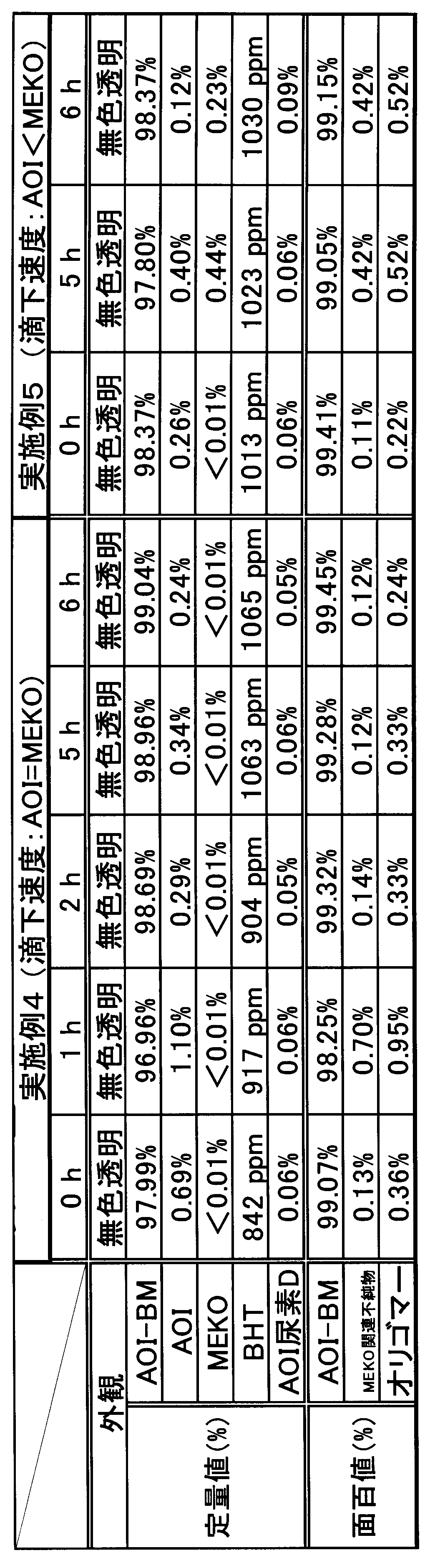
実施例1と同様の方法でアクリル酸2‐(O-[1’‐メチルプロピリデンアミノ] オキシカルボニルアミノ)エチルの製造を行った。メチルエチルケトンオキシム及び2-アクリロイルオキシエチルイソシアネートを反応器に滴下開始した直後を0時間(0h)とし、0h,1h,2h,5h,6hの時点での反応系内の組成をHPLCおよびGCによって分析した。結果を、表2に示す。(滴下終了時を5時間(5h)、反応終了時を6時間(6h)とした)GC分析にてBHT量のみ定量し、他組成物についてはHPLCを用いて定量した。GC分析条件及びHPLC分析条件は、実施例1と同様である。
表2中、AOI-BMは、アクリル酸2‐(O-[1’‐メチルプロピリデンアミノ] オキシカルボニルアミノ)エチルを示し、AOIは、2-アクリロイルオキシエチルイソシアネートを示し、MEKOは、メチルエチルケトンオキシムを示し、BHTは、2,6-ジターシャリーブチル-4-メチルフェノールを示し、AOI尿素Dは、AOIの二量体を示す。
実施例2と同様の方法でアクリル酸2‐(O-[1’‐メチルプロピリデンアミノ] オキシカルボニルアミノ)エチルの製造を行った。メチルエチルケトンオキシム及び2-アクリロイルオキシエチルイソシアネートを反応器に滴下開始した直後を0時間(0h)とし、0h,5h,6hの時点での反応系内の組成をHPLCおよびGCによって分析した。結果を、表2に示す。(2-アクリロイルオキシエチルイソシアネートの滴下終了時を5時間(5h)、反応終了時を6時間(6h)とした)GC分析にてBHT量のみ定量し、他組成物についてはHPLCを用いて定量した。GC分析条件及びHPLC分析条件は、実施例1と同様である。
攪拌器、コンデンサ、及び温度計を備えた2Lセパラブルフラスコに、メチルエチルケトンオキシム(MEKO)148.2g、2,6-ジターシャリーブチル-4-メチルフェノール(BHT)0.19gを入れ、10℃に温調した。続いて、内温20℃に調整しながら、2-アクリロイルオキシエチルイソシアネート(昭和電工株式会社製;製品名カレンズAOI(登録商標))240.0gを、滴下漏斗を用いて、5時間かけて滴下した。
滴下終了後、内温20℃に調整しながら1時間攪拌することで、アクリル酸2‐(O-[1’‐メチルプロピリデンアミノ] オキシカルボニルアミノ)エチルを得た。
生成物の組成を、HPLCおよびGCによって分析した結果を、表3に示す。
尚、GC分析にてBHT量のみ定量し、他組成物についてはHPLCを用いて定量した。GC分析条件及びHPLC分析条件は、実施例1と同様である。
表3中、AOI-BMは、アクリル酸2‐(O-[1’‐メチルプロピリデンアミノ] オキシカルボニルアミノ)エチルを示し、AOIは、2-アクリロイルオキシエチルイソシアネートを示し、MEKOは、メチルエチルケトンオキシムを示し、BHTは、2,6-ジターシャリーブチル-4-メチルフェノールを示し、AOI尿素Dは、AOIの二量体を示す。

攪拌器、コンデンサ、及び温度計を備えた2Lセパラブルフラスコに、メチルエチルケトンオキシム(MEKO)616g、2,6-ジターシャリーブチル-4-メチルフェノール(BHT)1.0gを入れ、5℃に冷却した。続いて、内温20℃に調整しながら、2-メタクリロイルオキシエチルイソシアネート(昭和電工株式会社製;製品名カレンズMOI(登録商標))1086gを、滴下漏斗を用いて、4時間かけて滴下した。
滴下終了後、内温25℃に調整しながら2時間攪拌することで、メタクリル酸2‐(O-[1’‐メチルプロピリデンアミノ] オキシカルボニルアミノ)エチルを得た。
生成物の組成を、HPLCおよびGCによって分析した結果を、表4に示す。
尚、GC分析にてBHT量のみ定量し、他組成物についてはHPLCを用いて定量した。GC分析条件及びHPLC分析条件は、実施例1と同様である。
表4中、MOI-BMは、メタクリル酸2‐(O-[1’‐メチルプロピリデンアミノ] オキシカルボニルアミノ)エチルを示し、MOIは、2-メタアクリロイルオキシエチルイソシアネートを示し、MEKOは、メチルエチルケトンオキシムを示し、BHTは、2,6-ジターシャリーブチル-4-メチルフェノールを示し、MOI尿素Dは、MOIの二量体を示す。

しかしながら、表3に示されるように、実施例6の製造方法では、アクリル酸2‐(O-[1’‐メチルプロピリデンアミノ] オキシカルボニルアミノ)エチル中に、2-(アクリロイルオキシエチルイソシアネートと、メチルエチルケトンオキシムを、同時に供給する実施例1、2の製造方法と比較して、メチルエチルケトンオキシム由来の不純物が発生することが確認された。
一方、2-メタアクリロイルオキシエチルイソシアネートを用いた実施例7の製造方法においては、このような不純物の発生は確認されなかった。
更に、本発明の製造方法は、アクリロイル基を含有するブロックイソシアネート化合物の製造に好適に用いられ、アクリロイル基を含有するブロックイソシアネート化合物中に、アクリロイル基含有イソシアネート化合物と、オキシム系化合物を、同時に供給することにより、不純物の発生を抑制することができる。
Claims (10)
- 下記一般式(I)で表される(メタ)アクリロイル基含有イソシアネート化合物と、下記一般式(II)で表されるオキシム系化合物とを反応させ、下記一般式(III)で表されるブロックイソシアネート化合物を製造する方法であって、製造工程において溶媒を用いないか、又は、前記一般式(III)で表されるブロックイソシアネート化合物を溶媒の代わりとして用いることを特徴とするブロックイソシアネート化合物の製造方法。

- 前記一般式(III)で表されるブロックイソシアネート化合物を溶媒の代わりとして用い、前記一般式(I)で表される(メタ)アクリロイル基含有イソシアネート化合物と前記一般式(II)で表されるオキシム系化合物を反応させる請求項1に記載のブロックイソシアネート化合物の製造方法。
- 前記R0は、水素原子である請求項1に記載のブロックイソシアネート化合物の製造方法。
- 製造の工程において、反応系内及び生成物における前記一般式(II)で表されるオキシム系化合物の含量が、常に1.0質量%以下である請求項1に記載のブロックイソシアネート化合物の製造方法。
- 前記ブロックイソシアネート化合物(III)を仕込んだ反応器、又は空の反応器に、前記イソシアネート化合物(I)と前記オキシム系化合物(II)を、同時に供給する請求項1に記載のブロックイソシアネート化合物の製造方法。
- 前記ブロックイソシアネート化合物(III)を仕込んだ反応器に、前記イソシアネート化合物(I)と前記オキシム系化合物(II)を、同時に供給する請求項1に記載のブロックイソシアネート化合物の製造方法。
- 前記R1が-COOR4-であり、前記R4は炭素数1~5のアルキレン基である請求項1に記載のブロックイソシアネート化合物の製造方法。
- 重合禁止剤の存在下で前記一般式(I)で表される(メタ)アクリロイル基含有イソシアネート化合物と前記一般式(II)で表されるオキシム系化合物とを反応させる請求項1に記載のブロックイソシアネート化合物の製造方法。
- 前記一般式(I)で表される(メタ)アクリロイル基含有イソシアネート化合物に対して、前記一般式(II)で表されるオキシム系化合物を0.5~2.0倍モル量で反応させる請求項1に記載のブロックイソシアネート化合物の製造方法。
- 反応温度が-10℃~90℃である請求項1に記載のブロックイソシアネート化合物の製造方法。
Priority Applications (3)
| Application Number | Priority Date | Filing Date | Title |
|---|---|---|---|
| JP2014528092A JP5815871B2 (ja) | 2012-07-30 | 2013-07-24 | ブロックイソシアネート化合物の製造方法 |
| KR1020147030717A KR101651030B1 (ko) | 2012-07-30 | 2013-07-24 | 블록 이소시아네이트 화합물의 제조 방법 |
| CN201380023479.4A CN104271551A (zh) | 2012-07-30 | 2013-07-24 | 封闭异氰酸酯化合物的制造方法 |
Applications Claiming Priority (2)
| Application Number | Priority Date | Filing Date | Title |
|---|---|---|---|
| JP2012-168544 | 2012-07-30 | ||
| JP2012168544 | 2012-07-30 |
Publications (1)
| Publication Number | Publication Date |
|---|---|
| WO2014021166A1 true WO2014021166A1 (ja) | 2014-02-06 |
Family
ID=50027844
Family Applications (1)
| Application Number | Title | Priority Date | Filing Date |
|---|---|---|---|
| PCT/JP2013/070042 Ceased WO2014021166A1 (ja) | 2012-07-30 | 2013-07-24 | ブロックイソシアネート化合物の製造方法 |
Country Status (4)
| Country | Link |
|---|---|
| JP (1) | JP5815871B2 (ja) |
| KR (1) | KR101651030B1 (ja) |
| CN (2) | CN104271551A (ja) |
| WO (1) | WO2014021166A1 (ja) |
Families Citing this family (1)
| Publication number | Priority date | Publication date | Assignee | Title |
|---|---|---|---|---|
| WO2022145298A1 (ja) * | 2020-12-28 | 2022-07-07 | 昭和電工株式会社 | ブロックイソシアネート化合物 |
Citations (3)
| Publication number | Priority date | Publication date | Assignee | Title |
|---|---|---|---|---|
| JP2000095833A (ja) * | 1998-09-18 | 2000-04-04 | Fuji Kasei Kogyo Kk | 一液型自己硬化性撥水性樹脂 |
| JP2004285272A (ja) * | 2003-03-24 | 2004-10-14 | Dai Ichi Kogyo Seiyaku Co Ltd | ビニルピロリドン共重合体熱硬化性組成物 |
| JP2006151967A (ja) * | 2004-10-29 | 2006-06-15 | Showa Denko Kk | ブロックイソシアネート化合物の製造方法 |
Family Cites Families (1)
| Publication number | Priority date | Publication date | Assignee | Title |
|---|---|---|---|---|
| JP2007270216A (ja) | 2006-03-30 | 2007-10-18 | Fujifilm Corp | 金属膜形成方法、それを用いた金属膜、金属膜形成用基板、金属パターン形成方法、及びそれを用いた金属パターン、金属パターン形成用基板、ポリマー前駆体層形成用塗布液組成物 |
-
2013
- 2013-07-24 CN CN201380023479.4A patent/CN104271551A/zh active Pending
- 2013-07-24 KR KR1020147030717A patent/KR101651030B1/ko not_active Ceased
- 2013-07-24 JP JP2014528092A patent/JP5815871B2/ja active Active
- 2013-07-24 CN CN201810736045.3A patent/CN108707092A/zh active Pending
- 2013-07-24 WO PCT/JP2013/070042 patent/WO2014021166A1/ja not_active Ceased
Patent Citations (3)
| Publication number | Priority date | Publication date | Assignee | Title |
|---|---|---|---|---|
| JP2000095833A (ja) * | 1998-09-18 | 2000-04-04 | Fuji Kasei Kogyo Kk | 一液型自己硬化性撥水性樹脂 |
| JP2004285272A (ja) * | 2003-03-24 | 2004-10-14 | Dai Ichi Kogyo Seiyaku Co Ltd | ビニルピロリドン共重合体熱硬化性組成物 |
| JP2006151967A (ja) * | 2004-10-29 | 2006-06-15 | Showa Denko Kk | ブロックイソシアネート化合物の製造方法 |
Also Published As
| Publication number | Publication date |
|---|---|
| KR20140145612A (ko) | 2014-12-23 |
| CN108707092A (zh) | 2018-10-26 |
| KR101651030B1 (ko) | 2016-08-24 |
| JP5815871B2 (ja) | 2015-11-17 |
| JPWO2014021166A1 (ja) | 2016-07-21 |
| CN104271551A (zh) | 2015-01-07 |
Similar Documents
| Publication | Publication Date | Title |
|---|---|---|
| EP3153495B1 (en) | Method for producing carboxylic acid anhydride, and method for producing carboxylic acid ester | |
| CN102292371A (zh) | 使用可嵌入抑制剂条件下的活性烯属化合物和二异氰酸酯的低单体含量1:1单加合物 | |
| US7863473B2 (en) | Method of producing organosilylamine containing radiation-polymerizable functional group and organosilylamine containing radiation-polymerizable functional group | |
| JP5815871B2 (ja) | ブロックイソシアネート化合物の製造方法 | |
| JP5591857B2 (ja) | (メタ)アクリルアミド化合物前駆体 | |
| CN103380106B (zh) | 被稳定化了的带异氰酸酯基的烯属不饱和化合物 | |
| KR100891790B1 (ko) | 블록 이소시아네이트 화합물의 제조 방법 | |
| JP2014062071A (ja) | エチレン性不飽和基含有イソシアネート化合物の製造方法 | |
| US9040736B2 (en) | Stabilized isocyanate group-containing ethylenically unsaturated compound | |
| KR101740870B1 (ko) | 반응 촉진제 및 이것을 사용한 우레탄 화합물, 티오우레탄 화합물, 아미드 화합물 또는 우레아 화합물의 제조 방법 | |
| JP7208885B2 (ja) | イソシアネート基のブロック剤、及び該ブロック剤で保護されたイソシアネート | |
| EP4403542B1 (en) | Production method for encapsulation of bicycloalkane compound | |
| US9938251B2 (en) | Cyclic ketone peroxide composition | |
| JP6078429B2 (ja) | 尿素化合物の製造方法 | |
| CN105026441A (zh) | 具有聚合性基团的含叔氮原子内酯聚合物及其制造方法 | |
| KR102591541B1 (ko) | 조성물, 조성물의 제조 방법 및 불포화 화합물의 제조 방법 | |
| JPH06247895A (ja) | ヒドロキシカルボン酸エステルの製造法 | |
| JP2006298922A (ja) | 不飽和の環状オルトエステルの製造方法 | |
| JP2024032689A (ja) | トリアジン化合物の製造方法 | |
| US20130171092A1 (en) | Alpha-cyanoacrylate ester synthesis | |
| KR20210024091A (ko) | 조성물, 조성물의 제조 방법 및 불포화 화합물의 제조 방법 | |
| JPH0639463B2 (ja) | 潜在化イソシアネ−ト化合物 |
Legal Events
| Date | Code | Title | Description |
|---|---|---|---|
| 121 | Ep: the epo has been informed by wipo that ep was designated in this application |
Ref document number: 13824995 Country of ref document: EP Kind code of ref document: A1 |
|
| ENP | Entry into the national phase |
Ref document number: 2014528092 Country of ref document: JP Kind code of ref document: A |
|
| ENP | Entry into the national phase |
Ref document number: 20147030717 Country of ref document: KR Kind code of ref document: A |
|
| NENP | Non-entry into the national phase |
Ref country code: DE |
|
| 122 | Ep: pct application non-entry in european phase |
Ref document number: 13824995 Country of ref document: EP Kind code of ref document: A1 |