WO2014021135A1 - 撥水液、撥水性物品、及びそれらの製法 - Google Patents
撥水液、撥水性物品、及びそれらの製法 Download PDFInfo
- Publication number
- WO2014021135A1 WO2014021135A1 PCT/JP2013/069860 JP2013069860W WO2014021135A1 WO 2014021135 A1 WO2014021135 A1 WO 2014021135A1 JP 2013069860 W JP2013069860 W JP 2013069860W WO 2014021135 A1 WO2014021135 A1 WO 2014021135A1
- Authority
- WO
- WIPO (PCT)
- Prior art keywords
- water
- repellent
- water repellent
- repellent liquid
- liquid
- Prior art date
- Legal status (The legal status is an assumption and is not a legal conclusion. Google has not performed a legal analysis and makes no representation as to the accuracy of the status listed.)
- Ceased
Links
Images


Classifications
-
- C—CHEMISTRY; METALLURGY
- C03—GLASS; MINERAL OR SLAG WOOL
- C03C—CHEMICAL COMPOSITION OF GLASSES, GLAZES OR VITREOUS ENAMELS; SURFACE TREATMENT OF GLASS; SURFACE TREATMENT OF FIBRES OR FILAMENTS MADE FROM GLASS, MINERALS OR SLAGS; JOINING GLASS TO GLASS OR OTHER MATERIALS
- C03C17/00—Surface treatment of glass, not in the form of fibres or filaments, by coating
- C03C17/28—Surface treatment of glass, not in the form of fibres or filaments, by coating with organic material
- C03C17/30—Surface treatment of glass, not in the form of fibres or filaments, by coating with organic material with silicon-containing compounds
-
- C—CHEMISTRY; METALLURGY
- C03—GLASS; MINERAL OR SLAG WOOL
- C03C—CHEMICAL COMPOSITION OF GLASSES, GLAZES OR VITREOUS ENAMELS; SURFACE TREATMENT OF GLASS; SURFACE TREATMENT OF FIBRES OR FILAMENTS MADE FROM GLASS, MINERALS OR SLAGS; JOINING GLASS TO GLASS OR OTHER MATERIALS
- C03C2217/00—Coatings on glass
- C03C2217/70—Properties of coatings
- C03C2217/76—Hydrophobic and oleophobic coatings
Definitions
- the present invention relates to a water-repellent liquid used for forming a water-repellent film on various glass articles, a water-repellent article obtained using the water-repellent liquid, and a method for producing them.
- Water repellent glass with excellent water repellency and durability is useful as a water repellent glass for various glass articles in various fields such as window materials for automobiles, as well as windows for ships as well as for buildings. It can be used, and various studies have been made so far.
- fluoroalkylsilane compounds those having a large number of fluorocarbon units, for example, fluoroalkylsilane compounds having 8 or more fluorocarbon units (hereinafter referred to as “long-chain fluoroalkylsilane compounds”).
- EPA US Environmental Protection Agency
- PFOA perfluorooctanoic acid
- the present applicant provides a base film having a surface with a unique fine uneven surface layer controlled with a high specific surface area on the glass surface, such as the water-repellent glass described in Patent Document 1, It discloses that by improving the adhesion efficiency and adhesion of the water-repellent film to be coated, it is possible to maintain excellent water-repellent performance, abrasion resistance, weather resistance and the like over the long term.
- the present applicant uses a water repellent glass manufacturing method described in Patent Document 2 to hydrolyze a starting raw material fluoroalkylsilane compound or alkylalkoxysilane compound in a dilute solvent with an acid catalyst,
- a dehydrating agent to increase the degree of polycondensation and controlling and adjusting the water repellent liquid, which is controlled and prepared to form a film on the glass substrate, it exhibits excellent wear resistance and weather resistance. Disclosure.
- the present applicant when forming a water-repellent film like the water-repellent glass described in Patent Document 3, the surface of the glass substrate is in a state where the temperature of the glass substrate is about 90 to 200 ° C. Depending on the direction, a water-repellent layer is formed on the surface of a fine concavo-convex glass substrate with streak-like wrinkles, which makes the water-repellent remarkably excellent in weather resistance, abrasion resistance, scratch resistance and durability. A method of forming a water repellent film that exhibits performance and maintains its effect over a long period of time is disclosed.
- each of linear polydimethylsiloxane having 30 to 400 dimethylsiloxane units (—Si (CH 3 ) 2 O—) and fluoroalkylsilane has disclosed in Japanese Patent Application Laid-Open No. H11-284, each of linear polydimethylsiloxane having 30 to 400 dimethylsiloxane units (—Si (CH 3 ) 2 O—) and fluoroalkylsilane.
- a method for producing a water-slidable article that is chemically bonded to the surface of a material to form a water-sliding layer is disclosed.
- a fluorine compound represented by the following general formula (1) is provided for the purpose of providing a PFOA-free water- and oil-repellent agent, an antifouling agent and the like that have no environmental impact. Disclosure.
- Z represents an aromatic hydroxyl group, an aromatic amino group, a carboxyl group or a sulfonic acid group (and neutralized salts or esters of these functional groups).
- the water-repellent glass described in Patent Document 1 is a technique that can answer the above-mentioned needs, but has a two-layer structure consisting of a specific base film and a water-repellent layer, and the film formation process of the base film and the water-repellent layer is complicated. Therefore, the film forming facility becomes large and tends to be expensive. For this reason, a water-repellent glass which is not a two-layer film but a single-layer film and excellent in water-repellent performance, abrasion resistance, weather resistance and the like is desired.
- the water-repellent glass obtained by the method described in Patent Document 2 is a water-repellent glass whose water-repellent performance and durability are improved and approaches the desired performance even with a single layer film, but the number of fluorocarbon units is less than 8.
- a fluoroalkylsilane compound for example, a fluoroalkylsilane compound having 4 to 6 fluorocarbon units
- the amount of water and the water repellent performance, and the durability performance has not been fully examined, and there is room for improvement.
- the water-repellent glass described in Patent Document 3 is a water-repellent glass that improves the water-repellent performance and durability and approaches the desired performance even if it is a single layer film, as in Patent Document 2.
- the substrate is heated or the surface of the glass substrate is uneven, the operation is complicated, and it may be difficult to say that the workability during production, particularly the handling thereof is simple and highly efficient.
- the water-slidable article disclosed in Patent Document 4 has good weather resistance and durability
- a treatment agent using a fluoroalkylsilane compound having less than 8 fluorocarbon units is used as the treatment agent.
- water repellency may be lowered in a relatively short period of time.
- Patent Document 5 the performance is improved by devising the fluoroalkylsilane compound itself having less than 8 fluorocarbon units.
- the fluoroalkylsilane compound itself having less than 8 fluorocarbon units.
- Sufficient technical know-how and knowledge are required, and compound production facilities are also required at the time of production. It is difficult to say that the process up to the production of water-repellent glass is simple.
- the compound represented by General formula (1) of patent document 5 is generally difficult to obtain, there exists a problem that implementation is difficult.
- the present invention uses a fluoroalkylsilane-based compound having a number of fluorocarbon units of less than 8 that is generally available and conventionally used, does not require any special film-forming equipment, and the film to be formed is a single-layer film.
- a water-repellent liquid that improves and achieves both durability, particularly weather resistance and abrasion resistance of the water-repellent article obtained, and a method for preparing the same, a water-repellent article obtained using the water-repellent liquid, and a method for producing the same. The task is to do.
- the present inventors have studied in detail about the composition of a water-repellent liquid containing a fluoroalkylsilane compound having a number of fluorocarbon units of less than 8, a solvent, an acid catalyst, and water, using a specific acid catalyst, and A water-repellent article (water-repellent glass) that solves the above-mentioned problems by improving the blending amount of each raw material within a specific range and improves weather resistance and wear resistance even in a short-chain fluoroalkylsilane compound. It was found that can be easily obtained.
- the durability such as weather resistance and abrasion resistance is the level required for water-repellent articles such as those used outdoors, especially water-repellent glass, and the durability of water-repellent articles is actually Outdoor exposure tests that evaluate the durability of water repellency by exposing the water-repellent article to the outdoor environment for a specified period of time, and durability such as water repellency by irradiating the water-repellent article with a strong UV light for a predetermined period of time It can be evaluated by a light resistance test for accelerating evaluation.
- the present invention mixes at least a fluoroalkylsilane compound in which m, which is the number of fluorocarbon units represented by CF 3 (CF 2 ) m ⁇ 1 , is an integer less than 8, an organic solvent, and an organic sulfonic acid.
- a water repellent liquid for forming a water repellent layer wherein the fluoroalkylsilane compound is added in an amount of 1 to 20% by mass relative to a total amount of 100% by mass of the water repellent liquid raw material.
- the water repellent liquid is characterized in that the addition amount of the organic sulfonic acid is 0.1 to 29 mol times the addition amount of the alkylsilane compound.
- the water repellent liquid of the present invention may contain water as a component other than the fluoroalkylsilane compound, the organic solvent, and the organic sulfonic acid.
- the fluoroalkylsilane compound which may contain a product obtained by hydrolysis and / or polycondensation of the compound
- the substrate surface By bonding, a solid coating (water repellent layer) having both excellent durability, particularly weather resistance and wear resistance, can be formed on the surface of the substrate.
- the water repellent liquid of the present invention is a water repellent for forming a water repellent layer obtained by mixing a fluoroalkylsilane compound in which m of the fluorocarbon unit is an integer of less than 8, an organic solvent, and an organic sulfonic acid.
- the addition amount of the fluoroalkylsilane compound is 1 to 20% by mass with respect to the total amount of the water-repellent liquid raw material of 100% by mass, and the addition of the organic sulfonic acid to the addition amount of the fluoroalkylsilane compound The amount is preferably 0.45 to 26 mol times.
- a water repellent liquid obtained by mixing a fluoroalkylsilane compound in which m of the fluorocarbon unit is an integer of less than 8, an organic solvent, and an organic sulfonic acid is referred to as a “first water repellent liquid”. To do.
- the amount of the organic sulfonic acid added is preferably 2.5 to 26 mol times the amount of the fluoroalkylsilane compound added.
- the water repellent liquid of the present invention forms a water repellent layer obtained by mixing a fluoroalkylsilane compound in which m of the fluorocarbon unit is an integer of less than 8, an organic solvent, an organic sulfonic acid, and water.
- the amount of the fluoroalkylsilane compound added relative to the total amount of the water repellent liquid material of 100% by mass is 1 to 20% by mass, and the organic sulfone relative to the amount of the fluoroalkylsilane compound added It is preferable that the addition amount of the acid is 0.15 to 2.8 mol times, and the addition amount of the water is 0.04 to 290 mol times the addition amount of the fluoroalkylsilane compound.
- a water repellent liquid obtained by mixing a fluoroalkylsilane compound, an organic solvent, an organic sulfonic acid, and water, wherein m of the fluorocarbon unit is an integer less than 8, is referred to as “second water repellent liquid”.
- the addition amount of the organic sulfonic acid is 0.2 to 2.5 mol times the addition amount of the fluoroalkylsilane compound, and the water is added to the addition amount of the fluoroalkylsilane compound.
- the addition amount of is preferably 0.1 to 200 mol times.
- the water repellent liquid preferably contains a compound obtained by hydrolyzing and / or polycondensing a fluoroalkylsilane compound in which m of the fluorocarbon unit is an integer of less than 8.
- the fluoroalkylsilane compound is preferably fluoroalkyltrialkoxysilane in which m of the fluorocarbon unit is an integer of less than 8.
- At least m of the fluorocarbon unit is an integer less than 8
- a fluoroalkylsilane compound, an organic solvent, and an organic sulfonic acid are mixed to hydrolyze the fluoroalkylsilane compound
- a method for preparing a water repellent liquid characterized in that the above water repellent liquid is prepared by polycondensation.
- the hydrolysis may proceed due to moisture contained in the water repellent liquid raw material, or may proceed due to moisture taken in from the atmosphere during preparation of the water repellent liquid. Moreover, it may progress by the water added as a water repellent liquid raw material.
- the hydrolysis and polycondensation do not need to proceed completely, and a part of the fluoroalkylsilane compound may be hydrolyzed or polycondensed.
- the water repellent liquid is prepared by mixing a fluoroalkylsilane compound, an organic solvent, an organic sulfonic acid, and water in which m of the fluorocarbon unit is an integer of less than 8 to add water to the fluoroalkylsilane compound. Decomposition and / or polycondensation is preferred.
- the water repellent liquid is preferably prepared by hydrolyzing and / or polycondensing the fluoroalkylsilane compound and then adding a dehydrating agent to the water repellent liquid.
- the present invention provides a method for producing a water-repellent article in which a water-repellent layer is formed on a substrate, wherein the above-mentioned water-repellent liquid is applied on the surface of the substrate and heated at 50 to 350 ° C. for 1 to 60 minutes.
- a water-repellent article is formed by forming a water-repellent layer.
- the present invention is a water-repellent article obtained by the method for producing a water-repellent article described above.
- the base material of the water-repellent article is preferably glass.
- a fluorocarbon silane-based compound in which m of the fluorocarbon unit that is generally available and used in the past is an integer of less than 8 is used, and a film to be formed can be formed without requiring a special film forming facility.
- the durability of the resulting water-repellent article, in particular the weather resistance and the abrasion resistance, is improved even if it is not a two-layer film structure such as a unique base film and a water-repellent layer, but a single-layer film consisting of only a single composition.
- a compatible water-repellent liquid and water-repellent article can be easily obtained.
- the image figure which put together the ratio (mol times) of the addition amount of an acid with respect to the addition amount of the fluoroalkylsilane type compound (FAS) in the 1st water repellent liquid of this invention, and a comparative example.
- (1) on the straight line in the figure is Examples 1-1 and 1-2, Comparative Examples 1-1 to 1-4, 1-6, 1-8, 1-13, and (2) are Examples.
- (13) shows Examples 2-1, 2-2, 2-10, 2-12 to 2-14, Comparative Examples 2-1 to 2-8, 2-11, and (14)
- Examples 2-3, 2-15, (15) are Examples 2-4, (16) are Examples 2-5, (17) are Examples 2-6, (18) are Examples 2 ⁇ 7, (19) is Example 2-8, (20) is Example 2-9, (21) is Example 2-11, (22) is Example 2-16, (23) Are Example 2-17, (24) is Example 2-18, (25) is Example 2-19, (26) is Example 2-20, (27) is Example 2- 21, (28) is Example 2-22, (29) is Example 2-23, (30) is Example 2-24, (31) is Comparative Example 2-9, (32) is The ratio of Comparative Example 2-10 is shown.
- a fluoroalkylsilane represented by the following general formula [1] is preferably used.
- Y 1 is a monovalent hydrolyzable functional group.
- m is an integer less than 8, and represents the number of fluorocarbon units (total number of CF 2 and CF 3 ).
- p is an integer of 1 to 3, and represents the number of functional groups that can be hydrolyzed.
- the number of fluorocarbon units improves the weather resistance and abrasion resistance of the resulting water-repellent film.
- the number of fluorocarbon units is less than 8.
- the addition amount of the fluoroalkylsilane compound is 1 to 20% by mass with respect to the total amount of the water repellent liquid. If it is less than 1% by mass, the initial water repellency (contact angle), weather resistance and abrasion resistance are significantly lowered. On the other hand, if it exceeds 20% by mass, the handling property at the time of preparing the water repellent liquid and the pot life of the water repellent liquid become worse, and the water repellent liquid becomes expensive, so the addition amount is 1 to 20% by mass. It is preferable.
- fluoroalkylsilane compound a generally available fluoroalkylsilane compound in which m in the general formula [1] is less than 8 can be used.
- CF 3 (CF 2 ) 5 CH 2 CH 2 Si (OCH 3 ) 3 CF 3 (CF 2 ) 5 CH 2 CH 2 SiCH 3 (OCH 3 ) 2
- CF 3 (CF 2 ) 5 CH 2 CH 2 SiCl 3 CF 3 (CF 2 ) 5 CH 2 CH 2 SiCH 3 Cl 2
- CF 3 (CF 2 ) 5 CH 2 CH 2 Si (CH 3 ) 2 Cl CF 3 (CF 2) 3 CH 2 CH 2 Si
- a fluoroalkylsilane compound having a hydrolyzable functional group at one end is preferably used as the fluoroalkylsilane compound.
- a fluoroalkylsilane-based compound having a hydrolyzable functional group at both ends tends to proceed with condensation, and it tends to be difficult to keep the properties of the water repellent liquid stable.
- the condensed water-repellent liquid tends to become an excess after the water-repellent liquid is applied to the substrate and dried, and this excess tends to adhere firmly to the substrate, making it difficult to remove the excess after drying. There is. Considering this point, it is preferable to use a fluoroalkylsilane compound having a hydrolyzable functional group only at one end.
- the number of hydrolyzable functional groups is preferably 3. If the number is less than 3, the amount of silanol groups to be produced is insufficient, so that the bond between the substrate and the resulting water repellent film is not sufficient, and the durability of the water repellent film may be lowered.
- an alkoxy group such as a methoxy group, an ethoxy group, a propoxy group, an isopropoxy group, a butoxy group, a chloro group or an isocyanate group
- an alkoxy group such as a methoxy group, an ethoxy group, a propoxy group, an isopropoxy group, a butoxy group, a chloro group or an isocyanate group
- the hydrolyzable functional group if the reactivity of the hydrolyzable functional group is too high, handling at the time of water repellent liquid preparation becomes difficult, and the pot life of the water repellent liquid may be shortened.
- the reactivity is too low, the hydrolysis reaction will not proceed sufficiently, and the amount of silanol groups produced will not be sufficient, so the bond between the substrate and the resulting water repellent film will not be sufficient, and the weather resistance of the water repellent film will be insufficient.
- the hydrolyzable functional group is preferably an alkoxy group, and particularly preferably a methoxy group or an ethoxy group.
- an organic solvent that dissolves the fluoroalkylsilane compound and the acid catalyst can be used.
- the organic solvent include lower alcohols such as ethyl alcohol and isopropyl alcohol, methyl ethyl ketone, and methyl isobutyl ketone. It is preferable to use ketones, esters such as ethyl acetate and butyl acetate, hydrocarbon solvents such as hexane, toluene, benzene and xylene, ethers such as diethyl ether and diisopropyl ether, and mixtures thereof.
- fluorine-type solvents such as hydrofluorocarbon, perfluorocarbon, perfluoroether, hydrofluoroether
- lower alcohols such as isopropyl alcohol have high solubility of fluoroalkylsilane compounds and acid catalysts, and furthermore, the applicability (ease of spreading) of water repellent liquid and the drying time (working time) become appropriate. Particularly preferred.
- organic sulfonic acid used in the water repellent liquid examples include methanesulfonic acid, ethanesulfonic acid, propanesulfonic acid, 2-propanesulfonic acid, butanesulfonic acid, 2-butanesulfonic acid, nonafluoro-1-butanesulfonic acid, and pentane.
- Sulfonic acid trifluoromethanesulfonic acid, 2-hydroxyethane-1-sulfonic acid, 2-hydroxypropane-1-sulfonic acid, 2-hydroxybutane-1-sulfonic acid, 2-hydroxypentanesulfonic acid, 1-carboxyethanesulfone Acid, 1,3-propanedisulfonic acid, arylsulfonic acid, 2-sulfoacetic acid, 2- or 3-sulfopropionic acid, benzenesulfonic acid, p-toluenesulfonic acid, xylenesulfonic acid, nitrobenzenesulfonic acid, sulfobenzoic acid, Sulfosalicylic acid, benzal Hidosuruhon acid, p- phenolsulfonic acid, phenol-2,4-disulfonic acid.
- methanesulfonic acid methanesulfonic acid, ethanesulfonic acid and p-toluenesulfonic acid are easily available, and are particularly preferable from the viewpoints of safety (hard to volatilize) and handling (hard to absorb moisture).
- FIG. 1 the ratio (mol times) of the addition amount of the acid to the addition amount of the fluoroalkylsilane compound (FAS) in the water repellent solution based on the data of Examples and Comparative Examples for the first water repellent solution. It is shown. It is important that the addition amount of the organic sulfonic acid is 0.1 to 29 mol times the range of the addition amount of the fluoroalkylsilane compound (range from point A to point E). If the amount is less than 0.1 mol, the protonation of the fluoroalkylsilane compound is not sufficient, and the initial contact angle, weather resistance and wear resistance are reduced due to the low activity of the substrate and the fluoroalkylsilane compound. To do.
- the addition amount of the organic sulfonic acid is 0.1 to 29 mol times the addition amount of the fluoroalkylsilane compound.
- the addition amount of the organic sulfonic acid is 0.45 to 26 mol times the addition amount of the fluoroalkylsilane compound ( The range from point B to point D) is preferred. Further, in order to obtain a higher initial contact angle, weather resistance and abrasion resistance, the amount of the organic sulfonic acid added is 2.5 to 26 mol times the amount of the fluoroalkylsilane compound added (point C). To the range of point D) is preferable.
- FIG. 2 shows the ratio (mol times) of the addition amount of acid to the addition amount of the fluoroalkylsilane compound (FAS) in the water repellent solution based on the data of Examples and Comparative Examples for the second water repellent solution. And the ratio (mol times) of the addition amount of water is illustrated.
- the addition amount of the organic sulfonic acid is 0.15 to 2.8 mol times the addition amount of the fluoroalkylsilane compound. (Range [F]) is preferable.
- the amount of the organic sulfonic acid added is 0.2 to 2.5 mol times the amount of the fluoroalkylsilane compound added ( [G] range) is preferred.
- the amount of water added relative to the amount of the fluoroalkylsilane compound added is preferably 0.04 to 290 mol times (in the range [F]). It is preferable that the amount is ⁇ 200 mol times (in the range [G]) because a higher initial contact angle, weather resistance, and wear resistance can be obtained.
- the water repellent liquid is a mixture of the fluoroalkylsilane compound and the organic solvent, the organic sulfonic acid for causing a hydrolysis reaction, and water, when water is added, mixed, and the fluoroalkylsilane compound. Can be obtained by hydrolysis and / or polycondensation.
- the reason why the fluoroalkylsilane compound and the organic solvent are mixed first is to allow the fluoroalkylsilane compound to be mixed homogeneously in the water repellent liquid. However, you may mix said raw material simultaneously.
- a dehydrating agent may be added to the water repellent liquid and dehydrated for a predetermined time.
- the dehydrating agent silica gel, synthetic zeolite, activated alumina, or the like can be used, but is not limited thereto.
- the application method for applying the water-repellent liquid obtained above to the substrate surface is brush coating, hand coating, nozzle flow coating method, dipping method, spray method, reverse coating method, flexo method, printing method, flow coating method.
- Various coating methods such as spin coating, roll coating, and combinations thereof can be appropriately employed.
- the base material to be used is not particularly limited.
- a plate glass having an inorganic transparency such as a window glass for automobiles, a float plate glass usually used for a window glass for buildings, or soda-lime glass produced by a roll-out method can be used.
- a translucent to opaque glass substrate such as a reflective substrate such as a mirror formed by using these plate glasses, rubbed glass, or glass with a pattern engraved thereon can be used.
- plastic base materials such as polycarbonate resin, polyethylene terephthalate resin, polymethyl methacrylate resin, polyethylene resin, polyvinyl chloride resin, other plastic bases Materials may be used.
- a treatment for improving the adhesive strength between the base material and the water repellent film can be performed on the base material surface in advance.
- the treatment include polishing / washing / drying with various polishing liquids, surface modification treatment with acidic solution or basic solution, primer treatment, plasma irradiation, corona discharge, high-pressure mercury lamp irradiation, etc. Generation.
- the primer treatment is performed, for example, by applying a solution to which a silicon compound having four functional groups on a substrate is added to the substrate, bonding the silicon compound and the substrate, and silanol groups derived from the silicon compound. (Active group) can be formed, and this is preferable because the number of silanol groups on the surface to which the water repellent liquid is applied can be increased.
- the treatment after applying the water repellent liquid to the substrate After applying the water repellent liquid to the substrate, it is heated at 50 to 350 ° C. for 1 to 60 minutes, so that the silanol group derived from the hydrolyzable functional group of the fluoroalkylsilane compound exists on the surface of the substrate.
- a bonding group such as a hydroxyl group
- a solid coating having both excellent durability, particularly weather resistance and wear resistance, can be formed on the surface of the substrate. Heating may be performed under normal pressure, increased pressure, reduced pressure, or an inert atmosphere.
- the water repellent film can be removed by wiping the surplus with a paper towel or cloth dampened with an organic solvent and / or a dry paper towel or cloth. An article in which is formed is obtained.
- a water-repellent liquid for forming a water-repellent layer was prepared and applied on a substrate to produce a water-repellent article.
- the method for preparing the water-repellent liquid and the method for producing the water-repellent article are as described below.
- quality evaluation was performed by the method shown below about the water-repellent layer of the obtained water-repellent article.
- the present invention is not limited to these examples.
- Lamp M0155-L312 made by Eye Graphics
- Lamp intensity 1.5kW
- Illuminance The measured value under the following conditions is 128 mW / cm 2
- Measuring device UV intensity meter (Konica Minolta Sensing, UM-10) -Light receiving part: UM-360 (light receiving wavelength range: 310 to 400 nm, peak wavelength: 365 ⁇ 5 nm)
- Measurement mode Irradiance measurement
- initial contact angle ⁇ (111 °)
- light resistance ⁇ (105 °)
- traverse resistance ⁇ (105 °)
- outdoor exposure Durability: ⁇ (90 °)
- excellent water repellency weather resistance and abrasion resistance, long-lasting water repellency and high durability.
- Example 1-2 About 5 g of molecular sieve (4AXH5 8X12, manufactured by Union Showa) was added as a dehydrating agent to the water repellent liquid obtained in the same manner as in Example 1-1, and the mixture was immersed for about 16 hours to adjust the polycondensation reaction and dehydrated. After that, the mixture was filtered using a filter paper (Whatman, glass fiber filter paper: GF / A), and the molecular sieve 4A was separated and removed to obtain a colorless, transparent and homogeneous water repellent liquid.
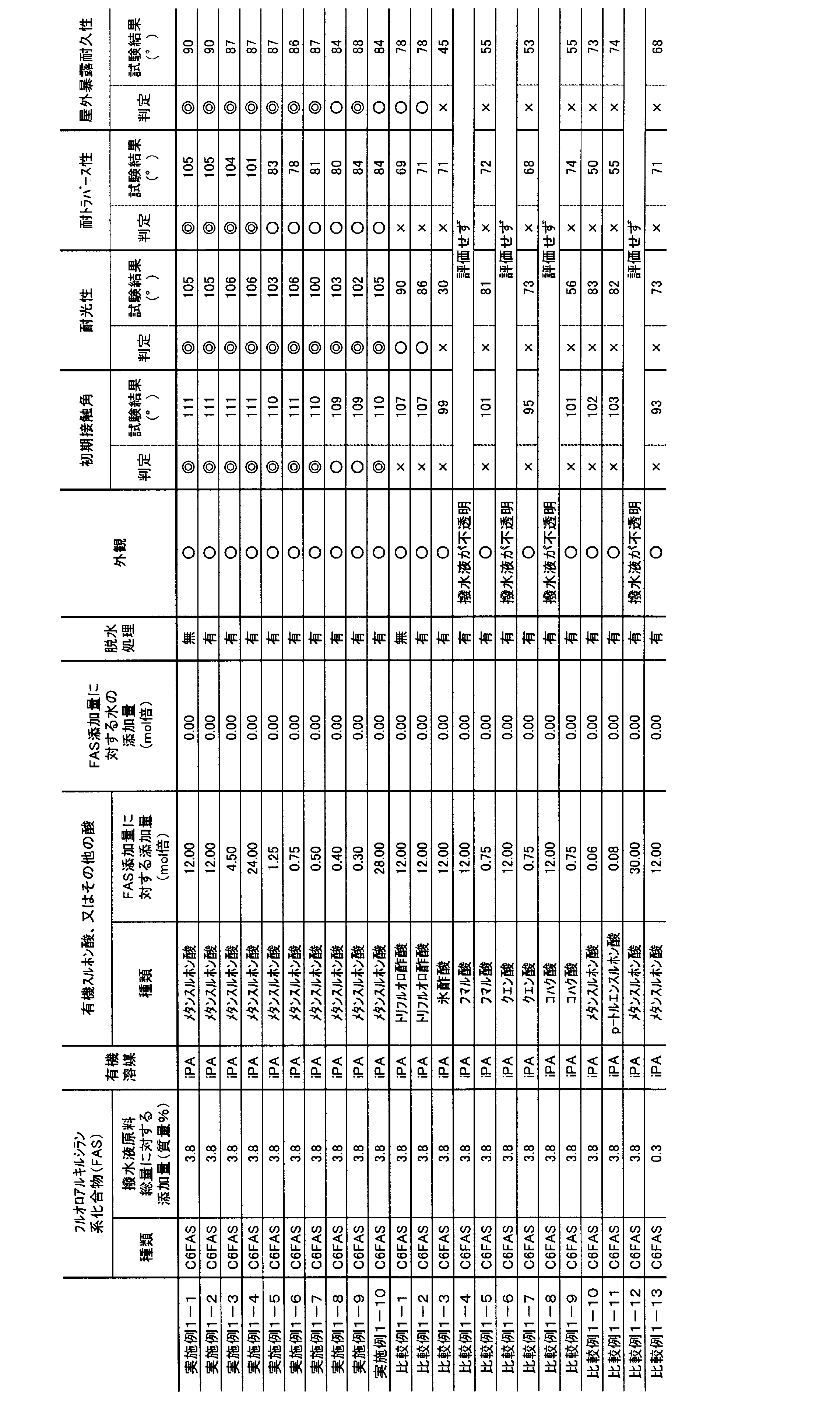
- the water repellent liquid corresponds to the water repellent liquid indicated by (1) in FIG. Table 1 shows the components and preparation conditions of the water repellent liquid.
- Example 1-1 a sample having a water-repellent film was prepared in the same manner as in Example 1-1 and evaluated in the same manner.
- initial contact angle ((111 °)
- light resistance ((105 ° )
- Traverse resistance ⁇ (105 °)
- outdoor exposure durability ⁇ (90 °)
- exhibiting excellent water repellency, weather resistance and wear resistance, maintaining long-term water repellency and durability was expensive.
- Examples 1-3 to 1-10 A water repellent liquid was prepared in the same manner as in Example 1-2 except that the amount of organic sulfonic acid added relative to the amount of fluoroalkylsilane compound added in Example 1-2 was changed. A sample having a water film was prepared and evaluated in the same manner.
- the water repellent liquids of Examples 1-3 to 1-10 correspond to the water repellent liquids indicated by (2) to (9) in FIG. 1, respectively. Table 1 shows the components and preparation conditions of the water repellent liquid and the evaluation results.
- Example 1-1 A water repellent liquid was prepared in the same manner as in Example 1-1 except that trifluoroacetic acid was used instead of organic sulfonic acid, and a sample having a transparent water repellent film with a uniform surface was obtained by visual observation. .
- the water repellent liquid used in this comparative example corresponds to the water repellent liquid indicated by (1) in FIG.
- initial contact angle ⁇ (107 °)
- light resistance ⁇ (90 °)
- traverse resistance ⁇ (69 °)
- outdoor Exposure durability ⁇ (78 °)
- Example 1-2 A water repellent liquid was prepared in the same manner as in Example 1-2 except that trifluoroacetic acid was used instead of organic sulfonic acid, and a sample having a transparent water repellent film with a uniform surface was obtained by visual observation. .
- the water repellent liquid used in this comparative example corresponds to the water repellent liquid indicated by (1) in FIG.
- initial contact angle ⁇ (107 °)
- light resistance ⁇ (86 °)
- traverse resistance ⁇ (71 °)
- outdoor Exposure durability ⁇ (78 °)
- Comparative Examples 1-3 to 1-13 In Comparative Example 1-2, the addition amount of the fluoroalkylsilane compound relative to the total amount of the water-repellent liquid raw material of 100% by mass, the type of acid, and the addition amount of acid relative to the addition amount of the fluoroalkylsilane compound were changed.
- a water repellent liquid was prepared in the same manner as in Comparative Example 1-2 and evaluated in the same manner.
- the water repellent liquid used in Comparative Examples 1-3, 1-4, 1-6, 1-8, 1-13 corresponds to the water repellent liquid shown in (1) of FIG.
- the water repellent liquid used in 1-7 and 1-9 corresponds to the water repellent liquid shown in (5) of FIG.
- water repellent liquids of the present invention those that do not contain water are added 1 to 20% by mass of a fluoroalkylsilane compound having an integer of less than 8 fluorocarbon units with respect to 100% by mass of the total amount of the water repellent liquid material.
- a fluoroalkylsilane compound having an integer of less than 8 fluorocarbon units with respect to 100% by mass of the total amount of the water repellent liquid material.
- organic sulfonic acid the ratio (mol times) of the addition amount of the acid to the addition amount of the fluoroalkylsilane compound is shown in the range of points A to E in FIG.
- a water repellent article water repellent glass excellent in weather resistance and wear resistance could be obtained.
- water repellent liquids having a ratio (mol times) of the addition amount of the acid to the addition amount of the fluoroalkylsilane compound in the range of points B to D in FIG.
- a water-repellent article water-repellent glass
- weather resistance and abrasion resistance could be obtained.
- water repellent liquids having a ratio (mol times) of the addition amount of the acid to the addition amount of the fluoroalkylsilane compound in the range of points C to D in FIG. 1 were used.
- a water-repellent article water-repellent glass particularly excellent in weather resistance and abrasion resistance could be obtained.
- the water repellent liquids of Comparative Examples 1-1 to 1-9 using an acid other than sulfonic acid have a problem that the water repellent liquid itself is opaque, and the weather resistance and wear resistance of the obtained water repellent article. There was a problem that was insufficient.
- the water repellent liquid of Comparative Example 1-13 in which the addition amount of the fluoroalkylsilane compound deviates from 1 to 20 mass% with respect to 100 mass% of the total amount of the water repellent liquid raw material is the weather resistance of the obtained water repellent article.
- the wear resistance is insufficient.
- Example 2-1 C6FAS; 1.00 g and iPA; 25.00 g were mixed and stirred for about 3 minutes. Subsequently, methanesulfonic acid [manufactured by Kishida Chemical Co., Ltd., molecular weight: 96]; 0.14 g and purified water [manufactured by Kishida Chemical Co., Ltd.]; 0.11 g were added and stirred at room temperature for about 2 hours to hydrolyze C6FAS, and / or Alternatively, a colorless, transparent and homogeneous water repellent liquid was obtained by polycondensation.
- the addition amount of C6FAS with respect to the total amount of water repellent liquid raw material of 100 mass% is 3.8 mass%
- the addition amount of methanesulfonic acid with respect to the addition amount of C6FAS is 0.75 mol times
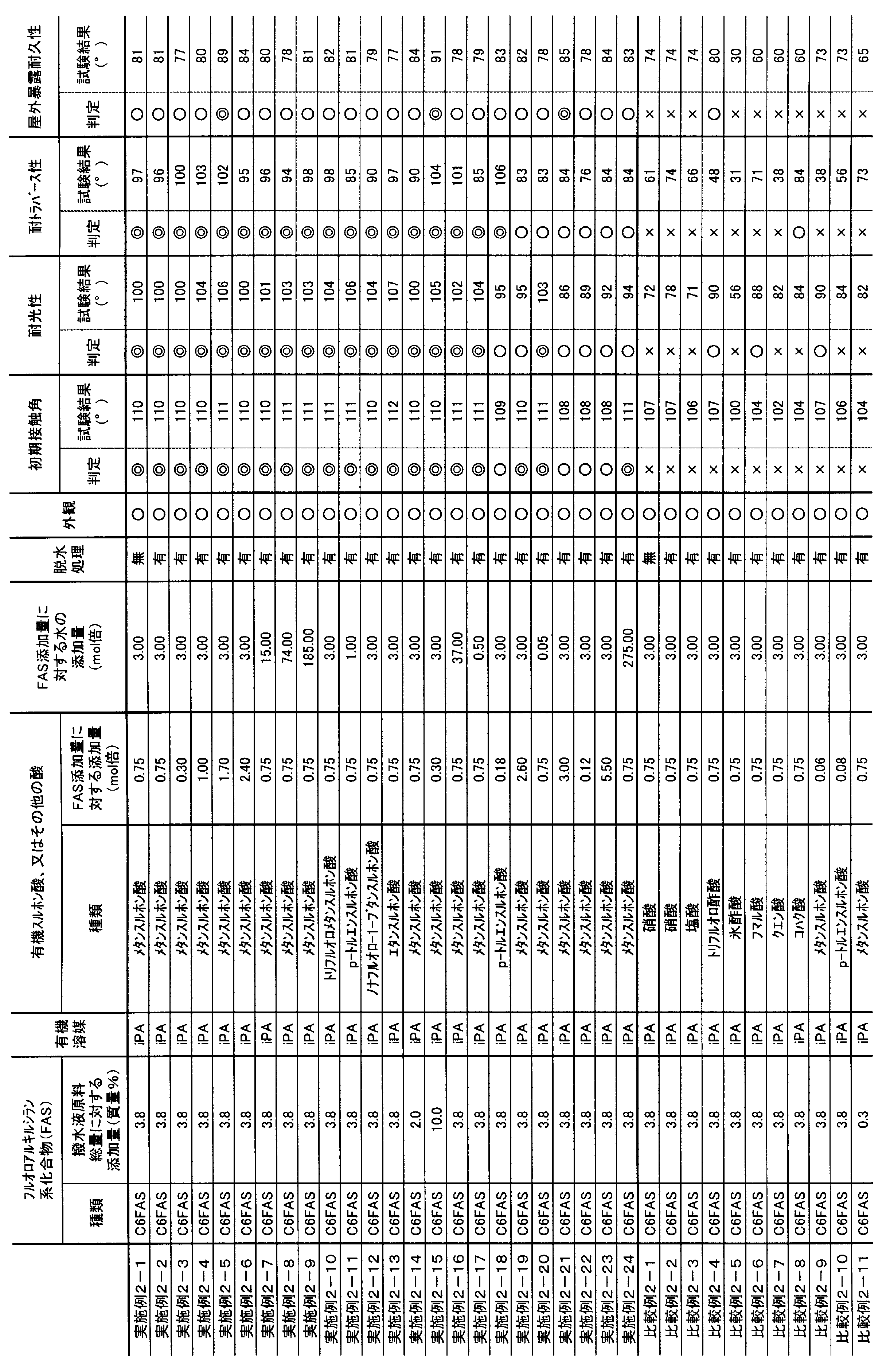
- water with respect to the addition amount of C6FAS. Is 3.00 mol times and corresponds to the water repellent liquid shown in (13) of FIG. Table 2 shows the components and preparation conditions of the water repellent liquid.
- Example 1-1 a sample having a water-repellent film was prepared in the same manner as in Example 1-1 and evaluated in the same manner.
- the initial contact angle: ⁇ (110 °), light resistance: ⁇ (100 ° ), Traverse resistance: ⁇ (97 °), outdoor exposure durability: ⁇ (81 °) exhibits excellent water repellency, weather resistance and wear resistance, maintains water repellency for long term and durability Was expensive.
- Example 2-2 About 5 g of molecular sieve (4AXH5 8X12, manufactured by Union Showa) was added as a dehydrating agent to the water repellent liquid obtained in the same manner as in Example 2-1, and the mixture was left to stand for about 16 hours to dehydrate while adjusting the polycondensation reaction. After that, the mixture was filtered using a filter paper (Whatman, glass fiber filter paper: GF / A), and the molecular sieve 4A was separated and removed to obtain a colorless, transparent and homogeneous water repellent liquid.
- the water repellent liquid corresponds to the water repellent liquid indicated by (13) in FIG. Table 2 shows the components and preparation conditions of the water repellent liquid.
- Example 2-1 a sample having a water-repellent film was prepared in the same manner as in Example 2-1, and evaluated in the same manner. As shown in Table 2, initial contact angle: ⁇ (110 °), light resistance: ((100 ° ), Traverse resistance: ⁇ (96 °), outdoor exposure durability: ⁇ (81 °), excellent water repellency, weather resistance and abrasion resistance, maintaining water repellency over the long term and durability was expensive.
- Example 2-2 the addition amount of the fluoroalkylsilane compound relative to the total amount of the water repellent liquid raw material of 100% by mass, the type of the organic sulfonic acid, the addition amount of the organic sulfonic acid relative to the addition amount of the fluoroalkylsilane compound, A water-repellent solution was prepared in the same manner as in Example 2-2 except that the amount of water added relative to the amount of alkylsilane-based compound was changed, and a sample having a water-repellent film was prepared in the same manner. Was evaluated.
- the water repellent liquids of Examples 2-3 and 2-15 correspond to the water repellent liquid shown in (14) of FIG.
- FIG. 2 corresponds to the water repellent liquid represented by (15) to (20), and the water repellent liquids of Examples 2-10, 2-12, 2-13, and 2-14 are represented by (13) in FIG.
- the water repellent liquid of Example 2-11 corresponds to the water repellent liquid shown in (21) of FIG. 2, and the water repellent liquids of Examples 2-16 to 2-24 are respectively This corresponds to the water repellent liquid indicated by (22) to (30) in FIG. Table 2 shows the components and preparation conditions of the water repellent liquid and the evaluation results.
- Example 2-1 A water repellent liquid was prepared in the same manner as in Example 2-1, except that nitric acid was used instead of organic sulfonic acid, and a sample having a transparent water repellent film having a uniform surface by visual observation was obtained.
- the water repellent liquid used in this comparative example corresponds to the water repellent liquid indicated by (13) in FIG.
- initial contact angle ⁇ (107 °)
- light resistance ⁇ (72 °)
- traverse resistance ⁇ (61 °)
- outdoor Exposure durability x (74 °)
- Example 2-2 A water repellent liquid was prepared in the same manner as in Example 2-2 except that nitric acid was used in place of the organic sulfonic acid, and a sample having a transparent water repellent film having a uniform surface by visual observation was obtained.
- the water repellent liquid used in this comparative example corresponds to the water repellent liquid indicated by (13) in FIG.
- initial contact angle ⁇ (107 °)
- light resistance ⁇ (78 °)
- traverse resistance ⁇ (74 °)
- outdoor Exposure durability x (74 °)
- Comparative Examples 2-3 to 2-11 In Comparative Example 2-2, the addition amount of the fluoroalkylsilane compound relative to the total amount of the water repellent liquid raw material of 100% by mass, the type of acid, and the addition amount of acid relative to the addition amount of the fluoroalkylsilane compound were changed.
- the water repellent liquid used in Comparative Examples 2-3 to 2-8 and 2-11 corresponds to the water repellent liquid shown in (13) of FIG. 2, and the water repellent liquid used in Comparative Example 2-9 is shown in FIG.
- the water repellent liquid represented by (31) corresponds to the water repellent liquid used in Comparative Example 2-10 and corresponds to the water repellent liquid represented by (32) in FIG.
- Table 2 shows the components and preparation conditions of the water repellent liquid and the evaluation results.
- water-repellent liquids of the present invention those containing water are added with 1 to 20% by mass of a fluoroalkylsilane-based compound whose number of fluorocarbon units is an integer less than 8 with respect to 100% by mass of the total amount of the water-repellent raw material.
- the ratio of the addition amount of the acid to the addition amount of the fluoroalkylsilane compound (mol times) was 0.1 to 29 mol times, and the water repellent liquid satisfying the above was used.
- a water-repellent article (water-repellent glass) excellent in weather resistance and abrasion resistance could be obtained.
- the ratio of the addition amount of the acid (mol times) to the addition amount of the fluoroalkylsilane compound and the ratio of the addition amount of water (mol times) are shown in FIG.
- a water-repellent article (water-repellent glass) superior in weather resistance and abrasion resistance could be obtained.
- the ratio of the addition amount of the acid to the addition amount of the fluoroalkylsilane compound (mole times) and the ratio of the addition amount of the water (mole times) are shown in FIG.
- a water-repellent article (water-repellent glass) particularly excellent in weather resistance and abrasion resistance could be obtained.
- the water repellent liquids of Comparative Examples 2-1 to 2-8 using an acid other than sulfonic acid had a problem that the obtained water repellent article had insufficient weather resistance and abrasion resistance.
- the water repellent liquids of Comparative Examples 2-9 and 2-10 in which the ratio of the addition amount of the acid to the addition amount of the fluoroalkylsilane compound (mol times) was out of the range of 0.1 to 29 mol times were obtained. There was a problem that the weather resistance and abrasion resistance of the water-repellent article obtained were insufficient.
- the water repellent liquid of Comparative Example 2-11 in which the addition amount of the fluoroalkylsilane compound deviates from 1 to 20 mass% with respect to 100 mass% of the total amount of the water repellent liquid raw material is the weather resistance of the obtained water repellent article.
- the wear resistance is insufficient.
Landscapes
- Chemical & Material Sciences (AREA)
- Life Sciences & Earth Sciences (AREA)
- Engineering & Computer Science (AREA)
- Chemical Kinetics & Catalysis (AREA)
- General Chemical & Material Sciences (AREA)
- Geochemistry & Mineralogy (AREA)
- Materials Engineering (AREA)
- Organic Chemistry (AREA)
- Surface Treatment Of Glass (AREA)
- Materials Applied To Surfaces To Minimize Adherence Of Mist Or Water (AREA)
- Paints Or Removers (AREA)
Description
本発明は、各種ガラス物品に撥水膜を形成するために用いる撥水液、該撥水液を用いて得られる撥水性物品、及びそれらの製法に関する。
優れた撥水性、耐久性を持ち合わせる撥水ガラスは、建築用はもちろん、自動車用等の窓材、さらには船舶や航空機の窓材などの種々の分野の各種ガラス物品において有用な撥水ガラスとして利用することが可能であり、これまでに種々の検討がなされている。
しかし、近年、フルオロアルキルシラン系化合物において、フルオロカーボンユニットの数が大きなもの、例えば、フルオロカーボンユニットの数が8以上のフルオロアルキルシラン系化合物(以降、「長鎖のフルオロアルキルシラン系化合物」と記載する場合がある)については、その合成プロセスで副生成物として排出されるPFOA(perfluorooctanoic acid)に対する環境への負荷の懸念が明らかとなったため、2003年4月にEPA(米国環境保護庁)がPFOAに対する科学的調査を強化する旨を発表以来、長鎖フルオロアルキルシラン系化合物は入手困難な状況となった。そのため、フルオロカーボンユニットの数が8未満のフルオロアルキルシラン系化合物を用いても、従来と同様の耐久性を有する処理剤が強く求められている。
そのような撥水ガラスを得るためには、これまでに多くの方法が提案されてきた。本出願人は、例えば、特許文献1に記載している撥水ガラスのように、ガラス表面に高い比表面積で制御した特異で微細な凹凸形状表層表面を有するベース膜を設けて、ベース膜に被覆する撥水膜の付着効率と密着性を高めることで長期に優れた撥水性能、耐摩耗性、耐候性等を維持できることを開示している。
また、本出願人は、特許文献2に記載している撥水ガラスの製法で、出発原料のフルオロアルキルシラン系化合物又はアルキルアルコキシシラン系化合物を希釈溶媒中で酸触媒により加水分解反応させ、その後、脱水剤等で含有水分量を調整して縮重合度を高めるとともに安定するよう制御・調製した撥水液をガラス基板に成膜することにより、優れた耐摩耗性と耐候性を示すことを開示している。
また、本出願人は、特許文献3に記載している撥水ガラスのように、撥水膜を形成する際に、ガラス基板の温度が90~200℃程度にある状態でガラス基板表面、場合によっては方向性をもつ筋状の疵をつけた微細な凹凸状ガラス基板表面に撥水層を形成することにより、耐候性、耐摩耗性、耐擦傷性ならびに耐久性に格段に優れた撥水性能を発揮し、長期にわたりその効果を持続する撥水膜を形成する方法を開示している。
さらに、本出願人は、特許文献4において、ジメチルシロキサンユニット(-Si(CH3)2O-)の数が30~400である直鎖状ポリジメチルシロキサン、及びフルオロアルキルシランのそれぞれを、基材表面に化学的に結合せしめて滑水層を形成する滑水性物品の製法を開示している。
さらに近年開示された特許文献5には、環境への負荷が無いPFOAフリーの撥水撥油剤や防汚剤等を提供することを目的として、下記一般式(1)で表されるフッ素化合物を開示している。
Rf-(CH2)n-X1-Y1-Z (1)
{式中Rfは炭素数1~7のパーフルオロアルキル基、nは0~5の整数であり、X1は-S-、-SO-または-SO2-を表し、Y1は炭素数1~10のアルキレン基または芳香族基、Zは芳香族性水酸基、芳香族性アミノ基、カルボキシル基あるいはスルホン酸基(及びこれらの官能基の中和塩又はエステルを含む)を表す。}
Rf-(CH2)n-X1-Y1-Z (1)
{式中Rfは炭素数1~7のパーフルオロアルキル基、nは0~5の整数であり、X1は-S-、-SO-または-SO2-を表し、Y1は炭素数1~10のアルキレン基または芳香族基、Zは芳香族性水酸基、芳香族性アミノ基、カルボキシル基あるいはスルホン酸基(及びこれらの官能基の中和塩又はエステルを含む)を表す。}
特許文献1に記載の撥水ガラスは、前述したニーズに答えうる手法であるが、特異なベース膜と撥水層の2層膜構成であり、ベース膜及び撥水層の成膜工程が煩雑であるため、成膜設備が大掛かりになり、高コストとなり易い。このため、2層膜ではなく単層膜で、撥水性能、耐摩耗性、耐候性等が優れた撥水ガラスが望まれている。
特許文献2に記載の方法により得られる撥水ガラスは、単層膜でも撥水性能や耐久性が向上し所望の性能に近づくような撥水ガラスであるものの、フルオロカーボンユニットの数が8未満のフルオロアルキルシラン系化合物、例えば、フルオロカーボンユニットの数が4~6のフルオロアルキルシラン系化合物を用いた撥水液における酸触媒の種類・量、水の量と撥水性能、耐久性能の関係については、十分な検討はなされておらず、改良のための検討の余地がある。
また、特許文献3に記載している撥水ガラスも特許文献2と同様に単層膜でも撥水性能や耐久性が向上し所望の性能に近づくような撥水ガラスであるものの、あらかじめ、ガラス基板を加熱状態としたり、ガラス基板表面に凹凸形状をつけたりと、操作が煩雑であり、生産時における作業性、特にその取り扱いが簡便で高効率であるとは言い難い場合がある。
また、特許文献4で開示された滑水性物品は、耐候性や耐久性が良好なものであったが、フルオロカーボンユニットの数が8未満のフルオロアルキルシラン系化合物を用いて処理剤とし、該処理剤を用いて得られた物品に耐候性、耐摩耗性などの負荷を加えると、比較的、短期間で撥水性能が低下することがある。
また、特許文献5では、フルオロカーボンユニットの数が8未満のフルオロアルキルシラン系化合物そのものの工夫により、性能改善を図ったものであるが、該化合物の合成と得られた化合物のキャラクタリゼーションには、充分な技術的ノウハウや知見が必要であるとともに、生産時には、化合物の合成設備も必要となり、撥水ガラスの製造に至るまでの工程としては、決して簡便であるとは言い難い。また、特許文献5の一般式(1)で表される化合物は一般的に入手困難であるため、実施が困難であるという問題がある。
本発明は、一般的に入手可能で従来用いられているフルオロカーボンユニットの数が8未満のフルオロアルキルシラン系化合物を用い、特別な成膜設備を必要とせず、形成する被膜が単層膜であっても、得られる撥水性物品の耐久性、特に耐候性、耐摩耗性を向上かつ両立する撥水液とその調製法、該撥水液を用いて得られる撥水性物品、及びその製法を提供することを課題とする。
本発明者らは、フルオロカーボンユニットの数が8未満のフルオロアルキルシラン系化合物、溶媒、酸触媒、水を含む撥水液の組成について詳細に検討を行い、特定の酸触媒を用いて、かつ、各原料の調合量を特定の範囲内にすることで、上記の課題を解決し、短鎖フルオロアルキルシラン系化合物においても耐候性、耐摩耗性を向上かつ両立する撥水性物品(撥水ガラス)を簡便に得られることを見出した。なお、上記の耐候性や耐摩耗性といった耐久性は、屋外で使用されるような撥水性物品、特に撥水ガラスに要求されるレベルのものであり、撥水性物品の耐久性は、実際に屋外環境に撥水性物品を所定の期間暴露して撥水性能等の耐久性を評価する屋外暴露試験や、撥水性物品に対し強力なUV光を所定の時間照射して撥水性能等の耐久性を加速評価する耐光性試験によって評価することができる。
すなわち、本発明は、少なくとも、CF3(CF2)m-1で示されるフルオロカーボンユニットの数であるmが8未満の整数であるフルオロアルキルシラン系化合物、有機溶媒、及び、有機スルホン酸を混合して得られる、撥水層を形成するための撥水液であり、該撥水液原料の総量100質量%に対する前記フルオロアルキルシラン系化合物の添加量が1~20質量%であり、前記フルオロアルキルシラン系化合物の添加量に対する前記有機スルホン酸の添加量が0.1~29mol倍であることを特徴とする、撥水液である。なお、本発明の撥水液には、前記フルオロアルキルシラン系化合物、有機溶媒、及び、有機スルホン酸以外の成分として、水が含まれていても良い。上記のような撥水液を用いることにより、前記フルオロアルキルシラン系化合物(該化合物が加水分解、及び/又は、重縮合した生成物を含むものであってもよい)と、基材表面とを結合させて、該基材表面に優れた耐久性、特に耐候性、耐摩耗性を両立する固形の被膜(撥水層)を形成することができる。
本発明の撥水液は、前記フルオロカーボンユニットのmが8未満の整数であるフルオロアルキルシラン系化合物、有機溶媒、及び、有機スルホン酸を混合して得られる、撥水層を形成するための撥水液であり、該撥水液原料の総量100質量%に対する前記フルオロアルキルシラン系化合物の添加量が1~20質量%であり、前記フルオロアルキルシラン系化合物の添加量に対する前記有機スルホン酸の添加量が0.45~26mol倍であることが好ましい。上記のように、フルオロカーボンユニットのmが8未満の整数であるフルオロアルキルシラン系化合物、有機溶媒、及び、有機スルホン酸を混合して得られる撥水液を「第1の撥水液」と記載する。
前記第1の撥水液は、前記フルオロアルキルシラン系化合物の添加量に対する前記有機スルホン酸の添加量が2.5~26mol倍であることが好ましい。
また本発明の撥水液は、前記フルオロカーボンユニットのmが8未満の整数であるフルオロアルキルシラン系化合物、有機溶媒、有機スルホン酸、及び、水を混合して得られる、撥水層を形成するための撥水液であり、該撥水液原料の総量100質量%に対する前記フルオロアルキルシラン系化合物の添加量が1~20質量%であり、前記フルオロアルキルシラン系化合物の添加量に対する前記有機スルホン酸の添加量が0.15~2.8mol倍であり、前記フルオロアルキルシラン系化合物の添加量に対する前記水の添加量が0.04~290mol倍であることが好ましい。上記のように、前記フルオロカーボンユニットのmが8未満の整数であるフルオロアルキルシラン系化合物、有機溶媒、有機スルホン酸、及び、水を混合して得られる撥水液を「第2の撥水液」と記載する。
前記第2の撥水液は、前記フルオロアルキルシラン系化合物の添加量に対する前記有機スルホン酸の添加量が0.2~2.5mol倍であり、前記フルオロアルキルシラン系化合物の添加量に対する前記水の添加量が0.1~200mol倍であることが好ましい。
また、上記の撥水液は、前記フルオロカーボンユニットのmが8未満の整数であるフルオロアルキルシラン系化合物が加水分解、及び/又は、重縮合された化合物を含有することが好ましい。
また、上記の撥水液は、前記フルオロアルキルシラン系化合物が、フルオロカーボンユニットのmが8未満の整数であるフルオロアルキルトリアルコキシシランであることが好ましい。
また、本発明は、少なくとも、前記フルオロカーボンユニットのmが8未満の整数であるフルオロアルキルシラン系化合物、有機溶媒、及び、有機スルホン酸を混合して、前記フルオロアルキルシラン系化合物を加水分解、及び/又は、重縮合することにより、上記の撥水液を調製することを特徴とする、撥水液の調製法である。前記の加水分解は、撥水液原料中に含まれていた水分によって進行するものであってもよく、撥水液の調製時に大気中から取り込まれた水分によって進行するものであってもよく、また、撥水液原料として添加された水によって進行するものであってもよい。なお、前記の加水分解や重縮合は完全に進行する必要はなく、前記フルオロアルキルシラン系化合物の一部が加水分解や重縮合することでもよい。
前記撥水液の調製法は、前記フルオロカーボンユニットのmが8未満の整数であるフルオロアルキルシラン系化合物、有機溶媒、有機スルホン酸、及び、水を混合して、前記フルオロアルキルシラン系化合物を加水分解、及び/又は、重縮合することが好ましい。
また前記撥水液の調製法は、前記フルオロアルキルシラン系化合物を加水分解、及び/又は、重縮合した後に、さらに脱水剤を添加することにより、撥水液を調製することが好ましい。
また、本発明は、基材上に撥水層を形成する撥水性物品の製法において、上記の撥水液を基材の表面上に塗布し、50~350℃で1~60分間加熱することにより、撥水層を形成することを特徴とする、撥水性物品の製法である。
また、本発明は、上記の撥水性物品の製法によって得られる撥水性物品である。
前記撥水性物品は、基材がガラスであることが好ましい。
本発明によると、一般的に入手可能で従来用いられている前記フルオロカーボンユニットのmが8未満の整数であるフルオロアルキルシラン系化合物を用い、特別な成膜設備を必要とせず、形成する被膜が、特異なベース膜と撥水層といった2層膜構成ではなく、単一組成のみからなる単層膜であっても、得られる撥水性物品の耐久性、特に耐候性、耐摩耗性を向上かつ両立する撥水液、及び撥水性物品が簡便に得られる。
本発明の撥水液に使用されるフルオロアルキルシラン系化合物は、下記一般式[1]で示されるフルオロアルキルシランが好適に用いられる。

ここで、Y1は1価の加水分解可能な官能基である。さらに、mは8未満の整数であり、フルオロカーボンユニットの数(CF2及びCF3の総数)を表す。さらに、pは1~3の整数であり、加水分解可能な官能基の数を表す。
フルオロカーボンユニットの数(CF2及びCF3の総数)が増加すると、得られる撥水膜の耐候性、耐摩耗性は改善する。しかしながら、前記背景の通り、mの数が大きなフルオロアルキルシラン系化合物は入手が困難になっている。従って、フルオロカーボンユニットの数は8未満である。
また、前記フルオロアルキルシラン系化合物の添加量は、撥水液の総量に対し、1~20質量%とすることが重要である。1質量%未満では、初期撥水性(接触角)、耐候性および耐摩耗性が著しく低下する。また、20質量%を超えると撥水液調合時の取り扱い性や撥水液のポットライフが悪くなるほか、撥水液が高コストとなるため、その添加量は、1~20質量%とすることが好ましい。
前記フルオロアルキルシラン系化合物としては、前記一般式[1]のmが8未満である一般に入手可能なフルオロアルキルシラン系化合物を用いることができ、例えば、CF3(CF2)5CH2CH2Si(OCH3)3、CF3(CF2)5CH2CH2SiCH3(OCH3)2、CF3(CF2)5CH2CH2Si(CH3)2OCH3、CF3(CF2)3CH2CH2Si(OCH3)3、CF3(CF2)3CH2CH2SiCH3(OCH3)2、CF3(CF2)3CH2CH2Si(CH3)2OCH3、CF3(CF2)5CH2CH2SiCl3、CF3(CF2)5CH2CH2SiCH3Cl2、CF3(CF2)5CH2CH2Si(CH3)2Cl、CF3(CF2)3CH2CH2SiCl3、CF3(CF2)3CH2CH2SiCH3Cl2、CF3(CF2)3CH2CH2Si(CH3)2Cl等のものが使用できる。
入手容易性と得られる撥水性物品の撥水層の耐久性の観点から、前記一般式[1]のmが4~6であるフルオロアルキルシラン系化合物がより好ましい。
入手容易性と得られる撥水性物品の撥水層の耐久性の観点から、前記一般式[1]のmが4~6であるフルオロアルキルシラン系化合物がより好ましい。
また、前記フルオロアルキルシラン系化合物は、片側末端に加水分解可能な官能基を有するフルオロアルキルシラン系化合物が好適に用いられる。両側末端に加水分解可能な官能基を持ったフルオロアルキルシラン系化合物は、縮合が進みやすく、このため撥水液の性状を安定に保つことが困難となる傾向がある。さらに、縮合した撥水液は、撥水液を基材に塗布・乾燥後、余剰分となり易く、この余剰分は基材に強固に固着し、乾燥後の余剰分の除去が困難となる傾向がある。この点を考慮すると、片側末端のみに加水分解可能な官能基を有するフルオロアルキルシラン系化合物とすることが好ましい。さらに、加水分解可能な官能基の数は、3個が好ましい。3個未満では、生成するシラノール基の量が十分でなくなるため、基材と得られる撥水膜の結合が十分でなくなり、撥水膜の耐久性が低くなる場合がある。
また、加水分解可能な官能基の種類としては、メトキシ基、エトキシ基、プロポキシ基、イソプロポキシ基、ブトキシ基等のアルコキシ基、クロロ基又はイソシアネート基等を用いることができる。ただし、加水分解可能な官能基の反応性が高すぎると、撥水液調合時の取扱いが難しくなるだけでなく、撥水液のポットライフが短くなる場合がある。一方、反応性が低すぎると、加水分解反応が十分進行しなくなり、生成するシラノール基の量が十分でなくなるため、基材と得られる撥水膜の結合が十分でなくなり、撥水膜の耐候性、耐摩耗性が低くなる場合がある。取扱いの容易さ、撥水液のポットライフ、得られる撥水膜の耐候性、耐摩耗性を考慮すると、加水分解可能な官能基としてはアルコキシ基が好ましく、中でもメトキシ基、エトキシ基が特に好ましい。
撥水液に用いる有機溶媒には、フルオロアルキルシラン系化合物、酸触媒を溶解させる有機溶媒を用いることができ、該有機溶媒として、エチルアルコール、イソプロピルアルコール等の低級アルコール、メチルエチルケトン、メチルイソブチルケトン等のケトン類、酢酸エチル、酢酸ブチル等のエステル類、ヘキサン、トルエン、ベンゼン、キシレン等の炭化水素溶媒類、ジエチルエーテル、ジイソプロピルエーテル等のエーテル類やそれらの混合物を用いることが好ましい。また、ハイドロフルオロカーボン、パーフルオロカーボン、パーフルオロエーテル、ハイドロフルオロエーテルなどのフッ素系溶剤を用いることもできる。中でも、イソプロピルアルコール等の低級アルコールは、フルオロアルキルシラン系化合物、酸触媒の溶解性が高く、さらに、撥水液の塗布性(塗り伸ばしやすさ)や乾燥時間(作業時間)が適度になるので特に好ましい。
また、撥水液に用いる有機スルホン酸としては、メタンスルホン酸、エタンスルホン酸、プロパンスルホン酸、2-プロパンスルホン酸、ブタンスルホン酸、2-ブタンスルホン酸、ノナフルオロ-1-ブタンスルホン酸、ペンタンスルホン酸、トリフルオロメタンスルホン酸、2-ヒドロキシエタン-1-スルホン酸、2-ヒドロキシプロパン-1-スルホン酸、2-ヒドロキシブタン-1-スルホン酸、2-ヒドロキシペンタンスルホン酸、1-カルボキシエタンスルホン酸、1,3-プロパンジスルホン酸、アリールスルホン酸、2-スルホ酢酸、2-又は3-スルホプロピオン酸、ベンゼンスルホン酸、p-トルエンスルホン酸、キシレンスルホン酸、ニトロベンゼンスルホン酸、スルホ安息香酸、スルホサリチル酸、ベンズアルデヒドスルホン酸、p-フェノールスルホン酸、フェノール-2,4-ジスルホン酸などが挙げられる。中でもメタンスルホン酸、エタンスルホン酸やp-トルエンスルホン酸は容易に入手でき、さらに安全性(揮発しにくい)や取り扱い(吸湿しにくい)の観点から特に好ましい。
図1に、第1の撥水液について、実施例及び比較例のデータに基づく撥水液における、フルオロアルキルシラン系化合物(FAS)の添加量に対する、酸の添加量の比(mol倍)を図示している。前記フルオロアルキルシラン系化合物の添加量に対する前記有機スルホン酸の添加量が0.1~29mol倍であること(点A~点Eの範囲)が重要である。0.1mol倍未満では、前記フルオロアルキルシラン系化合物のプロトン化が十分ではなく、基材と前記フルオロアルキルシラン系化合物との活性度が低いために初期接触角、耐候性および耐摩耗性が低下する。また、29mol倍を超えると前記フルオロアルキルシラン系化合物及び前記有機スルホン酸が撥水液内で均一に溶解することが困難となる。従って、前記有機スルホン酸の添加量は、前記フルオロアルキルシラン系化合物の添加量に対して0.1~29mol倍であることが重要である。
第1の撥水液では、より高い初期接触角と耐候性を得るためには、前記フルオロアルキルシラン系化合物の添加量に対する前記有機スルホン酸の添加量が0.45~26mol倍であること(点B~点Dの範囲)が好ましい。さらに、より高い初期接触角と耐候性および耐摩耗性を得るためには、前記フルオロアルキルシラン系化合物の添加量に対する前記有機スルホン酸の添加量が2.5~26mol倍であること(点C~点Dの範囲)が好ましい。
図2に、第2の撥水液について、実施例及び比較例のデータに基づく撥水液における、フルオロアルキルシラン系化合物(FAS)の添加量に対する、酸の添加量の比(mol倍)、及び、水の添加量の比(mol倍)を図示している。
第2の撥水液では、より高い初期接触角と耐候性を得るためには、前記フルオロアルキルシラン系化合物の添加量に対する前記有機スルホン酸の添加量が0.15~2.8mol倍であること([F]の範囲)が好ましい。さらに、より高い初期接触角と耐候性および耐摩耗性を得るためには、前記フルオロアルキルシラン系化合物の添加量に対する前記有機スルホン酸の添加量が0.2~2.5mol倍であること([G]の範囲)が好ましい。
第2の撥水液では、より高い初期接触角と耐候性を得るためには、前記フルオロアルキルシラン系化合物の添加量に対する前記有機スルホン酸の添加量が0.15~2.8mol倍であること([F]の範囲)が好ましい。さらに、より高い初期接触角と耐候性および耐摩耗性を得るためには、前記フルオロアルキルシラン系化合物の添加量に対する前記有機スルホン酸の添加量が0.2~2.5mol倍であること([G]の範囲)が好ましい。
さらに、第2の撥水液では、前記フルオロアルキルシラン系化合物の添加量に対する前記水の添加量は0.04~290mol倍であること([F]の範囲)が好ましく、さらに、0.1~200mol倍である([G]の範囲)と、より高い初期接触角と耐候性および耐摩耗性を得ることができるために好ましい。
次に本発明の撥水液の好ましい調製方法について説明する。
撥水液は、前記フルオロアルキルシラン系化合物、有機溶媒の混合物に、加水分解反応を起こさせるための前記有機スルホン酸、及び水を用いる場合は水を添加、混合し、前記フルオロアルキルシラン系化合物を加水分解、及び/又は、重縮合することにより得られる。ここで、フルオロアルキルシラン系化合物と有機溶媒とを先に混合するのは、フルオロアルキルシラン系化合物を撥水液中に均質に混合させるためである。しかしながら、上記の原料を同時に混合しても良い。
また、撥水液中の含有水分量を調整するために、撥水液に脱水剤を添加し、所定時間脱水処理を行っても良い。脱水剤としては、シリカゲル、合成ゼオライト、活性アルミナ等を用いることが出来るが、これに限定するものではない。
次に、得られた撥水液を使用して、撥水性物品を得る方法について説明する。
上記で得られた撥水液を基材表面に塗布する塗布方法としては、刷毛塗り、手塗り、ノズルフローコート法、ディッピング法、スプレー法、リバースコート法、フレキソ法、印刷法、フローコート法、スピンコート法、ロールコート法、それらの併用等各種塗布方法が適宜採用され得る。
本発明の撥水性物品の製法は、塗布後に50~350℃で1~60分間加熱を行うことが好ましいが、その加熱温度よりも高い耐熱温度を有するものであれば、撥水液が塗布される基材は特に限定されるものではない。例えば、自動車用窓ガラス、建築物用窓ガラスに通常使用されているフロート板ガラス、又はロールアウト法で製造されたソーダ石灰ガラス等無機質の透明性がある板ガラスを使用できる。これら板ガラスを用いて形成される鏡等の反射性基材、擦りガラス、模様が刻まれたガラス等の半透明から不透明のガラス基材を使用することができる。
前記ガラス基材の他にタイル、瓦、衛生陶器、食器等に使用されるセラミックス材料よりなる基材、ガラス窓等の枠体、調理器、メス、注射針等の医療器具、流し、自動車のボディ等に使用されるステンレス鋼、アルミニウム、鉄鋼等の金属材料、プラスチック製の基材、例えば、ポリカーボネート樹脂、ポリエチレンテレフタレート樹脂、ポリメチルメタアクリレート樹脂、ポリエチレン樹脂、ポリ塩化ビニル樹脂、その他のプラスチック基材を使用することがある。
また、基材と撥水膜との接着強度を向上させる処理を基材表面に予め行うこともできる。前記の処理としては、各種研磨液による研磨・洗浄・乾燥、酸性溶液または塩基性溶液による表面改質処理、プライマー処理、プラズマ照射、コロナ放電、高圧水銀灯照射等により、基材表面に活性基を発生させることが挙げられる。特に、プライマー処理は、例えば基材上に官能基を4個有するケイ素化合物が添加された溶液を基材に塗布し、該ケイ素化合物と基材とを結合させるとともに、該ケイ素化合物由来のシラノール基(活性基)を形成させて行うことができ、撥水液を塗布する表面のシラノール基の数を増やすことができるため好ましい。
次に撥水液を基材に塗布した後の処理について説明する。基材に撥水液を塗布後、50~350℃で1~60分間加熱させることで、前記フルオロアルキルシラン系化合物の加水分解可能な官能基に由来するシラノール基と、基材表面に存在する水酸基等の結合性基とを結合させることにより、該基材表面に優れた耐久性、特に耐候性、耐摩耗性を両立する固形の被膜(撥水層)を形成することができる。加熱は、常圧下、加圧下、減圧下、不活性雰囲気下で行っても良い。
最後に、余剰分が乾固物となって基材上に残留するので、この余剰分を有機溶剤で湿らした紙タオルや布および/または乾いた紙タオルや布で払拭することにより撥水膜が形成された物品が得られる。
本実施例及び比較例では、撥水層を形成するための撥水液を調製し、基材上に塗布して、撥水性物品を作製した。撥水液の調製方法及び撥水性物品の作製方法は後述の通りである。また、得られた撥水性物品の撥水層について、以下に示す方法により品質評価を行った。尚、本発明はこれらの実施例に限定されるものではない。
(1)外観:撥水液を塗布して乾燥させた後、白くまだらに残留している余剰な成分をアルコール系溶剤〔日本アルコール販売株式会社製、品名:ネオコールCP〕を湿らした紙タオル(品名:キムタオル)で拭き上げて透明なサンプルを作製する際に、透明サンプルが得られたものを良(表中で○と表記)、透明サンプルが得られなかったものを外観不良(表中で×と表記)とした。また、撥水液の原料の相溶性が悪く、撥水液自体が不透明な場合、均一な撥水層を形成することが困難であるため、そのような場合は「撥水液が不透明」と記載し、(1)~(5)に記載する評価を行わなかった。
(2)接触角:撥水性物品の撥水層表面に、純水約2μlを置いたときの水滴とサンプル表面とのなす角を接触角計で測定した。尚、接触角計には協和界面科学製CA-X型を用い、大気中(約25℃)で測定した。初期接触角において、接触角が108°以上を良(表中で○と表記)、110°以上を優(表中で◎と表記)とした。尚、108°未満のものを性能不足とし、表中で×と表記した。
(3)耐光性:メタルハライドランプのUV光を以下の条件でサンプルの撥水膜面に対して2時間照射した後の接触角(°)を測定して評価した。ここでは試験後の水滴の接触角が85°以上を合格(表中で○と表記)、100°以上を良(表中で◎と表記)とした。尚、85°未満のものを不合格とし、表中で×と表記した。
・ ランプ:アイグラフィックス製M015-L312
・ ランプ強度:1.5kW
・ 照度:下記条件における測定値が128mW/cm2
・ 測定装置:紫外線強度計(コニカミノルタセンシング製、UM-10)
・ 受光部:UM-360(受光波長域;310~400nm、ピーク波長;365±5nm)
・ 測定モード:放射照度測定
・ ランプ:アイグラフィックス製M015-L312
・ ランプ強度:1.5kW
・ 照度:下記条件における測定値が128mW/cm2
・ 測定装置:紫外線強度計(コニカミノルタセンシング製、UM-10)
・ 受光部:UM-360(受光波長域;310~400nm、ピーク波長;365±5nm)
・ 測定モード:放射照度測定
(4)耐トラバース性:以下の条件でトラバース試験を実施した後の接触角(°)を測定して評価した。ここでは、試験後の水滴の接触角が75°以上を合格(表中で○と表記)、85°以上を良(表中で◎と表記)した。尚、75°未満のものを不合格とし、表中で×と表記した。
・ 試験機 :トラバ-ス式摺動試験機
・ 試料サイズ :約100mm×200mm
・ 摩擦布 :ネル布
・ 荷重 :0.3kg /cm2
・ ストロ-ク :100mmの往復摺動(摺動回数は往復の回数)
・ 摺動速度 :30往復/分
・ 試験機 :トラバ-ス式摺動試験機
・ 試料サイズ :約100mm×200mm
・ 摩擦布 :ネル布
・ 荷重 :0.3kg /cm2
・ ストロ-ク :100mmの往復摺動(摺動回数は往復の回数)
・ 摺動速度 :30往復/分
(5)屋外暴露耐久性:撥水膜面を上面としてサンプルを30°傾斜させて南向きの屋外(三重県松阪市)に設置して10.5ヶ月の屋外暴露試験を行った後の接触角(°)を測定して評価した。ここでは試験後の水滴の接触角が75°以上を合格(表中で○と表記)、85°以上を良(表中で◎と表記)とした。尚、75°未満のものを不合格とし、表中で×と表記した。
[実施例1-1]
(I)撥水液の調製
撥水層を形成するための撥水液の原料として、フルオロカーボンユニットの数が6のフルオロアルキルトリアルコキシシランである、(3,3,4,4,5,5,6,6,7,7,8,8,8-トリデカフルオロオクチル)トリエトキシシラン〔CF3(CF2)5CH2CH2Si(OC2H5)3、エボニック・デグサ製、商品名:F8261、分子量:510、以降、本化合物を「C6FAS」と記載する場合がある〕;1.00gとイソプロピルアルコール〔キシダ化学製、以降、「iPA」と記載する場合がある〕;22.88gを混合し、約3分間撹拌した。次いで、メタンスルホン酸〔キシダ化学製、分子量:96〕;2.26gを添加し、約2時間室温で撹拌して、C6FASを加水分解、及び/又は、重縮合することにより無色透明で均質な撥水液を得た。なお、撥水液原料の総量100質量%に対するC6FASの添加量は3.8質量%であり、C6FASの添加量に対するメタンスルホン酸の添加量は12.00mol倍であり、図1の(1)で示される撥水液に該当する。撥水液の成分及び調製条件を表1に示す。
(I)撥水液の調製
撥水層を形成するための撥水液の原料として、フルオロカーボンユニットの数が6のフルオロアルキルトリアルコキシシランである、(3,3,4,4,5,5,6,6,7,7,8,8,8-トリデカフルオロオクチル)トリエトキシシラン〔CF3(CF2)5CH2CH2Si(OC2H5)3、エボニック・デグサ製、商品名:F8261、分子量:510、以降、本化合物を「C6FAS」と記載する場合がある〕;1.00gとイソプロピルアルコール〔キシダ化学製、以降、「iPA」と記載する場合がある〕;22.88gを混合し、約3分間撹拌した。次いで、メタンスルホン酸〔キシダ化学製、分子量:96〕;2.26gを添加し、約2時間室温で撹拌して、C6FASを加水分解、及び/又は、重縮合することにより無色透明で均質な撥水液を得た。なお、撥水液原料の総量100質量%に対するC6FASの添加量は3.8質量%であり、C6FASの添加量に対するメタンスルホン酸の添加量は12.00mol倍であり、図1の(1)で示される撥水液に該当する。撥水液の成分及び調製条件を表1に示す。
(II)基材の準備
200mm×200mm×3.5mm厚サイズのフロートガラス板の表面を、研磨液として、ガラス研磨剤ミレークE40(T)(三井金属工業製)を水に混合した2質量%のセリア懸濁液を用いて研磨し、水洗及び乾燥した。次いで、約40℃の0.2Nの硫酸水溶液に約1分間該ガラス板を浸漬し酸処理した後、再度水洗し、乾燥した。
200mm×200mm×3.5mm厚サイズのフロートガラス板の表面を、研磨液として、ガラス研磨剤ミレークE40(T)(三井金属工業製)を水に混合した2質量%のセリア懸濁液を用いて研磨し、水洗及び乾燥した。次いで、約40℃の0.2Nの硫酸水溶液に約1分間該ガラス板を浸漬し酸処理した後、再度水洗し、乾燥した。
(III)撥水膜の形成
雰囲気温度約23℃、湿度約50%RHの環境において、上記(I)で調製した撥水液1.0mlを保持した綿布(商品名:ベンコットM-1)をガラス板上に接触させて、任意の一方向に往復させて全面に塗布し、次いで、塗布方向に対して約90°となる方向に往復させて全面に塗布した後、該ガラス板を電気炉に入れ10分間乾燥した。この時、ガラスの最高到達温度(乾燥温度)は150℃であった。最後に、目視で白くまだらに残留している余剰な成分をアルコール系溶剤〔日本アルコール販売株式会社製、品名:ネオコールCP〕で湿らせた紙タオルで拭き上げて、目視観察で表面が均一な透明な撥水膜を有するサンプルを得た。
雰囲気温度約23℃、湿度約50%RHの環境において、上記(I)で調製した撥水液1.0mlを保持した綿布(商品名:ベンコットM-1)をガラス板上に接触させて、任意の一方向に往復させて全面に塗布し、次いで、塗布方向に対して約90°となる方向に往復させて全面に塗布した後、該ガラス板を電気炉に入れ10分間乾燥した。この時、ガラスの最高到達温度(乾燥温度)は150℃であった。最後に、目視で白くまだらに残留している余剰な成分をアルコール系溶剤〔日本アルコール販売株式会社製、品名:ネオコールCP〕で湿らせた紙タオルで拭き上げて、目視観察で表面が均一な透明な撥水膜を有するサンプルを得た。
上記の評価方法に記載した要領で評価したところ、表1に示すとおり、初期接触角:◎(111°)、耐光性:◎(105°)、耐トラバース性:◎(105°)、屋外暴露耐久性:◎(90°)であり、優れた撥水性、耐候性及び耐摩耗性を示し、長期的に撥水性能を維持し耐久性が高いものであった。
[実施例1-2]
実施例1-1と同様の操作で得た撥水液に、脱水剤としてモレキュラーシーブ〔4AXH5 8X12、ユニオン昭和製〕を約5g 添加浸漬して約16時間放置し重縮合反応を調整させつつ脱水した後、濾紙(ワットマン、ガラス繊維ろ紙:GF/A)を用いて濾過しモレキュラーシーブ4Aを分離除去することにより無色透明で均質な撥水液を得た。該撥水液は図1の(1)で示される撥水液に該当する。撥水液の成分及び調製条件を表1に示す。
実施例1-1と同様の操作で得た撥水液に、脱水剤としてモレキュラーシーブ〔4AXH5 8X12、ユニオン昭和製〕を約5g 添加浸漬して約16時間放置し重縮合反応を調整させつつ脱水した後、濾紙(ワットマン、ガラス繊維ろ紙:GF/A)を用いて濾過しモレキュラーシーブ4Aを分離除去することにより無色透明で均質な撥水液を得た。該撥水液は図1の(1)で示される撥水液に該当する。撥水液の成分及び調製条件を表1に示す。
上記以外は実施例1-1と同様に撥水膜を有するサンプルを作製し、同様に評価したところ、表1に示すとおり、初期接触角:◎(111°)、耐光性:◎(105°)、耐トラバース性:◎(105°)、屋外暴露耐久性:◎(90°)であり、優れた撥水性、耐候性及び耐摩耗性を示し、長期的に撥水性能を維持し耐久性が高いものであった。
[実施例1-3~1-10]
実施例1-2における、フルオロアルキルシラン系化合物の添加量に対する有機スルホン酸の添加量を変更し、それ以外は、実施例1-2と同様の操作で撥水液を調製し、同様に撥水膜を有するサンプルを作製し、同様に評価を行った。なお、実施例1-3~1-10の撥水液は、それぞれ、図1の(2)~(9)で示される撥水液に該当する。撥水液の成分及び調製条件と評価結果を表1に示す。
実施例1-2における、フルオロアルキルシラン系化合物の添加量に対する有機スルホン酸の添加量を変更し、それ以外は、実施例1-2と同様の操作で撥水液を調製し、同様に撥水膜を有するサンプルを作製し、同様に評価を行った。なお、実施例1-3~1-10の撥水液は、それぞれ、図1の(2)~(9)で示される撥水液に該当する。撥水液の成分及び調製条件と評価結果を表1に示す。
[比較例1-1]
有機スルホン酸の代わりにトリフルオロ酢酸を用いること以外は、実施例1-1と同様の操作で撥水液を調製し、目視観察で表面が均一な透明な撥水膜を有するサンプルを得た。なお、本比較例で用いた撥水液は図1の(1)で示される撥水液に該当する。実施例1-1と同様に評価を行ったところ、表1に示すとおり、初期接触角:×(107°)、耐光性:○(90°)、耐トラバース性:×(69°)、屋外暴露耐久性:○(78°)であり、性能不足であった。
有機スルホン酸の代わりにトリフルオロ酢酸を用いること以外は、実施例1-1と同様の操作で撥水液を調製し、目視観察で表面が均一な透明な撥水膜を有するサンプルを得た。なお、本比較例で用いた撥水液は図1の(1)で示される撥水液に該当する。実施例1-1と同様に評価を行ったところ、表1に示すとおり、初期接触角:×(107°)、耐光性:○(90°)、耐トラバース性:×(69°)、屋外暴露耐久性:○(78°)であり、性能不足であった。
[比較例1-2]
有機スルホン酸の代わりにトリフルオロ酢酸を用いること以外は、実施例1-2と同様の操作で撥水液を調製し、目視観察で表面が均一な透明な撥水膜を有するサンプルを得た。なお、本比較例で用いた撥水液は図1の(1)で示される撥水液に該当する。実施例1-2と同様に評価を行ったところ、表1に示すとおり、初期接触角:×(107°)、耐光性:○(86°)、耐トラバース性:×(71°)、屋外暴露耐久性:○(78°)であり、性能不足であった。
有機スルホン酸の代わりにトリフルオロ酢酸を用いること以外は、実施例1-2と同様の操作で撥水液を調製し、目視観察で表面が均一な透明な撥水膜を有するサンプルを得た。なお、本比較例で用いた撥水液は図1の(1)で示される撥水液に該当する。実施例1-2と同様に評価を行ったところ、表1に示すとおり、初期接触角:×(107°)、耐光性:○(86°)、耐トラバース性:×(71°)、屋外暴露耐久性:○(78°)であり、性能不足であった。
[比較例1-3~1-13]
比較例1-2における、撥水液原料の総量100質量%に対する前記フルオロアルキルシラン系化合物の添加量、酸の種類、フルオロアルキルシラン系化合物の添加量に対する酸の添加量を変更し、それ以外は、比較例1-2と同様の操作で撥水液を調製し、同様に評価を行った。比較例1-3、1-4、1-6、1-8、1-13で用いた撥水液は図1の(1)で示される撥水液に該当し、比較例1-5、1-7、1-9で用いた撥水液は図1の(5)で示される撥水液に該当し、比較例1-10で用いた撥水液は図1の(10)で示される撥水液に該当し、比較例1-11で用いた撥水液は図1の(11)で示される撥水液に該当し、比較例1-12で用いた撥水液は図1の(12)で示される撥水液に該当する。なお、比較例1-4、1-6、1-8、1-12では、撥水液の原料の相溶性が悪く、撥水液自体が不透明であったため、(1)~(5)に記載する評価を行わなかった。撥水液の成分及び調製条件と評価結果を表1に示す。
比較例1-2における、撥水液原料の総量100質量%に対する前記フルオロアルキルシラン系化合物の添加量、酸の種類、フルオロアルキルシラン系化合物の添加量に対する酸の添加量を変更し、それ以外は、比較例1-2と同様の操作で撥水液を調製し、同様に評価を行った。比較例1-3、1-4、1-6、1-8、1-13で用いた撥水液は図1の(1)で示される撥水液に該当し、比較例1-5、1-7、1-9で用いた撥水液は図1の(5)で示される撥水液に該当し、比較例1-10で用いた撥水液は図1の(10)で示される撥水液に該当し、比較例1-11で用いた撥水液は図1の(11)で示される撥水液に該当し、比較例1-12で用いた撥水液は図1の(12)で示される撥水液に該当する。なお、比較例1-4、1-6、1-8、1-12では、撥水液の原料の相溶性が悪く、撥水液自体が不透明であったため、(1)~(5)に記載する評価を行わなかった。撥水液の成分及び調製条件と評価結果を表1に示す。
本発明の撥水液のうち水を含まないものは、撥水液原料の総量100質量%に対してフルオロカーボンユニットの数が8未満の整数であるフルオロアルキルシラン系化合物を1~20質量%添加され、有機スルホン酸を用い、前記フルオロアルキルシラン系化合物の添加量に対する酸の添加量の比(mol倍)が図1の点A~点Eの範囲で示されるものであり、上記を満たした撥水液を用いた実施例では、耐候性及び耐摩耗性に優れた撥水性物品(撥水ガラス)を得ることができた。
また、上記の撥水液の中でも、前記フルオロアルキルシラン系化合物の添加量に対する酸の添加量の比(mol倍)が図1の点B~点Dの範囲で示される撥水液を用いた実施例では、耐候性及び耐摩耗性により優れた撥水性物品(撥水ガラス)を得ることができた。
また、上記の撥水液の中でも、前記フルオロアルキルシラン系化合物の添加量に対する酸の添加量の比(mol倍)が図1の点C~点Dの範囲で示される撥水液を用いた実施例では、耐候性及び耐摩耗性に特に優れた撥水性物品(撥水ガラス)を得ることができた。
一方、スルホン酸以外の酸を用いた比較例1-1~1-9の撥水液は、撥水液自体が不透明であるという問題や、得られた撥水性物品の耐候性及び耐摩耗性が不十分であるという問題があった。また、前記フルオロアルキルシラン系化合物の添加量に対する酸の添加量の比(mol倍)が図1の点A~点Eの範囲から外れた比較例1-10~1-12の撥水液は、撥水液自体が不透明であるという問題や、得られた撥水性物品の耐候性及び耐摩耗性が不十分であるという問題があった。また、撥水液原料の総量100質量%に対する前記フルオロアルキルシラン系化合物の添加量が1~20質量%から外れた比較例1-13の撥水液は、得られた撥水性物品の耐候性及び耐摩耗性が不十分であるという問題があった。
[実施例2-1]
C6FAS;1.00gとiPA;25.00gを混合し、約3分間撹拌した。次いで、メタンスルホン酸〔キシダ化学製、分子量:96〕;0.14gと精製水〔キシダ化学製〕;0.11gを添加し、約2時間室温で撹拌して、C6FASを加水分解、及び/又は、重縮合することにより無色透明で均質な撥水液を得た。なお、撥水液原料の総量100質量%に対するC6FASの添加量は3.8質量%であり、C6FASの添加量に対するメタンスルホン酸の添加量は0.75mol倍であり、C6FASの添加量に対する水の添加量は3.00mol倍であり、図2の(13)で示される撥水液に該当する。撥水液の成分及び調製条件を表2に示す。
C6FAS;1.00gとiPA;25.00gを混合し、約3分間撹拌した。次いで、メタンスルホン酸〔キシダ化学製、分子量:96〕;0.14gと精製水〔キシダ化学製〕;0.11gを添加し、約2時間室温で撹拌して、C6FASを加水分解、及び/又は、重縮合することにより無色透明で均質な撥水液を得た。なお、撥水液原料の総量100質量%に対するC6FASの添加量は3.8質量%であり、C6FASの添加量に対するメタンスルホン酸の添加量は0.75mol倍であり、C6FASの添加量に対する水の添加量は3.00mol倍であり、図2の(13)で示される撥水液に該当する。撥水液の成分及び調製条件を表2に示す。
上記以外は実施例1-1と同様に撥水膜を有するサンプルを作製し、同様に評価したところ、表2に示すとおり、初期接触角:◎(110°)、耐光性:◎(100°)、耐トラバース性:◎(97°)、屋外暴露耐久性:○(81°)であり、優れた撥水性、耐候性及び耐摩耗性を示し、長期的に撥水性能を維持し耐久性が高いものであった。
[実施例2-2]
実施例2-1と同様の操作で得た撥水液に、脱水剤としてモレキュラーシーブ〔4AXH5 8X12、ユニオン昭和製〕を約5g 添加浸漬して約16時間放置し重縮合反応を調整させつつ脱水した後、濾紙(ワットマン、ガラス繊維ろ紙:GF/A)を用いて濾過しモレキュラーシーブ4Aを分離除去することにより無色透明で均質な撥水液を得た。該撥水液は図2の(13)で示される撥水液に該当する。撥水液の成分及び調製条件を表2に示す。
実施例2-1と同様の操作で得た撥水液に、脱水剤としてモレキュラーシーブ〔4AXH5 8X12、ユニオン昭和製〕を約5g 添加浸漬して約16時間放置し重縮合反応を調整させつつ脱水した後、濾紙(ワットマン、ガラス繊維ろ紙:GF/A)を用いて濾過しモレキュラーシーブ4Aを分離除去することにより無色透明で均質な撥水液を得た。該撥水液は図2の(13)で示される撥水液に該当する。撥水液の成分及び調製条件を表2に示す。
上記以外は実施例2-1と同様に撥水膜を有するサンプルを作製し、同様に評価したところ、表2に示すとおり、初期接触角:◎(110°)、耐光性:◎(100°)、耐トラバース性:◎(96°)、屋外暴露耐久性:○(81°)であり、優れた撥水性、耐候性及び耐摩耗性を示し、長期的に撥水性能を維持し耐久性が高いものであった。
[実施例2-3~2-24]
実施例2-2における、撥水液原料の総量100質量%に対する前記フルオロアルキルシラン系化合物の添加量、有機スルホン酸の種類、フルオロアルキルシラン系化合物の添加量に対する有機スルホン酸の添加量、フルオロアルキルシラン系化合物の添加量に対する水の添加量を変更し、それ以外は、実施例2-2と同様の操作で撥水液を調製し、同様に撥水膜を有するサンプルを作製し、同様に評価を行った。なお、実施例2-3、2-15の撥水液は図2の(14)で示される撥水液に該当し、実施例2-4~2-9の撥水液は、それぞれ、図2の(15)~(20)で示される撥水液に該当し、実施例2-10、2-12、2-13、2-14の撥水液は図2の(13)で示される撥水液に該当し、実施例2-11の撥水液は図2の(21)で示される撥水液に該当し、実施例2-16~2-24の撥水液は、それぞれ、図2の(22)~(30)で示される撥水液に該当する。撥水液の成分及び調製条件と評価結果を表2に示す。
実施例2-2における、撥水液原料の総量100質量%に対する前記フルオロアルキルシラン系化合物の添加量、有機スルホン酸の種類、フルオロアルキルシラン系化合物の添加量に対する有機スルホン酸の添加量、フルオロアルキルシラン系化合物の添加量に対する水の添加量を変更し、それ以外は、実施例2-2と同様の操作で撥水液を調製し、同様に撥水膜を有するサンプルを作製し、同様に評価を行った。なお、実施例2-3、2-15の撥水液は図2の(14)で示される撥水液に該当し、実施例2-4~2-9の撥水液は、それぞれ、図2の(15)~(20)で示される撥水液に該当し、実施例2-10、2-12、2-13、2-14の撥水液は図2の(13)で示される撥水液に該当し、実施例2-11の撥水液は図2の(21)で示される撥水液に該当し、実施例2-16~2-24の撥水液は、それぞれ、図2の(22)~(30)で示される撥水液に該当する。撥水液の成分及び調製条件と評価結果を表2に示す。
[比較例2-1]
有機スルホン酸の代わりに硝酸を用いること以外は、実施例2-1と同様の操作で撥水液を調製し、目視観察で表面が均一な透明な撥水膜を有するサンプルを得た。なお、本比較例で用いた撥水液は図2の(13)で示される撥水液に該当する。実施例2-1と同様に評価を行ったところ、表2に示すとおり、初期接触角:×(107°)、耐光性:×(72°)、耐トラバース性:×(61°)、屋外暴露耐久性:×(74°)であり、性能不足であった。
有機スルホン酸の代わりに硝酸を用いること以外は、実施例2-1と同様の操作で撥水液を調製し、目視観察で表面が均一な透明な撥水膜を有するサンプルを得た。なお、本比較例で用いた撥水液は図2の(13)で示される撥水液に該当する。実施例2-1と同様に評価を行ったところ、表2に示すとおり、初期接触角:×(107°)、耐光性:×(72°)、耐トラバース性:×(61°)、屋外暴露耐久性:×(74°)であり、性能不足であった。
[比較例2-2]
有機スルホン酸の代わりに硝酸を用いること以外は、実施例2-2と同様の操作で撥水液を調製し、目視観察で表面が均一な透明な撥水膜を有するサンプルを得た。なお、本比較例で用いた撥水液は図2の(13)で示される撥水液に該当する。実施例2-2と同様に評価を行ったところ、表2に示すとおり、初期接触角:×(107°)、耐光性:×(78°)、耐トラバース性:×(74°)、屋外暴露耐久性:×(74°)であり、性能不足であった。
有機スルホン酸の代わりに硝酸を用いること以外は、実施例2-2と同様の操作で撥水液を調製し、目視観察で表面が均一な透明な撥水膜を有するサンプルを得た。なお、本比較例で用いた撥水液は図2の(13)で示される撥水液に該当する。実施例2-2と同様に評価を行ったところ、表2に示すとおり、初期接触角:×(107°)、耐光性:×(78°)、耐トラバース性:×(74°)、屋外暴露耐久性:×(74°)であり、性能不足であった。
[比較例2-3~2-11]
比較例2-2における、撥水液原料の総量100質量%に対する前記フルオロアルキルシラン系化合物の添加量、酸の種類、フルオロアルキルシラン系化合物の添加量に対する酸の添加量を変更し、それ以外は、比較例2-2と同様の操作で撥水液を調製し、同様に評価を行った。比較例2-3~2-8、2-11で用いた撥水液は図2の(13)で示される撥水液に該当し、比較例2-9で用いた撥水液は図2の(31)で示される撥水液に該当し、比較例2-10で用いた撥水液は図2の(32)で示される撥水液に該当する。撥水液の成分及び調製条件と評価結果を表2に示す。
比較例2-2における、撥水液原料の総量100質量%に対する前記フルオロアルキルシラン系化合物の添加量、酸の種類、フルオロアルキルシラン系化合物の添加量に対する酸の添加量を変更し、それ以外は、比較例2-2と同様の操作で撥水液を調製し、同様に評価を行った。比較例2-3~2-8、2-11で用いた撥水液は図2の(13)で示される撥水液に該当し、比較例2-9で用いた撥水液は図2の(31)で示される撥水液に該当し、比較例2-10で用いた撥水液は図2の(32)で示される撥水液に該当する。撥水液の成分及び調製条件と評価結果を表2に示す。
本発明の撥水液のうち水を含むものは、撥水液原料の総量100質量%に対してフルオロカーボンユニットの数が8未満の整数であるフルオロアルキルシラン系化合物を1~20質量%添加され、有機スルホン酸を用い、前記フルオロアルキルシラン系化合物の添加量に対する酸の添加量の比(mol倍)が0.1~29mol倍であり、上記を満たした撥水液を用いた実施例では、耐候性及び耐摩耗性に優れた撥水性物品(撥水ガラス)を得ることができた。
また、上記の撥水液の中でも、前記フルオロアルキルシラン系化合物の添加量に対する、酸の添加量の比(mol倍)、及び、水の添加量の比(mol倍)が図2の[F]の範囲で示される撥水液を用いた実施例では、耐候性及び耐摩耗性により優れた撥水性物品(撥水ガラス)を得ることができた。
また、上記の撥水液の中でも、前記フルオロアルキルシラン系化合物の添加量に対する、酸の添加量の比(mol倍)、及び、水の添加量の比(mol倍)が図2の[G]の範囲で示される撥水液を用いた実施例では、耐候性及び耐摩耗性に特に優れた撥水性物品(撥水ガラス)を得ることができた。
一方、スルホン酸以外の酸を用いた比較例2-1~2-8の撥水液は、得られた撥水性物品の耐候性及び耐摩耗性が不十分であるという問題があった。また、前記フルオロアルキルシラン系化合物の添加量に対する酸の添加量の比(mol倍)が0.1~29mol倍の範囲から外れた比較例2-9、2-10の撥水液は、得られた撥水性物品の耐候性及び耐摩耗性が不十分であるという問題があった。また、撥水液原料の総量100質量%に対する前記フルオロアルキルシラン系化合物の添加量が1~20質量%から外れた比較例2-11の撥水液は、得られた撥水性物品の耐候性及び耐摩耗性が不十分であるという問題があった。
Claims (10)
- 少なくとも、CF3(CF2)m-1で示されるフルオロカーボンユニットのmが8未満の整数であるフルオロアルキルシラン系化合物、有機溶媒、及び、有機スルホン酸を混合して得られる、撥水層を形成するための撥水液であり、該撥水液原料の総量100質量%に対する前記フルオロアルキルシラン系化合物の添加量が1~20質量%であり、前記フルオロアルキルシラン系化合物の添加量に対する前記有機スルホン酸の添加量が0.1~29mol倍であることを特徴とする、撥水液。
- 前記フルオロカーボンユニットのmが8未満の整数であるフルオロアルキルシラン系化合物、有機溶媒、有機スルホン酸、及び、水を混合して得られる、撥水層を形成するための撥水液であり、該撥水液原料の総量100質量%に対する前記フルオロアルキルシラン系化合物の添加量が1~20質量%であり、前記フルオロアルキルシラン系化合物の添加量に対する前記有機スルホン酸の添加量が0.15~2.8mol倍であり、前記フルオロアルキルシラン系化合物の添加量に対する前記水の添加量が0.04~290mol倍であることを特徴とする、請求項1に記載の撥水液。
- 前記フルオロカーボンユニットのmが8未満の整数であるフルオロアルキルシラン系化合物が加水分解、及び/又は、重縮合された化合物を含有することを特徴とする、請求項1又は請求項2に記載の撥水液。
- 前記フルオロアルキルシラン系化合物が、前記フルオロカーボンユニットのmが8未満の整数であるフルオロアルキルトリアルコキシシランであることを特徴とする、請求項1乃至請求項3のいずれかに記載の撥水液。
- 少なくとも、前記フルオロカーボンユニットのmが8未満の整数であるフルオロアルキルシラン系化合物、有機溶媒、及び、有機スルホン酸を混合して、前記フルオロアルキルシラン系化合物を加水分解、及び/又は、重縮合することにより、請求項1乃至請求項4のいずれかに記載の撥水液を調製することを特徴とする、撥水液の調製法。
- 前記フルオロカーボンユニットのmが8未満の整数であるフルオロアルキルシラン系化合物、有機溶媒、有機スルホン酸、及び、水を混合して、前記フルオロアルキルシラン系化合物を加水分解、及び/又は、重縮合することを特徴とする、請求項2乃至請求項4のいずれかに記載の撥水液の調製法。
- 前記フルオロアルキルシラン系化合物を加水分解、及び/又は、重縮合した後に、さらに脱水剤を添加することにより、撥水液を調製することを特徴とする、請求項5又は請求項6に記載の撥水液の調製法。
- 基材上に撥水層を形成する撥水性物品の製法において、請求項1乃至請求項4のいずれかに記載の撥水液を基材の表面上に塗布し、50~350℃で1~60分間加熱することにより、撥水層を形成することを特徴とする、撥水性物品の製法。
- 請求項8に記載の撥水性物品の製法によって得られる撥水性物品。
- 請求項9に記載の撥水性物品において、基材がガラスであることを特徴とする、撥水ガラス。
Applications Claiming Priority (4)
| Application Number | Priority Date | Filing Date | Title |
|---|---|---|---|
| JP2012-172979 | 2012-08-03 | ||
| JP2012172979 | 2012-08-03 | ||
| JP2013117299A JP6282047B2 (ja) | 2012-08-03 | 2013-06-03 | 撥水液、撥水性物品、及びそれらの製法 |
| JP2013-117299 | 2013-06-03 |
Publications (1)
| Publication Number | Publication Date |
|---|---|
| WO2014021135A1 true WO2014021135A1 (ja) | 2014-02-06 |
Family
ID=50027815
Family Applications (1)
| Application Number | Title | Priority Date | Filing Date |
|---|---|---|---|
| PCT/JP2013/069860 Ceased WO2014021135A1 (ja) | 2012-08-03 | 2013-07-23 | 撥水液、撥水性物品、及びそれらの製法 |
Country Status (2)
| Country | Link |
|---|---|
| JP (1) | JP6282047B2 (ja) |
| WO (1) | WO2014021135A1 (ja) |
Families Citing this family (3)
| Publication number | Priority date | Publication date | Assignee | Title |
|---|---|---|---|---|
| JP2016098306A (ja) * | 2014-11-20 | 2016-05-30 | 株式会社ソフト99コーポレーション | コーティング組成物 |
| JP6601126B2 (ja) * | 2015-01-22 | 2019-11-06 | セントラル硝子株式会社 | 撥水液、撥水性物品及びその製造方法 |
| JP6691296B2 (ja) * | 2016-07-13 | 2020-04-28 | セントラル硝子株式会社 | 撥水液、撥水性物品及びその製造方法 |
Citations (8)
| Publication number | Priority date | Publication date | Assignee | Title |
|---|---|---|---|---|
| JPH02233535A (ja) * | 1989-03-06 | 1990-09-17 | Three Bond Co Ltd | 車両ガラス用表面処理剤 |
| JPH04144940A (ja) * | 1990-10-05 | 1992-05-19 | Asahi Glass Co Ltd | 撥水撥油剤組成物 |
| JPH08277388A (ja) * | 1995-02-10 | 1996-10-22 | Sofuto Kyukyu Corp:Kk | 長期持続型ガラス用撥水処理剤 |
| JPH09104861A (ja) * | 1995-10-06 | 1997-04-22 | Soft Kyukyu Corp:Kk | 長期持続型ガラス用撥水処理剤 |
| JPH1059745A (ja) * | 1996-08-19 | 1998-03-03 | Central Glass Co Ltd | 撥水性ガラス及びその製法 |
| JPH10194784A (ja) * | 1996-11-18 | 1998-07-28 | Nippon Sheet Glass Co Ltd | 撥水性ガラス |
| JP2001207162A (ja) * | 1999-11-04 | 2001-07-31 | Nippon Sheet Glass Co Ltd | 撥水撥油防汚処理液、および撥水撥油防汚処理方法 |
| JP2002121286A (ja) * | 2000-10-12 | 2002-04-23 | Asahi Glass Co Ltd | 含フッ素有機ケイ素化合物、それを含む撥水性組成物、ならびに表面処理基材およびその製造方法 |
-
2013
- 2013-06-03 JP JP2013117299A patent/JP6282047B2/ja active Active
- 2013-07-23 WO PCT/JP2013/069860 patent/WO2014021135A1/ja not_active Ceased
Patent Citations (8)
| Publication number | Priority date | Publication date | Assignee | Title |
|---|---|---|---|---|
| JPH02233535A (ja) * | 1989-03-06 | 1990-09-17 | Three Bond Co Ltd | 車両ガラス用表面処理剤 |
| JPH04144940A (ja) * | 1990-10-05 | 1992-05-19 | Asahi Glass Co Ltd | 撥水撥油剤組成物 |
| JPH08277388A (ja) * | 1995-02-10 | 1996-10-22 | Sofuto Kyukyu Corp:Kk | 長期持続型ガラス用撥水処理剤 |
| JPH09104861A (ja) * | 1995-10-06 | 1997-04-22 | Soft Kyukyu Corp:Kk | 長期持続型ガラス用撥水処理剤 |
| JPH1059745A (ja) * | 1996-08-19 | 1998-03-03 | Central Glass Co Ltd | 撥水性ガラス及びその製法 |
| JPH10194784A (ja) * | 1996-11-18 | 1998-07-28 | Nippon Sheet Glass Co Ltd | 撥水性ガラス |
| JP2001207162A (ja) * | 1999-11-04 | 2001-07-31 | Nippon Sheet Glass Co Ltd | 撥水撥油防汚処理液、および撥水撥油防汚処理方法 |
| JP2002121286A (ja) * | 2000-10-12 | 2002-04-23 | Asahi Glass Co Ltd | 含フッ素有機ケイ素化合物、それを含む撥水性組成物、ならびに表面処理基材およびその製造方法 |
Also Published As
| Publication number | Publication date |
|---|---|
| JP2014043552A (ja) | 2014-03-13 |
| JP6282047B2 (ja) | 2018-02-21 |
Similar Documents
| Publication | Publication Date | Title |
|---|---|---|
| JP5308436B2 (ja) | 親水膜 | |
| JP5607915B2 (ja) | 撥水撥油樹脂組成物および塗装品 | |
| CN103424787A (zh) | 防雾-涂层 | |
| JP5631640B2 (ja) | 防曇剤組成物 | |
| CN112358809A (zh) | 一种基于有机硅的防雾涂料及其制备方法和应用 | |
| KR20190113801A (ko) | 발수 처리제, 발수 구조체 및 그 제조 방법 | |
| JP6282047B2 (ja) | 撥水液、撥水性物品、及びそれらの製法 | |
| JP3883366B2 (ja) | 高滑水性基板およびその製造方法 | |
| Hamada et al. | Robust and transparent antifogging polysilsesquioxane film containing a hydroxy group | |
| KR100894079B1 (ko) | 활수성 피막을 얻기 위한 처리제 및 활수성 피막의 제조방법 | |
| JP6691296B2 (ja) | 撥水液、撥水性物品及びその製造方法 | |
| JP5163022B2 (ja) | 光学機能性積層体上に防汚性被膜を形成するための処理剤 | |
| JP3599998B2 (ja) | 撥水液および撥水性被膜の製造方法 | |
| Hamada et al. | Effect of the amine hydrochloride salt on the antifogging properties of amino-functionalized polysilsesquioxane | |
| JP3649585B2 (ja) | 撥水性被膜形成用溶液 | |
| JP2002121286A (ja) | 含フッ素有機ケイ素化合物、それを含む撥水性組成物、ならびに表面処理基材およびその製造方法 | |
| JP6304411B2 (ja) | 撥水液、撥水性物品、及びそれらの製法 | |
| JP4876424B2 (ja) | 滑水性物品の製法 | |
| JP4401907B2 (ja) | 住居内の水周りで使用される部材用の易洗浄性物品及びその製法 | |
| JP4826226B2 (ja) | 滑水性被膜を得るための処理剤及び滑水性被膜の作製法 | |
| JP6601126B2 (ja) | 撥水液、撥水性物品及びその製造方法 | |
| US20160215169A1 (en) | Water Repellent Liquid, Water Repellent Article, and Method for Manufacturing the Same | |
| JP2006256951A (ja) | 滑水性ガラス物品の製法 | |
| JP4417155B2 (ja) | 建築物用易洗浄性ガラスおよびその製法 | |
| WO2020116541A1 (ja) | コーティング剤 |
Legal Events
| Date | Code | Title | Description |
|---|---|---|---|
| 121 | Ep: the epo has been informed by wipo that ep was designated in this application |
Ref document number: 13825114 Country of ref document: EP Kind code of ref document: A1 |
|
| NENP | Non-entry into the national phase |
Ref country code: DE |
|
| 122 | Ep: pct application non-entry in european phase |
Ref document number: 13825114 Country of ref document: EP Kind code of ref document: A1 |