WO2014010549A1 - 銀含有組成物及び銀要素形成基材 - Google Patents
銀含有組成物及び銀要素形成基材 Download PDFInfo
- Publication number
- WO2014010549A1 WO2014010549A1 PCT/JP2013/068631 JP2013068631W WO2014010549A1 WO 2014010549 A1 WO2014010549 A1 WO 2014010549A1 JP 2013068631 W JP2013068631 W JP 2013068631W WO 2014010549 A1 WO2014010549 A1 WO 2014010549A1
- Authority
- WO
- WIPO (PCT)
- Prior art keywords
- silver
- compound
- integer
- formula
- coupling agent
- Prior art date
- Legal status (The legal status is an assumption and is not a legal conclusion. Google has not performed a legal analysis and makes no representation as to the accuracy of the status listed.)
- Ceased
Links
Classifications
-
- C—CHEMISTRY; METALLURGY
- C09—DYES; PAINTS; POLISHES; NATURAL RESINS; ADHESIVES; COMPOSITIONS NOT OTHERWISE PROVIDED FOR; APPLICATIONS OF MATERIALS NOT OTHERWISE PROVIDED FOR
- C09D—COATING COMPOSITIONS, e.g. PAINTS, VARNISHES OR LACQUERS; FILLING PASTES; CHEMICAL PAINT OR INK REMOVERS; INKS; CORRECTING FLUIDS; WOODSTAINS; PASTES OR SOLIDS FOR COLOURING OR PRINTING; USE OF MATERIALS THEREFOR
- C09D1/00—Coating compositions, e.g. paints, varnishes or lacquers, based on inorganic substances
-
- H—ELECTRICITY
- H01—ELECTRIC ELEMENTS
- H01B—CABLES; CONDUCTORS; INSULATORS; SELECTION OF MATERIALS FOR THEIR CONDUCTIVE, INSULATING OR DIELECTRIC PROPERTIES
- H01B1/00—Conductors or conductive bodies characterised by the conductive materials; Selection of materials as conductors
- H01B1/20—Conductive material dispersed in non-conductive organic material
- H01B1/22—Conductive material dispersed in non-conductive organic material the conductive material comprising metals or alloys
-
- C—CHEMISTRY; METALLURGY
- C09—DYES; PAINTS; POLISHES; NATURAL RESINS; ADHESIVES; COMPOSITIONS NOT OTHERWISE PROVIDED FOR; APPLICATIONS OF MATERIALS NOT OTHERWISE PROVIDED FOR
- C09D—COATING COMPOSITIONS, e.g. PAINTS, VARNISHES OR LACQUERS; FILLING PASTES; CHEMICAL PAINT OR INK REMOVERS; INKS; CORRECTING FLUIDS; WOODSTAINS; PASTES OR SOLIDS FOR COLOURING OR PRINTING; USE OF MATERIALS THEREFOR
- C09D11/00—Inks
- C09D11/52—Electrically conductive inks
-
- C—CHEMISTRY; METALLURGY
- C09—DYES; PAINTS; POLISHES; NATURAL RESINS; ADHESIVES; COMPOSITIONS NOT OTHERWISE PROVIDED FOR; APPLICATIONS OF MATERIALS NOT OTHERWISE PROVIDED FOR
- C09D—COATING COMPOSITIONS, e.g. PAINTS, VARNISHES OR LACQUERS; FILLING PASTES; CHEMICAL PAINT OR INK REMOVERS; INKS; CORRECTING FLUIDS; WOODSTAINS; PASTES OR SOLIDS FOR COLOURING OR PRINTING; USE OF MATERIALS THEREFOR
- C09D5/00—Coating compositions, e.g. paints, varnishes or lacquers, characterised by their physical nature or the effects produced; Filling pastes
- C09D5/24—Electrically-conducting paints
Definitions
- the present invention was obtained by heating a silver-containing composition capable of producing a silver element such as a metal silver film or metal silver wire excellent in adhesion and conductivity by low-temperature sintering, and the composition on the surface of the substrate.
- the present invention relates to a silver element forming substrate.
- a method for producing a metal thin film or wire there is known a method in which a metal is made into a liquid ink or paste ink and heated after being applied or printed on a substrate.
- Gold, silver, copper, and aluminum are used as metals, and silver is widely used as a material for wiring materials.
- ink using silver generally, an ink in which metallic silver is dispersed in a dispersion solvent is used, a pattern is formed on a wiring board, and metallic silver in the ink is sintered to form a wiring.
- metallic silver as a conductive material
- a method of sintering at a low temperature using a melting point drop due to refinement of dispersed metallic silver is known.
- a transparent resin substrate generally has a softening point lower than that of glass or the like, a low-temperature sinterable silver-forming material capable of producing metallic silver by heating at less than 150 ° C. is desired.
- silver capable of forming a silver element such as a metallic silver film or wire that exhibits good conductivity by low-temperature sintering at 120 ° C. or lower, or sintering at 150 ° C. or higher for a very short time.
- a containing composition is required.
- Patent Document 2 As a silver material that can be sintered at low temperature, a method for forming metallic silver using a silver salt using an organic acid has been reported (Patent Document 2). Since the organic silver salt is a silver salt composed of a monofunctional carboxylic acid and silver, the silver content in the compound is low, and the organic components remaining during sintering increase. In order to decompose and evaporate the organic component, it is necessary to lengthen the sintering time. In addition, the organic silver salt that exhibits low-temperature sinterability is unstable with respect to heat, and the storage stability of the silver-containing composition is problematic.
- the object of the present invention is to obtain a silver element such as a metallic silver film or wire excellent in conductivity and adhesion by sintering at a low temperature of 120 ° C. or lower and for a short time, or by sintering for a short time at 150 ° C. or higher.
- the object is to provide a silver-containing composition having high storage stability.
- Another object of the present invention is to provide a silver element-forming substrate provided with a silver element such as a metallic silver film or wire excellent in conductivity and adhesion.
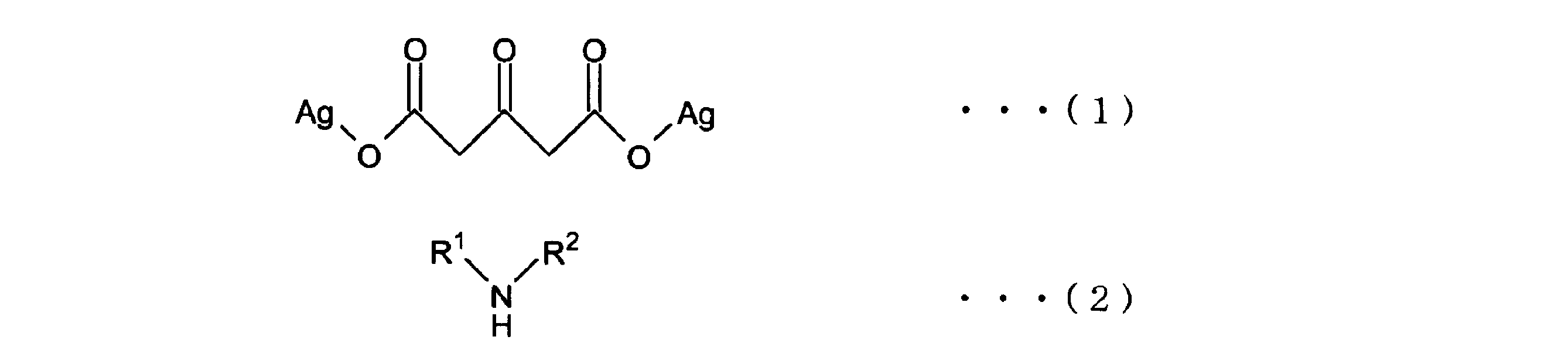
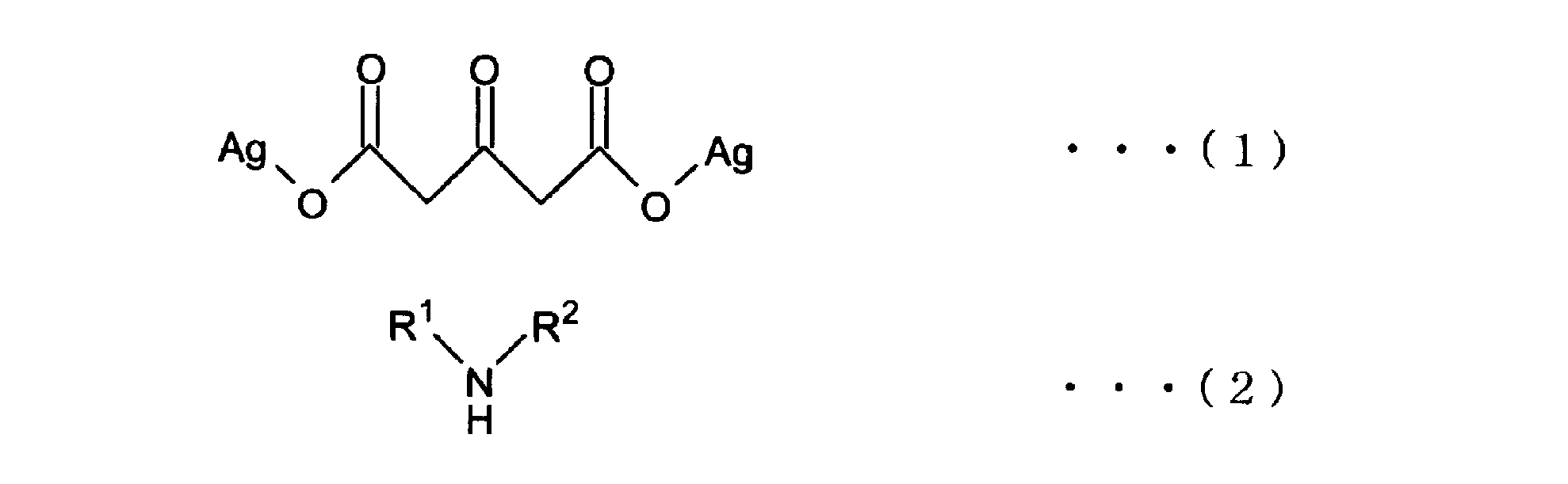
- a composition comprising a silver compound (A) represented by formula (1), an amine compound (B) represented by formula (2), and a silane coupling agent (C), 10 to 50% by mass of silver compound (A) and 50 to 90% by mass of amine compound (B) with respect to 100% by mass in total of silver compound (A), amine compound (B) and silane coupling agent (C) %, And a silver-containing composition containing 0.1 to 5% by mass of the silane coupling agent (C).
- R 1 represents a hydrogen atom, — (CY 1 Y 2 ) a—CH 3 or — ((CH 2 ) b—O—CHZ) c—CH 3
- R 2 represents — (CY 1 Y 2 ) d—CH 3 or — ((CH 2 ) e—O—CHZ) f—CH 3
- Y 1 and Y 2 each independently represent a hydrogen atom or — (CH 2 ) g—CH 3 .
- Z represents a hydrogen atom or — (CH 2 ) h—CH 3 , a is an integer of 0 to 8, b is an integer of 1 to 4, c is an integer of 1 to 3, and d is 0 to 8, preferably Is an integer from 1 to 8, e is an integer from 1 to 4, f is an integer from 1 to 3, g is an integer from 0 to 3, preferably from 1 to 3, and h is an integer from 0 to 2, preferably from 1 to 2. .) Moreover, according to this invention, the said silver containing composition is apply
- the silver-containing composition of the present invention contains the silver compound (A), the amine compound (B), and the silane coupling agent (C) at a specific ratio, it is excellent in sintering at a low temperature of 120 ° C. or lower and for a short time.
- the silver element which has electroconductivity and the outstanding adhesiveness with respect to various base materials, such as glass, a silicon
- the silver concentration in the composition can be increased, and a silver element can be obtained quickly at a low temperature of 120 ° C. or less in the absence of a catalyst.
- silver elements can be formed on a resin base material having low heat resistance in a short time. Furthermore, since a metallic silver element can be formed in a shorter time at a high temperature of 150 ° C. or higher, an improvement in productivity can be expected. Since the silver element obtained in this way has high adhesion to various substrates, the silver element obtained by applying this composition and heating it after printing can be used in various fields such as wiring materials and reflectors. Can be expected.
- the silver-containing composition of the present invention (hereinafter sometimes simply referred to as a composition) includes a silver compound (A) represented by the above formula (1), an amine compound (B) represented by the above formula (2), And a silane coupling agent (C) in a specific ratio.
- the silver compound (A) is acetone dicarboxylate, and its form is usually a powder. It is known that the silver compound (A) has a high viscosity when diluted in a solvent and is difficult to pattern such as printing.
- the viscosity when combined with the amine compound (B), the viscosity can be set low even in a composition having a high silver content, and metallic silver can be produced by sintering at a low temperature of 120 ° C. or lower for a short time. It becomes possible.
- silver elements such as metallic silver films and wires obtained from a silver-containing composition obtained by combining a silver compound (A) and an amine compound (B) are adhesive to various substrates such as glass, silicon, ITO, and polyester. It is scarce. Therefore, by adding a silane coupling agent (C) at a specific ratio to the silver compound (A) and the amine compound (B), a silver element formed even at a low temperature of 120 ° C. or lower and for a short time of sintering. Can significantly improve the adhesion to various substrates while maintaining good electrical conductivity.
- the silver compound (A), the amine compound (B), and the silane coupling agent (C) have a total content of 100 to 50% by mass, the silver compound (A) content is 10 to 50% by mass, and the amine
- the content of the compound (B) is 50 to 90% by mass, and the content of the silane coupling agent (C) is 0.1 to 5% by mass. If the content rate of an amine compound (B) is less than 50 mass%, the solubility of a silver compound (A) will fall remarkably.
- the content rate of a silane coupling agent (C) is less than 0.1 mass%, sufficient adhesiveness to the base material of the obtained silver element is not acquired, and on the other hand, when more than 5 mass%, it adheres However, the conductivity is deteriorated.
- the content of the silane coupling agent (C) is preferably 0.3 to 5% by mass.
- the manufacturing method of the silver compound (A) used for this invention is not restrict
- the amine compound (B) used in the present invention is a compound represented by the above formula (2), wherein R 1 is a hydrogen atom,-(CY 1 Y 2 ) a-CH 3 or-((CH 2 ) b—O—CHZ) c—CH 3 and R 2 represents — (CY 1 Y 2 ) d—CH 3 or — ((CH 2 ) e—O—CHZ) f—CH 3 .
- Y 1 and Y 2 each independently represent a hydrogen atom or — (CH 2 ) g—CH 3
- Z represents a hydrogen atom or — (CH 2 ) h—CH 3 .
- a is an integer from 0 to 8
- b is an integer from 1 to 4
- c is an integer from 1 to 3
- d is an integer from 0 to 8
- e is an integer from 1 to 4
- f is an integer from 1 to 3
- g is An integer from 0 to 3
- h is an integer from 0 to 2.
- the amine compound (B) include ethylamine, 1-propylamine, 1-butylamine, 1-pentylamine, 1-hexylamine, 1-heptylamine, 1-octylamine, 2-ethylhexylamine, isopropylamine, isobutyl.
- amine isopentylamine, sec-butylamine, tert-butylamine, tert-amylamine, 3-methoxypropylamine, 3-ethoxypropylamine, 3-isopropoxypropylamine, diisopropylamine, dibutylamine Can be mentioned.
- examples of such amine compound (B) include 1-propylamine, 1-butylamine, 1-pentylamine, 1-hexylamine, 1-heptylamine, 1-octylamine, isopropylamine, isobutylamine, isopentyl.
- Preferable examples include one or more of amine, 3-methoxypropylamine, 3-ethoxypropylamine, 3-isopropoxypropylamine, diisopropylamine, and dibutylamine.
- the silane coupling agent (C) is a compound having two different functional groups, an organic functional group and an alkoxy group, in one molecule.
- the organic functional group include vinyl group, allyl group, styryl group, epoxy group, (meth) acryl group, amino group, ureido group, mercapto group, sulfide group, and isocyanate group.
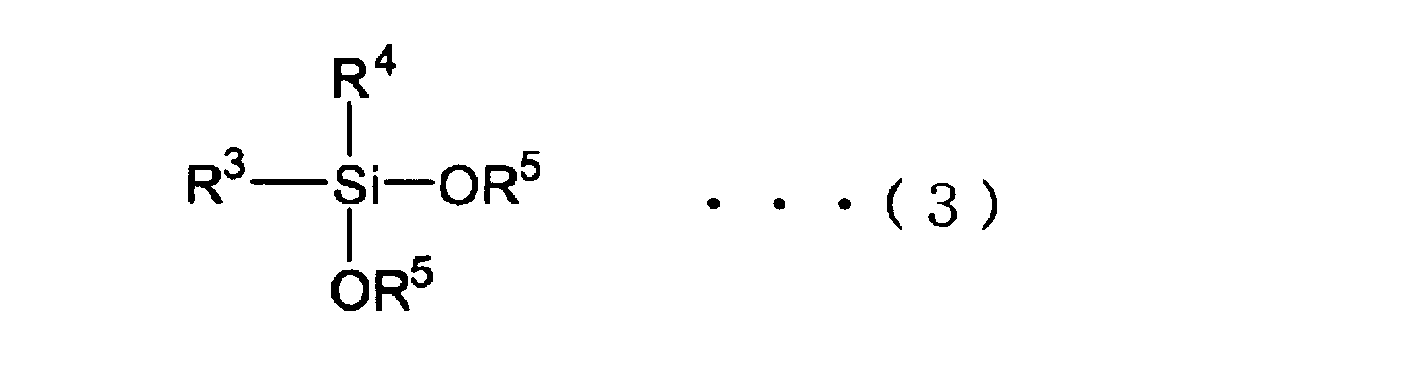
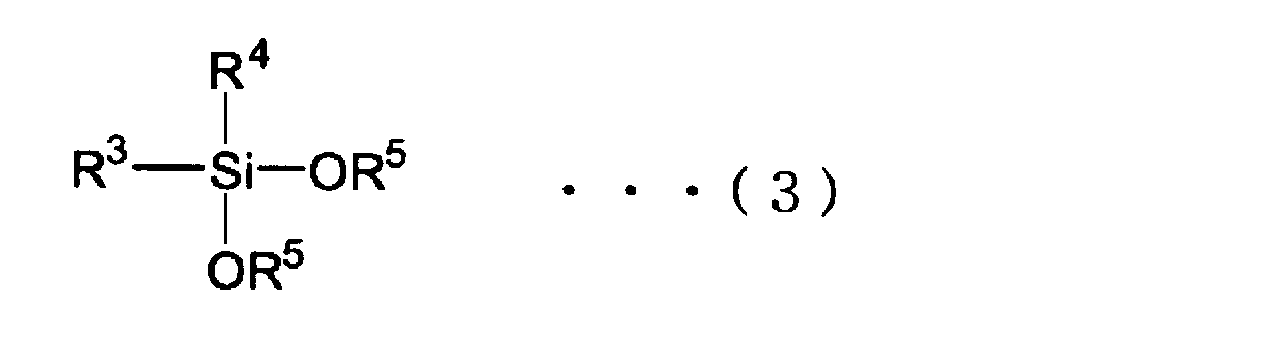
- the compound represented by Formula (3) is mentioned, for example.
- R 3 represents — (CH 2 ) i—CH ⁇ CH 2 , — (CH 2 ) j—R 6 , —C 6 H 4 —CH ⁇ CH 2 , — (CH 2 ) 3 —O— (C ⁇ O) —CR 7 ⁇ CH 2 , — (CH 2 ) 3 —NHR 8 , — (CH 2 ) 3 —R 9 , — (CH 2 ) 3 —SR 10 or — (CH 2 ) 3 —N ⁇ C ⁇ O, wherein R 6 is an organic functional group represented by formula (4) or formula (5), R 7 represents a hydrogen atom or CH 3 , R 8 represents a hydrogen atom, — (CH 2 ) 2 —NH 2 , —C 6 H 5 or — (C ⁇ O) —NH 2 , R 9 represents an organic functional group represented by the formula (6), and R 10 represents a hydrogen atom or —S —S—S— (CH 2 ) 3 —S
- R 4 represents a methyl group, a methoxy group, an ethoxy group or an acetoxy group
- R 5 represents a methyl group, an ethyl group or an acetyl group.
- silane coupling agent (C) represented by the above formula (3) examples include vinyltrimethoxysilane, vinylethoxysilane, vinyltriacetoxysilane, allyltrimethoxysilane, p-styryltrimethoxysilane, 2- (3 , 4-epoxycyclohexyl) ethyltrimethoxysilane, 3-glycidoxypropyltrimethoxysilane, 3-glycidoxypropyltriethoxysilane, 3-glycidoxypropylmethyldimethoxysilane, 3-glycidoxypropylmethyldiethoxy Silane, 3-methacryloxypropylmethyldimethoxysilane, 3-methacryloxypropyltrimethoxysilane, 3-methacryloxypropyltriethoxysilane, 3-acryloxypropylto Methoxysilane, N-2- (aminoethyl) -3
- R 3 in the formula (3) is — (CH 2 ) 3 —NHR 8 or (CH 2 ) 3 —R 9 .
- R 8 represents a hydrogen atom, — (CH 2 ) 2 —NH 2 , —C 6 H 5 or (C ⁇ O) —NH 2
- R 9 represents an organic functional group represented by the formula (6). Represents.
- silane coupling agent having an amino group examples include N-2- (aminoethyl) -3-aminopropylmethyldimethoxysilane, N-2- (aminoethyl) -3-aminopropyltrimethoxysilane, 3-amino Examples thereof include propyltrimethoxysilane, 3-aminopropyltriethoxysilane, 3-triethoxysilyl-N- (1,3-dimethylbutylidene) propylamine, and N-phenyl-3-aminopropyltrimethoxysilane.
- the mixing order of the silver compound (A), the amine compound (B), and the silane coupling agent (C) is not particularly limited.
- the composition of the present invention contains a solvent in addition to the silver compound (A), the amine compound (B), and the silane coupling agent (C) for the purpose of improving the coating property to the substrate and adjusting the viscosity. It can be added as appropriate.
- the amount of the solvent used is preferably 20 to 80% by mass with respect to 100% by mass in total of the silver compound (A), the amine compound (B), the silane coupling agent (C) and the solvent. If the amount of solvent exceeds 80% by mass, a uniform silver film may not be obtained due to a decrease in silver content.
- the type of the solvent is not particularly limited, but is preferably a solvent that can be easily removed during production of the silver element, and the solvents can be used alone or in combination depending on the application.
- the solvent include methanol, ethanol, 1-propanol, 2-propanol, 1-butanol, 2-butanol, 2-methyl-1-propanol, 2-methyl-2-propanol, 1-pentanol, and 2-pen.
- Solvents that further improve the flatness and low-temperature sinterability of the silver element formed include, for example, methanol, ethanol, 1-propanol, 2-propanol, 1-butanol, 2-butanol, and 2-methyl-1-propanol.
- 2-methyl-2-propanol 1-pentanol, 2-pentanol, 3-pentanol, 3-methyl-1-butanol, 2-methyl-1-butanol, 2,2-dimethyl-1-propanol, 3-methyl-2-butanol, 2-methyl-2-butanol, 1-hexanol, 2-hexanol, 3-hexanol, 2-methyl-1-pentanol, 3-methyl-1-pentanol, 4-methyl- 1-pentanol, 2-methyl-2-pentanol, 3-methyl-2-pentanol, 4-methyl-2-pentanol, -Methyl-3-pentanol, 3-methyl-3-pentanol, 2,2-dimethyl-1-butanol, 2,3-dimethyl-1-butanol, 3,3-dimethyl-1-butanol, 2,3 -Dimethyl-2-butanol, 3,3-dimethyl-2-butanol, 2-ethyl-1-
- the mixing order of the silver compound (A), the amine compound (B), the silane coupling agent (C) and the solvent is not particularly limited.
- a method of adding a solvent to a mixture of a silver compound (A), an amine compound (B), and a silane coupling agent (C), a silver compound (A) and a silane in a mixture of an amine compound (B) and a solvent Method of adding coupling agent (C), method of adding amine compound (B) and silane coupling agent (C) to a mixture of silver compound (A) and solvent, silane coupling agent (C) and solvent And a method of adding the silver compound (A) and the amine compound (B) to the mixture.
- composition of the present invention if necessary, for example, a hydrocarbon, acetylene alcohol, or silicone oil is used to adjust the leveling property with respect to the substrate, and, for example, a resin is used to adjust the viscosity characteristics of the composition. Or a plasticizer can be appropriately blended. Furthermore, if necessary, for example, other conductor powders, glass powders, surfactants, metal salts, and other additives generally used in silver-containing compositions may be appropriately blended.
- the composition of the present invention comprises a silver colloid dispersion liquid in which the composition is pre-heated and a generally known reducing agent is allowed to act to form silver clusters and nanoparticles.
- a generally known reducing agent include borohydride compounds, tertiary amines, thiol compounds, phosphorus compounds, ascorbic acid, quinones, and phenols.
- the amount of the reducing agent used can be appropriately selected as long as the conductivity and flatness of the resulting silver element are not lost.
- the silver element-forming base material of the present invention is a silver element in which the silver-containing composition of the present invention is applied on a base material such as a substrate, and the base material is heated to form metallic silver in a film or line shape. It is a base material provided.
- the material of the base material to which the composition of the present invention is applied is not particularly limited, and examples thereof include glass, silicon, silicon nitride, ITO, copper, aluminum, polyimide, polyester, and polycarbonate. From the viewpoint of productivity, a resin base material such as flexible polyester suitable for various printing methods is preferable.
- composition of the present invention to a substrate can be performed by printing or the like.
- the heating temperature at the time of heat-treating the substrate is not particularly limited as long as it is room temperature or higher. However, in consideration of productivity, heating at 80 ° C. or higher is preferable for firing in a short time.
- heat treatment is preferably performed at a temperature of 80 ° C. or higher and lower than 150 ° C.
- the heat processing of 120 to 170 degreeC is preferable from the point of productivity.
- Example 1-1 In a light-shielding bottle, 100 mg of the silver salt (A) prepared in Synthesis Example 1 as the silver compound (A) is dissolved in 896 mg of hexylamine (HA) as the amine compound (B), and the silane coupling agent (C) 4 mg of N-2- (aminoethyl) -3-aminopropyltrimethoxysilane was added and mixed to obtain 1000 mg of a silver-containing composition.
- Table 1 shows the amount of the silver compound (A), the amount of the amine compound (B) and the substituent in the above formula (2), and the amount of the silane coupling agent (C) and the substituent in the above formula (3). Show.
- Examples 1-2 to 1-5 A silver-containing composition was prepared in the same manner as in Example 1-1 except that the amounts of silver salt (A), HA and N-2- (aminoethyl) -3-aminopropyltrimethoxysilane were changed as shown in Table 1. Obtained.
- Example 1-6 In a light-shielding bottle, 398 mg of the silver salt (A) prepared in Synthesis Example 1 as the silver compound (A) is dissolved in 597 mg of HA as the amine compound (B), and vinyltril as the silane coupling agent (C) is dissolved. 5 mg of acetoxysilane was added to obtain 1000 mg of a silver-containing composition.
- Table 1 shows the amount of the silver compound (A), the amount of the amine compound (B) and the substituent in the above formula (2), and the amount of the silane coupling agent (C) and the substituent in the above formula (3). Show.
- Examples 1-7 to 1-21 The silane coupling agent (C) was changed to allyltrimethoxysilane in Example 1-7, 2- (3,4-epoxycyclohexyl) ethyltrimethoxysilane in Example 1-8, and 3 in Example 1-9.
- Example 1-16 3-triethoxysilyl-N- (1, -Dimethyl-butylidene) propylamine, N-phenyl-3-aminopropyltrimethoxysilane in Example 1-17, 3-ureidopropyltriethoxysilane in Example 1-18, 3 in Example 1-19 -Same as Example 1-6 except that mercaptopropyltrimethoxysilane was changed to bis (triethoxysilylpropyl) tetrasulfide in Example 1-20 and 3-isocyanatopropyltriethoxysilane in Example 1-21. A silver-containing composition was obtained. The results are shown in Table 1.
- Example 1-22 In a light-shielding bottle, 398 mg of the silver salt (A) prepared in Synthesis Example 1 as the silver compound (A) is dissolved in 597 mg of butylamine (BA) as the amine compound (B), and used as the silane coupling agent (C). 5 mg of N-2- (aminoethyl) -3-aminopropyltrimethoxysilane was added to obtain a silver-containing composition.
- Table 1 shows the amount of the silver compound (A), the amount of the amine compound (B) and the substituent in the above formula (2), and the amount of the silane coupling agent (C) and the substituent in the above formula (3). Show.
- Examples 1-23 to 1-28 The amine compound (B) is propylamine (PA) in Example 1-23, dibutylamine (DBA) in Example 1-24, 2-ethoxyethylamine (2-EOEA) in Example 1-25, Example 1-26 was changed to 2-ethylhexylamine (2-EHA), Example 1-27 was changed to isopentylamine (IAA), and Example 1-28 was changed to 2-EHA 199 mg and 2-EOEA 398 mg. Obtained a silver-containing composition in the same manner as in Example 1-22. The results are shown in Table 1.
- Comparative Example 1-1 In a light-shielding bottle, 100 mg of the silver salt (A) prepared in Synthesis Example 1 as the silver compound (A) was dissolved in 900 mg of HA as the amine compound (B) to obtain a silver-containing composition. Table 1 shows the amount of the silver compound (A), the amount of the amine compound (B), and the substituent in the above formula (2). Comparative Example 1-2 A silver-containing composition was obtained in the same manner as in Comparative Example 1 except that the amount of silver salt (A) and the amount of HA prepared in Synthesis Example 1 were changed as shown in Table 1.
- Examples 2-1 to 2-32 and Comparative Examples 2-1 to 2-4 In a light-shielding bottle, the silver-containing composition obtained in any of Examples 1-1 to 1-28 and Comparative Examples 1-1 and 1-2 in the amount shown in Table 2 was used in the amount of solvent shown in Table 2.
- IPA isopropyl alcohol
- MeOH represents methanol
- PGM represents propylene glycol monomethyl ether
- n-HA represents 1-hexanol
- TAA represents tert-amyl alcohol.
- Examples 3-1 to 3-32, Comparative Examples 3-1 and 3-2 The solutions prepared in Examples 1-1 to 1-28 and Comparative Examples 1-1 and 1-2 were applied to various substrates shown in Table 3 with a spin coater (Mikasa Co., Ltd.). A heat treatment was performed under the heating conditions shown to obtain a silver film. About the obtained silver film, the electrical conductivity shown below, adhesiveness, and the storage stability of a silver containing composition were evaluated. The results are shown in Table 3.
- ⁇ Electrical conductivity evaluation> The measurement was performed using a four-end needle type low resistivity meter (Lorestar GP: manufactured by Mitsubishi Chemical Corporation).
- the volume resistivity is a value when glass is used for the substrate, and those having a volume resistivity of 5.0 ⁇ 10 ⁇ 5 ⁇ ⁇ cm or less are represented by “ ⁇ ”, and “ ⁇ ” evaluation is the effect of the present invention. It was supposed to satisfy.
- ⁇ Adhesion evaluation> The cellophane tape was adhered to and peeled from the obtained silver film to evaluate the adhesion to the substrate. The evaluation was performed by the mechanical property-adhesion (cross-cut method) test method of the coating film specified in JIS K5600-5-6.
- the copper base material is abbreviated as Cu
- the polyester base material as PET
- the polycarbonate base material as PC
- the silicon base material as Si
- the silicon nitride base material as SiN.
- Examples 4-1 to 4-36, Comparative examples 4-1 to 4-4 The solutions prepared in Examples 2-1 to 2-32 and Comparative Examples 2-1 to 2-4 were applied to various substrates shown in Table 4 with a spin coater (Mikasa Co., Ltd.). Heat treatment was performed under the heating conditions shown to obtain a silver film. The conductivity, adhesion, and storage stability of the resulting silver film were evaluated in the same manner as in Examples 3-1 to 3-30 and Comparative Examples 3-1 and 3-2. The results are shown in Table 4.
Landscapes
- Chemical & Material Sciences (AREA)
- Life Sciences & Earth Sciences (AREA)
- Engineering & Computer Science (AREA)
- Materials Engineering (AREA)
- Wood Science & Technology (AREA)
- Organic Chemistry (AREA)
- Spectroscopy & Molecular Physics (AREA)
- Physics & Mathematics (AREA)
- Dispersion Chemistry (AREA)
- Inorganic Chemistry (AREA)
- Conductive Materials (AREA)
- Paints Or Removers (AREA)
- Inks, Pencil-Leads, Or Crayons (AREA)
Description
低温焼結可能な銀材料として、有機酸を用いた銀塩を利用する金属銀の形成方法が報告されている(特許文献2)。前記有機銀塩は、単官能カルボン酸と銀とから成る銀塩であるために、化合物中の銀含有率が低く焼結時に残存する有機成分が多くなる。該有機成分を分解・蒸発させるためには、焼結時間を長くする必要がある。また、低温焼結性を発現する前記有機銀塩は、熱に対して不安定であり、銀含有組成物の保存安定性が悪いことが問題となる。
本発明の別の目的は、導電性及び密着性に優れた金属銀膜や線等の銀要素を備えた銀要素形成基材を提供することにある。
また本発明によれば、上記銀含有組成物を基材上に塗布し、該基材を加熱して銀要素を形成された銀要素形成基材が提供される。
さらに、本発明によれば、基材上への塗布及び加熱によって該基材上に銀要素を形成するための組成物として、上記銀含有組成物は使用される。
本発明の銀含有組成物(以下、単に組成物ということがある)は、上記式(1)で表される銀化合物(A)、上記式(2)で表されるアミン化合物(B)、及びシランカップリング剤(C)を特定割合で含有する。
銀化合物(A)は、アセトンジカルボン酸銀であり、その形態は通常粉体である。該銀化合物(A)は、溶剤に希釈した際に粘度が高くなり、印刷等のパターニングが難しい物質であることが知られている。
しかし、上記アミン化合物(B)と組み合わせることで、銀含有量の高い組成物においても粘度を低く設定することができ、120℃以下の低温かつ短時間焼結にて金属銀を生成することが可能となる。
一方、銀化合物(A)とアミン化合物(B)とを組み合わせた銀含有組成物から得られる金属銀膜や線等の銀要素は、ガラス、シリコン、ITO、ポリエステルなどの各種基材に対する密着性に乏しい。そこで、銀化合物(A)及びアミン化合物(B)に、更にシランカップリング剤(C)を特定割合で配合することで、120℃以下の低温かつ短時間焼結においても、形成される銀要素は良好な導電性を維持したまま、各種基材に対する密着性を格段に向上させることができる。
本発明に用いるアミン化合物(B)は、上記式(2)で表される化合物であり、式中のR1は、水素原子、-(CY1Y2)a-CH3又は-((CH2)b-O-CHZ)c-CH3を表し、R2は、-(CY1Y2)d-CH3又は-((CH2)e-O-CHZ)f-CH3を表す。ここで、Y1とY2はそれぞれ独立して水素原子又は-(CH2)g-CH3を表し、Zは水素原子又は-(CH2)h-CH3を表す。aは0~8の整数、bは1~4の整数、cは1~3の整数、dは0~8の整数、eは1~4の整数、fは1~3の整数、gは0~3の整数、hは0~2の整数である。
アミン化合物(B)としては、例えば、エチルアミン、1-プロピルアミン、1-ブチルアミン、1-ペンチルアミン、1-ヘキシルアミン、1-ヘプチルアミン、1-オクチルアミン、2-エチルヘキシルアミン、イソプロピルアミン、イソブチルアミン、イソペンチルアミン、sec-ブチルアミン、tert-ブチルアミン、tert-アミルアミン、3-メトキシプロピルアミン、3-エトキシプロピルアミン、3-イソプロポキシプロピルアミン、ジイソプロピルアミン、ジブチルアミンの1種又は2種以上が挙げられる。
シランカップリング剤(C)としては、例えば、式(3)で表される化合物が挙げられる。

アミノ基を有するシランカップリング剤としては、例えば、N-2-(アミノエチル)-3-アミノプロピルメチルジメトキシシラン、N-2-(アミノエチル)-3-アミノプロピルトリメトキシシラン、3-アミノプロピルトリメトキシシラン、3-アミノプロピルトリエトキシシラン、3-トリエトキシシリル-N-(1,3-ジメチルブチリデン)プロピルアミン、N-フェニル-3-アミノプロピルトリメトキシシランが挙げられる。
還元剤としては、例えば、ホウ素化水素化合物、三級アミン、チオール化合物、リン化合物、アスコルビン酸、キノン類、フェノール類が挙げられる。還元剤の使用量は、得られる銀要素の導電性や平坦性を失われない範囲で適宜選択することができる。
本発明の組成物を塗布する基材の材質は特に制限されず、例えば、ガラス、シリコン、窒化シリコン、ITO、銅、アルミ、ポリイミド、ポリエステル、ポリカーボネートが挙げられる。生産性の点からは、各種印刷法に適するとされるフレキシブルなポリエステルなどの樹脂製基材が好ましい。
合成例1 アセトンジカルボン酸銀の合成
アセトンジカルボン酸43.8gを1000mlビーカーに秤量後、イオン交換水600gに添加し溶解させ氷冷し、さらに硝酸銀102gを添加して溶解させた。そこへ、キシルアミン48gを投入後、30分間撹拌した。得られた白色の固体をろ取し、アセトンで洗浄後、減圧乾燥することでアセトンジカルボン酸銀(以下、銀塩(A)と略す)88.2gを得た。収率は82%であった。
遮光瓶中で、銀化合物(A)としての合成例1で調製した銀塩(A)100mgを、アミン化合物(B)としてのヘキシルアミン(HA)896mgに溶解させ、シランカップリング剤(C)としてのN-2-(アミノエチル)-3-アミノプロピルトリメトキシシラン4mgを添加混合して銀含有組成物1000mgを得た。銀化合物(A)の量、アミン化合物(B)の量とその上記式(2)における置換基、並びにシランカップリング剤(C)の量とその上記式(3)における置換基を表1に示す。
実施例1-2~1-5
銀塩(A)、HA及びN-2-(アミノエチル)-3-アミノプロピルトリメトキシシランの量を表1に示すとおり変更した以外は、実施例1-1と同様に銀含有組成物を得た。
遮光瓶中で、銀化合物(A)としての合成例1で調製した銀塩(A)398mgを、アミン化合物(B)としてのHA 597mgに溶解させ、シランカップリング剤(C)としてのビニルトリアセトキシシラン5mgを添加して銀含有組成物1000mgを得た。銀化合物(A)の量、アミン化合物(B)の量とその上記式(2)における置換基、並びにシランカップリング剤(C)の量とその上記式(3)における置換基を表1に示す。
実施例1-7~1-21
シランカップリング剤(C)を、実施例1-7ではアリルトリメトキシシランに、実施例1-8では2-(3,4-エポキシシクロヘキシル)エチルトリメトキシシランに、実施例1-9では3-グリシドキシプロピルメチルジメトキシシランに、実施例1-10では3-グリシドキシプロピルメチルジエトキシシランに、実施例1-11ではp-スチリルトリメトキシシランに、実施例1-12では3-メタクリロキシプロピルトリメトキシシランに、実施例1-13では3-アクリロキシプロピルトリメトキシシランに、実施例1-14ではN-2-(アミノエチル)-3-アミノプロピルトリメトキシシランに、実施例1-15では3-アミノプロピルトリメトキシシランに、実施例1-16では3-トリエトキシシリル-N-(1,3-ジメチル-ブチリデン)プロピルアミンに、実施例1-17ではN-フェニル-3-アミノプロピルトリメトキシシランに、実施例1-18では3-ウレイドプロピルトリエトキシシランに、実施例1-19では3-メルカプトプロピルトリメトキシシランに、実施例1-20ではビス(トリエトキシシリルプロピル)テトラスルフィドに、実施例1-21では3-イソシアネートプロピルトリエトキシシランに変更した以外は実施例1-6と同様に銀含有組成物を得た。結果を表1に示す。
遮光瓶中で、銀化合物(A)としての合成例1で調製した銀塩(A)398mgを、アミン化合物(B)としてのブチルアミン(BA)597mgに溶解させ、シランカップリング剤(C)としてのN-2-(アミノエチル)-3-アミノプロピルトリメトキシシラン5mgを添加して銀含有組成物を得た。銀化合物(A)の量、アミン化合物(B)の量とその上記式(2)における置換基、並びにシランカップリング剤(C)の量とその上記式(3)における置換基を表1に示す。
実施例1-23~1-28
アミン化合物(B)を、実施例1-23ではプロピルアミン(PA)に、実施例1-24ではジブチルアミン(DBA)に、実施例1-25では2-エトキシエチルアミン(2-EOEA)に、実施例1-26では2-エチルヘキシルアミン(2-EHA)に、実施例1-27ではイソペンチルアミン(IAA)に、実施例1-28では2-EHA 199mg及び2-EOEA 398mgに変更した以外は実施例1-22と同様に銀含有組成物を得た。結果を表1に示す。
遮光瓶中で、銀化合物(A)としての合成例1で調製した銀塩(A)100mgを、アミン化合物(B)としてのHA 900mgに溶解させ、銀含有組成物を得た。銀化合物(A)の量、アミン化合物(B)の量とその上記式(2)における置換基を表1に示す。
比較例1-2
合成例1で調製した銀塩(A)の量とHAの量とを表1に示すとおり変更した以外は比較例1と同様に銀含有組成物を得た。
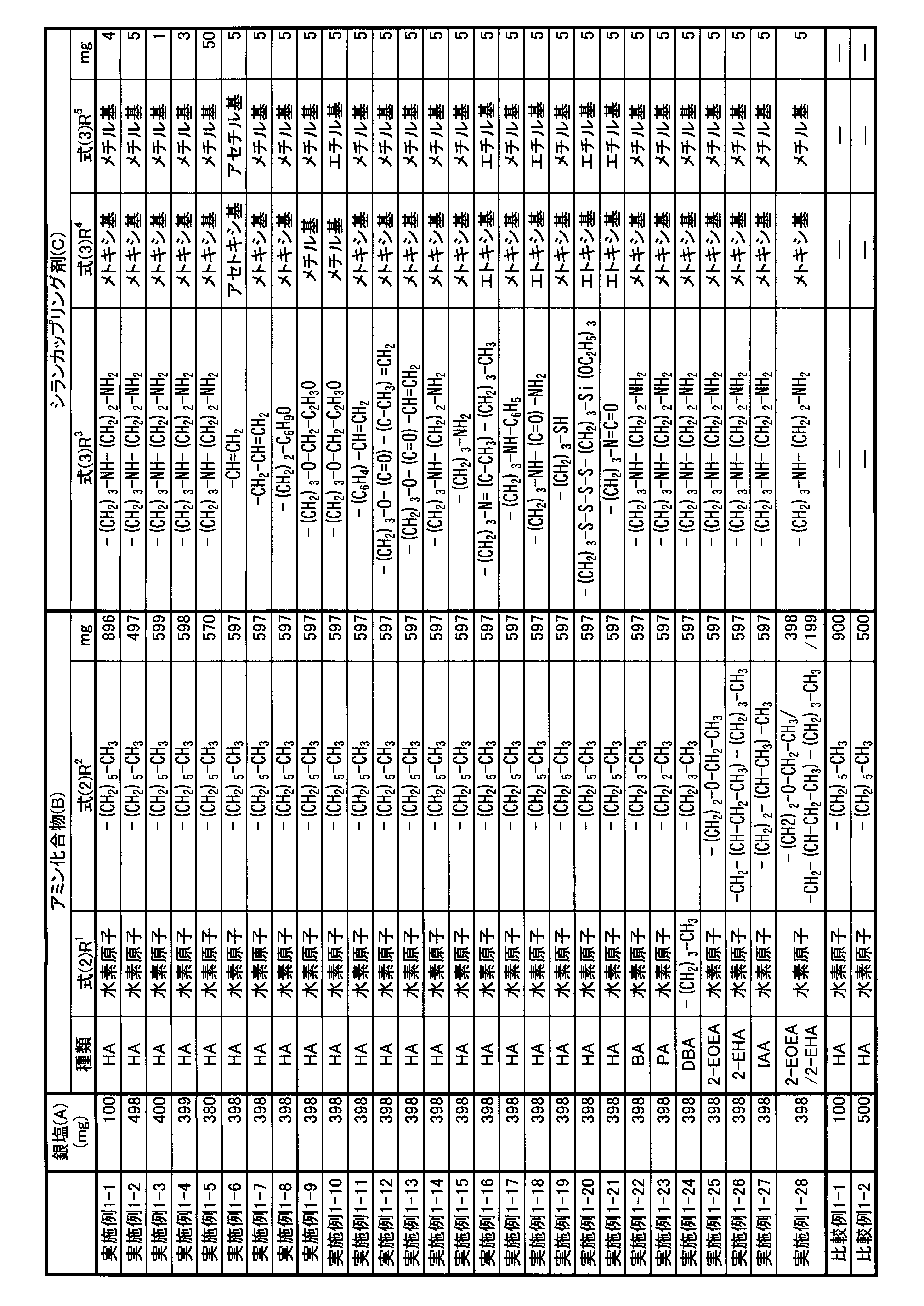
遮光瓶中で、表2に示す量の実施例1-1~1-28、比較例1-1及び1-2のいずれかで得られた銀含有組成物を、表2に示す量の溶媒に添加して、溶媒含有銀組成物を得た。
表2中、IPAはイソプロピルアルコール、MeOHはメタノール、PGMはプロピレングリコールモノメチルエーテル、n-HAは1-ヘキサノール、TAAはtert-アミルアルコールをそれぞれ示す。
実施例1-1~1-28、比較例1-1及び1-2で調製した溶液をスピンコーター(ミカサ(株)製)にて表3に示す各種基材に塗工し、表3に示す加熱条件で加熱処理を行って、銀膜を得た。得られた銀膜について、以下に示す導電性、密着性、及び銀含有組成物の保存安定性の評価を行った。結果を表3に示す。
四端針方式の低抵抗率計(ロレスターGP:三菱化学社製)を用いて行った。なお、体積抵抗率は基板にガラスを用いた場合の値となっており、体積抵抗率が5.0×10⁻⁵Ω・cm以下のものを○と表記し、○評価を本発明の効果を満たすものとした。
<密着性評価>
得られた銀膜にセロハンテープを密着、剥離することで基板に対する密着性を評価した。評価は、JIS K5600-5-6に規定される塗膜の機械的性質-付着性(クロスカット法)試験法で行った。剥離がなかったものを◎、セロハンテープ密着、剥離で剥離しなかったものを○、セロハンテープ密着、剥離で一部銀膜の剥離が確認されたものを△、セロハンテープ密着、剥離で全て剥離したものを×とし、◎、○、あるいは△評価を本発明の効果を満たすものとした。なお、表中、銅基材をCu、ポリエステル基材をPET、ポリカーボネート基材をPC、シリコン基材をSi、窒化シリコン基材をSiNと略記する。
<保存安定性評価>
各溶液を室温で2週間静置し、沈澱の有無にて確認した。評価は、沈澱の状態によって、沈澱がないものを○、微量の沈澱が見られるものを△、多量の沈澱が見られるものを×とし、○あるいは△評価を本発明の効果を満たすものとした。
実施例2-1~2-32及び比較例2-1~2-4で調製した溶液をスピンコーター(ミカサ(株)製)にて表4に示す各種基材に塗工し、表4に示す加熱条件で加熱処理を行って銀膜を得た。得られた銀膜の導電性、密着性、及び銀含有組成物の保存安定性の評価を、実施例3-1~3-30、比較例3-1及び3-2と同様に行った。結果を表4に示す。


Claims (4)
- 式(1)で表される銀化合物(A)、式(2)で表されるアミン化合物(B)、及びシランカップリング剤(C)を含む組成物であって、銀化合物(A)、アミン化合物(B)、及びシランカップリング剤(C)の合計100質量%に対して、銀化合物(A)を10~50質量%、アミン化合物(B)を50~90質量%、及びシランカップリング剤(C)を0.1~5質量%含む銀含有組成物。
- シランカップリング剤(C)が、式(3)で示される化合物である請求項1記載の銀含有化合物。

- 請求項1又は2に記載の銀含有組成物20~80質量%と、溶媒20~80質量%とを含む銀含有組成物。
- 請求項1~3のいずれかに記載の銀含有組成物を、基材上に塗布又は印刷し、該基材を加熱して銀要素を形成された銀要素形成基材。
Priority Applications (3)
| Application Number | Priority Date | Filing Date | Title |
|---|---|---|---|
| JP2014524793A JP6146414B2 (ja) | 2012-07-11 | 2013-07-08 | 銀含有組成物及び銀要素形成基材 |
| CN201380030436.9A CN104350550B (zh) | 2012-07-11 | 2013-07-08 | 含银组合物及形成银成分的基材 |
| KR1020147036068A KR102021636B1 (ko) | 2012-07-11 | 2013-07-08 | 은 함유 조성물 및 은 요소 형성 기재 |
Applications Claiming Priority (2)
| Application Number | Priority Date | Filing Date | Title |
|---|---|---|---|
| JP2012155122 | 2012-07-11 | ||
| JP2012-155122 | 2012-07-11 |
Publications (1)
| Publication Number | Publication Date |
|---|---|
| WO2014010549A1 true WO2014010549A1 (ja) | 2014-01-16 |
Family
ID=49916003
Family Applications (1)
| Application Number | Title | Priority Date | Filing Date |
|---|---|---|---|
| PCT/JP2013/068631 Ceased WO2014010549A1 (ja) | 2012-07-11 | 2013-07-08 | 銀含有組成物及び銀要素形成基材 |
Country Status (4)
| Country | Link |
|---|---|
| JP (1) | JP6146414B2 (ja) |
| KR (1) | KR102021636B1 (ja) |
| TW (1) | TWI594270B (ja) |
| WO (1) | WO2014010549A1 (ja) |
Cited By (3)
| Publication number | Priority date | Publication date | Assignee | Title |
|---|---|---|---|---|
| JP2016051624A (ja) * | 2014-09-01 | 2016-04-11 | 日油株式会社 | 銀含有組成物及び銀要素形成基材 |
| JP2019026790A (ja) * | 2017-08-02 | 2019-02-21 | 株式会社豊田中央研究所 | 超電導体用インク及び超電導体の製造方法 |
| JP2024003418A (ja) * | 2022-06-27 | 2024-01-15 | 日油株式会社 | 導電性組成物 |
Citations (2)
| Publication number | Priority date | Publication date | Assignee | Title |
|---|---|---|---|---|
| JP2009114232A (ja) * | 2007-11-01 | 2009-05-28 | Osaka Industrial Promotion Organization | β−ケトカルボン酸銀を含有するインク |
| JP2012153634A (ja) * | 2011-01-25 | 2012-08-16 | Nof Corp | 銀含有組成物及び基材 |
Family Cites Families (6)
| Publication number | Priority date | Publication date | Assignee | Title |
|---|---|---|---|---|
| JP2005060824A (ja) | 2003-07-28 | 2005-03-10 | Mitsuboshi Belting Ltd | 合金微粒子の製造方法及び合金薄膜の製造方法 |
| KR100727434B1 (ko) * | 2005-03-04 | 2007-06-13 | 주식회사 잉크테크 | 투명 은 잉크 조성물 및 이를 이용한 박막 형성방법 |
| EP1905756B1 (en) * | 2005-07-04 | 2013-02-27 | Osaka University | Silver beta-ketocarboxylate derivatives for forming silver metal |
| WO2007007802A1 (ja) * | 2005-07-13 | 2007-01-18 | Taiyo Ink Mfg. Co., Ltd. | 銀ペースト組成物、及びそれを用いた導電性パターンの形成方法、並びにその導電性パターン |
| JP5000288B2 (ja) | 2006-12-26 | 2012-08-15 | トッパン・フォームズ株式会社 | β−ケトカルボン酸銀から得られる金属銀を含む銀ペーストの製造方法及び金属銀の焼成方法 |
| JP5393988B2 (ja) * | 2008-02-21 | 2014-01-22 | トッパン・フォームズ株式会社 | インク、及び配線を形成する方法 |
-
2013
- 2013-07-08 KR KR1020147036068A patent/KR102021636B1/ko active Active
- 2013-07-08 WO PCT/JP2013/068631 patent/WO2014010549A1/ja not_active Ceased
- 2013-07-08 JP JP2014524793A patent/JP6146414B2/ja active Active
- 2013-07-10 TW TW102124649A patent/TWI594270B/zh active
Patent Citations (2)
| Publication number | Priority date | Publication date | Assignee | Title |
|---|---|---|---|---|
| JP2009114232A (ja) * | 2007-11-01 | 2009-05-28 | Osaka Industrial Promotion Organization | β−ケトカルボン酸銀を含有するインク |
| JP2012153634A (ja) * | 2011-01-25 | 2012-08-16 | Nof Corp | 銀含有組成物及び基材 |
Cited By (3)
| Publication number | Priority date | Publication date | Assignee | Title |
|---|---|---|---|---|
| JP2016051624A (ja) * | 2014-09-01 | 2016-04-11 | 日油株式会社 | 銀含有組成物及び銀要素形成基材 |
| JP2019026790A (ja) * | 2017-08-02 | 2019-02-21 | 株式会社豊田中央研究所 | 超電導体用インク及び超電導体の製造方法 |
| JP2024003418A (ja) * | 2022-06-27 | 2024-01-15 | 日油株式会社 | 導電性組成物 |
Also Published As
| Publication number | Publication date |
|---|---|
| KR102021636B1 (ko) | 2019-09-16 |
| TWI594270B (zh) | 2017-08-01 |
| JP6146414B2 (ja) | 2017-06-14 |
| JPWO2014010549A1 (ja) | 2016-06-23 |
| CN104350550A (zh) | 2015-02-11 |
| KR20150035734A (ko) | 2015-04-07 |
| TW201407641A (zh) | 2014-02-16 |
Similar Documents
| Publication | Publication Date | Title |
|---|---|---|
| JP5712635B2 (ja) | 銀含有組成物 | |
| CN101529532B (zh) | 导电层形成用银浆料 | |
| US8680309B2 (en) | Metal organic precursor, a method of preparing the same, and a method of forming a conductive metal film or pattern | |
| CN103946419A (zh) | 用于形成铜图形的组合物及铜图形的制备方法 | |
| CN104471652B (zh) | 含银组合物及银成分形成基材 | |
| JP6146414B2 (ja) | 銀含有組成物及び銀要素形成基材 | |
| US9133349B2 (en) | Zinc oxide film-forming composition, zinc oxide film production method, and zinc compound | |
| JP6509770B2 (ja) | 導電性金属粉ペースト | |
| JP6273805B2 (ja) | 銀含有組成物及び銀膜形成基材 | |
| JP2019006903A (ja) | 導電性銅インク組成物 | |
| CN104350550B (zh) | 含银组合物及形成银成分的基材 | |
| JP6384207B2 (ja) | 銀含有組成物及び銀要素形成基材 | |
| US10319928B2 (en) | Electrode material for organic semiconductor device | |
| JP6384206B2 (ja) | 導電性組成物、並びにそれを用いた配線、電極、導電パターン及び導電膜 | |
| TWI476202B (zh) | Silver-containing compositions and substrates | |
| JP6224472B2 (ja) | 導電膜形成用組成物、導電膜、有機薄膜トランジスタ、電子ペーパー、ディスプレイデバイスおよび配線板 | |
| JP6115280B2 (ja) | 導電性銅インク組成物 | |
| EP3617281A1 (en) | Solvent composition for producing electronic device |
Legal Events
| Date | Code | Title | Description |
|---|---|---|---|
| 121 | Ep: the epo has been informed by wipo that ep was designated in this application |
Ref document number: 13816781 Country of ref document: EP Kind code of ref document: A1 |
|
| ENP | Entry into the national phase |
Ref document number: 2014524793 Country of ref document: JP Kind code of ref document: A |
|
| ENP | Entry into the national phase |
Ref document number: 20147036068 Country of ref document: KR Kind code of ref document: A |
|
| NENP | Non-entry into the national phase |
Ref country code: DE |
|
| 122 | Ep: pct application non-entry in european phase |
Ref document number: 13816781 Country of ref document: EP Kind code of ref document: A1 |