WO2014007142A1 - 電気二重層キャパシタ用バインダー組成物 - Google Patents
電気二重層キャパシタ用バインダー組成物 Download PDFInfo
- Publication number
- WO2014007142A1 WO2014007142A1 PCT/JP2013/067684 JP2013067684W WO2014007142A1 WO 2014007142 A1 WO2014007142 A1 WO 2014007142A1 JP 2013067684 W JP2013067684 W JP 2013067684W WO 2014007142 A1 WO2014007142 A1 WO 2014007142A1
- Authority
- WO
- WIPO (PCT)
- Prior art keywords
- double layer
- water
- electric double
- layer capacitor
- soluble polymer
- Prior art date
- Legal status (The legal status is an assumption and is not a legal conclusion. Google has not performed a legal analysis and makes no representation as to the accuracy of the status listed.)
- Ceased
Links
Classifications
-
- H—ELECTRICITY
- H01—ELECTRIC ELEMENTS
- H01G—CAPACITORS; CAPACITORS, RECTIFIERS, DETECTORS, SWITCHING DEVICES, LIGHT-SENSITIVE OR TEMPERATURE-SENSITIVE DEVICES OF THE ELECTROLYTIC TYPE
- H01G11/00—Hybrid capacitors, i.e. capacitors having different positive and negative electrodes; Electric double-layer [EDL] capacitors; Processes for the manufacture thereof or of parts thereof
- H01G11/22—Electrodes
- H01G11/30—Electrodes characterised by their material
- H01G11/32—Carbon-based
-
- H—ELECTRICITY
- H01—ELECTRIC ELEMENTS
- H01G—CAPACITORS; CAPACITORS, RECTIFIERS, DETECTORS, SWITCHING DEVICES, LIGHT-SENSITIVE OR TEMPERATURE-SENSITIVE DEVICES OF THE ELECTROLYTIC TYPE
- H01G11/00—Hybrid capacitors, i.e. capacitors having different positive and negative electrodes; Electric double-layer [EDL] capacitors; Processes for the manufacture thereof or of parts thereof
- H01G11/22—Electrodes
- H01G11/30—Electrodes characterised by their material
- H01G11/32—Carbon-based
- H01G11/38—Carbon pastes or blends; Binders or additives therein
-
- Y—GENERAL TAGGING OF NEW TECHNOLOGICAL DEVELOPMENTS; GENERAL TAGGING OF CROSS-SECTIONAL TECHNOLOGIES SPANNING OVER SEVERAL SECTIONS OF THE IPC; TECHNICAL SUBJECTS COVERED BY FORMER USPC CROSS-REFERENCE ART COLLECTIONS [XRACs] AND DIGESTS
- Y02—TECHNOLOGIES OR APPLICATIONS FOR MITIGATION OR ADAPTATION AGAINST CLIMATE CHANGE
- Y02E—REDUCTION OF GREENHOUSE GAS [GHG] EMISSIONS, RELATED TO ENERGY GENERATION, TRANSMISSION OR DISTRIBUTION
- Y02E60/00—Enabling technologies; Technologies with a potential or indirect contribution to GHG emissions mitigation
- Y02E60/13—Energy storage using capacitors
Definitions
- the present invention relates to a binder composition for electric double layer capacitors.
- the present invention also relates to a slurry composition, an electrode, and an electric double layer capacitor using the binder composition for an electric double layer capacitor.
- capacitors electric double layer capacitors
- reduction of internal resistance is considered to be an important issue because it suppresses heat loss that occurs during charge / discharge of a large current and leads to improvement of charge / discharge efficiency.
- ⁇ Improvement of electrode strength leads to improvement of capacity because it can improve handling properties and reduce the winding diameter of the wound cell.
- the improvement of withstand voltage (durability) leads to the improvement of energy density. From the above, reduction of internal resistance, improvement of electrode strength and withstand voltage are important issues for improving the performance of the electric double layer capacitor.
- Patent Document 1 describes a binder composition for an electric double layer capacitor containing a water-soluble polymer composed of a vinyl alcohol polymer and a particulate binder. However, with the binder composition of Patent Document 1, it was possible to reduce the internal resistance, but it was found that the electrode strength and withstand voltage were insufficient.
- the present invention provides an electric double layer capable of improving the withstand voltage of the electric double layer capacitor and improving the electrode strength in addition to reducing the internal resistance of the electric double layer capacitor. It aims at providing the binder composition for capacitors.
- the present inventor has intensively studied to solve the above problems.
- the binder composition of Patent Document 1 since the surface of the electrode active material is not sufficiently coated, the electrode active material reacts with the electrolytic solution in the electric double layer capacitor, thereby decomposing the electrolytic solution. It has been found that the withstand voltage and the electrode strength are lowered. Therefore, as a result of further investigation, by including a specific water-soluble polymer in the binder composition, even an electrode active material having a large specific surface area can be sufficiently coated, It has been found that the withstand voltage and electrode strength of the multilayer capacitor are improved, and the present invention has been completed based on this finding.
- the gist of the present invention aimed at solving such problems is as follows. [1] containing a particulate binder and a water-soluble polymer,
- the binder composition for electric double layer capacitors according to any one of the above.
- An electric double layer capacitor slurry composition comprising the electric double layer capacitor binder composition according to any one of [1] to [7], an electrode active material, and water.
- An electrode for an electric double layer capacitor comprising the binder composition for an electric double layer capacitor as described in any one of [1] to [7] above and an electrode active material.
- a method for producing an electrode for an electric double layer capacitor comprising a step of applying the slurry composition for an electric double layer capacitor as described in [8] above onto a current collector and drying it.
- An electric double layer capacitor comprising an electrode, an electrolytic solution, and a separator, wherein the electrode is an electrode for an electric double layer capacitor according to [9] or [10].
- the binder composition of the present invention since it contains a specific water-soluble polymer, even an electrode active material having a large specific surface area can be coated on the surface. As a result, decomposition of the electrolytic solution by the electrode active material can be suppressed, and an electric double layer capacitor having a high withstand voltage can be obtained. Moreover, since the water-soluble polymer contained in the binder composition of the present invention is excellent in affinity with the electrolytic solution, an ionic conductivity is improved and an electric double layer capacitor having a low internal resistance can be obtained. Furthermore, according to the binder composition of the present invention, the electrode strength can be improved because of excellent binding properties between the electrode active materials or between the electrode active material and the current collector.
- the monomer unit means a structural unit derived from a monomer (a structural unit formed by polymerizing monomers).
- the ratio of each structural unit usually corresponds to the ratio (preparation ratio) of monomers capable of forming each structural unit in all monomers used for polymerization of the particulate binder or the water-soluble polymer.
- Binder composition for electric double layer capacitor is a particulate binder and a water-soluble polymer. including.
- the particulate binder has a property of being dispersed in a dispersion medium described later.
- a dispersion medium described later.
- the particulate binder is not particularly limited as long as it retains and exists in the particle shape in a state dispersed in a dispersion medium, but the electrode binder layer is preferably one that can exist in a state in which the particle shape is retained.
- the “state in which the particle state is maintained” does not have to be a state in which the particle shape is completely maintained, and may be in a state in which the particle shape is maintained to some extent.
- particulate binder examples include those in which binder particles such as latex are dispersed in water, and powders obtained by drying such a dispersion.
- the particulate binder in the present invention is preferably water-insoluble, that is, dispersed in a particulate form without being dissolved in an aqueous solvent.
- being water-insoluble means that when 0.5 g of the binder is dissolved in 100 g of water at 25 ° C., the insoluble content becomes 90% by mass or more.
- polymer constituting the particulate binder examples include polymer compounds such as a diene polymer, an acrylic polymer, a fluorine polymer, a polyimide, a polyamide, and a polyurethane polymer, and a diene polymer or an acrylic polymer.
- a polymer is preferable, and an acrylic polymer is more preferable in that it has excellent electrode strength, can increase the withstand voltage of the electric double layer capacitor, and can increase the energy density.
- Diene polymers include conjugated diene homopolymers; copolymers of different types of conjugated dienes; copolymers obtained by polymerizing monomer mixtures containing conjugated dienes, or hydrogenated products thereof.
- Examples of the conjugated diene include 1,3-butadiene, 2-methyl-1,3-butadiene, 2,3-dimethyl-1,3-butadiene, 2-ethyl-1,3-butadiene, and 2-chloro- Examples include 1,3-butadiene, 1,3-pentadiene, 1,3-hexadiene, and 2,4-hexadiene. Among these, 1,3-butadiene and 2-methyl-1,3-butadiene are preferable.
- a conjugated diene may be used individually by 1 type, and may be used combining two or more types by arbitrary ratios.
- the diene polymer is a copolymer obtained by polymerizing a monomer mixture containing a conjugated diene or a hydrogenated product thereof
- the ratio of the conjugated diene monomer unit in the diene polymer is preferably 20 masses. % To 60% by mass, more preferably 25% to 60% by mass, particularly preferably 30% to 55% by mass.
- the diene polymer preferably contains a nitrile group-containing monomer monomer unit in addition to the conjugated diene monomer unit.
- nitrile group-containing monomer include ⁇ , ⁇ -unsaturated nitrile compounds such as acrylonitrile, methacrylonitrile, ⁇ -chloroacrylonitrile, ⁇ -ethylacrylonitrile, and the like. Among them, acrylonitrile is preferable.
- a nitrile group containing monomer may be used individually by 1 type, and may be used combining two or more types by arbitrary ratios.
- the ratio of the nitrile group-containing monomer unit in the diene polymer is preferably 5 to 40% by mass, more preferably 5 to 30% by mass.
- the diene polymer may contain a monomer unit other than the above monomer units (hereinafter sometimes referred to as “other monomer units”).
- Other monomers that can form monomer units include unsaturated carboxylic acids such as acrylic acid, methacrylic acid, itaconic acid, fumaric acid; styrene, chlorostyrene, vinyltoluene, t-butylstyrene, vinylbenzoic acid.
- Styrene monomers such as methyl vinyl benzoate, vinyl naphthalene, chloromethyl styrene, hydroxymethyl styrene, ⁇ -methyl styrene, divinylbenzene; olefins such as ethylene, propylene; vinyl acetate, vinyl propionate, vinyl butyrate, Vinyl esters such as vinyl benzoate; Amide monomers such as acrylamide, N-methylolacrylamide, and acrylamide-2-methylpropanesulfonic acid; Vinyl ethers such as methyl vinyl ether, ethyl vinyl ether, and butyl vinyl ether; Methyl vinyl Ton, ethyl vinyl ketone, butyl vinyl ketone, hexyl vinyl ketone, such as isopropenyl vinyl ketone; N- vinylpyrrolidone, vinylpyridine, and a heterocyclic containing vinyl compounds such as vinyl imidazole.
- olefins such as ethylene
- the monomer which can form another monomer unit may each be used individually by 1 type, and may be used combining two or more types by arbitrary ratios.
- the content ratio of other monomer units in the diene polymer may be appropriately adjusted depending on the purpose of use.
- Specific examples of the monomer represented by the general formula (1) include ethyl acrylate, propyl acrylate, isopropyl acrylate, n-butyl acrylate, isobutyl acrylate, t-butyl acrylate, and n-acrylate.
- Acrylic esters such as amyl, isoamyl acrylate, n-hexyl acrylate, 2-ethylhexyl acrylate, lauryl acrylate, stearyl acrylate; ethyl methacrylate, propyl methacrylate, isopropyl methacrylate, n-butyl methacrylate, methacryl And methacrylic acid esters such as isobutyl acid, t-butyl methacrylate, n-amyl methacrylate, isoamyl methacrylate, n-hexyl methacrylate, 2-ethylhexyl methacrylate, lauryl methacrylate, and stearyl methacrylate.
- acrylate esters are preferable, and n-butyl acrylate and 2-ethylhexyl acrylate are particularly preferable because they can improve the strength of the obtained electrode and obtain an electric double layer capacitor having a high withstand voltage.
- the proportion of the structural unit derived from the monomer represented by the general formula (1) in the acrylic polymer is usually 50% by mass or more, preferably 70% by mass or more.
- the acrylic polymer preferably contains a nitrile group-containing monomer unit in addition to the monomer unit represented by the general formula (1).
- the nitrile group-containing monomer include acrylonitrile and methacrylonitrile as nitrile group-containing monomers copolymerizable with the monomer represented by the general formula (1).
- a nitrile group containing monomer may be used individually by 1 type, and may be used combining two or more types by arbitrary ratios.
- the ratio of the nitrile group-containing monomer unit in the acrylic polymer is preferably in the range of 5 to 35% by mass, more preferably 10 to 30% by mass.
- the acrylic polymer may contain a carboxylic acid group-containing monomer unit copolymerizable with the monomer unit in addition to the monomer unit.
- carboxylic acid group-containing monomer include monobasic acid-containing monomers such as acrylic acid and methacrylic acid; dibasic acid-containing monomers such as maleic acid, fumaric acid, and itaconic acid.
- a dibasic acid-containing monomer is preferable, and itaconic acid is particularly preferable in terms of improving the binding property between the current collector and the electrode mixture layer and improving the electrode strength.
- These monobasic acid-containing monomers and dibasic acid-containing monomers can be used alone or in combination of two or more.
- the content ratio of the carboxylic acid group-containing monomer unit in the acrylic polymer is preferably 1 to 50% by mass, more preferably 1 to 20% by mass, and particularly preferably 1 to 10% by mass.
- specific examples of the monomer constituting the copolymerizable monomer unit that can be included in the acrylic polymer include 2 such as ethylene glycol dimethacrylate, diethylene glycol dimethacrylate, and trimethylolpropane triacrylate.
- Carboxylic acid esters having one or more carbon-carbon double bonds Unsaturated esters containing fluorine in the side chain such as purple orooctylethyl acrylate and purple orooctylethyl methacrylate; styrene, chlorostyrene, vinyltoluene, t -Styrene monomers such as butyl styrene, vinyl benzoic acid, methyl vinyl benzoate, vinyl naphthalene, chloromethyl styrene, hydroxymethyl styrene, ⁇ -methyl styrene, divinyl benzene; acrylamide, N-methylol acrylate Amide monomers such as ilamide and acrylamide-2-methylpropanesulfonic acid; Olefins such as ethylene and propylene; Diene monomers such as butadiene and isoprene; Monomers containing halogen atoms such as vinyl chloride and vinyliden
- the glass transition temperature (Tg) of the particulate binder is preferably 50 ° C. or lower, more preferably ⁇ 40 to 0 ° C.
- the number average particle size of the particulate binder is not particularly limited, but is usually 0.01 to 1 ⁇ m, preferably 0.03 to 0.8 ⁇ m, more preferably 0.05 to 0.5 ⁇ m.
- the number average particle diameter is a number average particle diameter calculated as an arithmetic average value obtained by measuring the diameter of 100 binder particles randomly selected in a transmission electron micrograph.
- the shape of the particles can be either spherical or irregular.
- the water-soluble polymer is a copolymer containing at least an unsaturated carboxylic acid monomer unit and a fluorine-containing (meth) acrylic acid ester monomer unit.
- This copolymer may further contain a (meth) acrylic acid ester monomer unit or a crosslinkable monomer unit, and is a monomer having functionality such as a reactive surfactant monomer.
- Structural units derived from the body hereinafter sometimes abbreviated as “reactive surfactant monomer unit”
- structural units derived from other copolymerizable monomers etc. Also good.
- (meth) acryl includes both acrylic and methacrylic.
- the binding property between the current collector and the electrode mixture layer can be improved, and the electrode strength can be improved.
- the electrode active material described later covers the surface of the electrode active material described later with the water-soluble polymer, decomposition of the electrolytic solution by the electrode active material is suppressed in the electric double layer capacitor, and the withstand voltage of the electric double layer capacitor can be improved.
- the electrode active material is coated with a water-soluble polymer, the affinity between the electrode active material and the electrolytic solution can be improved, the ionic conductivity can be improved, and the internal resistance of the electric double layer capacitor can be reduced.
- Unsaturated carboxylic acid monomer unit An unsaturated carboxylic acid monomer unit is a structural unit derived from an unsaturated carboxylic acid monomer.
- the unsaturated carboxylic acid monomer include unsaturated monocarboxylic acid and its derivative, unsaturated dicarboxylic acid and its acid anhydride, and derivatives thereof.
- unsaturated monocarboxylic acids include acrylic acid, methacrylic acid, and crotonic acid.
- Examples of unsaturated monocarboxylic acid derivatives include 2-ethylacrylic acid, isocrotonic acid, ⁇ -acetoxyacrylic acid, ⁇ -trans-aryloxyacrylic acid, ⁇ -chloro- ⁇ -E-methoxyacrylic acid, and ⁇ -Diaminoacrylic acid.
- Examples of unsaturated dicarboxylic acids include maleic acid, fumaric acid, and itaconic acid.
- Examples of unsaturated dicarboxylic acid anhydrides include maleic anhydride, acrylic anhydride, methyl maleic anhydride, and dimethyl maleic anhydride.
- Examples of derivatives of unsaturated dicarboxylic acids include methylmaleic acid, dimethylmaleic acid, phenylmaleic acid, chloromaleic acid, dichloromaleic acid, fluoromaleic acid, methylallyl maleate; and diphenyl maleate, nonyl maleate, maleate
- Examples thereof include maleate esters such as decyl acid, dodecyl maleate, octadecyl maleate, and fluoroalkyl maleate.
- ethylenically unsaturated monocarboxylic acids such as acrylic acid and methacrylic acid are preferable. This is because the dispersibility of the obtained water-soluble polymer in water can be further increased.
- an acidic functional group can be introduced into the water-soluble polymer.
- an advantage that the adhesion between the water-soluble polymer and the metal current collector can be improved can be obtained.
- the content of the unsaturated carboxylic acid monomer unit in the water-soluble polymer is preferably 20 to 50% by mass, more preferably 25 to 50% by mass, and particularly preferably 30 to 50% by mass.
- Fluorine-containing (meth) acrylic acid ester monomer unit is a structural unit derived from a fluorine-containing (meth) acrylic acid ester monomer.
- the hydrocarbon group usually has 1 to 18 carbon atoms.
- the number of fluorine atoms contained in R 3 may be 1 or 2 or more.
- Examples of the fluorine-containing (meth) acrylic acid ester monomer represented by the general formula (2) include (meth) acrylic acid alkyl fluoride, (meth) acrylic acid fluoride aryl, and (meth) acrylic acid fluorine monomer.
- Aralkyl Of these, alkyl fluoride (meth) acrylate is preferable.
- Specific examples of such a monomer include (meth) acrylic acid-2,2,2-trifluoroethyl, (meth) acrylic acid- ⁇ - (perfluorooctyl) ethyl, (meth) acrylic acid-2.
- One type of fluorine-containing (meth) acrylic acid ester monomer may be used alone, or two or more types may be used in combination at any ratio. Therefore, the water-soluble polymer may contain only one type of fluorine-containing (meth) acrylic acid ester monomer unit, or may contain two or more types in combination at any ratio.
- the content ratio of the fluorine-containing (meth) acrylic acid ester monomer unit in the water-soluble polymer is preferably 0.1 to 30% by mass, more preferably 0.5 to 25% by mass, and particularly preferably 1 to 20%. It is the range of mass%.
- alkali resistance is imparted to the electrode mixture layer by including a fluorine-containing (meth) acrylic acid ester monomer unit.
- the slurry composition for electrode formation may contain an alkaline substance, and the alkaline substance may be generated by oxidation / reduction due to the operation of the element. Such an alkaline substance corrodes the current collector and impairs the device life.
- the electrode mixture layer has alkali resistance, so that corrosion of the current collector due to the alkaline substance is suppressed.
- the (meth) acrylic acid ester monomer unit is a structural unit derived from a (meth) acrylic acid ester monomer. However, among the (meth) acrylate monomers, those containing fluorine are distinguished from (meth) acrylate monomers as the above-mentioned fluorine-containing (meth) acrylate monomers.
- Examples of (meth) acrylic acid ester monomers include methyl acrylate, ethyl acrylate, n-propyl acrylate, isopropyl acrylate, n-butyl acrylate, t-butyl acrylate, pentyl acrylate, hexyl acrylate, heptyl acrylate, octyl acrylate, Acrylic acid alkyl esters such as 2-ethylhexyl acrylate, nonyl acrylate, decyl acrylate, lauryl acrylate, n-tetradecyl acrylate, stearyl acrylate; and methyl methacrylate, ethyl methacrylate, n-propyl methacrylate, isopropyl methacrylate, n-butyl methacrylate, t -Butyl methacrylate, pentyl methacrylate, hexyl methacrylate, heptyl
- (Meth) acrylic acid ester monomer may be used alone or in combination of two or more at any ratio. Therefore, the water-soluble polymer may contain only one type of (meth) acrylic acid ester monomer unit, or may contain two or more types in combination at any ratio.
- the content ratio of the (meth) acrylic acid ester monomer unit is preferably 30 to 70% by mass, more preferably 35 to 70% by mass, and particularly preferably 40 to 70% by mass.
- the cross-linkable monomer unit water-soluble polymer may further contain a cross-linkable monomer unit in addition to the above structural units.
- a crosslinkable monomer unit is a structural unit derived from a crosslinkable monomer.
- a crosslinkable monomer is a monomer that can form a crosslinked structure during or after polymerization by heating or energy irradiation.
- a monomer having thermal crosslinkability can be usually mentioned. More specifically, a monofunctional monomer having a heat-crosslinkable crosslinkable group and one olefinic double bond per molecule, or a polyfunctional having two or more olefinic double bonds per molecule. Ionic monomers.
- thermally crosslinkable groups contained in the monofunctional monomer include epoxy groups, N-methylolamide groups, oxetanyl groups, oxazoline groups, and combinations thereof.
- an epoxy group is more preferable in terms of easy adjustment of crosslinking and crosslinking density.
- crosslinkable monomer having an epoxy group as a thermally crosslinkable group and having an olefinic double bond examples include vinyl glycidyl ether, allyl glycidyl ether, butenyl glycidyl ether, o-allylphenyl glycidyl.
- Unsaturated glycidyl ethers such as ether; butadiene monoepoxide, chloroprene monoepoxide, 4,5-epoxy-2-pentene, 3,4-epoxy-1-vinylcyclohexene, 1,2-epoxy-5,9-cyclododecadiene Monoepoxides of dienes or polyenes such as; alkenyl epoxides such as 3,4-epoxy-1-butene, 1,2-epoxy-5-hexene, 1,2-epoxy-9-decene; and glycidyl acrylate, glycidyl methacrylate, Glycidyl crotonate, Unsaturated carboxylic acids such as glycidyl-4-heptenoate, glycidyl sorbate, glycidyl linoleate, glycidyl-4-methyl-3-pentenoate, glycidyl este
- crosslinkable monomer having an N-methylolamide group as a thermally crosslinkable group and having an olefinic double bond have a methylol group such as N-methylol (meth) acrylamide (meta ) Acrylamides.
- crosslinkable monomer having an oxetanyl group as a thermally crosslinkable group and having an olefinic double bond examples include 3-((meth) acryloyloxymethyl) oxetane, 3-((meth) Acryloyloxymethyl) -2-trifluoromethyloxetane, 3-((meth) acryloyloxymethyl) -2-phenyloxetane, 2-((meth) acryloyloxymethyl) oxetane, and 2-((meth) acryloyloxymethyl) ) -4-Trifluoromethyloxetane.
- crosslinkable monomer having an oxazoline group as a heat crosslinkable group and having an olefinic double bond examples include 2-vinyl-2-oxazoline, 2-vinyl-4-methyl-2- Oxazoline, 2-vinyl-5-methyl-2-oxazoline, 2-isopropenyl-2-oxazoline, 2-isopropenyl-4-methyl-2-oxazoline, 2-isopropenyl-5-methyl-2-oxazoline, and 2-isopropenyl-5-ethyl-2-oxazoline.
- multifunctional monomers having two or more olefinic double bonds include allyl (meth) acrylate, ethylene di (meth) acrylate, diethylene glycol di (meth) acrylate, triethylene glycol di (meth) acrylate, Tetraethylene glycol di (meth) acrylate, trimethylolpropane-tri (meth) acrylate, dipropylene glycol diallyl ether, polyglycol diallyl ether, triethylene glycol divinyl ether, hydroquinone diallyl ether, tetraallyloxyethane, trimethylolpropane-diallyl Ethers, allyl or vinyl ethers of polyfunctional alcohols other than those mentioned above, triallylamine, methylene bisacrylamide, and divinylbenzene.
- crosslinkable monomer in particular, allyl glycidyl ether and glycidyl methacrylate can be preferably used.
- the content is preferably 0.1 to 5% by mass, more preferably 0.2 to 4% by mass, and particularly preferably 0.5 to 2%. % By mass.
- the reactive surfactant unit water-soluble polymer contains a structural unit derived from a functional monomer such as a reactive surfactant monomer in addition to the above monomer units. Is preferred.
- the reactive surfactant monomer is a monomer having a polymerizable group that can be copolymerized with other monomers described later, and having a surfactant group (hydrophilic group and hydrophobic group). is there.
- the reactive surfactant unit obtained by polymerizing the reactive surfactant monomer constitutes a part of the molecule of the water-soluble polymer and is a structural unit that can function as a surfactant.
- the reactive surfactant monomer has a polymerizable unsaturated group, and this group also acts as a hydrophobic group after polymerization.
- the polymerizable unsaturated group that the reactive surfactant monomer has include a vinyl group, an allyl group, a vinylidene group, a propenyl group, an isopropenyl group, and an isobutylidene group.
- the type of the polymerizable unsaturated group may be one type or two or more types.
- the reactive surfactant monomer usually has a hydrophilic group as a portion that exhibits hydrophilicity.
- Reactive surfactant monomers are classified into anionic, cationic and nonionic surfactants depending on the type of hydrophilic group.
- anionic hydrophilic group examples include —SO 3 M, —COOM, and —PO (OH) 2 .
- M represents a hydrogen atom or a cation.
- cations include alkali metal ions such as lithium, sodium and potassium; alkaline earth metal ions such as calcium and magnesium; ammonium ions; ammonium ions of alkylamines such as monomethylamine, dimethylamine, monoethylamine and triethylamine; and Examples include ammonium ions of alkanolamines such as monoethanolamine, diethanolamine, and triethanolamine.
- Examples of the cationic hydrophilic group include —Cl, —Br, —I, and —SO 3 ORX.
- RX represents an alkyl group.
- Examples of RX include methyl group, ethyl group, propyl group, and isopropyl group.
- nonionic hydrophilic group is —OH.
- Suitable reactive surfactant monomers include compounds represented by the following formula (I).
- R represents a divalent linking group. Examples of R include —Si—O— group, methylene group and phenylene group.
- R 4 represents a hydrophilic group. An example of R 4 includes —SO 3 NH 4 .
- n is an integer of 1 or more and 100 or less.
- a reactive surfactant monomer may be used individually by 1 type, and may be used combining two or more types by arbitrary ratios.
- the content is preferably 0.1 to 15% by mass, more preferably 0.5 to 10% by mass, and particularly preferably 1 to 5% by mass. It is a range.
- styrene monomers such as styrene, chlorostyrene, vinyl toluene, t-butyl styrene, vinyl benzoic acid, methyl vinyl benzoate, vinyl naphthalene, chloromethyl styrene, hydroxymethyl styrene, ⁇ -methyl styrene and divinyl benzene;
- Amide monomers such as acrylamide and acrylamide-2-methylpropanesulfonic acid; ⁇ , ⁇ -unsaturated nitrile compound monomers such as acrylonitrile and methacrylonitrile; Olefin monomers such as ethylene and propylene;
- Vinyl chloride Halogen atom-containing monomers such as vinylidene chloride
- vinyl ester monomers such as vinyl acetate, vinyl propionate, vinyl butyrate and vinyl benzoate
- vinyl benzoic acid methyl vinyl benzoate
- vinyl naphthalene chloromethyl sty
- water-soluble polymer in this specification means a polymer having a 1% aqueous solution viscosity of 0.1 to 100,000 mPa ⁇ s at pH 12.
- the solution viscosity of a water-soluble polymer at the time of adjusting a 1% aqueous solution at pH 12 is preferably 0.1 to 20000 mPa ⁇ s, more preferably 1 to 10000 mPa ⁇ s, and particularly preferably 10 to 5000 mPa ⁇ s. It is in the range.
- the weight average molecular weight of the water-soluble polymer is usually smaller than that of the polymer serving as a binder, preferably 100 to 500,000, more preferably 500 to 250,000, and particularly preferably 1,000 to 100,000.
- the weight average molecular weight of the water-soluble polymer may be determined by GPC as a value in terms of polystyrene using a solution obtained by dissolving 0.85 g / ml sodium nitrate in a 10% by volume aqueous solution of dimethylformacid.
- the glass transition temperature of the water-soluble polymer is usually 0 to 100 ° C., preferably 5 to 50 ° C.
- the glass transition temperature of the water-soluble polymer can be adjusted by combining various monomers.
- the production method of the particulate binder is not particularly limited, but as described above, it can be obtained by emulsion polymerization of a monomer mixture containing monomers constituting each copolymer.
- the method for emulsion polymerization is not particularly limited, and a conventionally known emulsion polymerization method may be employed.
- Examples of the polymerization initiator used for emulsion polymerization include inorganic peroxides such as sodium persulfate, potassium persulfate, ammonium persulfate, potassium perphosphate, and hydrogen peroxide; t-butyl peroxide, cumene hydroperoxide, p-menthane hydroperoxide, di-t-butyl peroxide, t-butylcumyl peroxide, acetyl peroxide, isobutyryl peroxide, octanoyl peroxide, benzoyl peroxide, 3,5,5-trimethylhexanoyl peroxide Organic peroxides such as oxide and t-butylperoxyisobutyrate; azo compounds such as azobisisobutyronitrile, azobis-2,4-dimethylvaleronitrile, azobiscyclohexanecarbonitrile, methyl azobisisobutyrate, etc. Et That.
- an inorganic peroxide can be used alone or in combination of two or more.
- the peroxide initiator can also be used as a redox polymerization initiator in combination with a reducing agent such as sodium bisulfite.
- the amount of the polymerization initiator used is preferably 0.05 to 5 parts by mass, more preferably 0.1 to 2 parts by mass with respect to 100 parts by mass of the total amount of the monomer mixture used for the polymerization.
- a chain transfer agent may be used during emulsion polymerization in order to adjust the tetrahydrofuran-insoluble content of the resulting copolymer.
- the chain transfer agent include alkyl mercaptans such as n-hexyl mercaptan, n-octyl mercaptan, t-octyl mercaptan, n-dodecyl mercaptan, t-dodecyl mercaptan, n-stearyl mercaptan; dimethylxanthogen disulfide, diisopropylxanthogendi Xanthogen compounds such as sulfide; thiuram compounds such as terpinolene, tetramethylthiuram disulfide, tetraethylthiuram disulfide, tetramethylthiuram monosulfide; phenols such as 2,6-di-t-butyl-4-methylphenol and
- the amount of the chain transfer agent used is preferably 0.05 to 2 parts by mass, more preferably 0.1 to 1 part by mass with respect to 100 parts by mass of the monomer mixture.
- a surfactant may be used during emulsion polymerization.
- the surfactant is used as an emulsifier because it has an emulsifying action even if it is either the reactive surfactant or the non-reactive surfactant described above. These surfactants can be used alone or in combination of two kinds. Emulsion polymerization is stabilized by using a surfactant.
- non-reactive surfactants examples include anionic surfactants, nonionic surfactants, cationic surfactants, and amphoteric surfactants.
- anionic surfactant include sodium lauryl sulfate, ammonium lauryl sulfate, sodium dodecyl sulfate, ammonium dodecyl sulfate, sodium octyl sulfate, sodium decyl sulfate, sodium tetradecyl sulfate, sodium hexadecyl sulfate, sodium octadecyl sulfate and the like.
- alkylbenzene sulfonates such as sodium dodecylbenzene sulfonate, sodium lauryl benzene sulfonate, sodium hexadecyl benzene sulfonate
- fats such as sodium lauryl sulfonate, sodium dodecyl sulfonate, sodium tetradecyl sulfonate Group sulfonates; and the like.
- the amount of the surfactant used is preferably 0.5 to 10 parts by mass, more preferably 1 to 5 parts by mass with respect to 100 parts by mass of the monomer mixture.
- seed latex refers to a dispersion of fine particles that becomes the nucleus of the reaction during emulsion polymerization.
- the fine particles often have a particle size of 100 nm or less.
- the fine particles are not particularly limited, and general-purpose polymers such as acrylic polymers are used. According to the seed polymerization method, copolymer particles having a relatively uniform particle diameter can be obtained.
- the polymerization temperature for carrying out the polymerization reaction is not particularly limited, but is usually 0 to 100 ° C., preferably 40 to 80 ° C. Emulsion polymerization is performed in such a temperature range, and the polymerization reaction is stopped at a predetermined polymerization conversion rate by adding a polymerization terminator or cooling the polymerization system.
- the polymerization conversion rate for stopping the polymerization reaction is preferably 93% by mass or more, more preferably 95% by mass or more.
- the unreacted monomer is removed, the pH and solid content concentration are adjusted, and the binder is obtained in a form (latex) in which the particulate copolymer is dispersed in the dispersion medium. . Thereafter, if necessary, the dispersion medium may be replaced, or the dispersion medium may be evaporated to obtain a particulate copolymer in powder form.
- the method for alkalinizing to pH 7 to 13 is not particularly limited, but alkaline earth solutions such as an aqueous alkali metal solution such as an aqueous lithium hydroxide solution, an aqueous sodium hydroxide solution, and an aqueous potassium hydroxide solution, an aqueous calcium hydroxide solution, and an aqueous magnesium hydroxide solution.
- alkaline earth solutions such as an aqueous alkali metal solution such as an aqueous lithium hydroxide solution, an aqueous sodium hydroxide solution, and an aqueous potassium hydroxide solution, an aqueous calcium hydroxide solution, and an aqueous magnesium hydroxide solution.
- alkaline earth solutions such as an aqueous alkali metal solution such as an aqueous lithium hydroxide solution, an aqueous sodium hydroxide solution, and an aqueous potassium hydroxide solution, an aqueous calcium hydroxide solution, and an aqueous magnesium hydroxide solution.
- examples include
- the dispersion medium used for the production of the particulate binder and the water-soluble polymer can be used without any particular limitation on water and various organic solvents as long as the above-mentioned components can be uniformly dispersed and the dispersion state can be stably maintained. .
- water is often used as a reaction solvent, and it is particularly preferable to use water as a dispersion medium from the viewpoint of working environment.
- the binder composition for an electric double layer capacitor according to the present invention includes the above-mentioned particulate binder and a water-soluble polymer.
- binder compositions for electric double layer capacitors and slurry compositions for electric double layer capacitors described later include binders, thickeners, anti-aging agents, antifoaming agents, antiseptics, antibacterial agents, and blistering agents other than those described above.
- a pH adjuster or the like can be added as necessary.
- the method for producing the binder composition for an electric double layer capacitor is not particularly limited, and any means may be used as long as each solid component can be uniformly dispersed.
- a particulate binder, a water-soluble polymer dispersion, and optional components added as needed are mixed together, and then a dispersion medium is added as necessary to adjust the solid content concentration of the dispersion.
- the mixing method is not particularly limited, and examples thereof include a method using a mixing apparatus such as a stirring type, a shaking type, and a rotary type.
- a method using a dispersion kneader such as a homogenizer, a ball mill, a sand mill, a roll mill, a planetary mixer, and a planetary kneader can be used.
- the slurry composition for electric double layer capacitor of the present invention (hereinafter sometimes simply referred to as “slurry composition”) is the binder composition for electric double layer capacitor described above. A material, an electrode active material, and water. Moreover, you may add a electrically conductive agent and a dispersing agent to the slurry composition for electric double layer capacitors as needed.
- the electrode active material is preferably an allotrope of carbon, and specific examples include carbonaceous materials such as activated carbon, polyacene, carbon whisker, and graphite.
- activated carbon is preferable as the electrode active material for the electric double layer capacitor, and specific examples thereof include phenol-based, rayon-based, acrylic-based, pitch-based, and coconut shell-based activated carbon. These carbonaceous materials can be used alone or in combination of two or more. Among these, it is preferable to use activated carbon activated with water vapor (hereinafter sometimes abbreviated as “water vapor activated activated carbon”).
- the steam activated activated carbon is obtained by repeatedly washing, filtering and drying activated carbon and steam gas after heat treatment.
- non-porous carbon having a microcrystalline carbon similar to graphite and having an increased interlayer distance of the microcrystalline carbon can be used.
- Such non-porous carbon is obtained by dry-distilling graphitized charcoal with microcrystals of a multilayer graphite structure at 700 to 850 ° C., then heat-treating with caustic at 800 to 900 ° C., and further using heated steam as necessary. It is obtained by removing the residual alkali component.
- the electrode active material used in the present invention preferably has a large specific surface area that can form an interface having a larger area even with the same mass.
- the specific surface area of the electrode active material is preferably in the range of 500 to 2500 m 2 / g, more preferably 800 to 2300 m 2 / g, particularly preferably 1000 to 2000 m 2 / g.
- the shape of the electrode active material may be either powder or fiber.
- the volume average particle diameter of the electrode active material is preferably 0.1 to 100 ⁇ m, more preferably 1 to 50 ⁇ m, and particularly preferably 3 to 35 ⁇ m. When the volume average particle diameter is in this range, it is preferable because the electrode can be easily molded and the capacity can be increased.
- the above electrode active materials can be used alone or in combination of two or more. When the electrode active materials are used in combination, two or more types of electrode active materials having different average particle diameters or particle size distributions may be used in combination.
- the type of the conductive agent is not particularly limited as long as it has conductivity, and examples thereof include carbon allotropes or metals, and carbon allotropes are preferably used.
- conductive carbon blacks such as furnace black, acetylene black, and ketjen black (registered trademark of Akzo Nobel Chemicals Bethloten Fennaut Shap); natural graphite, graphite such as artificial graphite; Particulate conductive agent is mentioned.
- the fibrous conductive agent which consists of carbon allotropes, such as carbon fibers, such as a polyacrylonitrile type
- the conductive agent made of metal include particulate conductive agents such as titanium oxide, ruthenium oxide, aluminum, and nickel; and fibrous conductive agents such as metal fibers.
- carbon black is preferable, and acetylene black and furnace black are more preferable.
- the volume average particle diameter of the conductive agent is preferably smaller than the volume average particle diameter of the electrode active material, and is usually in the range of 0.001 to 10 ⁇ m, preferably 0.05 to 5 ⁇ m, more preferably 0.01 to 1 ⁇ m. is there. By setting the volume average particle diameter of the conductive agent in the above range, high conductivity can be obtained with a smaller amount of use.
- These conductive agents can be used alone or in combination of two or more.
- the amount of the conductive agent is usually in the range of 0.1 to 50 parts by mass, preferably 0.5 to 15 parts by mass, more preferably 1 to 10 parts by mass with respect to 100 parts by mass of the electrode active material.
- the slurry composition for electric double layer capacitors of the present invention may contain a dispersant for dispersing the above-described components.
- the dispersant include cellulosic polymers such as carboxymethylcellulose, methylcellulose, ethylcellulose, and hydroxypropylcellulose, and ammonium salts or alkali metal salts thereof, and poly (meth) acrylates such as sodium poly (meth) acrylate. , Polyvinyl alcohol, modified polyvinyl alcohol, polyethylene oxide 1 polyvinylpyrrolidone, polycarboxylic acid, oxidized starch, phosphate starch, casein, various modified starches, and the like. These dispersants can be used alone or in combination of two or more. If the amount of the dispersant is excessive, it takes time to dry the electrode mixture layer, and there is a high possibility that moisture will remain in the electrode mixture layer. Therefore, it is preferable that the usage-amount of the above dispersing agents shall be 5 mass parts or less with respect to 100 mass parts of electrode active materials.
- the method for producing the slurry composition for the electric double layer capacitor is not particularly limited, and any means may be used as long as each solid component can be uniformly dispersed.
- the binder composition, the electrode active material, and optional components added as necessary may be mixed together, and then water may be added as necessary to adjust the solid content concentration of the dispersion. Further, the electrode active material may be added in a state dispersed in any dispersion medium.
- the mixing method is the same as the mixing method in the manufacturing method of the binder composition.
- the content of the binder composition in the slurry composition for an electric double layer capacitor is preferably 0.5 to 20 parts by mass, more preferably 1 to 15 parts by mass, particularly preferably 2 to 100 parts by mass of the electrode active material. ⁇ 10 parts by mass.
- the water content in the slurry composition for electric double layer capacitors is preferably 60 to 90% by mass, more preferably 65 to 85% by mass, and particularly preferably 68 to 85% by mass.
- the solid content concentration of the slurry composition for an electric double layer capacitor is usually 10 to 60% by mass, preferably 15 to 50% by mass, more preferably 20 to 45% by mass, although it depends on the coating method. When the solid content concentration is within this range, the electrode mixture layer is highly filled, and the energy density and output density of the resulting electrode are increased.
- the viscosity of the slurry composition for an electric double layer capacitor is usually 10 to 10,000 mPa ⁇ s, preferably 50 to 5,000 mPa ⁇ s, more preferably 100 to 2,000 mPa ⁇ s, although it depends on the coating method. . When the viscosity of the slurry composition for an electric double layer capacitor is within this range, a uniform electrode mixture layer can be formed on the current collector.
- the water-soluble polymer in the binder composition of the present invention contains an unsaturated carboxylic acid monomer unit, the affinity with the carbon-based electrode active material or conductive agent is high, and the electrode active material or conductive property in the slurry composition is high.
- the dispersibility of the agent can be improved.
- Electrode for Electric Double Layer Capacitor The electrode for electric double layer capacitor of the present invention (hereinafter sometimes simply referred to as “electrode”) comprises the binder composition for an electric double layer capacitor and the electrode active material described above. Comprising. Specifically, the electrode for an electric double layer capacitor of the present invention is formed by forming an electrode mixture layer comprising the above slurry composition for an electric double layer capacitor on a current collector.
- the current collector used in the present invention is not particularly limited as long as it is an electrically conductive and electrochemically durable material.
- a metal material is preferable because it has heat resistance.
- aluminum is particularly preferable as a current collector used for the electric double layer capacitor electrode.
- the shape of the current collector is not particularly limited, but a sheet shape having a thickness of about 0.001 to 0.5 mm is preferable.
- the current collector can also be used after roughening in advance. Examples of the roughening method include a mechanical polishing method, an electrolytic polishing method, and a chemical polishing method.
- an abrasive cloth paper with a fixed abrasive particle, a grindstone, an emery buff, a wire brush provided with a steel wire or the like is used.
- the manufacturing method of the electrode for electric double layer capacitors is not particularly limited. Specifically, (I) a method (sheet forming method) in which the slurry composition for electric double layer capacitors is formed into a sheet, and the obtained sheet is laminated on a current collector to form an electrode mixture layer; (II) The method (wet forming method) etc. which apply
- the method of applying the slurry composition onto the current collector is not particularly limited.
- the method include a doctor blade method, a dip method, a reverse roll method, a direct roll method, a gravure method, an extrusion method, and a brush coating method.
- drying method examples include drying with warm air, hot air, low-humidity air, vacuum drying, and drying by irradiation with (far) infrared rays or electron beams.
- the drying step preferably includes a step of drying at 25 to 90 ° C. for 1 to 30 minutes and a step of drying at 100 to 200 ° C. for 1 to 30 minutes.
- the porosity of the electrode mixture layer is increased by pressure treatment using a die press or a roll press. It may be lowered.
- a preferable range of the porosity is 5 to 30%, more preferably 7 to 20%.
- the thickness of the electrode mixture layer in the electrode of the present invention is usually 5 to 300 ⁇ m, preferably 10 to 250 ⁇ m. When the thickness of the electrode mixture layer is in the above range, both load characteristics and cycle characteristics are high.
- the content ratio of the electrode active material in the electrode mixture layer is preferably 90 to 99.9% by mass, more preferably 95 to 99% by mass.
- the electric double layer capacitor of this invention is equipped with an electrode, electrolyte solution, and a separator, and the said electrode is said electrode for electric double layer capacitors.
- the type of the electrolytic solution used in the present invention is not particularly limited, but a nonaqueous electrolytic solution in which an electrolyte is dissolved in an electrolytic solvent is preferable.
- the electrolyte conventionally known ones can be used, and (C 2 H 5 ) 4 NBF 4 , (C 2 H 5 ) 3 (CH 3 ) NBF 4 , (C 2 H 5 ) 4 NPF 6 , LiClO 4 ,
- the salt include LiAsF 6 , LiBF 4 , LiPF 6 , LiN (C 2 F 5 SO 2 ) 2 , and LiN (CF 3 SO 2 ) 2 .
- the concentration of the electrolyte in the electrolytic solution is preferably at least 0.1 mol / liter or more, and more preferably in the range of 0.5 to 1.5 mol / liter, in order to reduce the internal resistance due to the electrolytic solution.
- the electrolyte solution solvent is not particularly limited as long as it can dissolve the electrolyte.
- Specific examples include carbonates such as ethylene carbonate, propylene carbonate, butylene carbonate, dimethyl carbonate, and diethyl carbonate; lactones such as ⁇ -butyrolactone; sulfolanes; nitriles such as acetonitrile. Of these, carbonates are preferred. These can be used alone or as a mixed electrolyte solvent of two or more.
- separators used in electric double layer capacitors include microporous membranes or non-woven fabrics made of polyolefins such as polyethylene and polypropylene, porous membranes (cellulose) generally made of pulp called electrolytic capacitor paper, and rayon-based ones.
- cellulose porous membranes
- a porous film or the like can be used. Moreover, it can replace with a separator and a solid electrolyte can also be used.
- An electric double layer capacitor can be manufactured according to a conventional method using the above-mentioned electrode and components such as an electrolytic solution and a separator. Specifically, for example, the electrode is cut into an appropriate size, and then the electrodes are overlapped via a separator, and this is wound into a capacitor shape, folded into a container, and an electrolytic solution is injected into the container. Can be manufactured by sealing.
- the peel strength of the electrodes is a rectangle with a length of 100 mm and a width of 10 mm for the electric double layer capacitor electrode so that the formation direction of the electrode mixture layer (running direction of the current collector) is the long side. Cut out to make a test piece, cellophane tape (as defined in JIS Z1522: 1964) was applied to the surface of the electrode mixture layer with the electrode mixture layer side down, and one end of the current collector was pulled at a vertical speed of 50 mm / The stress when peeled by pulling in minutes was measured (note that the cellophane tape is fixed to the test stand).
- Example 1 Manufacture of particulate binder
- a 5 MPa pressure vessel equipped with a stirrer 76 parts of 2-ethylhexyl acrylate, 20 parts of acrylonitrile, 4 parts of itaconic acid, 150 parts of ion-exchanged water, 0.5 part of potassium persulfate as a polymerization initiator, and as a non-reactive surfactant
- the mixture was heated to 50 ° C. to initiate polymerization. When the polymerization conversion rate reached 96%, the reaction was stopped by cooling to obtain an aqueous dispersion containing a particulate binder.
- the unreacted monomer is removed by heating under reduced pressure, and then cooled to 30 ° C. or lower.
- a desired particulate binder (glass transition temperature: ⁇ 20 ° C., number average particle size: 250 nm) was obtained.
- the aqueous dispersion containing the water-soluble polymer was added with 10% ammonia water to adjust the pH to 8, and the desired water-soluble polymer (weight average molecular weight: 48000, glass transition temperature: 35 ° C.) was obtained.
- the solution viscosity at the time of adjusting 1% aqueous solution in pH12 of water-soluble polymer was 350 mPa * s.
- the particulate binder and the water-soluble polymer were mixed at a solid content mass ratio (particulate binder / water-soluble polymer) at 94.0 / 6.0 to obtain a binder composition for an electric double layer capacitor.
- Electrode active material 100 parts of water vapor activated activated carbon (RP-20; manufactured by Kuraray Chemical Co., Ltd., specific surface area: 1800 m 2 / g, volume average particle size: 20 ⁇ m) using phenol resin as a raw material, and 1. carboxymethyl cellulose as a dispersant.
- RP-20 water vapor activated activated carbon
- aqueous solution 5% aqueous solution (DN-800H; manufactured by Daicel Chemical Industries, Ltd.) corresponding to the solid content, acetylene black as a conductive agent (denka black powder; manufactured by Denki Kagaku Kogyo Co., Ltd., volume average particle diameter: 0.2 ⁇ m) 5 parts of the binder composition prepared above was mixed with 3 parts corresponding to the solid content and ion-exchanged water so that the total solid content concentration was 42% to prepare a slurry composition for an electric double layer capacitor.
- aqueous solution DN-800H; manufactured by Daicel Chemical Industries, Ltd.
- acetylene black as a conductive agent denka black powder; manufactured by Denki Kagaku Kogyo Co., Ltd., volume average particle diameter: 0.2 ⁇ m
- electrolytic solution a solution obtained by dissolving tetraethylammonium fluoroborate as an electrolyte at a concentration of 1.0 mol / liter in propylene carbonate serving as an electrolytic solution solvent was used. Each evaluation was performed about the obtained electric double layer capacitor. The results are shown in Table 1.
- Example 2 Except having used the following water-soluble polymer as water-soluble polymer, operation similar to Example 1 was performed, the binder composition was obtained, and the slurry composition, the electrode, and the electrical double layer capacitor were produced. Each evaluation result is shown in Table 1.
- the aqueous dispersion containing the water-soluble polymer was added with 10% ammonia water to adjust the pH to 8, and the desired water-soluble polymer (weight average molecular weight: 49000, glass transition temperature: 30 ° C.) was obtained.
- the solution viscosity at the time of adjusting 1% aqueous solution of water-soluble polymer in pH12 was 450 mPa * s.
- Example 3 Except having used the following water-soluble polymer as water-soluble polymer, operation similar to Example 1 was performed, the binder composition was obtained, and the slurry composition, the electrode, and the electrical double layer capacitor were produced. Each evaluation result is shown in Table 1.
- the aqueous dispersion containing the water-soluble polymer was added with 10% ammonia water to adjust the pH to 8, and the desired water-soluble polymer (weight average molecular weight: 44000, glass transition temperature: 52 ° C.) was obtained.
- the solution viscosity at the time of adjusting 1% aqueous solution in pH12 of water-soluble polymer was 210 mPa * s.
- Example 4 Except having used the following water-soluble polymer as water-soluble polymer, operation similar to Example 1 was performed, the binder composition was obtained, and the slurry composition, the electrode, and the electrical double layer capacitor were produced. Each evaluation result is shown in Table 1.
- the aqueous dispersion containing the water-soluble polymer was added with 10% ammonia water to adjust the pH to 8, and the desired water-soluble polymer (weight average molecular weight: 48200, glass transition temperature: 26 ° C.) was obtained.
- the solution viscosity at the time of adjusting 1% aqueous solution in pH12 of water-soluble polymer was 16 mPa * s.
- Example 5 Except having used the following water-soluble polymer as water-soluble polymer, operation similar to Example 1 was performed, the binder composition was obtained, and the slurry composition, the electrode, and the electrical double layer capacitor were produced. Each evaluation result is shown in Table 1.
- the aqueous dispersion containing the water-soluble polymer was added with 10% ammonia water to adjust the pH to 8, and the desired water-soluble polymer (weight average molecular weight: 50300, glass transition temperature: 47 ° C.) was obtained.
- the solution viscosity at the time of adjusting 1% aqueous solution in pH12 of water-soluble polymer was 890 mPa * s.
- Example 6 Except having used the following water-soluble polymer as water-soluble polymer, operation similar to Example 1 was performed, the binder composition was obtained, and the slurry composition, the electrode, and the electrical double layer capacitor were produced. Each evaluation result is shown in Table 1.
- the aqueous dispersion containing the water-soluble polymer was added with 10% ammonia water to adjust the pH to 8, and the desired water-soluble polymer (weight average molecular weight: 56000, glass transition temperature: 35 ° C.) was obtained.
- the solution viscosity at the time of adjusting 1% aqueous solution in pH12 of water-soluble polymer was 430 mPa * s.
- Example 7 Except having used the following water-soluble polymer as water-soluble polymer, operation similar to Example 1 was performed, the binder composition was obtained, and the slurry composition, the electrode, and the electrical double layer capacitor were produced. Each evaluation result is shown in Table 1.
- Example 8 In the production of the binder composition for an electric double layer capacitor, the particulate binder and the water-soluble polymer are mixed at a solid content mass ratio (particulate binder / water-soluble polymer) at 98.0 / 2.0, and Except having obtained the binder composition for multilayer capacitors, operation similar to Example 1 was performed and the slurry composition, the electrode, and the electrical double layer capacitor were produced. Each evaluation result is shown in Table 1.
- Example 9 In the production of a binder composition for an electric double layer capacitor, a particulate binder and a water-soluble polymer are mixed at a solid content mass ratio (particulate binder / water-soluble polymer) at 85.0 / 15.0. Except having obtained the binder composition for multilayer capacitors, operation similar to Example 1 was performed and the slurry composition, the electrode, and the electrical double layer capacitor were produced. Each evaluation result is shown in Table 1.
- Example 10 In the production of a binder composition for an electric double layer capacitor, a particulate binder and a water-soluble polymer are mixed at a solid content mass ratio (particulate binder / water-soluble polymer) at 78.0 / 22.0. Except having obtained the binder composition for multilayer capacitors, operation similar to Example 1 was performed and the slurry composition, the electrode, and the electrical double layer capacitor were produced. Each evaluation result is shown in Table 1.
- Example 11 Except having used the following particulate binder as a particulate binder, operation similar to Example 1 was performed, the binder composition was obtained, and the slurry composition, the electrode, and the electrical double layer capacitor were produced. Each evaluation result is shown in Table 1.
- the unreacted monomer is removed by heating under reduced pressure, and then cooled to 30 ° C. or lower.
- a desired particulate binder (glass transition temperature: ⁇ 30 ° C., number average particle size: 250 nm) was obtained.
- Example 12 Except having used the following particulate binder as a particulate binder, operation similar to Example 1 was performed, the binder composition was obtained, and the slurry composition, the electrode, and the electrical double layer capacitor were produced. Each evaluation result is shown in Table 1.
- the unreacted monomer is removed by heating under reduced pressure, and then cooled to 30 ° C. or lower.
- a desired particulate binder (glass transition temperature: 15 ° C., number average particle size: 260 nm) was obtained.
- Example 13 Except having used the following particulate binder as a particulate binder, operation similar to Example 1 was performed, the binder composition was obtained, and the slurry composition, the electrode, and the electrical double layer capacitor were produced. Each evaluation result is shown in Table 1.
- the unreacted monomer is removed by heating under reduced pressure, and then cooled to 30 ° C. or lower.
- a desired particulate binder (glass transition temperature: ⁇ 5 ° C., number average particle size: 150 nm) was obtained.
- Example 14 Except having used the following particulate binder as a particulate binder, operation similar to Example 1 was performed, the binder composition was obtained, and the slurry composition, the electrode, and the electrical double layer capacitor were produced. Each evaluation result is shown in Table 1.
- the unreacted monomer is removed by heating under reduced pressure, and then cooled to 30 ° C. or lower.
- a desired particulate binder (glass transition temperature: 10 ° C., number average particle size: 150 nm) was obtained.
- Example 15 Except having used the following water-soluble polymer as water-soluble polymer, operation similar to Example 1 was performed, the binder composition was obtained, and the slurry composition, the electrode, and the electrical double layer capacitor were produced. Each evaluation result is shown in Table 1.
- the aqueous dispersion containing the water-soluble polymer was added with 10% ammonia water to adjust the pH to 8, and the desired water-soluble polymer (weight average molecular weight: 44000, glass transition temperature: 35 ° C.) was obtained.
- the solution viscosity at the time of adjusting 1% aqueous solution in pH12 of water-soluble polymer was 168 mPa * s.
- Example 1 Except having used the following particulate binder as a binder composition for electric double layer capacitors, operation similar to Example 1 was performed and the slurry composition, the electrode, and the electric double layer capacitor were produced. Each evaluation result is shown in Table 1.
- the unreacted monomer is removed by heating under reduced pressure, and then cooled to 30 ° C. or lower.
- a desired particulate binder (glass transition temperature: ⁇ 44 ° C., number average particle size: 260 ⁇ m) was obtained.
- Example 2 Except having used the particulate binder of Example 1 as a binder composition for electric double layer capacitors, the same operation as Example 1 was performed, and the slurry composition, the electrode, and the electric double layer capacitor were produced. Each evaluation result is shown in Table 1.
- 10% aqueous ammonia was added to the aqueous dispersion containing the water-soluble polymer to adjust the pH to 8, and the desired water-soluble polymer (weight average molecular weight: 138000, glass transition temperature: ⁇ 16 ° C.) was obtained. .
- the solution viscosity at the time of adjusting 1% aqueous solution in pH12 of water-soluble polymer was 9 mPa * s.
- 10% aqueous ammonia was added to the aqueous dispersion containing the water-soluble polymer to adjust the pH to 8, and the desired water-soluble polymer (weight average molecular weight: 132900, glass transition temperature: ⁇ 15 ° C.) was obtained. .
- the solution viscosity at the time of adjusting 1% aqueous solution in pH12 of water-soluble polymer was 7 mPa * s.
Landscapes
- Engineering & Computer Science (AREA)
- Power Engineering (AREA)
- Chemical & Material Sciences (AREA)
- Materials Engineering (AREA)
- Microelectronics & Electronic Packaging (AREA)
- Electric Double-Layer Capacitors Or The Like (AREA)
Description
本発明は、電気二重層キャパシタ用バインダー組成物に関する。また、本発明は、該電気二重層キャパシタ用バインダー組成物を用いたスラリー組成物、電極、及び電気二重層キャパシタに関する。
近年、電気二重層キャパシタ(以下、単に「キャパシタ」ということがある。)は高速充放電が可能なため高出力用途や回生エネルギー用途において注目を集めており、その用途は拡大しつつある。キャパシタにおいて、内部抵抗の低減は大電流充放電時に発生する熱損失を抑え、充放電効率の改善に繋がるため、重要な課題であると考えられている。
電極強度の向上はハンドリング性の向上や捲回式セルの巻き径を小さくすることができるため、容量向上にも繋がる。また、耐電圧(耐久性)の向上はエネルギー密度の向上に繋がる。以上より、内部抵抗の低減、電極強度及び耐電圧の向上は電気二重層キャパシタの性能を向上させるため重要な課題となっている。
特許文献1には、ビニルアルコール系重合体からなる水溶性ポリマーと粒子状バインダーとを含む電気二重層キャパシタ用バインダー組成物が記載されている。しかしながら、特許文献1のバインダー組成物では、内部抵抗を低減させることは可能であるが、電極強度および耐電圧が不十分であることがわかった。
上記のような従来技術の問題点に鑑み、本発明は、電気二重層キャパシタの内部抵抗の低減に加え、電気二重層キャパシタの耐電圧の向上及び、電極強度の向上を可能とする電気二重層キャパシタ用バインダー組成物を提供することを目的とする。
本発明者は、上記課題を解決するために鋭意検討を行った。その結果、特許文献1のバインダー組成物では、電極活物質の表面が十分に被覆されていないため、電気二重層キャパシタ内において電極活物質が電解液と反応し、それにより電解液が分解して、耐電圧や電極強度が低下しまうことがわかった。そこで、さらに検討を行った結果、バインダー組成物に特定の水溶性高分子を含有させることにより、比表面積の大きい電極活物質であっても、その表面を十分に被覆することができ、電気二重層キャパシタの耐電圧及び電極強度が向上することを見出し、この知見に基づき本発明を完成するに至った。
このような課題の解決を目的とした本発明の要旨は以下のとおりである。
〔1〕粒子状バインダーおよび水溶性高分子を含み、
前記水溶性高分子が、不飽和カルボン酸単量体単位およびフッ素含有(メタ)アクリル酸エステル単量体単位を含んでなる、電気二重層キャパシタ用バインダー組成物。
〔1〕粒子状バインダーおよび水溶性高分子を含み、
前記水溶性高分子が、不飽和カルボン酸単量体単位およびフッ素含有(メタ)アクリル酸エステル単量体単位を含んでなる、電気二重層キャパシタ用バインダー組成物。
〔2〕前記粒子状バインダーが、ジエン系重合体またはアクリル系重合体である〔1〕に記載の電気二重層キャパシタ用バインダー組成物。
〔3〕前記ジエン系重合体またはアクリル系重合体が、ニトリル基含有単量体単位を含む〔2〕に記載の電気二重層キャパシタ用バインダー組成物。
〔4〕前記水溶性高分子における不飽和カルボン酸単量体単位の含有割合が、20~50質量%である〔1〕~〔3〕のいずれかに記載の電気二重層キャパシタ用バインダー組成物。
〔5〕前記水溶性高分子におけるフッ素含有(メタ)アクリル酸エステル単量体単位の含有割合が、0.1~30質量%である〔1〕~〔4〕のいずれかに記載の電気二重層キャパシタ用バインダー組成物。
〔6〕前記水溶性高分子が、反応性界面活性剤単位を含有し、その含有割合が0.1~15質量%である〔1〕~〔5〕のいずれかに記載の電気二重層キャパシタ用バインダー組成物。
〔7〕前記粒子状バインダーと水溶性高分子の含有割合(質量比)が、粒子状バインダー/水溶性高分子=99.5/0.5~70/30である〔1〕~〔6〕のいずれかに記載の電気二重層キャパシタ用バインダー組成物。
〔8〕上記〔1〕~〔7〕のいずれかに記載の電気二重層キャパシタ用バインダー組成物、電極活物質および水を含んでなる電気二重層キャパシタ用スラリー組成物。
〔9〕上記〔1〕~〔7〕のいずれかに記載の電気二重層キャパシタ用バインダー組成物および電極活物質を含んでなる電気二重層キャパシタ用電極。
〔10〕前記電極活物質が、比表面積500~2500m2/gの炭素質材料である〔9〕に記載の電気二重層キャパシタ用電極。
〔11〕上記〔8〕に記載の電気二重層キャパシタ用スラリー組成物を、集電体上に塗布し、乾燥する工程を有する電気二重層キャパシタ用電極の製造方法。
〔12〕電極、電解液およびセパレーターを備える電気二重層キャパシタであって、前記電極が、〔9〕または〔10〕に記載の電気二重層キャパシタ用電極である電気二重層キャパシタ。
本発明のバインダー組成物によれば、特定の水溶性高分子を含むため、比表面積の大きい電極活物質であっても、その表面を被覆することができる。その結果、電極活物質による電解液の分解を抑制し、耐電圧の高い電気二重層キャパシタを得ることができる。また、本発明のバインダー組成物に含まれる水溶性高分子は電解液との親和性に優れるため、イオン伝導度が向上し、内部抵抗の低い電気二重層キャパシタを得ることができる。さらまた、本発明のバインダー組成物によれば、電極活物質同士あるいは電極活物質と集電体との結着性に優れるため、電極強度を向上できる。
以下において、(1)電気二重層キャパシタ用バインダー組成物、(2)電気二重層キャパシタ用スラリー組成物、(3)電気二重層キャパシタ用電極、及び(4)電気二重層キャパシタの順に説明する。なお、本願において単量体単位とは、単量体に由来する構造単位(単量体を重合して形成される構造単位)を意味する。ここで、各構造単位の割合は、通常、粒子状バインダーや水溶性高分子の重合に用いる全単量体における、各構造単位を形成しうる単量体の比率(仕込み比)に一致する。
(1)電気二重層キャパシタ用バインダー組成物
本発明に係る電気二重層キャパシタ用バインダー組成物(以下、単に「バインダー組成物」と記載することがある。)は、粒子状バインダーおよび水溶性高分子を含む。
本発明に係る電気二重層キャパシタ用バインダー組成物(以下、単に「バインダー組成物」と記載することがある。)は、粒子状バインダーおよび水溶性高分子を含む。
(粒子状バインダー)
粒子状バインダーは、後述する分散媒に分散する性質を有する。粒子状バインダーを用いることで、後述する集電体と電極合剤層との結着性を高め、電極強度を向上できると共に、得られる電極の容量の低下や充放電の繰り返しによる劣化を抑制できる。
粒子状バインダーは、後述する分散媒に分散する性質を有する。粒子状バインダーを用いることで、後述する集電体と電極合剤層との結着性を高め、電極強度を向上できると共に、得られる電極の容量の低下や充放電の繰り返しによる劣化を抑制できる。
粒子状バインダーは、分散媒に分散させた状態において粒子形状を保持・存在するものであればよいが、電極合剤層においても粒子形状を保持した状態で存在できるものが好ましい。本発明において、「粒子状態を保持した状態」とは、完全に粒子形状を保持した状態である必要はなく、その粒子形状をある程度保持した状態であればよい。
粒子状バインダーとしては、例えば、ラテックスのごときバインダーの粒子が水に分散した状態のものや、このような分散液を乾燥して得られる粉末状のものが挙げられる。
本発明における粒子状バインダーとは、非水溶性であること、即ち、水系溶媒中で溶解せずに粒子状で分散していることが好ましい。非水溶性であるとは、具体的には、25℃において、そのバインダー0.5gを100gの水に溶解した際に、不溶分が90質量%以上となることをいう。
粒子状バインダーを構成する重合体として、例えば、ジエン系重合体、アクリル系重合体、フッ素系重合体、ポリイミド、ポリアミド、ポリウレタン重合体等の高分子化合物が挙げられ、ジエン系重合体またはアクリル系重合体が好ましく、電極強度に優れ、電気二重層キャパシタの耐電圧を高くでき、かつエネルギー密度を高くすることができる点でアクリル系重合体がより好ましい。
ジエン系重合体は、共役ジエンの単独重合体;異なる種類の共役ジエン同士の共重合体;共役ジエンを含む単量体混合物を重合して得られる共重合体、またはそれらの水素添加物などが挙げられる。前記共役ジエンとしては、例えば、1,3-ブタジエン、2-メチル-1,3-ブタジエン、2,3-ジメチル-1,3-ブタジエン、2-エチル-1,3-ブタジエン、2-クロル-1,3-ブタジエン、1,3-ペンタジエン、1,3-ヘキサジエン、および2,4-ヘキサジエンなどが挙げられる。これらの中でも、1,3-ブタジエン、2-メチル-1,3-ブタジエンが好ましい。なお、共役ジエンは、1種類を単独で用いてもよく、2種類以上を任意の比率で組み合わせて用いてもよい。ジエン系重合体が共役ジエンを含む単量体混合物を重合して得られる共重合体やその水素添加物である場合、ジエン系重合体における共役ジエン単量体単位の割合は、好ましくは20質量%以上60質量%以下、より好ましくは25質量%以上60質量%以下、特に好ましくは30質量%以上55質量%以下である。
前記ジエン系重合体は、共役ジエン単量体単位の他に、ニトリル基含有単量体単量体単位を含むことが好ましい。ニトリル基含有単量体の具体例としては、アクリロニトリル、メタクリロニトリル、α-クロロアクリロニトリル、α-エチルアクリロニトリル等のα,β-不飽和ニトリル化合物などが挙げられ、中でもアクリロニトリルが好ましい。なお、ニトリル基含有単量体は、1種類を単独で用いてもよく、2種類以上を任意の比率で組み合わせて用いてもよい。
ジエン系重合体におけるニトリル基含有単量体単位の割合は、好ましくは5~40質量%、より好ましくは5~30質量%の範囲である。ニトリル基含有単量体単位の量を上記範囲とすることで、得られる電極強度がより向上する。
ジエン系重合体におけるニトリル基含有単量体単位の割合は、好ましくは5~40質量%、より好ましくは5~30質量%の範囲である。ニトリル基含有単量体単位の量を上記範囲とすることで、得られる電極強度がより向上する。
また、前記ジエン系重合体は、上記単量体単位以外の単量体単位(以下において「他の単量体単位」と記載することがある。)を含んでもよい。他の単量体単位を形成しうる単量体としては、アクリル酸、メタクリル酸、イタコン酸、フマル酸などの不飽和カルボン酸類;スチレン、クロロスチレン、ビニルトルエン、t-ブチルスチレン、ビニル安息香酸、ビニル安息香酸メチル、ビニルナフタレン、クロロメチルスチレン、ヒドロキシメチルスチレン、α-メチルスチレン、ジビニルベンゼン等のスチレン系単量体;エチレン、プロピレン等のオレフィン類;酢酸ビニル、プロピオン酸ビニル、酪酸ビニル、安息香酸ビニル等のビニルエステル類;アクリルアミド、N-メチロールアクリルアミド、アクリルアミド-2-メチルプロパンスルホン酸などのアミド系単量体;メチルビニルエーテル、エチルビニルエーテル、ブチルビニルエーテル等のビニルエーテル類;メチルビニルケトン、エチルビニルケトン、ブチルビニルケトン、ヘキシルビニルケトン、イソプロペニルビニルケトン等のビニルケトン類;N-ビニルピロリドン、ビニルピリジン、ビニルイミダゾール等の複素環含有ビニル化合物が挙げられる。なお、他の単量体単位を形成しうる単量体は、それぞれ、1種類を単独で用いてもよく、2種類以上を任意の比率で組み合わせて用いてもよい。ジエン系重合体における他の単量体単位の含有割合は、利用目的によって適宜調整されればよい。
アクリル系重合体は、一般式(1):CH2=CR1-COOR2(式中、R1は水素原子またはメチル基を、R2はアルキル基またはシクロアルキル基を表す。)で表される単量体に由来する構造単位を含む重合体である。一般式(1)で表される単量体の具体例としては、アクリル酸エチル、アクリル酸プロピル、アクリル酸イソプロピル、アクリル酸n-ブチル、アクリル酸イソブチル、アクリル酸t-ブチル、アクリル酸n-アミル、アクリル酸イソアミル、アクリル酸n-ヘキシル、アクリル酸2-エチルヘキシル、アクリル酸ラウリル、アクリル酸ステアリルなどのアクリル酸エステル;メタクリル酸エチル、メタクリル酸プロピル、メタクリル酸イソプロピル、メタクリル酸n-ブチル、メタクリル酸イソブチル、メタクリル酸t-ブチル、メタクリル酸n-アミル、メタクリル酸イソアミル、メタクリル酸n-ヘキシル、メタクリル酸2-エチルヘキシル、メタクリル酸ラウリル、メタクリル酸ステアリルなどのメタクリル酸エステル等が挙げられる。これらの中でも、アクリル酸エステルが好ましく、アクリル酸n-ブチルおよびアクリル酸2-エチルヘキシルが、得られる電極強度を向上させ、耐電圧の高い電気二重層キャパシタを得られる点で、特に好ましい。アクリル系重合体における一般式(1)で表される単量体に由来する構造単位の割合は、通常50質量%以上、好ましくは70質量%以上である。前記一般式(1)で表される単量体に由来する構造単位の割合が前記範囲であるアクリル系重合体を用いると、耐熱性が高く、かつ得られる電極の内部抵抗を小さくできる。
前記アクリル系重合体は、一般式(1)で表される単量体単位の他に、ニトリル基含有単量体単位を含んでいることが好ましい。ニトリル基含有単量体の具体例としては、一般式(1)で表される単量体と共重合可能なニトリル基含有単量体として、アクリロニトリルやメタクリロニトリルなどが挙げられ、中でもアクリロニトリルが、集電体と電極合剤層との結着性が高まり、電極強度が向上できる点で好ましい。なお、ニトリル基含有単量体は、1種類を単独で用いてもよく、2種類以上を任意の比率で組み合わせて用いてもよい。
アクリル系重合体におけるニトリル基含有単量体単位の割合は、好ましくは5~35質量%、より好ましくは10~30質量%の範囲である。ニトリル基含有単量体単位の量を上記範囲とすることで、得られる電極強度がより向上する。
アクリル系重合体におけるニトリル基含有単量体単位の割合は、好ましくは5~35質量%、より好ましくは10~30質量%の範囲である。ニトリル基含有単量体単位の量を上記範囲とすることで、得られる電極強度がより向上する。
また、前記アクリル系重合体には、上記単量体単位の他に、上記単量体単位と共重合可能なカルボン酸基含有単量体単位を含ませることができる。カルボン酸基含有単量体の具体例としては、アクリル酸、メタクリル酸などの一塩基酸含有単量体;マレイン酸、フマル酸、イタコン酸などの二塩基酸含有単量体が挙げられる。なかでも、二塩基酸含有単量体が好ましく、集電体と電極合剤層との結着性を高め、電極強度を向上できる点で、イタコン酸が特に好ましい。これらの一塩基酸含有単量体、二塩基酸含有単量体は、それぞれ単独でまたは2種以上を組み合わせて使用できる。
アクリル系重合体におけるカルボン酸基含有単量体単位の含有割合は、好ましくは1~50質量%、より好ましくは1~20質量%、特に好ましくは1~10質量%の範囲である。カルボン酸基含有単量体単位の量を上記範囲とすることで、得られる電極の強度がより向上する。
アクリル系重合体におけるカルボン酸基含有単量体単位の含有割合は、好ましくは1~50質量%、より好ましくは1~20質量%、特に好ましくは1~10質量%の範囲である。カルボン酸基含有単量体単位の量を上記範囲とすることで、得られる電極の強度がより向上する。
さらに、前記アクリル系重合体に含ませることのできる共重合可能な単量体単位を構成する単量体の具体例としては、エチレングリコールジメタクリレート、ジエチレングリコールジメタクリレート、トリメチロールプロパントリアクリレートなどの2つ以上の炭素-炭素二重結合を有するカルボン酸エステル類;パープルオロオクチルエチルアクリレートやパープルオロオクチルエチルメタクリレートなどの側鎖にフッ素を含有する不飽和エステル類;スチレン、クロロスチレン、ビニルトルエン、t-ブチルスチレン、ビニル安息香酸、ビニル安息香酸メチル、ビニルナフタレン、クロロメチルスチレン、ヒドロキシメチルスチレン、α-メチルスチレン、ジビニルベンゼン等のスチレン系単量体;アクリルアミド、N-メチロールアクエイルアミド、アクリルアミド-2-メチルプロパンスルホン酸などのアミド系単量体;エチレン、プロピレン等のオレフィン類;ブタジエン、イソプレン等のジエン系単量体;塩化ビニル、塩化ビニリデン等のハロゲン原子含有単量体;酢酸ビニル、プロピオン酸ビニル、酪酸ビニル、安息香酸ビニル等のビニルエステル類;メチルビニルエーテル、エチルビニルエーテル、ブチルビエルエーテル等のビニルエーテル類;メチルビニルケトン、エチルビニルケトン、ブチルビニルケトン、ヘキシルビニルケトン、イソプロペニルビニルケトン等のビニルケトン類;N-ビニルピロリドン、ビニルピリジン、ビニルイミダゾール等の複素環含有ビニル化合物;アリルグリシジルエーテルなどのグリシジルエーテル類;グリシジルアクリレート、グリシジルメタクリレートなどのグリシジルエステル類などが挙げられる。アクリル系重合体におけるこれらの共重合可能な単量体単位の含有割合は、利用目的によって適宜調整されればよい。
粒子状バインダーのガラス転移温度(Tg)は、好ましくは50℃以下、より好ましくは-40~0℃である。粒子状バインダーのガラス転移温度(Tg)を上記範囲とすることで、少量の使用量で結着性に優れ、電極強度が強く、柔軟性に富む電極を得ることができる。また、電極形成時のプレス工程により電極密度を容易に高めることができる。
粒子状バインダーの数平均粒子径は、格別な限定はないが、通常は0.01~1μm、好ましくは0.03~0.8μm、より好ましくは0.05~0.5μmである。粒子状バインダーの数平均粒子径を上記範囲とすることで、少量の粒子状バインダーであっても電極合剤層に優れた結着力を与え、電極強度を向上することができる。ここで、数平均粒子径は、透過型電子顕微鏡写真で無作為に選んだバインダー粒子100個の径を測定し、その算術平均値として算出される個数平均粒子径である。粒子の形状は球形、異形、どちらでもかまわない。これらの粒子状バインダーは単独でまたは二種類以上を組み合わせて用いることができる。
(水溶性高分子)
本明細書において、水溶性高分子は、少なくとも不飽和カルボン酸単量体単位およびフッ素含有(メタ)アクリル酸エステル単量体単位を含む共重合体である。この共重合体には、さらに(メタ)アクリル酸エステル単量体単位や架橋性単量体単位が含まれていてもよく、また反応性界面活性剤単量体などの機能性を有する単量体に由来する構造単位(以下、「反応性界面活性剤単量体単位」と略記することがある。)や、その他の共重合可能な単量体に由来する構造単位などが含まれていてもよい。なお、本明細書では、(メタ)アクリルはアクリルおよびメタクリルの両者を包含する。
このような水溶性高分子を用いることで、集電体と電極合剤層との結着性を高め、電極強度を向上できる。また、水溶性高分子が後述する電極活物質の表面を被覆することで、電気二重層キャパシタ内において、電極活物質による電解液の分解が抑制され、電気二重層キャパシタの耐電圧を向上できる。さらにまた、電極活物質が水溶性高分子により被覆されることで、電極活物質と電解液との親和性を高め、イオン伝導度を向上し、電気二重層キャパシタの内部抵抗を低減できる。
本明細書において、水溶性高分子は、少なくとも不飽和カルボン酸単量体単位およびフッ素含有(メタ)アクリル酸エステル単量体単位を含む共重合体である。この共重合体には、さらに(メタ)アクリル酸エステル単量体単位や架橋性単量体単位が含まれていてもよく、また反応性界面活性剤単量体などの機能性を有する単量体に由来する構造単位(以下、「反応性界面活性剤単量体単位」と略記することがある。)や、その他の共重合可能な単量体に由来する構造単位などが含まれていてもよい。なお、本明細書では、(メタ)アクリルはアクリルおよびメタクリルの両者を包含する。
このような水溶性高分子を用いることで、集電体と電極合剤層との結着性を高め、電極強度を向上できる。また、水溶性高分子が後述する電極活物質の表面を被覆することで、電気二重層キャパシタ内において、電極活物質による電解液の分解が抑制され、電気二重層キャパシタの耐電圧を向上できる。さらにまた、電極活物質が水溶性高分子により被覆されることで、電極活物質と電解液との親和性を高め、イオン伝導度を向上し、電気二重層キャパシタの内部抵抗を低減できる。
不飽和カルボン酸単量体単位
不飽和カルボン酸単量体単位は、不飽和カルボン酸単量体に由来する構造単位である。不飽和カルボン酸単量体の例としては、不飽和モノカルボン酸及びその誘導体、不飽和ジカルボン酸及びその酸無水物並びにそれらの誘導体が挙げられる。不飽和モノカルボン酸の例としては、アクリル酸、メタクリル酸、及びクロトン酸が挙げられる。不飽和モノカルボン酸の誘導体の例としては、2-エチルアクリル酸、イソクロトン酸、α-アセトキシアクリル酸、β-trans-アリールオキシアクリル酸、α-クロロ-β-E-メトキシアクリル酸、及びβ-ジアミノアクリル酸が挙げられる。不飽和ジカルボン酸の例としては、マレイン酸、フマル酸、及びイタコン酸が挙げられる。不飽和ジカルボン酸の酸無水物の例としては、無水マレイン酸、アクリル酸無水物、メチル無水マレイン酸、及びジメチル無水マレイン酸が挙げられる。不飽和ジカルボン酸の誘導体の例としては、メチルマレイン酸、ジメチルマレイン酸、フェニルマレイン酸、クロロマレイン酸、ジクロロマレイン酸、フルオロマレイン酸等のマレイン酸メチルアリル;並びにマレイン酸ジフェニル、マレイン酸ノニル、マレイン酸デシル、マレイン酸ドデシル、マレイン酸オクタデシル、マレイン酸フルオロアルキル等のマレイン酸エステルが挙げられる。これらの中でも、アクリル酸、メタクリル酸等のエチレン性不飽和モノカルボン酸が好ましい。得られる水溶性高分子の水に対する分散性をより高めることができるからである。上記の不飽和カルボン酸単量体を用いることで、水溶性高分子に酸性官能基を導入することができる。
酸性官能基を導入することで水溶性高分子と金属集電体との密着性を向上できるといった利点を得ることができる。
不飽和カルボン酸単量体単位は、不飽和カルボン酸単量体に由来する構造単位である。不飽和カルボン酸単量体の例としては、不飽和モノカルボン酸及びその誘導体、不飽和ジカルボン酸及びその酸無水物並びにそれらの誘導体が挙げられる。不飽和モノカルボン酸の例としては、アクリル酸、メタクリル酸、及びクロトン酸が挙げられる。不飽和モノカルボン酸の誘導体の例としては、2-エチルアクリル酸、イソクロトン酸、α-アセトキシアクリル酸、β-trans-アリールオキシアクリル酸、α-クロロ-β-E-メトキシアクリル酸、及びβ-ジアミノアクリル酸が挙げられる。不飽和ジカルボン酸の例としては、マレイン酸、フマル酸、及びイタコン酸が挙げられる。不飽和ジカルボン酸の酸無水物の例としては、無水マレイン酸、アクリル酸無水物、メチル無水マレイン酸、及びジメチル無水マレイン酸が挙げられる。不飽和ジカルボン酸の誘導体の例としては、メチルマレイン酸、ジメチルマレイン酸、フェニルマレイン酸、クロロマレイン酸、ジクロロマレイン酸、フルオロマレイン酸等のマレイン酸メチルアリル;並びにマレイン酸ジフェニル、マレイン酸ノニル、マレイン酸デシル、マレイン酸ドデシル、マレイン酸オクタデシル、マレイン酸フルオロアルキル等のマレイン酸エステルが挙げられる。これらの中でも、アクリル酸、メタクリル酸等のエチレン性不飽和モノカルボン酸が好ましい。得られる水溶性高分子の水に対する分散性をより高めることができるからである。上記の不飽和カルボン酸単量体を用いることで、水溶性高分子に酸性官能基を導入することができる。
酸性官能基を導入することで水溶性高分子と金属集電体との密着性を向上できるといった利点を得ることができる。
水溶性高分子における不飽和カルボン酸単量体単位の含有割合は、好ましくは20~50質量%、より好ましくは25~50質量%、特に好ましくは30~50質量%の範囲である。不飽和カルボン酸単量体の含有割合を上記範囲とすることで、集電体と電極合剤層との結着性を高め、電極強度を向上できる。その結果、優れたサイクル特性を有する電気二重層キャパシタを得ることができる。
フッ素含有(メタ)アクリル酸エステル単量体単位
フッ素含有(メタ)アクリル酸エステル単量体単位は、フッ素含有(メタ)アクリル酸エステル単量体に由来する構造単位である。フッ素含有(メタ)アクリル酸エステル単量体としては、例えば、一般式(2):CH2=CR1-COOR3(式中、R1は水素原子またはメチル基を、R3はフッ素原子を含有する炭化水素基を表す。)で表される単量体が挙げられる。
炭化水素基の炭素数は、通常1~18である。また、R3が含有するフッ素原子の数は、1個でもよく、2個以上でもよい。
フッ素含有(メタ)アクリル酸エステル単量体単位は、フッ素含有(メタ)アクリル酸エステル単量体に由来する構造単位である。フッ素含有(メタ)アクリル酸エステル単量体としては、例えば、一般式(2):CH2=CR1-COOR3(式中、R1は水素原子またはメチル基を、R3はフッ素原子を含有する炭化水素基を表す。)で表される単量体が挙げられる。
炭化水素基の炭素数は、通常1~18である。また、R3が含有するフッ素原子の数は、1個でもよく、2個以上でもよい。
一般式(2)で表されるフッ素含有(メタ)アクリル酸エステル単量体の例としては、(メタ)アクリル酸フッ化アルキル、(メタ)アクリル酸フッ化アリール、及び(メタ)アクリル酸フッ化アラルキルが挙げられる。なかでも(メタ)アクリル酸フッ化アルキルが好ましい。このような単量体の具体例としては、(メタ)アクリル酸-2,2,2-トリフルオロエチル、(メタ)アクリル酸-β-(パーフルオロオクチル)エチル、(メタ)アクリル酸-2,2,3,3-テトラフルオロプロピル、(メタ)アクリル酸-2,2,3,4,4,4-ヘキサフルオロブチル、(メタ)アクリル酸-1H,1H,9H-パーフルオロ-1-ノニル、(メタ)アクリル酸-1H,1H,11H-パーフルオロウンデシル、(メタ)アクリル酸パーフルオロオクチル、(メタ)アクリル酸-3-[4-〔1-トリフルオロメチル-2、2-ビス〔ビス(トリフルオロメチル)フルオロメチル〕エチニルオキシ〕ベンゾオキシ] -2-ヒドロキシプロピル等の(メタ)アクリル酸パーフルオロアルキルエステルが挙げられる。
フッ素含有(メタ)アクリル酸エステル単量体は1種類を単独で用いてもよく、2種類以上を任意の比率で組み合わせて用いてもよい。したがって、水溶性高分子は、フッ素含有(メタ)アクリル酸エステル単量体単位を、1種類だけ含んでいてもよく、2種類以上を任意の比率で組み合わせて含んでいてもよい。
水溶性高分子におけるフッ素含有(メタ)アクリル酸エステル単量体単位の含有割合は、好ましくは0.1~30質量%、より好ましくは0.5~25質量%以上、特に好ましくは1~20質量%の範囲である。フッ素含有(メタ)アクリル酸エステル単量体単位の比率を上記範囲とすることで、水溶性高分子に、電解液に対する適切な膨潤性及び濡れ性を与えることができ、低温サイクル特性を向上させることができる。
さらに、フッ素含有(メタ)アクリル酸エステル単量体単位を含むことによって、電極合剤層には耐アルカリ性が付与される。電極形成用のスラリー組成物にはアルカリ性物質が含まれることがあり、また素子の作動による酸化還元によりアルカリ性物質が発生することがある。このようなアルカリ性物質は、集電体を腐食し、素子寿命を損なうが、電極合剤層が耐アルカリ性を有することで、アルカリ性物質による集電体の腐食が抑制される。
(メタ)アクリル酸エステル単量体単位
(メタ)アクリル酸エステル単量体単位は、(メタ)アクリル酸エステル単量体に由来する構造単位である。ただし、(メタ)アクリル酸エステル単量体の中でもフッ素を含有するものは、上述のフッ素含有(メタ)アクリル酸エステル単量体として(メタ)アクリル酸エステル単量体とは区別する。
(メタ)アクリル酸エステル単量体単位は、(メタ)アクリル酸エステル単量体に由来する構造単位である。ただし、(メタ)アクリル酸エステル単量体の中でもフッ素を含有するものは、上述のフッ素含有(メタ)アクリル酸エステル単量体として(メタ)アクリル酸エステル単量体とは区別する。
(メタ)アクリル酸エステル単量体の例としては、メチルアクリレート、エチルアクリレート、n-プロピルアクリレート、イソプロピルアクリレート、n-ブチルアクリレート、t-ブチルアクリレート、ペンチルアクリレート、ヘキシルアクリレート、ヘプチルアクリレート、オクチルアクリレート、2-エチルヘキシルアクリレート、ノニルアクリレート、デシルアクリレート、ラウリルアクリレート、n-テトラデシルアクリレート、ステアリルアクリレート等のアクリル酸アルキルエステル;並びにメチルメタクリレート、エチルメタクリレート、n-プロピルメタクリレート、イソプロピルメタクリレート、n-ブチルメタクリレート、t-ブチルメタクリレート、ペンチルメタクリレート、ヘキシルメタクリレート、ヘプチルメタクリレート、オクチルメタクリレート、2-エチルヘキシルメタクリレート、ノニルメタクリレート、デシルメタクリレート、ラウリルメタクリレート、n-テトラデシルメタクリレート、ステアリルメタクリレート等のメタクリル酸アルキルエステルが挙げられる。
(メタ)アクリル酸エステル単量体は1種類を単独で用いてもよく、2種類以上を任意の比率で組み合わせて用いてもよい。したがって、水溶性高分子は、(メタ)アクリル酸エステル単量体単位を、1種類だけ含んでいてもよく、2種類以上を任意の比率で組み合わせて含んでいてもよい。
水溶性高分子において、(メタ)アクリル酸エステル単量体単位の含有割合は、好ましくは30~70質量%、より好ましくは35~70質量%、特に好ましくは40~70質量%である。(メタ)アクリル酸エステル単量体単位の含有割合を上記範囲とすることで、電極合剤層の柔軟性および集電体への密着性を高めることができる。
架橋性単量体単位
水溶性高分子は、上記各構成単位に加え、さらに架橋性単量体単位を含んでいてもよい。架橋性単量体単位は、架橋性単量体に由来する構造単位である。架橋性単量体は、加熱又はエネルギー照射により、重合中又は重合後に架橋構造を形成しうる単量体である。架橋性単量体の例としては、通常は、熱架橋性を有する単量体を挙げることができる。より具体的には、熱架橋性の架橋性基及び1分子あたり1つのオレフィン性二重結合を有する単官能性単量体や、1分子あたり2つ以上のオレフィン性二重結合を有する多官能性単量体が挙げられる。
水溶性高分子は、上記各構成単位に加え、さらに架橋性単量体単位を含んでいてもよい。架橋性単量体単位は、架橋性単量体に由来する構造単位である。架橋性単量体は、加熱又はエネルギー照射により、重合中又は重合後に架橋構造を形成しうる単量体である。架橋性単量体の例としては、通常は、熱架橋性を有する単量体を挙げることができる。より具体的には、熱架橋性の架橋性基及び1分子あたり1つのオレフィン性二重結合を有する単官能性単量体や、1分子あたり2つ以上のオレフィン性二重結合を有する多官能性単量体が挙げられる。
単官能性単量体に含まれる熱架橋性の架橋性基の例としては、エポキシ基、N-メチロールアミド基、オキセタニル基、オキサゾリン基、及びこれらの組み合わせが挙げられる。これらの中でも、エポキシ基が、架橋及び架橋密度の調節が容易な点でより好ましい。
熱架橋性の架橋性基としてエポキシ基を有し、且つオレフィン性二重結合を有する架橋性単量体の例としては、ビニルグリシジルエーテル、アリルグリシジルエーテル、ブテニルグリシジルエーテル、o-アリルフェニルグリシジルエーテルなどの不飽和グリシジルエーテル;ブタジエンモノエポキシド、クロロプレンモノエポキシド、4,5-エポキシ-2-ペンテン、3,4-エポキシ-1-ビニルシクロヘキセン、1,2-エポキシ-5,9-シクロドデカジエンなどのジエンまたはポリエンのモノエポキシド;3,4-エポキシ-1-ブテン、1,2-エポキシ-5-ヘキセン、1,2-エポキシ-9-デセンなどのアルケニルエポキシド;並びにグリシジルアクリレート、グリシジルメタクリレート、グリシジルクロトネート、グリシジル-4-ヘプテノエート、グリシジルソルベート、グリシジルリノレート、グリシジル-4-メチル-3-ペンテノエート、3-シクロヘキセンカルボン酸のグリシジルエステル、4-メチル-3-シクロヘキセンカルボン酸のグリシジルエステルなどの不飽和カルボン酸のグリシジルエステル類が挙げられる。
熱架橋性の架橋性基としてN-メチロールアミド基を有し、且つオレフィン性二重結合を有する架橋性単量体の例としては、N-メチロール(メタ)アクリルアミドなどのメチロール基を有する(メタ)アクリルアミド類が挙げられる。
熱架橋性の架橋性基としてオキセタニル基を有し、且つオレフィン性二重結合を有する架橋性単量体の例としては、3-((メタ)アクリロイルオキシメチル)オキセタン、3-((メタ)アクリロイルオキシメチル)-2-トリフロロメチルオキセタン、3-((メタ)アクリロイルオキシメチル)-2-フェニルオキセタン、2-((メタ)アクリロイルオキシメチル)オキセタン、及び2-((メタ)アクリロイルオキシメチル)-4-トリフロロメチルオキセタンが挙げられる。
熱架橋性の架橋性基としてオキサゾリン基を有し、且つオレフィン性二重結合を有する架橋性単量体の例としては、2-ビニル-2-オキサゾリン、2-ビニル-4-メチル-2-オキサゾリン、2-ビニル-5-メチル-2-オキサゾリン、2-イソプロペニル-2-オキサゾリン、2-イソプロペニル-4-メチル-2-オキサゾリン、2-イソプロペニル-5-メチル-2-オキサゾリン、及び2-イソプロペニル-5-エチル-2-オキサゾリンが挙げられる。
2つ以上のオレフィン性二重結合を有する多官能性単量体の例としては、アリル(メタ)アクリレート、エチレンジ(メタ)アクリレート、ジエチレングリコールジ(メタ)アクリレート、トリエチレングリコールジ(メタ)アクリレート、テトラエチレングリコールジ(メタ)アクリレート、トリメチロールプロパン-トリ(メタ)アクリレート、ジプロピレングリコールジアリルエーテル、ポリグリコールジアリルエーテル、トリエチレングリコールジビニルエーテル、ヒドロキノンジアリルエーテル、テトラアリルオキシエタン、トリメチロールプロパン-ジアリルエーテル、前記以外の多官能性アルコールのアリルまたはビニルエーテル、トリアリルアミン、メチレンビスアクリルアミド、及びジビニルベンゼンが挙げられる。
架橋性単量体としては、特に、アリルグリシジルエーテル、及びグリシジルメタクリレートを好ましく用いることができる。
水溶性高分子に架橋性単量体単位が含まれる場合、その含有割合は、好ましくは0.1~5質量%、より好ましくは0.2~4質量%、特に好ましくは0.5~2質量%である。架橋性単量体単位の含有割合を上記範囲とすることにより、水溶性高分子の分子量を高め、電解液に対する膨潤度が過度に上昇することを防止し、水溶性高分子の水に対する可溶性を高め、分散性を良好にすることができる。
反応性界面活性剤単位
水溶性高分子には、上記各単量体単位に加え、反応性界面活性剤単量体などの機能性を有する単量体に由来する構造単位が含まれていることが好ましい。
水溶性高分子には、上記各単量体単位に加え、反応性界面活性剤単量体などの機能性を有する単量体に由来する構造単位が含まれていることが好ましい。
反応性界面活性剤単量体は、後述する他の単量体と共重合しうる重合性の基を有し、且つ、界面活性基(親水性基及び疎水性基)を有する単量体である。反応性界面活性剤単量体を重合することにより得られる反応性界面活性剤単位は、水溶性高分子の分子の一部を構成し、且つ界面活性剤として機能しうる構成単位である。
通常、反応性界面活性剤単量体は重合性不飽和基を有し、この基が重合後に疎水性基としても作用する。反応性界面活性剤単量体が有する重合性不飽和基の例としては、ビニル基、アリル基、ビニリデン基、プロペニル基、イソプロペニル基、及びイソブチリデン基が挙げられる。かかる重合性不飽和基の種類は、1種類でもよく、2種類以上でもよい。
また、反応性界面活性剤単量体は、親水性を発現する部分として、通常は親水性基を有する。反応性界面活性剤単量体は、親水性基の種類により、アニオン系、カチオン系、ノニオン系の界面活性剤に分類される。
アニオン系の親水性基の例としては、-SO3M、-COOM、及び-PO(OH)2が挙げられる。ここでMは、水素原子又はカチオンを示す。カチオンの例としては、リチウム、ナトリウム、カリウム等のアルカリ金属イオン;カルシウム、マグネシウム等のアルカリ土類金属イオン;アンモニウムイオン;モノメチルアミン、ジメチルアミン、モノエチルアミン、トリエチルアミン等のアルキルアミンのアンモニウムイオン;並びにモノエタノールアミン、ジエタノールアミン、トリエタノールアミン等のアルカノールアミンのアンモニウムイオンが挙げられる。
カチオン系の親水基の例としては、-Cl、-Br、-I、及び-SO3ORXが挙げられる。ここでRXは、アルキル基を示す。RXの例としては、メチル基、エチル基、プロピル基、及びイソプロピル基が挙げられる。
ノニオン系の親水基の例としては、-OHが挙げられる。
好適な反応性界面活性剤単量体の例としては、下記の式(I)で表される化合物が挙げられる。
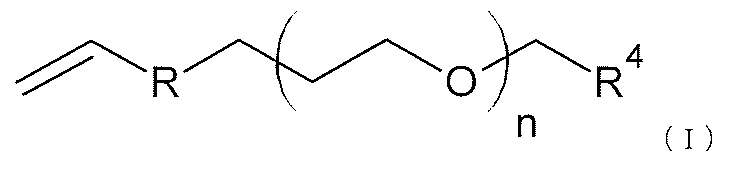
式(I)において、Rは2価の結合基を表す。Rの例としては、-Si-O-基、メチレン基及びフェニレン基が挙げられる。式(I)において、R4は親水性基を表す。R4の例としては、-SO3NH4が挙げられる。式(I)において、nは1以上100以下の整数である。反応性界面活性剤単量体は、1種類を単独で用いてもよく、2種類以上を任意の比率で組み合わせて用いてもよい。
水溶性高分子が反応性界面活性剤単位を含む場合、その含有割合は、好ましくは0.1~15質量%、より好ましくは0.5~10質量%、特に好ましくは1~5質量%の範囲である。反応性界面活性剤単位の含有割合を上記範囲とすることで、本発明に係るバインダー組成物の分散性及び電極合剤層の耐久性を向上させることができる。
他の単量体単位
水溶性高分子が有しうる任意の単位のさらなる例としては、下記の単量体に由来する構造単位が挙げられる。即ち、スチレン、クロロスチレン、ビニルトルエン、t-ブチルスチレン、ビニル安息香酸、ビニル安息香酸メチル、ビニルナフタレン、クロロメチルスチレン、ヒドロキシメチルスチレン、α-メチルスチレン、ジビニルベンゼン等のスチレン系単量体;アクリルアミド、アクリルアミド-2-メチルプロパンスルホン酸等のアミド系単量体;アクリロニトリル、メタクリロニトリル等のα,β-不飽和ニトリル化合物単量体;エチレン、プロピレン等のオレフィン類単量体;塩化ビニル、塩化ビニリデン等のハロゲン原子含有単量体;酢酸ビニル、プロピオン酸ビニル、酪酸ビニル、安息香酸ビニル等のビニルエステル類単量体;メチルビニルエーテル、エチルビニルエーテル、ブチルビニルエーテル等のビニルエーテル類単量体;メチルビニルケトン、エチルビニルケトン、ブチルビニルケトン、ヘキシルビニルケトン、イソプロペニルビニルケトン等のビニルケトン類単量体;並びにN-ビニルピロリドン、ビニルピリジン、ビニルイミダゾール等の複素環含有ビニル化合物単量体の1以上を重合して得られる単位が挙げられる。水溶性高分子におけるこれらの単位の含有割合は、好ましくは0~10質量%、より好ましくは0~5質量%である。
水溶性高分子が有しうる任意の単位のさらなる例としては、下記の単量体に由来する構造単位が挙げられる。即ち、スチレン、クロロスチレン、ビニルトルエン、t-ブチルスチレン、ビニル安息香酸、ビニル安息香酸メチル、ビニルナフタレン、クロロメチルスチレン、ヒドロキシメチルスチレン、α-メチルスチレン、ジビニルベンゼン等のスチレン系単量体;アクリルアミド、アクリルアミド-2-メチルプロパンスルホン酸等のアミド系単量体;アクリロニトリル、メタクリロニトリル等のα,β-不飽和ニトリル化合物単量体;エチレン、プロピレン等のオレフィン類単量体;塩化ビニル、塩化ビニリデン等のハロゲン原子含有単量体;酢酸ビニル、プロピオン酸ビニル、酪酸ビニル、安息香酸ビニル等のビニルエステル類単量体;メチルビニルエーテル、エチルビニルエーテル、ブチルビニルエーテル等のビニルエーテル類単量体;メチルビニルケトン、エチルビニルケトン、ブチルビニルケトン、ヘキシルビニルケトン、イソプロペニルビニルケトン等のビニルケトン類単量体;並びにN-ビニルピロリドン、ビニルピリジン、ビニルイミダゾール等の複素環含有ビニル化合物単量体の1以上を重合して得られる単位が挙げられる。水溶性高分子におけるこれらの単位の含有割合は、好ましくは0~10質量%、より好ましくは0~5質量%である。
なお、本明細書における水溶性高分子とは、pH12において、1%水溶液粘度が0.1~100000mPa・sである重合体をいう。
また、水溶性高分子の、pH12における、1%水溶液を調整した際の溶液粘度は、好ましくは0.1~20000mPa・s、より好ましくは1~10000mPa・s、特に好ましくは10~5000mPa・sの範囲にある。溶液粘度を上記範囲とすることで、電極合剤層の柔軟性及び集電体に対する密着性を向上させることができる。
水溶性高分子の重量平均分子量は、通常はバインダーとなる重合体よりも小さく、好ましくは100~500000、より好ましくは500~250000、特に好ましくは1000~100000である。水溶性高分子の重量平均分子量は、GPCによって、ジメチルホルムアシドの10体積%水溶液に0.85g/mlの硝酸ナトリウムを溶解させた溶液を展開溶媒としたポリスチレン換算の値として求めればよい。
さらに、水溶性高分子のガラス転移温度は、通常0~100℃、好ましくは5~50℃である。水溶性高分子のガラス転移温度は、様々な単量体を組み合わせることによって調整可能である。
[粒子状バインダーの製造]
粒子状バインダーは、その製法は特に限定はされないが、上述したように、各共重合体を構成する単量体を含む単量体混合物を、それぞれ乳化重合して得ることができる。乳化重合の方法としては、特に限定されず、従来公知の乳化重合法を採用すればよい。
粒子状バインダーは、その製法は特に限定はされないが、上述したように、各共重合体を構成する単量体を含む単量体混合物を、それぞれ乳化重合して得ることができる。乳化重合の方法としては、特に限定されず、従来公知の乳化重合法を採用すればよい。
乳化重合に使用する重合開始剤としては、たとえば、過硫酸ナトリウム、過硫酸カリウム、過硫酸アンモニウム、過リン酸カリウム、過酸化水素等の無機過酸化物;t-ブチルパーオキサイド、クメンハイドロパーオキサイド、p-メンタンハイドロパーオキサイド、ジ-t-ブチルパーオキサイド、t-ブチルクミルパーオキサイド、アセチルパーオキサイド、イソブチリルパーオキサイド、オクタノイルパーオキサイド、ベンゾイルパーオキサイド、3,5,5-トリメチルヘキサノイルパーオキサイド、t-ブチルパーオキシイソブチレート等の有機過酸化物;アゾビスイソブチロニトリル、アゾビス-2,4-ジメチルバレロニトリル、アゾビスシクロヘキサンカルボニトリル、アゾビスイソ酪酸メチル等のアゾ化合物等が挙げられる。
これらのなかでも、無機過酸化物を使用することが好ましい。これらの重合開始剤は、それぞれ単独でまたは2種類以上を組み合わせて使用することができる。また、過酸化物開始剤は、重亜硫酸ナトリウム等の還元剤と組み合わせて、レドックス系重合開始剤としても使用できる。
重合開始剤の使用量は、重合に使用する単量体混合物の全量100質量部に対して、好ましくは0.05~5質量部、より好ましくは0.1~2質量部である。
得られる共重合体のテトラヒドロフラン不溶解分量を調節するために、乳化重合時に連鎖移動剤を使用してもよい。連鎖移動剤としては、たとえば、n-ヘキシルメルカプタン、n-オクチルメルカプタン、t-オクチルメルカプタン、n-ドデシルメルカプタン、t-ドデシルメルカプタン、n-ステアリルメルカプタン等のアルキルメルカプタン;ジメチルキサントゲンジサルファイド、ジイソプロピルキサントゲンジサルファイド等のキサントゲン化合物;ターピノレンや、テトラメチルチウラムジスルフィド、テトラエチルチウラムジスルフィド、テトラメチルチウラムモノスルフィド等のチウラム系化合物;2,6-ジ-t-ブチル-4-メチルフェノール、スチレン化フェノール等のフェノール系化合物;アリルアルコール等のアリル化合物;ジクロルメタン、ジブロモメタン、四臭化炭素等のハロゲン化炭化水素化合物;チオグリコール酸、チオリンゴ酸、2-エチルヘキシルチオグリコレート、ジフェニルエチレン、α-メチルスチレンダイマーなどが挙げられる。
これらの連鎖移動剤は、単独または2種以上組み合わせて使用することができる。
これらの連鎖移動剤は、単独または2種以上組み合わせて使用することができる。
連鎖移動剤の使用量は、単量体混合物100質量部に対して、好ましくは0.05~2質量部、より好ましくは0.1~1質量部である。
乳化重合時に、界面活性剤を使用してもよい。界面活性剤は、前述した反応性界面活性剤または非反応性界面活性剤のいずれであっても乳化作用を有することから、乳化剤として用いられる。これらの界面活性剤は、単独または2種を組み合わせて使用することができる。界面活性剤を使用することで乳化重合が安定する。
非反応性界面活性剤の例としては、アニオン性界面活性剤、ノニオン性界面活性剤、カチオン性界面活性剤、両性界面活性剤が挙げられる。アニオン性界面活性剤の具体例としては、ナトリウムラウリルサルフェート、アンモニウムラウリルサルフェート、ナトリウムドデシルサルフェート、アンモニウムドデシルサルフェート、ナトリウムオクチルサルフェート、ナトリウムデシルサルフェート、ナトリウムテトラデシルサルフェート、ナトリウムヘキサデシルサルフェート、ナトリウムオクタデシルサルフェートなどの高級アルコールの硫酸エステル塩;ドデシルベンゼンスルホン酸ナトリウム、ラウリルベンゼンスルホン酸ナトリウム、ヘキサデシルベンゼンスルホン酸ナトリウムなどのアルキルベンゼンスルホン酸塩;ラウリルスルホン酸ナトリウム、ドデシルスルホン酸ナトリウム、テトラデシルスルホン酸ナトリウムなどの脂肪族スルホン酸塩;などが挙げられる。
界面活性剤の使用量(反応性界面活性剤を含む)は、単量体混合物100質量部に対して、好ましくは0.5~10質量部、より好ましくは1~5質量部である。
さらに乳化重合の際に、水酸化ナトリウム、アンモニアなどのpH調整剤;分散剤、キレート剤、酸素捕捉剤、ビルダー、粒子径調節のためのシードラテックスなどの各種添加剤を適宜使用することができる。シードラテックスとは、乳化重合の際に反応の核となる微小粒子の分散液をいう。微小粒子は粒径が100nm以下であることが多い。微小粒子は特に限定はされず、アクリル系重合体などの汎用の重合体が用いられる。シード重合法によれば、比較的粒径の揃った共重合体粒子が得られる。
重合反応を行う際の重合温度は、特に限定されないが、通常、0~100℃、好ましくは40~80℃とする。このような温度範囲で乳化重合し、所定の重合転化率で、重合停止剤を添加したり、重合系を冷却したりして、重合反応を停止する。重合反応を停止する重合転化率は、好ましくは93質量%以上、より好ましくは95質量%以上である。
重合反応を停止した後、所望により、未反応単量体を除去し、pHや固形分濃度を調整して、粒子状共重合体が分散媒に分散された形態(ラテックス)でバインダーが得られる。その後、必要に応じ、分散媒を置換してもよく、また分散媒を蒸発し、粒子状共重合体を粉末形状で得てもよい。
得られる粒子状共重合体の分散液には、公知の分散剤、増粘剤、老化防止剤、消泡剤、防腐剤、抗菌剤、ブリスター防止剤、pH調整剤などを必要に応じて添加することができる。
[水溶性高分子の製造]
水溶性高分子を製造する方法としては、水溶性高分子を構成する単量体を含む単量体混合物を、分散媒中で重合して水分散型ポリマーを得、pH7~13にアルカリ化する方法が挙げられる。重合方法については、上述の粒子状バインダーと同様である。
水溶性高分子を製造する方法としては、水溶性高分子を構成する単量体を含む単量体混合物を、分散媒中で重合して水分散型ポリマーを得、pH7~13にアルカリ化する方法が挙げられる。重合方法については、上述の粒子状バインダーと同様である。
pH7~13にアルカリ化する方法としては、特に限定されないが、水酸化リチウム水溶液、水酸化ナトリウム水溶液、水酸化カリウム水溶液などのアルカリ金属水溶液、水酸化カルシウム水溶液、水酸化マグネシウム水溶液などのアルカリ土類金属水溶液や、アンモニア水溶液などのアルカリ水溶液を添加する方法が挙げられる。
粒子状バインダーや水溶性高分子の製造に用いられる分散媒は、上記各成分を均一に分散でき、安定的に分散状態を保ちうる限り、水、各種有機溶媒が特に制限されることなく使用できる。製造工程の簡素化の観点から、上記の乳化重合後に溶媒置換などの操作を行うことなく、直接、粒子状バインダーや水溶性高分子を製造することが好ましく、分散媒としては乳化重合時の反応溶媒を使用することが望ましい。乳化重合時には、水が反応溶媒として用いられることが多く、また作業環境の観点からも水を分散媒とすることが特に好ましい。
[電気二重層キャパシタ用バインダー組成物の製造]
本発明に係る電気二重層キャパシタ用バインダー組成物は、上記した粒子状バインダーおよび水溶性高分子を含む。
本発明に係る電気二重層キャパシタ用バインダー組成物は、上記した粒子状バインダーおよび水溶性高分子を含む。
本発明に係る電気二重層キャパシタ用バインダー組成物における粒子状バインダーと水溶性高分子の含有割合(質量比)は、粒子状バインダー/水溶性高分子=99.5/0.5~70/30であることが好ましく、98/2~75/25であることがより好ましく、95/5~80/20であることが特に好ましい。バインダー組成物における粒子状バインダーと水溶性高分子の含有割合を上記範囲とすることで、集電体と電極合剤層との結着性を高め、電極強度を向上できる。
さらに、電気二重層キャパシタ用バインダー組成物や後述の電気二重層キャパシタ用スラリー組成物には、上記以外のバインダー、増粘剤、老化防止剤、消泡剤、防腐剤、抗菌剤、ブリスター防止剤、pH調整剤などを必要に応じて添加することができる。
電気二重層キャパシタ用バインダー組成物の製造方法は、特に限定はされず、上記各固形成分を均一に分散させることができればいかなる手段であってもよい。たとえば、粒子状バインダーや水溶性高分子の分散液、および必要に応じ添加される任意成分を一括して混合し、その後必要に応じ分散媒を添加し、分散液の固形分濃度を調整してもよい。混合方法は特に限定されず、例えば、撹拌式、振とう式、および回転式などの混合装置を使用した方法が挙げられる。また、ホモジナイザー、ボールミル、サンドミル、ロールミル、プラネタリーミキサーおよび遊星式混練機などの分散混練装置を使用した方法が挙げられる。
(2)電気二重層キャパシタ用スラリー組成物
本発明の電気二重層キャパシタ用スラリー組成物(以下、単に「スラリー組成物」と記載することがある。)は、上記の電気二重層キャパシタ用バインダー組成物、電極活物質および水を含んでなる。また、電気二重層キャパシタ用スラリー組成物には、必要に応じて導電剤や分散剤を添加してもよい。
本発明の電気二重層キャパシタ用スラリー組成物(以下、単に「スラリー組成物」と記載することがある。)は、上記の電気二重層キャパシタ用バインダー組成物、電極活物質および水を含んでなる。また、電気二重層キャパシタ用スラリー組成物には、必要に応じて導電剤や分散剤を添加してもよい。
(電極活物質)
電極活物質は炭素の同素体が好ましく、具体的には活性炭、ポリアセン、カーボンウィスカおよびグラファイト等の炭素質材料が挙げられる。特に電気二重層キャパシタ用の電極活物質としては活性炭が好ましく、具体的にはフェノール系、レーヨン系、アクリル系、ピッチ系、またはヤシガラ系等の活性炭を挙げることができる。これら炭素質材料は、単独でまたは二種類以上を組み合わせて使用することができる。これらのなかでも、水蒸気で賦活した活性炭(以下、「水蒸気賦活活性炭」と略記することがある。)を用いることが好ましい。水蒸気賦活活性炭は、活性炭と水蒸気ガスとを加熱処理後に洗浄、ろ過、乾燥を繰り返して得られるものである。
また、電極活物質として、黒鉛類似の微結晶炭素を有し、その微結晶炭素の層間距離が拡大された非多孔性炭素を用いることもできる。このような非多孔性炭素は、多層グラファイト構造の微結晶が発達した易黒鉛化炭を 700~850℃で乾留し、次いで苛性アルカリと共に800~900℃で熱処理し、さらに必要に応じ加熱水蒸気により残存アルカリ成分を除くことで得られる。
電極活物質は炭素の同素体が好ましく、具体的には活性炭、ポリアセン、カーボンウィスカおよびグラファイト等の炭素質材料が挙げられる。特に電気二重層キャパシタ用の電極活物質としては活性炭が好ましく、具体的にはフェノール系、レーヨン系、アクリル系、ピッチ系、またはヤシガラ系等の活性炭を挙げることができる。これら炭素質材料は、単独でまたは二種類以上を組み合わせて使用することができる。これらのなかでも、水蒸気で賦活した活性炭(以下、「水蒸気賦活活性炭」と略記することがある。)を用いることが好ましい。水蒸気賦活活性炭は、活性炭と水蒸気ガスとを加熱処理後に洗浄、ろ過、乾燥を繰り返して得られるものである。
また、電極活物質として、黒鉛類似の微結晶炭素を有し、その微結晶炭素の層間距離が拡大された非多孔性炭素を用いることもできる。このような非多孔性炭素は、多層グラファイト構造の微結晶が発達した易黒鉛化炭を 700~850℃で乾留し、次いで苛性アルカリと共に800~900℃で熱処理し、さらに必要に応じ加熱水蒸気により残存アルカリ成分を除くことで得られる。
本発明に使用される電極活物質の比表面積は、同じ質量でもより広い面積の界面を形成することが可能な、比表面積の大きいものが好ましい。具体的には、電極活物質の比表面積は好ましくは500~2500m2/g、より好ましくは800~2300m2/g、特に好ましくは1000~2000m2/gの範囲である。電極活物質の形状は、粉末状または繊維状のいずれであってもよい。
電極活物質の体積平均粒子径は、好ましくは0.1~100μm、より好ましくは1~50μm、特に好ましくは3~35μmである。体積平均粒子径がこの範囲にあると、電極の成形が容易で、容量も高くできるので好ましい。上記した電極活物質は、単独でまたは二種類以上を組み合わせて使用することができる。電極活物質を組み合わせて使用する場合は、平均粒子径または粒径分布が異なる二種類以上の電極活物質を組み合わせて使用してもよい。
(導電剤)
導電剤の種類は、導電性を有するものであれば特に限定されず、炭素の同素体または金属からなるものが挙げられ、好適には炭素の同素体が用いられる。具体的には、ファーネスブラック、アセチレンブラック、およびケッチェンブラック(アクゾノーベル ケミカルズ ベスローテン フェンノートシャップ社の登録商標)等の導電性カーボンブラック;天然黒鉛、人造黒鉛等の黒鉛;などの炭素の同素体からなる粒子状導電剤が挙げられる。 また、ポリアクリロニトリル系炭素繊維、ピッチ系炭素繊維、気相法炭素繊維等の炭素繊維;などの炭素の同素体からなる繊維状導電剤も挙げられる。金属からなる導電剤としては、例えば酸化チタン、酸化ルテニウム、アルミニウム、ニッケル等の粒子状導電剤;金属ファイバなどの繊維状導電剤;が挙げられる。これらの中でも、カーボンブラックが好ましく、アセチレンブラックおよびファーネスブラックがより好ましい。
導電剤の種類は、導電性を有するものであれば特に限定されず、炭素の同素体または金属からなるものが挙げられ、好適には炭素の同素体が用いられる。具体的には、ファーネスブラック、アセチレンブラック、およびケッチェンブラック(アクゾノーベル ケミカルズ ベスローテン フェンノートシャップ社の登録商標)等の導電性カーボンブラック;天然黒鉛、人造黒鉛等の黒鉛;などの炭素の同素体からなる粒子状導電剤が挙げられる。 また、ポリアクリロニトリル系炭素繊維、ピッチ系炭素繊維、気相法炭素繊維等の炭素繊維;などの炭素の同素体からなる繊維状導電剤も挙げられる。金属からなる導電剤としては、例えば酸化チタン、酸化ルテニウム、アルミニウム、ニッケル等の粒子状導電剤;金属ファイバなどの繊維状導電剤;が挙げられる。これらの中でも、カーボンブラックが好ましく、アセチレンブラックおよびファーネスブラックがより好ましい。
導電剤の体積平均粒子径は、電極活物質の体積平均粒子径よりも小さいものが好ましく、通常0.001~10μm、好ましくは0.05~5μm、より好ましくは0.01~1μmの範囲である。導電剤の体積平均粒子径を上記範囲とすることで、より少ない使用量で高い導電性が得られる。これらの導電剤は、それぞれ単独でまたは2種以上を組み合わせて用いることができる。
導電剤の量は、電極活物質100質量部に対して通常0.1~50質量部、好ましくは0.5~15質量部、より好ましくは1~10質量部の範囲である。この範囲の量の導電剤を含有する電気二重層キャパシタ用電極を形成することによって、キャパシタの容量を高く、かつ内部抵抗を低くすることができる。
(分散剤)
本発明の電気二重層キャパシタ用スラリー組成物には、上記各成分を分散させるための分散剤が含まれていてもよい。
本発明の電気二重層キャパシタ用スラリー組成物には、上記各成分を分散させるための分散剤が含まれていてもよい。
分散剤の具体例としては、カルボキシメチルセルロース、メチルセルロース、エチルセルロースおよびヒドロキシプロピルセルロースなどのセルロース系ポリマー、ならびにこれらのアンモニウム塩またはアルカリ金属塩、ポリ(メタ)アクリル酸ナトリウムなどのポリ(メタ)アクリル酸塩、ポリビニルアルコール、変性ポリビニルアルコール、ポリエチレンオキシド1ポリビニルピロリドン、ポリカルボン酸、酸化スターチ、リン酸スターチ、カゼイン、各種変性デンプンなどが挙げられる。これらの分散剤は、それぞれ単独でまたは2種以上を組み合わせて使用できる。なお、分散剤の配合量が過剰であると、電極合剤層の乾燥に時間がかかり、また電極合剤層に水分が残留するおそれが高くなる。したがって、上記のような分散剤の使用量は、電極活物質100質量部に対し、5質量部以下とすることが好ましい。
[電気二重層キャパシタ用スラリー組成物の製造]
電気二重層キャパシタ用スラリー組成物の製造方法は、特に限定はされず、上記各固形成分を均一に分散させることができればいかなる手段であってもよい。たとえば、上記バインダー組成物、電極活物質および必要に応じ添加される任意成分を一括して混合し、その後必要に応じ水を添加し、分散液の固形分濃度を調整してもよい。また、電極活物質を何等かの分散媒に分散した状態で添加してもよい。混合方法は、上記バインダー組成物の製造方法における混合方法と同様である。
電気二重層キャパシタ用スラリー組成物の製造方法は、特に限定はされず、上記各固形成分を均一に分散させることができればいかなる手段であってもよい。たとえば、上記バインダー組成物、電極活物質および必要に応じ添加される任意成分を一括して混合し、その後必要に応じ水を添加し、分散液の固形分濃度を調整してもよい。また、電極活物質を何等かの分散媒に分散した状態で添加してもよい。混合方法は、上記バインダー組成物の製造方法における混合方法と同様である。
電気二重層キャパシタ用スラリー組成物におけるバインダー組成物の含有量は、電極活物質100質量部に対して、好ましくは0.5~20質量部、より好ましくは1~15質量部、特に好ましくは2~10質量部である。
電気二重層キャパシタ用スラリー組成物における水の含有割合は、好ましくは60~90質量%であり、より好ましくは65~85質量%、特に好ましくは68~85質量%である。電気二重層キャパシタ用スラリー組成物の固形分濃度は、塗布法にもよるが、通常10~60質量%、好ましくは15~50質量%、より好ましくは20~45質量%である。固形分濃度がこの範囲にあると、電極合剤層が高充填化され、得られる電極のエネルギー密度と出力密度が高まる。
電気二重層キャパシタ用スラリー組成物の粘度は、塗布法にもよるが、通常10~10,000mPa・s、好ましくは50~5,000mPa・s、より好ましくは100~2,000mPa・sである。電気二重層キャパシタ用スラリー組成物の粘度がこの範囲にあると、集電体上へ均一な電極合剤層を形成することができる。
本発明のバインダー組成物における水溶性高分子は不飽和カルボン酸単量体単位を含むことから、炭素系の電極活物質や導電剤との親和性が高く、スラリー組成物における電極活物質や導電剤の分散性を向上させることができる。
(3)電気二重層キャパシタ用電極
本発明の電気二重層キャパシタ用電極(以下、単に「電極」と記載することがある。)は、上記の電気二重層キャパシタ用バインダー組成物および電極活物質を含んでなる。具体的には、本発明の電気二重層キャパシタ用電極は、上記の電気二重層キャパシタ用スラリー組成物からなる電極合剤層を集電体上に形成してなる。
本発明の電気二重層キャパシタ用電極(以下、単に「電極」と記載することがある。)は、上記の電気二重層キャパシタ用バインダー組成物および電極活物質を含んでなる。具体的には、本発明の電気二重層キャパシタ用電極は、上記の電気二重層キャパシタ用スラリー組成物からなる電極合剤層を集電体上に形成してなる。
(集電体)
本発明で用いる集電体は、電気導電性を有しかつ電気化学的に耐久性のある材料であれば特に制限されないが、耐熱性を有するため金属材料が好ましく、例えば、鉄、銅、アルミニウム、ニッケル、ステンレス鋼、チタン、タンタル、金、白金などが挙げられる。中でも、電気二重層キャパシタ用電極に用いる集電体としてはアルミニウムが特に好ましい。集電体の形状は特に制限されないが、厚さ0.001~0.5mm程度のシート状のものが好ましい。集電体は、電極合剤層との接着強度を高めるため、予め粗面化処理して使用することもできる。粗面化方法としては、機械的研磨法、電解研磨法、化学研磨法などが挙げられる。機械的研磨法においては、研磨剤粒子を固着した研磨布紙、砥石、エメリバフ、鋼線などを備えたワイヤーブラシ等が使用される。また、電極合剤層と集電体との接着強度や導電性を高めるために、集電体表面に導電性接着剤層を形成してもよい。
本発明で用いる集電体は、電気導電性を有しかつ電気化学的に耐久性のある材料であれば特に制限されないが、耐熱性を有するため金属材料が好ましく、例えば、鉄、銅、アルミニウム、ニッケル、ステンレス鋼、チタン、タンタル、金、白金などが挙げられる。中でも、電気二重層キャパシタ用電極に用いる集電体としてはアルミニウムが特に好ましい。集電体の形状は特に制限されないが、厚さ0.001~0.5mm程度のシート状のものが好ましい。集電体は、電極合剤層との接着強度を高めるため、予め粗面化処理して使用することもできる。粗面化方法としては、機械的研磨法、電解研磨法、化学研磨法などが挙げられる。機械的研磨法においては、研磨剤粒子を固着した研磨布紙、砥石、エメリバフ、鋼線などを備えたワイヤーブラシ等が使用される。また、電極合剤層と集電体との接着強度や導電性を高めるために、集電体表面に導電性接着剤層を形成してもよい。
[電気二重層キャパシタ用電極の製造]
電気二重層キャパシタ用電極の製造方法は、特に限定されない。具体的には、(I)上記電気二重層キャパシタ用スラリー組成物をシート成形し、得られたシートを集電体上に積層し、電極合剤層を形成する方法(シート成形法)、及び(II)上記電気二重層キャパシタ用スラリー組成物を集電体の少なくとも片面、好ましくは両面に塗布、乾燥し、電極合剤層を形成する方法(湿式成形法)等が挙げられる。これらの中でも、(II)湿式成形法が好ましい。(II)湿式成形法は電極の生産効率に優れている。
電気二重層キャパシタ用電極の製造方法は、特に限定されない。具体的には、(I)上記電気二重層キャパシタ用スラリー組成物をシート成形し、得られたシートを集電体上に積層し、電極合剤層を形成する方法(シート成形法)、及び(II)上記電気二重層キャパシタ用スラリー組成物を集電体の少なくとも片面、好ましくは両面に塗布、乾燥し、電極合剤層を形成する方法(湿式成形法)等が挙げられる。これらの中でも、(II)湿式成形法が好ましい。(II)湿式成形法は電極の生産効率に優れている。
(II)湿式成形法において、スラリー組成物を集電体上に塗布する方法は特に限定されない。例えば、ドクターブレード法、ディップ法、リバースロール法、ダイレクトロール法、グラビア法、エクストルージョン法、およびハケ塗り法などの方法が挙げられる。
乾燥方法としては、例えば、温風、熱風、低湿風による乾燥、真空乾燥、(遠)赤外線や電子線などの照射による乾燥法が挙げられる。また、乾燥工程は、25~90℃で1~30分間乾燥する工程と、100~200℃で1~30分間乾燥する工程とを有することが好ましい。このような乾燥工程を経ることで、電極合剤層におけるバインダー組成物の偏在化を防止し、電極の内部抵抗を小さくできる。
本発明の電極を製造するに際して、集電体上に上記スラリー組成物からなる電極合剤層を形成後、金型プレスやロールプレスなどを用い、加圧処理により電極合剤層の空隙率を低くしてもよい。空隙率の好ましい範囲は5~30%、より好ましくは7~20%である。空隙率を上記範囲とすることで、高い体積容量を得やすく、充電効率や放電効率を向上させることができる。さらには、電極合剤層が集電体から剥がれ難くなるため、不良の発生を抑制できる。
本発明の電極における電極合剤層の厚みは、通常5~300μmであり、好ましくは10~250μmである。電極合剤層の厚みが上記範囲にあることにより、負荷特性及びサイクル特性共に高い特性を示す。
本発明において、電極合剤層における電極活物質の含有割合は、好ましくは90~99.9質量%、より好ましくは95~99質量%である。電極活物質の含有割合を、上記範囲とすることにより、高い容量を示しながらも柔軟性、結着性を示すことができる。
(4)電気二重層キャパシタ
本発明の電気二重層キャパシタは、電極、電解液およびセパレーターを備え、前記電極が、上記の電気二重層キャパシタ用電極である。
本発明の電気二重層キャパシタは、電極、電解液およびセパレーターを備え、前記電極が、上記の電気二重層キャパシタ用電極である。
本発明に使用される電解液の種類は、特に限定されないが、電解質を電解液溶媒に溶解した非水電解液が好ましい。
電解質としては、従来より公知のものが使用でき、(C2H5)4NBF4、(C2H5)3(CH3)NBF4、(C2H5)4NPF6、LiClO4、LiAsF6、LiBF4、LiPF6、LiN(C2F5SO2)2、LiN(CF3SO2)2等の塩が挙げられる。電解液中の電解質の濃度は、電解液による内部抵抗を小さくするため少なくとも0.1mol/リットル以上とすることが好ましく、0.5~1.5mol/リットルの範囲内とすることが更に好ましい。
電解液溶媒は、電解質を溶解させることのできるものであれば特に限定されない。具体的には、エチレンカーボネート、プロピレンカーボネート、ブチレンカーボネート、ジメチルカーボネート、ジエチルカーボネートなどのカーボネート類;γ-ブチロラクトンなどのラクトン類;スルホラン類;アセトニトリルなどのニトリル類;が挙げられる。これらのなかでも、カーボネート類が好ましい。これらは単独または二種以上の混合電解液溶媒として使用することができる。
電気二重層キャパシタに使用されるセパレーターとしては、例えば、ポリエチレン、ポリプロピレンなどのポリオレフィン製の微孔膜または不織布、一般に電解コンデンサ紙と呼ばれるパルプを主原料とする多孔質膜(セルロース)、レーヨン系の多孔膜などを用いることができる。また、セパレーターに代えて固体電解質を用いることもできる。
[電気二重層キャパシタの製造]
電気二重層キャパシタは、上記の電極と、電解液、セパレーターなどの部品を用いて、常法に従って製造することができる。具体的には、例えば、電極を適切な大きさに切断し、次いでセパレーターを介して電極を重ね合わせ、これをキャパシタ形状に巻く、折るなどして容器に入れ、容器に電解液を注入して封口して製造できる。
電気二重層キャパシタは、上記の電極と、電解液、セパレーターなどの部品を用いて、常法に従って製造することができる。具体的には、例えば、電極を適切な大きさに切断し、次いでセパレーターを介して電極を重ね合わせ、これをキャパシタ形状に巻く、折るなどして容器に入れ、容器に電解液を注入して封口して製造できる。
以下に、実施例を挙げて本発明を説明するが、本発明はこれに限定されるものではない。尚、本実施例における部および%は、特記しない限り質量基準である。実施例および比較例において、各種物性は以下のように評価する。
(電極のピール強度)
実施例および比較例における電極のピール強度は、電極合剤層の形成方向(集電体の走行方向)が長辺となるように電気二重層キャパシタ用電極を長さ100mm、幅10mmの長方形に切り出して試験片とし、電極合剤層面を下にして電極合剤層表面にセロハンテープ(JIS Z1522:1964に規定されるもの)を貼り付け、集電体の一端を垂直方向に引張り速度50mm/分で引張って剥がしたときの応力を測定した(なお、セロハンテープは試験台に固定されている。)。測定を3回行い、その平均値を求めてこれをピール強度(N/m)とした。ピール強度が大きいほど電極合剤層の集電体への結着力が大きい(結着性に優れる)、すなわち電極強度が大きいことを示す。
実施例および比較例における電極のピール強度は、電極合剤層の形成方向(集電体の走行方向)が長辺となるように電気二重層キャパシタ用電極を長さ100mm、幅10mmの長方形に切り出して試験片とし、電極合剤層面を下にして電極合剤層表面にセロハンテープ(JIS Z1522:1964に規定されるもの)を貼り付け、集電体の一端を垂直方向に引張り速度50mm/分で引張って剥がしたときの応力を測定した(なお、セロハンテープは試験台に固定されている。)。測定を3回行い、その平均値を求めてこれをピール強度(N/m)とした。ピール強度が大きいほど電極合剤層の集電体への結着力が大きい(結着性に優れる)、すなわち電極強度が大きいことを示す。
(高温サイクル特性)
実施例および比較例における高温サイクル特性は、60℃の環境下、2.7V、定電流100mAで充電、0V、定電流100mAで放電を1000サイクル行った。そして、1サイクル充放電後および、1000サイクル充放電後の静電容量を算出し、容量維持率(%)(=1000サイクル充放電後の静電容量/1サイクル充放電後の静電容量)を算出した。高温サイクル特性評価における容量維持率が大きいほど、耐電圧の高い電気二重層キャパシタが得られたことを示す。
実施例および比較例における高温サイクル特性は、60℃の環境下、2.7V、定電流100mAで充電、0V、定電流100mAで放電を1000サイクル行った。そして、1サイクル充放電後および、1000サイクル充放電後の静電容量を算出し、容量維持率(%)(=1000サイクル充放電後の静電容量/1サイクル充放電後の静電容量)を算出した。高温サイクル特性評価における容量維持率が大きいほど、耐電圧の高い電気二重層キャパシタが得られたことを示す。
(フローティング特性)
実施例および比較例で製造した積層型ラミネートセルの電気二重層キャパシタについて、60℃の環境下、2.7Vおよび3.0Vで30日間保持した(フローティング)後に、定電流100mAで0Vに達するまで放電を行った。そして、フローティング後の静電容量を算出し、フローティング前の静電容量との変化から、容量維持率(%)(=フローティング後の静電容量/フローティング前の静電容量)を算出した。ここで、フローティング前の静電容量は、25℃の環境下で測定している。フローティング特性評価における容量維持率が大きいほど、耐電圧の高い電気二重層キャパシタが得られたことを示す。
実施例および比較例で製造した積層型ラミネートセルの電気二重層キャパシタについて、60℃の環境下、2.7Vおよび3.0Vで30日間保持した(フローティング)後に、定電流100mAで0Vに達するまで放電を行った。そして、フローティング後の静電容量を算出し、フローティング前の静電容量との変化から、容量維持率(%)(=フローティング後の静電容量/フローティング前の静電容量)を算出した。ここで、フローティング前の静電容量は、25℃の環境下で測定している。フローティング特性評価における容量維持率が大きいほど、耐電圧の高い電気二重層キャパシタが得られたことを示す。
(低温サイクル特性)
実施例および比較例における低温サイクル特性は、-10℃の環境下、2.7V、定電流100mAで充電、0V、定電流100mAで放電を100サイクル行った。そして、1サイクル充放電後および、100サイクル充放電後の静電容量を算出し、容量維持率(%)(=100サイクル充放電後の静電容量/1サイクル充放電後の静電容量)を算出した。低温サイクル特性評価における容量維持率が大きいほど、低抵抗化された電気二重層キャパシタが得られたことを示す。
実施例および比較例における低温サイクル特性は、-10℃の環境下、2.7V、定電流100mAで充電、0V、定電流100mAで放電を100サイクル行った。そして、1サイクル充放電後および、100サイクル充放電後の静電容量を算出し、容量維持率(%)(=100サイクル充放電後の静電容量/1サイクル充放電後の静電容量)を算出した。低温サイクル特性評価における容量維持率が大きいほど、低抵抗化された電気二重層キャパシタが得られたことを示す。
[実施例1]
(粒子状バインダーの製造)
攪拌機付き5MPa耐圧容器に、アクリル酸2-エチルヘキシル76部、アクリロニトリル20部、イタコン酸4部、イオン交換水150部、重合開始剤として過硫酸カリウム0.5部及び、非反応性界面活性剤としてドデシルベンゼンスルホン酸ナトリウム2部を入れ、十分に攪拌した後、50℃に加温して重合を開始した。重合転化率が96%になった時点で冷却し反応を停止して、粒子状バインダーを含む水系分散液を得た。
(粒子状バインダーの製造)
攪拌機付き5MPa耐圧容器に、アクリル酸2-エチルヘキシル76部、アクリロニトリル20部、イタコン酸4部、イオン交換水150部、重合開始剤として過硫酸カリウム0.5部及び、非反応性界面活性剤としてドデシルベンゼンスルホン酸ナトリウム2部を入れ、十分に攪拌した後、50℃に加温して重合を開始した。重合転化率が96%になった時点で冷却し反応を停止して、粒子状バインダーを含む水系分散液を得た。
上記粒子状バインダーを含む水系分散液に、5%水酸化ナトリウム水溶液を添加して、pH8に調整後、加熱減圧蒸留によって未反応単量体の除去を行った後、30℃以下まで冷却し、所望の粒子状バインダー(ガラス転移温度:-20℃、数平均粒子径:250nm)を得た。
(水溶性高分子の製造)
攪拌機付き5MPa耐圧容器に、アクリル酸ブチル61.3部、メタクリル酸30部、2,2,2-トリフルオロエチルメタクリレート7.5部、反応性界面活性剤としてポリオキシアルケニルエーテル硫酸アンモニウム1.2部、イオン交換水150部及び重合開始剤として過硫酸カリウム0.5部を入れ、十分に攪拌した後、60℃に加温して重合を開始した。重合転化率が96%になった時点で冷却し反応を停止して、水溶性高分子を含む水分散液を得た。
攪拌機付き5MPa耐圧容器に、アクリル酸ブチル61.3部、メタクリル酸30部、2,2,2-トリフルオロエチルメタクリレート7.5部、反応性界面活性剤としてポリオキシアルケニルエーテル硫酸アンモニウム1.2部、イオン交換水150部及び重合開始剤として過硫酸カリウム0.5部を入れ、十分に攪拌した後、60℃に加温して重合を開始した。重合転化率が96%になった時点で冷却し反応を停止して、水溶性高分子を含む水分散液を得た。
上記水溶性高分子を含む水分散液に、10%アンモニア水を添加して、pH8に調整し、所望の水溶性高分子(重量平均分子量:48000、ガラス転移温度:35℃)を得た。なお、水溶性高分子の、pH12における、1%水溶液を調整した際の溶液粘度は350mPa・sであった。
(電気二重層キャパシタ用バインダー組成物の製造)
上記粒子状バインダーおよび水溶性高分子を固形分質量比(粒子状バインダー/水溶性高分子)で94.0/6.0にて混合し、電気二重層キャパシタ用バインダー組成物を得た。
上記粒子状バインダーおよび水溶性高分子を固形分質量比(粒子状バインダー/水溶性高分子)で94.0/6.0にて混合し、電気二重層キャパシタ用バインダー組成物を得た。
(電気二重層キャパシタ用スラリー組成物の製造)
電極活物質として、フェノール樹脂を原料とする水蒸気賦活活性炭(RP-20;クラレケミカル社製、比表面積:1800m2/g、体積平均粒子径:20μm)100部、分散剤としてカルボキシメチルセルロースの1.5%水溶液(DN-800H;ダイセル化学工業社製)を固形分相当で2.0部、導電剤としてアセチレンブラック(デンカブラック粉状;電気化学工業社製、体積平均粒子径:0.2μm)5部、上記で調製したバインダー組成物を固形分相当で3部、およびイオン交換水を全固形分濃度が42%となるように混合し、電気二重層キャパシタ用スラリー組成物を調製した。
電極活物質として、フェノール樹脂を原料とする水蒸気賦活活性炭(RP-20;クラレケミカル社製、比表面積:1800m2/g、体積平均粒子径:20μm)100部、分散剤としてカルボキシメチルセルロースの1.5%水溶液(DN-800H;ダイセル化学工業社製)を固形分相当で2.0部、導電剤としてアセチレンブラック(デンカブラック粉状;電気化学工業社製、体積平均粒子径:0.2μm)5部、上記で調製したバインダー組成物を固形分相当で3部、およびイオン交換水を全固形分濃度が42%となるように混合し、電気二重層キャパシタ用スラリー組成物を調製した。
(電気二重層キャパシタ用電極の製造)
厚さ30μmのアルミニウム集電体上に、前記電気二重層キャパシタ用スラリー組成物をドクターブレードによって、10m/分の速度で塗布し、まず60℃で20分間、次いで120℃で20分間乾燥した後、5cm正方に打ち抜いて、厚さ100μmの電気二重層キャパシタ用電極を得た。得られた電気二重層キャパシタ用電極についてピール強度の評価を行った。結果を表1に示す。
厚さ30μmのアルミニウム集電体上に、前記電気二重層キャパシタ用スラリー組成物をドクターブレードによって、10m/分の速度で塗布し、まず60℃で20分間、次いで120℃で20分間乾燥した後、5cm正方に打ち抜いて、厚さ100μmの電気二重層キャパシタ用電極を得た。得られた電気二重層キャパシタ用電極についてピール強度の評価を行った。結果を表1に示す。
(電気二重層キャパシタの製造)
この電気二重層キャパシタ用電極及びセパレーターとしてセルロース(TF40;ニッポン高度紙工業社製)を用いて、室温で1時間電解液に含浸させ、次いで2枚の電気二重層キャパシタ用電極の電極合剤層がセパレーターを介して内側になるように対向させ、かつそれぞれの電気二重層キャパシタ用電極が電気的に接触しないように配置して、ラミネート型セル形状の電気二重層キャパシタを作製した。電解液は、電解液溶媒となるプロピレンカーボネートに、電解質であるテトラエチルアンモニウムフルオロボレートを1.0mol/リットルの濃度で溶解させたものを用いた。得られた電気二重層キャパシタについて各評価を行った。結果を表1に示す。
この電気二重層キャパシタ用電極及びセパレーターとしてセルロース(TF40;ニッポン高度紙工業社製)を用いて、室温で1時間電解液に含浸させ、次いで2枚の電気二重層キャパシタ用電極の電極合剤層がセパレーターを介して内側になるように対向させ、かつそれぞれの電気二重層キャパシタ用電極が電気的に接触しないように配置して、ラミネート型セル形状の電気二重層キャパシタを作製した。電解液は、電解液溶媒となるプロピレンカーボネートに、電解質であるテトラエチルアンモニウムフルオロボレートを1.0mol/リットルの濃度で溶解させたものを用いた。得られた電気二重層キャパシタについて各評価を行った。結果を表1に示す。
[実施例2]
水溶性高分子として、下記の水溶性高分子を用いたこと以外は、実施例1と同様の操作を行い、バインダー組成物を得、スラリー組成物、電極および電気二重層キャパシタを作製した。各評価結果を表1に示す。
水溶性高分子として、下記の水溶性高分子を用いたこと以外は、実施例1と同様の操作を行い、バインダー組成物を得、スラリー組成物、電極および電気二重層キャパシタを作製した。各評価結果を表1に示す。
(水溶性高分子の製造)
攪拌機付き5MPa耐圧容器に、アクリル酸ブチル67.8部、2,2,2-トリフルオロエチルメタクリレート1部、メタクリル酸30部、反応性界面活性剤としてポリオキシアルケニルエーテル硫酸アンモニウム1.2部、イオン交換水150部及び重合開始剤として過硫酸カリウム0.5部を入れ、十分に攪拌した後、60℃に加温して重合を開始した。重合転化率が96%になった時点で冷却し反応を停止して、水溶性高分子を含む水分散液を得た。
攪拌機付き5MPa耐圧容器に、アクリル酸ブチル67.8部、2,2,2-トリフルオロエチルメタクリレート1部、メタクリル酸30部、反応性界面活性剤としてポリオキシアルケニルエーテル硫酸アンモニウム1.2部、イオン交換水150部及び重合開始剤として過硫酸カリウム0.5部を入れ、十分に攪拌した後、60℃に加温して重合を開始した。重合転化率が96%になった時点で冷却し反応を停止して、水溶性高分子を含む水分散液を得た。
上記水溶性高分子を含む水分散液に、10%アンモニア水を添加して、pH8に調整し、所望の水溶性高分子(重量平均分子量:49000、ガラス転移温度:30℃)を得た。なお、水溶性高分子の、pH12における、1%水溶液を調整した際の溶液粘度は450mPa・sであった。
[実施例3]
水溶性高分子として、下記の水溶性高分子を用いたこと以外は、実施例1と同様の操作を行い、バインダー組成物を得、スラリー組成物、電極および電気二重層キャパシタを作製した。各評価結果を表1に示す。
水溶性高分子として、下記の水溶性高分子を用いたこと以外は、実施例1と同様の操作を行い、バインダー組成物を得、スラリー組成物、電極および電気二重層キャパシタを作製した。各評価結果を表1に示す。
(水溶性高分子の製造)
攪拌機付き5MPa耐圧容器に、アクリル酸ブチル44.8部、2,2,2-トリフルオロエチルメタクリレート24部、メタクリル酸30部、反応性界面活性剤としてポリオキシアルケニルエーテル硫酸アンモニウム1.2部、イオン交換水150部及び重合開始剤として過硫酸カリウム0.5部を入れ、十分に攪拌した後、60℃に加温して重合を開始した。重合転化率が96%になった時点で冷却し反応を停止して、水溶性高分子を含む水分散液を得た。
攪拌機付き5MPa耐圧容器に、アクリル酸ブチル44.8部、2,2,2-トリフルオロエチルメタクリレート24部、メタクリル酸30部、反応性界面活性剤としてポリオキシアルケニルエーテル硫酸アンモニウム1.2部、イオン交換水150部及び重合開始剤として過硫酸カリウム0.5部を入れ、十分に攪拌した後、60℃に加温して重合を開始した。重合転化率が96%になった時点で冷却し反応を停止して、水溶性高分子を含む水分散液を得た。
上記水溶性高分子を含む水分散液に、10%アンモニア水を添加して、pH8に調整し、所望の水溶性高分子(重量平均分子量:44000、ガラス転移温度:52℃)を得た。なお、水溶性高分子の、pH12における、1%水溶液を調整した際の溶液粘度は210mPa・sであった。
[実施例4]
水溶性高分子として、下記の水溶性高分子を用いたこと以外は、実施例1と同様の操作を行い、バインダー組成物を得、スラリー組成物、電極および電気二重層キャパシタを作製した。各評価結果を表1に示す。
水溶性高分子として、下記の水溶性高分子を用いたこと以外は、実施例1と同様の操作を行い、バインダー組成物を得、スラリー組成物、電極および電気二重層キャパシタを作製した。各評価結果を表1に示す。
(水溶性高分子の製造)
攪拌機付き5MPa耐圧容器に、アクリル酸ブチル69.3部、メタクリル酸22部、2,2,2-トリフルオロエチルメタクリレート7.5部、反応性界面活性剤としてポリオキシアルケニルエーテル硫酸アンモニウム1.2部、イオン交換水150部及び重合開始剤として過硫酸カリウム0.5部を入れ、十分に攪拌した後、60℃に加温して重合を開始した。重合転化率が96%になった時点で冷却し反応を停止して、水溶性高分子を含む水分散液を得た。
攪拌機付き5MPa耐圧容器に、アクリル酸ブチル69.3部、メタクリル酸22部、2,2,2-トリフルオロエチルメタクリレート7.5部、反応性界面活性剤としてポリオキシアルケニルエーテル硫酸アンモニウム1.2部、イオン交換水150部及び重合開始剤として過硫酸カリウム0.5部を入れ、十分に攪拌した後、60℃に加温して重合を開始した。重合転化率が96%になった時点で冷却し反応を停止して、水溶性高分子を含む水分散液を得た。
上記水溶性高分子を含む水分散液に、10%アンモニア水を添加して、pH8に調整し、所望の水溶性高分子(重量平均分子量:48200、ガラス転移温度:26℃)を得た。なお、水溶性高分子の、pH12における、1%水溶液を調整した際の溶液粘度は16mPa・sであった。
[実施例5]
水溶性高分子として、下記の水溶性高分子を用いたこと以外は、実施例1と同様の操作を行い、バインダー組成物を得、スラリー組成物、電極および電気二重層キャパシタを作製した。各評価結果を表1に示す。
水溶性高分子として、下記の水溶性高分子を用いたこと以外は、実施例1と同様の操作を行い、バインダー組成物を得、スラリー組成物、電極および電気二重層キャパシタを作製した。各評価結果を表1に示す。
(水溶性高分子の製造)
攪拌機付き5MPa耐圧容器に、アクリル酸ブチル47.3部、メタクリル酸44部、2,2,2-トリフルオロエチルメタクリレート7.5部、反応性界面活性剤としてポリオキシアルケニルエーテル硫酸アンモニウム1.2部、イオン交換水150部及び重合開始剤として過硫酸カリウム0.5部を入れ、十分に攪拌した後、60℃に加温して重合を開始した。重合転化率が96%になった時点で冷却し反応を停止して、水溶性高分子を含む水分散液を得た。
攪拌機付き5MPa耐圧容器に、アクリル酸ブチル47.3部、メタクリル酸44部、2,2,2-トリフルオロエチルメタクリレート7.5部、反応性界面活性剤としてポリオキシアルケニルエーテル硫酸アンモニウム1.2部、イオン交換水150部及び重合開始剤として過硫酸カリウム0.5部を入れ、十分に攪拌した後、60℃に加温して重合を開始した。重合転化率が96%になった時点で冷却し反応を停止して、水溶性高分子を含む水分散液を得た。
上記水溶性高分子を含む水分散液に、10%アンモニア水を添加して、pH8に調整し、所望の水溶性高分子(重量平均分子量:50300、ガラス転移温度:47℃)を得た。なお、水溶性高分子の、pH12における、1%水溶液を調整した際の溶液粘度は890mPa・sであった。
[実施例6]
水溶性高分子として、下記の水溶性高分子を用いたこと以外は、実施例1と同様の操作を行い、バインダー組成物を得、スラリー組成物、電極および電気二重層キャパシタを作製した。各評価結果を表1に示す。
水溶性高分子として、下記の水溶性高分子を用いたこと以外は、実施例1と同様の操作を行い、バインダー組成物を得、スラリー組成物、電極および電気二重層キャパシタを作製した。各評価結果を表1に示す。
(水溶性高分子の製造)
攪拌機付き5MPa耐圧容器に、アクリル酸ブチル61.9部、2,2,2-トリフルオロエチルメタクリレート7.5部、メタクリル酸30部、反応性界面活性剤としてポリオキシアルケニルエーテル硫酸アンモニウム0.6部、イオン交換水150部及び重合開始剤として過硫酸カリウム0.5部を入れ、十分に攪拌した後、60℃に加温して重合を開始した。重合転化率が96%になった時点で冷却し反応を停止して、水溶性高分子を含む水分散液を得た。
攪拌機付き5MPa耐圧容器に、アクリル酸ブチル61.9部、2,2,2-トリフルオロエチルメタクリレート7.5部、メタクリル酸30部、反応性界面活性剤としてポリオキシアルケニルエーテル硫酸アンモニウム0.6部、イオン交換水150部及び重合開始剤として過硫酸カリウム0.5部を入れ、十分に攪拌した後、60℃に加温して重合を開始した。重合転化率が96%になった時点で冷却し反応を停止して、水溶性高分子を含む水分散液を得た。
上記水溶性高分子を含む水分散液に、10%アンモニア水を添加して、pH8に調整し、所望の水溶性高分子(重量平均分子量:56000、ガラス転移温度:35℃)を得た。なお、水溶性高分子の、pH12における、1%水溶液を調整した際の溶液粘度は430mPa・sであった。
[実施例7]
水溶性高分子として、下記の水溶性高分子を用いたこと以外は、実施例1と同様の操作を行い、バインダー組成物を得、スラリー組成物、電極および電気二重層キャパシタを作製した。各評価結果を表1に示す。
水溶性高分子として、下記の水溶性高分子を用いたこと以外は、実施例1と同様の操作を行い、バインダー組成物を得、スラリー組成物、電極および電気二重層キャパシタを作製した。各評価結果を表1に示す。
(水溶性高分子の製造)
攪拌機付き5MPa耐圧容器に、アクリル酸ブチル52.7部、2,2,2-トリフルオロエチルメタクリレート7.5部、メタクリル酸30部、反応性界面活性剤としてポリオキシアルケニルエーテル硫酸アンモニウム9.8部、イオン交換水150部及び重合開始剤として過硫酸カリウム0.5部を入れ、十分に攪拌した後、60℃に加温して重合を開始した。重合転化率が96%になった時点で冷却し反応を停止して、水溶性高分子を含む水分散液を得た。
攪拌機付き5MPa耐圧容器に、アクリル酸ブチル52.7部、2,2,2-トリフルオロエチルメタクリレート7.5部、メタクリル酸30部、反応性界面活性剤としてポリオキシアルケニルエーテル硫酸アンモニウム9.8部、イオン交換水150部及び重合開始剤として過硫酸カリウム0.5部を入れ、十分に攪拌した後、60℃に加温して重合を開始した。重合転化率が96%になった時点で冷却し反応を停止して、水溶性高分子を含む水分散液を得た。
上記水溶性高分子を含む水分散液に、10%アンモニア水を添加して、pH8に調整し、所望の水溶性高分子(重量平均分子量:23000、ガラス転移温度:35℃)を得た。なお、水溶性高分子の、pH12における、1%水溶液を調整した際の溶液粘度は22mPa・sであった。
[実施例8]
電気二重層キャパシタ用バインダー組成物の製造において、粒子状バインダーおよび水溶性高分子を固形分質量比(粒子状バインダー/水溶性高分子)で98.0/2.0にて混合し、電気二重層キャパシタ用バインダー組成物を得たこと以外は、実施例1と同様の操作を行い、スラリー組成物、電極および電気二重層キャパシタを作製した。各評価結果を表1に示す。
電気二重層キャパシタ用バインダー組成物の製造において、粒子状バインダーおよび水溶性高分子を固形分質量比(粒子状バインダー/水溶性高分子)で98.0/2.0にて混合し、電気二重層キャパシタ用バインダー組成物を得たこと以外は、実施例1と同様の操作を行い、スラリー組成物、電極および電気二重層キャパシタを作製した。各評価結果を表1に示す。
[実施例9]
電気二重層キャパシタ用バインダー組成物の製造において、粒子状バインダーおよび水溶性高分子を固形分質量比(粒子状バインダー/水溶性高分子)で85.0/15.0にて混合し、電気二重層キャパシタ用バインダー組成物を得たこと以外は、実施例1と同様の操作を行い、スラリー組成物、電極および電気二重層キャパシタを作製した。各評価結果を表1に示す。
電気二重層キャパシタ用バインダー組成物の製造において、粒子状バインダーおよび水溶性高分子を固形分質量比(粒子状バインダー/水溶性高分子)で85.0/15.0にて混合し、電気二重層キャパシタ用バインダー組成物を得たこと以外は、実施例1と同様の操作を行い、スラリー組成物、電極および電気二重層キャパシタを作製した。各評価結果を表1に示す。
[実施例10]
電気二重層キャパシタ用バインダー組成物の製造において、粒子状バインダーおよび水溶性高分子を固形分質量比(粒子状バインダー/水溶性高分子)で78.0/22.0にて混合し、電気二重層キャパシタ用バインダー組成物を得たこと以外は、実施例1と同様の操作を行い、スラリー組成物、電極および電気二重層キャパシタを作製した。各評価結果を表1に示す。
電気二重層キャパシタ用バインダー組成物の製造において、粒子状バインダーおよび水溶性高分子を固形分質量比(粒子状バインダー/水溶性高分子)で78.0/22.0にて混合し、電気二重層キャパシタ用バインダー組成物を得たこと以外は、実施例1と同様の操作を行い、スラリー組成物、電極および電気二重層キャパシタを作製した。各評価結果を表1に示す。
[実施例11]
粒子状バインダーとして、下記の粒子状バインダーを用いたこと以外は、実施例1と同様の操作を行い、バインダー組成物を得、スラリー組成物、電極および電気二重層キャパシタを作製した。各評価結果を表1に示す。
粒子状バインダーとして、下記の粒子状バインダーを用いたこと以外は、実施例1と同様の操作を行い、バインダー組成物を得、スラリー組成物、電極および電気二重層キャパシタを作製した。各評価結果を表1に示す。
(粒子状バインダーの製造)
攪拌機付き5MPa耐圧容器に、アクリル酸2-エチルヘキシル90部、アクリロニトリル8部、イタコン酸2部、非反応性界面活性剤としてドデシルベンゼンスルホン酸ナトリウム2部、イオン交換水150部及び重合開始剤として過硫酸カリウム0.5部を入れ、十分に攪拌した後、50℃に加温して重合を開始した。重合転化率が96%になった時点で冷却し反応を停止して、粒子状バインダーを含む水系分散液を得た。
攪拌機付き5MPa耐圧容器に、アクリル酸2-エチルヘキシル90部、アクリロニトリル8部、イタコン酸2部、非反応性界面活性剤としてドデシルベンゼンスルホン酸ナトリウム2部、イオン交換水150部及び重合開始剤として過硫酸カリウム0.5部を入れ、十分に攪拌した後、50℃に加温して重合を開始した。重合転化率が96%になった時点で冷却し反応を停止して、粒子状バインダーを含む水系分散液を得た。
上記粒子状バインダーを含む水系分散液に、5%水酸化ナトリウム水溶液を添加して、pH8に調整後、加熱減圧蒸留によって未反応単量体の除去を行った後、30℃以下まで冷却し、所望の粒子状バインダー(ガラス転移温度:-30℃、数平均粒子径:250nm)を得た。
[実施例12]
粒子状バインダーとして、下記の粒子状バインダーを用いたこと以外は、実施例1と同様の操作を行い、バインダー組成物を得、スラリー組成物、電極および電気二重層キャパシタを作製した。各評価結果を表1に示す。
粒子状バインダーとして、下記の粒子状バインダーを用いたこと以外は、実施例1と同様の操作を行い、バインダー組成物を得、スラリー組成物、電極および電気二重層キャパシタを作製した。各評価結果を表1に示す。
(粒子状バインダーの製造)
攪拌機付き5MPa耐圧容器に、アクリル酸2-エチルヘキシル60部、メタクリロニトリル38部、イタコン酸2部、非反応性界面活性剤としてドデシルベンゼンスルホン酸ナトリウム2部、イオン交換水150部及び重合開始剤として過硫酸カリウム0.5部を入れ、十分に攪拌した後、50℃に加温して重合を開始した。重合転化率が96%になった時点で冷却し反応を停止して、粒子状バインダーを含む水系分散液を得た。
攪拌機付き5MPa耐圧容器に、アクリル酸2-エチルヘキシル60部、メタクリロニトリル38部、イタコン酸2部、非反応性界面活性剤としてドデシルベンゼンスルホン酸ナトリウム2部、イオン交換水150部及び重合開始剤として過硫酸カリウム0.5部を入れ、十分に攪拌した後、50℃に加温して重合を開始した。重合転化率が96%になった時点で冷却し反応を停止して、粒子状バインダーを含む水系分散液を得た。
上記粒子状バインダーを含む水系分散液に、5%水酸化ナトリウム水溶液を添加して、pH8に調整後、加熱減圧蒸留によって未反応単量体の除去を行った後、30℃以下まで冷却し、所望の粒子状バインダー(ガラス転移温度:15℃、数平均粒子径:260nm)を得た。
[実施例13]
粒子状バインダーとして、下記の粒子状バインダーを用いたこと以外は、実施例1と同様の操作を行い、バインダー組成物を得、スラリー組成物、電極および電気二重層キャパシタを作製した。各評価結果を表1に示す。
粒子状バインダーとして、下記の粒子状バインダーを用いたこと以外は、実施例1と同様の操作を行い、バインダー組成物を得、スラリー組成物、電極および電気二重層キャパシタを作製した。各評価結果を表1に示す。
(粒子状バインダーの製造)
攪拌機付き5MPa耐圧容器に、スチレン40部、1,3-ブタジエン50部、アクリロニトリル6部、イタコン酸4部、非反応性界面活性剤としてドデシルベンゼンスルホン酸ナトリウム2部、イオン交換水150部及び重合開始剤として過硫酸カリウム0.5部を入れ、十分に攪拌した後、50℃に加温して重合を開始した。重合転化率が96%になった時点で冷却し反応を停止して、粒子状バインダーを含む水系分散液を得た。
攪拌機付き5MPa耐圧容器に、スチレン40部、1,3-ブタジエン50部、アクリロニトリル6部、イタコン酸4部、非反応性界面活性剤としてドデシルベンゼンスルホン酸ナトリウム2部、イオン交換水150部及び重合開始剤として過硫酸カリウム0.5部を入れ、十分に攪拌した後、50℃に加温して重合を開始した。重合転化率が96%になった時点で冷却し反応を停止して、粒子状バインダーを含む水系分散液を得た。
上記粒子状バインダーを含む水系分散液に、5%水酸化ナトリウム水溶液を添加して、pH8に調整後、加熱減圧蒸留によって未反応単量体の除去を行った後、30℃以下まで冷却し、所望の粒子状バインダー(ガラス転移温度:-5℃、数平均粒子径:150nm)を得た。
[実施例14]
粒子状バインダーとして、下記の粒子状バインダーを用いたこと以外は、実施例1と同様の操作を行い、バインダー組成物を得、スラリー組成物、電極および電気二重層キャパシタを作製した。各評価結果を表1に示す。
粒子状バインダーとして、下記の粒子状バインダーを用いたこと以外は、実施例1と同様の操作を行い、バインダー組成物を得、スラリー組成物、電極および電気二重層キャパシタを作製した。各評価結果を表1に示す。
(粒子状バインダーの製造)
攪拌機付き5MPa耐圧容器に、スチレン40部、1,3-ブタジエン28部、アクリロニトリル28部、イタコン酸4部、非反応性界面活性剤としてドデシルベンゼンスルホン酸ナトリウム2部、イオン交換水150部及び重合開始剤として過硫酸カリウム0.5部を入れ、十分に攪拌した後、50℃に加温して重合を開始した。重合転化率が96%になった時点で冷却し反応を停止して、粒子状バインダーを含む水系分散液を得た。
攪拌機付き5MPa耐圧容器に、スチレン40部、1,3-ブタジエン28部、アクリロニトリル28部、イタコン酸4部、非反応性界面活性剤としてドデシルベンゼンスルホン酸ナトリウム2部、イオン交換水150部及び重合開始剤として過硫酸カリウム0.5部を入れ、十分に攪拌した後、50℃に加温して重合を開始した。重合転化率が96%になった時点で冷却し反応を停止して、粒子状バインダーを含む水系分散液を得た。
上記粒子状バインダーを含む水系分散液に、5%水酸化ナトリウム水溶液を添加して、pH8に調整後、加熱減圧蒸留によって未反応単量体の除去を行った後、30℃以下まで冷却し、所望の粒子状バインダー(ガラス転移温度:10℃、数平均粒子径:150nm)を得た。
[実施例15]
水溶性高分子として、下記の水溶性高分子を用いたこと以外は、実施例1と同様の操作を行い、バインダー組成物を得、スラリー組成物、電極および電気二重層キャパシタを作製した。各評価結果を表1に示す。
水溶性高分子として、下記の水溶性高分子を用いたこと以外は、実施例1と同様の操作を行い、バインダー組成物を得、スラリー組成物、電極および電気二重層キャパシタを作製した。各評価結果を表1に示す。
(水溶性高分子の製造)
攪拌機付き5MPa耐圧容器に、アクリル酸ブチル61.3部、2,2,2-トリフルオロエチルメタクリレート7.5部、メタクリル酸30部、反応性界面活性剤としてドデシルベンゼンスルホン酸ナトリウム1.2部、イオン交換水150部及び重合開始剤として過硫酸カリウム0.5部を入れ、十分に攪拌した後、60℃に加温して重合を開始した。重合転化率が96%になった時点で冷却し反応を停止して、水溶性高分子を含む水分散液を得た。
攪拌機付き5MPa耐圧容器に、アクリル酸ブチル61.3部、2,2,2-トリフルオロエチルメタクリレート7.5部、メタクリル酸30部、反応性界面活性剤としてドデシルベンゼンスルホン酸ナトリウム1.2部、イオン交換水150部及び重合開始剤として過硫酸カリウム0.5部を入れ、十分に攪拌した後、60℃に加温して重合を開始した。重合転化率が96%になった時点で冷却し反応を停止して、水溶性高分子を含む水分散液を得た。
上記水溶性高分子を含む水分散液に、10%アンモニア水を添加して、pH8に調整し、所望の水溶性高分子(重量平均分子量:44000、ガラス転移温度:35℃)を得た。なお、水溶性高分子の、pH12における、1%水溶液を調整した際の溶液粘度は168mPa・sであった。
[比較例1]
下記の粒子状バインダーを電気二重層キャパシタ用バインダー組成物として用いたこと以外は、実施例1と同様の操作を行い、スラリー組成物、電極および電気二重層キャパシタを作製した。各評価結果を表1に示す。
下記の粒子状バインダーを電気二重層キャパシタ用バインダー組成物として用いたこと以外は、実施例1と同様の操作を行い、スラリー組成物、電極および電気二重層キャパシタを作製した。各評価結果を表1に示す。
(粒子状バインダーの製造)
攪拌機付き5MPa耐圧容器に、アクリル酸2-エチルヘキシル98部、イタコン酸2部、乳化剤としてドデシルベンゼンスルホン酸ナトリウム2部、イオン交換水150部及び重合開始剤として過硫酸カリウム0.5部を入れ、十分に攪拌した後、50℃に加温して重合を開始した。重合転化率が96%になった時点で冷却し反応を停止して、粒子状バインダーを含む水系分散液を得た。
攪拌機付き5MPa耐圧容器に、アクリル酸2-エチルヘキシル98部、イタコン酸2部、乳化剤としてドデシルベンゼンスルホン酸ナトリウム2部、イオン交換水150部及び重合開始剤として過硫酸カリウム0.5部を入れ、十分に攪拌した後、50℃に加温して重合を開始した。重合転化率が96%になった時点で冷却し反応を停止して、粒子状バインダーを含む水系分散液を得た。
上記粒子状バインダーを含む水系分散液に、5%水酸化ナトリウム水溶液を添加して、pH8に調整後、加熱減圧蒸留によって未反応単量体の除去を行った後、30℃以下まで冷却し、所望の粒子状バインダー(ガラス転移温度:-44℃、数平均粒子径:260μm)を得た。
[比較例2]
実施例1の粒子状バインダーを電気二重層キャパシタ用バインダー組成物として用いたこと以外は、実施例1と同様の操作を行い、スラリー組成物、電極および電気二重層キャパシタを作製した。各評価結果を表1に示す。
実施例1の粒子状バインダーを電気二重層キャパシタ用バインダー組成物として用いたこと以外は、実施例1と同様の操作を行い、スラリー組成物、電極および電気二重層キャパシタを作製した。各評価結果を表1に示す。
[比較例3]
水溶性高分子として、下記の水溶性高分子を用いたこと以外は、実施例1と同様の操作を行い、バインダー組成物を得、スラリー組成物、電極および電気二重層キャパシタを作製した。各評価結果を表1に示す。
水溶性高分子として、下記の水溶性高分子を用いたこと以外は、実施例1と同様の操作を行い、バインダー組成物を得、スラリー組成物、電極および電気二重層キャパシタを作製した。各評価結果を表1に示す。
(水溶性高分子の製造)
攪拌機付き5MPa耐圧容器に、アクリル酸ブチル84.2部、メタクリル酸15部、反応性界面活性剤としてドデシルベンゼンスルホン酸ナトリウム0.8部、イオン交換水150部及び重合開始剤として過硫酸カリウム0.5部を入れ、十分に攪拌した後、60℃に加温して重合を開始した。重合転化率が96%になった時点で冷却し反応を停止して、水溶性高分子を含む水分散液を得た。
攪拌機付き5MPa耐圧容器に、アクリル酸ブチル84.2部、メタクリル酸15部、反応性界面活性剤としてドデシルベンゼンスルホン酸ナトリウム0.8部、イオン交換水150部及び重合開始剤として過硫酸カリウム0.5部を入れ、十分に攪拌した後、60℃に加温して重合を開始した。重合転化率が96%になった時点で冷却し反応を停止して、水溶性高分子を含む水分散液を得た。
上記水溶性高分子を含む水分散液に、10%アンモニア水を添加して、pH8に調整し、所望の水溶性高分子(重量平均分子量:129000、ガラス転移温度:-15℃)を得た。なお、水溶性高分子の、pH12における、1%水溶液を調整した際の溶液粘度は5mPa・sであった。
[比較例4]
水溶性高分子として、下記の水溶性高分子を用いたこと以外は、実施例1と同様の操作を行い、バインダー組成物を得、スラリー組成物、電極および電気二重層キャパシタを作製した。各評価結果を表1に示す。
水溶性高分子として、下記の水溶性高分子を用いたこと以外は、実施例1と同様の操作を行い、バインダー組成物を得、スラリー組成物、電極および電気二重層キャパシタを作製した。各評価結果を表1に示す。
(水溶性高分子の製造)
攪拌機付き5MPa耐圧容器に、アクリル酸ブチル84.2部、メタクリル酸15部、反応性界面活性剤としてポリオキシアルケニルエーテル硫酸アンモニウム0.8部、イオン交換水150部及び重合開始剤として過硫酸カリウム0.5部を入れ、十分に攪拌した後、60℃に加温して重合を開始した。重合転化率が96%になった時点で冷却し反応を停止して、水溶性高分子を含む水分散液を得た。
攪拌機付き5MPa耐圧容器に、アクリル酸ブチル84.2部、メタクリル酸15部、反応性界面活性剤としてポリオキシアルケニルエーテル硫酸アンモニウム0.8部、イオン交換水150部及び重合開始剤として過硫酸カリウム0.5部を入れ、十分に攪拌した後、60℃に加温して重合を開始した。重合転化率が96%になった時点で冷却し反応を停止して、水溶性高分子を含む水分散液を得た。
上記水溶性高分子を含む水分散液に、10%アンモニア水を添加して、pH8に調整し、所望の水溶性高分子(重量平均分子量:138000、ガラス転移温度:-16℃)を得た。なお、水溶性高分子の、pH12における、1%水溶液を調整した際の溶液粘度は9mPa・sであった。
[比較例5]
水溶性高分子として、下記の水溶性高分子を用いたこと以外は、実施例13と同様の操作を行い、バインダー組成物を得、スラリー組成物、電極および電気二重層キャパシタを作製した。各評価結果を表1に示す。
水溶性高分子として、下記の水溶性高分子を用いたこと以外は、実施例13と同様の操作を行い、バインダー組成物を得、スラリー組成物、電極および電気二重層キャパシタを作製した。各評価結果を表1に示す。
(水溶性高分子の製造)
攪拌機付き5MPa耐圧容器に、アクリル酸ブチル84.2部、メタクリル酸15部、反応性界面活性剤としてドデシルベンゼンスルホン酸ナトリウム0.8部、イオン交換水150部及び重合開始剤として過硫酸カリウム0.5部を入れ、十分に攪拌した後、60℃に加温して重合を開始した。重合転化率が96%になった時点で冷却し反応を停止して、水溶性高分子を含む水分散液を得た。
攪拌機付き5MPa耐圧容器に、アクリル酸ブチル84.2部、メタクリル酸15部、反応性界面活性剤としてドデシルベンゼンスルホン酸ナトリウム0.8部、イオン交換水150部及び重合開始剤として過硫酸カリウム0.5部を入れ、十分に攪拌した後、60℃に加温して重合を開始した。重合転化率が96%になった時点で冷却し反応を停止して、水溶性高分子を含む水分散液を得た。
上記水溶性高分子を含む水分散液に、10%アンモニア水を添加して、pH8に調整し、所望の水溶性高分子(重量平均分子量:132900、ガラス転移温度:-15℃)を得た。なお、水溶性高分子の、pH12における、1%水溶液を調整した際の溶液粘度は7mPa・sであった。

Claims (12)
- 粒子状バインダーおよび水溶性高分子を含み、
前記水溶性高分子が、不飽和カルボン酸単量体単位およびフッ素含有(メタ)アクリル酸エステル単量体単位を含んでなる、電気二重層キャパシタ用バインダー組成物。 - 前記粒子状バインダーが、ジエン系重合体またはアクリル系重合体である請求項1に記載の電気二重層キャパシタ用バインダー組成物。
- 前記ジエン系重合体またはアクリル系重合体が、ニトリル基含有単量体単位を含む請求項2に記載の電気二重層キャパシタ用バインダー組成物。
- 前記水溶性高分子における不飽和カルボン酸単量体単位の含有割合が、20~50質量%である請求項1~3のいずれかに記載の電気二重層キャパシタ用バインダー組成物。
- 前記水溶性高分子におけるフッ素含有(メタ)アクリル酸エステル単量体単位の含有割合が、0.1~30質量%である請求項1~4のいずれかに記載の電気二重層キャパシタ用バインダー組成物。
- 前記水溶性高分子が、反応性界面活性剤単位を含有し、その含有割合が0.1~15質量%である請求項1~5のいずれかに記載の電気二重層キャパシタ用バインダー組成物。
- 前記粒子状バインダーと水溶性高分子の含有割合(質量比)が、粒子状バインダー/水溶性高分子=99.5/0.5~70/30である請求項1~6のいずれかに記載の電気二重層キャパシタ用バインダー組成物。
- 請求項1~7のいずれかに記載の電気二重層キャパシタ用バインダー組成物、電極活物質および水を含んでなる電気二重層キャパシタ用スラリー組成物。
- 請求項1~7のいずれかに記載の電気二重層キャパシタ用バインダー組成物および電極活物質を含んでなる電気二重層キャパシタ用電極。
- 前記電極活物質が、比表面積500~2500m2/gの炭素質材料である請求項9に記載の電気二重層キャパシタ用電極。
- 請求項8に記載の電気二重層キャパシタ用スラリー組成物を、集電体上に塗布し、乾燥する工程を有する電気二重層キャパシタ用電極の製造方法。
- 電極、電解液およびセパレーターを備える電気二重層キャパシタであって、前記電極が、請求項9または10に記載の電気二重層キャパシタ用電極である電気二重層キャパシタ。
Priority Applications (1)
| Application Number | Priority Date | Filing Date | Title |
|---|---|---|---|
| JP2014523702A JPWO2014007142A1 (ja) | 2012-07-06 | 2013-06-27 | 電気二重層キャパシタ用バインダー組成物 |
Applications Claiming Priority (2)
| Application Number | Priority Date | Filing Date | Title |
|---|---|---|---|
| JP2012152753 | 2012-07-06 | ||
| JP2012-152753 | 2012-07-06 |
Publications (1)
| Publication Number | Publication Date |
|---|---|
| WO2014007142A1 true WO2014007142A1 (ja) | 2014-01-09 |
Family
ID=49881899
Family Applications (1)
| Application Number | Title | Priority Date | Filing Date |
|---|---|---|---|
| PCT/JP2013/067684 Ceased WO2014007142A1 (ja) | 2012-07-06 | 2013-06-27 | 電気二重層キャパシタ用バインダー組成物 |
Country Status (2)
| Country | Link |
|---|---|
| JP (1) | JPWO2014007142A1 (ja) |
| WO (1) | WO2014007142A1 (ja) |
Cited By (2)
| Publication number | Priority date | Publication date | Assignee | Title |
|---|---|---|---|---|
| WO2017177248A1 (de) | 2016-04-15 | 2017-10-19 | Julius Blum Gmbh | Schubladenausziehführung mit wälzkörpern |
| US12051782B2 (en) | 2019-03-29 | 2024-07-30 | Asahi Kasei Kabushiki Kaisha | Method for producing non-aqueous alkali metal electricity storage element |
Citations (4)
| Publication number | Priority date | Publication date | Assignee | Title |
|---|---|---|---|---|
| JPH11329904A (ja) * | 1998-05-12 | 1999-11-30 | Asahi Glass Furoro Polymers Kk | 非水系電気二重層キャパシタおよび電池の製造方法 |
| JP2003123766A (ja) * | 2001-10-19 | 2003-04-25 | Sanyo Chem Ind Ltd | 電気化学素子の電極用結合剤および電極 |
| JP2010174058A (ja) * | 2009-01-27 | 2010-08-12 | Hitachi Chem Co Ltd | ポリマー粒子及びこのポリマー粒子を用いた非水電解液エネルギーデバイス用バインダ樹脂組成物 |
| WO2010113940A1 (ja) * | 2009-03-30 | 2010-10-07 | Jsr株式会社 | 電気化学デバイス電極バインダー用組成物、電気化学デバイス用電極スラリー、及び電気化学デバイス用電極 |
-
2013
- 2013-06-27 JP JP2014523702A patent/JPWO2014007142A1/ja active Pending
- 2013-06-27 WO PCT/JP2013/067684 patent/WO2014007142A1/ja not_active Ceased
Patent Citations (4)
| Publication number | Priority date | Publication date | Assignee | Title |
|---|---|---|---|---|
| JPH11329904A (ja) * | 1998-05-12 | 1999-11-30 | Asahi Glass Furoro Polymers Kk | 非水系電気二重層キャパシタおよび電池の製造方法 |
| JP2003123766A (ja) * | 2001-10-19 | 2003-04-25 | Sanyo Chem Ind Ltd | 電気化学素子の電極用結合剤および電極 |
| JP2010174058A (ja) * | 2009-01-27 | 2010-08-12 | Hitachi Chem Co Ltd | ポリマー粒子及びこのポリマー粒子を用いた非水電解液エネルギーデバイス用バインダ樹脂組成物 |
| WO2010113940A1 (ja) * | 2009-03-30 | 2010-10-07 | Jsr株式会社 | 電気化学デバイス電極バインダー用組成物、電気化学デバイス用電極スラリー、及び電気化学デバイス用電極 |
Cited By (2)
| Publication number | Priority date | Publication date | Assignee | Title |
|---|---|---|---|---|
| WO2017177248A1 (de) | 2016-04-15 | 2017-10-19 | Julius Blum Gmbh | Schubladenausziehführung mit wälzkörpern |
| US12051782B2 (en) | 2019-03-29 | 2024-07-30 | Asahi Kasei Kabushiki Kaisha | Method for producing non-aqueous alkali metal electricity storage element |
Also Published As
| Publication number | Publication date |
|---|---|
| JPWO2014007142A1 (ja) | 2016-06-02 |
Similar Documents
| Publication | Publication Date | Title |
|---|---|---|
| JP5967098B2 (ja) | 導電性接着剤組成物、接着剤層付集電体および電気化学素子電極 | |
| JP6375949B2 (ja) | 二次電池用正極の製造方法、二次電池及び二次電池用積層体の製造方法 | |
| KR101959962B1 (ko) | 전기 화학 소자 전극용 도전성 접착제 조성물, 접착제층이 부착된 집전체 및 전기 화학 소자 전극 | |
| JP6417943B2 (ja) | リチウムイオン二次電池正極用スラリー | |
| JP6168063B2 (ja) | リチウムイオン二次電池 | |
| CN105190967B (zh) | 锂离子二次电池负极用浆料组合物、锂离子二次电池用负极及锂离子二次电池 | |
| KR101991924B1 (ko) | 리튬 이온 2 차 전지용 전극, 리튬 이온 2 차 전지 및 슬러리 조성물, 그리고 리튬 이온 2 차 전지용 전극의 제조 방법 | |
| JP6314402B2 (ja) | 電気化学キャパシタ用バインダー組成物、電気化学キャパシタ用スラリー組成物、電気化学キャパシタ用電極及び電気化学キャパシタ | |
| JP6287856B2 (ja) | リチウムイオン二次電池 | |
| JP6245173B2 (ja) | 二次電池用負極及び二次電池 | |
| JP6168059B2 (ja) | リチウムイオン二次電池負極用スラリー組成物 | |
| CN114599766A (zh) | 分散剂、导电材分散体、及电极膜用浆料 | |
| KR20060058697A (ko) | 전기 이중층 커패시터 전극용 바인더 | |
| WO2011068215A1 (ja) | 電気化学素子用バインダー粒子 | |
| JP6273948B2 (ja) | 電気化学素子電極用導電性接着剤組成物、接着剤層付集電体および電気化学素子用電極 | |
| WO2014007142A1 (ja) | 電気二重層キャパシタ用バインダー組成物 |
Legal Events
| Date | Code | Title | Description |
|---|---|---|---|
| 121 | Ep: the epo has been informed by wipo that ep was designated in this application |
Ref document number: 13813918 Country of ref document: EP Kind code of ref document: A1 |
|
| ENP | Entry into the national phase |
Ref document number: 2014523702 Country of ref document: JP Kind code of ref document: A |
|
| NENP | Non-entry into the national phase |
Ref country code: DE |
|
| 122 | Ep: pct application non-entry in european phase |
Ref document number: 13813918 Country of ref document: EP Kind code of ref document: A1 |