WO2014007002A1 - 電池容器用表面処理鋼板、電池容器および電池 - Google Patents
電池容器用表面処理鋼板、電池容器および電池 Download PDFInfo
- Publication number
- WO2014007002A1 WO2014007002A1 PCT/JP2013/064993 JP2013064993W WO2014007002A1 WO 2014007002 A1 WO2014007002 A1 WO 2014007002A1 JP 2013064993 W JP2013064993 W JP 2013064993W WO 2014007002 A1 WO2014007002 A1 WO 2014007002A1
- Authority
- WO
- WIPO (PCT)
- Prior art keywords
- nickel
- cobalt
- battery
- cobalt alloy
- steel sheet
- Prior art date
- Legal status (The legal status is an assumption and is not a legal conclusion. Google has not performed a legal analysis and makes no representation as to the accuracy of the status listed.)
- Ceased
Links
Images

Classifications
-
- C—CHEMISTRY; METALLURGY
- C25—ELECTROLYTIC OR ELECTROPHORETIC PROCESSES; APPARATUS THEREFOR
- C25D—PROCESSES FOR THE ELECTROLYTIC OR ELECTROPHORETIC PRODUCTION OF COATINGS; ELECTROFORMING; APPARATUS THEREFOR
- C25D5/00—Electroplating characterised by the process; Pretreatment or after-treatment of workpieces
- C25D5/48—After-treatment of electroplated surfaces
- C25D5/50—After-treatment of electroplated surfaces by heat-treatment
-
- C—CHEMISTRY; METALLURGY
- C25—ELECTROLYTIC OR ELECTROPHORETIC PROCESSES; APPARATUS THEREFOR
- C25D—PROCESSES FOR THE ELECTROLYTIC OR ELECTROPHORETIC PRODUCTION OF COATINGS; ELECTROFORMING; APPARATUS THEREFOR
- C25D5/00—Electroplating characterised by the process; Pretreatment or after-treatment of workpieces
- C25D5/10—Electroplating with more than one layer of the same or of different metals
- C25D5/12—Electroplating with more than one layer of the same or of different metals at least one layer being of nickel or chromium
- C25D5/14—Electroplating with more than one layer of the same or of different metals at least one layer being of nickel or chromium two or more layers being of nickel or chromium, e.g. duplex or triplex layers
-
- C—CHEMISTRY; METALLURGY
- C25—ELECTROLYTIC OR ELECTROPHORETIC PROCESSES; APPARATUS THEREFOR
- C25D—PROCESSES FOR THE ELECTROLYTIC OR ELECTROPHORETIC PRODUCTION OF COATINGS; ELECTROFORMING; APPARATUS THEREFOR
- C25D7/00—Electroplating characterised by the article coated
-
- H—ELECTRICITY
- H01—ELECTRIC ELEMENTS
- H01M—PROCESSES OR MEANS, e.g. BATTERIES, FOR THE DIRECT CONVERSION OF CHEMICAL ENERGY INTO ELECTRICAL ENERGY
- H01M10/00—Secondary cells; Manufacture thereof
- H01M10/24—Alkaline accumulators
-
- H—ELECTRICITY
- H01—ELECTRIC ELEMENTS
- H01M—PROCESSES OR MEANS, e.g. BATTERIES, FOR THE DIRECT CONVERSION OF CHEMICAL ENERGY INTO ELECTRICAL ENERGY
- H01M50/00—Constructional details or processes of manufacture of the non-active parts of electrochemical cells other than fuel cells, e.g. hybrid cells
- H01M50/10—Primary casings; Jackets or wrappings
- H01M50/116—Primary casings; Jackets or wrappings characterised by the material
- H01M50/117—Inorganic material
- H01M50/119—Metals
-
- H—ELECTRICITY
- H01—ELECTRIC ELEMENTS
- H01M—PROCESSES OR MEANS, e.g. BATTERIES, FOR THE DIRECT CONVERSION OF CHEMICAL ENERGY INTO ELECTRICAL ENERGY
- H01M50/00—Constructional details or processes of manufacture of the non-active parts of electrochemical cells other than fuel cells, e.g. hybrid cells
- H01M50/10—Primary casings; Jackets or wrappings
- H01M50/116—Primary casings; Jackets or wrappings characterised by the material
- H01M50/124—Primary casings; Jackets or wrappings characterised by the material having a layered structure
-
- H—ELECTRICITY
- H01—ELECTRIC ELEMENTS
- H01M—PROCESSES OR MEANS, e.g. BATTERIES, FOR THE DIRECT CONVERSION OF CHEMICAL ENERGY INTO ELECTRICAL ENERGY
- H01M50/00—Constructional details or processes of manufacture of the non-active parts of electrochemical cells other than fuel cells, e.g. hybrid cells
- H01M50/10—Primary casings; Jackets or wrappings
- H01M50/116—Primary casings; Jackets or wrappings characterised by the material
- H01M50/124—Primary casings; Jackets or wrappings characterised by the material having a layered structure
- H01M50/126—Primary casings; Jackets or wrappings characterised by the material having a layered structure comprising three or more layers
- H01M50/128—Primary casings; Jackets or wrappings characterised by the material having a layered structure comprising three or more layers with two or more layers of only inorganic material
-
- Y—GENERAL TAGGING OF NEW TECHNOLOGICAL DEVELOPMENTS; GENERAL TAGGING OF CROSS-SECTIONAL TECHNOLOGIES SPANNING OVER SEVERAL SECTIONS OF THE IPC; TECHNICAL SUBJECTS COVERED BY FORMER USPC CROSS-REFERENCE ART COLLECTIONS [XRACs] AND DIGESTS
- Y02—TECHNOLOGIES OR APPLICATIONS FOR MITIGATION OR ADAPTATION AGAINST CLIMATE CHANGE
- Y02E—REDUCTION OF GREENHOUSE GAS [GHG] EMISSIONS, RELATED TO ENERGY GENERATION, TRANSMISSION OR DISTRIBUTION
- Y02E60/00—Enabling technologies; Technologies with a potential or indirect contribution to GHG emissions mitigation
- Y02E60/10—Energy storage using batteries
Definitions
- the present invention relates to a surface-treated steel sheet for battery containers, a battery container using the surface-treated steel sheet for battery containers, and a battery using the battery container.
- alkaline batteries that are primary batteries, nickel-hydrogen batteries that are secondary batteries, lithium ion batteries, and the like are frequently used as operating power sources.
- These batteries are required to have high performance such as high output and long life, and battery containers filled with power generation elements composed of a positive electrode active material, a negative electrode active material, and the like are also important battery components.
- a battery container material a material that is excellent in resistance to dissolution in a strong alkaline electrolyte and that can realize high battery performance is desired.
- Patent Document 1 proposes a plated steel sheet in which a nickel plating layer and a cobalt plating layer are formed in order from the bottom on the surface of the steel sheet.
- Patent Document 1 by forming a cobalt plating layer as the outermost layer, the conductivity in the surface of the plated steel sheet is improved, thereby improving the battery characteristics even when the conductive film is not formed. Yes.
- Patent Document 1 when the present inventors have examined, when the plated steel sheet disclosed in Patent Document 1 is used as a battery container of a battery using a strong alkaline electrolyte such as an alkaline battery or a nickel metal hydride battery, It was recognized that cobalt was eluted over time, and that this elution of cobalt caused gas generation inside the battery, leading to the occurrence of liquid leakage.
- a strong alkaline electrolyte such as an alkaline battery or a nickel metal hydride battery
- the object of the present invention is to have excellent conductivity on the inner surface of the battery container, and effectively prevent cobalt from leaching in a strong alkaline electrolyte having a wide concentration range (particularly, a concentration range used as a battery electrolyte). It is providing the surface-treated steel sheet for battery containers made. Another object of the present invention is to provide a battery container and a battery obtained by using such a surface-treated steel sheet for battery containers.
- the present inventors have found that the nickel-cobalt alloy layer formed on the outermost surface of the battery container inner surface is immersed in an aqueous potassium hydroxide solution. It has been found that the above-mentioned object can be achieved when the potential difference with respect to the immersion potential has a predetermined relationship with the concentration of the aqueous potassium hydroxide solution, and the present invention has been completed.
- a surface-treated steel sheet for a battery container in which a nickel-cobalt alloy layer is formed on the outermost surface of the battery container, wherein x [wt%] (where 30 ⁇ x ⁇ 50)
- x [wt%] where 30 ⁇ x ⁇ 50
- y [mV] immersion potential of nickel-cobalt alloy layer”.
- immersion potential of nickel-cobalt alloy layer "immersion potential of nickel-cobalt alloy layer”.
- the surface-treated steel sheet for battery containers of the present invention preferably has a nickel layer as a lower layer of the nickel-cobalt alloy layer.
- a nickel layer as a lower layer of the nickel-cobalt alloy layer.
- an iron-nickel diffusion layer and / or an iron-nickel-cobalt diffusion layer is provided between the nickel-cobalt alloy layer and the steel plate.
- molding one of the said surface-treated steel sheets for battery containers is provided.
- the battery which uses the said battery container is provided.
- the nickel-cobalt alloy layer formed on the outermost surface of the battery container is immersed in a potassium hydroxide aqueous solution, the potential difference with respect to the cobalt immersion potential and the potassium hydroxide aqueous solution
- concentration so as to satisfy the above-described relationship, it is excellent in conductivity on the inner surface of the battery container and is a strong alkaline electrolyte in a wide concentration range (particularly, a concentration range used as a battery electrolyte).
- FIG. 1 is a graph showing the relationship between the concentration of an aqueous potassium hydroxide solution and the immersion potential difference between a nickel-cobalt alloy layer and cobalt in Examples and Comparative Examples of the present invention.
- the surface-treated steel sheet for battery containers of the present invention is a surface-treated steel sheet for battery containers in which a nickel-cobalt alloy layer is formed on the outermost surface of the inner surface of the battery container, and x [wt%] (
- y [mV] “nickel-cobalt alloy”.
- immersion potential of layer ⁇ “immersion potential of cobalt”
- any steel sheet may be used as long as it is excellent in drawing workability, drawing ironing workability, workability by drawing and bending back work (DTR).
- DTR drawing and bending back work
- low carbon aluminum killed steel carbon content 0.01 to 0.15 wt%
- ultra low carbon steel having a carbon content of 0.003 wt% or less
- ultra low carbon steel and Ti or Nb It is possible to use a non-aging ultra-low carbon steel made by adding
- these steel hot-rolled plates are pickled to remove the surface scale (oxide film), then cold-rolled, then electrolytically washed with rolling oil, and then annealed and temper-rolled.
- a thing is used as a substrate.
- the annealing may be either continuous annealing or box annealing, and is not particularly limited.
- the surface-treated steel sheet for battery containers of the present invention is formed by forming a nickel-cobalt alloy layer on the outermost surface that is the inner surface of the battery container.
- the nickel-cobalt alloy layer is calculated by the potential difference between the immersion potential of the nickel-cobalt alloy layer and the cobalt immersion potential in the aqueous potassium hydroxide solution ("immersion potential of the nickel-cobalt alloy layer"-"cobalt immersion potential").
- immersion potential of the nickel-cobalt alloy layer immersion potential of the nickel-cobalt alloy layer
- KOH concentration of the aqueous potassium hydroxide solution
- the surface-treated steel sheet for battery containers of the present invention obtained by controlling the potential difference when the nickel-cobalt alloy layer is immersed in KOH within the range of the above formula (1), the nickel-cobalt alloy layer is disposed on the inner surface.
- the nickel-cobalt alloy layer When used as a battery container, it has excellent conductivity on the inner surface of the battery container due to the action of cobalt having excellent conductivity, and has a strong alkalinity in a wide concentration range (especially, a concentration range used as a battery electrolyte). Cobalt elution can be effectively prevented with respect to the electrolyte solution.
- the present inventors have determined that the potential difference with respect to the immersion potential of cobalt when the nickel-cobalt alloy layer formed on the outermost surface of the battery container is immersed in an aqueous potassium hydroxide solution (the above-mentioned nickel-cobalt alloy).
- the potential difference during the KOH immersion of the nickel-cobalt alloy layer changes when the concentration of the potassium hydroxide aqueous solution changes.
- the knowledge that the potential difference at the time of KOH immersion of the nickel-cobalt alloy layer that can prevent cobalt elution is different depending on the concentration of the aqueous potassium hydroxide solution is obtained.
- the potential difference when the nickel-cobalt alloy layer is immersed in KOH and the concentration of the aqueous potassium hydroxide solution should satisfy the relationship of the above formula (1). What satisfies the relationship of following formula (2) from the point that it can raise more is more preferable. y ⁇ ⁇ 3.301x + 258.3 (2)
- the nickel-cobalt alloy layer and cobalt are immersed in a potassium hydroxide aqueous solution whose concentration is adjusted in the range of 30 to 50% by weight, for example. Then, the natural potential 15 minutes after the start of immersion is measured, and this can be set as the immersion potential.
- the time for immersing the nickel-cobalt alloy layer and cobalt in the aqueous potassium hydroxide solution should be set based on the time required for the natural potential value to stabilize after immersion. In the present invention, for example, it can be set to 15 minutes as described above.
- the measurement of the immersion potential of cobalt prepares the cobalt plating steel plate which performed the cobalt plating to the steel plate similar to the surface treatment steel plate for battery containers of this invention, and is the cobalt layer of the prepared cobalt plating steel plate.
- the natural potential can be measured.
- the potential difference when the nickel-cobalt alloy layer is immersed in KOH is obtained by measuring the natural potential with respect to / AgCl and then obtaining the potential difference obtained by subtracting the cobalt immersion potential from the immersion potential of the nickel-cobalt alloy layer. Can do.
- the method of setting the potential difference when the nickel-cobalt alloy layer is immersed in KOH within the range of the above formula (1) is not particularly limited, but examples thereof include the following method. That is, as a first method, a method of forming a nickel-cobalt alloy plating layer on the surface of a steel sheet using a nickel-cobalt alloy plating bath having a cobalt / nickel ratio within a predetermined range can be mentioned. Alternatively, as a second method, a nickel-cobalt alloy plating bath is used to form a nickel-cobalt alloy plating layer on the surface of the steel sheet, and then heat diffusion is performed on the nickel-cobalt alloy plating layer.
- a third method there is a method in which a nickel plating layer and a cobalt plating layer are formed in this order on the surface of the steel sheet, and then thermally diffused by applying heat treatment thereto to form a nickel-cobalt alloy layer.
- the method of setting the potential difference when the nickel-cobalt alloy layer is immersed in KOH within the range of the above formula (1) is not particularly limited to the above method.
- a nickel-cobalt alloy plating layer is formed on the surface of a steel sheet using a nickel-cobalt alloy plating bath having a cobalt / nickel ratio within a predetermined range by the first method
- a plating bath based on a watt bath containing nickel sulfate, nickel chloride, cobalt sulfate and boric acid.
- the cobalt / nickel ratio in the plating bath is preferably in the range of 0.10 to 0.29, more preferably in the range of 0.10 to 0.24, as the molar ratio of cobalt / nickel. preferable.
- nickel sulfate 10 to 300 g / L
- nickel chloride 20 to 60 g / L
- boric acid 10 to 40 g / L
- the nickel-cobalt alloy plating bath When the nickel-cobalt alloy plating bath is used to form a nickel-cobalt alloy plating layer on the surface of the steel plate, the nickel-cobalt alloy plating bath has a bath temperature of 40 to 80 ° C. and a pH of 1.5 to Preferably, the conditions are 5.0 and the current density is 1 to 40 A / dm 2.
- the plating thickness is preferably 0.01 to 3.0 ⁇ m, more preferably 0.05 to 2.0 ⁇ m, still more preferably. 0.1 to 1.0 ⁇ m.
- the base nickel plating layer may be formed by performing base nickel plating before forming the nickel-cobalt alloy layer.
- the underlying nickel plating layer can be usually formed using a watt bath, and the thickness is preferably 0.05 to 3.0 ⁇ m, more preferably 0.1 to 2.0 ⁇ m.
- the surface-treated steel sheet for battery containers of the present invention has a nickel layer and a nickel-cobalt alloy layer in order from the bottom on the steel sheet (Ni—Co / Ni / Fe).
- the heat treatment may be performed by either a continuous annealing method or a box annealing method, and the heat treatment conditions may be appropriately selected according to the thickness of the underlying nickel plating layer.
- the heat treatment temperature is preferably 700 to 800 ° C.
- the heat treatment time is preferably 10 to 300 seconds.
- the heat treatment temperature is 450 to 600 ° C.
- heat treatment atmosphere non-oxidizing atmosphere or reducing protective gas atmosphere.
- a protective gas composed of 75% hydrogen-25% nitrogen generated by an ammonia cracking method called hydrogen enriched annealing with good heat transfer is used as the protective gas. It is preferable to use it.
- the steel plate and the underlying nickel plating layer can be diffused, and an iron-nickel diffusion layer can be formed on the steel plate.
- the base nickel plating layer may be configured to completely diffuse with iron, or a part of the base nickel plating layer may be left without being diffused with iron. It is good also as such a structure.
- the surface-treated steel sheet for battery containers of the present invention is formed on the steel sheet in the order from the bottom, the iron-nickel diffusion layer and the nickel-cobalt alloy layer.
- the structure (Ni—Co / Ni—Fe / Fe) can be obtained.
- the surface-treated steel sheet for battery containers of the present invention has an iron-nickel diffusion layer, a nickel layer, and a nickel-cobalt alloy layer in order from the bottom on the steel sheet. (Ni—Co / Ni / Ni—Fe / Fe).
- the nickel-cobalt alloy plating bath is first made of nickel sulfate, nickel chloride, A nickel-cobalt alloy layer before heat treatment is formed using a plating bath based on a Watt bath containing cobalt sulfate and boric acid.
- the cobalt / nickel ratio in the plating bath is preferably in the range of 0.10 to 0.29, and more preferably in the range of 0.10 to 0.24, as the molar ratio of cobalt / nickel.
- the nickel-cobalt alloy plating is preferably performed under conditions of a bath temperature of 40 to 80 ° C., a pH of 1.5 to 5.0, and a current density of 1 to 40 A / dm 2 , and the plating thickness is preferably 0.01 to The thickness is 2.0 ⁇ m, more preferably 0.05 to 1.0 ⁇ m.
- the base nickel plating layer may be formed by performing base nickel plating before forming the nickel-cobalt alloy layer.
- the underlying nickel plating layer can be formed using a Watt bath that is usually used, and the thickness thereof is preferably 0.05 to 3.0 ⁇ m, more preferably 0.1 to 2.0 ⁇ m.
- the steel sheet on which the nickel-cobalt alloy layer before heat treatment is formed as described above is subjected to a heat diffusion treatment by heat treatment.
- the heat treatment may be performed by either a continuous annealing method or a box-type annealing method, and the heat treatment conditions include the cobalt / nickel ratio of the nickel-cobalt alloy plating bath used and the nickel-cobalt before the heat treatment.
- the heat treatment temperature 700 to 800 ° C.
- heat treatment time 10 seconds to 300 seconds.
- heat treatment temperature 450 to 600 ° C.
- heat treatment time 1 hour to 10 hours
- heat treatment atmosphere non-oxidizing atmosphere or reducing protective gas atmosphere
- the heat treatment atmosphere is a reducing protective gas atmosphere
- a protective gas composed of 75% hydrogen-25% nitrogen generated by an ammonia cracking method called hydrogen enriched annealing with good heat transfer is used as the protective gas. It is preferable to use it.
- an iron-nickel diffusion layer and / or an iron-nickel-cobalt diffusion layer is formed between the steel plate and the nickel-cobalt alloy layer by performing the thermal diffusion treatment described above. Therefore, the surface-treated steel sheet for battery containers of the present invention has an iron-nickel diffusion layer and / or an iron-nickel-cobalt diffusion layer and a nickel-cobalt alloy layer on the steel plate in order from the bottom. (Ni—Co / Fe—Ni and / or Fe—Ni—Co / Fe).
- the surface-treated steel sheet for battery containers of the present invention is ironed on the steel sheet in order from the bottom.
- a structure having a nickel diffusion layer and a nickel-cobalt alloy layer (Ni-Co / Fe-Ni / Fe), or an iron-nickel diffusion layer, a nickel layer, and a nickel-cobalt alloy on a steel plate in order from the bottom A structure having a layer (Ni—Co / Ni / Fe—Ni / Fe) can be employed.
- a nickel plating layer is formed on the surface of a steel sheet using a nickel plating bath.
- a plating bath usually used in nickel plating, that is, a watt bath, a citric acid bath, a sulfamic acid bath, a borofluoride bath, a chloride bath, or the like can be used.
- the nickel plating layer uses a bath composition of nickel sulfate 200 to 350 g / L, nickel chloride 20 to 60 g / L, boric acid 10 to 50 g / L as a watt bath, pH 1.5 to 5.0, bath It can be formed at a temperature of 40 to 80 ° C. and a current density of 1 to 40 A / dm 2 .
- the thickness of the nickel plating layer is preferably 0.05 to 3.0 ⁇ m, more preferably 0.1 to 2.0 ⁇ m.
- the cobalt plating layer is formed on the nickel plating layer by performing cobalt plating on the steel plate on which the nickel plating layer is formed.
- the cobalt plating layer is formed by using, for example, a cobalt plating bath having a bath composition of cobalt sulfate: 200 to 300 g / L, cobalt chloride: 50 to 150 g / L, sodium chloride: 10 to 50 g / L, pH: 2 to 5, It can be formed under conditions of bath temperature: 40 to 80 ° C. and current density: 1 to 40 A / dm 2 .
- the thickness of the cobalt plating layer is preferably 0.01 to 2.0 ⁇ m, more preferably 0.05 to 1.0 ⁇ m.
- the steel plate on which the nickel plating layer and the cobalt plating layer are formed is subjected to a heat treatment so that the nickel plating layer and the cobalt plating layer are thermally diffused to form a nickel-cobalt alloy layer.
- the heat treatment may be performed by either a continuous annealing method or a box-type annealing method, and the heat treatment conditions are appropriately determined according to the thickness of the nickel plating layer before the heat treatment or the thickness of the cobalt plating layer.
- the heat treatment temperature is preferably 700 to 800 ° C. and the heat treatment time is preferably 10 seconds to 300 seconds.
- Heat treatment temperature 450 to 600 ° C.
- heat treatment time 1 hour to 10 hours
- heat treatment atmosphere non-oxidizing atmosphere or reducing protective gas atmosphere
- an iron-nickel diffusion layer can be formed between the steel plate and the nickel layer by performing the above-described thermal diffusion treatment, and therefore, for the battery container of the present invention.
- the surface-treated steel sheet can have a structure (Ni—Co / Ni / Fe—Ni / Fe) having an iron-nickel diffusion layer, a nickel layer, and a nickel-cobalt alloy layer in order from the bottom on the steel sheet. .
- the nickel layer can be completely thermally diffused.
- the surface-treated steel sheet for battery containers of the present invention is placed on the steel sheet. From the bottom, a structure having an iron-nickel diffusion layer and a nickel-cobalt alloy layer (Ni—Co / Fe—Ni / Fe) can be employed.
- the potential difference when the nickel-cobalt alloy layer is immersed in KOH is within the range satisfying the above formula (1).
- a surface-treated steel sheet can be obtained.
- the surface-treated steel sheet for a battery container according to the present invention is used as a battery container having a nickel-cobalt alloy layer as an inner surface, it has excellent conductivity on the inner surface of the battery container due to the action of cobalt having excellent conductivity.
- the potassium hydroxide solution as the strong alkaline electrolyte high dissolution resistance can be ensured according to the concentration of potassium hydroxide in the solution.
- the battery container of the present invention is obtained using the above-described surface-treated steel sheet for battery containers of the present invention.
- the battery container of the present invention is formed by drawing, ironing, DI or DTR forming the above-described surface-treated steel sheet for a battery container of the present invention so that the nickel-cobalt alloy layer is on the inner surface side of the container. .
- the battery container of the present invention is formed by using the above-described surface-treated steel sheet for battery containers of the present invention, the battery container has an excellent conductivity on the inner surface of the battery container and a potassium hydroxide solution as a strong alkaline electrolyte.
- a potassium hydroxide solution as a strong alkaline electrolyte.
- it is suitable as a battery container such as a battery using an alkaline electrolyte such as an alkaline battery or a nickel metal hydride battery. Can be used.
- Example 1 As an original plate, a steel plate obtained by annealing a cold rolled plate (thickness 0.25 mm) of low carbon aluminum killed steel having the chemical composition shown below was prepared. C: 0.045 wt%, Mn: 0.23% wt, Si: 0.02 wt%, P: 0.012 wt%, S: 0.009 wt%, Al: 0.063 wt%, N: 0.0036% by weight, balance: Fe and inevitable impurities
- the prepared steel sheet was subjected to alkaline electrolytic degreasing and pickling with sulfuric acid, and then subjected to nickel-cobalt alloy plating under the following conditions to form a nickel-cobalt alloy layer.
- a surface-treated steel sheet having a coating amount of 15 g / m 2 was obtained.
- the conditions for nickel-cobalt alloy plating were as follows. Bath composition: nickel sulfate, nickel chloride, cobalt sulfate, cobalt chloride, and boric acid in a cobalt / nickel molar ratio of 0.10 pH: 3.5-5.0 Bath temperature: 60 ° C Current density: 10 A / dm 2
- the immersion potential of cobalt was measured.
- a steel plate similar to the above-mentioned surface-treated steel plate is subjected to alkaline electrolytic degreasing and sulfuric acid immersion pickling, and then using a cobalt plating bath containing cobalt sulfate, cobalt chloride, and sodium chloride, pH: 2-5, bath temperature: 60 ° C., a current density: 10A / dm by performing the cobalt plating at 2 conditions, to obtain a cobalt-plated steel sheet amount film is 15 g / m 2, the resulting cobalt-plated steel sheet The immersion potential was measured under the above conditions.
- the difference between the measured immersion potential of the nickel-cobalt alloy layer and the immersion potential of cobalt was determined to obtain a potential difference when the nickel-cobalt alloy layer was immersed in KOH.
- the concentration of the potassium hydroxide aqueous solution as the electrolytic solution was changed to 35, 38, 42, 45, and 50% by weight, and the nickel-cobalt alloy layer was immersed in the same manner for each potassium hydroxide aqueous solution of each concentration.
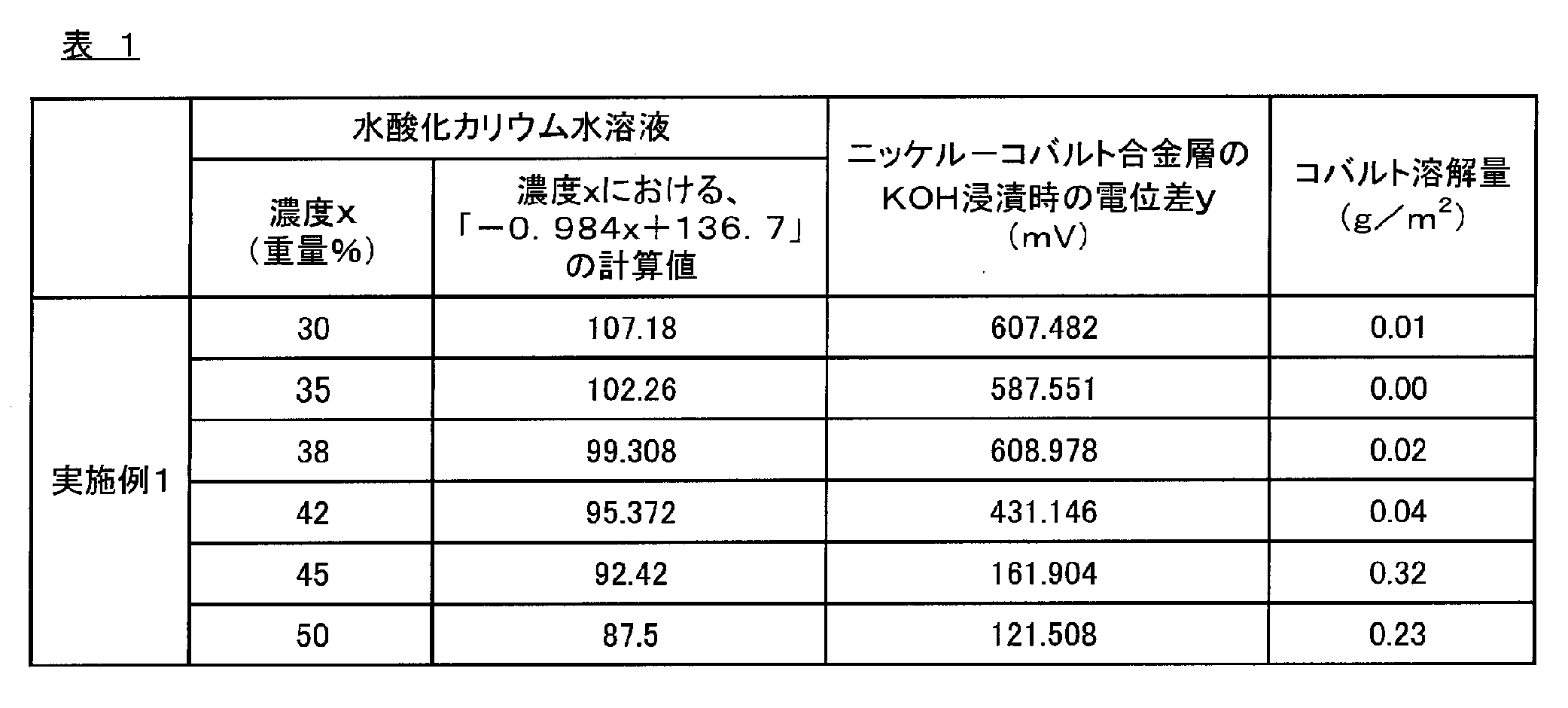
- the potential and the immersion potential of cobalt were measured, and the potential difference when the nickel-cobalt alloy layer was immersed in KOH was determined. The results are shown in Table 1.
- Example 2 A surface-treated steel sheet was obtained in the same manner as in Example 1 except that the cobalt / nickel ratio of the bath composition was changed to 0.14 when forming the nickel-cobalt alloy plating layer, and the concentrations shown in Table 2 were obtained. The same evaluation was performed in an aqueous potassium hydroxide solution. The results are shown in Table 2.
- Example 3 A surface-treated steel sheet was obtained in the same manner as in Example 1 except that the cobalt / nickel ratio of the bath composition was changed to 0.19 when forming the nickel-cobalt alloy plating layer, and the concentrations shown in Table 3 were obtained. The same evaluation was performed in an aqueous potassium hydroxide solution. The results are shown in Table 3.
- Example 4 A surface-treated steel sheet was obtained in the same manner as in Example 1 except that the cobalt / nickel ratio of the bath composition was changed to 0.24 when forming the nickel-cobalt alloy plating layer, and the concentrations shown in Table 4 were obtained. The same evaluation was performed in an aqueous potassium hydroxide solution. The results are shown in Table 4.
- Example 5 A surface-treated steel sheet was obtained in the same manner as in Example 1 except that the cobalt / nickel ratio of the bath composition was changed to 0.29 when forming the nickel-cobalt alloy plating layer, and the concentrations shown in Table 5 were obtained. The same evaluation was performed in an aqueous potassium hydroxide solution. The results are shown in Table 5.
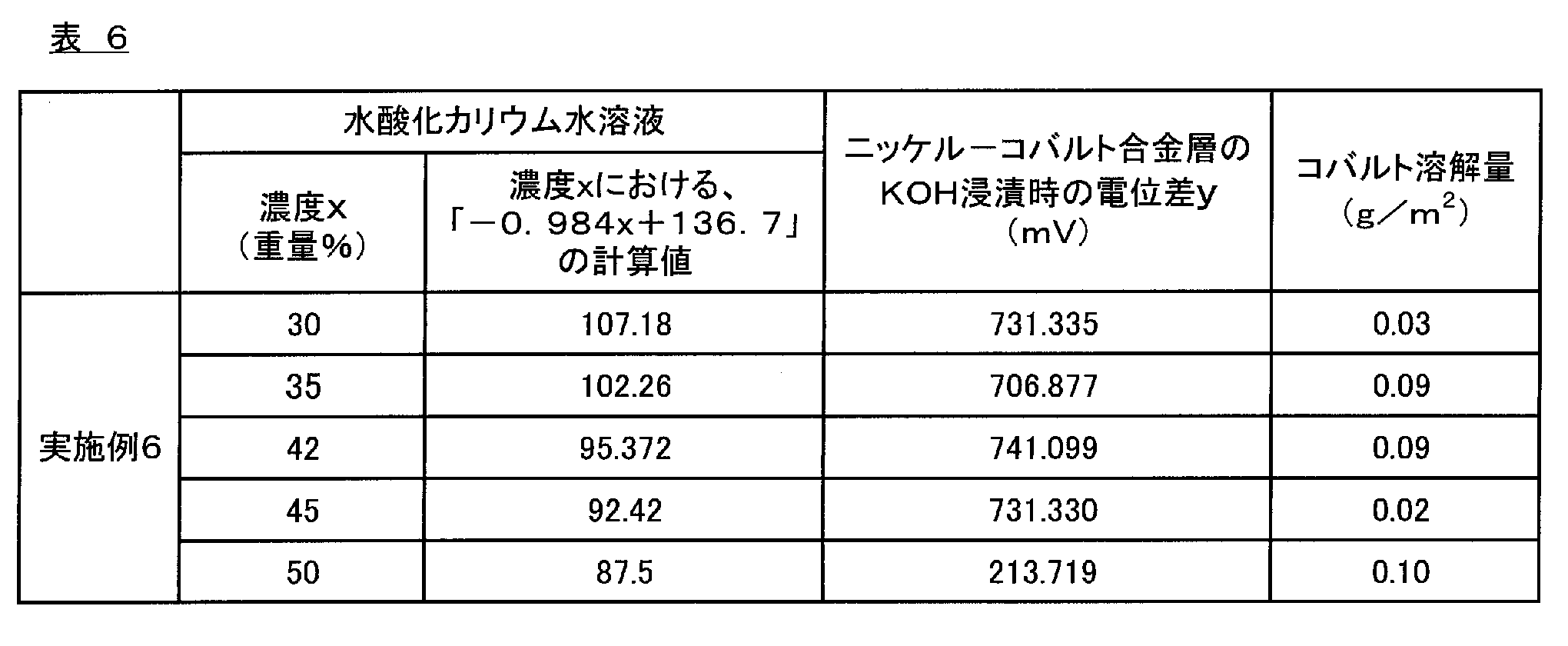
- Example 6 After forming the nickel-cobalt alloy plating layer, the surface was treated in the same manner as in Example 1 except that heat treatment was performed under the conditions of heat treatment temperature: 700 ° C. and heat treatment time: 60 seconds, and heat diffusion was performed. A treated steel plate was obtained and evaluated in the same manner in a potassium hydroxide aqueous solution having the concentration shown in Table 6. The results are shown in Table 6.
- Example 7 A surface-treated steel sheet was obtained in the same manner as in Example 6 except that the cobalt / nickel ratio of the bath composition was changed to 0.14 when forming the nickel-cobalt alloy plating layer, and the concentrations shown in Table 7 were obtained. The same evaluation was performed in an aqueous potassium hydroxide solution. The results are shown in Table 7.
- Example 8 A surface-treated steel sheet was obtained in the same manner as in Example 6 except that the cobalt / nickel ratio of the bath composition was changed to 0.19 when forming the nickel-cobalt alloy plating layer, and the concentrations shown in Table 8 were obtained. The same evaluation was performed in an aqueous potassium hydroxide solution. The results are shown in Table 8.
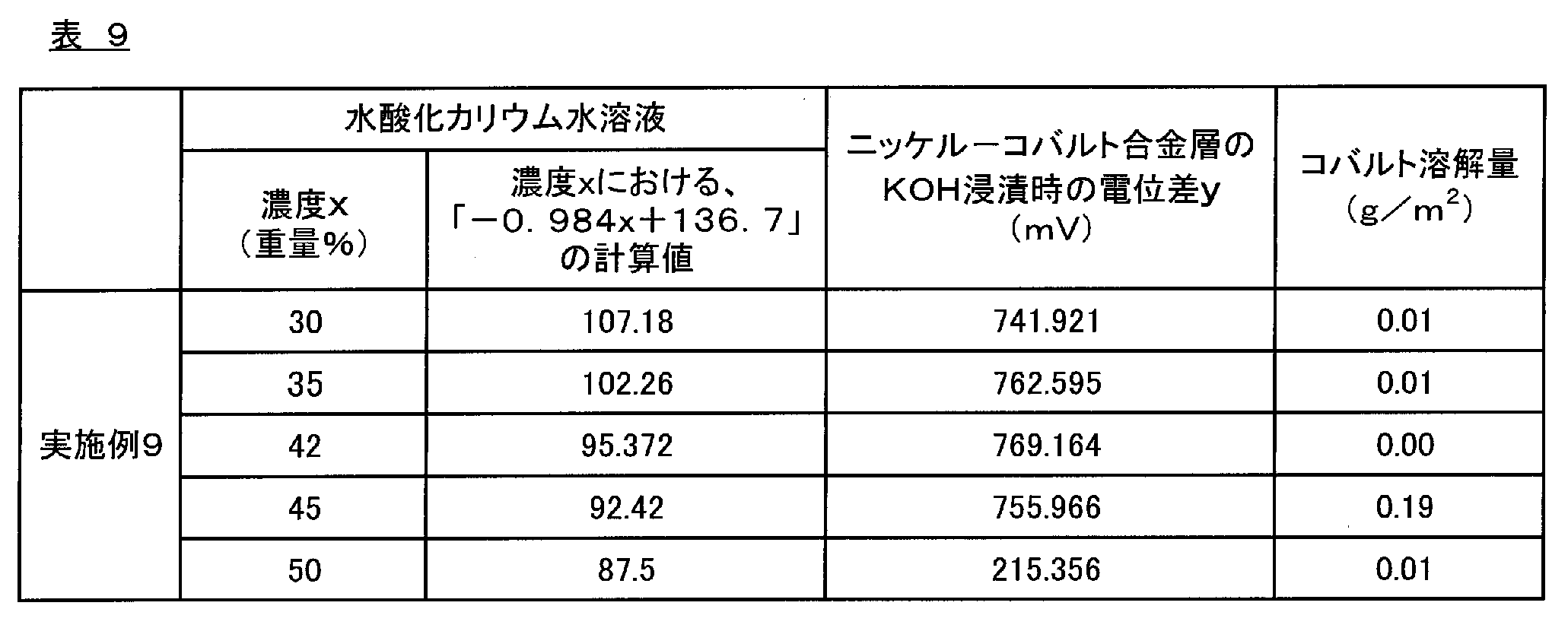
- Example 9 A surface-treated steel sheet was obtained in the same manner as in Example 6 except that the cobalt / nickel ratio of the bath composition was changed to 0.24 when forming the nickel-cobalt alloy plating layer, and the concentrations shown in Table 9 were obtained. The same evaluation was performed in an aqueous potassium hydroxide solution. The results are shown in Table 9.
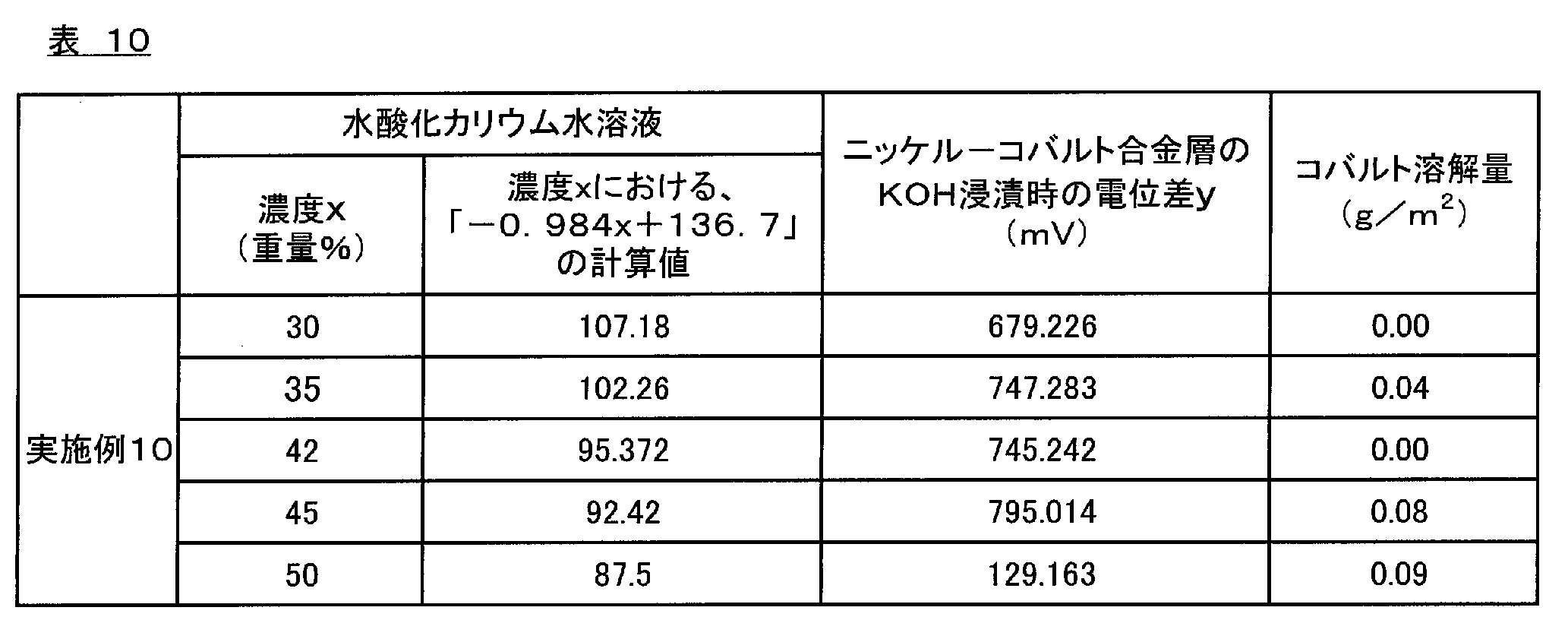
- Example 10 A surface-treated steel sheet was obtained in the same manner as in Example 6 except that the cobalt / nickel ratio of the bath composition was changed to 0.29 when forming the nickel-cobalt alloy plating layer, and the concentrations shown in Table 10 were obtained. The same evaluation was performed in an aqueous potassium hydroxide solution. The results are shown in Table 10.
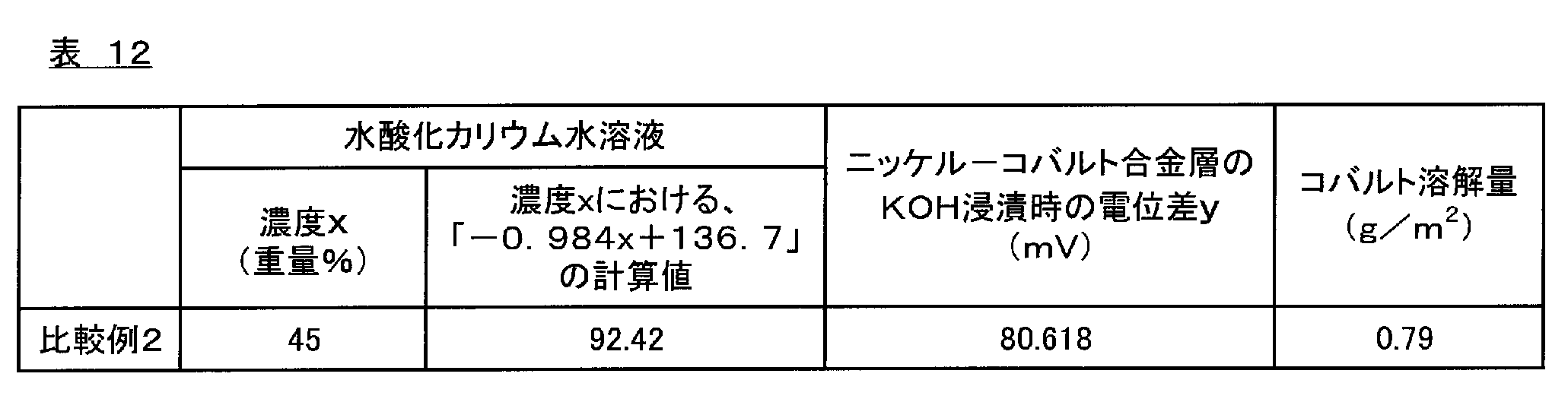
- Example 2 A surface-treated steel sheet was obtained in the same manner as in Example 1 except that the cobalt / nickel ratio of the bath composition was changed to 0.35 when forming the nickel-cobalt alloy plating layer. Evaluation was similarly performed in a potassium hydroxide aqueous solution having a concentration. The results are shown in Table 12.
- Example 3 A surface-treated steel sheet was obtained in the same manner as in Example 1 except that the cobalt / nickel ratio of the bath composition was changed to 0.32 when forming the nickel-cobalt alloy plating layer. Evaluation was similarly performed in a potassium hydroxide aqueous solution having a concentration. The results are shown in Table 13.
- FIG. 1 (A) is a graph in which the results of all examples and comparative examples (Examples 1 to 10 and Comparative Examples 1 to 3) are plotted.
- FIG. 1B is a graph in which FIG. ) Is a graph obtained by changing the scale of the vertical axis and enlarging the vicinity of the straight line of the above formula (1) and the above formula (2). As shown in FIG.
Landscapes
- Chemical & Material Sciences (AREA)
- Chemical Kinetics & Catalysis (AREA)
- Electrochemistry (AREA)
- Engineering & Computer Science (AREA)
- Materials Engineering (AREA)
- General Chemical & Material Sciences (AREA)
- Metallurgy (AREA)
- Organic Chemistry (AREA)
- Inorganic Chemistry (AREA)
- Manufacturing & Machinery (AREA)
- Electroplating Methods And Accessories (AREA)
- Sealing Battery Cases Or Jackets (AREA)
- Primary Cells (AREA)
- Secondary Cells (AREA)
Description
本発明は、電池容器用表面処理鋼板、該電池容器用表面処理鋼板を用いた電池容器、および該電池容器を用いた電池に関する。
近年、オーディオ機器や携帯電話など、多方面において携帯用機器が用いられ、その作動電源として一次電池であるアルカリ電池、二次電池であるニッケル水素電池、リチウムイオン電池などが多用されている。これらの電池においては、高出力化および長寿命化など、高性能化が求められており、正極活物質や負極活物質などからなる発電要素を充填する電池容器も電池の重要な構成要素としての性能の向上が求められている。そのため、このような電池容器材料としては、強アルカリ性の電解液に対する耐溶解性に優れ、かつ、高電池性能を実現できるような材料が望まれている。
また、近年、揮発性有機溶媒の削減のために、電池容器内面への導電膜の塗布が省略されており、そのため、このような電池容器材料としては、導電膜を形成しない場合でも、経時後の電池特性を良好に保つことができるものが望まれている。このような電池容器材料として、たとえば、特許文献1では、鋼板の表面に、下から順に、ニッケルめっき層、およびコバルトめっき層を形成してなるめっき鋼板が提案されている。特に、この特許文献1では、最表層にコバルトめっき層を形成することで、めっき鋼板表層における導電性を向上させ、これにより、導電膜を形成しない場合でも、電池特性を向上させることを目的としている。
しかしながら、本発明者等が検討したところ、上記特許文献1に開示されているめっき鋼板を、アルカリ電池、ニッケル水素電池などの強アルカリ性の電解液を用いる電池の電池容器として用いた場合には、時間の経過とともにコバルトが溶出してしまうこと、このコバルトの溶出が電池内部におけるガス発生の原因となり液漏れの発生へとつながるおそれの問題があることが認められた。
本発明の目的は、電池容器内面における導電性に優れ、かつ、広い濃度範囲(特に、電池の電解液として使用される濃度範囲)の強アルカリ性の電解液に対し、コバルトの溶出が有効に防止された電池容器用表面処理鋼板を提供することである。また、本発明は、このような電池容器用表面処理鋼板を用いて得られる電池容器および電池を提供することも目的とする。
本発明者等は、上記目的を達成すべく鋭意検討した結果、電池容器内面となる面の最表面に形成されるニッケル-コバルト合金層を、水酸化カリウム水溶液に浸漬させた際における、コバルトの浸漬電位に対する電位差が、水酸化カリウム水溶液の濃度に対して所定の関係を有するものとすることにより、上記目的を達成できることを見出し本発明を完成させるに至った。
すなわち、本発明によれば、電池容器内面となる面の最表面に、ニッケル-コバルト合金層が形成されてなる電池容器用表面処理鋼板であって、x[重量%](ただし、30≦x≦50)の濃度の水酸化カリウム水溶液に浸漬した際における、前記ニッケル-コバルト合金層の浸漬電位の、コバルトの浸漬電位に対する電位差をy[mV](y=「ニッケル-コバルト合金層の浸漬電位」-「コバルトの浸漬電位」)とした場合に、下記式(1)を満たすことを特徴とする電池容器用表面処理鋼板が提供される。
y≧-0.984x+136.7 ・・・(1)
y≧-0.984x+136.7 ・・・(1)
本発明の電池容器用表面処理鋼板において、好ましくは、前記ニッケル-コバルト合金層の下層として、ニッケル層を有する。
好ましくは、前記ニッケル-コバルト合金層と鋼板との間に鉄-ニッケル拡散層および/または鉄-ニッケル-コバルト拡散層を有する。
好ましくは、前記ニッケル-コバルト合金層と鋼板との間に鉄-ニッケル拡散層および/または鉄-ニッケル-コバルト拡散層を有する。
本発明によれば、上記いずれかの電池容器用表面処理鋼板を成形加工してなる電池容器が提供される。
また、本発明によれば、上記電池容器を用いてなる電池が提供される。
また、本発明によれば、上記電池容器を用いてなる電池が提供される。
本発明によれば、電池容器内面となる面の最表面に形成されるニッケル-コバルト合金層を、水酸化カリウム水溶液に浸漬させた際における、コバルトの浸漬電位に対する電位差と、水酸化カリウム水溶液の濃度とを上述した関係を満足するように制御することにより、電池容器内面における導電性に優れ、かつ、広い濃度範囲(特に、電池の電解液として使用される濃度範囲)の強アルカリ性の電解液に対し、コバルトの溶出が有効に防止された電池容器用表面処理鋼板、ならびに該電池容器用表面処理鋼板を用いて得られる電池容器および電池を提供することができる。
以下、本発明の電池容器用表面処理鋼板について説明する。
本発明の電池容器用表面処理鋼板は、電池容器内面となる面の最表面に、ニッケル-コバルト合金層が形成されてなる電池容器用表面処理鋼板であって、かつ、x[重量%](ただし、30≦x≦50)の濃度の水酸化カリウム水溶液に浸漬した際における、ニッケル-コバルト合金層の浸漬電位の、コバルトの浸漬電位に対する電位差をy[mV](y=「ニッケル-コバルト合金層の浸漬電位」-「コバルトの浸漬電位」)とした場合に、下記式(1)を満たすことを特徴とする。
y≧-0.984x+136.7 ・・・(1)
本発明の電池容器用表面処理鋼板は、電池容器内面となる面の最表面に、ニッケル-コバルト合金層が形成されてなる電池容器用表面処理鋼板であって、かつ、x[重量%](ただし、30≦x≦50)の濃度の水酸化カリウム水溶液に浸漬した際における、ニッケル-コバルト合金層の浸漬電位の、コバルトの浸漬電位に対する電位差をy[mV](y=「ニッケル-コバルト合金層の浸漬電位」-「コバルトの浸漬電位」)とした場合に、下記式(1)を満たすことを特徴とする。
y≧-0.984x+136.7 ・・・(1)
<鋼板>
本発明の電池容器用表面処理鋼板の基板となる鋼板としては、絞り加工性、絞りしごき加工性、絞り加工と曲げ戻し加工による加工(DTR)の加工性に優れているものであればよく特に限定されないが、たとえば、低炭素アルミキルド鋼(炭素量0.01~0.15重量%)、炭素量が0.003重量%以下の極低炭素鋼、または、極低炭素鋼にさらにTiやNbを添加してなる非時効性極低炭素鋼などからなるものを用いることができる。
本発明の電池容器用表面処理鋼板の基板となる鋼板としては、絞り加工性、絞りしごき加工性、絞り加工と曲げ戻し加工による加工(DTR)の加工性に優れているものであればよく特に限定されないが、たとえば、低炭素アルミキルド鋼(炭素量0.01~0.15重量%)、炭素量が0.003重量%以下の極低炭素鋼、または、極低炭素鋼にさらにTiやNbを添加してなる非時効性極低炭素鋼などからなるものを用いることができる。
本発明においては、これらの鋼の熱間圧延板を酸洗して表面のスケール(酸化膜)を除去した後、冷間圧延し、次いで圧延油を電解洗浄した後、焼鈍、調質圧延したものを基板として用いる。この場合における、焼鈍は、連続焼鈍あるいは箱型焼鈍のいずれでもよく、特に限定されない。
<ニッケル-コバルト合金層>
本発明の電池容器用表面処理鋼板は、電池容器内面となる面の最表面に、ニッケル-コバルト合金層が形成されてなる。ニッケル-コバルト合金層は、水酸化カリウム水溶液中における、ニッケル-コバルト合金層の浸漬電位の、コバルトの浸漬電位に対する電位差(「ニッケル-コバルト合金層の浸漬電位」-「コバルトの浸漬電位」で算出される電位差であり、以下、「ニッケル-コバルト合金層のKOH浸漬時の電位差」と略記する。)が、水酸化カリウム水溶液の濃度との関係において、下記式(1)を満たすものである。
y≧-0.984x+136.7 ・・・(1)
本発明の電池容器用表面処理鋼板は、電池容器内面となる面の最表面に、ニッケル-コバルト合金層が形成されてなる。ニッケル-コバルト合金層は、水酸化カリウム水溶液中における、ニッケル-コバルト合金層の浸漬電位の、コバルトの浸漬電位に対する電位差(「ニッケル-コバルト合金層の浸漬電位」-「コバルトの浸漬電位」で算出される電位差であり、以下、「ニッケル-コバルト合金層のKOH浸漬時の電位差」と略記する。)が、水酸化カリウム水溶液の濃度との関係において、下記式(1)を満たすものである。
y≧-0.984x+136.7 ・・・(1)
本発明においては、ニッケル-コバルト合金層のKOH浸漬時の電位差を、上記式(1)の範囲内に制御して得られる本発明の電池容器用表面処理鋼板を、ニッケル-コバルト合金層を内面とする電池容器として用いた際に、導電性に優れたコバルトの作用により電池容器内面における導電性に優れ、かつ、広い濃度範囲(特に、電池の電解液として使用される濃度範囲)の強アルカリ性の電解液に対し、コバルトの溶出を有効に防止することが可能となる。
特に、本発明者等は、電池容器内面となる面の最表面に形成するニッケル-コバルト合金層を水酸化カリウム水溶液に浸漬させた際における、コバルトの浸漬電位に対する電位差(上記のニッケル-コバルト合金層のKOH浸漬時の電位差)、および該水酸化カリウム水溶液の濃度に着目し、検討を行ったところ、水酸化カリウム水溶液の濃度が変化すると、ニッケル-コバルト合金層のKOH浸漬時の電位差が変化し、そして、水酸化カリウム水溶液の濃度によってコバルトの溶出を防止することができるニッケル-コバルト合金層のKOH浸漬時の電位差が異なるものとなるとの知見を得て、このような知見に基づき、水酸化カリウム水溶液の濃度と、ニッケル-コバルト合金層のKOH浸漬時の電位差とを所定の関係とすることにより、導電性を維持しながら、コバルトの溶出を防止できることを見出したものである。
なお、本発明においては、ニッケル-コバルト合金層のKOH浸漬時の電位差と、水酸化カリウム水溶液の濃度とが、上記式(1)の関係を満たせばよいが、コバルトの溶出を抑制する効果をより高めることができるという点より、下記式(2)の関係を満たすものがより好ましい。
y≧-3.301x+258.3 ・・・(2)
y≧-3.301x+258.3 ・・・(2)
また、本発明においては、ニッケル-コバルト合金層およびコバルトの浸漬電位は、たとえば、30~50重量%の範囲で濃度を調整した水酸化カリウム水溶液中に、ニッケル-コバルト合金層、およびコバルトを浸漬させた後、浸漬を開始から15分後の自然電位を測定し、これを浸漬電位とすることができる。ここで、浸漬電位を測定する際における、水酸化カリウム水溶液中にニッケル-コバルト合金層、およびコバルトを浸漬する時間は、浸漬後に自然電位の値が安定するまでに要する時間に基づいて設定することができ、本発明においては、たとえば、上記のように15分と設定することができる。なお、本発明においては、コバルトの浸漬電位の測定は、本発明の電池容器用表面処理鋼板と同様の鋼板にコバルトめっきを施したコバルトめっき鋼板を準備し、準備したコバルトめっき鋼板のコバルト層の自然電位を測定することができる。また、浸漬電位の具体的な測定方法としては、水酸化カリウム水溶液中において、参照電極:Ag/AgCl、対極:Pt、測定温度60℃の条件で、ニッケル-コバルト合金層、およびコバルトの、Ag/AgClに対する自然電位を測定し、次いで、ニッケル-コバルト合金層の浸漬電位から、コバルトの浸漬電位を引いた電位差を求めることにより、上述したニッケル-コバルト合金層のKOH浸漬時の電位差を求めることができる。
本発明において、ニッケル-コバルト合金層のKOH浸漬時の電位差を上記式(1)の範囲とする方法としては、特に限定されないが、たとえば、次の方法が挙げられる。すなわち、第1の方法として、コバルト/ニッケル比が所定範囲にあるニッケル-コバルト合金めっき浴を用いて、鋼板の表面にニッケル-コバルト合金めっき層を形成する方法が挙げられる。あるいは、第2の方法として、ニッケル-コバルト合金めっき浴を用いて、鋼板の表面にニッケル-コバルト合金めっき層を形成し、次いで、これに熱処理を施すことで熱拡散させる方法が挙げられる。さらに、第3の方法として、鋼板の表面にニッケルめっき層およびコバルトめっき層を、この順に形成し、次いで、これに熱処理を施すことで熱拡散させ、ニッケル-コバルト合金層を形成する方法などが挙げられる。ただし、本発明において、ニッケル-コバルト合金層のKOH浸漬時の電位差を上記式(1)の範囲とする方法としては、上記の方法に特に限定されるものではない。
上記第1の方法により、コバルト/ニッケル比が所定範囲にあるニッケル-コバルト合金めっき浴を用いて、鋼板の表面にニッケル-コバルト合金めっき層を形成する場合には、ニッケル-コバルト合金めっき浴として、硫酸ニッケル、塩化ニッケル、硫酸コバルトおよびホウ酸を含有してなるワット浴をベースとしためっき浴を用いることが好ましい。なお、めっき浴中における、コバルト/ニッケル比は、コバルト/ニッケルのモル比で、0.10~0.29の範囲とすることが好ましく、0.10~0.24の範囲とすることがより好ましい。たとえば、硫酸ニッケル、塩化ニッケル、硫酸コバルトおよびホウ酸を含有してなるワット浴をベースとしためっき浴を用いる場合には、硫酸ニッケル:10~300g/L、塩化ニッケル:20~60g/L、硫酸コバルト:10~250g/L、ほう酸:10~40g/Lの範囲で、コバルト/ニッケル比が上記範囲となるように、各成分を適宜調整してなるめっき浴を用いることができる。
なお、上記のニッケル-コバルト合金めっき浴を用いて、鋼板の表面にニッケル-コバルト合金めっき層を形成する場合には、ニッケル-コバルト合金めっき浴は、浴温40~80℃、pH1.5~5.0、電流密度1~40A/dm2の条件とすることが好ましく、めっき厚みは、好ましくは0.01~3.0μmであり、より好ましくは0.05~2.0μm、さらに好ましくは0.1~1.0μmである。
また、第1の方法においては、ニッケル-コバルト合金層を形成する前に、下地ニッケルめっきを施して、下地ニッケルめっき層を形成してもよい。下地ニッケルめっき層は、通常、ワット浴を用いて形成することができ、また、その厚みは、好ましくは0.05~3.0μm、より好ましくは0.1~2.0μmである。第1の方法において、下地ニッケルめっき層を形成することにより、本発明の電池容器用表面処理鋼板を、鋼板上に、下から順にニッケル層、ニッケル-コバルト合金層を有するもの(Ni-Co/Ni/Fe)とすることができる。
なお、第1の方法においては、このような下地ニッケルめっき層を形成する場合には、下地ニッケルめっき層の形成後、ニッケル-コバルト合金層を形成する前に、熱処理を施すことで、熱拡散させる処理を行なってもよい。この場合における、熱処理は、連続焼鈍法、または箱型焼鈍法のいずれで行なってもよく、また、熱処理条件は、下地ニッケルめっき層の厚みに応じて、適宜、選択すればよいが、たとえば、連続焼鈍とする場合には、熱処理温度:700~800℃、熱処理時間:10秒~300秒とすることが好ましく、また、箱型焼鈍とする場合には、熱処理温度:450~600℃、熱処理時間:1時間~10時間、熱処理雰囲気:非酸化性雰囲気または還元性保護ガス雰囲気とすることが好ましい。なお、熱処理雰囲気を、還元性保護ガス雰囲気とする場合には、保護ガスとして、熱伝達のよい水素富化焼鈍と呼ばれるアンモニアクラック法により生成される75%水素-25%窒素からなる保護ガスを用いることが好ましい。
そして、上述した熱拡散させる処理を行うことにより、鋼板と、下地ニッケルめっき層とを拡散させることができ、鋼板上に、鉄-ニッケル拡散層を形成することができる。なお、この場合においては、下地ニッケルめっき層を、鉄と完全に拡散させるような構成としてもよいし、あるいは、下地ニッケルめっき層の一部については鉄と拡散させずに、ニッケル層を残存させるような構成としてもよい。そして、下地ニッケルめっき層を、鉄と完全に拡散させた場合には、本発明の電池容器用表面処理鋼板を、鋼板上に、下から順に、鉄-ニッケル拡散層、ニッケル-コバルト合金層を有するような構成(Ni-Co/Ni-Fe/Fe)とすることができる。あるいは、ニッケル層を残存させた場合には、本発明の電池容器用表面処理鋼板を、鋼板上に、下から順に、鉄-ニッケル拡散層、ニッケル層、ニッケル-コバルト合金層を有するような構成(Ni-Co/Ni/Ni-Fe/Fe)とすることができる。
また、上記第2の方法により、ニッケル-コバルト合金層を形成した後に、熱処理を施して、熱拡散させる処理を行う場合には、まず、ニッケル-コバルト合金めっき浴として、硫酸ニッケル、塩化ニッケル、硫酸コバルトおよびホウ酸を含有してなるワット浴をベースとしためっき浴を用いて、熱処理前のニッケル-コバルト合金層を形成する。めっき浴中における、コバルト/ニッケル比は、コバルト/ニッケルのモル比で、0.10~0.29の範囲とすることが好ましく、0.10~0.24の範囲とすることがより好ましい。また、ニッケル-コバルト合金めっきは、浴温40~80℃、pH1.5~5.0、電流密度1~40A/dm2の条件とすることが好ましく、めっき厚みは、好ましくは0.01~2.0μmであり、より好ましくは0.05~1.0μmである。また、第2の方法においても、ニッケル-コバルト合金層を形成する前に、下地ニッケルめっきを施して、下地ニッケルめっき層を形成してもよい。下地ニッケルめっき層は、通常、用いられるワット浴を用いて形成することができ、また、その厚みは、好ましくは0.05~3.0μm、より好ましくは0.1~2.0μmである。
次いで、上記にて熱処理前のニッケル-コバルト合金層を形成した鋼板について、熱処理を施すことで、熱拡散させる処理を行なう。この場合における、熱処理は、連続焼鈍法、または箱型焼鈍法のいずれで行なってもよく、また、熱処理条件は、用いるニッケル-コバルト合金めっき浴のコバルト/ニッケル比や、熱処理前のニッケル-コバルト合金層の厚みや、下地ニッケルめっき層の有無に応じて、適宜、選択すればよいが、たとえば、連続焼鈍とする場合には、熱処理温度:700~800℃、熱処理時間:10秒~300秒とすることが好ましく、また、箱型焼鈍とする場合には、熱処理温度:450~600℃、熱処理時間:1時間~10時間、熱処理雰囲気:非酸化性雰囲気または還元性保護ガス雰囲気とすることが好ましい。なお、熱処理雰囲気を、還元性保護ガス雰囲気とする場合には、保護ガスとして、熱伝達のよい水素富化焼鈍と呼ばれるアンモニアクラック法により生成される75%水素-25%窒素からなる保護ガスを用いることが好ましい。
なお、第2の方法においては、上述した熱拡散させる処理を行うことにより、鋼板と、ニッケル-コバルト合金層との間に、鉄-ニッケル拡散層および/または鉄-ニッケル-コバルト拡散層を形成することもでき、そのため、本発明の電池容器用表面処理鋼板を、鋼板上に、下から順に、鉄-ニッケル拡散層および/または鉄-ニッケル-コバルト拡散層、ニッケル-コバルト合金層を有するような構成(Ni-Co/Fe-Niおよび/またはFe-Ni-Co/Fe)とすることができる。あるいは、第2の方法において、下地ニッケルめっき層を形成する場合には、下地ニッケルめっき層の厚みまたは熱処理条件によって、本発明の電池容器用表面処理鋼板を、鋼板上に、下から順に、鉄-ニッケル拡散層、ニッケル-コバルト合金層を有するような構成(Ni-Co/Fe-Ni/Fe)、あるいは、鋼板上に、下から順に、鉄-ニッケル拡散層、ニッケル層、ニッケル-コバルト合金層を有するような構成(Ni-Co/Ni/Fe-Ni/Fe)とすることができる。
あるいは、上記第3の方法により、鋼板の表面にニッケルめっき層およびコバルトめっき層を、この順に形成し、次いで、これに熱処理を施すことで熱拡散させ、ニッケル-コバルト合金層を形成させる場合には、まず、ニッケルめっき浴を用いて、鋼板の表面にニッケルめっき層を形成する。ニッケルめっき浴としては、ニッケルめっきで通常用いられているめっき浴、すなわち、ワット浴や、クエン酸浴、スルファミン酸浴、ほうフッ化物浴、塩化物浴などを用いることができる。たとえば、ニッケルめっき層は、ワット浴として、硫酸ニッケル200~350g/L、塩化ニッケル20~60g/L、ほう酸10~50g/Lの浴組成のものを用い、pH1.5~5.0、浴温40~80℃にて、電流密度1~40A/dm2の条件で形成することができる。ニッケルめっき層の厚みは、好ましくは0.05~3.0μm、より好ましくは0.1~2.0μmである。
次いで、ニッケルめっき層を形成した鋼板上に、コバルトめっきを施すことで、ニッケルめっき層上に、コバルトめっき層を形成する。コバルトめっき層は、たとえば、硫酸コバルト:200~300g/L、塩化コバルト:50~150g/L、塩化ナトリウム:10~50g/Lの浴組成のコバルトめっき浴を用いて、pH:2~5、浴温:40~80℃、電流密度:1~40A/dm2の条件で形成することができる。コバルトめっき層の厚みは、好ましくは0.01~2.0μm、より好ましくは0.05~1.0μmである。
次いで、ニッケルめっき層およびコバルトめっき層を形成した鋼板について、熱処理を施すことで、ニッケルめっき層およびコバルトめっき層を熱拡散させて、ニッケル-コバルト合金層を形成する処理を行なう。この場合における、熱処理は、連続焼鈍法、または箱型焼鈍法のいずれで行なってもよく、また、熱処理条件は、熱処理前のニッケルめっき層の厚みや、コバルトめっき層の厚みに応じて、適宜、選択すればよいが、たとえば、連続焼鈍とする場合には、熱処理温度:700~800℃、熱処理時間:10秒~300秒とすることが好ましく、また、箱型焼鈍とする場合には、熱処理温度:450~600℃、熱処理時間:1時間~10時間、熱処理雰囲気:非酸化性雰囲気または還元性保護ガス雰囲気とすることが好ましい。なお、熱処理雰囲気は、上述した第1の方法および第2の方法と同様に、75%水素-25%窒素からなる保護ガスを用いることが好ましい。
なお、第3の方法においては、上述した熱拡散させる処理を行うことにより、鋼板と、ニッケル層との間に、鉄-ニッケル拡散層を形成することもでき、そのため、本発明の電池容器用表面処理鋼板を、鋼板上に、下から順に、鉄-ニッケル拡散層、ニッケル層、ニッケル-コバルト合金層を有するような構成(Ni-Co/Ni/Fe-Ni/Fe)とすることができる。あるいは、第3の方法において、ニッケルめっき層の厚みまたは熱処理条件によっては、ニッケル層を完全に熱拡散させることができ、この場合には、本発明の電池容器用表面処理鋼板を、鋼板上に、下から順に、鉄-ニッケル拡散層、ニッケル-コバルト合金層(Ni-Co/Fe-Ni/Fe)を有するような構成とすることができる。
以上のようにして、鋼板上に形成するニッケル-コバルト合金層について、ニッケル-コバルト合金層のKOH浸漬時の電位差を上記式(1)を満たす範囲内とすることで、本発明の電池容器用表面処理鋼板を得ることができる。これにより、本発明の電池容器用表面処理鋼板を、ニッケル-コバルト合金層を内面とする電池容器として用いた際に、導電性に優れたコバルトの作用により電池容器内面における導電性に優れ、かつ、強アルカリ性の電解液としての水酸化カリウム溶液に対し、溶液中の水酸化カリウムの濃度に応じて、高い耐溶解性を確保することが可能となる。
<電池容器>
本発明の電池容器は、上述した本発明の電池容器用表面処理鋼板を用いて得られる。具体的には、本発明の電池容器は、上述した本発明の電池容器用表面処理鋼板を、絞り、しごき、DIまたはDTR成形にてニッケル-コバルト合金層が容器内面側となるように成形する。
本発明の電池容器は、上述した本発明の電池容器用表面処理鋼板を用いて得られる。具体的には、本発明の電池容器は、上述した本発明の電池容器用表面処理鋼板を、絞り、しごき、DIまたはDTR成形にてニッケル-コバルト合金層が容器内面側となるように成形する。
本発明の電池容器は、上述した本発明の電池容器用表面処理鋼板を用いてなるものであるため、電池容器内面における導電性に優れ、かつ、強アルカリ性の電解液としての水酸化カリウム溶液に対し、溶液中の水酸化カリウムの濃度に応じて、高い耐溶解性を確保することが可能であり、たとえば、アルカリ電池、ニッケル水素電池などのアルカリ性の電解液を用いる電池などの電池容器として好適に用いることができる。
以下に、実施例を挙げて、本発明についてより具体的に説明するが、本発明は、これら実施例に限定されない。
<実施例1>
原板として、下記に示す化学組成を有する低炭素アルミキルド鋼の冷間圧延板(厚さ0.25mm)を焼鈍して得られた鋼板を準備した。
C:0.045重量%、Mn:0.23重量%、Si:0.02重量%、P:0.012重量%、S:0.009重量%、Al:0.063重量%、N:0.0036重量%、残部:Feおよび不可避的不純物
原板として、下記に示す化学組成を有する低炭素アルミキルド鋼の冷間圧延板(厚さ0.25mm)を焼鈍して得られた鋼板を準備した。
C:0.045重量%、Mn:0.23重量%、Si:0.02重量%、P:0.012重量%、S:0.009重量%、Al:0.063重量%、N:0.0036重量%、残部:Feおよび不可避的不純物
そして、準備した鋼板について、アルカリ電解脱脂、硫酸浸漬の酸洗を行った後、下記条件にてニッケル-コバルト合金めっきを行い、ニッケル-コバルト合金層を形成することにより、ニッケル-コバルト合金層の被膜量が15g/m2である表面処理鋼板を得た。なお、ニッケル-コバルト合金めっきの条件は、以下の通りとした。
浴組成:硫酸ニッケル、塩化ニッケル、硫酸コバルト、塩化コバルト、およびホウ酸を、コバルト/ニッケルのモル比0.10で含有
pH:3.5~5.0
浴温:60℃
電流密度:10A/dm2
浴組成:硫酸ニッケル、塩化ニッケル、硫酸コバルト、塩化コバルト、およびホウ酸を、コバルト/ニッケルのモル比0.10で含有
pH:3.5~5.0
浴温:60℃
電流密度:10A/dm2
ニッケル-コバルト合金層のKOH浸漬時の電位差の測定
そして、このようにして得られた表面処理鋼板のニッケル-コバルト合金層を用いて、ニッケル-コバルト合金層のKOH浸漬時の電位差を求めた。まず、得られた表面処理鋼板のニッケル-コバルト合金層について、下記条件にて浸漬電位の測定を行った。
電解液:濃度30重量%の水酸化カリウム水溶液
参照極:Ag/AgCl
対極:Pt
測定温度:60℃
そして、このようにして得られた表面処理鋼板のニッケル-コバルト合金層を用いて、ニッケル-コバルト合金層のKOH浸漬時の電位差を求めた。まず、得られた表面処理鋼板のニッケル-コバルト合金層について、下記条件にて浸漬電位の測定を行った。
電解液:濃度30重量%の水酸化カリウム水溶液
参照極:Ag/AgCl
対極:Pt
測定温度:60℃
次いで、コバルトの浸漬電位の測定を行った。具体的には、上記の表面処理鋼板と同様の鋼板に、アルカリ電解脱脂、硫酸浸漬の酸洗を行った後、硫酸コバルト、塩化コバルト、および塩化ナトリウムを含むコバルトめっき浴を用いて、pH:2~5、浴温:60℃、電流密度:10A/dm2の条件にてコバルトめっきを行うことで、被膜量が15g/m2であるコバルトめっき鋼板を得て、得られたコバルトめっき鋼板について、上記の条件で浸漬電位の測定を行った。そして、測定したニッケル-コバルト合金層の浸漬電位と、コバルトの浸漬電位との差分を求めることでニッケル-コバルト合金層のKOH浸漬時の電位差を得た。次いで、電解液である水酸化カリウム水溶液の濃度を、35、38、42、45、50重量%と変更し、それぞれの濃度の水酸化カリウム水溶液ごとに、同様に、ニッケル-コバルト合金層の浸漬電位と、コバルトの浸漬電位を測定して、ニッケル-コバルト合金層のKOH浸漬時の電位差を求めた。結果を表1に示す。
コバルト溶解量の測定
表面処理鋼板のニッケル-コバルト合金層を、上述したニッケル-コバルト合金層のKOH浸漬時の電位差の測定に用いた電解液と同様の濃度の水酸化カリウム水溶液中に浸漬し、60℃の恒温槽で20日間保持した際における、コバルトの溶解量を測定した。結果を表1に示す。
表面処理鋼板のニッケル-コバルト合金層を、上述したニッケル-コバルト合金層のKOH浸漬時の電位差の測定に用いた電解液と同様の濃度の水酸化カリウム水溶液中に浸漬し、60℃の恒温槽で20日間保持した際における、コバルトの溶解量を測定した。結果を表1に示す。
<実施例2>
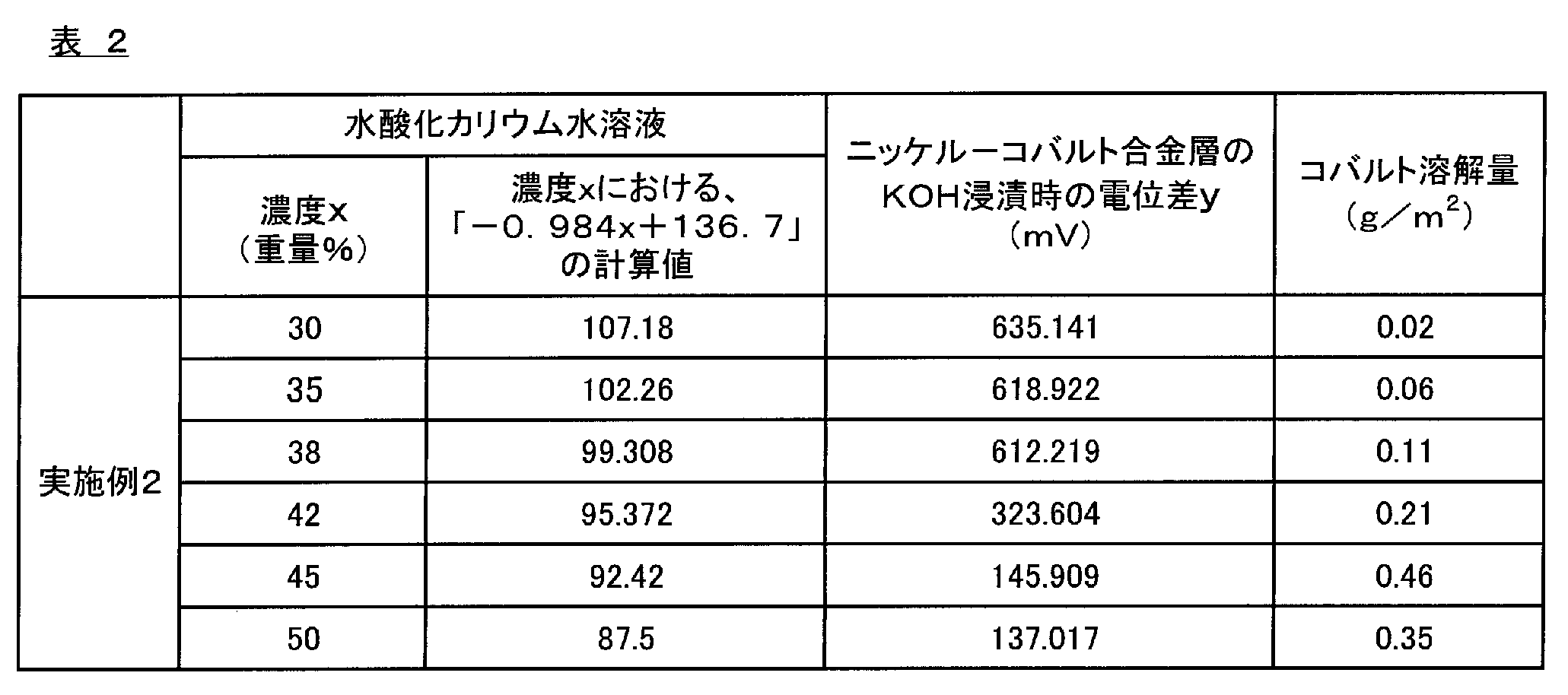
ニッケル-コバルト合金めっき層を形成する際における、浴組成のコバルト/ニッケル比を0.14に変更した点以外は、実施例1と同様にして、表面処理鋼板を得て、表2に示す濃度の水酸化カリウム水溶液中にて、同様に評価を行った。結果を表2に示す。
ニッケル-コバルト合金めっき層を形成する際における、浴組成のコバルト/ニッケル比を0.14に変更した点以外は、実施例1と同様にして、表面処理鋼板を得て、表2に示す濃度の水酸化カリウム水溶液中にて、同様に評価を行った。結果を表2に示す。
<実施例3>
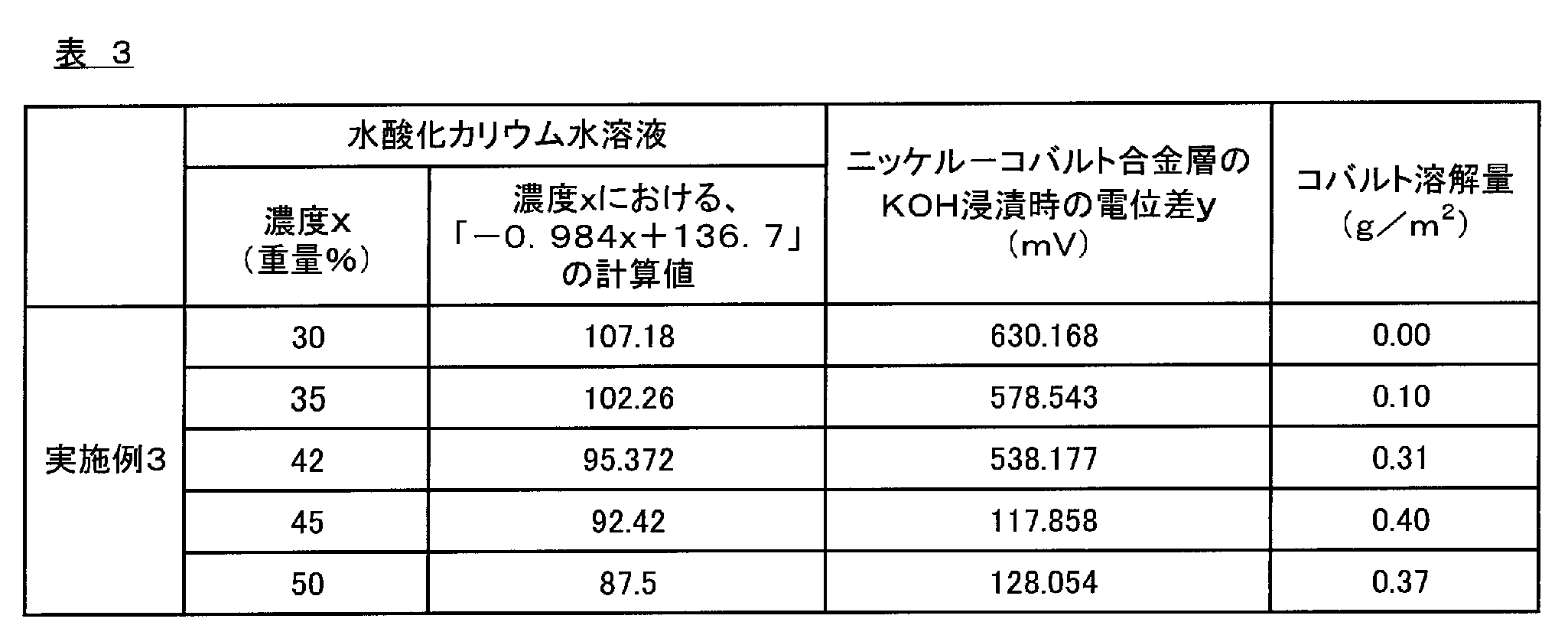
ニッケル-コバルト合金めっき層を形成する際における、浴組成のコバルト/ニッケル比を0.19に変更した点以外は、実施例1と同様にして、表面処理鋼板を得て、表3に示す濃度の水酸化カリウム水溶液中にて、同様に評価を行った。結果を表3に示す。
ニッケル-コバルト合金めっき層を形成する際における、浴組成のコバルト/ニッケル比を0.19に変更した点以外は、実施例1と同様にして、表面処理鋼板を得て、表3に示す濃度の水酸化カリウム水溶液中にて、同様に評価を行った。結果を表3に示す。
<実施例4>
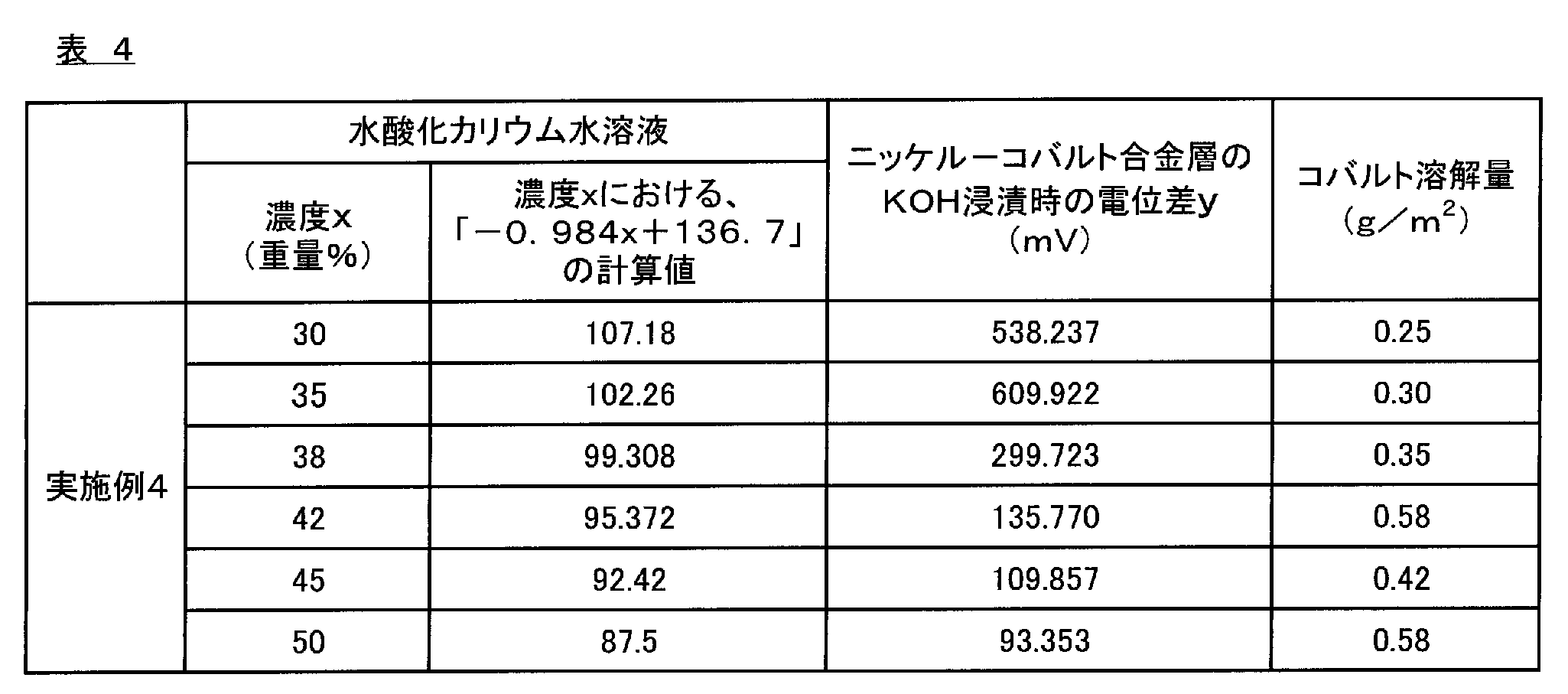
ニッケル-コバルト合金めっき層を形成する際における、浴組成のコバルト/ニッケル比を0.24に変更した点以外は、実施例1と同様にして、表面処理鋼板を得て、表4に示す濃度の水酸化カリウム水溶液中にて、同様に評価を行った。結果を表4に示す。
ニッケル-コバルト合金めっき層を形成する際における、浴組成のコバルト/ニッケル比を0.24に変更した点以外は、実施例1と同様にして、表面処理鋼板を得て、表4に示す濃度の水酸化カリウム水溶液中にて、同様に評価を行った。結果を表4に示す。
<実施例5>
ニッケル-コバルト合金めっき層を形成する際における、浴組成のコバルト/ニッケル比を0.29に変更した点以外は、実施例1と同様にして、表面処理鋼板を得て、表5に示す濃度の水酸化カリウム水溶液中にて、同様に評価を行った。結果を表5に示す。
ニッケル-コバルト合金めっき層を形成する際における、浴組成のコバルト/ニッケル比を0.29に変更した点以外は、実施例1と同様にして、表面処理鋼板を得て、表5に示す濃度の水酸化カリウム水溶液中にて、同様に評価を行った。結果を表5に示す。

<実施例6>
ニッケル-コバルト合金めっき層を形成した後、熱処理温度:700℃、熱処理時間:60秒の条件で熱処理を施して、熱拡散させる処理を行った点以外は、実施例1と同様にして、表面処理鋼板を得て、表6に示す濃度の水酸化カリウム水溶液中にて、同様に評価を行った。結果を表6に示す。
ニッケル-コバルト合金めっき層を形成した後、熱処理温度:700℃、熱処理時間:60秒の条件で熱処理を施して、熱拡散させる処理を行った点以外は、実施例1と同様にして、表面処理鋼板を得て、表6に示す濃度の水酸化カリウム水溶液中にて、同様に評価を行った。結果を表6に示す。
<実施例7>
ニッケル-コバルト合金めっき層を形成する際における、浴組成のコバルト/ニッケル比を0.14に変更した点以外は、実施例6と同様にして、表面処理鋼板を得て、表7に示す濃度の水酸化カリウム水溶液中にて、同様に評価を行った。結果を表7に示す。
ニッケル-コバルト合金めっき層を形成する際における、浴組成のコバルト/ニッケル比を0.14に変更した点以外は、実施例6と同様にして、表面処理鋼板を得て、表7に示す濃度の水酸化カリウム水溶液中にて、同様に評価を行った。結果を表7に示す。

<実施例8>
ニッケル-コバルト合金めっき層を形成する際における、浴組成のコバルト/ニッケル比を0.19に変更した点以外は、実施例6と同様にして、表面処理鋼板を得て、表8に示す濃度の水酸化カリウム水溶液中にて、同様に評価を行った。結果を表8に示す。
ニッケル-コバルト合金めっき層を形成する際における、浴組成のコバルト/ニッケル比を0.19に変更した点以外は、実施例6と同様にして、表面処理鋼板を得て、表8に示す濃度の水酸化カリウム水溶液中にて、同様に評価を行った。結果を表8に示す。

<実施例9>
ニッケル-コバルト合金めっき層を形成する際における、浴組成のコバルト/ニッケル比を0.24に変更した点以外は、実施例6と同様にして、表面処理鋼板を得て、表9に示す濃度の水酸化カリウム水溶液中にて、同様に評価を行った。結果を表9に示す。
ニッケル-コバルト合金めっき層を形成する際における、浴組成のコバルト/ニッケル比を0.24に変更した点以外は、実施例6と同様にして、表面処理鋼板を得て、表9に示す濃度の水酸化カリウム水溶液中にて、同様に評価を行った。結果を表9に示す。
<実施例10>
ニッケル-コバルト合金めっき層を形成する際における、浴組成のコバルト/ニッケル比を0.29に変更した点以外は、実施例6と同様にして、表面処理鋼板を得て、表10に示す濃度の水酸化カリウム水溶液中にて、同様に評価を行った。結果を表10に示す。
ニッケル-コバルト合金めっき層を形成する際における、浴組成のコバルト/ニッケル比を0.29に変更した点以外は、実施例6と同様にして、表面処理鋼板を得て、表10に示す濃度の水酸化カリウム水溶液中にて、同様に評価を行った。結果を表10に示す。
<比較例1>
ニッケル-コバルト合金めっき層を形成した後、熱処理温度:700℃、熱処理時間:60秒の条件で熱処理を施して、熱拡散させる処理を行った点、ニッケル-コバルト合金めっき層を形成する際における、浴組成のコバルト/ニッケル比を0.72に変更した点以外は、実施例1と同様にして、表面処理鋼板を得て、表11に示す濃度の水酸化カリウム水溶液中にて、同様に評価を行った。結果を表11に示す。
ニッケル-コバルト合金めっき層を形成した後、熱処理温度:700℃、熱処理時間:60秒の条件で熱処理を施して、熱拡散させる処理を行った点、ニッケル-コバルト合金めっき層を形成する際における、浴組成のコバルト/ニッケル比を0.72に変更した点以外は、実施例1と同様にして、表面処理鋼板を得て、表11に示す濃度の水酸化カリウム水溶液中にて、同様に評価を行った。結果を表11に示す。

<比較例2>
およびニッケル-コバルト合金めっき層を形成する際における、浴組成のコバルト/ニッケル比を0.35に変更した点以外は、実施例1と同様にして、表面処理鋼板を得て、表12に示す濃度の水酸化カリウム水溶液中にて、同様に評価を行った。結果を表12に示す。
およびニッケル-コバルト合金めっき層を形成する際における、浴組成のコバルト/ニッケル比を0.35に変更した点以外は、実施例1と同様にして、表面処理鋼板を得て、表12に示す濃度の水酸化カリウム水溶液中にて、同様に評価を行った。結果を表12に示す。
<比較例3>
およびニッケル-コバルト合金めっき層を形成する際における、浴組成のコバルト/ニッケル比を0.32に変更した点以外は、実施例1と同様にして、表面処理鋼板を得て、表13に示す濃度の水酸化カリウム水溶液中にて、同様に評価を行った。結果を表13に示す。
およびニッケル-コバルト合金めっき層を形成する際における、浴組成のコバルト/ニッケル比を0.32に変更した点以外は、実施例1と同様にして、表面処理鋼板を得て、表13に示す濃度の水酸化カリウム水溶液中にて、同様に評価を行った。結果を表13に示す。

表1~10に示すように、水酸化カリウム水溶液の濃度をxとし、ニッケル-コバルト合金層のKOH浸漬時の電位差をyとした場合において、xとyとの関係が下記式(1)を満たす実施例1~10は、水酸化カリウム水溶液に浸漬した際におけるコバルト溶解量が0.75g/m2(ニッケル-コバルト合金層の被膜量15g/m2の5重量%に相当する量)以下と少ない量であり、水酸化カリウム水溶液中におけるコバルトの溶出を有効に抑制することができるものであった。
y≧-0.984x+136.7 ・・・(1)
y≧-0.984x+136.7 ・・・(1)
一方、表11~13に示すように、水酸化カリウム水溶液の濃度、およびニッケル-コバルト合金層のKOH浸漬時の電位差が、上記式(1)の関係を満たさない比較例1~3は、水酸化カリウム水溶液に浸漬した際におけるコバルト溶解量が、0.75g/m2(ニッケル-コバルト合金層の被膜量15g/m2の5重量%に相当する量)を超えてしまい、水酸化カリウム水溶液中におけるコバルトの溶解を有効に抑制することができなかった。
ここで、各実施例および比較例における、水酸化カリウム水溶液の濃度であるxと、ニッケル-コバルト合金層のKOH浸漬時の電位差であるyとの関係を、上記式(1)、および上記式(2)の直線とともに表したグラフを図1(A)、図1(B)に示す。なお、図1(A)は、すべての実施例および比較例(実施例1~10、および比較例1~3)の結果をプロットしたグラフであり、図1(B)は、図1(A)の縦軸のスケールを変更し、上記式(1)、および上記式(2)の直線付近を拡大したグラフである。図1(A)、図1(B)に示すように、水酸化カリウム水溶液中におけるコバルトの溶出が有効に抑制されていた実施例1~10は、水酸化カリウム水溶液の濃度が30~50重量%の範囲において、上記式(1)の関係を満たすものとなっている(すなわち、上記式(1)の直線よりy軸の正方向に位置している。)。一方、水酸化カリウム水溶液中におけるコバルトの溶解が顕著に発生した比較例1~3は、上記式(1)の関係を満足しないものとなっている(すなわち、上記式(1)の直線よりy軸の負方向に位置している。)。
Claims (5)
- 電池容器内面となる面の最表面に、ニッケル-コバルト合金層が形成されてなる電池容器用表面処理鋼板であって、
x[重量%](ただし、30≦x≦50)の濃度の水酸化カリウム水溶液に浸漬した際における、前記ニッケル-コバルト合金層の浸漬電位の、コバルトの浸漬電位に対する電位差をy[mV](y=「ニッケル-コバルト合金層の浸漬電位」-「コバルトの浸漬電位」)とした場合に、下記式(1)を満たすことを特徴とする電池容器用表面処理鋼板。
y≧-0.984x+136.7 ・・・(1) - 前記ニッケル-コバルト合金層の下層として、ニッケル層を有することを特徴とする請求項1に記載の電池容器用表面処理鋼板。
- 前記ニッケル-コバルト合金層と鋼板との間に鉄-ニッケル拡散層および/または鉄-ニッケル-コバルト拡散層を有することを特徴とする請求項1または2に記載の電池容器用表面処理鋼板。
- 請求項1~3のいずれかに記載の電池容器用表面処理鋼板を成形加工してなる電池容器。
- 請求項4に記載の電池容器と、水酸化カリウム水溶液を含む電解液とを用いてなる電池。
Priority Applications (1)
| Application Number | Priority Date | Filing Date | Title |
|---|---|---|---|
| JP2014523645A JP6033304B2 (ja) | 2012-07-03 | 2013-05-30 | 電池容器用表面処理鋼板、電池容器および電池 |
Applications Claiming Priority (2)
| Application Number | Priority Date | Filing Date | Title |
|---|---|---|---|
| JP2012149290 | 2012-07-03 | ||
| JP2012-149290 | 2012-07-03 |
Publications (1)
| Publication Number | Publication Date |
|---|---|
| WO2014007002A1 true WO2014007002A1 (ja) | 2014-01-09 |
Family
ID=49881763
Family Applications (1)
| Application Number | Title | Priority Date | Filing Date |
|---|---|---|---|
| PCT/JP2013/064993 Ceased WO2014007002A1 (ja) | 2012-07-03 | 2013-05-30 | 電池容器用表面処理鋼板、電池容器および電池 |
Country Status (2)
| Country | Link |
|---|---|
| JP (1) | JP6033304B2 (ja) |
| WO (1) | WO2014007002A1 (ja) |
Cited By (5)
| Publication number | Priority date | Publication date | Assignee | Title |
|---|---|---|---|---|
| CN111699567A (zh) * | 2018-02-14 | 2020-09-22 | 日本制铁株式会社 | 电池容器用表面处理钢板和电池容器用表面处理钢板的制造方法 |
| EP3591098A4 (en) * | 2017-03-02 | 2021-01-27 | Nippon Steel Corporation | SURFACE-TREATED STEEL SHEET |
| CN112368425A (zh) * | 2018-07-06 | 2021-02-12 | 日本制铁株式会社 | 表面处理钢板和表面处理钢板的制造方法 |
| CN113748225A (zh) * | 2019-04-27 | 2021-12-03 | 东洋钢钣株式会社 | 表面处理钢板和其制造方法 |
| EP3819405A4 (en) * | 2018-07-06 | 2021-12-22 | Nippon Steel Corporation | SURFACE-TREATED STEEL SHEET AND METHOD FOR MANUFACTURING SURFACE-TREATED STEEL SHEET |
Citations (6)
| Publication number | Priority date | Publication date | Assignee | Title |
|---|---|---|---|---|
| WO1999003161A1 (fr) * | 1997-07-08 | 1999-01-21 | Toyo Kohan Co., Ltd. | Feuille d'acier traitee en surface pour boitier de batterie, boitier de batterie et batterie fabriquee a l'aide dudit boitier |
| JP2006257543A (ja) * | 2005-02-18 | 2006-09-28 | Toyo Kohan Co Ltd | 電池容器用めっき鋼板、その電池容器用めっき鋼板を用いた電池容器およびその電池容器を用いた電池 |
| JP2006348362A (ja) * | 2005-06-17 | 2006-12-28 | Toyo Kohan Co Ltd | 電池容器用めっき鋼板、その電池容器用めっき鋼板を用いた電池容器およびその電池容器を用いた電池 |
| JP2006351434A (ja) * | 2005-06-17 | 2006-12-28 | Toyo Kohan Co Ltd | 電池容器用めっき鋼板、その電池容器用めっき鋼板を用いた電池容器およびその電池容器を用いた電池 |
| JP2012048958A (ja) * | 2010-08-26 | 2012-03-08 | Fdk Energy Co Ltd | アルカリ電池 |
| WO2013005774A1 (ja) * | 2011-07-07 | 2013-01-10 | 東洋鋼鈑株式会社 | 電池容器用表面処理鋼板およびその製造方法、電池容器および電池 |
-
2013
- 2013-05-30 WO PCT/JP2013/064993 patent/WO2014007002A1/ja not_active Ceased
- 2013-05-30 JP JP2014523645A patent/JP6033304B2/ja active Active
Patent Citations (6)
| Publication number | Priority date | Publication date | Assignee | Title |
|---|---|---|---|---|
| WO1999003161A1 (fr) * | 1997-07-08 | 1999-01-21 | Toyo Kohan Co., Ltd. | Feuille d'acier traitee en surface pour boitier de batterie, boitier de batterie et batterie fabriquee a l'aide dudit boitier |
| JP2006257543A (ja) * | 2005-02-18 | 2006-09-28 | Toyo Kohan Co Ltd | 電池容器用めっき鋼板、その電池容器用めっき鋼板を用いた電池容器およびその電池容器を用いた電池 |
| JP2006348362A (ja) * | 2005-06-17 | 2006-12-28 | Toyo Kohan Co Ltd | 電池容器用めっき鋼板、その電池容器用めっき鋼板を用いた電池容器およびその電池容器を用いた電池 |
| JP2006351434A (ja) * | 2005-06-17 | 2006-12-28 | Toyo Kohan Co Ltd | 電池容器用めっき鋼板、その電池容器用めっき鋼板を用いた電池容器およびその電池容器を用いた電池 |
| JP2012048958A (ja) * | 2010-08-26 | 2012-03-08 | Fdk Energy Co Ltd | アルカリ電池 |
| WO2013005774A1 (ja) * | 2011-07-07 | 2013-01-10 | 東洋鋼鈑株式会社 | 電池容器用表面処理鋼板およびその製造方法、電池容器および電池 |
Cited By (9)
| Publication number | Priority date | Publication date | Assignee | Title |
|---|---|---|---|---|
| EP3591098A4 (en) * | 2017-03-02 | 2021-01-27 | Nippon Steel Corporation | SURFACE-TREATED STEEL SHEET |
| CN111699567A (zh) * | 2018-02-14 | 2020-09-22 | 日本制铁株式会社 | 电池容器用表面处理钢板和电池容器用表面处理钢板的制造方法 |
| CN112368425A (zh) * | 2018-07-06 | 2021-02-12 | 日本制铁株式会社 | 表面处理钢板和表面处理钢板的制造方法 |
| EP3819406A4 (en) * | 2018-07-06 | 2021-12-15 | Nippon Steel Corporation | SURFACE-TREATED STEEL SHEET AND METHOD FOR MANUFACTURING SURFACE-TREATED STEEL SHEET |
| EP3819405A4 (en) * | 2018-07-06 | 2021-12-22 | Nippon Steel Corporation | SURFACE-TREATED STEEL SHEET AND METHOD FOR MANUFACTURING SURFACE-TREATED STEEL SHEET |
| CN112368425B (zh) * | 2018-07-06 | 2024-03-05 | 日本制铁株式会社 | 表面处理钢板和表面处理钢板的制造方法 |
| CN113748225A (zh) * | 2019-04-27 | 2021-12-03 | 东洋钢钣株式会社 | 表面处理钢板和其制造方法 |
| CN113748225B (zh) * | 2019-04-27 | 2024-04-30 | 东洋钢钣株式会社 | 表面处理钢板和其制造方法 |
| US12448697B2 (en) | 2019-04-27 | 2025-10-21 | Toyo Kohan Co., Ltd. | Surface-treated steel sheet and production method therefor |
Also Published As
| Publication number | Publication date |
|---|---|
| JP6033304B2 (ja) | 2016-11-30 |
| JPWO2014007002A1 (ja) | 2016-06-02 |
Similar Documents
| Publication | Publication Date | Title |
|---|---|---|
| JP6152455B2 (ja) | 電池容器用表面処理鋼板、電池容器および電池 | |
| JP6117099B2 (ja) | 電池容器用表面処理鋼板およびその製造方法、電池容器および電池 | |
| JP7187469B2 (ja) | 表面処理鋼板およびその製造方法 | |
| JP6033304B2 (ja) | 電池容器用表面処理鋼板、電池容器および電池 | |
| JP6400140B2 (ja) | 表面処理鋼板の製造方法、および電池缶の製造方法 | |
| JP6200719B2 (ja) | 電池容器用表面処理鋼板の製造方法 | |
| KR102216706B1 (ko) | 전지 용기용 표면 처리 강판, 전지 용기 및 전지 | |
| WO2014007025A1 (ja) | 電池容器用表面処理鋼板およびその製造方法、電池容器および電池 | |
| CN107407000B (zh) | 电池容器用表面处理钢板的制造方法和电池容器用表面处理钢板 | |
| CN110945155B (zh) | 电池外筒罐用钢板、电池外筒罐及电池 | |
| JP2006093096A (ja) | 電池容器用めっき鋼板、その電池容器用めっき鋼板を用いた電池容器およびその電池容器を用いた電池 | |
| JP7836474B2 (ja) | Niめっき表面処理鋼板および電池容器 | |
| JP2007059087A (ja) | 電池容器用めっき鋼板、その電池容器用めっき鋼板を用いた電池容器およびその電池容器を用いた電池 | |
| JP4911952B2 (ja) | 電池容器用めっき鋼板、その電池容器用めっき鋼板を用いた電池容器およびその電池容器を用いた電池 | |
| WO2022118768A1 (ja) | 表面処理鋼板 |
Legal Events
| Date | Code | Title | Description |
|---|---|---|---|
| 121 | Ep: the epo has been informed by wipo that ep was designated in this application |
Ref document number: 13813926 Country of ref document: EP Kind code of ref document: A1 |
|
| NENP | Non-entry into the national phase |
Ref country code: DE |
|
| ENP | Entry into the national phase |
Ref document number: 2014523645 Country of ref document: JP Kind code of ref document: A |
|
| 122 | Ep: pct application non-entry in european phase |
Ref document number: 13813926 Country of ref document: EP Kind code of ref document: A1 |