WO2013185396A1 - 用于液晶显示器的液晶介质组合物 - Google Patents
用于液晶显示器的液晶介质组合物 Download PDFInfo
- Publication number
- WO2013185396A1 WO2013185396A1 PCT/CN2012/078264 CN2012078264W WO2013185396A1 WO 2013185396 A1 WO2013185396 A1 WO 2013185396A1 CN 2012078264 W CN2012078264 W CN 2012078264W WO 2013185396 A1 WO2013185396 A1 WO 2013185396A1
- Authority
- WO
- WIPO (PCT)
- Prior art keywords
- liquid crystal
- group
- medium composition
- groups
- same
- Prior art date
- Legal status (The legal status is an assumption and is not a legal conclusion. Google has not performed a legal analysis and makes no representation as to the accuracy of the status listed.)
- Ceased
Links
- 0 CC(C(c1ccc(*c(cc2)ccc2[U]C(C(C)=C)=*)cc1)=C)=C Chemical compound CC(C(c1ccc(*c(cc2)ccc2[U]C(C(C)=C)=*)cc1)=C)=C 0.000 description 3
- ZXKGDMZVLJWESO-UHFFFAOYSA-N CC(C(Oc(cc1)ccc1Nc(cc1)ccc1OC(C(C)=C)=O)=O)=C Chemical compound CC(C(Oc(cc1)ccc1Nc(cc1)ccc1OC(C(C)=C)=O)=O)=C ZXKGDMZVLJWESO-UHFFFAOYSA-N 0.000 description 1
- ZUOUZKKEUPVFJK-UHFFFAOYSA-N c(cc1)ccc1-c1ccccc1 Chemical compound c(cc1)ccc1-c1ccccc1 ZUOUZKKEUPVFJK-UHFFFAOYSA-N 0.000 description 1
Classifications
-
- C—CHEMISTRY; METALLURGY
- C09—DYES; PAINTS; POLISHES; NATURAL RESINS; ADHESIVES; COMPOSITIONS NOT OTHERWISE PROVIDED FOR; APPLICATIONS OF MATERIALS NOT OTHERWISE PROVIDED FOR
- C09K—MATERIALS FOR MISCELLANEOUS APPLICATIONS, NOT PROVIDED FOR ELSEWHERE
- C09K19/00—Liquid crystal materials
- C09K19/52—Liquid crystal materials characterised by components which are not liquid crystals, e.g. additives with special physical aspect: solvents, solid particles
- C09K19/54—Additives having no specific mesophase characterised by their chemical composition
- C09K19/542—Macromolecular compounds
-
- C—CHEMISTRY; METALLURGY
- C09—DYES; PAINTS; POLISHES; NATURAL RESINS; ADHESIVES; COMPOSITIONS NOT OTHERWISE PROVIDED FOR; APPLICATIONS OF MATERIALS NOT OTHERWISE PROVIDED FOR
- C09K—MATERIALS FOR MISCELLANEOUS APPLICATIONS, NOT PROVIDED FOR ELSEWHERE
- C09K19/00—Liquid crystal materials
- C09K19/04—Liquid crystal materials characterised by the chemical structure of the liquid crystal components, e.g. by a specific unit
- C09K19/06—Non-steroidal liquid crystal compounds
- C09K19/062—Non-steroidal liquid crystal compounds containing one non-condensed benzene ring
-
- C—CHEMISTRY; METALLURGY
- C09—DYES; PAINTS; POLISHES; NATURAL RESINS; ADHESIVES; COMPOSITIONS NOT OTHERWISE PROVIDED FOR; APPLICATIONS OF MATERIALS NOT OTHERWISE PROVIDED FOR
- C09K—MATERIALS FOR MISCELLANEOUS APPLICATIONS, NOT PROVIDED FOR ELSEWHERE
- C09K19/00—Liquid crystal materials
- C09K19/04—Liquid crystal materials characterised by the chemical structure of the liquid crystal components, e.g. by a specific unit
- C09K19/06—Non-steroidal liquid crystal compounds
- C09K19/08—Non-steroidal liquid crystal compounds containing at least two non-condensed rings
- C09K19/30—Non-steroidal liquid crystal compounds containing at least two non-condensed rings containing saturated or unsaturated non-aromatic rings, e.g. cyclohexane rings
- C09K19/3001—Cyclohexane rings
- C09K19/3028—Cyclohexane rings in which at least two rings are linked by a carbon chain containing carbon to carbon single bonds
-
- C—CHEMISTRY; METALLURGY
- C09—DYES; PAINTS; POLISHES; NATURAL RESINS; ADHESIVES; COMPOSITIONS NOT OTHERWISE PROVIDED FOR; APPLICATIONS OF MATERIALS NOT OTHERWISE PROVIDED FOR
- C09K—MATERIALS FOR MISCELLANEOUS APPLICATIONS, NOT PROVIDED FOR ELSEWHERE
- C09K19/00—Liquid crystal materials
- C09K19/04—Liquid crystal materials characterised by the chemical structure of the liquid crystal components, e.g. by a specific unit
- C09K19/06—Non-steroidal liquid crystal compounds
- C09K19/32—Non-steroidal liquid crystal compounds containing condensed ring systems, i.e. fused, bridged or spiro ring systems
- C09K19/322—Compounds containing a naphthalene ring or a completely or partially hydrogenated naphthalene ring
-
- C—CHEMISTRY; METALLURGY
- C09—DYES; PAINTS; POLISHES; NATURAL RESINS; ADHESIVES; COMPOSITIONS NOT OTHERWISE PROVIDED FOR; APPLICATIONS OF MATERIALS NOT OTHERWISE PROVIDED FOR
- C09K—MATERIALS FOR MISCELLANEOUS APPLICATIONS, NOT PROVIDED FOR ELSEWHERE
- C09K19/00—Liquid crystal materials
- C09K19/52—Liquid crystal materials characterised by components which are not liquid crystals, e.g. additives with special physical aspect: solvents, solid particles
- C09K19/54—Additives having no specific mesophase characterised by their chemical composition
-
- G—PHYSICS
- G02—OPTICS
- G02F—OPTICAL DEVICES OR ARRANGEMENTS FOR THE CONTROL OF LIGHT BY MODIFICATION OF THE OPTICAL PROPERTIES OF THE MEDIA OF THE ELEMENTS INVOLVED THEREIN; NON-LINEAR OPTICS; FREQUENCY-CHANGING OF LIGHT; OPTICAL LOGIC ELEMENTS; OPTICAL ANALOGUE/DIGITAL CONVERTERS
- G02F1/00—Devices or arrangements for the control of the intensity, colour, phase, polarisation or direction of light arriving from an independent light source, e.g. switching, gating or modulating; Non-linear optics
- G02F1/01—Devices or arrangements for the control of the intensity, colour, phase, polarisation or direction of light arriving from an independent light source, e.g. switching, gating or modulating; Non-linear optics for the control of the intensity, phase, polarisation or colour
- G02F1/13—Devices or arrangements for the control of the intensity, colour, phase, polarisation or direction of light arriving from an independent light source, e.g. switching, gating or modulating; Non-linear optics for the control of the intensity, phase, polarisation or colour based on liquid crystals, e.g. single liquid crystal display cells
- G02F1/133—Constructional arrangements; Operation of liquid crystal cells; Circuit arrangements
- G02F1/1333—Constructional arrangements; Manufacturing methods
- G02F1/1337—Surface-induced orientation of the liquid crystal molecules, e.g. by alignment layers
- G02F1/133707—Structures for producing distorted electric fields, e.g. bumps, protrusions, recesses, slits in pixel electrodes
-
- C—CHEMISTRY; METALLURGY
- C09—DYES; PAINTS; POLISHES; NATURAL RESINS; ADHESIVES; COMPOSITIONS NOT OTHERWISE PROVIDED FOR; APPLICATIONS OF MATERIALS NOT OTHERWISE PROVIDED FOR
- C09K—MATERIALS FOR MISCELLANEOUS APPLICATIONS, NOT PROVIDED FOR ELSEWHERE
- C09K19/00—Liquid crystal materials
- C09K19/04—Liquid crystal materials characterised by the chemical structure of the liquid crystal components, e.g. by a specific unit
- C09K2019/0444—Liquid crystal materials characterised by the chemical structure of the liquid crystal components, e.g. by a specific unit characterized by a linking chain between rings or ring systems, a bridging chain between extensive mesogenic moieties or an end chain group
- C09K2019/0448—Liquid crystal materials characterised by the chemical structure of the liquid crystal components, e.g. by a specific unit characterized by a linking chain between rings or ring systems, a bridging chain between extensive mesogenic moieties or an end chain group the end chain group being a polymerizable end group, e.g. -Sp-P or acrylate
-
- C—CHEMISTRY; METALLURGY
- C09—DYES; PAINTS; POLISHES; NATURAL RESINS; ADHESIVES; COMPOSITIONS NOT OTHERWISE PROVIDED FOR; APPLICATIONS OF MATERIALS NOT OTHERWISE PROVIDED FOR
- C09K—MATERIALS FOR MISCELLANEOUS APPLICATIONS, NOT PROVIDED FOR ELSEWHERE
- C09K19/00—Liquid crystal materials
- C09K19/04—Liquid crystal materials characterised by the chemical structure of the liquid crystal components, e.g. by a specific unit
- C09K19/06—Non-steroidal liquid crystal compounds
- C09K19/08—Non-steroidal liquid crystal compounds containing at least two non-condensed rings
- C09K19/10—Non-steroidal liquid crystal compounds containing at least two non-condensed rings containing at least two benzene rings
- C09K19/12—Non-steroidal liquid crystal compounds containing at least two non-condensed rings containing at least two benzene rings at least two benzene rings directly linked, e.g. biphenyls
- C09K2019/121—Compounds containing phenylene-1,4-diyl (-Ph-)
- C09K2019/122—Ph-Ph
-
- C—CHEMISTRY; METALLURGY
- C09—DYES; PAINTS; POLISHES; NATURAL RESINS; ADHESIVES; COMPOSITIONS NOT OTHERWISE PROVIDED FOR; APPLICATIONS OF MATERIALS NOT OTHERWISE PROVIDED FOR
- C09K—MATERIALS FOR MISCELLANEOUS APPLICATIONS, NOT PROVIDED FOR ELSEWHERE
- C09K19/00—Liquid crystal materials
- C09K19/52—Liquid crystal materials characterised by components which are not liquid crystals, e.g. additives with special physical aspect: solvents, solid particles
- C09K19/54—Additives having no specific mesophase characterised by their chemical composition
- C09K19/542—Macromolecular compounds
- C09K2019/548—Macromolecular compounds stabilizing the alignment; Polymer stabilized alignment
-
- G—PHYSICS
- G02—OPTICS
- G02F—OPTICAL DEVICES OR ARRANGEMENTS FOR THE CONTROL OF LIGHT BY MODIFICATION OF THE OPTICAL PROPERTIES OF THE MEDIA OF THE ELEMENTS INVOLVED THEREIN; NON-LINEAR OPTICS; FREQUENCY-CHANGING OF LIGHT; OPTICAL LOGIC ELEMENTS; OPTICAL ANALOGUE/DIGITAL CONVERTERS
- G02F1/00—Devices or arrangements for the control of the intensity, colour, phase, polarisation or direction of light arriving from an independent light source, e.g. switching, gating or modulating; Non-linear optics
- G02F1/01—Devices or arrangements for the control of the intensity, colour, phase, polarisation or direction of light arriving from an independent light source, e.g. switching, gating or modulating; Non-linear optics for the control of the intensity, phase, polarisation or colour
- G02F1/13—Devices or arrangements for the control of the intensity, colour, phase, polarisation or direction of light arriving from an independent light source, e.g. switching, gating or modulating; Non-linear optics for the control of the intensity, phase, polarisation or colour based on liquid crystals, e.g. single liquid crystal display cells
- G02F1/133—Constructional arrangements; Operation of liquid crystal cells; Circuit arrangements
- G02F1/1333—Constructional arrangements; Manufacturing methods
- G02F1/1337—Surface-induced orientation of the liquid crystal molecules, e.g. by alignment layers
- G02F1/133703—Surface-induced orientation of the liquid crystal molecules, e.g. by alignment layers by introducing organic surfactant additives into the liquid crystal material
-
- G—PHYSICS
- G02—OPTICS
- G02F—OPTICAL DEVICES OR ARRANGEMENTS FOR THE CONTROL OF LIGHT BY MODIFICATION OF THE OPTICAL PROPERTIES OF THE MEDIA OF THE ELEMENTS INVOLVED THEREIN; NON-LINEAR OPTICS; FREQUENCY-CHANGING OF LIGHT; OPTICAL LOGIC ELEMENTS; OPTICAL ANALOGUE/DIGITAL CONVERTERS
- G02F1/00—Devices or arrangements for the control of the intensity, colour, phase, polarisation or direction of light arriving from an independent light source, e.g. switching, gating or modulating; Non-linear optics
- G02F1/01—Devices or arrangements for the control of the intensity, colour, phase, polarisation or direction of light arriving from an independent light source, e.g. switching, gating or modulating; Non-linear optics for the control of the intensity, phase, polarisation or colour
- G02F1/13—Devices or arrangements for the control of the intensity, colour, phase, polarisation or direction of light arriving from an independent light source, e.g. switching, gating or modulating; Non-linear optics for the control of the intensity, phase, polarisation or colour based on liquid crystals, e.g. single liquid crystal display cells
- G02F1/133—Constructional arrangements; Operation of liquid crystal cells; Circuit arrangements
- G02F1/1333—Constructional arrangements; Manufacturing methods
- G02F1/1337—Surface-induced orientation of the liquid crystal molecules, e.g. by alignment layers
- G02F1/133776—Surface-induced orientation of the liquid crystal molecules, e.g. by alignment layers having structures locally influencing the alignment, e.g. unevenness
-
- G—PHYSICS
- G02—OPTICS
- G02F—OPTICAL DEVICES OR ARRANGEMENTS FOR THE CONTROL OF LIGHT BY MODIFICATION OF THE OPTICAL PROPERTIES OF THE MEDIA OF THE ELEMENTS INVOLVED THEREIN; NON-LINEAR OPTICS; FREQUENCY-CHANGING OF LIGHT; OPTICAL LOGIC ELEMENTS; OPTICAL ANALOGUE/DIGITAL CONVERTERS
- G02F1/00—Devices or arrangements for the control of the intensity, colour, phase, polarisation or direction of light arriving from an independent light source, e.g. switching, gating or modulating; Non-linear optics
- G02F1/01—Devices or arrangements for the control of the intensity, colour, phase, polarisation or direction of light arriving from an independent light source, e.g. switching, gating or modulating; Non-linear optics for the control of the intensity, phase, polarisation or colour
- G02F1/13—Devices or arrangements for the control of the intensity, colour, phase, polarisation or direction of light arriving from an independent light source, e.g. switching, gating or modulating; Non-linear optics for the control of the intensity, phase, polarisation or colour based on liquid crystals, e.g. single liquid crystal display cells
- G02F1/133—Constructional arrangements; Operation of liquid crystal cells; Circuit arrangements
- G02F1/1333—Constructional arrangements; Manufacturing methods
- G02F1/1337—Surface-induced orientation of the liquid crystal molecules, e.g. by alignment layers
- G02F1/13378—Surface-induced orientation of the liquid crystal molecules, e.g. by alignment layers by treatment of the surface, e.g. embossing, rubbing or light irradiation
- G02F1/133788—Surface-induced orientation of the liquid crystal molecules, e.g. by alignment layers by treatment of the surface, e.g. embossing, rubbing or light irradiation by light irradiation, e.g. linearly polarised light photo-polymerisation
-
- G—PHYSICS
- G02—OPTICS
- G02F—OPTICAL DEVICES OR ARRANGEMENTS FOR THE CONTROL OF LIGHT BY MODIFICATION OF THE OPTICAL PROPERTIES OF THE MEDIA OF THE ELEMENTS INVOLVED THEREIN; NON-LINEAR OPTICS; FREQUENCY-CHANGING OF LIGHT; OPTICAL LOGIC ELEMENTS; OPTICAL ANALOGUE/DIGITAL CONVERTERS
- G02F1/00—Devices or arrangements for the control of the intensity, colour, phase, polarisation or direction of light arriving from an independent light source, e.g. switching, gating or modulating; Non-linear optics
- G02F1/01—Devices or arrangements for the control of the intensity, colour, phase, polarisation or direction of light arriving from an independent light source, e.g. switching, gating or modulating; Non-linear optics for the control of the intensity, phase, polarisation or colour
- G02F1/13—Devices or arrangements for the control of the intensity, colour, phase, polarisation or direction of light arriving from an independent light source, e.g. switching, gating or modulating; Non-linear optics for the control of the intensity, phase, polarisation or colour based on liquid crystals, e.g. single liquid crystal display cells
- G02F1/137—Devices or arrangements for the control of the intensity, colour, phase, polarisation or direction of light arriving from an independent light source, e.g. switching, gating or modulating; Non-linear optics for the control of the intensity, phase, polarisation or colour based on liquid crystals, e.g. single liquid crystal display cells characterised by the electro-optical or magneto-optical effect, e.g. field-induced phase transition, orientation effect, guest-host interaction or dynamic scattering
- G02F1/13712—Devices or arrangements for the control of the intensity, colour, phase, polarisation or direction of light arriving from an independent light source, e.g. switching, gating or modulating; Non-linear optics for the control of the intensity, phase, polarisation or colour based on liquid crystals, e.g. single liquid crystal display cells characterised by the electro-optical or magneto-optical effect, e.g. field-induced phase transition, orientation effect, guest-host interaction or dynamic scattering the liquid crystal having negative dielectric anisotropy
Definitions
- the present invention relates to the field of liquid crystal display technology, and in particular, to a liquid crystal for a liquid crystal display.
- the liquid crystal crystal used for the device is a positive liquid crystal liquid crystal, and the liquid crystal crystal molecules are long and 1100 axis parallel to the surface of the base substrate surface when no electric current is applied. Arrange the columns. .
- the arrangement of the surface liquid crystal crystal molecules of the surface of the base substrate is arranged in the direction of the alignment direction ((AAlliiggnnmmeenntt llaayyeerr, usually the material is usually a polyimide))
- the direction of the rubbing direction of the rubbing is determined, and the surface surfaces of the two base substrate plates are arranged vertically perpendicular to the direction of the direction of the substrate, so that the surface surface of the substrate from one substrate to the other
- the other one base the surface of the surface of the slab, the sub-molecules of the liquid crystal layer are arranged in a continuous continuous twisting and twisting arrangement. .
- the shortcoming of the TTNN//SSTTNN type liquid crystal display device is that the visible viewing angle is small, and the brightness difference 1155 difference and color difference under the large viewing angle is The severity is severe and serious, and it is necessary to pass through the bounce of the film to improve the improvement of this process, thereby increasing the cost of the display device. . .
- the multi-domain domain vertical vertical matching direction ((MMuuiititi-- ddoommaaiinn vveerrttiiccaall aalliiggnnmmeenntt,, MMVVAA)) type TTFFTT-- LLCCDD very very.. a good solution to solve the TTNN / / SSTTNN display device view
- the problem of the angle of view limitation is that it adopts a liquid crystal with a negative-negative type liquid crystal and a vertical alignment with a vertical alignment film material. .
- the applied voltage voltage is not applied, the long axis of the liquid crystal crystal molecules is perpendicular to the surface of the surface of the base substrate, and the applied voltage voltage will be applied.
- the second200 causes the liquid crystal crystal molecules to be tilted down, and the liquid crystal crystal molecules have a tendency to tilt along the longitudinal axis of the vertical electric field.
- one sub-pixel is divided into a plurality of regions, so that the liquid crystal molecules are not different.
- the direction of the square tilts down so that the effect of the display device from the direction of the different directions is tending to be consistent.
- the first one is a method for developing a developing image by overexposure exposure, in the upper, lower, and lower glass-glass substrate boards 110022, 110033. Producing a polymerized polymer protrusion (bbuummpp)
- the liquid crystal liquid crystal molecules of the periphery of the polymerized product protrusion 110088 are produced to produce a predetermined pre-pretilt angle, and lead liquid crystal The sub-molecule 110066 is tilted down toward the fixed direction.
- the second and second species are formed on the upper, lower, and lower glass-glass substrate plates 330022, 330033, and the IITTOO image pixel electrode 220044 is formed.
- the method has a certain fixed pattern, and the electric electric field field generated by the production has a certain inclination angle of inclination, and thus the control system is different from the same area.
- the liquid crystal liquid crystals have a guiding orientation of the molecular molecule 330066, and this technique is called a picture image--vertical vertical straight matching direction ((PPaatttteernrneedd vveertrtiiccaall aalliiggnnmmeenntt, PPVVAA)) Inch inch support surgery. . Mouth map 22
- the third type is formed on the side of the TTFFTT side of the lower glass-glass substrate plate 550000 to form an IITTOO crack crack ((sslliitt) 550011, and the upper glass-glass substrate
- the IITTOO of the plate 550022 is completely intact, and a comonomer polymerized monomonomer (5mm) is added to the liquid crystal dielectric medium, and the ii is overcharged first.
- the mono-monomer is polymerized and formed into a polymer-polymerized protrusion protruding object 551100 having a liquid-leading liquid crystal crystal molecule having a tilting liquid, and deposited on the upper surface.
- the surface of the lower glass substrates 500, 502 acts as an alignment, and this technique becomes a polymer stabilized vertical alignment (hereinafter referred to as VS3).
- the formation process of polymer protrusions in PSVA technology is a phase separation process.
- the monomers are small molecules before polymerization, and have better compatibility with liquid crystal media. When the monomers are polymerized under ultraviolet light, they form high. The molecules are separated from the liquid crystal medium to form polymer protrusions which are insoluble in the liquid crystal medium, which is a polymer protrusion having an alignment effect.
- RM polymerizable monomer
- the key of PSVA technology is to control the reaction of the monomer to form a uniform size and uniform distribution of protrusions, avoiding the poor alignment of the liquid crystal and the dark spot phenomenon of the liquid crystal panel, thereby obtaining good optical performance of the panel, such as High contrast and fast response speed.
- An object of the present invention is to provide a liquid crystal medium composition for a liquid crystal display, wherein two or more kinds of polymerizable monomers which can be polymerized under ultraviolet light irradiation can be contained in the liquid crystal medium composition.
- the polymerization reaction is controlled to form the size and uniformity of the polymer protrusions, and the poor alignment of the liquid crystal and the dark spot phenomenon of the liquid crystal panel are avoided, so that the liquid crystal panel obtains good optical performance.
- the present invention provides a liquid crystal medium composition for a liquid crystal display, the liquid crystal medium composition comprising the following components: a negative liquid crystal material, a stable j, and two or more kinds of ultraviolet light a polymerizable monomer which undergoes polymerization under irradiation; the polymerizable monomer accounts for 0.1% to 1% by weight of the total amount of the liquid crystal medium composition; the structural formula of the polymerizable monomer consists of a single benzene ring, Two benzene rings, or a single naphthalene ring structure, the two benzene ring structures are directly connected by two harmless rings or indirectly through a group, and the benzene ring and the naphthalene ring are directly bonded to at least one polymerizable group. .
- the structural formula of the two or more polymerizable monomers is at least one of the structural formulas shown below, and when the structural formulas of the two or more polymerizable monomers are the same, Its base
- ⁇ represents a polymerizable group selected from at least one of a methacrylate group, an acrylate group, a vinyl group, a vinyloxy group, and an epoxy group; 11 is attached to the same fragrance
- the number of the polymerizable groups ⁇ on the ring, ⁇ is an integer of 1-3, if ⁇ is greater than 1, the polymerizable group It may be the same or different;
- X represents a radical of at least one selected from the group consisting of -F, -CL-Br, fluorenyl, -CN > and a linear or branched alkyl group of 28 carbon atoms.
- a non-adjacent one or more mercapto groups in the alkyl group may be substituted by a gas or a sulfur atom;
- ra is the number of substituent groups X attached to the same aromatic ring, m is an integer of -3 If ⁇ m is greater than 1, the substituent groups may be the same or different;
- n ⁇ -m is less than the number of groups attachable on the same aromatic ring;
- Z in formula IV is - 0-, - C00 -, -0C0- , - CH 2 0-, OCH 2 0-, - 0(CH 2 ) 2 0-, - COCH 2 -, fluorenylene, -C
- the lower group is substituted: - F, - ⁇ , -Br, fluorenyl, or -CN.
- the hydrogen atom on any non-aromatic ring in the structural formula of the polymerizable monomer may be substituted with: - F, - Ci, -Br, or methyl.
- the negative liquid crystal material includes at least one liquid crystal molecule having the following structural formula:
- n is an integer of i-4, and n of different ring structures may be the same Or different, if ⁇ >1, the plurality of substituent groups X are the same or different; and Y 2 is -R, -0-R, -CO-R, -OCO-, COO-R, or -(0C3 ⁇ 4C3 ⁇ 4, respectively) ) nl C3 ⁇ 4, R 1 to 12 carbon atoms Representative straight chain or branched alkyl, NL is an integer of 1-5, with the same or different from Y 2.
- the stabilizer comprises at least one stable ruthenium molecule having the following structural formula:
- R 2 represents a linear or branched alkyl group of 1 to 36 carbon atoms
- L is a carbon-carbon single bond, -0, -COO-, - 0C0-, -CH 2 0-, - OCH 2 0-, - 0 (C3 ⁇ 4) 2 0 , - COCii 2 -, or anthracenylene.
- the two or more polymerizable monomers are specifically selected from two of the structural formulae shown below
- X is -F or -CN; in the formula VI and the formula VII, Z is -0-, -COO-, -0C0- -0(CH 2 ) 2 0- , - COC3 ⁇ 4-> methylene, - C ⁇ C- ,
- the molar ratio of any one of the two or three polymerizable monomers to the total content of the polymerizable monomers is less than or equal to 98%.
- the negative liquid crystal material is specifically:
- R is a linear or branched alkyl group of 1 to 9 carbon atoms, and one or more of the indenyl or methylene groups which are not adjacent in the alkyl group may be substituted by an oxygen or sulfur atom;
- the proportion by weight of the liquid crystal material is from 20% to 90% in the liquid crystal medium composition.
- the stabilizer is specifically a stabilizer comprising at least one of the following structural formulas:
- R is a linear or branched alkyl group of - 30 carbon atoms, and one or more methyl or methylene groups which are not adjacent in the alkyl group may be substituted by an oxygen or sulfur atom.
- the proportion by weight of the stabilizer is less than i% in the liquid crystal medium composition.
- the present invention also provides a liquid crystal dielectric composition for a liquid crystal display, the liquid crystal medium composition comprising the following components: a negative liquid crystal material, a stabilizer, and two or more kinds of ultraviolet light irradiation a polymerizable monomer in which polymerization occurs; the polymerizable monomer accounts for 0.1% to 1% by weight of the total amount of the liquid crystal medium complex; the structural formula of the polymerizable monomer consists of a single benzene ring , two benzene rings, or a single naphthalene ring, the two benzene ring structures are directly connected by two benzene rings Or consisting of an indirect linkage through a group, the tiny ring and the naphthalene ring being directly bonded to at least one polymerizable group;
- the structural formula of the two or more polymerizable monomers is at least one of the structural formulas shown below, when the structural formula of the two or more polymerizable monomers At the same time, the number of its groups is different:
- P represents a polymerizable group selected from at least one of a methacrylate group, an acrylate group, a vinyl group, a vinyloxy group, and an epoxy group; 11 is attached to the same
- the number of polymerizable groups P on the aromatic ring, n is an integer of 1 3, if n is greater than 1, the polymerizable groups may be the same or different
- X represents a substituent group selected from -F, -C1, - At least one of Br, fluorenyl, -CN.
- m is the number of substituent groups X attached to the same aromatic ring, m is an integer from 1 to 3. If m is greater than 1, the substituent groups may be the same or different; n+m is smaller than the same aromatic ring The number of groups that can be attached;
- Z in the formula IV is -0-, -COO, - OCO-, -CH 2 0-, - OCH 2 0-, - 0(CH 2 ) 2 0-
- the hydrogen atom on any aromatic ring in the structural formula of the polymerizable monomer may be substituted with: - F, - CI. -Br, methyl, or - CN;
- the hydrogen atom on any non-aromatic ring in the structural formula of the polymerizable monomer may be substituted with: - F, -CL-Br, or methyl;
- the negative liquid crystal material comprises at least one liquid crystal molecule, and the structural formula is as follows:
- X represents a substituent group attached to the ring structure selected from -H, -F, -Cl, -Br, -1, -CN, and -N0 2 At least one of them; n is 1-
- n of different ring structures may be the same or different, and if n>i, the plurality of substituent groups X are the same or different; and Y 2 are respectively R, -0-R, -CO-R, - OCO-R, -COO-R, or -(OCH 2 CH 2 ) ni C3 ⁇ 4, wherein R represents a linear or branched alkyl group of 1 to 12 carbon atoms, and nl is an integer of 1 to 5, the oxime ⁇ Same or different from Y 2 ;
- the stabilizer comprises at least one stabilizer molecule having the following structural formula:
- n is an integer of 1-4.
- R 2 represents 1 a straight or branched alkyl group of 36 carbon atoms
- L is a carbon-carbon single bond, -0-, -COO-, -OCO-, -CH 2 0-, - OCII 2 0 ⁇ , - 0(CI ) 2 0-, -COCH 2 -, or methylene;
- two or more polymerizable monomers are specifically selected from two or three of the structural formulae shown below:
- X is F or -CN; in the formula VI and the formula Vn, ⁇ is 0, -C00 -, -0C0, -Cl 2 0 , -OCH 2 0- , -0(CH 2 ) 2 0- , - COCH 2 -, methylene, - C ⁇ C - ,
- any of the two or three polymerizable monomers can be aggregated An example lower than or equal to 98%;
- R is a linear or branched alkyl group of 1 to 9 carbon atoms, and one or more of the indenyl or methylene groups which are not adjacent in the alkyl group may be substituted by an oxygen or sulfur atom;
- the proportion by weight of the liquid crystal material in the liquid crystal medium composition is 20% to 90%;
- R is a linear or branched alkyl group of - 30 carbon atoms, and one or more methyl or methylene groups which are not adjacent in the alkyl group may be substituted by an oxygen or sulfur atom;
- a polymerizable monomer which can be polymerized under ultraviolet light irradiation and two or more kinds thereof can be polymerized by a polymerization ratio.
- the polymer protrusions with small size and uniformity avoid the poor alignment of the liquid crystal and the dark spot phenomenon of the liquid crystal panel, and the response speed of the liquid crystal panel is improved from !3 ⁇ 4 And get high contrast.
- 1A is a schematic view showing a state of a liquid crystal medium layer after liquid crystal alignment in a liquid crystal display device manufactured by an exposure and development technique;
- Figure IB is a schematic view showing a state of a liquid crystal medium layer after liquid crystal alignment in a liquid crystal display device made by an image vertical alignment technique
- FIG. 2 is a schematic view showing a liquid crystal alignment process in a liquid crystal display device made by a polymer stable vertical alignment technique
- 3 to 5 are respectively a type of polymer protrusions formed by using a different polymerizable monomer in a liquid crystal medium composition of a liquid crystal display device;
- Fig. 6 is a view showing the form of polymer protrusions formed when two kinds of polymerizable monomers are mixed and used in a liquid crystal medium composition for a liquid crystal display device according to an embodiment of the present invention. Specific way
- the present invention provides a liquid crystal medium composition for a liquid crystal display, the liquid crystal medium composition comprising the following components: a negative liquid crystal material, a stabilizer, and two or more kinds of polymerizations which can be irradiated under ultraviolet light.
- the polymerizable monomer; the polymerizable monomer accounts for 0.1% to 1% by weight of the total amount of the liquid crystal medium composition;
- the structural formula of the polymerizable monomer consists of a single benzene ring, two benzene rings, Or a single naphthalene ring structure, the two benzene ring structures are directly connected or passed by two benzene rings
- a group is indirectly linked, and the benzene ring and the naphthalene ring are directly bonded to at least one polymerizable group.
- the structural formula of the two or more polymerizable monomers is at least one of the structural formulas shown below, and when the structural formulas of the two or more polymerizable monomers are the same, The number of groups is different:
- ⁇ represents a polymerizable group selected from at least one of a methacrylate group, an acrylate group, a vinyl group, a vinyloxy group, and an epoxy group; ⁇ is attached to the same fragrance
- the number of the polymerizable groups ⁇ on the ring, ⁇ is an integer of 1-3, and if ⁇ is greater than 1, the polymerizable groups may be the same or different.
- the polymerizable group ⁇ is directly connected to the benzene ring structure, has no spacer group; 3 ⁇ 4 and one benzene ring can be connected to a plurality of polymer groups at the same time;
- X represents a deuterated group selected from F, -CI, Br, A At least one of a straight or branched alkyl group consisting of -, CN, and 2 to 8 carbon atoms, wherein the non-adjacent one or more methyl groups in the alkyl group may be substituted by an oxygen or sulfur atom;
- m is an integer from 1-3, if m is greater than the number of the scoring group X attached to the same aromatic ring 1 , the substituent groups may be the same or different; n+m is less than the number of groups connectable on the same aromatic ring;
- Z in formula IV is - 0-, H 2 0-, - 0(CH 2 ) 2 0
- the hydrogen atom on any aromatic ring in the structural formula of the polymerizable monomer may be substituted by the following groups: - F, -CI, -Br. fluorenyl, or -CN.
- the hydrogen atom on any non-aromatic ring in the structural formula of the polymerizable monomer may be substituted with: - F, ⁇ , -Br, or methyl.
- the negative liquid crystal material ifr includes at least one liquid crystal molecule, and has the following structural formula:
- X represents a substituent group attached to the ring structure selected from at least one of -H, -F, -Cl, -Br, -1, CN, and -N0 2 ; 11 is 1-4 Integer, n on different ring structures may be the same or different. If ⁇ >1, the plurality of substituent groups X are the same or different; and ⁇ 2 is -R, -0-R, -CO R, - OCO- R, -COO- R, or -(OC3 ⁇ 4C3 ⁇ 4) nl C3 ⁇ 4, R represents a linear or branched alkyl group of 1 to 12 carbon atoms, nl is
- An integer of 1-5 which is the same as or different from Y 2 .
- the stabilizer comprises at least one stabilizer molecule having the following structural formula:
- n is an integer of 1 to 4, and when ⁇ >1, a plurality of substituent groups are the same or different;
- R 2 represents 1 a straight or branched alkyl group of 36 carbon atoms;
- L is a carbon-carbon single bond, - 0-, -COO-, -OCO-, -C3 ⁇ 40-, -OC3 ⁇ 40, - 0(CH 2 ) 2 0-, - COCK?.-, or methylene.
- the two or more polymerizable monomers are specifically selected from two or three of the structural formulae shown below:
- the molar ratio of any one of the two or three polymerizable monomers to the total content of the polymerizable monomers is less than or equal to 98%.
- the negative liquid crystal material is specifically:
- the liquid crystal medium composition uses a negative liquid crystal material, a stabilizer, and two polymerizable sheets as follows:
- the molar ratio of M-A1 to RM-B1 is 1:5, and the total content of the two accounts for the liquid crystal dielectric layer. 3000ppm.
- the size of the polymer ump formed by mixing RM-A1 and RM-B 1 is d, uniform, and as shown in Fig. 6, there is no dark state of light phenomenon.
- the negative liquid crystal material and the stabilizer used in the liquid crystal medium composition of this embodiment are the same as those in the first embodiment; the two polymerizable monomers are RM-A2 and RM-B2, respectively, and the structural formula of RM-A2 is as follows;
- the molar ratio of RM-A2 to RM-B2 is 2:5, and the total content of both accounts for 3000 ppm of the liquid crystal dielectric layer.
- the polymer formed by mixing RM-A2 and RM-B2 is small in size and uniform, and there is no dark state of light.
- the negative liquid crystal material and the stabilizer used in the liquid crystal medium composition of this embodiment are the same as those of the first embodiment; and the two polymerizable monomers are RM-A3 and RM-B3, respectively, and the structural formula of M-A3 is as follows:
- the molar ratio of RM-A3 to RM B3 is 4:1, and the total content of the two accounts for 2500 ppm of the liquid crystal dielectric layer.
- the polymer bum formed by mixing RM-A3 and RM-B3 is small in size and uniform, and there is no dark state of light.
- the liquid crystal medium composition for liquid crystal display according to the present invention has two or more kinds of polymerizable monomers which can be polymerized under ultraviolet light irradiation and which are contained in the liquid crystal medium composition, and The proper ratio can control the polymerization to form the large and uniformity of the polymer protrusions, avoiding the poor alignment of the liquid crystal and the dark spot phenomenon of the liquid crystal panel, so that the liquid crystal panel obtains good optical performance, such as high contrast and High response speed.
Landscapes
- Chemical & Material Sciences (AREA)
- Crystallography & Structural Chemistry (AREA)
- Physics & Mathematics (AREA)
- Engineering & Computer Science (AREA)
- Materials Engineering (AREA)
- Organic Chemistry (AREA)
- Nonlinear Science (AREA)
- Spectroscopy & Molecular Physics (AREA)
- Mathematical Physics (AREA)
- General Physics & Mathematics (AREA)
- Optics & Photonics (AREA)
- Liquid Crystal Substances (AREA)
- Liquid Crystal (AREA)
Description
技术领域
本发明涉及液晶显示技术领域, 尤其涉及一种用于液晶显示器的液晶
5 介质组合物 :
.技术
扭扭曲曲向向列列型型 (( TTwwiisstteedd nneemmaattiicc ,, ΤΤΝΝ )) 或或超超 ^^丑丑曲曲向向列列型型 ((SSuuppeerr ttwwiisstteedd nneemmaaiiiicc,, SSTTNN )) 液液晶晶显显示示器器所所用用的的液液晶晶为为正正型型液液晶晶,, 未未加加电电时时液液晶晶分分子子长长 1100 轴轴平平行行于于基基板板表表面面排排列列。。 基基板板表表面面液液晶晶分分子子的的排排列列方方向向由由配配向向层层 (( AAlliiggnnmmeenntt llaayyeerr,, 材材质质通通常常为为聚聚酰酰亚亚胺胺)) 的的摩摩擦擦方方向向决决定定,, 两两基基板板表表面面 配配向向方方向向垂垂直直,, 所所以以从从一一个个基基板板表表面面到到另另一一个个基基..板板表表面面,, 液液晶晶层层的的分分子子呈呈 连连续续扭扭转转排排列列状状态态。。 当当施施加加电电压压之之后后,, 液液晶晶分分子子的的长长轴轴将将倾倾向向于于沿沿电电场场的的 方方向向排排列列。。 TTNN//SSTTNN 型型液液晶晶显显示示器器的的缺缺点点是是可可视视角角小小,, 在在大大视视角角下下的的亮亮度度 1155 差差异异和和色色差差严严重重,, 需需要要通通过过扑扑偿偿膜膜对对此此进进行行改改善善,, 从从而而提提高高了了显显示示器器的的制制 造造成成本本。。
多多域域垂垂直直配配向向 ((MMuuiititi-- ddoommaaiinn vveerrttiiccaall aalliiggnnmmeenntt,, MMVVAA )) 型型 TTFFTT-- LLCCDD 很很..好好的的解解决决了了 TTNN//SSTTNN显显示示器器视视角角限限制制的的问问题题,, 它它采采用用负负型型液液晶晶与与垂垂直直配配 向向膜膜材材料料。。 未未施施加加电电压压时时,, 液液晶晶分分子子长长轴轴均均垂垂直直于于基基板板表表面面,, 施施加加电电压压会会
2200 使使液液晶晶分分子子倾倾倒倒,, 液液晶晶分分子子长长轴轴倾倾向向于于沿沿垂垂直直电电场场方方向向排排列列。。 为为了了解解决决视视 角角问问题题,, 一一个个亚亚像像素素被被分分成成多多个个区区域域,, 使使液液晶晶分分子子朝朝不不同同的的方方向向倾倾倒倒,, 让让 显显示示器器从从不不同同的的方方向向看看到到的的效效果果趋趋于于一一致致。。 在在一一个个亚亚像像素素内内使使不不同同区区域域的的 液液晶晶分分子子导导向向不不同同的的方方向向有有多多种种方方法法。。 如如图图 11AA 所所示示,, 第第一一种种是是通通过过曝曝光光 显显影影的的方方法法在在上上、、 下下玻玻璃璃基基板板 110022、、 110033 制制作作出出聚聚合合物物突突起起物物 (( bbuummpp ))
2255 110088,, 使使聚聚合合物物突突起起物物 110088 周周围围的的液液晶晶分分子子产产生生一一定定的的预预倾倾角角,, 引引导导液液晶晶 分分子子 110066 朝朝固固定定方方向向倾倾倒倒。。 如如图图 22BB 所所示示,, 第第二二种种是是在在上上、、 下下玻玻璃璃基基板板 330022、、 330033 上上的的 IITTOO像像素素电电极极 220044形形成成具具有有一一定定图图案案,, 由由此此产产生生的的电电场场具具 有有一一定定的的倾倾斜斜角角度度,, 从从而而控控制制不不同同区区域域的的液液晶晶分分子子 330066 的的导导向向,, 此此技技术术被被 称称为为图图像像 --垂垂直直配配向向 ((PPaatttteernrneedd vveertrtiiccaall aalliiggnnmmeenntt,, PPVVAA )) --寸寸支支术术。。 口口图图 22 所所
3300 示示,, 第第三三种种是是在在下下玻玻璃璃基基板板 550000的的 TTFFTT侧侧形形成成 IITTOO裂裂缝缝 (( sslliitt )) 550011,, 而而上上 玻玻璃璃基基板板 550022 的的 IITTOO 为为完完整整的的,, 在在液液晶晶介介质质中中添添加加可可聚聚合合的的单单体体 ((mmoonnoommeerr))550088,, 先先 ii 过过电电场场''吏吏液液晶晶分分子子 550066倾倾倒倒,,

使使单单体体聚聚合合形形成成具具有有引引导导液液晶晶分分子子倾倾倒倒的的聚聚合合物物突突起起物物 551100,, 沉沉积积在在上上、、
下玻璃基板 500、 502表面起到配向的作用, 这种技术成为聚合物稳定垂 §己向 (Polymer stabilized vertical alignment , 以下 ff¾称 PS A)技.才。
PSVA 技术中聚合物突起物的形成过程为一相分离过程, 单体未聚合 之前为小分子, 与液晶介质具有较 if的相容性, 当单体在紫外光照射下发 生聚合反应, 形成高分子时便从液晶介质中分离出来, 形成不溶于液晶介 质的聚合物突起物, 此即为具有配向作用的聚合物突起物。 但是., 在现有 技术中均未涉及如何控制可聚合单体 ( RM ) 的聚合程度与聚合物颗粒的 大小, 而这一性质对面板的配向效果与光学表现有重大的影响。 以现用的 材料为例, 如果光照强度过小的话, RM反应速度慢, 制程时间太长; 光 照强度太大的话, RM反.应速度过快, 容易形成较大的聚合物颗粒, 使液 晶配向不良, 并形成碎亮点, 造成暗态漏光, 降低对比度。 因此, PSVA 技术的关键是控制单体的反应, 使其形成大小合适且分布均匀的突起物, 避免了液晶配向不良、 液晶面板暗态亮点现象的发生, 以此获得面板良好 的光学表现, 如高对比度和快响应速度等。
参见图 3 5, 目前所用的技术中, 通常只采用一种单体, 往往容易出 现不良的情况, 如光照条件的改变容易出现较大颗粒的突起物, 使 PSVA 面板产生在暗态下可见的碎亮点, 使面板的对比度下降。 因此, PSVA技 术的液晶介质组合物还有待进一步改进。 发明内容
本发明的目的在于提供一种用于液晶显示器的液晶介质组合物, 通过 该液晶介质组合物中含有的两种或两种以上的可在紫外光照射下发生聚合 反应的可聚合单体, 可以控制聚合反应形成聚合物突起物的大小和均匀 性, 避免了液晶配向不良、 液晶面板暗态亮点现象的发生, 以此使得液晶 面板获得好的光学表现。
为实现上述目的, 本发明提供一种用于液晶显示器的液晶介质组合 物, 所述液晶介质组合物包括如下组分: 负型液晶材料、 稳定 j、 及两种 或两种以上可在紫外光照射下发生聚合反应的可聚合单体; 所述可聚合单 体按重量份计算占液晶介质组合物总量的 0.1%-1%; 所述可聚合单体的结 构通式由单个苯环、 两个苯环、 或单个萘环构成, 该两个苯环结构由两个 笨环直接连接或通过一个基团间接连接构成, 所述苯环和萘环上直接连接 至少有一个可聚合基团。
所述两种或两种以上的可聚合单体的结构通式为如下所示结构通式中 的至少一种, 当该两种或两种以上的可聚合单体的结构通式相同时, 其基


(X)m (X)m
式 ΐ至 IV中, Ρ代表可聚合基团, 其选自甲基丙烯酸酯基、 丙烯酸酯 基、 乙烯基、 乙烯氧基、 及环氧基中的至少一种; 11 为连接于同一个芳香 环上的可聚合基团 Ρ的个数, η为 1-3的整数、 如果 η大于 1, 可聚合基团
可以相同或不同; X代表取.代基团, 其选自 - F, -CL -Br, 曱基、 - CN > 及 2 8 个碳原子构成的直链或支链烷基.中的至少一种, 该烷基中非相邻的一 个或多个曱基可被氣或硫原子取代; ra 为连接于同一个芳香环上的取代基 团 X的个数, m为 〗-3的整数, 如杲 m大于 1, 取代基团可以相同或不 同; n ί-m小于同一个芳香环上可连接的基团个数; 式 IV 中的 Z 为- 0-、 - C00 -、 -0C0- , - CH20-、 OCH20-、 - 0(CH2)20-、 - COCH2-、 亚曱基、 - C
 下基 团取代: - F、 - α、 - Br、 曱基、 或- CN。
所述可聚合单体的结构通式中的任意非芳香环上的氢原子可以被如下 基团取代: - F、 - Ci、 -Br, 或甲基。
述负型液晶材料包括至少一种液晶分子, 其结构通式如下:

基团, 其选自 - H:、 - F、 -CL -Br, -I, - CN、 及- N02中的至少一种; n为 i- 4 的整数, 不同环结构上的 n可以相同或不同, 若 η>1, 所述多个取代基 团 X相同或不同; 与 Y2分别为 - R, - 0- R、 - CO- R、 -OCO- , COO- R、 或 -(0C¾C¾)nlC¾, R 代表 1-12 个碳原子组成的直链或支链烷基, nl为 1-5的整数, 所述 与 Y2相同或不同。
所述稳定剂包括至少一种稳定剞分子, 其结构通式如下:
(Ri )n
的整数, 当 η>1, 多个取代基团 相同或不同; R2代表 1-36个碳原子的 直链或支链烷基; L 为碳碳单键、 - 0 、 -COO-、 -0C0-、 -CH20-、 - OCH20-、 - 0(C¾)20 、 - COCii2-、 或亚曱基。
所迷两种或两种以上的可聚合单体具体选自如下所示结构式中的两种

式 V中, X为- F或- CN; 式 VI和式 VII中, Z为- 0-、 - COO-、 -0C0- -0(CH2)20- 、 - COC¾- > 亚甲基、 - C ^ C- 、
 ; 所述两种或三种的可聚合单体中任何一种可聚 合单体的含量占可聚合单体总含量的摩尔比例低于或等于 98%。
所述负型液晶材料具体为:

上述结构式中, R为 1-9 个碳原子的直链或支链烷基, 烷基中非相邻 的一个或多个曱基或亚甲基可被氧或硫原子取代; 所述负型液晶材料的重 量含量在液晶介质組合物中所占比例为 20%至 90%。
所述稳定剂具体为包含至少一种如下结构式的稳定剂:

所述稳定^的重量含量在液晶介质组合物中所占的比例小于 i%。 本发明还提供一种用于液晶显示器的液晶介 -质组合物, 所述液晶介质 组合物包括如下组分: 负型液晶材料、 稳定剂、 及两种或两种以上可在紫 外光照射下发生聚合反应的可聚合单体; 所述可聚合单体按重量份计算占 所述液晶介质纽合物总量的 0.1%- 1%; 所述可聚合单体的结构通式由单个 苯环、 两个苯环、 或单个萘环构成, 该两个苯环结构由两个苯环直接连接
或通过一个基团间接连接构成, 所述笨环和萘环上直接连接至少有一个可 聚合基团;
其中 , 所述两种或两种以上的可聚合单体的结构通式为如下所示结构 通式中的至少一种, 当该两种或两种以上的可聚合单体的结构通式相同 时, 其基团个数不同:
式 ί


式 IV中的 Z为- 0-、 - COO 、 - OCO-、 - CH20-、 - OCH20-、 - 0(CH2)20-
、 COCH2-、 亚甲基、 - c≡c -、 __/— 、 或—— T™"5;
其中, 所述可聚合单体的结构通式中的任意芳香环上的氢原子可以被 如下基团取代: - F、 - CI. -Br, 甲基、 或- CN;
其中, 所述可聚合单体的結构通式中任意非芳香环上的氢原子可以被 如下基团取代: - F、 -CL -Br, 或甲基;
其中, 所述负型液晶材料包括至少一种液晶分子, 其结构通式如下:
其
 中, 为—' '或"" "", X 表示连接在环结构上的取代 基团, 其选自 -H、 -F、 -Cl、 -Br、 -1、 -CN、 及 -N02中的至少一种; n为 1-
4 的整数, 不同环结构上的 n 可以相同或不同, 若 n>i, 所述多个取代基 团 X相同或不同; 与 Y2分别为 R、 - 0- R、 - CO- R、 - OCO- R、 - COO- R、 或 -(OCH2CH2)niC¾, 其中 R代表 1-12 个碳原子組成的直链或支链烷 基, nl为 1-5的整数, 所述 Υ〗与 Y2相同或不同;
其中, 所述稳定剂包括至少一种稳定剂分子, 其结构通式如下:

其中, 为 1-9个凝原子的直链或支链垸基中的至少一种, n为 1-4 的整数, 当 η>1 , 多个取代基困 相同或不同; R2代表 1-36个碳原子的 直链或支链烷基; L 为碳碳单键、 -0-、 -COO-、 -OCO-、 -CH20-、 - OCII20~, - 0(CI )20-、 - COCH2-、 或亚甲基;
其中, 所述两种或两种以上的可聚合单体具体选自如下所示结构式中 的两种或三种:
.
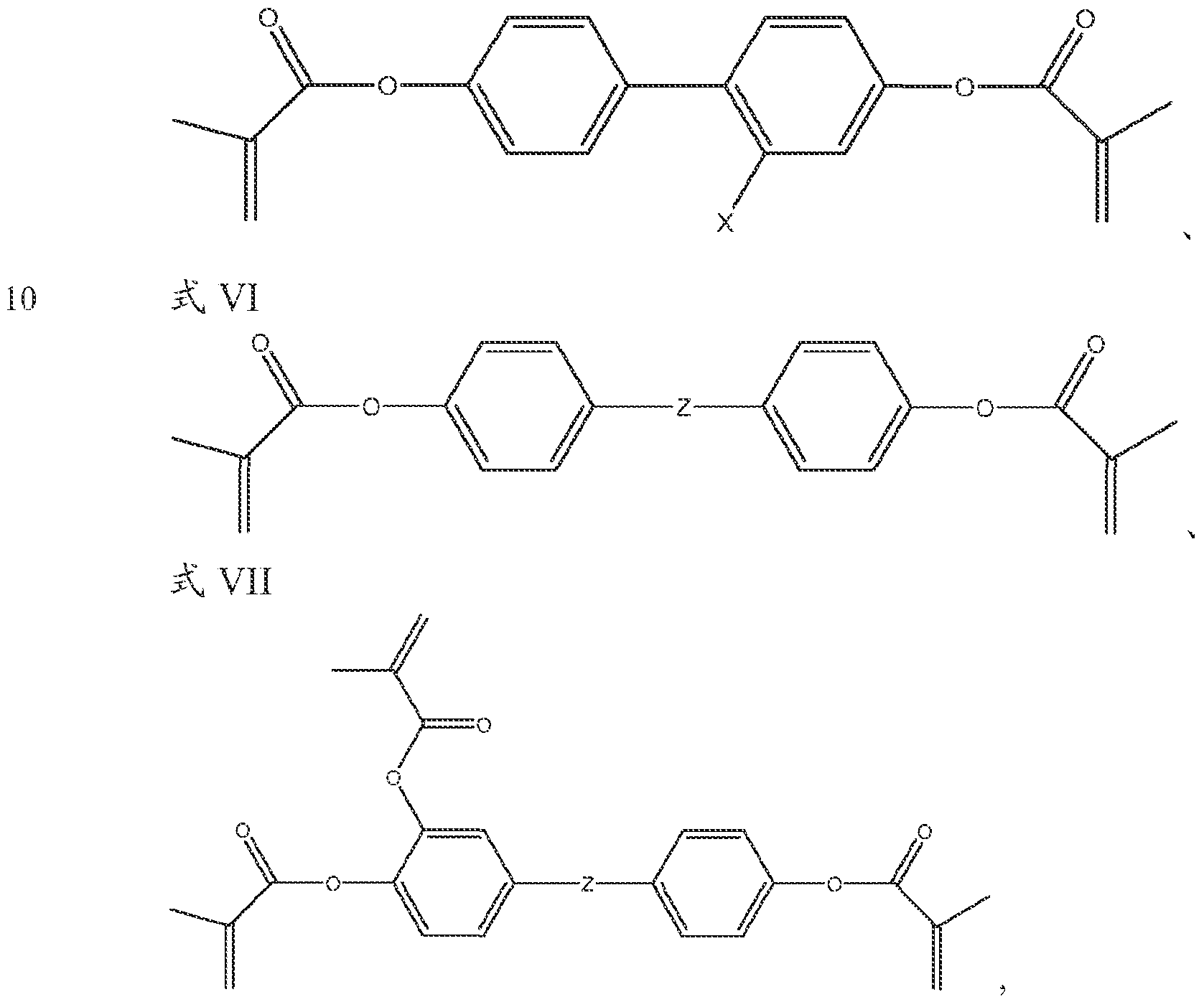
式 V中, X为 F或- CN; 式 VI和式 Vn中, Ζ为 0 、 - C00 -、 - 0C0 、 - Cl 20 、 -OCH20- , -0(CH2)20- , - COCH2-、 亚甲基、 - C ^ C - 、
\__J 、 或― __ , 所述两种或三种的可聚合单体中任何一种可聚
例低于或等于 98%;

上述结构式中, R为 1-9 个碳原子的直链或支链烷基, 烷基中非相邻 的一个或多个曱基或亚甲基可被氧或硫原子取代; 所述负型液晶材料的重 量含量在液晶介质組合物中所占比例为 20%至 90%;
含至少一种如下结构式的稳定剂:

其中, R为 - 30个碳原子的直链或支链烷基, 烷基中非相邻的一个或 多个甲基或亚甲基可被氧或硫原子取代;
其中, 所述稳定剂的重量含量在液晶介质组合物中所占的比例小于
1%。
本发明的有益效果: 所述用于液晶显示器的液晶介质组合物中, 通过 两种或两种以上可在紫外光照射下发生聚合反应的可聚合单体及其合适配 比, 可以聚合反应得到尺寸较小, 均匀性好的聚合物突起物, 避免了液晶 配向不良、 液晶面板暗态亮点现象的发生, 从 !¾使液晶面板响应速度变快
并获得高对比度。
为了能更进一步 T解本发明的特征以及技术内容, 请参阅以下有关本 发明的详细说明与附图, 然而附图仅提供参考与说明用, 并非用来对本发 明加以限制。 附图说明
下面结合附图, 通过对本发明的具体实施方式详细描述, 将使本发明 的技术方案及其它有益效果显而易见。
附图中,
图 1A 为曝光显影技术制成的液晶显示装置中液晶配向后液晶介质层 的状态示意图;
图 IB 为图像垂直配向技术制成的液晶显示装置中液晶配向后液晶介 质层的状态示意图;
图 2 为聚合物稳定垂直配向技术制成的液晶显示装置中液晶配向过程 示意图;
图 3 - 5 分別为液晶显示装置的液晶介质组合物中使用一种不同的可 聚合单体生成的聚合物突起物的型态;
图 6 为本发明一实施例的用于液晶显示装置的液晶介质组合物中, 混 合使用两种可聚合单体时生成的聚合物突起物的型态。 具体实 方式
为更进一步阐述本发明所采取的技术手段及其效果, 以下结合本发明 的优选实施例及其酎图进.行详细描述。
本发明提供一种用于液晶显示器的液晶介质组合物, 所述液晶介质组 合物包括如下组分: 负型液晶材料、 稳定剂、 及两种或两种以上可在紫外 光照射下发生聚合反应的可聚合单体; 所述可聚合单体按重量份计算占液 晶介质组合物总量的 0.1 %- 1%; 所述可聚合单体的结构通式由单个苯环、 两个苯环、 或单个萘环构成, 该两个苯环结构由两个苯环直接连接或通过
—个基团间接连接构成, 所述苯环和萘环上直接连接至少有一个可聚合基 团。
所述两种或两种以上的可聚合单体的结构通式为如下所示结构通式中 的至少一种, 当该两种或两种以上的可聚合单体的结构通式相同时, 其基 团个数不同:
式工
II


(X)m (X)m
式 ΐ至 IV中, Ρ代表可聚合基团, 其选自甲基丙烯酸酯基、 丙烯酸酯 基, 乙烯基、 乙烯氧基、 及环氧基中的至少一种; η 为连接于同一个芳香 环上的可聚合基团 Ρ的个数, η为 1-3的整数, 如果 η大于 1 , 可聚合基团 可以相同或不同。 可聚合基团 Ρ直接与苯环结构相连, 无间隔基团; ¾且 一个苯环上可同时连接多个聚合基团; X 代表馭代基团, 其选自 F , - CI , Br, 甲基、 - CN、 及 2- 8 个碳原子构成的直链或支链烷基中的至少一 种, 该烷基中非相邻的一个或多个甲基可被氧或硫原子取代; m 为连接于 同一个芳香环上的取伐基团 X 的个数, m为 1-3 的整数, 如果 m 大于
1 , 取代基团可以相同或不同; n+m 小于同一个芳香环上可连接的基团个 数; 式 IV中的 Z为- 0-、 H20-、 - 0(CH2)20
、 - COCH2-、 亚曱基、 - C

所述可聚合单体的结构通式中的任意芳香环上的氢原子可以被如下基 团取代: - F、 -CI, -Br. 曱基、 或- CN。
所述可聚合单体的结构通式中的任意非芳香环上的氢原子可以被如下 基团取代: - F、 α、 - Br、 或甲基。
所述负型液晶材 ifr包括至少一种液晶分子, 其结构通式如下:
其
 中, X表示连接在环结构上的取代基 团, 其选自 - H、 - F、 - Cl、 -Br, -1、 CN、 及- N02中的至少一种; 11 为 1-4 的整数, 不同环结构上的 n可以相同或不同, 若 η>1 , 所述多个取代基团 X相同或不同; 与 ¥2分别为- R、 - 0- R、 - CO R、 - OCO- R、 - COO- R、 或 -(OC¾C¾)nlC¾, R代表 1-12个碳原子组成的直链或支链烷基, nl为
1-5的整数, 所述 与 Y2相同或不同。
所述稳定剂包括至少一种稳定剂分子, 其结构通式如下:

其中, 为 1-9个碳原子的直链或支链烷基中的至少一种, n为 1-4 的整数, 当 η>1 , 多个取代基团 相同或不同; R2代表 1-36个碳原子的 直链或支链烷基; L 为碳碳单键、 - 0-、 -COO-、 -OCO-、 - C¾0-、 - OC¾0 、 - 0(CH2)20-、 -COCK?.-, 或亚甲基。
所述两种或两种以上的可聚合单体具体选自如下所示结构式中的两种 或三种:
V 飞
; r V


所述两种或三种的可聚合单体中任何一种可聚合单体的含量占可聚合 单体总含量的摩尔比例低于或等于 98%。
所述负型液晶材料具体为:
 所述液晶介质组合物采用负型液晶材料、 稳定剂, 及两种可聚合单 具体如下:
负型液晶材料的结构式为


M-B1的结构式如下所示:

M-A1 与 RM- B1 的摩尔比是 1 :5 , 两者的总含量占液晶介质层的
3000ppm。 液晶介质组合物中, 混合使用 RM- A1和 RM- B 1生成的聚合物 ump的尺寸 d、、 均匀 , 参见图 6, 不存在暗态亮光现象。
实施例 2:
本实施例液晶介质组合物采用的负型液晶材料与稳定剂与实施例 1 相 同; ί¾两种可聚合单体分别为 RM- A2与 RM- B2 , RM-A2的结构式如下 所示;

RM-A2 与 RM- B2 的摩尔比是 2:5, 两者的总含量占液晶介质层的 3000ppm。 液晶介质组合物中, 混合使用 RM- A2和 RM- B2生成的聚合物 bump的尺寸小、 均匀, 不存在暗态亮光现象。
实^例 3 :
本实施例液晶介质组合物采用的负型液晶材料与稳定剂与实施例 1 相 同; 而两种可聚合单体分别为 RM- A3 与 RM- B3 , M-A3 的结构式如下 所示:


RM-A3 与 RM B3 的摩尔比是 4: 1 , 两者的总含量占液晶介质层的 2500ppm。 液晶介质组合物中, 混合使用 RM-A3和 RM-B3生成的聚合物 bum 的尺寸小、 均匀, 不存在暗态亮光现象。
综上所述, 本发明所述的用于液晶显示器的液晶介质组合物, 通过该 液晶介质组合物中含有的两种或两种以上可在紫外光照射下发生聚合反应 的可聚合单体以及合适配比, 可以控制聚合反应形成聚合物突起物的大 、 和均匀性, 避免了液晶配向不良、 液晶面板暗态亮点现象的发生, 以此使 得液晶面板获得好的光学表现 , 如高对比度和高响应速度。
以上所述, 对于本领域的普通技术人员来说, 可以根据本发明的技术 方案和技术构思作出其他各种相应的改变和变形, 而所有这些改变和变形 都应属于本发明权利要求的保护范围。
Claims
—种用于液晶显示器的液晶介质组合物, 所述液晶介质组合物包 括如下组分: 负型液晶材料、 稳定剂、 及两种或两种以上可在紫外光照射 下发生聚合反应的可聚合单体; 所述可聚合单体按重量份计算占所述液晶 介-质组合物总量的 0.1%-1%; 所述可聚合单体的结构通式由单个苯环、 两 个笨环、 或单个萘环构成, 该两个苯环结构由两个笨环直接连接或通过一 个基团间接连接构成, 所述苯环和萘环上直接连接至少有一个可聚合基 团。
2、 如权利要求 1 所述用于液晶显示器的液晶介质组合物, 其中, 所 迷两种或两种以上的可聚合单体的结构通式为如下所示结构通式中的至少 一种, 当该两种或两种以上的可聚合单体的结构通式相同时, 其基团个数 不同:
式 I


(X)m (X)m 式 I至 IV中, P代表可聚合基.团, 其选自甲基丙烯酸酯基、 丙烯酸酯 基、 乙烯基 乙烯氧基、 及环氧基中的至少一种; 11 为连接于同一个芳香 环上的可聚合基团 P的个数, n为 1-3的整数, 如果 n大于 1, 可聚合基团 可以相同或不同; X代表取代基团, 其选自 - F, -CI, -Br, 曱基、 - CN、 及 2-8 个碳原子构成的直链或支链烷基中的至少一种, 该烷基中非相部的一 个或多个甲基可被氧或硫原子取代; m 为连接于同一个芳香环上的取代基 团 X的个数, m为 1-3的整数, 如果 m大于 1, 取 基团可以相同或不 同; n+m小于同一个芳香环上可连接的基团个数;
式 IV中的 Z为- 0-、 - COO ¾0-、 -0(CH2)20-
、 - COC¾-、 亚曱基、 - C≡C -、

3、 如权利要求 2 所述用于液晶显示器的液晶介质组合物, 其中, 所 述可聚合单体的结构通式中的任意芳香环上的氢原子可以被如下基团取 代: - F、 - Cl、 -Br, 曱基、 或- CN。
4、 如权利要求 2 所述用于液晶显示器的液晶介质组合物, 其中, 所 迷可聚合单体的结构通式中任意非芳香环上的氬原子可以被如下基团取 代: - F、 - Ci、 - Br、 或曱基。
5、 如权利要求 1 所述用于液晶显示器的液晶介质组合物, 其中, 所 述负型液晶材料包括至少一种液晶分子, 其结构通式如下:

基团, 其选自 - H、 F、 - Cl、 - Br、 -L - CN、 及- ¾中的至少一种; n为 1- 4 的整数, 不同环结构上的 n可以相同或不同, 若 η>1 , 所述多个取代基 团 X 相同或不同; Y 与 Y2分别为 - R、 - 0 R、 - CO- R、 -OCO-R, COO- EL, 或- (0C¾CH2)niC¾, 其中 R代表 i- 12个碳原子组成的直链或支链烷 基 , n 为 1 5的整数 , 所述 Y!与 Y2相同或不同。
6、 如权利要求 1 所述用于液晶显示器的液晶介质组合物, 其中, 所 述稳定剂包括至少一种稳定剂分子, 其结构通式如下:

其中, 为 1 - 9个碳原子的直链或支链烷基中的至少一种, n为 ! -4 的整数, 当 η>1 , 多个取代基团 相同或不同; R2代表 1-36个碳原子的 直链或支链烷基; L 为碳碳单键、 - 0-、 -COO-、 -0C0-、 - C¾0-、 - 0CH20-、 -0(CH2)20-, - C0CH2-、 或亚曱 H
7、 如权利要求 2 所述用于液晶显示器的液晶介质组合物, 其中, 所 迷两种或两种以上的可聚合单体具体选自如下所示结构式中的两种或三 种:

式 VI


9、 如权利要求 6 所述用于液晶显示器的液晶介质组合物, 其中, 所 述稳 一种如下结构式的稳定剂:

其中, I 为 - 30个碳原子的直链或支链烷基, 烷基中非相邻的一个或 多个甲基或亚曱基可被氧或硫原子取代。
10、 如权利要求 1 所述用于液晶显示器的液晶介质组合物, 其中, 所 述稳定剂的重量含量在液晶介质组合物中所占的比例小于 1%。
11、 一种用于液晶显示器的液晶介质组合物, 所述液晶介质组合物包 括如下组分: 负型液晶材料、 稳定剂、 及两种或两种以上可在紫外光照射 下发生聚合反应的可聚合单体; 所述可聚合单体按重量份计算占所述液晶 介质组合物总量的 0,1%- 1%; 所述可聚合单体的结构通式由单个苯环、 两 个苯环, 或单个萘环构成, 该两个苯环结构由两个苯环直接连接或通过一 个基团间接连接构成, 所述苯环和茶环上直接连接至少有一个可聚合基 团;
其中, 所述两种或两种以上的可聚合单体的结构通式为如下所示结构 通式中的至少一种, 当该两种或两种以上的可聚合单体的结构通式相同 时, 其基团个数不同:
式 I


 团 X的个数, m为 1-3的整数, 如果 m大于 1 , 取. 基团可以相同或不 同; n+m小于同一个芳香环上可连接的基团个数;
式 IV中的 Z为- 0 、 - COO-、 - OCO 、 -CH20 - OCH20 、 -0(CH,),0-
、 - coc¾-、 亚甲基、 - c≡c -、 --- _ -- 或
其中, 所述可聚合单体的结构通式中的任意芳香环上的氢原子可以被 如下基团取代: - F、 - Ci、 - Br、 甲基、 或- CN;
其中, 所述可聚合单体的结构通式中任意非芳香环上的氢原子可以被 如下基团取代: - F - Cl、 - Br、 或甲基;
其中, 所述负型液晶材料包括至少一种液晶分子, 其结构通式如下:

其中, 所述稳定剂包括至少一种稳定剂分子, 其结构通式如下:

其中, 为 1-9个碳原子的直链或支链坑基中的至少一种, n为 1-4 的整数, 当 η>ί, 多个取代基团 相同或不同; R2代表 1-36个碳原子的 直链或支链烷基; L 为碳碳单键、 -0- , - C00 -、 - 0C0 、 - C¾0-、 - 0CH20- , - 0(CH2)20-、 - C0C¾-、 或亚曱基;
其中, 所述两种或两种以上的可聚合单体具体选自如下所示结构式中


26

上述结构式中, R为 1-9 个碳原子的直链或支链烷基, 烷基中非相邻 的一个或多个曱基或亚甲基可被氧或硫原子取代; 所述负型液晶材料的重 量含量在液晶介质組合物中所占比例为 20%至 90%;
含至少一种如下结构式的稳定剂:

其中, R为 - 30个碳原子的直链或支链烷基, 烷基中非相邻的一个或 多个甲基或亚甲基可被氧或硫原子取代;
其中, 所述稳定剂的重量含量在液晶介质组合物中所占的比例小于
1%。
Priority Applications (1)
| Application Number | Priority Date | Filing Date | Title |
|---|---|---|---|
| US13/807,392 US9139775B2 (en) | 2012-06-15 | 2012-07-06 | Liquid crystal medium composition for use in liquid crystal display |
Applications Claiming Priority (2)
| Application Number | Priority Date | Filing Date | Title |
|---|---|---|---|
| CN201210198996.2 | 2012-06-15 | ||
| CN201210198996.2A CN102732265B (zh) | 2012-06-15 | 2012-06-15 | 用于液晶显示器的液晶介质组合物 |
Publications (1)
| Publication Number | Publication Date |
|---|---|
| WO2013185396A1 true WO2013185396A1 (zh) | 2013-12-19 |
Family
ID=46988576
Family Applications (1)
| Application Number | Title | Priority Date | Filing Date |
|---|---|---|---|
| PCT/CN2012/078264 Ceased WO2013185396A1 (zh) | 2012-06-15 | 2012-07-06 | 用于液晶显示器的液晶介质组合物 |
Country Status (3)
| Country | Link |
|---|---|
| US (1) | US9139775B2 (zh) |
| CN (1) | CN102732265B (zh) |
| WO (1) | WO2013185396A1 (zh) |
Families Citing this family (14)
| Publication number | Priority date | Publication date | Assignee | Title |
|---|---|---|---|---|
| TWI635164B (zh) * | 2012-04-24 | 2018-09-11 | 迪愛生股份有限公司 | Liquid crystal composition containing polymerizable compound and liquid crystal display element using same |
| CN102732265B (zh) * | 2012-06-15 | 2014-04-09 | 深圳市华星光电技术有限公司 | 用于液晶显示器的液晶介质组合物 |
| CN103194244A (zh) * | 2013-03-28 | 2013-07-10 | 深圳市华星光电技术有限公司 | 液晶组合物及其液晶显示面板 |
| CN103254356B (zh) | 2013-04-25 | 2016-01-13 | 深圳市华星光电技术有限公司 | 可聚合混合物及其液晶组合物 |
| CN103484131B (zh) * | 2013-08-29 | 2016-08-10 | 深圳市华星光电技术有限公司 | 液晶介质组合物 |
| EP3020785B1 (en) * | 2014-11-14 | 2017-12-13 | Merck Patent GmbH | Liquid crystal medium |
| EP3029127B1 (en) * | 2014-12-01 | 2017-12-20 | Merck Patent GmbH | Liquid crystal medium |
| TWI556043B (zh) | 2015-07-09 | 2016-11-01 | 友達光電股份有限公司 | 顯示面板及其製造方法 |
| WO2017024614A1 (zh) * | 2015-08-10 | 2017-02-16 | 深圳市华星光电技术有限公司 | Ffs型液晶面板的配向方法 |
| KR102611868B1 (ko) * | 2016-06-02 | 2023-12-11 | 삼성디스플레이 주식회사 | 액정 표시 장치 및 그 제조 방법 |
| CN108873489A (zh) * | 2018-08-16 | 2018-11-23 | 惠科股份有限公司 | 显示面板的制造方法及制造装置 |
| CN109913242A (zh) * | 2019-03-21 | 2019-06-21 | 深圳市华星光电技术有限公司 | 液晶材料及液晶显示面板 |
| CN111123589B (zh) * | 2019-12-16 | 2021-07-23 | Tcl华星光电技术有限公司 | 一种液晶显示层、液晶介质组合物及其制备方法 |
| CN111117665A (zh) * | 2019-12-17 | 2020-05-08 | Tcl华星光电技术有限公司 | 液晶材料及液晶显示面板 |
Citations (5)
| Publication number | Priority date | Publication date | Assignee | Title |
|---|---|---|---|---|
| CN1408749A (zh) * | 2001-10-03 | 2003-04-09 | 伊斯曼柯达公司 | 显示器聚合物组件用稳定剂系统 |
| CN101320155A (zh) * | 2007-10-11 | 2008-12-10 | 友达光电股份有限公司 | 液晶及含该液晶的液晶材料组合及液晶显示装置 |
| CN102197333A (zh) * | 2008-10-21 | 2011-09-21 | 夏普株式会社 | 取向膜、取向膜材料和具有取向膜的液晶显示装置及其形成方法 |
| CN102732265A (zh) * | 2012-06-15 | 2012-10-17 | 深圳市华星光电技术有限公司 | 用于液晶显示器的液晶介质组合物 |
| CN102786936A (zh) * | 2012-05-09 | 2012-11-21 | 深圳市华星光电技术有限公司 | 液晶介质组合物 |
Family Cites Families (10)
| Publication number | Priority date | Publication date | Assignee | Title |
|---|---|---|---|---|
| KR100955968B1 (ko) * | 1999-07-02 | 2010-05-13 | 메르크 파텐트 게엠베하 | 모노반응성 메소제닉 화합물 |
| CN100334493C (zh) * | 2004-05-28 | 2007-08-29 | 友达光电股份有限公司 | 用于聚合物稳定配向过程的单体以及包括该单体生成的聚合物的液晶显示面板 |
| US8114310B2 (en) * | 2007-10-22 | 2012-02-14 | Merck Patent Gmbh | Liquid-crystal display |
| WO2010061490A1 (ja) * | 2008-11-27 | 2010-06-03 | シャープ株式会社 | 液晶表示装置及びその製造方法 |
| JP5720919B2 (ja) * | 2010-02-04 | 2015-05-20 | Dic株式会社 | 重合性化合物を含有する液晶組成物及びそれを使用した液晶表示素子 |
| TWI425281B (zh) * | 2010-12-31 | 2014-02-01 | 友達光電股份有限公司 | 聚合物穩定配向型液晶顯示面板的製造方法 |
| US20140085593A1 (en) * | 2012-09-21 | 2014-03-27 | Shenzhen China Star Optoelectronics Technology Co., Ltd | Mixture for Liquid Crystal Medium and Liquid Crystal Display Using the Same |
| US9127198B2 (en) * | 2012-09-21 | 2015-09-08 | Shenzhen China Star Optoelectronics Technology Co., Ltd. | Mixture for liquid crystal medium and liquid crystal display using the same |
| US20140085595A1 (en) * | 2012-09-21 | 2014-03-27 | Shenzhen China Star Optoelectronics Technology Co. Ltd. | Mixture for Liquid Crystal Medium and Liquid Crystal Display Using the Same |
| US20140085572A1 (en) * | 2012-09-21 | 2014-03-27 | Shenzhen China Star Optoelectronics Technology Co., Ltd. | Mixture for Liquid Crystal Medium and Liquid Crystal Display Using the Same |
-
2012
- 2012-06-15 CN CN201210198996.2A patent/CN102732265B/zh not_active Expired - Fee Related
- 2012-07-06 US US13/807,392 patent/US9139775B2/en active Active
- 2012-07-06 WO PCT/CN2012/078264 patent/WO2013185396A1/zh not_active Ceased
Patent Citations (5)
| Publication number | Priority date | Publication date | Assignee | Title |
|---|---|---|---|---|
| CN1408749A (zh) * | 2001-10-03 | 2003-04-09 | 伊斯曼柯达公司 | 显示器聚合物组件用稳定剂系统 |
| CN101320155A (zh) * | 2007-10-11 | 2008-12-10 | 友达光电股份有限公司 | 液晶及含该液晶的液晶材料组合及液晶显示装置 |
| CN102197333A (zh) * | 2008-10-21 | 2011-09-21 | 夏普株式会社 | 取向膜、取向膜材料和具有取向膜的液晶显示装置及其形成方法 |
| CN102786936A (zh) * | 2012-05-09 | 2012-11-21 | 深圳市华星光电技术有限公司 | 液晶介质组合物 |
| CN102732265A (zh) * | 2012-06-15 | 2012-10-17 | 深圳市华星光电技术有限公司 | 用于液晶显示器的液晶介质组合物 |
Also Published As
| Publication number | Publication date |
|---|---|
| US9139775B2 (en) | 2015-09-22 |
| CN102732265B (zh) | 2014-04-09 |
| US20140231711A1 (en) | 2014-08-21 |
| CN102732265A (zh) | 2012-10-17 |
Similar Documents
| Publication | Publication Date | Title |
|---|---|---|
| WO2013185396A1 (zh) | 用于液晶显示器的液晶介质组合物 | |
| US9360708B2 (en) | Cinnamic acid derivative, polymer thereof, and liquid crystal alignment layer comprising cured product thereof | |
| WO2014043953A1 (zh) | 液晶介质混合物及使用其的液晶显示器 | |
| CN102786936B (zh) | 液晶介质组合物 | |
| TWI601806B (zh) | 可聚合化合物及其於液晶顯示器之用途 | |
| US9127198B2 (en) | Mixture for liquid crystal medium and liquid crystal display using the same | |
| JPWO2013145369A1 (ja) | 液晶表示素子及びその製造方法 | |
| WO2015027531A1 (zh) | 液晶介质组合物 | |
| WO2013159400A1 (zh) | 液晶介质组合物、使用其的液晶显示器及其制作方法 | |
| CN105518035A (zh) | 化合物、聚合物、液晶取向膜、液晶显示元件以及光学各向异性体 | |
| CN103254356B (zh) | 可聚合混合物及其液晶组合物 | |
| US20180320071A1 (en) | Polymerizable compound, liquid crystal medium containing same and liquid crystal display device | |
| CN102888229B (zh) | 液晶介质混合物及使用其的液晶显示器 | |
| CN112175634A (zh) | 一种聚合物稳定配向型液晶组合物及其应用 | |
| US20140085593A1 (en) | Mixture for Liquid Crystal Medium and Liquid Crystal Display Using the Same | |
| WO2014043955A1 (zh) | 液晶介质混合物及使用其的液晶显示器 | |
| CN102746855B (zh) | 用于液晶显示器的液晶介质混合物 | |
| CN102888231A (zh) | 液晶介质混合物及使用其的液晶显示器 | |
| CN102876337A (zh) | 液晶介质混合物及使用其的液晶显示器 | |
| CN102863970A (zh) | 液晶介质混合物及使用其的液晶显示器 | |
| US9028713B2 (en) | Mixture for liquid crystal medium and liquid crystal display using the same | |
| WO2014043960A1 (zh) | 液晶介质混合物及使用其的液晶显示器 | |
| TW202110953A (zh) | 液晶配向劑、液晶配向膜、相位差膜、液晶顯示元件用基板及液晶顯示元件 | |
| CN102876335B (zh) | 液晶介质混合物及使用其的液晶显示器 | |
| WO2014043958A1 (zh) | 液晶介质混合物及使用其的液晶显示器 |
Legal Events
| Date | Code | Title | Description |
|---|---|---|---|
| WWE | Wipo information: entry into national phase |
Ref document number: 13807392 Country of ref document: US |
|
| 121 | Ep: the epo has been informed by wipo that ep was designated in this application |
Ref document number: 12878715 Country of ref document: EP Kind code of ref document: A1 |
|
| NENP | Non-entry into the national phase |
Ref country code: DE |
|
| 122 | Ep: pct application non-entry in european phase |
Ref document number: 12878715 Country of ref document: EP Kind code of ref document: A1 |