WO2013157463A1 - 光配向用液晶配向膜を形成するための液晶配向剤、液晶配向膜およびこれを用いた液晶表示素子 - Google Patents
光配向用液晶配向膜を形成するための液晶配向剤、液晶配向膜およびこれを用いた液晶表示素子 Download PDFInfo
- Publication number
- WO2013157463A1 WO2013157463A1 PCT/JP2013/060841 JP2013060841W WO2013157463A1 WO 2013157463 A1 WO2013157463 A1 WO 2013157463A1 JP 2013060841 W JP2013060841 W JP 2013060841W WO 2013157463 A1 WO2013157463 A1 WO 2013157463A1
- Authority
- WO
- WIPO (PCT)
- Prior art keywords
- formula
- liquid crystal
- ring
- group
- carbon atoms
- Prior art date
- Legal status (The legal status is an assumption and is not a legal conclusion. Google has not performed a legal analysis and makes no representation as to the accuracy of the status listed.)
- Ceased
Links
- 0 C*C1CCCCC1 Chemical compound C*C1CCCCC1 0.000 description 20
- YXFVVABEGXRONW-UHFFFAOYSA-N Cc1ccccc1 Chemical compound Cc1ccccc1 YXFVVABEGXRONW-UHFFFAOYSA-N 0.000 description 4
- HYZTXGFQOKQFEB-UHFFFAOYSA-N CC(C)c(cc1)ccc1N(C1)COc2c1cccc2 Chemical compound CC(C)c(cc1)ccc1N(C1)COc2c1cccc2 HYZTXGFQOKQFEB-UHFFFAOYSA-N 0.000 description 2
- WCDSVWRUXWCYFN-UHFFFAOYSA-N Nc(cc1)ccc1S Chemical compound Nc(cc1)ccc1S WCDSVWRUXWCYFN-UHFFFAOYSA-N 0.000 description 2
- LJMPOXUWPWEILS-UHFFFAOYSA-N O=C(C(CC1C(O2)=O)C3CC1C2=O)OC3=O Chemical compound O=C(C(CC1C(O2)=O)C3CC1C2=O)OC3=O LJMPOXUWPWEILS-UHFFFAOYSA-N 0.000 description 2
- ANSXAPJVJOKRDJ-UHFFFAOYSA-N O=C(c(c1c2)cc(C(O3)=O)c2C3=O)OC1=O Chemical compound O=C(c(c1c2)cc(C(O3)=O)c2C3=O)OC1=O ANSXAPJVJOKRDJ-UHFFFAOYSA-N 0.000 description 2
- GLJFYGFBITUZOE-UHFFFAOYSA-N C(CCc1ccccc1)Cc1ccccc1 Chemical compound C(CCc1ccccc1)Cc1ccccc1 GLJFYGFBITUZOE-UHFFFAOYSA-N 0.000 description 1
- AXRMFNLZQVAPOE-UHFFFAOYSA-N C(Cc(cc1)ccc1N(C1)COc2c1cccc2)c(cc1)ccc1N(C1)COc2c1cccc2 Chemical compound C(Cc(cc1)ccc1N(C1)COc2c1cccc2)c(cc1)ccc1N(C1)COc2c1cccc2 AXRMFNLZQVAPOE-UHFFFAOYSA-N 0.000 description 1
- NVQXIRSFHCYCQK-UHFFFAOYSA-N C(c(cccc1)c1OC1)N1c(cc1)ccc1Sc(cc1)ccc1N(C1)COc2c1cccc2 Chemical compound C(c(cccc1)c1OC1)N1c(cc1)ccc1Sc(cc1)ccc1N(C1)COc2c1cccc2 NVQXIRSFHCYCQK-UHFFFAOYSA-N 0.000 description 1
- FMZPVXIKKGVLLV-UHFFFAOYSA-N C(c(cccc1)c1OC1)N1c1ccccc1 Chemical compound C(c(cccc1)c1OC1)N1c1ccccc1 FMZPVXIKKGVLLV-UHFFFAOYSA-N 0.000 description 1
- ZJSIXESJQPTYOJ-UHFFFAOYSA-N C(c1ccc2c(OCN(C3)c4ccccc4)c3ccc2c1OC1)N1c1ccccc1 Chemical compound C(c1ccc2c(OCN(C3)c4ccccc4)c3ccc2c1OC1)N1c1ccccc1 ZJSIXESJQPTYOJ-UHFFFAOYSA-N 0.000 description 1
- DGZJLVRKEYTIKQ-UHFFFAOYSA-N CC(C)(C)c(cc1)ccc1N(C1)COc2c1cccc2 Chemical compound CC(C)(C)c(cc1)ccc1N(C1)COc2c1cccc2 DGZJLVRKEYTIKQ-UHFFFAOYSA-N 0.000 description 1
- ZYEDGEXYGKWJPB-UHFFFAOYSA-N CC(C)(c(cc1)ccc1N)c(cc1)ccc1N Chemical compound CC(C)(c(cc1)ccc1N)c(cc1)ccc1N ZYEDGEXYGKWJPB-UHFFFAOYSA-N 0.000 description 1
- FYFDGTVHXKGYPA-UHFFFAOYSA-N CC(N(C)C(CO)(CO)CO)=O Chemical compound CC(N(C)C(CO)(CO)CO)=O FYFDGTVHXKGYPA-UHFFFAOYSA-N 0.000 description 1
- OCYYRKKBXGIBQK-UHFFFAOYSA-N CC(N(C)C(CO)CO)=O Chemical compound CC(N(C)C(CO)CO)=O OCYYRKKBXGIBQK-UHFFFAOYSA-N 0.000 description 1
- CSSWCWIUAZSBHV-UHFFFAOYSA-N CC(N(CCO)CCO)=O Chemical compound CC(N(CCO)CCO)=O CSSWCWIUAZSBHV-UHFFFAOYSA-N 0.000 description 1
- DVACNIVEDRTHEG-UHFFFAOYSA-N CC1(CC1)N(C(C1C2C3C=CC1C3)=O)C2=O Chemical compound CC1(CC1)N(C(C1C2C3C=CC1C3)=O)C2=O DVACNIVEDRTHEG-UHFFFAOYSA-N 0.000 description 1
- KPNJYXKRHWAPHP-UHFFFAOYSA-N CCCC(C)(C)N Chemical compound CCCC(C)(C)N KPNJYXKRHWAPHP-UHFFFAOYSA-N 0.000 description 1
- WHRYLXXHLFPFNZ-UHFFFAOYSA-N CN(C(C1C2C3C=CC1C3)=O)C2=O Chemical compound CN(C(C1C2C3C=CC1C3)=O)C2=O WHRYLXXHLFPFNZ-UHFFFAOYSA-N 0.000 description 1
- OMMDEGRJVXNIGC-UHFFFAOYSA-N Cc(cc(cc1)N(C2)COc3c2cccc3)c1-c(cc1)c(C)cc1N(C1)COc2c1cccc2 Chemical compound Cc(cc(cc1)N(C2)COc3c2cccc3)c1-c(cc1)c(C)cc1N(C1)COc2c1cccc2 OMMDEGRJVXNIGC-UHFFFAOYSA-N 0.000 description 1
- XFTXGTMZGBLHQG-UHFFFAOYSA-N Cc(cc1)ccc1N(C(C1C2C3C=CC1C3)=O)C2=O Chemical compound Cc(cc1)ccc1N(C(C1C2C3C=CC1C3)=O)C2=O XFTXGTMZGBLHQG-UHFFFAOYSA-N 0.000 description 1
- RIOMVMLZCCHZKW-UHFFFAOYSA-N Cc(cc1)ccc1N(C1)COc2c1ccc1c2ccc(C2)c1OCN2c1ccc(C)cc1 Chemical compound Cc(cc1)ccc1N(C1)COc2c1ccc1c2ccc(C2)c1OCN2c1ccc(C)cc1 RIOMVMLZCCHZKW-UHFFFAOYSA-N 0.000 description 1
- FJAXKDRZMBSGMP-UHFFFAOYSA-N Cc(cccc1)c1N(C1)COc2c1ccc1c2ccc(C2)c1OCN2c1c(C)cccc1 Chemical compound Cc(cccc1)c1N(C1)COc2c1ccc1c2ccc(C2)c1OCN2c1c(C)cccc1 FJAXKDRZMBSGMP-UHFFFAOYSA-N 0.000 description 1
- QYIMZXITLDTULQ-UHFFFAOYSA-N Cc1cc(N)ccc1-c(cc1)c(C)cc1N Chemical compound Cc1cc(N)ccc1-c(cc1)c(C)cc1N QYIMZXITLDTULQ-UHFFFAOYSA-N 0.000 description 1
- VOHNMQCFAHGMPO-UHFFFAOYSA-N Cc1cccc(N(C2)COc3c2ccc2c3ccc(C3)c2OCN3c2cc(C)ccc2)c1 Chemical compound Cc1cccc(N(C2)COc3c2ccc2c3ccc(C3)c2OCN3c2cc(C)ccc2)c1 VOHNMQCFAHGMPO-UHFFFAOYSA-N 0.000 description 1
- ZQQOGBKIFPCFMJ-UHFFFAOYSA-N Nc(cc1)cc(C(F)(F)F)c1N Chemical compound Nc(cc1)cc(C(F)(F)F)c1N ZQQOGBKIFPCFMJ-UHFFFAOYSA-N 0.000 description 1
- ZLSMCQSGRWNEGX-UHFFFAOYSA-N Nc(cc1)ccc1C(c(cc1)ccc1N)=O Chemical compound Nc(cc1)ccc1C(c(cc1)ccc1N)=O ZLSMCQSGRWNEGX-UHFFFAOYSA-N 0.000 description 1
- CBCKQZAAMUWICA-UHFFFAOYSA-N Nc(cc1)ccc1N Chemical compound Nc(cc1)ccc1N CBCKQZAAMUWICA-UHFFFAOYSA-N 0.000 description 1
- MQJKPEGWNLWLTK-UHFFFAOYSA-N Nc(cc1)ccc1S(c(cc1)ccc1N)(=O)=O Chemical compound Nc(cc1)ccc1S(c(cc1)ccc1N)(=O)=O MQJKPEGWNLWLTK-UHFFFAOYSA-N 0.000 description 1
- ICNFHJVPAJKPHW-UHFFFAOYSA-N Nc(cc1)ccc1Sc(cc1)ccc1N Chemical compound Nc(cc1)ccc1Sc(cc1)ccc1N ICNFHJVPAJKPHW-UHFFFAOYSA-N 0.000 description 1
- RQMUOISRUDXAGH-UHFFFAOYSA-N Nc(cc1Cc2ccccc2)ccc1N Chemical compound Nc(cc1Cc2ccccc2)ccc1N RQMUOISRUDXAGH-UHFFFAOYSA-N 0.000 description 1
- KIATVFIARSSXER-UHFFFAOYSA-N Nc1cc(Cc2ccccc2)cc(N)c1 Chemical compound Nc1cc(Cc2ccccc2)cc(N)c1 KIATVFIARSSXER-UHFFFAOYSA-N 0.000 description 1
- XDTLWEGRVWRVNF-UHFFFAOYSA-N Nc1cc(N)cc(C(OCc2c(cccc3)c3cc3c2cccc3)=O)c1 Chemical compound Nc1cc(N)cc(C(OCc2c(cccc3)c3cc3c2cccc3)=O)c1 XDTLWEGRVWRVNF-UHFFFAOYSA-N 0.000 description 1
- BZUDFOIXWMQYRX-SREVYHEPSA-N Nc1cc(N)cc(C(Oc2ccc(/C=C\c3ccccc3)cc2)=O)c1 Chemical compound Nc1cc(N)cc(C(Oc2ccc(/C=C\c3ccccc3)cc2)=O)c1 BZUDFOIXWMQYRX-SREVYHEPSA-N 0.000 description 1
- WZCQRUWWHSTZEM-UHFFFAOYSA-N Nc1cc(N)ccc1 Chemical compound Nc1cc(N)ccc1 WZCQRUWWHSTZEM-UHFFFAOYSA-N 0.000 description 1
- YGYCECQIOXZODZ-UHFFFAOYSA-N O=C(C(C1C2C(O3)=O)C2C3=O)OC1=O Chemical compound O=C(C(C1C2C(O3)=O)C2C3=O)OC1=O YGYCECQIOXZODZ-UHFFFAOYSA-N 0.000 description 1
- MZQABJFSPCLHEH-UHFFFAOYSA-N O=C(C(CC1)C2C(CC3C(O4)=O)C1CC3C4=O)OC2=O Chemical compound O=C(C(CC1)C2C(CC3C(O4)=O)C1CC3C4=O)OC2=O MZQABJFSPCLHEH-UHFFFAOYSA-N 0.000 description 1
- JOTNEHQCEZUBLR-UHFFFAOYSA-N O=C(C(CC1)C2CC1C(CCCC1C(O3)=O)C1C3=O)OC2=O Chemical compound O=C(C(CC1)C2CC1C(CCCC1C(O3)=O)C1C3=O)OC2=O JOTNEHQCEZUBLR-UHFFFAOYSA-N 0.000 description 1
- TXXLTGFCBXNBHU-UHFFFAOYSA-N O=C(C(Cc1ccc2C(O3)=O)C4Cc1c2C3=O)OC4=O Chemical compound O=C(C(Cc1ccc2C(O3)=O)C4Cc1c2C3=O)OC4=O TXXLTGFCBXNBHU-UHFFFAOYSA-N 0.000 description 1
- QVEIRZNRYOJFCL-UHFFFAOYSA-N O=C(CC(C(C1)C(O2)=O)C3C1C2=O)OC3=O Chemical compound O=C(CC(C(C1)C(O2)=O)C3C1C2=O)OC3=O QVEIRZNRYOJFCL-UHFFFAOYSA-N 0.000 description 1
- OLQWMCSSZKNOLQ-UHFFFAOYSA-N O=C(CC1C(CC(O2)=O)C2=O)OC1=O Chemical compound O=C(CC1C(CC(O2)=O)C2=O)OC1=O OLQWMCSSZKNOLQ-UHFFFAOYSA-N 0.000 description 1
- JYCTWJFSRDBYJX-UHFFFAOYSA-N O=C(CC1C(CC2C(O3)=O)c4ccccc4C2C3=O)OC1=O Chemical compound O=C(CC1C(CC2C(O3)=O)c4ccccc4C2C3=O)OC1=O JYCTWJFSRDBYJX-UHFFFAOYSA-N 0.000 description 1
- QQGYZOYWNCKGEK-UHFFFAOYSA-N O=C(c(cc1)c2cc1Oc(cc1C(O3)=O)ccc1C3=O)OC2=O Chemical compound O=C(c(cc1)c2cc1Oc(cc1C(O3)=O)ccc1C3=O)OC2=O QQGYZOYWNCKGEK-UHFFFAOYSA-N 0.000 description 1
- VQVIHDPBMFABCQ-UHFFFAOYSA-N O=C(c(cc1)cc(C(O2)=O)c1C2=O)c(cc1)cc(C(O2)=O)c1C2=O Chemical compound O=C(c(cc1)cc(C(O2)=O)c1C2=O)c(cc1)cc(C(O2)=O)c1C2=O VQVIHDPBMFABCQ-UHFFFAOYSA-N 0.000 description 1
- LPZWZTFGGBOEGX-UHFFFAOYSA-N O=C(c(cc1)ccc1N(C1)COc2c1cccc2)c(cc1)ccc1N(C1)COc2c1cccc2 Chemical compound O=C(c(cc1)ccc1N(C1)COc2c1cccc2)c(cc1)ccc1N(C1)COc2c1cccc2 LPZWZTFGGBOEGX-UHFFFAOYSA-N 0.000 description 1
- FQYRKGOPNIHLGJ-UHFFFAOYSA-N OC(C(C1)C2CCC1S(C(CCC1C(O3)=O)CC1C3=O)(=O)=O)OC2=O Chemical compound OC(C(C1)C2CCC1S(C(CCC1C(O3)=O)CC1C3=O)(=O)=O)OC2=O FQYRKGOPNIHLGJ-UHFFFAOYSA-N 0.000 description 1
- IIMAZUMVSWZCOB-UHFFFAOYSA-N OC(c(c1c2)ccc2S(c(cc2)cc(C(O3)=O)c2C3=O)(=O)=O)OC1O Chemical compound OC(c(c1c2)ccc2S(c(cc2)cc(C(O3)=O)c2C3=O)(=O)=O)OC1O IIMAZUMVSWZCOB-UHFFFAOYSA-N 0.000 description 1
- URGLNURGNDHYAL-UHFFFAOYSA-N OC(c1c2cc(ccc(C(O3)=O)c4C3=O)c4c1)OC2=O Chemical compound OC(c1c2cc(ccc(C(O3)=O)c4C3=O)c4c1)OC2=O URGLNURGNDHYAL-UHFFFAOYSA-N 0.000 description 1
- YBFCBQMICVOSRW-UHFFFAOYSA-N c(c1c2cccc1)c[n]2-c1ccccc1 Chemical compound c(c1c2cccc1)c[n]2-c1ccccc1 YBFCBQMICVOSRW-UHFFFAOYSA-N 0.000 description 1
- UHOVQNZJYSORNB-UHFFFAOYSA-N c1ccccc1 Chemical compound c1ccccc1 UHOVQNZJYSORNB-UHFFFAOYSA-N 0.000 description 1
Classifications
-
- C—CHEMISTRY; METALLURGY
- C09—DYES; PAINTS; POLISHES; NATURAL RESINS; ADHESIVES; COMPOSITIONS NOT OTHERWISE PROVIDED FOR; APPLICATIONS OF MATERIALS NOT OTHERWISE PROVIDED FOR
- C09K—MATERIALS FOR MISCELLANEOUS APPLICATIONS, NOT PROVIDED FOR ELSEWHERE
- C09K19/00—Liquid crystal materials
- C09K19/52—Liquid crystal materials characterised by components which are not liquid crystals, e.g. additives with special physical aspect: solvents, solid particles
- C09K19/54—Additives having no specific mesophase characterised by their chemical composition
- C09K19/56—Aligning agents
-
- C—CHEMISTRY; METALLURGY
- C08—ORGANIC MACROMOLECULAR COMPOUNDS; THEIR PREPARATION OR CHEMICAL WORKING-UP; COMPOSITIONS BASED THEREON
- C08G—MACROMOLECULAR COMPOUNDS OBTAINED OTHERWISE THAN BY REACTIONS ONLY INVOLVING UNSATURATED CARBON-TO-CARBON BONDS
- C08G73/00—Macromolecular compounds obtained by reactions forming a linkage containing nitrogen with or without oxygen or carbon in the main chain of the macromolecule, not provided for in groups C08G12/00 - C08G71/00
- C08G73/06—Polycondensates having nitrogen-containing heterocyclic rings in the main chain of the macromolecule
- C08G73/10—Polyimides; Polyester-imides; Polyamide-imides; Polyamide acids or similar polyimide precursors
-
- C—CHEMISTRY; METALLURGY
- C08—ORGANIC MACROMOLECULAR COMPOUNDS; THEIR PREPARATION OR CHEMICAL WORKING-UP; COMPOSITIONS BASED THEREON
- C08G—MACROMOLECULAR COMPOUNDS OBTAINED OTHERWISE THAN BY REACTIONS ONLY INVOLVING UNSATURATED CARBON-TO-CARBON BONDS
- C08G73/00—Macromolecular compounds obtained by reactions forming a linkage containing nitrogen with or without oxygen or carbon in the main chain of the macromolecule, not provided for in groups C08G12/00 - C08G71/00
- C08G73/06—Polycondensates having nitrogen-containing heterocyclic rings in the main chain of the macromolecule
- C08G73/10—Polyimides; Polyester-imides; Polyamide-imides; Polyamide acids or similar polyimide precursors
- C08G73/1046—Polyimides containing oxygen in the form of ether bonds in the main chain
-
- C—CHEMISTRY; METALLURGY
- C08—ORGANIC MACROMOLECULAR COMPOUNDS; THEIR PREPARATION OR CHEMICAL WORKING-UP; COMPOSITIONS BASED THEREON
- C08G—MACROMOLECULAR COMPOUNDS OBTAINED OTHERWISE THAN BY REACTIONS ONLY INVOLVING UNSATURATED CARBON-TO-CARBON BONDS
- C08G73/00—Macromolecular compounds obtained by reactions forming a linkage containing nitrogen with or without oxygen or carbon in the main chain of the macromolecule, not provided for in groups C08G12/00 - C08G71/00
- C08G73/06—Polycondensates having nitrogen-containing heterocyclic rings in the main chain of the macromolecule
- C08G73/10—Polyimides; Polyester-imides; Polyamide-imides; Polyamide acids or similar polyimide precursors
- C08G73/1096—Polyimides; Polyester-imides; Polyamide-imides; Polyamide acids or similar polyimide precursors containing azo linkage in the main chain
-
- C—CHEMISTRY; METALLURGY
- C08—ORGANIC MACROMOLECULAR COMPOUNDS; THEIR PREPARATION OR CHEMICAL WORKING-UP; COMPOSITIONS BASED THEREON
- C08K—Use of inorganic or non-macromolecular organic substances as compounding ingredients
- C08K5/00—Use of organic ingredients
- C08K5/16—Nitrogen-containing compounds
- C08K5/34—Heterocyclic compounds having nitrogen in the ring
- C08K5/3412—Heterocyclic compounds having nitrogen in the ring having one nitrogen atom in the ring
- C08K5/3415—Five-membered rings
- C08K5/3417—Five-membered rings condensed with carbocyclic rings
-
- C—CHEMISTRY; METALLURGY
- C08—ORGANIC MACROMOLECULAR COMPOUNDS; THEIR PREPARATION OR CHEMICAL WORKING-UP; COMPOSITIONS BASED THEREON
- C08K—Use of inorganic or non-macromolecular organic substances as compounding ingredients
- C08K5/00—Use of organic ingredients
- C08K5/16—Nitrogen-containing compounds
- C08K5/34—Heterocyclic compounds having nitrogen in the ring
- C08K5/35—Heterocyclic compounds having nitrogen in the ring having also oxygen in the ring
- C08K5/353—Five-membered rings
-
- C—CHEMISTRY; METALLURGY
- C08—ORGANIC MACROMOLECULAR COMPOUNDS; THEIR PREPARATION OR CHEMICAL WORKING-UP; COMPOSITIONS BASED THEREON
- C08K—Use of inorganic or non-macromolecular organic substances as compounding ingredients
- C08K5/00—Use of organic ingredients
- C08K5/54—Silicon-containing compounds
- C08K5/541—Silicon-containing compounds containing oxygen
- C08K5/5415—Silicon-containing compounds containing oxygen containing at least one Si—O bond
- C08K5/5419—Silicon-containing compounds containing oxygen containing at least one Si—O bond containing at least one Si—C bond
-
- C—CHEMISTRY; METALLURGY
- C08—ORGANIC MACROMOLECULAR COMPOUNDS; THEIR PREPARATION OR CHEMICAL WORKING-UP; COMPOSITIONS BASED THEREON
- C08K—Use of inorganic or non-macromolecular organic substances as compounding ingredients
- C08K5/00—Use of organic ingredients
- C08K5/54—Silicon-containing compounds
- C08K5/544—Silicon-containing compounds containing nitrogen
-
- C—CHEMISTRY; METALLURGY
- C09—DYES; PAINTS; POLISHES; NATURAL RESINS; ADHESIVES; COMPOSITIONS NOT OTHERWISE PROVIDED FOR; APPLICATIONS OF MATERIALS NOT OTHERWISE PROVIDED FOR
- C09K—MATERIALS FOR MISCELLANEOUS APPLICATIONS, NOT PROVIDED FOR ELSEWHERE
- C09K2323/00—Functional layers of liquid crystal optical display excluding electroactive liquid crystal layer characterised by chemical composition
-
- C—CHEMISTRY; METALLURGY
- C09—DYES; PAINTS; POLISHES; NATURAL RESINS; ADHESIVES; COMPOSITIONS NOT OTHERWISE PROVIDED FOR; APPLICATIONS OF MATERIALS NOT OTHERWISE PROVIDED FOR
- C09K—MATERIALS FOR MISCELLANEOUS APPLICATIONS, NOT PROVIDED FOR ELSEWHERE
- C09K2323/00—Functional layers of liquid crystal optical display excluding electroactive liquid crystal layer characterised by chemical composition
- C09K2323/02—Alignment layer characterised by chemical composition
-
- C—CHEMISTRY; METALLURGY
- C09—DYES; PAINTS; POLISHES; NATURAL RESINS; ADHESIVES; COMPOSITIONS NOT OTHERWISE PROVIDED FOR; APPLICATIONS OF MATERIALS NOT OTHERWISE PROVIDED FOR
- C09K—MATERIALS FOR MISCELLANEOUS APPLICATIONS, NOT PROVIDED FOR ELSEWHERE
- C09K2323/00—Functional layers of liquid crystal optical display excluding electroactive liquid crystal layer characterised by chemical composition
- C09K2323/02—Alignment layer characterised by chemical composition
- C09K2323/027—Polyimide
-
- G—PHYSICS
- G02—OPTICS
- G02F—OPTICAL DEVICES OR ARRANGEMENTS FOR THE CONTROL OF LIGHT BY MODIFICATION OF THE OPTICAL PROPERTIES OF THE MEDIA OF THE ELEMENTS INVOLVED THEREIN; NON-LINEAR OPTICS; FREQUENCY-CHANGING OF LIGHT; OPTICAL LOGIC ELEMENTS; OPTICAL ANALOGUE/DIGITAL CONVERTERS
- G02F1/00—Devices or arrangements for the control of the intensity, colour, phase, polarisation or direction of light arriving from an independent light source, e.g. switching, gating or modulating; Non-linear optics
- G02F1/01—Devices or arrangements for the control of the intensity, colour, phase, polarisation or direction of light arriving from an independent light source, e.g. switching, gating or modulating; Non-linear optics for the control of the intensity, phase, polarisation or colour
- G02F1/13—Devices or arrangements for the control of the intensity, colour, phase, polarisation or direction of light arriving from an independent light source, e.g. switching, gating or modulating; Non-linear optics for the control of the intensity, phase, polarisation or colour based on liquid crystals, e.g. single liquid crystal display cells
- G02F1/133—Constructional arrangements; Operation of liquid crystal cells; Circuit arrangements
- G02F1/1333—Constructional arrangements; Manufacturing methods
- G02F1/1337—Surface-induced orientation of the liquid crystal molecules, e.g. by alignment layers
- G02F1/13378—Surface-induced orientation of the liquid crystal molecules, e.g. by alignment layers by treatment of the surface, e.g. embossing, rubbing or light irradiation
- G02F1/133788—Surface-induced orientation of the liquid crystal molecules, e.g. by alignment layers by treatment of the surface, e.g. embossing, rubbing or light irradiation by light irradiation, e.g. linearly polarised light photo-polymerisation
Definitions
- the present invention relates to a liquid crystal aligning agent for photo alignment used in a photo alignment method, a photo alignment film using the same, and a liquid crystal display element.
- liquid crystal display elements are display elements using nematic liquid crystals.
- a TN (Twisted Nematic) mode and an STN (Super Twisted Nematic) mode are well known.
- a TN liquid crystal display device using an optical compensation film MVA (Multi -domain (Vertical Alignment) mode, lateral electric field type IPS (In-Plane Switching) mode, FFS (Fringe Field Switching) mode, etc. have been proposed and put to practical use.
- MVA Multi -domain (Vertical Alignment) mode
- IPS In-Plane Switching
- FFS Frringe Field Switching
- the development of the technology of the liquid crystal display element is achieved not only by simply improving these driving methods and element structures but also by improving the components used in the elements.
- the liquid crystal alignment film is one of important materials related to display quality, and the performance of the alignment film can be improved with the improvement in quality of the liquid crystal display element. It is becoming important.
- the liquid crystal alignment film is formed from a liquid crystal aligning agent.
- the liquid crystal aligning agent mainly used at present is a solution (varnish) obtained by dissolving polyamic acid or soluble polyimide in an organic solvent. After this solution is applied to the substrate, it is formed by means such as heating to form a polyimide-based liquid crystal alignment film.
- the rubbing method is a process of rubbing the surface of the liquid crystal alignment film in one direction using a cloth in which fibers of nylon, rayon, polyester, or the like are planted, and this makes it possible to obtain uniform alignment of liquid crystal molecules.
- problems such as dust generation due to the rubbing method and generation of static electricity have been pointed out, and in recent years, an alignment treatment method that replaces the rubbing method has been actively developed.
- a photo alignment treatment method in which alignment treatment is performed by irradiating light is attracting attention as an alignment treatment method replacing the rubbing method.
- Many alignment mechanisms such as a photodecomposition method, a photoisomerization method, a photodimerization method, and a photocrosslinking method have been proposed for the photoalignment treatment method (see, for example, Non-Patent Document 1, Patent Documents 1 and 2).
- the photo-alignment method has higher uniformity of alignment than the rubbing method, and it is a non-contact alignment method, so the film is not damaged and causes the display defects of liquid crystal display elements such as dust generation and static electricity. There are advantages such as reduction.
- the photo-alignment film had a large anchoring energy, good orientation, and good electrical characteristics such as voltage holding ratio.
- residual DC residual voltage
- the residual DC is a voltage remaining when the voltage is returned to 0 V after the liquid crystal is driven by applying a voltage. It is known that after an arbitrary image is displayed on the liquid crystal display element for a long time and then changed to another image, the previous image remains as an afterimage, which deteriorates the display quality. By suppressing the above and shortening the relaxation time, this afterimage can be suppressed (see, for example, Patent Document 6).
- the present invention provides a liquid crystal aligning agent for photo-alignment for obtaining a liquid crystal alignment film that can provide a liquid crystal display element that has a small residual DC accumulation, can reduce a relaxation time, and can prevent the occurrence of an afterimage. For the purpose.
- the present inventor provides a photoreactive structure for a polyamic acid or a derivative thereof having a photoreactive structure derived from at least one of a tetracarboxylic dianhydride having a photoreactive structure and a diamine having a photoreactive structure.
- a tetracarboxylic dianhydride having a specific structure and a photoreactive structure having a specific structure together with at least one of a tetracarboxylic dianhydride having a photoreactive structure and a diamine having a photoreactive structure
- a liquid crystal aligning agent for photo-alignment containing a polyamic acid synthesized using a diamine that does not contain benzene or a derivative thereof has been developed. And it discovered that the liquid crystal display element which can satisfy said request
- the present invention has the following configuration.
- [1] Light containing a polyamic acid having a photoreactive structure derived from at least one of a tetracarboxylic dianhydride having a photoreactive structure and a diamine having a photoreactive structure, or a derivative thereof, in a structural unit A liquid crystal aligning agent for alignment;
- This polyamic acid or a derivative thereof includes a tetracarboxylic dianhydride having no photoreactive structure and a photoreaction together with at least one of a tetracarboxylic dianhydride having a photoreactive structure and a diamine having a photoreactive structure.
- the tetracarboxylic dianhydride having no photoreactive structure includes at least one selected from the group of compounds represented by the following formulas (AN-a) to (AN-c); and
- the diamine having no photoreactive structure includes at least one selected from the group of compounds represented by the following formulas (DI-a) to (DI-c):
- X 1 is a single bond or alkylene having 1 to 20 carbon atoms;
- X 2 is alkylene having 1 to 8 carbons;
- R 1 is hydrogen or —CH 3 , a is an integer from 1 to 5; and
- a group whose bonding position is not fixed to any carbon atom constituting the ring indicates that the bonding position in the ring is arbitrary.
- At least one of a tetracarboxylic dianhydride having a photoreactive structure and a diamine having a photoreactive structure is represented by the following formulas (I-1), (II-1), (III-1), (IV -1), (IV-2), (V-1), (VI-1), and at least one selected from the group of compounds represented by (VII-1) to (VII-3).
- the liquid crystal aligning agent for photo-alignment according to any one of [1] to [3]:
- formulas (I-1), (II-1), (III-1), (IV-1), (V-1), (VI-1), (VII-1) and (VII-2) A group whose bonding position is not fixed to any carbon atom constituting the ring indicates that the bonding position in the ring is arbitrary;
- R 5 is independently —CH 3 , —OCH 3 , —CF 3 , or —COOCH 3 ; and b is an integer of 0-2.
- At least one of a tetracarboxylic dianhydride having a photoreactive structure and a diamine having a photoreactive structure is represented by the following formulas (VI-1-1), (VII-1-1), and (VII-
- the tetracarboxylic dianhydride having no photoreactive structure is at least one selected from the group of compounds represented by the following formulas (AN-b) and (AN-c), [1] The liquid crystal aligning agent for photo-alignment according to any one of [5].
- X 2 is alkylene having 1 to 8 carbons.
- a tetracarboxylic dianhydride having no photoreactive structure is a compound represented by the following formula (AN-b), and a diamine having no photoreactive structure is represented by the following formula (DI-b- 2.
- the liquid crystal aligning agent for photo-alignment according to any one of [1] to [7], which is a compound represented by 2).
- X 2 is alkylene having 1 to 8 carbons.
- a tetracarboxylic dianhydride having no photoreactive structure used with at least one selected from the group of compounds represented by formulas (AN-a) to (AN-c) is represented by the following formula (The liquid crystal aligning agent for photo-alignment according to any one of the above [1] to [8], which is at least one selected from the group of compounds represented by AN-I) to (AN-VII):
- X is independently a single bond or —CH 2 —;
- G is a single bond, alkylene having 1 to 20 carbon atoms, —CO—, —O—, —S—, —SO 2 —, —C (CH 3 ) 2 —, or —C (CF 3 ) 2- ;
- Y is independently one selected from the following group of trivalent groups: At least one hydrogen of these groups
- the G is not alkylene having 1 to 8 carbon atoms and —O—;
- ring A is a monocyclic hydrocarbon group having 3 to 10 carbon atoms or a condensed polycyclic hydrocarbon group having 6 to 30 carbon atoms.
- at least one hydrogen in the ring may be replaced by methyl, ethyl or phenyl, and the bond on the ring is connected to any carbon constituting the ring, and the two bonds are on the same carbon.
- X 10 is alkylene having 2 to 6 carbon atoms; Me is methyl; Ph is phenyl;
- G 10 is independently —O—, —COO— or —OCO—; and r is independently 0 or 1.
- a tetracarboxylic dianhydride having no photoreactive structure and used in combination with at least one selected from the group of compounds represented by formulas (AN-a) to (AN-c) is represented by the following formula (AN -1-1), (AN-2-1), (AN-3-1), (AN-3-2), (AN-5-1), and (AN-16-1)
- the liquid crystal aligning agent for photo-alignment according to item [9] which is at least one selected from the group of compounds:
- a diamine having no photoreactive structure used with at least one selected from the group of compounds represented by formulas (DI-a) to (DI-c) is represented by the following formula (DI-1) to The liquid crystal aligning agent for photoalignment according to any one of the above [1] to [10], which is at least one selected from the group of compounds represented by (DI-17):
- M in the formula (DI-1) is an integer of 1 to 12;
- G 21 is independently a single bond, —O—, —S—, —SS—, —SO 2 —, —CO—.
- G 21 represents a single bond, —NH—, —O—, —S—, —SS—, —SO 2 —, —CO—, —CONH—, —NHCO—, — C (CH 3 ) 2 —, —C (CF 3 ) 2 —, — (CH 2 ) m ′′ —, —O— (CH 2 ) m ′ —O—, —N (CH 3 ) — (CH 2 ) K —N (CH 3 ) —, or —S— (CH 2 )
- At least one hydrogen of the cyclohexane ring and the benzene ring in the formulas (DI-3) to (DI-7) is —F, —CH 3 , —OH, —CF 3 , —CO 2 H, —CONH 2 , or
- at least one hydrogen of the benzene ring may be replaced by the following formulas (DI-4-a) to (DI-4-c) Often,
- R 20 is independently hydrogen or —CH 3 ;
- a group whose bonding position is not fixed to any carbon atom constituting the ring indicates that the bonding position in the ring is arbitrary; and
- the bonding position of —NH 2 to the cyclohexane ring or the benzene ring is an arbitrary position excluding the bond
- R 21 and R 22 are independently alkyl having 1 to 3 carbons or phenyl; G 23 is independently alkylene having 1 to 6 carbons, phenylene or alkyl-substituted phenylene; w is an integer from 1 to 10; In formula (DI-9), R 23 is independently alkyl having 1 to 5 carbons, alkoxy having 1 to 5 carbons or —Cl; p is independently an integer from 0 to 3 and q is an integer from 0 to 4, but p and q are not 0 at the same time; In the formula (DI-10), R 24 is hydrogen, alkyl having 1 to 4 carbons, phenyl, or benzyl; In formula (DI-11), G 24 is —CH 2 — or —NH—; In the formula (DI-12), G 25 is a single bond, alkylene having 2 to 6 carbon atoms or 1,4-phenylene; r is 0 or 1; In the formula (DI-12), a group
- R 25 is an alkyl having 3 to 20 carbon atoms, phenyl, cyclohexyl, a group having a steroid skeleton, or a group represented by the following formula (DI-13-a).
- At least one hydrogen is — F may be replaced, and at least one —CH 2 — may be replaced by —O—, and the hydrogen of this phenyl is —F, —CH 3 , —OCH 3 , —OCH 2 F, — OCHF 2 , —OCF 3 , alkyl having 3 to 20 carbon atoms, or alkoxy having 3 to 20 carbon atoms may be substituted, and hydrogen of this cyclohexyl is alkyl having 3 to 20 carbon atoms or carbon having 3 to 20 carbon atoms.
- G 27 , G 28 and G 29 each represent a bonding group, and these are each independently a single bond or alkylene having 1 to 12 carbon atoms, and one or more —CH 2 — may be replaced by —O—, —COO—, —OCO—, —CONH—, —CH ⁇ CH—;
- Ring B 21 , Ring B 22 , Ring B 23 , and Ring B 24 are independently 1,4-phenylene, 1,4-cyclohexylene, 1,3-dioxane-2,5-diyl, pyrimidine-2, 5-diyl, pyridine-2,5-diyl, naphthalene-1,4-diyl, naphthalene-1,5-diyl, naphthalene-2,6-d
- At least one —CH 2 — of the alkyl having 1 to 30 carbon atoms may be replaced by a divalent group represented by the following formula (DI-13-b);
- R 27 and R 28 are independently alkyl having 1 to 3 carbons;
- v is an integer from 1 to 6;
- G 30 is independently a single bond, —CO— or —CH 2 —;
- R 29 is independently hydrogen or —CH 3 ;
- R 30 is hydrogen, alkyl having 1 to 20 carbons, or alkenyl having 2 to 20 carbons;
- One hydrogen on the benzene ring in formula (DI-15) may be replaced by alkyl or phenyl having 1 to 20 carbon atoms;
- a group whose bonding position is not fixed to any carbon atom constituting the ring indicates that the bonding position in the ring is arbitrary; —NH 2 bonded to a benzene
- a diamine having no photoreactive structure used with at least one selected from the group of compounds represented by formulas (DI-a) to (DI-c) is represented by the following formula (DI-4-1): ), (DI-5-9), (DI-5-12), (DI-5-27) to (DI-5-30), and (DI-7-3)
- the liquid crystal aligning agent for photo-alignment according to item [11] which is at least one selected from: In the formulas (DI-5-12) and (DI-7-3), m is an integer of 1 to 12; In formula (DI-5-30), k is an integer from 1 to 5: and In the formula (DI-7-3), n is 1 or 2.
- It further contains at least one selected from the group consisting of an alkenyl-substituted nadiimide compound, a compound having a radical polymerizable unsaturated double bond, an oxazine compound, an oxazoline compound, an epoxy compound, and a silane coupling agent.
- the liquid crystal aligning agent for photo-alignment according to any one of [1] to [12].
- the alkenyl-substituted nadiimide compound is bis ⁇ 4- (allylbicyclo [2.2.1] hept-5-ene-2,3-dicarboximide) phenyl ⁇ methane, N, N′-m-xylylene- Bis (allylbicyclo [2.2.1] hept-5-ene-2,3-dicarboximide), and N, N′-hexamethylene-bis (allylbicyclo [2.2.1] hept-5-
- the epoxy compound is N, N, N ′, N′-tetraglycidyl-m-xylenediamine, 1,3-bis (N, N-diglycidylaminomethyl) cyclohexane, N, N, N ′, N '-Tetraglycidyl-4,4'-diaminodiphenylmethane, 2- [4- (2,3-epoxypropoxy) phenyl] -2- [4- [1,1-bis [4-([2,3-epoxy Selected from the group of compounds consisting of propoxy] phenyl)] ethyl] phenyl] propane, 3,4-epoxycyclohexenylmethyl-3 ′, 4′-epoxycyclohexenecarboxylate, and N-phenylmaleimide-glycidyl methacrylate copolymer
- the liquid crystal aligning agent according to the above [13], which is at least one.
- the silane coupling agent is at least one selected from the group of compounds consisting of 2- (3,4-epoxycyclohexyl) ethyltrimethoxysilane, paraaminophenyltrimethoxysilane, and 3-aminopropyltriethoxysilane.
- the liquid crystal aligning agent as described in the above [13].
- a liquid crystal alignment film for photo-alignment formed through a process and then a process of irradiating the film with polarized ultraviolet rays.
- a liquid crystal display device having the liquid crystal alignment film for photo-alignment according to any one of [17] to [20].
- the liquid crystal alignment film for photo-alignment formed by the liquid crystal aligning agent for photo-alignment of the present invention By using the liquid crystal alignment film for photo-alignment formed by the liquid crystal aligning agent for photo-alignment of the present invention, the residual DC accumulation of the liquid crystal display element can be reduced, the relaxation time can be shortened, and the occurrence of afterimages can be prevented. can do.
- a group in which letters (for example, A or B 21 to B 24 ) are circled means a group having a ring structure (A or B 21 to B 24 ).
- a group in which a letter (for example, A 11 or B 25 ) is surrounded by a hexagon means that the group has a six-membered ring structure (A 11 or B 25 ).
- the liquid crystal aligning agent for photo-alignment of this invention contains the polyamic acid which is a reaction product of tetracarboxylic dianhydride and diamine, or its derivative (s).
- the polyamic acid derivative is a component that dissolves in a solvent when the liquid crystal aligning agent described later contains a solvent.
- the main component is polyimide. It is a component that can form a liquid crystal alignment film. Examples of such polyamic acid derivatives include soluble polyimides, polyamic acid esters, and polyamic acid amides.
- polyimide in which all amino acids and carboxyls of polyamic acid are subjected to a dehydration ring-closing reaction, 2) Partially dehydrated ring-closing partial polyimide, 3) Polyamic acid ester in which carboxyl of polyamic acid is converted to ester, 4) Part of acid dianhydride contained in tetracarboxylic dianhydride compound is organic dicarboxylic And polyamic acid-polyamide copolymer obtained by reacting with an acid, and 5) polyamideimide obtained by subjecting a part or all of the polyamic acid-polyamide copolymer to a dehydration ring-closing reaction.
- One compound may be sufficient as the said polyamic acid or its derivative (s), and two or more may be sufficient as them.
- tetracarboxylic dianhydride may represent a single tetracarboxylic dianhydride or a mixture of a plurality of tetracarboxylic dianhydrides.
- diamine when expressed as “diamine”, it may represent a diamine alone or a mixture of a plurality of diamines.
- the polyamic acid or derivative thereof used for the liquid crystal aligning agent for photo-alignment of the present invention has a photoreactive structure in the structural unit.
- This photoreactive structure is brought about by using at least one of a tetracarboxylic dianhydride having a photoreactive structure and a diamine having a photoreactive structure as a raw material.
- the polyamic acid or derivative thereof is represented by the following (AN-a) to (AN-c) together with at least one of a tetracarboxylic dianhydride having a photoreactive structure and a diamine having a photoreactive structure.
- X 1 is a single bond or alkylene having 1 to 20 carbon atoms.
- X 2 is alkylene having 1 to 8 carbon atoms
- the formula (DI-b R 1 is hydrogen or —CH 3
- a is an integer of 1 to 5
- any carbon atom constituting the ring A group whose bonding position is not fixed indicates that the bonding position in the ring is arbitrary.
- the photoreactive structure can be selected from all known photosensitive structures that undergo isomerization, photolysis, dimerization reaction, and the like upon irradiation with light. From the viewpoint of photosensitivity, it is preferable to use a photosensitive group that causes a photoisomerization or dimerization reaction.
- the tetracarboxylic dianhydride having a photoreactive structure or the diamine having a photoreactive structure is at least selected from the group of compounds represented by the following formulas (I) to (VII) having good photosensitivity.
- One is preferable, and a compound represented by formula (VII) is more preferable.
- R 2 and R 3 are each independently a monovalent organic group having —NH 2 or a monovalent organic group having —CO—O—CO—, and R 4 is It is a divalent organic group having an aromatic ring.
- the photoreactive structure may be incorporated into either the main chain or the side chain of the polyamic acid or derivative thereof in the present invention, but can be suitably used for a horizontal electric field type liquid crystal display element by incorporating it into the main chain.
- Examples of the material having the photoreactive structure include the following formulas (I-1), (II-1), (III-1), (IV-1) to (IV-2), (V-1), ( VI-1) and at least one selected from the group of compounds represented by (VII-1) to (VII-3) can be preferably used.
- formulas (I-1), (II-1), (III-1), (IV-1), (V-1), (VI-1), (VII-1) and (VII-2) A group in which the bonding position is not fixed to any carbon atom constituting the ring indicates that the bonding position in the ring is arbitrary, and in formula (VII-1), R 5 is independently —CH 3. , —OCH 3 , —CF 3 , or —COOCH 3 , and b is an integer of 0-2.
- the compounds represented by the above formulas (VI-1), (VII-1) and (VII-3) can be particularly preferably used from the viewpoint of their photosensitivity.
- the alignment film is sensitive to light.
- the photosensitive tetracarboxylic dianhydride is preferably 0 to 70 mol% based on the total amount of the tetracarboxylic dianhydride used as a raw material for producing the polyamic acid or derivative thereof of the present invention. 0 to 50 mol% is particularly preferable.
- two or more photosensitive tetracarboxylic dianhydrides may be used in combination in order to improve the above-described various characteristics such as sensitivity to light, electrical characteristics, and afterimage characteristics.
- the polyamic of the present invention is used to prevent a decrease in sensitivity of the alignment film to light.
- the photosensitive diamine is preferably 20 to 100 mol%, particularly preferably 50 to 100 mol%, based on the total amount of the diamine used as a raw material for producing the acid or derivative thereof.
- Two or more photosensitive diamines may be used in combination in order to improve the above-described various characteristics such as sensitivity to light and afterimage characteristics.
- the embodiment of the present invention includes the case where the total amount of the tetracarboxylic dianhydride is occupied by the non-photosensitive tetracarboxylic dianhydride. Even in this case, at least 20 mol% of the total amount of the diamine is photosensitive. It is required to be a functional diamine.
- a photosensitive tetracarboxylic dianhydride and a photosensitive diamine may be used in combination, or two or more of each may be used in combination.
- Non-photosensitive tetracarboxylic dianhydride For the non-photosensitive tetracarboxylic dianhydrides represented by the formulas (AN-a) to (AN-c), when importance is placed on further improving the orientation of the liquid crystal, the formula (AN-a) and The compound represented by (AN-b) is preferably used, and when importance is attached to improving the VHR of the liquid crystal display element, the compound represented by the formula (AN-a) is preferably used. In the case where importance is placed on suppressing the accumulation of residual DC in the alignment film, the compounds represented by the formulas (AN-a) and (AN-c) are preferably used, and the relaxation time of the residual DC in the liquid crystal alignment film is reduced.
- X 2 is particularly preferably alkylene having 4 to 8 carbon atoms.
- Tetracarboxylic dianhydrides represented by the formulas (AN-a) to (AN-c) are used as raw materials for producing the polyamic acid or derivative thereof of the present invention in order to satisfy the above-mentioned characteristics.
- the total amount of tetracarboxylic dianhydride is preferably 50 to 100 mol%, more preferably 70 to 100 mol%.
- Non-photosensitive diamine For the non-photosensitive diamines represented by the formulas (DI-a) to (DI-c), when importance is attached to further improving the orientation of the liquid crystal, the formulas (DI-b) and (DI-c) It is preferable to use a compound represented by formula (DI-a) and a compound represented by formula (DI-c) when importance is attached to improving the VHR of the liquid crystal display element.
- a is preferably 2 or 4, and a is more preferably 4.
- the diamines of the above formulas (DI-a) to (DI-c) are based on the total amount of the diamine used as a raw material when producing the polyamic acid or derivative thereof of the present invention. 20 to 100 mol% is preferable, and 20 to 50 mol% is more preferable.
- Examples of combinations of tetracarboxylic dianhydrides represented by the formulas (AN-a) to (AN-c) and diamines represented by the formulas (DI-a) to (DI-c) include those represented by the formula (AN-b
- the tetracarboxylic dianhydride represented by (II) and the diamine represented by (DI-b) can be suitably used in order to satisfy the above properties.
- a compound in which X 2 is alkylene having 4 to 8 carbon atoms, and in the formula (DI-b), a is 6, R 1 is hydrogen, and the bonding position of the amine is Those in the para position can be particularly preferably used.
- ⁇ Other tetracarboxylic dianhydrides In producing the polyamic acid or derivative thereof of the present invention, in addition to the above-described photosensitive tetracarboxylic dianhydride and the non-photosensitive tetracarboxylic dianhydrides represented by the formulas (AN-a) to (AN-c) "Other tetracarboxylic dianhydrides" can be used.
- Other tetracarboxylic dianhydrides can be selected without limitation from known tetracarboxylic dianhydrides.
- Such tetracarboxylic dianhydrides are aromatic systems (including heteroaromatic ring systems) in which dicarboxylic acid anhydrides are directly bonded to aromatic rings, and aliphatic groups in which dicarboxylic acid anhydrides are not directly bonded to aromatic rings. It may belong to any group of systems (including heterocyclic ring systems).
- tetracarboxylic dianhydrides are represented by the formulas (AN-I) to (AN-VII) from the viewpoint of easy availability of raw materials, ease of polymer production, and electrical characteristics of the film. And tetracarboxylic dianhydrides.
- X is independently a single bond or —CH 2 —
- G is a single bond, the number of carbon atoms 1 to 20 alkylene, —CO—, —O—, —S—, —SO 2 —, —C (CH 3 ) 2 —, or —C (CF 3 ) 2 —, which has the formula (AN-II)
- Y is independently one selected from the group of the following trivalent groups, the bond is connected to any carbon, and at least one hydrogen of this group is methyl
- Y when Y is 2-azapropane-1,2,3-triyl, G is not alkylene having 1 to 20 carbons, When Y is benzene-1,2,4-triyl, the G is from 1 to Not of alkylene and -O-.
- ring A is a monocyclic hydrocarbon group having 3 to 10 carbon atoms or a condensed polycyclic hydrocarbon group having 6 to 30 carbon atoms. And at least one hydrogen in the ring may be replaced by methyl, ethyl or phenyl, and the bond on the ring is connected to any carbon constituting the ring, and the two bonds are on the same carbon.
- X 10 is alkylene having 2 to 6 carbon atoms, Me is methyl, and Ph is phenyl
- G 10 10 is independently —O—, —COO— or —OCO—, and r is independently 0 or 1.
- tetracarboxylic dianhydrides represented by the following formulas (AN-1) to (AN-16-14) can be mentioned.
- G 11 is a single bond, alkylene having 1 to 12 carbons, 1,4-phenylene, or 1,4-cyclohexylene.
- X 11 is independently a single bond or —CH 2 —.
- G 12 is independently> CH— or> N—.
- the hydrogen of> CH— may be replaced with —CH 3 .
- G 11 is not a single bond and —CH 2 —, and X 11 is not a single bond.
- R 11 is hydrogen or —CH 3 .
- Examples of the tetracarboxylic dianhydride represented by the formula (AN-1) include compounds represented by the following formula. In the formulas (AN-1-2) and (AN-1-13), m is an integer of 1 to 12.
- R 12 is independently hydrogen, —CH 3 , —CH 2 CH 3 , or phenyl.
- Examples of the tetracarboxylic dianhydride represented by the formula (AN-2) include compounds represented by the following formula.
- ring A 11 is a cyclohexane ring or a benzene ring.
- Examples of the tetracarboxylic dianhydride represented by the formula (AN-3) include compounds represented by the following formula.
- G 13 represents a single bond, -CH 2 -, - CH 2 CH 2 -, - O -, - S -, - C (CH 3) 2 -, - SO 2 -, - CO -Or -C (CF 3 ) 2- .
- Ring A 11 is each independently a cyclohexane ring or a benzene ring. G 13 may be bonded to any position of ring A 11 .
- Examples of the tetracarboxylic dianhydride represented by the formula (AN-4) include compounds represented by the following formula.
- R 11 is hydrogen or —CH 3 .
- R 11 whose bond position is not fixed to the carbon atom constituting the benzene ring indicates that the bond position in the benzene ring is arbitrary.
- Examples of the tetracarboxylic dianhydride represented by the formula (AN-5) include compounds represented by the following formula.
- X 11 is independently a single bond or —CH 2 —.
- X 12 is independently —CH 2 —, —CH 2 CH 2 — or —CH ⁇ CH—.
- n is 1 or 2.
- Examples of the tetracarboxylic dianhydride represented by the formula (AN-6) include compounds represented by the following formula.
- X 11 is a single bond or —CH 2 —.
- Examples of the tetracarboxylic dianhydride represented by the formula (AN-7) include compounds represented by the following formula.
- X 11 each independently represents a single bond or —CH 2 —.
- R 12 is hydrogen, —CH 3 , —CH 2 CH 3 , or phenyl, and ring A 12 is a cyclohexane ring or a cyclohexene ring.
- Examples of the tetracarboxylic dianhydride represented by the formula (AN-8) include compounds represented by the following formula.
- each r is independently 0 or 1.
- Examples of the tetracarboxylic dianhydride represented by the formula (AN-9) include compounds represented by the following formula.
- Formula (AN-10) is the following tetracarboxylic dianhydride.
- ring A 11 is independently a cyclohexane ring or a benzene ring.
- Examples of the tetracarboxylic dianhydride represented by the formula (AN-11) include compounds represented by the following formula.
- each ring A 11 is independently a cyclohexane ring or a benzene ring.
- Examples of the tetracarboxylic dianhydride represented by the formula (AN-12) include compounds represented by the following formula.
- X 13 represents alkylene having 2 to 6 carbon atoms
- Ph represents phenyl.
- Examples of the tetracarboxylic dianhydride represented by the formula (AN-13) include compounds represented by the following formula.
- G 14 is independently —O—, —COO— or —OCO—, and r is independently 0 or 1.
- Examples of the tetracarboxylic dianhydride represented by the formula (AN-14) include compounds represented by the following formula.
- w is an integer of 1 to 10.
- Examples of the tetracarboxylic dianhydride represented by the formula (AN-15) include compounds represented by the following formula.
- Examples of tetracarboxylic dianhydrides other than the above include the following compounds.
- the formulas (AN-1-1), (AN-1-3), (AN-2-1), ( AN-3-2), (AN-4-5), (AN-5-1), (AN-7-2), (AN-8-1), (AN-11-3), (AN- 16-3) and (AN-16-14) are more preferred, and the compounds represented by formulas (AN-1-1), (AN-3-2), (AN-11-3), and (AN The compound represented by -16-14) is particularly preferred.
- diamines can be divided into two types according to their structures. That is, when a skeleton connecting two amino groups is viewed as a main chain, a group branched from the main chain, that is, a diamine having a side chain group and a diamine having no side chain group.
- This side chain group is a group having an effect of increasing the pretilt angle.
- the side chain group having such an effect needs to be a group having 3 or more carbon atoms. Specific examples include alkyl having 3 or more carbon atoms, alkoxy having 3 or more carbon atoms, alkoxyalkyl having 3 or more carbon atoms, and A group having a steroid skeleton can be exemplified.
- a diamine having such a side chain group may be referred to as a side chain diamine.
- Such a diamine having no side chain group may be referred to as a non-side chain diamine.
- the side chain diamine is preferably used in combination so as not to impair the properties of the present invention.
- the side chain diamine and the non-side chain diamine are preferably selected and used for the purpose of improving the vertical alignment with respect to the liquid crystal, the voltage holding ratio, the image sticking property, and the photo alignment.
- Non-side chain diamine examples include diamines represented by the following formulas (DI-1) and (DI-3) to (DI-12).
- m is an integer of 1 to 12.
- G 21 is independently a single bond, —O—, —S—, —SS—, —SO 2 —, —CO—.
- G 21 represents a single bond, —NH—, —O—, —S—, —SS—, —SO 2 —, —CO—, —CONH—, —NHCO—, — C (CH 3 ) 2 —, —C (CF 3 ) 2 —, — (CH 2 ) m ′′ —, —O— (CH 2 ) m ′ —O—, —N (CH 3 ) — (CH 2 ) K —N (CH 3 ) —, or —S— (CH 2 ) m ′ —S—, where m ′ is an integer from 1 to 12, m ′′ is an integer from 6 to 12, Is an integer from 1 to 5.
- G 22 is independently a single bond, —O—, —S—, —CO—, —C (CH 3 ) 2 —, —C (CF 3 ) 2. -, Or alkylene having 1 to 10 carbon atoms.
- At least one hydrogen of the cyclohexane ring and the benzene ring in the formulas (DI-3) to (DI-7) is —F, —CH 3 , —OH, —CF 3 , —CO 2 H, —CONH 2 , or
- at least one hydrogen of the benzene ring may be replaced by the following formulas (DI-4-a) to (DI-4-c):
- a group whose bonding position is not fixed to any carbon atom constituting the ring indicates that the bonding position in the ring is arbitrary.
- the bonding position of —NH 2 to the cyclohexane ring or benzene ring is an arbitrary position excluding the bonding position of G 21 or G 22 .
- R 20 is independently hydrogen or —CH 3 .
- R 21 and R 22 are independently alkyl or phenyl having 1 to 3 carbon atoms
- G 23 is independently alkylene, phenylene or alkyl-substituted phenylene having 1 to 6 carbon atoms.
- w is an integer of 1 to 10.
- R 23 is independently alkyl having 1 to 5 carbons, alkoxy having 1 to 5 carbons or —Cl
- p is independently an integer from 0 to 3
- q is Although it is an integer of 0 to 4, p and q are not 0 at the same time.
- R 24 is hydrogen, alkyl having 1 to 4 carbons, phenyl, or benzyl.
- G 24 represents —CH 2 — or —NH—.
- G 25 is a single bond, alkylene having 2 to 6 carbon atoms or 1,4-phenylene, and r is 0 or 1.
- a group whose bond position is not fixed to the carbon atoms constituting the ring indicates that the bond position in the ring is arbitrary.
- the bonding position of —NH 2 bonded to the benzene ring is an arbitrary position.
- diamines represented by formulas (DI-1) to (DI-3) are shown below.
- Examples of the diamine represented by the formula (DI-4) are shown below.
- Examples of the diamine represented by the formula (DI-5) are shown below.
- m is an integer of 1 to 12.
- v is an integer of 1 to 6.
- k is an integer of 1 to 5.
- Examples of the diamine represented by the formula (DI-7) are shown below.
- m is an integer of 1 to 12
- n is independently 1 or 2.
- Examples of the diamine represented by the formula (DI-12) are shown below.
- Such a non-side chain diamine has an effect of improving electrical characteristics, such as reducing the ion density of the liquid crystal display element.
- the proportion in the total amount of diamine is preferably 0 to 80 mol%, It is more preferable to set it to ⁇ 50 mol%.
- ⁇ Side-chain diamine examples include the following groups.
- alkyl, alkyloxy, alkyloxyalkyl, alkylcarbonyl, alkylcarbonyloxy, alkyloxycarbonyl, alkylaminocarbonyl, alkenyl, alkenyloxy, alkenylcarbonyl, alkenylcarbonyloxy, alkenyloxycarbonyl, alkenylaminocarbonyl, Alkynyl, alkynyloxy, alkynylcarbonyl, alkynylcarbonyloxy, alkynyloxycarbonyl, alkynylaminocarbonyl and the like can be mentioned.
- Alkyl, alkenyl and alkynyl in these groups are all groups having 3 or more carbon atoms. However, in alkyloxyalkyl, it is sufficient if the entire group has 3 or more carbon atoms. These groups may be linear or branched.
- phenyl, phenylalkyl, phenylalkyloxy, phenyloxy provided that the terminal ring has alkyl having 1 or more carbon atoms, alkoxy having 1 or more carbon atoms or alkoxyalkyl having 2 or more carbon atoms as a substituent.
- a ring assembly group having an alkoxy of several or more or an alkoxyalkyl having two or more carbons can be given.
- a group having a steroid skeleton is also effective as a side chain group.
- Examples of the diamine having a side chain include compounds represented by the following formulas (DI-13) to (DI-17).
- G 26 represents a single bond, —O—, —COO—, —OCO—, —CO—, —CONH—, —CH 2 O—, —OCH 2 —, —CF 2 O—. , —OCF 2 —, or — (CH 2 ) m ′ —, and m ′ is an integer of 1 to 12.
- G 26 are a single bond, —O—, —COO—, —OCO—, —CH 2 O—, and alkylene having 1 to 3 carbon atoms, and particularly preferred examples are a single bond, —O—, — COO -, - OCO -, - CH 2 O -, - CH 2 - and -CH 2 CH 2 -.
- R 25 is an alkyl having 3 to 30 carbon atoms, phenyl, a group having a steroid skeleton, or a group represented by the following formula (DI-13-a).
- At least one hydrogen may be replaced with —F, and at least one —CH 2 — may be replaced with —O—, —CH ⁇ CH— or —C ⁇ C—.
- the hydrogen of this phenyl is replaced by —F, —CH 3 , —OCH 3 , —OCH 2 F, —OCHF 2, —OCF 3, alkyl having 3 to 30 carbon atoms or alkoxy having 3 to 30 carbon atoms.
- the hydrogen of the cyclohexyl may be replaced by alkyl having 3 to 30 carbons or alkoxy having 3 to 30 carbons.
- the bonding position of —NH 2 bonded to the benzene ring indicates an arbitrary position in the ring, but the bonding position is preferably meta or para. That is, when the bonding position of the group “R 25 —G 24 —” is the first position, the two bonding positions are preferably the third position and the fifth position, or the second position and the fifth position.
- G 27 , G 28 and G 29 are bonding groups, and these are each independently a single bond or alkylene having 1 to 12 carbon atoms, and one or more of these alkylenes —CH 2 — may be replaced by —O—, —COO—, —OCO—, —CONH—, —CH ⁇ CH—.
- Ring B 21 , Ring B 22 , Ring B 23 and Ring B 24 are independently 1,4-phenylene, 1,4-cyclohexylene, 1,3-dioxane-2,5-diyl, pyrimidine-2,5 -Diyl, pyridine-2,5-diyl, naphthalene-1,5-diyl, naphthalene-2,7-diyl or anthracene-9,10-diyl, ring B 21 , ring B 22 , ring B 23 and ring in B 24, at least one hydrogen may be replaced by -F, or -CH 3, s, t and u is an integer of 0 to 2 independently, the total is 1 to 5, When s, t or u is 2, the two linking groups in each parenthesis may be the same or different, and the two rings may be the same or different.
- R 26 represents —F, —OH, alkyl having 1 to 30 carbon atoms, fluorine-substituted alkyl having 1 to 30 carbon atoms, alkoxy having 1 to 30 carbon atoms, —CN, —OCH 2 F, —OCHF 2 , or —OCF. And at least one —CH 2 — of the alkyl having 1 to 30 carbon atoms may be replaced by a divalent group represented by the following formula (DI-13-b).
- R 27 and R 28 are independently alkyl having 1 to 3 carbon atoms, and v is an integer of 1 to 6.
- Preferred examples of R 26 are alkyl having 1 to 30 carbons and alkoxy having 1 to 30 carbons.
- G 30 is independently a single bond, —CO— or —CH 2 —, R 29 is independently hydrogen or —CH 3 , R 30 30 is hydrogen, alkyl having 1 to 20 carbons, or alkenyl having 2 to 20 carbons. At least one hydrogen of the benzene ring in formula (DI-15) may be replaced with alkyl having 1 to 20 carbons or phenyl. A group whose bonding position is not fixed to any carbon atom constituting the ring indicates that the bonding position in the ring is arbitrary.
- One of the two groups “-phenylene-G 30 —O—” in formula (DI-14) is preferably bonded to the 3-position of the steroid nucleus and the other is bonded to the 6-position of the steroid nucleus.
- the bonding position of the two groups “-phenylene-G 30 —O—” in formula (DI-15) to the benzene ring is preferably the meta position or the para position with respect to the bonding position of the steroid nucleus, respectively.
- —NH 2 bonded to the benzene ring indicates that the bonding position in the ring is arbitrary.
- G 31 is independently —O— or alkylene having 1 to 6 carbons, and G 32 is a single bond or alkylene having 1 to 3 carbons.
- R 31 is hydrogen or alkyl having 1 to 20 carbon atoms, and at least one —CH 2 — of the alkyl may be replaced by —O—, —CH ⁇ CH— or —C ⁇ C—.
- R 32 is alkyl having 6 to 22 carbon atoms, and R 33 is hydrogen or alkyl having 1 to 22 carbon atoms.
- Ring B 25 is 1,4-phenylene or 1,4-cyclohexylene, and r is 0 or 1.
- —NH 2 bonded to the benzene ring indicates that the bonding position in the ring is arbitrary, but it is preferably independently of the meta position or the para position with respect to the bonding position of G 31 .
- Examples of the side chain diamine are illustrated below.
- Examples of the diamine compounds having side chains of the above formulas (DI-13) to (DI-17) include compounds represented by the following formulas (DI-13-1) to (DI-17-3). .
- R 34 is alkyl having 1 to 30 carbons or alkoxy having 1 to 30 carbons, preferably alkyl or carbon having 5 to 25 carbons. It is an alkoxy having a number of 5 to 25.
- R 35 is alkyl having 1 to 30 carbons or alkoxy having 1 to 30 carbons, preferably alkyl having 3 to 25 carbons or alkoxy having 3 to 25 carbons.
- R 36 is alkyl having 4 to 30 carbons, and preferably alkyl having 6 to 25 carbons.
- R 37 is alkyl having 6 to 30 carbon atoms, preferably alkyl having 8 to 25 carbon atoms.
- R 38 is alkyl having 1 to 20 carbons or alkoxy having 1 to 20 carbons, preferably alkyl or carbon having 3 to 20 carbons.
- R 39 is hydrogen, —F, alkyl having 1 to 30 carbons, alkoxy having 1 to 30 carbons, —CN, —OCH 2 F, —OCHF 2 or —OCF 3 , preferably having 3 to 25 carbons.
- G 33 is alkylene having 1 to 20 carbon atoms.
- R 40 is hydrogen or alkyl having 1 to 20 carbons, preferably hydrogen or alkyl having 1 to 10 carbons, and R 41 is hydrogen. Alternatively, it is alkyl having 1 to 12 carbons.
- R 37 is alkyl having 6 to 22 carbons
- R 41 is hydrogen or alkyl having 1 to 12 carbons.
- diamines other than the diamines represented by the above formulas (DI-1-1) to (DI-17-3) can also be used.
- examples of such diamines include diamines having side chain structures other than those represented by formulas (DI-13-1) to (DI-17-3).
- R 42 each independently represents an alkyl group having 3 to 30 carbon atoms.
- diamines represented by the formulas (DI-18-9) to (DI-18-13) can also be mentioned.
- e is an integer of 2 to 10
- each R 43 independently represents hydrogen, —NHBoc or —N (Boc) 2
- at least one of R 43 is —NHBoc or —N (Boc) 2
- R 44 is —NHBoc or —N (Boc) 2
- m is an integer from 1 to 12.
- Boc is a t-butoxycarbonyl group.
- the proportion of the side chain diamine in the total amount of diamine is preferably 5 to 70 mol%, more preferably 10 to 50 mol%.
- the ratio of the monoamine to the diamine may be 40 mol% or less, and a part of the diamine may be replaced with the monoamine.
- Such replacement can cause termination of the polymerization reaction when the polyamic acid is produced, and further progress of the polymerization reaction can be suppressed.
- the molecular weight of the obtained polymer (polyamic acid and derivatives thereof) can be easily controlled by such replacement, and for example, the coating characteristics of the liquid crystal aligning agent are improved without impairing the effects of the present invention. be able to.
- One or two or more diamines may be substituted as long as the effects of the present invention are not impaired.
- Examples of monoamines include aniline, 4-hydroxyaniline, cyclohexylamine, n-butylamine, n-pentylamine, n-hexylamine, n-heptylamine, n-octylamine, n-nonylamine, n-decylamine, and n-un. Decylamine, n-dodecylamine, n-tridecylamine, n-tetradecylamine, n-pentadecylamine, n-hexadecylamine, n-heptadecylamine, n-octadecylamine, and n-eicosylamine Can be mentioned.
- aniline can be preferably used.
- the formulas (DI-5-30), (DI-7-1), (DI-7-3) , (DI-11-1), (DI-12-1), (DI-13-1), (DI-13-2), (DI-13-4) to (DI-13-6), ( DI-16-1), (DI-16-2), (DI-16-4), (DI-16-5), (DI-16-7), and formula (DI-16-8) It is preferable to use a diamine of formula (DI-5-1), (DI-5-2), (DI-5-21), (DI-5-30), (DI-13-4), Diamines represented by (DI-13-5), (DI-16-1), (DI-16-2), (DI-16-4), and (DI-16-7) are more preferable.
- diamines represented by (DI-12-1) are preferably used and are represented by the formulas (DI-5-1), (DI-5-2), (DI-5-9) to (DI-5-5) 11), diamines represented by (DI-5-21), (DI-5-27), and (DI-5-30) are more preferable.
- the polyamic acid used for the liquid crystal aligning agent of this invention is obtained by making the mixture of said acid anhydride and diamine react in a solvent. In this synthesis reaction, no special conditions other than the selection of raw materials are required, and the conditions for normal polyamic acid synthesis can be applied as they are. The solvent to be used will be described later.
- the liquid crystal aligning agent of this invention may further contain other components other than polyamic acid or its derivative (s).
- the other component may be one type or two or more types.
- the liquid crystal aligning agent of the present invention may further contain an alkenyl-substituted nadiimide compound for the purpose of stabilizing the electrical characteristics of the liquid crystal display element over a long period of time.
- An alkenyl substituted nadiimide compound may be used independently and may use 2 or more types together.
- the content of the alkenyl-substituted nadiimide compound is preferably 1 to 100% by weight, more preferably 1 to 70% by weight, more preferably 1 to 50% by weight with respect to the polyamic acid or derivative thereof for the above purpose. More preferably.
- alkenyl-substituted nadiimide compound ⁇ Alkenyl-substituted nadiimide compound>
- the alkenyl-substituted nadiimide compound is preferably a compound that can be dissolved in a solvent that dissolves the polyamic acid or derivative thereof used in the present invention.
- Examples of such alkenyl-substituted nadiimide compounds include compounds represented by the following formula (NA).
- L 1 and L 2 are independently hydrogen, alkyl having 1 to 12 carbons, alkenyl having 3 to 6 carbons, cycloalkyl having 5 to 8 carbons, aryl having 6 to 12 carbons, or Benzyl and n is 1 or 2.
- W is alkyl having 1 to 8 carbons, alkenyl having 3 to 4 carbons, cyclohexyl, phenyl, benzyl, poly (ethyleneoxy) ethyl having 4 to 10 carbons, phenyloxyphenyl, phenylmethylphenyl, Phenylisopropylidenephenyl, and groups in which one or two hydrogens of these groups are replaced by —OH.
- W is alkylene having 2 to 20 carbon atoms, cycloalkylene having 5 to 8 carbon atoms, arylene having 6 to 12 carbon atoms, —Z 1 —O— (Z 2 O) k -Z 3 - (wherein the meaning of Z 1 ⁇ Z 3, and k are as defined above.) groups represented by, -Z 4 -B-Z 5 - (where Z 4, Z meaning of 5 and B are as defined above.
- W is alkylene having 2 to 12 carbon atoms, cyclohexylene, phenylene, tolylene, xylylene, —C 3 H 6 —O— (Z 2 —O) n —O—C 3 H 6 — (where, Z 2 is alkylene having 2 to 6 carbon atoms, and n is 1 or 2.) —B—T—B— (where B is phenylene, and T is — A group represented by CH 2 —, —O— or —SO 2 —), —B—O—B—C 3 H 6 —B—O—B—, wherein B is phenylene. And a group in which one or two hydrogens of these groups are replaced by —OH.
- Such an alkenyl-substituted nadiimide compound holds an alkenyl-substituted nadic acid anhydride derivative and a diamine at a temperature of 80 to 220 ° C. for 0.5 to 20 hours.
- a compound obtained by synthesis by the method or a commercially available compound can be used.
- Specific examples of the alkenyl-substituted nadiimide compound include the following compounds.
- N, N′-p-phenylene-bis (allylbicyclo [2.2.1] hept-5-ene-2,3-dicarboximide), N, N′-p-phenylene-bis (allylmethylbicyclo [ 2.2.1] Hept-5-ene-2,3-dicarboximide), N, N′-m-phenylene-bis (allylbicyclo [2.2.1] hept-5-ene-2,3 -Dicarboximide), N, N′-m-phenylene-bis (allylmethylbicyclo [2.2.1] hept-5-ene-2,3-dicarboximide), N, N ′- ⁇ (1 -Methyl) -2,4-phenylene ⁇ -bis (allylbicyclo [2.2.1] hept-5-ene-2,3-dicarboximide), N, N′-p-xylylene-bis (allylbicyclo) [2.2.1] Hept-5-ene-2,3-dica Boxoxyimide),
- alkenyl-substituted nadiimide compound used in the present invention may be a compound represented by the following formula containing an asymmetric alkylene / phenylene group.
- alkenyl-substituted nadiimide compounds preferred compounds are shown below.
- N, N′-p-phenylene-bis (allylbicyclo [2.2.1] hept-5-ene-2,3-dicarboximide), N, N′-p-phenylene-bis (allylmethylbicyclo [ 2.2.1] Hept-5-ene-2,3-dicarboximide), N, N′-m-phenylene-bis (allylbicyclo [2.2.1] hept-5-ene-2,3 -Dicarboximide), N, N′-m-phenylene-bis (allylmethylbicyclo [2.2.1] hept-5-ene-2,3-dicarboximide), N, N ′- ⁇ (1 -Methyl) -2,4-phenylene ⁇ -bis (allylbicyclo [2.2.1] hept-5-ene-2,3-dicarboximide), N, N′-p-xylylene-bis (allylbicyclo) [2.2.1] Hept-5-ene-2,3-dica Boxoxyimide),
- alkenyl-substituted nadiimide compounds are shown below.
- N, N′-p-phenylene-bis (allylbicyclo [2.2.1] hept-5-ene-2,3-dicarboximide), N, N′-p-phenylene-bis (allylmethylbicyclo [ 2.2.1] Hept-5-ene-2,3-dicarboximide), N, N′-m-phenylene-bis (allylbicyclo [2.2.1] hept-5-ene-2,3 -Dicarboximide), N, N′-m-phenylene-bis (allylmethylbicyclo [2.2.1] hept-5-ene-2,3-dicarboximide), N, N ′- ⁇ (1 -Methyl) -2,4-phenylene ⁇ -bis (allylbicyclo [2.2.1] hept-5-ene-2,3-dicarboximide), N, N′-p-xylylene-bis (allylbicyclo) [2.2.1] Hept-5-ene-2,3-dica Boxoxyimide),
- a particularly preferred alkenyl-substituted nadiimide compound is bis ⁇ 4- (allylbicyclo [2.2.1] hept-5-ene-2,3-dicarboximide) represented by the following formula (NA-1): Phenyl ⁇ methane, N, N′-m-xylylene-bis (allylbicyclo [2.2.1] hept-5-ene-2,3-dicarboximide) represented by the formula (NA-2), and And N, N′-hexamethylene-bis (allylbicyclo [2.2.1] hept-5-ene-2,3-dicarboximide) represented by the formula (NA-3).
- the liquid crystal aligning agent of the present invention may further contain a compound having a radical polymerizable unsaturated double bond for the purpose of stabilizing the electrical characteristics of the liquid crystal display element for a long period of time.
- the compound having a radical polymerizable unsaturated double bond may be one type of compound or two or more types of compounds.
- the compound having a radically polymerizable unsaturated double bond does not include an alkenyl-substituted nadiimide compound.
- the content of the compound having a radical polymerizable unsaturated double bond is preferably 1 to 100% by weight, more preferably 1 to 70% by weight, based on the polyamic acid or its derivative. Preferably, it is 1 to 50% by weight.
- the ratio of the compound having a radical polymerizable unsaturated double bond to the alkenyl-substituted nadiimide compound reduces the ion density of the liquid crystal display element, suppresses the increase in ion density over time, and further suppresses the occurrence of afterimages. Therefore, the weight ratio of the compound having a radical polymerizable unsaturated double bond / alkenyl-substituted nadiimide compound is preferably from 0.1 to 10, more preferably from 0.5 to 5.
- the compound having a radical polymerizable unsaturated double bond will be specifically described below.
- Examples of the compound having a radically polymerizable unsaturated double bond include (meth) acrylic acid esters, (meth) acrylic acid derivatives such as (meth) acrylic acid amide, and bismaleimide.
- the compound having a radically polymerizable unsaturated double bond is more preferably a (meth) acrylic acid derivative having two or more radically polymerizable unsaturated double bonds.
- (meth) acrylic acid esters include, for example, cyclohexyl (meth) acrylate, 2-methylcyclohexyl (meth) acrylate, dicyclopentanyl (meth) acrylate, dicyclopentanyl (meth) acrylate.
- examples include oxyethyl, isobornyl (meth) acrylate, phenyl (meth) acrylate, benzyl (meth) acrylate, 2-hydroxyethyl (meth) acrylate, and 2-hydroxypropyl (meth) acrylate.
- bifunctional (meth) acrylic acid ester examples include, for example, ethylene bisacrylate, Aronix M-210, Aronix M-240 and Aronix M-6200, which are products of Toa Gosei Chemical Co., Ltd., Nippon Kayaku Co., Ltd. ) Products KAYARAD HDDA, KAYARAD HX-220, KAYARAD R-604 and KAYARAD R-684, products of Osaka Organic Chemical Industries, Ltd., V260, V312 and V335HP, and products of Kyoeisha Yushi Chemical Co., Ltd. And light acrylate BA-4EA, light acrylate BP-4PA, and light acrylate BP-2PA.
- trifunctional or higher polyfunctional (meth) acrylic acid ester examples include, for example, 4,4′-methylenebis (N, N-dihydroxyethylene acrylate aniline), Aronix M-, a product of Toa Gosei Chemical Co., Ltd. 400, Aronix M-405, Aronix M-450, Aronix M-7100, Aronix M-8030, Aronix M-8060, Nippon Kayaku Co., Ltd. products KAYARAD TMPTA, KAYARAD DPCA-20, KAYARAD DPCA-30, Examples include KAYARAD DPCA-60, KAYARAD DPCA-120, and VGPT, a product of Osaka Organic Chemical Industry Co., Ltd.
- (meth) acrylic acid amide derivatives include N-isopropylacrylamide, N-isopropylmethacrylamide, Nn-propylacrylamide, Nn-propylmethacrylamide, N-cyclopropylacrylamide, and N-cyclopropyl.
- N, N′-methylenebisacrylamide, N, N′-dihydroxyethylene-bisacrylamide, ethylenebisacrylate, and 4,4′-methylenebis (N, N-dihydroxyethyleneacrylate) Aniline) is particularly preferred.
- Examples of the bismaleimide include BMI-70 and BMI-80 manufactured by Kay Kasei Co., Ltd., and BMI-1000, BMI-3000, BMI-4000, BMI-5000 and BMI- manufactured by Daiwa Kasei Kogyo Co., Ltd. 7000.
- the liquid crystal aligning agent of this invention may further contain the oxazine compound from the objective of stabilizing the electrical property in a liquid crystal display element for a long period of time.
- the oxazine compound may be one type of compound or two or more types of compounds.
- the content of the oxazine compound is preferably 0.1 to 50% by weight, more preferably 1 to 40% by weight, and more preferably 1 to 20% by weight with respect to the polyamic acid or derivative thereof. More preferably.
- the oxazine compound will be specifically described below.
- the oxazine compound is soluble in a solvent for dissolving the polyamic acid or its derivative, and in addition, an oxazine compound having ring-opening polymerizability is preferable.
- the number of oxazine structures in the oxazine compound is not particularly limited.
- the structure of oxazine is not particularly limited, but examples of the oxazine structure in the oxazine compound include an oxazine structure having an aromatic group containing a condensed polycyclic aromatic group such as benzoxazine and naphthoxazine.
- Examples of the oxazine compound include compounds represented by the following formulas (OX-1) to (OX-6).
- the bond displayed toward the center of the ring indicates that it is bonded to any carbon that forms the ring and that can be bonded to a substituent.
- L 3 and L 4 are organic groups having 1 to 30 carbon atoms.
- L 5 to L 8 Is hydrogen or a hydrocarbon group having 1 to 6 carbon atoms
- Q 1 is a single bond, —O—, —S—.
- —S—S— —SO 2 —, —CO—, —CONH—, —NHCO—, —C (CH 3 ) 2 —, —C (CF 3 ) 2 —, — (CH 2 ) v —, —O— (CH 2 ) v —O—, —S— (CH 2 ) v —S—, where v is an integer of 1 to 6, and is represented by formulas (OX-5) and (OX-6).
- Q 2 is independently a single bond, —O—, —S—, —CO—, —C (CH 3 ) 2 —, —C (CF 3 ) 2 — or alkylene having 1 to 3 carbon atoms.
- the hydrogen bonded to the benzene ring and naphthalene ring may be independently replaced with —F, —CH 3 , —OH, —COOH, —SO 3 H, —PO 3 H 2 .
- the oxazine compound includes an oligomer or polymer having an oxazine structure in the side chain, and an oligomer or polymer having an oxazine structure in the main chain.
- Examples of the oxazine compound represented by the formula (OX-1) include the following oxazine compounds.
- L 3 is preferably alkyl having 1 to 30 carbons, more preferably alkyl having 1 to 20 carbons.
- Examples of the oxazine compound represented by the formula (OX-2) include the following oxazine compounds.
- L 3 is preferably alkyl having 1 to 30 carbon atoms, more preferably alkyl having 1 to 20 carbon atoms.
- Examples of the oxazine compound represented by the formula (OX-3) include an oxazine compound represented by the following formula (OX-3-I).
- L 3 and L 4 are organic groups having 1 to 30 carbon atoms
- L 5 to L 8 are hydrogen or a hydrocarbon group having 1 to 6 carbon atoms
- Q 1 is A single bond, —CH 2 —, —C (CH 3 ) 2 —, —CO—, —O—, —SO 2 —, —C (CH 3 ) 2 —, or —C (CF 3 ) 2 —.
- Examples of the oxazine compound represented by the formula (OX-3-I) include the following oxazine compounds.
- L 3 and L 4 are preferably alkyl having 1 to 30 carbon atoms, more preferably alkyl having 1 to 20 carbon atoms.
- Examples of the oxazine compound represented by the formula (OX-4) include the following oxazine compounds.
- Examples of the oxazine compound represented by the formula (OX-5) include the following oxazine compounds.
- Examples of the oxazine compound represented by the formula (OX-6) include the following oxazine compounds.
- the oxazine compound can be produced by a method similar to the method described in International Publication No. 2004/009708, JP-A-11-12258, and JP-A-2004-352670.
- the oxazine compound represented by the formula (OX-1) can be obtained by reacting a phenol compound, a primary amine, and an aldehyde (see International Publication 2004/009708).
- the oxazine compound represented by the formula (OX-2) is obtained by reacting by a method in which a primary amine is gradually added to formaldehyde, and then reacting by adding a compound having a naphthol-based hydroxyl group (International Publication 2004 / (See 009708.)
- the oxazine compound represented by the formula (OX-3) is a secondary aliphatic compound in which an organic solvent contains 1 mol of a phenol compound, at least 2 mol or more of an aldehyde per 1 phenolic hydroxyl group, and 1 mol of a primary amine. It can be obtained by reacting in the presence of an amine, a tertiary aliphatic amine or a basic nitrogen-containing heterocyclic compound (see International Publication No. 2004/009708 and JP-A-11-12258).
- Oxazine compounds represented by the formulas (OX-4) to (OX-6) are aldehydes such as 4,4′-diaminodiphenylmethane, diamines having a plurality of benzene rings and organic groups that bind them, and aldehydes such as formalin. , And phenol are subjected to a dehydration condensation reaction in n-butanol at a temperature of 90 ° C. or higher (see JP-A-2004-352670).
- the liquid crystal aligning agent of this invention may further contain the oxazoline compound from the objective of stabilizing the electrical property in a liquid crystal display element for a long period of time.
- An oxazoline compound is a compound having an oxazoline structure.
- the oxazoline compound may be one type of compound or two or more types of compounds.
- the content of the oxazoline compound is preferably 0.1 to 50% by weight, more preferably 1 to 40% by weight, and more preferably 1 to 20% by weight with respect to the polyamic acid or derivative thereof. It is preferable that Alternatively, the content of the oxazoline compound is preferably 0.1 to 40% by weight based on the polyamic acid or its derivative when the oxazoline structure in the oxazoline compound is converted to oxazoline.
- the oxazoline compound will be specifically described below.
- the oxazoline compound may have only one type of oxazoline structure in one compound, or may have two or more types. Moreover, the oxazoline compound should just have one oxazoline structure in one compound, but it is preferable to have 2 or more.
- the oxazoline compound may be a polymer having an oxazoline ring structure in the side chain, or may be a copolymer.
- the polymer having an oxazoline structure in the side chain may be a homopolymer of a monomer having an oxazoline structure in the side chain, or a copolymer of a monomer having an oxazoline structure in the side chain and a monomer having no oxazoline structure It may be.
- the copolymer having an oxazoline structure in the side chain may be a copolymer of two or more monomers having an oxazoline structure in the side chain, or two or more monomers having an oxazoline structure in the side chain and an oxazoline structure. It may also be a copolymer with a monomer that does not have.
- the oxazoline structure is preferably a structure present in the oxazoline compound so that one or both of oxygen and nitrogen in the oxazoline structure can react with the carbonyl group of the polyamic acid.
- oxazoline compound examples include 2,2′-bis (2-oxazoline), 1,2,4-tris- (2-oxazolinyl-2) -benzene, 4-furan-2-ylmethylene-2-phenyl-4H— Oxazol-5-one, 1,4-bis (4,5-dihydro-2-oxazolyl) benzene, 1,3-bis (4,5-dihydro-2-oxazolyl) benzene, 2,3-bis (4- Isopropenyl-2-oxazolin-2-yl) butane, 2,2′-bis-4-benzyl-2-oxazoline, 2,6-bis (isopropyl-2-oxazolin-2-yl) pyridine, 2,2 ′ -Isopropylidenebis (4-tert-butyl-2-oxazoline), 2,2'-isopropylidenebis (4-phenyl-2-oxazoline), 2,2'-methylenebi (4-tert
- polymers and oligomers having oxazolyl such as Epocross (trade name, manufactured by Nippon Shokubai Co., Ltd.) are also included.
- Epocross trade name, manufactured by Nippon Shokubai Co., Ltd.
- 1,3-bis (4,5-dihydro-2-oxazolyl) benzene is more preferable.
- the liquid crystal aligning agent of the present invention may further contain an epoxy compound for the purpose of stabilizing the electrical characteristics of the liquid crystal display element for a long period of time.
- the epoxy compound may be one type of compound or two or more types of compounds.
- the content of the epoxy compound is preferably 0.1 to 50% by weight, more preferably 1 to 40% by weight, and more preferably 1 to 20% by weight with respect to the polyamic acid or derivative thereof. More preferably.
- the epoxy compound will be specifically described below.
- Examples of the epoxy compound include various compounds having one or more epoxy rings in the molecule.
- Examples of the compound having one epoxy ring in the molecule include phenyl glycidyl ether, butyl glycidyl ether, 3,3,3-trifluoromethyl propylene oxide, styrene oxide, hexafluoropropylene oxide, cyclohexene oxide, 3-glycidoxy Propyltrimethoxysilane, 2- (3,4-epoxycyclohexyl) ethyltrimethoxysilane, N-glycidylphthalimide, (nonafluoro-N-butyl) epoxide, perfluoroethylglycidyl ether, epichlorohydrin, epibromohydrin, N, N-diglycidylaniline, and 3- [2- (perfluorohexyl) ethoxy] -1,2-
- Examples of the compound having two epoxy rings in the molecule include ethylene glycol diglycidyl ether, polyethylene glycol diglycidyl ether, propylene glycol diglycidyl ether, tripropylene glycol diglycidyl ether, polypropylene glycol diglycidyl ether, neopentyl glycol diglycidyl.
- Examples of the compound having three epoxy rings in the molecule include 2- [4- (2,3-epoxypropoxy) phenyl] -2- [4- [1,1-bis [4-([2,3- Epoxypropoxy] phenyl)] ethyl] phenyl] propane (trade name “Techmore VG3101L” (manufactured by Mitsui Chemicals, Inc.)).
- Examples of the compound having four epoxy rings in the molecule include 1,3,5,6-tetraglycidyl-2,4-hexanediol, N, N, N ′, N′-tetraglycidyl-m-xylenediamine, 1,3-bis (N, N-diglycidylaminomethyl) cyclohexane, N, N, N ′, N′-tetraglycidyl-4,4′-diaminodiphenylmethane, and 3- (N-allyl-N-glycidyl) Aminopropyltrimethoxysilane is mentioned.
- examples of the compound having an epoxy ring in the molecule include oligomers and polymers having an epoxy ring.
- examples of the monomer having an epoxy ring include glycidyl (meth) acrylate, 3,4-epoxycyclohexyl (meth) acrylate, and methyl glycidyl (meth) acrylate.
- monomers that copolymerize with monomers having an epoxy ring include, for example, (meth) acrylic acid, methyl (meth) acrylate, ethyl (meth) acrylate, isopropyl (meth) acrylate, butyl (meth) acrylate, iso-butyl (Meth) acrylate, t-butyl (meth) acrylate, cyclohexyl (meth) acrylate, benzyl (meth) acrylate, 2-hydroxyethyl (meth) acrylate, 2-hydroxypropyl (meth) acrylate, styrene, methylstyrene, chloromethyl Styrene, (3-ethyl-3-oxetanyl) methyl (meth) acrylate, N-cyclohexylmaleimide and N-phenylmaleimide.
- the monomer polymer having an epoxy ring include polyglycidyl methacrylate.
- Preferred examples of the copolymer of the monomer having an epoxy ring and another monomer include N-phenylmaleimide-glycidyl methacrylate copolymer, N-cyclohexylmaleimide-glycidyl methacrylate copolymer, benzyl methacrylate-glycidyl methacrylate.
- examples of the epoxy compound include glycidyl ether, glycidyl ester, glycidyl amine, epoxy group-containing acrylic resin, glycidyl amide, glycidyl isocyanurate, chain aliphatic epoxy compound, and cyclic aliphatic epoxy compound.
- an epoxy compound means the compound which has an epoxy group
- an epoxy resin means resin which has an epoxy group.
- Examples of the epoxy compound include glycidyl ether, glycidyl ester, glycidyl amine, epoxy group-containing acrylic resin, glycidyl amide, glycidyl isocyanurate, chain aliphatic epoxy compound, and cyclic aliphatic epoxy compound.
- Examples of the glycidyl ether include bisphenol A type epoxy compound, bisphenol F type epoxy compound, bisphenol S type epoxy compound, bisphenol type epoxy compound, hydrogenated bisphenol-A type epoxy compound, hydrogenated bisphenol-F type epoxy compound, hydrogenated bisphenol.
- glycidyl ester examples include a diglycidyl ester compound and a glycidyl ester epoxy compound.
- glycidylamine examples include polyglycidylamine compounds and glycidylamine type epoxy resins.
- epoxy group-containing acrylic compound examples include homopolymers and copolymers of monomers having oxiranyl.
- glycidyl amide examples include glycidyl amide type epoxy compounds.
- Examples of the chain aliphatic epoxy compound include compounds containing an epoxy group obtained by oxidizing a carbon-carbon double bond of an alkene compound.
- Examples of the cycloaliphatic epoxy compound include a compound containing an epoxy group obtained by oxidizing a carbon-carbon double bond of a cycloalkene compound.
- Examples of the bisphenol A type epoxy compound include jER828, jER1001, jER1002, jER1003, jER1004, jER1007, jER1010 (all manufactured by Mitsubishi Chemical Corporation), Epototo YD-128 (manufactured by Tohto Kasei Co., Ltd.), DER-331, DER-332, DER-324 (both manufactured by The Dow Chemical Company), Epicron 840, Epicron 850, Epicron 1050 (all manufactured by DIC Corporation), Epomic R-140, Epomic R-301, and Epomic R-304 (Both manufactured by Mitsui Chemicals, Inc.).
- Examples of the bisphenol F-type epoxy compound include jER806, jER807, jER4004P (all manufactured by Mitsubishi Chemical Corporation), Epototo YDF-170, Epototo YDF-175S, Epototo YDF-2001 (all manufactured by Toto Kasei Co., Ltd.), DER-354 (manufactured by Dow Chemical Company), Epicron 830, and Epicron 835 (all manufactured by DIC Corporation) can be mentioned.
- Examples of the bisphenol type epoxy compound include an epoxidized product of 2,2-bis (4-hydroxyphenyl) -1,1,1,3,3,3-hexafluoropropane.
- Examples of the hydrogenated bisphenol-A type epoxy compound include Santo Tote ST-3000 (manufactured by Toto Kasei Co., Ltd.), Jamaica Resin HBE-100 (manufactured by Shin Nippon Rika Co., Ltd.), and Denacol EX-252 (Nagase ChemteX Corporation) ))).
- Examples of the hydrogenated bisphenol type epoxy compound include an epoxidized product of hydrogenated 2,2-bis (4-hydroxyphenyl) -1,1,1,3,3,3-hexafluoropropane.
- brominated bisphenol-A type epoxy compound examples include jER5050, jER5051 (all manufactured by Mitsubishi Chemical Corporation), Epototo YDB-360, Epototo YDB-400 (all manufactured by Toto Kasei Co., Ltd.), DER-530, DER-538 (all manufactured by The Dow Chemical Company), Epicron 152, and Epicron 153 (all manufactured by DIC Corporation) may be mentioned.
- phenol novolac type epoxy compound examples include jER152, jER154 (both manufactured by Mitsubishi Chemical Corporation), YDPN-638 (manufactured by Tohto Kasei Co., Ltd.), DEN431, DEN438 (all manufactured by The Dow Chemical Company), Epicron N-770. (Manufactured by DIC Corporation), EPPN-201, and EPPN-202 (all from Nippon Kayaku Co., Ltd.).
- cresol novolac type epoxy compound examples include jER180S75 (manufactured by Mitsubishi Chemical Corporation), YDCN-701, YDCN-702 (all manufactured by Tohto Kasei Co., Ltd.), Epicron N-665, Epicron N-695 (all DIC Corporation) )), EOCN-102S, EOCN-103S, EOCN-104S, EOCN-1020, EOCN-1025, and EOCN-1027 (all manufactured by Nippon Kayaku Co., Ltd.).
- Examples of the bisphenol A novolak type epoxy compound include jER157S70 (manufactured by Mitsubishi Chemical Corporation) and Epicron N-880 (manufactured by DIC Corporation).
- Examples of the naphthalene skeleton-containing epoxy compound include epiclone HP-4032, epiclone HP-4700, epiclone HP-4770 (all manufactured by DIC Corporation), and NC-7000 (manufactured by Nippon Kayaku Co., Ltd.).
- aromatic polyglycidyl ether compound examples include hydroquinone diglycidyl ether (following formula EP-1), catechol diglycidyl ether (following formula EP-2), resorcinol diglycidyl ether (following formula EP-3), 2- [4- (2,3-epoxypropoxy) phenyl] -2- [4- [1,1-bis [4-([2,3-epoxypropoxy] phenyl)] ethyl] phenyl] propane (formula EP-4 below), Tris (4-glycidyloxyphenyl) methane (formula EP-5 below), 1031S, 1032H60 (all manufactured by Mitsubishi Chemical Corporation), TACTIX-742 (manufactured by The Dow Chemical Company), Denacol EX-201 (Nagase ChemteX) Manufactured by Co., Ltd.), DPPN-503, DPPN-502H, DPPN-501H, NC6000 Both Nippon Kayaku Co
- dicyclopentadiene phenol type epoxy compound examples include TACTIX-556 (manufactured by The Dow Chemical Company) and Epicron HP-7200 (manufactured by DIC Corporation).
- Examples of the alicyclic diglycidyl ether compound include cyclohexane dimethanol diglycidyl ether compound and licarresin DME-100 (manufactured by Shin Nippon Rika Co., Ltd.).
- Examples of the aliphatic polyglycidyl ether compound include ethylene glycol diglycidyl ether (following formula EP-8), diethylene glycol diglycidyl ether (following formula EP-9), polyethylene glycol diglycidyl ether, propylene glycol diglycidyl ether (following formula EP).
- polysulfide-type diglycidyl ether compound examples include FLDP-50 and FLDP-60 (both manufactured by Toray Rethiocol Co., Ltd.).
- biphenol type epoxy compound examples include YX-4000, YL-6121H (all manufactured by Mitsubishi Chemical Corporation), NC-3000P, and NC-3000S (all manufactured by Nippon Kayaku Co., Ltd.).
- diglycidyl ester compound examples include diglycidyl terephthalate (following formula EP-17), diglycidyl phthalate (following formula EP-18), bis (2-methyloxiranylmethyl) phthalate (following formula EP-19), di Examples thereof include glycidyl hexahydrophthalate (formula EP-20 below), a compound represented by formula EP-21 below, a compound represented by formula EP-22 below, and a compound represented by formula EP-23 below.
- Examples of the glycidyl ester epoxy compound include 871, 872 (all manufactured by Mitsubishi Chemical Corporation), Epicron 200, Epicron 400 (all manufactured by DIC Corporation), Denacol EX-711, and Denacol EX-721 (all Nagase ChemteX Corporation).
- polyglycidylamine compound examples include N, N-diglycidylaniline (formula EP-24 below), N, N-diglycidyl-o-toluidine (formula EP-25 below), N, N-diglycidyl-m-toluidine (formula EP-25)
- Examples of the homopolymer of the monomer having oxiranyl include polyglycidyl methacrylate.
- Examples of the copolymer of monomers having oxiranyl include N-phenylmaleimide-glycidyl methacrylate copolymer, N-cyclohexylmaleimide-glycidyl methacrylate copolymer, benzyl methacrylate-glycidyl methacrylate copolymer, butyl methacrylate-glycidyl methacrylate copolymer.
- Examples of the monomer having oxiranyl include glycidyl (meth) acrylate, 3,4-epoxycyclohexyl (meth) acrylate, and methyl glycidyl (meth) acrylate.
- Examples of monomers other than the monomer having oxiranyl in the copolymer of monomers having oxiranyl include, for example, (meth) acrylic acid, methyl (meth) acrylate, ethyl (meth) acrylate, isopropyl (meth) acrylate, and butyl (meth).
- glycidyl isocyanurate examples include 1,3,5-triglycidyl-1,3,5-triazine-2,4,6- (1H, 3H, 5H) -trione (the following formula EP-50), 1,3 -Diglycidyl-5-allyl-1,3,5-triazine-2,4,6- (1H, 3H, 5H) -trione (formula EP-51 below) and glycidyl isocyanurate type epoxy resin.
- chain aliphatic epoxy compound examples include epoxidized polybutadiene and epolide PB3600 (manufactured by Daicel Corporation).
- cycloaliphatic epoxy compound examples include 3,4-epoxycyclohexenylmethyl-3 ′, 4′-epoxycyclohexenecarboxylate (Celoxide 2021 (manufactured by Daicel Corporation), the following formula EP-52), 2-methyl -3,4-epoxycyclohexylmethyl-2'-methyl-3 ', 4'-epoxycyclohexylcarboxylate (formula EP-53 below), 2,3-epoxycyclopentane-2', 3'-epoxycyclopentane ether (Formula EP-54), ⁇ -caprolactone-modified 3,4-epoxycyclohexylmethyl-3 ′, 4′-epoxycyclohexanecarboxylate, 1,2: 8,9-diepoxy limonene (Celoxide 3000 (Daicel Corporation) ), A compound represented by the following formula EP-56), a compound represented by the following formula EP-56
- the epoxy compound is preferably one or more of a polyglycidylamine compound, a bisphenol A novolac type epoxy compound, a cresol novolac type epoxy compound, and a cyclic aliphatic type epoxy compound, and N, N, N ′, N′-tetraglycidyl -M-xylenediamine, 1,3-bis (N, N-diglycidylaminomethyl) cyclohexane, N, N, N ′, N′-tetraglycidyl-4,4′-diaminodiphenylmethane, trade name “Techmore VG3101L” 3,4-epoxycyclohexenylmethyl-3 ′, 4′-epoxycyclohexene carboxylate, N-phenylmaleimide-glycidyl methacrylate copolymer, N, N, O-triglycidyl-p-aminophenol, bisphenol A novolak type Epoxy compounds, It is preferred and is
- the liquid crystal aligning agent of the present invention may further contain a polymer other than polyamic acid and derivatives thereof for the purpose of controlling the electrical characteristics and orientation of the liquid crystal display element.
- the polymer include polymers that are soluble in organic solvents.
- the polymer may be used alone or in combination of two or more.
- the content of the polymer is preferably 0.01 to 100% by weight, more preferably 0.1 to 70% by weight, more preferably 0.1% to 70% by weight, based on the polyamic acid or derivative thereof. More preferably, it is ⁇ 50% by weight.
- polystyrene resin examples include polyamide, polyurethane, polyurea, polyester, polyepoxide, polyester polyol, silicone-modified polyurethane, silicone-modified polyester, polyacrylic acid alkyl ester, polymethacrylic acid alkyl ester, acrylic acid alkyl ester, and methacrylic acid alkyl ester.
- examples include polymers, polyoxyethylene glycol diacrylate, polyoxyethylene glycol dimethacrylate, polyoxypropylene glycol diacrylate, and polyoxypropylene glycol dimethacrylate.
- the liquid crystal aligning agent of the present invention may further contain a low molecular compound.
- the low molecular weight compound include 1) a surfactant in accordance with this purpose when improvement in coating properties is desired, 2) an antistatic agent when improvement in antistatic properties is required, and 3) adhesion and resistance to substrates.
- a silane coupling agent or a titanium-based coupling agent is desired when improving rubbing properties, and 4) an imidization catalyst when imidization proceeds at a low temperature.
- the content of the low molecular weight compound is preferably 0.1 to 50% by weight, more preferably 0.1 to 40% by weight, more preferably 0.1 to 40% by weight based on the polyamic acid or its derivative. More preferably, it is 1 to 20% by weight.
- the silane coupling agent includes silane compounds containing an epoxy group exemplified as the epoxy compound.
- a silane coupling agent containing an epoxy group may be added to the liquid crystal aligning agent of the present invention for the purpose of stabilizing electrical characteristics over a long period of time.
- silane coupling agents include vinyltrimethoxysilane, vinyltriethoxysilane, N- (2-aminoethyl) -3-aminopropylmethyldimethoxysilane, N- (2-aminoethyl) -3-aminopropylmethyltri Methoxysilane, paraaminophenyltrimethoxysilane, paraaminophenyltriethoxysilane, metaaminophenyltrimethoxysilane, metaaminophenyltriethoxysilane, 3-aminopropyltrimethoxysilane, 3-aminopropyltriethoxysilane, 3-chloropropylmethyl Dimethoxysilane, 3-chloropropyltrimethoxysilane, 3-methacryloxypropyltrimethoxysilane, 3-mercaptopropyltrimethoxysilane, N- (1,3-dimethylbutylidene) -3
- Preferred silane coupling agents include 3-glycidoxypropyltrimethoxysilane, 2- (3,4-epoxycyclohexyl) ethyltrimethoxysilane, paraaminophenyltrimethoxysilane, and 3-aminopropyltriethoxysilane.
- imidization catalyst examples include aliphatic amines such as trimethylamine, triethylamine, tripropylamine, and tributylamine; aromatic amines such as N, N-dimethylaniline, N, N-diethylaniline, methyl-substituted aniline, and hydroxy-substituted aniline.
- Cyclic amines such as pyridine, methyl substituted pyridine, hydroxy substituted pyridine, quinoline, methyl substituted quinoline, hydroxy substituted quinoline, isoquinoline, methyl substituted isoquinoline, hydroxy substituted isoquinoline, imidazole, methyl substituted imidazole, hydroxy substituted imidazole .
- the imidization catalyst is one or more selected from N, N-dimethylaniline, o-hydroxyaniline, m-hydroxyaniline, p-hydroxyaniline, o-hydroxypyridine, m-hydroxypyridine, p-hydroxypyridine, and isoquinoline. Two or more are preferable.
- the liquid crystal aligning agent of the present invention is selected from at least one tetracarboxylic dianhydride selected from (AN-a) to (AN-c) or a mixture thereof and (DI-a) to (DI-c). At least one of a tetracarboxylic dianhydride having a photoreactive structure or a diamine having a photoreactive structure, which is a polyamic acid obtained by reacting at least one diamine or a mixture thereof, or a derivative thereof. Although it is a liquid crystal aligning agent for photo-alignment containing the polyamic acid or its derivative, other polyamic acid or its derivative may be mixed and used.
- liquid crystal aligning agent of this invention polymers other than the polyamic acid obtained by reaction with an acid anhydride and diamine or its derivative (s), for example, polyester, an epoxy resin, etc. can be used together.
- the proportion is preferably 30% by weight or less based on the total weight of the polymer.
- the aligning agent of the present invention is a solution in which polyamic acid is dissolved in a solvent.
- This solvent can be appropriately selected from solvents used in the production and use of known polyamic acids according to the purpose of use. Examples of these solvents are as follows.
- Examples of aprotic polar organic solvents include N-methyl-2-pyrrolidone (NMP), dimethylimidazolidinone, N-methylcaprolactam, N-methylpropionamide, N, N-dimethylacetamide, dimethyl sulfoxide, N,
- Examples include lactones such as N-dimethylformamide (DMF), N, N-diethylformamide, N, N-diethylacetamide (DMAc), and ⁇ -butyrolactone (GBL).
- solvents other than those mentioned above for the purpose of improving coatability include alkyl lactate, 3-methyl-3-methoxybutanol, tetralin, isophorone, ethylene glycol monoalkyl ether (eg, ethylene glycol monoalkyl).
- butyl ether (BCS)), diethylene glycol monoalkyl ether (eg, diethylene glycol monoethyl ether), ethylene glycol monophenyl ether, triethylene glycol monoalkyl ether, propylene glycol monoalkyl ether (eg, propylene glycol monobutyl ether), dialkyl malonate ( Example: diethyl malonate), dipropylene glycol monoalkyl ether (eg, dipropylene glycol monomethyl ether), and these glycol monoethers Ester compound of ethers may be mentioned. Of these, NMP, dimethylimidazolidinone, GBL, BCS, diethylene glycol monoethyl ether, propylene glycol monobutyl ether and dipropylene glycol monomethyl ether are particularly preferred.
- the concentration of the polymer in the alignment agent of the present invention is preferably 0.1 to 40% by weight, and more preferably 1 to 10% by weight.
- concentration of the contained polymer can be adjusted by diluting with a solvent in advance.
- the preferred range of the viscosity of the liquid crystal aligning agent of the present invention varies depending on the coating method, the concentration of the polyamic acid or derivative thereof, the type of polyamic acid or derivative used, and the type and ratio of the solvent.
- the pressure is 5 to 100 mPa ⁇ s (more preferably 10 to 80 mPa ⁇ s). If it is less than 5 mPa ⁇ s, it is difficult to obtain a sufficient film thickness, and if it exceeds 100 mPa ⁇ s, printing unevenness may increase.
- 5 to 200 mPa ⁇ s (more preferably 10 to 100 mPa ⁇ s) is suitable.
- liquid crystal aligning agent In the case of coating using an inkjet coating apparatus, 5 to 50 mPa ⁇ s (more preferably 5 to 20 mPa ⁇ s) is suitable.
- the viscosity of the liquid crystal aligning agent is measured by a rotational viscosity measurement method, for example, using a rotational viscometer (TVE-20L type manufactured by Toki Sangyo Co., Ltd.) (measurement temperature: 25 ° C.).
- the liquid crystal alignment film of the present invention can be formed by applying the liquid crystal alignment agent of the present invention to a substrate in a liquid crystal display element, as in the case of producing a normal liquid crystal alignment film.
- the substrate is a glass substrate on which electrodes such as ITO (Indium Tin Oxide), IZO (In 2 O 3 —ZnO), and IGZO (In—Ga—ZnO 4 ) electrodes and a color filter may be provided.
- ITO Indium Tin Oxide
- IZO In 2 O 3 —ZnO
- IGZO In—Ga—ZnO 4
- the heat drying step a method of heat treatment in an oven or an infrared furnace, a method of heat treatment on a hot plate, and the like are generally known.
- the heat drying step is preferably performed at a temperature within a range where the solvent can be evaporated, and more preferably at a temperature relatively lower than the temperature in the heat baking step.
- the heat drying temperature is preferably in the range of 30 ° C. to 150 ° C., and more preferably in the range of 50 ° C. to 120 ° C.
- the heating and baking step can be performed under conditions necessary for the polyamic acid or its derivative to exhibit a dehydration / ring-closure reaction.
- a method of heat treatment in an oven or an infrared furnace, a method of heat treatment on a hot plate, and the like are generally known. These methods are equally applicable in the present invention. In general, it is preferably performed at a temperature of about 100 to 300 ° C. for 1 minute to 3 hours, more preferably 120 to 280 ° C., and still more preferably 150 to 250 ° C.
- the method for forming the liquid crystal alignment film of the present invention by the photo-alignment method will be described in detail.
- the liquid crystal alignment film of the present invention using the photo-alignment method gives the film anisotropy by irradiating with linearly polarized light or non-polarized light after the coating film is heated and dried, and the film is heated and fired. Can be formed. Or it can form by irradiating the linearly polarized light or non-polarized light of a radiation, after heating-drying and heating-baking a coating film. From the viewpoint of orientation, the radiation irradiation step is preferably performed before the heating and baking step.
- a linearly polarized light or non-polarized light can be irradiated while heating a coating film. Irradiation may be performed in a step of heating and drying the coating film or a step of heating and baking, or may be performed between the heating and drying step and the heating and baking step.
- the heating and drying temperature in this step is preferably in the range of 30 ° C. to 150 ° C., more preferably in the range of 50 ° C. to 120 ° C.
- the heating and baking temperature in this step is preferably in the range of 30 ° C. to 300 ° C., more preferably in the range of 50 ° C. to 250 ° C.
- ultraviolet rays including light having a wavelength of 150 to 800 nm or visible light can be used, but ultraviolet rays including light having a wavelength of 300 to 400 nm are preferable.
- linearly polarized light or non-polarized light can be used. These lights are not particularly limited as long as they can impart a liquid crystal alignment ability to the coating film, but linearly polarized light is preferable when it is desired to develop a strong alignment regulating force for liquid crystals.
- the liquid crystal alignment film of the present invention can exhibit high liquid crystal alignment ability even with low energy light irradiation.
- the irradiation amount of linearly polarized light in the radiation irradiation step is preferably 0.05 to 20 J / cm 2, and more preferably 0.5 to 10 J / cm 2.
- the wavelength of linearly polarized light is preferably 200 to 400 nm, and more preferably 300 to 400 nm.
- the irradiation angle with respect to the film surface of linearly polarized light is not particularly limited, it is preferable from the viewpoint of shortening the alignment processing time that it is as perpendicular as possible to the film surface in order to develop a strong alignment regulating force for the liquid crystal.
- the liquid crystal alignment film of the present invention can align liquid crystal in a direction perpendicular to the polarization direction of linearly polarized light by irradiating linearly polarized light.
- the light applied to the film may be linearly polarized light or non-polarized light as described above.
- the amount of light irradiated to the film is preferably 0.05 to 20 J / cm 2, particularly preferably 0.5 to 10 J / cm 2, and its wavelength is 250 to 400 nm. It is preferable that the thickness is 300 to 380 nm.
- the irradiation angle of the light applied to the film with respect to the film surface is not particularly limited, but is preferably 30 to 60 degrees from the viewpoint of shortening the alignment processing time.
- the light source used in the process of irradiating linearly polarized light or non-polarized light is ultra-high pressure mercury lamp, high pressure mercury lamp, low pressure mercury lamp, deep UV lamp, halogen lamp, metal halide lamp, high power metal halide lamp, xenon lamp, mercury.
- a xenon lamp, an excimer lamp, a KrF excimer laser, a fluorescent lamp, an LED lamp, a sodium lamp, a microwave excitation electrodeless lamp, and the like can be used without limitation.
- the liquid crystal alignment film of the present invention can be suitably obtained by a method that further includes steps other than the steps described above.
- the liquid crystal alignment film of the present invention does not require a process of cleaning the film after baking or radiation irradiation with a cleaning liquid, but a cleaning process can be provided for convenience of other processes.
- the cleaning liquid is pure water, various alcohols such as methyl alcohol, ethyl alcohol, isopropyl alcohol, aromatic hydrocarbons such as benzene, toluene, xylene, halogen solvents such as methylene chloride, and ketones such as acetone and methyl ethyl ketone. Although it can be used, it is not limited to these. Of course, these cleaning liquids are sufficiently purified and have few impurities. Such a cleaning method can also be applied to the cleaning step in the formation of the liquid crystal alignment film of the present invention.
- annealing with heat or light can be used before or after the heating and baking step, before or after the rubbing step, or before or after irradiation with polarized or non-polarized radiation.
- the annealing temperature is 30 to 180 ° C., preferably 50 to 150 ° C.
- the time is preferably 1 minute to 2 hours.
- examples of the annealing light used for the annealing treatment include a UV lamp, a fluorescent lamp, and an LED lamp.
- the amount of light irradiation is preferably 0.3 to 10 J / cm 2.
- the thickness of the liquid crystal alignment film of the present invention is not particularly limited, but is preferably 10 to 300 nm, and more preferably 30 to 150 nm.
- the film thickness of the liquid crystal alignment film of the present invention can be measured by a known film thickness measuring device such as a step meter or an ellipsometer.
- the liquid crystal alignment film of the present invention is particularly characterized by having a large alignment anisotropy.
- the magnitude of such anisotropy can be evaluated by a method using polarized IR described in JP-A-2005-275364. Further, as shown in the following examples, evaluation can also be made by a method using ellipsometry.
- a material having a larger film anisotropy is considered to have a large alignment regulating force for the liquid crystal composition.
- the liquid crystal alignment film of the present invention can be used for alignment control of an optical compensation material and all other liquid crystal materials in addition to the alignment use of a liquid crystal composition for a liquid crystal display. Further, since the alignment film of the present invention has large anisotropy, it can be used alone for an optical compensator application.
- the liquid crystal display element of the present invention includes a pair of substrates, a liquid crystal layer containing liquid crystal molecules and formed between the pair of substrates, an electrode for applying a voltage to the liquid crystal layer, and the liquid crystal molecules in a predetermined direction. And a liquid crystal alignment film to be aligned.
- the liquid crystal alignment film of the present invention is used for the liquid crystal alignment film.
- the substrate As the substrate, the glass substrate described above in the liquid crystal alignment film of the present invention can be used.
- the electrode ITO or IZO formed on the glass substrate as described above in the liquid crystal alignment film of the present invention.
- IGZO electrodes can be used.
- the liquid crystal layer is formed of a liquid crystal composition that is sealed in a gap between a pair of substrates facing each other so that a surface on which a liquid crystal alignment film is formed on one substrate of the pair of substrates faces the other substrate.
- the liquid crystal composition is not particularly limited, and various liquid crystal compositions having a positive or negative dielectric anisotropy can be used.
- Preferred liquid crystal compositions having a positive dielectric anisotropy include Japanese Patent No. 3086228, Japanese Patent No. 2635435, Japanese Patent Laid-Open No. 5-501735, Japanese Patent Laid-Open No. 8-157826, Japanese Patent Laid-Open No.
- Preferred liquid crystal compositions having a negative dielectric anisotropy include JP-A-57-114532, JP-A-2-4725, JP-A-4-224855, JP-A-8-40953, and JP-A-8-104869.
- One or more optically active compounds may be added to a liquid crystal composition having a positive or negative dielectric anisotropy.
- the liquid crystal alignment film of the present invention is formed on at least one of a pair of substrates, and the obtained pair of substrates are opposed to each other with a liquid crystal alignment film facing inward through a spacer. It is obtained by enclosing a liquid crystal composition in the formed gap to form a liquid crystal layer.
- the production of the liquid crystal display element of the present invention may include additional steps such as attaching a polarizing film to the substrate as necessary.
- the liquid crystal display element of the present invention can form liquid crystal display elements for various electric field systems.
- a liquid crystal display element for electric field mode a liquid crystal display element for horizontal electric field mode in which the electrode applies a voltage to the liquid crystal layer in a horizontal direction with respect to the surface of the substrate, or to the surface of the substrate.
- a vertical electric field type liquid crystal display element in which the electrode applies a voltage to the liquid crystal layer in the vertical direction.
- the liquid crystal alignment film produced using the liquid crystal aligning agent of the present invention as a raw material can be applied to liquid crystal display elements of various display drive systems by appropriately selecting the polymer as the raw material.
- the liquid crystal display element of the present invention may further include elements other than the above-described components.
- the liquid crystal display element of the present invention is mounted with components usually used for liquid crystal display elements such as a polarizing plate (polarizing film), a wave plate, a light scattering film, and a drive circuit. May be.
- Residual DC A DC voltage of 5 V was applied to a liquid crystal display element to be described later for 15 minutes, a short circuit for 1 second, and a residual DC after release for 15 minutes were measured. The values are initial and values after relaxation for 15 minutes, respectively.
- the measurement temperature was 60 ° C.
- a liquid crystal property measuring system 6254 type manufactured by Toyo Technica Co., Ltd. was used. As the initial value of the residual DC is smaller and the value after relaxation for 15 minutes is greatly attenuated from the initial value, the residual DC is less accumulated, the relaxation time can be shortened, and the occurrence of afterimage can be prevented. It can be said. 2.
- the liquid crystal display element which will be described later, is sandwiched between polarizing plates arranged in crossed Nicols, and when the liquid crystal is injected into the cell, the phenomenon that the liquid crystal molecules are fixed in the direction of flow, so-called flow alignment is visually observed. confirmed.
- N-methyl-2-pyrrolidone NMP Butyl cellosolve (ethylene glycol monobutyl ether): BC
- Additive (Ad1): bis [4- (allylbicyclo [2.2.1] hept-5-ene-2,3-dicarboximido) phenyl] methane additive (Ad2): 1,3-bis (4 , 5-Dihydro-2-oxazolyl) benzene additive (Ad3): 2- (3,4-epoxycyclohexyl) ethyltrimethoxysilane additive (Ad4): 3-aminopropyltriethoxysilane
- the weight average molecular weight of the polyamic acid was measured by GPC method using a 2695 separation module / 2414 differential refractometer (manufactured by Waters) and calculated by polystyrene conversion.
- the column was HSPgel RT MB-M (manufactured by Waters), and measurement was performed under the conditions of a column temperature of 50 ° C. and a flow rate of 0.40 mL / min using the mixed solution as a developing agent.
- As the standard polystyrene TSK standard polystyrene manufactured by Tosoh Corporation was used.
- a liquid crystal aligning agent was used.
- a liquid crystal display element was produced using the obtained liquid crystal aligning agent as follows.
- the liquid crystal aligning agent was applied to two glass substrates with ITO electrodes by a spinner (Mikasa Co., Ltd., spin coater (1H-DX2)). After coating, after heating and drying at 70 ° C. for about 1 minute on a hot plate (manufactured by AS ONE Corporation, EC hot plate (EC-1200N)), Multilight ML-501C / B manufactured by USHIO INC. Was used.
- the substrate was irradiated with linearly polarized ultraviolet light from a vertical direction through a polarizing plate.
- the exposure energy at this time is 5.0 ⁇ 0.1 J / cm 2 at a wavelength of 365 nm by measuring the amount of light using a UV integrated light meter UIT-150 (receiver UVD-S365) manufactured by USHIO INC. The exposure time was adjusted. Subsequently, the film was heat-treated at 230 ° C. for 15 minutes in a clean oven (manufactured by ESPEC Corporation, clean oven (PVHC-231)) to form an alignment film having a thickness of 100 ⁇ 10 nm.
- a clean oven manufactured by ESPEC Corporation, clean oven (PVHC-231)
- a gap for injecting the liquid crystal composition was formed between and bonded together to assemble an empty cell having a cell thickness of 4 ⁇ m.
- the injection port for injecting the liquid crystal into the empty cell was provided at a position where the liquid crystal flow direction at the time of injection was substantially parallel to the polarization direction of the ultraviolet rays irradiated to the alignment film.
- the liquid crystal composition A shown below was vacuum-injected into the empty cell produced as described above to produce a liquid crystal display element.
- ⁇ Liquid crystal composition A> Physical property values: NI 100.1 ° C .; ⁇ 5.1; ⁇ n 0.093; ⁇ 25.6 mPa ⁇ s.
- the initial value of the residual DC was 785 mV, and the value after relaxation for 15 minutes was 59 mV. Moreover, fluid orientation was not confirmed and orientation was good.
- Example 15 To the polyamic acid solution (PA4) having a polymer solid content concentration of 6% by weight prepared in Synthesis Example 4, the additive (Ad1) was added at a rate of 20% by weight per polymer weight.
- This polyamic acid solution is designated as PA18.
- the weight average molecular weight of the polyamic acid contained in PA18 was 52,000.
- An empty cell was assembled by the method according to Example 1 using the obtained liquid crystal aligning agent. Then, the liquid crystal composition A was vacuum-injected into this empty cell to produce a liquid crystal display element, and the residual DC was measured and the orientation was confirmed in the same manner as in Example 1.
- Example 16 To the polyamic acid solution (PA4) having a polymer solid content concentration of 6% by weight prepared in Synthesis Example 4, the additive (Ad2) was added at a rate of 20% by weight per polymer weight.
- This polyamic acid solution is designated as PA19.
- the weight average molecular weight of the polyamic acid contained in PA19 was 52,000.
- An empty cell was assembled by the method according to Example 1 using the obtained liquid crystal aligning agent. Then, the liquid crystal composition A was vacuum-injected into this empty cell to produce a liquid crystal display element, and the residual DC was measured and the orientation was confirmed in the same manner as in Example 1.
- Example 17 To the polyamic acid solution (PA4) having a polymer solid content concentration of 6% by weight prepared in Synthesis Example 4, the additive (Ad3) was added at a rate of 20% by weight per polymer weight.
- This polyamic acid solution is designated as PA20.
- the weight average molecular weight of the polyamic acid contained in PA20 was 52,000.
- An empty cell was assembled by the method according to Example 1 using the obtained liquid crystal aligning agent. Then, the liquid crystal composition A was vacuum-injected into this empty cell to produce a liquid crystal display element, and the residual DC was measured and the orientation was confirmed in the same manner as in Example 1.
- Example 18 To the polyamic acid solution (PA4) having a polymer solid concentration of 6% by weight prepared in Synthesis Example 4, the additive (Ad4) was added at a rate of 10% by weight per polymer weight.
- This polyamic acid solution is designated as PA21.
- the weight average molecular weight of the polyamic acid contained in PA21 was 52,000.
- An empty cell was assembled by the method according to Example 1 using the obtained liquid crystal aligning agent. Then, the liquid crystal composition A was vacuum-injected into this empty cell to produce a liquid crystal display element, and the residual DC was measured and the orientation was confirmed in the same manner as in Example 1.
- the measurement results of residual DC in Examples 1 to 18 are shown in Table 2-1.
- a liquid crystal aligning agent was used.
- a liquid crystal display element was produced using the obtained liquid crystal aligning agent as follows.
- the liquid crystal aligning agent was applied to two glass substrates with ITO electrodes by a spinner (Mikasa Co., Ltd., spin coater (1H-DX2)). After coating, after drying for about 1 minute at 70 ° C. on a hot plate (manufactured by AS ONE, EC hot plate (EC-1200N)), a UV lamp (UVL-1500M2-N1) manufactured by USHIO INC.
- the substrate was irradiated with ultraviolet linearly polarized light from the vertical direction through the polarizing plate (exposure energy: 5.0 ⁇ 0.1 J / cm 2 at 365 nm).
- Example 2 The conditions for ultraviolet irradiation and the method for adjusting the exposure energy were the same as in Example 1. Subsequently, the film was heat-treated at 230 ° C. for 15 minutes in a clean oven (manufactured by ESPEC Corporation, clean oven (PVHC-231)) to form an alignment film having a thickness of 100 ⁇ 10 nm. Finally, the heated substrate was annealed at 120 ° C. for 30 minutes in a clean oven.
- a clean oven manufactured by ESPEC Corporation, clean oven (PVHC-231)
- a gap for injecting the liquid crystal composition was formed between and bonded together to assemble an empty cell having a cell thickness of 4 ⁇ m.
- the injection port for injecting the liquid crystal into the empty cell was provided at a position where the liquid crystal flow direction at the time of injection was substantially parallel to the polarization direction of the ultraviolet rays irradiated to the alignment film.
- the liquid crystal composition A shown below was vacuum-injected into the empty cell produced as described above to produce a liquid crystal display element.
- the initial value of the residual DC was 728 mV, and the value after relaxation for 15 minutes was 51 mV. Moreover, fluid orientation was not confirmed and orientation was good.
- polyamic acid solutions PA4, PA6, PA11, PA13, and PA19
- PA4 polyamic acid solutions
- PA19 polymer solid concentration of 6% by weight
- the polymer solids concentration was 4% by weight.
- Example 19 An empty cell was assembled by a method according to Example 19 using the obtained liquid crystal aligning agent. Then, the liquid crystal composition A was vacuum-injected into these empty cells to produce a liquid crystal display element, and the residual DC was measured and the orientation was confirmed in the same manner as in Example 1.
- the measurement results of residual DC in Examples 19 to 24 are shown in Table 2-2.
- a liquid crystal aligning agent was used.
- a liquid crystal display element was produced using the obtained liquid crystal aligning agent as follows.
- the liquid crystal aligning agent was applied to two glass substrates with ITO electrodes by a spinner (Mikasa Co., Ltd., spin coater (1H-DX2)). After coating, after heating and drying at 70 ° C. for about 1 minute on a hot plate (manufactured by AS ONE Corporation, EC hot plate (EC-1200N)), Multilight ML-501C / B manufactured by USHIO INC. Was used.
- the substrate was irradiated with ultraviolet linearly polarized light from the vertical direction through a polarizing plate (exposure energy: 5.0 ⁇ 0.1 J / cm 2 at 365 nm). During the UV exposure, the substrate was heated to keep the temperature at 50 ° C.
- Example 2 The conditions for ultraviolet irradiation and the method for adjusting the exposure energy were the same as in Example 1. Subsequently, the film was heat-treated at 230 ° C. for 15 minutes in a clean oven (manufactured by ESPEC Corporation, clean oven (PVHC-231)) to form an alignment film having a thickness of 100 ⁇ 10 nm.
- a clean oven manufactured by ESPEC Corporation, clean oven (PVHC-231)
- a gap for injecting the liquid crystal composition was formed between and bonded together to assemble an empty cell having a cell thickness of 4 ⁇ m.
- the injection port for injecting the liquid crystal into the empty cell was provided at a position where the liquid crystal flow direction at the time of injection was substantially parallel to the polarization direction of the ultraviolet rays irradiated to the alignment film.
- the liquid crystal composition A was vacuum-injected into the empty cell produced as described above to produce a liquid crystal display element.
- the initial value of the residual DC was 764 mV, and the value after 15 minutes relaxation was 44 mV. Moreover, fluid orientation was not confirmed and orientation was good.
- a liquid crystal aligning agent An empty cell was assembled by the method according to Example 25 using the obtained liquid crystal aligning agent. Then, the liquid crystal composition A was vacuum-injected into these empty cells to produce a liquid crystal display element, and the residual DC was measured and the orientation was confirmed in the same manner as in Example 1.
- the measurement results of the residual DC in Examples 25 to 30 are shown in Table 2-3.
- the alignment film of the present invention when applied to an alignment film for a liquid crystal display device, the occurrence of afterimages can be suppressed and the alignment property is good, so that it has sufficient characteristics to withstand practical use. You can see that
- liquid crystal aligning agent of the present invention it is possible to provide a liquid crystal aligning film for photoalignment in which the residual DC of the liquid crystal display element is small, the relaxation time is short, and the occurrence of an afterimage can be prevented. And the liquid crystal display element excellent in the display characteristic which has this photo-alignment film can be provided.
Landscapes
- Chemical & Material Sciences (AREA)
- Organic Chemistry (AREA)
- Health & Medical Sciences (AREA)
- Chemical Kinetics & Catalysis (AREA)
- Medicinal Chemistry (AREA)
- Polymers & Plastics (AREA)
- Crystallography & Structural Chemistry (AREA)
- Engineering & Computer Science (AREA)
- Materials Engineering (AREA)
- Liquid Crystal (AREA)
- Macromolecular Compounds Obtained By Forming Nitrogen-Containing Linkages In General (AREA)
Description
[1] 構成単位中に、光反応性構造を有するテトラカルボン酸二無水物および光反応性構造を有するジアミンの少なくとも1つに由来する光反応性構造を有するポリアミック酸またはその誘導体を含有する光配向用液晶配向剤であり;
このポリアミック酸またはその誘導体は光反応性構造を有するテトラカルボン酸二無水物および光反応性構造を有するジアミンの少なくとも1つと共に、光反応性構造を有さないテトラカルボン酸二無水物および光反応性構造を有さないジアミンを用いて合成され;
光反応性構造を有さないテトラカルボン酸二無水物は、下記の式(AN-a)~(AN-c)で表される化合物の群から選ばれる少なくとも1つを含み、;そして、
光反応性構造を有さないジアミンは、下記の式(DI-a)~(DI-c)で表される化合物の群から選ばれる少なくとも1つを含む、光配向用液晶配向剤:


式(An-b)において、X2は炭素数1~8のアルキレンであり;
式(DI-b)において、R1は水素または-CH3であり、aは1~5の整数であり;そして、
式(DI-a)および(DI-b)において、環を構成するいずれかの炭素原子に結合位置が固定されていない基は、その環における結合位置が任意であることを示す。
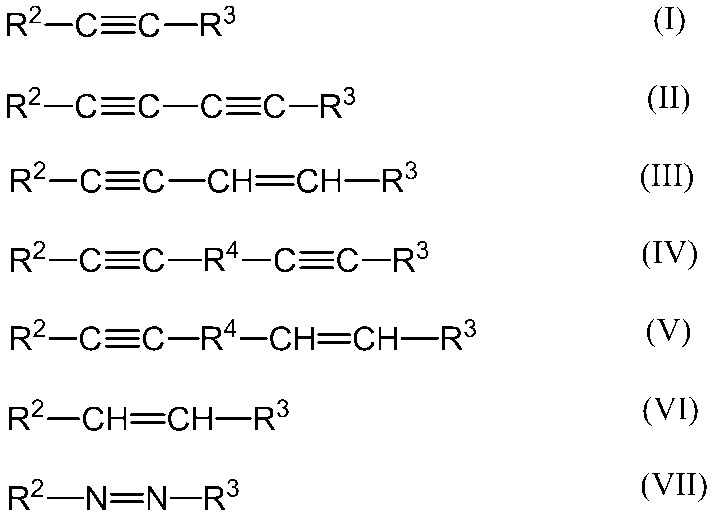
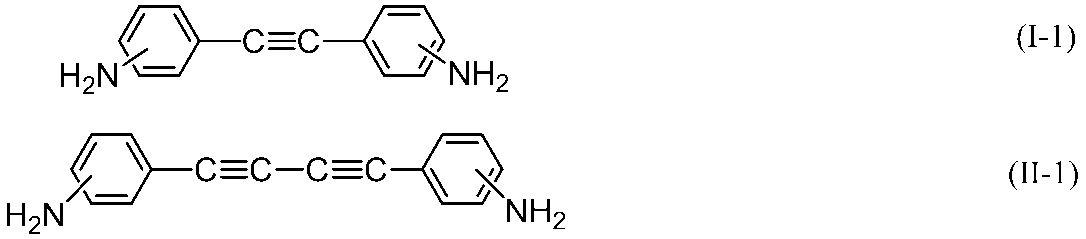

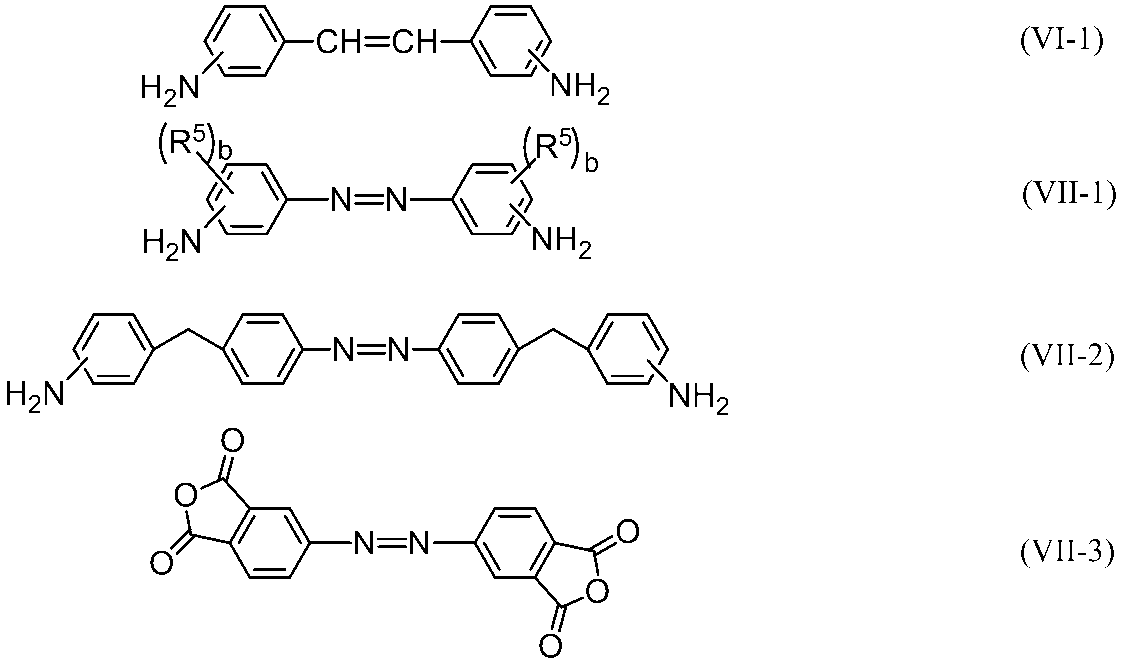
式(VII-1)において、R5は独立して-CH3、-OCH3、-CF3、または-COOCH3であり;そして、
bは0~2の整数である。
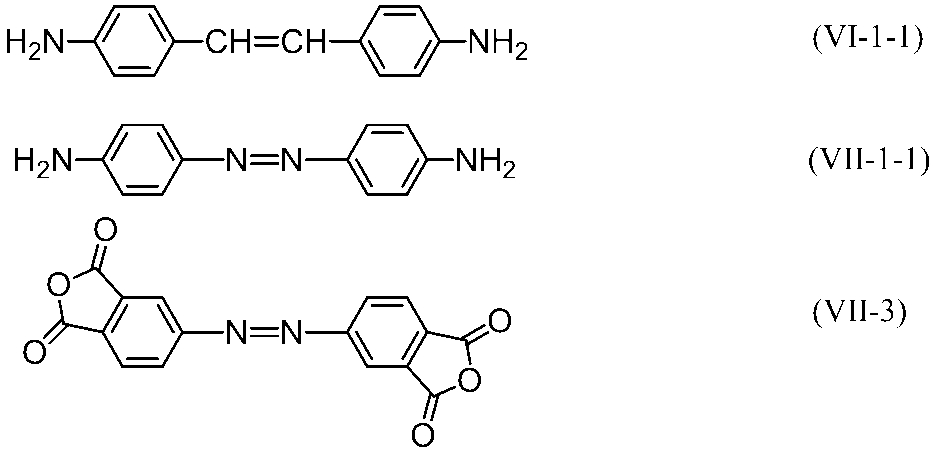
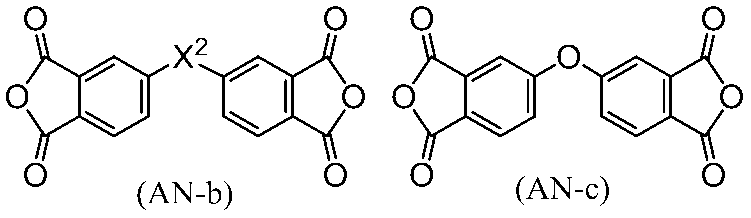
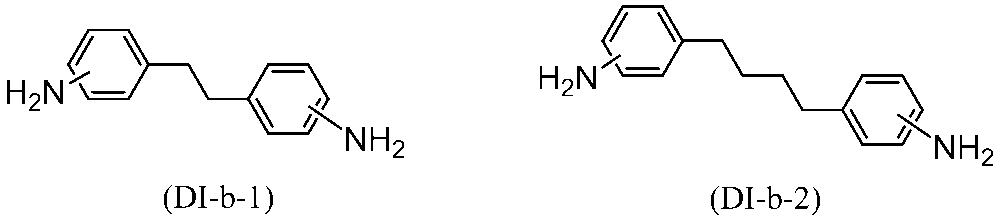
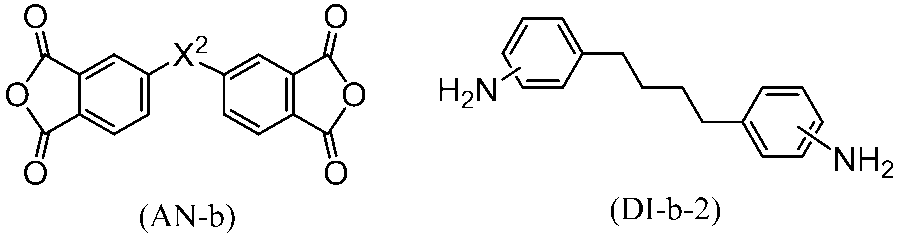
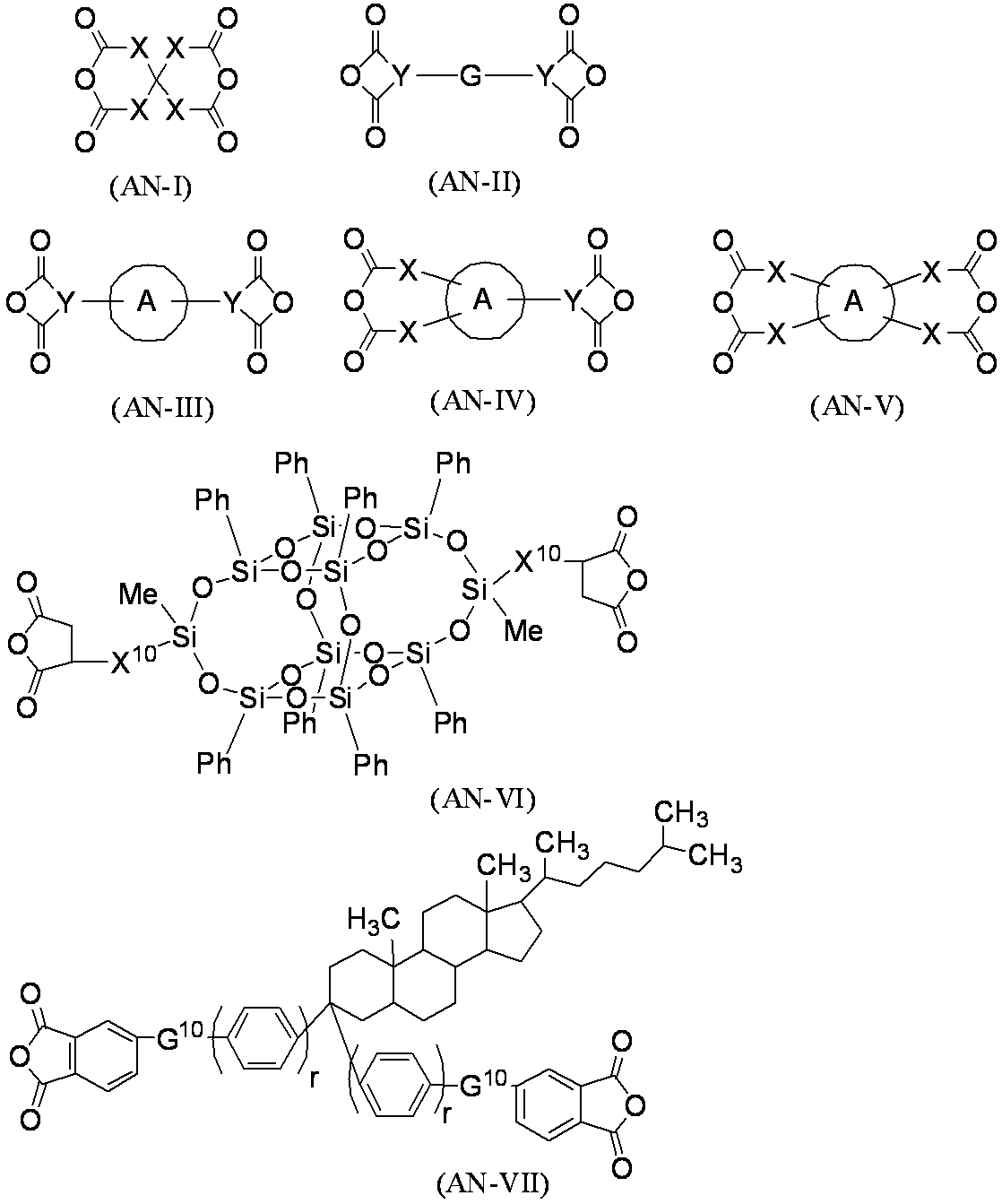
式(AN-II)において、Gは単結合、炭素数1~20のアルキレン、-CO-、-O-、-S-、-SO2-、-C(CH3)2-、または-C(CF3)2-であり;
式(AN-II)~(AN-IV)において、Yは独立して下記の3価の基の群から選ばれる1つであり、

式(AN-II)において、Yが2-アザプロパン-1,2,3-トリイルであるとき、前記Gは炭素数1~20のアルキレンではなく、Yがベンゼン-1,2,4-トリイルであるとき、前記Gは炭素数1~8のアルキレンおよび-O-ではなく;
式(AN-III)~(AN-V)において、環Aは炭素数3~10の単環式炭化水素の基または炭素数6~30の縮合多環式炭化水素の基であり、この基の少なくとも1つの水素はメチル、エチルまたはフェニルで置き換えられていてもよく、環に掛かっている結合手は環を構成する任意の炭素に連結しており、2本の結合手が同一の炭素に連結してもよく;
式(AN-VI)において、X10は炭素数2~6のアルキレンであり;
Meはメチルであり;
Phはフェニルであり;
式(AN-VII)において、G10は独立して-O-、-COO-または-OCO-であり;そして、
rは独立して0または1である。


(DI-3)、(DI-6)および(DI-7)において、G21は独立して単結合、-O-、-S-、-S-S-、-SO2-、-CO-、-CONH-、-NHCO-、-C(CH3)2-、-C(CF3)2-、-(CH2)m’-、-O-(CH2)m’-O-、または-S-(CH2)m’-S-であり、m’は独立して1~12の整数であり;
式(DI-5)において、G21は単結合、-NH-、-O-、-S-、-S-S-、-SO2-、-CO-、-CONH-、-NHCO-、-C(CH3)2-、-C(CF3)2-、-(CH2)m’’-、-O-(CH2)m’-O-、-N(CH3)-(CH2)k-N(CH3)-、または-S-(CH2)m’-S-であり、m’は1~12の整数であり、m’’は6~12の整数であり、kは1~5の整数であり;
(DI-6)および(DI-7)において、G22は独立して単結合、-O-、-S-、-CO-、-C(CH3)2-、-C(CF3)2-、または炭素数1~10のアルキレンであり;
式(DI-3)~(DI-7)中のシクロヘキサン環およびベンゼン環の少なくとも1つの水素は、-F、-CH3、-OH、-CF3、-CO2H、-CONH2、またはベンジルで置き換えられていてもよく、加えて式(DI-4)においてベンゼン環の少なくとも1つの水素は、下記式(DI-4-a)~(DI-4-c)で置き換えられていてもよく、

式(DI-2)~(DI-7)において、環を構成するいずれかの炭素原子に結合位置が固定されていない基は、その環における結合位置が任意であることを示し;そして、
シクロヘキサン環またはベンゼン環への-NH2の結合位置は、G21またはG22の結合位置を除く任意の位置である。

G23は独立して炭素数1~6のアルキレン、フェニレンまたはアルキル置換されたフェニレンであり;
wは1~10の整数であり;
式(DI-9)において、R23は独立して炭素数1~5のアルキル、炭素数1~5のアルコキシまたは-Clであり;
pは独立して0~3の整数であり、qは0~4の整数であるが、pおよびqが同時に0であることはなく;
式(DI-10)において、R24は水素、炭素数1~4のアルキル、フェニル、またはベンジルであり;
式(DI-11)において、G24は-CH2-または-NH-であり;
式(DI-12)において、G25は単結合、炭素数2~6のアルキレンまたは1,4-フェニレンであり;
rは0または1であり;
式(DI-12)において、環を構成するいずれかの炭素原子に結合位置が固定されていない基は、その環における結合位置が任意であることを示し;そして、
式(DI-9)、(DI-11)および(DI-12)において、ベンゼン環に結合する-NH2の結合位置は任意の位置であり;
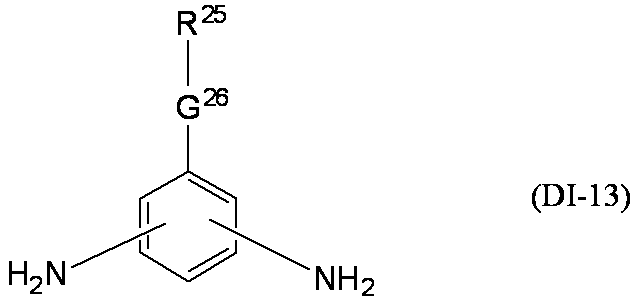
R25は炭素数3~20のアルキル、フェニル、シクロヘキシル、ステロイド骨格を有する基、または下記の式(DI-13-a)で表される基であり、このアルキルにおいて、少なくとも1つの水素は-Fで置き換えられてもよく、少なくとも1つの-CH2-は-O-で置き換えられていてもよく、このフェニルの水素は、-F、-CH3、-OCH3、-OCH2F、-OCHF2、-OCF3、炭素数3~20のアルキル、または炭素数3~20のアルコキシで置き換えられていてもよく、このシクロヘキシルの水素は炭素数3~20のアルキルまたは炭素数3~20のアルコキシで置き換えられていてもよく、ベンゼン環に結合する-NH2の結合位置はその環において任意の位置であることを示し;

環B21、環B22、環B23、および環B24は独立して1,4-フェニレン、1,4-シクロへキシレン、1,3-ジオキサン-2,5-ジイル、ピリミジン-2,5-ジイル、ピリジン-2,5-ジイル、ナフタレン-1,4-ジイル、ナフタレン-1,5-ジイル、ナフタレン-2,6-ジイル、ナフタレン-2,7-ジイル、またはアントラセン-9,10-ジイルであり;
環B21、環B22、環B23、および環B24において、少なくとも1つの水素は-Fまたは-CH3で置き換えられてもよく;
s,tおよびuは独立して0~2の整数であり、これらの合計は1~5であり;
s,tまたはuが2であるとき、各々の括弧内の2つの結合基は同じであっても異なってもよく、2つの環は同じであっても異なっていてもよく;
R26は-F、-OH、炭素数1~30のアルキル、炭素数1~30のフッ素置換アルキル、炭素数1~30のアルコキシ、-CN、-OCH2F、-OCHF2、または-OCF3であり、この炭素数1~30のアルキルの少なくとも1つの-CH2-は下記式(DI-13-b)で表される2価の基で置き換えられていてもよく;

vは1~6の整数であり;

R29は独立して水素または-CH3であり;
R30は水素、炭素数1~20のアルキル、または炭素数2~20のアルケニルであり;
式(DI-15)におけるベンゼン環の1つの水素は、炭素数1~20のアルキルまたはフェニルで置き換えられてもよく;
式(DI-14)および式(DI-15)において、環を構成するいずれかの炭素原子に結合位置が固定されていない基は、その環における結合位置が任意であることを示し;
ベンゼン環に結合する-NH2はその環における結合位置が任意であることを示し;

G32は単結合または炭素数1~3のアルキレンであり;
R31は水素または炭素数1~20のアルキルであり、このアルキルの少なくとも1つの-CH2-は、-O-で置き換えられてもよく;
R32は炭素数6~22のアルキルであり;
R33は水素または炭素数1~22のアルキルであり;
環B25は1,4-フェニレンまたは1,4-シクロヘキシレンであり;
rは0または1であり;そして、
ベンゼン環に結合する-NH2はその環における結合位置が任意であることを示す。
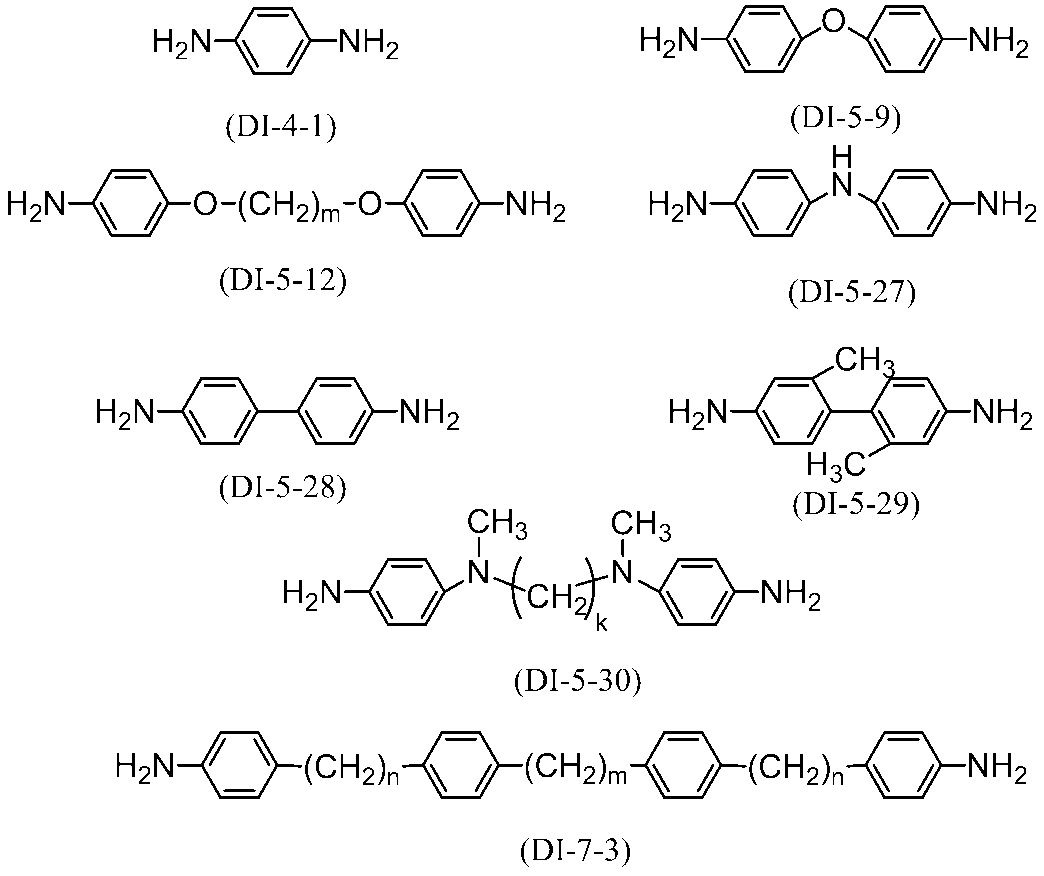
式(DI-5-30)において、kは1~5の整数であり:そして、
式(DI-7-3)において、nは1または2である。
本発明の光配向用液晶配向剤は、テトラカルボン酸二無水物とジアミンとの反応生成物であるポリアミック酸またはその誘導体を含有する。前記ポリアミック酸の誘導体とは、溶剤を含有する後述する液晶配向剤としたときに溶剤に溶解する成分であり、その液晶配向剤を後述する液晶配向膜としたときに、ポリイミドを主成分とする液晶配向膜を形成することができる成分である。このようなポリアミック酸の誘導体としては、例えば可溶性ポリイミド、ポリアミック酸エステル、およびポリアミック酸アミド等が挙げられ、より具体的には1)ポリアミック酸の全てのアミノとカルボキシルとが脱水閉環反応したポリイミド、2)部分的に脱水閉環反応した部分ポリイミド、3)ポリアミック酸のカルボキシルがエステルに変換されたポリアミック酸エステル、4)テトラカルボン酸二無水物化合物に含まれる酸二無水物の一部を有機ジカルボン酸に置き換えて反応させて得られたポリアミック酸-ポリアミド共重合体、さらに5)該ポリアミック酸-ポリアミド共重合体の一部もしくは全部を脱水閉環反応させたポリアミドイミドが挙げられる。前記ポリアミック酸またはその誘導体は、1つの化合物であってもよいし、2つ以上であってもよい。


光反応性構造としては、光の照射によって異性化、光分解、二量化反応等を起こす公知の全ての感光性構造から選択することができる。感光性の点から光異性化または二量化反応を起こす感光性基を用いることが好ましい。
前記光反応性構造を有するテトラカルボン酸二無水物または光反応性構造を有するジアミンとしては、感光性が良好な下記式(I)~(VII)で表される化合物の群から選ばれる少なくとも1つであることが好ましく、式(VII)で表される化合物がより好ましい。
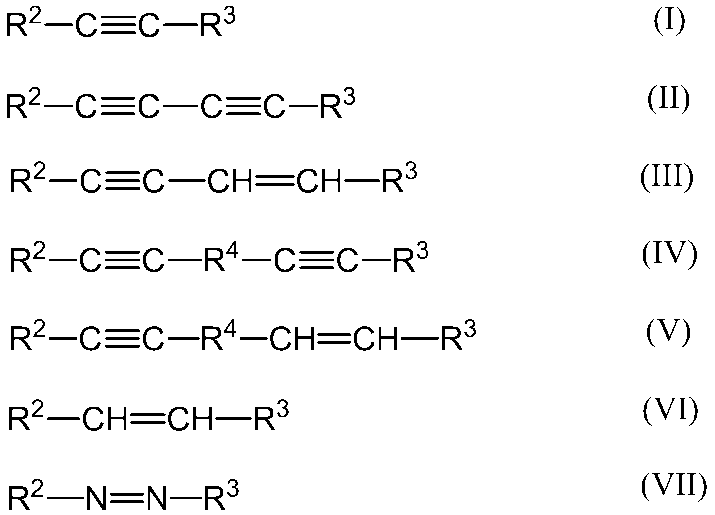


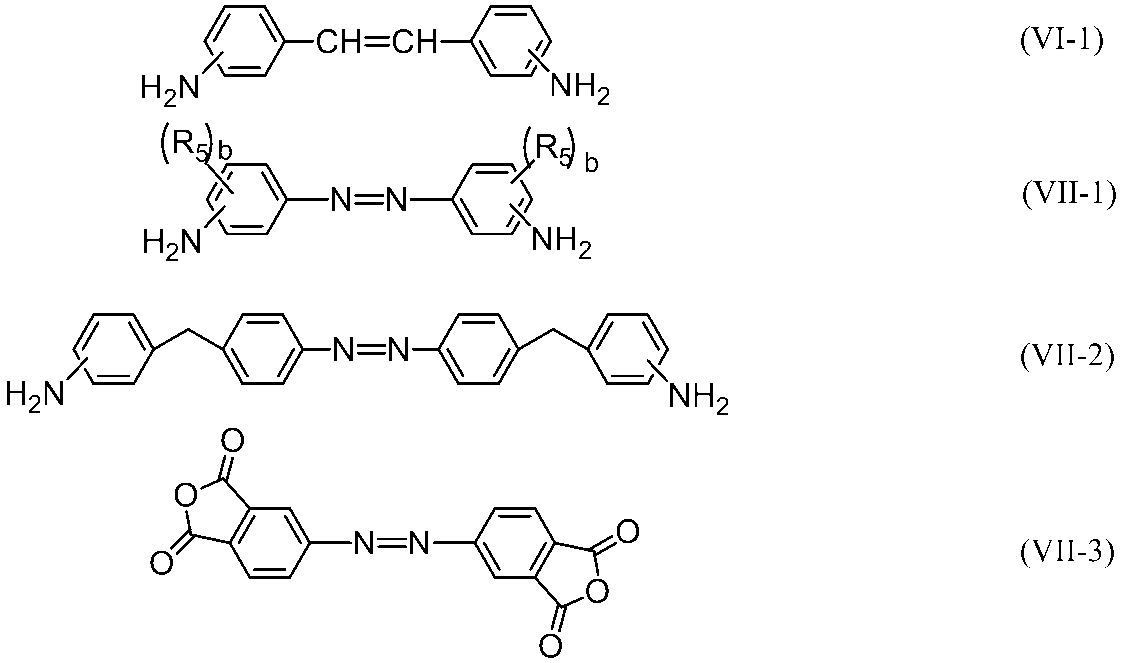
式(AN-a)~(AN-c)で表される非感光性テトラカルボン酸二無水物について、液晶の配向性をさらに向上させることを重視する場合には、式(AN-a)および(AN-b)で表される化合物を用いるのが好ましく、液晶表示素子のVHRを向上させることを重視する場合には、式(AN-a)で表される化合物を用いるのが好ましく、液晶配向膜の残留DCの溜まりを抑えることを重視する場合には、式(AN-a)および(AN-c)で表される化合物を用いるのが好ましく、液晶配向膜の残留DCの緩和時間を短くすることを重視する場合には、式(AN-b)および(AN-c)で表される化合物を用いるのが好ましい。上記諸特性をバランスよく満たす式(AN-b)で表される化合物をより好適に用いることができる。
式(DI-a)~(DI-c)で表される非感光性ジアミンについて、液晶の配向性をさらに向上させることを重視する場合には、式(DI-b)および(DI-c)で表される化合物を用いるのが好ましく、液晶表示素子のVHRを向上させることを重視する場合には、式(DI-a)および(DI-c)で表される化合物を用いるのが好ましく、液晶配向膜の残留DCの溜まりを抑えることを重視する場合には、式(DI-a)および(DI-c)で表される化合物を用いるのが好ましく、液晶配向膜の残留DCの緩和時間を短くすることを重視する場合には、式(DI-b)で表される化合物を用いるのが好ましい。上記諸特性をバランスよく満たす式(DI-b)で表される化合物をより好適に用いることができる。
本発明のポリアミック酸またはその誘導体を製造するにあたって、上述した感光性テトラカルボン酸二無水物および式(AN-a)~(AN-c)で表される非感光性テトラカルボン酸二無水物以外の、「その他のテトラカルボン酸二無水物」を使用することができる。その他のテトラカルボン酸二無水物は、公知のテトラカルボン酸二無水物から制限されることなく選択することができる。このようなテトラカルボン酸二無水物は、芳香環に直接ジカルボン酸無水物が結合した芳香族系(複素芳香環系を含む)、および芳香環に直接ジカルボン酸無水物が結合していない脂肪族系(複素環系を含む)の何れの群に属するものであってもよい。
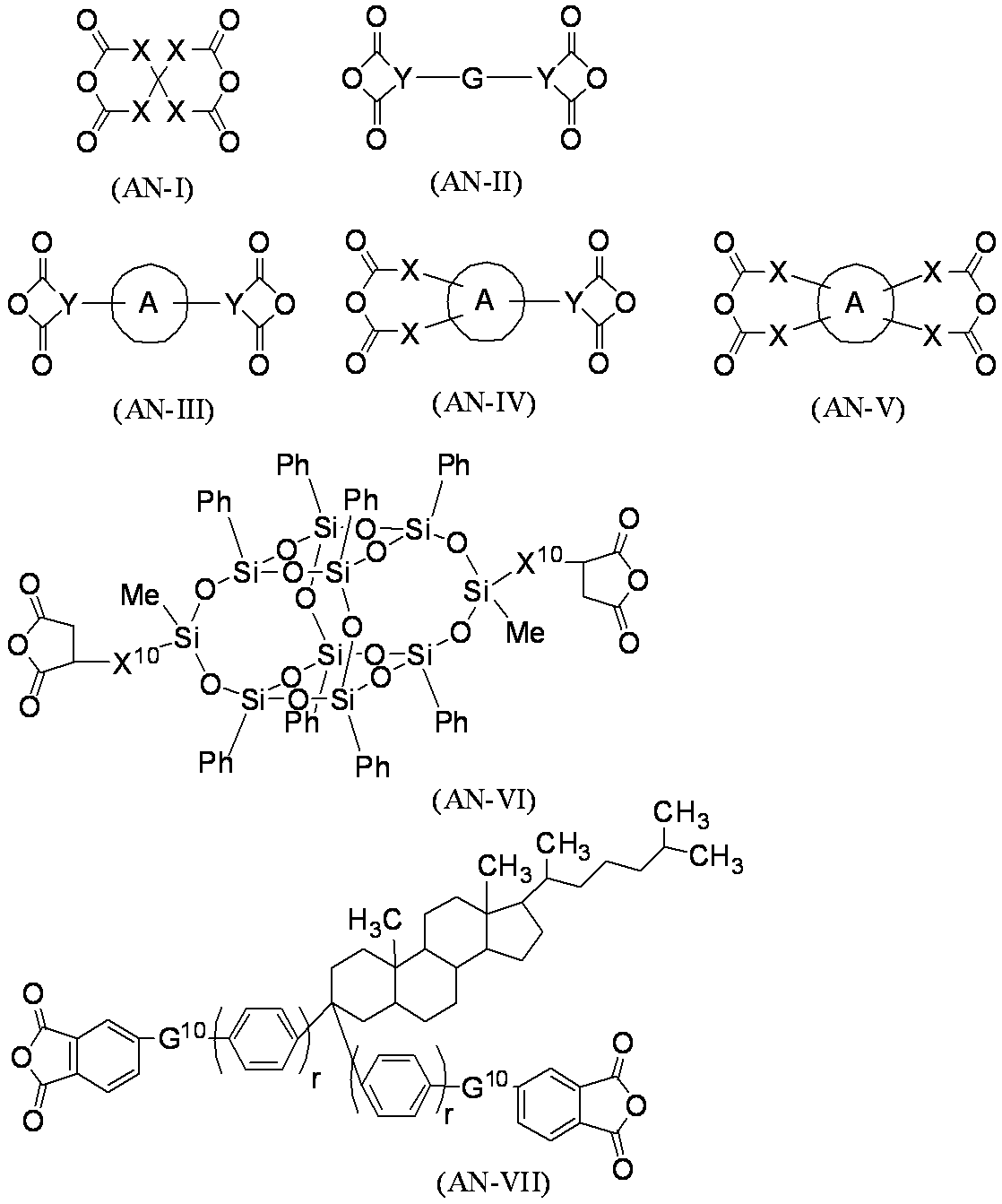



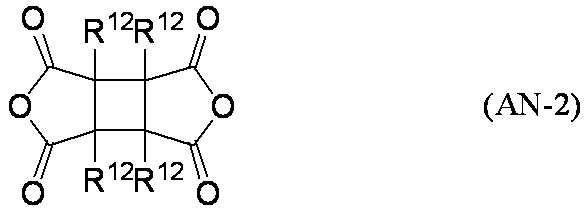
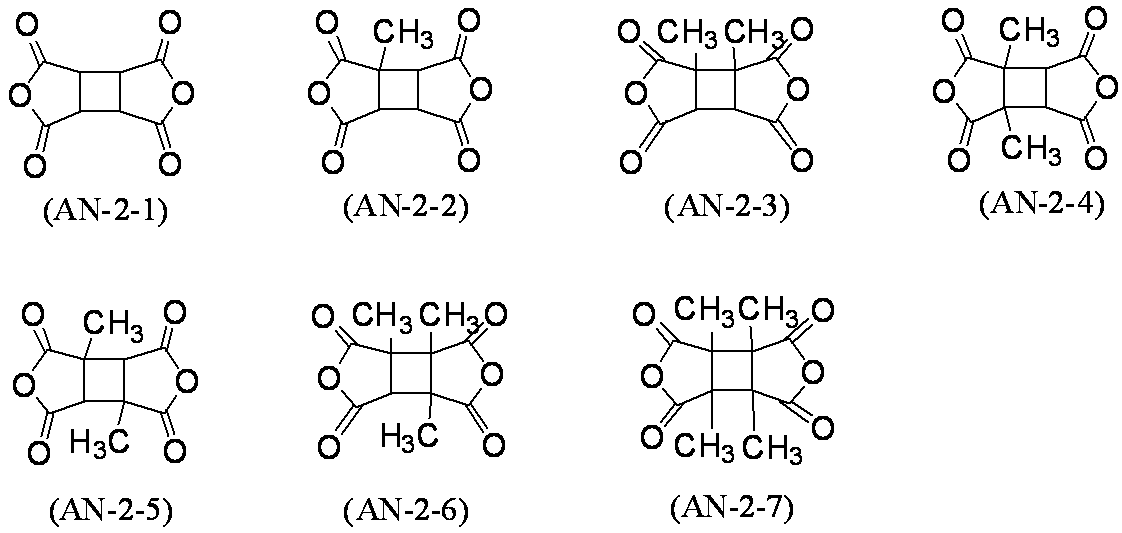

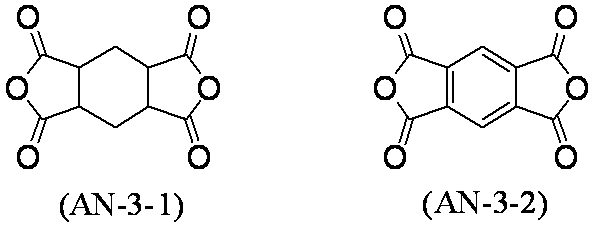
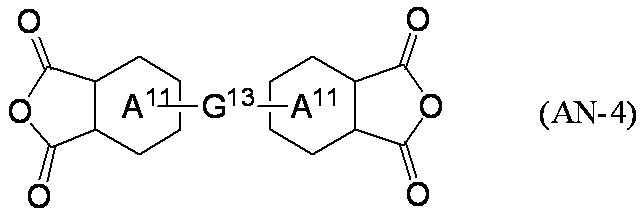

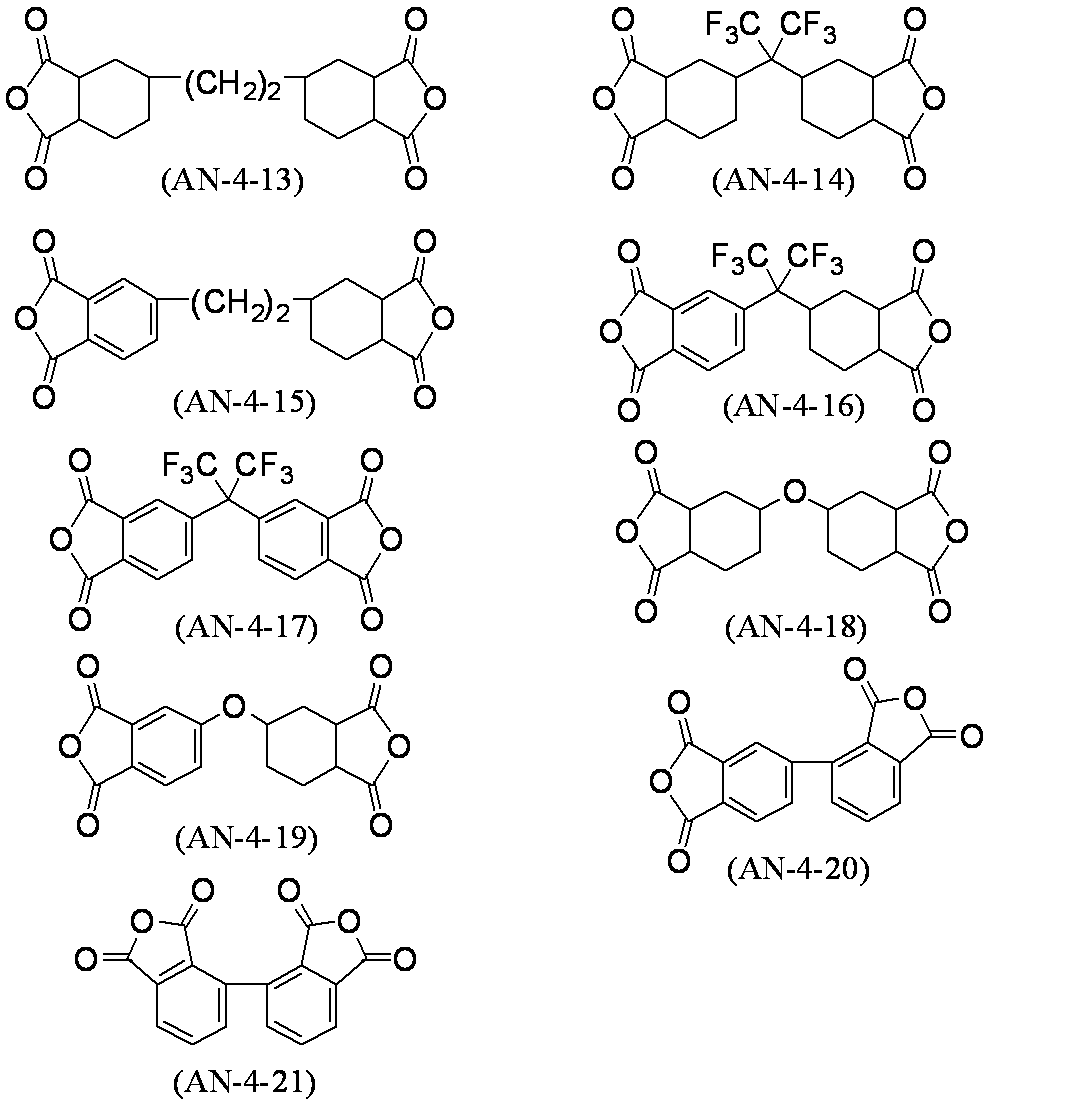

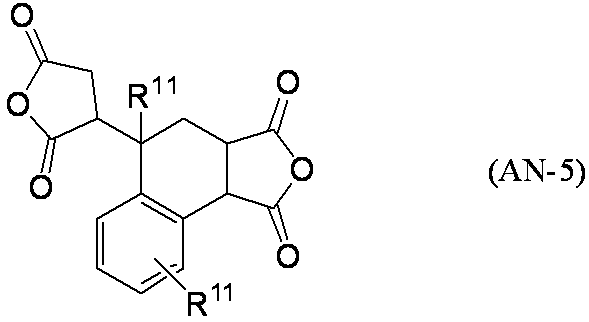
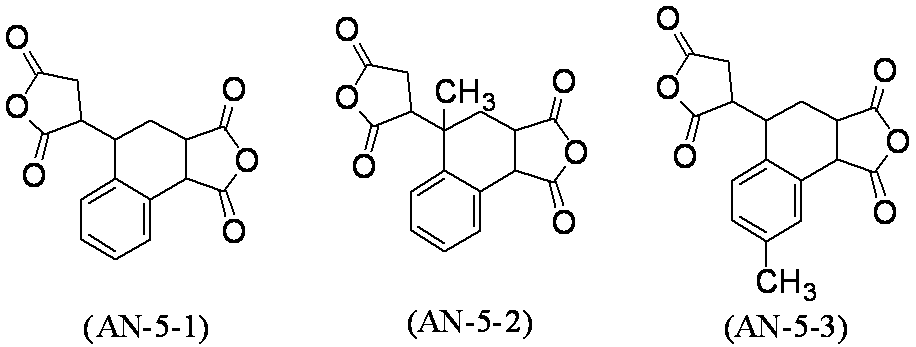

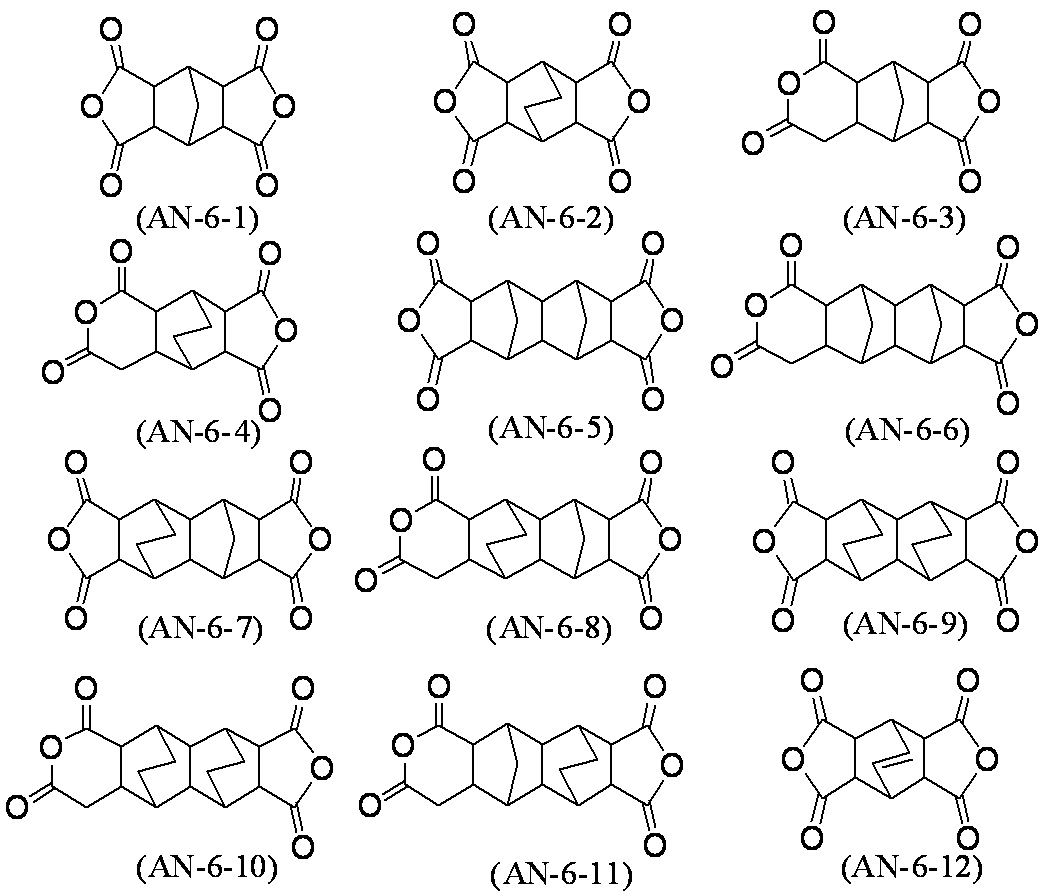
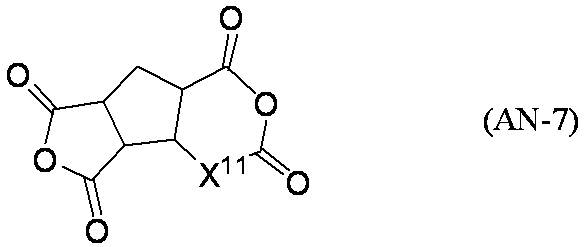
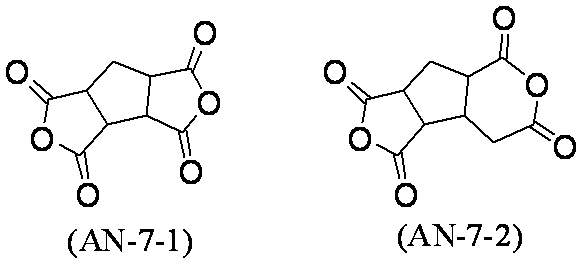
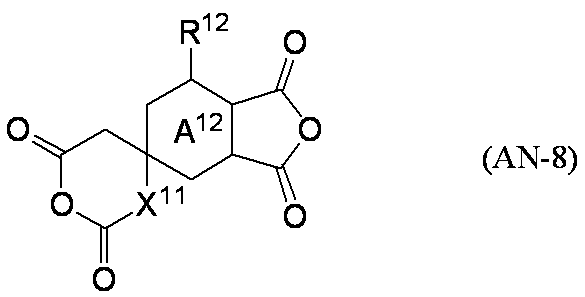
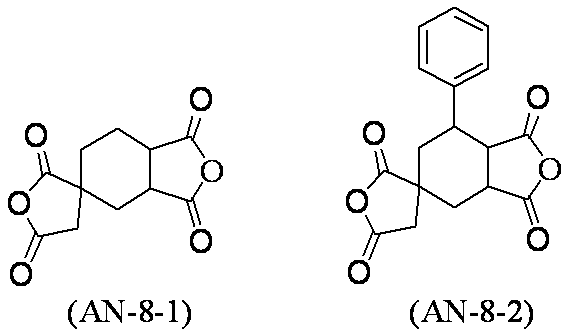
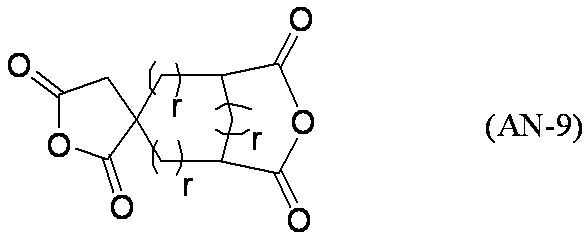
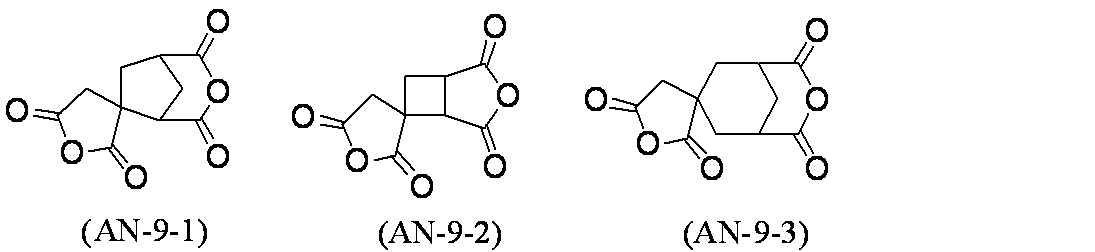
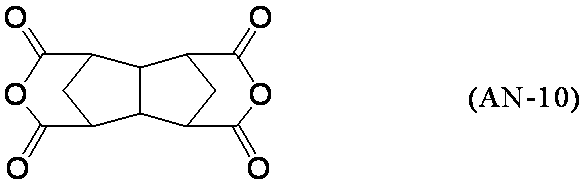
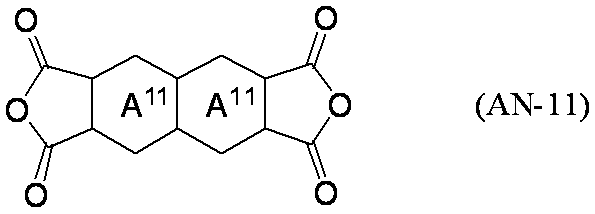
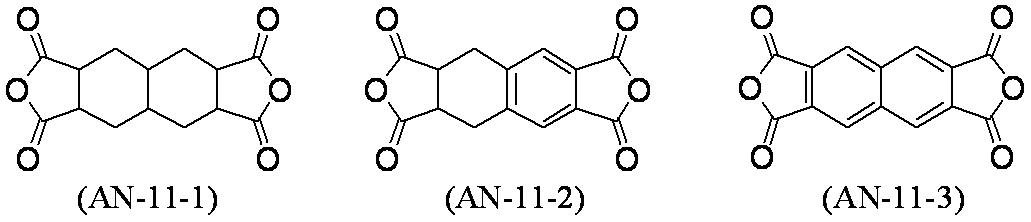

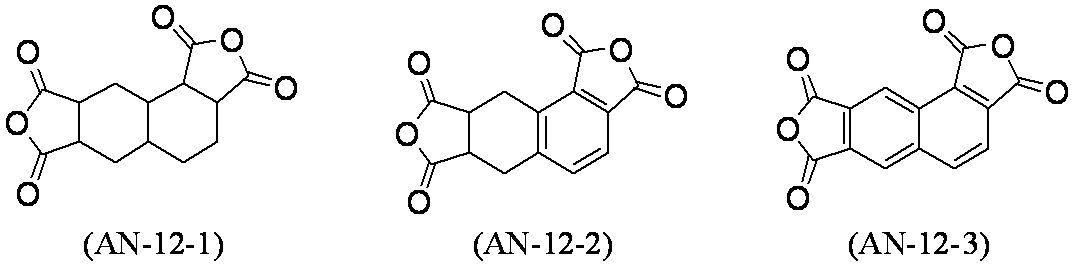

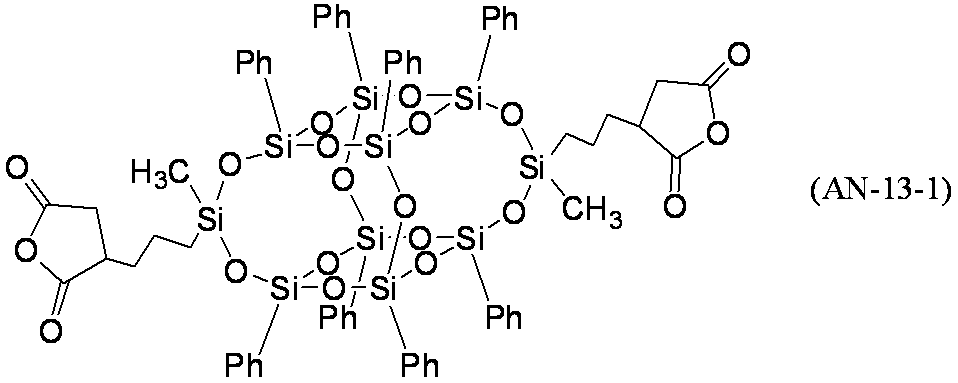
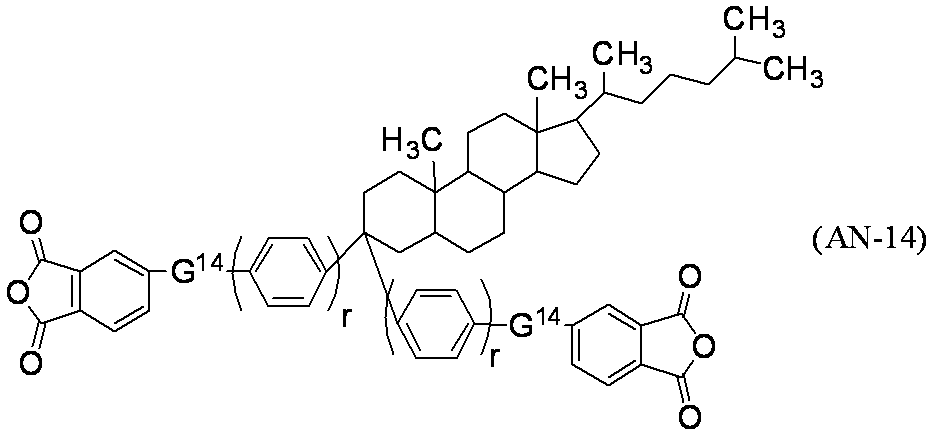
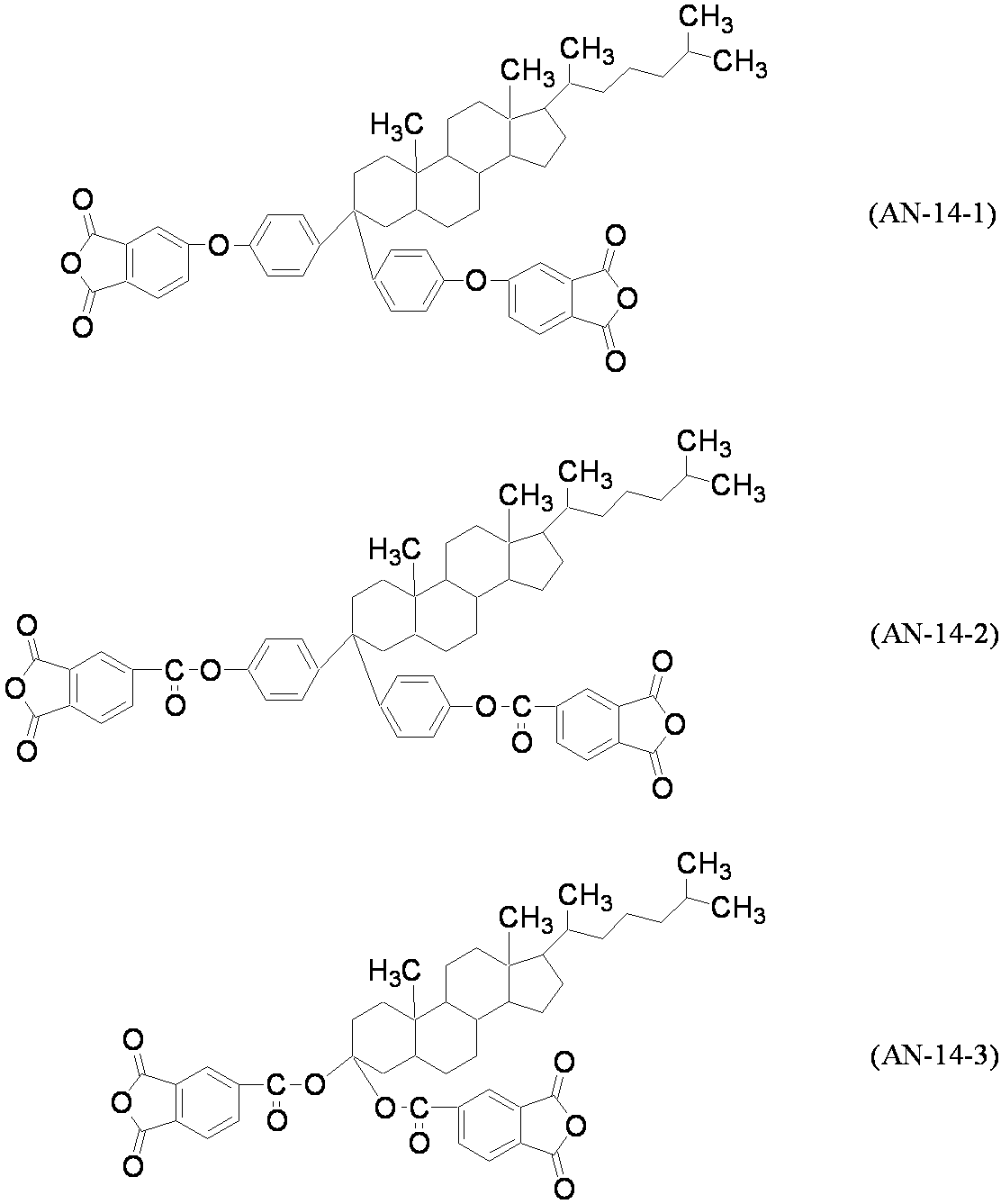



本発明のポリアミック酸またはその誘導体を製造するにあたって、上述した感光性ジアミンおよび式(DI-a)~(DI-c)で表されるジアミン以外の、「その他のジアミン」を使用することができる。その他のジアミンは、公知のジアミンから制限されることなく選択することができる。
既知の側鎖を有さないジアミンとしては、以下の式(DI-1)および(DI-3)~(DI-12)で表されるジアミンを挙げることができる。
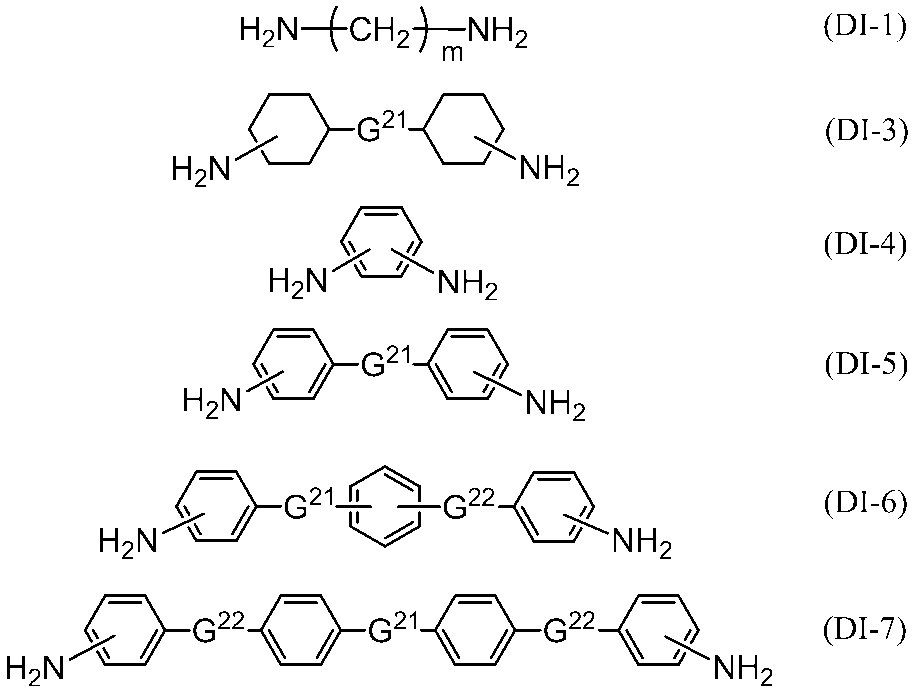
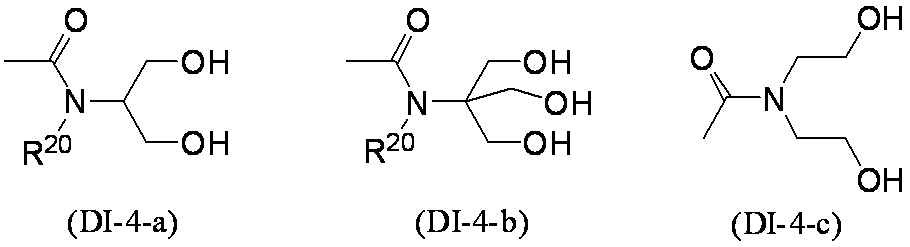

式(DI-9)において、R23は独立して炭素数1~5のアルキル、炭素数1~5のアルコキシまたは-Clであり、pは独立して0~3の整数であり、qは0~4の整数であるが、pおよびqが同時に0であることはない。
式(DI-10)において、R24は水素、炭素数1~4のアルキル、フェニル、またはベンジルである。
式(DI-11)において、G24は-CH2-または-NH-である。
式(DI-12)において、G25は単結合、炭素数2~6のアルキレンまたは1,4-フェニレンであり、rは0または1である。そして、環を構成する炭素原子に結合位置が固定されていない基は、その環における結合位置が任意であることを示す。
式(DI-9)、式(DI-11)および式(DI-12)において、ベンゼン環に結合する-NH2の結合位置は、任意の位置である。
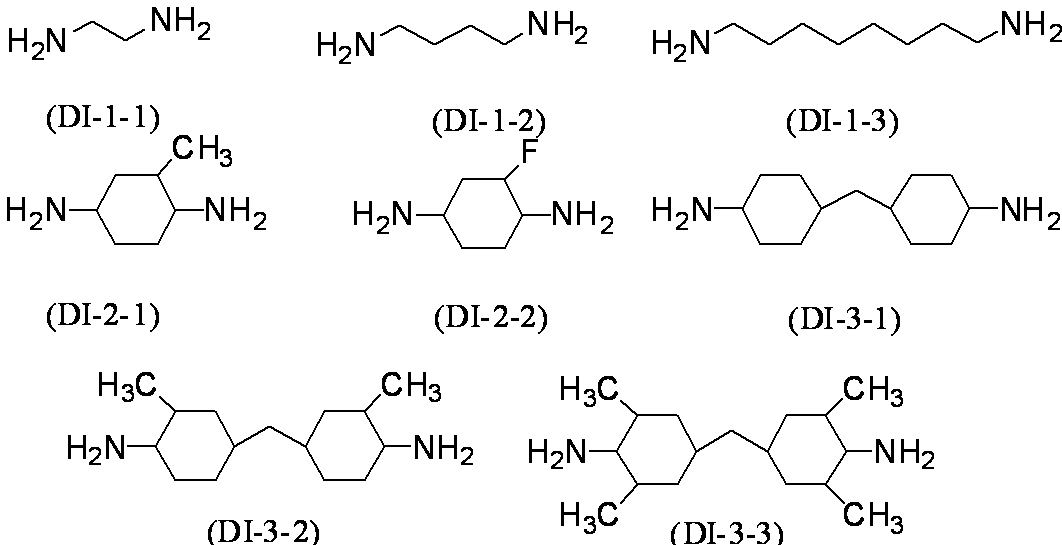

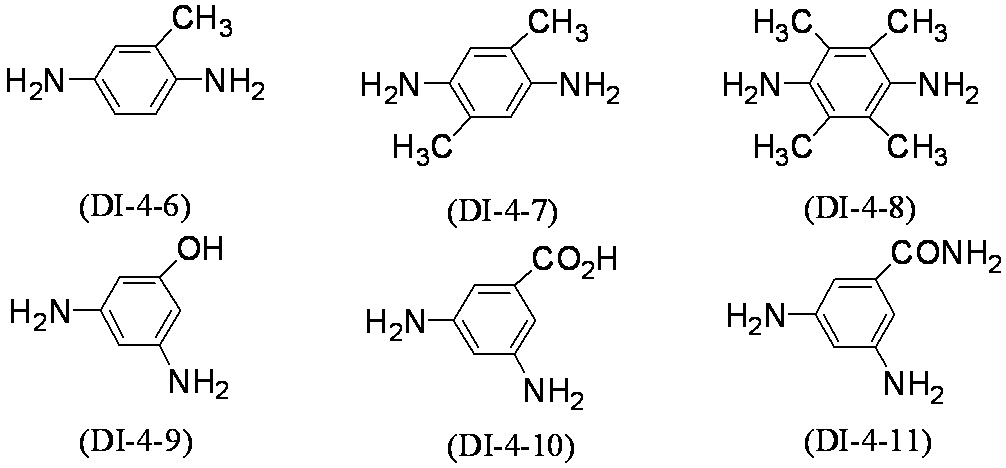
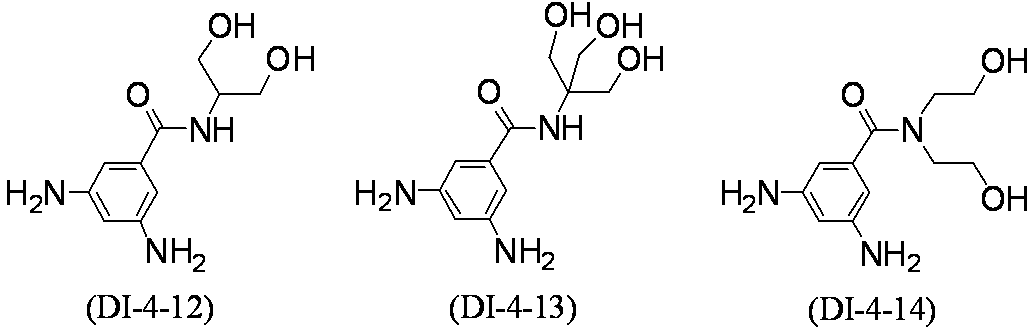


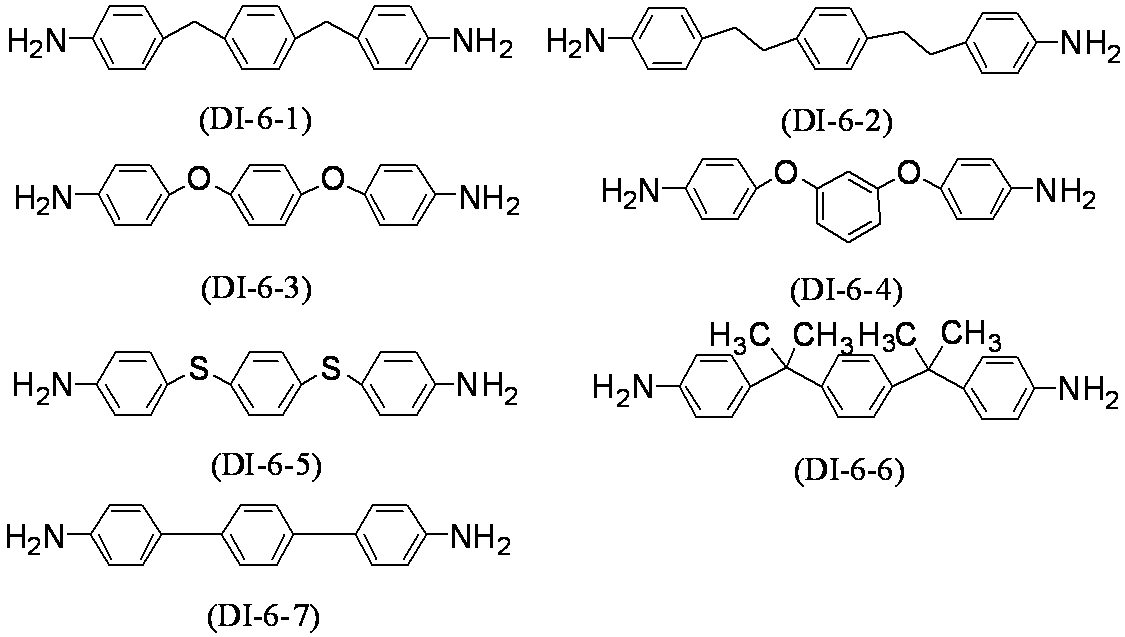


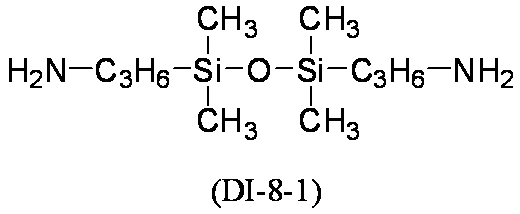


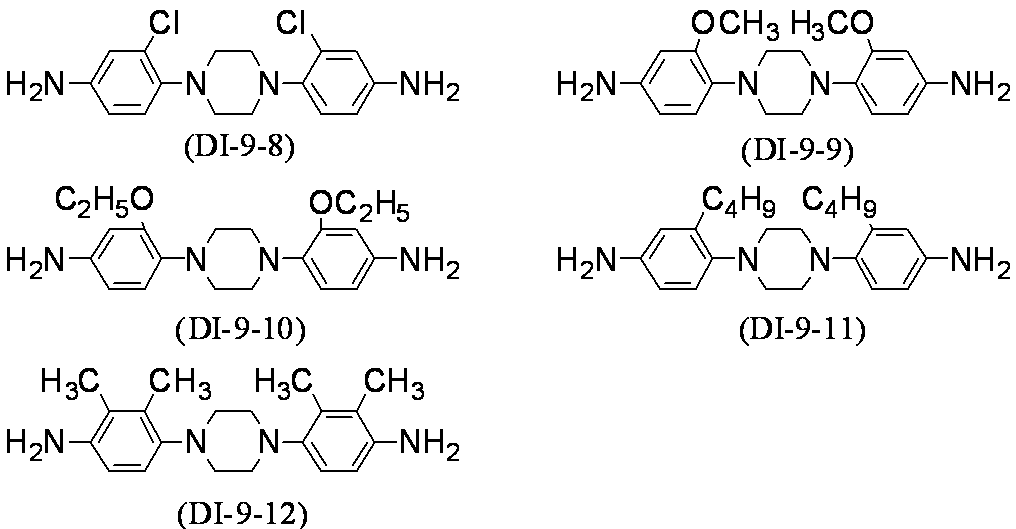
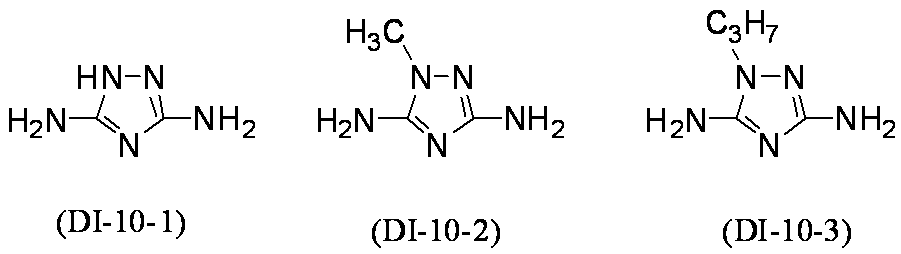
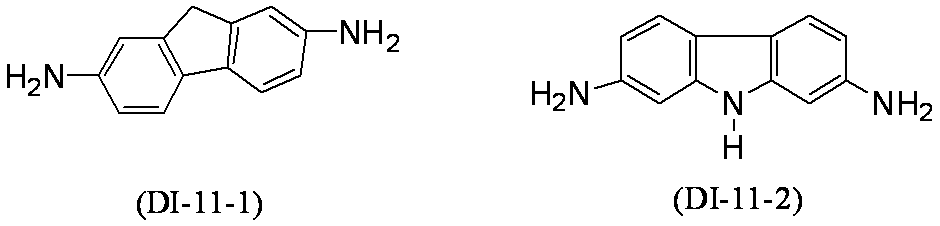

側鎖型ジアミンの側鎖基としては、以下の基をあげることができる。




上記式(DI-13)~(DI-17)の側鎖を有するジアミン化合物として、下記の式(DI-13-1)~(DI-17-3)で表される化合物を挙げることができる。

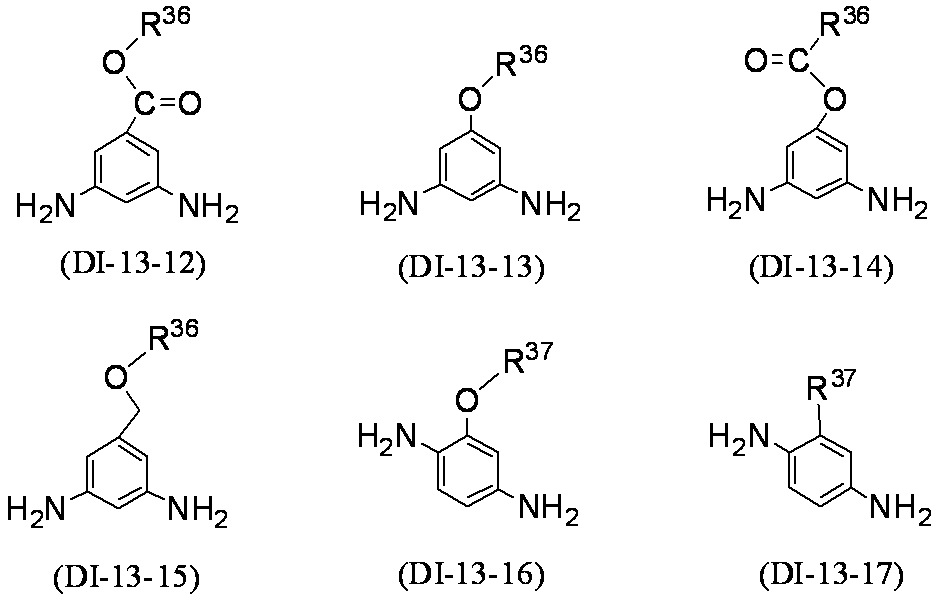

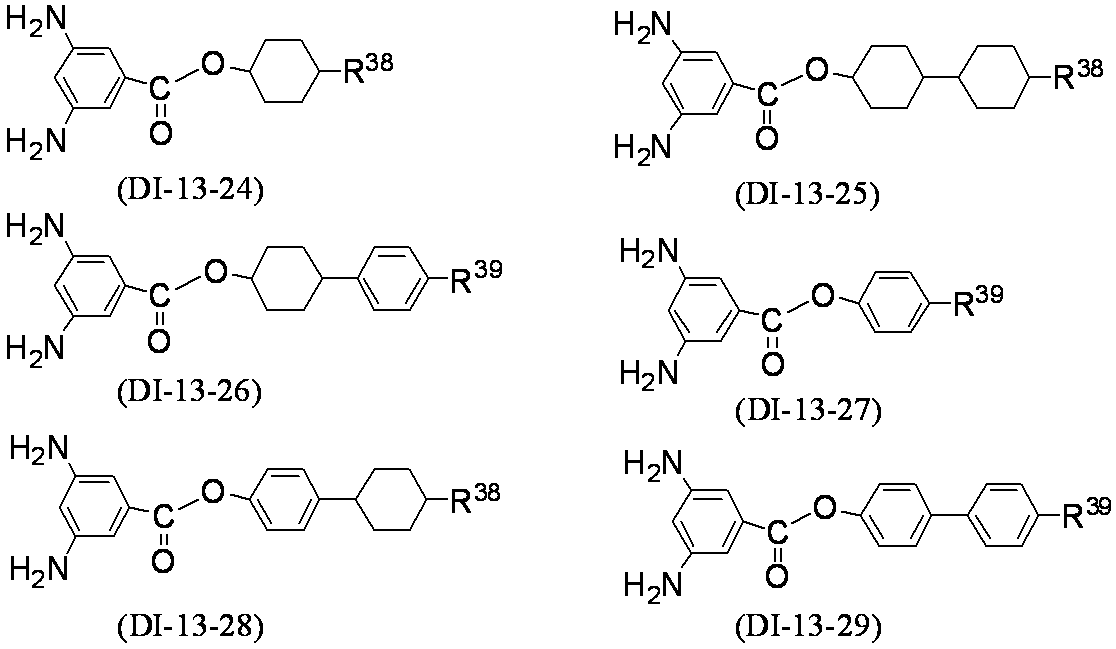

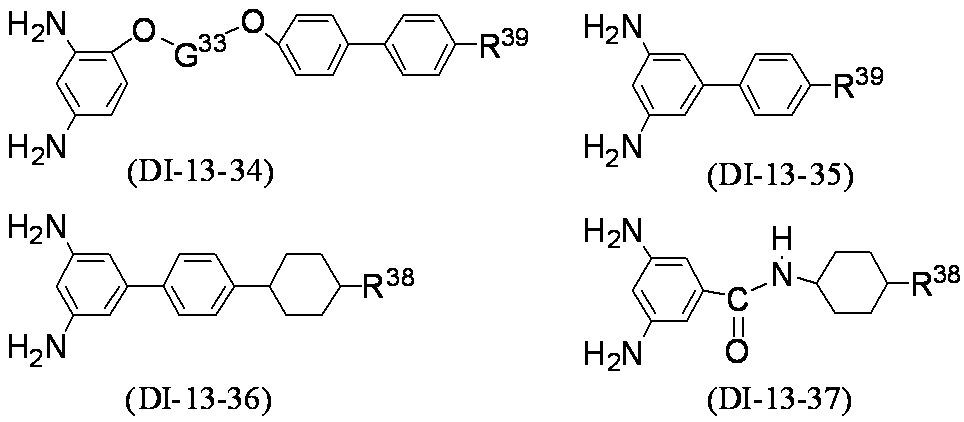


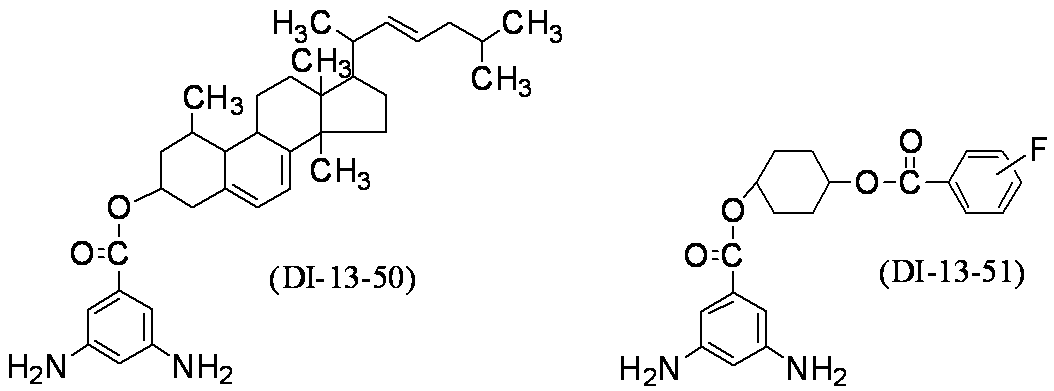
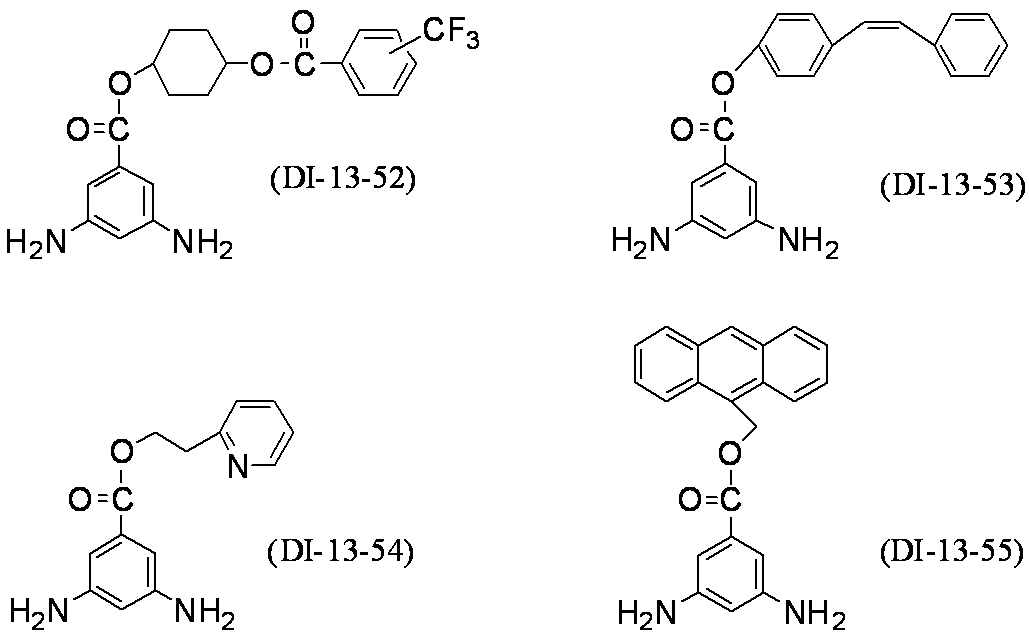
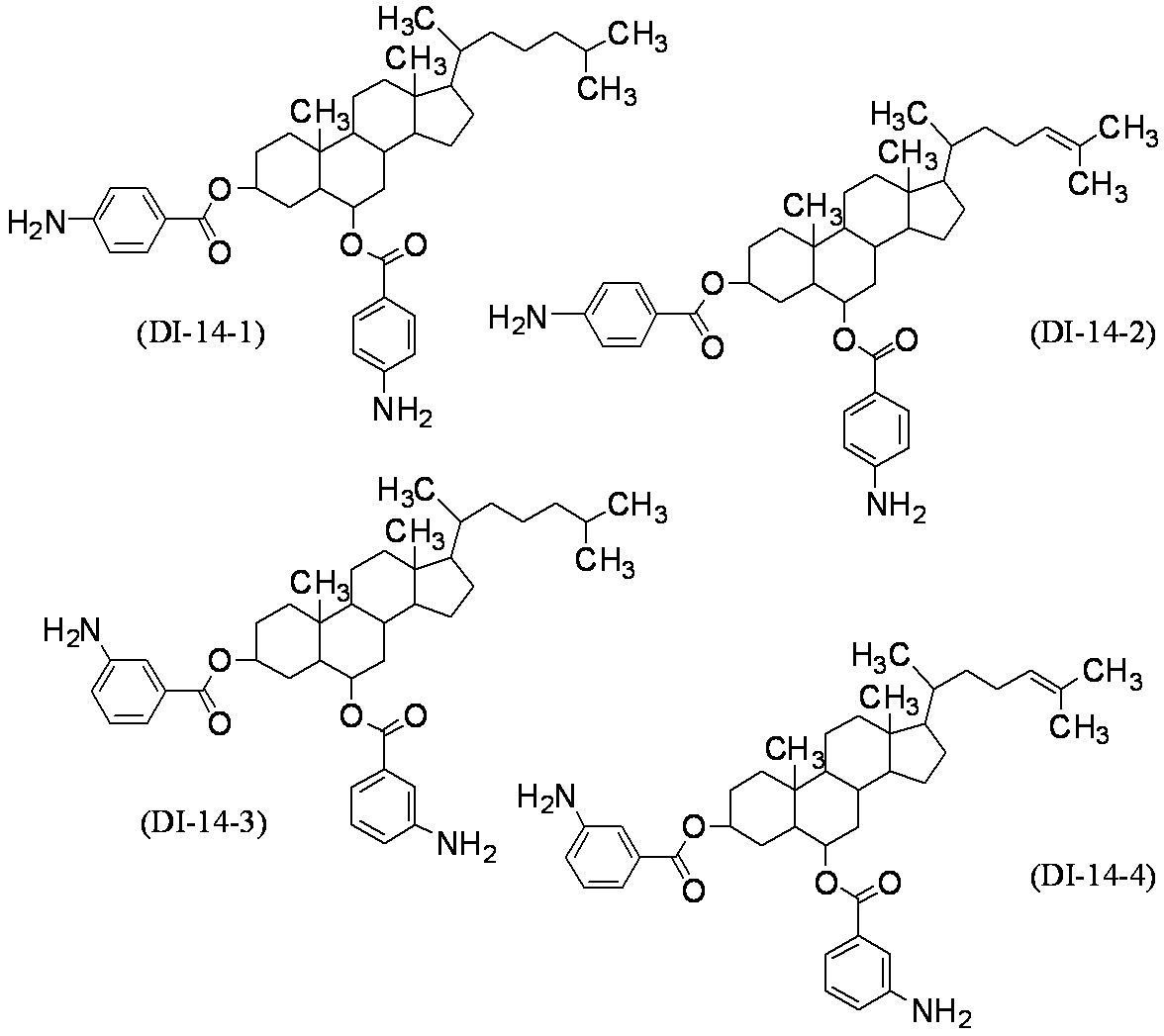
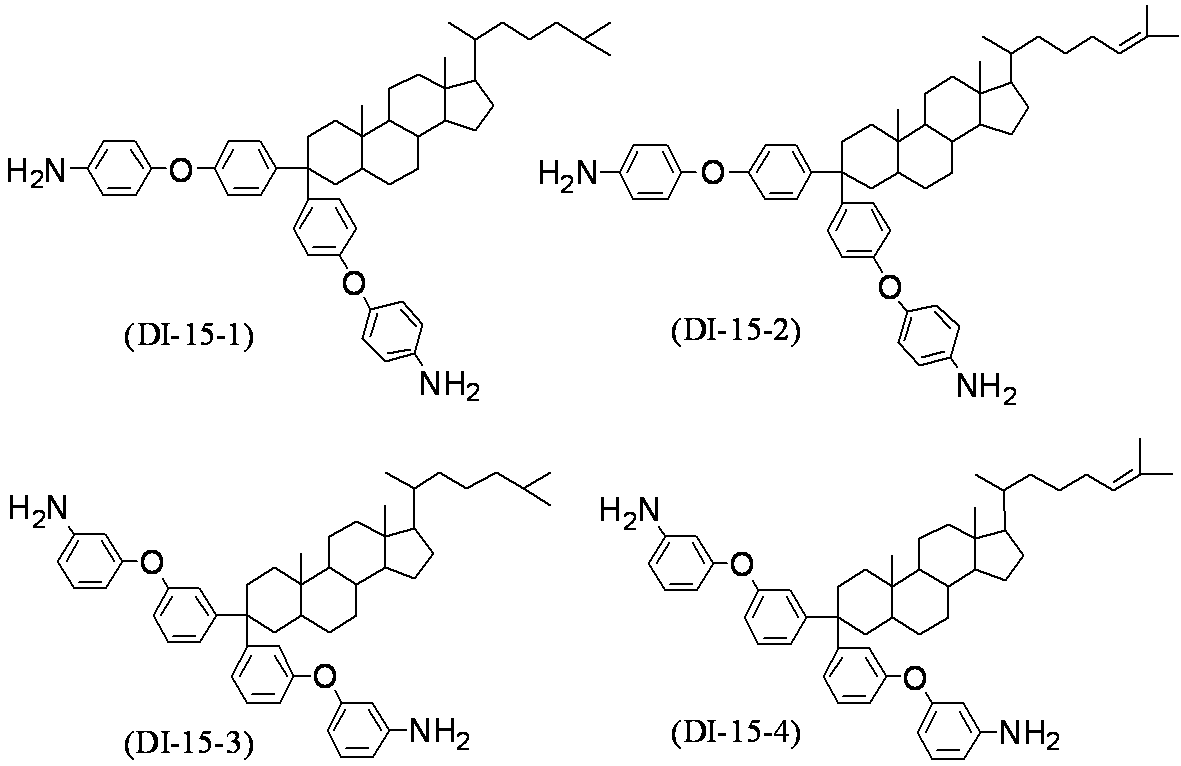
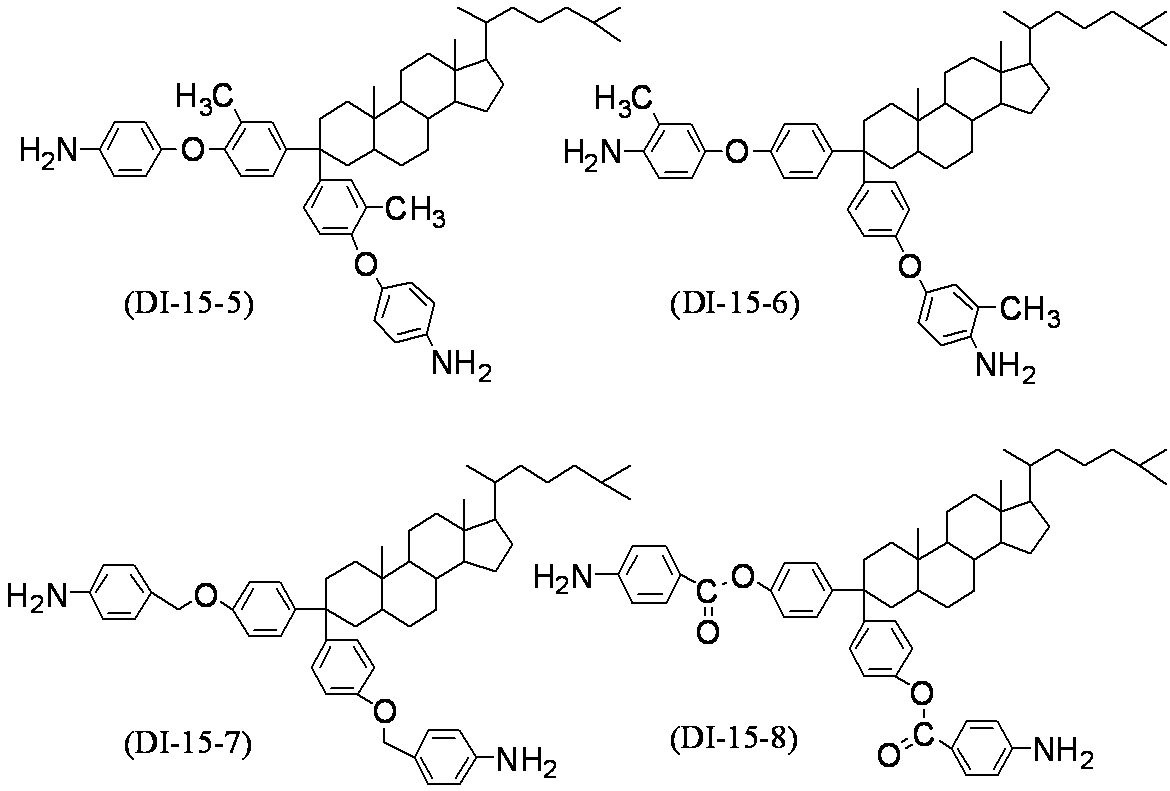

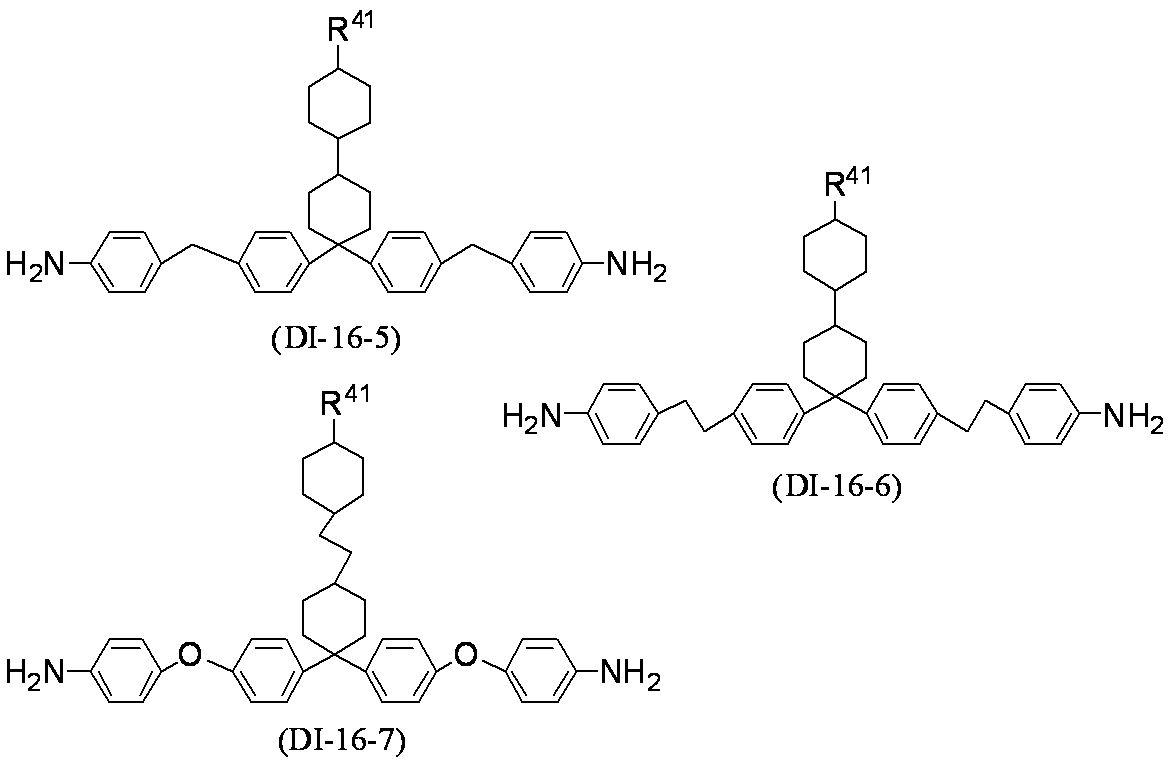
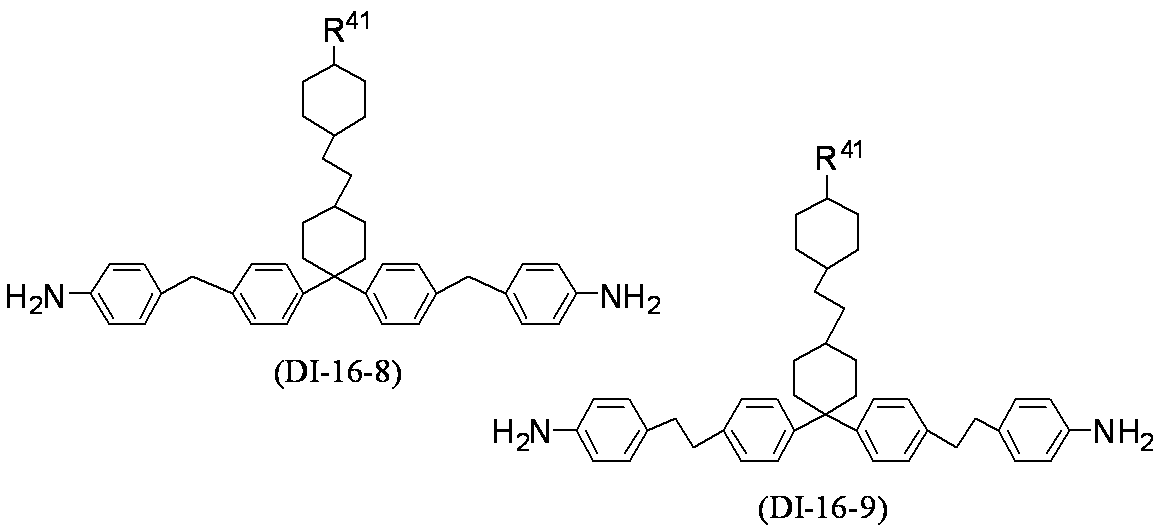
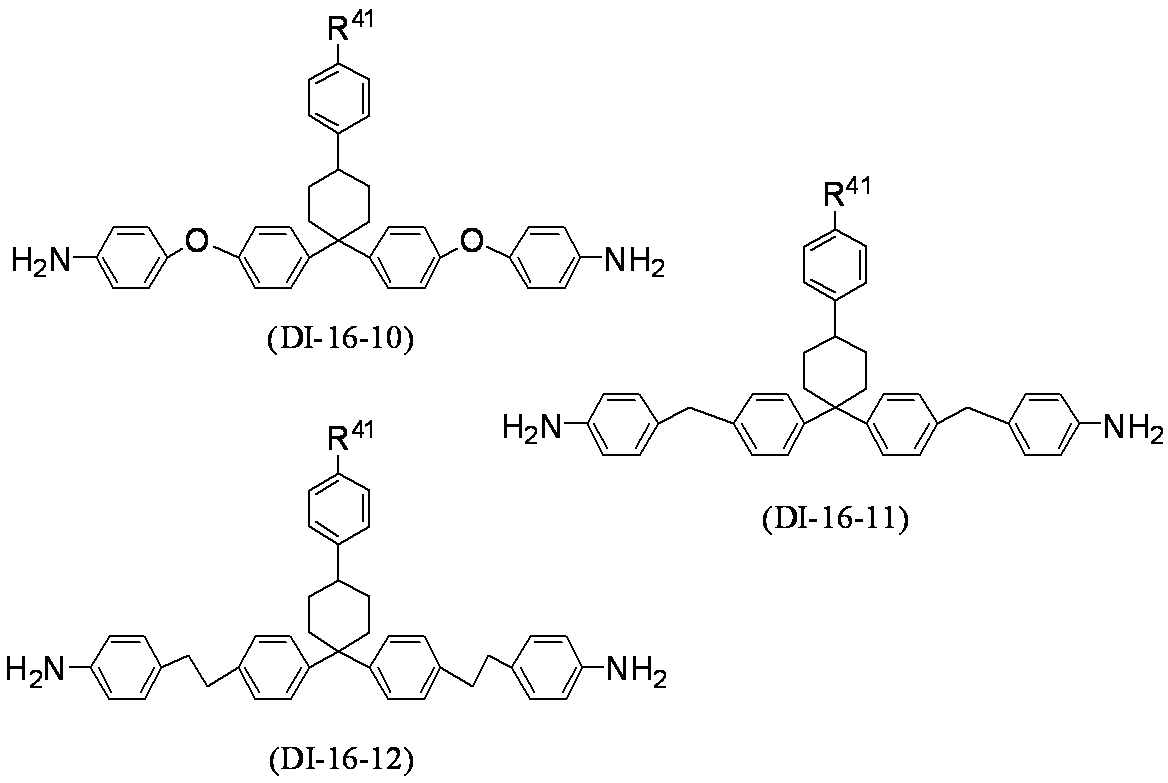
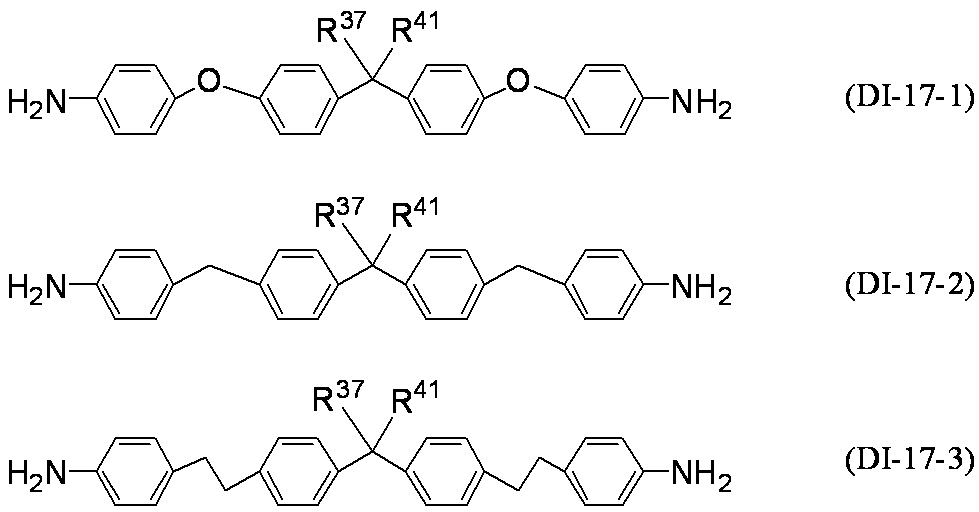
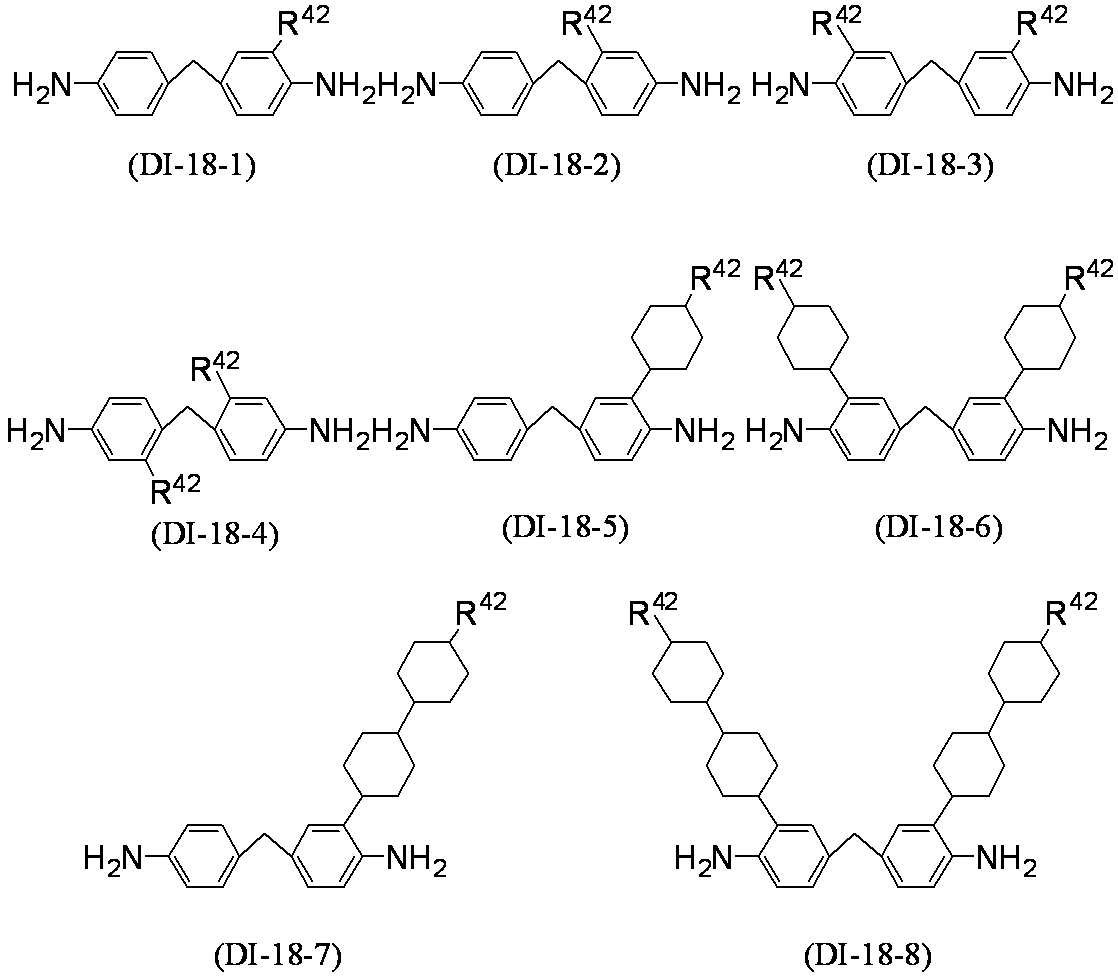
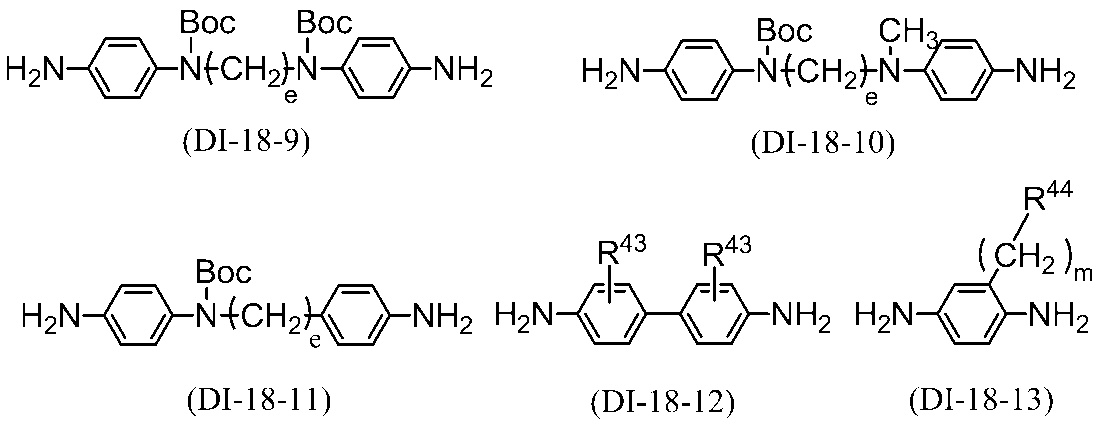
本発明の液晶配向剤に用いるポリアミック酸は、上記の酸無水物の混合物とジアミンを溶剤中で反応させることによって得られる。この合成反応においては、原料の選択以外に特別な条件は必要でなく、通常のポリアミック酸合成における条件をそのまま適用することができる。使用する溶剤については後述する。
本発明の液晶配向剤は、ポリアミック酸またはその誘導体以外の他の成分をさらに含有していてもよい。他の成分は、1種であっても2種以上であってもよい。
以下にアルケニル置換ナジイミド化合物について具体的に説明する。
アルケニル置換ナジイミド化合物は、本発明で用いられるポリアミック酸またはその誘導体を溶解する溶剤に溶解させることができる化合物であることが好ましい。このようなアルケニル置換ナジイミド化合物の例は、下記の式(NA)で表される化合物が挙げられる。


N,N’-エチレン-ビス(アリルビシクロ[2.2.1]ヘプト-5-エン-2,3-ジカルボキシイミド)、N,N’-エチレン-ビス(アリルメチルビシクロ[2.2.1]ヘプト-5-エン-2,3-ジカルボキシイミド)、N,N’-エチレン-ビス(メタリルビシクロ[2.2.1]ヘプト-5-エン-2,3-ジカルボキシイミド)、N,N’-トリメチレン-ビス(アリルビシクロ[2.2.1]ヘプト-5-エン-2,3-ジカルボキシイミド)、N,N’-ヘキサメチレン-ビス(アリルビシクロ[2.2.1]ヘプト-5-エン-2,3-ジカルボキシイミド)、N,N’-ヘキサメチレン-ビス(アリルメチルビシクロ[2.2.1]ヘプト-5-エン-2,3-ジカルボキシイミド)、N,N’-ドデカメチレン-ビス(アリルビシクロ[2.2.1]ヘプト-5-エン-2,3-ジカルボキシイミド)、N,N’-ドデカメチレン-ビス(アリルメチルビシクロ[2.2.1]ヘプト-5-エン-2,3-ジカルボキシイミド)、N,N’-シクロヘキシレン-ビス(アリルビシクロ[2.2.1]ヘプト-5-エン-2,3-ジカルボキシイミド)、N,N’-シクロヘキシレン-ビス(アリルメチルビシクロ[2.2.1]ヘプト-5-エン-2,3-ジカルボキシイミド)、
N,N’-エチレン-ビス(アリルビシクロ[2.2.1]ヘプト-5-エン-2,3-ジカルボキシイミド)、N,N’-エチレン-ビス(アリルメチルビシクロ[2.2.1]ヘプト-5-エン-2,3-ジカルボキシイミド)、N,N’-エチレン-ビス(メタリルビシクロ[2.2.1]ヘプト-5-エン-2,3-ジカルボキシイミド)、N,N’-トリメチレン-ビス(アリルビシクロ[2.2.1]ヘプト-5-エン-2,3-ジカルボキシイミド)、N,N’-ヘキサメチレン-ビス(アリルビシクロ[2.2.1]ヘプト-5-エン-2,3-ジカルボキシイミド)、N,N’-ヘキサメチレン-ビス(アリルメチルビシクロ[2.2.1]ヘプト-5-エン-2,3-ジカルボキシイミド)、N,N’-ドデカメチレン-ビス(アリルビシクロ[2.2.1]ヘプト-5-エン-2,3-ジカルボキシイミド)、N,N’-ドデカメチレン-ビス(アリルメチルビシクロ[2.2.1]ヘプト-5-エン-2,3-ジカルボキシイミド)、N,N’-シクロヘキシレン-ビス(アリルビシクロ[2.2.1]ヘプト-5-エン-2,3-ジカルボキシイミド)、N,N’-シクロヘキシレン-ビス(アリルメチルビシクロ[2.2.1]ヘプト-5-エン-2,3-ジカルボキシイミド)。

例えば、本発明の液晶配向剤は、液晶表示素子の電気特性を長期に安定させる目的から、ラジカル重合性不飽和二重結合を有する化合物をさらに含有していてもよい。ラジカル重合性不飽和二重結合を有する化合物は1種の化合物であってもよいし、2種以上の化合物であってもよい。なお、ラジカル重合性不飽和二重結合を有する化合物にはアルケニル置換ナジイミド化合物は含まれない。ラジカル重合性不飽和二重結合を有する化合物の含有量は、上記の目的から、ポリアミック酸またはその誘導体に対して1~100重量%であることが好ましく、1~70重量%であることがより好ましく、1~50重量%であることがさらに好ましい。
ラジカル重合性不飽和二重結合を有する化合物としては、(メタ)アクリル酸エステル、(メタ)アクリル酸アミド等の(メタ)アクリル酸誘導体、およびビスマレイミドが挙げられる。ラジカル重合性不飽和二重結合を有する化合物は、ラジカル重合性不飽和二重結合を2つ以上有する(メタ)アクリル酸誘導体であることがより好ましい。
例えば、本発明の液晶配向剤は、液晶表示素子における電気特性を長期に安定させる目的から、オキサジン化合物をさらに含有していてもよい。オキサジン化合物は1種の化合物であってもよいし、2種以上の化合物であってもよい。オキサジン化合物の含有量は、上記の目的から、ポリアミック酸またはその誘導体に対して0.1~50重量%であることが好ましく、1~40重量%であることがより好ましく、1~20重量%であることがさらに好ましい。
オキサジン化合物は、ポリアミック酸またはその誘導体を溶解させる溶媒に可溶であり、加えて、開環重合性を有するオキサジン化合物が好ましい。
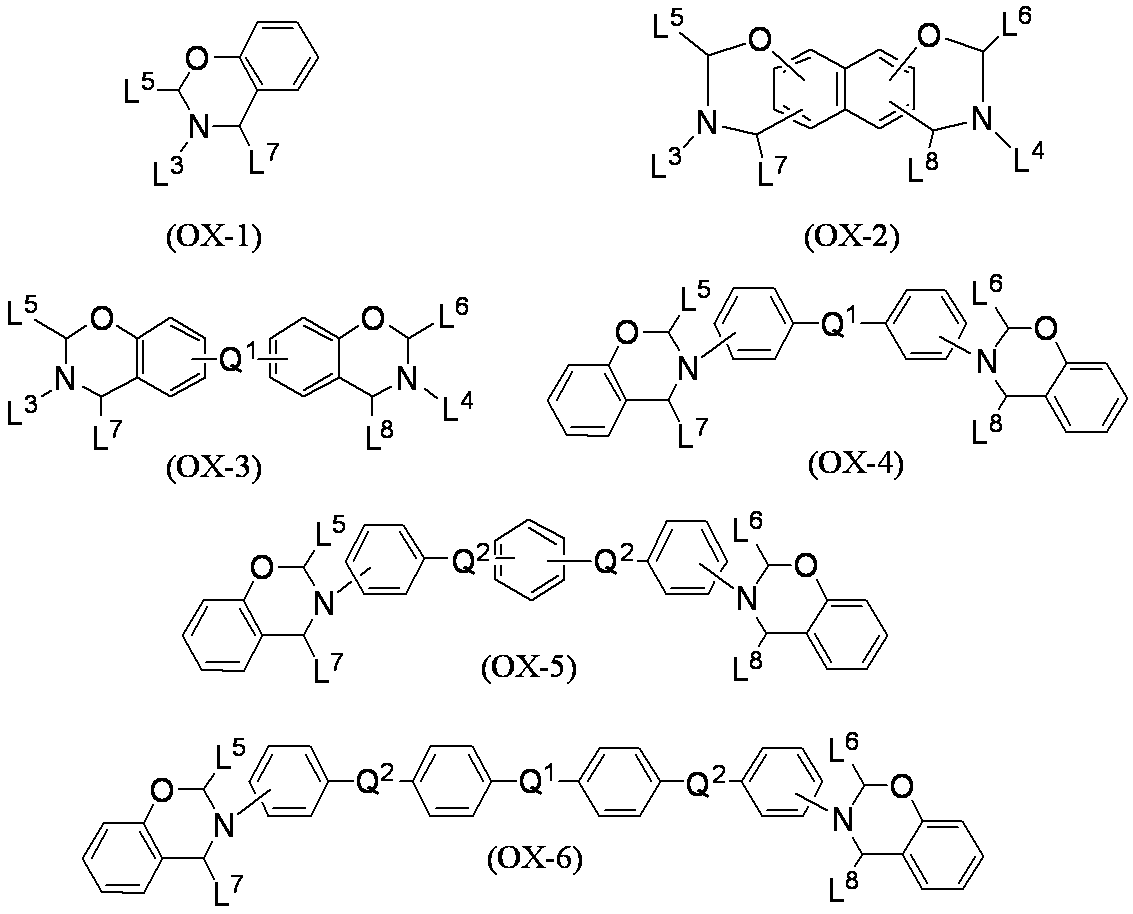


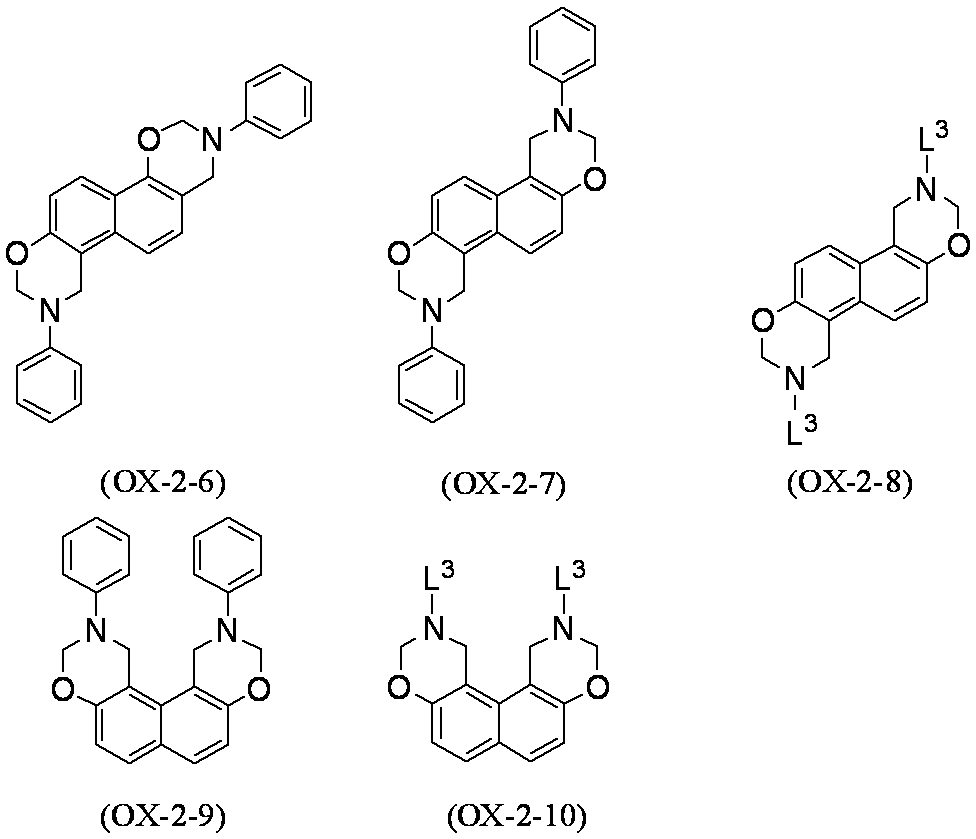


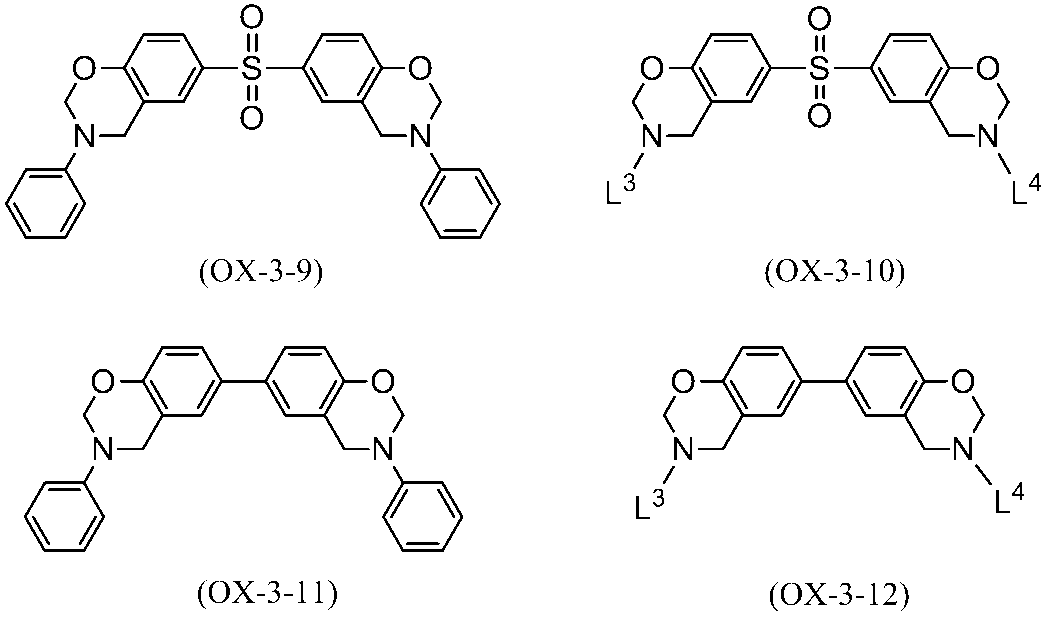

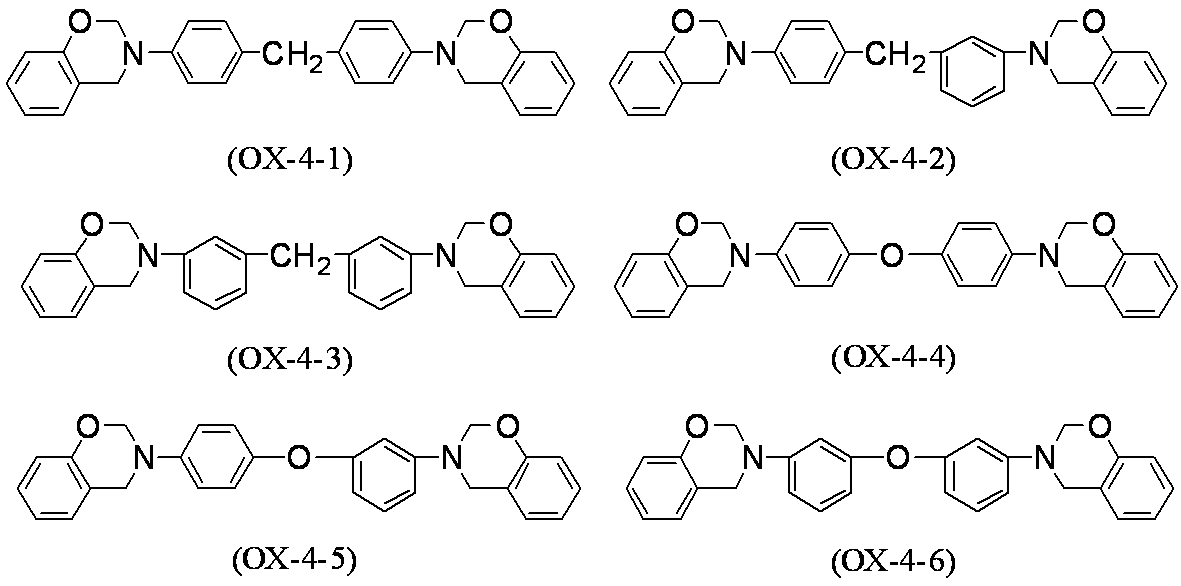
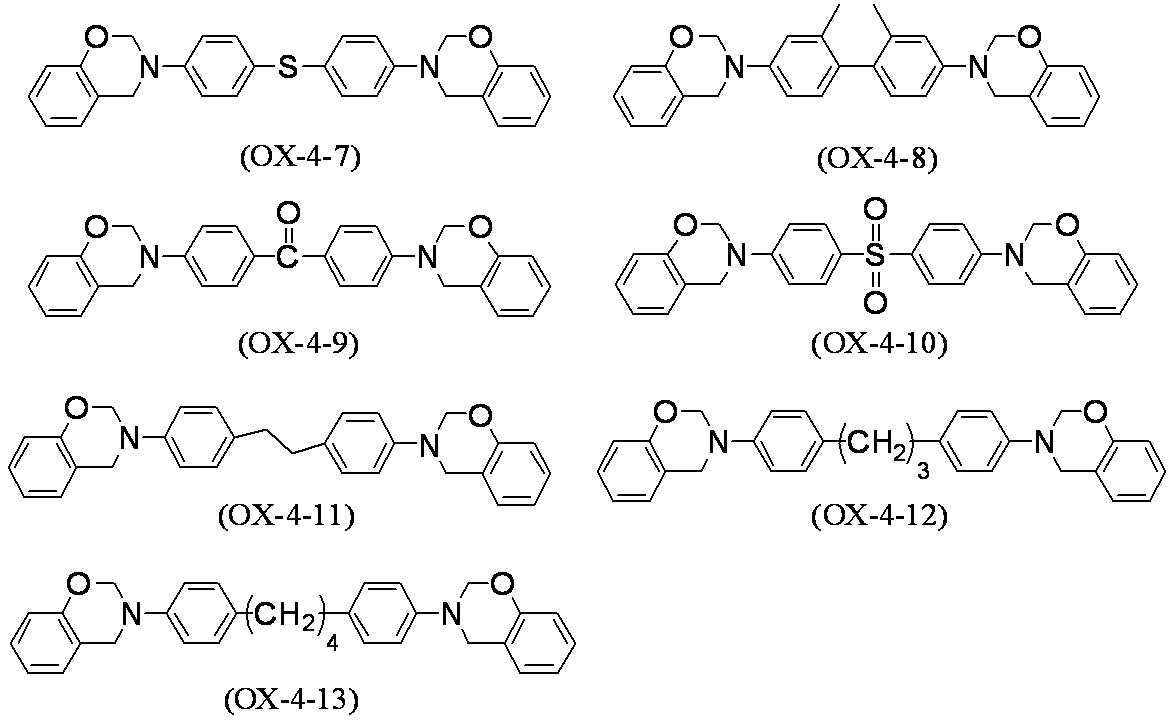
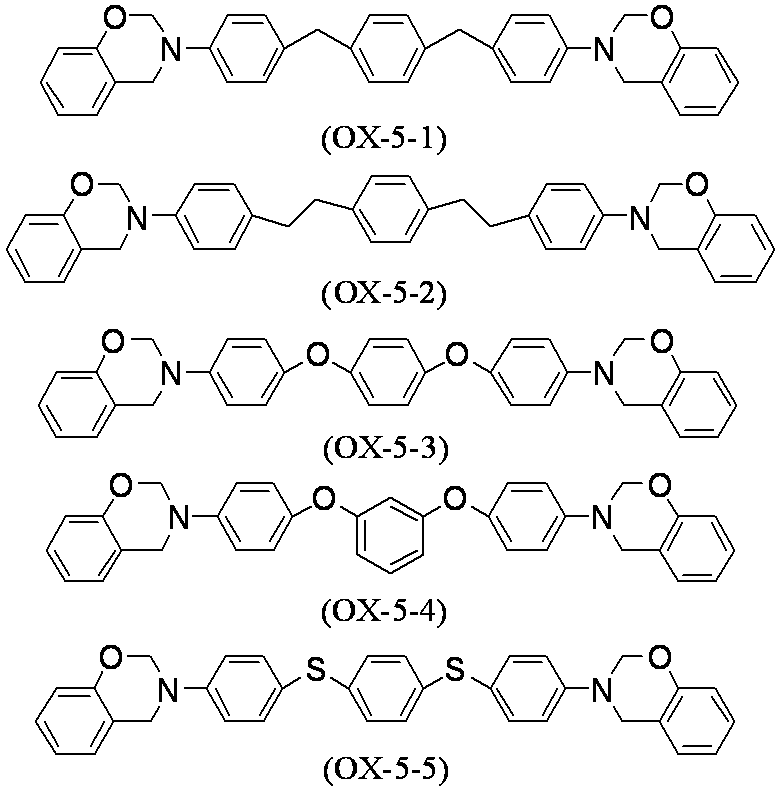
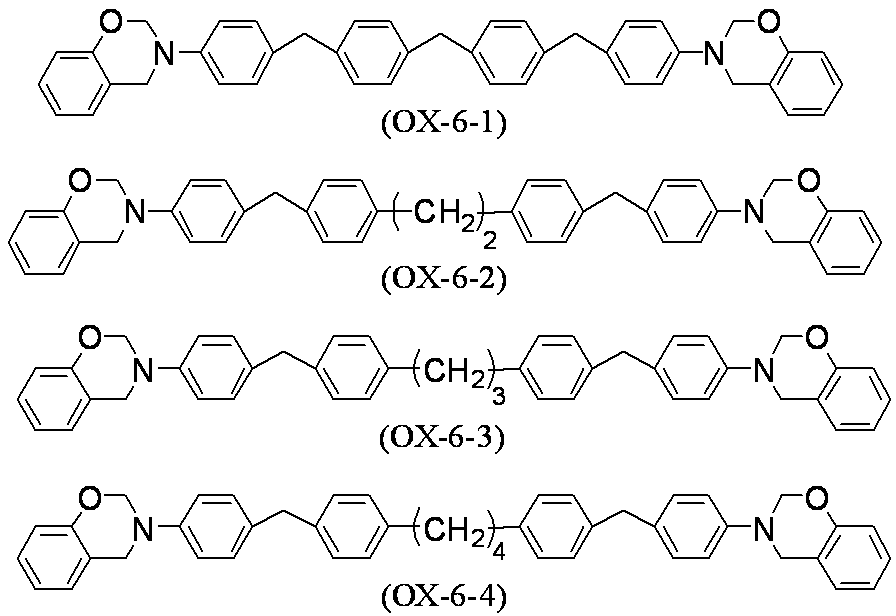

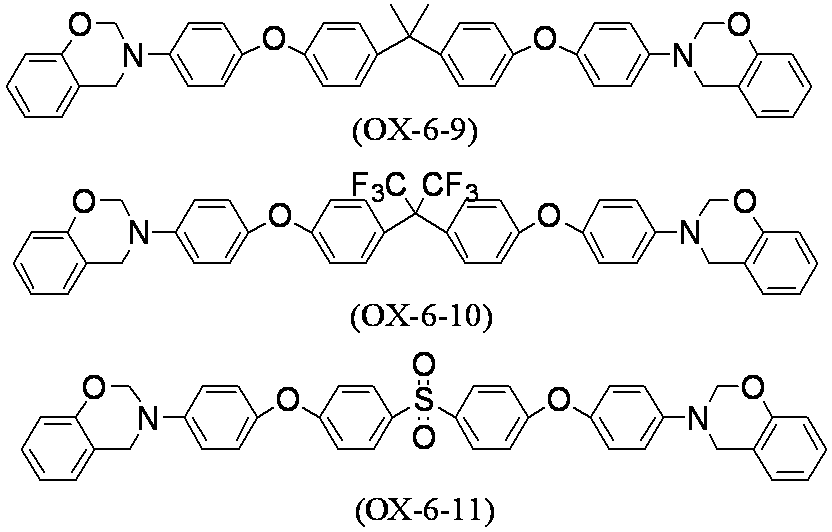
例えば、本発明の液晶配向剤は、液晶表示素子における電気特性を長期に安定させる目的から、オキサゾリン化合物をさらに含有していてもよい。オキサゾリン化合物はオキサゾリン構造を有する化合物である。オキサゾリン化合物は1種の化合物であってもよいし、2種以上の化合物であってもよい。オキサゾリン化合物の含有量は、上記の目的から、ポリアミック酸またはその誘導体に対して0.1~50重量%であることが好ましく、1~40重量%であることがより好ましく、1~20重量%であることが好ましい。または、オキサゾリン化合物の含有量は、オキサゾリン化合物中のオキサゾリン構造をオキサゾリンに換算したときに、ポリアミック酸またはその誘導体に対して0.1~40重量%であることが、上記の目的から好ましい。
オキサゾリン化合物は、1つの化合物中にオキサゾリン構造を1種だけ有していてもよいし、2種以上有していてもよい。またオキサゾリン化合物は、1つの化合物中にオキサゾリン構造を1個有していればよいが、2個以上有することが好ましい。またオキサゾリン化合物は、オキサゾリン環構造を側鎖に有する重合体であってもよいし、共重合体であってもよい。オキサゾリン構造を側鎖に有する重合体は、オキサゾリン構造を側鎖に有するモノマーの単独重合体であってもよいし、オキサゾリン構造を側鎖に有するモノマーとオキサゾリン構造を有しないモノマーとの共重合体であってもよい。オキサゾリン構造を側鎖に有する共重合体は、オキサゾリン構造を側鎖に有する2種以上のモノマーの共重合体であってもよいし、オキサゾリン構造を側鎖に有する2種以上のモノマーとオキサゾリン構造を有しないモノマーとの共重合体であってもよい。
例えば、本発明の液晶配向剤は、液晶表示素子における電気特性を長期に安定させる目的から、エポキシ化合物をさらに含有していてもよい。エポキシ化合物は1種の化合物であってもよいし、2種以上の化合物であってもよい。エポキシ化合物の含有量は、上記の目的から、ポリアミック酸またはその誘導体に対して0.1~50重量%であることが好ましく、1~40重量%であることがより好ましく、1~20重量%であることがさらに好ましい。
エポキシ化合物としては、分子内にエポキシ環を1つまたは2つ以上有する種々の化合物が挙げられる。分子内にエポキシ環を1つ有する化合物としては、例えばフェニルグリシジルエーテル、ブチルグリシジルエーテル、3,3,3-トリフルオロメチルプロピレンオキシド、スチレンオキシド、ヘキサフルオロプロピレンオキシド、シクロヘキセンオキシド、3-グリシドキシプロピルトリメトキシシラン、2-(3,4-エポキシシクロヘキシル)エチルトリメトキシシラン、N-グリシジルフタルイミド、(ノナフルオロ-N-ブチル)エポキシド、パーフルオロエチルグリシジルエーテル、エピクロロヒドリン、エピブロモヒドリン、N,N-ジグリシジルアニリン、および3-[2-(パーフルオロヘキシル)エトキシ]-1,2-エポキシプロパンが挙げられる。
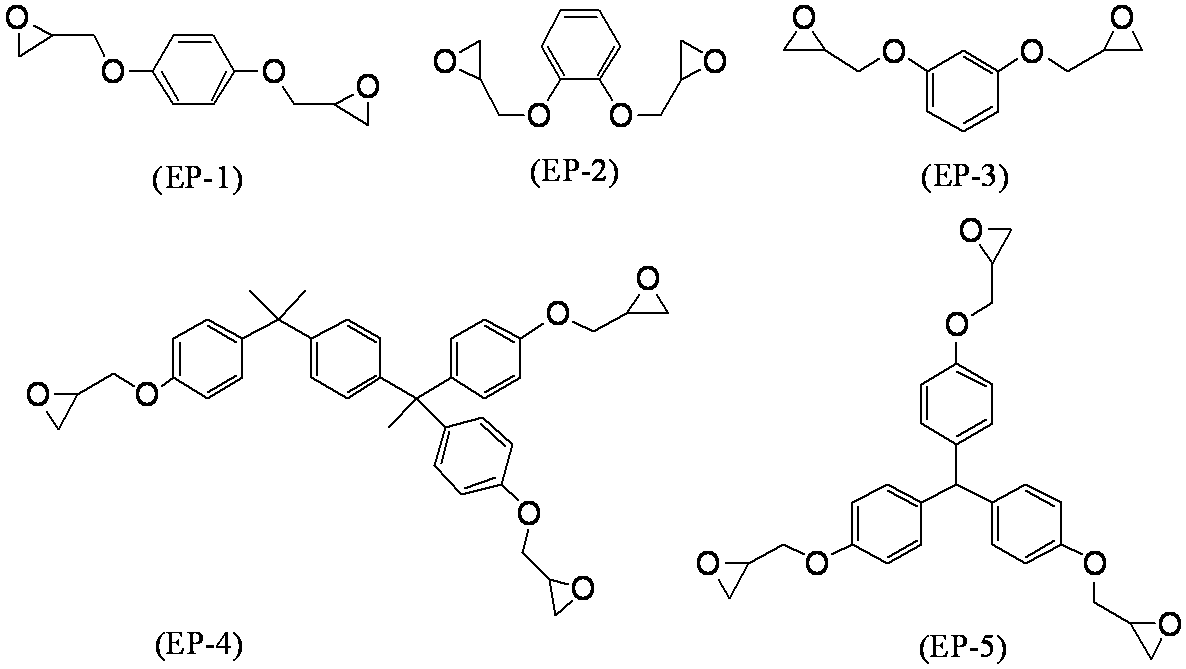
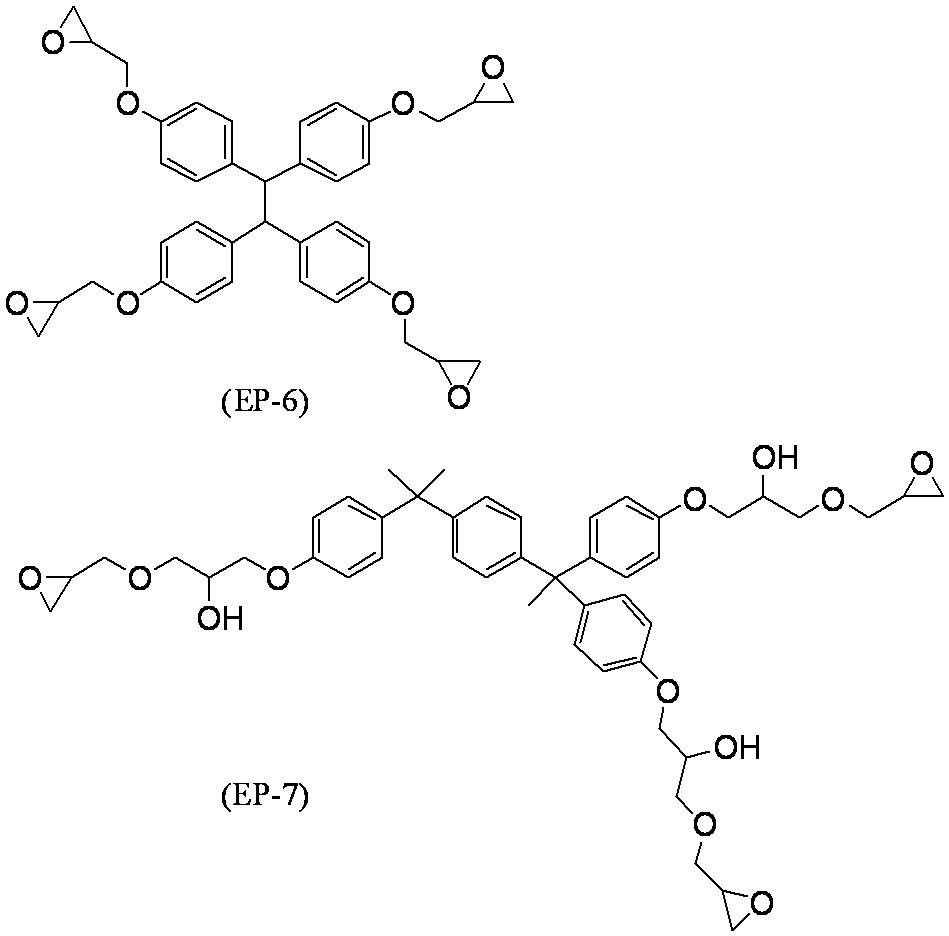
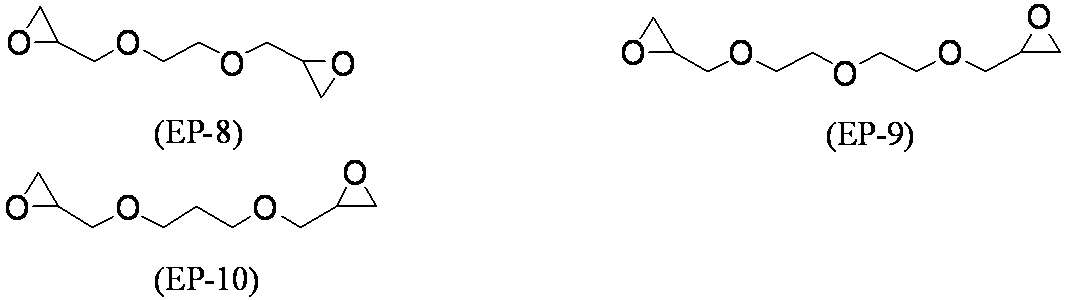
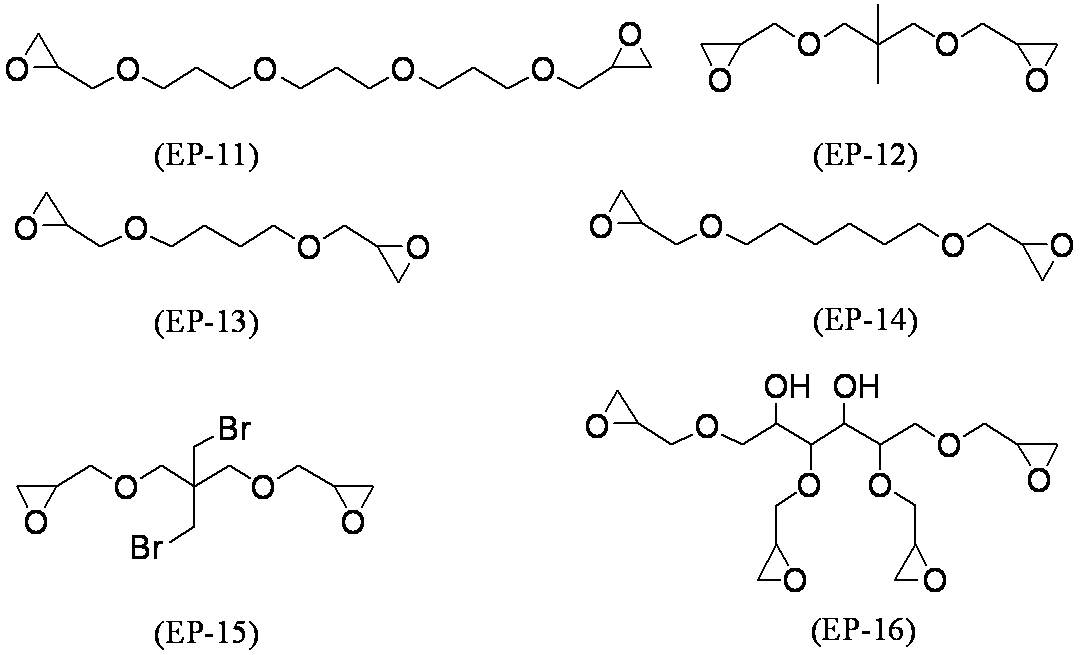
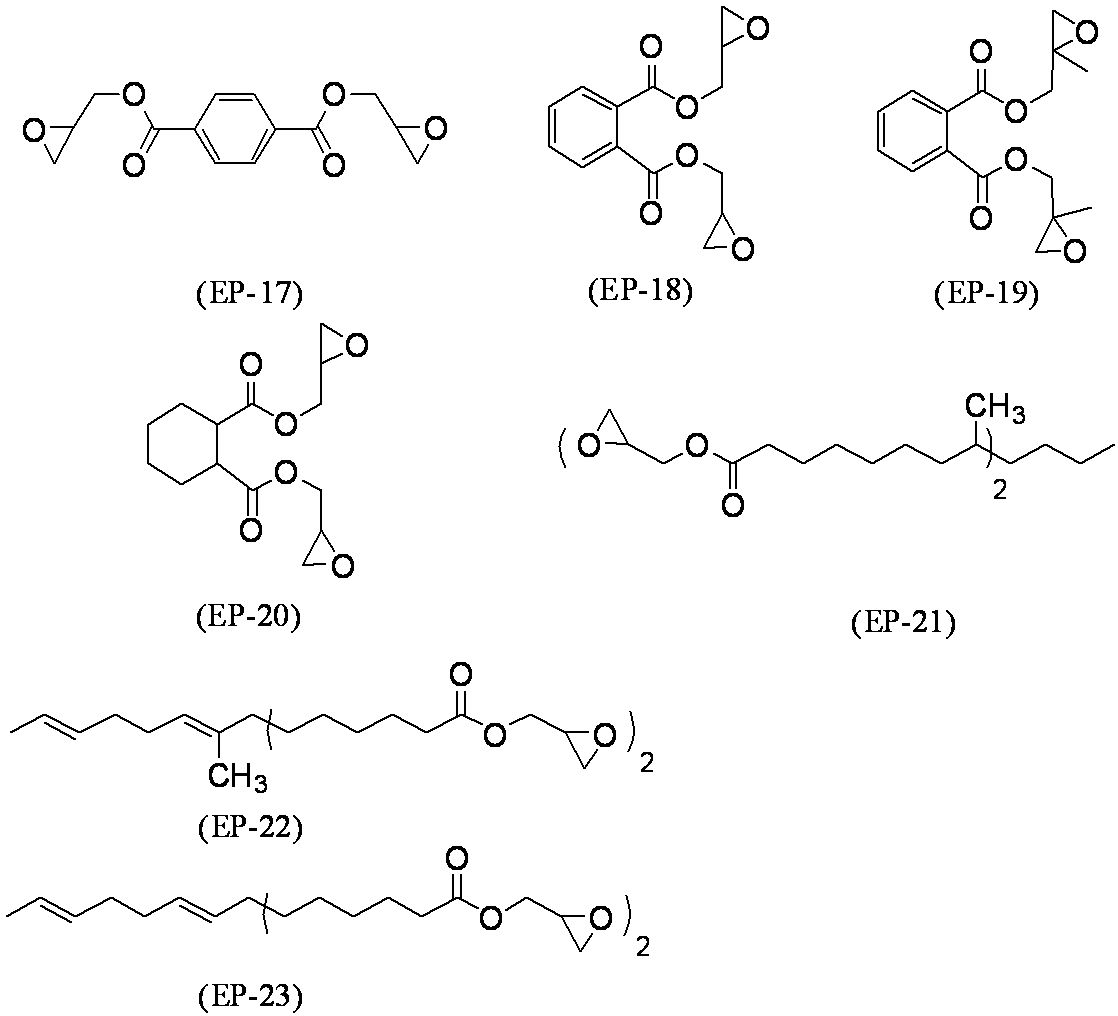


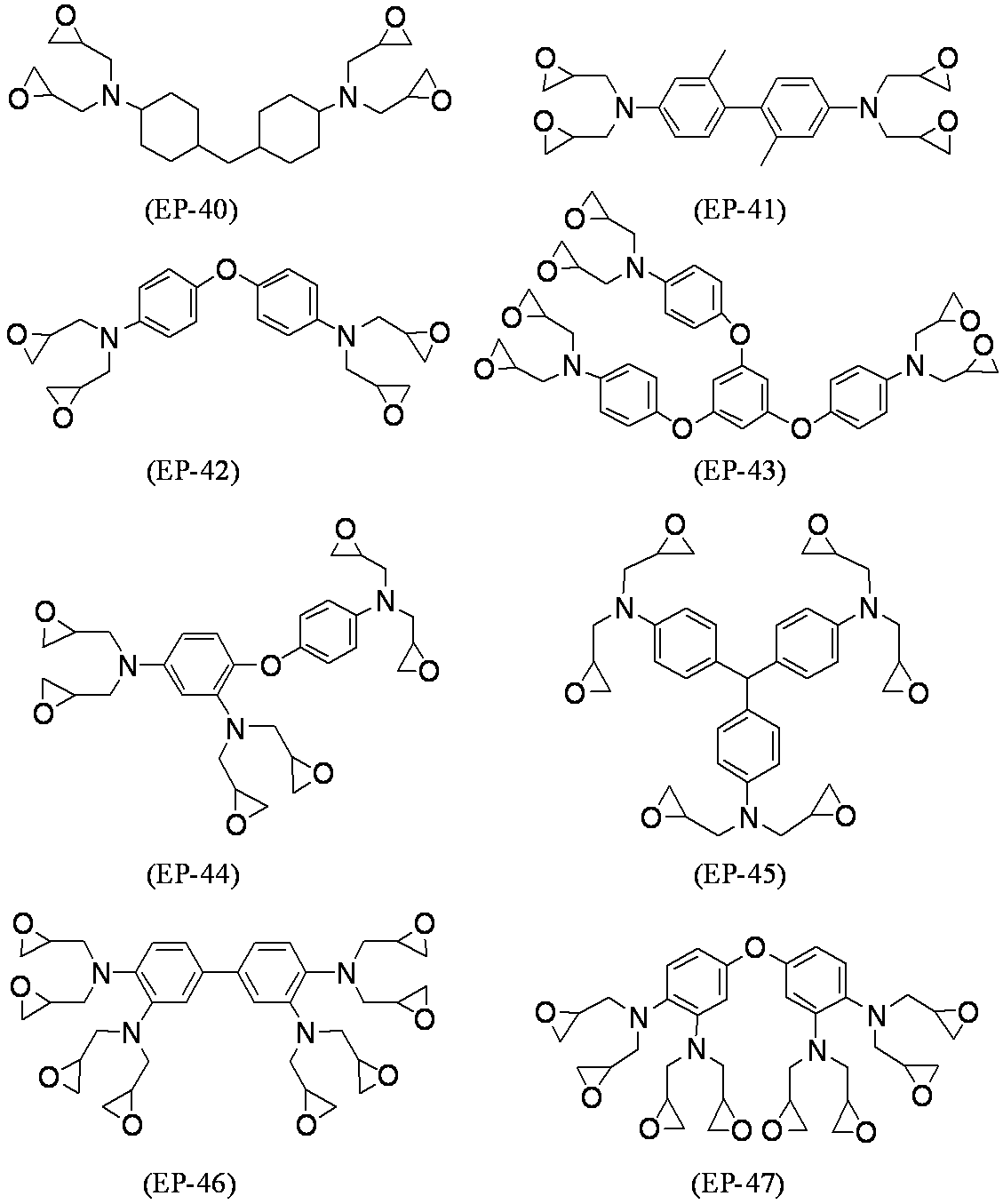
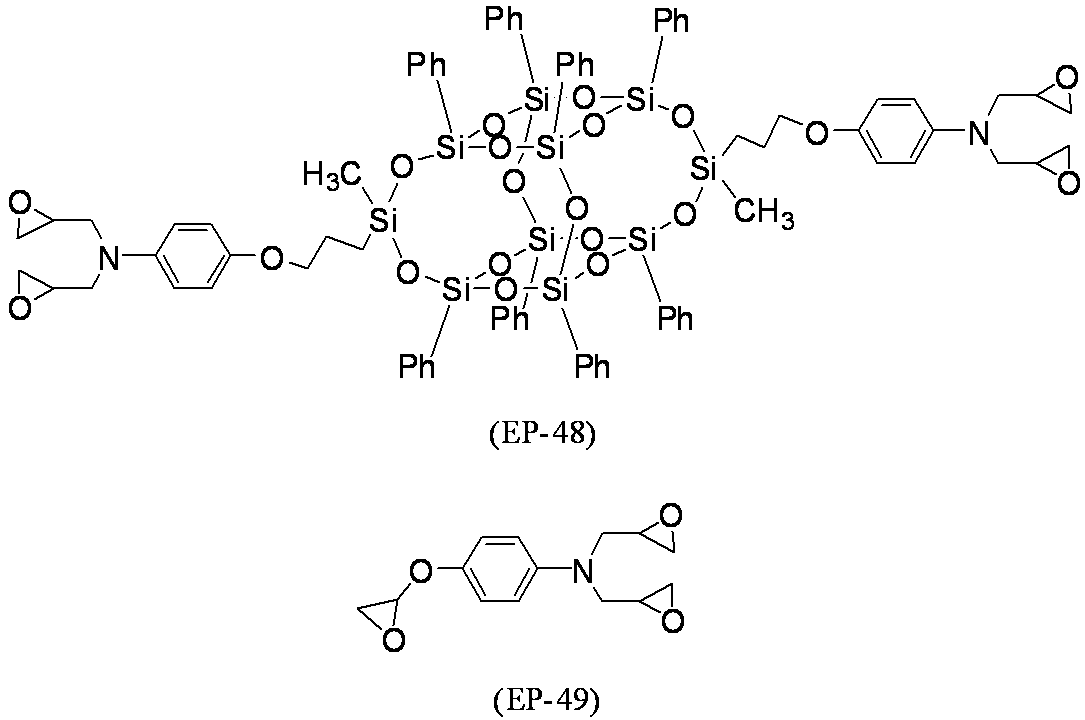
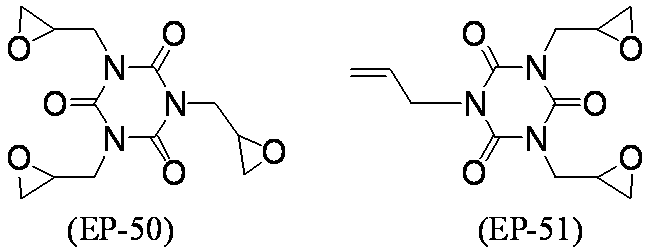

例えば、本発明の液晶配向剤は、液晶表示素子の電気特性や配向性を制御する目的から、ポリアミック酸およびその誘導体以外のポリマーをさらに含有していてもよい。該ポリマーとしては、有機溶剤に可溶であるポリマーが挙げられる。該ポリマーは1種で用いてもよいし、2種以上を併用してもよい。該ポリマーの含有量は、上記の目的から、ポリアミック酸またはその誘導体に対して0.01~100重量%であることが好ましく、0.1~70重量%であることがより好ましく、0.1~50重量%であることがさらに好ましい。該ポリマーとしては、例えばポリアミド、ポリウレタン、ポリウレア、ポリエステル、ポリエポキサイド、ポリエステルポリオール、シリコーン変性ポリウレタン、シリコーン変性ポリエステル、ポリアクリル酸アルキルエステル、ポリメタクリル酸アルキルエステル、アクリル酸アルキルエステル、メタクリル酸アルキルエステル共重合体、ポリオキシエチレングリコールジアクリレート、ポリオキシエチレングリコールジメタクリレート、ポリオキシプロピレングリコールジアクリレートおよびポリオキシプロピレングリコールジメタクリレートが挙げられる。
例えば、本発明の液晶配向剤は低分子化合物をさらに含有していてもよい。低分子化合物としては、例えば1)塗布性の向上を望むときにはこの目的に沿った界面活性剤、2)帯電防止の向上を必要とするときは帯電防止剤、3)基板との密着性や耐ラビング性の向上を望むときにはシランカップリング剤やチタン系のカップリング剤、また、4)低温でイミド化を進行させる場合はイミド化触媒が挙げられる。低分子化合物の含有量は、上記の観点から、ポリアミック酸またはその誘導体に対して0.1~50重量%であることが好ましく、0.1~40重量%であることがより好ましく、0.1~20重量%であることがさらに好ましい。
本発明の液晶配向剤は、前記の(AN-a)~(AN-c)から選ばれる少なくとも1つのテトラカルボン酸二無水物またはその混合物および(DI-a)~(DI-c)から選ばれる少なくとも1つのジアミンまたはその混合物を反応させて得られるポリアミック酸またはその誘導体であって、光反応性構造を有するテトラカルボン酸二無水物または光反応性構造を有するジアミンの少なくとも1つを必須とするポリアミック酸またはその誘導体を含有する、光配向用液晶配向剤であるが、その他のポリアミック酸またはその誘導体を混合して用いてもよい。本発明の液晶配向剤では、酸無水物とジアミンとの反応により得られるポリアミック酸またはその誘導体以外のポリマー、例えばポリエステルやエポキシ樹脂などを併用することができる。しかしながら、このようなその他のポリマーを併用するときのその割合は、ポリマーの全重量を基準として30重量%以下であることが好ましい。
本発明の配向剤は、ポリアミック酸を溶剤に溶解した溶液である。この溶剤は公知のポリアミック酸の製造や使用において用いられている溶剤から、使用目的に応じて適宜選択することができる。これらの溶剤を例示すれば以下のとおりである。
本発明の液晶配向膜は、通常の液晶配向膜の作製と同様に、液晶表示素子における基板に本発明の液晶配向剤を塗布することによって形成することができる。前記基板には、ITO(Indium TinOxide)、IZO(In2O3-ZnO)、IGZO(In-Ga-ZnO4)電極等の電極やカラーフィルター等が設けられていてもよいガラス製の基板が挙げられる。また液晶配向剤を塗布する方法としては、スピンナー法、印刷法、ディッピング法、滴下法、インクジェット法等が一般に知られている。
前記加熱乾燥工程は、オーブンまたは赤外炉の中で加熱処理する方法、ホットプレート上で加熱処理する方法等が一般に知られている。加熱乾燥工程は溶剤の蒸発が可能な範囲内の温度で実施することが好ましく、加熱焼成工程における温度に対して比較的低い温度で実施することがより好ましい。具体的には加熱乾燥温度は30℃~150℃の範囲であること、さらには50℃~120℃の範囲であることが好ましい。
本発明の液晶表示素子は、一対の基板と、液晶分子を含有し、前記一対の基板の間に形成される液晶層と、液晶層に電圧を印加する電極と、前記液晶分子を所定の方向に配向させる液晶配向膜とを有する。前記液晶配向膜には前述の本発明の液晶配向膜が用いられる。
1.残留DC
後述する液晶表示素子に、直流電圧5Vを15分間印加した後、1秒間ショートした後、および15分間リリースした後の残留DCを測定した。それぞれ初期、および15分間緩和後の値とする。測定温度は60℃とした。測定装置には東陽テクニカ社製の液晶物性測定システム6254型を使用した。残留DCの初期値が小さいほど、また15分間緩和後の値が初期値から大きく減衰しているほど、残留DCの溜まりが小さく、また緩和時間を短くすることができ、残像の発生を防止できるといえる。
2.配向性
後述する液晶表示素子をクロスニコルの配置した偏光板に挟み、セルに液晶を注入する際に液晶分子が流動する方向に固定される現象、いわゆる流動配向が見られるかどうかを目視にて確認した。
酸二無水物(A1):エチレンジアミン四酢酸二無水物:(AN-a)でX1が-CH2CH2-である化合物
酸二無水物(A2):1,8-ビス(3,4-ジカルボン酸フェニル)オクタン二無水物:(AN-b)でX2が-(CH2)8-である化合物
酸二無水物(A3):3,3’,4,4’-ジフェニルエーテルテトラカルボン酸二無水物:(AN-c)
酸二無水物(A4):1,2,4,5-シクロヘキサンテトラカルボン酸二無水物:(AN-3-1)
酸二無水物(A5):アゾベンゼン-3,3’,4,4’-テトラカルボン酸二無水物:(VII-3)
酸二無水物(A6):5,5’-p-フェニレンビス(イソベンゾフラン-1,3-ジオン):(AN-16-14)
ジアミン(D1):4,4’-ジアミノアゾベンゼン:(VII-1-1)
ジアミン(D2):4,4’-ジアミノスチルベン:(VI-1-1)
ジアミン(D3):4,4’-ジアミノジフェニル-1,4-ブタジイン:(II-1)で2つのアミノ基が共にパラ位である化合物
ジアミン(D4):1,4-シクロヘキサンジアミン:(DI-a)で2つのアミノ基が共にパラ位である化合物
ジアミン(D5):3,3’-ジメチル-4,4’-ジアミノジフェニルメタン:(DI-b)でaが1で、R1が共にメタ位のメチルで、2つのアミノ基が共にパラ位である化合物
ジアミン(D6):4,4’-ジアミノジフェニルエタン:(DI-b)でaが2で、R1が共に水素で、2つのアミノ基が共にパラ位である化合物
ジアミン(D7):4,4’-ジアミノジフェニルブタン:(DI-b)でaが4で、R1が共に水素で、2つのアミノ基が共にパラ位である化合物
ジアミン(D8):4,4’-N,N’-ビス(4-アミノフェニル)ピペラジン:(DI-c)
ジアミン(D9):4,4’-ジアミノジフェニルオクタン:(DI-5-31)
ジアミン(D10):4,4’-ジアミノジフェニルヘキサン:(DI-5-29)
ジアミン(D11):1,8-ジアミノオクタン:(DI-1-3)
ジアミン(D12):1,1-ビス(4-((アミノフェニル)メチル)フェニル)-4-ブチルシクロヘキサン:(DI-16-2)でR40が-C4H9である化合物
ジアミン(D13):1,1-ビス((アミノフェノキシ)フェニル)-4-(n-ヘキシルシクロヘキシル)シクロヘキサン:(DI-16-4)でR41が-C7H15である化合物
ジアミン(D14):1,1-ビス((アミノフェノキシ)フェニル)-4-((n-ペンチルシクロヘキシル)エチル)シクロヘキサン:(DI-16-7)でR41が-C5H11である化合物
ジアミン(D15):3,5-ジアミノ-N-((ジヒドロキシメチル)メチル)ベンズアミド:(DI-4-12)
ジアミン(D16):3,5-ジアミノ-N-((トリヒドロキシメチル)メチル)ベンズアミド:(DI-4-13)
N-メチル-2-ピロリドン:NMP
ブチルセロソルブ(エチレングリコールモノブチルエーテル):BC
添加剤(Ad1):ビス[4-(アリルビシクロ[2.2.1]ヘプト-5-エン-2,3-ジカルボキシイミド)フェニル]メタン
添加剤(Ad2):1,3-ビス(4,5-ジヒドロ-2-オキサゾリル)ベンゼン
添加剤(Ad3):2-(3,4-エポキシシクロヘキシル)エチルトリメトキシシラン
添加剤(Ad4):3-アミノプロピルトリエトキシシラン
[合成例1]
温度計、攪拌機、原料投入口および窒素ガス導入口を備えた100mLの四つ口フラスコにジアミン(D1)2.27g、ジアミン(D4)0.31g、および脱水NMP50gを入れ、乾燥窒素気流下攪拌溶解した。次いで酸二無水物(A1)3.42gおよび脱水NMP24gを入れ、室温で24時間攪拌を続けた。この反応溶液にBC20gを加えて、ポリマー固形分濃度が6重量%のポリアミック酸溶液を得た。このポリアミック酸溶液をPA1とする。PA1に含まれるポリアミック酸の重量平均分子量は39,000であった。
表1に示したようにテトラカルボン酸二無水物およびジアミンを変更した以外は、合成例1に準拠してポリマー固形分濃度が6重量%のポリアミック酸溶液(PA2)~(PA17)を調製した。合成例1の結果を含めて、得られたポリアミック酸の重量平均分子量の測定結果を表1にまとめた。
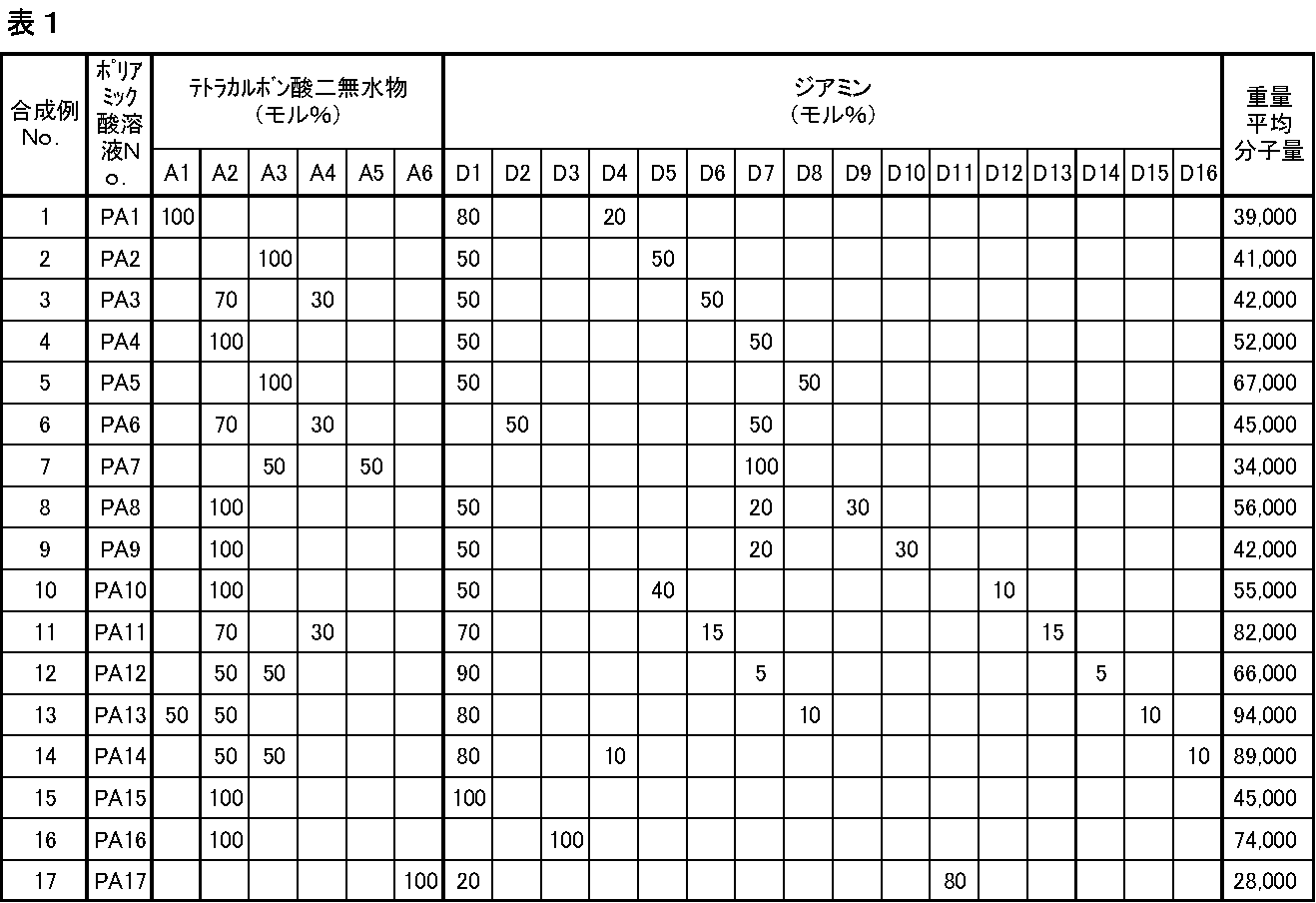
[実施例1]
合成例1で調製したポリマー固形分濃度6重量%のポリアミック酸溶液(PA1)に、NMP/BC=4/1(重量比)の混合溶剤を加え、ポリマー固形分濃度4重量%に希釈して液晶配向剤とした。得られた液晶配向剤を用いて下記の通り液晶表示素子を作製した。
液晶配向剤を2枚のITO電極付きガラス基板にスピンナー(ミカサ株式会社製、スピンコーター(1H-DX2))にて塗布した。塗膜後、ホットプレート(アズワン株式会社製、ECホットプレート(EC-1200N))上で70℃にて約1分間加熱乾燥した後、ウシオ電機(株)製マルチライトML-501C/Bを用い、基板に対して鉛直方向から、偏光板を介して紫外線の直線偏光を照射した。この時の露光エネルギーは、ウシオ電機(株)製紫外線積算光量計UIT-150(受光器UVD-S365)を用いて光量を測定し、波長365nmで5.0±0.1J/cm2になるよう、露光時間を調整した。次いで、クリーンオーブン(エスペック株式会社製、クリーンオーブン(PVHC-231))中で、230℃にて15分間加熱処理して、膜厚100±10nmの配向膜を形成した。
<液晶組成物A>
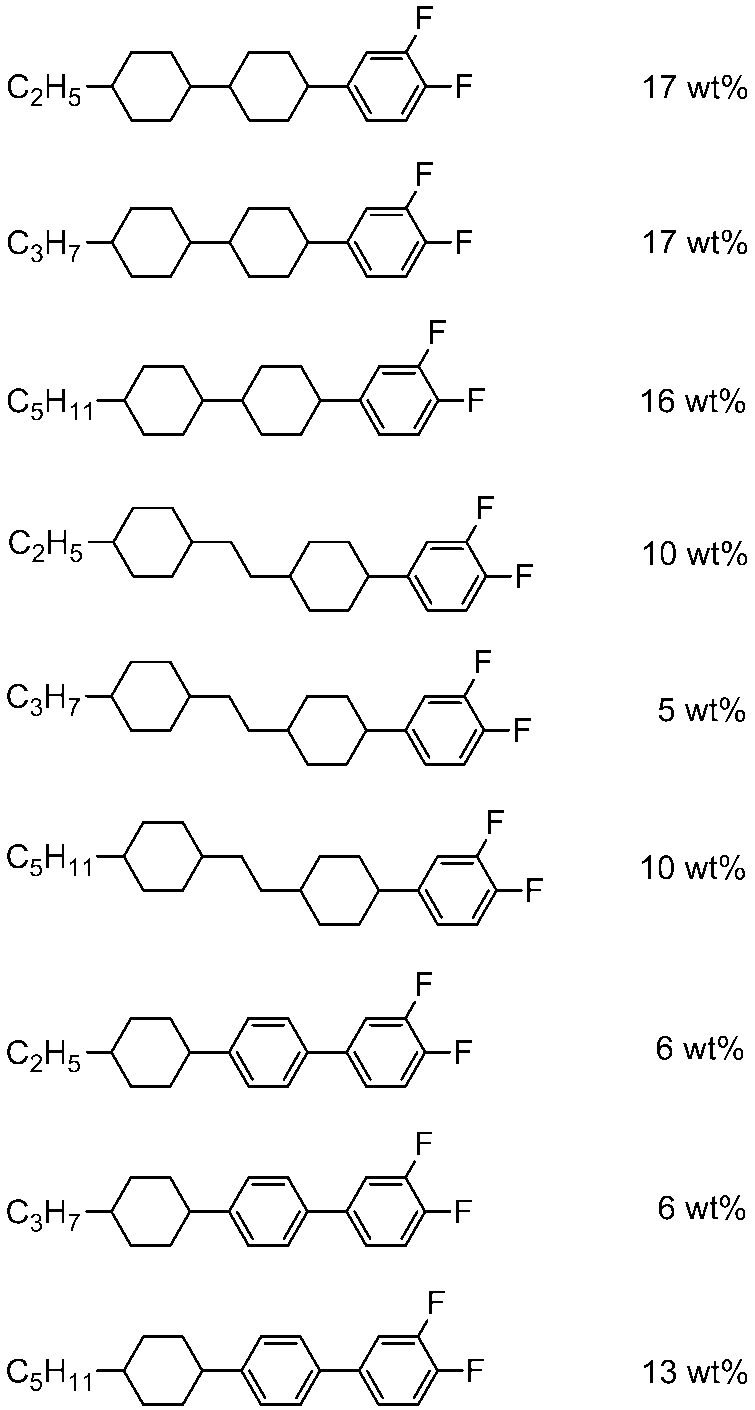
合成例2~14で調製したポリマー固形分濃度6重量%のポリアミック酸溶液(PA2~PA14)それぞれに、NMP/BC=4/1(重量比)の混合溶剤を加え、ポリマー固形分濃度4重量%に希釈して液晶配向剤とした。得られた液晶配向剤を用いて、実施例1に準じた方法で空セルを組み立てた。そして、これらの空セルに液晶組成物Aを真空注入して、液晶表示素子を作製し、実施例1同様に残留DCの測定および配向性の確認を行った。
合成例4で調製したポリマー固形分濃度6重量%のポリアミック酸溶液(PA4)に、添加剤(Ad1)をポリマー重量当たり20重量%の割合で添加した。このポリアミック酸溶液をPA18とする。PA18に含まれるポリアミック酸の重量平均分子量は52,000であった。その後、NMP/BC=4/1(重量比)の混合溶剤を加え、ポリマー固形分濃度4重量%に希釈して液晶配向剤とした。得られた液晶配向剤を用いて、実施例1に準じた方法で空セルを組み立てた。そして、この空セルに液晶組成物Aを真空注入して、液晶表示素子を作製し、実施例1同様に残留DCの測定および配向性の確認を行った。
合成例4で調製したポリマー固形分濃度6重量%のポリアミック酸溶液(PA4)に、添加剤(Ad2)をポリマー重量当たり20重量%の割合で添加した。このポリアミック酸溶液をPA19とする。PA19に含まれるポリアミック酸の重量平均分子量は52,000であった。その後、NMP/BC=4/1(重量比)の混合溶剤を加え、ポリマー固形分濃度4重量%に希釈して液晶配向剤とした。得られた液晶配向剤を用いて、実施例1に準じた方法で空セルを組み立てた。そして、この空セルに液晶組成物Aを真空注入して、液晶表示素子を作製し、実施例1同様に残留DCの測定および配向性の確認を行った。
合成例4で調製したポリマー固形分濃度6重量%のポリアミック酸溶液(PA4)に、添加剤(Ad3)をポリマー重量当たり20重量%の割合で添加した。このポリアミック酸溶液をPA20とする。PA20に含まれるポリアミック酸の重量平均分子量は52,000であった。その後、NMP/BC=4/1(重量比)の混合溶剤を加え、ポリマー固形分濃度4重量%に希釈して液晶配向剤とした。得られた液晶配向剤を用いて、実施例1に準じた方法で空セルを組み立てた。そして、この空セルに液晶組成物Aを真空注入して、液晶表示素子を作製し、実施例1同様に残留DCの測定および配向性の確認を行った。
合成例4で調製したポリマー固形分濃度6重量%のポリアミック酸溶液(PA4)に、添加剤(Ad4)をポリマー重量当たり10重量%の割合で添加した。このポリアミック酸溶液をPA21とする。PA21に含まれるポリアミック酸の重量平均分子量は52,000であった。その後、NMP/BC=4/1(重量比)の混合溶剤を加え、ポリマー固形分濃度4重量%に希釈して液晶配向剤とした。得られた液晶配向剤を用いて、実施例1に準じた方法で空セルを組み立てた。そして、この空セルに液晶組成物Aを真空注入して、液晶表示素子を作製し、実施例1同様に残留DCの測定および配向性の確認を行った。実施例1~18の残留DCの測定結果を表2-1に示す。

合成例1で調製したポリマー固形分濃度6重量%のポリアミック酸溶液(PA1)に、NMP/BC=4/1(重量比)の混合溶剤を加え、ポリマー固形分濃度4重量%に希釈して液晶配向剤とした。得られた液晶配向剤を用いて下記の通り液晶表示素子を作製した。
液晶配向剤を2枚のITO電極付きガラス基板にスピンナー(ミカサ株式会社製、スピンコーター(1H-DX2))にて塗布した。塗膜後、ホットプレート(アズワン株式会社製、ECホットプレート(EC-1200N))上で70℃にて約1分間加熱乾燥した後、ウシオ電機(株)製UVランプ(UVL-1500M2-N1)を用い、基板に対して鉛直方向から、偏光板を介して紫外線の直線偏光を照射した(露光エネルギー:365nmで5.0±0.1J/cm2)。紫外線照射の条件、露光エネルギーの調整方法は実施例1に準じた。次いで、クリーンオーブン(エスペック株式会社製、クリーンオーブン(PVHC-231))中で、230℃にて15分間加熱処理して、膜厚100±10nmの配向膜を形成した。最後に、加熱後の基板をクリーンオーブン中で、120℃にて30分間の加熱アニールを行った。
ポリマー固形分濃度6重量%のポリアミック酸溶液(PA4、PA6、PA11、PA13、およびPA19)それぞれに、NMP/BC=4/1(重量比)の混合溶剤を加え、ポリマー固形分濃度4重量%に希釈して液晶配向剤とした。得られた液晶配向剤を用いて、実施例19に準じた方法で空セルを組み立てた。そして、これらの空セルに液晶組成物Aを真空注入して、液晶表示素子を作製し、実施例1同様に残留DCの測定および配向性の確認を行った。実施例19~24の残留DCの測定結果を表2-2に示す。
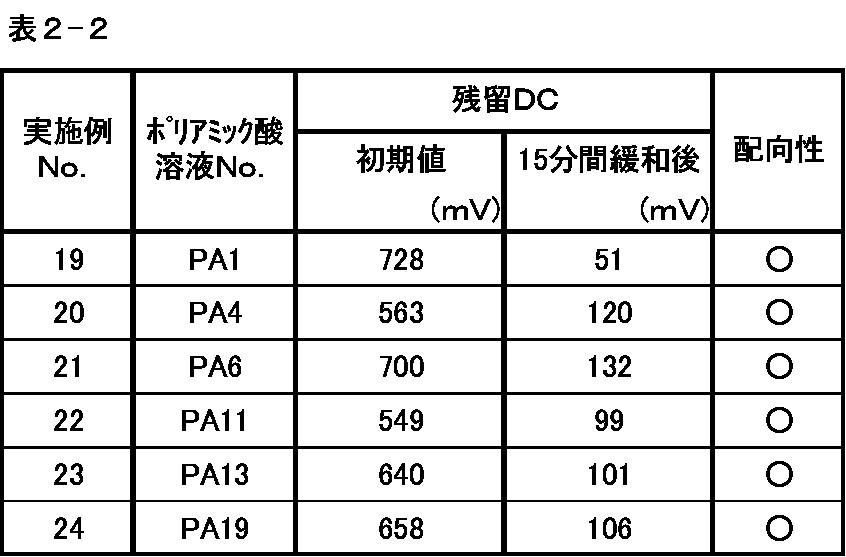
合成例1で調製したポリマー固形分濃度6重量%のポリアミック酸溶液(PA1)に、NMP/BC=4/1(重量比)の混合溶剤を加え、ポリマー固形分濃度4重量%に希釈して液晶配向剤とした。得られた液晶配向剤を用いて下記の通り液晶表示素子を作製した。
液晶配向剤を2枚のITO電極付きガラス基板にスピンナー(ミカサ株式会社製、スピンコーター(1H-DX2))にて塗布した。塗膜後、ホットプレート(アズワン株式会社製、ECホットプレート(EC-1200N))上で70℃にて約1分間加熱乾燥した後、ウシオ電機(株)製マルチライトML-501C/Bを用い、基板に対して鉛直方向から、偏光板を介して紫外線の直線偏光を照射した(露光エネルギー:365nmで5.0±0.1J/cm2)。紫外線露光中、基板を加熱し温度を50℃に保った。紫外線照射の条件、露光エネルギーの調整方法は実施例1に準じた。次いで、クリーンオーブン(エスペック株式会社製、クリーンオーブン(PVHC-231))中で、230℃にて15分間加熱処理して、膜厚100±10nmの配向膜を形成した。
ポリマー固形分濃度6重量%のポリアミック酸溶液(PA4、PA6、PA11、PA13、およびPA19)それぞれに、NMP/BC=4/1(重量比)の混合溶剤を加え、ポリマー固形分濃度4重量%に希釈して液晶配向剤とした。得られた液晶配向剤を用いて、実施例25に準じた方法で空セルを組み立てた。そして、これらの空セルに液晶組成物Aを真空注入して、液晶表示素子を作製し、実施例1同様に残留DCの測定および配向性の確認を行った。実施例25~30の残留DCの測定結果を表2-3に示す。
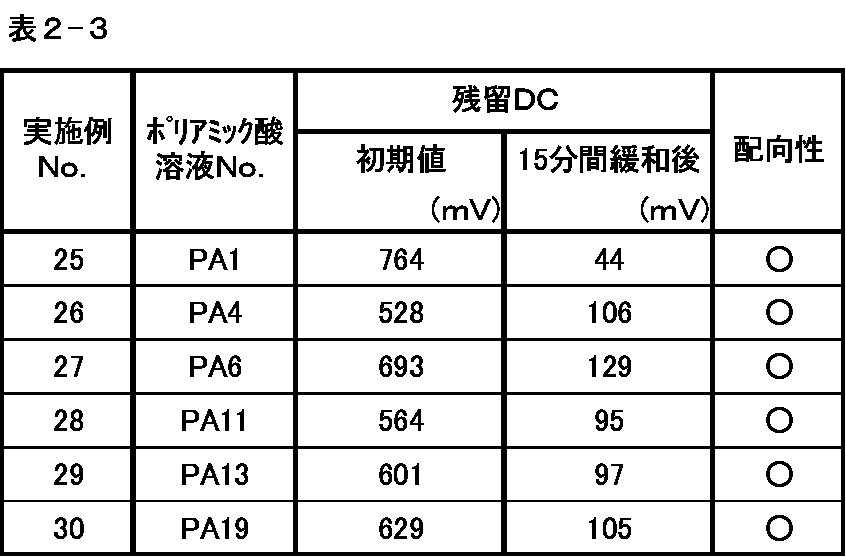
ポリマー固形分濃度6重量%のポリアミック酸溶液(PA15~17)それぞれに、NMP/BC=4/1(重量比)の混合溶剤を加え、ポリマー固形分濃度4重量%に希釈して液晶配向剤とした。得られた液晶配向剤を用いて、実施例1に準じた方法で空セルを組み立てた。そして、この空セルに液晶組成物Aを真空注入して、液晶セルを作製し、実施例1同様に残留DCの測定および配向性の確認を行った。比較例1~3の残留DCの測定結果を表3に示す。
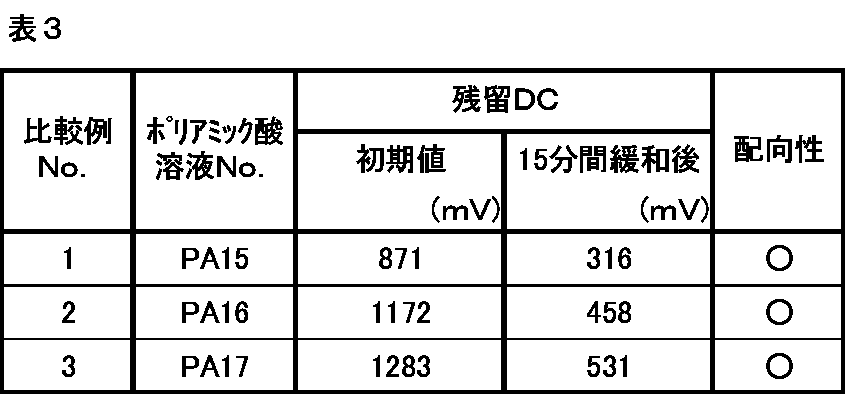
Claims (21)
- 構成単位中に光反応性構造を有するテトラカルボン酸二無水物および光反応性構造を有するジアミンの少なくとも1つに由来する光反応性構造を有するポリアミック酸またはその誘導体を含有する光配向用液晶配向剤であり;
このポリアミック酸またはその誘導体は光反応性構造を有するテトラカルボン酸二無水物および光反応性構造を有するジアミンの少なくとも1つと共に、光反応性構造を有さないテトラカルボン酸二無水物および光反応性構造を有さないジアミンを用いて合成され;
光反応性構造を有さないテトラカルボン酸二無水物は、下記の式(AN-a)~(AN-c)で表される化合物の群から選ばれる少なくとも1つを含み;そして、
光反応性構造を有さないジアミンは、下記の式(DI-a)~(DI-c)で表される化合物の群から選ばれる少なくとも1つを含む、光配向用液晶配向剤:


式(An-b)において、X2は炭素数1~8のアルキレンであり;
式(DI-b)において、R1は独立して水素または-CH3であり、aは1~5の整数であり;そして、
式(DI-a)および(DI-b)において、環を構成するいずれかの炭素原子に結合位置が固定されていない基は、その環における結合位置が任意であることを示す。 - 光反応性構造を有するテトラカルボン酸二無水物および光反応性構造を有するジアミンの少なくとも1つが下記式(I)~(VII)から選ばれる少なくとも1つである、請求項1に記載の光配向用液晶配向剤:
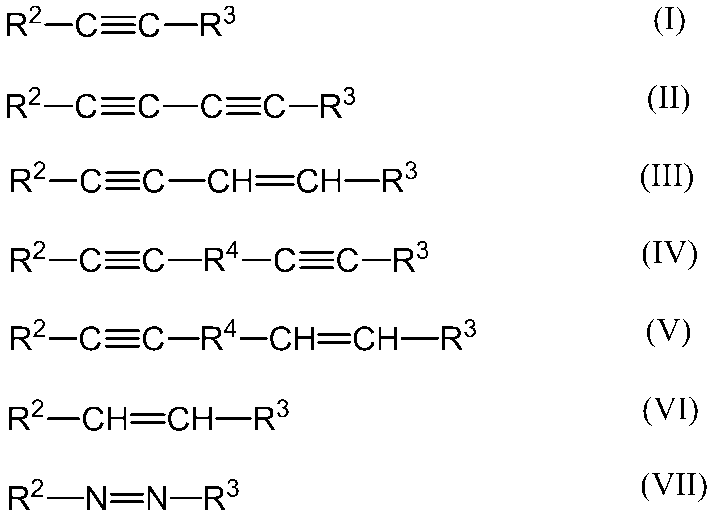
- 光反応性構造がポリアミック酸またはその誘導体の主鎖に位置する、請求項1または2に記載の光配向用液晶配向剤。
- 光反応性構造を有するテトラカルボン酸二無水物および光反応性構造を有するジアミンの少なくとも1つが、下記式(I-1)、(II-1)、(III-1)、(IV-1)、(IV-2)、(V-1)、(VI-1)、および(VII-1)~(VII-3)で表される化合物の群から選ばれる少なくとも1つである、請求項1~3のいずれか1項に記載の光配向用液晶配向剤:

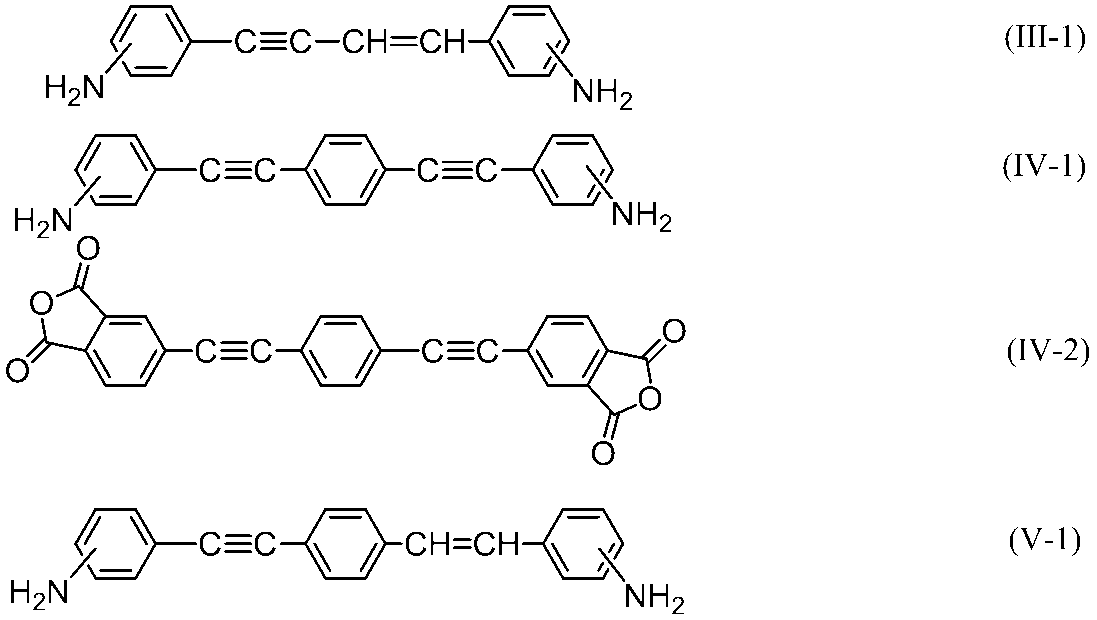

式(VII-1)において、R5は独立して-CH3、-OCH3、-CF3、または-COOCH3であり;そして、
bは0~2の整数である。 - 光反応性構造を有するテトラカルボン酸二無水物および光反応性構造を有するジアミンの少なくとも1つが、下記式(VI-1-1)、(VII-1-1)、および(VII-3)で表される化合物の群から選ばれる少なくとも1つである、請求項4に記載の光配向用液晶配向剤。
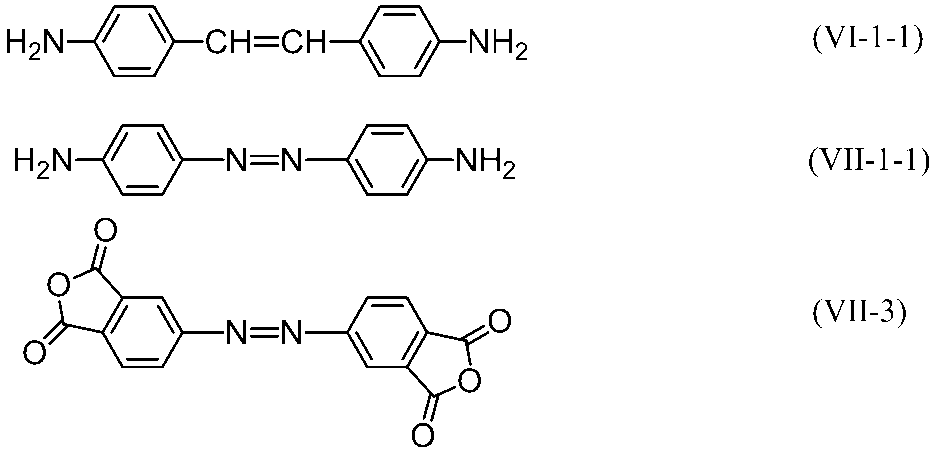
- 光反応性構造を有さないテトラカルボン酸二無水物が、下記式(AN-b)および(AN-c)で表される化合物の群から選ばれる少なくとも1つである、請求項1~5のいずれか1項に記載の光配向用液晶配向剤。

- 光反応性構造を有さないジアミンが下記式(DI-b-1)および(DI-b-2)である、請求項1~6のいずれか1項に記載の光配向用液晶配向剤。
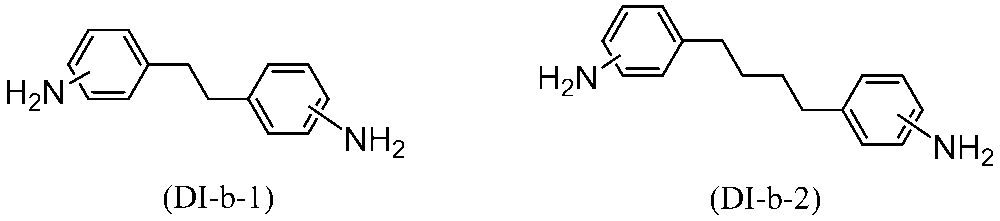
- 光反応性構造を有さないテトラカルボン酸二無水物が下記式(AN-b)で表される化合物であり、光反応性構造を有さないジアミンが下記式(DI-b-2)で表される化合物である、請求項1~7のいずれか1項に記載の光配向用液晶配向剤。
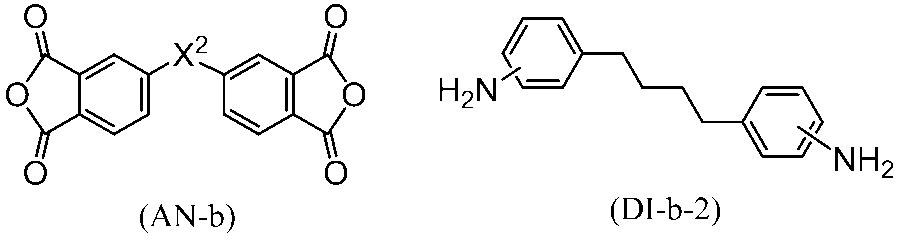
- 式(AN-a)~(AN-c)で表される化合物の群から選ばれる少なくとも1つと共に用いられる光反応性構造を有さないテトラカルボン酸二無水物が、下記式(AN-I)~(AN-VII)で表される化合物の群から選ばれる少なくとも1つである、請求項1~8のいずれか1項に記載の光配向用液晶配向剤:
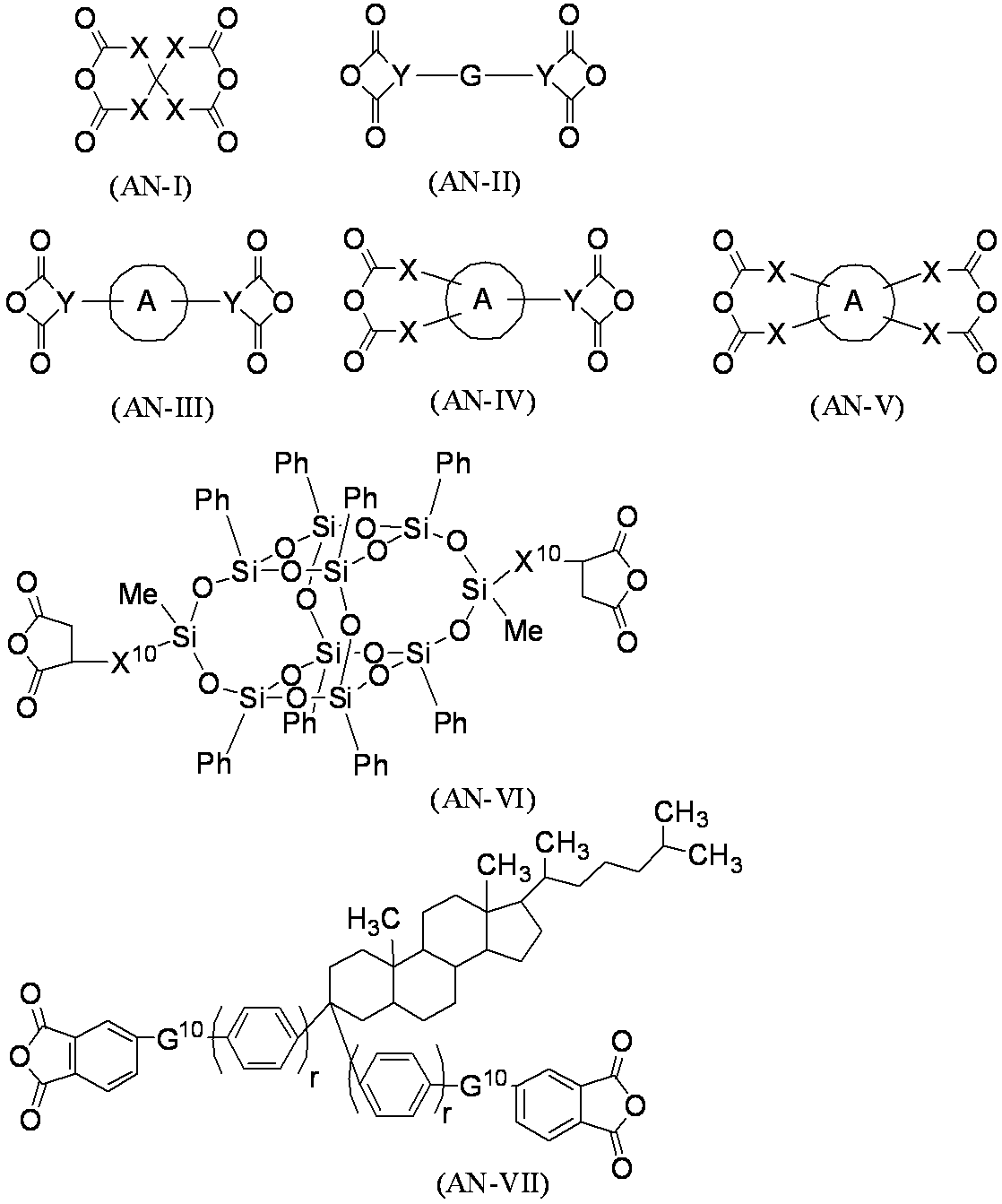
式(AN-II)において、Gは単結合、炭素数1~20のアルキレン、-CO-、-O-、-S-、-SO2-、-C(CH3)2-、または-C(CF3)2-であり;
式(AN-II)~(AN-IV)において、Yは独立して下記の3価の基の群から選ばれる1つであり、
式(AN-II)において、Yが2-アザプロパン-1,2,3-トリイルであるとき、前記Gは炭素数1~20のアルキレンではなく、Yがベンゼン-1,2,4-トリイルであるとき、前記Gは炭素数1~8のアルキレンおよび-O-ではなく;
式(AN-III)~(AN-V)において、環Aは炭素数3~10の単環式炭化水素の基または炭素数6~30の縮合多環式炭化水素の基であり、この基の少なくとも1つの水素はメチル、エチルまたはフェニルで置き換えられていてもよく、環に掛かっている結合手は環を構成する任意の炭素に連結しており、2本の結合手が同一の炭素に連結してもよく;
式(AN-VI)において、X10は炭素数2~6のアルキレンであり;
Meはメチルであり;
Phはフェニルであり;
式(AN-VII)において、G10は独立して-O-、-COO-または-OCO-であり;そして、
rは独立して0または1である。 - 式(AN-a)~(AN-c)で表される化合物の群から選ばれる少なくとも1つと共に用いられる光反応性構造を有さないテトラカルボン酸二無水物が下記式(AN-1-1)、(AN-2-1)、(AN-3-1)、(AN-3-2)、(AN-5-1)、および(AN-16-1)で表される化合物の群から選ばれる少なくとも1つである、請求項9に記載の光配向用液晶配向剤:

- 式(DI-a)~(DI-c)で表される化合物の群から選ばれる少なくとも1つと共に用いられる光反応性構造を有さないジアミンが、下記式(DI-1)および(DI-3)~(DI-17)で表される化合物の群から選ばれる少なくとも1つである、請求項1~10のいずれか1項に記載の光配向用液晶配向剤:

(DI-3)および(DI-6)~(DI-7)において、G21は独立して単結合、-O-、-S-、-S-S-、-SO2-、-CO-、-CONH-、-NHCO-、-C(CH3)2-、-C(CF3)2-、-(CH2)m’-、-O-(CH2)m’-O-、または-S-(CH2)m’-S-であり、m’は独立して1~12の整数であり;
式(DI-5)において、G21は単結合、-NH-、-O-、-S-、-S-S-、-SO2-、-CO-、-CONH-、-NHCO-、-C(CH3)2-、-C(CF3)2-、-(CH2)m’’-、-O-(CH2)m’-O-、-N(CH3)-(CH2)k-N(CH3)-、または-S-(CH2)m’-S-であり、m’は1~12の整数であり、m’’は6~12の整数であり、kは1~5の整数であり;
(DI-6)および(DI-7)において、G22は独立して単結合、-O-、-S-、-CO-、-C(CH3)2-、-C(CF3)2-、または炭素数1~10のアルキレンであり;
式(DI-3)~(DI-7)中のシクロヘキサン環およびベンゼン環の少なくとも1つの水素は、-F、-CH3、-OH、-CF3、-CO2H、-CONH2、またはベンジルで置き換えられていてもよく、加えて式(DI-4)においてベンゼン環の少なくとも1つの水素は、下記式(DI-4-a)~(DI-4-c)で置き換えられていてもよく、

式(DI-2)~(DI-7)において、環を構成するいずれかの炭素原子に結合位置が固定されていない基は、その環における結合位置が任意であることを示し;そして、
シクロヘキサン環またはベンゼン環への-NH2の結合位置は、G21またはG22の結合位置を除く任意の位置である。

G23は独立して炭素数1~6のアルキレン、フェニレンまたはアルキル置換されたフェニレンであり;
wは1~10の整数であり;
式(DI-9)において、R23は独立して炭素数1~5のアルキル、炭素数1~5のアルコキシまたは-Clであり;
pは独立して0~3の整数であり、qは0~4の整数であるが、pおよびqが同時に0であることはなく;
式(DI-10)において、R24は水素、炭素数1~4のアルキル、フェニル、またはベンジルであり;
式(DI-11)において、G24は-CH2-または-NH-であり;
式(DI-12)において、G25は単結合、炭素数2~6のアルキレンまたは1,4-フェニレンであり;
rは0または1であり;
式(DI-12)において、環を構成するいずれかの炭素原子に結合位置が固定されていない基は、その環における結合位置が任意であることを示し;そして、
式(DI-9)、(DI-11)および(DI-12)において、ベンゼン環に結合する-NH2の結合位置は任意の位置であり;

R25は炭素数3~20のアルキル、フェニル、シクロヘキシル、ステロイド骨格を有する基、または下記の式(DI-13-a)で表される基であり、このアルキルにおいて、少なくとも1つの水素は-Fで置き換えられてもよく、少なくとも1つの-CH2-は-O-で置き換えられていてもよく、このフェニルの水素は、-F、-CH3、-OCH3、-OCH2F、-OCHF2、-OCF3、炭素数3~20のアルキル、または炭素数3~20のアルコキシで置き換えられていてもよく、このシクロヘキシルの水素は炭素数3~20のアルキルまたは炭素数3~20のアルコキシで置き換えられていてもよく、ベンゼン環に結合する-NH2の結合位置はその環において任意の位置であることを示し;

環B21、環B22、環B23、および環B24は独立して1,4-フェニレン、1,4-シクロへキシレン、1,3-ジオキサン-2,5-ジイル、ピリミジン-2,5-ジイル、ピリジン-2,5-ジイル、ナフタレン-1,4-ジイル、ナフタレン-1,5-ジイル、ナフタレン-2,6-ジイル、ナフタレン-2,7-ジイル、またはアントラセン-9,10-ジイルであり;
環B21、環B22、環B23、および環B24において、少なくとも1つの水素は-Fまたは-CH3で置き換えられてもよく;
s,tおよびuは独立して0~2の整数であり、これらの合計は1~5であり;
s,tまたはuが2であるとき、各々の括弧内の2つの結合基は同じであっても異なってもよく、2つの環は同じであっても異なっていてもよく;
R26は-F、-OH、炭素数1~30のアルキル、炭素数1~30のフッ素置換アルキル、炭素数1~30のアルコキシ、-CN、-OCH2F、-OCHF2、または-OCF3であり、この炭素数1~30のアルキルの少なくとも1つの-CH2-は下記式(DI-13-b)で表される2価の基で置き換えられていてもよく;

vは1~6の整数であり;
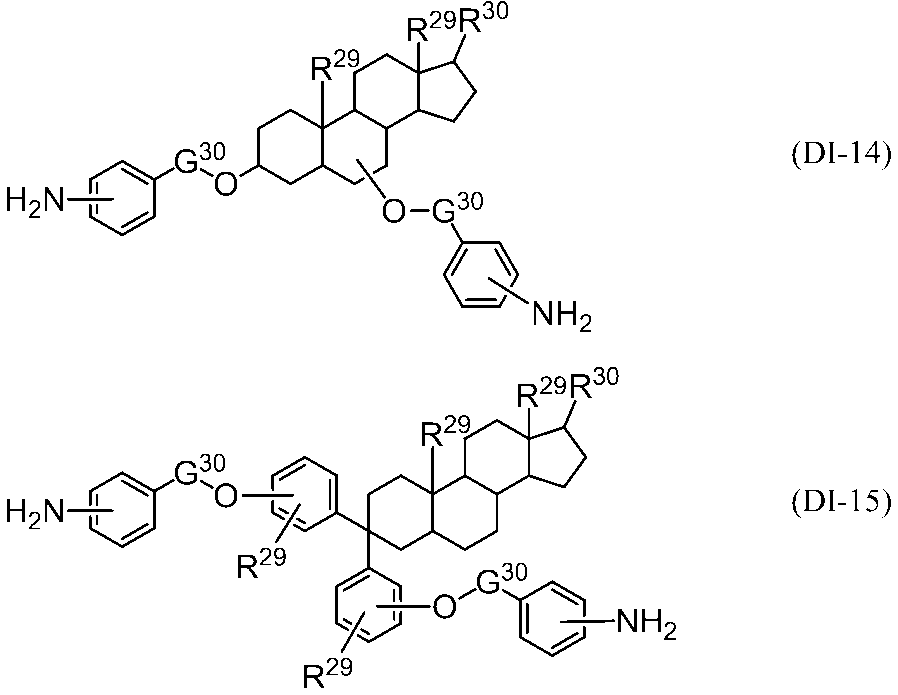
R29は独立して水素または-CH3であり;
R30は水素、炭素数1~20のアルキル、または炭素数2~20のアルケニルであり;
式(DI-15)におけるベンゼン環の少なくとも1つの水素は、炭素数1~20のアルキルまたはフェニルで置き換えられてもよく;
式(DI-14)および式(DI-15)において、環を構成するいずれかの炭素原子に結合位置が固定されていない基は、その環における結合位置が任意であることを示し;
ベンゼン環に結合する-NH2はその環における結合位置が任意であることを示し;

G32は単結合または炭素数1~3のアルキレンであり;
R31は水素または炭素数1~20のアルキルであり、このアルキルの少なくとも1つの-CH2-は、-O-で置き換えられてもよく;
R32は炭素数6~22のアルキルであり;
R33は水素または炭素数1~22のアルキルであり;
環B25は1,4-フェニレンまたは1,4-シクロヘキシレンであり;
rは0または1であり;そして、
ベンゼン環に結合する-NH2はその環における結合位置が任意であることを示す。 - 式(DI-a)~(DI-c)で表される化合物の群から選ばれる少なくとも1つと共に用いられる光反応性構造を有さないジアミンが、下記式(DI-4-1)、(DI-5-9)、(DI-5-12)、(DI-5-27)~(DI-5-30)、および(DI-7-3)で表される化合物の群から選ばれる少なくとも1つである、請求項11に記載の光配向用液晶配向剤:

式(DI-5-30)において、kは1~5の整数であり:そして、
式(DI-7-3)において、nは1または2である。 - アルケニル置換ナジイミド化合物、ラジカル重合性不飽和二重結合を有する化合物、オキサジン化合物、オキサゾリン化合物、エポキシ化合物、およびシランカップリング剤からなる化合物の群から選ばれる少なくとも1つをさらに含有する、請求項1~12のいずれか1項に記載の光配向用液晶配向剤。
- アルケニル置換ナジイミド化合物が、ビス{4-(アリルビシクロ[2.2.1]ヘプト-5-エン-2,3-ジカルボキシイミド)フェニル}メタン、N,N’-m-キシリレン-ビス(アリルビシクロ[2.2.1]ヘプト-5-エン-2,3-ジカルボキシイミド)、およびN,N’-ヘキサメチレン-ビス(アリルビシクロ[2.2.1]ヘプト-5-エン-2,3-ジカルボキシイミド)からなる化合物の群から選ばれる少なくとも1つである、請求項13に記載の光配向用液晶配向剤。
- エポキシ化合物が、N,N,N’,N’-テトラグリシジル-m-キシレンジアミン、1,3-ビス(N,N-ジグリシジルアミノメチル)シクロヘキサン、N,N,N’,N’-テトラグリシジル-4,4’-ジアミノジフェニルメタン、2-[4-(2,3-エポキシプロポキシ)フェニル]-2-[4-[1,1-ビス[4-([2,3-エポキシプロポキシ]フェニル)]エチル]フェニル]プロパン、3,4-エポキシシクロヘキセニルメチル-3’,4’-エポキシシクロヘキセンカルボキシレート、およびN-フェニルマレイミド-グリシジルメタクリレート共重合体からなる化合物の群から選ばれる少なくとも1つである、請求項13に記載の液晶配向剤。
- シランカップリング剤が、2-(3,4-エポキシシクロヘキシル)エチルトリメトキシシラン、パラアミノフェニルトリメトキシシランおよび3-アミノプロピルトリエトキシシランからなる化合物の群から選ばれる少なくとも1つである、請求項13に記載の液晶配向剤。
- 請求項1~16のいずれか1項に記載の光配向用液晶配向剤によって形成された液晶配向膜。
- 請求項1~16のいずれか1項に記載の液晶配向剤を基板に塗布する工程と、配向剤を塗布した基板を加熱乾燥する工程と、乾燥した膜に偏向紫外線を照射する工程とを経て形成される光配向用液晶配向膜。
- 請求項1~16のいずれか1項に記載の液晶配向剤を基板に塗布する工程と、配向剤を塗布した基板を加熱乾燥する工程と、乾燥した膜に偏向紫外線を照射する工程と、次いでその膜を加熱焼成する工程を経て形成される光配向用液晶配向膜。
- 請求項1~16のいずれか1項に記載の液晶配向剤を基板に塗布する工程と、配向剤を塗布した基板を加熱乾燥する工程と、乾燥した膜を加熱焼成する工程と、次いでその膜に偏向紫外線を照射する工程とを経て形成される光配向用液晶配向膜。
- 請求項17~20のいずれか1項に記載の光配向用液晶配向膜を有する液晶表示素子。
Priority Applications (3)
| Application Number | Priority Date | Filing Date | Title |
|---|---|---|---|
| JP2014511184A JP6103257B2 (ja) | 2012-04-16 | 2013-04-10 | 光配向用液晶配向膜を形成するための液晶配向剤、液晶配向膜およびこれを用いた液晶表示素子 |
| US14/394,540 US9796927B2 (en) | 2012-04-16 | 2013-04-10 | Liquid crystal aligning agents for forming photo-aligning liquid crystal alignment layers, liquid crystal alignment layers and liquid crystal display devices using the same |
| US15/664,331 US20170327744A1 (en) | 2012-04-16 | 2017-07-31 | Liquid crystal aligning agents for forming photo-aligning liquid crystal alignment layers, liquid crystal alignment layers and liquid crystal display devices using the same |
Applications Claiming Priority (4)
| Application Number | Priority Date | Filing Date | Title |
|---|---|---|---|
| JP2012-092708 | 2012-04-16 | ||
| JP2012092708 | 2012-04-16 | ||
| JP2013065979 | 2013-03-27 | ||
| JP2013-065979 | 2013-03-27 |
Related Child Applications (2)
| Application Number | Title | Priority Date | Filing Date |
|---|---|---|---|
| US14/394,540 A-371-Of-International US9796927B2 (en) | 2012-04-16 | 2013-04-10 | Liquid crystal aligning agents for forming photo-aligning liquid crystal alignment layers, liquid crystal alignment layers and liquid crystal display devices using the same |
| US15/664,331 Continuation US20170327744A1 (en) | 2012-04-16 | 2017-07-31 | Liquid crystal aligning agents for forming photo-aligning liquid crystal alignment layers, liquid crystal alignment layers and liquid crystal display devices using the same |
Publications (1)
| Publication Number | Publication Date |
|---|---|
| WO2013157463A1 true WO2013157463A1 (ja) | 2013-10-24 |
Family
ID=49383422
Family Applications (1)
| Application Number | Title | Priority Date | Filing Date |
|---|---|---|---|
| PCT/JP2013/060841 Ceased WO2013157463A1 (ja) | 2012-04-16 | 2013-04-10 | 光配向用液晶配向膜を形成するための液晶配向剤、液晶配向膜およびこれを用いた液晶表示素子 |
Country Status (4)
| Country | Link |
|---|---|
| US (2) | US9796927B2 (ja) |
| JP (1) | JP6103257B2 (ja) |
| TW (2) | TWI573814B (ja) |
| WO (1) | WO2013157463A1 (ja) |
Cited By (9)
| Publication number | Priority date | Publication date | Assignee | Title |
|---|---|---|---|---|
| JP2015166844A (ja) * | 2014-02-13 | 2015-09-24 | Jsr株式会社 | 液晶配向剤、液晶配向膜、液晶表示素子、位相差フィルム、位相差フィルムの製造方法、重合体及び化合物 |
| KR20160110166A (ko) | 2015-03-11 | 2016-09-21 | 제이엔씨 주식회사 | 액정 배향막을 형성하기 위한 액정 배향제, 액정 배향막 및 이것을 사용한 액정 표시 소자 |
| JP2017129780A (ja) * | 2016-01-21 | 2017-07-27 | Jnc株式会社 | 液晶配向剤、液晶配向膜およびこれを用いた液晶表示素子 |
| JP2019133173A (ja) * | 2014-04-14 | 2019-08-08 | Jnc株式会社 | 液晶配向剤、液晶配向膜および液晶表示素子 |
| KR20190137712A (ko) | 2018-06-01 | 2019-12-11 | 제이엔씨 주식회사 | 광배향용 액정 배향제, 액정 배향막 및 이것을 이용한 액정 표시 소자 |
| JP2020008867A (ja) * | 2019-09-03 | 2020-01-16 | Jnc株式会社 | テトラカルボン酸二無水物 |
| US10968392B2 (en) | 2017-10-31 | 2021-04-06 | Jnc Corporation | Liquid crystal aligning agent for photoalignment, liquid crystal alignment film and liquid crystal display device using it, and diamine and polymer |
| JP2021187841A (ja) * | 2020-05-25 | 2021-12-13 | Jnc株式会社 | ジアミン化合物、ポリマー、液晶配向剤、液晶配向膜、及び液晶表示素子、並びに、液晶配向膜の製造方法、ジアミン化合物の製造方法、ジニトロ化合物及びジニトロ化合物の製造方法、保護ジアミノ化合物 |
| WO2026053892A1 (ja) * | 2024-09-06 | 2026-03-12 | 富士フイルム株式会社 | 樹脂組成物、硬化物、積層体、硬化物の製造方法、積層体の製造方法、半導体デバイスの製造方法、及び、半導体デバイス |
Families Citing this family (8)
| Publication number | Priority date | Publication date | Assignee | Title |
|---|---|---|---|---|
| PL3153228T3 (pl) * | 2014-06-04 | 2024-05-13 | Mitsubishi Chemical Corporation | Materiał zalewowy do modułów membran i moduł membran z pustych włókien go zawierający |
| JP6565730B2 (ja) * | 2016-02-18 | 2019-08-28 | Jnc株式会社 | ジアミン、ポリアミック酸またはその誘導体、液晶配向剤、液晶配向膜および液晶表示素子 |
| KR101856727B1 (ko) * | 2016-06-21 | 2018-05-10 | 주식회사 엘지화학 | 액정 배향제 조성물, 이를 이용한 액정 배향막의 제조 방법, 및 이를 이용한 액정 배향막 |
| CN106753430B (zh) * | 2016-11-24 | 2019-08-27 | 厦门天马微电子有限公司 | 液晶取向剂、液晶取向膜及其制作方法以及包含其的液晶显示装置 |
| KR102604339B1 (ko) * | 2016-12-28 | 2023-11-20 | 닛산 가가쿠 가부시키가이샤 | 액정 배향제, 액정 배향막, 및 액정 표시 소자 |
| TWI742094B (zh) * | 2017-06-13 | 2021-10-11 | 奇美實業股份有限公司 | 液晶配向膜的製造方法及液晶顯示元件 |
| JP2019132952A (ja) * | 2018-01-30 | 2019-08-08 | シャープ株式会社 | 液晶配向剤、液晶配向膜及び液晶表示装置 |
| JP2019152755A (ja) * | 2018-03-02 | 2019-09-12 | シャープ株式会社 | 液晶表示装置 |
Citations (4)
| Publication number | Priority date | Publication date | Assignee | Title |
|---|---|---|---|---|
| JP2010506031A (ja) * | 2007-01-09 | 2010-02-25 | エルジー・ケム・リミテッド | 新規なポリイミド共重合体、これを含む液晶配向膜、およびこれを含む液晶ディスプレイ |
| JP2010156953A (ja) * | 2008-12-01 | 2010-07-15 | Chisso Corp | 液晶配向剤、液晶配向膜及び液晶表示素子 |
| JP2011008218A (ja) * | 2009-05-22 | 2011-01-13 | Chisso Corp | 光学異方体 |
| JP2011207786A (ja) * | 2010-03-29 | 2011-10-20 | Jnc Corp | 分子内2箇所にジフェニルアミンの構造を有するジアミン、このジアミンを反応させて得られるポリマー、このポリマーを含有する液晶配向剤、この液晶配向剤を用いて形成される液晶配向膜、およびこの液晶配向膜を有する液晶表示素子 |
Family Cites Families (13)
| Publication number | Priority date | Publication date | Assignee | Title |
|---|---|---|---|---|
| EP0919851B1 (en) | 1996-03-05 | 2003-10-22 | Nissan Chemical Industries, Limited | Method for liquid crystal alignment |
| JP3893659B2 (ja) | 1996-03-05 | 2007-03-14 | 日産化学工業株式会社 | 液晶配向処理方法 |
| JP4126731B2 (ja) | 1997-03-13 | 2008-07-30 | Jsr株式会社 | 液晶配向剤 |
| JP4620438B2 (ja) | 2004-02-27 | 2011-01-26 | チッソ株式会社 | 液晶配向膜、液晶配向剤、及び液晶表示素子 |
| JP4775796B2 (ja) | 2006-03-14 | 2011-09-21 | 独立行政法人物質・材料研究機構 | 液晶配向膜、液晶配向剤、及び液晶表示素子 |
| TWI422927B (zh) * | 2006-03-16 | 2014-01-11 | Jnc Corp | 光配向膜以及液晶顯示元件 |
| JP2008233713A (ja) | 2007-03-23 | 2008-10-02 | Sony Corp | 液晶表示装置および電子機器 |
| JP5156894B2 (ja) | 2007-09-13 | 2013-03-06 | 独立行政法人物質・材料研究機構 | 液晶配向剤、液晶配向膜及びその製造方法、並びに液晶表示素子 |
| JP5407394B2 (ja) | 2008-03-21 | 2014-02-05 | Jnc株式会社 | 光配向剤、配向膜およびこれを用いた液晶表示素子 |
| JP5899927B2 (ja) * | 2009-03-10 | 2016-04-13 | 日産化学工業株式会社 | 液晶配向剤 |
| JP5459052B2 (ja) * | 2009-06-25 | 2014-04-02 | Jnc株式会社 | 液晶配向剤、液晶配向膜および液晶表示素子 |
| JP5643985B2 (ja) * | 2010-08-19 | 2014-12-24 | Jnc株式会社 | ジアミン、液晶配向剤、液晶配向膜および液晶表示素子 |
| KR20120091886A (ko) | 2011-02-10 | 2012-08-20 | 삼성전자주식회사 | 액정 표시 장치 |
-
2013
- 2013-04-10 US US14/394,540 patent/US9796927B2/en not_active Expired - Fee Related
- 2013-04-10 WO PCT/JP2013/060841 patent/WO2013157463A1/ja not_active Ceased
- 2013-04-10 JP JP2014511184A patent/JP6103257B2/ja active Active
- 2013-04-15 TW TW102113213A patent/TWI573814B/zh not_active IP Right Cessation
- 2013-04-15 TW TW105133211A patent/TWI610965B/zh not_active IP Right Cessation
-
2017
- 2017-07-31 US US15/664,331 patent/US20170327744A1/en not_active Abandoned
Patent Citations (4)
| Publication number | Priority date | Publication date | Assignee | Title |
|---|---|---|---|---|
| JP2010506031A (ja) * | 2007-01-09 | 2010-02-25 | エルジー・ケム・リミテッド | 新規なポリイミド共重合体、これを含む液晶配向膜、およびこれを含む液晶ディスプレイ |
| JP2010156953A (ja) * | 2008-12-01 | 2010-07-15 | Chisso Corp | 液晶配向剤、液晶配向膜及び液晶表示素子 |
| JP2011008218A (ja) * | 2009-05-22 | 2011-01-13 | Chisso Corp | 光学異方体 |
| JP2011207786A (ja) * | 2010-03-29 | 2011-10-20 | Jnc Corp | 分子内2箇所にジフェニルアミンの構造を有するジアミン、このジアミンを反応させて得られるポリマー、このポリマーを含有する液晶配向剤、この液晶配向剤を用いて形成される液晶配向膜、およびこの液晶配向膜を有する液晶表示素子 |
Cited By (11)
| Publication number | Priority date | Publication date | Assignee | Title |
|---|---|---|---|---|
| JP2015166844A (ja) * | 2014-02-13 | 2015-09-24 | Jsr株式会社 | 液晶配向剤、液晶配向膜、液晶表示素子、位相差フィルム、位相差フィルムの製造方法、重合体及び化合物 |
| JP2019133173A (ja) * | 2014-04-14 | 2019-08-08 | Jnc株式会社 | 液晶配向剤、液晶配向膜および液晶表示素子 |
| KR20160110166A (ko) | 2015-03-11 | 2016-09-21 | 제이엔씨 주식회사 | 액정 배향막을 형성하기 위한 액정 배향제, 액정 배향막 및 이것을 사용한 액정 표시 소자 |
| JP2017129780A (ja) * | 2016-01-21 | 2017-07-27 | Jnc株式会社 | 液晶配向剤、液晶配向膜およびこれを用いた液晶表示素子 |
| CN106987256A (zh) * | 2016-01-21 | 2017-07-28 | Jnc株式会社 | 液晶取向剂、液晶取向膜和使用其的液晶显示元件 |
| CN106987256B (zh) * | 2016-01-21 | 2021-09-21 | Jnc株式会社 | 液晶取向剂、液晶取向膜和使用其的液晶显示元件 |
| US10968392B2 (en) | 2017-10-31 | 2021-04-06 | Jnc Corporation | Liquid crystal aligning agent for photoalignment, liquid crystal alignment film and liquid crystal display device using it, and diamine and polymer |
| KR20190137712A (ko) | 2018-06-01 | 2019-12-11 | 제이엔씨 주식회사 | 광배향용 액정 배향제, 액정 배향막 및 이것을 이용한 액정 표시 소자 |
| JP2020008867A (ja) * | 2019-09-03 | 2020-01-16 | Jnc株式会社 | テトラカルボン酸二無水物 |
| JP2021187841A (ja) * | 2020-05-25 | 2021-12-13 | Jnc株式会社 | ジアミン化合物、ポリマー、液晶配向剤、液晶配向膜、及び液晶表示素子、並びに、液晶配向膜の製造方法、ジアミン化合物の製造方法、ジニトロ化合物及びジニトロ化合物の製造方法、保護ジアミノ化合物 |
| WO2026053892A1 (ja) * | 2024-09-06 | 2026-03-12 | 富士フイルム株式会社 | 樹脂組成物、硬化物、積層体、硬化物の製造方法、積層体の製造方法、半導体デバイスの製造方法、及び、半導体デバイス |
Also Published As
| Publication number | Publication date |
|---|---|
| TWI573814B (zh) | 2017-03-11 |
| TW201343723A (zh) | 2013-11-01 |
| US20150105503A1 (en) | 2015-04-16 |
| TW201706334A (zh) | 2017-02-16 |
| US20170327744A1 (en) | 2017-11-16 |
| JPWO2013157463A1 (ja) | 2015-12-21 |
| JP6103257B2 (ja) | 2017-03-29 |
| US9796927B2 (en) | 2017-10-24 |
| TWI610965B (zh) | 2018-01-11 |
Similar Documents
| Publication | Publication Date | Title |
|---|---|---|
| JP6308282B2 (ja) | 光配向用液晶配向膜を形成するための液晶配向剤、液晶配向膜およびこれを用いた液晶表示素子 | |
| JP6103257B2 (ja) | 光配向用液晶配向膜を形成するための液晶配向剤、液晶配向膜およびこれを用いた液晶表示素子 | |
| JP6176354B2 (ja) | ジアミン | |
| JP6056187B2 (ja) | 光配向用液晶配向膜を形成するための液晶配向剤、液晶配向膜およびこれを用いた液晶表示素子 | |
| JP6213281B2 (ja) | 感光性ジアミン、液晶配向剤および液晶表示素子 | |
| JP6090570B2 (ja) | 光配向用液晶配向膜を形成するための液晶配向剤、液晶配向膜およびこれを用いた液晶表示素子 | |
| JP6398236B2 (ja) | 液晶配向剤および液晶表示素子 | |
| JP6057070B2 (ja) | 液晶配向剤、およびこれを用いた液晶表示素子 | |
| JP6350852B2 (ja) | 液晶配向剤、液晶表示素子、およびテトラカルボン酸二無水物 | |
| JP6565730B2 (ja) | ジアミン、ポリアミック酸またはその誘導体、液晶配向剤、液晶配向膜および液晶表示素子 | |
| JP5817972B2 (ja) | ポリアミック酸、およびこれを用いた液晶配向剤、液晶配向膜、液晶表示素子 | |
| JP6252009B2 (ja) | 新規ジアミン、これを用いたポリマー、液晶配向剤、液晶配向膜、および液晶表示素子 | |
| JP2016224415A (ja) | 光配向用液晶配向膜を形成するための液晶配向剤、液晶配向膜およびこれを用いた液晶表示素子 | |
| JP2016041683A (ja) | トリアゾール含有テトラカルボン酸二無水物、液晶配向剤、液晶配向膜、および液晶表示素子 | |
| JP6561624B2 (ja) | 光配向用液晶配向膜を形成するための液晶配向剤、液晶配向膜およびこれを用いた液晶表示素子 | |
| JP2017146597A (ja) | 液晶配向膜を形成するための液晶配向剤、液晶配向膜およびこれを用いた液晶表示素子 |
Legal Events
| Date | Code | Title | Description |
|---|---|---|---|
| 121 | Ep: the epo has been informed by wipo that ep was designated in this application |
Ref document number: 13778204 Country of ref document: EP Kind code of ref document: A1 |
|
| ENP | Entry into the national phase |
Ref document number: 2014511184 Country of ref document: JP Kind code of ref document: A |
|
| WWE | Wipo information: entry into national phase |
Ref document number: 14394540 Country of ref document: US |
|
| NENP | Non-entry into the national phase |
Ref country code: DE |
|
| 122 | Ep: pct application non-entry in european phase |
Ref document number: 13778204 Country of ref document: EP Kind code of ref document: A1 |