WO2013147261A1 - シリケート被覆MFI型ゼオライトとその製造方法およびそれを用いたp-キシレンの製造方法 - Google Patents
シリケート被覆MFI型ゼオライトとその製造方法およびそれを用いたp-キシレンの製造方法 Download PDFInfo
- Publication number
- WO2013147261A1 WO2013147261A1 PCT/JP2013/059742 JP2013059742W WO2013147261A1 WO 2013147261 A1 WO2013147261 A1 WO 2013147261A1 JP 2013059742 W JP2013059742 W JP 2013059742W WO 2013147261 A1 WO2013147261 A1 WO 2013147261A1
- Authority
- WO
- WIPO (PCT)
- Prior art keywords
- silicate
- mfi
- type zeolite
- coated
- zeolite
- Prior art date
- Legal status (The legal status is an assumption and is not a legal conclusion. Google has not performed a legal analysis and makes no representation as to the accuracy of the status listed.)
- Ceased
Links
Images









Classifications
-
- C—CHEMISTRY; METALLURGY
- C01—INORGANIC CHEMISTRY
- C01B—NON-METALLIC ELEMENTS; COMPOUNDS THEREOF; METALLOIDS OR COMPOUNDS THEREOF NOT COVERED BY SUBCLASS C01C
- C01B39/00—Compounds having molecular sieve and base-exchange properties, e.g. crystalline zeolites; Their preparation; After-treatment, e.g. ion-exchange or dealumination
- C01B39/02—Crystalline aluminosilicate zeolites; Isomorphous compounds thereof; Direct preparation thereof; Preparation thereof starting from a reaction mixture containing a crystalline zeolite of another type, or from preformed reactants; After-treatment thereof
- C01B39/36—Pentasil type, e.g. types ZSM-5, ZSM-8 or ZSM-11
-
- B—PERFORMING OPERATIONS; TRANSPORTING
- B01—PHYSICAL OR CHEMICAL PROCESSES OR APPARATUS IN GENERAL
- B01J—CHEMICAL OR PHYSICAL PROCESSES, e.g. CATALYSIS OR COLLOID CHEMISTRY; THEIR RELEVANT APPARATUS
- B01J29/00—Catalysts comprising molecular sieves
- B01J29/005—Mixtures of molecular sieves comprising at least one molecular sieve which is not an aluminosilicate zeolite, e.g. from groups B01J29/03 - B01J29/049 or B01J29/82 - B01J29/89
-
- B—PERFORMING OPERATIONS; TRANSPORTING
- B01—PHYSICAL OR CHEMICAL PROCESSES OR APPARATUS IN GENERAL
- B01J—CHEMICAL OR PHYSICAL PROCESSES, e.g. CATALYSIS OR COLLOID CHEMISTRY; THEIR RELEVANT APPARATUS
- B01J29/00—Catalysts comprising molecular sieves
- B01J29/03—Catalysts comprising molecular sieves not having base-exchange properties
- B01J29/035—Microporous crystalline materials not having base exchange properties, such as silica polymorphs, e.g. silicalites
-
- B—PERFORMING OPERATIONS; TRANSPORTING
- B01—PHYSICAL OR CHEMICAL PROCESSES OR APPARATUS IN GENERAL
- B01J—CHEMICAL OR PHYSICAL PROCESSES, e.g. CATALYSIS OR COLLOID CHEMISTRY; THEIR RELEVANT APPARATUS
- B01J29/00—Catalysts comprising molecular sieves
- B01J29/04—Catalysts comprising molecular sieves having base-exchange properties, e.g. crystalline zeolites
- B01J29/06—Crystalline aluminosilicate zeolites; Isomorphous compounds thereof
- B01J29/40—Crystalline aluminosilicate zeolites; Isomorphous compounds thereof of the pentasil type, e.g. types ZSM-5, ZSM-8 or ZSM-11, as exemplified by patent documents US3702886, GB1334243 and US3709979, respectively
-
- B—PERFORMING OPERATIONS; TRANSPORTING
- B01—PHYSICAL OR CHEMICAL PROCESSES OR APPARATUS IN GENERAL
- B01J—CHEMICAL OR PHYSICAL PROCESSES, e.g. CATALYSIS OR COLLOID CHEMISTRY; THEIR RELEVANT APPARATUS
- B01J35/00—Catalysts, in general, characterised by their form or physical properties
- B01J35/40—Catalysts, in general, characterised by their form or physical properties characterised by dimensions, e.g. grain size
-
- B—PERFORMING OPERATIONS; TRANSPORTING
- B01—PHYSICAL OR CHEMICAL PROCESSES OR APPARATUS IN GENERAL
- B01J—CHEMICAL OR PHYSICAL PROCESSES, e.g. CATALYSIS OR COLLOID CHEMISTRY; THEIR RELEVANT APPARATUS
- B01J35/00—Catalysts, in general, characterised by their form or physical properties
- B01J35/70—Catalysts, in general, characterised by their form or physical properties characterised by their crystalline properties, e.g. semi-crystalline
-
- B—PERFORMING OPERATIONS; TRANSPORTING
- B01—PHYSICAL OR CHEMICAL PROCESSES OR APPARATUS IN GENERAL
- B01J—CHEMICAL OR PHYSICAL PROCESSES, e.g. CATALYSIS OR COLLOID CHEMISTRY; THEIR RELEVANT APPARATUS
- B01J35/00—Catalysts, in general, characterised by their form or physical properties
- B01J35/70—Catalysts, in general, characterised by their form or physical properties characterised by their crystalline properties, e.g. semi-crystalline
- B01J35/77—Compounds characterised by their crystallite size
-
- B—PERFORMING OPERATIONS; TRANSPORTING
- B01—PHYSICAL OR CHEMICAL PROCESSES OR APPARATUS IN GENERAL
- B01J—CHEMICAL OR PHYSICAL PROCESSES, e.g. CATALYSIS OR COLLOID CHEMISTRY; THEIR RELEVANT APPARATUS
- B01J37/00—Processes, in general, for preparing catalysts; Processes, in general, for activation of catalysts
- B01J37/02—Impregnation, coating or precipitation
- B01J37/0215—Coating
-
- B—PERFORMING OPERATIONS; TRANSPORTING
- B01—PHYSICAL OR CHEMICAL PROCESSES OR APPARATUS IN GENERAL
- B01J—CHEMICAL OR PHYSICAL PROCESSES, e.g. CATALYSIS OR COLLOID CHEMISTRY; THEIR RELEVANT APPARATUS
- B01J37/00—Processes, in general, for preparing catalysts; Processes, in general, for activation of catalysts
- B01J37/08—Heat treatment
- B01J37/10—Heat treatment in the presence of water, e.g. steam
-
- C—CHEMISTRY; METALLURGY
- C01—INORGANIC CHEMISTRY
- C01B—NON-METALLIC ELEMENTS; COMPOUNDS THEREOF; METALLOIDS OR COMPOUNDS THEREOF NOT COVERED BY SUBCLASS C01C
- C01B39/00—Compounds having molecular sieve and base-exchange properties, e.g. crystalline zeolites; Their preparation; After-treatment, e.g. ion-exchange or dealumination
- C01B39/02—Crystalline aluminosilicate zeolites; Isomorphous compounds thereof; Direct preparation thereof; Preparation thereof starting from a reaction mixture containing a crystalline zeolite of another type, or from preformed reactants; After-treatment thereof
- C01B39/36—Pentasil type, e.g. types ZSM-5, ZSM-8 or ZSM-11
- C01B39/38—Type ZSM-5
-
- C—CHEMISTRY; METALLURGY
- C01—INORGANIC CHEMISTRY
- C01B—NON-METALLIC ELEMENTS; COMPOUNDS THEREOF; METALLOIDS OR COMPOUNDS THEREOF NOT COVERED BY SUBCLASS C01C
- C01B39/00—Compounds having molecular sieve and base-exchange properties, e.g. crystalline zeolites; Their preparation; After-treatment, e.g. ion-exchange or dealumination
- C01B39/02—Crystalline aluminosilicate zeolites; Isomorphous compounds thereof; Direct preparation thereof; Preparation thereof starting from a reaction mixture containing a crystalline zeolite of another type, or from preformed reactants; After-treatment thereof
- C01B39/36—Pentasil type, e.g. types ZSM-5, ZSM-8 or ZSM-11
- C01B39/38—Type ZSM-5
- C01B39/40—Type ZSM-5 using at least one organic template directing agent
-
- C—CHEMISTRY; METALLURGY
- C07—ORGANIC CHEMISTRY
- C07B—GENERAL METHODS OF ORGANIC CHEMISTRY; APPARATUS THEREFOR
- C07B61/00—Other general methods
-
- C—CHEMISTRY; METALLURGY
- C07—ORGANIC CHEMISTRY
- C07C—ACYCLIC OR CARBOCYCLIC COMPOUNDS
- C07C15/00—Cyclic hydrocarbons containing only six-membered aromatic rings as cyclic parts
- C07C15/02—Monocyclic hydrocarbons
- C07C15/04—Benzene
-
- C—CHEMISTRY; METALLURGY
- C07—ORGANIC CHEMISTRY
- C07C—ACYCLIC OR CARBOCYCLIC COMPOUNDS
- C07C15/00—Cyclic hydrocarbons containing only six-membered aromatic rings as cyclic parts
- C07C15/02—Monocyclic hydrocarbons
- C07C15/067—C8H10 hydrocarbons
- C07C15/08—Xylenes
-
- C—CHEMISTRY; METALLURGY
- C07—ORGANIC CHEMISTRY
- C07C—ACYCLIC OR CARBOCYCLIC COMPOUNDS
- C07C6/00—Preparation of hydrocarbons from hydrocarbons containing a different number of carbon atoms by redistribution reactions
- C07C6/02—Metathesis reactions at an unsaturated carbon-to-carbon bond
- C07C6/04—Metathesis reactions at an unsaturated carbon-to-carbon bond at a carbon-to-carbon double bond
- C07C6/06—Metathesis reactions at an unsaturated carbon-to-carbon bond at a carbon-to-carbon double bond at a cyclic carbon-to-carbon double bond
-
- C—CHEMISTRY; METALLURGY
- C07—ORGANIC CHEMISTRY
- C07C—ACYCLIC OR CARBOCYCLIC COMPOUNDS
- C07C6/00—Preparation of hydrocarbons from hydrocarbons containing a different number of carbon atoms by redistribution reactions
- C07C6/08—Preparation of hydrocarbons from hydrocarbons containing a different number of carbon atoms by redistribution reactions by conversion at a saturated carbon-to-carbon bond
- C07C6/12—Preparation of hydrocarbons from hydrocarbons containing a different number of carbon atoms by redistribution reactions by conversion at a saturated carbon-to-carbon bond of exclusively hydrocarbons containing a six-membered aromatic ring
-
- C—CHEMISTRY; METALLURGY
- C07—ORGANIC CHEMISTRY
- C07C—ACYCLIC OR CARBOCYCLIC COMPOUNDS
- C07C6/00—Preparation of hydrocarbons from hydrocarbons containing a different number of carbon atoms by redistribution reactions
- C07C6/08—Preparation of hydrocarbons from hydrocarbons containing a different number of carbon atoms by redistribution reactions by conversion at a saturated carbon-to-carbon bond
- C07C6/12—Preparation of hydrocarbons from hydrocarbons containing a different number of carbon atoms by redistribution reactions by conversion at a saturated carbon-to-carbon bond of exclusively hydrocarbons containing a six-membered aromatic ring
- C07C6/123—Preparation of hydrocarbons from hydrocarbons containing a different number of carbon atoms by redistribution reactions by conversion at a saturated carbon-to-carbon bond of exclusively hydrocarbons containing a six-membered aromatic ring of only one hydrocarbon
-
- B—PERFORMING OPERATIONS; TRANSPORTING
- B01—PHYSICAL OR CHEMICAL PROCESSES OR APPARATUS IN GENERAL
- B01J—CHEMICAL OR PHYSICAL PROCESSES, e.g. CATALYSIS OR COLLOID CHEMISTRY; THEIR RELEVANT APPARATUS
- B01J2229/00—Aspects of molecular sieve catalysts not covered by B01J29/00
- B01J2229/10—After treatment, characterised by the effect to be obtained
- B01J2229/16—After treatment, characterised by the effect to be obtained to increase the Si/Al ratio; Dealumination
-
- B—PERFORMING OPERATIONS; TRANSPORTING
- B01—PHYSICAL OR CHEMICAL PROCESSES OR APPARATUS IN GENERAL
- B01J—CHEMICAL OR PHYSICAL PROCESSES, e.g. CATALYSIS OR COLLOID CHEMISTRY; THEIR RELEVANT APPARATUS
- B01J2229/00—Aspects of molecular sieve catalysts not covered by B01J29/00
- B01J2229/60—Synthesis on support
- B01J2229/62—Synthesis on support in or on other molecular sieves
-
- B—PERFORMING OPERATIONS; TRANSPORTING
- B01—PHYSICAL OR CHEMICAL PROCESSES OR APPARATUS IN GENERAL
- B01J—CHEMICAL OR PHYSICAL PROCESSES, e.g. CATALYSIS OR COLLOID CHEMISTRY; THEIR RELEVANT APPARATUS
- B01J2235/00—Indexing scheme associated with group B01J35/00, related to the analysis techniques used to determine the catalysts form or properties
- B01J2235/05—Nuclear magnetic resonance [NMR]
-
- B—PERFORMING OPERATIONS; TRANSPORTING
- B01—PHYSICAL OR CHEMICAL PROCESSES OR APPARATUS IN GENERAL
- B01J—CHEMICAL OR PHYSICAL PROCESSES, e.g. CATALYSIS OR COLLOID CHEMISTRY; THEIR RELEVANT APPARATUS
- B01J2235/00—Indexing scheme associated with group B01J35/00, related to the analysis techniques used to determine the catalysts form or properties
- B01J2235/15—X-ray diffraction
-
- B—PERFORMING OPERATIONS; TRANSPORTING
- B01—PHYSICAL OR CHEMICAL PROCESSES OR APPARATUS IN GENERAL
- B01J—CHEMICAL OR PHYSICAL PROCESSES, e.g. CATALYSIS OR COLLOID CHEMISTRY; THEIR RELEVANT APPARATUS
- B01J35/00—Catalysts, in general, characterised by their form or physical properties
- B01J35/19—Catalysts containing parts with different compositions
-
- B—PERFORMING OPERATIONS; TRANSPORTING
- B01—PHYSICAL OR CHEMICAL PROCESSES OR APPARATUS IN GENERAL
- B01J—CHEMICAL OR PHYSICAL PROCESSES, e.g. CATALYSIS OR COLLOID CHEMISTRY; THEIR RELEVANT APPARATUS
- B01J37/00—Processes, in general, for preparing catalysts; Processes, in general, for activation of catalysts
- B01J37/02—Impregnation, coating or precipitation
- B01J37/024—Multiple impregnation or coating
- B01J37/0246—Coatings comprising a zeolite
-
- C—CHEMISTRY; METALLURGY
- C07—ORGANIC CHEMISTRY
- C07C—ACYCLIC OR CARBOCYCLIC COMPOUNDS
- C07C2529/00—Catalysts comprising molecular sieves
- C07C2529/03—Catalysts comprising molecular sieves not having base-exchange properties
- C07C2529/035—Crystalline silica polymorphs, e.g. silicalites
-
- C—CHEMISTRY; METALLURGY
- C07—ORGANIC CHEMISTRY
- C07C—ACYCLIC OR CARBOCYCLIC COMPOUNDS
- C07C2529/00—Catalysts comprising molecular sieves
- C07C2529/04—Catalysts comprising molecular sieves having base-exchange properties, e.g. crystalline zeolites, pillared clays
- C07C2529/06—Crystalline aluminosilicate zeolites; Isomorphous compounds thereof
- C07C2529/40—Crystalline aluminosilicate zeolites; Isomorphous compounds thereof of the pentasil type, e.g. types ZSM-5, ZSM-8 or ZSM-11
-
- C—CHEMISTRY; METALLURGY
- C07—ORGANIC CHEMISTRY
- C07C—ACYCLIC OR CARBOCYCLIC COMPOUNDS
- C07C2529/00—Catalysts comprising molecular sieves
- C07C2529/04—Catalysts comprising molecular sieves having base-exchange properties, e.g. crystalline zeolites, pillared clays
- C07C2529/06—Crystalline aluminosilicate zeolites; Isomorphous compounds thereof
- C07C2529/80—Mixtures of different zeolites
-
- Y—GENERAL TAGGING OF NEW TECHNOLOGICAL DEVELOPMENTS; GENERAL TAGGING OF CROSS-SECTIONAL TECHNOLOGIES SPANNING OVER SEVERAL SECTIONS OF THE IPC; TECHNICAL SUBJECTS COVERED BY FORMER USPC CROSS-REFERENCE ART COLLECTIONS [XRACs] AND DIGESTS
- Y02—TECHNOLOGIES OR APPLICATIONS FOR MITIGATION OR ADAPTATION AGAINST CLIMATE CHANGE
- Y02P—CLIMATE CHANGE MITIGATION TECHNOLOGIES IN THE PRODUCTION OR PROCESSING OF GOODS
- Y02P20/00—Technologies relating to chemical industry
- Y02P20/50—Improvements relating to the production of bulk chemicals
- Y02P20/52—Improvements relating to the production of bulk chemicals using catalysts, e.g. selective catalysts
-
- Y—GENERAL TAGGING OF NEW TECHNOLOGICAL DEVELOPMENTS; GENERAL TAGGING OF CROSS-SECTIONAL TECHNOLOGIES SPANNING OVER SEVERAL SECTIONS OF THE IPC; TECHNICAL SUBJECTS COVERED BY FORMER USPC CROSS-REFERENCE ART COLLECTIONS [XRACs] AND DIGESTS
- Y10—TECHNICAL SUBJECTS COVERED BY FORMER USPC
- Y10S—TECHNICAL SUBJECTS COVERED BY FORMER USPC CROSS-REFERENCE ART COLLECTIONS [XRACs] AND DIGESTS
- Y10S423/00—Chemistry of inorganic compounds
- Y10S423/22—MFI, e.g. ZSM-5. silicalite, LZ-241
Definitions
- the present invention relates to a silicate-coated MFI type zeolite and a method for producing the same, and a method for producing p-xylene from a disproportionation reaction or an alkylation reaction of an aromatic hydrocarbon, particularly toluene, using a catalyst comprising the zeolite.
- the present invention relates to a method for producing high yield and high purity p-xylene.
- xylenes are extremely important compounds as starting materials for producing terephthalic acid, isophthalic acid, orthophthalic acid, etc., which are raw materials for polyester, and are produced by various production methods.
- p-xylene is useful as a raw material for producing terephthalic acid, which is a monomer raw material for polyethylene terephthalate, and various methods for selectively producing p-xylene have been proposed.
- MFI-type zeolite In order to selectively produce p-xylene from aromatic hydrocarbons (for example, toluene), the use of molecular sieving (or shape selectivity) of MFI-type zeolite has been studied. MFI-type zeolite that has not been used has active sites (acid sites) inside and outside the pores, and when the reaction takes place inside the pores, shape selectivity is manifested due to diffusion constraints due to the molecular size of the product. Only p-xylene is obtained, but when it reacts on the outer surface, it has no shape selectivity and other isomers (o-xylene and m-xylene) are also produced.
- aromatic hydrocarbons for example, toluene
- Patent Document 1 toluene and methylation are present in the presence of a zeolite-bound zeolite catalyst that includes a first zeolite having an MFI structure and a second zeolite that at least partially covers the first zeolite and has an MFI structure. It is disclosed that p-xylene can be produced by reaction with an agent.
- Patent Document 2 a part of the outer surface of a macro structure having a three-dimensional structure containing a first porous inorganic substance made of ZSM-5 is made of a second porous inorganic substance made of silicalite. Coated catalysts suitable for hydrocarbon conversion are disclosed.
- Patent Document 3 discloses a catalyst in which the outer surface of an MFI-type zeolite having a predetermined crystallite diameter is modified with a silicate having a predetermined thickness to coat aluminum as an active site.
- Non-Patent Document 1 An MFI type zeolite is synthesized by introducing a fluorine source, and the synthesized MFI type zeolite is hydrothermally synthesized with a fluorine source and a silica source to form a silicate film on the outer surface of the MFI type zeolite.
- Patent Document 4 MFI-type zeolite having a predetermined SiO 2 / Al 2 O 3 ratio and primary particle diameter is coated with crystalline silicate, and the acid point present on the outer surface of the catalyst is expressed with a pKa value using a Hammett indicator.
- the above-mentioned MFI-type zeolite having a modified outer surface can produce p-xylene with high selectivity by an alkylation reaction of benzene and / or toluene.
- the MFI type zeolite modified on the outer surface since the coating of the acid surface (aluminum) on the outer surface of the MFI type zeolite is insufficient, a high selectivity of p-xylene is realized only under the raw material dilute condition, There was a problem that the yield of p-xylene was low.
- the MFI type zeolite whose outer surface has been modified can only be used under dilute raw material conditions, when used in a toluene disproportionation reaction that is less reactive than the alkylation reaction of toluene, p-xylene Is difficult to produce in a high yield, and p-xylene production by toluene disproportionation reaction using the catalyst is not practically suitable.
- the present invention has been made in view of the above, and is a silicate-coated MFI capable of producing p-xylene selectively and in high yield by alkylation reaction or disproportionation reaction of aromatic hydrocarbons, particularly toluene.
- Type zeolite, silicate-coated MFI type zeolite production method, and p-xylene production method are provided.
- the silicate-coated MFI-type zeolite of the present invention is a silicate-coated MFI-type zeolite obtained by coating an MFI-type zeolite with silicate.
- 2 ⁇ 7.0-8.
- the peaks of MFI zeolite after coating with silicate are a and b, and before coating with silicate
- the peaks of MFI-type zeolite were distinguished from a ′ and b ′.
- the silicate-coated MFI zeolite of the present invention is characterized in that, in the above invention, the amount of aluminum outside the framework of the MFI zeolite is 10% or less.
- the silicate-coated MFI zeolite of the present invention is characterized in that, in the above-mentioned invention, the particle diameter is 1 ⁇ m or more and 40 ⁇ m or less.
- the silicate-coated MFI-type zeolite of the present invention is characterized in that, in the above-mentioned invention, p-xylene is used for selectively producing aromatic hydrocarbons, particularly by toluene disproportionation reaction or alkylation reaction. To do.
- a silicate is grown on the outer surface of the MFI-type zeolite by a synthesis treatment.
- the silicate-coated MFI-type zeolite production method of the present invention is the above-described method, wherein the MFI-type zeolite before coating with silicate is hydrothermally synthesized using a silica source, an aluminum source, a structure directing agent, and a fluorine source. It is characterized by being obtained.
- the method for producing a silicate-coated MFI zeolite of the present invention is characterized in that, in the above invention, there is a step of removing extra-framework aluminum of the MFI zeolite.
- the method for producing p-xylene according to the present invention comprises contacting the silicate-coated MFI zeolite according to any one of the above and an aromatic hydrocarbon, and performing a disproportionation reaction or an alkylation reaction. , P-xylene is selectively produced.
- the outer surface of the MFI zeolite is coated with an inert silicate. Therefore, p-xylene is selected by utilizing the molecular sieving action (or shape selectivity) of the MFI zeolite. Can be suitably used for the production.
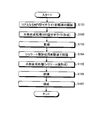
- FIG. 1 is a flowchart of the production process of the silicate-coated MFI zeolite of the present invention.
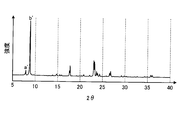
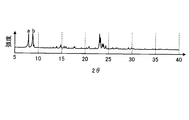
- FIG. 2 is an X-ray diffraction pattern of the ZSM-5 type zeolite according to Synthesis Example 1.
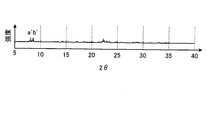
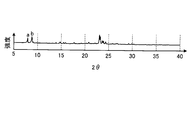
- FIG. 3 is an X-ray diffraction pattern of ZSM-5 type zeolite according to Synthesis Example 2.
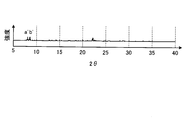
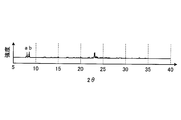
- FIG. 4 is an X-ray diffraction pattern of the ZSM-5 type zeolite according to Synthesis Example 3.
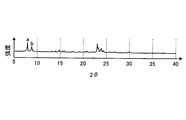
- FIG. 5 is an X-ray diffraction pattern of ZSM-5 type zeolite according to Synthesis Example 4.
- FIG. 6 is an X-ray diffraction pattern of the ZSM-5 type zeolite according to Synthesis Example 5.
- FIG. 2 is an X-ray diffraction pattern of the ZSM-5 type zeolite according to Synthesis Example 1.
- FIG. 3 is an X-ray diffraction pattern of ZSM-5 type zeolite according to Synthesis Example 2.
- FIG. 7 is an X-ray diffraction pattern of the ZSM-5 type zeolite according to Synthesis Example 6.
- FIG. 8 is an X-ray diffraction pattern of ZSM-5 type zeolite according to Synthesis Example 7.
- FIG. 9 is an X-ray diffraction pattern of commercially available ZSM-5 type zeolite.
- FIG. 10 is an X-ray diffraction pattern of the silicate-coated ZSM-5 type zeolite according to Example 1.
- FIG. 11 is an X-ray diffraction pattern of the silicate-coated ZSM-5 type zeolite according to Example 2.
- 12 is an X-ray diffraction pattern of the silicate-coated ZSM-5 type zeolite according to Example 3.
- FIG. 13 is an X-ray diffraction pattern of the silicate-coated ZSM-5 type zeolite according to Example 4.
- FIG. 14 is an X-ray diffraction pattern of the silicate-coated ZSM-5 type zeolite according to Example 5.
- FIG. 15 is an X-ray diffraction pattern of the silicate-coated ZSM-5 type zeolite according to Comparative Example 1.
- FIG. 16 is an X-ray diffraction pattern of the silicate-coated ZSM-5 type zeolite according to Comparative Example 2.
- FIG. 17 is an X-ray diffraction pattern of the silicate-coated ZSM-5 type zeolite according to Comparative Example 3.
- a silicate-coated MFI-type zeolite having a pKa value of not less than 1 and a pKa value measured by a Hammett indicator of not less than +3.3 in an aromatic hydrocarbon, in particular, toluene disproportionation reaction or alkylation reaction, p- It has been found that xylene can be produced with high selectivity and high yield.
- b / a is 1 or more
- pKa value measured by Hammett indicator is +3.3 or more. More preferably, the peak area ratio b / a is 1.4 or more, and even more preferably, the peak area ratio b / a is 1.9 or more.
- the zeolite crystal When the peak area ratio b / a is 1 or more, the zeolite crystal is relatively thin in the direction of the pores where the raw materials and products are likely to diffuse, so the reaction rate is improved and p-xylene is increased. It can be produced in a yield. And, since the pKa value of the silicate-coated MFI type zeolite measured by Hammett indicator is +3.3 or more, the outer surface acid sites having no shape selectivity are covered with a silicate inert to the reaction, and the silicate When the coated MFI type zeolite is used for the disproportionation reaction or alkylation reaction of aromatic hydrocarbons, particularly toluene, p-xylene can be produced with high selectivity.
- an X-ray diffraction pattern was obtained under the following conditions.
- the X-ray diffraction diagram may be acquired under the following conditions, and the X-ray diffraction apparatus is not limited.
- X-ray source CuK ⁇ 1
- Tube power supply 30 kV
- Tube current 20 mA
- Scan speed 4 ° / min Step width: 0.02 °
- the peak area means the integrated intensity of the peak in the X-ray diffraction diagram.
- the silicate is the core
- 2 ⁇ 8
- the peak at .4 to 9.7 ° was designated as peak b ′.
- the peak area ratio b ′ / a ′ is preferably 1 or more. More preferably, the peak area ratio b '/ a' is 2 or more, more preferably the peak area ratio b '/ a' is 5 or more, and particularly preferably the peak area ratio b '/ a' is 9 or more.
- the thickness of the zeolite crystals is relatively thin in the direction of the pores where the raw materials and products are likely to diffuse. Even if the coating is carried out, the reaction rate hardly decreases, and p-xylene can be produced in a high yield. And when silicate coating is applied to MFI-type zeolite having a peak area ratio b ′ / a ′ of 1 or more, the silicate film is likely to grow on the outer surface, so that the silicate film is uniform and has almost no defects. By using MFI-type zeolite for the disproportionation reaction or alkylation reaction of aromatic hydrocarbons, particularly toluene, p-xylene can be produced with high selectivity.
- MFI-type zeolite before silicate coating of the present invention ZSM-5, TS-1, TSZ, SSI-10, USC-4, NU-4 and the like can be preferably used, and ZSM-5 is particularly preferable.
- MFI-type zeolites have the same pore size as the minor axis of the p-xylene molecule (about 0.55 nm), so that the molecular size is slightly larger than that of p-xylene. It can be distinguished from xylene and m-xylene, and is particularly effective for producing the target p-xylene.
- the silica / alumina ratio (SiO 2 / Al 2 O 3 molar ratio) of the MFI-type zeolite before the silicate coating of the present invention is preferably 24 or more and 500 or less, more preferably 24 or more and 100 or less, and more preferably 24 or more and 70 or less. Further preferred. In order to stably maintain the MFI structure, the silica / alumina ratio is preferably 24 or more, and in order to maintain the acid amount (aluminum) that is the reaction active point, the silica / alumina ratio is 500 or less. Is preferred.
- the silicate-coated MFI type zeolite of the present invention is formed by coating the outer surface of the MFI type zeolite with silicate.
- the silicate may be amorphous, but is preferably crystalline (specifically, a crystalline silicate etc. can be mentioned), and more preferably has a crystal structure similar to that of the core MFI zeolite. And a crystalline silicate in which pores are linked (specifically, silicalite and the like can be mentioned). If the silicate has the same crystal structure as the MFI zeolite and the pores are continuous, it is difficult to block the pores of the MFI zeolite that is the reaction field.
- the silicate is desirably inert in the aromatic hydrocarbon (particularly toluene) alkylation and disproportionation reactions, and is preferably pure silica containing no aluminum.
- the ratio b / a is 1 or more.
- Silicate-coated MFI type zeolite having a peak area ratio b / a within the above range has a uniform silicate film and almost no defects, and the silicate-coated MFI type zeolite is disproportionated with aromatic hydrocarbons, particularly toluene. By using it in the reaction or alkylation reaction, p-xylene can be produced with high selectivity and high yield.
- the silicate-coated MFI zeolite of the present invention has a pKa value measured by a Hammett indicator of +3.3 or more. If the pKa value of the silicate-coated MFI type zeolite is +3.3 or higher, it is inactive in the disproportionation reaction, alkylation reaction and isomerization reaction of aromatic hydrocarbons on the outer surface, and the shape-selective reaction is efficient. Can be done well.
- the silica / alumina ratio (SiO 2 / Al 2 O 3 molar ratio) of the zeolite part of the core of the silicate-coated MFI type zeolite of the present invention is not limited as long as the MFI type structure is maintained, but is 24 or more 500 or less is preferable, 24 to 100 is more preferable, and 24 to 70 is more preferable.
- the silica / alumina ratio is preferably 24 or more, and in order to maintain the acid amount (aluminum) that is the reaction active point, the silica / alumina ratio is 500 or less. Is preferred.
- the pKa value by Hammett indicator is an index indicating the strength of acid and base, and general explanation and measurement methods are described in detail in the book. That is, with a neutral pKa value of +7.0, a value greater than +7.0 indicates a stronger base strength, and a value less than +7.0 indicates a higher acid strength.
- a spectrocolorimeter may be used for the specific measurement of the pKa value in the present invention. Specifically, 0.25 g of silicate-coated MFI zeolite is added to 7 ml of a Hammett reagent dehydrated benzene solution having a predetermined concentration (each concentration is shown in Table 1), and the color change of the silicate-coated MFI zeolite, that is, a Hammett indicator. This is carried out by determining the degree of coloring due to the discoloration using a spectrocolorimeter.
- the color change (degree of coloring) is observed with the spectrocolorimeter in the L * a * b * color system defined by the Japanese Industrial Standard JIS Z 8729, with the values of the coordinates a * and b *. Measure and do.
- the Hammett indicator used for the measurement of the pKa value in the present invention is 2,4-dinitrotoluene (pKa: -13.75), p-nitrotoluene (pKa: -11.35), anthraquinone (pKa: -8.2).
- Benzalacetophenone (pKa: -5.6), dicinnamalacetone (pKa: -3.0), benzeneazodiphenylamine (pKa: +1.5), p-dimethylaminoazobenzene (pKa: +3.3), 4- (phenylazo) -1-naphthylamine (pKa: +4.0), methyl red (pKa: +4.8), neutral red (pKa: +6.8) and the like. Since these Hammett indicators are molecules having a size that does not enter the pores of the MFI-type zeolite, they react only with acid sites present on the outer surface of the zeolite and change color.
- An indicator for determining that the zeolite has changed the Hammett indicator is that high-purity silica that does not change the Hammett indicator (Tosoh Silica, Nipgel AZ-200) is added to each Hammett indicator solution shown in Table 1.
- Table 1 shows coloring judgment indexes of Hammett indicators.
- a pKa value measured by a Hammett indicator of +3.3 or more means that p-dimethylaminoazobenzene (pKa: +3.3) is not discolored.
- the core MFI type zeolite uses a structure-directing agent such as tetrapropylammonium bromide (TPABr), tetrapropylammonium hydroxide (TPAOH), or tetraethylammonium hydroxide.
- TPABr tetrapropylammonium bromide
- TPAOH tetrapropylammonium hydroxide
- TPABr tetrapropylammonium bromide
- a silica source used when synthesizing the core MFI type zeolite amorphous silica, amorphous silica, fumed silica, colloidal silica, tetraethyl orthosilicate (TEOS), sodium silicate, potassium silicate, lithium silicate, etc. can be used.
- TEOS tetraethyl orthosilicate
- sodium silicate, potassium silicate, lithium silicate, etc. can be used.
- aluminum source sodium aluminate, potassium aluminate, aluminum chloride, aluminum nitrate, aluminum sulfate, aluminum hydroxide, and the like can be used.
- MFI-type zeolite serving as a core may be crystallized in the presence of fluoride ions.
- the core MFI type zeolite may be crystallized in the presence of the mineralizing agent.
- the mineralizing agent alkali metal or alkaline earth metal hydroxide is used. A specific example is sodium hydroxide.
- the core MFI-type zeolite is preferably crystallized by hydrothermal synthesis or the like.
- the hydrothermal synthesis treatment can take a general method. For example, a silica source, an aluminum source, a fluorine source, a mineralizer, a structure directing agent is mixed with water or an aqueous alcohol solution to form a precursor solution, and the obtained precursor is obtained. The solution is introduced into an autoclave and heated.
- the temperature of the hydrothermal synthesis treatment is preferably 100 ° C. or more and 250 ° C. or less, and more preferably hydrothermal synthesis treatment at a temperature of 150 ° C. or more and 200 ° C. or less.
- the hydrothermal synthesis treatment time is preferably 0.5 hours or more and 120 hours or less, more preferably 1 hour or more and 100 hours or less, and further preferably 10 hours or more and 100 hours or less. In addition, you may perform a hydrothermal synthesis process in multiple times.
- an ion exchange treatment may be performed before coating the outer surface of the core with silicate.
- the ion exchange treatment here refers to making the zeolite into a proton type.
- the activity is expressed by exchanging alkali metal ions and the like with ammonium ions to make the zeolite into an ammonium type and then baking it into a proton type.
- the ammonium ion source include ammonium nitrate and ammonium chloride.
- the crystallized core is dried at 80 to 140 ° C., followed by baking at 450 to 700 ° C.
- silicate coating may be performed without performing a baking treatment after drying performed after ion exchange.
- the aluminum dissolves when coated with silicate, and is taken into the outer surface of the zeolite to express acid sites. Therefore, it is not preferable.
- the proportion of aluminum derived from outside the zeolite framework is preferably 10% or less, more preferably 5% or less, and even more preferably 1% or less. .
- the method for removing aluminum contained outside the zeolite framework is not particularly limited, but the zeolite is put into water at 50 to 100 ° C., stirred for 10 minutes to 1 day, filtered, and then at 80 to 140 ° C.
- the method of drying is mention
- extra-framework aluminum can be removed also by the ion exchange treatment described above. It is more preferable to remove extra-skeletal aluminum by ion exchange treatment because it can be performed simultaneously with ion exchange.
- the silicate covering the core MFI-type zeolite is desirably inert to aromatic hydrocarbons, particularly toluene disproportionation reaction and alkylation reaction, and is pure silica containing no alumina component (active component) (for example, Silicalite) is preferred. Since pure silica has almost no acid sites, the coated MFI-type zeolite surface can be inactivated against disproportionation reaction or the like. By coating MFI-type zeolite uniformly with pure silica without any defects, disproportionation reaction, isomerization reaction, and the like on the outer surface can be suppressed, and only a reaction corresponding to the size of the molecular sieve in the pores can be caused.
- the mass of the silicate membrane is preferably 1 part by mass or more and 100 parts by mass or less with respect to 100 parts by mass of the MFI type zeolite as the core. If the silicate membrane is less than 1 part by mass with respect to 100 parts by mass of the MFI-type zeolite as the core, the molecular sieving action of the silicate membrane cannot be sufficiently exhibited, which is not preferable. Further, when the silicate membrane exceeds 100 parts by mass with respect to 100 parts by mass of the MFI zeolite as the core, the ratio of the MFI zeolite as the core in the catalyst is reduced, or the raw materials and products pass through the silicate membrane. This is not preferable because the resistance at the time increases and the conversion of the reaction decreases.
- the mass of the silicate membrane is particularly preferably 10 parts by mass or more and 70 parts by mass or less with respect to 100 parts by mass of the MFI type zeolite serving as the core.
- the particle size of the silicate-coated MFI zeolite according to the present invention is preferably 1 ⁇ m or more and 40 ⁇ m or less, and more preferably 1 ⁇ m or more and 25 ⁇ m or less. If the particle size of the silicate-coated MFI-type zeolite is larger than 40 ⁇ m, the length of the silicate-coated MFI-type zeolite pores becomes longer, the diffusion rate of the reaction substrate (raw material) in the pores becomes slower, and a practical conversion rate is obtained. It is because it becomes impossible. Further, if the particle size of the silicate-coated MFI zeolite is smaller than 1 ⁇ m, the core MFI zeolite aggregates and it is difficult to uniformly coat with the silicate.
- silicate coating-Preparation of silicate film precursor solution Although the silicate coating method of the MFI type zeolite used as a core is not limited to the method described below, a hydrothermal synthesis method can be used.
- raw materials such as tetraethyl orthosilicate (TEOS), fumed silica, colloidal silica, and other silica sources, tetrapropylammonium bromide (TPABr), tetrapropylammonium hydroxide (TPAOH), and the like, water or alcohol
- TPABr tetrapropylammonium bromide
- TPAOH tetrapropylammonium hydroxide
- a precursor solution for forming a silicate film is prepared by dissolving in an aqueous solution. At this time, the precursor solution preferably does not contain fluoride ions.
- the silica source is 0.5 to 5 moles with respect to 120 moles of water on the oxide basis, and the structure directing agent is 0.01 to 0.5 moles with respect to 120 moles of water. It is preferable to mix them.
- the hydrothermal synthesis treatment temperature is preferably 100 ° C. or more and 250 ° C. or less, and more preferably hydrothermal synthesis treatment at a temperature of 150 ° C. or more and 200 ° C. or less.
- the hydrothermal synthesis treatment time is preferably 0.5 hours or more and 48 hours or less, and more preferably 1 hour or more and 36 hours or less.
- the silicate-coated MFI-type zeolite is taken out, dried at 80 to 140 ° C., and further calcined.
- the firing treatment may be performed by heating at a temperature rising rate of 0.1 ° C. to 10 ° C./min, if necessary, followed by heat treatment at a temperature of 450 ° C. to 700 ° C. for 2 to 10 hours.
- the structure-directing agent in the pores is removed by firing to form pores that serve as molecular sieves in the core and silicate film.
- the silicate-coated MFI-type zeolite may be further ion-exchanged after the calcination to obtain the silicate-coated MFI-type zeolite of the present invention.
- the ion exchange processing method is the same as described above ([0042]). However, when the ion exchange treatment is performed before the silicate coating treatment, the ion exchange treatment after the silicate coating does not have to be performed.
- a mineralizer when preparing the core MFI-type zeolite, it is ionized either at the preparation stage of the core MFI-type zeolite or after the calcining treatment of the silica-coated MFI-type zeolite. An exchange process may be performed.
- FIG. 1 shows an example of the production process of the silicate-coated MFI zeolite of the present invention.
- a precursor solution is prepared (step S101), and MFI is obtained by hydrothermal synthesis treatment.
- a type zeolite is formed (step S102) and dried (step S103).
- the core MFI-type zeolite may be prepared by the above method, or a commercially available product may be used as long as the peak area ratio b / a is 1 or more.
- the MFI-type zeolite is immersed in a silicate film forming precursor solution in which a silica source and a structure directing agent are dispersed in a predetermined amount in water or an aqueous alcohol solution (step S104).
- the MFI-type zeolite before being immersed in the silicate film forming precursor solution is preferably one that is not calcined after the hydrothermal synthesis treatment of S102, that is, one that has no calcining history. This is because the silicate film easily grows uniformly in the MFI type zeolite not subjected to the calcination treatment.
- the MFI type zeolite immersed in the silicate film forming precursor solution is hydrothermally synthesized at a predetermined temperature to form a silicate film (step S105).
- the hydrothermal synthesis treatment is performed at a temperature range of 100 to 250 ° C. for 0.5 to 48 hours.
- the silicate-coated MFI-type zeolite is dried (step S106), and a calcination treatment is performed in a temperature range of 450 ° C. to 700 ° C. for a predetermined time (step S107).
- a calcination treatment pores to be molecular sieves are formed in the core and the silicate film to produce a silicate-coated MFI zeolite.
- the silicate-coated MFI zeolite prepared by the above method is not colored with a Hammett indicator (p-dimethylaminoazobenzene) having a pKa value of +3.3, that is, a pKa value of +3.3 or more, and is an MFI type zeolite.
- the outer surface acid sites are coated with a silicate inert to the reaction.
- step S101 and S102 when the MFI type zeolite precursor containing the mineralizer is used for hydrothermal synthesis treatment of the core MFI type zeolite, it is calcined and ionized after the drying step of step S103. It is preferable to perform an exchange process, or to perform an ion exchange process after the baking process of step S107.
- toluene As a raw material for producing p-xylene, toluene is preferable.
- Toluene which is a raw material, can contain water, olefin, sulfur compound and nitrogen compound as impurities, but it is preferable that the content of impurities is small.
- the water content is preferably 200 mass ppm or less, and more preferably 100 mass ppm or less.
- the olefin content is preferably 1% by mass or less, and more preferably 0.5% by mass or less.
- the nitrogen compound content is preferably 1 mass ppm or less.
- the moisture content mentioned here is the Karl Fischer-type coulometric titration method of JIS K 2275 “Crude oil and petroleum products—moisture test method”, and the olefin content is the fluorescent indicator adsorption of JIS K 2536 “Petroleum product-component test method”.
- the nitrogen compound content is a value measured by the chemiluminescence method of JIS K 2609 “Crude oil and petroleum products—nitrogen content test method”.
- Disproportionation reaction of an aromatic hydrocarbon supplies the aromatic hydrocarbons in the range of liquid hourly space velocity (LHSV) 0.01h -1 ⁇ 10h -1 , and a silicate coating MFI type zeolite of the present embodiment It is preferable to make it contact.
- Liquid hourly space velocity of the aromatic hydrocarbons (LHSV) is more preferably fed at a range of 0.1h -1 ⁇ 5h -1.
- the aromatic hydrocarbon disproportionation reaction is preferably carried out by heating in the range of 200 ° C to 550 ° C. If the reaction temperature is lower than 200 ° C., the reaction does not proceed easily, and if the reaction temperature is higher than 550 ° C., the selectivity of p-xylene decreases and the energy consumption increases, which is not preferable.
- the reaction temperature is more preferably 230 ° C. to 530 ° C., particularly preferably 260 ° C. to 510 ° C.
- the reaction pressure is preferably from atmospheric pressure to 10 MPaG, more preferably from 0.5 MPaG to 5 MPaG.
- Raw materials include aromatic hydrocarbons such as benzene and toluene.
- the raw material aromatic hydrocarbon may contain a hydrocarbon compound other than benzene and toluene.
- p-xylene is the target product, it is not preferable to use m-xylene or o-xylene as a raw material. Highly reactive toluene is more preferable as a raw material.
- Examples of the alkylating agent used for the alkylation reaction of the aromatic hydrocarbon include methanol and dimethyl ether. Commercial products can be used for these, but for example, methanol or dimethyl ether produced from synthesis gas, which is a mixed gas of hydrogen and carbon monoxide, or dimethyl ether produced by dehydration reaction of methanol may be used as a starting material. .
- Examples of impurities that may be present in benzene, toluene, methanol, and dimethyl ether include water, olefins, sulfur compounds, and nitrogen compounds.
- the water content is 200 ppm by weight or less, more preferably 100 ppm by weight or less, the olefin content is 1% by weight or less, more preferably 0.5% by weight or less, the sulfur compound content and the nitrogen compound content is 1 Weight ppm or less, More preferably, it is 0.1 weight ppm or less.
- the moisture content mentioned here is the Karl Fischer-type coulometric titration method of JIS K 2275 “Crude oil and petroleum products—moisture test method”, and the olefin content is the fluorescent indicator adsorption of JIS K 2536 “Petroleum product-component test method”.
- the sulfur compound content is measured by the chemiluminescence method of JIS K 241 “Crude oil and petroleum products-sulfur content test method”, and the nitrogen compound content is measured by the chemiluminescence method of JIS K 2609 “Crude oil and petroleum products-nitrogen content test method”. Value.
- the ratio of the alkylating agent to the aromatic hydrocarbon in the alkylation reaction of the aromatic hydrocarbon is preferably 5/1 to 1/20 as the molar ratio of the methyl group to the aromatic hydrocarbon, and 2/1 to 1/10. Is more preferable, and 1/1 to 1/5 is particularly preferable.
- the amount of alkylating agent is excessively large with respect to the aromatic hydrocarbon, the reaction between undesirable alkylating agents proceeds, which may cause coking that causes catalyst deterioration, which is not preferable. Further, when the amount of alkylating agent is extremely small relative to the aromatic hydrocarbon, the alkylation reaction to the aromatic hydrocarbon does not proceed and the recycling of the aromatic hydrocarbon increases, which is not preferable.
- the aromatic hydrocarbons feedstock liquid hourly space velocity (LHSV) 0.01h -1 or more, more preferably 0.1 h -1 or more, 10h -1 or less, more preferably It is desirable to carry out by supplying 5 h ⁇ 1 or less and contacting with the silicate-coated MFI zeolite according to the present embodiment.
- the reaction conditions for the alkylation reaction are not particularly limited, but the reaction temperature is preferably 200 ° C. or higher, more preferably 230 ° C. or higher, particularly preferably 260 ° C. or higher, preferably 550 ° C. or lower, more preferably Is 530 ° C. or less, particularly preferably 510 ° C. or less, and the pressure is preferably atmospheric pressure or more, more preferably 0.1 MPaG or more, particularly preferably 0.5 MPaG or more, preferably 10 MPaG or less, more preferably 5 MPaG or less. It is.
- an inert gas such as nitrogen or helium or hydrogen for suppressing coking may be circulated in the alkylation reaction, and the pressure may be atmospheric or pressurized. If the reaction temperature is too low, the activation of the aromatic hydrocarbon and the alkylating agent is insufficient, so the conversion rate of the raw aromatic hydrocarbon is low. On the other hand, if the reaction temperature is too high, much energy is consumed. In addition to consumption, the catalyst life tends to be short.
- the silicate-coated MFI zeolite of the present invention is characterized by having a peak area ratio b / a to a certain peak b of 1 or more and a pKa value measured by a Hammett indicator of +3.3 or more. By using it in a disproportionation reaction or alkylation reaction of hydrocarbons, particularly toluene, high-purity p-xylene can be produced with high selectivity.
- ZSM-5 had a SiO 2 / Al 2 O 3 ratio of 69 (molar ratio).
- fluorine content of ZSM-5 obtained by X-ray photoelectron spectroscopy was measured, it was found to be less than 0.1 mol%, and it was found that no fluorine was contained in ZSM-5.
- the obtained ZSM-5 had a SiO 2 / Al 2 O 3 ratio of 97 (molar ratio).
- Example 1 SiO 2 : TPAOH: EtOH: H 2 O 2: 0.05: 0.8: 120 using tetraethyl orthosilicate (TEOS), tetrapropylammonium hydroxide (TPAOH), ethanol (EtOH) and deionized water.
- TEOS tetraethyl orthosilicate
- TPAOH tetrapropylammonium hydroxide
- EtOH ethanol
- deionized water A precursor solution for forming a silicate film was prepared so as to have a (molar ratio).
- ZSM-5 obtained in Synthesis Example 1 and the prepared silicate film forming precursor solution were mixed, and hydrothermal synthesis was performed at 180 ° C. for 24 hours. After hydrothermal synthesis, the obtained product was washed and filtered at 25 ° C. using ion-exchanged water, dried at 130 ° C.
- silicate-coated MFI type zeolite had a pKa value of +3.3 or higher, that is, the Hammett indicator having a pKa of +3.3 did not change color.
- TEOS tetraethyl orthosilicate
- TPAOH tetrapropylammonium hydroxide
- EtOH ethanol
- deionized water A precursor solution for forming a silicate film was prepared so as to have a (molar ratio).
- ZSM-5 obtained in Synthesis Example 2 and the prepared silicate film-forming precursor solution were mixed, and hydrothermal synthesis was performed at 180 ° C. for 24 hours. After hydrothermal synthesis, the resulting product was washed and filtered at 25 ° C. using ion-exchanged water, dried at 130 ° C.
- silicate-coated MFI zeolite had a pKa value of +3.3 or higher, that is, the Hammett indicator having a pKa of +3.3 did not change color.
- silicate-coated MFI-type zeolite was obtained by calcination at 5 ° C. for 5 hours.
- the resulting silicate-coated MFI zeolite had a pKa value of +3.3 or higher, that is, the Hammett indicator having a pKa of +3.3 did not change color.
- TEOS tetraethyl orthosilicate
- TPAOH tetrapropylammonium hydroxide
- EtOH ethanol
- deionized water A silicate film forming precursor solution was prepared so as to have a (molar ratio).
- ZSM-5 obtained in Synthesis Example 4 and the prepared silicate film forming precursor solution were mixed, and hydrothermal synthesis was performed at 180 ° C. for 24 hours. After hydrothermal synthesis, the resulting product was washed and filtered at 25 ° C. using ion-exchanged water, dried at 130 ° C.
- silicate-coated MFI zeolite had a pKa value of +3.3 or higher, that is, the Hammett indicator having a pKa of +3.3 did not change color.
- silicate-coated MFI zeolite had a pKa value of +3.3 or higher, that is, the Hammett indicator having a pKa of +3.3 did not change color.
- silicate-coated MFI zeolite had a pKa value of ⁇ 3.0 to +1.5, that is, a Hammett indicator having a pKa of +1.5 was discolored, and a Hammett indicator of ⁇ 3.0 was not discolored.
- silicate-coated MFI-type zeolite has a pKa value of ⁇ 5.6 or more and ⁇ 3.0 or less, that is, the Hammett indicator having a pKa of ⁇ 3.0 is discolored and the Hammett indicator of ⁇ 5.6 is not discolored. It was.
- silicate-coated MFI zeolite had a pKa value of ⁇ 3.0 to +1.5, that is, a Hammett indicator having a pKa of +1.5 was discolored, and a Hammett indicator of ⁇ 3.0 was not discolored.
- the analysis conditions for acquiring the X-ray diffraction spectrum are as follows. Equipment: Ultimate IV, manufactured by Rigaku Corporation X-ray source: CuK ⁇ 1 Tube power supply: 30 kV Tube current: 20 mA Scan speed: 4 ° / min Step width: 0.02 °
- the ratio of aluminum in the skeleton refers to the ratio of tetracoordinated aluminum to the sum of tetracoordinated and hexacoordinated aluminum calculated from 29 Al-NMR spectrum.
- the particle diameter is the mode diameter (most frequent diameter) in the volume-based particle size distribution.
- Crystallinity (%) (Strength of (101 face) of each zeolite) / (Strength of (101) face of ZSM-5 manufactured by NE CHEMCAT) ⁇ 100
- Synthesis Examples 1 to 5 have peak a ′ areas at 7.0 to 8.4 ° in the X-ray diffraction diagram and 8.4 to 9.7 °.
- the peak area ratio b ′ / a ′ with a certain peak b ′ area was found to be 1 or more (2.3, 9.6, 1.4, 1.2, 1.2).
- the peak area ratio b ′ / a ′ of Synthesis Example 6 and the commercially available ZSM-5 is smaller than 0.8, 0.9 and 1, which is clearly that of ZSM-5. It can be seen that the developed crystal plane is different from those of Synthesis Examples 1-5. As shown in FIG.
- Synthesis Example 7 washed with water without performing ion exchange after the baking treatment has a peak area ratio b ′ / a ′ of 1 or more, but the ratio of aluminum in the skeleton is It was found to be small (58%), that is, a large amount of extra-framework aluminum was present (42%).
- the peak a area at 7.0 to 8.4 ° in the X-ray diffraction diagram, and 8.4 to 9.7.
- the peak area ratio b / a to the peak b area at ° is 1 or more (1.4, 1.9, 1.2, 1.2, 1.2), and the pKa value is +3.3. It turns out that it is above.
- the peak area ratio b / a of Comparative Examples 1 and 2 is smaller than 0.8, 0.9 and 1 as shown in FIGS. 15 and 16, and clearly the development of ZSM-5 after silicate coating. It can be seen that the obtained crystal plane is different from those in Examples 1 to 5. Further, as shown in FIG.
- a fixed bed reaction vessel is filled with 20 mg of MFI zeolite or silicate-coated MFI zeolite, hydrogen / toluene is 60 mol / mol, and LHSV is 0.48 h ⁇ 1 , 0.9 MPaG, 400 ° C. It was.
- the product at the outlet of the reaction vessel was analyzed by gas chromatography to determine the toluene conversion and p-xylene selectivity.
- Measuring device GC-2014 manufactured by Shimadzu Corporation
- Column Capillary column Xylene Master, inner diameter 0.32 mm, length 50 m
- Temperature conditions column initial temperature 50 ° C., heating rate 2 ° C./min, detector (FID) temperature 250 ° C.
- Carrier gas helium
- Table 3 shows the results of the catalyst performance evaluation test together with the pKa value.
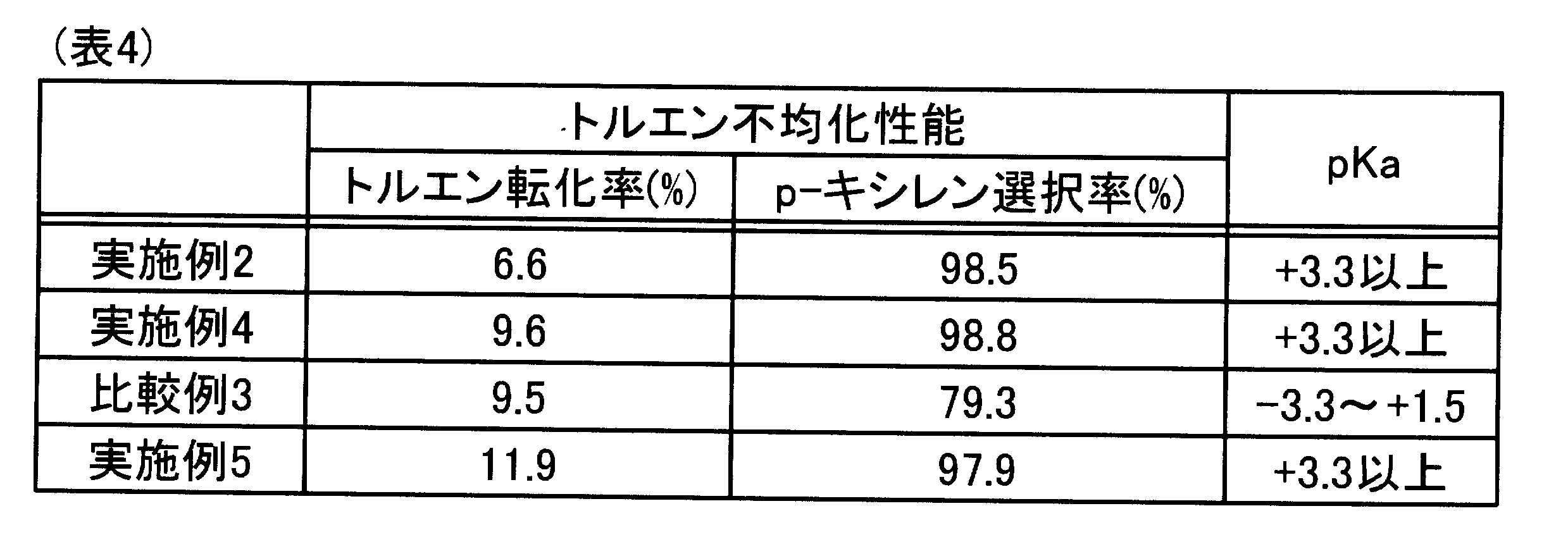
- a fixed bed reaction vessel was filled with 0.5 g of silicate-coated MFI zeolite, hydrogen / toluene was set to 1.0 mol / mol, and LHSV was 6.0 h ⁇ 1 , normal pressure, and 500 ° C. to perform a disproportionation reaction. .
- the product at the outlet of the reaction vessel was analyzed by gas chromatography to determine the toluene conversion and p-xylene selectivity.
- Example 4 in which ion exchange treatment was performed before silicate coating and silicate-coated MFI type zeolite with 0% extra-framework aluminum was used as a catalyst was washed with water, and the extra-framework aluminum was 8%. It was found that the p-xylene selectivity was higher than that of Comparative Example 3 in which% silicate-coated MFI zeolite was used as a catalyst. Further, Example 5 using a silicate-coated MFI type zeolite having a small particle size as a catalyst was more effective than Example 4 using a silicate-coated MFI type zeolite having a large particle size as a catalyst while maintaining p-xylene selectivity. It was found that the conversion rate was improved.
- the silicate-coated MFI-type zeolite and the method for producing the silicate-coated MFI-type zeolite according to the present invention are industrially feasible, and are free of aromatic hydrocarbons (particularly toluene). It is useful for the production of p-xylene by a leveling reaction or an alkylation reaction.
Landscapes
- Chemical & Material Sciences (AREA)
- Organic Chemistry (AREA)
- Chemical Kinetics & Catalysis (AREA)
- Engineering & Computer Science (AREA)
- Materials Engineering (AREA)
- Geology (AREA)
- Life Sciences & Earth Sciences (AREA)
- General Life Sciences & Earth Sciences (AREA)
- Inorganic Chemistry (AREA)
- Crystallography & Structural Chemistry (AREA)
- Physics & Mathematics (AREA)
- Thermal Sciences (AREA)
- Organic Low-Molecular-Weight Compounds And Preparation Thereof (AREA)
- Catalysts (AREA)
- Low-Molecular Organic Synthesis Reactions Using Catalysts (AREA)
- Silicates, Zeolites, And Molecular Sieves (AREA)
Abstract
Description
本発明のシリケート被覆MFI型ゼオライトは、X線回折スペクトルにおいて2θ=7.0~8.4°にあるピークaと、2θ=8.4~9.7°にあるピークbとのピーク面積比b/aが1以上で、ハメット指示薬により測定されたpKa値が+3.3以上である。より好ましくはピーク面積比b/aが1.4以上、さらに好ましくはピーク面積比b/aが1.9以上である。ピーク面積比b/aが1以上であると、原料ならびに生成物が拡散しやすい細孔のある方向にゼオライト結晶の厚さが相対的に薄いため、反応速度が向上してp-キシレンを高収率で製造できる。そして、ハメット指示薬により測定された該シリケート被覆MFI型ゼオライトのpKa値が+3.3以上であるため、形状選択性のない外表面酸点が反応に不活性なシリケートで覆われており、該シリケート被覆MFI型ゼオライトを芳香族炭化水素、特にはトルエンの不均化反応またはアルキル化反応に用いると、p-キシレンを高選択率で製造できる。
装置:(株)リガク製 Ultima IV
X線源:CuKα1
管電源:30kV
管電流:20mA
スキャン速度:4°/分
ステップ幅:0.02°
ハメット指示薬によるpKa値は、酸及び塩基の強度を示す指標であり、一般的な解説や測定法については、成書に詳しく記載がある。すなわち、pKa値が+7.0を中性として、+7.0より大きい値ほど塩基強度が強いことを示し、+7.0より小さい値ほど酸強度が強いことを意味する。

(コアの調製-構造規定剤)
本発明のシリケート被覆MFI型ゼオライトに係る製造方法において、コアとなるMFI型ゼオライトはテトラプロピルアンモニウムブロミド(TPABr)や、テトラプロピルアンモニウムヒドロキシド(TPAOH)、テトラエチルアンモニウムヒドロキシドなどの構造規定剤を使用して結晶化することが好ましく、なかでも、テトラプロピルアンモニウムブロミド(TPABr)を構造規定剤として使用することがより好ましい。
コアとなるMFI型ゼオライトを合成する際に用いるシリカ源としては、無定形シリカ、アモルファスシリカ、フュームドシリカ、コロイダルシリカ、オルトケイ酸テトラエチル(TEOS)、珪酸ナトリウム、珪酸カリウム、珪酸リチウムなどが使用できる。
また、アルミニウム源としては、アルミン酸ナトリウム、アルミン酸カリウム、塩化アルミニウム、硝酸アルミニウム、硫酸アルミニウム、水酸化アルミニウムなどが使用できる。
コアとなるMFI型ゼオライトは、水熱合成等により結晶化させることが好ましい。水熱合成処理は一般的な方法をとることができ、例えば、シリカ源、アルミ源、フッ素源、鉱化剤、構造規定剤を水またはアルコール水溶液と混合して前駆液とし、得られた前駆液をオートクレーブに導入して加熱することにより行う。水熱合成処理の温度は、100℃以上、250℃以下とすることが好ましく、150℃以上、200℃以下の温度で水熱合成処理することがより好ましい。また、水熱合成処理の時間は、0.5時間以上120時間以下が好ましく、1時間以上100時間以下がより好ましく、10時間以上100時間以下とするのがさらに好ましい。なお、水熱合成処理は複数回行っても構わない。
コアとなるMFI型ゼオライトを被覆するシリケートは、芳香族炭化水素、特にはトルエン不均化反応およびアルキル化反応に不活性であることが望ましく、アルミナ成分(活性成分)を含まない純シリカ(例えばシリカライト)であることが好適である。純シリカは、酸点がほとんどないため、被覆後のMFI型ゼオライト表面を不均化反応等に対して不活性化することができる。MFI型ゼオライトを純シリカで均一に欠陥なく被覆することにより、外表面での不均化反応や異性化反応等を抑制し、細孔内の分子篩サイズに応じた反応のみを起こすことができる。
コアとなるMFI型ゼオライトのシリケート被覆方法は、以下に記載の方法に限定されるものではないが、水熱合成法を使用することができる。例えば、原料であるオルトケイ酸テトラエチル(TEOS)、フュームドシリカ、コロイダルシリカなどのシリカ源、テトラプロピルアンモニウムブロミド(TPABr)や、テトラプロピルアンモニウムヒドロキシド(TPAOH)などの構造規定剤を、水またはアルコール水溶液に溶かしてシリケート膜形成用前駆液を調製する。この時、該前駆液はフッ化物イオンを含まないことが好ましい。なお、シリケート膜形成用前駆液において、シリカ源は酸化物基準で水120モルに対して0.5~5モル、構造規定剤は水120モルに対して0.01~0.5モルとなるよう混合することが好ましい。
コアとなるMFI型ゼオライトとシリケート膜形成用前駆液とを入れたオートクレーブをオーブンに入れて加熱することにより行う。この水熱合成処理の温度は、100℃以上、250℃以下とすることが好ましく、150℃以上、200℃以下の温度で水熱合成処理することがより好ましい。また、水熱合成処理の時間は、0.5時間以上、48時間以下が好ましく、1時間以上、36時間以下とするのがより好ましい。
水熱合成処理後、シリケート被覆MFI型ゼオライトを取り出して80~140℃で乾燥し、さらに焼成処理を行う。焼成処理は、必要に応じて0.1℃~10℃/分の昇温速度で昇温し、その後450℃~700℃の温度で2~10時間熱処理することにより行えばよい。焼成によって細孔内にある構造規定剤を除去し、コアおよびシリケート膜に分子篩となる細孔を形成する。
コアとなるMFI型ゼオライトを調製する際に鉱化剤を使用した場合は、前記焼成処理後、さらにシリケート被覆MFI型ゼオライトをイオン交換処理して、本発明のシリケート被覆MFI型ゼオライトを得ることが好ましい。イオン交換処理方法は、先の記述([0042])と同様である。ただし、シリケート被覆処理前にイオン交換処理を行っている場合は、シリケート被覆後のイオン交換処理を行わなくてよい。
つまり、コアとなるMFI型ゼオライトを調製する際に鉱化剤を使用した場合は、前述のコアとなるMFI型ゼオライトの調製段階、またはシリカ被覆MFI型ゼオライトの焼成処理の後のいずれかにイオン交換処理を行えばよい。
本発明の実施の形態に係るシリケート被覆MFI型ゼオライトを用いた、芳香族炭化水素の不均化反応によるp-キシレンの製造について説明する。
なお、ここでいう水分含有量はJIS K 2275「原油及び石油製品-水分試験方法」のカールフィッシャー式電量滴定法で、オレフィン含有量はJIS K 2536「石油製品-成分試験方法」の蛍光指示薬吸着法で、窒素化合物含有量はJIS K 2609「原油及び石油製品-窒素分試験方法」の化学発光法で測定される値である。
本発明の実施の形態に係るシリケート被覆MFI型ゼオライトを用いた、芳香族炭化水素のアルキル化反応によるp-キシレンの製造について説明する。
なお、ここでいう水分含有量はJIS K 2275「原油及び石油製品-水分試験方法」のカールフィッシャー式電量滴定法で、オレフィン含有量はJIS K 2536「石油製品-成分試験方法」の蛍光指示薬吸着法で、硫黄化合物含有量はJIS K 241「原油及び石油製品-硫黄分試験方法」で、窒素化合物含有量はJIS K 2609「原油及び石油製品-窒素分試験方法」の化学発光法で測定される値である。
アルキル化反応の反応条件は、特に限定されるものではないが、反応温度が好ましくは200℃以上、より好ましくは230℃以上、特に好ましくは260℃以上であり、好ましくは550℃以下、より好ましくは530℃以下、特に好ましくは510℃以下であり、また、圧力が好ましくは大気圧以上、より好ましくは0.1MPaG以上、特に好ましくは0.5MPaG以上、好ましくは10MPaG以下、より好ましくは5MPaG以下である。
最初に、ピーク面積比b’/a’が1以上のZSM-5(合成例1~3、6および7)と、ピーク面積比b’/a’が1未満のZSM-5を製造または用意した(合成例4、5および市販品)。合成例1~7および市販品のZSM-5を、シリケート被覆してシリケート被覆MFI型ゼオライトを調製した(実施例1~5、比較例1~3)。
オルトケイ酸テトラエチル(TEOS)、硝酸アルミニウム、水酸化ナトリウム、テトラプロピルアンモニウムブロミド(TPABr)および脱イオン水を用いて、SiO2:Al2O3:Na2O:TPABr:H2O=1:0.01:0.1:0.2:42(モル比。シリカ源、アルミナ源およびナトリウム源は酸化物基準でのモル比)とし、180℃で24時間水熱合成した。水熱合成後、得られた生成物を25℃でイオン交換水を用いて洗浄ろ過して、130℃で乾燥した。得られたZSM-5のSiO2/Al2O3は97(モル比)であった。
フュームドシリカ、水酸化アルミニウム、テトラプロピルアンモニウムブロミド、フッ化アンモニウムおよび脱イオン水を用いて、SiO2:Al2O3:TPABr:F-:H2O=1:0.025:0.125:0.9:33(モル比。シリカ源およびアルミナ源は酸化物基準でのモル比)とし、180℃で70時間水熱合成した。水熱合成後、得られた生成物を25℃でイオン交換水を用い洗浄ろ過して、130℃で12時間乾燥後、550℃にて7時間焼成処理した後、イオン交換し、130℃で12時間乾燥し、450℃で2時間焼成した。得られたZSM-5のSiO2/Al2O3は69(モル比)であった。X線光電子分光法にて得られたZSM-5のフッ素含有量を測定したところ、0.1mol%未満であり、ZSM-5中にはフッ素は含有されていないことがわかった。
オルトケイ酸テトラエチル(TEOS)、硝酸アルミニウム、水酸化ナトリウム、テトラプロピルアンモニウムブロミド、フッ化アンモニウムおよび脱イオン水を用いて、SiO2:Al2O3:Na2O:TPABr:F-:H2O=1:0.01:0.1:0.2:1.4:42(モル比。シリカ源、アルミナ源およびナトリウム源は酸化物基準でのモル比。)とし、180℃で70時間水熱合成した。水熱合成後、得られた生成物を25℃でイオン交換水を用い洗浄ろ過して、乾燥後、550℃にて7時間焼成処理した後、イオン交換し、130℃で12時間乾燥し、450℃で2時間焼成した。得られたZSM-5のSiO2/Al2O3は97(モル比)であった。
フュームドシリカ、水酸化アルミニウム、テトラプロピルアンモニウムブロミド、フッ化アンモニウムおよび脱イオン水を用いて、SiO2:Al2O3:TPABr:F-:H2O=1:0.042:0.125:0.9:33(モル比。シリカ源およびアルミナ源は酸化物基準でのモル比)とし、180℃で70時間水熱合成した。水熱合成後、得られた生成物を水で洗浄ろ過して、130℃で12時間乾燥後、550℃にて7時間焼成処理した後、イオン交換し、130℃で12時間乾燥し、450℃で2時間焼成した。得られたZSM-5のSiO2/Al2O3は60(モル比)であり、全アルミニウム中の骨格外アルミニウムの割合は0%であった。
合成例4で得たZSM-5を635メッシュ(20μm)のふるいを用いて分級し、微粉ZSM-5を得た。
合成例1で得たZSM-5を、550℃で2時間焼成処理した後、イオン交換し、130℃で12時間乾燥し、450℃で2時間焼成した。SiO2/Al2O3は合成例1と同様97(モル比)であった。
合成例4と同様の処方および工程で、180℃で70時間の水熱合成処理および550℃で7時間の焼成処理を行なった後、イオン交換処理を行なわずに得られた生成物を25℃でイオン交換水を用い洗浄ろ過して、130℃で12時間乾燥後、550℃にて7時間焼成処理した。得られたZSM-5のSiO2/Al2O3は42(モル比)であり、全アルミニウム中の骨格外アルミニウムの割合は42%であった。
市販されているZSM-5を用いた。SiO2/Al2O3は49(モル比)であった。
オルトケイ酸テトラエチル(TEOS)、テトラプロピルアンモニウムヒドロキシド(TPAOH)、エタノール(EtOH)および脱イオン水を用いて、SiO2:TPAOH:EtOH:H2O=2:0.05:0.8:120(モル比)となるようにシリケート膜形成用前駆液を調製した。合成例1で得たZSM-5と調製したシリケート膜形成用前駆液を混合し、180℃で24時間水熱合成を行った。水熱合成後、得られた生成物を25℃でイオン交換水を用い洗浄ろ過して、130℃で12時間乾燥後、550℃にて5時間焼成処理した後、イオン交換し、130℃で12時間乾燥し、550℃にて2時間焼成してシリケート被覆MFI型ゼオライトを得た。得られたシリケート被覆MFI型ゼオライトのpKa値は、+3.3以上、即ち、pKaが+3.3のハメット指示薬を変色しなかった。
オルトケイ酸テトラエチル(TEOS)、テトラプロピルアンモニウムヒドロキシド(TPAOH)、エタノール(EtOH)および脱イオン水を用いて、SiO2:TPAOH:EtOH:H2O=2:0.05:0.8:120(モル比)となるようにシリケート膜形成用前駆液を調製した。合成例2で得たZSM-5と調製したシリケート膜形成用前駆液を混合し、180℃で24時間水熱合成を行った。水熱合成後、得られた生成物を25℃でイオン交換水を用い洗浄ろ過して、130℃で12時間乾燥後、550℃にて5時間焼成処理してシリケート被覆MFI型ゼオライトを得た。得られたシリケート被覆MFI型ゼオライトのpKa値は、+3.3以上、即ち、pKaが+3.3のハメット指示薬を変色しなかった。
オルトケイ酸テトラエチル(TEOS)、テトラプロピルアンモニウムヒドロキシド(TPAOH)、エタノール(EtOH)および脱イオン水を用いて、SiO2:TPAOH:EtOH:H2O=2:0.05:0.8:120(モル比)となるようにシリケート膜形成用前駆液を調製した。合成例3で得たZSM-5と調製したシリケート膜形成用前駆液を混合し、180℃で24時間水熱合成を行った。水熱合成後、得られた生成物を25℃でイオン交換水を用い洗浄ろ過して乾燥後、550℃にて5時間焼成処理した後、イオン交換し、130℃で12時間乾燥し、550℃にて5時間焼成してシリケート被覆MFI型ゼオライトを得た。得られたシリケート被覆MFI型ゼオライトのpKa値は、+3.3以上、即ち、pKaが+3.3のハメット指示薬を変色しなかった。
オルトケイ酸テトラエチル(TEOS)、テトラプロピルアンモニウムヒドロキシド(TPAOH)、エタノール(EtOH)および脱イオン水を用いて、SiO2:TPAOH:EtOH:H2O=2:0.05:0.8:120(モル比)となるようにシリケート膜形用成前駆液を調製した。合成例4で得たZSM-5と調製したシリケート膜形成用前駆液を混合し、180℃で24時間水熱合成を行った。水熱合成後、得られた生成物を25℃でイオン交換水を用い洗浄ろ過して、130℃で12時間乾燥後、550℃にて5時間焼成処理してシリケート被覆MFI型ゼオライトを得た。得られたシリケート被覆MFI型ゼオライトのpKa値は、+3.3以上、即ち、pKaが+3.3のハメット指示薬を変色しなかった。
オルトケイ酸テトラエチル(TEOS)、テトラプロピルアンモニウムヒドロキシド(TPAOH)、エタノール(EtOH)および脱イオン水を用いて、SiO2:TPAOH:EtOH:H2O=2:0.05:0.8:120(モル比)となるようにシリケート膜形成用前駆液を調製した。合成例5で得たZSM-5と調製したシリケート膜形成用前駆液を混合し、180℃で24時間水熱合成を行った。水熱合成後、得られた生成物を25℃でイオン交換水を用い洗浄ろ過して、130℃で12時間乾燥後、550℃にて5時間焼成処理してシリケート被覆MFI型ゼオライトを得た。得られたシリケート被覆MFI型ゼオライトのpKa値は、+3.3以上、即ち、pKaが+3.3のハメット指示薬を変色しなかった。
オルトケイ酸テトラエチル(TEOS)、テトラプロピルアンモニウムヒドロキシド(TPAOH)、エタノール(EtOH)および脱イオン水を用いて、SiO2:TPAOH:EtOH:H2O=2:0.05:0.8:120(モル比)となるようにシリケート膜形成用前駆液を調製した。合成例6で得たZSM-5と調製したシリケート膜形成用前駆液を混合し、180℃で24時間水熱合成を行った。水熱合成後、得られた生成物を25℃でイオン交換水を用い洗浄ろ過して、130℃で12時間乾燥後、550℃にて5時間焼成処理してシリケート被覆MFI型ゼオライトを得た。得られたシリケート被覆MFI型ゼオライトのpKa値は、-3.0以上+1.5以下、即ち、pKaが+1.5のハメット指示薬を変色し、-3.0のハメット指示薬を変色しなかった。
オルトケイ酸テトラエチル(TEOS)、テトラプロピルアンモニウムヒドロキシド(TPAOH)、エタノール(EtOH)および脱イオン水を用いて、SiO2:TPAOH:EtOH:H2O=2:0.05:0.8:120(モル比)となるようにシリケート膜形成用前駆液を調製した。市販ZSM-5と調製したシリケート膜形成用前駆液を混合し、180℃で24時間水熱合成を行った。水熱合成後、得られた生成物を25℃でイオン交換水を用い洗浄ろ過して、130℃で12時間乾燥後、550℃にて5時間焼成処理してシリケート被覆MFI型ゼオライトを得た。得られたシリケート被覆MFI型ゼオライトのpKa値は、-5.6以上-3.0以下、即ち、pKaが-3.0のハメット指示薬を変色し、-5.6のハメット指示薬を変色しなかった。
オルトケイ酸テトラエチル(TEOS)、テトラプロピルアンモニウムヒドロキシド(TPAOH)、エタノール(EtOH)および脱イオン水を用いて、SiO2:TPAOH:EtOH:H2O=2:0.05:0.8:120(モル比)となるようにシリケート膜形成用前駆液を調製した。合成例7で得たZSM-5と調製したシリケート膜形成用前駆液を混合し、180℃で24時間水熱合成を行った。水熱合成後、得られた生成物を25℃でイオン交換水を用い洗浄ろ過して、130℃で12時間乾燥後、550℃にて5時間焼成処理してシリケート被覆MFI型ゼオライトを得た。得られたシリケート被覆MFI型ゼオライトのpKa値は、-3.0以上+1.5以下、即ち、pKaが+1.5のハメット指示薬を変色し、-3.0のハメット指示薬を変色しなかった。
上記のようにして得た合成例1~7、市販ZSM-5、実施例1~5および比較例1~3の触媒について、X線により結晶構造を解析した。図2~8に合成例1~7、図9に市販ZSM-5、図10~14に実施例1~5、図15~図17に比較例1~3に係るZSM-5型ゼオライト触媒のX線回折図を示す。
装置:(株)リガク製 Ultima IV
X線源:CuKα1
管電源:30kV
管電流:20mA
スキャン速度:4°/分
ステップ幅:0.02°
なお、本願において、骨格内アルミニウムとは29Al-NMRにより測定された四配位アルミニウムのことをいい、骨格外アルミニウムとは29Al-NMRにより測定された六配位アルミニウムのことをいう。従って、上記骨格内アルミニウムの割合とは、29Al-NMRスペクトルより算出された四配位および六配位アルミニウムの和に対する四配位アルミニウムの割合をいう。また、粒子径は、体積基準の粒度分布におけるモード径(最頻度径)である.
結晶化度は、N.E.CHEMCAT社製のZSM-5(SiO2/Al2O3=30)を600℃で5時間焼成したものの(101)面の強度と各ゼオライトの(101)面の強度の比から算出した(計算式は以下の通り)。結晶子径は、(101)面の値である。
結晶化度(%)=(各ゼオライトの(101面)の強度)/(N.E.CHEMCAT社製ZSM-5の(101)面の強度)×100

合成例1~3、および6、市販ZSM-5、実施例1~3、ならびに比較例1および2のMFI型ゼオライトおよびシリケート被覆MFI型ゼオライトの存在下、トルエンの不均化反応を行い、トルエンの転化率およびp-キシレンの選択率を測定した。
温度条件:カラム初期温度50℃、昇温速度2℃/分、検出器(FID)温度250℃
キャリアガス:ヘリウム
トルエン転化率(mol%)=100-(未反応トルエン(mol)/(原料トルエン(mol))
)×100
p-キシレン選択率(mol%)=100-(生成p-キシレン(mol)/(生成C8芳香族炭化水素(mol)))×100
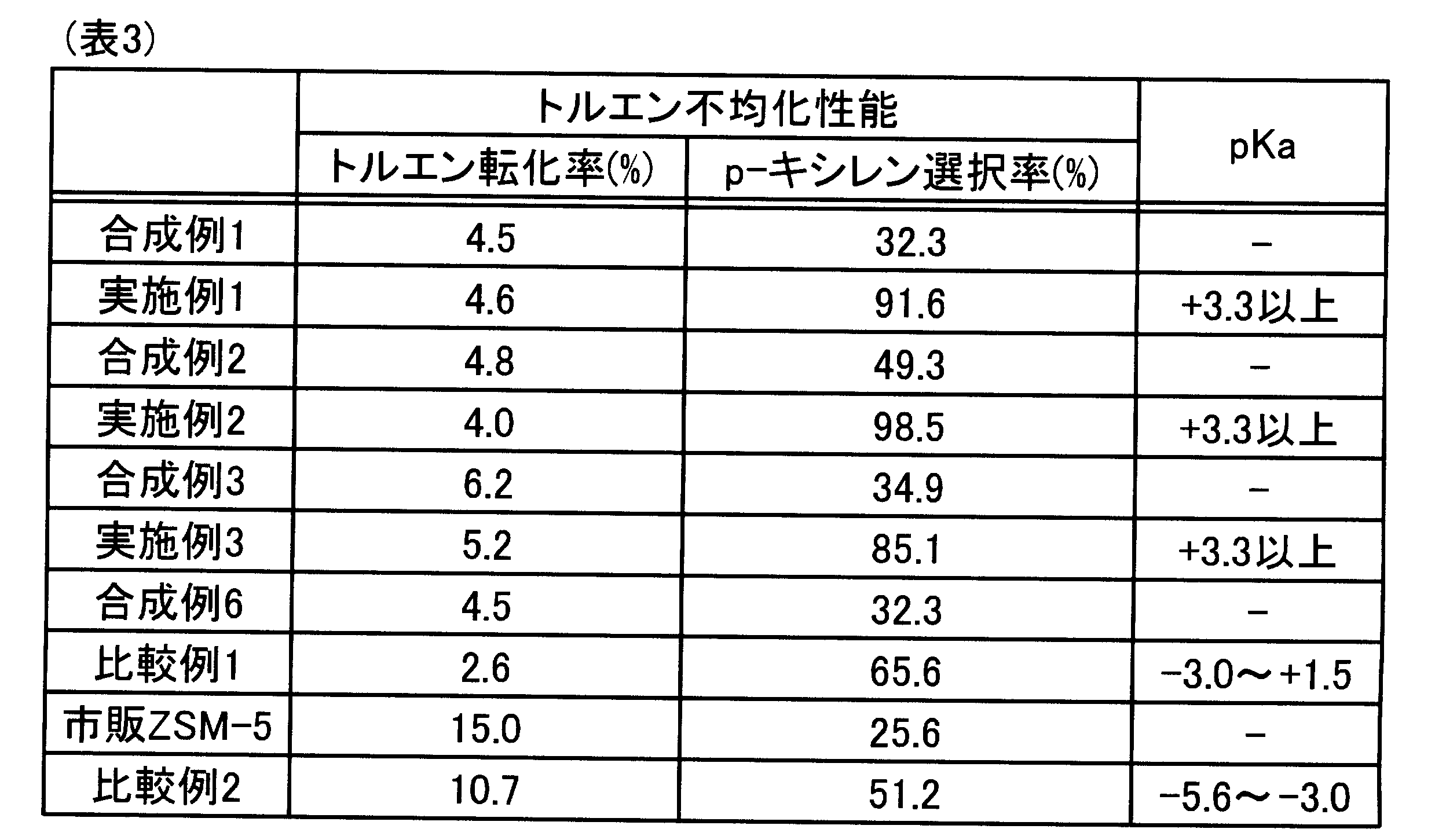
一方、本発明を満たさないシリケート被覆MFI型ゼオライトを用いた比較例1および2は、シリケート被覆前の合成例6および市販ZSM-5より転化率が劣ると同時に、p-キシレンの選択率も向上できないことが分かる。
実施例2、4、5ならびに比較例3のシリケート被覆MFI型ゼオライトの存在下、トルエンの不均化反応を行い、トルエンの転化率およびp-キシレンの選択率を測定した。
Claims (9)
- MFI型ゼオライトをシリケートで被覆したシリケート被覆MFI型ゼオライトであって、前記シリケート被覆MFI型ゼオライトのX線回折スペクトルにおいて、2θ=7.0~8.4°にあるピークaと、2θ=8.4~9.7°にあるピークbとのピーク面積比b/aが1以上で、かつ、ハメット指示薬により測定されたpKa値が+3.3以上であることを特徴とするシリケート被覆MFI型ゼオライト。
- 前記MFI型ゼオライトのX線回折スペクトルにおいて、2θ=7.0~8.4°にあるピークa’と、2θ=8.4~9.7°にあるピークb’とのピーク面積比b’/a’が1以上であることを特徴とする請求項1に記載のシリケート被覆MFI型ゼオライト。
- 前記MFI型ゼオライトの骨格外のアルミニウム量は、10%以下であることを特徴とする請求項1または2に記載のシリケート被覆MFI型ゼオライト。
- 粒子径が1μm以上40μm以下であることを特徴とする請求項1~3のいずれか一つに記載のシリケート被覆MFI型ゼオライト。
- p-キシレンを選択的に製造するために用いることを特徴とする、請求項1~4のいずれか一つに記載のシリケート被覆MFI型ゼオライト。
- 請求項1~5のいずれか一項に記載のシリケート被覆MFI型ゼオライトを製造する方法であって、2θ=7.0~8.4°にあるピークa’と、2θ=8.4~9.7°にあるピークb’とのピーク面積比b’/a’が1以上であるMFI型ゼオライトを、シリカ源および構造規定剤を用いて水熱合成処理して、前記MFI型ゼオライトの外表面にシリケートを成長させることを特徴とするシリケート被覆MFI型ゼオライトの製造方法。
- 前記MFI型ゼオライトが、シリカ源とアルミニウム源と構造規定剤とフッ素源とを用いて水熱合成処理して得られることを特徴とする、請求項6に記載のシリケート被覆MFI型ゼオライトの製造方法。
- 前記MFI型ゼオライトの骨格外アルミニウムの除去工程を有することを特徴とする請求項6または7に記載のシリケート被覆MFI型ゼオライトの製造方法。
- 請求項1~5のいずれか一項に記載のシリケート被覆MFI型ゼオライトと芳香族炭化水素とを接触させて、不均化反応またはアルキル化反応を行うことにより、p-キシレンを選択的に製造させることを特徴とするp-キシレンの製造方法。
Priority Applications (3)
| Application Number | Priority Date | Filing Date | Title |
|---|---|---|---|
| US14/389,553 US9687827B2 (en) | 2012-03-30 | 2013-03-29 | Silicate-coated MFI-type zeolite, method of producing the same, and method of producing p-xylene using the same |
| KR1020147027596A KR101663121B1 (ko) | 2012-03-30 | 2013-03-29 | 실리케이트 피복 MFI형 제올라이트와 그 제조 방법 및 그것을 이용한 p-크실렌의 제조 방법 |
| JP2014508232A JP6029654B2 (ja) | 2012-03-30 | 2013-03-29 | シリケート被覆MFI型ゼオライトとその製造方法およびそれを用いたp−キシレンの製造方法 |
Applications Claiming Priority (2)
| Application Number | Priority Date | Filing Date | Title |
|---|---|---|---|
| JP2012083192 | 2012-03-30 | ||
| JP2012-083192 | 2012-03-30 |
Publications (1)
| Publication Number | Publication Date |
|---|---|
| WO2013147261A1 true WO2013147261A1 (ja) | 2013-10-03 |
Family
ID=49260500
Family Applications (1)
| Application Number | Title | Priority Date | Filing Date |
|---|---|---|---|
| PCT/JP2013/059742 Ceased WO2013147261A1 (ja) | 2012-03-30 | 2013-03-29 | シリケート被覆MFI型ゼオライトとその製造方法およびそれを用いたp-キシレンの製造方法 |
Country Status (4)
| Country | Link |
|---|---|
| US (1) | US9687827B2 (ja) |
| JP (1) | JP6029654B2 (ja) |
| KR (1) | KR101663121B1 (ja) |
| WO (1) | WO2013147261A1 (ja) |
Cited By (5)
| Publication number | Priority date | Publication date | Assignee | Title |
|---|---|---|---|---|
| JP6557443B1 (ja) * | 2018-04-06 | 2019-08-07 | 株式会社アドマテックス | 樹脂組成物用フィラー、フィラー含有スラリー組成物、及びフィラー含有樹脂組成物、並びに樹脂組成物用フィラーの製造方法 |
| WO2019193766A1 (ja) * | 2018-04-06 | 2019-10-10 | 株式会社アドマテックス | 樹脂組成物用フィラー、フィラー含有スラリー組成物、及びフィラー含有樹脂組成物、並びに樹脂組成物用フィラーの製造方法 |
| JP2022179168A (ja) * | 2021-05-21 | 2022-12-02 | 国立大学法人鳥取大学 | アルキル基含有芳香族炭化水素の製造方法及びアルキル化反応用触媒 |
| WO2024210177A1 (ja) * | 2023-04-07 | 2024-10-10 | 東ソー株式会社 | Mfi型ゼオライト及びその製造方法 |
| WO2025110099A1 (ja) * | 2023-11-21 | 2025-05-30 | 東ソー株式会社 | ゼオライト |
Families Citing this family (1)
| Publication number | Priority date | Publication date | Assignee | Title |
|---|---|---|---|---|
| JP7443684B2 (ja) | 2019-07-10 | 2024-03-06 | 東ソー株式会社 | 新規ゼオライト及びそれを含む芳香族炭化水素製造用触媒 |
Citations (8)
| Publication number | Priority date | Publication date | Assignee | Title |
|---|---|---|---|---|
| JPS5918112A (ja) * | 1982-07-20 | 1984-01-30 | Agency Of Ind Science & Technol | 結晶性アルミノシリケ−ト焼成体及びその製造方法 |
| JPH07252170A (ja) * | 1994-03-11 | 1995-10-03 | Cosmo Sogo Kenkyusho:Kk | エチルベンゼン又はp−キシレンの製造方法 |
| JP2001031416A (ja) * | 1998-08-28 | 2001-02-06 | Toray Ind Inc | ゼオライト膜の製造方法、mfi型ゼオライト膜および分子を分離する方法 |
| JP2003500189A (ja) * | 1999-05-20 | 2003-01-07 | エクソンモービル・ケミカル・パテンツ・インク | 炭化水素転化方法及びその方法に有用な触媒 |
| JP2004002160A (ja) * | 2002-03-28 | 2004-01-08 | Toray Ind Inc | ゼオライト結晶のコーティング方法、ゼオライト結晶がコーティングされた基材、ゼオライト膜の製造方法、ゼオライト膜、およびゼオライト膜を利用した分離方法 |
| WO2010107076A1 (ja) * | 2009-03-16 | 2010-09-23 | 株式会社ジャパンエナジー | パラ置換芳香族炭化水素製造用触媒及びそれを用いたパラ置換芳香族炭化水素の製造方法 |
| JP2010221095A (ja) * | 2009-03-19 | 2010-10-07 | Japan Energy Corp | 触媒及びその製造方法、並びにそれを用いたパラキシレンの製造方法 |
| JP2011523619A (ja) * | 2008-06-06 | 2011-08-18 | トータル・ペトロケミカルズ・リサーチ・フエリユイ | 結晶質メタロシリケートの製造方法 |
Family Cites Families (13)
| Publication number | Priority date | Publication date | Assignee | Title |
|---|---|---|---|---|
| ID18446A (id) | 1996-05-29 | 1998-04-09 | Exxon Chemical Patents Inc | Proses untuk isomerisasi hidrokarbon-hidrokarbon alkilaromatik |
| US6040259A (en) | 1996-05-29 | 2000-03-21 | Exxon Chemical Patents Inc. | Metal-containing zeolite catalyst, preparation thereof and use for hydrocarbon conversion |
| US6436869B1 (en) | 1996-05-29 | 2002-08-20 | Exxonmobil Chemical Patents Inc. | Iron, cobalt and/or nickel containing ALPO bound SAPO molecular sieve catalyst for producing olefins |
| BR9709622A (pt) | 1996-05-29 | 1999-08-10 | Exxon Chemical Patents Inc | Processo para produção de compostos aromáticos a partir de hidrocarbonetos alifáticos |
| BR9709381A (pt) | 1996-05-29 | 1999-08-10 | Exxon Chemical Patents Inc | Processos de convers o aromática e catalisador de zeólito útil nos mesmos |
| ZA974712B (en) | 1996-05-29 | 1998-11-17 | Exxon Chemical Patents Inc | Zeolite catalyst and use for hydrocarbon conversion |
| US5994603A (en) | 1996-05-29 | 1999-11-30 | Exxon Chemical Patents Inc. | Methylation of toluene to para-xylene |
| KR20000016111A (ko) | 1996-05-29 | 2000-03-25 | 엑손 케미칼 패턴츠 인코포레이티드 | 탄화수소 전환 촉매 및 그의 용도 |
| US6627577B2 (en) | 1997-05-29 | 2003-09-30 | Exxonmobil Chemical Patents Inc. | Hydrocarbon conversion catalyst and its use |
| EP1044068A1 (en) * | 1997-12-03 | 2000-10-18 | Exxon Chemical Patents Inc. | Catalyst comprising a zeolite partially coated with a second zeolite, its use for hydrocarbon conversion |
| US6682650B2 (en) * | 2001-06-05 | 2004-01-27 | Japan Cooperation Center, Petroleum | Zeolite catalyst carrier and hydrogenation catalyst using same |
| KR100978490B1 (ko) * | 2008-05-21 | 2010-08-30 | 서강대학교산학협력단 | 다양한 두께를 갖는 모든 b-축이 기질에 대해서 수직으로배향된 MFI형 제올라이트 박막 및 그의 제조방법 |
| JP5495531B2 (ja) * | 2008-10-09 | 2014-05-21 | Jx日鉱日石エネルギー株式会社 | パラキシレン製造用合成ゼオライト触媒の製造方法、並びに該方法で製造したパラキシレン製造用触媒を用いた高純度パラキシレンの製造方法 |
-
2013
- 2013-03-29 WO PCT/JP2013/059742 patent/WO2013147261A1/ja not_active Ceased
- 2013-03-29 US US14/389,553 patent/US9687827B2/en not_active Expired - Fee Related
- 2013-03-29 KR KR1020147027596A patent/KR101663121B1/ko active Active
- 2013-03-29 JP JP2014508232A patent/JP6029654B2/ja active Active
Patent Citations (8)
| Publication number | Priority date | Publication date | Assignee | Title |
|---|---|---|---|---|
| JPS5918112A (ja) * | 1982-07-20 | 1984-01-30 | Agency Of Ind Science & Technol | 結晶性アルミノシリケ−ト焼成体及びその製造方法 |
| JPH07252170A (ja) * | 1994-03-11 | 1995-10-03 | Cosmo Sogo Kenkyusho:Kk | エチルベンゼン又はp−キシレンの製造方法 |
| JP2001031416A (ja) * | 1998-08-28 | 2001-02-06 | Toray Ind Inc | ゼオライト膜の製造方法、mfi型ゼオライト膜および分子を分離する方法 |
| JP2003500189A (ja) * | 1999-05-20 | 2003-01-07 | エクソンモービル・ケミカル・パテンツ・インク | 炭化水素転化方法及びその方法に有用な触媒 |
| JP2004002160A (ja) * | 2002-03-28 | 2004-01-08 | Toray Ind Inc | ゼオライト結晶のコーティング方法、ゼオライト結晶がコーティングされた基材、ゼオライト膜の製造方法、ゼオライト膜、およびゼオライト膜を利用した分離方法 |
| JP2011523619A (ja) * | 2008-06-06 | 2011-08-18 | トータル・ペトロケミカルズ・リサーチ・フエリユイ | 結晶質メタロシリケートの製造方法 |
| WO2010107076A1 (ja) * | 2009-03-16 | 2010-09-23 | 株式会社ジャパンエナジー | パラ置換芳香族炭化水素製造用触媒及びそれを用いたパラ置換芳香族炭化水素の製造方法 |
| JP2010221095A (ja) * | 2009-03-19 | 2010-10-07 | Japan Energy Corp | 触媒及びその製造方法、並びにそれを用いたパラキシレンの製造方法 |
Non-Patent Citations (1)
| Title |
|---|
| YUKIO OSAFUNE ET AL.: "Core-Shell Kozo no MFI-gata Zeolite o Shokubai ni Mochiita Toluene no Methyl-ka", DAI 102 KAI SHOKUBAI TORONKAI TORONKAI A YOKOSHU, 23 September 2008 (2008-09-23), pages 213 * |
Cited By (15)
| Publication number | Priority date | Publication date | Assignee | Title |
|---|---|---|---|---|
| JP6557443B1 (ja) * | 2018-04-06 | 2019-08-07 | 株式会社アドマテックス | 樹脂組成物用フィラー、フィラー含有スラリー組成物、及びフィラー含有樹脂組成物、並びに樹脂組成物用フィラーの製造方法 |
| WO2019193766A1 (ja) * | 2018-04-06 | 2019-10-10 | 株式会社アドマテックス | 樹脂組成物用フィラー、フィラー含有スラリー組成物、及びフィラー含有樹脂組成物、並びに樹脂組成物用フィラーの製造方法 |
| WO2019194321A1 (ja) * | 2018-04-06 | 2019-10-10 | 株式会社アドマテックス | 樹脂組成物用フィラー、フィラー含有スラリー組成物、及びフィラー含有樹脂組成物、並びに樹脂組成物用フィラーの製造方法 |
| CN110573562A (zh) * | 2018-04-06 | 2019-12-13 | 株式会社亚都玛科技 | 树脂组合物用填料、含填料的浆料组合物及含填料的树脂组合物及树脂组合物用填料的制造方法 |
| CN110573562B (zh) * | 2018-04-06 | 2021-03-30 | 株式会社亚都玛科技 | 树脂组合物用填料、含填料的浆料组合物及含填料的树脂组合物及树脂组合物用填料的制造方法 |
| US11091647B2 (en) | 2018-04-06 | 2021-08-17 | Admatechs., Ltd. | Filler for resinous composition, filler-containing slurry composition and filler-containing resinous composition as well as production process for filler for resinous composition |
| JP2022179168A (ja) * | 2021-05-21 | 2022-12-02 | 国立大学法人鳥取大学 | アルキル基含有芳香族炭化水素の製造方法及びアルキル化反応用触媒 |
| WO2024210177A1 (ja) * | 2023-04-07 | 2024-10-10 | 東ソー株式会社 | Mfi型ゼオライト及びその製造方法 |
| JP7571329B1 (ja) | 2023-04-07 | 2024-10-22 | 東ソー株式会社 | Mfi型ゼオライト及びその製造方法 |
| JP2024154379A (ja) * | 2023-04-07 | 2024-10-30 | 東ソー株式会社 | Mfi型ゼオライト及びその製造方法 |
| JP2024170333A (ja) * | 2023-04-07 | 2024-12-06 | 東ソー株式会社 | Mfi型ゼオライト及びその製造方法 |
| JP2024170331A (ja) * | 2023-04-07 | 2024-12-06 | 東ソー株式会社 | Mfi型ゼオライト及びその製造方法 |
| JP7790504B2 (ja) | 2023-04-07 | 2025-12-23 | 東ソー株式会社 | Mfi型ゼオライト及びその製造方法 |
| JP7810226B2 (ja) | 2023-04-07 | 2026-02-03 | 東ソー株式会社 | Mfi型ゼオライト及びその製造方法 |
| WO2025110099A1 (ja) * | 2023-11-21 | 2025-05-30 | 東ソー株式会社 | ゼオライト |
Also Published As
| Publication number | Publication date |
|---|---|
| US20150328626A1 (en) | 2015-11-19 |
| KR20150005529A (ko) | 2015-01-14 |
| KR101663121B1 (ko) | 2016-10-06 |
| JP6029654B2 (ja) | 2016-11-24 |
| JPWO2013147261A1 (ja) | 2015-12-14 |
| US9687827B2 (en) | 2017-06-27 |
Similar Documents
| Publication | Publication Date | Title |
|---|---|---|
| JP6029654B2 (ja) | シリケート被覆MFI型ゼオライトとその製造方法およびそれを用いたp−キシレンの製造方法 | |
| JP5571950B2 (ja) | モレキュラーシーブ組成物(emm−10)とその製造方法、およびこの組成物を用いた炭化水素の転換方法 | |
| JP6669633B2 (ja) | Scm−10モレキュラーシーブ、その製造方法及びその使用 | |
| KR102159632B1 (ko) | Scm-11 분자체, 그 제조 방법 및 그 용도 | |
| CN109046444B (zh) | 一种c8芳烃异构化的双功能催化剂及其制备方法 | |
| Iwase et al. | Influence of Si distribution in framework of SAPO-34 and its particle size on propylene selectivity and production rate for conversion of ethylene to propylene | |
| CN108993585B (zh) | 一种含多级孔euo分子筛的双功能催化剂及其制备方法 | |
| Nakai et al. | Dehydrogenation of propane over high silica* BEA type gallosilicate (Ga-Beta) | |
| EP2902362A1 (en) | Sapo-34 molecular sieve and synthesis method thereof | |
| Wu et al. | Exclusive SAPO-seeded synthesis of ZK-5 zeolite for selective synthesis of methylamines | |
| Reddy et al. | Synthesis of Ce-MCM-22 and its enhanced catalytic performance for the removal of olefins from aromatic stream | |
| EP2448890A2 (en) | Process for alkylation of aromatic hydrocarbons using uzm-35 | |
| Sánchez-Sánchez et al. | On the Sn (II) and Sn (IV) incorporation into the AFI-structured AlPO 4-based framework: the first significantly acidic SnAPO-5 | |
| JP5602719B2 (ja) | パラ置換芳香族炭化水素製造用触媒及びそれを用いたパラ置換芳香族炭化水素の製造方法 | |
| CN106865567B (zh) | 一种ecnu‑16分子筛及其制备和应用 | |
| CN102441438B (zh) | 一种复合分子筛及其制备方法 | |
| CN111099613B (zh) | 分子筛、其合成方法及其用途 | |
| KR101262549B1 (ko) | 중형기공성 zsm-5 촉매 제조방법 및 그 촉매를 이용한 경질 올레핀 제조방법 | |
| CN106964393B (zh) | 丙烯制造用催化剂、该催化剂的制造方法和丙烯的制造方法 | |
| KR102800271B1 (ko) | 4 내지 7개의 탄소 원자를 갖는 탄화수소의 촉매 분해로부터 경질 올레핀을 제조하기 위한 촉매 | |
| CN108946757B (zh) | 分子筛scm-13、其合成方法及其用途 | |
| US8212097B2 (en) | Aromatic alkylation process using UZM-5, UZM-5P and UZM-6 zeolites | |
| JP7812918B2 (ja) | シリコン-アルミニウムモレキュラーシーブscm-36、その製造方法およびその用途 | |
| CN116262622B (zh) | 一种纳米级高硅y分子筛、及其制备方法和应用 | |
| WO2014047800A1 (zh) | 一种sapo-34分子筛的合成方法及由其制备的催化剂 |
Legal Events
| Date | Code | Title | Description |
|---|---|---|---|
| 121 | Ep: the epo has been informed by wipo that ep was designated in this application |
Ref document number: 13768381 Country of ref document: EP Kind code of ref document: A1 |
|
| ENP | Entry into the national phase |
Ref document number: 2014508232 Country of ref document: JP Kind code of ref document: A |
|
| ENP | Entry into the national phase |
Ref document number: 20147027596 Country of ref document: KR Kind code of ref document: A |
|
| NENP | Non-entry into the national phase |
Ref country code: DE |
|
| WWE | Wipo information: entry into national phase |
Ref document number: 14389553 Country of ref document: US |
|
| 122 | Ep: pct application non-entry in european phase |
Ref document number: 13768381 Country of ref document: EP Kind code of ref document: A1 |