WO2013147204A1 - 結晶性アルミノシリケート、重質油水素化分解触媒及びその製造方法 - Google Patents
結晶性アルミノシリケート、重質油水素化分解触媒及びその製造方法 Download PDFInfo
- Publication number
- WO2013147204A1 WO2013147204A1 PCT/JP2013/059637 JP2013059637W WO2013147204A1 WO 2013147204 A1 WO2013147204 A1 WO 2013147204A1 JP 2013059637 W JP2013059637 W JP 2013059637W WO 2013147204 A1 WO2013147204 A1 WO 2013147204A1
- Authority
- WO
- WIPO (PCT)
- Prior art keywords
- crystalline aluminosilicate
- slurry
- mass
- heavy oil
- catalyst
- Prior art date
- Legal status (The legal status is an assumption and is not a legal conclusion. Google has not performed a legal analysis and makes no representation as to the accuracy of the status listed.)
- Ceased
Links
Classifications
-
- B—PERFORMING OPERATIONS; TRANSPORTING
- B01—PHYSICAL OR CHEMICAL PROCESSES OR APPARATUS IN GENERAL
- B01J—CHEMICAL OR PHYSICAL PROCESSES, e.g. CATALYSIS OR COLLOID CHEMISTRY; THEIR RELEVANT APPARATUS
- B01J29/00—Catalysts comprising molecular sieves
- B01J29/04—Catalysts comprising molecular sieves having base-exchange properties, e.g. crystalline zeolites
- B01J29/06—Crystalline aluminosilicate zeolites; Isomorphous compounds thereof
- B01J29/08—Crystalline aluminosilicate zeolites; Isomorphous compounds thereof of the faujasite type, e.g. type X or Y
- B01J29/084—Y-type faujasite
-
- C—CHEMISTRY; METALLURGY
- C01—INORGANIC CHEMISTRY
- C01B—NON-METALLIC ELEMENTS; COMPOUNDS THEREOF; METALLOIDS OR COMPOUNDS THEREOF NOT COVERED BY SUBCLASS C01C
- C01B39/00—Compounds having molecular sieve and base-exchange properties, e.g. crystalline zeolites; Their preparation; After-treatment, e.g. ion-exchange or dealumination
- C01B39/02—Crystalline aluminosilicate zeolites; Isomorphous compounds thereof; Direct preparation thereof; Preparation thereof starting from a reaction mixture containing a crystalline zeolite of another type, or from preformed reactants; After-treatment thereof
- C01B39/20—Faujasite type, e.g. type X or Y
- C01B39/24—Type Y
-
- C—CHEMISTRY; METALLURGY
- C10—PETROLEUM, GAS OR COKE INDUSTRIES; TECHNICAL GASES CONTAINING CARBON MONOXIDE; FUELS; LUBRICANTS; PEAT
- C10G—CRACKING HYDROCARBON OILS; PRODUCTION OF LIQUID HYDROCARBON MIXTURES, e.g. BY DESTRUCTIVE HYDROGENATION, OLIGOMERISATION, POLYMERISATION; RECOVERY OF HYDROCARBON OILS FROM OIL-SHALE, OIL-SAND, OR GASES; REFINING MIXTURES MAINLY CONSISTING OF HYDROCARBONS; REFORMING OF NAPHTHA; MINERAL WAXES
- C10G47/00—Cracking of hydrocarbon oils, in the presence of hydrogen or hydrogen- generating compounds, to obtain lower boiling fractions
- C10G47/02—Cracking of hydrocarbon oils, in the presence of hydrogen or hydrogen- generating compounds, to obtain lower boiling fractions characterised by the catalyst used
- C10G47/10—Cracking of hydrocarbon oils, in the presence of hydrogen or hydrogen- generating compounds, to obtain lower boiling fractions characterised by the catalyst used with catalysts deposited on a carrier
- C10G47/12—Inorganic carriers
- C10G47/16—Crystalline alumino-silicate carriers
-
- C—CHEMISTRY; METALLURGY
- C10—PETROLEUM, GAS OR COKE INDUSTRIES; TECHNICAL GASES CONTAINING CARBON MONOXIDE; FUELS; LUBRICANTS; PEAT
- C10G—CRACKING HYDROCARBON OILS; PRODUCTION OF LIQUID HYDROCARBON MIXTURES, e.g. BY DESTRUCTIVE HYDROGENATION, OLIGOMERISATION, POLYMERISATION; RECOVERY OF HYDROCARBON OILS FROM OIL-SHALE, OIL-SAND, OR GASES; REFINING MIXTURES MAINLY CONSISTING OF HYDROCARBONS; REFORMING OF NAPHTHA; MINERAL WAXES
- C10G47/00—Cracking of hydrocarbon oils, in the presence of hydrogen or hydrogen- generating compounds, to obtain lower boiling fractions
- C10G47/02—Cracking of hydrocarbon oils, in the presence of hydrogen or hydrogen- generating compounds, to obtain lower boiling fractions characterised by the catalyst used
- C10G47/10—Cracking of hydrocarbon oils, in the presence of hydrogen or hydrogen- generating compounds, to obtain lower boiling fractions characterised by the catalyst used with catalysts deposited on a carrier
- C10G47/12—Inorganic carriers
- C10G47/16—Crystalline alumino-silicate carriers
- C10G47/18—Crystalline alumino-silicate carriers the catalyst containing platinum group metals or compounds thereof
-
- C—CHEMISTRY; METALLURGY
- C10—PETROLEUM, GAS OR COKE INDUSTRIES; TECHNICAL GASES CONTAINING CARBON MONOXIDE; FUELS; LUBRICANTS; PEAT
- C10G—CRACKING HYDROCARBON OILS; PRODUCTION OF LIQUID HYDROCARBON MIXTURES, e.g. BY DESTRUCTIVE HYDROGENATION, OLIGOMERISATION, POLYMERISATION; RECOVERY OF HYDROCARBON OILS FROM OIL-SHALE, OIL-SAND, OR GASES; REFINING MIXTURES MAINLY CONSISTING OF HYDROCARBONS; REFORMING OF NAPHTHA; MINERAL WAXES
- C10G47/00—Cracking of hydrocarbon oils, in the presence of hydrogen or hydrogen- generating compounds, to obtain lower boiling fractions
- C10G47/02—Cracking of hydrocarbon oils, in the presence of hydrogen or hydrogen- generating compounds, to obtain lower boiling fractions characterised by the catalyst used
- C10G47/10—Cracking of hydrocarbon oils, in the presence of hydrogen or hydrogen- generating compounds, to obtain lower boiling fractions characterised by the catalyst used with catalysts deposited on a carrier
- C10G47/12—Inorganic carriers
- C10G47/16—Crystalline alumino-silicate carriers
- C10G47/20—Crystalline alumino-silicate carriers the catalyst containing other metals or compounds thereof
Definitions
- the present invention relates to a crystalline aluminosilicate, a heavy oil hydrocracking catalyst, and a method for producing the same, and in particular, a crystalline alumino suitable for a carrier material for a heavy oil hydrocracking catalyst having both excellent desulfurization activity and cracking activity.
- the present invention relates to a silicate, a heavy oil hydrocracking catalyst containing the crystalline aluminosilicate as a support material, and a method for producing the same.
- Atmospheric distillation residue oil (AR) of crude oil is hydrodesulfurized in heavy oil direct desulfurization equipment (hereinafter referred to as “direct desulfurization equipment”), and distillate oil and desulfurized heavy oil such as desulfurized naphtha, desulfurized kerosene and desulfurized light oil. And generate Of these, desulfurized heavy oil is used as boiler fuel for electric power as a low sulfur C heavy oil. Desulfurized heavy oil is also used as a raw material to be processed in a fluid catalytic cracking (FCC) apparatus. From now on, catalytic cracking gasoline (hereinafter referred to as “FCC gasoline”), catalytic cracking light oil (hereinafter referred to as “LCO”: light cycle oil). Light fractions such as LPG fractions are produced.
- FCC gasoline catalytic cracking gasoline
- LCO catalytic cracking light oil
- desulfurized heavy oil, desulfurized heavy light oil, etc. obtained by hydrodesulfurization treatment of heavy oil in hydrodesulfurization equipment such as direct desulfurization equipment, intermediate desulfurization equipment, etc. are further decomposed, desulfurized naphtha, Development of hydrocracking methods to increase production of desulfurized kerosene, desulfurized light oil, etc. is underway. Also, research on the method of converting desulfurized heavy oil and desulfurized heavy gas oil into light fractions such as LPG fraction, FCC gasoline fraction, LCO fraction, etc.
- an active metal is used as a support made of a mixture of a crystalline aluminosilicate such as zeolite imparting decomposition activity and an inorganic oxide such as alumina imparting desulfurization activity.
- a crystalline aluminosilicate such as zeolite imparting decomposition activity
- an inorganic oxide such as alumina imparting desulfurization activity.
- Patent Document 1 as a catalyst capable of increasing the yield of middle distillate in the hydrocracking of heavy oil, an active metal is supported on a support composed of 65% by weight of a specific iron-containing aluminosilicate and 35% by weight of alumina.
- a heavy oil hydrocracking catalyst is disclosed.
- Patent Document 2 heavy oil cracking using a catalyst in which an active metal is supported on a support containing 2 to 35% by weight of zeolite and 65 to 98% by weight of specific alumina having an average pore diameter of 60 to 125%.
- a catalyst is disclosed.
- Patent Document 3 discloses that a catalyst in which an active metal is supported on a support produced by mixing a slurry of crystalline aluminosilicate and a slurry of an aluminum compound is effective for a hydrocarbon conversion reaction.
- the hydrocracking catalyst in which the carrier is composed of crystalline aluminosilicate and alumina or the like increases the decomposition activity when the ratio of the crystalline aluminosilicate in the carrier is increased. Desulfurization activity may be insufficient.
- the direct desulfurization unit uses a system that combines multiple catalysts with different roles, such as demetallization catalysts and desulfurization catalysts. The filling ratio of the cracking catalyst can be reduced. Therefore, a decrease in the desulfurization activity of the catalyst can be compensated by filling the desulfurization catalyst. Therefore, increasing the decomposition activity as much as possible has been anxious to maintain the desulfurization activity while having the necessary decomposition activity.
- the present invention provides a crystalline aluminosilicate used as a carrier material for realizing a heavy oil hydrocracking catalyst having particularly excellent cracking activity, and a heavy oil hydrogenation containing the crystalline aluminosilicate as a carrier material.
- An object of the present invention is to provide a cracking catalyst and a production method thereof.
- the present inventors have developed a high-decomposition activity of heavy oil utilizing the characteristics of a crystalline aluminosilicate (zeolite) surface having high acid strength as a solid acid, and desulfurization active sites such as NiMo and CoMo.
- zeolite crystalline aluminosilicate
- desulfurization active sites such as NiMo and CoMo.
- the carrier material used is a mixture of zeolite particles in a slurry and mixed with alumina or the like.
- the heavy oil molecules that are to undergo the decomposition reaction can diffuse only to the extreme surface of the aggregated particles. It cannot work effectively. Furthermore, there is a molecular distance from the metal-supported alumina to which active hydrogen is to be supplied, which may result in inadequate hydrogen supply. If these occur, the decomposition function due to the originally effective zeolite acid point is not sufficiently exhibited, and the heavy oil decomposition characteristics cannot be efficiently exhibited.
- the present inventors pay attention to the particle size distribution of the zeolite in the slurry, particularly using RL 10 ⁇ m (volume ratio of the crystalline aluminosilicate particle size of 10 ⁇ m or less) and MD (the median diameter of the crystalline aluminosilicate) as an index.
- the drying conditions are made milder, or the operation of loosening the agglomerated particles using a disperser such as a colloid mill can be used to reduce the heavy oil decomposition activity. It has also been found that it contributes to significant improvement.
- this invention is made
- the present invention is as follows.
- a crystalline aluminosilicate used as a carrier material for a heavy oil hydrocracking catalyst wherein (a) the crystalline aluminosilicate is a super-stabilized Y-type zeolite or a metal-supported super-stabilized Y-type zeolite. And (b) a crystalline aluminosilicate in which the volume ratio of a particle size of 10 ⁇ m or less analyzed from volume-based particle size distribution data by a laser diffraction scattering method is 95% or more.
- a crystalline aluminosilicate used as a carrier material for realizing a heavy oil hydrocracking catalyst having both excellent desulfurization activity and cracking activity, and a heavy metal containing the crystalline aluminosilicate as a carrier material can be provided.
- the crystalline aluminosilicate of the present invention used as a carrier material for a heavy oil hydrocracking catalyst is an ultra-stabilized Y-type zeolite or a metal-supported ultra-stabilized Y-type zeolite, and is based on volume by laser diffraction scattering method.
- the volume ratio (RL 10 ⁇ m) of the particle size of 10 ⁇ m or less analyzed from the particle size distribution data is 95% or more.
- RL10 ⁇ m is less than 95%, the proportion of aggregated particles reaches a level that cannot be ignored and causes a significant decrease in decomposition activity.
- RL10 ⁇ m is preferably 95% or more, and more preferably 96% or more.
- the median diameter (MD) analyzed from the volume-based particle size distribution data obtained by the laser diffraction / scattering method is preferably 3.0 ⁇ m or less, more preferably 2.8 to 2.0. When MD is 3.0 ⁇ m or less, agglomeration of particles of crystalline aluminosilicate (super-stabilized Y-type zeolite) is suppressed, and a more monodispersed state can be obtained.
- ultra-stabilized Y-type zeolite (hereinafter sometimes referred to as “USY zeolite”), metal-supported USY zeolite is used, and metal-supported USY zeolite is preferable.
- the metal-supported USY zeolite is preferably a metal-supported USY zeolite in which one or more metals selected from Groups 3 to 16 of the periodic table are supported on the USY zeolite, and in particular, an iron-supported USY in which iron is supported as a metal. Zeolite (iron-containing crystalline aluminosilicate) is preferred.
- the USY zeolite and the metal-supported USY zeolite can be produced, for example, by the following method.
- a raw material for USY zeolite the ratio of silica to alumina (molar ratio), that is, SiO 2 / Al 2 O 3 is 4.5 or more, preferably 5.0 or more, and Na 2 O is 2.4% by mass.
- Y-type zeolite of 1.8% by mass or less is preferably used.
- Such Y-type zeolite is steamed to produce USY zeolite.
- the conditions for the steaming treatment may be appropriately selected according to various situations, but the treatment is preferably carried out in the presence of water vapor at 510 to 810 ° C.
- Water vapor may be introduced from the outside, or physically adsorbed water or crystal water contained in the Y-type zeolite may be used. Further, by adding a mineral acid to the USY zeolite obtained by the steaming treatment, and mixing and stirring, the aluminum that has fallen off is washed and removed by dealumination, steaming, and mineral acid treatment from the zeolite structure skeleton.
- mineral acids examples include various types of acids such as hydrochloric acid, nitric acid, and sulfuric acid, but also phosphoric acid, perchloric acid, peroxodisulfonic acid, dithionic acid, sulfamic acid, and nitrososulfonic acid.
- Inorganic acids such as formic acid, trichloroacetic acid, trifluoroacetic acid, and other organic acids can also be used.
- the amount of mineral acid to be added is 0.5 to 20 mol, preferably 3 to 16 mol, per kg of USY zeolite.
- the mineral acid concentration is 0.5 to 50% by mass solution, preferably 1 to 20% by mass solution.
- the treatment temperature is room temperature to 100 ° C, preferably 50 to 100 ° C.
- the processing time is 0.1 to 12 hours.
- a metal salt solution is subsequently added to the above system to support the metal on the USY zeolite.
- the supporting method metal solution treatment
- examples of the supporting method include mixed stirring treatment, dipping method, and impregnation method, and mixed stirring treatment is preferable.
- the metals include yttria, lanthanum, group 4 zirconium, titanium, group 5 vanadium, niobium, thallium, group 6 chromium, molybdenum, tungsten, group 7 manganese, rhenium, Group 8 iron, ruthenium, osmium, Group 9 cobalt, rhodium, iridium, Group 10 nickel, palladium, platinum, Group 11 copper, Group 12 zinc, cadmium, Group 13 aluminum, gallium , Group 14 tin, Group 15 phosphorus, antimony, Group 16 selenium, and the like.
- titanium, iron, manganese, cobalt, nickel, palladium, and platinum are preferable, and iron is particularly preferable.
- the salts of various metals are preferable.
- the metal salt solution treatment it cannot be determined uniquely depending on the situation, but usually the treatment temperature is 30 to 100 ° C., preferably 50 to 80 ° C., the treatment time is 0.1 to 12 hours, preferably 0.
- the loading of these metals is preferably carried out simultaneously with dealumination from the zeolite structure skeleton, and is appropriately selected and carried out in the range of pH 2.0 or lower, preferably pH 1.8 or lower.
- the iron salt include ferrous sulfate and ferric sulfate, and ferric sulfate is preferable. Although this iron sulfate can be added as it is, it is preferably added as a solution.
- the solvent at this time may be any solvent that dissolves the iron salt, but water, alcohol, ether, ketone and the like are preferable.
- the concentration of iron sulfate added is usually 0.02 to 10.0 mol / liter, preferably 0.05 to 5.0 mol / liter.
- the slurry ratio ie, the treatment solution volume (liter) / aluminosilicate weight (kg) is in the range of 1-50. Conveniently, 5-30 are particularly preferred.
- USY zeolite is manufactured by performing filtration and washing as appropriate, followed by drying.
- the drying temperature during drying is preferably 110 to 140 ° C., more preferably 120 to 130 ° C.
- the temperature condition becomes mild, so that particle aggregation due to heat is suppressed and a crystalline aluminosilicate having a volume ratio (RL 10 ⁇ m) of a particle diameter of 10 ⁇ m or less and 95% or more can be obtained.
- a crystalline aluminosilicate having an MD of 3.0 ⁇ m or less is obtained.
- drying step after filtration and washing is omitted and the slurry is brought to the next step in a slurry state, particle aggregation due to heat during drying described above can be avoided.
- the heavy oil hydrocracking catalyst of the present invention comprises a carrier containing the above-described crystalline aluminosilicate of the present invention and a porous inorganic oxide other than the crystalline aluminosilicate. At least one kind of active metal is supported on the metal of group 9, group 9 and group 10.
- the proportion of crystalline aluminosilicate in the mixture of crystalline aluminosilicate and porous inorganic oxide is too small, a high reaction temperature is required to obtain the desired decomposition rate, light fraction and middle fraction, and as a result Adversely affects the life of the catalyst. If the proportion of the crystalline aluminosilicate is too high, the decomposition activity of the atmospheric distillation residue oil (hereinafter referred to as AR (343 + ° C.) fraction) is improved, but the heavier vacuum distillation residue oil (hereinafter referred to as “AR”). The decomposition activity of the VR (referred to as 525 + ° C. fraction) is reduced, and the decomposition selectivity of the light fraction and middle fraction is lowered.
- AR atmospheric distillation residue oil
- porous inorganic oxides such as alumina disperse the active metal supported to a high degree, so if the proportion of porous inorganic oxides is large, the hydrogenation activity is high, and desulfurization activity, denitrogenation activity, decarbonization activity At least one of deasphaltenic activity, demetallizing activity, etc. is improved, but the proportion of crystalline aluminosilicate is reduced, the desired decomposition rate cannot be obtained, and it becomes difficult to obtain light fractions and middle fractions .
- the content of crystalline aluminosilicate in the carrier is in the range of 5 to 80% by mass, preferably 45 to 80% by mass, and 60 to 80% by mass in order to further exhibit the decomposition activity. It is more preferable.
- silica mixing degree obtained by EPMA measurement of the carrier cross section or catalyst cross section of the heavy oil hydrocracking catalyst of the present invention is 0.86 or more, preferably 0.88 or more, preferably 0.90 or more. More preferably.
- “silica mixing degree” indicates the degree of mixing of the silica component in the support or catalyst, and the measurement method will be described later. The closer this is to 1, the more completely the silica component is improved. Show.
- Examples of the porous inorganic oxide excluding the crystalline aluminosilicate according to the present invention include alumina, silica-alumina, silica, alumina-boria, alumina-zirconia, and alumina-titania.
- alumina is mainly used. It is preferable to use it as a component.
- the main component means that the content is 50% by mass or more, preferably 70% by mass, more preferably 80% by mass, based on the porous inorganic oxide (100% by mass).
- boehmite gel, alumina sol, and alumina produced from these are preferably used.
- Alumina is preferred in that the active metal can be supported in a highly dispersed manner.
- the carrier of the heavy oil hydrocracking catalyst of the present invention is preferably composed only of crystalline aluminosilicate and porous inorganic oxide, but if necessary, a third component such as clay mineral or phosphorus may be mixed. Good.
- the content of the third component is 1 to 30% by mass, particularly 3 to 25% by mass, where the total amount of the crystalline aluminosilicate, the porous inorganic oxide and the third component is 100% by mass. . If it exceeds 30% by mass, the surface area of the carrier may become small, and the catalytic activity may not be sufficiently exhibited. In the case of less than 1% by mass, the effect due to the addition of the third component may not be expected.
- the hydrogenation active metal according to the hydrocracking catalyst of the present invention is at least one of Group 6, Group 8, Group 9, and Group 10 metals of the periodic table
- the metal belonging to Group 6 of the periodic table is preferably molybdenum or tungsten
- the metal belonging to Groups 8 to 10 is preferably nickel or cobalt.
- Examples of the combination of the two types of metals include nickel-molybdenum, cobalt-molybdenum, nickel-tungsten, cobalt-tungsten, etc. Among them, cobalt-molybdenum and nickel-molybdenum are preferable, and nickel-molybdenum is more preferable.
- the amount of the active metal supported is not particularly limited and may be appropriately selected according to various conditions such as the type of the raw material oil and the desired yield of the naphtha fraction. 0.5 to 30% by mass, preferably 5 to 20% by mass, and the metals of Group 8 to 10 are 0.1 to 20% by mass, preferably 1 to 10% by mass, based on the total catalyst.
- a slurry-like crystalline aluminosilicate in which the crystalline aluminosilicate of the present invention described above is made into a slurry state is prepared (slurry-like crystalline aluminosilicate preparation step) ). That is, the crystalline aluminosilicate of USY zeolite and metal-supported USY zeolite is used as a slurry containing water after washing.
- a means for the wet pulverization treatment a means for performing a stirring operation for a predetermined time or more in a stirrer such as a propeller blade can be cited.
- a high-speed rotating centrifugal radiation stirrer for example, a high-speed rotating shear stirrer, a colloid mill, a media type disperser (bead mill), a high-pressure jet type emulsifying disperser, an ultrasonic emulsifying disperser and the like can be mentioned.
- a colloid mill is preferable.
- slurry-like crystalline aluminosilicate is supplied to the gap between a disk rotating at high speed and a fixed disk, and the degree of dispersion of aggregated particles varies depending on the gap between the disks.
- the gap between the disks is preferably 10 to 50 ⁇ m.
- a slurry-like alumina precursor is prepared in which the alumina precursor is made into a slurry (slurry-alumina precursor preparation step). That is, the porous inorganic oxide is made into a slurry by adding water in the same manner as the crystalline aluminosilicate.
- the slurry-like alumina precursor and the slurry-like crystalline aluminosilicate are mixed (slurry mixing step).
- Each slurry is sufficiently mixed with a kneader (kneader) under a sufficient amount of water.
- the amount of water in each slurry state is preferably 30 to 80% by mass and more preferably 40 to 70% by mass in the case of slurry crystalline aluminosilicate (crystalline aluminosilicate slurry).
- a slurry-like alumina precursor porous inorganic oxide slurry
- 50 to 90% by mass is preferable, and 55 to 85% by mass is more preferable.
- the mixing ratio is adjusted so as to have the content as described above.
- a dehydration process is performed to concentrate to an extent that allows extrusion molding (dehydration process step).
- the crystalline aluminosilicate and the porous inorganic oxide After mixing and kneading the crystalline aluminosilicate and the porous inorganic oxide, it is molded into a diameter of 1/12 inch to 1/32 inch and a length of 1.5 mm to 6 mm, and is cylindrical, three-leaf type, four-leaf type A molded product having a mold shape is obtained.
- the molded product is dried at 30 to 200 ° C. for 0.1 to 24 hours, and then fired at 300 to 750 ° C. (preferably 450 to 700 ° C.) for 1 to 10 hours (preferably 2 to 7 hours).
- a heavy oil hydrocracking catalyst carrier having a crystalline aluminosilicate content of 5 to 80% by mass in the carrier is prepared (carrier preparation step).
- the support is loaded with at least one active metal among the metals of Groups 6, 8, 9, and 10 of the periodic table (active metal loading step).
- the method for supporting the metal component on the carrier is not particularly limited, and for example, known methods such as an impregnation method, a kneading method, and a coprecipitation method can be employed.
- the above metal component supported on a carrier is usually dried at 30 to 200 ° C. for 0.1 to 24 hours, and then at 250 to 700 ° C. (preferably 300 to 650 ° C.) for 1 to 10 hours (preferably Is calcined for 2-7 hours) and finished as a heavy oil hydrocracking catalyst of the present invention.
- the heavy oil hydrocracking catalyst of the present invention as described above has improved hydrogenation activity of the heavy fraction, high cracking activity of the fraction having a boiling point of 525 ° C. or higher (VR fraction), and 343.
- the decomposition activity of a fraction having a boiling point of not lower than ° C. (AR fraction) is also relatively high.
- AR fraction has high decarburization activity, desulfurization activity and denitrification activity. Therefore, when hydrocracking using this catalyst, the properties of the obtained desulfurized heavy oil (desulfurized atmospheric residue: DSAR and desulfurized vacuum gas oil: DSVGO) are preferred as raw materials for fluid catalytic crackers and the like. .
- the hydrocracking treatment catalyst in the present invention is used for hydrocracking reaction, and simultaneously hydrocracking reaction, hydrodesulfurization reaction, hydrodenitrogenation reaction, hydrodemetallation reaction, etc. are carried out. Perform under the following conditions.
- a direct desorption device is usually used as a device for performing such a hydrocracking reaction under high pressure.
- the conditions for hydrocracking using the heavy oil hydrocracking catalyst of the present invention are not particularly limited, and may be performed under the reaction conditions conventionally used in hydrocracking and hydrodesulfurization reactions of heavy oil,
- the normal reaction temperature is preferably 320 to 550 ° C., more preferably 350 to 430 ° C.
- the hydrogen partial pressure is preferably 1 to 30 MPa, more preferably 5 to 17 MPa
- the hydrogen / oil ratio is preferably 100 to 2,000 Nm. 3 / kiloliter, more preferably 300 to 1,000 Nm 3 / kiloliter
- the liquid hourly space velocity (LHSV) is preferably 0.1 to 5 h ⁇ 1 , more preferably 0.2 to 2.0 h ⁇ 1 .
- heavy oil such as vacuum residue oil, coker oil, synthetic crude oil, extracted crude oil, heavy gas oil, vacuum gas oil, LCO, heavy cycle oil (HCO), clarified oil (CLO), gas-trickle oil (GTL oil), wax, etc.
- a hydrocracking treatment can also be performed by mixing a quality oil with an atmospheric distillation residue oil.
- the heavy oil hydrocracking catalyst of the present invention may be used alone or in combination with a general hydrotreating catalyst.
- the demetallization catalyst is 10 to 40% by volume in the first stage
- the desulfurization catalyst is 0 to 50% by volume in the second stage
- the present invention is in the third stage with respect to the total catalyst charge.
- 10 to 70% by volume of the heavy oil hydrocracking catalyst and 0 to 40% by volume as the finishing desulfurization catalyst in the fourth stage are preferable.
- These can have various filling patterns depending on the properties of the feedstock.
- a descaling catalyst for removing scales such as iron powder and inorganic oxide contained in the raw material oil may be filled before the first stage demetallation catalyst.
- the heavy oil hydrocracking catalyst of the present invention can be used, for example, as follows. That is, the heavy oil hydrocracking catalyst of the present invention is used to hydrocrack atmospheric distillation residue oil, and the resulting product oil residue oil or a mixture of residual oil and distillate is used as a raw material. , Fluid catalytic cracking treatment.
- the distillate a distillate having a boiling point of 120 to 400 ° C. is preferable, and a distillate having a boiling point of 150 to 350 ° C. is more preferable. If it is in such a boiling range, the decomposition product of a favorable boiling range is obtained, and the effect which increases FCC gasoline etc. is acquired.
- the mixing ratio of the distillate oil in the raw material for the fluid catalytic cracking treatment is preferably 1 to 30% by volume, and more preferably 3 to 20% by volume. Within such a range, the effect of increasing the amount of LPG fraction or FCC gasoline fraction is recognized.
- the conditions for the catalytic cracking treatment are not particularly limited, and may be performed by known methods and conditions.
- an amorphous catalyst such as silica-alumina or silica-magnesia or a zeolite catalyst such as faujasite type crystal aluminosilicate is used.
- the reaction temperature is 450 to 650 ° C., preferably 480 to 580 ° C.
- the regeneration temperature is 550 to 760 ° C.
- the reaction pressure may be appropriately selected within the range of 0.02 to 5 MPa, preferably 0.2 to 2 MPa.
- the product of fluid catalytic cracking which is the final process, has a high ratio of FCC gasoline fraction and LPG fraction, which are useful as raw materials for fuel and petrochemical products, and demand is high.
- the proportion of the small LCO fraction can be lowered.
- the yield of kerosene oil fraction, which is a so-called middle fraction, and naphtha fraction, which is a light fraction, of hydrocracked product oil by direct desorption equipment that is an intermediate process is high, and it is a raw material for fuel and petrochemical products.
- the specific surface area was measured and analyzed according to the BET nitrogen adsorption method (ASTM D4365-95). P / P 0 for calculating the specific surface area from the BET blot was set to 0.3. In addition, it measured after removing the water
- the mixing degree of the silica in a heavy oil hydrocracking catalyst was measured and evaluated by the following method. That is, the cross section of the catalyst particles is observed with EPMA (X-ray probe microanalyzer), and the distribution of the crystalline aluminosilicate component and the alumina component is examined. At that time, normally, the distribution state of the crystalline aluminosilicate component was evaluated from the concentration distribution of Si and Al, while the distribution state of the alumina component was evaluated from the concentration distribution of Al or Al and other binder constituent elements.
- EPMA data were statistically analyzed, and first, the degree of dispersion of the component to be measured was determined from the value of the standard deviation of the distribution state. The degree of mixing was calculated by the following equation using the value of the degree of dispersion.
- ⁇ represents the degree of dispersion of the component to be measured (silica)
- ⁇ 0 represents the degree of dispersion when ideally (completely) mixed. Note that this ⁇ 0 is the catalyst composition.
- the fraction of the modified zeolite relative to the total amount of the modified zeolite component and the binder component is X, it is represented by the following formula.
- the degree of mixing of silica in the catalyst generally takes a value of 0 to 1 from the above formula, with a degree of mixing of 0 means complete separation and a degree of mixing of 1 means complete mixing.
- Example 1 (1) Preparation of Alumina Hydrate 44 kg of pure water was put into a tank, and 2.12 kg of an aqueous sodium aluminate solution containing 22.0% by mass of alumina was added thereto, and the mixture was heated to 60 ° C. This aqueous solution was kept at 60 ⁇ 3 ° C. with stirring, 52.3 g of 26.8% by mass sodium gluconate aqueous solution was added, and then aluminum sulfate aqueous solution 7 containing 3.0% by mass alumina heated to 60 ° C. 7 .2 kg was added to obtain a seed alumina slurry having a pH of 7.2.
- the seed alumina slurry was circulated while maintaining 53.4 kg of seed alumina slurry (including 0.68 kg of alumina) at a temperature of 60 ° C. While stirring and circulating the seed alumina slurry, a sodium aluminate aqueous solution (containing 6.0% by mass of alumina) containing 0.18% by mass of sodium gluconate and sulfuric acid containing 3.0% by mass of alumina. Aluminum was added so that the temperature of the solution in the alumina production apparatus tank was 60 ⁇ 3 ° C. and pH 7.1 ⁇ 0.1 was maintained to obtain an alumina slurry.
- the amount of each aqueous solution added was 70.0 kg of a sodium aluminate aqueous solution containing 6.0% by mass of alumina to which sodium gluconate was added, and 72.7 kg of aluminum sulfate containing 3.0% by mass of alumina.
- a sodium aluminate aqueous solution containing 6.0% by mass of alumina was added so that the alumina slurry had a pH of 9.9, and then a slurry prepared by washing to remove sodium and sulfate radicals was prepared.
- the obtained blended slurry had a sodium content of 0.05 mass% as Na 2 O and a sulfate radical content of 0.2 mass% as SO 4 2- .
- deionized water is added to this prepared slurry to obtain an Al 2 O 3 concentration of 15% by mass, and the pH is adjusted to 10.5 with 15% by mass ammonia water, followed by 4.5 hours at 95 ° C. in a tank. Aging was performed to obtain an aging slurry. After completion of the aging, the aging slurry was concentrated by evaporation using a double-arm kneader and then kneaded for an additional 0.5 hour to obtain alumina hydrate.
- the slurry was added to 0.90 kg of alumina hydrate as a dry weight and a kneader, concentrated to an extrudable concentration with heating and stirring, and then extruded into a 1/18 inch size four-leaf pellet.
- the obtained molded article was dried at 110 ° C. for 16 hours and then calcined at 550 ° C. for 3 hours to obtain a catalyst carrier of 70/30 with iron-containing zeolite / alumina (solid content converted mass ratio).
- a suspension of molybdenum trioxide and nickel carbonate in pure water was heated to 90 ° C., and then a solution obtained by adding malic acid and dissolving was added to the catalyst support as MoO 3 with respect to the entire catalyst. It was impregnated so that it might become 2.6 mass% and 4.2 mass% as NiO, then dried at 250 ° C. and calcined at 550 ° C. for 1 hour to obtain a heavy oil hydrocracking catalyst.
- the silica mixing degree of the catalyst was 0.88.
- the obtained hydrate slurry was aged at 60 ° C. for 30 minutes with stirring, dehydrated, and further washed with 150 L of 60 ° C. pure water.
- the cake-like slurry after washing was diluted with ion-exchanged water so as to be 10% by mass in terms of Al 2 O 3 concentration, and then adjusted to pH 10.5 with 15% by mass ammonia water. This was transferred to a tank and aged at 95 ° C. for 16 hours with stirring to obtain an alumina aging slurry.
- the slurry was added to 0.90 kg of alumina hydrate and kneader as a dry weight, concentrated to a concentration capable of extrusion while heating and stirring, and then extruded into a 1/18 inch size four-leaf pellet.
- the obtained molded article was dried at 110 ° C. for 16 hours and then calcined at 550 ° C. for 3 hours to obtain a catalyst carrier of 70/30 with iron-containing zeolite / alumina (solid content converted mass ratio).
- Example 2 (1) Preparation of Alumina Hydrate Into a tank, 9.09 kg of a 22 mass% sodium aluminate aqueous solution in terms of Al 2 O 3 concentration was added, and 224 g of a 26.78 mass% sodium gluconate solution was further added. After dilution with 30.69 kg of ion-exchanged water, the solution was heated to 60 ° C. to prepare a basic aluminum salt aqueous solution. Moreover, creating the acid aluminum salt aqueous solution obtained by diluting 7 wt% aqueous solution of aluminum sulfate 14.28kg in the concentration of Al 2 O 3 in terms of the ion exchange water 25.72Kg. The mixed aqueous solution was added to the tank containing the basic aqueous aluminum salt solution until the pH reached 7.2 to prepare a hydrate slurry.
- the obtained hydrate slurry was aged at 60 ° C. for 30 minutes with stirring, dehydrated, and further washed with 150 L of 60 ° C. pure water.
- the cake-like slurry after washing was diluted with ion-exchanged water so as to be 10% by mass in terms of Al 2 O 3 concentration, and then adjusted to pH 10.5 with 15% by mass ammonia water. This was transferred to a tank and aged at 95 ° C. for 16 hours with stirring to obtain an alumina aging slurry.
- iron-containing crystalline aluminosilicate hereinafter referred to as iron-containing zeolite
- the slurry was mixed with 0.90 kg of aged alumina slurry as a dry weight and stirred, added to a kneader, concentrated to a concentration capable of being extruded while being heated and stirred, and then 1/18 inch. Extruded into a sized four-leaf pellet.
- the obtained molded article was dried at 110 ° C. for 16 hours and then calcined at 550 ° C. for 3 hours to obtain a catalyst carrier of 70/30 with iron-containing zeolite / alumina (solid content converted mass ratio).
- Example 3 (1) Preparation of Alumina Hydrate Into a tank, 9.09 kg of a 22 mass% sodium aluminate aqueous solution in terms of Al 2 O 3 concentration was added, and 224 g of a 26.78 mass% sodium gluconate solution was further added. After dilution with 30.69 kg of ion exchange water, the solution was heated to 60 ° C. to prepare a basic aluminum salt aqueous solution. Further, an acidic aluminum salt aqueous solution was prepared by diluting 14.28 kg of an aluminum sulfate aqueous solution of 7% by mass in terms of Al 2 O 3 concentration with 25.72 kg of ion exchange water. The mixed aqueous solution was added to the tank containing the basic aqueous aluminum salt solution until the pH reached 7.2 to prepare a hydrate slurry.
- the obtained hydrate slurry was aged at 60 ° C. for 30 minutes with stirring, dehydrated, and further washed with 150 L of 60 ° C. pure water.
- the cake-like slurry after washing was diluted with ion-exchanged water so as to be 10% by mass in terms of Al 2 O 3 concentration, and then adjusted to pH 10.5 with 15% by mass ammonia water. This was transferred to a tank and aged at 95 ° C. for 16 hours with stirring to obtain an alumina aging slurry.
- iron-containing crystalline aluminosilicate hereinafter referred to as iron-containing zeolite
- the slurry was mixed with 0.90 kg of aged alumina slurry as a dry weight and stirred, added to a kneader, concentrated to a concentration capable of being extruded while being heated and stirred, and then 1/18 inch. Extruded into a sized four-leaf pellet.
- the obtained molded article was dried at 110 ° C. for 16 hours and then calcined at 550 ° C. for 3 hours to obtain a catalyst carrier of 70/30 with iron-containing zeolite / alumina (solid content converted mass ratio).
- the obtained hydrate slurry was aged at 60 ° C. for 30 minutes with stirring, dehydrated, and further washed with 150 L of 60 ° C. pure water.
- the cake-like slurry after washing was diluted with ion-exchanged water so as to be 10% by mass in terms of Al 2 O 3 concentration, and then adjusted to pH 10.5 with 15% by mass ammonia water. This was transferred to a tank and aged at 95 ° C. for 16 hours with stirring to obtain an alumina aging slurry.
- a slurry of 0.90 kg of alumina ripening as a dry weight and 2.10 kg of a slurry of iron-containing zeolite having a solid concentration of 30% by mass as a dry weight are mixed and stirred together, added to a kneader, heated and stirred.
- the solution was then concentrated to an extrudable concentration and then extruded into a 1/18 inch size four-leaf pellet.
- the iron-containing zeolite slurry is not only stirred but also repeatedly circulated using a circulation pump to disperse the aggregated particles.
- the obtained molded article was dried at 110 ° C. for 16 hours and then calcined at 550 ° C. for 3 hours to obtain a catalyst carrier of 70/30 with iron-containing zeolite / alumina (solid content converted mass ratio).
- a suspension obtained by suspending molybdenum trioxide and nickel carbonate in pure water is heated to 90 ° C., and then a solution obtained by adding and dissolving malic acid is added to the catalyst support D as MoO 3 for the entire catalyst. After impregnation so that it might become 10.6 mass% and 4.2 mass% as NiO, it dried at 250 degreeC and baked at 550 degreeC for 1 hour, and the heavy oil hydrocracking catalyst was obtained.
- the silica mixing degree of the catalyst was 0.88.
- the seed alumina slurry was circulated while maintaining 53.4 kg of seed alumina slurry (including 0.68 kg of alumina) at a temperature of 60 ° C. While stirring and circulating the seed alumina slurry, a sodium aluminate aqueous solution (containing 6.0% by mass of alumina) containing 0.18% by mass of sodium gluconate and sulfuric acid containing 3.0% by mass of alumina. Aluminum was added so that the temperature of the solution in the alumina production apparatus tank was 60 ⁇ 3 ° C. and pH 7.1 ⁇ 0.1 was maintained to obtain an alumina slurry.
- the amount of each aqueous solution added was 70.0 kg of a sodium aluminate aqueous solution containing 6.0% by mass of alumina to which sodium gluconate was added, and 72.7 kg of aluminum sulfate containing 3.0% by mass of alumina.
- a sodium aluminate aqueous solution containing 6.0% by mass of alumina was added so that the alumina slurry had a pH of 9.9, and then a slurry prepared by washing to remove sodium and sulfate radicals was prepared.
- the obtained blended slurry had a sodium content of 0.05 mass% as Na 2 O and a sulfate radical content of 0.2 mass% as SO 4 2- .
- deionized water is added to this prepared slurry to obtain an Al 2 O 3 concentration of 15% by mass, and the pH is adjusted to 10.5 with 15% by mass ammonia water, followed by 4.5 hours at 95 ° C. in a tank. Aging was performed to obtain an aging slurry. After completion of the aging, the aging slurry was concentrated by evaporation using a double-arm kneader and then kneaded for an additional 0.5 hour to obtain alumina hydrate.
- the slurry was added to 0.90 kg of alumina hydrate as a dry weight and a kneader, concentrated to a concentration capable of extrusion while heating and stirring, and then extruded into a 1/18 inch size four-leaf pellet.
- the iron-containing zeolite slurry is not only stirred but also repeatedly circulated using a circulation pump to disperse the aggregated particles.
- the obtained molded article was dried at 110 ° C. for 16 hours and then calcined at 550 ° C. for 3 hours to obtain a catalyst carrier of 70/30 with iron-containing zeolite / alumina (mass ratio in terms of solid content).
- the hydrocracking treatment method is 30 cc of a commercial demetallation catalyst (CDS-DM5CQ manufactured by JGC Catalysts & Chemicals Co., Ltd.) and 70 cc of a heavy oil hydrocracking catalyst to be evaluated, combined on the upper and lower sides, respectively, and fixed at high pressure. After 100 cc of the bed reactor was charged and subjected to sulfurization treatment, hydrocracking treatment was performed under the following conditions using the atmospheric distillation residue oil having the properties shown in Table 1 as a raw material oil.
- CDS-DM5CQ commercial demetallation catalyst manufactured by JGC Catalysts & Chemicals Co., Ltd.
- product oil obtained by the above hydrocracking treatment (hereinafter sometimes simply referred to as product oil) is analyzed by gas chromatography distillation method (ASTM D5307-97), and the hydrocracking rate (343 + ° C.) defined below. Conversion rate). The results are shown in Table 2 below. A larger value of the hydrocracking rate means that the hydrocracking activity of the heavy oil hydrocracking catalyst is higher.
- the raw material oil is an atmospheric distillation residue oil shown in Table 1 below.
- Hydrocracking rate (mass%) (residue fraction in feedstock-residue fraction in product oil) / residue fraction in feedstock
- Desulfurization activity was evaluated according to the following measurement method and definition, and calculated by a normal method. The results are shown in Table 2 below.
- Desulfurization activity (mass%) (Sulfur content in feedstock-Sulfur content in product oil) / Sulfur content in feedstock
- the heavy oil hydrocracking catalyst of the present invention is excellent in both functions of cracking activity and desulfurization activity, it can be widely used in various reaction systems that make use of these activities.
Landscapes
- Chemical & Material Sciences (AREA)
- Oil, Petroleum & Natural Gas (AREA)
- Organic Chemistry (AREA)
- Chemical Kinetics & Catalysis (AREA)
- Engineering & Computer Science (AREA)
- Crystallography & Structural Chemistry (AREA)
- Inorganic Chemistry (AREA)
- General Chemical & Material Sciences (AREA)
- Materials Engineering (AREA)
- Geology (AREA)
- Life Sciences & Earth Sciences (AREA)
- General Life Sciences & Earth Sciences (AREA)
- Production Of Liquid Hydrocarbon Mixture For Refining Petroleum (AREA)
- Silicates, Zeolites, And Molecular Sieves (AREA)
- Catalysts (AREA)
Abstract
重質油水素化分解触媒の担体材料として用いられる結晶性アルミノシリケートであって、(a)前記結晶性アルミノシリケートが、超安定化Y型ゼオライトもしくは金属担持超安定化Y型ゼオライトであり、かつ(b)レーザー回折散乱法による体積基準の粒子径分布データから解析される粒子径10μm以下の体積割合が95%以上である、結晶性アルミノシリケート、及び該結晶性アルミノシリケートを成分とした重質油水素化分解触媒と、その製造方法である。
Description
本発明は、結晶性アルミノシリケート、重質油水素化分解触媒及びその製造方法に関し、特に、脱硫活性と分解活性とが共に優れた重質油水素化分解触媒の担体材料に好適な結晶性アルミノシリケート、及び当該結晶性アルミノシリケートを担体材料として含む重質油水素化分解触媒及びその製造方法に関する。
原油の常圧蒸留残渣油(AR)は、重油直接脱硫装置(以下、「直脱装置」と称する)にて水素化脱硫され、脱硫ナフサ、脱硫灯油、脱硫軽油等の留出油と脱硫重油とを生成する。これらのうち脱硫重油は、低硫黄C重油として電力用のボイラー燃料等に用いられている。また脱硫重油は、流動接触分解(FCC)装置で処理される原料としても使用され、これから、接触分解ガソリン(以下、「FCCガソリン」と称する)、接触分解軽油(以下、「LCO」:ライトサイクルオイルと称する)、LPG留分等の軽質留分が生産されている。
近年、石油精製において使用できる原油は重質化し、重質油を多量に含む原油が多くなる傾向にある。しかも、発電、ボイラー用の重油の需要が減少する等、重質油の利用量は減少しつつある。また、流動接触分解装置からのLCO留分の需要も減少しつつある。
一方、ガソリン需要は拡大し、また、プロピレン、ブテン、ベンゼン、トルエン、キシレンといったBTX等の多数の石油化学製品の原料として使用されるLPG留分やナフサ留分の需要も増大してきている。従って、常圧蒸留残渣油等の重質油からガソリンやナフサ留分、LPG留分等の軽質留分を多量に製造する技術開発が重要な課題となっている。
一方、ガソリン需要は拡大し、また、プロピレン、ブテン、ベンゼン、トルエン、キシレンといったBTX等の多数の石油化学製品の原料として使用されるLPG留分やナフサ留分の需要も増大してきている。従って、常圧蒸留残渣油等の重質油からガソリンやナフサ留分、LPG留分等の軽質留分を多量に製造する技術開発が重要な課題となっている。
このような状況から、重質油を直脱装置、間脱装置等の水素化脱硫装置にて水素化脱硫処理して得られる脱硫重油、脱硫重質軽油等をさらに分解して、脱硫ナフサ、脱硫灯油、脱硫軽油等を増産する水素化分解法の開発が進められている。また、流動接触分解装置にて脱硫重油、脱硫重質軽油を高い分解率で接触分解することにより、LPG留分、FCCガソリン留分、LCO留分等の軽質留分へ転換する方法についての研究・開発が行われている。そして、ここでは、通常、重質油水素化分解触媒として、結晶性アルミノシリケートからなる担体に活性金属を担持した触媒が使用されている。
しかしながら、このような触媒を用いると分解活性は高いものの、脱硫活性が不充分であることがあった。また、原料中の沸点が525℃以上の減圧蒸留残渣油(VR)のような高沸点成分に対する分解活性が不充分なことがあった。
そこで、これらの欠点を解決すべく研究開発が進められ、例えば、分解活性を付与するゼオライト等の結晶性アルミノシリケートと脱硫活性を付与するアルミナ等の無機酸化物との混合物からなる担体に活性金属を担持した触媒を用いた重質炭化水素油の水素化分解触媒が多数報告されている(例えば、特許文献1~3参照)。
しかしながら、このような触媒を用いると分解活性は高いものの、脱硫活性が不充分であることがあった。また、原料中の沸点が525℃以上の減圧蒸留残渣油(VR)のような高沸点成分に対する分解活性が不充分なことがあった。
そこで、これらの欠点を解決すべく研究開発が進められ、例えば、分解活性を付与するゼオライト等の結晶性アルミノシリケートと脱硫活性を付与するアルミナ等の無機酸化物との混合物からなる担体に活性金属を担持した触媒を用いた重質炭化水素油の水素化分解触媒が多数報告されている(例えば、特許文献1~3参照)。
特許文献1では、重質油の水素化分解において、中間留分の得率を高め得る触媒として、特定の鉄含有アルミノシリケート65重量%とアルミナ35質量%とからなる担体に活性金属を担持した重質油水素化分解触媒が開示されている。
特許文献2では、ゼオライト2~35重量%と平均細孔直径が60~125Åである特定のアルミナ65~98重量%とを含有する担体に、活性金属を担持した触媒を用いた重質油分解触媒が開示されている。
特許文献3では、結晶性アルミノシリケートのスラリーとアルミニウム化合物のスラリーとを混合して製造された担体に活性金属を担持した触媒が、炭化水素転換反応に有効であることが開示されている。
特許文献2では、ゼオライト2~35重量%と平均細孔直径が60~125Åである特定のアルミナ65~98重量%とを含有する担体に、活性金属を担持した触媒を用いた重質油分解触媒が開示されている。
特許文献3では、結晶性アルミノシリケートのスラリーとアルミニウム化合物のスラリーとを混合して製造された担体に活性金属を担持した触媒が、炭化水素転換反応に有効であることが開示されている。
しかしながら、特許文献1~3に記載されているように、担体が結晶性アルミノシリケートとアルミナ等とからなる水素化分解触媒は、担体における結晶性アルミノシリケートの比率を高めると分解活性が高まるものの、脱硫活性が不十分になることがあった。
一方、直脱装置では脱メタル触媒や脱硫触媒等の役割の異なる複数の触媒を組み合わせたシステムで使用するため、ゼオライト比率を高めて分解活性を強化した分、当該ゼオライト系の重質油水素化分解触媒の充填比率を低下できる。そのため、当該触媒の脱硫活性低下は脱硫触媒を充填することで補償できる。従って、分解活性を可能な限り高めることは、必要な分解活性を持たせた上で脱硫活性を維持するために切望されていた。
一方、直脱装置では脱メタル触媒や脱硫触媒等の役割の異なる複数の触媒を組み合わせたシステムで使用するため、ゼオライト比率を高めて分解活性を強化した分、当該ゼオライト系の重質油水素化分解触媒の充填比率を低下できる。そのため、当該触媒の脱硫活性低下は脱硫触媒を充填することで補償できる。従って、分解活性を可能な限り高めることは、必要な分解活性を持たせた上で脱硫活性を維持するために切望されていた。
以上から本発明は、分解活性が特に優れた重質油水素化分解触媒を実現するために担体材料に用いられる結晶性アルミノシリケート、及び当該結晶性アルミノシリケートを担体材料として含む重質油水素化分解触媒及びその製造方法を提供することを目的とするものである。
上記課題に鑑み、本発明者らは、固体酸としての酸強度の高い結晶性アルミノシリケート(ゼオライト)表面の特性を活かした重質油の高分解活性と、NiMoやCoMo等の脱硫活性点となる活性金属を高分散に担持することで硫化物の状態で高い脱硫機能を発揮するアルミナ触媒との両特性を最大限に両立する画期的な触媒系の創成を試みた。その過程で、固体酸への水素供給が水素化分解を効果的に行うために必須であり、そのため、(1)重質油が反応する位置にゼオライトの固体酸がより多く存在すること、並びに(2)ゼオライト粒子とより近接した金属担持アルミナ粒子の存在が多いこと、の双方が両立できていることが望ましいことを見出した。
従来、結晶性アルミノシリケートとゼオライト粒子とを含む担体を作製する場合、担体材料としては、ゼオライト粒子をスラリー状にしただけでアルミナ等に混合しものを使用していた。この場合、1~2μmのゼオライト粒子の多くは互いが凝集した状態で存在しており、特に10μm以上の凝集粒子は100個以上(仮に単粒子で1μmの立方体からなっていた場合10μmの粒子は10×10×10=1000個、2μmの立方体なら5×5×5=125個)の凝集粒子から構成されることになる。
このように、凝集粒子の割合が無視できない状態で担体材料として用いられた場合、分解反応を受けるべき重質油分子は凝集粒子の極表面にしか拡散できないため、凝集粒子の内部の酸点を有効に作用させることができない。さらに、活性水素が供給されるべき金属担持のアルミナからの分子レベルで距離が離れており、その結果、水素供給が不十分となることがある。これらのことが生じると、本来有効なゼオライト酸点による分解機能が十分に発揮されず、重質油分解特性が効率的に発揮できない。
このように、凝集粒子の割合が無視できない状態で担体材料として用いられた場合、分解反応を受けるべき重質油分子は凝集粒子の極表面にしか拡散できないため、凝集粒子の内部の酸点を有効に作用させることができない。さらに、活性水素が供給されるべき金属担持のアルミナからの分子レベルで距離が離れており、その結果、水素供給が不十分となることがある。これらのことが生じると、本来有効なゼオライト酸点による分解機能が十分に発揮されず、重質油分解特性が効率的に発揮できない。
そこで本発明者らは、スラリー中のゼオライトの粒子径分布に着目し、特にRL10μm(結晶性アルミノシリケートの粒子径10μm以下の体積割合)やMD(結晶性アルミノシリケートのメジアン径)を指標にし、単にゼオライトをスラリー化した場合(従来法)に比べて、乾燥条件をよりマイルドにしたり、コロイドミル等の分散機を用いて凝集粒子をほぐす操作を行ったりすることで、重質油分解活性の顕著な改善に寄与することをも見出した。
以上から、本発明は上記知見をもとになされたものであり、その詳細は下記の通りである。
以上から、本発明は上記知見をもとになされたものであり、その詳細は下記の通りである。
すなわち、本発明は下記の通りである。
[1] 重質油水素化分解触媒の担体材料として用いられる結晶性アルミノシリケートであって、(a)前記結晶性アルミノシリケートが、超安定化Y型ゼオライトもしくは金属担持超安定化Y型ゼオライトであり、かつ(b)レーザー回折散乱法による体積基準の粒子径分布データから解析される粒子径10μm以下の体積割合が95%以上である、結晶性アルミノシリケート。
[2] (c)レーザー回折散乱法による体積基準の粒子径分布データから解析されるメジアン径が3.0μm以下である[1]に記載の結晶性アルミノシリケート。
[3] 上記[1]又は[2]に記載の結晶性アルミノシリケートと、該結晶性アルミノシリケート以外の多孔性無機酸化物とを含む担体に、周期表第6族、第8族、第9族、第10族の金属のうち少なくとも1種の活性金属が担持されてなる重質油水素化分解触媒であって、(a)前記担体中の前記結晶性アルミノシリケートの含有量が5~80質量%の範囲にあり、かつ(b)担体断面もしくは触媒断面のEPMA測定によって得られるシリカ混合度が0.86以上である、重質油水素化分解触媒。
[4] 上記[1]又は[2]に記載の結晶性アルミノシリケートをスラリー状とするスラリー状結晶性アルミノシリケート調製工程と、アルミナ前駆体をスラリー状とするスラリー状アルミナ前駆体調製工程と、を含み、これらの工程後に、前記スラリー状アルミナ前駆体と前記スラリー状結晶性アルミノシリケートとを混合するスラリー混合工程と、脱水処理を行う脱水処理工程と、成型処理を行って、前記担体中の前記結晶性アルミノシリケートの含有量が5~80質量%である重質油水素化分解触媒用担体を調製する担体調製工程と、前記重質油水素化分解触媒用担体に周期表第6族、第8族、第9族、第10族の金属のうち少なくとも1種の活性金属を担持する活性金属担持工程と、を順次含む重質油水素化分解触媒の製造方法。
[1] 重質油水素化分解触媒の担体材料として用いられる結晶性アルミノシリケートであって、(a)前記結晶性アルミノシリケートが、超安定化Y型ゼオライトもしくは金属担持超安定化Y型ゼオライトであり、かつ(b)レーザー回折散乱法による体積基準の粒子径分布データから解析される粒子径10μm以下の体積割合が95%以上である、結晶性アルミノシリケート。
[2] (c)レーザー回折散乱法による体積基準の粒子径分布データから解析されるメジアン径が3.0μm以下である[1]に記載の結晶性アルミノシリケート。
[3] 上記[1]又は[2]に記載の結晶性アルミノシリケートと、該結晶性アルミノシリケート以外の多孔性無機酸化物とを含む担体に、周期表第6族、第8族、第9族、第10族の金属のうち少なくとも1種の活性金属が担持されてなる重質油水素化分解触媒であって、(a)前記担体中の前記結晶性アルミノシリケートの含有量が5~80質量%の範囲にあり、かつ(b)担体断面もしくは触媒断面のEPMA測定によって得られるシリカ混合度が0.86以上である、重質油水素化分解触媒。
[4] 上記[1]又は[2]に記載の結晶性アルミノシリケートをスラリー状とするスラリー状結晶性アルミノシリケート調製工程と、アルミナ前駆体をスラリー状とするスラリー状アルミナ前駆体調製工程と、を含み、これらの工程後に、前記スラリー状アルミナ前駆体と前記スラリー状結晶性アルミノシリケートとを混合するスラリー混合工程と、脱水処理を行う脱水処理工程と、成型処理を行って、前記担体中の前記結晶性アルミノシリケートの含有量が5~80質量%である重質油水素化分解触媒用担体を調製する担体調製工程と、前記重質油水素化分解触媒用担体に周期表第6族、第8族、第9族、第10族の金属のうち少なくとも1種の活性金属を担持する活性金属担持工程と、を順次含む重質油水素化分解触媒の製造方法。
本発明によれば、脱硫活性と分解活性とが共に優れた重質油水素化分解触媒を実現するために担体材料に用いられる結晶性アルミノシリケート、及び当該結晶性アルミノシリケートを担体材料として含む重質油水素化分解触媒及びその製造方法を提供することができる。
〔1.結晶性アルミノシリケート〕
重質油水素化分解触媒の担体材料として用いられる本発明の結晶性アルミノシリケートは、超安定化Y型ゼオライトもしくは金属担持超安定化Y型ゼオライトであり、かつ、レーザー回折散乱法による体積基準の粒子径分布データから解析される粒子径10μm以下の体積割合(RL10μm)が95%以上となっている。
重質油水素化分解触媒の担体材料として用いられる本発明の結晶性アルミノシリケートは、超安定化Y型ゼオライトもしくは金属担持超安定化Y型ゼオライトであり、かつ、レーザー回折散乱法による体積基準の粒子径分布データから解析される粒子径10μm以下の体積割合(RL10μm)が95%以上となっている。
RL10μmが95%未満であると、凝集粒子の占める割合が無視できないレベルに達し分解活性の明らかな低下を引き起してしまう。RL10μmは、95%以上であることが好ましく、96%以上であることがより好ましい。
また、レーザー回折散乱法による体積基準の粒子径分布データから解析されるメジアン径(MD)が3.0μm以下であることが好ましく、2.8~2.0であることがより好ましい。MDが3.0μm以下であることで、結晶性アルミノシリケート(超安定化Y型ゼオライト)の粒子の凝集が抑えられより単分散な状態に近づけることができる。
また、レーザー回折散乱法による体積基準の粒子径分布データから解析されるメジアン径(MD)が3.0μm以下であることが好ましく、2.8~2.0であることがより好ましい。MDが3.0μm以下であることで、結晶性アルミノシリケート(超安定化Y型ゼオライト)の粒子の凝集が抑えられより単分散な状態に近づけることができる。
結晶性アルミノシリケートとしては、超安定化Y型ゼオライト(以下、「USYゼオライト」と称することがある)、金属担持USYゼオライトを使用し、金属担持USYゼオライトが好ましい。
当該金属担持USYゼオライトとしては、USYゼオライトに周期表第3~16族から選ばれる1種または2種以上の金属を担持した金属担持USYゼオライトが好ましく、特に、金属として鉄を担持した鉄担持USYゼオライト(鉄含有結晶性アルミノシリケート)が好適である。
当該金属担持USYゼオライトとしては、USYゼオライトに周期表第3~16族から選ばれる1種または2種以上の金属を担持した金属担持USYゼオライトが好ましく、特に、金属として鉄を担持した鉄担持USYゼオライト(鉄含有結晶性アルミノシリケート)が好適である。
USYゼオライト及び金属担持USYゼオライトは、例えば、以下の方法によって製造することができる。
USYゼオライトの原料として、アルミナに対するシリカの比率(モル比)、つまりSiO2/Al2O3が4.5以上、好ましくは5.0以上であり、また、Na2Oが2.4質量%以下、好ましくは1.8質量%以下のY型ゼオライトを用いる。かかるY型ゼオライトをスチーミング処理してUSYゼオライトが製造される。
ここで、スチーミング処理の条件としては様々な状況に応じて適宜選定すればよいが、510~810℃の水蒸気の存在下で処理するのが好ましい。水蒸気は、外部から導入してもよいし、Y型ゼオライトに含まれる物理吸着水や結晶水を使用してもよい。
また、スチーミング処理して得られたUSYゼオライトに鉱酸を加え、混合攪拌処理することによって、ゼオライト構造骨格からの脱アルミニウムとスチーミング及び鉱酸処理により脱落アルミニウムの洗浄除去を行う。
USYゼオライトの原料として、アルミナに対するシリカの比率(モル比)、つまりSiO2/Al2O3が4.5以上、好ましくは5.0以上であり、また、Na2Oが2.4質量%以下、好ましくは1.8質量%以下のY型ゼオライトを用いる。かかるY型ゼオライトをスチーミング処理してUSYゼオライトが製造される。
ここで、スチーミング処理の条件としては様々な状況に応じて適宜選定すればよいが、510~810℃の水蒸気の存在下で処理するのが好ましい。水蒸気は、外部から導入してもよいし、Y型ゼオライトに含まれる物理吸着水や結晶水を使用してもよい。
また、スチーミング処理して得られたUSYゼオライトに鉱酸を加え、混合攪拌処理することによって、ゼオライト構造骨格からの脱アルミニウムとスチーミング及び鉱酸処理により脱落アルミニウムの洗浄除去を行う。
このような鉱酸としては各種のものが挙げられるが、塩酸、硝酸、硫酸等が一般的であり、そのほかリン酸、過塩素酸、ペルオクソ二スルホン酸、二チオン酸、スルファミン酸、ニトロソスルホン酸等の無機酸、ギ酸、トリクロロ酢酸、トリフルオロ酢酸等の有機酸等を用いることもできる。添加すべき鉱酸の量は、USYゼオライト1kgあたり0.5~20モルとし、好ましくは3~16モルとする。鉱酸濃度は0.5~50質量%溶液、好ましくは1~20質量%溶液である。処理温度は、室温~100℃、好ましくは50~100℃である。処理時間は0.1~12時間である。
次に、金属担持USYゼオライトを製造するには、続いて上記の系に金属塩溶液を加えてUSYゼオライトに金属を担持する。
担持する方法(金属溶液処理)としては、混合攪拌処理、浸漬法、含浸法が挙げられ、混合撹拌処理が好ましい。金属としては周期表第3族のイットリア、ランタン、第4族のジルコニウム、チタン、第5族のバナジウム、ニオブ、タリウム、第6族のクロム、モリブデン、タングステン、第7族のマンガン、レニウム、第8族の鉄、ルテニウム、オスミウム、第9族のコバルト、ロジウム、イリジウム、第10族のニッケル、パラジウム、白金、第11族の銅、第12族の亜鉛、カドミウム、第13族のアルミニウム、ガリウム、第14族のスズ、第15族のリン、アンチモン、第16族のセレン等が上げられる。この中で、チタン、鉄、マンガン、コバルト、ニッケル、パラジウム、白金が好ましく、特に鉄が好ましい。
担持する方法(金属溶液処理)としては、混合攪拌処理、浸漬法、含浸法が挙げられ、混合撹拌処理が好ましい。金属としては周期表第3族のイットリア、ランタン、第4族のジルコニウム、チタン、第5族のバナジウム、ニオブ、タリウム、第6族のクロム、モリブデン、タングステン、第7族のマンガン、レニウム、第8族の鉄、ルテニウム、オスミウム、第9族のコバルト、ロジウム、イリジウム、第10族のニッケル、パラジウム、白金、第11族の銅、第12族の亜鉛、カドミウム、第13族のアルミニウム、ガリウム、第14族のスズ、第15族のリン、アンチモン、第16族のセレン等が上げられる。この中で、チタン、鉄、マンガン、コバルト、ニッケル、パラジウム、白金が好ましく、特に鉄が好ましい。
各種金属の塩としては硫酸塩、硝酸塩が好ましい。金属塩溶液処理を行う場合、状況により異なり一義的に決定することはできないが、通常は処理温度30~100℃、好ましくは50~80℃、処理時間0.1~12時間、好ましくは0.5~5時間とし、これらの金属の担持はゼオライト構造骨格から脱アルミニウムと同時に行うことが好ましく、pH2.0以下、好ましくはpH1.8以下の範囲で適宜選定し実施する。
担持する金属が鉄の場合、当該鉄の塩の種類は、硫酸第一鉄、硫酸第二鉄を挙げることができるが、硫酸第二鉄が好ましい。この鉄の硫酸塩はそのまま加えることもできるが、溶液として加えることが好ましい。この際の溶媒は鉄塩を溶解するものであればよいが、水、アルコール、エーテル、ケトン等が好ましい。また、加える鉄の硫酸塩の濃度は、通常は0.02~10.0モル/リットル、好ましくは0.05~5.0モル/リットルである。
なお、この鉱酸と鉄の硫酸塩を加えて結晶性アルミノシリケートを処理するにあたっては、そのスラリー比、すなわち、処理溶液容量(リットル)/アルミノシリケート重量(kg)は、1~50の範囲が好都合であり、特に5~30が好適である。
なお、この鉱酸と鉄の硫酸塩を加えて結晶性アルミノシリケートを処理するにあたっては、そのスラリー比、すなわち、処理溶液容量(リットル)/アルミノシリケート重量(kg)は、1~50の範囲が好都合であり、特に5~30が好適である。
その後、適宜濾過、洗浄を行って、乾燥を行うことでUSYゼオライトが製造される。このとき、乾燥時の乾燥温度は、110~140℃とすることが好ましく、120~130℃とすることがより好ましい。110~140℃とすることで、温度条件がマイルドになるため、熱による粒子凝集が抑制されて、粒子径10μm以下の体積割合(RL10μm)が95%以上の結晶性アルミノシリケートが得られる。また、MDが3.0μm以下である結晶性アルミノシリケートが得られる。
なお、濾過、洗浄後の乾燥工程を省き、スラリー化した状態で次の工程に持っていく場合は、上記に記載した乾燥時の熱による粒子凝集を避けることができる。
〔2.重質油水素化分解触媒及びその製造方法〕
本発明の重質油水素化分解触媒は、既述の本発明の結晶性アルミノシリケートと、該結晶性アルミノシリケート以外の多孔性無機酸化物とを含む担体に、周期表第6族、第8族、第9族、第10族の金属のうち少なくとも1種の活性金属が担持されてなる。
本発明の重質油水素化分解触媒は、既述の本発明の結晶性アルミノシリケートと、該結晶性アルミノシリケート以外の多孔性無機酸化物とを含む担体に、周期表第6族、第8族、第9族、第10族の金属のうち少なくとも1種の活性金属が担持されてなる。
結晶性アルミノシリケートと多孔性無機酸化物との混合において結晶性アルミノシリケートの割合が少なすぎると、所望の分解率、軽質留分や中間留分を得るのに高い反応温度を必要とし、その結果、触媒の寿命に悪影響を与える。また、結晶性アルミノシリケートの割合が多すぎると、常圧蒸留残渣油(以下、AR(343+℃)留分と称す)の分解活性は向上するが、より重質な減圧蒸留残渣油(以下、VR(525+℃)留分と称す)の分解活性が低下するとともに軽質留分や中間留分の分解選択性が下がる。
一方、アルミナ等の多孔性無機酸化物は担持される活性金属を高度に分散させるため、多孔性無機酸化物の割合が多いと水素化活性が高く、脱硫活性、脱窒素活性、脱残炭活性、脱アスファルテン活性、脱メタル活性等の少なくとも一つが向上するが、結晶性アルミノシリケートの割合が少なくなり、所望の分解率が得られず、軽質留分や中間留分を得るのが困難になる。また、多孔性無機酸化物の割合が少ないと脱硫活性、脱窒素活性、脱残炭活性、脱アスファルテン活性、脱メタル活性等の少なくとも一つ(所謂、水素化活性)が低下するという問題がある。
そのため、担体中の結晶性アルミノシリケートの含有量は5~80質量%の範囲であり、45~80質量%であることが好ましく、分解活性をより発揮させるためには60~80質量%であることがより好ましい。
そのため、担体中の結晶性アルミノシリケートの含有量は5~80質量%の範囲であり、45~80質量%であることが好ましく、分解活性をより発揮させるためには60~80質量%であることがより好ましい。
また、本発明の重質油水素化分解触媒の担体断面もしくは触媒断面のEPMA測定によって得られるシリカ混合度は0.86以上であり、0.88以上であることが好ましく、0.90以上であることがより好ましい。
ここで、「シリカ混合度」とは、担体もしくは触媒中のシリカ成分の混合度合いを示すもので、測定方法については後述するが、これが1に近いほどシリカ成分が完全に向上していることを示す。
ここで、「シリカ混合度」とは、担体もしくは触媒中のシリカ成分の混合度合いを示すもので、測定方法については後述するが、これが1に近いほどシリカ成分が完全に向上していることを示す。
本発明に係る結晶性アルミノシリケートを除く多孔性無機酸化物としては、アルミナ、シリカ-アルミナ、シリカ、アルミナ-ボリア、アルミナ-ジルコニア、アルミナ-チタニア等が挙げられるが、本発明においてはアルミナを主成分とするのが好ましい。
ここで、主成分とは、含有量が多孔性無機酸化物を基準(100質量%)として、50質量%以上、好ましくは70質量%、より好ましくは80質量%のものをいう。また、アルミナとしては、ベーマイトゲル、アルミナゾル及びこれらから製造されるアルミナが好ましく用いられる。活性金属が高分散担持できる点でアルミナが好適である。
ここで、主成分とは、含有量が多孔性無機酸化物を基準(100質量%)として、50質量%以上、好ましくは70質量%、より好ましくは80質量%のものをいう。また、アルミナとしては、ベーマイトゲル、アルミナゾル及びこれらから製造されるアルミナが好ましく用いられる。活性金属が高分散担持できる点でアルミナが好適である。
本発明の重質油水素化分解触媒の担体は、結晶性アルミノシリケートと多孔性無機酸化物のみからなることが好ましいが、必要に応じて粘土鉱物、リン等の第3成分を混合してもよい。その場合、第3成分の含有量は、結晶性アルミノシリケート、多孔性無機酸化物及び第3成分の合計量を100質量%として、1~30質量%であり、特に3~25質量%が好ましい。30質量%を超えると、担体の表面積が小さくなって触媒活性が十分に発現しない虞がある。1質量%未満の場合は、第3成分を加える事による効果の発現が期待できない場合がある。
本発明の水素化分解触媒に係る水素化活性金属、すなわち活性金属としては既述の通り、周期表第6族、第8族、第9族、第10族金属のうち少なくとも一種であるが、周期表第6族に属する金属としては、モリブデン、タングステンが好ましく、第8~10族に属する金属としては、ニッケル、コバルトが好ましい。2種類の金属の組み合わせとしては、ニッケル-モリブデン、コバルト-モリブデン、ニッケル-タングステン、コバルト-タングステン等が挙げられ、なかでもコバルト-モリブデン、ニッケル-モリブデンが好ましく、ニッケル-モリブデンがより好ましい。
上記活性金属の担持量は、特に制限はなく原料油の種類や、所望するナフサ留分の得率等の各種条件に応じて適宜選定すればよいが、通常は第6族の金属は触媒全体の0.5~30質量%、好ましくは5~20質量%、第8~10族の金属は、触媒全体の0.1~20質量%、好ましくは1~10質量%である。
〔3.重質油水素化分解触媒の製造方法〕
本発明の重質油水素化分解触媒の製造方法では、まず、既述の本発明の結晶性アルミノシリケートをスラリー状とするスラリー状結晶性アルミノシリケートを調製する(スラリー状結晶性アルミノシリケート調製工程)。すなわち、USYゼオライト及び金属担持USYゼオライトの結晶性アルミノシリケートは水洗後の水を含有したスラリー状態として使用する。
本発明の重質油水素化分解触媒の製造方法では、まず、既述の本発明の結晶性アルミノシリケートをスラリー状とするスラリー状結晶性アルミノシリケートを調製する(スラリー状結晶性アルミノシリケート調製工程)。すなわち、USYゼオライト及び金属担持USYゼオライトの結晶性アルミノシリケートは水洗後の水を含有したスラリー状態として使用する。
このとき、湿式微粉化処理装置にて結晶性アルミノシリケートの凝集粒子を機械的に微粉化・乳化させることが好ましい。当該処理によっても、RL10μmが95%以上の結晶性アルミノシリケートが得られる。また、MDが3.0μm以下である結晶性アルミノシリケートが得られる。
湿式微粉化処理の手段としては、プロペラ羽根等の攪拌機中で、一定時間以上攪拌操作を行う手段が挙げられる。例えば、高速回転遠心放射型攪拌機、高速回転剪断型攪拌機、コロイドミル、メディア式分散機(ビーズミル)、高圧噴射型乳化分散機、超音波乳化分散機等が挙げられる。これらのなかでも、コロイドミルが好ましい。
コロイドミルでは、高速回転するディスクと固定されたディスクの間隙にスラリー状結晶性アルミノシリケートを供給し、ディスク間の間隙により凝集粒子の分散度合が変化する。RL10μm及びMDを所望の範囲にするには、ディスク間の間隙は、10~50μmが好ましい。
湿式微粉化処理の手段としては、プロペラ羽根等の攪拌機中で、一定時間以上攪拌操作を行う手段が挙げられる。例えば、高速回転遠心放射型攪拌機、高速回転剪断型攪拌機、コロイドミル、メディア式分散機(ビーズミル)、高圧噴射型乳化分散機、超音波乳化分散機等が挙げられる。これらのなかでも、コロイドミルが好ましい。
コロイドミルでは、高速回転するディスクと固定されたディスクの間隙にスラリー状結晶性アルミノシリケートを供給し、ディスク間の間隙により凝集粒子の分散度合が変化する。RL10μm及びMDを所望の範囲にするには、ディスク間の間隙は、10~50μmが好ましい。
また、アルミナ前駆体をスラリー状とするスラリー状アルミナ前駆体を調製する(スラリー状アルミナ前駆体調製工程)。すなわち、多孔性無機酸化物も結晶性アルミノシリケートと同じように水を加えてスラリー状とする。
そして、スラリー状アルミナ前駆体と前記スラリー状結晶性アルミノシリケートとを混合する(スラリー混合工程)。それぞれのスラリーは、十分な水分量のもとにニーダー(混練機)にて十分に混合する。それぞれのスラリー状態での水分量は、スラリー状結晶性アルミノシリケート(結晶性アルミノシリケートスラリー)では30~80質量%が好ましく、40~70質量%がより好ましい。スラリー状アルミナ前駆体(多孔性無機酸化物スラリー)では50質量%~90質量%が好ましく、55~85質量%がより好ましい。また、混合比は、既述のような含有量となるように調整する。
その後、押し出し成型可能な程度に濃縮を行う脱水処理を行う(脱水処理工程)。そして、結晶性アルミノシリケートと多孔性無機酸化物とを混合捏和した後、1/12インチ~1/32インチの径、長さ1.5mm~6mmに成型し、円柱状、三つ葉型、四葉型の形状の成型物を得る。成型物は30~200℃、0.1~24時間乾燥させ、次いで、300~750℃(好ましくは450~700℃)で、1~10時間(好ましくは2~7時間)焼成することで、担体中の結晶性アルミノシリケートの含有量が5~80質量%である重質油水素化分解触媒用担体を調製する(担体調製工程)。
次に、当該担体に周期表第6族、第8族、第9族、第10族の金属のうち少なくとも1種の活性金属を担持する(活性金属担持工程)。上記金属成分を担体に担持する方法については特に制限はなく、例えば、含浸法、混練法、共沈法等の公知の方法を採用することができる。
上記の金属成分を担体に担持したものは、通常30~200℃で、0.1~24時間乾燥し、次いで、250~700℃(好ましくは300~650℃)で、1~10時間(好ましくは2~7時間)焼成して、本発明の重質油水素化分解触媒として仕上げられる。
上記の金属成分を担体に担持したものは、通常30~200℃で、0.1~24時間乾燥し、次いで、250~700℃(好ましくは300~650℃)で、1~10時間(好ましくは2~7時間)焼成して、本発明の重質油水素化分解触媒として仕上げられる。
以上のような本発明の重質油水素化分解触媒は、重質留分の水素化活性が向上し、525℃以上の沸点を持つ留分(VR留分)の分解活性が高く、かつ343℃以上の沸点を持つ留分(AR留分)の分解活性も比較的高い。さらに脱残炭活性、脱硫活性、脱窒素活性が高い。
従って、この触媒を用いて水素化分解すれば、得られた脱硫重質油(脱硫常圧残油:DSARや脱硫減圧軽油:DSVGO)の性状が流動接触分解装置等の原料として好ましいものとなる。
従って、この触媒を用いて水素化分解すれば、得られた脱硫重質油(脱硫常圧残油:DSARや脱硫減圧軽油:DSVGO)の性状が流動接触分解装置等の原料として好ましいものとなる。
本発明における水素化分解処理触媒は、水素化分解反応に用いられるが、水素化分解反応と同時に水素化脱硫反応、水素化脱窒素反応、水素化脱メタル反応等も行われ、これらは水素高圧下の条件で行う。このような高圧下での水素化分解反応を実施する装置としては、通常、直脱装置が用いられる。
本発明の重質油水素化分解触媒を用いる水素化分解の条件は、特に制限はなく、従来、重質油の水素化分解や水素化脱硫反応で行われている反応条件で行えばよく、通常の反応温度は、好ましくは320~550℃、より好ましくは350~430℃、水素分圧が好ましくは1~30MPa、より好ましくは5~17MPa、水素/油比が好ましくは100~2,000Nm3/キロリットル、より好ましくは300~1,000Nm3/キロリットル、液空間速度(LHSV)が好ましくは0.1~5h-1、より好ましくは0.2~2.0h-1の範囲で適宜選定すればよい。
また、減圧残渣油、コーカー油、合成原油、抜頭原油、重質軽油、減圧軽油、LCO、ヘビーサイクルオイル(HCO)、クラリファイドオイル(CLO)、ガストゥリッキドオイル(GTL油)、ワックス等の重質油を常圧蒸留残渣油と混合して水素化分解処理をすることもできる。
また、減圧残渣油、コーカー油、合成原油、抜頭原油、重質軽油、減圧軽油、LCO、ヘビーサイクルオイル(HCO)、クラリファイドオイル(CLO)、ガストゥリッキドオイル(GTL油)、ワックス等の重質油を常圧蒸留残渣油と混合して水素化分解処理をすることもできる。
本発明の重質油水素化分解触媒は、これを単独で用いてもよいが、一般の水素化処理触媒と組み合わせたものを用いてもよい。組み合わせのパターンとしては、例えば全触媒充填量に対して第一段目に脱メタル触媒を10~40容量%、第二段目に脱硫触媒を0~50容量%、第三段目に本発明の重質油水素化分解触媒を10~70容量%、第四段目にフィニシングの脱硫触媒として0~40容量%の充填パターンが好ましい。これらは原料油の性状等によっては種々の充填パターンとすることができる。第一段目の脱メタル触媒の前に原料油中に含まれる鉄粉、無機酸化物等のスケールを除去する脱スケール触媒を充填してもよい。
本発明の重質油水素化分解触媒は、例えば次のように利用することができる。
すなわち、本発明の重質油水素化分解触媒を用いて、常圧蒸留残渣油を水素化分解処理し、得られた生成油の残渣油、若しくは残油と留出油との混合物を原料とし、流動接触分解処理する。
この場合、留出油としては、沸点120~400℃の留出油が好適であり、150~350℃のものがより好ましい。このような沸点範囲のものであれば、良好な沸点範囲の分解生成物が得られ、FCCガソリン等を増量する効果が得られる。また、流動接触分解処理の原料における留出油の混合割合は、1~30容量%であることが好ましく、3~20容量%がより好ましい。このような範囲であれば、良好にLPG留分やFCCガソリン留分を増量する効果が認められる。
すなわち、本発明の重質油水素化分解触媒を用いて、常圧蒸留残渣油を水素化分解処理し、得られた生成油の残渣油、若しくは残油と留出油との混合物を原料とし、流動接触分解処理する。
この場合、留出油としては、沸点120~400℃の留出油が好適であり、150~350℃のものがより好ましい。このような沸点範囲のものであれば、良好な沸点範囲の分解生成物が得られ、FCCガソリン等を増量する効果が得られる。また、流動接触分解処理の原料における留出油の混合割合は、1~30容量%であることが好ましく、3~20容量%がより好ましい。このような範囲であれば、良好にLPG留分やFCCガソリン留分を増量する効果が認められる。
なお、接触分解処理の条件は、特に制限はなく、公知の方法、条件で行えばよい。例えば、シリカ-アルミナ、シリカ-マグネシア等のアモルファス触媒や、フォージャサイト型結晶アルミノシリケート等のゼオライト触媒を用い、反応温度450~650℃、好ましくは480~580℃、再生温度550~760℃、反応圧力0.02~5MPa、好ましくは0.2~2MPaの範囲で適宜選定すればよい。
上記常圧蒸留残渣油の分解処理においては、最終工程である流動接触分解の生成油が、燃料や石油化学製品の原料として有用な、FCCガソリン留分及びLPG留分の割合を高く、需要が少ないLCO留分の割合を低くすることができる。
さらに、中間工程である直脱装置等による水素化分解生成油におけるいわゆる中間留分である灯軽油留分や軽質留分であるナフサ留分等の得率が高く、燃料や石油化学製品の原料として活用できる。
さらに、中間工程である直脱装置等による水素化分解生成油におけるいわゆる中間留分である灯軽油留分や軽質留分であるナフサ留分等の得率が高く、燃料や石油化学製品の原料として活用できる。
次に、本発明を実施例により具体的に説明するが、これらの実施例になんら制限されるものではない。なお、実施例、比較例に係る担体、触媒等の物性は、以下の方法で測定した。
(1)比表面積
比表面積は、BET窒素吸着法(ASTM D4365-95)に従って測定し解析した。BETブロットから比表面積を算出するP/P0は、0.3とした。
なお、予備前処理として400℃で3時間の真空加熱排気処理にて、充分に含有する水分を除去した後測定した。
比表面積は、BET窒素吸着法(ASTM D4365-95)に従って測定し解析した。BETブロットから比表面積を算出するP/P0は、0.3とした。
なお、予備前処理として400℃で3時間の真空加熱排気処理にて、充分に含有する水分を除去した後測定した。
(2)格子定数
鉄担持USYゼオライトを乾燥させたものとシリコン内部標準粉末をよく混合、粉砕し、X線粉末回折用サンプルホルダーに充填した。これをCu管球、印加電圧40KV、印加電流40mAにてステップスキャンで測定し、得られたピーク角度より鉄担持USYゼオライトの格子定数(UD)を算出した。
鉄担持USYゼオライトを乾燥させたものとシリコン内部標準粉末をよく混合、粉砕し、X線粉末回折用サンプルホルダーに充填した。これをCu管球、印加電圧40KV、印加電流40mAにてステップスキャンで測定し、得られたピーク角度より鉄担持USYゼオライトの格子定数(UD)を算出した。
(3)結晶性アルミノシリケート中の水分量
赤外線水分計を用い、結晶性アルミノシリケート5gを180℃で30分間加熱乾燥させて、水分の蒸発による質量変化から水分量を求めた。
赤外線水分計を用い、結晶性アルミノシリケート5gを180℃で30分間加熱乾燥させて、水分の蒸発による質量変化から水分量を求めた。
(4)シリカ混合度
重質油水素化分解触媒におけるシリカの混合度は、次の方法によって測定・評価した。
すなわち、触媒粒子の断面をEPMA(X線プローブマイクロアナライザー)によって観察し、結晶性アルミノシリケート成分とアルミナ成分の分布を調べる。その際、通常は、結晶性アルミノシリケート成分の分布状況をSiとAlの濃度分布から評価し、一方、アルミナ成分の分布状況をAlあるいはAlと他のバインダー構成元素の濃度分布から評価した。これらのEPMAのデータを統計的に解析し、まず、測定対象成分の分散度をその分布状況の標準偏差の値から求めた。混合度は、この分散度の値を用いて次式で計算した。
重質油水素化分解触媒におけるシリカの混合度は、次の方法によって測定・評価した。
すなわち、触媒粒子の断面をEPMA(X線プローブマイクロアナライザー)によって観察し、結晶性アルミノシリケート成分とアルミナ成分の分布を調べる。その際、通常は、結晶性アルミノシリケート成分の分布状況をSiとAlの濃度分布から評価し、一方、アルミナ成分の分布状況をAlあるいはAlと他のバインダー構成元素の濃度分布から評価した。これらのEPMAのデータを統計的に解析し、まず、測定対象成分の分散度をその分布状況の標準偏差の値から求めた。混合度は、この分散度の値を用いて次式で計算した。
混合度=1-(σ/σ0)
(但し、上式において、σは測定対象成分(シリカ)の分散度を表し、σ0は理想的(完全)に混合された場合の分散度を表す。なお、このσ0は、触媒組成物中の改質ゼオライト成分とバインダー成分の合計量に対する該改質ゼオライトの分率をXとすると、下記式で表される。
σ0=[(1-X)X]1/2
従って、触媒におけるシリカの混合度は、一般には上式から0~1の値をとり、混合度0は完全分離、混合度1は完全混合を意味する。
[実施例1]
(1)アルミナ水和物の調製
44kgの純水をタンクに張り込み、これに22.0質量%のアルミナを含むアルミン酸ナトリウム水溶液2.12kgを添加し、60℃に加温した。この水溶液を攪拌しながら60±3℃に保持し、26.8質量%のグルコン酸ナトリウム水溶液52.3gを加え、次いで60℃に加温した3.0質量%のアルミナを含む硫酸アルミニウム水溶液7.2kgを添加して、pH7.2の種子アルミナスラリーを得た。
(1)アルミナ水和物の調製
44kgの純水をタンクに張り込み、これに22.0質量%のアルミナを含むアルミン酸ナトリウム水溶液2.12kgを添加し、60℃に加温した。この水溶液を攪拌しながら60±3℃に保持し、26.8質量%のグルコン酸ナトリウム水溶液52.3gを加え、次いで60℃に加温した3.0質量%のアルミナを含む硫酸アルミニウム水溶液7.2kgを添加して、pH7.2の種子アルミナスラリーを得た。
種子アルミナスラリー53.4kg(0.68kgのアルミナを含む)を温度60℃に保ちながら、種子アルミナスラリーを循環させた。種子アルミナスラリーを攪拌及び循環させながら、これにグルコン酸ナトリウムを0.18質量%含有するアルミン酸ナトリウム水溶液(6.0質量%のアルミナを含む)と、3.0質量%のアルミナを含む硫酸アルミニウムとを、アルミナ製造装置タンク内の溶液の温度が60±3℃、かつ、pH7.1±0.1を保つように添加し、アルミナスラリーを得た。各水溶液の添加量は、グルコン酸ナトリウムを添加した6.0質量%のアルミナを含むアルミン酸ナトリウム水溶液が70.0kg、3.0質量%のアルミナを含む硫酸アルミニウム72.7kgであった。
次にアルミナスラリーがpH9.9になるように、6.0質量%のアルミナを含むアルミン酸ナトリウム水溶液を17.0kg添加した後、洗浄してナトリウム及び硫酸根を除去した調合スラリーを調製した。
得られた調合スラリーの、ナトリウム含有量は、Na2Oとして0.05質量%、硫酸根含有量は、SO4 2-として0.2質量%であった。
得られた調合スラリーの、ナトリウム含有量は、Na2Oとして0.05質量%、硫酸根含有量は、SO4 2-として0.2質量%であった。
次にこの調合スラリーに脱イオン水を加えてAl2O3濃度で15質量%とし、更に、15質量%アンモニア水にてpH10.5に調整した後、タンクにて95℃で4.5時間熟成し、熟成スラリーを得た。熟成終了後、熟成スラリーを双腕型ニーダーにより蒸発濃縮した後、さらに0.5時間捏和し、アルミナ水和物を得た。
(2)結晶性アルミノシリケートの調製
合成NaY型ゼオライト(結晶格子定数2.466nm)をアンモニウムイオン交換し、引き続きスチ-ミング処理を650℃で施しUSY型ゼオライト(Na2O含量1.0質量%以下、結晶格子定数2.440nm)を得た。
合成NaY型ゼオライト(結晶格子定数2.466nm)をアンモニウムイオン交換し、引き続きスチ-ミング処理を650℃で施しUSY型ゼオライト(Na2O含量1.0質量%以下、結晶格子定数2.440nm)を得た。
次に、10kgのUSY型ゼオライトを純水115リットルに懸濁させた後、懸濁液を75℃に昇温し30分間攪拌した。次いで、この懸濁液に10質量%硫酸溶液13.7kgを35分間で添加し、更に濃度0.57モル/リットルの硫酸第二鉄溶液11.5kgを10分間で添加し、添加後更に30分間攪拌した後、濾過、洗浄、130℃で乾燥し、結晶性アルミノシリケート(鉄含有結晶性アルミノシリケート)のパウダーを得た。この結晶性アルミノシリケートのX線回折法によって求めた格子定数は2.431nmであった。当該パウダーの水分量は35質量%であった。
(3)重質油水素化分解触媒の調製
上述で乾燥後の結晶性アルミノシリケート(鉄含有結晶性アルミノシリケート、以降、鉄含有ゼオライトと称す)を固形分濃度として30質量%、乾燥重量として2.10kgを純水に懸濁させ30分間攪拌した(スラリー状結晶性アルミノシリケートという。)。そのスラリーの一部を採取して、堀場製作所製レーザー回折散乱法の粒子径分布測定装置(LA-300)で、当該スラリーの粒子径分布を測定した。その結果、RL10μmおよびMDはそれぞれ97%、2.8μmであった。
上述で乾燥後の結晶性アルミノシリケート(鉄含有結晶性アルミノシリケート、以降、鉄含有ゼオライトと称す)を固形分濃度として30質量%、乾燥重量として2.10kgを純水に懸濁させ30分間攪拌した(スラリー状結晶性アルミノシリケートという。)。そのスラリーの一部を採取して、堀場製作所製レーザー回折散乱法の粒子径分布測定装置(LA-300)で、当該スラリーの粒子径分布を測定した。その結果、RL10μmおよびMDはそれぞれ97%、2.8μmであった。
当該スラリーを、乾燥重量として0.90kgのアルミナ水和物とニーダーに加え、加熱、撹拌しながら押し出し成形可能な濃度に濃縮した後、1/18インチサイズの四葉型ペレット状に押し出し成型した。
得られた成型品は、110℃で16時間乾燥した後、550℃で3時間焼成し、鉄含有ゼオライト/アルミナ(固形分換算質量比)で70/30の触媒担体を得た。
次に、三酸化モリブデンと炭酸ニッケルを純水に懸濁したものを90℃に加熱した後、リンゴ酸を添加し溶解させた溶解液を、触媒担体にそれぞれ触媒全体に対してMoO3として10.6質量%、NiOとして4.2質量%になるように含浸した後、250℃で乾燥させて、550℃で1時間焼成し、重質油水素化分解触媒を得た。当該触媒のシリカ混合度は0.88であった。
次に、三酸化モリブデンと炭酸ニッケルを純水に懸濁したものを90℃に加熱した後、リンゴ酸を添加し溶解させた溶解液を、触媒担体にそれぞれ触媒全体に対してMoO3として10.6質量%、NiOとして4.2質量%になるように含浸した後、250℃で乾燥させて、550℃で1時間焼成し、重質油水素化分解触媒を得た。当該触媒のシリカ混合度は0.88であった。
[比較例1]
(1)アルミナ水和物の調製
タンクに、Al2O3濃度換算で22質量%のアルミン酸ナトリウム水溶液9.09kgを入れ、更に26.78質量%のグルコン酸ナトリウム溶液224gを加えた。イオン交換水30.69kgで希釈後、60℃に加温して、塩基性アルミニウム塩水溶液を作成した。また、Al2O3濃度換算で7質量%の硫酸アルミニウム水溶液14.28kgを25.72kgのイオン交換水で希釈した酸性アルミニウム塩水溶液を作成した。塩基性アルミニウム塩水溶液が入ったタンクに、混合水溶液をpHが7.2となるまで添加し、水和物スラリーを調製した。
(1)アルミナ水和物の調製
タンクに、Al2O3濃度換算で22質量%のアルミン酸ナトリウム水溶液9.09kgを入れ、更に26.78質量%のグルコン酸ナトリウム溶液224gを加えた。イオン交換水30.69kgで希釈後、60℃に加温して、塩基性アルミニウム塩水溶液を作成した。また、Al2O3濃度換算で7質量%の硫酸アルミニウム水溶液14.28kgを25.72kgのイオン交換水で希釈した酸性アルミニウム塩水溶液を作成した。塩基性アルミニウム塩水溶液が入ったタンクに、混合水溶液をpHが7.2となるまで添加し、水和物スラリーを調製した。
得られた水和物スラリーを攪拌しながら60℃で30分熟成した後、脱水し、更に60℃純水150Lで洗浄した。洗浄後のケーキ状のスラリーをAl2O3濃度換算で10質量%となるようにイオン交換水で希釈した後、15質量%アンモニア水でpHを10.5に調整した。これをタンクに移し、攪拌しながら95℃で16時間熟成し、アルミナ熟成スラリーを得た。
(2)結晶性アルミノシリケートの調製
合成NaY型ゼオライト(結晶格子定数2.466nm)をアンモニウムイオン交換し、引き続きスチ-ミング処理を650℃で施しUSY型ゼオライト(Na2O含量1.0質量%以下、結晶格子定数2.440m)を得た。
合成NaY型ゼオライト(結晶格子定数2.466nm)をアンモニウムイオン交換し、引き続きスチ-ミング処理を650℃で施しUSY型ゼオライト(Na2O含量1.0質量%以下、結晶格子定数2.440m)を得た。
次に、10kgのUSY型ゼオライトを純水115リットルに懸濁させた後、懸濁液を75℃に昇温し30分間攪拌した。次いで、この懸濁液に10質量%硫酸溶液13.7kgを35分間で添加し、更に濃度0.57モル/リットルの硫酸第二鉄溶液11.5kgを10分間で添加し、添加後更に30分間攪拌した後、濾過、洗浄、150℃で乾燥し、結晶性アルミノシリケート(鉄含有結晶性アルミノシリケート以降、「鉄含有ゼオライト」と称することがある)のパウダーを得た。この結晶性アルミノシリケートのX線回折法によって求めた格子定数は2.431nmであった。当該パウダーの水分量は28質量%であった。
(3)重質油水素化分解触媒の調製
上述で乾燥後の結晶性アルミノシリケート(鉄含有結晶性アルミノシリケート)を固形分濃度として30質量%、乾燥重量として2.10kgを純水に懸濁させ30分間攪拌した(スラリー状結晶性アルミノシリケート)。そのスラリーの一部を採取して、堀場製作所製レーザー回折散乱法の粒子径分布測定装置(LA-300)で、当該スラリーの粒子径分布を測定した。その結果、RL10μmおよびMDは、それぞれ94%、3.3μmであった。
上述で乾燥後の結晶性アルミノシリケート(鉄含有結晶性アルミノシリケート)を固形分濃度として30質量%、乾燥重量として2.10kgを純水に懸濁させ30分間攪拌した(スラリー状結晶性アルミノシリケート)。そのスラリーの一部を採取して、堀場製作所製レーザー回折散乱法の粒子径分布測定装置(LA-300)で、当該スラリーの粒子径分布を測定した。その結果、RL10μmおよびMDは、それぞれ94%、3.3μmであった。
当該スラリーを、乾燥重量として0.90kgのアルミナ水和物とニーダーに加え、加熱、攪拌しながら押し出し成形可能な濃度に濃縮した後、1/18インチサイズの四葉型ペレット状に押し出し成型した。
得られた成型品は、110℃で16時間乾燥した後、550℃で3時間焼成し、鉄含有ゼオライト/アルミナ(固形分換算質量比)で70/30の触媒担体を得た。
得られた成型品は、110℃で16時間乾燥した後、550℃で3時間焼成し、鉄含有ゼオライト/アルミナ(固形分換算質量比)で70/30の触媒担体を得た。
次に、三酸化モリブデンと炭酸ニッケルを純水に懸濁したものを90℃に加熱した後、リンゴ酸を添加し溶解させた溶解液を、触媒担体にそれぞれ触媒全体に対してMoO3として10.6質量%、NiOとして4.2質量%になるように含浸した後、250℃で乾燥させて、550℃で1時間焼成し、重質油水素化分解触媒を得た。当該触媒のシリカ混合度は0.84であった。
[実施例2]
(1)アルミナ水和物の調製
タンクに、Al2O3濃度換算で22質量%のアルミン酸ナトリウム水溶液9.09kgを入れ、更に26.78質量%のグルコン酸ナトリウム溶液224gを加えた。イオン交換水30.69kgで希釈後、60℃に加温して、塩基性アルミニウム塩水溶液を作成した。また、Al2O3濃度換算で7質量%の硫酸アルミニウム水溶液14.28kgを25.72kgのイオン交換水で希釈した酸性アルミニウム塩水溶液を作成した。塩基性アルミニウム塩水溶液が入ったタンクに、混合水溶液をpHが7.2となるまで添加し、水和物スラリーを調製した。
(1)アルミナ水和物の調製
タンクに、Al2O3濃度換算で22質量%のアルミン酸ナトリウム水溶液9.09kgを入れ、更に26.78質量%のグルコン酸ナトリウム溶液224gを加えた。イオン交換水30.69kgで希釈後、60℃に加温して、塩基性アルミニウム塩水溶液を作成した。また、Al2O3濃度換算で7質量%の硫酸アルミニウム水溶液14.28kgを25.72kgのイオン交換水で希釈した酸性アルミニウム塩水溶液を作成した。塩基性アルミニウム塩水溶液が入ったタンクに、混合水溶液をpHが7.2となるまで添加し、水和物スラリーを調製した。
得られた水和物スラリーを攪拌しながら60℃で30分熟成した後、脱水し、更に60℃純水150Lで洗浄した。洗浄後のケーキ状のスラリーをAl2O3濃度換算で10質量%となるようにイオン交換水で希釈した後、15質量%アンモニア水でpHを10.5に調整した。これをタンクに移し、攪拌しながら95℃で16時間熟成し、アルミナ熟成スラリーを得た。
(2)結晶性アルミノシリケートの調製
合成NaY型ゼオライト(結晶格子定数2.466nm)をアンモニウムイオン交換し、引き続きスチ-ミング処理を650℃で施しUSY型ゼオライト(Na2O含量1.0質量%以下、結晶格子定数2.440nm)を得た。
合成NaY型ゼオライト(結晶格子定数2.466nm)をアンモニウムイオン交換し、引き続きスチ-ミング処理を650℃で施しUSY型ゼオライト(Na2O含量1.0質量%以下、結晶格子定数2.440nm)を得た。
次に、10kgのUSY型ゼオライトを純水115リットルに懸濁させた後、懸濁液を75℃に昇温し30分間攪拌した。次いで、この懸濁液に10質量%硫酸溶液13.7kgを35分間で添加し、更に濃度0.57モル/リットルの硫酸第二鉄溶液11.5kgを10分間で添加し、添加後更に30分間攪拌した後、濾過、洗浄、150℃で乾燥し、結晶性アルミノシリケート(鉄含有結晶性アルミノシリケート)のパウダーを得た。この結晶性アルミノシリケートのX線回折法によって求めた格子定数は2.431nmであった。当該パウダーの水分量は25質量%であった。
(3)重質油水素化分解触媒の調製
上述で乾燥後の結晶性アルミノシリケート(鉄含有結晶性アルミノシリケート、以降、鉄含有ゼオライトと称す)を固形分濃度として30質量%、乾燥重量として2.10kgを純水に懸濁させ30分間攪拌した(スラリー状結晶性アルミノシリケート)。引き続き、湿式微粉化装置(コロイドミル:特殊機化工業社製マイコロイダー、ディスク間の間隙 20μm)にて微粉化し、鉄含有ゼオライトの凝集粒子を機械的に液中に分散させた。当該鉄含有ゼオライトスラリーの一部を採取して、堀場製作所製レーザー回折散乱法の粒子径分布測定装置(LA-300)で、当該スラリーの粒子径分布を測定した。その結果、RL10μmおよびMDは、それぞれ96%、2.8μmであった。
上述で乾燥後の結晶性アルミノシリケート(鉄含有結晶性アルミノシリケート、以降、鉄含有ゼオライトと称す)を固形分濃度として30質量%、乾燥重量として2.10kgを純水に懸濁させ30分間攪拌した(スラリー状結晶性アルミノシリケート)。引き続き、湿式微粉化装置(コロイドミル:特殊機化工業社製マイコロイダー、ディスク間の間隙 20μm)にて微粉化し、鉄含有ゼオライトの凝集粒子を機械的に液中に分散させた。当該鉄含有ゼオライトスラリーの一部を採取して、堀場製作所製レーザー回折散乱法の粒子径分布測定装置(LA-300)で、当該スラリーの粒子径分布を測定した。その結果、RL10μmおよびMDは、それぞれ96%、2.8μmであった。
次に、当該スラリーを、乾燥重量として0.90kgのアルミナ熟成スラリーとスラリー同士で混合、撹拌して、ニーダーに加え、加熱、攪拌しながら押し出し成形可能な濃度に濃縮した後、1/18インチサイズの四葉型ペレット状に押し出し成型した。
得られた成型品は、110℃で16時間乾燥した後、550℃で3時間焼成し、鉄含有ゼオライト/アルミナ(固形分換算質量比)で70/30の触媒担体を得た。
得られた成型品は、110℃で16時間乾燥した後、550℃で3時間焼成し、鉄含有ゼオライト/アルミナ(固形分換算質量比)で70/30の触媒担体を得た。
次に、三酸化モリブデンと炭酸ニッケルを純水に懸濁したものを90℃に加熱した後、リンゴ酸を添加し溶解させた溶解液を、触媒担体にそれぞれ触媒全体に対してMoO3として10.6質量%、NiOとして4.2質量%になるように含浸した後、250℃で乾燥させて、550℃で1時間焼成し、重質油水素化分解触媒を得た。当該触媒のシリカ混合度は0.92であった。
[実施例3]
(1)アルミナ水和物の調製
タンクに、Al2O3濃度換算で22質量%のアルミン酸ナトリウム水溶液9.09kgを入れ、更に26.78質量%のグルコン酸ナトリウム溶液224gを加えた。イオン交換水30.69kgで希釈後、60℃に加温して、塩基性アルミニウム塩水溶液を作製した。また、Al2O3濃度換算で7質量%の硫酸アルミニウム水溶液14.28kgを25.72kgのイオン交換水で希釈した酸性アルミニウム塩水溶液を作製した。塩基性アルミニウム塩水溶液が入ったタンクに、混合水溶液をpHが7.2となるまで添加し、水和物スラリーを調製した。
(1)アルミナ水和物の調製
タンクに、Al2O3濃度換算で22質量%のアルミン酸ナトリウム水溶液9.09kgを入れ、更に26.78質量%のグルコン酸ナトリウム溶液224gを加えた。イオン交換水30.69kgで希釈後、60℃に加温して、塩基性アルミニウム塩水溶液を作製した。また、Al2O3濃度換算で7質量%の硫酸アルミニウム水溶液14.28kgを25.72kgのイオン交換水で希釈した酸性アルミニウム塩水溶液を作製した。塩基性アルミニウム塩水溶液が入ったタンクに、混合水溶液をpHが7.2となるまで添加し、水和物スラリーを調製した。
得られた水和物スラリーを攪拌しながら60℃で30分熟成した後、脱水し、更に60℃純水150Lで洗浄した。洗浄後のケーキ状のスラリーをAl2O3濃度換算で10質量%となるようにイオン交換水で希釈した後、15質量%アンモニア水でpHを10.5に調整した。これをタンクに移し、攪拌しながら95℃で16時間熟成し、アルミナ熟成スラリーを得た。
(2)結晶性アルミノシリケートの調製
合成NaY型ゼオライト(結晶格子定数2.466nm)をアンモニウムイオン交換し、引き続きスチ-ミング処理を580℃で施しUSY型ゼオライト(Na2O含量1.0質量%以下、結晶格子定数2.442nm)を得た。
合成NaY型ゼオライト(結晶格子定数2.466nm)をアンモニウムイオン交換し、引き続きスチ-ミング処理を580℃で施しUSY型ゼオライト(Na2O含量1.0質量%以下、結晶格子定数2.442nm)を得た。
次に、10kgのUSY型ゼオライトを純水115リットルに懸濁させた後、懸濁液を75℃に昇温し30分間攪拌した。次いで、この懸濁液に10質量%硫酸溶液11.5kgを35分間で添加し、更に濃度0.57モル/リットルの硫酸第二鉄溶液11.5kgを10分間で添加し、添加後更に30分間攪拌した後、濾過、洗浄、130℃で乾燥し、結晶性アルミノシリケート(鉄含有結晶性アルミノシリケート)のパウダーを得た。この結晶性アルミノシリケートのX線回折法によって求めた格子定数は2.432nmであった。当該パウダーの水分量は35質量%であった。
(3)重質油水素化分解触媒の調製
上述で乾燥後の結晶性アルミノシリケート(鉄含有結晶性アルミノシリケート、以降、鉄含有ゼオライトと称す)を固形分濃度として30質量%、乾燥重量として2.10kgを純水に懸濁させ30分間攪拌した(スラリー状結晶性アルミノシリケート)。引き続き、湿式微粉化装置にて微粉化し、鉄含有ゼオライトの凝集粒子を機械的に液中に分散させた。当該鉄含有ゼオライトスラリーの一部を採取して、堀場製作所製レーザー回折散乱法の粒子径分布測定装置(LA-300)で、当該スラリーの粒子径分布を測定した。その結果、RL10μmおよびMDは、それぞれ98%、2.5μmであった。
上述で乾燥後の結晶性アルミノシリケート(鉄含有結晶性アルミノシリケート、以降、鉄含有ゼオライトと称す)を固形分濃度として30質量%、乾燥重量として2.10kgを純水に懸濁させ30分間攪拌した(スラリー状結晶性アルミノシリケート)。引き続き、湿式微粉化装置にて微粉化し、鉄含有ゼオライトの凝集粒子を機械的に液中に分散させた。当該鉄含有ゼオライトスラリーの一部を採取して、堀場製作所製レーザー回折散乱法の粒子径分布測定装置(LA-300)で、当該スラリーの粒子径分布を測定した。その結果、RL10μmおよびMDは、それぞれ98%、2.5μmであった。
次に、当該スラリーを、乾燥重量として0.90kgのアルミナ熟成スラリーとスラリー同士で混合、撹拌して、ニーダーに加え、加熱、攪拌しながら押し出し成形可能な濃度に濃縮した後、1/18インチサイズの四葉型ペレット状に押し出し成型した。
得られた成型品は、110℃で16時間乾燥した後、550℃で3時間焼成し、鉄含有ゼオライト/アルミナ(固形分換算質量比)で70/30の触媒担体を得た。
得られた成型品は、110℃で16時間乾燥した後、550℃で3時間焼成し、鉄含有ゼオライト/アルミナ(固形分換算質量比)で70/30の触媒担体を得た。
次に、三酸化モリブデンと炭酸ニッケルを純水に懸濁したものを90℃に加熱した後、リンゴ酸を添加し溶解させた溶解液を、触媒担体にそれぞれ触媒全体に対してMoO3として10.6質量%、NiOとして4.2質量%になるように含浸した後、250℃で乾燥させて、550℃で1時間焼成し、重質油水素化分解触媒を得た。当該触媒のシリカ混合度は0.92であった。
[比較例2]
(1)アルミナ水和物の調製
タンクに、Al2O3濃度換算で22質量%のアルミン酸ナトリウム水溶液9.09kgを入れ、更に26.78質量%のグルコン酸ナトリウム溶液224gを加えた。イオン交換水30.69kgで希釈後、60℃に加温して、塩基性アルミニウム塩水溶液を作成した。また、Al2O3濃度換算で7質量%の硫酸アルミニウム水溶液14.28kgを25.72kgのイオン交換水で希釈した酸性アルミニウム塩水溶液を作成した。塩基性アルミニウム塩水溶液が入ったタンクに、混合水溶液をpHが7.2となるまで添加し、水和物スラリーを調製した。
(1)アルミナ水和物の調製
タンクに、Al2O3濃度換算で22質量%のアルミン酸ナトリウム水溶液9.09kgを入れ、更に26.78質量%のグルコン酸ナトリウム溶液224gを加えた。イオン交換水30.69kgで希釈後、60℃に加温して、塩基性アルミニウム塩水溶液を作成した。また、Al2O3濃度換算で7質量%の硫酸アルミニウム水溶液14.28kgを25.72kgのイオン交換水で希釈した酸性アルミニウム塩水溶液を作成した。塩基性アルミニウム塩水溶液が入ったタンクに、混合水溶液をpHが7.2となるまで添加し、水和物スラリーを調製した。
得られた水和物スラリーを攪拌しながら60℃で30分熟成した後、脱水し、更に60℃純水150Lで洗浄した。洗浄後のケーキ状のスラリーをAl2O3濃度換算で10質量%となるようにイオン交換水で希釈した後、15質量%アンモニア水でpHを10.5に調整した。これをタンクに移し、攪拌しながら95℃で16時間熟成し、アルミナ熟成スラリーを得た。
(2)結晶性アルミノシリケートの調製
合成NaY型ゼオライト(結晶格子定数2.466nm)をアンモニウムイオン交換し、引き続きスチ-ミング処理を650℃で施しUSY型ゼオライト(Na2O含量1.0質量%以下、結晶格子定数2.440nm)を得た。
合成NaY型ゼオライト(結晶格子定数2.466nm)をアンモニウムイオン交換し、引き続きスチ-ミング処理を650℃で施しUSY型ゼオライト(Na2O含量1.0質量%以下、結晶格子定数2.440nm)を得た。
次に、10kgのUSY型ゼオライトを純水115リットルに懸濁させた後、懸濁液を75℃に昇温し30分間攪拌した。次いで、この懸濁液に10質量%硫酸溶液13.7kgを35分間で添加し、更に濃度0.57モル/リットルの硫酸第二鉄溶液11.5kgを10分間で添加し、添加後更に30分間攪拌した後、濾過、洗浄、150℃で乾燥し、結晶性アルミノシリケート(鉄含有結晶性アルミノシリケート)のパウダーを得た。この結晶性アルミノシリケートのX線回折法によって求めた格子定数は2.431nmであった。当該パウダーの水分量は25質量%であった。
(3)重質油水素化分解触媒の調製
上述で乾燥後の結晶性アルミノシリケート(鉄含有結晶性アルミノシリケート)を固形分濃度として30質量%、乾燥重量として2.10kgを純水に懸濁させ30分間攪拌した(スラリー状結晶性アルミノシリケート)。当該鉄含有ゼオライトスラリーの一部を採取して、堀場製作所製レーザー回折散乱法の粒子径分布測定装置(LA-300)で、当該スラリーの粒子径分布を測定した。その結果、RL10μmおよびMDは、それぞれ92%、3.1μmであった。
上述で乾燥後の結晶性アルミノシリケート(鉄含有結晶性アルミノシリケート)を固形分濃度として30質量%、乾燥重量として2.10kgを純水に懸濁させ30分間攪拌した(スラリー状結晶性アルミノシリケート)。当該鉄含有ゼオライトスラリーの一部を採取して、堀場製作所製レーザー回折散乱法の粒子径分布測定装置(LA-300)で、当該スラリーの粒子径分布を測定した。その結果、RL10μmおよびMDは、それぞれ92%、3.1μmであった。
乾燥重量として0.90kgのアルミナ熟成スラリーと、固形分濃度30質量%の鉄含有ゼオライトのスラリーを乾燥重量として2.10kg分とをスラリー同士で混合、撹拌して、ニーダーに加え、加熱、攪拌しながら押し出し成形可能な濃度に濃縮した後、1/18インチサイズの四葉型ペレット状に押し出し成型した。但し、鉄含有ゼオライトのスラリーは撹拌だけでなく、循環ポンプを用い、繰り返し循環させることで、凝集粒子を分散させている。
得られた成型品は、110℃で16時間乾燥した後、550℃で3時間焼成し、鉄含有ゼオライト/アルミナ(固形分換算質量比)で70/30の触媒担体を得た。
次に、三酸化モリブデンと炭酸ニッケルを純水に懸濁したものを90℃に加熱した後、リンゴ酸を添加し溶解させた溶解液を、触媒担体Dにそれぞれ触媒全体に対してMoO3として10.6質量%、NiOとして4.2質量%になるように含浸した後、250℃で乾燥させて、550℃で1時間焼成し、重質油水素化分解触媒を得た。当該触媒のシリカ混合度は0.88であった。
次に、三酸化モリブデンと炭酸ニッケルを純水に懸濁したものを90℃に加熱した後、リンゴ酸を添加し溶解させた溶解液を、触媒担体Dにそれぞれ触媒全体に対してMoO3として10.6質量%、NiOとして4.2質量%になるように含浸した後、250℃で乾燥させて、550℃で1時間焼成し、重質油水素化分解触媒を得た。当該触媒のシリカ混合度は0.88であった。
[比較例3]
(1)アルミナ水和物の調製
44kgの純水をタンクに張り込み、これに22.0質量%のアルミナを含むアルミン酸ナトリウム水溶液2.12kgを添加し、60℃に加温した。この水溶液を攪拌しながら60±3℃に保持し、26.8質量%のグルコン酸ナトリウム水溶液52.3gを加え、次いで60℃に加温した3.0質量%のアルミナを含む硫酸アルミニウム水溶液7.2kgを添加して、pH7.2の種子アルミナスラリーを得た。
(1)アルミナ水和物の調製
44kgの純水をタンクに張り込み、これに22.0質量%のアルミナを含むアルミン酸ナトリウム水溶液2.12kgを添加し、60℃に加温した。この水溶液を攪拌しながら60±3℃に保持し、26.8質量%のグルコン酸ナトリウム水溶液52.3gを加え、次いで60℃に加温した3.0質量%のアルミナを含む硫酸アルミニウム水溶液7.2kgを添加して、pH7.2の種子アルミナスラリーを得た。
種子アルミナスラリー53.4kg(0.68kgのアルミナを含む)を温度60℃に保ちながら、種子アルミナスラリーを循環させた。種子アルミナスラリーを攪拌及び循環させながら、これにグルコン酸ナトリウムを0.18質量%含有するアルミン酸ナトリウム水溶液(6.0質量%のアルミナを含む)と、3.0質量%のアルミナを含む硫酸アルミニウムとを、アルミナ製造装置タンク内の溶液の温度が60±3℃、かつ、pH7.1±0.1を保つように添加し、アルミナスラリーを得た。各水溶液の添加量は、グルコン酸ナトリウムを添加した6.0質量%のアルミナを含むアルミン酸ナトリウム水溶液が70.0kg、3.0質量%のアルミナを含む硫酸アルミニウム72.7kgであった。
次にアルミナスラリーがpH9.9になるように、6.0質量%のアルミナを含むアルミン酸ナトリウム水溶液を17.0kg添加した後、洗浄してナトリウム及び硫酸根を除去した調合スラリーを調製した。得られた調合スラリーの、ナトリウム含有量は、Na2Oとして0.05質量%、硫酸根含有量は、SO4
2-として0.2質量%であった。
次にこの調合スラリーに脱イオン水を加えてAl2O3濃度で15質量%とし、更に、15質量%アンモニア水にてpH10.5に調整した後、タンクにて95℃で4.5時間熟成し、熟成スラリーを得た。熟成終了後、熟成スラリーを双腕型ニーダーにより蒸発濃縮した後、さらに0.5時間捏和し、アルミナ水和物を得た。
(2)結晶性アルミノシリケートの調製
合成NaY型ゼオライト(結晶格子定数2.466nm)をアンモニウムイオン交換し、引き続きスチ-ミング処理を650℃で施しUSY型ゼオライト(Na2O含量1.0質量%以下、結晶格子定数2.440nm)を得た。
合成NaY型ゼオライト(結晶格子定数2.466nm)をアンモニウムイオン交換し、引き続きスチ-ミング処理を650℃で施しUSY型ゼオライト(Na2O含量1.0質量%以下、結晶格子定数2.440nm)を得た。
次に、10kgのUSY型ゼオライトを純水115リットルに懸濁させた後、懸濁液を75℃に昇温し30分間攪拌した。次いで、この懸濁液に10質量%硫酸溶液13.7kgを35分間で添加し、更に濃度0.57モル/リットルの硫酸第二鉄溶液11.5kgを10分間で添加し、添加後更に30分間攪拌した後、濾過、洗浄、150℃で乾燥し、結晶性アルミノシリケート(鉄含有結晶性アルミノシリケート)のパウダーを得た。この結晶性アルミノシリケートのX線回折法によって求めた格子定数は2.431nmであった。当該パウダーの水分量は25質量%であった。
(3)重質油水素化分解触媒の調製
上述で乾燥後の結晶性アルミノシリケート(鉄含有結晶性アルミノシリケート)を固形分濃度として30質量%、乾燥重量として2.10kgを純水に懸濁させ30分間攪拌した(スラリー状結晶性アルミノシリケート)。当該鉄含有ゼオライトスラリーの一部を採取して、堀場製作所製レーザー回折散乱法の粒子径分布測定装置(LA-300)で、当該スラリーの粒子径分布を測定した。その結果、RL10μmおよびMDは、それぞれ92%、3.1μmであった。
上述で乾燥後の結晶性アルミノシリケート(鉄含有結晶性アルミノシリケート)を固形分濃度として30質量%、乾燥重量として2.10kgを純水に懸濁させ30分間攪拌した(スラリー状結晶性アルミノシリケート)。当該鉄含有ゼオライトスラリーの一部を採取して、堀場製作所製レーザー回折散乱法の粒子径分布測定装置(LA-300)で、当該スラリーの粒子径分布を測定した。その結果、RL10μmおよびMDは、それぞれ92%、3.1μmであった。
当該スラリーを、乾燥重量として0.90kgのアルミナ水和物とニーダーに加え、加熱、攪拌しながら押し出し成形可能な濃度に濃縮した後、1/18インチサイズの四葉型ペレット状に押し出し成型した。但し、鉄含有ゼオライトのスラリーは撹拌だけでなく、循環ポンプを用い、繰り返し循環させることで、凝集粒子を分散させている。
得られた成型品は、110℃で16時間乾燥した後、550℃で3時間焼成し、鉄含有ゼオライト/アルミナ(固形分換算質量比)で70/30の触媒担体を得た。
次に、三酸化モリブデンと炭酸ニッケルを純水に懸濁したものを90℃に加熱した後、リンゴ酸を添加し溶解させた溶解液を、触媒担体Eにそれぞれ触媒全体に対してMoO3として10.6質量%、NiOとして4.2質量%になるように含浸した後、250℃で乾燥させて、550℃で1時間焼成し、重質油水素化分解触媒を得た。当該触媒のシリカ混合度は0.85であった。
〔重質油の水素化分解処理方法〕
上記重質油水素化分解触媒I~VIの水素化分解処理性能を評価した。結果を表2に示す。なお、水素化分解処理方法は、下記の通りにして行った。
上記重質油水素化分解触媒I~VIの水素化分解処理性能を評価した。結果を表2に示す。なお、水素化分解処理方法は、下記の通りにして行った。
水素化分解処理方法は、市販脱メタル触媒(日揮触媒化成株式会社製 CDS-DM5CQ)を30ccと評価対象となる重質油水素化分解触媒70ccを、それぞれ上段側と下段側に組合せ、高圧固定床反応器に100cc充填し、硫化処理した後、表1に示す性状の常圧蒸留残渣油を原料油として、以下の条件で水素化分解処理を行った。
《水素化分解条件》
反応温度(WAT:Weight Average Temperature,重量平均温度) 400℃
液空間速度(LHSV) 0.3h-1
水素分圧 13MPa
水素/油比 1,000Nm3/キロリットル
反応温度(WAT:Weight Average Temperature,重量平均温度) 400℃
液空間速度(LHSV) 0.3h-1
水素分圧 13MPa
水素/油比 1,000Nm3/キロリットル
上記水素化分解処理によって得られた生成油(以下、単に生成油と呼ぶ場合も有る)をガスクロマトグラフィー蒸留法(ASTM D5307-97)により分析を行い、下記定義の水素化分解率(343+℃転化率)を求めた。結果を下記表2に示す。水素化分解率は値が大きいほど、重質油水素化分解触媒の水素化分解活性が高いことを意味する。
なお、原料油は、下記表1の常圧蒸留残渣油である。

水素化分解率(質量%)=(原料油中の残油留分-生成油中の残油留分)/原料油中の残油留分
また、脱硫活性は下記測定法及び定義に従って評価し、通常の方法にて算出した。結果を下記表2に示す。
脱硫活性(質量%)=(原料油中の硫黄分-生成油中の硫黄分)/原料油中の硫黄分
脱硫活性(質量%)=(原料油中の硫黄分-生成油中の硫黄分)/原料油中の硫黄分
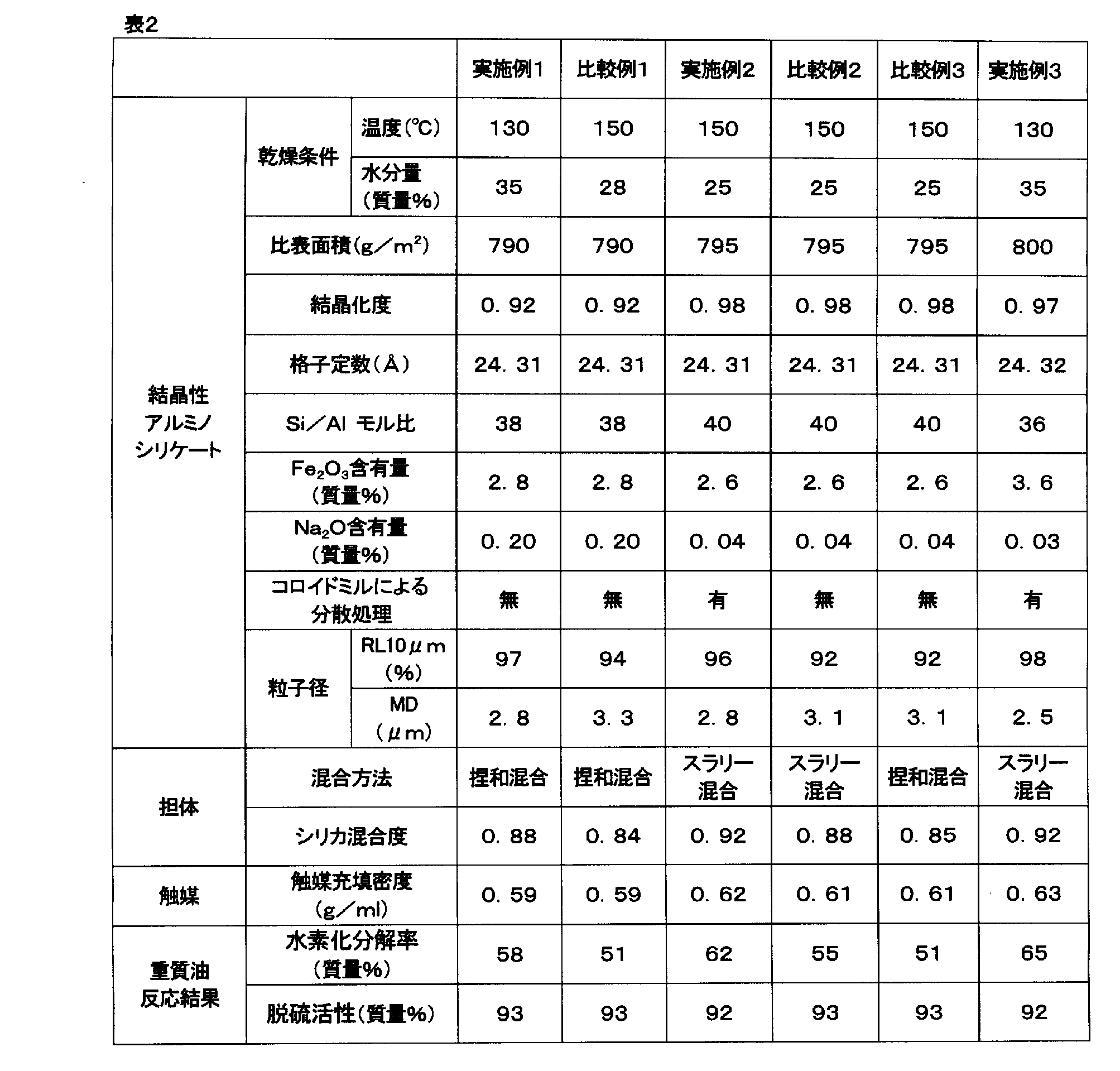
本発明の重質油水素化分解触媒は、分解活性及び脱硫活性の両機能が共に優れるため、これらの活性を生かせる種々の反応系に広く利用することができる。
Claims (4)
- 重質油水素化分解触媒の担体材料として用いられる結晶性アルミノシリケートであって、
(a)前記結晶性アルミノシリケートが、超安定化Y型ゼオライトもしくは金属担持超安定化Y型ゼオライトであり、かつ
(b)レーザー回折散乱法による体積基準の粒子径分布データから解析される粒子径10μm以下の体積割合が95%以上である、結晶性アルミノシリケート。 - (c)レーザー回折散乱法による体積基準の粒子径分布データから解析されるメジアン径が3.0μm以下である請求項1に記載の結晶性アルミノシリケート。
- 請求項1又は2に記載の結晶性アルミノシリケートと、該結晶性アルミノシリケート以外の多孔性無機酸化物とを含む担体に、周期表第6族、第8族、第9族、第10族の金属のうち少なくとも1種の活性金属が担持されてなる重質油水素化分解触媒であって、
(a)前記担体中の前記結晶性アルミノシリケートの含有量が5~80質量%の範囲にあり、かつ
(b)担体断面もしくは触媒断面のEPMA測定によって得られるシリカ混合度が0.86以上である、重質油水素化分解触媒。 - 請求項1又は2に記載の結晶性アルミノシリケートをスラリー状とするスラリー状結晶性アルミノシリケート調製工程と、
アルミナ前駆体をスラリー状とするスラリー状アルミナ前駆体調製工程と、を含み、これらの工程後に、
前記スラリー状アルミナ前駆体と前記スラリー状結晶性アルミノシリケートとを混合するスラリー混合工程と、
脱水処理を行う脱水処理工程と、
成型処理を行って、前記担体中の前記結晶性アルミノシリケートの含有量が5~80質量%である重質油水素化分解触媒用担体を調製する担体調製工程と、
前記重質油水素化分解触媒用担体に周期表第6族、第8族、第9族、第10族の金属のうち少なくとも1種の活性金属を担持する活性金属担持工程と、を順次含む重質油水素化分解触媒の製造方法。
Applications Claiming Priority (2)
| Application Number | Priority Date | Filing Date | Title |
|---|---|---|---|
| JP2012-083134 | 2012-03-30 | ||
| JP2012083134A JP6267414B2 (ja) | 2012-03-30 | 2012-03-30 | 結晶性アルミノシリケート、重質油水素化分解触媒及びその製造方法 |
Publications (1)
| Publication Number | Publication Date |
|---|---|
| WO2013147204A1 true WO2013147204A1 (ja) | 2013-10-03 |
Family
ID=49260445
Family Applications (1)
| Application Number | Title | Priority Date | Filing Date |
|---|---|---|---|
| PCT/JP2013/059637 Ceased WO2013147204A1 (ja) | 2012-03-30 | 2013-03-29 | 結晶性アルミノシリケート、重質油水素化分解触媒及びその製造方法 |
Country Status (2)
| Country | Link |
|---|---|
| JP (1) | JP6267414B2 (ja) |
| WO (1) | WO2013147204A1 (ja) |
Cited By (1)
| Publication number | Priority date | Publication date | Assignee | Title |
|---|---|---|---|---|
| JP2019018200A (ja) * | 2017-07-11 | 2019-02-07 | 日揮触媒化成株式会社 | 脱硫剤の製造方法および脱硫剤前駆体の製造方法、並びに脱硫剤前駆体 |
Families Citing this family (2)
| Publication number | Priority date | Publication date | Assignee | Title |
|---|---|---|---|---|
| DK3305406T3 (da) * | 2015-05-27 | 2025-02-24 | Jgc Catalysts & Chemicals Ltd | Hydrotreating-katalysator til carbonhydridolie, fremgangsmåde til fremstilling deraf og hydrotreating-fremgangsmåde |
| JP7295614B2 (ja) * | 2017-05-31 | 2023-06-21 | 古河電気工業株式会社 | Fcc副生分解油から生成される芳香族化合物製造用触媒構造体、該触媒構造体を有する芳香族化合物製造装置及び芳香族化合物製造用触媒構造体の製造方法 |
Citations (7)
| Publication number | Priority date | Publication date | Assignee | Title |
|---|---|---|---|---|
| JPH03284354A (ja) * | 1990-03-30 | 1991-12-16 | Sekiyu Sangyo Kasseika Center | 炭化水素油用水素化処理触媒組成物ならびにそれを用いる水素化処理方法 |
| JPH0456666B2 (ja) * | 1984-05-11 | 1992-09-09 | Jushitsuyu Taisaku Gijutsu Kenkyu Kumiai | |
| JPH05329375A (ja) * | 1990-06-04 | 1993-12-14 | Texaco Dev Corp | 新規なゼオライト及びその製造方法 |
| JPH06285374A (ja) * | 1993-04-07 | 1994-10-11 | Idemitsu Kosan Co Ltd | 新規触媒組成物 |
| JPH10500898A (ja) * | 1994-06-03 | 1998-01-27 | アクゾ ノーベル ナムローゼ フェンノートシャップ | 被覆されたゼオライト粒子を含むfcc触媒 |
| WO2009119390A1 (ja) * | 2008-03-28 | 2009-10-01 | 財団法人石油産業活性化センター | 重質油水素化分解触媒 |
| JP2011031194A (ja) * | 2009-08-03 | 2011-02-17 | Idemitsu Kosan Co Ltd | 重質油水素化分解触媒及びそれを用いた重質油の水素化処理方法 |
-
2012
- 2012-03-30 JP JP2012083134A patent/JP6267414B2/ja active Active
-
2013
- 2013-03-29 WO PCT/JP2013/059637 patent/WO2013147204A1/ja not_active Ceased
Patent Citations (7)
| Publication number | Priority date | Publication date | Assignee | Title |
|---|---|---|---|---|
| JPH0456666B2 (ja) * | 1984-05-11 | 1992-09-09 | Jushitsuyu Taisaku Gijutsu Kenkyu Kumiai | |
| JPH03284354A (ja) * | 1990-03-30 | 1991-12-16 | Sekiyu Sangyo Kasseika Center | 炭化水素油用水素化処理触媒組成物ならびにそれを用いる水素化処理方法 |
| JPH05329375A (ja) * | 1990-06-04 | 1993-12-14 | Texaco Dev Corp | 新規なゼオライト及びその製造方法 |
| JPH06285374A (ja) * | 1993-04-07 | 1994-10-11 | Idemitsu Kosan Co Ltd | 新規触媒組成物 |
| JPH10500898A (ja) * | 1994-06-03 | 1998-01-27 | アクゾ ノーベル ナムローゼ フェンノートシャップ | 被覆されたゼオライト粒子を含むfcc触媒 |
| WO2009119390A1 (ja) * | 2008-03-28 | 2009-10-01 | 財団法人石油産業活性化センター | 重質油水素化分解触媒 |
| JP2011031194A (ja) * | 2009-08-03 | 2011-02-17 | Idemitsu Kosan Co Ltd | 重質油水素化分解触媒及びそれを用いた重質油の水素化処理方法 |
Cited By (2)
| Publication number | Priority date | Publication date | Assignee | Title |
|---|---|---|---|---|
| JP2019018200A (ja) * | 2017-07-11 | 2019-02-07 | 日揮触媒化成株式会社 | 脱硫剤の製造方法および脱硫剤前駆体の製造方法、並びに脱硫剤前駆体 |
| JP7027270B2 (ja) | 2017-07-11 | 2022-03-01 | 日揮触媒化成株式会社 | 脱硫剤の製造方法および脱硫剤前駆体の製造方法、並びに脱硫剤前駆体 |
Also Published As
| Publication number | Publication date |
|---|---|
| JP6267414B2 (ja) | 2018-01-24 |
| JP2013212449A (ja) | 2013-10-17 |
Similar Documents
| Publication | Publication Date | Title |
|---|---|---|
| JP5547923B2 (ja) | 重質油水素化分解触媒及びそれを用いた重質油の水素化処理方法 | |
| CN104114273B (zh) | 含二氧化硅的氧化铝载体、由其制备的催化剂及其使用方法 | |
| EP0449144B2 (en) | Catalyst composition for hydrotreating of hydrocarbons and hydrotreating process using the same | |
| WO2009119390A1 (ja) | 重質油水素化分解触媒 | |
| WO2006029137A2 (en) | Hydroprocessing catalyst with zeolite and high mesoporosity | |
| CN109423336B (zh) | 一种加氢裂化方法 | |
| US11305264B2 (en) | Manufacturing hydrocracking catalyst | |
| CN103998130A (zh) | 包含至少一种nu-86沸石、至少一种usy沸石和多孔无机基质的催化剂和使用所述的催化剂来加氢转化烃原料的方法 | |
| US11192089B2 (en) | Process for hydroconversion of heavy hydrocarbon feedstock in hybrid reactor | |
| SA521422374B1 (ar) | محفزات مدعومة بزيوليت بمقاس نانوي وطرق لإنتاجها | |
| KR102708276B1 (ko) | 향상된 산점분포를 가지는 고도로 안정화된 y 제올라이트를 포함하는 중간 유분 수소화 분해 촉매 | |
| US6551500B1 (en) | Hydrocracking catalyst, producing method thereof, and hydrocracking method | |
| JP2025000619A (ja) | 高いナノ細孔の安定化yゼオライトを含有する中間留分水素化分解触媒 | |
| JP6267414B2 (ja) | 結晶性アルミノシリケート、重質油水素化分解触媒及びその製造方法 | |
| US6682650B2 (en) | Zeolite catalyst carrier and hydrogenation catalyst using same | |
| JP6026782B2 (ja) | 重質油の水素化処理方法 | |
| JP5220456B2 (ja) | 常圧蒸留残渣油の分解方法 | |
| JP5852892B2 (ja) | 重質油の水素化処理方法 | |
| JP2000086233A (ja) | 鉄含有結晶性アルミノシリケート | |
| JP2015168688A (ja) | 軽油基材の製造方法 | |
| JP2022074937A (ja) | 重質炭化水素油の水素化処理触媒及びその製造方法ならびに水素化処理方法 | |
| JP2013213107A (ja) | 水素化分解触媒を用いた水素化脱硫装置及び重質油の水素化処理方法 | |
| JP2025538494A (ja) | βゼオライト系触媒を含む一連の触媒を含む鉱物供給原料の再生可能な供給原料との共処理によって中間留分を製造するための方法 | |
| JP2000265175A (ja) | 軽油留分の水素化脱硫方法 | |
| JPH0628738B2 (ja) | 水素化脱硫・水素化分解触媒 |
Legal Events
| Date | Code | Title | Description |
|---|---|---|---|
| 121 | Ep: the epo has been informed by wipo that ep was designated in this application |
Ref document number: 13769943 Country of ref document: EP Kind code of ref document: A1 |
|
| NENP | Non-entry into the national phase |
Ref country code: DE |
|
| 122 | Ep: pct application non-entry in european phase |
Ref document number: 13769943 Country of ref document: EP Kind code of ref document: A1 |