WO2013140441A1 - 再生装置の制御方法および再生装置 - Google Patents
再生装置の制御方法および再生装置 Download PDFInfo
- Publication number
- WO2013140441A1 WO2013140441A1 PCT/JP2012/001932 JP2012001932W WO2013140441A1 WO 2013140441 A1 WO2013140441 A1 WO 2013140441A1 JP 2012001932 W JP2012001932 W JP 2012001932W WO 2013140441 A1 WO2013140441 A1 WO 2013140441A1
- Authority
- WO
- WIPO (PCT)
- Prior art keywords
- playback
- music
- reproduction
- time
- information
- Prior art date
- Legal status (The legal status is an assumption and is not a legal conclusion. Google has not performed a legal analysis and makes no representation as to the accuracy of the status listed.)
- Ceased
Links
Images




Classifications
-
- G—PHYSICS
- G11—INFORMATION STORAGE
- G11B—INFORMATION STORAGE BASED ON RELATIVE MOVEMENT BETWEEN RECORD CARRIER AND TRANSDUCER
- G11B27/00—Editing; Indexing; Addressing; Timing or synchronising; Monitoring; Measuring tape travel
- G11B27/10—Indexing; Addressing; Timing or synchronising; Measuring tape travel
Definitions
- the present invention relates to a control method and a playback apparatus for a playback apparatus that plays back music such as dance music.
- music acquisition means for acquiring music data and music information provided from a personal computer
- music storage means for storing the acquired music data and music information
- playback means for reproducing the stored music data
- This playback apparatus assumes a dance-only audio device (so-called dancer audio) used for dance practice, and mainly plays dance music as music.
- the playback apparatus is configured to be able to continuously play a plurality of music pieces.
- the conventional playback device plays the role of DJ
- the music stored in the playback device will be played back, so the team that provided the playback device would be advantageous. . That is, since the team that provided the playback device knows the music in advance, this works as superiority or inferiority in dance battles that compete for ad-lib capabilities.
- the playback devices cannot be linked to each other, the music playback is performed between the two playback devices. When switching with, music cannot be connected smoothly. As a result, there is a problem that the atmosphere of the place will rise.
- the playback device control method of the present invention is a playback device control method for performing music playback while switching between other playback devices, including a setting step for setting playback information including the playback time of the music, The playback information transmission step for transmitting playback information to the playback device, the playback control step for playing back the music for the playback time, and N (N ⁇ 1) immediately before switching when switching the music playback to another playback device.
- a start information transmission step of transmitting reproduction start information for starting reproduction of the (N + 1) th music piece to another reproduction device before the end of the reproduction time of the music piece is performed. .
- the playback device of the present invention is a playback device that performs music playback while switching between other playback devices, a setting unit that sets playback information including the playback time of the music, and other playback devices, A reproduction information transmission unit that transmits reproduction information, a reproduction control unit that reproduces music for the reproduction time, and a reproduction time of the Nth (N ⁇ 1) music immediately before switching when switching the music reproduction to another reproduction device And a start information transmitting unit that transmits playback start information for starting playback of the (N + 1) -th music to another playback device before the end.
- the playback information (setting information) can be shared with other playback devices by transmitting the set playback information to the other playback devices.
- the playback start information (trigger signal) is transmitted to the other playback devices, so that the playback devices (your playback device and other playback devices) can be connected to each other. Can be linked.
- the playback start information before the end of the playback time (the set playback time) of the music immediately before the switching, it is possible to prevent the playback of the music after the switching from being delayed due to the transmission / reception of the playback start information. Can do.
- the music reproduction after the switching can be started at the same time as or after the music reproduction before the switching is completed. Therefore, music can be smoothly connected at the time of switching.
- the effect of “appropriately connecting playback devices” is limited to “when a playback device is used for a dance battle” in the case of playing music by connecting playback devices together. This is an effect that can be obtained at all, and the present invention is not limited to “when a playback apparatus is used for a dance battle”.
- an interval section for separating the playback times in time series is provided between the end time of the playback time of the Nth song and the start time of the playback time of the (N + 1) th song. It is preferable.
- the interval section can be used as a dancer's preparation period by arranging the interval section during the music playback time (move time).
- the start information transmission step it is preferable to transmit the reproduction start information to another reproduction apparatus T (T> 0) seconds before the start point of the interval section.
- the playback start information is transmitted before the start time of the interval section, so that the music playback after switching is started before the end of the interval section, that is, at the start time of the interval section or in the middle thereof can do.
- it is effective when music playback is performed by shifting the start time of music playback from the start time of the set playback time (move time).
- the Nth music piece is extended and played back until the end of the interval section or until the end point.
- the playback control step it is preferable to play the Nth song with an effect during the interval section.
- a specific sound reproduction control step for reproducing specific sound is further executed in synchronization with music reproduction by another reproducing apparatus.
- rhythm sound for example, rhythm sound (beat sound), cheering SE (effect sound), MC comment, and the like are played back.
- rhythm sound beat sound
- cheering SE effect sound
- MC comment a comment that helps the other player play music.
- the music information (BPM information, etc.) of the music selected from the other playback device is acquired, and based on this, the rhythm sound is played back along with the music playback of the other playback device.
- a mode selection step for selecting either the first mode or the second mode is further executed.
- the mode selection step is performed according to the set number of reproductions.
- the first mode playback control step of selecting a number of songs and playing the song data of each selected song for the duration of playback, and when the second mode is selected, correspond to the beginning to the end of the selected song. It is preferable to execute the second mode playback control step of continuously playing back the music data of arbitrary length until the playback time is satisfied while switching the music.
- the first mode in which each piece of music corresponding to the set number of playbacks is played for the playback time (individual playback time) and the set playback time (total playback time) are satisfied.
- a variety of dance battles can be enjoyed by making it possible to switch between the second mode (so-called circle mode) for reproducing a number of music pieces.
- a cooperative playback system including a playback device is illustrated.
- This cooperative playback system is used when performing a dance battle, and is assumed to be configured by wirelessly connecting two playback devices (dancer audio) brought together by the opposing teams.
- regeneration system has the structure which cooperates reproducing
- the cooperative reproduction system SY is composed of two reproduction apparatuses 1.
- the playback apparatuses 1 are connected to each other via a wireless communication network NW such as Wi-Fi Direct (registered trademark) or Bluetooth (registered trademark), and are configured to be able to communicate various data between each other.
- NW such as Wi-Fi Direct (registered trademark) or Bluetooth (registered trademark)
- the playback devices 1 are linked together, and a series of music playback during a dance battle is performed while switching between the playback devices 1.
- Each playback device 1 assumes a dance-only audio device (so-called dancer audio), and mainly plays dance music.
- each playback device 1 includes a music storage unit 11, a playback unit 12, a wireless communication unit 13, a liquid crystal display unit 14, an operation unit 15, and a control unit 16. It is equipped with.
- the music storage unit 11 is composed of an internal memory or the like, and stores music data of a plurality of music.
- the playback unit 12 includes an internal speaker and the like, and plays back music data, rhythm sounds, and the like of music stored in the music storage unit 11.
- the wireless communication unit 13 is composed of a wireless module, and performs wireless communication with another playback device 1 via the wireless communication network NW. Specifically, the wireless communication unit 13 exchanges information (reproduction information, reproduction start information, and music information) necessary for cooperation with other reproduction apparatuses 1.
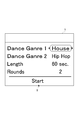
- the liquid crystal display unit 14 is composed of a liquid crystal display or the like, and displays a playback setting screen S.
- the playback setting screen S is a screen for setting playback information for a series of music playback during a dance battle.
- the reproduction information includes a first genre (Dance Genre 1), a second genre (Dance Genre 2), one move time (Length), and the number of rounds (Rounds).
- the first genre and the second genre can be set to “hip hop”, “house”, “break”, “rock”, “pop”, “jazz”, and the like.
- the move time can be set in increments of 10 seconds from 30 seconds to 90 seconds.
- the number of rounds can be set in increments of 1 to 6 times.
- the music data of the two songs can be played for 120 seconds each (move time ⁇ number of teams) for a total of 240 seconds. Done.
- twice the time of one move is the reproduction time of the music data of each song, and the reproduction time is set by setting one move time.
- the number of rounds is the number of times the music is played (the number of played music).
- the operation unit 15 includes operation keys, a remote controller, and the like, and functions as a reproduction setting unit (setting unit) 21.
- the reproduction setting unit 21 selects and sets the reproduction information on the reproduction setting screen S. After selecting each of the above items, pressing the “Start” button B on the playback setting screen S completes the setting.
- the control unit 16 has a CPU (Central Processing Unit) 31, a RAM (Random Access Memory) 32, and a ROM (Read Only Memory) 33.
- the CPU 31 is a central processing unit that performs various types of processing related to the control of the playback device 1.
- the RAM 32 is a volatile memory serving as a work area for the various arithmetic processes.
- the ROM 33 is a non-volatile memory that stores a control program and control data for performing the various arithmetic processes. Then, the CPU 31 executes a predetermined program to thereby reproduce the reproduction information transmission unit 41, the music reproduction control unit (reproduction control unit) 42, the trigger transmission unit (start information transmission unit) 43, the music information transmission unit 44, and the audio reproduction. It functions as the control unit 45.
- the reproduction information transmission unit 41 transmits the set reproduction information to another reproduction device by the wireless communication unit 13. That is, the reproduction information transmitting unit 41 transmits the set reproduction information to another reproduction device 1 at the start of a series of music reproduction at the time of a dance battle, thereby sharing the reproduction information with the other reproduction device 1.
- the music playback control unit 42 uses the playback unit 12 to play back music based on the playback information in cooperation with the other playback device 1.
- a series of music playback during a dance battle is such that the playback time of each round (the movement time of both teams) and the playback time of the previous and next rounds are separated in time series (x> 0). It consists of an interval section of seconds.
- the interval section time x is, for example, a few seconds.
- each round of the set number of rounds is distributed to the two reproduction apparatuses 1, and a series of music reproduction is performed while switching between the reproduction apparatuses 1.
- each of the music playback control units 42 of the two playback devices 1 automatically selects and selects half of the set number of rounds according to the genre (first genre and second genre).
- the music data of each music is played for the set playback time.
- the music reproduction control unit 42 selects odd-numbered music from the first genre and selects even-numbered music from the second genre.
- the trigger transmission unit 43 transmits a trigger signal (reproduction start information) to the other reproduction device 1 by the wireless communication unit 13.
- the trigger signal is a signal for the other playback device 1 to start playing music. That is, the trigger transmission unit 43 instructs the other playback device 1 to play back music by transmitting a trigger signal when switching the playback of music to another playback device 1.
- the playback device 1 that has received the trigger signal determines the music playback start timing based on the trigger signal reception timing.
- the music information transmitting unit 44 transmits the music information of the selected music to the other playback device 1 by the wireless communication unit 13.
- the music information is information attached to the music or information obtained by analyzing the music, and includes, for example, the title and artist name of the music, beat position information of the music, BPM (Beats Per Minute) information, and the like.
- the audio reproduction control unit 45 causes the reproduction unit 12 to reproduce a rhythm sound (beat sound) based on the music information from the other reproduction apparatus 1. That is, the audio reproduction control unit 45 reproduces the rhythm sound in synchronization with the music reproduction of the other reproduction apparatus 1 mainly based on the beat position information and the BMP information. As a result, music playback by another playback device 1 is assisted (effect). In addition, when synchronizing with the music playback of the other playback device 1, it is necessary to specify the playback start timing of the music playback of the other playback device 1, and this is specified using the reception timing of the music information. That is, music information is used as a synchronization signal.
- the audio playback control unit 45 receives the music information reception timing, the interval between the predetermined music information transmission timing and the music playback playback start timing (t seconds described later), and delays such as transmission delay and file access delay. Based on the time (the difference between the transmission timing and reception timing of music information), the playback start timing of music playback is specified. Based on the specified playback start timing and beat position information, the playback timing of the rhythm sound is determined. Thereby, rhythm sound reproduction
- This music reproduction operation is executed due to the setting of reproduction information (completion of setting) in one reproduction apparatus 1. Also, the following operation is executed with the playback device 1 in which playback information is set serving as a master device and the other playback device 1 as a slave device.
- the case where the set number of rounds is two is illustrated. Therefore, a series of music reproduction is performed by the reproduction time of the first round and the second round, and the interval section provided between the end time of the first round and the start time of the second round.
- the n-th (n ⁇ 1) round is referred to as round n.
- the master device transmits the set reproduction information to the slave device (S2: reproduction information transmitting step).
- the slave device receives this reproduction information (S3). Thereby, reproduction information is shared between the reproducing apparatuses 1.
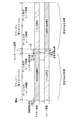
- the master device When the reproduction information is transmitted, the master device reproduces the music of round 1 based on the reproduction information (reproduction control step). That is, the music playback control unit 42 selects the first music to be played in round 1 according to the first genre (S4). Then, after the music information transmitting unit 44 transmits the music information of the selected music to the slave device (S5), the music reproduction control unit 42 starts the reproduction of the selected music (S6). At this time, as shown in FIG. 5, music information is transmitted t (t> 0) seconds before the music playback of the selected music starts. On the other hand, after receiving the music information (S7), the slave device reproduces the rhythm sound in synchronization with the music reproduction of the master device by the audio reproduction control unit 45 based on the received music information and its reception timing ( S8: Specific audio reproduction control step).
- the master device transmits a trigger transmission unit. 43, a trigger signal for starting reproduction of the second music is transmitted to the slave device (S9: start information transmission step) (see FIG. 5). Then, the reproduction of the first song is finished (S10).
- the master device reproduces the first music piece by extending it to the end point of the interval section. That is, the master device continuously plays back the first music piece for the playback time and the interval interval x seconds.
- the slave device when receiving the trigger signal, performs round 2 music playback based on the playback information (playback control step). That is, after receiving the trigger signal (S11), the slave device selects the second song to be played in round 2 according to the second genre by the song playing control unit 42 (S12). Then, after the music information transmitting section 44 transmits the music information of the selected music (S13), the music playback control section 42 starts to play the selected music (S14). At this time, as shown in FIG. 5, music information is transmitted t (t> 0) seconds before the music playback of the selected music starts. Also, the music playback of the second music is started from the middle of the interval section (for example, the center position).
- the slave device continuously reproduces the second music piece for several seconds in the interval section and for the reproduction time.
- the music reproduction start timing is determined based on the trigger signal reception timing, but is determined in consideration of the transmission delay of the trigger signal, the file access delay, and the like.
- the master device After receiving the music information (S15), the master device reproduces the rhythm sound in synchronization with the music reproduction based on the received music information and the reception timing by the audio reproduction control unit 45 (S16). Thereafter, the reproduction of the second music is finished (S17), and this operation is finished.
- the playback device 1 is switched alternately for each round and played back.
- the round 2 to 2 rounds (2 songs) are played back. It is preferable to play by switching the device 1 (in FIG. 6, the case of four times is illustrated). As a result, it is possible to avoid the genre being fixed by the playback apparatus 1 such that the first genre is played by only one playback apparatus 1.
- the playback device 1 that is playing is configured to transmit a trigger signal to another playback device 1 immediately before the end of the playback time in the odd-numbered round.
- a trigger signal to another playback device 1 immediately before the end of the playback time in the odd-numbered round.
- Shift playback from song to later song is transmitted to another playback device 1 immediately before the end of the playback time in the odd-numbered round.
- the playback information (setting information) can be shared with the other playback devices 1 by transmitting the set playback information to the other playback devices 1.
- the playback devices 1 can be linked together by transmitting a trigger signal to the other playback device 1.
- the playback time set playback time
- N + 1 By transmitting a trigger signal for starting the music reproduction of the music piece, it is possible to avoid delaying the music reproduction after switching due to a lag in transmission / reception of the trigger signal. Therefore, the music reproduction after the switching can be started at the same time as or after the music reproduction before the switching is completed. Therefore, music can be smoothly connected at the time of switching.
- this interval section can be used as a dancer's preparation period.
- the rhythm sound is played back in synchronization with this, so that the atmosphere of the place can be raised.
- the rhythm sound based on the music information can be started from the music playback start time.
- each piece of music corresponding to the set number of rounds is played for a set playback time (individual playback time), but this is a normal mode (first mode).
- the playback mode during the dance battle can be switched between the circle mode (second mode) in which the number of songs satisfying the set playback time is played back.
- the operation unit 15 selects either the normal mode or the circle mode before setting by the playback setting unit 21 (mode selection step).
- mode selection step When the first mode is selected by the music playback control unit 42, the master device and the slave device perform music playback described in the above embodiment (first mode playback control step).
- each playback device 1 uses the trigger transmission unit 43 to switch the playback of music to another playback device 1 before the end of the playback time of its own music.
- the other playback device 1 transmits a trigger signal for starting the music playback.
- the Nth music before switching is configured to be played continuously until the end of the interval section.
- the structure which continues to the middle may be sufficient.
- it instead of simply continuing the music piece until the end point of the interval section or halfway, it may be configured to reproduce the music piece with an echo (effect) in the interval section.
- the music playback of the (N + 1) th music after switching is played from the middle of the interval section.
- the playback may be performed from the start time of the interval section.
- the sound reproduction control unit 45 is configured to reproduce the rhythm sound in synchronization with the music reproduction of the other reproduction device 1, but is synchronized with the music reproduction of the other reproduction device 1. And if it is the structure which reproduces
- the configuration may be such that a cheering SE (sound effect), MC comment, or the like is reproduced in synchronism with the music reproduction of the other reproducing apparatus 1. In this case, the cheering SE or MC comment is reproduced in a specific melody area such as rust or A melody based on the reproduction information.
- the linked playback system SY is configured to perform music playback by linking two playback devices 1, but is configured to playback music by linking three or more playback devices 1. It may be.
- the playback apparatus 1 sets the order in which the music playback is performed among the three playback apparatuses 1 in addition to the above-mentioned various items as playback information by the playback setting unit 41, and this is set between the three playback apparatuses 1.
- the trigger transmission unit 43 transmits the identification information of the playback apparatus 1 that performs the next music playback together with the trigger signal.
- the three playback devices 1 are appropriately linked.
- the playback device 1 itself is configured to execute the various processes (transmission / reception and playback control of various information) illustrated in FIG. 4, but these are connected to the computer connected to the playback device 1. It may be configured to perform various processes. That is, it is the structure which performs the said various processes by mounting a dedicated application in the computer (PC, smart phone, etc.) which has a radio
- the cooperative reproduction system SY is configured by wirelessly connecting the reproduction processing systems including the computer and the reproduction apparatus 1 via the wireless communication network NW.
- each function of the playback device 1 shown in the above embodiment can be provided as a program.
- the program can be provided by being stored in various storage media (CD-ROM, flash memory, etc.). That is, a program for causing a computer to function as the playback setting unit 21, the playback information transmission unit 41, the music playback control unit 42, the trigger transmission unit 43, the music information transmission unit 44, and the audio playback control unit 45 of the playback device 1, and the program It is also assumed that a storage medium on which is recorded is provided.
Landscapes
- Electrophonic Musical Instruments (AREA)
Description
本発明は、ダンスミュージック等の楽曲を再生する再生装置の制御方法および再生装置に関するものである。
従来、再生装置として、パーソナルコンピューターから提供された楽曲データおよび楽曲情報を取得する楽曲取得手段と、取得した楽曲データおよび楽曲情報を記憶する楽曲記憶手段と、記憶した楽曲データを再生する再生手段と、を備えたものが知られている(特許文献1参照)。この再生装置は、ダンスの練習に用いられるダンス専用オーディオ機器(いわゆるダンサーオーディオ)を想定し、楽曲としては、主にダンスミュージックを再生するものである。また、本再生装置は、複数の楽曲を連続再生可能に構成されている。
ところで、ダンスパフォーマンスの一種として、チーム同士(もしくはダンサー同士)で、交互にダンス(ムーブ)を披露して対決するダンスバトルが知られている。このダンスバトルは、基本的にDJが選曲した楽曲に合わせて、アドリブ(即興)でダンスを披露し、楽曲に合ったダンスを披露できたか否かによって、勝敗を決めるものである。これに対し、近年、このDJの役割を、再生装置の連続再生機能で行わせることが求められている。すなわち、再生装置がDJの役割を担うことで、第3者であるDJなしでダンスバトルを行うことができ、これによって、気軽にダンスバトルおよびその練習を行うことができる。
しかしながら、DJの役割を、上記従来の再生装置に行わせると、再生装置に記憶されている楽曲を再生することになるので、再生装置を提供したチームが有利になってしまうという問題があった。すなわち、再生装置を提供したチームは、予め楽曲を知っているので、アドリブ能力を競うダンスバトルでは、これが優劣として働いてしまう。これに対し、両チームが提供した2台の再生装置を使って、交互に楽曲再生を行うことを考えたが、再生装置同士を連携させることができないので、楽曲再生を2台の再生装置間で切り替えるときに、スムーズに音楽をつなげることができない。これによって、場の雰囲気が盛り下がってしまうという問題が想定される。
しかしながら、DJの役割を、上記従来の再生装置に行わせると、再生装置に記憶されている楽曲を再生することになるので、再生装置を提供したチームが有利になってしまうという問題があった。すなわち、再生装置を提供したチームは、予め楽曲を知っているので、アドリブ能力を競うダンスバトルでは、これが優劣として働いてしまう。これに対し、両チームが提供した2台の再生装置を使って、交互に楽曲再生を行うことを考えたが、再生装置同士を連携させることができないので、楽曲再生を2台の再生装置間で切り替えるときに、スムーズに音楽をつなげることができない。これによって、場の雰囲気が盛り下がってしまうという問題が想定される。
本発明は、再生装置同士を適切に連携させることができる再生装置の制御方法および再生装置を提供することを課題としている。
本発明の再生装置の制御方法は、楽曲再生を、他の再生装置との間で切り替えつつ行う再生装置の制御方法であって、楽曲の再生時間を含む再生情報を設定する設定ステップと、他の再生装置に対し、再生情報を送信する再生情報送信ステップと、再生時間だけ楽曲を再生する再生制御ステップと、楽曲再生を他の再生装置と切り替えるときに、切替え直前のN(N≧1)曲目の楽曲の再生時間終了前に、他の再生装置に対し、(N+1)曲目の楽曲の再生を開始するための再生開始情報を送信する開始情報送信ステップと、を実行することを特徴とする。
本発明の再生装置は、楽曲再生を、他の再生装置との間で切り替えつつ行う再生装置であって、楽曲の再生時間を含む再生情報を設定する設定部と、他の再生装置に対し、再生情報を送信する再生情報送信部と、再生時間だけ楽曲を再生する再生制御部と、楽曲再生を他の再生装置と切り替えるときに、切替え直前のN(N≧1)曲目の楽曲の再生時間終了前に、他の再生装置に対し、(N+1)曲目の楽曲の再生を開始するための再生開始情報を送信する開始情報送信部と、を備えたことを特徴とする。
これらの構成によれば、設定した再生情報を他の再生装置に送信することで、再生情報(設定情報)を他の再生装置と共有することができる。これに加えて、楽曲再生を他の再生装置と切り替えるときに、再生開始情報(トリガー信号)を他の再生装置に送信することで、再生装置同士(自身の再生装置および他の再生装置)を連携させることができる。さらに、再生開始情報を、切替え直前の楽曲の再生時間(設定の再生時間)終了前に送信することで、再生開始情報の送受信のラグによって、切替え後の楽曲再生が遅れてしまうのを避けることができる。そのため、切替え前の楽曲再生が終了するのと同時に、またはその付近(前後)から、切替え後の楽曲再生を開始することができる。よって、切替え時に、スムーズに音楽をつなげることができる。なお、この「再生装置同士を適切に連携させることができる」という作用効果は、再生装置同士を連携させて楽曲再生を行うケースであれば、「ダンスバトルに再生装置を用いた場合」に限らずとも得られる作用効果であり、本発明は、「ダンスバトルに再生装置を用いた場合」に限定するものではない。
上記の再生装置の制御方法において、N曲目の再生時間の終了時点と(N+1)曲目の楽曲の再生時間の開始時点との間に、当該両再生時間を時系列的に離間させるインターバル区間を設けることが好ましい。
この構成によれば、楽曲の再生時間(ムーブ時間)の間に、インターバル区間を配したことで、このインターバル区間をダンサーの準備期間として利用することができる。
この場合、開始情報送信ステップでは、他の再生装置に対し、インターバル区間の開始時点からT(T>0)秒前に再生開始情報を送信することが好ましい。
この構成によれば、再生開始情報を、インターバル区間の開始時点よりも前に送信することで、インターバル区間が終了する前、すなわち、インターバル区間の開始時点やその途中から切替え後の楽曲再生を開始することができる。例えば、楽曲再生の開始時点を、設定の再生時間(ムーブ時間)の開始時点からずらして、楽曲再生を行う場合に有効である。
一方、再生制御ステップでは、インターバル区間の途中または終了時点まで、N曲目の楽曲を延長して再生することが好ましい。
また、再生制御ステップでは、インターバル区間中に、N曲目の楽曲にエフェクトをかけて再生することが好ましい。
これらの構成によれば、インターバル区間中にも楽曲再生を継続することで、インターバル区間中に音声(音楽)が途切れてしまい、場の雰囲気が盛り下がってしまうのを避けることができる。なお、楽曲にかけるエフェクトとしては、エコーやディレイ、フェードアウト等が考えられる。
一方、他の再生装置の楽曲再生に同期して、特定の音声を再生する特定音声再生制御ステップを、さらに実行することを特徴とすることが好ましい。
この構成によれば、他の再生装置が楽曲再生を行っている間、これと同期して、例えば、リズム音(ビート音)や歓声のSE(効果音)、MCコメント等を再生する。このように、他の再生装置の楽曲再生を助ける演出を再生することで、場の雰囲気を盛り上げることができる。例えば、他の再生装置から選曲した楽曲の楽曲情報(BPM情報等)を取得し、これに基づき、他の再生装置の楽曲再生に合わせて、リズム音を再生する。
この場合、楽曲の再生開始前に、他の再生装置に対し、再生する楽曲の拍位置情報を含む楽曲情報を送信する楽曲情報送信ステップを、さらに実行することが好ましい。
この構成によれば、楽曲の再生開始前に、その楽曲の楽曲情報を送信することで、楽曲再生の開始時点から、楽曲情報に基づく特定の音声(特にリズム音)の再生を開始することができる。
また、第1のモードと第2のモードのいずれかを選択するモード選択ステップを、さらに実行し、再生制御ステップでは、第1のモードが選択された場合に、設定された再生回数に応じた数の楽曲を選曲し、選曲した各楽曲の楽曲データを再生時間だけ再生する第1モード再生制御ステップと、第2のモードが選択された場合に、選曲した楽曲の先頭から後尾までに相当する任意長の楽曲データを、楽曲を切り替えながら再生時間を満たすまで連続して再生する第2モード再生制御ステップと、を実行することが好ましい。
この構成によれば、設定した再生回数に応じた数の各楽曲を再生時間(個別再生時間)だけ再生する第1のモード(いわゆるノーマルモード)と、設定した再生時間(総再生時間)を満たす数の楽曲を再生する第2のモード(いわゆるサークルモード)とを切り替え可能とすることで、多様なダンスバトルを楽しむことができる。
以下、添付図面を参照し、本発明の一実施形態に係る再生装置の制御方法、再生装置、プログラムおよび再生処理システムについて説明する。本実施形態では、再生装置を備えた連携再生システムを例示する。この連携再生システムは、ダンスバトルを行うときに用いられ、対決する両チームが持ち寄った2台の再生装置(ダンサーオーディオ)同士を、無線接続して構成されること等を想定している。なお、本連携再生システムは、所定の通信制御および再生制御により、再生装置同士を適切に連携させる構成を有している。
図1に示すように、連携再生システムSYは、2台の再生装置1により構成されている。再生装置1同士は、Wi‐Fi Direct(登録商標)やBluetooth(登録商標)等の無線通信ネットワークNWを介して接続されており、相互間で各種データを通信可能に構成されている。これにより、再生装置1同士を連携させて、ダンスバトル時の一連の楽曲再生を、再生装置1同士で切り替えつつ実行する。
各再生装置1は、ダンス専用オーディオ機器(いわゆるダンサーオーディオ)を想定しており、主にダンスミュージックを再生する。具体的には、図1に示すように、各再生装置1は、楽曲記憶部11と、再生部12と、無線通信部13と、液晶表示部14と、操作部15と、制御部16と、を備えている。楽曲記憶部11は、内部メモリー等で構成されており、複数の楽曲の楽曲データを記憶する。再生部12は、内部スピーカー等を有し、楽曲記憶部11に記憶された楽曲の楽曲データやリズム音等を再生する。
無線通信部13は、無線モジュールで構成されており、無線通信ネットワークNWを介して他の再生装置1との無線通信を行う。具体的には、無線通信部13は、他の再生装置1との間で、連携に必要な情報(再生情報、再生開始情報および楽曲情報)をやりとりする。
液晶表示部14は、液晶ディスプレイ等で構成されており、再生設定画面Sを表示する。図2に示すように、再生設定画面Sは、ダンスバトル時の一連の楽曲再生の再生情報を設定する画面である。再生情報は、第1のジャンル(Dance Genre 1)、第2のジャンル(Dance Genre 2)、1回のムーブ時間(Length)、およびラウンド数(Rounds)を含んでいる。そして、第1のジャンル、第2のジャンルは、「ヒップホップ」、「ハウス」、「ブレーク」、「ロック」、「ポップ」、「ジャズ」等が設定可能である。また、ムーブ時間は、30秒から90秒まで10秒刻みで設定可能である。さらに、ラウンド数は、1回から6回まで1回刻みで設定可能である。例えば、ラウンド数が「2回」と設定され、ムーブ時間が60秒と設定された場合、2つの楽曲の楽曲データを、それぞれ120秒間(ムーブ時間×チーム数)ずつ、計240秒間の再生が行われる。すなわち、本実施形態では、1回のムーブ時間の2倍が、各楽曲の楽曲データの再生時間となり、1回のムーブ時間を設定することで、当該再生時間を設定する。また、ラウンド数が楽曲の再生回数(再生曲数)となる。
操作部15は、操作キーやリモコン等で構成されており、再生設定部(設定部)21として機能する。再生設定部21は、再生設定画面Sにより、上記再生情報を選択設定する。なお、上記各項目を選択した後、再生設定画面Sの「Start」ボタンBを押すことで、設定を完了する。
図1に示すように、制御部16は、CPU(Central Processing Unit)31、RAM(Random Access Memory)32およびROM(Read Only Memory)33を有している。CPU31は、再生装置1の制御に係る各種演算処理を行う中央演算処理装置である。RAM32は、当該各種演算処理の作業領域となる揮発性メモリーである。ROM33は、当該各種演算処理を行うための制御プログラムおよび制御データを記憶する不揮発性メモリーである。そして、CPU31は、所定のプログラムを実行することで、再生情報送信部41、楽曲再生制御部(再生制御部)42、トリガー送信部(開始情報送信部)43、楽曲情報送信部44および音声再生制御部45として機能する。
再生情報送信部41は、無線通信部13により、設定した再生情報を他の再生装置に送信する。すなわち、再生情報送信部41は、ダンスバトル時の一連の楽曲再生の開始時に、設定した再生情報を他の再生装置1に送信することで、当該再生情報を他の再生装置1と共有する。
楽曲再生制御部42は、再生部12により、他の再生装置1と連携して、再生情報に基づく楽曲再生を行う。図3に示すように、ダンスバトル時の一連の楽曲再生は、各ラウンドの再生時間(両チームのムーブ時間)と、前後のラウンドの再生時間を時系列的に離間させるx(x>0)秒のインターバル区間とにより構成されている。インターバル区間の時間xは、例えば2、3秒である。そして、連携再生システムSYでは、設定したラウンド数の各ラウンドを2台の再生装置1に振り分け、一連の楽曲再生を再生装置1同士で切り替えつつ行う。すなわち、2台の再生装置1の各楽曲再生制御部42はそれぞれ、設定されたラウンド数の半数の楽曲を、ジャンル(第1のジャンルおよび第2のジャンル)に応じて自動選曲し、選曲した各楽曲の楽曲データを、設定した再生時間だけ再生する。なお、図3に示すように、楽曲再生制御部42は、楽曲を自動選曲するとき、奇数番目の楽曲を第1のジャンルから選曲し、偶数番目の楽曲を第2のジャンルから選曲する。
トリガー送信部43は、無線通信部13により、トリガー信号(再生開始情報)を他の再生装置1に送信する。トリガー信号は、他の再生装置1が楽曲再生を開始するための信号である。すなわち、トリガー送信部43は、楽曲再生を他の再生装置1に切り替えるときに、トリガー信号を送信することで、他の再生装置1に対し楽曲再生を指示する。トリガー信号を受信した再生装置1は、トリガー信号の受信タイミングに基づいて、楽曲再生の開始タイミングを決定する。
楽曲情報送信部44は、無線通信部13により、選曲した楽曲の楽曲情報を他の再生装置1に送信する。楽曲情報は、楽曲に付随した情報や楽曲を解析した情報であり、例えば、楽曲のタイトルやアーティスト名、楽曲の拍位置情報やBPM(Beats Per Minute)情報等を含んでいる。
音声再生制御部45は、再生部12により、他の再生装置1からの楽曲情報に基づいて、リズム音(ビート音)を再生する。すなわち、音声再生制御部45は、主に拍位置情報およびBMP情報に基づき、他の再生装置1の楽曲再生に同期して、リズム音を再生する。これにより、他の再生装置1による楽曲再生を補助(演出)する。なお、他の再生装置1の楽曲再生と同期をとる際、他の再生装置1の楽曲再生の再生開始タイミングを特定する必要があるが、これを楽曲情報の受信タイミングを利用して特定する。つまり、楽曲情報を同期信号として利用する。すなわち、音声再生制御部45は、楽曲情報の受信タイミング、予め定めた楽曲情報の送信タイミングと楽曲再生の再生開始タイミングとの間隔(後述のt秒間)、および伝送遅延やファイルアクセス遅延等の遅延時間(楽曲情報の送信タイミングと受信タイミングとのずれ)に基づいて、楽曲再生の再生開始タイミングを特定する。そして、特定した再生開始タイミングと拍位置情報とに基づいて、リズム音の再生タイミングを決定する。これにより、他の再生装置1の楽曲再生に対し、リズム音再生をより厳密に同期させることができる。
ここで図4および図5を参照して、再生装置1同士で連携して行われる楽曲再生動作について説明する。本楽曲再生動作は、一方の再生装置1で再生情報を設定する(設定を完了する)に起因して実行される。また、再生情報を設定した再生装置1がマスター装置となり、他方の再生装置1がスレーブ装置となって、以下の動作が実行される。なお、ここでは、設定したラウンド数が2回である場合について例示する。そのため、1回目のラウンドおよび2回目のラウンドの再生時間と、1回目のラウンドの終了時点と2回目のラウンドの開始時点との間に設けられたインターバル区間とにより一連の楽曲再生が行われる。また、以下、n(n≧1)回目のラウンドを、ラウンドnと呼称する。
図4に示すように、マスター装置は、再生設定部21により再生情報が設定されると(S1:設定ステップ)、設定した再生情報をスレーブ装置に送信する(S2:再生情報送信ステップ)。一方、スレーブ装置は、この再生情報を受信する(S3)。これにより、再生装置1同士で再生情報が共有される。
再生情報を送信したら、マスター装置は、再生情報に基づいて、ラウンド1の楽曲再生を行う(再生制御ステップ)。すなわち、楽曲再生制御部42により、第1のジャンルに応じて、ラウンド1で再生する1曲目の楽曲を選曲する(S4)。そして、楽曲情報送信部44により、選曲した楽曲の楽曲情報をスレーブ装置に送信した後(S5)、楽曲再生制御部42により、選曲した楽曲の再生を開始する(S6)。このとき、図5に示すように、選曲した楽曲の楽曲再生を開始するt(t>0)秒前に楽曲情報を送信する。一方、スレーブ装置は、この楽曲情報を受信した後(S7)、音声再生制御部45により、受信した楽曲情報およびその受信タイミングに基づき、マスター装置の楽曲再生に同期してリズム音を再生する(S8:特定音声再生制御ステップ)。
楽曲再生を続け、1曲目の楽曲の再生時間(ラウンド1)が終了する直前、具体的には、インターバル区間の開始時点のT(T>0)秒前になると、マスター装置は、トリガー送信部43により、2曲目の楽曲の再生を開始するためのトリガー信号をスレーブ装置に送信する(S9:開始情報送信ステップ)(図5参照)。そして、1曲目の楽曲再生を終了する(S10)。このとき、図5に示すように、マスター装置は、1曲目の楽曲を、インターバル区間の終了時点まで延長して再生する。すなわち、マスター装置は、1曲目の楽曲を、その再生時間およびインターバル区間のx秒間の間、継続して再生する。
一方、スレーブ装置は、トリガー信号を受信すると、再生情報に基づいて、ラウンド2の楽曲再生を行う(再生制御ステップ)。すなわち、スレーブ装置は、トリガー信号を受信した後(S11)、楽曲再生制御部42により、第2のジャンルに応じて、ラウンド2で再生する2曲目の楽曲を選曲する(S12)。そして、楽曲情報送信部44により、選曲した楽曲の楽曲情報を送信した後(S13)、楽曲再生制御部42により、選曲した楽曲の再生を開始する(S14)。このとき、図5に示すように、選曲した楽曲の楽曲再生を開始するt(t>0)秒前に楽曲情報を送信する。また、2曲目の楽曲再生を、インターバル区間の途中(例えば中央位置)から楽曲再生を開始する。すなわち、スレーブ装置は、2曲目の楽曲を、インターバル区間中の数秒間およびその再生時間の間、継続して再生する。なお、この楽曲再生の開始タイミングは、トリガー信号の受信タイミングに基づいて行われるが、トリガー信号の伝送遅延やファイルアクセス遅延等を考慮して決定する。
一方、マスター装置は、この楽曲情報を受信した後(S15)、音声再生制御部45により、受信した楽曲情報およびその受信タイミングに基づき、楽曲再生に同期してリズム音を再生する(S16)。その後、2曲目の楽曲再生を終了して(S17)、本動作を終了する。
なお、上記例では、ラウンド数が2回の場合を例示したが、3回以降の場合にも、同様の処理を行って、楽曲再生を再生装置1同士で切り替える。また、上記例では、1ラウンドずつ再生装置1を交互に切り替えて再生したが、図6に示すように、ラウンド数が3回以上である場合、ラウンド2から2ラウンドずつ(2曲ずつ)再生装置1を切り替えて再生することが好ましい(図6では4回の場合を例示)。これにより、第1のジャンルは一方の再生装置1でしか再生されない等、再生装置1でジャンルが固定されてしまうことを避けることができる。また、かかる場合、奇数回目のラウンドにおける再生時間の終了直前に、再生中の再生装置1が、他の再生装置1にトリガー信号を送信する構成となる。また、一方の再生装置1で連続再生される2つラウンド(ラウンド2およびラウンド3等)間のインターバル区間では、後の楽曲をインターバル区間の途中から再生するべく、インターバル区間の途中で、先の楽曲から後の楽曲に再生をシフトする。
以上の実施形態によれば、設定した再生情報を他の再生装置1に送信することで、再生情報(設定情報)を他の再生装置1と共有することができる。これに加えて、楽曲再生を他の再生装置1と切り替えるときに、トリガー信号を他の再生装置1に送信することで、再生装置1同士を連携させることができる。さらに、楽曲再生を他の再生装置1と切り替えるときに、切替え直前のN(N≧1)曲目の楽曲の再生時間(設定の再生時間)終了前に、他の再生装置1に対し、(N+1)曲目の楽曲再生を開始するためのトリガー信号を送信することで、トリガー信号の送受信のラグによって、切替え後の楽曲再生が遅れてしまうのを避けることができる。そのため、切替え前の楽曲再生が終了するのと同時に、またはその付近(前後)から、切替え後の楽曲再生を開始することができる。よって、切替え時に、スムーズに音楽をつなげることができる。
また、楽曲の再生時間の間に、インターバル区間を配したことで、このインターバル区間をダンサーの準備期間として利用することができる。
さらに、トリガー信号を、インターバル区間の開始時点よりも前に送信することで、インターバル区間が終了する前、すなわち、インターバル区間の開始時点やその途中から切替え後の楽曲再生を開始することができる。
またさらに、インターバル区間中にも楽曲再生を継続することで、インターバル区間中に音声(音楽)が途切れてしまい、場の雰囲気が盛り下がってしまうのを避けることができる。
また、他の再生装置1が楽曲再生を行っている間、これと同期して、リズム音を再生することで、場の雰囲気を盛り上げることができる。
さらに、楽曲の再生開始前に、その楽曲の楽曲情報を送信することで、楽曲再生の開始時点から、楽曲情報に基づくリズム音の再生を開始することができる。
なお、本実施形態においては、設定したラウンド数に応じた数の各楽曲を、それぞれ設定の再生時間(個別再生時間)だけ再生する構成であったが、これをノーマルモード(第1のモード)とし、設定した再生時間を満たす数の楽曲を再生するサークルモード(第2のモード)との間で、ダンスバトル時の再生モードを切替え可能とする構成であっても良い。具体的には、操作部15により、再生設定部21による設定の前に、ノーマルモードおよびサークルモードのいずれか一方を選択する(モード選択ステップ)。そして、マスター装置およびスレーブ装置は、楽曲再生制御部42により、第1のモードが選択された場合に、上記実施形態に記載の楽曲再生を行う(第1モード再生制御ステップ)。一方、第2のモードが選択された場合に、設定のジャンルに応じて自動選曲した楽曲の先頭から後尾までに相当する任意長の楽曲データを、楽曲を切り替えながら設定の再生時間を満たすまで連続して再生する(第2モード再生制御ステップ)。この構成により、多様なダンスバトルを提供することができる。なお、かかるサークルモードにおいても、2台の再生装置1で連携して楽曲再生を行う構成が好ましい。具体的には、設定の再生時間の2分の1を、各再生装置1の楽曲の再生時間とする。そして、上記実施形態と同様、各再生装置1は、トリガー送信部43により、楽曲再生を他の再生装置1と切り替えるときに、自身の楽曲の再生時間終了前に、他の再生装置1に対し、他の再生装置1が楽曲再生を開始するためのトリガー信号を送信する。
また、本実施形態においては、楽曲再生を他の再生装置1に切り替えるときに、切替え前のN曲目の楽曲を、インターバル区間の終了時点まで継続して再生する構成であったが、インターバル区間の途中まで継続する構成であっても良い。また、当該楽曲を、単にインターバル区間の終了地点またはその途中まで継続させるのに代えて、インターバル区間中において、当該楽曲にエコー(エフェクト)をかけて再生する構成であっても良い。
さらに、本実施形態においては、楽曲再生を他の再生装置1に切り替えるときに、切替え後の(N+1)曲目の楽曲再生を、インターバル区間の途中から再生する構成であったが、当該楽曲再生を、インターバル区間の開始時点から再生する構成であっても良い。
またさらに、本実施形態においては、音声再生制御部45により、他の再生装置1の楽曲再生に同期して、リズム音を再生する構成であったが、他の再生装置1の楽曲再生に同期して、特定の音声を再生する構成であれば、これに限るものではない。例えば、他の再生装置1の楽曲再生に同期して、歓声のSE(効果音)やMCコメント等を再生する構成であっても良い。かかる場合、再生情報に基づき、サビやAメロ等の特定のメロディ領域で、歓声のSEやMCコメントを再生する。
また、本実施形態においては、連携再生システムSYとして、2台の再生装置1を連携させて楽曲再生を行う構成であったが、3台以上の再生装置1を連携させて楽曲再生を行う構成であっても良い。かかる場合、再生装置1は、再生設定部41により、再生情報として、上記各種項目に加え、3台の再生装置1間で楽曲再生を行う順番を設定し、これを3台の再生装置1間で共有する。また、トリガー送信部43により、トリガー信号と一緒に、その次に楽曲再生を行う再生装置1の識別情報を送信する。これらによって、3台の再生装置1を適切に連携させる。
さらに、本実施形態においては、再生装置1自身が、図4に記載の各種処理(各種情報の送受信や再生制御)を実行する構成であったが、再生装置1に接続したコンピューターに、これらの各種処理を行わせる構成であっても良い。すなわち、無線通信機能を有したコンピューター(PCやスマートフォン等)に、専用アプリケーションを搭載することで、当該各種処理を行わせる構成である。かかる場合、連携再生システムSYは、当該コンピューターおよび再生装置1から成る再生処理システム同士を、無線通信ネットワークNWを介して無線接続して構成される。
なお、上記の実施形態に示した再生装置1の各機能をプログラムとして提供することも可能である。また、そのプログラムを各種記憶媒体(CD-ROM、フラッシュメモリー等)に格納して提供することも可能である。すなわち、コンピューターを再生装置1の再生設定部21、再生情報送信部41、楽曲再生制御部42、トリガー送信部43、楽曲情報送信部44および音声再生制御部45として機能させるためのプログラム、およびそれを記録した記憶媒体を提供することも想定している。
1:再生装置、 21:再生設定部、 41:再生情報送信部、 42:楽曲再生制御部、 43:トリガー送信部
Claims (9)
- 楽曲再生を、他の再生装置との間で切り替えつつ行う再生装置の制御方法であって、
楽曲の再生時間を含む再生情報を設定する設定ステップと、
前記他の再生装置に対し、前記再生情報を送信する再生情報送信ステップと、
前記再生時間だけ前記楽曲を再生する再生制御ステップと、
楽曲再生を前記他の再生装置と切り替えるときに、切替え直前のN(N≧1)曲目の楽曲の再生時間終了前に、前記他の再生装置に対し、(N+1)曲目の楽曲の再生を開始するための再生開始情報を送信する開始情報送信ステップと、を実行することを特徴とする再生装置の制御方法。 - 前記N曲目の再生時間の終了時点と前記(N+1)曲目の楽曲の再生時間の開始時点との間に、当該両再生時間を時系列的に離間させるインターバル区間を設けることを特徴とする請求項1に記載の再生装置の制御方法。
- 前記開始情報送信ステップでは、前記他の再生装置に対し、前記インターバル区間の開始時点からT(T>0)秒前に前記再生開始情報を送信することを特徴とする請求項2に記載の再生装置の制御方法。
- 前記再生制御ステップでは、前記インターバル区間の途中または終了時点まで、前記N曲目の楽曲を延長して再生することを特徴とする請求項2に記載の再生装置の制御方法。
- 前記再生制御ステップでは、前記インターバル区間中に、前記N曲目の楽曲にエフェクトをかけて再生することを特徴とする請求項2に記載の再生装置の制御方法。
- 前記他の再生装置の楽曲再生に同期して、特定の音声を再生する特定音声再生制御ステップを、さらに実行することを特徴とする請求項1に記載の再生装置の制御方法。
- 楽曲の再生開始前に、前記他の再生装置に対し、再生する前記楽曲の拍位置情報を含む楽曲情報を送信する楽曲情報送信ステップを、さらに実行することを特徴とする請求項6に記載の再生装置の制御方法。
- 第1のモードと第2のモードのいずれかを選択するモード選択ステップを、さらに実行し、
前記再生制御ステップでは、
前記第1のモードが選択された場合に、設定された再生回数に応じた数の楽曲を選曲し、選曲した各楽曲の楽曲データを前記再生時間だけ再生する第1モード再生制御ステップと、
前記第2のモードが選択された場合に、選曲した楽曲の先頭から後尾までに相当する任意長の楽曲データを、楽曲を切り替えながら前記再生時間を満たすまで連続して再生する第2モード再生制御ステップと、を実行することを特徴とする請求項1に記載の再生装置の制御方法。 - 楽曲再生を、他の再生装置との間で切り替えつつ行う再生装置であって、
楽曲の再生時間を含む再生情報を設定する設定部と、
前記他の再生装置に対し、前記再生情報を送信する再生情報送信部と、
前記再生時間だけ前記楽曲を再生する再生制御部と、
楽曲再生を前記他の再生装置と切り替えるときに、切替え直前のN(N≧1)曲目の楽曲の再生時間終了前に、前記他の再生装置に対し、(N+1)曲目の楽曲の再生を開始するための再生開始情報を送信する開始情報送信部と、を備えたことを特徴とする再生装置。
Priority Applications (1)
| Application Number | Priority Date | Filing Date | Title |
|---|---|---|---|
| PCT/JP2012/001932 WO2013140441A1 (ja) | 2012-03-21 | 2012-03-21 | 再生装置の制御方法および再生装置 |
Applications Claiming Priority (1)
| Application Number | Priority Date | Filing Date | Title |
|---|---|---|---|
| PCT/JP2012/001932 WO2013140441A1 (ja) | 2012-03-21 | 2012-03-21 | 再生装置の制御方法および再生装置 |
Publications (1)
| Publication Number | Publication Date |
|---|---|
| WO2013140441A1 true WO2013140441A1 (ja) | 2013-09-26 |
Family
ID=49221947
Family Applications (1)
| Application Number | Title | Priority Date | Filing Date |
|---|---|---|---|
| PCT/JP2012/001932 Ceased WO2013140441A1 (ja) | 2012-03-21 | 2012-03-21 | 再生装置の制御方法および再生装置 |
Country Status (1)
| Country | Link |
|---|---|
| WO (1) | WO2013140441A1 (ja) |
Citations (2)
| Publication number | Priority date | Publication date | Assignee | Title |
|---|---|---|---|---|
| JP2001135011A (ja) * | 1999-11-01 | 2001-05-18 | Nippon Columbia Co Ltd | 情報媒体再生装置 |
| JP2011129198A (ja) * | 2009-12-17 | 2011-06-30 | J&K Car Electronics Corp | コンテンツ再生装置、プログラム、及びコンテンツ再生方法 |
-
2012
- 2012-03-21 WO PCT/JP2012/001932 patent/WO2013140441A1/ja not_active Ceased
Patent Citations (2)
| Publication number | Priority date | Publication date | Assignee | Title |
|---|---|---|---|---|
| JP2001135011A (ja) * | 1999-11-01 | 2001-05-18 | Nippon Columbia Co Ltd | 情報媒体再生装置 |
| JP2011129198A (ja) * | 2009-12-17 | 2011-06-30 | J&K Car Electronics Corp | コンテンツ再生装置、プログラム、及びコンテンツ再生方法 |
Similar Documents
| Publication | Publication Date | Title |
|---|---|---|
| CA2721524C (en) | Wireless musical figurines | |
| CN101448009B (zh) | 音乐同步播放系统、方法及音乐播放器 | |
| US20100041330A1 (en) | Synchronized playing of songs by a plurality of wireless mobile terminals | |
| JP6662063B2 (ja) | 収録データ処理方法 | |
| US10078488B2 (en) | Structures and methods for controlling the playback of music track files | |
| JP2018011204A5 (ja) | ||
| JP4096610B2 (ja) | カラオケシステム、携帯通信端末及びプログラム | |
| CN109040819A (zh) | 播放进度同步方法、装置、设备以及存储介质 | |
| WO2013140441A1 (ja) | 再生装置の制御方法および再生装置 | |
| JP2013160890A (ja) | 情報処理プログラム、情報処理装置、歌詞表示方法、及び通信システム | |
| JP5557785B2 (ja) | ネットワークavレシーバ装置 | |
| JP2001351366A (ja) | ディジタルオーディオ装置 | |
| US11450347B2 (en) | Data group playback device and system and method for same | |
| JP2017538242A (ja) | 無線データ伝送を用いたオーディオの同期記録 | |
| JP5462330B2 (ja) | ビデオゲーム処理装置、およびビデオゲーム処理プログラム | |
| JP2015041091A (ja) | 通信デュエット時における音声等の切換処理に特徴を有する通信カラオケシステム | |
| WO2008069038A1 (ja) | 音声再生システム | |
| JP7250132B2 (ja) | 録音再生装置 | |
| JP5000789B1 (ja) | 楽曲再生設定方法 | |
| KR101222711B1 (ko) | 합주게임을 제공하는 서버, 게임장치 및 시스템 | |
| JP2015185195A (ja) | 音響・映像機器の再生制御装置 | |
| JP4595791B2 (ja) | カラオケ練習装置およびプログラム | |
| JP2010054806A (ja) | データ再生システム | |
| JP3617329B2 (ja) | カラオケ装置 | |
| JP2011129198A (ja) | コンテンツ再生装置、プログラム、及びコンテンツ再生方法 |
Legal Events
| Date | Code | Title | Description |
|---|---|---|---|
| 121 | Ep: the epo has been informed by wipo that ep was designated in this application |
Ref document number: 12871940 Country of ref document: EP Kind code of ref document: A1 |
|
| NENP | Non-entry into the national phase |
Ref country code: DE |
|
| 122 | Ep: pct application non-entry in european phase |
Ref document number: 12871940 Country of ref document: EP Kind code of ref document: A1 |
|
| NENP | Non-entry into the national phase |
Ref country code: JP |