WO2013133073A1 - シートベルト用リトラクタ - Google Patents
シートベルト用リトラクタ Download PDFInfo
- Publication number
- WO2013133073A1 WO2013133073A1 PCT/JP2013/054803 JP2013054803W WO2013133073A1 WO 2013133073 A1 WO2013133073 A1 WO 2013133073A1 JP 2013054803 W JP2013054803 W JP 2013054803W WO 2013133073 A1 WO2013133073 A1 WO 2013133073A1
- Authority
- WO
- WIPO (PCT)
- Prior art keywords
- gear
- locking
- ratchet gear
- locking gear
- clutch
- Prior art date
- Legal status (The legal status is an assumption and is not a legal conclusion. Google has not performed a legal analysis and makes no representation as to the accuracy of the status listed.)
- Ceased
Links
Images
















Classifications
-
- B—PERFORMING OPERATIONS; TRANSPORTING
- B60—VEHICLES IN GENERAL
- B60R—VEHICLES, VEHICLE FITTINGS, OR VEHICLE PARTS, NOT OTHERWISE PROVIDED FOR
- B60R22/00—Safety belts or body harnesses in vehicles
- B60R22/34—Belt retractors, e.g. reels
- B60R22/341—Belt retractors, e.g. reels comprising energy-absorbing means
- B60R22/3413—Belt retractors, e.g. reels comprising energy-absorbing means operating between belt reel and retractor frame
-
- B—PERFORMING OPERATIONS; TRANSPORTING
- B60—VEHICLES IN GENERAL
- B60R—VEHICLES, VEHICLE FITTINGS, OR VEHICLE PARTS, NOT OTHERWISE PROVIDED FOR
- B60R22/00—Safety belts or body harnesses in vehicles
- B60R22/34—Belt retractors, e.g. reels
- B60R22/36—Belt retractors, e.g. reels self-locking in an emergency
- B60R22/405—Belt retractors, e.g. reels self-locking in an emergency responsive to belt movement and vehicle movement
-
- B—PERFORMING OPERATIONS; TRANSPORTING
- B60—VEHICLES IN GENERAL
- B60R—VEHICLES, VEHICLE FITTINGS, OR VEHICLE PARTS, NOT OTHERWISE PROVIDED FOR
- B60R22/00—Safety belts or body harnesses in vehicles
- B60R22/34—Belt retractors, e.g. reels
- B60R22/46—Reels with means to tension the belt in an emergency by forced winding up
- B60R22/4676—Reels with means to tension the belt in an emergency by forced winding up comprising energy-absorbing means operating between belt reel and retractor frame
-
- B—PERFORMING OPERATIONS; TRANSPORTING
- B60—VEHICLES IN GENERAL
- B60R—VEHICLES, VEHICLE FITTINGS, OR VEHICLE PARTS, NOT OTHERWISE PROVIDED FOR
- B60R22/00—Safety belts or body harnesses in vehicles
- B60R22/34—Belt retractors, e.g. reels
- B60R22/46—Reels with means to tension the belt in an emergency by forced winding up
- B60R2022/468—Reels with means to tension the belt in an emergency by forced winding up characterised by clutching means between actuator and belt reel
Definitions
- the present invention relates to a seat belt retractor for preventing webbing from being pulled out in an emergency.
- the lock unit includes a mechanism block that is in contact with the outer surface of the side wall, a clutch that guides the pawl to engage with the ratchet gear of the winding drum unit, a locking gear that rotates integrally with the ratchet gear,
- the clutch cover and the locking gear are housed, and a mechanism cover that rotatably supports the shaft portion protruding from the ratchet gear via the locking gear is provided.
- the lock unit includes a mechanism block, a clutch, a locking gear, and a mechanism cover along the direction of the rotation axis of the winding drum unit.
- the take-up drum unit and the locking gear rotate integrally.
- the clutch does not rotate integrally with the locking gear in normal times, but rotates integrally with the locking gear in an emergency.
- the mechanism block and the mechanism cover are fixed to the side wall portion of the housing.
- an object of the present invention is to provide a seatbelt retractor that can reduce the thickness of the lock mechanism.
- a seatbelt retractor includes a housing, a winding drum that is rotatably housed in the housing and winds and stores a webbing, and the winding drum on one side wall of the housing.
- a locking mechanism portion that prevents the winding drum from rotating in the webbing pull-out direction in an emergency, and the one side wall portion that is mounted on the outer side in the rotational axis direction of the winding drum.
- a mechanism cover that accommodates the lock mechanism, and the winding drum includes a ratchet gear that is provided on one end side of the winding drum and rotates integrally, and the lock mechanism is in the direction of the rotation axis.
- the inner end face is in contact with the outer end face of the ratchet gear in the rotational axis direction, and is not relatively rotatable with respect to the ratchet gear, and is mounted coaxially.
- Has a locking gear which is, one end side of the winding drum, characterized in that via the locking gear is rotatably supported by the mechanism cover.
- the locking gear constituting the locking mechanism is brought into contact with the outer end surface portion of the ratchet gear in the rotational axis direction and is not relatively rotatable with respect to the ratchet gear and is coaxial. It is attached. Thereby, it is not necessary to provide a gap between the ratchet gear and the locking gear, and the lock mechanism can be thinned.
- one end side of the winding drum is rotatably supported by a mechanism cover that accommodates the lock mechanism portion via a locking gear.
- the locking mechanism portion needs to provide a predetermined gap only between the bottom surface portion of the mechanism cover and the outer end surface portion of the locking gear in the rotation axis direction. Therefore, the predetermined gap in the rotation axis direction provided in the locking mechanism portion. Therefore, the seat belt retractor can be reduced in size.
- the locking gear and the ratchet gear have a rotation preventing portion that couples the locking gear to the ratchet gear so as not to rotate relative to the ratchet gear. You may make it provide in the position of the radial direction outer side rather than the rotating shaft of the said locking gear.
- the detent portion for coupling the locking gear to the ratchet gear so as not to rotate relative to the ratchet gear is provided at a position radially outward from the rotation shaft portion of the locking gear.
- the detent portion includes a convex portion formed on one side of the locking gear and the ratchet gear and protruding to the other side, the locking gear, and the ratchet gear. And a recess or a through-hole into which the protrusion is inserted.
- the locking gear can be ratchet with a simple configuration by inserting a convex portion formed on one of the locking gear and the ratchet gear into a concave portion or a through hole formed on the other. It can be coupled to the gear in a relatively non-rotatable manner.
- the anti-rotation portion is formed on the locking gear and is elastically deformable in a radial direction with respect to a rotation shaft of the locking gear; and the ratchet gear
- the elastic locking portion may be formed so as to elastically lock the elastic locking portion.
- the locking gear is formed into a ratchet gear with a simple configuration by elastically locking the elastic locking portion formed on the locking gear to the locking portion formed on the ratchet gear.
- it can be coupled so as not to be relatively rotatable.
- the locking gear can be securely held by the ratchet gear, and the assembly work can be made more efficient.
- the anti-rotation portion is formed on the locking gear and protrudes toward the ratchet gear so as to be elastically deformable in the radial direction with respect to the rotation shaft of the locking gear.
- a stopper a through hole formed in the ratchet gear for allowing the elastic locking portion to be inserted in a radially deformable manner, and the elastic member formed on one end side of the winding drum and protruding from the through hole. You may make it have a latching
- the elastic locking portion formed on the locking gear is inserted into the through hole formed on the ratchet gear, and the locking portion formed on one end side of the winding drum is elastically
- the locking gear can be coupled to the ratchet gear in a relatively non-rotatable manner with a simple configuration.
- the locking gear can be securely held by the ratchet gear, and the assembly work can be made more efficient.
- the locking gear has a rotating shaft portion that protrudes from a central portion facing the bottom surface portion of the mechanism cover of the locking gear
- the mechanism cover includes: When the mechanism cover has a cylindrical support boss erected on the side of the locking gear on the bottom surface of the mechanism cover, and the mechanism cover is attached to the one side wall, the rotating shaft is attached to the support boss.
- the support boss is fitted so as to be slidably rotatable, and the tip end portion of the support boss is brought into contact with the base end portion of the rotation shaft portion, so that the ratchet gear is rotatably supported by the support boss via the locking gear. You may be made to do.
- the ratchet gear has a shaft portion standing at the center of the end surface portion on the outer side in the rotational axis direction, and the locking gear is an end surface portion on the inner side in the rotational axis direction. And having a recess into which the shaft portion is inserted, and when the mechanism cover is attached to the one side wall portion, the shaft portion is in the support boss. And the tip end of the shaft portion may be formed at a height that is on the inner side in the rotation axis direction than the tip end of the rotation shaft portion.
- the ratchet gear is pivotally supported by the support boss of the mechanism cover in a state where the shaft portion is fitted in the recess of the rotating shaft portion of the locking gear. It is possible to improve the strength of the structure that supports the shaft. Further, since the shaft portion is located in the support boss of the mechanism cover and the tip portion of the shaft portion is inward in the rotation axis direction from the tip of the rotation shaft portion, the shaft portion can be shortened, and the ratchet gear It is possible to reduce the weight and reduce the thickness in the rotation axis direction.
- the mechanism cover has a through hole formed coaxially with the support boss in the bottom surface portion, and is disposed outside the mechanism cover in the rotation axis direction of the winding drum.
- a winding attachment biasing mechanism that constantly biases the winding drum so as to rotate in the webbing winding direction, and the tip end portion of the rotating shaft protrudes from the through-hole and projects the winding attachment bias. You may make it connect with a mechanism part.
- the rotation shaft portion of the locking gear has a winding end that protrudes outward from the through hole of the mechanism cover and constantly urges the winding drum to rotate in the webbing winding direction. It is connected to the attachment urging mechanism.
- the tip end portion of the support boss of the mechanism cover is brought into contact with the ratchet gear via the locking gear, thereby preventing axial backlash between the winding drum and the mechanism cover. This prevents fluctuations in the urging force due to axial backlash of the member connected to the winding attachment biasing mechanism, and the winding attachment biasing mechanism turns the winding drum smoothly and stably in the webbing winding direction. Can be made.
- the locking gear is formed coaxially over the entire circumference of the base end portion of the rotating shaft portion and has an insertion groove into which the support boss is inserted, When the mechanism cover is attached to the one side wall portion, the tip end portion of the support boss may be brought into contact with the bottom surface portion of the insertion groove.
- the tip end portion of the support boss is formed coaxially over the entire circumference of the base end portion of the rotating shaft portion of the locking gear. It contacts the bottom surface of the inserted groove.
- the support boss of the mechanism cover can support substantially the entire length of the rotating shaft portion of the locking gear, and the rotation of the winding drum can be prevented with a simple configuration and the rotation can be stabilized.
- the locking gear is formed separately from the rotating shaft portion and is brought into contact with an end surface portion on the outer side in the rotating shaft direction of the ratchet gear.
- the locking gear is not rotatable relative to the ratchet gear, and is rotatably supported by the main body portion that is coaxially mounted and the support boss of the mechanism cover, and the shaft of the ratchet gear.
- the rotating shaft portion connected to the portion so as not to be relatively rotatable can be configured as a separate part.
- the main body can be molded from a material that emphasizes strength and impact resistance
- the rotating shaft can be molded from a material that emphasizes slidability and wear resistance.
- the gear can be further reduced in size, and as a result, the lock mechanism portion can be further reduced in thickness.
- the lock mechanism is disposed so as to be rotatable coaxially with the locking gear, and is engaged with the ratchet gear by rotating in the webbing pull-out direction.
- a clutch that guides a pawl that prevents rotation of the winding drum in the webbing pull-out direction to engage with the ratchet gear; and a locking gear and the clutch that are disposed between the locking gear and the clutch.
- a coupling mechanism that is coupled to a locking gear and rotates the clutch and the locking gear integrally in a webbing pull-out direction to engage the pawl with the ratchet gear. And the mechanism cover.
- a predetermined gap is provided only between the locking gear and the clutch and between the clutch and the mechanism cover, so that the clutch is coaxial with the locking gear via the rotating shaft portion and the support boss.
- the lock mechanism can be thinned easily.
- a connecting mechanism that connects the clutch to the locking gear in an emergency and rotates the clutch and the locking gear integrally in the webbing pull-out direction is disposed between the locking gear and the clutch. Further reduction in thickness is possible.
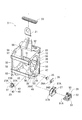
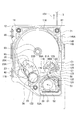
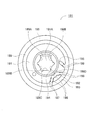
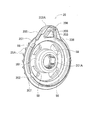
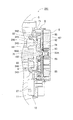
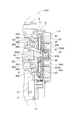
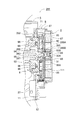
- FIG. 1 is an external perspective view of a seatbelt retractor according to the present embodiment. It is the perspective view which decomposed
- FIG. 36 is an assembled cross-sectional view including the lock arm of FIG. 35. It is operation
- FIG. 39 is a cross-sectional view taken along arrow X1-X1 in FIG.
- FIG. 1 is an external perspective view of a seatbelt retractor 1 according to this embodiment.
- 2 and 3 are exploded perspective views of the seat belt retractor 1 for each unit.
- the seat belt retractor 1 is a device for winding a webbing 3 of a vehicle, and includes a housing unit 5, a winding drum unit 6, a pretensioner unit 7, and a winding unit.
- a spring unit 8 and a lock unit 9 are included.
- the lock unit 9 is fixed to one side wall portion 12 of the housing 11 constituting the housing unit 5 by means of each ny latch 9A and each locking hook 9B formed integrally with the mechanism cover 71 (see FIG. 5). ing.
- the lock unit 9 constitutes a lock mechanism 10 that stops the pull-out of the webbing 3 in response to a sudden pull-out of the webbing 3 or a rapid acceleration change of the vehicle, as will be described later (see FIG. 10).
- the take-up spring unit 8 winds the lock unit 9 as described later via three plate-like locking pieces 8A (see FIG. 6) protruding from the outer periphery of the spring case 67 (see FIG. 5).
- the drum unit 6 is fixed to the outer side in the rotation axis direction (see FIG. 8).
- the pretensioner unit 7 is arranged on the other side wall portion 13 opposite to the side wall portion 12 of the housing 11 formed in a substantially U shape in plan view, and on the outer side in the rotation axis direction of the winding drum unit 6 of the pretensioner unit 7. Are screwed by the respective screws 15 inserted therethrough.
- the pretensioner unit 7 includes a stopper pin 16 inserted into the side wall portion 13 from the outer side in the rotation axis direction of the winding drum unit 6 of the pretensioner unit 7, and the rotation of the winding drum unit 6 of the side wall portion 13 through the stopper pin 16. It is fixed by a push nut 18 inserted from the inside in the axial direction.
- the winding drum unit 6 around which the webbing 3 is wound is rotatable between a lock unit 9 fixed to the side wall 12 of the housing unit 5 and a pretensioner unit 7 fixed to the side wall 13. Supported.
- the winding drum unit 6 is always urged in the winding direction of the webbing 3 by a winding spring unit 8 fixed outside the lock unit 9.
- FIG. 4 is an exploded perspective view of the housing unit 5.
- the housing unit 5 includes a housing 11, a bracket 21, a protector 22, a pawl 23, a pawl rivet 25, a torsion coil spring 26, a sensor cover 27, and a vehicle acceleration sensor 28. And connecting members 32 and 33 and a rivet 61.
- the housing 11 is formed in a substantially U shape in plan view by extending a back plate portion 31 fixed to the vehicle body and side wall portions 12 and 13 facing each other from both side edge portions of the back plate portion 31. It is made of steel. Further, the side wall portions 12 and 13 are connected to each other by connecting members 32 and 33 each having a horizontally long thin plate shape that is long in the direction of the rotation axis of the winding drum unit 6. In addition, an opening is formed in the central portion of the back plate portion 31 so as to reduce the weight and limit the amount of webbing 3 accommodated.
- the side wall portion 12 is formed with a through hole 36 into which the ratchet gear 35 of the winding drum unit 6 is inserted while forming a predetermined gap (for example, a gap of about 0.5 mm).
- the inner peripheral edge of the through hole 36 is configured to be recessed to the winding drum unit 6 side by a predetermined depth inward in the central axis direction, and to be opposed to the ratchet gear 35 of the winding drum unit 6.
- the notch portion 38 is cut out to a depth in which the distal end portion 37 is accommodated from the portion to the outside in the turning direction of the pawl 23 (the turning direction is away from the ratchet gear 35 of the pawl 23). Is formed.
- a through hole 41 for rotatably mounting the pawl 23 is formed on the side of the notch 38 on the back plate 31 side.
- an arcuate guide portion 38 ⁇ / b> A is formed coaxially with the through hole 41 at a portion where the pawl 23 on the through hole 41 side of the cutout portion 38 abuts.
- a portion of the pawl 23 made of steel or the like that slides in contact with the guide portion 38A has a height substantially equal to the thickness of the side wall portion 12 and has the same radius of curvature as the guide portion 38A.
- a stepped portion 37A that is recessed in an arc is formed.
- a guide hole 116 (see FIGS. 5 and 10) of the clutch 85 constituting the lock unit 9 is provided at the tip of the side surface of the pawl 23 on the outer side in the rotational axis direction (the front side in FIG. 4).
- a guide pin 42 to be inserted is erected.
- a through hole 43 through which the pawl rivet 25 is inserted is formed at the base end portion (one end portion) of the pawl 23 and is rotated from the peripheral portion of the through hole 43 to the through hole 41 of the side wall portion 12.
- a cylindrical boss portion 45 that can be inserted is erected at a height substantially equal to the thickness dimension of the side wall portion 12.
- the pawl 23 can be rotated by a pawl rivet 25 fitted into the through hole 43 from the outside of the side wall portion 12 in a state where the boss portion 45 is inserted into the through hole 41 of the side wall portion 12 from the inside of the housing 11.
- the engaging teeth 23A and 23B of the pawl 23 and the ratchet gear portion 35A formed on the outer peripheral surface of the ratchet gear 35 are arranged so as to be substantially flush with the outer surface of the side wall portion 12.
- the head of the pawl rivet 25 is formed in a disk shape having a larger outer diameter than the through hole 41 and a predetermined thickness (for example, a thickness of about 1.5 mm).
- the torsion coil spring 26, which functions as an example of a return spring, is disposed so as to surround the head of the pawl rivet 25 with one winding, and one end side 26 ⁇ / b> A is attached to the guide pin 42 of the pawl 23. .
- the wire diameter of the torsion coil spring 26 is approximately half the height of the head of the pawl rivet 25 (for example, the wire diameter is about 0.6 mm). Accordingly, the height of one turn of the torsion coil spring 26 is set to be substantially the same as the height of the head of the pawl rivet 25.
- the other end side 26B of the torsion coil spring 26 passes through the side wall portion 12 side of the one end side 26A so as to be slidable on the side wall portion 12, and then the inner side direction of the side wall portion 12 (in FIG. 4, the back side of the side wall portion 12). Direction), and is inserted through a mounting hole 46 formed in the side wall portion 12. Further, the end portion of the other end side 26B is bent into a substantially U shape and is brought into contact with the inner surface of the side wall portion 12 to constitute a retaining portion. As a result, the pawl 23 is biased by the torsion coil spring 26 so as to rotate toward the back side of the notch 38 (in the counterclockwise direction in FIG.
- the side portion 37 is in contact with the back side of the notch 38. Accordingly, the pawl 23 is urged to rotate in a direction away from the ratchet gear 35 by the torsion coil spring 26.
- a substantially rectangular opening 47 is formed.
- a shallow substantially box-shaped sensor cover 27 having a substantially rectangular cross section substantially the same as the opening 47 is fitted into the opening 47 from the outside (the front side in FIG. 4).
- the resin-made sensor cover 27 has a flange formed on the opening-side peripheral edge abutting on the outer peripheral edge of the opening 47 (the front-side peripheral edge in FIG. 4), and the sensor cover. 27, a pair of locking claws 27A (in FIG. 4, the locking claw 27A on the upper end surface is shown) projecting from both ends in the up-down direction are shown in FIG. It is inserted in the back side of the direction both ends and is elastically locked.
- the vehicle acceleration sensor 28 includes a resin-made sensor holder 51 having a substantially box shape opened to the upper side in the vertical direction (upper side in FIG. 4) and having a mortar-shaped mounting portion formed on the bottom surface portion, Inertial mass 52 formed in a spherical body of metal such as steel and movably mounted on the mounting portion, and placed on the upper side in the vertical direction of inertial mass 52 and opposite to pawl 23 From the sensor lever 53 made of resin, the end edge portion (the right end edge portion in FIG. 4) is supported by the sensor holder 51 so as to be swingable vertically (in the vertical direction in FIG. 4). It is configured.
- the vehicle acceleration sensor 28 is fitted into the sensor cover 27, and a pair of locking claws 51 ⁇ / b> A (one engagement in FIG. 4) provided on both side surfaces facing both side walls in the sensor cover 27 of the sensor holder 51.
- the vehicle acceleration sensor 28 is attached to the housing 11 via the sensor cover 27 by inserting and locking the pawl 51A into each locking hole 27B of the sensor cover 27.
- the side wall portion 12 has three corners, that is, both corners of an upper edge portion (upper edge portion in FIG. 4) and a lower portion of the through hole 36 (downward direction in FIG. 4).
- Each mounting hole 55 into which each ny latch 9A of the lock unit 9 is fitted and attached is formed.
- each locking piece to which each locking hook 9 ⁇ / b> B of the lock unit 9 is elastically locked is located at the center of the left and right side edges of the side wall 12 (the vertical center in FIG. 4).
- 56 is formed so as to protrude perpendicularly to the rotation axis of the winding drum unit 6.
- a through hole 57 through which the winding drum unit 6 is inserted is formed in the side wall portion 13 at the center portion.
- the side wall portion 13 includes a substantially lower end edge portion (lower end edge portion in FIG. 2), a corner portion on the connecting member 33 side, and an upper end edge portion (upper end edge portion in FIG. 2).
- the screw holes 58 into which the screws 15 are screwed are formed by burring in the direction of the pretensioner unit 7 at the corners on the back plate portion 31 side.
- a through hole 59 through which the stopper pin 16 is inserted is formed in the side wall portion 13 at a corner portion on the connecting member 32 side of the upper end edge portion (the upper end edge portion in FIG. 2).
- the bracket 21 attached to each upper end edge (the upper end edge in FIG. 2) of the back plate 31 by each rivet 61 is formed of a steel material or the like, and the upper end edge of the back plate 31
- a laterally long through hole 62 extending in the width direction of the back plate portion 31 from which the webbing 3 is pulled out is formed in an extending portion extending in the direction of the connecting member 32 at a substantially right angle from the side, and is formed of a synthetic resin such as nylon.
- a horizontally long frame-shaped protector 22 is fitted.
- a bolt insertion hole 63 through which a bolt is inserted when being attached to a fastening piece (not shown) of the vehicle is formed in the lower end portion (the lower end portion in FIG. 2) of the back plate portion 31. .
- 5 and 6 are exploded perspective views of the winding spring unit 8 and the lock unit 9 including the ratchet gear.
- 7 and 8 are cross-sectional views for explaining the attachment of the spring case 67.
- FIG. FIG. 11 is an enlarged cross-sectional view of a main part including the winding spring unit 8 and the lock unit 9 of the seat belt retractor 1.
- the winding spring unit 8 includes a spiral spring 65 and an outer end 65 ⁇ / b> A of the spiral spring 65 erected from the bottom surface of the inner peripheral edge.
- a spring case 67 that is fixed to the rib 66 and accommodates the spiral spring 65, and a spring shaft 68 to which the inner end 65B of the spiral spring 65 is connected and the spring force is urged are configured.
- the spring case 67 is formed with a groove portion 67A having a predetermined depth (for example, a depth of about 2.5 mm) over the entire circumference at the edge portion on the mechanism cover 71 side constituting the lock unit 9. ing.
- plate-shaped locking pieces 8A having a substantially rectangular shape in front view from three locations on the outer peripheral portion are formed in through holes formed in a substantially central portion of the mechanism cover 71.
- the projection 73 is concentrically provided with respect to the central shaft 73 ⁇ / b> A.
- the outer peripheral surface of the outer side in the radial direction with respect to the central axis 73A of the through hole 73 of each locking piece 8A is formed so as to be located on a concentric circle.
- the locking piece 8 ⁇ / b> A located at the lower end edge of the spring case 67 is continuous with the end edge on the counterclockwise direction side with respect to the central axis 73 ⁇ / b> A of the through hole 73.
- a fixed portion 8B having a square cross section is provided continuously.
- a through hole 8C parallel to the central axis 73A of the through hole 73 is formed at a substantially central portion of the fixed part 8B, and fixed so as to close an end of the through hole 8C on the outer side in the central axis 73A direction.
- the pin 8D is integrally formed.
- the shaft diameter of the fixing pin 8D is formed to be substantially the same as the inner diameter of the through hole 8C, and the fixing pin 8D can be pushed into the through hole 8C by pushing the fixing pin 8D toward the mechanism cover 71 with a predetermined load or more. Further, the length of the fixing pin 8D is formed so as to be longer than the thickness of the fixing portion 8B.
- a thick plate-like holding portion 72 having a substantially rectangular cross section is provided on the winding spring unit 8 side from three locations facing each locking piece 8A on the outer peripheral portion.
- the base end portion of each holding portion 72 is notched in the counterclockwise direction with respect to the central axis 73 ⁇ / b> A of the through hole 73, and the back end portion is closed.
- a fitting groove 72A having a substantially rectangular cross section is formed.
- each fitting groove portion 72A has a slightly larger radius (for example, about The radius is larger by 0.2 mm to 0.5 mm.).
- the width dimension of each fitting groove 72A in the direction of the central axis 73A is formed to be approximately the same as the thickness dimension of each locking piece 8A.
- each locking piece 8A has each fitting groove 72A. It is comprised so that it may insert in (refer FIG. 8).
- the mechanism cover 71 is provided with a substantially ring-shaped rib portion 71A standing at a predetermined height (for example, a height of about 2 mm) along the outer peripheral edge of the winding drum unit 6 in the rotation axis direction. It has been.
- the rib portion 71A is provided at a position corresponding to the groove portion 67A, and the inner diameter and the outer diameter of the rib portion 71A are in a state in which the rib portion 71A is fitted in the groove portion 64A with respect to the inner diameter and the outer diameter of the groove portion 67A.
- Each is provided so as to form a predetermined gap (for example, a gap of about 0.1 mm to 0.3 mm).
- the spring case 67 is provided in the mechanism cover as will be described later.
- a fixing hole 74 having a circular cross section is formed at a position facing the fixing pin 8D.
- the inner diameter of the fixing hole 74 is formed to be smaller by a predetermined dimension (for example, about 0.1 mm to 0.3 mm) than the outer diameter of the fixing pin 8D of the spring case 67, and the fixing pin 8D is press-fitted. It is provided so that it can.
- a cylindrical boss 75 whose rear side is closed is erected on the rear side of the fixing hole 74, that is, on the peripheral edge portion on the side wall 12 side of the housing 11. Further, the inner diameter of the cylindrical boss 75 is formed in a circular cross section having the same diameter as that of the fixing hole 74 and is formed coaxially with the fixing hole 74.
- the outer end 65 ⁇ / b> A of the spiral spring 65 is fitted into a rib 66 erected on the inner side of the spring case 67 and housed in the spring case 67, and the spring is connected to the inner end 65 ⁇ / b> B of the spiral spring 65.
- the mounting groove 68C of the shaft 68 is fitted.
- the spring shaft 68 has a pin 69 erected at a substantially central position of the bottom surface portion of the spring case 67 and is inserted into the through hole 68A in the bottom surface portion, and the bottom surface portion side is pinned. 69 is rotatably abutted on the peripheral edge of 69.
- each locking piece 8 ⁇ / b> A protruding radially outward from three locations on the outer peripheral portion of the spring case 67 is connected to the edge portion of the holding portion 72 of the mechanism cover 71 on the front view clockwise side. Position it so as to face.
- the distal end portion 93 ⁇ / b> A of the rotating shaft portion 93 of the locking gear 81 protruding from the through hole 73 of the mechanism cover 71 is formed in a rectangular cross-section and along the central axis.
- a shaft hole 93B into which the pin 69 is inserted is formed.
- the distal end portion 93 ⁇ / b> A of the rotating shaft portion 93 of the locking gear 81 protruding from the through hole 73 of the mechanism cover 71 is formed in a cylindrical hole formed in a rectangular cross section of the spring shaft 68.
- the rotary shaft portion 93 of the locking gear 81 is connected to the spring shaft 68 so as not to be relatively rotatable.
- the rib portion 71 ⁇ / b> A standing on the peripheral edge portion of the mechanism cover 71 is inserted into the groove portion 67 ⁇ / b> A of the spring case 67.
- the spring case 67 is rotated in the webbing pull-out direction, that is, in the counterclockwise direction when viewed from the front (in the direction of arrow 70 in FIG. 7).
- 8A is inserted into the fitting groove portion 72A of each holding portion 72 of the mechanism cover 71 and is brought into contact with the back side of each fitting groove portion 72A. Accordingly, the spring case 67 is positioned so as not to move in the radial direction and the axial direction with respect to the central axis 73A of the through hole 73 of the mechanism cover 71.
- the fixing pin 8 ⁇ / b> D of the spring case 67 is pressed and press-fitted into the through hole 8 ⁇ / b> C of the fixing portion 8 ⁇ / b> B and the fixing hole 74 of the mechanism cover 71, whereby the winding spring unit 8 is inserted into the mechanism cover 71.
- the winding spring unit 8 is fixed in a relatively non-rotatable manner, and is attached in a state where the winding spring unit 8 is in contact with the outer side of the winding drum unit 6 of the mechanism cover 71 in the rotation axis direction.
- the rib portion 71 ⁇ / b> A erected on the peripheral portion of the mechanism cover 71 is fitted into the groove portion 67 ⁇ / b> A of the spring case 67, and dust and dust are prevented from entering the spring case 67.
- the end of the spring shaft 68 on the lock unit 9 side with the bottom surface of the mechanism cover 71 in contact with the peripheral edge of the pin 69 so as to be rotatable A predetermined gap (for example, a gap of about 0.3 mm) is formed between the peripheral edge portion of the through hole 73 formed in the substantially central portion of the mechanism cover 71.
- a predetermined gap (for example, a gap of about 0.3 mm) is also formed between the bottom surface of the cylindrical hole 68B of the spring shaft 68 and the distal end portion 93A of the rotating shaft portion 93 of the locking gear 81. Yes. Therefore, the spring shaft 68 is provided between the spring case 67 and the mechanism cover 71 so as to be movable in the axial direction of the central shaft 73A by a predetermined gap.
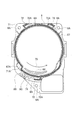
- or FIG. 9 about schematic structure of the lock unit 9 which comprises the lock mechanism 10 which stops the pull-out of the webbing 3 in response to the rapid change of the webbing 3 and the rapid acceleration of a vehicle. This will be described with reference to FIG.
- FIG. 9 is an assembly cross-sectional view including the lock arm of the lock unit 9.
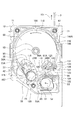
- FIG. 10 is a partially cutaway cross-sectional view in which a part of the bottom surface of the mechanism cover 71 of the lock unit 9 is cut away.
- FIG. 12 is an outer perspective view of the clutch.
- FIG. 13 is an inside perspective view of the clutch.
- FIG. 14 is a perspective view of the clutch as viewed obliquely from below.
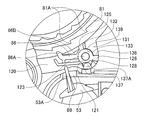
- 15 and 16 are perspective views of the pilot lever.
- FIG. 17 is an enlarged view of a main part showing a normal state of the pilot lever.
- FIG. 18 is an enlarged view of a main part showing a state where the pilot lever is engaged with the locking gear.
- the lock unit 9 includes a mechanism cover 71, a locking gear 81, a lock arm 82, a sensor spring 83, a clutch 85, and a pilot lever 86.
- the members excluding the sensor spring 83 are formed of synthetic resin, and the friction coefficient between the members when they are in contact with each other is small. is there.
- the mechanism cover 71 is formed with a substantially box-shaped mechanism housing portion 87 having a substantially circular bottom surface that is open on the side wall 12 side of the housing 11, and is configured to house the locking gear 81, the clutch 85, and the like. Yes. Further, the mechanism cover 71 is formed in a concave shape having a substantially square cross section at a corner portion (the lower left corner portion in FIG. 6) facing the vehicle acceleration sensor 28 attached to the housing 11 via the sensor cover 27.
- the sensor housing portion 88 is provided.
- the mechanism cover 71 When the mechanism cover 71 is attached to the side wall portion 12 by the ny latches 9A and the locking hooks 9B, the sensor holder 51 of the vehicle acceleration sensor 28 is fitted into the sensor housing portion 88, and the sensor lever 53 is moved in the vertical direction. It is configured so as to be swingable vertically (in the vertical direction in FIG. 6). Further, the mechanism housing portion 87 and the sensor housing portion 88 are opened so as to communicate with the lower end portion substantially central portion (in FIG. 6, the lower end portion substantially central portion) of the mechanism cover portion 71 of the mechanism cover 71. An opening 89 is formed.
- the opening 89 has a vertically extending vertical end of the lock claw 53A that protrudes upward from the front edge of the sensor lever 53 of the vehicle acceleration sensor 28 (the upward direction in FIG. 6).
- the front end of the lock claw 53 ⁇ / b> A is positioned in the vicinity of the receiving plate portion 122 (see FIG. 10) of the pilot lever 86.
- the lock claw 53A is connected to the pilot lever 86 via the opening 89.
- the pilot lever 86 is configured to rotate upward in the vertical direction by contacting the receiving plate portion 122 (see FIG. 27).
- a cylindrical support boss 91 is erected on the substantially circular bottom surface portion of the mechanism housing portion 87 from the peripheral edge portion of the through hole 73 formed in the center portion.
- the outer periphery of the tip end portion of the support boss 91 on the side of the locking gear 81 is formed with a tapered chamfered portion 91A inclined at a predetermined angle (for example, an inclination angle of about 30 °) toward the tip end over the entire circumference. ing.
- the support boss 91 is fitted with a cylindrical rotary shaft portion 93 protruding from the back side facing the mechanism cover 71 at the center portion of the disc-shaped bottom surface portion 92 of the locking gear 81 for sliding rotation. Supported as possible.
- the locking gear 81 is erected in an annular shape from the entire circumference of the disk-shaped bottom surface 92 to the clutch 85 side, and locking gear teeth 81A that engage with the pilot lever 86 are formed on the outer periphery.
- the locking gear teeth 81A are formed so as to engage with the engaging claws 86A of the pilot lever 86 only when the locking gear 81 rotates in the webbing pull-out direction (see FIG. 16).
- a shaft portion standing on the center portion of the end surface of the ratchet gear 35 on the side of the locking gear 81 is provided at the center portion of the bottom surface portion 92 of the locking gear 81.
- a through hole into which 76 is inserted is formed.
- a cylindrical base 94 is erected from the peripheral edge of the through hole on the mechanism cover 71 side at substantially the same height as the axial height of the locking gear teeth 81A.
- the cylindrical rotating shaft portion 93 of the locking gear 81 is smaller than the base portion 94 from the edge of the mechanism base 71 side of the cylindrical base portion 94, and is substantially equal to the inner diameter of the support boss 91. Coaxially extending toward the mechanism cover 71 with the same outer diameter. Further, the end of the rotary shaft 93 on the side of the mechanism cover 71 is closed, and a distal end portion 93A having a rectangular cross section extends coaxially.
- the shaft portion 76 that opens to the end surface on the ratchet gear 35 side of the locking gear 81 and is erected on the center portion of the end surface on the mechanism cover 71 side of the ratchet gear 35.
- a shaft hole portion 94A having a circular cross section is formed.
- a plurality of ribs 94B are erected at the same height in the radial direction along the axial direction on the inner peripheral surface of the shaft hole portion 94A, and come into contact with the outer peripheral surface of the shaft portion 76 of the ratchet gear 35.
- the shaft portion 76 is formed in a truncated cone shape with a half portion on the base end portion side of the total length, and a half portion on the distal end side is continuous with the truncated cone shape.
- annular rib 95 is erected coaxially at a height substantially equal to the thickness dimension of the substantially disc-shaped plate portion 111 of the clutch 85.
- An insertion groove 95A is formed.
- the inner peripheral wall portion of the annular rib 95 is inclined radially outward at an angle equal to or greater than the inclination angle of the tip end portion of the support boss 91 (for example, an inclination angle of about 45 °).
- the outer diameter of the bottom surface portion of the insertion groove 95 ⁇ / b> A formed inside the annular rib 95 is formed to be substantially the same as the outer diameter of the tip portion of the support boss 91.
- the outer diameter of the annular rib 95 is formed to be substantially the same as the inner diameter of the through hole 112 formed in the central portion of the plate portion 111 of the clutch 85 and is smaller than the outer diameter of the base portion 94. It is formed in the diameter. Further, an annular rib 112A is erected at a predetermined height (for example, a height of about 0.5 mm) at the end edge portion of the through hole 112 of the clutch 85 on the side of the locking gear 81. Has been.
- the rotary shaft portion 93 is The back surface of the locking gear 81 is inserted into the support boss 91 of the mechanism cover 71 and the tip of the support boss 91 is brought into contact with the bottom surface of the insertion groove 95 ⁇ / b> A formed on the radially inner side of the annular rib 95.
- a rotating shaft portion 93 protruding from the side is attached coaxially to and supported by the support boss 91 over almost the entire height.
- the annular rib 95 of the locking gear 81 is fitted into the through hole 112 so as to be slidable and rotatable, and the clutch 85 is accommodated between the locking gear 81 and the mechanism cover 71 so as to be rotatable within a certain rotation range.
- the end face of the locking gear 81 on the ratchet gear 35 side has four convex portions 96 that project into a substantially rectangular cylindrical shape having a long cross section in the circumferential direction. , And are erected so as to be located on concentric circles at a predetermined distance (for example, a distance of about 14 mm) outward in the radial direction from the rotation shaft 81B at equal central angles.
- One convex portion 96 is partially cut away at the outer peripheral edge in the radial direction.
- a positioning hole 97 having a predetermined inner diameter (for example, an inner diameter of about 3.5 mm) is provided at a substantially central position between a pair of convex portions 96 adjacent in the circumferential direction on the bottom surface of the locking gear 81. Is formed.
- each convex portion 96 of the locking gear 81 is formed at an equal central angle.
- it is formed at a position facing each convex portion 96 that is separated from the rotation shaft 81B by a predetermined distance (for example, a distance of about 14 mm) radially outward.
- the inner diameter of the positioning hole 97 is set at a position facing the positioning hole 97 between a pair of circumferentially adjacent through holes 98.
- Positioning pins 99 formed with substantially the same outer diameter are provided upright.
- the height of the shaft portion 76 erected on the outer end surface of the ratchet gear 35 in the rotation axis direction is formed to be substantially equal to the depth of the shaft hole portion 94 ⁇ / b> A of the locking gear 81.
- the depth of the shaft hole portion 94 ⁇ / b> A of the locking gear 81 is formed such that the tip end of the shaft portion 76 is located on the inner side in the rotation axis direction than the tip end of the tip end portion 93 ⁇ / b> A of the rotation shaft portion 93.
- the shaft portion 76 of the ratchet gear 35 is fitted into the shaft hole portion 94A of the locking gear 81, and the positioning pin 99 of the ratchet gear 35 is fitted into the positioning hole 97 of the locking gear 81.
- the convex portion 96 is fitted into each through hole 98 of the ratchet gear 35.
- the locking gear 81 is coaxially attached to the ratchet gear 35 in a relatively non-rotatable manner while the locking gear 81 is in contact with the end surface of the ratchet gear 35 in the rotational axis direction.
- 76 is positioned and supported in the support boss 91 of the mechanism cover 71 via the rotating shaft portion 93 of the locking gear 81.
- each convex portion 96 of the locking gear 81 a rib (not shown) protruding outward in the radial direction is erected along the rotation axis direction of the ratchet gear 35.
- each convex part 96 of the locking gear 81 is press-fitted and attached to each through hole 98 of the ratchet gear 35 while crushing each rib.
- the locking gear 81 can be attached to the ratchet gear 35 without rattling, and the locking gear 81 is held by the ratchet gear 35, so that the assembly work can be made more efficient.
- the ratchet gear 35 of the winding drum unit 6 is attached coaxially to the spring shaft 68 of the winding spring unit 8 via the tip end portion 93A of the rotating shaft portion 93 of the locking gear 81 so as not to be relatively rotatable. Accordingly, the winding drum unit 6 is always urged to rotate in the webbing winding direction via the winding spring unit 8.
- each convex part 96 was formed in the cylinder shape, you may form so that a cross section may protrude in the substantially rectangular solid shape long in the circumferential direction.
- four through holes 98 having a substantially rectangular cross section that is long in the circumferential direction are provided at positions facing the respective convex portions 96 of the ratchet gear 35.
- the cross sectional shape of the through holes 98 is the same as that of the through holes 98. You may make it provide four recessed parts recessed at the depth more than the height of each convex part 96.
- a cylindrical support boss 101 adjacent to the base portion 94 is provided on the surface of the bottom surface portion 92 of the locking gear 81 on the clutch 85 side. It is erected at a height lower than the locking gear teeth 81A.
- the lock arm 82 made of synthetic resin formed in a substantially arcuate shape so as to surround the base portion 94 is inserted into the through-hole 102 formed in the end portion on the base portion 94 side in the substantially central portion in the longitudinal direction.
- a support boss 101 is rotatably inserted and pivotally supported.
- an elastic locking piece 103 having an inverted L-shaped cross section is erected on the mechanism cover 71 side at a position near the outer side in the radial direction with respect to the support boss 101.
- the elastic locking piece 103 is inserted into the window 104 having a stepped portion having a substantially fan shape formed on the side of the through hole 102 of the lock arm 82, and is elastic to be rotatable around the axis of the base 94. Is locked.
- the locking gear 81 has a spring support pin 105 in which one end side of the sensor spring 83 is fitted into a rib portion extending radially outward from the outer peripheral surface of the base portion 94.
- the webbing pull-out direction is perpendicular to the axis of the base 94.
- a spring support pin 106 into which the other end side of the sensor spring 83 is fitted is erected on the side wall of the lock arm 82 facing the spring support pin 105.
- the lock arm 82 moves toward the webbing pull-out direction side with respect to the axis of the support boss 101 by fitting both ends of the sensor spring 83 into the spring support pins 105 and 106 ( In FIG. 9, it is biased with a predetermined load so as to rotate (in the direction of arrow 107).
- the lock arm 82 has a stopper 114 formed so that an end edge portion on the engagement claw 109 side that engages with the clutch gear 108 of the clutch 85 protrudes radially outward from the base portion 94 of the locking gear 81. It is in contact with.
- the lock arm 82 is rotated in the webbing take-up direction (in the opposite direction to the arrow 107 in FIG. 9) against the urging force of the sensor spring 83 and engaged with the clutch gear 108.
- the end edge of the engagement claw 109 opposite to the engagement portion has a spindle-shaped detent 115 with a predetermined clearance (for example, a clearance of about 0). .3 mm)) (see FIG. 20).
- the clutch 85 is sandwiched between the locking gear 81 and the mechanism cover 71 and can be rotated in the mechanism housing portion 87 within a certain rotation range. Be contained.
- an outer diameter slightly smaller than the inner peripheral diameter of the annular rib formed on the outer peripheral portion of the locking gear tooth 81A of the locking gear 81 is coaxial with the through hole 112.
- An annular rib portion 113 is provided upright.
- a clutch gear 108 that engages with the engaging claw 109 of the lock arm 82 is formed on the inner peripheral surface of the rib portion 113 (see FIG. 20). As will be described later, the clutch gear 108 is formed so as to engage with the engagement claw 109 of the lock arm 82 only when the locking gear 81 rotates in the webbing pull-out direction with respect to the axis of the through hole 112. (See FIG. 20).
- annular outer rib portion 117 is erected on the outer peripheral portion of the substantially disc-shaped plate portion 111 of the clutch 85 so as to surround the rib portion 113. Further, the edge of the outer rib 117 on the side of the ratchet gear 35 is extended outward in the radial direction with respect to the central axis of the through hole 112, and extended slightly inclined toward the ratchet gear 35.
- the flange portion 118 is formed over substantially the entire circumference.
- the guide block portion 119 has a substantially elongated guide hole 116 in which a guide pin 42 erected on the side surface of the tip portion including the engaging teeth 23A and 23B of the pawl 23 is loosely fitted from the ratchet gear 35 side. Is formed.
- the guide hole 116 is formed in a long groove shape substantially parallel to the webbing pull-out direction (vertical direction in FIG. 10) at the corner of the outer rib portion 117 facing the pawl 23. ing.
- the guide pin 42 is moved along the guide hole 116 and the pawl 23 is moved.
- Each engaging tooth 23A, 23B is rotated so as to approach the ratchet gear portion 35A of the ratchet gear 35 (see FIGS. 20 to 22).
- the pawl 23 is urged to rotate away from the ratchet gear 35 by the torsion coil spring 26, and the clutch 85 is urged by the guide pin 42 of the pawl 23 that is loosely fitted in the guide hole 116. . Due to this urging force, the clutch 85 is the end edge portion at the position farthest away from the ratchet gear 35 in the rotation radial direction of the clutch 85 in the guide hole 116 (the lower end edge portion of the guide hole 116 in FIG. 9). ) Is biased so as to be in a rotational posture in a state where the guide pin 42 of the pawl 23 abuts, so that the webbing is pulled out in a direction opposite to the drawing direction. Therefore, the clutch urging mechanism 129 is configured by the pawl 23 and the torsion coil spring 26.
- the pawl 23 is normally the end edge portion at the position farthest away from the ratchet gear 35 in the radial direction of the clutch 85 in the guide hole 116 (the lower end edge portion of the guide hole 116 in FIG. 9). ), The guide pin 42 of the pawl 23 abuts and the rotation is restricted, so that it is held so as to be located in the vicinity of the back side of the notch 38 formed in the side wall 12.
- the lower end edge portion (the lower end edge portion in FIG. 6) of the outer rib portion 117 of the clutch 85 is located above the sensor housing portion 88 from the end surface portion on the ratchet gear 35 side of the guide block portion 119 (in FIG. 6).
- the plate-like extension part 120 extended from the flange part 118 to the outer side in the radial direction in a substantially arc shape is formed up to the part facing the upper direction.
- the cylindrical shaft of the pilot lever 86 is positioned in the vicinity of the end edge portion on the opposite side to the guide block portion 119 of the extension portion 120.
- a thin columnar mounting boss 123 fitted into the portion 121 is erected on the mechanism cover 71 side at substantially the same height as the outer rib portion 117.
- the pilot lever 86 includes a cylindrical shaft portion 121, a plate-like engagement claw portion 86 ⁇ / b> A, and a thin plate-like receiving plate portion 122. , And a thin plate-like connecting plate portion 124.
- the axial length of the shaft portion 121 is formed to be approximately the same as the height of the mounting boss 123 provided upright on the extension portion 120.
- the plate-like engagement claw portion 86A is formed in a substantially L shape in the rotational axis direction when the tip portion is obliquely bent toward the locking gear 81 side.
- the plate-like engaging claw portion 86A is formed from the outer peripheral surface of the shaft portion 121 so as to be substantially horizontal when the pilot lever 86 is rotated by its own weight and is restricted from rotating downward in the vertical direction.
- a predetermined length projecting toward the guide hole 116 with a width shorter than the length of the shaft 121 is provided.
- the thin plate-like receiving plate portion 122 is projected from the outer peripheral surface of the shaft portion 121 to the tangential guide hole 116 side so as to face the engaging claw portion 86A, and the distal end portion is the distal end side of the engaging claw portion 86A. It is bent at an angle so that it is almost parallel to.
- the thin plate-like connecting plate portion 124 is formed so as to connect the engaging claw portion 86 ⁇ / b> A and the front end portion of the receiving plate portion 122.
- an upward detent portion 125 that restricts the rotation of the pilot lever 86 in the locking gear 81 side direction, that is, the upward rotation in the vertical direction, is a shaft portion.
- the outer peripheral surface 121 protrudes radially outward.
- the upward detent portion 125 has a predetermined height (for example, a height) that is substantially the same width as the width of the engaging claw portion 86A and is substantially perpendicular to the base end portion of the engaging claw portion 86A. It is about 1.5 mm.) Projected.
- the engagement claw portion 86A starts from the portion where the tip portion is obliquely bent toward the locking gear 81 side.
- the rib portion 86B is provided upright at the substantially central portion in the width direction along the longitudinal direction.
- the rib portion 86B is about half the width of the engaging claw portion 86A, and has a constant height (for example, a constant height) from a portion where the tip portion is obliquely bent toward the locking gear 81 side to a substantially central portion in the longitudinal direction.
- it is erected in a substantially triangular shape as viewed in the rotational axis direction from the substantially central portion in the longitudinal direction to the base end portion of the upward detent portion 125 continuously.
- the engaging claw portion 86A has a bending strength in the locking gear 81 side direction from the portion bent obliquely to the locking gear 81 side by the rib portion 86B to the substantially central portion in the longitudinal direction, and the locking gear 81 at the distal end portion. It is formed so as to be larger than the bending strength in the lateral direction.
- the engaging claw 86A has a bending strength in the locking gear 81 side direction from the substantially central portion in the longitudinal direction to the proximal end of the engaging claw 86A on the shaft 121 side by the rib 86B. It is formed so as to be larger than the bending strength in the direction toward the locking gear 81 from the portion bent obliquely to the side to the substantially central portion in the longitudinal direction.
- a downward detent for restricting rotation of the pilot lever 86 in the direction of the sensor lever 53, that is, downward rotation in the vertical direction. 126 protrudes radially outward from the outer peripheral surface of the shaft 121.
- the downward rotation preventing portion 126 has a width dimension in the rotation axis direction narrower than the width in the rotation axis direction of the receiving plate portion 122 from the end surface side opposite to the ratchet gear 35 of the shaft portion 121.
- a predetermined height (for example, a height of about 1.5 mm) is provided so as to face the base end portion of the portion 122.
- a predetermined depth in the radial direction (for example, a depth of about 0.5 mm) is provided on the outer peripheral surface from the base end portion of the receiving plate portion 122 of the shaft portion 121 to the base end portion of the downward rotation preventing portion 126.
- a concave portion 127 having a substantially sectoral cross section that is recessed to a substantially central portion in the axial direction is formed.
- a plate-like convex portion 128 is provided at the end edge on the axially central portion side of the concave portion 127 with a predetermined height (for example, a height of about 1) outward in the radial direction over the entire circumferential width of the concave portion 127. .5 mm)).
- the pilot lever support block 131 is substantially the same height as the outer rib portion 117 at the edge portion of the extension portion 120 facing the mounting boss 123. And projecting toward the mechanism cover 71 side. As shown in FIG. 14, the pilot lever support block 131 has an inner side facing the mounting boss 123 extending vertically downward from the outer peripheral surface of the outer rib portion 117, and the pilot lever 86 is locked as described later. An upper restricting end surface portion 132 with which the upper detent portion 125 abuts when rotated to the gear 81 side is formed.
- the inner side of the pilot lever support block 131 facing the mounting boss 123 is further extended from the upper regulating end surface portion 132 to the vertical lower end edge portion of the extending portion 120.
- a smooth curved surface that is substantially semicircular when viewed from the front with a radius of curvature that is coaxial with the mounting boss 123 and slightly larger than the radius of the outer peripheral surface of the shaft 121 of the pilot lever 86 (for example, about 0.1 mm larger).
- a load receiving surface 133 is provided.
- a stepped portion 135 is formed at the edge portion on the lower side in the vertical direction of the pilot lever support block 131 by notching a predetermined height to the extending portion 120 side.
- a downward regulating end surface portion 136 is formed to which the downward rotation stopper 126 abuts.
- the height of the stepped portion 135 from the extended portion 120 is formed to be lower than the downward rotation preventing portion 126.
- an elastic locking piece 137 having an inverted L-shaped cross section with a locking projection 137A formed at the tip is attached to the edge of the extending portion 120 that faces the mounting boss 123 vertically downward. It is erected so as to be elastically deformable radially outward with respect to the boss 123.
- This elastic locking piece 137 forms a predetermined gap (for example, a gap of about 0.3 mm) and opposes the convex portion 128 protruding from the outer peripheral surface of the shaft portion 121 of the pilot lever 86.
- the locking protrusion 137A formed at the tip is erected so as to be slightly higher than the convex portion 128 (for example, about 0.2 mm higher).
- an opening 138 penetrating vertically in the vertical direction is provided at a position facing the engaging claw 86 ⁇ / b> A of the pilot lever 86 of the outer rib 117. It has a predetermined width in the circumferential direction and is formed by cutting out a predetermined dimension from the edge of the plate portion 111 to the inside. As will be described later, the opening 138 enters the opening 138 and engages with the locking gear teeth 81A when the engaging claw 86A is pressed and rotated by the lock claw 53A of the sensor lever 53. It can be formed (see FIG. 18).
- the shaft 121 is fitted into the mounting boss 123, and abuts on the extension 120.
- the locking protrusion 137A of the elastic locking piece 137 forms a predetermined gap (for example, a gap of about 0.2 mm) and faces the convex portion 128, so that the pilot lever 86 is attached to the mounting boss 123. Can be prevented from falling out.
- the locking protrusion 137 ⁇ / b> A is opposed to the peripheral surface of the recess 127 formed in the shaft portion 121 by forming a predetermined gap (for example, a clearance of 0.2 mm) and the outer periphery of the shaft portion 121. Since a predetermined clearance 139 (for example, a clearance of about 0.1 mm) is formed between the surface and the load receiving surface 133 of the pilot lever support block 131, the pilot lever 86 can be smoothly moved up and down in the vertical direction. Rotate.
- a predetermined gap for example, a clearance of 0.2 mm
- the downward detent portion 126 has the pilot lever support block. 131 abuts on the lower regulation end face portion 131, and the rotation angle to the lower side in the vertical direction (the lower direction in FIG. 17) is regulated. Further, in a normal state, a gap is formed between the receiving plate portion 122 of the pilot lever 86 and the lock claw 53A of the sensor lever 53.
- the pressing load applied to the engaging claw portion 86A can be supported by the pilot lever support block 131 via the upward detent portion 125 and the shaft portion 121.
- the pilot lever 86 and the mounting boss 123 are made small, it is possible to prevent deformation and breakage of the upward detent portion 125, the shaft portion 121, and the mounting boss 123 that support the pressing load applied to the engaging claw portion 86A. .
- the flange portion 118 of the clutch 85 has a through hole 112 on the substantially opposite side to the through hole 112 of the guide block portion 119.
- a notch portion 145 is formed by notching to the outer rib portion 117 at a predetermined center angle (for example, the center angle is about 60 degrees) with respect to the center axis.
- a rib-like elastic rib 146 extends from one end to the other end more than the width of the flange 118.
- a narrow width is formed in an arc shape concentric with the central axis of the through hole 112.
- the elastic rib 146 has a substantially U-shaped cross section that protrudes at a predetermined height (for example, a height of about 1.2 mm) outward in the radial direction from the outer diameter of the flange portion 118 at the center in the circumferential direction of the elastic rib 146.
- the formed clutch side protrusion 146A is provided.
- the rib-shaped elastic rib 146 is configured such that the clutch-side protrusion 146A has a radius larger than the outer diameter of the flange 118 when the clutch-side protrusion 146A formed at the center in the circumferential direction is pressed inward in the radial direction. It is formed to be elastically deformable so that it can move inward.
- the inner wall portion facing the flange portion 118 of the clutch 85 of the mechanism housing portion 87 of the mechanism cover 71 is concentric with the central axis 73 ⁇ / b> A of the through hole 73. It is formed and faces the flange portion 118 by forming a predetermined gap (for example, a gap of about 1.5 mm).
- the clutch 85 is rotated in the webbing pull-out direction as will be described later at a portion facing the elastic rib 146 of the clutch 85, and the pawl 23 is the ratchet gear portion of the ratchet gear 35.
- a rib-like fixed-side protrusion 148 is erected along the direction of the central axis 73A at a position where the clutch-side protrusion 146A can get over (see FIG. 22).
- the fixed protrusion 148 is formed in a substantially semicircular cross section that protrudes from the inner wall portion of the mechanism housing portion 87 to the inside in the radial direction with a predetermined height (for example, a height of about 1.2 mm).
- the notch 145 of the clutch 85 is not limited to the portion of the flange portion 118 that is substantially opposite to the through hole 112 of the guide block portion 119, but is the flange that is substantially opposite to the through hole 112 of the extension portion 120.
- the elastic rib 146 may be formed by providing the portion 118 or the flange portion 118 on the substantially opposite side of the through hole 112 of the pilot lever support block 131.
- the fixed-side protruding portion 148 formed on the inner wall portion of the mechanism housing portion 87 is engaged with the portion of the inner wall portion facing each elastic rib 146.
- the clutch side protrusion 146A may be provided at a position where it can be overcome.
- the pulling direction of the webbing 3 is the arrow 151 direction
- the pulling direction of the webbing 3 is the arrow 152 direction.
- the counterclockwise rotation direction is the rotation direction (webbing pull-out direction) of the winding drum unit 6 when the webbing 3 is pulled out. Further, for the explanation of the operation of the lock mechanism 10, a part of the drawing is cut out and displayed as necessary.
- the locking mechanism 10 is a “webbing sensitive locking mechanism” that operates when the webbing 3 is suddenly pulled out, and a “vehicle body sensitive type” that operates in response to an acceleration caused by a vehicle shake or inclination. It operates as two types of lock mechanisms, “lock mechanism”.
- the operation of the pawl 23 is common to both the “webbing sensitive lock mechanism” and the “vehicle body sensitive lock mechanism”. For this reason, in FIG. 19 thru
- FIGS. 19 to 25 are explanatory diagrams for explaining the operation of the “webbing sensitive lock mechanism”.
- the portion indicating the relationship between the pawl 23 and the ratchet gear 35 in addition to the portion indicating the relationship between the lock arm 82 and the clutch gear 108 and the portion indicating the movement of the sensor spring 83 are cut off. Missing shows.
- the pull-out acceleration of the webbing 3 is a predetermined acceleration (for example, about 2.0G). If 1G ⁇ 9.8 m / s2 is exceeded, a delay in inertia occurs in the lock arm 82 with respect to the rotation of the locking gear 81 in the webbing pull-out direction (the direction of the arrow 153). .
- the lock arm 82 that has been in contact with the stopper 114 maintains its initial position against the urging force of the sensor spring 83, so that the lock gear 82 is clockwise with respect to the locking gear 81 around the support boss 101 (arrow 155 Direction), and is rotated to the vicinity of the detent 115. Therefore, the engagement claw 109 of the lock arm 82 is rotated radially outward with respect to the rotation shaft of the locking gear 81 and engaged with the clutch gear 108 of the clutch 85.
- the locking gear 81 is further rotated in the webbing withdrawal direction (in the direction of the arrow 153).
- the engagement claw 109 of the lock arm 82 is rotated in the webbing pull-out direction (in the direction of the arrow 153) while being engaged with the clutch gear 108.
- the clutch 85 is urged to rotate away from the ratchet gear 35 by the torsion coil spring 26. Against the urging force of the pawl 23 by the guide pin 42, it rotates in the webbing pull-out direction (in the direction of arrow 156) around the axis of the rib 95 of the locking gear 81, that is, around the axis of the rotating shaft 93. Moved.
- the guide pin 42 of the pawl 23 is guided by the guide hole 116 of the clutch 85 as the clutch 85 rotates in the webbing pull-out direction (in the direction of the arrow 156). It is rotated toward the ratchet gear 35 against the biasing force of the torsion coil spring 26 (in the direction of arrow 157). Further, the clutch-side protrusion 146A of the elastic rib 146 provided on the flange portion 118 on the substantially opposite side in the diameter direction with respect to the guide hole 116 of the clutch 85 so as to be elastically deformable radially inward is also rotated by the clutch 85. Along with this, the mechanism cover 71 is rotated toward the fixed projection 148 provided on the inner peripheral wall of the mechanism accommodating portion 87 of the mechanism cover 71.
- the elastic rib 146 of the clutch 85 further contacts the fixed-side protrusion 148 because the clutch-side protrusion 146A is further rotated toward the fixed-side protrusion 148 provided on the inner peripheral wall of the mechanism housing portion 87. It is pressed in contact and elastically deformed inward in the radial direction, and smoothly gets over the fixed-side protrusion 148.
- the engaging teeth 23A and 23B of the pawl 23 come into contact with the ratchet gear portion 35A of the ratchet gear 35 and the pawl 23 stops rotating. At the position where 146A gets over the fixed-side protrusion 148, the rotation in the webbing pull-out direction (the direction of the arrow 156) is stopped.
- the clutch-side protrusion 146A of the elastic rib 146 provided so as to protrude radially outward from the outer peripheral portion of the clutch 85 is elastically deformed radially inward and is erected on the inner peripheral wall of the mechanism housing portion 87.
- the fixed-side protruding portion 148 is overcome and positioned in contact with or close to the side surface of the fixed-side protruding portion 148 on the webbing pull-out direction side.
- the locking gear 81 is coupled to the ratchet gear 35 so as not to rotate relative to the ratchet gear 35. Therefore, the locking gear 81 is rotated together with the ratchet gear 35 in the webbing winding direction (in the direction of the arrow 159). .
- the clutch 85 abuts on the elastic rib 146 with the clutch-side protrusion 146A getting over the fixed-side protrusion 148, and therefore the rotation in the webbing take-up direction (the direction of the arrow 159) is the locking gear. Relatively late with respect to 81 rotation.
- the clutch-side protrusion 146A provided so as to protrude from the elastic rib 146 integrally formed on the outer peripheral portion radially outward with respect to the rotational axis of the clutch 85, and the side wall of the housing 11
- the mechanism cover 71 fixed to the portion 12 is erected radially inward on the inner peripheral wall of the mechanism housing portion 87 and protrudes so as to come into contact with the clutch side protrusion 146A when the clutch 85 rotates in the webbing pull-out direction.
- the rotation-side imparting mechanism 149 that delays the rotation of the clutch 85 in the webbing take-up direction relative to the rotation of the locking gear 81 can be configured by the fixed-side protrusion 148 to be performed.
- the locking gear 81 rotates in the webbing take-up direction relatively ahead of the rotation of the clutch 85 in the webbing take-up direction, and the engagement side corner of the engagement claw 109 of the lock arm 82 and the clutch gear A gap that allows the lock arm 82 to rotate in the rotational direction in which the lock arm 82 is disengaged from the clutch gear 108 is generated.
- a gap is generated between the ratchet gear portion 35 ⁇ / b> A of the ratchet gear 35 and the engaging teeth 23 ⁇ / b> A and 23 ⁇ / b> B of the pawl 23 so that the pawl 23 can rotate in the turning direction to release the engagement with the ratchet gear 35. .
- the lock arm 82 can be rotated in a direction to release the engagement with the clutch gear 108, and therefore the counter-clockwise direction around the support boss 101 is applied by the urging force of the sensor spring 83. (In the direction of arrow 161). Then, the lock arm 82 is disengaged from the clutch gear 108 and returns to the initial position where it comes into contact with the stopper 114.
- the pawl 23 can be rotated in the rotational direction for releasing the engagement with the ratchet gear 35, and therefore the direction (arrow) away from the ratchet gear 35 by the torsion coil spring 26. 162 direction), and the engagement with the ratchet gear 35 is released.
- the guide pin 42 of the pawl 23 moves in the direction opposite to that during the locking operation with the rotation of the pawl 23 due to the biasing force of the torsion coil spring 26. It is urged to rotate (in the direction of arrow 163).
- the elastic rib 146 of the clutch 85 is pressed while the clutch side protrusion 146A abuts against the fixed side protrusion 148 erected on the inner peripheral wall of the mechanism accommodating portion 87, and elastically deforms radially inward.
- the fixed side protrusion 148 is smoothly overcome.
- the clutch 85 rotates in the webbing take-up direction (in the direction of the arrow 163) as the pawl 23 is rotated by the biasing force of the torsion coil spring 26, and the guide pin 42 is the most ratchet gear in the guide hole 116.
- the reference rotational posture returns to the normal state where it abuts on the end edge portion (the lower end edge portion of the guide hole 116 in FIG. 25) located away from 35.
- FIGS. 26 to 32 are explanatory diagrams for explaining the operation of the “vehicle body sensitive locking mechanism”.
- FIGS. 33 to 37 are explanatory diagrams for explaining the operation when the synchronization shift of the pawl 23 of the “vehicle body sensitive locking mechanism” occurs.
- body-sensitive locking mechanism in addition to the portion indicating the relationship between the pawl 23 and the ratchet gear 35, the portion indicating the relationship between the pilot lever 86 and the locking gear 81, the sensor holder 51 of the vehicle acceleration sensor 28, and the sensor A portion of the lever 53 is cut away.
- the lock claw 53A of the sensor lever 53 abuts on the receiving plate portion 122 of the pilot lever 86 that is rotatably attached to the attachment boss 123 that is erected on the extension portion 120 of the clutch 85, and the pilot The lever 86 is rotated upward in the vertical direction. Accordingly, the pilot lever 86 is rotated clockwise (in the direction of the arrow 164) around the axis of the mounting boss 123, and the engaging claw portion 86A of the pilot lever 86 is connected to the opening 138 of the clutch 85 (FIG. 10). (See) and engages with the locking gear teeth 81 ⁇ / b> A formed on the outer peripheral portion of the locking gear 81. At this time, a predetermined gap (for example, a gap of about 0.1 mm) is formed between the upward detent portion 125 and the upward regulating end surface portion 132 of the pilot lever support block 131.
- a predetermined gap for example, a gap of about 0.1 mm
- the clutch 85 is urged by the guide pin 42 of the pawl 23 that is urged to rotate away from the ratchet gear 35 by the torsion coil spring 26. Against this, it is rotated in the webbing pull-out direction (in the direction of arrow 166) around the axis of the rib 95 of the locking gear 81, that is, around the axis of the rotating shaft 93.
- the guide pin 42 of the pawl 23 is guided to the guide hole 116 of the clutch 85 as the clutch 85 rotates in the webbing pull-out direction (in the direction of the arrow 166). It is rotated toward the ratchet gear 35 (in the direction of arrow 167). Further, the clutch-side protrusion 146A of the elastic rib 146 provided on the flange portion 118 on the substantially opposite side in the diameter direction with respect to the guide hole 116 of the clutch 85 so as to be elastically deformable radially inward is also rotated by the clutch 85. Along with this, the mechanism cover 71 is rotated toward the fixed projection 148 provided on the inner peripheral wall of the mechanism accommodating portion 87 of the mechanism cover 71.
- the elastic rib 146 of the clutch 85 further contacts the fixed-side protrusion 148 because the clutch-side protrusion 146A is further rotated toward the fixed-side protrusion 148 provided on the inner peripheral wall of the mechanism housing portion 87. It is pressed in contact and elastically deformed inward in the radial direction, and smoothly gets over the fixed-side protrusion 148.
- the engaging teeth 23A and 23B of the pawl 23 come into contact with the ratchet gear portion 35A of the ratchet gear 35 and the pawl 23 stops rotating. At the position where 146A gets over the fixed-side protrusion 148, the rotation in the webbing pull-out direction (the direction of arrow 166) is stopped.
- the clutch-side protrusion 146A of the elastic rib 146 provided so as to protrude radially outward from the outer peripheral portion of the clutch 85 is elastically deformed radially inward and is erected on the inner peripheral wall of the mechanism housing portion 87.
- the fixed-side protruding portion 148 is overcome and positioned in contact with or close to the side surface of the fixed-side protruding portion 148 on the webbing pull-out direction side.
- the locking gear 81 is coupled to the ratchet gear 35 so as not to rotate relative to the ratchet gear 35 by the convex portions 96, so that the locking gear 81 is integrated with the ratchet gear 35 in the webbing take-up direction (the direction of the arrow 169). Slightly rotated.
- the clutch 85 comes into contact with the elastic rib 146 with the clutch-side protrusion 146A getting over the fixed-side protrusion 148, so that the rotation in the webbing take-up direction (the direction of the arrow 169) is the locking gear. Relatively late with respect to 81 rotation.
- the clutch-side protrusion 146 ⁇ / b> A provided so as to protrude from the elastic rib 146 integrally formed on the outer peripheral portion radially outward with respect to the rotation axis of the clutch 85, and the side wall of the housing 11.
- the mechanism cover 71 fixed to the portion 12 is erected radially inward on the inner peripheral wall of the mechanism housing portion 87 and protrudes so as to come into contact with the clutch side protrusion 146A when the clutch 85 rotates in the webbing pull-out direction.
- the rotation-side imparting mechanism 149 that delays the rotation of the clutch 85 in the webbing take-up direction relative to the rotation of the locking gear 81 can be configured by the fixed-side protrusion 148 to be performed.
- the locking gear 81 rotates in the webbing winding direction relatively earlier than the rotation of the clutch 85 in the webbing winding direction, and the tip of the engaging claw portion 86A of the pilot lever 86 and the locking gear teeth 81A. Between the two, a clearance is generated that allows the pilot lever 86 to rotate in the turning direction to release the engagement with the locking gear teeth 81A. In addition, a gap is generated between the ratchet gear portion 35 ⁇ / b> A of the ratchet gear 35 and the engaging teeth 23 ⁇ / b> A and 23 ⁇ / b> B of the pawl 23 so that the pawl 23 can rotate in the turning direction to release the engagement with the ratchet gear 35. .
- the pilot lever 86 can be rotated in a direction to release the engagement between the engagement claw portion 86 ⁇ / b> A and the locking gear 81, and therefore is vertically downward (in the direction of the arrow 171) by its own weight. )). Then, the pilot lever 86 is disengaged from the locking gear 81, and at the initial position where the downward rotation preventing portion 126 of the pilot lever 86 abuts the downward regulating end surface portion 136 of the pilot lever support block 131. Return to state.
- the pawl 23 can rotate in the rotational direction for releasing the engagement with the ratchet gear 35, and therefore, the direction (arrow) away from the ratchet gear 35 by the torsion coil spring 26. 172 direction), and the engagement with the ratchet gear 35 is released.
- the guide pin 42 of the pawl 23 moves in the direction opposite to that during the locking operation with the rotation of the pawl 23 due to the biasing force of the torsion coil spring 26. It is urged to rotate (in the direction of arrow 173).
- the elastic rib 146 of the clutch 85 is pressed while the clutch side protrusion 146A abuts against the fixed side protrusion 148 erected on the inner peripheral wall of the mechanism accommodating portion 87, and elastically deforms radially inward.
- the fixed side protrusion 148 is smoothly overcome.
- the clutch 85 rotates in the webbing take-up direction (in the direction of the arrow 173) as the pawl 23 is rotated by the urging force of the torsion coil spring 26, and the guide pin 42 is the most ratchet gear in the guide hole 116. It returns to the reference rotation posture in the normal state in contact with the end edge portion (the lower end edge portion of the guide hole 116 in FIG. 32) located away from 35.
- the pilot lever 86 is rotated to the vehicle acceleration sensor 28 side by its own weight, and the receiving plate portion 122 returns to the normal state in the vicinity of the lock claw 53A of the sensor lever 53. Then, the engagement between the engaging teeth 23A, 23B of the pawl 23 and the ratchet gear 35 is released, and the pawl 23 is separated from the ratchet gear 35, so that the winding drum unit 6 is unlocked by the pawl 23.
- the webbing 3 can be pulled out. Therefore, the rotation lock of the winding drum unit 6 can be released with a slight winding amount of the webbing 3.
- the clutch 85 is rotated in the webbing pull-out direction (in the direction of the arrow 166), and the pawl 23 is rotated toward the ratchet gear 35 ( Arrow 167 direction).
- the elastic rib 146 of the clutch 85 abuts against the fixed-side protrusion 148 because the clutch-side protrusion 146A is rotated toward the fixed-side protrusion 148 provided on the inner peripheral wall of the mechanism housing portion 87. And is elastically deformed radially inward, and smoothly gets over the fixed-side protrusion 148.
- the pilot lever 86 is further rotated clockwise around the axis of the mounting boss 123, and the upward detent portion 125 is brought into contact with the upward regulating end surface portion 132 of the pilot lever support block 131, The upward rotation in the vertical direction is restricted.
- the mounting boss 123 is bent toward the pilot lever support block 131 and the shaft 121 of the pilot lever 86 is brought into contact with the load receiving surface 133 of the pilot lever support block 131.
- the ratchet gear 35 is moved until the end of each engagement tooth 23A, 23B of the pawl 23 comes into contact with each tooth of the ratchet gear portion 35A until the locking operation is completed. It is further rotated in the webbing pull-out direction (the direction of the arrow 175). At the same time, the engaging claw portion 86A of the pilot lever 86 and the receiving plate portion 122 connected via the connecting plate portion 124 are pressed toward the shaft portion 121 by the locking gear teeth 81A. It is elastically deformed to the 121 side and is bent into a substantially U shape protruding outward in the radial direction.
- the distal end portion of the engaging claw portion 86A formed in a substantially L shape when viewed in the rotational axis direction is elastically deformed toward the shaft portion 121 side mainly at a portion bent obliquely toward the locking gear 81 side.
- the opening 138 into which the pilot lever 86 of the clutch 85 enters has an engaging claw 86A and a receiving plate 122 connected via a connecting plate 124 as a shaft portion. It is formed in a size that does not contact even if it is elastically deformed to the 121 side and is bent into a substantially U shape protruding outward in the radial direction. Further, the distal end portion of the engaging claw portion 86A of the pilot lever 86 is elastically deformed and bent outwardly in the radial direction with respect to the locking gear teeth 81A (arrow 176) as it bends in a substantially U shape protruding outward in the radial direction. Direction.) It will shift.
- the elastic deformation of the engaging claw portion 86A of the pilot lever 86 and the receiving plate portion 122 connected via the connecting plate portion 124 toward the shaft portion 121 is caused by
- the engaging claw 86A reaches an elastic deformation amount that disengages from the locking gear teeth 81A
- the tip of the engaging claw 86A disengages radially outward from the locking gear teeth 81A.
- each engagement tooth 23A, 23B of the pawl 23 comes into contact with each tooth of the ratchet gear portion 35A, and the locking operation is completed. Thereby, the rotation of the winding drum unit 6 is locked and the drawer of the webbing 3 is locked.
- the clutch-side protrusion 146A of the elastic rib 146 provided so as to protrude radially outward from the outer peripheral portion of the clutch 85 is elastically deformed radially inward and is erected on the inner peripheral wall of the mechanism housing portion 87.
- the fixed-side protruding portion 148 is overcome and positioned in contact with or close to the side surface of the fixed-side protruding portion 148 on the webbing pull-out direction side.
- the engaging claw portion 86A is elastically deformed toward the shaft 121 side of the engaging claw portion 86A of the pilot lever 86 and the receiving plate portion 122 connected via the connecting plate portion 124.
- the clutch-side protrusion 146A of the elastic rib 146 provided so as to protrude radially outward from the outer periphery of the clutch 85 is elastically deformed radially inward, It overlies the fixed-side protrusion 148 erected on the inner peripheral wall of the mechanism accommodating portion 87 and is in contact with or close to the side surface of the fixed-side protrusion 148 on the webbing pull-out direction side.
- the rotation difference applying mechanism 149 releases the engagement between the pilot lever 86 and the locking gear 81 with a slight winding amount of the webbing 3 and the winding.
- the rotation lock of the take-up drum unit 6 can be released.
- FIG. 38 is a cross-sectional view including the axis of the winding drum unit 6.
- FIG. 39 is an exploded perspective view of the winding drum unit 6.
- FIG. 40 is a front view of the winding drum 181 as viewed from the side where the ratchet gear 35 is attached.
- FIG. 41 is a perspective view of the ratchet gear 35.
- FIG. 42 is an inner front view of the ratchet gear 35.
- 43 is a cross-sectional view taken along arrow X1-X1 in FIG.
- the winding drum unit 6 includes a winding drum 181, a torsion bar 182, a wire 183, and a ratchet gear 35.
- the take-up drum 181 is formed by aluminum die casting, zinc die casting, or the like, and is formed in a substantially cylindrical shape with the end surface portion on the pretensioner unit 7 side closed. Has been. Further, an end edge portion on the pretensioner unit 7 side in the axial direction of the winding drum 181 extends in the radial direction from the outer peripheral portion, and further in a substantially right-angled outward direction (the left side direction in FIG. 38). An extended flange portion 185 is formed. Further, an internal gear to which each clutch pawl 232 (see FIG. 44) is engaged and the rotation of the pinion gear 215 (see FIG. 44) is transmitted to the inner peripheral surface of the flange portion 185 at the time of a vehicle collision as will be described later. 186 is formed.
- a cylindrical boss 187 is erected at the center position of the end surface of the winding drum 181 on the pretensioner unit 7 side.
- the boss 187 is fitted into a bearing 235 (see FIG. 44) formed of a synthetic resin material such as polyacetal described later, and the base end portion of the boss 187 is brought into contact with the bearing 235.
- the one end side of the winding drum unit 6 is rotatably supported by the boss
- hub part 215D (refer FIG. 44) of the pinion gear 215 which comprises the pretensioner unit 7 via the bearing 235.
- the take-up drum unit 6 is rotatably supported by the pretensioner unit 7 and the lock unit 9 while preventing backlash in the rotation axis direction.
- a shaft hole 181A having a draft angle formed so as to be gradually narrowed along the central axis is formed inside the winding drum 181.
- five projecting portions 188A to 188E having a substantially trapezoidal cross section are formed at regular intervals in the circumferential direction on the inner peripheral surface of the end portion on the flange portion 185 side in the shaft hole 181A. And projecting in a rib shape inward in the radial direction.
- the torsion bar 182 is formed of a shaft portion 182C formed of a steel material or the like and having a circular cross section, and splines 182A and 182B formed at both ends of the shaft portion 182C.
- the projecting portions 188A to 188E are provided so as to be fitted between the projecting portions of the spline 182A formed at one end portion of the torsion bar 182 formed of a steel material or the like. Accordingly, as shown in FIGS. 38 and 39, the torsion bar 182 is inserted into the shaft hole 181A of the take-up drum 181 by inserting the spline 182A side of the torsion bar 182 and press-fitted between the projecting portions 188A to 188E. It is press-fitted and fixed in the take-up drum 181 so as not to be relatively rotatable.
- the end edge of the winding drum 181 on the lock unit 9 side in the axial direction is extended in the radial direction from the outer peripheral surface slightly inward in the axial direction from the end edge.
- a flange portion 189 having a substantially circular shape when viewed from the front is formed.
- a cylindrical step portion 191 having a slightly smaller outer diameter is formed on the outer side in the axial direction from the flange portion 189.
- the step 191 is provided so as to surround the spline 182B on the other end side of the torsion bar 182 press-fitted into the shaft hole 181A with a predetermined gap.
- a bent portion 183A at one end of a wire 183 having a circular cross section made of a metal material such as stainless steel is provided on the outer peripheral portion of a step portion 191 having a substantially circular shape in front view formed on the outer surface in the axial direction of the flange portion 189.
- a holding-side bending path 192 in which is inserted and held is integrally formed.
- the holding-side bending path 192 includes a projecting portion 193 formed in a substantially trapezoidal shape that protrudes from the axially outer side surface of the flange portion 189 and faces inward in the radial direction of the front view, and a stepped portion.
- the groove portion 195 is formed in a diagonally inward direction inclined in the counterclockwise direction when viewed from the front, and the outer peripheral surface between the recess portion 194 and the groove portion 195 of the step portion 191.
- a pair of opposing ribs 196 is provided along the depth direction of the holding-side bending path 192.
- the radially outer wire 183 is provided on the opposite surface (the clockwise side in FIG. 40) of the groove 195 inclined obliquely with respect to the radial direction of the convex portion 193 and the concave portion 194.
- Two pairs of opposing ribs 197 and 198 are provided along the depth direction of the holding-side bent path 192, respectively, at the outlet side end and the inner side in the radial direction.
- a pair of opposing ribs 199 are provided on the opposing surface of the groove portion 195 along the depth direction of the holding-side bending path 192. Further, as shown in FIGS. 40 and 43, the opposing ribs 196 to 199 are arranged on a plane orthogonal to the axis of the wire 183 with the wire 183 inserted into the holding-side bending path 192 interposed therebetween.
- the holding-side bent path 192 is erected along the depth direction so as to face each other. Further, the distance between the opposing ribs 196 to 199 is formed to be smaller than the outer diameter of the wire 183. Note that the height of each of the ribs 196 to 199 from the bottom surface of the holding-side bending path 192 is set to be equal to or higher than the outer diameter of the wire 183.
- the bent portion 183A at one end of the wire 183 is fitted and held in the holding-side bent path 192 while crushing the ribs 196 to 199.
- a substantially inverted U-shaped bent portion 183B formed continuously from the bent portion 183A of the wire 183 is formed to protrude outward from the outer periphery of the flange portion 189.
- a bent portion 183C formed continuously with the bent portion 183B of the wire 183 is formed in an arc shape along the outer peripheral surface of the step portion 191.
- the bent portion 183A of the wire 183 is sandwiched between the two sets of ribs 197 and 198 disposed along the axial direction of the wire 183 at the outlet side end portion of the holding-side bent path 192.
- the inclination of the bent part 183B continuous from the outlet side of the holding-side bent path 192 can be made substantially constant.
- the ratchet gear 35 is formed by aluminum die casting, zinc die casting, or the like, and has a substantially ring-shaped axial cross section, and a ratchet gear portion 35A is formed on the outer peripheral portion.
- a cylindrical fixed boss 201 is erected at the inner center position.
- a spline groove 201 ⁇ / b> A into which a spline 182 ⁇ / b> B formed on the other end side of the torsion bar 182 is press-fitted is formed on the inner peripheral surface of the fixed boss 201.
- the inner peripheral portion of the ratchet gear portion 35A is formed to have an inner diameter into which the step portion 191 of the winding drum 181 can be inserted.
- the maximum outer diameter of the spline 182B formed on the other end of the torsion bar 182 is slightly smaller than the outer diameter of the spline 182A formed on one end of the torsion bar 182.
- the ratchet gear 35 has a ring shape in a front view from the end surface portion of the ratchet gear portion 35A on the winding drum 181 side to the outer side in the radial direction from the outer diameter of the flange portion 189 of the winding drum 181.
- a flange portion 202 is formed that extends from the outer peripheral portion of a predetermined center angle (for example, the center angle is about 60 degrees) to the radially outer side in a substantially trapezoidal shape in which the front end side in the front view is narrow.
- the outer diameter of the flange portion 202 is formed to be approximately the same as the outer diameter of the flange portion 185 of the winding drum 181.
- the inner side surface of the substantially trapezoidal trapezoidal trapezoidal portion 202A that extends outward in the radial direction of the flange portion 202 and narrows in the front view is on the winding drum 181 side from the trapezoidal portion 202A to the outer side in the rotation axis direction.
- the inner surface of the flange portion 202 on the winding drum 181 side is erected with an inner diameter slightly larger than the outer diameter of the flange portion 189 of the winding drum 181 and along the outer peripheral portion of the trapezoidal portion 202A.
- a flange portion 205 having a generally oval shape in front view is formed.
- the inner peripheral portion of the flange portion 205 and the outer peripheral portion of the convex portion 203 form a deformation imparting bending path 206 having a generally inverted U shape in front view through which the wire 183 is slid and guided. 43).
- window portions 207 that are notched in the circumferential direction are formed at two locations so that the attached wire 183 is visible.
- One rib 208 has a side surface opposite to a rotation direction side (a counterclockwise side in FIG. 43) in which the holding-side bending path 192 rotates relative to the deformation-applying bending path 206 when the wire is pulled out. It is erected at the end of the drawer side. Further, the other rib 209 is on the side facing the rib 208 across the wire 183 of the deformation imparting bending path 206, and is on the far side in the axial direction of the wire 183 from the rib 208 (in FIG. 42, radially outside). ).
- the distance between the ribs 208 and 209 in the direction orthogonal to the axis of the wire 183 is formed to be substantially the same as the outer diameter of the wire 183. Therefore, when the wire 183 passes through the deformation-applying bending path 206, it is bent and deformed at least at the apex of the convex portion 203 having a substantially mountain shape when viewed from the front, and a drawing resistance is generated.
- the distance between the ribs 208 and 209 in the direction orthogonal to the axis of the wire 183 may be formed to be slightly smaller than the outer diameter of the wire 183.
- FIGS. 39 and 43 first, a bent portion 183A bent in a substantially S-shape on one end side of the wire 183 is bent into a holding-side bent formed on the flange portion 189 and the step portion 191 of the winding drum 181.
- the ribs 196 to 199 are inserted into the path 192 while being crushed.
- a substantially inverted U-shaped bent portion 183B formed continuously from the bent portion 183A of the wire 183 is projected outward from the outer periphery of the flange portion 189.
- an arc-shaped bent portion 183C formed continuously with the bent portion 183B of the wire 183 is disposed along the outer peripheral surface of the step portion 191.
- the bent portion 183A on one end side of the wire 183 is fitted and fixedly held in the holding-side bent path 192 formed in the flange portion 189 and the step portion 191 of the winding drum 181 and the wire 183 is bent.
- the part 183C is arranged in a state of facing the flange part 189.
- a bent portion 183 ⁇ / b> B having a substantially inverted U shape in front view of the wire 183 protruding outward from the outer periphery of the flange portion 189 of the winding drum 181 is provided.
- the ribs 208 and 209 are inserted into the deformation imparting bending path 206 formed in the outer peripheral portion of the convex portion 203 provided on the trapezoidal portion 202A of the flange portion 202 of the ratchet gear 35 while being positioned.
- the fixed boss 201 of the ratchet gear 35 is inserted into the step portion 191 of the take-up drum 181 and the spline 182B formed on the other end of the torsion bar 182 is press-fitted into the spline groove 201A of the fixed boss 201.
- the wire 183 is disposed between the flange portion 189 of the winding drum 181 and the flange portions 202 and 205 of the ratchet gear 35, and the ratchet gear 35 is attached to the winding drum 181.
- FIG. 44 is an exploded perspective view of the pretensioner unit 7.
- FIG. 45 is a cross-sectional view showing the internal structure of the pretensioner unit 7.
- the pretensioner unit 7 is configured to rotate the take-up drum 181 in the webbing take-up direction in an emergency such as a vehicle collision to remove the slack of the webbing 3 and firmly restrain the occupant to the seat.
- the pretensioner unit 7 includes a gas generation member 211, a pipe cylinder 212, a piston 213, a pinion gear 215, a clutch mechanism 216, and a bearing 235.
- the gas generating member 211 includes a gas generating agent such as explosive, and is configured to ignite the gas generating agent by an ignition signal from a control unit (not shown) and generate gas by combustion of the gas generating agent. Yes.
- the pipe cylinder 212 is formed as an L-shaped cylinder member in which a gas introduction part 212B is connected to one end of a linear piston guide cylinder part 212A.
- a gas generating member 211 is accommodated in the gas introduction part 212B. Accordingly, the gas generated by the gas generating member 211 is introduced from the gas introduction part 212B into the piston guide cylinder part 212A.
- an opening 217 is formed in the longitudinal intermediate portion on one side of the piston guide cylinder portion 212A, and a part of the pinion gear teeth 215A of the pinion gear 215 is disposed as will be described later.
- the pipe cylinder 212 is sandwiched between the base plate 218 on the side wall 13 side of the housing 11 and the outer cover plate 221, and is sandwiched between the base block 222 and the cover plate 221.
- the screw 15 is attached and fixed to the outer surface of the side wall 13.
- the pretensioner unit 7 is attached to the side wall portion 13 at the upper end portion of the piston guide cylinder portion 212A, and a stopper pin 16 that functions as a stopper for the piston 213, a stopper for the pipe cylinder 212, and a rotation stopper can be inserted.
- a pair of through holes 212C are formed to face each other.
- the piston 213 is formed of a metal member such as a steel material, has a substantially rectangular cross section that can be inserted from the upper end side of the piston guide cylinder portion 212A, and has a long shape as a whole.
- a rack 213A that meshes with the pinion gear teeth 215A is formed on the side surface of the piston 213 on the pinion gear 215 side.
- the end surface of the piston 213 on the gas generating member 211 side is formed into a circular end surface 213B corresponding to the cross-sectional shape of the piston guide cylinder portion 212A.
- a seal plate 223 formed of a rubber material or the like is attached to the circular end surface 213B.
- This piston 213 is formed with a through-hole 213C having a long rectangular cross section along its longitudinal direction, and both side surface portions are communicated. Further, a gas vent hole 225 communicating with the through hole 213C from the pressure receiving side surface for receiving the gas of the seal plate 223 is formed in the piston 213 and the seal plate 223. As shown in FIG. 45, the piston 213 is configured so that the rack 213A is not connected to the pinion gear teeth 215A before the pretensioner unit 7 operates, that is, in a normal standby state where no gas is generated by the gas generating member 211.
- the piston guide cylinder portion 212A is inserted and arranged to the back side up to the meshing position.
- the pinion gear 215 is a columnar member made of steel or the like, and pinion gear teeth 215A that can mesh with the rack 213A are formed on the outer periphery thereof.
- the rotation of the pinion gear 215 is transmitted to the winding drum 181 through the clutch mechanism 216. That is, a cylindrical boss portion 215D protruding along the axial direction is formed at the end of the pinion gear 215 on the side wall 13 side in the axial direction. On the outer peripheral surface of the boss portion 215D, a spline composed of six protrusions having the outer diameter of the base end portion is formed. The boss portion 215D is rotatably fitted in a through hole 227 formed in the base plate 218, and protrudes from the winding drum 181 side.
- the clutch mechanism 216 rotates the pinion gear 215 from the state in which the winding drum 181 is freely rotated with respect to the pinion gear 215 in a normal state (the state in which the clutch pawl 232 is accommodated) when the pretensioner unit 7 is operated. It is configured to be switchable to a state where it is transmitted to the winding drum 181 (a state where the clutch pawl 232 protrudes).
- the clutch mechanism 216 is formed of a pawl base 231 formed of steel or the like, four clutch pawls 232 formed of steel or the like, and a synthetic resin such as polyacetal, and is disposed on the base plate 218 side of the pawl base 231.
- a substantially annular bearing 235 that sandwiches 232.
- a fitting hole 236 in which six spline grooves are formed so that the boss portion 215D of the pinion gear 215 is fitted is provided in the center portion of the pawl base 231.
- the boss portion 215D of the pinion gear 215 is press-fitted into the fitting hole 236 of the pawl base 231 with the base plate 218 and the pawl guide 233 interposed therebetween, so that the pawl base 231 is attached to the pinion gear 215 so as not to rotate relative to the pinion gear 215. . That is, the pawl base 231 and the pinion gear 215 are configured to rotate integrally.
- the bearing 235 is configured to be locked to the outer peripheral portion of the pawl guide 233 by a plurality of elastic locking pieces 235A protruding from the outer peripheral portion toward the pawl guide 233.
- a through hole 235 ⁇ / b> B having an inner diameter substantially equal to the outer diameter of the boss 187 of the winding drum 181 is formed at the center of the bearing 235.
- a cylindrical bearing portion 235C having the same inner diameter as the through-hole 235B and having an outer diameter substantially equal to the inner diameter of the boss portion 215D of the pinion gear 215 is continuous from the peripheral portion on the pawl base 231 side of the through-hole 235B. It is erected so as to protrude.
- each pawl base 231 is supported on the pawl base 231 in an accommodation posture.
- the accommodated posture is a posture in which each clutch pawl 232 is accommodated within the outer peripheral edge of the pawl base 231.
- the pawl guide 233 is a substantially annular member, and is disposed at a position facing the pawl base 231 and each clutch pawl 232.
- Four positioning protrusions protrude from the side surface of the pawl guide 233 on the base plate 218 side, and the positioning protrusions are fitted into the positioning holes 218A of the base plate 218.
- the pawl guide 233 is attached and fixed to the base plate 218 in a non-rotatable state.
- the locking posture is a posture in which the tip end portion of the clutch pawl 232 protrudes outward from the outer peripheral edge portion of the pawl base 231.
- each clutch pawl 232 when each clutch pawl 232 changes its position to the locked position, it engages with the winding drum 181.
- the clutch mechanism 216 is fitted into the boss 187 of the take-up drum 181 via the bearing 235 and rotatably supports the take-up drum 181, and each clutch pawl 232 has an outer peripheral edge of the pawl base 231.
- the inner gear 186 formed on the inner peripheral surface of the flange 185 can be engaged.
- each clutch pawl 232 is changed to the locked posture, the tip end portion of each clutch pawl 232 is engaged with the internal gear 186, whereby the pawl base 231 rotates the take-up drum 181.
- the engagement between the clutch pawl 232 and the internal gear 186 is an engagement structure in only one direction that rotates the winding drum 181 in the winding direction of the webbing 3.
- the clutch pawls 232 are engaged with the internal gear 186 with deformation, and when the take-up drum 181 rotates in the webbing pull-out direction after the engagement, the pinion gear 215 is moved by the pretensioner unit 7.
- the piston 213 is rotated back through the clutch mechanism 216 in the direction opposite to the direction of operation, and the piston 213 is pushed back in the direction opposite to the operation direction.
- the piston 213 is pushed back to a position where the engagement between the rack 213A of the piston 213 and the pinion gear teeth 215A of the pinion gear 215 is disengaged, the pinion gear 215 is disengaged from the piston 213, so that the winding drum 181 rotates freely with respect to the piston 213. become able to.
- FIG. 46 is an explanatory diagram showing the operation of the pawl 23 when the vehicle collides.
- the gas generating member 211 of the pretensioner unit 7 is operated at the time of a vehicle collision or the like, the piston 213 moves toward the tip side of the piston guide cylinder portion 212A by the pressure of the generated gas.
- the pinion gear 215 having the pinion gear teeth 215A meshed with the rack 213A rotates (rotates counterclockwise in FIG. 45).
- the inertial mass body 52 of the vehicle acceleration sensor 28 moves on the bottom surface of the sensor holder 51 and rotates the sensor lever 53 upward in the vertical direction.
- the lock claw 53A rotates the pilot lever 86 upward in the vertical direction.
- the engaging claw portion 86 ⁇ / b> A of the pilot lever 86 is brought into contact with a locking gear tooth 81 ⁇ / b> A formed on the outer peripheral portion of the locking gear 81.
- the engagement between the engagement claw portion 86A of the pilot lever 86 and the locking gear tooth 81A is an engagement structure in only one direction that operates in a direction that does not rotate the take-up drum 181 in the pull-out direction of the webbing 3. . Therefore, when the pretensioner unit 7 is operating, the winding drum 181 rotates smoothly in the winding direction of the webbing 3 even if the engaging claw 86A of the pilot lever 86 contacts the locking gear teeth 81A. To do.
- each clutch pawl 232 engages with the internal gear 186 of the winding drum 181, and the force that the piston 213 attempts to move to the front end side of the piston guide cylinder portion 212 ⁇ / b> A causes the pinion gear 215, the pawl. It is transmitted to the winding drum 181 via the base 231, each clutch pawl 232, and the internal gear 186, so that the winding drum 181 is rotationally driven in the winding direction of the webbing 3, and the webbing 3 is wound around the winding drum 181. It is done.
- the engaging claw portion 86A of the pilot lever 86 is provided. Engages with the locking gear teeth 81A formed on the outer peripheral portion of the locking gear 81, and the clutch 85 is rotated in the webbing pull-out direction. Therefore, as shown in FIG. 46, the pawl 23 guided by the guide hole 116 of the clutch 85 is engaged with the ratchet gear portion 35 ⁇ / b> A of the ratchet gear 35.
- the ratchet gear 35 of the winding drum unit 6 is engaged by the engagement between the pawl 23 and the ratchet gear portion 35A. Is prevented from rotating in the direction in which the webbing 3 is pulled out.
- the pawl 23 and the ratchet gear portion 35 ⁇ / b> A are engaged in only one direction in which the winding drum 181 is rotated in the drawing direction of the webbing 3.
- the spline 182A side press-fitted and fixed to the back side of the shaft hole 181A of the winding drum 181 of the torsion bar 182 is rotated by the rotational torque in the webbing pull-out direction acting on the winding drum 181 and the shaft portion of the torsion bar 182 is rotated.
- the torsional deformation of 182C is started.
- the shaft portion 182C of the torsion bar 182 is twisted and deformed, the winding drum 181 rotates in the pulling direction of the webbing 3, and the impact energy is absorbed by the torsional deformation of the torsion bar 182 as a “first energy absorbing mechanism”. Made.
- FIGS. 43 and 47 to 50 are operation explanatory views for pulling out the wire 183.
- FIG. 43 As shown in FIG. 43, in the initial state of the winding drum 181 and the ratchet gear 35, the exit side end portion of the wire 183 of the convex portion 193 and the concave portion 194 constituting the holding side bending path 192 of the winding drum 181. Is located near the end portion on the pull-out side of the deformation imparting bending path 206 formed on the outer peripheral portion of the convex portion 203 protruding from the trapezoidal portion 202A of the flange portion 202.
- the substantially S-shaped bent portion 183A of the wire 183 is fitted and fixedly held in a holding-side bent path 192 formed by the convex portion 193, the concave portion 194, and the groove portion 195 of the winding drum 181.
- a substantially inverted U-shaped bent portion 183B that is continuous with the bent portion 183A of the wire 183 is a deformation-applying bent path 206 formed on the outer peripheral portion of the convex portion 203 protruding from the trapezoidal portion 202A. It is inserted in.
- the wire 183 has a substantially S-shaped bent portion 183A sandwiched between ribs 197 and 198 provided on opposite side surfaces of the convex portion 193 and the concave portion 194 constituting the holding-side bent path 192.
- a substantially inverted U-shaped bent portion 183B that is continuous with the bent portion 183A is erected on the rib 208 provided on the side surface portion of the end portion on the drawer side of the convex portion 203 and the outer peripheral portion of the trapezoidal portion 202A.
- the flange portion 205 is positioned in the deformation-applying bending path 206 by a rib 209 erected on the back side of the rib 208.
- a predetermined gap (for example, a gap of about 0.2 mm) is formed between the side surface portion facing the rib 208 at the pull-out side end portion of the deformation imparting bending path 206 and the wire 183, and the rib 209 is formed.
- a predetermined gap (for example, a gap of about 0.2 mm) is also formed between the outer peripheral surface of the convex portion 203 and the wire 183.
- the wire 183 in which the bent portion 183A is fixedly held on the holding-side bent path 192 of the stepped portion 191 is projected to the flange portion 205 protruding from the outer peripheral portion of the trapezoidal portion 202A and the central portion of the trapezoidal portion 202A. It is pulled out in the direction of the arrow X3 while being sequentially squeezed from the deformation imparting bending path 206 having a substantially inverted U shape when viewed from the front formed by the portion 203 and wound around the outer peripheral surface of the step portion 191.
- the torsion bar 182 is also twisted and deformed with the rotation of the winding drum 181 at the same time as the wire 183 is pulled out.
- the wire 183 passes through the deformation imparting bending path 206 having a substantially inverted U shape when viewed from the front while being deformed, the wire 183 faces the rib 208 at the end of the deformation imparting bending path 206 on the drawer side. And slides on the side surface portion in the rotation direction (in the direction of arrow X2) and the outer peripheral surface of the convex portion 203 facing the rib 209 provided on the inner side in the axial direction of the wire 183 relative to the rib 208. .
- the shaft portion 76 of the ratchet gear 35 is fitted into the shaft hole portion 94A of the locking gear 81, and the positioning pin 99 of the ratchet gear 35 is moved to the locking gear.
- the protrusions 96 of the locking gear 81 are inserted into the through holes 98 of the ratchet gear 35 at the same time.
- the locking gear 81 is coaxially attached to the ratchet gear 35 in a relatively non-rotatable manner while the locking gear 81 is in contact with the end surface of the ratchet gear 35 in the rotational axis direction.
- 76 is positioned and supported in the support boss 91 of the mechanism cover 71 via the rotating shaft portion 93 of the locking gear 81.
- the locking gear 81 constituting the lock unit 9 is brought into contact with the end surface of the ratchet gear 35 on the outer side in the rotation axis direction, there is no need to provide a gap between the ratchet gear 35 and the locking gear 81.
- the lock unit 9 that constitutes the number 10 can be reduced in thickness. Further, the lock unit 9 only needs to have a clearance in the rotation axis direction between the locking gear 81 and the clutch 85 and between the clutch 85 and the bottom surface of the mechanism cover 71.
- the number of the predetermined gaps in the direction of the rotation axis provided can be reduced and the thickness can be easily reduced. As a result, the seat belt retractor 1 can be reduced in size.
- the four cross sections of the locking gear 81 are long in the circumferential direction formed at the positions where the convex portions 96 projecting in a substantially rectangular cylindrical shape that is long in the circumferential direction and the convex portions 96 of the ratchet gear 35 face each other.
- the four through-holes 98 having a substantially rectangular cross section are provided at positions separated from the rotation shaft 81B by a predetermined distance radially outward.
- the locking gear 81 can be ratchet with a simple configuration.
- the gear 35 can be coupled so as not to rotate relative to the gear 35.
- the backlash in the axial direction between the ratchet gear 35 and the mechanism cover 71 can be easily prevented, and the webbing 3 can be taken up and pulled out smoothly.
- the locking gear 81 is sandwiched between the tip end portion of the support boss 91 and the ratchet gear 35 via the rotation shaft portion 93, the locking gear 81 can be rotated while preventing the locking gear 81 from rattling in the axial direction.
- the locking mechanism 10 can function reliably.
- the ratchet gear 35 is pivotally supported by the support boss 91 of the mechanism cover 71 in a state where the shaft portion 76 is fitted in the shaft hole portion 94A of the locking gear 81, so that one end side of the winding drum unit 6 is pivoted.
- the strength of the supporting structure can be improved.
- the tip end portion of the shaft portion 76 of the ratchet gear 35 is located on the inner side in the rotation axis direction than the tip end of the tip portion 93A of the rotation shaft portion 93, the shaft portion 76 can be shortened. It is possible to reduce the weight and reduce the thickness in the rotation axis direction.
- the rotary shaft portion 93 of the locking gear 81 has a winding end that constantly urges the leading end portion 93A to protrude outward from the through hole 73 of the mechanism cover 71 so that the winding drum unit 6 rotates in the webbing winding direction.
- the spring unit 8 is connected to the spring shaft 68.
- the ratchet gear 35 is connected to the spring shaft 68 of the take-up spring unit 8 via the locking gear 81, so that the shaft portion 76 can be shortened and the diameter thereof can be reduced. Weight reduction can be achieved.
- the tip end portion of the support boss 91 of the mechanism cover 71 is brought into contact with the ratchet gear 35 via the locking gear 81 to prevent axial rattling between the ratchet gear 35 and the mechanism cover 71. Shaking in the axial direction of the locking gear 81 connected to the spring shaft 68 of the winding spring unit 8 is also prevented. Accordingly, since the spring shaft 68 is not pressed in the axial direction by the locking gear 81, the movement of the central shaft 73 ⁇ / b> A in the axial direction between the spring case 67 and the mechanism cover 71 is not hindered by the locking gear 81.
- the center shaft 73A is movable in the axial direction by a predetermined gap.
- the spiral spring 65 connected to the spring shaft 68 has a width dimension in the axial direction of the central axis 73A substantially the same as that of the spring shaft 68, the spring case 67, the mechanism cover 71, Is movable in the axial direction of the central shaft 73A. Accordingly, the spring shaft 68 and the spiral spring 65 can be smoothly rotated without being pressed by the locking gear 81 on the bottom surface portion of the spring case 67 and the axially outer surface of the mechanism cover 71, and the winding spring unit 8. The fluctuation of the urging force can be prevented and stabilized.
- the support boss 91 of the mechanism cover 71 can support almost the entire length of the rotating shaft portion 93 of the locking gear 81, and the rotation of the winding drum unit 6 can be prevented from being tilted with a simple configuration to stabilize the rotation. be able to.
- the clutch 85 is connected to the locking gear 81 via the rotating shaft portion 93 and the support boss 91.
- the lock unit 9 can be pivotally supported coaxially and can be thinned easily. Also, the lock arm 82 and the sensor spring 83 that connect the clutch 85 to the locking gear 81 and rotate the clutch 85 and the locking gear 81 in the webbing pull-out direction in an emergency are provided between the locking gear 81 and the clutch 85. Since it is arranged between them, the lock unit 9 can be further reduced in thickness.
- each of the convex portions 96 is erected on the end face of the locking gear 81 on the ratchet gear 35 side so as to be positioned concentrically away from the rotation shaft 81B by a predetermined distance radially outward.
- the outer diameter of the base part 94 erected from the center part of 81 to the mechanism cover 71 side can be reduced.
- a space for arranging the substantially arcuate lock arm 82 and the sensor spring 83 so as to surround the base portion 94 can be widely secured radially inward from the outer peripheral portion of the locking gear 81. Therefore, the lock arm 82 and the sensor spring 83 are secured. Can be increased in the radial direction with respect to the rotation shaft 81B. Therefore, the lock arm 82 can be made thinner and the sensor spring 83 can be made thinner, the locking gear 81 and the clutch 85 can be made thinner in the axial direction of the rotary shaft 81B, and the lock unit 9 can be made thinner. Can do.
- FIG. 51 is an enlarged cross-sectional view of a main part including the winding spring unit 8 and the lock unit 9 of the seatbelt retractor 241 according to another first embodiment.
- the schematic configuration of the seatbelt retractor 241 according to the other first embodiment is substantially the same as the configuration of the seatbelt retractor 1 according to the embodiment.
- the locking gear 242 has substantially the same configuration as the locking gear 81, but instead of each convex portion 96, it has a substantially rectangular cross section that is substantially the same shape as the convex portion 96 and is long in the circumferential direction.
- the four through-holes 243 are formed so as to be located on concentric circles at a predetermined distance (for example, a distance of about 14 mm) radially outward from the rotation shaft 81B (see FIG. 5) at equal center angles. Yes. That is, in the locking gear 242, each through hole 243 having substantially the same cross-sectional shape as the convex portion 96 is formed at a position where the convex portion 96 is formed instead of the convex portion 96.
- the ratchet gear 245 has substantially the same configuration as that of the ratchet gear 35, but instead of the through holes 98, the ratchet gear 245 has a solid cross section substantially the same as each through hole 243 of the locking gear 242, and has a bottom surface portion of the locking gear 81.
- the four protrusions 246 that protrude at substantially the same height as the thickness of 92 are each equi-center angle, and each through-hole 243 separated from the rotation shaft 81B radially outward by a predetermined distance (for example, a distance of about 14 mm). It is formed in the position which opposes.
- the shaft portion 76 of the ratchet gear 245 is fitted into the shaft hole portion 94A of the locking gear 242 and the positioning pin 99 of the ratchet gear 245 is fitted into the positioning hole 97 of the locking gear 81.
- the convex portion 246 is fitted into each through hole 243 of the locking gear 81.
- the locking gear 242 is coaxially attached to the ratchet gear 245 so as to be relatively non-rotatable with the locking gear 242 in contact with the end surface of the ratchet gear 245 in the rotational axis direction, and the shaft portion of the ratchet gear 245 76 is positioned and supported in the support boss 91 of the mechanism cover 71 via the rotating shaft portion 93 of the locking gear 242.
- each through-hole 243 and each convex part 246 was formed in the substantially rectangular shape long in the circumferential direction, you may make arbitrary cross-sectional shapes, such as a circle, a rectangle, an ellipse, a triangle, a parallelogram. .
- the locking gear 242 constituting the lock unit 9 is brought into contact with the end surface of the ratchet gear 245 on the outer side in the rotation axis direction, so there is no need to provide a gap between the ratchet gear 245 and the locking gear 242.
- the lock unit 9 constituting the mechanism 10 can be thinned.
- the lock unit 9 may be provided with a clearance in the rotation axis direction between the locking gear 242 and the clutch 85 and between the clutch 85 and the bottom surface of the mechanism cover 71. It is possible to easily reduce the thickness by reducing the number of predetermined gaps provided in the direction of the rotation axis. As a result, the seat belt retractor 241 can be reduced in size.
- each protrusions formed in substantially the same cross-sectional shape at positions where the four cross sections of the locking gear 242 are opposed to the substantially rectangular through holes 243 that are long in the circumferential direction and the through holes 243 of the ratchet gear 245. 246 is provided at a position away from the rotation shaft 81B by a predetermined distance radially outward.
- each convex portion 246 and each through hole 243 can be reduced in size, and the lock unit 9 can be further reduced in thickness.
- the locking gear 242 can be configured with a simple configuration.
- the ratchet gear 245 can be coupled so as not to rotate relative to the ratchet gear 245.
- FIG. 52 is an enlarged cross-sectional view of a main part including a winding spring unit 8 and a lock unit 9 of a seatbelt retractor 251 according to another second embodiment.
- the schematic configuration of the seatbelt retractor 251 according to the other second embodiment is substantially the same as the configuration of the seatbelt retractor 1 according to the above-described embodiment.
- the locking gear 252 has substantially the same configuration as that of the locking gear 81.
- four elastic locking pieces 253 having a substantially square cross section are provided on the rotation shaft. It is erected so as to be located on a concentric circle that is a predetermined distance (for example, a distance of about 14 mm) radially outward from 81B (see FIG. 5).
- Each elastic locking piece 253 is erected so as to be elastically deformable radially outward with respect to the rotation shaft 81B.
- a locking protrusion 253A having a substantially triangular cross section that protrudes radially inward with respect to the rotation shaft 81B is formed at the tip of each elastic locking piece 253.
- the ratchet gear 255 has substantially the same configuration as that of the ratchet gear 35. Instead of the through holes 98, the four ratchet gears 255 have substantially the same sectional shape as the elastic locking pieces 253 of the locking gear 252. A stop hole 256 is formed. Further, the height from the base end portion of each elastic locking piece 253 of the locking gear 252 to the lower end portion of each locking projection 253A is substantially equal to the thickness of the end surface portion of the ratchet gear 255 on the locking gear 252 side. It is formed to become.
- the take-up drum 257 has substantially the same configuration as the take-up drum 181, but the latches projecting from the respective lock holes 256 are positioned at positions facing the respective lock holes 256 of the ratchet gear 255 of the step portion 191.
- Four recesses 258 having a substantially rectangular cross section that is deeper than the height of the protrusion 253 ⁇ / b> A and larger than the cross section of each locking hole 256 are formed.
- the four concave portions 258 are provided in the stepped portion 191 so as to avoid the holding-side bent path 192 in which the bent portion 183A at one end of the wire 183 is fitted and held.
- the fixing boss 201 of the ratchet gear 255 is moved to the stepped portion 191 of the winding drum 257 while the respective locking holes 256 of the ratchet gear 255 are opposed to the respective recessed portions 258 formed in the stepped portion 191 of the winding drum 257.
- the spline 182B formed on the other end side of the torsion bar 182 is press-fitted into the spline groove 201A of the fixed boss 201.
- the shaft portion 76 of the ratchet gear 255 is fitted into the shaft hole portion 94 ⁇ / b> A of the locking gear 252, and the positioning pin 99 of the ratchet gear 255 is fitted into the positioning hole 97 of the locking gear 252.
- the elastic locking pieces 253 of the locking gear 252 are fitted into the locking holes 256 of the ratchet gear 255 and locked in the locking holes 256.
- the locking gear 252 is coaxially attached to the ratchet gear 255 in a relatively non-rotatable manner while the locking gear 252 is in contact with the end surface of the ratchet gear 255 in the rotational axis direction, and the shaft portion of the ratchet gear 255 is fixed.
- 76 is positioned and supported in the support boss 91 of the mechanism cover 71 via the rotating shaft portion 93 of the locking gear 252.
- each elastic locking piece 253 and each locking hole 256 was formed in the substantially square shape, arbitrary cross sections, such as a substantially horizontal rectangle long in the circumferential direction, a circle, an ellipse, a rhombus, a parallelogram, etc. You may make it a shape.
- the locking gear 252 constituting the lock unit 9 is brought into contact with the outer end surface of the ratchet gear 255 in the rotational axis direction, so that there is no need to provide a gap between the ratchet gear 255 and the locking gear 252.
- the lock unit 9 constituting the mechanism 10 can be thinned.
- the lock unit 9 only needs to have a clearance in the rotation axis direction between the locking gear 252 and the clutch 85 and between the clutch 85 and the bottom surface of the mechanism cover 71. It is possible to easily reduce the thickness by reducing the number of predetermined gaps provided in the direction of the rotation axis. As a result, the seatbelt retractor 251 can be reduced in size.
- each of the elastic locking pieces 253 of the locking gear 252 and each of the four locking holes 256 formed in substantially the same cross-sectional shape at the opposing positions of the respective elastic locking pieces 253 of the ratchet gear 255 have a rotational axis. It is provided at a position away from 81B by a predetermined distance radially outward. As a result, each elastic locking piece 253 and each locking hole 256 can be reduced in size, and the lock unit 9 can be further reduced in thickness.
- the four elastic locking pieces 253 of the locking gear 252 are fitted and locked in the four locking holes 256 of the ratchet gear 255, whereby the locking gear 252 can be locked with a simple configuration. Can be coupled so as not to rotate relative to each other. In addition, the locking gear 252 can be securely held by the ratchet gear 255, and the efficiency of the assembly work can be improved.
- each elastic latching piece 253 that is formed of a synthetic resin protruding from each latching hole 256 of the ratchet gear 255 causes the ratchet gear 255 and the take-up drum 257 to rotate relative to each other when absorbing impact energy.
- the portions inserted into the respective recesses 258 of the winding drum 257 are sheared, so that absorption of impact energy is not hindered.
- the locking gear 252 is moved to the ratchet gear 255 at the time of absorbing the impact energy and after absorbing the impact energy. Can be coupled so as not to rotate relative to each other.
- FIG. 53 is an enlarged cross-sectional view of a main part including a winding spring unit 8 and a lock unit 9 of a seatbelt retractor 261 according to another third embodiment.
- the schematic configuration of the seatbelt retractor 261 according to the other third embodiment is substantially the same as the configuration of the seatbelt retractor 1 according to the above-described embodiment.
- the locking gear 262 has substantially the same configuration as that of the locking gear 81.
- four elastic locking pieces 263 having a substantially square cross section are provided on the rotating shaft. It is erected so as to be located on a concentric circle that is a predetermined distance (for example, a distance of about 14 mm) radially outward from 81B (see FIG. 5). Each elastic locking piece 263 is erected so as to be elastically deformable radially outward with respect to the rotation shaft 81B. Further, a locking projection 263A having a substantially triangular cross section that protrudes radially inward with respect to the rotation shaft 81B is formed at the tip of each elastic locking piece 263.
- the ratchet gear 265 has substantially the same configuration as the ratchet gear 35, but instead of each through hole 98, four through-holes having a substantially rectangular cross section substantially the same as the cross-sectional shape of each elastic locking piece 263 of the locking gear 262.
- a hole 266 is formed.
- the take-up drum 267 has substantially the same configuration as the take-up drum 181, but has a substantially rectangular cross section substantially the same as each through-hole 266 at a position of the step portion 191 facing each through-hole 266 of the ratchet gear 265.
- Four locking holes 268 are formed at a depth deeper than the height of the locking protrusions 263A protruding from the through holes 266.
- each locking hole 268 has a predetermined depth (for example, a depth of about 2 mm) in the axial direction of the rotation shaft 81B from the end surface portion on the ratchet gear 265 side. )
- the engagement is formed so as to be recessed at a predetermined depth (for example, a depth of about 1.0 mm) radially inward with respect to the rotary shaft 81B.
- a recess 269 is formed.
- the four locking holes 268 are provided in the stepped portion 191 so as to avoid the holding-side bent path 192 in which the bent portion 183A at one end of the wire 183 is fitted and held.
- each elastic locking piece 263 of the locking gear 262 to the lower end portion of each locking projection 263A is from the end surface portion of the ratchet gear 265 on the locking gear 262 side to the ratchet of the engaging recess 269. It is formed so as to have a height substantially equal to the length to the end face portion on the gear 265 side.
- the fixing boss 201 of the ratchet gear 265 is moved to the step portion of the winding drum 267 while the through holes 266 of the ratchet gear 265 are opposed to the respective locking holes 268 formed in the step portion 191 of the winding drum 267.
- the spline 182 ⁇ / b> B formed on the other end side of the torsion bar 182 is press-fitted into the spline groove 201 ⁇ / b> A of the fixed boss 201.
- the shaft portion 76 of the ratchet gear 265 is inserted into the shaft hole portion 94A of the locking gear 262, and the positioning pin 99 of the ratchet gear 265 is inserted into the positioning hole 97 of the locking gear 262.
- the respective elastic locking pieces 263 of the locking gear 262 are fitted into the respective through holes 266 of the ratchet gear 265, and further fitted into the respective locking holes 268 formed in the stepped portion 191. Lock into the recess 269.
- the locking gear 262 is coaxially attached to the ratchet gear 265 and the winding drum 267 in a relatively non-rotatable manner while the locking gear 262 is in contact with the end surface of the ratchet gear 265 in the rotational axis direction.
- the shaft portion 76 of the gear 265 is positioned and supported in the support boss 91 of the mechanism cover 71 via the rotating shaft portion 93 of the locking gear 262.
- each elastic locking piece 263, each through-hole 266, and each locking hole 268 was formed in the substantially square shape, the substantially horizontal rectangle long in a circumferential direction, a circle, an ellipse, a rhombus, a parallelogram shape
- any cross-sectional shape may be used.
- the locking gear 262 constituting the lock unit 9 is brought into contact with the end surface of the ratchet gear 265 on the outer side in the rotation axis direction, so there is no need to provide a gap between the ratchet gear 265 and the locking gear 262.
- the lock unit 9 constituting the mechanism 10 can be thinned. Further, the lock unit 9 only needs to be provided with a clearance in the rotation axis direction between the locking gear 262 and the clutch 85 and between the clutch 85 and the bottom surface portion of the mechanism cover 71. It is possible to easily reduce the thickness by reducing the number of predetermined gaps provided in the direction of the rotation axis. As a result, the seatbelt retractor 261 can be reduced in size.
- each elastic locking piece 263 of the locking gear 262, each through hole 266 of the ratchet gear 265, and each locking hole 268 formed in the step portion 191 of the take-up drum 267 are radially outward from the rotating shaft 81B. It is provided at a position separated by a predetermined distance. As a result, the elastic locking pieces 263, the through holes 266, and the locking holes 268 can be reduced in size, and the lock unit 9 can be further reduced in thickness.
- the four elastic locking pieces 263 of the locking gear 262 are fitted into the four through holes 266 of the ratchet gear 265 and further fitted into the locking holes 268 of the stepped portion 191 to be locked.
- the locking gear 262 can be coupled to the ratchet gear 265 in a non-rotatable manner with a simple configuration.
- the locking drum 262 can be securely held by the winding drum 267 and the ratchet gear 265, so that the efficiency of the assembling work can be improved.
- each elastic locking piece 263 that is molded from a synthetic resin protruding from each through hole 266 of the ratchet gear 265 causes the ratchet gear 265 and the winding drum 267 to rotate relative to each other when absorbing impact energy.
- the portions inserted into the respective locking holes 268 of the winding drum 267 are sheared, so that the absorption of impact energy is not hindered.
- the locking gear 262 is moved to the ratchet gear 265 when absorbing the impact energy and after absorbing the impact energy.
- it can be coupled so as not to be relatively rotatable.
- FIG. 54 is an enlarged cross-sectional view of a main part including a winding spring unit 8 and a lock unit 9 of a seatbelt retractor 271 according to another fourth embodiment.
- the schematic configuration of the seatbelt retractor 271 according to the other fourth embodiment is substantially the same as the configuration of the seatbelt retractor 1 according to the above embodiment.
- the locking gear 272 has substantially the same configuration as the locking gear 81, but instead of the rotating shaft portion 93, it extends to the tip portion with the same outer diameter as the rotating shaft portion 93.
- a rotating shaft portion 273 having a circular cross section is formed.
- a shaft hole 273 ⁇ / b> B into which a pin 69 erected on the bottom surface portion of the spring case 67 is inserted is formed along the central axis at the distal end portion of the rotation shaft portion 273.
- an attachment groove 273A into which the inner end 65B of the spiral spring 65 is fitted is formed at the tip of the rotating shaft portion 273.
- the shaft portion 76 of the ratchet gear 35 is fitted into the shaft hole portion 94A of the locking gear 272, and the positioning pin 99 of the ratchet gear 35 is fitted into the positioning hole 97 of the locking gear 272.
- the convex portion 96 is fitted into each through hole 98 of the ratchet gear 35.
- the locking gear 272 is coaxially attached to the ratchet gear 35 in a relatively non-rotatable manner with the locking gear 272 in contact with the end surface of the ratchet gear 35 in the rotational axis direction, and the shaft portion of the ratchet gear 35 76 is positioned and supported in the support boss 91 of the mechanism cover 71 via the rotating shaft portion 273 of the locking gear 272.
- the outer end 65 ⁇ / b> A of the spiral spring 65 is fitted into a rib 66 erected on the inner side of the spring case 67 and housed in the spring case 67, and the inner end 65 ⁇ / b> B of the spiral spring 65 is passed through the mechanism cover 71.
- the locking gear 272 protruding from the hole 73 is fitted into a mounting groove 273 ⁇ / b> A formed in the rotating shaft portion 273.
- a pin 69 erected at the substantially center position of the bottom surface portion of the spring case 67 is inserted into the shaft hole 273 ⁇ / b> B formed at the tip of the rotating shaft portion 273.
- the spring case 67 is attached to the outside of the mechanism cover 71 via each locking piece 8A and the fixing pin 8D.
- the seatbelt retractor 271 can achieve substantially the same effect as the seatbelt retractor 1 according to the above-described embodiment, can reduce the spring shaft 68, and can further reduce the number of components, and The structure can be simplified.
- FIG. 55 is an enlarged cross-sectional view of a main part including a winding spring unit 8 and a lock unit 9 of a seat belt retractor 281 according to another fifth embodiment.
- the schematic configuration of the seat belt retractor 281 according to the other fifth embodiment is substantially the same as the configuration of the seat belt retractor 1 according to the above embodiment.
- the locking gear 282 has substantially the same configuration as the locking gear 81, but the cylindrical base 94 is located at the center of the end surface facing the bottom surface of the mechanism cover 71.
- An annular rib 95 having an inner diameter substantially equal to the outer diameter of the support boss 91 of the mechanism cover 71 is formed on the peripheral edge of the through hole 283 on the bottom surface side of the mechanism cover 71. It is erected coaxially at a height substantially equal to the thickness dimension of the plate-shaped plate portion 111.
- a rotation shaft portion 285 formed separately from the locking gear 282 is provided.
- the rotation shaft portion 285 is formed in substantially the same shape as the rotation shaft portion 93, and a tip end portion 93 formed in a rectangular cross section is formed, and a shaft hole 93B into which the pin 69 is inserted is formed.
- a shaft hole 285B having a rectangular cross section into which the shaft portion 287 protruding from the through hole 283 is fitted is formed along the central axis on the base portion 94 side of the rotation shaft portion 285.
- the tip end portion of the shaft portion 287 is formed in a rectangular cross section, and the rotating shaft portion 285 is attached to the ratchet gear 286 so as not to be relatively rotatable.
- the rotation shaft portion 285 may be attached to the ratchet gear 286 directly or via the locking gear 282 so as not to rotate relative to the ratchet gear 286.
- You may comprise so that relative rotation is impossible with respect to any one or both.
- the rotation shaft portion 285 has a ring-shaped rib 285A having an outer diameter substantially equal to the inner diameter of the rib 95 extending radially outward from the rotation shaft from the outer periphery of the edge portion on the base portion 94 side. . Therefore, when the rotation shaft portion 285 is fitted into the support boss 91, the rib 285 A is brought into contact with the distal end portion of the support boss 91 and is also brought into contact with the base portion 94, so that the outer peripheral surface of the rotation shaft portion 285.
- the insertion groove 95 ⁇ / b> A is configured by the outer surface in the rotation axis direction of the rib 285 ⁇ / b> A and the inner peripheral surface of the rib 95.
- the shaft portion 287 of the ratchet gear 286 is fitted into the through hole 283 of the locking gear 282 to which the lock arm 82 and the sensor spring 83 are attached, and the positioning pin 99 of the ratchet gear 286 is inserted into the positioning hole of the locking gear 282.
- the protrusions 96 of the locking gear 282 are inserted into the through holes 98 of the ratchet gear 286.
- the shaft portion 287 protruding from the through hole 283 of the locking gear 282 is fitted into the shaft hole 285 ⁇ / b> B of the rotating shaft portion 285.
- the locking gear 282 and the rotating shaft portion 285 are coaxially attached to the ratchet gear 286 in a relatively non-rotatable manner with the locking gear 282 in contact with the end surface of the ratchet gear 286 on the outer side in the rotating shaft direction.
- the clutch 85 is disposed on the locking gear 282, and the rotating shaft portion 285 is inserted into the support boss 91 of the mechanism cover 71.
- the lock unit 9 is configured by inserting the support boss 91 into the insertion groove 95A.
- the shaft portion 287 of the ratchet gear 286 is positioned and supported in the support boss 91 of the mechanism cover 71 via the rotation shaft portion 285.
- the seatbelt retractor 281 can exhibit substantially the same effect as the seatbelt retractor 1 according to the above-described embodiment. Further, by providing a rotating shaft portion 285 formed separately from the locking gear 282 in place of the rotating shaft portion 93, a portion that is pivotally supported in the support boss 91 of the mechanism cover 71 is provided with the locking gear 282. Can be composed of separate parts and can be molded using the most suitable material for each.
- the locking gear 282 is molded from a material that emphasizes strength and impact resistance (for example, a material such as a polyacetal impact resistance grade), and the rotary shaft portion 285 is a material that emphasizes slidability and wear resistance. (For example, it is a polyacetal sliding grade or a general grade).
- a material that emphasizes strength and impact resistance for example, a material such as a polyacetal impact resistance grade
- the rotary shaft portion 285 is a material that emphasizes slidability and wear resistance.
- it is a polyacetal sliding grade or a general grade
- FIG. 56 is an enlarged cross-sectional view of a main part including the lock unit 9 of the seatbelt retractor 291 according to another sixth embodiment.
- the schematic configuration of the seatbelt retractor 291 according to the other sixth embodiment is substantially the same as the configuration of the seatbelt retractor 1 according to the above-described embodiment.
- the take-up spring unit 8 is not attached to the outer side in the rotation axis direction of the take-up drum unit 6 of the lock unit 9.
- the mechanism cover 292 has substantially the same configuration as the mechanism cover 71, but the outer side in the rotation axis direction of the winding drum unit 6 in the through hole 73, that is, the outer side in the rotation axis direction of the winding drum unit 6 in the support boss 91 is a wall. Blocked by the portion 293. Further, the wall portion 293 protrudes outward in the rotational axis direction of the winding drum unit 6 to the extent that it does not protrude outward in the rotational axis direction of the winding drum unit 6 from the sensor housing portion 88.
- the take-up spring unit 8 is attached to the outer side in the rotation axis direction of the take-up drum unit 6 of the pretensioner unit 7, and the spring shaft 68 is connected to the boss 187 of the take-up drum 181 via a drum shaft (not shown). Yes.
- the locking gear 295 has substantially the same configuration as that of the locking gear 81, but the cylindrical base portion 94 has a shaft portion 299 of the ratchet gear 298 at the center portion of the end surface portion facing the bottom surface portion of the mechanism cover 292.
- a through hole 296 into which is inserted is formed, and the rotation shaft portion 93 is not provided.
- An annular rib 95 having an inner diameter substantially equal to the outer diameter of the support boss 91 of the mechanism cover 292 is provided at the peripheral edge of the through hole 296 on the bottom surface side of the mechanism cover 292. It is erected coaxially at a height substantially equal to the thickness dimension of the plate-shaped plate portion 111.
- a rotation shaft portion 297 formed separately from the locking gear 295 is provided instead of the rotation shaft portion 93.
- the rotation shaft portion 297 has an outer diameter substantially equal to the inner diameter of the support boss 91, is formed in a substantially cylindrical shape having the same length as the support boss 91, and is closed on the outer side in the rotation axis direction.
- a shaft hole 297B having a rectangular cross section into which the shaft portion 299 of the ratchet gear 298 protruding from the through hole 296 is fitted is formed along the central axis on the base portion 94 side of the rotating shaft portion 297.
- the tip end portion of the shaft portion 299 is formed in a rectangular cross section, and the rotating shaft portion 297 is attached to the ratchet gear 298 so as not to be relatively rotatable.
- the rotation shaft portion 297 may be attached to the ratchet gear 298 directly or via the locking gear 295 so as not to be rotatable relative to the ratchet gear 298.
- You may comprise so that relative rotation is impossible with respect to any one or both.
- the rotation shaft portion 297 has a ring-shaped rib 297A having an outer diameter substantially equal to the inner diameter of the rib 95 extending radially outward from the rotation shaft from the outer periphery of the end edge portion on the base portion 94 side. . Therefore, when the rotation shaft portion 297 is fitted into the support boss 91, the rib 297 A is in contact with the distal end portion of the support boss 91 and is also in contact with the base portion 94, so that the outer peripheral surface of the rotation shaft portion 297.
- the insertion groove 95 ⁇ / b> A is configured by the outer surface in the rotation axis direction of the rib 297 ⁇ / b> A and the inner peripheral surface of the rib 95.
- the shaft portion 299 of the ratchet gear 298 is fitted into the through hole 296 of the locking gear 295 to which the lock arm 82 and the sensor spring 83 are attached, and the positioning pin 99 of the ratchet gear 298 is positioned to the positioning hole of the locking gear 295.
- the projections 96 of the locking gear 295 are fitted into the through holes 98 of the ratchet gear 298.
- the shaft portion 299 protruding from the through hole 296 of the locking gear 295 is fitted into the shaft hole 297 ⁇ / b> B of the rotating shaft portion 297.
- the locking gear 295 and the rotation shaft portion 297 are coaxially attached to the ratchet gear 298 so as not to be relatively rotatable with the locking gear 295 being in contact with the end surface of the ratchet gear 298 on the outer side in the rotation axis direction.
- the clutch 85 is disposed on the locking gear 295 and the rotating shaft portion 297 is inserted into the support boss 91 of the mechanism cover 292.
- the lock unit 9 is configured by inserting the support boss 91 into the insertion groove 95A.
- the shaft portion 299 of the ratchet gear 298 is positioned and supported in the support boss 91 of the mechanism cover 292 via the rotating shaft portion 297.
- the seatbelt retractor 291 can achieve substantially the same effect as the seatbelt retractor 1 according to the above-described embodiment, and is provided with a rotating shaft portion 297 instead of the rotating shaft portion 93, thereby providing a component shape.
- a rotation shaft portion 297 formed separately from the locking gear 295 in place of the rotation shaft portion 93 a portion pivotally supported in the support boss 91 of the mechanism cover 292 is provided with the locking gear 295.
- the locking gear 295 is molded from a material that emphasizes strength and impact resistance (for example, a material such as polyacetal impact resistance grade), and the rotary shaft 297 is a material that emphasizes slidability and wear resistance. (For example, it is a polyacetal sliding grade or a general grade). As a result, it is possible to reduce the size of the locking gear 295, the rotary shaft portion 297, and the like, and to further reduce the thickness of the lock unit 9.
- a material that emphasizes strength and impact resistance for example, a material such as polyacetal impact resistance grade
- the rotary shaft 297 is a material that emphasizes slidability and wear resistance.
- it is a polyacetal sliding grade or a general grade
- the lock unit 9 of the seatbelt retractor 281 according to the other fifth embodiment and the other sixth embodiment.
- the lock unit 9 of the seatbelt retractor 291 according to the embodiment can be smoothly switched and assembled in a common assembly line.
Landscapes
- Engineering & Computer Science (AREA)
- Mechanical Engineering (AREA)
- Automotive Seat Belt Assembly (AREA)
Applications Claiming Priority (2)
| Application Number | Priority Date | Filing Date | Title |
|---|---|---|---|
| JP2012-050617 | 2012-03-07 | ||
| JP2012050617A JP5876333B2 (ja) | 2012-03-07 | 2012-03-07 | シートベルト用リトラクタ |
Publications (1)
| Publication Number | Publication Date |
|---|---|
| WO2013133073A1 true WO2013133073A1 (ja) | 2013-09-12 |
Family
ID=49116555
Family Applications (1)
| Application Number | Title | Priority Date | Filing Date |
|---|---|---|---|
| PCT/JP2013/054803 Ceased WO2013133073A1 (ja) | 2012-03-07 | 2013-02-25 | シートベルト用リトラクタ |
Country Status (2)
| Country | Link |
|---|---|
| JP (1) | JP5876333B2 (enExample) |
| WO (1) | WO2013133073A1 (enExample) |
Citations (2)
| Publication number | Priority date | Publication date | Assignee | Title |
|---|---|---|---|---|
| JP2000247208A (ja) * | 1999-02-24 | 2000-09-12 | Takata Corp | 安全ベルト装置 |
| JP2003520719A (ja) * | 1998-02-19 | 2003-07-08 | ブリード オートモティブ テクノロジィ、 インク. | エネルギー管理安全ベルトレトラクタ |
Family Cites Families (3)
| Publication number | Priority date | Publication date | Assignee | Title |
|---|---|---|---|---|
| JP2002200965A (ja) * | 2000-11-06 | 2002-07-16 | Nsk Autoliv Co Ltd | シートベルト装置 |
| JP2007186033A (ja) * | 2006-01-12 | 2007-07-26 | Tokai Rika Co Ltd | ウエビング巻取装置 |
| JP4976326B2 (ja) * | 2008-03-31 | 2012-07-18 | 芦森工業株式会社 | シートベルト用リトラクタ |
-
2012
- 2012-03-07 JP JP2012050617A patent/JP5876333B2/ja active Active
-
2013
- 2013-02-25 WO PCT/JP2013/054803 patent/WO2013133073A1/ja not_active Ceased
Patent Citations (2)
| Publication number | Priority date | Publication date | Assignee | Title |
|---|---|---|---|---|
| JP2003520719A (ja) * | 1998-02-19 | 2003-07-08 | ブリード オートモティブ テクノロジィ、 インク. | エネルギー管理安全ベルトレトラクタ |
| JP2000247208A (ja) * | 1999-02-24 | 2000-09-12 | Takata Corp | 安全ベルト装置 |
Also Published As
| Publication number | Publication date |
|---|---|
| JP2013184541A (ja) | 2013-09-19 |
| JP5876333B2 (ja) | 2016-03-02 |
Similar Documents
| Publication | Publication Date | Title |
|---|---|---|
| JP5919097B2 (ja) | シートベルト用リトラクタ | |
| JP6026162B2 (ja) | シートベルト用リトラクタ | |
| WO2013179979A1 (ja) | シートベルト用リトラクタ | |
| JP5876332B2 (ja) | シートベルト用リトラクタ | |
| JP5924987B2 (ja) | シートベルト用リトラクタ | |
| JP2013184538A (ja) | シートベルト用リトラクタ | |
| WO2013179978A1 (ja) | シートベルト用リトラクタ | |
| JP6080636B2 (ja) | シートベルト用リトラクタ | |
| JP5876333B2 (ja) | シートベルト用リトラクタ | |
| WO2013061873A1 (ja) | シートベルト用リトラクタ | |
| JP6381370B2 (ja) | シートベルト用リトラクタ | |
| WO2013061877A1 (ja) | シートベルト用リトラクタ | |
| JP6074243B2 (ja) | シートベルト用リトラクタ | |
| JP5806587B2 (ja) | シートベルト用リトラクタ | |
| JP2013184542A (ja) | シートベルト用リトラクタ | |
| JP2013184543A (ja) | シートベルト用リトラクタ | |
| JP2014008920A (ja) | シートベルト用リトラクタ | |
| JP5931609B2 (ja) | シートベルト用リトラクタ | |
| JP6155116B2 (ja) | シートベルト用リトラクタ | |
| WO2013061878A1 (ja) | シートベルト用リトラクタ | |
| JP2013119309A (ja) | シートベルト用リトラクタ | |
| JP2013095200A (ja) | シートベルト用リトラクタ | |
| JP2013095201A (ja) | シートベルト用リトラクタ | |
| JP2013095199A (ja) | シートベルト用リトラクタ | |
| WO2012011344A1 (ja) | シートベルト用リトラクタ |
Legal Events
| Date | Code | Title | Description |
|---|---|---|---|
| 121 | Ep: the epo has been informed by wipo that ep was designated in this application |
Ref document number: 13757411 Country of ref document: EP Kind code of ref document: A1 |
|
| NENP | Non-entry into the national phase |
Ref country code: DE |
|
| 122 | Ep: pct application non-entry in european phase |
Ref document number: 13757411 Country of ref document: EP Kind code of ref document: A1 |