WO2013122171A1 - セルロースナノファイバー及び樹脂を含む分散液、並びに樹脂組成物 - Google Patents
セルロースナノファイバー及び樹脂を含む分散液、並びに樹脂組成物 Download PDFInfo
- Publication number
- WO2013122171A1 WO2013122171A1 PCT/JP2013/053579 JP2013053579W WO2013122171A1 WO 2013122171 A1 WO2013122171 A1 WO 2013122171A1 JP 2013053579 W JP2013053579 W JP 2013053579W WO 2013122171 A1 WO2013122171 A1 WO 2013122171A1
- Authority
- WO
- WIPO (PCT)
- Prior art keywords
- dispersion
- dyed
- resin
- cellulose nanofiber
- resin composition
- Prior art date
- Legal status (The legal status is an assumption and is not a legal conclusion. Google has not performed a legal analysis and makes no representation as to the accuracy of the status listed.)
- Ceased
Links
Images



Classifications
-
- C—CHEMISTRY; METALLURGY
- C08—ORGANIC MACROMOLECULAR COMPOUNDS; THEIR PREPARATION OR CHEMICAL WORKING-UP; COMPOSITIONS BASED THEREON
- C08J—WORKING-UP; GENERAL PROCESSES OF COMPOUNDING; AFTER-TREATMENT NOT COVERED BY SUBCLASSES C08B, C08C, C08F, C08G or C08H
- C08J5/00—Manufacture of articles or shaped materials containing macromolecular substances
- C08J5/005—Reinforced macromolecular compounds with nanosized materials, e.g. nanoparticles, nanofibres, nanotubes, nanowires, nanorods or nanolayered materials
-
- B—PERFORMING OPERATIONS; TRANSPORTING
- B82—NANOTECHNOLOGY
- B82Y—SPECIFIC USES OR APPLICATIONS OF NANOSTRUCTURES; MEASUREMENT OR ANALYSIS OF NANOSTRUCTURES; MANUFACTURE OR TREATMENT OF NANOSTRUCTURES
- B82Y30/00—Nanotechnology for materials or surface science, e.g. nanocomposites
-
- C—CHEMISTRY; METALLURGY
- C08—ORGANIC MACROMOLECULAR COMPOUNDS; THEIR PREPARATION OR CHEMICAL WORKING-UP; COMPOSITIONS BASED THEREON
- C08J—WORKING-UP; GENERAL PROCESSES OF COMPOUNDING; AFTER-TREATMENT NOT COVERED BY SUBCLASSES C08B, C08C, C08F, C08G or C08H
- C08J5/00—Manufacture of articles or shaped materials containing macromolecular substances
- C08J5/04—Reinforcing macromolecular compounds with loose or coherent fibrous material
- C08J5/0405—Reinforcing macromolecular compounds with loose or coherent fibrous material with inorganic fibres
- C08J5/043—Reinforcing macromolecular compounds with loose or coherent fibrous material with inorganic fibres with glass fibres
-
- C—CHEMISTRY; METALLURGY
- C08—ORGANIC MACROMOLECULAR COMPOUNDS; THEIR PREPARATION OR CHEMICAL WORKING-UP; COMPOSITIONS BASED THEREON
- C08L—COMPOSITIONS OF MACROMOLECULAR COMPOUNDS
- C08L77/00—Compositions of polyamides obtained by reactions forming a carboxylic amide link in the main chain; Compositions of derivatives of such polymers
-
- C—CHEMISTRY; METALLURGY
- C08—ORGANIC MACROMOLECULAR COMPOUNDS; THEIR PREPARATION OR CHEMICAL WORKING-UP; COMPOSITIONS BASED THEREON
- C08K—Use of inorganic or non-macromolecular organic substances as compounding ingredients
- C08K5/00—Use of organic ingredients
- C08K5/04—Oxygen-containing compounds
- C08K5/06—Ethers; Acetals; Ketals; Ortho-esters
-
- C—CHEMISTRY; METALLURGY
- C08—ORGANIC MACROMOLECULAR COMPOUNDS; THEIR PREPARATION OR CHEMICAL WORKING-UP; COMPOSITIONS BASED THEREON
- C08K—Use of inorganic or non-macromolecular organic substances as compounding ingredients
- C08K5/00—Use of organic ingredients
- C08K5/04—Oxygen-containing compounds
- C08K5/10—Esters; Ether-esters
- C08K5/101—Esters; Ether-esters of monocarboxylic acids
- C08K5/103—Esters; Ether-esters of monocarboxylic acids with polyalcohols
-
- C—CHEMISTRY; METALLURGY
- C08—ORGANIC MACROMOLECULAR COMPOUNDS; THEIR PREPARATION OR CHEMICAL WORKING-UP; COMPOSITIONS BASED THEREON
- C08K—Use of inorganic or non-macromolecular organic substances as compounding ingredients
- C08K5/00—Use of organic ingredients
- C08K5/04—Oxygen-containing compounds
- C08K5/15—Heterocyclic compounds having oxygen in the ring
- C08K5/151—Heterocyclic compounds having oxygen in the ring having one oxygen atom in the ring
-
- C—CHEMISTRY; METALLURGY
- C08—ORGANIC MACROMOLECULAR COMPOUNDS; THEIR PREPARATION OR CHEMICAL WORKING-UP; COMPOSITIONS BASED THEREON
- C08L—COMPOSITIONS OF MACROMOLECULAR COMPOUNDS
- C08L1/00—Compositions of cellulose, modified cellulose or cellulose derivatives
- C08L1/02—Cellulose; Modified cellulose
- C08L1/04—Oxycellulose; Hydrocellulose, e.g. microcrystalline cellulose
-
- C—CHEMISTRY; METALLURGY
- C08—ORGANIC MACROMOLECULAR COMPOUNDS; THEIR PREPARATION OR CHEMICAL WORKING-UP; COMPOSITIONS BASED THEREON
- C08L—COMPOSITIONS OF MACROMOLECULAR COMPOUNDS
- C08L2205/00—Polymer mixtures characterised by other features
- C08L2205/14—Polymer mixtures characterised by other features containing polymeric additives characterised by shape
- C08L2205/16—Fibres; Fibrils
Definitions
- the present invention relates to a dispersion containing cellulose nanofibers and a resin, and a resin composition containing cellulose nanofibers and a resin.
- cellulose nanofiber is known as the reinforcing material.
- Cellulose nanofibers have a large specific surface area and an excellent reinforcing effect compared to general cellulose fibers, but on the other hand, the surface of cellulose nanofibers has many hydroxyl groups, so it is a highly hydrophobic resin. When they are mixed with each other, agglomeration occurs in the resin component, and the reinforcing effect is rather reduced.
- Patent Document 1 proposes a method of hydrophobically modifying microfibrillated plant fibers for the purpose of improving the adhesion of the microfibrillated plant fibers to the resin.
- Patent Document 2 for the purpose of obtaining a composite resin having excellent dispersibility of microfibrillated cellulose, a dispersion in which microfibrillated cellulose is dispersed in water is prepared, and then a resin powder is dispersed in the dispersion. There has been proposed a method of removing the dispersion medium after the treatment. However, if the specific surface area is extremely high, aggregation tends to occur between the cellulose nanofibers and the thermoplastic resin, and the intended high-strength material may not be obtained.
- An object of the present invention is to provide a dispersion in which both cellulose nanofibers and a resin are uniformly dispersed in a dispersion medium, and a resin composition in which cellulose nanofibers are uniformly contained in the resin. .
- the present inventors have added a nonionic surfactant having an HLB value in a specific range in a dispersion containing cellulose nanofibers and a thermoplastic resin. It has been found that both cellulose nanofibers and thermoplastic resin can be uniformly dispersed in a dispersion medium, and the present invention has been completed.
- the present invention relates to the following dispersion and resin composition.
- Item 1 A dispersion containing cellulose nanofiber (A), a thermoplastic resin (B), and a nonionic surfactant (C) having an HLB value of 8 to 13.
- Item 2 The dispersion according to Item 1, wherein the cellulose nanofiber (A) is dyed.
- thermoplastic resin (B) is at least one selected from the group consisting of polypropylene, polyethylene, and polyamide.
- Item 4 A resin composition obtained from the dispersion according to any one of Items 1 to 3.
- Item 6. (1) a step of dyeing cellulose nanofiber (A), (2) In the dispersion medium (D), the cellulose nanofiber (A1) dyed in step 1, the thermoplastic resin (B), and the nonionic surfactant (C) having an HLB value of 8 to 13 are mixed.
- a method for producing a resin composition comprising a step of preparing a dispersion, and (3) a step of removing a dispersion medium from the dispersion.
- the dispersion of the present invention contains cellulose nanofiber (A), thermoplastic resin (B), and nonionic surfactant (C) having an HLB value of 8 to 13.
- Cellulose nanofiber (A) Cellulose fiber (CF) used as a raw material of cellulose nanofiber (A) contained in the dispersion of the present invention is made from natural plant raw materials such as wood, bamboo, hemp, jute, kenaf, cotton, beet, agricultural waste, and cloth. Examples of the pulp obtained include regenerated cellulose fibers such as rayon and cellophane. Among these, pulp and fibrillated cellulose obtained by fibrillating pulp are preferable raw materials.
- the pulp includes chemical pulp (kraft pulp (KP), sulfite pulp (SP)), semi-chemical pulp (SCP) obtained by pulping plant raw materials chemically or mechanically, or a combination of both. ), Chemi-Grand Pulp (CGP), Chemi-Mechanical Pulp (CMP), Groundwood Pulp (GP), Refiner Mechanical Pulp (RMP), Thermo-Mechanical Pulp (TMP), Chemi-thermo-Mechanical Pulp (CTMP), and these pulps Preferred examples include deinked waste paper pulp, corrugated waste paper pulp and magazine waste paper pulp as components. These raw materials can be delignified or bleached as necessary to adjust the amount of lignin in the pulp.
- NUKP coniferous unbleached kraft pulps
- NOKPs softwood oxygen-bleached unbleached kraft pulps
- NBKP Softwood bleached kraft pulp
- Pulp is mainly composed of cellulose, hemicellulose, and lignin, and has a structure composed of lignin and hemicellulose that fills the space between cellulose fibers, and part or all of the periphery of the cellulose microfibril bundle is hemicellulose and / or lignin. Has a coated structure.
- the lignin content in the pulp is not particularly limited, but is usually about 0 to 40% by mass, preferably about 0 to 10% by mass. The lignin content can be measured by the Klason method.
- cellulose microfibrils single cellulose nanofibers with a width of about 4 nm are present as a minimum unit. This is the basic skeletal material (basic element) of plants. The cellulose microfibrils gather to form a plant skeleton.
- cellulose nanofiber is a material (pulverized) obtained by unraveling a fiber-containing material to a nanosize level.
- a known method can be employed, for example, a water suspension or slurry of the cellulose fiber-containing material is mechanically refined, a high-pressure homogenizer, a grinder, a uniaxial or multiaxial kneader, a bead mill or the like.
- a method of defibration by grinding or beating can be used. You may process combining the said defibrating method as needed.
- a specific defibrating method for example, a method described in JP 2008-297364 A can be used.
- the specific surface area of cellulose nanofibers preferably about 70 ⁇ 300m 2 / g, more preferably about 70 ⁇ 250m 2 / g, more preferably about 70 ⁇ 200m 2 / g. From the viewpoint of improving the strength of the resin composition prepared using the dispersion liquid, it is preferable that the specific surface area of the cellulose nanofiber is high.
- the fiber diameter of the cellulose nanofibers is usually about 4 to 200 nm, preferably about 4 to 150 nm, particularly preferably about 4 to 100 nm.
- the average value (average fiber diameter) of the fiber diameter of a cellulose nanofiber is an average value when it measures about at least 50 or more of the modified cellulose nanofiber in the visual field of an electron microscope.
- the cellulose nanofiber (A) may be dyed.
- a resin composition colored with a material can be prepared from the dispersion.
- the nonionic surfactant (B) having an HLB value of 8 to 13 described later is blended in the dispersion, the dispersibility of the dyed (colored) cellulose nanofibers in the dispersion is improved.
- cellulose nanofibers are dyed, it is also possible to adjust the density of the dyeing at the material level.
- cellulose nanofibers There is no particular method for dyeing cellulose nanofibers, and general dyeing methods for cellulose fibers can be applied.
- it can be dyed using reactive dyes, vat dyes (vat dyes), direct dyes, sulfur dyes, naphthol dyes and the like.
- reactive dyes and vat dyes are preferably used from the viewpoint of fastness of the dyed article, and reactive dyes are used from the viewpoint of various hue expressions such as the vividness of the dyed article and the color selection range. Is preferred.
- Examples of a method for dyeing cellulose nanofibers using reactive dyes include a method in which a dye is covalently bonded to a hydroxyl group of cellulose nanofibers.
- a reactive dye having a reactive group such as sulfate ethylsulfonic acid or monochlorotriazine is covalently bonded to the hydroxyl group of cellulose nanofiber to dye cellulose nanofiber.
- Such reactive dyes include vinyl sulfone reactive dyes, s-triazine reactive dyes, pyrimidine reactive dyes, and the like.
- a reactive dye can be selected depending on the reaction temperature, the equipment for controlling the reaction temperature, the target color, fastness, and the like.
- the dyeing method using reactive dye will be described.
- Dyeing with a reactive dye is performed through an absorption process and a fixing process.
- a neutral salt for example, sodium sulfate
- a salt such as sodium carbonate is added to make the dye bath alkaline, and the fibers and the dye are reacted and fixed (covalently bonded) (fixing treatment).
- vat dye A dyeing method using a vat dye (a vat dye) will be described.
- the vat dye does not dissolve in water, but is reduced by a hot liquid (alkaline reducing liquid) of hydrosulfite and sodium hydroxide to be dissolved as a leuco compound.
- the dissolved vat dye can be dyed onto the fiber in the form of a leuco compound, and then returned to the original vat dye by air oxidation (or oxidation with an oxidizing agent) and allowed to develop color on the fiber.
- Some of the vat dyes are classified into an indigo type and an anthraquinone type in terms of chemical structure.
- a method of ion-bonding the dye to the hydroxyl group of cellulose nanofiber there is a method of adsorbing the dye by cationizing cellulose nanofiber, for example, reacting a quaternary ammonium compound to the hydroxyl group of cellulose nanofiber, Thereafter, a dye having an anionic functional group such as a sulfone group can be adsorbed by ionic bond.
- a dye having a sulfone group include a direct dye and an acid dye in addition to the reactive dye.
- the amount of the reactive dye used is appropriately set according to the type and purpose of the reactive dye. For example, it is preferably about 0.01 to 20 parts by mass with respect to 100 parts by mass of the cellulose nanofiber (A). About 1 to 15 parts by mass is more preferable.
- the content ratio of the cellulose nanofiber (A) in the dispersion is sufficient because the reinforcing effect when the resin composition is obtained can be sufficiently obtained, and because the dispersion can be uniformly dispersed in the dispersion medium.
- the content is preferably about 0.01 to 5% by mass, more preferably about 0.05 to 3% by mass, and still more preferably about 0.1 to 2% by mass.
- the content of the cellulose nanofiber (A) with respect to the thermoplastic resin (B) may be included in an amount of about 0.01 to 300 parts by mass with respect to 100 parts by mass of the thermoplastic resin (B) for the same reason as described above.
- the content is preferably about 0.1 to 100 parts by mass, more preferably about 1 to 50 parts by mass.
- Thermoplastic resin (B) includes polyethylene (PE), polypropylene (PP), polyvinyl chloride, polystyrene, polyvinylidene chloride, fluororesin, polymethyl methacrylate, polyamide (PA, nylon), polyester, polycarbonate, polyphenylene oxide.
- cellulose resins such as thermoplastic polyurethane, polyacetal, nylon resin, vinyl ether resin, polysulfone resin, triacetylated cellulose, and diacetylated cellulose. These thermoplastic resins may be used alone or as a mixed resin of two or more.
- thermoplastic resins polyolefins such as polypropylene, polyethylene, polybutene, and polystyrene, polyamides, for the reason that a sufficient reinforcing effect can be obtained when a resin composition is used, and because they can be uniformly dispersed in a dispersion medium. Is preferred.
- the average particle size of the thermoplastic resin (B) dispersed in the dispersion medium is a resin composition in which a uniform dispersion with cellulose nanofibers can be prepared, and the cellulose nanofibers are uniformly dispersed in the thermoplastic resin. From the reason that a product or a molded body can be produced, it is preferably about 0.1 to 500 ⁇ m, more preferably about 0.2 to 300 ⁇ m, and further preferably about 0.5 to 100 ⁇ m.
- the content ratio of the thermoplastic resin (B), in the dispersion liquid it is possible to obtain a sufficient reinforcing effect in the case of the resin composition and because it can be uniformly dispersed in the dispersion medium.
- the content is preferably about 1 to 50% by mass, more preferably about 1 to 40% by mass, and still more preferably about 2 to 30% by mass.
- a dispersion medium containing water aqueous dispersion medium
- good dispersibility can be shown with respect to the dispersion medium containing water.
- Nonionic surfactant having an HLB value of 8 to 13 (C)
- the cellulose nanofiber (A) and the thermoplastic resin (B) are present in the dispersion medium (D) described later, the cellulose nanofiber (A) and the thermoplastic resin (B ), A nonionic surfactant (C) that can improve dispersibility is used.
- the dispersion of the present invention can improve the dispersibility of both the cellulose nanofiber (A) and the thermoplastic resin (B) among the surfactants.
- the resin composition produced using the dispersion liquid containing the dyed cellulose nanofiber (A1) is colored without unevenness in the dyeing.
- the nonionic surfactant (C) having an HLB value of 8 to 13 is used because the resin composition can be prepared.
- the HLB value of the nonionic surfactant is preferably about 8.5 to 12.5, more preferably about 9 to 12, and further preferably around 11.
- the HLB value is a value indicating the balance between the hydrophobicity and the hydrophilicity of the surfactant. It takes a value from 1 to 20, and the smaller the value, the stronger the hydrophobicity, and the higher the value, the stronger the hydrophilicity. It shows that.
- the HLB value can be obtained from the following Griffin method.
- threshold “total formula weight / molecular weight of the hydrophilic portion” is mass% of the hydrophilic group.
- Nonionic surfactants include ester types, ether types, ester ether types, alkanolamide types, alkyl glycosides, higher alcohols, and the like.
- the ester type is represented by (RCOO (CH 2 CH 2 O) n H).
- glycerin fatty acid esters such as glyceryl laurate (C 11 H 23 COOCH 2 CH (OH) CH 2 OH) and glyceryl monostearate (C 17 H 35 COOCH 2 CH (OH) CH 2 OH) 2 CH (OH) CH 2 OH); sorbitan fatty acid ester (RCOOCH 2 CH (CHOH) 3 CH 2 O, sorbitan laurate); sucrose fatty acid ester (RCOOC 12 H 21 O 10 ) and the like.
- the ether type is represented by (RO (CH 2 CH 2 O) n H).
- R represents a hydrophobic group (lipophilic group). When R is an alkyl group, it becomes a polyoxyethylene alkyl ether, and when R is an alkylbenzene, it becomes a polyoxyethylene alkyl phenolate.
- pentaethylene glycol monododecyl ether C 12 H 25 O (CH 2 CH 2 O) 5 H
- octaethylene glycol monododecyl ether C 12 H 25 O (CH 2 CH 2 O) 8 H
- fatty alcohol ethoxylate of equal (polyoxyethylene alkyl ethers, RO (CH 2 CH 2 O ) nH); nonoxynol (C 9 H 19 C 6 H 4 O (CH 2 CH 2 O) n H, nonylphenol ethoxylate),
- Polyoxyethylene alkyl phenyl ethers RC 6 H 4 O (CH 2 CH 2 O) n H) such as nonoxynol-9 (C 9 H 19 C 6 H 4 O (CH 2 CH 2 O) 9 H); polyoxy And ethylene polyoxypropylene glycol (H (OCH 2 CH 2 ) l (OC 3 H 6 ) m (OCH 2 CH 2 ) n OH).
- ester ether type examples include polyoxyethylene sorbitan fatty acid ester, polyoxyethylene hexitan fatty acid ester, sorbitan fatty acid ester polyethylene glycol and the like.
- alkanolamide type lauric acid diethanolamide (C 11 H 23 CON (C 2 H 4 OH) 2), oleic acid diethanolamide (C 17 H 33 CON (C 2 H 4 OH) 2), stearic acid diethanolamide (C 17 H 35 CON (C 2 H 4 OH) 2), cocamide DEA (CH 3 (CH 2) nCON (C 2 H 4 OH) 2) , and the like.
- Alkyl glycosides include octyl glucoside (C 8 H 17 C 6 H 11 O 6 ), decyl glucoside (C 10 H 21 C 6 H 11 O 6 ), lauryl glucoside (C 12 H 25 C 6 H 11 O 6 ) and the like.
- higher alcohols examples include cetanol (C 16 H 33 OH), stearyl alcohol (C 18 H 37 OH), oleyl alcohol (CH 3 (CH 2 ) 7 CH ⁇ CH (CH 2 ) 8 OH), and the like.
- polyoxyethylene nonylphenyl ether C 9 H 19 C 6 H 4 O (CH 2 CH 2 O) n H
- the number of moles (n number) of polyoxyethylene is about 4 to 9 It is preferably about 5 to 8, more preferably around 7.
- nonipol polyoxyethylene nonylphenyl ether
- nonipol 40 HLB value: 8.0, polyoxyethylene
- nonipol 70 HLB value: 11.7, polyoxyethylene mole number: 7
- nonipol 85 HLB value: 12.6, polyoxyethylene mole number: 8 to 9 are preferred.
- Nonipol 70 HLB value: 11.7, number of moles of polyoxyethylene: 7
- thermoplastic resin (B) for example, polypropylene, polypropylene, polyamide, etc.
- the nonionic surfactant (C) may have an HLB value of 8 to 13, and two or more nonionic surfactants may be mixed to adjust the HLB value.
- a sorbitan ester type nonionic surfactant (trade name: SPAN80, sorbitan monooleate) and polyoxyethylene sorbitan monooleate (trade name: TWEEN80) in which ethylene oxide is added to the same active agent are mixed, and HLB is mixed.
- the value can be adjusted to 8-13.
- the cellulose nanofiber (A) and the thermoplastic resin (B) described above can be favorably dispersed in the dispersion medium (D) described later.
- the dispersion preferably contains about 0.01 to 10% by mass, more preferably about 0.05 to 5% by mass, and further preferably about 0.1 to 3% by mass.
- the addition amount of the nonionic surfactant (C) is about 0.1 to 100 parts by mass with respect to 100 parts by mass of the total amount of the cellulose nanofiber (A) and the thermoplastic resin (B). Is preferably about 0.5 to 50 parts by mass, more preferably about 1 to 30 parts by mass.
- examples of the surfactant include an anionic surfactant and a cationic surfactant other than the nonionic surfactant used in the present invention. These anionic surfactants and cationic surfactants may be appropriately contained as long as the effects of the present invention are not impaired. However, the anionic surfactant is adsorbed when the cationized cellulose nanofiber is used, and the cationic surfactant is adsorbed with the cellulose nanofiber (A) alone. It is not preferable to use in the above.
- Dispersion medium (D) The dispersion of the present invention is dispersible with respect to both the cellulose nanofiber (A) and the thermoplastic resin (B) in the presence of a nonionic surfactant (C) having an HLB value of 8 to 13.
- a dispersion medium (D) that can improve the viscosity can be used.
- an aqueous dispersion medium (D1) containing water can be used because cellulose nanofibers having high hydrophilicity can be favorably dispersed in the dispersion.
- an aqueous dispersion medium containing water an aqueous dispersion containing cellulose nanofiber (A), a thermoplastic resin (B), a nonionic surfactant (C) having an HLB value of 8 to 13 and the like is obtained.
- a hydrophilic organic solvent such as a lower alcohol having compatibility with water may be used in combination because the dispersibility of the cellulose nanofiber (A) and the thermoplastic resin (B) can be improved.
- lower alcohols include alcohols having 1 to 7 carbon atoms such as methyl alcohol, ethyl alcohol, n-propyl alcohol, isopropyl alcohol, 1,3-butyl alcohol, sec-butyl alcohol, isobutyl alcohol, tert-butyl alcohol, benzyl alcohol, etc.
- examples thereof include polyhydric alcohols having 2 to 5 carbon atoms such as glycerin, isopropylene glycol, propylene glycol, and 1,3-butylene glycol.
- hydrophilic organic solvents examples include methyl acetate, ethyl acetate, acetone, methyl acetoacetate and the like.
- dispersion medium (D) only water may be used, or a solvent other than one kind or two or more kinds of water may be used in combination as a mixed solvent.
- a binder such as a water-soluble polymer may be added to the dispersion medium (D).
- Water-soluble polymers include starches, mannans, seaweeds such as galactan and sodium alginate, plant mucilage such as tragacanth gum, gum arabic and dextran, proteins such as gelatin and casein, and celluloses such as methylcellulose, hydroxycellulose and carboxymethylcellulose , Synthetic polymers such as polyvinyl alcohol, sodium polyacrylate, polyethylene oxide, polyvinyl pyrrolidone, and polyacrylamide.
- ingredients (E) In addition to the components contained in the dispersion, for example, compatibilizers; surfactants (other than the above); polysaccharides such as starches and alginic acid; natural proteins such as gelatin, glue and casein; tannins and zeolites Additives such as inorganic compounds such as ceramics, metal powders, colorants, plasticizers, fragrances, pigments, flow regulators, leveling agents, conductive agents, antistatic agents, ultraviolet absorbers, ultraviolet dispersants, and deodorants You may mix
- the pH of the dispersion liquid may be practically in the range of about 4 to 11, more preferably in the range of 6 to 8.
- the pH can be adjusted using a basic substance or an acidic substance.
- the basic substance include inorganic bases such as sodium hydroxide and potassium hydroxide; organic amines such as triethanolamine and diisopropanolamine; basic amino acids such as arginine, lysine and ornithine.
- the acidic substance include inorganic acids and organic acids such as hydrochloric acid, nitric acid, metasulfonic acid, sulfuric acid, p-toluenesulfonic acid, phosphoric acid, citric acid, malic acid, tartaric acid, and succinic acid.
- the resin composition of the present invention contains a dyed cellulose nanofiber (A1) and a thermoplastic resin (B).
- the dyed cellulose nanofiber (A1) is obtained by dyeing cellulose nanofiber (A) with a reactive dye or the like as described in ⁇ Dispersion>.
- the resin composition of the present invention can prepare a colored resin composition by using dyed cellulose nanofibers.
- thermoplastic resin (B) the same resin as described in ⁇ Dispersion> can be used.
- the content ratio of the dyed cellulose nanofiber (A1) is because the reinforcing effect when the resin composition is obtained can be sufficiently obtained, and the resin composition can be uniformly colored.
- the amount is preferably about 0.01 to 300 parts by weight, more preferably about 0.1 to 100 parts by weight, and more preferably about 1 to 50 parts by weight with respect to 100 parts by weight of the thermoplastic resin (B). More preferably.
- the resin composition of the present invention has a dyed cellulose nanofiber (A1), a thermoplastic resin (B), and an HLB value of 8 to 13 in the dispersion medium (D). It is prepared from a dispersion containing the nonionic surfactant (C).
- the resin composition of the present invention may contain a nonionic surfactant (C) having an HLB value of 8 to 13.
- the dispersion of the present invention is prepared by mixing the cellulose nanofiber (A), the thermoplastic resin (B), and the nonionic surfactant (C) having an HLB value of 8 to 13 in the dispersion medium (D). can do.
- a dispersion liquid in which the cellulose nanofibers (A) and the thermoplastic resin (B) are uniformly dispersed in the dispersion medium (D) can be obtained.
- Each concentration of cellulose nanofiber (A), thermoplastic resin (B) and nonionic surfactant (C) in the dispersion is such that the final concentration in the dispersion is the concentration described in ⁇ Dispersion>. Adjust to.
- nonionic surfactant (C): 0. About 1 to 5% by mass is preferably contained.
- the method of mixing the cellulose nanofiber (A), the thermoplastic resin (B), the nonionic surfactant (C) and the dispersion medium (D) is not particularly limited, but may be agitated.
- a planetary stirrer, an ultrasonic homogenizer, a propeller stirrer, or the like can be used, but is not limited thereto.
- the stirring time for dispersing is not particularly limited, and can be appropriately set according to the degree of dispersion of the cellulose nanofiber (A) and the thermoplastic resin (B).
- the method of mixing and stirring with apparatuses which can mix or stir such as a mixer, a blender, a twin-screw kneader, a kneader, a lab plast mill, a homogenizer, a high-speed homogenizer, a high-pressure homogenizer, a planetary stirrer, and a three rolls.
- the mixing temperature is practically preferably about 5 to 40 ° C., more preferably about 10 to 30 ° C., because the cellulose nanofiber (A) and the thermoplastic resin (B) can be uniformly mixed.
- components (E) may be arbitrarily blended and mixed.
- the dispersion containing the cellulose nanofiber (A) and the thermoplastic resin (B) of the present invention contains the nonionic surfactant (C) having an HLB value of 8 to 13, the cellulose nanofiber in the dispersion medium
- the dispersibility of the thermoplastic resin can be improved.
- the dispersion liquid of the present invention is obtained by simultaneously mixing the cellulose nanofiber (A), the thermoplastic resin (B), and the nonionic surfactant (C) having an HLB value of 8 to 13 in the dispersion medium (D). It may be prepared.
- the dispersion of the present invention is (1) adding cellulose nanofiber (A) and thermoplastic resin (B) to dispersion medium (D), and (2) adding nonionic surfactant (C) having an HLB value of 8 to 13. It is preferable to manufacture by the preparation method which has a process in order.
- the nonionic surfactant (C) having an HLB value of 8 to 13 is added and mixed to disperse.
- the cellulose nanofiber (A) and the thermoplastic resin (B) can be favorably dispersed.
- the resin composition of the present invention contains a dyed cellulose nanofiber (A1) and a thermoplastic resin (B), and is obtained from the dispersion.
- the resin composition of the present invention is (1) a step of dyeing cellulose nanofiber (A), (2) In the dispersion medium (D), the cellulose nanofiber (A1) dyed in step 1, the thermoplastic resin (B), and the nonionic surfactant (C) having an HLB value of 8 to 13 are mixed. It can be produced by a production method comprising a step of preparing a dispersion and (3) a step of removing the dispersion medium from the dispersion.
- the cellulose nanofiber (A) can be dyed using a reactive dye or the like as described in ⁇ Dispersion>.
- the mixing method in Step 2 is as follows.
- the dyed cellulose nanofiber (A1), the thermoplastic resin (B), and the nonionic surfactant having an HLB value of 8 to 13 (C) can be mixed, for example with a mixer etc., and a dispersion liquid can be obtained.
- the cellulose nanofiber (A) and the thermoplastic resin (B) can be favorably dispersed in the dispersion medium (D).
- Examples of the method for removing the dispersion medium from the dispersion in Step 3 include suction filtration, dehydration, and drying.
- suction filtration is performed, forcibly dehydrated by passing acetone through for the reason that separation / aggregation of the cellulose nanofiber (A) and the thermoplastic resin (B) can be prevented.
- the nonionic surfactant (C) having an HLB value of 8 to 13 can also be removed, but the nonionic surfactant (C) may be present in the resin composition.
- the dispersion medium (D) is removed, whereby the dyed cellulose nanofibers (A1) and the thermoplastic resin (B) are uniformly dispersed.
- a resin composition can be obtained.
- the cellulose nanofibers are uniformly dispersed in the thermoplastic resin, when a molding material and a molded body are produced from the resin composition, the reinforcing effect of the cellulose nanofibers can be expressed, Mechanical strength such as bending strength and tensile strength can be increased.
- the present invention also relates to a molding material using the resin composition and a molded body obtained by molding the molding material.
- the resin composition can be molded into a desired shape and used as a molding material.
- the shape of the molding material include sheets, pellets, and powders.
- the molding material having these shapes can be obtained by using, for example, mold molding, injection molding, extrusion molding, hollow molding, foam molding and the like.
- the molding conditions may be applied by appropriately adjusting the molding conditions of the resin as necessary, such as a press.
- the molded body can be used not only in the field of fiber reinforced plastics where cellulose nanofiber-containing resin moldings have been used, but also in fields where higher mechanical strength (such as tensile strength) is required.
- interior materials, exterior materials, structural materials, etc. for transportation equipment such as automobiles, trains, ships, airplanes, etc .
- housings, structural materials, internal parts, etc. for electrical appliances such as personal computers, televisions, telephones, watches, etc .
- mobile phones, etc. Housing, structural materials, internal parts, etc. for mobile communication equipment; portable music playback equipment, video playback equipment, printing equipment, copying equipment, housing for sports equipment, etc .; construction materials, office equipment such as stationery It can be used effectively as a container, a container, etc.
- the dispersion containing the cellulose nanofiber and the thermoplastic resin of the present invention contains a nonionic surfactant having an HLB value of 8 to 13, so that the dispersibility of the cellulose nanofiber and the thermoplastic resin in the dispersion medium is improved. Can be made.
- the specific surface area of the cellulose nanofiber is 138 m 2 / g, and the average value of the fiber diameter of the cellulose nanofiber is 35 nm.
- Nonipol 100 HLB value: 13.3
- Nonipol 160 HLB value: 15.2
- nonipol polyoxyethylene nonylphenyl ether
- the evaluation criteria of the dispersion state of dyed CNF and PP are as follows.
- ⁇ After stirring, after 30 minutes under the conditions of 20 ° C. and 50% humidity, an interface is formed between the dispersion medium and CNF or PP in the dispersion, and layer separation is possible, but there is no problem in practice.
- the dispersibility of the dyed CNF was improved by adding a nonionic surfactant having an HLB value of 8 to 13 to the dispersion medium.
- the dispersibility of PP was improved by adding a nonionic surfactant having an HLB value of 8 to 13 to the dispersion medium.
- Example 1 Dispersibility test example of CNF and PP by addition of nonionic surfactant
- Various nonionic surfactants were added to the aqueous suspension containing dyed CNF (0.05% by mass in the dispersion) and PP (0.5% by mass in the dispersion) (2% by mass in the dispersion). The dispersibility of the dyed CNF and PP was observed (water was used as the dispersion medium).
- the dispersibility of the dyed CNF and PP was improved by adding a nonionic surfactant having an HLB value of 8 to 13 to the dispersion medium.
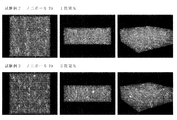
- Test example 2 Nonipol 70 (HLB value: 11.7, number of moles of polyoxyethylene: 7) was added to an aqueous suspension of dyed CNF so as to be 3% by mass and 1% by mass with respect to the whole dispersion, and then PP. (MAPP included) was added and mixed with a homomixer to obtain a dispersion containing dyed CNF and PP (in the dispersion, dyed CNF: 1% by mass, PP (including MAPP): 9% by mass). Next, the dispersion containing dyed CNF and PP was suction filtered, and dried while passing acetone (dehydrating) to obtain a resin composition containing dyed CNF and PP. Next, a 0.5 mm spacer was placed and the resin composition was pressed to form a molded body.
- MAPP included was added and mixed with a homomixer to obtain a dispersion containing dyed CNF and PP (in the dispersion, dyed CNF: 1% by mass, PP
- X-ray CT X-ray tomography
- ⁇ Device SKYSCAN1172 version 1.5 made by Skyscan (Belgium) -Image reconstruction software: Skyscan's NRecon ⁇ Measurement conditions ⁇ Spatial resolution: 0.7 ⁇ m, analysis area: 590 ⁇ 590 ⁇ 210 ⁇ m ⁇ Explanation of the photo ⁇ Square image (analysis area viewed from above): 590 ⁇ 590 ⁇ m ⁇ Rectangular image (image of the analysis area seen from the side): 590 ⁇ 210 ⁇ m ⁇ 3D image: 590 ⁇ 590 ⁇ 210 ⁇ m ⁇ Tube voltage: 60kV, tube current: 100 ⁇ A, no filter ⁇ Number of projections: 1800 (taken 180 degrees in 0.1 ° increments)
- Nonipol 70 is added to the aqueous suspension of dyed CNF so as to be 3% by mass and 1% by mass with respect to the whole dispersion, and then PP (including MAPP) is added and mixed with a homomixer.
- a dispersion containing dyed CNF and PP was obtained (in the dispersion, dyed CNF: 1% by mass, PP (including MAPP): 9% by mass).
- the dispersion containing dyed CNF and PP was suction filtered, and dried while passing acetone (dehydrating) to obtain a resin composition containing dyed CNF and PP.
- the resin composition was subjected to high compression pressing to prepare a molded body.
- a dispersion liquid is prepared by adding a nonionic surfactant having an HLB value of 8 to 13 to a dispersion medium containing dyed CNF and PP, a resin composition prepared from the dispersion liquid, and In the molded product, it was possible to prepare a resin composition and molded product colored with a material having good dispersibility of dyed CNF in the resin component (PP) and no unevenness in dyeing.
- a physical property test (tensile test) was performed on the molded body prepared in Test Example 2 (Nonipol 70 1 mass%, Nonipol 70 3 mass%).
- the physical property test conditions were: sample shape: flat plate (width: approx. 5 mm, thickness: approx. 0.4 mm), chuck distance: 25 mm, tensile speed: 1 mm / min, load cell: 1 kN, maximum point stress (average of 5 points) ) was measured.
- a nonionic surfactant having an HLB value of 8 to 13 was added to prepare a dispersion, and the resin composition and molded body prepared from the dispersion were: Compared to a resin composition and a molded article prepared without adding a nonionic surfactant, the tensile strength was equal to or higher than that of the molded article, and the physical properties were also good.
- the dispersibility of the dyed CNF was improved when the ethanol content was 60% by mass or less.
- the dispersibility of PP was improved when the ethanol content was 50 to 70% by mass.
- Test Example 5 Add ethanol (same amount as the aqueous suspension of stained CNF) to the aqueous suspension of stained CNF (stained CNF: 1% by mass), then add PP (including MAPP) and mix with a homomixer.
- a dispersion containing dyed CNF and PP was obtained (in the dispersion, dyed CNF: 0.05% by mass, PP (including MAPP): 2% by mass).
- the dispersion containing dyed CNF and PP was suction filtered, and dried while passing acetone (dehydrating) to obtain a resin composition containing dyed CNF and PP.
- the resin composition was pressed to form a molded body.
- a dispersion containing dyed CNF and PP is obtained by adding PP (including MAPP) at a ratio of 9% by weight to an aqueous suspension of dyed CNF (dyed CNF: 1% by weight) and mixing with a homomixer. It was. Next, the dispersion containing dyed CNF and PP was suction filtered and dried to obtain a resin composition containing dyed CNF and PP. Next, the resin composition was pressed to form a molded body.
- a dispersion containing dyed CNF and PP is prepared using a mixed dispersion medium containing water and ethanol, and in the resin composition prepared from the dispersion, dyeing in the resin component (PP) is performed. It was possible to prepare a colored resin composition having good dispersibility of CNF and no unevenness in dyeing.
- a nonionic surfactant having an HLB value of 8 to 13 is added to prepare a dispersion, and in the resin composition prepared from the dispersion, the resin component (PP) It is possible to prepare a colored resin composition having good dispersibility of the dyed CNF and no unevenness in dyeing.
- a dispersion containing dyed CNF and PP is prepared using a mixed dispersion medium containing water and ethanol, and the resin composition prepared from the dispersion has a dispersibility of the dyed CNF in the resin component (PP).
- a resin-colored resin composition that is good and has no unevenness in dyeing can be prepared.
Landscapes
- Chemical & Material Sciences (AREA)
- Engineering & Computer Science (AREA)
- Materials Engineering (AREA)
- Organic Chemistry (AREA)
- Nanotechnology (AREA)
- Health & Medical Sciences (AREA)
- Chemical Kinetics & Catalysis (AREA)
- Medicinal Chemistry (AREA)
- Polymers & Plastics (AREA)
- Manufacturing & Machinery (AREA)
- Physics & Mathematics (AREA)
- Composite Materials (AREA)
- Condensed Matter Physics & Semiconductors (AREA)
- General Physics & Mathematics (AREA)
- Crystallography & Structural Chemistry (AREA)
- Inorganic Chemistry (AREA)
- Processes Of Treating Macromolecular Substances (AREA)
- Compositions Of Macromolecular Compounds (AREA)
Applications Claiming Priority (2)
| Application Number | Priority Date | Filing Date | Title |
|---|---|---|---|
| JP2012-029571 | 2012-02-14 | ||
| JP2012029571A JP5797129B2 (ja) | 2012-02-14 | 2012-02-14 | セルロースナノファイバー及び樹脂を含む分散液、並びに樹脂組成物 |
Publications (1)
| Publication Number | Publication Date |
|---|---|
| WO2013122171A1 true WO2013122171A1 (ja) | 2013-08-22 |
Family
ID=48984280
Family Applications (1)
| Application Number | Title | Priority Date | Filing Date |
|---|---|---|---|
| PCT/JP2013/053579 Ceased WO2013122171A1 (ja) | 2012-02-14 | 2013-02-14 | セルロースナノファイバー及び樹脂を含む分散液、並びに樹脂組成物 |
Country Status (2)
| Country | Link |
|---|---|
| JP (1) | JP5797129B2 (https=) |
| WO (1) | WO2013122171A1 (https=) |
Cited By (11)
| Publication number | Priority date | Publication date | Assignee | Title |
|---|---|---|---|---|
| JP2015117340A (ja) * | 2013-12-19 | 2015-06-25 | サンノプコ株式会社 | セルロースナノファイバー水性分散体の製造方法及び高濃度化助剤 |
| WO2016170857A1 (ja) * | 2015-04-23 | 2016-10-27 | サンノプコ株式会社 | 溶解パルプ組成物及びビスコースレーヨン製造方法 |
| JP2017025206A (ja) * | 2015-07-23 | 2017-02-02 | 第一工業製薬株式会社 | セルロースエステル水性分散体 |
| CN107849359A (zh) * | 2015-07-07 | 2018-03-27 | 第工业制药株式会社 | 树脂增强用混合物、纤维强化树脂混合物和纤维强化树脂及其制造方法 |
| JP2018048218A (ja) * | 2016-09-20 | 2018-03-29 | 第一工業製薬株式会社 | セルロースナノファイバー濃縮物の製造方法 |
| KR20180077000A (ko) | 2016-12-28 | 2018-07-06 | 아사히 가세이 가부시키가이샤 | 셀룰로오스 제제 |
| CN109081988A (zh) * | 2018-07-13 | 2018-12-25 | 东北林业大学 | 一种利用表面活性剂分散微纳米纤维素制备聚烯烃基复合材料的方法 |
| WO2019045076A1 (ja) * | 2017-09-04 | 2019-03-07 | 株式会社日本製鋼所 | セルロースナノファイバー分散液、セルロースナノファイバー複合樹脂、及びそれらの製造方法 |
| JP2019131774A (ja) * | 2018-02-02 | 2019-08-08 | 株式会社スギノマシン | セルロースナノファイバー含有樹脂組成物 |
| JP2020152925A (ja) * | 2020-06-26 | 2020-09-24 | 旭化成株式会社 | セルロース含有樹脂組成物 |
| US11390728B2 (en) | 2016-12-28 | 2022-07-19 | Asahi Kasei Kabushiki Kaisha | Cellulose-containing resin composition and cellulosic ingredient |
Families Citing this family (20)
| Publication number | Priority date | Publication date | Assignee | Title |
|---|---|---|---|---|
| JP5652797B2 (ja) * | 2012-09-20 | 2015-01-14 | 独立行政法人 国立印刷局 | セルロース微小繊維によって印刷した印刷物及び作製方法 |
| JP6249488B2 (ja) * | 2013-09-25 | 2017-12-20 | トクラス株式会社 | 改質フィブリル化セルロース、及び、フィブリル化セルロース含有樹脂製品、並びに、これらの製造方法 |
| JP6502645B2 (ja) * | 2014-10-20 | 2019-04-17 | 出光ライオンコンポジット株式会社 | ポリオレフィン樹脂組成物 |
| JP6091589B2 (ja) | 2015-03-19 | 2017-03-08 | 国立大学法人京都大学 | 化学修飾セルロースナノファイバー及び熱可塑性樹脂を含有する繊維強化樹脂組成物 |
| JP6713127B2 (ja) * | 2016-06-10 | 2020-06-24 | 第一工業製薬株式会社 | 樹脂補強用混合物、繊維強化樹脂混合物、並びに、繊維強化樹脂及びその製造方法 |
| JP6256644B1 (ja) * | 2017-02-27 | 2018-01-10 | スターライト工業株式会社 | ナノファイバー複合体の製造方法 |
| JP6939386B2 (ja) * | 2017-02-27 | 2021-09-22 | スターライト工業株式会社 | ナノファイバー複合体の製造方法 |
| JP6895323B2 (ja) * | 2017-06-22 | 2021-06-30 | 旭化成株式会社 | 化学修飾されたセルロース微細繊維を含有する高耐熱性樹脂複合体 |
| JP2019014771A (ja) * | 2017-07-03 | 2019-01-31 | 日本ペイントホールディングス株式会社 | 水性塗料組成物、塗膜および物品 |
| JP6979933B2 (ja) * | 2017-08-29 | 2021-12-15 | 旭化成株式会社 | セルロース充填樹脂組成物の製造方法 |
| JP7024310B2 (ja) * | 2017-10-16 | 2022-02-24 | スターライト工業株式会社 | ナノファイバー複合体の製造方法 |
| JP2019085472A (ja) * | 2017-11-06 | 2019-06-06 | セイコーエプソン株式会社 | インク組成物およびインク組成物の製造方法 |
| EP3786215B1 (en) | 2018-04-23 | 2024-09-25 | Asahi Kasei Kabushiki Kaisha | Cellulose nanofiber-containing aqueous dispersion and cellulose nanofiber-containing resin composition |
| JP7218243B2 (ja) * | 2018-05-31 | 2023-02-06 | キヤノン株式会社 | 水性着色液、インクジェット用インク、筆記具用インク |
| JP6726235B2 (ja) * | 2018-07-11 | 2020-07-22 | 旭化成株式会社 | セルロース含有樹脂組成物 |
| JP7142586B2 (ja) * | 2019-02-06 | 2022-09-27 | 株式会社スギノマシン | セルロース繊維乾燥体、セルロース繊維樹脂複合体、成形体 |
| US20240150555A1 (en) * | 2021-02-22 | 2024-05-09 | Asahi Kasei Kabushiki Kaisha | Composition Containing Cellulose Nanofibers |
| JP7374372B2 (ja) * | 2021-02-22 | 2023-11-06 | 旭化成株式会社 | セルロースナノファイバーを含む組成物 |
| KR102774675B1 (ko) * | 2022-10-18 | 2025-03-05 | 한솔제지 주식회사 | 셀룰로오스 복합체 및 이를 포함하는 고무 조성물 |
| JP7772408B1 (ja) | 2024-08-23 | 2025-11-18 | 株式会社成光工業 | セルロースナノファイバーのスラリーおよびその粉体 |
Citations (6)
| Publication number | Priority date | Publication date | Assignee | Title |
|---|---|---|---|---|
| JP2008297364A (ja) * | 2007-05-29 | 2008-12-11 | Kyoto Univ | ミクロフィブリル化セルロース複合樹脂及びその製造方法 |
| WO2009013925A1 (ja) * | 2007-07-26 | 2009-01-29 | Toyota Boshoku Kabushiki Kaisha | 熱可塑性樹脂組成物の製造方法及び成形体の製造方法 |
| JP2010270315A (ja) * | 2009-04-24 | 2010-12-02 | Sumitomo Bakelite Co Ltd | 複合体組成物 |
| JP2011201964A (ja) * | 2010-03-24 | 2011-10-13 | Mitsubishi Electric Corp | 親水性樹脂の製造方法及びパルプ繊維複合樹脂の成形品 |
| JP2011201965A (ja) * | 2010-03-24 | 2011-10-13 | Mitsubishi Electric Corp | 親水性樹脂の製造方法及びパルプ繊維複合樹脂の成形品 |
| WO2012111408A1 (ja) * | 2011-02-15 | 2012-08-23 | 日産化学工業株式会社 | 繊維状樹脂補強剤とその製造方法、およびそれを用いた樹脂組成物 |
-
2012
- 2012-02-14 JP JP2012029571A patent/JP5797129B2/ja active Active
-
2013
- 2013-02-14 WO PCT/JP2013/053579 patent/WO2013122171A1/ja not_active Ceased
Patent Citations (6)
| Publication number | Priority date | Publication date | Assignee | Title |
|---|---|---|---|---|
| JP2008297364A (ja) * | 2007-05-29 | 2008-12-11 | Kyoto Univ | ミクロフィブリル化セルロース複合樹脂及びその製造方法 |
| WO2009013925A1 (ja) * | 2007-07-26 | 2009-01-29 | Toyota Boshoku Kabushiki Kaisha | 熱可塑性樹脂組成物の製造方法及び成形体の製造方法 |
| JP2010270315A (ja) * | 2009-04-24 | 2010-12-02 | Sumitomo Bakelite Co Ltd | 複合体組成物 |
| JP2011201964A (ja) * | 2010-03-24 | 2011-10-13 | Mitsubishi Electric Corp | 親水性樹脂の製造方法及びパルプ繊維複合樹脂の成形品 |
| JP2011201965A (ja) * | 2010-03-24 | 2011-10-13 | Mitsubishi Electric Corp | 親水性樹脂の製造方法及びパルプ繊維複合樹脂の成形品 |
| WO2012111408A1 (ja) * | 2011-02-15 | 2012-08-23 | 日産化学工業株式会社 | 繊維状樹脂補強剤とその製造方法、およびそれを用いた樹脂組成物 |
Non-Patent Citations (2)
| Title |
|---|
| HIROAKI OKUMURA ET AL.: "Cellulose Nanofiber Kyoka Polyolefin Jushi no Kaihatsu", RECENT ADVANCEMENT OF INTERFACIAL MATERIALS SCIENCE ON COMPOSITE MATERIALS, 2011, pages 0 - 34-1 TO 0-34-2 * |
| TAKAHIRO UESAKA ET AL.: "Cellulose Nanofiber Senshoku Gijutsu Oyobi Senshoku Cellulose Nanobiber / Netsu Kasosei Jushi Fukugo Zairyo no Sakusei", SEIKEI KAKO SYMPOSIA, 22 November 2012 (2012-11-22), pages 251 - 252 * |
Cited By (17)
| Publication number | Priority date | Publication date | Assignee | Title |
|---|---|---|---|---|
| JP2015117340A (ja) * | 2013-12-19 | 2015-06-25 | サンノプコ株式会社 | セルロースナノファイバー水性分散体の製造方法及び高濃度化助剤 |
| WO2016170857A1 (ja) * | 2015-04-23 | 2016-10-27 | サンノプコ株式会社 | 溶解パルプ組成物及びビスコースレーヨン製造方法 |
| CN107108964A (zh) * | 2015-04-23 | 2017-08-29 | 圣诺普科有限公司 | 溶解纸浆组合物及粘胶丝制造方法 |
| CN107849359A (zh) * | 2015-07-07 | 2018-03-27 | 第工业制药株式会社 | 树脂增强用混合物、纤维强化树脂混合物和纤维强化树脂及其制造方法 |
| JP2017025206A (ja) * | 2015-07-23 | 2017-02-02 | 第一工業製薬株式会社 | セルロースエステル水性分散体 |
| JP2018048218A (ja) * | 2016-09-20 | 2018-03-29 | 第一工業製薬株式会社 | セルロースナノファイバー濃縮物の製造方法 |
| KR20180077000A (ko) | 2016-12-28 | 2018-07-06 | 아사히 가세이 가부시키가이샤 | 셀룰로오스 제제 |
| US11390728B2 (en) | 2016-12-28 | 2022-07-19 | Asahi Kasei Kabushiki Kaisha | Cellulose-containing resin composition and cellulosic ingredient |
| WO2019045076A1 (ja) * | 2017-09-04 | 2019-03-07 | 株式会社日本製鋼所 | セルロースナノファイバー分散液、セルロースナノファイバー複合樹脂、及びそれらの製造方法 |
| JP2019044087A (ja) * | 2017-09-04 | 2019-03-22 | 株式会社日本製鋼所 | セルロースナノファイバー分散液、及び、セルロースナノファイバー複合樹脂 |
| CN111094424A (zh) * | 2017-09-04 | 2020-05-01 | 株式会社日本制钢所 | 纤维素纳米纤维分散液、纤维素纳米纤维复合树脂及它们的制造方法 |
| CN111094424B (zh) * | 2017-09-04 | 2022-07-08 | 株式会社日本制钢所 | 纤维素纳米纤维分散液、纤维素纳米纤维复合树脂及它们的制造方法 |
| JP2019131774A (ja) * | 2018-02-02 | 2019-08-08 | 株式会社スギノマシン | セルロースナノファイバー含有樹脂組成物 |
| CN109081988B (zh) * | 2018-07-13 | 2020-08-14 | 东北林业大学 | 一种利用表面活性剂分散微纳米纤维素制备聚烯烃基复合材料的方法 |
| CN109081988A (zh) * | 2018-07-13 | 2018-12-25 | 东北林业大学 | 一种利用表面活性剂分散微纳米纤维素制备聚烯烃基复合材料的方法 |
| JP2020152925A (ja) * | 2020-06-26 | 2020-09-24 | 旭化成株式会社 | セルロース含有樹脂組成物 |
| JP7203791B2 (ja) | 2020-06-26 | 2023-01-13 | 旭化成株式会社 | セルロース含有樹脂組成物 |
Also Published As
| Publication number | Publication date |
|---|---|
| JP2013166818A (ja) | 2013-08-29 |
| JP5797129B2 (ja) | 2015-10-21 |
Similar Documents
| Publication | Publication Date | Title |
|---|---|---|
| JP5797129B2 (ja) | セルロースナノファイバー及び樹脂を含む分散液、並びに樹脂組成物 | |
| EP2532774B1 (en) | Method of manufacturing a cationic microfibrillated plant fiber | |
| KR102312070B1 (ko) | 건조 혼합된 재분산성 셀룰로스 필라멘트/캐리어 제품 및 이의 제조 방법 | |
| CN102112509B (zh) | 含有不饱和聚酯树脂和微纤化植物纤维的成型材料 | |
| JP5757765B2 (ja) | 変性ミクロフィブリル化植物繊維を含む樹脂組成物 | |
| EP3845706B1 (en) | Molded body of cellulose fiber and method of manufacturing same | |
| JP6591304B2 (ja) | 易分散性セルロース組成物、易分散性セルロース組成物の製造方法、セルロース分散樹脂組成物及びセルロース分散樹脂組成物の製造方法 | |
| CN105026477A (zh) | 包含纤维素和分散剂的组合物 | |
| JP6418212B2 (ja) | 微細繊維状セルロース含有物 | |
| CA2435702C (en) | Flowable and meterable densified fiber flake | |
| JP6601088B2 (ja) | 微細繊維状セルロース含有物 | |
| WO2015050126A1 (ja) | ナノ複合体及びナノ複合体の製造法 | |
| JP5910786B1 (ja) | 微細繊維状セルロース含有物 | |
| JP6572700B2 (ja) | 成形体及び成形体用シート | |
| JP2017106012A (ja) | 塗料用組成物および筆記具 | |
| US20190309477A1 (en) | Method for preparing nanocellulose | |
| JP6637275B2 (ja) | 湿式抄紙用分散剤、湿式抄紙用分散組成物及び繊維シート | |
| EP4442737A1 (en) | Cellulose particles and cellulose particle dispersion | |
| JP6579286B1 (ja) | 樹脂組成物および成形体 | |
| EP4011955B1 (en) | Polymer complex | |
| JP7517971B2 (ja) | セルロース-樹脂複合組成物及びその製造方法、セルロース分散樹脂組成物、並びにセルロース分散樹脂成形品 | |
| KR20250097871A (ko) | 섬유 성형체, 섬유상 바인더 및 이들의 응용 | |
| JP6418213B2 (ja) | 微細繊維状セルロース含有物 | |
| JP7821096B2 (ja) | セルロース樹脂複合組成物の製造方法及びセルロース樹脂複合組成物 | |
| JP2019147965A (ja) | 繊維強化樹脂成形体及び繊維強化樹脂成形体用シート |
Legal Events
| Date | Code | Title | Description |
|---|---|---|---|
| 121 | Ep: the epo has been informed by wipo that ep was designated in this application |
Ref document number: 13749753 Country of ref document: EP Kind code of ref document: A1 |
|
| NENP | Non-entry into the national phase |
Ref country code: DE |
|
| 122 | Ep: pct application non-entry in european phase |
Ref document number: 13749753 Country of ref document: EP Kind code of ref document: A1 |