WO2013114671A1 - 防振材およびその製法 - Google Patents
防振材およびその製法 Download PDFInfo
- Publication number
- WO2013114671A1 WO2013114671A1 PCT/JP2012/074798 JP2012074798W WO2013114671A1 WO 2013114671 A1 WO2013114671 A1 WO 2013114671A1 JP 2012074798 W JP2012074798 W JP 2012074798W WO 2013114671 A1 WO2013114671 A1 WO 2013114671A1
- Authority
- WO
- WIPO (PCT)
- Prior art keywords
- carbon black
- vibration
- thermoplastic polyurethane
- polyurethane elastomer
- acid
- Prior art date
- Legal status (The legal status is an assumption and is not a legal conclusion. Google has not performed a legal analysis and makes no representation as to the accuracy of the status listed.)
- Ceased
Links
Classifications
-
- C—CHEMISTRY; METALLURGY
- C08—ORGANIC MACROMOLECULAR COMPOUNDS; THEIR PREPARATION OR CHEMICAL WORKING-UP; COMPOSITIONS BASED THEREON
- C08K—Use of inorganic or non-macromolecular organic substances as compounding ingredients
- C08K3/00—Use of inorganic substances as compounding ingredients
- C08K3/02—Elements
- C08K3/04—Carbon
-
- B—PERFORMING OPERATIONS; TRANSPORTING
- B60—VEHICLES IN GENERAL
- B60G—VEHICLE SUSPENSION ARRANGEMENTS
- B60G7/00—Pivoted suspension arms; Accessories thereof
- B60G7/005—Ball joints
-
- C—CHEMISTRY; METALLURGY
- C08—ORGANIC MACROMOLECULAR COMPOUNDS; THEIR PREPARATION OR CHEMICAL WORKING-UP; COMPOSITIONS BASED THEREON
- C08J—WORKING-UP; GENERAL PROCESSES OF COMPOUNDING; AFTER-TREATMENT NOT COVERED BY SUBCLASSES C08B, C08C, C08F, C08G or C08H
- C08J3/00—Processes of treating or compounding macromolecular substances
- C08J3/20—Compounding polymers with additives, e.g. colouring
- C08J3/203—Solid polymers with solid and/or liquid additives
-
- C—CHEMISTRY; METALLURGY
- C08—ORGANIC MACROMOLECULAR COMPOUNDS; THEIR PREPARATION OR CHEMICAL WORKING-UP; COMPOSITIONS BASED THEREON
- C08L—COMPOSITIONS OF MACROMOLECULAR COMPOUNDS
- C08L75/00—Compositions of polyureas or polyurethanes; Compositions of derivatives of such polymers
- C08L75/04—Polyurethanes
-
- C—CHEMISTRY; METALLURGY
- C08—ORGANIC MACROMOLECULAR COMPOUNDS; THEIR PREPARATION OR CHEMICAL WORKING-UP; COMPOSITIONS BASED THEREON
- C08J—WORKING-UP; GENERAL PROCESSES OF COMPOUNDING; AFTER-TREATMENT NOT COVERED BY SUBCLASSES C08B, C08C, C08F, C08G or C08H
- C08J2375/00—Characterised by the use of polyureas or polyurethanes; Derivatives of such polymers
- C08J2375/04—Polyurethanes
Definitions
- the present invention relates to an anti-vibration material used for an anti-vibration rubber bush (stabilizer bush, suspension bush, etc.) for vehicles such as automobiles and the like, and a method for producing the same.
- anti-vibration rubber bushes such as stabilizer bushes and suspension bushes have been used for vehicles such as automobiles.
- a natural rubber material has been used for a vibration isolating material such as the vibration isolating rubber bush.
- thermoplastic materials such as thermoplastic elastomers in place of natural rubber materials has been proposed for the purpose of reducing the cost of the vibration-proof material (for example, see Patent Documents 1 and 2).
- thermoplastic materials such as the above-mentioned thermoplastic elastomers have intermediate properties between rubber and resin
- vibration isolators using thermoplastic materials are more difficult than conventional anti-vibration materials using natural rubber materials.
- durability is inferior.
- the present invention has been made in view of such circumstances, and an object thereof is to provide a vibration-proof material having excellent durability and a method for producing the same.
- thermoplastic polyurethane elastomer TPU
- properties similar to those of natural rubber tensile, static, dynamic.
- carbon black is present in the hard segment of the thermoplastic polyurethane elastomer
- the isocyanate bond chains in the hard segment are clumped around the carbon black, and the crystallinity of the thermoplastic polyurethane elastomer is reduced. Therefore, it was found that the vibration-proof material has poor durability.
- thermoplastic polyurethane elastomer and carbon black are kneaded at a lower temperature (20 to 100 ° C.) than the conventional kneading temperature (155 to 205 ° C.), the carbon black is substantially It has been found that it is dispersed only in the soft segment of the thermoplastic polyurethane elastomer. As a result, soft segment polymer chains are gathered around the carbon black, forming so-called pseudo-crosslinking points, and the soft segment polymer chains are pseudo-crosslinked, thereby improving the durability of the vibration isolator. And the present invention has been reached.
- the present invention is a vibration-proof material comprising a thermoplastic polyurethane elastomer as a main component and containing carbon black, wherein the carbon black is substantially dispersed only in the soft segment of the thermoplastic polyurethane elastomer.
- the vibration material is a first gist.
- the second gist of the present invention is a method for producing the above-described vibration-proof material, in which a thermoplastic polyurethane elastomer and carbon black are kneaded at a temperature of 20 to 100 ° C.
- the vibration-proof material of the present invention is a vibration-proof material mainly composed of a thermoplastic polyurethane elastomer and containing carbon black, and the carbon black is substantially contained in the soft segment of the thermoplastic polyurethane elastomer. Only uniformly distributed. Therefore, the bound polymer in which the polymer chains of the soft segments are wrapped around the carbon black becomes a pseudo-crosslinking point, and the polymer chains of the soft segments come to be pseudo-crosslinked, thereby improving the durability of the vibration-proof material.
- the durability is further improved.
- thermoplastic polyurethane elastomer and carbon black are kneaded at a high temperature (150 to 205 ° C)
- the TPU becomes completely melted, carbon black enters the hard segment, the crystallinity of the TPU decreases, and durability is improved.
- the thermoplastic polyurethane elastomer and carbon black are kneaded at a low temperature (20 to 100 ° C.)
- the TPU is not completely melted but is in a semi-molten state (slightly before completely melting). In this semi-molten state, the carbon black aggregates are loosened. For this reason, carbon black comes to disperse
- the vibration isolator of the present invention is mainly composed of a thermoplastic polyurethane elastomer and contains carbon black.
- the most characteristic feature of the present invention is that the carbon black is substantially dispersed only in the soft segment of the thermoplastic polyurethane elastomer.
- the fact that the carbon black is substantially dispersed only in the soft segment of the thermoplastic polyurethane elastomer means that the carbon black is not substantially dispersed in the hard segment of the thermoplastic polyurethane elastomer. To do.
- the dispersion state of the carbon black in the thermoplastic polyurethane elastomer can be observed with, for example, a transmission electron microscope (TEM), a scanning electron microscope (SEM), a microscope, or the like. .
- TEM transmission electron microscope
- SEM scanning electron microscope
- the vibration isolator of the present invention is mainly composed of a thermoplastic polyurethane elastomer.
- the main component means a component that greatly affects the characteristics of the vibration isolator, and the content of the component is usually 50% by weight or more of the entire vibration isolator.
- thermoplastic polyurethane elastomer is composed of a hard phase (hard segment, constrained phase) and a soft rubber soft phase (soft segment), and exhibits properties as rubber at room temperature, but exhibits thermoplasticity at high temperatures. It is a polymer.
- the thermoplastic polyurethane elastomer is obtained using a polyisocyanate and a polyol.
- polyisocyanate examples include 4,4′-diphenylmethane diisocyanate (MDI), 2,4-tolylene diisocyanate (2,4-TDI), 2,6-tolylene diisocyanate (2,6-TDI), 3 , 3'-vitrylene-4,4'-diisocyanate, 3,3'-dimethyldiphenylmethane-4,4'-diisocyanate, 2,4-tolylene diisocyanate uretidinedione (2,4-TDI dimer), 1,5-naphthylene diisocyanate, metaphenylene diisocyanate, hexamethylene diisocyanate, isophorone diisocyanate, 4,4'-dicyclohexylmethane diisocyanate (hydrogenated MDI), carbodiimide-modified MDI, orthotoluidine diisocyanate, xylene diisocyanate Examples thereof include diisocyanates such as paraphenyl
- polystyrene resin examples include polyester polyols, polyether polyols, and the like. These may be used alone or in combination of two or more.
- polyester polyol examples include those having an ester bond by condensation reaction of polyhydric alcohol and polyvalent carboxylic acid in the presence of a solid acid catalyst, including polyether ester polyol, polycarbonate polyester polyol, and the like. It is.
- the polyhydric alcohol is preferably a linear glycol having 2 to 15 main carbon atoms, specifically ethylene glycol, 1,3-propylene glycol, diethylene glycol, 1,4-butylene glycol, 1,5-pentamethyl.
- the main chain is a hydrocarbon of glycols such as glycol, 1,6-hexamethylene glycol, bishydroxyethoxybenzene or p-xylene glycol.
- the total number of carbon atoms is preferably 3 to 34, more preferably 3 to 17, such as 1,2-propylene glycol, 2-methyl-1,3-propanediol, di-1,2-propylene glycol, 1, 2-butylene glycol, 1,3-butylene glycol, 2,3-butylene glycol, 2,2-dimethyl-1,3-propanediol, 3-methyl-1,5-pentanediol, 3-methyl-1,3 , 5-pentanetriol, 2,2,4-trimethyl-1,3-pentanediol, 2-ethyl-1,3-hexanediol, 2,2-dimethyl-3-hydroxypropyl-2,2-dimethyl-3 -Hydroxypropanate, neopentyl glycol, 2-normalbutyl-2-ethyl-1,3-propanediol, 3-ethyl-1,5-pen Diol, 3-propyl-1,5-pentanedi
- the polyhydric alcohol may be used in combination with a compound having 3 or more hydroxyl groups.
- the compound that can be used in combination may be any compound that is generally used for polyester polyols, and examples thereof include polyfunctional polyhydroxy compounds such as glycerin, hexanetriol, triethanolamine, pentaerythritol, and ethylenediamine.
- polyvalent carboxylic acid examples include succinic acid, maleic acid, adipic acid, glutaric acid, pimelic acid, suberic acid, azelaic acid, sebacic acid, 1,9-nonamethylene dicarboxylic acid, and 1,10-decamethylene dicarboxylic acid.
- adipic acid is mainly used.
- dimer acid obtained by polymerization of tall oil fatty acid can be used.
- tall oil fatty acids include mixtures of unsaturated acids such as oleic acid and linoleic acid, and palmitic acid and stearic acid.
- polyether polyol examples include compounds having 2 or more, preferably 2 to 6 active hydrogens, for example, the polyhydric alcohol, glycerin, trimethylolpropane, pentaerythritol, sorbitol, mannitol, ditrimethylolpropane, dipentaerythritol.
- Carbon black examples include various grades of carbon black such as SAF class, ISAF class, HAF class, MAF class, FEF class, GPF class, SRF class, FT class, and MT class. These may be used alone or in combination of two or more.
- the average particle size of the carbon black is preferably 18 to 122 nm, particularly preferably 20 to 40 nm.
- the present invention is characterized in that carbon black is loosened during carbon black kneading and uniformly dispersed in the soft segment of the TPU with a small particle size.
- the dispersion diameter of the carbon black dispersed in the TPU soft segment is preferably 70 ⁇ m or less, and particularly preferably 50 ⁇ m or less.
- the content of the carbon black is preferably 5 to 50 parts by weight, particularly preferably 10 to 40 parts by weight with respect to 100 parts by weight of the thermoplastic polyurethane elastomer.
- the content of the carbon black is preferably 5 to 50 parts by weight, particularly preferably 10 to 40 parts by weight with respect to 100 parts by weight of the thermoplastic polyurethane elastomer.
- the material forming the vibration-proof material of the present invention includes a foaming agent, a surfactant, a flame retardant, a colorant, a filler, a plasticizer, a stabilizer, and a release agent. It is also possible to appropriately mix and use an agent, an antioxidant and the like.
- the vibration isolator of the present invention comprises, for example, the above-mentioned thermoplastic polyurethane elastomer (TPU) and carbon black at a low temperature of 20 to 100 ° C. (temperature near the lower limit at which TPU is plasticized) for 3 to 15 minutes, preferably After kneading at 30 to 80 ° C. for 5 to 10 minutes, it can be formed into a vibration-proof material having a desired shape by extrusion molding, injection molding or the like.
- TPU thermoplastic polyurethane elastomer
- carbon black at a low temperature of 20 to 100 ° C. (temperature near the lower limit at which TPU is plasticized) for 3 to 15 minutes, preferably After kneading at 30 to 80 ° C. for 5 to 10 minutes, it can be formed into a vibration-proof material having a desired shape by extrusion molding, injection molding or the like.
- the temperature at the time of kneading means the cylinder temperature of the biaxial kneader, and does not mean the die temperature of the biaxial kneader.
- the die temperature is usually 150 to 200 ° C. in consideration of extrudability and the like.
- the hardness of the vibration isolator of the present invention is preferably 50 to 85 (JIS A), particularly preferably 60 to 70 (JIS A).
- Carbon black (i) SEAST SO manufactured by Tokai Carbon (Carbon black (ii)) Showa Black N330, Showa Cabot [Carbon black (iii)] Toast Carbon Co., Ltd., Seast V
- Examples 2 to 8 Comparative Examples 1 to 6
- An anti-vibration rubber composition was prepared according to Example 1 except that the types and blending ratios of each component, kneading conditions (kneading temperature, kneading time) and the like were changed as shown in Tables 1 and 2 below. .
- a test piece (thickness: 32 mm, size: 36 mm ⁇ 40 mm) was prepared by injection molding of each anti-vibration rubber composition between two steel fittings (thickness: 6 mm, size: 45 mm ⁇ 45 mm) prepared in advance. did. However, an adhesive (Chemlock C210, manufactured by Road Far East Incorporated) was applied to the contact portion between the iron fitting and the vibration-proof rubber composition before injection molding. Then, durability evaluation (load load: 0 ⁇ 4000 N, ambient temperature: room temperature, speed: 3 Hz) was performed using this test piece. In the evaluation, the number of times until the test piece was cracked was less than 20,000 times, x was 20,000 times or more and less than 100,000 times, and ⁇ was 100,000 times or more.
- the measurement was carried out using a VHX-1000 manufactured by KEYENCE, and observed at 175 times the original size, arbitrarily extracting 100 observable carbon blacks, and measuring the particle diameter.
- those having a maximum diameter of 70 ⁇ m or less were dispersed, and those having a diameter larger than 70 ⁇ m were dispersed.
- Comparative Examples 1 and 2 were inferior in durability because they did not contain carbon black.
- Comparative Example 3 the amount of carbon black was large, and carbon black was dispersed in the hard segment of TPU. Therefore, tensile strength at break, tensile elongation at break and durability were all inferior.
- Comparative products 4 to 6 made by kneading TPU and carbon black at high temperature have poor durability because TPU is completely melted and carbon black is dispersed in the hard segment of TPU. It was.
- the anti-vibration material of the present invention can be preferably used for, for example, an anti-vibration rubber bush (stabilizer bush, suspension bush, etc.) for a vehicle such as an automobile, but is not limited thereto, and is used for a joint member of a robot. Can also be used.
- an anti-vibration rubber bush stabilizer bush, suspension bush, etc.
Landscapes
- Chemical & Material Sciences (AREA)
- Health & Medical Sciences (AREA)
- Chemical Kinetics & Catalysis (AREA)
- Medicinal Chemistry (AREA)
- Polymers & Plastics (AREA)
- Organic Chemistry (AREA)
- Engineering & Computer Science (AREA)
- Mechanical Engineering (AREA)
- Compositions Of Macromolecular Compounds (AREA)
- Vibration Prevention Devices (AREA)
- Processes Of Treating Macromolecular Substances (AREA)
- Polyurethanes Or Polyureas (AREA)
Abstract
耐久性に優れた防振材を提供するため、本発明の防振材は、熱可塑性ポリウレタンエラストマーを主成分とし、カーボンブラックを含有する防振材であって、上記カーボンブラックが実質的に上記熱可塑性ポリウレタンエラストマーのソフトセグメント中にのみ分散しているという構成をとる。
Description
本発明は、自動車等の車両用の防振ゴムブッシュ(スタビライザブッシュ、サスペンションブッシュ等)等に使用される、防振材およびその製法に関するものである。
従来より、自動車等の車両には、スタビライザブッシュやサスペンションブッシュ等の防振ゴムブッシュが使用されている。そして、この防振ゴムブッシュ等の防振材には、天然ゴム材料が使用されてきた。ところが、近年、上記防振材の低コスト化を目的に、天然ゴム材料に代えて、熱可塑性エラストマー等の熱可塑性材料の使用が提案されている(例えば、特許文献1,2参照)。
しかしながら、上記熱可塑性エラストマー等の熱可塑性材料は、ゴムと樹脂との中間の性質を有するため、熱可塑性材料を用いた防振材は、従来の天然ゴム材料を用いた防振材に比べて、耐久性が劣るという難点がある。
本発明は、このような事情に鑑みなされたもので、耐久性に優れた防振材およびその製法の提供をその目的とする。
本発明者らは、耐久性に優れた防振材を得るため、鋭意研究を重ねた。そして、熱可塑性エラストマーのなかでも、天然ゴムの特性(引張、静特性、動特性)に類似する特性を備えるという点から、特に熱可塑性ポリウレタンエラストマー(TPU)に着目した。そして、研究を続けたところ、熱可塑性ポリウレタンエラストマーのハードセグメント中にカーボンブラックが存在すると、カーボンブラックの回りに、ハードセグメント中のイソシアネート結合鎖等がまとわりついて、熱可塑性ポリウレタンエラストマーの結晶性が低下するため、防振材の耐久性が劣るということを突き止めた。そこで、実験を重ねた結果、熱可塑性ポリウレタンエラストマーと、カーボンブラックとを、従来の混練温度(155~205℃)よりも低温(20~100℃)で混練すると、上記カーボンブラックが実質的に上記熱可塑性ポリウレタンエラストマーのソフトセグメント中にのみ分散することを見いだした。その結果、カーボンブラックの回りに、ソフトセグメントのポリマー鎖がまとわりついて、いわゆる擬似架橋点が形成され、これによりソフトセグメントのポリマー鎖同士が擬似架橋するため、防振材の耐久性が向上することを見いだし、本発明に到達した。
すなわち、本発明は、熱可塑性ポリウレタンエラストマーを主成分とし、カーボンブラックを含有する防振材であって、上記カーボンブラックが実質的に上記熱可塑性ポリウレタンエラストマーのソフトセグメント中にのみ分散している防振材を第1の要旨とする。
また、本発明は、上記防振材の製法であって、熱可塑性ポリウレタンエラストマーとカーボンブラックとを20~100℃の温度で混練する防振材の製法を第2の要旨とする。
以上のように、本発明の防振材は、熱可塑性ポリウレタンエラストマーを主成分とし、カーボンブラックを含有する防振材であって、上記カーボンブラックが実質的に上記熱可塑性ポリウレタンエラストマーのソフトセグメント中にのみ均一に分散している。そのため、カーボンブラックの回りにソフトセグメントのポリマー鎖がまとわりついたバウンドポリマーが擬似架橋点となって、ソフトセグメントのポリマー鎖同士が擬似架橋するようになり、防振材の耐久性が向上する。
また、カーボンブラックの含有量が、熱可塑性ポリウレタンエラストマー100重量部に対して5~50重量部であると、耐久性がさらに向上するようになる。
熱可塑性ポリウレタンエラストマーと、カーボンブラックとを、高温(150~205℃)で混練すると、TPUが完全溶融状態となり、ハードセグメント中にカーボンブラックが入って、TPUの結晶性が低下し、耐久性が劣る。本発明の製法によると、熱可塑性ポリウレタンエラストマーと、カーボンブラックとを、低温(20~100℃)で混練するため、TPUが完全溶融状態とはならず、半溶融状態(完全に溶融する少し手前の餅のような状態)になり、この半溶融状態の粘性によって、カーボンブラックの凝集がほぐされる。このため、カーボンブラックがソフトセグメント中にのみ均一に分散するようになり、耐久性が向上する。
つぎに、本発明の実施の形態について詳しく説明する。ただし、本発明は、この実施の形態に限られるものではない。
本発明の防振材は、熱可塑性ポリウレタンエラストマーを主成分とし、カーボンブラックを含有するものである。本発明においては、上記カーボンブラックが実質的に上記熱可塑性ポリウレタンエラストマーのソフトセグメント中にのみ分散していることが最大の特徴である。
本発明において、上記カーボンブラックが実質的に上記熱可塑性ポリウレタンエラストマーのソフトセグメント中にのみ分散するとは、上記カーボンブラックが、上記熱可塑性ポリウレタンエラストマーのハードセグメント中には略分散していないことを意味する。
なお、上記カーボンブラックの熱可塑性ポリウレタンエラストマー中における分散状態は、例えば、透過型電子顕微鏡(Transmission Electron Microscope;TEM)、走査電子顕微鏡(Scanning Electron Microscope;SEM)、マイクロスコープ等により観察することができる。
まず、本発明の防振材の各成分について説明する。
《熱可塑性ポリウレタンエラストマー》
本発明の防振材は、熱可塑性ポリウレタンエラストマーを主成分とするものである。
本発明において、主成分とは、防振材の特性に大きな影響を与える成分の意味であり、その成分の含有量は、通常、防振材全体の50重量%以上である。
本発明の防振材は、熱可塑性ポリウレタンエラストマーを主成分とするものである。
本発明において、主成分とは、防振材の特性に大きな影響を与える成分の意味であり、その成分の含有量は、通常、防振材全体の50重量%以上である。
上記熱可塑性ポリウレタンエラストマー(TPU)は、硬質相(ハードセグメント、拘束相)と、軟質ゴムの軟質相(ソフトセグメント)とからなり、常温でゴムとしての性質を示すが、高温で熱可塑性を示すポリマーである。上記熱可塑性ポリウレタンエラストマーは、ポリイソシアネートと、ポリオールとを用いて得られる。
上記ポリイソシアネートとしては、例えば、4,4′-ジフェニルメタンジイソシアネート(MDI)、2,4-トリレンジイソシアネート(2,4-TDI)、2,6-トリレンジイソシアネート(2,6-TDI)、3,3′-ビトリレン-4,4′-ジイソシアネート、3,3′-ジメチルジフェニルメタン-4,4′-ジイソシアネート、2,4-トリレンジイソシアネートウレチジンジオン(2,4-TDIの二量体)、1,5-ナフチレンジイソシアネート、メタフェニレンジイソシアネート、ヘキサメチレンジイソシアネート、イソホロンジイソシアネート、4,4′-ジシクロヘキシルメタンジイソシアネート(水添MDI)、カルボジイミド変性MDI、オルトトルイジンジイソシアネート、キシレンジイソシアネート、パラフェニレンジイソシアネート、リジンジイソシアネートメチルエステル等のジイソシアネート、トリフェニルメタン-4,4′,4″-トリイソシアネート等のトリイソシアネート、ポリメリックMDI等があげられる。これらは単独でもしくは2種以上併せて用いられる。これらのなかでも、汎用性の点から、MDIが好適に用いられる。
上記ポリイソシアネートとともに用いられるポリオールとしては、例えば、ポリエステルポリオール、ポリエーテルポリオール等があげられ、単独でもしくは2種以上併せて用いられる。
〈ポリエステルポリオール〉
上記ポリエステルポリオールとしては、例えば、多価アルコールと多価カルボン酸とを固体酸触媒の存在下で縮合反応してエステル結合を有したものが使用され、ポリエーテルエステルポリオール、ポリカーボネートポリエステルポリオール等も含まれる。
上記ポリエステルポリオールとしては、例えば、多価アルコールと多価カルボン酸とを固体酸触媒の存在下で縮合反応してエステル結合を有したものが使用され、ポリエーテルエステルポリオール、ポリカーボネートポリエステルポリオール等も含まれる。
上記多価アルコールとしては、好ましくは主鎖炭素数2~15の直鎖グリコール、具体的にはエチレングリコール、1,3-プロピレングリコール、ジエチレングリコール、1,4-ブチレングリコール、1,5-ペンタメチルグリコール、1,6-ヘキサメチレングリコール、ビスヒドロキシエトキシベンゼンもしくはp-キシレングリコール等のグリコール類の炭化水素を主鎖にするものがあげられる。炭素原子総数が好ましくは3~34、より好ましくは3~17のもので、例えば1,2-プロピレングリコール、2-メチル-1,3-プロパンジオール、ジ-1,2-プロピレングリコール、1,2-ブチレングリコール、1,3-ブチレングリコール、2,3-ブチレングリコール、2,2-ジメチル-1,3-プロパンジオール、3-メチル-1,5-ペンタンジオール、3-メチル-1,3,5-ペンタントリオール、2,2,4-トリメチル-1,3-ペンタンジオール、2-エチル-1,3-ヘキサンジオール、2,2-ジメチル-3-ヒドロキシプロピル-2,2-ジメチル-3-ヒドロキシプロパネート、ネオペンチルグリコール、2-ノルマルブチル-2-エチル-1,3-プロパンジオール、3-エチル-1,5-ペンタンジオール、3-プロピル-1,5-ペンタンジオール、2,2-ジエチル-1,3-プロパンジオール、3-オクチル-1,5-ペンタンジオール、2-エチル-1,3-ヘキサンジオール、3-ミリスチル-1,5-ペンタンジオール、3-ステアリル-1,5-ペンタンジオール、3-フェニル1,5-ペンタンジオール、3-(4-ノニルフェニル)-1,5-ペンタンジオール、3,3-ビス(4-ノニルフェニル)-1,5-ペンタンジオール、1,2-ビス(ヒドロキシメチル)シクロプロパン、1,3-ビス(ヒドロキシエチル)シクロブタン、1,3-ビス(ヒドロキシメチル)シクロペンタン、1,4-ビス(ヒドロキシメチル)シクロヘキサン、1,4-ビス(ヒドロキシエチル)シクロヘキサン、1,4-ビス(ヒドロキシプロピル)シクロヘキサン、1,4-ビス(ヒドロキシエチル)シクロヘプタン、1,4-ビス(ヒドロキシメトキシ)シクロヘキサン、1,4-ビス(ヒドロキシエトキシ)シクロヘキサン、2,2-ビス(4′-ヒドロキシメトキシシクロヘキシル)プロパン、2,2-ビス(4′-ヒドロキシエドキシシクロヘキシル)プロパン、トリメチロールプロパン等があげられ、これらを単独もしくは2種以上併せて用いることができる。
なお、上記多価アルコールには、水酸基数3以上の化合物を併用しても差し支えない。併用し得る化合物としては、一般にポリエステルポリオールに使用されるものであればよく、例えば、グリセリン、ヘキサントリオール、トリエタノールアミン、ペンタエリスリトール、エチレンジアミン等の多官能ポリヒドロキシ化合物があげられる。
上記多価カルボン酸としては、例えばコハク酸、マレイン酸、アジピン酸、グルタル酸、ピメリン酸、スベリン酸、アゼライン酸、セバシン酸、1,9-ノナメチレンジカルボン酸、1,10-デカメチレンジカルボン酸、1,11-ウンデカメチレンジカルボン酸、1,12-ドデカメチレンジカルボン酸、ドデカンジカルボン酸や、芳香族系ジカルボン酸(例えば、フタル酸、イソフタル酸、テレフタル酸、ヘキサヒドロテレフタル酸、ヘキサヒドロイソフタル酸またはこれらの無水物等)等があげられる。これらは単独でもしくは2種以上併せて用いられる。工業的見地からは主にアジピン酸が使用される。また、トール油脂肪酸の重合によって得られるダイマー酸等も使用できる。トール油脂肪酸としては、例えば、オレイン酸、リノール酸等の不飽和酸と、パルチミン酸,ステアリン酸等との混合物があげられる。
〈ポリエーテルポリオール〉
上記ポリエーテルポリオールとしては、活性水素を2個以上、好ましくは2~6個有する化合物、例えば、前記多価アルコール、グリセリン、トリメチロールプロパン、ペンタエリスリトール、ソルビトール、マンニトール、ジトリメチロールプロパン、ジペンタエリスリトール等にアルキレンオキサイドに対し、例えば、エチレンオキサイド、プロピレンオキサイド、ブチレンオキサイド等を単独または2種以上、好ましくは2~9モル付加重合して得られるポリオールがあげられる。
上記ポリエーテルポリオールとしては、活性水素を2個以上、好ましくは2~6個有する化合物、例えば、前記多価アルコール、グリセリン、トリメチロールプロパン、ペンタエリスリトール、ソルビトール、マンニトール、ジトリメチロールプロパン、ジペンタエリスリトール等にアルキレンオキサイドに対し、例えば、エチレンオキサイド、プロピレンオキサイド、ブチレンオキサイド等を単独または2種以上、好ましくは2~9モル付加重合して得られるポリオールがあげられる。
《カーボンブラック》
上記カーボンブラックとしては、例えば、SAF級,ISAF級,HAF級,MAF級,FEF級,GPF級,SRF級,FT級,MT級等の種々のグレードのカーボンブラックがあげられる。これらは単独でもしくは2種以上併せて用いられる。
上記カーボンブラックとしては、例えば、SAF級,ISAF級,HAF級,MAF級,FEF級,GPF級,SRF級,FT級,MT級等の種々のグレードのカーボンブラックがあげられる。これらは単独でもしくは2種以上併せて用いられる。
上記カーボンブラックの平均粒径は、18~122nmが好ましく、特に好ましくは20~40nmである。
本発明においては、カーボンブラックの混練中にカーボンブラックがほぐされて、小さい粒径でTPUのソフトセグメント中に均一に分散することが特徴である。TPUのソフトセグメント中に分散しているカーボンブラックの分散径は、70μm以下が好ましく、特に好ましくは50μm以下である。
上記カーボンブラックの含有量は、上記熱可塑性ポリウレタンエラストマー100重量部に対して5~50重量部が好ましく、特に好ましくは10~40重量部である。上記カーボンブラックの含有量が多すぎると、硬くなりすぎて、振動吸収性能が低下する傾向がみられ、少なすぎると、耐久性が劣る傾向がみられる。
なお、本発明の防振材を形成する材料には、上記ポリイソシアネート、ポリオールおよびカーボンブラック以外に、発泡剤、界面活性剤、難燃剤、着色剤、充填剤、可塑剤、安定剤、離型剤、酸化防止剤等を適宜配合して用いることも可能である。
本発明の防振材は、例えば、上記熱可塑性ポリウレタンエラストマー(TPU)と、カーボンブラックとを、20~100℃の低温(TPUが可塑化する下限近傍の温度)で3~15分間、好ましくは30~80℃で5~10分間、混練した後、押出成形、インジェクション成形等により、所望の形状の防振材に成形することができる。混練時の温度(混練温度)が高すぎると、TPUが完全溶融状態になるため、TPUのハードセグメント中にカーボンブラックが入って、TPUの結晶性が低下し、耐久性が低下する傾向がみられ、混練温度が低すぎると、混練ができない傾向がみられる。
なお、本発明において、混練時の温度(混練温度)は、2軸混練機のシリンダー温度を意味し、2軸混練機のダイス温度を意味するものではない。ダイス温度は、押出成形性等を考慮し、通常150~200℃である。
本発明の防振材の硬さは、50~85(JIS A)が好ましく、特に好ましくは60~70(JIS A)である。
以下、実施例をあげて本発明をさらに具体的に説明するが、本発明はその要旨を超えない限り以下の実施例に限定されるものではない。なお、例中、「部」とあるのは、断りのない限り重量基準を意味する。
まず、実施例および比較例に先立ち、下記に示す材料を準備した。
〔エステル系TPU〕
クラレ社製、クラミロン8165
クラレ社製、クラミロン8165
〔エーテル系TPU〕
クラレ社製、クラミロン9185
クラレ社製、クラミロン9185
〔カーボンブラック(i)〕
東海カーボン社製、シーストSO
〔カーボンブラック(ii)〕
昭和キャボット社製、ショウブラックN330
〔カーボンブラック(iii) 〕
東海カーボン社製、シーストV
東海カーボン社製、シーストSO
〔カーボンブラック(ii)〕
昭和キャボット社製、ショウブラックN330
〔カーボンブラック(iii) 〕
東海カーボン社製、シーストV
〔実施例1〕
エステル系TPU(クラレ社製、クラミロン8165)100部と、カーボンブラック(i)(東海カーボン社製、シーストSO)5部とを、2軸混練機(JSW社製、Tex30α)を用いて、混練温度(30℃;設定できるシリンダー温度)(なお、押出し成形性を考慮して、ダイス温度は200℃とした。)で10分間混練することにより、防振ゴム組成物を調製した。
エステル系TPU(クラレ社製、クラミロン8165)100部と、カーボンブラック(i)(東海カーボン社製、シーストSO)5部とを、2軸混練機(JSW社製、Tex30α)を用いて、混練温度(30℃;設定できるシリンダー温度)(なお、押出し成形性を考慮して、ダイス温度は200℃とした。)で10分間混練することにより、防振ゴム組成物を調製した。
〔実施例2~8、比較例1~6〕
各成分の種類や配合割合、混練条件(混練温度、混練時間)等を下記の表1および表2に示すように変更する以外は、実施例1に準じて、防振ゴム組成物を調製した。
各成分の種類や配合割合、混練条件(混練温度、混練時間)等を下記の表1および表2に示すように変更する以外は、実施例1に準じて、防振ゴム組成物を調製した。

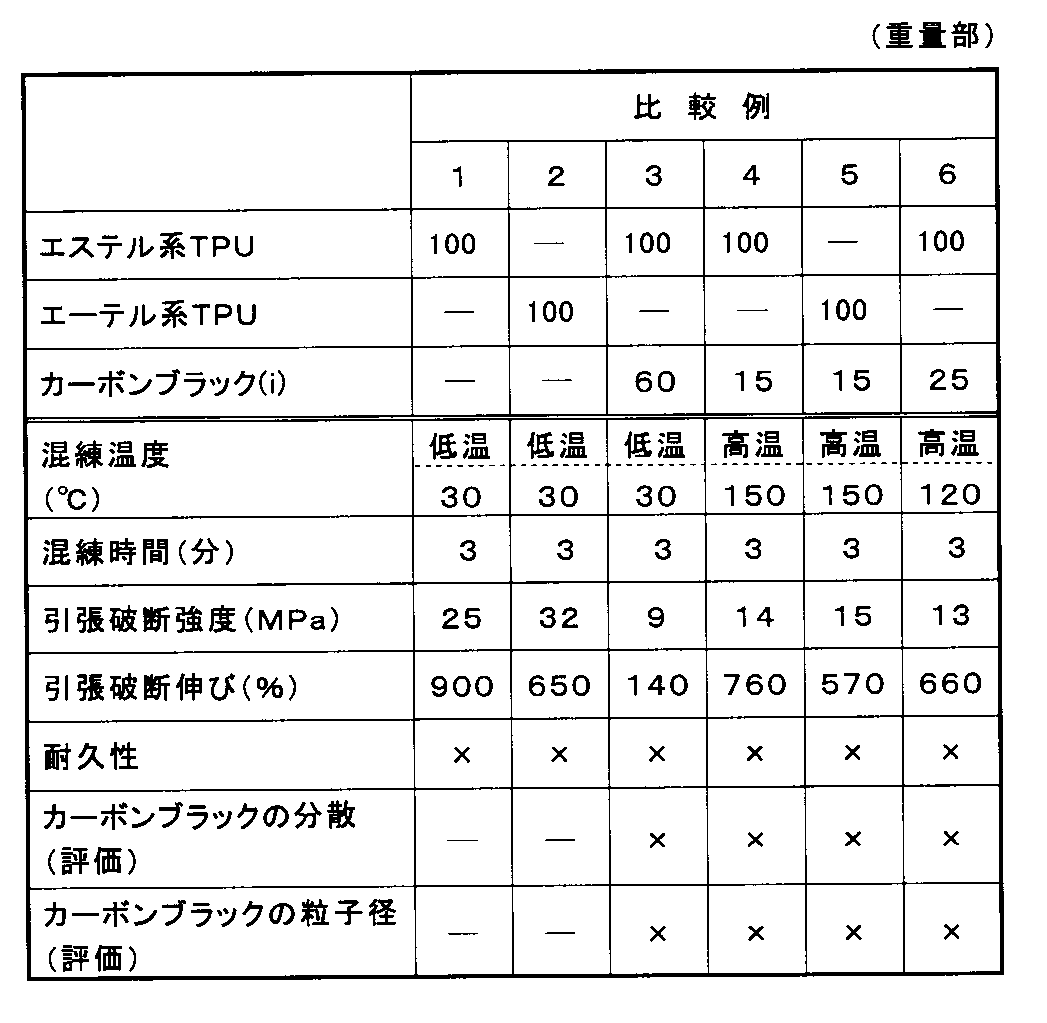
このようにして得られた実施例品および比較例品を用い、下記の基準に従って、各特性の評価を行った。その結果を、上記表1および表2に併せて示した。
〔引張破断強度、引張破断伸び〕
各防振ゴム組成物を用い、JIS K 6251に準じて、引張破断強度および引張破断伸びを測定した。
各防振ゴム組成物を用い、JIS K 6251に準じて、引張破断強度および引張破断伸びを測定した。
〔耐久性〕
予め準備した2枚の鉄製金具(厚み:6mm、大きさ:45mm×45mm)間に、各防振ゴム組成物をインジェクション成形して試験片(厚み:32mm、大きさ:36mm×40mm)を作製した。ただし、鉄製金具と防振ゴム組成物との接触部分には、インジェクション成形前に接着剤(ロードファーイーストインコーポレイテッド社製、ケムロックC210)を塗布した。そして、この試験片を用いて、耐久性の評価(負荷荷重:0±4000N、雰囲気温度:室温、速度:3Hz)を行った。評価は、試験片に亀裂が生じるまでの回数が、2万回未満のものを×、2万回以上10万回未満のものを△、10万回以上のものを○とした。
予め準備した2枚の鉄製金具(厚み:6mm、大きさ:45mm×45mm)間に、各防振ゴム組成物をインジェクション成形して試験片(厚み:32mm、大きさ:36mm×40mm)を作製した。ただし、鉄製金具と防振ゴム組成物との接触部分には、インジェクション成形前に接着剤(ロードファーイーストインコーポレイテッド社製、ケムロックC210)を塗布した。そして、この試験片を用いて、耐久性の評価(負荷荷重:0±4000N、雰囲気温度:室温、速度:3Hz)を行った。評価は、試験片に亀裂が生じるまでの回数が、2万回未満のものを×、2万回以上10万回未満のものを△、10万回以上のものを○とした。
〔カーボンブラックの分散、カーボンブラックの粒子径〕
各防振ゴム組成物をインジェクション成形してシート(厚み:2mm)を作製した。つぎに、シートをLEIKA RM 2155で切断した断面について、ブルカー社製のMMAFM-8型SPMを用いて、熱可塑性ポリウレタンエラストマー(TPU)中のカーボンブラックの分散状態を観察した。評価は、カーボンブラックが、ソフトセグメント中にのみ分散しているものを○、ハードセグメントにも分散しているもの×とした。
また、上記TPU中に分散しているカーボンブラックの粒子径を測定した。測定方法は、KEYENCE社製、VHX-1000を用いて原寸の175倍で観察し、観察できるカーボンブラックを任意に100個抽出してその粒子径を測定した。評価は、粒子径を計測したカーボンブラックの中で最大径が70μm以下で分散しているものを○、70μmより大きい径で分散しているものを×とした。
各防振ゴム組成物をインジェクション成形してシート(厚み:2mm)を作製した。つぎに、シートをLEIKA RM 2155で切断した断面について、ブルカー社製のMMAFM-8型SPMを用いて、熱可塑性ポリウレタンエラストマー(TPU)中のカーボンブラックの分散状態を観察した。評価は、カーボンブラックが、ソフトセグメント中にのみ分散しているものを○、ハードセグメントにも分散しているもの×とした。
また、上記TPU中に分散しているカーボンブラックの粒子径を測定した。測定方法は、KEYENCE社製、VHX-1000を用いて原寸の175倍で観察し、観察できるカーボンブラックを任意に100個抽出してその粒子径を測定した。評価は、粒子径を計測したカーボンブラックの中で最大径が70μm以下で分散しているものを○、70μmより大きい径で分散しているものを×とした。
上記結果から、すべての実施例品は、カーボンブラックがTPUのソフトセグメント中にのみ存在し、ハードセグメント中には分散していないため、引張破断強度および引張破断伸びが良好で、耐久性に優れていた。
これに対して、比較例1,2品は、カーボンブラックを含有しないため、耐久性が劣っていた。
比較例3品は、カーボンブラックの配合量が多く、カーボンブラックがTPUのハードセグメント中にも分散しているため、引張破断強度、引張破断伸びおよび耐久性が何れも劣っていた。
TPUとカーボンブラックとを高温で混練してなる比較例4品~6品は、TPUが完全溶融状態となって、カーボンブラックがTPUのハードセグメント中にも分散しているため、耐久性が劣っていた。
なお、上記実施例においては、本発明における具体的な形態について示したが、上記実施例は単なる例示にすぎず、限定的に解釈されるものではない。当業者に明らかな様々な変形は、本発明の範囲内であることが企図されている。
本発明の防振材は、例えば、自動車等の車両用の防振ゴムブッシュ(スタビライザブッシュ、サスペンションブッシュ等)等に好ましく使用することができるが、これに限定されず、ロボットの関節部材等にも使用することができる。
Claims (3)
- 熱可塑性ポリウレタンエラストマーを主成分とし、カーボンブラックを含有する防振材であって、上記カーボンブラックが実質的に上記熱可塑性ポリウレタンエラストマーのソフトセグメント中にのみ分散していることを特徴とする防振材。
- カーボンブラックの含有量が、熱可塑性ポリウレタンエラストマー100重量部に対して5~50重量部である請求項1記載の防振材。
- 請求項1または2記載の防振材の製法であって、熱可塑性ポリウレタンエラストマーとカーボンブラックとを20~100℃の温度で混練することを特徴とする防振材の製法。
Priority Applications (2)
| Application Number | Priority Date | Filing Date | Title |
|---|---|---|---|
| CN201280060458.5A CN103975036B (zh) | 2012-01-30 | 2012-09-26 | 防振材料及其制法 |
| US14/202,197 US20140187713A1 (en) | 2012-01-30 | 2014-03-10 | Virbration-damping material and production method therefor |
Applications Claiming Priority (2)
| Application Number | Priority Date | Filing Date | Title |
|---|---|---|---|
| JP2012016284A JP5798501B2 (ja) | 2012-01-30 | 2012-01-30 | 防振材およびその製法 |
| JP2012-016284 | 2012-01-30 |
Related Child Applications (1)
| Application Number | Title | Priority Date | Filing Date |
|---|---|---|---|
| US14/202,197 Continuation US20140187713A1 (en) | 2012-01-30 | 2014-03-10 | Virbration-damping material and production method therefor |
Publications (1)
| Publication Number | Publication Date |
|---|---|
| WO2013114671A1 true WO2013114671A1 (ja) | 2013-08-08 |
Family
ID=48904739
Family Applications (1)
| Application Number | Title | Priority Date | Filing Date |
|---|---|---|---|
| PCT/JP2012/074798 Ceased WO2013114671A1 (ja) | 2012-01-30 | 2012-09-26 | 防振材およびその製法 |
Country Status (4)
| Country | Link |
|---|---|
| US (1) | US20140187713A1 (ja) |
| JP (1) | JP5798501B2 (ja) |
| CN (1) | CN103975036B (ja) |
| WO (1) | WO2013114671A1 (ja) |
Families Citing this family (2)
| Publication number | Priority date | Publication date | Assignee | Title |
|---|---|---|---|---|
| FR3069897B1 (fr) * | 2017-08-02 | 2019-12-27 | Sogefi Suspensions | Palier pour barre stabilisatrice |
| CN114773570A (zh) * | 2022-03-16 | 2022-07-22 | 华南理工大学 | 含有金属配位和二硫键聚氨酯弹性体及其制备方法与自修复方法 |
Citations (6)
| Publication number | Priority date | Publication date | Assignee | Title |
|---|---|---|---|---|
| JPS6469685A (en) * | 1987-09-10 | 1989-03-15 | Nippon Steel Chemical Co | Composition for composite vibration-damping material |
| JPH0270751A (ja) * | 1988-09-06 | 1990-03-09 | Japan Synthetic Rubber Co Ltd | 制振・防音・遮音材用ウレタン系組成物 |
| JPH10251507A (ja) * | 1997-03-07 | 1998-09-22 | Emulsion Technology Co Ltd | 制振材用ウレタン系組成物 |
| JP2002147511A (ja) * | 2000-11-13 | 2002-05-22 | Akihiro Yokono | 応力緩和防止振動吸収ゴム |
| JP2005272512A (ja) * | 2004-03-23 | 2005-10-06 | Bando Chem Ind Ltd | ポリウレタンエラストマーおよびそれを用いた免震装置 |
| JP2005281655A (ja) * | 2004-03-03 | 2005-10-13 | Yunimatekku Kk | 熱可塑性ポリウレタンエラストマー |
Family Cites Families (2)
| Publication number | Priority date | Publication date | Assignee | Title |
|---|---|---|---|---|
| CN101712797A (zh) * | 2009-10-18 | 2010-05-26 | 姜彩云 | 一种利用动态硫化法制备的热塑性聚氨酯与氯化聚乙烯(tpu/cpe)新型共混物材料 |
| CN102020841A (zh) * | 2010-11-10 | 2011-04-20 | 黄河水利委员会黄河水利科学研究院 | 纳米聚氨酯弹性体及其制备方法以及用其进行抗磨蚀方法 |
-
2012
- 2012-01-30 JP JP2012016284A patent/JP5798501B2/ja active Active
- 2012-09-26 CN CN201280060458.5A patent/CN103975036B/zh active Active
- 2012-09-26 WO PCT/JP2012/074798 patent/WO2013114671A1/ja not_active Ceased
-
2014
- 2014-03-10 US US14/202,197 patent/US20140187713A1/en not_active Abandoned
Patent Citations (6)
| Publication number | Priority date | Publication date | Assignee | Title |
|---|---|---|---|---|
| JPS6469685A (en) * | 1987-09-10 | 1989-03-15 | Nippon Steel Chemical Co | Composition for composite vibration-damping material |
| JPH0270751A (ja) * | 1988-09-06 | 1990-03-09 | Japan Synthetic Rubber Co Ltd | 制振・防音・遮音材用ウレタン系組成物 |
| JPH10251507A (ja) * | 1997-03-07 | 1998-09-22 | Emulsion Technology Co Ltd | 制振材用ウレタン系組成物 |
| JP2002147511A (ja) * | 2000-11-13 | 2002-05-22 | Akihiro Yokono | 応力緩和防止振動吸収ゴム |
| JP2005281655A (ja) * | 2004-03-03 | 2005-10-13 | Yunimatekku Kk | 熱可塑性ポリウレタンエラストマー |
| JP2005272512A (ja) * | 2004-03-23 | 2005-10-06 | Bando Chem Ind Ltd | ポリウレタンエラストマーおよびそれを用いた免震装置 |
Also Published As
| Publication number | Publication date |
|---|---|
| JP5798501B2 (ja) | 2015-10-21 |
| CN103975036B (zh) | 2015-12-02 |
| JP2013155271A (ja) | 2013-08-15 |
| CN103975036A (zh) | 2014-08-06 |
| US20140187713A1 (en) | 2014-07-03 |
Similar Documents
| Publication | Publication Date | Title |
|---|---|---|
| EP2329961B1 (en) | Abrasive-containing eraser | |
| JP6308021B2 (ja) | タイヤ用ゴム組成物およびスタッドレスタイヤ | |
| JP5620510B2 (ja) | クロロプレンゴム組成物及びその加硫物並びに成形体 | |
| JP2011256290A (ja) | 芳香族ポリアミド樹脂組成物およびその発泡体 | |
| EP3112407A1 (en) | Rubber composition for flexible coupling | |
| JP5798501B2 (ja) | 防振材およびその製法 | |
| JP5231148B2 (ja) | 防振ゴム組成物の製法およびそれによって得られた防振ゴム組成物 | |
| US10023727B2 (en) | Composition for rubber bushing having vibration isolation and fatigue endurance characteristics | |
| KR101277947B1 (ko) | 분체상 열가소성 폴리우레탄 수지 조성물과 이의 제조방법 | |
| US20150284532A1 (en) | Method For Rubber Reinforced With Carbon Nanotubes | |
| JP5821365B2 (ja) | 樹脂組成物の製造方法 | |
| JP5376878B2 (ja) | 防振ゴム組成物の製法およびそれによって得られた防振ゴム組成物ならびに防振ゴム | |
| KR102470778B1 (ko) | 열가소성 폴리에스테르 엘라스토머 수지 조성물, 이의 제조방법 및 이를 포함하는 성형품 | |
| JP5251347B2 (ja) | 熱可塑性エラストマー組成物並びにその製造方法及びそれを用いた空気入りタイヤ | |
| JP7259641B2 (ja) | タイヤ用ゴム組成物およびそれを用いた空気入りタイヤ | |
| KR101551020B1 (ko) | 폴리에테르에스테르계 열가소성 탄성체를 포함하는 자동차용 부쉬 조성물 | |
| JP2014065828A (ja) | 防振部材用熱可塑性エラストマー組成物およびそれを用いた防振部材 | |
| JP6196821B2 (ja) | ゴム組成物の製造方法 | |
| JP2008184543A (ja) | 熱可塑性エラストマー製品の製法およびそれによって得られた熱可塑性エラストマー製品 | |
| JPWO2019117155A1 (ja) | 防振ゴム組成物及び防振ゴム | |
| JP6705159B2 (ja) | タイヤ用ゴム組成物、タイヤ用ゴム組成物の製造方法および空気入りタイヤ | |
| JP6105426B2 (ja) | 防振ゴム組成物及び防振ゴム | |
| JP2014065224A (ja) | 防振部材およびその製法 | |
| KR20230040084A (ko) | 피로내구성이 향상된 서스펜션 부시용 고무 조성물 및 이를 포함하는 자동차 서스펜션 부시용 고무 | |
| JP2017210020A (ja) | 空気入りタイヤ |
Legal Events
| Date | Code | Title | Description |
|---|---|---|---|
| 121 | Ep: the epo has been informed by wipo that ep was designated in this application |
Ref document number: 12867123 Country of ref document: EP Kind code of ref document: A1 |
|
| NENP | Non-entry into the national phase |
Ref country code: DE |
|
| 122 | Ep: pct application non-entry in european phase |
Ref document number: 12867123 Country of ref document: EP Kind code of ref document: A1 |