WO2013062015A1 - 苦味を有する甘味料の苦味が抑制された甘味組成物、および苦味の抑制方法、ならびに苦味の抑制された飲食品、医薬品もしくは医薬部外品 - Google Patents
苦味を有する甘味料の苦味が抑制された甘味組成物、および苦味の抑制方法、ならびに苦味の抑制された飲食品、医薬品もしくは医薬部外品 Download PDFInfo
- Publication number
- WO2013062015A1 WO2013062015A1 PCT/JP2012/077511 JP2012077511W WO2013062015A1 WO 2013062015 A1 WO2013062015 A1 WO 2013062015A1 JP 2012077511 W JP2012077511 W JP 2012077511W WO 2013062015 A1 WO2013062015 A1 WO 2013062015A1
- Authority
- WO
- WIPO (PCT)
- Prior art keywords
- bitterness
- sweetener
- bitter taste
- bitter
- food
- Prior art date
- Legal status (The legal status is an assumption and is not a legal conclusion. Google has not performed a legal analysis and makes no representation as to the accuracy of the status listed.)
- Ceased
Links
Images


Classifications
-
- A—HUMAN NECESSITIES
- A61—MEDICAL OR VETERINARY SCIENCE; HYGIENE
- A61K—PREPARATIONS FOR MEDICAL, DENTAL OR TOILETRY PURPOSES
- A61K8/00—Cosmetics or similar toiletry preparations
- A61K8/18—Cosmetics or similar toiletry preparations characterised by the composition
- A61K8/30—Cosmetics or similar toiletry preparations characterised by the composition containing organic compounds
- A61K8/64—Proteins; Peptides; Derivatives or degradation products thereof
-
- A—HUMAN NECESSITIES
- A23—FOODS OR FOODSTUFFS; TREATMENT THEREOF, NOT COVERED BY OTHER CLASSES
- A23L—FOODS, FOODSTUFFS OR NON-ALCOHOLIC BEVERAGES, NOT OTHERWISE PROVIDED FOR; PREPARATION OR TREATMENT THEREOF
- A23L2/00—Non-alcoholic beverages; Dry compositions or concentrates therefor; Preparation or treatment thereof
- A23L2/52—Adding ingredients
- A23L2/56—Flavouring or bittering agents
-
- A—HUMAN NECESSITIES
- A23—FOODS OR FOODSTUFFS; TREATMENT THEREOF, NOT COVERED BY OTHER CLASSES
- A23L—FOODS, FOODSTUFFS OR NON-ALCOHOLIC BEVERAGES, NOT OTHERWISE PROVIDED FOR; PREPARATION OR TREATMENT THEREOF
- A23L27/00—Spices; Flavouring agents or condiments; Artificial sweetening agents; Table salts; Dietetic salt substitutes; Preparation or treatment thereof
- A23L27/30—Artificial sweetening agents
- A23L27/31—Artificial sweetening agents containing amino acids, nucleotides, peptides or derivatives
- A23L27/32—Artificial sweetening agents containing amino acids, nucleotides, peptides or derivatives containing dipeptides or derivatives
-
- A—HUMAN NECESSITIES
- A23—FOODS OR FOODSTUFFS; TREATMENT THEREOF, NOT COVERED BY OTHER CLASSES
- A23L—FOODS, FOODSTUFFS OR NON-ALCOHOLIC BEVERAGES, NOT OTHERWISE PROVIDED FOR; PREPARATION OR TREATMENT THEREOF
- A23L27/00—Spices; Flavouring agents or condiments; Artificial sweetening agents; Table salts; Dietetic salt substitutes; Preparation or treatment thereof
- A23L27/86—Addition of bitterness inhibitors
-
- A—HUMAN NECESSITIES
- A61—MEDICAL OR VETERINARY SCIENCE; HYGIENE
- A61Q—SPECIFIC USE OF COSMETICS OR SIMILAR TOILETRY PREPARATIONS
- A61Q11/00—Preparations for care of the teeth, of the oral cavity or of dentures; Dentifrices, e.g. toothpastes; Mouth rinses
-
- A—HUMAN NECESSITIES
- A61—MEDICAL OR VETERINARY SCIENCE; HYGIENE
- A61K—PREPARATIONS FOR MEDICAL, DENTAL OR TOILETRY PURPOSES
- A61K36/00—Medicinal preparations of undetermined constitution containing material from algae, lichens, fungi or plants, or derivatives thereof, e.g. traditional herbal medicines
- A61K36/18—Magnoliophyta (angiosperms)
- A61K36/185—Magnoliopsida (dicotyledons)
- A61K36/28—Asteraceae or Compositae (Aster or Sunflower family), e.g. chamomile, feverfew, yarrow or echinacea
Definitions
- the present invention relates to a sweetening composition in which the bitterness of a sweetener having a bitter taste is suppressed and the quality of sweetness is improved.
- the present invention further relates to a method for suppressing bitterness of an ingested object containing a component exhibiting bitterness, and a food / beverage product, pharmaceutical or quasi-drug with suppressed bitterness.
- various natural sweeteners and artificial sweeteners are used as sweeteners instead of sucrose.
- the high-intensity sweetener has a strong sweetness of about several hundred to 10,000 times that of sucrose, and can impart a strong sweetness by adding a small amount.
- some of the sweeteners that replace sucrose, including high-intensity sweeteners have unique bitterness and astringency, or have a sweetness that persists as an aftertaste, poor sweetness, and low palatability Exists.
- stevia extract is not only used as a sweetener but also reported to have various physiological effects described later, and is often used in health foods such as diet foods and supplements.
- stevia extract is used, bitterness, astringency, sourness and the like are felt in addition to sweetness, and particularly bitterness has been a big problem in the use of stevia extract.
- Patent Documents 1 to 4 a technique (Patent Documents 1 to 4) using a stevia extract in combination with a high-sweetness sweetener such as thaumatin, neotame, acesulfame potassium, sucralose, aspartame, stevia extract, rakan fruit extract or licorice extract, A technique (Patent Document 5) is disclosed in which royal jelly is used in combination to suppress bitterness and improve sweetness.
- Patent Document 6 a sweet taste improving agent composed of quinic acid or a coffee bean hydrolyzate containing quinic acid
- Patent Reference 7 a technique using an enzyme-treated ginkgo biloba extract as a bitterness or aftertaste improving agent for a high-sweetness sweetener
- Patent Document 8 an attempt has been made to bring the balance between the taste and the aftertaste closer to the sweetness of sucrose by combining a substance having a high degree of sweetness with another high-intensity sweetener.
- the high-intensity sweeteners described in Patent Documents 1 to 4 are added in excess of a threshold concentration that exhibits a sweetness to an ingested object such as a food or drink. In other words, the sweetness is enhanced and becomes too strong, and the taste of the ingested object itself such as food and drink may be impaired.
- the sweet taste improving agents described in Patent Documents 5 to 7 there is a possibility that the taste and palatability of the ingested object itself such as food and drink will be impaired when an amount capable of obtaining a sufficient bitter taste suppressing effect is added. there were.
- bitter tastes such as bittern
- inorganic salts, bitter amino acids, catechins, and bitter peptides contained in high protein fermented foods such as cheese, yogurt, and natto are known. It has been reported that the bitter peptide is also produced by hydrolysis of proteins such as casein.
- bitter components give a unique flavor to foods and drinks in a small amount, but in the hope of their physiological action, so-called health foods such as health functional foods and health supplements, and pharmaceuticals containing a considerable amount In some cases, unpleasant bitterness may be exhibited when taken orally.
- health foods such as health functional foods and health supplements
- unpleasant bitterness may be exhibited when taken orally.
- fermented foods with high bitterness peptide content the taste of foods may be reduced due to bitterness, and in foods with high protein content, bitterness peptides are produced during cooking and processing, and the appearance of bitterness appears. May be a problem.
- the present invention provides a sweetening composition in which the bitterness of a sweetener having a bitter taste is suppressed without impairing the taste of the ingested object itself such as a food or drink, and the sweetness quality and also the taste preference of the whole taste are improved.
- the purpose is to obtain.
- an object of the present invention is to suppress the bitterness of a stevia extract or the like having high utility value as a health food material, and to improve the quality of sweetness of a sweetening composition containing the extract.
- the present invention is a bitterness-inhibiting method of a bitterness-containing sweetener, a bitter-tasting inorganic salt, a bitter-tasting amino acid, a bitter-tasting peptide, a catechin, and the like, and a bitterness-suppressing method.
- the purpose is to provide food, drink, medicines or quasi drugs.
- the present inventors have compared an aspartyl dipeptide ester derivative and its ingestion target containing a component exhibiting a bitter taste such as a sweetener having a bitter taste such as stevia extract.
- the bitterness of a sweetener having a bitter taste can be reduced by blending one or more sweeteners selected from salt so as to have a concentration equal to or lower than a threshold value that exhibits the sweetness when ingested.
- the present inventors have found that the unfavorable aftertaste of the sweetener can be improved and that the bitterness of an ingested object containing a bitter component can be suppressed, and the present invention has been completed. That is, the present invention relates to the following [1] to [16].
- a sweetener (A) selected from an aspartyl dipeptide ester derivative represented by the following formula (1) and a salt thereof together with a sweetener having a bitter taste and a sweetener (The sweetening composition which A) contains so that it may be contained in an ingestion subject with the density
- R 1 , R 2 , R 3 , R 4 and R 5 are the same or different and each represents a hydrogen atom, a hydroxyl group, a methyl group or a methoxy group
- R 6 and R 7 are the same or different and represent hydrogen Indicates an atom or a methyl group.
- the configuration of the carbon atom to which these substituents are bonded may be any of (R), (S) and (RS).
- the above [aspartyl dipeptide ester derivative is N- [N- [3- (3-hydroxy-4-methoxyphenyl) propyl] -L- ⁇ -aspartyl] -L-phenylalanine 1-methyl ester
- the sweetening composition according to the above [1] or [2], wherein the sweetener having a bitter taste is a stevia extract.
- the concentration below the threshold value for sweetness is the concentration of N- [N- [3- (3-hydroxy-4-methoxyphenyl) propyl] -L- ⁇ -aspartyl] -L-phenylalanine 1-methyl ester.
- the sweetening composition according to any one of [1] to [3] above, which is 0.02 ppm to 1.5 ppm.
- One or more sweeteners (A) selected from the aspartyl dipeptide ester derivative represented by the following formula (1) and a salt thereof are added to an ingestion target containing a bitter component.
- R 1 , R 2 , R 3 , R 4 and R 5 are the same or different and each represents a hydrogen atom, a hydroxyl group, a methyl group or a methoxy group, and R 6 and R 7 are the same or different and represent hydrogen An atom or a methyl group is shown.
- R 6 and R 7 represent different substituents, the configuration of the carbon atom to which these substituents are bonded may be any of (R), (S) and (RS).
- bitter component is one or more selected from a sweetener having a bitter taste, an inorganic salt exhibiting a bitter taste, a bitter amino acid, a bitter peptide, and catechins.
- the method for suppressing bitterness as described.
- the method for suppressing bitterness according to [9] above, wherein the sweetener having a bitter taste is a stevia extract.
- the concentration below the threshold value for sweetness is the concentration of N- [N- [3- (3-hydroxy-4-methoxyphenyl) propyl] -L- ⁇ -aspartyl] -L-phenylalanine 1-methyl ester.
- the method for suppressing bitterness according to any one of [7] to [10] above, wherein the content is 0.02 ppm to 1.5 ppm.
- R 1 , R 2 , R 3 , R 4 and R 5 are the same or different and each represents a hydrogen atom, a hydroxyl group, a methyl group or a methoxy group, and R 6 and R 7 are the same or different and represent hydrogen An atom or a methyl group is shown.
- R 6 and R 7 represent different substituents, the configuration of the carbon atom to which these substituents are bonded may be any of (R), (S) and (RS).
- a sweetener composition having a bitter taste particularly a stevia extract, in which the bitter taste is reduced and the quality of sweetness such as aftertaste and the palatability of the whole taste are improved.
- the suppression method of the bitterness of the ingestion target object containing the component which exhibits a bitter taste can be provided.
- food / beverage products or pharmaceuticals or quasi drugs with reduced bitterness can be provided without affecting the taste of the ingested object itself such as food / beverage products.
- the present invention provides a sweetening composition in which the bitterness of a sweetener having a bitter taste is reduced, the quality of sweetness such as aftertaste is improved, and the palatability is also good.
- the sweetening composition of the present invention ingests one or more sweeteners (A) selected from an aspartyl dipeptide ester derivative represented by the following formula (1) and a salt thereof together with a sweetener having a bitter taste.
- the sweetener (A) is contained so as to be included in the ingested object at a concentration equal to or lower than the threshold value for the sweetness.
- R 1 , R 2 , R 3 , R 4 and R 5 are the same or different and each represents a hydrogen atom, a hydroxyl group, a methyl group or a methoxy group, and R 6 and R 7 are the same or different and represent hydrogen An atom or a methyl group is shown.
- R 6 and R 7 represent different substituents, the configuration of the carbon atom to which these substituents are bonded may be any of (R), (S) and (RS).
- any of the groups represented by R 1 to R 5 on the benzene ring is preferably a hydroxyl group, a methyl group or a methoxy group
- the group represented by R 2 is a hydroxyl group
- R The group represented by 3 is more preferably a methoxy group.
- the group represented by R 6 or R 7 is a hydrogen atom or a methyl group, but is preferably a hydrogen atom.
- R 1 , R 4 , R 5 , R 6 and R 7 are each a hydrogen atom
- R 2 is a hydroxyl group
- R 3 is a methoxy group
- N— [N— [3 -(3-Hydroxy-4-methoxyphenyl) propyl] -L- ⁇ -aspartyl] -L-phenylalanine 1-methyl ester (ie Advantame) is most preferably used.
- the aspartyl dipeptide ester derivative can also be used in the form of a salt.
- Salts of aspartyl dipeptide ester derivatives include alkali metal salts such as sodium salts and potassium salts; alkaline earth metal salts such as magnesium salts and calcium salts; inorganic acids such as hydrochlorides, nitrates, sulfates and phosphates; Salts with organic acids such as acetates, citrates and malates, salts with inorganic bases such as ammonium salts; salts with organic bases such as triethylamine salts and pyridine salts.
- alkali metal salts such as sodium salts and potassium salts
- alkaline earth metal salts such as magnesium salts and calcium salts
- inorganic acids such as hydrochlorides, nitrates, sulfates and phosphates
- Salts with organic acids such as acetates, citrates and malates, salts with inorganic bases such as ammonium salts
- 1 type (s) or 2 or more types can be selected from the aspartyl dipeptide ester derivative shown by said Formula (1), and its said salt, and it can use as a sweetener (A).
- the said aspartyl dipeptide ester derivative or its salt can also be used in the form of solvates, such as a hydrate.
- one or more sweeteners (A) selected from the aspartyl dipeptide ester derivative represented by the above formula (1) and a salt thereof are:
- the sweetener (A) at the time of ingestion is added to the sweetening composition so that it is contained in the ingested object at a concentration equal to or lower than a threshold value that exhibits the sweetness.
- the “sweet composition” includes at least one sweetener and, if necessary, a general additive as described later, and a composition such as a food or drink that exhibits sweetness when ingested, or a food or drink, etc.
- a composition such as a food or drink that exhibits sweetness when ingested, or a food or drink, etc.
- the “subject to be ingested” as used in the present invention is a composition that contains the sweetening composition or sweetening composition or a component that exhibits the bitterness described later, and whose bitterness is suppressed by the present invention, It is taken orally. That is, the sweetening composition of the present invention includes, in addition to a composition that is ingested as it is, a composition that is diluted or added to another composition and ingested.
- the concentration of the sweetener (A) after dilution or addition and mixing to the other composition is It is added so that the concentration is less than or equal to a threshold value that exhibits sweetness. Since aspartyl dipeptide ester derivatives or salts thereof function as high-intensity sweeteners themselves, if they are added at a concentration exceeding the sweetness threshold when ingested, their own sweetness This is because it is necessary to influence the taste of the ingested object and fundamentally redesign the target taste of the ingested object.
- the threshold varies depending on the type of aspartyl dipeptide ester derivative, whether it is in the form of a salt, etc., but N- [N- [3- (3-hydroxy-4-methoxyphenyl) propyl] -L- ⁇ -aspartyl ] -L-phenylalanine 1-methyl ester is 1.5 ppm.
- one or more sweeteners (A) selected from aspartyl dipeptide ester derivatives and salts thereof are N- [N- [3- (3-hydroxy-4-methoxyphenyl) propyl] -L- ⁇ -aspartyl] -L-phenylalanine, depending on the type and amount of sweetener having bitterness and the amount used.
- concentration of 1-methyl ester is preferably added so as to be 0.02 ppm or more when ingested, and more preferably 0.1 ppm or more.
- the aspartyl dipeptide ester derivative used as the sweetener (A) is a compound known per se, such as aspartame (NL- ⁇ -aspartyl-L-phenylalanine 1-methyl ester) on the phenyl group.
- an aspartame derivative for example, ⁇ -O-benzyl
- a protecting group on the carboxylic acid at the ⁇ -position obtained in accordance with a normal peptide synthesis method (Izumiya et al., Peptide synthesis basics and experiment: issued on Mar.
- sweetener (A) selected from an aspartyl dipeptide ester derivative or the like
- a product marketed under a trade name such as “Advantame” can be used as the sweetener (A) selected from an aspartyl dipeptide ester derivative or the like.
- sweetening agent having a bitter taste examples include high-intensity sweeteners such as Rahan fruit extract, licorice extract, glycyrrhizin, stevia extract, saccharin, and saccharin sodium. Since acesulfame potassium is also reported to exhibit a bitter taste as an aftertaste when used at a high concentration, it is used as a “sweetener having a bitter taste” in the sweetening composition of the present invention.
- Stevia extract is contained as “a sweetener having a bitter taste”.
- Stevia extract is an extract obtained from Stevia rebaudiana, which is a plant of the Compositae family, according to a conventional method, and contains terpenoid glycosides such as stevioside and rebaudioside A. .
- stevia extract, stevioside, rebaudioside A, etc. obtained by separation and purification are used in addition to extracts obtained from stevia plants, concentrates and crudely purified products thereof. be able to. Commercial products sold by each company can also be used.
- composition containing stevia extract is Due to such physiological activity, not only as a sweetener, application in a wide range of fields such as a composition for improving or preventing type 2 diabetes is expected. Therefore, by improving the bitterness and aftertaste, the composition containing stevia extract can be more easily used.
- a sweetener having a bitter taste can be used at a concentration that is usually used, and depends on the type and use form of the sweetening composition. Can be used.
- the sweetener (A) has a concentration of N- [N- [3- (3-hydroxy-4-methoxyphenyl) propyl] -L- ⁇ -aspartyl] -L-phenylalanine 1-methyl ester. It is contained so as to have a concentration equal to or lower than a threshold concentration that exhibits its sweetness when ingested, preferably 0.02 ppm to 1.5 ppm, more preferably about 0.1 ppm to 1.0 ppm.
- the sweetener having a bitter taste and the sweetener (A) in the sweetening composition of the present invention are a sweetener having a bitter taste and N- [N -[3- (3-hydroxy-4-methoxyphenyl) propyl] -L- ⁇ -aspartyl] -L-phenylalanine 1-methyl ester weight ratio (weight of sweetener with bitter taste: N- [N- [3 -(3-hydroxy-4-methoxyphenyl) propyl] -L- ⁇ -aspartyl] -L-phenylalanine (weight of 1-methyl ester) in the range of 1: 0.00002 to 1: 0.04.
- the content is preferably in the range of 1: 0.0001 to 1: 0.025.
- a sweetening composition containing stevia extract as a sweetener having a bitter taste is provided.
- stevia extract for example, a content of rebaudioside A in the stevia extract is usually about 40 ppm to 700 ppm in the ingested object.
- the sweetener (A) is N- [N- [3- (3-hydroxy-4-methoxyphenyl) propyl] -L-
- concentration of ⁇ -aspartyl] -L-phenylalanine 1-methyl ester is preferably in the range of 0.02 ppm to 1.5 ppm in the subject to be ingested, and is preferably in the range of 0.1 ppm to 1.0 ppm. More preferred.
- the stevia extract and the sweetener (A) include the sweetening component in the stevia extract and N- [N- [3- (3] from the viewpoint of the stability of the composition and the quality of sweetness.
- -Hydroxy-4-methoxyphenyl) propyl] -L- ⁇ -aspartyl] -L-phenylalanine 1-methyl ester weight ratio weight of sweetening ingredients in stevia extract: N- [N- [3- (3- Hydroxy-4-methoxyphenyl) propyl] -L- ⁇ -aspartyl] -L-phenylalanine 1-methyl ester
- the content is more preferably in the range of 1: 0.00015 to 1: 0.004, further preferably in the range of 1: 0.00015 to 1: 0.003. : More preferably, it is contained in the range of 0.0003 to 1: 0.003.
- the sweetening composition of the present invention can be provided as a powdery composition by mixing a sweetener (A) and a sweetener having a bitter taste and adding an excipient as necessary. Further, a binder or the like can be further added to obtain a granular composition. Alternatively, the sweetener (A) and the sweetener having a bitter taste can be dissolved or suspended in a solvent such as water and provided as a liquid composition. At that time, a suspending or dispersing agent, a pH adjusting agent, or the like can be added. Furthermore, it can be emulsified with an emulsifier to give an emulsion composition, or can be thickened or gelled with a thickening / gelling agent to give a jelly-like composition or a gel-like composition.
- excipient examples include carmellose, carmellose sodium, crystalline cellulose, starch, and hydroxypropylcellulose
- examples of the binder include pregelatinized starch, gelatin, shellac, and lactose.
- suspending or dispersing agent examples include gum arabic, glycerin fatty acid ester, sucrose fatty acid ester, sorbitan fatty acid ester, and the like.
- examples of the pH adjusting agent include dilute hydrochloric acid, citric acid, sodium citrate, acetic acid, sodium acetate, and the like. Is mentioned.
- emulsifier examples include glycerin fatty acid ester, polyglycerin fatty acid ester, sorbitan fatty acid ester, propylene glycol fatty acid ester, sucrose fatty acid ester, and lecithin.
- Thickening / gelling agents include carrageenan, agar, xanthan gum and gellan gum. And gelatin.
- antioxidants can be added to the sweetening composition of the present invention.
- the above-mentioned additives such as excipients can be added within a range that does not affect the sweetness and quality of the sweetening composition of the present invention, the stability of the composition, and the like.
- the sweetening composition of the present invention can be produced by a generally used production method in formulating foods and drinks.
- a powdery composition is produced as a homogenous product by mixing a sweetener (A) and a sweetener having a bitter taste, if necessary, with an excipient or the like using a mixer such as a Henschel mixer.
- the granular composition is produced by adding an excipient or a binder to a sweetener (A) and a sweetener having a bitter taste and mixing them, followed by granulation, sizing and the like.
- a liquid composition is prepared by adding a sweetener (A) and a sweetener having a bitter taste to a solvent such as water and mixing them, and uniformly dissolving them, or adding a suspending agent or a dispersing agent if necessary. It becomes turbid or dispersed, and is produced by filtering as necessary.
- An emulsion composition is produced by adding an emulsifier and emulsifying it.
- a jelly-like or gel-like composition is produced by adding a thickening / gelling agent to increase the viscosity or gelling.
- the sweetening composition of the present invention can also be provided as a lyophilized powder by dissolving or suspending a sweetener (A) and a sweetener having a bitter taste in a solvent, and then freeze-drying.
- the present invention provides an ingestible object containing one or more sweeteners (A) selected from the aspartyl dipeptide ester derivative represented by the above formula (1) and a salt thereof, and a component exhibiting a bitter taste.
- a method of suppressing bitterness is provided by blending so as to have a concentration equal to or lower than a threshold value that exhibits sweetness when ingested.
- bitter-tasting ingredient includes bitter-sweetening agents, bitter-tasting inorganic salts, bitter-tasting amino acids, bitter-tasting peptides, and catechins, and one or more of these are included in the ingested object. May be contained.
- sweeteners having a bitter taste examples include stevia extract.
- a sweetener having a bitter taste is usually contained in an amount of about 40 ppm to 700 ppm in an ingested object such as a food or drink or a pharmaceutical product or quasi drug.
- the sweetener (A) is N- [N- [3- (3-hydroxy-4-methoxyphenyl) propyl] -L- ⁇ -aspartyl] -L-phenylalanine at the time of ingestion in the ingestion target.
- -Concentration of methyl ester is preferably in the range of 0.02 ppm to 1.5 ppm, more preferably in the range of 0.1 ppm to 1.0 ppm, and in the range of 0.6 ppm to 1.0 ppm. More preferably, it is contained.
- the content of the sweetener (A) is less than 0.02 ppm, a sufficient bitterness suppressing effect may not be obtained.
- the content of the sweetener (A) exceeds 1.5 ppm, the ingestion target containing the sweetener having a bitter taste in the above concentration range exceeds the threshold value at which the sweetener (A) exhibits its sweetness when ingested. Undesirable sweetness may be imparted to the ingested object.
- Inorganic salts exhibiting bitterness include calcium chloride and calcium sulfate, which are components of bittern, and magnesium salts such as magnesium chloride and magnesium sulfate, as well as potassium salts such as potassium chloride and potassium sulfate, sodium sulfate and carbonate.
- magnesium salts such as magnesium chloride and magnesium sulfate
- potassium salts such as potassium chloride and potassium sulfate, sodium sulfate and carbonate.
- Sodium salts such as sodium and the like are mentioned, and these are usually 0.005% by weight to 1.0% by weight in foods or drinks intended for intake of minerals or ingested objects such as pharmaceuticals or quasi drugs. About 0.02 wt% to 0.5 wt% is preferably contained.
- the sweetener (A) is N- [N- [3- (3-hydroxy-4-methoxyphenyl) propyl] -L- ⁇ -aspartyl] -L-phenylalanine at the time of ingestion in the ingestion target.
- -Concentration of methyl ester is preferably in the range of 0.02 ppm to 1.5 ppm, more preferably in the range of 0.1 ppm to 1.0 ppm, and in the range of 0.6 ppm to 1.0 ppm. More preferably, it is contained.
- the sweetener (A) exceeds 1.5 ppm, in the ingestion target containing inorganic salts exhibiting a bitter taste in the above concentration range, the sweetener (A) exceeds the threshold value for exhibiting the sweetness when ingested. Undesirable sweetness may be imparted to the ingested object.
- bitter amino acids examples include phenylalanine, tyrosine, arginine, leucine, isoleucine, valine, methionine, histidine, and the like, and one or more of these can be selected and used. These are usually about 0.1% by weight to 5.0% by weight, preferably 0.5% by weight to 3% by weight, particularly in foods or drinks for the purpose of ingesting amino acids or ingested objects such as pharmaceuticals or quasi drugs. About 0.0% by weight is contained.
- the sweetener (A) is N- [N- [3- (3-hydroxy-4-methoxyphenyl) propyl] -L- ⁇ -aspartyl] -L-phenylalanine at the time of ingestion in the ingestion target.
- -Concentration of methyl ester is preferably in the range of 0.02 ppm to 1.5 ppm, more preferably in the range of 0.1 ppm to 1.0 ppm, and in the range of 0.6 ppm to 1.0 ppm. More preferably, it is contained.
- the content of the sweetener (A) is less than 0.02 ppm, a sufficient bitterness suppressing effect may not be obtained.
- the content of the sweetener (A) exceeds 1.5 ppm, the ingestion target containing a bitter amino acid in the above-described concentration range exceeds the threshold at which the sweetener (A) exhibits its sweetness when ingested, and the ingestion target Undesirable sweetness may be imparted to the product.
- bitter taste peptides include cyclic dipeptides (diketopiperazines) formed from proline, isoleucine, leucine, valine, phenylalanine, etc. present in cheese, yogurt, soy peptides, collagen peptides, rice peptides, etc. In a food or food product or a food or quasi-drug product containing abundant protein, the content is usually about 0.1 to 3.0% by weight based on the total weight of the protein.
- the sweetener (A) is N- [N- [3- (3-hydroxy-4-methoxyphenyl) propyl] -L- ⁇ -aspartyl] -L-phenylalanine at the time of ingestion in the ingestion target.
- -Concentration of methyl ester is preferably in the range of 0.02 ppm to 1.5 ppm, more preferably in the range of 0.1 ppm to 1.0 ppm, and in the range of 0.6 ppm to 1.0 ppm. More preferably, it is contained.
- the sweetener (A) in the ingestion target containing the bitter taste peptide in the above concentration range, if the content of the sweetener (A) is less than 0.02 ppm, a sufficient bitter taste suppressing effect may not be obtained.
- the content of the sweetener (A) exceeds 1.0 ppm, in the ingestion object containing the bitter taste peptide in the above-mentioned concentration range, the sweetener (A) exceeds the threshold value for exhibiting the sweetness, and the ingestion object Undesirable sweetness may be imparted.
- the catechins include (+)-catechin (3,4-dihydro-2 ⁇ - (3,4-dihydroxyphenyl) -2H-1-benzopyran-3 ⁇ , 5,7-triol), epicatechin (3,4- Dihydro-2 ⁇ - (3,4-dihydroxyphenyl) -2H-1-benzopyran-3 ⁇ , 5,7-triol), epigallocatechin (3,4-dihydro-2 ⁇ - (3,4,5-trihydroxyphenyl) ) -2H-1-benzopyran-3 ⁇ , 5,7-triol), epicatechin gallate (3,4,5-trihydroxybenzoic acid [(2R) -2 ⁇ - (3,4-dihydroxyphenyl) -3, 4-dihydro-5,7-dihydroxy-2H-1-benzopyran] -3 ⁇ -yl), epigallocatechin gallate (3,4,5-trihydroxybenzoic acid [(2R, 3R) Tea catechins such as 3,4-dihydro-5,7-dihydroxy-2 ⁇ - (3,
- the sweetener (A) is N- [N- [3- (3-hydroxy-4-methoxyphenyl) propyl] -L- ⁇ -aspartyl] -L-phenylalanine at the time of ingestion in the ingestion target.
- -Concentration of methyl ester is preferably in the range of 0.02 ppm to 1.5 ppm, more preferably in the range of 0.1 ppm to 1.0 ppm, and in the range of 0.6 ppm to 1.0 ppm. More preferably, it is contained.
- the ingestion target containing catechins in the above concentration range if the content of the sweetener (A) is less than 0.02 ppm, a sufficient bitterness suppressing effect may not be obtained.
- the content of the sweetener (A) exceeds 1.5 ppm, the ingestion target containing catechins in the above concentration range exceeds the threshold value for the sweetener (A) to exhibit its sweetness. Undesirable sweetness may be imparted.
- the present invention provides one or more sweeteners selected from the aspartyl dipeptide ester derivative represented by the above formula (1) and a salt thereof, together with the above-mentioned bitter taste component such as a sweetener having a bitter taste ( A food / beverage product or a pharmaceutical or quasi-drug (hereinafter referred to as “food / beverage product etc.” in this specification) containing A) at a concentration below the threshold at which the sweetener (A) exhibits its sweetness when ingested. ”).
- a sweetener having a bitter taste A food / beverage product or a pharmaceutical or quasi-drug (hereinafter referred to as “food / beverage product etc.” in this specification) containing A) at a concentration below the threshold at which the sweetener (A) exhibits its sweetness when ingested. ”).
- “food and drink” refers to “food” as defined in Article 4 of the Food Sanitation Law, that is, food and drink, and may be solid food, semi-solid food, liquid food or beverage. preferable.
- Chewing gum such as candy
- Chocolate such as chocolate
- Tabletop sweetener such as Powdered instant drinks, such as powdered juice, powdered cocoa, powdered cola, and instant coffee
- Ice cream iced
- frozen confectionery such as candy
- refreshing confectionery in the mouth such as ramune
- baked confectionery such as cakes and cookies
- steamed confectionery such as buns
- snack confectionery dried fruits; and solid supplements.
- Semi-solid food is not particularly limited, and examples thereof include yogurt, cream, jelly, and jam.
- the liquid food is not particularly limited, and examples include soups, fruits and vegetables.
- Beverages include carbonated drinks, fruit juice drinks, flavored drinks, sports drinks, energy drinks, nutritional drinks, coffee, cocoa, tea, Japanese tea, Chinese tea, milk drinks, lactic acid bacteria drinks, mineral water, liquid supplements, etc. be able to.
- the food and drink of the present invention include health functional foods such as foods for specified health use and functional nutrition foods; special foods such as foods for the sick and foods for the elderly; health supplements and the like.
- the pharmaceutical or quasi-drug of the present invention is orally ingested or applied to the oral cavity, and contains a bitter taste component such as a sweetener having a bitter taste, By including in the mouth, the bitter taste is expressed.
- a bitter taste component such as a sweetener having a bitter taste
- the ingredient exhibiting bitter taste is a sweetener having bitter taste
- the ingredient is usually contained in food and drink as a taste-masking agent.
- the medicine containing a sweetener having a bitter taste as a corrigent include cold medicine, stomach medicine, headache medicine and the like.
- a throat refreshing agent, a healthy stomach refreshing agent, an oropharyngeal medicine, a mouthwash, a toothpaste, a mouth freshener, etc. are mentioned.
- Stevia extract is preferably used as a sweetener having a bitter taste.
- Stevia extract can be contained as an active ingredient in functional foods such as health functional foods, pharmaceuticals or quasi drugs, in addition to being included as a taste-masking agent in foods and beverages, etc. .
- bitter component is an inorganic salt, bitter amino acid, bitter peptide or catechin that exhibits a bitter taste, these are contained in foods and drinks, pharmaceuticals, or quasi drugs for the purpose of nutritional supplementation or the physiological action they have.
- the above-mentioned food / beverage product or medicine or quasi-drug of the present invention comprises, as necessary, the above-mentioned sweetener (A) in an amount that gives the above-mentioned bitter taste and the amount of the above-mentioned sweetener (A) whose concentration when ingested is not more than a threshold value that exhibits sweetness.
- Additives such as excipients, binders, suspending or dispersing agents, pH adjusters, etc., and the fields of food and drink, etc., such as the production methods prescribed in the General Formulations of the Japanese Pharmacopoeia, US Pharmacopoeia, etc. And can be produced according to a general formulation method.
- the amount of the above sweetness in which the concentration at the time of ingestion is less than or equal to a threshold value for the food or drink containing the bitter taste component or the like can be added and dissolved or dispersed uniformly for production.
- Example 1 Beverage Table 1 shows the composition of the beverage of Example 1.
- the beverage of Example 1 contains rebaudioside A, which is a stevia extract, as a sweetener.
- the beverage of Example 1 prepared an aqueous solution containing components other than the Advantame aqueous solution at a double concentration, and 200.0 g of the aqueous solution and 1.20 g of a 0.02 wt% aqueous Advantame solution as a bitterness suppressing component. It mixed with ion-exchange water, and melt
- the concentration of advantame in the beverage is 0.6 ppm.
- Example 2 Beverage In the preparation of the beverage of Example 1 above, Example 2 was prepared in the same manner except that the amount of advantame aqueous solution, which is a bitterness suppressing component, was 0.040 g. The concentration of advantame in the beverage of Example 2 is 0.02 ppm.
- Example 1 Evaluation of Bitter Taste Suppressing Effect
- Each beverage of the above Examples containing rebaudioside A was evaluated for the bitterness suppressing effect felt during ingestion.
- the aqueous solution of Advantame which is a bitterness suppressing component
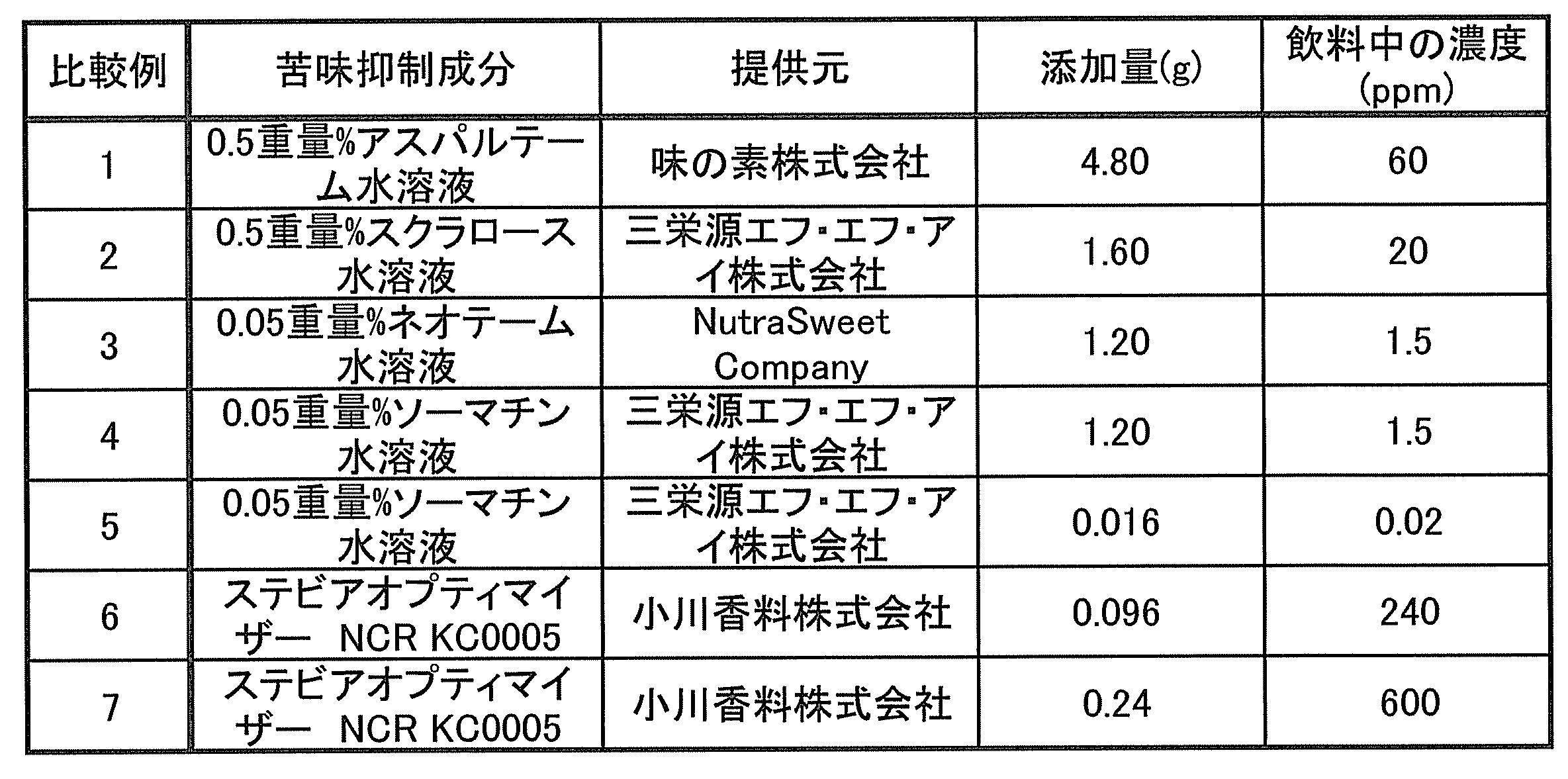
- Table 2 also shows the concentration of the bitterness suppressing component in the beverages of the comparative examples.
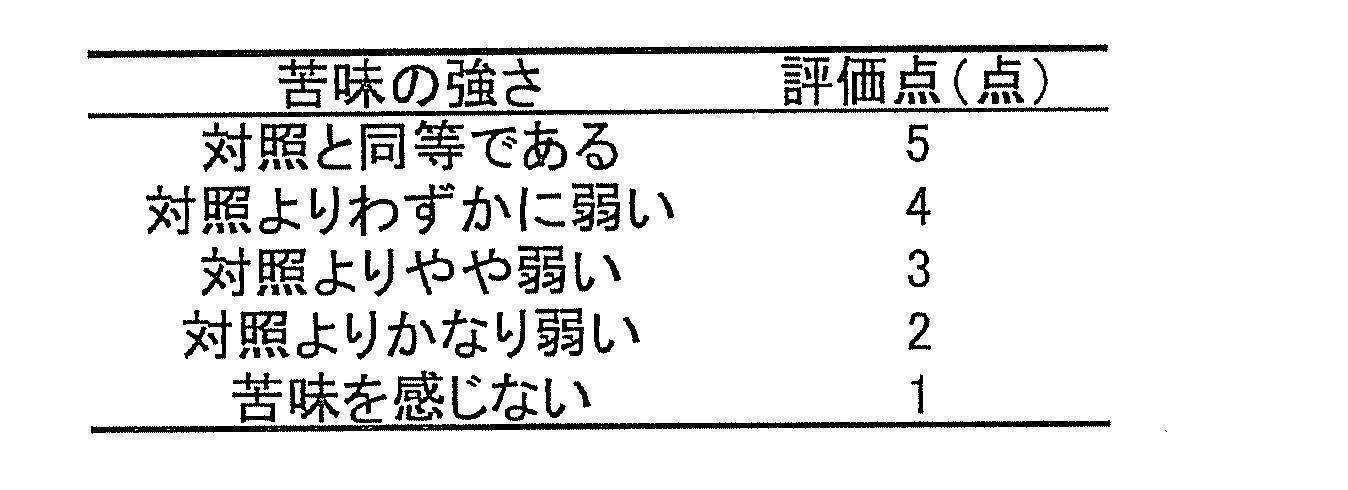
- contrast which does not add a bitterness suppression component was evaluated by the evaluation criteria shown in Table 3 by the paired comparison method by eight trained panelists.
- the average value of the evaluation points of the eight panelists was calculated and shown in FIG.
- the bar in the graph of FIG. 1 shows the standard deviation.
- the corresponding t test was performed between the evaluation point about the drink of Example 1, and the evaluation point about another drink.
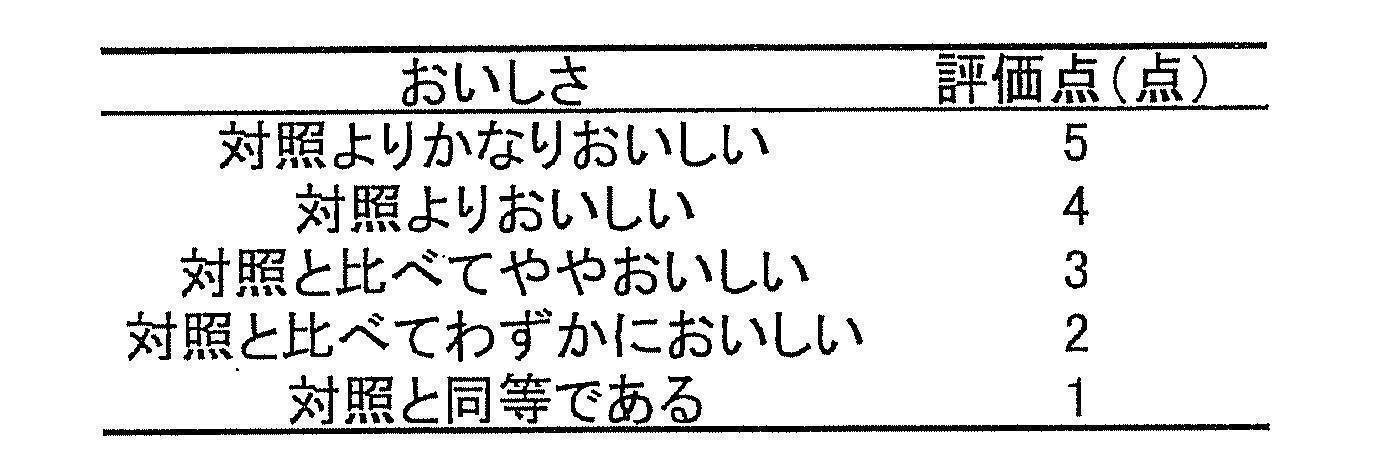
- Example 2 Evaluation of deliciousness About the drink of Example 1, the deliciousness evaluation by a pair comparison method was performed between the controls which do not add a bitterness suppression component. The evaluation was performed by 8 trained panelists according to the evaluation criteria shown in Table 4, and the average value ⁇ standard deviation of the evaluation scores of 8 people was calculated. As a result, the evaluation score for the beverage of Example 1 was 3.2 ⁇ 1.2, indicating that the taste of the taste as a whole was also improved.
- Example 3 Mineral-containing beverages Table 5 shows the compositions of the mineral-containing beverages of Example 3 and Comparative Examples 8 to 10.
- the mineral-containing beverage contains magnesium chloride and potassium chloride as inorganic salts having a bitter taste.
- bitterness amino acid-containing beverages of Example 4 and Comparative Examples 11 to 13 components other than the bitterness suppressing component were sequentially added to ion-exchanged water, mixed and dissolved, and then the bitterness suppressing component was added, mixed and dissolved uniformly. The total amount was adjusted to 400.0 g.
- concentrations of each bitterness-inhibiting component in the bitterness amino acid-containing beverage are as shown in Table 6.
- Example 5 Plain yogurt (food containing bitter peptide) Table 7 shows the compositions of plain yogurt of Example 5 and Comparative Examples 14 to 16.
- Example 5 and Comparative Examples 14 to 16 were prepared by mixing each bitterness-inhibiting ingredient uniformly with a commercially available sugar-free plain yogurt to a total amount of 400.0 g.
- concentrations of each bitterness suppressing component in plain yogurt are as shown in Table 7.
- Example 6 and Comparative Examples 17 to 19 were prepared by mixing each bitterness suppressing component with a commercially available catechin-containing beverage and dissolving it uniformly to a total amount of 400.0 g.
- the concentration of each bitterness suppressing component in the catechin-containing beverage is as shown in Table 8.
- Example 3 Evaluation of Bitter Taste Suppressing Effect in Mineral-Containing Beverages The sensory evaluation was performed on the bitterness of each of the mineral-containing beverages of Example 3 and Comparative Examples 8 to 10 containing inorganic salts exhibiting a bitter taste.
- the evaluation criteria shown in Table 3 above by the paired comparison method are the intensity of bitterness compared to a control in which each of the mineral-containing beverages of Examples and Comparative Examples was ingested by 7 trained panelists and no bitterness-inhibiting ingredient was added. According to the evaluation.
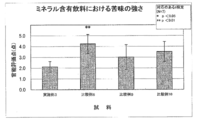
- the average value of the evaluation score of 7 panelists was calculated and shown in FIG.
- the bar in the graph of FIG. 2 shows the standard deviation.
- a corresponding t test was performed between the evaluation points for the mineral-containing beverage of Example 3 containing advantame as a bitterness-inhibiting component and the evaluation points for each of the mineral-containing beverages of Comparative Examples 8 to 10. It was.
- Example 4 Evaluation of Bitter Taste Inhibiting Effect in Bitter Taste Amino Acid-Containing Beverages
- the bitter taste of each of the bitter amino acid-containing beverages of Example 4 and Comparative Examples 11 to 13 was subjected to sensory evaluation. Evaluation criteria shown in the above Table 3 by the paired comparison method for the bitterness intensity compared with the control in which each of the bitterness amino acid-containing beverages of Examples and Comparative Examples was ingested by 7 trained panelists and the bitterness-inhibiting ingredient was not added. According to the evaluation.
- Example 5 Evaluation of Bitter Taste Inhibitory Effect in Plain Yogurt The sensory evaluation was performed on the bitter taste of each plain yogurt in Example 5 and Comparative Examples 14 to 16 containing a bitter peptide. Each plain yogurt of Example and Comparative Example was ingested by 7 trained panelists, and the bitterness strength compared to the control without addition of the bitterness inhibiting component was evaluated according to the evaluation criteria shown in Table 3 above by the paired comparison method. I let you.
- FIG. 4 shows that the plain yogurt of Example 5 has a reduced bitter taste when ingested compared to the plain yogurt of Comparative Examples 14-16.
- the plain yogurt of Comparative Example 14 containing thaumatin as a bitterness suppressing component and the plain yogurt of Comparative Example 15 containing sucralose as a bitterness suppressing component (p ⁇ 0.01 and p ⁇ 0. 05).
- the paneler who felt the bad sweetness and the bad aftertaste was not seen.
- Example 6 Evaluation of Bitter Taste Inhibitory Effect in Catechin-Containing Beverages The sensory evaluation was performed on the bitterness of each catechin-containing beverage of Example 6 and Comparative Examples 17-19. Each of the catechin-containing beverages of Examples and Comparative Examples was ingested by 7 trained panelists, and the bitterness strength compared to the control without addition of the bitterness-inhibiting component was determined according to the evaluation criteria shown in Table 3 above by the paired comparison method. I was allowed to evaluate.
- FIG. 5 shows that the catechin-containing beverage of Example 6 has a reduced bitter taste when ingested compared to the catechin-containing beverages of Comparative Examples 17-19. Moreover, about the catechin containing drink of Example 6, the paneler who felt the bad sweet taste and the bad aftertaste was not seen.
- the bitterness of the sweetener having a bitter taste is suppressed without impairing the taste of the ingested subject itself such as food and drink, the quality of sweetness such as aftertaste is improved, and the taste of the whole taste Can also provide an improved sweetening composition.
- the present invention suitably provides a sweet composition containing a stevia extract in which the bitter taste of the stevia extract is suppressed and the sweetness quality and the taste of the whole taste are improved.
- the bitterness in an ingested object containing a component exhibiting bitterness can be satisfactorily suppressed, and even if it contains a component exhibiting bitterness, a food or drink or pharmaceutical product in which bitterness is suppressed Or a quasi-drug can be provided.
Landscapes
- Life Sciences & Earth Sciences (AREA)
- Health & Medical Sciences (AREA)
- Nutrition Science (AREA)
- Chemical & Material Sciences (AREA)
- Engineering & Computer Science (AREA)
- Food Science & Technology (AREA)
- Polymers & Plastics (AREA)
- Veterinary Medicine (AREA)
- Animal Behavior & Ethology (AREA)
- General Health & Medical Sciences (AREA)
- Public Health (AREA)
- Proteomics, Peptides & Aminoacids (AREA)
- Oral & Maxillofacial Surgery (AREA)
- Birds (AREA)
- Epidemiology (AREA)
- Medicinal Preparation (AREA)
- Seasonings (AREA)
Abstract
本発明によれば、苦味を呈する成分を含有する飲食品、医薬品もしくは医薬部外品等の摂取対象物において、それらの味に影響を与えることなく、苦味のみを抑制することができる。 すなわち、本発明においては、苦味を呈する成分を含有する摂取対象物に、下記の式(1)で示されるアスパルチルジペプチドエステル誘導体およびその塩から選択される1種または2種以上の甘味料(A)を、摂取時に、甘味料(A)がその甘味を呈する閾値以下の濃度で摂取対象物に含まれるように配合する。 [式中のR1~R7の意義については、明細書中の記載と同義である。]
Description
本発明は、苦味を有する甘味料の苦味が抑制され、甘味の質が改善された甘味組成物に関する。また、本発明はさらに苦味を呈する成分を含有する摂取対象物の苦味の抑制方法、ならびに苦味の抑制された飲食品、医薬品もしくは医薬部外品に関する。
近年、健康志向やダイエット志向が高まり、糖類の摂取を控える傾向が強くなってきている。また、糖尿病患者における糖類摂取の抑制を図る上でも、飲食品、医薬品、医薬部外品等に甘味を付与する際、ショ糖に代わる甘味料、特に高甘味度甘味料の需要が高くなっている。
現在、ショ糖に代わる甘味料として、種々の天然甘味料および人工甘味料が用いられている。中でも、高甘味度甘味料は、ショ糖の数百倍~10,000倍程度の強い甘味を有し、少量を添加することにより強い甘味を付与することができる。しかし、高甘味度甘味料をはじめ、ショ糖に代わる甘味料の中には、独特の苦味や渋味を有するものや、甘味が後味として持続し、甘味の質が悪く、嗜好性の低いものが存在する。
特に、ステビア抽出物は甘味料として用いられるだけでなく、後述する種々の生理作用を有することが報告され、ダイエット用食品やサプリメント等の健康食品にも多く用いられている。
しかし、ステビア抽出物を用いた場合、甘味の他に苦味、渋味、酸味等が感じられることが知られており、特に苦味については、ステビア抽出物の使用において大きな問題となっていた。
しかし、ステビア抽出物を用いた場合、甘味の他に苦味、渋味、酸味等が感じられることが知られており、特に苦味については、ステビア抽出物の使用において大きな問題となっていた。
それゆえ、ステビア抽出物等の苦味を有する甘味料の苦味を抑制し、また甘味の質を改善する試みが多くなされている。
たとえば、ステビア抽出物と、ソーマチン、ネオテーム、アセスルファムカリウム、スクラロース、アスパルテーム等の高甘味度甘味料を併用する技術(特許文献1~4)や、ステビア抽出物、羅漢果抽出物または甘草抽出物と、ローヤルゼリーを併用して苦味を抑制し、甘味の改善を図る技術(特許文献5)が開示されている。また、キナ酸またはキナ酸を含むコーヒー豆加水分解物からなる甘味改善剤(特許文献6)や、酵素処理イチョウ葉エキスを高甘味度甘味料の苦味や後味の改善剤として利用する技術(特許文献7)も提案されている。
さらにまた、高甘味度を有する物質と、他の高甘味度甘味料とを組み合わせることにより、先味と後味のバランスをショ糖の甘味質に近づける試みもなされている(特許文献8)。
たとえば、ステビア抽出物と、ソーマチン、ネオテーム、アセスルファムカリウム、スクラロース、アスパルテーム等の高甘味度甘味料を併用する技術(特許文献1~4)や、ステビア抽出物、羅漢果抽出物または甘草抽出物と、ローヤルゼリーを併用して苦味を抑制し、甘味の改善を図る技術(特許文献5)が開示されている。また、キナ酸またはキナ酸を含むコーヒー豆加水分解物からなる甘味改善剤(特許文献6)や、酵素処理イチョウ葉エキスを高甘味度甘味料の苦味や後味の改善剤として利用する技術(特許文献7)も提案されている。
さらにまた、高甘味度を有する物質と、他の高甘味度甘味料とを組み合わせることにより、先味と後味のバランスをショ糖の甘味質に近づける試みもなされている(特許文献8)。
しかし、ステビア抽出物等の苦味を十分に抑制するためには、特許文献1~4に記載された高甘味度甘味料は、飲食品等の摂取対象物に甘味を呈する閾値濃度を超えて添加することを要し、甘味が増強されて強くなりすぎ、飲食品等の摂取対象物自体の味が害されることがある。また、特許文献5~7に記載された甘味改善剤の使用についても、十分な苦味抑制効果の得られる量を添加した場合、飲食品等の摂取対象物自体の味や嗜好性を損なうおそれもあった。
また、飲食品や医薬品もしくは医薬部外品に含有される成分には苦味を呈するものがあり、かかる成分として、特に栄養補給、健康維持等の目的で摂取されることの多い、にがり等の苦味を呈する無機塩類、苦味アミノ酸、カテキン類や、チーズ、ヨーグルト、納豆等の高タンパク質の発酵食品に含まれる苦味ペプチドなどが知られている。前記苦味ペプチドは、カゼイン等のタンパク質の加水分解によっても生じることが報告されている。
上記の苦味成分は、少量では飲食品等に独特の風味を与えるが、それらの有する生理作用を期待して、相当量を含有させた保健機能食品、健康補助食品等のいわゆる健康食品や、医薬品等においては、経口摂取に際し、好ましくない苦味を呈することがある。また、苦味ペプチド含有量の多い発酵食品等では、苦味により食品等の嗜好性が低下することがあり、タンパク質含有量の高い食品では、調理、加工の過程で苦味ペプチドが生成され、苦味の出現が問題となることもある。
そこで本発明は、飲食品等の摂取対象物自体の味を損なうことなく、苦味を有する甘味料の苦味が抑制され、甘味の質、さらには味全体の嗜好性についても改善された甘味組成物を得ることを目的とする。
特に本発明は、健康食品素材としても利用価値の高いステビア抽出物等の有する苦味の抑制と、該抽出物を含有する甘味組成物の甘味の質の改善を目的とする。
特に本発明は、健康食品素材としても利用価値の高いステビア抽出物等の有する苦味の抑制と、該抽出物を含有する甘味組成物の甘味の質の改善を目的とする。
また、本発明は、苦味を有する甘味料、苦味を呈する無機塩類、苦味アミノ酸、苦味ペプチド、カテキン類等の苦味を呈する成分を含有する摂取対象物の苦味の抑制方法、ならびに苦味が抑制された飲食品、医薬品もしくは医薬部外品を提供することを目的とする。
上記の課題を解決するため鋭意検討した結果、本発明者らは、ステビア抽出物等、苦味を有する甘味料等の苦味を呈する成分を含有する摂取対象物に対し、アスパルチルジペプチドエステル誘導体およびその塩から選択される1種または2種以上の甘味料を、摂取時にその甘味を呈する閾値以下の濃度となるように配合することにより、苦味を有する甘味料の苦味を低減することができ、さらに該甘味料の好ましくない後味を改善することができること、また、苦味を呈する成分を含有する摂取対象物の苦味を抑制できることを見いだし、本発明を完成するに至った。すなわち、本発明は次の[1]~[16]に関する。
[1]苦味を有する甘味料とともに、下記の式(1)で示されるアスパルチルジペプチドエステル誘導体およびその塩から選択される1種または2種以上の甘味料(A)を、摂取時に甘味料(A)がその甘味を呈する閾値以下の濃度で摂取対象物に含まれるように含有する、甘味組成物。
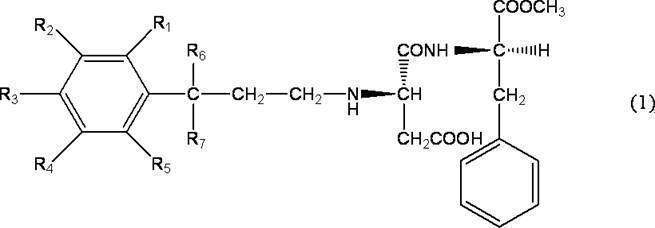
[式中、R1、R2、R3、R4およびR5はそれぞれ同一または異なって、水素原子、水酸基、メチル基またはメトキシ基を示し、R6およびR7は同一または異なって、水素原子またはメチル基を示す。R6とR7が異なる置換基を表す場合、これらの置換基が結合する炭素原子の立体配置は(R)、(S)および(RS)のいずれでもよい。]
[2]アスパルチルジペプチドエステル誘導体が、N-[N-[3-(3-ヒドロキシ-4-メトキシフェニル)プロピル]-L-α-アスパルチル]-L-フェニルアラニン 1-メチルエステルである、上記[1]に記載の甘味組成物。
[3]苦味を有する甘味料がステビア抽出物である、上記[1]または[2]に記載の甘味組成物。
[4]甘味を呈する閾値以下の濃度が、N-[N-[3-(3-ヒドロキシ-4-メトキシフェニル)プロピル]-L-α-アスパルチル]-L-フェニルアラニン 1-メチルエステルの濃度にして0.02ppm~1.5ppmである、上記[1]~[3]のいずれかに記載の甘味組成物。
[5]苦味を有する甘味料と甘味料(A)とを、苦味を有する甘味料とN-[N-[3-(3-ヒドロキシ-4-メトキシフェニル)プロピル]-L-α-アスパルチル]-L-フェニルアラニン 1-メチルエステルの重量比(苦味を有する甘味料の重量:N-[N-[3-(3-ヒドロキシ-4-メトキシフェニル)プロピル]-L-α-アスパルチル]-L-フェニルアラニン 1-メチルエステルの重量)にして1:0.00002~1:0.04の範囲で含有する、上記[1]または[2]に記載の甘味組成物。
[6]ステビア抽出物と甘味料(A)とを、ステビア抽出物中の甘味成分とN-[N-[3-(3-ヒドロキシ-4-メトキシフェニル)プロピル]-L-α-アスパルチル]-L-フェニルアラニン 1-メチルエステルの重量比(ステビア抽出物中の甘味成分の重量:N-[N-[3-(3-ヒドロキシ-4-メトキシフェニル)プロピル]-L-α-アスパルチル]-L-フェニルアラニン 1-メチルエステルの重量)にして1:0.00015~1:0.004の範囲で含有する、上記[3]に記載の甘味組成物。
[7]下記の式(1)で示されるアスパルチルジペプチドエステル誘導体およびその塩から選択される1種または2種以上の甘味料(A)を、苦味を呈する成分を含有する摂取対象物に、摂取時にその甘味を呈する閾値以下の濃度となるように配合することによる、苦味の抑制方法。
[3]苦味を有する甘味料がステビア抽出物である、上記[1]または[2]に記載の甘味組成物。
[4]甘味を呈する閾値以下の濃度が、N-[N-[3-(3-ヒドロキシ-4-メトキシフェニル)プロピル]-L-α-アスパルチル]-L-フェニルアラニン 1-メチルエステルの濃度にして0.02ppm~1.5ppmである、上記[1]~[3]のいずれかに記載の甘味組成物。
[5]苦味を有する甘味料と甘味料(A)とを、苦味を有する甘味料とN-[N-[3-(3-ヒドロキシ-4-メトキシフェニル)プロピル]-L-α-アスパルチル]-L-フェニルアラニン 1-メチルエステルの重量比(苦味を有する甘味料の重量:N-[N-[3-(3-ヒドロキシ-4-メトキシフェニル)プロピル]-L-α-アスパルチル]-L-フェニルアラニン 1-メチルエステルの重量)にして1:0.00002~1:0.04の範囲で含有する、上記[1]または[2]に記載の甘味組成物。
[6]ステビア抽出物と甘味料(A)とを、ステビア抽出物中の甘味成分とN-[N-[3-(3-ヒドロキシ-4-メトキシフェニル)プロピル]-L-α-アスパルチル]-L-フェニルアラニン 1-メチルエステルの重量比(ステビア抽出物中の甘味成分の重量:N-[N-[3-(3-ヒドロキシ-4-メトキシフェニル)プロピル]-L-α-アスパルチル]-L-フェニルアラニン 1-メチルエステルの重量)にして1:0.00015~1:0.004の範囲で含有する、上記[3]に記載の甘味組成物。
[7]下記の式(1)で示されるアスパルチルジペプチドエステル誘導体およびその塩から選択される1種または2種以上の甘味料(A)を、苦味を呈する成分を含有する摂取対象物に、摂取時にその甘味を呈する閾値以下の濃度となるように配合することによる、苦味の抑制方法。

[式中、R1、R2、R3、R4およびR5はそれぞれ同一または異なって、水素原子、水酸基、メチル基またはメトキシ基を示し、R6およびR7は同一または異なって、水素原子又はメチル基を示す。R6とR7が異なる置換基を表す場合、これらの置換基が結合する炭素原子の立体配置は(R)、(S)および(RS)のいずれでもよい。]
[8]アスパルチルジペプチドエステル誘導体が、N-[N-[3-(3-ヒドロキシ-4-メトキシフェニル)プロピル]-L-α-アスパルチル]-L-フェニルアラニン 1-メチルエステルである、上記[7]に記載の苦味の抑制方法。
[9]苦味を呈する成分が、苦味を有する甘味料、苦味を呈する無機塩類、苦味アミノ酸、苦味ペプチドおよびカテキン類から選択される1種以上の成分である、上記[7]または[8]に記載の苦味の抑制方法。
[10]苦味を有する甘味料がステビア抽出物である、上記[9]に記載の苦味の抑制方法。
[11]甘味を呈する閾値以下の濃度が、N-[N-[3-(3-ヒドロキシ-4-メトキシフェニル)プロピル]-L-α-アスパルチル]-L-フェニルアラニン 1-メチルエステルの濃度にして0.02ppm~1.5ppmである、上記[7]~[10]のいずれかに記載の苦味の抑制方法。
[12]苦味を呈する成分とともに、下記の式(1)で示されるアスパルチルジペプチドエステル誘導体およびその塩から選択される1種または2種以上の甘味料(A)を、摂取時に甘味料(A)がその甘味を呈する閾値以下の濃度で含まれるように含有してなる、飲食品または医薬品もしくは医薬部外品。
[9]苦味を呈する成分が、苦味を有する甘味料、苦味を呈する無機塩類、苦味アミノ酸、苦味ペプチドおよびカテキン類から選択される1種以上の成分である、上記[7]または[8]に記載の苦味の抑制方法。
[10]苦味を有する甘味料がステビア抽出物である、上記[9]に記載の苦味の抑制方法。
[11]甘味を呈する閾値以下の濃度が、N-[N-[3-(3-ヒドロキシ-4-メトキシフェニル)プロピル]-L-α-アスパルチル]-L-フェニルアラニン 1-メチルエステルの濃度にして0.02ppm~1.5ppmである、上記[7]~[10]のいずれかに記載の苦味の抑制方法。
[12]苦味を呈する成分とともに、下記の式(1)で示されるアスパルチルジペプチドエステル誘導体およびその塩から選択される1種または2種以上の甘味料(A)を、摂取時に甘味料(A)がその甘味を呈する閾値以下の濃度で含まれるように含有してなる、飲食品または医薬品もしくは医薬部外品。
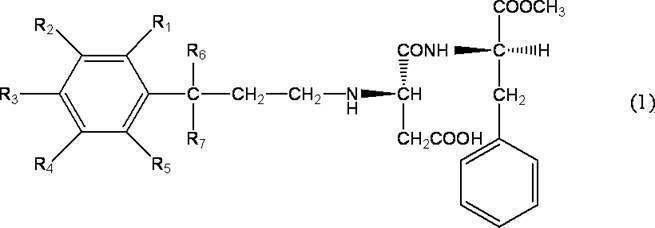
[式中、R1、R2、R3、R4およびR5はそれぞれ同一または異なって、水素原子、水酸基、メチル基またはメトキシ基を示し、R6およびR7は同一または異なって、水素原子又はメチル基を示す。R6とR7が異なる置換基を表す場合、これらの置換基が結合する炭素原子の立体配置は(R)、(S)および(RS)のいずれでもよい。]
[13]アスパルチルジペプチドエステル誘導体が、N-[N-[3-(3-ヒドロキシ-4-メトキシフェニル)プロピル]-L-α-アスパルチル]-L-フェニルアラニン 1-メチルエステルである、上記[12]に記載の飲食品または医薬品もしくは医薬部外品。
[14]苦味を呈する成分が、苦味を有する甘味料、苦味を呈する無機塩類、苦味アミノ酸、苦味ペプチドおよびカテキン類から選択される1種以上の成分である、上記[12]または[13]に記載の飲食品または医薬品もしくは医薬部外品。
[15]苦味を有する甘味料がステビア抽出物である、上記[14]に記載の飲食品または医薬品もしくは医薬部外品。
[16]甘味を呈する閾値以下の濃度が、N-[N-[3-(3-ヒドロキシ-4-メトキシフェニル)プロピル]-L-α-アスパルチル]-L-フェニルアラニン 1-メチルエステルの濃度にして0.02ppm~1.5ppmである、上記[12]~[15]のいずれかに記載の飲食品または医薬品もしくは医薬部外品。
[13]アスパルチルジペプチドエステル誘導体が、N-[N-[3-(3-ヒドロキシ-4-メトキシフェニル)プロピル]-L-α-アスパルチル]-L-フェニルアラニン 1-メチルエステルである、上記[12]に記載の飲食品または医薬品もしくは医薬部外品。
[14]苦味を呈する成分が、苦味を有する甘味料、苦味を呈する無機塩類、苦味アミノ酸、苦味ペプチドおよびカテキン類から選択される1種以上の成分である、上記[12]または[13]に記載の飲食品または医薬品もしくは医薬部外品。
[15]苦味を有する甘味料がステビア抽出物である、上記[14]に記載の飲食品または医薬品もしくは医薬部外品。
[16]甘味を呈する閾値以下の濃度が、N-[N-[3-(3-ヒドロキシ-4-メトキシフェニル)プロピル]-L-α-アスパルチル]-L-フェニルアラニン 1-メチルエステルの濃度にして0.02ppm~1.5ppmである、上記[12]~[15]のいずれかに記載の飲食品または医薬品もしくは医薬部外品。
本発明により、苦味を有する甘味料、特にステビア抽出物の苦味が低減され、後味等の甘味の質、さらには味全体の嗜好性が改善された甘味組成物を提供することができる。また、苦味を呈する成分を含有する摂取対象物の苦味の抑制方法を提供することができる。さらに、飲食品等の摂取対象物自体の味に影響を与えることなく、苦味の低減された飲食品または医薬品もしくは医薬部外品を提供することができる。
本発明は、苦味を有する甘味料の苦味が低減され、後味等甘味の質が改善されて、嗜好性も良好な甘味組成物を提供する。
本発明の甘味組成物は、苦味を有する甘味料とともに、下記式(1)で示されるアスパルチルジペプチドエステル誘導体およびその塩から選択される1種または2種以上の甘味料(A)を、摂取時に甘味料(A)がその甘味を呈する閾値以下の濃度で摂取対象物に含まれるように含有してなる。
本発明の甘味組成物は、苦味を有する甘味料とともに、下記式(1)で示されるアスパルチルジペプチドエステル誘導体およびその塩から選択される1種または2種以上の甘味料(A)を、摂取時に甘味料(A)がその甘味を呈する閾値以下の濃度で摂取対象物に含まれるように含有してなる。
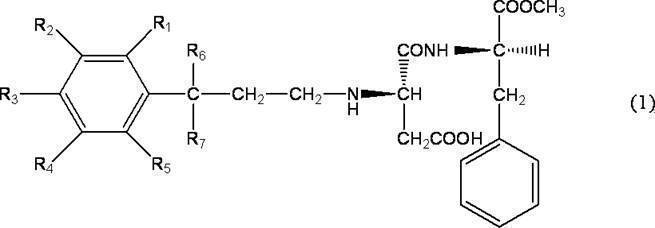
[式中、R1、R2、R3、R4およびR5はそれぞれ同一または異なって、水素原子、水酸基、メチル基またはメトキシ基を示し、R6およびR7は同一または異なって、水素原子又はメチル基を示す。R6とR7が異なる置換基を表す場合、これらの置換基が結合する炭素原子の立体配置は(R)、(S)および(RS)のいずれでもよい。]
上記式(1)において、ベンゼン環上のR1~R5で示される基のいずれかが、水酸基、メチル基またはメトキシ基であることが好ましく、R2で示される基が水酸基であり、R3で示される基がメトキシ基であることがより好ましい。また式(1)において、R6またはR7で示される基は水素原子またはメチル基であるが、水素原子であることが好ましい。
なお、本発明の目的には、R1、R4、R5、R6およびR7がそれぞれ水素原子であり、R2が水酸基、R3がメトキシ基である、N-[N-[3-(3-ヒドロキシ-4-メトキシフェニル)プロピル]-L-α-アスパルチル]-L-フェニルアラニン 1-メチルエステル(すなわち、アドバンテーム)が最も好ましく使用できる。
なお、本発明の目的には、R1、R4、R5、R6およびR7がそれぞれ水素原子であり、R2が水酸基、R3がメトキシ基である、N-[N-[3-(3-ヒドロキシ-4-メトキシフェニル)プロピル]-L-α-アスパルチル]-L-フェニルアラニン 1-メチルエステル(すなわち、アドバンテーム)が最も好ましく使用できる。
本発明においては、上記アスパルチルジペプチドエステル誘導体は、塩の形態でも用いることができる。
アスパルチルジペプチドエステル誘導体の塩としては、ナトリウム塩、カリウム塩等のアルカリ金属塩;マグネシウム塩、カルシウム塩等のアルカリ土類金属塩;塩酸塩、硝酸塩、硫酸塩、リン酸塩等の無機酸との塩;酢酸塩、クエン酸塩、リンゴ酸塩等の有機酸との塩、アンモニウム塩等の無機塩基との塩;トリエチルアミン塩、ピリジン塩等の有機塩基との塩などが挙げられる。
アスパルチルジペプチドエステル誘導体の塩としては、ナトリウム塩、カリウム塩等のアルカリ金属塩;マグネシウム塩、カルシウム塩等のアルカリ土類金属塩;塩酸塩、硝酸塩、硫酸塩、リン酸塩等の無機酸との塩;酢酸塩、クエン酸塩、リンゴ酸塩等の有機酸との塩、アンモニウム塩等の無機塩基との塩;トリエチルアミン塩、ピリジン塩等の有機塩基との塩などが挙げられる。
本発明においては、上記式(1)で示されるアスパルチルジペプチドエステル誘導体、およびその上記の塩から1種または2種以上を選択して、甘味料(A)として用いることができる。
なお、上記アスパルチルジペプチドエステル誘導体またはその塩は、水和物等の溶媒和物の形態で用いることもできる。
なお、上記アスパルチルジペプチドエステル誘導体またはその塩は、水和物等の溶媒和物の形態で用いることもできる。
本発明において、苦味を有する甘味料の苦味を抑制するには、上記式(1)で示されるアスパルチルジペプチドエステル誘導体およびその塩から選択される1種または2種以上の甘味料(A)は、摂取時に甘味料(A)が、その甘味を呈する閾値以下の濃度で摂取対象物に含まれるように、甘味組成物に添加される。
ここで「甘味組成物」とは、少なくとも1種の甘味料と、必要により後述するような一般的な添加剤を含み、摂取した際に甘味を呈する飲食品等の組成物、または飲食品等に添加される組成物をいう。本発明の甘味組成物は、苦味を有する甘味料とともに、少なくとも上記の甘味料(A)を含むが、さらに任意の成分を含んでいてもよい。
なお、本発明でいう「摂取対象物」とは、当該甘味組成物または甘味組成物あるいは後述する苦味を呈する成分を含有し、本発明により苦味の抑制される対象となる組成物であって、経口的に摂取されるものをいう。
すなわち、本発明の甘味組成物には、そのまま摂取される組成物の他、希釈され、または他の組成物に添加されて摂取される組成物が含まれる。
なお、本発明でいう「摂取対象物」とは、当該甘味組成物または甘味組成物あるいは後述する苦味を呈する成分を含有し、本発明により苦味の抑制される対象となる組成物であって、経口的に摂取されるものをいう。
すなわち、本発明の甘味組成物には、そのまま摂取される組成物の他、希釈され、または他の組成物に添加されて摂取される組成物が含まれる。
従って、甘味組成物が希釈されたり、他の組成物に添加されて摂取される場合には、希釈後または他の組成物に添加、混合された後の甘味料(A)の濃度が、その甘味を呈する閾値以下の濃度となるように添加される。アスパルチルジペプチドエステル誘導体またはその塩は、それら自体高甘味度甘味料として機能するものであるため、摂取時にそれらがその甘味を呈する閾値を越える濃度となるように添加されると、それら自体の甘味が発現し、摂取対象物の味に影響を与え、摂取対象物の目標呈味を根本的に設計し直す必要が生じるからである。
本発明において、上記甘味料(A)の閾値とは、訓練された甘味パネラーによる繰り返しを含む官能評価(N=62)において、N数の75%以上が甘味を感じない最大濃度として判断する濃度をいう。かかる閾値は、アスパルチルジペプチドエステル誘導体の種類、塩の形態であるかどうか等により異なるが、N-[N-[3-(3-ヒドロキシ-4-メトキシフェニル)プロピル]-L-α-アスパルチル]-L-フェニルアラニン 1-メチルエステルについては、1.5ppmである。
また、本発明において、苦味を有する甘味料の苦味を良好に抑制するためには、アスパルチルジペプチドエステル誘導体およびその塩から選択される1種または2種以上の甘味料(A)は、該誘導体の種類や苦味を有する甘味料の種類、使用量等にもよるが、N-[N-[3-(3-ヒドロキシ-4-メトキシフェニル)プロピル]-L-α-アスパルチル]-L-フェニルアラニン 1-メチルエステルの濃度として、摂取時に0.02ppm以上となるように添加されることが好ましく、0.1ppm以上となるように添加されることがより好ましい。
本発明において、甘味料(A)として用いるアスパルチルジペプチドエステル誘導体は、自体公知の化合物であり、たとえばアスパルテーム(N-L-α-アスパルチル-L-フェニルアラニン 1-メチルエステル)を、フェニル基上に種々の置換基を持ち、なおかつ主鎖上に1から2個のアルキル置換基を持つ3-フェニルプロピオンアルデヒド誘導体、シンナムアルデヒド誘導体あるいは(2-フェニルエチル)アルキルケトン誘導体と還元剤(たとえば水素/パラジウム炭素触媒)とを用いて還元的にアルキル化することによって容易に合成できる。あるいは、通常のペプチド合成法(泉屋等、ペプチド合成の基礎と実験:丸善1985年1月20日発行)に従って得られる、β位のカルボン酸に保護基を有するアスパルテーム誘導体(たとえばβ-O-ベンジル-α-L-アスパルチル-L-アミノ酸メチルエステル)を、上記3-フェニルプロピオンアルデヒド誘導体、シンナムアルデヒド誘導体あるいは(2-フェニルエチル)アルキルケトン誘導体と還元剤(たとえばトリアセトキシヒドロホウ酸ナトリウム;NaB(OAc)3H)とを用いて還元的にアルキル化(A.F.Abdel-Magid等,Tetrahedoron Letters,31,5595(1990))した後に保護基を除去する方法、あるいは必要に応じて不飽和結合を還元剤で飽和する方法によって得ることができる。上記3-フェニルプロピオンアルデヒド誘導体、シンナムアルデヒド誘導体あるいは(2-フェニルエチル)アルキルケトン誘導体の代わりに、これらのアセタールあるいはケタール誘導体等も還元的アルキル化の際のアルデヒドあるいはケトン成分として用いられ得る。
なお、本発明においては、アスパルチルジペプチドエステル誘導体等より選択される甘味料(A)として、「アドバンテーム」等の商品名で市販されている製品を用いることもできる。
本発明の甘味組成物に含まれる「苦味を有する甘味料」としては、羅漢果抽出物、甘草抽出物、グリチルリチン、ステビア抽出物、サッカリン、サッカリンナトリウム等の高甘味度甘味料が挙げられる。アセスルファムカリウムについても、高濃度で用いた場合には、後味として苦味を呈することが報告されているため、本発明の甘味組成物において、「苦味を有する甘味料」として用いられる。
本発明の甘味組成物においては、特にステビア抽出物を「苦味を有する甘味料」として含有する。
ステビア抽出物は、キク科(Compositae)の植物であるステビア(Stevia rebaudiana)の葉等より常法に従って得た抽出物であり、ステビオシド、レバウディオサイドA等のテルペノイドの配糖体を含有する。
本発明においては、ステビア抽出物としては、ステビアの植物体より得られた抽出物、その濃縮物、粗精製物の他、分離、精製して得られたステビオシド、レバウディオサイドA等を用いることができる。また、各社より販売されている市販の製品を用いることもできる。
ステビア抽出物は、キク科(Compositae)の植物であるステビア(Stevia rebaudiana)の葉等より常法に従って得た抽出物であり、ステビオシド、レバウディオサイドA等のテルペノイドの配糖体を含有する。
本発明においては、ステビア抽出物としては、ステビアの植物体より得られた抽出物、その濃縮物、粗精製物の他、分離、精製して得られたステビオシド、レバウディオサイドA等を用いることができる。また、各社より販売されている市販の製品を用いることもできる。
ステビア抽出物については、抗酸化作用の他、インスリン抵抗性改善作用、C型肝炎ウイルス抑制作用、制ガン作用等、種々の生理活性が報告されており、ステビア抽出物を含有する組成物は、甘味料としてのみではなく、かかる生理活性により、2型糖尿病の改善または予防用組成物など、幅広い分野での応用が期待される。従って、その苦味や後味の改善により、ステビア抽出物を含有する組成物をより利用しやすくすることができる。
本発明の甘味組成物においては、苦味を有する甘味料は通常使用される濃度で用いることができ、その種類や甘味組成物の使用形態等にもよるが、たとえば摂取対象物において、40ppm~700ppmの濃度で用いることができる。これに対して、甘味料(A)は、N-[N-[3-(3-ヒドロキシ-4-メトキシフェニル)プロピル]-L-α-アスパルチル]-L-フェニルアラニン 1-メチルエステルの濃度として、摂取時にその甘味を呈する閾値濃度以下の濃度となるように含有され、好ましくは0.02ppm~1.5ppm、より好ましくは0.1ppm~1.0ppm程度となるように含有される。
なお、甘味組成物の安定性や甘味の質等を考慮すれば、本発明の甘味組成物において、苦味を有する甘味料と甘味料(A)とは、苦味を有する甘味料とN-[N-[3-(3-ヒドロキシ-4-メトキシフェニル)プロピル]-L-α-アスパルチル]-L-フェニルアラニン 1-メチルエステルの重量比(苦味を有する甘味料の重量:N-[N-[3-(3-ヒドロキシ-4-メトキシフェニル)プロピル]-L-α-アスパルチル]-L-フェニルアラニン 1-メチルエステルの重量)にして、1:0.00002~1:0.04の範囲で含有させることが好ましく、1:0.0001~1:0.025の範囲で含有させることがより好ましい。
特に、本発明の好適な実施態様として、苦味を有する甘味料としてステビア抽出物を含有する甘味組成物を提供する。ステビア抽出物は、たとえばステビア抽出物中のレバウディオサイドAの含有量として、摂取対象物において通常40ppm~700ppm程度が用いられる。これに対し、苦味の良好な低減と甘味の質の改善を図るには、甘味料(A)は、N-[N-[3-(3-ヒドロキシ-4-メトキシフェニル)プロピル]-L-α-アスパルチル]-L-フェニルアラニン 1-メチルエステルの濃度として、摂取対象物において0.02ppm~1.5ppmの範囲で含有させることが好ましく、0.1ppm~1.0ppmの範囲で含有させることがより好ましい。
上記甘味組成物において、ステビア抽出物と甘味料(A)とは、組成物の安定性および甘味の質等の観点から、ステビア抽出物中の甘味成分とN-[N-[3-(3-ヒドロキシ-4-メトキシフェニル)プロピル]-L-α-アスパルチル]-L-フェニルアラニン 1-メチルエステルの重量比(ステビア抽出物中の甘味成分の重量:N-[N-[3-(3-ヒドロキシ-4-メトキシフェニル)プロピル]-L-α-アスパルチル]-L-フェニルアラニン 1-メチルエステルの重量)にして、1:0.0001~1:0.005の範囲で含有させることが好ましく、1:0.00015~1:0.004の範囲で含有させることがより好ましく、1:0.00015~1:0.003の範囲で含有させることがさらに好ましく、1:0.0003~1:0.003の範囲で含有させることがより一層好ましい。
本発明の甘味組成物は、甘味料(A)および苦味を有する甘味料を混合し、必要により賦形剤を加えて、粉末状の組成物として提供することができる。また、さらに結合剤等を加え、顆粒状の組成物とすることができる。あるいは、甘味料(A)および苦味を有する甘味料を水等の溶媒に溶解または懸濁し、液状の組成物として提供することができる。その際に、懸濁もしくは分散剤、pH調整剤等を添加することができる。さらに、乳化剤により乳化して乳液状の組成物としたり、増粘・ゲル化剤により増粘またはゲル化させてゼリー状組成物またはゲル状組成物とすることもできる。
上記賦形剤としては、カルメロース、カルメロースナトリウム、結晶セルロース、デンプン、ヒドロキシプロピルセルロース等が挙げられ、上記結合剤としては、α化デンプン、ゼラチン、セラック、乳糖等が挙げられる。上記懸濁もしくは分散剤としては、アラビアゴム、グリセリン脂肪酸エステル、ショ糖脂肪酸エステル、ソルビタン脂肪酸エステル等が挙げられ、上記pH調整剤としては、希塩酸、クエン酸、クエン酸ナトリウム、酢酸、酢酸ナトリウム等が挙げられる。
上記乳化剤としては、グリセリン脂肪酸エステル、ポリグリセリン脂肪酸エステル、ソルビタン脂肪酸エステル、プロピレングリコール脂肪酸エステル、ショ糖脂肪酸エステル、レシチン等が挙げられ、増粘・ゲル化剤としては、カラギーナン、カンテン、キサンタンガム、ジェランガム、ゼラチン等が挙げられる。
また、本発明の甘味組成物には、酸化防止剤、防腐剤、香味剤、着色剤等を添加することもできる。
なお、本発明において、賦形剤等の上記添加剤は、本発明の甘味組成物の甘味度や甘味の質、組成物の安定性等に影響を与えない範囲で添加することができる。
本発明の甘味組成物は、飲食品等の製剤化に際し、一般的に用いられる製造方法により製造することができる。
たとえば、粉末状の組成物は、甘味料(A)および苦味を有する甘味料を、必要により賦形剤等を加えてヘンシェルミキサー等の混合機を用いて混和し、均質として製造する。顆粒状の組成物は、甘味料(A)および苦味を有する甘味料に、賦形剤や結合剤を加えて混和した後、造粒、整粒等を行って製造する。液状の組成物は、水等の溶媒に甘味料(A)および苦味を有する甘味料を添加して混和し、均一に溶解させ、または必要により懸濁化剤もしくは分散剤等を添加して懸濁もしくは分散し、必要に応じてろ過して製造する。乳液状の組成物は、乳化剤を加えて乳化して製造する。ゼリー状またはゲル状の組成物は、増粘・ゲル化剤を加えて増粘させ、またはゲル化して製造する。
たとえば、粉末状の組成物は、甘味料(A)および苦味を有する甘味料を、必要により賦形剤等を加えてヘンシェルミキサー等の混合機を用いて混和し、均質として製造する。顆粒状の組成物は、甘味料(A)および苦味を有する甘味料に、賦形剤や結合剤を加えて混和した後、造粒、整粒等を行って製造する。液状の組成物は、水等の溶媒に甘味料(A)および苦味を有する甘味料を添加して混和し、均一に溶解させ、または必要により懸濁化剤もしくは分散剤等を添加して懸濁もしくは分散し、必要に応じてろ過して製造する。乳液状の組成物は、乳化剤を加えて乳化して製造する。ゼリー状またはゲル状の組成物は、増粘・ゲル化剤を加えて増粘させ、またはゲル化して製造する。
また、本発明の甘味組成物は、甘味料(A)および苦味を有する甘味料を溶媒に溶解または懸濁等させた後、凍結乾燥して、凍結乾燥粉末として提供することもできる。
また、本発明は、上記式(1)で示されるアスパルチルジペプチドエステル誘導体およびその塩から選択される1種または2種以上の甘味料(A)を、苦味を呈する成分を含有する摂取対象物に、摂取時にその甘味を呈する閾値以下の濃度となるように配合することにより、苦味を抑制する方法を提供する。
本発明において、「苦味を呈する成分」としては、苦味を有する甘味料、苦味を呈する無機塩類、苦味アミノ酸、苦味ペプチドおよびカテキン類が挙げられ、これらの1種または2種以上が摂取対象物に含有され得る。
苦味を有する甘味料としては、特にステビア抽出物が挙げられる。
苦味を有する甘味料は、飲食品または医薬品もしくは医薬部外品等の摂取対象物において、通常40ppm~700ppm程度含有される。これに対し、甘味料(A)は、摂取対象物における摂取時のN-[N-[3-(3-ヒドロキシ-4-メトキシフェニル)プロピル]-L-α-アスパルチル]-L-フェニルアラニン 1-メチルエステルの濃度として、0.02ppm~1.5ppmの範囲で含有させることが好ましく、0.1ppm~1.0ppmの範囲で含有させることがより好ましく、0.6ppm~1.0ppmの範囲で含有させることがさらに好ましい。
苦味を有する甘味料は、飲食品または医薬品もしくは医薬部外品等の摂取対象物において、通常40ppm~700ppm程度含有される。これに対し、甘味料(A)は、摂取対象物における摂取時のN-[N-[3-(3-ヒドロキシ-4-メトキシフェニル)プロピル]-L-α-アスパルチル]-L-フェニルアラニン 1-メチルエステルの濃度として、0.02ppm~1.5ppmの範囲で含有させることが好ましく、0.1ppm~1.0ppmの範囲で含有させることがより好ましく、0.6ppm~1.0ppmの範囲で含有させることがさらに好ましい。
すなわち、苦味を有する甘味料を上記濃度範囲で含有する摂取対象物においては、甘味料(A)の含有量が0.02ppm未満であると、十分な苦味の抑制効果が得られない場合がある。一方、甘味料(A)の含有量が1.5ppmを超えると、苦味を有する甘味料を上記濃度範囲で含有する摂取対象物において、摂取時に甘味料(A)がその甘味を呈する閾値を超え、摂取対象物に好ましくない甘味が付与されることがある。
苦味を呈する無機塩類としては、にがりの成分である塩化カルシウム、硫酸カルシウム等のカルシウム塩、および塩化マグネシウム、硫酸マグネシウム等のマグネシウム塩の他、塩化カリウム、硫酸カリウム等のカリウム塩、硫酸ナトリウム、炭酸ナトリウム等のナトリウム塩などが挙げられ、これらは、特にミネラル分の摂取を目的とする飲食品または医薬品もしくは医薬部外品等の摂取対象物において、通常0.005重量%~1.0重量%程度、好ましくは0.02重量%~0.5重量%程度含有される。これに対し、甘味料(A)は、摂取対象物における摂取時のN-[N-[3-(3-ヒドロキシ-4-メトキシフェニル)プロピル]-L-α-アスパルチル]-L-フェニルアラニン 1-メチルエステルの濃度として、0.02ppm~1.5ppmの範囲で含有させることが好ましく、0.1ppm~1.0ppmの範囲で含有させることがより好ましく、0.6ppm~1.0ppmの範囲で含有させることがさらに好ましい。
すなわち、苦味を呈する無機塩類を上記濃度範囲で含有する摂取対象物においては、甘味料(A)の含有量が0.02ppm未満であると、十分な苦味の抑制効果が得られない場合がある。一方、甘味料(A)の含有量が1.5ppmを超えると、苦味を呈する無機塩類を上記濃度範囲で含有する摂取対象物において、摂取時に甘味料(A)がその甘味を呈する閾値を超え、摂取対象物に好ましくない甘味が付与されることがある。
苦味アミノ酸としては、フェニルアラニン、チロシン、アルギニン、ロイシン、イソロイシン、バリン、メチオニン、ヒスチジン等が挙げられ、これらより1種または2種以上を選択して用いることができる。これらは、特にアミノ酸の摂取を目的とする飲食品または医薬品もしくは医薬部外品等の摂取対象物において、通常0.1重量%~5.0重量%程度、好ましくは0.5重量%~3.0重量%程度含有される。これに対し、甘味料(A)は、摂取対象物における摂取時のN-[N-[3-(3-ヒドロキシ-4-メトキシフェニル)プロピル]-L-α-アスパルチル]-L-フェニルアラニン 1-メチルエステルの濃度として、0.02ppm~1.5ppmの範囲で含有させることが好ましく、0.1ppm~1.0ppmの範囲で含有させることがより好ましく、0.6ppm~1.0ppmの範囲で含有させることがさらに好ましい。
すなわち、苦味アミノ酸を上記濃度範囲で含有する摂取対象物においては、甘味料(A)の含有量が0.02ppm未満であると、十分な苦味の抑制効果が得られない場合がある。一方、甘味料(A)の含有量が1.5ppmを超えると、苦味アミノ酸を上記濃度範囲で含有する摂取対象物において、摂取時に甘味料(A)がその甘味を呈する閾値を超え、摂取対象物に好ましくない甘味が付与されることがある。
苦味ペプチドとしては、チーズ、ヨーグルト等に存在するプロリン、イソロイシン、ロイシン、バリン、フェニルアラニン等から形成される環状ジペプチド(ジケトピペラジン類)、大豆ペプチド、コラーゲンペプチド、米ペプチドなどの苦味ペプチドが挙げられ、タンパク質を豊富に含有する飲食品または医薬品もしくは医薬部外品等の摂取対象物において、タンパク質の総重量に対し、通常0.1重量%~3.0重量%程度含有される。これに対し、甘味料(A)は、摂取対象物における摂取時のN-[N-[3-(3-ヒドロキシ-4-メトキシフェニル)プロピル]-L-α-アスパルチル]-L-フェニルアラニン 1-メチルエステルの濃度として、0.02ppm~1.5ppmの範囲で含有させることが好ましく、0.1ppm~1.0ppmの範囲で含有させることがより好ましく、0.6ppm~1.0ppmの範囲で含有させることがさらに好ましい。
すなわち、苦味ペプチドを上記濃度範囲で含有する摂取対象物においては、甘味料(A)の含有量が0.02ppm未満であると、十分な苦味の抑制効果が得られない場合がある。一方、甘味料(A)の含有量が1.0ppmを超えると、苦味ペプチドを上記濃度範囲で含有する摂取対象物において、甘味料(A)がその甘味を呈する閾値を超え、摂取対象物に好ましくない甘味が付与されることがある。
カテキン類としては、(+)-カテキン(3,4-ジヒドロ-2α-(3,4-ジヒドロキシフェニル)-2H-1-ベンゾピラン-3β,5,7-トリオール)、エピカテキン(3,4-ジヒドロ-2α-(3,4-ジヒドロキシフェニル)-2H-1-ベンゾピラン-3α,5,7-トリオール)、エピガロカテキン(3,4-ジヒドロ-2α-(3,4,5-トリヒドロキシフェニル)-2H-1-ベンゾピラン-3α,5,7-トリオール)、エピカテキンガラート(3,4,5-トリヒドロキシ安息香酸[(2R)-2α-(3,4-ジヒドロキシフェニル)-3,4-ジヒドロ-5,7-ジヒドロキシ-2H-1-ベンゾピラン]-3α-イル)、エピガロカテキンガラート(3,4,5-トリヒドロキシ安息香酸[(2R,3R)-3,4-ジヒドロ-5,7-ジヒドロキシ-2α-(3,4,5-トリヒドロキシフェニル)-2H-1-ベンゾピラン-3α-イル])等の茶カテキンなどが挙げられ、血圧上昇抑制作用、血中コレステロール抑制作用、血糖値調節作用、抗酸化作用等の種々の生理作用を有することが報告されている。これらは、カテキン類の摂取を目的とする飲食品または医薬品もしくは医薬部外品等の摂取対象物において、通常0.01(w/v)%~0.5(w/v)%程度、好ましくは0.05(w/v)%~0.2(w/v)%程度含有される。これに対し、甘味料(A)は、摂取対象物における摂取時のN-[N-[3-(3-ヒドロキシ-4-メトキシフェニル)プロピル]-L-α-アスパルチル]-L-フェニルアラニン 1-メチルエステルの濃度として、0.02ppm~1.5ppmの範囲で含有させることが好ましく、0.1ppm~1.0ppmの範囲で含有させることがより好ましく、0.6ppm~1.0ppmの範囲で含有させることがさらに好ましい。
すなわち、カテキン類を上記濃度範囲で含有する摂取対象物においては、甘味料(A)の含有量が0.02ppm未満であると、十分な苦味の抑制効果が得られない場合がある。一方、甘味料(A)の含有量が1.5ppmを超えると、カテキン類を上記濃度範囲で含有する摂取対象物において、甘味料(A)がその甘味を呈する閾値を超え、摂取対象物に好ましくない甘味が付与されるおそれがある。
さらに本発明は、苦味を有する甘味料等の上記した苦味を呈する成分とともに、上記式(1)で示されるアスパルチルジペプチドエステル誘導体およびその塩から選択される1種または2種以上の甘味料(A)を、摂取時に甘味料(A)がその甘味を呈する閾値以下の濃度で含まれるように含有してなる、飲食品または医薬品もしくは医薬部外品(以下、本明細書において「飲食品等」ということがある)を提供する。
本発明において、「飲食品」とは、食品衛生法第4条に定義される「食品」、すなわち飲食物をいうが、固形状食品、半固形状食品、液体状食品または飲料であることが好ましい。
固形状食品としては、特に限定されないが、具体的にはチューインガム;キャンディー等の飴類;チョコレート;卓上甘味剤;粉末ジュース、粉末ココア、粉末コーラ、インスタントコーヒー等の粉末即席飲料;アイスクリーム、アイスキャンディー等の冷菓;ラムネ等の錠剤様口中清涼菓子;ケーキ、クッキーなどの焼成菓子;饅頭などの蒸菓子;スナック菓子;乾燥果実類;固形状サプリメントなどを挙げることができる。
半固形状食品としては、特に限定されないが、ヨーグルト、クリーム、ゼリー、ジャム等を挙げることができる。
液体状食品としては、特に限定されないが、スープ、果実や野菜等のソース類を挙げることができる。
飲料としては、炭酸飲料、果汁飲料、フレーバー飲料、スポーツ飲料、エネルギー飲料、栄養補給飲料、コーヒー、ココア、紅茶、日本茶、中国茶、乳飲料、乳酸菌飲料、ミネラルウォーター、液体状サプリメント等を挙げることができる。
なお、本発明の飲食品には、特定保健用食品、栄養機能食品等の保健機能食品;病者用食品、高齢者用食品等の特別用途食品;健康補助食品なども含まれる。
また、本発明の医薬品または医薬部外品は、経口的に摂取され、または口腔内に適用されるものであって、苦味を有する甘味料等、上記したような苦味を呈する成分を含有し、口に含むことにより、その苦味が発現するものである。
苦味を呈する成分が苦味を有する甘味料である場合、該成分は通常矯味剤として飲食品等に含有される。苦味を有する甘味料を矯味剤として含有する医薬品としては、風邪薬、胃薬、頭痛薬等を挙げることができる。また、医薬部外品としては、のど清涼剤、健胃清涼剤、口腔咽頭薬、うがい薬、歯磨き、口中清涼剤等が挙げられる。
苦味を有する甘味料としては、ステビア抽出物が好ましく用いられる。ステビア抽出物は、飲食品等に矯味剤として含有される他、上記した生理作用を目的として、特に保健機能食品等の機能性食品、医薬品または医薬部外品において、有効成分としても含有され得る。
苦味を呈する成分が、苦味を呈する無機塩類、苦味アミノ酸、苦味ペプチドまたはカテキン類である場合、これらは栄養補給またはこれらの有する生理作用を目的として、飲食品、医薬品または医薬部外品に含有される。
本発明の上記飲食品または医薬品もしくは医薬部外品は、上記した苦味を呈する成分と、摂取時の含有濃度が甘味を呈する閾値以下の濃度となる量の上記甘味料(A)に、必要により上記した賦形剤、結合剤、懸濁もしくは分散剤、pH調整剤等の添加剤を加え、日本薬局方、米国薬局方等の製剤総則等に規定された製造方法等、飲食品等の分野で一般的な製剤化方法に従って製造することができる。
また、上記苦味を呈する成分を含有する飲食品等の剤形によっては、苦味を呈する成分を含有する飲食品等に、摂取時の含有濃度が甘味を呈する閾値以下の濃度となる量の上記甘味料(A)を添加し、均一に溶解または分散させて製造することができる。
次に、実施例を挙げて本発明をより具体的に説明するが、本発明は以下の実施例によって限定されるものではない。
[実施例1]飲料
表1に実施例1の飲料の組成を示した。実施例1の飲料は、甘味料として、ステビア抽出物であるレバウディオサイドAを含有する。
表1に実施例1の飲料の組成を示した。実施例1の飲料は、甘味料として、ステビア抽出物であるレバウディオサイドAを含有する。
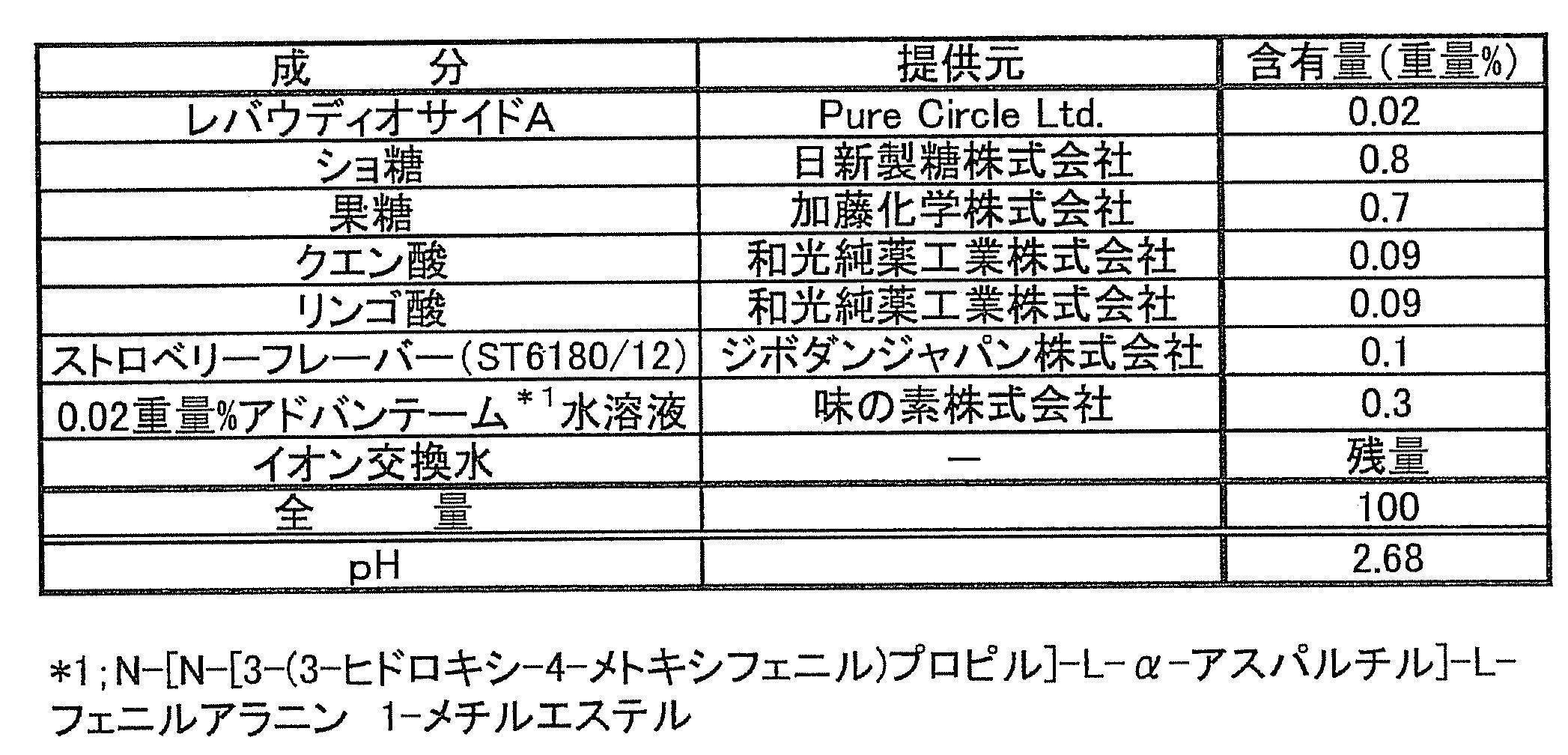
実施例1の飲料は、アドバンテーム水溶液以外の成分を2倍濃度で含有する水溶液を調製し、該水溶液200.0gと、苦味抑制成分として、0.02重量%のアドバンテーム水溶液1.20gをイオン交換水に混合し、均一に溶解して、全量を400.0gとして調製した。該飲料中におけるアドバンテームの濃度は、0.6ppmである。
[実施例2]飲料
上記実施例1の飲料の調製において、苦味抑制成分であるアドバンテーム水溶液の添加量を0.040gとした他は同様に調製し、実施例2とした。実施例2の飲料中におけるアドバンテームの濃度は、0.02ppmである。
上記実施例1の飲料の調製において、苦味抑制成分であるアドバンテーム水溶液の添加量を0.040gとした他は同様に調製し、実施例2とした。実施例2の飲料中におけるアドバンテームの濃度は、0.02ppmである。
[実験例1]苦味抑制効果の評価
レバウディオサイドAを含有する上記実施例の各飲料について、摂取時に感じる苦味の抑制効果の評価を行った。
その際、上記実施例1の飲料の調製において、苦味抑制成分であるアドバンテーム水溶液を、表2に示す苦味抑制成分に代替して同様に調製し、比較例1~7の飲料とした。各比較例の飲料中における苦味抑制成分の濃度についても、表2中に併せて示した。
実施例および比較例の各飲料について、苦味抑制成分を添加しない対照と比較した苦味の強さを、訓練された8名のパネラーによる一対比較法により、表3に示す評価基準により評価した。
レバウディオサイドAを含有する上記実施例の各飲料について、摂取時に感じる苦味の抑制効果の評価を行った。
その際、上記実施例1の飲料の調製において、苦味抑制成分であるアドバンテーム水溶液を、表2に示す苦味抑制成分に代替して同様に調製し、比較例1~7の飲料とした。各比較例の飲料中における苦味抑制成分の濃度についても、表2中に併せて示した。
実施例および比較例の各飲料について、苦味抑制成分を添加しない対照と比較した苦味の強さを、訓練された8名のパネラーによる一対比較法により、表3に示す評価基準により評価した。
実施例および比較例の各飲料について、8名のパネラーの評価点の平均値を算出し、図1に示した。図1のグラフ中のバーは標準偏差を示す。
なお、実施例1の飲料についての評価点と、他の飲料についての評価点との間で、対応のあるt検定を行った。
なお、実施例1の飲料についての評価点と、他の飲料についての評価点との間で、対応のあるt検定を行った。
図1より明らかなように、本発明の実施例1および2の各飲料において、対照に比べて苦味が抑制されていた。
なお、実施例1の飲料においては、実施例2の飲料に比べて、有意に強い苦味抑制効果が認められた(p<0.01)。さらに、実施例1の飲料では、比較例の各飲料に比べて良好な苦味抑制効果が認められ、該抑制効果について、比較例1以外の飲料との間で、統計的に有意差が認められた(p<0.05またはp<0.01)。
なお、実施例1の飲料においては、実施例2の飲料に比べて、有意に強い苦味抑制効果が認められた(p<0.01)。さらに、実施例1の飲料では、比較例の各飲料に比べて良好な苦味抑制効果が認められ、該抑制効果について、比較例1以外の飲料との間で、統計的に有意差が認められた(p<0.05またはp<0.01)。
[実験例2]おいしさの評価
実施例1の飲料について、苦味抑制成分を添加しない対照との間で、一対比較法によるおいしさの評価を行った。
評価は、訓練されたパネラー8名により、表4に示す評価基準により行い、8名の評価点の平均値±標準偏差を算出した。その結果、実施例1の飲料について評価点は3.2±1.2点であり、味覚全体の嗜好性においても改善されていることが示された。
実施例1の飲料について、苦味抑制成分を添加しない対照との間で、一対比較法によるおいしさの評価を行った。
評価は、訓練されたパネラー8名により、表4に示す評価基準により行い、8名の評価点の平均値±標準偏差を算出した。その結果、実施例1の飲料について評価点は3.2±1.2点であり、味覚全体の嗜好性においても改善されていることが示された。
[実施例3]ミネラル含有飲料
表5に実施例3および比較例8~10のミネラル含有飲料の組成を示した。なお、該ミネラル含有飲料は、苦味を有する無機塩類として、塩化マグネシウムおよび塩化カリウムを含有する。
表5に実施例3および比較例8~10のミネラル含有飲料の組成を示した。なお、該ミネラル含有飲料は、苦味を有する無機塩類として、塩化マグネシウムおよび塩化カリウムを含有する。

実施例3および比較例8~10のミネラル含有飲料は、苦味抑制成分以外の成分を順次イオン交換水に添加し、混合、溶解した後、苦味抑制成分を添加し、均一に溶解して、全量を400.0gとして調製した。ミネラル含有飲料における各苦味抑制成分の濃度は、表5に示す通りである。
[実施例4]苦味アミノ酸含有飲料
表6に実施例4および比較例11~13の苦味アミノ酸含有飲料の組成を示した。
表6に実施例4および比較例11~13の苦味アミノ酸含有飲料の組成を示した。
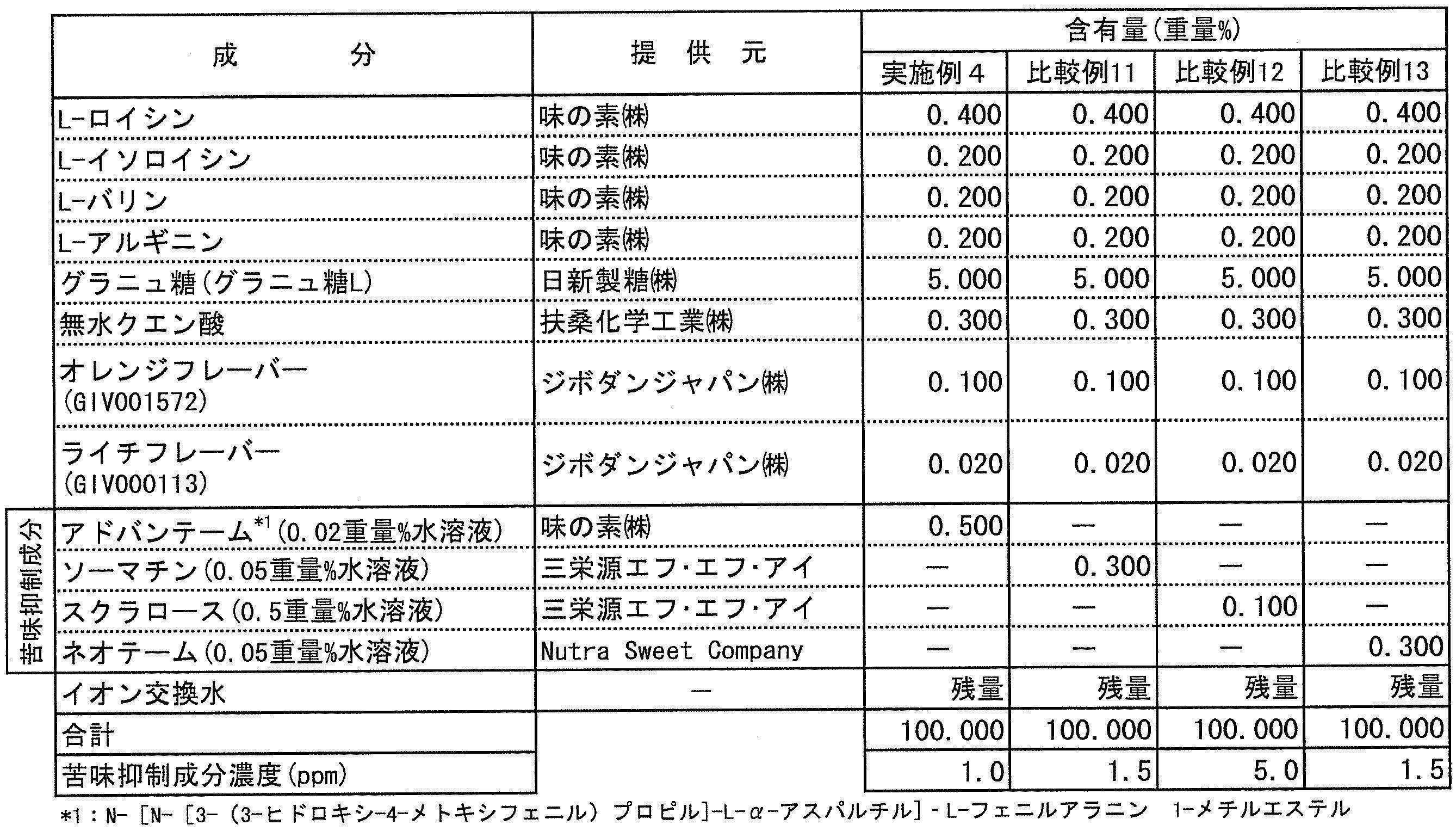
実施例4および比較例11~13の苦味アミノ酸含有飲料は、苦味抑制成分以外の成分を順次イオン交換水に添加し、混合、溶解した後、苦味抑制成分を添加、混合し、均一に溶解して、全量を400.0gとして調製した。苦味アミノ酸含有飲料における各苦味抑制成分の濃度は、表6に示す通りである。
[実施例5]プレーンヨーグルト(苦味ペプチド含有食品)
表7に実施例5および比較例14~16のプレーンヨーグルトの組成を示した。
表7に実施例5および比較例14~16のプレーンヨーグルトの組成を示した。

実施例5および比較例14~16のプレーンヨーグルトは、市販の無糖プレーンヨーグルトに各苦味抑制成分を均一に混合し、全量を400.0gとして調製した。プレーンヨーグルトにおける各苦味抑制成分の濃度は、表7に示す通りである。
[実施例6]カテキン含有飲料
表8に実施例6および比較例17~19のカテキン含有飲料(カテキン含有量=154mg/100mL)の組成を示した。
表8に実施例6および比較例17~19のカテキン含有飲料(カテキン含有量=154mg/100mL)の組成を示した。

実施例6および比較例17~19は、市販のカテキン含有飲料に各苦味抑制成分を混合し、均一に溶解して、全量を400.0gとして調製した。カテキン含有飲料における各苦味抑制成分の濃度は、表8に示す通りである。
[実験例3]ミネラル含有飲料における苦味抑制効果の評価
苦味を呈する無機塩類を含有する上記実施例3および比較例8~10の各ミネラル含有飲料の苦味について、官能評価を行った。
実施例および比較例の各ミネラル含有飲料を、訓練された7名のパネラーに摂取させ、苦味抑制成分を添加しない対照と比較した苦味の強さを、一対比較法により上記表3に示す評価基準に従って評価させた。
苦味を呈する無機塩類を含有する上記実施例3および比較例8~10の各ミネラル含有飲料の苦味について、官能評価を行った。
実施例および比較例の各ミネラル含有飲料を、訓練された7名のパネラーに摂取させ、苦味抑制成分を添加しない対照と比較した苦味の強さを、一対比較法により上記表3に示す評価基準に従って評価させた。
実施例および比較例の各ミネラル含有飲料について、7名のパネラーの評価点の平均値を算出し、図2に示した。図2のグラフ中のバーは標準偏差を示す。
なお、苦味抑制成分としてアドバンテームを含有する実施例3のミネラル含有飲料についての評価点と、比較例8~10の各ミネラル含有飲料についての評価点との間で、対応のあるt検定を行った。
なお、苦味抑制成分としてアドバンテームを含有する実施例3のミネラル含有飲料についての評価点と、比較例8~10の各ミネラル含有飲料についての評価点との間で、対応のあるt検定を行った。
図2より、実施例3のミネラル含有飲料では、比較例8~10のミネラル含有飲料に比べて、摂取時に感じる苦味が低減されていることが示された。特に、苦味抑制成分としてソーマチンを含有する比較例8のミネラル含有飲料との間に有意差(p<0.01)が認められた。
また、実施例3のミネラル含有飲料について、余分な甘味や後味の悪さを感じたパネラーは見られなかった。
また、実施例3のミネラル含有飲料について、余分な甘味や後味の悪さを感じたパネラーは見られなかった。
[実験例4]苦味アミノ酸含有飲料における苦味抑制効果の評価
上記実施例4および比較例11~13の各苦味アミノ酸含有飲料の苦味について、官能評価を行った。
実施例および比較例の各苦味アミノ酸含有飲料を訓練された7名のパネラーに摂取させ、苦味抑制成分を添加しない対照と比較した苦味の強さを、一対比較法により上記表3に示す評価基準に従って評価させた。
上記実施例4および比較例11~13の各苦味アミノ酸含有飲料の苦味について、官能評価を行った。
実施例および比較例の各苦味アミノ酸含有飲料を訓練された7名のパネラーに摂取させ、苦味抑制成分を添加しない対照と比較した苦味の強さを、一対比較法により上記表3に示す評価基準に従って評価させた。
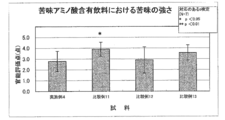
実施例および比較例の各苦味アミノ酸含有飲料について、7名のパネラーの評価点の平均値を算出し、図3に示した。図3のグラフ中のバーは標準偏差を示す。
なお、苦味抑制成分としてアドバンテームを含有する実施例4の苦味アミノ酸含有飲料についての評価点と、比較例11~13の各苦味アミノ酸含有飲料についての評価点との間で、対応のあるt検定を行った。
なお、苦味抑制成分としてアドバンテームを含有する実施例4の苦味アミノ酸含有飲料についての評価点と、比較例11~13の各苦味アミノ酸含有飲料についての評価点との間で、対応のあるt検定を行った。
図3より、実施例4の苦味アミノ酸含有飲料では、比較例11~13の苦味アミノ酸含有飲料に比べて、摂取時に感じる苦味が低減されていることが示された。特に、苦味抑制成分としてソーマチンを含有する比較例11の苦味アミノ酸含有飲料との間に有意差(p<0.05)が認められた。
また、実施例4の苦味アミノ酸含有飲料について、余分な甘味や後味の悪さを感じたパネラーは見られなかった。
また、実施例4の苦味アミノ酸含有飲料について、余分な甘味や後味の悪さを感じたパネラーは見られなかった。
[実験例5]プレーンヨーグルトにおける苦味抑制効果の評価
苦味ペプチドを含有する上記実施例5および比較例14~16の各プレーンヨーグルトの苦味について、官能評価を行った。
実施例および比較例の各プレーンヨーグルトを訓練された7名のパネラーに摂取させ、苦味抑制成分を添加しない対照と比較した苦味の強さを、一対比較法により上記表3に示す評価基準に従って評価させた。
苦味ペプチドを含有する上記実施例5および比較例14~16の各プレーンヨーグルトの苦味について、官能評価を行った。
実施例および比較例の各プレーンヨーグルトを訓練された7名のパネラーに摂取させ、苦味抑制成分を添加しない対照と比較した苦味の強さを、一対比較法により上記表3に示す評価基準に従って評価させた。
実施例および比較例の各プレーンヨーグルトについて、7名のパネラーの評価点の平均値を算出し、図4に示した。図4のグラフ中のバーは標準偏差を示す。
なお、苦味抑制成分としてアドバンテームを含有する実施例5のプレーンヨーグルトについての評価点と、比較例14~16の各プレーンヨーグルトについての評価点との間で、対応のあるt検定を行った。
なお、苦味抑制成分としてアドバンテームを含有する実施例5のプレーンヨーグルトについての評価点と、比較例14~16の各プレーンヨーグルトについての評価点との間で、対応のあるt検定を行った。
図4より、実施例5のプレーンヨーグルトでは、比較例14~16のプレーンヨーグルトに比べて、摂取時に感じる苦味が低減されていることが示された。特に、苦味抑制成分としてソーマチンを含有する比較例14のプレーンヨーグルト、および苦味抑制成分としてスクラロースを含有する比較例15のプレーンヨーグルトとの間に有意差(それぞれp<0.01およびp<0.05)が認められた。
また、実施例5のプレーンヨーグルトについて、余分な甘味や後味の悪さを感じたパネラーは見られなかった。
また、実施例5のプレーンヨーグルトについて、余分な甘味や後味の悪さを感じたパネラーは見られなかった。
[実験例6]カテキン含有飲料における苦味抑制効果の評価
上記実施例6および比較例17~19の各カテキン含有飲料の苦味について、官能評価を行った。
実施例および比較例の各カテキン含有飲料を訓練された7名のパネラーに摂取させ、苦味抑制成分を添加しない対照と比較した苦味の強さを、一対比較法により上記表3に示す評価基準に従って評価させた。
上記実施例6および比較例17~19の各カテキン含有飲料の苦味について、官能評価を行った。
実施例および比較例の各カテキン含有飲料を訓練された7名のパネラーに摂取させ、苦味抑制成分を添加しない対照と比較した苦味の強さを、一対比較法により上記表3に示す評価基準に従って評価させた。
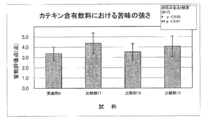
実施例および比較例の各カテキン含有飲料について、7名のパネラーの評価点の平均値を算出し、図5に示した。図5のグラフ中のバーは標準偏差を示す。
なお、苦味抑制成分としてアドバンテームを含有する実施例6のカテキン含有飲料についての評価点と、比較例17~19の各カテキン含有飲料についての評価点との間で、対応のあるt検定を行った。
なお、苦味抑制成分としてアドバンテームを含有する実施例6のカテキン含有飲料についての評価点と、比較例17~19の各カテキン含有飲料についての評価点との間で、対応のあるt検定を行った。
図5より、実施例6のカテキン含有飲料では、比較例17~19のカテキン含有飲料に比べて、摂取時に感じる苦味が低減されていることが示された。
また、実施例6のカテキン含有飲料について、余分な甘味や後味の悪さを感じたパネラーは見られなかった。
また、実施例6のカテキン含有飲料について、余分な甘味や後味の悪さを感じたパネラーは見られなかった。
上述したように、本発明により、飲食品等摂取対象物自体の味を損なうことなく、苦味を有する甘味料の苦味が抑制され、後味等甘味の質が改善されて、味全体の嗜好性についても改善された甘味組成物を提供することができる。
特に、本発明は、ステビア抽出物の苦味が抑制され、甘味の質および味全体の嗜好性の改善されたステビア抽出物を含有する甘味組成物を好適に提供するものである。
特に、本発明は、ステビア抽出物の苦味が抑制され、甘味の質および味全体の嗜好性の改善されたステビア抽出物を含有する甘味組成物を好適に提供するものである。
また、本発明により、苦味を呈する成分を含有する摂取対象物における苦味を良好に抑制することができ、苦味を呈する成分を含有するものであっても、苦味が抑制された飲食品、または医薬品もしくは医薬部外品を提供することができる。
本出願は、日本国で出願された特願2011-233342を基礎としており、その内容は本明細書に全て包含されるものである。
Claims (10)
- 下記の式(1)で示されるアスパルチルジペプチドエステル誘導体およびその塩から選択される1種または2種以上の甘味料(A)を、苦味を呈する成分を含有する摂取対象物に、摂取時にその甘味を呈する閾値以下の濃度となるように配合することによる、苦味の抑制方法。

[式中、R1、R2、R3、R4およびR5はそれぞれ同一または異なって、水素原子、水酸基、メチル基またはメトキシ基を示し、R6およびR7は同一または異なって、水素原子又はメチル基を示す。R6とR7が異なる置換基を表す場合、これらの置換基が結合する炭素原子の立体配置は(R)、(S)および(RS)のいずれでもよい。] - アスパルチルジペプチドエステル誘導体が、N-[N-[3-(3-ヒドロキシ-4-メトキシフェニル)プロピル]-L-α-アスパルチル]-L-フェニルアラニン 1-メチルエステルである、請求項1に記載の苦味の抑制方法。
- 苦味を呈する成分が、苦味を有する甘味料、苦味を呈する無機塩類、苦味アミノ酸、苦味ペプチドおよびカテキン類から選択される1種以上の成分である、請求項1または2に記載の苦味の抑制方法。
- 苦味を有する甘味料がステビア抽出物である、請求項3に記載の苦味の抑制方法。
- 甘味を呈する閾値以下の濃度が、N-[N-[3-(3-ヒドロキシ-4-メトキシフェニル)プロピル]-L-α-アスパルチル]-L-フェニルアラニン 1-メチルエステルの濃度にして0.02ppm~1.5ppmである、請求項1~4のいずれか1項に記載の苦味の抑制方法。
- 苦味を呈する成分とともに、下記の式(1)で示されるアスパルチルジペプチドエステル誘導体およびその塩から選択される1種または2種以上の甘味料(A)を、摂取時に甘味料(A)がその甘味を呈する閾値以下の濃度で含まれるように含有してなる、飲食品または医薬品もしくは医薬部外品。
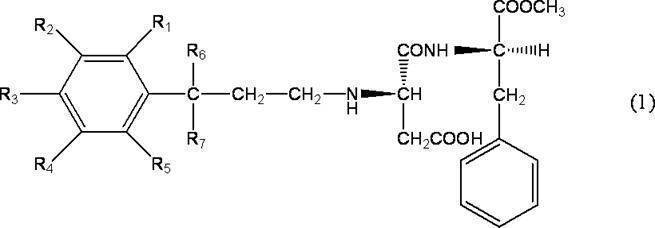
[式中、R1、R2、R3、R4およびR5はそれぞれ同一または異なって、水素原子、水酸基、メチル基またはメトキシ基を示し、R6およびR7は同一または異なって、水素原子又はメチル基を示す。R6とR7が異なる置換基を表す場合、これらの置換基が結合する炭素原子の立体配置は(R)、(S)および(RS)のいずれでもよい。] - アスパルチルジペプチドエステル誘導体が、N-[N-[3-(3-ヒドロキシ-4-メトキシフェニル)プロピル]-L-α-アスパルチル]-L-フェニルアラニン 1-メチルエステルである、請求項6に記載の飲食品または医薬品もしくは医薬部外品。
- 苦味を呈する成分が、苦味を有する甘味料、苦味を呈する無機塩類、苦味アミノ酸、苦味ペプチドおよびカテキン類から選択される1種以上の成分である、請求項6または7に記載の飲食品または医薬品もしくは医薬部外品。
- 苦味を有する甘味料がステビア抽出物である、請求項8に記載の飲食品または医薬品もしくは医薬部外品。
- 甘味を呈する閾値以下の濃度が、N-[N-[3-(3-ヒドロキシ-4-メトキシフェニル)プロピル]-L-α-アスパルチル]-L-フェニルアラニン 1-メチルエステルの濃度にして0.02ppm~1.5ppmである、請求項6~9のいずれか1項に記載の飲食品または医薬品もしくは医薬部外品。
Applications Claiming Priority (2)
| Application Number | Priority Date | Filing Date | Title |
|---|---|---|---|
| JP2011-233342 | 2011-10-24 | ||
| JP2011233342 | 2011-10-24 |
Publications (1)
| Publication Number | Publication Date |
|---|---|
| WO2013062015A1 true WO2013062015A1 (ja) | 2013-05-02 |
Family
ID=48167842
Family Applications (1)
| Application Number | Title | Priority Date | Filing Date |
|---|---|---|---|
| PCT/JP2012/077511 Ceased WO2013062015A1 (ja) | 2011-10-24 | 2012-10-24 | 苦味を有する甘味料の苦味が抑制された甘味組成物、および苦味の抑制方法、ならびに苦味の抑制された飲食品、医薬品もしくは医薬部外品 |
Country Status (1)
| Country | Link |
|---|---|
| WO (1) | WO2013062015A1 (ja) |
Cited By (5)
| Publication number | Priority date | Publication date | Assignee | Title |
|---|---|---|---|---|
| JP2015163066A (ja) * | 2014-02-03 | 2015-09-10 | 三栄源エフ・エフ・アイ株式会社 | 高甘味度甘味料の味質改善剤及び味質改善方法 |
| WO2016009686A1 (ja) * | 2014-07-16 | 2016-01-21 | 味の素株式会社 | 風味の向上した食肉及び食肉加工品並びにその製造方法 |
| JP2016093176A (ja) * | 2014-11-10 | 2016-05-26 | 三栄源エフ・エフ・アイ株式会社 | 飲食品の酸味のマスキング方法 |
| JP2017099356A (ja) * | 2015-12-03 | 2017-06-08 | 三栄源エフ・エフ・アイ株式会社 | 飲料のアルコール感付与増強剤 |
| JP2023083851A (ja) * | 2021-12-06 | 2023-06-16 | 味の素株式会社 | ロイシン高配合アミノ酸含有スイーツ及びその製造方法 |
Citations (5)
| Publication number | Priority date | Publication date | Assignee | Title |
|---|---|---|---|---|
| JP2000287642A (ja) * | 1999-04-09 | 2000-10-17 | Ikeda Shokken Kk | 甘味料の呈味改善方法及び甘味料組成物 |
| WO2001025262A1 (en) * | 1999-10-04 | 2001-04-12 | Ajinomoto Co., Inc. | Sweetener compositions with high degree of sweetness having improved sweetness, corrigents and utilization thereof |
| JP2001231485A (ja) * | 2000-02-21 | 2001-08-28 | Nippon Paper Industries Co Ltd | 甘味付与方法及び甘味料 |
| JP2002360215A (ja) * | 2001-06-05 | 2002-12-17 | Sanei Gen Ffi Inc | 甘味料組成物及び該組成物を含有する可食性製品並びに甘味増強方法。 |
| JP2011024445A (ja) * | 2009-07-22 | 2011-02-10 | Sanei Gen Ffi Inc | ステビア抽出物の味質改善剤及び味質改善方法 |
-
2012
- 2012-10-24 WO PCT/JP2012/077511 patent/WO2013062015A1/ja not_active Ceased
Patent Citations (5)
| Publication number | Priority date | Publication date | Assignee | Title |
|---|---|---|---|---|
| JP2000287642A (ja) * | 1999-04-09 | 2000-10-17 | Ikeda Shokken Kk | 甘味料の呈味改善方法及び甘味料組成物 |
| WO2001025262A1 (en) * | 1999-10-04 | 2001-04-12 | Ajinomoto Co., Inc. | Sweetener compositions with high degree of sweetness having improved sweetness, corrigents and utilization thereof |
| JP2001231485A (ja) * | 2000-02-21 | 2001-08-28 | Nippon Paper Industries Co Ltd | 甘味付与方法及び甘味料 |
| JP2002360215A (ja) * | 2001-06-05 | 2002-12-17 | Sanei Gen Ffi Inc | 甘味料組成物及び該組成物を含有する可食性製品並びに甘味増強方法。 |
| JP2011024445A (ja) * | 2009-07-22 | 2011-02-10 | Sanei Gen Ffi Inc | ステビア抽出物の味質改善剤及び味質改善方法 |
Cited By (8)
| Publication number | Priority date | Publication date | Assignee | Title |
|---|---|---|---|---|
| JP2015163066A (ja) * | 2014-02-03 | 2015-09-10 | 三栄源エフ・エフ・アイ株式会社 | 高甘味度甘味料の味質改善剤及び味質改善方法 |
| WO2016009686A1 (ja) * | 2014-07-16 | 2016-01-21 | 味の素株式会社 | 風味の向上した食肉及び食肉加工品並びにその製造方法 |
| JPWO2016009686A1 (ja) * | 2014-07-16 | 2017-04-27 | 味の素株式会社 | 風味の向上した食肉及び食肉加工品並びにその製造方法 |
| CN106659211A (zh) * | 2014-07-16 | 2017-05-10 | 味之素株式会社 | 风味改良的食用肉和肉制品及其制造方法 |
| CN106659211B (zh) * | 2014-07-16 | 2020-05-26 | 味之素株式会社 | 风味改良的食用肉和肉制品及其制造方法 |
| JP2016093176A (ja) * | 2014-11-10 | 2016-05-26 | 三栄源エフ・エフ・アイ株式会社 | 飲食品の酸味のマスキング方法 |
| JP2017099356A (ja) * | 2015-12-03 | 2017-06-08 | 三栄源エフ・エフ・アイ株式会社 | 飲料のアルコール感付与増強剤 |
| JP2023083851A (ja) * | 2021-12-06 | 2023-06-16 | 味の素株式会社 | ロイシン高配合アミノ酸含有スイーツ及びその製造方法 |
Similar Documents
| Publication | Publication Date | Title |
|---|---|---|
| EP1959762B1 (en) | High-potency sweetener composition for treatment and/or prevention of autoimmune disorders, compositions and beverages sweetened therewith | |
| JP2023014175A (ja) | ミネラルを含む高甘味度甘味料組成物及びこれにより甘味を付与された組成物 | |
| EP1959755B1 (en) | High-potency sweetener composition with c-reactive protein reducing substance and compositions sweetened therewith | |
| EP2526778B1 (en) | Natural high-potency sweetener compositions with improved temporal profile and/or flavor profile, methods for their formulation, and uses | |
| TWI756455B (zh) | 甜化及掩味組成物、其產品及用途 | |
| TWI657746B (zh) | 含有甜葉菊苷e之可食用產品及使用其製備和強化可食用產品之甜味的方法 | |
| JP6353364B2 (ja) | 組成物 | |
| TW200738174A (en) | High-potency sweetener composition with antioxidant and compositions sweetened therewith | |
| TW200738172A (en) | High-potency sweetener composition with calcium and compositions sweetened therewith | |
| MX2010012362A (es) | Composiciones edulcorantes de alta potencia naturales y/o sinteticos con mejorado perfil temporal y/o perfil de sabor, metodos para su formulacion, y usos. | |
| TW200738171A (en) | High-potency sweetener composition with vitamin and compositions sweetened therewith | |
| US20120232166A1 (en) | Masking Bitter Flavors | |
| JP2018508480A (ja) | 甘味を調節するための化合物、組成物、およびその方法 | |
| JP2003235512A (ja) | 呈味性が改善されたアミノ酸含有組成物 | |
| Antonik et al. | Characteristics of sweeteners used in foods and their effects on human health | |
| JP2001258502A (ja) | 甘味料組成物、甘味付与方法およびその利用 | |
| JP2011254749A (ja) | マンノース含有組成物 | |
| WO2014010332A1 (ja) | 飲料 | |
| JP6790348B2 (ja) | 飲料 | |
| JP7406321B2 (ja) | グリシン用呈味改善剤 | |
| JP6686292B2 (ja) | アミノ酸含有組成物 | |
| JP2005110548A (ja) | メチルスルホニルメタン含有食品組成物 | |
| US20220183338A1 (en) | Protein-containing oral composition and method for improving flavor of protein-containing oral composition | |
| US20240148038A1 (en) | Taste-masking compounds and compositions and uses thereof | |
| JP2010095474A (ja) | カルシウム吸収促進組成物及びカルシウム吸収促進飲食物 |
Legal Events
| Date | Code | Title | Description |
|---|---|---|---|
| 121 | Ep: the epo has been informed by wipo that ep was designated in this application |
Ref document number: 12844395 Country of ref document: EP Kind code of ref document: A1 |
|
| NENP | Non-entry into the national phase |
Ref country code: DE |
|
| 122 | Ep: pct application non-entry in european phase |
Ref document number: 12844395 Country of ref document: EP Kind code of ref document: A1 |
|
| NENP | Non-entry into the national phase |
Ref country code: JP |