WO2012176816A1 - ネガ型感光性樹脂組成物、隔壁、ブラックマトリックス、カラーフィルタおよび液晶表示素子 - Google Patents
ネガ型感光性樹脂組成物、隔壁、ブラックマトリックス、カラーフィルタおよび液晶表示素子 Download PDFInfo
- Publication number
- WO2012176816A1 WO2012176816A1 PCT/JP2012/065774 JP2012065774W WO2012176816A1 WO 2012176816 A1 WO2012176816 A1 WO 2012176816A1 JP 2012065774 W JP2012065774 W JP 2012065774W WO 2012176816 A1 WO2012176816 A1 WO 2012176816A1
- Authority
- WO
- WIPO (PCT)
- Prior art keywords
- group
- carbon atoms
- hydrogen atom
- resin composition
- photosensitive resin
- Prior art date
- Legal status (The legal status is an assumption and is not a legal conclusion. Google has not performed a legal analysis and makes no representation as to the accuracy of the status listed.)
- Ceased
Links
- 0 **(c(c-1c2)ccc2C(*)=*O[N+](*)[O-])c2c-1c(*)c(*)c(*)c2* Chemical compound **(c(c-1c2)ccc2C(*)=*O[N+](*)[O-])c2c-1c(*)c(*)c(*)c2* 0.000 description 1
Classifications
-
- G—PHYSICS
- G03—PHOTOGRAPHY; CINEMATOGRAPHY; ANALOGOUS TECHNIQUES USING WAVES OTHER THAN OPTICAL WAVES; ELECTROGRAPHY; HOLOGRAPHY
- G03F—PHOTOMECHANICAL PRODUCTION OF TEXTURED OR PATTERNED SURFACES, e.g. FOR PRINTING, FOR PROCESSING OF SEMICONDUCTOR DEVICES; MATERIALS THEREFOR; ORIGINALS THEREFOR; APPARATUS SPECIALLY ADAPTED THEREFOR
- G03F7/00—Photomechanical, e.g. photolithographic, production of textured or patterned surfaces, e.g. printing surfaces; Materials therefor, e.g. comprising photoresists; Apparatus specially adapted therefor
- G03F7/0005—Production of optical devices or components in so far as characterised by the lithographic processes or materials used therefor
- G03F7/0007—Filters, e.g. additive colour filters; Components for display devices
-
- C—CHEMISTRY; METALLURGY
- C09—DYES; PAINTS; POLISHES; NATURAL RESINS; ADHESIVES; COMPOSITIONS NOT OTHERWISE PROVIDED FOR; APPLICATIONS OF MATERIALS NOT OTHERWISE PROVIDED FOR
- C09B—ORGANIC DYES OR CLOSELY-RELATED COMPOUNDS FOR PRODUCING DYES, e.g. PIGMENTS; MORDANTS; LAKES
- C09B57/00—Other synthetic dyes of known constitution
-
- G—PHYSICS
- G03—PHOTOGRAPHY; CINEMATOGRAPHY; ANALOGOUS TECHNIQUES USING WAVES OTHER THAN OPTICAL WAVES; ELECTROGRAPHY; HOLOGRAPHY
- G03F—PHOTOMECHANICAL PRODUCTION OF TEXTURED OR PATTERNED SURFACES, e.g. FOR PRINTING, FOR PROCESSING OF SEMICONDUCTOR DEVICES; MATERIALS THEREFOR; ORIGINALS THEREFOR; APPARATUS SPECIALLY ADAPTED THEREFOR
- G03F7/00—Photomechanical, e.g. photolithographic, production of textured or patterned surfaces, e.g. printing surfaces; Materials therefor, e.g. comprising photoresists; Apparatus specially adapted therefor
- G03F7/004—Photosensitive materials
- G03F7/0046—Photosensitive materials with perfluoro compounds, e.g. for dry lithography
-
- G—PHYSICS
- G03—PHOTOGRAPHY; CINEMATOGRAPHY; ANALOGOUS TECHNIQUES USING WAVES OTHER THAN OPTICAL WAVES; ELECTROGRAPHY; HOLOGRAPHY
- G03F—PHOTOMECHANICAL PRODUCTION OF TEXTURED OR PATTERNED SURFACES, e.g. FOR PRINTING, FOR PROCESSING OF SEMICONDUCTOR DEVICES; MATERIALS THEREFOR; ORIGINALS THEREFOR; APPARATUS SPECIALLY ADAPTED THEREFOR
- G03F7/00—Photomechanical, e.g. photolithographic, production of textured or patterned surfaces, e.g. printing surfaces; Materials therefor, e.g. comprising photoresists; Apparatus specially adapted therefor
- G03F7/004—Photosensitive materials
- G03F7/027—Non-macromolecular photopolymerisable compounds having carbon-to-carbon double bonds, e.g. ethylenic compounds
- G03F7/028—Non-macromolecular photopolymerisable compounds having carbon-to-carbon double bonds, e.g. ethylenic compounds with photosensitivity-increasing substances, e.g. photoinitiators
- G03F7/031—Organic compounds not covered by group G03F7/029
-
- G—PHYSICS
- G03—PHOTOGRAPHY; CINEMATOGRAPHY; ANALOGOUS TECHNIQUES USING WAVES OTHER THAN OPTICAL WAVES; ELECTROGRAPHY; HOLOGRAPHY
- G03F—PHOTOMECHANICAL PRODUCTION OF TEXTURED OR PATTERNED SURFACES, e.g. FOR PRINTING, FOR PROCESSING OF SEMICONDUCTOR DEVICES; MATERIALS THEREFOR; ORIGINALS THEREFOR; APPARATUS SPECIALLY ADAPTED THEREFOR
- G03F7/00—Photomechanical, e.g. photolithographic, production of textured or patterned surfaces, e.g. printing surfaces; Materials therefor, e.g. comprising photoresists; Apparatus specially adapted therefor
- G03F7/004—Photosensitive materials
- G03F7/027—Non-macromolecular photopolymerisable compounds having carbon-to-carbon double bonds, e.g. ethylenic compounds
- G03F7/032—Non-macromolecular photopolymerisable compounds having carbon-to-carbon double bonds, e.g. ethylenic compounds with binders
-
- G—PHYSICS
- G03—PHOTOGRAPHY; CINEMATOGRAPHY; ANALOGOUS TECHNIQUES USING WAVES OTHER THAN OPTICAL WAVES; ELECTROGRAPHY; HOLOGRAPHY
- G03F—PHOTOMECHANICAL PRODUCTION OF TEXTURED OR PATTERNED SURFACES, e.g. FOR PRINTING, FOR PROCESSING OF SEMICONDUCTOR DEVICES; MATERIALS THEREFOR; ORIGINALS THEREFOR; APPARATUS SPECIALLY ADAPTED THEREFOR
- G03F7/00—Photomechanical, e.g. photolithographic, production of textured or patterned surfaces, e.g. printing surfaces; Materials therefor, e.g. comprising photoresists; Apparatus specially adapted therefor
- G03F7/004—Photosensitive materials
- G03F7/075—Silicon-containing compounds
- G03F7/0757—Macromolecular compounds containing Si-O, Si-C or Si-N bonds
-
- G—PHYSICS
- G03—PHOTOGRAPHY; CINEMATOGRAPHY; ANALOGOUS TECHNIQUES USING WAVES OTHER THAN OPTICAL WAVES; ELECTROGRAPHY; HOLOGRAPHY
- G03F—PHOTOMECHANICAL PRODUCTION OF TEXTURED OR PATTERNED SURFACES, e.g. FOR PRINTING, FOR PROCESSING OF SEMICONDUCTOR DEVICES; MATERIALS THEREFOR; ORIGINALS THEREFOR; APPARATUS SPECIALLY ADAPTED THEREFOR
- G03F7/00—Photomechanical, e.g. photolithographic, production of textured or patterned surfaces, e.g. printing surfaces; Materials therefor, e.g. comprising photoresists; Apparatus specially adapted therefor
- G03F7/004—Photosensitive materials
- G03F7/09—Photosensitive materials characterised by structural details, e.g. supports, auxiliary layers
- G03F7/105—Photosensitive materials characterised by structural details, e.g. supports, auxiliary layers having substances, e.g. indicators, for forming visible images
-
- G—PHYSICS
- G02—OPTICS
- G02B—OPTICAL ELEMENTS, SYSTEMS OR APPARATUS
- G02B5/00—Optical elements other than lenses
- G02B5/20—Filters
- G02B5/22—Absorbing filters
- G02B5/223—Absorbing filters containing organic substances, e.g. dyes, inks or pigments
Definitions
- the present invention relates to a negative photosensitive resin composition, partition walls and a black matrix using the same, and a color filter and a liquid crystal display device having the black matrix.
- a cost reduction process using an inkjet method has been proposed as a method for manufacturing a pixel portion of a color filter or an organic EL (Electro-Luminescence) display element.
- a color filter after a partition that is a black matrix is formed by photolithography, R (red), G (green), and B (blue) inks are formed in openings (dots) surrounded by the partition. Are sprayed and applied by an ink jet method to form pixels.
- a partition that is a black matrix is formed by photolithography, and then a hole transport material and a light emitting material solution are sprayed and applied to an opening (dot) surrounded by the partition by an inkjet method.
- a pixel having a hole transport layer, a light emitting layer, and the like is formed.
- Patent Document 1 a technique of a black matrix on array type (hereinafter also referred to as a BOA type) in which a color filter is manufactured on a TFT (Thin Film Transistor) array substrate side in a liquid crystal display has been proposed (Patent Document 1). reference).
- the black matrix can be thinned because accuracy can be ensured without alignment compared to a normal color filter that requires precise alignment between the two substrates, the color filter substrate and the TFT array substrate.
- the aperture ratio is improved, and a liquid crystal display device that achieves both low power consumption and high luminance is obtained.
- a BOA type color filter unlike a color filter produced on a normal counter substrate side, in order to connect a switching element such as a TFT and a pixel electrode, it is necessary to form a through hole called a contact hole in a black matrix. Furthermore, in order to increase the area of the pixel formation portion, that is, the display portion, the black matrix is required to be thinned, and the contact hole formed in the black matrix is also required to be miniaturized.
- the partition wall black matrix
- the partition wall is required to have a property of repelling ink containing water or an organic solvent which is an inkjet coating liquid, so-called ink repellency.
- the ink layer formed on the pixel by the inkjet method is required to have high film thickness uniformity, the opening (dot) surrounded by the partition wall has good wettability with respect to the discharge liquid. Therefore, it is required to have so-called ink affinity.
- Patent Document 2 discloses a negative photosensitive resin composition containing an ink repellent agent, a black colorant, a photopolymerization initiator, a photosensitive resin, and a radical crosslinking agent.
- the photo-curing sensitivity of the negative photosensitive resin composition used in the production is lowered, and leakage from the photomask opening is reduced. It is necessary to suppress photocuring by light.
- methods such as reducing the amount of exposure during black matrix production, reducing the amount of photopolymerization initiator used in the composition to be used, and using a photopolymerization initiator with low photocuring sensitivity can be considered.
- the black matrix pattern disappears due to development caused by insufficient curing during exposure, and the ink repellency of the black matrix obtained when an ink repellent agent is contained is not good. There was a problem of becoming enough. In the case of reducing the exposure amount, the ink repellency becomes more remarkably insufficient, and when the exposure amount is increased to accelerate curing, it becomes difficult to form a minute contact hole.
- a photopolymerization initiator having a low photocuring sensitivity for example, when a large amount of a photopolymerization initiator composed of a compound represented by the following formula (4) is used, a pigment such as a black colorant contained in the composition to be used is used. There is a problem in mass productivity because there is a problem that the dispersibility in an alkaline aqueous solution is deteriorated, the pigment is precipitated during alkali development, and the filter is clogged.
- An object of the present invention is to provide a negative photosensitive resin composition capable of coexistence of formation of a partition having a fine line pattern and formation of a minute contact hole in the partition, and a partition and a black matrix using the same.
- Another object of the present invention is to provide a color filter having the above black matrix and capable of producing a bright BOA type liquid crystal display element with low power consumption and a liquid crystal display element having the same.
- the present invention is a negative photosensitive resin composition having the following configurations [1] to [11], a partition, a black matrix, a color filter, and a liquid crystal display device.
- a negative photosensitive resin composition comprising The ratio of the total content of the photopolymerization initiator (C1) and the photopolymerization initiator (C2) with respect to the total solid content is 3.5 to 7.0% by mass, and the photopolymerization initiator with respect to the total content
- R 1 is a hydrogen atom, an alkyl group having 1 to 12 carbon atoms, a cycloalkyl group having 3 to 8 carbon atoms, an alkenyl group having 2 to 5 carbon atoms, or a hydrogen atom in a benzene ring.
- R 2 represents a hydrogen atom, an alkyl group having 1 to 20 carbon atoms, a cycloalkyl group having 3 to 8 carbon atoms, or a 6 to 20 carbon atom in which a hydrogen atom in the benzene ring may be substituted with an alkyl group.
- R 8 represents a hydrogen atom, an alkyl group having 1 to 12 carbon atoms, a cycloalkyl group having 3 to 8 carbon atoms, an alkenyl group having 2 to 5 carbon atoms, or a hydrogen atom in a benzene ring.
- R 9 is a hydrogen atom, an alkyl group having 1 to 20 carbon atoms, a cycloalkyl group, a hydrogen atom-good 6 carbon atoms be substituted with an alkyl group in the benzene ring 20 of 3 to 8 carbon atoms
- the ink repellent agent (E) has a side chain having a group represented by the following formula (1) or a group represented by the following formula (2) in one molecule and an ethylenic double bond.
- X represents a hydrogen atom, a fluorine atom, or a trifluoromethyl group
- R f is a carbon atom in which at least one hydrogen atom optionally having an etheric oxygen atom is substituted with a fluorine atom.
- An alkyl group of several 20 or less, or a fluorine atom is shown.
- R 10 , R 11 , R 12 and R 13 each independently represent a hydrogen atom, an alkyl group, a cycloalkyl group or an aryl group, and R 14 represents a hydrogen atom or an etheric oxygen atom. Alternatively, it represents an alkyl group having 1 to 10 carbon atoms which may contain a nitrogen atom, and n represents an integer of 1 to 200.
- a black matrix comprising the partition walls of [7].
- Black matrix [10] A color filter formed on a substrate having a plurality of pixels and a partition located between adjacent pixels, the partition comprising the black matrix of [8] or [9] .
- a liquid crystal display element having the color filter of [10] above on a TFT array substrate.
- the negative photosensitive resin composition of the present invention it is possible to produce a partition and a black matrix having a fine line pattern and a fine contact hole. By using the black matrix, low power consumption is achieved.
- a color filter capable of producing a bright BOA type liquid crystal display element and a liquid crystal display element having the color filter can be provided.
- the acid value in this specification refers to the number of milligrams of potassium hydroxide required to neutralize resin acid or the like in 1 g of a sample, and is a value that can be measured according to the measurement method of JIS K 0070. .
- the unit is mgKOH / g.
- (meth) acryloyl ...” Is a general term for “methacryloyl...” And “acryloyl. The same applies to (meth) acrylic acid, (meth) acrylate, (meth) acrylamide, (meth) allyl ..., (meth) acrylic resin.
- the group represented by Formula (1) in this specification is called group (1).
- the monomer represented by the formula (11) in this specification is referred to as a monomer (11).
- the total solid content in this specification refers to a partition-forming component among the components contained in the negative photosensitive resin composition, and other than volatile components that volatilize by heating in the partition-forming process such as solvent (F). All components are shown. The amount of total solids can be calculated from the amount charged. In the case of analysis, the negative photosensitive resin composition is heated at 160 ° C. for 10 minutes to remove the solvent. The residue after removal of the solvent is defined as the total solid content.
- a film coated with the negative photosensitive resin composition is referred to as a “coating film”, a dried state is referred to as a “film”, and a film obtained by curing the film is referred to as a “cured film”. .
- the “surface” of the partition wall is used as a term indicating only the upper surface of the partition wall. Therefore, the “surface” of the partition does not include the side surface of the partition.
- the ink in the present specification is a general term for, for example, liquids having optically and electrically functions after being dried and cured, and is not limited to conventionally used coloring materials.
- pixels formed by injecting the ink are also used to represent sections having optical and electrical functions, which are partitioned by the partition walls.
- the ink repellency refers to a property having moderately both water repellency and oil repellency in order to repel the ink, and can be evaluated by, for example, a method described later.
- the contact hole refers to a through-hole provided for connecting an element and an electrode in a film thickness direction of a partition wall or a black matrix.
- “Fine” of a minute contact hole means a size having a maximum horizontal hole diameter of approximately 20 ⁇ m or less in a through hole constituting the contact hole.
- the horizontal maximum hole diameter in the through hole refers to the long diameter in the cross section having the maximum area in the horizontal cross section of the through hole, and the minimum hole diameter in the cross section having the minimum area in the horizontal cross section of the through hole.
- the minor axis hereinafter, the present invention will be described in detail.
- % represents the mass%.
- the alkali-soluble resin (A) is a photosensitive resin having an acidic group and an ethylenic double bond in one molecule. Since the alkali-soluble resin (A) has an ethylenic double bond in the molecule, the exposed portion of the negative photosensitive resin composition is polymerized and cured by radicals generated from the photopolymerization initiator. The exposed portion thus cured is not removed with an alkaline developer. Moreover, when the alkali-soluble resin (A) has an acidic group in the molecule, an unexposed portion of the uncured negative photosensitive resin composition can be selectively removed with an alkali developer. As a result, a partition wall can be formed. In addition, it is preferable that alkali-soluble resin (A) does not contain substantially the group (1) or group (2) which the compound which preferably comprises the below-mentioned ink repellent agent (E) has.
- a carboxyl group, a phenolic hydroxyl group, a sulfonic acid group, a phosphoric acid group etc. are mentioned, These may be used individually by 1 type or may use 2 or more types together.
- limit especially as said ethylenic double bond The double bond which has addition polymerizability, such as a (meth) acryloyl group, an allyl group, a vinyl group, a vinyloxy group, a vinyl ether group, is mentioned, These are 1 type. It may be used alone or in combination of two or more.
- a part or all of the hydrogen atoms of the double bond group having addition polymerizability may be substituted with an alkyl group, preferably a methyl group.
- the alkali-soluble resin (A) is not particularly limited, but is a resin (A1-1) having a side chain having an acidic group and a side chain having an ethylenic double bond, and an epoxy group having an acidic group and an ethylenic double chain. And a resin (A1-2) having a bond introduced therein, and a monomer (A1-3) having a side chain having an acidic group and a side chain having an ethylenic double bond. These may be used alone or in combination of two or more.
- Resin (A1-1) can be synthesized, for example, by the following method (i) or (ii).
- a side having a reactive group by copolymerizing a monomer having a reactive group other than an acidic group in the side chain, for example, a monomer having a hydroxyl group, an epoxy group or the like, and a monomer having an acidic group in the side chain.
- a copolymer having a chain and a side chain having an acidic group is obtained.
- this copolymer is reacted with a compound having a functional group capable of bonding to the reactive group and an ethylenic double bond in a solvent.
- the acidic group remains after the reaction with the functional group capable of bonding to the acidic group and the compound having an ethylenic double bond.
- the amount is dissolved in a solvent and reacted.
- (Ii) having a monomer having a reactive group other than an acidic group in the side chain as in (i) above, a functional group capable of binding to this reactive group, and a protected ethylenic double bond The compound is dissolved in a solvent and reacted.
- the protection of the ethylenic double bond is removed.
- the protection of the ethylenic double bond is removed.
- the method (i) is preferably used in the present invention. Hereinafter, the method (i) will be specifically described.
- Monomers having a hydroxyl group as a reactive group include 2-hydroxyethyl (meth) acrylate, 2-hydroxypropyl (meth) acrylate, 3-hydroxypropyl (meth) acrylate, 4-hydroxybutyl (meth) acrylate, 5 -Hydroxypentyl (meth) acrylate, 6-hydroxyhexyl (meth) acrylate, 4-hydroxycyclohexyl (meth) acrylate, neopentyl glycol mono (meth) acrylate, 3-chloro-2-hydroxypropyl (meth) acrylate, glycerin mono (Meth) acrylate, 2-hydroxyethyl vinyl ether, 4-hydroxybutyl vinyl ether, cyclohexanediol monovinyl ether, 2-hydroxyethyl allyl ether, N-hydroxymethyl Meth) acrylamide, N, N-bis (hydroxymethyl) (meth) acrylamide.
- the compound having a functional group capable of bonding to a hydroxyl group and an ethylenic double bond to be reacted with the copolymer having a side chain having a hydroxyl group and a side chain having an acidic group obtained as described above includes Examples thereof include acid anhydrides having a heavy bond, compounds having an isocyanate group and an ethylenic double bond, and compounds having an acyl chloride group and an ethylenic double bond.
- Examples of the acid anhydride having an ethylenic double bond include maleic anhydride, itaconic anhydride, citraconic anhydride, methyl-5-norbornene-2,3-dicarboxylic anhydride, 3,4,5,6-tetrahydrophthal And acid anhydride, cis-1,2,3,6-tetrahydrophthalic anhydride, 2-buten-1-ylsuccinic anhydride, and the like.
- Examples of the compound having an isocyanate group and an ethylenic double bond include 2- (meth) acryloyloxyethyl isocyanate and 1,1-bis ((meth) acryloyloxymethyl) ethyl isocyanate.
- Examples of the compound having an acyl chloride group and an ethylenic double bond include (meth) acryloyl chloride.
- Examples of the monomer having an epoxy group as a reactive group include glycidyl (meth) acrylate and 3,4-epoxycyclohexylmethyl acrylate.
- a monomer having an acidic group to be copolymerized with a monomer having an epoxy group as a reactive group the same monomers as described for the monomer having a hydroxyl group as a reactive group can be used, Copolymerization of a monomer having an epoxy group as a reactive group and a monomer having an acidic group can also be performed by a conventionally known method.
- the carboxyl group is reacted with the copolymer having a side chain having an epoxy group and a side chain having an acidic group obtained above.
- a compound having an ethylenic double bond include acrylic acid, methacrylic acid, vinyl acetic acid, crotonic acid, itaconic acid, maleic acid, fumaric acid, cinnamic acid, and salts thereof.
- a carboxyl group may be introduced into the resin (A1-1) by reacting the generated hydroxyl group with an acid anhydride in which the dehydration condensation part of the carboxylic acid forms part of the cyclic structure.
- Examples of the monomer having a carboxyl group as a reactive group include acrylic acid, methacrylic acid, vinyl acetic acid, crotonic acid, itaconic acid, maleic acid, fumaric acid, cinnamic acid, and salts thereof.
- these monomers are used also as a monomer which has the acidic group mentioned above.
- a monomer having a carboxyl group as a reactive group When a monomer having a carboxyl group as a reactive group is used, it is copolymerized alone as described above.
- the compound having an epoxy group and an ethylenic double bond as the compound having a functional group capable of bonding to the carboxyl group and an ethylenic double bond, which is reacted with a copolymer having the resulting carboxyl group as a reactive group Is mentioned.
- the compound include glycidyl (meth) acrylate and 3,4-epoxycyclohexylmethyl acrylate.
- the amount of the functional group capable of bonding to the carboxyl group and the compound having an ethylenic double bond to be reacted with the copolymer having a carboxyl group is such that the carboxyl group is an acidic group in the copolymer after the reaction. As the amount remaining in the side chain.
- Resin (A1-2) is synthesized by reacting an epoxy resin with a compound having a carboxyl group and an ethylenic double bond, which will be described later, and then reacting with a polybasic carboxylic acid or its anhydride. be able to. Specifically, an ethylenic double bond is introduced into the epoxy resin by reacting an epoxy resin with a compound having a carboxyl group and an ethylenic double bond. Next, a carboxyl group can be introduce
- the epoxy resin is not particularly limited, but bisphenol A type epoxy resin, bisphenol F type epoxy resin, phenol novolac type epoxy resin, cresol novolac type epoxy resin, trisphenolmethane type epoxy resin, epoxy resin having naphthalene skeleton, And an epoxy resin having a biphenyl skeleton represented by (A1-2a), an epoxy resin represented by the following formula (A1-2b), an epoxy resin having a biphenyl skeleton represented by the following formula (A1-2c), and the like. It is done.
- v is an integer of 1 to 50, preferably 2 to 10.
- the hydrogen atoms of the benzene ring are each independently an alkyl group having 1 to 12 carbon atoms or a halogen atom. Or a part of hydrogen atoms may be substituted with a phenyl group which may be substituted with a substituent.
- R 31 , R 32 , R 33 and R 34 are each independently a hydrogen atom, a chlorine atom or an alkyl group having 1 to 5 carbon atoms, and w is 0 It is an integer of ⁇ 10.
- each hydrogen atom of the benzene ring is independently a phenyl group in which an alkyl group having 1 to 12 carbon atoms, a halogen atom, or a part of hydrogen atoms may be substituted with a substituent.
- u is an integer of 0 to 10.
- the epoxy resins represented by the formulas (A1-2a) to (A1-2c) are reacted with a compound having a carboxyl group and an ethylenic double bond, and then reacted with a polybasic carboxylic acid anhydride.
- a mixture of a dicarboxylic anhydride and a tetracarboxylic dianhydride as the polybasic carboxylic anhydride.
- acrylic acid, methacrylic acid, vinyl acetic acid, crotonic acid, itaconic acid, maleic acid, fumaric acid, cinnamic acid and salts thereof are preferable, and acrylic acid or methacrylic acid Acid is particularly preferred.
- the resin (A1-2) a commercially available product can be used.
- commercial products all are trade names, such as KAYARAD PCR-1069, K-48C, CCR-1105, CCR-1115, CCR-1159H, CCR-1235, TCR-1025, TCR-1064H, TCR-1286H, ZAR- 1535H, ZAR-2002H, ZFR-1491H, ZFR-1492H, ZCR-1571H, ZCR-1569H, ZCR-1580H, ZCR-1581H, ZCR-1588H, ZCR-1642H, ZCR-1664H (above, manufactured by Nippon Kayaku Co., Ltd.) EX1010, ZAR-2001H (manufactured by Nagase ChemteX Corporation), and the like.
- Examples of the monomer (A1-3) include 2,2,2-triacryloyloxymethylethylphthalic acid (NK ester CBX-1, manufactured by Shin-Nakamura Chemical Co., Ltd.).
- the alkali-soluble resin (A) it is possible to obtain a high-resolution pattern by suppressing peeling of the coating film at the time of development, good linearity of the line, and the appearance after the post-baking process is maintained.
- the resin (A1-2) is preferably used in that a smooth coating surface can be easily obtained.
- Examples of the resin (A1-2) include a resin in which an acidic group and an ethylenic double bond are introduced into a bisphenol A type epoxy resin, a resin in which an acidic group and an ethylenic double bond are introduced into a bisphenol F type epoxy resin, phenol Resin with acidic group and ethylenic double bond introduced into novolac epoxy resin, Resin with acidic group and ethylenic double bond introduced into cresol novolac epoxy resin, Acid group and ethylene into trisphenol methane type epoxy resin Particularly preferred are resins in which an acidic double bond is introduced, and resins in which an acidic group and an ethylenic double bond are introduced into the epoxy resins represented by the formulas (A1-2a) to (A1-2c).
- the number of ethylenic double bonds of the alkali-soluble resin (A) in one molecule is preferably 3 or more on average, and particularly preferably 6 or more.
- the number of ethylenic double bonds is at least the lower limit of the above range, the alkali solubility between the exposed and unexposed portions is likely to be different, and a fine pattern can be formed with a smaller exposure amount.
- the mass average molecular weight (Mw) of the alkali-soluble resin (A) is preferably 1.5 ⁇ 10 3 to 30 ⁇ 10 3 , particularly preferably 2 ⁇ 10 3 to 15 ⁇ 10 3 .
- the number average molecular weight (Mn) is preferably 500 to 20 ⁇ 10 3 , and particularly preferably 1.0 ⁇ 10 3 to 10 ⁇ 10 3 .
- the acid value of the alkali-soluble resin (A) is preferably 10 to 300 mgKOH / g, particularly preferably 30 to 150 mgKOH / g. When the acid value is in the above range, the developability of the negative photosensitive resin composition is improved.
- the alkali-soluble resin (A) contained in the negative photosensitive resin composition may be used alone or in combination of two or more.
- the content of the photosensitive resin (A) in the total solid content in the negative photosensitive resin composition is preferably 5 to 80% by mass, and particularly preferably 10 to 60% by mass. When the content ratio is in the above range, the developability of the negative photosensitive resin composition is good.
- the negative photosensitive resin composition of the present invention contains a black colorant (B).
- the black colorant (B) include carbon black, aniline black, anthraquinone black pigment, perylene black pigment, specifically C.I. I. Pigment black 1, 6, 7, 12, 20, 31 etc. are mentioned.
- the black colorant (B) a mixture of organic pigments and inorganic pigments such as a red pigment, a blue pigment, a green pigment, and a yellow pigment can also be used.
- organic pigments include C.I. I. And CI Pigment Blue 15: 6, Pigment Red 254, Pigment Green 36, Pigment Yellow 150, and azomethine pigments.
- the black colorant (B) an organic pigment is preferable from the viewpoint of electrical characteristics, and carbon black is preferable from the viewpoint of cost and light shielding properties.
- the carbon black is preferably surface-treated with a resin or the like, and a blue pigment or a violet pigment can be used in combination to adjust the color tone.
- the organic pigment preferably has a specific surface area of 50 to 200 m 2 / g by the BET method from the viewpoint of the shape of the black matrix.
- the specific surface area is 50 m 2 / g or more, the black matrix shape is hardly deteriorated.
- it is 200 m 2 / g or less, the dispersion aid is not excessively adsorbed on the organic pigment, and it is not necessary to add a large amount of dispersion aid in order to develop various physical properties.
- the average primary particle diameter of the organic pigment observed with a transmission electron microscope is preferably 20 to 150 nm.
- the average primary particle diameter is 20 nm or more, the negative photosensitive resin composition can be dispersed at a high concentration with the negative photosensitive resin composition, and a negative photosensitive resin composition with good temporal stability can be easily obtained.
- the black matrix shape is hardly deteriorated.
- the average secondary particle diameter by observation with a transmission electron microscope is preferably 80 to 200 nm.
- the content of the black colorant (B) in the total solid content in the negative photosensitive resin composition is preferably 20 to 65% by mass, more preferably 25 to 60% by mass, and particularly preferably 30 to 55% by mass.
- the content ratio is equal to or higher than the lower limit of the above range, the optical density, which is a value indicating the light blocking property of the obtained partition wall, is sufficient.
- the amount is not more than the upper limit of the above range, the curability of the negative photosensitive resin composition is improved, a cured film having a good appearance is obtained, and the ink repellency is also improved.
- the polymer dispersant is preferably a compound having a basic functional group from the viewpoint of affinity for the black colorant (B).
- the basic functional group has a primary, secondary or tertiary amino group, the dispersibility is particularly excellent.
- Polymer dispersing agents include urethane, polyimide, alkyd, epoxy, unsaturated polyester, melamine, phenol, acrylic, vinyl chloride, vinyl chloride vinyl acetate copolymer, polyamide, polycarbonate And the like. Of these, urethane-based and polyester-based compounds are particularly preferable.
- the amount of the polymer dispersant used is preferably 5 to 30% by weight, particularly preferably 10 to 25% by weight, based on the black colorant (B).
- the amount used is not less than the lower limit of the above range, the dispersion of the black colorant (B) becomes good, and when it is not more than the upper limit of the above range, the developability becomes good.
- the negative photosensitive resin composition of the present invention is represented by a photopolymerization initiator (C1) composed of a compound represented by the following formula (3) as a photopolymerization initiator (C) and the following formula (4). And a photopolymerization initiator (C2) made of a compound.
- the ratio of the total content of the photopolymerization initiator (C1) and the photopolymerization initiator (C2) to the total solid content in the negative photosensitive resin composition is 3.5 to 7.0% by mass.
- the ratio of the total content is preferably 3.5 to 6.8% by mass, more preferably 3.6 to 6.0% by mass, and particularly preferably 3.7 to 5.5% by mass.
- the negative photosensitive resin composition has good curability, and after the coating film is formed, a line pattern or a line in a partition or a black matrix obtained through an exposure process and a development process.
- the width can be formed in a shape close to a mask pattern at the time of exposure, and a minute contact hole can be formed.
- sufficient ink repellency can be imparted when the negative photosensitive resin composition contains the ink repellant (E).
- the solubility of the pigment such as the black colorant (B) in the alkaline aqueous solution is not hindered.
- the ratio of the photopolymerization initiator (C1) to the total content of the photopolymerization initiator (C1) and the photopolymerization initiator (C2) in the negative photosensitive resin composition is 5 to 15% by mass.
- the ratio of the photopolymerization initiator (C1) to the total content is preferably 6 to 13% by mass, particularly preferably 7 to 12% by mass.
- the negative photosensitive resin composition has good curability, and is a partition obtained through an exposure process and a development process after the coating film is formed.
- the line pattern and the line width can be formed in a shape close to the mask pattern at the time of exposure, and a minute contact hole can be formed.
- the ratio of the photopolymerization initiator (C1) to the total content is within the above range, sufficient ink repellency is imparted when the negative photosensitive resin composition contains the ink repellent (E). Is also possible.
- the solubility of the pigment such as the black colorant (B) in the alkaline aqueous solution is not inhibited.
- the content of the photopolymerization initiator (C1) in the total solid content in the negative photosensitive resin composition is preferably 0.1 to 5% by mass, more preferably 0.3 to 0.5% by mass, and 35 to 0.45% by mass is particularly preferable. Further, the content of the photopolymerization initiator (C2) in the total solid content in the negative photosensitive resin composition is preferably 3 to 7% by mass, particularly preferably 3 to 6.5% by mass.
- the partition (black matrix) when the negative photosensitive resin composition of the present invention is used, when the partition (black matrix) is produced, the partition (black matrix) is formed in a fine line close to the mask pattern, and at the same time, the partition (black matrix) is formed.
- the negative photosensitive resin composition contains the ink repellent (E), sufficient ink repellency can be achieved. The reason why such an effect can be obtained is not clear, but the above-described effect is because the photopolymerization initiator (C1) and the photopolymerization initiator (C2) are relatively sensitive among the photopolymerization initiators. (C1) is considered to be due to the feature of higher sensitivity than the photopolymerization initiator (C2).
- the negative type photosensitive resin composition is used as a coating film, a mask pattern is formed on the dried film, and exposure and development are performed, whereby the black matrix is manufactured.
- the formation of the contact hole in the black matrix and the optional ink repellency are simultaneously performed.
- the contact hole is formed by photoreactivity inside the film and the film surface by the ink repellency. Affected by photoreactivity.
- the film for black matrix production has low light transmittance, when exposed from the film side, the photoreactivity may be insufficient near the substrate rather than near the film surface. Sometimes the pattern dissolves and disappears.
- the photopolymerization initiator (C1) since there is photoreaction inhibition by oxygen, the difference in reactivity between the photopolymerization initiator (C1) and the photopolymerization initiator (C2) is small.
- the photopolymerization initiator (C1) is more reactive (sensitivity) than the photopolymerization initiator (C2), and therefore the photopolymerization initiator (C2) should be used. It is preferable for imparting ink repellency and forming minute contact holes.
- the pattern disappears during development due to insufficient reactivity inside the film due to insufficient transmitted light amount.
- the photopolymerization initiator (C1) for the purpose of preventing the disappearance of the pattern at the time of development, by adding a small amount of the photopolymerization initiator (C1) to the photopolymerization initiator (C2), the reactivity inside the film is compensated. Formation of partition walls having a fine line pattern, formation of minute contact holes in the partition walls, and addition of sufficient ink repellency when the negative photosensitive resin composition contains an ink repellent agent (E) Can be achieved at the same time.
- 2-mercaptobenzimidazole, 2-mercaptobenzoxazole, 2-mercaptobenzothiazole, 1,4-butanol bis (3-mercaptobutyrate), tris (2-mercapto) Thiol compounds such as propanoyloxyethyl) isocyanurate and pentaerythritol tetrakis (3-mercaptobutyrate) may be used together with the photopolymerization initiator (C1) and the photopolymerization initiator (C2).
- C1 photopolymerization initiator
- C2 photopolymerization initiator
- the photopolymerization initiator (C1) is composed of an O-acyloxime compound represented by the following formula (3).
- R 1 is a hydrogen atom, an alkyl group having 1 to 12 carbon atoms, a cycloalkyl group having 3 to 8 carbon atoms, an alkenyl group having 2 to 5 carbon atoms, or a hydrogen atom in a benzene ring.
- R 2 represents a hydrogen atom, an alkyl group having 1 to 20 carbon atoms, a cycloalkyl group having 3 to 8 carbon atoms, or a 6 to 20 carbon atom in which a hydrogen atom in the benzene ring may be substituted with an alkyl group.
- R 3 is an alkyl group having 1 to 12 carbon atoms.
- R 4 , R 5 , R 6 and R 7 are each independently a hydrogen atom, an alkyl group having 1 to 12 carbon atoms, or a carbon atom in which a hydrogen atom in the cycloalkane ring may be substituted with an alkyl group
- R 1 is preferably an alkyl group having 1 to 10 carbon atoms, or a phenyl group having 6 to 12 carbon atoms in which a hydrogen atom in the benzene ring may be substituted with an alkyl group.
- An alkyl group having 1 to 4 carbon atoms is more preferred, an alkyl group having 1 to 2 carbon atoms is more preferred, and a methyl group is particularly preferred.
- R 2 is preferably an alkyl group having 1 to 10 carbon atoms or an alkoxycarbonyl group having 2 to 5 carbon atoms.
- R 2 is preferably an alkyl group having 1 to 10 carbon atoms or an alkoxycarbonyl group having 2 to 5 carbon atoms.
- An alkyl group having 1 to 6 carbon atoms is more preferable, an alkyl group having 1 to 3 carbon atoms is more preferable, and a methyl group is particularly preferable.
- R 3 is preferably an alkyl group having 1 to 8 carbon atoms, and examples thereof include a methyl group, an ethyl group, a propyl group, a butyl group, a pentyl group, a hexyl group, a heptyl group, and an octyl group.
- An alkyl group having 2 to 6 carbon atoms is more preferable, and an ethyl group is particularly preferable.
- R 4 , R 6 and R 7 are preferably hydrogen atoms.
- R 5 represents a benzoyl group having 7 to 20 carbon atoms in which a hydrogen atom in the benzene ring may be substituted with an alkyl group, or a carbon atom in which a hydrogen atom in the benzene ring may be substituted with an alkyl group.
- benzylcarbonyl groups are preferred, benzoyl group, 2-methylbenzoyl group, 2-methyl-4-tetrahydropyranylmethoxybenzoyl group, 2-methyl-5-tetrahydrofuranylmethoxybenzoyl group, 2-methyl-5- A tetrahydropyranylmethoxybenzoyl group, a benzylcarbonyl group, and a 1,3,5 trimethylbenzylcarbonyl group are particularly preferred.
- the photopolymerization initiator (C1) include compounds (3-1) to (3-10) in which R 1 to R 7 in the formula (3) are the following groups, respectively.
- Compound (3-2) wherein R 1 is a methyl group, R 2 is an octyl group, R 3 is an ethyl group, R 4 , R 6 , R 7 is a hydrogen atom, and R 5 is a benzoyl group
- Compound (3-4) wherein R
- photopolymerization initiator (C1) a commercially available product can be used.
- commercially available products all are trade names, IRGACURE OXE02 (manufactured by BASF: corresponding to the above compound (3-7)), Adekaoptomer N-1919, Adeka Cruz NCI-831, NCI-930 (above, ADEKA) and the like.
- a photoinitiator (C2) consists of a compound represented by the following Formula (4).
- R 8 is a hydrogen atom, an alkyl group having 1 to 12 carbon atoms, a cycloalkyl group having 3 to 8 carbon atoms, an alkenyl group having 2 to 5 carbon atoms, or a hydrogen atom in a benzene ring.
- R 9 represents a hydrogen atom, an alkyl group having 1 to 20 carbon atoms, a cycloalkyl group having 3 to 8 carbon atoms, or a carbon atom number 6 to 20 in which a hydrogen atom in the benzene ring may be substituted with an alkyl group.
- R 8 is preferably an alkyl group having 1 to 10 carbon atoms, or a phenyl group having 6 to 12 carbon atoms in which a hydrogen atom in the benzene ring may be substituted with an alkyl group.
- the alkyl group an alkyl group having 1 to 4 carbon atoms and a phenyl group are more preferable, an alkyl group having 1 to 2 carbon atoms is more preferable, and a methyl group is particularly preferable.
- R 9 is preferably an alkyl group having 1 to 10 carbon atoms or an alkoxycarbonyl group having 2 to 5 carbon atoms.
- An alkyl group having 1 to 6 carbon atoms is more preferable, and a hexyl group and a methyl group are particularly preferable.
- a commercial item can be used for a photoinitiator (C2).
- Examples of commercially available products include IRGACURE OXE01 (trade name, manufactured by BASF: a compound in which R 8 is a phenyl group and R 9 is a hexyl group in the above formula (4)).
- the negative photosensitive resin composition of the present invention may contain a crosslinking agent (D) as an optional component that promotes radical curing.
- a crosslinking agent (D) the compound which has two or more ethylenic double bonds in 1 molecule, and does not have an acidic group is preferable.
- the negative photosensitive resin composition contains the crosslinking agent (D)
- the curability of the negative photosensitive resin composition at the time of exposure is improved, and the partition can be formed even with a low exposure amount.
- crosslinking agent (D) examples include diethylene glycol di (meth) acrylate, tetraethylene glycol di (meth) acrylate, tripropylene glycol di (meth) acrylate, neopentyl glycol di (meth) acrylate, 1,9-nonanediol di ( (Meth) acrylate, trimethylolpropane tri (meth) acrylate, pentaerythritol tri (meth) acrylate, pentaerythritol tetra (meth) acrylate, ditrimethylolpropane tetra (meth) acrylate, dipentaerythritol penta (meth) acrylate, dipentaerythritol Hexa (meth) acrylate, ethoxylated isocyanuric acid triacrylate, ⁇ -caprolactone modified tris- (2-acryloxyethyl) isocyanurate, ⁇ 4-
- hept-5-ene-2,3-dicarboximide 1,3-dicarboximide
- urethane acrylate 1,3-dicarboximide
- photoreactivity it is preferable to have a large number of ethylenic double bonds.
- these may be used individually by 1 type, or may use 2 or more types together.
- a commercial item can be used as a crosslinking agent (D).
- Commercially available products include KAYARAD DPHA (trade name, manufactured by Nippon Kayaku Co., Ltd., a mixture of dipentaerythritol pentaacrylate and dipentaerythritol hexaacrylate), NK ester A-9530 (trade name, manufactured by Shin-Nakamura Chemical Co., Ltd., dipenta Erythritol pentaacrylate and dipentaerythritol hexaacrylate)), NK Este A-9300 (trade name, Shin-Nakamura Chemical Co., Ltd., ethoxylated isocyanuric acid triacrylate), NK ester A-9300-1CL (trade name, new Nakamura Chemical Co., Ltd., ⁇ -caprolactone-modified tris- (2-acryloxyethyl) isocyanurate), BANI-M (trade name, manufactured by Maruzen Petrochemical Co., Ltd.,
- urethane acrylate examples include KAYARAD UX series manufactured by Nippon Kayaku Co., Ltd., and specific product names include UX-3204, UX-6101, UX-0937, DPHA-40H, UX-5000, UX-5002D-P20. Etc.
- the content of the crosslinking agent (D) in the total solid content in the negative photosensitive resin composition is preferably 1 to 60% by mass, particularly preferably 2 to 15% by mass. Within the above range, the alkali developability of the negative photosensitive resin composition is improved.
- the ink repellent agent (E) is a compound that is contained in the negative photosensitive resin composition of the present invention as needed, is unevenly distributed on the surface of the coating film, and imparts an ink repellency function to the surface of the cured film.
- the ink repellent agent (E) a group represented by the following formula (1) (hereinafter also referred to as group (1)) or a group represented by the following formula (2) (hereinafter referred to as group (1)) per molecule. Also referred to as 2), a compound having a side chain having a) and a side chain having an ethylenic double bond is preferred.
- X represents a hydrogen atom, a fluorine atom, or a trifluoromethyl group
- R f is a carbon atom in which at least one hydrogen atom optionally having an etheric oxygen atom is substituted with a fluorine atom.
- An alkyl group of several 20 or less, or a fluorine atom is shown.
- R 10 , R 11 , R 12 and R 13 each independently represent a hydrogen atom, an alkyl group, a cycloalkyl group, or an aryl group
- R 14 represents a hydrogen atom or a carbon atom number of 1 to 10 represents an alkyl group which may contain 10 etheric oxygen atoms or nitrogen atoms
- n represents an integer of 1 to 200.
- the ink repellent agent (E) Since the ink repellent agent (E) has a side chain having the group (1) or the group (2), the ink repellent agent (E) has surface migration, and the surface of the coating film when the coating film of the negative photosensitive resin composition is dried by heating. Move to the neighborhood. Therefore, the surface of the partition wall made of a cured film exhibits ink repellency, and the ink injected by the ink jet method does not overflow from the dots (locations that become pixels), and color mixing between adjacent pixels hardly occurs. In addition, since the ink repellent agent (E) has a side chain having an ethylenic double bond, a curing reaction of the ink repellent agent (E) occurs at the time of exposure and is easily immobilized on the partition wall surface.
- the side chain is a branched portion in a chain-like high molecular weight product obtained by polymerization of a low molecular weight product.
- the side chain having the group (1) or the group (2) may be directly formed by a polymerization reaction or may be formed by a chemical conversion after the polymerization reaction. Further, the side chain having an ethylenic double bond can be formed by chemical conversion after the polymerization reaction.
- R f in the group (1) is an alkyl group having 20 or less carbon atoms in which at least one of hydrogen atoms optionally having an etheric oxygen atom is substituted with a fluorine atom
- the hydrogen atom may be substituted with a halogen atom other than the fluorine atom, and the chlorine atom is preferred as the other halogen atom.
- the etheric oxygen atom may exist between the carbon-carbon bonds of the alkyl group or may exist at the terminal of the alkyl group. Examples of the structure of the alkyl group include a linear structure, a branched structure, a ring structure, or a structure having a partial ring, and a linear structure is preferable.
- the group (1) is preferably a perfluoroalkyl group or a polyfluoroalkyl group containing one hydrogen atom, and particularly preferably a perfluoroalkyl group (however, the alkyl group includes those having an etheric oxygen atom). .)
- the partition formed from the negative photosensitive resin composition has good ink repellency.
- the total number of carbon atoms in the group (1) is preferably 4-6. As a result, sufficient ink repellency is imparted to the partition walls, and the compatibility between the ink repellent agent (E) and other components constituting the negative photosensitive resin composition is improved, so that the negative photosensitive resin composition is obtained.
- the ink repellent agent (E) does not aggregate with each other, and a partition wall having a good appearance can be formed.
- the group (1) is particularly preferably a perfluoroalkyl group having 4 to 6 carbon atoms in total.
- R 10 and R 11 in the group (2) may be the same or different for each siloxane unit. Since the partition formed from the negative photosensitive resin composition exhibits excellent ink repellency, R 10 and R 11 are each independently a hydrogen atom, an alkyl group having 1 to 10 carbon atoms, or a cycloalkyl group. Or an aryl group, a hydrogen atom, a methyl group, or a phenyl group is more preferable, and R 10 and R 11 of all siloxane units are particularly preferably a methyl group.
- R 12 , R 13 and R 14 are groups bonded to the silicon atom at the terminal of the siloxane bond, and R 12 and R 13 can be the same as R 10 and R 11 , The preferred embodiment is also the same.
- R 14 may contain an etheric oxygen atom (—O—) or a nitrogen atom (—NR 40 —.
- R 40 is a hydrogen atom or an alkyl group having 1 to 5 carbon atoms). In the case of an alkyl group having 1 to 10 atoms, an alkyl group having 1 to 5 carbon atoms, an alkyl group having 1 to 5 carbon atoms containing one etheric oxygen atom, and the like are preferable.
- R 14 is particularly preferably a hydrogen atom or an alkyl group having 1 to 5 carbon atoms.
- n is preferably an integer of 1 to 200, particularly preferably an integer of 2 to 100.
- Examples of the ethylenic double bond include double bonds having an addition polymerization property such as (meth) acryloyl group, allyl group, vinyl group, vinyl ether group, etc. These may be used alone or in combination of two or more. You may use together.
- part or all of the hydrogen atoms of the addition polymerizable group may be substituted with an alkyl group, preferably a methyl group.
- the ink repellent agent (E) is preferably a polymer having a side chain having an acidic group. Some molecules of the ink repellent agent (E) that did not undergo a curing reaction in the exposure process are washed away from the partition wall surface during development because they have side chains having acidic groups, and are not fixed in the partition walls. The remaining molecules are difficult to remain. Accordingly, the number of molecules that can migrate to dots in the previous stage of the post-baking process can be further reduced, and the ink affinity of the dots can be further increased.
- the acidic group examples include a carboxyl group, a phenolic hydroxyl group, and a sulfonic acid group. These may be used alone or in combination of two or more.
- the side chain having an acidic group may be formed by a polymerization reaction of a monomer having an acidic group, or may be formed by a chemical conversion after the polymerization reaction.
- the ink repellent agent (E) having a side chain having the group (1) or the group (2) and a side chain having an ethylenic double bond used in the present invention is a compound whose main chain is a hydrocarbon chain. preferable.
- the ink repellent agent (E) whose main chain is a hydrocarbon chain is also referred to as “ink repellent agent (E 1 )”.
- the ink repellent agent (E 1 ) is obtained by copolymerizing two or more monomers including a monomer (a1) or a monomer (a2) described later and a monomer (a3) having a reactive group. Then, it can manufacture by making the compound (z1) which has the functional group which can couple
- the monomer (a1) is a monomer having the group (1), and the monomer (11) represented by the following formula (11) is preferable.
- CH 2 CR 21 COO-Y-CFXR f (11)
- R 21 represents a hydrogen atom, a methyl group, or a trifluoromethyl group
- Y represents a single bond or a divalent organic group containing no fluorine atom having 1 to 6 carbon atoms
- R f Represents an alkyl group in which at least one hydrogen atom having 20 or less carbon atoms which may have an etheric oxygen atom is substituted with a fluorine atom, or a fluorine atom.
- the preferred embodiment of —CFXR f is the same as the preferred embodiment of group (1).
- Y is preferably an alkylene group having 2 to 4 carbon atoms from the viewpoint of availability.
- Examples of the monomer (11) include the following examples.
- R 24 CFXR f
- R 21 represents a hydrogen atom, a methyl group, or a trifluoromethyl group
- R 22 represents an alkylene group having 1 to 6 carbon atoms
- R 23 represents a hydrogen atom or a methyl group
- R 24 represents a single atom.
- R represents a bond or an alkylene group having 1 to 4 carbon atoms
- R f has the same meaning as described above.
- R 22 examples include —CH 2 —, —CH 2 CH 2 —, —CH (CH 3 ) —, -CH 2 CH 2 CH 2- , -C (CH 3 ) 2- , -CH (CH 2 CH 3 )-, —CH 2 CH 2 CH 2 CH 2 —, —CH (CH 2 CH 2 CH 3 ) —, —CH 2 (CH 2 ) 3 CH 2 —, —CH (CH 2 CH (CH 3 ) 2 ) —, etc. Is mentioned.
- R 24 are, -CH 2 -, - CH 2 CH 2 -, - CH (CH 3) -, - CH 2 CH 2 CH 2 -, - C (CH 3) 2 -, - CH (CH 2 CH 3 ) —, —CH 2 CH 2 CH 2 CH 2 —, —CH (CH 2 CH 2 CH 3 ) — and the like.
- monomer (11) examples include 2- (perfluorohexyl) ethyl (meth) acrylate, 2- (perfluorobutyl) ethyl (meth) acrylate, and the like.
- Monomer (11) may use 1 type and may use 2 or more types together.
- the monomer (a2) is a monomer having the group (2), and the monomer (21) represented by the following formula (21) is preferable.
- CH 2 CR 25 COO-Z- (SiR 10 R 11 O) n -SiR 12 R 13 R 14 (21)
- R 25 represents a hydrogen atom or a methyl group
- Z represents a single bond or a divalent organic group having 1 to 6 carbon atoms
- R 10 , R 11 , R 12 and R 13 each represents Independently, it represents a hydrogen atom, an alkyl group, a cycloalkyl group, or an aryl group
- R 14 represents a hydrogen atom, an etheric oxygen atom, or a nitrogen atom (—NR 41 —.
- R 41 represents one hydrogen atom or carbon atom
- preferred embodiments of R 10 , R 11 , R 12 , R 13 , R 14 , and n are the same as the preferred embodiment of the group (2).
- Z is preferably a divalent alkyl group having 1 to 6 carbon atoms. Specific examples include the following groups. -CH 2 -, - CH 2 CH 2 -, - CH (CH 3) -, - CH 2 CH 2 CH 2 -, - C (CH 3) 2 -, - CH (CH 2 CH 3) -, - CH 2 CH 2 CH 2 —, —CH (CH 2 CH 2 CH 3 ) —, —CH 2 (CH 2 ) 3 CH 2 —, —CH (CH 2 CH (CH 3 ) 2 ) —.
- the said monomer (21) may use 1 type and may use 2 or more types together.
- the monomer (a3) is a monomer having a reactive group, a monomer having a hydroxyl group, an acid anhydride monomer having an ethylenic double bond, a monomer having a carboxyl group, And the like.
- the reactive group include a hydroxyl group, an ethylenic double bond, a carboxyl group, and an epoxy group.
- a monomer (a3) does not contain group (1) and group (2) substantially.
- the monomer having a hydroxyl group examples include 2-hydroxyethyl (meth) acrylate, 2-hydroxypropyl (meth) acrylate, 3-hydroxypropyl (meth) acrylate, 4-hydroxybutyl (meth) acrylate, 5- Hydroxypentyl (meth) acrylate, 6-hydroxyhexyl (meth) acrylate, 4-hydroxycyclohexyl (meth) acrylate, neopentyl glycol mono (meth) acrylate, 3-chloro-2-hydroxypropyl (meth) acrylate, glycerin mono ( (Meth) acrylate, 2-hydroxyethyl vinyl ether, 4-hydroxybutyl vinyl ether, cyclohexanediol monovinyl ether, 2-hydroxyethyl allyl ether, N-hydroxymethyl (meta) Acrylamide, N, N-bis (hydroxymethyl) (meth) acrylamide.
- the monomer having a hydroxyl group may be a monomer having a polyoxyalkylene chain whose terminal is a hydroxyl group.
- CH 2 CHOCH 2 C 6 H 10 CH 2 O (C 2 H 4 O) h H (where h is an integer of 1 to 100, the same shall apply hereinafter)
- CH 2 CHOC 4 H 8 O (C 2 H 4 O) h H
- CH 2 CHCOOC 2 H 4 O (C 2 H 4 O) h H
- CH 2 C (CH 3) COOC 2 H 4 O (C 2 H 4 O) h H
- CH 2 CHCOOC 2 H 4 O (C 2 H 4 O) i (C 3 H 6 O) g H (where i is an integer from 0 to 100, g is an integer from 1 to 100, and m + j is 1 to 100.
- the acid anhydride monomer having an ethylenic double bond examples include maleic anhydride, itaconic anhydride, citraconic anhydride, anhydrous methyl-5-norbornene-2,3-dicarboxylic acid, anhydrous 3,4, Examples include 5,6-tetrahydrophthalic acid, cis-1,2,3,6-tetrahydrophthalic anhydride, 2-buten-1-ylsuccinic anhydride, and the like.
- Specific examples of the monomer having a carboxyl group include acrylic acid, methacrylic acid, vinyl acetic acid, crotonic acid, itaconic acid, maleic acid, fumaric acid, cinnamic acid, and salts thereof.
- Specific examples of the monomer having an epoxy group include glycidyl (meth) acrylate and 3,4-epoxycyclohexylmethyl acrylate.
- the monomer (a3) is preferably a compound having a hydroxyl group at the terminal, more preferably (meth) acrylate having a hydroxyl group at the terminal, and particularly preferably 2-hydroxyethyl (meth) acrylate.
- the compound (z1) is selected according to the reactive group possessed by the monomer (a3).
- Examples of the combination of the reactive group and the compound (z1) include the following (1) to (6).
- Specific examples of the acid anhydride having an ethylenic double bond as the compound (z1) include the above-described examples.
- Specific examples of the compound having an isocyanate group and an ethylenic double bond as the compound (z1) include 2- (meth) acryloyloxyethyl isocyanate and 1,1-bis ((meth) acryloyloxymethyl) ethyl isocyanate. It is done.
- Specific examples of the compound having an acyl chloride group and an ethylenic double bond as the compound (z1) include (meth) acryloyl chloride.
- Specific examples of the compound having a hydroxyl group and an ethylenic double bond as the compound (z1) include the above-described monomer examples having a hydroxyl group.
- Specific examples of the compound having an epoxy group and an ethylenic double bond as the compound (z1) include the above-described monomers having an epoxy group.
- Specific examples of the compound having a carboxyl group and an ethylenic double bond as the compound (z1) include the above examples of the monomer having a carboxyl group.
- the combination (2) is preferable, and it is particularly preferable to use 1,1-bis ((meth) acryloyloxymethyl) ethyl isocyanate as the compound (z1).
- the ink repellent agent (E 1 ) has side chains having two or more ethylenic double bonds per side chain, and the ink repellent agent (E 1 ) is fixed to the partition surface. Can be obtained, and a partition wall excellent in ink repellency can be obtained.
- the ink repellent agent (E 1 ) has a side chain having an acidic group
- the monomer (a4) having an acidic group include a monomer having a carboxyl group, a monomer having a phenolic hydroxyl group, and a monomer having a sulfonic acid group.
- the monomer having a carboxyl group include the same monomers as exemplified in the monomer (a3).
- Examples of the monomer having a phenolic hydroxyl group include o-hydroxystyrene, m-hydroxystyrene, and p-hydroxystyrene.
- one or more hydrogen atoms of these benzene rings are an alkyl group such as a methyl group, an ethyl group or an n-butyl group, an alkoxy group such as a methoxy group, an ethoxy group or an n-butoxy group, a halogen atom or an alkyl group.
- compounds in which one or more hydrogen atoms are substituted with a halogen atom, a haloalkyl group, a nitro group, a cyano group, or an amide group.
- Examples of the monomer having a sulfonic acid group include vinyl sulfonic acid, styrene sulfonic acid, (meth) allyl sulfonic acid, 2-hydroxy-3- (meth) allyloxypropane sulfonic acid, and (meth) acrylic acid-2-sulfoethyl.
- the other monomer (a5) is preferably a compound (12) represented by the following formula (12) having a polyoxyalkylene group or a compound (13) represented by the following formula (13). These may be used alone or in combination of two or more.
- CH 2 CR 26 —COO—W— (R 27 O) m (R 28 O) j R 29 (12)
- CH 2 CR 26 —OW— (R 27 O) m (R 28 O) j R 29 (13).
- R 26 represents a hydrogen atom, a chlorine atom, a bromine atom, an iodine atom, a cyano group, an alkyl group having 1 to 20 carbon atoms, or an aryl group having 7 to 20 carbon atoms.
- W is a divalent organic group having no single bond or a fluorine atom having 1 to 10 carbon atoms.
- R 27 and R 28 are each independently an alkylene group having 2 to 4 carbon atoms, and R 29 is a hydrogen atom or a carbon atom having 1 part of which may be substituted with a substituent.
- m is an integer from 0 to 100
- j is an integer from 0 to 100
- m + j is an integer from 4 to 100.
- R 27 and R 28 are each independently an alkylene group having 2 to 4 carbon atoms, and the structure of the alkylene group may be a straight chain structure or a branched structure. It may be. R 27 and R 28 may be the same or different. Among such R 27 and R 28 , both are independently —CH 2 CH 2 — or —C 3 H 6 —, or a combination of —CH 2 CH 2 — and —C 4 H 8 —. It is preferable that both of them are —CH 2 CH 2 — or a combination of —CH 2 CH 2 — and —CH 2 CH (CH 3 ) —.
- m is an integer from 0 to 100
- j is an integer from 0 to 100
- m and j are each preferably an integer from 0 to 50, preferably from 0 to 30
- M + j is an integer of 4 to 100, preferably an integer of 6 to 50, particularly preferably an integer of 8 to 30.
- the ink repellent agent (E 1 ) does not migrate to the opening during post-baking, and the ink affinity of the opening between the partition walls is sufficient.
- the ink is sufficiently spread and spreads in the opening.
- Formula (12) and Formula (13) indicate that Compound (12) and Compound (13) have m (R 27 O) units and j (R 28 O) units,
- the order of bonding of the (R 27 O) unit and the (R 28 O) unit is not particularly limited. That is, in the compound (12) and the compound (13), m (R 27 O) units and j (R 28 O) units are bonded alternately, randomly, or in blocks, for example. Also good.
- R 29 is an alkyl group having 1 to 10 carbon atoms in which some of the hydrogen atoms may be substituted with a substituent
- the structure is a linear structure , A branched structure, a ring structure, a structure having a partial ring, and the like may be used.
- the substituent include a carboxyl group, a hydroxyl group, and an alkoxy group having 1 to 5 carbon atoms.
- R 29 in the formulas (12) and (13) is preferably a linear or unsubstituted alkyl group having 1 to 5 carbon atoms, particularly preferably a methyl group or an ethyl group.
- (R 27 O) and (R 28 O) in formula (12) and formula (13) include —CH 2 C 6 H 10 CH 2 O— (wherein C 6 H 10 is cyclohexylene Group)), —CH 2 O—, —CH 2 CH 2 O—, —CH (CH 3 ) O—, —CH 2 CH 2 CH 2 O—, —C (CH 3 ) 2 O—, — CH (CH 2 CH 3 ) O—, —CH 2 CH 2 CH 2 CH 2 O—, —CH (CH 2 CH 2 CH 3 ) O—, —CH 2 (CH 2 ) 3 CH 2 O—, —CH (CH 2 CH (CH 3 ) 2 ) O— and the like.
- both (R 27 O) and (R 28 O) are selected from the oxyalkylene groups exemplified above, and m + j is 4 to 4 And a group in which R 29 is CH 3 .
- W is a single bond or a divalent organic group having no fluorine atom having 1 to 10 carbon atoms.
- W is a divalent organic group having 1 to 10 carbon atoms and having no fluorine atom, for example, it has a linear structure other than R 27 O and R 28 O, a branched structure, a ring structure, and a partial ring Examples thereof include oxyalkylene groups having 1 to 10 carbon atoms in the structure.
- oxyalkylene group CH 2 C 6 H 10 CH 2 O (wherein C 6 H 10 is a cyclohexylene group), CH 2 O, CH 2 CH 2 O, CH (CH 3) O, CH 2 CH 2 CH 2 O, C (CH 3) 2 O, CH (CH 2 CH 3) O, CH 2 CH 2 CH 2 CH 2 O, CH (CH 2 CH 2 CH 3) O, CH 2 (CH 2) 3 CH 2 O, CH (CH 2 CH (CH 3) 2) O , and the like.
- W in the compounds (12) and (13) is preferably an oxyalkylene group having 2 to 4 carbon atoms from the viewpoint of availability.
- a hydrogen atom, a chlorine atom, a methyl group, a phenyl group, a benzyl group, and the like are preferable, and a hydrogen atom, a chlorine atom, and a methyl group are more preferable. preferable.
- C 6 H 10 is a cyclohexylene group.
- C 2 H 4 , C 3 H 6 , and C 4 H 8 may be either a linear structure or a branched structure.
- R 29 in the formula has the same meaning as described above, and preferred groups are straight-chain, unsubstituted alkyl groups having 1 to 10 carbon atoms, or hydrogen atoms, specifically, methyl groups, hydrogen atoms Is an atom.
- a commercially available product can be used as the compound (12). The following are mentioned as a commercial item of a compound (12).
- BLEMMER PME-400 (trade name, manufactured by NOF Corporation, CH 2 ⁇ C (CH 3 ) COO (CH 2 CH 2 O) k CH 3 : k in the formula represents an average value between molecules, and the value of k is In the following, k, m, and j in the molecular formula of each commercially available product are all average values between molecules.)
- BLEMMER PME-1000 (trade name, manufactured by NOF Corporation, CH 2 ⁇ C (CH 3 ) COO (CH 2 CH 2 O) k CH 3 : In the formula, the value of k is about 23.)
- NK ester M-230G (trade name, manufactured by Shin-Nakamura Chemical Co., Ltd., CH 2 ⁇ C (CH 3 ) COO (CH 2 CH 2 O) k CH 3 : where k is about 9)
- the ink repellent agent (E 1 ) can be synthesized, for example, by the following method. First, a monomer for obtaining a desired copolymer is dissolved in a solvent and heated, and a polymerization initiator is added for copolymerization to obtain a copolymer. In the copolymerization reaction, it is preferable that a chain transfer agent is present if necessary. The monomer, polymerization initiator, solvent and chain transfer agent may be added continuously.
- the solvent examples include alcohols such as ethanol, 1-propanol, 2-propanol, 1-butanol, and ethylene glycol; ketones such as acetone, 2-butanone, methyl isobutyl ketone, and cyclohexanone; 2-methoxyethanol, 2-ethoxy Cellsolves such as ethanol and 2-butoxyethanol; carbitols such as 2- (2-methoxyethoxy) ethanol, 2- (2-ethoxyethoxy) ethanol and 2- (2-butoxyethoxy) ethanol; methyl acetate, ethyl Acetate, n-butyl acetate, ethyl lactate, n-butyl lactate, ethylene glycol monomethyl ether acetate, ethylene glycol monoethyl ether acetate, ethylene glycol monobutyl ether acetate, Ethylene glycol monomethyl ether acetate, diethylene glycol monoethyl ether acetate, diethylene glycol monobut
- polymerization initiator examples include known organic peroxides, inorganic peroxides, azo compounds and the like.
- Organic peroxides and inorganic peroxides can also be used as a redox (oxidation-reduction reaction) catalyst in combination with a reducing agent.
- organic peroxide examples include benzoyl peroxide, lauroyl peroxide, isobutyryl peroxide, t-butyl hydroperoxide, t-butyl- ⁇ -cumyl peroxide and the like.
- inorganic peroxide examples include ammonium persulfate, sodium persulfate, potassium persulfate, hydrogen peroxide, percarbonate and the like.
- Examples of the azo compound include 2,2′-azobisisobutyronitrile, 1,1′-azobis (cyclohexane-1-carbonitrile), 2,2′-azobis (2,4-dimethylvaleronitrile), 2, Examples include 2'-azobis (4-methoxy-2,4-dimethylvaleronitrile), dimethyl 2,2'-azobisisobutyrate, 2,2'-azobis (2-amidinopropane) dihydrochloride, and the like.
- a commercially available product V-65 (trade name, manufactured by Wako Pure Chemical Industries, Ltd.) can be used as the azo polymerization initiator.
- chain transfer agents examples include mercaptans such as n-butyl mercaptan, n-dodecyl mercaptan, t-butyl mercaptan, ethyl thioglycolate, 2-ethylhexyl thioglycolate, and 2-mercaptoethanol; chloroform, carbon tetrachloride, tetraodor And alkyl halides such as carbon halides.
- mercaptans such as n-butyl mercaptan, n-dodecyl mercaptan, t-butyl mercaptan, ethyl thioglycolate, 2-ethylhexyl thioglycolate, and 2-mercaptoethanol
- chloroform carbon tetrachloride
- tetraodor And alkyl halides such as carbon halides.
- the ink repellent agent (E 1 ) is a compound having a side chain having a group (1) or group (2) in one molecule and a side chain having an ethylenic double bond
- the monomer (a1) or monomer (a2) and the monomer (a3) having a reactive group are copolymerized by a polymerization reaction.
- the obtained copolymer and compound (z1) are reacted.
- a solvent for the reaction As the solvent, the solvent used in the above copolymerization reaction is used.
- the polymerization inhibitor include 2,6-di-t-butyl-p-cresol.
- a catalyst or a neutralizing agent may be added.
- a tin compound such as dibutyltin dilaurate can be used.
- a basic catalyst can be used.
- the preferable ratio of each monomer with respect to the total mass of monomers to be copolymerized is as follows.
- the proportion of monomer (a1) or monomer (a2) is preferably 20 to 80% by mass, particularly preferably 30 to 60% by mass.
- the proportion of the monomer (a3) is preferably 20 to 70% by mass, particularly preferably 30 to 50% by mass.
- the ink repellent agent (a4) is copolymerized with the monomers (a1) to (a3) to form an ink repellent agent ( E 1 ) is obtained.
- the proportion of the monomer (a4) is preferably 2 to 20% by mass, particularly preferably 4 to 12% by mass. Within this range, residual molecules that have not been immobilized in the exposure process are easily washed away from the partition walls in the development process.
- the proportion is preferably 70% by mass or less, and particularly preferably 50% by mass or less. Within this range, alkali solubility and developability are good.
- the copolymer and the compound (z1) are preferably charged so that the equivalent ratio of [functional group of the compound (z1)] / [reactive group of the copolymer] is 0.5 to 2. 0.8 to 1.5 is particularly preferred.
- the equivalent ratio is not less than the lower limit of the above range, the ink repellent agent (E 1 ) can be fixed to the partition wall well.
- the amount is not more than the upper limit of the above range, the amount of the unreacted compound (z1) present as an impurity can be kept low, and the coating film appearance can be maintained well.
- the acid value of the ink repellent agent (E 1 ) is in the range described later. The amount of the copolymer and compound (z1) charged may be adjusted.
- the fluorine atom content in the ink repellent agent (E 1 ) is preferably 5 to 35% by mass, and particularly preferably 10 to 35% by mass.
- the content is at least the lower limit of the above range, the surface tension of the partition formed from the negative compound can be reduced, and a partition excellent in ink repellency can be obtained. Adhesiveness of a partition and a base material becomes it favorable that it is below the upper limit of the said range.
- the silicon atom content in the ink repellent agent (E 1 ) is preferably from 0.1 to 25% by mass, particularly preferably from 0.5 to 10% by mass. .
- the content is equal to or higher than the lower limit of the above range, the surface tension of the partition formed from the negative type compound can be reduced, and the ink falling property to the dots (display portion) can be improved. Adhesiveness of a partition and a base material becomes it favorable that it is below the upper limit of the said range.
- the amount is preferably 1.0 ⁇ 10 ⁇ 3 to 5.0 ⁇ 10 ⁇ 3 mol / g, and more preferably 1.5 ⁇ 10 ⁇ 3 to 4.5 ⁇ 10 ⁇ 3 mol / g is particularly preferred. Within the above range, the immobilization of the ink repellent agent (E) to the partition and the developability are good.
- the acid value is preferably 100 mgKOH / g or less, particularly preferably 10 to 50 mgKOH / g. Within the above range, residual molecules that are not immobilized in the exposure step are easily washed away from the partition walls in the development step.
- the number average molecular weight (Mn) of the ink repellent agent (E 1 ) is preferably from 1,500 to 50,000, particularly preferably from 3,000 to 50,000. Alkali solubility and developability are favorable in the said range.
- the ink repellent agent (E) a compound having the group (1) in the side chain and the main chain being an organopolysiloxane chain is also preferable.
- the ink repellent agent (E) whose main chain is an organopolysiloxane chain is also referred to as “ink repellent agent (E 2 )”.
- Examples of the ink repellent agent (E 2 ) include a hydrolyzable silane compound represented by the following formula (14) (hereinafter also referred to as “silane compound (a7)”) or a partially hydrolyzed condensate thereof, and the following formula: A hydrolyzable silane compound represented by (15) (hereinafter also referred to as “silane compound (a8)”) or a partial hydrolysis condensate thereof, or a partial hydrolysis of the mixture It preferably consists of a condensate.
- R f CFX—Q 1 —SiX 1 3
- R H1 p —SiX 2 (4-p) (15)
- Q 1 is a divalent organic group not containing a fluorine atom having 1 to 10 carbon atoms
- R H1 is a hydrocarbon group having 1 to 6 carbon atoms
- X 1 and X 2 are hydrolyzable groups
- p is 0, 1 or 2.
- three X 1 in the formula (14), (4-p) X 2 in the formula (15), and p R H1 may be different from each other or the same. )
- the content of fluorine atoms in the ink repellent agent (E 2 ) is preferably 10 to 55% by mass, more preferably 12 to 40% by mass, and particularly preferably 15 to 30% by mass.
- the content of fluorine atoms is in the above range.
- excellent ink repellency and ink repellency UV / ozone resistance can be imparted to the partition obtained from the negative photosensitive resin assembly.
- the ink repellent agent (E 2 ) preferably has a silanol group (that is, a hydroxyl group bonded to a silicon atom).
- the number of silanol groups is preferably 0.2 to 3.5, more preferably 0.2 to 2, and particularly preferably 0.5 to 1.5 per silicon atom.
- it is at least the lower limit of the above range it is possible to prevent detachment of the ink repellent agent (E 2 ) from the substrate surface when the partition wall is formed using the negative photosensitive resin composition.
- the ink repellent agent (E 2 ) is excellent in compatibility with the solvent and other components in the negative photosensitive resin composition.
- the number of silanol groups in the ink repellent agent (E 2 ) depends on the ratio of the peak areas of Si groups having silanol groups and Si groups having no silanol groups, as measured by 29 Si-NMR (nuclear magnetic resonance). Calculated.
- the hydrolyzable silane compound mixture includes a silane compound (a7) or a partial hydrolysis condensate thereof and a silane compound (a8) or a partial hydrolysis condensate thereof.
- a partially hydrolyzed condensate of a hydrolyzable silane compound is an oligomer (multimer) produced by hydrolyzing a polyfunctional hydrolyzable silane compound and then dehydrating and condensing it in a solvent. Of high molecular weight.
- a relatively low molecular weight multimer such as a dimer to tetramer of a hydrolyzable silane compound is also a partial hydrolysis condensate in the present invention.
- the partially hydrolyzed condensate has a silanol group generated by hydrolysis of a hydrolyzable group, and may have an unreacted hydrolyzable group.
- the relatively high molecular weight partially hydrolyzed condensate mainly has silanol groups, and the relatively low molecular weight partially hydrolyzed condensate may further have hydrolyzable groups.
- the partially hydrolyzed condensate has the property of finally becoming a high molecular weight cured product that does not dissolve in the solvent as a result of further condensation or hydrolysis.
- the partial hydrolysis-condensation product may be a mixture of oligomers having different degrees of multimerization.
- the partially hydrolyzed condensate can be produced, for example, by stirring the hydrolyzable silane compound in the presence of an acid catalyst and water for a predetermined time under a predetermined reaction temperature condition.
- the degree of multimerization of the resulting partially hydrolyzed condensate can be appropriately adjusted depending on the acid concentration, reaction temperature, reaction time, and the like.
- the molar ratio indicating the ratio of the following hydrolyzable silane compound is such that when at least one of the following hydrolyzable silane compounds is a partial hydrolysis condensate, the above molar ratio is determined for each hydrolyzable silane compound. It is the ratio of the number of derived silicon atoms.
- the silane compound (a7) represented by the formula (14) is a hydrolyzable silane compound having a group (1).
- Q 1 is a divalent organic group containing no fluorine atom having 1 to 10 carbon atoms that connects the group (1) and the hydrolyzable silyl group (—SiX 1 3 ).
- Q 1 is expressed as — (CH 2 ) i1 — (where i1 is 1 to 5) when Si is represented as the right bond and R f —CFX— is bonded to the left bond.
- Q 1 is more preferably — (CH 2 ) i1 — in which i1 is 2 or 3, particularly preferably — (CH 2 ) 2 —.
- the Q 1 is preferably a group represented by — (CH 2 ) i1 — (i1 is the same as above).
- i1 is preferably an integer of 2 to 4, and — (CH 2 ) 2 — in which i1 is 2 is particularly preferable.
- the above Q 1 includes — (CH 2 ) i1 —, —CH 2 O (CH 2 ) i2 —, A group represented by —SO 2 NR 1 — (CH 2 ) i3 —, — (C ⁇ O) —NR 1 — (CH 2 ) i4 — (i1 to i4 and R 1 are the same as described above) is preferable. In this case, — (CH 2 ) 2 — is particularly preferable.
- X 1 represents a hydrolyzable group bonded to a silicon atom.
- Examples of X 1 include an alkoxy group, a halogen atom, an acyl group, an isocyanate group, an amino group, and a group in which hydrogen of the amino group is substituted with an alkyl group.
- An alkoxy group having 1 to 4 carbon atoms or a halogen atom is preferable, and a methoxy group, an ethoxy group, or a chlorine atom is particularly preferable.
- the group becomes a hydroxyl group (silanol group) by a hydrolysis reaction, and further, a reaction for forming a Si—O—Si bond through a condensation reaction between molecules tends to proceed smoothly.
- silane compound (a7) include the following compounds. F (CF 2 ) 4 CH 2 CH 2 Si (OCH 3 ) 3 , F (CF 2 ) 4 CH 2 CH 2 Si (OCH 2 CH 3 ) 3 , F (CF 2 ) 4 CH 2 CH 2 SiCl 3 , F (CF 2) 6 CH 2 CH 2 Si (OCH 3) 3, F (CF 2) 6 CH 2 CH 2 Si (OCH 2 CH 3) 3, F (CF 2) 6 CH 2 CH 2 SiCl 3.
- the silane compound (a7) F (CF 2 ) 6 CH 2 CH 2 Si (OCH 3) 3, F (CF 2) 6 CH 2 CH 2 Si (OCH 2 CH 3) 3, F (CF 2) 6 CH 2 CH 2 SiCl 3, F (CF 2) 3 OCF (CF 3) CF 2 O (CF 2) 2 CH 2 CH 2 Si (OCH 3) 3 is particularly preferred.
- the silane compound (a7) may be used alone or in combination of two or more.
- the hydrolyzable silane compound mixture may contain a partial hydrolysis condensate of the silane compound (a7). However, it is preferable that it is a silane compound (a7) simple substance rather than a partial hydrolysis-condensation product.
- R H1 is preferably an alkyl group having 1 to 4 carbon atoms, more preferably a methyl group or an ethyl group, and particularly preferably a methyl group.
- RH1 other than an alkyl group include alkenyl groups such as a vinyl group and an allyl group, and hydrocarbon groups having a ring such as a phenyl group and a cycloalkyl group.
- X 2 is a hydrolyzable group, and is the same as X 1 in the above formula (15), including preferred embodiments.
- p is 0, 1 or 2.
- two R H1 s when p is 2 and (4-p) X 2 s may be different from each other or the same.
- the silane compound (a8) is preferably a tetrafunctional compound in which p is 0 or a trifunctional compound in which p is 1.
- water repellency is expressed by the group (1) derived from the silane compound (a7) and R H1 derived from the silane compound (a8), and oil repellency is expressed mainly by the group (1). .
- the ink repellent agent (E 2 ) is easily dissolved in a hydrocarbon solvent, and a coating film of a negative photosensitive resin composition is formed on the surface of the substrate.
- a relatively inexpensive solvent can be selected when forming the film.
- silane compound (a8) the following compounds are preferable. Si (OCH 3 ) 4 , Si (OCH 2 CH 3 ) 4 , CH 3 Si (OCH 3 ) 3 , CH 3 Si (OCH 2 CH 3 ) 3 , CH 3 CH 2 Si (OCH 3 ) 3 , CH 3 CH 2 Si (OCH 2 CH 3 ) 3 , (CH 3 ) 2 Si (OCH 3 ) 2 , (CH 3) 2 Si (OCH 2 CH 3) 2, (C 6 H 5) Si (OCH 2 CH 3) 3.
- the partial hydrolysis-condensation product of a silane compound (a8) can be used instead of a silane compound (a8).
- the partially hydrolyzed condensate is preferably a relatively low molecular weight compound.
- the partial hydrolysis condensate include the following partial hydrolysis condensates. Partially hydrolyzed condensate of Si (OCH 3 ) 4 (for example, methyl silicate 51 (trade name) manufactured by Colcoat), Partially hydrolyzed condensate of Si (OCH 2 CH 3 ) 4 (for example, ethyl manufactured by Colcoat) Silicate 40, ethyl silicate 48 (both are trade names)).
- the silane compound (a8) may be used alone or in combination of two or more.
- a bifunctional compound can also be used together with a tetrafunctional compound and / or a trifunctional compound.
- the content of the silane compound (a8) in the hydrolyzable silane compound mixture is preferably 0.1 to 9 mol of the silane compound (a8) with respect to 1 mol of the silane compound (a7), preferably 0.5 to 9 mol. Is particularly preferred.
- hydrolyzable silane compounds other than the silane compound (a7) and the silane compound (a8) (hereinafter also referred to as silane compound (a9)) and a partial hydrolysis condensate of the silane compound (a9) may be included. .
- the silane compound (a9) is a bifunctional or trifunctional silane compound having a hydrolyzable group, and any known silane as long as it is a compound that co-condenses with the silane compound (a7) and the silane compound (a8). Compounds can be used.
- the silane compound (a9) is preferably a silane compound having a structure having a hydrocarbon group substituted with a hydrocarbon group having 7 or more carbon atoms or a reactive group in place of R H1 in the formula (15). .
- R H1 when p is 2 in Formula (15), one of two R H1 may be the same as R H1 in the silane compound (a8).
- a (meth) acryloyloxy group, an amino group, a hydrocarbon-substituted amino group, an epoxy group and the like are preferable.
- a reactive group having an ethylenic double bond such as a (meth) acryloyloxy group is preferred.
- a preferred silane compound (a9) is a hydrolyzable silane compound having a reactive group having an ethylenic double bond, and a trialkoxysilane or dialkoxysilane having a (meth) acryloyloxy group-substituted alkyl group is particularly preferred.
- an ink repellent agent (E 2 ) having an ethylenic double bond is obtained.
- the silane compound (a9) may be used alone or in combination of two or more.
- the compounding amount of the silane compound (a9) in the hydrolyzable silane compound mixture of the present invention is preferably 5 mol or less, preferably 4 mol or less with respect to 1 mol of the total amount of the silane compound (a7) and silane compound (a8). Is particularly preferred.
- a monofunctional silane compound can be mix
- the monofunctional silane compound functions as a molecular weight regulator when hydrolyzing and condensing a hydrolyzable silane compound mixture to form a partially hydrolyzed condensate. That is, it is used for the purpose of producing a partially hydrolyzed condensate having a relatively low molecular weight or for preventing the partially hydrolyzed condensate from becoming too high in molecular weight and becoming insoluble in a solvent. It is preferable to adjust the amount of the partial hydrolysis-condensation product as appropriate depending on the intended molecular weight.
- the monofunctional silane compound a compound having a structure in which p is 3 or hexaalkyldisiloxane in the formula (15) is preferable.
- the alkyl group in these compounds preferably has 4 or less carbon atoms, and particularly preferably a methyl group or an ethyl group.
- the ink repellent agent (E 2 ) used in the negative photosensitive resin composition of the present invention is a hydrolyzable silane compound mixture as a raw material or a partially hydrolyzed condensate thereof, and a plurality of condensates having different degrees of polymerization. It is preferable that the mixture is a mixture of partially hydrolyzed condensates. That is, the ink repellent agent (E 2 ) is a partially hydrolyzed condensate produced using the silane compound (a7) and the silane compound (a8) as essential components and optionally using the silane compound (a9). preferable.
- This partial hydrolysis-condensation product is preferably produced by mixing the silane compound (a7), the silane compound (a8), and optionally the silane compound (a9), and then subjecting the mixture to partial hydrolysis-condensation.
- silane compound (a7), the silane compound (a8), and the silane compound (a9) partial hydrolysis condensates thereof may be used.
- the partial hydrolysis-condensation product produced using the silane compound (a7) and the silane compound (a8) has a structure with an average composition formula represented by the following formula (16). However, it is actually a product (partially hydrolyzed condensate) in which a hydrolyzable group or silanol group remains, and it is difficult to express this product by a chemical formula.
- the average composition formula represented by the formula (16) shows that the hydrolyzable group or silanol group is completely hydrolyzed and condensed into a siloxane bond in the partially hydrolyzed condensate produced as described above. Is the chemical formula.
- R f , R H1 , Q 1 and p are the same as those described above.
- s and t are the average number of moles of each unit in a plurality of partial hydrolysis-condensation products having different degrees of polymerization.
- the units derived from the silane compound (a7) and the silane compound (a8) are arranged randomly.
- s / t (molar ratio) in the average composition formula (16) when using the silane compound (a7) and the silane compound (a8) is hydrolyzable as an average value of the entire ink repellent agent (E 2 ).
- the content of the silane compound (a7) with respect to the silane compound (a8) in the silane compound mixture is preferably in the above-mentioned range, that is, 10/1 to 90 (molar ratio), particularly preferably 10/5 to 90 (molar ratio).
- the partially hydrolyzed condensate produced from the ink repellent agent (E 2 ) using the silane compound (a7), the silane compound (a8) and the silane compound (a9) is derived from the silane compound (a9) in the formula (16).
- the unit has a structure of an average composition formula further co-condensed.
- Silane compound (a7) at least one selected from 2- (perfluorohexyl) ethyltrimethoxysilane and 2- (perfluorobutyl) ethyltrimethoxysilane
- Silane compound (a8) tetraethoxysilane or tetraethoxysilane and methyltriethoxysilane.
- Silane compound (a7) at least one selected from 2- (perfluorohexyl) ethyltrimethoxysilane and 2- (perfluorobutyl) ethyltrimethoxysilane
- Silane compound (a8) tetraethoxysilane or tetraethoxysilane and methyltriethoxysilane
- Monofunctional silane compound hexamethyldisiloxane or trimethylmethoxysilane.
- Silane compound (a7) at least one selected from 2- (perfluorohexyl) ethyltrimethoxysilane and 2- (perfluorobutyl) ethyltrimethoxysilane, Silane compound (a8): tetraethoxysilane or tetraethoxysilane and methyltriethoxysilane, Silane compound (a9): 3-acryloyloxypropyltrimethoxysilane or 3-methacryloyloxypropyltrimethoxysilane.
- Silane compound (a7) at least one selected from 2- (perfluorohexyl) ethyltrimethoxysilane and 2- (perfluorobutyl) ethyltrimethoxysilane
- Silane compound (a8) tetraethoxysilane or tetraethoxysilane and methyltriethoxysilane
- Silane compound (a9) 3-acryloyloxypropyltrimethoxysilane or 3-methacryloyloxypropyltrimethoxysilane
- Monofunctional silane compound hexamethyldisiloxane or trimethylmethoxysilane.
- Silane compound (a7) at least one selected from 2- (perfluorohexyl) ethyltrimethoxysilane and 2- (perfluorobutyl) ethyltrimethoxysilane, Silane compound (a8): tetraethoxysilane or tetraethoxysilane and methyltriethoxysilane, Silane compound (a9): 3-glycidyloxypropyltrimethoxysilane, Monofunctional silane compound: hexamethyldisiloxane or trimethylmethoxysilane.
- the ink-repellent agent (E 2 ) in the negative photosensitive resin composition of the present invention is an excellent ink-repellent material even in the process of exposure, curing, and the like, in which the silanol groups contained are further condensed and irradiated with ultraviolet rays / ozone. It is considered that a partition wall exhibiting properties is formed.
- the number average molecular weight (Mn) of the ink repellent agent (E 2 ) in the negative photosensitive resin composition of the present invention is preferably 500 or more, preferably less than 1,000,000, and particularly preferably less than 10,000.
- the number average molecular weight (Mn) is not less than the lower limit of the above range, detachment from the substrate surface can be prevented when the partition is formed using the negative photosensitive resin composition.
- the number average molecular weight (Mn) is less than the upper limit of the above range, the solubility in a solvent is good and the workability is excellent.
- the number average molecular weight (Mn) of the ink repellent agent (E 2 ) can be adjusted by selecting reaction conditions and the like.
- the hydrolyzable silane compound mixture described above is hydrolyzed and partially condensed (hereinafter, referred to as the “hydrophobic silane compound mixture”). It is also called “reaction process”. Hydrolysis and partial condensation are reactions that generate silanol groups by hydrolysis reaction of hydrolyzable groups and siloxane bonds by dehydration condensation reaction between silanol groups as described above.
- the reaction conditions usually used for the reaction of hydrolyzing and condensing the hydrolyzable silane compound can be applied without particular limitation, and for example, water, a catalyst, an organic solvent and the like can be used.
- the amount is preferably 25 to 9,900 parts by weight, particularly preferably 100 to 1,900 parts by weight, based on 100 parts by weight of the hydrolyzable silane compound mixture.
- the hydrolysis and condensation reaction can be easily controlled.
- the catalyst used in the reaction step it is preferable to use inorganic acids such as hydrochloric acid, sulfuric acid, nitric acid and phosphoric acid, and organic acids such as acetic acid, oxalic acid and maleic acid.
- the amount of the catalyst used is preferably from 0.01 to 10 parts by weight, particularly preferably from 0.1 to 1 part by weight, based on 100 parts by weight of the hydrolyzable silane compound mixture.
- An organic solvent may be used in the reaction step.
- the organic solvent the organic solvent usually used for hydrolyzing and condensing the hydrolyzable silane compound, specifically, the organic solvents mentioned in (Production of ink repellent agent (E 1 )) are used. it can.
- An organic solvent may be used individually by 1 type, or may use 2 or more types together.
- the amount of the organic solvent is preferably 25 to 9,900 parts by weight, particularly preferably 100 to 1,900 parts by weight, based on 100 parts by weight of the hydrolyzable silane compound mixture.
- the obtained partial hydrolysis-condensation product is blended into the negative photosensitive resin composition together with the solvent used in the reaction step. Therefore, it is preferable to use a solvent that stabilizes the silanol group in the ink repellent agent (E 2 ) as the solvent used in the reaction step.
- a solvent that stabilizes the silanol group include compounds having a hydroxyl group and a relative dielectric constant ( ⁇ ) at 25 ° C. in the range of 5 to 20.
- glycol monoalkyl ether acetate solvents having 2 to 8 carbon atoms examples include glycol monoalkyl ether acetate solvents having 2 to 8 carbon atoms, glycol monoalkyl ether solvents, glyme solvents, hydrocarbon alcohols having 2 to 4 carbon atoms, and the like.
- propylene glycol monomethyl ether acetate ⁇ : 8.3 as a glycol-based monoalkyl ether acetate solvent
- propylene glycol monomethyl ether ( ⁇ : 12.3) as a glycol-based monoalkyl ether solvent
- hydrogen alcohol examples include 2-propanol ( ⁇ : 19.92).
- Propylene glycol monomethyl ether is particularly preferred because of its high silanol group stabilizing effect.
- the reaction step is preferably carried out at a temperature from room temperature to the boiling point of the solvent under suitable stirring conditions.
- the reaction time is generally 0.5 to 24 hours, preferably 1 to 10 hours, depending on the amount of raw material components used, reaction temperature, stirring conditions and the like.
- the obtained ink repellent agent (E 2 ) can be included in the negative photosensitive resin composition of the present invention without removing the organic solvent. After removing the organic solvent by a usual method, the ink repellent agent (E 2 ) may be isolated and then included in the negative photosensitive resin composition.
- the content of the ink repellent agent (E) in the total solid content in the negative photosensitive resin composition is preferably 0.01 to 30% by mass, particularly preferably 0.05 to 20% by mass.
- the content ratio is at least the lower limit of the above range, the surface tension of the partition formed from the negative-type compound can be reduced, and a partition excellent in ink repellency can be obtained. Adhesiveness of a partition and a base material becomes it favorable that it is below the upper limit of the said range.
- the ink repellent agent (E 1 ) is used as the ink repellent agent (E)
- its content is more preferably 0.1 to 10% by mass, and From 1 to 5% by weight is particularly preferred.
- the content ratio of the ink repellent agent (E) is not less than the lower limit of the above range, a partition wall excellent in the effect of reducing the surface tension of the partition wall formed and excellent in ink repellency can be obtained. Adhesiveness of a partition and a base material becomes it favorable that it is below the upper limit of the said range.
- the ink repellent agent (E 2 ) is used as the ink repellent agent (E)
- its content is more preferably 0.1 to 10% by mass, and From 1 to 5% by weight is particularly preferred.
- the content of the ink repellent agent (E 2 ) is within the above range, the negative photosensitive resin composition is excellent in storage stability, and the partition walls of the optical element obtained from the negative photosensitive resin composition have ink repellent properties. Excellent in properties and has a smooth surface.
- the ink repellent agent (E) in the present invention may have both a side chain having a group (1) and a side chain having a group (2) in one molecule.
- the negative photosensitive resin composition of the present invention comprises both an ink repellent agent (E) having a side chain having a group (1) and an ink repellent agent (E) having a side chain having a group (2). May be included. In these cases, the partition obtained from the negative photosensitive resin composition can exhibit high ink repellency and ink drop-off property to dots (display portions).
- the negative photosensitive resin composition of this invention contains a solvent (F) as needed.
- the negative photosensitive resin composition contains a solvent (F)
- the viscosity of the negative photosensitive resin composition is reduced, so that the negative photosensitive resin composition can be easily applied onto a substrate. Therefore, a uniform coating film of the negative photosensitive resin composition can be formed.
- a negative photosensitive resin composition does not contain a solvent (F)
- the coating film of a negative photosensitive resin composition becomes the same as the film
- the solvent (F) contained in the negative photosensitive resin composition of the present invention is the alkali-soluble resin (A), black colorant (B), photopolymerization initiator (C1) contained in the negative photosensitive resin composition. ) And a photopolymerization initiator (C2), and if necessary, a crosslinking agent (D), an ink repellent agent (E), a thermosetting agent (I) described later, and optional components described later are uniformly dissolved or dispersed.
- a crosslinking agent (D), an ink repellent agent (E), a thermosetting agent (I) described later are uniformly dissolved or dispersed.
- There is no particular limitation as long as it has a function of uniformly and easily applying the negative photosensitive resin composition to the base material on which the partition walls are formed and does not have reactivity with these components.
- a solvent similar to the solvent used at the time of synthesizing the ink repellent agent (E 1 ) and the ink repellent agent (E 2 ) can be used.
- Other examples include chain hydrocarbons such as n-butane and n-hexane, cyclic saturated hydrocarbons such as cyclohexane, and aromatic hydrocarbons such as toluene, xylene and benzyl alcohol. These may be used alone or in combination of two or more.
- the content of the solvent (F) contained in the negative photosensitive resin composition varies depending on the composition and use of the negative photosensitive resin composition, but is 50 to 99% by mass in the negative photosensitive resin composition. It is preferably blended, more preferably 60 to 95% by mass, and particularly preferably 65 to 90% by mass.
- the negative photosensitive resin composition may contain fine particles (G) as necessary.
- the partition obtained from the negative photosensitive resin composition is a partition excellent in heat resistance in which thermal sagging is prevented.
- the fine particles (G) various inorganic and organic fine particles can be used, but those that are negatively charged are preferably used from the viewpoint of the adsorption ability of the basic polymer dispersant.
- inorganic materials include silica, zirconia, magnesium fluoride, tin-doped indium oxide (ITO), and antimony-doped tin oxide (ATO).
- organic system examples include polyethylene and polymethyl methacrylate (PMMA).
- inorganic fine particles are preferable, and in view of availability and dispersion stability, silica or zirconia is particularly preferable.
- the fine particles (G) do not absorb the light irradiated at the time of exposure, and i-line (365 nm) which is the main emission wavelength of the ultrahigh pressure mercury lamp.
- the particle diameter of the fine particles (G) is preferably 1 ⁇ m or less, particularly preferably 200 nm or less, because the surface smoothness of the partition wall is improved.
- the content ratio of fine particles (G) in the total solid content in the negative photosensitive resin composition is preferably 3 to 20% by mass, more preferably 5 to 15% by mass, and particularly preferably 7 to 10% by mass.
- the content ratio is not less than the lower limit of the above range, there is an effect of suppressing the decrease in ink repellency by post-baking, and when it is not more than the upper limit of the above range, the stability of the liquid of the negative photosensitive resin composition is good become.
- the negative photosensitive resin composition may contain a silane coupling agent (H) as necessary.
- a silane coupling agent (H) as necessary.
- the substrate adhesion of the cured film formed from the negative photosensitive resin composition can be improved.
- Specific examples of the silane coupling agent (H) include tetraethoxysilane, 3-glycidoxypropyltrimethoxysilane, methyltrimethoxysilane, vinyltrimethoxysilane, 3-methacryloyloxypropyltrimethoxysilane, and 3-chloropropyl.
- trimethoxysilane 3-mercaptopropyltrimethoxysilane, heptadecafluorooctylethyltrimethoxysilane, polyoxyalkylene chain-containing triethoxysilane, and imidazolesilane. These may be used alone or in combination of two or more.
- the content ratio of the silane coupling agent (H) in the total solid content in the negative photosensitive resin composition is preferably 0.1 to 20% by mass, particularly preferably 1 to 10% by mass.
- the content ratio of the silane coupling agent (H) in the total solid content in the negative photosensitive resin composition is preferably 0.1 to 20% by mass, particularly preferably 1 to 10% by mass.
- the negative photosensitive resin composition may contain a thermosetting agent (I) as necessary.
- the thermosetting agent (I) includes an amino resin, a compound having two or more epoxy groups, a compound having two or more hydrazino groups, a polycarbodiimide compound, a compound having two or more oxazoline groups, two or more Examples thereof include compounds having an aziridine group, polyvalent metals, compounds having two or more mercapto groups, and polyisocyanate compounds.
- an amino resin, a compound having two or more epoxy groups, or a compound having two or more oxazoline groups is particularly preferable from the viewpoint of improving chemical resistance of the formed partition wall.
- the content of the thermosetting agent (I) in the total solid content in the negative photosensitive resin composition is preferably 1 to 50% by mass, particularly preferably 1 to 30% by mass. Within the above range, the developability of the obtained negative photosensitive resin composition becomes good.
- the negative photosensitive resin composition may contain a phosphoric acid compound (J) as necessary. Adhesiveness with a base material can be improved because a negative photosensitive resin composition contains a phosphoric acid compound (J).
- the phosphoric acid compound include mono (meth) acryloyloxyethyl phosphate, di (meth) acryloyloxyethyl phosphate, tris (meth) acryloyloxyethyl phosphate, and the like.
- the content ratio of the phosphoric acid compound (J) in the total solid content in the negative photosensitive resin composition is preferably 0.1 to 10% by mass, particularly preferably 0.3 to 1% by mass. Adhesiveness with the base material of the cured film formed from the negative photosensitive resin composition obtained as it is the said range becomes favorable.
- the negative photosensitive resin composition may further contain a curing accelerator, a thickener, a plasticizer, an antifoaming agent, a leveling agent, a repellency inhibitor, an ultraviolet absorber, and the like as necessary.
- the negative photosensitive resin composition of the present invention contains an alkali-soluble resin (A), a black colorant (B), a photopolymerization initiator (C1), and a photopolymerization initiator (C2). Furthermore, a crosslinking agent (D), an ink repellent agent (E), a solvent (F), and a thermosetting agent (I) are contained as needed. Furthermore, you may contain said fine particle (G), a silane coupling agent (H), a phosphoric acid compound (J), and another additive.
- the negative photosensitive resin composition is used as a material such as photolithography in the same manner as an ordinary negative photosensitive resin composition, and the cured film obtained is a cured film of an ordinary negative photosensitive resin composition. It can be used as a member of the optical element used.
- the negative photosensitive resin composition of the present invention it is preferable to select a composition and a blending ratio in accordance with applications and required characteristics.
- the preferable composition of the various compounding components in the negative photosensitive resin composition of the present invention is shown below.
- the ratio of the total content of the polymerization initiator (C1) and the photopolymerization initiator (C2) is 3.5 to 7.0% by mass, and the ratio of the photopolymerization initiator (C1) to the total content is 5-15% by mass)
- Solvent (F) at least one selected from the group consisting of water, 2-propanol, propylene glycol monomethyl ether, propylene glycol monomethyl ether acetate, 3-methoxybutyl acetate, diethylene glycol ethyl methyl ether, butyl acetate, 4-butyrolactone, and cyclohexanone
- One solvent 50 to 99% by mass in the negative photosensitive resin composition
- Thermosetting agent (I) a compound having two or more epoxy groups in a molecule, and 1 to 30% by mass in the total solid content in the negative photosensitive resin composition.
- the partition of this invention is a partition formed in order to provide a division on a board
- the partition wall of the present invention is suitably used for an optical element, and since the negative photosensitive resin composition contains a black colorant (B), the resulting partition wall can be applied as a black matrix. is there.
- the partition of the present invention is applied to a partition for an optical element having, for example, a plurality of pixels and a partition located between adjacent pixels on a substrate.
- partition walls can be formed on fine lines close to the mask pattern, and at the same time, if contact holes are required on the partition walls, minute contact holes can be formed. It is. Furthermore, when the negative photosensitive resin composition contains the ink repellent agent (E), sufficient ink repellency can be imparted at the same time. Examples of a method for producing a partition for an optical element (black matrix) using the negative photosensitive resin composition of the present invention include the following methods.
- the partition wall (black matrix) for the optical element of the present invention is formed by coating the negative photosensitive resin composition of the present invention on a substrate to form a coating film (coating film forming step), and then drying the coating film. Then, a film is formed (drying process), and then only the portion that becomes the partition wall of the film is exposed and photocured (exposure process), and then the coating film other than the photocured part is removed to remove the coating film. It can be produced by forming a partition comprising a photocured portion (development process) and then further thermally curing the formed partition and the like as necessary (post-bake process). Moreover, you may put the process (post-exposure process) which further photocures the formed partition etc. between a image development process and a post-baking process.
- the material of the substrate used in the present invention is not particularly limited, but various glass plates; polyester (polyethylene terephthalate, etc.), polyolefin (polyethylene, polypropylene, etc.), polycarbonate, polymethyl methacrylate, polysulfone, polyimide, poly (meth)
- Thermoplastic plastic sheets such as acrylic resins; cured sheets of thermosetting resins such as epoxy resins and unsaturated polyesters can be used.
- a heat resistant plastic such as a glass plate or polyimide is preferable from the viewpoint of heat resistance.
- a post exposure may be performed from the back surface (board
- the partition black matrix
- a substrate in which a predetermined member such as a TFT array is previously formed on the substrate may be prepared.
- the coating method is not particularly limited as long as a coating film having a uniform film thickness is formed. Usually, spin coating, spraying, slit coating, roll coating, spin coating, bar coating, etc. The method used for the coating film formation of this is mentioned.
- the film thickness of the coating film is determined in consideration of the height of the partition wall finally obtained and the solid content concentration of the negative photosensitive resin composition.
- the thickness of the coating film is preferably from 500 to 2,000%, particularly preferably from 550 to 1,000% of the height of the partition wall finally obtained.
- the thickness of the coating film is preferably from 0.3 to 100 ⁇ m, particularly preferably from 1 to 50 ⁇ m.
- the coating film formed on the substrate in the coating film forming step is dried to obtain a film.
- the volatile components including the solvent contained in the negative photosensitive resin composition constituting the coating film are volatilized and removed, and a non-sticky film is obtained.
- this ink repellent agent (E) transfers to the coating-film surface vicinity. Drying is preferably performed by vacuum drying or heat drying (pre-baking). Moreover, it is more preferable to use vacuum drying and heat drying together in order to efficiently dry the coating film without causing unevenness of the coating film appearance.
- the vacuum drying conditions vary depending on the type of each component, the blending ratio, etc., but it is preferable to carry out at 500 to 10 Pa for 10 to 300 seconds. Heat drying is preferably performed at 50 to 120 ° C. for 10 to 2,000 seconds with a heating device such as a hot plate or oven together with the substrate.
- the negative photosensitive resin composition in the exposed portion is cured, and the negative photosensitive resin composition in the unexposed portion is not cured.
- the irradiation light include excimer lasers such as visible light, ultraviolet light, far ultraviolet light, KrF excimer laser, ArF excimer laser, F 2 excimer laser, Kr 2 excimer laser, KrAr excimer laser, Ar 2 excimer laser, X-ray, electron beam Etc.
- Light having a wavelength of 100 to 600 nm is preferable, electromagnetic waves having a distribution in the range of 300 to 500 nm are more preferable, and i-line (365 nm), h-line (405 nm), and g-line (436 nm) are particularly preferable.
- i-line 365 nm
- h-line 405 nm
- g-line 436 nm
- Exposure is preferably 5 ⁇ 1,000mJ / cm 2, particularly preferably 50 ⁇ 400mJ / cm 2. It is preferable that the exposure amount is not less than the lower limit of the above range, since the partition walls are sufficiently cured. A high resolution is obtained when it is not more than the upper limit of the above range.
- the development process It develops with a developing solution and the negative photosensitive resin composition of an unexposed part is removed.
- a developing solution an alkaline aqueous solution containing alkalis such as inorganic alkalis, amines, alcohol amines, and quaternary ammonium salts can be used. Further, an organic solvent such as a surfactant or alcohol can be added to the developer in order to improve solubility and remove residues.
- the development time time for contact with the developer is preferably 5 to 180 seconds. Examples of the developing method include a liquid piling method, a dipping method, and a shower method. After development, water on the substrate can be removed by washing with high pressure water or running water and air-drying with compressed air or compressed nitrogen.
- post exposure process Next, you may perform post exposure as needed.
- the post-exposure may be performed from either the front surface where the partition walls are formed or the back surface (substrate side) where the partition walls are not formed. Moreover, you may expose from both front and back.
- Preferred exposure is at 50 mJ / cm 2 or more, 200 mJ / cm 2 or more, and more preferably 1,000 mJ / cm 2 or more, 2,000 mJ / cm 2 or more is particularly preferable. Further, the upper limit value of the exposure amount is preferably 10,000 mJ / cm 2 .
- the light to be irradiated is preferably ultraviolet light, and a known ultra-high pressure mercury lamp or high-pressure mercury lamp can be used as the light source.
- These light sources are preferably used because they emit light having a wavelength of 600 nm or less that contributes to the hardening of the barrier ribs, and emit less light having a wavelength of 200 nm or less that causes oxidative decomposition of the barrier ribs.
- the quartz tube glass used for the mercury lamp has an optical filter function for cutting light of 200 nm or less, the mercury lamp is preferably used as the light source.
- a low pressure mercury lamp can also be used as the light source.
- a low-pressure mercury lamp has a high emission intensity at a wavelength of 200 nm or less, and oxidative decomposition of the partition walls is likely to occur due to the generation of ozone.
- the exposure amount is preferably 500 mJ / cm 2 or less, particularly preferably 300 mJ / cm 2 or less.
- the partition wall Furthermore, it is preferable to heat the partition wall.
- a heating device such as a hot plate or an oven, a pattern including partition walls and regions (dots) divided by the partition walls is formed.
- the heating temperature is preferably 150 to 250 ° C, particularly preferably 180 to 250 ° C.
- the partition walls are sufficiently cured, and sufficient chemical resistance is obtained.
- the ink is applied in the subsequent inkjet coating process, the solvent is contained in the ink.
- the partition wall does not swell and the ink does not ooze.
- thermal decomposition of the partition wall is difficult to occur.
- the pattern formed from the negative photosensitive resin composition of the present invention preferably has an average partition wall width of 100 ⁇ m or less, particularly preferably 20 ⁇ m or less.
- the average distance between adjacent partition walls is preferably 300 ⁇ m or less, and particularly preferably 100 ⁇ m or less.
- the average height of the partition walls is preferably 0.05 to 50 ⁇ m, and particularly preferably 0.2 to 10 ⁇ m.
- the partition wall (black matrix) of the present invention When the partition wall (black matrix) of the present invention is applied to a so-called BOA color filter in which a color filter is disposed on a TFT array substrate, the partition wall (black matrix) is used to connect a switching element such as a TFT and a pixel electrode. It is necessary to form a through-hole penetrating in the film thickness direction as a contact hole in the matrix.
- the contact hole is formed by forming a mask having a predetermined pattern used in the above exposure process into a pattern capable of forming a contact hole.
- the size of the contact hole depends on the type and design of the optical element to be used, but if the negative photosensitive resin composition of the present invention is used, the major axis of the cross section having the maximum horizontal cross-sectional area in the through hole serving as the contact hole, that is, A minute contact hole having a maximum hole diameter of 20 ⁇ m or less can be formed. Therefore, the partition wall (black matrix) of the present invention is suitable as a partition wall (black matrix) for optical elements that require such minute contact holes.
- the minimum horizontal hole diameter in the through hole is preferably 1 ⁇ m or more, and particularly preferably 2 ⁇ m or more.
- the maximum hole diameter in the horizontal direction of the through hole is preferably 20 ⁇ m or less, and particularly preferably 15 ⁇ m or less.
- the ink repellency of the cured film formed from the negative photosensitive resin composition can be estimated by the contact angle of PGMEA (propylene glycol-1-monomethyl ether-2-acetate).
- the contact angle of PGMEA is preferably 30 degrees or more, particularly preferably 35 degrees or more. Within the above range, ink repellency is sufficient to prevent color mixing due to overflow of the inkjet coating liquid into adjacent pixels.
- the optical element to which the partition wall (black matrix) of the present invention is applied examples include a color filter and an organic EL display element.
- the black matrix of the present invention has the BOA. It is suitably used for a type of color filter.
- the present invention provides a liquid crystal display element in which the color filter of the present invention is formed on a TFT array substrate. Since the color filter of the present invention employs a black matrix in which minute contact holes are formed in a minute line pattern, low power consumption can be achieved by using a liquid crystal display element having this color filter on a TFT array substrate. A liquid crystal display device compatible with high luminance can be obtained.
- a color filter can be manufactured by forming pixels by injecting ink into the region partitioned by the partition using an inkjet device (inkjet method).
- pixels may be formed by injecting ink into the region partitioned by the black matrix on the substrate by an ink jet method.
- the substrate surface exposed in the dot is exposed in the dot.
- the ink-repellent treatment may be performed by a method such as cleaning with an alkaline aqueous solution, UV cleaning, UV ozone cleaning, excimer cleaning, corona discharge, or oxygen plasma.
- the ink jet device is not particularly limited, but a method in which charged ink is continuously ejected and controlled by a magnetic field, a method in which ink is ejected intermittently using a piezoelectric element, and ink is heated to foam.
- An apparatus using various methods such as a method of intermittently ejecting ink by using can be used.
- the pixel shape may be any known arrangement such as a stripe type, a mosaic type, a triangle type, or a four-pixel arrangement type.
- the black matrix has a predetermined position set in consideration of the shape of the pixel and the positional relationship of the TFT array on the TFT array substrate. In addition, it is formed in a predetermined shape.
- the ink mainly contains a coloring component, a binder resin component, and a solvent.
- a coloring component it is preferable to use pigments and dyes excellent in heat resistance, light resistance and the like.
- the binder resin component a resin that is transparent and excellent in heat resistance is preferable, and examples thereof include an acrylic resin, a melamine resin, and a urethane resin.
- the water-based ink contains water and, if necessary, a water-soluble organic solvent, contains a water-soluble resin or a water-dispersible resin as a binder resin component, and contains various auxiliary agents as necessary.
- the oil-based ink contains an organic solvent as a solvent, a resin soluble in the organic solvent as a binder resin component, and further contains various auxiliary agents as necessary.
- the ink jet method after ink is injected into the dots by the ink jet device, the ink layer formed in the dots is subjected to treatment such as drying, heat curing, and ultraviolet curing as necessary. Pixels are formed.
- a protective film layer is formed as necessary.
- the protective film layer is preferably formed for the purpose of increasing the surface flatness and for blocking the eluate from the ink in the partition walls and the pixel portion from reaching the liquid crystal layer.
- a transparent electrode such as tin-doped indium oxide (ITO) is formed on a transparent substrate such as glass by sputtering or the like, and the transparent electrode is etched into a desired pattern as necessary.
- a barrier rib is formed using the negative photosensitive resin composition of the present invention, and after the dot is made into an ink-inking treatment, a solution of a hole transport material and a light emitting material is sequentially applied to the dot using an ink jet method and dried. Thus, a hole transport layer and a light emitting layer are formed.
- an organic EL display element pixel is obtained by forming an electrode such as aluminum by vapor deposition or the like.
- Examples 1 to 7 and 21 to 23 are examples, and examples 11 to 17 are comparative examples.
- Alkali-soluble resin (A)) EX1010 a resin obtained by introducing an ethylenic double bond and an acidic group into the epoxy resin represented by the above formula (A1-2b) (manufactured by Nagase ChemteX Corporation, trade name: EX-1010, mass average molecular weight (Mw): 3,300, acid value: 60 mg KOH / g, solid content: 70% by mass).
- ZCR1642 Resin in which an ethylenic double bond and an acidic group are introduced into an epoxy resin having a biphenyl skeleton represented by the above formula (A1-2a) (trade name: ZCR-1642H, manufactured by Nippon Kayaku Co., Ltd., mass average molecular weight) (Mw): 5,800, acid value: 100 mgKOH / g, solid content: 70% by mass).
- ZAR-2001H Trade name: KAYARAD ZAR-2001H, manufactured by Nippon Kayaku Co., Ltd., a resin in which a carboxyl group and an ethylenic double bond are introduced into a bisphenol A type epoxy resin, solid content 70%, acid value 100 mgKOH / g, PGMEA: 30% by mass.
- DINA PGMEA dispersion of organic pigment (manufactured by DIC, trade name: DINA mixed color BM, solid content: 19.5% by mass).
- OXE02 Ethanone, 1- [9-ethyl-6- (2-methylbenzoyl) -9H-carbazol-3-yl] -1- (O-acetyloxime) (in the compound represented by formula (3), R 1 : methyl group, R 2 : methyl group, R 3 : ethyl group, R 4 , R 6 , R 7 : hydrogen atom, R 5 : 2-methylbenzoyl group, manufactured by BASF, trade name: OXE02. ).
- PME1000 Blemmer PME-1000 (manufactured by NOF Corporation, CH 2 ⁇ C (CH 3 ) COO (CH 2 CH 2 O) k CH 3 : k in the formula represents an average value between molecules, and the value of k is about (It corresponds to the compound (12) of the monomer (a5).).
- 2-HEMA 2-hydroxyethyl methacrylate (corresponds to monomer (a3)).
- V-65 Azo polymerization initiator (manufactured by Wako Pure Chemical Industries, Ltd., trade name: V-65).
- AOI 2-acryloyloxyethyl isocyanate (manufactured by Showa Denko KK, trade name: Karenz AOI) (corresponds to compound (z1)).
- DBTDL Dibutyltin dilaurate.
- BHT 2,6-di-t-butyl-p-cresol.
- Synthesis Example 2 Synthesis of the ink repellent agent (E 1 -2)] Copolymer 2 was obtained by the same copolymerization reaction except that the composition of the raw materials was changed as shown in Table 1 in the synthesis of copolymer 1.
- an ink repellent agent (E 1 -2) was obtained by the same reaction except that the composition of the raw materials was changed as shown in Table 1.
- Synthesis Example 4 Synthesis of the ink repellent agent (E 2 -2)] A 1,000 cm 3 three-necked flask equipped with a stirrer was charged with 16.7 g of compound (a7-1), 41.7 g of compound (a8-1), and 41.7 g of compound (a9-1). A hydrolyzable silane compound mixture was obtained. Next, 564.7 g of PGME was added to the mixture to prepare a solution (raw material solution). 65.7g of 1.0 mass% nitric acid aqueous solution was dripped at the obtained raw material solution, stirring at 40 degreeC. After completion of the dropwise addition, the mixture was stirred at 40 ° C.
- a negative photosensitive resin composition was applied onto a glass substrate using a spinner to form a coating film (coating film forming step). Next, it dried on the hotplate for 2 minutes at 100 degreeC, and obtained the glass substrate (1) which formed the film
- the unexposed portion was developed by being immersed in an inorganic alkali type developer (Yokohama Yushi Kogyo Co., Ltd., trade name: Semi-clean DL-A4 10-fold diluted aqueous solution), and the unexposed portion was washed away with water and dried. (Development process). Subsequently, the glass substrate (2) in which the pattern was formed was obtained by heating on a hotplate at 220 degreeC for 1 hour (post-baking process). With respect to the examples shown in Tables 3 to 5, pattern forming properties, developability and ink repellency were measured and evaluated by the following methods. The evaluation results are shown in Tables 3-5.
- the ink repellency was evaluated by the contact angle (degree) of PGMEA of the cured film on the glass substrate (2).
- the contact angle is an angle formed by a solid surface and a tangent to the liquid surface at a point where the solid and the liquid are in contact, and is defined as an angle including the liquid. The larger the angle, the better the ink repellency of the cured film.
- a contact angle of PGMEA of 35 ° or more was expressed as ⁇ (good), and a contact angle of less than 35 ° was expressed as x (bad).
- the solubility of the negative photosensitive resin composition of the present invention in the developer is good, and a pattern with a fine line width can be formed from the negative photosensitive resin composition. It was possible to form a simple contact hole. Moreover, the ink repellency of the cured film formed from the negative photosensitive resin composition was also good.
- the negative photosensitive resin whose total ratio of the content of the photopolymerization initiator (C1) and the content of the photopolymerization initiator (C2) in the total solid content is 3.5% by mass or less. In Examples 11 and 13 using the composition, the line resolution and ink repellency were insufficient.
- Negative photosensitive resin composition in which the ratio of the content of the photopolymerization initiator (C1) to the total of the content of the photopolymerization initiator (C1) and the content of the photopolymerization initiator (C2) is 5% by mass or less.
- the line resolution was insufficient.
- the solubility of the negative photosensitive resin composition in the developer was insufficient. It is presumed that this is because the photopolymerization initiator (C2) is contained in a large amount so as to adsorb on the pigment dispersant and deteriorate the dispersibility of the pigment in the aqueous alkali solution.
- Negative photosensitive resin composition in which the ratio of the content of the photopolymerization initiator (C1) to the total content of the photopolymerization initiator (C1) and the photopolymerization initiator (C2) is 15% by mass or more.
- the resolution of the contact hole was insufficient. This is because photocuring at the light shielding portion occurred because the amount of the photopolymerization initiator (C1) relative to the total amount of the initiator was excessive.
- a partition and a black matrix having a fine line pattern and a fine contact hole can be produced.
- a black matrix is suitably used for a color filter, in particular, a BOA type color filter capable of obtaining a high luminance image with low power consumption.
Landscapes
- Physics & Mathematics (AREA)
- General Physics & Mathematics (AREA)
- Spectroscopy & Molecular Physics (AREA)
- Chemical & Material Sciences (AREA)
- Organic Chemistry (AREA)
- Engineering & Computer Science (AREA)
- Architecture (AREA)
- Structural Engineering (AREA)
- Materials For Photolithography (AREA)
- Optical Filters (AREA)
Abstract
微細なラインパターンと微小なコンタクトホールをともに有する隔壁(ブラックマトリックス)の形成を可能とするネガ型感光性樹脂組成物、低消費電力で明るいBOA型の液晶表示素子が製造可能なカラーフィルタおよび液晶表示素子の提供。 酸性基とエチレン性二重結合とを有するアルカリ可溶性樹脂、黒色着色剤、カルバゾール骨格を有するO-アシルオキシム系化合物からなる光重合開始剤(C1)、4-(フェニルチオ)ベンゾイル基を有するO-アシルオキシム系化合物からなる光重合開始剤(C2)、を含むネガ型感光性樹脂組成物であって、全固形分量に対する光重合開始剤(C1)と光重合開始剤(C2)との合計含有量の割合が3.5~7.0質量%であり、かつ、該合計含有量に対する光重合開始剤(C1)の割合が5~15質量%であるネガ型感光性樹脂組成物およびこれを用いて得られる隔壁。
Description
本発明は、ネガ型感光性樹脂組成物、これを用いた隔壁およびブラックマトリックス、ならびに該ブラックマトリックスを有するカラーフィルタおよび液晶表示素子に関する。
近年、カラーフィルタや有機EL(Electro-Luminescence)表示素子の画素部製造方法として、インクジェット法を利用した低コスト化プロセスが提案されている。
例えば、カラーフィルタの製造においては、ブラックマトリックスである隔壁をフォトリソグラフィにより形成した後に、隔壁で囲まれた開口部(ドット)にR(レッド)、G(グリーン)、およびB(ブルー)のインクをインクジェット法により噴射、塗布し、画素を形成する。
例えば、カラーフィルタの製造においては、ブラックマトリックスである隔壁をフォトリソグラフィにより形成した後に、隔壁で囲まれた開口部(ドット)にR(レッド)、G(グリーン)、およびB(ブルー)のインクをインクジェット法により噴射、塗布し、画素を形成する。
有機EL表示素子の製造においては、ブラックマトリックスである隔壁をフォトリソグラフィにより形成した後に、隔壁で囲まれた開口部(ドット)に正孔輸送材料、発光材料の溶液をインクジェット法により噴射、塗布し、正孔輸送層、発光層等を有する画素が形成される。
近年、液晶ディスプレイにおいて、カラーフィルタをTFT(Thin Film Transistor:薄膜トランジスタ)アレイ基板側に作製するブラックマトリックス・オン・アレイ型(以下、BOA型ともいう。)の技術が提案されている(特許文献1参照)。この場合、カラーフィルタ基板とTFTアレイ基板の2枚の基板の精密な位置合わせが必要とされる通常のカラーフィルタと比較して、位置合わせなしで精度が確保できるため、ブラックマトリックスを細線化でき開口率が向上し、低消費電力と高輝度を両立した液晶表示デバイスとなる。
BOA型のカラーフィルタでは、通常の対向基板側に作製するカラーフィルタと異なり、TFT等のスイッチング素子と画素電極を接続するために、ブラックマトリックスにコンタクトホールと呼ばれる貫通孔を形成する必要がある。さらに、画素形成部すなわち表示部の面積を増やすために、ブラックマトリックスの細線化が求められており、該ブラックマトリックスに形成されるコンタクトホールのサイズも微小化が要求されている。
インクジェット法では、隣り合う画素間におけるインクの混色を防ぐ必要がある。したがって、隔壁(ブラックマトリックス)には、インクジェットの塗出液である水や有機溶剤を含むインクをはじく性質、いわゆる撥インク性が要求されている。一方、インクジェット法で画素に形成されるインク層には、高い膜厚均一性を有することが要求されているため、隔壁で囲まれた開口部(ドット)は吐出液に対して良好な濡れ性、いわゆる親インク性を有することが要求されている。
特許文献2には、撥インク剤、黒色着色剤、光重合開始剤、感光性樹脂、ラジカル架橋剤を含むネガ型感光性樹脂組成物が開示されている。
本発明者らの知見によれば、微小なコンタクトホールを有するブラックマトリックスを製造するには、該製造に用いるネガ型感光性樹脂組成物の光硬化感度を低下させ、フォトマスク開口部からの漏れ光による光硬化を抑える必要がある。このために、ブラックマトリックス製造時の露光量を低減する、用いる組成物中の光重合開始剤の使用量を低減する、光硬化感度の低い光重合開始剤を使用する等の方法が考えられる。
光重合開始剤の使用量を低減する場合、露光時の硬化不足によって引き起こされる、現像によるブラックマトリックスパターンの消失、さらには、撥インク剤を含有する場合に得られるブラックマトリックスの撥インク性が不充分になるという問題があった。
露光量を低減する場合、上記撥インク性がより顕著に不充分となり、硬化促進のために露光量を増やすと、微小なコンタクトホールの形成が困難になった。
光硬化感度の低い光重合開始剤として、例えば、後述の式(4)で表される化合物からなる光重合開始剤を多量に使用した場合、用いる組成物が含有する黒色着色剤等の顔料のアルカリ水溶液への分散性を悪化させ、アルカリ現像時に顔料が沈降し、フィルタの目詰まりを引き起こすといった不具合があり、量産性に課題があった。
露光量を低減する場合、上記撥インク性がより顕著に不充分となり、硬化促進のために露光量を増やすと、微小なコンタクトホールの形成が困難になった。
光硬化感度の低い光重合開始剤として、例えば、後述の式(4)で表される化合物からなる光重合開始剤を多量に使用した場合、用いる組成物が含有する黒色着色剤等の顔料のアルカリ水溶液への分散性を悪化させ、アルカリ現像時に顔料が沈降し、フィルタの目詰まりを引き起こすといった不具合があり、量産性に課題があった。
つまり、隔壁特にブラックマトリックスの製造において、微小なコンタクトホールの形成と、所望の形状の隔壁(ブラックマトリック)パターンの形成、さらに、撥インク剤を含有する場合の隔壁(ブラックマトリックス)への充分な撥インク性の付与はトレードオフの関係にあり、両立が困難であった。
本発明者らの知見によれば、特許文献2に記載の組成物を用いて、上述の手段を試みたところ、微小なコンタクトホールを形成するのは困難であった。
本発明者らの知見によれば、特許文献2に記載の組成物を用いて、上述の手段を試みたところ、微小なコンタクトホールを形成するのは困難であった。
本発明は、微細なラインパターンの隔壁の形成と隔壁への微小なコンタクトホールの形成の両立が可能なネガ型感光性樹脂組成物、およびこれを用いた隔壁およびブラックマトリックスの提供を目的とする。
また、本発明は、上記のブラックマトリックスを有する、低消費電力で明るいBOA型の液晶表示素子が製造可能なカラーフィルタおよびこれを有する液晶表示素子の提供を目的とする。
また、本発明は、上記のブラックマトリックスを有する、低消費電力で明るいBOA型の液晶表示素子が製造可能なカラーフィルタおよびこれを有する液晶表示素子の提供を目的とする。
本発明は、以下の[1]~[11]の構成を有するネガ型感光性樹脂組成物、隔壁、ブラックマトリックス、カラーフィルタおよび液晶表示素子である。
[1]1分子中に酸性基とエチレン性二重結合とを有するアルカリ可溶性樹脂(A)、
黒色着色剤(B)、
下式(3)で表される化合物からなる光重合開始剤(C1)、
および下式(4)で表される化合物からなる光重合開始剤(C2)、
を含むネガ型感光性樹脂組成物であって、
全固形分量に対する光重合開始剤(C1)と光重合開始剤(C2)との合計含有量の割合が3.5~7.0質量%であり、かつ、該合計含有量に対する光重合開始剤(C1)の割合が5~15質量%であることを特徴とするネガ型感光性樹脂組成物。

式(3)中、R1は、水素原子、炭素原子数1~12のアルキル基、炭素原子数3~8のシクロアルキル基、炭素原子数2~5のアルケニル基、ベンゼン環中の水素原子がアルキル基に置換されていてもよい炭素原子数6~20のフェニル基またはベンゼン環中の水素原子がアルキル基に置換されていてもよい炭素原子数6~20のフェノキシ基を示し、
R2は、水素原子、炭素原子数1~20のアルキル基、炭素原子数3~8のシクロアルキル基、ベンゼン環中の水素原子がアルキル基に置換されていてもよい炭素原子数6~20のフェニル基、炭素原子数2~20のアルカノイル基、ベンゼン環中の水素原子がアルキル基に置換されていてもよい炭素原子数7~20のベンゾイル基、炭素原子数2~12のアルコキシカルボニル基またはベンゼン環中の水素原子がアルキル基に置換されていてもよい炭素原子数7~20のフェノキシカルボニル基を示し、
R3は、炭素原子数1~12のアルキル基を示し、
R4、R5、R6およびR7は、それぞれ独立して、水素原子、炭素原子数1~12のアルキル基、シクロアルカン環中の水素原子がアルキル基に置換されていてもよい炭素原子数3~8のシクロアルキル基、ベンゼン環中の水素原子がアルキル基に置換されていてもよい炭素原子数6~20のフェニル基、炭素原子数2~20のアルカノイル基、ベンゼン環中の水素原子がアルキル基に置換されていてもよい炭素原子数7~20のベンゾイル基、ベンゼン環中の水素原子がアルキル基に置換されていてもよい炭素原子数7~20のベンジルカルボニル基、炭素原子数2~12のアルコキシカルボニル基、ベンゼン環中の水素原子がアルキル基に置換されていてもよい炭素原子数7~20のフェノキシカルボニル基、炭素原子数1~20のアミド基またはニトロ基を示す。
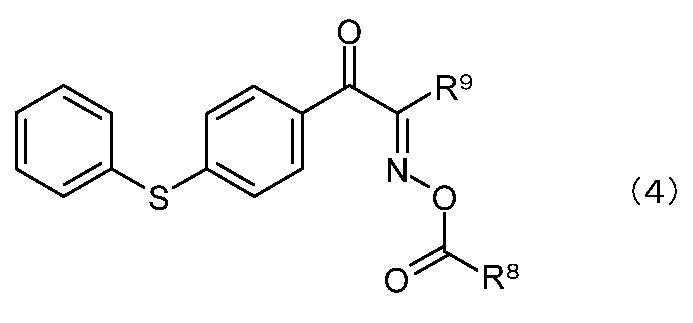
式(4)中、R8は、水素原子、炭素原子数1~12のアルキル基、炭素原子数3~8のシクロアルキル基、炭素原子数2~5のアルケニル基、ベンゼン環中の水素原子がアルキル基に置換されていてもよい炭素原子数6~20のフェニル基またはベンゼン環中の水素原子がアルキル基に置換されていてもよい炭素原子数6~20のフェノキシ基を示し、
R9は、水素原子、炭素原子数1~20のアルキル基、炭素原子数3~8のシクロアルキル基、ベンゼン環中の水素原子がアルキル基に置換されていてもよい炭素原子数6~20のフェニル基、炭素原子数2~20のアルカノイル基、ベンゼン環中の水素原子がアルキル基に置換されていてもよい炭素原子数7~20のベンゾイル基、炭素原子数2~12のアルコキシカルボニル基またはベンゼン環中の水素原子がアルキル基に置換されていてもよい炭素原子数7~20のフェノキシカルボニル基を示す。
[2]架橋剤(D)をさらに含み、該架橋剤(D)が1分子中に2つ以上のエチレン性二重結合を有し、酸性基を有しない化合物である、前記[1]のネガ型感光性樹脂組成物。
[3]熱硬化剤(I)をさらに含み、該熱硬化剤(I)が1分子中に2つ以上のエポキシ基を有する化合物である、前記[1]または[2]のネガ型感光性樹脂組成物。
[4]撥インク剤(E)をさらに含む、前記[1]~[3]のいずれかのネガ型感光性樹脂組成物。
[5]前記撥インク剤(E)が、1分子中に下式(1)で表される基または下式(2)で表される基を有する側鎖と、エチレン性二重結合を有する側鎖とを有する化合物である前記[4]のネガ型感光性樹脂組成物。
-CFXRf (1)
式(1)中、Xは水素原子、フッ素原子、またはトリフルオロメチル基を示し、Rfはエーテル性酸素原子を有していてもよい水素原子の少なくとも1つがフッ素原子に置換された炭素原子数20以下のアルキル基、またはフッ素原子を示す。
-(SiR10R11O)n-SiR12R13R14 (2)
式(2)中、R10、R11、R12およびR13はそれぞれ独立して、水素原子、アルキル基、シクロアルキル基、またはアリール基を示し、R14は水素原子、またはエーテル性酸素原子もしくは窒素原子を含んでいてもよい炭素原子数1~10のアルキル基を示し、nは1~200の整数を示す。
[6]前記撥インク剤(E)が、側鎖に基(1)を有し、主鎖がオルガノポリシロキサン鎖の化合物である、前記[4]のネガ型感光性樹脂組成物。
[7]基板上に区画を設けるために形成される隔壁であって、前記[1]~[6]のいずれかのネガ型感光性樹脂組成物の硬化膜からなる隔壁。
[8]前記[7]の隔壁からなるブラックマトリックス。
[9]前記隔壁と同時に形成される該隔壁の膜厚方向に貫通する貫通孔を有し、該貫通孔における水平方向の最大孔径が20μm以下であり、最小孔径が1μm以上である前記[8]のブラックマトリックス。
[10]基板上に形成される、複数の画素と、隣接する画素間に位置する隔壁とを有するカラーフィルタであって、前記隔壁が前記[8]または[9]のブラックマトリックスからなるカラーフィルタ。
[11]TFTアレイ基板上に前記[10]のカラーフィルタを有する液晶表示素子。
[1]1分子中に酸性基とエチレン性二重結合とを有するアルカリ可溶性樹脂(A)、
黒色着色剤(B)、
下式(3)で表される化合物からなる光重合開始剤(C1)、
および下式(4)で表される化合物からなる光重合開始剤(C2)、
を含むネガ型感光性樹脂組成物であって、
全固形分量に対する光重合開始剤(C1)と光重合開始剤(C2)との合計含有量の割合が3.5~7.0質量%であり、かつ、該合計含有量に対する光重合開始剤(C1)の割合が5~15質量%であることを特徴とするネガ型感光性樹脂組成物。
式(3)中、R1は、水素原子、炭素原子数1~12のアルキル基、炭素原子数3~8のシクロアルキル基、炭素原子数2~5のアルケニル基、ベンゼン環中の水素原子がアルキル基に置換されていてもよい炭素原子数6~20のフェニル基またはベンゼン環中の水素原子がアルキル基に置換されていてもよい炭素原子数6~20のフェノキシ基を示し、
R2は、水素原子、炭素原子数1~20のアルキル基、炭素原子数3~8のシクロアルキル基、ベンゼン環中の水素原子がアルキル基に置換されていてもよい炭素原子数6~20のフェニル基、炭素原子数2~20のアルカノイル基、ベンゼン環中の水素原子がアルキル基に置換されていてもよい炭素原子数7~20のベンゾイル基、炭素原子数2~12のアルコキシカルボニル基またはベンゼン環中の水素原子がアルキル基に置換されていてもよい炭素原子数7~20のフェノキシカルボニル基を示し、
R3は、炭素原子数1~12のアルキル基を示し、
R4、R5、R6およびR7は、それぞれ独立して、水素原子、炭素原子数1~12のアルキル基、シクロアルカン環中の水素原子がアルキル基に置換されていてもよい炭素原子数3~8のシクロアルキル基、ベンゼン環中の水素原子がアルキル基に置換されていてもよい炭素原子数6~20のフェニル基、炭素原子数2~20のアルカノイル基、ベンゼン環中の水素原子がアルキル基に置換されていてもよい炭素原子数7~20のベンゾイル基、ベンゼン環中の水素原子がアルキル基に置換されていてもよい炭素原子数7~20のベンジルカルボニル基、炭素原子数2~12のアルコキシカルボニル基、ベンゼン環中の水素原子がアルキル基に置換されていてもよい炭素原子数7~20のフェノキシカルボニル基、炭素原子数1~20のアミド基またはニトロ基を示す。
R9は、水素原子、炭素原子数1~20のアルキル基、炭素原子数3~8のシクロアルキル基、ベンゼン環中の水素原子がアルキル基に置換されていてもよい炭素原子数6~20のフェニル基、炭素原子数2~20のアルカノイル基、ベンゼン環中の水素原子がアルキル基に置換されていてもよい炭素原子数7~20のベンゾイル基、炭素原子数2~12のアルコキシカルボニル基またはベンゼン環中の水素原子がアルキル基に置換されていてもよい炭素原子数7~20のフェノキシカルボニル基を示す。
[2]架橋剤(D)をさらに含み、該架橋剤(D)が1分子中に2つ以上のエチレン性二重結合を有し、酸性基を有しない化合物である、前記[1]のネガ型感光性樹脂組成物。
[3]熱硬化剤(I)をさらに含み、該熱硬化剤(I)が1分子中に2つ以上のエポキシ基を有する化合物である、前記[1]または[2]のネガ型感光性樹脂組成物。
[4]撥インク剤(E)をさらに含む、前記[1]~[3]のいずれかのネガ型感光性樹脂組成物。
[5]前記撥インク剤(E)が、1分子中に下式(1)で表される基または下式(2)で表される基を有する側鎖と、エチレン性二重結合を有する側鎖とを有する化合物である前記[4]のネガ型感光性樹脂組成物。
-CFXRf (1)
式(1)中、Xは水素原子、フッ素原子、またはトリフルオロメチル基を示し、Rfはエーテル性酸素原子を有していてもよい水素原子の少なくとも1つがフッ素原子に置換された炭素原子数20以下のアルキル基、またはフッ素原子を示す。
-(SiR10R11O)n-SiR12R13R14 (2)
式(2)中、R10、R11、R12およびR13はそれぞれ独立して、水素原子、アルキル基、シクロアルキル基、またはアリール基を示し、R14は水素原子、またはエーテル性酸素原子もしくは窒素原子を含んでいてもよい炭素原子数1~10のアルキル基を示し、nは1~200の整数を示す。
[6]前記撥インク剤(E)が、側鎖に基(1)を有し、主鎖がオルガノポリシロキサン鎖の化合物である、前記[4]のネガ型感光性樹脂組成物。
[7]基板上に区画を設けるために形成される隔壁であって、前記[1]~[6]のいずれかのネガ型感光性樹脂組成物の硬化膜からなる隔壁。
[8]前記[7]の隔壁からなるブラックマトリックス。
[9]前記隔壁と同時に形成される該隔壁の膜厚方向に貫通する貫通孔を有し、該貫通孔における水平方向の最大孔径が20μm以下であり、最小孔径が1μm以上である前記[8]のブラックマトリックス。
[10]基板上に形成される、複数の画素と、隣接する画素間に位置する隔壁とを有するカラーフィルタであって、前記隔壁が前記[8]または[9]のブラックマトリックスからなるカラーフィルタ。
[11]TFTアレイ基板上に前記[10]のカラーフィルタを有する液晶表示素子。
本発明のネガ型感光性樹脂組成物によれば、微細なラインパターンと微小なコンタクトホールを有する隔壁およびブラックマトリックスを製造することが可能であり、該ブラックマトリックスを用いることにより、低消費電力で明るいBOA型の液晶表示素子の作製が可能なカラーフィルタおよびこれを有する液晶表示素子が提供できる。
本明細書における酸価とは、試料1g中の樹脂酸等を中和するのに必要な水酸化カリウムのミリグラム数をいい、JIS K 0070の測定方法に準じて測定することができる値である。単位はmgKOH/gである。
本明細書における「(メタ)アクリロイル…」とは、「メタアクリロイル…」と「アクリロイル…」の総称である。(メタ)アクリル酸、(メタ)アクリレート、(メタ)アクリルアミド、(メタ)アリル…、(メタ)アクリル樹脂もこれと同様である。
本明細書における「(メタ)アクリロイル…」とは、「メタアクリロイル…」と「アクリロイル…」の総称である。(メタ)アクリル酸、(メタ)アクリレート、(メタ)アクリルアミド、(メタ)アリル…、(メタ)アクリル樹脂もこれと同様である。
本明細書における式(1)で表される基を、基(1)という。他の基も同様である。
本明細書における式(11)で表される単量体を、単量体(11)という。他の単量体も同様である。
本明細書における全固形分とは、ネガ型感光性樹脂組成物が含有する成分のうち、隔壁形成成分をいい、溶媒(F)等の隔壁形成過程における加熱等により揮発する揮発性成分以外の全成分を示す。全固形分の量は仕込み量より計算できる。分析する場合には、ネガ型感光性樹脂組成物を160℃で10分間加熱して溶媒を除去する。溶媒除去後の残存物を全固形分とする。
本明細書においては、ネガ型感光性樹脂組成物を塗布した膜を「塗膜」、それを乾燥させた状態を「膜」、さらに、それを硬化させて得られる膜を「硬化膜」という。
本明細書における式(11)で表される単量体を、単量体(11)という。他の単量体も同様である。
本明細書における全固形分とは、ネガ型感光性樹脂組成物が含有する成分のうち、隔壁形成成分をいい、溶媒(F)等の隔壁形成過程における加熱等により揮発する揮発性成分以外の全成分を示す。全固形分の量は仕込み量より計算できる。分析する場合には、ネガ型感光性樹脂組成物を160℃で10分間加熱して溶媒を除去する。溶媒除去後の残存物を全固形分とする。
本明細書においては、ネガ型感光性樹脂組成物を塗布した膜を「塗膜」、それを乾燥させた状態を「膜」、さらに、それを硬化させて得られる膜を「硬化膜」という。
本明細書において、隔壁の「表面」は、隔壁の上面のみを示す用語として用いる。したがって、隔壁の「表面」には、隔壁の側面は含まれない。
本明細書におけるインクとは、乾燥硬化した後に、例えば光学的、電気的に機能を有する液体を総称するものであり、従来から用いられている着色材料に限定されるものではない。また、上記インクを注入して形成される「画素」についても同様に、隔壁で仕切られたそれぞれに光学的、電気的機能を有する区分を表すものとして用いられる。
本明細書における撥インク性とは、上記インクをはじくために、撥水性と撥油性の両方を適度に有する性質をいい、例えば、後述の方法で評価できる。
本明細書におけるインクとは、乾燥硬化した後に、例えば光学的、電気的に機能を有する液体を総称するものであり、従来から用いられている着色材料に限定されるものではない。また、上記インクを注入して形成される「画素」についても同様に、隔壁で仕切られたそれぞれに光学的、電気的機能を有する区分を表すものとして用いられる。
本明細書における撥インク性とは、上記インクをはじくために、撥水性と撥油性の両方を適度に有する性質をいい、例えば、後述の方法で評価できる。
本明細書においてコンタクトホールとは、隔壁またはブラックマトリックスの膜厚方向に素子と電極を接続するために設けられる貫通孔をいう。微小なコンタクトホールの、「微小」とは、該コンタクトホールを構成する貫通孔における水平方向の最大孔径が概ね20μm以下のサイズをいう。また、貫通孔における水平方向の最大孔径とは、貫通孔の水平断面のうちで最大面積を有する断面における長径をいい、最小孔径とは、貫通孔の水平断面のうちで最小面積を有する断面における短径をいう。
以下、本発明を詳細に説明する。なお、本明細書において特に説明のない場合、%は質量%を表す。
以下、本発明を詳細に説明する。なお、本明細書において特に説明のない場合、%は質量%を表す。
[アルカリ可溶性樹脂(A)]
アルカリ可溶性樹脂(A)は、1分子中に酸性基とエチレン性二重結合とを有する感光性樹脂である。アルカリ可溶性樹脂(A)が分子中にエチレン性二重結合を有することで、ネガ型感光性樹脂組成物の露光部は、光重合開始剤から発生したラジカルにより重合して硬化する。このように硬化した露光部分はアルカリ現像液にて除去されない。また、アルカリ可溶性樹脂(A)が分子中に酸性基を有することで、アルカリ現像液にて、硬化していないネガ型感光性樹脂組成物の未露光部を選択的に除去することができる。その結果、隔壁を形成することができる。なお、アルカリ可溶性樹脂(A)は実質的に、後述の撥インク剤(E)を好ましく構成する化合物が有する基(1)または基(2)を含有しないことが好ましい。
アルカリ可溶性樹脂(A)は、1分子中に酸性基とエチレン性二重結合とを有する感光性樹脂である。アルカリ可溶性樹脂(A)が分子中にエチレン性二重結合を有することで、ネガ型感光性樹脂組成物の露光部は、光重合開始剤から発生したラジカルにより重合して硬化する。このように硬化した露光部分はアルカリ現像液にて除去されない。また、アルカリ可溶性樹脂(A)が分子中に酸性基を有することで、アルカリ現像液にて、硬化していないネガ型感光性樹脂組成物の未露光部を選択的に除去することができる。その結果、隔壁を形成することができる。なお、アルカリ可溶性樹脂(A)は実質的に、後述の撥インク剤(E)を好ましく構成する化合物が有する基(1)または基(2)を含有しないことが好ましい。
前記酸性基としては、特に制限されないが、カルボキシル基、フェノール性水酸基、スルホン酸基、リン酸基等が挙げられ、これらは1種を単独で用いても2種以上を併用してもよい。
前記エチレン性二重結合としては、特に制限されないが、(メタ)アクリロイル基、アリル基、ビニル基、ビニルオキシ基、ビニルエーテル基等の付加重合性を有する二重結合が挙げられ、これらは1種を単独で用いても2種以上を併用してもよい。なお、該付加重合性を有する二重結合基が有する水素原子の一部または全てが、アルキル基、好ましくはメチル基で置換されていてもよい。
前記エチレン性二重結合としては、特に制限されないが、(メタ)アクリロイル基、アリル基、ビニル基、ビニルオキシ基、ビニルエーテル基等の付加重合性を有する二重結合が挙げられ、これらは1種を単独で用いても2種以上を併用してもよい。なお、該付加重合性を有する二重結合基が有する水素原子の一部または全てが、アルキル基、好ましくはメチル基で置換されていてもよい。
アルカリ可溶性樹脂(A)としては、特に限定されないが、酸性基を有する側鎖とエチレン性二重結合を有する側鎖とを有する樹脂(A1-1)、エポキシ樹脂に酸性基とエチレン性二重結合とを導入した樹脂(A1-2)、酸性基を有する側鎖とエチレン性二重結合を有する側鎖とを有する単量体(A1-3)等が挙げられる。これらは1種を単独で用いても2種以上を併用してもよい。
樹脂(A1-1)は、例えば、以下の(i)または(ii)の方法で合成できる。
(i)側鎖に酸性基以外の反応性基、例えば、水酸基、エポキシ基等を有する単量体と、側鎖に酸性基を有する単量体とを共重合させ、反応性基を有する側鎖と、酸性基を有する側鎖を有する共重合体を得る。次いで、この共重合体と、上記反応性基に対して結合し得る官能基およびエチレン性二重結合を有する化合物を溶媒に溶解させて反応させる。または、側鎖に酸性基、例えばカルボキシル基等を有する単量体を共重合させた後、酸性基に対して結合し得る官能基およびエチレン性二重結合を有する化合物を反応後に酸性基が残る量、溶媒に溶解させて反応させる。
(ii)上記(i)と同様の酸性基以外の反応性基を側鎖に有する単量体と、この反応性基に対して結合し得る官能基および保護されたエチレン性二重結合を有する化合物を溶媒に溶解させて反応させる。次いで、この単量体と側鎖に酸性基を有する単量体とを共重合させた後、エチレン性二重結合の保護を外す。または、側鎖に酸性基を有する単量体と、側鎖に保護されたエチレン性二重結合を有する単量体とを共重合させた後、エチレン性二重結合の保護を外す。
これらのうちでも、本発明においては(i)の方法が好ましく用いられる。以下、(i)の方法について具体的に説明する。
(i)側鎖に酸性基以外の反応性基、例えば、水酸基、エポキシ基等を有する単量体と、側鎖に酸性基を有する単量体とを共重合させ、反応性基を有する側鎖と、酸性基を有する側鎖を有する共重合体を得る。次いで、この共重合体と、上記反応性基に対して結合し得る官能基およびエチレン性二重結合を有する化合物を溶媒に溶解させて反応させる。または、側鎖に酸性基、例えばカルボキシル基等を有する単量体を共重合させた後、酸性基に対して結合し得る官能基およびエチレン性二重結合を有する化合物を反応後に酸性基が残る量、溶媒に溶解させて反応させる。
(ii)上記(i)と同様の酸性基以外の反応性基を側鎖に有する単量体と、この反応性基に対して結合し得る官能基および保護されたエチレン性二重結合を有する化合物を溶媒に溶解させて反応させる。次いで、この単量体と側鎖に酸性基を有する単量体とを共重合させた後、エチレン性二重結合の保護を外す。または、側鎖に酸性基を有する単量体と、側鎖に保護されたエチレン性二重結合を有する単量体とを共重合させた後、エチレン性二重結合の保護を外す。
これらのうちでも、本発明においては(i)の方法が好ましく用いられる。以下、(i)の方法について具体的に説明する。
水酸基を反応性基として有する単量体としては、2-ヒドロキシエチル(メタ)アクリレート、2-ヒドロキシプロピル(メタ)アクリレート、3-ヒドロキシプロピル(メタ)アクリレート、4-ヒドロキシブチル(メタ)アクリレート、5-ヒドロキシペンチル(メタ)アクリレート、6-ヒドロキシヘキシル(メタ)アクリレート、4-ヒドロキシシクロヘキシル(メタ)アクリレート、ネオペンチルグリコールモノ(メタ)アクリレート、3-クロロ-2-ヒドロキシプロピル(メタ)アクリレート、グリセリンモノ(メタ)アクリレート、2-ヒドロキシエチルビニルエーテル、4-ヒドロキシブチルビニルエーテル、シクロヘキサンジオールモノビニルエーテル、2-ヒドロキシエチルアリルエーテル、N-ヒドロキシメチル(メタ)アクリルアミド、N,N-ビス(ヒドロキシメチル)(メタ)アクリルアミド等が挙げられる。
水酸基を反応性基として有する単量体と共重合させる酸性基を有する単量体としては、特に限定されないが、後述のカルボキシル基を有する単量体の他に、リン酸基を有する単量体として、2-(メタ)アクリロイルオキシエタンリン酸等が挙げられる。水酸基を反応性基として有する単量体と酸性基を有する単量体の共重合は、従来公知の方法で行うことができる。
上記で得られた水酸基を有する側鎖と酸性基を有する側鎖を有する共重合体と反応させる、水酸基に対して結合し得る官能基およびエチレン性二重結合を有する化合物としては、エチレン性二重結合を有する酸無水物、イソシアネート基とエチレン性二重結合とを有する化合物、塩化アシル基とエチレン性二重結合とを有する化合物等が挙げられる。
エチレン性二重結合を有する酸無水物としては、無水マレイン酸、無水イタコン酸、無水シトラコン酸、メチル-5-ノルボルネン-2,3-ジカルボン酸無水物、3,4,5,6-テトラヒドロフタル酸無水物、cis-1,2,3,6-テトラヒドロフタル酸無水物、2-ブテン-1-イルサクシニックアンハイドライド等が挙げられる。
イソシアネート基とエチレン性二重結合とを有する化合物としては、2-(メタ)アクリロイルオキシエチルイソシアネート、1,1-ビス((メタ)アクリロイルオキシメチル)エチルイソシアネート等が挙げられる。
塩化アシル基とエチレン性二重結合とを有する化合物としては、(メタ)アクリロイルクロライド等が挙げられる。
エチレン性二重結合を有する酸無水物としては、無水マレイン酸、無水イタコン酸、無水シトラコン酸、メチル-5-ノルボルネン-2,3-ジカルボン酸無水物、3,4,5,6-テトラヒドロフタル酸無水物、cis-1,2,3,6-テトラヒドロフタル酸無水物、2-ブテン-1-イルサクシニックアンハイドライド等が挙げられる。
イソシアネート基とエチレン性二重結合とを有する化合物としては、2-(メタ)アクリロイルオキシエチルイソシアネート、1,1-ビス((メタ)アクリロイルオキシメチル)エチルイソシアネート等が挙げられる。
塩化アシル基とエチレン性二重結合とを有する化合物としては、(メタ)アクリロイルクロライド等が挙げられる。
エポキシ基を反応性基として有する単量体としては、グリシジル(メタ)アクリレート、3,4-エポキシシクロヘキシルメチルアクリレート等が挙げられる。
エポキシ基を反応性基として有する単量体と共重合させる酸性基を有する単量体としては、上記水酸基を反応性基として有する単量体で説明したのと同様の単量体が使用でき、エポキシ基を反応性基として有する単量体と酸性基を有する単量体の共重合についても、従来公知の方法で行うことができる。
エポキシ基を反応性基として有する単量体と共重合させる酸性基を有する単量体としては、上記水酸基を反応性基として有する単量体で説明したのと同様の単量体が使用でき、エポキシ基を反応性基として有する単量体と酸性基を有する単量体の共重合についても、従来公知の方法で行うことができる。
上記で得られたエポキシ基を有する側鎖と酸性基を有する側鎖を有する共重合体と反応させる、エポキシ基に対して結合し得る官能基およびエチレン性二重結合を有する化合物として、カルボキシル基とエチレン性二重結合を有する化合物が挙げられる。該化合物の具体例としては、アクリル酸、メタクリル酸、ビニル酢酸、クロトン酸、イタコン酸、マレイン酸、フマル酸、ケイ皮酸およびこれらの塩が挙げられる。なお、ここで生じた水酸基とカルボン酸の脱水縮合部分が環状構造の一部をなす酸無水物とを反応させ、樹脂(A1-1)中にカルボキシル基を導入してもよい。
カルボキシル基を反応性基として有する単量体としては、アクリル酸、メタクリル酸、ビニル酢酸、クロトン酸、イタコン酸、マレイン酸、フマル酸、ケイ皮酸およびこれらの塩が挙げられる。なお、これらの単量体は上述した酸性基を有する単量体としても用いられる。
カルボキシル基を反応性基として有する単量体を用いる場合、上記と同様にこれを単独で共重合させる。得られたカルボキシル基を反応性基として有する共重合体と反応させる、カルボキシル基に対して結合し得る官能基およびエチレン性二重結合を有する化合物としてはエポキシ基とエチレン性二重結合を有する化合物が挙げられる。該化合物としては、グリシジル(メタ)アクリレート、3,4-エポキシシクロヘキシルメチルアクリレート等が挙げられる。なお、この場合、カルボキシル基を有する共重合体と反応させる、カルボキシル基に対して結合し得る官能基およびエチレン性二重結合を有する化合物の量は、反応後に共重合体においてカルボキシル基が酸性基として側鎖に残る量とする。
樹脂(A1-2)は、エポキシ樹脂と、後述するカルボキシル基とエチレン性二重結合とを有する化合物とを反応させた後に、多塩基性カルボン酸またはその無水物とを反応させることにより合成することができる。
具体的には、エポキシ樹脂と、カルボキシル基とエチレン性二重結合を有する化合物とを反応させることにより、エポキシ樹脂にエチレン性二重結合が導入される。次に、エチレン性二重結合が導入されたエポキシ樹脂に多塩基性カルボン酸またはその無水物を反応させることにより、カルボキシル基を導入することができる。
具体的には、エポキシ樹脂と、カルボキシル基とエチレン性二重結合を有する化合物とを反応させることにより、エポキシ樹脂にエチレン性二重結合が導入される。次に、エチレン性二重結合が導入されたエポキシ樹脂に多塩基性カルボン酸またはその無水物を反応させることにより、カルボキシル基を導入することができる。
エポキシ樹脂としては、特に限定されないが、ビスフェノールA型エポキシ樹脂、ビスフェノールF型エポキシ樹脂、フェノールノボラック型エポキシ樹脂、クレゾールノボラック型エポキシ樹脂、トリスフェノールメタン型エポキシ樹脂、ナフタレン骨格を有するエポキシ樹脂、下式(A1-2a)で表されるビフェニル骨格を有するエポキシ樹脂、下式(A1-2b)で表されるエポキシ樹脂、下式(A1-2c)で表されるビフェニル骨格を有するエポキシ樹脂等が挙げられる。

(式(A1-2a)中、vは、1~50の整数であり、2~10が好ましい。またベンゼン環の水素原子はそれぞれ独立して、炭素原子数1~12のアルキル基、ハロゲン原子、または一部の水素原子が置換基で置換されていてもよいフェニル基、で置換されていてもよい。)


なお、式(A1-2a)~(A1-2c)で表されるエポキシ樹脂と、カルボキシル基とエチレン性二重結合を有する化合物とを反応させた後に、多塩基性カルボン酸無水物を反応させる場合、多塩基性カルボン酸無水物としては、ジカルボン酸無水物およびテトラカルボン酸二無水物の混合物を用いることが好ましい。ジカルボン酸無水物とテトラカルボン酸二無水物の比率を変化させることにより、分子量を制御することができる。
カルボキシル基とエチレン性二重結合とを有する化合物としては、アクリル酸、メタクリル酸、ビニル酢酸、クロトン酸、イタコン酸、マレイン酸、フマル酸、ケイ皮酸およびこれらの塩が好ましく、アクリル酸またはメタクリル酸が特に好ましい。
樹脂(A1-2)は、市販品を使用することができる。市販品としては、いずれも商品名で、KAYARAD PCR-1069、K-48C、CCR-1105、CCR-1115、CCR-1159H、CCR-1235、TCR-1025、TCR-1064H、TCR-1286H、ZAR-1535H、ZAR-2002H、ZFR-1491H、ZFR-1492H、ZCR-1571H、ZCR-1569H、ZCR-1580H、ZCR-1581H、ZCR-1588H、ZCR-1642H、ZCR-1664H(以上、日本化薬社製)、EX1010、ZAR-2001H(ナガセケムテックス社製)等が挙げられる。
単量体(A1-3)としては、2,2,2-トリアクリロイルオキシメチルエチルフタル酸(NKエステル CBX-1 新中村化学工業社製)等が挙げられる。
アルカリ可溶性樹脂(A)としては、現像時の塗膜剥離が抑制されて、高解像度のパターンを得ることができる点、ラインの直線性が良好である点、およびポストベーク工程後の外観が維持され、平滑な塗膜表面が得られやすい点で、樹脂(A1-2)を用いることが好ましい。
樹脂(A1-2)としては、ビスフェノールA型エポキシ樹脂に酸性基とエチレン性二重結合とを導入した樹脂、ビスフェノールF型エポキシ樹脂に酸性基とエチレン性二重結合とを導入した樹脂、フェノールノボラック型エポキシ樹脂に酸性基とエチレン性二重結合とを導入した樹脂、クレゾールノボラック型エポキシ樹脂に酸性基とエチレン性二重結合とを導入した樹脂、トリスフェノールメタン型エポキシ樹脂に酸性基とエチレン性二重結合とを導入した樹脂、式(A1-2a)~(A1-2c)で表されるエポキシ樹脂に酸性基とエチレン性二重結合とを導入した樹脂が特に好ましい。
樹脂(A1-2)としては、ビスフェノールA型エポキシ樹脂に酸性基とエチレン性二重結合とを導入した樹脂、ビスフェノールF型エポキシ樹脂に酸性基とエチレン性二重結合とを導入した樹脂、フェノールノボラック型エポキシ樹脂に酸性基とエチレン性二重結合とを導入した樹脂、クレゾールノボラック型エポキシ樹脂に酸性基とエチレン性二重結合とを導入した樹脂、トリスフェノールメタン型エポキシ樹脂に酸性基とエチレン性二重結合とを導入した樹脂、式(A1-2a)~(A1-2c)で表されるエポキシ樹脂に酸性基とエチレン性二重結合とを導入した樹脂が特に好ましい。
アルカリ可溶性樹脂(A)が1分子中に有するエチレン性二重結合の数は、平均3個以上が好ましく、6個以上が特に好ましい。エチレン性二重結合の数が上記範囲の下限値以上であると、露光部分と未露光部分とのアルカリ溶解度に差がつきやすく、より少ない露光量での微細なパターン形成が可能となる。
アルカリ可溶性樹脂(A)の質量平均分子量(Mw)は、1.5×10³~30×103が好ましく、2×10³~15×103が特に好ましい。また、数平均分子量(Mn)は、500~20×103が好ましく、1.0×10³~10×103が特に好ましい。質量平均分子量(Mw)および数平均分子量(Mn)が上記範囲の下限値以上であると、露光時の硬化が充分であり、上記範囲の上限値以下であると、現像性が良好である。
アルカリ可溶性樹脂(A)の酸価は、10~300mgKOH/gが好ましく、30~150mgKOH/gが特に好ましい。酸価が上記範囲であると、ネガ型感光性樹脂組成物の現像性が良好になる。
アルカリ可溶性樹脂(A)の酸価は、10~300mgKOH/gが好ましく、30~150mgKOH/gが特に好ましい。酸価が上記範囲であると、ネガ型感光性樹脂組成物の現像性が良好になる。
ネガ型感光性樹脂組成物に含まれるアルカリ可溶性樹脂(A)は、1種を単独で用いても2種以上を併用してもよい。
ネガ型感光性樹脂組成物における全固形分中の感光性樹脂(A)の含有割合は、5~80質量%が好ましく、10~60質量%が特に好ましい。含有割合が上記範囲であると、ネガ型感光性樹脂組成物の現像性が良好である。
ネガ型感光性樹脂組成物における全固形分中の感光性樹脂(A)の含有割合は、5~80質量%が好ましく、10~60質量%が特に好ましい。含有割合が上記範囲であると、ネガ型感光性樹脂組成物の現像性が良好である。
[黒色着色剤(B)]
本発明のネガ型感光性樹脂組成物は黒色着色剤(B)を含む。
黒色着色剤(B)としては、カーボンブラック、アニリンブラック、アントラキノン系黒色顔料、ペリレン系黒色顔料、具体的には、C.I.ピグメントブラック1、6、7、12、20、31等が挙げられる。
黒色着色剤(B)としては、赤色顔料、青色顔料、緑色顔料、黄色顔料等の有機顔料や無機顔料の混合物を用いることもできる。
有機顔料の具体例としては、C.I.ピグメントブルー15:6、ピグメントレッド254、ピグメントグリーン36、ピグメントイエロー150、アゾメチン系顔料等が挙げられる。
黒色着色剤(B)としては、電気特性の点から有機顔料が好ましく、価格および遮光性の点からはカーボンブラックが好ましい。カーボンブラックは樹脂等で表面処理されているのが好ましく、また、色調を調整するため、青色顔料や紫色顔料を併用することができる。
本発明のネガ型感光性樹脂組成物は黒色着色剤(B)を含む。
黒色着色剤(B)としては、カーボンブラック、アニリンブラック、アントラキノン系黒色顔料、ペリレン系黒色顔料、具体的には、C.I.ピグメントブラック1、6、7、12、20、31等が挙げられる。
黒色着色剤(B)としては、赤色顔料、青色顔料、緑色顔料、黄色顔料等の有機顔料や無機顔料の混合物を用いることもできる。
有機顔料の具体例としては、C.I.ピグメントブルー15:6、ピグメントレッド254、ピグメントグリーン36、ピグメントイエロー150、アゾメチン系顔料等が挙げられる。
黒色着色剤(B)としては、電気特性の点から有機顔料が好ましく、価格および遮光性の点からはカーボンブラックが好ましい。カーボンブラックは樹脂等で表面処理されているのが好ましく、また、色調を調整するため、青色顔料や紫色顔料を併用することができる。
有機顔料としては、ブラックマトリックスの形状の観点から、BET法による比表面積が50~200m2/gであるものが好ましい。比表面積が50m2/g以上であると、ブラックマトリックス形状が劣化しにくい。200m2/g以下であると、有機顔料に分散助剤が過度に吸着することなく、諸物性を発現させるために多量の分散助剤を配合する必要がなくなる。
また、有機顔料の透過型電子顕微鏡観察による平均1次粒子径は、20~150nmであることが好ましい。平均1次粒子径が20nm以上であると、ネガ型感光性樹脂組成物で高濃度に分散でき、経時安定性の良好なネガ型感光性樹脂組成物が得られやすい。150nm以下であると、ブラックマトリックス形状が劣化しにくい。また、透過型電子顕微鏡観察による平均2次粒子径としては、80~200nmが好ましい。
ネガ型感光性樹脂組成物における全固形分中の黒色着色剤(B)の含有割合は、20~65質量%が好ましく、25~60質量%がより好ましく、30~55質量%が特に好ましい。含有割合が上記範囲の下限値以上であると、得られる隔壁の光の遮光性を示す値である光学濃度が充分になる。上記範囲の上限値以下であると、ネガ型感光性樹脂組成物の硬化性が良好になり、良好な外観の硬化膜が得られ、撥インク性も良好になる。
黒色着色剤(B)のネガ型感光性樹脂組成物における分散性を向上するためには、高分子分散剤を含有させることが好ましい。該高分子分散剤は、黒色着色剤(B)への親和性の点から、塩基性官能基を有する化合物が好ましい。該塩基性官能基として、1級、2級もしくは3級アミノ基を有すると、特に分散性に優れる。
高分子分散剤としては、ウレタン系、ポリイミド系、アルキッド系、エポキシ系、不飽和ポリエステル系、メラミン系、フェノール系、アクリル系、塩化ビニル系、塩化ビニル酢酸ビニル系共重合体系、ポリアミド系、ポリカーボネート系等の化合物が挙げられる。中でも特にウレタン系、ポリエステル系の化合物が好ましい。
高分子分散剤の使用量は、黒色着色剤(B)に対して5~30重量%が好ましく、10~25重量%が特に好ましい。使用量が上記範囲の下限値以上であると、黒色着色剤(B)の分散が良好になり、上記範囲の上限値以下であると、現像性が良好になる。
高分子分散剤としては、ウレタン系、ポリイミド系、アルキッド系、エポキシ系、不飽和ポリエステル系、メラミン系、フェノール系、アクリル系、塩化ビニル系、塩化ビニル酢酸ビニル系共重合体系、ポリアミド系、ポリカーボネート系等の化合物が挙げられる。中でも特にウレタン系、ポリエステル系の化合物が好ましい。
高分子分散剤の使用量は、黒色着色剤(B)に対して5~30重量%が好ましく、10~25重量%が特に好ましい。使用量が上記範囲の下限値以上であると、黒色着色剤(B)の分散が良好になり、上記範囲の上限値以下であると、現像性が良好になる。
[光重合開始剤(C)]
本発明のネガ型感光性樹脂組成物は、光重合開始剤(C)として、下式(3)で表される化合物からなる光重合開始剤(C1)と、下式(4)で表される化合物からなる光重合開始剤(C2)とを含む。
ネガ型感光性樹脂組成物における全固形分量に対する光重合開始剤(C1)と光重合開始剤(C2)の合計含有量の割合は3.5~7.0質量%である。該合計含有量の割合は、3.5~6.8質量%が好ましく、3.6~6.0質量%がより好ましく、3.7~5.5質量%が特に好ましい。該合計含有量の割合が上記範囲であると、ネガ型感光性樹脂組成物の硬化性が良好で、塗膜形成後、露光工程および現像工程を経て得られる隔壁やブラックマトリックスにおいてラインパターンや線幅を露光時のマスクパターンに近い形状に形成することができ、微小なコンタクトホールの形成も可能となる。また、該合計含有量の割合が上記範囲であると、ネガ型感光性樹脂組成物が撥インク剤(E)を含有する場合に、充分な撥インク性の付与も可能である。さらに、アルカリ水溶液への黒色着色剤(B)等の顔料の溶解性を阻害することがない。
本発明のネガ型感光性樹脂組成物は、光重合開始剤(C)として、下式(3)で表される化合物からなる光重合開始剤(C1)と、下式(4)で表される化合物からなる光重合開始剤(C2)とを含む。
ネガ型感光性樹脂組成物における全固形分量に対する光重合開始剤(C1)と光重合開始剤(C2)の合計含有量の割合は3.5~7.0質量%である。該合計含有量の割合は、3.5~6.8質量%が好ましく、3.6~6.0質量%がより好ましく、3.7~5.5質量%が特に好ましい。該合計含有量の割合が上記範囲であると、ネガ型感光性樹脂組成物の硬化性が良好で、塗膜形成後、露光工程および現像工程を経て得られる隔壁やブラックマトリックスにおいてラインパターンや線幅を露光時のマスクパターンに近い形状に形成することができ、微小なコンタクトホールの形成も可能となる。また、該合計含有量の割合が上記範囲であると、ネガ型感光性樹脂組成物が撥インク剤(E)を含有する場合に、充分な撥インク性の付与も可能である。さらに、アルカリ水溶液への黒色着色剤(B)等の顔料の溶解性を阻害することがない。
ネガ型感光性樹脂組成物における光重合開始剤(C1)と光重合開始剤(C2)の合計含有量に対する光重合開始剤(C1)の割合は5~15質量%である。該合計含有量に対する光重合開始剤(C1)の割合は、6~13質量%が好ましく、7~12質量%が特に好ましい。該合計含有量に対する光重合開始剤(C1)の割合が上記範囲であると、ネガ型感光性樹脂組成物の硬化性が良好で、塗膜形成後、露光工程および現像工程を経て得られる隔壁やブラックマトリックスにおいてラインパターンや線幅を露光時のマスクパターンに近い形状に形成することができ、微小なコンタクトホールの形成も可能となる。また、該合計含有量に対する光重合開始剤(C1)の割合が上記範囲であると、ネガ型感光性樹脂組成物が撥インク剤(E)を含有する場合に、充分な撥インク性の付与も可能である。さらに、アルカリ水溶液への黒色着色剤(B)等の顔料の溶解性を阻害することがない。
ネガ型感光性樹脂組成物における全固形分中の光重合開始剤(C1)の含有割合は、0.1~5質量%が好ましく、0.3~0.5質量%がより好ましく、0.35~0.45質量%が特に好ましい。また、ネガ型感光性樹脂組成物における全固形分中の光重合開始剤(C2)の含有割合は、3~7質量%が好ましく、3~6.5質量%が特に好ましい。
本発明のネガ型感光性樹脂組成物を用いれば、隔壁(ブラックマトリックス)を製造する場合に、隔壁(ブラックマトリックス)をマスクパターンに近い微細ラインに形成しつつ、同時に、隔壁(ブラックマトリックス)への微小なコンタクトホールの形成と、さらには、ネガ型感光性樹脂組成物が撥インク剤(E)を含有する場合に、充分な撥インク性の付与が達成できる。このような効果が得られる理由は定かではないが、上記効果は、光重合開始剤(C1)および光重合開始剤(C2)が光重合開始剤の中でも比較的感度が高く、光重合開始剤(C1)は光重合開始剤(C2)よりもより感度が高いという特徴によるものと考えられる。
ここで、ネガ型感光性樹脂組成物を塗膜とし、乾燥させた膜にマスクパターンをして露光し現像することで、上記ブラックマトリックスが製造される。その過程においてブラックマトリックスへのコンタクトホールの形成と、任意に行われる撥インク性の付与が同時に行われるが、コンタクトホールの形成については膜内部の光反応性、撥インク性の付与については膜表面の光反応性の影響を受ける。さらに、ブラックマトリクス製造用の膜では光透過性が低いために、膜側から露光した場合、膜表面付近よりも基板付近では光反応性が不充分となることがあり、その場合には、現像時にパターンが溶解し消失してしまう。
ここで、ネガ型感光性樹脂組成物を塗膜とし、乾燥させた膜にマスクパターンをして露光し現像することで、上記ブラックマトリックスが製造される。その過程においてブラックマトリックスへのコンタクトホールの形成と、任意に行われる撥インク性の付与が同時に行われるが、コンタクトホールの形成については膜内部の光反応性、撥インク性の付与については膜表面の光反応性の影響を受ける。さらに、ブラックマトリクス製造用の膜では光透過性が低いために、膜側から露光した場合、膜表面付近よりも基板付近では光反応性が不充分となることがあり、その場合には、現像時にパターンが溶解し消失してしまう。
膜表面の光反応性については、酸素による光反応阻害があるため、光重合開始剤(C1)および光重合開始剤(C2)ともに反応性の差は小さい。一方、膜内部の光反応性については、光重合開始剤(C1)は光重合開始剤(C2)よりも反応性(感度)が高いことから、光重合開始剤(C2)を使用した方が撥インク性の付与と微小なコンタクトホールの形成には好ましい。しかしながら、光重合開始剤(C2)のみを使用した場合には、透過光量の不足による膜内部の反応性不足を要因として、現像時にパターンの消失が引き起こされる。
本発明においては、この現像時のパターン消失を防止する目的で、光重合開始剤(C2)に光重合開始剤(C1)を少量加えることにより、膜内部の反応性を補い、上記のような微細なラインパターンを有する隔壁の形成および隔壁への微小なコンタクトホールの形成、さらには、ネガ型感光性樹脂組成物が撥インク剤(E)を含有する場合に、充分な撥インク性の付与を同時に達成することを可能とした。
本発明においては、この現像時のパターン消失を防止する目的で、光重合開始剤(C2)に光重合開始剤(C1)を少量加えることにより、膜内部の反応性を補い、上記のような微細なラインパターンを有する隔壁の形成および隔壁への微小なコンタクトホールの形成、さらには、ネガ型感光性樹脂組成物が撥インク剤(E)を含有する場合に、充分な撥インク性の付与を同時に達成することを可能とした。
本発明のネガ型感光性樹脂組成物においては、2-メルカプトベンズイミダゾール、2-メルカプトベンゾオキサゾール、2-メルカプトベンゾチアゾール、1,4-ブタノールビス(3-メルカプトブチレート)、トリス(2-メルカプトプロパノイルオキシエチル)イソシアヌレート、ペンタエリスリトールテトラキス(3-メルカプトブチレート)等のチオール化合物を光重合開始剤(C1)および光重合開始剤(C2)と共に用いてもよい。これにより増感効果を発現することがある。
(光重合開始剤(C1))
光重合開始剤(C1)は、下式(3)で表されるO-アシルオキシム系化合物からなる。
光重合開始剤(C1)は、下式(3)で表されるO-アシルオキシム系化合物からなる。

式(3)中、R1は、水素原子、炭素原子数1~12のアルキル基、炭素原子数3~8のシクロアルキル基、炭素原子数2~5のアルケニル基、ベンゼン環中の水素原子がアルキル基に置換されていてもよい炭素原子数6~20のフェニル基またはベンゼン環中の水素原子がアルキル基に置換されていてもよい炭素原子数6~20のフェノキシ基である。
R2は、水素原子、炭素原子数1~20のアルキル基、炭素原子数3~8のシクロアルキル基、ベンゼン環中の水素原子がアルキル基に置換されていてもよい炭素原子数6~20のフェニル基、炭素原子数2~20のアルカノイル基、ベンゼン環中の水素原子がアルキル基に置換されていてもよい炭素原子数7~20のベンゾイル基、炭素原子数2~12のアルコキシカルボニル基またはベンゼン環中の水素原子がアルキル基に置換されていてもよい炭素原子数7~20のフェノキシカルボニル基である。
R3は、炭素原子数1~12のアルキル基である。
R4、R5、R6およびR7は、それぞれ独立して、水素原子、炭素原子数1~12のアルキル基、シクロアルカン環中の水素原子がアルキル基に置換されていてもよい炭素原子数3~8のシクロアルキル基、ベンゼン環中の水素原子がアルキル基に置換されていてもよい炭素原子数6~20のフェニル基、炭素原子数2~20のアルカノイル基、ベンゼン環中の水素原子がアルキル基に置換されていてもよい炭素原子数7~20のベンゾイル基、ベンゼン環中の水素原子がアルキル基に置換されていてもよい炭素原子数7~20のベンジルカルボニル基、炭素原子数2~12のアルコキシカルボニル基、ベンゼン環中の水素原子がアルキル基に置換されていてもよい炭素原子数7~20のフェノキシカルボニル基、炭素原子数1~20のアミド基またはニトロ基である。
R2は、水素原子、炭素原子数1~20のアルキル基、炭素原子数3~8のシクロアルキル基、ベンゼン環中の水素原子がアルキル基に置換されていてもよい炭素原子数6~20のフェニル基、炭素原子数2~20のアルカノイル基、ベンゼン環中の水素原子がアルキル基に置換されていてもよい炭素原子数7~20のベンゾイル基、炭素原子数2~12のアルコキシカルボニル基またはベンゼン環中の水素原子がアルキル基に置換されていてもよい炭素原子数7~20のフェノキシカルボニル基である。
R3は、炭素原子数1~12のアルキル基である。
R4、R5、R6およびR7は、それぞれ独立して、水素原子、炭素原子数1~12のアルキル基、シクロアルカン環中の水素原子がアルキル基に置換されていてもよい炭素原子数3~8のシクロアルキル基、ベンゼン環中の水素原子がアルキル基に置換されていてもよい炭素原子数6~20のフェニル基、炭素原子数2~20のアルカノイル基、ベンゼン環中の水素原子がアルキル基に置換されていてもよい炭素原子数7~20のベンゾイル基、ベンゼン環中の水素原子がアルキル基に置換されていてもよい炭素原子数7~20のベンジルカルボニル基、炭素原子数2~12のアルコキシカルボニル基、ベンゼン環中の水素原子がアルキル基に置換されていてもよい炭素原子数7~20のフェノキシカルボニル基、炭素原子数1~20のアミド基またはニトロ基である。
R1としては、炭素原子数1~10のアルキル基、またはベンゼン環中の水素原子がアルキル基に置換されていてもよい炭素原子数6~12のフェニル基が好ましく、例えば、メチル基、エチル基、プロピル基、ブチル基、ペンチル基、ヘキシル基、ヘプチル基、オクチル基、ノニル基、デシル基、フェニル基等が挙げられる。炭素原子数1~4のアルキル基がより好ましく、炭素原子数1~2のアルキル基がさらに好ましく、メチル基が特に好ましい。
R2としては、炭素原子数1~10のアルキル基、または炭素原子数2~5のアルコキシカルボニル基が好ましく、例えば、メチル基、エチル基、プロピル基、ブチル基、ペンチル基、ヘキシル基、ヘプチル基、オクチル基、ノニル基、デシル基、メトキシカルボニル基、エトキシカルボニル基、プロポキシカルボニル基等が挙げられる。炭素原子数1~6のアルキル基がより好ましく、炭素原子数1~3のアルキル基がさらに好ましく、メチル基が特に好ましい。
R2としては、炭素原子数1~10のアルキル基、または炭素原子数2~5のアルコキシカルボニル基が好ましく、例えば、メチル基、エチル基、プロピル基、ブチル基、ペンチル基、ヘキシル基、ヘプチル基、オクチル基、ノニル基、デシル基、メトキシカルボニル基、エトキシカルボニル基、プロポキシカルボニル基等が挙げられる。炭素原子数1~6のアルキル基がより好ましく、炭素原子数1~3のアルキル基がさらに好ましく、メチル基が特に好ましい。
R3としては、炭素原子数1~8のアルキル基が好ましく、例えばメチル基、エチル基、プロピル基、ブチル基、ペンチル基、ヘキシル基、ヘプチル基、オクチル基等が挙げられる。炭素原子数2~6のアルキル基がより好ましく、エチル基が特に好ましい。
R4、R6およびR7としては、水素原子が好ましい。
R5としては、ベンゼン環中の水素原子がアルキル基に置換されていてもよい炭素原子数7~20のベンゾイル基またはベンゼン環中の水素原子がアルキル基に置換されていてもよい炭素原子数7~20のベンジルカルボニル基が好ましく、ベンゾイル基、2-メチルベンゾイル基、2-メチル-4-テトラヒドロピラニルメトキシベンゾイル基、2-メチル-5-テトラヒドロフラニルメトキシベンゾイル基、2-メチル-5-テトラヒドロピラニルメトキシベンゾイル基、ベンジルカルボニル基、1,3,5トリメチルベンジルカルボニル基が特に好ましい。
R4、R6およびR7としては、水素原子が好ましい。
R5としては、ベンゼン環中の水素原子がアルキル基に置換されていてもよい炭素原子数7~20のベンゾイル基またはベンゼン環中の水素原子がアルキル基に置換されていてもよい炭素原子数7~20のベンジルカルボニル基が好ましく、ベンゾイル基、2-メチルベンゾイル基、2-メチル-4-テトラヒドロピラニルメトキシベンゾイル基、2-メチル-5-テトラヒドロフラニルメトキシベンゾイル基、2-メチル-5-テトラヒドロピラニルメトキシベンゾイル基、ベンジルカルボニル基、1,3,5トリメチルベンジルカルボニル基が特に好ましい。
光重合開始剤(C1)の具体例としては、式(3)において、R1~R7がそれぞれ以下の基である化合物(3-1)~(3-10)等を挙げることができる。
R1:フェニル基、R2:オクチル基、R3:エチル基、R4、R6、R7:水素原子、R5:ベンゾイル基である化合物(3-1)、
R1:メチル基、R2:オクチル基、R3:エチル基、R4、R6、R7:水素原子、R5:ベンゾイル基である化合物(3-2)、
R1:メチル基、R2:ブチル基、R3:エチル基、R4、R6、R7:水素原子、R5:ベンゾイル基である化合物(3-3)、
R1:メチル基、R2:ヘプチル基、R3:エチル基、R4、R6、R7:水素原子、R5:ベンゾイル基である化合物(3-4)、
R1:フェニル基、R2:オクチル基、R3:エチル基、R4、R6、R7:水素原子、R5:2-メチルベンゾイル基である化合物(3-5)、
R1:メチル基、R2:オクチル基、R3:エチル基、R4、R6、R7:水素原子、R5:2-メチルベンゾイル基である化合物(3-6)、
R1:メチル基、R2:メチル基、R3:エチル基、R4、R6、R7:水素原子、R5:2-メチルベンゾイル基である化合物(3-7)、
R1:メチル基、R2:メチル基、R3:エチル基、R4、R6、R7:水素原子、R5:2-メチル-4-テトラヒドロピラニルメトキシベンゾイル基である化合物(3-8)、
R1:メチル基、R2:メチル基、R3:エチル基、R4、R6、R7:水素原子、R5:2-メチル-5-テトラヒドロフラニルメトキシベンゾイル基である化合物(3-9)、
R1:メチル基、R2:メチル基、R3:エチル基、R4、R6、R7:水素原子、R5:2-メチル-5-テトラヒドロピラニルメトキシベンゾイル基である化合物(3-10)。
R1:フェニル基、R2:オクチル基、R3:エチル基、R4、R6、R7:水素原子、R5:ベンゾイル基である化合物(3-1)、
R1:メチル基、R2:オクチル基、R3:エチル基、R4、R6、R7:水素原子、R5:ベンゾイル基である化合物(3-2)、
R1:メチル基、R2:ブチル基、R3:エチル基、R4、R6、R7:水素原子、R5:ベンゾイル基である化合物(3-3)、
R1:メチル基、R2:ヘプチル基、R3:エチル基、R4、R6、R7:水素原子、R5:ベンゾイル基である化合物(3-4)、
R1:フェニル基、R2:オクチル基、R3:エチル基、R4、R6、R7:水素原子、R5:2-メチルベンゾイル基である化合物(3-5)、
R1:メチル基、R2:オクチル基、R3:エチル基、R4、R6、R7:水素原子、R5:2-メチルベンゾイル基である化合物(3-6)、
R1:メチル基、R2:メチル基、R3:エチル基、R4、R6、R7:水素原子、R5:2-メチルベンゾイル基である化合物(3-7)、
R1:メチル基、R2:メチル基、R3:エチル基、R4、R6、R7:水素原子、R5:2-メチル-4-テトラヒドロピラニルメトキシベンゾイル基である化合物(3-8)、
R1:メチル基、R2:メチル基、R3:エチル基、R4、R6、R7:水素原子、R5:2-メチル-5-テトラヒドロフラニルメトキシベンゾイル基である化合物(3-9)、
R1:メチル基、R2:メチル基、R3:エチル基、R4、R6、R7:水素原子、R5:2-メチル-5-テトラヒドロピラニルメトキシベンゾイル基である化合物(3-10)。
光重合開始剤(C1)は市販品を使用することができる。市販品としては、いずれも商品名で、IRGACURE OXE02(BASF社製:上記化合物(3-7)に相当する。)、アデカオプトマー N-1919、アデカクルーズNCI-831、NCI-930(以上、ADEKA社製)等が挙げられる。
(光重合開始剤(C2))
光重合開始剤(C2)は、下式(4)で表される化合物からなる。
光重合開始剤(C2)は、下式(4)で表される化合物からなる。

式(4)中、R8は、水素原子、炭素原子数1~12のアルキル基、炭素原子数3~8のシクロアルキル基、炭素原子数2~5のアルケニル基、ベンゼン環中の水素原子がアルキル基に置換されていてもよい炭素原子数6~20のフェニル基またはベンゼン環中の水素原子がアルキル基に置換されていてもよい炭素原子数6~20のフェノキシ基である。
R9は、水素原子、炭素原子数1~20のアルキル基、炭素原子数3~8のシクロアルキル基、ベンゼン環中の水素原子がアルキル基に置換されていてもよい炭素原子数6~20のフェニル基、炭素原子数2~20のアルカノイル基、ベンゼン環中の水素原子がアルキル基に置換されていてもよい炭素原子数7~20のベンゾイル基、炭素原子数2~12のアルコキシカルボニル基またはベンゼン環中の水素原子がアルキル基に置換されていてもよい炭素原子数7~20のフェノキシカルボニル基である。
R9は、水素原子、炭素原子数1~20のアルキル基、炭素原子数3~8のシクロアルキル基、ベンゼン環中の水素原子がアルキル基に置換されていてもよい炭素原子数6~20のフェニル基、炭素原子数2~20のアルカノイル基、ベンゼン環中の水素原子がアルキル基に置換されていてもよい炭素原子数7~20のベンゾイル基、炭素原子数2~12のアルコキシカルボニル基またはベンゼン環中の水素原子がアルキル基に置換されていてもよい炭素原子数7~20のフェノキシカルボニル基である。
R8としては、炭素原子数1~10のアルキル基、またはベンゼン環中の水素原子がアルキル基に置換されていてもよい炭素原子数6~12のフェニル基が好ましく、例えば、メチル基、エチル基、プロピル基、ブチル基、ペンチル基、ヘキシル基、ヘプチル基、オクチル基、ノニル基、デシル基、フェニル基等が挙げられる。アルキル基としては炭素原子数1~4のアルキル基、フェニル基がより好ましく、炭素原子数1~2のアルキル基がさらに好ましく、メチル基が特に好ましい。
R9としては、炭素原子数1~10のアルキル基、または炭素原子数2~5のアルコキシカルボニル基が好ましく、例えば、メチル基、エチル基、プロピル基、ブチル基、ペンチル基、ヘキシル基、ヘプチル基、オクチル基、ノニル基、デシル基、メトキシカルボニル基、エトキシカルボニル基、プロポキシカルボニル基等が挙げられる。炭素原子数1~6のアルキル基がより好ましく、ヘキシル基、メチル基が特に好ましい。
R9としては、炭素原子数1~10のアルキル基、または炭素原子数2~5のアルコキシカルボニル基が好ましく、例えば、メチル基、エチル基、プロピル基、ブチル基、ペンチル基、ヘキシル基、ヘプチル基、オクチル基、ノニル基、デシル基、メトキシカルボニル基、エトキシカルボニル基、プロポキシカルボニル基等が挙げられる。炭素原子数1~6のアルキル基がより好ましく、ヘキシル基、メチル基が特に好ましい。
光重合開始剤(C2)は市販品を使用することができる。市販品としては、IRGACURE OXE01(商品名、BASF社製:上式(4)においてR8がフェニル基、R9がヘキシル基である化合物))等が挙げられる。
[架橋剤(D)]
本発明のネガ型感光性樹脂組成物は、ラジカル硬化を促進する任意成分として、架橋剤(D)を含んでもよい。架橋剤(D)としては、1分子中に2つ以上のエチレン性二重結合を有し、酸性基を有しない化合物が好ましい。ネガ型感光性樹脂組成物が架橋剤(D)を含むことにより、露光時におけるネガ型感光性樹脂組成物の硬化性が向上し、低い露光量でも隔壁を形成することができる。
本発明のネガ型感光性樹脂組成物は、ラジカル硬化を促進する任意成分として、架橋剤(D)を含んでもよい。架橋剤(D)としては、1分子中に2つ以上のエチレン性二重結合を有し、酸性基を有しない化合物が好ましい。ネガ型感光性樹脂組成物が架橋剤(D)を含むことにより、露光時におけるネガ型感光性樹脂組成物の硬化性が向上し、低い露光量でも隔壁を形成することができる。
架橋剤(D)としては、ジエチレングリコールジ(メタ)アクリレート、テトラエチレングリコールジ(メタ)アクリレート、トリプロピレングリコールジ(メタ)アクリレート、ネオペンチルグリコールジ(メタ)アクリレート、1,9-ノナンジオールジ(メタ)アクリレート、トリメチロールプロパントリ(メタ)アクリレート、ペンタエリスリトールトリ(メタ)アクリレート、ペンタエリスリトールテトラ(メタ)アクリレート、ジトリメチロールプロパンテトラ(メタ)アクリレート、ジペンタエリスリトールペンタ(メタ)アクリレート、ジペンタエリスリトールヘキサ(メタ)アクリレート、エトキシ化イソシアヌル酸トリアクリレート、ε-カプロラクトン変性トリス-(2-アクリロキシエチル)イソシアヌレート、ビス{4-(アリルビシクロ[2.2.1]ヘプト-5-エン-2,3-ジカルボキシイミド)フェニル}メタン、N,N’-m-キシリレン-ビス(アリルビシクロ[2.2.1]ヘプト-5-エン-2,3-ジカルボキシイミド)、ウレタンアクリレート等が挙げられる。光反応性の点から多数のエチレン性二重結合を有することが好ましい。なお、これらは1種を単独で用いても2種以上を併用してもよい。
架橋剤(D)としては、市販品を使用することができる。市販品としては、KAYARAD DPHA(商品名、日本化薬社製、ジペンタエリスリトールペンタアクリレートとジペンタエリスリトールヘキサアクリレートの混合物)、NKエステル A-9530(商品名、新中村化学工業社製、ジペンタエリスリトールペンタアクリレートとジペンタエリスリトールヘキサアクリレートの混合物))、NKエステ A-9300(商品名、新中村化学工業社製、エトキシ化イソシアヌル酸トリアクリレート)、NKエステル A-9300-1CL(商品名、新中村化学工業社製、ε-カプロラクトン変性トリス-(2-アクリロキシエチル)イソシアヌレート)、BANI-M(商品名、丸善石油化学社製、ビス{4-(アリルビシクロ[2.2.1]ヘプト-5-エン-2,3-ジカルボキシイミド)フェニル}メタン)、BANI-X(商品名、丸善石油化学社製、N,N’-m-キシリレン-ビス(アリルビシクロ[2.2.1]ヘプト-5-エン-2,3-ジカルボキシイミド))等が挙げられる。
ウレタンアクリレートとしては、日本化薬社製のKAYARAD UXシリーズが挙げられ、具体的商品名としては、UX-3204、UX-6101、UX-0937、DPHA-40H、UX-5000、UX-5002D-P20等である。
ウレタンアクリレートとしては、日本化薬社製のKAYARAD UXシリーズが挙げられ、具体的商品名としては、UX-3204、UX-6101、UX-0937、DPHA-40H、UX-5000、UX-5002D-P20等である。
ネガ型感光性樹脂組成物における全固形分中の架橋剤(D)の含有割合は、1~60質量%が好ましく、2~15質量%が特に好ましい。上記範囲であると、ネガ型感光性樹脂組成物のアルカリ現像性が良好となる。
[撥インク剤(E)]
撥インク剤(E)は、必要に応じて、本発明のネガ型感光性樹脂組成物に含有され、塗膜の表面に偏在し、硬化膜表面に撥インク性の機能を与える化合物である。
撥インク剤(E)としては、1分子中に下式(1)で表される基(以下、基(1)ともいう。)または下式(2)で表される基(以下、基(2)ともいう。)を有する側鎖と、エチレン性二重結合を有する側鎖とを有する化合物が好ましい。
-CFXRf (1)
式(1)中、Xは水素原子、フッ素原子、またはトリフルオロメチル基を示し、Rfはエーテル性酸素原子を有していてもよい水素原子の少なくとも1つがフッ素原子に置換された炭素原子数20以下のアルキル基、またはフッ素原子を示す。
-(SiR10R11O)n-SiR12R13R14 (2)
式(2)中、R10、R11、R12およびR13はそれぞれ独立して、水素原子、アルキル基、シクロアルキル基、またはアリール基を示し、R14は水素原子または炭素原子数1~10のエーテル性酸素原子または窒素原子を含んでいてもよいアルキル基を示し、nは1~200の整数を示す。
撥インク剤(E)は、必要に応じて、本発明のネガ型感光性樹脂組成物に含有され、塗膜の表面に偏在し、硬化膜表面に撥インク性の機能を与える化合物である。
撥インク剤(E)としては、1分子中に下式(1)で表される基(以下、基(1)ともいう。)または下式(2)で表される基(以下、基(2)ともいう。)を有する側鎖と、エチレン性二重結合を有する側鎖とを有する化合物が好ましい。
-CFXRf (1)
式(1)中、Xは水素原子、フッ素原子、またはトリフルオロメチル基を示し、Rfはエーテル性酸素原子を有していてもよい水素原子の少なくとも1つがフッ素原子に置換された炭素原子数20以下のアルキル基、またはフッ素原子を示す。
-(SiR10R11O)n-SiR12R13R14 (2)
式(2)中、R10、R11、R12およびR13はそれぞれ独立して、水素原子、アルキル基、シクロアルキル基、またはアリール基を示し、R14は水素原子または炭素原子数1~10のエーテル性酸素原子または窒素原子を含んでいてもよいアルキル基を示し、nは1~200の整数を示す。
撥インク剤(E)は、基(1)または基(2)を有する側鎖を有するため表面移行性を有し、ネガ型感光性樹脂組成物の塗膜を加熱乾燥するときに塗膜表面近傍に移行する。よって、硬化膜からなる隔壁の表面は撥インク性を発現し、インクジェット法で注入されるインクはドット(画素となる箇所)からあふれ出ることがなく、隣接画素間での混色が起きにくい。
また、撥インク剤(E)はエチレン性二重結合を有する側鎖を有しているため、露光時に撥インク剤(E)の硬化反応が生じ、隔壁表面に固定化されやすい。そのため、露光・現像後のポストベーク時に未反応の残存分子がドットにマイグレート(移動、migrate)して、ドットを汚染することが起こりにくい。
なお、側鎖とは、低分子量体の重合によって得られる鎖状の高分子量体における枝分かれ部のことである。
また、撥インク剤(E)はエチレン性二重結合を有する側鎖を有しているため、露光時に撥インク剤(E)の硬化反応が生じ、隔壁表面に固定化されやすい。そのため、露光・現像後のポストベーク時に未反応の残存分子がドットにマイグレート(移動、migrate)して、ドットを汚染することが起こりにくい。
なお、側鎖とは、低分子量体の重合によって得られる鎖状の高分子量体における枝分かれ部のことである。
基(1)または基(2)を有する側鎖は、重合反応によって直接形成しても、重合反応後の化学変換によって形成してもよい。また、エチレン性二重結合を有する側鎖は重合反応後の化学変換によって形成できる。
基(1)中のRfが、エーテル性酸素原子を有していてもよい水素原子の少なくとも1つがフッ素原子に置換された炭素原子数20以下のアルキル基である場合、前記アルキル基中の水素原子はフッ素原子以外の他のハロゲン原子に置換されていてもよく、他のハロゲン原子としては、塩素原子が好ましい。また、エーテル性酸素原子は、該アルキル基の炭素-炭素結合間に存在してもよく、該アルキル基の末端に存在してもよい。また該アルキル基の構造は、直鎖構造、分岐構造、環構造、または部分的に環を有する構造が挙げられ、直鎖構造が好ましい。
基(1)としては、ペルフルオロアルキル基または水素原子1個を含むポリフルオロアルキル基であることが好ましく、ペルフルオロアルキル基が特に好ましい(ただし、前記アルキル基は、エーテル性酸素原子を有するものを含む。)。これによりネガ型感光性樹脂組成物から形成される隔壁は撥インク性が良好となる。また、基(1)の全炭素原子数は4~6が好ましい。これにより隔壁に充分な撥インク性が付与されるとともに、撥インク剤(E)とネガ型感光性樹脂組成物を構成する他の成分との相溶性が良好となり、ネガ型感光性樹脂組成物を塗布し塗膜を形成したときに、撥インク剤(E)同士が凝集することがなく、外観の良好な隔壁が形成できる。基(1)としては、全炭素原子数が4~6のペルフルオロアルキル基が特に好ましい。
具体例としては、以下の基が挙げられる。
-CF3、-CF2CF3、-CF2CHF2、-(CF2)2CF3、-(CF2)3CF3、-(CF2)4CF3、-(CF2)5CF3、-(CF2)6CF3、-(CF2)7CF3、-(CF2)8CF3、-(CF2)9CF3、-(CF2)11CF3、-(CF2)15CF3、-CF(CF3)O(CF2)5CF3、-CF2O(CF2CF2O)pCF3(pは1~8の整数)、-CF(CF3)O(CF2CF(CF3)O)qC6F13(qは1~4の整数)、-CF(CF3)O(CF2CF(CF3)O)rC3F7(rは1~5の整数)。
-CF3、-CF2CF3、-CF2CHF2、-(CF2)2CF3、-(CF2)3CF3、-(CF2)4CF3、-(CF2)5CF3、-(CF2)6CF3、-(CF2)7CF3、-(CF2)8CF3、-(CF2)9CF3、-(CF2)11CF3、-(CF2)15CF3、-CF(CF3)O(CF2)5CF3、-CF2O(CF2CF2O)pCF3(pは1~8の整数)、-CF(CF3)O(CF2CF(CF3)O)qC6F13(qは1~4の整数)、-CF(CF3)O(CF2CF(CF3)O)rC3F7(rは1~5の整数)。
基(2)中のR10およびR11はシロキサン単位毎に同一でも異なっていてもよい。ネガ型感光性樹脂組成物から形成される隔壁が優れた撥インク性を示すことから、R10およびR11はそれぞれ独立して、水素原子、炭素原子数1~10のアルキル基、シクロアルキル基、またはアリール基が好ましく、水素原子、メチル基、またはフェニル基がより好ましく、全てのシロキサン単位のR10およびR11がメチル基であることが特に好ましい。
基(2)において、R12、R13およびR14はシロキサン結合の末端のケイ素原子に結合する基であり、R12およびR13としては、R10およびR11と同様とすることができ、好ましい態様も同様である。また、R14がエーテル性酸素原子(-O-)または窒素原子(-NR40-。R40は水素原子または炭素原子数が1~5のアルキル基である。)を含んでいてもよい炭素原子数1~10のアルキル基である場合、炭素原子数1~5のアルキル基、エーテル性酸素原子を1個含む炭素原子数1~5のアルキル基等が好ましい。R14は水素原子または炭素原子数1~5のアルキル基であることが特に好ましい。nは1~200の整数が好ましく、2~100の整数が特に好ましい。
基(2)において、R12、R13およびR14はシロキサン結合の末端のケイ素原子に結合する基であり、R12およびR13としては、R10およびR11と同様とすることができ、好ましい態様も同様である。また、R14がエーテル性酸素原子(-O-)または窒素原子(-NR40-。R40は水素原子または炭素原子数が1~5のアルキル基である。)を含んでいてもよい炭素原子数1~10のアルキル基である場合、炭素原子数1~5のアルキル基、エーテル性酸素原子を1個含む炭素原子数1~5のアルキル基等が好ましい。R14は水素原子または炭素原子数1~5のアルキル基であることが特に好ましい。nは1~200の整数が好ましく、2~100の整数が特に好ましい。
具体例としては、以下の基が挙げられる。
-(Si(CH3)2O)n-Si(CH3)2H、-(Si(CH3)2O)n-Si(CH3)2CH3、-(Si(CH3)2O)n-Si(CH3)2C2H5、-(Si(CH3)2O)n-Si(CH3)2C3H7、-(Si(CH3)2O)n-Si(CH3)2C4H9、-(Si(CH3)2O)n-Si(CH3)2C5H10、-(Si(CH3)2O)n-Si(CH3)2OH、-(Si(CH3)2O)n-Si(CH3)2OCH3、-(Si(CH3)2O)n-Si(CH3)2OC2H5、-(Si(C2H5)2O)n-Si(CH3)2H、-(Si(C2H5)2O)n-Si(C2H5)2H、-(Si(C2H5)2O)n-Si(C2H5)2H、-(Si(C2H5)2O)n-Si(C2H5)3、-(Si(C2H5)(CH3)O)n-Si(C2H5)2H。
-(Si(CH3)2O)n-Si(CH3)2H、-(Si(CH3)2O)n-Si(CH3)2CH3、-(Si(CH3)2O)n-Si(CH3)2C2H5、-(Si(CH3)2O)n-Si(CH3)2C3H7、-(Si(CH3)2O)n-Si(CH3)2C4H9、-(Si(CH3)2O)n-Si(CH3)2C5H10、-(Si(CH3)2O)n-Si(CH3)2OH、-(Si(CH3)2O)n-Si(CH3)2OCH3、-(Si(CH3)2O)n-Si(CH3)2OC2H5、-(Si(C2H5)2O)n-Si(CH3)2H、-(Si(C2H5)2O)n-Si(C2H5)2H、-(Si(C2H5)2O)n-Si(C2H5)2H、-(Si(C2H5)2O)n-Si(C2H5)3、-(Si(C2H5)(CH3)O)n-Si(C2H5)2H。
エチレン性二重結合としては、(メタ)アクリロイル基、アリル基、ビニル基、ビニルエーテル基等の付加重合性を有する二重結合が挙げられ、これらは1種を単独で用いても2種以上を併用してもよい。なお、該付加重合性基が有する水素原子の一部または全てが、アルキル基、好ましくはメチル基で置換されていてもよい。
撥インク剤(E)は、さらに酸性基を有する側鎖を有する重合体であることが好ましい。露光工程で硬化反応しなかった撥インク剤(E)の一部の分子は、それらが酸性基を有する側鎖を有することにより、現像時に隔壁表面から洗い流され、隔壁内には固定化されなかった残存分子が残りにくい。したがって、ポストベーク工程の前段階でドットにマイグレートする可能性のある分子をより減らすことができ、ドットの親インク性をより高くすることができる。
上記酸性基としては、カルボキシル基、フェノール性水酸基、スルホン酸基等が挙げられ、これらは1種を単独で用いても2種以上を併用してもよい。
酸性基を有する側鎖は、酸性基を有する単量体の重合反応によって形成してもよいし、重合反応後の化学変換によって形成してもよい。
酸性基を有する側鎖は、酸性基を有する単量体の重合反応によって形成してもよいし、重合反応後の化学変換によって形成してもよい。
本発明に用いる、基(1)または基(2)を有する側鎖と、エチレン性二重結合を有する側鎖とを有する撥インク剤(E)は、主鎖が炭化水素鎖である化合物が好ましい。以下、主鎖が炭化水素鎖である撥インク剤(E)を「撥インク剤(E1)」ともいう。
撥インク剤(E1)は、後述する単量体(a1)または単量体(a2)と反応性基を有する単量体(a3)とを含む2種以上の単量体を共重合し、次いで、得られた共重合体と前記反応性基と結合し得る官能基とエチレン性二重結合とを有する化合物(z1)とを反応させることにより製造できる。
撥インク剤(E1)は、後述する単量体(a1)または単量体(a2)と反応性基を有する単量体(a3)とを含む2種以上の単量体を共重合し、次いで、得られた共重合体と前記反応性基と結合し得る官能基とエチレン性二重結合とを有する化合物(z1)とを反応させることにより製造できる。
(単量体(a1))
単量体(a1)は基(1)を有する単量体であり、下式(11)で表される単量体(11)が好ましい。
CH2=CR21COO-Y-CFXRf (11)
式(11)中、R21は水素原子、メチル基、またはトリフルオロメチル基を示し、Yは単結合または炭素原子数1~6のフッ素原子を含まない2価の有機基を示し、Rfはエーテル性酸素原子を有していてもよい炭素原子数20以下の水素原子の少なくとも1つがフッ素原子に置換されたアルキル基、またはフッ素原子を示す。
単量体(11)において、-CFXRfの好ましい態様としては、基(1)の好ましい態様と同様である。単量体(11)において、Yは、入手の容易さから、炭素原子数2~4のアルキレン基であることが好ましい。
単量体(a1)は基(1)を有する単量体であり、下式(11)で表される単量体(11)が好ましい。
CH2=CR21COO-Y-CFXRf (11)
式(11)中、R21は水素原子、メチル基、またはトリフルオロメチル基を示し、Yは単結合または炭素原子数1~6のフッ素原子を含まない2価の有機基を示し、Rfはエーテル性酸素原子を有していてもよい炭素原子数20以下の水素原子の少なくとも1つがフッ素原子に置換されたアルキル基、またはフッ素原子を示す。
単量体(11)において、-CFXRfの好ましい態様としては、基(1)の好ましい態様と同様である。単量体(11)において、Yは、入手の容易さから、炭素原子数2~4のアルキレン基であることが好ましい。
単量体(11)としては、以下の例が挙げられる。
CH2=CR21COOR22CFXRf
CH2=CR21COOR22NR23SO2CFXRf
CH2=CR21COOR22NR23COCFXRf
CH2=CR21COOCH2CH(OH)R24CFXRf
ここで、R21は水素原子、メチル基、またはトリフルオロメチル基を示し、R22は炭素原子数1~6のアルキレン基を示し、R23は水素原子またはメチル基を示し、R24は単結合または炭素原子数1~4のアルキレン基を示し、Rfは上記と同じ意味を示す。
CH2=CR21COOR22CFXRf
CH2=CR21COOR22NR23SO2CFXRf
CH2=CR21COOR22NR23COCFXRf
CH2=CR21COOCH2CH(OH)R24CFXRf
ここで、R21は水素原子、メチル基、またはトリフルオロメチル基を示し、R22は炭素原子数1~6のアルキレン基を示し、R23は水素原子またはメチル基を示し、R24は単結合または炭素原子数1~4のアルキレン基を示し、Rfは上記と同じ意味を示す。
R22の具体例としては、-CH2-、-CH2CH2-、-CH(CH3)-、
-CH2CH2CH2-、-C(CH3)2-、-CH(CH2CH3)-、
-CH2CH2CH2CH2-、-CH(CH2CH2CH3)-、-CH2(CH2)3CH2-、-CH(CH2CH(CH3)2)-、等が挙げられる。
-CH2CH2CH2-、-C(CH3)2-、-CH(CH2CH3)-、
-CH2CH2CH2CH2-、-CH(CH2CH2CH3)-、-CH2(CH2)3CH2-、-CH(CH2CH(CH3)2)-、等が挙げられる。
R24の具体例としては、-CH2-、-CH2CH2-、-CH(CH3)-、-CH2CH2CH2-、-C(CH3)2-、-CH(CH2CH3)-、-CH2CH2CH2CH2-、-CH(CH2CH2CH3)-等が挙げられる。
単量体(11)の具体例としては、2-(ペルフルオロヘキシル)エチル(メタ)アクリレート、2-(ペルフルオロブチル)エチル(メタ)アクリレート等が挙げられる。単量体(11)は1種を用いてもよく、2種以上を併用してもよい。
(単量体(a2))
単量体(a2)は基(2)を有する単量体であり、下式(21)で表される単量体(21)が好ましい。
CH2=CR25COO-Z-(SiR10R11O)n-SiR12R13R14 (21)
式(21)中、R25は水素原子またはメチル基を示し、Zは単結合または炭素原子数1~6の2価の有機基を示し、R10、R11、R12およびR13はそれぞれ独立して、水素原子、アルキル基、シクロアルキル基、またはアリール基を示し、R14は水素原子またはエーテル性酸素原子または窒素原子(-NR41-。R41は水素原子または炭素原子数が1~5のアルキル基である。)を含んでいてもよい炭素原子数1~10のアルキル基を示し、nは1~200の整数を示す。
単量体(21)において、R10、R11、R12、R13、R14、およびnの好ましい態様としては、基(2)の好ましい態様と同様である。
単量体(a2)は基(2)を有する単量体であり、下式(21)で表される単量体(21)が好ましい。
CH2=CR25COO-Z-(SiR10R11O)n-SiR12R13R14 (21)
式(21)中、R25は水素原子またはメチル基を示し、Zは単結合または炭素原子数1~6の2価の有機基を示し、R10、R11、R12およびR13はそれぞれ独立して、水素原子、アルキル基、シクロアルキル基、またはアリール基を示し、R14は水素原子またはエーテル性酸素原子または窒素原子(-NR41-。R41は水素原子または炭素原子数が1~5のアルキル基である。)を含んでいてもよい炭素原子数1~10のアルキル基を示し、nは1~200の整数を示す。
単量体(21)において、R10、R11、R12、R13、R14、およびnの好ましい態様としては、基(2)の好ましい態様と同様である。
Zは炭素原子数1~6の2価のアルキル基が好ましい。具体例としては下記の基が挙げられる。
-CH2-、-CH2CH2-、-CH(CH3)-、-CH2CH2CH2-、-C(CH3)2-、-CH(CH2CH3)-、-CH2CH2CH2CH2-、-CH(CH2CH2CH3)-、-CH2(CH2)3CH2-、-CH(CH2CH(CH3)2)-。
上記単量体(21)は1種を用いてもよく、2種以上を併用してもよい。
-CH2-、-CH2CH2-、-CH(CH3)-、-CH2CH2CH2-、-C(CH3)2-、-CH(CH2CH3)-、-CH2CH2CH2CH2-、-CH(CH2CH2CH3)-、-CH2(CH2)3CH2-、-CH(CH2CH(CH3)2)-。
上記単量体(21)は1種を用いてもよく、2種以上を併用してもよい。
(単量体(a3))
単量体(a3)は反応性基を有する単量体であり、水酸基を有する単量体、エチレン性二重結合を有する酸無水物単量体、カルボキシル基を有する単量体、エポキシ基を有する単量体等が挙げられる。反応性基としては、水酸基、エチレン性二重結合、カルボキシル基、エポキシ基が挙げられる。なお、単量体(a3)は、基(1)および基(2)を実質的に含まないことが好ましい。
単量体(a3)は反応性基を有する単量体であり、水酸基を有する単量体、エチレン性二重結合を有する酸無水物単量体、カルボキシル基を有する単量体、エポキシ基を有する単量体等が挙げられる。反応性基としては、水酸基、エチレン性二重結合、カルボキシル基、エポキシ基が挙げられる。なお、単量体(a3)は、基(1)および基(2)を実質的に含まないことが好ましい。
水酸基を有する単量体の具体例としては、2-ヒドロキシエチル(メタ)アクリレート、2-ヒドロキシプロピル(メタ)アクリレート、3-ヒドロキシプロピル(メタ)アクリレート、4-ヒドロキシブチル(メタ)アクリレート、5-ヒドロキシペンチル(メタ)アクリレート、6-ヒドロキシヘキシル(メタ)アクリレート、4-ヒドロキシシクロヘキシル(メタ)アクリレート、ネオペンチルグリコールモノ(メタ)アクリレート、3-クロロ-2-ヒドロキシプロピル(メタ)アクリレート、グリセリンモノ(メタ)アクリレート、2-ヒドロキシエチルビニルエーテル、4-ヒドロキシブチルビニルエーテル、シクロヘキサンジオールモノビニルエーテル、2-ヒドロキシエチルアリルエーテル、N-ヒドロキシメチル(メタ)アクリルアミド、N,N-ビス(ヒドロキシメチル)(メタ)アクリルアミド等が挙げられる。
さらに、水酸基を有する単量体としては、末端が水酸基であるポリオキシアルキレン鎖を有する単量体であってもよい。例えば、CH2=CHOCH2C6H10CH2O(C2H4O)hH(ここで、hは1~100の整数、以下同じ。)、CH2=CHOC4H8O(C2H4O)hH、CH2=CHCOOC2H4O(C2H4O)hH、CH2=C(CH3)COOC2H4O(C2H4O)hH、CH2=CHCOOC2H4O(C2H4O)i(C3H6O)gH(ここで、iは0~100の整数であり、gは1~100の整数であり、m+jは1~100である。以下同じ。)、CH2=C(CH3)COOC2H4O(C2H4O)i(C3H6O)gH等が挙げられる。
エチレン性二重結合を有する酸無水物単量体の具体例としては、無水マレイン酸、無水イタコン酸、無水シトラコン酸、無水メチル-5-ノルボルネン-2,3-ジカルボン酸、無水3,4,5,6-テトラヒドロフタル酸、無水cis-1,2,3,6-テトラヒドロフタル酸、2-ブテン-1-イルサクシニックアンハイドライド等が挙げられる。
カルボキシル基を有する単量体の具体例としては、アクリル酸、メタクリル酸、ビニル酢酸、クロトン酸、イタコン酸、マレイン酸、フマル酸、ケイ皮酸およびそれらの塩が挙げられる。
エポキシ基を有する単量体の具体例としては、グリシジル(メタ)アクリレート、3,4-エポキシシクロヘキシルメチルアクリレートが挙げられる。
カルボキシル基を有する単量体の具体例としては、アクリル酸、メタクリル酸、ビニル酢酸、クロトン酸、イタコン酸、マレイン酸、フマル酸、ケイ皮酸およびそれらの塩が挙げられる。
エポキシ基を有する単量体の具体例としては、グリシジル(メタ)アクリレート、3,4-エポキシシクロヘキシルメチルアクリレートが挙げられる。
単量体(a3)としては、末端に水酸基を有する化合物が好ましく、末端に水酸基を有する(メタ)アクリレートがより好ましく、2-ヒドロキシエチル(メタ)アクリレートが特に好ましい。
化合物(z1)としては、単量体(a3)が有する反応性基に合わせて選択される。反応性基と化合物(z1)との組み合わせとしては、以下の(1)~(6)が挙げられる。
(1)反応性基としての水酸基に対し、化合物(z1)としてのエチレン性二重結合を有する酸無水物、
(2)反応性基としての水酸基に対し、化合物(z1)としてのイソシアネート基とエチレン性二重結合を有する化合物、
(3)反応性基としての水酸基に対し、化合物(z1)としての塩化アシル基とエチレン性二重結合を有する化合物、
(4)反応性基としての酸無水物に対し、化合物(z1)としての水酸基とエチレン性二重結合を有する化合物、
(5)反応性基としてのカルボキシル基に対し、化合物(z1)としてのエポキシ基とエチレン性二重結合を有する化合物、
(6)反応性基としてのエポキシ基に対し、化合物(z1)としてのカルボキシル基とエチレン性二重結合を有する化合物。
(1)反応性基としての水酸基に対し、化合物(z1)としてのエチレン性二重結合を有する酸無水物、
(2)反応性基としての水酸基に対し、化合物(z1)としてのイソシアネート基とエチレン性二重結合を有する化合物、
(3)反応性基としての水酸基に対し、化合物(z1)としての塩化アシル基とエチレン性二重結合を有する化合物、
(4)反応性基としての酸無水物に対し、化合物(z1)としての水酸基とエチレン性二重結合を有する化合物、
(5)反応性基としてのカルボキシル基に対し、化合物(z1)としてのエポキシ基とエチレン性二重結合を有する化合物、
(6)反応性基としてのエポキシ基に対し、化合物(z1)としてのカルボキシル基とエチレン性二重結合を有する化合物。
化合物(z1)としてのエチレン性二重結合を有する酸無水物の具体例としては、上記した例が挙げられる。
化合物(z1)としてのイソシアネート基とエチレン性二重結合を有する化合物の具体例としては、2-(メタ)アクリロイルオキシエチルイソシアネート、1,1-ビス((メタ)アクリロイルオキシメチル)エチルイソシアネートが挙げられる。
化合物(z1)としての塩化アシル基とエチレン性二重結合を有する化合物の具体例としては、(メタ)アクリロイルクロライドが挙げられる。
化合物(z1)としての水酸基とエチレン性二重結合を有する化合物の具体例としては、上記した水酸基を有する単量体の例が挙げられる。
化合物(z1)としてのエポキシ基とエチレン性二重結合を有する化合物の具体例としては、上記したエポキシ基を有する単量体の例が挙げられる。
化合物(z1)としてのカルボキシル基とエチレン性二重結合を有する化合物の具体例としては、上記したカルボキシル基を有する単量体の例が挙げられる。
上記の組み合わせの中では、(2)の組み合わせが好ましく、化合物(z1)として1,1-ビス((メタ)アクリロイルオキシメチル)エチルイソシアネートを用いることが特に好ましい。該組み合わせにすることで、撥インク剤(E1)は側鎖1つにつきエチレン性二重結合を2つ以上有する側鎖を有することとなり、撥インク剤(E1)の隔壁表面への固定化が優れ、撥インク性に優れた隔壁が得られる。
化合物(z1)としてのイソシアネート基とエチレン性二重結合を有する化合物の具体例としては、2-(メタ)アクリロイルオキシエチルイソシアネート、1,1-ビス((メタ)アクリロイルオキシメチル)エチルイソシアネートが挙げられる。
化合物(z1)としての塩化アシル基とエチレン性二重結合を有する化合物の具体例としては、(メタ)アクリロイルクロライドが挙げられる。
化合物(z1)としての水酸基とエチレン性二重結合を有する化合物の具体例としては、上記した水酸基を有する単量体の例が挙げられる。
化合物(z1)としてのエポキシ基とエチレン性二重結合を有する化合物の具体例としては、上記したエポキシ基を有する単量体の例が挙げられる。
化合物(z1)としてのカルボキシル基とエチレン性二重結合を有する化合物の具体例としては、上記したカルボキシル基を有する単量体の例が挙げられる。
上記の組み合わせの中では、(2)の組み合わせが好ましく、化合物(z1)として1,1-ビス((メタ)アクリロイルオキシメチル)エチルイソシアネートを用いることが特に好ましい。該組み合わせにすることで、撥インク剤(E1)は側鎖1つにつきエチレン性二重結合を2つ以上有する側鎖を有することとなり、撥インク剤(E1)の隔壁表面への固定化が優れ、撥インク性に優れた隔壁が得られる。
(単量体(a4))
撥インク剤(E1)が酸性基を有する側鎖を有する場合は、単量体(a1)~(a3)とともに酸性基を有する単量体(a4)を共重合させることが好ましい。
酸性基を有する単量体(a4)としては、カルボキシル基を有する単量体、フェノール性水酸基を有する単量体、スルホン酸基を有する単量体等が挙げられる。
カルボキシル基を有する単量体としては、上記単量体(a3)において例示したのと同様の単量体が挙げられる。酸性基を有する単量体(a4)としてカルボキシル基を有する単量体を用い、上記反応性基を有する単量体(a3)としてもカルボキシル基を有する単量体を用いるときは、最終的にエチレン性二重結合が導入されず、カルボキシル基として残るものを単量体(a4)とみなすこととする。
撥インク剤(E1)が酸性基を有する側鎖を有する場合は、単量体(a1)~(a3)とともに酸性基を有する単量体(a4)を共重合させることが好ましい。
酸性基を有する単量体(a4)としては、カルボキシル基を有する単量体、フェノール性水酸基を有する単量体、スルホン酸基を有する単量体等が挙げられる。
カルボキシル基を有する単量体としては、上記単量体(a3)において例示したのと同様の単量体が挙げられる。酸性基を有する単量体(a4)としてカルボキシル基を有する単量体を用い、上記反応性基を有する単量体(a3)としてもカルボキシル基を有する単量体を用いるときは、最終的にエチレン性二重結合が導入されず、カルボキシル基として残るものを単量体(a4)とみなすこととする。
フェノール性水酸基を有する単量体としては、o-ヒドロキシスチレン、m-ヒドロキシスチレン、p-ヒドロキシスチレン等が挙げられる。また、これらのベンゼン環の1個以上の水素原子が、メチル基、エチル基、n-ブチル基等のアルキル基、メトキシ基、エトキシ基、n-ブトキシ基等のアルコキシ基、ハロゲン原子、アルキル基の1個以上の水素原子がハロゲン原子に置換されたハロアルキル基、ニトロ基、シアノ基、アミド基に置換された化合物等が挙げられる。
スルホン酸基を有する単量体としては、ビニルスルホン酸、スチレンスルホン酸、(メタ)アリルスルホン酸、2-ヒドロキシ-3-(メタ)アリルオキシプロパンスルホン酸、(メタ)アクリル酸-2-スルホエチル、(メタ)アクリル酸-2-スルホプロピル、2-ヒドロキシ-3-(メタ)アクリロキシプロパンスルホン酸、2-(メタ)アクリルアミド-2-メチルプロパンスルホン酸が挙げられる。
(単量体(a5))
本発明における重合に用いる単量体としては、単量体(a1)~(a4)以外のその他の単量体(a5)を用いてもよい。
本発明における重合に用いる単量体としては、単量体(a1)~(a4)以外のその他の単量体(a5)を用いてもよい。
その他の単量体(a5)としては、ポリオキシアルキレン基を有する下式(12)で表される化合物(12)または下式(13)で表される化合物(13)であることが好ましい。これらは1種を単独で用いても、2種以上を併用してもよい。
CH2=CR26-COO-W-(R27O)m(R28O)jR29 …(12)
CH2=CR26-O-W-(R27O)m(R28O)jR29 …(13)。
CH2=CR26-COO-W-(R27O)m(R28O)jR29 …(12)
CH2=CR26-O-W-(R27O)m(R28O)jR29 …(13)。
式(12)および式(13)中、R26は、水素原子、塩素原子、臭素原子、ヨウ素原子、シアノ基、炭素原子数1~20のアルキル基、炭素原子数7~20のアリール基で置換されたアルキル基、炭素原子数6~20のアリール基、または炭素原子数3~20のシクロアルキル基である。Wは、単結合または炭素原子数が1~10のフッ素原子を有さない2価の有機基である。R27およびR28は、それぞれ独立して炭素原子数2~4のアルキレン基であり、R29は、水素原子、または一部の水素原子が置換基で置換されていてもよい炭素原子数1~10のアルキル基である。mは0~100の整数であり、jは0~100の整数であり、m+jは4~100の整数である。
式(12)および式(13)において、R27およびR28は、それぞれ独立して炭素原子数2~4のアルキレン基であるが、アルキレン基の構造は、直鎖構造であっても分岐構造であってもよい。R27およびR28は同一であっても、異なってもよい。このようなR27およびR28のうちでも、両者がそれぞれ独立して-CH2CH2-または-C3H6-である、もしくは-CH2CH2-と-C4H8-の組み合わせであることが好ましく、両者が-CH2CH2-である、または、-CH2CH2-と-CH2CH(CH3)-の組み合わせであることが特に好ましい。
式(12)および式(13)中、mは0~100の整数、jは0~100の整数であるが、mとjはそれぞれ0~50の整数であることが好ましく、0~30の整数であることが特に好ましい。
また、m+jは、4~100の整数であるが、6~50の整数が好ましく、8~30の整数が特に好ましい。m+jが上記範囲の下限値以上であると、現像工程の後に高圧水を使用したジェットリンス工程を行った場合、撥インク性が低下しにくい。さらに、残膜が発生しにくい。m+jが上記範囲の上限値以下であると、ポストベーク時に開口部に撥インク剤(E1)がマイグレートすることなく、隔壁間開口部の親インク性が充分になり、インクジェット法を用いてインクを塗布したとき、開口部にインクが充分に濡れ拡がる。
また、m+jは、4~100の整数であるが、6~50の整数が好ましく、8~30の整数が特に好ましい。m+jが上記範囲の下限値以上であると、現像工程の後に高圧水を使用したジェットリンス工程を行った場合、撥インク性が低下しにくい。さらに、残膜が発生しにくい。m+jが上記範囲の上限値以下であると、ポストベーク時に開口部に撥インク剤(E1)がマイグレートすることなく、隔壁間開口部の親インク性が充分になり、インクジェット法を用いてインクを塗布したとき、開口部にインクが充分に濡れ拡がる。
式(12)および式(13)は化合物(12)および化合物(13)が、m個の(R27O)単位とj個の(R28O)単位を有することを示すものであって、(R27O)単位と(R28O)単位の結合の順番については特に制限されるものではない。つまり、化合物(12)および化合物(13)において、m個の(R27O)単位とj個の(R28O)単位は、例えば、交互に、またはランダムに、もしくはブロックで結合していてもよい。
式(12)および式(13)において、R29が、一部の水素原子が置換基で置換されていてもよい炭素原子数1~10のアルキル基である場合、その構造は、直鎖構造、分岐構造、環構造、部分的に環を有する構造等であってもよい。また、置換基として具体的には、カルボキシル基、水酸基、炭素原子数1~5のアルコキシ基等が挙げられる。本発明においては、式(12)および式(13)中のR29として、炭素原子数1~5の直鎖、非置換のアルキル基が好ましく、メチル基およびエチル基が特に好ましい。
式(12)および式(13)における、(R27O)および(R28O)の具体例としては、-CH2C6H10CH2O-(式中C6H10は、シクロヘキシレン基である。)、-CH2O-、-CH2CH2O-、-CH(CH3)O-、-CH2CH2CH2O-、-C(CH3)2O-、-CH(CH2CH3)O-、-CH2CH2CH2CH2O-、-CH(CH2CH2CH3)O-、-CH2(CH2)3CH2O-、-CH(CH2CH(CH3)2)O-等が挙げられる。-(R27O)m(R28O)jR29の具体例としては、(R27O)および(R28O)がともに、上に例示したオキシアルキレン基から選ばれ、m+jが4~100の整数であり、かつR29がCH3である基が挙げられる。
上記式(12)および式(13)において、Wは、単結合、または炭素原子数が1~10のフッ素原子を有しない2価の有機基である。Wとして炭素原子数が1~10のフッ素原子を有しない2価の有機基の場合、例えば、R27O、R28O以外の直鎖構造、分岐構造、環構造、部分的に環を有する構造の炭素原子数が1~10のオキシアルキレン基が挙げられる。オキシアルキレン基としては、具体的には、CH2C6H10CH2O(式中C6H10は、シクロヘキシレン基である。)、CH2O、CH2CH2O、CH(CH3)O、CH2CH2CH2O、C(CH3)2O、CH(CH2CH3)O、CH2CH2CH2CH2O、CH(CH2CH2CH3)O、CH2(CH2)3CH2O、CH(CH2CH(CH3)2)O等が挙げられる。これらのうちでも、化合物(12)および(13)におけるWとしては、入手の容易さから、炭素原子数が2~4のオキシアルキレン基が好ましい。
化合物(12)および化合物(13)においては、上記R26が示す基のうちでも、水素原子、塩素原子、メチル基、フェニル基、ベンジル基等が好ましく、水素原子、塩素原子、メチル基がより好ましい。
化合物(12)としては、
CH2=CHCOO(CH2CH2O)mR29、
CH2=C(CH3)COO(CH2CH2O)mR29、
CH2=CHCOO(CH2CH2O)m(C3H6O)jR29、
CH2=C(CH3)COO(CH2CH2O)m(C3H6O)jR29、
CH2=CHCOO(C2H4O)m(C4H8O)jR29
が好ましい。
また、化合物(13)としては、
CH2=CHOCH2C6H10CH2O(CH2CH2O)mR29、
CH2=CHO(CH2)4O(CH2CH2O)mR29
が好ましい。
式中、mおよびjは上記と同じ意味を示し、好ましい範囲も同様である。なお、C6H10は、シクロヘキシレン基である。
C2H4、C3H6、C4H8は直鎖構造、分岐構造のいずれでもよい。式中のR29は、上記と同じ意味を示し、好ましい基としては、炭素原子数1~10の直鎖、非置換のアルキル基、または水素原子であり、具体的には、メチル基、水素原子である。
CH2=CHCOO(CH2CH2O)mR29、
CH2=C(CH3)COO(CH2CH2O)mR29、
CH2=CHCOO(CH2CH2O)m(C3H6O)jR29、
CH2=C(CH3)COO(CH2CH2O)m(C3H6O)jR29、
CH2=CHCOO(C2H4O)m(C4H8O)jR29
が好ましい。
また、化合物(13)としては、
CH2=CHOCH2C6H10CH2O(CH2CH2O)mR29、
CH2=CHO(CH2)4O(CH2CH2O)mR29
が好ましい。
式中、mおよびjは上記と同じ意味を示し、好ましい範囲も同様である。なお、C6H10は、シクロヘキシレン基である。
C2H4、C3H6、C4H8は直鎖構造、分岐構造のいずれでもよい。式中のR29は、上記と同じ意味を示し、好ましい基としては、炭素原子数1~10の直鎖、非置換のアルキル基、または水素原子であり、具体的には、メチル基、水素原子である。
化合物(12)としては、市販品を用いることができる。化合物(12)の市販品としては、以下のものが挙げられる。
ブレンマーPME-400(商品名、日本油脂社製、CH2=C(CH3)COO(CH2CH2O)kCH3:式中のkは分子間の平均値を示し、kの値は約9である。以下、各市販品の分子式におけるk、m、およびjは全て分子間の平均値を示す。)、
ブレンマーPME-1000(商品名、日本油脂社製、CH2=C(CH3)COO(CH2CH2O)kCH3:式中、kの値は約23である。)
NKエステルM-230G:(商品名、新中村化学社製、CH2=C(CH3)COO(CH2CH2O)kCH3:式中、kは約9である。)、
ニューフロンティアNFバイソマーPEM6E(商品名、第一工業製薬社製、CH2=C(CH3)COO(CH2CH2O)kH:式中、kは約6である。)、
ライトエステル130A(商品名、共栄社化学社製、CH2=CHCOO(CH2CH2O)kCH3:式中、kは約9である。)、
ブレンマーAE-400(商品名、日本油脂社製、CH2=CHCOO(CH2CH2O)kH:式中、kは約10である。)、
ブレンマーPP-800(商品名、日本油脂社製、CH2=C(CH3)COO(C3H6O)kH:式中、kは約13である。)、
ブレンマーAP-800(商品名、日本油脂社製、CH2=CHCOO(C3H6O)kH:式中、kは約13である。)、
ブレンマー70PEP-350B(商品名、日本油脂社製、CH2=C(CH3)COO(C2H4O)m(C3H6O)jH:式中、mは約5、jは約2である。)、
ブレンマー55PET-800(商品名、日本油脂社製、CH2=C(CH3)COO(C2H4O)m(C4H8O)jH:式中、mは約10、jは約5である。)。
ブレンマーPME-400(商品名、日本油脂社製、CH2=C(CH3)COO(CH2CH2O)kCH3:式中のkは分子間の平均値を示し、kの値は約9である。以下、各市販品の分子式におけるk、m、およびjは全て分子間の平均値を示す。)、
ブレンマーPME-1000(商品名、日本油脂社製、CH2=C(CH3)COO(CH2CH2O)kCH3:式中、kの値は約23である。)
NKエステルM-230G:(商品名、新中村化学社製、CH2=C(CH3)COO(CH2CH2O)kCH3:式中、kは約9である。)、
ニューフロンティアNFバイソマーPEM6E(商品名、第一工業製薬社製、CH2=C(CH3)COO(CH2CH2O)kH:式中、kは約6である。)、
ライトエステル130A(商品名、共栄社化学社製、CH2=CHCOO(CH2CH2O)kCH3:式中、kは約9である。)、
ブレンマーAE-400(商品名、日本油脂社製、CH2=CHCOO(CH2CH2O)kH:式中、kは約10である。)、
ブレンマーPP-800(商品名、日本油脂社製、CH2=C(CH3)COO(C3H6O)kH:式中、kは約13である。)、
ブレンマーAP-800(商品名、日本油脂社製、CH2=CHCOO(C3H6O)kH:式中、kは約13である。)、
ブレンマー70PEP-350B(商品名、日本油脂社製、CH2=C(CH3)COO(C2H4O)m(C3H6O)jH:式中、mは約5、jは約2である。)、
ブレンマー55PET-800(商品名、日本油脂社製、CH2=C(CH3)COO(C2H4O)m(C4H8O)jH:式中、mは約10、jは約5である。)。
(撥インク剤(E1)の製造)
撥インク剤(E1)は、例えば、以下の方法によって合成できる。まず、所望の共重合体を得るための単量体を溶媒に溶解して加熱し、重合開始剤を加えて共重合させ、共重合体を得る。共重合反応においては、必要に応じて連鎖移動剤を存在させるのが好ましい。単量体、重合開始剤、溶媒および連鎖移動剤は連続して添加してもよい。
撥インク剤(E1)は、例えば、以下の方法によって合成できる。まず、所望の共重合体を得るための単量体を溶媒に溶解して加熱し、重合開始剤を加えて共重合させ、共重合体を得る。共重合反応においては、必要に応じて連鎖移動剤を存在させるのが好ましい。単量体、重合開始剤、溶媒および連鎖移動剤は連続して添加してもよい。
前記溶媒としては、エタノール、1-プロパノール、2-プロパノール、1-ブタノール、エチレングリコール等のアルコール類;アセトン、2-ブタノン、メチルイソブチルケトン、シクロヘキサノン等のケトン類;2-メトキシエタノール、2-エトキシエタノール、2-ブトキシエタノール等のセルソルブ類;2-(2-メトキシエトキシ)エタノール、2-(2-エトキシエトキシ)エタノール、2-(2-ブトキシエトキシ)エタノール等のカルビトール類;メチルアセテート、エチルアセテート、n-ブチルアセテート、エチルラクテート、n-ブチルラクテート、エチレングリコールモノメチルエーテルアセテート、エチレングリコールモノエチルエーテルアセテート、エチレングリコールモノブチルエーテルアセテート、ジエチレングリコールモノメチルエーテルアセテート、ジエチレングリコールモノエチルエーテルアセテート、ジエチレングリコールモノブチルエーテルアセテート、プロピレングリコールモノメチルエーテルアセテート、エチレングリコールジアセテート、プロピレングリコールジアセテート、エチル-3-エトキシプロピオネート、シクロヘキサノールアセテート、乳酸ブチル、γ-ブチロラクトン、3-メチル-3-メトキシブチルアセテート、グリセリントリアセテート等のエステル類;ジエチレングリコールジメチルエーテル、ジエチレングリコールジエチルエーテル、ジエチレングリコールジブチルエーテル、トリエチレングリコールジメチルエーテル、テトラエチレングリコールジメチルエーテル、プロピレングリコールジメチルエーテル、ジブチルエーテル、ジエチレングリコールメチルエチルエーテル等のエーテル類が挙げられる。
重合開始剤としては、公知の有機過酸化物、無機過酸化物、アゾ化合物等が挙げられる。有機過酸化物、無機過酸化物は、還元剤と組み合わせて、レドックス(酸化還元反応)系触媒として使用することもできる。
有機過酸化物としては、ベンゾイルペルオキシド、ラウロイルペルオキシド、イソブチリルペルオキシド、t-ブチルヒドロペルオキシド、t-ブチル-α-クミルペルオキシド等が挙げられる。
無機過酸化物としては、過硫酸アンモニウム、過硫酸ナトリウム、過硫酸カリウム、過酸化水素、過炭酸塩等が挙げられる。
アゾ化合物としては、2,2’-アゾビスイソブチロニトリル、1,1’-アゾビス(シクロヘキサン-1-カルボニトリル)、2,2’-アゾビス(2,4-ジメチルバレロニトリル)、2,2’-アゾビス(4-メトキシ-2,4-ジメチルバレロニトリル)、2,2’-アゾビスイソ酪酸ジメチル、2,2’-アゾビス(2-アミジノプロパン)二塩酸塩等が挙げられる。また、アゾ系重合開始剤として、市販品のV-65(商品名、和光純薬工業社製)等を使用することも可能である。
無機過酸化物としては、過硫酸アンモニウム、過硫酸ナトリウム、過硫酸カリウム、過酸化水素、過炭酸塩等が挙げられる。
アゾ化合物としては、2,2’-アゾビスイソブチロニトリル、1,1’-アゾビス(シクロヘキサン-1-カルボニトリル)、2,2’-アゾビス(2,4-ジメチルバレロニトリル)、2,2’-アゾビス(4-メトキシ-2,4-ジメチルバレロニトリル)、2,2’-アゾビスイソ酪酸ジメチル、2,2’-アゾビス(2-アミジノプロパン)二塩酸塩等が挙げられる。また、アゾ系重合開始剤として、市販品のV-65(商品名、和光純薬工業社製)等を使用することも可能である。
連鎖移動剤としては、n-ブチルメルカプタン、n-ドデシルメルカプタン、t-ブチルメルカプタン、チオグリコール酸エチル、チオグリコール酸2-エチルヘキシル、2-メルカプトエタノール等のメルカプタン類;クロロホルム、四塩化炭素、四臭化炭素等のハロゲン化アルキルが挙げられる。
撥インク剤(E1)が、1分子中に基(1)または基(2)を有する側鎖と、エチレン性二重結合を有する側鎖とを有する化合物である場合、まず、上記の共重合反応により単量体(a1)または単量体(a2)と反応性基を有する単量体(a3)を共重合させる。
次に、得られた共重合体と化合物(z1)とを反応させる。
該反応には溶媒を用いるのが好ましい。溶媒は上述の共重合反応に用いる溶媒が用いられる。
また、重合禁止剤を配合することが好ましい。重合禁止剤としては、例えば、2,6-ジ-t-ブチル-p-クレゾールが挙げられる。
また、触媒や中和剤を加えてもよい。例えば、水酸基を有する共重合体と、イソシアネート基とエチレン性二重結合を有する化合物を反応させる場合、ジブチル錫ジラウレート等の錫化合物等を用いることができる。水酸基を有する共重合体と、塩化アシル基とエチレン性二重結合を有する化合物を反応させる場合、塩基性触媒を用いることができる。
次に、得られた共重合体と化合物(z1)とを反応させる。
該反応には溶媒を用いるのが好ましい。溶媒は上述の共重合反応に用いる溶媒が用いられる。
また、重合禁止剤を配合することが好ましい。重合禁止剤としては、例えば、2,6-ジ-t-ブチル-p-クレゾールが挙げられる。
また、触媒や中和剤を加えてもよい。例えば、水酸基を有する共重合体と、イソシアネート基とエチレン性二重結合を有する化合物を反応させる場合、ジブチル錫ジラウレート等の錫化合物等を用いることができる。水酸基を有する共重合体と、塩化アシル基とエチレン性二重結合を有する化合物を反応させる場合、塩基性触媒を用いることができる。
この場合、共重合させる単量体全質量に対する各単量体の好ましい割合は以下のとおりである。
単量体(a1)または単量体(a2)の割合は20~80質量%が好ましく、30~60質量%が特に好ましい。該割合が上記範囲の下限値以上であると、硬化膜からなる隔壁の表面張力を低減でき、隔壁に高い撥インク性を付与できる。上記範囲の上限値以下であると、隔壁と基材との密着性が良好になる。
単量体(a3)の割合は20~70質量%が好ましく、30~50質量%が特に好ましい。該範囲であると、エチレン性二重結合の導入による撥インク剤(E)の隔壁への固定化および現像性が良好となる。
単量体(a1)または単量体(a2)の割合は20~80質量%が好ましく、30~60質量%が特に好ましい。該割合が上記範囲の下限値以上であると、硬化膜からなる隔壁の表面張力を低減でき、隔壁に高い撥インク性を付与できる。上記範囲の上限値以下であると、隔壁と基材との密着性が良好になる。
単量体(a3)の割合は20~70質量%が好ましく、30~50質量%が特に好ましい。該範囲であると、エチレン性二重結合の導入による撥インク剤(E)の隔壁への固定化および現像性が良好となる。
撥インク剤(E1)が酸性基を有する側鎖を有する場合は、単量体(a1)~(a3)とともに酸性基を有する単量体(a4)を共重合させることで撥インク剤(E1)が得られる。
単量体(a4)の割合は2~20質量%が好ましく、4~12質量%が特に好ましい。該範囲であると、露光工程で固定化されなかった残存分子が現像工程において隔壁から洗い流されやすい。
その他の単量体(a5)を用いる場合には、その割合は70質量%以下が好ましく、50質量%以下が特に好ましい。該範囲であるとアルカリ溶解性、現像性が良好である。
単量体(a4)の割合は2~20質量%が好ましく、4~12質量%が特に好ましい。該範囲であると、露光工程で固定化されなかった残存分子が現像工程において隔壁から洗い流されやすい。
その他の単量体(a5)を用いる場合には、その割合は70質量%以下が好ましく、50質量%以下が特に好ましい。該範囲であるとアルカリ溶解性、現像性が良好である。
単量体の好ましい組み合わせは以下のとおりである。
単量体(a1):単量体(a3):単量体(a4):単量体(a5)=40~50質量%:20~70質量%:1~10質量%:15~25質量%。
単量体(a1):単量体(a3):単量体(a4):単量体(a5)=40~50質量%:20~70質量%:1~10質量%:15~25質量%。
共重合体と化合物(z1)とは、[化合物(z1)の官能基]/[共重合体の反応性基]の当量比の値が0.5~2となるように仕込むことが好ましく、0.8~1.5が特に好ましい。当量比が上記範囲の下限値以上であると、撥インク剤(E1)の隔壁への固定化が良好となる。上記範囲の上限値以下であると、未反応の化合物(z1)が不純物として存在する量を低く抑えることができ、塗膜外観を良好に維持できる。
なお、単量体(a3)と単量体(a4)のいずれにおいてもカルボキシル基を有する単量体を使用する場合は、撥インク剤(E1)の酸価が後述する範囲となるように、共重合体と化合物(z1)の仕込み量を調節すればよい。
なお、単量体(a3)と単量体(a4)のいずれにおいてもカルボキシル基を有する単量体を使用する場合は、撥インク剤(E1)の酸価が後述する範囲となるように、共重合体と化合物(z1)の仕込み量を調節すればよい。
撥インク剤(E1)が基(1)を有する場合、撥インク剤(E1)におけるフッ素原子の含有率は5~35質量%が好ましく、10~35質量%が特に好ましい。含有率が上記範囲の下限値以上であると、ネガ型用の化合物より形成される隔壁の表面張力を低減でき、撥インク性に優れた隔壁が得られる。上記範囲の上限値以下であると、隔壁と基材との密着性が良好になる。
撥インク剤(E1)が基(2)を有する場合、撥インク剤(E1)におけるケイ素原子の含有率は0.1~25質量%が好ましく、0.5~10質量%が特に好ましい。含有率が上記範囲の下限値以上であると、ネガ型用の化合物より形成される隔壁の表面張力を低減でき、かつドット(表示部)へのインク転落性を向上させることができる。上記範囲の上限値以下であると、隔壁と基材との密着性が良好になる。
撥インク剤(E1)がエチレン性二重結合を含む場合、その量は、1.0×10⁻³~5.0×10⁻³mol/gが好ましく、1.5×10-3~4.5×10-3mol/gが特に好ましい。上記範囲であると、撥インク剤(E)の隔壁への固定化および現像性が良好となる。
撥インク剤(E1)が酸性基を有する場合、その酸価は100mgKOH/g以下が好ましく、10~50mgKOH/gが特に好ましい。上記範囲であると、露光工程で固定化されなかった残存分子が現像工程において隔壁から洗い流されやすい。
撥インク剤(E1)の数平均分子量(Mn)は、1,500~50,000が好ましく、3,000~50,000が特に好ましい。上記範囲であると、アルカリ溶解性および現像性が良好である。
また、撥インク剤(E)としては、側鎖に基(1)を有し、主鎖がオルガノポリシロキサン鎖である化合物も好ましい。以下、主鎖がオルガノポリシロキサン鎖である撥インク剤(E)を「撥インク剤(E2)」ともいう。
該撥インク剤(E2)としては、下式(14)で表される加水分解性シラン化合物(以下、「シラン化合物(a7)」ともいう。)またはその部分加水分解縮合物と、下式(15)で表される加水分解性シラン化合物(以下、「シラン化合物(a8)」ともいう。)またはその部分加水分解縮合物とを含む加水分解性シラン化合物混合物、または該混合物の部分加水分解縮合物からなることが好ましい。
Rf-CFX-Q1-SiX1 3 ・・・(14)
RH1 p-SiX2 (4-p) ・・・(15)
(式(14)および(15)中、XおよびRfは上述と同様であり、
Q1は炭素原子数1~10のフッ素原子を含まない2価の有機基であり、
RH1は炭素原子数1~6の炭化水素基であり、
X1およびX2は加水分解性基であり、
pは0、1または2である。
ただし、式(14)中の3個のX1、式(15)中の(4-p)個のX2、p個のRH1は、それぞれ互いに異なっていても同一であってもよい。)
該撥インク剤(E2)としては、下式(14)で表される加水分解性シラン化合物(以下、「シラン化合物(a7)」ともいう。)またはその部分加水分解縮合物と、下式(15)で表される加水分解性シラン化合物(以下、「シラン化合物(a8)」ともいう。)またはその部分加水分解縮合物とを含む加水分解性シラン化合物混合物、または該混合物の部分加水分解縮合物からなることが好ましい。
Rf-CFX-Q1-SiX1 3 ・・・(14)
RH1 p-SiX2 (4-p) ・・・(15)
(式(14)および(15)中、XおよびRfは上述と同様であり、
Q1は炭素原子数1~10のフッ素原子を含まない2価の有機基であり、
RH1は炭素原子数1~6の炭化水素基であり、
X1およびX2は加水分解性基であり、
pは0、1または2である。
ただし、式(14)中の3個のX1、式(15)中の(4-p)個のX2、p個のRH1は、それぞれ互いに異なっていても同一であってもよい。)
撥インク剤(E2)のフッ素原子の含有率は10~55質量%が好ましく、12~40質量%がより好ましく、15~30質量%が特に好ましい、フッ素原子の含有率が上記範囲であると、ネガ型感光性樹脂組物から得られる隔壁に、優れた撥インク性および撥インク性の耐紫外線/オゾン性を付与できる。
撥インク剤(E2)は、シラノール基(すなわち、ケイ素原子に結合した水酸基)を有することが好ましい。シラノール基の数としては、ケイ素原子1個当たり、0.2~3.5個が好ましく、0.2~2個がより好ましく、0.5~1.5個が特に好ましい。上記範囲の下限値以上であると、ネガ型感光性樹脂組成物を用いて隔壁を形成する際に、基板表面からの撥インク剤(E2)の脱離を防止できる。上記範囲の上限値以下であると、撥インク剤(E2)が、ネガ型感光性樹脂組成物中で溶媒や他の成分との相溶性に優れる。
なお、撥インク剤(E2)中のシラノール基数は、29Si-NMR(核磁気共鳴)により測定されるシラノール基を有するSi基と、シラノール基を有しないSi基とのピーク面積の比により算出される。
なお、撥インク剤(E2)中のシラノール基数は、29Si-NMR(核磁気共鳴)により測定されるシラノール基を有するSi基と、シラノール基を有しないSi基とのピーク面積の比により算出される。
前記加水分解性シラン化合物混合物は、シラン化合物(a7)またはその部分加水分解縮合物と、シラン化合物(a8)またはその部分加水分解縮合物とを含む。
加水分解性シラン化合物の部分加水分解縮合物とは、多官能性の加水分解性シラン化合物が加水分解し、次いで脱水縮合することによって生成するオリゴマー(多量体)のうちで、溶媒に溶解する程度の高分子量体をいう。また、加水分解性シラン化合物の2~4量体等の比較的低分子量の多量体も本発明における部分加水分解縮合物である。部分加水分解縮合物は、加水分解性基が加水分解して生じるシラノール基を有し、未反応の加水分解性基を有することもある。比較的高分子量の部分加水分解縮合物は主としてシラノール基を有し、比較的低分子量の部分加水分解縮合物はさらに加水分解性基を有することもある。
部分加水分解縮合物は、さらなる縮合や加水分解の結果、最終的に溶媒に溶解しない高分子量硬化物になる性質を有する。部分加水分解縮合物は、多量体化の程度の異なるオリゴマーの混合物であってもよい。
部分加水分解縮合物は、例えば、加水分解性シラン化合物を酸触媒と水の存在下、所定の反応温度条件下で所定の時間撹拌する等により製造することができる。得られる部分加水分解縮合物の多量体化の程度は、酸濃度、反応温度、反応時間等により適宜、調整可能である。
なお、下記加水分解性シラン化合物の割合を示すモル比は、下記加水分解性シラン化合物の少なくともいずれかが部分加水分解縮合物である場合には、上記モル比は、各加水分解性シラン化合物に由来するケイ素原子の数の比である。
加水分解性シラン化合物の部分加水分解縮合物とは、多官能性の加水分解性シラン化合物が加水分解し、次いで脱水縮合することによって生成するオリゴマー(多量体)のうちで、溶媒に溶解する程度の高分子量体をいう。また、加水分解性シラン化合物の2~4量体等の比較的低分子量の多量体も本発明における部分加水分解縮合物である。部分加水分解縮合物は、加水分解性基が加水分解して生じるシラノール基を有し、未反応の加水分解性基を有することもある。比較的高分子量の部分加水分解縮合物は主としてシラノール基を有し、比較的低分子量の部分加水分解縮合物はさらに加水分解性基を有することもある。
部分加水分解縮合物は、さらなる縮合や加水分解の結果、最終的に溶媒に溶解しない高分子量硬化物になる性質を有する。部分加水分解縮合物は、多量体化の程度の異なるオリゴマーの混合物であってもよい。
部分加水分解縮合物は、例えば、加水分解性シラン化合物を酸触媒と水の存在下、所定の反応温度条件下で所定の時間撹拌する等により製造することができる。得られる部分加水分解縮合物の多量体化の程度は、酸濃度、反応温度、反応時間等により適宜、調整可能である。
なお、下記加水分解性シラン化合物の割合を示すモル比は、下記加水分解性シラン化合物の少なくともいずれかが部分加水分解縮合物である場合には、上記モル比は、各加水分解性シラン化合物に由来するケイ素原子の数の比である。
(式(14)で表される加水分解性シラン化合物)
前記式(14)で表されるシラン化合物(a7)は、基(1)を有する加水分解性シラン化合物である。前記式(14)において、Q1は、基(1)と加水分解性シリル基(-SiX1 3)とを連結する炭素原子数1~10のフッ素原子を含まない2価の有機基である。
Q1は、右側の結合手にSiが、左側の結合手にRf-CFX-がそれぞれ結合するとして表示した場合に、具体的には、-(CH2)i1-(i1は1~5の整数。)、-CH2O(CH2)i2-(i2は1~4の整数。)、-SO2NR1-(CH2)i3-(R1は水素原子、メチル基、またはエチル基、i3は1以上であり、R1の炭素原子数との合計で4以下の整数。)、-(C=O)-NR1-(CH2)i4-(R1は上記同様であり、i4は1以上であり、R1の炭素原子数との合計で4以下の整数。)で表される基が好ましい。Q1としては、i1が2または3である-(CH2)i1-がより好ましく、-(CH2)2-が特に好ましい。
前記式(14)で表されるシラン化合物(a7)は、基(1)を有する加水分解性シラン化合物である。前記式(14)において、Q1は、基(1)と加水分解性シリル基(-SiX1 3)とを連結する炭素原子数1~10のフッ素原子を含まない2価の有機基である。
Q1は、右側の結合手にSiが、左側の結合手にRf-CFX-がそれぞれ結合するとして表示した場合に、具体的には、-(CH2)i1-(i1は1~5の整数。)、-CH2O(CH2)i2-(i2は1~4の整数。)、-SO2NR1-(CH2)i3-(R1は水素原子、メチル基、またはエチル基、i3は1以上であり、R1の炭素原子数との合計で4以下の整数。)、-(C=O)-NR1-(CH2)i4-(R1は上記同様であり、i4は1以上であり、R1の炭素原子数との合計で4以下の整数。)で表される基が好ましい。Q1としては、i1が2または3である-(CH2)i1-がより好ましく、-(CH2)2-が特に好ましい。
基(1)が炭素原子数1~6のペルフルオロアルキル基である場合、上記Q1としては、-(CH2)i1-(i1は上記と同様)で表される基が好ましい。i1は2~4の整数が好ましく、i1が2である-(CH2)2-が特に好ましい。
基(1)がエーテル性酸素原子を含む炭素原子数4~9のペルフルオロアルキル基である場合、上記Q1としては、-(CH2)i1-、-CH2O(CH2)i2-、-SO2NR1-(CH2)i3-、-(C=O)-NR1-(CH2)i4-で表される基(i1~i4およびR1は上記と同様)が好ましい。この場合においても、-(CH2)2-が特に好ましい。
基(1)がエーテル性酸素原子を含む炭素原子数4~9のペルフルオロアルキル基である場合、上記Q1としては、-(CH2)i1-、-CH2O(CH2)i2-、-SO2NR1-(CH2)i3-、-(C=O)-NR1-(CH2)i4-で表される基(i1~i4およびR1は上記と同様)が好ましい。この場合においても、-(CH2)2-が特に好ましい。
式(14)中、X1は、ケイ素原子に結合する加水分解性基を示す。X1としては、アルコキシ基、ハロゲン原子、アシル基、イソシアナート基、アミノ基、アミノ基の水素がアルキル基で置換された基等が挙げられる。炭素原子数1~4のアルコキシ基またはハロゲン原子が好ましく、メトキシ基、エトキシ基、塩素原子が特に好ましい。該基は、加水分解反応により水酸基(シラノール基)となり、さらに分子間で縮合反応してSi-O-Si結合を形成する反応が円滑に進みやすい。
シラン化合物(a7)の具体例としては、以下の化合物が挙げられる。
F(CF2)4CH2CH2Si(OCH3)3、F(CF2)4CH2CH2Si(OCH2CH3)3、F(CF2)4CH2CH2SiCl3、F(CF2)6CH2CH2Si(OCH3)3、F(CF2)6CH2CH2Si(OCH2CH3)3、F(CF2)6CH2CH2SiCl3。
CF3OCF3CF2CF2CH2CH2Si(OCH3)3、F(CF2)2OCF2CF2OCF2CF2OCF2CF2OCF2CH2CH2Si(OCH2CH3)3、CF3OCF(CF3)CF2CH2CH2CH2Si(OCH3)3。
F(CF2)2OCF2CF2OCF2CH2CH2CH2Si(OCH3)3、F(CF2)2O(CF2)2O(CF2)2CH2CH2Si(OCH3)3。
F(CF2)3OCF2CF2CH2CH2SiCl3、F(CF2)3OCF(CF3)CF2O(CF2)2CH2CH2Si(OCH3)3。
F(CF2)4CH2CH2Si(OCH3)3、F(CF2)4CH2CH2Si(OCH2CH3)3、F(CF2)4CH2CH2SiCl3、F(CF2)6CH2CH2Si(OCH3)3、F(CF2)6CH2CH2Si(OCH2CH3)3、F(CF2)6CH2CH2SiCl3。
CF3OCF3CF2CF2CH2CH2Si(OCH3)3、F(CF2)2OCF2CF2OCF2CF2OCF2CF2OCF2CH2CH2Si(OCH2CH3)3、CF3OCF(CF3)CF2CH2CH2CH2Si(OCH3)3。
F(CF2)2OCF2CF2OCF2CH2CH2CH2Si(OCH3)3、F(CF2)2O(CF2)2O(CF2)2CH2CH2Si(OCH3)3。
F(CF2)3OCF2CF2CH2CH2SiCl3、F(CF2)3OCF(CF3)CF2O(CF2)2CH2CH2Si(OCH3)3。
なかでも、シラン化合物(a7)としては、F(CF2)6CH2CH2Si(OCH3)3、F(CF2)6CH2CH2Si(OCH2CH3)3、F(CF2)6CH2CH2SiCl3、F(CF2)3OCF(CF3)CF2O(CF2)2CH2CH2Si(OCH3)3が特に好ましい。
加水分解性シラン化合物混合物に含まれる加水分解性シラン化合物として、シラン化合物(a7)は、1種を単独で用いても2種以上を併用してもよい。
また、前記加水分解性シラン化合物混合物は、シラン化合物(a7)の部分加水分解縮合物を含有していてもよい。しかし、部分加水分解縮合物であるよりもシラン化合物(a7)単体であることが好ましい。
加水分解性シラン化合物混合物に含まれる加水分解性シラン化合物として、シラン化合物(a7)は、1種を単独で用いても2種以上を併用してもよい。
また、前記加水分解性シラン化合物混合物は、シラン化合物(a7)の部分加水分解縮合物を含有していてもよい。しかし、部分加水分解縮合物であるよりもシラン化合物(a7)単体であることが好ましい。
(式(15)で表される加水分解性シラン化合物)
前記式(15)で表されるシラン化合物(a8)は、上記シラン化合物(a7)と共に、加水分解性シラン化合物混合物に含まれる加水分解性シラン化合物として用いられる。
式(15)において、RH1は炭素原子数1~4のアルキル基が好ましく、メチル基またはエチル基がより好ましく、メチル基が特に好ましい。アルキル基以外のRH1としては、ビニル基やアリル基等のアルケニル基、フェニル基やシクロアルキル基等の環を有する炭化水素基が挙げられる。
X2は加水分解性基であり、上式(15)中のX1と好ましい態様を含めて同様である。pは0、1または2である。ただし、pが2の場合の2個のRH1、および(4-p)個のX2は、それぞれ互いに異なっていても同一であってもよい。
シラン化合物(a8)は、pが0である4官能性化合物、またはpが1である3官能性化合物が好ましい。
前記式(15)で表されるシラン化合物(a8)は、上記シラン化合物(a7)と共に、加水分解性シラン化合物混合物に含まれる加水分解性シラン化合物として用いられる。
式(15)において、RH1は炭素原子数1~4のアルキル基が好ましく、メチル基またはエチル基がより好ましく、メチル基が特に好ましい。アルキル基以外のRH1としては、ビニル基やアリル基等のアルケニル基、フェニル基やシクロアルキル基等の環を有する炭化水素基が挙げられる。
X2は加水分解性基であり、上式(15)中のX1と好ましい態様を含めて同様である。pは0、1または2である。ただし、pが2の場合の2個のRH1、および(4-p)個のX2は、それぞれ互いに異なっていても同一であってもよい。
シラン化合物(a8)は、pが0である4官能性化合物、またはpが1である3官能性化合物が好ましい。
撥インク剤(E2)において、シラン化合物(a7)由来の基(1)およびシラン化合物(a8)由来のRH1によって撥水性が発現され、主に基(1)によって撥油性が発現される。また、撥インク剤(E2)の硬化物が充分な撥油性を発現するには、撥インク剤(E2)中の基(1)とRH1との合計に対して、基(1)の割合が高いことが好ましい。pが0の場合、撥インク剤(E2)における基(1)の割合が高くなり撥油性が向上し、また造膜性に優れる。pが1または2の場合、RH1がある程度存在することにより、撥インク剤(E2)は炭化水素系の溶媒に溶解しやすくなり、基板の表面にネガ型感光性樹脂組成物の塗膜を形成する際に比較的安価な溶媒を選択できる。
シラン化合物(a8)としては、以下の化合物が好ましい。
Si(OCH3)4、Si(OCH2CH3)4、CH3Si(OCH3)3、
CH3Si(OCH2CH3)3、CH3CH2Si(OCH3)3、
CH3CH2Si(OCH2CH3)3、(CH3)2Si(OCH3)2、
(CH3)2Si(OCH2CH3)2、(C6H5)Si(OCH2CH3)3。
また、シラン化合物(a8)の代わりにシラン化合物(a8)の部分加水分解縮合物を使用することができる。部分加水分解縮合物としては比較的低分子量の化合物であることが好ましい。部分加水分解縮合物としては例えば下記の部分加水分解縮合物が挙げられる。
Si(OCH3)4の部分加水分解縮合物(例えば、コルコート社製のメチルシリケート51(商品名))、Si(OCH2CH3)4の部分加水分解縮合物(例えば、コルコート社製のエチルシリケート40、エチルシリケート48(いずれも商品名))。
Si(OCH3)4、Si(OCH2CH3)4、CH3Si(OCH3)3、
CH3Si(OCH2CH3)3、CH3CH2Si(OCH3)3、
CH3CH2Si(OCH2CH3)3、(CH3)2Si(OCH3)2、
(CH3)2Si(OCH2CH3)2、(C6H5)Si(OCH2CH3)3。
また、シラン化合物(a8)の代わりにシラン化合物(a8)の部分加水分解縮合物を使用することができる。部分加水分解縮合物としては比較的低分子量の化合物であることが好ましい。部分加水分解縮合物としては例えば下記の部分加水分解縮合物が挙げられる。
Si(OCH3)4の部分加水分解縮合物(例えば、コルコート社製のメチルシリケート51(商品名))、Si(OCH2CH3)4の部分加水分解縮合物(例えば、コルコート社製のエチルシリケート40、エチルシリケート48(いずれも商品名))。
本発明の加水分解性シラン化合物混合物に含まれる加水分解性シラン化合物として、シラン化合物(a8)は、1種を単独で用いても2種以上を併用してもよい。2種以上を併用する場合、4官能性化合物および/または3官能性化合物と共に2官能性化合物を併用することもできる。
加水分解性シラン化合物混合物中のシラン化合物(a8)の含有量は、シラン化合物(a7)の1モルに対してシラン化合物(a8)の0.1~9モルが好ましく、0.5~9モルが特に好ましい。さらに、シラン化合物(a7)およびシラン化合物(a8)以外の加水分解性シラン化合物(以下、シラン化合物(a9)ともいう。)やシラン化合物(a9)の部分加水分解縮合物を含んでいてもよい。
加水分解性シラン化合物混合物中のシラン化合物(a8)の含有量は、シラン化合物(a7)の1モルに対してシラン化合物(a8)の0.1~9モルが好ましく、0.5~9モルが特に好ましい。さらに、シラン化合物(a7)およびシラン化合物(a8)以外の加水分解性シラン化合物(以下、シラン化合物(a9)ともいう。)やシラン化合物(a9)の部分加水分解縮合物を含んでいてもよい。
(シラン化合物(a9))
シラン化合物(a9)としては、加水分解性基を有する2官能性または3官能性のシラン化合物であり、シラン化合物(a7)およびシラン化合物(a8)と共縮合する化合物であれば、公知のシラン化合物を使用できる。
シラン化合物(a9)としては、前記式(15)においてRH1の代わりに炭素原子数7以上の炭化水素基や反応性基で置換された炭化水素基を有する構造のシラン化合物であることが好ましい。ただし、式(15)においてpが2である場合、2つのRH1の1つは、シラン化合物(a8)におけるRH1と同じであってもよい。反応性基としては、(メタ)アクリロイルオキシ基、アミノ基、炭化水素基置換アミノ基、エポキシ基等が好ましい。特に(メタ)アクリロイルオキシ基等のエチレン性二重結合を有する反応性基が好ましい。
好ましいシラン化合物(a9)はエチレン性二重結合を有する反応性基を有する加水分解性シラン化合物であり、(メタ)アクリロイルオキシ基置換アルキル基を有するトリアルコキシシランやジアルコキシシランが特に好ましい。エチレン性二重結合を有するシラン化合物(a9)を使用することによりエチレン性二重結合を有する撥インク剤(E2)が得られる。
特に好ましい化合物シラン化合物(a9)の具体例としては、以下が挙げられる。
CH2=C(CH3)COO(CH2)3Si(OCH3)3、
CH2=C(CH3)COO(CH2)3Si(OCH2CH3)3、
CH2=CHCOO(CH2)3Si(OCH3)3、
CH2=CHCOO(CH2)3Si(OCH2CH3)3、
[CH2=C(CH3)COO(CH2)3]CH3Si(OCH3)2、
[CH2=C(CH3)COO(CH2)3]CH3Si(OCH2CH3)2、
(C6H5)NH(CH2)3Si(OCH3)3。
本発明の加水分解性シラン化合物混合物に含まれる加水分解性シラン化合物として、シラン化合物(a9)は、1種を単独で用いても2種以上を併用してもよい。
本発明の加水分解性シラン化合物混合物中のシラン化合物(a9)の配合量は、シラン化合物(a7)およびシラン化合物(a8)の合計量の1モルに対して5モル以下が好ましく、4モル以下が特に好ましい。
シラン化合物(a9)としては、加水分解性基を有する2官能性または3官能性のシラン化合物であり、シラン化合物(a7)およびシラン化合物(a8)と共縮合する化合物であれば、公知のシラン化合物を使用できる。
シラン化合物(a9)としては、前記式(15)においてRH1の代わりに炭素原子数7以上の炭化水素基や反応性基で置換された炭化水素基を有する構造のシラン化合物であることが好ましい。ただし、式(15)においてpが2である場合、2つのRH1の1つは、シラン化合物(a8)におけるRH1と同じであってもよい。反応性基としては、(メタ)アクリロイルオキシ基、アミノ基、炭化水素基置換アミノ基、エポキシ基等が好ましい。特に(メタ)アクリロイルオキシ基等のエチレン性二重結合を有する反応性基が好ましい。
好ましいシラン化合物(a9)はエチレン性二重結合を有する反応性基を有する加水分解性シラン化合物であり、(メタ)アクリロイルオキシ基置換アルキル基を有するトリアルコキシシランやジアルコキシシランが特に好ましい。エチレン性二重結合を有するシラン化合物(a9)を使用することによりエチレン性二重結合を有する撥インク剤(E2)が得られる。
特に好ましい化合物シラン化合物(a9)の具体例としては、以下が挙げられる。
CH2=C(CH3)COO(CH2)3Si(OCH3)3、
CH2=C(CH3)COO(CH2)3Si(OCH2CH3)3、
CH2=CHCOO(CH2)3Si(OCH3)3、
CH2=CHCOO(CH2)3Si(OCH2CH3)3、
[CH2=C(CH3)COO(CH2)3]CH3Si(OCH3)2、
[CH2=C(CH3)COO(CH2)3]CH3Si(OCH2CH3)2、
(C6H5)NH(CH2)3Si(OCH3)3。
本発明の加水分解性シラン化合物混合物に含まれる加水分解性シラン化合物として、シラン化合物(a9)は、1種を単独で用いても2種以上を併用してもよい。
本発明の加水分解性シラン化合物混合物中のシラン化合物(a9)の配合量は、シラン化合物(a7)およびシラン化合物(a8)の合計量の1モルに対して5モル以下が好ましく、4モル以下が特に好ましい。
加水分解性シラン化合物混合物には、加水分解性シラン化合物として、1官能性のシラン化合物を配合することができる。1官能性のシラン化合物は加水分解性シラン化合物混合物を加水分解縮合させて部分加水分解縮合物とする際に分子量調整剤として機能する。すなわち、比較的低分子量の部分加水分解縮合物を製造する目的や部分加水分解縮合物が高分子量化しすぎて溶媒不溶性となることを防止する目的等に使用される。部分加水分解縮合物の目的とする分子量により、その使用量を適宜調節することが好ましい。
1官能性のシラン化合物としては、前記式(15)においてpが3である構造の化合物やヘキサアルキルジシロキサンが好ましい。これら化合物におけるアルキル基は炭素原子数4以下が好ましく、メチル基またはエチル基であることが特に好ましい。
1官能性のシラン化合物としては、前記式(15)においてpが3である構造の化合物やヘキサアルキルジシロキサンが好ましい。これら化合物におけるアルキル基は炭素原子数4以下が好ましく、メチル基またはエチル基であることが特に好ましい。
本発明のネガ型感光性樹脂組成物に用いる撥インク剤(E2)は、上記原料の加水分解性シラン化合物混合物またはその部分加水分解縮合物であり、重合度等の異なる複数の縮合物で構成される部分加水分解縮合物の混合物であることが好ましい。すなわち、撥インク剤(E2)は、シラン化合物(a7)およびシラン化合物(a8)を必須成分として用い、任意にシラン化合物(a9)を用いて製造された部分加水分解縮合物であることが好ましい。この部分加水分解縮合物は、好ましくは、シラン化合物(a7)、シラン化合物(a8)、および任意にシラン化合物(a9)を混合し、次いでその混合物を部分加水分解縮合させて製造される。なお、シラン化合物(a7)、シラン化合物(a8)、およびシラン化合物(a9)の代わりにそれぞれその部分加水分解縮合物を用いてもよい。
シラン化合物(a7)とシラン化合物(a8)とを用いて製造された部分加水分解縮合物は、下式(16)で表される平均組成式の構造を有する。ただし、実際は加水分解性基またはシラノール基が残存した生成物(部分加水分解縮合物)であり、この生成物を化学式で表すことは困難である。式(16)で表される平均組成式は、上記のように製造された部分加水分解縮合物において、加水分解性基またはシラノール基の全てが完全に加水分解し、縮合してシロキサン結合となった場合の化学式である。
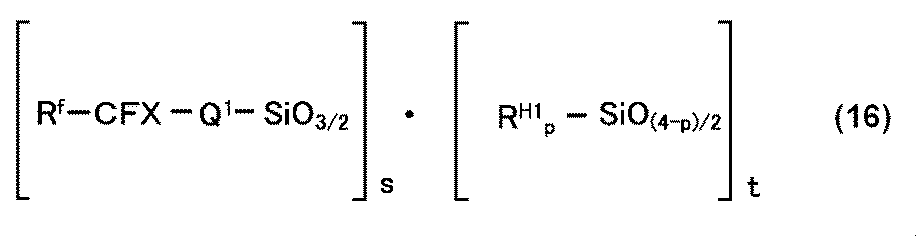
式(16)で表される平均組成式の構造を有する部分加水分解縮合物においては、シラン化合物(a7)およびシラン化合物(a8)にそれぞれ由来する単位は、ランダムに配列していると推測される。なお、シラン化合物(a7)およびシラン化合物(a8)を用いた場合の平均組成式(16)におけるs/t(モル比)は、撥インク剤(E2)全体の平均値として、加水分解性シラン化合物混合物におけるシラン化合物(a8)に対するシラン化合物(a7)の含有量として上述した範囲、すなわち10/1~90(モル比)が好ましく、10/5~90(モル比)が特に好ましい。
撥インク剤(E2)をシラン化合物(a7)、シラン化合物(a8)およびシラン化合物(a9)を用いて製造した部分加水分解縮合物は、式(16)にシラン化合物(a9)に由来する単位がさらに共縮合された平均組成式の構造を有するものとなる。
撥インク剤(E2)としては、下記シラン化合物の混合物の部分加水分解縮合物が好ましい。
(組み合わせ1)
シラン化合物(a7):2-(ペルフルオロヘキシル)エチルトリメトキシシランおよび2-(ペルフルオロブチル)エチルトリメトキシシランから選ばれる少なくとも1種、
シラン化合物(a8):テトラエトキシシランまたはテトラエトキシシランとメチルトリエトキシシラン。
(組み合わせ2)
シラン化合物(a7):2-(ペルフルオロヘキシル)エチルトリメトキシシランおよび2-(ペルフルオロブチル)エチルトリメトキシシランから選ばれる少なくとも1種、
シラン化合物(a8):テトラエトキシシランまたはテトラエトキシシランとメチルトリエトキシシラン、
1官能性のシラン化合物:ヘキサメチルジシロキサンまたはトリメチルメトキシシラン。
(組み合わせ3)
シラン化合物(a7):2-(ペルフルオロヘキシル)エチルトリメトキシシランおよび2-(ペルフルオロブチル)エチルトリメトキシシランから選ばれる少なくとも1種、
シラン化合物(a8):テトラエトキシシランまたはテトラエトキシシランとメチルトリエトキシシラン、
シラン化合物(a9):3-アクリロイルオキシプロピルトリメトキシシランまたは3-メタクリロイルオキシプロピルトリメトキシシラン。
(組み合わせ4)
シラン化合物(a7):2-(ペルフルオロヘキシル)エチルトリメトキシシランおよび2-(ペルフルオロブチル)エチルトリメトキシシランから選ばれる少なくとも1種、
シラン化合物(a8):テトラエトキシシランまたはテトラエトキシシランとメチルトリエトキシシラン、
シラン化合物(a9):3-アクリロイルオキシプロピルトリメトキシシランまたは3-メタクリロイルオキシプロピルトリメトキシシラン、
1官能性のシラン化合物:ヘキサメチルジシロキサンまたはトリメチルメトキシシラン。
(組み合わせ5)
シラン化合物(a7):2-(ペルフルオロヘキシル)エチルトリメトキシシランおよび2-(ペルフルオロブチル)エチルトリメトキシシランから選ばれる少なくとも1種、
シラン化合物(a8):テトラエトキシシランまたはテトラエトキシシランとメチルトリエトキシシラン、
シラン化合物(a9):3-グリシジルオキシプロピルトリメトキシシラン、
1官能性のシラン化合物:ヘキサメチルジシロキサンまたはトリメチルメトキシシラン。
(組み合わせ1)
シラン化合物(a7):2-(ペルフルオロヘキシル)エチルトリメトキシシランおよび2-(ペルフルオロブチル)エチルトリメトキシシランから選ばれる少なくとも1種、
シラン化合物(a8):テトラエトキシシランまたはテトラエトキシシランとメチルトリエトキシシラン。
(組み合わせ2)
シラン化合物(a7):2-(ペルフルオロヘキシル)エチルトリメトキシシランおよび2-(ペルフルオロブチル)エチルトリメトキシシランから選ばれる少なくとも1種、
シラン化合物(a8):テトラエトキシシランまたはテトラエトキシシランとメチルトリエトキシシラン、
1官能性のシラン化合物:ヘキサメチルジシロキサンまたはトリメチルメトキシシラン。
(組み合わせ3)
シラン化合物(a7):2-(ペルフルオロヘキシル)エチルトリメトキシシランおよび2-(ペルフルオロブチル)エチルトリメトキシシランから選ばれる少なくとも1種、
シラン化合物(a8):テトラエトキシシランまたはテトラエトキシシランとメチルトリエトキシシラン、
シラン化合物(a9):3-アクリロイルオキシプロピルトリメトキシシランまたは3-メタクリロイルオキシプロピルトリメトキシシラン。
(組み合わせ4)
シラン化合物(a7):2-(ペルフルオロヘキシル)エチルトリメトキシシランおよび2-(ペルフルオロブチル)エチルトリメトキシシランから選ばれる少なくとも1種、
シラン化合物(a8):テトラエトキシシランまたはテトラエトキシシランとメチルトリエトキシシラン、
シラン化合物(a9):3-アクリロイルオキシプロピルトリメトキシシランまたは3-メタクリロイルオキシプロピルトリメトキシシラン、
1官能性のシラン化合物:ヘキサメチルジシロキサンまたはトリメチルメトキシシラン。
(組み合わせ5)
シラン化合物(a7):2-(ペルフルオロヘキシル)エチルトリメトキシシランおよび2-(ペルフルオロブチル)エチルトリメトキシシランから選ばれる少なくとも1種、
シラン化合物(a8):テトラエトキシシランまたはテトラエトキシシランとメチルトリエトキシシラン、
シラン化合物(a9):3-グリシジルオキシプロピルトリメトキシシラン、
1官能性のシラン化合物:ヘキサメチルジシロキサンまたはトリメチルメトキシシラン。
本発明のネガ型感光性樹脂組成物における撥インク剤(E2)は、露光、硬化等の過程においては、含まれるシラノール基がさらに縮合し、紫外線/オゾン照射をしても優れた撥インク性を示す隔壁を形成するものと考えられる。
本発明のネガ型感光性樹脂組成物における撥インク剤(E2)の数平均分子量(Mn)は、500以上が好ましく、1,000,000未満が好ましく、10,000未満が特に好ましい。数平均分子量(Mn)が上記範囲の下限値以上であると、ネガ型感光性樹脂組成物を用いて隔壁を形成する際に、基板表面からの脱離を防止できる。数平均分子量(Mn)が上記範囲の上限値未満であると、溶媒への溶解性が良好で、作業性に優れる。撥インク剤(E2)の数平均分子量(Mn)は反応条件等を選択することにより調節できる。
(撥インク剤(E2)の製造)
本発明のネガ型感光性樹脂組成物における撥インク剤(E2)は、それが部分加水分解縮合物である場合、上述した加水分解性シラン化合物混合物を加水分解し、部分縮合させる(以下、「反応工程」ともいう。)ことで製造できる。加水分解および部分縮合は、上述の通り加水分解性基の加水分解反応によるシラノール基の生成と、シラノール基同士の脱水縮合反応によるシロキサン結合を生成する反応である。反応工程には、加水分解性シラン化合物を加水分解縮合させる反応に通常用いる反応条件を特に制限なく適用することができ、例えば、水、触媒、有機溶媒等を用いることができる。
本発明のネガ型感光性樹脂組成物における撥インク剤(E2)は、それが部分加水分解縮合物である場合、上述した加水分解性シラン化合物混合物を加水分解し、部分縮合させる(以下、「反応工程」ともいう。)ことで製造できる。加水分解および部分縮合は、上述の通り加水分解性基の加水分解反応によるシラノール基の生成と、シラノール基同士の脱水縮合反応によるシロキサン結合を生成する反応である。反応工程には、加水分解性シラン化合物を加水分解縮合させる反応に通常用いる反応条件を特に制限なく適用することができ、例えば、水、触媒、有機溶媒等を用いることができる。
反応工程において水を用いる場合、その量は、加水分解性シラン化合物混合物の100質量部に対して、25~9,900質量部が好ましく、100~1,900質量部が特に好ましい。水の量を上記範囲とすることで、加水分解および縮合反応の制御がし易くなる。
反応工程に用いる触媒としては、塩酸、硫酸、硝酸、リン酸等の無機酸、酢酸、シュウ酸、マレイン酸等の有機酸を用いることが好ましい。
用いる触媒の量は、加水分解性シラン化合物混合物の100質量に対して0.01~10質量部が好ましく、0.1~1質量部が特に好ましい。
反応工程に用いる触媒としては、塩酸、硫酸、硝酸、リン酸等の無機酸、酢酸、シュウ酸、マレイン酸等の有機酸を用いることが好ましい。
用いる触媒の量は、加水分解性シラン化合物混合物の100質量に対して0.01~10質量部が好ましく、0.1~1質量部が特に好ましい。
上記反応工程には有機溶媒を用いてもよい。該有機溶媒としては、加水分解性シラン化合物を加水分解、縮合反応する際に、通常、用いる有機溶媒、具体的には、(撥インク剤(E1)の製造)で挙げた有機溶媒を使用できる。有機溶媒は1種を単独で用いても2種以上を併用してもよい。
反応工程において、有機溶媒の量は、加水分解性シラン化合物混合物の100質量部に対して、25~9,900質量部が好ましく、100~1,900質量部が特に好ましい。
反応工程において、有機溶媒の量は、加水分解性シラン化合物混合物の100質量部に対して、25~9,900質量部が好ましく、100~1,900質量部が特に好ましい。
得られる部分加水分解縮合物は、反応工程で用いた溶媒と共にネガ型感光性樹脂組成物に配合される。したがって、反応工程に用いる溶媒としては、撥インク剤(E2)中のシラノール基を安定化する溶媒を用いることが好ましい。シラノール基を安定化する溶媒としては、水酸基を有し、25℃における比誘電率(ε)が5~20の範囲の化合物が挙げられる。
具体的には、炭素原子数2~8個のグリコール系のモノアルキルエーテルアセテート溶媒、グリコール系のモノアルキルエーテル溶媒、グライム系溶媒、炭素原子数2~4個の炭化水素系アルコール等が挙げられる。より具体的には、グリコール系のモノアルキルエーテルアセテート溶媒として、プロピレングリコールモノメチルエーテルアセテート(ε:8.3)、グリコール系のモノアルキルエーテル溶媒としてプロピレングリコールモノメチルエーテル(ε:12.3)、炭化水素系アルコールとして、2-プロパノール(ε:19.92)等が挙げられる。プロピレングリコールモノメチルエーテルは、シラノール基の安定化効果が高い点で特に好ましい。
反応工程は、室温から溶媒の沸点までの温度で、適当な撹拌条件の下で実施することが好ましい。反応時間は、用いる原料成分の量、反応温度、撹拌条件等にもよるが、概ね0.5~24時間、好ましくは1~10時間である。
反応終了後、得られた撥インク剤(E2)を、有機溶媒を除去することなく、本発明のネガ型感光性樹脂組成物中に含ませることもできる。通常の方法により有機溶媒を除去してから撥インク剤(E2)を単離した後、ネガ型感光性樹脂組成物中に含ませてもよい。
反応終了後、得られた撥インク剤(E2)を、有機溶媒を除去することなく、本発明のネガ型感光性樹脂組成物中に含ませることもできる。通常の方法により有機溶媒を除去してから撥インク剤(E2)を単離した後、ネガ型感光性樹脂組成物中に含ませてもよい。
ネガ型感光性樹脂組成物における全固形分中の撥インク剤(E)の含有割合は、0.01~30質量%が好ましく、0.05~20質量%が特に好ましい。含有割合が上記範囲の下限値以上であると、ネガ型用の化合物より形成される隔壁の表面張力を低減でき、撥インク性に優れた隔壁が得られる。上記範囲の上限値以下であると、隔壁と基材との密着性が良好になる。
撥インク剤(E)として撥インク剤(E1)を用いる場合には、その含有量は、0.1~10質量%がより好ましく、0.l~5質量%が特に好ましい。撥インク剤(E)の含有割合を上記範囲の下限値以上であると、形成される隔壁の表面張力を下げる効果に優れ、撥インク性に優れた隔壁が得られる。上記範囲の上限値以下であると、隔壁と基材との密着性が良好になる。
撥インク剤(E)として撥インク剤(E2)を用いる場合には、その含有量は、0.1~10質量%がより好ましく、0.l~5質量%が特に好ましい。撥インク剤(E2)の含有量が上記範囲であると、ネガ型感光性樹脂組成物の貯蔵安定性に優れ、また該ネガ型感光性樹脂組成物から得られる光学素子の隔壁は撥インク性に優れ、滑らかな表面を有する。
撥インク剤(E)として撥インク剤(E1)を用いる場合には、その含有量は、0.1~10質量%がより好ましく、0.l~5質量%が特に好ましい。撥インク剤(E)の含有割合を上記範囲の下限値以上であると、形成される隔壁の表面張力を下げる効果に優れ、撥インク性に優れた隔壁が得られる。上記範囲の上限値以下であると、隔壁と基材との密着性が良好になる。
撥インク剤(E)として撥インク剤(E2)を用いる場合には、その含有量は、0.1~10質量%がより好ましく、0.l~5質量%が特に好ましい。撥インク剤(E2)の含有量が上記範囲であると、ネガ型感光性樹脂組成物の貯蔵安定性に優れ、また該ネガ型感光性樹脂組成物から得られる光学素子の隔壁は撥インク性に優れ、滑らかな表面を有する。
本発明における撥インク剤(E)は、基(1)を有する側鎖と基(2)を有する側鎖の両方を1分子中に有していてもよい。また本発明のネガ型感光性樹脂組成物は、基(1)を有する側鎖を有する撥インク剤(E)と、基(2)を有する側鎖を有する撥インク剤(E)の両方を含んでいてもよい。これらの場合、ネガ型感光性樹脂組成物から得られる隔壁は、高い撥インク性とドット(表示部)へのインク転落性を発現できる。
[溶媒(F)]
本発明のネガ型感光性樹脂組成物は、必要に応じて溶媒(F)を含有する。ネガ型感光性樹脂組成物が溶媒(F)を含むと、ネガ型感光性樹脂組成物の粘度が低減するため、ネガ型感光性樹脂組成物の基材上への塗布がしやすい。よって、均一なネガ型感光性樹脂組成物の塗膜が形成できる。なお、ネガ型感光性樹脂組成物が溶媒(F)を含まない場合には、ネガ型感光性樹脂組成物の塗膜が、ネガ型感光性樹脂組成物の膜と同じものとなる。
本発明のネガ型感光性樹脂組成物は、必要に応じて溶媒(F)を含有する。ネガ型感光性樹脂組成物が溶媒(F)を含むと、ネガ型感光性樹脂組成物の粘度が低減するため、ネガ型感光性樹脂組成物の基材上への塗布がしやすい。よって、均一なネガ型感光性樹脂組成物の塗膜が形成できる。なお、ネガ型感光性樹脂組成物が溶媒(F)を含まない場合には、ネガ型感光性樹脂組成物の塗膜が、ネガ型感光性樹脂組成物の膜と同じものとなる。
本発明のネガ型感光性樹脂組成物が含有する溶媒(F)は、ネガ型感光性樹脂組成物が含有する上記アルカリ可溶性樹脂(A)、黒色着色剤(B)、光重合開始剤(C1)および光重合開始剤(C2)、必要に応じて架橋剤(D)、撥インク剤(E)、後述の熱硬化剤(I)、さらには後述する任意成分を均一に溶解または分散させて、隔壁が形成される基材へのネガ型感光性樹脂組成物の塗布を均一で簡便にする機能を有し、かつこれら成分との反応性を有しないものであれば特に制限されない。例えば、撥インク剤(E1)および撥インク剤(E2)の合成時に使用した溶媒と同様の溶媒が使用できる。その他には、n-ブタン、n-ヘキサン等の鎖式炭化水素、シクロヘキサン等の環式飽和炭化水素、トルエン、キシレン、ベンジルアルコール等の芳香族炭化水素等が挙げられる。これらは1種を用いても2種以上を併用してもよい。
ネガ型感光性樹脂組成物に含まれる溶媒(F)の含有割合は、ネガ型感光性樹脂組成物の組成や用途等により異なるが、ネガ型感光性樹脂組成物中、50~99質量%で配合されるのが好ましく、60~95質量%がより好ましく、65~90質量%が特に好ましい。
[微粒子(G)]
ネガ型感光性樹脂組成物は、必要に応じて、微粒子(G)を含んでいてもよい。ネガ型感光性樹脂組成物が微粒子(G)を含むことにより、ネガ型感光性樹脂組成物から得られる隔壁は、熱垂れが防止された、耐熱性に優れる隔壁となる。
微粒子(G)としては、各種の無機系、有機系の微粒子が使用可能であるが、塩基性高分子分散剤の吸着能の点から、マイナスに帯電しているものが好ましく用いられる。
ネガ型感光性樹脂組成物は、必要に応じて、微粒子(G)を含んでいてもよい。ネガ型感光性樹脂組成物が微粒子(G)を含むことにより、ネガ型感光性樹脂組成物から得られる隔壁は、熱垂れが防止された、耐熱性に優れる隔壁となる。
微粒子(G)としては、各種の無機系、有機系の微粒子が使用可能であるが、塩基性高分子分散剤の吸着能の点から、マイナスに帯電しているものが好ましく用いられる。
無機系としては、シリカ、ジルコニア、フッ化マグネシウム、スズドープ酸化インジウム(ITO)、アンチモンドープ酸化スズ(ATO)等が挙げられる。
有機系としては、ポリエチレン、ポリメチルメタクリレート(PMMA)等が挙げられる。耐熱性を考慮すると、無機系微粒子が好ましく、入手容易性や分散安定性を考慮すると、シリカ、またはジルコニアが特に好ましい。さらに、ネガ型感光性樹脂組成物の露光感度を考慮すると、微粒子(G)は、露光時に照射される光を吸収しないことが好ましく、超高圧水銀灯の主な発光波長であるi線(365nm)、h線(405nm)、およびg線(436nm)を吸収しないことが特に好ましい。
微粒子(G)の粒子径は、隔壁の表面平滑性が良好となることから、平均粒子径が1μm以下であることが好ましく、200nm以下が特に好ましい。
有機系としては、ポリエチレン、ポリメチルメタクリレート(PMMA)等が挙げられる。耐熱性を考慮すると、無機系微粒子が好ましく、入手容易性や分散安定性を考慮すると、シリカ、またはジルコニアが特に好ましい。さらに、ネガ型感光性樹脂組成物の露光感度を考慮すると、微粒子(G)は、露光時に照射される光を吸収しないことが好ましく、超高圧水銀灯の主な発光波長であるi線(365nm)、h線(405nm)、およびg線(436nm)を吸収しないことが特に好ましい。
微粒子(G)の粒子径は、隔壁の表面平滑性が良好となることから、平均粒子径が1μm以下であることが好ましく、200nm以下が特に好ましい。
ネガ型感光性樹脂組成物における全固形分中の微粒子(G)の含有割合は、3~20質量%が好ましく、5~15質量%がより好ましく、7~10質量%が特に好ましい。含有割合が上記範囲の下限値以上であると、ポストベークによる撥インク性の低下抑制効果があり、上記範囲の上限値以下であると、ネガ型感光性樹脂組成物の液の安定性が良好になる。
[シランカップリング剤(H)]
ネガ型感光性樹脂組成物は、必要に応じて、シランカップリング剤(H)を含んでいてもよい。ネガ型感光性樹脂組成物がシランカップリング剤(H)を含むことで、ネガ型感光性樹脂組成物から形成される硬化膜の基材密着性を向上させることができる。
シランカップリング剤(H)の具体例としては、テトラエトキシシラン、3-グリシドキシプロピルトリメトキシシラン、メチルトリメトキシシラン、ビニルトリメトキシシラン、3-メタクリロイルオキシプロピルトリメトキシシラン、3-クロロプロピルトリメトキシシラン、3-メルカプトプロピルトリメトキシシラン、ヘプタデカフルオロオクチルエチルトリメトキシシラン、ポリオキシアルキレン鎖含有トリエトキシシラン、イミダゾールシラン等が挙げられる。これらは1種を用いても2種以上を併用してもよい。
ネガ型感光性樹脂組成物は、必要に応じて、シランカップリング剤(H)を含んでいてもよい。ネガ型感光性樹脂組成物がシランカップリング剤(H)を含むことで、ネガ型感光性樹脂組成物から形成される硬化膜の基材密着性を向上させることができる。
シランカップリング剤(H)の具体例としては、テトラエトキシシラン、3-グリシドキシプロピルトリメトキシシラン、メチルトリメトキシシラン、ビニルトリメトキシシラン、3-メタクリロイルオキシプロピルトリメトキシシラン、3-クロロプロピルトリメトキシシラン、3-メルカプトプロピルトリメトキシシラン、ヘプタデカフルオロオクチルエチルトリメトキシシラン、ポリオキシアルキレン鎖含有トリエトキシシラン、イミダゾールシラン等が挙げられる。これらは1種を用いても2種以上を併用してもよい。
ネガ型感光性樹脂組成物における全固形分中のシランカップリング剤(H)の含有割合は、0.1~20質量%が好ましく、1~10質量%が特に好ましい。上記範囲の下限値以上であると、ネガ型感光性樹脂組成物から形成される硬化膜の基材密着性が向上し、上記範囲の上限値以下であると、撥インク性が良好である。
[熱硬化剤(I)]
ネガ型感光性樹脂組成物は、必要に応じて、熱硬化剤(I)を含んでいてもよい。ネガ型感光性樹脂組成物が熱硬化剤(I)を含むことで、隔壁の耐熱性および耐透水性を向上させることができる。
熱硬化剤(I)としては、アミノ樹脂、2個以上のエポキシ基を有する化合物、2個以上のヒドラジノ基を有する化合物、ポリカルボジイミド化合物、2個以上のオキサゾリン基を有する化合物、2個以上のアジリジン基を有する化合物、多価金属類、2個以上のメルカプト基を有する化合物、ポリイソシアネート化合物等が挙げられる。中でも、形成された隔壁の耐薬品性が向上する点から、アミノ樹脂、2個以上のエポキシ基を有する化合物または2個以上のオキサゾリン基を有する化合物が特に好ましい。
ネガ型感光性樹脂組成物は、必要に応じて、熱硬化剤(I)を含んでいてもよい。ネガ型感光性樹脂組成物が熱硬化剤(I)を含むことで、隔壁の耐熱性および耐透水性を向上させることができる。
熱硬化剤(I)としては、アミノ樹脂、2個以上のエポキシ基を有する化合物、2個以上のヒドラジノ基を有する化合物、ポリカルボジイミド化合物、2個以上のオキサゾリン基を有する化合物、2個以上のアジリジン基を有する化合物、多価金属類、2個以上のメルカプト基を有する化合物、ポリイソシアネート化合物等が挙げられる。中でも、形成された隔壁の耐薬品性が向上する点から、アミノ樹脂、2個以上のエポキシ基を有する化合物または2個以上のオキサゾリン基を有する化合物が特に好ましい。
ネガ型感光性樹脂組成物における全固形分中の熱硬化剤(I)の含有割合は、1~50質量%が好ましく、1~30質量%が特に好ましい。上記範囲であると、得られるネガ型感光性樹脂組成物の現像性が良好となる。
[リン酸化合物(J)]
ネガ型感光性樹脂組成物は、必要に応じて、リン酸化合物(J)を含んでいてもよい。ネガ型感光性樹脂組成物がリン酸化合物(J)を含むことで、基材との密着性を向上させることができる。
リン酸化合物しては、モノ(メタ)アクリロイルオキシエチルフォスフェート、ジ(メタ)アクリロイルオキシエチルフォスフェート、トリス(メタ)アクリロイルオキシエチルフォスフェート等が挙げられる。
ネガ型感光性樹脂組成物は、必要に応じて、リン酸化合物(J)を含んでいてもよい。ネガ型感光性樹脂組成物がリン酸化合物(J)を含むことで、基材との密着性を向上させることができる。
リン酸化合物しては、モノ(メタ)アクリロイルオキシエチルフォスフェート、ジ(メタ)アクリロイルオキシエチルフォスフェート、トリス(メタ)アクリロイルオキシエチルフォスフェート等が挙げられる。
ネガ型感光性樹脂組成物における全固形分中のリン酸化合物(J)の含有割合は、0.1~10質量%が好ましく、0.3~1質量%が特に好ましい。上記範囲であると、得られるネガ型感光性樹脂組成物から形成される硬化膜の基材との密着性が良好となる。
[その他の添加剤]
ネガ型感光性樹脂組成物は、さらに必要に応じて、硬化促進剤、増粘剤、可塑剤、消泡剤、レベリング剤、ハジキ防止剤、紫外線吸収剤等を使用することができる。
ネガ型感光性樹脂組成物は、さらに必要に応じて、硬化促進剤、増粘剤、可塑剤、消泡剤、レベリング剤、ハジキ防止剤、紫外線吸収剤等を使用することができる。
[ネガ型感光性樹脂組成物]
本発明のネガ型感光性樹脂組成物は、アルカリ可溶性樹脂(A)、黒色着色剤(B)、光重合開始剤(C1)および光重合開始剤(C2)を含有する。さらに、必要に応じて、架橋剤(D)、撥インク剤(E)、溶媒(F)および熱硬化剤(I)を含有する。さらに、上記の微粒子(G)、シランカップリング剤(H)、リン酸化合物(J)およびその他の添加剤を含有してもよい。
ネガ型感光性樹脂組成物は、通常のネガ型感光性樹脂組成物と同様にフォトリソグラフィ等の材料として用いられ、得られた硬化膜は、通常のネガ型感光性樹脂組成物の硬化膜が用いられる光学素子の部材として、使用することが可能である。
本発明のネガ型感光性樹脂組成物は、アルカリ可溶性樹脂(A)、黒色着色剤(B)、光重合開始剤(C1)および光重合開始剤(C2)を含有する。さらに、必要に応じて、架橋剤(D)、撥インク剤(E)、溶媒(F)および熱硬化剤(I)を含有する。さらに、上記の微粒子(G)、シランカップリング剤(H)、リン酸化合物(J)およびその他の添加剤を含有してもよい。
ネガ型感光性樹脂組成物は、通常のネガ型感光性樹脂組成物と同様にフォトリソグラフィ等の材料として用いられ、得られた硬化膜は、通常のネガ型感光性樹脂組成物の硬化膜が用いられる光学素子の部材として、使用することが可能である。
(ネガ型感光性樹脂組成物の好ましい組み合わせ)
本発明のネガ型感光性樹脂組成物は、用途や要求特性に合わせて組成と配合比を選択することが好ましい。
本発明のネガ型感光性樹脂組成物における各種配合成分の好ましい組成を以下に示す。
アルカリ可溶性樹脂(A):ビスフェノールA型エポキシ樹脂に酸性基とエチレン性二重結合とを導入した樹脂、ビスフェノールF型エポキシ樹脂に酸性基とエチレン性二重結合とを導入した樹脂、フェノールノボラック型エポキシ樹脂に酸性基とエチレン性二重結合とを導入した樹脂、クレゾールノボラック型エポキシ樹脂に酸性基とエチレン性二重結合とを導入した樹脂、トリスフェノールメタン型エポキシ樹脂に酸性基とエチレン性二重結合とを導入した樹脂、および上記式(A1-2a)~(A1-2c)で表されるエポキシ樹脂に酸性基とエチレン性二重結合とを導入した樹脂からなる群から選ばれる少なくとも1つの樹脂であって、ネガ型感光性樹脂組成物における全固形分中に10~60質量%、
本発明のネガ型感光性樹脂組成物は、用途や要求特性に合わせて組成と配合比を選択することが好ましい。
本発明のネガ型感光性樹脂組成物における各種配合成分の好ましい組成を以下に示す。
アルカリ可溶性樹脂(A):ビスフェノールA型エポキシ樹脂に酸性基とエチレン性二重結合とを導入した樹脂、ビスフェノールF型エポキシ樹脂に酸性基とエチレン性二重結合とを導入した樹脂、フェノールノボラック型エポキシ樹脂に酸性基とエチレン性二重結合とを導入した樹脂、クレゾールノボラック型エポキシ樹脂に酸性基とエチレン性二重結合とを導入した樹脂、トリスフェノールメタン型エポキシ樹脂に酸性基とエチレン性二重結合とを導入した樹脂、および上記式(A1-2a)~(A1-2c)で表されるエポキシ樹脂に酸性基とエチレン性二重結合とを導入した樹脂からなる群から選ばれる少なくとも1つの樹脂であって、ネガ型感光性樹脂組成物における全固形分中に10~60質量%、
黒色着色剤(B):カーボンブラック、および有機顔料からなる群から選ばれる少なくとも1つの着色剤であって、ネガ型感光性樹脂組成物における全固形分中に20~65質量%、
光重合開始剤(C1):式(3)で表されるO-アシルオキシム系化合物であって、ネガ型感光性樹脂組成物における全固形分中に0.1~5質量%、
光重合開始剤(C2):式(4)で表されるO-アシルオキシム系化合物であって、ネガ型感光性樹脂組成物における全固形分中に3~7質量%(全固形分量に対する光重合開始剤(C1)と光重合開始剤(C2)の合計含有量の割合が3.5~7.0質量%であり、かつ、該合計含有量に対する光重合開始剤(C1)の割合が5~15質量%)、
架橋剤(D):1分子中に2つ以上のエチレン性二重結合を有し、酸性基を有しない化合物であって、ネガ型感光性樹脂組成物における全固形分中に2~15質量%、
撥インク剤(E):1分子中に式(1)で表される基を有する側鎖と、エチレン性二重結合を有する側鎖とを有する化合物から選ばれる少なくとも1つの撥インク剤であって、ネガ型感光性樹脂組成物における全固形分中に0.01~30質量%、
光重合開始剤(C1):式(3)で表されるO-アシルオキシム系化合物であって、ネガ型感光性樹脂組成物における全固形分中に0.1~5質量%、
光重合開始剤(C2):式(4)で表されるO-アシルオキシム系化合物であって、ネガ型感光性樹脂組成物における全固形分中に3~7質量%(全固形分量に対する光重合開始剤(C1)と光重合開始剤(C2)の合計含有量の割合が3.5~7.0質量%であり、かつ、該合計含有量に対する光重合開始剤(C1)の割合が5~15質量%)、
架橋剤(D):1分子中に2つ以上のエチレン性二重結合を有し、酸性基を有しない化合物であって、ネガ型感光性樹脂組成物における全固形分中に2~15質量%、
撥インク剤(E):1分子中に式(1)で表される基を有する側鎖と、エチレン性二重結合を有する側鎖とを有する化合物から選ばれる少なくとも1つの撥インク剤であって、ネガ型感光性樹脂組成物における全固形分中に0.01~30質量%、
溶媒(F):水、2-プロパノール、プロピレングリコールモノメチルエーテル、プロピレングリコールモノメチルエーテルアセテート、3-メトキシブチルアセテート、ジエチレングリコールエチルメチルエーテル、ブチルアセテート、4-ブチロラクトン、およびシクロヘキサノンからなる群から選ばれる少なくとも1つの溶媒であって、ネガ型感光性樹脂組成物中、50~99質量%、
熱硬化剤(I):1分子中に2つ以上のエポキシ基を有する化合物であって、ネガ型感光性樹脂組成物における全固形分中に1~30質量%。
熱硬化剤(I):1分子中に2つ以上のエポキシ基を有する化合物であって、ネガ型感光性樹脂組成物における全固形分中に1~30質量%。
[光学素子用隔壁およびその製造方法]
本発明の隔壁は、基板上に区画を設けるために形成される隔壁であって、上記のネガ型感光性樹脂組成物の硬化膜からなる。
本発明の隔壁は、光学素子の用途に好適に用いられ、上記のネガ型感光性樹脂組成物が黒色着色剤(B)を含有することから、得られる隔壁はブラックマトリックスとしての適用が可能である。
本発明の隔壁は、例えば、基板上に複数の画素と隣接する画素間に位置する隔壁とを有する光学素子用の隔壁に適用される。
本発明の隔壁は、基板上に区画を設けるために形成される隔壁であって、上記のネガ型感光性樹脂組成物の硬化膜からなる。
本発明の隔壁は、光学素子の用途に好適に用いられ、上記のネガ型感光性樹脂組成物が黒色着色剤(B)を含有することから、得られる隔壁はブラックマトリックスとしての適用が可能である。
本発明の隔壁は、例えば、基板上に複数の画素と隣接する画素間に位置する隔壁とを有する光学素子用の隔壁に適用される。
本発明のネガ型感光性樹脂組成物を用いれば、マスクパターンに近い微細ラインに隔壁を形成することができ、同時に、隔壁にコンタクトホールが必要な場合には、微小なコンタクトホールの形成が可能である。さらに、ネガ型感光性樹脂組成物が撥インク剤(E)を含有する場合には、充分な撥インク性の付与も同時に達成できる。
本発明のネガ型感光性樹脂組成物を用いて光学素子用の隔壁(ブラックマトリックス)を製造する方法としては、例えば、以下の方法が挙げられる。
本発明のネガ型感光性樹脂組成物を用いて光学素子用の隔壁(ブラックマトリックス)を製造する方法としては、例えば、以下の方法が挙げられる。
本発明の光学素子用の隔壁(ブラックマトリックス)は、本発明のネガ型感光性樹脂組成物を基板上に塗布して塗膜を形成し(塗膜形成工程)、次いで、該塗膜を乾燥して膜とし(乾燥工程)、次いで、該膜の隔壁となる部分のみを露光して光硬化させ(露光工程)、次いで、該光硬化した部分以外の塗膜を除去して上記塗膜の光硬化部分からなる隔壁を形成させ(現像工程)、次いで、必要に応じて上記形成された隔壁等をさらに熱硬化させる(ポストベーク工程)ことにより製造できる。また、現像工程とポストベーク工程の間に、形成された隔壁等をさらに光硬化させる工程(ポスト露光工程)を入れてもよい。
本発明で用いる基板の材質は特に限定されるものではないが、各種ガラス板;ポリエステル(ポリエチレンテレフタレート等)、ポリオレフィン(ポリエチレン、ポリプロピレン等)、ポリカーボネート、ポリメチルメタクリレート、ポリスルホン、ポリイミド、ポリ(メタ)アクリル樹脂等の熱可塑性プラスチックシート;エポキシ樹脂、不飽和ポリエステル等の熱硬化性樹脂の硬化シート等を使用できる。特に、耐熱性の点からガラス板、ポリイミド等の耐熱性プラスチックが好ましい。また、ポスト露光を、隔壁が形成されていない裏面(基板側)から行うこともあるため、透明基板であることが好ましい。
基板のネガ型感光性樹脂組成物の塗布面は、塗布前に予めアルコール洗浄、紫外線/オゾン洗浄等で洗浄することが好ましい。
また、BOA型のカラーフィルタのように隔壁(ブラックマトリックス)をTFTアレイ基板上に形成する場合には、基板上に予めTFTアレイ等の所定の部材が形成されたものを準備してもよい。
基板のネガ型感光性樹脂組成物の塗布面は、塗布前に予めアルコール洗浄、紫外線/オゾン洗浄等で洗浄することが好ましい。
また、BOA型のカラーフィルタのように隔壁(ブラックマトリックス)をTFTアレイ基板上に形成する場合には、基板上に予めTFTアレイ等の所定の部材が形成されたものを準備してもよい。
(塗膜形成工程)
塗布方法としては、膜厚が均一な塗膜が形成される方法であれば特に制限されず、スピンコート法、スプレー法、スリットコート法、ロールコート法、回転塗布法、バー塗布法等、通常の塗膜形成に用いられる方法が挙げられる。
塗膜の膜厚は、最終的に得られる隔壁の高さとネガ型感光性樹脂組成物の固形分濃度を勘案して決められる。塗膜の膜厚は、最終的に得られる隔壁の高さの500~2,000%が好ましく、550~1,000%が特に好ましい。塗膜の膜厚は0.3~100μmが好ましく、1~50μmが特に好ましい。
塗布方法としては、膜厚が均一な塗膜が形成される方法であれば特に制限されず、スピンコート法、スプレー法、スリットコート法、ロールコート法、回転塗布法、バー塗布法等、通常の塗膜形成に用いられる方法が挙げられる。
塗膜の膜厚は、最終的に得られる隔壁の高さとネガ型感光性樹脂組成物の固形分濃度を勘案して決められる。塗膜の膜厚は、最終的に得られる隔壁の高さの500~2,000%が好ましく、550~1,000%が特に好ましい。塗膜の膜厚は0.3~100μmが好ましく、1~50μmが特に好ましい。
(乾燥工程)
上記塗膜形成工程で基板上に形成された塗膜を乾燥し、膜を得る。乾燥によって、塗膜を構成するネガ型感光性樹脂組成物に含まれる溶媒を含む揮発成分が揮発、除去され、粘着性のない膜が得られる。また、ネガ型感光性樹脂組成物が撥インク剤(E)を含有する場合には、該撥インク剤(E)が塗膜表面近傍に移行する。
乾燥は、真空乾燥や加熱乾燥(プリベーク)による方法が好ましい。また、塗膜外観のムラを発生させず、効率よく乾燥させるために、真空乾燥と加熱乾燥を併用することがより好ましい。
真空乾燥の条件は、各成分の種類、配合割合等によっても異なるが、500~10Paで10~300秒間行うことが好ましい。
加熱乾燥は、基板とともに塗膜をホットプレート、オーブン等の加熱装置により、50~120℃で10~2,000秒間行うことが好ましい。
上記塗膜形成工程で基板上に形成された塗膜を乾燥し、膜を得る。乾燥によって、塗膜を構成するネガ型感光性樹脂組成物に含まれる溶媒を含む揮発成分が揮発、除去され、粘着性のない膜が得られる。また、ネガ型感光性樹脂組成物が撥インク剤(E)を含有する場合には、該撥インク剤(E)が塗膜表面近傍に移行する。
乾燥は、真空乾燥や加熱乾燥(プリベーク)による方法が好ましい。また、塗膜外観のムラを発生させず、効率よく乾燥させるために、真空乾燥と加熱乾燥を併用することがより好ましい。
真空乾燥の条件は、各成分の種類、配合割合等によっても異なるが、500~10Paで10~300秒間行うことが好ましい。
加熱乾燥は、基板とともに塗膜をホットプレート、オーブン等の加熱装置により、50~120℃で10~2,000秒間行うことが好ましい。
(露光工程)
得られた膜の一部に所定パターンのマスクを介して露光を行う。露光部のネガ型感光性樹脂組成物は硬化し、未露光部のネガ型感光性樹脂組成物は硬化しない。照射する光としては、可視光、紫外線、遠紫外線、KrFエキシマレーザ、ArFエキシマレーザ、F2エキシマレーザ、Kr2エキシマレーザ、KrArエキシマレーザ、Ar2エキシマレーザ等のエキシマレーザ、X線、電子線等が挙げられる。波長100~600nmの光線が好ましく、300~500nmの範囲に分布を有する電磁波がより好ましく、i線(365nm)、h線(405nm)およびg線(436nm)が特に好ましい。
照射装置としては、公知の超高圧水銀灯等を用いることができる。露光量は、5~1,000mJ/cm2が好ましく、50~400mJ/cm2が特に好ましい。露光量が上記範囲の下限値以上であると、隔壁の硬化が充分になされ、好ましい。上記範囲の上限値以下であると、高い解像度が得られる。
得られた膜の一部に所定パターンのマスクを介して露光を行う。露光部のネガ型感光性樹脂組成物は硬化し、未露光部のネガ型感光性樹脂組成物は硬化しない。照射する光としては、可視光、紫外線、遠紫外線、KrFエキシマレーザ、ArFエキシマレーザ、F2エキシマレーザ、Kr2エキシマレーザ、KrArエキシマレーザ、Ar2エキシマレーザ等のエキシマレーザ、X線、電子線等が挙げられる。波長100~600nmの光線が好ましく、300~500nmの範囲に分布を有する電磁波がより好ましく、i線(365nm)、h線(405nm)およびg線(436nm)が特に好ましい。
照射装置としては、公知の超高圧水銀灯等を用いることができる。露光量は、5~1,000mJ/cm2が好ましく、50~400mJ/cm2が特に好ましい。露光量が上記範囲の下限値以上であると、隔壁の硬化が充分になされ、好ましい。上記範囲の上限値以下であると、高い解像度が得られる。
(現像工程)
現像液により現像し、未露光部分のネガ型感光性樹脂組成物を除去する。現像液としては、無機アルカリ類、アミン類、アルコールアミン類、第4級アンモニウム塩等のアルカリ類を含むアルカリ水溶液を用いることができる。また現像液には、溶解性の向上や残渣除去のために、界面活性剤やアルコール等の有機溶媒を添加することができる。
現像時間(現像液に接触させる時間)は、5~180秒間が好ましい。また現像方法は液盛り法、ディッピング法、シャワー法等が挙げられる。現像後、高圧水洗や流水洗浄を行い、圧縮空気や圧縮窒素で風乾させることによって、基板上の水分を除去できる。
現像液により現像し、未露光部分のネガ型感光性樹脂組成物を除去する。現像液としては、無機アルカリ類、アミン類、アルコールアミン類、第4級アンモニウム塩等のアルカリ類を含むアルカリ水溶液を用いることができる。また現像液には、溶解性の向上や残渣除去のために、界面活性剤やアルコール等の有機溶媒を添加することができる。
現像時間(現像液に接触させる時間)は、5~180秒間が好ましい。また現像方法は液盛り法、ディッピング法、シャワー法等が挙げられる。現像後、高圧水洗や流水洗浄を行い、圧縮空気や圧縮窒素で風乾させることによって、基板上の水分を除去できる。
(ポスト露光工程)
次に、必要に応じてポスト露光を行ってもよい。ポスト露光は隔壁が形成されている表面、または隔壁が形成されていない裏面(基板側)のいずれから行ってもよい。また、表裏両面から露光してもよい。好ましい露光量としては、50mJ/cm2以上であり、200mJ/cm2以上がより好ましく、1,000mJ/cm2以上がさらに好ましく、2,000mJ/cm2以上が特に好ましい。また、露光量の上限値は10,000mJ/cm2が好ましい。
次に、必要に応じてポスト露光を行ってもよい。ポスト露光は隔壁が形成されている表面、または隔壁が形成されていない裏面(基板側)のいずれから行ってもよい。また、表裏両面から露光してもよい。好ましい露光量としては、50mJ/cm2以上であり、200mJ/cm2以上がより好ましく、1,000mJ/cm2以上がさらに好ましく、2,000mJ/cm2以上が特に好ましい。また、露光量の上限値は10,000mJ/cm2が好ましい。
照射する光としては、紫外線が好ましく、光源として、公知の超高圧水銀灯または高圧水銀灯等を用いることができる。これらの光源は隔壁の硬化に寄与する600nm以下の光を発光し、かつ、隔壁の酸化分解の原因となる200nm以下の光の発光が少ないため、好ましく用いられる。さらに、水銀灯に用いられている石英管ガラスが200nm以下の光をカットする光学フィルタ機能を有することで、光源として水銀灯が好ましく用いられる。
光源としては、低圧水銀灯を用いることもできる。ただし、低圧水銀灯は200nm以下の波長の発光強度も高く、オゾンの生成により隔壁の酸化分解が起こり易いため、多量の露光を行うことは好ましくない。露光量は500mJ/cm2以下であることが好ましく、300mJ/cm2以下が特に好ましい。
(ポストベーク工程)
さらに、隔壁を加熱することが好ましい。ホットプレート、オーブンなどの加熱装置により、5~90分間加熱処理をすることによって、隔壁および隔壁で区分された領域(ドット)とからなるパターンが形成される。
加熱温度は150~250℃が好ましく、180~250℃が特に好ましい。加熱温度が上記範囲の下限値以上であると、隔壁の硬化が充分であり、充分な耐薬品性が得られ、その後のインクジェット塗布工程でインクを塗布した場合に、そのインクに含まれる溶媒により隔壁が膨潤したり、インクが滲んでしまうことがない。上記範囲の上限値以下であると、隔壁の熱分解が生じにくい。
さらに、隔壁を加熱することが好ましい。ホットプレート、オーブンなどの加熱装置により、5~90分間加熱処理をすることによって、隔壁および隔壁で区分された領域(ドット)とからなるパターンが形成される。
加熱温度は150~250℃が好ましく、180~250℃が特に好ましい。加熱温度が上記範囲の下限値以上であると、隔壁の硬化が充分であり、充分な耐薬品性が得られ、その後のインクジェット塗布工程でインクを塗布した場合に、そのインクに含まれる溶媒により隔壁が膨潤したり、インクが滲んでしまうことがない。上記範囲の上限値以下であると、隔壁の熱分解が生じにくい。
本発明のネガ型感光性樹脂組成物から形成されるパターンは、隔壁の幅の平均が、100μm以下であることが好ましく、20μm以下であることが特に好ましい。また、隣接する隔壁間の距離(ドットの幅)の平均が、300μm以下であることが好ましく、100μm以下であることが特に好ましい。また、隔壁の高さの平均が、0.05~50μmであることが好ましく、0.2~10μmであることが特に好ましい。
本発明の隔壁(ブラックマトリックス)を、カラーフィルタがTFTアレイ基板上に配置された、いわゆるBOA型のカラーフィルタに適用する場合、TFT等のスイッチング素子と画素電極を接続するために、隔壁(ブラックマトリックス)に、その膜厚方向に貫通した貫通孔をコンタクトホールとして形成する必要がある。コンタクトホールの形成は、上記露光工程で用いる所定パターンのマスクをコンタクトホールが形成可能なパターンに作製することで、行われる。コンタクトホールの大きさは、用いる光学素子の種類や設計によるが、本発明のネガ型感光性樹脂組成物を用いれば、コンタクトホールとなる貫通孔において水平断面積が最大である断面の長径、すなわち最大孔径が20μm以下という微小なコンタクトホールの形成が可能である。したがって、本発明の隔壁(ブラックマトリックス)は、このような微小なコンタクトホールを必要とする光学素子用の隔壁(ブラックマトリックス)として好適である。
ここで、膜厚方向の貫通孔がコンタクトホールとして機能するために該貫通孔における水平方向の最小孔径は1μm以上であることが好ましく、2μm以上が特に好ましい。また、コンタクトホールを充分に微小なサイズとするためには、貫通孔の水平方向の最大孔径は20μm以下であることが好ましく、15μm以下が特に好ましい。
なお、ネガ型感光性樹脂組成物から形成される硬化膜の撥インク性は、PGMEA(プロピレングリコール-1-モノメチルエーテル-2-アセテート)の接触角で見積もることができる。PGMEAの接触角は30度以上が好ましく、35度以上が特に好ましい。上記範囲であると、インクジェット塗布液が隣接画素内に溢れ出ることによる混色を防ぐのに充分な撥インク性となる。
本発明の隔壁(ブラックマトリックス)が適用される光学素子としては、カラーフィルタ、有機EL表示素子等が挙げられる。特に、用いるマスクパターンに近い微細なラインパターンに隔壁を形成することができ、同時に、この微細な隔壁に微小なコンタクトホールを形成することが可能であることから、本発明のブラックマトリックスは、BOA型のカラーフィルタに好適に用いられる。
さらに、本発明はTFTアレイ基板上に本発明のカラーフィルタが形成された液晶表示素子を提供する。本発明のカラーフィルタは微細なラインパターンに微小なコンタクトホールが形成されたブラックマトリックスを採用していることから、このカラーフィルタをTFTアレイ基板上に有する液晶表示素子を用いれば、低消費電力と高輝度を両立した液晶表示装置が得られる。
さらに、本発明はTFTアレイ基板上に本発明のカラーフィルタが形成された液晶表示素子を提供する。本発明のカラーフィルタは微細なラインパターンに微小なコンタクトホールが形成されたブラックマトリックスを採用していることから、このカラーフィルタをTFTアレイ基板上に有する液晶表示素子を用いれば、低消費電力と高輝度を両立した液晶表示装置が得られる。
[カラーフィルタの製造方法]
上記のように隔壁(ブラックマトリックス)を形成した後、隔壁で区分された領域内に、インクジェット装置を用いてインクを注入(インクジェット法)して画素を形成することで、カラーフィルタを製造できる。
上記のように隔壁(ブラックマトリックス)を形成した後、隔壁で区分された領域内に、インクジェット装置を用いてインクを注入(インクジェット法)して画素を形成することで、カラーフィルタを製造できる。
なお、本発明のカラーフィルタをTFTアレイ基板上に形成する場合には、上記の通り、基板上に予め形成されたTFTアレイを具備する基板を用い、該基板上の所定位置に本発明の方法によってブラックマトリックスを形成した後、該基板上のブラックマトリックスで仕切られた領域にインクジェット法によりインクを注入して画素を形成すればよい。
また、上記ブラックマトリックスが形成されたTFTアレイを有する、または有しない基板においては、該ブラックマトリックスで仕切られた領域(ドット)内にインクを投入する前に、ドット内に露出した基板表面に、例えば、アルカリ水溶液による洗浄処理、UV洗浄処理、UVオゾン洗浄処理、エキシマ洗浄処理、コロナ放電処理、酸素プラズマ処理等の方法で親インク化処理が施されてもよい。
インクジェット装置としては、特に限定されるものではないが、帯電したインクを連続的に噴射し磁場によって制御する方法、圧電素子を用いて間欠的にインクを噴射する方法、インクを加熱しその発泡を利用して間欠的にインクを噴射する方法等の各種の方法を用いた装置を用いることができる。
画素の形状は、ストライプ型、モザイク型、トライアングル型、4画素配置型等の公知のいずれの配列とすることも可能である。なお、本発明のカラーフィルタをTFTアレイ基板上に形成する場合には、上記ブラックマトリックスは、この画素の形状とTFTアレイ基材上のTFTアレイの位置関係を考慮して設定された所定の位置に、所定の形状で形成される。
画素の形状は、ストライプ型、モザイク型、トライアングル型、4画素配置型等の公知のいずれの配列とすることも可能である。なお、本発明のカラーフィルタをTFTアレイ基板上に形成する場合には、上記ブラックマトリックスは、この画素の形状とTFTアレイ基材上のTFTアレイの位置関係を考慮して設定された所定の位置に、所定の形状で形成される。
インクは、主に着色成分とバインダー樹脂成分と溶剤とを含む。着色成分としては、耐熱性、耐光性等に優れた顔料および染料を用いることが好ましい。
バインダー樹脂成分としては、透明で耐熱性に優れた樹脂が好ましく、アクリル樹脂、メラミン樹脂、ウレタン樹脂等が挙げられる。水性のインクは、溶剤として水および必要に応じて水溶性有機溶媒を含み、バインダー樹脂成分として水溶性樹脂または水分散性樹脂を含み、必要に応じて各種助剤を含む。また、油性のインクは、溶剤として有機溶剤を含み、バインダー樹脂成分として有機溶剤に可溶な樹脂を含み、さらに必要に応じて各種助剤を含む。
なお、インクジェット法においては、上記インクジェット装置でドットにインクを注入した後、ドット内に形成されたインク層に対して、必要に応じて、乾燥、加熱硬化、紫外線硬化等の処理を行うことで画素が形成される。
バインダー樹脂成分としては、透明で耐熱性に優れた樹脂が好ましく、アクリル樹脂、メラミン樹脂、ウレタン樹脂等が挙げられる。水性のインクは、溶剤として水および必要に応じて水溶性有機溶媒を含み、バインダー樹脂成分として水溶性樹脂または水分散性樹脂を含み、必要に応じて各種助剤を含む。また、油性のインクは、溶剤として有機溶剤を含み、バインダー樹脂成分として有機溶剤に可溶な樹脂を含み、さらに必要に応じて各種助剤を含む。
なお、インクジェット法においては、上記インクジェット装置でドットにインクを注入した後、ドット内に形成されたインク層に対して、必要に応じて、乾燥、加熱硬化、紫外線硬化等の処理を行うことで画素が形成される。
画素形成後、必要に応じて、保護膜層を形成する。保護膜層は表面平坦性を上げる目的と隔壁や画素部のインクからの溶出物が液晶層に到達するのを遮断する目的で形成することが好ましい。
保護膜層を形成する場合は、事前に隔壁の撥インク性を除去することが好ましい。撥インク性を除去しない場合、オーバーコート用塗布液をはじき、均一な膜厚が得られないため好ましくない。隔壁の撥インク性を除去する方法としては、プラズマアッシング処理や光アッシング処理等が挙げられる。
さらに必要に応じて、カラーフィルタを用いて製造される液晶パネル等の高品位化のためにフォトスペーサを隔壁上に形成することが好ましい。
保護膜層を形成する場合は、事前に隔壁の撥インク性を除去することが好ましい。撥インク性を除去しない場合、オーバーコート用塗布液をはじき、均一な膜厚が得られないため好ましくない。隔壁の撥インク性を除去する方法としては、プラズマアッシング処理や光アッシング処理等が挙げられる。
さらに必要に応じて、カラーフィルタを用いて製造される液晶パネル等の高品位化のためにフォトスペーサを隔壁上に形成することが好ましい。
[有機EL表示素子の製造方法]
隔壁を形成する前に、ガラス等の透明基板にスズドープ酸化インジウム(ITO)等の透明電極をスパッタ法等によって製膜し、必要に応じて所望のパターンに透明電極をエッチングする。次に、本発明のネガ型感光性樹脂組成物を用いて隔壁を形成し、ドットの親インク化処理後、インクジェット法を用いてドットに正孔輸送材料、発光材料の溶液を順次塗布、乾燥して、正孔輸送層、発光層を形成する。その後アルミニウム等の電極を蒸着法等によって形成することによって、有機EL表示素子の画素が得られる。
隔壁を形成する前に、ガラス等の透明基板にスズドープ酸化インジウム(ITO)等の透明電極をスパッタ法等によって製膜し、必要に応じて所望のパターンに透明電極をエッチングする。次に、本発明のネガ型感光性樹脂組成物を用いて隔壁を形成し、ドットの親インク化処理後、インクジェット法を用いてドットに正孔輸送材料、発光材料の溶液を順次塗布、乾燥して、正孔輸送層、発光層を形成する。その後アルミニウム等の電極を蒸着法等によって形成することによって、有機EL表示素子の画素が得られる。
以下に実施例を用いて本発明をさらに詳しく説明するが、本発明はこれら実施例に限定して解釈されるものではない。なお、例1~7および21~23は実施例、例11~17が比較例である。
各測定は以下の方法で行った。
[数平均分子量(Mn)]
ゲルパーミエーションクロマトグラフィー法により、ポリスチレンを標準物質として測定した。
[撥インク剤(E)中のフッ素原子の含有率、エチレン性二重結合の量および酸価]
撥インク剤(E)中のフッ素原子の含有率は、1,4-ジトリフルオロメチルベンゼンを標準物質として、19F NMR測定により算出した。
撥インク剤(E)中のエチレン性二重結合の量は、1,4-ジトリフルオロメチルベンゼンを標準物質として、1H NMR測定により算出した。
撥インク剤(E)中の酸価(mgKOH/g)および1分子中のエチレン性二重結合の数は、原料である単量体の配合割合から算出した理論値である。
[数平均分子量(Mn)]
ゲルパーミエーションクロマトグラフィー法により、ポリスチレンを標準物質として測定した。
[撥インク剤(E)中のフッ素原子の含有率、エチレン性二重結合の量および酸価]
撥インク剤(E)中のフッ素原子の含有率は、1,4-ジトリフルオロメチルベンゼンを標準物質として、19F NMR測定により算出した。
撥インク剤(E)中のエチレン性二重結合の量は、1,4-ジトリフルオロメチルベンゼンを標準物質として、1H NMR測定により算出した。
撥インク剤(E)中の酸価(mgKOH/g)および1分子中のエチレン性二重結合の数は、原料である単量体の配合割合から算出した理論値である。
合成例および実施例で用いた化合物の略語は以下の通りである。
(アルカリ可溶性樹脂(A))
EX1010:上式(A1-2b)で表されるエポキシ樹脂にエチレン性二重結合と酸性基とを導入した樹脂(ナガセケムテックス社製、商品名:EX-1010、質量平均分子量(Mw):3,300、酸価:60mgKOH/g、固形分:70質量%)。
ZCR1642:上式(A1-2a)で表されるビフェニル骨格を有するエポキシ樹脂にエチレン性二重結合と酸性基とを導入した樹脂(日本化薬社製、商品名:ZCR-1642H、質量平均分子量(Mw):5,800、酸価:100mgKOH/g、固形分:70質量%)。
ZAR-2001H:商品名;KAYARAD ZAR-2001H、日本化薬社製、ビスフェノールA型エポキシ樹脂にカルボキシル基とエチレン性二重結合を導入した樹脂、固形分70%、酸価100mgKOH/g、PGMEA:30質量%。
(黒色着色材(B))
DINA:有機顔料のPGMEA分散液(DIC社製、商品名:DINA混色BM、固形分:19.5質量%)。
(アルカリ可溶性樹脂(A))
EX1010:上式(A1-2b)で表されるエポキシ樹脂にエチレン性二重結合と酸性基とを導入した樹脂(ナガセケムテックス社製、商品名:EX-1010、質量平均分子量(Mw):3,300、酸価:60mgKOH/g、固形分:70質量%)。
ZCR1642:上式(A1-2a)で表されるビフェニル骨格を有するエポキシ樹脂にエチレン性二重結合と酸性基とを導入した樹脂(日本化薬社製、商品名:ZCR-1642H、質量平均分子量(Mw):5,800、酸価:100mgKOH/g、固形分:70質量%)。
ZAR-2001H:商品名;KAYARAD ZAR-2001H、日本化薬社製、ビスフェノールA型エポキシ樹脂にカルボキシル基とエチレン性二重結合を導入した樹脂、固形分70%、酸価100mgKOH/g、PGMEA:30質量%。
(黒色着色材(B))
DINA:有機顔料のPGMEA分散液(DIC社製、商品名:DINA混色BM、固形分:19.5質量%)。
(光重合開始剤(C1))
OXE02:エタノン,1-[9-エチル-6-(2-メチルベンゾイル)-9H-カルバゾール-3-イル]-1-(O-アセチルオキシム)(式(3)で表される化合物において、R1:メチル基、R2:メチル基、R3:エチル基、R4、R6、R7:水素原子、R5:2-メチルベンゾイル基で示される。BASF社製、商品名:OXE02。)。
(光重合開始剤(C2))
OXE01:1.2-オクタンジオン,1-[4-(フェニルチオ)フェニル]-,2-(0-ベンゾイルオキシム)(式(4)で表される化合物において、R8:フェニル基、R9:ヘキシル基で示される。BASF社製、商品名:OXE01)。
(架橋剤(D))
UX5002:多官能ウレタンアクリレートオリゴマー(日本化薬社製、商品名:KAYARAD UX-5002D-P20)。
OXE02:エタノン,1-[9-エチル-6-(2-メチルベンゾイル)-9H-カルバゾール-3-イル]-1-(O-アセチルオキシム)(式(3)で表される化合物において、R1:メチル基、R2:メチル基、R3:エチル基、R4、R6、R7:水素原子、R5:2-メチルベンゾイル基で示される。BASF社製、商品名:OXE02。)。
(光重合開始剤(C2))
OXE01:1.2-オクタンジオン,1-[4-(フェニルチオ)フェニル]-,2-(0-ベンゾイルオキシム)(式(4)で表される化合物において、R8:フェニル基、R9:ヘキシル基で示される。BASF社製、商品名:OXE01)。
(架橋剤(D))
UX5002:多官能ウレタンアクリレートオリゴマー(日本化薬社製、商品名:KAYARAD UX-5002D-P20)。
(撥インク剤(E1)の合成に用いた化合物)
MEK:2-ブタノン。
C6FMA:CH2=C(CH3)COOCH2CH2(CF2)6F(単量体(a1)に該当する。)。
MAA:メタクリル酸(単量体(a4)に該当する。)。
PME400:ブレンマーPME-400(日本油脂社製、CH2=C(CH3)COO(CH2CH2O)kCH3、式中のkは分子間の平均値を示し、kの値は約9である。)(単量体(a5)の化合物(12)に該当する。)。
PME1000:ブレンマーPME-1000(日本油脂社製、CH2=C(CH3)COO(CH2CH2O)kCH3:式中のkは分子間の平均値を示し、kの値は約23である。)(単量体(a5)の化合物(12)に該当する。)。
2-HEMA:2-ヒドロキシエチルメタクリレート(単量体(a3)に該当する。)。
V-65:アゾ系重合開始剤(和光純薬工業社製、商品名:V-65)。
AOI:2-アクリロイルオキシエチルイソシアネート(昭和電工社製、商品名:カレンズAOI)(化合物(z1)に該当する。)。
DBTDL:ジブチル錫ジラウレート。
BHT:2,6-ジ-t-ブチル-p-クレゾール。
MEK:2-ブタノン。
C6FMA:CH2=C(CH3)COOCH2CH2(CF2)6F(単量体(a1)に該当する。)。
MAA:メタクリル酸(単量体(a4)に該当する。)。
PME400:ブレンマーPME-400(日本油脂社製、CH2=C(CH3)COO(CH2CH2O)kCH3、式中のkは分子間の平均値を示し、kの値は約9である。)(単量体(a5)の化合物(12)に該当する。)。
PME1000:ブレンマーPME-1000(日本油脂社製、CH2=C(CH3)COO(CH2CH2O)kCH3:式中のkは分子間の平均値を示し、kの値は約23である。)(単量体(a5)の化合物(12)に該当する。)。
2-HEMA:2-ヒドロキシエチルメタクリレート(単量体(a3)に該当する。)。
V-65:アゾ系重合開始剤(和光純薬工業社製、商品名:V-65)。
AOI:2-アクリロイルオキシエチルイソシアネート(昭和電工社製、商品名:カレンズAOI)(化合物(z1)に該当する。)。
DBTDL:ジブチル錫ジラウレート。
BHT:2,6-ジ-t-ブチル-p-クレゾール。
(撥インク剤(E2)の合成に用いた化合物)
化合物(a7-1):CF3(CF2)5CH2CH2Si(OCH3)3(旭硝子社製)。
化合物(a8-1):Si(OC2H5)4(コルコート社製)。
化合物(a9-1):CH2=CHCOO(CH2)3Si(OCH3)3(東京化成工業社製)。
TMMS:トリメチルメトキシシラン[(CH3)3Si(OCH3)](東京化成工業社製)。
PGME:プロピレングリコールモノメチルエーテル。
PGMEA:プロピレングリコール-1-モノメチルエーテル-2-アセテート。
化合物(a7-1):CF3(CF2)5CH2CH2Si(OCH3)3(旭硝子社製)。
化合物(a8-1):Si(OC2H5)4(コルコート社製)。
化合物(a9-1):CH2=CHCOO(CH2)3Si(OCH3)3(東京化成工業社製)。
TMMS:トリメチルメトキシシラン[(CH3)3Si(OCH3)](東京化成工業社製)。
PGME:プロピレングリコールモノメチルエーテル。
PGMEA:プロピレングリコール-1-モノメチルエーテル-2-アセテート。
(溶媒(F))
PGMEA:プロピレングリコール-1-モノメチルエーテル-2-アセテート。
PGME:プロピレングリコールモノメチルエーテル。
(熱硬化剤(I))
XD1000:多官能エポキシ樹脂(日本化薬社製、商品名:XD1000)
PGMEA:プロピレングリコール-1-モノメチルエーテル-2-アセテート。
PGME:プロピレングリコールモノメチルエーテル。
(熱硬化剤(I))
XD1000:多官能エポキシ樹脂(日本化薬社製、商品名:XD1000)
[合成例1:撥インク剤(E1-1)の合成]
撹拌機を備えた内容積2L(リットル)のオートクレーブに、MEK(700g)、C6FMA(140g)、MAA(15g)、PME400(60g)、2-HEMA(85g)および重合開始剤V-65(2g)を仕込み、窒素ガス中で撹拌しながら、50℃で24時間重合させ、粗共重合体を合成した。得られた粗共重合体の溶液をヘキサンに加えて再沈精製した後、真空乾燥し、共重合体1(242g)を得た。
該共重合体1は、数平均分子量(Mn)が35,000、質量平均分子量(Mw)が91,000であった。
撹拌機を備えた内容積2L(リットル)のオートクレーブに、MEK(700g)、C6FMA(140g)、MAA(15g)、PME400(60g)、2-HEMA(85g)および重合開始剤V-65(2g)を仕込み、窒素ガス中で撹拌しながら、50℃で24時間重合させ、粗共重合体を合成した。得られた粗共重合体の溶液をヘキサンに加えて再沈精製した後、真空乾燥し、共重合体1(242g)を得た。
該共重合体1は、数平均分子量(Mn)が35,000、質量平均分子量(Mw)が91,000であった。
(エチレン性二重結合の導入)
温度計、撹拌機および加熱装置を備えた内容量300mLのガラス製フラスコに、共重合体1(40g)、AOI(12g)、DBTDL(0.05g)、BHT(0.2g)およびMEK(130g)を仕込み、撹拌しながら、40℃で24時間反応させ、撥インク剤(E1-1)の溶液を得た。得られた撥インク剤(E1-1)のMEK溶液をヘプタンに加え再沈精製し、真空乾燥し、撥インク剤(E1-1)(65.6g)を得た。数平均分子量(Mn)は38,000であった。撥インク剤(E1-1)の赤外分光分析を行ったところ、アクリロイル基のC=C伸縮振動に由来する吸収帯(1,635cm-1)、アクリロイル基のCH2面内変角振動に由来する吸収帯(1,409cm-1)、およびアクリロイル基のCH2面外変角振動に由来する吸収帯(810cm-1)が存在すること、またAOIのNCO伸縮振動に由来する吸収帯(2,274cm-1)が消失していたことから、撥インク剤(E1-1)中にアクリロイル基が存在することが確認された。
得られた撥インク剤(E1-1)の数平均分子量(Mn)、フッ素原子の含有率、エチレン性二重結合の量(C=C量、×10-3mol/g)および酸価(mgKOH/g)を表1に示した。
温度計、撹拌機および加熱装置を備えた内容量300mLのガラス製フラスコに、共重合体1(40g)、AOI(12g)、DBTDL(0.05g)、BHT(0.2g)およびMEK(130g)を仕込み、撹拌しながら、40℃で24時間反応させ、撥インク剤(E1-1)の溶液を得た。得られた撥インク剤(E1-1)のMEK溶液をヘプタンに加え再沈精製し、真空乾燥し、撥インク剤(E1-1)(65.6g)を得た。数平均分子量(Mn)は38,000であった。撥インク剤(E1-1)の赤外分光分析を行ったところ、アクリロイル基のC=C伸縮振動に由来する吸収帯(1,635cm-1)、アクリロイル基のCH2面内変角振動に由来する吸収帯(1,409cm-1)、およびアクリロイル基のCH2面外変角振動に由来する吸収帯(810cm-1)が存在すること、またAOIのNCO伸縮振動に由来する吸収帯(2,274cm-1)が消失していたことから、撥インク剤(E1-1)中にアクリロイル基が存在することが確認された。
得られた撥インク剤(E1-1)の数平均分子量(Mn)、フッ素原子の含有率、エチレン性二重結合の量(C=C量、×10-3mol/g)および酸価(mgKOH/g)を表1に示した。
[合成例2:撥インク剤(E1-2)の合成]
共重合体1の合成において、原料の配合を表1のように変更した以外は同様の共重合反応により、共重合体2を得た。次に、撥インク剤(E1-1)の合成において、原料の配合を表1のように変更した以外は同様の反応により、撥インク剤(E1-2)を得た。得られた撥インク剤(E1-2)の数平均分子量(Mn)、フッ素原子の含有率、エチレン性二重結合の量(C=C量、×10-3mol/g)および酸価(mgKOH/g)を表1に示した。
共重合体1の合成において、原料の配合を表1のように変更した以外は同様の共重合反応により、共重合体2を得た。次に、撥インク剤(E1-1)の合成において、原料の配合を表1のように変更した以外は同様の反応により、撥インク剤(E1-2)を得た。得られた撥インク剤(E1-2)の数平均分子量(Mn)、フッ素原子の含有率、エチレン性二重結合の量(C=C量、×10-3mol/g)および酸価(mgKOH/g)を表1に示した。

[合成例3:撥インク剤(E2-1)の合成]
撹拌機を備えた1,000cm3の三口フラスコに、化合物(a7-1)の11.8g、化合物(a8-1)の29.4g、化合物(a9-1)の29.4g、およびTMMSの29.4gを仕込み、加水分解性シラン化合物混合物を得た。次いで、該混合物にPGMEAの564.7gを入れて、溶液(原料溶液)とした。
得られた原料溶液に、40℃で、撹拌しながら、1.0質量%塩酸水溶液を52.0g滴下した。滴下終了後、40℃で5時間撹拌して、撥インク剤(E2-1)をPGMEA溶液(撥インク剤(E2-1)濃度:10質量%。以下、「(E2-1)液」という。)として得た。なお、反応液中の各化合物の組成をガスクロマトグラフィを使用して測定し、原料としての各化合物が検出限界以下になったことを確認した。
得られた撥インク剤(E2-1)の数平均分子量(Mn)、質量平均分子量(Mw)、およびフッ素原子の含有率を、撥インク剤(E2-1)の仕込み組成(モル%)とともに表2に示す。
撹拌機を備えた1,000cm3の三口フラスコに、化合物(a7-1)の11.8g、化合物(a8-1)の29.4g、化合物(a9-1)の29.4g、およびTMMSの29.4gを仕込み、加水分解性シラン化合物混合物を得た。次いで、該混合物にPGMEAの564.7gを入れて、溶液(原料溶液)とした。
得られた原料溶液に、40℃で、撹拌しながら、1.0質量%塩酸水溶液を52.0g滴下した。滴下終了後、40℃で5時間撹拌して、撥インク剤(E2-1)をPGMEA溶液(撥インク剤(E2-1)濃度:10質量%。以下、「(E2-1)液」という。)として得た。なお、反応液中の各化合物の組成をガスクロマトグラフィを使用して測定し、原料としての各化合物が検出限界以下になったことを確認した。
得られた撥インク剤(E2-1)の数平均分子量(Mn)、質量平均分子量(Mw)、およびフッ素原子の含有率を、撥インク剤(E2-1)の仕込み組成(モル%)とともに表2に示す。
[合成例4:撥インク剤(E2-2)の合成]
撹拌機を備えた1,000cm3の三口フラスコに、化合物(a7-1)の16.7g、化合物(a8-1)の41.7g、および化合物(a9-1)の41.7gを仕込み、加水分解性シラン化合物混合物を得た。次いで、該混合物にPGMEの564.7gを入れて、溶液(原料溶液)とした。
得られた原料溶液に、40℃で、撹拌しながら、1.0質量%硝酸水溶液を65.7g滴下した。滴下終了後、40℃で5時間撹拌して、撥インク剤(E2-2)をPGME溶液(撥インク剤(E2-2)濃度:10質量%。以下、「(E2-2)液」という。)として得た。なお、反応液中の各化合物の組成をガスクロマトグラフィを使用して測定し、原料としての各化合物が検出限界以下になったことを確認した。
得られた撥インク剤(E2-2)の数平均分子量(Mn)、質量平均分子量(Mw)およびフッ素原子含有率を、撥インク剤(E2-2)の仕込み組成(モル%)とともに表2に示す。
撹拌機を備えた1,000cm3の三口フラスコに、化合物(a7-1)の16.7g、化合物(a8-1)の41.7g、および化合物(a9-1)の41.7gを仕込み、加水分解性シラン化合物混合物を得た。次いで、該混合物にPGMEの564.7gを入れて、溶液(原料溶液)とした。
得られた原料溶液に、40℃で、撹拌しながら、1.0質量%硝酸水溶液を65.7g滴下した。滴下終了後、40℃で5時間撹拌して、撥インク剤(E2-2)をPGME溶液(撥インク剤(E2-2)濃度:10質量%。以下、「(E2-2)液」という。)として得た。なお、反応液中の各化合物の組成をガスクロマトグラフィを使用して測定し、原料としての各化合物が検出限界以下になったことを確認した。
得られた撥インク剤(E2-2)の数平均分子量(Mn)、質量平均分子量(Mw)およびフッ素原子含有率を、撥インク剤(E2-2)の仕込み組成(モル%)とともに表2に示す。

[例1~7、11~17および21~23:ネガ型感光性樹脂組成物の調製、隔壁の形成と評価]
表3~5に示す割合で、アルカリ可溶性樹脂(A)(溶媒としてPGNEAを40質量%含む。)、黒色着色剤(B)(溶媒としてPGMEAを80質量%含む。)、光重合開始剤(C1)、光重合開始剤(C2)、架橋剤(D)(溶媒としてPGMEAを20質量%含む。)、撥インク剤(E)(溶媒としてPGMEAを90質量%含む。)、熱硬化剤(I)および溶媒(F)としてPGMEAを配合して、ネガ型感光性樹脂組成物を得た。
ガラス基板上にスピンナーを用いてネガ型感光性樹脂組成物を塗布し、塗膜を形成した(塗膜形成工程)。次に、100℃で2分間ホットプレート上にて乾燥し、膜厚3μmの膜を形成したガラス基板(1)を得た(乾燥工程)。次に、10μm×10mmの線状の開口部、および50μm×50μmの開口部の中央に直径20μmの遮光部を持つフォトマスクを通して、超高圧水銀灯を用いて、露光量がi線(365nm)基準で50mJ/cm2の光を照射した(露光工程)。
表3~5に示す割合で、アルカリ可溶性樹脂(A)(溶媒としてPGNEAを40質量%含む。)、黒色着色剤(B)(溶媒としてPGMEAを80質量%含む。)、光重合開始剤(C1)、光重合開始剤(C2)、架橋剤(D)(溶媒としてPGMEAを20質量%含む。)、撥インク剤(E)(溶媒としてPGMEAを90質量%含む。)、熱硬化剤(I)および溶媒(F)としてPGMEAを配合して、ネガ型感光性樹脂組成物を得た。
ガラス基板上にスピンナーを用いてネガ型感光性樹脂組成物を塗布し、塗膜を形成した(塗膜形成工程)。次に、100℃で2分間ホットプレート上にて乾燥し、膜厚3μmの膜を形成したガラス基板(1)を得た(乾燥工程)。次に、10μm×10mmの線状の開口部、および50μm×50μmの開口部の中央に直径20μmの遮光部を持つフォトマスクを通して、超高圧水銀灯を用いて、露光量がi線(365nm)基準で50mJ/cm2の光を照射した(露光工程)。
次いで、未露光部分を無機アルカリタイプ現像液(横浜油脂工業社製、商品名:セミクリーンDL-A4の10倍希釈水溶液)に浸漬して現像し、未露光部を水により洗い流し、乾燥させた(現像工程)。
次いで、ホットプレート上、220℃で1時間加熱することにより、パターンが形成されたガラス基板(2)を得た(ポストベーク工程)。表3~5に示す例について、パターン形成性、現像性および撥インク性を以下に示す方法で測定し、評価した。評価結果を表3~5に示す。
次いで、ホットプレート上、220℃で1時間加熱することにより、パターンが形成されたガラス基板(2)を得た(ポストベーク工程)。表3~5に示す例について、パターン形成性、現像性および撥インク性を以下に示す方法で測定し、評価した。評価結果を表3~5に示す。
(ライン解像度)
上記ガラス基板(2)について、幅10μm、長さ10mmの線状のパターンが残ったものを○(良好)、残らなかったものを×(不良)としてパターンの有無を評価した。
(コンタクトホール解像度)
上記ガラス基板(2)について、隔壁上部における直径が20μmの円形の空孔が、現像により底部において残渣等残らずに直径1μm以上で貫通したものを○(良好)、貫通しなかったものを×(不良)としてパターンの有無を評価した。
(現像液への溶解性)
上記ガラス基板(1)について、塗工したネガ型感光性樹脂組成物を現像液に溶解し、目視で沈殿物の有無を観察した。沈殿物が観察されなかったものを○(良好)、観察されたものを×(不良)と記載した。
上記ガラス基板(2)について、幅10μm、長さ10mmの線状のパターンが残ったものを○(良好)、残らなかったものを×(不良)としてパターンの有無を評価した。
(コンタクトホール解像度)
上記ガラス基板(2)について、隔壁上部における直径が20μmの円形の空孔が、現像により底部において残渣等残らずに直径1μm以上で貫通したものを○(良好)、貫通しなかったものを×(不良)としてパターンの有無を評価した。
(現像液への溶解性)
上記ガラス基板(1)について、塗工したネガ型感光性樹脂組成物を現像液に溶解し、目視で沈殿物の有無を観察した。沈殿物が観察されなかったものを○(良好)、観察されたものを×(不良)と記載した。
(撥インク性)
撥インク性は、上記ガラス基板(2)上の硬化膜のPGMEAの接触角(度)により評価した。接触角とは、固体と液体が接触する点における液体表面に対する接線と固体表面がなす角で、液体を含む方の角度で定義した。この角度が大きいほど硬化膜の撥インク性が優れることを意味する。PGMEAの接触角35度以上を○(良好)、35度未満を×(不良)と表記した。
撥インク性は、上記ガラス基板(2)上の硬化膜のPGMEAの接触角(度)により評価した。接触角とは、固体と液体が接触する点における液体表面に対する接線と固体表面がなす角で、液体を含む方の角度で定義した。この角度が大きいほど硬化膜の撥インク性が優れることを意味する。PGMEAの接触角35度以上を○(良好)、35度未満を×(不良)と表記した。
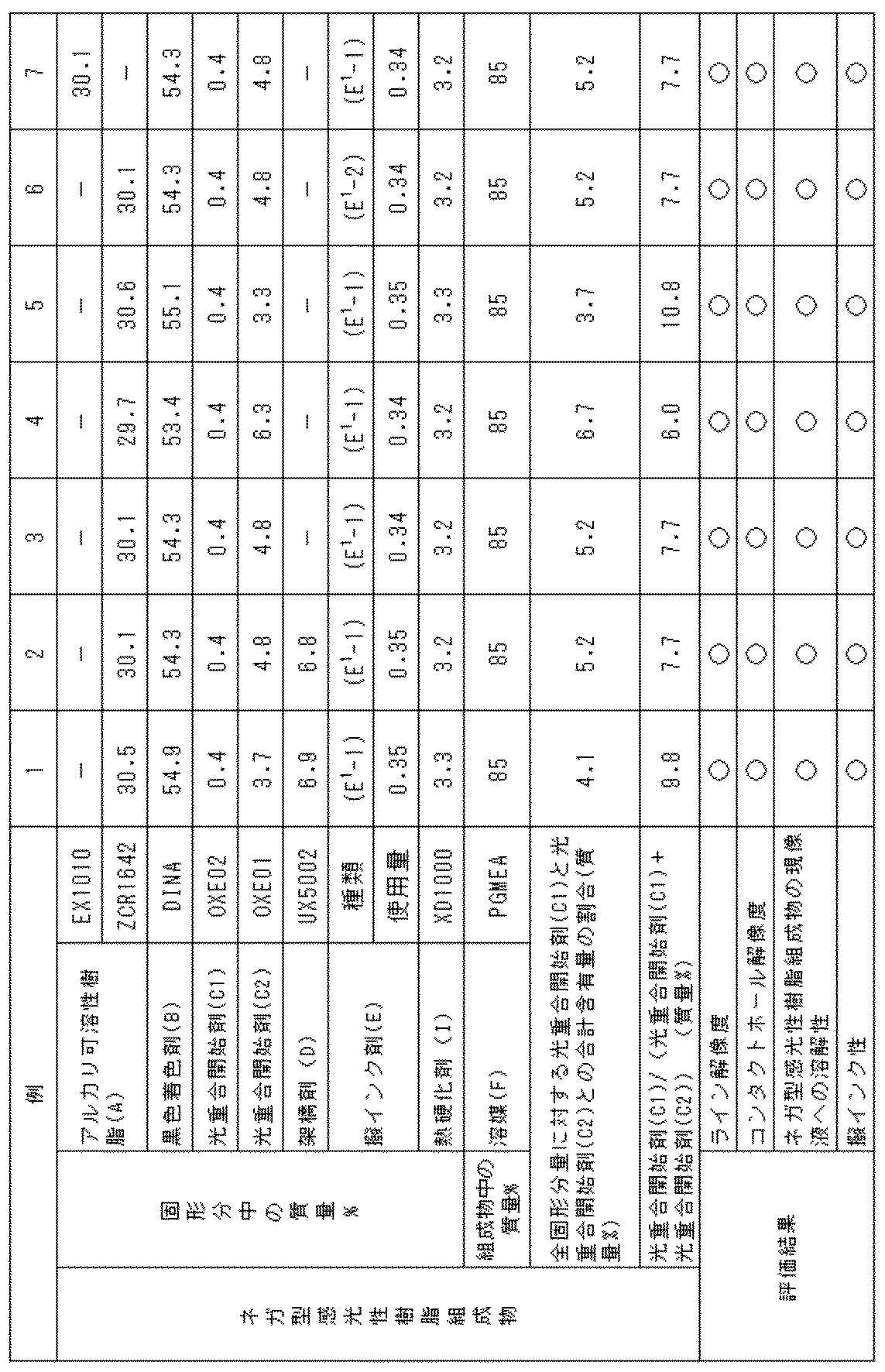
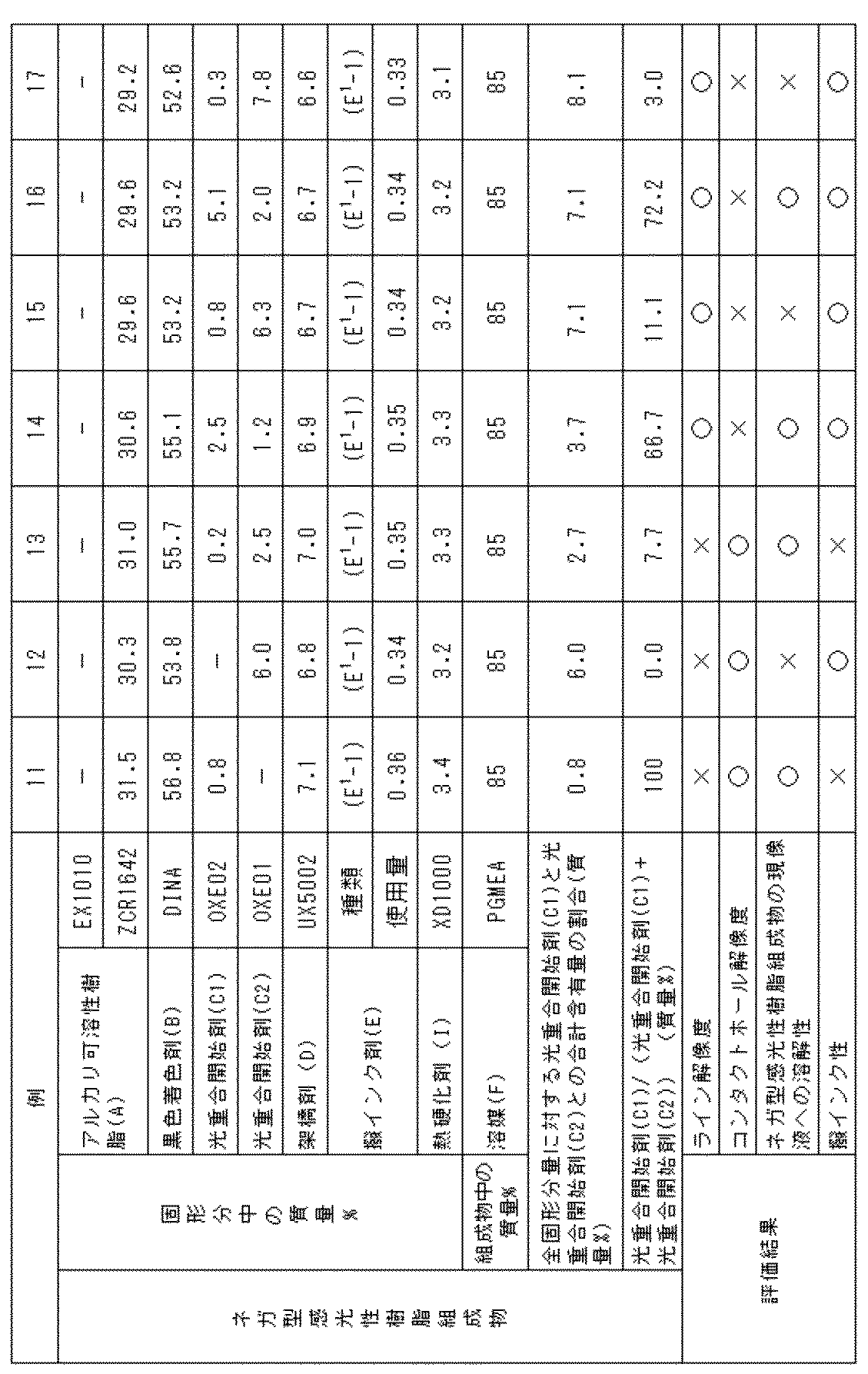
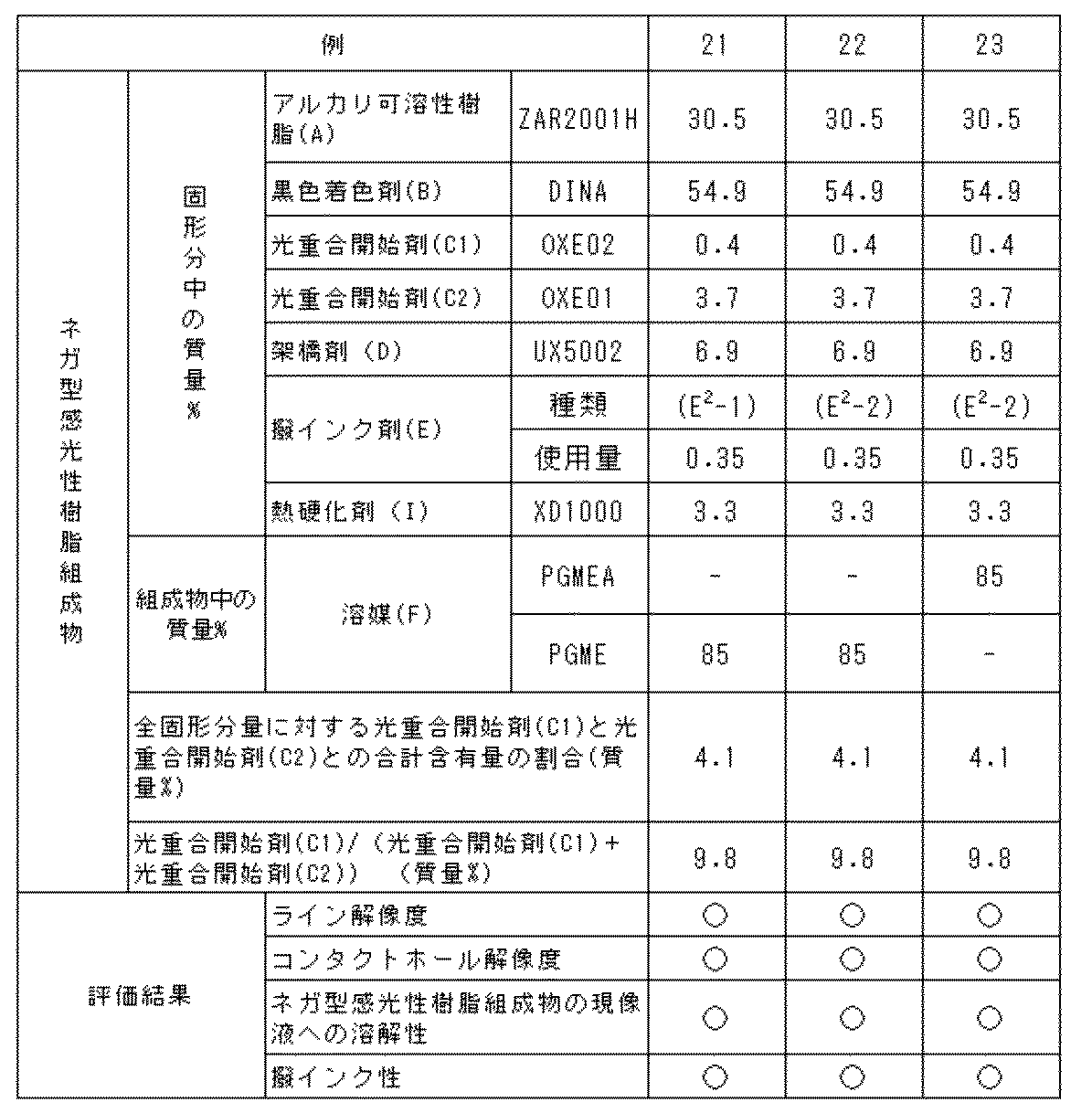
表3および表5より、本発明のネガ型感光性樹脂組成物の現像液への溶解性は良好であり、該ネガ型感光性樹脂組成物から微細な線幅のパターンが形成でき、特に微小なコンタクトホールの形成も可能であった。また、該ネガ型感光性樹脂組成物から形成された硬化膜の撥インク性も良好であった。
一方、表4において、全固形分中の光重合開始剤(C1)の含有量と光重合開始剤(C2)の含有量との合計割合が3.5質量%以下であるネガ型感光性樹脂組成物を用いた例11および13では、ライン解像度および撥インク性が不充分であった。ブラックマトリックス内部の光硬化性が不充分で、現像時にパターン下部が溶解したため、ライン解像度が不良であった。また、光重合開始剤の使用量が不充分であったために構造体表面の撥インク剤が充分に光反応せず、現像時に溶出し、撥インク性が不充分となった。
表4において、全固形分中の光重合開始剤(C1)の含有量と光重合開始剤(C2)の含有量との合計割合が7質量%以上であるネガ型感光性樹脂組成物を用いた例15、16および17では、コンタクトホール解像度が不充分であった。これは、光重合開始剤の使用量が過剰なため未露光部の光硬化が生じたためである。
一方、表4において、全固形分中の光重合開始剤(C1)の含有量と光重合開始剤(C2)の含有量との合計割合が3.5質量%以下であるネガ型感光性樹脂組成物を用いた例11および13では、ライン解像度および撥インク性が不充分であった。ブラックマトリックス内部の光硬化性が不充分で、現像時にパターン下部が溶解したため、ライン解像度が不良であった。また、光重合開始剤の使用量が不充分であったために構造体表面の撥インク剤が充分に光反応せず、現像時に溶出し、撥インク性が不充分となった。
表4において、全固形分中の光重合開始剤(C1)の含有量と光重合開始剤(C2)の含有量との合計割合が7質量%以上であるネガ型感光性樹脂組成物を用いた例15、16および17では、コンタクトホール解像度が不充分であった。これは、光重合開始剤の使用量が過剰なため未露光部の光硬化が生じたためである。
光重合開始剤(C1)の含有量と光重合開始剤(C2)の含有量との合計に対する光重合開始剤(C1)の含有量の割合が5質量%以下のネガ型感光性樹脂組成物を用いた例12では、ライン解像度が不充分であった。また、ネガ型感光性樹脂組成物の現像液への溶解性が不充分であった。これは、光重合開始剤(C2)を多量に含むことにより、顔料分散剤に吸着しアルカリ水溶液中での顔料の分散性を悪化させたためと推定している。
光重合開始剤(C1)の含有量と光重合開始剤(C2)の含有量との合計に対する光重合開始剤(C1)の含有量の割合が15質量%以上のネガ型感光性樹脂組成物を用いた例14では、コンタクトホールの解像度が不充分であった。これは、開始剤全量に対する光重合開始剤(C1)量が過剰なために遮光部での光硬化が生じたためである。
光重合開始剤(C1)の含有量と光重合開始剤(C2)の含有量との合計に対する光重合開始剤(C1)の含有量の割合が15質量%以上のネガ型感光性樹脂組成物を用いた例14では、コンタクトホールの解像度が不充分であった。これは、開始剤全量に対する光重合開始剤(C1)量が過剰なために遮光部での光硬化が生じたためである。
本発明のネガ型感光性樹脂組成物によれば、微細なラインパターンと微小なコンタクトホールを有する隔壁およびブラックマトリックスを製造することができる。このようなブラックマトリックスは、カラーフィルタ、特に、低消費電力で高輝度画像が得られるBOA型のカラーフィルタに好適に用いられる。
なお、2011年6月21日に出願された日本特許出願2011-137086号の明細書、特許請求の範囲および要約書の全内容をここに引用し、本発明の明細書の開示として、取り入れるものである。
なお、2011年6月21日に出願された日本特許出願2011-137086号の明細書、特許請求の範囲および要約書の全内容をここに引用し、本発明の明細書の開示として、取り入れるものである。
Claims (11)
- 1分子中に酸性基とエチレン性二重結合とを有するアルカリ可溶性樹脂(A)、
黒色着色剤(B)、
下式(3)で表される化合物からなる光重合開始剤(C1)、
および下式(4)で表される化合物からなる光重合開始剤(C2)、
を含むネガ型感光性樹脂組成物であって、
全固形分量に対する光重合開始剤(C1)と光重合開始剤(C2)との合計含有量の割合が3.5~7.0質量%であり、かつ、該合計含有量に対する光重合開始剤(C1)の割合が5~15質量%であることを特徴とするネガ型感光性樹脂組成物。

式(3)中、R1は、水素原子、炭素原子数1~12のアルキル基、炭素原子数3~8のシクロアルキル基、炭素原子数2~5のアルケニル基、ベンゼン環中の水素原子がアルキル基に置換されていてもよい炭素原子数6~20のフェニル基またはベンゼン環中の水素原子がアルキル基に置換されていてもよい炭素原子数6~20のフェノキシ基を示し、
R2は、水素原子、炭素原子数1~20のアルキル基、炭素原子数3~8のシクロアルキル基、ベンゼン環中の水素原子がアルキル基に置換されていてもよい炭素原子数6~20のフェニル基、炭素原子数2~20のアルカノイル基、ベンゼン環中の水素原子がアルキル基に置換されていてもよい炭素原子数7~20のベンゾイル基、炭素原子数2~12のアルコキシカルボニル基またはベンゼン環中の水素原子がアルキル基に置換されていてもよい炭素原子数7~20のフェノキシカルボニル基を示し、
R3は、炭素原子数1~12のアルキル基を示し、
R4、R5、R6およびR7は、それぞれ独立して、水素原子、炭素原子数1~12のアルキル基、シクロアルカン環中の水素原子がアルキル基に置換されていてもよい炭素原子数3~8のシクロアルキル基、ベンゼン環中の水素原子がアルキル基に置換されていてもよい炭素原子数6~20のフェニル基、炭素原子数2~20のアルカノイル基、ベンゼン環中の水素原子がアルキル基に置換されていてもよい炭素原子数7~20のベンゾイル基、ベンゼン環中の水素原子がアルキル基に置換されていてもよい炭素原子数7~20のベンジルカルボニル基、炭素原子数2~12のアルコキシカルボニル基、ベンゼン環中の水素原子がアルキル基に置換されていてもよい炭素原子数7~20のフェノキシカルボニル基、炭素原子数1~20のアミド基またはニトロ基を示す。
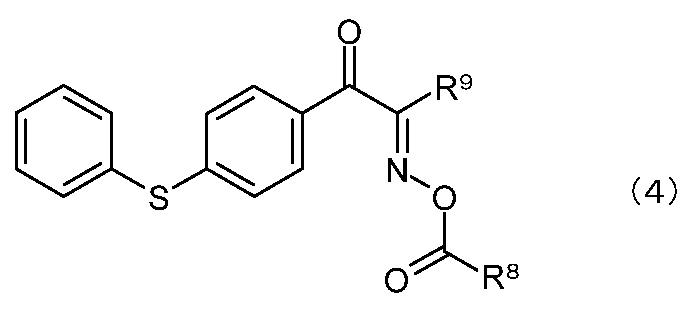
式(4)中、R8は、水素原子、炭素原子数1~12のアルキル基、炭素原子数3~8のシクロアルキル基、炭素原子数2~5のアルケニル基、ベンゼン環中の水素原子がアルキル基に置換されていてもよい炭素原子数6~20のフェニル基またはベンゼン環中の水素原子がアルキル基に置換されていてもよい炭素原子数6~20のフェノキシ基を示し、
R9は、水素原子、炭素原子数1~20のアルキル基、炭素原子数3~8のシクロアルキル基、ベンゼン環中の水素原子がアルキル基に置換されていてもよい炭素原子数6~20のフェニル基、炭素原子数2~20のアルカノイル基、ベンゼン環中の水素原子がアルキル基に置換されていてもよい炭素原子数7~20のベンゾイル基、炭素原子数2~12のアルコキシカルボニル基またはベンゼン環中の水素原子がアルキル基に置換されていてもよい炭素原子数7~20のフェノキシカルボニル基を示す。 - 架橋剤(D)をさらに含み、該架橋剤(D)が1分子中に2つ以上のエチレン性二重結合を有し、酸性基を有しない化合物である、請求項1に記載のネガ型感光性樹脂組成物。
- 熱硬化剤(I)をさらに含み、該熱硬化剤(I)が1分子中に2つ以上のエポキシ基を有する化合物である、請求項1または2に記載のネガ型感光性樹脂組成物。
- 撥インク剤(E)をさらに含む、請求項1~3のいずれか一項に記載のネガ型感光性樹脂組成物。
- 前記撥インク剤(E)が、1分子中に下式(1)で表される基または下式(2)で表される基を有する側鎖と、エチレン性二重結合を有する側鎖とを有する化合物である請求項4に記載のネガ型感光性樹脂組成物。
-CFXRf (1)
式(1)中、Xは水素原子、フッ素原子、またはトリフルオロメチル基を示し、Rfはエーテル性酸素原子を有していてもよい水素原子の少なくとも1つがフッ素原子に置換された炭素原子数20以下のアルキル基、またはフッ素原子を示す。
-(SiR10R11O)n-SiR12R13R14 (2)
式(2)中、R10、R11、R12およびR13はそれぞれ独立して、水素原子、アルキル基、シクロアルキル基、またはアリール基を示し、R14は水素原子、またはエーテル性酸素原子もしくは窒素原子を含んでいてもよい炭素原子数1~10のアルキル基を示し、nは1~200の整数を示す。 - 前記撥インク剤(E)が、側鎖に基(1)を有し、主鎖がオルガノポリシロキサン鎖の化合物である、請求項4に記載のネガ型感光性樹脂組成物。
- 基板上に区画を設けるために形成される隔壁であって、請求項1~6のいずれか一項に記載のネガ型感光性樹脂組成物の硬化膜からなる隔壁。
- 請求項7に記載の隔壁からなるブラックマトリックス。
- 前記隔壁と同時に形成される該隔壁の膜厚方向に貫通する貫通孔を有し、該貫通孔における水平方向の最大孔径が20μm以下であり、最小孔径が1μm以上である請求項8に記載のブラックマトリックス。
- 基板上に形成される、複数の画素と、隣接する画素間に位置する隔壁とを有するカラーフィルタであって、前記隔壁が請求項8または9に記載のブラックマトリックスからなるカラーフィルタ。
- TFTアレイ基板上に請求項10に記載のカラーフィルタを有する液晶表示素子。
Applications Claiming Priority (2)
| Application Number | Priority Date | Filing Date | Title |
|---|---|---|---|
| JP2011-137086 | 2011-06-21 | ||
| JP2011137086A JP2014167492A (ja) | 2011-06-21 | 2011-06-21 | ネガ型用感光性組成物、隔壁、ブラックマトリックス、カラーフィルタおよび液晶表示素子 |
Publications (1)
| Publication Number | Publication Date |
|---|---|
| WO2012176816A1 true WO2012176816A1 (ja) | 2012-12-27 |
Family
ID=47422647
Family Applications (1)
| Application Number | Title | Priority Date | Filing Date |
|---|---|---|---|
| PCT/JP2012/065774 Ceased WO2012176816A1 (ja) | 2011-06-21 | 2012-06-20 | ネガ型感光性樹脂組成物、隔壁、ブラックマトリックス、カラーフィルタおよび液晶表示素子 |
Country Status (3)
| Country | Link |
|---|---|
| JP (1) | JP2014167492A (ja) |
| TW (1) | TW201308007A (ja) |
| WO (1) | WO2012176816A1 (ja) |
Cited By (3)
| Publication number | Priority date | Publication date | Assignee | Title |
|---|---|---|---|---|
| WO2013058386A1 (ja) * | 2011-10-21 | 2013-04-25 | 旭硝子株式会社 | 撥インク剤の製造方法、ネガ型感光性樹脂組成物、隔壁および光学素子 |
| WO2015163379A1 (ja) * | 2014-04-25 | 2015-10-29 | 旭硝子株式会社 | ネガ型感光性樹脂組成物、隔壁および光学素子 |
| CN111566560A (zh) * | 2018-01-26 | 2020-08-21 | 三菱化学株式会社 | 感光性树脂组合物、间隔壁、有机场致发光元件、图像显示装置及照明 |
Families Citing this family (4)
| Publication number | Priority date | Publication date | Assignee | Title |
|---|---|---|---|---|
| TWI749019B (zh) | 2016-06-14 | 2021-12-11 | 日商日產化學工業股份有限公司 | Boa基板或附有bcs之基板塗布用液晶配向劑及液晶顯示元件 |
| KR102749259B1 (ko) * | 2018-03-23 | 2025-01-03 | 도레이 카부시키가이샤 | 경화막의 제조 방법 및 유기 el 디스플레이의 제조 방법 |
| TWI662069B (zh) * | 2018-07-11 | 2019-06-11 | 新應材股份有限公司 | 感光性組成物、彩色濾光片及彩色濾光片的製造方法 |
| WO2025187597A1 (ja) * | 2024-03-04 | 2025-09-12 | 三菱ケミカル株式会社 | 感光性樹脂組成物、硬化物、隔壁、有機電界発光素子、及び画像表示装置 |
Citations (5)
| Publication number | Priority date | Publication date | Assignee | Title |
|---|---|---|---|---|
| JP2006195410A (ja) * | 2005-01-12 | 2006-07-27 | Qimei Industry Co Ltd | カラーフィルター用感光性樹脂組成物 |
| WO2007069703A1 (ja) * | 2005-12-15 | 2007-06-21 | Asahi Glass Company, Limited | 含フッ素重合体、ネガ型感光性組成物及び隔壁 |
| JP2009244414A (ja) * | 2008-03-28 | 2009-10-22 | Fujifilm Corp | 感光性樹脂組成物、遮光性カラーフィルター及びその製造方法、並びに、固体撮像素子 |
| WO2009131189A1 (ja) * | 2008-04-25 | 2009-10-29 | 三菱化学株式会社 | ケトオキシムエステル系化合物及びその利用 |
| JP2010224282A (ja) * | 2009-03-24 | 2010-10-07 | Fujifilm Corp | カラーフィルタ用重合性組成物、カラーフィルタ、及び固体撮像素子 |
-
2011
- 2011-06-21 JP JP2011137086A patent/JP2014167492A/ja not_active Withdrawn
-
2012
- 2012-06-20 WO PCT/JP2012/065774 patent/WO2012176816A1/ja not_active Ceased
- 2012-06-21 TW TW101122234A patent/TW201308007A/zh unknown
Patent Citations (5)
| Publication number | Priority date | Publication date | Assignee | Title |
|---|---|---|---|---|
| JP2006195410A (ja) * | 2005-01-12 | 2006-07-27 | Qimei Industry Co Ltd | カラーフィルター用感光性樹脂組成物 |
| WO2007069703A1 (ja) * | 2005-12-15 | 2007-06-21 | Asahi Glass Company, Limited | 含フッ素重合体、ネガ型感光性組成物及び隔壁 |
| JP2009244414A (ja) * | 2008-03-28 | 2009-10-22 | Fujifilm Corp | 感光性樹脂組成物、遮光性カラーフィルター及びその製造方法、並びに、固体撮像素子 |
| WO2009131189A1 (ja) * | 2008-04-25 | 2009-10-29 | 三菱化学株式会社 | ケトオキシムエステル系化合物及びその利用 |
| JP2010224282A (ja) * | 2009-03-24 | 2010-10-07 | Fujifilm Corp | カラーフィルタ用重合性組成物、カラーフィルタ、及び固体撮像素子 |
Cited By (4)
| Publication number | Priority date | Publication date | Assignee | Title |
|---|---|---|---|---|
| WO2013058386A1 (ja) * | 2011-10-21 | 2013-04-25 | 旭硝子株式会社 | 撥インク剤の製造方法、ネガ型感光性樹脂組成物、隔壁および光学素子 |
| WO2015163379A1 (ja) * | 2014-04-25 | 2015-10-29 | 旭硝子株式会社 | ネガ型感光性樹脂組成物、隔壁および光学素子 |
| JPWO2015163379A1 (ja) * | 2014-04-25 | 2017-04-20 | 旭硝子株式会社 | ネガ型感光性樹脂組成物、隔壁および光学素子 |
| CN111566560A (zh) * | 2018-01-26 | 2020-08-21 | 三菱化学株式会社 | 感光性树脂组合物、间隔壁、有机场致发光元件、图像显示装置及照明 |
Also Published As
| Publication number | Publication date |
|---|---|
| JP2014167492A (ja) | 2014-09-11 |
| TW201308007A (zh) | 2013-02-16 |
Similar Documents
| Publication | Publication Date | Title |
|---|---|---|
| JP6115471B2 (ja) | ネガ型感光性樹脂組成物、隔壁、ブラックマトリックス及び光学素子 | |
| JP5045747B2 (ja) | 感光性組成物、隔壁、ブラックマトリックス | |
| JP5910629B2 (ja) | ネガ型感光性樹脂組成物、硬化膜、隔壁およびブラックマトリックスとその製造方法、カラーフィルタならびに有機el素子 | |
| JP6593331B2 (ja) | 撥インク剤、ネガ型感光性樹脂組成物、隔壁および光学素子 | |
| CN103765314B (zh) | 负型感光性树脂组合物、分隔壁以及光学元件 | |
| JP2013050549A (ja) | ネガ型感光性樹脂組成物、隔壁、光学素子 | |
| WO2007061115A1 (ja) | 隔壁、カラーフィルタ、有機elの製造方法 | |
| JP6036699B2 (ja) | 撥インク剤の製造方法、ネガ型感光性樹脂組成物、隔壁および光学素子 | |
| JP2008298859A (ja) | 感光性組成物、それを用いた隔壁、隔壁の製造方法、カラーフィルタの製造方法、有機el表示素子の製造方法および有機tftアレイの製造方法 | |
| CN105425542A (zh) | 彩色滤光片用感光性树脂组合物及其应用 | |
| TW201308007A (zh) | 負型感光性樹脂組成物、隔壁、黑色矩陣、濾色器及液晶顯示元件 | |
| CN111149058A (zh) | 透明感光性树脂组合物、光刻间隔物、液晶显示装置、光刻间隔物的制造方法、液晶显示装置的制造方法及透明感光性树脂组合物在透镜扫描曝光中的应用 | |
| CN105319847A (zh) | 彩色滤光片用的感光性树脂组合物及其应用 | |
| CN104977807A (zh) | 感光性树脂组合物、彩色滤光片及其制法、液晶显示装置 | |
| CN106200265A (zh) | 感光性树脂组成物、彩色滤光片及其制备方法、液晶显示装置 |
Legal Events
| Date | Code | Title | Description |
|---|---|---|---|
| 121 | Ep: the epo has been informed by wipo that ep was designated in this application |
Ref document number: 12802512 Country of ref document: EP Kind code of ref document: A1 |
|
| NENP | Non-entry into the national phase |
Ref country code: DE |
|
| 122 | Ep: pct application non-entry in european phase |
Ref document number: 12802512 Country of ref document: EP Kind code of ref document: A1 |
|
| NENP | Non-entry into the national phase |
Ref country code: JP |