WO2012176582A1 - 鳥インフルエンザに対する点眼ワクチン - Google Patents
鳥インフルエンザに対する点眼ワクチン Download PDFInfo
- Publication number
- WO2012176582A1 WO2012176582A1 PCT/JP2012/063604 JP2012063604W WO2012176582A1 WO 2012176582 A1 WO2012176582 A1 WO 2012176582A1 JP 2012063604 W JP2012063604 W JP 2012063604W WO 2012176582 A1 WO2012176582 A1 WO 2012176582A1
- Authority
- WO
- WIPO (PCT)
- Prior art keywords
- avian influenza
- inactivated
- poultry
- virus
- vaccine
- Prior art date
- Legal status (The legal status is an assumption and is not a legal conclusion. Google has not performed a legal analysis and makes no representation as to the accuracy of the status listed.)
- Ceased
Links
Images
Classifications
-
- A—HUMAN NECESSITIES
- A61—MEDICAL OR VETERINARY SCIENCE; HYGIENE
- A61K—PREPARATIONS FOR MEDICAL, DENTAL OR TOILETRY PURPOSES
- A61K39/00—Medicinal preparations containing antigens or antibodies
- A61K39/12—Viral antigens
- A61K39/145—Orthomyxoviridae, e.g. influenza virus
-
- A—HUMAN NECESSITIES
- A61—MEDICAL OR VETERINARY SCIENCE; HYGIENE
- A61K—PREPARATIONS FOR MEDICAL, DENTAL OR TOILETRY PURPOSES
- A61K39/00—Medicinal preparations containing antigens or antibodies
- A61K39/12—Viral antigens
-
- A—HUMAN NECESSITIES
- A61—MEDICAL OR VETERINARY SCIENCE; HYGIENE
- A61K—PREPARATIONS FOR MEDICAL, DENTAL OR TOILETRY PURPOSES
- A61K9/00—Medicinal preparations characterised by special physical form
- A61K9/0012—Galenical forms characterised by the site of application
- A61K9/0048—Eye, e.g. artificial tears
-
- A—HUMAN NECESSITIES
- A61—MEDICAL OR VETERINARY SCIENCE; HYGIENE
- A61P—SPECIFIC THERAPEUTIC ACTIVITY OF CHEMICAL COMPOUNDS OR MEDICINAL PREPARATIONS
- A61P31/00—Antiinfectives, i.e. antibiotics, antiseptics, chemotherapeutics
- A61P31/12—Antivirals
- A61P31/14—Antivirals for RNA viruses
- A61P31/16—Antivirals for RNA viruses for influenza or rhinoviruses
-
- A—HUMAN NECESSITIES
- A61—MEDICAL OR VETERINARY SCIENCE; HYGIENE
- A61K—PREPARATIONS FOR MEDICAL, DENTAL OR TOILETRY PURPOSES
- A61K39/00—Medicinal preparations containing antigens or antibodies
- A61K2039/51—Medicinal preparations containing antigens or antibodies comprising whole cells, viruses or DNA/RNA
- A61K2039/525—Virus
- A61K2039/5252—Virus inactivated (killed)
-
- A—HUMAN NECESSITIES
- A61—MEDICAL OR VETERINARY SCIENCE; HYGIENE
- A61K—PREPARATIONS FOR MEDICAL, DENTAL OR TOILETRY PURPOSES
- A61K39/00—Medicinal preparations containing antigens or antibodies
- A61K2039/54—Medicinal preparations containing antigens or antibodies characterised by the route of administration
-
- A—HUMAN NECESSITIES
- A61—MEDICAL OR VETERINARY SCIENCE; HYGIENE
- A61K—PREPARATIONS FOR MEDICAL, DENTAL OR TOILETRY PURPOSES
- A61K39/00—Medicinal preparations containing antigens or antibodies
- A61K2039/545—Medicinal preparations containing antigens or antibodies characterised by the dose, timing or administration schedule
-
- A—HUMAN NECESSITIES
- A61—MEDICAL OR VETERINARY SCIENCE; HYGIENE
- A61K—PREPARATIONS FOR MEDICAL, DENTAL OR TOILETRY PURPOSES
- A61K39/00—Medicinal preparations containing antigens or antibodies
- A61K2039/55—Medicinal preparations containing antigens or antibodies characterised by the host/recipient, e.g. newborn with maternal antibodies
- A61K2039/552—Veterinary vaccine
-
- C—CHEMISTRY; METALLURGY
- C12—BIOCHEMISTRY; BEER; SPIRITS; WINE; VINEGAR; MICROBIOLOGY; ENZYMOLOGY; MUTATION OR GENETIC ENGINEERING
- C12N—MICROORGANISMS OR ENZYMES; COMPOSITIONS THEREOF; PROPAGATING, PRESERVING, OR MAINTAINING MICROORGANISMS; MUTATION OR GENETIC ENGINEERING; CULTURE MEDIA
- C12N2760/00—MICROORGANISMS OR ENZYMES; COMPOSITIONS THEREOF; PROPAGATING, PRESERVING, OR MAINTAINING MICROORGANISMS; MUTATION OR GENETIC ENGINEERING; CULTURE MEDIA ssRNA viruses negative-sense
- C12N2760/00011—Details
- C12N2760/16011—Orthomyxoviridae
- C12N2760/16111—Influenzavirus A, i.e. influenza A virus
- C12N2760/16134—Use of virus or viral component as vaccine, e.g. live-attenuated or inactivated virus, VLP, viral protein
Definitions
- the present invention relates to a method for preventing avian influenza in poultry.
- Vaccines are roughly classified into live vaccines and inactivated vaccines depending on the antigen to be administered.
- a 'live vaccine' uses a attenuated pathogen as a vaccine antigen, is highly immunogenic, and can provide strong and long-term immunity.
- a living pathogen is used as an antigen, there is a possibility of causing a problem in terms of safety.
- an “inactivated vaccine” uses an inactivated pathogen or a component (protein, etc.) thereof as an antigen, and has high safety but low immunogenicity.
- the strength of immunity conferred by the vaccine depends greatly on the administration method. Generally, when administered subcutaneously or intramuscularly, the immunity imparted is strong. On the other hand, when given to mucous membranes (oral, total excretory cavity, nasal, eye drops), the immunity imparted is weak. Therefore, conventionally, when an inactivated vaccine is used, a method of using an adjuvant (immunity enhancing agent) in combination and injecting subcutaneously or intramuscularly has been employed (see, for example, Patent Document 1).
- the virus When vaccination against avian influenza is carried out in poultry, if live vaccine is used, the virus may cause mutation or reassortant (gene reassortant) in the host, and a virus that is highly toxic to poultry may be generated. Also, there is a problem in using live vaccines for poultry from the viewpoint of food safety. Furthermore, the possibility that live vaccines inoculated into poultry may be involved in the emergence of influenza viruses that cause pandemics by some route. Therefore, as an avian influenza vaccine for current poultry, a method in which the inactivated vaccine of the virus is used in combination with an oil adjuvant and injected subcutaneously or intramuscularly is employed.
- poultry vaccinated by such a method cannot be shipped for a certain period of time from the viewpoint of food safety because the oil adjuvant remains in the body for a long time.
- it takes a lot of labor to inoculate each bird individually, and it is difficult to inoculate many wings quickly.
- the danger of needle stick accidents for those who inoculate (veterinary workers, etc.) and the disposal of used syringe needles are a problem.
- the present invention solves the above problems, and in a method for preventing avian influenza using an inactivated vaccine in poultry; high immunity can be imparted without using an oil adjuvant, and an injection needle is used. It is an object of the present invention to develop a method that allows rapid administration to multiple wings, not an administration method.
- the present inventors have administered a vaccine using “inactivated avian influenza virus” as an antigen by “instillation”; It was found that strong immunity can be imparted to poultry without using any oil adjuvant.
- the present invention has been made based on these findings. That is, the present invention according to [Claim 1] relates to a method for preventing avian influenza in poultry, characterized by administering the inactivated vaccine described in (A) below to poultry.
- the present invention according to [Claim 2] is the method for preventing avian influenza according to claim 1, wherein the inactivated avian influenza virus is inactivated while maintaining the structure of the virus particles. It is about.
- the present invention according to [Claim 3] relates to the method for preventing avian influenza according to claim 1 or 2, wherein the eye drop administration is performed by spraying.
- the present invention according to [Claim 4] relates to the method for preventing avian influenza according to any one of claims 1 to 3, wherein the ophthalmic administration is performed twice or more at intervals. .
- the present invention since it is not necessary to use an oil adjuvant at all, it can be shipped at an earlier stage without food safety problems as compared with poultry inoculated with an oil adjuvant. ii) Because it is possible to administer eye drops by spraying, etc., it is possible to administer vaccine to multi-fowl poultry at once. As a result, labor for vaccine administration can be greatly reduced, and at the same time, a needle stick accident, a problem of disposal of used syringe needles and the like do not occur. iii) Since a live vaccine is not used, there is no possibility that a virulent virus is generated in the inoculated individual, and the safety is high.
- the vaccine can be used as an effective prevention means against avian influenza, and the large-scale killing that has been conventionally performed can be avoided.
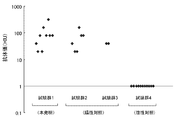
- Example 1 it is a figure which shows the measurement result of the antibody titer of the chicken of each treatment group.
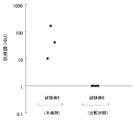
- Example 2 it is a figure which shows the measurement result of the antibody titer of the chicken of each treatment group.
- the present invention relates to a method for preventing avian influenza in poultry, characterized by administering an inactivated vaccine for avian influenza to poultry.
- inactivated vaccine As an inactivated vaccine of avian influenza in the present invention, it is necessary to use an inactivated avian influenza virus as an antigen.
- inactivation refers to a state in which a function as a virus (function of infection or proliferation) is lost.
- the vaccine in the present invention does not include a live vaccine using an attenuated virus having a function as a virus as an antigen from the viewpoint of safety.
- inactivated viruses used as antigens examples include inactivated whole-particle viruses inactivated while retaining the structure of virus particles; inactivated split viruses inactivated by destroying virus particles; be able to.
- the inactivated whole particle virus can be obtained by chemical treatment such as ⁇ -propiolactone and formalin, heating treatment, ultraviolet irradiation and the like.
- Inactivated split virus can be obtained by chemical treatment with ether or the like. In the present invention, it is preferable to use an inactivated whole particle virus in order to obtain sufficient immunogenicity.
- the inactivated vaccine in the present invention does not include a vaccine using only a virus-derived protein (for example, hemagglutinin purified from a virus or produced by a gene recombination technique) as an antigen. This is because it has been suggested that a protein having antigenicity alone does not have sufficient immunogenicity.
- a virus-derived protein for example, hemagglutinin purified from a virus or produced by a gene recombination technique
- the avian influenza virus is a type A influenza virus that infects birds.
- Influenza viruses have a structure in which hemagglutinin (HA) and neuraminidase (NA) are arranged in a spike on the surface, and are classified into 144 subtypes consisting of H1N1 to H16N9 types. In particular, it targets highly pathogenic avian influenza viruses that exhibit high pathogenicity when infected with poultry.
- HA hemagglutinin
- NA neuraminidase
- the inactivated vaccine is “instilled” to poultry.
- strong immunity can be imparted when an inactivated virus is inoculated from the eye mucosa.
- the ophthalmic administration is an administration method in which the inactivated vaccine is administered to the orbit and the inactivated virus is introduced through the mucous membrane of the eye.
- the inactivated vaccine is administered to the orbit and the inactivated virus is introduced through the mucous membrane of the eye.
- there are few inactivated vaccines that can be administered from mucous membranes in poultry.
- an inactivated vaccine when an inactivated vaccine is administered from the mucosa, it causes little or only a weak immune response. For inactivated vaccines against avian influenza, it was never assumed that strong immunity could be conferred by instillation without an adjuvant
- a method of dropping an inactivated vaccine sputum from above so as to point to a normal eye drop using an eye dropper or the like can be used.
- it can be performed by a method in which one drop is administered to one eye (preferably both eyes).
- the method of injecting the said liquid into eyes using a syringe, a water gun-like container, etc. can also be taken.
- spraying can be performed using a spray, a sprayer, a sprayer, or the like.
- the dose of the vaccine is preferably 10 3 HAU or more, preferably 10 3 to 10 5 HAU, more preferably about 10 4 HAU in terms of the amount of inactivated virus.
- HAU is a unit indicating hemagglutination unit.
- the administration interval is preferably 3 weeks to 2 months.
- the vaccine in the present invention includes any form as long as it is in a form suitable for eye drops (in a liquid state at the time of use).
- it can be in the form of an eye drop-like liquid ampule, concentrated liquid, or the like.
- it can be used without a problem.
- what mixed pH adjuster, antibiotics, etc. may be used as needed.
- the vaccine of the present invention can be in the form of a mixed vaccine in which antigens of other pathogenic bacteria and viruses are mixed.
- an adjuvant in the present invention, sufficient immunity can be imparted without the need for any combined use of an adjuvant (immunity enhancing agent).
- the combined use of an adjuvant refers to (i) a mode in which an adjuvant is contained in a vaccine in principle, and (ii) includes a mode in which a vaccine and an adjuvant are separately administered.
- oil adjuvants are suitable for subcutaneous and intramuscular injection, they are not suitable for general mucosal administration (oral, total excretory cavity, nasal, instillation) because of their high viscosity. Furthermore, since the oil adjuvant remains in the body for a long time, the inoculated poultry cannot be shipped for a certain period from the viewpoint of food safety.
- an adjuvant for vaccine administration is not completely excluded, and any vaccine can be used as long as it has properties suitable for eye drops such as high safety and low viscosity.
- Target poultry Although the present invention is a technique that can be applied to birds in general, a specific target is poultry. Examples of poultry include chickens, ducklings, quails, pheasants, ostriches, cheeks and turkeys. In particular, it can be effectively used for chickens from the viewpoint of application to the poultry industry.
- the inactivated vaccine administration by the eye drop of this invention can confer immunity to a chick even if it is an adult bird if it is an individual before the avian influenza virus is infected.
- the effect of the vaccine cannot be obtained for individuals after being infected with the virus.
- Preparation Example 1 Preparation of inactivated virus 10 days old growing chicken eggs are inoculated with highly pathogenic avian influenza virus (A / chichen / Yamaguchi / 07/2004, H5N1) It was collected. ⁇ -propiolactone was added to the urinary serous fluid to a final concentration of 0.1%, and allowed to stand at room temperature for 4 hours to inactivate the virus, and the precipitate was collected by centrifugation at 30,000 rpm for 2 hours.
- highly pathogenic avian influenza virus A / chichen / Yamaguchi / 07/2004, H5N1
- ⁇ -propiolactone was added to the urinary serous fluid to a final concentration of 0.1%, and allowed to stand at room temperature for 4 hours to inactivate the virus, and the precipitate was collected by centrifugation at 30,000 rpm for 2 hours.
- the inactivated whole particle virus was purified from the obtained precipitate by sucrose density gradient centrifugation. Centrifugation was performed at 27,000 rpm for 2 hours together with 70% and 25% sucrose solutions, and the inactivated virus concentrated between the two sucrose solutions was recovered. The obtained inactivated whole particle virus was used as a vaccine antigen by measuring the hemagglutination value (HAU) using chicken erythrocytes.
- HAU hemagglutination value
- Example 1 Instillation of inactivated virus to chickens ⁇ "Vaccine administration"
- the inactivated virus (10 4 HAU) prepared above was instilled into the orbit of an adult chicken group. Administration was performed twice at 4-week intervals. Thereafter, serum was collected 4 weeks after the second administration, and the antibody titer (hemagglutination inhibition titer: HIU) was measured (Test Group 1).
- the antibody titer of chicken groups that were simultaneously instilled with an adjuvant CpG ODN or cholera toxin
- test groups 2 and 3 As a negative control, the antibody titer of the chicken group not administered with the vaccine was also measured (test group 4). The measurement results are shown in Table 1 and FIG.
- the portion where the antibody titer value is described as “N.D.” indicates that the detection limit was 10 ⁇ HIU or less.
- chicken individuals whose measured values are 10 HIU or less (N.D.), which is the detection limit, are plotted as 1 HIU for convenience.
- Example 2 Contrast between ophthalmic administration and nasal administration "Vaccine administration"
- the inactivated virus (10 3 HAU) prepared above was instilled into the orbit of an adult chicken group. Administration was performed twice at 4-week intervals, and after 4 weeks from the second administration, serum was collected and the antibody titer was measured (Test Group 5).
- the inactivated virus (10 3 HAU) prepared above was administered to chicken nasal cavity (nasal administration: a type of mucosal administration) to adult chicken groups. Administration was performed twice at 4-week intervals, and serum was collected and antibody titer was measured 4 weeks after the second administration (Test Group 6). The results are shown in Table 2 and FIG.
- the present invention is expected to be a very effective prevention technology against avian influenza in poultry.
- it is possible to avoid a large-scale killing at the time of occurrence of avian influenza, and it is expected to greatly contribute to the reduction of economic damage in the poultry industry.
- commercialization is anticipated as prevention of avian influenza with respect to poultry, and an emergency inoculation vaccine.
Landscapes
- Health & Medical Sciences (AREA)
- Life Sciences & Earth Sciences (AREA)
- Virology (AREA)
- Veterinary Medicine (AREA)
- Medicinal Chemistry (AREA)
- Chemical & Material Sciences (AREA)
- Animal Behavior & Ethology (AREA)
- General Health & Medical Sciences (AREA)
- Pharmacology & Pharmacy (AREA)
- Public Health (AREA)
- Epidemiology (AREA)
- Mycology (AREA)
- Microbiology (AREA)
- Pulmonology (AREA)
- Immunology (AREA)
- Communicable Diseases (AREA)
- Chemical Kinetics & Catalysis (AREA)
- General Chemical & Material Sciences (AREA)
- Nuclear Medicine, Radiotherapy & Molecular Imaging (AREA)
- Organic Chemistry (AREA)
- Oncology (AREA)
- Molecular Biology (AREA)
- Ophthalmology & Optometry (AREA)
- Medicines Containing Antibodies Or Antigens For Use As Internal Diagnostic Agents (AREA)
- Medicinal Preparation (AREA)
Priority Applications (1)
| Application Number | Priority Date | Filing Date | Title |
|---|---|---|---|
| CN201280027280.4A CN103582493A (zh) | 2011-06-20 | 2012-05-28 | 用于禽流感的滴眼疫苗 |
Applications Claiming Priority (2)
| Application Number | Priority Date | Filing Date | Title |
|---|---|---|---|
| JP2011135988A JP2013001686A (ja) | 2011-06-20 | 2011-06-20 | 鳥インフルエンザに対する点眼ワクチン |
| JP2011-135988 | 2011-06-20 |
Publications (1)
| Publication Number | Publication Date |
|---|---|
| WO2012176582A1 true WO2012176582A1 (ja) | 2012-12-27 |
Family
ID=47422424
Family Applications (1)
| Application Number | Title | Priority Date | Filing Date |
|---|---|---|---|
| PCT/JP2012/063604 Ceased WO2012176582A1 (ja) | 2011-06-20 | 2012-05-28 | 鳥インフルエンザに対する点眼ワクチン |
Country Status (3)
| Country | Link |
|---|---|
| JP (1) | JP2013001686A (enExample) |
| CN (1) | CN103582493A (enExample) |
| WO (1) | WO2012176582A1 (enExample) |
Cited By (1)
| Publication number | Priority date | Publication date | Assignee | Title |
|---|---|---|---|---|
| WO2021222913A1 (en) * | 2020-04-30 | 2021-11-04 | Koziol Jeffrey E | Micro dosing of viral vaccines |
Citations (4)
| Publication number | Priority date | Publication date | Assignee | Title |
|---|---|---|---|---|
| JP2007526215A (ja) * | 2003-05-05 | 2007-09-13 | ダウ アグロサイエンス リミテッド ライアビリティー カンパニー | トランスジェニック植物細胞に由来する安定な免疫予防的および治療的組成物ならびにその産生方法 |
| JP2008206664A (ja) * | 2007-02-26 | 2008-09-11 | Daitsu:Kk | 家鶏及び養鶏施設の防疫方法。 |
| JP2009072166A (ja) * | 2007-09-25 | 2009-04-09 | One Touch Chikusan Shizai Kenkyusho:Kk | 家禽用個体識別バンド。 |
| WO2011040526A1 (ja) * | 2009-09-30 | 2011-04-07 | 国立大学法人帯広畜産大学 | α-ガラクトースエピトープ発現ウイルス及びワクチンの作製方法 |
Family Cites Families (2)
| Publication number | Priority date | Publication date | Assignee | Title |
|---|---|---|---|---|
| JP2002128695A (ja) * | 2000-10-20 | 2002-05-09 | Gen Corp:Kk | 家禽への不活化ワクチンの接種方法 |
| JP2010539093A (ja) * | 2007-09-10 | 2010-12-16 | インターベツト・インターナシヨナル・ベー・ベー | イヌ、ネコ及びウマにおけるインフルエンザ感染を予防するための組成物及び方法 |
-
2011
- 2011-06-20 JP JP2011135988A patent/JP2013001686A/ja active Pending
-
2012
- 2012-05-28 WO PCT/JP2012/063604 patent/WO2012176582A1/ja not_active Ceased
- 2012-05-28 CN CN201280027280.4A patent/CN103582493A/zh active Pending
Patent Citations (4)
| Publication number | Priority date | Publication date | Assignee | Title |
|---|---|---|---|---|
| JP2007526215A (ja) * | 2003-05-05 | 2007-09-13 | ダウ アグロサイエンス リミテッド ライアビリティー カンパニー | トランスジェニック植物細胞に由来する安定な免疫予防的および治療的組成物ならびにその産生方法 |
| JP2008206664A (ja) * | 2007-02-26 | 2008-09-11 | Daitsu:Kk | 家鶏及び養鶏施設の防疫方法。 |
| JP2009072166A (ja) * | 2007-09-25 | 2009-04-09 | One Touch Chikusan Shizai Kenkyusho:Kk | 家禽用個体識別バンド。 |
| WO2011040526A1 (ja) * | 2009-09-30 | 2011-04-07 | 国立大学法人帯広畜産大学 | α-ガラクトースエピトープ発現ウイルス及びワクチンの作製方法 |
Cited By (1)
| Publication number | Priority date | Publication date | Assignee | Title |
|---|---|---|---|---|
| WO2021222913A1 (en) * | 2020-04-30 | 2021-11-04 | Koziol Jeffrey E | Micro dosing of viral vaccines |
Also Published As
| Publication number | Publication date |
|---|---|
| CN103582493A (zh) | 2014-02-12 |
| JP2013001686A (ja) | 2013-01-07 |
Similar Documents
| Publication | Publication Date | Title |
|---|---|---|
| Kim et al. | Influenza vaccines: Past, present, and future | |
| JP6378380B2 (ja) | ワクチン組成物 | |
| RU2652296C2 (ru) | Композиция назальной вакцины против гриппа | |
| KR20090029851A (ko) | 인플루엔자 백신 | |
| KR101707569B1 (ko) | 인플루엔자 백신 | |
| BRPI0621886A2 (pt) | composição de vacina contra influenza monovalente, kit, método para a produção de uma composição de vacina contra influenza para uma situação pandêmica ou uma situação pré-pandêmica, e, usos de um antìgeno de vìrus da influenza ou preparação antigênica do mesmo e de um adjuvante em emulsão óleo-em-água, de um antìgeno de vìrus da influenza pandêmica ou preparação antigênica do antìgeno de hemaglutinina do vìrus da influenza e de um adjuvante em emulsão óleo-em-água e de um antìgeno ou preparação antigênica de uma primeira cepa de influenza | |
| CA2951982A1 (en) | Rhinovaccination system of influenza vaccine | |
| JP2011057605A (ja) | 粘膜投与型ワクチン | |
| JP2009209086A (ja) | 粘膜投与型ワクチン | |
| EP2822585B1 (en) | Improved vaccination against influenza | |
| JP2012508221A (ja) | ワクチン組成物 | |
| WO2017129048A1 (zh) | 一种用于防治流感、禽流感、上呼吸道感染的疫苗 | |
| US20130236494A1 (en) | Vaccination against influenza | |
| CN111629751B (zh) | 广泛保护性灭活流感病毒疫苗 | |
| WO2012176582A1 (ja) | 鳥インフルエンザに対する点眼ワクチン | |
| Ross et al. | Vaccine technologies against avian influenza: current approaches and new directions | |
| JP7660514B2 (ja) | 弱毒生インフルエンザワクチン組成物及びその調製プロセス | |
| WO2023047419A1 (en) | A vaccine for coronavirus and influenza virus, and method for preparation thereof | |
| JP5846624B2 (ja) | H5n1型インフルエンザワクチン及び感染防御キット | |
| JP2010529166A5 (enExample) | ||
| CN111148532A (zh) | 疫苗组合物 | |
| Asanuma et al. | Past Efforts and Future Prospects for a Nasal Influenza Vaccine | |
| JP6499420B2 (ja) | ワクチン及び感染防御キット | |
| HK40007838A (en) | Nasal influenza vaccine composition |
Legal Events
| Date | Code | Title | Description |
|---|---|---|---|
| 121 | Ep: the epo has been informed by wipo that ep was designated in this application |
Ref document number: 12802521 Country of ref document: EP Kind code of ref document: A1 |
|
| NENP | Non-entry into the national phase |
Ref country code: DE |
|
| 122 | Ep: pct application non-entry in european phase |
Ref document number: 12802521 Country of ref document: EP Kind code of ref document: A1 |