WO2012165435A1 - 含フッ素重合性単量体およびそれを用いた高分子化合物 - Google Patents
含フッ素重合性単量体およびそれを用いた高分子化合物 Download PDFInfo
- Publication number
- WO2012165435A1 WO2012165435A1 PCT/JP2012/063781 JP2012063781W WO2012165435A1 WO 2012165435 A1 WO2012165435 A1 WO 2012165435A1 JP 2012063781 W JP2012063781 W JP 2012063781W WO 2012165435 A1 WO2012165435 A1 WO 2012165435A1
- Authority
- WO
- WIPO (PCT)
- Prior art keywords
- atom
- fluorine
- group
- formula
- general formula
- Prior art date
- Legal status (The legal status is an assumption and is not a legal conclusion. Google has not performed a legal analysis and makes no representation as to the accuracy of the status listed.)
- Ceased
Links
- QTCJEYXCCZLYNY-UHFFFAOYSA-N Nc1c(C(C(F)(F)F)(C(F)(F)F)O)cc(Cc(cc2)cc(C(C(F)(F)F)(C(F)(F)F)O)c2N)cc1 Chemical compound Nc1c(C(C(F)(F)F)(C(F)(F)F)O)cc(Cc(cc2)cc(C(C(F)(F)F)(C(F)(F)F)O)c2N)cc1 QTCJEYXCCZLYNY-UHFFFAOYSA-N 0.000 description 1
- UUGRLPGHJFQXKT-UHFFFAOYSA-N OC(C(F)(F)F)(C(F)(F)F)c(cc(cc1)-c(cc2)cc(C(C(F)(F)F)(C(F)(F)F)O)c2O)c1O Chemical compound OC(C(F)(F)F)(C(F)(F)F)c(cc(cc1)-c(cc2)cc(C(C(F)(F)F)(C(F)(F)F)O)c2O)c1O UUGRLPGHJFQXKT-UHFFFAOYSA-N 0.000 description 1
Classifications
-
- C—CHEMISTRY; METALLURGY
- C08—ORGANIC MACROMOLECULAR COMPOUNDS; THEIR PREPARATION OR CHEMICAL WORKING-UP; COMPOSITIONS BASED THEREON
- C08G—MACROMOLECULAR COMPOUNDS OBTAINED OTHERWISE THAN BY REACTIONS ONLY INVOLVING UNSATURATED CARBON-TO-CARBON BONDS
- C08G63/00—Macromolecular compounds obtained by reactions forming a carboxylic ester link in the main chain of the macromolecule
- C08G63/68—Polyesters containing atoms other than carbon, hydrogen and oxygen
- C08G63/682—Polyesters containing atoms other than carbon, hydrogen and oxygen containing halogens
- C08G63/6824—Polyesters containing atoms other than carbon, hydrogen and oxygen containing halogens derived from polycarboxylic acids and polyhydroxy compounds
- C08G63/6826—Dicarboxylic acids and dihydroxy compounds
-
- C—CHEMISTRY; METALLURGY
- C07—ORGANIC CHEMISTRY
- C07C—ACYCLIC OR CARBOCYCLIC COMPOUNDS
- C07C317/00—Sulfones; Sulfoxides
- C07C317/16—Sulfones; Sulfoxides having sulfone or sulfoxide groups and singly-bound oxygen atoms bound to the same carbon skeleton
- C07C317/22—Sulfones; Sulfoxides having sulfone or sulfoxide groups and singly-bound oxygen atoms bound to the same carbon skeleton with sulfone or sulfoxide groups bound to carbon atoms of six-membered aromatic rings of the carbon skeleton
-
- C—CHEMISTRY; METALLURGY
- C07—ORGANIC CHEMISTRY
- C07C—ACYCLIC OR CARBOCYCLIC COMPOUNDS
- C07C323/00—Thiols, sulfides, hydropolysulfides or polysulfides substituted by halogen, oxygen or nitrogen atoms, or by sulfur atoms not being part of thio groups
- C07C323/10—Thiols, sulfides, hydropolysulfides or polysulfides substituted by halogen, oxygen or nitrogen atoms, or by sulfur atoms not being part of thio groups containing thio groups and singly-bound oxygen atoms bound to the same carbon skeleton
- C07C323/18—Thiols, sulfides, hydropolysulfides or polysulfides substituted by halogen, oxygen or nitrogen atoms, or by sulfur atoms not being part of thio groups containing thio groups and singly-bound oxygen atoms bound to the same carbon skeleton having the sulfur atom of at least one of the thio groups bound to a carbon atom of a six-membered aromatic ring of the carbon skeleton
- C07C323/20—Thiols, sulfides, hydropolysulfides or polysulfides substituted by halogen, oxygen or nitrogen atoms, or by sulfur atoms not being part of thio groups containing thio groups and singly-bound oxygen atoms bound to the same carbon skeleton having the sulfur atom of at least one of the thio groups bound to a carbon atom of a six-membered aromatic ring of the carbon skeleton with singly-bound oxygen atoms bound to carbon atoms of the same non-condensed six-membered aromatic ring
-
- C—CHEMISTRY; METALLURGY
- C07—ORGANIC CHEMISTRY
- C07C—ACYCLIC OR CARBOCYCLIC COMPOUNDS
- C07C39/00—Compounds having at least one hydroxy or O-metal group bound to a carbon atom of a six-membered aromatic ring
- C07C39/12—Compounds having at least one hydroxy or O-metal group bound to a carbon atom of a six-membered aromatic ring polycyclic with no unsaturation outside the aromatic rings
- C07C39/15—Compounds having at least one hydroxy or O-metal group bound to a carbon atom of a six-membered aromatic ring polycyclic with no unsaturation outside the aromatic rings with all hydroxy groups on non-condensed rings, e.g. phenylphenol
-
- C—CHEMISTRY; METALLURGY
- C07—ORGANIC CHEMISTRY
- C07C—ACYCLIC OR CARBOCYCLIC COMPOUNDS
- C07C39/00—Compounds having at least one hydroxy or O-metal group bound to a carbon atom of a six-membered aromatic ring
- C07C39/24—Halogenated derivatives
- C07C39/367—Halogenated derivatives polycyclic non-condensed, containing only six-membered aromatic rings as cyclic parts, e.g. halogenated poly-hydroxyphenylalkanes
-
- C—CHEMISTRY; METALLURGY
- C07—ORGANIC CHEMISTRY
- C07C—ACYCLIC OR CARBOCYCLIC COMPOUNDS
- C07C43/00—Ethers; Compounds having groups, groups or groups
- C07C43/02—Ethers
- C07C43/257—Ethers having an ether-oxygen atom bound to carbon atoms both belonging to six-membered aromatic rings
- C07C43/295—Ethers having an ether-oxygen atom bound to carbon atoms both belonging to six-membered aromatic rings containing hydroxy or O-metal groups
-
- C—CHEMISTRY; METALLURGY
- C07—ORGANIC CHEMISTRY
- C07C—ACYCLIC OR CARBOCYCLIC COMPOUNDS
- C07C49/00—Ketones; Ketenes; Dimeric ketenes; Ketonic chelates
- C07C49/76—Ketones containing a keto group bound to a six-membered aromatic ring
- C07C49/82—Ketones containing a keto group bound to a six-membered aromatic ring containing hydroxy groups
- C07C49/83—Ketones containing a keto group bound to a six-membered aromatic ring containing hydroxy groups polycyclic
-
- C—CHEMISTRY; METALLURGY
- C08—ORGANIC MACROMOLECULAR COMPOUNDS; THEIR PREPARATION OR CHEMICAL WORKING-UP; COMPOSITIONS BASED THEREON
- C08L—COMPOSITIONS OF MACROMOLECULAR COMPOUNDS
- C08L67/00—Compositions of polyesters obtained by reactions forming a carboxylic ester link in the main chain; Compositions of derivatives of such polymers
- C08L67/02—Polyesters derived from dicarboxylic acids and dihydroxy compounds
- C08L67/03—Polyesters derived from dicarboxylic acids and dihydroxy compounds the dicarboxylic acids and dihydroxy compounds having the carboxyl- and the hydroxy groups directly linked to aromatic rings
Definitions
- the present invention relates to a fluorine-containing polymerizable monomer useful as a resist material used for lithography in semiconductor production, a coating for a flat panel display, a protective film for a substrate for an electronic circuit or a protective film for a semiconductor, and the like.
- the present invention relates to a polymer compound using
- Bisphenol is useful as a raw material for engineering plastics.
- polymers using bisphenol are used in electronic parts and are used in a wide range of applications such as separation membranes for water treatment, gas separation or hemodialysis.
- polyesters containing bisphenol repeating units are difficult to dissolve in organic solvents and difficult to mold.
- fluorine-containing polymers using hexafluoroisopropylidene groups that is, bisphenol or dicarboxylic acid having —C (CF 3 ) 2 — in the chemical structure as monomers have been developed.
- the fluoropolymer has characteristics such as excellent heat resistance and corrosion resistance, water repellency, low water absorption, low dielectric constant and low refractive index.
- a fluorocarbinol group is known as a functional group that imparts moderate hydrophilicity to a fluorine compound.
- a 2-hydroxy-1,1,1,3,3,3-hexafluoroisopropyl group that is, —C (CF 3 ) 2 OH (hereinafter, A resist made of a fluorine compound containing a fluorine compound containing an HFIP group) has adhesiveness to a substrate in addition to high transparency.
- exposure sensitivity is high in short-wavelength ultraviolet light exposure using an argon fluoride laser (wavelength, 193 nm) or the like as a light source, and can be applied to a developer during patterning after exposure. It is melted.
- aromatic compounds in which HFIP groups are introduced into aromatic polyamide or aromatic polyimide are disclosed.
- polymers obtained by polymerizing these aromatic compounds have a problem of low transparency in spite of a high fluorine content.
- the cause is that the ⁇ -conjugate length in the compound becomes longer due to the formation of an imide ring or a heterocyclic ring.
- a highly transparent material is useful not only as a resist, but also as a coating material for flat panel displays, a protective film for an electronic circuit board, or a protective film for a semiconductor.
- Aromatic polyesters to which HFIP groups have been added are expected as polymer materials having moderate hydrophilicity in addition to the low water absorption and transparency of the fluorine compounds described above.
- Non-Patent Document 3 describes a substitution reaction of a hydrogen atom of an HFIP group.
- An object of the present invention is to solve such problems and to obtain a fluorine-containing polymerizable monomer for obtaining a fluorine-containing polymer compound having a low water absorption property of a fluorine compound and a hydrophilic property of a hydroxyl group.
- the present invention has a high fluorine content and higher transparency than an aromatic compound in which an HFIP group is introduced into a conventional aromatic polyamide or aromatic polyimide. It aims at obtaining the fluorine-containing polymerizable monomer for obtaining a molecular compound.
- the present inventors synthesized a fluorine-containing aromatic phenol into which a HFIP group was introduced, which is a novel fluorine-containing polymerizable monomer. Subsequently, the fluorine-polymerizable monomer was polymerized to synthesize a fluorine-containing aromatic polyester into which a HFIP group was introduced as a novel polymer compound, and the present invention was completed. If the fluorine-containing polyester has a structure without a heterocycle, a highly transparent material can be obtained. The novel fluorine-containing aromatic polyester containing no heterocyclic ring thus obtained is much more transparent than the aromatic compounds in which HFIP groups are introduced into conventional aromatic polyamides or aromatic polyimides. Met.
- phenol refers to a compound in which a hydrogen atom of an aromatic ring is substituted with a hydroxyl group.
- the present invention comprises the following inventions 1 to 15.
- A is a single bond, an oxygen atom, a sulfur atom, SO 2 , CH 2 , CO, C (CH 3 ) 2 , C (CH 3 ) (CH 2 CH 3 ), C (CF 3 ) 2 , C (CH 3 ) (C 6 H 5 ), CH 2 —C 6 H 4 —CH 2 , or a divalent organic group having two hydrogen atoms removed from benzene, naphthalene, cyclohexene or fluorene, And b are each independently an integer of 0 to 2, and 1 ⁇ a + b ⁇ 4.
- A is a single bond, oxygen atom, sulfur atom, SO 2 , CH 2 , CO, C (CH 3 ) 2 , C (CH 3 ) (CH 2 CH 3 ), C (CF 3 ) 2 , C (CH 3 ) (C 6 H 5 ), CH 2 —C 6 H 4 —CH 2 , or a divalent organic group in which two hydrogen atoms are removed from benzene, biphenyl, naphthalene, cyclohexene or fluorene.
- the fluorine-containing polymerizable monomer of the inventions 1 to 3 and a specific compound are used as a composition, and the fluorine-containing monomer of the inventions 1 to 3 is used.
- a polymer compound which is an aromatic polyester by subjecting a compound represented by the general formulas (4) to (6) to a polycondensation reaction with a hydroxy group directly bonded to an aromatic ring contained in a polymerizable monomer Can be obtained.
- the polymer compound of the present invention (polymer compound represented by the general formulas (7) to (12)) which is an aromatic polyester containing an HFIP group is obtained.
- Each B is independently a hydrogen atom, an alkyl group having 1 to 10 carbon atoms or an aryl group having 6 to 10 carbon atoms.
- R 1 is an alkylene group or a divalent organic group in which two hydrogen atoms are removed from an aromatic ring or alicyclic ring, and may contain an oxygen atom, a sulfur atom or a nitrogen atom in the structure.
- a part of hydrogen atoms may be substituted with a fluorine atom, a chlorine atom, an alkyl group or a fluoroalkyl group.
- X is each independently a chlorine atom, a fluorine atom, a bromine atom or an iodine atom.
- R 2 is a tetravalent organic group in which four hydrogen atoms are removed from an alkane, aromatic ring or alicyclic ring, and may contain an oxygen atom, sulfur atom or nitrogen atom in the structure, Some of the atoms may be substituted with an alkyl group, a fluorine atom, a chlorine atom, or a fluoroalkyl group.
- each A is independently a single bond, oxygen atom, sulfur atom, SO 2 , CH 2 , CO, C (CH 3 ) 2 , C (CH 3 ) (CH 2 CH 3 ), C (CF 3 ) 2 , C (CH 3 ) (C 6 H 5 ), CH 2 —C 6 H 4 —CH 2 , or a divalent organic group in which two hydrogen atoms are removed from benzene, biphenyl, naphthalene, cyclohexene or fluorene.
- each R 1 is independently an alkylene group or a divalent organic group in which two hydrogen atoms have been removed from an aromatic ring or alicyclic ring, and contains an oxygen atom, a sulfur atom or a nitrogen atom in the structure.
- a part of hydrogen atoms may be substituted with a fluorine atom, a chlorine atom, an alkyl group or a fluoroalkyl group.
- a and b are each independently an integer of 0 to 2, and 1 ⁇ a + b ⁇ 4.
- each A is independently a single bond, oxygen atom, sulfur atom, SO 2 , CH 2 , CO, C (CH 3 ) 2 , C (CH 3 ) (CH 2 CH 3 ), C (CF 3 ) 2 , C (CH 3 ) (C 6 H 5 ), CH 2 —C 6 H 4 —CH 2 , or a divalent organic group in which two hydrogen atoms are removed from benzene, biphenyl, naphthalene, cyclohexene or fluorene.
- each R 1 is independently an alkylene group or a divalent organic group in which two hydrogen atoms are separated from an aromatic ring or alicyclic ring, and contains an oxygen atom, a sulfur atom or a nitrogen atom in the structure.
- part of the hydrogen atoms may be substituted with a fluorine atom, a chlorine atom, an alkyl group or a fluoroalkyl group.
- each A is independently a single bond, oxygen atom, sulfur atom, SO 2 , CH 2 , CO, C (CH 3 ) 2 , C (CH 3 ) (CH 2 CH 3 ), C ( CF 3 ) 2 , C (CH 3 ) (C 6 H 5 ), CH 2 —C 6 H 6 —CH 2 , or a divalent organic compound in which two hydrogen atoms are removed from phenyl, biphenyl, naphthalene, cyclohexene or fluorene.
- Each of R 2 is independently a tetravalent organic group in which four hydrogen atoms are removed from an alkane, aromatic ring or alicyclic ring, and the structure contains an oxygen atom, a sulfur atom or a nitrogen atom. Alternatively, part of hydrogen may be substituted with a fluorine atom, a chlorine atom, an alkyl group or a fluoroalkyl group.
- a and b are each independently an integer of 0 to 2, and 1 ⁇ a + b ⁇ 4.
- each A is independently a single bond, oxygen atom, sulfur atom, SO 2 , CH 2 , CO, C (CH 3 ) 2 , C (CH 3 ) (CH 2 CH 3 ), C (CF 3 ) 2 , C (CH 3 ) (C 6 H 5 ), CH 2 —C 6 H 4 —CH 2 , or a divalent organic group in which two hydrogen atoms are removed from benzene, biphenyl, naphthalene, cyclohexene or fluorene.
- R 2 is a tetravalent organic group in which four hydrogen atoms are removed from an alkane, aromatic ring or alicyclic ring, and the structure may contain an oxygen atom, a sulfur atom or a nitrogen atom, May be substituted with a fluorine atom, a chlorine atom, an alkyl group or a fluoroalkyl group.
- the hydrogen atom at the OH site in the HFIP group of the polymer compound of the inventions 5 to 10 can be replaced with a glycidyl group, so that a polymer compound that can be easily cured even by itself can be obtained. It was.
- Invention 11 Any one of Inventions 5 to 10, wherein at least a part of hydrogen atoms at the OH site in the 2-hydroxy-1,1,1,3,3,3-hexafluoroisopropyl group is substituted with a glycidyl group.
- a cured product was obtained by curing a composition containing the polymer compound of any one of Inventions 5 to 11 and an epoxy compound.
- invention 12 A composition comprising the polymer compound according to any one of Inventions 5 to 11 and an epoxy compound.
- R 3 is a monovalent organic group in which one hydrogen atom is removed from an alkane, aromatic ring or alicyclic ring, and may contain an oxygen atom, a sulfur atom or a nitrogen atom in the structure. A part of hydrogen atoms may be substituted with a fluorine atom, a chlorine atom, an alkyl group or a fluoroalkyl group.
- c is an integer of 1 to 4.
- the cured product of Invention 14 or Invention 15 obtained by crosslinking the polymer compound of Invention 11 and the composition of Invention 12 or Invention 13 by a method such as heat curing.
- the composition is treated by a wet coating method or the like.
- a cured film formed by coating on and crosslinking reaction by a method such as heat curing is useful as a coating material for a flat panel display, a protective film for a substrate body for an electronic circuit, or a protective film for a semiconductor.
- a novel fluorine-containing polymerizable monomer having an HFIP group for obtaining a material having moderate hydrophilicity in addition to the low water absorption property of the fluorine compound is obtained, and a novel using the same Aromatic polyester which is a high molecular compound can be obtained.
- the fluorine-containing aromatic polyester having an HFIP group not containing a heterocyclic ring according to the present invention is much more transparent than a conventional fluorine-containing polymer compound in which an HFIP group is introduced into an aromatic polyamide or aromatic polyimide. It is.
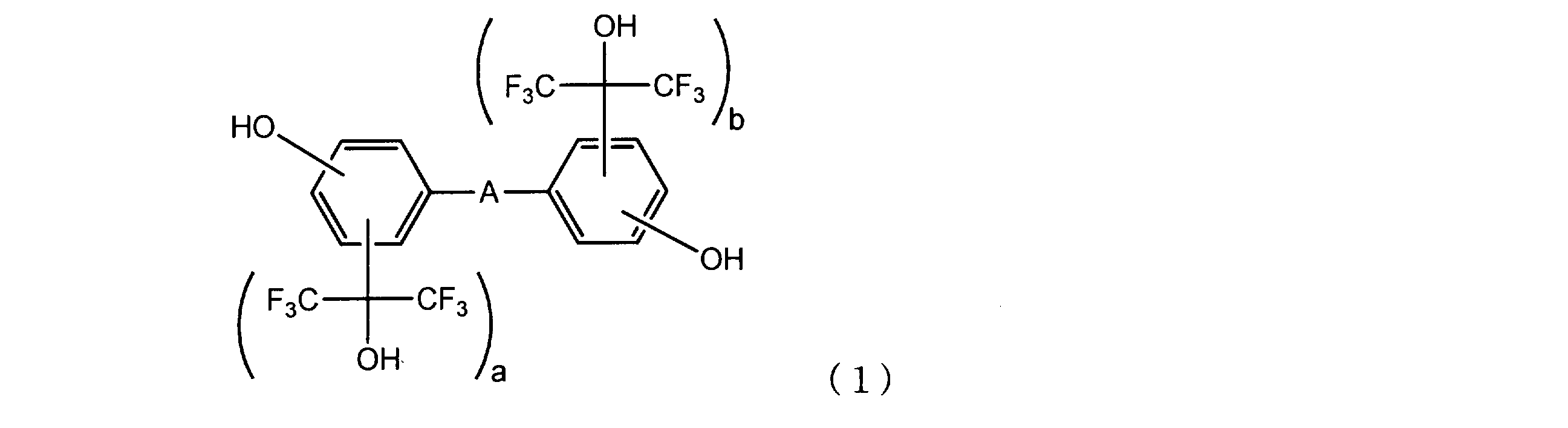
- Fluorine-containing polymerizable monomer compound The present invention is a fluorine-containing polymerizable monomer represented by the general formula (1).
- A is a single bond, an oxygen atom, a sulfur atom, SO 2 , CH 2 , CO, C (CH 3 ) 2 , C (CH 3 ) (CH 2 CH 3 ), C (CF 3 ) 2 , C (CH 3 ) (C 6 H 5 ), CH 2 —C 6 H 4 —CH 2 , or a divalent organic group having two hydrogen atoms removed from benzene, naphthalene, cyclohexene or fluorene,
- b are each independently an integer of 0 to 2, and 1 ⁇ a + b ⁇ 4.
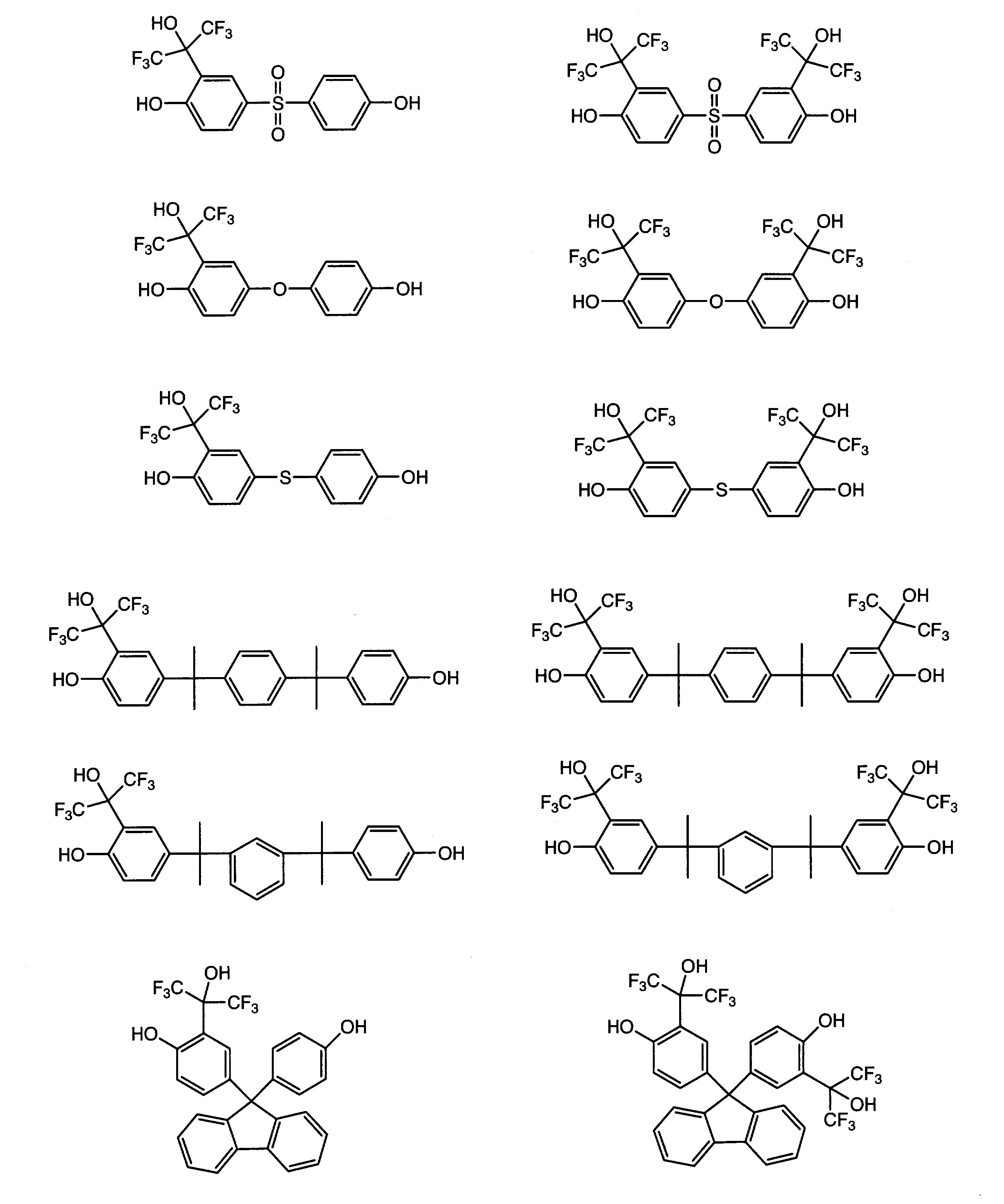
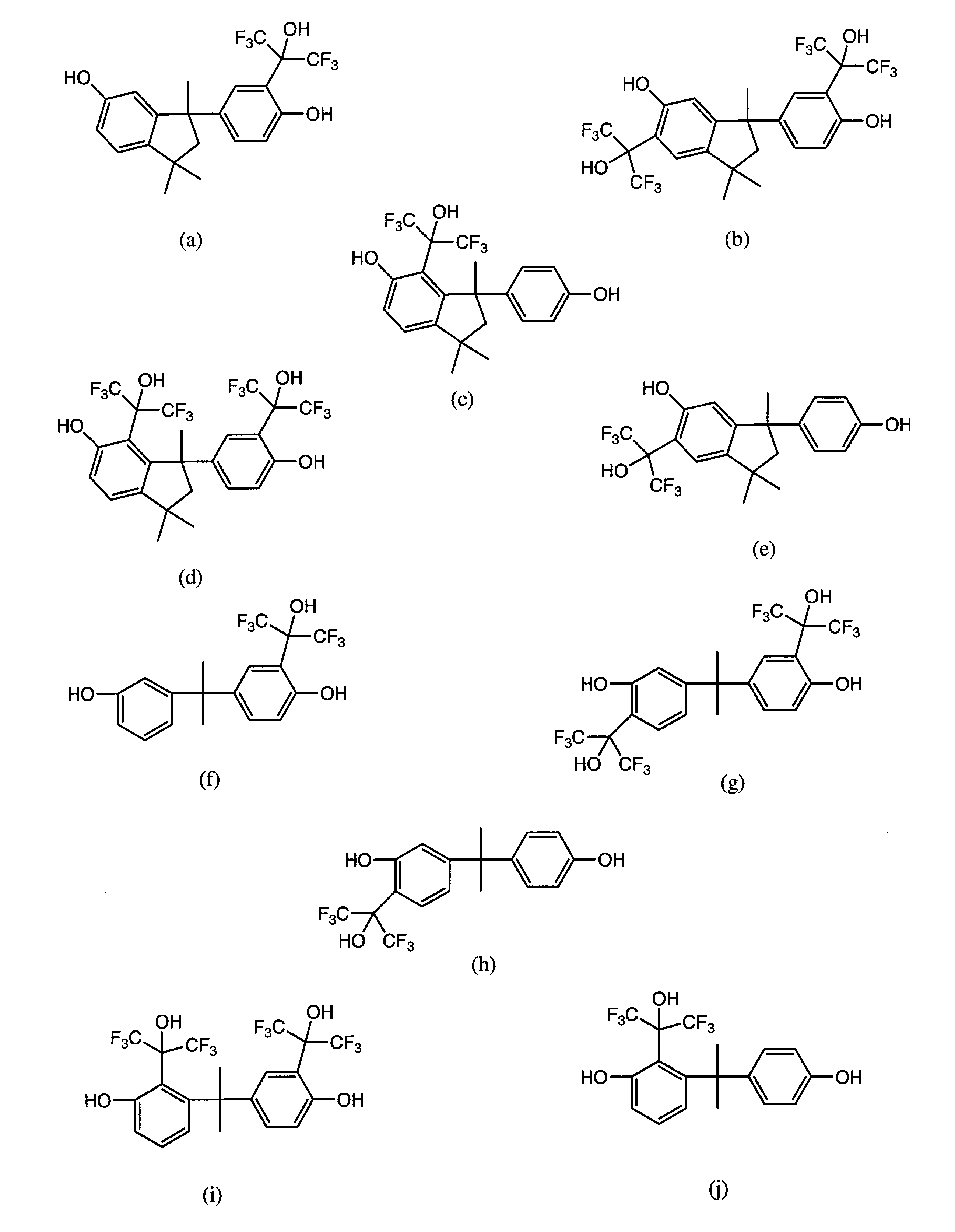
- the fluorine-containing polymerizable monomer represented by the general formula (1) is exemplified below.
- the fluorine-containing polymerizable monomers of the formulas (a) to (j) are synthesized from the fluorine-containing polymerizable monomer represented by the general formula (1), and are within the scope of the present invention. .
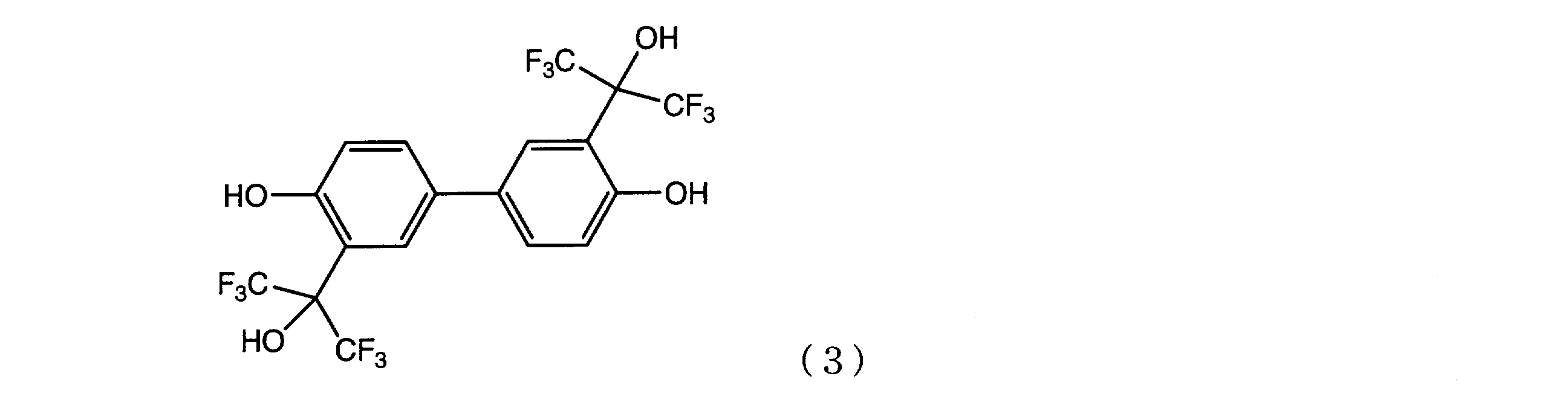
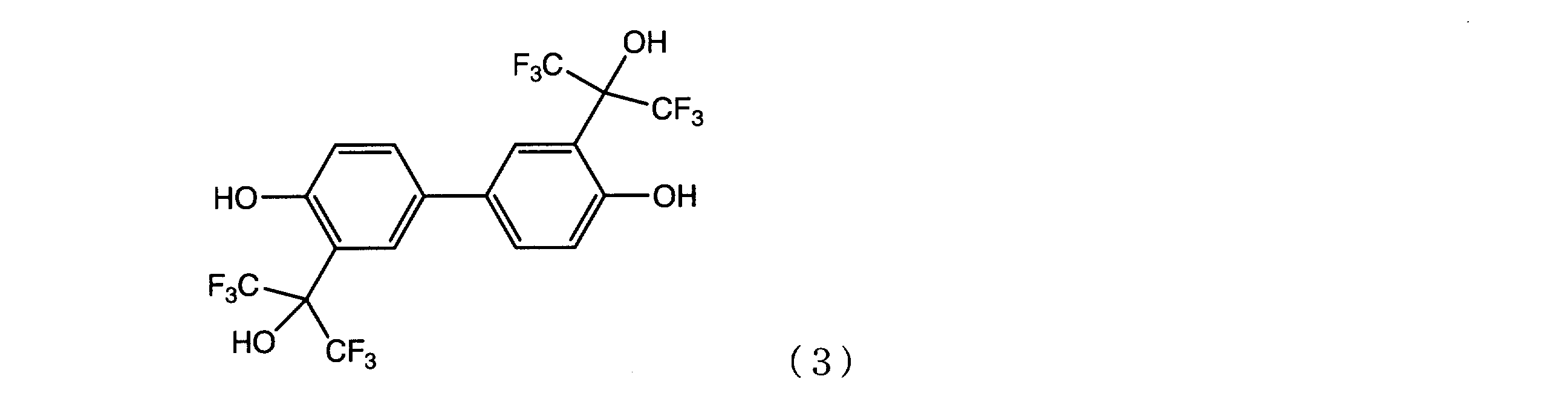
- the synthesis is easy and that the HFIP group is bifunctional as a raw material of the polymer compound, and a fluorine-containing polymerizable monomer represented by the formula (3) is preferable.
- the fluorine-containing polymerizable monomer represented by the formula (3) is a diol, and can be obtained by reacting 4,4′-biphenol with hexafluoroacetone or hexafluoroacetone trihydrate.
- hexafluoroacetone When hexafluoroacetone is added to 4,4'-biphenol, the boiling point of hexafluoroacetone is -28 ° C, so a cooling device or a sealed reactor is used to keep hexafluoroacetone in the reaction system. In particular, it is preferable to use a sealed reactor.
- hexafluoroacetone trihydrate When reacting 4,4′-biphenol and hexafluoroacetone trihydrate, the boiling point of hexafluoroacetone trihydrate is 105 ° C., which is easier to handle than hexafluoroacetone.
- a sealed vessel may be used as the reaction apparatus, but hexafluoroacetone trihydrate can be retained in the reaction system by cooling with a reflux condenser.
- the amount of hexafluoroacetone or hexafluoroacetone trihydrate used in this reaction is preferably 2.0 molar equivalents or more and 8.0 molar equivalents or less with respect to 4,4′-biphenol, preferably 2. It is 2 molar equivalents or more and 3.0 molar equivalents or less. If it is less than 2.0 molar equivalents, the yield of the fluorine-containing polymerizable monomer represented by formula (3) is low, and the reaction proceeds even if it is used in excess of 8.0 molar equivalents, but 8.0. It is not necessary to use more than the molar equivalent.
- This reaction can be carried out in the temperature range of 50 ° C. or more and 200 ° C. or less, but 120 ° C. or more and 130 ° C. or less is particularly preferable.
- the reaction hardly proceeds at a temperature lower than 50 ° C., and at a temperature higher than 200 ° C., particularly 250 ° C. or higher, the yield of the fluorine-containing polymerizable monomer represented by the formula (3) decreases.
- This reaction proceeds without using a catalyst, but the reaction can be promoted by using an acid catalyst.
- acid catalysts used include Lewis acid such as aluminum chloride, iron (III) chloride or boron fluoride, organic sulfonic acid such as benzenesulfonic acid, camphorsulfonic acid (CSA), methanesulfonic acid, and p-toluenesulfonic acid.
- Lewis acid such as aluminum chloride, iron (III) chloride or boron fluoride
- organic sulfonic acid such as benzenesulfonic acid, camphorsulfonic acid (CSA), methanesulfonic acid, and p-toluenesulfonic acid.
- pTsOH p-toluenesulfonic acid
- PPTS pyridinium p-toluenesulfonic acid
- aluminum chloride, iron (III) chloride, methanesulfonic acid, p-toluenesulfone Acid (pTsOH) monohydrate is particularly preferred because it is readily available.
- the amount of the catalyst used is 1 mol% or more and 50 mol% or less, preferably 3 mol% or more and 40 mol% or less with respect to 1 mol of 4,4′-biphenol. If it is less than 1 mol%, the yield of the fluorine-containing polymerizable monomer represented by formula (3) is low, and the reaction proceeds even if it is used in an amount of more than 50 mol%, but it is not necessary to add much.
- This reaction may be solventless or use a solvent.
- the solvent used is not particularly limited as long as it does not participate in the reaction, but aromatic hydrocarbons such as xylene, toluene, benzene, anisole, diphenyl ether, nitrobenzene or benzonitrile, chlorinated solvents such as chloroform and methylene chloride. Dichloroethane or dichlorobenzene or water is preferred.
- the amount of the solvent to be used is not particularly limited, but it is not preferable to use a large amount because the yield of the fluorine-containing polymerizable monomer represented by the formula (3) per unit volume of the reactor decreases.
- the mode differs depending on whether hexafluoroacetone or hexafluoroacetone trihydrate is used.
- hexafluoroacetone first, 4,4′-biphenol and a catalyst or solvent are put in the reactor, and then the hexafluoroacetone is heated while the pressure in the reactor does not exceed 0.5 MPa. It is preferred to add acetone.
- the reaction time of this reaction is not particularly limited, but is appropriately selected depending on the temperature or the amount of catalyst used. Therefore, it is preferable to terminate the reaction after confirming that the raw material has been sufficiently consumed by general-purpose analysis means such as gas chromatography.
- the fluorine-containing polymerizable monomer represented by the formula (3) can be obtained by means such as extraction, distillation, and crystallization. If necessary, the fluorine-containing polymerizable monomer represented by the formula (3) can be purified by column chromatography or recrystallization.
- a polymer compound comprising a fluorine-containing polymerizable monomer represented by the general formula (1), the general formula (2) or the formula (3) is subjected to polycondensation. Can be obtained.
- These fluorine-containing polymerizable monomers are compounds having two hydroxy groups and one or more HFIP groups, and have at least two hydroxy groups in the molecule. When manufacturing a high molecular compound, it is preferable to make the hydroxyl group couple
- the fluorine-containing polymerizable monomer of the present invention is made into a composition with at least one compound selected from the group consisting of the compounds represented by the general formulas (4) to (6), and then subjected to predetermined reaction conditions.
- a repeating unit represented by the general formula (7), (8), the formula (9), the general formula (10), (11), or the formula (12) is included by performing a condensation polymerization reaction in a suitable temperature range.
- a polymer compound can be obtained.
- composition of fluorinated polymerizable monomer of the present invention and compound represented by general formula (4) or general formula (5) and polymer compound thereof General formula (1), (2) or formula of the present invention
- a composition containing the fluorine-containing polymerizable monomer represented by (3) and the compound represented by the following general formula (4) or general formula (5) is subjected to a condensation polymerization reaction under predetermined reaction conditions.
- a polymer compound containing a repeating unit represented by formula (7), (8) or formula (9) is obtained. Thereafter, if necessary, the hydrogen atom of the HFIP group can be substituted with the glycidyl group.
- R 1 is an alkylene group or a divalent organic group in which two hydrogen atoms are removed from an aromatic ring or an alicyclic ring, and may contain an oxygen atom, a sulfur atom or a nitrogen atom in the structure, A part of hydrogen atoms may be substituted with a fluorine atom, a chlorine atom, an alkyl group or a fluoroalkyl group.
- Each B is independently a hydrogen atom, an alkyl group having 1 to 10 carbon atoms, or a phenyl group having 6 to 10 carbon atoms.
- R 1 is an alkylene group or a divalent organic group in which two hydrogen atoms are removed from an aromatic ring or alicyclic ring, and the structure may contain an oxygen atom, a sulfur atom or a nitrogen atom.
- a part of hydrogen atoms may be substituted with a fluorine atom, a chlorine atom, an alkyl group or a fluoroalkyl group.
- X is each independently a chlorine atom, a fluorine atom, a bromine atom or an iodine atom.
- carboxylic acid as a raw material of the compound represented by the general formula (4) or the general formula (5), either an aliphatic carboxylic acid or an aromatic carboxylic acid may be used.
- aliphatic dicarboxylic acid examples include oxalic acid, malonic acid, succinic acid, glutaric acid, adipic acid, pimelic acid, suberic acid, azelaic acid and sebacic acid.
- Aromatic carboxylic acids include phthalic acid, isophthalic acid, terephthalic acid, 3,3'-dicarboxyldiphenyl ether, 3,4'-dicarboxyldiphenyl ether, 4,4'-dicarboxyldiphenyl ether, 3,3'-dicarboxyl Diphenylmethane, 3,4'-dicarboxyldiphenylmethane, 4,4'-dicarboxyldiphenylmethane, 3,3'-dicarboxyldiphenyldifluoromethane, 3,4'-dicarboxyldiphenyldifluoromethane, 4,4'-dicarboxyldiphenyl Difluoromethane, 3,3′-dicarboxyl diphenyl sulfone, 3,4′-dicarboxyl diphenyl sulfone, 4,4′-dicarboxyl diphenyl sulfone, 3,3′-dicarboxyl diphen
- 2- (perfluorononenyloxy) terephthalic acid or 4-methoxy-5- (perfluorononenyloxy) isophthalic acid can be mentioned.
- the fluorine-containing polymerizable monomer represented by the general formula (1), the general formula (2) or the formula (3) is reacted with the compound represented by the general formula (4) or the general formula (5). Then, a polymer compound containing a repeating unit represented by the following general formula (7), (8) or formula (9) is obtained.
- the method and conditions for this polymerization reaction are not particularly limited.
- a method in which the composition containing the fluorine-containing polymerizable monomer and the compound represented by the general formula (4) or the general formula (5) is mutually melted at 150 ° C. or more and subjected to a condensation polymerization reaction without a solvent In addition, a method of performing a condensation polymerization reaction in an organic solvent, preferably at 150 ° C. or more, and a method of performing a condensation polymerization reaction in an organic solvent at a temperature of ⁇ 20 ° C. or more and 80 ° C. or less can be mentioned.
- the organic solvent that can be used is not particularly limited as long as both components of the raw material dissolve, but N, N-dimethylformamide, N, N-dimethylacetamide, N-methylformamide, hexamethylphosphoric triamide or N -Methyl-2-pyrrolidone, aromatic solvents benzene, anisole, diphenyl ether, nitrobenzene or benzonitrile, halogen solvents chloroform, dichloromethane, 1,2-dichloroethane or 1,1,2,2-tetrachloroethane,
- the lactone compound include ⁇ -butyrolactone, ⁇ -valerolactone, ⁇ -valerolactone, ⁇ -caprolactone, ⁇ -caprolactone, and ⁇ -methyl- ⁇ -butyrolactone.
- These organic solvents may be used alone or as a mixture of two or more. It is effective to carry out the reaction in the presence of an acid acceptor such as pyridine or triethy
- the hydrogen atom of the HFIP group may be substituted with a glycidyl group.
- an HFIP group and epichlorohydrin can be reacted in the presence of an alkali metal compound to obtain a target glycidyl group adduct (described in Non-Patent Document 3).
- the alkali metal compounds include sodium hydroxide, lithium hydroxide or potassium hydroxide, which are alkali metal hydroxides, sodium carbonate, sodium bicarbonate, sodium chloride, lithium chloride or potassium chloride, sodium methoxide, Examples include alkali metal alkoxides such as sodium ethoxide, alkali metal phenoxides, sodium hydride, lithium hydride, and the like, and alkali metal salts of organic acids such as sodium acetate and sodium stearate.
- a phase transfer catalyst may be added, and a quaternary ammonium salt is preferably used.
- the quaternary ammonium salts include tetramethylammonium chloride, tetramethylammonium bromide, tetramethylammonium hydroxide, triethylmethylammonium chloride, tetraethylammonium chloride, tetraethylammonium bromide, tetrabutylammonium chloride, tetrabutylammonium bromide, tetrabutylammonium ion.
- Examples thereof include dye, benzyltrimethylammonium chloride, benzyltrimethylammonium bromide, benzyltrimethylammonium hydroxide, benzyltributylammonium chloride, and phenyltrimethylammonium chloride.
- the HFIP group can be converted to a glycidyl group by oxidizing the double bond after protecting the HFIP group with an allyl group.
- an allyl group-protected substance is obtained by reacting an allyl halide such as allyl chloride, allyl bromide, or allyl iodide with an HFIP group, an oxidizing agent such as hydrogen peroxide or alkyl hydroperoxide is allowed to act.
- an allyl halide such as allyl chloride, allyl bromide, or allyl iodide
- an oxidizing agent such as hydrogen peroxide or alkyl hydroperoxide
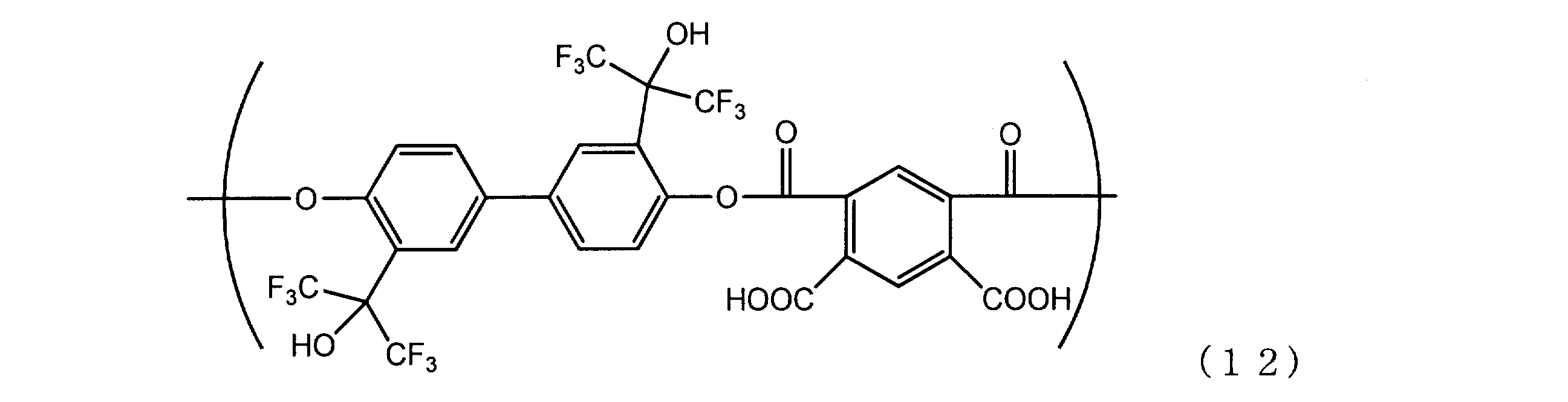
- composition of fluorinated polymerizable monomer of the present invention and compound represented by general formula (6) and polymer compound thereof represented by general formula (1), (2) or formula (3) of the present invention If a composition containing a fluorine-containing polymerizable monomer and a compound represented by the following general formula (6) is subjected to a polycondensation reaction under predetermined reaction conditions, the general formula (10), (11) or formula A polymer compound containing the repeating unit represented by (12) is obtained. Thereafter, if necessary, the hydrogen atom of the HFIP group can be substituted with the glycidyl group.
- R 2 is a tetravalent organic group in which four hydrogen atoms are removed from an alkane, aromatic ring or alicyclic ring, and may contain an oxygen atom, sulfur atom or nitrogen atom in the structure, Some of the atoms may be substituted with a fluorine atom, a chlorine atom, an alkyl group or a fluoroalkyl group.
- a tetracarboxylic dianhydride generally used as a raw material for polyamic acid or polyimide can be used.
- tetracarboxylic dianhydride examples include benzenetetracarboxylic dianhydride (pyromellitic dianhydride; PMDA), trifluoromethylbenzenetetracarboxylic dianhydride, bistrifluoromethylbenzenetetracarboxylic dianhydride, Difluorobenzenetetracarboxylic dianhydride, naphthalenetetracarboxylic dianhydride, biphenyltetracarboxylic dianhydride, terphenyltetracarboxylic dianhydride, hexafluoroisopropylidenediphthalic dianhydride, oxydiphthalic dianhydride Bicyclo (2,2,2) oct-7-ene-2,3,5,6-tetracarboxylic dianhydride, 2,2-bis (3,4-dicarboxyphenyl) fexafluoropropanoic acid Anhydride (6FDA), 2,3,4,5-thiophe
- the fluorine-containing polymerizable monomer represented by the general formula (1), (2) or formula (3) and the compound represented by the general formula (6) are subjected to a polycondensation reaction, and the following general formula ( 10), a polymer compound containing a repeating unit represented by (11) or formula (12) is obtained.
- the solvent that can be used is not particularly limited as long as the composition of the raw material dissolves, and a similar solvent can be used.
- N, N-dimethylformamide, N, N-dimethylacetamide, N-methylformamide which are amide solvents, Hexamethylphosphoric triamide or N-methyl-2-pyrrolidone, aromatic solvents benzene, anisole, diphenyl ether, nitrobenzene, or benzonitrile, halogenated solvents chloroform, dichloromethane, 1,2-dichloroethane or 1,1 2,2-tetrachloroethane, lactones ⁇ -butyrolactone, ⁇ -valerolactone, ⁇ -valerolactone, ⁇ -caprolactone, ⁇ -caprolactone or ⁇ -methyl- ⁇ -butyrolactone can be used.
- These organic solvents may be used alone or as a mixture of two or more. It is also effective to conduct the reaction in the presence of an acid accept
- the hydrogen atom of the HFIP group may be substituted with a glycidyl group.
- an HFIP group and epichlorohydrin can be reacted in the presence of an alkali metal compound to obtain a target glycidyl group adduct (described in Non-Patent Document 3).
- Diol Compound In polymerizing a polymer compound containing a repeating unit represented by the general formula (7), (8), formula (9), general formula (10), (11) and formula (12), the present invention In addition to the fluorine-containing polymerizable monomer of the general formula (1), the general formula (2) or the formula (3) and the compounds represented by the general formulas (4) to (6), desired heat resistance or solvent solubility In order to obtain properties and the like, another diol compound may be added to serve as a copolymer component.
- diol compound to be added examples include 1,4-cyclohexanediol, 1,3-adamantanediol, catechol, 1,3-benzenediol, 2,2'-dihydroxybiphenyl, 4,4'-dihydroxybiphenyl, 2,2'- Methylene diphenol, 4,4′-methylene diphenol, ethylene glycol, propylene glycol, 2,2-bis (4-hydroxyphenyl) -propane, 2,2-bis (4-hydroxyphenyl) -3-methylpropane, 2,2-bis (4-hydroxyphenyl) -butane, 3,3-bis (4-hydroxyphenyl) -pentane, 2,2-bis (4-hydroxyphenyl) -4-methylpentane, 3,3-bis (4-hydroxyphenyl) -hexane, 2,2-bis (3-chloro-4-hydroxyphenyl) Nyl) -propane, 2,2-bis (3,5-dichloro-4-hydroxyphenyl) -propan
- polyester can be used as a varnish dissolved in an organic solvent, or as a powder or film.
- an oxidation stabilizer, a filler, a silane coupling agent, a photosensitizer, a photopolymerization initiator, a sensitizer, and the like may be added to the polymer compound depending on the purpose of use.
- varnish it can be applied on a substrate such as glass, silicon wafer, metal, metal oxide, ceramics or resin by a known method such as spin coating, spray coating, flow coating, impregnation coating or brush coating. it can.
- the polymer compound containing the repeating unit represented by the general formula (7), (8), formula (9), general formula (10), (11) or formula (12) has transparency or heat resistance. For the purpose of improving, it can be mixed with an epoxy compound and cured by heating or light irradiation to obtain a cured product.
- Epoxy compounds include phenol novolac resin, cresol novolac resin, aromatic hydrocarbon formaldehyde resin modified phenol resin, dicyclopentadiene modified phenol resin, phenol aralkyl resin, cresol aralkyl resin, naphthol aralkyl resin, biphenyl modified phenol aralkyl resin, phenol triol.
- R 3 is a monovalent organic group in which one hydrogen atom is removed from an alkane, aromatic ring or alicyclic ring, and may contain an oxygen atom, a sulfur atom or a nitrogen atom in the structure. A part of hydrogen atoms may be substituted with a fluorine atom, a chlorine atom, an alkyl group or a fluoroalkyl group.
- f is an integer of 1 to 4.
- Examples of the alcohol include 1,4-cyclohexanediol, 1,3-adamantanediol, catechol, 1,3-benzenediol, 2,2′-dihydroxybiphenyl, 4,4′-dihydroxybiphenyl, and 2,2′-methylene.
- these epoxy compounds and an epoxy resin curing agent may be used in combination.
- the curing agent examples include amine compounds, acid anhydride compounds, amide compounds, phenol compounds, mercaptan compounds, imidazole compounds, polysulfide resin compounds, and phosphorus compounds.
- thermosetting agents diaminodiphenylmethane, diaminodiphenylsulfone, diethylenetriamine, triethylenetetramine, polyalkylene glycol polyamine, phthalic anhydride, trimellitic anhydride, pyromellitic anhydride, maleic anhydride, tetrahydrophthalic anhydride , Methyltetrahydrophthalic anhydride, methylnadic anhydride, hexahydrophthalic anhydride, methylhexahydrophthalic anhydride, 2-methylimidazole, triphenylphosphine, 2-ethyl-4-methylimidazole, BF3-amine complex or guanidine derivative And diphenyliodonium hexafluorophosphate
- the mixing ratio of the polymer compound containing the repeating unit represented by the general formula (7), (8), formula (9), general formula (10), (11) or formula (12) and the epoxy compound is a mass ratio.
- polymer compound: epoxy compound 10: 90 to 90:10, preferably 30:70 to 70:30, more preferably 40:60 to 60:40.
- the mixing ratio of the epoxy compound and the curing agent for epoxy resin is 70:30 to 99: 1 in terms of mass ratio, preferably 90:10 to 99:30, more preferably 40:60 to 60: 40.
- the above composition can be dissolved in an organic solvent, applied to, for example, a glass or silicon substrate, and then cured by heating or ultraviolet irradiation with an ultraviolet (UV) lamp or the like to form a crosslinked cured film.
- an ultraviolet (UV) lamp or the like to form a crosslinked cured film.
- any solvent that can dissolve the composition can be used without any particular limitation.
- Specific examples include N, N-dimethylformamide, N, N-dimethylacetamide, N-methylformamide, hexamethylphosphoric triamide or N-methyl-2-pyrrolidone, and others, cyclohexanone, Examples include propylene glycol monomethyl ether acetate or ⁇ -butyrolactone.
- the cured film of the present invention is used as a coating material for a flat panel display, a protective film for a substrate body of an electronic circuit, a protective film for a semiconductor, or the like by applying the cured film to a substrate by wet film formation. .
- the identification method of the fluorine-containing polymerizable monomer synthesized in the examples and the physical property evaluation method of the polyarylate resin which is a polymer compound are shown in the following (1) to (6).
- NMR Nuclear Magnetic Resonance
- NMP N-methylpyrrolidone
- TMAH tetramethylammonium hydroxide
- the film thickness before and after heating was measured using a stylus type surface shape measuring instrument (product name Dektak 8 manufactured by Veeco, USA).
- the remaining film ratio is the film thickness after heating / the film thickness before heating ⁇ 100.
- Example 2 Synthesis of fluorine-containing polymerizable monomers (C) and (D)
- compound (B) and hexafluoroacetone were reacted to synthesize a fluorine-containing polymerizable monomer represented by formula (C) or formula (D).
- room temperature (20 ° C.) 150 g of xylene was placed in a stainless steel autoclave, compound (B), 25 g (0.16 mol) was added, and CH 3 SO 3 H, 0.25 g was added.
- the temperature was gradually raised and the reaction was continued for 8 hours while stirring at 110 ° C.
- the reaction product containing the starting material in the reaction system was filtered, and the filter residue was dissolved in isopropyl ether and washed with water, and anhydrous magnesium sulfate was added to the separated organic layer for dehumidification. Distillation under reduced pressure was performed to distill off isopropyl ether, and hexane as a poor solvent was added to precipitate a fluorine-containing polymerizable monomer. From the results of DI-MS analysis, the obtained solid was obtained as a fluorine-containing polymerizable monomer represented by the formula (D) and a fluorine-containing polymerizable monomer represented by the formula (C).
- Example 3 Synthesis of fluorine-containing polymerizable monomers (F) and (G)
- compound (E) and hexafluoroacetone were reacted to synthesize a fluorine-containing polymerizable monomer represented by formula (F) or formula (G).
- room temperature (20 ° C.) 150 g of xylene was placed in a stainless steel autoclave, compound (E) and 25 g (0.16 mol) were added, and CH 3 SO 3 H and 0.25 g were added.
- the analysis result of the obtained fluorine-containing polymerizable monomer of the formula (F) is shown below.
- Example 4 In a reaction vessel equipped with a stirrer, the fluorine-containing polymerizable monomer represented by the formula (3) synthesized in Example 1, that is, 3,3-bis (1,1,1,3,3,3 -Hexafluoro-2-hydroxypropan-2-yl) -4,4-biphenol, 25.91 g (0.0500 mol) was prepared and dehydrated and purified in advance, N-methylpyrrolidone, 167 g and pyridine, 8.7 g In a mixed solvent.
- the fluorine-containing polymerizable monomer represented by the formula (3) synthesized in Example 1, that is, 3,3-bis (1,1,1,3,3,3 -Hexafluoro-2-hydroxypropan-2-yl) -4,4-biphenol, 25.91 g (0.0500 mol) was prepared and dehydrated and purified in advance, N-methylpyrrolidone, 167 g and pyridine, 8.7 g In a mixed solvent.
- Example 5 In a reaction vessel equipped with a stirrer, the fluorine-containing polymerizable monomer represented by the formula (3) synthesized in Example 1, that is, 3,3-bis (1,1,1,3,3,3 -Hexafluoro-2-hydroxypropan-2-yl) -4,4-biphenol, 3.00 g (0.0052 mol), N-methylpyrrolidone previously purified by dehydration, 16 g and pyridine, 1.01 g Dissolved in the mixed solvent.
- Example 6 In a reaction vessel equipped with a stirrer, the fluorine-containing polymerizable monomer represented by the formula (3) synthesized in Example 1, that is, 3,3-bis (1,1,1,3,3,3 -Hexafluoro-2-hydroxypropan-2-yl) -4,4-biphenol, 3.00 g (0.0052 mol), N-methylpyrrolidone previously purified by dehydration, 16 g and pyridine, 1.01 g Dissolved in the mixed solvent.
- Example 8 As a fluorine-containing polymerizable monomer represented by the formula (3) synthesized in Example 1 in a reaction vessel equipped with a stirrer, 3,3-bis (1,1,1,3,3,3- Hexafluoro-2-hydroxypropan-2-yl) -4,4-biphenol, 1.036 g (0.00200 mol) was prepared, dehydrated and purified in advance, N-methylpyrrolidone, 7.0 g and pyridine, Dissolved in 35 g of mixed solvent. Subsequently, pyromellitic anhydride, 0.436 g (0.00200 mol) was added, and the polycondensation reaction shown below was performed by stirring for 24 hours at room temperature to obtain a reaction solution.
- Example 4 After completion of the reaction, the same operation as in Example 4 was performed to obtain 1.22 g of a polyarylate resin which is a polycondensate containing a repeating unit represented by the formula (J) in a yield of 83%.
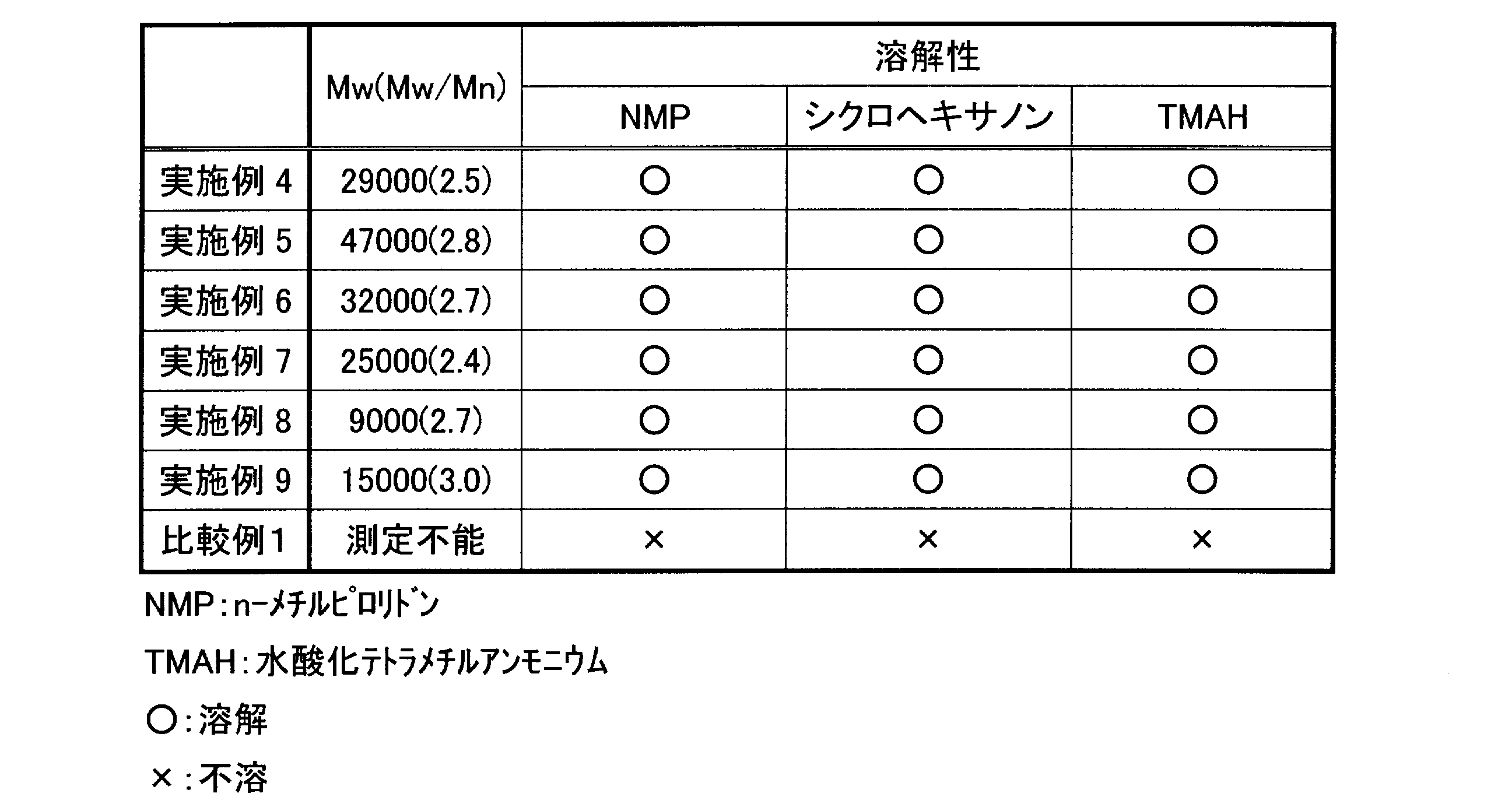
- the molecular weight and solubility results of the resin are shown in Table 1.
- Example 9 As a fluorine-containing polymerizable monomer represented by the formula (3) synthesized in Example 1 in a reaction vessel equipped with a stirrer, 3,3-bis (1,1,1,3,3,3- Hexafluoro-2-hydroxypropan-2-yl) -4,4-biphenol, 1.036 g (0.002 mol) was prepared, dehydrated and purified in advance, N-methylpyrrolidone, 7.0 g and pyridine, Dissolved in 35 g of mixed solvent.
- Comparative Example 1 In a reaction vessel equipped with a stirrer, 0.931 g (0.00500 mol) of 4,4-biphenol was dissolved in a mixed solvent of N-methylpyrrolidone, 8.6 g and pyridine, 0.87 g, which had been dehydrated and purified in advance. . Next, 1.015 g (0.005 mol) of isophthalic acid chloride was added, and the mixture was stirred at room temperature (20 ° C.) to carry out the polycondensation reaction shown below. Precipitation started to deposit in 1 hour after the start of stirring.
- the reaction solution in which the precipitate was deposited was poured into a beaker containing 100 g of methanol, which is a poor solvent, to precipitate a polymer compound. It dried for 8 hours at 100 degreeC under pressure reduction with the vacuum dryer, and obtained the polyarylate resin containing the repeating unit represented by Formula (K). This polyarylate resin was insoluble in THF, and molecular weight measurement and transparency evaluation could not be performed.
- the polyarylate resin that is a polymer compound containing HFIP groups of the present invention of Examples 4 to 9 is different from the polyarylate resin that is a polymer compound not containing HFIP groups of Comparative Example 1, It was found to be soluble in n-methylpyrrolidone, cyclohexanone and tetramethylammonium hydroxide. Since it is soluble in these organic solvents, it is easy to handle as a functional resin, raw material or material in the semiconductor field.
- Example 10 Polyarylate resin, which is a polymer compound synthesized in Example 4, 1.62 g, bisphenol A type epoxy resin (JER828, manufactured by Mitsubishi Chemical Corporation) as an epoxy compound, 1.28 g, and triphenylphosphine as a curing accelerator.
- 05 g and 11.3 g of cyclohexanone were added and stirred to dissolve to obtain a solution having a solid content concentration of 20% by mass.
- a spin coater spin-coated for 40 seconds at 1000 rpm, and was dried at 80 degreeC for 5 minutes. Then, it heated at 180 degreeC for 1 hour, the curing reaction was performed, and the cured film was formed on the glass substrate.
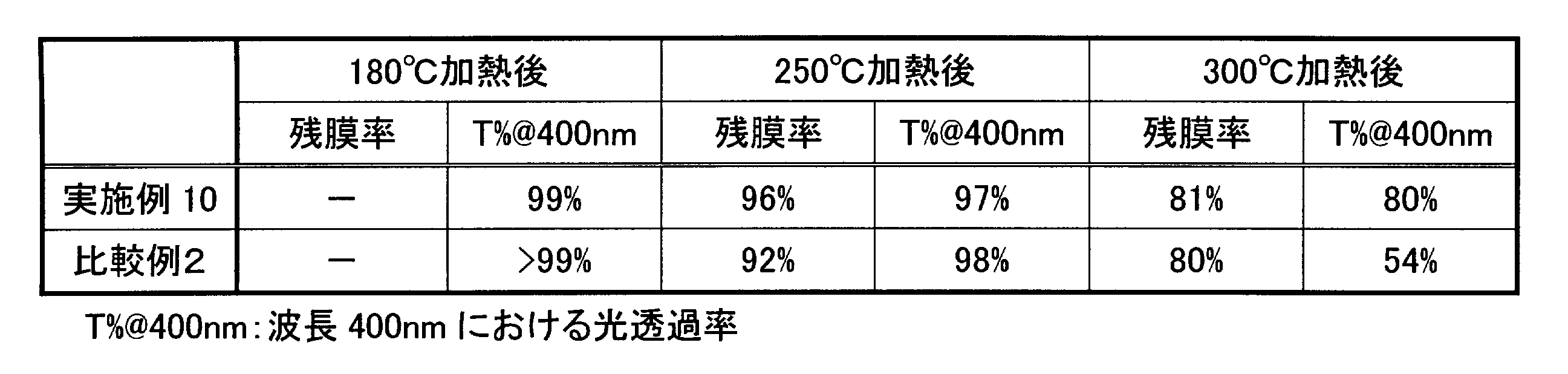
- the obtained glass substrate with a cured film was measured for light transmittance at a wavelength of 400 nm with a spectrophotometer using the glass substrate as a reference. Further, the two glass substrates with cured films were heated again at 250 ° C. for 30 minutes and at 300 ° C. for 30 minutes, respectively, and the transmittance at 400 nm was measured.
- the residual film ratio was evaluated by measuring the film thickness after heating at 180 ° C. and the film thickness after reheating, setting the film thickness after heating at 180 ° C. as 100%, and the film thickness after reheating. The higher the remaining film ratio, the less the volatile content and the better the film.
- Example 10 The results of Example 10 and Comparative Example 2 are shown in Table 2.
- the polyarylate resin which is a polymer compound containing HFIP groups of Example 10
- the polyamide resin containing HFIP groups of Comparative Example 2 are subjected to heat transparency at 250 ° C. after heat treatment. Although it is the same value, it turned out that the heat treatment at 300 ° C. is superior in transparency to the polyarylate resin.
- the reason for this is that, when the polyamide resin is heated at 300 ° C., as shown in the following reaction formula, the polyamide resin is changed to a structure containing a repeating unit (M) having a heterocyclic ring, and the ⁇ conjugate length is increased, thereby increasing transparency. Is estimated to have been reduced.
- the fluorine-containing polymerizable monomer containing the HFIP group of the present invention can be polycondensed by having a plurality of hydroxyl groups in the structure. Therefore, if the fluorine-containing polymerizable monomer of the present invention is used, HFIP groups can be included in the chemical structure of the polyester resin, the transparency is high, the water absorption, the dielectric constant, and the refractive index are low. Features such as dissolution in a solvent and excellent adhesion to a substrate can be further imparted. Therefore, these resins using the fluorine-containing polymerizable monomer of the present invention are used in the field of polymer materials such as coating materials for advanced flat panel displays, substrate bodies for electronic circuits or protective film materials for semiconductors.
- the fluorine-containing polymerizable monomer of the present invention are used in the field of polymer materials such as coating materials for advanced flat panel displays, substrate bodies for electronic circuits or protective film materials for semiconductors.
Landscapes
- Chemical & Material Sciences (AREA)
- Organic Chemistry (AREA)
- Health & Medical Sciences (AREA)
- Chemical Kinetics & Catalysis (AREA)
- Medicinal Chemistry (AREA)
- Polymers & Plastics (AREA)
- Organic Low-Molecular-Weight Compounds And Preparation Thereof (AREA)
- Compositions Of Macromolecular Compounds (AREA)
- Polyesters Or Polycarbonates (AREA)
- Epoxy Resins (AREA)
Abstract
Description
一般式(1)で表される含フッ素重合性単量体。

一般式(1)で表わされる含フッ素重合性単量体が、一般式(2)で表される含フッ素単量体である、発明1の含フッ素重合性単量体。

一般式(2)で表わされる含フッ素単量体が、式(3)で表される含フッ素重合性単量体である、発明2の含フッ素重合性単量体。

発明1~3のいずれかの含フッ素重合性単量体と、一般式(4)で表される化合物、一般式(5)で表される化合物、および一般式(6)で表される化合物からなる群から選ばれる少なくとも一種を含む、組成物。



一般式(7)で表される繰り返し単位を含む、高分子化合物。

一般式(7)で表わされる繰り返し単位が、一般式(8)で表される繰り返し単位である、発明5の高分子化合物。

一般式(8)で表わされる繰り返し単位が、式(9)で表される繰り返し単位である、発明6の高分子化合物。

一般式(10)で表される繰り返し単位を含む、高分子化合物。
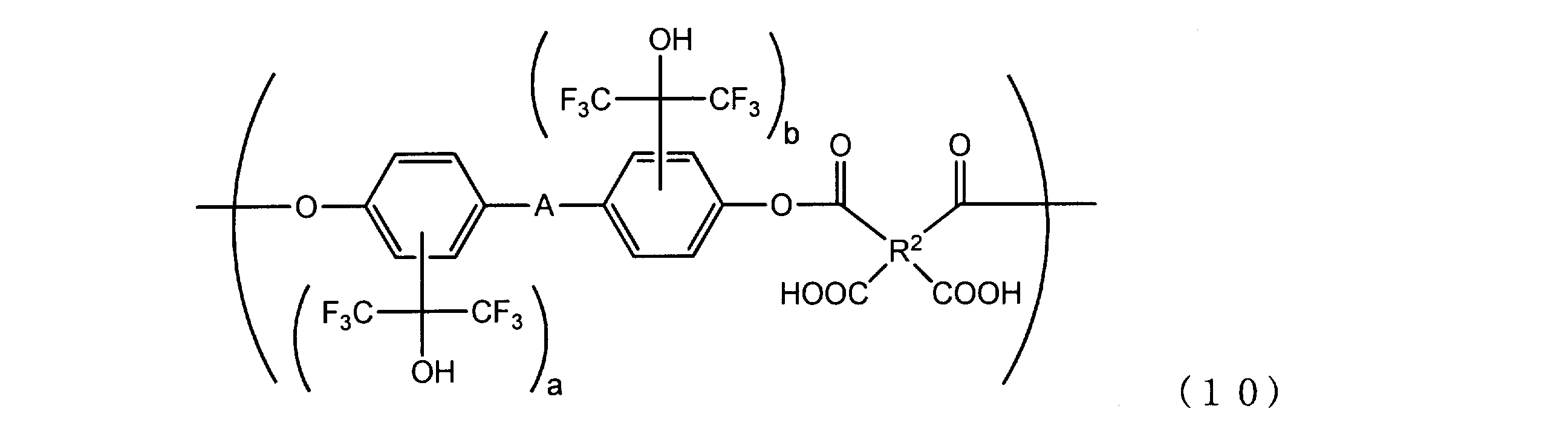
一般式(10)表わされる繰り返し単位が、一般式(11)で表される繰り返し単位である、発明8の高分子化合物。
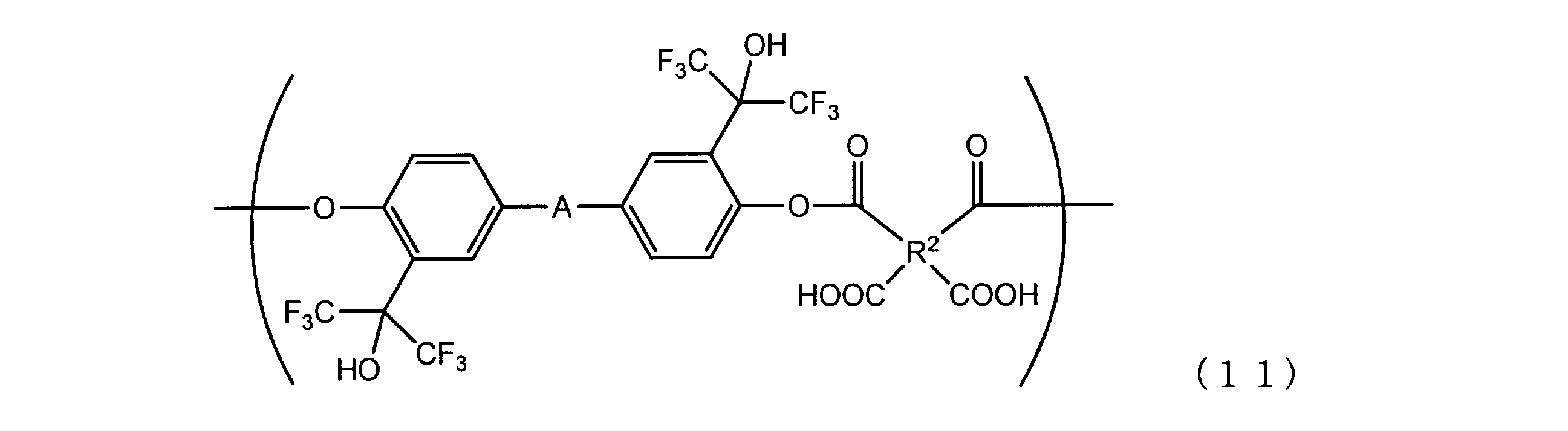
一般式(11)で表わされる繰り返し単位が、式(12)で表される繰り返し単位である、発明9の高分子化合物。

2-ヒドロキシ-1,1,1,3,3,3-ヘキサフルオロイソプロピル基中のOH部位の水素原子の少なくとも一部がグリシジル基で置換されてなる、発明5乃至発明10のいずれか1項に記載の高分子化合物。
発明5乃至発明11のいずれか1項に記載の高分子化合物とエポキシ化合物とを含む、組成物。
エポキシ化合物が一般式(13)で表される、発明12に記載の組成物。

発明11に記載の高分子化合物のグリシジル基を架橋させてなる、硬化物。
発明12または発明13に記載の組成物を架橋させてなる、硬化物。
本発明は、一般式(1)で表される含フッ素重合性単量体である。

前記式(3)で表される含フッ素重合性単量体の合成方法について、例を挙げて説明する。
本発明において、一般式(1)、一般式(2)または式(3)で表される含フッ素重合性単量体を含む組成物を縮重合させ、高分子化合物を得ることができる。これら含フッ素重合性単量体は、2個のヒドロキシ基、1個以上のHFIP基を有する化合物であり、少なくとも分子内に2つ以上のヒドロキシ基を有している。高分子化合物を製造する場合、芳香環に結合したヒドロキシ基を反応させることが好ましい。
本発明の一般式(1)、(2)または式(3)で表される含フッ素重合性単量体と、下記一般式(4)または一般式(5)で表される化合物を含む組成物を、所定の反応条件で縮重合反応させれば、一般式(7)、(8)または式(9)で表される繰り返し単位を含む高分子化合物が得られる。その後、必要であればHFIP基の水素原子をグリシジル基と置換反応させることも可能である。
[一般式(4)で表される化合物]

[一般式(5)で表される化合物]

本発明の一般式(1)、(2)または式(3)で表される含フッ素重合性単量体と、下記一般式(6)で表される化合物を含む組成物を、所定の反応条件で縮重合反応させれば、一般式(10)、(11)または式(12)で表される繰り返し単位を含む高分子化合物が得られる。その後、必要であればHFIP基の水素原子をグリシジル基と置換反応させることも可能である。
[一般式(6)で表される化合物]

前記一般式(7)、(8)、式(9)、一般式(10)、(11)および式(12)で表される繰り返し単位を含む高分子化合物を重合するに当たり、本発明の一般式(1)、一般式(2)または式(3)の含フッ素重合性単量体、一般式(4)~(6)で表される化合物以外に、所望の耐熱性または溶剤溶解性等を得るために、他のジオール化合物を加え、共重合成分としてもよい。
本発明の一般式(7)、(8)、式(9)、一般式(10)、(11)または式(12)で表される繰り返し単位を含む高分子化合物であるポリエステルは、有機溶媒に溶解させたワニス、または粉末もしくはフィルム等として使用できる。その際、使用目的に応じて、前記高分子化合物に、酸化安定剤、フィラー、シランカップリング剤、感光剤、光重合開始剤および増感剤等を添加物してもよい。ワニスの場合は、ガラス、シリコンウェハ、金属、金属酸化物、セラミックスまたは樹脂等の基材上に、スピンコート、スプレーコート、フローコート、含浸コートまたはハケ塗り等の既知の方法で塗布することができる。

共鳴周波数400MHzの核磁気共鳴装置(日本電子株式会社製)を使用し、1H-NMR、19F-NMRの測定を行った。
質量分析計(日本電子株式会社製 型番 JMS-T100GC)を使用し、質量分析スペクトルを測定した。
テトラヒドロフラン(以下、THFと略する)を溶媒とし、ゲル浸透クロマトグラフィー(GPC)測定を行い、ポリスチレン換算で分子量を算出した。
N-メチルピロリドン(以下、NMPと略する)、シクロヘキサノンまたは水酸化テトラメチルアンモニウム(以下、TMAHと略する)の濃度2.38質量%の各々溶液に対し、合成した高分子化合物を、固形分濃度10質量%になるように加え、室温にて1時間攪拌した後に、目視にて溶解物の有無を観察した。尚、NMPおよびシクロヘキサノンは極性溶剤であり、TMAHは有機系強アルカリで、半導体表面処理剤やリソグラフィー用のポジレジスト用現像液として用いられる。
紫外可視分光光度計(株式会社島津製作所製 型番 UV-3150)を使用し、測定した。
加熱前後の膜厚を、触針式表面形状測定器(米国Veeco社製 品名 Dektak8)を用いて測定した。残膜率とは、加熱後の膜厚/加熱前の膜厚×100である。
実施例1(含フッ素重合性単量体(3)の合成)
以下の反応式に示すように、4,4’-ビフェノール(A)にヘキサフルオロアセトンを反応させて、式(3)で表される含フッ素重合性単量体、即ち、3,3-ビス(1,1,1,3,3,3-ヘキサフルオロ-2-ヒドロキシプロパン-2-イル)-4,4-ビフェノールを合成した。
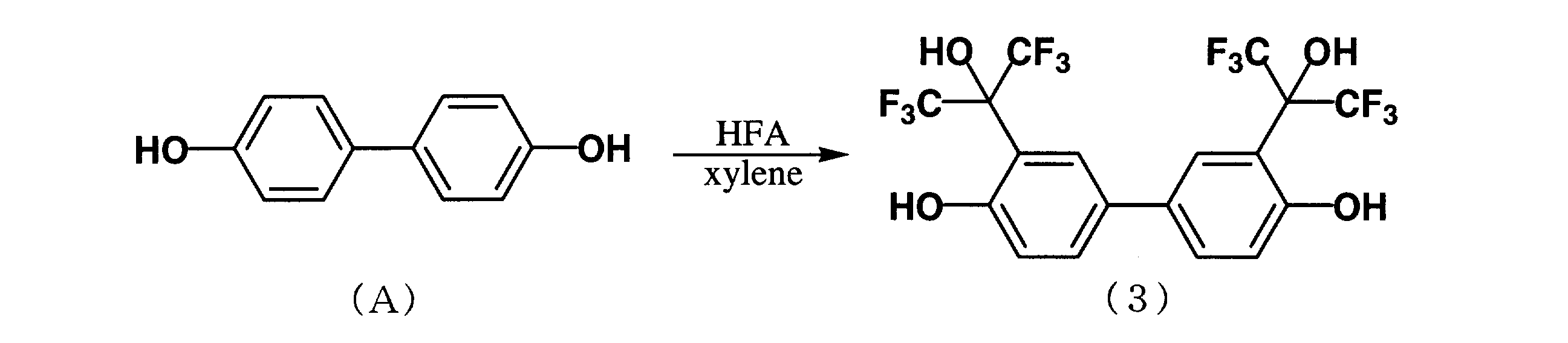
反応系内の原料を含む反応物を濾過し、濾過残渣をイソプロピルエーテルに溶解させた後に水で洗浄し、分離した有機層に無水硫酸マグネシウムを加え脱湿した。減圧蒸留しイソプロピルエーテルを留去し、貧溶媒であるヘキサンを加え、式(3)の含フッ素重合性単量体の沈殿を析出させた。このようにして、78%の収率で式(3)の含フッ素重合性単量体を得た。
得られた式(3)の含フッ素重合性単量体の分析結果を、以下に示す。
1H-NMR(溶媒、d-DMSO, TMS): δ 10.8(1H,s), 8.6(1H,s), 7.7(1H,s), 7.5(1H,dd,J=8.6Hz), 7.0(1H,d,J=8.3Hz)
19F-NMR(溶媒、d-DMSO, CCl3F): δ -72.8(12F,s)
DI-MS(FD+): m/z 518.06 (M+)
以下の反応式に示すように化合物(B)とヘキサフルオロアセトンを反応させて、式(C)または式(D)で表される含フッ素重合性単量体を合成した。
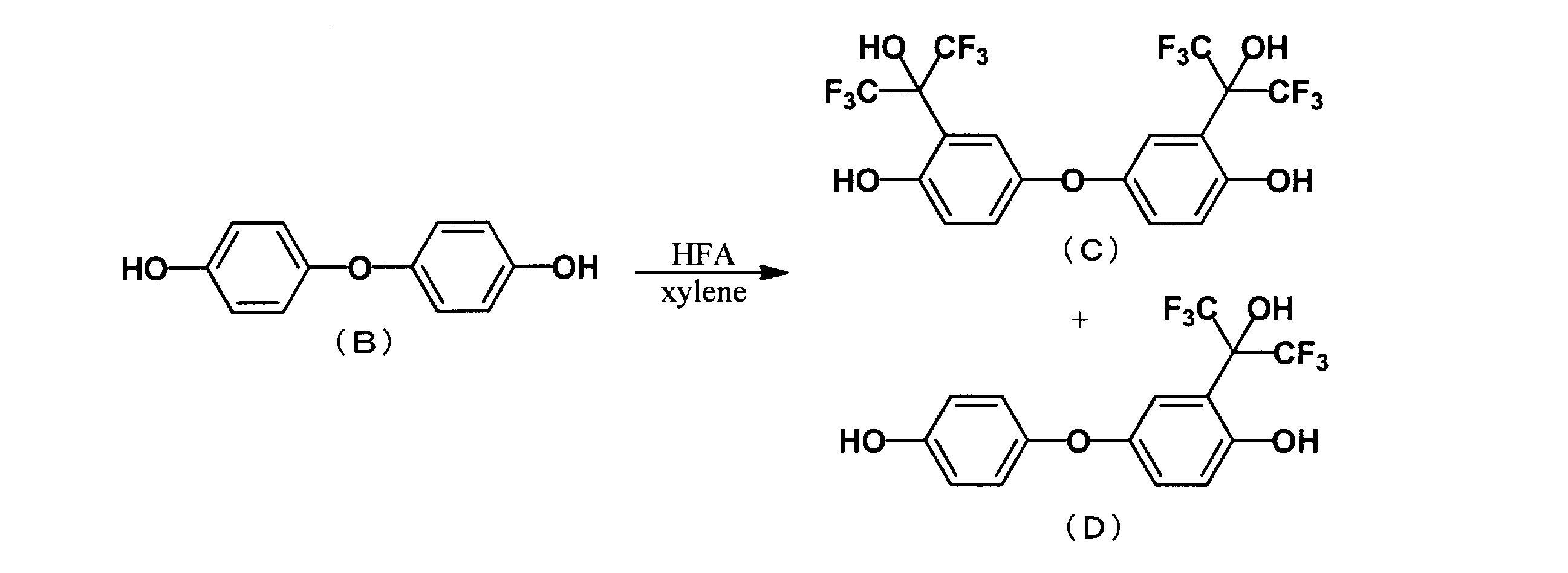
反応系内の原料を含む反応物を濾過し、濾過残渣をイソプロピルエーテルに溶解させた後に水で洗浄し、分離した有機層に無水硫酸マグネシウムを加え脱湿した。減圧蒸留しイソプロピルエーテルを留去し、貧溶媒であるヘキサンを加え、含フッ素重合性単量体の沈殿を析出させた。DI-MS分析の結果から、得られた固体は、式(D)で表される含フッ素重合性単量体(HFIP基の一置換体)と式(C)で表される含フッ素重合性単量体(HFIP基の二置換体)の混合物であり、その存在比は、C:D=2:3であった。
得られた式(C)の含フッ素重合性単量体の分析結果を、以下に示す。
DI-MS(FD+):m/z 534.05 (M+), 368.51 (M+)
以下の反応式に示すように化合物(E)とヘキサフルオロアセトンを反応させて、式(F)または式(G)で表される含フッ素重合性単量体を合成した。

反応系内の原料を含む反応物を濾過し、濾過残渣をイソプロピルエーテルに溶解させた後に水で洗浄し、分離した有機層に無水硫酸マグネシウムを加え脱湿した。減圧蒸留しイソプロピルエーテルを留去し、貧溶媒であるヘキサンを加え、含フッ素重合性単量体の沈殿を析出させた。DI-MS分析の結果から、得られた固体は、式(G)で表される含フッ素重合性単量体(HFIP基の一置換体)と式(F)で表される含フッ素重合性単量体(HFIP基の二置換体)の混合物であり、その存在比は、F:G=2:3であった。
得られた式(F)の含フッ素重合性単量体の分析結果を、以下に示す。
DI-MS(FD+): m/z 550.35(M+), 384.45 (M+)
実施例4
攪拌装置を備えた反応容器中、実施例1で合成した式(3)で表される含フッ素重合性単量体、即ち、3,3-ビス(1,1,1,3,3,3-ヘキサフルオロ-2-ヒドロキシプロパン-2-イル)-4,4-ビフェノール、25.91g(0.0500モル)を用意し、予め、脱水精製したN-メチルピロリドン、167gおよびピリジン、8.7gの混合溶媒に溶解した。次いで、イソフタル酸クロライド10.15g(0.0500モル)を加え、室温で5hr攪拌して、以下に示す重縮合反応を行い、反応液を得た。
反応終了後、貧溶媒である大型ビーカー内のメタノール50質量%水溶液、1.5kg中に、上記反応液を徐々に注ぎ、高分子化合物を析出させた。この高分子化合物を濾過した後、真空乾燥機内で、減圧下、100℃に8時間乾燥して、式(H)で表される繰り返し単位を含む重縮合物であるポリアリレート樹脂、27.5gを、収率85%で得た。

攪拌装置を備えた反応容器中、実施例1で合成した式(3)で表される含フッ素重合性単量体、即ち、3,3-ビス(1,1,1,3,3,3-ヘキサフルオロ-2-ヒドロキシプロパン-2-イル)-4,4-ビフェノール、3.00g(0.0052モル)を用意し、予め脱水精製したN-メチルピロリドン、16gおよびピリジン、1.01gの混合溶媒に溶解した。次いで、イソフタル酸クロライド、0.527g(0.0026モル)およびテレフタル酸クロライド、0.527g(0.0026モル)を加え、室温で5hr攪拌して、以下に示す重縮合反応を行い、反応液を得た。
反応終了後、実施例4と同様の操作を行い、式(H)で表される繰り返し単位または式(I)で表される繰り返し単位を含む重縮合物でポリアリレート樹脂、3.28gを、収率90%で得た。

攪拌装置を備えた反応容器中、実施例1で合成した式(3)で表される含フッ素重合性単量体、即ち、3,3-ビス(1,1,1,3,3,3-ヘキサフルオロ-2-ヒドロキシプロパン-2-イル)-4,4-ビフェノール、3.00g(0.0052モル)を用意し、予め脱水精製したN-メチルピロリドン、16gおよびピリジン、1.01gの混合溶媒に溶解した。次いで、2,2-ビス(4-カルボニルクロリドフェニル)―ヘキサフルオロプロパン、2.23g(0.0052モル)を加え、室温で5hr攪拌して、以下に示す重縮合反応を行い、反応液を得た。
反応終了後、実施例4と同様の操作を行い、式(P)で表される繰り返し単位を含む重縮合物でポリアリレート樹脂、3.86gを、収率85%で得た。

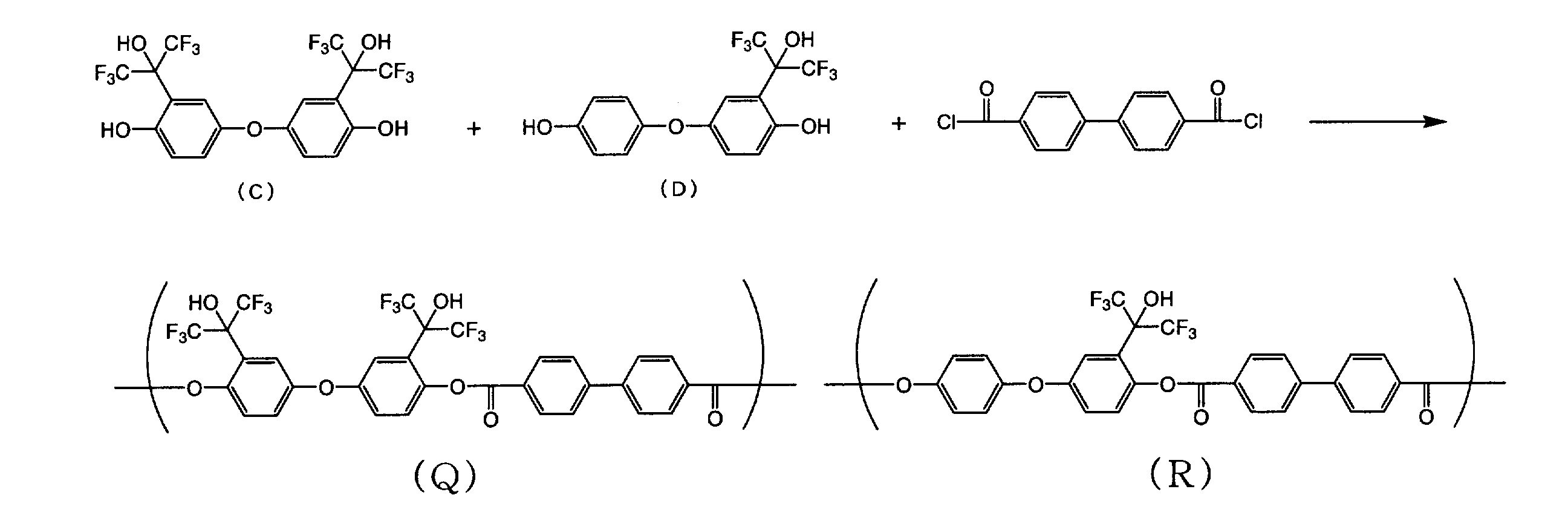
攪拌装置を備えた反応容器中、実施例2で合成した含フッ素重合性単量体(C)と(D)の混合物(その存在比は、モル比で、C:D=2:3)、2.26g(0.0052モル)を用意し、予め脱水精製したN-メチルピロリドン、16gおよびピリジン、1.01gの混合溶媒に溶解した。次いで、4,4‘-ビフェニルジカルボニルジクロリド、1.45g(0.0052モル)を加え、室温で5hr攪拌して、以下に示す重縮合反応を行い、反応液を得た。
反応終了後、実施例4と同様の操作を行い、式(Q)で表される繰り返し単位または式(R)で表される繰り返し単位を含む重縮合物でポリアリレート樹脂、2.89gを、収率87%で得た。
攪拌装置を備えた反応容器中、実施例1で合成した式(3)で表される含フッ素重合性単量体として、3,3-ビス(1,1,1,3,3,3-ヘキサフルオロ-2-ヒドロキシプロパン-2-イル)-4,4-ビフェノール、1.036g(0.00200モル)を用意し、予め脱水精製した、N-メチルピロリドン、7.0gおよびピリジン、0.35gの混合溶媒に溶解した。次いで、ピロメリット酸無水物、0.436g(0.00200モル)を加え、室温下で24hr攪拌して以下に示す重縮合反応を行い、反応液を得た。
反応終了後、実施例4と同様の操作を行い、式(J)で表される繰り返し単位を含む重縮合物であるポリアリレート樹脂、1.22gを、収率83%で得た。当該樹脂の分子量および溶解性の結果を表1に示す。

攪拌装置を備えた反応容器中、実施例1で合成した式(3)で表される含フッ素重合性単量体として、3,3-ビス(1,1,1,3,3,3-ヘキサフルオロ-2-ヒドロキシプロパン-2-イル)-4,4-ビフェノール、1.036g(0.002モル)を用意し、予め脱水精製した、N-メチルピロリドン、7.0gおよびピリジン、0.35gの混合溶媒に溶解した。次いで、2,2-ビス(3,4-ジカルボキシフェニル)ヘキサフルオロプロパン二無水物、0.888g(0.002モル)を加え、室温下で24hr攪拌して以下に示す重縮合反応を行い、反応液を得た。
反応終了後、実施例4と同様の操作を行い、式(S)で表される繰り返し単位を含む重縮合物であるポリアリレート樹脂、1.73gを、収率90%で得た。当該樹脂の分子量および溶解性の結果を表1に示す。

攪拌装置を備えた反応容器中、4,4-ビフェノール0.931g(0.00500モル)を、予め脱水精製した、N-メチルピロリドン、8.6gおよびピリジン、0.87gの混合溶媒に溶解した。次いで、イソフタル酸クロライド、1.015g(0.005モル)を加え、室温(20℃)下で攪拌し、以下に示す重縮合反応を行った。撹拌開始後、1時間で沈殿が析出し始めた。
さらに、3時間撹拌した後、沈殿が析出した反応液を、貧溶媒であるメタノールを100g入れたビーカー内に注ぎ、高分子化合物を析出させた。真空乾燥機で、減圧下、100℃に8時間乾燥して、式(K)で表される繰り返し単位を含むポリアリレート樹脂を得た。このポリアリレート樹脂はTHFに不溶であり、分子量測定および透明性の評価を行うことができなかった。

実施例4で合成した高分子化合物であるポリアリレート樹脂、1.62gに、エポキシ化合物としてビスフェノールA型エポキシ樹脂(三菱化学株式会社製JER828)、1.28g、硬化促進剤としてトリフェニルホスフィン0.05g、およびシクロヘキサノン11.3gを加えて攪拌し溶解させることで、固形分濃度20質量%の溶液を得た。次いで、スピンコーターを用いて、当該ガラス基板上に垂らし、回転数1000rpmで、40秒間、スピンコートした後、80℃で5分間、乾燥させた。その後、180℃下で1時間加熱し硬化反応を行い、ガラス基板上に硬化膜を形成させた。
得られた硬化膜付きガラス基板を分光光度計にて、ガラス基板をリファレンスとして、波長400nmの光透過率を測定した。
また、2枚の硬化膜付きガラス基板を各々、250℃で30分間、300℃で30分間、再度加熱した後、400nmでの透過率を測定した。
残膜率は、180℃で加熱後の膜厚および再加熱後の膜厚を測定し、180℃で加熱後の膜厚を100%とし、再加熱後の膜厚で評価した。残膜率が高い方が、揮発分が少なく膜として優れる。
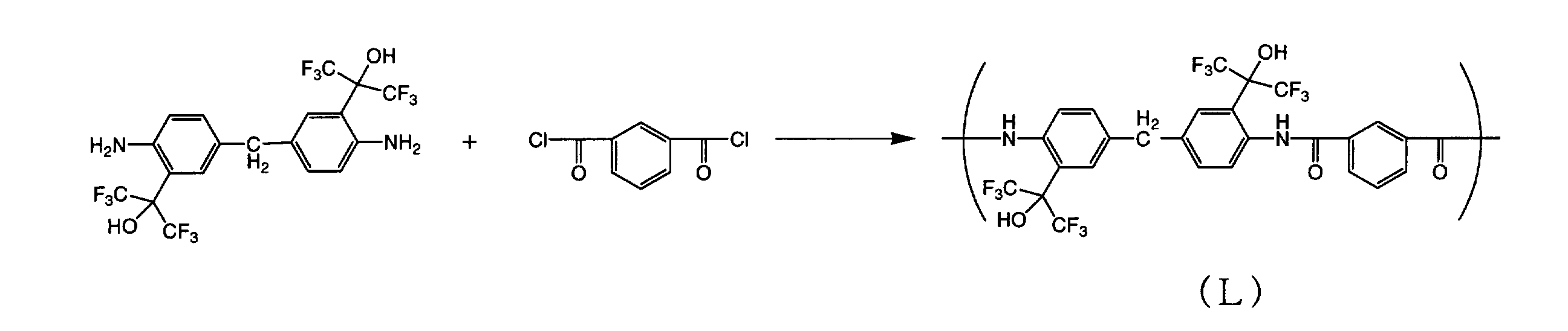
攪拌装置を備えた反応容器中、3,3-ビス(1,1,1,3,3,3-ヘキサフルオロ-2-ヒドロキシプロパン-2-イル)-4,4-メチレンジアニリン21.212g(0.0400モル)を、脱水精製したNMP、150gに溶解した。この溶液にイソフタル酸クロライド、9.745g(0.0480モル)を加え、室温で5hr攪拌して、以下に示す重縮合反応を行った。
反応終了後、実施例4と同様の操作を行い、式(L)で表される繰り返し単位を含むポリアミド樹脂、23.0gを、収率87%で得た。分子量はMw(Mw/Mn)=18000(2.6)であった。

Claims (15)
- 一般式(1)で表される含フッ素重合性単量体。

- 一般式(1)で表わされる含フッ素重合性単量体が、一般式(2)で表される含フッ素単量体である、請求項1に記載の含フッ素重合性単量体。

- 一般式(2)で表わされる含フッ素単量体が、式(3)で表される含フッ素重合性単量体である、請求項2に記載の含フッ素重合性単量体。
- 請求項1乃至請求項3のいずれか1項に記載の含フッ素重合性単量体と、一般式(4)で表される化合物、一般式(5)で表される化合物、および一般式(6)で表される化合物からなる群から選ばれる少なくとも一種を含む、組成物。



- 一般式(7)で表される繰り返し単位を含む高分子化合物。

- 一般式(7)で表わされる繰り返し単位が、一般式(8)で表される繰り返し単位である、請求項5に記載の高分子化合物。
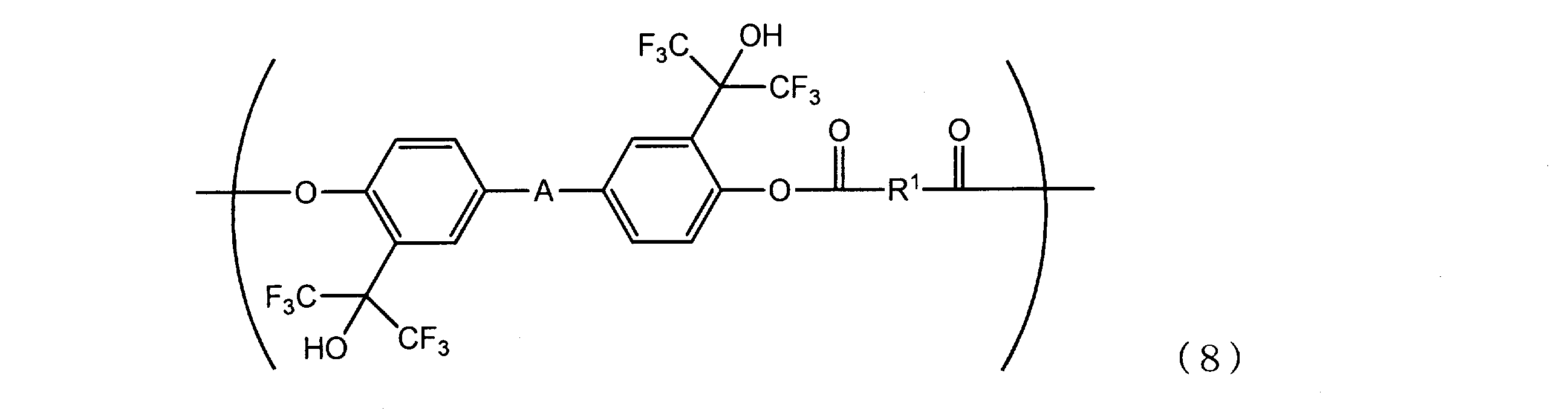
- 一般式(8)で表わされる繰り返し単位が、式(9)で表される繰り返し単位である、請求項6に記載の高分子化合物。

- 一般式(10)で表される繰り返し単位を含む、高分子化合物。
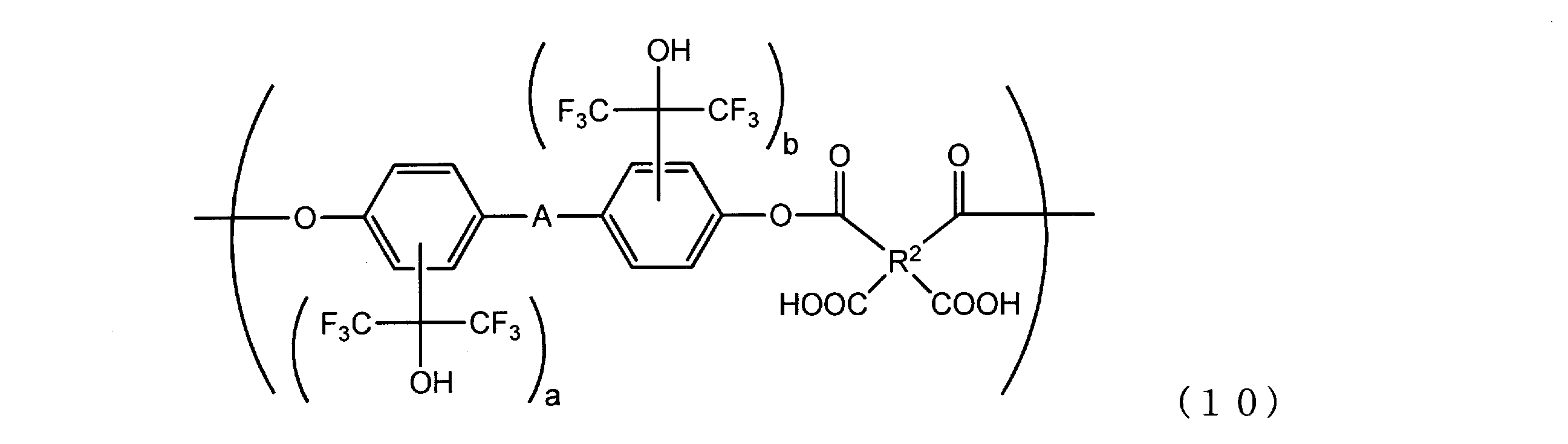
- 一般式(10)表わされる繰り返し単位が、一般式(11)で表される繰り返し単位である、請求項8に記載の高分子化合物。
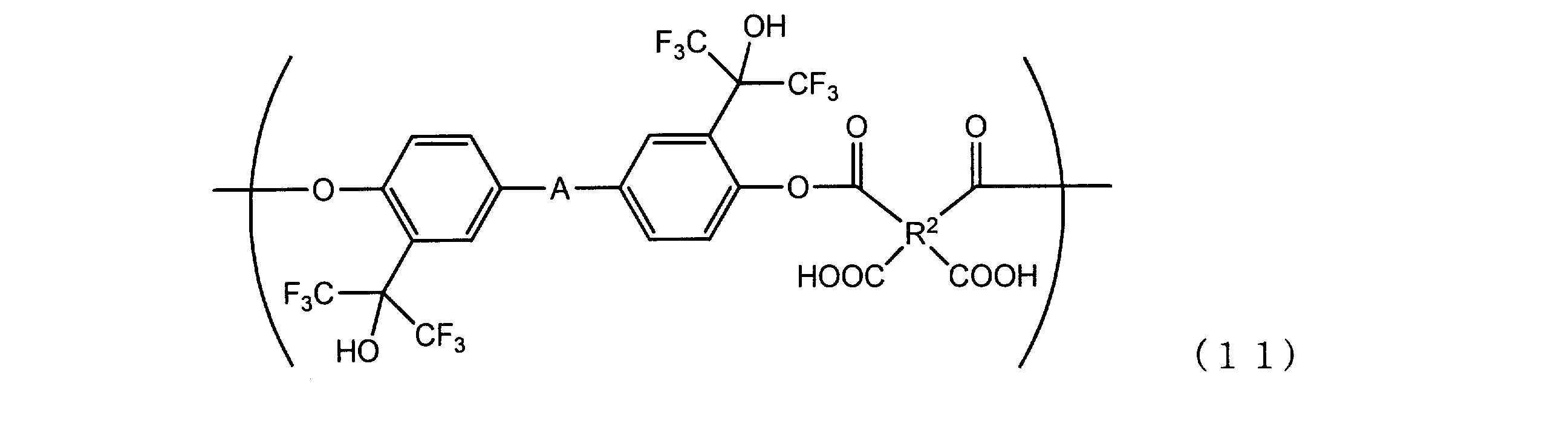
- 一般式(11)で表わされる繰り返し単位が、式(12)で表される繰り返し単位である、請求項9に記載の高分子化合物。
- 2-ヒドロキシ-1,1,1,3,3,3-ヘキサフルオロイソプロピル基中のOH部位の水素原子の少なくとも一部がグリシジル基で置換されてなる、請求項5乃至請求項10のいずれか1項に記載の高分子化合物。
- 請求項5乃至請求項11のいずれか1項に記載の高分子化合物とエポキシ化合物とを含む、組成物。
- エポキシ化合物が一般式(13)で表される、請求項12に記載の組成物。

- 請求項11に記載の高分子化合物のグリシジル基を架橋させてなる、硬化物。
- 請求項12または請求項13に記載の組成物を架橋させてなる、硬化物。
Priority Applications (4)
| Application Number | Priority Date | Filing Date | Title |
|---|---|---|---|
| KR1020137034404A KR101606158B1 (ko) | 2011-05-30 | 2012-05-29 | 함불소 중합성 단량체 및 그것을 사용한 고분자 화합물 |
| US14/122,578 US9550711B2 (en) | 2011-05-30 | 2012-05-29 | Fluorine-containing polymerizable monomer and polymer compound using same |
| CN201280026497.3A CN103562261B (zh) | 2011-05-30 | 2012-05-29 | 含氟聚合性单体及使用其的高分子化合物 |
| US15/375,522 US10087284B2 (en) | 2011-05-30 | 2016-12-12 | Fluorine-containing polymerizable monomer and polymer compound using same |
Applications Claiming Priority (4)
| Application Number | Priority Date | Filing Date | Title |
|---|---|---|---|
| JP2011121030 | 2011-05-30 | ||
| JP2011-121030 | 2011-05-30 | ||
| JP2012-118432 | 2012-05-24 | ||
| JP2012118432A JP5862453B2 (ja) | 2011-05-30 | 2012-05-24 | 含フッ素重合性単量体およびそれを用いた高分子化合物 |
Related Child Applications (2)
| Application Number | Title | Priority Date | Filing Date |
|---|---|---|---|
| US14/122,578 A-371-Of-International US9550711B2 (en) | 2011-05-30 | 2012-05-29 | Fluorine-containing polymerizable monomer and polymer compound using same |
| US15/375,522 Division US10087284B2 (en) | 2011-05-30 | 2016-12-12 | Fluorine-containing polymerizable monomer and polymer compound using same |
Publications (1)
| Publication Number | Publication Date |
|---|---|
| WO2012165435A1 true WO2012165435A1 (ja) | 2012-12-06 |
Family
ID=47259289
Family Applications (1)
| Application Number | Title | Priority Date | Filing Date |
|---|---|---|---|
| PCT/JP2012/063781 Ceased WO2012165435A1 (ja) | 2011-05-30 | 2012-05-29 | 含フッ素重合性単量体およびそれを用いた高分子化合物 |
Country Status (5)
| Country | Link |
|---|---|
| US (2) | US9550711B2 (ja) |
| JP (1) | JP5862453B2 (ja) |
| KR (1) | KR101606158B1 (ja) |
| CN (1) | CN103562261B (ja) |
| WO (1) | WO2012165435A1 (ja) |
Cited By (1)
| Publication number | Priority date | Publication date | Assignee | Title |
|---|---|---|---|---|
| JP2022159148A (ja) * | 2021-03-31 | 2022-10-17 | セントラル硝子株式会社 | ヘキサフルオロイソプロパノール基を含む医療用樹脂組成物 |
Families Citing this family (6)
| Publication number | Priority date | Publication date | Assignee | Title |
|---|---|---|---|---|
| EP3162875B1 (en) * | 2015-10-30 | 2018-05-23 | Merck Patent GmbH | Polymerisable compounds and the use thereof in liquid-crystal displays |
| JP6936859B2 (ja) * | 2017-07-28 | 2021-09-22 | 富士フイルム株式会社 | センサ |
| CN108987819A (zh) * | 2018-07-19 | 2018-12-11 | 浙江谷神能源科技股份有限公司 | 制备全固态电池的方法以及固态电池 |
| CN109004221A (zh) * | 2018-07-19 | 2018-12-14 | 浙江谷神能源科技股份有限公司 | 固态电池组粘结剂组合物 |
| CN109517316B (zh) * | 2018-11-27 | 2021-05-04 | 广东莱尔新材料科技股份有限公司 | 一种含氟活性酯及其制备方法、包含其的树脂固化物 |
| US12098238B2 (en) | 2020-02-28 | 2024-09-24 | Central Glass Company, Limited | Curable resin, curable resin composition, cured product, electronic device, laminated board material, electronic component encapsulant, and method for producing curable resin |
Citations (2)
| Publication number | Priority date | Publication date | Assignee | Title |
|---|---|---|---|---|
| JPS5015258B1 (ja) * | 1969-03-26 | 1975-06-03 | ||
| JP2010215904A (ja) * | 2009-02-20 | 2010-09-30 | Central Glass Co Ltd | 含フッ素ジカルボン酸誘導体およびそれを用いた高分子化合物 |
Family Cites Families (7)
| Publication number | Priority date | Publication date | Assignee | Title |
|---|---|---|---|---|
| DE4020184A1 (de) * | 1990-06-25 | 1992-01-02 | Hoechst Ag | Teilfluorierte biphenyle, verfahren zu ihrer herstellung und ihre verwendung |
| JP4679328B2 (ja) | 2004-10-13 | 2011-04-27 | セントラル硝子株式会社 | 含フッ素重合性単量体及びそれを用いた高分子化合物 |
| JP4940623B2 (ja) | 2004-10-20 | 2012-05-30 | セントラル硝子株式会社 | 含フッ素重合性単量体及びそれを用いた高分子化合物 |
| JP4679357B2 (ja) | 2004-12-28 | 2011-04-27 | セントラル硝子株式会社 | 含フッ素ジアミンおよびそれを用いた重合体 |
| US7517635B2 (en) * | 2006-08-25 | 2009-04-14 | Central Glass Company, Limited | Polyester compound and resist material using the same |
| JP5114938B2 (ja) | 2006-12-19 | 2013-01-09 | セントラル硝子株式会社 | 含フッ素ジアミンおよびそれを用いた高分子化合物 |
| JP5971016B2 (ja) * | 2011-08-09 | 2016-08-17 | セントラル硝子株式会社 | 含フッ素芳香族化合物およびその製造方法 |
-
2012
- 2012-05-24 JP JP2012118432A patent/JP5862453B2/ja not_active Expired - Fee Related
- 2012-05-29 CN CN201280026497.3A patent/CN103562261B/zh not_active Expired - Fee Related
- 2012-05-29 KR KR1020137034404A patent/KR101606158B1/ko not_active Expired - Fee Related
- 2012-05-29 WO PCT/JP2012/063781 patent/WO2012165435A1/ja not_active Ceased
- 2012-05-29 US US14/122,578 patent/US9550711B2/en not_active Expired - Fee Related
-
2016
- 2016-12-12 US US15/375,522 patent/US10087284B2/en active Active
Patent Citations (2)
| Publication number | Priority date | Publication date | Assignee | Title |
|---|---|---|---|---|
| JPS5015258B1 (ja) * | 1969-03-26 | 1975-06-03 | ||
| JP2010215904A (ja) * | 2009-02-20 | 2010-09-30 | Central Glass Co Ltd | 含フッ素ジカルボン酸誘導体およびそれを用いた高分子化合物 |
Non-Patent Citations (1)
| Title |
|---|
| BASIL S. FARAH ET AL.: "Phenolic Derivatives of the Perhaloacetones", JOURNAL OF ORGANIC CHEMISTRY, vol. 30, no. 4, April 1965 (1965-04-01), pages 1003 - 1005 * |
Cited By (1)
| Publication number | Priority date | Publication date | Assignee | Title |
|---|---|---|---|---|
| JP2022159148A (ja) * | 2021-03-31 | 2022-10-17 | セントラル硝子株式会社 | ヘキサフルオロイソプロパノール基を含む医療用樹脂組成物 |
Also Published As
| Publication number | Publication date |
|---|---|
| CN103562261B (zh) | 2016-03-16 |
| US20170088666A1 (en) | 2017-03-30 |
| CN103562261A (zh) | 2014-02-05 |
| US20140100342A1 (en) | 2014-04-10 |
| JP5862453B2 (ja) | 2016-02-16 |
| KR101606158B1 (ko) | 2016-03-24 |
| JP2013010941A (ja) | 2013-01-17 |
| KR20140015586A (ko) | 2014-02-06 |
| US10087284B2 (en) | 2018-10-02 |
| US9550711B2 (en) | 2017-01-24 |
Similar Documents
| Publication | Publication Date | Title |
|---|---|---|
| US10087284B2 (en) | Fluorine-containing polymerizable monomer and polymer compound using same | |
| TWI466911B (zh) | A soluble imide skeleton resin, a soluble imide skeleton resin solution composition, a hardened resin composition and a hardened product thereof | |
| JP5768320B2 (ja) | 含フッ素ジカルボン酸誘導体およびそれを用いた高分子化合物 | |
| JP7602145B2 (ja) | ノボラック樹脂、エポキシ樹脂、感光性樹脂組成物、硬化性樹脂組成物、硬化物、電子デバイス、ノボラック樹脂の製造方法、エポキシ樹脂の製造方法および活性エステル樹脂の製造方法 | |
| JP6330272B2 (ja) | 感光性樹脂組成物およびそれを用いたパターン形成方法 | |
| TW202140600A (zh) | 固化性樹脂、固化性樹脂組成物、固化物、電子器件、堆疊板材料、電子零件密封材及固化性樹脂的製造方法 | |
| WO2007037206A1 (ja) | 熱硬化性樹脂、及びそれを含む熱硬化性組成物、並びにそれから得られる成形体 | |
| JP6194774B2 (ja) | 気体分離膜 | |
| JP6650273B2 (ja) | エポキシ樹脂組成物及びその硬化物並びに新規ポリエーテルスルホン系樹脂 | |
| JP5861562B2 (ja) | 含フッ素重合性単量体およびそれを用いた高分子化合物 | |
| WO2024106523A1 (ja) | ベンゾオキサジン化合物、それを含有する樹脂原料組成物、硬化性樹脂組成物及びその硬化物 | |
| JP6341933B2 (ja) | フェノール樹脂、エポキシ樹脂、エポキシ樹脂組成物およびそれらの硬化物 | |
| JP4935196B2 (ja) | ベンゾオキサゾール前駆体、樹脂組成物およびそれを用いたコーティングワニス、樹脂膜並びに半導体装置 | |
| JP7590174B2 (ja) | 芳香族エーテルエーテルケトン系重合体及びその製造方法並びに当該重合体を用いた樹脂組成物及び樹脂硬化物 | |
| WO2023080072A1 (ja) | 樹脂硬化剤、硬化性樹脂組成物、硬化物、電子デバイス、積層板材料、電子部品封止材、エステル化合物、エステル化合物の製造方法およびノボラック樹脂の製造方法 | |
| JP3847579B2 (ja) | 脂環式含フッ素ジカルボン酸およびそれを用いた重合体または感光性材料用組成物 | |
| TW202546065A (zh) | 多官能乙烯基樹脂、多元羥基樹脂、環氧樹脂、其組成物及硬化物 | |
| JPS6337123A (ja) | 熱可塑性芳香族ポリエ−テルピリジンおよびその製造方法 | |
| WO2023162693A1 (ja) | エポキシ樹脂、多価ヒドロキシ樹脂、エポキシ樹脂組成物、及びエポキシ樹脂硬化物並びに多価ヒドロキシ樹脂の製造方法 | |
| JP2014185275A (ja) | 化合物、耐熱材料及び耐熱部材 |
Legal Events
| Date | Code | Title | Description |
|---|---|---|---|
| WWE | Wipo information: entry into national phase |
Ref document number: 201280026497.3 Country of ref document: CN |
|
| 121 | Ep: the epo has been informed by wipo that ep was designated in this application |
Ref document number: 12793371 Country of ref document: EP Kind code of ref document: A1 |
|
| WWE | Wipo information: entry into national phase |
Ref document number: 14122578 Country of ref document: US |
|
| NENP | Non-entry into the national phase |
Ref country code: DE |
|
| ENP | Entry into the national phase |
Ref document number: 20137034404 Country of ref document: KR Kind code of ref document: A |
|
| 122 | Ep: pct application non-entry in european phase |
Ref document number: 12793371 Country of ref document: EP Kind code of ref document: A1 |