WO2012165430A1 - 選択装置、選択方法、非一時的な記録媒体、ならびに、プログラム - Google Patents
選択装置、選択方法、非一時的な記録媒体、ならびに、プログラム Download PDFInfo
- Publication number
- WO2012165430A1 WO2012165430A1 PCT/JP2012/063768 JP2012063768W WO2012165430A1 WO 2012165430 A1 WO2012165430 A1 WO 2012165430A1 JP 2012063768 W JP2012063768 W JP 2012063768W WO 2012165430 A1 WO2012165430 A1 WO 2012165430A1
- Authority
- WO
- WIPO (PCT)
- Prior art keywords
- node
- item
- leaf node
- tree structure
- items
- Prior art date
- Legal status (The legal status is an assumption and is not a legal conclusion. Google has not performed a legal analysis and makes no representation as to the accuracy of the status listed.)
- Ceased
Links
Images










Classifications
-
- G—PHYSICS
- G06—COMPUTING OR CALCULATING; COUNTING
- G06F—ELECTRIC DIGITAL DATA PROCESSING
- G06F3/00—Input arrangements for transferring data to be processed into a form capable of being handled by the computer; Output arrangements for transferring data from processing unit to output unit, e.g. interface arrangements
- G06F3/01—Input arrangements or combined input and output arrangements for interaction between user and computer
- G06F3/048—Interaction techniques based on graphical user interfaces [GUI]
- G06F3/0481—Interaction techniques based on graphical user interfaces [GUI] based on specific properties of the displayed interaction object or a metaphor-based environment, e.g. interaction with desktop elements like windows or icons, or assisted by a cursor's changing behaviour or appearance
- G06F3/0482—Interaction with lists of selectable items, e.g. menus
-
- G—PHYSICS
- G06—COMPUTING OR CALCULATING; COUNTING
- G06F—ELECTRIC DIGITAL DATA PROCESSING
- G06F16/00—Information retrieval; Database structures therefor; File system structures therefor
- G06F16/90—Details of database functions independent of the retrieved data types
- G06F16/901—Indexing; Data structures therefor; Storage structures
- G06F16/9027—Trees
Definitions
- the present invention relates to a selection device, a selection method, a non-transitory recording medium, and a program that can easily select frequently selected items.
- a user interface is known in which a user can select a desired item from a plurality of items prepared in advance by operating a controller.
- items form a hierarchical structure, and the user traces to the lowest item while selecting an item belonging to each layer. Then, the lowest item is output as the selection result.
- Patent Document 1 discloses an information output device that makes it easy to grasp which level of an item is currently displayed in a hierarchical structure.
- the present invention solves the problems as described above, and provides a selection device, a selection method, a non-temporary recording medium, and a program capable of easily selecting frequently selected items. Objective.
- the selection device includes a selection device that includes a plurality of nodes and selects items from a tree structure in which items are associated with each node to a leaf node to any leaf node.
- the storage unit, the moving unit, the output unit, and the updating unit are provided and configured as follows.
- the tree structure is a structure in which one node has one or more nodes, each of the one or more nodes further has one or more nodes, and branches as the hierarchy deepens.
- a lower node of the focused node is referred to as a child node
- an upper node having the focused node is referred to as a parent node.
- the highest node in the tree structure is called a root node
- a terminal node having no child nodes is called a leaf node.
- a node having a child node (a node other than a leaf node) is referred to as an internal node (the root node is therefore an internal node).
- Arbitrary items are associated with each node.
- the item “setting” is associated with the highest node (root node) of the tree structure, and “1” and “2” indicating the number of users who play the game are displayed at the lower nodes. Are associated with each other. Furthermore, items “Japan”, “US”, and “Germany” indicating the nationality of the team operated by the user are associated with the nodes below the item “1 person” or “2 people”. Further, items of “easy”, “ordinary”, and “difficult” indicating the difficulty level of the game are associated with nodes below these items.
- the node associated with the item representing the difficulty level is a leaf node, and the game setting ends when any leaf node is selected. For example, when the user selects “1” as the number of players to play the game, selects “Japan” as the nationality of the team, and selects “easy” as the difficulty level, the game setting ends.
- the storage unit stores a tree structure, items associated with each node included in the tree structure, and any node in the tree structure (hereinafter referred to as “attention node”).
- the storage unit stores information on where each item related to the setting of the soccer game is arranged in the tree structure. If the user selects “2” as the number of users playing the game, the storage unit stores a node associated with the item “2” as the node of interest.
- the moving unit moves the node of interest from the root node to any leaf node by updating the storage unit based on a user instruction.
- the moving unit starts from a node associated with an item “two” in the tree structure, and is a child node of the node “Japan”.
- the node of interest is moved to the node associated with the item.
- the moving unit moves the node of interest until a child node of the node associated with the item “Japan”, that is, a leaf node is selected.
- the output unit outputs items from the root node to any leaf node as a selection result.
- the output unit outputs the item “Japan” as a selection result.
- the update unit When the frequency of reaching the leaf node satisfies a predetermined condition, the update unit adds a new leaf node that associates an item associated with the leaf node and an item associated with the node that has passed through the leaf node.
- the storage unit is updated so as to be a child node of the root node of the tree structure.
- the predetermined condition is 5 times. For example, the number of times that a leaf node associated with the item “Easy” is selected via each node associated with the items “2 people” and “Japan” in the tree structure, and the leaf node is selected. Is the fifth time.
- the updating unit associates the items “two people”, “Japan”, and “simple” with one leaf node, and updates the storage unit so that the leaf node is a child node of the root node. .
- the user since frequently selected items are collected, the user can easily select frequently selected items.
- the selection device may further include a display unit and may be configured as follows.
- the display unit displays an item associated with the child node of the internal node on the screen, and a new leaf node is displayed on the child node associated with the item displayed on the screen. If included, the item associated with the new leaf node is highlighted.
- the node of interest is a root node associated with the item “setting”
- the items “1 person” and “2 people” associated with the child nodes of the root node are displayed on the screen.
- a new node element associated with the item “2 people, Japan, easy” as a child node of the root node is also provided.
- the display unit displays the item “2 people, Japan, easy” with a conspicuous color on the screen.
- items in which frequently selected items are collected can be displayed in an easy-to-understand manner for the user.
- the display unit displays an item associated with the child node of the internal node on the screen, and displays a new leaf on the child node associated with the item displayed on the screen. If a node is included, the item associated with the new leaf node is displayed at the top of the displayed items.
- a new leaf node associated with the item “2 people, Japan, easy” as a child node of the root node is included.
- the display unit starts with the item “2 people, Japan, easy”, and “2 people, Japan, easy”, “1”. Items are arranged in the order of “person” and “2 people” and displayed on the screen.
- items in which frequently selected items are collected can be displayed at a position where they can be easily selected.
- the display unit displays an item associated with a child node of the internal node on the screen.
- a child node associated with an item displayed on the screen includes a new leaf node
- the item associated with the new leaf node is associated with the item associated with the new leaf node.
- the item is displayed adjacent to the item associated with the child node of the root node.
- a new leaf node associated with the item “2 people, Japan, easy” as a child node of the root node is included.
- the “leaf node to which the item associated with the new leaf node is associated” is a “simple” leaf node via “two people” and “Japan”.
- the “node” is a node in which “2 people” and “Japan” are associated with each other. Of the nodes associated with “2 people” and “Japan”, “the item associated with the child node of the root node” is the item of “2 people”.
- the display unit adjoins the item “2 people, Japan, simple” associated with the new leaf node to the item “2 people”, so that “1 person”, “2 people”, “2 people, Japan, Items are displayed on the screen in the order of “Easy”.
- the selection method includes a tree structure including a plurality of nodes, selecting items from a root node to any leaf node from a tree structure in which items are associated with each node, A storage unit that stores a structure, an item associated with each node included in the tree structure, and any node in the tree structure (hereinafter referred to as “attention node”), a moving unit, A selection method executed by a selection device including an output unit and an update unit, and configured as follows.
- the moving unit moves the attention node from the root node to any leaf node by updating the storage unit based on the user's instruction.
- the output unit outputs items from the root node to any leaf node as a selection result.
- the item associated with the leaf node and the item associated with the node through which the leaf node is reached are associated with each other.
- the storage unit is updated so that the leaf node is a child node of the root node of the tree structure.
- the program according to another aspect of the present invention is configured to cause a computer to function as the selection device and to cause the computer to execute the selection method.
- the program of the present invention can be recorded on a computer-readable non-transitory information recording medium such as a compact disk, flexible disk, hard disk, magneto-optical disk, digital video disk, magnetic tape, and semiconductor memory.
- a computer-readable non-transitory information recording medium such as a compact disk, flexible disk, hard disk, magneto-optical disk, digital video disk, magnetic tape, and semiconductor memory.
- the above program can be distributed and sold via a computer communication network independently of the computer on which the program is executed.
- the non-temporary information recording medium can be distributed and sold independently of the computer.
- the present invention it is possible to provide a selection device, a selection method, a non-temporary recording medium, and a program that can easily select frequently selected items.
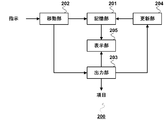
- FIG. It is a mimetic diagram showing the outline composition of the typical information processor with which the selection device concerning the embodiment of the present invention is realized. It is a figure which shows schematic structure of the selection apparatus which concerns on Embodiment 1.
- FIG. It is a figure which shows the example of a tree structure. It is a figure for demonstrating the item displayed on a screen. It is a figure for demonstrating the item displayed on a screen. It is a figure for demonstrating the item displayed on a screen. It is a figure for demonstrating a tree structure table. It is a figure for demonstrating a frequency table. It is a figure which shows the example of a tree structure. It is a figure for demonstrating a tree structure table. It is a figure for demonstrating the item displayed on a screen.
- FIG. 5 is a flowchart for explaining selection processing performed by each unit of the selection device according to the first embodiment. It is a figure for demonstrating the item displayed on a screen. It is a figure for demonstrating the item displayed on a screen. It is a figure for demonstrating the item displayed on a screen. 10 is a flowchart for explaining selection processing performed by each unit of the selection device according to the second embodiment. It is a figure which shows the example of a tree structure. It is a figure for demonstrating the item displayed on a screen. It is a figure for demonstrating the item displayed on a screen. It is a figure for demonstrating the item displayed on a screen. It is a figure for demonstrating the item displayed on a screen. It is a figure for demonstrating the item displayed on a screen. It is a figure for demonstrating the item displayed on a screen.
- the selection device of the present invention collectively displays items that are frequently selected. There are a plurality of methods for displaying items, and a selection device that employs each method will be described as Embodiments 1 and 2.
- the selection device employs a technique in which, when the frequency with which a leaf node is selected satisfies a predetermined condition, the items up to the leaf node are collectively highlighted as a new leaf node.
- the selection device adjusts the display position of a new leaf node in which items up to the leaf node are collected and is easily understood by the user. Adopt a display method.
- FIG. 1 is a schematic diagram showing a schematic configuration of a typical information processing apparatus 100 that performs a function of a selection apparatus according to an embodiment of the present invention by executing a program.
- a description will be given with reference to FIG. 1
- the information processing apparatus 100 includes a CPU (Central Processing Unit) 101, a ROM (Read Only Memory) 102, a RAM (Random Access Memory) 103, an interface 104, a controller 105, an external memory 106, and an image processing unit 107.
- the CPU 101 controls the overall operation of the information processing apparatus 100, is connected to each component, and exchanges control signals and data.
- the CPU 101 uses arithmetic operations such as addition / subtraction / multiplication / division, logical sum, logical product using ALU (Arithmetic Logic Unit) (not shown) for a storage area called a register (not shown) that can be accessed at high speed.
- Logic operations such as logical negation, bit operations such as bit sum, bit product, bit inversion, bit shift, and bit rotation can be performed.
- the CPU 101 itself is configured and can be implemented with a coprocessor so that saturation operations such as addition, subtraction, multiplication, division, etc. for multimedia processing, and trigonometric functions, etc., can be performed at high speed. There is.
- the ROM 102 stores an IPL (Initial Program Loader) that is executed immediately after the power is turned on, and when this is executed, the program stored in the DVD-ROM is read into the RAM 103 and execution by the CPU 101 is started.
- the ROM 102 stores an operating system program and various data necessary for operation control of the entire information processing apparatus 100.
- the RAM 103 is for temporarily storing data and programs, and holds programs and data read from the DVD-ROM and other data necessary for game progress and chat communication.
- the CPU 101 provides a variable area in the RAM 103, performs an operation by directly operating the ALU on the value stored in the variable, or temporarily stores the value stored in the RAM 103 in a register. Processing is performed on the register, and the result of the operation is written back to the memory.
- the controller 105 is connected via the interface 104.
- the controller 105 receives an operation input performed when the player executes the game.
- the external memory 106 is detachably connected via the interface 104.
- the external memory 106 stores rewritable data indicating game play status (past results, etc.), game progress data, chat communication log (record) data in the case of a network match, and the like.
- the player can store these data in the external memory 106 as appropriate by inputting an instruction via the controller 105.
- the image processing unit 107 processes the data read from the DVD-ROM by the CPU 101 or an image arithmetic processor (not shown) included in the image processing unit 107, and then processes the processed data in a frame memory ( (Not shown).
- the image information stored in the frame memory is converted into a video signal at a predetermined synchronization timing and output to a monitor connected to the image processing unit 107. Thereby, various image displays are possible.
- the image arithmetic processor can execute two-dimensional image overlay calculation, transparency calculation such as ⁇ blending, and various saturation calculations at high speed.
- polygon information that is arranged in the three-dimensional space and to which various texture information is added is rendered by the Z buffer method, and a predetermined viewpoint position is used. It is also possible to perform a high-speed execution of a calculation that obtains a rendering image obtained by bird's-eye view of a polygon arranged in the virtual space.
- the CPU 101 and the image arithmetic processor work together to draw a character string in the frame memory as a two-dimensional image or draw it on the surface of each polygon according to the font information that defines the character shape. It is.
- the DVD-ROM mounted on the DVD-ROM drive 108 stores a program for realizing the game and image data and sound data associated with the game. Under the control of the CPU 101, the DVD-ROM drive 108 performs a reading process on the DVD-ROM mounted thereon, reads necessary programs and data, and these are temporarily stored in the RAM 103 or the like.
- the NIC 109 is used to connect the information processing apparatus 100 to a computer communication network (not shown) such as the Internet, and is used when configuring a LAN (Local Area Network) 10BASE-T / 100BASE-T standard. Or modems that connect to the Internet using telephone lines, ISDN (Integrated Services Digital Network) modems, ADSL (Asymmetric Digital Subscriber Line) modems, cables to connect to the Internet using cable television lines It comprises a modem, etc., and an interface (not shown) that mediates between them and the CPU 101.
- a computer communication network such as the Internet
- modems that connect to the Internet using telephone lines
- ISDN Integrated Services Digital Network
- ADSL Asymmetric Digital Subscriber Line
- the audio processing unit 110 converts audio data read from the DVD-ROM into an analog audio signal and outputs it from a speaker (not shown) connected thereto.
- the sound processing unit 110 generates sound effects and music data to be generated during the progress of the game under the control of the CPU 101, and outputs sound corresponding to the sound from the speaker.
- the audio processing unit 110 refers to the sound source data of the audio data and converts the MIDI data into PCM (Pulse Code Modulation) data. Convert. If the audio data is compressed audio data in ADPCM (Adaptive Differential PCM) format, Ogg Vorbis format, or the like, the audio processing unit 110 expands and converts it into PCM data.
- the PCM data can be output by performing D / A (Digital / Analog) conversion at a timing corresponding to the sampling frequency and outputting it to a speaker.
- the information processing apparatus 100 uses a large-capacity external storage device such as a hard disk to perform the same function as the ROM 102, the RAM 103, the external memory 106, the DVD-ROM attached to the DVD-ROM drive 108, and the like. You may comprise.
- a large-capacity external storage device such as a hard disk to perform the same function as the ROM 102, the RAM 103, the external memory 106, the DVD-ROM attached to the DVD-ROM drive 108, and the like. You may comprise.
- the information processing apparatus 100 described above corresponds to a so-called “consumer video game apparatus”, but the present invention can be realized as long as it performs image processing that displays a virtual space. Therefore, the present invention can be realized on various computers such as a mobile phone, a portable game device, a karaoke apparatus, and a general business computer.
- a general computer like the information processing apparatus 100, includes a CPU, a RAM, a ROM, a DVD-ROM drive, and a NIC, and includes an image processing unit that has simpler functions than the information processing apparatus 100.
- a hard disk as an external storage device
- a flexible disk a magneto-optical disk, a magnetic tape, and the like can be used.
- a keyboard or a mouse is used as an input device.
- FIGS. 1 and 2 embodiments a schematic configuration of the selection apparatus according to the first and second embodiments realized in the information processing apparatus 100 will be described with reference to FIGS.
- a DVD-ROM storing a game program and data is loaded into the DVD-ROM drive 108 and the information processing apparatus 100 is turned on to execute the program.
- the selection according to the first and second embodiments A device is realized.
- the selection device 200 When the frequency with which a leaf node is selected satisfies a predetermined condition, the selection device according to the first embodiment collectively displays items up to the leaf node as a new leaf node.
- the selection device 200 according to the first embodiment includes a storage unit 201, a moving unit 202, an output unit 203, and an update unit 204. Further, as shown in the figure, a display unit 205 may be provided.
- FIG. 3 represents items related to the setting of a soccer game in a tree structure.
- the item of “setting” is associated with the root node (node 301), and “1” or “2” indicating the number of users playing the game is displayed at lower nodes (nodes 302 and 303). Items are associated. Nodes 302 and 303 below the nodes 302 and 303 associated with the items “one” or “two” are “Japan” and “US” indicating the nationality of the team operated by the user. Or the item “Germany” is associated.
- nodes 310 to 327 associated with the items indicating the difficulty level are leaf nodes, and when any leaf node is selected, the game setting ends.
- the parent node is the “setting” node 301
- the child nodes are the “Japan” node 304, the “US” node 305, and the “unique” node. Node 306.
- the items associated with each node of this tree structure are displayed on the screen as shown in FIGS. 4A to 4C.
- the node of interest is set as the root node (node 301), and an image 401 including items 411 and 412 is displayed on the screen (FIG. 4A).
- the user operates the cursor 420 in the image 401 in FIG. 4A and selects either the “one” item 411 or the “two” item 412, the node 302 or 303 is selected as the node of interest. Is set, and an image 402 including items 413, 414, and 415 is displayed on the screen (FIG. 4B).
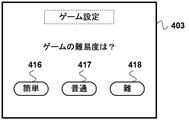
- the node of interest is set to one of the nodes 304 to 309. Then, an image 403 including items 416, 417, and 418 is displayed on the screen (FIG. 4C).
- the node of interest is one of the leaf nodes of the nodes 310 to 327.
- the node of interest is set in the node 310, and the game setting process ends. Thereafter, when the user performs an operation for starting the game, a soccer game is started for “one person”, the country of the team operated by the user is set to “Japan”, and the difficulty level is set to “easy”.
- the storage unit 201 stores a tree structure, items associated with each node included in the tree structure, and any node in the tree structure (hereinafter referred to as “attention node”).
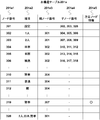
- the storage unit 201 stores a tree structure table 201a (FIG. 5) representing the tree structure of FIG.
- the tree structure table 201a includes a node number 201a1 of a node included in the tree structure, an item 201a2 associated with the node, a parent node number 201a3 of a parent node of the node, and a child node of a child node of the node Number 201a4 is registered in association with node-of-interest information 201a5 indicating whether or not the node is currently the node of interest.
- the node-of-interest information 201a5 it is assumed that the node with the node number marked with “ ⁇ ” is the current node of interest.
- the tree structure table 201a in FIG. 5 is in a state immediately after a predetermined operation for setting a game is performed.
- the RAM 103 functions as the storage unit 201.
- the moving unit 202 moves the node of interest from the root node to any leaf node by updating the storage unit 201 based on a user instruction.
- the moving unit 202 moves the node of interest from the node 301 associated with the “setting” item of the tree structure to “2”. It is moved to the node 303 associated with the item “person”. That is, the moving unit 202 deletes “ ⁇ ” of the node number 301 and attaches “ ⁇ ” to the node number 303 in the target node information 201a5 of the tree structure table 201a.
- the CPU 101 functions as the moving unit 202.
- the output unit 203 outputs items from the root node to any leaf node as a selection result.
- the item “Japan” of the node 304 For example, if the user selects the item “Japan” of the node 304, the item “Japan” is output as the selection result.
- the CPU 101 functions as the output unit 203.
- the update unit 204 creates a new leaf node in which an item associated with the leaf node and an item associated with the node that has reached the leaf node are associated with each other Is updated as a child node of the root node of the tree structure.
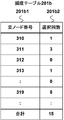
- the RAM 103 stores a frequency table 201b (FIG. 6) that describes the number of times a leaf node included in the tree structure is selected.
- a leaf node number 201b1 of a leaf node included in the tree structure and a selection count 201b2 by which the leaf node is selected are registered in association with each other.
- the predetermined condition is, for example, “the number of times of selection (number of times of selection) is 5 times or more”.
- the user selects the “2 people” item 412 in FIG. 4A, the “Japan” item 413 in FIG. 4B, and the “Easy” item 416 in FIG. 4C. That is, the user finally selects the item “easy” associated with the node 319, and the node of interest at this time is the node 319.
- the leaf node node 319
- the CPU 101 increases the number of times 201b2 of the leaf node number 319 of the frequency table 201b by 1 (the number of times of increase is 5).
- the update unit 204 associates these items “2 people, Japan, simple” with one leaf node, and as shown in FIG. 7, the update node 204 sets the leaf node as a child node (node 328) of the root node (node 301). ). Then, as shown in FIG. 8, the update unit 204 adds information about the node 328 to the tree structure table 201a, and adds a new leaf node number “328” to the child node of the root node (node 301). To do.
- the CPU 101 functions as the update unit 204.
- the display unit 205 displays an item associated with a child node of the internal node on the screen. At this time, when a new leaf node is included in the child node associated with the item displayed on the screen, the item associated with the new leaf node is highlighted.
- internal nodes are nodes 301 to 309 other than leaf nodes (nodes 310 to 327). That is, when the node of interest is one of the nodes 301 to 309, the display unit 205 displays a child node of the node on the screen. For example, when the node of interest is the node 301, the display unit 205 displays items “1 person” and “2 people” associated with the child nodes 302 and 303 of the node 301, as shown in FIG. 4A.
- the display unit 205 displays “Japan” associated with the child nodes 304 to 306 of the node 302 or the child nodes 307 to 309 of the node 303 as shown in FIG. 4B. , “US”, and “Germany” items are displayed.
- the display unit 205 displays “simple”, “normal”, and “corresponding to the child nodes 310 to 327 as shown in FIG. 4C. The “difficult” item is displayed.
- the display unit 205 displays a node 328 that is a child node of the node 301.
- the item “2 people, Japan, easy” associated with is displayed on the screen.
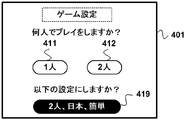
- the display unit 205 displays the item 419 with a different color from the other items 411 and 412 as shown in FIG.
- the display of the images 402 and 403 is omitted, and the game setting process ends.
- a soccer game for “two people” is started in which the country of the team operated by the user is set to “Japan” and the difficulty level is set to “easy”.
- the opponent country may be selected by the opponent before the start of the soccer game, or an item about the opponent country may be included in the tree structure shown in FIG. Good.
- the CPU 101 and the image processing unit 107 cooperate to function as the display unit 205.
- the update unit 204 may update the storage unit 201 as needed according to the tendency of user settings. For example, assume that the frequency of selecting a certain leaf node satisfies a predetermined condition, and the frequency of selecting another leaf node after the addition of a new leaf node satisfies the predetermined condition. In this case, the update unit 204 sets a new leaf node associated with the item associated with the other leaf node and the item associated with the node that has passed through the other leaf node as the root of the tree structure. You may make it update the memory
- the update unit 204 replaces the node 328 with a new leaf node associated with the item “one person, the United States, difficulty” in which the items associated with the nodes 302, 305, and 315 are collected,
- the storage unit 201 is updated to be a child node of (node 301).
- the display unit 205 deletes the item 419 in FIG. 9 and sets the item “one person, US, difficult” at the position of the item 419 when the node of interest is set as the root node (node 301). indicate.
- the update unit 204 does not delete the node 328 previously added as a new leaf node but leaves it as it is, and further adds a new leaf node associated with the item “one person, US, difficulty” to the root node (
- the storage unit 201 may be updated to be a child node of the node 301).
- the display unit 205 may not display the item 419 of the image 401 in FIG. 9, but may display the item “one person, US, difficulty” so as to be adjacent to the item 419.
- the update unit 204 updates the storage unit 201 so that the frequency of reaching the leaf node satisfies a predetermined condition and sets the new leaf node as a child node of the root node, and then the leaf node and the new leaf node When the frequency at which the other leaf node is selected satisfies a predetermined condition, the storage unit 201 may be updated so as to delete the new leaf node.
- the predetermined condition is, for example, 10 times.
- the update unit 204 deletes the node 328 from the tree structure table 201a in FIG. 7 and the tree structure table 201a in FIG. 8, and restores the state of the original tree structure in FIG.
- the storage unit 201 is updated.
- the display unit 205 deletes the item 419 in FIG. 9 and displays only the items 411 and 412 (FIG. 4A).
- the CPU 101 sets the root node of the tree structure as the attention node, and displays items associated with the child nodes of the attention node (root node) on the screen (step S101).
- the CPU 101 adds “O” to the node-of-interest information 201a5 of the node 301 associated with the “setting” item in the tree structure table 201a.
- the display unit 205 displays “1 person” and “2 persons” items 411 and 412 associated with the child nodes 302 and 303 of the node 301 on the screen as shown in FIG. 4A.
- the moving unit 202 determines whether or not there is an instruction for item selection by the user (step S102). When there is the instruction (step S102; Yes), the moving unit 202 moves the node of interest to the node associated with the selected item (step S103). On the other hand, when there is no such instruction (step S102; No), the moving unit 202 waits as it is.
- the moving unit 202 deletes the “ ⁇ ” of the node number 301 in the node-of-interest information 201a5 of the tree structure table 201a.
- “ ⁇ ” is added to the node number 303, and the node of interest is set as the node 303.
- the moving unit 202 stands by with the image 401 displayed on the screen.
- the output unit 203 outputs an item associated with the node of interest (step S104).
- the output unit 203 outputs the “2 people” item as a selection result.
- the CPU 101 determines whether or not the node of interest is a leaf node (step S105).
- the update unit 204 determines whether or not the number of times that the leaf node is selected (number of selections) satisfies a predetermined condition. (Step S106).
- the display unit 205 determines whether a new leaf node is included in the child nodes of the node of interest (step S105). S108).
- the CPU 101 determines that the node 319 is a leaf node, and the update unit 204 refers to the frequency table 201b in FIG. 6 and the number of times the node 319 is selected. And whether or not a predetermined condition (for example, “the number of selected times is 5 or more”) is satisfied is determined.
- the CPU 101 determines that the node 303 is not a leaf node, and the display unit 205 determines whether or not a new leaf node is included in the child nodes 307, 308, and 309 of the node 303. Determine whether.
- step S106 when the update unit 204 determines that the number of leaf node selections satisfies a predetermined condition (step S106; Yes), the item associated with the leaf node and the item passed through to the leaf node The storage unit 201 is updated so that a new leaf node associated with is made a child node of the root node of the tree structure (step S107). On the other hand, when the update unit 204 determines that the number of leaf node selections does not satisfy the predetermined condition (step S106; No), the selection process is terminated.
- the update unit 204 refers to the frequency table 201b (FIG. 6) and obtains the number of selections “5 times” for the node 319. , It is determined that the number of times the node is selected satisfies a predetermined condition. In this case, the update unit 204 sets the item “Easy” associated with the node 319 and the items “2 people” (node 303) and “Japan” (node 307) that have passed through the node 319 as one item. Associating with the leaf node, as shown in FIG.
- the leaf node is set as a child node (node 328) of the root node (node 301). Then, the update unit 204 adds information about the node 328 to the tree structure table 201a as illustrated in FIG.
- the update unit 204 refers to the frequency table 201b (FIG. 6) and obtains the number of selections “1” of the node 310, It is determined that the number of times the node is selected does not satisfy a predetermined condition. In this case, the CPU 101 ends the selection process.
- step S108 when the display unit 205 determines in step S108 that the child node of the node of interest includes a new leaf node (step S108; Yes), the item associated with the child node of the node of interest is displayed. Then, the item associated with the new leaf node is highlighted (step S109). Thereafter, the process returns to step S102.
- the display unit 205 determines that a new leaf node is not included in the child node of the node of interest (Step S108; No), the item associated with the child node of the node of interest is displayed (Step S108). S110). Thereafter, the process returns to step S102.
- the display unit 205 determines that a new leaf node (node 328) is included in the child nodes (nodes 302, 303, and 328) of the node 301. Then, as shown in FIG. 9, the display unit 205 highlights the item 419 “2 people, Japan, easy” associated with the node 328.
- frequently selected items are collected, so that the user can easily select frequently selected items.
- items in which frequently selected items are collected can be displayed in an easy-to-understand manner for the user.
- the user's fluid selection tendency can be reflected by collecting the items based on the new selection tendency.
- the user selects another item from the collected items the items that are not frequently selected are displayed by not displaying the collected items. Annoyance can be avoided.
- a user-friendly selection device can be provided.
- the selection device When the frequency with which a leaf node is selected satisfies a predetermined condition, the selection device according to the second embodiment adjusts the display position of a new leaf node in which items up to the leaf node are collected and is easily understood by the user. indicate.
- the selection device includes a storage unit 201, a moving unit 202, an output unit 203, and an update unit 204. Further, as shown in the figure, a display unit 205 may be provided.
- the storage unit 201, the moving unit 202, the output unit 203, and the updating unit 204 of the present embodiment have the same functions as those of the first embodiment.
- the display unit 205 having different functions will be described.
- the display unit 205 displays an item associated with the child node of the internal node on the screen, and a new leaf node is displayed on the child node associated with the item displayed on the screen. Is included, the item associated with the new leaf node is displayed at the top of the displayed items.
- the display unit 205 displays the node 504 on the node 504. Items 514, 515, and 516 associated with the child nodes 304 to 306 or 307 to 309 of 302 or 303 are displayed.
- the node of interest is set to one of the nodes 304 to 309, and the display unit 205
- the panel 505 displays items 517, 518, and 519 associated with child nodes of any of the nodes 304 to 309.
- the node of interest is set to one of the leaf nodes of the nodes 310 to 327.
- the item “Easy” associated with the node 319 is selected, the node of interest is set to the node 319, and the game setting ends.
- the display unit 205 displays the item “520, Japan, easy” associated with the node 328 among the child nodes (nodes 302, 303, and 328) of the node 301. Are displayed at the top of the panel 506.
- the display unit 205 associates the item associated with the new leaf node with the new leaf node.
- the item may be displayed adjacent to the item associated with the child node of the root node.
- the leaf node to which the item associated with the new leaf node is associated is the node 319.
- the nodes that have passed through are nodes 303 and 307.
- the child node of the root node (node 301) is a node 303. Therefore, as shown in FIG. 13, the display unit 205 displays an item “520, two people, Japan, easy” associated with the node 328 and an item “two people” associated with the node 303 on the panel 507. Display next to.
- the user selects the item 520 displayed as shown in FIG. 12 or FIG.
- the game setting process can be completed by selecting the items “2 people”, “Japan”, and “Easy” without opening a panel for performing the game.
- the CPU 101 and the image processing unit 107 cooperate to function as the display unit 205.
- step S108 when the display unit 205 determines that the child node of the node of interest includes a new leaf node (step S108; Yes), the item associated with the child node of the node of interest is displayed. The display position of the item associated with the new leaf node is adjusted and displayed (step S209).
- the display unit 205 displays an item 520 of “2 people, Japan, easy” associated with the node 328 on the panel 506 as shown in FIG. Displayed at the top of 513.
- the display unit 205 displays an item “520, two people, Japan, simple” associated with the node 328 for “two people” associated with the node 303 on the panel 507. It is displayed adjacent to the item 513.
- an item in which frequently selected items are collected is displayed at the top of the items displayed on the screen, so that it can be displayed at a position where it can be easily selected.
- Embodiment 1 and 2 although the item regarding the setting of a soccer game was demonstrated to the example which represented the tree structure, the tree structure which this invention makes object is not restricted to this.
- the selection device 200 is applicable, for example, when the items related to the character generation setting are represented by a tree structure.
- the tree structure in FIG. 15 represents items related to character generation settings in a tree structure.
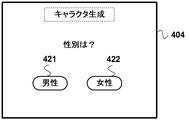
- the item “setting” is associated with the root node (node 601), and the item “male” or “female” indicating the gender of the character to be generated is associated with the lower nodes (nodes 602 and 603). Attached. Nodes 602 and 603 associated with the item “male” or “female” (nodes 604 to 607) have “round face” or “square face” indicating the shape of the character's face. Items are associated. Further, items of “skin”, “normal”, or “obesity” indicating the body type of the character are associated with nodes lower than those items (nodes 608 to 619). The nodes 608 to 619 associated with the item indicating the body type are leaf nodes, and when any leaf node is selected, the character generation setting ends.
- the items associated with each node of this tree structure are displayed on the screen as shown in FIGS. 16A to 16C.
- the node of interest is set as a root node (node 601), and the display unit 205 displays an image 404 including items 421 and 422 on the screen. (FIG. 16A).
- the display unit 205 displays an image 404 including items 421 and 422 on the screen.
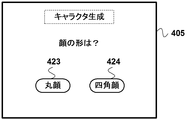
- the node 602 or 603 is set as the node of interest, and the display unit 205
- An image 405 including items 423 and 424 is displayed on the screen (FIG. 16B).
- the node of interest is set to one of the nodes 604 to 607, and the display unit 205 In FIG. 16C, an image 406 including items 425, 426, and 427 is displayed on the screen.
- the node of interest is any one of the leaf nodes 608 to 619.
- node 608 the node of interest is set to node 608, and “male” ”Is generated, and the character of the“ round face ”“ skinned ”body shape is generated, and the character generation process ends.
- node 620 when a new leaf node (node 620) is included and the node of interest is the node 601, the display unit 205, for example, as shown in FIG.
- the item “428, male, round face, normal” is highlighted.
- the setting process in the image 405 of FIG. 16B and the image 406 of FIG. 16C is omitted, and the “male” “round face” and “normal” body shape. Can be generated.
- the present invention it is possible to provide a selection device, a selection method, a non-temporary recording medium, and a program that can easily select frequently selected items.
Landscapes
- Engineering & Computer Science (AREA)
- Theoretical Computer Science (AREA)
- General Engineering & Computer Science (AREA)
- Physics & Mathematics (AREA)
- General Physics & Mathematics (AREA)
- Databases & Information Systems (AREA)
- Human Computer Interaction (AREA)
- Software Systems (AREA)
- Data Mining & Analysis (AREA)
- User Interface Of Digital Computer (AREA)
Abstract
選択装置(200)は、複数のノードに項目が対応付けられた木構造から項目を選択するものである。記憶部(201)には、木構造と、木構造に含まれる各ノードに対応付けられる項目と、木構造内のいずれかのノード(以下、「注目ノード」という)と、が記憶される。移動部(202)は、ユーザの指示に基づいて、記憶部(201)を更新することにより木構造を根ノードからいずれかの葉ノードに至るまで注目ノードを移動させる。出力部(203)は、項目を選択結果として出力する。更新部(204)は、葉ノードに至る頻度が所定の条件を満たす場合、葉ノードに対応付けられる項目及び葉ノードに至るまでに経由したノードに対応付けられる項目が対応付けられる新たな葉ノードを、木構造の根ノードの子ノードとするように記憶部(201)を更新する。
Description
本発明は、頻繁に選択する項目を簡易に選択することが可能な選択装置、選択方法、非一時的な(non-transitory)記録媒体、ならびに、プログラムに関する。
ユーザがコントローラを操作して、予め用意された複数の項目の中から所望の項目を選択できるユーザインターフェースが知られている。このようなユーザインターフェースでは、項目が階層構造を形成するものがあり、ユーザは各階層に属する項目を選択しながら、最も下位の項目まで辿る。そして、最も下位の項目が選択結果として出力される。
上記のユーザインターフェースにおいては、項目や階層が多くなるほど、選択操作が煩雑になるため、ユーザにとって項目を選択し易くするための工夫がなされている。例えば、特許文献1には、階層構造において現在どの階層の項目が表示されているのかを把握し易くする情報出力装置が開示されている。
一方で、頻繁に選択する項目までの階層を辿る手続きは、ユーザにとって煩雑であり、簡易に項目の選択を行いたいという要望もある。
本発明は、上記のような課題を解決するもので、頻繁に選択する項目を簡易に選択することが可能な選択装置、選択方法、非一時的な記録媒体、ならびに、プログラムを提供することを目的とする。
本発明の第1の観点に係る選択装置は、複数のノードを含み、各ノードに項目が対応付けられた木構造から、根ノードからいずれかの葉ノードに至るまでの項目を選択する選択装置であって、記憶部、移動部、出力部、更新部を備え、以下のように構成する。
ここで、木構造とは、1つのノードが1つ以上のノードを持ち、当該1つ以上のノードのそれぞれがさらに1つ以上のノードを持つという形で、階層が深くなるにつれて枝分かれする構造をいう。木構造においてあるノードに注目したとすると、注目しているノードが持つ下位のノードを子ノード、注目しているノードを持つ上位のノードを親ノードという。そして、木構造における最も上位のノードを根ノード、子ノードを持たない末端のノードを葉ノードという。また、子ノードを持つノード(葉ノード以外のノード)を内部ノードという(したがって、根ノードは内部ノードである)。各ノードには任意の項目が対応付けられる。
以下、サッカーゲームの設定に関する項目が木構造で体系付けられている場合を例に説明する。例えば、木構造の最上位のノード(根ノード)には“設定”の項目が対応付けられ、その下位のノードには、ゲームを行うユーザの人数を示す“1人”、及び“2人”の項目が対応付けられる。さらに、“1人”、又は“2人”の項目の下位のノードには、ユーザが操作するチームの国籍を示す“日本”、“米国”、及び“独逸”の項目が対応付けられる。そして、さらにそれらの各項目の下位のノードには、ゲームの難易度を示す“簡単”、“普通”、及び“難”の項目が対応付けられる。難易度を表す項目が対応付けられたノードは葉ノードであり、いずれかの葉ノードが選択されると、ゲームの設定は終了することとする。例えば、ユーザが、ゲームを行う人数を“1人”と選択し、チームの国籍を“日本”と選択し、難易度を“簡単”と選択すると、ゲームの設定は終了する。
記憶部には、木構造と、当該木構造に含まれる各ノードに対応付けられる項目と、当該木構造内のいずれかのノード(以下、「注目ノード」という)と、が記憶される。
すなわち、記憶部には、サッカーゲームの設定に関する各項目が木構造のどの位置に配置されているかという情報が記憶されている。また、ユーザがゲームを行うユーザの人数を“2人”と選択したとすると、記憶部には、注目ノードとして、“2人”の項目が対応付けられたノードが記憶される。
移動部は、ユーザの指示に基づいて、記憶部を更新することにより木構造を根ノードからいずれかの葉ノードに至るまで注目ノードを移動させる。
例えば、ユーザが、“日本”の項目を選択する操作を行うと、移動部は木構造の“2人”の項目が対応付けられたノードから、当該ノードの子ノードである、“日本”の項目が対応付けられたノードへ注目ノードを移動させる。移動部は、“日本”の項目が対応付けられたノードの子ノード、すなわち、葉ノードが選択されるまで、注目ノードを移動させる。
出力部は、根ノードからいずれかの葉ノードに至るまでの項目を選択結果として出力する。
例えば、ユーザが、“日本”の項目が対応付けられたノードを選択する操作を行ったとすると、出力部は、“日本”の項目を選択結果として出力する。
更新部は、葉ノードに至る頻度が所定の条件を満たす場合、当該葉ノードに対応付けられる項目及び当該葉ノードに至るまでに経由したノードに対応付けられる項目が対応付けられる新たな葉ノードを、木構造の根ノードの子ノードとするように記憶部を更新する。
ここで、所定の条件を、5回とする。例えば、木構造の“2人”及び“日本”の項目が対応付けられた各ノードを経由して“簡単”の項目が対応付けられた葉ノードが選択され、当該葉ノードが選択された回数が5回目であったとする。この場合、更新部は、“2人”、“日本”、及び“簡単”の項目を1つの葉ノードに対応付け、当該葉ノードを根ノードの子ノードとするように、記憶部を更新する。
本発明によれば、頻繁に選択する項目がまとめられるので、ユーザは、頻繁に選択する項目を簡易に選択することができる。
また、本発明の第1の観点に係る選択装置は、表示部をさらに備え、以下のように構成してもよい。
表示部は、注目ノードが内部ノードである場合、当該内部ノードの子ノードに対応付けられた項目を画面に表示し、画面に表示される項目が対応付けられた子ノードに新たな葉ノードが含まれる場合、当該新たな葉ノードに対応付けられた項目を、強調表示する。
例えば、注目ノードが“設定”の項目が対応付けられた根ノードである場合、当該根ノードの子ノードに対応付けられた項目“1人”、及び“2人”を画面に表示する。また、例えば、“1人”、又は“2人”の項目が対応付けられた子ノード以外に、根ノードの子ノードとして、“2人、日本、簡単”の項目が対応付けられた新たな葉ノードが含まれる場合、表示部は、“2人、日本、簡単”の項目を、画面において目立つ色を付して表示する。
本発明によれば、頻繁に選択する項目がまとめられた項目を、ユーザに分かり易く表示することができる。
あるいは、表示部は、注目ノードが内部ノードである場合、当該内部ノードの子ノードに対応付けられた項目を画面に表示し、画面に表示される項目が対応付けられた子ノードに新たな葉ノードが含まれる場合、当該新たな葉ノードに対応付けられた項目を、当該表示される項目のうちの先頭に表示する。
例えば、“1人”、又は“2人”の項目が対応付けられた子ノード以外に、根ノードの子ノードとして、“2人、日本、簡単”の項目が対応付けられた新たな葉ノードが含まれているとする。注目ノードが、“設定”の項目が対応付けられた根ノードである場合、表示部は、“2人、日本、簡単”の項目を先頭にして、“2人、日本、簡単”、“1人”、“2人”の順に項目を並べて画面に表示する。
本発明によれば、頻繁に選択する項目がまとめられた項目を、選択し易い位置に表示することができる。
また、あるいは、表示部は、注目ノードが内部ノードである場合、当該内部ノードの子ノードに対応付けられた項目を画面に表示し、
画面に表示される項目が対応付けられた子ノードに新たな葉ノードが含まれる場合、当該新たな葉ノードに対応付けられた項目を、当該新たな葉ノードに対応付けられた項目が対応付けられる葉ノードに至るまでに経由したノードのうち、根ノードの子ノードに対応付けられた項目に隣接して表示する。
画面に表示される項目が対応付けられた子ノードに新たな葉ノードが含まれる場合、当該新たな葉ノードに対応付けられた項目を、当該新たな葉ノードに対応付けられた項目が対応付けられる葉ノードに至るまでに経由したノードのうち、根ノードの子ノードに対応付けられた項目に隣接して表示する。
例えば、“1人”、又は“2人”の項目が対応付けられた子ノード以外に、根ノードの子ノードとして、“2人、日本、簡単”の項目が対応付けられた新たな葉ノードが含まれているとする。「新たな葉ノードに対応付けられた項目が対応付けられる葉ノード」とは、“2人”及び“日本”を経由した“簡単”の葉ノードであり、「葉ノードに至るまでに経由したノード」とは、“2人”及び“日本”が対応付けられたノードである。そして、“2人”及び“日本”が対応付けられたノードのうち、「根ノードの子ノードに対応付けられた項目」とは、“2人”の項目である。すなわち、表示部は、新たな葉ノードに対応付けられる項目“2人、日本、簡単”を項目“2人”に隣接させて、“1人”、“2人”、“2人、日本、簡単”の順に項目を並べて画面に表示する。
本発明によれば、頻繁に選択する項目がまとめられた項目を、どの項目をまとめたものかを分かり易く提示することができる。
本発明の第2の観点に係る選択方法は、複数のノードを含み、各ノードに項目が対応付けられた木構造から、根ノードからいずれかの葉ノードに至るまでの項目を選択し、木構造と、当該木構造に含まれる各ノードに対応付けられる項目と、当該木構造内のいずれかのノード(以下、「注目ノード」という)と、が記憶される記憶部と、移動部と、出力部と、更新部と、を備える選択装置が実行する選択方法であって、以下のように構成する。
移動工程において、移動部が、ユーザの指示に基づいて、記憶部を更新することにより木構造を根ノードからいずれかの葉ノードに至るまで注目ノードを移動させる。
出力工程において、出力部が、根ノードからいずれかの葉ノードに至るまでの項目を選択結果として出力する。
更新工程において、更新部が、葉ノードに至る頻度が所定の条件を満たす場合、当該葉ノードに対応付けられる項目及び当該葉ノードに至るまでに経由したノードに対応付けられる項目が対応付けられる新たな葉ノードを、木構造の根ノードの子ノードとするように記憶部を更新する。
本発明のその他の観点に係るプログラムは、コンピュータを上記選択装置として機能させ、コンピュータに上記選択方法を実行させるように構成する。
また、本発明のプログラムは、コンパクトディスク、フレキシブルディスク、ハードディスク、光磁気ディスク、ディジタルビデオディスク、磁気テープ、半導体メモリ等のコンピュータ読取可能な非一時的な情報記録媒体に記録することができる。
上記プログラムは、プログラムが実行されるコンピュータとは独立して、コンピュータ通信網を介して配布・販売することができる。また、上記非一時的な情報記録媒体は、コンピュータとは独立して配布・販売することができる。
本発明によれば、頻繁に選択する項目を簡易に選択することが可能な選択装置、選択方法、非一時的な記録媒体、ならびに、プログラムを提供することができる。
本発明の選択装置は、頻繁に選択される項目をまとめ表示するものである。項目を表示する手法は複数あり、各手法を採用した選択装置を実施形態1及び2として説明する。
実施形態1の選択装置は、葉ノードが選択される頻度が所定の条件を満たすと、当該葉ノードに至るまでの項目をまとめて新たな葉ノードとして強調表示する手法を採用する。
実施形態2の選択装置は、葉ノードが選択される頻度が所定の条件を満たすと、当該葉ノードに至るまでの項目をまとめた新たな葉ノードを、表示位置を調整してユーザに分かり易く表示する手法を採用する。
実施形態2の選択装置は、葉ノードが選択される頻度が所定の条件を満たすと、当該葉ノードに至るまでの項目をまとめた新たな葉ノードを、表示位置を調整してユーザに分かり易く表示する手法を採用する。
(情報処理装置の概要構成)
まず、これらの実施形態の選択装置が実現される典型的な情報処理装置について説明する。なお、以下では、理解を容易にするため、ゲーム用の情報処理装置を利用して本発明が実現される実施形態を説明するが、以下に説明する実施形態は説明のためのものであり、本願発明の範囲を制限するものではない。したがって、当業者であればこれらの各要素もしくは全要素をこれと均等なものに置換した実施形態を採用することが可能であるが、これらの実施形態も本発明の範囲に含まれる。
まず、これらの実施形態の選択装置が実現される典型的な情報処理装置について説明する。なお、以下では、理解を容易にするため、ゲーム用の情報処理装置を利用して本発明が実現される実施形態を説明するが、以下に説明する実施形態は説明のためのものであり、本願発明の範囲を制限するものではない。したがって、当業者であればこれらの各要素もしくは全要素をこれと均等なものに置換した実施形態を採用することが可能であるが、これらの実施形態も本発明の範囲に含まれる。
図1は、プログラムを実行することにより、本発明の実施形態に係る選択装置の機能を果たす典型的な情報処理装置100の概要構成を示す模式図である。以下、本図を参照して説明する。
情報処理装置100は、CPU(Central Processing Unit)101と、ROM(Read Only Memory)102と、RAM(Random Access Memory)103と、インターフェース104と、コントローラ105と、外部メモリ106と、画像処理部107と、DVD-ROM(Digital Versatile Disc ROM)ドライブ108と、NIC(Network Interface Card)109と、音声処理部110と、を備える。
CPU 101は、情報処理装置100全体の動作を制御し、各構成要素と接続され、制御信号やデータをやりとりする。また、CPU 101は、レジスタ(図示せず)という高速アクセスが可能な記憶域に対してALU(Arithmetic Logic Unit)(図示せず)を用いて加減乗除等の算術演算や、論理和、論理積、論理否定等の論理演算、ビット和、ビット積、ビット反転、ビットシフト、ビット回転等のビット演算などを行うことができる。さらに、マルチメディア処理対応のための加減乗除等の飽和演算や、三角関数等、ベクトル演算などを高速に行えるように、CPU 101自身が構成されているものや、コプロセッサを備えて実現するものがある。
ROM 102には、電源投入直後に実行されるIPL(Initial Program Loader)が記憶され、これが実行されることにより、DVD-ROMに記憶されたプログラムをRAM 103に読み出してCPU 101による実行が開始される。また、ROM 102には、情報処理装置100全体の動作制御に必要なオペレーティングシステムのプログラムや各種のデータが記憶される。
RAM 103は、データやプログラムを一時的に記憶するためのもので、DVD-ROMから読み出したプログラムやデータ、その他ゲームの進行やチャット通信に必要なデータが保持される。また、CPU 101は、RAM 103に変数領域を設け、当該変数に格納された値に対して直接ALUを作用させて演算を行ったり、RAM 103に格納された値を一旦レジスタに格納してからレジスタに対して演算を行い、演算結果をメモリに書き戻す、等の処理を行う。
コントローラ105は、インターフェース104を介して接続される。コントローラ105は、プレイヤがゲーム実行の際に行う操作入力を受け付ける。
外部メモリ106は、インターフェース104を介して着脱自在に接続される。外部メモリ106には、ゲーム等のプレイ状況(過去の成績等)を示すデータ、ゲームの進行状態を示すデータ、ネットワーク対戦の場合のチャット通信のログ(記録)のデータなどが書き換え可能に記憶される。プレイヤは、コントローラ105を介して指示入力を行うことにより、これらのデータを適宜外部メモリ106に記憶させることができる。
画像処理部107は、DVD-ROMから読み出されたデータをCPU 101や画像処理部107が備える画像演算プロセッサ(図示せず)によって加工処理した後、これを画像処理部107が備えるフレームメモリ(図示せず)に記憶させる。フレームメモリに記憶された画像情報は、所定の同期タイミングでビデオ信号に変換され画像処理部107に接続されるモニタへ出力される。これにより、各種の画像表示が可能となる。
また、画像演算プロセッサは、2次元の画像の重ね合わせ演算やαブレンディング等の透過演算、各種の飽和演算を高速に実行できる。
また、仮想空間が3次元にて構成される場合には、当該3次元空間内に配置され、各種のテクスチャ情報が付加されたポリゴン情報を、Zバッファ法によりレンダリングして、所定の視点位置から仮想空間に配置されたポリゴンを所定の視線の方向へ俯瞰したレンダリング画像を得る演算の高速実行も可能である。
さらに、CPU 101と画像演算プロセッサが協調動作することにより、文字の形状を定義するフォント情報に従って、文字列を2次元画像としてフレームメモリへ描画したり、各ポリゴン表面へ描画したりすることが可能である。
DVD-ROMドライブ108に装着されるDVD-ROMには、ゲームを実現するためのプログラムとゲームに付随する画像データや音声データが記憶される。CPU 101の制御によって、DVD-ROMドライブ108は、これに装着されたDVD-ROMに対する読み出し処理を行って、必要なプログラムやデータを読み出し、これらはRAM 103等に一時的に記憶される。
NIC 109は、情報処理装置100をインターネット等のコンピュータ通信網(図示せず)に接続するためのものであり、LAN(Local Area Network)を構成する際に用いられる10BASE-T/100BASE-T規格に従うものや、電話回線を用いてインターネットに接続するためのアナログモデム、ISDN(Integrated Services Digital Network)モデム、ADSL(Asymmetric Digital Subscriber Line)モデム、ケーブルテレビジョン回線を用いてインターネットに接続するためのケーブルモデム等と、これらとCPU 101との仲立ちを行うインターフェース(図示せず)により構成される。
音声処理部110は、DVD-ROMから読み出した音声データをアナログ音声信号に変換し、これに接続されたスピーカ(図示せず)から出力させる。また、音声処理部110は、CPU 101の制御の下、ゲームの進行の中で発生させるべき効果音や楽曲データを生成し、これに対応した音声をスピーカから出力させる。
DVD-ROMに記録された音声データがMIDI(Musical Instrument Digital Interface)データである場合には、音声処理部110は、これが有する音源データを参照して、MIDIデータをPCM(Pulse Code Modulation)データに変換する。また、音声データがADPCM(Adaptive Differential PCM)形式やOgg Vorbis形式等の圧縮済音声データである場合には、音声処理部110は、これを展開してPCMデータに変換する。PCMデータは、そのサンプリング周波数に応じたタイミングでD/A(Digital/Analog)変換を行って、スピーカに出力することにより、音声出力が可能となる。
このほか、情報処理装置100は、ハードディスク等の大容量外部記憶装置を用いて、ROM 102、RAM 103、外部メモリ106、DVD-ROMドライブ108に装着されるDVD-ROM等と同じ機能を果たすように構成してもよい。
以上で説明した情報処理装置100は、いわゆる「コンシューマ向けテレビゲーム装置」に相当するものであるが、仮想空間を表示するような画像処理を行うものであれば本発明を実現することができる。したがって、携帯電話、携帯ゲーム機器、カラオケ装置、一般的なビジネス用コンピュータなど、種々の計算機上で本発明を実現することが可能である。
例えば、一般的なコンピュータは、上記情報処理装置100と同様に、CPU、RAM、ROM、DVD-ROMドライブ、及び、NICを備え、情報処理装置100よりも簡易な機能を備えた画像処理部を備え、外部記憶装置としてハードディスクを有する他、フレキシブルディスク、光磁気ディスク、磁気テープ等が利用できるようになっている。また、コントローラ105ではなく、キーボードやマウスなどを入力装置として利用する。
以下、上記情報処理装置100において実現される実施形態1及び2に係る選択装置の概要構成について、図1乃至17を参照して説明する。ゲーム用のプログラム及びデータが記憶されたDVD-ROMをDVD-ROMドライブ108に装着して、情報処理装置100の電源を投入することにより、当該プログラムが実行され、実施形態1及び2に係る選択装置が実現される。
(実施形態1)
実施形態1の選択装置は、葉ノードが選択される頻度が所定の条件を満たすと、当該葉ノードに至るまでの項目をまとめて新たな葉ノードとして強調表示する。
実施形態1の選択装置200は、図2に示すように、記憶部201と、移動部202と、出力部203と、更新部204と、から構成される。また、図示するように、表示部205を備えるようにしてもよい。
実施形態1の選択装置は、葉ノードが選択される頻度が所定の条件を満たすと、当該葉ノードに至るまでの項目をまとめて新たな葉ノードとして強調表示する。
実施形態1の選択装置200は、図2に示すように、記憶部201と、移動部202と、出力部203と、更新部204と、から構成される。また、図示するように、表示部205を備えるようにしてもよい。
まず、本実施形態における木構造の例を図3に示す。図3の木構造は、サッカーゲームの設定に関する項目を木構造で表したものである。根ノード(ノード301)には“設定”の項目が対応付けられ、その下位のノード(ノード302、303)には、ゲームを行うユーザの人数を示す“1人”、又は“2人”の項目が対応付けられる。“1人”、又は“2人”の項目が対応付けられたノード302、303の下位のノード(ノード304~309)には、ユーザが操作するチームの国籍を示す“日本”、“米国”、又は“独逸”の項目が対応付けられる。そして、さらにそれらの項目の下位のノード(ノード310~327)には、ゲームの難易度を示す“簡単”、“普通”、又は“難”の項目が対応付けられる。難易度を示す項目が対応付けられたノード310~327は葉ノードであり、いずれかの葉ノードが選択されると、ゲームの設定は終了する。
例えば、注目ノードが“1人”のノード302である場合、親ノードは“設定”のノード301であり、子ノードは、“日本”のノード304、“米国”のノード305、及び、“独逸”のノード306である。
この木構造の各ノードに対応付けられている項目は、図4A乃至図4Cに示すように画面に表示される。例えば、ユーザがゲームの設定を行うための所定の操作を行うと、注目ノードが根ノード(ノード301)に設定され、項目411、412を含む画像401が画面に表示される(図4A)。次に、ユーザが、図4Aの画像401において、カーソル420を操作して、“1人”の項目411、又は“2人”の項目412のいずれかを選択すると、注目ノードにノード302又は303が設定され、項目413、414、415を含む画像402が画面に表示される(図4B)。ユーザが、図4Bの画像402において、“日本”の項目413、“米国”の項目414、又は“独逸”の項目415のいずれかを選択すると、注目ノードがノード304~309のいずれかに設定され、項目416、417、418を含む画像403が画面に表示される(図4C)。ユーザが、図4Cの画像において、“簡単”の項目416、“普通”の項目417、又は“難”の項目418のいずれかを選択すると、注目ノードがノード310~327のいずれかの葉ノードに設定される。例えば、ノード310に対応付けられた“簡単”の項目が選択されたとすると、注目ノードがノード310に設定され、ゲームの設定の処理は終了する。この後、ユーザがゲーム開始の操作を行えば、“1人”用で、ユーザが操作するチームの国が“日本”、難易度が“簡単”と設定されたサッカーゲームが開始される。
記憶部201には、木構造と、当該木構造に含まれる各ノードに対応付けられる項目と、当該木構造内のいずれかのノード(以下、「注目ノード」という)と、が記憶される。
例えば、記憶部201には、図3の木構造を表す木構造テーブル201a(図5)が記憶される。木構造テーブル201aには、木構造に含まれるノードのノード番号201a1と、当該ノードに対応付けられた項目201a2と、当該ノードの親ノードの親ノード番号201a3と、当該ノードの子ノードの子ノード番号201a4と、当該ノードが現在注目ノードであるか否かを示す注目ノード情報201a5と、が対応付けて登録されている。注目ノード情報201a5において、“○”が付されたノード番号のノードが現在の注目ノードであるとする。なお、図5の木構造テーブル201aは、ゲームの設定を行うための所定の操作が行われた直後の状態であるとする。
したがって、RAM 103が記憶部201として機能する。
移動部202は、ユーザの指示に基づいて、記憶部201を更新することにより木構造を根ノードからいずれかの葉ノードに至るまで注目ノードを移動させる。
例えば、ユーザが、図4Aの“2人”の項目412を選択する操作を行うと、移動部202は、注目ノードを、木構造の“設定”の項目が対応付けられたノード301から“2人”の項目が対応付けられたノード303に移動させる。すなわち、移動部202は、木構造テーブル201aの注目ノード情報201a5において、ノード番号301の“○”を削除して、ノード番号303に“○”を付する。
したがって、CPU 101が移動部202として機能する。
出力部203は、根ノードからいずれかの葉ノードに至るまでの項目を選択結果として出力する。
例えば、ユーザが、ノード304の“日本”の項目を選択したとすると、“日本”の項目を選択結果として出力する。
したがって、CPU 101が出力部203として機能する。
更新部204は、葉ノードに至る頻度が所定の条件を満たす場合、当該葉ノードに対応付けられる項目及び当該葉ノードに至るまでに経由したノードに対応付けられる項目が対応付けられる新たな葉ノードを、木構造の根ノードの子ノードとするように記憶部201を更新する。
例えば、RAM 103には、木構造に含まれる葉ノードについて、当該葉ノードが選択された回数を記す頻度テーブル201b(図6)が記憶される。頻度テーブル201bには、木構造に含まれる葉ノードの葉ノード番号201b1と、当該葉ノードが選択された選択回数201b2と、が対応付けて登録されている。ここで、所定の条件を、例えば、“選択された回数(選択回数)が5回以上”とする。
ユーザが、図4Aにおいて、“2人”の項目412を選択し、図4Bにおいて、“日本”の項目413を選択し、図4Cにおいて、“簡単”の項目416を選択したとする。すなわち、ユーザは、最終的に、ノード319に対応付けられた“簡単”の項目を選択したことになり、このときの注目ノードはノード319である。葉ノード(ノード319)が選択されると、CPU 101は、頻度テーブル201bの葉ノード番号319の回数201b2を1つ増やす(増やした回数を5回とする)。ここで、ノード319に対応付けられた項目は“簡単”であり、ノード319に至るまでに経由したノードに対応付けられた項目は、“2人”(ノード303)、“日本”(ノード307)である。したがって、更新部204は、これらの項目“2人、日本、簡単”を1つの葉ノードに対応付け、図7に示すように、当該葉ノードを根ノード(ノード301)の子ノード(ノード328)とする。そして、更新部204は、図8に示すように、木構造テーブル201aに、ノード328についての情報を追加し、根ノード(ノード301)の子ノードに新たな葉ノードの番号“328”を追加する。
したがって、CPU 101が更新部204として機能する。
表示部205は、注目ノードが内部ノードである場合、当該内部ノードの子ノードに対応付けられた項目を画面に表示する。この際、画面に表示される項目が対応付けられた子ノードに新たな葉ノードが含まれる場合、当該新たな葉ノードに対応付けられた項目を、強調表示する。
図3の木構造において、内部ノードは、葉ノード(ノード310~327)以外のノード301~309である。すなわち、表示部205は、注目ノードがノード301~309のいずれかのノードである場合に、当該ノードの子ノードを画面に表示する。例えば、注目ノードがノード301の場合、表示部205は、図4Aに示すように、ノード301の子ノード302、303に対応付けられた“1人”及び“2人”の項目を表示する。注目ノードが、ノード302又は303の場合、表示部205は、図4Bに示すように、ノード302の子ノード304~306、又は、ノード303の子ノード307~309に対応付けられた“日本”、“米国”、及び“独逸”の項目を表示する。そして、注目ノードがノード304~309のいずれかの場合、表示部205は、図4Cに示すように、それらの子ノード310~327に対応付けられた、“簡単”、“普通”、及び“難”の項目を表示する。
また、図7に示すように、新たに追加された葉ノード328が木構造に含まれ、現在の注目ノードがノード301であるとすると、表示部205は、ノード301の子ノードであるノード328に対応付けられた“2人、日本、簡単”の項目を画面に表示する。この場合、表示部205は、図9に示すように、項目419を他の項目411、412と異なる色を付して表示する。ユーザが、図9の画像401において、項目419を選択する操作を行うと、画像402、403の表示は省略され、ゲームの設定の処理は終了する。この後、ユーザがゲーム開始の操作を行うと、“2人”用で、ユーザが操作するチームの国が“日本”、難易度が“簡単”と設定されたサッカーゲームが開始される。なお、相手チームの国の選択については、サッカーゲーム開始前に、対戦相手が選択するようにしてもよいし、図3に示す木構造に対戦相手の国についての項目を含ませるようにしてもよい。
したがって、CPU 101及び画像処理部107が協働して、表示部205として機能する。
なお、更新部204は、ユーザの設定の傾向に従い、随時記憶部201を更新するようにしてもよい。例えば、ある葉ノードを選択する頻度が所定の条件を満たし、新たな葉ノードが追加された後に、他の葉ノードを選択する頻度が所定の条件を満たしたとする。この場合、更新部204は、当該他の葉ノードに対応付けられる項目及び当該他の葉ノードに至るまでに経由したノードに対応付けられる項目が対応付けられる新たな葉ノードを、木構造の根ノードの子ノードとするように記憶部201を更新するようにしてもよい。
例えば、図7及び図8に示すように、木構造及び木構造テーブル201aに新たな葉ノード(ノード328)が追加された後、ユーザが、葉ノード315を5回選択したとする。この場合、更新部204は、ノード302、305、315に対応付けられた項目をまとめた項目“1人、米国、難”が対応付けられる新たな葉ノードを、ノード328に代えて、根ノード(ノード301)の子ノードとするよう記憶部201を更新する。更新された後、表示部205は、注目ノードが根ノード(ノード301)に設定されると、図9の項目419を削除して、項目419の位置に項目“1人、米国、難”を表示する。
あるいは、更新部204は、先に新たな葉ノードとして追加されていたノード328を削除せず、そのまま残し、項目“1人、米国、難”が対応付けられる新たな葉ノードをさらに根ノード(ノード301)の子ノードとするよう記憶部201を更新するようにしてもよい。この場合、表示部205は、図9の画像401の項目419を削除せず、項目419と隣接するように項目“1人、米国、難”を追加して表示してもよい。
また、更新部204は、葉ノードに至る頻度が所定の条件を満たし、新たな葉ノードを根ノードの子ノードとするように記憶部201を更新した後、当該葉ノード及び当該新たな葉ノード以外の葉ノードが選択される頻度が所定の条件を満たした場合、当該新たな葉ノードを削除するように記憶部201を更新するようにしてもよい。
ここで、所定の条件を、例えば、10回とする。例えば、図7及び図8に示すように、木構造及び木構造テーブル201aに新たな葉ノード(ノード328)が追加された後、ユーザが、ノード319、328以外の葉ノード310~318、320~327を合計して10回選択したとする。この場合、更新部204は、図7の木構造及び図8の木構造テーブル201aからノード328を削除して、当初の図3の木構造及び図5の木構造テーブル201aの状態に戻すように記憶部201を更新する。更新された後、表示部205は、注目ノードが根ノード(ノード301)に設定されると、図9の項目419を削除して項目411、412のみを表示する(図4A)。
(ゲーム装置の動作)
以下、本実施形態の選択装置200の各部が行う動作について説明する。選択装置200に電源が投入され、ユーザが設定を行うための所定の操作を行うと、CPU 101は、図10のフローチャートに示す選択処理を開始する。以下、サッカーゲームの設定に関する項目が対応付けられた、図3の木構造を例に説明する。
以下、本実施形態の選択装置200の各部が行う動作について説明する。選択装置200に電源が投入され、ユーザが設定を行うための所定の操作を行うと、CPU 101は、図10のフローチャートに示す選択処理を開始する。以下、サッカーゲームの設定に関する項目が対応付けられた、図3の木構造を例に説明する。
まず、CPU 101は、木構造の根ノードを注目ノードとして設定し、当該注目ノード(根ノード)の子ノードに対応付けられた項目を画面に表示する(ステップS101)。
例えば、CPU 101は木構造テーブル201aにおいて、“設定”の項目が対応付けられたノード301の注目ノード情報201a5に“○”を付する。そして、表示部205は、ノード301の子ノード302、303に対応付けられた“1人”、“2人”の項目411、412を、図4Aに示すように画面に表示する。
移動部202は、ユーザによる項目選択の指示があったか否かを判断する(ステップS102)。当該指示があった場合(ステップS102;Yes)、移動部202は、選択された項目が対応付けられるノードへ注目ノードを移動させる(ステップS103)。一方、当該指示が無かった場合(ステップS102;No)、移動部202はそのまま待機する。
例えば、ユーザが、図4Aの画像401において、“2人”の項目412を選択した場合、移動部202は、木構造テーブル201aの注目ノード情報201a5において、ノード番号301の“○”を削除して、ノード番号303に“○”を付し、注目ノードをノード303とする。一方、図4Aの画像401において、項目411、412のどちらも選択されない場合は、移動部202は、画像401が画面に表示されたまま待機する。
出力部203は、注目ノードに対応付けられた項目を出力する(ステップS104)。
例えば、“2人”の項目412を選択した場合、出力部203は、“2人”の項目を選択結果として出力する。
次に、CPU 101は、注目ノードが葉ノードか否かを判断する(ステップS105)。CPU 101が、注目ノードが葉ノードであると判断した場合(ステップS105;Yes)、更新部204は、当該葉ノードが選択された回数(選択回数)が所定の条件を満たすか否かを判断する(ステップS106)。一方、CPU 101が、注目ノードが葉ノードでないと判断した場合(ステップS105;No)、表示部205は、当該注目ノードの子ノードに新たな葉ノードが含まれるか否かを判断する(ステップS108)。
例えば、現在の注目ノードがノード319である場合、CPU 101はノード319が葉ノードであると判断し、更新部204は、図6の頻度テーブル201bを参照して、ノード319が選択された回数を調べ、所定の条件(例えば、“選択された回数が5回以上”)を満たすか否かを判断する。一方、現在の注目ノードがノード303の場合、CPU 101はノード303は葉ノードでないと判断し、表示部205は、ノード303の子ノード307、308、309に新たな葉ノードが含まれるか否かを判断する。
ステップS106において、更新部204が、葉ノードの選択回数が所定の条件を満たすと判断した場合(ステップS106;Yes)、当該葉ノードに対応付けられる項目及び当該葉ノードに至るまでに経由した項目が対応付けられる新たな葉ノードを、木構造の根ノードの子ノードとするように記憶部201を更新する(ステップS107)。一方、更新部204が、葉ノードの選択回数が所定の条件を満たさないと判断した場合(ステップS106;No)、選択処理を終了する。
例えば、現在ユーザにより指定された項目に対応付けられるノードがノード319であるとすると、更新部204は、頻度テーブル201b(図6)を参照して、ノード319の選択回数“5回”を求め、当該ノードの選択回数が所定の条件を満たすと判断する。この場合、更新部204は、ノード319に対応付けられた項目“簡単”と、ノード319に至るまでに経由した項目“2人”(ノード303)及び“日本”(ノード307)とを1つの葉ノードに対応付け、図7に示すように、当該葉ノードを根ノード(ノード301)の子ノード(ノード328)とする。そして、更新部204は、図8に示すように、木構造テーブル201aに、ノード328についての情報を追加する。一方、現在ユーザにより指定された項目に対応付けられるノードがノード310である場合、更新部204は、頻度テーブル201b(図6)を参照して、ノード310の選択回数“1回”を求め、当該ノードの選択回数が所定の条件を満たさないと判断する。この場合、CPU 101は選択処理を終了する。
一方、ステップS108において、表示部205が、当該注目ノードの子ノードに新たな葉ノードが含まれると判断した場合(ステップS108;Yes)、当該注目ノードの子ノードに対応付けられた項目を表示し、新たな葉ノードに対応付けられた項目を強調表示する(ステップS109)。その後、ステップS102に戻る。一方、表示部205が、当該注目ノードの子ノードに新たな葉ノードが含まれないと判断した場合(ステップS108;No)、当該注目ノードの子ノードに対応付けられた項目を表示する(ステップS110)。その後、ステップS102に戻る。
例えば、サッカーゲームの設定についての項目が図7の木構造で体系付けられているとする。この木構造において、注目ノードがノード301である場合、表示部205は、ノード301の子ノード(ノード302、303、328)に新たな葉ノード(ノード328)が含まれると判断する。そして、表示部205は、図9に示すように、ノード328に対応付けられた“2人、日本、簡単”の項目419を強調表示する。
本実施形態によれば、頻繁に選択する項目がまとめられるので、ユーザは、頻繁に選択する項目を簡易に選択することができる。また、頻繁に選択する項目がまとめられた項目を、ユーザに分かり易く表示することができる。さらに、項目がまとめられた後、ユーザによる項目の選択傾向が変わった場合に、新たな選択傾向に基づいて項目をまとめることにより、ユーザの流動的な選択傾向を反映することができる。また、ユーザがまとめられた項目より他の項目を選択するようになった場合には、当該まとめられた項目を表示しないようにすることにより、頻繁に選択しなくなった項目が表示されることによる煩わしさを回避することができる。このようにユーザの選択傾向に基づいて項目を設定することのより、ユーザにとって使い勝手のよい選択装置を提供することができる。
(実施形態2)
実施形態2の選択装置は、葉ノードが選択される頻度が所定の条件を満たすと、当該葉ノードに至るまでの項目をまとめた新たな葉ノードを、表示位置を調整してユーザに分かり易く表示する。
実施形態2の選択装置は、図2に示すように、記憶部201と、移動部202と、出力部203と、更新部204と、から構成される。また、図示するように、表示部205を備えるようにしてもよい。本実施形態の記憶部201、移動部202、出力部203、及び、更新部204は、実施形態1のものと同様の機能を有する。以下、異なる機能を有する表示部205について説明する。
実施形態2の選択装置は、葉ノードが選択される頻度が所定の条件を満たすと、当該葉ノードに至るまでの項目をまとめた新たな葉ノードを、表示位置を調整してユーザに分かり易く表示する。
実施形態2の選択装置は、図2に示すように、記憶部201と、移動部202と、出力部203と、更新部204と、から構成される。また、図示するように、表示部205を備えるようにしてもよい。本実施形態の記憶部201、移動部202、出力部203、及び、更新部204は、実施形態1のものと同様の機能を有する。以下、異なる機能を有する表示部205について説明する。
表示部205は、注目ノードが内部ノードである場合、当該内部ノードの子ノードに対応付けられた項目を画面に表示し、画面に表示される項目が対応付けられた子ノードに新たな葉ノードが含まれる場合、当該新たな葉ノードに対応付けられた項目を、当該表示される項目のうちの先頭に表示する。
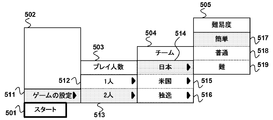
例えば、図3の木構造の各ノードに対応付けられた項目が、図11に示すように画面に表示されるとする。以下、ユーザにより選択された項目には灰色を付することとする。ユーザが、画面に表示されたスタートボタン501をクリックすると、パネル502が開き、“ゲームの設定”の項目511が表示される。この“ゲームの設定”の項目を選択すると、注目ノードがノード301に設定され、表示部205は、パネル503に、ノード301の下位のノード(ノード302、303)の項目を表示する。そして、ユーザが、“1人”の項目512、又は、“2人”の項目513のいずれかを選択すると、注目ノードにノード302又は303が設定され、表示部205は、パネル504に、ノード302又は303の子ノード304~306又は307~309に対応付けられる項目514、515、516を表示する。ユーザが、“日本”の項目514、“米国”の項目515、又は“独逸”の項目516のいずれかを選択すると、注目ノードが、ノード304~309のいずれかに設定され、表示部205は、パネル505に、ノード304~309のいずれかのノードの子ノードに対応付けられた項目517、518、519を表示する。ユーザが、“簡単”の項目517、“普通”の項目518、又は“難”の項目519のいずれかを選択すると、注目ノードがノード310~327のいずれかの葉ノードに設定される。例えば、図11の例ではノード319に対応付けられた“簡単”の項目が選択されており、注目ノードがノード319に設定されて、ゲームの設定は終了する。
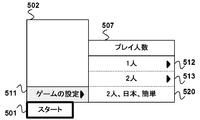
ここで、新たな葉ノード(ノード328)が含まれる木構造において(図7)、現在の注目ノードがノード301であるとする。この場合、表示部205は、図12に示すように、ノード328に対応付けられた“2人、日本、簡単”の項目520を、ノード301の子ノード(ノード302、303、328)のうち、パネル506の先頭に表示する。
あるいは、表示部205は、画面に表示される項目が対応付けられた子ノードに新たな葉ノードが含まれる場合、当該新たな葉ノードに対応付けられた項目を、当該新たな葉ノードに対応付けられた項目が対応付けられる葉ノードに至るまでに経由したノードのうち、根ノードの子ノードに対応付けられた項目に隣接して表示するようにしてもよい。
例えば、新たな葉ノード(ノード328)が含まれる木構造において(図7)、新たな葉ノードに対応付けられた項目が対応付けられる葉ノードとはノード319であり、当該ノード319に至るまでに経由したノードとは、ノード303、307である。そして、これらのノードのうち根ノード(ノード301)の子ノードはノード303である。したがって、表示部205は、図13に示すように、ノード328に対応付けられた“2人、日本、簡単”の項目520を、パネル507において、ノード303に対応付けられた項目“2人”に隣接して表示する。
“2人”、“日本”、“簡単”の項目でゲームの設定を行う場合、ユーザは、図12又は図13に示すように表示された項目520を選択すれば、チーム及び難易度を選択するためのパネルを開くことなく、“2人”、“日本”、“簡単”の項目を選択して、ゲームの設定の処理を終えることができる。
したがって、CPU 101及び画像処理部107が協働して、表示部205として機能する。
(ゲーム装置の動作)
以下、本実施形態の選択装置200の各部が行う動作について説明する。選択装置200に電源が投入されると、CPU 101は、図14のフローチャートに示す選択処理を開始する。なお、図14のフローチャートにおいて、図10と同じステップ番号が付されているステップは、図10のフローチャートにおける処理と同様の処理を行う。
以下、本実施形態の選択装置200の各部が行う動作について説明する。選択装置200に電源が投入されると、CPU 101は、図14のフローチャートに示す選択処理を開始する。なお、図14のフローチャートにおいて、図10と同じステップ番号が付されているステップは、図10のフローチャートにおける処理と同様の処理を行う。
ステップS108において、表示部205が、当該注目ノードの子ノードに新たな葉ノードが含まれると判断した場合(ステップS108;Yes)、当該注目ノードの子ノードに対応付けられた項目を表示し、新たな葉ノードに対応付けられた項目の表示位置を調節して表示する(ステップS209)。
例えば、図7の木構造において、表示部205は、図12に示すように、ノード328に対応付けられた“2人、日本、簡単”の項目520を、パネル506において、他の項目512、513よりも先頭に表示する。あるいは、表示部205は、図13に示すように、ノード328に対応付けられた“2人、日本、簡単”の項目520を、パネル507において、ノード303に対応付けられた“2人”の項目513に隣接して表示する。
本実施形態によれば、頻繁に選択する項目がまとめられた項目を、画面に表示する項目の先頭に表示することにより、選択し易い位置に表示することができる。あるいは、まとめた項目に含まれる項目に隣接して表示することにより、まとめられた項目が、どの項目をまとめたものかを分かり易く提示することができる。
なお、実施形態1及び2において、サッカーゲームの設定に関する項目を木構造で表したものを例に説明したが、本発明が対象とする木構造はこれに限らない。選択装置200は、例えば、キャラクタ生成の設定に関する項目を木構造で表した場合においても適用可能である。
図15の木構造は、キャラクタ生成の設定に関する項目を木構造で表したものである。根ノード(ノード601)には“設定”の項目が対応付けられ、その下位のノード(ノード602、603)には、生成するキャラクタの性別を示す“男性”、又は“女性”の項目が対応付けられる。“男性”、又は“女性”の項目が対応付けられたノード602、603の下位のノード(ノード604~607)には、キャラクタの顔の形を示す“丸顔”、又は“四角顔”の項目が対応付けられる。そして、さらにそれらの項目の下位のノード(ノード608~619)に、キャラクタの体型を示す“痩せ”、“普通”、又は“肥満”の項目が対応付けられる。体型を示す項目が対応付けられたノード608~619は葉ノードであり、いずれかの葉ノードが選択されると、キャラクタ生成の設定は終了する。
この木構造の各ノードに対応付けられている項目は、図16A乃至図16Cに示すように画面に表示される。例えば、ユーザが生成するキャラクタの設定を行うための所定の操作を行うと、注目ノードが根ノード(ノード601)に設定され、表示部205は、項目421、422を含む画像404が画面に表示される(図16A)。次に、ユーザが、図16Aの画像404において、“男性”の項目421、又は“女性”の項目422のいずれかを選択すると、注目ノードにノード602又は603が設定され、表示部205は、項目423、424を含む画像405が画面に表示される(図16B)。ユーザが、図16Bの画像405において、“丸顔”の項目423、又は“四角顔”の項目424のいずれかを選択すると、注目ノードがノード604~607のいずれかに設定され、表示部205は、項目425、426、427を含む画像406が画面に表示される(図16C)。ユーザが、図16Cの画像において、“痩せ”の項目425、“普通”の項目426、又は“肥満”の項目427のいずれかを選択すると、注目ノードがノード608~619のいずれかの葉ノードに設定される。例えば、ユーザが、“男性”(ノード602)及び“丸顔”(ノード604)を選択した後、“痩せ”(ノード608)を選択したとすると、注目ノードがノード608に設定され、“男性”で“丸顔”の“痩せ”た体型のキャラクタが生成され、キャラクタ生成の処理は終了する。
このような木構造において、新たな葉ノード(ノード620)が含まれ、注目ノードがノード601である場合、表示部205は、例えば、図17に示すように、ノード620に対応付けられた“男性、丸顔、普通”の項目428を強調表示する。図17の画像404において、ユーザが項目428を選択すれば、図16Bの画像405、図16Cの画像406における設定の処理を省略して、“男性”で“丸顔”、“普通”の体型のキャラクタを生成することができる。
本発明は、2011年6月1日に出願された日本国特許出願2011-123078号に基づく。本明細書中に日本国特許出願2011-123078号の明細書、特許請求の範囲、図面全体を参照として取り込むものとする。
本発明によれば、頻繁に選択する項目を簡易に選択することが可能な選択装置、選択方法、非一時的な記録媒体、ならびに、プログラムを提供することができる。
100 情報処理装置
101 CPU
102 ROM
103 RAM
104 インターフェース
105 コントローラ
106 外部メモリ
107 画像処理部
108 DVD-ROMドライブ
109 NIC
110 音声処理部
200 選択装置
201 記憶部
202 移動部
203 出力部
204 更新部
205 表示部
301~328、601~620 ノード
401~406 画像
411~419、421~428、511~520 項目
420 カーソル
501 スタートボタン
502~507 パネル
101 CPU
102 ROM
103 RAM
104 インターフェース
105 コントローラ
106 外部メモリ
107 画像処理部
108 DVD-ROMドライブ
109 NIC
110 音声処理部
200 選択装置
201 記憶部
202 移動部
203 出力部
204 更新部
205 表示部
301~328、601~620 ノード
401~406 画像
411~419、421~428、511~520 項目
420 カーソル
501 スタートボタン
502~507 パネル
Claims (7)
- 複数のノードを含み、各ノードに項目が対応付けられた木構造から、根ノードからいずれかの葉ノードに至るまでの項目を選択する選択装置(200)であって、
前記木構造と、当該木構造に含まれる各ノードに対応付けられる項目と、当該木構造内のいずれかのノード(以下、「注目ノード」という)と、が記憶される記憶部(201)と、
ユーザの指示に基づいて、前記記憶部(201)を更新することにより前記木構造を根ノードからいずれかの葉ノードに至るまで前記注目ノードを移動させる移動部(202)と、
前記根ノードからいずれかの葉ノードに至るまでの項目を選択結果として出力する出力部(203)と、
前記葉ノードに至る頻度が所定の条件を満たす場合、当該葉ノードに対応付けられる項目及び当該葉ノードに至るまでに経由したノードに対応付けられる項目が対応付けられる新たな葉ノードを、前記木構造の根ノードの子ノードとするように前記記憶部(201)を更新する更新部(204)と、
を備えることを特徴とする選択装置(200)。 - 請求項1に記載の選択装置(200)であって、
前記注目ノードが内部ノードである場合、当該内部ノードの子ノードに対応付けられた項目を画面に表示し、
前記画面に表示される項目が対応付けられた子ノードに前記新たな葉ノードが含まれる場合、当該新たな葉ノードに対応付けられた項目を、強調表示する表示部(205)
をさらに備えることを特徴とする選択装置(200)。 - 請求項1に記載の選択装置(200)であって、
前記注目ノードが内部ノードである場合、当該内部ノードの子ノードに対応付けられた項目を画面に表示し、
前記画面に表示される項目が対応付けられた子ノードに前記新たな葉ノードが含まれる場合、当該新たな葉ノードに対応付けられた項目を、当該表示される項目のうちの先頭に表示する表示部(205)
をさらに備えることを特徴とする選択装置(200)。 - 請求項1に記載の選択装置(200)であって、
前記注目ノードが内部ノードである場合、当該内部ノードの子ノードに対応付けられた項目を画面に表示し、
前記画面に表示される項目が対応付けられた子ノードに前記新たな葉ノードが含まれる場合、当該新たな葉ノードに対応付けられた項目を、当該新たな葉ノードに対応付けられた項目が対応付けられる葉ノードに至るまでに経由したノードのうち、根ノードの子ノードに対応付けられた項目に隣接して表示する表示部(205)
をさらに備えることを特徴とする選択装置(200)。 - 複数のノードを含み、各ノードに項目が対応付けられた木構造から、根ノードからいずれかの葉ノードに至るまでの項目を選択し、前記木構造と、当該木構造に含まれる各ノードに対応付けられる項目と、当該木構造内のいずれかのノード(以下、「注目ノード」という)と、が記憶される記憶部(201)と、移動部(202)と、出力部(203)と、更新部(204)と、を備える選択装置(200)が実行する選択方法であって、
前記移動部(202)が、ユーザの指示に基づいて、前記記憶部(201)を更新することにより前記木構造を根ノードからいずれかの葉ノードに至るまで前記注目ノードを移動させる移動工程と、
前記出力部(203)が、前記根ノードからいずれかの葉ノードに至るまでの項目を選択結果として出力する出力工程と、
前記更新部(204)が、前記葉ノードに至る頻度が所定の条件を満たす場合、当該葉ノードに対応付けられる項目及び当該葉ノードに至るまでに経由したノードに対応付けられる項目が対応付けられる新たな葉ノードを、前記木構造の根ノードの子ノードとするように前記記憶部(201)を更新する更新工程と、
を備えることを特徴とする選択方法。 - コンピュータを、
複数のノードを含み、各ノードに項目が対応付けられた木構造から、根ノードからいずれかの葉ノードに至るまでの項目を選択する選択装置(200)として機能させるプログラムであって、
前記プログラムは、前記コンピュータを、
前記木構造と、当該木構造に含まれる各ノードに対応付けられる項目と、当該木構造内のいずれかのノード(以下、「注目ノード」という)と、が記憶される記憶部(201)、
ユーザの指示に基づいて、前記記憶部(201)を更新することにより前記木構造を根ノードからいずれかの葉ノードに至るまで前記注目ノードを移動させる移動部(202)、
前記根ノードからいずれかの葉ノードに至るまでの項目を選択結果として出力する出力部(203)、
前記葉ノードに至る頻度が所定の条件を満たす場合、当該葉ノードに対応付けられる項目及び当該葉ノードに至るまでに経由したノードに対応付けられる項目が対応付けられる新たな葉ノードを、前記木構造の根ノードの子ノードとするように前記記憶部(201)を更新する更新部(204)、
として機能させることを特徴とするプログラムを記録したコンピュータ読み取り可能な非一時的な記録媒体。 - コンピュータを、
複数のノードを含み、各ノードに項目が対応付けられた木構造から、根ノードからいずれかの葉ノードに至るまでの項目を選択する選択装置(200)として機能させるプログラムであって、
前記プログラムは、前記コンピュータを、
前記木構造と、当該木構造に含まれる各ノードに対応付けられる項目と、当該木構造内のいずれかのノード(以下、「注目ノード」という)と、が記憶される記憶部(201)、
ユーザの指示に基づいて、前記記憶部(201)を更新することにより前記木構造を根ノードからいずれかの葉ノードに至るまで前記注目ノードを移動させる移動部(202)、
前記根ノードからいずれかの葉ノードに至るまでの項目を選択結果として出力する出力部(203)、
前記葉ノードに至る頻度が所定の条件を満たす場合、当該葉ノードに対応付けられる項目及び当該葉ノードに至るまでに経由したノードに対応付けられる項目が対応付けられる新たな葉ノードを、前記木構造の根ノードの子ノードとするように前記記憶部(201)を更新する更新部(204)、
として機能させることを特徴とするプログラム。
Applications Claiming Priority (2)
| Application Number | Priority Date | Filing Date | Title |
|---|---|---|---|
| JP2011-123078 | 2011-06-01 | ||
| JP2011123078A JP5211197B2 (ja) | 2011-06-01 | 2011-06-01 | 選択装置、選択方法、ならびに、プログラム |
Publications (1)
| Publication Number | Publication Date |
|---|---|
| WO2012165430A1 true WO2012165430A1 (ja) | 2012-12-06 |
Family
ID=47259284
Family Applications (1)
| Application Number | Title | Priority Date | Filing Date |
|---|---|---|---|
| PCT/JP2012/063768 Ceased WO2012165430A1 (ja) | 2011-06-01 | 2012-05-29 | 選択装置、選択方法、非一時的な記録媒体、ならびに、プログラム |
Country Status (2)
| Country | Link |
|---|---|
| JP (1) | JP5211197B2 (ja) |
| WO (1) | WO2012165430A1 (ja) |
Cited By (1)
| Publication number | Priority date | Publication date | Assignee | Title |
|---|---|---|---|---|
| CN113055235A (zh) * | 2021-03-30 | 2021-06-29 | 合安科技技术有限公司 | 一种基于树的设备选择方法、系统及相关设备 |
Citations (2)
| Publication number | Priority date | Publication date | Assignee | Title |
|---|---|---|---|---|
| JP2004287702A (ja) * | 2003-03-20 | 2004-10-14 | Kyocera Corp | 携帯端末 |
| JP2011043886A (ja) * | 2009-08-19 | 2011-03-03 | Konami Digital Entertainment Co Ltd | 選択装置、選択方法、ならびに、プログラム |
-
2011
- 2011-06-01 JP JP2011123078A patent/JP5211197B2/ja active Active
-
2012
- 2012-05-29 WO PCT/JP2012/063768 patent/WO2012165430A1/ja not_active Ceased
Patent Citations (2)
| Publication number | Priority date | Publication date | Assignee | Title |
|---|---|---|---|---|
| JP2004287702A (ja) * | 2003-03-20 | 2004-10-14 | Kyocera Corp | 携帯端末 |
| JP2011043886A (ja) * | 2009-08-19 | 2011-03-03 | Konami Digital Entertainment Co Ltd | 選択装置、選択方法、ならびに、プログラム |
Cited By (1)
| Publication number | Priority date | Publication date | Assignee | Title |
|---|---|---|---|---|
| CN113055235A (zh) * | 2021-03-30 | 2021-06-29 | 合安科技技术有限公司 | 一种基于树的设备选择方法、系统及相关设备 |
Also Published As
| Publication number | Publication date |
|---|---|
| JP2012249727A (ja) | 2012-12-20 |
| JP5211197B2 (ja) | 2013-06-12 |
Similar Documents
| Publication | Publication Date | Title |
|---|---|---|
| JP5462828B2 (ja) | 選択装置、選択方法、ならびに、プログラム | |
| JP4519883B2 (ja) | キャラクター表示装置、キャラクター表示方法、ならびに、プログラム | |
| CN104252291B (zh) | 用于在玩游戏期间表达情感的方法和系统 | |
| JP5306702B2 (ja) | 年齢層推定装置、年齢層推定方法、ならびに、プログラム | |
| CN101415471A (zh) | 图像生成装置、角色外观变更方法、信息记录介质及程序 | |
| CN101317151B (zh) | 对象选择装置和对象选择方法 | |
| JP3827693B2 (ja) | ゲーム装置、ゲーム装置制御方法、ならびに、プログラム | |
| JP5211197B2 (ja) | 選択装置、選択方法、ならびに、プログラム | |
| JP5351674B2 (ja) | ゲーム装置、ゲーム制御方法、ならびに、プログラム | |
| CN101107630A (zh) | 图像生成装置、自动生成方法、记录媒体以及程序 | |
| JP5291682B2 (ja) | ゲーム装置、ゲーム装置の制御方法、ならびに、プログラム | |
| JP5401380B2 (ja) | 処理装置、処理方法、ならびに、プログラム | |
| JP4607210B2 (ja) | 再生装置、再生方法、ならびに、プログラム | |
| JP4510841B2 (ja) | ゲーム装置、ゲーム制御方法、ならびに、プログラム | |
| JP4637199B2 (ja) | 画像処理装置、画像処理方法、ならびに、プログラム | |
| JP5155427B2 (ja) | ゲーム装置、ゲーム装置の制御方法、ならびに、プログラム | |
| JP5535127B2 (ja) | ゲーム装置、ならびに、プログラム | |
| JP5325276B2 (ja) | 選択装置、選択方法、ならびに、プログラム | |
| WO2012165417A1 (ja) | ゲーム装置、ゲーム装置の制御方法、非一時的な記録媒体、ならびに、プログラム | |
| JP2006271705A (ja) | 数値群処理装置、数値群処理方法、ならびに、プログラム | |
| JP5431274B2 (ja) | ゲーム装置、ならびに、プログラム | |
| JP5073717B2 (ja) | ゲーム装置、ゲーム制御方法、ならびに、プログラム | |
| JP4825273B2 (ja) | ゲーム装置、ゲーム装置の制御方法、ならびに、プログラム | |
| JP2008302014A (ja) | ゲーム装置、ゲームプログラム、オブジェクト制御方法 | |
| JP2013004120A (ja) | 再生装置、再生方法、ならびに、プログラム |
Legal Events
| Date | Code | Title | Description |
|---|---|---|---|
| 121 | Ep: the epo has been informed by wipo that ep was designated in this application |
Ref document number: 12792779 Country of ref document: EP Kind code of ref document: A1 |
|
| NENP | Non-entry into the national phase |
Ref country code: DE |
|
| 122 | Ep: pct application non-entry in european phase |
Ref document number: 12792779 Country of ref document: EP Kind code of ref document: A1 |