WO2012165417A1 - ゲーム装置、ゲーム装置の制御方法、非一時的な記録媒体、ならびに、プログラム - Google Patents
ゲーム装置、ゲーム装置の制御方法、非一時的な記録媒体、ならびに、プログラム Download PDFInfo
- Publication number
- WO2012165417A1 WO2012165417A1 PCT/JP2012/063730 JP2012063730W WO2012165417A1 WO 2012165417 A1 WO2012165417 A1 WO 2012165417A1 JP 2012063730 W JP2012063730 W JP 2012063730W WO 2012165417 A1 WO2012165417 A1 WO 2012165417A1
- Authority
- WO
- WIPO (PCT)
- Prior art keywords
- viewpoint
- sign
- virtual space
- character
- unit
- Prior art date
- Legal status (The legal status is an assumption and is not a legal conclusion. Google has not performed a legal analysis and makes no representation as to the accuracy of the status listed.)
- Ceased
Links
Images






Classifications
-
- A—HUMAN NECESSITIES
- A63—SPORTS; GAMES; AMUSEMENTS
- A63F—CARD, BOARD, OR ROULETTE GAMES; INDOOR GAMES USING SMALL MOVING PLAYING BODIES; VIDEO GAMES; GAMES NOT OTHERWISE PROVIDED FOR
- A63F13/00—Video games, i.e. games using an electronically generated display having two or more dimensions
- A63F13/50—Controlling the output signals based on the game progress
- A63F13/53—Controlling the output signals based on the game progress involving additional visual information provided to the game scene, e.g. by overlay to simulate a head-up display [HUD] or displaying a laser sight in a shooting game
- A63F13/537—Controlling the output signals based on the game progress involving additional visual information provided to the game scene, e.g. by overlay to simulate a head-up display [HUD] or displaying a laser sight in a shooting game using indicators, e.g. showing the condition of a game character on screen
- A63F13/5372—Controlling the output signals based on the game progress involving additional visual information provided to the game scene, e.g. by overlay to simulate a head-up display [HUD] or displaying a laser sight in a shooting game using indicators, e.g. showing the condition of a game character on screen for tagging characters, objects or locations in the game scene, e.g. displaying a circle under the character controlled by the player
-
- A—HUMAN NECESSITIES
- A63—SPORTS; GAMES; AMUSEMENTS
- A63F—CARD, BOARD, OR ROULETTE GAMES; INDOOR GAMES USING SMALL MOVING PLAYING BODIES; VIDEO GAMES; GAMES NOT OTHERWISE PROVIDED FOR
- A63F13/00—Video games, i.e. games using an electronically generated display having two or more dimensions
- A63F13/20—Input arrangements for video game devices
- A63F13/21—Input arrangements for video game devices characterised by their sensors, purposes or types
- A63F13/214—Input arrangements for video game devices characterised by their sensors, purposes or types for locating contacts on a surface, e.g. floor mats or touch pads
-
- A—HUMAN NECESSITIES
- A63—SPORTS; GAMES; AMUSEMENTS
- A63F—CARD, BOARD, OR ROULETTE GAMES; INDOOR GAMES USING SMALL MOVING PLAYING BODIES; VIDEO GAMES; GAMES NOT OTHERWISE PROVIDED FOR
- A63F13/00—Video games, i.e. games using an electronically generated display having two or more dimensions
- A63F13/40—Processing input control signals of video game devices, e.g. signals generated by the player or derived from the environment
- A63F13/42—Processing input control signals of video game devices, e.g. signals generated by the player or derived from the environment by mapping the input signals into game commands, e.g. mapping the displacement of a stylus on a touch screen to the steering angle of a virtual vehicle
-
- A—HUMAN NECESSITIES
- A63—SPORTS; GAMES; AMUSEMENTS
- A63F—CARD, BOARD, OR ROULETTE GAMES; INDOOR GAMES USING SMALL MOVING PLAYING BODIES; VIDEO GAMES; GAMES NOT OTHERWISE PROVIDED FOR
- A63F13/00—Video games, i.e. games using an electronically generated display having two or more dimensions
- A63F13/40—Processing input control signals of video game devices, e.g. signals generated by the player or derived from the environment
- A63F13/44—Processing input control signals of video game devices, e.g. signals generated by the player or derived from the environment involving timing of operations, e.g. performing an action within a time slot
-
- A—HUMAN NECESSITIES
- A63—SPORTS; GAMES; AMUSEMENTS
- A63F—CARD, BOARD, OR ROULETTE GAMES; INDOOR GAMES USING SMALL MOVING PLAYING BODIES; VIDEO GAMES; GAMES NOT OTHERWISE PROVIDED FOR
- A63F13/00—Video games, i.e. games using an electronically generated display having two or more dimensions
- A63F13/50—Controlling the output signals based on the game progress
- A63F13/52—Controlling the output signals based on the game progress involving aspects of the displayed game scene
- A63F13/525—Changing parameters of virtual cameras
- A63F13/5252—Changing parameters of virtual cameras using two or more virtual cameras concurrently or sequentially, e.g. automatically switching between fixed virtual cameras when a character changes room or displaying a rear-mirror view in a car-driving game
-
- A—HUMAN NECESSITIES
- A63—SPORTS; GAMES; AMUSEMENTS
- A63F—CARD, BOARD, OR ROULETTE GAMES; INDOOR GAMES USING SMALL MOVING PLAYING BODIES; VIDEO GAMES; GAMES NOT OTHERWISE PROVIDED FOR
- A63F13/00—Video games, i.e. games using an electronically generated display having two or more dimensions
- A63F13/50—Controlling the output signals based on the game progress
- A63F13/54—Controlling the output signals based on the game progress involving acoustic signals, e.g. for simulating revolutions per minute [RPM] dependent engine sounds in a driving game or reverberation against a virtual wall
-
- A—HUMAN NECESSITIES
- A63—SPORTS; GAMES; AMUSEMENTS
- A63F—CARD, BOARD, OR ROULETTE GAMES; INDOOR GAMES USING SMALL MOVING PLAYING BODIES; VIDEO GAMES; GAMES NOT OTHERWISE PROVIDED FOR
- A63F13/00—Video games, i.e. games using an electronically generated display having two or more dimensions
- A63F13/80—Special adaptations for executing a specific game genre or game mode
- A63F13/814—Musical performances, e.g. by evaluating the player's ability to follow a notation
-
- A—HUMAN NECESSITIES
- A63—SPORTS; GAMES; AMUSEMENTS
- A63F—CARD, BOARD, OR ROULETTE GAMES; INDOOR GAMES USING SMALL MOVING PLAYING BODIES; VIDEO GAMES; GAMES NOT OTHERWISE PROVIDED FOR
- A63F2300/00—Features of games using an electronically generated display having two or more dimensions, e.g. on a television screen, showing representations related to the game
- A63F2300/10—Features of games using an electronically generated display having two or more dimensions, e.g. on a television screen, showing representations related to the game characterized by input arrangements for converting player-generated signals into game device control signals
- A63F2300/1068—Features of games using an electronically generated display having two or more dimensions, e.g. on a television screen, showing representations related to the game characterized by input arrangements for converting player-generated signals into game device control signals being specially adapted to detect the point of contact of the player on a surface, e.g. floor mat, touch pad
-
- A—HUMAN NECESSITIES
- A63—SPORTS; GAMES; AMUSEMENTS
- A63F—CARD, BOARD, OR ROULETTE GAMES; INDOOR GAMES USING SMALL MOVING PLAYING BODIES; VIDEO GAMES; GAMES NOT OTHERWISE PROVIDED FOR
- A63F2300/00—Features of games using an electronically generated display having two or more dimensions, e.g. on a television screen, showing representations related to the game
- A63F2300/30—Features of games using an electronically generated display having two or more dimensions, e.g. on a television screen, showing representations related to the game characterized by output arrangements for receiving control signals generated by the game device
- A63F2300/303—Features of games using an electronically generated display having two or more dimensions, e.g. on a television screen, showing representations related to the game characterized by output arrangements for receiving control signals generated by the game device for displaying additional data, e.g. simulating a Head Up Display
- A63F2300/305—Features of games using an electronically generated display having two or more dimensions, e.g. on a television screen, showing representations related to the game characterized by output arrangements for receiving control signals generated by the game device for displaying additional data, e.g. simulating a Head Up Display for providing a graphical or textual hint to the player
-
- A—HUMAN NECESSITIES
- A63—SPORTS; GAMES; AMUSEMENTS
- A63F—CARD, BOARD, OR ROULETTE GAMES; INDOOR GAMES USING SMALL MOVING PLAYING BODIES; VIDEO GAMES; GAMES NOT OTHERWISE PROVIDED FOR
- A63F2300/00—Features of games using an electronically generated display having two or more dimensions, e.g. on a television screen, showing representations related to the game
- A63F2300/30—Features of games using an electronically generated display having two or more dimensions, e.g. on a television screen, showing representations related to the game characterized by output arrangements for receiving control signals generated by the game device
- A63F2300/303—Features of games using an electronically generated display having two or more dimensions, e.g. on a television screen, showing representations related to the game characterized by output arrangements for receiving control signals generated by the game device for displaying additional data, e.g. simulating a Head Up Display
- A63F2300/306—Features of games using an electronically generated display having two or more dimensions, e.g. on a television screen, showing representations related to the game characterized by output arrangements for receiving control signals generated by the game device for displaying additional data, e.g. simulating a Head Up Display for displaying a marker associated to an object or location in the game field
-
- A—HUMAN NECESSITIES
- A63—SPORTS; GAMES; AMUSEMENTS
- A63F—CARD, BOARD, OR ROULETTE GAMES; INDOOR GAMES USING SMALL MOVING PLAYING BODIES; VIDEO GAMES; GAMES NOT OTHERWISE PROVIDED FOR
- A63F2300/00—Features of games using an electronically generated display having two or more dimensions, e.g. on a television screen, showing representations related to the game
- A63F2300/60—Methods for processing data by generating or executing the game program
- A63F2300/66—Methods for processing data by generating or executing the game program for rendering three dimensional images
- A63F2300/6661—Methods for processing data by generating or executing the game program for rendering three dimensional images for changing the position of the virtual camera
- A63F2300/6669—Methods for processing data by generating or executing the game program for rendering three dimensional images for changing the position of the virtual camera using a plurality of virtual cameras concurrently or sequentially, e.g. automatically switching between fixed virtual cameras when a character change rooms
-
- A—HUMAN NECESSITIES
- A63—SPORTS; GAMES; AMUSEMENTS
- A63F—CARD, BOARD, OR ROULETTE GAMES; INDOOR GAMES USING SMALL MOVING PLAYING BODIES; VIDEO GAMES; GAMES NOT OTHERWISE PROVIDED FOR
- A63F2300/00—Features of games using an electronically generated display having two or more dimensions, e.g. on a television screen, showing representations related to the game
- A63F2300/80—Features of games using an electronically generated display having two or more dimensions, e.g. on a television screen, showing representations related to the game specially adapted for executing a specific type of game
- A63F2300/8047—Music games
Definitions
- the present invention relates to a game device, a game device control method, a non-transitory recording medium, and a program that are suitable for making it easy to grasp the direction in the virtual space.
- Patent Document 1 discloses a dance game device that guides the timing of stepping and the like, and allows a player to experience a dance sensation by stepping on a step in time with music.
- dance games that require not only steps but also movements using the entire body such as arms and legs.
- a character who dances with an exemplary choreography is displayed on the screen.
- the direction in which the character is projected is fixed in one direction, and it may be difficult for the player to see depending on the action of the character. For example, when a character punches or kicks forward, it may be difficult for the player to discern the movement because the player's body appears with his hands and feet superimposed on the character's body. On the other hand, if the direction in which the character is projected is simply changed to make the movement of the character easier to see, there is a problem that it becomes difficult to know in which direction the original direction has been changed.
- the present invention solves the above-described problems, and provides a game device, a game device control method, a non-temporary recording medium, and a program suitable for making it easy to grasp the direction in the virtual space. For the purpose.
- the game device includes a display unit, a moving unit, and a sign unit, and is configured as follows.
- a dance game in which steps are taken according to the direction indicated by an object moving in the screen will be described as an example.
- the display unit displays on the screen an image representing a state in which the character placed in the virtual space is viewed from the viewpoint placed in the virtual space.
- a character is a character that dances by taking exemplary steps arranged in a virtual space.
- the viewpoint is, for example, the position of the virtual camera arranged in the virtual space.
- the display unit displays an image on which the state of the character dancing with the virtual camera is photographed.
- the moving unit moves the viewpoint in the virtual space.
- the moving unit moves the position of the virtual camera from the position in the forward direction of the character to the position in the direction of the right side of the character.
- the sign unit places the sign at a sign position determined relative to the character in the virtual space before the moving unit moves the viewpoint, and moves the viewpoint after the moving unit moves the viewpoint. Erase from within.
- the sign position determined relative to the character is, for example, the position of the chest in the forward direction of the character that is a predetermined distance away from the character in the virtual space.
- the sign is, for example, an arrow-shaped object indicating the forward direction of the character.
- the sign unit places an arrow-shaped object on the character's chest before the virtual camera moves, and erases the arrow-shaped object after the virtual camera moves.
- the player can immediately and easily recognize the change of the viewpoint of the virtual camera and the direction of the character in the virtual space after the change due to the movement of the sign.
- the body when the body is moved by imitating a character, it becomes easy to recognize the action of the character.
- it is possible to realize a game device that can effectively assist the player's play by introducing the movement of the above-mentioned signs in a scene where it is difficult to determine the movement of the limbs or the like only by looking at the character from one direction. .
- the moving unit may move the viewpoint instantaneously.
- the moving unit instantaneously moves the virtual camera from the forward direction of the character to the right side surface of the character.
- the sign unit places the sign in the virtual space only before the first time when the viewpoint should move, and erases the sign from the virtual space only after the second time from the time when the viewpoint moves. You may make it do.
- the first time is 2 seconds and the second time is 1 second.
- the sign unit places an arrow-shaped object when it is two seconds before the time when the virtual camera is moved by the moving unit, and the arrow-shaped object is displayed for one second from the time when the virtual camera is moved. Display the object. Then, after one second has elapsed from the time when the virtual camera is moved, the sign unit deletes the arrow-shaped object from the virtual space.
- the player can grasp which direction is the direction before the change.
- the sign position may be determined relatively to the front foot of the character.
- a sign displayed before and after the movement of the viewpoint is displayed at the front foot of the character.
- the sign can be displayed so that the movement of the character's leg or arm is not hidden by the sign.
- a game device control method is a control method executed by a game device including a display unit, a moving unit, and a sign unit, and is configured as follows.
- the display unit displays on the screen an image representing a state in which the character placed in the virtual space is viewed from the viewpoint placed in the virtual space.
- the moving unit moves the viewpoint in the virtual space.
- the labeling unit arranges the label at a label position determined relative to the character in the virtual space, and after the moving unit moves the viewpoint, Erase the sign from the virtual space.
- a program according to another aspect of the present invention is configured to cause a computer to function as the game device and to cause the computer to execute the control method.
- the program of the present invention can be recorded on a computer-readable non-transitory information recording medium such as a compact disk, flexible disk, hard disk, magneto-optical disk, digital video disk, magnetic tape, and semiconductor memory.
- a computer-readable non-transitory information recording medium such as a compact disk, flexible disk, hard disk, magneto-optical disk, digital video disk, magnetic tape, and semiconductor memory.
- the above program can be distributed and sold via a computer communication network independently of the computer on which the program is executed.
- the non-temporary information recording medium can be distributed and sold independently of the computer.
- a game device it is possible to provide a game device, a game device control method, a non-temporary recording medium, and a program that are suitable for making it easy to grasp the direction in the virtual space.
- the game device of the present embodiment displays a sign in the virtual space before and after the direction in which the virtual space is projected changes.
- FIG. 1 is a schematic diagram showing a schematic configuration of a typical information processing apparatus 100 that performs functions of a game apparatus according to an embodiment of the present invention by executing a program.
- a description will be given with reference to FIG. 1
- the information processing apparatus 100 includes a CPU (Central Processing Unit) 101, a ROM (Read Only Memory) 102, a RAM (Random Access Memory) 103, an interface 104, a controller 105, an external memory 106, and an image processing unit 107.
- the CPU 101 controls the overall operation of the information processing apparatus 100, is connected to each component, and exchanges control signals and data.
- the CPU 101 uses arithmetic operations such as addition / subtraction / multiplication / division, logical sum, logical product using ALU (Arithmetic Logic Unit) (not shown) for a storage area called a register (not shown) that can be accessed at high speed.
- Logic operations such as logical negation, bit operations such as bit sum, bit product, bit inversion, bit shift, and bit rotation can be performed.
- the CPU 101 itself is configured and can be implemented with a coprocessor so that saturation operations such as addition, subtraction, multiplication, division, etc. for multimedia processing, and trigonometric functions, etc., can be performed at high speed. There is.
- the ROM 102 stores an IPL (Initial Program Loader) that is executed immediately after the power is turned on, and when this is executed, the program stored in the DVD-ROM is read into the RAM 103 and execution by the CPU 101 is started.
- the ROM 102 stores an operating system program and various data necessary for operation control of the entire information processing apparatus 100.
- the RAM 103 is for temporarily storing data and programs, and holds programs and data read from the DVD-ROM and other data necessary for game progress and chat communication.
- the CPU 101 provides a variable area in the RAM 103, performs an operation by directly operating the ALU on the value stored in the variable, or temporarily stores the value stored in the RAM 103 in a register. Processing is performed on the register, and the result of the operation is written back to the memory.
- the controller 105 is connected via the interface 104.
- the controller 105 receives an operation input performed when the player executes the game.
- the external memory 106 is detachably connected via the interface 104.
- the external memory 106 stores rewritable data indicating game play status (past results, etc.), game progress data, chat communication log (record) data in the case of a network match, and the like.
- the player can store these data in the external memory 106 as appropriate by inputting an instruction via the controller 105.
- the image processing unit 107 processes the data read from the DVD-ROM by the CPU 101 or an image arithmetic processor (not shown) included in the image processing unit 107, and then processes the processed data in a frame memory ( (Not shown).
- the image information stored in the frame memory is converted into a video signal at a predetermined synchronization timing and output to a monitor connected to the image processing unit 107. Thereby, various image displays are possible.
- the image arithmetic processor can execute two-dimensional image overlay calculation, transparency calculation such as ⁇ blending, and various saturation calculations at high speed.
- polygon information that is arranged in the three-dimensional space and to which various texture information is added is rendered by the Z buffer method, and a predetermined viewpoint position is used. It is also possible to perform a high-speed execution of a calculation that obtains a rendering image obtained by bird's-eye view of a polygon arranged in the virtual space.
- the CPU 101 and the image arithmetic processor work together to draw a character string in the frame memory as a two-dimensional image or draw it on the surface of each polygon according to the font information that defines the character shape. It is.
- the DVD-ROM mounted on the DVD-ROM drive 108 stores a program for realizing the game and image data and sound data associated with the game. Under the control of the CPU 101, the DVD-ROM drive 108 performs a reading process on the DVD-ROM mounted thereon, reads necessary programs and data, and these are temporarily stored in the RAM 103 or the like.
- the NIC 109 is used to connect the information processing apparatus 100 to a computer communication network (not shown) such as the Internet, and is used when configuring a LAN (Local Area Network) 10BASE-T / 100BASE-T standard. Or modems that connect to the Internet using telephone lines, ISDN (Integrated Services Digital Network) modems, ADSL (Asymmetric Digital Subscriber Line) modems, cables to connect to the Internet using cable television lines It comprises a modem, etc., and an interface (not shown) that mediates between them and the CPU 101.
- a computer communication network such as the Internet
- modems that connect to the Internet using telephone lines
- ISDN Integrated Services Digital Network
- ADSL Asymmetric Digital Subscriber Line
- the audio processing unit 110 converts audio data read from the DVD-ROM into an analog audio signal, and outputs it from a speaker or headphones connected thereto.
- the sound processing unit 110 generates sound effects and music data to be generated during the progress of the game under the control of the CPU 101, and outputs sound corresponding thereto from a speaker or headphones.
- the audio processing unit 110 refers to the sound source data of the audio data and converts the MIDI data into PCM (Pulse Code Modulation) data. Convert. If the audio data is compressed audio data in ADPCM (Adaptive Differential PCM) format, Ogg Vorbis format, or the like, the audio processing unit 110 expands and converts it into PCM data.
- the PCM data can be output by performing D / A (Digital / Analog) conversion at a timing corresponding to the sampling frequency and outputting it to a speaker.
- MP3 MPeg
- MIDI Music Instruction Data Interface
- the mat type controller 111 is connected through the interface 104. In the present invention, it is also possible to connect a plurality of mat type controllers 111 to the information processing apparatus 100.
- the mat-type controller 111 receives an operation input performed by the player when playing the game.
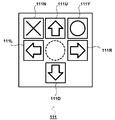
- FIG. 2 is a schematic diagram showing an appearance of the mat type controller 111.
- the mat type controller 111 will be described with reference to FIG.
- FIG. 2 is a schematic view of the mat type controller 111 when the mat type controller 111 installed on the floor is viewed from directly above.
- a button 111L for receiving an input for instructing “left” from the player
- a button 111R for receiving an input for instructing “right” from the player
- a button for receiving an input instructing “up” from the player 111U
- a button 111D for receiving an input indicating “down” from the player
- a button 111Y for receiving an input indicating approval of a predetermined operation from the player
- a button 111N for receiving an input indicating rejection of the predetermined operation from the player, respectively.
- the player can press the buttons 111L, 111R, 111U, 111D, 111Y, and 111N at an arbitrary timing.
- the CPU 101 determines whether or not the buttons 111L, 111R, 111U, 111D, 111Y, and 111N are pressed.
- the mat-type controller 111 includes six buttons 111L, 111R, 111U, 111D, 111Y, and 111N.
- the number of buttons is not limited to six, and may be five or less or seven or more. Good.
- an operation input for game play may be obtained by capturing the movement of the entire body of the player by using an infrared camera or the like.
- the information processing apparatus 100 uses a large-capacity external storage device such as a hard disk to perform the same function as the ROM 102, the RAM 103, the external memory 106, the DVD-ROM attached to the DVD-ROM drive 108, and the like. You may comprise.
- a large-capacity external storage device such as a hard disk to perform the same function as the ROM 102, the RAM 103, the external memory 106, the DVD-ROM attached to the DVD-ROM drive 108, and the like. You may comprise.
- the information processing apparatus 100 described above corresponds to a so-called “consumer video game apparatus”, but the present invention can be realized as long as it performs image processing that displays a virtual space. Therefore, the present invention can be realized on various computers such as a smartphone, a mobile phone, a portable game device, a karaoke device, and a general business computer.
- a general computer like the information processing apparatus 100, includes a CPU, a RAM, a ROM, a DVD-ROM drive, and a NIC, and includes an image processing unit that has simpler functions than the information processing apparatus 100.
- a hard disk as an external storage device
- a flexible disk a magneto-optical disk, a magnetic tape, and the like can be used.
- a keyboard or a mouse is used as an input device.
- FIGS. 1-10 A DVD-ROM storing a game program and data is loaded into the DVD-ROM drive 108 and the information processing apparatus 100 is turned on to execute the program, thereby realizing the game apparatus according to the embodiment. Is done. In the following embodiments, it is assumed that the game device executes a dance game shown below.
- a plurality of types of target objects MO1 to MO4 are synchronized with the rhythm of the musical piece to be played, along the moving lane La (the lane corresponding to the type of object) from below. It shows how they appear sequentially, move upwards, and then disappear.
- the target objects MO1 to MO4 represent arrow symbols in different directions.
- the target object MO1 which is a right-pointing arrow symbol, instructs the player to take a step in the right direction.
- the target object MO2 that is a downward arrow symbol indicates a step backward
- the target object MO3 that is an upward arrow symbol is forward
- the target object MO4 that is a left arrow symbol indicates a left step.
- These target objects MO1 to MO4 appear from the lower end (starting point) of the moving lane La, move upward in the moving lane La, and disappear at the upper end (ending point) of the moving lane La.
- determination objects HO1 to HO4 having the same shape as the target objects MO1 to MO4 are displayed in a predetermined area (determination area HA).
- the player is required to step in the direction indicated by the target objects MO1 to MO4 at the timing when the target objects MO1 to MO4 are completely overlapped with the determination objects HO1 to HO4 (hereinafter referred to as “overlap timing”). That is, it is required to press the button 111R at the timing when the target object MO1 completely overlaps the determination object HO1 (overlap timing).
- pressing the button 111D is required when the target object MO2 completely overlaps the determination object HO2, and pressing the button 111U when the target object MO3 completely overlaps the determination object HO3. It is required to press the button 111L at the timing when the target object MO4 is completely overlapped with the determination object HO4.
- the score is added, for example, “123400” in FIG. Each score is displayed on the screen.
- no score is obtained or the score is subtracted. Note that a higher score may be obtained as the error between the timing of stepping and the overlapping timing is smaller.
- a character 300 and a mat type controller 400 are displayed.
- the character 300 dances an exemplary dance while taking steps in overlapping directions in the directions indicated by the target objects MO1 to MO4.
- the character 300 dances so as to have a mirror image relationship with the player, but is not limited thereto.
- the character 300 displayed in the game image may move in the same direction as the player with his back to the player.
- the game device 200 includes a display unit 201, a moving unit 202, and a sign unit 203.
- the display unit 201 displays on the screen an image representing a state where a character placed in the virtual space is viewed from a viewpoint placed in the virtual space.
- the viewpoint is the position of the virtual camera arranged in the virtual space.
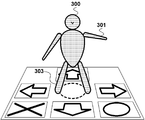
- the display unit 201 displays an image (FIG. 6) that shows a state viewed in the direction 801 from the virtual camera 701 arranged in the forward direction of the character 300 in FIG. 5.
- the CPU 101 and the image processing unit 107 cooperate to function as the display unit 201.
- the moving unit 202 moves the viewpoint in the virtual space.
- the moving unit 202 moves the position of the virtual camera one second before the movement so that the movement of the character is easy to see.
- the arm 301 of the character 300 is moved by a movement distance 501 in parallel with the ground of the virtual space.
- the moving unit 202 changes the position of the virtual camera 701 to the position of the virtual camera 702 one second before the time when the arm 301 is moved so that the movement of the arm 301 can be easily seen.
- the display unit 201 displays an image (FIG. 9) showing a state seen from the virtual camera 702 in the direction 802 on the screen.
- the moving unit 202 may instantaneously move the viewpoint (the position of the virtual camera).
- the display unit 201 displays a frame image (FIG. 6) showing a state seen from the virtual camera 701
- the next frame shows a state (FIG. 9) seen from the virtual camera 702.
- the display unit 201 displays the image of FIG. That is, when the moving unit 202 instantaneously moves the viewpoint, the image in FIG. 6 is instantaneously changed to the image in FIG. 9.
- the CPU 101 and the image processing unit 107 cooperate to function as the moving unit 202.
- the sign unit 203 arranges the sign at a sign position determined relative to the character in the virtual space before the moving unit 202 moves the viewpoint, and after the moving unit 202 moves the viewpoint, Is deleted from the virtual space.
- the time before the moving unit 202 moves the viewpoint is, for example, a first time before the time when the viewpoint should move.
- the time after the moving unit 202 moves the viewpoint is after the second time from the time when the viewpoint moves.
- the first time is “2 seconds” and the second time is “1 second”.
- the sign position determined relative to the character is the front foot of the character.
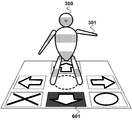
- the sign unit 203 arranges the sign 601 in the virtual space.
- the display unit 201 displays the game image (FIG. 7) on which the sign 601 is arranged on the screen.
- the sign 601 indicates the forward direction of the character at the present time, and is displayed so as to be superimposed on the matting controller 400.
- the sign unit 203 places the sign 601 in the virtual space for one second after the moving unit 202 moves from the position of the virtual camera 701 to the position of the virtual camera 702.
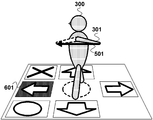
- the display unit 201 displays a game image (FIG. 8) including a sign 601 representing a state viewed from the virtual camera 702 on the screen.
- the display unit 201 displays a game image (FIG. 9) representing a state viewed from the virtual camera 702 from which the sign 601 has been deleted on the screen. Then, the position of the virtual camera is moved at a time one second before the time when the arm 301 is moved by the moving distance 501, and the sign 601 is erased one second after the movement, so that the sign 601 is erased simultaneously, The arm 301 of the character 300 moves by a moving distance 501.
- the moving unit 202 changes the position of the virtual camera 701 to the position of the virtual camera 703 one second before the time when the arm 302 is moved so that the movement of the arm 302 can be easily seen.
- the sign unit 203 places the sign 602 at the front foot of the character 300 at a time point that is 2 seconds before the time when the position of the virtual camera is moved, and the display unit 201 moves in the direction 801 from the virtual camera 701.
- An image showing the appearance (FIG. 11) is displayed.
- the sign unit 203 places the sign 602 in the virtual space.
- the display unit 201 displays a game image (FIG. 12) that includes a sign 602 and represents a state viewed from the virtual camera 703.
- the sign unit 203 erases the sign 602 from the virtual space, and the display unit 201 displays an image from which the sign 602 has been erased.
- the CPU 101 and the image processing unit 107 cooperate to function as the sign unit 203.
- the display unit 201 displays an image of the virtual space including the character from the initial position of the viewpoint on the screen (step S101).
- the display unit 201 displays, for example, the image shown in FIG. 6 on the screen.
- the CPU 101 determines whether the current time is the time to move the viewpoint (hereinafter referred to as “viewpoint movement time”), the time before the viewpoint movement time, or the time after the viewpoint movement time. Judgment is made (step S102).
- the sign unit 203 determines whether or not the first time is before the viewpoint movement time. (Step S103).
- step S104 If it is determined that the sign unit 203 is only the first time before (step S103; Yes), the sign unit 203 places a sign at the sign position in the virtual space (step S104).
- the information of the image on which the sign is arranged by the sign unit 203 is stored in a frame memory or the like provided in the image processing unit 107.
- the image processing unit 107 waits for clearing the queue or performing another process until a vertical synchronization interrupt occurs (step S105).
- the image processing unit 107 converts image information stored in the frame memory into a display signal, and the display unit 201 displays the image on a monitor connected to the information processing apparatus 100 ( Step S106).
- the sign unit 203 determines that the time is a first time (for example, 2 seconds) before the viewpoint movement time, the sign unit 203 places the sign 601 in the virtual space, and before the viewpoint is moved.
- Information of an image (for example, FIG. 7) in which the sign 601 is arranged is stored in the frame memory.
- the display unit 201 displays the image of FIG. 7 on the screen based on the information of the image.
- step S103 determines that it is not the first time before the viewpoint movement time (step S103; No). the process proceeds to step S105.
- the display unit 201 displays the image of FIG. 6 on the screen based on the information of the image.
- the time is one second before the viewpoint movement time
- information on an image that is an image before the viewpoint is moved and on which the sign is arranged is stored in the frame memory.
- the display unit 201 displays the image of FIG. 7 on the screen based on the information of the image.
- step S102 viewpoint movement time
- step S107 the moving unit 202 moves the viewpoint in the virtual space
- the moving unit 202 moves the virtual camera 701 to the virtual camera 702 as shown in FIG. Then, information of an image of the virtual space viewed from the virtual camera 702 (for example, FIG. 8) is stored in the frame memory.
- the display unit 201 displays the image of FIG. 8 on the screen based on the information of the image.
- the label unit 203 determines whether or not the second time has elapsed since the viewpoint movement time. (Step S108).
- step S108 When the sign unit 203 determines that the second time has elapsed from the viewpoint movement time (step S108; Yes), the sign unit 203 deletes the sign from the virtual space (step S109). Then, the process proceeds to step S105.
- the sign unit 203 determines that the second time (for example, 1 second) has elapsed from the viewpoint movement time, the sign unit 203 erases the sign 601 from the virtual space, and the image after the viewpoint is moved. And the information of the image (for example, FIG. 9) from which the sign 601 has been deleted is stored in the frame memory.
- the display unit 201 displays the image of FIG. 9 on the screen based on the information of the image.
- step S108 if it is determined that the sign unit 203 is not after the second time has elapsed from the viewpoint movement time (step S108; No), the process proceeds to step S105.
- the display unit 201 displays the image of FIG. 8 on the screen based on the information of the image.
- the time is 2 seconds after the viewpoint movement time
- information on the image after the viewpoint is moved and the sign is deleted is stored in the frame memory.
- the display unit 201 displays the image of FIG. 9 on the screen based on the information of the image.
- the player before and after the direction in which the virtual space is projected changes, the player can grasp the direction before the change by arranging the sign at the relative position from the character.
- the direction in which the virtual space is projected is changed instantaneously, it is possible to keep up with the required action in a rhythm game in which timing is important.
- by placing a sign at the front of the character it is possible to prevent the movement of the character from being hidden by the sign.
- the time before the moving unit 202 moves the viewpoint is the first time before the time when the viewpoint should move, and the time when the viewpoint moves after the moving unit 202 moves the viewpoint.
- the present invention is not limited to this.
- the time before the moving unit 202 moves the viewpoint may be when the operation immediately before the predetermined operation is started.
- the time after the moving unit 202 moves the viewpoint may be the time when the predetermined operation is completed after the viewpoint is moved.
- the arm 301 is moved by the movement distance 501 after the leg 303 (FIG. 6) is moved from the button 111U in front of the mat controller 400 to the center of the mat controller 400.
- the time before the moving unit 202 moves the viewpoint is when the leg 303 is released from the button 111U. Also, after the moving unit 202 moves the viewpoint, the time point when the arm 301 reaches the end point of the moving distance 501.
- the sign position determined relative to the character is the front step of the character, but is not limited thereto.
- a sign 603 may be arranged on the front chest of the character.
- a game device it is possible to provide a game device, a game device control method, a non-temporary recording medium, and a program that are suitable for making it easy to grasp the direction in the virtual space.
- Information processing apparatus 101
- CPU 102
- ROM 103
- RAM 104
- Interface 105
- Controller 106
- External Memory 107
- Image Processing Unit 108
- DVD-ROM Drive 109
- Audio processing unit 111
- 400 Matte controller MO1, MO2, MO3, MO4 Target object HO1, HO2, HO3, HO4 Determination object La Moving lane HA Determination area
- Game device 201 Display unit 202 Moving unit 203 Marking unit 300 Character 301, 302 Arm 303 Leg 501, 502 Movement distance 601, 602, 603 Sign 701, 702, 703 Virtual camera 801, 802, 803 Direction
Landscapes
- Engineering & Computer Science (AREA)
- Multimedia (AREA)
- Human Computer Interaction (AREA)
- Physics & Mathematics (AREA)
- Optics & Photonics (AREA)
- Processing Or Creating Images (AREA)
Abstract
表示部(201)は、仮想空間内に配置されるキャラクタを当該仮想空間内に配置される視点から見た様子を表す画像を画面に表示する。移動部(202)は、視点を仮想空間内で移動させる。標識部(203)は、移動部(202)が視点を移動させる前に、仮想空間内においてキャラクタに対して相対的に定められた標識位置に標識を配置し、移動部(202)が視点を移動させた後に、標識を仮想空間内から消去する。
Description
本発明は、仮想空間における方向を把握し易くするのに好適なゲーム装置、ゲーム装置の制御方法、非一時的な(non-transitory)記録媒体、ならびに、プログラムに関する。
プレイヤが体を動かしてプレイするゲームが遊技場等で広く普及している。例えば、特許文献1には、ステップを踏むタイミング等をガイドし、プレイヤが音楽に合わせて踏み台を踏むことで、ダンス感覚を体感できるダンスゲーム装置が開示されている。近年では、ステップだけでなく、腕や脚などの体全体を使った動きが求められるダンスゲームもある。このようなゲームでは、一般的に、プレイヤにとって腕や脚等を動かす方向やタイミングをわかりやすくするために、画面に模範的な振り付けでダンスを踊るキャラクタが表示される。
しかしながら、従来、キャラクタを映し出す方向は一方向に固定されており、キャラクタの動作によってはプレイヤに見難いことがあった。例えば、キャラクタが前方にパンチやキックを行なうような場合、プレイヤ側からはキャラクタの身体に手や足が重なった状態で見えるので、その動作が判別し難いことがある。一方、キャラクタの動作を見やすくするため、単純にキャラクタを映し出す方向を変更すると、元の方向からどの方向に変更されたのかがわかりにくくなるという問題があった。
本発明は、上記のような課題を解決するもので、仮想空間における方向を把握し易くするのに好適なゲーム装置、ゲーム装置の制御方法、非一時的な記録媒体、ならびに、プログラムを提供することを目的とする。
本発明の第1の観点に係るゲーム装置は、表示部と、移動部と、標識部と、を備え、以下のように構成する。以下、画面内を移動するオブジェクトが示す方向に従って、ステップを踏むダンスゲームを例に、説明する。
表示部は、仮想空間内に配置されるキャラクタを当該仮想空間内に配置される視点から見た様子を表す画像を画面に表示する。
ここで、キャラクタとは、例えば、仮想空間に配置された、模範的なステップを踏んでダンスを踊るキャラクタである。また、視点とは、例えば、仮想空間に配置された仮想カメラの位置である。表示部は、仮想カメラによってダンスを踊るキャラクタの様子が撮影された画像を画面に表示する。
移動部は、視点を仮想空間内で移動させる。
例えば、仮想カメラがキャラクタの前方方向の所定の位置に配置されていた場合、移動部は、仮想カメラの位置を、キャラクタの前方方向の位置から、キャラクタの右側面の方向の位置に移動させる。
標識部は、移動部が視点を移動させる前に、仮想空間内においてキャラクタに対して相対的に定められた標識位置に標識を配置し、移動部が視点を移動させた後に、標識を仮想空間内から消去する。
キャラクタに対して相対的に定められた標識位置とは、例えば、仮想空間におけるキャラクタから所定の距離だけ離れたキャラクタの前方方向の胸元の位置であるとする。また、標識とは、例えば、キャラクタの前方方向を示す矢印型のオブジェクトとする。標識部は、例えば、仮想カメラが移動する前に、キャラクタの胸元に矢印型のオブジェクトを配置し、仮想カメラが移動した後に、当該矢印型のオブジェクトを消去する。
本発明によれば、プレイヤは、標識の移動によって、その後に仮想カメラの視点が切り替わること、および切り替わった後の仮想空間内でのキャラクタの向きを、直ちに且つ容易に認識できるので、例えばダンスゲームのように、キャラクタをまねて体を動かすような場合に、そのキャラクタの動作の認識が容易となる。特に、キャラクタを一方向から見るだけでは、その手足等の動きを判別し難いような場面において、上記標識の移動等を導入することで、プレイヤの遊戯を効果的に援助できるゲーム装置を実現できる。
また、移動部は、視点を瞬間的に移動させるようにしてもよい。
例えば、移動部は、仮想カメラを、キャラクタの前方方向から、キャラクタの右側面の方向に、瞬間的に移動させる。
本発明によれば、タイミングを重視するようなリズムゲームにおいて、求められる動作に間に合うように、仮想空間が映し出される方向を変更することができる。
また、標識部は、視点が移動すべき時刻より第1の時間だけ以前に、標識を仮想空間内に配置し、視点が移動した時刻から第2の時間だけ以後に、標識を仮想空間から消去するようにしてもよい。
例えば、第1の時間を2秒、第2の時間を1秒とする。この場合、標識部は、移動部により仮想カメラが移動される時刻よりも2秒前になった時に矢印型のオブジェクトを配置し、仮想カメラが移動された時刻から1秒間は、当該矢印型のオブジェクトを表示する。そして、仮想カメラが移動された時刻から1秒経過後に、標識部は、当該矢印型のオブジェクトを仮想空間から消去する。
本発明によれば、仮想空間が映し出される方向の変化の前後で、所定の時間、標識が表示されるので、プレイヤは変化前の方向がどの方向であったかを把握することができる。
標識位置は、キャラクタの前方足元に相対的に定められるようにしてもよい。
例えば、視点の移動の前後で表示される標識は、キャラクタの前方足元に表示される。
本発明によれば、キャラクタの脚や腕の動作が標識により隠されないように、標識を表示することができる。
本発明の第2の観点に係るゲーム装置の制御方法は、表示部と、移動部と、標識部と、を備えるゲーム装置が実行する制御方法であって、以下のように構成する。
表示工程において、表示部が、仮想空間内に配置されるキャラクタを当該仮想空間内に配置される視点から見た様子を表す画像を画面に表示する。
移動工程において、移動部が、視点を仮想空間内で移動させる。
標識工程において、標識部が、移動部が視点を移動させる前に、仮想空間内においてキャラクタに対して相対的に定められた標識位置に標識を配置し、移動部が視点を移動させた後に、標識を仮想空間内から消去する。
本発明のその他の観点に係るプログラムは、コンピュータを上記ゲーム装置として機能させ、コンピュータに上記制御方法を実行させるように構成する。
また、本発明のプログラムは、コンパクトディスク、フレキシブルディスク、ハードディスク、光磁気ディスク、ディジタルビデオディスク、磁気テープ、半導体メモリ等のコンピュータ読取可能な非一時的な情報記録媒体に記録することができる。
上記プログラムは、プログラムが実行されるコンピュータとは独立して、コンピュータ通信網を介して配布・販売することができる。また、上記非一時的な情報記録媒体は、コンピュータとは独立して配布・販売することができる。
本発明によれば、仮想空間における方向を把握し易くするのに好適なゲーム装置、ゲーム装置の制御方法、非一時的な記録媒体、ならびに、プログラムを提供することができる。
本実施形態のゲーム装置は、仮想空間が映し出される方向が変化する前後で、仮想空間内に標識を表示するものである。
(情報処理装置の概要構成)
まず、実施形態に係るゲーム装置が実現される典型的な情報処理装置について説明する。なお、以下では、理解を容易にするため、ゲーム用の情報処理装置を利用して本発明が実現される実施形態を説明するが、以下に説明する実施形態は説明のためのものであり、本願発明の範囲を制限するものではない。したがって、当業者であればこれらの各要素もしくは全要素をこれと均等なものに置換した実施形態を採用することが可能であるが、これらの実施形態も本発明の範囲に含まれる。
まず、実施形態に係るゲーム装置が実現される典型的な情報処理装置について説明する。なお、以下では、理解を容易にするため、ゲーム用の情報処理装置を利用して本発明が実現される実施形態を説明するが、以下に説明する実施形態は説明のためのものであり、本願発明の範囲を制限するものではない。したがって、当業者であればこれらの各要素もしくは全要素をこれと均等なものに置換した実施形態を採用することが可能であるが、これらの実施形態も本発明の範囲に含まれる。
図1は、プログラムを実行することにより、本発明の実施形態に係るゲーム装置の機能を果たす典型的な情報処理装置100の概要構成を示す模式図である。以下、本図を参照して説明する。
情報処理装置100は、CPU(Central Processing Unit)101と、ROM(Read Only Memory)102と、RAM(Random Access Memory)103と、インターフェース104と、コントローラ105と、外部メモリ106と、画像処理部107と、DVD-ROM(Digital Versatile Disc ROM)ドライブ108と、NIC(Network Interface Card)109と、音声処理部110と、マット型コントローラ111と、を備える。
CPU 101は、情報処理装置100全体の動作を制御し、各構成要素と接続され、制御信号やデータをやりとりする。また、CPU 101は、レジスタ(図示せず)という高速アクセスが可能な記憶域に対してALU(Arithmetic Logic Unit)(図示せず)を用いて加減乗除等の算術演算や、論理和、論理積、論理否定等の論理演算、ビット和、ビット積、ビット反転、ビットシフト、ビット回転等のビット演算などを行うことができる。さらに、マルチメディア処理対応のための加減乗除等の飽和演算や、三角関数等、ベクトル演算などを高速に行えるように、CPU 101自身が構成されているものや、コプロセッサを備えて実現するものがある。
ROM 102には、電源投入直後に実行されるIPL(Initial Program Loader)が記憶され、これが実行されることにより、DVD-ROMに記憶されたプログラムをRAM 103に読み出してCPU 101による実行が開始される。また、ROM 102には、情報処理装置100全体の動作制御に必要なオペレーティングシステムのプログラムや各種のデータが記憶される。
RAM 103は、データやプログラムを一時的に記憶するためのもので、DVD-ROMから読み出したプログラムやデータ、その他ゲームの進行やチャット通信に必要なデータが保持される。また、CPU 101は、RAM 103に変数領域を設け、当該変数に格納された値に対して直接ALUを作用させて演算を行ったり、RAM 103に格納された値を一旦レジスタに格納してからレジスタに対して演算を行い、演算結果をメモリに書き戻す、等の処理を行う。
コントローラ105は、インターフェース104を介して接続される。コントローラ105は、プレイヤがゲーム実行の際に行う操作入力を受け付ける。
外部メモリ106は、インターフェース104を介して着脱自在に接続される。外部メモリ106には、ゲーム等のプレイ状況(過去の成績等)を示すデータ、ゲームの進行状態を示すデータ、ネットワーク対戦の場合のチャット通信のログ(記録)のデータなどが書き換え可能に記憶される。プレイヤは、コントローラ105を介して指示入力を行うことにより、これらのデータを適宜外部メモリ106に記憶させることができる。
画像処理部107は、DVD-ROMから読み出されたデータをCPU 101や画像処理部107が備える画像演算プロセッサ(図示せず)によって加工処理した後、これを画像処理部107が備えるフレームメモリ(図示せず)に記憶させる。フレームメモリに記憶された画像情報は、所定の同期タイミングでビデオ信号に変換され画像処理部107に接続されるモニタへ出力される。これにより、各種の画像表示が可能となる。
また、画像演算プロセッサは、2次元の画像の重ね合わせ演算やαブレンディング等の透過演算、各種の飽和演算を高速に実行できる。
また、仮想空間が3次元にて構成される場合には、当該3次元空間内に配置され、各種のテクスチャ情報が付加されたポリゴン情報を、Zバッファ法によりレンダリングして、所定の視点位置から仮想空間に配置されたポリゴンを所定の視線の方向へ俯瞰したレンダリング画像を得る演算の高速実行も可能である。
さらに、CPU 101と画像演算プロセッサが協調動作することにより、文字の形状を定義するフォント情報に従って、文字列を2次元画像としてフレームメモリへ描画したり、各ポリゴン表面へ描画したりすることが可能である。
DVD-ROMドライブ108に装着されるDVD-ROMには、ゲームを実現するためのプログラムとゲームに付随する画像データや音声データが記憶される。CPU 101の制御によって、DVD-ROMドライブ108は、これに装着されたDVD-ROMに対する読み出し処理を行って、必要なプログラムやデータを読み出し、これらはRAM 103等に一時的に記憶される。
NIC 109は、情報処理装置100をインターネット等のコンピュータ通信網(図示せず)に接続するためのものであり、LAN(Local Area Network)を構成する際に用いられる10BASE-T/100BASE-T規格に従うものや、電話回線を用いてインターネットに接続するためのアナログモデム、ISDN(Integrated Services Digital Network)モデム、ADSL(Asymmetric Digital Subscriber Line)モデム、ケーブルテレビジョン回線を用いてインターネットに接続するためのケーブルモデム等と、これらとCPU 101との仲立ちを行うインターフェース(図示せず)により構成される。
音声処理部110は、DVD-ROMから読み出した音声データをアナログ音声信号に変換し、これに接続されたスピーカやヘッドフォンから出力させる。また、音声処理部110は、CPU 101の制御の下、ゲームの進行の中で発生させるべき効果音や楽曲データを生成し、これに対応した音声をスピーカやヘッドフォンから出力させる。
DVD-ROMに記録された音声データがMIDI(Musical Instrument Digital Interface)データである場合には、音声処理部110は、これが有する音源データを参照して、MIDIデータをPCM(Pulse Code Modulation)データに変換する。また、音声データがADPCM(Adaptive Differential PCM)形式やOgg Vorbis形式等の圧縮済音声データである場合には、音声処理部110は、これを展開してPCMデータに変換する。PCMデータは、そのサンプリング周波数に応じたタイミングでD/A(Digital/Analog)変換を行って、スピーカに出力することにより、音声出力が可能となる。音声データとしては、音声の波形データをディジタル化したPCMデータを圧縮してサイズを小さくしたMP3(MPeg audio layer-3)データ等を利用することが可能である。また、MIDI(Music Instruction Data Interface)データのように、音高、音長、音量、音色の種類を定義するデータを用意し、これにしたがって、予め用意された音源波形データを適宜選択・変形して再生する手法を採用してもよい。
マット型コントローラ111は、インターフェース104を介して接続される。本発明において、情報処理装置100に複数のマット型コントローラ111を接続することも可能である。マット型コントローラ111は、プレイヤがゲームプレイの際に行う操作入力を受け付ける。図2は、マット型コントローラ111の外観を示す模式図である。以下、本図を参照してマット型コントローラ111を説明する。
図2は、床面に設置されたマット型コントローラ111を真上から眺めたときのマット型コントローラ111の概略図である。マット型コントローラ111の所定領域には、“左”を指示する入力をプレイヤから受け付けるボタン111L、“右”を指示する入力をプレイヤから受け付けるボタン111R、“上”を指示する入力をプレイヤから受け付けるボタン111U、“下”を指示する入力をプレイヤから受け付けるボタン111D、所定の操作の承認等を示す入力をプレイヤから受け付けるボタン111Y、所定の操作の却下等を示す入力をプレイヤから受け付けるボタン111N、がそれぞれ配置されている。プレイヤは、ボタン111L、111R、111U、111D、111Y、111Nを任意のタイミングで押圧することができる。CPU 101は、ボタン111L、111R、111U、111D、111Y、111Nのそれぞれについて、ボタンが押圧されている状態であるか否かを判別する。
本実施形態では、マット型コントローラ111は6個のボタン111L、111R、111U、111D、111Y、111Nを備えているが、ボタンの数は6個に限定されず、5個以下あるいは7個以上でもよい。
また、マット型コントローラ111に代えて、赤外線カメラ等を使用することによりプレイヤの体全体の動きを捉えることで、ゲームプレイの操作入力としてもよい。
このほか、情報処理装置100は、ハードディスク等の大容量外部記憶装置を用いて、ROM 102、RAM 103、外部メモリ106、DVD-ROMドライブ108に装着されるDVD-ROM等と同じ機能を果たすように構成してもよい。
以上で説明した情報処理装置100は、いわゆる「コンシューマ向けテレビゲーム装置」に相当するものであるが、仮想空間を表示するような画像処理を行うものであれば本発明を実現することができる。したがって、スマートフォン、携帯電話、携帯ゲーム機器、カラオケ装置、一般的なビジネス用コンピュータなど、種々の計算機上で本発明を実現することが可能である。
例えば、一般的なコンピュータは、上記情報処理装置100と同様に、CPU、RAM、ROM、DVD-ROMドライブ、及び、NICを備え、情報処理装置100よりも簡易な機能を備えた画像処理部を備え、外部記憶装置としてハードディスクを有する他、フレキシブルディスク、光磁気ディスク、磁気テープ等が利用できるようになっている。また、コントローラ105ではなく、キーボードやマウスなどを入力装置として利用する。
以下、上記情報処理装置100において実現される実施形態に係るゲーム装置の概要構成について、図1乃至15を参照して説明する。ゲーム用のプログラム及びデータが記憶されたDVD-ROMをDVD-ROMドライブ108に装着して、情報処理装置100の電源を投入することにより、当該プログラムが実行され、実施形態に係るゲーム装置が実現される。なお、以下の実施形態では、ゲーム装置は、以下に示すダンスゲームを実行するものとする。
(ゲームの概要)
まず、各実施形態のゲーム装置が生成するゲーム画像に係るダンスゲームについて説明する。
まず、各実施形態のゲーム装置が生成するゲーム画像に係るダンスゲームについて説明する。
図3のダンスゲームのゲーム画像は、複数種類の目標オブジェクトMO1~MO4が、演奏される楽曲のリズム等に同調して、移動レーンLa(オブジェクトの種類に応じたレーン)に沿って、下方から順次現れてそれぞれ上方まで移動し、消えて行く様子を示している。目標オブジェクトMO1~MO4は、異なる向きの矢印シンボルを表している。右向きの矢印シンボルである目標オブジェクトMO1は、プレイヤに右方向にステップを踏むように指示するものである。同様に、下向きの矢印シンボルである目標オブジェクトMO2は後方に、上向きの矢印のシンボルである目標オブジェクトMO3は前方に、左向きの矢印シンボルである目標オブジェクトMO4は左方向に、ステップを踏むことを指示するものである。これらの目標オブジェクトMO1~MO4は、移動レーンLaの下端(起点)から出現して、移動レーンLaを上方向に移動し、移動レーンLaの上端(終点)にて消滅する。
また、ダンスゲームのゲーム画像には、各目標オブジェクトMO1~MO4と同じ形状の判定オブジェクトHO1~HO4が所定の領域(判定エリアHA)に固定されて表示される。プレイヤは、目標オブジェクトMO1~MO4が判定オブジェクトHO1~HO4に完全に重なったタイミング(以下、「重複タイミング」という)で、目標オブジェクトMO1~MO4が示す方向にステップを踏むことが求められる。すなわち、目標オブジェクトMO1が判定オブジェクトHO1に完全に重なったタイミング(重複タイミング)で、ボタン111Rを押圧することが求められる。同様に、目標オブジェクトMO2が判定オブジェクトHO2に完全に重なったタイミングで、ボタン111Dを押圧することが求められ、目標オブジェクトMO3が判定オブジェクトHO3に完全に重なったタイミングで、ボタン111Uを押圧することが求められ、目標オブジェクトMO4が判定オブジェクトHO4に完全に重なったタイミングで、ボタン111Lを押圧することが求められる。
プレイヤが、重複タイミングで、目標オブジェクトMO1~MO4が示す方向にステップを踏む(ボタン111L、111R、111U、111Dの押圧する)と、得点が加算され、例えば、図3の“123400”のように画面にそれぞれの得点が表示される。一方、重複タイミングで、プレイヤによる入力が無かった場合や、目標オブジェクトMO1~MO4が示す方向にステップが踏まれなかった場合、得点は得られず、又は得点が減算される。なお、ステップを踏むタイミングと重複タイミングとの誤差が小さいほど、高得点を得られるようにしてもよい。
ゲーム画像には、キャラクタ300及びマット型コントローラ400が表示される。キャラクタ300は、目標オブジェクトMO1~MO4が示す方向に重複タイミングでステップを踏みながら、模範的なダンスを踊るものである。なお、本実施形態では、キャラクタ300は、プレイヤと鏡像関係になるようにダンスを踊るものとするが、これに限らない。例えば、ゲーム画像に表示されるキャラクタ300は、プレイヤに背を向けて、プレイヤと同じ方向に動くものとしてもよい。
(実施形態に係るゲーム装置の概要構成)
実施形態のゲーム装置200は、図4に示すように、表示部201と、移動部202と、標識部203と、を備える。
実施形態のゲーム装置200は、図4に示すように、表示部201と、移動部202と、標識部203と、を備える。
表示部201は、仮想空間内に配置されるキャラクタを当該仮想空間内に配置される視点から見た様子を表す画像を画面に表示する。
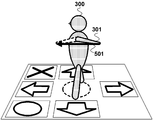
ここで、視点とは、仮想空間に配置された仮想カメラの位置であるとする。例えば、表示部201は、図5の、キャラクタ300の前方方向に配置された仮想カメラ701から方向801に見た様子を示す画像(図6)を画面に表示する。
本実施形態において、CPU 101及び画像処理部107が協働して、表示部201として機能する。
移動部202は、視点を仮想空間内で移動させる。
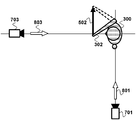
例えば、移動部202は、ゲームプログラムに従って、キャラクタの動作が見やすいように当該動作の1秒前に仮想カメラの位置を移動させる。例えば、図5に示すように、キャラクタ300の腕301が、仮想空間の地面と平行に移動距離501だけ動かされる。この場合、移動部202は、腕301の動きが見やすいように、腕301が動かされる時刻から1秒前に仮想カメラ701の位置を仮想カメラ702の位置に変更する。そして、表示部201は、仮想カメラ702から方向802に見た様子を示す画像(図9)を画面に表示する。
なお、移動部202は、視点(仮想カメラの位置)を瞬間的に移動させるようにしてもよい。この場合、例えば、表示部201が仮想カメラ701から見た様子を示すフレームの画像(図6)を表示しているとすると、次のフレームは、仮想カメラ702から見た様子(図9)を示すフレームであり、表示部201は、図9の画像を表示する。すなわち、移動部202が視点を瞬間的に移動させると、図6の画像から図9の画像に瞬間的に変化する。
本実施形態において、CPU 101及び画像処理部107が協働して、移動部202として機能する。
標識部203は、移動部202が視点を移動させる前に、仮想空間内においてキャラクタに対して相対的に定められた標識位置に標識を配置し、移動部202が視点を移動させた後に、標識を仮想空間内から消去する。
ここで、移動部202が視点を移動させる前とは、例えば、視点が移動すべき時刻より第1の時間だけ前であるとする。また、移動部202が視点を移動させた後とは、視点が移動した時刻から第2の時間だけ後であるとする。以下、第1の時間を“2秒”、第2の時間を“1秒”とする。
また、キャラクタに対して相対的に定められた標識位置を、キャラクタの前方足元とする。
例えば、移動部202が仮想カメラ701の位置から仮想カメラ702の位置に移動させる時刻(すなわち、腕301が移動距離501だけ動かされ始める時刻から1秒前の時刻)から2秒前となった時点で、標識部203は、標識601を仮想空間に配置する。表示部201は、標識601が配置されたゲーム画像(図7)を画面に表示する。ここで、標識601は、現時点でのキャラクタの前方方向を示すものであり、マット方コントローラ400に重ねて表示されるものとする。
標識部203は、移動部202により仮想カメラ701の位置から仮想カメラ702の位置に移動された後1秒間、標識601を仮想空間に配置させておく。表示部201は、標識601を含む、仮想カメラ702から見た様子を表すゲーム画像(図8)を画面に表示する。
そして、仮想カメラ701の位置から仮想カメラ702の位置に移動されてから1秒後、標識部203は、標識601を仮想空間から消去する。表示部201は、標識601が消去された、仮想カメラ702から見た様子を表すゲーム画像(図9)を画面に表示する。そして、腕301が移動距離501だけ動かされる時刻から1秒前の時刻に仮想カメラの位置が移動され、移動されてから1秒後に標識601が消去されるので、標識601が消去されたと同時に、キャラクタ300の腕301が移動距離501だけ動く。
また、例えば、図10に示すように、キャラクタ300が仮想カメラ701から見て左方向に向いており、キャラクタ300の腕302が、仮想空間の地面と平行に移動距離502だけ動かされるとする。そして、移動部202は、例えば、腕302の動きが見やすいように、腕302が動かされる時刻から1秒前に仮想カメラ701の位置を仮想カメラ703の位置に変更する。
この場合、標識部203は、仮想カメラの位置を移動する時刻から2秒前となった時点で、標識602をキャラクタ300の前方足元に配置し、表示部201は、仮想カメラ701から方向801に見た様子を示す画像(図11)を表示する。移動部202により仮想カメラの位置が移動された後1秒間は、標識部203は、標識602を仮想空間に配置させておく。表示部201は、標識602を含む、仮想カメラ703から見た様子を表すゲーム画像(図12)を表示する。そして、1秒経過後に標識部203は、標識602を仮想空間から消去し、標識602が消去された画像が表示部201により表示される。
本実施形態において、CPU 101及び画像処理部107が協働して、標識部203として機能する。
(実施形態に係るゲーム装置の動作)
以下、本実施形態のゲーム装置200の各部が行う動作について説明する。ゲーム装置200に電源が投入されると、CPU 101は、図13のフローチャートに示す制御処理を開始する。
以下、本実施形態のゲーム装置200の各部が行う動作について説明する。ゲーム装置200に電源が投入されると、CPU 101は、図13のフローチャートに示す制御処理を開始する。
表示部201は、視点の初期位置からキャラクタを含む仮想空間の画像を画面に表示する(ステップS101)。
例えば、視点の初期位置を仮想カメラ701の位置であるとすると(図5)、表示部201は、例えば、図6に示す画像を画面に表示する。
次に、CPU 101は、現在の時刻が、視点を移動すべき時刻(以下、「視点移動時刻」という)か、視点移動時刻より前の時刻か、又は、視点移動時刻より後の時刻かを判断する(ステップS102)。
CPU 101が、現在の時刻は視点移動時刻より前の時刻と判断すると(ステップS102;視点移動時刻前)、標識部203は、視点移動時刻より第1の時間だけ前であるか否かを判断する(ステップS103)。
標識部203が第1の時間だけ前であると判断すると(ステップS103;Yes)、標識部203は、仮想空間の標識位置に、標識を配置する(ステップS104)。
そして、標識部203により標識が配置された画像の情報は、画像処理部107が備えるフレームメモリ等に記憶される。画像処理部107は、垂直同期割り込みが生じるまでキューのクリアや、別のプロセスを行って待機する(ステップS105)。
垂直同期割り込みが生じると、画像処理部107は、フレームメモリに記憶された画像の情報を表示信号に変換し、表示部201は、情報処理装置100に接続されるモニタに当該画像を表示する(ステップS106)。
例えば、標識部203が視点移動時刻より第1の時間(例えば、2秒間)だけ前の時刻であると判断すると、標識部203は仮想空間に標識601を配置し、視点が移動される前の画像であって、標識601が配置された画像(例えば、図7)の情報が、フレームメモリに記憶される。そして、表示部201は、垂直同期割り込みが生じると、当該画像の情報に基づいて図7の画像を画面に表示する。
一方、標識部203が視点移動時刻より第1の時間だけ前でないと判断すると(ステップS103;No)、ステップS105に進む。
例えば、視点移動時刻より3秒前の時刻である場合、視点が移動される前の画像であって、標識が配置されていない画像(例えば、図6)の情報が、フレームメモリに記憶される。そして、表示部201は、垂直同期割り込みが生じると、当該画像の情報に基づいて図6の画像を画面に表示する。あるいは、視点移動時刻より1秒前の時刻である場合、視点が移動される前の画像であって、標識が配置されている画像(例えば、図7)の情報が、フレームメモリに記憶される。そして、表示部201は、垂直同期割り込みが生じると、当該画像の情報に基づいて図7の画像を画面に表示する。
CPU 101が、現在の時刻は視点移動時刻であると判断すると(ステップS102;視点移動時刻)、移動部202は、視点を仮想空間内で移動させる(ステップS107)。そして、ステップS105へと進む。
例えば、CPU 101が現在の時刻は視点移動時刻であると判断すると、移動部202は、図5に示すように、仮想カメラ701の位置から仮想カメラ702の位置に移動させる。そして、仮想カメラ702から見た仮想空間の画像(例えば、図8)の情報がフレームメモリに記憶される。そして、表示部201は、垂直同期割り込みが生じると、当該画像の情報に基づいて図8の画像を画面に表示する。
CPU 101が、現在の時刻は視点移動時刻より後の時刻と判断すると(ステップS102;視点移動時刻後)、標識部203は、視点移動時刻から第2の時間経過後であるか否かを判断する(ステップS108)。
標識部203が視点移動時刻より第2の時間経過後であると判断すると(ステップS108;Yes)、標識部203は、仮想空間から標識を消去する(ステップS109)。そして、ステップS105へと進む。
例えば、標識部203が視点移動時刻から第2の時間(例えば、1秒間)経過した時刻であると判断すると、標識部203は仮想空間から標識601を消去し、視点が移動された後の画像であって、標識601が消去された画像(例えば、図9)の情報が、フレームメモリに記憶される。そして、表示部201は、垂直同期割り込みが生じると、当該画像の情報に基づいて図9の画像を画面に表示する。
一方、標識部203が視点移動時刻から第2の時間経過後でないと判断されると(ステップS108;No)、ステップS105に進む。
例えば、視点移動時刻より0.5秒経過後の時刻である場合、視点が移動された後の画像であって、標識が配置された画像(例えば、図8)の情報が、フレームメモリに記憶される。そして、表示部201は、垂直同期割り込みが生じると、当該画像の情報に基づいて図8の画像を画面に表示する。あるいは、視点移動時刻より2秒経過後の時刻である場合、視点が移動された後の画像であって、標識が消去された画像(例えば、図9)の情報が、フレームメモリに記憶される。そして、表示部201は、垂直同期割り込みが生じると、当該画像の情報に基づいて図9の画像を画面に表示する。
本実施形態によれば、仮想空間が映し出される方向が変化する前後に、キャラクタからの相対位置に標識を配置することにより、プレイヤは変化前の方向がどの方向であったかを把握することができる。また、仮想空間が映し出される方向を瞬間的に変更するので、タイミングを重視するようなリズムゲームにおいて、求められる動作に間に合わせることができる。また、キャラクタの前方足元に標識を配置することにより、キャラクタの動作が標識により隠されないようにすることができる。
本実施形態において、移動部202が視点を移動させる前とは、視点が移動すべき時刻より第1の時間だけ前とし、移動部202が視点を移動させた後とは、視点が移動した時刻から第2の時間だけ後としたが、これに限らない。例えば、移動部202が、所定の動作を見やすくするために、当該所定の動作の前に、視点を移動したとする。この場合、移動部202が視点を移動させる前とは、当該所定の動作の1つ前の動作が開始された時とするようにしてもよい。また、移動部202が視点を移動させた後とは、視点が移動された後、当該所定の動作が終了した時点であるとしてもよい。
例えば、脚303(図6)をマット型コントローラ400の前方のボタン111Uから、マット型コントローラ400の中央に戻す動作がされた後、腕301が移動距離501だけ動かされるとする。この場合、移動部202が視点を移動させる前とは、脚303をボタン111Uから離した時点である。また、移動部202が視点を移動させた後とは、腕301が移動距離501の終点位置に達した時点である。
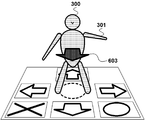
本実施形態において、キャラクタに対して相対的に定められた標識位置は、キャラクタの前方足元としたが、これに限らない。例えば、図14(視点移動前)及び図15(視点移動後)に示すように、キャラクタの前方胸元に標識603を配置するようにしてもよい。
本発明は、2011年6月1日に出願された日本国特許出願2011-123035号に基づく。本明細書中に日本国特許出願2011-123035号の明細書、特許請求の範囲、図面全体を参照として取り込むものとする。
本発明によれば、仮想空間における方向を把握し易くするのに好適なゲーム装置、ゲーム装置の制御方法、非一時的な記録媒体、ならびに、プログラムを提供することができる。
100 情報処理装置
101 CPU
102 ROM
103 RAM
104 インターフェース
105 コントローラ
106 外部メモリ
107 画像処理部
108 DVD-ROMドライブ
109 NIC
110 音声処理部
111、400 マット型コントローラ
MO1、MO2、MO3、MO4 目標オブジェクト
HO1、HO2、HO3、HO4 判定オブジェクト
La 移動レーン
HA 判定エリア
200 ゲーム装置
201 表示部
202 移動部
203 標識部
300 キャラクタ
301、302 腕
303 脚
501、502 移動距離
601、602、603 標識
701、702、703 仮想カメラ
801、802、803 方向
101 CPU
102 ROM
103 RAM
104 インターフェース
105 コントローラ
106 外部メモリ
107 画像処理部
108 DVD-ROMドライブ
109 NIC
110 音声処理部
111、400 マット型コントローラ
MO1、MO2、MO3、MO4 目標オブジェクト
HO1、HO2、HO3、HO4 判定オブジェクト
La 移動レーン
HA 判定エリア
200 ゲーム装置
201 表示部
202 移動部
203 標識部
300 キャラクタ
301、302 腕
303 脚
501、502 移動距離
601、602、603 標識
701、702、703 仮想カメラ
801、802、803 方向
Claims (7)
- 仮想空間内に配置されるキャラクタを当該仮想空間内に配置される視点から見た様子を表す画像を画面に表示する表示部(201)、
前記視点を前記仮想空間内で移動させる移動部(202)、
前記移動部(202)が前記視点を移動させる前に、前記仮想空間内において前記キャラクタに対して相対的に定められた標識位置に標識を配置し、前記移動部(202)が前記視点を移動させた後に、前記標識を前記仮想空間内から消去する標識部(203)、
を備えることを特徴とするゲーム装置。 - 請求項1に記載のゲーム装置であって、
前記移動部(202)は、前記視点を瞬間的に移動させる
ことを特徴とするゲーム装置。 - 請求項2に記載のゲーム装置であって、
前記標識部(203)は、前記視点が移動すべき時刻より第1の時間だけ以前に、前記標識を前記仮想空間内に配置し、前記視点が移動した時刻から第2の時間だけ以後に、前記標識を前記仮想空間から消去する、
ことを特徴とするゲーム装置。 - 請求項1に記載のゲーム装置であって、
前記標識位置は、前記キャラクタの前方足元に相対的に定められる
ことを特徴とするゲーム装置。 - 表示部(201)と、移動部(202)と、標識部(203)と、を備えるゲーム装置が実行する制御方法であって、
前記表示部(201)が、仮想空間内に配置されるキャラクタを当該仮想空間内に配置される視点から見た様子を表す画像を画面に表示する表示工程と、
前記移動部(202)が、前記視点を前記仮想空間内で移動させる移動工程と、
前記標識部(203)が、前記移動部(202)が前記視点を移動させる前に、前記仮想空間内において前記キャラクタに対して相対的に定められた標識位置に標識を配置し、前記移動部(202)が前記視点を移動させた後に、前記標識を前記仮想空間内から消去する標識工程と、
を備えることを特徴とするゲーム装置の制御方法。 - コンピュータを、
仮想空間内に配置されるキャラクタを当該仮想空間内に配置される視点から見た様子を表す画像を画面に表示する表示部(201)、
前記視点を前記仮想空間内で移動させる移動部(202)、
前記移動部(202)が前記視点を移動させる前に、前記仮想空間内において前記キャラクタに対して相対的に定められた標識位置に標識を配置し、前記移動部(202)が前記視点を移動させた後に、前記標識を前記仮想空間内から消去する標識部(203)、
として機能させることを特徴とするプログラムを記録したコンピュータ読み取り可能な非一時的な記録媒体。 - コンピュータを、
仮想空間内に配置されるキャラクタを当該仮想空間内に配置される視点から見た様子を表す画像を画面に表示する表示部(201)、
前記視点を前記仮想空間内で移動させる移動部(202)、
前記移動部(202)が前記視点を移動させる前に、前記仮想空間内において前記キャラクタに対して相対的に定められた標識位置に標識を配置し、前記移動部(202)が前記視点を移動させた後に、前記標識を前記仮想空間内から消去する標識部(203)、
として機能させることを特徴とするプログラム。
Applications Claiming Priority (2)
| Application Number | Priority Date | Filing Date | Title |
|---|---|---|---|
| JP2011-123035 | 2011-06-01 | ||
| JP2011123035A JP5100862B1 (ja) | 2011-06-01 | 2011-06-01 | ゲーム装置、ゲーム装置の制御方法、ならびに、プログラム |
Publications (1)
| Publication Number | Publication Date |
|---|---|
| WO2012165417A1 true WO2012165417A1 (ja) | 2012-12-06 |
Family
ID=47259271
Family Applications (1)
| Application Number | Title | Priority Date | Filing Date |
|---|---|---|---|
| PCT/JP2012/063730 Ceased WO2012165417A1 (ja) | 2011-06-01 | 2012-05-29 | ゲーム装置、ゲーム装置の制御方法、非一時的な記録媒体、ならびに、プログラム |
Country Status (2)
| Country | Link |
|---|---|
| JP (1) | JP5100862B1 (ja) |
| WO (1) | WO2012165417A1 (ja) |
Cited By (1)
| Publication number | Priority date | Publication date | Assignee | Title |
|---|---|---|---|---|
| CN116020113A (zh) * | 2022-12-26 | 2023-04-28 | 网易(杭州)网络有限公司 | 游戏中的视角切换方法、装置、电子设备及存储介质 |
Families Citing this family (1)
| Publication number | Priority date | Publication date | Assignee | Title |
|---|---|---|---|---|
| JP2019195683A (ja) * | 2019-07-23 | 2019-11-14 | 株式会社コナミアミューズメント | ゲーム機、ゲームシステム及びコンピュータプログラム |
Citations (7)
| Publication number | Priority date | Publication date | Assignee | Title |
|---|---|---|---|---|
| JP2002315956A (ja) * | 2001-04-19 | 2002-10-29 | Enix Corp | ビデオゲーム装置、記録媒体およびプログラム |
| JP2004110217A (ja) * | 2002-09-17 | 2004-04-08 | Ricoh Co Ltd | グラフィカルユーザインタフェース、プログラムおよび記録媒体 |
| JP2007014457A (ja) * | 2005-07-06 | 2007-01-25 | Sega Corp | ビデオゲーム制御プログラムおよびビデオゲーム装置 |
| JP2007087324A (ja) * | 2005-09-26 | 2007-04-05 | Jtekt Corp | タッチパネル装置 |
| JP2007121797A (ja) * | 2005-10-31 | 2007-05-17 | Denso Corp | 地図表示装置 |
| JP2008299693A (ja) * | 2007-06-01 | 2008-12-11 | Konami Digital Entertainment:Kk | キャラクター表示装置、キャラクター表示方法、ならびに、プログラム |
| JP2009015793A (ja) * | 2007-07-09 | 2009-01-22 | Nintendo Co Ltd | 画像処理プログラムおよび画像処理装置 |
-
2011
- 2011-06-01 JP JP2011123035A patent/JP5100862B1/ja active Active
-
2012
- 2012-05-29 WO PCT/JP2012/063730 patent/WO2012165417A1/ja not_active Ceased
Patent Citations (7)
| Publication number | Priority date | Publication date | Assignee | Title |
|---|---|---|---|---|
| JP2002315956A (ja) * | 2001-04-19 | 2002-10-29 | Enix Corp | ビデオゲーム装置、記録媒体およびプログラム |
| JP2004110217A (ja) * | 2002-09-17 | 2004-04-08 | Ricoh Co Ltd | グラフィカルユーザインタフェース、プログラムおよび記録媒体 |
| JP2007014457A (ja) * | 2005-07-06 | 2007-01-25 | Sega Corp | ビデオゲーム制御プログラムおよびビデオゲーム装置 |
| JP2007087324A (ja) * | 2005-09-26 | 2007-04-05 | Jtekt Corp | タッチパネル装置 |
| JP2007121797A (ja) * | 2005-10-31 | 2007-05-17 | Denso Corp | 地図表示装置 |
| JP2008299693A (ja) * | 2007-06-01 | 2008-12-11 | Konami Digital Entertainment:Kk | キャラクター表示装置、キャラクター表示方法、ならびに、プログラム |
| JP2009015793A (ja) * | 2007-07-09 | 2009-01-22 | Nintendo Co Ltd | 画像処理プログラムおよび画像処理装置 |
Cited By (1)
| Publication number | Priority date | Publication date | Assignee | Title |
|---|---|---|---|---|
| CN116020113A (zh) * | 2022-12-26 | 2023-04-28 | 网易(杭州)网络有限公司 | 游戏中的视角切换方法、装置、电子设备及存储介质 |
Also Published As
| Publication number | Publication date |
|---|---|
| JP2012249725A (ja) | 2012-12-20 |
| JP5100862B1 (ja) | 2012-12-19 |
Similar Documents
| Publication | Publication Date | Title |
|---|---|---|
| US8319777B2 (en) | Character display, character displaying method, information recording medium, and program | |
| JP5325327B2 (ja) | ゲーム装置、詳細提示方法、および、プログラム | |
| US8360836B2 (en) | Gaming device, game processing method and information memory medium | |
| JP5124610B2 (ja) | ゲーム装置、ゲーム処理方法、ならびに、プログラム | |
| JP4612031B2 (ja) | 画像生成装置、画像生成方法、ならびに、プログラム | |
| EP1795240B1 (en) | Game machine, game machine control method, information recording medium, and program | |
| JP5325265B2 (ja) | ゲーム装置、ゲーム装置の制御方法、ならびに、プログラム | |
| JP4354509B2 (ja) | ゲーム装置、ゲーム処理方法、ならびに、プログラム | |
| JP5100862B1 (ja) | ゲーム装置、ゲーム装置の制御方法、ならびに、プログラム | |
| US8496516B2 (en) | Game device, tempo announcement method, information recording medium and program | |
| JP2011239937A (ja) | ゲーム装置、ゲーム処理方法、ならびに、プログラム | |
| JP5238756B2 (ja) | ゲーム装置、ゲーム処理方法、ならびに、プログラム | |
| JP5480183B2 (ja) | ゲーム装置、画像生成方法、および、プログラム | |
| JP2011206267A (ja) | ゲーム装置、ゲームの進行方法、及びゲーム進行プログラム | |
| JP5535127B2 (ja) | ゲーム装置、ならびに、プログラム | |
| JP2011239936A (ja) | ゲーム装置、ゲーム処理方法、ならびに、プログラム | |
| JP2012055637A (ja) | ゲーム装置、ゲーム処理方法、ならびに、プログラム | |
| JP5431412B2 (ja) | ゲーム装置、ゲーム装置の制御方法、ならびに、プログラム | |
| JP5431274B2 (ja) | ゲーム装置、ならびに、プログラム | |
| JP2012120589A (ja) | ゲーム装置、ゲーム制御方法、ならびに、プログラム | |
| JP2012029763A (ja) | ゲーム装置、ゲームシステム、ゲーム制御方法、ならびに、プログラム | |
| JP4071130B2 (ja) | 制御装置、キャラクタ制御方法、ならびに、プログラム | |
| JP2004341567A (ja) | 画像生成システム、アニメーション生成方法、スクリプト、情報記憶媒体及びアニメーション画像生成用スクリプト作成方法 | |
| JP2012024437A (ja) | 画像生成装置、画像生成方法、ならびに、プログラム | |
| JP2011024648A (ja) | ゲーム装置、ゲーム制御方法、ならびに、プログラム |
Legal Events
| Date | Code | Title | Description |
|---|---|---|---|
| 121 | Ep: the epo has been informed by wipo that ep was designated in this application |
Ref document number: 12792041 Country of ref document: EP Kind code of ref document: A1 |
|
| NENP | Non-entry into the national phase |
Ref country code: DE |
|
| 122 | Ep: pct application non-entry in european phase |
Ref document number: 12792041 Country of ref document: EP Kind code of ref document: A1 |