WO2012147398A1 - アントラキノン誘導体、及びそれを含有するリチウムイオン二次電池用の正極活物質 - Google Patents
アントラキノン誘導体、及びそれを含有するリチウムイオン二次電池用の正極活物質 Download PDFInfo
- Publication number
- WO2012147398A1 WO2012147398A1 PCT/JP2012/054167 JP2012054167W WO2012147398A1 WO 2012147398 A1 WO2012147398 A1 WO 2012147398A1 JP 2012054167 W JP2012054167 W JP 2012054167W WO 2012147398 A1 WO2012147398 A1 WO 2012147398A1
- Authority
- WO
- WIPO (PCT)
- Prior art keywords
- substituted
- unsubstituted
- ion secondary
- lithium ion
- anthraquinone derivative
- Prior art date
- Legal status (The legal status is an assumption and is not a legal conclusion. Google has not performed a legal analysis and makes no representation as to the accuracy of the status listed.)
- Ceased
Links
- 0 CCC(C)(C)CCc(cc1)ccc1N=C([C@@]1C2=CC=CC1)c(cccc1)c1C2=N[C@](CC(C)C(C(C)CC(C=C1)=CC[C@]1N=C(C1C=CC(*)=C[C@]11)C2C=CC=CC2(C)C1=Nc1ccc(*C)cc1)=C)C=C Chemical compound CCC(C)(C)CCc(cc1)ccc1N=C([C@@]1C2=CC=CC1)c(cccc1)c1C2=N[C@](CC(C)C(C(C)CC(C=C1)=CC[C@]1N=C(C1C=CC(*)=C[C@]11)C2C=CC=CC2(C)C1=Nc1ccc(*C)cc1)=C)C=C 0.000 description 9
- YNQLUTRBYVCPMQ-UHFFFAOYSA-N CCc1ccccc1 Chemical compound CCc1ccccc1 YNQLUTRBYVCPMQ-UHFFFAOYSA-N 0.000 description 2
- GHMAYLNDFHGZAN-IZHYLOQSSA-N CC(C)CCC(CC1)=CC=C1/N=C1\c2ccccc2OC2C=CC=CC12 Chemical compound CC(C)CCC(CC1)=CC=C1/N=C1\c2ccccc2OC2C=CC=CC12 GHMAYLNDFHGZAN-IZHYLOQSSA-N 0.000 description 1
- SRDOJGMYVZZEOJ-UHFFFAOYSA-N CC(C)Cc(cc1)ccc1OC Chemical compound CC(C)Cc(cc1)ccc1OC SRDOJGMYVZZEOJ-UHFFFAOYSA-N 0.000 description 1
- PPAGQKBLGDCLIM-UHFFFAOYSA-N N=C(c1ccccc11)C(C=CCC2)=C2C1O Chemical compound N=C(c1ccccc11)C(C=CCC2)=C2C1O PPAGQKBLGDCLIM-UHFFFAOYSA-N 0.000 description 1
- JJSYJYVKPGBOAK-UHFFFAOYSA-N NC(CC1)CCC1Br Chemical compound NC(CC1)CCC1Br JJSYJYVKPGBOAK-UHFFFAOYSA-N 0.000 description 1
- UWCWLGDARQUWHX-UHFFFAOYSA-N NC1=CCC(CCc(cc2)ccc2N)CC1 Chemical compound NC1=CCC(CCc(cc2)ccc2N)CC1 UWCWLGDARQUWHX-UHFFFAOYSA-N 0.000 description 1
- YKVNNWAYITUXRN-UHFFFAOYSA-N O=C(c1ccccc11)c2ccccc2C1=C1CCC1 Chemical compound O=C(c1ccccc11)c2ccccc2C1=C1CCC1 YKVNNWAYITUXRN-UHFFFAOYSA-N 0.000 description 1
Images






Classifications
-
- C—CHEMISTRY; METALLURGY
- C07—ORGANIC CHEMISTRY
- C07C—ACYCLIC OR CARBOCYCLIC COMPOUNDS
- C07C251/00—Compounds containing nitrogen atoms doubly-bound to a carbon skeleton
- C07C251/02—Compounds containing nitrogen atoms doubly-bound to a carbon skeleton containing imino groups
- C07C251/20—Compounds containing nitrogen atoms doubly-bound to a carbon skeleton containing imino groups having carbon atoms of imino groups being part of rings other than six-membered aromatic rings
- C07C251/22—Quinone imines
-
- C—CHEMISTRY; METALLURGY
- C08—ORGANIC MACROMOLECULAR COMPOUNDS; THEIR PREPARATION OR CHEMICAL WORKING-UP; COMPOSITIONS BASED THEREON
- C08G—MACROMOLECULAR COMPOUNDS OBTAINED OTHERWISE THAN BY REACTIONS ONLY INVOLVING UNSATURATED CARBON-TO-CARBON BONDS
- C08G73/00—Macromolecular compounds obtained by reactions forming a linkage containing nitrogen with or without oxygen or carbon in the main chain of the macromolecule, not provided for in groups C08G12/00 - C08G71/00
-
- C—CHEMISTRY; METALLURGY
- C08—ORGANIC MACROMOLECULAR COMPOUNDS; THEIR PREPARATION OR CHEMICAL WORKING-UP; COMPOSITIONS BASED THEREON
- C08G—MACROMOLECULAR COMPOUNDS OBTAINED OTHERWISE THAN BY REACTIONS ONLY INVOLVING UNSATURATED CARBON-TO-CARBON BONDS
- C08G73/00—Macromolecular compounds obtained by reactions forming a linkage containing nitrogen with or without oxygen or carbon in the main chain of the macromolecule, not provided for in groups C08G12/00 - C08G71/00
- C08G73/02—Polyamines
- C08G73/026—Wholly aromatic polyamines
-
- H—ELECTRICITY
- H01—ELECTRIC ELEMENTS
- H01M—PROCESSES OR MEANS, e.g. BATTERIES, FOR THE DIRECT CONVERSION OF CHEMICAL ENERGY INTO ELECTRICAL ENERGY
- H01M10/00—Secondary cells; Manufacture thereof
- H01M10/05—Accumulators with non-aqueous electrolyte
- H01M10/052—Li-accumulators
- H01M10/0525—Rocking-chair batteries, i.e. batteries with lithium insertion or intercalation in both electrodes; Lithium-ion batteries
-
- H—ELECTRICITY
- H01—ELECTRIC ELEMENTS
- H01M—PROCESSES OR MEANS, e.g. BATTERIES, FOR THE DIRECT CONVERSION OF CHEMICAL ENERGY INTO ELECTRICAL ENERGY
- H01M4/00—Electrodes
- H01M4/02—Electrodes composed of, or comprising, active material
- H01M4/13—Electrodes for accumulators with non-aqueous electrolyte, e.g. for lithium-accumulators; Processes of manufacture thereof
- H01M4/137—Electrodes based on electro-active polymers
-
- H—ELECTRICITY
- H01—ELECTRIC ELEMENTS
- H01M—PROCESSES OR MEANS, e.g. BATTERIES, FOR THE DIRECT CONVERSION OF CHEMICAL ENERGY INTO ELECTRICAL ENERGY
- H01M4/00—Electrodes
- H01M4/02—Electrodes composed of, or comprising, active material
- H01M4/36—Selection of substances as active materials, active masses, active liquids
- H01M4/60—Selection of substances as active materials, active masses, active liquids of organic compounds
- H01M4/602—Polymers
- H01M4/606—Polymers containing aromatic main chain polymers
-
- C—CHEMISTRY; METALLURGY
- C07—ORGANIC CHEMISTRY
- C07C—ACYCLIC OR CARBOCYCLIC COMPOUNDS
- C07C2603/00—Systems containing at least three condensed rings
- C07C2603/02—Ortho- or ortho- and peri-condensed systems
- C07C2603/04—Ortho- or ortho- and peri-condensed systems containing three rings
- C07C2603/22—Ortho- or ortho- and peri-condensed systems containing three rings containing only six-membered rings
- C07C2603/24—Anthracenes; Hydrogenated anthracenes
-
- Y—GENERAL TAGGING OF NEW TECHNOLOGICAL DEVELOPMENTS; GENERAL TAGGING OF CROSS-SECTIONAL TECHNOLOGIES SPANNING OVER SEVERAL SECTIONS OF THE IPC; TECHNICAL SUBJECTS COVERED BY FORMER USPC CROSS-REFERENCE ART COLLECTIONS [XRACs] AND DIGESTS
- Y02—TECHNOLOGIES OR APPLICATIONS FOR MITIGATION OR ADAPTATION AGAINST CLIMATE CHANGE
- Y02E—REDUCTION OF GREENHOUSE GAS [GHG] EMISSIONS, RELATED TO ENERGY GENERATION, TRANSMISSION OR DISTRIBUTION
- Y02E60/00—Enabling technologies; Technologies with a potential or indirect contribution to GHG emissions mitigation
- Y02E60/10—Energy storage using batteries
Definitions
- the present invention relates to an anthraquinone derivative and a positive electrode active material for a lithium ion secondary battery containing the anthraquinone derivative, a positive electrode including the positive electrode active material, and a lithium ion secondary battery including the positive electrode as a constituent element.
- the positive electrode active material of the lithium ion secondary battery that is currently used mainly uses cobalt or manganese oxide having a large specific gravity, the total weight of the lithium ion secondary battery is large. Therefore, in order to reduce the weight of the entire lithium ion secondary battery, it is conceivable to reduce the proportion of the positive electrode active material in the entire lithium ion secondary battery. Longer life and longer life (cycle suitability) are unlikely to be desired.
- Patent Document 1 describes a novel polyaniline derivative compound of a conductive polymer capable of one-step two-electron transfer and a secondary battery using a protonated version of the compound as a positive electrode.
- the electrode material using the compound of the novel polyaniline derivative has a high energy density
- the use of the electrode material as a positive electrode means that a zinc plate is used as a negative electrode and a zinc sulfate aqueous solution is used as an electrolyte. It is stated to be useful in secondary batteries.
- An object of the present invention is to provide an anthraquinone derivative capable of simultaneously achieving weight reduction, high capacity and long life (cycle suitability) of a lithium ion secondary battery, and lithium containing an anthraquinone derivative. It aims at providing the positive electrode active material for ion secondary batteries, the positive electrode provided with a positive electrode active material, and the lithium ion secondary battery which uses a positive electrode as a component.
- the present inventors have conducted extensive research to achieve the above object, and as a result, substituted or unsubstituted at the 2-position of the starting material anthraquinone with respect to a compound comprising an anthracene skeleton and an ethylenedianiline unit.
- the present inventors have found that a structural transformation can be carried out by introducing a hydrocarbon group, and a novel anthraquinone derivative B was synthesized to complete the present invention.
- the inventors of the present invention have found that the starting material anthraquinone 2-position or 2-position 6 and 6 with respect to a compound composed of anthracene skeleton and ethylenedianiline unit.
- the present inventors have found that structural transformation can be performed by introducing a substituted or unsubstituted alkoxy group into the position, and have completed the present invention by synthesizing novel anthraquinone derivatives C1 and C2.
- the present inventors have conducted extensive research to achieve the above object, and as a result, introduced an unsubstituted anthraquinone as a starting material and a substituted or unsubstituted alkoxy group at the 2-position of the anthraquinone to convert the structure. It was surprisingly found that the substituted anthraquinone can be copolymerized, and a novel anthraquinone derivative D was synthesized to complete the present invention.
- Anthraquinone derivative B which is represented by the following general formula (B-1):
- R 2 is represented by a substituted or unsubstituted aliphatic hydrocarbon group, a substituted or unsubstituted aromatic hydrocarbon group, or the following general formula (B-2).
- n 2 is an integer of 1 to 100.
- R 3 represents a linking group or a single bond
- m 1 is an integer of 1 to 10.
- a positive electrode active material for a lithium ion secondary battery comprising the anthraquinone derivative B according to (4) or (5).
- a positive electrode active material for a lithium ion secondary battery comprising the anthraquinone derivative C1 according to (7) or (8).
- a positive electrode active material for a lithium ion secondary battery comprising the anthraquinone derivative C2 according to (9) or (10).
- n 4 is an integer of 1 to 100, and m 2 is 0 or an integer of 1 to 100.
- R 7 represents a substituted or unsubstituted aliphatic hydrocarbon group or a substituted or unsubstituted aromatic hydrocarbon group.
- R 6 is a substituent having a hetero atom.
- R 7 is a substituent having a hetero atom.
- a positive electrode active material for a lithium ion secondary battery comprising the anthraquinone derivative D according to any one of (13) to (15).
- the positive electrode active material according to (3), (6), (11), (12), or (16) is provided on at least the surface of the current collector.
- a positive electrode for a lithium ion secondary battery is provided on at least the surface of the current collector.
- a positive electrode for a lithium ion secondary battery is provided on at least the surface of the current collector.
- a positive electrode for a lithium ion secondary battery is provided on at least the surface of the current collector.
- a positive electrode for a lithium ion secondary battery is provided on at least the surface of the current collector.
- a positive electrode for a lithium ion secondary battery is provided on at least the surface of the current collector.
- a positive electrode for a lithium ion secondary battery is provided on at least the surface of the current collector.
- a positive electrode for a lithium ion secondary battery is provided on at least the surface of the current collector.
- a positive electrode for a lithium ion secondary battery is provided on at least the surface of the current collector.
- a positive electrode for a lithium ion secondary battery
- an anthraquinone derivative excellent in multi-electron mobility and suitable for a lithium ion secondary battery application is provided, and a positive electrode active material and a positive electrode active material for a lithium ion secondary battery containing an anthraquinone derivative are provided.
- a positive electrode and a lithium ion secondary battery having the positive electrode as a constituent element are provided.
- FIG. 1 is a graph showing the results of battery characteristic evaluation of the anthraquinone derivative A of the present invention carried out in Example A.
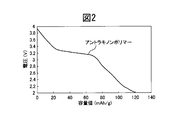
- FIG. 2 is a diagram showing the results of battery characteristic evaluation of an anthraquinone polymer of a comparative example, which was performed in Example A.
- FIG. 3 is a graph showing the results of battery characteristic evaluation of the anthraquinone derivative B of the present invention carried out in Example B.
- 4 is a graph showing the results of battery characteristic evaluation of an anthraquinone polymer of a comparative example, which was performed in Example B.
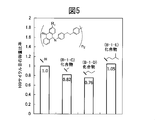
- FIG. 5 is a graph showing the results of the battery capacity at the 100th cycle of the anthraquinone derivative B of the present invention and the anthraquinone polymer of the comparative example, which were carried out in Example B.
- FIG. 6 is a graph showing the results of battery characteristic evaluation of the anthraquinone derivatives C1 and C2 of the present invention carried out in Example C.
- FIG. 7 is a graph showing the results of the battery characteristic evaluation of the anthraquinone derivative C1 of the present invention carried out in Example C.
- FIG. 8 is a graph showing the results of battery characteristic evaluation of the anthraquinone derivative C1 of the present invention carried out in Example C.
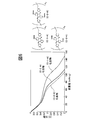
- FIG. 9 is a diagram showing the results of battery characteristic evaluation of the anthraquinone polymer of the comparative example, which was performed in Example C.
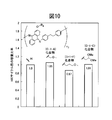
- FIG. 10 is a graph showing the results of the battery capacity at the 100th cycle of the anthraquinone derivative C1 of the present invention and the anthraquinone polymer of the comparative example, which were performed in Example C.
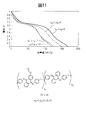
- FIG. 11 is a diagram showing the results of battery characteristic evaluation of the anthraquinone derivative D of the present invention carried out in Example D.
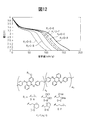
- FIG. 12 is a diagram showing the results of battery characteristic evaluation of the anthraquinone derivative D of the present invention carried out in Example D.
- FIG. 10 is a graph showing the results of battery capacity at the 100th cycle of the anthraquinone derivative C1 of the present invention and the anthraquinone polymer of the comparative example, which were performed in Example C.
- FIG. 11 is a diagram showing the results of battery characteristic evaluation of the anthr
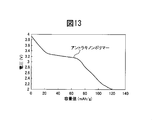
- FIG. 13 is a diagram showing the results of battery characteristic evaluation of an anthraquinone polymer of a comparative example, which was performed in Example D.
- FIG. 14 is a graph showing the results of the battery capacity at the 100th cycle of the anthraquinone derivative D of the present invention and the anthraquinone polymer of the comparative example implemented in Example D.
- Anthraquinone derivative A The anthraquinone derivative A according to the present invention is represented by the following general formula (A-1).
- R 1 represents a substituted or unsubstituted aliphatic hydrocarbon group or a substituted or unsubstituted aromatic hydrocarbon group
- n 1 is an integer of 1 to 100.
- the substituted aliphatic hydrocarbon group or the substituted aromatic hydrocarbon group means that the aliphatic hydrocarbon group or the aromatic hydrocarbon group is further substituted with a substituent, for example, When it is a substituted arylene group or a substituted cyclic substituent, it means that it has at least one substituent in the arylene group portion or on the ring portion of the cyclic substituent.
- R 1 is not particularly limited as long as it is a divalent substituted or unsubstituted aliphatic hydrocarbon group, or a divalent substituted or unsubstituted aromatic hydrocarbon group.
- the substituent when R 1 is substituted with a substituent is not particularly limited, and examples thereof include a substituted or unsubstituted methyl group, a substituted or unsubstituted ethyl group, a substituted or unsubstituted propyl Group, substituted or unsubstituted phenyl group, substituted or unsubstituted biphenyl group, substituted or unsubstituted thiophenyl group, substituted or unsubstituted thienyl group, substituted or unsubstituted furanyl group, substituted or unsubstituted pyrrolyl group, etc. Is mentioned.
- R 1 is preferably a substituted or unsubstituted phenylene group or a substituted or unsubstituted thienylene group, and more preferably an unsubstituted phenylene group or an unsubstituted thienylene group.
- n 1 is an integer of 1 to 100 indicating the degree of polymerization. n 1 is preferably an integer of 2 or more.
- anthraquinone derivative A by this invention is not limited to these compounds.
- the synthesis route of the anthraquinone derivative A according to the present invention is as follows.
- the method for synthesizing anthraquinone derivative A comprises adding a titanium chloride (IV) chloroform solution to a chloroform solution of anthraquinone (AA), 4-bromoaniline and 1,4-diazabicyclo [2,2,2] octane. Then, an imine (Ab) is synthesized (step A-1), and a Pd catalyst is added to a solution of the imine (Ab), a substituted diboronic acid, and a base to obtain the present invention. Thus, an anthraquinone derivative (A-1) is synthesized (step A-2).
- a cathode active material for a lithium ion secondary battery according to the present invention is characterized by containing an anthraquinone derivative A according to the present invention.
- the positive electrode active material containing the anthraquinone derivative A for a lithium ion secondary battery directly contributes to the positive electrode of the lithium ion secondary battery in an electrode reaction such as a charge reaction and a discharge reaction of the lithium ion secondary battery. It means a substance.
- Anthraquinone derivative B The anthraquinone derivative B according to the present invention is represented by the following general formula (B-1).
- R 2 represents a substituted or unsubstituted aliphatic hydrocarbon group, a substituted or unsubstituted aromatic hydrocarbon group, or a group represented by the following general formula (B-2).
- N 2 is an integer from 1 to 100.
- the substituted aliphatic hydrocarbon group or the substituted aromatic hydrocarbon group in R 2 means that the aliphatic hydrocarbon group or the aromatic hydrocarbon group is further substituted with a substituent.
- a substituted aryl group or a substituted cyclic substituent it means that the aryl group portion or the cyclic substituent has an at least one substituent on the ring.
- R 3 represents a linking group or a single bond
- m 1 is an integer of 1 to 10.
- R 2 is a substituted or unsubstituted aliphatic hydrocarbon group or a substituted or unsubstituted aromatic hydrocarbon group, a monovalent substituted or unsubstituted aliphatic hydrocarbon group, substituted or unsubstituted aromatic carbonization
- R 2 is a hydrogen group, for example, a substituted or unsubstituted methyl group, a substituted or unsubstituted ethyl group, a substituted or unsubstituted n-propyl group, a substituted or unsubstituted isopropyl group
- R 2 is a substituted or unsubstituted aliphatic hydrocarbon group or a substituted or unsubstituted aromatic hydrocarbon group
- the substituent when further substituted with a substituent is not particularly limited.
- a substituted or unsubstituted propioxy group a substituted or unsubstituted isopropoxy group, a substituted or unsubstituted butoxy group, a substituted or unsubstituted sec-butoxy group, a substituted or unsubstituted tert-butoxy group, or the like
- R 2 is a substituted or unsubstituted aliphatic hydrocarbon group or a substituted or unsubstituted aromatic hydrocarbon group
- R 2 preferably has the following structural formula.
- R 3 represents a linking group or a single bond.
- R 3 is a linking group, it is not particularly limited as long as it is a divalent substituent, for example, a substituted or unsubstituted methylene group, a substituted or unsubstituted ethylene group, a substituted or unsubstituted group Propylene group, substituted or unsubstituted ether group, substituted or unsubstituted thioether group, substituted or unsubstituted phenylene group, substituted or unsubstituted biphenylene group, substituted or unsubstituted thiophenylene group, substituted or unsubstituted thienylene Group, substituted or unsubstituted furylene group, substituted or unsubstituted pyrrolylene group, substituted or unsubstituted amide group, and the like.
- R 3 is a divalent substituent
- the substituent when further substituted with a substituent is not particularly limited, and examples thereof include a substituted or unsubstituted methyl group, substituted or unsubstituted Ethyl group, substituted or unsubstituted propyl group, substituted or unsubstituted phenyl group, substituted or unsubstituted biphenyl group, substituted or unsubstituted thiophenyl group, substituted or unsubstituted thienyl group, substituted or unsubstituted furanyl Group, substituted or unsubstituted pyrrolyl group and the like.
- R 3 is preferably a substituted or unsubstituted phenylene group, and more preferably an unsubstituted phenylene group.
- n 2 is an integer of 1 to 100 indicating the degree of polymerization. n 2 is preferably an integer of 6 or more.
- n 1 is an integer of 1 to 10 indicating the degree of polymerization. m 1 is preferably an integer of 2 or more.
- anthraquinone derivative B by this invention is not limited to these compounds.
- the synthesis route of the anthraquinone derivative B according to the present invention is as follows.
- Tetrakis [triphenylphosphine] palladium (0) was added to a toluene solution of 2-bromoanthraquinone (Ba), 4-vinylphenylboronic acid and sodium phosphate tribasic 12 water at room temperature to add quinine (B- b) was synthesized (step B-1), and the quinine (BB), 1,4-diazabicyclo [2,2,2] octane (78 mg, 0.70 mmol), and aniline in chlorobenzene solution were combined with titanium chloride.
- An anthraquinone derivative (B-1) is synthesized by adding a chlorobenzene solution (step B-2).
- step B-3 (not shown in the above synthesis route), 2,2′-azobis (isobutyronitrile) was added to a tetrahydrofuran solution (2 ml) of an anthraquinone derivative (B-1) into which an olefin was introduced. ) (10 mg, 0.06 mmol) can be added at room temperature to crosslink the olefin part of the anthraquinone derivative (B-1).
- the cathode active material for a lithium ion secondary battery according to the present invention is characterized by containing the anthraquinone derivative B according to the present invention.
- the positive electrode active material containing the anthraquinone derivative B for a lithium ion secondary battery directly contributes to the positive electrode of the lithium ion secondary battery in an electrode reaction such as a charge reaction and a discharge reaction of the lithium ion secondary battery. It means a substance.
- Anthraquinone derivatives C1 and C2 The anthraquinone derivative C1 according to the present invention is represented by the following general formula (C-1).
- R 4 represents a substituted or unsubstituted aliphatic hydrocarbon group or a substituted or unsubstituted aromatic hydrocarbon group
- n 3 is an integer of 1 to 100.
- the substituted aliphatic hydrocarbon group or the substituted aromatic hydrocarbon group in R 4 means that the aliphatic hydrocarbon group or the aromatic hydrocarbon group is further substituted with a substituent.
- a substituted aryl group or a substituted cyclic substituent it means that the aryl group portion or the cyclic substituent has an at least one substituent on the ring.
- R 4 is not particularly limited as long as it is a monovalent substituted or unsubstituted aliphatic hydrocarbon group or a substituted or unsubstituted aromatic hydrocarbon group.
- R 4 is a substituted or unsubstituted methyl group.
- a substituted or unsubstituted alkyl group such as a substituted isobutyl group, a substituted or unsubstituted tert-butyl group, a substituted or unsubstituted n-pentyl group, a substituted or unsubstituted isopentyl group, a substituted or unsubstituted cyclopentyl group,
- a substituted or unsubstituted cyclic alkyl group such as a substituted or unsubstituted cyclohexyl group, a substituted or unsubstituted vinyl group,
- the substituent when R 4 is further substituted with a substituent is not particularly limited, and examples thereof include a substituted or unsubstituted phenyl group, a substituted or unsubstituted tolyl group, a substituted or unsubstituted group.
- a substituted or unsubstituted aryl group such as a naphthyl group, a substituted or unsubstituted methoxy group, a substituted or unsubstituted ethoxy group, a substituted or unsubstituted propioxy group, a substituted or unsubstituted isopropoxy group, a substituted or unsubstituted Examples include a butoxy group, a substituted or unsubstituted sec-butoxy group, a substituted or unsubstituted alkoxy group such as a substituted or unsubstituted tert-butoxy group, a substituted or unsubstituted dioxolanyl group, a substituted or unsubstituted dioxanyl group, and the like. It is done.
- R 4 preferably has the following structural formulas (CA to CK), more preferably structural formulas CA (methoxymethyl group) and CK (p-methoxybenzyl group).
- An anthraquinone derivative C2 according to the present invention is represented by the following general formula (C-2).
- R 4 in the general formula (1) it has the same meaning as R 4, its in the general formula (2), R 5 represents a substituted or unsubstituted aliphatic hydrocarbon group, or a substituted Alternatively, it represents an unsubstituted aromatic hydrocarbon group, and n 3 is an integer of 1 to 100.
- the substituted aliphatic hydrocarbon group or the substituted aromatic hydrocarbon group in R 5 is an aliphatic hydrocarbon group or an aromatic hydrocarbon group as described above for R 4 .
- a substituted aryl group or a substituted cyclic substituent it has at least one substituent on the ring portion of the aryl group or the cyclic substituent. Means that.
- R 5 is not particularly limited as long as it is a monovalent substituted or unsubstituted aliphatic hydrocarbon group or a substituted or unsubstituted aromatic hydrocarbon group, for example, a substituted or unsubstituted methyl group Substituted or unsubstituted ethyl group, substituted or unsubstituted n-propyl group, substituted or unsubstituted isopropyl group, substituted or unsubstituted n-butyl group, substituted or unsubstituted sec-butyl group, substituted or unsubstituted A substituted or unsubstituted alkyl group such as a substituted isobutyl group, a substituted or unsubstituted tert-butyl group, a substituted or unsubstituted n-pentyl group, a substituted or unsubstituted isopentyl group, a substituted or unsubstitute
- the substituent when R 5 is further substituted with a substituent is not particularly limited, and examples thereof include a substituted or unsubstituted phenyl group, a substituted or unsubstituted tolyl group, a substituted or unsubstituted group.
- a substituted or unsubstituted aryl group such as a naphthyl group, a substituted or unsubstituted methoxy group, a substituted or unsubstituted ethoxy group, a substituted or unsubstituted propioxy group, a substituted or unsubstituted isopropoxy group, a substituted or unsubstituted Examples include a butoxy group, a substituted or unsubstituted sec-butoxy group, a substituted or unsubstituted alkoxy group such as a substituted or unsubstituted tert-butoxy group, a substituted or unsubstituted dioxolanyl group, a substituted or unsubstituted dioxanyl group, and the like. It is done.
- R 5 is preferably the following structural formulas (CA to CK), more preferably the structural formulas CA (methoxymethyl group) and CK (p-methoxybenzyl group).
- R 4 and R 5 are structural formula A (methoxymethyl group) and / or structural formula K (p-methoxybenzyl group).
- n 3 is an integer of 1 to 100 indicating the degree of polymerization. n 3 is preferably an integer of 6 or more.
- C-1-A to C-1-K, C-2-A to C-2-K Preferred specific exemplary compounds (C-1-A to C-1-K, C-2-A to C-2-K) of anthraquinone derivatives C1 and C2 according to the present invention are shown.
- C2 is not limited to these compounds.
- the synthesis route of the anthraquinone derivative C1 represented by the general formula (C-1) according to the present invention is as follows.
- the synthesis route of the anthraquinone derivative C2 represented by the general formula (C-2) according to the present invention is as follows.
- titanium (IV) chloride is added to a chlorobenzene solution of anthraquinone (Cd) having an R 5 substituent at the 6-position, ethylenedianiline, and 1,4-diazabicyclo [2,2,2] octane.
- An anthraquinone derivative (C-2) was synthesized by adding a chlorobenzene solution.
- a cathode active material for a lithium ion secondary battery according to the present invention contains an anthraquinone derivative C1 according to the present invention.
- the positive electrode active material containing the anthraquinone derivative C1 for a lithium ion secondary battery directly contributes to the positive electrode of the lithium ion secondary battery in an electrode reaction such as a charge reaction and a discharge reaction of the lithium ion secondary battery. It means a substance.
- a cathode active material for a lithium ion secondary battery according to the present invention contains an anthraquinone derivative C2 according to the present invention.
- the positive electrode active material containing the anthraquinone derivative C2 for a lithium ion secondary battery directly contributes to the positive electrode of the lithium ion secondary battery in an electrode reaction such as a charge reaction and a discharge reaction of the lithium ion secondary battery. It means a substance.
- Anthraquinone derivative D The anthraquinone derivative D according to the present invention is represented by the following general formula (D-1).
- R 6 represents a substituted or unsubstituted aliphatic hydrocarbon group, a substituted or unsubstituted aromatic hydrocarbon group, or a group represented by the following general formula (D-2).
- N 4 and m 2 are integers of 1 to 100.
- the substituted aliphatic hydrocarbon group or the substituted aromatic hydrocarbon group in R 6 means that the aliphatic hydrocarbon group or the aromatic hydrocarbon group is further substituted with a substituent.
- a substituted aryl group or a substituted cyclic substituent it means that the aryl group portion or the cyclic substituent has an at least one substituent on the ring.
- R 7 represents a substituted or unsubstituted aliphatic hydrocarbon group or a substituted or unsubstituted aromatic hydrocarbon group.
- the substituted aliphatic hydrocarbon group or the substituted aromatic hydrocarbon group in R 7 means that the aliphatic hydrocarbon group or the aromatic hydrocarbon group is further substituted with a substituent.
- a substituted aryl group or a substituted cyclic substituent it means that the aryl group portion or the cyclic substituent has an at least one substituent on the ring.
- R 6 is a substituted or unsubstituted aliphatic hydrocarbon group or a substituted or unsubstituted aromatic hydrocarbon group, a monovalent substituted or unsubstituted aliphatic hydrocarbon group, substituted or unsubstituted aromatic carbonization
- R 6 is a hydrogen group, for example, a substituted or unsubstituted methyl group, a substituted or unsubstituted ethyl group, a substituted or unsubstituted n-propyl group, a substituted or unsubstituted isopropyl group
- R 6 is a substituted or unsubstituted aliphatic hydrocarbon group or a substituted or unsubstituted aromatic hydrocarbon group
- the substituent when further substituted with a substituent is not particularly limited.
- a substituted or unsubstituted propioxy group a substituted or unsubstituted isopropoxy group, a substituted or unsubstituted butoxy group, a substituted or unsubstituted sec-butoxy group, a substituted or unsubstituted tert-butoxy group, or the like
- R 7 is a monovalent substituted or unsubstituted aliphatic hydrocarbon group or a substituted or unsubstituted aromatic hydrocarbon group.
- R 7 is a monovalent substituted or unsubstituted aliphatic hydrocarbon group or a substituted or unsubstituted aromatic hydrocarbon group.
- a substituted or unsubstituted methyl group a substituted or unsubstituted ethyl group, a substituted or unsubstituted n-propyl group, a substituted or unsubstituted isopropyl group, a substituted or unsubstituted N-butyl group, substituted or unsubstituted sec-butyl group, substituted or unsubstituted isobutyl group, substituted or unsubstituted tert-butyl group, substituted or unsubstituted n-pentyl group, substituted or unsubstituted isopentyl
- the substituent when R 7 is further substituted with a substituent is not particularly limited, and examples thereof include a substituted or unsubstituted phenyl group, a substituted or unsubstituted tolyl group, a substituted or unsubstituted group.
- a substituted or unsubstituted aryl group such as a naphthyl group, a substituted or unsubstituted methoxy group, a substituted or unsubstituted ethoxy group, a substituted or unsubstituted propioxy group, a substituted or unsubstituted isopropoxy group, a substituted or unsubstituted Examples include a butoxy group, a substituted or unsubstituted sec-butoxy group, a substituted or unsubstituted alkoxy group such as a substituted or unsubstituted tert-butoxy group, a substituted or unsubstituted dioxolanyl group, a substituted or unsubstituted dioxanyl group, and the like. It is done.
- R 6 is preferably a substituent having a hetero atom.
- R 7 is preferably a substituent having a hetero atom, more preferably the following structural formulas (DA to DL), and further the structural formula DA (methoxymethyl group). It is more preferable.
- n 4 is an integer of 1 to 100 indicating the degree of polymerization. n 4 is preferably an integer of 2 or more.
- n 2 is 0 or an integer of 1 to 100 indicating the degree of polymerization. m 2 is preferably an integer of 2 or more.
- the synthesis route of the anthraquinone derivative (D-1) according to the present invention is as follows.
- anthraquinone (Da), quinone (Db), 4,4′-ethylenedianiline and 1,4-diazabicyclo [2,2,2] octane (323 mg, 2.88 mmol) in chlorobenzene (3 ml) An anthraquinone derivative (D-1) is synthesized by adding a chlorobenzene solution of titanium (IV) chloride.
- Positive electrode active material containing anthraquinone derivative D for lithium ion secondary battery contains an anthraquinone derivative D according to the present invention.
- the positive electrode active material containing an anthraquinone derivative D for a lithium ion secondary battery is a substance that directly contributes to the positive electrode of a lithium ion secondary battery in an electrode reaction such as a charge reaction and a discharge reaction of the lithium ion secondary battery. I mean.
- Positive electrode for lithium ion secondary battery is characterized in that the positive electrode active material for a lithium ion secondary battery according to the present invention is provided on at least the surface of the current collector.
- the current collector is a chemically inert electronic high conductor that keeps a current flowing through an electrode during discharging or charging of a lithium ion secondary battery.
- the current collector is in the form of a foil, a plate or the like formed of the electronic high conductor. Although it will not specifically limit if it is the shape according to the objective, For example, copper foil, aluminum foil, and aluminum mesh are mentioned.
- One method for providing the positive electrode active material on at least the surface of the current collector includes, for example, applying the positive electrode active material to the surface of the current collector.
- coating means placing a positive electrode active material on a current collector.
- the coating method include a roll coating method, a dip coating method, a doctor blade method, a spray coating method, a curtain coating method, and the like, which are generally used when producing an electrode for a lithium ion secondary battery. If it is a coating method, it will not specifically limit.
- the positive electrode for a lithium ion secondary battery according to the present invention may be provided with a conductive additive together with the positive electrode active material of the present invention on at least the surface of the current collector.
- the conductive auxiliary agent is added to increase conductivity.
- Examples of the conductive assistant include carbon black, graphite, acetylene black, ketjen black, and carbon fiber, which are carbonaceous fine particles. They may be added alone or in combination of two or more.
- the amount added is preferably 10 to 2000 parts by mass, more preferably 100 to 1000 parts by mass, and still more preferably 200 to 800 parts by mass per 100 parts by mass of the positive electrode active material of the present invention.
- Lithium Ion Secondary Battery A lithium ion secondary battery according to the present invention is characterized in that it comprises at least constituent elements of a positive electrode, a negative electrode, and an electrolyte, and the positive electrode is the positive electrode of the present invention.
- the negative electrode of the lithium ion secondary battery according to the present invention is preferably a lithium-based negative electrode.
- the lithium-based negative electrode can be composed of a lithium-based metal material such as metal lithium or a lithium alloy (for example, a Li—Al alloy), or a lithium intercalation carbon material.
- the lithium-based metallic material is preferably used in the form of a foil from the viewpoint of reducing the weight of the battery.
- the electrolyte of the lithium ion secondary battery according to the present invention may be disposed between the positive electrode and the negative electrode, or may be disposed as an electrolyte layer.
- the electrolyte is preferably composed of a polymer gel containing an electrolyte solution (polymer gel electrolyte).
- Examples of the electrolyte contained in the polymer electrolyte include CF 3 SO 3 Li, C 4 F 9 SO 3 Li, (CF 3 SO 2 ) 2 NLi, (CF 3 SO 2 ) 3 CLi, LiBF 4 , LiPF 6 , and LiClO.
- lithium salts such as 4 .
- the solvent that dissolves the electrolyte is preferably a non-aqueous solvent.
- non-aqueous solvents include chain carbonates, cyclic carbonates, cyclic esters, nitrile compounds, acid anhydrides, amide compounds, phosphate compounds, amine compounds, and the like.
- Specific examples of the non-aqueous solvent include, for example, ethylene carbonate, propylene carbonate, diethyl carbonate, dimethoxyethane, ⁇ -butyrolactone, N-methylpyrrolidinone, N, N′-dimethylacetamide, a mixture of propylene carbonate and dimethoxyethane, ethylene
- examples thereof include a mixture of carbonate and diethyl carbonate, and a mixture of sulfolane and tetrahydrofuran.
- the polymer gel it is preferable to use a prepolymer TA210 (polyfunctional acrylate polymer having a polyoxyalkylene chain) that is polymerized with a photopolymerization initiator (for example, IRGACURE 184).
- a photopolymerization initiator for example, IRGACURE 184
- acrylonitrile and methyl acrylate are used.
- a copolymer with methacrylic acid can be obtained by immersing the polymer in the electrolyte solution or polymerizing the polymer structural unit (monomer / compound) in the presence of the electrolyte solution.
- polyolefin gels described in JP-A-2002-198095 are also preferably used.
- This gel is a gel of a non-crosslinked polymer in which about 10% by mole of polyethylene is grafted with a compound containing an oligomer of polyethylene oxide such as polyethylene glycol.
- This polymer has completely different physical properties from non-grafted polyethylene and has the ability to absorb and gel a large amount of organic electrolyte and retain the absorbed solution. Therefore, a gel electrolyte can be obtained by immersing the polymer in an electrolyte solution.
- the lithium ion secondary battery according to the present invention may include a separator as one component.
- the separator can be used for the purpose of preventing the positive electrode and the negative electrode of the lithium ion secondary battery from contacting each other, and may include an electrolyte.
- a separator a polypropylene porous film and a nonwoven fabric are mentioned, for example, A polypropylene porous film is preferable.
- the configuration form (stacked form) of the lithium ion secondary battery according to the present invention may be arbitrary.
- the electrolyte solution is impregnated with the positive electrode of the present invention, a separator and a glass filter are laminated on the positive electrode, and a negative electrode is further laminated. Further, the positive electrode, the separator containing the electrolyte, and the negative electrode are sequentially stacked. A form is mentioned.
- the shape of the lithium ion secondary battery according to the present invention may be a known shape.
- the electrode laminate, the wound body may be a metal case, a resin case, or a laminate film composed of a metal foil such as an aluminum foil and a synthetic resin film. What was sealed is mentioned.
- examples of the external shape of the lithium ion secondary battery include a cylindrical shape, a square shape, a coin shape, and a sheet shape, but are not limited thereto.
- Vehicle A vehicle according to the present invention is equipped with the lithium ion secondary battery according to the present invention.
- Vehicles include, for example, automobiles, motorbikes, light vehicles, trolley buses, railway vehicles, military vehicles, construction vehicles, agricultural vehicles, industrial vehicles, and the like.
- Example A-1 Example A-1-1 ⁇ Synthesis Example A-1: Synthesis of anthraquinone derivative (A-1-1)>
- Step A-1-1 Synthesis of imine (Ab-1) Anthraquinone (1.0 g, 4.8 mmol) (Aa), 4-bromoaniline (1.65 g, 9.6 mmol) and 1,4-diazabicyclo [
- Step A-2-1 Synthesis of anthraquinone derivative (A-1-1)
- imine (Ab-1) (1 eq. (Equivalent)
- 1,4-benzenediboronic acid (1 eq. Eq)
- base 3.5 eq. (Eq)
- Pd catalyst 0.4 eq. (Eq)
- the reaction mixture was cooled to room temperature and filtered through celite. The filtrate was evaporated under reduced pressure and reprecipitated with methanol to obtain an anthraquinone derivative (A-1-1).
- Step A-1-2 Synthesis of imine (Ab-2) Anthraquinone (1.0 g, 4.8 mmol) (Aa), 4-bromoaniline (1.65 g, 9.6 mmol) and 1,4-diazabicyclo [
- Step A-2-2 Synthesis of anthraquinone derivative (A-1-2)
- imine (Ab-2) (1 eq. (Equivalent)
- 1,4-thiophene diboronic acid (1 eq. Eq)
- base 3.5 eq. (Eq)
- Pd catalyst 0.4 eq. (Eq)
- the reaction mixture was cooled to room temperature and filtered through celite. The filtrate was evaporated under reduced pressure and reprecipitated with methanol to obtain an anthraquinone derivative (A-1-2).
- Example A-2-1 Preparation of positive electrode for lithium ion secondary battery> Anthraquinone derivative (A-1-1) synthesized above (2 mg), Ketjen Black (Ketjen Black International Co., Ltd.) (4 mg), and conductive binder (TAB-2) (made by Hosen) (4 mg) ) To form a sheet and pressed onto the surface of an aluminum mesh (14 ⁇ ) (manufactured by Niraco) as a current collector. It was vacuum-dried at 120 ° C. for 6 hours to produce an electrode equipped with an anthraquinone derivative (A-1-1).
- EC ethylene carbonate
- DEC diethyl carbonate
- the positive electrode was impregnated with an electrolytic solution (manufactured by Kishida Chemical).
- a separator manufactured by Celgard
- a separator made of a polypropylene porous film and a glass filter (manufactured by Advantech) were laminated on the positive electrode, and a lithium foil (manufactured by Honjo Metal) that became the negative electrode was further laminated.
- the outer casing of the coin-type battery is overlaid with insulating packing disposed around it, and pressurized with a crimping machine, and sealed using anthraquinone derivative (A-1-1) as the positive electrode active material and metallic lithium as the negative electrode active material.
- Type coin-type lithium ion secondary battery was fabricated.
- Example A-2-2 Preparation of positive electrode for lithium ion secondary battery>
- the anthraquinone derivative (A-1-2) was prepared in the same manner as in Example A-2-1 except that the anthraquinone derivative (A-1-2) was used instead of the anthraquinone derivative (A-1-1). An electrode was prepared.
- Example A-2-1 ⁇ Production of coin-type lithium ion secondary battery>
- the above electrode was used as the positive electrode of a coin-type battery, an anthraquinone derivative (A-1-2) as the positive electrode active material, and a sealed coin using metal lithium as the negative electrode active material Type lithium ion secondary battery was produced.
- the coin-type lithium ion secondary battery produced in Comparative Example A-1 was discharged at a constant current of 0.05 milliampere (mA) until it reached 2 volts (V).
- FIG. 1 shows the results of a charge / discharge test using the coin-type lithium ion secondary battery produced in Examples A-2-1 and A-2-2.
- FIG. 1 shows a charge / discharge curve (charge / discharge capacity value (mAh / g)) vs. 30th cycle. Voltage (V)).
- FIG. 2 shows the results of a discharge test using the coin-type lithium ion secondary battery produced in Comparative Example A-1.
- FIG. 2 shows a discharge curve (discharge capacity value (mAh / g)) vs.. Voltage (V)).
- the coin-type lithium ion secondary battery produced in Examples A-2-1 and A-2-2 is the same as the coin-type lithium ion secondary battery produced in Comparative Example A-1. The average voltage was lower than that of the battery.
- Example B Example B-1
- Example B-1-1 ⁇ Synthesis Example B-1: Synthesis of anthraquinone derivative (B-1-A)>
- Step B-1-1 Synthesis of quinone (BBa) 2-bromoanthraquinone (200 mg, 0.70 mmol), 4-vinylphenylboronic acid (103 mg, 0.70 mmol) and sodium phosphate tribasic 12 Tetrakis [triphenylphosphine] palladium (0) (40 mg, 0.03 mmol) was added to a toluene solution (7 ml) of water (927 mg, 2.44 mmol) at room temperature, and the mixture was stirred at 100 ° C. for 1 day. The reaction mixture was cooled to room temperature and evaporated under reduced pressure.
- Step B-2-1 Synthesis of anthraquinone derivative (B-1-A ′) Quinone (BBa) (36 mg, 0.12 mmol), 1,4-diazabicyclo [2,2,2] octane (78 mg 0.70 mmol) and aniline (21 ml, 0.23 mmol) in chlorobenzene solution (1 ml) and titanium chloride (IV) (32 ml, 0.29 mmol) in chlorobenzene solution (1 ml) were added at 90 ° C for 1 day at 130 ° C Ar Stir below. The reaction mixture was cooled to room temperature and filtered through celite.
- Step B-3-1 Synthesis of anthraquinone derivative (B-1-A) To a tetrahydrofuran solution (2 ml) of the anthraquinone derivative (B-1-A ′) (40 mg, 0.09 mmol), 2,2′-azobis ( Isobutyronitrile) (10 mg, 0.06 mmol) was added at room temperature and the mixture was stirred at 70 ° C. for 2 days. The reaction mixture was cooled to room temperature and evaporated under reduced pressure to give an anthraquinone derivative (B-1-A) (35 mg, yield: 93%).
- 2,2′-azobis Isobutyronitrile
- Step B-1-2 Synthesis of quinone (Bbb) 2-bromoanthraquinone (200 mg, 0.70 mmol), 2-allenyl-4,4,5,5-tetramethyl-1,3,2- Tetrakis [triphenylphosphine] palladium (0) (40 mg, 0.03 mmol) was added to a toluene solution (7 ml) of dioxaborolane (107 mg, 0.70 mmol) and sodium phosphate tribasic 12 water (927 mg, 2.44 mmol) at room temperature The mixture was stirred at 100 ° C. for 1 day. The reaction mixture was cooled to room temperature and evaporated under reduced pressure.
- Step B-2-2 Synthesis of anthraquinone derivative (B-1-B ′): quinone (BB) (73 mg, 0.31 mmol), 4,4′-ethylenedianiline (66 mg, 0.31 mmol) and To a chlorobenzene solution (2 ml) of 1,4-diazabicyclo [2,2,2] octane (208 mg, 0.77 mmol) was added titanium chloride (IV) (85 ml, 0.77 mmol) chlorobenzene solution (1 ml) at 90 ° C. Stir for 1 day under Ar at 130 ° C. The reaction mixture was cooled to room temperature and filtered through celite. The filtrate was evaporated under reduced pressure and reprecipitated with methanol to obtain an anthraquinone derivative (B-1-B ′) (22 mg, yield: 17%).
- Step B-3-2 Synthesis of anthraquinone derivative (B-1-B) To a solution (2 ml) of anthraquinone derivative (B-1-B ′) (12 mg, 0.03 mmol) in 2,2′-azobis ( Isobutyronitrile) (10 mg, 0.06 mmol) was added at room temperature and the mixture was stirred at 70 ° C. for 2 days. The reaction mixture was cooled to room temperature and evaporated under reduced pressure to obtain anthraquinone derivative (B-1-B) (11 mg, yield: 93%).
- 2,2′-azobis Isobutyronitrile
- Example B-2-1 Preparation of positive electrode for lithium ion secondary battery> Anthraquinone derivative (B-1-A) (2 mg) synthesized above, Ketjen black (Ketjen Black International) (4 mg), conductive binder (TAB-2) (made by Hosen) (4 mg) ) To form a sheet and pressed onto the surface of an aluminum mesh (14 ⁇ ) (manufactured by Niraco) as a current collector. It was vacuum-dried at 120 ° C. for 6 hours to produce an electrode equipped with an anthraquinone derivative (B-1-A).
- EC ethylene carbonate
- DEC diethyl carbonate
- the positive electrode was impregnated with an electrolytic solution (manufactured by Kishida Chemical).
- a separator manufactured by Celgard
- a separator made of a polypropylene porous film and a glass filter (manufactured by Advantech) were laminated on the positive electrode, and a lithium foil (manufactured by Honjo Metal) that became the negative electrode was further laminated.
- the outer casing of the coin-type battery is overlaid with an insulating packing disposed around it, and pressurized with a crimping machine, and sealed using anthraquinone derivative (B-1-A) as the positive electrode active material and metallic lithium as the negative electrode active material.
- Type coin-type lithium ion secondary battery was fabricated.
- Example B-2-2 Preparation of positive electrode for lithium ion secondary battery>
- the anthraquinone derivative (B-1-B) was prepared in the same manner as in Example B-2-1 except that the anthraquinone derivative (B-1-B) was used instead of the anthraquinone derivative (B-1-A). An electrode was prepared.
- Example B-2-1 ⁇ Production of coin-type lithium ion secondary battery>
- the above electrode was used as a positive electrode of a coin-type battery, an anthraquinone derivative (B-1-B) as a positive electrode active material, and a sealed coin using metallic lithium as a negative electrode active material Type lithium ion secondary battery was produced.
- Example B-2-3 Preparation of positive electrode for lithium ion secondary battery>
- the anthraquinone derivative (B-1-C) was prepared in the same manner as in Example B-2-1 except that the anthraquinone derivative (B-1-C) was used instead of the anthraquinone derivative (B-1-A). An electrode was prepared.
- Example B-2-1 ⁇ Production of coin-type lithium ion secondary battery>
- the above electrode is used as a positive electrode of a coin-type battery, an anthraquinone derivative (B-1-C) as a positive electrode active material, and a sealed coin using metallic lithium as a negative electrode active material Type lithium ion secondary battery was produced.
- Example B-2-4 Preparation of positive electrode for lithium ion secondary battery>
- the anthraquinone derivative (B-1-D) was prepared in the same manner as in Example B-2-1 except that the anthraquinone derivative (B-1-D) was used instead of the anthraquinone derivative (B-1-A). An electrode was prepared.
- Example B-2-1 ⁇ Production of coin-type lithium ion secondary battery>
- the above electrode was used as a positive electrode of a coin-type battery, an anthraquinone derivative (B-1-D) as a positive electrode active material, and a sealed coin using metallic lithium as a negative electrode active material Type lithium ion secondary battery was produced.
- Example B-2-5 Preparation of positive electrode for lithium ion secondary battery>
- the anthraquinone derivative (B-1-E) was prepared in the same manner as in Example B-2-1 except that the anthraquinone derivative (B-1-E) was used instead of the anthraquinone derivative (B-1-A). An electrode was prepared.
- Example B-2-1 ⁇ Production of coin-type lithium ion secondary battery>
- the above electrode was used as the positive electrode of a coin-type battery, an anthraquinone derivative (B-1-E) as the positive electrode active material, and a sealed coin using metallic lithium as the negative electrode active material Type lithium ion secondary battery was produced.
- the coin-type lithium ion secondary battery produced in Comparative Example B-1 was discharged at a constant current of 0.05 milliampere (mA) until it reached 2 volts (V).
- FIG. 3 shows the results of the charge / discharge test using the coin-type lithium ion secondary battery produced in Example B-2-2.
- FIG. 3 shows charge / discharge curves (charge / discharge capacity value (mAh / g)) vs. 1st cycle and 20th cycle. Voltage (V)).
- FIG. 4 shows the results of a discharge test using the coin-type lithium ion secondary battery produced in Comparative Example B-1.
- FIG. 5 shows the results of a charge / discharge test using the coin-type lithium ion secondary batteries produced in Examples B-2-1 to B-2-5 and Comparative Example B-1.
- FIG. 3 shows the results of the charge / discharge test using the coin-type lithium ion secondary battery produced in Example B-2-2.
- FIG. 3 shows charge / discharge curves (charge / discharge capacity value (mAh / g)) vs. 1st cycle and 20th cycle. Voltage (V)).
- FIG. 4 shows the results of a discharge test using the coin-type lithium ion
- the battery capacity value of the coin-type lithium ion secondary battery using the anthraquinone derivatives (B-1-A to B-1-E) of the present invention is the battery capacity of the coin-type lithium ion secondary battery using the anthraquinone polymer. It is a ratio value when the value is 1.0.
- the coin-type lithium ion secondary battery produced in Example B-2-2 has an average voltage higher than that of the coin-type lithium ion secondary battery produced in Comparative Example B-1. Showed low characteristics. Further, referring to FIG. 5, the battery capacity value of the coin-type lithium ion secondary battery produced in Example B-2-5 shows the highest value, and the increase in capacity and extension of life (cycle suitability) are shown. It was confirmed that both were achieved.
- Example C Example C-1
- Example C-1-1 ⁇ Synthesis Example C-1: Synthesis of anthraquinone derivative (C-1-A)>
- Step C-1-1 Synthesis of 2-methoxymethylanthraquinone (Cba) To a dimethylformamide solution (40 ml) of 2-hydroxyanthraquinone (Ca) (1.0 g, 4.46 mmol), sodium hydride (290 mg, 6.69 mmol) was added at 0 ° C. and stirred for 10 minutes. After stirring, methoxymethyl chloride (0.4 ml, 5.35 mmol) was added to the reaction mixture at 0 ° C., and the mixture was stirred at 70 ° C. for 1 day. The reaction mixture was cooled to room temperature and evaporated under reduced pressure. The residue was extracted three times with chloroform, dried over MgSO4 and filtered.
- Step C-3-1 Synthesis of 2,6-dimethoxymethylanthraquinone (CdA) To a solution of 2,6-dihydroxyanthraquinone (Cc) (1.0 g, 4.16 mmol) in dimethylformamide (40 ml) Sodium hydride (450 mg, 10.4 mmol) was added at 0 ° C. and stirred for 10 minutes. After stirring, methoxymethyl chloride (0.78 ml, 10.4 mmol) was added to the reaction mixture at 0 ° C., and the mixture was stirred at 70 ° C. for 1 day. The reaction mixture was cooled to room temperature and evaporated under reduced pressure.
- CdA 2,6-dimethoxymethylanthraquinone
- Example C-2-1 Preparation of positive electrode for lithium ion secondary battery> Anthraquinone derivative (C-1-A) (2 mg) synthesized in Example C-1-1 above, Ketjen Black (Ketjen Black International) (4 mg), and conductive binder (TAB-2) (Made by Hosen) (4 mg) was mixed to form a sheet, which was crimped onto the surface of an aluminum mesh (14 ⁇ ) (made by Niraco) as a current collector. It was vacuum-dried at 120 ° C. for 6 hours to produce an electrode equipped with an anthraquinone derivative (C-1-A).
- EC ethylene carbonate
- DEC diethyl carbonate
- the positive electrode was impregnated with an electrolytic solution (manufactured by Kishida Chemical).
- a separator manufactured by Celgard
- a separator made of a polypropylene porous film and a glass filter (manufactured by Advantech) were laminated on the positive electrode, and a lithium foil (manufactured by Honjo Metal) that became the negative electrode was further laminated.
- the outer casing of the coin-type battery is overlaid with insulating packing disposed around it, and pressurized with a crimping machine, and sealed using anthraquinone derivative (C-1-A) as the positive electrode active material and metallic lithium as the negative electrode active material.
- Type coin-type lithium ion secondary battery was fabricated.
- Example C-2-2 Preparation of positive electrode for lithium ion secondary battery> The same method as in Example C-2-1 except that the anthraquinone derivative (C-2-A) synthesized in Example C-1-2 was used instead of the anthraquinone derivative (C-1-A). Thus, an electrode provided with an anthraquinone derivative (C-2-A) was produced.
- Example C-2-3 Preparation of positive electrode for lithium ion secondary battery> The same method as in Example C-2-1 except that the anthraquinone derivative (C-2-K) synthesized in Example C-1-3 was used instead of the anthraquinone derivative (C-1-A). An electrode equipped with an anthraquinone derivative (C-2-K) was prepared.
- Example C-2-4 ⁇ Preparation of positive electrode for lithium ion secondary battery>
- Example C-2-- was used except that the anthraquinone derivative (C-1-B) synthesized with reference to the synthesis method of Example C-1-1 was used. 1 was used to prepare an electrode provided with an anthraquinone derivative (C-1-B).
- Example C-2-1 ⁇ Production of coin-type lithium ion secondary battery>
- the above electrode was used as a positive electrode of a coin-type battery, an anthraquinone derivative (C-1-B) as a positive electrode active material, and a sealed coin using metallic lithium as a negative electrode active material Type lithium ion secondary battery was produced.
- Example C-2--5 ⁇ Preparation of positive electrode for lithium ion secondary battery> Instead of the anthraquinone derivative (C-1-A), Example C-2-- was used except that the anthraquinone derivative (C-1-C) synthesized with reference to the synthesis method of Example C-1-1 was used. In the same manner as in Example 1, an electrode provided with an anthraquinone derivative (C-1-C) was produced.
- Example C-2-6 ⁇ Preparation of positive electrode for lithium ion secondary battery> Instead of the anthraquinone derivative (C-1-A), Example C-2-- was used except that the anthraquinone derivative (C-1-D) synthesized with reference to the synthesis method of Example C-1-1 was used. In the same manner as in Example 1, an electrode provided with an anthraquinone derivative (C-1-D) was produced.
- Example C-2-1 ⁇ Production of coin-type lithium ion secondary battery>
- the above electrode was used as a positive electrode of a coin-type battery, an anthraquinone derivative (C-1-D) as a positive electrode active material, and a sealed coin using metal lithium as a negative electrode active material Type lithium ion secondary battery was produced.
- Example C-2-7 ⁇ Preparation of positive electrode for lithium ion secondary battery> Instead of the anthraquinone derivative (C-1-A), Example C-2-- was used except that the anthraquinone derivative (C-1-E) synthesized with reference to the synthesis method of Example C-1-1 was used. In the same manner as in Example 1, an electrode provided with an anthraquinone derivative (C-1-E) was produced.
- Example C-2-1 ⁇ Production of coin-type lithium ion secondary battery>
- the above electrode was used as a positive electrode of a coin-type battery, an anthraquinone derivative (C-1-E) as a positive electrode active material, and a sealed coin using metallic lithium as a negative electrode active material Type lithium ion secondary battery was produced.
- Example C-2--8 ⁇ Preparation of positive electrode for lithium ion secondary battery> Instead of the anthraquinone derivative (C-1-A), Example C-2-- was used except that the anthraquinone derivative (C-1-F) synthesized with reference to the synthesis method of Example C-1-1 was used. In the same manner as in Example 1, an electrode provided with an anthraquinone derivative (C-1-F) was produced.
- Example C-2-1 ⁇ Production of coin-type lithium ion secondary battery>
- the above electrode was used as a positive electrode of a coin-type battery, an anthraquinone derivative (C-1-F) as a positive electrode active material, and a sealed coin using metallic lithium as a negative electrode active material Type lithium ion secondary battery was produced.
- Example C-2-9 ⁇ Preparation of positive electrode for lithium ion secondary battery>
- Example C-2-- was used except that the anthraquinone derivative (C-1-G) synthesized with reference to the synthesis method of Example C-1-1 was used.
- an electrode provided with an anthraquinone derivative (C-1-G) was produced.
- Example C-2-1 ⁇ Production of coin-type lithium ion secondary battery>
- the above electrode is used as a positive electrode of a coin-type battery, an anthraquinone derivative (C-1-G) as a positive electrode active material, and a sealed coin using metallic lithium as a negative electrode active material Type lithium ion secondary battery was produced.
- Example C-2-10 ⁇ Preparation of positive electrode for lithium ion secondary battery> Instead of the anthraquinone derivative (C-1-A), Example C-2-- was used except that the anthraquinone derivative (C-1-H) synthesized with reference to the synthesis method of Example C-1-1 was used. In the same manner as in Example 1, an electrode provided with an anthraquinone derivative (C-1-H) was produced.
- Example C-2-1 ⁇ Production of coin-type lithium ion secondary battery>
- the above electrode was used as the positive electrode of a coin-type battery, an anthraquinone derivative (C-1-H) as the positive electrode active material, and a sealed coin using metallic lithium as the negative electrode active material Type lithium ion secondary battery was produced.
- Example C-2-11 Preparation of positive electrode for lithium ion secondary battery>
- an example C-2-I was used except that the anthraquinone derivative (C-1-I) synthesized with reference to the synthesis method of Example C-1-1 was used. 1 was used to prepare an electrode provided with an anthraquinone derivative (C-1-I).
- Example C-2-1 ⁇ Production of coin-type lithium ion secondary battery>
- the above electrode was used as the positive electrode of a coin-type battery, an anthraquinone derivative (C-1-I) as the positive electrode active material, and a sealed coin using metallic lithium as the negative electrode active material Type lithium ion secondary battery was produced.
- Example C-2-12 ⁇ Preparation of positive electrode for lithium ion secondary battery>
- Example C-2-- was used except that the anthraquinone derivative (C-1-J) synthesized with reference to the synthesis method of Example C-1-1 was used.
- an electrode provided with an anthraquinone derivative (C-1-J) was produced.
- Example C-2-1 ⁇ Production of coin-type lithium ion secondary battery>
- the above electrode was used as a positive electrode of a coin-type battery, an anthraquinone derivative (C-1-J) as a positive electrode active material, and a sealed coin using metallic lithium as a negative electrode active material Type lithium ion secondary battery was produced.
- the coin-type lithium ion secondary batteries produced in Examples C-2-1 to C-2-12 and Comparative Example C-1 were 2 at a constant current of 0.05 milliampere (mA). The battery was discharged until it reached volts (V).
- the coin-type lithium ion secondary battery produced in Examples C-2-1, C-2-5 and C-2-8 was 2 volts at a constant current of 0.05 milliampere (mA).
- the battery was discharged until it reached (V), and after 5 minutes of rest, it was charged with a constant current of 0.05 milliampere (mA) until it reached 4 volts (V). With this as one cycle, a charge / discharge test was conducted up to 100 cycles.
- FIG. 6 shows the results of a discharge test using the coin-type lithium ion secondary batteries produced in Examples C-2-1 to C-2-3.
- FIG. 6 shows a discharge curve (discharge capacity value (mAh / g)) vs. Voltage (V)).
- FIG. 7 shows the results of a discharge test using the coin-type lithium ion secondary batteries produced in Examples C-2-1 and C-2-4 to C-2-8.
- FIG. 7 shows a discharge curve (discharge capacity value (mAh / g)) vs. Voltage (V)).
- FIG. 8 shows the results of a discharge test using the coin-type lithium ion secondary batteries produced in Examples C-2-9 to C-2-12.
- FIG. 8 shows a discharge curve (discharge capacity value (mAh / g)) vs.. Voltage (V)).
- FIG. 9 shows the results of a discharge test using the coin-type lithium ion secondary battery produced in Comparative Example C-1.
- FIG. 9 shows a discharge curve (discharge capacity value (mAh / g)) vs.. Voltage (V)).
- FIG. 10 shows the results of a charge / discharge test using the coin-type lithium ion secondary batteries produced in Examples C-2-1, C-2-5, C-2-8 and Comparative Example C-1.
- the battery capacity value of the coin-type lithium ion secondary battery using the anthraquinone derivatives (C-1-A, C-1-C and C-1-F) of the present invention is the same as that of the coin using the anthraquinone polymer of the comparative example. It is a ratio value when the battery capacity value of the lithium ion secondary battery is 1.0.
- the battery capacity of the coin-type lithium ion secondary battery using the anthraquinone derivative (C-1-A) of Example C-2-1 increased, and Comparative Example C-1
- the value was 1.3 times the battery capacity of the coin-type lithium ion secondary battery using the anthraquinone polymer.
- the battery capacity of the coin-type lithium ion secondary battery using the anthraquinone derivatives (C-2-A and C-2-K) of Examples C-2-2 and C-2-3 is the same as that of Comparative Example C-1.
- the value was almost the same as the battery capacity of a coin-type lithium ion secondary battery using an anthraquinone polymer.
- Example C-1-I the battery capacity of the coin-type lithium ion secondary battery using the anthraquinone derivative (C-1-I) of Example C-2-11 is as described in Example C-
- the battery capacity of the coin-type lithium ion secondary battery using the 2-1 anthraquinone derivative (C-1-A) was almost the same as the battery capacity and was very good.
- the battery capacity value of the coin-type lithium ion secondary battery using the anthraquinone derivative (C-1-A) of Example C-2-1 shows the highest value. It was confirmed that both lifespan (cycle suitability) was achieved at the same time.
- the battery capacity value of the coin-type lithium ion secondary battery using the anthraquinone derivatives (C-1-C and C-1-F) of Examples C-2-5 and C-2-8 is the same as that of Comparative Example C-
- the battery capacity of the coin-type lithium ion secondary battery using 1 anthraquinone polymer was slightly higher to slightly lower, and it was confirmed that there was no problem in cycle suitability.
- Example D Example D-1
- Example D-1-1 ⁇ Synthesis Example D-1: Synthesis of anthraquinone derivative (D-1-A)>
- Step D-1-1 Synthesis of anthraquinone derivative (D-1-A) Anthraquinone (100 mg, 0.48 mmol), quinone (DbA) (29 mg, 0.10 mmol), 4,4′-ethylenedianiline (122 mg, 0.58 mmol) and 1,4-diazabicyclo [2,2,2] octane (323 mg, 2.88 mmol) in chlorobenzene (3 ml) to titanium (IV) chloride (0.16 ml, 1.44 mmol) in chlorobenzene (2 ml) ) The solution was added at 90 ° C. and stirred for 1 day under Ar at 125 ° C.
- Step D-1-2 Synthesis of anthraquinone derivative (D-1-B) Anthraquinone (150 mg, 0.72 mmol), quinone (Dbb) (49 mg, 0.14 mmol), 4,4′-ethylenedianiline (184 mg, 0.86 mmol) and 1,4-diazabicyclo [2,2,2] octane (565 mg, 5.04 mmol) in chlorobenzene (5 ml) to a solution of titanium (IV) chloride (0.16 ml, 1.44 mmol) in chlorobenzene (2 ml ) The solution was added at 90 ° C. and stirred for 2 days under Ar at 130 ° C.
- Step D-1-3 Synthesis of anthraquinone derivative (D-1-C) Anthraquinone (100 mg, 0.48 mmol), quinone (DbC) (30 mg, 0.10 mmol), 4,4′-ethylenedianiline (122 mg, 0.58 mmol) and 1,4-diazabicyclo [2,2,2] octane (323 mg, 2.88 mmol) in chlorobenzene (2 ml) to a solution of titanium (IV) chloride (0.1 ml, 0.96 mmol) in chlorobenzene (2 ml ) The solution was added at 90 ° C. and stirred for 1 day under Ar at 130 ° C.
- D-1-C Anthraquinone (100 mg, 0.48 mmol), quinone (DbC) (30 mg, 0.10 mmol), 4,4′-ethylenedianiline (122 mg, 0.58 mmol) and 1,4-diazabicyclo [2,2,2] octane (3
- Step D-1-4 Synthesis of anthraquinone derivative (D-1-D) Anthraquinone (150 mg, 0.72 mmol), quinone (DbD) (49 mg, 0.14 mmol), 4,4′-ethylenedianiline (184 mg, 0.86 mmol) and 1,4-diazabicyclo [2,2,2] octane (565 mg, 5.04 mmol) in chlorobenzene (5 ml) to a solution of titanium (IV) chloride (0.16 ml, 1.44 mmol) in chlorobenzene (2 ml ) The solution was added at 90 ° C. and stirred for 1 day under Ar at 130 ° C.
- Step D-1-5 Synthesis of anthraquinone derivative (D-1-E) Anthraquinone (100 mg, 0.48 mmol), quinone (DbE) (30 mg, 0.10 mmol), 4,4′-ethylenedianiline (122 mg, 0.58 mmol) and 1,4-diazabicyclo [2,2,2] octane (337 mg, 3.36 mmol) in chlorobenzene (4 ml) solution with titanium (IV) chloride (0.1 ml, 0.86 mmol) in chlorobenzene (2 ml ) The solution was added at 90 ° C. and stirred for 1 day under Ar at 130 ° C. The reaction mixture was cooled to room temperature and filtered through celite.
- Step D-1-6 Synthesis of anthraquinone derivative (D-1-F) Anthraquinone (100 mg, 0.48 mmol), quinone (DbF) (29 mg, 0.10 mmol), 4,4′-ethylenedianiline (122 mg, 0.58 mmol) and 1,4-diazabicyclo [2,2,2] octane (323 mg, 2.88 mmol) in chlorobenzene (4 ml) with titanium (IV) chloride (0.1 ml, 0.86 mmol) in chlorobenzene (2 ml ) The solution was added at 90 ° C. and stirred for 1 day under Ar at 130 ° C. The reaction mixture was cooled to room temperature and filtered through celite.
- Step D-1-7 Synthesis of anthraquinone derivative (D-1-G) Anthraquinone (100 mg, 0.48 mmol), quinone (DbG) (23 mg, 0.10 mmol), 4,4′-ethylenedianiline (122 mg, 0.58 mmol) and 1,4-diazabicyclo [2,2,2] octane (323 mg, 2.88 mmol) in chlorobenzene (4 ml) with titanium (IV) chloride (0.1 ml, 0.86 mmol) in chlorobenzene (2 ml ) The solution was added at 90 ° C. and stirred for 1 day under Ar at 130 ° C. The reaction mixture was cooled to room temperature and filtered through celite.
- Step D-1-8 Synthesis of anthraquinone derivative (D-1-H) Anthraquinone (100 mg, 0.48 mmol), quinone (DbH) (27 mg, 0.10 mmol), 4,4′-ethylenedianiline (122 mg, 0.58 mmol) and 1,4-diazabicyclo [2,2,2] octane (323 mg, 2.88 mmol) in chlorobenzene (4 ml) with titanium (IV) chloride (0.1 ml, 0.86 mmol) in chlorobenzene (2 ml ) The solution was added at 90 ° C. and stirred for 1 day under Ar at 130 ° C. The reaction mixture was cooled to room temperature and filtered through celite.
- Step D-1-9 Synthesis of anthraquinone derivative (D-1-I) Anthraquinone (100 mg, 0.48 mmol), quinone (DbI) (28 mg, 0.10 mmol), 4,4′-ethylenedianiline (122 mg, 0.58 mmol) and 1,4-diazabicyclo [2,2,2] octane (323 mg, 2.88 mmol) in chlorobenzene (4 ml) with titanium (IV) chloride (0.1 ml, 0.86 mmol) in chlorobenzene (2 ml ) The solution was added at 90 ° C. and stirred for 1 day under Ar at 130 ° C. The reaction mixture was cooled to room temperature and filtered through celite.
- Step D-1-10) Synthesis of anthraquinone derivative (D-1-K) Anthraquinone (100 mg, 0.48 mmol), quinone (DbK) (32 mg, 0.10 mmol), 4,4′-ethylenedianiline (122 mg, 0.58 mmol) and 1,4-diazabicyclo [2,2,2] octane (377 mg, 3.36 mmol) in chlorobenzene (4 ml) solution with titanium (IV) chloride (0.11 ml, 0.96 mmol) in chlorobenzene (2 ml ) The solution was added at 90 ° C. and stirred for 1 day under Ar at 130 ° C. The reaction mixture was cooled to room temperature and filtered through celite.
- Step D-1-11 Synthesis of anthraquinone derivative (D-1-L) Anthraquinone (100 mg, 0.48 mmol), quinone (DbL) (33 mg, 0.10 mmol), 4,4′-ethylenedianiline (122 mg, 0.58 mmol) and 1,4-diazabicyclo [2,2,2] octane (389 mg, 3.46 mmol) in chlorobenzene (4 ml) solution with titanium (IV) chloride (0.1 ml, 0.86 mmol) in chlorobenzene (2 ml ) The solution was added at 90 ° C. and stirred for 1 day under Ar at 130 ° C. The reaction mixture was cooled to room temperature and filtered through celite.
- Example 2 ⁇ Battery characteristics evaluation>
- Example D-2-1 Preparation of positive electrode for lithium ion secondary battery> Anthraquinone derivative (D-1-A-m0) (2 mg) synthesized with reference to Example D-1-1 above, Ketjen Black (Ketjen Black International) (4 mg), and conductive binder (TAB-2) (manufactured by Hosen) (4 mg) was mixed to form a sheet, which was then crimped onto the surface of an aluminum mesh (14 ⁇ ) (manufactured by Niraco) as a current collector. It was vacuum-dried at 120 ° C. for 6 hours to produce an electrode equipped with an anthraquinone derivative (D-1-A-m0).
- EC ethylene carbonate
- DEC diethyl carbonate
- the positive electrode was impregnated with an electrolytic solution (manufactured by Kishida Chemical).
- a separator manufactured by Celgard
- a separator made of a polypropylene porous film and a glass filter (manufactured by Advantech) were laminated on the positive electrode, and a lithium foil (manufactured by Honjo Metal) that became the negative electrode was further laminated.
- the outer casing of the coin-type battery is overlaid with an insulating packing disposed around it, and pressurized with a crimping machine, using anthraquinone derivative (D-1-A-m0) as the positive electrode active material and metallic lithium as the negative electrode active material.
- D-1-A-m0 anthraquinone derivative
- metallic lithium metallic lithium
- Example D-2-2 ⁇ Preparation of positive electrode for lithium ion secondary battery> Example D-, except that the anthraquinone derivative (D-1-A-m1) synthesized with reference to Example D-1-1 was used in place of the anthraquinone derivative (D-1-A-m0) An electrode provided with an anthraquinone derivative (D-1-A-m1) was produced in the same manner as in 2-1.
- Example D-2-1 ⁇ Production of coin-type lithium ion secondary battery>
- the above electrode was used as a positive electrode of a coin-type battery, an anthraquinone derivative (D-1-A-m1) as a positive electrode active material, and metallic lithium as a negative electrode active material.
- a coin-type lithium ion secondary battery was prepared.
- Example D-2-3 Preparation of positive electrode for lithium ion secondary battery> Example D-, except that the anthraquinone derivative (D-1-A-m5) synthesized with reference to Example D-1-1 was used in place of the anthraquinone derivative (D-1-A-m0) An electrode provided with an anthraquinone derivative (D-1-A-m5) was produced in the same manner as in 2-1.
- Example D-2-1 ⁇ Production of coin-type lithium ion secondary battery>
- the above electrode was used as a positive electrode of a coin-type battery, an anthraquinone derivative (D-1-A-m5) as a positive electrode active material, and metallic lithium as a negative electrode active material.
- a coin-type lithium ion secondary battery was prepared.
- Example D-2-4 Preparation of positive electrode for lithium ion secondary battery> Example D-, except that the anthraquinone derivative (D-1-A-m10) synthesized with reference to Example D-1-1 was used instead of the anthraquinone derivative (D-1-A-m0).
- An electrode provided with an anthraquinone derivative (D-1-A-m10) was produced in the same manner as in 2-1.
- Example D-2-1 ⁇ Production of coin-type lithium ion secondary battery>
- the above electrode was used as a positive electrode of a coin-type battery, an anthraquinone derivative (D-1-A-m10) as a positive electrode active material, and metallic lithium as a negative electrode active material.
- a coin-type lithium ion secondary battery was prepared.
- Example D-2-5 ⁇ Preparation of positive electrode for lithium ion secondary battery> Example D-, except that the anthraquinone derivative (D-1-B-m5) synthesized with reference to Example D-1-2 was used instead of the anthraquinone derivative (D-1-A-m0)
- An electrode provided with an anthraquinone derivative (D-1-B-m5) was produced in the same manner as in 2-1.
- Example D-2-1 ⁇ Production of coin-type lithium ion secondary battery>
- the above electrode was used as the positive electrode of a coin-type battery, an anthraquinone derivative (D-1-B-m5) as the positive electrode active material, and metal lithium as the negative electrode active material.
- a coin-type lithium ion secondary battery was prepared.
- Example D-2-6 ⁇ Preparation of positive electrode for lithium ion secondary battery> Example D-, except that the anthraquinone derivative (D-1-C-m5) synthesized with reference to Example D-1-3 was used instead of the anthraquinone derivative (D-1-A-m0)
- An electrode provided with an anthraquinone derivative (D-1-C-m5) was produced in the same manner as in 2-1.
- Example D-2-1 ⁇ Production of coin-type lithium ion secondary battery>
- the above electrode was used as a positive electrode of a coin-type battery, an anthraquinone derivative (D-1-C-m5) as a positive electrode active material, and metallic lithium as a negative electrode active material.
- a coin-type lithium ion secondary battery was prepared.
- Example D-2-7 ⁇ Preparation of positive electrode for lithium ion secondary battery> Example D-, except that the anthraquinone derivative (D-1-D-m5) synthesized with reference to Example D-1-4 was used instead of the anthraquinone derivative (D-1-A-m0).
- An electrode provided with an anthraquinone derivative (D-1-D-m5) was produced in the same manner as in 2-1.
- Example D-2-1 ⁇ Production of coin-type lithium ion secondary battery>
- the above electrode was used as a positive electrode of a coin-type battery, an anthraquinone derivative (D-1-D-m5) as a positive electrode active material, and metallic lithium as a negative electrode active material.
- a coin-type lithium ion secondary battery was prepared.
- Example D-2-8 ⁇ Preparation of positive electrode for lithium ion secondary battery> Example D-, except that the anthraquinone derivative (D-1-E-m5) synthesized with reference to Example D-1-5 was used instead of the anthraquinone derivative (D-1-A-m0)
- An electrode provided with an anthraquinone derivative (D-1-E-m5) was produced in the same manner as in 2-1.
- Example D-2-1 ⁇ Production of coin-type lithium ion secondary battery>
- the above electrode was used as a positive electrode of a coin-type battery, an anthraquinone derivative (D-1-E-m5) as a positive electrode active material, and metallic lithium as a negative electrode active material.
- a coin-type lithium ion secondary battery was prepared.
- Example D-2-9 ⁇ Preparation of positive electrode for lithium ion secondary battery> Example D-, except that the anthraquinone derivative (D-1-F-m5) synthesized with reference to Example D-1-6 was used instead of the anthraquinone derivative (D-1-A-m0)
- An electrode provided with an anthraquinone derivative (D-1-F-m5) was produced in the same manner as in 2-1.
- Example D-2-1 ⁇ Production of coin-type lithium ion secondary battery>
- the above electrode was used as the positive electrode of a coin-type battery, an anthraquinone derivative (D-1-F-m5) as the positive electrode active material, and metal lithium as the negative electrode active material.
- a coin-type lithium ion secondary battery was prepared.
- the coin-type lithium ion secondary batteries produced in Examples D-2-1 to D-2-9 and Comparative Example D-1 were 2 at a constant current of 0.05 milliampere (mA). The battery was discharged until it reached volts (V).
- the coin-type lithium ion secondary battery produced in Examples D-2-3, D-2-6, D-2-9 and Comparative Example D-1 was 0.05 milliampere (mA).
- the battery was discharged at a constant current of up to 2 volts (V), and after 5 minutes of rest, it was charged at a constant current of 0.05 milliampere (mA) until it reached 4 volts (V). With this as one cycle, a charge / discharge test was conducted up to 100 cycles.
- FIG. 11 shows the results of a discharge test using the coin-type lithium ion secondary batteries produced in Examples D-2-1 to D-2-4.
- FIG. 11 shows a discharge curve (discharge capacity value (mAh / g)) vs.. Voltage (V)).
- FIG. 12 shows the results of a discharge test using the coin-type lithium ion secondary batteries produced in Examples D-2-3 and D-2-5 to D-2-9.
- FIG. 12 shows a discharge curve (discharge capacity value (mAh / g)) vs. Voltage (V)).
- FIG. 13 shows the results of a discharge test using the coin-type lithium ion secondary battery produced in Comparative Example D-1.
- FIG. 13 shows a discharge curve (discharge capacity value (mAh / g)) vs..
- FIG. 14 shows the results of a charge / discharge test using the coin-type lithium ion secondary batteries produced in Examples D-2-3, D-2-6, D-2-9 and Comparative Example D-1.
- FIG. 14 shows a coin-type lithium ion secondary battery using the anthraquinone derivatives (D-1-A-m5, D-1-C-m5, and D-1-F-m5) of the present invention and an anthraquinone of a comparative example. It is a result of the battery capacity of the 100th cycle with the coin-type lithium ion secondary battery using a polymer.
- the battery capacity value of the coin-type lithium ion secondary battery using the anthraquinone derivatives (D-1-A-m5, D-1-C-m5, and D-1-F-m5) of the present invention is a comparative example. This is a ratio value when the battery capacity value of a coin-type lithium ion secondary battery using an anthraquinone polymer of D-1 is 1.0.
- anthraquinone (m): methoxymethylanthraquinone (n) at the 2-position was 5:
- the battery capacity of the coin-type lithium ion secondary battery using the anthraquinone derivative (D-1-A-m5) of Example D-2-3 was maximum.
- the anthraquinone derivatives of Examples D-2-1 and 2-3 are compared with the battery capacity of the coin-type lithium ion secondary battery using the anthraquinone polymer of Comparative Example D-1.
- the battery capacity of coin-type lithium ion secondary batteries using (D-1-A-m0 and D-1-A-m5) is high, and it is confirmed that the lithium ion secondary battery is suitable for use. It was done. Further, coin-type lithium ions using the anthraquinone derivatives (D-1-A-m0, D-1-A-m1 and D-1-A-m10) of Examples D-2-2 and D-2-4
- the battery capacity of the secondary battery is almost the same as the battery capacity of the coin-type lithium ion secondary battery using the anthraquinone polymer of Comparative Example D-1, and there is no problem in suitability for use of the lithium ion secondary battery. Was confirmed.
- the anthraquinone derivative (D-1-A-m5) of Example D-2-3 and the anthraquinone derivative (D-1-C-m5) of Example D-2-6 Coin-type lithium ion secondary using the anthraquinone derivative (D-1-F-m5) of Example D-2-9 and the anthraquinone derivative (D-1-E-m5) of Example D-2-8
- the battery capacity of the battery was higher than that of the coin-type lithium ion secondary battery using the anthraquinone polymer of Comparative Example D-1, and an anthraquinone derivative (D-1-A-m5), an anthraquinone derivative (D-1-C-m5), anthraquinone derivative, and anthraquinone derivative (D-1-E-m5) were confirmed to have good suitability for lithium ion secondary batteries.
- the battery capacity of the coin-type lithium ion secondary battery using the anthraquinone derivative (D-1-B-m5) of Example D-2-5 is equal to the coin-type lithium ion secondary battery using the anthraquinone polymer of Comparative Example D-1.
- the battery capacity of the coin-type lithium ion secondary battery using the anthraquinone derivative (D-1-D-m5) of Example D-2-4 was almost the same as the battery capacity of the secondary battery.
- the battery capacity of the coin-type lithium ion secondary battery using the anthraquinone polymer of Comparative Example D-1 was slightly lower.
- the coin-type lithium ion secondary battery using the anthraquinone derivative (D-1-A-m5) of Example D-2-3 has the highest battery capacity value, and the capacity is increased. As a result, it was confirmed that both a long life (cycle suitability) was achieved at the same time.
- the battery capacity values of coin-type lithium ion secondary batteries using the anthraquinone derivatives (D-1-C-m5 and D-1-F-m5) of Examples D-2-6 and 2-9 were compared. The battery capacity of the coin-type lithium ion secondary battery using the anthraquinone polymer of Example D-1 was almost the same, and it was confirmed that there was no problem in cycle suitability.
Landscapes
- Chemical & Material Sciences (AREA)
- Chemical Kinetics & Catalysis (AREA)
- Organic Chemistry (AREA)
- General Chemical & Material Sciences (AREA)
- Engineering & Computer Science (AREA)
- Electrochemistry (AREA)
- Medicinal Chemistry (AREA)
- Polymers & Plastics (AREA)
- Materials Engineering (AREA)
- Health & Medical Sciences (AREA)
- Manufacturing & Machinery (AREA)
- Battery Electrode And Active Subsutance (AREA)
- Secondary Cells (AREA)
- Heterocyclic Compounds Containing Sulfur Atoms (AREA)
- Organic Low-Molecular-Weight Compounds And Preparation Thereof (AREA)
- Polyoxymethylene Polymers And Polymers With Carbon-To-Carbon Bonds (AREA)
- Macromolecular Compounds Obtained By Forming Nitrogen-Containing Linkages In General (AREA)
Abstract
リチウムイオン二次電池の軽量化と高容量化と長寿命化(サイクル適性)とを同時に達成することができるアントラキノン誘導体を提供することを目的とし、並びに、アントラキノン誘導体を含有するリチウムイオン二次電池用の正極活物質、正極活物質を備える正極、及び正極を構成要素とするリチウムイオン二次電池を提供すること。 本発明によるリチウムイオン二次電池用の正極活物質は、本発明によるアントラキノン誘導体A、B、C1、C2及びDを含有することを特徴とする。
Description
本発明は、アントラキノン誘導体、及びそのアントラキノン誘導体を含有するリチウムイオン二次電池用の正極活物質に関し、並びにその正極活物質を備える正極、及びその正極を構成要素とするリチウムイオン二次電池に関する。
ノート型パソコン、携帯電話等の電子機器類の小型化及び高機能化に伴い、これらに用いられるリチウムイオン二次電池の軽量化、高容量化及び長寿命化(サイクル適性)に対する要求が高まっている。しかし、現在、主に用いられているリチウムイオン二次電池の正極活物質は、比重の大きなコバルトやマンガンの酸化物が用いられているため、リチウムイオン二次電池全体の重量は大きい。そこで、リチウムイオン二次電池全体の重量を小さくするために、リチウムイオン二次電池全体に占める正極活物質の割合を小さくすることが考えられるが、その場合、軽量化は達成できても高容量化及び長寿命化(サイクル適性)は望むことができない可能性が大きい。
近年、軽量な元素からなる有機化合物等を電極活物質として適用できないかどうかについて盛んに検討がされている。特に、π電子共役系の導電性高分子は電極活物質として有望である。例えば、特許文献1には、1段階2電子移動が可能である導電性高分子の新規ポリアニリン誘導体化合物及びその化合物をプロトン化したものを正極に用いた二次電池について記載されている。特許文献1によると、その新規ポリアニリン誘導体の化合物を用いた電極材料は高エネルギー密度を有するので、その電極材料を正極とすることは、亜鉛板を負極とし、硫酸亜鉛水溶液を電解液とする二次電池において有用であると述べられている。
しかし、リチウムイオン二次電池の軽量化を図りながら、更なる高容量化及び長寿命化(サイクル適性)を達成する目的のために、リチウムイオン二次電池用の電極活物質の更なる改良が望まれているのが現状である。そのため、新規な有機化合物等をリチウム二次電池用の電極活物質に応用できないかどうかについて盛んに研究がなされている。
本発明は、リチウムイオン二次電池の軽量化と高容量化と長寿命化(サイクル適性)とを同時に達成することができるアントラキノン誘導体を提供することを目的とし、並びに、アントラキノン誘導体を含有するリチウムイオン二次電池用の正極活物質、正極活物質を備える正極、及び正極を構成要素とするリチウムイオン二次電池を提供することを目的とする。
本発明者らは、上記目的を達成するために、鋭意研究を重ねた結果、アントラセン骨格とエチレンジアニリンのユニットからなる化合物に対してエチレンジアニリン部位の構造変換を行うことができることを見出し、新規なアントラキノン誘導体Aを合成して本発明を完成するに至った。
また、本発明者らは、上記目的を達成するために、鋭意研究を重ねた結果、アントラセン骨格とエチレンジアニリンのユニットからなる化合物に対して、出発物質のアントラキノンの2位に置換又は無置換の炭化水素基を導入する構造変換を行うことができることを見出し、新規なアントラキノン誘導体Bを合成して本発明を完成するに至った。
さらに、本発明者らは、上記目的を達成するために、鋭意研究を重ねた結果、アントラセン骨格とエチレンジアニリンのユニットからなる化合物に対して、出発物質のアントラキノンの2位又は2位と6位とに置換又は無置換のアルコキシ基を導入する構造変換を行うことができることを見出し、新規なアントラキノン誘導体C1及びC2を合成して本発明を完成するに至った。
またさらに、本発明者らは、上記目的を達成するために、鋭意研究を重ねた結果、出発物質の無置換アントラキノンと、アントラキノンの2位に置換又は無置換のアルコキシ基を導入して構造変換した置換アントラキノンとを共重合することができることを驚くべきことに見出し、新規なアントラキノン誘導体Dを合成して本発明を完成するに至った。
上記目的を達成するための具体的な手段は、以下のとおりである。
(1)下記一般式(A-1)で表されることを特徴とする、アントラキノン誘導体A。

(その一般式(A-1)中、R1は、置換若しくは無置換の脂肪族炭化水素基、又は置換若しくは無置換の芳香族炭化水素基を示し、n1は1~100の整数である。)
(2)そのR1が置換若しくは無置換のフェニレン基又は置換若しくは無置換のチエニレン基であることを特徴とする、第(1)項に記載のアントラキノン誘導体A。
(3)第(1)項又は第(2)項に記載のアントラキノン誘導体Aを含有することを特徴とする、リチウムイオン二次電池用の正極活物質。
(4)下記一般式(B-1)で表されることを特徴とする、アントラキノン誘導体B。

(その一般式(B-1)中、R2は、置換若しくは無置換の脂肪族炭化水素基、置換若しくは無置換の芳香族炭化水素基、又は下記一般式(B-2)で表される基を示し、n2は1~100の整数である。)
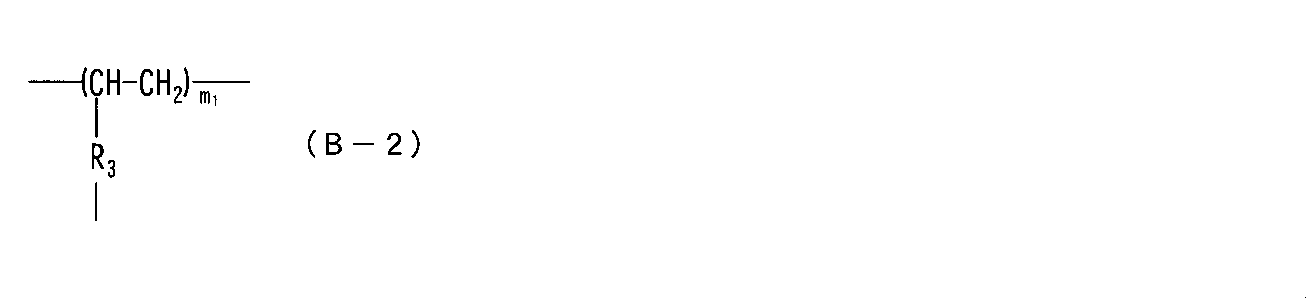
(その一般式(B-2)中、R3は、連結基又は単結合を示し、m1は1~10の整数である。)
(5)そのR3が置換又は無置換のフェニレン基であることを特徴とする、第(4)項に記載のアントラキノン誘導体B。
(6)第(4)項又は第(5)項に記載のアントラキノン誘導体Bを含有することを特徴とする、リチウムイオン二次電池用の正極活物質。
(7)下記一般式(C-1)で表されることを特徴とする、アントラキノン誘導体C1。
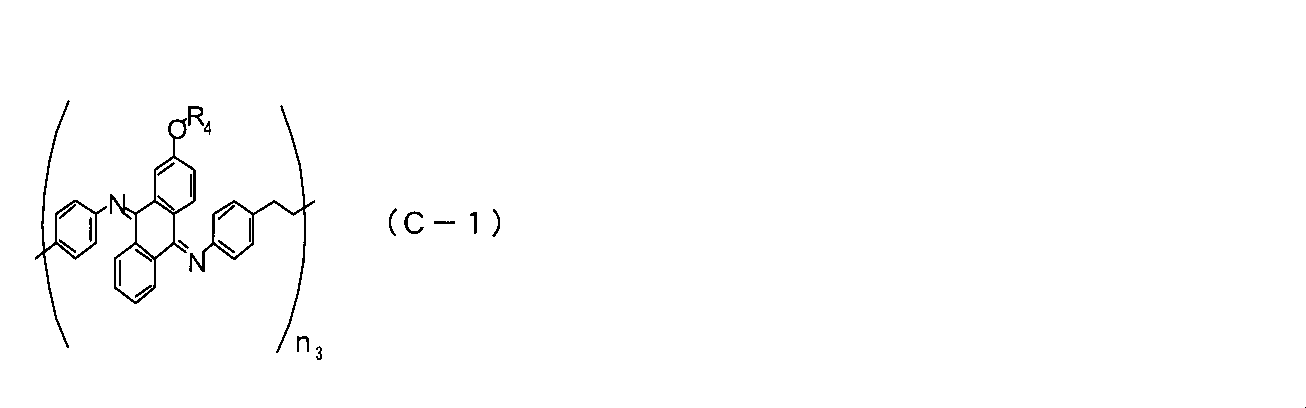
(その一般式(C-1)中、R4は、置換若しくは無置換の脂肪族炭化水素基、又は置換若しくは無置換の芳香族炭化水素基を示し、n3は1~100の整数である。)
(8)そのR4が、メトキシメチル基又はp-メトキシベンジル基であることを特徴とする、第(7)項に記載のアントラキノン誘導体C1。
(9)下記一般式(C-2)で表されることを特徴とする、アントラキノン誘導体C2。
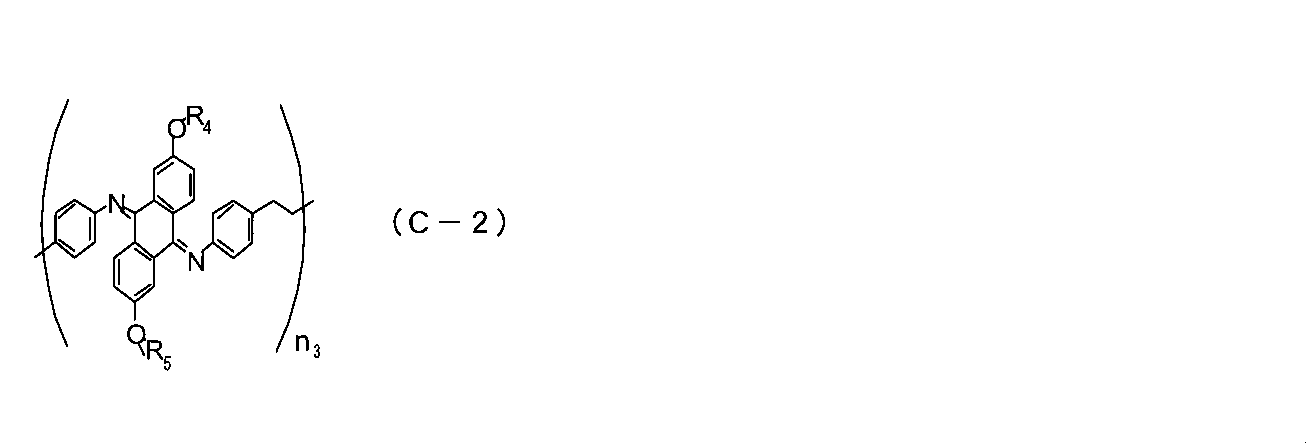
(その一般式(C-2)中のR4はその一般式(C-1)中のR4と同義であり、その一般式(C-2)中、R5は置換若しくは無置換の脂肪族炭化水素基、又は置換若しくは無置換の芳香族炭化水素基を示し、n3は1~100の整数である。)
(10)そのR4及び/又はそのR5が、メトキシメチル基及び/又はp-メトキシベンジル基であることを特徴とする、第(9)項に記載のアントラキノン誘導体C2。
(11)第(7)項又は第(8)項に記載のアントラキノン誘導体C1を含有することを特徴とする、リチウムイオン二次電池用の正極活物質。
(12)第(9)項又は第(10)項に記載のアントラキノン誘導体C2を含有することを特徴とする、リチウムイオン二次電池用の正極活物質。
(13)下記一般式(D-1)で表されることを特徴とする、アントラキノン誘導体D。

(その一般式(D-1)中、R6は、置換若しくは無置換の脂肪族炭化水素基、置換若しくは無置換の芳香族炭化水素基、又は下記一般式(D-2)で表される基を示し、n4は1~100の整数であり、m2は0又は1~100の整数である。)

(その一般式(D-2)中、R7は、置換若しくは無置換の脂肪族炭化水素基、又は置換若しくは無置換の芳香族炭化水素基を示す。)
(14)そのR6がヘテロ原子を有する置換基であることを特徴とする、第(13)項に記載のアントラキノン誘導体D。
(15)そのR7がヘテロ原子を有する置換基であることを特徴とする、第(13)項又は第(14)項に記載のアントラキノン誘導体D。
(16)第(13)項から第(15)項のいずれか1項に記載のアントラキノン誘導体Dを含有することを特徴とする、リチウムイオン二次電池用の正極活物質。
(17)第(3)項、第(6)項、第(11)項、第(12)項又は第(16)項に記載の正極活物質が集電体の少なくとも表面に備えられることを特徴とする、リチウムイオン二次電池用の正極。
(18)正極と、負極と、電解質とを少なくとも構成要素とするリチウムイオン二次電池において、該正極が第(17)項に記載の正極であることを特徴とする、リチウムイオン二次電池。
(19)第(18)項に記載のリチウムイオン二次電池を搭載した車両。
(1)下記一般式(A-1)で表されることを特徴とする、アントラキノン誘導体A。
(2)そのR1が置換若しくは無置換のフェニレン基又は置換若しくは無置換のチエニレン基であることを特徴とする、第(1)項に記載のアントラキノン誘導体A。
(3)第(1)項又は第(2)項に記載のアントラキノン誘導体Aを含有することを特徴とする、リチウムイオン二次電池用の正極活物質。
(4)下記一般式(B-1)で表されることを特徴とする、アントラキノン誘導体B。
(5)そのR3が置換又は無置換のフェニレン基であることを特徴とする、第(4)項に記載のアントラキノン誘導体B。
(6)第(4)項又は第(5)項に記載のアントラキノン誘導体Bを含有することを特徴とする、リチウムイオン二次電池用の正極活物質。
(7)下記一般式(C-1)で表されることを特徴とする、アントラキノン誘導体C1。
(8)そのR4が、メトキシメチル基又はp-メトキシベンジル基であることを特徴とする、第(7)項に記載のアントラキノン誘導体C1。
(9)下記一般式(C-2)で表されることを特徴とする、アントラキノン誘導体C2。
(10)そのR4及び/又はそのR5が、メトキシメチル基及び/又はp-メトキシベンジル基であることを特徴とする、第(9)項に記載のアントラキノン誘導体C2。
(11)第(7)項又は第(8)項に記載のアントラキノン誘導体C1を含有することを特徴とする、リチウムイオン二次電池用の正極活物質。
(12)第(9)項又は第(10)項に記載のアントラキノン誘導体C2を含有することを特徴とする、リチウムイオン二次電池用の正極活物質。
(13)下記一般式(D-1)で表されることを特徴とする、アントラキノン誘導体D。
(14)そのR6がヘテロ原子を有する置換基であることを特徴とする、第(13)項に記載のアントラキノン誘導体D。
(15)そのR7がヘテロ原子を有する置換基であることを特徴とする、第(13)項又は第(14)項に記載のアントラキノン誘導体D。
(16)第(13)項から第(15)項のいずれか1項に記載のアントラキノン誘導体Dを含有することを特徴とする、リチウムイオン二次電池用の正極活物質。
(17)第(3)項、第(6)項、第(11)項、第(12)項又は第(16)項に記載の正極活物質が集電体の少なくとも表面に備えられることを特徴とする、リチウムイオン二次電池用の正極。
(18)正極と、負極と、電解質とを少なくとも構成要素とするリチウムイオン二次電池において、該正極が第(17)項に記載の正極であることを特徴とする、リチウムイオン二次電池。
(19)第(18)項に記載のリチウムイオン二次電池を搭載した車両。
本発明によれば、多電子移動性に優れ、リチウムイオン二次電池用途に適したアントラキノン誘導体が提供され、並びに、アントラキノン誘導体を含有するリチウムイオン二次電池用の正極活物質、正極活物質を備える正極、及び正極を構成要素とするリチウムイオン二次電池が提供される。
以下、本発明について更に詳しく説明をする。
(1)アントラキノン誘導体A
本発明によるアントラキノン誘導体Aは、下記一般式(A-1)で表されることを特徴とする。
本発明によるアントラキノン誘導体Aは、下記一般式(A-1)で表されることを特徴とする。
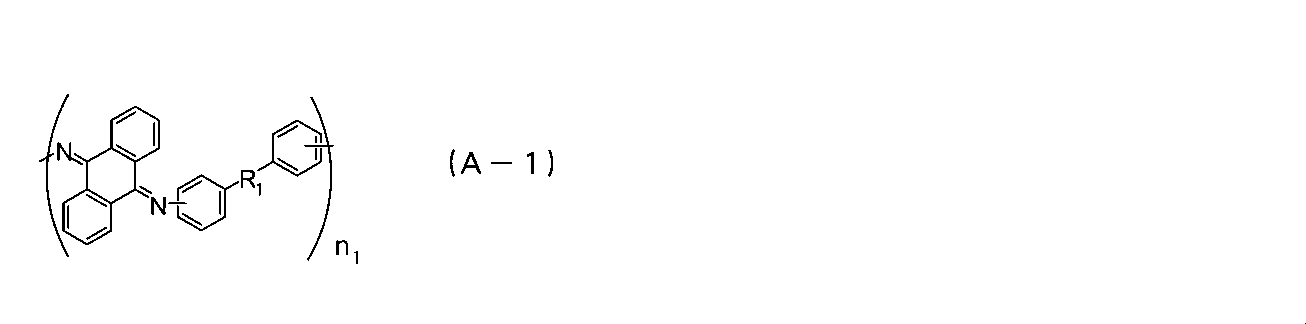
一般式(A-1)中、R1は、置換若しくは無置換の脂肪族炭化水素基、又は置換若しくは無置換の芳香族炭化水素基を示し、n1は1~100の整数である。ここで、置換の脂肪族炭化水素基、又は置換の芳香族炭化水素基とは、脂肪族炭化水素基、又は芳香族炭化水素基が、更に置換基で置換されることを意味し、例えば、置換のアリーレン基又は置換の環状置換基である場合は、そのアリーレン基部分又はその環状置換基の環上部分に少なくとも1つの置換基を有することを意味する。
R1は、2価の置換若しくは無置換の脂肪族炭化水素基、又は2価の置換若しくは無置換の芳香族炭化水素基であれば、特に限定されることはないが、例えば、置換又は無置換のメチレン基、置換又は無置換のエチレン基、置換又は無置換のプロピレン基、置換又は無置換のエーテル基、置換又は無置換のチオエーテル基、置換又は無置換のフェニレン基、置換又無置換のビフェニレン基、置換又は無置換のチオフェニレン基、置換又は無置換のチエニレン基、置換又は無置換のフラニレン基、置換又は無置換のピロリレン基等が挙げられる。
R1が、置換基で置換される時の置換基としては、特に限定されることはないが、例えば、置換又は無置換のメチル基、置換又は無置換のエチル基、置換又は無置換のプロピル基、置換又は無置換のフェニル基、置換又無置換のビフェニル基、置換又は無置換のチオフェニル基、置換又は無置換のチエニル基、置換又は無置換のフラニル基、置換又は無置換のピロリル基等が挙げられる。
R1は、置換若しくは無置換のフェニレン基又は置換若しくは無置換のチエニレン基であることが好ましく、無置換のフェニレン基又は無置換のチエニレン基であることがより好ましい。
n1は重合度を示す1~100の整数である。n1は、2以上の整数であることが好ましい。
本発明によるアントラキノン誘導体Aの好ましい具体的例示化合物を示すが、本発明によるアントラキノン誘導体Aは、これらの化合物に限定されることはない。
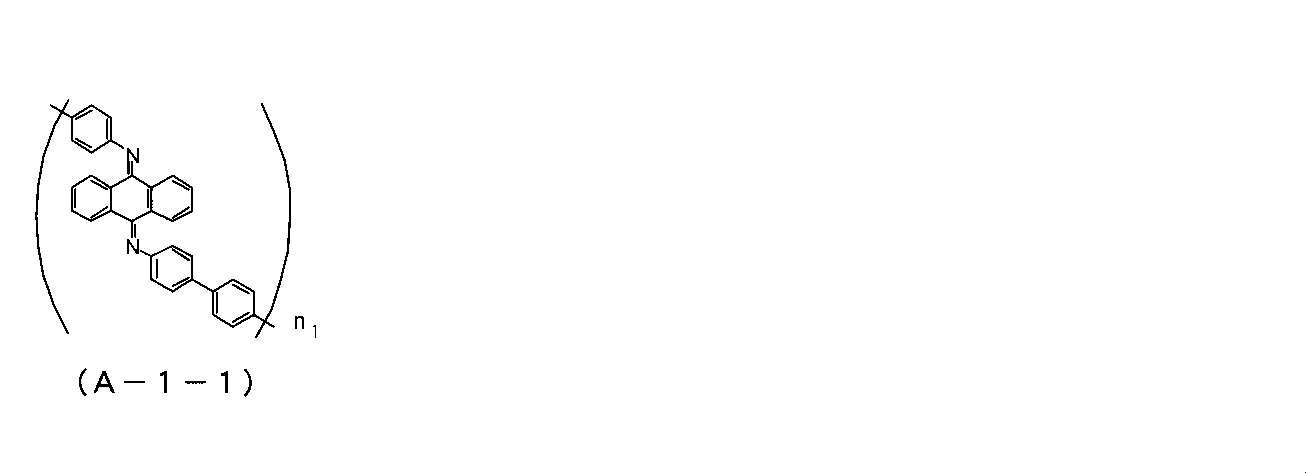

次に、本発明によるアントラキノン誘導体Aの合成方法について述べる。本発明によるアントラキノン誘導体Aの合成経路は以下である。
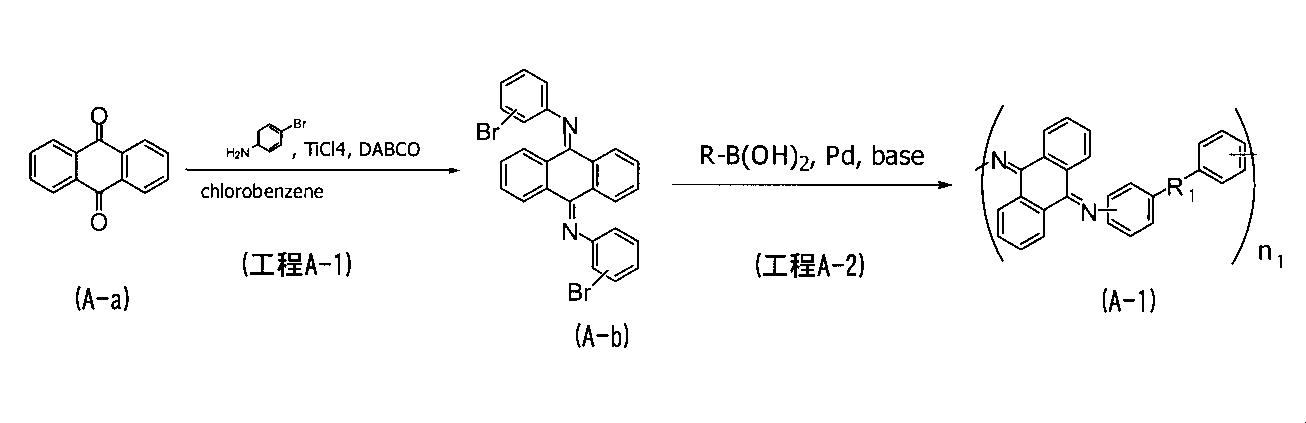
本発明によるアントラキノン誘導体Aの合成方法は、アントラキノン(A-a)、4-ブロモアニリン及び1,4-ジアザビシクロ[2,2,2]オクタンのクロロホルム溶液に、塩化チタン(IV)クロロホルム溶液を添加して、イミン(A-b)を合成して(工程A-1)、そのイミン(A-b)と、置換ジボロン酸と、塩基との溶媒の溶液にPd触媒を添加して、本発明によるアントラキノン誘導体(A-1)が合成される(工程A-2)。
(2)リチウムイオン二次電池用のアントラキノン誘導体Aを含有する正極活物質
本発明によるリチウムイオン二次電池用の正極活物質は、本発明によるアントラキノン誘導体Aを含有することを特徴とする。ここで、リチウムイオン二次電池用のアントラキノン誘導体Aを含有する正極活物質とは、リチウムイオン二次電池の充電反応及び放電反応などの電極反応において、リチウムイオン二次電池の正極で直接寄与する物質のことをいう。
本発明によるリチウムイオン二次電池用の正極活物質は、本発明によるアントラキノン誘導体Aを含有することを特徴とする。ここで、リチウムイオン二次電池用のアントラキノン誘導体Aを含有する正極活物質とは、リチウムイオン二次電池の充電反応及び放電反応などの電極反応において、リチウムイオン二次電池の正極で直接寄与する物質のことをいう。
(3)アントラキノン誘導体B
本発明によるアントラキノン誘導体Bは、下記一般式(B-1)で表されることを特徴とする。
本発明によるアントラキノン誘導体Bは、下記一般式(B-1)で表されることを特徴とする。
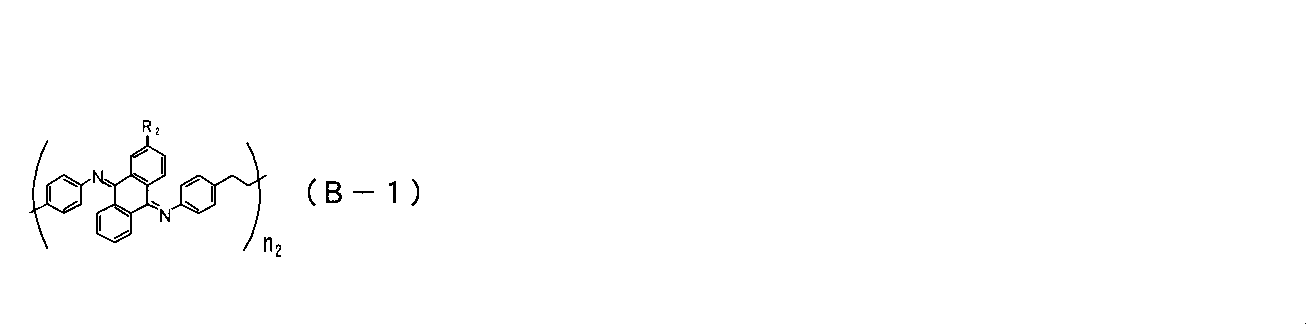
一般式(B-1)中、R2は、置換若しくは無置換の脂肪族炭化水素基、置換若しくは無置換の芳香族炭化水素基、又は下記一般式(B-2)で表される基を示し、n2は1~100の整数である。ここで、R2における置換の脂肪族炭化水素基、又は置換の芳香族炭化水素基とは、脂肪族炭化水素基、又は芳香族炭化水素基が、置換基で更に置換されることを意味し、例えば、置換のアリール基又は置換の環状置換基である場合は、そのアリール基部分又はその環状置換基の環上部分に少なくとも1つの置換基を有することを意味する。

一般式(B-2)中、R3は、連結基又は単結合を示し、m1は1~10の整数である。
R2が置換若しくは無置換の脂肪族炭化水素基又は置換若しくは無置換の芳香族炭化水素基である場合、1価の置換若しくは無置換の脂肪族炭化水素基、置換若しくは無置換の芳香族炭化水素基であれば、特に限定されることはないが、例えば、置換又は無置換のメチル基、置換又は無置換のエチル基、置換又は無置換のn-プロピル基、置換又は無置換のイソプロピル基、置換又は無置換のn-ブチル基、置換又は無置換のsec-ブチル基、置換又は無置換のイソブチル基、置換又は無置換のtert-ブチル基、置換又は無置換のn-ペンチル基、置換又は無置換のイソペンチル基等の置換又は無置換のアルキル基、置換又は無置換のシクロペンチル基、置換又は無置換のシクロヘキシル基等の置換又は無置換の環状アルキル基、置換又は無置換のビニル基、置換又は無置換のアリル基等の置換又は無置換のアルケニル基、置換又は無置換のフェニル基、置換又は無置換のトリル基、置換又は無置換のナフチル基等の置換又は無置換のアリール基が挙げられる。
R2が置換若しくは無置換の脂肪族炭化水素基又は置換若しくは無置換の芳香族炭化水素基である場合、置換基で更に置換される時の置換基としては、特に限定されることはないが、例えば、置換又は無置換のフェニル基、置換又は無置換のトリル基、置換又は無置換のナフチル基等の置換又は無置換のアリール基、置換又は無置換のメトキシ基、置換又は無置換のエトキシ基、置換又は無置換のプロピオキシ基、置換又は無置換のイソプロピオキシ基、置換又は無置換のブトキシ基、置換又は無置換のsec-ブトキシ基、置換又は無置換のtert-ブトキシ基等の置換又は無置換のアルコキシ基が挙げられる。
R2が置換若しくは無置換の脂肪族炭化水素基又は置換若しくは無置換の芳香族炭化水素基である場合、R2は、下記の構造式を有することが好ましい。

R2が一般式(B-2)で表される基である場合、R3は連結基又は単結合を示す。R3が連結基である場合、2価の置換基であれば、特に限定されることはないが、例えば、置換又は無置換のメチレン基、置換又は無置換のエチレン基、置換又は無置換のプロピレン基、置換又は無置換のエーテル基、置換又は無置換のチオエーテル基、置換又は無置換のフェニレン基、置換又は無置換のビフェニレン基、置換又は無置換のチオフェニレン基、置換又は無置換のチエニレン基、置換又は無置換のフラニレン基、置換又は無置換のピロリレン基、置換又は無置換のアミド基等が挙げられる。ここで、置換のメチレン基等とは、メチレン基部分等に少なくとも1つの置換基を更に有することを意味する。
R3が、2価の置換基である場合、置換基で更に置換される時の置換基としては、特に限定されることはないが、例えば、置換又は無置換のメチル基、置換又は無置換のエチル基、置換又は無置換のプロピル基、置換又は無置換のフェニル基、置換又は無置換のビフェニル基、置換又は無置換のチオフェニル基、置換又は無置換のチエニル基、置換又は無置換のフラニル基、置換又は無置換のピロリル基等が挙げられる。
R3は置換又は無置換のフェニレン基であることが好ましく、無置換のフェニレン基であることがより好ましい。
n2は重合度を示す1~100の整数である。n2は、6以上の整数であることが好ましい。
m1は重合度を示す1~10の整数である。m1は、2以上の整数であることが好ましい。
本発明によるアントラキノン誘導体Bの好ましい具体的例示化合物を示すが、本発明によるアントラキノン誘導体Bは、これらの化合物に限定されることはない。

次に、本発明によるアントラキノン誘導体Bの合成方法について述べる。本発明によるアントラキノン誘導体Bの合成経路は以下である。

2-ブロモアントラキノン(B-a)、4-ビニルフェニルボロン酸及びリン酸ナトリウム三塩基性12水のトルエン溶液に、テトラキス[トリフェニルホスフィン]パラジウム(0)を室温で添加してキニン(B-b)を合成し(工程B-1)、そのキニン(B-b)と、1,4-ジアザビシクロ[2,2,2]オクタン(78mg、0.70mmol)と、アニリンとのクロロベンゼン溶液に塩化チタン(IV)クロロベンゼン溶液を添加して、アントラキノン誘導体(B-1)を合成する(工程B-2)。
さらに、工程B-3として(上記の合成経路では図示されていない。)、オレフィンを導入したアントラキノン誘導体(B-1)のテトラヒドロフラン溶液(2ml)に、2,2’-アゾビス(イソブチロニトリル)(10mg、0.06mmol)を室温で添加して、アントラキノン誘導体(B-1)のオレフィン部を架橋させることができる。
(4)リチウムイオン二次電池用のアントラキノン誘導体Bを含有する正極活物質
本発明によるリチウムイオン二次電池用の正極活物質は、本発明によるアントラキノン誘導体Bを含有することを特徴とする。ここで、リチウムイオン二次電池用のアントラキノン誘導体Bを含有する正極活物質とは、リチウムイオン二次電池の充電反応及び放電反応などの電極反応において、リチウムイオン二次電池の正極で直接寄与する物質のことをいう。
本発明によるリチウムイオン二次電池用の正極活物質は、本発明によるアントラキノン誘導体Bを含有することを特徴とする。ここで、リチウムイオン二次電池用のアントラキノン誘導体Bを含有する正極活物質とは、リチウムイオン二次電池の充電反応及び放電反応などの電極反応において、リチウムイオン二次電池の正極で直接寄与する物質のことをいう。
(5)アントラキノン誘導体C1及びC2
本発明によるアントラキノン誘導体C1は、下記一般式(C-1)で表されることを特徴とする。
本発明によるアントラキノン誘導体C1は、下記一般式(C-1)で表されることを特徴とする。

一般式(C-1)中、R4は、置換若しくは無置換の脂肪族炭化水素基、又は置換若しくは無置換の芳香族炭化水素基を示し、n3は1~100の整数である。ここで、R4における置換の脂肪族炭化水素基、又は置換の芳香族炭化水素基とは、脂肪族炭化水素基、又は芳香族炭化水素基が、置換基で更に置換されることを意味し、例えば、置換のアリール基又は置換の環状置換基である場合は、そのアリール基部分又はその環状置換基の環上部分に少なくとも1つの置換基を有することを意味する。
R4は、1価の置換若しくは無置換の脂肪族炭化水素基、置換若しくは無置換の芳香族炭化水素基であれば、特に限定されることはないが、例えば、置換又は無置換のメチル基、置換又は無置換のエチル基、置換又は無置換のn-プロピル基、置換又は無置換のイソプロピル基、置換又は無置換のn-ブチル基、置換又は無置換のsec-ブチル基、置換又は無置換のイソブチル基、置換又は無置換のtert-ブチル基、置換又は無置換のn-ペンチル基、置換又は無置換のイソペンチル基等の置換又は無置換のアルキル基、置換又は無置換のシクロペンチル基、置換又は無置換のシクロヘキシル基等の置換又は無置換の環状アルキル基、置換又は無置換のビニル基、置換又は無置換のアリル基等の置換又は無置換のアルケニル基、置換又は無置換のフェニル基、置換又は無置換のトリル基、置換又は無置換のナフチル基等の置換又は無置換のアリール基、置換又は無置換のベンジル基等の置換又は無置換の芳香族アルキル基等が挙げられる。
R4が、置換基で更に置換される時の置換基としては、特に限定されることはないが、例えば、置換又は無置換のフェニル基、置換又は無置換のトリル基、置換又は無置換のナフチル基等の置換又は無置換のアリール基、置換又は無置換のメトキシ基、置換又は無置換のエトキシ基、置換又は無置換のプロピオキシ基、置換又は無置換のイソプロピオキシ基、置換又は無置換のブトキシ基、置換又は無置換のsec-ブトキシ基、置換又は無置換のtert-ブトキシ基等の置換又は無置換のアルコキシ基、置換又は無置換のジオキソラニル基、置換又は無置換のジオキサニル基等が挙げられる。
R4は、下記の構造式(C-A~C-K)を有することが好ましく、構造式C-A(メトキシメチル基)及びC-K(p-メトキシベンジル基)がより好ましい。
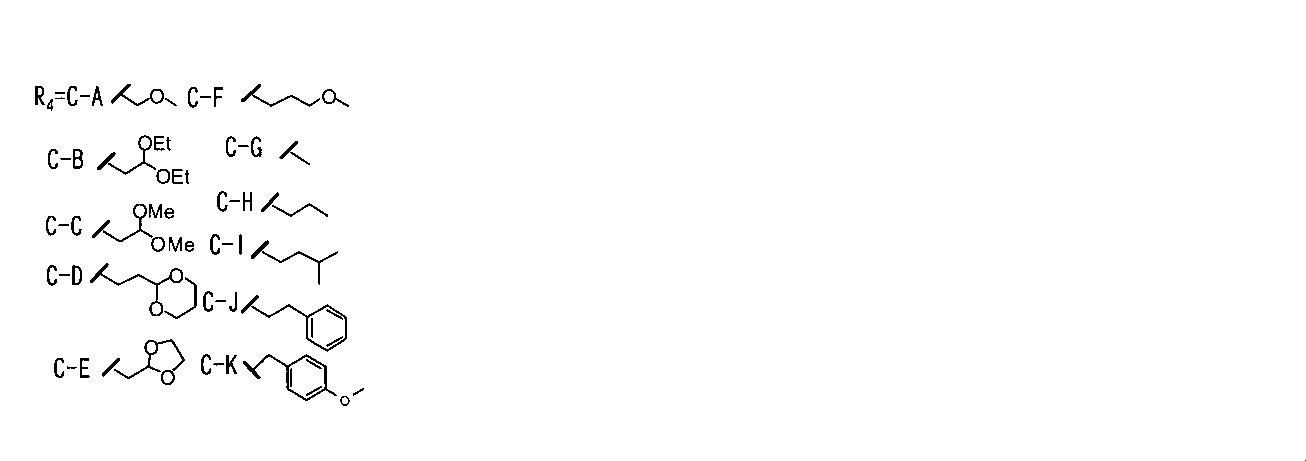
本発明によるアントラキノン誘導体C2は、下記一般式(C-2)で表されることを特徴とする。

一般式(C-2)中のR4は一般式(1)中のR4と同義であり、その一般式(2)中、R5は置換若しくは無置換の脂肪族炭化水素基、又は置換若しくは無置換の芳香族炭化水素基を示し、n3は1~100の整数である。ここで、R5における置換の脂肪族炭化水素基、又は置換の芳香族炭化水素基とは、上記で述べたR4についてと同様に、脂肪族炭化水素基、又は芳香族炭化水素基が、置換基で更に置換されることを意味し、例えば、置換のアリール基又は置換の環状置換基である場合は、そのアリール基部分又はその環状置換基の環上部分に少なくとも1つの置換基を有することを意味する。
R5は、1価の置換若しくは無置換の脂肪族炭化水素基、置換若しくは無置換の芳香族炭化水素基であれば、特に限定されることはないが、例えば、置換又は無置換のメチル基、置換又は無置換のエチル基、置換又は無置換のn-プロピル基、置換又は無置換のイソプロピル基、置換又は無置換のn-ブチル基、置換又は無置換のsec-ブチル基、置換又は無置換のイソブチル基、置換又は無置換のtert-ブチル基、置換又は無置換のn-ペンチル基、置換又は無置換のイソペンチル基等の置換又は無置換のアルキル基、置換又は無置換のシクロペンチル基、置換又は無置換のシクロヘキシル基等の置換又は無置換の環状アルキル基、置換又は無置換のビニル基、置換又は無置換のアリル基等の置換又は無置換のアルケニル基、置換又は無置換のフェニル基、置換又は無置換のトリル基、置換又は無置換のナフチル基等の置換又は無置換のアリール基、置換又は無置換のベンジル基等の置換又は無置換の芳香族アルキル基等が挙げられる。
R5が、置換基で更に置換される時の置換基としては、特に限定されることはないが、例えば、置換又は無置換のフェニル基、置換又は無置換のトリル基、置換又は無置換のナフチル基等の置換又は無置換のアリール基、置換又は無置換のメトキシ基、置換又は無置換のエトキシ基、置換又は無置換のプロピオキシ基、置換又は無置換のイソプロピオキシ基、置換又は無置換のブトキシ基、置換又は無置換のsec-ブトキシ基、置換又は無置換のtert-ブトキシ基等の置換又は無置換のアルコキシ基、置換又は無置換のジオキソラニル基、置換又は無置換のジオキサニル基等が挙げられる。
R5は下記の構造式(C-A~C-K)であることが好ましく、構造式C-A(メトキシメチル基)及びC-K(p-メトキシベンジル基)であることがより好ましい。
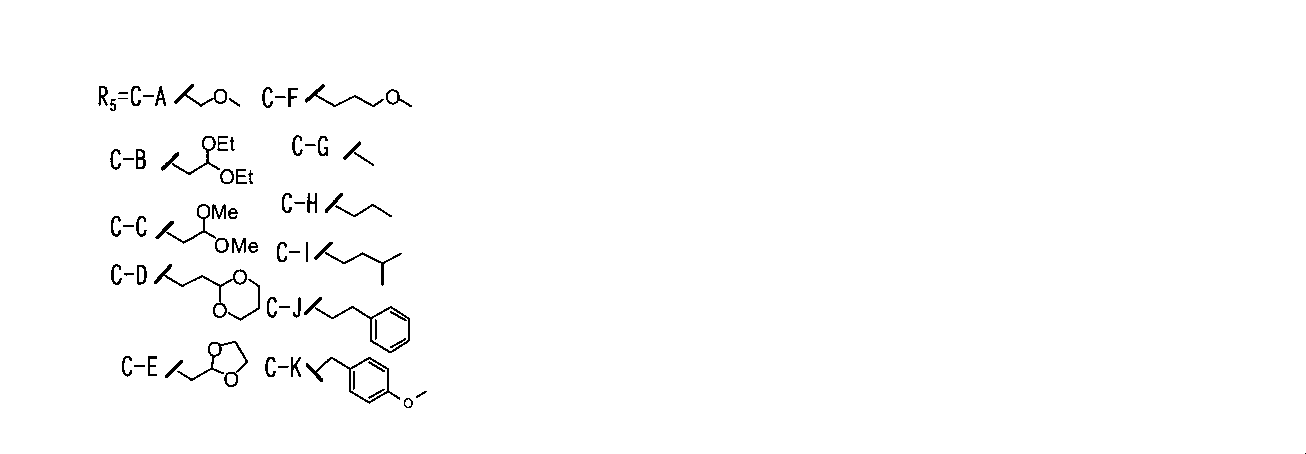
R4及びR5が、構造式A(メトキシメチル基)及び/又は構造式K(p-メトキシベンジル基)であることが更に好ましい。
n3は重合度を示す1~100の整数である。n3は、6以上の整数であることが好ましい。
本発明によるアントラキノン誘導体C1及びC2の好ましい具体的例示化合物(C-1-A~C-1-K、C-2-A~C-2-K)を示すが、本発明によるアントラキノン誘導体C1及びC2は、これらの化合物に限定されることはない。
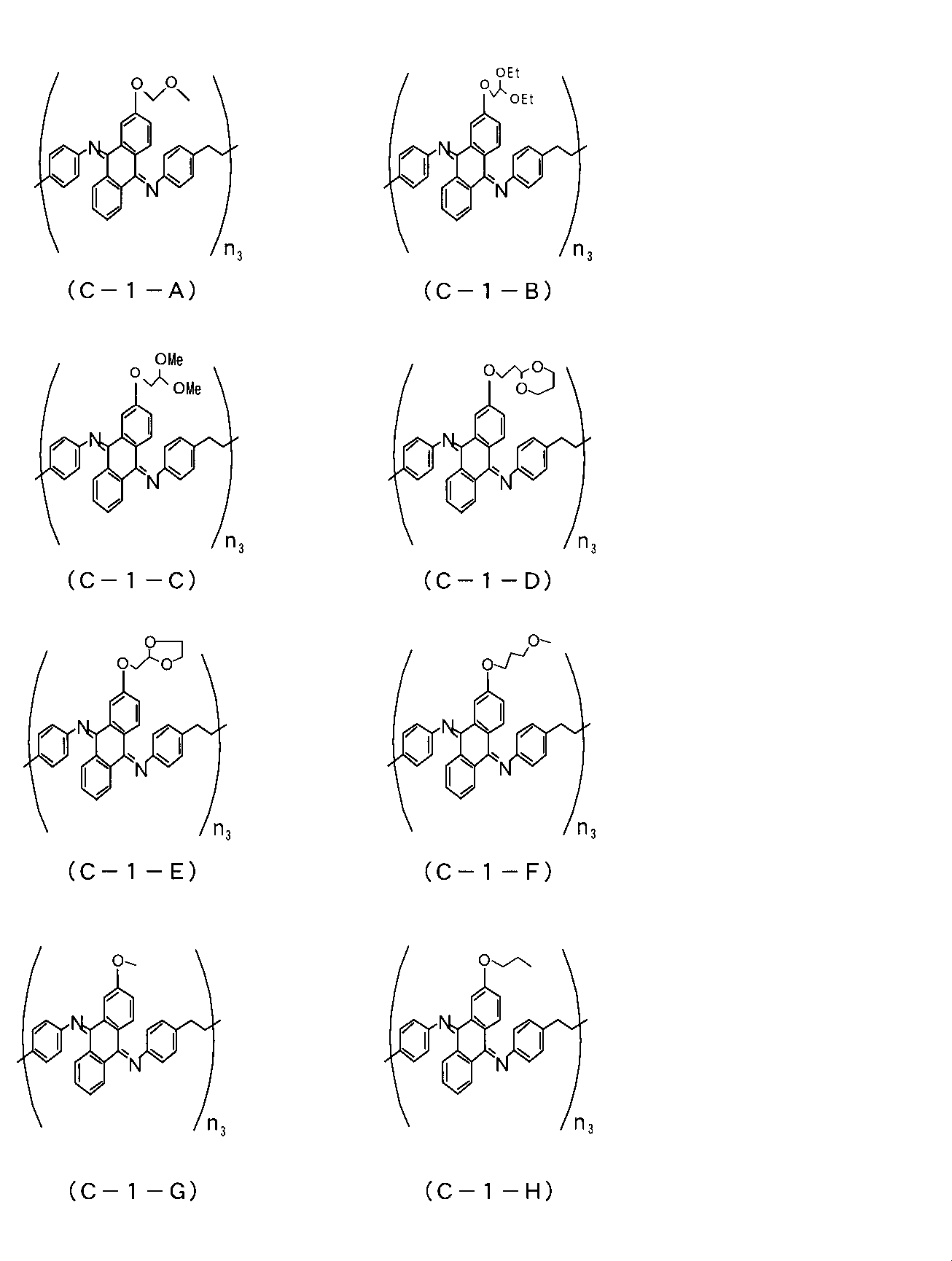

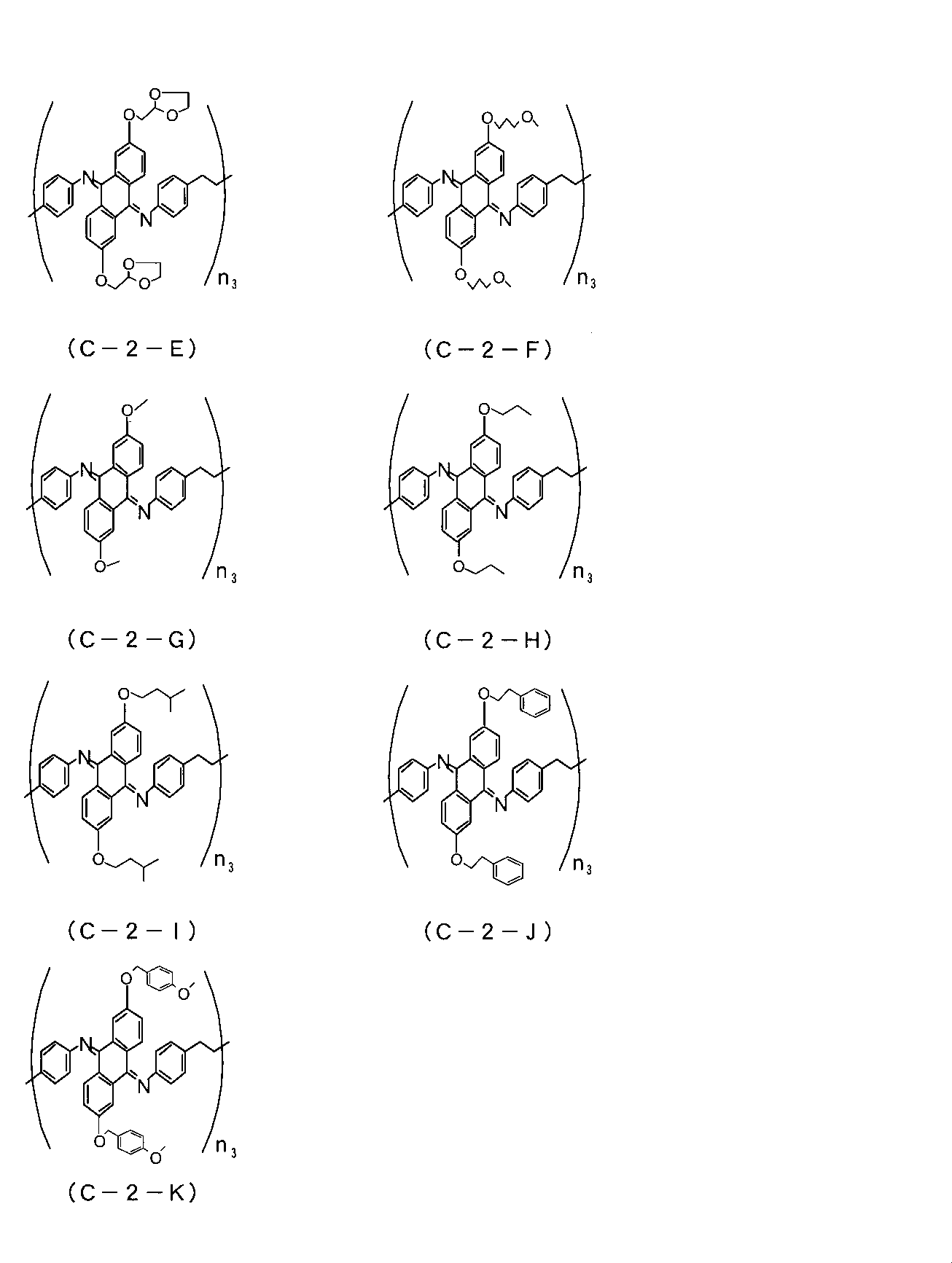
次に、本発明によるアントラキノン誘導体C1及びC2の合成方法について述べる。
一般式(C-1)で表される、本発明によるアントラキノン誘導体C1の合成経路は以下である。

2-ヒドロキシアントラキノン(C-a)のジメチルホルムアミド溶液に、水素化ナトリウムを0℃で添加して、その反応混合物にハロゲン化物(R4-X)を添加して、R4の置換基を有するアントラキノン(C-b)を合成し(工程C-1)、その2位にR4の置換基を有するアントラキノン(C-b)と、エチレンジアニリンと、1,4-ジアザビシクロ[2,2,2]オクタンとのクロロベンゼン溶液に塩化チタン(IV)クロロベンゼン溶液を添加して、アントラキノン誘導体(C-1)を合成する。
一般式(C-2)で表される、本発明によるアントラキノン誘導体C2の合成経路は以下である。
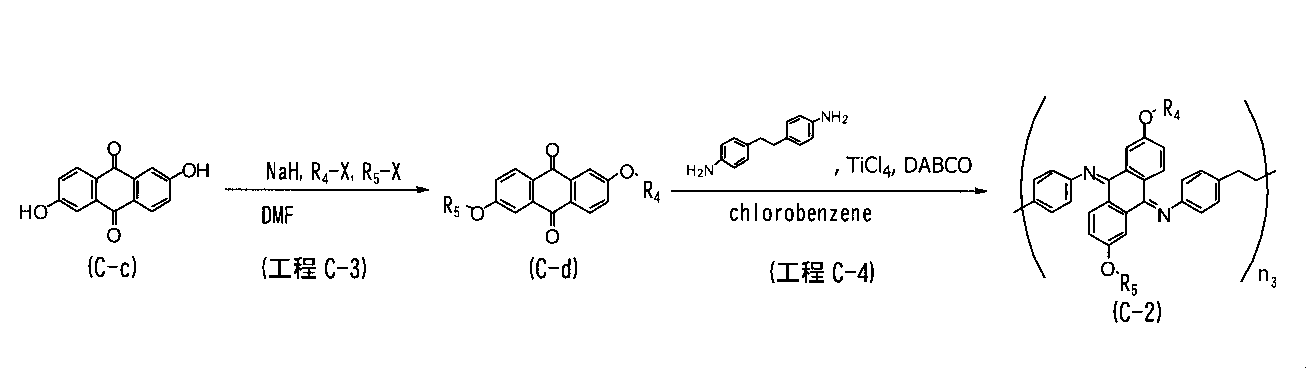
2,6-ジヒドロキシアントラキノン(C-c)のジメチルホルムアミド溶液に、水素化ナトリウムを0℃で添加して、その反応混合物に2つのハロゲン化物(R4-X、R5-X)を添加して、2位にR4の置換基を有し、さらに6位にR5の置換基を有するアントラキノン(C-d)を合成し(工程C-3)、2位にR4の置換基を有し、さらに6位にR5の置換基を有するアントラキノン(C-d)と、エチレンジアニリンと、1,4-ジアザビシクロ[2,2,2]オクタンとのクロロベンゼン溶液に塩化チタン(IV)クロロベンゼン溶液を添加して、アントラキノン誘導体(C-2)を合成した。
(6)リチウムイオン二次電池用のアントラキノン誘導体C1を含有する正極活物質
本発明によるリチウムイオン二次電池用の正極活物質は、本発明によるアントラキノン誘導体C1を含有することを特徴とする。ここで、リチウムイオン二次電池用のアントラキノン誘導体C1を含有する正極活物質とは、リチウムイオン二次電池の充電反応及び放電反応などの電極反応において、リチウムイオン二次電池の正極で直接寄与する物質のことをいう。
本発明によるリチウムイオン二次電池用の正極活物質は、本発明によるアントラキノン誘導体C1を含有することを特徴とする。ここで、リチウムイオン二次電池用のアントラキノン誘導体C1を含有する正極活物質とは、リチウムイオン二次電池の充電反応及び放電反応などの電極反応において、リチウムイオン二次電池の正極で直接寄与する物質のことをいう。
(7)リチウムイオン二次電池用のアントラキノン誘導体C2を含有する正極活物質
本発明によるリチウムイオン二次電池用の正極活物質は、本発明によるアントラキノン誘導体C2を含有することを特徴とする。ここで、リチウムイオン二次電池用のアントラキノン誘導体C2を含有する正極活物質とは、リチウムイオン二次電池の充電反応及び放電反応などの電極反応において、リチウムイオン二次電池の正極で直接寄与する物質のことをいう。
本発明によるリチウムイオン二次電池用の正極活物質は、本発明によるアントラキノン誘導体C2を含有することを特徴とする。ここで、リチウムイオン二次電池用のアントラキノン誘導体C2を含有する正極活物質とは、リチウムイオン二次電池の充電反応及び放電反応などの電極反応において、リチウムイオン二次電池の正極で直接寄与する物質のことをいう。
(8)アントラキノン誘導体D
本発明によるアントラキノン誘導体Dは、下記一般式(D-1)で表されることを特徴とする。
本発明によるアントラキノン誘導体Dは、下記一般式(D-1)で表されることを特徴とする。

一般式(D-1)中、R6は、置換若しくは無置換の脂肪族炭化水素基、置換若しくは無置換の芳香族炭化水素基、又は下記一般式(D-2)で表される基を示し、n4及びm2は1~100の整数である。ここで、R6における置換の脂肪族炭化水素基、又は置換の芳香族炭化水素基とは、脂肪族炭化水素基、又は芳香族炭化水素基が、置換基で更に置換されることを意味し、例えば、置換のアリール基又は置換の環状置換基である場合は、そのアリール基部分又はその環状置換基の環上部分に少なくとも1つの置換基を有することを意味する。

一般式(D-2)中、R7は、置換若しくは無置換の脂肪族炭化水素基、又は置換若しくは無置換の芳香族炭化水素基を示す。ここで、R7における置換の脂肪族炭化水素基、又は置換の芳香族炭化水素基とは、脂肪族炭化水素基、又は芳香族炭化水素基が、置換基で更に置換されることを意味し、例えば、置換のアリール基又は置換の環状置換基である場合は、そのアリール基部分又はその環状置換基の環上部分に少なくとも1つの置換基を有することを意味する。
R6が置換若しくは無置換の脂肪族炭化水素基又は置換若しくは無置換の芳香族炭化水素基である場合、1価の置換若しくは無置換の脂肪族炭化水素基、置換若しくは無置換の芳香族炭化水素基であれば、特に限定されることはないが、例えば、置換又は無置換のメチル基、置換又は無置換のエチル基、置換又は無置換のn-プロピル基、置換又は無置換のイソプロピル基、置換又は無置換のn-ブチル基、置換又は無置換のsec-ブチル基、置換又は無置換のイソブチル基、置換又は無置換のtert-ブチル基、置換又は無置換のn-ペンチル基、置換又は無置換のイソペンチル基等の置換又は無置換のアルキル基、置換又は無置換のシクロペンチル基、置換又は無置換のシクロヘキシル基等の置換又は無置換の環状アルキル基、置換又は無置換のビニル基、置換又は無置換のアリル基等の置換又は無置換のアルケニル基、置換又は無置換のフェニル基、置換又は無置換のトリル基、置換又は無置換のナフチル基等の置換又は無置換のアリール基等が挙げられる。
R6が置換若しくは無置換の脂肪族炭化水素基又は置換若しくは無置換の芳香族炭化水素基である場合、置換基で更に置換される時の置換基としては、特に限定されることはないが、例えば、置換又は無置換のフェニル基、置換又は無置換のトリル基、置換又は無置換のナフチル基等の置換又は無置換のアリール基、置換又は無置換のメトキシ基、置換又は無置換のエトキシ基、置換又は無置換のプロピオキシ基、置換又は無置換のイソプロピオキシ基、置換又は無置換のブトキシ基、置換又は無置換のsec-ブトキシ基、置換又は無置換のtert-ブトキシ基等の置換又は無置換のアルコキシ基等が挙げられる。
R6が一般式(D-2)で表される基である場合、R7は、1価の置換若しくは無置換の脂肪族炭化水素基、置換若しくは無置換の芳香族炭化水素基であれば、特に限定されることはないが、例えば、置換又は無置換のメチル基、置換又は無置換のエチル基、置換又は無置換のn-プロピル基、置換又は無置換のイソプロピル基、置換又は無置換のn-ブチル基、置換又は無置換のsec-ブチル基、置換又は無置換のイソブチル基、置換又は無置換のtert-ブチル基、置換又は無置換のn-ペンチル基、置換又は無置換のイソペンチル基等の置換又は無置換のアルキル基、置換又は無置換のシクロペンチル基、置換又は無置換のシクロヘキシル基等の置換又は無置換の環状アルキル基、置換又は無置換のビニル基、置換又は無置換のアリル基等の置換又は無置換のアルケニル基、置換又は無置換のフェニル基、置換又は無置換のトリル基、置換又は無置換のナフチル基等の置換又は無置換のアリール基、置換又は無置換のベンジル基等の置換又は無置換の芳香族アルキル基等が挙げられる。
R7が、置換基で更に置換される時の置換基としては、特に限定されることはないが、例えば、置換又は無置換のフェニル基、置換又は無置換のトリル基、置換又は無置換のナフチル基等の置換又は無置換のアリール基、置換又は無置換のメトキシ基、置換又は無置換のエトキシ基、置換又は無置換のプロピオキシ基、置換又は無置換のイソプロピオキシ基、置換又は無置換のブトキシ基、置換又は無置換のsec-ブトキシ基、置換又は無置換のtert-ブトキシ基等の置換又は無置換のアルコキシ基、置換又は無置換のジオキソラニル基、置換又は無置換のジオキサニル基等が挙げられる。
R6はヘテロ原子を有する置換基であることが好ましい。
R7はヘテロ原子を有する置換基であることが好ましく、さらに、下記の構造式(D-A~D-L)であることが好ましく、さらに、構造式D-A(メトキシメチル基)であることがより好ましい。
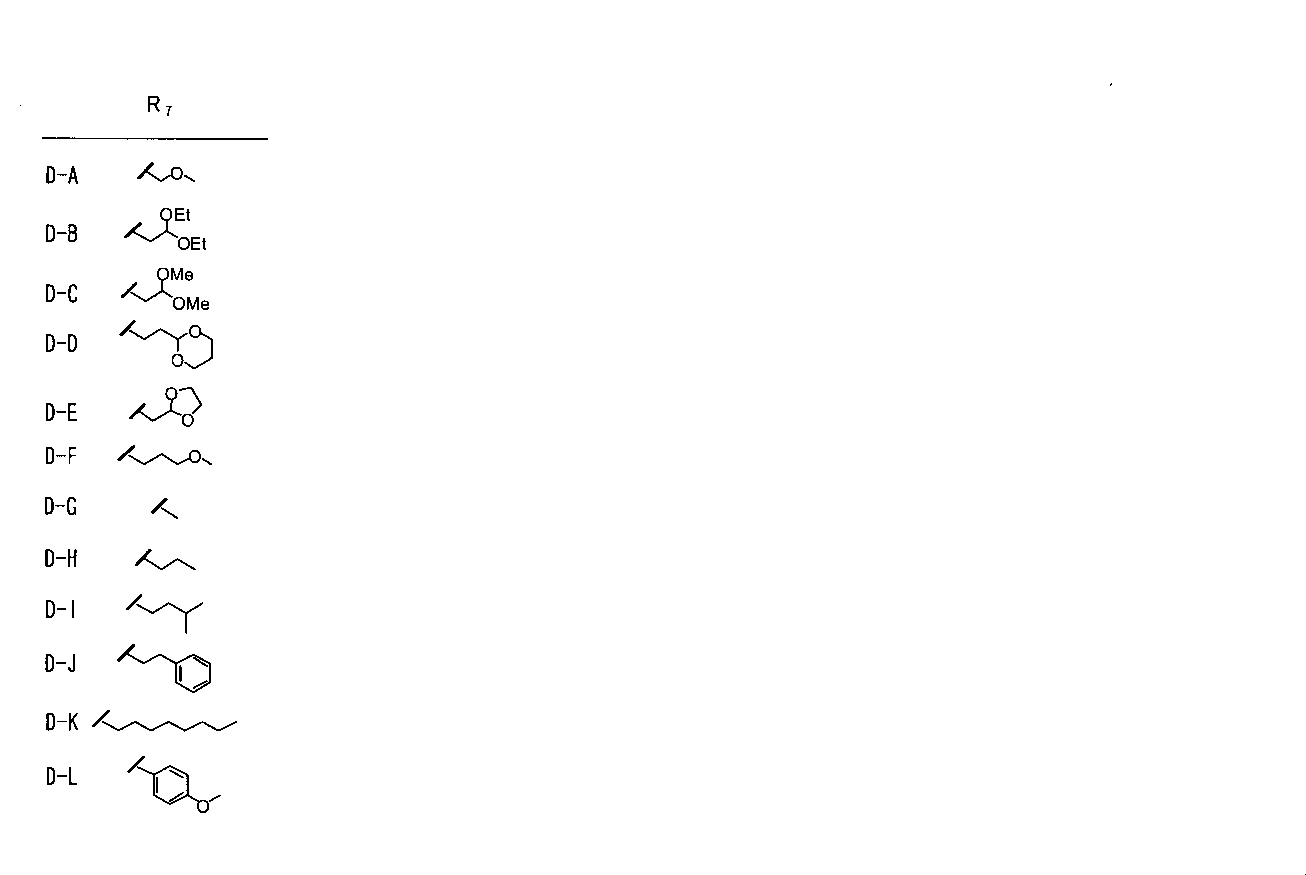
n4は重合度を示す1~100の整数である。n4は、2以上の整数であることが好ましい。
m2は0又は重合度を示す1~100の整数である。m2は、2以上の整数であることが好ましい。
n4とm2との比率(n4:m2)は任意の比率値でよいが、n4:m2=1:5であることが好ましい。
次に、本発明によるアントラキノン誘導体Dの好ましい具体的例示化合物(D-1-A~D-1-M)を示すが、本発明によるアントラキノン誘導体Dは、これらの化合物に限定されることはない。
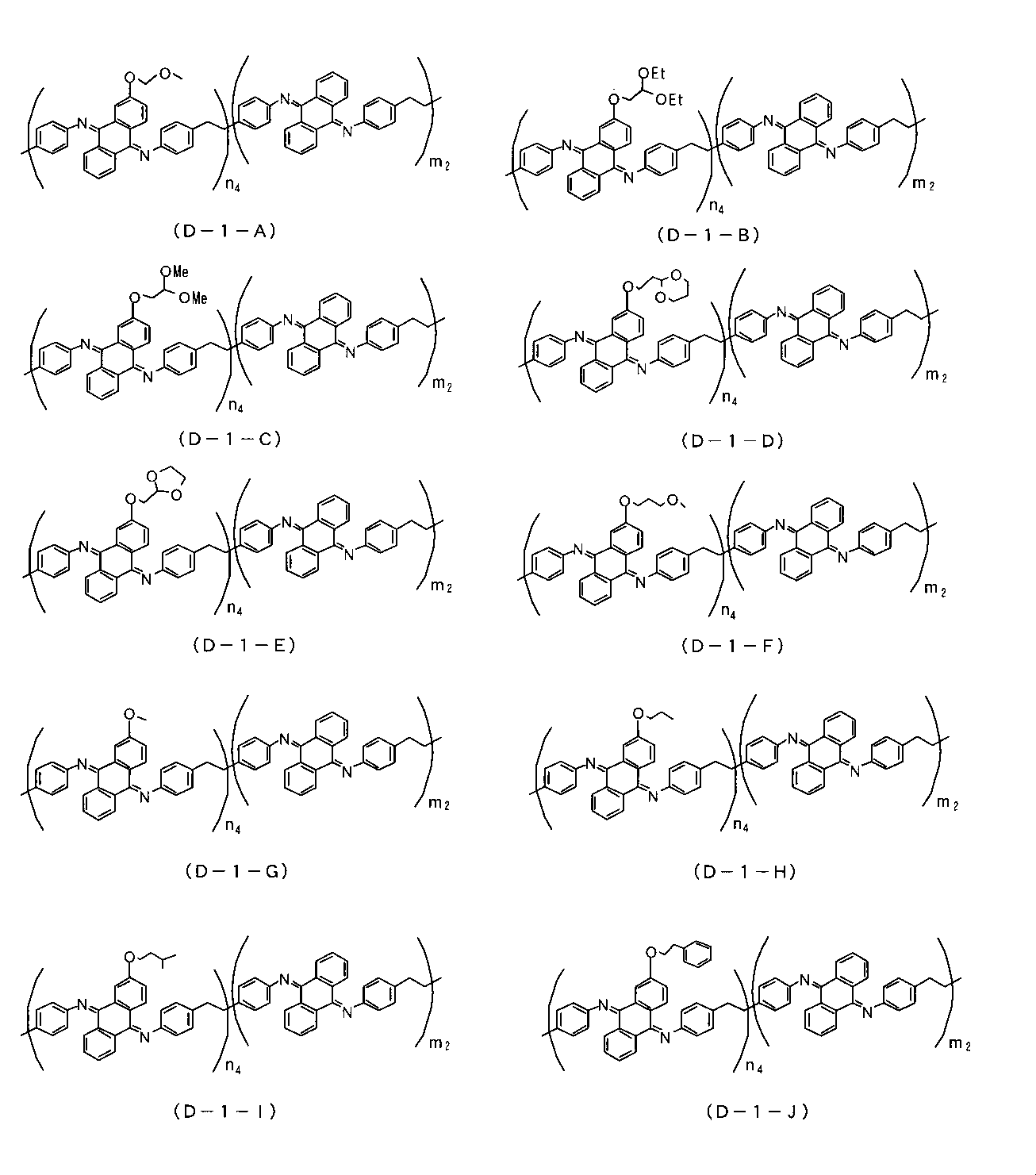
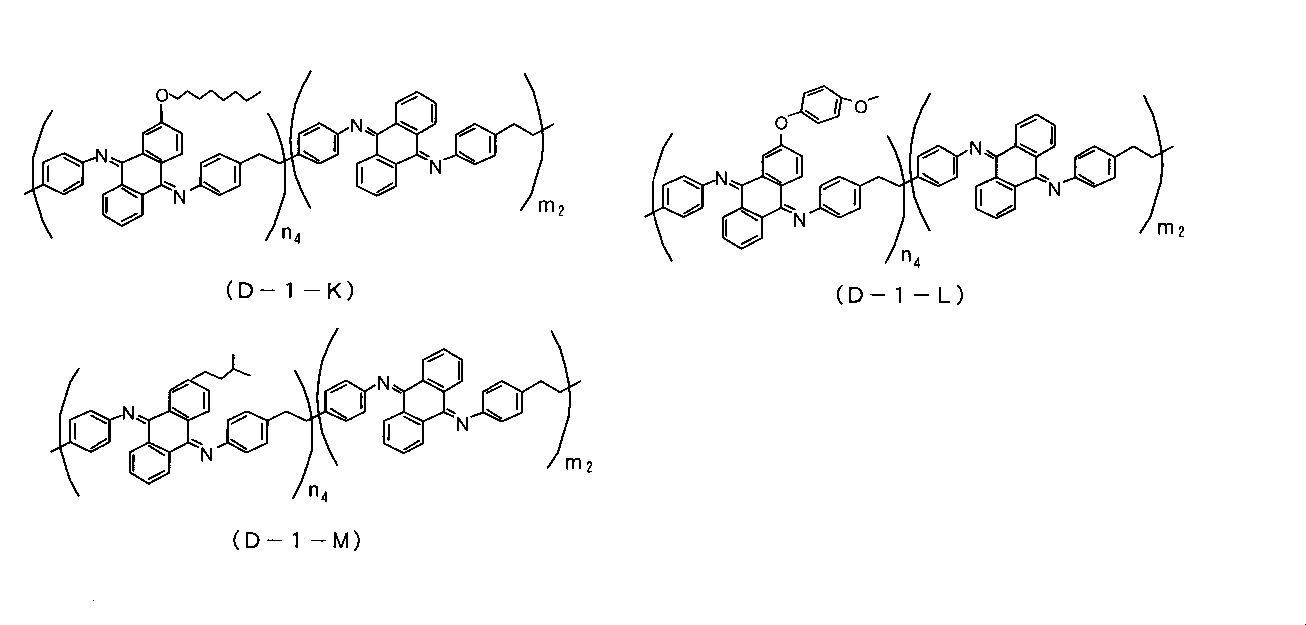
次に、本発明によるアントラキノン誘導体Dの合成方法について述べる。本発明によるアントラキノン誘導体(D-1)の合成経路は以下である。

アントラキノン(D-a)、キノン(D-b)、4,4’-エチレンジアニリン及び1,4-ジアザビシクロ[2,2,2]オクタン(323mg、2.88mmol)のクロロベンゼン(3ml)溶液に、塩化チタン(IV)のクロロベンゼン溶液を添加して、アントラキノン誘導体(D-1)を合成する。
(9)リチウムイオン二次電池用のアントラキノン誘導体Dを含有する正極活物質
本発明によるリチウムイオン二次電池用の正極活物質は、本発明によるアントラキノン誘導体Dを含有することを特徴とする、ここで、リチウムイオン二次電池用のアントラキノン誘導体Dを含有する正極活物質とは、リチウムイオン二次電池の充電反応及び放電反応などの電極反応において、リチウムイオン二次電池の正極で直接寄与する物質のことをいう。
本発明によるリチウムイオン二次電池用の正極活物質は、本発明によるアントラキノン誘導体Dを含有することを特徴とする、ここで、リチウムイオン二次電池用のアントラキノン誘導体Dを含有する正極活物質とは、リチウムイオン二次電池の充電反応及び放電反応などの電極反応において、リチウムイオン二次電池の正極で直接寄与する物質のことをいう。
(10)リチウムイオン二次電池用の正極
本発明によるリチウムイオン二次電池用の正極は、本発明によるリチウムイオン二次電池用の正極活物質が集電体の少なくとも表面に備えられることを特徴とする。
本発明によるリチウムイオン二次電池用の正極は、本発明によるリチウムイオン二次電池用の正極活物質が集電体の少なくとも表面に備えられることを特徴とする。
集電体とはリチウムイオン二次電池の放電又は充電の間、電極に電流を流し続けるための化学的に不活性な電子高伝導体のことである。集電体はその電子高伝導体で形成された箔、板等の形状となる。目的に応じた形状であれば特に限定されないが、例えば、銅箔、アルミニウム箔、アルミメッシュが挙げられる。
正極活物質を集電体の少なくとも表面に備えるための一つの方法としては、例えば、集電体の表面に正極活物質を塗布することが挙げられる。ここで、塗布するとは集電体に正極活物質を載せることである。塗布する方法としては、例えば、ロールコート法、ディップコート法、ドクターブレード法、スプレーコート法、カーテンコート法等が挙げられるが、リチウムイオン二次電池用電極を作製する際に一般的に用いられる塗布方法であれば、特に限定されることはない。
本発明によるリチウムイオン二次電池用の正極は、本発明の正極活物質と合わせて導電助剤を、集電体の少なくとも表面に備えてよい。導電助剤は導電性を高めるために添加されるものである。導電助剤としては、例えば、炭素質微粒子であるカーボンブラック、黒鉛、アセチレンブラック、ケチェンブラック、カーボンファイバが挙げられる。それらを単独で添加してもよいし、又はそれらを二種以上組み合わせて添加してもよい。添加量は、本発明の正極活物質100質量部当たり、10~2000質量部であることが好ましく、100~1000質量部であることがより好ましく、200~800質量部であることが更に好ましい。
(11)リチウムイオン二次電池
本発明によるリチウムイオン二次電池は、正極と、負極と、電解質とを少なくとも構成要素とし、正極が本発明の正極であることを特徴とする。
本発明によるリチウムイオン二次電池は、正極と、負極と、電解質とを少なくとも構成要素とし、正極が本発明の正極であることを特徴とする。
本発明によるリチウムイオン二次電池の負極はリチウム系負極であることが好ましい。リチウム系負極は、金属リチウムやリチウム合金(例えば、Li-Al合金)のようなリチウム系金属材料、又はリチウムインターカレーション炭素材料により構成することができる。リチウム系金属材料は、箔の形態で使用することが電池の軽量化の点で好ましい。
本発明によるリチウムイオン二次電池の電解質は、正極と負極との間に配置されてよく、電解質の層として配置されてもよい。電解質は、電解質の溶液を含むポリマーゲルで構成すること(ポリマーゲル電解質)が好ましい。ポリマー電解質に含まれる電解質としては、例えば、CF3SO3Li、C4F9SO3Li、(CF3SO2)2NLi、(CF3SO2)3CLi、LiBF4、LiPF6、LiClO4等のリチウム塩が挙げられる。電解質を溶解する溶媒は非水溶媒であることが好ましい。そのような非水溶媒には、鎖状カーボネート、環状カーボネート、環状エステル、ニトリル化合物、酸無水物、アミド化合物、ホスフェート化合物、アミン化合物等が含まれる。非水溶媒の具体例としては、例えば、エチレンカーボネート、プロピレンカーボネート、ジエチルカーボネート、ジメトキシエタン、γ-ブチロラクトン、N-メチルピロリジノン、N,N’-ジメチルアセトアミド、プロピレンカーボネートとジメトキシエタンとの混合物、エチレンカーボネートとジエチルカーボネートとの混合物、スルホランとテトラヒドロフランとの混合物が挙げられる。
ポリマーゲルとしては、光重合開始剤(例えば、IRGACURE184が挙げられる。)で重合するプレポリマーTA210(ポリオキシアルキレン鎖を有する多官能アクリレートポリマー)を用いることが好ましく、また、アクリロニトリルと、アクリル酸メチル若しくはメタアクリル酸とのコポリマーを用いることも好ましい。ポリマーゲル電解質は、ポリマーを電解質溶液中に浸漬するか、又は電解質溶液の存在下でポリマーの構成単位(モノマー/化合物)を重合することよって得ることができる。さらに、特開2002-198095号公報に記載のポリオレフィン系ゲルも好適に用いられる。このゲルは、ポリエチレンのモル比で約10%がポリエチレングリコールなどのポリエチレンオキシドのオリゴマーを含有する化合物でグラフト化されている非架橋ポリマーのゲルである。このポリマーは、非グラフト化ポリエチレンと物性が全く異なり、大量の有機電解液を吸収してゲル化し、その吸収液を保持する能力を有する。したがって、そのポリマーを電解質溶液に浸漬することによってゲル電解質を得ることができる。また、前述の非架橋ポリマーを有機溶媒中の電解質溶液に溶解した溶液に架橋性モノマーを添加してなる反応混合物を基材に適用し、その架橋性モノマーを架橋重合させる反応条件に供することによって、その基材と一体化されたポリマーゲル電解質を得ることもできる。
本発明によるリチウムイオン二次電池は、一つの構成要素としてセパレーターを含んでもよい。セパレーターは、リチウムイオン二次電池の正極及び負極が接触しないようにする目的で用いることができ、電解質を含んでもよい。そして、セパレーターとしては、例えば、ポリプロピレン多孔質フィルム、不織布が挙げられ、ポリプロピレン多孔質フィルムが好ましい。
本発明によるリチウムイオン二次電池の構成形態(積層形態)は任意のものでよい。例えば、電解質溶液に本発明の正極を含浸させ、その正極上にセパレーター、ガラスフィルターを積層し、さらに負極を積層する形態が挙げられ、さらに、正極、電解質を含むセパレーター、負極を順に重ね合わせた形態が挙げられる。
本発明によるリチウムイオン二次電池の形状は、公知の形状でよく、例えば、電極積層体、巻回体を金属ケース、樹脂ケース、又はアルミニウム箔などの金属箔と合成樹脂フィルムからなるラミネートフィルムによって封止したものが挙げられる。さらに、リチウムイオン二次電池の外観形状は、例えば、円筒型、角型、コイン型、シート型等が挙げられるが、これらに限定されるものではない。
(12)車両
本発明による車両は、本発明によるリチウムイオン二次電池を搭載したことを特徴とする。
本発明による車両は、本発明によるリチウムイオン二次電池を搭載したことを特徴とする。
車両は、例えば、自動車、原動機付き自転車、軽車両、トロリーバス、鉄道車両、軍用車両、建設車両、農業車両、産業車両等が挙げられる。
以下、本発明をより具体的に説明するための実施例を提供する。なお、本発明は、その目的及び主旨を逸脱しない範囲で以下の実施例に限定されるものではない。
実施例A
(実施例A-1)
(実施例A-1-1)
<合成例A-1:アントラキノン誘導体(A-1-1)の合成>
(実施例A-1)
(実施例A-1-1)
<合成例A-1:アントラキノン誘導体(A-1-1)の合成>
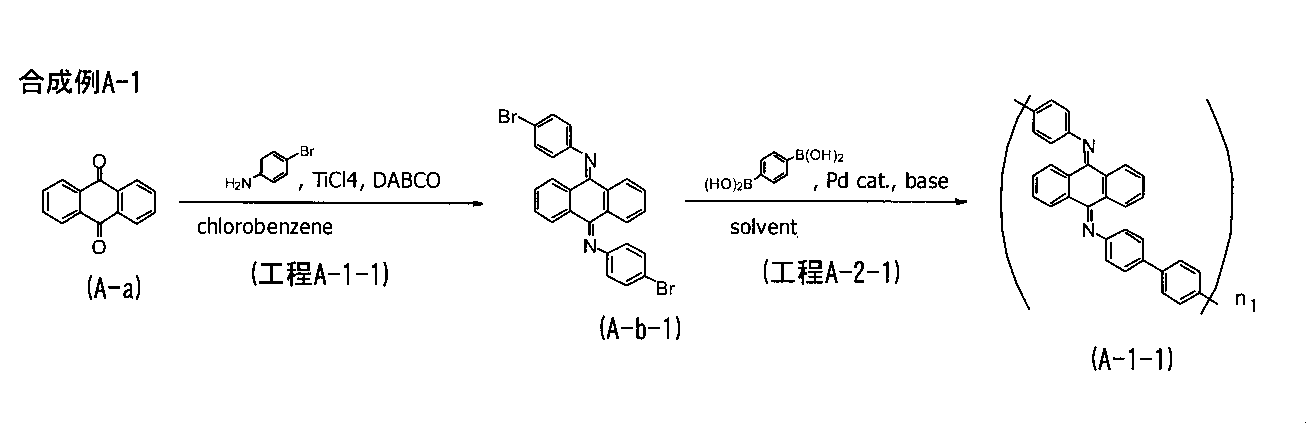
(工程A-1-1)イミン(A-b-1)の合成
アントラキノン(1.0g、4.8mmol)(A-a)、4-ブロモアニリン(1.65g、9.6 mmol)及び1,4-ジアザビシクロ[2,2,2]オクタン(2.7g、24.0mmol)のクロロホルム(45ml)溶液に、塩化チタン(IV)(1.3ml、12.0mmol)クロロホルム溶液(5ml)を50℃で添加して、1日間、75℃のAr下で攪拌した。その反応混合物を、室温まで冷却してセライトでろ過をした。ろ液を減圧下で蒸発させた。残留物をシリカゲルカラムクロマトグラフィー(クロロホルム)によって精製して、イミン(A-b-1)を得た(2.14g、収率:86%、スペクトルデータ:1H NMR(500 MHz, CDCl3)d 6.81(d, J = 8.6 Hz, 4H), 7.08-7.19(m, 4H), 7.45-7.52(m, 5H), 7.61(br, 1H), 8.30(br, 2H); 13C-NMR(125 MHz, CDCl3)d 121.1, 121.5, 127.0, 128.3, 129.1, 129.4, 130.6, 132.5, 144.1, 150.0, 157.1)。
アントラキノン(1.0g、4.8mmol)(A-a)、4-ブロモアニリン(1.65g、9.6 mmol)及び1,4-ジアザビシクロ[2,2,2]オクタン(2.7g、24.0mmol)のクロロホルム(45ml)溶液に、塩化チタン(IV)(1.3ml、12.0mmol)クロロホルム溶液(5ml)を50℃で添加して、1日間、75℃のAr下で攪拌した。その反応混合物を、室温まで冷却してセライトでろ過をした。ろ液を減圧下で蒸発させた。残留物をシリカゲルカラムクロマトグラフィー(クロロホルム)によって精製して、イミン(A-b-1)を得た(2.14g、収率:86%、スペクトルデータ:1H NMR(500 MHz, CDCl3)d 6.81(d, J = 8.6 Hz, 4H), 7.08-7.19(m, 4H), 7.45-7.52(m, 5H), 7.61(br, 1H), 8.30(br, 2H); 13C-NMR(125 MHz, CDCl3)d 121.1, 121.5, 127.0, 128.3, 129.1, 129.4, 130.6, 132.5, 144.1, 150.0, 157.1)。
(工程A-2-1)アントラキノン誘導体(A-1-1)の合成
室温において、イミン(A-b-1)(1eq.(当量))、1,4-ベンゼンジボロン酸(1eq.(当量))及び塩基(3.5eq.(当量))の溶媒(0.1M)の溶液にPd触媒(0.04eq.(当量))を添加して、その混合物を80℃で18時間、攪拌をした。その反応混合物を室温まで冷却してセライトでろ過をした。ろ液を減圧下で蒸発させて、メタノールで再沈殿させてアントラキノン誘導体(A-1-1)を得た。
室温において、イミン(A-b-1)(1eq.(当量))、1,4-ベンゼンジボロン酸(1eq.(当量))及び塩基(3.5eq.(当量))の溶媒(0.1M)の溶液にPd触媒(0.04eq.(当量))を添加して、その混合物を80℃で18時間、攪拌をした。その反応混合物を室温まで冷却してセライトでろ過をした。ろ液を減圧下で蒸発させて、メタノールで再沈殿させてアントラキノン誘導体(A-1-1)を得た。
(実施例A-1-2)
<合成例A-2:アントラキノン誘導体(A-1-2)の合成>
<合成例A-2:アントラキノン誘導体(A-1-2)の合成>
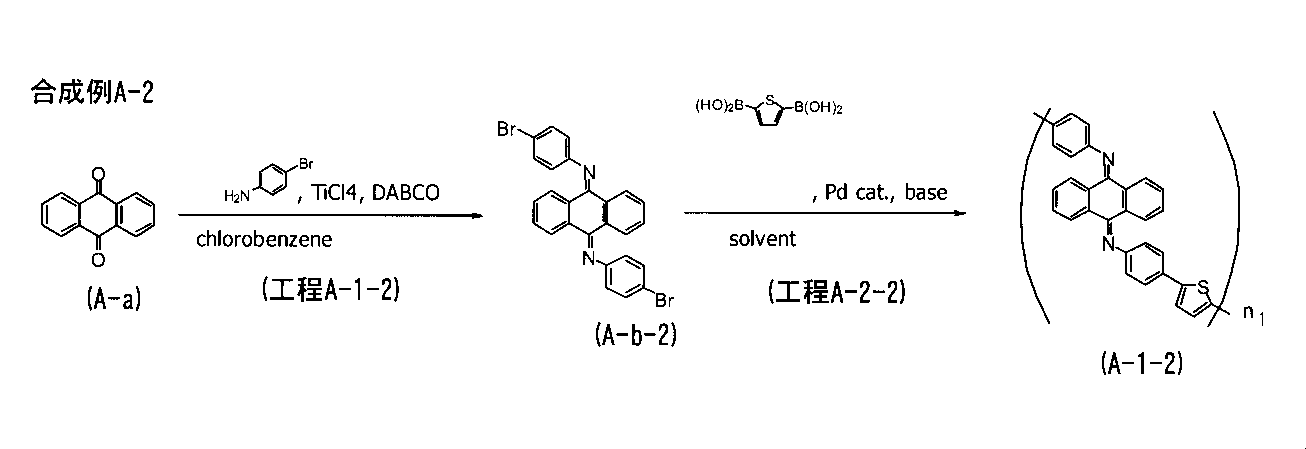
(工程A-1-2)イミン(A-b-2)の合成
アントラキノン(1.0g、4.8mmol)(A-a)、4-ブロモアニリン(1.65g、9.6 mmol)及び1,4-ジアザビシクロ[2,2,2]オクタン(2.7g、24.0mmol)のクロロホルム(45ml)溶液に、塩化チタン(IV)(1.3ml、12.0mmol)クロロホルム溶液(5ml)を50℃で添加して、1日間、75℃のAr下で攪拌した。その反応混合物を、室温まで冷却してセライトでろ過をした。ろ液を減圧下で蒸発させた。残留物をシリカゲルカラムクロマトグラフィー(クロロホルム)によって精製して、イミン(A-b-2)を得た(2.14g、収率:86%、スペクトルデータ:1H NMR(500 MHz, CDCl3)d 6.81(d, J = 8.6 Hz, 4H), 7.08-7.19(m, 4H), 7.45-7.52(m, 5H), 7.61(br, 1H), 8.30(br, 2H); 13C-NMR(125 MHz, CDCl3)d 121.1, 121.5, 127.0, 128.3, 129.1, 129.4, 130.6, 132.5, 144.1, 150.0, 157.1)。
アントラキノン(1.0g、4.8mmol)(A-a)、4-ブロモアニリン(1.65g、9.6 mmol)及び1,4-ジアザビシクロ[2,2,2]オクタン(2.7g、24.0mmol)のクロロホルム(45ml)溶液に、塩化チタン(IV)(1.3ml、12.0mmol)クロロホルム溶液(5ml)を50℃で添加して、1日間、75℃のAr下で攪拌した。その反応混合物を、室温まで冷却してセライトでろ過をした。ろ液を減圧下で蒸発させた。残留物をシリカゲルカラムクロマトグラフィー(クロロホルム)によって精製して、イミン(A-b-2)を得た(2.14g、収率:86%、スペクトルデータ:1H NMR(500 MHz, CDCl3)d 6.81(d, J = 8.6 Hz, 4H), 7.08-7.19(m, 4H), 7.45-7.52(m, 5H), 7.61(br, 1H), 8.30(br, 2H); 13C-NMR(125 MHz, CDCl3)d 121.1, 121.5, 127.0, 128.3, 129.1, 129.4, 130.6, 132.5, 144.1, 150.0, 157.1)。
(工程A-2-2)アントラキノン誘導体(A-1-2)の合成
室温において、イミン(A-b-2)(1eq.(当量))、1,4-チオフェンジボロン酸(1eq.(当量))及び塩基(3.5eq.(当量))の溶媒(0.1M)の溶液に、Pd触媒(0.04eq.(当量))を添加して、その混合物を80℃で18時間、攪拌をした。その反応混合物を室温まで冷却してセライトでろ過をした。ろ液を減圧下で蒸発させて、メタノールで再沈殿させてアントラキノン誘導体(A-1-2)を得た。
室温において、イミン(A-b-2)(1eq.(当量))、1,4-チオフェンジボロン酸(1eq.(当量))及び塩基(3.5eq.(当量))の溶媒(0.1M)の溶液に、Pd触媒(0.04eq.(当量))を添加して、その混合物を80℃で18時間、攪拌をした。その反応混合物を室温まで冷却してセライトでろ過をした。ろ液を減圧下で蒸発させて、メタノールで再沈殿させてアントラキノン誘導体(A-1-2)を得た。
(実施例A-2)<電池特性評価>
(実施例A-2-1)
<リチウムイオン二次電池用の正極用電極の作製>
上記で合成されたアントラキノン誘導体(A-1-1)(2mg)と、ケチェンブラック(ケッチェンブラックインターナショナル社製)(4mg)と、導電性バインダー(TAB-2)(宝泉製)(4mg)とを混合してシート化し、集電体であるアルミメッシュ(14φ)(ニラコ製)の表面上に圧着した。それを120℃6時間で真空乾燥し、アントラキノン誘導体(A-1-1)を備えた電極を作製した。
(実施例A-2-1)
<リチウムイオン二次電池用の正極用電極の作製>
上記で合成されたアントラキノン誘導体(A-1-1)(2mg)と、ケチェンブラック(ケッチェンブラックインターナショナル社製)(4mg)と、導電性バインダー(TAB-2)(宝泉製)(4mg)とを混合してシート化し、集電体であるアルミメッシュ(14φ)(ニラコ製)の表面上に圧着した。それを120℃6時間で真空乾燥し、アントラキノン誘導体(A-1-1)を備えた電極を作製した。
<コイン型リチウムイオン二次電池の作製>
上記電極をコイン型リチウムイオン二次電池の正極とし、1M(mol/l)のLiPF6(六フッ化リン酸リチウム)電解質塩を含むエチレンカーボネート(EC)/ジエチルカーボネート(DEC)(EC:DEC=1:1(体積比))の混合溶液である電解液(キシダ化学製)にその正極を含浸させた。そして、その正極上にポリプロピレン多孔質フィルムからなるセパレーター(セルガード製)、ガラスフィルター(アドバンテック製)を積層し、さらに負極となるリチウム箔(本城金属製)を積層した。その後、周囲に絶縁パッキンを配置した状態でコイン型電池のアルミ外装を重ね、しめ機によって加圧し、正極活物質としてアントラキノン誘導体(A-1-1)、負極活物質として金属リチウムを用いた密閉型のコイン型リチウムイオン二次電池を作製した。
上記電極をコイン型リチウムイオン二次電池の正極とし、1M(mol/l)のLiPF6(六フッ化リン酸リチウム)電解質塩を含むエチレンカーボネート(EC)/ジエチルカーボネート(DEC)(EC:DEC=1:1(体積比))の混合溶液である電解液(キシダ化学製)にその正極を含浸させた。そして、その正極上にポリプロピレン多孔質フィルムからなるセパレーター(セルガード製)、ガラスフィルター(アドバンテック製)を積層し、さらに負極となるリチウム箔(本城金属製)を積層した。その後、周囲に絶縁パッキンを配置した状態でコイン型電池のアルミ外装を重ね、しめ機によって加圧し、正極活物質としてアントラキノン誘導体(A-1-1)、負極活物質として金属リチウムを用いた密閉型のコイン型リチウムイオン二次電池を作製した。
(実施例A-2-2)
<リチウムイオン二次電池用の正極用電極の作製>
アントラキノン誘導体(A-1-1)の替わりにアントラキノン誘導体(A-1-2)を用いた以外は、実施例A-2-1と同様な方法でアントラキノン誘導体(A-1-2)を備えた電極を作製した。
<リチウムイオン二次電池用の正極用電極の作製>
アントラキノン誘導体(A-1-1)の替わりにアントラキノン誘導体(A-1-2)を用いた以外は、実施例A-2-1と同様な方法でアントラキノン誘導体(A-1-2)を備えた電極を作製した。
<コイン型リチウムイオン二次電池の作製>
実施例A-2-1と同様な方法で、上記電極をコイン型電池の正極とし、正極活物質としてアントラキノン誘導体(A-1-2)及び負極活物質として金属リチウムを用いた密閉型のコイン型リチウムイオン二次電池を作製した。
実施例A-2-1と同様な方法で、上記電極をコイン型電池の正極とし、正極活物質としてアントラキノン誘導体(A-1-2)及び負極活物質として金属リチウムを用いた密閉型のコイン型リチウムイオン二次電池を作製した。
(比較例A-1)
<リチウムイオン二次電池用の正極用電極の作製>
アントラキノン誘導体(A-1-1)の替わりに、アントラキノンポリマーを用いた以外は、実施例A-2-1と全く同様な方法でアントラキノンポリマーを備えた電極を作製した。
<リチウムイオン二次電池用の正極用電極の作製>
アントラキノン誘導体(A-1-1)の替わりに、アントラキノンポリマーを用いた以外は、実施例A-2-1と全く同様な方法でアントラキノンポリマーを備えた電極を作製した。
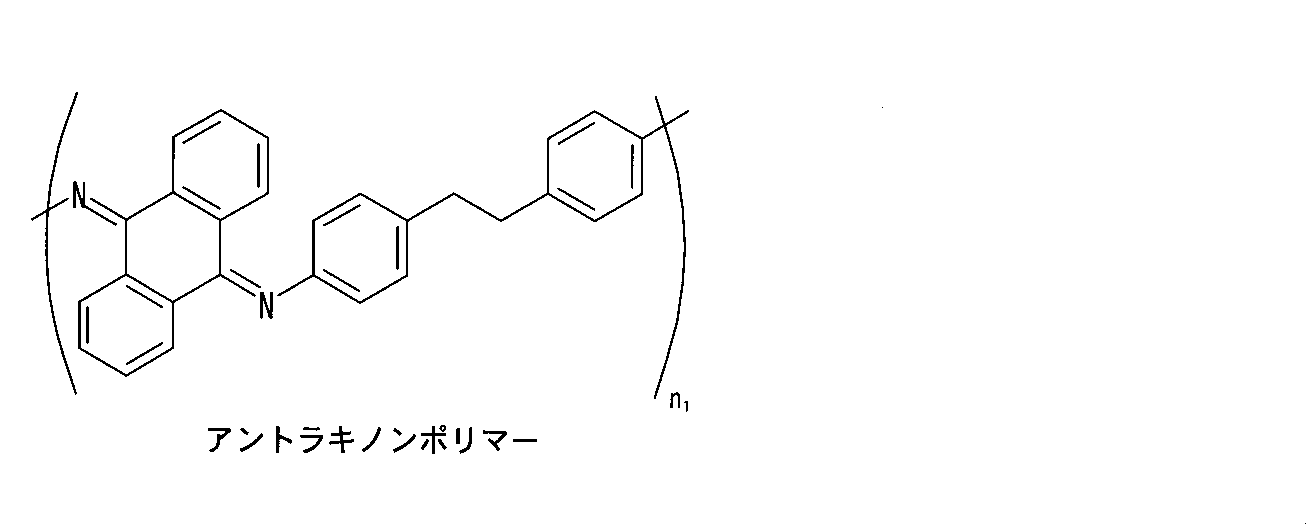
<コイン型リチウムイオン二次電池の作製>
実施例A-2-1と全く同様な方法で、上記電極をコイン型電池の正極とし、正極活物質としてアントラキノンポリマー及び負極活物質として金属リチウムを用いた密閉型のコイン型リチウムイオン二次電池を作製した。
実施例A-2-1と全く同様な方法で、上記電極をコイン型電池の正極とし、正極活物質としてアントラキノンポリマー及び負極活物質として金属リチウムを用いた密閉型のコイン型リチウムイオン二次電池を作製した。
<実施例A-2-1~A-2-2、及び比較例A-1で作製したコイン型リチウムイオン二次電池を用いた電池特性評価>
実施例A-2-1~A-2-2、及び比較例A-1で作製したコイン型リチウムイオン二次電池を用いて、次の方法にしたがって充放電又は放電試験を行った。
温度25℃の環境下、実施例A-2-1~A-2-2で作製したコイン型リチウムイオン二次電池を0.05ミリアンペア(mA)の定電流で2ボルト(V)に達するまで放電し、5分間の休止後、0.05ミリアンペア(mA)の定電流で4ボルト(V)に達するまで充電した。これを1サイクルとして、100サイクルまで充放電試験を行った。
温度25℃の環境下、比較例A-1で作製したコイン型リチウムイオン二次電池を0.05ミリアンペア(mA)の定電流で2ボルト(V)に達するまで放電をした。
<実施例A-2-1~A-2-2、及び比較例A-1で作製したコイン型リチウムイオン二次電池の電池特性の評価結果>
実施例A-2-1及びA-2-2で作製したコイン型リチウムイオン二次電池を用いた充放電試験の結果を図1に示す。図1は、30サイクル目の充放電曲線(充放電容量値(mAh/g))vs.電圧(V))を表す。次に、比較例A-1で作製したコイン型リチウムイオン二次電池を用いた放電試験の結果を図2に示す。図2は、放電曲線(放電容量値(mAh/g))vs.電圧(V))を表す。図1及び図2から明らかなように、実施例A-2-1及びA-2-2で作製したコイン型リチウムイオン二次電池は、比較例A-1で作製したコイン型リチウムイオン二次電池に比べて平均電圧が低い特性を示した。
自動車等の車両に、実施例A-2-1~A-2-2で作製したコイン型リチウムイオン二次電池を搭載したところ、実施例A-2-1~A-2-2で作製したコイン型リチウムイオン二次電池が、信頼性の高い安定な電源として重要な役割を果たしていることを確認した。
実施例B
(実施例B-1)
(実施例B-1-1)
<合成例B-1:アントラキノン誘導体(B-1-A)の合成>
(実施例B-1)
(実施例B-1-1)
<合成例B-1:アントラキノン誘導体(B-1-A)の合成>

(工程B-1-1)キノン(B-b-A)の合成
2-ブロモアントラキノン(200mg、0.70mmol)、4-ビニルフェニルボロン酸(103 mg、0.70mmol)及びリン酸ナトリウム三塩基性12水(927mg、2.44mmol)のトルエン溶液(7ml)に、テトラキス[トリフェニルホスフィン]パラジウム(0)(40mg、0.03mmol)を室温で添加して、その混合物を100℃で1日間攪拌した。その反応混合物を室温まで冷却して減圧下で蒸発させた。残留物をシリカゲルカラムクロマトグラフィー(ヘキサン:酢酸エチル=10:1)によって精製して、キノン(B-b-A)を得た(175mg、81%、スペクトルデータ:1H NMR(500 MHz, CDCl3)d 3.50(s, 6H), 4.20(d, J = 5.2 Hz, 2H), 4.79(t, J = 5.2 Hz, 1H), 7.32(dd, J = 2.9, 8.6 Hz, 1H), 7.75-7.80(m, 3H), 8.27(d, J = 8.6 Hz, 1H), 8.28-8.31(m, 2H); 13C-NMR(125 MHz, CDCl3)d 54.4, 68.1, 101.8, 110.7, 121.5, 127.2, 127.4, 129.8, 133.5, 133.6, 133.7, 134.2, 135.5, 163.2, 182.1, 183.1))。
2-ブロモアントラキノン(200mg、0.70mmol)、4-ビニルフェニルボロン酸(103 mg、0.70mmol)及びリン酸ナトリウム三塩基性12水(927mg、2.44mmol)のトルエン溶液(7ml)に、テトラキス[トリフェニルホスフィン]パラジウム(0)(40mg、0.03mmol)を室温で添加して、その混合物を100℃で1日間攪拌した。その反応混合物を室温まで冷却して減圧下で蒸発させた。残留物をシリカゲルカラムクロマトグラフィー(ヘキサン:酢酸エチル=10:1)によって精製して、キノン(B-b-A)を得た(175mg、81%、スペクトルデータ:1H NMR(500 MHz, CDCl3)d 3.50(s, 6H), 4.20(d, J = 5.2 Hz, 2H), 4.79(t, J = 5.2 Hz, 1H), 7.32(dd, J = 2.9, 8.6 Hz, 1H), 7.75-7.80(m, 3H), 8.27(d, J = 8.6 Hz, 1H), 8.28-8.31(m, 2H); 13C-NMR(125 MHz, CDCl3)d 54.4, 68.1, 101.8, 110.7, 121.5, 127.2, 127.4, 129.8, 133.5, 133.6, 133.7, 134.2, 135.5, 163.2, 182.1, 183.1))。
(工程B-2-1)アントラキノン誘導体(B-1-A´)の合成
キノン(B-b-A)(36mg、0.12mmol)、1,4-ジアザビシクロ[2,2,2]オクタン(78mg、0.70mmol)及びアニリン(21ml、0.23mmol)のクロロベンゼン溶液(1ml)に塩化チタン(IV)(32ml、0.29mmol)クロロベンゼン溶液(1ml)を90℃で添加して、1日間、130℃のAr下で攪拌した。その反応混合物を、室温まで冷却してセライトでろ過をした。ろ液を減圧下で蒸発させ、残留物をシリカゲルカラムクロマトグラフィー(ヘキサン:酢酸エチル=10:1)によって精製して、アントラキノン誘導体(B-1-A´)を得た(46mg、収率:86%、スペクトルデータ:1H NMR(500 MHz, CDCl3)d 5.27-5.31(m, 1H), 5.77-5.82(m, 1H), 6.64-6.82(m, 1H), 6.84-7.93(m, 19H), 8.34-8.8.42(m, 2H))。
キノン(B-b-A)(36mg、0.12mmol)、1,4-ジアザビシクロ[2,2,2]オクタン(78mg、0.70mmol)及びアニリン(21ml、0.23mmol)のクロロベンゼン溶液(1ml)に塩化チタン(IV)(32ml、0.29mmol)クロロベンゼン溶液(1ml)を90℃で添加して、1日間、130℃のAr下で攪拌した。その反応混合物を、室温まで冷却してセライトでろ過をした。ろ液を減圧下で蒸発させ、残留物をシリカゲルカラムクロマトグラフィー(ヘキサン:酢酸エチル=10:1)によって精製して、アントラキノン誘導体(B-1-A´)を得た(46mg、収率:86%、スペクトルデータ:1H NMR(500 MHz, CDCl3)d 5.27-5.31(m, 1H), 5.77-5.82(m, 1H), 6.64-6.82(m, 1H), 6.84-7.93(m, 19H), 8.34-8.8.42(m, 2H))。
(工程B-3-1)アントラキノン誘導体(B-1-A)の合成
アントラキノン誘導体(B-1-A´)(40mg、0.09mmol)のテトラヒドロフラン溶液(2ml)に、2,2’-アゾビス(イソブチロニトリル)(10mg、0.06mmol)を室温で添加して、その混合物を70℃で2日間攪拌をした。その反応混合物を室温まで冷却して減圧下で蒸発させて、アントラキノン誘導体(B-1-A)を得た(35mg、収率:93%)。
アントラキノン誘導体(B-1-A´)(40mg、0.09mmol)のテトラヒドロフラン溶液(2ml)に、2,2’-アゾビス(イソブチロニトリル)(10mg、0.06mmol)を室温で添加して、その混合物を70℃で2日間攪拌をした。その反応混合物を室温まで冷却して減圧下で蒸発させて、アントラキノン誘導体(B-1-A)を得た(35mg、収率:93%)。
(実施例B-1-2)
<合成例B-2:アントラキノン誘導体(B-1-B)の合成>
<合成例B-2:アントラキノン誘導体(B-1-B)の合成>
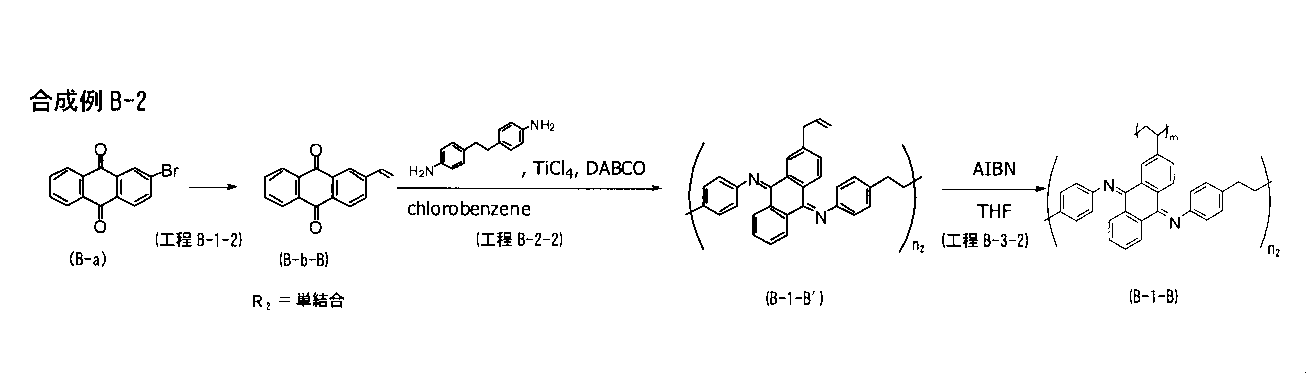
(工程B-1-2)キノン(B-b-B)の合成
2-ブロモアントラキノン(200mg、0.70mmol)、2-アレニル-4,4,5,5-テトラメチル-1,3,2-ジオキサボロラン(107mg、0.70mmol)及びリン酸ナトリウム三塩基性12水(927mg、2.44mmol)のトルエン溶液(7ml)に、テトラキス[トリフェニルホスフィン]パラジウム(0)(40mg、0.03mmol)を室温で添加して、その混合物を100℃で1日間攪拌した。その反応混合物を室温まで冷却して減圧下で蒸発させた。残留物をシリカゲルカラムクロマトグラフィー(ヘキサン:酢酸エチル=10:1)によって精製して、キノン(B-b-B)を得た(138mg, 収率:85%、スペクトルデータ:1H NMR(500 MHz, CDCl3)d 5.53(d, J = 10.9 Hz, 1H), 6.04(d, J = 17.8 Hz, 1H), 6.87(dd, J = 10.9, 17.8 Hz, 1H), 7.80-7.84(m, 3H), 8.28(d, J = 8.5 Hz, 1H), 8.31-8.33(m, 3H); 13C-NMR(125 MHz, CDCl3)d 118.4, 124.8, 127.2, 127.3, 127.8, 131.4, 132.6, 133.7, 133.8, 134.0, 134.2, 135.4, 143.3, 182.7, 183.)。
2-ブロモアントラキノン(200mg、0.70mmol)、2-アレニル-4,4,5,5-テトラメチル-1,3,2-ジオキサボロラン(107mg、0.70mmol)及びリン酸ナトリウム三塩基性12水(927mg、2.44mmol)のトルエン溶液(7ml)に、テトラキス[トリフェニルホスフィン]パラジウム(0)(40mg、0.03mmol)を室温で添加して、その混合物を100℃で1日間攪拌した。その反応混合物を室温まで冷却して減圧下で蒸発させた。残留物をシリカゲルカラムクロマトグラフィー(ヘキサン:酢酸エチル=10:1)によって精製して、キノン(B-b-B)を得た(138mg, 収率:85%、スペクトルデータ:1H NMR(500 MHz, CDCl3)d 5.53(d, J = 10.9 Hz, 1H), 6.04(d, J = 17.8 Hz, 1H), 6.87(dd, J = 10.9, 17.8 Hz, 1H), 7.80-7.84(m, 3H), 8.28(d, J = 8.5 Hz, 1H), 8.31-8.33(m, 3H); 13C-NMR(125 MHz, CDCl3)d 118.4, 124.8, 127.2, 127.3, 127.8, 131.4, 132.6, 133.7, 133.8, 134.0, 134.2, 135.4, 143.3, 182.7, 183.)。
(工程B-2-2)アントラキノン誘導体(B-1-B´)の合成
キノン(B-b-B)(73mg、0.31mmol)、4,4’-エチレンジアニリン(66mg、0.31mmol)及び1,4-ジアザビシクロ[2,2,2]オクタン(208mg、0.77mmol)のクロロベンゼン溶液(2ml)に塩化チタン(IV)(85ml、0.77mmol)クロロベンゼン溶液(1ml)を90℃で添加して、1日間、130℃のAr下で攪拌した。その反応混合物を、室温まで冷却してセライトでろ過をした。ろ液を減圧下で蒸発させ、メタノールで再沈殿させてアントラキノン誘導体(B-1-B´)を得た(22mg、収率:17%)。
キノン(B-b-B)(73mg、0.31mmol)、4,4’-エチレンジアニリン(66mg、0.31mmol)及び1,4-ジアザビシクロ[2,2,2]オクタン(208mg、0.77mmol)のクロロベンゼン溶液(2ml)に塩化チタン(IV)(85ml、0.77mmol)クロロベンゼン溶液(1ml)を90℃で添加して、1日間、130℃のAr下で攪拌した。その反応混合物を、室温まで冷却してセライトでろ過をした。ろ液を減圧下で蒸発させ、メタノールで再沈殿させてアントラキノン誘導体(B-1-B´)を得た(22mg、収率:17%)。
(工程B-3-2)アントラキノン誘導体(B-1-B)の合成
アントラキノン誘導体(B-1-B´)(12mg、0.03mmol)のテトラヒドロフラン溶液(2ml)に、2,2’-アゾビス(イソブチロニトリル)(10mg、0.06mmol)を室温で添加して、その混合物を70℃で2日間攪拌をした。その反応混合物を室温まで冷却して減圧下で蒸発させて、アントラキノン誘導体(B-1-B)を得た(11mg、収率:93%)。
アントラキノン誘導体(B-1-B´)(12mg、0.03mmol)のテトラヒドロフラン溶液(2ml)に、2,2’-アゾビス(イソブチロニトリル)(10mg、0.06mmol)を室温で添加して、その混合物を70℃で2日間攪拌をした。その反応混合物を室温まで冷却して減圧下で蒸発させて、アントラキノン誘導体(B-1-B)を得た(11mg、収率:93%)。
(実施例B-2)<電池特性評価>
(実施例B-2-1)
<リチウムイオン二次電池用の正極用電極の作製>
上記で合成されたアントラキノン誘導体(B-1-A)(2mg)と、ケチェンブラック(ケッチェンブラックインターナショナル社製)(4mg)と、導電性バインダー(TAB-2)(宝泉製)(4mg)とを混合してシート化し、集電体であるアルミメッシュ(14φ)(ニラコ製)の表面上に圧着した。それを120℃6時間で真空乾燥し、アントラキノン誘導体(B-1-A)を備えた電極を作製した。
(実施例B-2-1)
<リチウムイオン二次電池用の正極用電極の作製>
上記で合成されたアントラキノン誘導体(B-1-A)(2mg)と、ケチェンブラック(ケッチェンブラックインターナショナル社製)(4mg)と、導電性バインダー(TAB-2)(宝泉製)(4mg)とを混合してシート化し、集電体であるアルミメッシュ(14φ)(ニラコ製)の表面上に圧着した。それを120℃6時間で真空乾燥し、アントラキノン誘導体(B-1-A)を備えた電極を作製した。
<コイン型リチウムイオン二次電池の作製>
上記電極をコイン型リチウムイオン二次電池の正極とし、1M(mol/l)のLiPF6(六フッ化リン酸リチウム)電解質塩を含むエチレンカーボネート(EC)/ジエチルカーボネート(DEC)(EC:DEC=1:1(体積比))の混合溶液である電解液(キシダ化学製)にその正極を含浸させた。そして、その正極上にポリプロピレン多孔質フィルムからなるセパレーター(セルガード製)、ガラスフィルター(アドバンテック製)を積層し、さらに負極となるリチウム箔(本城金属製)を積層した。その後、周囲に絶縁パッキンを配置した状態でコイン型電池のアルミ外装を重ね、しめ機によって加圧し、正極活物質としてアントラキノン誘導体(B-1-A)、負極活物質として金属リチウムを用いた密閉型のコイン型リチウムイオン二次電池を作製した。
上記電極をコイン型リチウムイオン二次電池の正極とし、1M(mol/l)のLiPF6(六フッ化リン酸リチウム)電解質塩を含むエチレンカーボネート(EC)/ジエチルカーボネート(DEC)(EC:DEC=1:1(体積比))の混合溶液である電解液(キシダ化学製)にその正極を含浸させた。そして、その正極上にポリプロピレン多孔質フィルムからなるセパレーター(セルガード製)、ガラスフィルター(アドバンテック製)を積層し、さらに負極となるリチウム箔(本城金属製)を積層した。その後、周囲に絶縁パッキンを配置した状態でコイン型電池のアルミ外装を重ね、しめ機によって加圧し、正極活物質としてアントラキノン誘導体(B-1-A)、負極活物質として金属リチウムを用いた密閉型のコイン型リチウムイオン二次電池を作製した。
(実施例B-2-2)
<リチウムイオン二次電池用の正極用電極の作製>
アントラキノン誘導体(B-1-A)の替わりにアントラキノン誘導体(B-1-B)を用いた以外は、実施例B-2-1と同様な方法でアントラキノン誘導体(B-1-B)を備えた電極を作製した。
<リチウムイオン二次電池用の正極用電極の作製>
アントラキノン誘導体(B-1-A)の替わりにアントラキノン誘導体(B-1-B)を用いた以外は、実施例B-2-1と同様な方法でアントラキノン誘導体(B-1-B)を備えた電極を作製した。
<コイン型リチウムイオン二次電池の作製>
実施例B-2-1と同様な方法で、上記電極をコイン型電池の正極とし、正極活物質としてアントラキノン誘導体(B-1-B)及び負極活物質として金属リチウムを用いた密閉型のコイン型リチウムイオン二次電池を作製した。
実施例B-2-1と同様な方法で、上記電極をコイン型電池の正極とし、正極活物質としてアントラキノン誘導体(B-1-B)及び負極活物質として金属リチウムを用いた密閉型のコイン型リチウムイオン二次電池を作製した。
(実施例B-2-3)
<リチウムイオン二次電池用の正極用電極の作製>
アントラキノン誘導体(B-1-A)の替わりにアントラキノン誘導体(B-1-C)を用いた以外は、実施例B-2-1と同様な方法でアントラキノン誘導体(B-1-C)を備えた電極を作製した。
<リチウムイオン二次電池用の正極用電極の作製>
アントラキノン誘導体(B-1-A)の替わりにアントラキノン誘導体(B-1-C)を用いた以外は、実施例B-2-1と同様な方法でアントラキノン誘導体(B-1-C)を備えた電極を作製した。
<コイン型リチウムイオン二次電池の作製>
実施例B-2-1と同様な方法で、上記電極をコイン型電池の正極とし、正極活物質としてアントラキノン誘導体(B-1-C)及び負極活物質として金属リチウムを用いた密閉型のコイン型リチウムイオン二次電池を作製した。
実施例B-2-1と同様な方法で、上記電極をコイン型電池の正極とし、正極活物質としてアントラキノン誘導体(B-1-C)及び負極活物質として金属リチウムを用いた密閉型のコイン型リチウムイオン二次電池を作製した。
(実施例B-2-4)
<リチウムイオン二次電池用の正極用電極の作製>
アントラキノン誘導体(B-1-A)の替わりにアントラキノン誘導体(B-1-D)を用いた以外は、実施例B-2-1と同様な方法でアントラキノン誘導体(B-1-D)を備えた電極を作製した。
<リチウムイオン二次電池用の正極用電極の作製>
アントラキノン誘導体(B-1-A)の替わりにアントラキノン誘導体(B-1-D)を用いた以外は、実施例B-2-1と同様な方法でアントラキノン誘導体(B-1-D)を備えた電極を作製した。
<コイン型リチウムイオン二次電池の作製>
実施例B-2-1と同様な方法で、上記電極をコイン型電池の正極とし、正極活物質としてアントラキノン誘導体(B-1-D)及び負極活物質として金属リチウムを用いた密閉型のコイン型リチウムイオン二次電池を作製した。
実施例B-2-1と同様な方法で、上記電極をコイン型電池の正極とし、正極活物質としてアントラキノン誘導体(B-1-D)及び負極活物質として金属リチウムを用いた密閉型のコイン型リチウムイオン二次電池を作製した。
(実施例B-2-5)
<リチウムイオン二次電池用の正極用電極の作製>
アントラキノン誘導体(B-1-A)の替わりにアントラキノン誘導体(B-1-E)を用いた以外は、実施例B-2-1と同様な方法でアントラキノン誘導体(B-1-E)を備えた電極を作製した。
<リチウムイオン二次電池用の正極用電極の作製>
アントラキノン誘導体(B-1-A)の替わりにアントラキノン誘導体(B-1-E)を用いた以外は、実施例B-2-1と同様な方法でアントラキノン誘導体(B-1-E)を備えた電極を作製した。
<コイン型リチウムイオン二次電池の作製>
実施例B-2-1と同様な方法で、上記電極をコイン型電池の正極とし、正極活物質としてアントラキノン誘導体(B-1-E)及び負極活物質として金属リチウムを用いた密閉型のコイン型リチウムイオン二次電池を作製した。
実施例B-2-1と同様な方法で、上記電極をコイン型電池の正極とし、正極活物質としてアントラキノン誘導体(B-1-E)及び負極活物質として金属リチウムを用いた密閉型のコイン型リチウムイオン二次電池を作製した。
(比較例B-1)
<リチウムイオン二次電池用の正極用電極の作製>
アントラキノン誘導体(B-1-A)の替わりに、アントラキノンポリマーを用いた以外は、実施例B-2-1と全く同様な方法でアントラキノンポリマーを備えた電極を作製した。
<リチウムイオン二次電池用の正極用電極の作製>
アントラキノン誘導体(B-1-A)の替わりに、アントラキノンポリマーを用いた以外は、実施例B-2-1と全く同様な方法でアントラキノンポリマーを備えた電極を作製した。
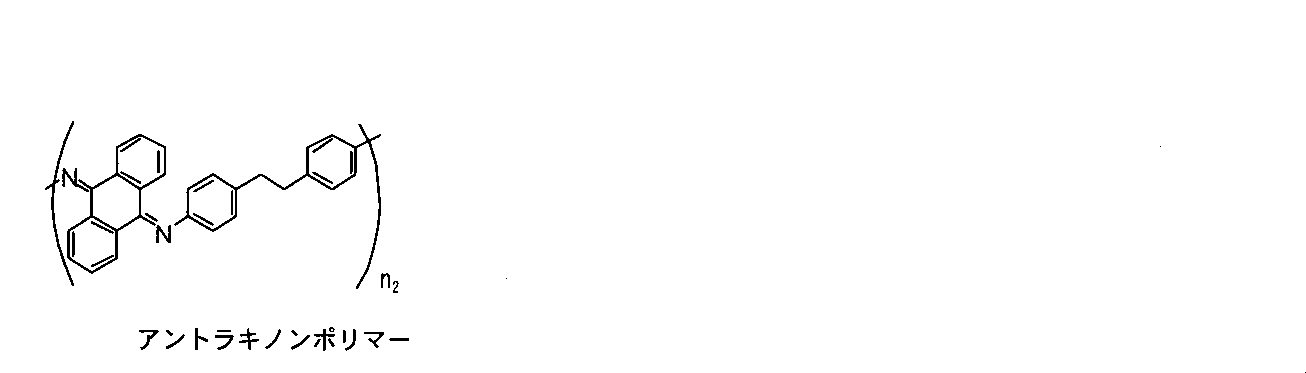
<コイン型リチウムイオン二次電池の作製>
実施例B-2-1と全く同様な方法で、上記電極をコイン型電池の正極とし、正極活物質としてアントラキノンポリマー及び負極活物質として金属リチウムを用いた密閉型のコイン型リチウムイオン二次電池を作製した。
実施例B-2-1と全く同様な方法で、上記電極をコイン型電池の正極とし、正極活物質としてアントラキノンポリマー及び負極活物質として金属リチウムを用いた密閉型のコイン型リチウムイオン二次電池を作製した。
<実施例B-2-1~B-2-5、及び比較例B-1で作製したコイン型リチウムイオン二次電池を用いた電池特性評価>
実施例B-2-1~B-2-5、及び比較例B-1で作製したコイン型リチウムイオン二次電池を用いて、次の方法にしたがって充放電又は放電試験を行った。
温度25℃の環境下、実施例B-2-1~B-2-5で作製したコイン型リチウムイオン二次電池を0.05ミリアンペア(mA)の定電流で2ボルト(V)に達するまで放電し、5分間の休止後、0.05ミリアンペア(mA)の定電流で4ボルト(V)に達するまで充電した。これを1サイクルとして、100サイクルまで充放電試験を行った。
温度25℃の環境下、比較例B-1で作製したコイン型リチウムイオン二次電池を0.05ミリアンペア(mA)の定電流で2ボルト(V)に達するまで放電した。
<実施例B-2-1~B-2-5、及び比較例B-1で作製したコイン型リチウムイオン二次電池の電池特性の評価結果>
実施例B-2-2で作製したコイン型リチウムイオン二次電池を用いた充放電試験の結果を図3に示す。図3は、1サイクル目と20サイクル目の充放電曲線(充放電容量値(mAh/g))vs.電圧(V))を表す。次に、比較例B-1で作製したコイン型リチウムイオン二次電池を用いた放電試験の結果を図4に示す。実施例B-2-1~B-2-5、及び比較例B-1で作製したコイン型リチウムイオン二次電池を用いた充放電試験の結果を図5に示す。図5は、本発明のアントラキノン誘導体(B-1-A~B-1-E)を用いたコイン型リチウムイオン二次電池と比較例のアントラキノンポリマーを用いたコイン型リチウムイオン二次電池との100サイクル目の電池容量の結果である。本発明のアントラキノン誘導体(B-1-A~B-1-E)を用いたコイン型リチウムイオン二次電池の電池容量の値は、アントラキノンポリマーを用いたコイン型リチウムイオン二次電池の電池容量値を1.0としたときの比率値である。
図3及び図4から明らかなように、実施例B-2-2で作製したコイン型リチウムイオン二次電池は、比較例B-1で作製したコイン型リチウムイオン二次電池に比べて平均電圧が低い特性を示した。また、図5を参照すると、実施例B-2-5で作製したコイン型リチウムイオン二次電池の電池容量値が一番高い値を示し、高容量化と長寿命化(サイクル適性)との両方を達成したことが確認された。
自動車等の車両に、実施例B-2-1~B-2-5で作製したコイン型リチウムイオン二次電池を搭載したところ、実施例B-2-1~B-2-5で作製したコイン型リチウムイオン二次電池が、信頼性の高い安定な電源として重要な役割を果たしていることを確認した。
実施例C
(実施例C-1)
(実施例C-1-1)
<合成例C-1:アントラキノン誘導体(C-1-A)の合成>
(実施例C-1)
(実施例C-1-1)
<合成例C-1:アントラキノン誘導体(C-1-A)の合成>
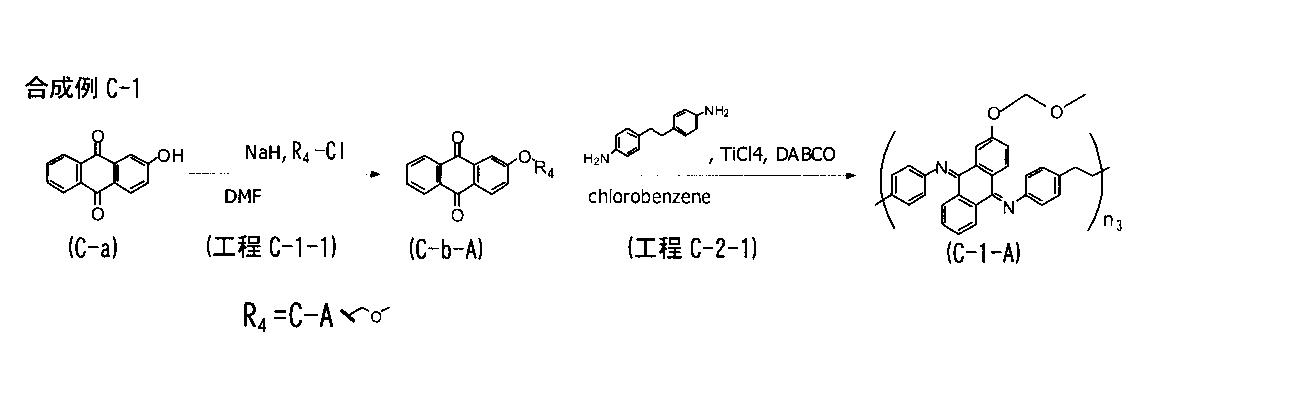
(工程C-1-1)2-メトキシメチルアントラキノン(C-b-A)の合成
2-ヒドロキシアントラキノン(C-a)(1.0g、4.46mmol)のジメチルホルムアミド溶液(40ml)に、水素化ナトリウム(290mg、6.69mmol)を0℃で添加して10分間攪拌をした。攪拌後、反応混合物に塩化メトキシメチル(0.4ml、5.35mmol)を0℃で添加して、その混合物を70℃で1日間攪拌をした。その反応混合物を室温まで冷却して減圧下で蒸発させた。その残留物をクロロホルムで3回抽出してMgSO4で乾燥させてろ過した。ろ液を減圧下で蒸発させ、その混合物をカラムクロマトグラフィー(シリカゲル、クロロホルム)によって精製して、2-メトキシメチルアントラキノン(b-A)を得た(1.1g、93%、スペクトルデータ:%). 1H NMR(500 MHz, DMSO-d6)δ3.44(s, 3H), 5.43(s, 2H), 7.52(dd, J = 2.9, 8.6 Hz, 1H), 7.74(d, J = 2.3 Hz, 1H), 7.0-7.95(m, 2H), 8.20(t, J = 6.9 Hz, 1H), 8.20(d, J = 6.9 Hz, 2H); 13C-NMR(125 MHz, DMSO-d6)δ56.0, 93.9, 112.2, 112.2, 126.6, 126.7, 127.1, 129.4, 133.0, 134.2, 134.5, 134.9, 161.4, 181.3, 182.2; Elem. Anal. Calcd for C16H12O4: C, 71.64; H, 4.51. Found: C, 71.8; H, 4.8.)。
2-ヒドロキシアントラキノン(C-a)(1.0g、4.46mmol)のジメチルホルムアミド溶液(40ml)に、水素化ナトリウム(290mg、6.69mmol)を0℃で添加して10分間攪拌をした。攪拌後、反応混合物に塩化メトキシメチル(0.4ml、5.35mmol)を0℃で添加して、その混合物を70℃で1日間攪拌をした。その反応混合物を室温まで冷却して減圧下で蒸発させた。その残留物をクロロホルムで3回抽出してMgSO4で乾燥させてろ過した。ろ液を減圧下で蒸発させ、その混合物をカラムクロマトグラフィー(シリカゲル、クロロホルム)によって精製して、2-メトキシメチルアントラキノン(b-A)を得た(1.1g、93%、スペクトルデータ:%). 1H NMR(500 MHz, DMSO-d6)δ3.44(s, 3H), 5.43(s, 2H), 7.52(dd, J = 2.9, 8.6 Hz, 1H), 7.74(d, J = 2.3 Hz, 1H), 7.0-7.95(m, 2H), 8.20(t, J = 6.9 Hz, 1H), 8.20(d, J = 6.9 Hz, 2H); 13C-NMR(125 MHz, DMSO-d6)δ56.0, 93.9, 112.2, 112.2, 126.6, 126.7, 127.1, 129.4, 133.0, 134.2, 134.5, 134.9, 161.4, 181.3, 182.2; Elem. Anal. Calcd for C16H12O4: C, 71.64; H, 4.51. Found: C, 71.8; H, 4.8.)。
(工程C-2-1)MOM(メトキシメチル)アントラキノン誘導体(C-1-A)の合成
2-メトキシメチルアントラキノン(C-b-A)(300mg、1.12mmol)、エチレンジアニリン(237mg、1.12mmol)及び1,4-ジアザビシクロ[2,2,2]オクタン(753mg、6.71mmol)のクロロベンゼン(10ml)溶液に塩化チタン(IV)(0.18ml、1.68mmol)クロロベンゼン溶液(2ml)を90℃で添加して、1日間、125℃のAr下で攪拌した。その反応混合物を室温まで冷却してセライトでろ過をした。ろ液を減圧下で蒸発させてメタノールで再沈澱させて、MOM(メトキシメチルアントラキノン誘導体(C-1-A)を得た(291mg、収率:58、MW=8800、Mw/Mn=1.437)。
(実施例C-1-2)
<合成例C-2:ジ-MOM(メトキシメチル)アントラキノン誘導体(C-2-A)の合成>
<合成例C-2:ジ-MOM(メトキシメチル)アントラキノン誘導体(C-2-A)の合成>
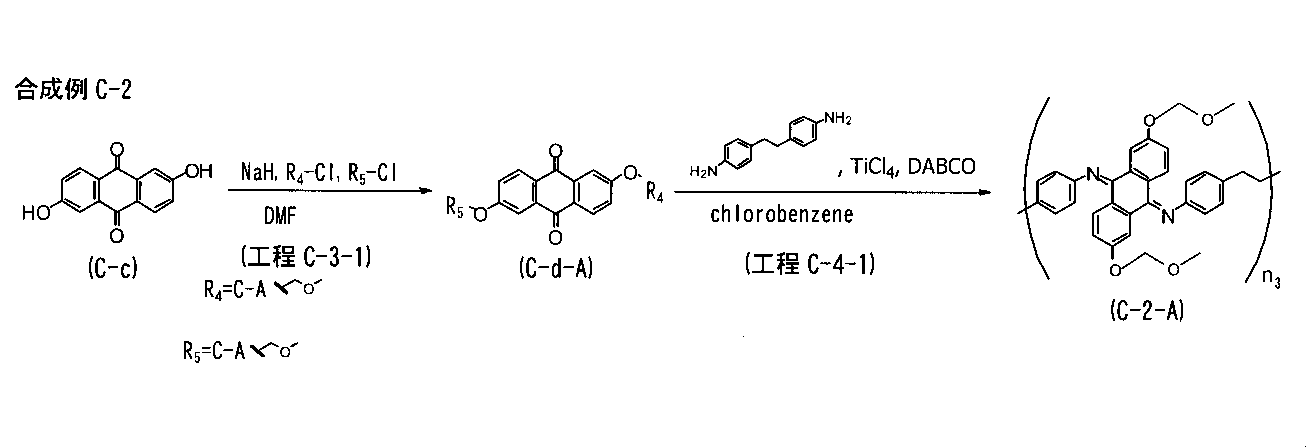
(工程C-3-1)2,6-ジメトキシメチルアントラキノン(C-d-A)の合成
2,6-ジヒドロキシアントラキノン(C-c)(1.0g、4.16mmol)のジメチルホルムアミド溶液(40ml)に、水素化ナトリウム(450mg、10.4mmol)を0℃で添加して10分間攪拌をした。攪拌後、反応混合物に塩化メトキシメチル(0.78ml、10.4mmol)を0℃で添加して、その混合物を70℃で1日間攪拌をした。その反応混合物を室温まで冷却して減圧下で蒸発させた。その残留物をクロロホルムで3回抽出してMgSO4で乾燥させてろ過した。ろ液を減圧下で蒸発させ、その混合物をカラムクロマトグラフィー(シリカゲル、クロロホルム)によって精製して、2,6-ジメトキシメチルアントラキノン(C-d-A)を得た(1.5g、適量、スペクトルデータ:1H NMR(500 MHz, CDCl3)d 3.52(s, 6H), 5.34(s, 4H), 7.37(dd, J = 2.9, 8.6 Hz, 2H), 7.87(d, J = 2.9 Hz, 2H), 8.25(d, J = 8.6 Hz, 2H))。
2,6-ジヒドロキシアントラキノン(C-c)(1.0g、4.16mmol)のジメチルホルムアミド溶液(40ml)に、水素化ナトリウム(450mg、10.4mmol)を0℃で添加して10分間攪拌をした。攪拌後、反応混合物に塩化メトキシメチル(0.78ml、10.4mmol)を0℃で添加して、その混合物を70℃で1日間攪拌をした。その反応混合物を室温まで冷却して減圧下で蒸発させた。その残留物をクロロホルムで3回抽出してMgSO4で乾燥させてろ過した。ろ液を減圧下で蒸発させ、その混合物をカラムクロマトグラフィー(シリカゲル、クロロホルム)によって精製して、2,6-ジメトキシメチルアントラキノン(C-d-A)を得た(1.5g、適量、スペクトルデータ:1H NMR(500 MHz, CDCl3)d 3.52(s, 6H), 5.34(s, 4H), 7.37(dd, J = 2.9, 8.6 Hz, 2H), 7.87(d, J = 2.9 Hz, 2H), 8.25(d, J = 8.6 Hz, 2H))。
(工程C-4-1)ジ-MOM(メトキシメチル)アントラキノン誘導体(C-2-A)の合成
2,6-ジメトキシメチルアントラキノン(C-d-A)(250mg、0.76mmol)、エチレンジアニリン(162mg、0.76mmol)及び1,4-ジアザビシクロ[2,2,2]オクタン(510mg、4.57mmol)のクロロベンゼン(5ml)溶液に塩化チタン(IV)(0.13ml、1.14mmol)クロロベンゼン溶液(2ml)を90℃で添加して、1日間、130℃のAr下で攪拌した。その反応混合物を室温まで冷却してセライトでろ過をした。ろ液を減圧下で蒸発させてメタノールで再沈澱させて、ジ-MOM(メトキシメチル)アントラキノン誘導体(C-2-A)を得た(68mg、収率:18%、MW=34340、Mw/Mn=1.244)。
(実施例C-1-3)
<合成例C-3:ジ-PMB(p-メトキシベンジル)アントラキノン誘導体(C-2-K)の合成>
<合成例C-3:ジ-PMB(p-メトキシベンジル)アントラキノン誘導体(C-2-K)の合成>
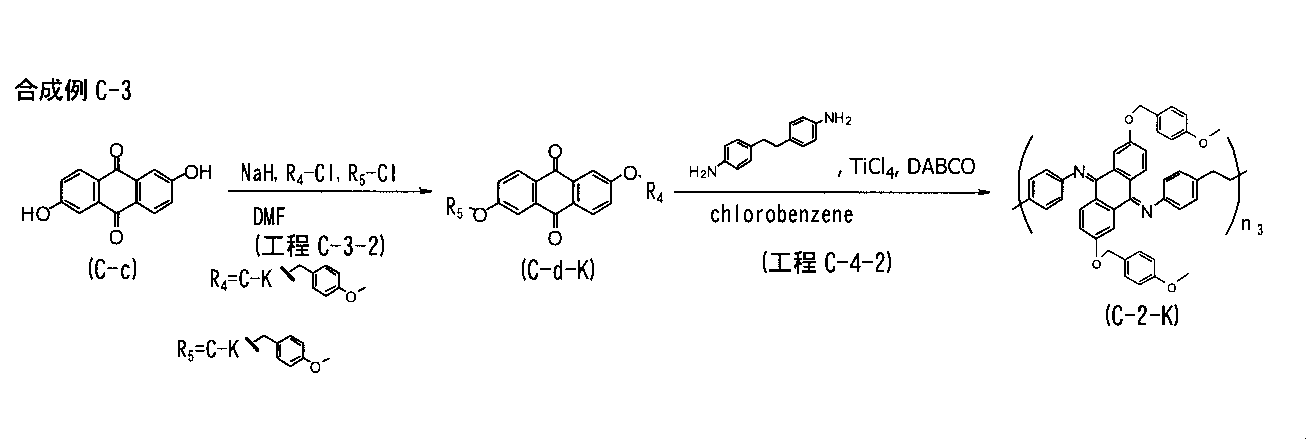
(工程C-3-2)2,6-ジ-(p-メトキシベンジル)アントラキノン(C-d-K)の合成
2,6-ジヒドロキシアントラキノン(C-c)(300mg、1.25mmol)のジメチルホルムアミド溶液(12ml)に、水素化ナトリウム(110mg、2.75mmol)を0℃で添加して10分間攪拌をした。攪拌後、反応混合物にp-メトキシベンジルクロライド(0.37ml、2.75mmol)を0℃で添加して、その混合物を70℃で1日間攪拌をした。その反応混合物を室温まで冷却して減圧下で蒸発させた。その残留物をクロロホルムで3回抽出してMgSO4で乾燥させてろ過した。ろ液を減圧下で蒸発させて、2,6-ジ-(p-メトキシベンジル)アントラキノン(d-K)を得た(600mg、適量、スペクトルデータ:13C-NMR(125 MHz, DMSO-d6)d 56.0, 93.9, 112.2, 112.2, 126.6, 126.7, 127.1, 129.4, 133.0, 134.2, 134.5, 134.9, 161.4, 181.3, 182.2)。
(工程C-4-2)ジ-PMB(p-メトキシベンジル)アントラキノン誘導体(C-2-K)の合成
2,6-ジ-(p-メトキシベンジル)アントラキノン(C-d-K)(100mg、0.21mmol)、エチレンジアニリン(44mg、0.21mmol)及び1,4-ジアザビシクロ[2,2,2]オクタン(140mg、1.25mmol)のクロロベンゼン(1ml)溶液に塩化チタン(IV)(35ml、0.31mmol)クロロベンゼン溶液(1ml)を90℃で添加して、1日間、130℃のAr下で攪拌した。その反応混合物を室温まで冷却してセライトでろ過をした。ろ液を減圧下で蒸発させてメタノールで再沈澱させて、ジ-PMB(p-メトキシベンジル)アントラキノン誘導体(C-2-K)を得た(21mg、収率18%、MW =9870、Mw/Mn=1.178)。
(実施例C-2)<電池特性評価>
(実施例C-2-1)
<リチウムイオン二次電池用の正極用電極の作製>
上記実施例C-1-1で合成されたアントラキノン誘導体(C-1-A)(2mg)と、ケチェンブラック(ケッチェンブラックインターナショナル社製)(4mg)と、導電性バインダー(TAB-2)(宝泉製)(4mg)とを混合してシート化し、集電体であるアルミメッシュ(14φ)(ニラコ製)の表面上に圧着した。それを120℃6時間で真空乾燥し、アントラキノン誘導体(C-1-A)を備えた電極を作製した。
(実施例C-2-1)
<リチウムイオン二次電池用の正極用電極の作製>
上記実施例C-1-1で合成されたアントラキノン誘導体(C-1-A)(2mg)と、ケチェンブラック(ケッチェンブラックインターナショナル社製)(4mg)と、導電性バインダー(TAB-2)(宝泉製)(4mg)とを混合してシート化し、集電体であるアルミメッシュ(14φ)(ニラコ製)の表面上に圧着した。それを120℃6時間で真空乾燥し、アントラキノン誘導体(C-1-A)を備えた電極を作製した。
<コイン型リチウムイオン二次電池の作製>
上記電極をコイン型リチウムイオン二次電池の正極とし、1M(mol/l)のLiPF6(六フッ化リン酸リチウム)電解質塩を含むエチレンカーボネート(EC)/ジエチルカーボネート(DEC)(EC:DEC=1:1(体積比))の混合溶液である電解液(キシダ化学製)にその正極を含浸させた。そして、その正極上にポリプロピレン多孔質フィルムからなるセパレーター(セルガード製)、ガラスフィルター(アドバンテック製)を積層し、さらに負極となるリチウム箔(本城金属製)を積層した。その後、周囲に絶縁パッキンを配置した状態でコイン型電池のアルミ外装を重ね、しめ機によって加圧し、正極活物質としてアントラキノン誘導体(C-1-A)、負極活物質として金属リチウムを用いた密閉型のコイン型リチウムイオン二次電池を作製した。
上記電極をコイン型リチウムイオン二次電池の正極とし、1M(mol/l)のLiPF6(六フッ化リン酸リチウム)電解質塩を含むエチレンカーボネート(EC)/ジエチルカーボネート(DEC)(EC:DEC=1:1(体積比))の混合溶液である電解液(キシダ化学製)にその正極を含浸させた。そして、その正極上にポリプロピレン多孔質フィルムからなるセパレーター(セルガード製)、ガラスフィルター(アドバンテック製)を積層し、さらに負極となるリチウム箔(本城金属製)を積層した。その後、周囲に絶縁パッキンを配置した状態でコイン型電池のアルミ外装を重ね、しめ機によって加圧し、正極活物質としてアントラキノン誘導体(C-1-A)、負極活物質として金属リチウムを用いた密閉型のコイン型リチウムイオン二次電池を作製した。
(実施例C-2-2)
<リチウムイオン二次電池用の正極用電極の作製>
アントラキノン誘導体(C-1-A)の替わりに、実施例C-1-2で合成されたアントラキノン誘導体(C-2-A)を用いた以外は、実施例C-2-1と同様な方法でアントラキノン誘導体(C-2-A)を備えた電極を作製した。
<リチウムイオン二次電池用の正極用電極の作製>
アントラキノン誘導体(C-1-A)の替わりに、実施例C-1-2で合成されたアントラキノン誘導体(C-2-A)を用いた以外は、実施例C-2-1と同様な方法でアントラキノン誘導体(C-2-A)を備えた電極を作製した。
<コイン型リチウムイオン二次電池の作製>
実施例C-2-1と同様な方法で、上記電極をコイン型電池の正極とし、正極活物質としてアントラキノン誘導体(C-2-A)及び負極活物質として金属リチウムを用いた密閉型のコイン型リチウムイオン二次電池を作製した。
実施例C-2-1と同様な方法で、上記電極をコイン型電池の正極とし、正極活物質としてアントラキノン誘導体(C-2-A)及び負極活物質として金属リチウムを用いた密閉型のコイン型リチウムイオン二次電池を作製した。
(実施例C-2-3)
<リチウムイオン二次電池用の正極用電極の作製>
アントラキノン誘導体(C-1-A)の替わりに、実施例C-1-3で合成されたアントラキノン誘導体(C-2-K)を用いた以外は、実施例C-2-1と同様な方法でアントラキノン誘導体(C-2-K)を備えた電極を作製した。
<リチウムイオン二次電池用の正極用電極の作製>
アントラキノン誘導体(C-1-A)の替わりに、実施例C-1-3で合成されたアントラキノン誘導体(C-2-K)を用いた以外は、実施例C-2-1と同様な方法でアントラキノン誘導体(C-2-K)を備えた電極を作製した。
<コイン型リチウムイオン二次電池の作製>
実施例C-2-1と同様な方法で、上記電極をコイン型電池の正極とし、正極活物質としてアントラキノン誘導体(C-2-K)及び負極活物質として金属リチウムを用いた密閉型のコイン型リチウムイオン二次電池を作製した。
実施例C-2-1と同様な方法で、上記電極をコイン型電池の正極とし、正極活物質としてアントラキノン誘導体(C-2-K)及び負極活物質として金属リチウムを用いた密閉型のコイン型リチウムイオン二次電池を作製した。
(実施例C-2-4)
<リチウムイオン二次電池用の正極用電極の作製>
アントラキノン誘導体(C-1-A)の替わりに、実施例C-1-1の合成法を参照しながら合成したアントラキノン誘導体(C-1-B)を用いた以外は、実施例C-2-1と同様な方法でアントラキノン誘導体(C-1-B)を備えた電極を作製した。
<リチウムイオン二次電池用の正極用電極の作製>
アントラキノン誘導体(C-1-A)の替わりに、実施例C-1-1の合成法を参照しながら合成したアントラキノン誘導体(C-1-B)を用いた以外は、実施例C-2-1と同様な方法でアントラキノン誘導体(C-1-B)を備えた電極を作製した。
<コイン型リチウムイオン二次電池の作製>
実施例C-2-1と同様な方法で、上記電極をコイン型電池の正極とし、正極活物質としてアントラキノン誘導体(C-1-B)及び負極活物質として金属リチウムを用いた密閉型のコイン型リチウムイオン二次電池を作製した。
実施例C-2-1と同様な方法で、上記電極をコイン型電池の正極とし、正極活物質としてアントラキノン誘導体(C-1-B)及び負極活物質として金属リチウムを用いた密閉型のコイン型リチウムイオン二次電池を作製した。
(実施例C-2-5)
<リチウムイオン二次電池用の正極用電極の作製>
アントラキノン誘導体(C-1-A)の替わりに、実施例C-1-1の合成法を参照しながら合成したアントラキノン誘導体(C-1-C)を用いた以外は、実施例C-2-1と同様な方法でアントラキノン誘導体(C-1-C)を備えた電極を作製した。
<リチウムイオン二次電池用の正極用電極の作製>
アントラキノン誘導体(C-1-A)の替わりに、実施例C-1-1の合成法を参照しながら合成したアントラキノン誘導体(C-1-C)を用いた以外は、実施例C-2-1と同様な方法でアントラキノン誘導体(C-1-C)を備えた電極を作製した。
<コイン型リチウムイオン二次電池の作製>
実施例C-2-1と同様な方法で、上記電極をコイン型電池の正極とし、正極活物質としてアントラキノン誘導体(C-1-C)及び負極活物質として金属リチウムを用いた密閉型のコイン型リチウムイオン二次電池を作製した。
実施例C-2-1と同様な方法で、上記電極をコイン型電池の正極とし、正極活物質としてアントラキノン誘導体(C-1-C)及び負極活物質として金属リチウムを用いた密閉型のコイン型リチウムイオン二次電池を作製した。
(実施例C-2-6)
<リチウムイオン二次電池用の正極用電極の作製>
アントラキノン誘導体(C-1-A)の替わりに、実施例C-1-1の合成法を参照しながら合成したアントラキノン誘導体(C-1-D)を用いた以外は、実施例C-2-1と同様な方法でアントラキノン誘導体(C-1-D)を備えた電極を作製した。
<リチウムイオン二次電池用の正極用電極の作製>
アントラキノン誘導体(C-1-A)の替わりに、実施例C-1-1の合成法を参照しながら合成したアントラキノン誘導体(C-1-D)を用いた以外は、実施例C-2-1と同様な方法でアントラキノン誘導体(C-1-D)を備えた電極を作製した。
<コイン型リチウムイオン二次電池の作製>
実施例C-2-1と同様な方法で、上記電極をコイン型電池の正極とし、正極活物質としてアントラキノン誘導体(C-1-D)及び負極活物質として金属リチウムを用いた密閉型のコイン型リチウムイオン二次電池を作製した。
実施例C-2-1と同様な方法で、上記電極をコイン型電池の正極とし、正極活物質としてアントラキノン誘導体(C-1-D)及び負極活物質として金属リチウムを用いた密閉型のコイン型リチウムイオン二次電池を作製した。
(実施例C-2-7)
<リチウムイオン二次電池用の正極用電極の作製>
アントラキノン誘導体(C-1-A)の替わりに、実施例C-1-1の合成法を参照しながら合成したアントラキノン誘導体(C-1-E)を用いた以外は、実施例C-2-1と同様な方法でアントラキノン誘導体(C-1-E)を備えた電極を作製した。
<リチウムイオン二次電池用の正極用電極の作製>
アントラキノン誘導体(C-1-A)の替わりに、実施例C-1-1の合成法を参照しながら合成したアントラキノン誘導体(C-1-E)を用いた以外は、実施例C-2-1と同様な方法でアントラキノン誘導体(C-1-E)を備えた電極を作製した。
<コイン型リチウムイオン二次電池の作製>
実施例C-2-1と同様な方法で、上記電極をコイン型電池の正極とし、正極活物質としてアントラキノン誘導体(C-1-E)及び負極活物質として金属リチウムを用いた密閉型のコイン型リチウムイオン二次電池を作製した。
実施例C-2-1と同様な方法で、上記電極をコイン型電池の正極とし、正極活物質としてアントラキノン誘導体(C-1-E)及び負極活物質として金属リチウムを用いた密閉型のコイン型リチウムイオン二次電池を作製した。
(実施例C-2-8)
<リチウムイオン二次電池用の正極用電極の作製>
アントラキノン誘導体(C-1-A)の替わりに、実施例C-1-1の合成法を参照しながら合成したアントラキノン誘導体(C-1-F)を用いた以外は、実施例C-2-1と同様な方法でアントラキノン誘導体(C-1-F)を備えた電極を作製した。
<リチウムイオン二次電池用の正極用電極の作製>
アントラキノン誘導体(C-1-A)の替わりに、実施例C-1-1の合成法を参照しながら合成したアントラキノン誘導体(C-1-F)を用いた以外は、実施例C-2-1と同様な方法でアントラキノン誘導体(C-1-F)を備えた電極を作製した。
<コイン型リチウムイオン二次電池の作製>
実施例C-2-1と同様な方法で、上記電極をコイン型電池の正極とし、正極活物質としてアントラキノン誘導体(C-1-F)及び負極活物質として金属リチウムを用いた密閉型のコイン型リチウムイオン二次電池を作製した。
実施例C-2-1と同様な方法で、上記電極をコイン型電池の正極とし、正極活物質としてアントラキノン誘導体(C-1-F)及び負極活物質として金属リチウムを用いた密閉型のコイン型リチウムイオン二次電池を作製した。
(実施例C-2-9)
<リチウムイオン二次電池用の正極用電極の作製>
アントラキノン誘導体(C-1-A)の替わりに、実施例C-1-1の合成法を参照しながら合成したアントラキノン誘導体(C-1-G)を用いた以外は、実施例C-2-1と同様な方法でアントラキノン誘導体(C-1-G)を備えた電極を作製した。
<リチウムイオン二次電池用の正極用電極の作製>
アントラキノン誘導体(C-1-A)の替わりに、実施例C-1-1の合成法を参照しながら合成したアントラキノン誘導体(C-1-G)を用いた以外は、実施例C-2-1と同様な方法でアントラキノン誘導体(C-1-G)を備えた電極を作製した。
<コイン型リチウムイオン二次電池の作製>
実施例C-2-1と同様な方法で、上記電極をコイン型電池の正極とし、正極活物質としてアントラキノン誘導体(C-1-G)及び負極活物質として金属リチウムを用いた密閉型のコイン型リチウムイオン二次電池を作製した。
実施例C-2-1と同様な方法で、上記電極をコイン型電池の正極とし、正極活物質としてアントラキノン誘導体(C-1-G)及び負極活物質として金属リチウムを用いた密閉型のコイン型リチウムイオン二次電池を作製した。
(実施例C-2-10)
<リチウムイオン二次電池用の正極用電極の作製>
アントラキノン誘導体(C-1-A)の替わりに、実施例C-1-1の合成法を参照しながら合成したアントラキノン誘導体(C-1-H)を用いた以外は、実施例C-2-1と同様な方法でアントラキノン誘導体(C-1-H)を備えた電極を作製した。
<リチウムイオン二次電池用の正極用電極の作製>
アントラキノン誘導体(C-1-A)の替わりに、実施例C-1-1の合成法を参照しながら合成したアントラキノン誘導体(C-1-H)を用いた以外は、実施例C-2-1と同様な方法でアントラキノン誘導体(C-1-H)を備えた電極を作製した。
<コイン型リチウムイオン二次電池の作製>
実施例C-2-1と同様な方法で、上記電極をコイン型電池の正極とし、正極活物質としてアントラキノン誘導体(C-1-H)及び負極活物質として金属リチウムを用いた密閉型のコイン型リチウムイオン二次電池を作製した。
実施例C-2-1と同様な方法で、上記電極をコイン型電池の正極とし、正極活物質としてアントラキノン誘導体(C-1-H)及び負極活物質として金属リチウムを用いた密閉型のコイン型リチウムイオン二次電池を作製した。
(実施例C-2-11)
<リチウムイオン二次電池用の正極用電極の作製>
アントラキノン誘導体(C-1-A)の替わりに、実施例C-1-1の合成法を参照しながら合成したアントラキノン誘導体(C-1-I)を用いた以外は、実施例C-2-1と同様な方法でアントラキノン誘導体(C-1-I)を備えた電極を作製した。
<リチウムイオン二次電池用の正極用電極の作製>
アントラキノン誘導体(C-1-A)の替わりに、実施例C-1-1の合成法を参照しながら合成したアントラキノン誘導体(C-1-I)を用いた以外は、実施例C-2-1と同様な方法でアントラキノン誘導体(C-1-I)を備えた電極を作製した。
<コイン型リチウムイオン二次電池の作製>
実施例C-2-1と同様な方法で、上記電極をコイン型電池の正極とし、正極活物質としてアントラキノン誘導体(C-1-I)及び負極活物質として金属リチウムを用いた密閉型のコイン型リチウムイオン二次電池を作製した。
実施例C-2-1と同様な方法で、上記電極をコイン型電池の正極とし、正極活物質としてアントラキノン誘導体(C-1-I)及び負極活物質として金属リチウムを用いた密閉型のコイン型リチウムイオン二次電池を作製した。
(実施例C-2-12)
<リチウムイオン二次電池用の正極用電極の作製>
アントラキノン誘導体(C-1-A)の替わりに、実施例C-1-1の合成法を参照しながら合成したアントラキノン誘導体(C-1-J)を用いた以外は、実施例C-2-1と同様な方法でアントラキノン誘導体(C-1-J)を備えた電極を作製した。
<リチウムイオン二次電池用の正極用電極の作製>
アントラキノン誘導体(C-1-A)の替わりに、実施例C-1-1の合成法を参照しながら合成したアントラキノン誘導体(C-1-J)を用いた以外は、実施例C-2-1と同様な方法でアントラキノン誘導体(C-1-J)を備えた電極を作製した。
<コイン型リチウムイオン二次電池の作製>
実施例C-2-1と同様な方法で、上記電極をコイン型電池の正極とし、正極活物質としてアントラキノン誘導体(C-1-J)及び負極活物質として金属リチウムを用いた密閉型のコイン型リチウムイオン二次電池を作製した。
実施例C-2-1と同様な方法で、上記電極をコイン型電池の正極とし、正極活物質としてアントラキノン誘導体(C-1-J)及び負極活物質として金属リチウムを用いた密閉型のコイン型リチウムイオン二次電池を作製した。
(比較例C-1)
<リチウムイオン二次電池用の正極用電極の作製>
アントラキノン誘導体(1-A)の替わりに、アントラキノンポリマーを用いた以外は、実施例2-1と全く同様な方法でアントラキノンポリマーを備えた電極を作製した。
<リチウムイオン二次電池用の正極用電極の作製>
アントラキノン誘導体(1-A)の替わりに、アントラキノンポリマーを用いた以外は、実施例2-1と全く同様な方法でアントラキノンポリマーを備えた電極を作製した。

<コイン型リチウムイオン二次電池の作製>
実施例C-2-1と全く同様な方法で、上記電極をコイン型電池の正極とし、正極活物質としてアントラキノンポリマー及び負極活物質として金属リチウムを用いた密閉型のコイン型リチウムイオン二次電池を作製した。
実施例C-2-1と全く同様な方法で、上記電極をコイン型電池の正極とし、正極活物質としてアントラキノンポリマー及び負極活物質として金属リチウムを用いた密閉型のコイン型リチウムイオン二次電池を作製した。
<実施例C-2-1~C-2-12、及び比較例C-1で作製したコイン型リチウムイオン二次電池を用いた電池特性評価>
実施例C-2-1~C-2-12、及び比較例C-1で作製したコイン型リチウムイオン二次電池を用いて、次の方法にしたがって放電試験又は充放電試験を行った。
温度25℃の環境下、実施例C-2-1~C-2-12、及び比較例C-1で作製したコイン型リチウムイオン二次電池を0.05ミリアンペア(mA)の定電流で2ボルト(V)に達するまで放電した。
温度25℃の環境下、実施例C-2-1、C-2-5及びC-2-8で作製したコイン型リチウムイオン二次電池を0.05ミリアンペア(mA)の定電流で2ボルト(V)に達するまで放電し、5分間の休止後、0.05ミリアンペア(mA)の定電流で4ボルト(V)に達するまで充電した。これを1サイクルとして、100サイクルまで充放電試験を行った。
<実施例C-2-1~C-2-12、及び比較例C-1で作製したコイン型リチウムイオン二次電池の電池特性の評価結果>
実施例C-2-1~C-2-3で作製したコイン型リチウムイオン二次電池を用いた放電試験の結果を図6に示す。図6は放電曲線(放電容量値(mAh/g))vs.電圧(V))を表す。実施例C-2-1、C-2-4~C-2-8で作製したコイン型リチウムイオン二次電池を用いた放電試験の結果を図7に示す。図7は放電曲線(放電容量値(mAh/g))vs.電圧(V))を表す。実施例C-2-9~C-2-12で作製したコイン型リチウムイオン二次電池を用いた放電試験の結果を図8に示す。図8は放電曲線(放電容量値(mAh/g))vs.電圧(V))を表す。比較例C-1で作製したコイン型リチウムイオン二次電池を用いた放電試験の結果を図9に示す。図9は、放電曲線(放電容量値(mAh/g))vs.電圧(V))を表す。実施例C-2-1、C-2-5、C-2-8及び比較例C-1で作製したコイン型リチウムイオン二次電池を用いた充放電試験の結果を図10に示す。図10は、本発明のアントラキノン誘導体(C-1-A、C-1-C及びC-1-F)を用いたコイン型リチウムイオン二次電池と比較例のアントラキノンポリマーを用いたコイン型リチウムイオン二次電池との100サイクル目の電池容量の結果である。本発明のアントラキノン誘導体(C-1-A、C-1-C及びC-1-F)を用いたコイン型リチウムイオン二次電池の電池容量の値は、比較例のアントラキノンポリマーを用いたコイン型リチウムイオン二次電池の電池容量値を1.0としたときの比率値である。
図6及び図9から明らかなように、実施例C-2-1のアントラキノン誘導体(C-1-A)を用いたコイン型リチウムイオン二次電池の電池容量は増加して比較例C-1のアントラキノンポリマーを用いたコイン型リチウムイオン二次電池の電池容量に対して1.3倍の値であった。実施例C-2-2及びC-2-3のアントラキノン誘導体(C-2-A及びC-2-K)を用いたコイン型リチウムイオン二次電池の電池容量は、比較例C-1のアントラキノンポリマーを用いたコイン型リチウムイオン二次電池の電池容量とほぼ同等の値であった。
図7、図8及び図9から明らかなように、実施例C-2-11のアントラキノン誘導体(C-1-I)を用いたコイン型リチウムイオン二次電池の電池容量は、実施例C-2-1のアントラキノン誘導体(C-1-A)を用いたコイン型リチウムイオン二次電池の電池容量とほほ同等の値であり非常に良好であった。また、実施例C-2-4~C-2-10、C-2-12のアントラキノン誘導体(C-1-B~C-1-H、C-1-J)を用いたコイン型リチウムイオン二次電池の電池容量も、比較例C-1のアントラキノンポリマーを用いたコイン型リチウムイオン二次電池の電池容量とほぼ同等の値であり、良好であった。
図10を参照すると、実施例C-2-1のアントラキノン誘導体(C-1-A)を用いたコイン型リチウムイオン二次電池の電池容量値が一番高い値を示し、高容量化と長寿命化(サイクル適性)との両方を同時に達成したことが確認された。また、実施例C-2-5及びC-2-8のアントラキノン誘導体(C-1-C及びC-1-F)を用いたコイン型リチウムイオン二次電池の電池容量値は比較例C-1のアントラキノンポリマーを用いたコイン型リチウムイオン二次電池の電池容量とやや高い~やや低いレベルであり、サイクル適性に問題ないことが確認された。
自動車等の車両に、実施例C-2-1~C-2-12で作製したコイン型リチウムイオン二次電池を搭載したところ、実施例C-2-1~C-2-12で作製したコイン型リチウムイオン二次電池が、信頼性の高い安定な電源として重要な役割を果たしていることを確認した。
実施例D
(実施例D-1)
(実施例D-1-1)
<合成例D-1:アントラキノン誘導体(D-1-A)の合成>
(実施例D-1)
(実施例D-1-1)
<合成例D-1:アントラキノン誘導体(D-1-A)の合成>

キノン(D-b-A)の合成
2-ヒドロキシアントラキノン(1.0g、4.46mmol)のジメチルホルムアミド(40ml)溶液に、水素化ナトリウム(290mg、6.69mmol)を0℃で添加して、10分間攪拌をした。攪拌後、反応混合物に塩化メトキシメチル(0.4ml、5.35mmol)を0℃で添加して、その混合物を70℃で1日間攪拌をした。その反応混合物を室温まで冷却して減圧下で蒸発させた。その残留物をクロロホルムで3回抽出してMgSO4で乾燥させてろ過した。ろ液を減圧下で蒸発させ、その混合物をカラムクロマトグラフィー(シリカゲル、クロロホルム)によって精製して、キノン(b-A)を得た(1.1 g、収率:93%、スペクトルデータ:1H NMR(500 MHz, DMSO-d6)δ 3.44(s, 3H), 5.43(s, 2H), 7.52(dd, J = 2.9, 8.6 Hz, 1H), 7.74(d, J = 2.3 Hz, 1H), 7.0-7.95(m, 2H), 8.20(t, J = 6.9 Hz, 1H), 8.20(d, J = 6.9 Hz, 2H); 13C-NMR(125 MHz, DMSO-d6)δ 56.0, 93.9, 112.2, 112.2, 126.6, 126.7, 127.1, 129.4, 133.0, 134.2, 134.5, 134.9, 161.4, 181.3, 182.2; Elem. Anal. Calcd for C16H12O4: C, 71.64; H, 4.51. Found: C, 71.8; H, 4.8)。
2-ヒドロキシアントラキノン(1.0g、4.46mmol)のジメチルホルムアミド(40ml)溶液に、水素化ナトリウム(290mg、6.69mmol)を0℃で添加して、10分間攪拌をした。攪拌後、反応混合物に塩化メトキシメチル(0.4ml、5.35mmol)を0℃で添加して、その混合物を70℃で1日間攪拌をした。その反応混合物を室温まで冷却して減圧下で蒸発させた。その残留物をクロロホルムで3回抽出してMgSO4で乾燥させてろ過した。ろ液を減圧下で蒸発させ、その混合物をカラムクロマトグラフィー(シリカゲル、クロロホルム)によって精製して、キノン(b-A)を得た(1.1 g、収率:93%、スペクトルデータ:1H NMR(500 MHz, DMSO-d6)δ 3.44(s, 3H), 5.43(s, 2H), 7.52(dd, J = 2.9, 8.6 Hz, 1H), 7.74(d, J = 2.3 Hz, 1H), 7.0-7.95(m, 2H), 8.20(t, J = 6.9 Hz, 1H), 8.20(d, J = 6.9 Hz, 2H); 13C-NMR(125 MHz, DMSO-d6)δ 56.0, 93.9, 112.2, 112.2, 126.6, 126.7, 127.1, 129.4, 133.0, 134.2, 134.5, 134.9, 161.4, 181.3, 182.2; Elem. Anal. Calcd for C16H12O4: C, 71.64; H, 4.51. Found: C, 71.8; H, 4.8)。
(工程D-1-1)アントラキノン誘導体(D-1-A)の合成
アントラキノン(100mg、0.48mmol)、キノン(D-b-A)(29mg、0.10mmol)、4,4’-エチレンジアニリン(122mg、0.58mmol)及び1,4-ジアザビシクロ[2,2,2]オクタン(323mg、2.88mmol)のクロロベンゼン(3ml)溶液に、塩化チタン(IV)(0.16ml、1.44mmol)のクロロベンゼン(2ml)溶液を90℃で添加して、1日間、125℃のAr下で攪拌した。その反応混合物を室温まで冷却してセライトでろ過をした。ろ液を減圧下で蒸発させてメタノールで再沈澱させて、アントラキノン誘導体(D-1-A)を得た(Mw = 3200; Mw/Mn = 1.32. Elem. Anal. Calcd for C36H28N2O: C, 85.69; H, 5.59; N, 5.55)。
アントラキノン(100mg、0.48mmol)、キノン(D-b-A)(29mg、0.10mmol)、4,4’-エチレンジアニリン(122mg、0.58mmol)及び1,4-ジアザビシクロ[2,2,2]オクタン(323mg、2.88mmol)のクロロベンゼン(3ml)溶液に、塩化チタン(IV)(0.16ml、1.44mmol)のクロロベンゼン(2ml)溶液を90℃で添加して、1日間、125℃のAr下で攪拌した。その反応混合物を室温まで冷却してセライトでろ過をした。ろ液を減圧下で蒸発させてメタノールで再沈澱させて、アントラキノン誘導体(D-1-A)を得た(Mw = 3200; Mw/Mn = 1.32. Elem. Anal. Calcd for C36H28N2O: C, 85.69; H, 5.59; N, 5.55)。
(実施例D-1-2)
<合成例D-2:アントラキノン誘導体(D-1-B)の合成>
<合成例D-2:アントラキノン誘導体(D-1-B)の合成>
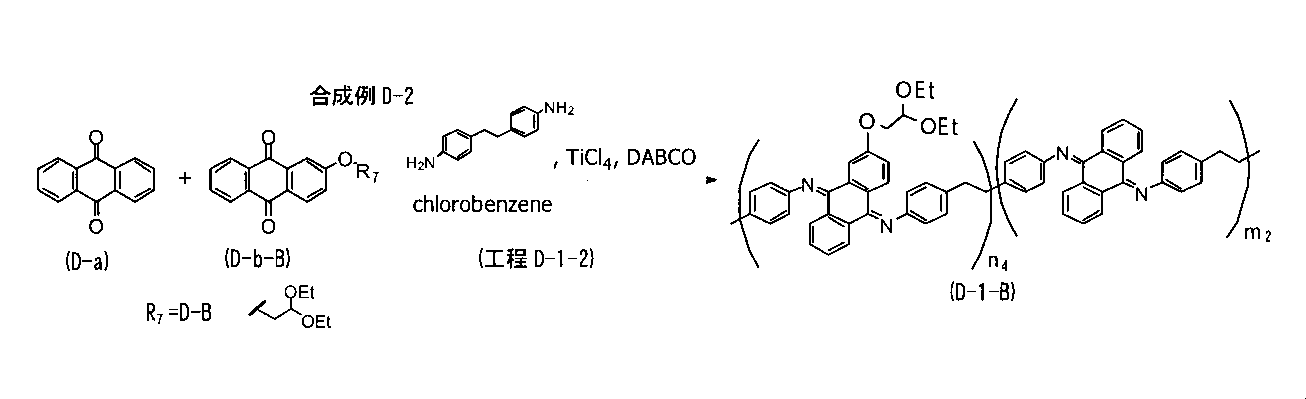
キノン(D-b-B)の合成
2-ヒドロキシアントラキノン(500mg、2.23mmol)のジメチルホルムアミド(22ml)溶液に、水素化ナトリウム(146mg、3.35mmol)を0℃で添加して、10分間攪拌をした。攪拌後、反応混合物にジエチルクロロアセタール(0.51ml、3.35mmol)を0℃で添加して、その混合物を70℃で1日間攪拌をした。その反応混合物を室温まで冷却して減圧下で蒸発させた。その残留物をクロロホルムで3回抽出してMgSO4で乾燥させてろ過した。ろ液を減圧下で蒸発させ、その混合物をカラムクロマトグラフィー(シリカゲル、クロロホルム)によって精製して、キノン(b-B)を得た(487mg、収率:64%、スペクトルデータ:1H NMR(500 MHz, CDCl3)δ 1.28(t, J = 6.9 Hz, 6H), 3.67(dq, J = 9.2, 6.2 Hz, 2H), 3.81(dq, J = 9.8, 6.9 Hz, 2H), 4.20(d, J = 5.2 Hz, 2H), 4.90(t, J = 5.2 Hz, 1H), 7.31(dd, J = 2.9, 8.6 Hz, 1H), 7.75(d, J = 2.0 Hz, 1H), 7.77-7.82(m, 2H), 8.27(d, J = 8.0 Hz, 1H), 8.29-8.31(m, 2H); 13C-NMR(125 MHz, CDCl3)d 15.3, 29.7, 62.9, 69.0, 100.2, 110.9, 121.4, 127.1, 127.3, 129.8, 133.5, 133.6, 133.7, 134.2, 135.5, 163.3, 182.2, 183.1; Elem. Anal. Calcd for C20H20O5: C, 70.57; H, 5.92; O, 23.5. Found: C, 71.7; H, 6.6)。
2-ヒドロキシアントラキノン(500mg、2.23mmol)のジメチルホルムアミド(22ml)溶液に、水素化ナトリウム(146mg、3.35mmol)を0℃で添加して、10分間攪拌をした。攪拌後、反応混合物にジエチルクロロアセタール(0.51ml、3.35mmol)を0℃で添加して、その混合物を70℃で1日間攪拌をした。その反応混合物を室温まで冷却して減圧下で蒸発させた。その残留物をクロロホルムで3回抽出してMgSO4で乾燥させてろ過した。ろ液を減圧下で蒸発させ、その混合物をカラムクロマトグラフィー(シリカゲル、クロロホルム)によって精製して、キノン(b-B)を得た(487mg、収率:64%、スペクトルデータ:1H NMR(500 MHz, CDCl3)δ 1.28(t, J = 6.9 Hz, 6H), 3.67(dq, J = 9.2, 6.2 Hz, 2H), 3.81(dq, J = 9.8, 6.9 Hz, 2H), 4.20(d, J = 5.2 Hz, 2H), 4.90(t, J = 5.2 Hz, 1H), 7.31(dd, J = 2.9, 8.6 Hz, 1H), 7.75(d, J = 2.0 Hz, 1H), 7.77-7.82(m, 2H), 8.27(d, J = 8.0 Hz, 1H), 8.29-8.31(m, 2H); 13C-NMR(125 MHz, CDCl3)d 15.3, 29.7, 62.9, 69.0, 100.2, 110.9, 121.4, 127.1, 127.3, 129.8, 133.5, 133.6, 133.7, 134.2, 135.5, 163.3, 182.2, 183.1; Elem. Anal. Calcd for C20H20O5: C, 70.57; H, 5.92; O, 23.5. Found: C, 71.7; H, 6.6)。
(工程D-1-2)アントラキノン誘導体(D-1-B)の合成
アントラキノン(150mg、0.72mmol)、キノン(D-b-B)(49mg、0.14mmol)、4,4’-エチレンジアニリン(184mg、0.86mmol)及び1,4-ジアザビシクロ[2,2,2]オクタン(565mg、5.04mmol)のクロロベンゼン(5ml)溶液に、塩化チタン(IV)(0.16ml、1.44mmol)のクロロベンゼン(2ml)溶液を90℃で添加して、2日間、130℃のAr下で攪拌した。その反応混合物を室温まで冷却してセライトでろ過をした。ろ液を減圧下で蒸発させてメタノールで再沈澱させて、アントラキノン誘導体(D-1-B)を得た(251mg、収率:72%、Mw = 9600; Mw/Mn = 1.63. Elem. Anal. Calcd for C174H132N12O3: C, 85.69; H, 5.46; N, 6.89. Found: C, 79.3; H, 5.3; N, 6.3.)。
アントラキノン(150mg、0.72mmol)、キノン(D-b-B)(49mg、0.14mmol)、4,4’-エチレンジアニリン(184mg、0.86mmol)及び1,4-ジアザビシクロ[2,2,2]オクタン(565mg、5.04mmol)のクロロベンゼン(5ml)溶液に、塩化チタン(IV)(0.16ml、1.44mmol)のクロロベンゼン(2ml)溶液を90℃で添加して、2日間、130℃のAr下で攪拌した。その反応混合物を室温まで冷却してセライトでろ過をした。ろ液を減圧下で蒸発させてメタノールで再沈澱させて、アントラキノン誘導体(D-1-B)を得た(251mg、収率:72%、Mw = 9600; Mw/Mn = 1.63. Elem. Anal. Calcd for C174H132N12O3: C, 85.69; H, 5.46; N, 6.89. Found: C, 79.3; H, 5.3; N, 6.3.)。
(実施例D-1-3)
<合成例D-3:アントラキノン誘導体(D-1-C)の合成>
<合成例D-3:アントラキノン誘導体(D-1-C)の合成>

キノン(D-b-C)の合成
2-ヒドロキシアントラキノン(500mg、2.23mmol)のジメチルホルムアミド(22ml)溶液に、水素化ナトリウム(146mg、3.35mmol)を0℃で添加して、10分間攪拌をした。攪拌後、反応混合物に2,2-ジメトキシエチルブロミド(0.4ml、3.35mmol)を0℃で添加して、その混合物を130℃で1日間攪拌をした。その反応混合物を室温まで冷却して減圧下で蒸発させた。その残留物をクロロホルムで3回抽出してMgSO4で乾燥させてろ過した。ろ液を減圧下で蒸発させ、その混合物をカラムクロマトグラフィー(シリカゲル、クロロホルム)によって精製して、キノン(D-b-C)を得た(532mg、収率:76%、スペクトルデータ:1H NMR(500 MHz, CDCl3)δ 3.50(s, 6H), 4.20(d, J = 5.2 Hz, 2H), 4.79(t, J = 5.2 Hz, 1H), 7.32(dd, J = 2.9, 8.6 Hz, 1H), 7.75-7.80(m, 3H), 8.27(d, J = 8.6 Hz, 1H), 8.28-8.31(m, 2H); 13C-NMR(125 MHz, CDCl3)δ 54.4, 68.1, 101.8, 110.7, 121.5, 127.2, 127.4, 129.8, 133.5, 133.6, 133.7, 134.2, 135.5, 163.2, 182.1, 183.1; Elem. Anal. Calcd for C18H16O5: C, 69.22; H, 5.16. Found: C, 69.0; H, 5.1)。
2-ヒドロキシアントラキノン(500mg、2.23mmol)のジメチルホルムアミド(22ml)溶液に、水素化ナトリウム(146mg、3.35mmol)を0℃で添加して、10分間攪拌をした。攪拌後、反応混合物に2,2-ジメトキシエチルブロミド(0.4ml、3.35mmol)を0℃で添加して、その混合物を130℃で1日間攪拌をした。その反応混合物を室温まで冷却して減圧下で蒸発させた。その残留物をクロロホルムで3回抽出してMgSO4で乾燥させてろ過した。ろ液を減圧下で蒸発させ、その混合物をカラムクロマトグラフィー(シリカゲル、クロロホルム)によって精製して、キノン(D-b-C)を得た(532mg、収率:76%、スペクトルデータ:1H NMR(500 MHz, CDCl3)δ 3.50(s, 6H), 4.20(d, J = 5.2 Hz, 2H), 4.79(t, J = 5.2 Hz, 1H), 7.32(dd, J = 2.9, 8.6 Hz, 1H), 7.75-7.80(m, 3H), 8.27(d, J = 8.6 Hz, 1H), 8.28-8.31(m, 2H); 13C-NMR(125 MHz, CDCl3)δ 54.4, 68.1, 101.8, 110.7, 121.5, 127.2, 127.4, 129.8, 133.5, 133.6, 133.7, 134.2, 135.5, 163.2, 182.1, 183.1; Elem. Anal. Calcd for C18H16O5: C, 69.22; H, 5.16. Found: C, 69.0; H, 5.1)。
(工程D-1-3)アントラキノン誘導体(D-1-C)の合成
アントラキノン(100mg、0.48mmol)、キノン(D-b-C)(30mg、0.10mmol)、4,4’-エチレンジアニリン(122mg、0.58mmol)及び1,4-ジアザビシクロ[2,2,2]オクタン(323mg、2.88mmol)のクロロベンゼン(2ml)溶液に、塩化チタン(IV)(0.1ml、0.96mmol)のクロロベンゼン(2ml)溶液を90℃で添加して、1日間、130℃のAr下で攪拌した。その反応混合物を室温まで冷却してセライトでろ過をした。ろ液を減圧下で蒸発させてメタノールで再沈澱させて、アントラキノン誘導体(D-1-C)を得た(162mg、収率:70%、Mw = 7800; Mw/Mn = 1.57. Elem. Anal. Calcd for C172H128N12O3: C, 85.69; H, 5.35; N, 6.97. Found: C, 80.4; H, 5.2; N, 6.4)。
アントラキノン(100mg、0.48mmol)、キノン(D-b-C)(30mg、0.10mmol)、4,4’-エチレンジアニリン(122mg、0.58mmol)及び1,4-ジアザビシクロ[2,2,2]オクタン(323mg、2.88mmol)のクロロベンゼン(2ml)溶液に、塩化チタン(IV)(0.1ml、0.96mmol)のクロロベンゼン(2ml)溶液を90℃で添加して、1日間、130℃のAr下で攪拌した。その反応混合物を室温まで冷却してセライトでろ過をした。ろ液を減圧下で蒸発させてメタノールで再沈澱させて、アントラキノン誘導体(D-1-C)を得た(162mg、収率:70%、Mw = 7800; Mw/Mn = 1.57. Elem. Anal. Calcd for C172H128N12O3: C, 85.69; H, 5.35; N, 6.97. Found: C, 80.4; H, 5.2; N, 6.4)。
(実施例D-1-4)
<合成例D-4:アントラキノン誘導体(D-1-D)の合成>
<合成例D-4:アントラキノン誘導体(D-1-D)の合成>

キノン(D-b-D)の合成
2-ヒドロキシアントラキノン(500mg、2.23mmol)のジメチルホルムアミド(22ml)溶液に、水素化ナトリウム(146mg、3.35mmol)を0℃で添加して、10分間攪拌をした。攪拌後、反応混合物に2-(2-ブロモエチル)-1,3-ジオキサン(0.45ml、3.35mmol)を0℃で添加して、その混合物を130℃で1日間攪拌をした。その反応混合物を室温まで冷却して減圧下で蒸発させた。その残留物をクロロホルムで3回抽出してMgSO4で乾燥させてろ過した。ろ液を減圧下で蒸発させ、その混合物をカラムクロマトグラフィー(シリカゲル、クロロホルム)によって精製して、キノン(D-b-D)を得た(532mg、収率:76%、スペクトルデータ:1H NMR(500 MHz, CDCl3)δ 1.37-1.40(m, 1H), 2.08-2.17(m, 3H), 3.81(dt, J = 2.3, 12.6 Hz, 2H), 4.14(dd, J = 5.2, 10.3 Hz, 2H), 4.27(dd, J = 6.3, 6.3 Hz, 2H), 4.81(t, J = 5.2 Hz, 1H), 7.27(dd, J = 2.3, 8.6 Hz, 1H), 7.74-7.81(m, 3H), 8.25(d, J = 8.6 Hz, 1H), 8.28-8.31(m, 2H); Elem. Anal. Calcd for C20H18O5: C, 70.99; H, 5.36. Found: C, 71.1; H, 5.4)。
2-ヒドロキシアントラキノン(500mg、2.23mmol)のジメチルホルムアミド(22ml)溶液に、水素化ナトリウム(146mg、3.35mmol)を0℃で添加して、10分間攪拌をした。攪拌後、反応混合物に2-(2-ブロモエチル)-1,3-ジオキサン(0.45ml、3.35mmol)を0℃で添加して、その混合物を130℃で1日間攪拌をした。その反応混合物を室温まで冷却して減圧下で蒸発させた。その残留物をクロロホルムで3回抽出してMgSO4で乾燥させてろ過した。ろ液を減圧下で蒸発させ、その混合物をカラムクロマトグラフィー(シリカゲル、クロロホルム)によって精製して、キノン(D-b-D)を得た(532mg、収率:76%、スペクトルデータ:1H NMR(500 MHz, CDCl3)δ 1.37-1.40(m, 1H), 2.08-2.17(m, 3H), 3.81(dt, J = 2.3, 12.6 Hz, 2H), 4.14(dd, J = 5.2, 10.3 Hz, 2H), 4.27(dd, J = 6.3, 6.3 Hz, 2H), 4.81(t, J = 5.2 Hz, 1H), 7.27(dd, J = 2.3, 8.6 Hz, 1H), 7.74-7.81(m, 3H), 8.25(d, J = 8.6 Hz, 1H), 8.28-8.31(m, 2H); Elem. Anal. Calcd for C20H18O5: C, 70.99; H, 5.36. Found: C, 71.1; H, 5.4)。
(工程D-1-4)アントラキノン誘導体(D-1-D)の合成
アントラキノン(150mg、0.72mmol)、キノン(D-b-D)(49mg、0.14mmol)、4,4’-エチレンジアニリン(184mg、0.86mmol)及び1,4-ジアザビシクロ[2,2,2]オクタン(565mg、5.04mmol)のクロロベンゼン(5ml)溶液に、塩化チタン(IV)(0.16ml、1.44mmol)のクロロベンゼン(2ml)溶液を90℃で添加して、1日間、130℃のAr下で攪拌した。その反応混合物を室温まで冷却してセライトでろ過をした。ろ液を減圧下で蒸発させてメタノールで再沈澱させて、アントラキノン誘導体(D-1-D)を得た(256mg、収率:73%、Mw = 9300; Mw/Mn = 1.53. Elem. Anal. Calcd for C173H128N12O3: C, 85.76; H, 5.38; N, 6.90. Found: C, 80.8; H, 5.2; N, 6.3)。
アントラキノン(150mg、0.72mmol)、キノン(D-b-D)(49mg、0.14mmol)、4,4’-エチレンジアニリン(184mg、0.86mmol)及び1,4-ジアザビシクロ[2,2,2]オクタン(565mg、5.04mmol)のクロロベンゼン(5ml)溶液に、塩化チタン(IV)(0.16ml、1.44mmol)のクロロベンゼン(2ml)溶液を90℃で添加して、1日間、130℃のAr下で攪拌した。その反応混合物を室温まで冷却してセライトでろ過をした。ろ液を減圧下で蒸発させてメタノールで再沈澱させて、アントラキノン誘導体(D-1-D)を得た(256mg、収率:73%、Mw = 9300; Mw/Mn = 1.53. Elem. Anal. Calcd for C173H128N12O3: C, 85.76; H, 5.38; N, 6.90. Found: C, 80.8; H, 5.2; N, 6.3)。
(実施例D-1-5)
<合成例D-5:アントラキノン誘導体(D-1-E)の合成>
<合成例D-5:アントラキノン誘導体(D-1-E)の合成>

キノン(D-b-E)の合成
2-ヒドロキシアントラキノン(500mg、2.23mmol)のジメチルホルムアミド(22ml)溶液に、水素化ナトリウム(146mg、3.35mmol)を0℃で添加して、10分間攪拌をした。攪拌後、反応混合物に2-ブロモメチル-1,3-ジオキソラン(0.35ml、3.35mmol)を0℃で添加して、その混合物を130℃で1日間攪拌をした。その反応混合物を室温まで冷却して減圧下で蒸発させた。その残留物をクロロホルムで3回抽出してMgSO4で乾燥させてろ過した。ろ液を減圧下で蒸発させ、その混合物をカラムクロマトグラフィー(シリカゲル、クロロホルム)によって精製して、キノン(D-b-E)を得た(560mg、収率:81%、スペクトルデータ:1H NMR(500 MHz, CDCl3)δ 3.99-4.04(m, 2H), 4.06-4.11(m, 2H), 4.23(d, J = 3.5 Hz, 2H), 5.37(t, J = 3.5 Hz, 1H), 7.33(dd, J = 2.9, 8.6 Hz, 1H), 7.76-7.81(m, 3H), 8.26-8.31(m, 3H); 13C-NMR(125 MHz, CDCl3), Elem. Anal. Calcd for C18H14O5: C, 69.67; H, 4.55. Found: C, 69.2; H, 4.5)。
2-ヒドロキシアントラキノン(500mg、2.23mmol)のジメチルホルムアミド(22ml)溶液に、水素化ナトリウム(146mg、3.35mmol)を0℃で添加して、10分間攪拌をした。攪拌後、反応混合物に2-ブロモメチル-1,3-ジオキソラン(0.35ml、3.35mmol)を0℃で添加して、その混合物を130℃で1日間攪拌をした。その反応混合物を室温まで冷却して減圧下で蒸発させた。その残留物をクロロホルムで3回抽出してMgSO4で乾燥させてろ過した。ろ液を減圧下で蒸発させ、その混合物をカラムクロマトグラフィー(シリカゲル、クロロホルム)によって精製して、キノン(D-b-E)を得た(560mg、収率:81%、スペクトルデータ:1H NMR(500 MHz, CDCl3)δ 3.99-4.04(m, 2H), 4.06-4.11(m, 2H), 4.23(d, J = 3.5 Hz, 2H), 5.37(t, J = 3.5 Hz, 1H), 7.33(dd, J = 2.9, 8.6 Hz, 1H), 7.76-7.81(m, 3H), 8.26-8.31(m, 3H); 13C-NMR(125 MHz, CDCl3), Elem. Anal. Calcd for C18H14O5: C, 69.67; H, 4.55. Found: C, 69.2; H, 4.5)。
(工程D-1-5)アントラキノン誘導体(D-1-E)の合成
アントラキノン(100mg、0.48mmol)、キノン(D-b-E)(30mg、0.10mmol)、4,4’-エチレンジアニリン(122mg、0.58mmol)及び1,4-ジアザビシクロ[2,2,2]オクタン(337mg、3.36mmol)のクロロベンゼン(4ml)溶液に、塩化チタン(IV)(0.1ml、0.86mmol)のクロロベンゼン(2ml)溶液を90℃で添加して、1日間、130℃のAr下で攪拌した。その反応混合物を室温まで冷却してセライトでろ過をした。ろ液を減圧下で蒸発させてメタノールで再沈澱させて、アントラキノン誘導体(D-1-E)を得た(183mg、収率:79%、Mw = 8800; Mw/Mn = 1.58. Elem. Anal. Calcd for C172H126N12O3: C, 85.76; H, 5.27; N, 6.98. Found: C, 80.2; H, 5.1; N, 6.4)。
アントラキノン(100mg、0.48mmol)、キノン(D-b-E)(30mg、0.10mmol)、4,4’-エチレンジアニリン(122mg、0.58mmol)及び1,4-ジアザビシクロ[2,2,2]オクタン(337mg、3.36mmol)のクロロベンゼン(4ml)溶液に、塩化チタン(IV)(0.1ml、0.86mmol)のクロロベンゼン(2ml)溶液を90℃で添加して、1日間、130℃のAr下で攪拌した。その反応混合物を室温まで冷却してセライトでろ過をした。ろ液を減圧下で蒸発させてメタノールで再沈澱させて、アントラキノン誘導体(D-1-E)を得た(183mg、収率:79%、Mw = 8800; Mw/Mn = 1.58. Elem. Anal. Calcd for C172H126N12O3: C, 85.76; H, 5.27; N, 6.98. Found: C, 80.2; H, 5.1; N, 6.4)。
(実施例D-1-6)
<合成例D-6:アントラキノン誘導体(D-1-F)の合成>
<合成例D-6:アントラキノン誘導体(D-1-F)の合成>

キノン(D-b-F)の合成
2-ヒドロキシアントラキノン(500mg、2.23mmol)のジメチルホルムアミド(22ml)溶液に、水素化ナトリウム(117mg、2.68mmol)を0℃で添加して、10分間攪拌をした。攪拌後、反応混合物に1-ブロモ-3-メトキシプロパン(0.3ml、2.68mmol)を0℃で添加して、その混合物を130℃で1日間攪拌をした。その反応混合物を室温まで冷却して減圧下で蒸発させた。その残留物をクロロホルムで3回抽出してMgSO4で乾燥させてろ過した。ろ液を減圧下で蒸発させ、その混合物をカラムクロマトグラフィー(シリカゲル、クロロホルム)によって精製して、キノン(D-b-F)を得た(619mg、収率:94%、スペクトルデータ:1H NMR(500 MHz, CDCl3)δ 2.13(ddd, J = 6.3 Hz, 2H), 3.38(s, 3H), 3.59(t, J = 6.3 Hz, 2H), 4.26(t, J = 6.3 Hz, 2H), 7.27(dd, J = 2.9, 8.6 Hz, 1H), 7.74(d, J = 2.9 Hz, 1H), 7.75-7.81(m, 2H), 8.26(d, J = 8.6 Hz, 1H), 8.29(m, 2H); 13C-NMR(125 MHz, CDCl3)δ 29.4, 58.8, 65.7, 68.8, 110.7, 121.3, 129.7, 133.6, 133.6, 133.7, 134.1, 135.6, 163.8, 183.3; Elem. Anal. Calcd for C18H16O4: C, 72.96; H, 5.44. Found: C, 73.0; H, 5.4)。
2-ヒドロキシアントラキノン(500mg、2.23mmol)のジメチルホルムアミド(22ml)溶液に、水素化ナトリウム(117mg、2.68mmol)を0℃で添加して、10分間攪拌をした。攪拌後、反応混合物に1-ブロモ-3-メトキシプロパン(0.3ml、2.68mmol)を0℃で添加して、その混合物を130℃で1日間攪拌をした。その反応混合物を室温まで冷却して減圧下で蒸発させた。その残留物をクロロホルムで3回抽出してMgSO4で乾燥させてろ過した。ろ液を減圧下で蒸発させ、その混合物をカラムクロマトグラフィー(シリカゲル、クロロホルム)によって精製して、キノン(D-b-F)を得た(619mg、収率:94%、スペクトルデータ:1H NMR(500 MHz, CDCl3)δ 2.13(ddd, J = 6.3 Hz, 2H), 3.38(s, 3H), 3.59(t, J = 6.3 Hz, 2H), 4.26(t, J = 6.3 Hz, 2H), 7.27(dd, J = 2.9, 8.6 Hz, 1H), 7.74(d, J = 2.9 Hz, 1H), 7.75-7.81(m, 2H), 8.26(d, J = 8.6 Hz, 1H), 8.29(m, 2H); 13C-NMR(125 MHz, CDCl3)δ 29.4, 58.8, 65.7, 68.8, 110.7, 121.3, 129.7, 133.6, 133.6, 133.7, 134.1, 135.6, 163.8, 183.3; Elem. Anal. Calcd for C18H16O4: C, 72.96; H, 5.44. Found: C, 73.0; H, 5.4)。
(工程D-1-6)アントラキノン誘導体(D-1-F)の合成
アントラキノン(100mg、0.48mmol)、キノン(D-b-F)(29mg、0.10mmol)、4,4’-エチレンジアニリン(122mg、0.58mmol)及び1,4-ジアザビシクロ[2,2,2]オクタン(323mg、2.88mmol)のクロロベンゼン(4ml)溶液に、塩化チタン(IV)(0.1ml、0.86mmol)のクロロベンゼン(2ml)溶液を90℃で添加して、1日間、130℃のAr下で攪拌した。その反応混合物を室温まで冷却してセライトでろ過をした。ろ液を減圧下で蒸発させてメタノールで再沈澱させて、アントラキノン誘導体(D-1-F)を得た(198mg、収率:86%、Mw = 11300; Mw/Mn = 1.72. Elem. Anal. Calcd for C172H128N12O2: C, 86.26; H, 5.39; N, 7.02)。
アントラキノン(100mg、0.48mmol)、キノン(D-b-F)(29mg、0.10mmol)、4,4’-エチレンジアニリン(122mg、0.58mmol)及び1,4-ジアザビシクロ[2,2,2]オクタン(323mg、2.88mmol)のクロロベンゼン(4ml)溶液に、塩化チタン(IV)(0.1ml、0.86mmol)のクロロベンゼン(2ml)溶液を90℃で添加して、1日間、130℃のAr下で攪拌した。その反応混合物を室温まで冷却してセライトでろ過をした。ろ液を減圧下で蒸発させてメタノールで再沈澱させて、アントラキノン誘導体(D-1-F)を得た(198mg、収率:86%、Mw = 11300; Mw/Mn = 1.72. Elem. Anal. Calcd for C172H128N12O2: C, 86.26; H, 5.39; N, 7.02)。
(実施例D-1-7)
<合成例D-7:アントラキノン誘導体(D-1-G)の合成>
<合成例D-7:アントラキノン誘導体(D-1-G)の合成>

キノン(D-b-G)の合成
2-ヒドロキシアントラキノン(500mg、2.23mmol)のジメチルホルムアミド(22ml)溶液に、水素化ナトリウム(117mg、2.68mmol)を0℃で添加して、10分間攪拌をした。攪拌後、反応混合物にヨウ化メチル(0.17ml、2.68mmol)を0℃で添加して、その混合物を130℃で1日間攪拌をした。その反応混合物を室温まで冷却して減圧下で蒸発させた。その残留物をクロロホルムで3回抽出してMgSO4で乾燥させてろ過した。ろ液を減圧下で蒸発させ、その混合物をカラムクロマトグラフィー(シリカゲル、クロロホルム)によって精製して、キノン(D-b-G)を得た(503mg、収率:95%、スペクトルデータ:1H NMR(500 MHz, CDCl3)δ 3.99(s, 3H), 7.27(dd, J = 2.9, 8.6 Hz, 1H), 7.73(d, J = 2.9 Hz, 1H), 7.75-7.81(m, 2H), 8.26(d, J = 8.6 Hz, 1H), 8.28-8.31(m, 2H); 13C-NMR(125 MHz, CDCl3)δ 56.0, 109.9, 121.2, 127.1, 129.8, 133.6, 133.7, 134.2, 135.6, 164.3, 182.2, 183.3; Elem. Anal. Calcd for C15H10O3: C, 75.62; H, 4.23. Found: C, 76.2; H, 4.8)。
2-ヒドロキシアントラキノン(500mg、2.23mmol)のジメチルホルムアミド(22ml)溶液に、水素化ナトリウム(117mg、2.68mmol)を0℃で添加して、10分間攪拌をした。攪拌後、反応混合物にヨウ化メチル(0.17ml、2.68mmol)を0℃で添加して、その混合物を130℃で1日間攪拌をした。その反応混合物を室温まで冷却して減圧下で蒸発させた。その残留物をクロロホルムで3回抽出してMgSO4で乾燥させてろ過した。ろ液を減圧下で蒸発させ、その混合物をカラムクロマトグラフィー(シリカゲル、クロロホルム)によって精製して、キノン(D-b-G)を得た(503mg、収率:95%、スペクトルデータ:1H NMR(500 MHz, CDCl3)δ 3.99(s, 3H), 7.27(dd, J = 2.9, 8.6 Hz, 1H), 7.73(d, J = 2.9 Hz, 1H), 7.75-7.81(m, 2H), 8.26(d, J = 8.6 Hz, 1H), 8.28-8.31(m, 2H); 13C-NMR(125 MHz, CDCl3)δ 56.0, 109.9, 121.2, 127.1, 129.8, 133.6, 133.7, 134.2, 135.6, 164.3, 182.2, 183.3; Elem. Anal. Calcd for C15H10O3: C, 75.62; H, 4.23. Found: C, 76.2; H, 4.8)。
(工程D-1-7)アントラキノン誘導体(D-1-G)の合成
アントラキノン(100mg、0.48mmol)、キノン(D-b-G)(23mg、0.10mmol)、4,4’-エチレンジアニリン(122mg、0.58mmol)及び1,4-ジアザビシクロ[2,2,2]オクタン(323mg、2.88mmol)のクロロベンゼン(4ml)溶液に、塩化チタン(IV)(0.1ml、0.86mmol)のクロロベンゼン(2ml)溶液を90℃で添加して、1日間、130℃のAr下で攪拌した。その反応混合物を室温まで冷却してセライトでろ過をした。ろ液を減圧下で蒸発させてメタノールで再沈澱させて、アントラキノン誘導体(D-1-F)を得た(171mg、収率:76%、Mw = 10700; Mw/Mn = 1.58. Elem. Anal. Calcd for C169H122N12O: C, 86.86; H, 5.26; N, 7.19)。
アントラキノン(100mg、0.48mmol)、キノン(D-b-G)(23mg、0.10mmol)、4,4’-エチレンジアニリン(122mg、0.58mmol)及び1,4-ジアザビシクロ[2,2,2]オクタン(323mg、2.88mmol)のクロロベンゼン(4ml)溶液に、塩化チタン(IV)(0.1ml、0.86mmol)のクロロベンゼン(2ml)溶液を90℃で添加して、1日間、130℃のAr下で攪拌した。その反応混合物を室温まで冷却してセライトでろ過をした。ろ液を減圧下で蒸発させてメタノールで再沈澱させて、アントラキノン誘導体(D-1-F)を得た(171mg、収率:76%、Mw = 10700; Mw/Mn = 1.58. Elem. Anal. Calcd for C169H122N12O: C, 86.86; H, 5.26; N, 7.19)。
(実施例D-1-8)
<合成例D-8:アントラキノン誘導体(D-1-H)の合成>
<合成例D-8:アントラキノン誘導体(D-1-H)の合成>

キノン(D-b-H)の合成
2-ヒドロキシアントラキノン(500mg、2.23mmol)のジメチルホルムアミド(22ml)溶液に、水素化ナトリウム(117mg、2.68mmol)を0℃で添加して、10分間攪拌をした。攪拌後、反応混合物に1-臭化プロパン(0.24ml、2.68mmol)を0℃で添加して、その混合物を130℃で1日間攪拌をした。その反応混合物を室温まで冷却して減圧下で蒸発させた。その残留物をクロロホルムで3回抽出してMgSO4で乾燥させてろ過した。ろ液を減圧下で蒸発させ、その混合物をカラムクロマトグラフィー(シリカゲル、クロロホルム)によって精製して、キノン(D-b-H)を得た(571mg、収率:91%、スペクトルデータ:1H NMR(500 MHz, CDCl3)δ 1.09(t, J = 7.5 Hz, 3H), 1.89(dq, J = 7.5, 6.3 Hz, 2H), 4.12(t, J = 6.3 Hz, 2H), 7.27(dd, J = 2.9, 8.6 Hz, 1H), 7.72(d, J = 2.9 Hz, 1H), 7.75-7.81(m, 2H), 8.25(d, J = 8.6 Hz, 1H), 8.28-8.31(m, 2H); 13C-NMR(125 MHz, CDCl3)δ 10.4, 22.4, 70.3, 110.5, 121.5, 126.9, 127.1, 129.7, 133.6, 133.7, 134.1, 135.5, 164.0, 182.2, 183.4; Elem. Anal. Calcd for C17H14O3: C, 76.68; H, 5.30. Found: C, 76.6; H, 5.4)。
2-ヒドロキシアントラキノン(500mg、2.23mmol)のジメチルホルムアミド(22ml)溶液に、水素化ナトリウム(117mg、2.68mmol)を0℃で添加して、10分間攪拌をした。攪拌後、反応混合物に1-臭化プロパン(0.24ml、2.68mmol)を0℃で添加して、その混合物を130℃で1日間攪拌をした。その反応混合物を室温まで冷却して減圧下で蒸発させた。その残留物をクロロホルムで3回抽出してMgSO4で乾燥させてろ過した。ろ液を減圧下で蒸発させ、その混合物をカラムクロマトグラフィー(シリカゲル、クロロホルム)によって精製して、キノン(D-b-H)を得た(571mg、収率:91%、スペクトルデータ:1H NMR(500 MHz, CDCl3)δ 1.09(t, J = 7.5 Hz, 3H), 1.89(dq, J = 7.5, 6.3 Hz, 2H), 4.12(t, J = 6.3 Hz, 2H), 7.27(dd, J = 2.9, 8.6 Hz, 1H), 7.72(d, J = 2.9 Hz, 1H), 7.75-7.81(m, 2H), 8.25(d, J = 8.6 Hz, 1H), 8.28-8.31(m, 2H); 13C-NMR(125 MHz, CDCl3)δ 10.4, 22.4, 70.3, 110.5, 121.5, 126.9, 127.1, 129.7, 133.6, 133.7, 134.1, 135.5, 164.0, 182.2, 183.4; Elem. Anal. Calcd for C17H14O3: C, 76.68; H, 5.30. Found: C, 76.6; H, 5.4)。
(工程D-1-8)アントラキノン誘導体(D-1-H)の合成
アントラキノン(100mg、0.48mmol)、キノン(D-b-H)(27mg、0.10mmol)、4,4’-エチレンジアニリン(122mg、0.58mmol)及び1,4-ジアザビシクロ[2,2,2]オクタン(323mg、2.88mmol)のクロロベンゼン(4ml)溶液に、塩化チタン(IV)(0.1ml、0.86mmol)のクロロベンゼン(2ml)溶液を90℃で添加して、1日間、130℃のAr下で攪拌した。その反応混合物を室温まで冷却してセライトでろ過をした。ろ液を減圧下で蒸発させてメタノールで再沈澱させて、アントラキノン誘導体(D-1-H)を得た(174mg、収率:76%、Mw = 7800; Mw/Mn = 1.50. Elem. Anal. Calcd for C171H126N12O: C, 86.85; H, 5.37; N, 7.11)。
アントラキノン(100mg、0.48mmol)、キノン(D-b-H)(27mg、0.10mmol)、4,4’-エチレンジアニリン(122mg、0.58mmol)及び1,4-ジアザビシクロ[2,2,2]オクタン(323mg、2.88mmol)のクロロベンゼン(4ml)溶液に、塩化チタン(IV)(0.1ml、0.86mmol)のクロロベンゼン(2ml)溶液を90℃で添加して、1日間、130℃のAr下で攪拌した。その反応混合物を室温まで冷却してセライトでろ過をした。ろ液を減圧下で蒸発させてメタノールで再沈澱させて、アントラキノン誘導体(D-1-H)を得た(174mg、収率:76%、Mw = 7800; Mw/Mn = 1.50. Elem. Anal. Calcd for C171H126N12O: C, 86.85; H, 5.37; N, 7.11)。
(実施例D-1-9)
<合成例D-9:アントラキノン誘導体(D-1-I)の合成>
<合成例D-9:アントラキノン誘導体(D-1-I)の合成>
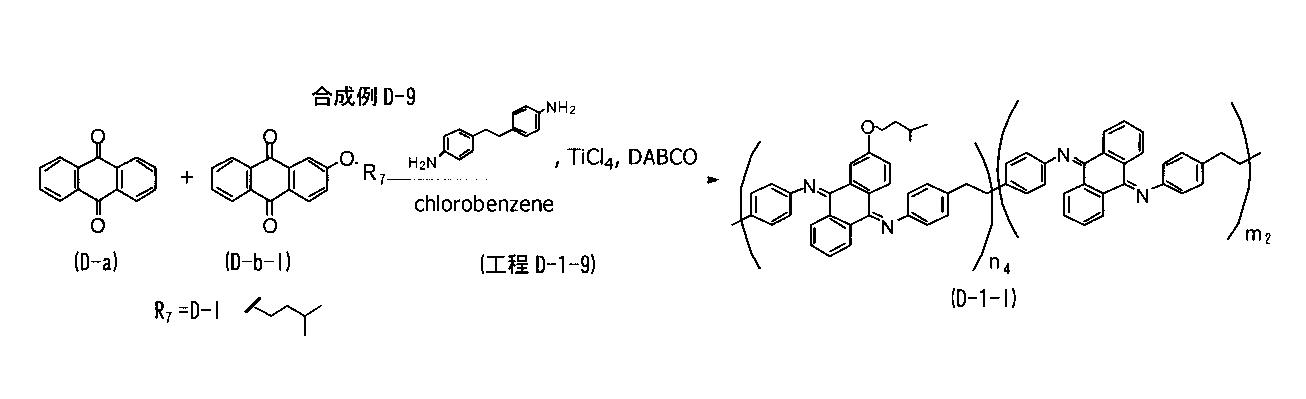
キノン(D-b-I)の合成
2-ヒドロキシアントラキノン(500mg、2.23mmol)のジメチルホルムアミド(22ml)溶液に、水素化ナトリウム(117mg、2.68mmol)を0℃で添加して、10分間攪拌をした。攪拌後、反応混合物に1-ブロモ-3-メチルブタン(0.34ml、2.68mmol)を0℃で添加して、その混合物を130℃で1日間攪拌をした。その反応混合物を室温まで冷却して減圧下で蒸発させた。その残留物をクロロホルムで3回抽出してMgSO4で乾燥させてろ過した。ろ液を減圧下で蒸発させ、その混合物をカラムクロマトグラフィー(シリカゲル、クロロホルム)によって精製して、キノン(D-b-I)を得た(633mg、収率:96%、スペクトルデータ:1H NMR(500 MHz, CDCl3)δ 1.75(dt, J = 6.9 Hz, 2H), 1.88(ddq, J = 6.9 Hz, 6H), 4.19(t, J = 6.9 Hz, 2H), 7.26(dd, J = 2.9, 8.6 Hz, 1H), 7.72(d, J = 2.9 Hz, 1H), 7.75-7.81(m, 2H), 8.25(d, J = 8.6 Hz, 1H), 8.28-8.31(m, 2H); 13C-NMR(125 MHz, CDCl3)δ 22.5, 25.0, 37.7, 67.2, 110.5, 121.5, 126.9, 127.1, 129.7, 133.6, 133.7, 134.1, 135.5, 164.0, 182.2, 183.4; Elem. Anal. Calcd for C19H18O3: C, 77.53; H, 6.16. Found: C, 77.2; H, 6.2)。
2-ヒドロキシアントラキノン(500mg、2.23mmol)のジメチルホルムアミド(22ml)溶液に、水素化ナトリウム(117mg、2.68mmol)を0℃で添加して、10分間攪拌をした。攪拌後、反応混合物に1-ブロモ-3-メチルブタン(0.34ml、2.68mmol)を0℃で添加して、その混合物を130℃で1日間攪拌をした。その反応混合物を室温まで冷却して減圧下で蒸発させた。その残留物をクロロホルムで3回抽出してMgSO4で乾燥させてろ過した。ろ液を減圧下で蒸発させ、その混合物をカラムクロマトグラフィー(シリカゲル、クロロホルム)によって精製して、キノン(D-b-I)を得た(633mg、収率:96%、スペクトルデータ:1H NMR(500 MHz, CDCl3)δ 1.75(dt, J = 6.9 Hz, 2H), 1.88(ddq, J = 6.9 Hz, 6H), 4.19(t, J = 6.9 Hz, 2H), 7.26(dd, J = 2.9, 8.6 Hz, 1H), 7.72(d, J = 2.9 Hz, 1H), 7.75-7.81(m, 2H), 8.25(d, J = 8.6 Hz, 1H), 8.28-8.31(m, 2H); 13C-NMR(125 MHz, CDCl3)δ 22.5, 25.0, 37.7, 67.2, 110.5, 121.5, 126.9, 127.1, 129.7, 133.6, 133.7, 134.1, 135.5, 164.0, 182.2, 183.4; Elem. Anal. Calcd for C19H18O3: C, 77.53; H, 6.16. Found: C, 77.2; H, 6.2)。
(工程D-1-9)アントラキノン誘導体(D-1-I)の合成
アントラキノン(100mg、0.48mmol)、キノン(D-b-I)(28mg、0.10mmol)、4,4’-エチレンジアニリン(122mg、0.58mmol)及び1,4-ジアザビシクロ[2,2,2]オクタン(323mg、2.88mmol)のクロロベンゼン(4ml)溶液に、塩化チタン(IV)(0.1ml、0.86mmol)のクロロベンゼン(2ml)溶液を90℃で添加して、1日間、130℃のAr下で攪拌した。その反応混合物を室温まで冷却してセライトでろ過をした。ろ液を減圧下で蒸発させてメタノールで再沈澱させて、アントラキノン誘導体(D-1-I)を得た(179mg、収率:79%、Mw = 9100; Mw/Mn = 1.85. Elem. Anal. Calcd for C173H130N12O: C, 86.83; H, 5.48; N, 7.02)。
アントラキノン(100mg、0.48mmol)、キノン(D-b-I)(28mg、0.10mmol)、4,4’-エチレンジアニリン(122mg、0.58mmol)及び1,4-ジアザビシクロ[2,2,2]オクタン(323mg、2.88mmol)のクロロベンゼン(4ml)溶液に、塩化チタン(IV)(0.1ml、0.86mmol)のクロロベンゼン(2ml)溶液を90℃で添加して、1日間、130℃のAr下で攪拌した。その反応混合物を室温まで冷却してセライトでろ過をした。ろ液を減圧下で蒸発させてメタノールで再沈澱させて、アントラキノン誘導体(D-1-I)を得た(179mg、収率:79%、Mw = 9100; Mw/Mn = 1.85. Elem. Anal. Calcd for C173H130N12O: C, 86.83; H, 5.48; N, 7.02)。
(実施例D-1-10)
<合成例D-10:アントラキノン誘導体(D-1-K)の合成>
<合成例D-10:アントラキノン誘導体(D-1-K)の合成>

キノン(D-b-K)の合成
2-ヒドロキシアントラキノン(500mg、2.23mmol)のジメチルホルムアミド(22ml)溶液に、水素化ナトリウム(117mg、2.68mmol)を0℃で添加して、10分間攪拌をした。攪拌後、反応混合物に1-ブロモオクタン(0.47ml、2.68mmol)を0℃で添加して、その混合物を130℃で1日間攪拌をした。その反応混合物を室温まで冷却して減圧下で蒸発させた。その残留物をクロロホルムで3回抽出してMgSO4で乾燥させてろ過した。ろ液を減圧下で蒸発させ、その混合物をカラムクロマトグラフィー(シリカゲル、クロロホルム)によって精製して、キノン(D-b-K)を得た(753mg、適量、スペクトルデータ:1H NMR(500 MHz, CDCl3)δ 0.90(t, J = 6.9 Hz, 3H), 1.25-1.40(m, 8H), 1.46-1.52(m, 2H), 1.85(ddt, J = 6.9 Hz, 2H), 4.15(t, J = 6.9 Hz, 2H), 7.26(dd, J = 2.3, 8.6 Hz, 1H), 7.71(d, J = 2.3 Hz, 1H), 7.75-7.81(m, 2H), 8.25(d, J = 8.6 Hz, 1H), 8.30(ddd, J = 1.7, 5.2, 6.9 Hz, 2H); 13C-NMR(125 MHz, CDCl3)δ 14.1, 22.6, 29.0, 29.2, 29.3, 31.8, 68.8, 110.5, 121.5, 126.9, 127.1, 129.7, 133.6, 133.7, 134.1, 164.0, 182.2, 183.3; Elem. Anal. Calcd for C22H24O3: C, 78.54; H, 7.19. Found: C, 78.5; H, 7.2)。
2-ヒドロキシアントラキノン(500mg、2.23mmol)のジメチルホルムアミド(22ml)溶液に、水素化ナトリウム(117mg、2.68mmol)を0℃で添加して、10分間攪拌をした。攪拌後、反応混合物に1-ブロモオクタン(0.47ml、2.68mmol)を0℃で添加して、その混合物を130℃で1日間攪拌をした。その反応混合物を室温まで冷却して減圧下で蒸発させた。その残留物をクロロホルムで3回抽出してMgSO4で乾燥させてろ過した。ろ液を減圧下で蒸発させ、その混合物をカラムクロマトグラフィー(シリカゲル、クロロホルム)によって精製して、キノン(D-b-K)を得た(753mg、適量、スペクトルデータ:1H NMR(500 MHz, CDCl3)δ 0.90(t, J = 6.9 Hz, 3H), 1.25-1.40(m, 8H), 1.46-1.52(m, 2H), 1.85(ddt, J = 6.9 Hz, 2H), 4.15(t, J = 6.9 Hz, 2H), 7.26(dd, J = 2.3, 8.6 Hz, 1H), 7.71(d, J = 2.3 Hz, 1H), 7.75-7.81(m, 2H), 8.25(d, J = 8.6 Hz, 1H), 8.30(ddd, J = 1.7, 5.2, 6.9 Hz, 2H); 13C-NMR(125 MHz, CDCl3)δ 14.1, 22.6, 29.0, 29.2, 29.3, 31.8, 68.8, 110.5, 121.5, 126.9, 127.1, 129.7, 133.6, 133.7, 134.1, 164.0, 182.2, 183.3; Elem. Anal. Calcd for C22H24O3: C, 78.54; H, 7.19. Found: C, 78.5; H, 7.2)。
(工程D-1-10)アントラキノン誘導体(D-1-K)の合成
アントラキノン(100mg、0.48mmol)、キノン(D-b-K)(32mg、0.10mmol)、4,4’-エチレンジアニリン(122mg、0.58mmol)及び1,4-ジアザビシクロ[2,2,2]オクタン(377mg、3.36mmol)のクロロベンゼン(4ml)溶液に、塩化チタン(IV)(0.11ml、0.96mmol)のクロロベンゼン(2ml)溶液を90℃で添加して、1日間、130℃のAr下で攪拌した。その反応混合物を室温まで冷却してセライトでろ過をした。ろ液を減圧下で蒸発させてメタノールで再沈澱させて、アントラキノン誘導体(D-1-K)を得た(179mg、収率:77%、Mw = 8900; Mw/Mn = 1.65. Elem. Anal. Calcd for C176H136N12O: C, 86.81; H, 5.63; N, 6.90))。
アントラキノン(100mg、0.48mmol)、キノン(D-b-K)(32mg、0.10mmol)、4,4’-エチレンジアニリン(122mg、0.58mmol)及び1,4-ジアザビシクロ[2,2,2]オクタン(377mg、3.36mmol)のクロロベンゼン(4ml)溶液に、塩化チタン(IV)(0.11ml、0.96mmol)のクロロベンゼン(2ml)溶液を90℃で添加して、1日間、130℃のAr下で攪拌した。その反応混合物を室温まで冷却してセライトでろ過をした。ろ液を減圧下で蒸発させてメタノールで再沈澱させて、アントラキノン誘導体(D-1-K)を得た(179mg、収率:77%、Mw = 8900; Mw/Mn = 1.65. Elem. Anal. Calcd for C176H136N12O: C, 86.81; H, 5.63; N, 6.90))。
(実施例D-1-11)
<合成例D-11:アントラキノン誘導体(D-1-L)の合成>
<合成例D-11:アントラキノン誘導体(D-1-L)の合成>
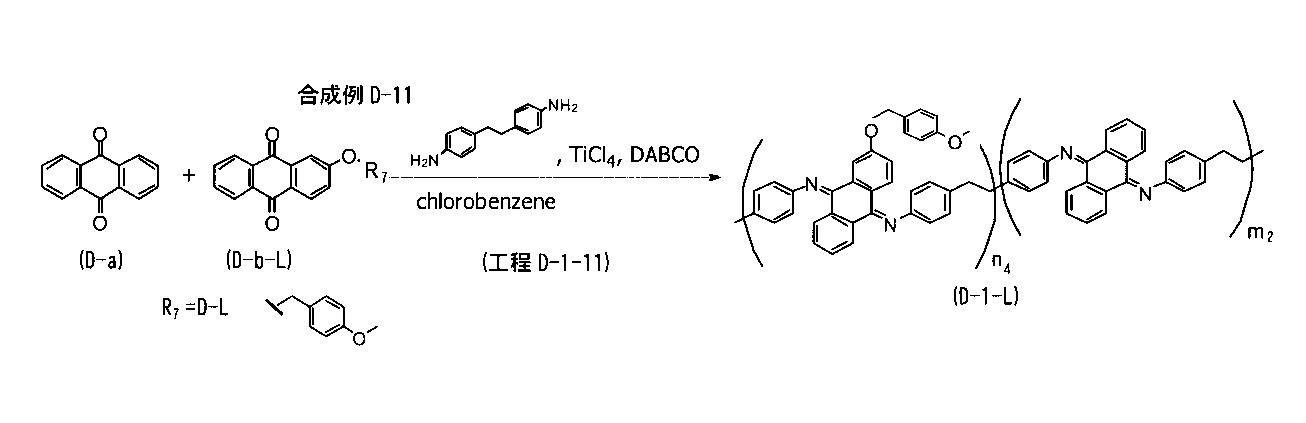
キノン(D-b-L)の合成
2-ヒドロキシアントラキノン(500mg、2.23mmol)のジメチルホルムアミド(22ml)溶液に、水素化ナトリウム(117mg、2.68mmol)を0℃で添加して、10分間攪拌をした。攪拌後、反応混合物にp-メトキシベンジルクロライド(0.36 ml、2.68mmol)を0℃で添加して、その混合物を130℃で1日間攪拌をした。その反応混合物を室温まで冷却して減圧下で蒸発させた。その残留物をクロロホルムで3回抽出してMgSO4で乾燥させてろ過した。ろ液を減圧下で蒸発させ、その混合物をカラムクロマトグラフィー(シリカゲル、クロロホルム)によって精製して、キノン(D-b-L)を得た(771mg、適量、スペクトルデータ:1H NMR(500 MHz, CDCl3)δ 3.83(s, 3H), 5.18(s, 2H), 6.95(d, J = 8.6 Hz, 2H), 7.33(dd, J = 2.3, 8.6 Hz, 1H), 7.40(d, J = 9.2 Hz, 2H), 7.75-7.81(m, 2H), 7.82(d, J = 2.3 Hz, 1H), 8.26(d, J = 8.6 Hz, 1H), 8.28-8.31(m, 2H); 13C-NMR(125 MHz, CDCl3)δ 55.3, 70.5, 110.9, 114.2, 121.8, 127.1, 127.2, 127.7, 129.5, 129.8, 133.6, 133.7, 134.2, 135.6, 159.8, 163.5, 182.2, 183.3. Elem. Anal. Calcd for C21H14O4: C, 76.35; H, 4.27)。
2-ヒドロキシアントラキノン(500mg、2.23mmol)のジメチルホルムアミド(22ml)溶液に、水素化ナトリウム(117mg、2.68mmol)を0℃で添加して、10分間攪拌をした。攪拌後、反応混合物にp-メトキシベンジルクロライド(0.36 ml、2.68mmol)を0℃で添加して、その混合物を130℃で1日間攪拌をした。その反応混合物を室温まで冷却して減圧下で蒸発させた。その残留物をクロロホルムで3回抽出してMgSO4で乾燥させてろ過した。ろ液を減圧下で蒸発させ、その混合物をカラムクロマトグラフィー(シリカゲル、クロロホルム)によって精製して、キノン(D-b-L)を得た(771mg、適量、スペクトルデータ:1H NMR(500 MHz, CDCl3)δ 3.83(s, 3H), 5.18(s, 2H), 6.95(d, J = 8.6 Hz, 2H), 7.33(dd, J = 2.3, 8.6 Hz, 1H), 7.40(d, J = 9.2 Hz, 2H), 7.75-7.81(m, 2H), 7.82(d, J = 2.3 Hz, 1H), 8.26(d, J = 8.6 Hz, 1H), 8.28-8.31(m, 2H); 13C-NMR(125 MHz, CDCl3)δ 55.3, 70.5, 110.9, 114.2, 121.8, 127.1, 127.2, 127.7, 129.5, 129.8, 133.6, 133.7, 134.2, 135.6, 159.8, 163.5, 182.2, 183.3. Elem. Anal. Calcd for C21H14O4: C, 76.35; H, 4.27)。
(工程D-1-11)アントラキノン誘導体(D-1-L)の合成
アントラキノン(100mg、0.48mmol)、キノン(D-b-L)(33mg、0.10mmol)、4,4’-エチレンジアニリン(122mg、0.58mmol)及び1,4-ジアザビシクロ[2,2,2]オクタン(389mg、3.46mmol)のクロロベンゼン(4ml)溶液に、塩化チタン(IV)(0.1ml、0.86mmol)のクロロベンゼン(2ml)溶液を90℃で添加して、1日間、130℃のAr下で攪拌した。その反応混合物を室温まで冷却してセライトでろ過をした。ろ液を減圧下で蒸発させてメタノールで再沈澱させて、アントラキノン誘導体(D-1-L)を得た(134mg、収率:57%、Mw = 8200; Mw/Mn = 1.53. Elem. Anal. Calcd for C175H126N12O2: C, 86.53; H, 5.23; N, 6.92))。
アントラキノン(100mg、0.48mmol)、キノン(D-b-L)(33mg、0.10mmol)、4,4’-エチレンジアニリン(122mg、0.58mmol)及び1,4-ジアザビシクロ[2,2,2]オクタン(389mg、3.46mmol)のクロロベンゼン(4ml)溶液に、塩化チタン(IV)(0.1ml、0.86mmol)のクロロベンゼン(2ml)溶液を90℃で添加して、1日間、130℃のAr下で攪拌した。その反応混合物を室温まで冷却してセライトでろ過をした。ろ液を減圧下で蒸発させてメタノールで再沈澱させて、アントラキノン誘導体(D-1-L)を得た(134mg、収率:57%、Mw = 8200; Mw/Mn = 1.53. Elem. Anal. Calcd for C175H126N12O2: C, 86.53; H, 5.23; N, 6.92))。
(実施例2)<電池特性評価>
(実施例D-2-1)
<リチウムイオン二次電池用の正極用電極の作製>
上記実施例D-1-1を参照しながら合成されたアントラキノン誘導体(D-1-A-m0)(2mg)と、ケチェンブラック(ケッチェンブラックインターナショナル社製)(4mg)と、導電性バインダー(TAB-2)(宝泉製)(4mg)とを混合してシート化し、集電体であるアルミメッシュ(14φ)(ニラコ製)の表面上に圧着した。それを120℃6時間で真空乾燥し、アントラキノン誘導体(D-1-A-m0)を備えた電極を作製した。
(実施例D-2-1)
<リチウムイオン二次電池用の正極用電極の作製>
上記実施例D-1-1を参照しながら合成されたアントラキノン誘導体(D-1-A-m0)(2mg)と、ケチェンブラック(ケッチェンブラックインターナショナル社製)(4mg)と、導電性バインダー(TAB-2)(宝泉製)(4mg)とを混合してシート化し、集電体であるアルミメッシュ(14φ)(ニラコ製)の表面上に圧着した。それを120℃6時間で真空乾燥し、アントラキノン誘導体(D-1-A-m0)を備えた電極を作製した。

<コイン型リチウムイオン二次電池の作製>
上記電極をコイン型リチウムイオン二次電池の正極とし、1M(mol/l)のLiPF6(六フッ化リン酸リチウム)電解質塩を含むエチレンカーボネート(EC)/ジエチルカーボネート(DEC)(EC:DEC=1:1(体積比))の混合溶液である電解液(キシダ化学製)にその正極を含浸させた。そして、その正極上にポリプロピレン多孔質フィルムからなるセパレーター(セルガード製)、ガラスフィルター(アドバンテック製)を積層し、さらに負極となるリチウム箔(本城金属製)を積層した。その後、周囲に絶縁パッキンを配置した状態でコイン型電池のアルミ外装を重ね、しめ機によって加圧し、正極活物質としてアントラキノン誘導体(D-1-A-m0)、負極活物質として金属リチウムを用いた密閉型のコイン型リチウムイオン二次電池を作製した。
上記電極をコイン型リチウムイオン二次電池の正極とし、1M(mol/l)のLiPF6(六フッ化リン酸リチウム)電解質塩を含むエチレンカーボネート(EC)/ジエチルカーボネート(DEC)(EC:DEC=1:1(体積比))の混合溶液である電解液(キシダ化学製)にその正極を含浸させた。そして、その正極上にポリプロピレン多孔質フィルムからなるセパレーター(セルガード製)、ガラスフィルター(アドバンテック製)を積層し、さらに負極となるリチウム箔(本城金属製)を積層した。その後、周囲に絶縁パッキンを配置した状態でコイン型電池のアルミ外装を重ね、しめ機によって加圧し、正極活物質としてアントラキノン誘導体(D-1-A-m0)、負極活物質として金属リチウムを用いた密閉型のコイン型リチウムイオン二次電池を作製した。
(実施例D-2-2)
<リチウムイオン二次電池用の正極用電極の作製>
アントラキノン誘導体(D-1-A-m0)の替わりに、実施例D-1-1を参照して合成されたアントラキノン誘導体(D-1-A-m1)を用いた以外は、実施例D-2-1と同様な方法でアントラキノン誘導体(D-1-A-m1)を備えた電極を作製した。
<リチウムイオン二次電池用の正極用電極の作製>
アントラキノン誘導体(D-1-A-m0)の替わりに、実施例D-1-1を参照して合成されたアントラキノン誘導体(D-1-A-m1)を用いた以外は、実施例D-2-1と同様な方法でアントラキノン誘導体(D-1-A-m1)を備えた電極を作製した。
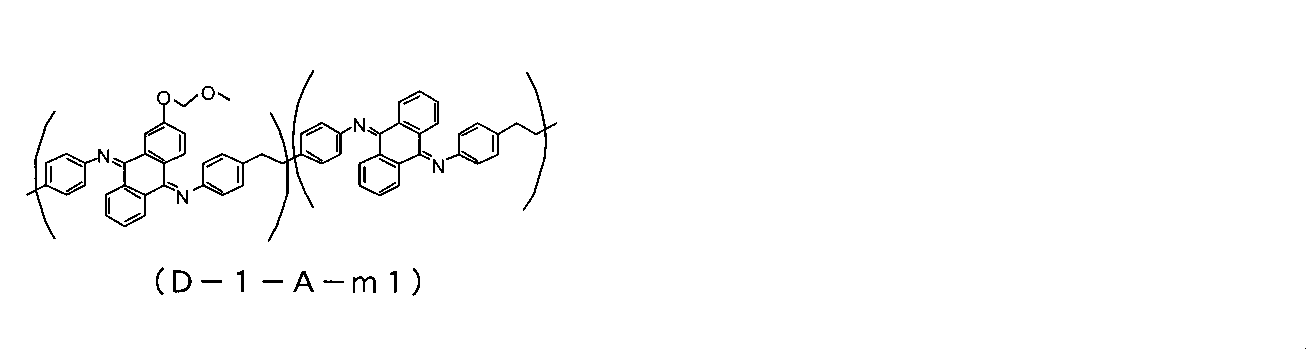
<コイン型リチウムイオン二次電池の作製>
実施例D-2-1と同様な方法で、上記電極をコイン型電池の正極とし、正極活物質としてアントラキノン誘導体(D-1-A-m1)及び負極活物質として金属リチウムを用いた密閉型のコイン型リチウムイオン二次電池を作製した。
実施例D-2-1と同様な方法で、上記電極をコイン型電池の正極とし、正極活物質としてアントラキノン誘導体(D-1-A-m1)及び負極活物質として金属リチウムを用いた密閉型のコイン型リチウムイオン二次電池を作製した。
(実施例D-2-3)
<リチウムイオン二次電池用の正極用電極の作製>
アントラキノン誘導体(D-1-A-m0)の替わりに、実施例D-1-1を参照して合成されたアントラキノン誘導体(D-1-A-m5)を用いた以外は、実施例D-2-1と同様な方法でアントラキノン誘導体(D-1-A-m5)を備えた電極を作製した。
<リチウムイオン二次電池用の正極用電極の作製>
アントラキノン誘導体(D-1-A-m0)の替わりに、実施例D-1-1を参照して合成されたアントラキノン誘導体(D-1-A-m5)を用いた以外は、実施例D-2-1と同様な方法でアントラキノン誘導体(D-1-A-m5)を備えた電極を作製した。
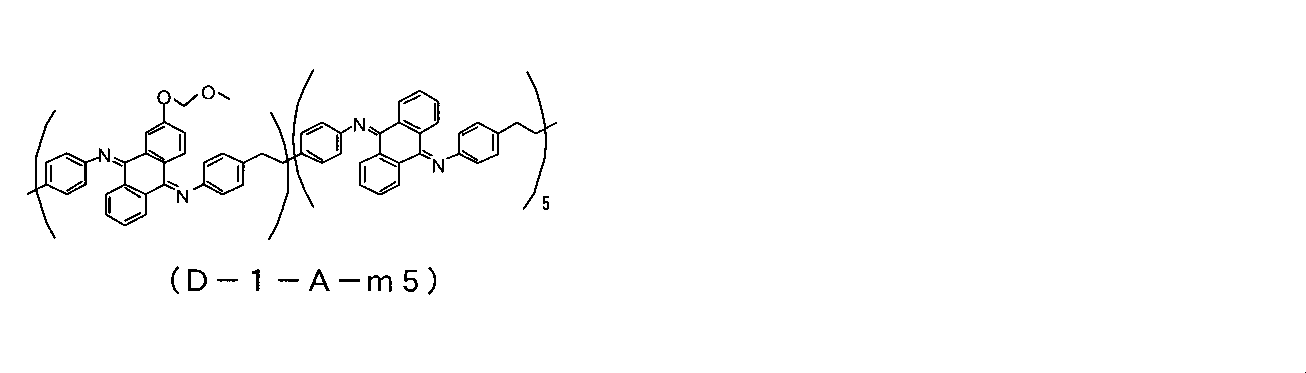
<コイン型リチウムイオン二次電池の作製>
実施例D-2-1と同様な方法で、上記電極をコイン型電池の正極とし、正極活物質としてアントラキノン誘導体(D-1-A-m5)及び負極活物質として金属リチウムを用いた密閉型のコイン型リチウムイオン二次電池を作製した。
実施例D-2-1と同様な方法で、上記電極をコイン型電池の正極とし、正極活物質としてアントラキノン誘導体(D-1-A-m5)及び負極活物質として金属リチウムを用いた密閉型のコイン型リチウムイオン二次電池を作製した。
(実施例D-2-4)
<リチウムイオン二次電池用の正極用電極の作製>
アントラキノン誘導体(D-1-A-m0)の替わりに、実施例D-1-1を参照して合成されたアントラキノン誘導体(D-1-A-m10)を用いた以外は、実施例D-2-1と同様な方法でアントラキノン誘導体(D-1-A-m10)を備えた電極を作製した。
<リチウムイオン二次電池用の正極用電極の作製>
アントラキノン誘導体(D-1-A-m0)の替わりに、実施例D-1-1を参照して合成されたアントラキノン誘導体(D-1-A-m10)を用いた以外は、実施例D-2-1と同様な方法でアントラキノン誘導体(D-1-A-m10)を備えた電極を作製した。

<コイン型リチウムイオン二次電池の作製>
実施例D-2-1と同様な方法で、上記電極をコイン型電池の正極とし、正極活物質としてアントラキノン誘導体(D-1-A-m10)及び負極活物質として金属リチウムを用いた密閉型のコイン型リチウムイオン二次電池を作製した。
実施例D-2-1と同様な方法で、上記電極をコイン型電池の正極とし、正極活物質としてアントラキノン誘導体(D-1-A-m10)及び負極活物質として金属リチウムを用いた密閉型のコイン型リチウムイオン二次電池を作製した。
(実施例D-2-5)
<リチウムイオン二次電池用の正極用電極の作製>
アントラキノン誘導体(D-1-A-m0)の替わりに、実施例D-1-2を参照して合成されたアントラキノン誘導体(D-1-B-m5)を用いた以外は、実施例D-2-1と同様な方法でアントラキノン誘導体(D-1-B-m5)を備えた電極を作製した。
<リチウムイオン二次電池用の正極用電極の作製>
アントラキノン誘導体(D-1-A-m0)の替わりに、実施例D-1-2を参照して合成されたアントラキノン誘導体(D-1-B-m5)を用いた以外は、実施例D-2-1と同様な方法でアントラキノン誘導体(D-1-B-m5)を備えた電極を作製した。
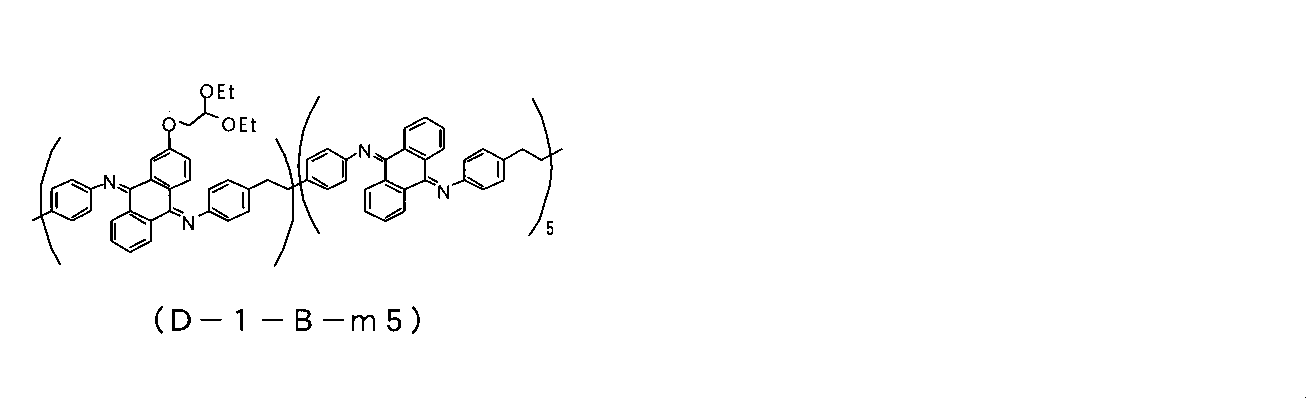
<コイン型リチウムイオン二次電池の作製>
実施例D-2-1と同様な方法で、上記電極をコイン型電池の正極とし、正極活物質としてアントラキノン誘導体(D-1-B-m5)及び負極活物質として金属リチウムを用いた密閉型のコイン型リチウムイオン二次電池を作製した。
実施例D-2-1と同様な方法で、上記電極をコイン型電池の正極とし、正極活物質としてアントラキノン誘導体(D-1-B-m5)及び負極活物質として金属リチウムを用いた密閉型のコイン型リチウムイオン二次電池を作製した。
(実施例D-2-6)
<リチウムイオン二次電池用の正極用電極の作製>
アントラキノン誘導体(D-1-A-m0)の替わりに、実施例D-1-3を参照して合成されたアントラキノン誘導体(D-1-C-m5)を用いた以外は、実施例D-2-1と同様な方法でアントラキノン誘導体(D-1-C-m5)を備えた電極を作製した。
<リチウムイオン二次電池用の正極用電極の作製>
アントラキノン誘導体(D-1-A-m0)の替わりに、実施例D-1-3を参照して合成されたアントラキノン誘導体(D-1-C-m5)を用いた以外は、実施例D-2-1と同様な方法でアントラキノン誘導体(D-1-C-m5)を備えた電極を作製した。
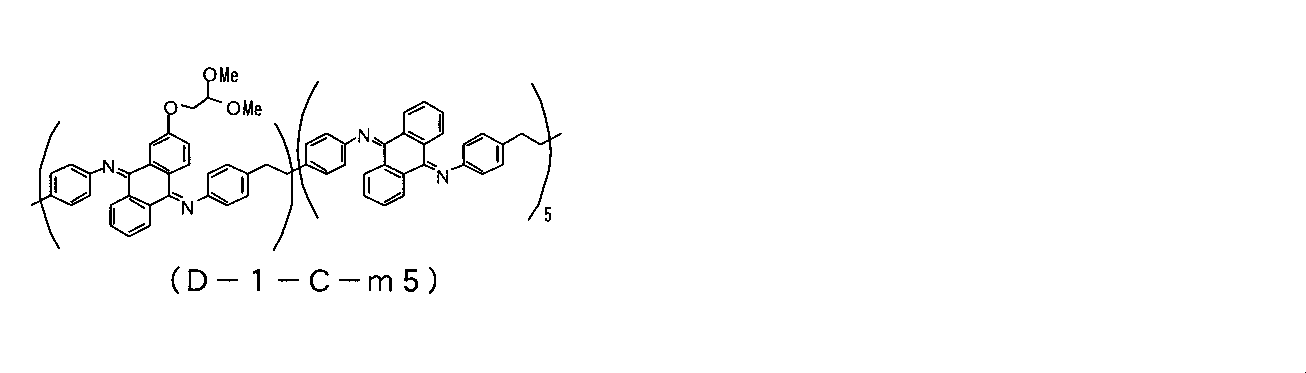
<コイン型リチウムイオン二次電池の作製>
実施例D-2-1と同様な方法で、上記電極をコイン型電池の正極とし、正極活物質としてアントラキノン誘導体(D-1-C-m5)及び負極活物質として金属リチウムを用いた密閉型のコイン型リチウムイオン二次電池を作製した。
実施例D-2-1と同様な方法で、上記電極をコイン型電池の正極とし、正極活物質としてアントラキノン誘導体(D-1-C-m5)及び負極活物質として金属リチウムを用いた密閉型のコイン型リチウムイオン二次電池を作製した。
(実施例D-2-7)
<リチウムイオン二次電池用の正極用電極の作製>
アントラキノン誘導体(D-1-A-m0)の替わりに、実施例D-1-4を参照して合成されたアントラキノン誘導体(D-1-D-m5)を用いた以外は、実施例D-2-1と同様な方法でアントラキノン誘導体(D-1-D-m5)を備えた電極を作製した。
<リチウムイオン二次電池用の正極用電極の作製>
アントラキノン誘導体(D-1-A-m0)の替わりに、実施例D-1-4を参照して合成されたアントラキノン誘導体(D-1-D-m5)を用いた以外は、実施例D-2-1と同様な方法でアントラキノン誘導体(D-1-D-m5)を備えた電極を作製した。
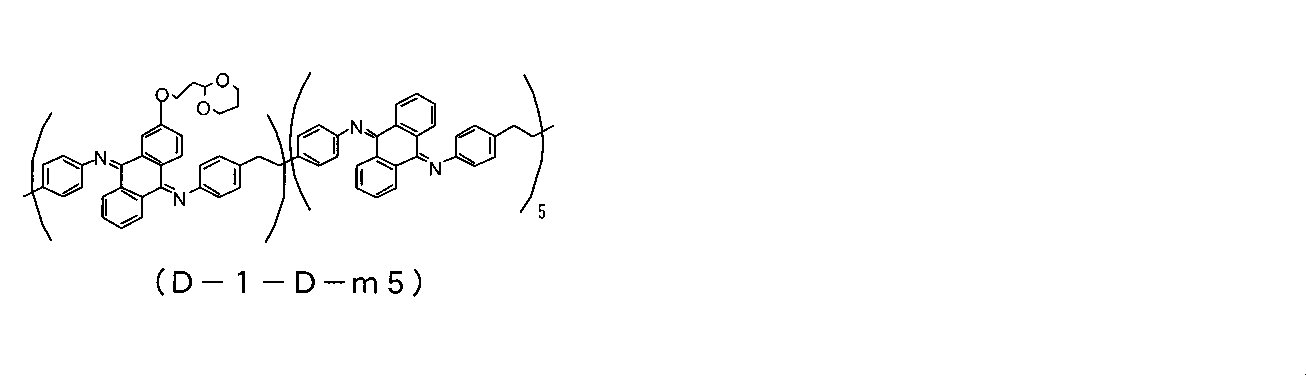
<コイン型リチウムイオン二次電池の作製>
実施例D-2-1と同様な方法で、上記電極をコイン型電池の正極とし、正極活物質としてアントラキノン誘導体(D-1-D-m5)及び負極活物質として金属リチウムを用いた密閉型のコイン型リチウムイオン二次電池を作製した。
実施例D-2-1と同様な方法で、上記電極をコイン型電池の正極とし、正極活物質としてアントラキノン誘導体(D-1-D-m5)及び負極活物質として金属リチウムを用いた密閉型のコイン型リチウムイオン二次電池を作製した。
(実施例D-2-8)
<リチウムイオン二次電池用の正極用電極の作製>
アントラキノン誘導体(D-1-A-m0)の替わりに、実施例D-1-5を参照して合成されたアントラキノン誘導体(D-1-E-m5)を用いた以外は、実施例D-2-1と同様な方法でアントラキノン誘導体(D-1-E-m5)を備えた電極を作製した。
<リチウムイオン二次電池用の正極用電極の作製>
アントラキノン誘導体(D-1-A-m0)の替わりに、実施例D-1-5を参照して合成されたアントラキノン誘導体(D-1-E-m5)を用いた以外は、実施例D-2-1と同様な方法でアントラキノン誘導体(D-1-E-m5)を備えた電極を作製した。
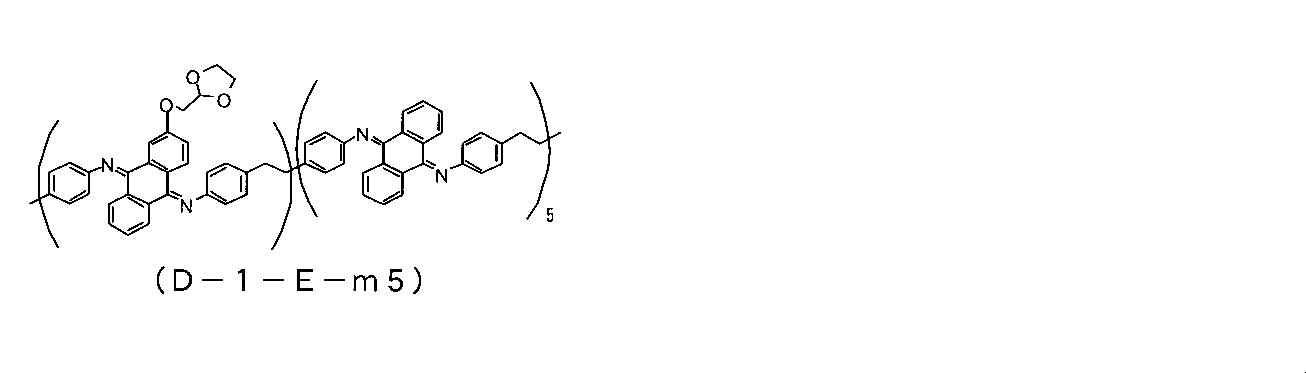
<コイン型リチウムイオン二次電池の作製>
実施例D-2-1と同様な方法で、上記電極をコイン型電池の正極とし、正極活物質としてアントラキノン誘導体(D-1-E-m5)及び負極活物質として金属リチウムを用いた密閉型のコイン型リチウムイオン二次電池を作製した。
実施例D-2-1と同様な方法で、上記電極をコイン型電池の正極とし、正極活物質としてアントラキノン誘導体(D-1-E-m5)及び負極活物質として金属リチウムを用いた密閉型のコイン型リチウムイオン二次電池を作製した。
(実施例D-2-9)
<リチウムイオン二次電池用の正極用電極の作製>
アントラキノン誘導体(D-1-A-m0)の替わりに、実施例D-1-6を参照して合成されたアントラキノン誘導体(D-1-F-m5)を用いた以外は、実施例D-2-1と同様な方法でアントラキノン誘導体(D-1-F-m5)を備えた電極を作製した。
<リチウムイオン二次電池用の正極用電極の作製>
アントラキノン誘導体(D-1-A-m0)の替わりに、実施例D-1-6を参照して合成されたアントラキノン誘導体(D-1-F-m5)を用いた以外は、実施例D-2-1と同様な方法でアントラキノン誘導体(D-1-F-m5)を備えた電極を作製した。
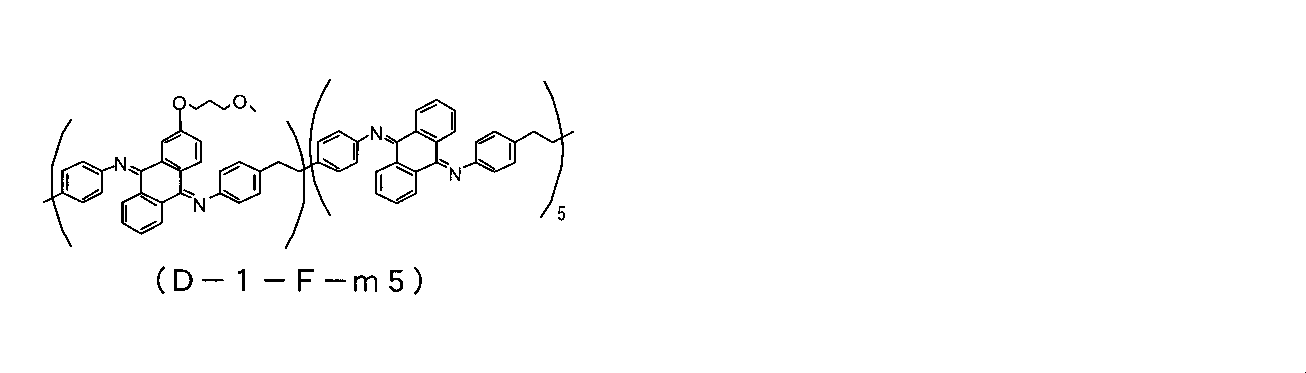
<コイン型リチウムイオン二次電池の作製>
実施例D-2-1と同様な方法で、上記電極をコイン型電池の正極とし、正極活物質としてアントラキノン誘導体(D-1-F-m5)及び負極活物質として金属リチウムを用いた密閉型のコイン型リチウムイオン二次電池を作製した。
実施例D-2-1と同様な方法で、上記電極をコイン型電池の正極とし、正極活物質としてアントラキノン誘導体(D-1-F-m5)及び負極活物質として金属リチウムを用いた密閉型のコイン型リチウムイオン二次電池を作製した。
(比較例D-1)
<リチウムイオン二次電池用の正極用電極の作製>
アントラキノン誘導体(D-1-A-m0)の替わりに、アントラキノンポリマーを用いた以外は、実施例D-2-1と全く同様な方法でアントラキノンポリマーを備えた電極を作製した。
<リチウムイオン二次電池用の正極用電極の作製>
アントラキノン誘導体(D-1-A-m0)の替わりに、アントラキノンポリマーを用いた以外は、実施例D-2-1と全く同様な方法でアントラキノンポリマーを備えた電極を作製した。
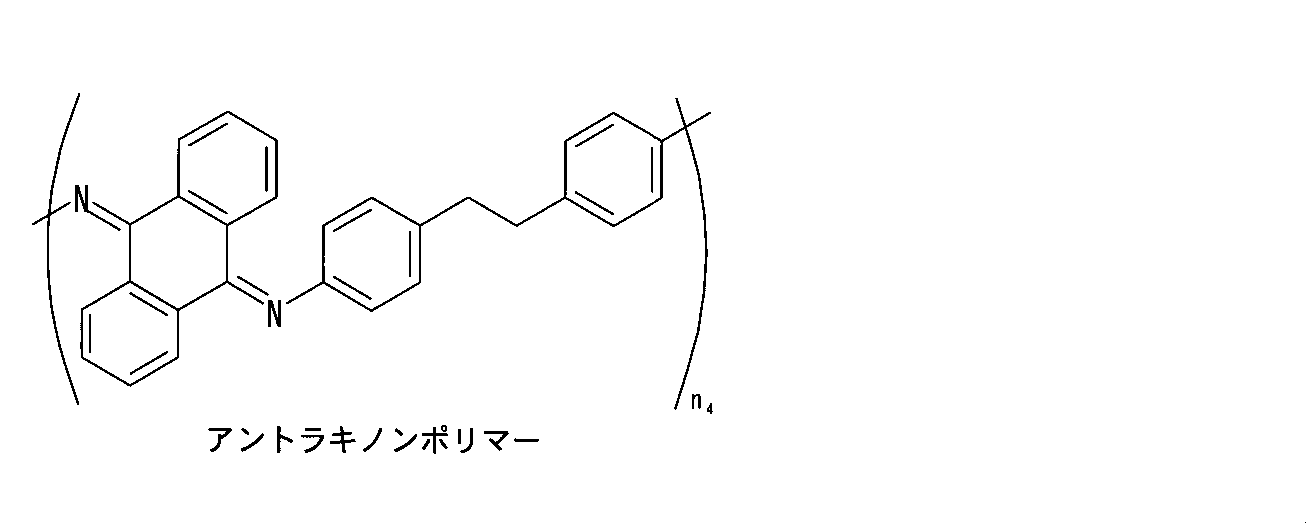
<コイン型リチウムイオン二次電池の作製>
実施例D-2-1と全く同様な方法で、上記電極をコイン型電池の正極とし、正極活物質としてアントラキノンポリマー及び負極活物質として金属リチウムを用いた密閉型のコイン型リチウムイオン二次電池を作製した。
実施例D-2-1と全く同様な方法で、上記電極をコイン型電池の正極とし、正極活物質としてアントラキノンポリマー及び負極活物質として金属リチウムを用いた密閉型のコイン型リチウムイオン二次電池を作製した。
<実施例D-2-1~D-2-9、及び比較例D-1で作製したコイン型リチウムイオン二次電池を用いた電池特性評価>
実施例D-2-1~D-2-9、及び比較例D-1で作製したコイン型リチウムイオン二次電池を用いて、次の方法にしたがって放電試験又は充放電試験を行った。
温度25℃の環境下、実施例D-2-1~D-2-9、及び比較例D-1で作製したコイン型リチウムイオン二次電池を0.05ミリアンペア(mA)の定電流で2ボルト(V)に達するまで放電した。
温度25℃の環境下、実施例D-2-3、D-2-6、D-2-9及び比較例D-1で作製したコイン型リチウムイオン二次電池を0.05ミリアンペア(mA)の定電流で2ボルト(V)に達するまで放電し、5分間の休止後、0.05ミリアンペア(mA)の定電流で4ボルト(V)に達するまで充電した。これを1サイクルとして、100サイクルまで充放電試験を行った。
<実施例D-2-1~D-2-9、及び比較例D-1で作製したコイン型リチウムイオン二次電池の電池特性の評価結果>
実施例D-2-1~D-2-4で作製したコイン型リチウムイオン二次電池を用いた放電試験の結果を図11に示す。図11は放電曲線(放電容量値(mAh/g))vs.電圧(V))を表す。実施例D-2-3、D-2-5~D-2-9で作製したコイン型リチウムイオン二次電池を用いた放電試験の結果を図12に示す。図12は放電曲線(放電容量値(mAh/g))vs.電圧(V))を表す。比較例D-1で作製したコイン型リチウムイオン二次電池を用いた放電試験の結果を図13に示す。図13は、放電曲線(放電容量値(mAh/g))vs.電圧(V))を表す。実施例D-2-3、D-2-6、D-2-9及び比較例D-1で作製したコイン型リチウムイオン二次電池を用いた充放電試験の結果を図14に示す。図14は、本発明のアントラキノン誘導体(D-1-A-m5、D-1-C-m5、及びD-1-F-m5)を用いたコイン型リチウムイオン二次電池と比較例のアントラキノンポリマーを用いたコイン型リチウムイオン二次電池との100サイクル目の電池容量の結果である。本発明のアントラキノン誘導体(D-1-A-m5、D-1-C-m5、及びD-1-F-m5)を用いたコイン型リチウムイオン二次電池の電池容量の値は、比較例D-1のアントラキノンポリマーを用いたコイン型リチウムイオン二次電池の電池容量値を1.0としたときの比率値である。
無置換のアントラキノンと2位にメトキシメチル基を有するキノンとの割合を任意に変更したところ、図11から明らかなように、アントラキノン(m):2位にメトキシメチルアントラキノン(n)が、5:1のとき、すなわち、実施例D-2-3のアントラキノン誘導体(D-1-A-m5)を用いたコイン型リチウムイオン二次電池の電池容量が最大値を示した。図11及び図13から明らかなように、比較例D-1のアントラキノンポリマーを用いたコイン型リチウムイオン二次電池の電池容量に対して、実施例D-2-1及び2-3のアントラキノン誘導体(D-1-A-m0及びD-1-A-m5)を用いたコイン型リチウムイオン二次電池の電池容量は高い値を示し、リチウムイオン二次電池用途適性が良好であることが確認された。また、実施例D-2-2及びD-2-4のアントラキノン誘導体(D-1-A-m0、D-1-A-m1及びD-1-A-m10)を用いたコイン型リチウムイオン二次電池の電池容量は比較例D-1のアントラキノンポリマーを用いたコイン型リチウムイオン二次電池の電池容量に対して、ほほ同等の値を示し、リチウムイオン二次電池用途適性に問題ないことが確認された。
図12及び図13から明らかなように、実施例D-2-3のアントラキノン誘導体(D-1-A-m5)、実施例D-2-6のアントラキノン誘導体(D-1-C-m5)、実施例D-2-9のアントラキノン誘導体(D-1-F-m5)、及び実施例D-2-8のアントラキノン誘導体(D-1-E-m5)を用いたコイン型リチウムイオン二次電池の電池容量は、比較例D-1のアントラキノンポリマーを用いたコイン型リチウムイオン二次電池の電池容量に対して、高い値を示し、アントラキノン誘導体(D-1-A-m5)、アントラキノン誘導体(D-1-C-m5)、アントラキノン誘導体、及びアントラキノン誘導体(D-1-E-m5)は、リチウムイオン二次電池用途適性が良好であることが確認された。実施例D-2-5のアントラキノン誘導体(D-1-B-m5)を用いたコイン型リチウムイオン二次電池の電池容量は、比較例D-1のアントラキノンポリマーを用いたコイン型リチウムイオン二次電池の電池容量に対して、ほぼ同等の値を示し、実施例D-2-4のアントラキノン誘導体(D-1-D-m5)を用いたコイン型リチウムイオン二次電池の電池容量は、比較例D-1のアントラキノンポリマーを用いたコイン型リチウムイオン二次電池の電池容量に対して、やや低い値を示した。
図14を参照すると、実施例D-2-3のアントラキノン誘導体(D-1-A-m5)を用いたコイン型リチウムイオン二次電池の電池容量値が一番高い値を示し、高容量化と長寿命化(サイクル適性)との両方を同時に達成したことが確認された。また、実施例D-2-6及び2-9のアントラキノン誘導体(D-1-C-m5、及びD-1-F-m5)を用いたコイン型リチウムイオン二次電池の電池容量値は比較例D-1のアントラキノンポリマーを用いたコイン型リチウムイオン二次電池の電池容量とほぼ同等の値を示し、サイクル適性に問題ないことが確認された。
自動車等の車両に、実施例D-2-1~D-2-9で作製したコイン型リチウムイオン二次電池を搭載したところ、実施例D-2-1~D-2-9で作製したコイン型リチウムイオン二次電池が、信頼性の高い安定な電源として重要な役割を果たしていることを確認した。
Claims (19)
- 下記一般式(A-1)で表されることを特徴とする、アントラキノン誘導体A。

- 前記R1が置換若しくは無置換のフェニレン基又は置換若しくは無置換のチエニレン基であることを特徴とする、請求項1に記載のアントラキノン誘導体A。
- 請求項1又は2に記載のアントラキノン誘導体Aを含有することを特徴とする、リチウムイオン二次電池用の正極活物質。
- 下記一般式(B-1)で表されることを特徴とする、アントラキノン誘導体B。
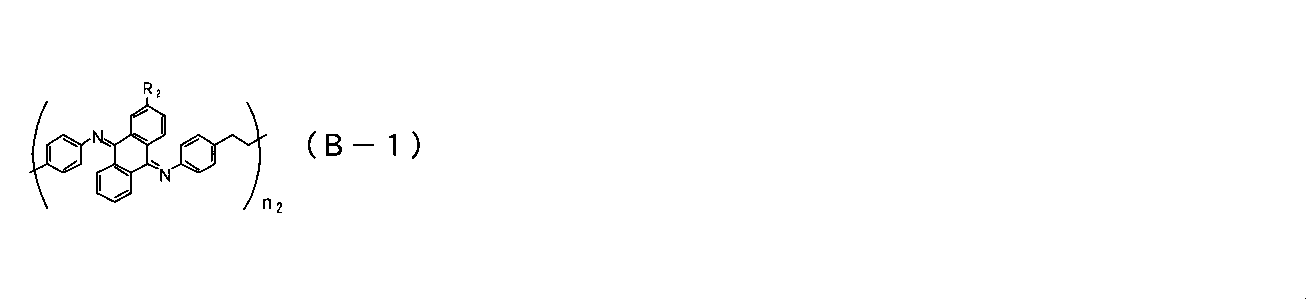

- 前記R3が置換又は無置換のフェニレン基であることを特徴とする、請求項4に記載のアントラキノン誘導体B。
- 請求項4又は5に記載のアントラキノン誘導体Bを含有することを特徴とする、リチウムイオン二次電池用の正極活物質。
- 下記一般式(C-1)で表されることを特徴とする、アントラキノン誘導体C1。
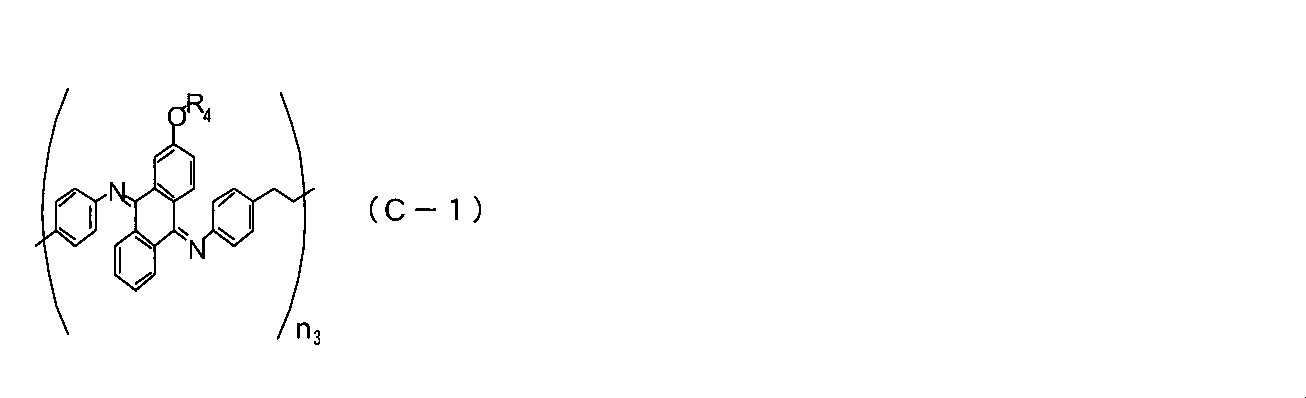
- 前記R4が、メトキシメチル基又はp-メトキシベンジル基であることを特徴とする、請求項7に記載のアントラキノン誘導体C1。
- 下記一般式(C-2)で表されることを特徴とする、アントラキノン誘導体C2。
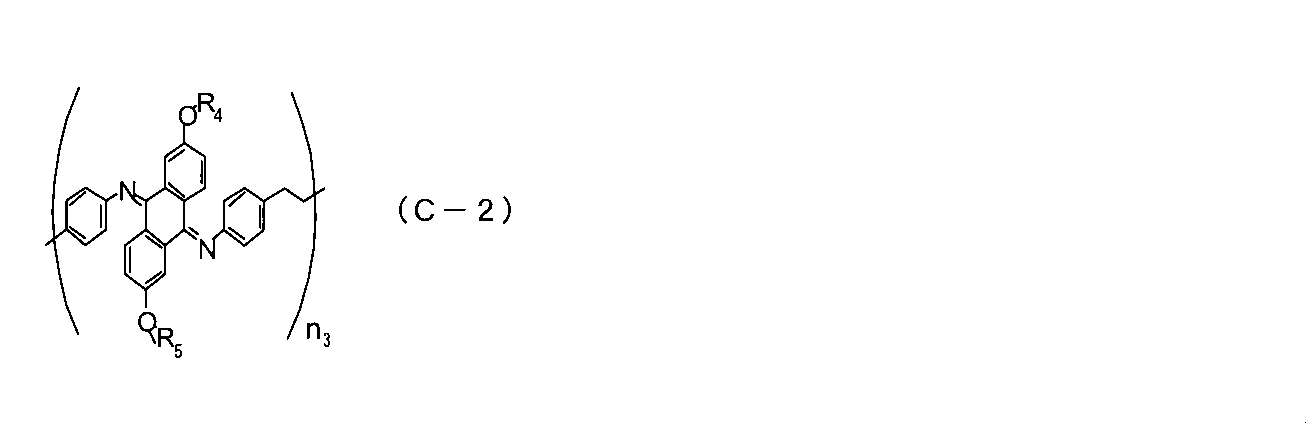
- 前記R4及び/又は前記R5が、メトキシメチル基及び/又はp-メトキシベンジル基であることを特徴とする、請求項9に記載のアントラキノン誘導体C2。
- 請求項7又は8に記載のアントラキノン誘導体C1を含有することを特徴とする、リチウムイオン二次電池用の正極活物質。
- 請求項9又は10に記載のアントラキノン誘導体C2を含有することを特徴とする、リチウムイオン二次電池用の正極活物質。
- 下記一般式(D-1)で表されることを特徴とする、アントラキノン誘導体D。


- 前記R6がヘテロ原子を有する置換基であることを特徴とする、請求項13に記載のアントラキノン誘導体D。
- 前記R7がヘテロ原子を有する置換基であることを特徴とする、請求項13又は14に記載のアントラキノン誘導体D。
- 請求項13から15のいずれか1項に記載のアントラキノン誘導体Dを含有することを特徴とする、リチウムイオン二次電池用の正極活物質。
- 請求項3、6、11、12又は16に記載の正極活物質が集電体の少なくとも表面に備えられることを特徴とする、リチウムイオン二次電池用の正極。
- 正極と、負極と、電解質とを少なくとも構成要素とするリチウムイオン二次電池において、該正極が請求項17に記載の正極であることを特徴とする、リチウムイオン二次電池。
- 請求項18に記載のリチウムイオン二次電池を搭載した車両。
Priority Applications (1)
| Application Number | Priority Date | Filing Date | Title |
|---|---|---|---|
| JP2013511960A JP5739985B2 (ja) | 2011-04-25 | 2012-02-21 | アントラキノン誘導体、及びそれを含有するリチウムイオン二次電池用の正極活物質 |
Applications Claiming Priority (8)
| Application Number | Priority Date | Filing Date | Title |
|---|---|---|---|
| JP2011097480 | 2011-04-25 | ||
| JP2011-097422 | 2011-04-25 | ||
| JP2011097422 | 2011-04-25 | ||
| JP2011-097409 | 2011-04-25 | ||
| JP2011-097499 | 2011-04-25 | ||
| JP2011-097480 | 2011-04-25 | ||
| JP2011097499 | 2011-04-25 | ||
| JP2011097409 | 2011-04-25 |
Publications (1)
| Publication Number | Publication Date |
|---|---|
| WO2012147398A1 true WO2012147398A1 (ja) | 2012-11-01 |
Family
ID=47071926
Family Applications (1)
| Application Number | Title | Priority Date | Filing Date |
|---|---|---|---|
| PCT/JP2012/054167 Ceased WO2012147398A1 (ja) | 2011-04-25 | 2012-02-21 | アントラキノン誘導体、及びそれを含有するリチウムイオン二次電池用の正極活物質 |
Country Status (3)
| Country | Link |
|---|---|
| JP (1) | JP5739985B2 (ja) |
| TW (1) | TW201302853A (ja) |
| WO (1) | WO2012147398A1 (ja) |
Cited By (2)
| Publication number | Priority date | Publication date | Assignee | Title |
|---|---|---|---|---|
| JP2013116949A (ja) * | 2011-12-02 | 2013-06-13 | Toyota Industries Corp | 複合材料及びその製造方法、非水系二次電池用の正極活物質及び正極、非水系二次電池、並びに車両 |
| KR20200048512A (ko) * | 2018-10-30 | 2020-05-08 | 서울대학교산학협력단 | 안트라퀴논계 배트 염료를 포함하는 리튬 이차전지용 전극 활물질 |
Citations (7)
| Publication number | Priority date | Publication date | Assignee | Title |
|---|---|---|---|---|
| JPS4952239A (ja) * | 1972-09-18 | 1974-05-21 | ||
| JPH11279279A (ja) * | 1997-12-03 | 1999-10-12 | Nissan Chem Ind Ltd | 透明電気伝導性ポリマー |
| JP2004006863A (ja) * | 2003-05-08 | 2004-01-08 | Ricoh Co Ltd | 電界効果型トランジスタ |
| JP2004189949A (ja) * | 2002-12-12 | 2004-07-08 | Kanagawa Acad Of Sci & Technol | 電気応答性環状型分子認識材料とその製造方法 |
| JP2005002278A (ja) * | 2003-06-13 | 2005-01-06 | Kanagawa Acad Of Sci & Technol | 高エネルギー密度新規ポリアニリン誘導体 |
| WO2008143272A1 (ja) * | 2007-05-17 | 2008-11-27 | Sumitomo Chemical Company, Limited | アントラセン系高分子化合物及びそれを用いてなる発光素子 |
| JP2011222318A (ja) * | 2010-04-09 | 2011-11-04 | Toyota Industries Corp | 過充放電処理によって得られるリチウムイオン二次電池用の正極活物質 |
-
2012
- 2012-02-21 JP JP2013511960A patent/JP5739985B2/ja not_active Expired - Fee Related
- 2012-02-21 WO PCT/JP2012/054167 patent/WO2012147398A1/ja not_active Ceased
- 2012-04-24 TW TW101114455A patent/TW201302853A/zh unknown
Patent Citations (7)
| Publication number | Priority date | Publication date | Assignee | Title |
|---|---|---|---|---|
| JPS4952239A (ja) * | 1972-09-18 | 1974-05-21 | ||
| JPH11279279A (ja) * | 1997-12-03 | 1999-10-12 | Nissan Chem Ind Ltd | 透明電気伝導性ポリマー |
| JP2004189949A (ja) * | 2002-12-12 | 2004-07-08 | Kanagawa Acad Of Sci & Technol | 電気応答性環状型分子認識材料とその製造方法 |
| JP2004006863A (ja) * | 2003-05-08 | 2004-01-08 | Ricoh Co Ltd | 電界効果型トランジスタ |
| JP2005002278A (ja) * | 2003-06-13 | 2005-01-06 | Kanagawa Acad Of Sci & Technol | 高エネルギー密度新規ポリアニリン誘導体 |
| WO2008143272A1 (ja) * | 2007-05-17 | 2008-11-27 | Sumitomo Chemical Company, Limited | アントラセン系高分子化合物及びそれを用いてなる発光素子 |
| JP2011222318A (ja) * | 2010-04-09 | 2011-11-04 | Toyota Industries Corp | 過充放電処理によって得られるリチウムイオン二次電池用の正極活物質 |
Cited By (3)
| Publication number | Priority date | Publication date | Assignee | Title |
|---|---|---|---|---|
| JP2013116949A (ja) * | 2011-12-02 | 2013-06-13 | Toyota Industries Corp | 複合材料及びその製造方法、非水系二次電池用の正極活物質及び正極、非水系二次電池、並びに車両 |
| KR20200048512A (ko) * | 2018-10-30 | 2020-05-08 | 서울대학교산학협력단 | 안트라퀴논계 배트 염료를 포함하는 리튬 이차전지용 전극 활물질 |
| KR102159706B1 (ko) | 2018-10-30 | 2020-09-24 | 서울대학교산학협력단 | 안트라퀴논계 배트 염료를 포함하는 리튬 이차전지용 전극 활물질 |
Also Published As
| Publication number | Publication date |
|---|---|
| JP5739985B2 (ja) | 2015-06-24 |
| TW201302853A (zh) | 2013-01-16 |
| JPWO2012147398A1 (ja) | 2014-07-28 |
Similar Documents
| Publication | Publication Date | Title |
|---|---|---|
| CN113594455B (zh) | 硅基负极材料、其制备方法及在锂离子电池的用途 | |
| US8399136B2 (en) | Electrolyte solution for lithium ion secondary battery, lithium ion secondary battery, fluoroalkane derivative and gelling agent | |
| US9406974B2 (en) | Additive for electrolyte of lithium battery, organic electrolytic solution comprising the same, and lithium battery using the organic electrolytic solution | |
| US20180076478A1 (en) | Solid electrolyte composition, electrode sheet for all-solid state secondary battery, all-solid state secondary battery, and methods for manufacturing electrode sheet for all-solid state secondary battery and all-solid state secondary battery | |
| TW201639225A (zh) | 非水電解液用添加劑、非水電解液、蓄電裝置、鋰離子電池及鋰離子電容器 | |
| JP6568199B2 (ja) | リチウム電極、これを含むリチウム二次電池、前記リチウム二次電池を含む電池モジュールおよびリチウム電極の製造方法 | |
| JP6247284B2 (ja) | リチウム二次電池用の電極材料として役立つポリマー | |
| WO2022142093A1 (zh) | 电解液、电化学装置及电子装置 | |
| CN113328093B (zh) | 一种金属离子电池有机电极材料、电极、电池以及制备方法 | |
| CN1698225A (zh) | 二次电池 | |
| JP5739985B2 (ja) | アントラキノン誘導体、及びそれを含有するリチウムイオン二次電池用の正極活物質 | |
| CN117083746A (zh) | 用于可再充电锂电池的电解质和包括其的可再充电锂电池 | |
| CN110828892B (zh) | 一种固态镁硫电池、制备方法及在深海中应用 | |
| CN1244174C (zh) | 电极及采用该电极的电池 | |
| JP5907373B2 (ja) | 複合材料及びその製造方法、非水系二次電池用の正極活物質及び正極、非水系二次電池、並びに車両 | |
| CN107251278B (zh) | 包含聚合材料的电化学元件及该聚合材料的用途 | |
| KR100691113B1 (ko) | 기능성 전해액 첨가제 및 이를 포함하는 전기 화학 소자 | |
| CN115621528B (zh) | 电池负极的预锂化方法、预锂化负极片和锂离子电池 | |
| JP5663011B2 (ja) | 縮合多環芳香族化合物及びその製造方法、並びにそれを含有するリチウムイオン二次電池用の正極活物質 | |
| JP5425694B2 (ja) | 過充放電処理をすることによって得られるリチウムイオン二次電池用の正極活物質、該正極活物質を備えるリチウムイオン二次電池用の正極及び該正極を構成要素として含むリチウムイオン二次電池 | |
| JP5799782B2 (ja) | ポリアセチレン誘導体、非水系二次電池用の正極活物質及び正極、非水系二次電池、並びに車両 | |
| JP5799781B2 (ja) | ポリアセチレン誘導体、非水系二次電池用の正極活物質及び正極、非水系二次電池、並びに車両 | |
| JP5401389B2 (ja) | アニリン誘導体を含有するリチウムイオン二次電池用の正極活物質、該正極活物質を備えるリチウムイオン二次電池用の正極及び該正極を構成要素として含むリチウムイオン二次電池 | |
| KR102367605B1 (ko) | 공중합체, 이의 제조방법, 이를 포함하는 실리콘 음극용 고분자 바인더, 상기 실리콘 음극용 고분자 바인더를 포함하는 실리콘 음극 및 상기 실리콘 음극을 포함하는 리튬이온전지 | |
| JP7278495B2 (ja) | 接着剤及びその製造方法、二次電池、電池モジュール、電池パックならびに電気装置 |
Legal Events
| Date | Code | Title | Description |
|---|---|---|---|
| 121 | Ep: the epo has been informed by wipo that ep was designated in this application |
Ref document number: 12776827 Country of ref document: EP Kind code of ref document: A1 |
|
| ENP | Entry into the national phase |
Ref document number: 2013511960 Country of ref document: JP Kind code of ref document: A |
|
| NENP | Non-entry into the national phase |
Ref country code: DE |
|
| 122 | Ep: pct application non-entry in european phase |
Ref document number: 12776827 Country of ref document: EP Kind code of ref document: A1 |