WO2012144532A1 - 金ヒドロキソ陰イオン錯体溶液及び金ナノ粒子担持体の製造方法 - Google Patents
金ヒドロキソ陰イオン錯体溶液及び金ナノ粒子担持体の製造方法 Download PDFInfo
- Publication number
- WO2012144532A1 WO2012144532A1 PCT/JP2012/060494 JP2012060494W WO2012144532A1 WO 2012144532 A1 WO2012144532 A1 WO 2012144532A1 JP 2012060494 W JP2012060494 W JP 2012060494W WO 2012144532 A1 WO2012144532 A1 WO 2012144532A1
- Authority
- WO
- WIPO (PCT)
- Prior art keywords
- gold
- solution
- carrier
- hydroxo
- anion
- Prior art date
- Legal status (The legal status is an assumption and is not a legal conclusion. Google has not performed a legal analysis and makes no representation as to the accuracy of the status listed.)
- Ceased
Links
Images






Classifications
-
- B—PERFORMING OPERATIONS; TRANSPORTING
- B01—PHYSICAL OR CHEMICAL PROCESSES OR APPARATUS IN GENERAL
- B01J—CHEMICAL OR PHYSICAL PROCESSES, e.g. CATALYSIS OR COLLOID CHEMISTRY; THEIR RELEVANT APPARATUS
- B01J23/00—Catalysts comprising metals or metal oxides or hydroxides, not provided for in group B01J21/00
- B01J23/38—Catalysts comprising metals or metal oxides or hydroxides, not provided for in group B01J21/00 of noble metals
- B01J23/48—Silver or gold
- B01J23/52—Gold
-
- B—PERFORMING OPERATIONS; TRANSPORTING
- B01—PHYSICAL OR CHEMICAL PROCESSES OR APPARATUS IN GENERAL
- B01J—CHEMICAL OR PHYSICAL PROCESSES, e.g. CATALYSIS OR COLLOID CHEMISTRY; THEIR RELEVANT APPARATUS
- B01J21/00—Catalysts comprising the elements, oxides, or hydroxides of magnesium, boron, aluminium, carbon, silicon, titanium, zirconium, or hafnium
- B01J21/06—Silicon, titanium, zirconium or hafnium; Oxides or hydroxides thereof
- B01J21/063—Titanium; Oxides or hydroxides thereof
-
- B—PERFORMING OPERATIONS; TRANSPORTING
- B01—PHYSICAL OR CHEMICAL PROCESSES OR APPARATUS IN GENERAL
- B01J—CHEMICAL OR PHYSICAL PROCESSES, e.g. CATALYSIS OR COLLOID CHEMISTRY; THEIR RELEVANT APPARATUS
- B01J23/00—Catalysts comprising metals or metal oxides or hydroxides, not provided for in group B01J21/00
- B01J23/38—Catalysts comprising metals or metal oxides or hydroxides, not provided for in group B01J21/00 of noble metals
- B01J23/54—Catalysts comprising metals or metal oxides or hydroxides, not provided for in group B01J21/00 of noble metals combined with metals, oxides or hydroxides provided for in groups B01J23/02 - B01J23/36
- B01J23/66—Silver or gold
-
- B—PERFORMING OPERATIONS; TRANSPORTING
- B01—PHYSICAL OR CHEMICAL PROCESSES OR APPARATUS IN GENERAL
- B01J—CHEMICAL OR PHYSICAL PROCESSES, e.g. CATALYSIS OR COLLOID CHEMISTRY; THEIR RELEVANT APPARATUS
- B01J29/00—Catalysts comprising molecular sieves
- B01J29/04—Catalysts comprising molecular sieves having base-exchange properties, e.g. crystalline zeolites
- B01J29/06—Crystalline aluminosilicate zeolites; Isomorphous compounds thereof
- B01J29/08—Crystalline aluminosilicate zeolites; Isomorphous compounds thereof of the faujasite type, e.g. type X or Y
- B01J29/10—Crystalline aluminosilicate zeolites; Isomorphous compounds thereof of the faujasite type, e.g. type X or Y containing iron group metals, noble metals or copper
- B01J29/12—Noble metals
- B01J29/126—Y-type faujasite
-
- B—PERFORMING OPERATIONS; TRANSPORTING
- B01—PHYSICAL OR CHEMICAL PROCESSES OR APPARATUS IN GENERAL
- B01J—CHEMICAL OR PHYSICAL PROCESSES, e.g. CATALYSIS OR COLLOID CHEMISTRY; THEIR RELEVANT APPARATUS
- B01J29/00—Catalysts comprising molecular sieves
- B01J29/82—Phosphates
- B01J29/84—Aluminophosphates containing other elements, e.g. metals, boron
- B01J29/85—Silicoaluminophosphates [SAPO compounds]
-
- B—PERFORMING OPERATIONS; TRANSPORTING
- B01—PHYSICAL OR CHEMICAL PROCESSES OR APPARATUS IN GENERAL
- B01J—CHEMICAL OR PHYSICAL PROCESSES, e.g. CATALYSIS OR COLLOID CHEMISTRY; THEIR RELEVANT APPARATUS
- B01J31/00—Catalysts comprising hydrides, coordination complexes or organic compounds
- B01J31/02—Catalysts comprising hydrides, coordination complexes or organic compounds containing organic compounds or metal hydrides
- B01J31/06—Catalysts comprising hydrides, coordination complexes or organic compounds containing organic compounds or metal hydrides containing polymers
-
- B—PERFORMING OPERATIONS; TRANSPORTING
- B01—PHYSICAL OR CHEMICAL PROCESSES OR APPARATUS IN GENERAL
- B01J—CHEMICAL OR PHYSICAL PROCESSES, e.g. CATALYSIS OR COLLOID CHEMISTRY; THEIR RELEVANT APPARATUS
- B01J35/00—Catalysts, in general, characterised by their form or physical properties
- B01J35/30—Catalysts, in general, characterised by their form or physical properties characterised by their physical properties
- B01J35/391—Physical properties of the active metal ingredient
- B01J35/393—Metal or metal oxide crystallite size
-
- B—PERFORMING OPERATIONS; TRANSPORTING
- B01—PHYSICAL OR CHEMICAL PROCESSES OR APPARATUS IN GENERAL
- B01J—CHEMICAL OR PHYSICAL PROCESSES, e.g. CATALYSIS OR COLLOID CHEMISTRY; THEIR RELEVANT APPARATUS
- B01J35/00—Catalysts, in general, characterised by their form or physical properties
- B01J35/40—Catalysts, in general, characterised by their form or physical properties characterised by dimensions, e.g. grain size
- B01J35/45—Nanoparticles
-
- B—PERFORMING OPERATIONS; TRANSPORTING
- B01—PHYSICAL OR CHEMICAL PROCESSES OR APPARATUS IN GENERAL
- B01J—CHEMICAL OR PHYSICAL PROCESSES, e.g. CATALYSIS OR COLLOID CHEMISTRY; THEIR RELEVANT APPARATUS
- B01J35/00—Catalysts, in general, characterised by their form or physical properties
- B01J35/50—Catalysts, in general, characterised by their form or physical properties characterised by their shape or configuration
- B01J35/56—Foraminous structures having flow-through passages or channels, e.g. grids or three-dimensional [3D] monoliths
-
- B—PERFORMING OPERATIONS; TRANSPORTING
- B01—PHYSICAL OR CHEMICAL PROCESSES OR APPARATUS IN GENERAL
- B01J—CHEMICAL OR PHYSICAL PROCESSES, e.g. CATALYSIS OR COLLOID CHEMISTRY; THEIR RELEVANT APPARATUS
- B01J35/00—Catalysts, in general, characterised by their form or physical properties
- B01J35/70—Catalysts, in general, characterised by their form or physical properties characterised by their crystalline properties, e.g. semi-crystalline
-
- B—PERFORMING OPERATIONS; TRANSPORTING
- B01—PHYSICAL OR CHEMICAL PROCESSES OR APPARATUS IN GENERAL
- B01J—CHEMICAL OR PHYSICAL PROCESSES, e.g. CATALYSIS OR COLLOID CHEMISTRY; THEIR RELEVANT APPARATUS
- B01J37/00—Processes, in general, for preparing catalysts; Processes, in general, for activation of catalysts
- B01J37/02—Impregnation, coating or precipitation
- B01J37/0201—Impregnation
-
- B—PERFORMING OPERATIONS; TRANSPORTING
- B01—PHYSICAL OR CHEMICAL PROCESSES OR APPARATUS IN GENERAL
- B01J—CHEMICAL OR PHYSICAL PROCESSES, e.g. CATALYSIS OR COLLOID CHEMISTRY; THEIR RELEVANT APPARATUS
- B01J37/00—Processes, in general, for preparing catalysts; Processes, in general, for activation of catalysts
- B01J37/02—Impregnation, coating or precipitation
- B01J37/03—Precipitation; Co-precipitation
- B01J37/031—Precipitation
- B01J37/035—Precipitation on carriers
-
- B—PERFORMING OPERATIONS; TRANSPORTING
- B01—PHYSICAL OR CHEMICAL PROCESSES OR APPARATUS IN GENERAL
- B01J—CHEMICAL OR PHYSICAL PROCESSES, e.g. CATALYSIS OR COLLOID CHEMISTRY; THEIR RELEVANT APPARATUS
- B01J37/00—Processes, in general, for preparing catalysts; Processes, in general, for activation of catalysts
- B01J37/06—Washing
-
- B—PERFORMING OPERATIONS; TRANSPORTING
- B01—PHYSICAL OR CHEMICAL PROCESSES OR APPARATUS IN GENERAL
- B01J—CHEMICAL OR PHYSICAL PROCESSES, e.g. CATALYSIS OR COLLOID CHEMISTRY; THEIR RELEVANT APPARATUS
- B01J37/00—Processes, in general, for preparing catalysts; Processes, in general, for activation of catalysts
- B01J37/08—Heat treatment
-
- B—PERFORMING OPERATIONS; TRANSPORTING
- B82—NANOTECHNOLOGY
- B82Y—SPECIFIC USES OR APPLICATIONS OF NANOSTRUCTURES; MEASUREMENT OR ANALYSIS OF NANOSTRUCTURES; MANUFACTURE OR TREATMENT OF NANOSTRUCTURES
- B82Y30/00—Nanotechnology for materials or surface science, e.g. nanocomposites
-
- C—CHEMISTRY; METALLURGY
- C01—INORGANIC CHEMISTRY
- C01G—COMPOUNDS CONTAINING METALS NOT COVERED BY SUBCLASSES C01D OR C01F
- C01G7/00—Compounds of gold
-
- C—CHEMISTRY; METALLURGY
- C07—ORGANIC CHEMISTRY
- C07F—ACYCLIC, CARBOCYCLIC OR HETEROCYCLIC COMPOUNDS CONTAINING ELEMENTS OTHER THAN CARBON, HYDROGEN, HALOGEN, OXYGEN, NITROGEN, SULFUR, SELENIUM OR TELLURIUM
- C07F1/00—Compounds containing elements of Groups 1 or 11 of the Periodic Table
- C07F1/005—Compounds containing elements of Groups 1 or 11 of the Periodic Table without C-Metal linkages
-
- H—ELECTRICITY
- H01—ELECTRIC ELEMENTS
- H01M—PROCESSES OR MEANS, e.g. BATTERIES, FOR THE DIRECT CONVERSION OF CHEMICAL ENERGY INTO ELECTRICAL ENERGY
- H01M4/00—Electrodes
- H01M4/86—Inert electrodes with catalytic activity, e.g. for fuel cells
- H01M4/90—Selection of catalytic material
- H01M4/9041—Metals or alloys
-
- H—ELECTRICITY
- H01—ELECTRIC ELEMENTS
- H01M—PROCESSES OR MEANS, e.g. BATTERIES, FOR THE DIRECT CONVERSION OF CHEMICAL ENERGY INTO ELECTRICAL ENERGY
- H01M4/00—Electrodes
- H01M4/86—Inert electrodes with catalytic activity, e.g. for fuel cells
- H01M4/90—Selection of catalytic material
- H01M4/9075—Catalytic material supported on carriers, e.g. powder carriers
-
- B—PERFORMING OPERATIONS; TRANSPORTING
- B01—PHYSICAL OR CHEMICAL PROCESSES OR APPARATUS IN GENERAL
- B01J—CHEMICAL OR PHYSICAL PROCESSES, e.g. CATALYSIS OR COLLOID CHEMISTRY; THEIR RELEVANT APPARATUS
- B01J2235/00—Indexing scheme associated with group B01J35/00, related to the analysis techniques used to determine the catalysts form or properties
- B01J2235/30—Scanning electron microscopy; Transmission electron microscopy
-
- B—PERFORMING OPERATIONS; TRANSPORTING
- B01—PHYSICAL OR CHEMICAL PROCESSES OR APPARATUS IN GENERAL
- B01J—CHEMICAL OR PHYSICAL PROCESSES, e.g. CATALYSIS OR COLLOID CHEMISTRY; THEIR RELEVANT APPARATUS
- B01J23/00—Catalysts comprising metals or metal oxides or hydroxides, not provided for in group B01J21/00
- B01J23/38—Catalysts comprising metals or metal oxides or hydroxides, not provided for in group B01J21/00 of noble metals
- B01J23/54—Catalysts comprising metals or metal oxides or hydroxides, not provided for in group B01J21/00 of noble metals combined with metals, oxides or hydroxides provided for in groups B01J23/02 - B01J23/36
- B01J23/56—Platinum group metals
- B01J23/63—Platinum group metals with rare earths or actinides
-
- B—PERFORMING OPERATIONS; TRANSPORTING
- B82—NANOTECHNOLOGY
- B82Y—SPECIFIC USES OR APPLICATIONS OF NANOSTRUCTURES; MEASUREMENT OR ANALYSIS OF NANOSTRUCTURES; MANUFACTURE OR TREATMENT OF NANOSTRUCTURES
- B82Y40/00—Manufacture or treatment of nanostructures
-
- C—CHEMISTRY; METALLURGY
- C01—INORGANIC CHEMISTRY
- C01P—INDEXING SCHEME RELATING TO STRUCTURAL AND PHYSICAL ASPECTS OF SOLID INORGANIC COMPOUNDS
- C01P2004/00—Particle morphology
- C01P2004/01—Particle morphology depicted by an image
- C01P2004/04—Particle morphology depicted by an image obtained by TEM, STEM, STM or AFM
-
- C—CHEMISTRY; METALLURGY
- C01—INORGANIC CHEMISTRY
- C01P—INDEXING SCHEME RELATING TO STRUCTURAL AND PHYSICAL ASPECTS OF SOLID INORGANIC COMPOUNDS
- C01P2004/00—Particle morphology
- C01P2004/60—Particles characterised by their size
- C01P2004/64—Nanometer sized, i.e. from 1-100 nanometer
-
- Y—GENERAL TAGGING OF NEW TECHNOLOGICAL DEVELOPMENTS; GENERAL TAGGING OF CROSS-SECTIONAL TECHNOLOGIES SPANNING OVER SEVERAL SECTIONS OF THE IPC; TECHNICAL SUBJECTS COVERED BY FORMER USPC CROSS-REFERENCE ART COLLECTIONS [XRACs] AND DIGESTS
- Y02—TECHNOLOGIES OR APPLICATIONS FOR MITIGATION OR ADAPTATION AGAINST CLIMATE CHANGE
- Y02E—REDUCTION OF GREENHOUSE GAS [GHG] EMISSIONS, RELATED TO ENERGY GENERATION, TRANSMISSION OR DISTRIBUTION
- Y02E60/00—Enabling technologies; Technologies with a potential or indirect contribution to GHG emissions mitigation
- Y02E60/30—Hydrogen technology
- Y02E60/50—Fuel cells
Definitions
- the present invention relates to a gold hydroxo anion complex solution, a method for producing the same, and a method for producing a gold nanoparticle carrier using the gold hydroxo anion complex solution.
- the carrier is immersed in a solution of a precious metal compound such as chloroplatinic acid in a solvent such as water, and the solvent is removed by a method such as evaporation to dryness.
- a precious metal compound such as chloroplatinic acid
- a solvent such as water
- it is prepared by a so-called impregnation method in which chloroplatinic acid is dispersed and supported on the surface of the carrier and calcined and reduced to form platinum fine particles.
- platinum it is possible to support platinum nanoparticles having a particle size of 5 nm or less by this method. According to this method, a wide variety of catalysts can be easily prepared by combining a noble metal compound and a carrier, and mass production is easy.
- a highly active catalyst cannot be obtained by a normal impregnation method. Even if it is prepared by the same impregnation method as that of the platinum catalyst using chloroauric acid, the particle size of gold becomes as large as about 30 nm. It has been pointed out that this is because the chlorine contained in the raw material chloroauric acid becomes particles that agglomerate and coarsen gold during thermal decomposition. Further, even after the thermal decomposition treatment, the remaining chlorine causes poisoning of active sites for many catalytic reactions, so that it becomes a double negative factor together with the aggregation of gold, and the activity becomes extremely low.
- the operation of washing the coprecipitate is particularly important, and it has been reported that if chlorine remains even in a trace amount of about 300 ppm, the particle size of gold is increased during firing. For this reason, the washing operation needs to be repeated using a large amount of water, but in order to obtain a highly active catalyst with a large surface area, the carrier oxide also needs to be made into fine particles. In many cases, separation of water and precipitates takes a long time when using either the decantation method or the centrifugal separation method, and it is very laborious to wash repeatedly until chlorine is no longer detected. This is an operation.
- a gold / titanium oxide catalyst a catalyst that is highly active in CO oxidation can be prepared by using a precipitation method at around pH 7. For example, even if it is prepared with 3% by weight of gold, the actual gold after preparation is prepared. / Gold contained in titanium oxide is about 1.5 wt%, and only about 50% of the charged amount is supported. Further, since the carrier capable of supporting gold by the precipitation method is limited to basic to amphoteric oxides, it cannot support gold on acidic oxides such as silica and silica-alumina.
- Patent Document 1 after impregnating titanium oxide with chloroauric acid and further impregnating with sodium carbonate, gold hydroxide is precipitated in the pores, washed with water, A method is described in which gold / titanium oxide showing high activity is dried by drying. However, in this method, chlorine cannot be completely removed by washing with water, and a larger amount of chlorine is detected than in the precipitation method, and the activity decreases when baked at about 400 ° C.
- the liquid phase gold nanoparticle preparation process has various drawbacks, and therefore, a gold nanoparticle catalyst preparation method by a gas phase method or a solid phase method has been studied.
- a typical example of the gas phase method is a gas phase grafting method in which dimethylgold acetylacetonate complex (CH 3 ) 2 Au (acac) is vaporized and supported in a vacuum line.
- a solid phase mixing method in which the same complex is mixed and pulverized in a carrier and a mortar, and a sublimated gold precursor is supported on the surface with high dispersion.
- the present invention has been made in view of the current state of the prior art described above, and its main object is to prepare a gold nanoparticle catalyst to which a liquid phase method is applied. It is an object of the present invention to provide a novel method in which a compound can be used and supported efficiently, and a highly active gold nanoparticle-supported catalyst can be produced by a simple preparation method.
- the inventor has conducted intensive research to achieve the above-described purpose.
- a trivalent gold compound containing no halogen such as gold acetate and gold hydroxide was used as a raw material, and this was suspended or dispersed in water, and in a solution adjusted to pH 8 or more in the presence of a conjugate base of a weak acid.
- the inventors have found that a transparent solution in which a gold compound is uniformly dissolved can be obtained by advancing the hydrolysis reaction of the gold compound. According to the method of impregnating this solution into various carriers, calcining, and washing with water, it becomes possible to efficiently support a gold compound as a raw material, and high activity in which gold nanoparticles are highly dispersed and supported.
- the present inventors have found that a gold catalyst can be obtained and completed the present invention.
- this invention provides the following gold hydroxo anion complex solution, its manufacturing method, and the manufacturing method of a gold nanoparticle carrier.
- At least one ligand is OH - an A, includes a hydroxo anionic complex of 3 Ataikin square planar structure containing no halogen anion as a ligand, the conjugate base of a weak acid that does not coordinate to gold Gold hydroxo anion complex solution consisting of a transparent solution having a pH of 8 or higher, containing no halogen anion.
- Item 2. The gold hydroxo anion complex solution according to Item 1, which is an impregnating solution for producing a gold nanoparticle support.
- the conjugate base of the weak acid that is not coordinated to gold is at least one selected from the group consisting of a carboxylate anion, carbonate ion, bicarbonate ion, citrate ion, phosphate ion, borate ion, and tartrate ion Item 3.
- Item 4. Wherein the hydrolysis reaction of the gold compound is allowed to proceed in the presence of a conjugate base of a weak acid in a solution of pH 8 or higher in which a trivalent gold compound containing no halogen is suspended or dispersed in water.
- Item 5. Item 5.
- the halogen according to Item 4 wherein the halogen-free trivalent gold compound is at least one selected from the group consisting of gold carboxylate, gold oxide, gold hydroxide, and a double oxide of gold and an alkali metal.
- a method for producing a gold hydroxo anion complex solution Item 6.
- Item 7. Item 7.
- a gold compound containing trivalent gold not containing halogen is used as a raw material.
- chloroauric acid is often used as a raw material for producing gold nanoparticle catalysts.
- chloroauric acid when chloroauric acid is used, residual chlorine is removed to obtain a highly dispersed and highly active catalyst. It is necessary to. For this reason, a process process becomes complicated and there exists a problem that the utilization factor of gold is low.
- a trivalent gold compound containing no halogen is used as a raw material, and a gold hydroxo anion complex solution in which the gold compound is uniformly dissolved is prepared by a method to be described later.
- a particle catalyst By producing a particle catalyst, it was possible to eliminate the problems caused by the presence of halogen and to obtain a highly dispersed and highly active catalyst.
- the gold compound of the raw material contains 0.01 wt% impurity halogen, even if all remains in the gold catalyst after preparation, if the gold loading is 1.5 wt%, the halogen will be 3 ppm or less at maximum, It is possible to greatly reduce chlorine compared to the conventional method.
- gold compounds shown in the following items (1) to (4) can be preferably used as the trivalent gold compound containing no halogen.
- gold carboxylate Au (CH 3 COO) 3 , Au (C 2 H 5 COO) 3 etc. (basic salt Au (OH) (CH 3 COO) 2 , Au (OH) 2 (CH 3 (COO) etc.
- KAuO manufacturing method of two equal gold nanoparticle catalyst (i) a clear solution, firstly, a trivalent gold compound containing no halogen as described above Is used as a raw material, and the gold compound is hydrolyzed in the presence of a weak acid conjugate base in a solution having a pH of about 8 or higher, preferably about pH 10 or higher, suspended or dispersed in water.
- concentration of the gold compound in this solution is not particularly limited as long as a uniform dispersion can be formed, but it is usually within a range of about 0.001 to 10 wt%.
- the conjugate base of the weak acid can be used without particular limitation as long as it meets the above definition.
- Specific examples of such weak acid conjugate bases include carboxylate anions such as acetate ions and propionate ions, carbonate ions, bicarbonate ions, citrate ions, phosphate ions, borate ions, and tartrate ions. be able to.
- a salt of a weak acid and a strong base is dissolved in water in advance so that the pH is 8 or more.
- a trivalent gold compound may be added to the prepared aqueous solution, or a salt of a weak acid and a strong base is added to a solution in which the trivalent gold compound is suspended or dispersed in water to adjust the pH to 8 or more. Also good. In these cases, the amount of the salt of the weak acid and the strong base may be such that the pH of the solution in which the gold compound is suspended or dispersed in water is 8 or more.
- a strong base such as NaOH.
- a salt of a weak acid and a strong base used for adjusting the pH to 8 or more for example, alkali metal ions (K + , Na + etc.), alkaline earth metal ions (Ca 2+ , It is only necessary to use a weak acid salt containing Ba 2+ or the like and generating a conjugate base as described above, and it is particularly preferable to use a weak acid salt containing an alkali metal ion as a cation component.
- a specific solution preparation method for example, when gold acetate is used as a gold compound and sodium carbonate is used for pH adjustment, gold acetate is added to deionized water, and a touch mixer or an ultrasonic cleaner is used. Disperse as a colloid used, add aqueous sodium carbonate solution to pH 8 or higher, and boil to reflux. From a brown colloid solution to a yellow transparent solution in a few minutes, a colorless and transparent solution is obtained in about 10 minutes.
- the transparent solution prepared by the above-described method is a solution in which a gold hydroxo anion complex that does not contain halogen such as chlorine, which has not been conventionally known, is uniformly dissolved, which causes a coarsening of the gold particles and causes a catalytic reaction. Does not contain halogen as a poisonous substance. For this reason, according to the method in which the support is impregnated with the solution by a method described later and then heat-treated, a highly active catalyst uniformly supporting gold nanoparticles can be easily obtained.
- halogen such as chlorine
- the solution containing the gold hydroxo anion complex has a tetragonal structure of a trivalent gold hydroxo anion complex having at least one ligand of OH ⁇ and containing no halogen anion as a ligand.
- This is a clear solution having a pH of 8 or more, which contains a conjugate base of a weak acid that is not coordinated to, and does not contain halogen anions.
- This solution is a solution in which a gold hydroxo anion complex that does not contain halogen such as chlorine is uniformly dissolved, and it causes coarsening of gold particles, and does not contain halogen that is a poison for the catalytic reaction.
- a gold hydroxo anion complex that does not contain halogen such as chlorine is uniformly dissolved, and it causes coarsening of gold particles, and does not contain halogen that is a poison for the catalytic reaction.
- a highly active catalyst in which gold nanoparticles are uniformly supported can be easily obtained.
- the solution since a weak acid conjugate base is present, the solution has a buffering action and the pH is stabilized. Thereby, it is considered that the gold complex in the solution interacts with the carrier under a certain condition, and helps to generate uniform gold nanoparticles.
- the trivalent gold hydroxo anion complex for example, those satisfying the following conditions (1) to (4) can be preferably used.
- (1) The following formula
- a gold complex having a planar rectangular structure represented by (2) Gold is trivalent and is an anion complex having a negative charge as a whole due to the coordination of anionic ligands a, b, c, d.
- Ligand a, b, c, d is not a halogen anion
- any ligand other than OH ⁇ among the ligands a, b, c, d may be any anion ligand that is not a halogen anion.
- acetate ion CH 3 COO ⁇ carbonate ion CO 3 2 ⁇ and the like can be exemplified.
- n indicates the valence of negative charges determined by the type of anion ligand, and the total valence of anion ligands a, b, c, d
- the value obtained by subtracting 3 is the value of n.
- Examples of such a gold hydroxo anion complex include the following compounds.
- gold complexes do not need to be a single species in the impregnation solution, and may be a mixture.
- a solution containing 90% of [Au (OH) 4 ] ⁇ and 10% of [Au (OH) 3 (CH 3 COO)] ⁇ as a gold hydroxo anion complex may be used.
- the method of impregnating the carrier with the solution containing the gold hydroxo anion complex is not particularly limited, and may be a method of immersing the carrier in the solution by using the solution in excess of the volume of the carrier, or The impregnation may be performed by the incipient wetness method in which a solution having an amount corresponding to the pore volume of the support is dropped onto the support. In these cases, it is necessary to adjust the concentration of the gold hydroxo anion complex solution in advance so that the target amount of gold is supported.
- the method for removing moisture is not particularly limited, and any method such as evaporation to dryness by heating on a hot plate, reduced pressure drying with a rotary evaporator, freeze drying method, and the like can be applied.
- CO 3 2 ⁇ or CH 3 COO ⁇ which is a conjugate base of a weak acid is present together with alkali metal ions, alkaline earth metal ions and the like, so that the solution has a buffer action and the pH is stabilized.
- the gold complex in the solution interacts with the carrier under a certain condition, and helps to generate uniform gold nanoparticles.
- the carrier is not particularly limited as long as it is usually used as a carrier for a noble metal catalyst.
- Metal oxides as shown below; porous silicates such as zeolite, mesoporous silicate, clay; porous metal complexes (MOF); porous polymer beads; carbon materials such as carbon nanotubes and activated carbon; ceramic honeycombs and metals A honeycomb etc. can be illustrated.
- Which carrier is used depends on the target catalytic reaction and the conditions of use. However, taking the oxidation reaction of carbon monoxide as an example, good adhesion to gold nanoparticles and formation of active sites at the bonding interface are possible. It is preferable to use a metal oxide from the viewpoints of ease and heat resistance.
- metal oxide carriers examples include beryllium, magnesium, aluminum, silicon, calcium, scandium, titanium, vanadium, chromium, manganese, iron, cobalt, nickel, copper, zinc, gallium, germanium, strontium, yttrium,
- An oxide containing a metal element such as zirconium, cadmium, indium, tin, barium, or a lanthanoid element can be used.
- These metal oxides may be single metal oxides containing only one of the above metal elements, or complex oxides containing two or more metal elements.
- metal oxides or composite oxides containing one or more metal elements such as titanium, manganese, iron, cobalt, nickel, zinc, zirconium, lanthanum, and cerium are particularly preferable.
- the above-mentioned single metal metal oxide and composite oxide can be mixed and used as necessary.
- beryllium, magnesium, calcium, strontium, and barium of the periodic group 2 elements may include hydroxides, basic carbonates, and the like in addition to the corresponding oxides depending on the manufacturing method.
- the “oxide” supporting gold in the form of nanoparticles may contain these hydroxides, basic carbonates and the like.
- the gold content is not particularly limited as long as it can be prepared so that gold can be held in a nanoparticle state.
- a gold nanoparticle carrier having a gold content of about 0.1 to 60% by weight based on the total amount of gold nanoparticles and the carrier can be prepared by appropriately selecting the type of carrier and the preparation method.
- the form of the gold nanoparticle carrier of the present invention can be appropriately selected according to the purpose of use. For example, it can be used in the form of powder, or can be used after being formed into granules or pellets.
- a support carrying gold nanoparticles on a support can be immobilized and used as a shape of the support.
- the shape of the support is not particularly limited as long as the carrier supporting gold nanoparticles on the surface can be fixed, and any shape such as a flat plate shape, a block shape, a fiber shape, a net shape, a bead shape, or a honeycomb shape may be used.
- a carrier prepared in a powder form can be used by adhering to the surface of the honeycomb, or a carrier is fixed in advance on the surface of the honeycomb, and the carrying method of the present invention is applied.
- Gold nanoparticles can also be directly supported on the surface.
- the material of the support is not particularly limited as long as it is stable under the conditions for supporting the gold nanoparticles and under the reaction conditions. For example, various ceramics can be used.
- the specific surface area of the carrier in a state where the gold nanoparticles are supported is preferably about 1 to 2000 m 2 / g, more preferably about 5 to 1000 m 2 / g, as measured by the BET method.
- a carrier having a specific surface area in the above-described range may be used as a carrier for supporting gold nanoparticles.
- gold can be supported as metal nanoparticles by heating.
- the heating atmosphere there is no particular limitation on the heating atmosphere, and the heat treatment can be performed in various atmospheres such as an oxygen-containing atmosphere, a reducing gas atmosphere, and an inert gas atmosphere.
- an oxygen-containing atmosphere an air atmosphere, a mixed gas atmosphere in which oxygen is diluted with nitrogen, helium, argon, or the like can be used.
- the reducing gas for example, about 1 to 10 vol% hydrogen gas or carbon monoxide gas diluted with nitrogen gas can be used.
- nitrogen, helium, argon, or the like can be used as the inert gas.
- the heat treatment temperature is not higher than the heat resistance temperature of the carrier and is usually about 100 to 600 ° C. In order to obtain stable and fine gold particles, it is preferably about 200 to 400 ° C.
- the heat treatment time is not particularly limited, but may be heated for about 5 minutes or more after reaching the predetermined heat treatment temperature in the above temperature range.
- the washing method is not particularly limited. For example, washing with deionized water on a filter paper using a suction filter; washing while putting the carrier powder and deionized water in a beaker and replacing the supernatant.
- a carrier carrying gold nanoparticles can be obtained by drying.
- the drying temperature may be any temperature that is lower than the temperature at which gold nanoparticles are produced by heat treatment, and is usually a temperature between room temperature and 150 ° C.
- Gold nanoparticle carrier According to the method described above, a carrier in which gold nanoparticles are uniformly supported can be obtained using a trivalent gold compound containing no halogen as a raw material.
- the gold nanoparticle carrier obtained by the method of the present invention is one in which gold nanoparticles are uniformly supported on a carrier and does not contain a halogen that becomes a poisonous substance for the catalytic reaction. On the other hand, it has high activity. For this reason, indoor air purification such as carbon monoxide oxidation removal, atmospheric environment conservation such as NOx reduction, fuel cell related reactions such as selective oxidation of carbon monoxide in hydrogen, reactions for chemical processes such as propylene oxide synthesis reaction from propylene It can be effectively used as a catalyst in various fields where gold nanoparticle catalysts are conventionally used.
- a support in which gold nanoparticles are uniformly supported can be obtained using a gold compound containing no halogen as a raw material. According to this method, it is possible to obtain a highly active gold nanoparticle carrier that does not contain halogen, which is a poisoning substance for the catalytic reaction, with a high yield of gold compound by a simple treatment method.
- FIG. 3 is a TEM photograph of Au / TiO 2 carrier prepared from gold acetate in Example 2.
- FIG. 4 is a TEM photograph of an Au / TiO 2 carrier prepared from chloroauric acid in Comparative Example 2.
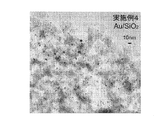
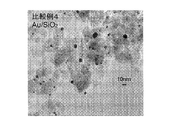
- 4 is a TEM photograph of an Au / SiO 2 carrier prepared from chloroauric acid in Comparative Example 4.
- 6 is a TEM photograph of an Au / AC carrier prepared from gold acetate in Example 8.
- FIG. 4 is a TEM photograph of an Au / PMA-DVB carrier prepared from gold acetate in Example 9.
- 2 is a TEM photograph of an Au / HY carrier prepared from gold acetate in Example 10.
- FIG. 2 is a TEM photograph of an Au / NaY carrier prepared from gold acetate in Example 11.
- FIG. 4 is a TEM photograph of Au / Saponite support prepared from gold acetate in Example 12.
- Example 1 Gold / cerium oxide (Au / CeO 2, Au 1.0wt %) prepared with active evaluation acetic gold [Au (CH 3 COO) 3 , Alfa Aesar Co., Ltd., purity of 99.99% according to the analysis certificate manufacturer
- acetic gold Au (CH 3 COO) 3
- 0.1 mol / L sodium carbonate
- 20 mg was added and dispersed using a touch mixer and an ultrasonic cleaner. Although there was almost no undissolved precipitate, the Tyndall phenomenon was observed when the LED light was applied from the side of the container, confirming that it was not a true aqueous solution but a brown colloidal dispersion.
- the pH of this solution was 10.8.
- the obtained carrier was stored in a glass screw tube bottle.
- the gold nanoparticle carrier obtained by the above-described method was subjected to carbon monoxide oxidation reaction at room temperature (23 ° C.) using a fixed bed flow reactor by the following method to evaluate the catalytic activity.
- a quartz reaction tube having an inner diameter of 6 mm was filled with 20 mg of carrier powder mixed with 0.5 g of quartz sand.
- a mixed gas of CO (1%) + O 2 (20%) + He (balance gas) was circulated at 100 mL / min, and the gas at the outlet of the reaction tube was passed through a mass spectrometer and a photoacoustic analyzer (PAS). ).
- PAS photoacoustic analyzer
- Example 2 Preparation of gold / titanium oxide (Au / TiO 2 , Au 1.0 wt%) and evaluation of activity A gold hydroxo anion complex solution was obtained in the same manner as in Example 1 except that 9.7 mg of gold acetate powder was used. . The pH of this solution was 10.9.
- a gold / titanium oxide carrier was obtained in the same manner as in Example 1 except that 0.25 g of titanium oxide (Nippon Aerosil, P25) powder was placed in a PFA petri dish and 5 mL of a gold hydroxo anion complex solution was added. The amount of gold supported on the obtained support was 1.0 wt%.
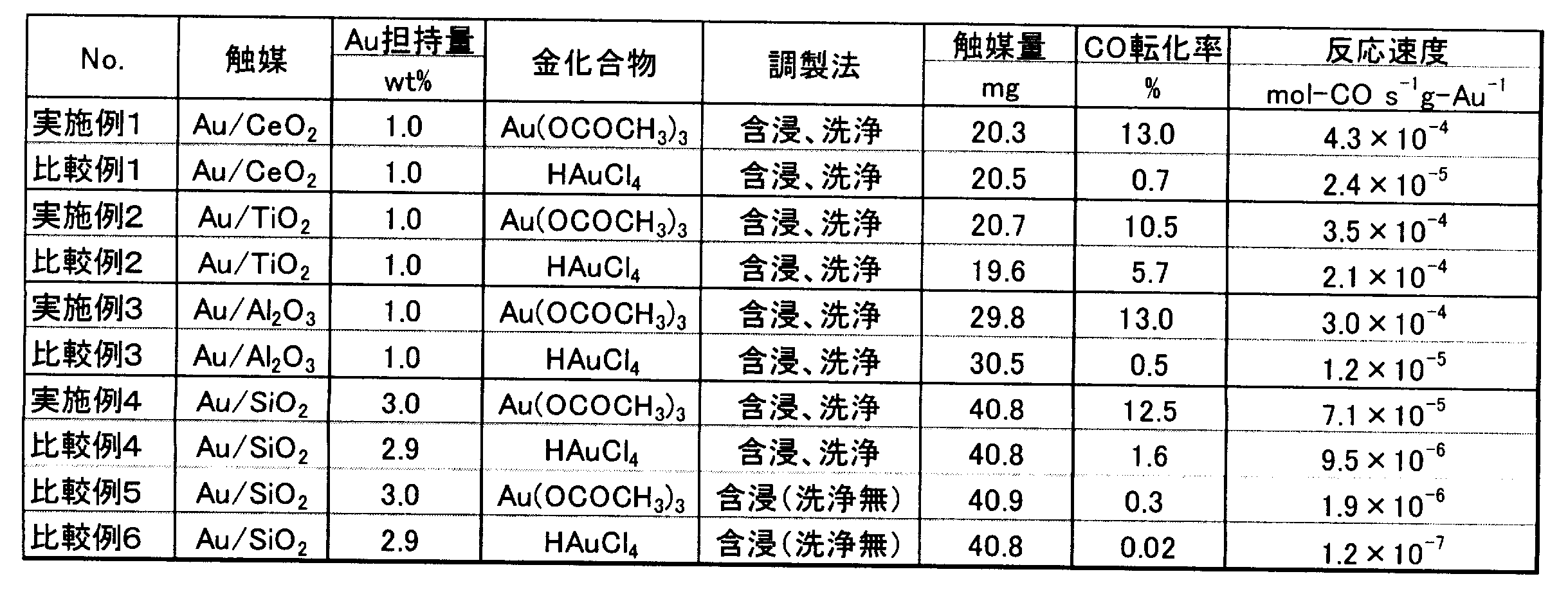
- Table 1 shows the results of catalytic activity evaluation performed on this carrier in the same manner as in Example 1. A TEM photograph of the prepared carrier is shown in FIG. From FIG. 1, it can be confirmed that the obtained support has uniformly dispersed and supported gold ultrafine particles of about 10 nm or less.
- Example 3 Preparation of gold / aluminum oxide (Au / Al 2 O 3 , Au 1.0 wt%) and activity evaluation 19.2 mg of gold acetate powder was used, and 20 mL of an aqueous solution of sodium carbonate (0.1 mol / L) was used. In the same manner as in Example 1, a gold hydroxo anion complex solution was obtained. The pH of this solution was 10.7.
- Example 4 Preparation and activity evaluation of gold / silica (Au / SiO 2 , Au 3.0 wt %) Example 1 except that 39.2 mg of gold acetate powder and 10 mL of an aqueous solution of sodium carbonate (0.2 mol / L) were used. In the same manner, a gold hydroxo anion complex solution was obtained. The pH of this solution was 10.4.
- a gold / silica carrier was obtained in the same manner as in Example 1 except that 0.1 g of silica (Nippon Aerosil, Aerosil 200) powder was taken in a PFA petri dish and 1.5 mL of the gold hydroxo anion complex solution obtained by the above method was added. Got. The amount of gold supported on the obtained support was 3.0 wt%.
- Table 1 shows the results of catalytic activity evaluation performed on this carrier in the same manner as in Example 1. A TEM photograph of the prepared carrier is shown in FIG. From FIG. 3, it can be confirmed that in the obtained carrier, gold ultrafine particles of about 5 nm or less are uniformly dispersed and supported.
- Example 5 Preparation of gold / cerium oxide (from sodium hydroxide solution of sodium hydroxide) and evaluation of its activity Brown powder 18.7 mg of gold hydroxide [Au (OH) 3 , manufactured by Alfa Aesar] was ground in an agate mortar and carbonated. 10 mL of an aqueous solution of sodium (0.1 mol / L) was added to obtain a suspension. The pH of this solution was 11.2. This suspension was heated on a hot plate to keep boiling and refluxed, and treated in the same manner as in Example 1 for 10 minutes. Undissolved powder still remained and precipitated when heating was stopped, but the supernatant solution was clear.
- Au (OH) 3 gold hydroxide
- Example 2 On the other hand, 0.2 g of yellow powder of cerium oxide powder (manufactured by Daiichi Rare Element, Grade A) was placed in a PFA petri dish, 2 mL of the supernatant solution was added, and the same treatment as in Example 1 was performed. Since a black support was obtained in the same manner as in Example 1, gold was dissolved as a gold hydroxo anion complex ion in the supernatant solution after boiling reflux, and finally gold was nano-sized on the cerium oxide surface. It can be determined that the particles are supported.
- Table 2 shows the results of catalytic activity evaluation performed on this carrier in the same manner as in Example 1.
- the reaction rate per gold weight was determined on the assumption that the amount of gold supported was 1.5 wt% when all the gold hydroxide used was supported.
- Example 6 Preparation of gold / cerium oxide (from gold acetate in potassium carbonate solution) and evaluation of activity The same as in Example 1 except that 19.0 mg of gold acetate powder and 10 mL of an aqueous solution of potassium carbonate (0.1 mol / L) were used. Thus, a gold hydroxo anion complex solution was obtained. The pH of this solution was 11.3.
- a gold / cerium oxide carrier was obtained in the same manner as in Example 1 except that 0.4 g of cerium oxide powder was placed in a PFA petri dish and 4.0 mL of the gold hydroxo anion complex solution prepared by the above method was added. The amount of gold supported on the obtained support was 1.0 wt%.
- Table 2 shows the results of catalytic activity evaluation performed on this carrier in the same manner as in Example 1.
- Example 7 Preparation and activity evaluation of gold / cerium oxide (from gold acetate in sodium hydroxide solution)
- Example 6 except that 18.4 mg of gold acetate powder and 10 mL of an aqueous solution of sodium hydroxide (0.1 mol / L) were used In the same manner, a gold / cerium oxide carrier was obtained. The pH of this aqueous solution was 13.2.
- Table 2 shows the results of catalytic activity evaluation performed on this carrier in the same manner as in Example 1.
- Comparative Example 1 Preparation and activity evaluation of gold / cerium oxide (Au / CeO 2 , Au 1.0 wt%) 0.1 mol of chloroauric acid (HAuCl 4 ) prepared in advance from chloroauric acid tetrahydrate (Kishida Chemical)
- a gold / cerium oxide support was obtained in the same manner as in Example 1 except that 0.5 mL of an / L aqueous solution and 9.5 mL of an aqueous solution of sodium carbonate (0.1 mol / L) were mixed to obtain a 10 mL solution.
- the pH of this solution was 10.5.
- Table 1 shows the results of catalytic activity evaluation performed on this carrier in the same manner as in Example 1.
- Comparative Example 2 a 0.1 mol / L aqueous solution 0.25mL gold / titanium oxide (Au / TiO 2, Au 1.0wt %) prepared with active evaluation chloroauric acid (HAuCl 4), sodium carbonate (0.1 mol / L)
- a gold / titanium oxide carrier was obtained in the same manner as in Example 2 except that 9.75 mL of the aqueous solution was mixed to obtain a 10 mL solution. The pH of this solution was 10.7.
- the amount of gold supported on the obtained support was 1.0 wt%.
- Table 1 shows the results of catalytic activity evaluation performed on this carrier in the same manner as in Example 1. A TEM photograph of the carrier is shown in FIG. From FIG. 4, it can be confirmed that in the obtained carrier, the gold fine particles are aggregated and supported in a state of particles exceeding 10 nm.
- Comparative Example 3 Preparation and activity evaluation of gold / aluminum oxide (Au / Al 2 O 3 , Au 1.0 wt%) 0.5 mL of 0.1 mol / L aqueous solution of chloroauric acid (HAuCl 4 ) and sodium carbonate (0.1 mol / L)
- a gold / aluminum oxide carrier was obtained in the same manner as in Example 3 except that 19.5 mL of an aqueous solution of 2) was mixed to obtain a 20 mL solution. The pH of this solution was 10.8.
- the amount of gold supported on the obtained support was 1.0 wt%.
- Table 1 shows the results of catalytic activity evaluation performed on this carrier in the same manner as in Example 1. A TEM photograph of the carrier is shown in FIG. From FIG. 5, it can be confirmed that in the obtained carrier, the gold fine particles are aggregated and supported in a state of particles exceeding 20 nm.
- Comparative Example 4 0.1 mol / L aqueous solution 1.0mL of gold / silica (Au / SiO 2, Au 2.9wt %) prepared with active evaluation chloroauric acid (HAuCl 4), an aqueous solution of sodium carbonate (0.2 mol / L)
- a gold / silica carrier was obtained in the same manner as in Example 4 except that 9.0 mL was mixed to obtain a 10 mL solution. The pH of this solution was 10.1.
- the amount of gold supported on the obtained carrier was 2.9 wt%.
- Table 1 shows the results of catalytic activity evaluation performed on this carrier in the same manner as in Example 1. A TEM photograph of the carrier is shown in FIG. From FIG. 6, it can be confirmed that the obtained support has a structure in which the gold fine particles are aggregated to become particles larger than 10 nm.
- Comparative Example 5 Preparation of gold / silica (Au / SiO 2 , Au 3.0 wt%) and activity evaluation In the method for preparing a gold / silica carrier described in Example 4, without washing with water after firing at 350 ° C. Otherwise, a gold / silica carrier was obtained in the same manner as in Example 4. The amount of gold supported on the obtained support was 3.0 wt%. Table 1 shows the results of catalytic activity evaluation performed on this carrier in the same manner as in Example 1.
- Comparative Example 6 Preparation of gold / silica (Au / SiO 2 , Au 2.9 wt%) and activity evaluation In the method for preparing a gold / silica carrier described in Comparative Example 4, without washing with water after firing at 350 ° C., Otherwise, a gold / silica carrier was obtained in the same manner as in Comparative Example 4. The amount of gold supported on the obtained support was 2.9 wt%. Table 1 shows the results of catalytic activity evaluation performed on this carrier in the same manner as in Example 1.
- Comparative Example 7 Preparation and activity evaluation of gold / cerium oxide (from gold hydroxide in potassium hydroxide solution) 100 mg of brown powder of gold hydroxide [Au (OH) 3 , Alfa Aesar] was ground in an agate mortar and water In addition to 7 mL of potassium oxide aqueous solution (including 24 mg of KOH), it was kept at 82 to 85 ° C. in a water bath. From a brown dark suspension, a clear yellow solution was obtained after about 2 hours of continued heating. The pH of this solution was 10.9.
- a gold / cerium oxide carrier was obtained in the same manner as in Example 1 except that 1.0 g of cerium oxide powder was placed in a PFA petri dish and 0.97 mL of the gold solution prepared by the above-described method was added. The amount of gold supported on the obtained support was 1.1 wt%.
- Table 2 shows the results of catalytic activity evaluation performed on this carrier in the same manner as in Example 1.
- Comparative Example 8 Preparation and activity evaluation of gold / cerium oxide (from gold hydroxide in potassium hydroxide) 143 mg of gold hydroxide brown powder was ground in an agate mortar, and 10 mL of potassium hydroxide aqueous solution (containing 34 mg of KOH) In addition, when kept under boiling reflux conditions, the brown suspension turned into a yellow transparent solution, and a colorless and transparent solution was obtained after 2 hours. The pH of this solution was 11.6.
- a gold / cerium oxide carrier was obtained in the same manner as in Example 1 except that 1.0 g of cerium oxide powder was placed in a PFA petri dish and 0.97 mL of the solution prepared by the method described above was added. The amount of gold supported on the obtained support was 1.1 wt%.
- Table 2 shows the results of catalytic activity evaluation performed on this carrier in the same manner as in Example 1.
- Example 1 and Comparative Example 1 Example 2 and Comparative Example 2, Example 3 and Comparative Example 3, and Example 4 and Comparative Example 4 were compared. It can be seen that the supports of Examples 1 to 4 prepared from gold acetate are more active than the supports of Examples 1 to 4.
- Example 8 Preparation of gold / activated carbon (Au / AC, Au 1.0 wt%) and activity evaluation Example 1 except that 20.0 mg of gold acetate powder was used and 20 mL of an aqueous solution of sodium carbonate (0.1 mol / L) was used. In the same manner, a gold hydroxo anion complex solution was obtained. The pH of this solution was 10.7.
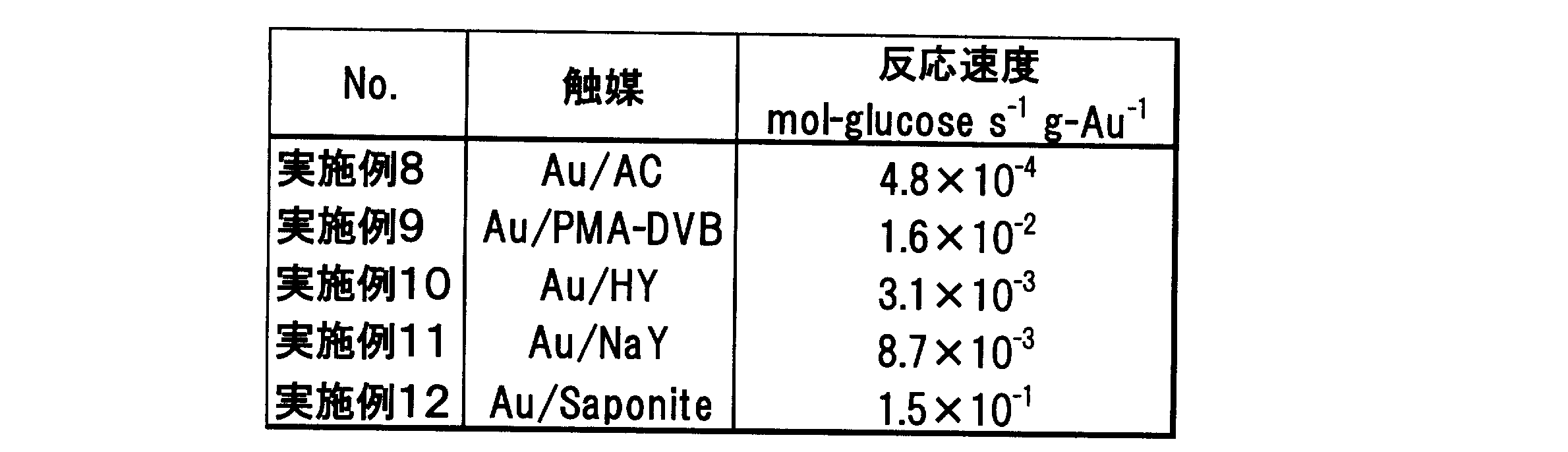
- the glucose oxidation reaction in water was performed using the catalyst obtained by the above method.
- 4.4 g of glucose was dissolved in 83 mL of water (glucose concentration 5 wt%) and heated to 60 ° C. While vigorously stirring at 1500 rpm, oxygen was bubbled at 60 mL / min, and a 1 mol / L sodium hydroxide aqueous solution was added dropwise from a burette to adjust the pH to 9.5.
- 30 mg of catalyst powder (corresponding to a molar ratio of gold: glucose of 1: 16000) pulverized in a mortar was put into the solution to initiate the reaction.
- a 1 mol / L aqueous sodium hydroxide solution was added dropwise so as to maintain the pH of the aqueous solution in the range of 9.5 ⁇ 0.1.
- Gluconic acid which is an oxidation product of glucose, is neutralized with sodium hydroxide at a molar ratio of 1: 1, so that the amount of gluconic acid produced can be measured as a function of reaction time from the amount of sodium hydroxide dropped.
- Table 3 shows the glucose oxidation reaction rate obtained by the calculation.
- Example 9 Gold / resin beads carrier (Au / PMA-DVB, Au 1.0wt%) using powder 19.0mg Preparation and activity evaluation acetic gold, other using an aqueous solution 20mL of sodium carbonate (0.1 mol / L) Obtained a gold hydroxo anion complex solution in the same manner as in Example 1. The pH of this solution was 10.7.
- the carrier obtained by the above-described method was pulverized with a mortar, and the powdered sample was observed with TEM. The photograph is shown in FIG. From FIG. 8, it can be confirmed that in the obtained carrier, ultrafine gold particles of about 10 nm or less are uniformly dispersed and supported.
- Table 3 shows the results of pulverizing the prepared catalyst in a mortar and performing a glucose oxidation reaction under the same conditions as in Example 8.
- Example 10 Preparation of gold / H type Y zeolite (Au / HY, Au 1.0wt%) and activity evaluation 19.0 mg of gold acetate powder was used, and 20 mL of an aqueous solution of sodium carbonate (0.1 mol / L) was used. A gold hydroxo anion complex solution was obtained in the same manner as in Example 1. The pH of this solution was 10.7.
- FIG. 9 shows a TEM photograph of the carrier obtained by the above method. From FIG. 9, it can be confirmed that in the obtained carrier, gold ultrafine particles of about 10 nm or less are uniformly dispersed and supported. Table 3 shows the results of the glucose oxidation reaction using the prepared catalyst under the same conditions as in Example 8.
- Example 11 Preparation and activity evaluation of gold / Na type Y zeolite (Au / NaY, Au 1.0 wt%) Implemented except that 19.0 mg of gold acetate powder was used and 20 mL of an aqueous solution of sodium carbonate (0.1 mol / L) was used. A gold hydroxo anion complex solution was obtained in the same manner as in Example 1. The pH of this solution was 10.7.
- FIG. 10 shows a TEM photograph of the carrier obtained by the above method. From FIG. 10, it can be confirmed that gold ultrafine particles of about 10 nm or less are dispersed and supported on the obtained support. Depending on the observation place of TEM, a part where gold particles of 10 nm or less were densely supported was also observed. Table 3 shows the results of the glucose oxidation reaction using the prepared catalyst under the same conditions as in Example 8.
- Example 12 Preparation and activity evaluation of gold / layered clay (Au / Saponite, Au 1.0 wt%)
- Example 1 except that 19.0 mg of gold acetate powder was used and 20 mL of an aqueous solution of sodium carbonate (0.1 mol / L) was used. In the same manner, a gold hydroxo anion complex solution was obtained. The pH of this solution was 10.7.
- FIG. 11 shows a TEM photograph of the carrier obtained by the above method. From FIG. 11, it can be confirmed that the obtained support has dispersed and supported gold ultrafine particles of about 10 nm or less.
- a glucose oxidation reaction was performed under the same conditions as in Example 8 except that the catalyst amount was 8.3 mg. The results are shown in Table 3.
- Example 13 Other Add an aqueous solution 50mL of gold / titanium oxide beads (Au / TiO 2, Au 0.1wt %) of sodium carbonate powder 99mg Preparation and activity evaluation acetate gold (0.1 mol / L) from Example 1 In the same manner, a gold hydroxo anion complex solution was obtained. 5 mL of this solution was taken and diluted to 1/10 concentration by adding 45 mL of water, and then stored at room temperature for 4 months in a glass screw tube bottle. The pH of this solution was 10.4.
- the CO conversion was 12.2% and the oxidation rate was 4.2 ⁇ 10 ⁇ 4 mol-CO s ⁇ 1 g- Au -1 was obtained.
- This oxidation rate exceeds the value obtained with the catalyst in which gold is supported on the powdered titanium oxide of Example 2, and even when gold is supported on a molded body other than a powder having a bead shape, high catalytic activity is obtained. It turns out that it is obtained.
- silica, zeolite, clay are not supported as gold nanoparticles unless the isoelectric point is an oxide having a pH of about 5 or higher. It is impossible to support gold nanoparticles on non-oxide carriers such as activated carbon and porous resin that do not fall under this.
- gold nanoparticles can be supported on oxides including silica, activated carbon, and polymer powder. Since solid-phase mixing was performed while adding, it was impossible to directly support gold nanoparticles on a molded carrier such as a bead shape.
- the gold hydroxo anion complex solution of the present invention it is possible to directly support gold nanoparticles from an aqueous solution regardless of the type and form of the carrier.
Landscapes
- Chemical & Material Sciences (AREA)
- Engineering & Computer Science (AREA)
- Organic Chemistry (AREA)
- Materials Engineering (AREA)
- Chemical Kinetics & Catalysis (AREA)
- Crystallography & Structural Chemistry (AREA)
- Physics & Mathematics (AREA)
- General Chemical & Material Sciences (AREA)
- Electrochemistry (AREA)
- Nanotechnology (AREA)
- Condensed Matter Physics & Semiconductors (AREA)
- General Physics & Mathematics (AREA)
- Inorganic Chemistry (AREA)
- Composite Materials (AREA)
- Thermal Sciences (AREA)
- Catalysts (AREA)
- Organic Low-Molecular-Weight Compounds And Preparation Thereof (AREA)
Abstract
Description
項1. 少なくとも一つの配位子がOH-であって、ハロゲン陰イオンを配位子として含まない平面四角形構造の3価金のヒドロキソ陰イオン錯体と、金に配位していない弱酸の共役塩基を含み、ハロゲン陰イオンを含まない、pHが8以上の透明溶液からなる、金ヒドロキソ陰イオン錯体溶液。
項2. 金ナノ粒子の担持体を製造するための含浸液である、上記項1に記載の金ヒドロキソ陰イオン錯体溶液。
項3. 金に配位していない弱酸の共役塩基が、カルボキシレート陰イオン、炭酸イオン、炭酸水素イオン、クエン酸イオン、リン酸イオン、ホウ酸イオン及び酒石酸イオンからなる群から選ばれた少なくとも一種である上記項1又は2に記載の金ヒドロキソ陰イオン錯体溶液。
項4. ハロゲンを含まない3価の金化合物を水に懸濁又は分散させたpH8以上の溶液中で、弱酸の共役塩基の存在下において、金化合物の加水分解反応を進行させることを特徴とする、上記項1~3のいずれかに記載された金ヒドロキソ陰イオン錯体溶液を製造する方法。
項5. ハロゲンを含まない3価の金化合物が、金カルボキシラート、酸化金、水酸化金、及び金とアルカリ金属との複酸化物からなる群から選ばれた少なくとも一種である、上記項4に記載の金ヒドロキソ陰イオン錯体溶液の製造方法。
項6. 上記項1~3のいずれかに記載の金ヒドロキソ陰イオン錯体溶液を担体に含浸させた後、水分を除去し、次いで熱処理を行った後、水洗することを特徴とする金ナノ粒子担持体の製造方法。
項7. 担体が、金属酸化物、多孔質ケイ酸塩、多孔質金属錯体、多孔質ポリマービーズ、炭素材料、セラミックハニカム、又はメタルハニカムである、上記項6に記載の金ナノ粒子担持体の製造方法。
本発明では、原料としては、ハロゲンを含まない3価の金を含む金化合物を用いる。一般に、金ナノ粒子触媒の製造原料としては、塩化金酸が用いられることが多いが、塩化金酸を用いる場合には、高分散・高活性の触媒を得るためには、残留する塩素を除去することが必要である。このため、処理工程が煩雑となり、金の利用率が低いという問題がある。
(1)金カルボキシラート:Au(CH3COO)3, Au(C2H5COO)3等(塩基性塩であるAu(OH)(CH3COO)2, Au(OH)2(CH3COO)等を含んでいても良い)
(2)酸化金:Au2O3
(3)水酸化金:Au(OH)3
(4)金とアルカリ金属との複酸化物:NaAuO2, KAuO2等
金ナノ粒子触媒の製造方法
(i)透明溶液の調製
本発明では、まず、上記したハロゲンを含まない3価の金化合物を原料として用い、これを水に懸濁又は分散させたpH8程度以上、好ましくはpH10程度以上の溶液中で、弱酸の共役塩基の存在下において、金化合物の加水分解反応を進行させる。この溶液における金化合物の濃度については特に限定的ではなく、均一な分散液を形成できればよいが、通常、0.001~10wt%程度の範囲とすればよい。

(1)下記式
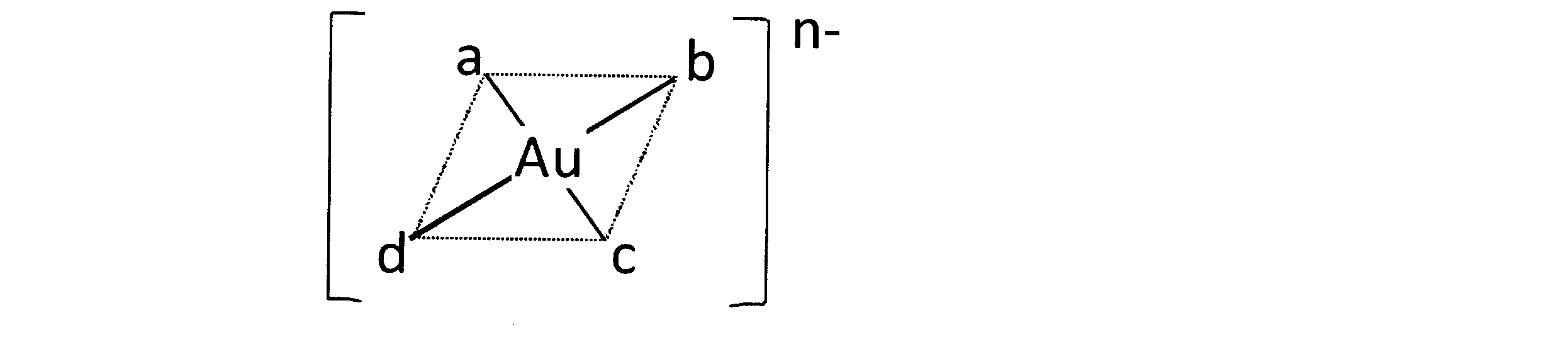
(2)金は3価であり、アニオン配位子a, b, c, dの配位により全体として負電荷を持つ陰イオン錯体であること、
(3)配位子a, b, c, dのうち、少なくとも1つはOH-であること、
(4)配位子a, b, c, dは、いずれもハロゲン陰イオンではないこと、
上記した金のヒドロキソ陰イオン錯体において、配位子a, b, c, dのうちOH-以外の配位子は、ハロゲン陰イオンではないアニオン配位子であればどのようなものでも良い。例えば、酢酸イオンCH3COO-、炭酸イオンCO3 2-等を例示することができる。

次いで、上記した方法で調製した金ヒドロキソ陰イオン錯体を含む透明溶液を担体に含浸させる。
上記した方法で担体表面に金ヒドロキソ陰イオン錯体を固定化した後、加熱することによって、金を金属ナノ粒子として担持させることができる。加熱雰囲気としては、特に限定はなく、酸素含有雰囲気中、還元性ガス雰囲気中、不活性ガス雰囲気中等の各種の雰囲気中で熱処理を行うことができる。例えば、酸素含有雰囲気としては、大気雰囲気、酸素を窒素、ヘリウム、アルゴン等で希釈した混合気体雰囲気などを利用できる。還元性ガスとしては、例えば、窒素ガスで希釈した1~10vol%程度の水素ガス、一酸化炭素ガス等を用いることができる。不活性ガスとしては、例えば、窒素、ヘリウム、アルゴンなどを利用できる。
次いで、上記した熱処理後の担持体を水洗する。熱処理後の担持体には、酢酸イオン、炭酸イオン等の弱酸の共役塩基がアルカリ金属塩、アルカリ土類金属塩等の形で残存する。これらの塩類は、ハロゲン陰イオンほど強い被毒の原因とはならないが、塩類が表面に残存すると物理的に活性点を塞ぐなどして活性低下の原因となる。このため、熱処理後の担持体を水洗して残存する塩類を除去する。
上記した方法によれば、ハロゲンを含まない3価金化合物を原料として、金ナノ粒子が均一に担持された担持体を得ることができる。
酢酸金[Au(CH3COO)3, Alfa Aesar製, メーカーの分析証明書に記載の純度99.99%] の茶色粉末20mgを炭酸ナトリウム(0.1mol/L)の水溶液10mLに入れ、タッチミキサー及び超音波洗浄機を用いて分散させた。溶け残りの沈殿はほぼ無くなるが、容器の横からLEDライトの光を当てるとチンダル現象が見られることから真の水溶液ではなく茶色のコロイド分散液となっていることが確認された。この溶液のpHは、10.8であった。
酢酸金の粉末9.7mgを用いる他は実施例1と同様にして金ヒドロキソ陰イオン錯体溶液を得た。この溶液のpHは、10.9であった。
酢酸金の粉末19.2mgを用い、炭酸ナトリウム(0.1mol/L)の水溶液20mLを用いる他は実施例1と同様にして金ヒドロキソ陰イオン錯体溶液を得た。この溶液のpHは、10.7であった。
酢酸金の粉末39.2mgと炭酸ナトリウム(0.2mol/L)の水溶液10mLを用いる他は、実施例1と同様にして金ヒドロキソ陰イオン錯体溶液を得た。この溶液のpHは、10.4であった。
水酸化金[Au(OH)3, Alfa Aesar製] の茶色粉末18.7mgをメノウ乳鉢にてすり潰し、炭酸ナトリウム(0.1mol/L)の水溶液10mLを加えて懸濁液を得た。この溶液のpHは、11.2であった。この懸濁液をホットプレート上で加熱して沸騰還流の状態を保ち、実施例1と同様に10分処理した。溶け残った粉末がなお残り、加熱を止めると沈殿したが、上澄みの溶液は透明であった。
酢酸金の粉末19.0mgと炭酸カリウム(0.1mol/L)の水溶液10mLを用いる他は実施例1と同様にして金ヒドロキソ陰イオン錯体溶液を得た。この溶液のpHは、11.3であった。
酢酸金の粉末18.4mgと、水酸化ナトリウム(0.1mol/L)の水溶液10mLを用いる他は実施例6と同様にして金/酸化セリウム担持体を得た。この水溶液のpHは、13.2であった。
塩化金酸四水和物(キシダ化学)から予め調製した、塩化金酸(HAuCl4)の0.1mol/L水溶液0.5mLと、炭酸ナトリウム(0.1mol/L)の水溶液9.5mLを混合し10mLの溶液とする他は実施例1と同様にして金/酸化セリウム担持体を得た。この溶液のpHは、10.5であった。
塩化金酸(HAuCl4)の0.1mol/L水溶液0.25mLと、炭酸ナトリウム(0.1mol/L)の水溶液9.75mLを混合し10mLの溶液とする他は実施例2と同様にして金/酸化チタン担持体を得た。この溶液のpHは、10.7であった。
塩化金酸(HAuCl4)の0.1mol/L水溶液0.5mLと、炭酸ナトリウム(0.1mol/L)の水溶液19.5mLを混合し20mLの溶液とする他は実施例3と同様にして金/酸化アルミニウム担持体を得た。この溶液のpHは、10.8であった。
塩化金酸(HAuCl4)の0.1mol/L水溶液1.0mLと、炭酸ナトリウム(0.2mol/L)の水溶液9.0mLを混合し10mLの溶液とする他は実施例4と同様にして金/シリカ担持体を得た。この溶液のpHは、10.1であった。
実施例4に記載した金/シリカ担持体の調製方法において、350℃焼成後の水洗を行うことなく、それ以外は実施例4と同様にして金/シリカ担持体を得た。得られた担持体における金の担持量は3.0wt%であった。この担持体について、実施例1と同様にして触媒活性評価を行った結果を表1に示す。
比較例4に記載した金/シリカ担持体の調製方法において、350℃焼成後の水洗を行うことなく、それ以外は比較例4と同様にして金/シリカ担持体を得た。得られた担持体における金の担持量は2.9wt%であった。この担持体について、実施例1と同様にして触媒活性評価を行った結果を表1に示す。
水酸化金[Au(OH)3, Alfa Aesar製] の茶色粉末100mgをメノウ乳鉢にてすり潰し、水酸化カリウム水溶液7mL(KOH 24mg分を含む)に加え、水浴中で82~85℃に保持した。茶色の濃い懸濁液の状態から、加熱を続けて約2時間後に黄色の透明溶液が得られた。この溶液のpHは、10.9であった。
水酸化金の茶色粉末143mgをメノウ乳鉢にてすり潰し、水酸化カリウム水溶液10mL(KOH 34mg分を含む)に加え、沸騰還流条件で保持すると、茶色の懸濁液から黄色の透明溶液となり2時間後には無色透明の溶液が得られた。この溶液のpHは、11.6であった。

酢酸金の粉末20.0mgを用い、炭酸ナトリウム(0.1mol/L)の水溶液20mLを用いる他は実施例1と同様にして金ヒドロキソ陰イオン錯体溶液を得た。この溶液のpHは、10.7であった。
酢酸金の粉末19.0mgを用い、炭酸ナトリウム(0.1mol/L)の水溶液20mLを用いる他は実施例1と同様にして金ヒドロキソ陰イオン錯体溶液を得た。この溶液のpHは、10.7であった。
酢酸金の粉末19.0mgを用い、炭酸ナトリウム(0.1mol/L)の水溶液20mLを用いる他は実施例1と同様にして金ヒドロキソ陰イオン錯体溶液を得た。この溶液のpHは、10.7であった。
酢酸金の粉末19.0mgを用い、炭酸ナトリウム(0.1mol/L)の水溶液20mLを用いる他は実施例1と同様にして金ヒドロキソ陰イオン錯体溶液を得た。この溶液のpHは、10.7であった。
酢酸金の粉末19.0mgを用い、炭酸ナトリウム(0.1mol/L)の水溶液20mLを用いる他は実施例1と同様にして金ヒドロキソ陰イオン錯体溶液を得た。この溶液のpHは、10.7であった。
酢酸金の粉末99mgを炭酸ナトリウム(0.1mol/L)の水溶液50mLに入れる他は実施例1と同様にして金ヒドロキソ陰イオン錯体溶液を得た。この溶液を5mL分取して45mLの水を加えて1/10濃度に希釈した後、ガラス製スクリュー管ビン中で4か月間、室温で保存した。この溶液のpHは10.4であった。
Claims (7)
- 少なくとも一つの配位子がOH-であって、ハロゲン陰イオンを配位子として含まない平面四角形構造の3価金のヒドロキソ陰イオン錯体と、金に配位していない弱酸の共役塩基を含み、ハロゲン陰イオンを含まない、pHが8以上の透明溶液からなる、金ヒドロキソ陰イオン錯体溶液。
- 金ナノ粒子の担持体を製造するための含浸液である、請求項1に記載の金ヒドロキソ陰イオン錯体溶液。
- 金に配位していない弱酸の共役塩基が、カルボキシレート陰イオン、炭酸イオン、炭酸水素イオン、クエン酸イオン、リン酸イオン、ホウ酸イオン及び酒石酸イオンからなる群から選ばれた少なくとも一種である請求項1又は2に記載の金ヒドロキソ陰イオン錯体溶液。
- ハロゲンを含まない3価の金化合物を水に懸濁又は分散させたpH8以上の溶液中で、弱酸の共役塩基の存在下において、金化合物の加水分解反応を進行させることを特徴とする、請求項1~3のいずれかに記載された金ヒドロキソ陰イオン錯体溶液を製造する方法。
- ハロゲンを含まない3価の金化合物が、金カルボキシラート、酸化金、水酸化金、及び金とアルカリ金属との複酸化物からなる群から選ばれた少なくとも一種である、請求項4に記載の金ヒドロキソ陰イオン錯体溶液の製造方法。
- 請求項1~3のいずれかに記載の金ヒドロキソ陰イオン錯体溶液を担体に含浸させた後、水分を除去し、次いで熱処理を行った後、水洗することを特徴とする金ナノ粒子担持体の製造方法。
- 担体が、金属酸化物、多孔質ケイ酸塩、多孔質金属錯体、多孔質ポリマービーズ、炭素材料、セラミックハニカム、又はメタルハニカムである、請求項6に記載の金ナノ粒子担持体の製造方法。
Priority Applications (2)
| Application Number | Priority Date | Filing Date | Title |
|---|---|---|---|
| US14/112,675 US20140031195A1 (en) | 2011-04-19 | 2012-04-18 | Anionic gold-hydroxo complex solution and process for producing material loaded with gold nanoparticles |
| JP2013511025A JP5740658B2 (ja) | 2011-04-19 | 2012-04-18 | 金ヒドロキソ陰イオン錯体溶液及び金ナノ粒子担持体の製造方法 |
Applications Claiming Priority (2)
| Application Number | Priority Date | Filing Date | Title |
|---|---|---|---|
| JP2011093132 | 2011-04-19 | ||
| JP2011-093132 | 2011-04-19 |
Publications (1)
| Publication Number | Publication Date |
|---|---|
| WO2012144532A1 true WO2012144532A1 (ja) | 2012-10-26 |
Family
ID=47041638
Family Applications (1)
| Application Number | Title | Priority Date | Filing Date |
|---|---|---|---|
| PCT/JP2012/060494 Ceased WO2012144532A1 (ja) | 2011-04-19 | 2012-04-18 | 金ヒドロキソ陰イオン錯体溶液及び金ナノ粒子担持体の製造方法 |
Country Status (3)
| Country | Link |
|---|---|
| US (1) | US20140031195A1 (ja) |
| JP (1) | JP5740658B2 (ja) |
| WO (1) | WO2012144532A1 (ja) |
Cited By (3)
| Publication number | Priority date | Publication date | Assignee | Title |
|---|---|---|---|---|
| WO2013133315A1 (ja) * | 2012-03-08 | 2013-09-12 | 独立行政法人産業技術総合研究所 | 金コロイド溶液及びその製造方法 |
| WO2016143490A1 (ja) * | 2015-03-09 | 2016-09-15 | 国立研究開発法人産業技術総合研究所 | 金ヒドロキソ陰イオン錯体溶液 |
| WO2020054597A1 (ja) * | 2018-09-11 | 2020-03-19 | 公立大学法人首都大学東京 | 金担持触媒 |
Families Citing this family (6)
| Publication number | Priority date | Publication date | Assignee | Title |
|---|---|---|---|---|
| CN106011969B (zh) * | 2016-06-12 | 2018-10-23 | 上海大学 | 镍基上金纳米颗粒阵列及其制备方法 |
| KR102640613B1 (ko) * | 2016-12-28 | 2024-02-26 | 닛테츠 케미컬 앤드 머티리얼 가부시키가이샤 | 금속-수지 복합체 및 그 이용 |
| CN109399659A (zh) * | 2018-11-16 | 2019-03-01 | 华东理工大学 | 一种小尺寸金纳米颗粒负载的钛硅沸石及其制备方法 |
| CN113118433B (zh) * | 2019-12-31 | 2022-06-24 | Tcl科技集团股份有限公司 | 一种贵金属纳米粒子的形貌重构的方法 |
| CN114870807B (zh) * | 2022-04-25 | 2024-06-07 | 天津国科医疗科技发展有限公司 | 离子化磁性微球材料 |
| CN115722231B (zh) * | 2022-09-09 | 2024-07-23 | 中国人民解放军军事科学院防化研究院 | 一种负载型纳米金催化剂的制备方法 |
Citations (5)
| Publication number | Priority date | Publication date | Assignee | Title |
|---|---|---|---|---|
| JPH02133318A (ja) * | 1988-09-23 | 1990-05-22 | Rockwell Internatl Corp | 酢酸金(3) |
| JP2007297245A (ja) * | 2006-05-01 | 2007-11-15 | National Institute Of Advanced Industrial & Technology | 金の超微粒子とアパタイトからなる無機複合材料及びその製造方法、並びに、それを用いた微量一酸化炭素の酸化除去方法 |
| JP2008280184A (ja) * | 2007-05-08 | 2008-11-20 | National Institute Of Advanced Industrial & Technology | セリウムを含有するメソポーラスシリカと貴金属の超微粒子の複合体、その複合体の製造方法、並びにその複合体を触媒に用いた微量一酸化炭素の酸化的除去方法及びアルコール類の酸化的脱水素反応によるケトン類の合成方法 |
| JP2010527780A (ja) * | 2007-05-31 | 2010-08-19 | ズード−ケミー アーゲー | ジルコニウム酸化物がドープされた触媒担体、その生成方法、およびジルコニウム酸化物がドープされた触媒担体を含む触媒担体を含む触媒 |
| JP2010527779A (ja) * | 2007-05-31 | 2010-08-19 | ズード−ケミー アーゲー | HfO2を含むPd/Auシェル触媒、生成プロセス、およびその使用 |
Family Cites Families (1)
| Publication number | Priority date | Publication date | Assignee | Title |
|---|---|---|---|---|
| JPS6483513A (en) * | 1987-09-24 | 1989-03-29 | Agency Ind Science Techn | Ultrafine gold particle immobilized alkaline earth metallic compound, production thereof, oxidation catalyst, reduction catalyst and combustible gas sensor element |
-
2012
- 2012-04-18 WO PCT/JP2012/060494 patent/WO2012144532A1/ja not_active Ceased
- 2012-04-18 US US14/112,675 patent/US20140031195A1/en not_active Abandoned
- 2012-04-18 JP JP2013511025A patent/JP5740658B2/ja not_active Expired - Fee Related
Patent Citations (5)
| Publication number | Priority date | Publication date | Assignee | Title |
|---|---|---|---|---|
| JPH02133318A (ja) * | 1988-09-23 | 1990-05-22 | Rockwell Internatl Corp | 酢酸金(3) |
| JP2007297245A (ja) * | 2006-05-01 | 2007-11-15 | National Institute Of Advanced Industrial & Technology | 金の超微粒子とアパタイトからなる無機複合材料及びその製造方法、並びに、それを用いた微量一酸化炭素の酸化除去方法 |
| JP2008280184A (ja) * | 2007-05-08 | 2008-11-20 | National Institute Of Advanced Industrial & Technology | セリウムを含有するメソポーラスシリカと貴金属の超微粒子の複合体、その複合体の製造方法、並びにその複合体を触媒に用いた微量一酸化炭素の酸化的除去方法及びアルコール類の酸化的脱水素反応によるケトン類の合成方法 |
| JP2010527780A (ja) * | 2007-05-31 | 2010-08-19 | ズード−ケミー アーゲー | ジルコニウム酸化物がドープされた触媒担体、その生成方法、およびジルコニウム酸化物がドープされた触媒担体を含む触媒担体を含む触媒 |
| JP2010527779A (ja) * | 2007-05-31 | 2010-08-19 | ズード−ケミー アーゲー | HfO2を含むPd/Auシェル触媒、生成プロセス、およびその使用 |
Non-Patent Citations (1)
| Title |
|---|
| HIROAKI SAKURAI ET AL.: "Enso o Gan'yu shinai Zenkutai Yoeki no Ganshinho ni yori Chosei shita Kin Nano-ryushi Shokubai to sono CO Sanka Kassei", SHOKUBAI TORONKAI TORONKAI A YOKOSHU, vol. 108, 13 September 2011 (2011-09-13), pages 366 * |
Cited By (6)
| Publication number | Priority date | Publication date | Assignee | Title |
|---|---|---|---|---|
| WO2013133315A1 (ja) * | 2012-03-08 | 2013-09-12 | 独立行政法人産業技術総合研究所 | 金コロイド溶液及びその製造方法 |
| JPWO2013133315A1 (ja) * | 2012-03-08 | 2015-07-30 | 国立研究開発法人産業技術総合研究所 | 金コロイド溶液及びその製造方法 |
| WO2016143490A1 (ja) * | 2015-03-09 | 2016-09-15 | 国立研究開発法人産業技術総合研究所 | 金ヒドロキソ陰イオン錯体溶液 |
| JPWO2016143490A1 (ja) * | 2015-03-09 | 2018-01-18 | 国立研究開発法人産業技術総合研究所 | 金ヒドロキソ陰イオン錯体溶液 |
| WO2020054597A1 (ja) * | 2018-09-11 | 2020-03-19 | 公立大学法人首都大学東京 | 金担持触媒 |
| US11931726B2 (en) | 2018-09-11 | 2024-03-19 | Tokyo Metropolitan University | Gold-supporting catalyst |
Also Published As
| Publication number | Publication date |
|---|---|
| US20140031195A1 (en) | 2014-01-30 |
| JP5740658B2 (ja) | 2015-06-24 |
| JPWO2012144532A1 (ja) | 2014-07-28 |
Similar Documents
| Publication | Publication Date | Title |
|---|---|---|
| JP5740658B2 (ja) | 金ヒドロキソ陰イオン錯体溶液及び金ナノ粒子担持体の製造方法 | |
| JP6160874B2 (ja) | 金ナノ粒子を担持してなる触媒担持体及びその製造方法 | |
| JP4970120B2 (ja) | 金微粒子を担体に分散・固定する方法 | |
| CN113000049B (zh) | 一种制备Ni-Al基氧化物催化剂的方法 | |
| CN101703935B (zh) | 一种负载型金属催化剂及其制备方法 | |
| CN105214594B (zh) | 氧化铈-氧化锆复合氧化物材料及其制造方法 | |
| Liu et al. | Au/LaVO4 nanocomposite: Preparation, characterization, and catalytic activity for CO oxidation | |
| CN103212413B (zh) | 一种热稳定核壳结构纳米三效催化剂及其制备方法 | |
| CN103263920B (zh) | 一种TiO2负载的高分散金属催化剂及其制备方法 | |
| CN107456965B (zh) | 一种以氧化铈为载体的负载型钯催化剂及其制备方法 | |
| CN102553579A (zh) | 一种高分散负载型纳米金属催化剂的制备方法 | |
| CN110404573A (zh) | 一种超小钯基合金材料的制备方法及应用 | |
| CN110201680B (zh) | 一种用于α,β-不饱和醛/酮选择性加氢的催化剂、制备方法及催化方法 | |
| Shan et al. | Self-template synthesis of a MnCeOδ/Co3O4 polyhedral nanocage catalyst for toluene oxidation | |
| Chen et al. | Advances in photochemical deposition for controllable synthesis of heterogeneous catalysts | |
| CN106881110B (zh) | 一种适用于水汽共存一氧化碳氧化的钯催化剂的制备方法 | |
| Yousaf et al. | Synergistic effect of interfacial phenomenon on enhancing catalytic performance of Pd loaded MnO x–CeO 2–C hetero-nanostructure for hydrogenation and electrochemical reactions | |
| CN103143353B (zh) | 一种经还原处理的钯催化剂的制备方法 | |
| JP5548548B2 (ja) | 金属粒子担持触媒の製造方法、金属粒子担持触媒及び反応方法。 | |
| CN104353456B (zh) | 一种负载金的二氧化钛纳米催化剂及其制备方法和应用 | |
| JP2005111336A (ja) | 耐熱性触媒およびその製造方法 | |
| CN115770570B (zh) | 一种氧化铈负载原子级分散Pt催化剂及其再分散制备方法 | |
| TW200410754A (en) | Nano-gold catalyst and preparation of nano-gold catalyst | |
| CN111420656A (zh) | 一种异辛醇选择氧化制异辛酸用催化剂及其制备方法 | |
| JP6441454B2 (ja) | 金ヒドロキソ陰イオン錯体溶液 |
Legal Events
| Date | Code | Title | Description |
|---|---|---|---|
| 121 | Ep: the epo has been informed by wipo that ep was designated in this application |
Ref document number: 12774026 Country of ref document: EP Kind code of ref document: A1 |
|
| ENP | Entry into the national phase |
Ref document number: 2013511025 Country of ref document: JP Kind code of ref document: A |
|
| WWE | Wipo information: entry into national phase |
Ref document number: 14112675 Country of ref document: US |
|
| NENP | Non-entry into the national phase |
Ref country code: DE |
|
| 122 | Ep: pct application non-entry in european phase |
Ref document number: 12774026 Country of ref document: EP Kind code of ref document: A1 |