WO2012141283A1 - 排ガス浄化触媒の再生方法 - Google Patents
排ガス浄化触媒の再生方法 Download PDFInfo
- Publication number
- WO2012141283A1 WO2012141283A1 PCT/JP2012/060107 JP2012060107W WO2012141283A1 WO 2012141283 A1 WO2012141283 A1 WO 2012141283A1 JP 2012060107 W JP2012060107 W JP 2012060107W WO 2012141283 A1 WO2012141283 A1 WO 2012141283A1
- Authority
- WO
- WIPO (PCT)
- Prior art keywords
- catalyst
- exhaust gas
- regenerating
- gas purification
- alkali
- Prior art date
- Legal status (The legal status is an assumption and is not a legal conclusion. Google has not performed a legal analysis and makes no representation as to the accuracy of the status listed.)
- Ceased
Links
Images

Classifications
-
- B—PERFORMING OPERATIONS; TRANSPORTING
- B01—PHYSICAL OR CHEMICAL PROCESSES OR APPARATUS IN GENERAL
- B01J—CHEMICAL OR PHYSICAL PROCESSES, e.g. CATALYSIS OR COLLOID CHEMISTRY; THEIR RELEVANT APPARATUS
- B01J27/00—Catalysts comprising the elements or compounds of halogens, sulfur, selenium, tellurium, phosphorus or nitrogen; Catalysts comprising carbon compounds
- B01J27/14—Phosphorus; Compounds thereof
- B01J27/185—Phosphorus; Compounds thereof with iron group metals or platinum group metals
- B01J27/1856—Phosphorus; Compounds thereof with iron group metals or platinum group metals with platinum group metals
-
- B—PERFORMING OPERATIONS; TRANSPORTING
- B01—PHYSICAL OR CHEMICAL PROCESSES OR APPARATUS IN GENERAL
- B01D—SEPARATION
- B01D53/00—Separation of gases or vapours; Recovering vapours of volatile solvents from gases; Chemical or biological purification of waste gases, e.g. engine exhaust gases, smoke, fumes, flue gases, aerosols
- B01D53/34—Chemical or biological purification of waste gases
- B01D53/74—General processes for purification of waste gases; Apparatus or devices specially adapted therefor
- B01D53/86—Catalytic processes
-
- B—PERFORMING OPERATIONS; TRANSPORTING
- B01—PHYSICAL OR CHEMICAL PROCESSES OR APPARATUS IN GENERAL
- B01J—CHEMICAL OR PHYSICAL PROCESSES, e.g. CATALYSIS OR COLLOID CHEMISTRY; THEIR RELEVANT APPARATUS
- B01J23/00—Catalysts comprising metals or metal oxides or hydroxides, not provided for in group B01J21/00
- B01J23/38—Catalysts comprising metals or metal oxides or hydroxides, not provided for in group B01J21/00 of noble metals
-
- B—PERFORMING OPERATIONS; TRANSPORTING
- B01—PHYSICAL OR CHEMICAL PROCESSES OR APPARATUS IN GENERAL
- B01J—CHEMICAL OR PHYSICAL PROCESSES, e.g. CATALYSIS OR COLLOID CHEMISTRY; THEIR RELEVANT APPARATUS
- B01J23/00—Catalysts comprising metals or metal oxides or hydroxides, not provided for in group B01J21/00
- B01J23/38—Catalysts comprising metals or metal oxides or hydroxides, not provided for in group B01J21/00 of noble metals
- B01J23/40—Catalysts comprising metals or metal oxides or hydroxides, not provided for in group B01J21/00 of noble metals of the platinum group metals
- B01J23/42—Platinum
-
- B—PERFORMING OPERATIONS; TRANSPORTING
- B01—PHYSICAL OR CHEMICAL PROCESSES OR APPARATUS IN GENERAL
- B01J—CHEMICAL OR PHYSICAL PROCESSES, e.g. CATALYSIS OR COLLOID CHEMISTRY; THEIR RELEVANT APPARATUS
- B01J23/00—Catalysts comprising metals or metal oxides or hydroxides, not provided for in group B01J21/00
- B01J23/90—Regeneration or reactivation
- B01J23/96—Regeneration or reactivation of catalysts comprising metals, oxides or hydroxides of the noble metals
-
- B—PERFORMING OPERATIONS; TRANSPORTING
- B01—PHYSICAL OR CHEMICAL PROCESSES OR APPARATUS IN GENERAL
- B01J—CHEMICAL OR PHYSICAL PROCESSES, e.g. CATALYSIS OR COLLOID CHEMISTRY; THEIR RELEVANT APPARATUS
- B01J27/00—Catalysts comprising the elements or compounds of halogens, sulfur, selenium, tellurium, phosphorus or nitrogen; Catalysts comprising carbon compounds
- B01J27/28—Regeneration or reactivation
- B01J27/285—Regeneration or reactivation of catalysts comprising compounds of phosphorus
-
- B—PERFORMING OPERATIONS; TRANSPORTING
- B01—PHYSICAL OR CHEMICAL PROCESSES OR APPARATUS IN GENERAL
- B01J—CHEMICAL OR PHYSICAL PROCESSES, e.g. CATALYSIS OR COLLOID CHEMISTRY; THEIR RELEVANT APPARATUS
- B01J38/00—Regeneration or reactivation of catalysts, in general
- B01J38/02—Heat treatment
-
- B—PERFORMING OPERATIONS; TRANSPORTING
- B01—PHYSICAL OR CHEMICAL PROCESSES OR APPARATUS IN GENERAL
- B01J—CHEMICAL OR PHYSICAL PROCESSES, e.g. CATALYSIS OR COLLOID CHEMISTRY; THEIR RELEVANT APPARATUS
- B01J38/00—Regeneration or reactivation of catalysts, in general
- B01J38/48—Liquid treating or treating in liquid phase, e.g. dissolved or suspended
-
- B—PERFORMING OPERATIONS; TRANSPORTING
- B01—PHYSICAL OR CHEMICAL PROCESSES OR APPARATUS IN GENERAL
- B01J—CHEMICAL OR PHYSICAL PROCESSES, e.g. CATALYSIS OR COLLOID CHEMISTRY; THEIR RELEVANT APPARATUS
- B01J38/00—Regeneration or reactivation of catalysts, in general
- B01J38/48—Liquid treating or treating in liquid phase, e.g. dissolved or suspended
- B01J38/60—Liquid treating or treating in liquid phase, e.g. dissolved or suspended using acids
-
- B—PERFORMING OPERATIONS; TRANSPORTING
- B01—PHYSICAL OR CHEMICAL PROCESSES OR APPARATUS IN GENERAL
- B01J—CHEMICAL OR PHYSICAL PROCESSES, e.g. CATALYSIS OR COLLOID CHEMISTRY; THEIR RELEVANT APPARATUS
- B01J38/00—Regeneration or reactivation of catalysts, in general
- B01J38/48—Liquid treating or treating in liquid phase, e.g. dissolved or suspended
- B01J38/64—Liquid treating or treating in liquid phase, e.g. dissolved or suspended using alkaline material; using salts
-
- B—PERFORMING OPERATIONS; TRANSPORTING
- B01—PHYSICAL OR CHEMICAL PROCESSES OR APPARATUS IN GENERAL
- B01J—CHEMICAL OR PHYSICAL PROCESSES, e.g. CATALYSIS OR COLLOID CHEMISTRY; THEIR RELEVANT APPARATUS
- B01J21/00—Catalysts comprising the elements, oxides, or hydroxides of magnesium, boron, aluminium, carbon, silicon, titanium, zirconium, or hafnium
- B01J21/02—Boron or aluminium; Oxides or hydroxides thereof
- B01J21/04—Alumina
Definitions
- the present invention relates to a method for regenerating a used exhaust gas purification catalyst, and particularly relates to a method suitable for regenerating a catalyst to which an organic silicon compound is adhered.
- Exhaust gas purification catalysts are used to reduce VOCs by oxidative decomposition when detoxifying or deodorizing VOCs (volatile organic compounds) in exhaust gases generated from painting, printing, chemical products, food, medicine, chemical factories, etc. ing.
- VOCs volatile organic compounds
- this exhaust gas purifying catalyst for example, a catalyst in which a noble metal such as platinum is supported as a catalyst metal on a honeycomb coated with a metal oxide such as alumina is known. These catalysts promote the oxidation reaction rate of VOC by catalytic action, and the catalyst itself does not change before and after the reaction. Therefore, theoretically, it is considered that the catalytic activity can be maintained permanently.
- the washcoat and the catalyst metal necessary for maintaining the catalytic activity may also fall off. For this reason, it is necessary to adopt a regeneration method that removes only the poisoning substance without dropping the catalyst metal or the like.
- Patent Document 1 describes a method of regenerating the catalyst by immersing the catalyst using ammonium hydrogen fluoride and the like, washing with water, and drying the washed catalyst. In this method, the regeneration treatment can be performed at a relatively low treatment temperature, and the catalyst metal or the like necessary for maintaining the activity can be prevented from falling off.
- Patent Document 2 describes a catalyst regeneration method in which a spent heavy oil hydrotreating catalyst is calcined and then washed with washing water controlled to pH 1 to 11 with sulfuric acid or caustic soda. In this method, deposits such as vanadium and nickel can be removed without removing active components such as molybdenum.
- the poisonous substance cannot be removed sufficiently, and the catalyst has sufficient activity so that it can be reused for exhaust gas treatment by regeneration. There was a case that was not.
- the poisoning substance is organic silicon or organic phosphorus
- the method described in Patent Document 1 cannot completely remove the organic silicon or organic phosphorus, and the catalytic activity is difficult to recover.
- materials containing organic silicon have excellent properties such as heat resistance, cold resistance, weather resistance, water repellency, electrical properties, etc., and therefore the amount of organic silicon attached to the exhaust gas has increased. Therefore, a technique for making the catalyst reusable is required.
- an object of the present invention is to provide a method for regenerating an exhaust gas purifying catalyst to which silicon or phosphorus adheres, and capable of sufficiently recovering the catalytic activity by regeneration while preventing the catalyst component from falling off.
- the present invention for solving the above includes a calcination step of calcining a used catalyst at 400 to 700 ° C., and an alkali impregnation step of impregnating the calcined catalyst in an alkaline solution of 1 to 25 wt%, wherein the alkali impregnation step has a pH of 13 or more.
- the present invention relates to a method for regenerating an exhaust gas purifying catalyst. Such a regeneration method of the present invention regenerates a used catalyst to which silicon or phosphorus is attached.
- a catalyst used for oxidative decomposition of a VOC (volatile hydrocarbon) component contained in factory exhaust gas can be regenerated, and the activity required for exhaust gas purification can be recovered.
- an attached catalyst such as an organic silicon compound or an organic phosphorus compound can be regenerated.
- the catalyst to be regenerated is composed of a base material such as a honeycomb coated with alumina, zirconia, titania, ceria, etc., and a noble metal such as platinum, palladium, rhodium, ruthenium, iridium, gold, silver, etc.
- the catalyst metal containing can be applied.
- the exhaust gas purifying catalyst in addition to the catalyst metal, those on which a promoter such as vanadium, nickel, molybdenum is supported are generally used.
- the catalyst to be regenerated in the present invention includes these promoters. None is preferred. This is because a cocatalyst such as vanadium tends to fall off from the catalyst in the alkali impregnation step described below, and therefore, it tends to be difficult to recover the catalyst activity before poisoning by regeneration.
- the catalyst is impregnated with an alkaline solution to dissolve and remove poisonous substances such as silicon adhering to the catalyst, and the firing step is performed before the alkali impregnation.
- the firing step has characteristics.
- organic components in the poisoning substance are removed by combustion, and only the inorganic components in the poisoning substance remain in the catalyst. For this reason, an inorganic component can be efficiently removed in the alkali impregnation of a post process.
- the firing step is performed at 400 to 700 ° C., preferably 500 to 600 ° C. If the temperature is lower than 400 ° C, combustion removal of organic components in the poisonous substance does not proceed sufficiently.
- the agglomeration of the catalyst component proceeds to increase the particle size of the noble metal and reduce the specific surface area. For this reason, depending on the type of VOC, the catalytic activity decreases.
- the alkali impregnation step is performed by impregnating the catalyst with an alkaline solution having a concentration of 1 to 25 wt%.
- the alkali impregnation step can dissolve and remove the inorganic component derived from the poisoning substance that has adhered to the catalyst even after the firing step.
- the alkaline solution sodium hydroxide or potassium hydroxide can be used, and sodium hydroxide is preferably used.
- the alkali concentration is preferably 5 to 12.5 wt%.
- the above-described alkali impregnation step is performed at a solution pH of 13 or more, and is preferably performed at a pH of 13.5 or more.
- the pH is less than 13, the inorganic component tends to be hardly dissolved and removed.
- the liquid temperature during the alkali impregnation is preferably 0 to 90 ° C, more preferably 30 to 60 ° C. If the liquid temperature is too low, the dissolution and removal efficiency of the inorganic components is not sufficient, and if it exceeds 90 ° C., the amount of evaporation of the alkaline solution increases, making it difficult to maintain a predetermined alkali concentration and the need for exhaust treatment.
- the impregnation time is preferably 1 minute to 24 hours, more preferably 1 hour to 16 hours. If it is less than 1 minute, the dissolution and removal efficiency of the inorganic component is not sufficient, and if it exceeds 24 hours, the dissolution and removal efficiency of the inorganic component is hardly improved, and elution of the catalyst component is concerned.
- the regeneration efficiency can be increased by increasing the alkali concentration or the liquid temperature, or by increasing the immersion time in the immersion step.
- the alkali concentration, liquid temperature, and time of the impregnation step may be adjusted according to the adhesion concentration of the poisoning substance.
- the washing step is preferably performed with pure water or tap water, and may be neutralized with an acidic solution after washing to near neutral with pure water or tap water.
- an acidic solution after washing with tap water may adhere to the catalyst. Can be removed. Further, when an acidic solution is used, it can be easily neutralized, so that the amount of pure water or tap water required for cleaning can be reduced.
- the acidic solution nitric acid, sulfuric acid, hydrochloric acid, acetic acid, formic acid or the like can be used, and nitric acid is particularly preferable. This is because nitric acid can be easily removed by drying or calcination without poisoning the catalyst components.
- the concentration of the acidic solution is preferably 0.3 to 3.0 wt%. If it is less than 0.3 wt%, the effect of removing alkali metal components and alkaline earth metal components is not sufficient, and if it is 3.0 wt%, alkali metal components can be removed sufficiently, and even higher concentrations can be removed. The effect will not improve much.
- the pH of the solution is preferably 0.2 to 1.5, and particularly preferably within the range of pH 0.2 to 1.0. If it is in the said pH range, an alkali metal component etc. can fully be removed.
- a drying step for drying the catalyst is preferably performed, and the heating temperature is preferably 100 to 700 ° C. This is to remove moisture, acid components, and the like remaining on the catalyst after washing.
- the drying temperature is preferably 100 ° C to 250 ° C. If the temperature is lower than 100 ° C., it is difficult to sufficiently remove the water in the catalyst carrier, and it is not necessary to raise the temperature higher than 250 ° C. in order to remove the water.
- the drying temperature is preferably 300 to 600 ° C, particularly preferably 450 to 550 ° C. If it is less than 300 degreeC, it is difficult to remove an acid component completely, and an acid component can fully be removed by setting it as 600 degreeC.
- the catalyst regenerated by the above regeneration method can greatly reduce the silicon and phosphorus contents compared to the catalyst before regeneration.
- the regenerated catalyst preferably has a silicon or phosphorus content of 1.5 wt% or less. If it is 1.5 wt% or less, it is possible to sufficiently recover the catalyst activity before regeneration. In particular, when the silicon content is 1.5 wt% or less, the activity of the regenerated catalyst tends to be high. The lower the silicon or phosphorus content, the higher the catalytic activity after regeneration, so the content may be 0 wt%.
- the used exhaust gas purification catalyst to which silicon or phosphorus adheres can be regenerated.
- Example 1 As the catalyst, a stainless honeycomb ( ⁇ 56 mm ⁇ 50 mm L) washed with 80 g / L of ⁇ -alumina and carrying Pt 2 g / L was used. As poisonous substances, dimethyl silicone oil KF96 manufactured by Shin-Etsu Silicone was used as the organic silicon compound, and toluene was used as the VOC component. A solution in which an organosilicon compound and toluene are mixed at a ratio of 1: 1 is fed at 340 ⁇ L / min at an air volume of 125 L / min and a catalyst inlet temperature of 350 ° C., and poisoned for 21 minutes until the catalyst completely loses its activity. It was. The amount of silicone fed was 3500 ⁇ L.
- the used catalyst was regenerated by the following method. First, after boiling and washing with 500 mL of tap water for 1 hour, the water was blown off and baked at 500 ° C. for 1 hour. After calcination, it was impregnated with 400 ml of 12.5 wt% sodium hydroxide solution and stirred at 60 ° C. for 6 hours. The catalyst after the alkali impregnation was regenerated by washing with pure water until the pH became near neutral and drying at 120 ° C.
- Examples 2 to 6 Using the same catalyst to be regenerated as in Example 1, in the alkali impregnation step, the method using potassium hydroxide instead of sodium hydroxide, and the method in which the alkali concentration was changed to 5 wt% or 25 wt%, Regenerated (Table 1). Other conditions were the same as in Example 1.
- Example 7 Using the same catalyst to be regenerated as in Example 1, the catalyst was regenerated at a solution temperature of 30 ° C. in the alkali impregnation step. Other conditions were the same as in Example 1.
- Example 8-9 Using the same catalyst to be regenerated as in Example 1, the catalyst was regenerated at a calcination temperature of 600 ° C. and 700 ° C. Other conditions were the same as in Example 1.
- Examples 10-12 After impregnation with alkali, after washing with tap water, nitric acid was added. The nitric acid concentration was 0.4 wt% (pH 1.1), 0.6 wt% (pH 0.9), and 3.0 wt% (pH 0.2). The drying temperature after washing was 500 ° C. Other conditions were the same as in Example 1.
- Example 13-14 The drying temperature after washing was set to 450 ° C. and 550 ° C. to regenerate the catalyst. Other conditions were the same as in Example 11.
- Example 15 After impregnating with alkali using potassium hydroxide, the catalyst was regenerated by washing with nitric acid.
- the firing temperature, solution concentration, etc. were the conditions shown in Table 1.
- Comparative Examples 1 and 2 Using the same catalyst to be regenerated as in Example 1, the catalyst was boiled and washed, and then subjected to an alkali impregnation step with 12.5 wt% and 5 wt% sodium hydroxide without firing. The procedure was the same as Example 1 except that no firing was performed.
- Toluene purification test The toluene purification rate of the regenerated catalyst was measured. The purification rate was measured using SV60000h ⁇ 1 , 300 ppm of toluene, and air balance. Table 1 shows the toluene purification rate at a catalyst inlet temperature of 200 ° C.
- Example 2 As the catalyst before poisoning, the same catalyst as in Example 1 was used. The catalyst was poisoned for 45 minutes at an inlet temperature of 300 ° C. with a gas containing 500 ppm of toluene and 280 ppm of organic phosphorous triethyl phosphate. The poisoned catalyst was regenerated under the same conditions as in the regeneration method of Example 1. The performance of the regenerated catalyst was evaluated by an ethanol purification test.
- the regeneration method of the present invention is also suitable for regeneration of a catalyst poisoned by an organophosphorus compound.
- Example 2 As the catalyst before poisoning, the same catalyst as in Example 1 was used. After this catalyst was used for VOC removal by an exhaust gas purification device in a factory, it was used as a catalyst to be regenerated. The regeneration conditions were the same as in Example 1. About the catalyst before and behind reproduction
Landscapes
- Chemical & Material Sciences (AREA)
- Engineering & Computer Science (AREA)
- Chemical Kinetics & Catalysis (AREA)
- Materials Engineering (AREA)
- Organic Chemistry (AREA)
- Physics & Mathematics (AREA)
- Environmental & Geological Engineering (AREA)
- Thermal Sciences (AREA)
- Health & Medical Sciences (AREA)
- General Chemical & Material Sciences (AREA)
- Oil, Petroleum & Natural Gas (AREA)
- Analytical Chemistry (AREA)
- Biomedical Technology (AREA)
- Catalysts (AREA)
- Exhaust Gas Treatment By Means Of Catalyst (AREA)
Abstract
本発明は、シリコン等の付着した使用済み排ガス浄化触媒を400~700℃で焼成する工程と、焼成した触媒を1~25wt%のアルカリ溶液に含浸させる工程とを含み、アルカリ含浸工程はpH13以上で行う再生方法に関する。アルカリ溶液は、水酸化ナトリウム又は水酸化カリウムが好ましい。また、アルカリ含浸工程後は洗浄工程を付加するのがより好ましい。本発明の再生方法によれば、シリコンやリンの付着した使用済み排ガス浄化触媒に付着した有機シリコン等を除去し、触媒活性を充分に回復することができる。
Description
本発明は、使用済みの排ガス浄化触媒を再生する方法に関し、特に、有機シリコン化合物の付着した触媒の再生に好適な方法に関する。
塗装、印刷、化成品、食品、医療、化学工場等から発生する排ガス中のVOC(揮発性有機化合物)を無害化、無臭化する際、VOCを酸化分解して低減する排ガス浄化触媒が用いられている。この排ガス浄化触媒としては、例えば、アルミナ等の金属酸化物をウォッシュコートしたハニカムに、触媒金属として白金等の貴金属を担持したものが知られている。これらの触媒は、VOCの酸化反応速度を触媒作用で促進させるものであり、反応前後で触媒自体は変化しない。このため理論上は、永久的に触媒活性を維持できると考えられるが、実際のところ、浄化対象である排ガス中には、VOC等の炭化水素以外にも、シリコンを含む物質等が混入する。このようなシリコン物質等が触媒表面に付着すると、被毒により触媒活性が低下する。このため、工場排ガスについて、所定のVOC排出量等を維持するには、触媒表面に付着した被毒物質を除去し、被毒により低下した触媒活性を回復する技術が必要となる。
このための触媒再生方法においては、単に被毒物質を除去すべく過酷な処理条件とすると、触媒活性の維持に必要なウォッシュコートや触媒金属も脱落してしまう場合がある。このため、触媒金属等は脱落させることなく、被毒物質のみを除去するような再生方法を採用する必要がある。
このような背景のもと、特許文献1には、フッ化水素アンモニウム等を用いて触媒を浸漬処理した後に水洗し、洗浄後の触媒を乾燥させて再生する方法が記載されている。この方法では、比較的低い処理温度で再生処理を行うことができ、活性維持に必要な触媒金属等の脱落を防止できる。また、特許文献2には、使用済みの重質油の水素化処理触媒を焼成した後、硫酸又は苛性ソーダでpH1~11に制御した洗浄水で水洗処理する触媒再生方法が記載されている。この方法では、モリブデン等の活性成分を除去することなく、バナジウム、ニッケル等の付着物を除去できる。
しかしながら、上記文献記載の再生方法では、触媒に付着した被毒物質の種類によっては、被毒物質を充分に除去できず、再生により、排ガス処理に再利用できるような、充分な活性を有する触媒とならない場合があった。特に、被毒物質が、有機シリコンや有機リンである場合、特許文献1記載の方法では、有機シリコンや有機リンを完全には除去できず、触媒活性が回復しにくかった。一方、有機シリコンを含む材料は、耐熱性、耐寒性、耐候性、撥水性、電気特性等に優れる性質を有することから、排ガス中への排出量も増加しているため、これら有機シリコンの付着した触媒も再生可能であり、触媒を繰返し利用可能とする技術が求められていた。
そこで本発明は、シリコンやリンの付着した排ガス浄化触媒を再生する方法であって、触媒成分の脱落を防止しつつ、再生により触媒活性を充分に回復できる再生方法の提供を目的とする。
以上を解決する本発明は、使用済み触媒を400~700℃で焼成する焼成工程と、焼成した触媒を1~25wt%のアルカリ溶液に含浸させるアルカリ含浸工程とを含み、アルカリ含浸工程はpH13以上で行う排ガス浄化触媒の再生方法に関する。かかる本発明の再生方法は、シリコン又はリンが付着した使用済み触媒を再生するものである。
本発明の方法によれば、工場排ガスに含まれるVOC(揮発性炭化水素)成分等の酸化分解に使用された触媒を再生し、排ガス浄化のために必要とされる活性を回復できる。被毒物質としては、有機シリコン化合物、有機リン化合物等の付着した触媒を再生できる。特に、有機シリコン化合物が付着した触媒の再生に好適である。本発明において、再生対象とする触媒の構成としては、アルミナ、ジルコニア、チタニア、セリア等をウォッシュコートしたハニカム等の基材に、白金、パラジウム、ロジウム、ルテニウム、イリジウム、金、銀等の貴金属を含む触媒金属を担持したものを適用できる。排ガス浄化触媒としては、触媒金属以外にも、バナジウム、ニッケル、モリブデン等の助触媒が担持されたものも一般的であるが、本発明の再生対象とする触媒としては、これらの助触媒を含まないものが好ましい。バナジウム等の助触媒は、以下で説明するアルカリ含浸工程等において、触媒から脱落しやすいため、再生により被毒前の触媒活性まで回復することが困難な傾向となるからである。
これらの触媒を再生する本発明の方法は、触媒をアルカリ溶液に含浸させることにより、触媒に付着したシリコン等の被毒物質を溶解除去するものであり、アルカリ含浸前に焼成工程を行う点に特徴を有する。焼成工程では、被毒物質中の有機成分が燃焼除去され、触媒には被毒物質中の無機成分のみが残る。このため、後工程のアルカリ含浸において無機成分を効率的に除去できる。焼成工程は400~700℃で行うものであり、好ましくは500~600℃で行う。400℃未満では被毒物質中の有機成分の燃焼除去が充分に進行せず、700℃を超えると、被毒物質の酸化による無機化が進み、アルカリ含浸工程における被毒物質の除去率は高くなるが、触媒成分の凝集が進行して貴金属が大粒径化し、比表面積が低下する。このため、VOCの種類によっては触媒活性が低下する。尚、焼成工程の前処理として、触媒をエアーブロー、純水又は水道水等で洗浄しても良い。またこの洗浄は、煮沸しながら行ってもよい。焼成前に洗浄することで、分離しやすいほこりや硫黄化合物等の水溶性の被毒物質を予め効率的に除去することができ、アルカリ含浸工程におけるシリコン等の除去効率を向上できる。
焼成工程後、濃度1~25wt%のアルカリ溶液に触媒を含浸させて、アルカリ含浸工程を行う。上記したように、アルカリ含浸工程によって、焼成工程後も触媒上に付着している被毒物質由来の無機成分を溶解除去できる。アルカリ溶液としては、水酸化ナトリウム又は水酸化カリウムを用いることができ、好ましくは水酸化ナトリウムを用いる。アルカリ濃度は5~12.5wt%であると好ましい。1wt%未満では無機成分の溶解除去効率が充分でなく、25wt%を超えても、被毒物質の除去効率はあまり向上しない一方、その後洗浄するための中和作業で、大量の水が必要になる。また、アルカリ溶液として水酸化ナトリウムを用いる場合は、アルカリ濃度25wt%を超えると、低温下で含水結晶を生じることがあり、冬季等に取り扱いが困難となる。
上記のアルカリ含浸工程は、溶液pH13以上において行うものであり、pH13.5以上で行うことが好ましい。pH13未満であると無機成分を充分に溶解除去しにくい傾向となる。
アルカリ含浸時の液温は、0~90℃とすることが好ましく、30~60℃がより好ましい。液温が低すぎると無機成分の溶解除去効率が充分でなく、90℃を超えるとアルカリ溶液の蒸発量が多くなり、所定のアルカリ濃度に保持することが困難となり、排気処理の必要も生じる。含浸時間は1分~24時間が好ましく、1時間~16時間がより好ましい。1分未満では無機成分の溶解除去効率が充分でなく、24時間を超えても、無機成分の溶解除去効率はほとんど向上せず、触媒成分の溶出等が懸念される。使用済み触媒の被毒物質濃度が高いときは、浸漬工程において、アルカリ濃度や液温を高めるか、浸漬時間を長時間として、再生効率を高めることができる。このように、含浸工程のアルカリ濃度、液温及び時間は、被毒物質の付着濃度に応じて調製するとよい。
アルカリ含浸後は、洗浄溶液のpHが中性付近になるまで洗浄する洗浄工程を行うことが好ましい。洗浄工程は、純水又は水道水により行うことが好ましく、純水又は水道水で中性付近まで洗浄した後、酸性溶液を用いて中性としてもよい。特に、水道水による洗浄後は、酸性溶液を用いることが好ましい。洗浄時、触媒に水道水中のアルカリ金属成分(Na、K等)や、アルカリ土類金属製分(Ca等)等が付着する場合があるが、酸性溶液を用いることにより、これらの付着成分を除去できる。また、酸性溶液を用いた場合、容易に中性付近とすることができるため、洗浄に要する純水や水道水の量を低減できる。
酸性溶液としては、硝酸、硫酸、塩酸、酢酸、蟻酸等を用いることができ、硝酸が特に好ましい。硝酸は、触媒成分を被毒させることなく、乾燥又は焼成により容易に除去できるからである。また、酸性溶液の濃度は0.3~3.0wt%が好ましい。0.3wt%未満ではアルカリ金属成分や、アルカリ土類金属成分の除去効果が十分でなく、3.0wt%あればアルカリ金属成分等を充分に除去することができ、それ以上の濃度としても除去効果はあまり向上しない。酸性溶液を用いる場合、溶液のpHを0.2~1.5にすることが好ましく、pH0.2~1.0の範囲内にすることが特に好ましい。上記pH範囲内であれば、充分にアルカリ金属成分等を除去できる。
洗浄工程後は、触媒を乾燥させる乾燥工程を行うことが好ましく、加熱温度は100~700℃とすることが好ましい。洗浄後の触媒に残存する水分や酸成分等を除去するためである。
洗浄工程を純水で行った場合は、乾燥温度を100℃~250℃とすることが好ましい。100℃未満では、触媒担体中の水分を充分に除去することが困難であり、水分を除去するには250℃より高温とする必要はないためである。
一方、洗浄工程で酸性溶液を用いた場合には、乾燥温度を300~600℃とすることが好ましく、450~550℃とすることが特に好ましい。300℃未満では酸成分を完全に除去することが難しく、600℃とすることで充分に酸成分を除去できる。
以上の再生方法により再生した触媒は、再生前の触媒に比べ、シリコンやリン含有量を大幅に低減できる。再生後の触媒は、シリコン又はリン含有量が、それぞれ1.5wt%以下であることが好ましい。1.5wt%以下であれば、充分に再生前の触媒活性まで回復することが可能となる。特に、シリコン含有量が1.5wt%以下であると、再生後の触媒の活性が高いものとなりやすい。尚、シリコン又はリン含有量は低いほど再生後の触媒活性が高いものとなる傾向となるため、含有量0wt%であってもよい。
本発明の再生方法によれば、シリコンやリンの付着した使用済み排ガス浄化触媒を再生できる。
以下、本発明における最良の実施形態について説明する。
[第一実施形態]
有機シリコン化合物及びVOCで被毒させた排ガス浄化触媒について、種々の再生条件で被毒物質を除去し、再生後の触媒性能等を比較した。
有機シリコン化合物及びVOCで被毒させた排ガス浄化触媒について、種々の再生条件で被毒物質を除去し、再生後の触媒性能等を比較した。
実施例1
触媒としては、γアルミナ80g/Lをウォッシュコートしたステンレス製ハニカム(φ56mm×50mmL)に、Pt 2g/Lを担持したものを用いた。被毒物質としては、有機シリコン化合物として信越シリコーン製ジメチルシリコーンオイルKF96、VOC成分としてトルエンを用いた。有機シリコン化合物とトルエンを1:1の比で混合した溶液を、風量125L/min、触媒入口温度350℃で、340μL/min送液し、触媒が完全に活性を失うまで、21分間被毒させた。送液したシリコーン量は3500μLであった。
触媒としては、γアルミナ80g/Lをウォッシュコートしたステンレス製ハニカム(φ56mm×50mmL)に、Pt 2g/Lを担持したものを用いた。被毒物質としては、有機シリコン化合物として信越シリコーン製ジメチルシリコーンオイルKF96、VOC成分としてトルエンを用いた。有機シリコン化合物とトルエンを1:1の比で混合した溶液を、風量125L/min、触媒入口温度350℃で、340μL/min送液し、触媒が完全に活性を失うまで、21分間被毒させた。送液したシリコーン量は3500μLであった。
上記使用後の触媒を、以下の方法により再生した。まず水道水500mLで1時間煮沸洗浄した後、水を吹き払い、500℃で1時間焼成した。焼成後、12.5wt%水酸化ナトリウム溶液400mlに含浸させ、60℃で6時間撹拌した。アルカリ含浸後の触媒は、pHが中性付近となるまで純水で洗浄し、120℃で乾燥させて再生した。
実施例2~6
実施例1と同じ再生対象の触媒を用いて、アルカリ含浸工程で、水酸化ナトリウムに代えて水酸化カリウムを用いた方法、及びアルカリ濃度を5wt%又は25wt%に変更した方法にて、触媒を再生した(表1)。その他の条件は、実施例1と同様とした。
実施例1と同じ再生対象の触媒を用いて、アルカリ含浸工程で、水酸化ナトリウムに代えて水酸化カリウムを用いた方法、及びアルカリ濃度を5wt%又は25wt%に変更した方法にて、触媒を再生した(表1)。その他の条件は、実施例1と同様とした。
実施例7
実施例1と同じ再生対象の触媒を用いて、アルカリ含浸工程の溶液温度を30℃として触媒を再生した。その他の条件は、実施例1と同様とした。
実施例1と同じ再生対象の触媒を用いて、アルカリ含浸工程の溶液温度を30℃として触媒を再生した。その他の条件は、実施例1と同様とした。
実施例8~9
実施例1と同じ再生対象の触媒を用いて、焼成温度を600℃、700℃として触媒を再生した。その他の条件は、実施例1と同様とした。
実施例1と同じ再生対象の触媒を用いて、焼成温度を600℃、700℃として触媒を再生した。その他の条件は、実施例1と同様とした。
実施例10~12
アルカリ含浸後、水道水で洗浄後、硝酸を添加した。硝酸濃度は0.4wt%(pH1.1)、0.6wt%(pH0.9)、3.0wt%(pH0.2)とした。洗浄後の乾燥温度は500℃とした。その他の条件は、実施例1と同様とした。
アルカリ含浸後、水道水で洗浄後、硝酸を添加した。硝酸濃度は0.4wt%(pH1.1)、0.6wt%(pH0.9)、3.0wt%(pH0.2)とした。洗浄後の乾燥温度は500℃とした。その他の条件は、実施例1と同様とした。
実施例13~14
洗浄後の乾燥温度を、450℃、550℃として触媒を再生した。その他の条件は、実施例11と同様とした。
洗浄後の乾燥温度を、450℃、550℃として触媒を再生した。その他の条件は、実施例11と同様とした。
実施例15
水酸化カリウムを用いてアルカリ含浸後、硝酸を用いて洗浄して触媒を再生した。焼成温度、溶液濃度等は、表1に示した条件とした。
水酸化カリウムを用いてアルカリ含浸後、硝酸を用いて洗浄して触媒を再生した。焼成温度、溶液濃度等は、表1に示した条件とした。
比較例1、2
実施例1と同じ再生対象の触媒を用いて、触媒を煮沸洗浄した後、焼成せずに、12.5wt%と5wt%の水酸化ナトリウムでアルカリ含浸工程を行った。焼成を行わないこと以外は、実施例1と同様とした。
実施例1と同じ再生対象の触媒を用いて、触媒を煮沸洗浄した後、焼成せずに、12.5wt%と5wt%の水酸化ナトリウムでアルカリ含浸工程を行った。焼成を行わないこと以外は、実施例1と同様とした。
○Si量の測定
上記実施例及び比較例の触媒について、再生前後の触媒に対するSiの付着量を測定した。Si量の測定は、ステンレスハニカムを解体し、その一部を切り出して、触媒表面に付着しているSi量を蛍光X線を用いた簡易的な定量分析で測定した。測定の結果、被毒した触媒における再生前の付着Si量は、約10wt%であった。
上記実施例及び比較例の触媒について、再生前後の触媒に対するSiの付着量を測定した。Si量の測定は、ステンレスハニカムを解体し、その一部を切り出して、触媒表面に付着しているSi量を蛍光X線を用いた簡易的な定量分析で測定した。測定の結果、被毒した触媒における再生前の付着Si量は、約10wt%であった。
○トルエン浄化試験
再生後の触媒についてトルエン浄化率を測定した。浄化率の測定は、SV60000h-1、トルエン300ppm、エアーバランスで行った。触媒入口温度200℃におけるトルエン浄化率を、表1に示す。
再生後の触媒についてトルエン浄化率を測定した。浄化率の測定は、SV60000h-1、トルエン300ppm、エアーバランスで行った。触媒入口温度200℃におけるトルエン浄化率を、表1に示す。

以上の結果、アルカリ含浸前に焼成を行った再生触媒(実施例1~15)では、付着Si量が大幅に低減され、トルエン浄化率も高いものであった。焼成温度は高いほど、Si除去量が多く、トルエン浄化率も高いものとなった(実施例1、8、9)。アルカリ含浸におけるアルカリ濃度及び液温は、高いほどSi除去量が多く、トルエン浄化率も高いものとなった(実施例1~7)。アルカリ溶液としては、水酸化ナトリウムと水酸化カリウムのいずれを用いた場合にも、Si除去可能であり、トルエン浄化率の回復がみられた(実施例1~6)。
また、洗浄工程において、水道水で洗浄した後に硝酸を用いた場合(実施例10~15)も、純水で洗浄した場合(実施例1~9)と同様に、付着Si量が低減され、トルエン浄化率も高いものとなった。これは、アルカリ溶液として、水酸化ナトリウムと水酸化カリウムのいずれを用いた場合にも、同様の結果となった。
一方、アルカリ含浸前に焼成工程を行わなかった再生触媒は、Si除去率が低く、トルエン浄化率の回復も充分ではなかった(比較例1、2)。
[第二実施形態]
被毒物質として、有機シリコン化合物に代えて、有機リン化合物を付着させた触媒を再生し、再生後の触媒性能を試験した。
被毒物質として、有機シリコン化合物に代えて、有機リン化合物を付着させた触媒を再生し、再生後の触媒性能を試験した。
被毒前の触媒としては、実施例1と同様の触媒を用いた。トルエン500ppmと、有機リンであるリン酸トリエチル280ppmと、を含むガスで、上記触媒を45分間、入り口温度300℃で被毒させた。被毒した触媒は、実施例1の再生方法と同様の条件で再生した。上記再生触媒について、エタノール浄化試験にて性能を評価した。
○エタノール浄化試験
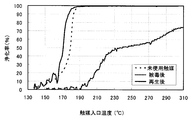
SV=60000h-1、エタノール300ppm、エアーバランスで試験した。被毒前の触媒、及び被毒後再生前の触媒についても、同様に試験を行った。結果を図1に示す。
SV=60000h-1、エタノール300ppm、エアーバランスで試験した。被毒前の触媒、及び被毒後再生前の触媒についても、同様に試験を行った。結果を図1に示す。
以上の結果、再生処理前の触媒は、有機リン被毒によりエタノール浄化率が大幅に低下していたのに対し、再生処理後の触媒では、低下したエタノール浄化率を完全に回復することができた。よって、本発明の再生方法は、有機リン化合物に被毒した触媒の再生にも好適であることが分かった。
[第三実施形態]
工場において実際に使用した触媒を再生し、再生後の触媒性能を試験した。
工場において実際に使用した触媒を再生し、再生後の触媒性能を試験した。
被毒前の触媒としては、実施例1と同様の触媒を用いた。この触媒を、工場の排ガス浄化装置によるVOC除去に使用した後、再生対象の触媒とした。再生条件は実施例1と同様とした。再生前後の触媒について、付着している被毒物質の量を測定した。被毒物質の測定は、ステンレスハニカムを解体し、その一部を切り出し、任意の3箇所について、EPMAで簡易定量分析して平均値を算出した。また、実施例1と同様の条件で、トルエン浄化試験を行った。結果を、表2及び図2に示す。

表2より、再生によって、触媒成分であるPtを脱落させることなく、被毒物質であるC、Si、P、Caについては除去できた。また、図2より、再生処理前の触媒は、被毒により浄化率が大幅に低下していたのに対し、再生処理後の触媒では、低下した浄化率を完全に回復することができた。よって、実際に工場での使用により、有機シリコンや有機リン化合物で被毒した触媒についても、上記再生方法により活性を回復できることが分かった。
Claims (9)
- シリコン又はリンの少なくともいずれかが付着した使用済み排ガス浄化触媒を再生する方法であって、
使用済み排ガス浄化触媒を400~700℃で焼成する焼成工程と、
焼成した触媒を1~25wt%のアルカリ溶液に含浸させるアルカリ含浸工程と、を含み、
アルカリ含浸工程はpH13以上で行う排ガス浄化触媒の再生方法。 - 有機シリコン化合物が付着した排ガス浄化触媒を再生対象とする請求項1に記載された排ガス浄化触媒の再生方法。
- アルカリ溶液は、水酸化ナトリウム又は水酸化カリウムである請求項1又は2に記載された排ガス浄化触媒の再生方法。
- アルカリ含浸工程後の洗浄工程をさらに含む請求項1~3のいずれかに記載された排ガス浄化触媒の再生方法。
- 洗浄工程において、純水又は水道水で洗浄した後、酸性溶液を用いる請求項4に記載された排ガス浄化触媒の再生方法。
- 酸性溶液は、0.3~3.0wt%の硝酸溶液である請求項5に記載された排ガス浄化触媒の再生方法。
- 酸性溶液を用いた洗浄工程の後、300~600℃で触媒を乾燥させる乾燥工程をさらに含む請求項5又は6に記載された排ガス浄化触媒の再生方法。
- 再生後の排ガス浄化触媒は、シリコン又はリンの各含有量が1.5wt%以下である請求項1~7のいずれかに記載された排ガス浄化触媒の再生方法。
- 排ガス浄化触媒は、アルミナ、ジルコニア、チタニア、セリアのうち1種以上をウォッシュコートした基材に、白金、パラジウム、ロジウム、ルテニウム、イリジウム、金、銀のうち1種以上の貴金属からなる触媒金属が担持されたものである請求項1~8のいずれかに記載の排ガス浄化触媒の再生方法。
Priority Applications (2)
| Application Number | Priority Date | Filing Date | Title |
|---|---|---|---|
| KR1020137030037A KR101439806B1 (ko) | 2011-04-15 | 2012-04-13 | 배기가스 정화 촉매의 재생방법 |
| CN201280018573.6A CN103492075B (zh) | 2011-04-15 | 2012-04-13 | 废气净化催化剂的再生方法 |
Applications Claiming Priority (2)
| Application Number | Priority Date | Filing Date | Title |
|---|---|---|---|
| JP2011-090652 | 2011-04-15 | ||
| JP2011090652A JP4989771B1 (ja) | 2011-04-15 | 2011-04-15 | 排ガス浄化触媒の再生方法 |
Publications (1)
| Publication Number | Publication Date |
|---|---|
| WO2012141283A1 true WO2012141283A1 (ja) | 2012-10-18 |
Family
ID=46793830
Family Applications (1)
| Application Number | Title | Priority Date | Filing Date |
|---|---|---|---|
| PCT/JP2012/060107 Ceased WO2012141283A1 (ja) | 2011-04-15 | 2012-04-13 | 排ガス浄化触媒の再生方法 |
Country Status (5)
| Country | Link |
|---|---|
| JP (1) | JP4989771B1 (ja) |
| KR (1) | KR101439806B1 (ja) |
| CN (1) | CN103492075B (ja) |
| TW (1) | TWI454306B (ja) |
| WO (1) | WO2012141283A1 (ja) |
Cited By (1)
| Publication number | Priority date | Publication date | Assignee | Title |
|---|---|---|---|---|
| RU2600778C2 (ru) * | 2014-04-23 | 2016-10-27 | Джонсон Мэтти Плс | Извлечение драгоценных металлов |
Families Citing this family (3)
| Publication number | Priority date | Publication date | Assignee | Title |
|---|---|---|---|---|
| JP5918718B2 (ja) * | 2013-03-29 | 2016-05-18 | 田中貴金属工業株式会社 | ケイ素化合物を含有する排ガスを浄化するための排ガス処理触媒 |
| CN105907975B (zh) * | 2016-06-21 | 2017-12-29 | 中南大学 | 一种综合回收利用含碳石油化工行业废Pd/Al2O3催化剂的方法 |
| CN106367595B (zh) * | 2016-08-26 | 2018-03-20 | 中南大学 | 一种综合回收利用废Pd/Al2O3催化剂的方法 |
Citations (2)
| Publication number | Priority date | Publication date | Assignee | Title |
|---|---|---|---|---|
| JP2005537929A (ja) * | 2002-09-11 | 2005-12-15 | エンヴィカ ゲゼルシャフト ミット ベシュレンクテル ハフツング | リン負荷されたdeNOx触媒の再生方法 |
| WO2009113996A1 (en) * | 2008-03-11 | 2009-09-17 | Evonik Energy Services Llc | Method of regeneration of scr catalyst poisoned by phosphorous components in flue gas |
Family Cites Families (5)
| Publication number | Priority date | Publication date | Assignee | Title |
|---|---|---|---|---|
| CN1136994C (zh) * | 2001-05-30 | 2004-02-04 | 中国石油化工股份有限公司 | 一种催化剂连续再生方法 |
| JP4141722B2 (ja) | 2002-04-01 | 2008-08-27 | バブコック日立株式会社 | シリコン含有排ガスの浄化方法 |
| JP5495001B2 (ja) * | 2007-06-27 | 2014-05-21 | バブコック日立株式会社 | 触媒の再生方法 |
| CN101288850B (zh) * | 2008-06-06 | 2010-06-02 | 万山特区红晶汞业有限公司 | 氯氧化法再生氯化汞触媒的方法 |
| TW200946214A (en) * | 2009-07-28 | 2009-11-16 | Jg Environmental Tech Co Ltd | A regeneration method of a low concentration inorganic waste gas catalyic filter material |
-
2011
- 2011-04-15 JP JP2011090652A patent/JP4989771B1/ja active Active
-
2012
- 2012-04-13 CN CN201280018573.6A patent/CN103492075B/zh active Active
- 2012-04-13 KR KR1020137030037A patent/KR101439806B1/ko active Active
- 2012-04-13 WO PCT/JP2012/060107 patent/WO2012141283A1/ja not_active Ceased
- 2012-04-16 TW TW101113424A patent/TWI454306B/zh active
Patent Citations (2)
| Publication number | Priority date | Publication date | Assignee | Title |
|---|---|---|---|---|
| JP2005537929A (ja) * | 2002-09-11 | 2005-12-15 | エンヴィカ ゲゼルシャフト ミット ベシュレンクテル ハフツング | リン負荷されたdeNOx触媒の再生方法 |
| WO2009113996A1 (en) * | 2008-03-11 | 2009-09-17 | Evonik Energy Services Llc | Method of regeneration of scr catalyst poisoned by phosphorous components in flue gas |
Cited By (1)
| Publication number | Priority date | Publication date | Assignee | Title |
|---|---|---|---|---|
| RU2600778C2 (ru) * | 2014-04-23 | 2016-10-27 | Джонсон Мэтти Плс | Извлечение драгоценных металлов |
Also Published As
| Publication number | Publication date |
|---|---|
| TW201309378A (zh) | 2013-03-01 |
| TWI454306B (zh) | 2014-10-01 |
| KR20130140189A (ko) | 2013-12-23 |
| CN103492075A (zh) | 2014-01-01 |
| KR101439806B1 (ko) | 2014-09-11 |
| CN103492075B (zh) | 2015-05-13 |
| JP4989771B1 (ja) | 2012-08-01 |
| JP2012223665A (ja) | 2012-11-15 |
Similar Documents
| Publication | Publication Date | Title |
|---|---|---|
| JP5701185B2 (ja) | 脱硝触媒のso2酸化率上昇低減方法 | |
| JP2013056319A5 (ja) | ||
| JP4989771B1 (ja) | 排ガス浄化触媒の再生方法 | |
| CN107427772B (zh) | 催化的陶瓷烛式过滤器和清洁工艺尾气或废气的方法 | |
| JP5615228B2 (ja) | 使用済脱硝触媒の再生方法 | |
| JP2659802B2 (ja) | 排ガス浄化用触媒の再生方法 | |
| JPH0316642A (ja) | アルシン除去触媒の処理方法 | |
| JP5769814B2 (ja) | 排ガス処理触媒、排ガス処理触媒の製造方法、及び排ガス処理触媒の再生方法 | |
| JP4264642B2 (ja) | 熱的劣化触媒の再生方法 | |
| CN105142760A (zh) | 使用碱性水溶液和抗氧剂从催化转化器去除铁材料的方法 | |
| JP2016163874A (ja) | メタン酸化除去用触媒およびメタン酸化除去方法 | |
| JP3985119B2 (ja) | 排ガス浄化用触媒および排ガス浄化方法 | |
| JP2002253969A (ja) | 排ガス浄化用触媒および排ガス浄化方法 | |
| JP6032974B2 (ja) | 排ガス浄化処理用触媒の製造方法 | |
| JP2002316051A (ja) | 脱硝触媒またはダイオキシン分解触媒の再生方法および再生装置 | |
| JP7471863B2 (ja) | ディーゼル自動車用の酸化触媒装置の洗浄方法 | |
| JP2001162171A (ja) | 排ガス浄化用触媒および排ガス浄化方法 | |
| JP2012179543A (ja) | 脱硝触媒の再生方法 | |
| JPS60175550A (ja) | 排ガス浄化用触媒の再生方法 | |
| WO1995024258A1 (en) | Method for removing nitrous oxide | |
| JPH07136461A (ja) | 含酸素化合物、芳香族化合物及び酸素を含む混合ガスからの含酸素化合物の選択的除去方法 | |
| TWI576151B (zh) | 脫除硫酸銨鹽白煙之吸附劑及其製備方法 | |
| WO2010016250A1 (ja) | 窒素酸化物浄化用触媒、それを用いた窒素酸化物浄化装置及び窒素酸化物浄化方法 | |
| JPH0259020A (ja) | 排ガスの前処理方法 | |
| JP2013099715A (ja) | 燃焼排ガス中の窒素酸化物の除去触媒および同触媒を用いる窒素酸化物の除去方法 |
Legal Events
| Date | Code | Title | Description |
|---|---|---|---|
| 121 | Ep: the epo has been informed by wipo that ep was designated in this application |
Ref document number: 12771442 Country of ref document: EP Kind code of ref document: A1 |
|
| NENP | Non-entry into the national phase |
Ref country code: DE |
|
| ENP | Entry into the national phase |
Ref document number: 20137030037 Country of ref document: KR Kind code of ref document: A |
|
| 122 | Ep: pct application non-entry in european phase |
Ref document number: 12771442 Country of ref document: EP Kind code of ref document: A1 |