WO2012141216A1 - ハイパーブランチポリマー、金属微粒子及び有機酸を含む無電解めっき下地剤 - Google Patents
ハイパーブランチポリマー、金属微粒子及び有機酸を含む無電解めっき下地剤 Download PDFInfo
- Publication number
- WO2012141216A1 WO2012141216A1 PCT/JP2012/059907 JP2012059907W WO2012141216A1 WO 2012141216 A1 WO2012141216 A1 WO 2012141216A1 JP 2012059907 W JP2012059907 W JP 2012059907W WO 2012141216 A1 WO2012141216 A1 WO 2012141216A1
- Authority
- WO
- WIPO (PCT)
- Prior art keywords
- acid
- group
- metal
- substrate
- base material
- Prior art date
- Legal status (The legal status is an assumption and is not a legal conclusion. Google has not performed a legal analysis and makes no representation as to the accuracy of the status listed.)
- Ceased
Links
Images


Classifications
-
- C—CHEMISTRY; METALLURGY
- C08—ORGANIC MACROMOLECULAR COMPOUNDS; THEIR PREPARATION OR CHEMICAL WORKING-UP; COMPOSITIONS BASED THEREON
- C08F—MACROMOLECULAR COMPOUNDS OBTAINED BY REACTIONS ONLY INVOLVING CARBON-TO-CARBON UNSATURATED BONDS
- C08F12/00—Homopolymers and copolymers of compounds having one or more unsaturated aliphatic radicals, each having only one carbon-to-carbon double bond, and at least one being terminated by an aromatic carbocyclic ring
- C08F12/02—Monomers containing only one unsaturated aliphatic radical
- C08F12/32—Monomers containing only one unsaturated aliphatic radical containing two or more rings
-
- C—CHEMISTRY; METALLURGY
- C08—ORGANIC MACROMOLECULAR COMPOUNDS; THEIR PREPARATION OR CHEMICAL WORKING-UP; COMPOSITIONS BASED THEREON
- C08F—MACROMOLECULAR COMPOUNDS OBTAINED BY REACTIONS ONLY INVOLVING CARBON-TO-CARBON UNSATURATED BONDS
- C08F12/00—Homopolymers and copolymers of compounds having one or more unsaturated aliphatic radicals, each having only one carbon-to-carbon double bond, and at least one being terminated by an aromatic carbocyclic ring
- C08F12/02—Monomers containing only one unsaturated aliphatic radical
- C08F12/04—Monomers containing only one unsaturated aliphatic radical containing one ring
- C08F12/14—Monomers containing only one unsaturated aliphatic radical containing one ring substituted by hetero atoms or groups containing heteroatoms
- C08F12/26—Nitrogen
-
- C—CHEMISTRY; METALLURGY
- C08—ORGANIC MACROMOLECULAR COMPOUNDS; THEIR PREPARATION OR CHEMICAL WORKING-UP; COMPOSITIONS BASED THEREON
- C08F—MACROMOLECULAR COMPOUNDS OBTAINED BY REACTIONS ONLY INVOLVING CARBON-TO-CARBON UNSATURATED BONDS
- C08F12/00—Homopolymers and copolymers of compounds having one or more unsaturated aliphatic radicals, each having only one carbon-to-carbon double bond, and at least one being terminated by an aromatic carbocyclic ring
- C08F12/02—Monomers containing only one unsaturated aliphatic radical
- C08F12/04—Monomers containing only one unsaturated aliphatic radical containing one ring
- C08F12/14—Monomers containing only one unsaturated aliphatic radical containing one ring substituted by hetero atoms or groups containing heteroatoms
- C08F12/30—Sulfur
-
- C—CHEMISTRY; METALLURGY
- C23—COATING METALLIC MATERIAL; COATING MATERIAL WITH METALLIC MATERIAL; CHEMICAL SURFACE TREATMENT; DIFFUSION TREATMENT OF METALLIC MATERIAL; COATING BY VACUUM EVAPORATION, BY SPUTTERING, BY ION IMPLANTATION OR BY CHEMICAL VAPOUR DEPOSITION, IN GENERAL; INHIBITING CORROSION OF METALLIC MATERIAL OR INCRUSTATION IN GENERAL
- C23C—COATING METALLIC MATERIAL; COATING MATERIAL WITH METALLIC MATERIAL; SURFACE TREATMENT OF METALLIC MATERIAL BY DIFFUSION INTO THE SURFACE, BY CHEMICAL CONVERSION OR SUBSTITUTION; COATING BY VACUUM EVAPORATION, BY SPUTTERING, BY ION IMPLANTATION OR BY CHEMICAL VAPOUR DEPOSITION, IN GENERAL
- C23C18/00—Chemical coating by decomposition of either liquid compounds or solutions of the coating forming compounds, without leaving reaction products of surface material in the coating; Contact plating
- C23C18/16—Chemical coating by decomposition of either liquid compounds or solutions of the coating forming compounds, without leaving reaction products of surface material in the coating; Contact plating by reduction or substitution, e.g. electroless plating
- C23C18/18—Pretreatment of the material to be coated
- C23C18/1803—Pretreatment of the material to be coated of metallic material surfaces or of a non-specific material surfaces
- C23C18/1824—Pretreatment of the material to be coated of metallic material surfaces or of a non-specific material surfaces by chemical pretreatment
- C23C18/1827—Pretreatment of the material to be coated of metallic material surfaces or of a non-specific material surfaces by chemical pretreatment only one step pretreatment
-
- C—CHEMISTRY; METALLURGY
- C23—COATING METALLIC MATERIAL; COATING MATERIAL WITH METALLIC MATERIAL; CHEMICAL SURFACE TREATMENT; DIFFUSION TREATMENT OF METALLIC MATERIAL; COATING BY VACUUM EVAPORATION, BY SPUTTERING, BY ION IMPLANTATION OR BY CHEMICAL VAPOUR DEPOSITION, IN GENERAL; INHIBITING CORROSION OF METALLIC MATERIAL OR INCRUSTATION IN GENERAL
- C23C—COATING METALLIC MATERIAL; COATING MATERIAL WITH METALLIC MATERIAL; SURFACE TREATMENT OF METALLIC MATERIAL BY DIFFUSION INTO THE SURFACE, BY CHEMICAL CONVERSION OR SUBSTITUTION; COATING BY VACUUM EVAPORATION, BY SPUTTERING, BY ION IMPLANTATION OR BY CHEMICAL VAPOUR DEPOSITION, IN GENERAL
- C23C18/00—Chemical coating by decomposition of either liquid compounds or solutions of the coating forming compounds, without leaving reaction products of surface material in the coating; Contact plating
- C23C18/16—Chemical coating by decomposition of either liquid compounds or solutions of the coating forming compounds, without leaving reaction products of surface material in the coating; Contact plating by reduction or substitution, e.g. electroless plating
- C23C18/18—Pretreatment of the material to be coated
- C23C18/1851—Pretreatment of the material to be coated of surfaces of non-metallic or semiconducting in organic material
- C23C18/1872—Pretreatment of the material to be coated of surfaces of non-metallic or semiconducting in organic material by chemical pretreatment
- C23C18/1875—Pretreatment of the material to be coated of surfaces of non-metallic or semiconducting in organic material by chemical pretreatment only one step pretreatment
-
- C—CHEMISTRY; METALLURGY
- C23—COATING METALLIC MATERIAL; COATING MATERIAL WITH METALLIC MATERIAL; CHEMICAL SURFACE TREATMENT; DIFFUSION TREATMENT OF METALLIC MATERIAL; COATING BY VACUUM EVAPORATION, BY SPUTTERING, BY ION IMPLANTATION OR BY CHEMICAL VAPOUR DEPOSITION, IN GENERAL; INHIBITING CORROSION OF METALLIC MATERIAL OR INCRUSTATION IN GENERAL
- C23C—COATING METALLIC MATERIAL; COATING MATERIAL WITH METALLIC MATERIAL; SURFACE TREATMENT OF METALLIC MATERIAL BY DIFFUSION INTO THE SURFACE, BY CHEMICAL CONVERSION OR SUBSTITUTION; COATING BY VACUUM EVAPORATION, BY SPUTTERING, BY ION IMPLANTATION OR BY CHEMICAL VAPOUR DEPOSITION, IN GENERAL
- C23C18/00—Chemical coating by decomposition of either liquid compounds or solutions of the coating forming compounds, without leaving reaction products of surface material in the coating; Contact plating
- C23C18/16—Chemical coating by decomposition of either liquid compounds or solutions of the coating forming compounds, without leaving reaction products of surface material in the coating; Contact plating by reduction or substitution, e.g. electroless plating
- C23C18/18—Pretreatment of the material to be coated
- C23C18/20—Pretreatment of the material to be coated of organic surfaces, e.g. resins
- C23C18/2006—Pretreatment of the material to be coated of organic surfaces, e.g. resins by other methods than those of C23C18/22 - C23C18/30
- C23C18/2046—Pretreatment of the material to be coated of organic surfaces, e.g. resins by other methods than those of C23C18/22 - C23C18/30 by chemical pretreatment
- C23C18/2053—Pretreatment of the material to be coated of organic surfaces, e.g. resins by other methods than those of C23C18/22 - C23C18/30 by chemical pretreatment only one step pretreatment
-
- C—CHEMISTRY; METALLURGY
- C23—COATING METALLIC MATERIAL; COATING MATERIAL WITH METALLIC MATERIAL; CHEMICAL SURFACE TREATMENT; DIFFUSION TREATMENT OF METALLIC MATERIAL; COATING BY VACUUM EVAPORATION, BY SPUTTERING, BY ION IMPLANTATION OR BY CHEMICAL VAPOUR DEPOSITION, IN GENERAL; INHIBITING CORROSION OF METALLIC MATERIAL OR INCRUSTATION IN GENERAL
- C23C—COATING METALLIC MATERIAL; COATING MATERIAL WITH METALLIC MATERIAL; SURFACE TREATMENT OF METALLIC MATERIAL BY DIFFUSION INTO THE SURFACE, BY CHEMICAL CONVERSION OR SUBSTITUTION; COATING BY VACUUM EVAPORATION, BY SPUTTERING, BY ION IMPLANTATION OR BY CHEMICAL VAPOUR DEPOSITION, IN GENERAL
- C23C18/00—Chemical coating by decomposition of either liquid compounds or solutions of the coating forming compounds, without leaving reaction products of surface material in the coating; Contact plating
- C23C18/16—Chemical coating by decomposition of either liquid compounds or solutions of the coating forming compounds, without leaving reaction products of surface material in the coating; Contact plating by reduction or substitution, e.g. electroless plating
- C23C18/18—Pretreatment of the material to be coated
- C23C18/20—Pretreatment of the material to be coated of organic surfaces, e.g. resins
- C23C18/28—Sensitising or activating
- C23C18/30—Activating or accelerating or sensitising with palladium or other noble metal
-
- C—CHEMISTRY; METALLURGY
- C08—ORGANIC MACROMOLECULAR COMPOUNDS; THEIR PREPARATION OR CHEMICAL WORKING-UP; COMPOSITIONS BASED THEREON
- C08F—MACROMOLECULAR COMPOUNDS OBTAINED BY REACTIONS ONLY INVOLVING CARBON-TO-CARBON UNSATURATED BONDS
- C08F2438/00—Living radical polymerisation
- C08F2438/03—Use of a di- or tri-thiocarbonylthio compound, e.g. di- or tri-thioester, di- or tri-thiocarbamate, or a xanthate as chain transfer agent, e.g . Reversible Addition Fragmentation chain Transfer [RAFT] or Macromolecular Design via Interchange of Xanthates [MADIX]
Definitions
- the present invention relates to an electroless plating base material containing a hyperbranched polymer, metal fine particles and an organic acid.
- a film with a uniform thickness can be obtained by simply immersing the substrate in the plating solution, regardless of the type or shape of the substrate.
- Metal plating films can also be applied to non-conductive materials such as plastic, ceramic, and glass. For example, it is widely used in various fields such as decorative applications such as imparting a sense of quality and aesthetics to resin moldings such as automobile parts, and wiring technologies such as electromagnetic shielding, printed circuit boards, and large-scale integrated circuits. ing.
- decorative applications such as imparting a sense of quality and aesthetics to resin moldings such as automobile parts
- wiring technologies such as electromagnetic shielding, printed circuit boards, and large-scale integrated circuits. ing.
- the pre-processing for improving the adhesiveness of a base material and a metal plating film is performed.
- the surface to be treated is roughened and / or made hydrophilic by various etching means, and then the sensitization of supplying an adsorbing substance that promotes adsorption of the plating catalyst onto the surface to be treated is performed.
- a treatment (sensitization) and an activation treatment (activation) for adsorbing the plating catalyst on the surface to be treated are performed.
- the sensitizing treatment immerses the object to be treated in an acidic solution of stannous chloride, so that a metal (Sn 2+ ) that can act as a reducing agent adheres to the surface to be treated.
- the object to be treated is immersed in an acidic solution of palladium chloride as an activation treatment for the sensitized surface to be treated.
- the palladium ions in the solution are reduced by the metal (tin ion: Sn 2+ ) as a reducing agent and adhere to the surface to be treated as active palladium catalyst nuclei.
- it is immersed in an electroless plating solution to form a metal plating film on the surface to be treated.
- hyperbranched polymers classified as dendritic (dendritic) polymers actively introduce branching, and the most remarkable feature is the large number of terminal groups.
- a reactive functional group is added to this end group, the polymer has a reactive functional group at a very high density.
- a high-sensitivity capture agent for functional substances such as catalysts, a high-sensitivity multifunctional Application as a crosslinking agent, a dispersing agent or a coating agent of a metal or a metal oxide is expected.
- Patent Document 1 an example in which a composition containing a hyperbranched polymer having an ammonium group and metal fine particles is used as a reduction catalyst has been reported (Patent Document 1).
- the roughening process performed in the pretreatment process uses a chromium compound (chromic acid), and the number of pretreatment processes is very large.
- the molding technology for resin casings has been improved, and a method that enables plating of a clean casing surface as it is, especially with the miniaturization of electronic circuit formation and the speeding up of electrical signals, is highly electroless.
- the present invention pays attention to such problems, and aims to provide a new base material used as a pretreatment process of electroless plating that can be easily processed with a small number of processes and can realize cost reduction in consideration of the environment.
- the present inventors have combined a hyperbranched polymer having an ammonium group at the molecular end with metal fine particles and an organic acid, and a layer obtained by applying this to a substrate. Was found to be excellent in plating properties and adhesion as an underlayer for electroless metal plating, and completed the present invention.
- the present invention is a base agent for forming a metal plating film on a substrate by electroless plating treatment, having an ammonium group at a molecular end and a weight average molecular weight of 500 to 5
- the present invention relates to a base agent containing a hyperbranched polymer, metal fine particles and an organic acid.
- the ammonium group of the said hyperbranched polymer adheres to the said metal microparticle, It is related with the base material as described in a 1st viewpoint.
- the organic acid is acetic acid, propionic acid, (meth) acrylic acid, butyric acid, lactic acid, oxalic acid, malonic acid, succinic acid, glutaric acid, adipic acid, maleic acid, fumaric acid, malic acid, tartaric acid.
- Citric acid Citric acid, poly (meth) acrylic acid, benzoic acid, salicylic acid, 3-hydroxybenzoic acid, 4-hydroxybenzoic acid, 2,6-dihydroxybenzoic acid, 3,5-dihydroxybenzoic acid, phthalic acid, isophthalic acid,
- the base material according to the first aspect or the second aspect which is selected from the group consisting of terephthalic acid, trimellitic acid and pyromellitic acid.
- the present invention relates to the base agent according to the third aspect, in which the organic acid is succinic acid, maleic acid, citric acid or poly (meth) acrylic acid.
- the present invention relates to the base agent according to any one of the first aspect to the fourth aspect, in which the hyperbranched polymer is a hyperbranched polymer represented by the formula [1].
- R 1 independently represents a hydrogen atom or a methyl group
- R 2 , R 3 and R 4 each independently represent a hydrogen atom, a straight chain having 1 to 20 carbon atoms, A branched or cyclic alkyl group, an arylalkyl group having 7 to 20 carbon atoms, or — (CH 2 CH 2 O) m
- R 5 represents a hydrogen atom or a methyl group; Represents an integer of 2 to 100
- the alkyl group and arylalkyl group may be substituted with an alkoxy group, a hydroxy group, an ammonium group, a carboxyl group, or a cyano group
- R 2 , R Two of 3 and R 4 together represent a linear, branched or cyclic alkylene group
- the present invention relates to the base agent according to the fifth aspect, in which the hyperbranched polymer is a hyperbranched polymer represented by the formula [3].
- the metal fine particles include iron (Fe), cobalt (Co), nickel (Ni), copper (Cu), palladium (Pd), silver (Ag), tin (Sn), platinum (Pt) and It is related with the base material as described in any one of the 1st viewpoint thru
- the present invention relates to the base agent according to the seventh aspect, wherein the metal fine particles are palladium fine particles.
- the present invention relates to the base agent according to the seventh aspect or the eighth aspect, in which the metal fine particles are fine particles having an average particle diameter of 1 to 100 nm.
- the base agent as described in any one of the 1st viewpoint thru
- it is related with the base agent as described in any one of the 1st viewpoint thru
- the base material, the electroless plating base layer according to the twelfth aspect formed on the base material, and the metal plating film according to the thirteenth aspect formed on the electroless plating base layer And a metal-coated substrate.
- the present invention relates to the metal-coated substrate according to the fourteenth aspect, in which the substrate is a non-conductive substrate.
- the present invention relates to the metal-coated substrate according to the fourteenth aspect, in which the substrate is a conductive substrate.
- it is related with the manufacturing method of a metal film base material containing the following A process and B process.
- Step A Step of applying the base agent according to any one of the first aspect to the eleventh aspect on the base material to form a base layer
- Step B Electroless plating bath for the base material provided with the base layer A step of forming a metal plating film by dipping in a metal.
- the said base material is related with the manufacturing method as described in a 17th viewpoint which is a nonelectroconductive base material.
- the present invention relates to the manufacturing method according to the seventeenth aspect, wherein the base material is a conductive base material.
- the base agent of the present invention can easily form a base layer of electroless metal plating simply by coating on a substrate. Moreover, the base agent of this invention can form the base layer which is excellent in adhesiveness with a base material. Furthermore, the base material of the present invention can draw fine lines on the order of ⁇ m and can be suitably used for various wiring techniques.
- the electroless metal plating base layer formed from the base agent of the present invention can be easily formed by simply immersing it in an electroless plating bath, and the substrate, the base layer, and the metal plating film can be formed. The provided metal-coated substrate can be easily obtained. And the said metal plating film is excellent in adhesiveness with a lower base layer. That is, by forming the base layer on the base material using the base material of the present invention, it is possible to form a metal plating film having excellent adhesion to the base material.
- FIG. 1 is a diagram showing a 1 H NMR spectrum of a hyperbranched polymer (HPS-Cl) having a chlorine atom at the molecular end obtained in Synthesis Example 1.
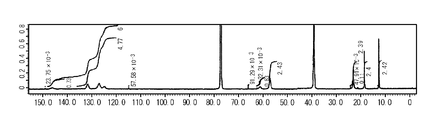
- FIG. 2 is a diagram showing a 13 C NMR spectrum of a hyperbranched polymer (HPS-NBu 3 Cl) having a tributylammonium group at the molecular end obtained in Synthesis Example 2.
- FIG. 3 is a diagram showing a 13 C NMR spectrum of a hyperbranched polymer (HPS-NOct 3 Cl) having a trioctylammonium group at the molecular end obtained in Synthesis Example 4.
- the base agent of the present invention is a base agent containing a hyperbranched polymer containing an ammonium group and having a weight average molecular weight of 500 to 5,000,000, fine metal particles and an organic acid.
- the base agent of the present invention is suitably used as a base agent for forming a metal plating film on a substrate by electroless plating.
- the hyperbranched polymer used in the base agent of the present invention is a polymer having an ammonium group at the molecular end and a weight average molecular weight of 500 to 5,000,000, specifically represented by the following formula [1]. And hyperbranched polymers.
- R 1 represents a hydrogen atom or a methyl group independently.
- R 2 , R 3 and R 4 are each independently a hydrogen atom, a linear, branched or cyclic alkyl group having 1 to 20 carbon atoms, an arylalkyl group having 7 to 20 carbon atoms, Or — (CH 2 CH 2 O) m R 5 (wherein R 5 represents a hydrogen atom or a methyl group, and m represents an arbitrary integer of 2 to 100).
- the alkyl group and arylalkyl group may be substituted with an alkoxy group, a hydroxy group, an ammonium group, a carboxyl group, or a cyano group.
- R 2 , R 3 and R 4 together represent a linear, branched or cyclic alkylene group, or R 2 , R 3 and R 4 and they are bonded
- the nitrogen atoms to be bonded together may form a ring.
- X ⁇ represents an anion
- n is the number of repeating unit structures, and represents an integer of 2 to 100,000.
- Examples of the linear alkyl group having 1 to 20 carbon atoms in R 2 , R 3 and R 4 include a methyl group, an ethyl group, an n-propyl group, an n-butyl group, an n-pentyl group, and an n-hexyl group.
- n-octyl group is particularly preferred.
- the branched alkyl group include isopropyl group, isobutyl group, sec-butyl group, tert-butyl group and the like.
- the cyclic alkyl group include a cyclopentyl ring and a group having a cyclohexyl ring structure.
- the arylalkyl group having 7 to 20 carbon atoms in R 2 , R 3 and R 4 include a benzyl group and a phenethyl group.
- the linear alkylene group in which two groups out of R 2 , R 3 and R 4 are combined includes a methylene group, an ethylene group, an n-propylene group, an n-butylene group and an n-hexylene group.
- Examples of the branched alkylene group include an isopropylene group, an isobutylene group, and a 2-methylpropylene group.
- Examples of the cyclic alkylene group include alicyclic aliphatic groups having a monocyclic, polycyclic or bridged cyclic structure having 3 to 30 carbon atoms.
- alkylene groups may contain a nitrogen atom, a sulfur atom or an oxygen atom in the group.
- the ring formed by combining R 2 , R 3 and R 4 and the nitrogen atom bonded thereto contains a nitrogen atom, a sulfur atom or an oxygen atom in the ring.
- examples thereof include a pyridine ring, a pyrimidine ring, a pyrazine ring, a quinoline ring, and a bipyridyl ring.
- the anion of X ⁇ is preferably a halogen atom, PF 6 ⁇ , BF 4 ⁇ or perfluoroalkanesulfonate.
- a 1 represents a structure represented by the following formula [2].
- a 2 represents a linear, branched or cyclic alkylene group having 1 to 30 carbon atoms which may contain an ether bond or an ester bond.
- Y 1 , Y 2 , Y 3 and Y 4 are each independently a hydrogen atom, an alkyl group having 1 to 20 carbon atoms, an alkoxy group having 1 to 20 carbon atoms, a nitro group, a hydroxy group, an amino group, Represents a carboxyl group or a cyano group.
- alkylene group represented by A 2 examples include linear alkylene groups such as methylene group, ethylene group, n-propylene group, n-butylene group and n-hexylene group, isopropylene group, isobutylene group, 2-methyl group.
- examples include branched alkylene groups such as propylene groups.
- the cyclic alkylene group include alicyclic aliphatic groups having a monocyclic, polycyclic and bridged cyclic structure having 3 to 30 carbon atoms. Specific examples include groups having a monocyclo, bicyclo, tricyclo, tetracyclo, or pentacyclo structure having 4 or more carbon atoms.
- structural examples (a) to (s) of the alicyclic portion of the alicyclic aliphatic group are shown below.
- Examples of the alkyl group having 1 to 20 carbon atoms of Y 1 , Y 2 , Y 3 and Y 4 in the above formula [2] include a methyl group, an ethyl group, an isopropyl group, a cyclohexyl group, and an n-pentyl group. Can be mentioned.
- Examples of the alkoxy group having 1 to 20 carbon atoms include methoxy group, ethoxy group, isopropoxy group, cyclohexyloxy group, n-pentyloxy group and the like.
- Y 1 , Y 2 , Y 3 and Y 4 are each independently preferably a hydrogen atom or an alkyl group having 1 to 20 carbon atoms.
- the A 1 is a structure represented by the following formula [4].
- the hyperbranched polymer used in the present invention includes a hyperbranched polymer represented by the following formula [3].
- R ⁇ 1 >, R ⁇ 2 > and n represent the same meaning as the above.
- the hyperbranched polymer having an ammonium group at the molecular end used in the present invention can be obtained, for example, by reacting an amine compound with a hyperbranched polymer having a halogen atom at the molecular end.
- a hyperbranched polymer having a halogen atom at the molecular end can be produced from a hyperbranched polymer having a dithiocarbamate group at the molecular end in accordance with the description in WO 2008/029688.
- As the hyperbranched polymer having a dithiocarbamate group at the molecular end a commercially available product can be used, and Hypertech (registered trademark) HPS-200 manufactured by Nissan Chemical Industries, Ltd. can be preferably used.
- the amine compounds that can be used in this reaction are, as primary amines, methylamine, ethylamine, n-propylamine, isopropylamine, n-butylamine, isobutylamine, sec-butylamine, tert-butylamine, n-pentylamine, n -Hexylamine, n-heptylamine, n-octylamine, n-nonylamine, n-decylamine, n-undecylamine, n-dodecylamine, n-tridecylamine, n-tetradecylamine, n-pentadecylamine N-hexadecylamine, n-heptadecylamine, n-octadecylamine, n-nonadecylamine, n-eicosylamine and other aliphatic amines; cyclopen
- Secondary amines include dimethylamine, diethylamine, di-n-propylamine, diisopropylamine, di-n-butylamine, diisobutylamine, di-sec-butylamine, di-n-pentylamine, ethylmethylamine, methyl- n-propylamine, methyl-n-butylamine, methyl-n-pentylamine, ethylisopropylamine, ethyl-n-butylamine, ethyl-n-pentylamine, methyl-n-octylamine, methyl-n-decylamine, methyl- n-dodecylamine, methyl-n-tetradecylamine, methyl-n-hexadecylamine, methyl-n-octadecylamine, ethylisopropylamine, ethyl-n-octylamine, di
- Tertiary amines include trimethylamine, triethylamine, tri-n-propylamine, tri-n-butylamine, tri-n-pentylamine, tri-n-octylamine, tri-n-dodecylamine, dimethyl-n-octyl.
- Amine diethyl-n-decylamine, dimethyl-n-dodecylamine, dimethyl-n-tetradecylamine, dimethyl-n-hexadecylamine, dimethyl-n-octadecylamine, dimethyl-n-eicosylamine, dimethyl-n- Aliphatic amines such as dodecylamine; nitrogen-containing heterocyclic compounds such as pyridine, pyrazine, pyrimidine, quinoline, 1-methylimidazole, 4,4′-bipyridyl, 4-methyl-4,4′-bipyridyl.
- the amount of amine compound that can be used in these reactions is 0.1 to 20 molar equivalents, preferably 0.5 to 10 molar equivalents per mole of halogen atoms of the hyperbranched polymer having a halogen atom at the molecular end. Preferably, it may be 1 to 5 molar equivalents.
- the reaction between the hyperbranched polymer having a halogen atom at the molecular end and the amine compound can be carried out in water or an organic solvent in the presence or absence of a base.
- the solvent to be used is preferably a solvent capable of dissolving a hyperbranched polymer having a halogen atom at the molecular end and an amine compound.
- a hyperbranched polymer having a halogen atom at the molecular end and an amine compound can be dissolved, but a solvent that does not dissolve the hyperbranched polymer having an ammonium group at the molecular end is more preferable because it can be easily isolated.
- the solvent that can be used in this reaction is not particularly limited as long as it does not significantly inhibit the progress of this reaction.
- Alcohols such as isopropanol
- organic acids such as acetic acid
- Aromatic hydrocarbons such as chlorobenzene
- ethers such as tetrahydrofuran and diethyl ether
- ketones such as acetone, ethyl methyl ketone, isobutyl methyl ketone and cyclohexanone
- halides such as chloroform, dichloromethane and 1,2-dichloroethane
- n- Aliphatic hydrocarbons such as hexane, n-heptane and cyclohexane
- Amides such as N, N-dimethylformamide, N, N-dimethylacetamide and N-methyl-2-pyrrolidone can be used.
- solvents may be used alone or in combination of two or more.
- the amount used is 0.2 to 1,000 times, preferably 1 to 500 times, more preferably 5 to 100 times, most preferably the mass of the hyperbranched polymer having a halogen atom at the molecular end. It is preferable to use a solvent having a mass of 10 to 50 times.
- Suitable bases generally include alkali metal hydroxides and alkaline earth metal hydroxides (eg sodium hydroxide, potassium hydroxide, calcium hydroxide), alkali metal oxides and alkaline earth metal oxides (eg lithium oxide). Calcium oxide), alkali metal hydrides and alkaline earth metal hydrides (eg sodium hydride, potassium hydride, calcium hydride), alkali metal amides (eg sodium amide), alkali metal carbonates and alkaline earth metal carbonates Inorganic compounds such as salts (eg lithium carbonate, sodium carbonate, potassium carbonate, calcium carbonate), alkali metal bicarbonates (eg sodium bicarbonate), and alkali metal alkyls, alkylmagnesium halides, alkali metal alkoxides, alkaline earth metals Alkoki De, organometallic compounds such as dimethoxy magnesium was used.
- alkali metal hydroxides and alkaline earth metal hydroxides eg sodium hydroxide, potassium hydroxide,
- potassium carbonate and sodium carbonate are particularly preferred.
- the amount used is 0.2 to 10 molar equivalents, preferably 0.5 to 10 molar equivalents, most preferably 1 to 5 molar equivalents per mole of halogen atoms of the hyperbranched polymer having a halogen atom at the molecular end. It is preferable to use the base.
- reaction conditions are appropriately selected from a reaction time of 0.01 to 100 hours and a reaction temperature of 0 to 300 ° C.
- the reaction time is 0.1 to 72 hours, and the reaction temperature is 20 to 150 ° C.
- a hyperbranched polymer represented by the formula [1] can be obtained regardless of the presence / absence of a base.
- a hyperbranched polymer having a halogen atom at the molecular end is reacted with a primary amine or secondary amine compound in the absence of a base, the terminal secondary amine and tertiary tertiary of the corresponding hyperbranched polymer are respectively reacted.
- a hyperbranched polymer having ammonium groups terminated with protonated primary amines is obtained.
- the terminal secondary amine of the corresponding hyperbranched polymer can be obtained by mixing with an aqueous solution of an acid such as hydrogen chloride, hydrogen bromide, or hydrogen iodide in an organic solvent. And a hyperbranched polymer having an ammonium group terminated with a tertiary amine protonated.
- the hyperbranched polymer has a weight average molecular weight Mw measured in terms of polystyrene by gel permeation chromatography of 500 to 5,000,000, preferably 1,000 to 1,000,000, more preferably 2. 3,000 to 500,000, most preferably 3,000 to 200,000.
- the degree of dispersion: Mw (weight average molecular weight) / Mn (number average molecular weight) is 1.0 to 7.0, preferably 1.1 to 6.0, more preferably 1.2 to 5. .0.
- the organic acid used in the base material of the present invention is not particularly limited, and examples thereof include aliphatic monocarboxylic acids such as acetic acid, propionic acid, (meth) acrylic acid, butyric acid, and lactic acid; oxalic acid, malonic acid, succinic acid, and glutar Aliphatic polycarboxylic acids such as acid, adipic acid, maleic acid, fumaric acid, malic acid, tartaric acid, citric acid, poly (meth) acrylic acid; benzoic acid, salicylic acid, 3-hydroxybenzoic acid, 4-hydroxybenzoic acid Aromatic monocarboxylic acids such as 2,6-dihydroxybenzoic acid and 3,5-dihydroxybenzoic acid; aromatic polycarboxylic acids such as phthalic acid, isophthalic acid, terephthalic acid, trimellitic acid and pyromellitic acid Can be mentioned.
- aliphatic monocarboxylic acids such as acetic acid, propionic acid, (meth) acrylic
- organic acids may be used alone or in combination of two or more.
- an aliphatic polycarboxylic acid is preferable as the organic acid. More preferred are succinic acid, maleic acid, citric acid and poly (meth) acrylic acid, and more preferred are citric acid and poly (meth) acrylic acid.
- the poly (meth) acrylic acid is composed of (meth) acrylic acid esters such as methyl (meth) acrylate; (meth) acrylic acid amides; (meth) acrylic acid salts such as sodium (meth) acrylate; It may be a copolymer with a polymerizable monomer such as maleic acid such as acid or maleic anhydride; an aromatic vinyl compound such as styrene; or a diene compound such as butadiene.
- (meth) acrylic acid refers to both acrylic acid and methacrylic acid.
- the addition amount of the organic acid in the base material of the present invention is preferably 0.01 to 50 parts by mass with respect to 1 part by mass of the composite formed from the hyperbranched polymer and metal fine particles described later. By setting it as 0.01 mass part or more, the more superior base-material adhesiveness can be obtained, and more excellent plating property can be obtained by setting it as 50 mass parts or less. More preferably, it is 0.03 to 50 parts by mass.
- the metal fine particles used in the base material of the present invention are not particularly limited, and the metal species are iron (Fe), cobalt (Co), nickel (Ni), copper (Cu), palladium (Pd), silver (Ag). , Tin (Sn), platinum (Pt), and gold (Au). These metals may be one kind or two or more kinds of alloys. Among these, preferable metal fine particles include palladium fine particles.
- the metal oxide may be an oxide of the metal.
- the metal fine particles can be obtained by reducing metal ions by, for example, a method of irradiating an aqueous solution of a metal salt with a high-pressure mercury lamp or a method of adding a compound having a reducing action (so-called reducing agent) to the aqueous solution.
- a compound having a reducing action for example, an aqueous solution of a metal salt is added to a solution in which the hyperbranched polymer is dissolved and irradiated with ultraviolet light, or an aqueous solution of a metal salt and a reducing agent are added to the solution to reduce metal ions.
- the base agent containing the hyperbranched polymer and the metal fine particles can be prepared while forming a complex of the hyperbranched polymer and the metal fine particles.
- the reducing agent is not particularly limited, and various reducing agents can be used, and it is preferable to select the reducing agent according to the metal species to be contained in the obtained base material.
- the reducing agent that can be used include metal borohydrides such as sodium borohydride and potassium borohydride; lithium aluminum hydride, potassium aluminum hydride, cesium aluminum hydride, aluminum beryllium hydride, hydrogenation
- Aluminum hydride salts such as aluminum magnesium and calcium aluminum hydride; hydrazine compounds; citric acid and salts thereof; succinic acid and salts thereof; ascorbic acid and salts thereof; primary or secondary such as methanol, ethanol, isopropanol and polyol Tertiary alcohols; tertiary amines such as trimethylamine, triethylamine, diisopropylethylamine, diethylmethylamine, tetramethylethylenediamine [TMEDA], ethylenediaminetetraacetic acid [EDTA]; Rox
- the average particle size of the metal fine particles is preferably 1 to 100 nm. The reason is that when the average particle diameter of the metal fine particles exceeds 100 nm, the surface area decreases and the catalytic activity decreases.
- the average particle size is more preferably 75 nm or less, and particularly preferably 1 to 30 nm.
- the amount of the hyperbranched polymer added to the base material of the present invention is preferably 50 to 2,000 parts by mass with respect to 100 parts by mass of the metal fine particles.
- the amount is less than 50 parts by mass, the dispersibility of the metal fine particles is insufficient, and when the amount exceeds 2,000 parts by mass, the organic matter content increases, and problems such as physical properties tend to occur. More preferably, it is 100 to 1,000 parts by mass.
- the base agent of the present invention includes a hyperbranched polymer having an ammonium group at a molecular end, metal fine particles, and an organic acid, and at this time, the hyperbranched polymer and the metal fine particles form a complex.
- the composite is a particle that is in contact with or close to the metal fine particles due to the action of the ammonium group at the end of the hyperbranched polymer to form a particulate form. It is expressed as a composite having a structure in which the ammonium group of the polymer is attached or coordinated to the metal fine particles.
- the metal fine particles and the hyperbranched polymer are combined to form one composite as described above, but also the metal fine particles and the hyperbranched polymer have bonding portions. Those that are present independently without being formed may also be included.
- Formation of a complex of a hyperbranched polymer having an ammonium group and metal fine particles is performed simultaneously with the preparation of a base material containing the hyperbranched polymer and metal fine particles, and the method includes a metal stabilized to some extent by a lower ammonium ligand.
- an aqueous solution of a metal salt is added to the solution in which the hyperbranched polymer is dissolved and irradiated with ultraviolet rays, or an aqueous solution of a metal salt and a reducing agent are added to the solution.
- a complex can also be formed by reducing metal ions.
- the metal fine particles stabilized to some extent by the lower ammonium ligand used as a raw material can be synthesized by the method described in Journal of Organometallic Chemistry 1996, 520, 143-162 and the like.
- the target metal fine particle composite can be obtained by dissolving the hyperbranched polymer having an ammonium group in the obtained reaction mixture solution of metal fine particles and stirring at room temperature (approximately 25 ° C.) or with heating.
- the solvent to be used is not particularly limited as long as it is a solvent capable of dissolving the metal fine particles and the hyperbranched polymer having an ammonium group at a required concentration or higher.
- alcohols such as ethanol, propanol, and isopropanol
- halogenated hydrocarbons such as methylene and chloroform
- cyclic ethers such as tetrahydrofuran, 2-methyltetrahydrofuran and tetrahydropyran
- nitriles such as acetonitrile and butyronitrile
- tetrahydrofuran is used.
- the temperature at which the reaction mixture of the metal fine particles and the hyperbranched polymer having an ammonium group are mixed usually ranges from 0 ° C.
- the metal fine particles can be stabilized to some extent in advance by using a phosphine dispersant (phosphine ligand) in addition to the amine dispersant (lower ammonium ligand).
- phosphine dispersant phosphine ligand
- amine dispersant lower ammonium ligand
- a target metal fine particle composite can be obtained by dissolving a hyperbranched polymer having a metal ion and an ammonium group in a solvent and reacting them in a hydrogen gas atmosphere.
- the metal ion source used here include the above metal salts, hexacarbonyl chromium [Cr (CO) 6 ], pentacarbonyl iron [Fe (Co) 5 ], and octacarbonyl dicobalt [Co 2 (CO) 8 ].
- a metal carbonyl complex such as tetracarbonyl nickel [Ni (CO) 4 ] can be used.
- zero-valent metal complexes such as metal olefin complexes, metal phosphine complexes, and metal nitrogen complexes can also be used.
- the solvent to be used is not particularly limited as long as it can dissolve a hyperbranched polymer having a metal ion and an ammonium group at a required concentration or higher.
- alcohols such as ethanol and propanol
- methylene chloride, chloroform Halogenated hydrocarbons such as tetrahydrofuran
- cyclic ethers such as tetrahydrofuran, 2-methyltetrahydrofuran and tetrahydropyran
- nitriles such as acetonitrile and butyronitrile
- a mixture of these solvents preferably tetrahydrofuran.
- a range of usually 0 ° C. to the boiling point of the solvent can be used.
- a target metal fine particle composite can be obtained by dissolving a hyperbranched polymer having a metal ion and an ammonium group in a solvent and causing a thermal decomposition reaction.
- a metal ion source used here the above metal salts, metal carbonyl complexes, other zero-valent metal complexes, and metal oxides such as silver oxide can be used.
- the solvent to be used is not particularly limited as long as it can dissolve the hyperbranched polymer having a metal ion and an ammonium group at a required concentration or more.
- methanol, ethanol, n-propanol, isopropanol, ethylene glycol Alcohols such as: Halogenated hydrocarbons such as methylene chloride and chloroform; Cyclic ethers such as tetrahydrofuran, 2-methyltetrahydrofuran and tetrahydropyran; Nitriles such as acetonitrile and butyronitrile; Aromatic hydrocarbons such as benzene and toluene And a mixed solution of these solvents, preferably toluene.
- the temperature at which the metal ion and the hyperbranched polymer having an ammonium group are mixed is usually 0 ° C. to the boiling point of the solvent, preferably around the boiling point of the solvent, for example, 110 ° C. (heating reflux) in the case of toluene. It is.
- the thus obtained complex of the hyperbranched polymer having ammonium groups and the metal fine particles can be made into a solid form such as a powder through a purification treatment such as reprecipitation.
- the base agent of the present invention includes the hyperbranched polymer having an ammonium group, metal fine particles (preferably a composite made of these), and the organic acid, and forms an [electroless plating base layer] described later. It may be in the form of a varnish used sometimes.
- Electroless plating underlayer The base agent of the present invention described above can form an electroless plating base layer by coating on a substrate. This electroless plating underlayer is also an object of the present invention.
- a nonelectroconductive base material or a conductive base material can be used preferably.
- the non-conductive substrate include glass, ceramic, etc .; polyethylene resin, polypropylene resin, vinyl chloride resin, nylon (polyamide resin), polyimide resin, polycarbonate resin, acrylic resin, PEN (polyethylene naphthalate) resin, PET (polyethylene) Terephthalate) resin, ABS (acrylonitrile-butadiene-styrene copolymer) resin, epoxy resin, polyacetal resin and the like; and paper. These are preferably used in the form of a sheet or a film, and the thickness in this case is not particularly limited.
- the conductive substrate examples include ITO (indium tin oxide), various stainless steels, aluminum alloys such as aluminum and duralumin, iron and iron alloys, copper and copper alloys such as brass, phosphor bronze, white copper and beryllium copper, Examples thereof include metals such as nickel and nickel alloys, and silver alloys such as silver and foreign silver.
- the base material may be a three-dimensional molded body.
- the hyperbranched polymer having metal groups and metal fine particles (preferably from these) The composite) is dissolved or dispersed in a suitable solvent to form a varnish, and the varnish is applied onto a substrate on which a metal plating film is formed; spin coating method; blade coating method; dip coating method; roll coating method; Die coating method; spray coating method; ink jet method; pen lithography such as fountain pen nanolithography (FPN), dip pen nanolithography (DPN); letterpress printing, flexographic printing, resin letterpress printing, contact printing, microcontact printing ( Intaglio printing methods such as CP), nanoimprinting lithography (NIL), and nanotransfer printing (nTP); intaglio printing methods such as gravure and engraving; lithographic printing methods; stencil printing methods such as screen printing and engraving printing; offset A thin layer is formed by applying by a printing method or the like and then e
- spin coating spin coating, spray coating, ink jet, pen lithography, contact printing, ⁇ CP, NIL, and nTP are preferable.
- spin coating method since it can be applied in a single time, even a highly volatile solution can be used, and there is an advantage that highly uniform application can be performed.
- spray coating method highly uniform coating can be performed with a very small amount of varnish, which is industrially very advantageous.
- ink jet method, pen lithography, contact printing, ⁇ CP, NIL, or nTP is used, a fine pattern such as a wiring can be efficiently formed (drawn), which is very advantageous industrially.
- the solvent used here is not particularly limited as long as it dissolves or disperses the above complex.
- water aromatic hydrocarbons such as benzene, toluene, xylene, ethylbenzene, chlorobenzene, dichlorobenzene; Alcohols such as methanol, ethanol and isopropanol; ethers such as tetrahydrofuran, methyltetrahydrofuran, 1,4-dioxane, diethyl ether, diethylene glycol dimethyl ether and propylene glycol methyl ether; esters such as ethyl acetate; acetone, ethyl methyl ketone and isobutyl Ketones such as methyl ketone, cyclopentanone, cyclohexanone; aliphatic hydrocarbons such as n-heptane, n-hexane, cyclohexane; 1,2-dichloroethane, chloroform
- solvents may be used alone, or two or more kinds of solvents may be mixed.
- glycols such as ethylene glycol, propylene glycol and butylene glycol may be added.
- concentration in which the solvent is dissolved or dispersed is arbitrary, but the complex concentration in the varnish is 0.05 to 90% by mass, preferably 0.1 to 80% by mass.
- the method for drying the solvent is not particularly limited.
- the solvent may be evaporated using a hot plate or an oven in an appropriate atmosphere, that is, in an inert gas such as air or nitrogen, or in a vacuum. Thereby, it is possible to obtain an underlayer having a uniform film formation surface.
- the firing temperature is not particularly limited as long as the solvent can be evaporated, but it is preferably performed at 40 to 250 ° C.
- electroless plating treatment By electrolessly plating the electroless plating base layer formed on the substrate obtained as described above, a metal plating film is formed on the electroless plating base layer.
- the metal plating film thus obtained, and the metal-coated base material provided in the order of the electroless plating base layer and the metal plating film on the base material are also objects of the present invention.
- the electroless plating treatment (process) is not particularly limited, and can be performed by any generally known electroless plating treatment.
- the plating is performed using a conventionally known electroless plating solution.
- a method of immersing the electroless plating base layer formed on the substrate in a liquid (bath) is common.
- the electroless plating solution mainly contains a metal ion (metal salt), a complexing agent, and a reducing agent, and a pH adjuster, a pH buffering agent, a reaction accelerator (second complexing agent) according to other uses.
- a metal ion metal salt
- a complexing agent complexing agent
- a reducing agent a pH adjuster
- a pH buffering agent pH buffering agent
- a reaction accelerator second complexing agent
- Stabilizers surfactants (use for imparting gloss to the plating film, use for improving wettability of the surface to be treated, etc.) and the like are appropriately included.
- the metal used in the metal plating film formed by electroless plating include iron, cobalt, nickel, copper, palladium, silver, tin, platinum, gold, and alloys thereof, and are appropriately selected according to the purpose. Is done.
- the complexing agent and the reducing agent may be appropriately selected according to the metal ion.
- the electroless plating solution may be a commercially available plating solution.
- electroless nickel plating chemicals (Melplate NI series), electroless copper plating chemicals (Melplate CU series) manufactured by Meltex Co., Ltd., Okuno Electroless nickel plating solution (ICP Nicolon series), electroless copper plating solution (OPC-700 electroless copper MK, ATS add copper IW), electroless tin plating solution (Substar SN) -5), electroless gold plating solution (Flash Gold 330, Self Gold OTK-IT), electroless palladium plating solution (pallet II) manufactured by Kojima Chemical Co., Ltd., electroless gold plating solution (dip G series, NC) Gold series), electroless silver plating solution (Esdia AG-40) manufactured by Sasaki Chemical Co., Ltd. Kell plating solution (Schumer (registered trademark) series, Schumer (R) Crab Black (registered trademark) series), electroless palladium plating solution (S-KPD) and the
- the electroless plating process adjusts the temperature, pH, immersion time, metal ion concentration, presence / absence of stirring, stirring speed, presence / absence of supply of air / oxygen, supply speed, etc. And the film thickness can be controlled.
- HPS Hyperbranched polystyrene [Hypertech (registered trademark) HPS-200 manufactured by Nissan Chemical Industries, Ltd.]
- PAA polyacrylic acid [manufactured by Aldrich Co., Ltd., average molecular weight ⁇ 450,000]
- IPA Isopropanol IPE: Diisopropyl ether
- THF Tetrahydrofuran ABS: Acrylonitrile-butadiene-styrene copolymer
- PET Polyethylene terephthalate
- PI Polyimide
- PC Polycarbonate ITO: Indium tin oxide
- the white powder obtained by filtering this precipitate was dissolved in 100 g of chloroform and added to 500 g of IPA to reprecipitate the polymer.
- the precipitate was filtered under reduced pressure and vacuum dried to obtain 8.5 g of hyperbranched polymer (HPS-Cl) having a chlorine atom at the molecular end as a white powder (yield 99%).
- the 1 H NMR spectrum of the obtained HPS-Cl is shown in FIG. Since the peak (4.0 ppm, 3.7 ppm) derived from the dithiocarbamate group disappeared, it was confirmed that the obtained HPS-Cl had almost all the dithiocarbamate groups at the HPS molecule terminals substituted with chlorine atoms. It became clear.
- the weight average molecular weight Mw measured by polystyrene conversion by GPC of the obtained HPS-Cl was 14,000, and the dispersity Mw / Mn was 2.9.
- the precipitated polymer was filtered under reduced pressure and vacuum dried at 40 ° C. to obtain 5.8 g of a hyperbranched polymer (HPS-NBu 3 Cl) having a tributylammonium group at the molecular end as a light brown powder.
- the 13 C NMR spectrum of the obtained HPS-NBu 3 Cl is shown in FIG. From the peak of the methylene group to which the chlorine atom is bonded and the peak of the methylene group to which the ammonium group is bonded, the obtained HPS-NBu 3 Cl has 80% of the chlorine atom at the end of the HPS-Cl molecule replaced with an ammonium group. Became clear.
- the weight average molecular weight Mw of HPS-NBu 3 Cl calculated from Mw (14,000) of HPS-Cl and ammonium group introduction rate (80%) was 28,000.
- Synthesis Example 4 Production of HPS-NOct 3 Cl
- a 1 L reaction flask equipped with a reflux tower was charged with 30.4 g (0.2 mol) of HPS-Cl prepared according to Synthesis Example 1 and 100 g of chloroform, and stirred until uniform.
- a solution prepared by dissolving 77.8 g (0.22 mol) of trioctylamine [manufactured by Guangei Chemical Industry Co., Ltd.] in 50 g of chloroform was added using a dropping funnel.
- the dropping funnel was washed into the reaction flask using 50 g of chloroform and then 50 g of IPA. The mixture was stirred at 60 ° C. for 48 hours.
- HPS-NOct 3 Cl From the peak of the methylene group to which the chlorine atom is bonded and the peak of the methylene group to which the ammonium group is bonded, the obtained HPS-NOct 3 Cl has 71% of the chlorine atom at the end of the HPS-Cl molecule replaced with the ammonium group. Became clear.
- the weight average molecular weight Mw of HPS-NOct 3 Cl calculated from Mw (14,000) of HPS-Cl and ammonium group introduction rate (71%) was 37,000.
- the obtained residue was dissolved in 300 g of THF and cooled to 0 ° C. This solution was added to 6,000 g of IPE at 0 ° C. for reprecipitation purification.
- the precipitated polymer was filtered under reduced pressure and vacuum dried at 60 ° C. to obtain 19.9 g of a complex of hyperbranched polymer having an ammonium group at the molecular end and Pd particles (Pd [HPS-NOct 3 Cl]) as a black powder. It was. From the results of ICP emission analysis, the Pd content of the obtained Pd [HPS-NOct 3 Cl] was 11% by mass. Further, from the TEM (transmission electron microscope) image, the Pd particle diameter was about 2 to 4 nm.
- Example 1 Electroless plating on an ABS substrate using a base material containing citric acid 10 mg of Pd [HPS-NBu 3 Cl] produced in Synthesis Example 3 and 200 mg of citric acid [manufactured by Tokyo Chemical Industry Co., Ltd.] Was dissolved in 4.0 g of IPA to prepare an electroless plating base material having a solid content concentration of 5 mass%.
- a 25 ⁇ 25 mm ABS substrate [Mitsubishi Resin Co., Ltd.] washed in advance with ethanol, the above base material 0.3 mL was dropped on the center of the substrate, and spin coated for 5 seconds, 1,500 rpm ⁇ 30 seconds, and 5 seconds of slope. . This substrate was dried on an 80 ° C.
- the adhered cellophane (registered trademark) was peeled off at once, and the substrate adhesion of the metal plating film was evaluated.
- the state of the metal plating film was confirmed by visual observation, the metal plating film remained in close contact with the substrate without peeling off from the substrate.
- the roughnesses of the substrate surface before coating of the base agent, the surface of the base layer (base agent coating film) and the surface of the metal plating film were measured by AFM and found to be 4.1 nm, 3.3 nm and 2.9 nm, respectively.
- Example 2 Electroless plating on an ABS substrate using a base material containing succinic acid
- succinic acid manufactured by Tokyo Chemical Industry Co., Ltd.
- 200 mg was used instead of citric acid.
- a metal plating film having a metallic luster was formed on the entire surface of the substrate on which the base layer was formed by the electroless plating treatment.
- the substrate adhesion of the plating film was evaluated in the same manner as in Example 1, the metal plating film remained adhered to the substrate without peeling off from the substrate.
- Example 3 Electroless plating on an ABS substrate using a base material containing maleic acid
- maleic acid manufactured by Wako Pure Chemical Industries, Ltd.
- 200 mg was used instead of citric acid.
- a metal plating film having a metallic luster was formed on the entire surface of the substrate on which the underlayer was formed.
- the substrate adhesion of the plating film was evaluated in the same manner as in Example 1, the metal plating film remained adhered to the substrate without peeling off from the substrate.
- Example 1 Electroless plating on an ABS substrate using a base material containing no organic acid-1
- Example 1 the same operation was performed except that citric acid was not added.
- an electroless plating treatment resulted in a metal plating film having a metallic luster on the entire surface on which the base layer was formed.
- the adhesion of the metal plating film to the substrate was evaluated in the same manner as in Example 1, most of the metal plating film was peeled off from the substrate and adhered to the cello tape (registered trademark).
- Example 4 Electroless plating on an ABS substrate using a base material containing PAA 100 mg of Pd [HPS-NOct 3 Cl] produced in Synthesis Example 5 and 7 mg of PAA were dissolved in 3.46 g of propanol to obtain a solid content. An electroless plating base material having a concentration of 3% by mass was prepared. The above base agent was impregnated into Bencot (registered trademark) M-1 (manufactured by Asahi Kasei Fibers) and applied to the entire surface of a 25 ⁇ 25 mm ABS substrate (manufactured by Mitsubishi Plastics).
- Bencot registered trademark
- M-1 manufactured by Asahi Kasei Fibers
- This substrate was dried at room temperature (approximately 25 ° C.) for 1 hour to obtain an ABS substrate having a base layer on the entire surface of the substrate.
- the obtained substrate was immersed in the electroless plating solution B at 80 ° C. prepared in Reference Example 2 for 60 seconds. Thereafter, the substrate taken out was washed with water and dried on a hot plate at 80 ° C. for 5 minutes.
- the electroless plating treatment resulted in a metallic plating film having a metallic luster on the entire surface of the substrate on which the base layer was formed.
- substrate adhesiveness of the obtained metal plating film was evaluated by the method similar to Example 1, the metal plating film remained on the board
- Example 5 Electroless plating on a PET substrate using a base material containing PAA
- a PET substrate [manufactured by Nippon Polypenco Co., Ltd.] was used instead of the ABS substrate.
- a metallic plating film having a metallic luster was formed on the entire surface of the substrate on which the underlayer was formed.
- the substrate adhesion of the plating film was evaluated in the same manner as in Example 1, the metal plating film remained adhered to the substrate without peeling off from the substrate.
- Example 6 Electroless Plating on PI Film Using Base Material Containing PAA-1
- a PI film [Kapton (registered trademark) 200EN manufactured by Toray DuPont Co., Ltd.] was used instead of the ABS substrate, and a film in which an underlayer was formed by electroless plating treatment A metallic plating film having a metallic luster was formed on the entire upper surface.
- the metal plating film remained adhered to the film without peeling off from the film.
- Example 7 Electroless plating on a PVC substrate using a base material containing PAA
- a PVC substrate [thin plate hard vinyl chloride plate manufactured by Kasai Sangyo Co., Ltd.] was used instead of the ABS substrate.
- a metal plating film having a metallic luster was formed on the entire surface of the substrate on which the base layer was formed by the electroless plating treatment.
- the substrate adhesion of the plating film was evaluated in the same manner as in Example 1, the metal plating film remained adhered to the substrate without peeling off from the substrate.
- Example 8 Electroless plating on 6,6-nylon substrate using base material containing PAA
- a 6,6-nylon substrate [Asahi Kasei Co., Ltd.] was used instead of the ABS substrate.
- an electroless plating treatment resulted in a metal plating film having a metallic luster on the entire surface of the substrate on which the base layer was formed.
- the substrate adhesion of the plating film was evaluated in the same manner as in Example 1, the metal plating film remained adhered to the substrate without peeling off from the substrate.
- Example 9 Electroless plating on a PC board using a base material containing PAA
- a PC board manufactured by Takiron Co., Ltd.
- the electroless plating treatment resulted in a metallic plating film having a metallic luster on the entire surface of the substrate on which the base layer was formed.
- the substrate adhesion of the plating film was evaluated in the same manner as in Example 1, the metal plating film remained adhered to the substrate without peeling off from the substrate.
- Example 2 Electroless plating on an ABS substrate using a base material containing no organic acid-2
- Example 4 the same operation was performed except that PAA was not added.
- an electroless plating treatment resulted in a metal plating film having a metallic luster on the entire surface on which the base layer was formed.
- the adhesion of the metal plating film to the substrate was evaluated in the same manner as in Example 1, most of the metal plating film was peeled off from the substrate and adhered to the cello tape (registered trademark).
- Example 3 Electroless plating on a PET substrate using a base material containing no organic acid
- a PA substrate manufactured by Nippon Polypenco Co., Ltd.
- an electroless plating treatment resulted in a metal plating film having a metallic luster on the entire surface of the substrate on which the base layer was formed.
- the adhesion of the metal plating film to the substrate was evaluated in the same manner as in Example 1, most of the metal plating film was peeled off from the substrate and adhered to the cello tape (registered trademark).
- Example 4 Electroless plating on PI film using a base material containing no organic acid-1
- the PI film [Kapton (registered trademark) 200EN manufactured by Toray DuPont Co., Ltd.] was used instead of the ABS substrate, the same operation was performed.
- a metallic plating film having a metallic luster was formed on the entire surface of the film on which the underlayer was formed.
- the film adhesion of the metal plating film was evaluated in the same manner as in Example 1, most of the metal plating film was peeled off from the film and adhered to the cello tape (registered trademark).
- Example 5 Electroless plating on a PVC substrate using a base material that does not contain an organic acid
- PAA was not added, and instead of an ABS substrate, a PVC substrate [thin plate hard chloride manufactured by Kasai Sangyo Co., Ltd.
- a PVC substrate [thin plate hard chloride manufactured by Kasai Sangyo Co., Ltd.
- an electroless plating process resulted in a metallic plating film having a metallic luster on the entire surface of the substrate on which the base layer was formed.
- the adhesion of the metal plating film to the substrate was evaluated in the same manner as in Example 1, most of the metal plating film was peeled off from the substrate and adhered to the cello tape (registered trademark).
- Example 7 Electroless plating on a PC board using a base material containing no organic acid
- a PA board manufactured by Takiron Co., Ltd.
- an electroless plating treatment resulted in a metal plating film having a metallic luster on the entire surface of the substrate on which the base layer was formed.
- the adhesion of the metal plating film to the substrate was evaluated in the same manner as in Example 1, most of the metal plating film was peeled off from the substrate and adhered to the cello tape (registered trademark).
- Example 10 Electroless plating-2 on a PI film using a base material containing PAA-2 100 mg of Pd [HPS-NOct 3 Cl] produced in Synthesis Example 5 and 50 mg of PAA were dissolved in 4.85 g of propanol to prepare an electroless plating base material having a solid content concentration of 3% by mass.
- the above base agent was impregnated into Bencot (registered trademark) M-1 (Asahi Kasei Fibers Co., Ltd.) and applied to the entire surface of a 25 ⁇ 25 mm PI film (Kapton (registered trademark) 200EN manufactured by Toray DuPont). .
- This film was dried at room temperature (approximately 25 ° C.) for 1 hour to obtain a PI film having an underlayer on the entire surface of the film.
- the obtained film was immersed in the electroless plating solution C at 80 ° C. prepared in Reference Example 3 for 60 seconds. Thereafter, the film taken out was washed with water and dried on a hot plate at 80 ° C. for 5 minutes.
- the electroless plating treatment resulted in a metallic plating film having a metallic luster on the entire surface of the film on which the underlayer was formed.
- the film adhesion of the obtained metal plating film was evaluated by the same method as in Example 1, the metal plating film remained adhered to the film without peeling off from the film.
- Example 8 Electroless plating-2 on a PI film using a base material containing no organic acid-2
- Example 10 the same operation was performed except that PAA was not added.
- an electroless plating treatment resulted in a metal plating film having a metallic luster on the entire surface on which the underlayer was formed.
- the film adhesion of the metal plating film was evaluated in the same manner as in Example 1, most of the metal plating film was peeled off from the film and adhered to the cello tape (registered trademark).
- Example 11 Electroless plating on an ITO-attached PET substrate using a base material containing PAA
- electroless plating was performed in the same manner except that an PET substrate with ITO was used instead of the ABS substrate.
- a metallic plating film having a metallic luster was formed on the entire surface of the ITO film on which the underlayer was formed.
- Table 1 shows the uniformity and substrate (or film) adhesion of each metal plating film obtained in Examples 1 to 10 and Comparative Examples 1 to 8.
- the addition amount of organic acid represents the addition amount [parts by mass] with respect to 1 part by mass of the complex of hyperbranched polymer and metal fine particles, and the uniformity and adhesion were visually evaluated according to the following criteria.
Landscapes
- Chemical & Material Sciences (AREA)
- Organic Chemistry (AREA)
- Chemical Kinetics & Catalysis (AREA)
- Metallurgy (AREA)
- Materials Engineering (AREA)
- Mechanical Engineering (AREA)
- Engineering & Computer Science (AREA)
- General Chemical & Material Sciences (AREA)
- Health & Medical Sciences (AREA)
- Medicinal Chemistry (AREA)
- Polymers & Plastics (AREA)
- Chemically Coating (AREA)
- Addition Polymer Or Copolymer, Post-Treatments, Or Chemical Modifications (AREA)
Abstract
【課題】環境に配慮し、少ない工程数で簡便に処理でき、また低コスト化を実現できる、無電解めっきの前処理工程として用いられる新たな下地剤の提供。 【解決手段】基材上に無電解めっき処理により金属めっき膜を形成するための下地剤であって、アンモニウム基を分子末端に有し且つ重量平均分子量が500乃至5,000,000であるハイパーブランチポリマー、金属微粒子及び有機酸を含む下地剤。
Description
本発明は、ハイパーブランチポリマー、金属微粒子及び有機酸を含む無電解めっき下地剤に関する。
無電解めっきは、基材をめっき液に浸漬するだけで、基材の種類や形状に関係なく厚さの均一な被膜が得られ、プラスチックやセラミック、ガラス等の不導体材料にも金属めっき膜を形成できることから、例えば、自動車部品などの樹脂成形体への高級感や美観の付与といった装飾用途や、電磁遮蔽、プリント基板及び大規模集積回路等の配線技術など、種々の分野において幅広く用いられている。
通常、無電解めっきにより基材(被めっき体)上に金属めっき膜を形成する場合、基材と金属めっき膜の密着性を高めるための前処理が行われる。具体的には、まず種々のエッチング手段によって被処理面を粗面化及び/又は親水化し、次いで、被処理面上へのめっき触媒の吸着を促す吸着物質を被処理面上に供給する感受性化処理(sensitization)と、被処理面上にめっき触媒を吸着させる活性化処理(activation)とを行う。典型的には、感受性化処理は塩化第一スズの酸性溶液中に被処理物を浸漬し、これにより、還元剤として作用し得る金属(Sn2+)が被処理面に付着する。そして、感受性化された被処理面に対して、活性化処理として塩化パラジウムの酸性溶液中に被処理物を浸漬させる。これにより、溶液中のパラジウムイオンは還元剤である金属(スズイオン:Sn2+)によって還元され、活性なパラジウム触媒核として被処理面に付着する。こうした前処理後、無電解めっき液に浸漬して、金属めっき膜を被処理面上に形成する。
通常、無電解めっきにより基材(被めっき体)上に金属めっき膜を形成する場合、基材と金属めっき膜の密着性を高めるための前処理が行われる。具体的には、まず種々のエッチング手段によって被処理面を粗面化及び/又は親水化し、次いで、被処理面上へのめっき触媒の吸着を促す吸着物質を被処理面上に供給する感受性化処理(sensitization)と、被処理面上にめっき触媒を吸着させる活性化処理(activation)とを行う。典型的には、感受性化処理は塩化第一スズの酸性溶液中に被処理物を浸漬し、これにより、還元剤として作用し得る金属(Sn2+)が被処理面に付着する。そして、感受性化された被処理面に対して、活性化処理として塩化パラジウムの酸性溶液中に被処理物を浸漬させる。これにより、溶液中のパラジウムイオンは還元剤である金属(スズイオン:Sn2+)によって還元され、活性なパラジウム触媒核として被処理面に付着する。こうした前処理後、無電解めっき液に浸漬して、金属めっき膜を被処理面上に形成する。
一方、デンドリティック(樹枝状)ポリマーとして分類されるハイパーブランチポリマーは、積極的に枝分かれを導入しており、最も顕著な特徴として末端基数の多さが挙げられる。この末端基に反応性官能基を付与した場合、上記ポリマーは非常に高密度に反応性官能基を有することになるため、例えば、触媒などの機能物質の高感度捕捉剤、高感度な多官能架橋剤、金属もしくは金属酸化物の分散剤又はコーティング剤としての応用などが期待されている。
例えば、アンモニウム基を有するハイパーブランチポリマー及び金属微粒子を含む組成物の還元触媒として使用した例が報告されている(特許文献1)。
例えば、アンモニウム基を有するハイパーブランチポリマー及び金属微粒子を含む組成物の還元触媒として使用した例が報告されている(特許文献1)。
上述したように、従来の無電解めっき処理において、前処理工程で実施される粗面化処理はクロム化合物(クロム酸)が使用されており、また前処理の工程数が非常に多いなど、環境面やコスト面、煩雑な操作性などの種々の改善が求められている。
さらに近年、樹脂筐体の成形技術が向上し、綺麗な筐体面をそのままめっき化できる方法、特に電子回路形成の微細化及び電気信号の高速化に伴い、平滑基板への密着性の高い無電解めっきの方法が求められている。
そこで本発明はこうした課題に着目し、環境に配慮し、少ない工程数で簡便に処理でき、また低コスト化を実現できる、無電解めっきの前処理工程として用いられる新たな下地剤の提供を目的とする。
さらに近年、樹脂筐体の成形技術が向上し、綺麗な筐体面をそのままめっき化できる方法、特に電子回路形成の微細化及び電気信号の高速化に伴い、平滑基板への密着性の高い無電解めっきの方法が求められている。
そこで本発明はこうした課題に着目し、環境に配慮し、少ない工程数で簡便に処理でき、また低コスト化を実現できる、無電解めっきの前処理工程として用いられる新たな下地剤の提供を目的とする。
本発明者らは、上記目的を達成するために鋭意検討した結果、アンモニウム基を分子末端に有するハイパーブランチポリマーと金属微粒子及び有機酸とを組み合わせ、これを基材上に塗布して得られる層が無電解金属めっきの下地層としてめっき性並びに密着性に優れることを見出し、本発明を完成させた。
すなわち、本発明は、第1観点として、基材上に無電解めっき処理により金属めっき膜を形成するための下地剤であって、アンモニウム基を分子末端に有し且つ重量平均分子量が500乃至5,000,000であるハイパーブランチポリマー、金属微粒子及び有機酸を含む下地剤に関する。
第2観点として、前記金属微粒子に、前記ハイパーブランチポリマーのアンモニウム基が付着して複合体を形成している、第1観点に記載の下地剤に関する。
第3観点として、前記有機酸が、酢酸、プロピオン酸、(メタ)アクリル酸、酪酸、乳酸、シュウ酸、マロン酸、コハク酸、グルタル酸、アジピン酸、マレイン酸、フマル酸、リンゴ酸、酒石酸、クエン酸、ポリ(メタ)アクリル酸、安息香酸、サリチル酸、3-ヒドロキシ安息香酸、4-ヒドロキシ安息香酸、2,6-ジヒドロキシ安息香酸、3,5-ジヒドロキシ安息香酸、フタル酸、イソフタル酸、テレフタル酸、トリメリット酸及びピロメリット酸からなる群から選択される、第1観点又は第2観点に記載の下地剤に関する。
第4観点として、前記有機酸が、コハク酸、マレイン酸、クエン酸又はポリ(メタ)アクリル酸である、第3観点に記載の下地剤に関する。
第5観点として、前記ハイパーブランチポリマーが、式[1]で表されるハイパーブランチポリマーである、第1観点乃至第4観点のうち何れか一項に記載の下地剤に関する。

(式中、R1は、それぞれ独立して、水素原子又はメチル基を表し、R2、R3及びR4は、それぞれ独立して、水素原子、炭素原子数1乃至20の直鎖状、枝分かれ状若しくは環状のアルキル基、炭素原子数7乃至20のアリールアルキル基、又は-(CH2CH2O)mR5(式中、R5は、水素原子又はメチル基を表し、mは、2乃至100の整数を表す。)を表す(該アルキル基及びアリールアルキル基は、アルコキシ基、ヒドロキシ基、アンモニウム基、カルボキシル基又はシアノ基で置換されていてもよい。)か、R2、R3及びR4のうちの2つの基が一緒になって、直鎖状、枝分かれ状又は環状のアルキレン基を表すか、又はR2、R3及びR4並びにそれらが結合する窒素原子が一緒になって環を形成してもよく、X-は、陰イオンを表し、nは繰り返し単位構造の数であって、2乃至100,000の整数を表し、A1は、式[2]で表される構造を表す。)

(式中、A2はエーテル結合又はエステル結合を含んでいてもよい炭素原子数1乃至30の直鎖状、枝分かれ状又は環状のアルキレン基を表し、Y1、Y2、Y3及びY4は、それぞれ独立して、水素原子、炭素原子数1乃至20のアルキル基、炭素原子数1乃至20のアルコキシ基、ニトロ基、ヒドロキシ基、アミノ基、カルボキシル基又はシアノ基を表す。)
第6観点として、前記ハイパーブランチポリマーが、式[3]で表されるハイパーブランチポリマーである、第5観点に記載の下地剤に関する。

(式中、R1、R2及びnは、前記と同じ意味を表す。)
第7観点として、前記金属微粒子が、鉄(Fe)、コバルト(Co)、ニッケル(Ni)、銅(Cu)、パラジウム(Pd)、銀(Ag)、スズ(Sn)、白金(Pt)及び金(Au)からなる群より選択される少なくとも一種の微粒子である、第1観点乃至第6観点のうち何れか一項に記載の下地剤に関する。
第8観点として、前記金属微粒子が、パラジウム微粒子である、第7観点に記載の下地剤に関する。
第9観点として、前記金属微粒子が、1乃至100nmの平均粒径を有する微粒子である、第7観点又は第8観点に記載の下地剤に関する。
第10観点として、非導電性基材上に無電解めっき処理により金属めっき膜を形成するための下地剤である、第1観点乃至第9観点のうち何れか一項に記載の下地剤に関する。
第11観点として、導電性基材上に無電解めっき処理により金属めっき膜を形成するための下地剤である、第1観点乃至第9観点のうち何れか一項に記載の下地剤に関する。
第12観点として、第1観点乃至第11観点のうち何れか一項に記載の下地剤を層形成して得られる、無電解めっき下地層に関する。
第13観点として、第12観点に記載の無電解めっき下地層に無電解めっきすることにより該下地層上に形成される、金属めっき膜に関する。
第14観点として、基材と、該基材上に形成された第12観点に記載の無電解めっき下地層と、該無電解めっき下地層上に形成された第13観点に記載の金属めっき膜とを具備する、金属被膜基材に関する。
第15観点として、前記基材が非導電性基材である、第14観点に記載の金属被膜基材に関する。
第16観点として、前記基材が導電性基材である、第14観点に記載の金属被膜基材に関する。
第17観点として、下記A工程及びB工程を含む、金属被膜基材の製造方法に関する。
A工程:第1観点乃至第11観点のうち何れか一項に記載の下地剤を基材上に塗布し、下地層を形成する工程
B工程:下地層を具備した基材を無電解めっき浴に浸漬し、金属めっき膜を形成する工程。
第18観点として、前記基材が非導電性基材である、第17観点に記載の製造方法に関する。
第19観点として、前記基材が導電性基材である、第17観点に記載の製造方法に関する。
第2観点として、前記金属微粒子に、前記ハイパーブランチポリマーのアンモニウム基が付着して複合体を形成している、第1観点に記載の下地剤に関する。
第3観点として、前記有機酸が、酢酸、プロピオン酸、(メタ)アクリル酸、酪酸、乳酸、シュウ酸、マロン酸、コハク酸、グルタル酸、アジピン酸、マレイン酸、フマル酸、リンゴ酸、酒石酸、クエン酸、ポリ(メタ)アクリル酸、安息香酸、サリチル酸、3-ヒドロキシ安息香酸、4-ヒドロキシ安息香酸、2,6-ジヒドロキシ安息香酸、3,5-ジヒドロキシ安息香酸、フタル酸、イソフタル酸、テレフタル酸、トリメリット酸及びピロメリット酸からなる群から選択される、第1観点又は第2観点に記載の下地剤に関する。
第4観点として、前記有機酸が、コハク酸、マレイン酸、クエン酸又はポリ(メタ)アクリル酸である、第3観点に記載の下地剤に関する。
第5観点として、前記ハイパーブランチポリマーが、式[1]で表されるハイパーブランチポリマーである、第1観点乃至第4観点のうち何れか一項に記載の下地剤に関する。
第6観点として、前記ハイパーブランチポリマーが、式[3]で表されるハイパーブランチポリマーである、第5観点に記載の下地剤に関する。
第7観点として、前記金属微粒子が、鉄(Fe)、コバルト(Co)、ニッケル(Ni)、銅(Cu)、パラジウム(Pd)、銀(Ag)、スズ(Sn)、白金(Pt)及び金(Au)からなる群より選択される少なくとも一種の微粒子である、第1観点乃至第6観点のうち何れか一項に記載の下地剤に関する。
第8観点として、前記金属微粒子が、パラジウム微粒子である、第7観点に記載の下地剤に関する。
第9観点として、前記金属微粒子が、1乃至100nmの平均粒径を有する微粒子である、第7観点又は第8観点に記載の下地剤に関する。
第10観点として、非導電性基材上に無電解めっき処理により金属めっき膜を形成するための下地剤である、第1観点乃至第9観点のうち何れか一項に記載の下地剤に関する。
第11観点として、導電性基材上に無電解めっき処理により金属めっき膜を形成するための下地剤である、第1観点乃至第9観点のうち何れか一項に記載の下地剤に関する。
第12観点として、第1観点乃至第11観点のうち何れか一項に記載の下地剤を層形成して得られる、無電解めっき下地層に関する。
第13観点として、第12観点に記載の無電解めっき下地層に無電解めっきすることにより該下地層上に形成される、金属めっき膜に関する。
第14観点として、基材と、該基材上に形成された第12観点に記載の無電解めっき下地層と、該無電解めっき下地層上に形成された第13観点に記載の金属めっき膜とを具備する、金属被膜基材に関する。
第15観点として、前記基材が非導電性基材である、第14観点に記載の金属被膜基材に関する。
第16観点として、前記基材が導電性基材である、第14観点に記載の金属被膜基材に関する。
第17観点として、下記A工程及びB工程を含む、金属被膜基材の製造方法に関する。
A工程:第1観点乃至第11観点のうち何れか一項に記載の下地剤を基材上に塗布し、下地層を形成する工程
B工程:下地層を具備した基材を無電解めっき浴に浸漬し、金属めっき膜を形成する工程。
第18観点として、前記基材が非導電性基材である、第17観点に記載の製造方法に関する。
第19観点として、前記基材が導電性基材である、第17観点に記載の製造方法に関する。
本発明の下地剤は、基材上に塗布するだけで容易に無電解金属めっきの下地層を形成することができる。また、本発明の下地剤は、基材との密着性に優れる下地層を形成することができる。さらに、本発明の下地剤は、μmオーダーの細線を描くことができ、各種配線技術にも好適に使用することができる。
また本発明の下地剤から形成された無電解金属めっきの下地層は、無電解めっき浴に浸漬するだけで、容易に金属めっき膜を形成でき、基材と下地層、そして金属めっき膜とを備える金属被膜基材を容易に得ることができる。
そして上記金属めっき膜は、下層の下地層との密着性に優れる。
すなわち、本発明の下地剤を用いて基材上に下地層を形成することにより、いわば基材との密着性に優れた金属めっき膜を形成することができる。
また本発明の下地剤から形成された無電解金属めっきの下地層は、無電解めっき浴に浸漬するだけで、容易に金属めっき膜を形成でき、基材と下地層、そして金属めっき膜とを備える金属被膜基材を容易に得ることができる。
そして上記金属めっき膜は、下層の下地層との密着性に優れる。
すなわち、本発明の下地剤を用いて基材上に下地層を形成することにより、いわば基材との密着性に優れた金属めっき膜を形成することができる。
以下、本発明について詳細に説明する。
本発明の下地剤は、アンモニウム基を含有し且つ重量平均分子量が500乃至5,000,000であるハイパーブランチポリマー、金属微粒子及び有機酸を含む下地剤である。
本発明の下地剤は基材上に無電解めっき処理により金属めっき膜を形成するための下地剤として好適に使用される。
本発明の下地剤は、アンモニウム基を含有し且つ重量平均分子量が500乃至5,000,000であるハイパーブランチポリマー、金属微粒子及び有機酸を含む下地剤である。
本発明の下地剤は基材上に無電解めっき処理により金属めっき膜を形成するための下地剤として好適に使用される。
[下地剤]
<ハイパーブランチポリマー>
本発明の下地剤に用いられるハイパーブランチポリマーは、アンモニウム基を分子末端に有し且つ重量平均分子量が500乃至5,000,000であるポリマーであり、具体的には下記式[1]で表されるハイパーブランチポリマーが挙げられる。

前記式[1]中、R1は、それぞれ独立して水素原子又はメチル基を表す。
また、R2、R3及びR4は、それぞれ独立して、水素原子、炭素原子数1乃至20の直鎖状、枝分かれ状又は環状のアルキル基、炭素原子数7乃至20のアリールアルキル基、又は-(CH2CH2O)mR5(式中、R5は水素原子又はメチル基を表し、mは2乃至100の任意の整数を表す。)を表す。上記アルキル基及びアリールアルキル基は、アルコキシ基、ヒドロキシ基、アンモニウム基、カルボキシル基又はシアノ基で置換されていてもよい。また、R2、R3及びR4のうちの2つの基が一緒になって、直鎖状、枝分かれ状又は環状のアルキレン基を表すか、又はR2、R3及びR4並びにそれらが結合する窒素原子が一緒になって環を形成してもよい。
またX-は陰イオンを表し、nは繰り返し単位構造の数であって、2乃至100,000の整数を表す。
<ハイパーブランチポリマー>
本発明の下地剤に用いられるハイパーブランチポリマーは、アンモニウム基を分子末端に有し且つ重量平均分子量が500乃至5,000,000であるポリマーであり、具体的には下記式[1]で表されるハイパーブランチポリマーが挙げられる。
また、R2、R3及びR4は、それぞれ独立して、水素原子、炭素原子数1乃至20の直鎖状、枝分かれ状又は環状のアルキル基、炭素原子数7乃至20のアリールアルキル基、又は-(CH2CH2O)mR5(式中、R5は水素原子又はメチル基を表し、mは2乃至100の任意の整数を表す。)を表す。上記アルキル基及びアリールアルキル基は、アルコキシ基、ヒドロキシ基、アンモニウム基、カルボキシル基又はシアノ基で置換されていてもよい。また、R2、R3及びR4のうちの2つの基が一緒になって、直鎖状、枝分かれ状又は環状のアルキレン基を表すか、又はR2、R3及びR4並びにそれらが結合する窒素原子が一緒になって環を形成してもよい。
またX-は陰イオンを表し、nは繰り返し単位構造の数であって、2乃至100,000の整数を表す。
上記R2、R3及びR4における炭素原子数1乃至20の直鎖状のアルキル基としては、メチル基、エチル基、n-プロピル基、n-ブチル基、n-ペンチル基、n-ヘキシル基、n-ヘプチル基、n-オクチル基、n-ノニル基、n-デシル基、n-ウンデシル基、n-ドデシル基、n-トリデシル基、n-テトラデシル基、n-ペンタデシル基、n-ヘキサデシル基、n-ヘプタデシル基、n-オクタデシル基、n-ノナデシル基、n-エイコシル基等が挙げられ、下地剤が無電解めっき液に溶出しにくい点で、炭素原子数8以上の基が好ましく、特にn-オクチル基が好ましい。枝分かれ状のアルキル基としては、イソプロピル基、イソブチル基、sec-ブチル基、tert-ブチル基等が挙げられる。環状のアルキル基としては、シクロペンチル環、シクロヘキシル環構造を有する基等が挙げられる。
またR2、R3及びR4における炭素原子数7乃至20のアリールアルキル基としては、ベンジル基、フェネチル基等が挙げられる。
さらに、R2、R3及びR4のうちの2つの基が一緒になった直鎖状のアルキレン基としては、メチレン基、エチレン基、n-プロピレン基、n-ブチレン基、n-ヘキシレン基等が挙げられる。枝分かれ状のアルキレン基としては、イソプロピレン基、イソブチレン基、2-メチルプロピレン基等が挙げられる。環状のアルキレン基としては、炭素原子数3乃至30の単環式、多環式、架橋環式の環状構造の脂環式脂肪族基が挙げられる。具体的には、炭素原子数4以上のモノシクロ、ビシクロ、トリシクロ、テトラシクロ、ペンタシクロ構造等を有する基を挙げることができる。これらアルキレン基は基中に窒素原子、硫黄原子又は酸素原子を含んでいても良い。
そして、式[1]で表される構造でR2、R3及びR4並びにそれらと結合する窒素原子が一緒になって形成する環は、環中に窒素原子、硫黄原子又は酸素原子を含んでいても良く、例えばピリジン環、ピリミジン環、ピラジン環、キノリン環、ビピリジル環等が挙げられる。
またX-の陰イオンとして好ましくはハロゲン原子、PF6 -、BF4 -又はパーフルオロアルカンスルホナートが挙げられる。
またR2、R3及びR4における炭素原子数7乃至20のアリールアルキル基としては、ベンジル基、フェネチル基等が挙げられる。
さらに、R2、R3及びR4のうちの2つの基が一緒になった直鎖状のアルキレン基としては、メチレン基、エチレン基、n-プロピレン基、n-ブチレン基、n-ヘキシレン基等が挙げられる。枝分かれ状のアルキレン基としては、イソプロピレン基、イソブチレン基、2-メチルプロピレン基等が挙げられる。環状のアルキレン基としては、炭素原子数3乃至30の単環式、多環式、架橋環式の環状構造の脂環式脂肪族基が挙げられる。具体的には、炭素原子数4以上のモノシクロ、ビシクロ、トリシクロ、テトラシクロ、ペンタシクロ構造等を有する基を挙げることができる。これらアルキレン基は基中に窒素原子、硫黄原子又は酸素原子を含んでいても良い。
そして、式[1]で表される構造でR2、R3及びR4並びにそれらと結合する窒素原子が一緒になって形成する環は、環中に窒素原子、硫黄原子又は酸素原子を含んでいても良く、例えばピリジン環、ピリミジン環、ピラジン環、キノリン環、ビピリジル環等が挙げられる。
またX-の陰イオンとして好ましくはハロゲン原子、PF6 -、BF4 -又はパーフルオロアルカンスルホナートが挙げられる。
上記式[1]中、A1は下記式[2]で表される構造を表す。

上記式[2]中、A2はエーテル結合又はエステル結合を含んでいても良い炭素原子数1乃至30の直鎖状、枝分かれ状又は環状のアルキレン基を表す。
Y1、Y2、Y3及びY4は、それぞれ独立して、水素原子、炭素原子数1乃至20のアルキル基、炭素原子数1乃至20のアルコキシ基、ニトロ基、ヒドロキシ基、アミノ基、カルボキシル基又はシアノ基を表す。
Y1、Y2、Y3及びY4は、それぞれ独立して、水素原子、炭素原子数1乃至20のアルキル基、炭素原子数1乃至20のアルコキシ基、ニトロ基、ヒドロキシ基、アミノ基、カルボキシル基又はシアノ基を表す。
上記A2のアルキレン基の具体例としては、メチレン基、エチレン基、n-プロピレン基、n-ブチレン基、n-ヘキシレン基等の直鎖状アルキレン基、イソプロピレン基、イソブチレン基、2-メチルプロピレン基等の枝分かれ状アルキレン基が挙げられる。また環状アルキレン基としては、炭素原子数3乃至30の単環式、多環式及び架橋環式の環状構造の脂環式脂肪族基が挙げられる。具体的には、炭素原子数4以上のモノシクロ、ビシクロ、トリシクロ、テトラシクロ、ペンタシクロ構造等を有する基を挙げることができる。例えば、下記に脂環式脂肪族基のうち、脂環式部分の構造例(a)乃至(s)を示す。
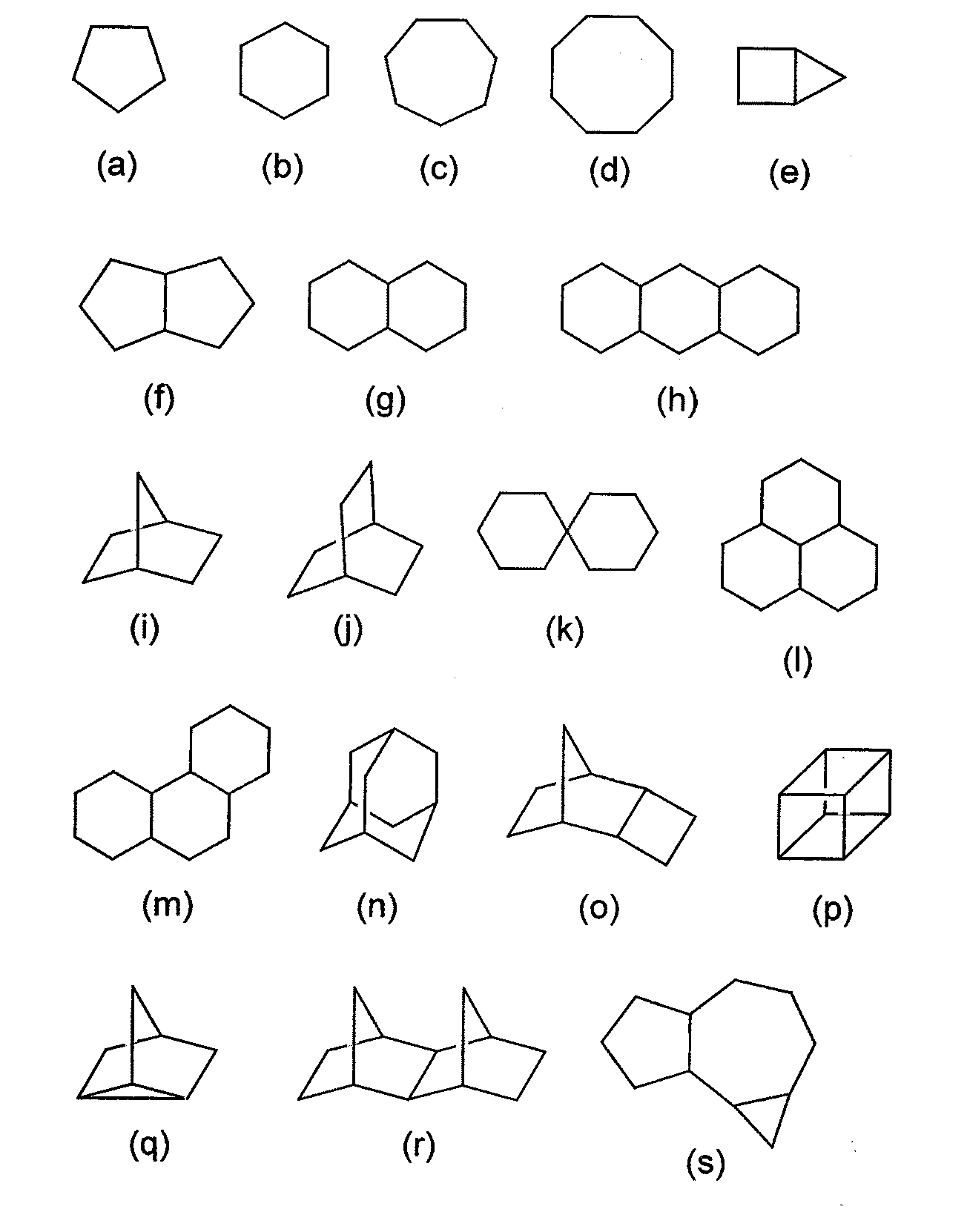
また上記式[2]中のY1、Y2、Y3及びY4の炭素原子数1乃至20のアルキル基としては、メチル基、エチル基、イソプロピル基、シクロヘキシル基、n-ペンチル基等が挙げられる。炭素原子数1乃至20のアルコキシ基としては、メトキシ基、エトキシ基、イソプロポキシ基、シクロヘキシルオキシ基、n-ペンチルオキシ基等が挙げられる。Y1、Y2、Y3及びY4としては、それぞれ独立して、水素原子又は炭素原子数1乃至20のアルキル基が好ましい。
なお、前記A1は下記式[4]で表される構造であることが好ましい。

好ましくは、本発明に用いられるハイパーブランチポリマーとしては、下記式[3]で表されるハイパーブランチポリマーが挙げられる。
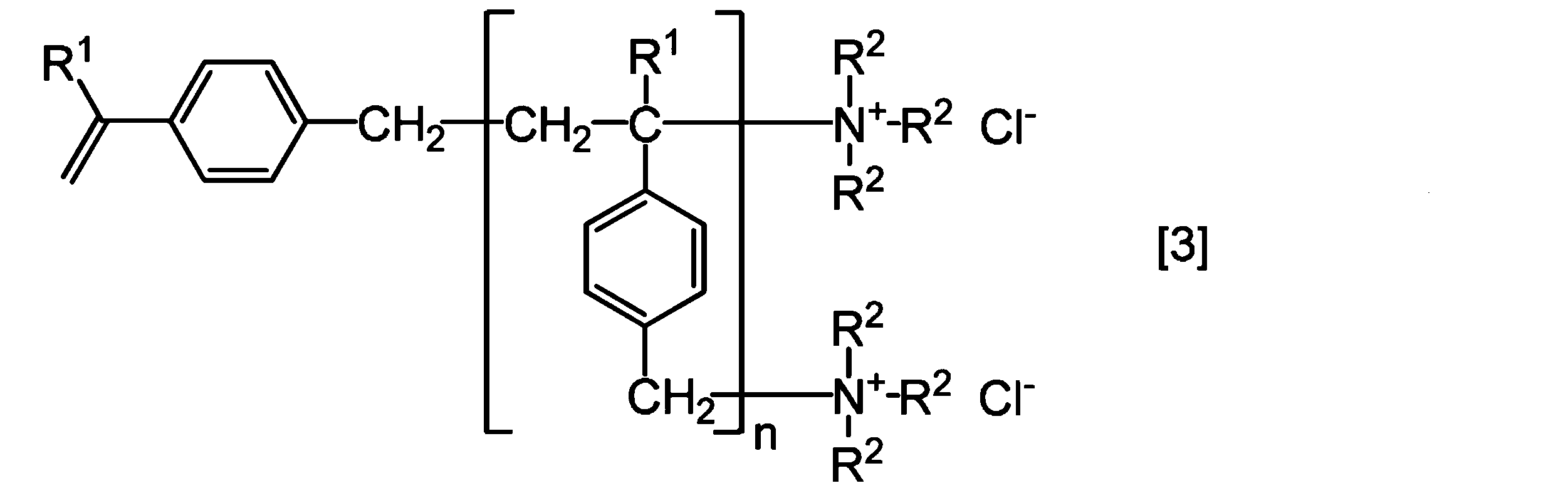
前記式[3]中、R1、R2及びnは上記と同じ意味を表す。
本発明で用いる上記アンモニウム基を分子末端に有するハイパーブランチポリマーは、例えば、分子末端にハロゲン原子を有するハイパーブランチポリマーにアミン化合物を反応させることによって得ることができる。
なお、分子末端にハロゲン原子を有するハイパーブランチポリマーは、国際公開第2008/029688号パンフレットの記載に従い、ジチオカルバメート基を分子末端に有するハイパーブランチポリマーより製造することができる。該ジチオカルバメート基を分子末端に有するハイパーブランチポリマーは、市販品を用いることができ、日産化学工業(株)製のハイパーテック(登録商標)HPS-200等を好適に使用可能である。
なお、分子末端にハロゲン原子を有するハイパーブランチポリマーは、国際公開第2008/029688号パンフレットの記載に従い、ジチオカルバメート基を分子末端に有するハイパーブランチポリマーより製造することができる。該ジチオカルバメート基を分子末端に有するハイパーブランチポリマーは、市販品を用いることができ、日産化学工業(株)製のハイパーテック(登録商標)HPS-200等を好適に使用可能である。
本反応で使用できるアミン化合物は、第一級アミンとしては、メチルアミン、エチルアミン、n-プロピルアミン、イソプロピルアミン、n-ブチルアミン、イソブチルアミン、sec-ブチルアミン、tert-ブチルアミン、n-ペンチルアミン、n-ヘキシルアミン、n-ヘプチルアミン、n-オクチルアミン、n-ノニルアミン、n-デシルアミン、n-ウンデシルアミン、n-ドデシルアミン、n-トリデシルアミン、n-テトラデシルアミン、n-ペンタデシルアミン、n-ヘキサデシルアミン、n-ヘプタデシルアミン、n-オクタデシルアミン、n-ノナデシルアミン、n-エイコシルアミン等の脂肪族アミン;シクロペンチルアミン、シクロヘキシルアミン等の脂環式アミン;ベンジルアミン、フェネチルアミン等のアラルキルアミン;アニリン、p-n-ブチルアニリン、p-tert-ブチルアニリン、p-n-オクチルアニリン、p-n-デシルアニリン、p-n-ドデシルアニリン、p-n-テトラデシルアニリンなどのアニリン類、1-ナフチルアミン、2-ナフチルアミンなどのナフチルアミン類、1-アミノアントラセン、2-アミノアントラセンなどのアミノアントラセン類、1-アミノアントラキノンなどのアミノアントラキノン類、4-アミノビフェニル、2-アミノビフェニルなどのアミノビフェニル類、2-アミノフルオレン、1-アミノ-9-フルオレノン、4-アミノ-9-フルオレノンなどのアミノフルオレノン類、5-アミノインダンなどのアミノインダン類、5-アミノイソキノリンなどのアミノイソキノリン類、9-アミノフェナントレンなどのアミノフェナントレン類等の芳香族アミンが挙げられる。更に、N-(tert-ブトキシカルボニル)-1,2-エチレンジアミン、N-(tert-ブトキシカルボニル)-1,3-プロピレンジアミン、N-(tert-ブトキシカルボニル)-1,4-ブチレンジアミン、N-(tert-ブトキシカルボニル)-1,5-ペンタメチレンジアミン、N-(tert-ブトキシカルボニル)-1,6-ヘキサメチレンジアミン、N-(2-ヒドロキシエチル)アミン、N-(3-ヒドロキシプロピル)アミン、N-(2-メトキシエチル)アミン、N-(2-エトキシエチル)アミン等のアミン化合物が挙げられる。
第二級アミンとしては、ジメチルアミン、ジエチルアミン、ジ-n-プロピルアミン、ジイソプロピルアミン、ジ-n-ブチルアミン、ジイソブチルアミン、ジ-sec-ブチルアミン、ジ-n-ペンチルアミン、エチルメチルアミン、メチル-n-プロピルアミン、メチル-n-ブチルアミン、メチル-n-ペンチルアミン、エチルイソプロピルアミン、エチル-n-ブチルアミン、エチル-n-ペンチルアミン、メチル-n-オクチルアミン、メチル-n-デシルアミン、メチル-n-ドデシルアミン、メチル-n-テトラデシルアミン、メチル-n-ヘキサデシルアミン、メチル-n-オクタデシルアミン、エチルイソプロピルアミン、エチル-n-オクチルアミン、ジ-n-ヘキシルアミン、ジ-n-オクチルアミン、ジ-n-ドデシルアミン、ジ-n-ヘキサデシルアミン、ジ-n-オクタデシルアミン等の脂肪族アミン;ジシクロヘキシルアミン等の脂環式アミン;ジベンジルアミン等のアラルキルアミン;ジフェニルアミン等の芳香族アミン;フタルイミド、ピロール、ピペリジン、ピペラジン、イミダゾール等の窒素含有複素環式化合物が挙げられる。更に、ビス(2-ヒドロキシエチル)アミン、ビス(3-ヒドロキシプロピル)アミン、ビス(2-エトキシエチル)アミン、ビス(2-プロポキシエチル)アミン等が挙げられる。
第三級アミンとしては、トリメチルアミン、トリエチルアミン、トリ-n-プロピルアミン、トリ-n-ブチルアミン、トリ-n-ペンチルアミン、トリ-n-オクチルアミン、トリ-n-ドデシルアミン、ジメチル-n-オクチルアミン、ジエチル-n-デシルアミン、ジメチル-n-ドデシルアミン、ジメチル-n-テトラデシルアミン、ジメチル-n-ヘキサデシルアミン、ジメチル-n-オクタデシルアミン、ジメチル-n-エイコシルアミン、ジメチル-n-ドデシルアミン等の脂肪族アミン;ピリジン、ピラジン、ピリミジン、キノリン、1-メチルイミダゾール、4,4’-ビピリジル、4-メチル-4,4’-ビピリジル等の窒素含有複素環式化合物が挙げられる。
これらの反応で使用できるアミン化合物の使用量は、分子末端にハロゲン原子を有するハイパーブランチポリマーのハロゲン原子1モルに対して0.1乃至20モル当量、好ましくは0.5乃至10モル当量、より好ましくは1乃至5モル当量であればよい。
分子末端にハロゲン原子を有するハイパーブランチポリマーとアミン化合物との反応は、水又は有機溶媒中で、塩基の存在下又は非存在下で行なうことができる。使用する溶媒は、分子末端にハロゲン原子を有するハイパーブランチポリマーとアミン化合物を溶解可能なものが好ましい。さらに、分子末端にハロゲン原子を有するハイパーブランチポリマーとアミン化合物を溶解可能であるが、分子末端にアンモニウム基を有するハイパーブランチポリマーを溶解しない溶媒であれば、単離が容易となりさらに好適である。
本反応で使用できる溶媒としては、本反応の進行を著しく阻害しないものであれば良く、水;イソプロパノール等のアルコール類;酢酸等の有機酸類;ベンゼン、トルエン、キシレン、エチルベンゼン、1,2-ジクロロベンゼン等の芳香族炭化水素類;テトラヒドロフラン、ジエチルエーテル等のエーテル類;アセトン、エチルメチルケトン、イソブチルメチルケトン、シクロヘキサノン等のケトン類;クロロホルム、ジクロロメタン、1,2-ジクロロエタン等のハロゲン化物;n-ヘキサン、n-ヘプタン、シクロヘキサン等の脂肪族炭化水素類;N,N-ジメチルホルムアミド、N,N-ジメチルアセトアミド、N-メチル-2-ピロリドン等のアミド類が使用できる。これらの溶媒は1種を用いてもよいし、2種以上を混合して用いてもよい。また、使用量は、分子末端にハロゲン原子を有するハイパーブランチポリマーの質量に対して0.2乃至1,000倍質量、好ましくは1乃至500倍質量、より好ましくは5乃至100倍質量、最も好ましくは10乃至50倍質量の溶媒を使用することが好ましい。
本反応で使用できる溶媒としては、本反応の進行を著しく阻害しないものであれば良く、水;イソプロパノール等のアルコール類;酢酸等の有機酸類;ベンゼン、トルエン、キシレン、エチルベンゼン、1,2-ジクロロベンゼン等の芳香族炭化水素類;テトラヒドロフラン、ジエチルエーテル等のエーテル類;アセトン、エチルメチルケトン、イソブチルメチルケトン、シクロヘキサノン等のケトン類;クロロホルム、ジクロロメタン、1,2-ジクロロエタン等のハロゲン化物;n-ヘキサン、n-ヘプタン、シクロヘキサン等の脂肪族炭化水素類;N,N-ジメチルホルムアミド、N,N-ジメチルアセトアミド、N-メチル-2-ピロリドン等のアミド類が使用できる。これらの溶媒は1種を用いてもよいし、2種以上を混合して用いてもよい。また、使用量は、分子末端にハロゲン原子を有するハイパーブランチポリマーの質量に対して0.2乃至1,000倍質量、好ましくは1乃至500倍質量、より好ましくは5乃至100倍質量、最も好ましくは10乃至50倍質量の溶媒を使用することが好ましい。
好適な塩基としては一般に、アルカリ金属水酸化物及びアルカリ土類金属水酸化物(例えば水酸化ナトリウム、水酸化カリウム、水酸化カルシウム)、アルカリ金属酸化物及びアルカリ土類金属酸化物(例えば酸化リチウム、酸化カルシウム)、アルカリ金属水素化物及びアルカリ土類金属水素化物(例えば水素化ナトリウム、水素化カリウム、水素化カルシウム)、アルカリ金属アミド(例えばナトリウムアミド)、アルカリ金属炭酸塩及びアルカリ土類金属炭酸塩(例えば炭酸リチウム、炭酸ナトリウム、炭酸カリウム、炭酸カルシウム)、アルカリ金属重炭酸塩(例えば重炭酸ナトリウム)等の無機化合物、並びにアルカリ金属アルキル、アルキルマグネシウムハロゲン化物、アルカリ金属アルコキシド、アルカリ土類金属アルコキシド、ジメトキシマグネシウム等の有機金属化合物が使用される。特に好ましいのは、炭酸カリウム及び炭酸ナトリウムである。また、使用量は、分子末端にハロゲン原子を有するハイパーブランチポリマーのハロゲン原子1モルに対して0.2乃至10モル当量、好ましくは0.5乃至10モル当量、最も好ましくは1乃至5モル当量の塩基を使用することが好ましい。
この反応では反応開始前に反応系内の酸素を十分に除去することが好ましく、窒素、アルゴン等の不活性気体で系内を置換するとよい。反応条件としては、反応時間は0.01乃至100時間、反応温度は0乃至300℃から、適宜選択される。好ましくは反応時間が0.1乃至72時間で、反応温度が20乃至150℃である。
第三級アミンを用いた場合、塩基の存在/非存在に関わらず、式[1]で表されるハイパーブランチポリマーを得ることができる。
塩基の非存在下で、第一級アミン又は第二級アミン化合物と分子末端にハロゲン原子を有するハイパーブランチポリマーを反応させた場合、それぞれに対応するハイパーブランチポリマーの末端第二級アミン及び第三級アミンがプロトン化されたアンモニウム基末端のハイパーブランチポリマーが得られる。また、塩基を用いて反応を行った場合においても、有機溶媒中で塩化水素、臭化水素、ヨウ化水素等の酸の水溶液と混合することにより、対応するハイパーブランチポリマーの末端第二級アミン及び第三級アミンがプロトン化されたアンモニウム基末端のハイパーブランチポリマーが得られる。
塩基の非存在下で、第一級アミン又は第二級アミン化合物と分子末端にハロゲン原子を有するハイパーブランチポリマーを反応させた場合、それぞれに対応するハイパーブランチポリマーの末端第二級アミン及び第三級アミンがプロトン化されたアンモニウム基末端のハイパーブランチポリマーが得られる。また、塩基を用いて反応を行った場合においても、有機溶媒中で塩化水素、臭化水素、ヨウ化水素等の酸の水溶液と混合することにより、対応するハイパーブランチポリマーの末端第二級アミン及び第三級アミンがプロトン化されたアンモニウム基末端のハイパーブランチポリマーが得られる。
前記ハイパーブランチポリマーは、ゲル浸透クロマトグラフィーによるポリスチレン換算で測定される重量平均分子量Mwが500乃至5,000,000であり、好ましくは1,000乃至1,000,000であり、より好ましくは2,000乃至500,000であり、最も好ましくは3,000乃至200,000である。また、分散度:Mw(重量平均分子量)/Mn(数平均分子量)としては1.0乃至7.0であり、好ましくは1.1乃至6.0であり、より好ましくは1.2乃至5.0である。
<有機酸>
本発明の下地剤に用いられる有機酸としては特に限定されず、例えば酢酸、プロピオン酸、(メタ)アクリル酸、酪酸、乳酸などの脂肪族モノカルボン酸;シュウ酸、マロン酸、コハク酸、グルタル酸、アジピン酸、マレイン酸、フマル酸、リンゴ酸、酒石酸、クエン酸、ポリ(メタ)アクリル酸などの脂肪族多価カルボン酸;安息香酸、サリチル酸、3-ヒドロキシ安息香酸、4-ヒドロキシ安息香酸、2,6-ジヒドロキシ安息香酸、3,5-ジヒドロキシ安息香酸などの芳香族モノカルボン酸;フタル酸、イソフタル酸、テレフタル酸、トリメリット酸、ピロメリット酸などの芳香族多価カルボン酸等が挙げられる。これら有機酸は1種を単独で、或いは2種以上を混合して用いてもよい。
中でも好ましい有機酸として、脂肪族多価カルボン酸が挙げられる。より好ましくはコハク酸、マレイン酸、クエン酸及びポリ(メタ)アクリル酸が挙げられ、さらに好ましくはクエン酸及びポリ(メタ)アクリル酸が挙げられる。
また、前記ポリ(メタ)アクリル酸は、メチル(メタ)アクリレートなどの(メタ)アクリル酸エステル類;(メタ)アクリル酸アミド類;(メタ)アクリル酸ナトリウムなどの(メタ)アクリル酸塩類;マレイン酸、無水マレイン酸などのマレイン酸類;スチレンなどの芳香族ビニル化合物;ブタジエンなどのジエン化合物等の重合性モノマーとの共重合体であってもよい。なお、本発明では(メタ)アクリル酸とは、アクリル酸とメタクリル酸の両方をいう。
本発明の下地剤に用いられる有機酸としては特に限定されず、例えば酢酸、プロピオン酸、(メタ)アクリル酸、酪酸、乳酸などの脂肪族モノカルボン酸;シュウ酸、マロン酸、コハク酸、グルタル酸、アジピン酸、マレイン酸、フマル酸、リンゴ酸、酒石酸、クエン酸、ポリ(メタ)アクリル酸などの脂肪族多価カルボン酸;安息香酸、サリチル酸、3-ヒドロキシ安息香酸、4-ヒドロキシ安息香酸、2,6-ジヒドロキシ安息香酸、3,5-ジヒドロキシ安息香酸などの芳香族モノカルボン酸;フタル酸、イソフタル酸、テレフタル酸、トリメリット酸、ピロメリット酸などの芳香族多価カルボン酸等が挙げられる。これら有機酸は1種を単独で、或いは2種以上を混合して用いてもよい。
中でも好ましい有機酸として、脂肪族多価カルボン酸が挙げられる。より好ましくはコハク酸、マレイン酸、クエン酸及びポリ(メタ)アクリル酸が挙げられ、さらに好ましくはクエン酸及びポリ(メタ)アクリル酸が挙げられる。
また、前記ポリ(メタ)アクリル酸は、メチル(メタ)アクリレートなどの(メタ)アクリル酸エステル類;(メタ)アクリル酸アミド類;(メタ)アクリル酸ナトリウムなどの(メタ)アクリル酸塩類;マレイン酸、無水マレイン酸などのマレイン酸類;スチレンなどの芳香族ビニル化合物;ブタジエンなどのジエン化合物等の重合性モノマーとの共重合体であってもよい。なお、本発明では(メタ)アクリル酸とは、アクリル酸とメタクリル酸の両方をいう。
本発明の下地剤における有機酸の添加量は、後述する前記ハイパーブランチポリマーと金属微粒子より形成された複合体1質量部に対して、0.01乃至50質量部が好ましい。0.01質量部以上とすることで、より優れた基材密着性を得ることができ、50質量部以下とすることで、より優れためっき性を得ることができる。より好ましくは0.03乃至50質量部である。
<金属微粒子>
本発明の下地剤に用いられる金属微粒子としては特に限定されず、金属種としては鉄(Fe)、コバルト(Co)、ニッケル(Ni)、銅(Cu)、パラジウム(Pd)、銀(Ag)、スズ(Sn)、白金(Pt)及び金(Au)が挙げられ、これらの金属の1種類でもよいし2種以上の合金でも構わない。中でも好ましい金属微粒子としてはパラジウム微粒子が挙げられる。なお、金属微粒子として、前記金属の酸化物を用いてもよい。
本発明の下地剤に用いられる金属微粒子としては特に限定されず、金属種としては鉄(Fe)、コバルト(Co)、ニッケル(Ni)、銅(Cu)、パラジウム(Pd)、銀(Ag)、スズ(Sn)、白金(Pt)及び金(Au)が挙げられ、これらの金属の1種類でもよいし2種以上の合金でも構わない。中でも好ましい金属微粒子としてはパラジウム微粒子が挙げられる。なお、金属微粒子として、前記金属の酸化物を用いてもよい。
前記金属微粒子は、例えば金属塩の水溶液を高圧水銀灯により光照射する方法や、該水溶液に還元作用を有する化合物(所謂還元剤)を添加する方法等により、金属イオンを還元することによって得られる。例えば、上記ハイパーブランチポリマーを溶解した溶液に金属塩の水溶液を添加してこれに紫外線を照射したり、或いは、該溶液に金属塩の水溶液及び還元剤を添加するなどして、金属イオンを還元することにより、ハイパーブランチポリマーと金属微粒子の複合体を形成させながら、ハイパーブランチポリマー及び金属微粒子を含む下地剤を調製することができる。
前記金属塩としては、塩化金酸、硝酸銀、硫酸銅、硝酸銅、酢酸銅、塩化スズ、塩化第一白金、塩化白金酸、Pt(dba)2[dba=ジベンジリデンアセトン]、Pt(cod)2[cod=1,5-シクロオクタジエン]、Pt(CH3)2(cod)、塩化パラジウム、酢酸パラジウム(Pd(OC(=O)CH3)2)、硝酸パラジウム、Pd2(dba)3・CHCl3、Pd(dba)2、Ni(cod)2等が挙げられる。
前記還元剤としては、特に限定されるものではなく、種々の還元剤を用いることができ、得られる下地剤に含有させる金属種等により還元剤を選択することが好ましい。用いることができる還元剤としては、例えば、水素化ホウ素ナトリウム、水素化ホウ素カリウム等の水素化ホウ素金属塩;水素化アルミニウムリチウム、水素化アルミニウムカリウム、水素化アルミニウムセシウム、水素化アルミニウムベリリウム、水素化アルミニウムマグネシウム、水素化アルミニウムカルシウム等の水素化アルミニウム塩;ヒドラジン化合物;クエン酸及びその塩;コハク酸及びその塩;アスコルビン酸及びその塩;メタノール、エタノール、イソプロパノール、ポリオール等の第一級又は第二級アルコール類;トリメチルアミン、トリエチルアミン、ジイソプロピルエチルアミン、ジエチルメチルアミン、テトラメチルエチレンジアミン[TMEDA]、エチレンジアミン四酢酸[EDTA]等の第三級アミン類;ヒドロキシルアミン;トリ-n-プロピルホスフィン、トリ-n-ブチルホスフィン、トリシクロヘキシルホスフィン、トリベンジルホスフィン、トリフェニルホスフィン、トリエトキシホスフィン、1,2-ビス(ジフェニルホスフィノ)エタン[DPPE]、1,3-ビス(ジフェニルホスフィノ)プロパン[DPPP]、1,1’-ビス(ジフェニルホスフィノ)フェロセン[DPPF]、2,2’-ビス(ジフェニルホスフィノ)-1,1’-ビナフチル[BINAP]等のホスフィン類などが挙げられる。
前記還元剤としては、特に限定されるものではなく、種々の還元剤を用いることができ、得られる下地剤に含有させる金属種等により還元剤を選択することが好ましい。用いることができる還元剤としては、例えば、水素化ホウ素ナトリウム、水素化ホウ素カリウム等の水素化ホウ素金属塩;水素化アルミニウムリチウム、水素化アルミニウムカリウム、水素化アルミニウムセシウム、水素化アルミニウムベリリウム、水素化アルミニウムマグネシウム、水素化アルミニウムカルシウム等の水素化アルミニウム塩;ヒドラジン化合物;クエン酸及びその塩;コハク酸及びその塩;アスコルビン酸及びその塩;メタノール、エタノール、イソプロパノール、ポリオール等の第一級又は第二級アルコール類;トリメチルアミン、トリエチルアミン、ジイソプロピルエチルアミン、ジエチルメチルアミン、テトラメチルエチレンジアミン[TMEDA]、エチレンジアミン四酢酸[EDTA]等の第三級アミン類;ヒドロキシルアミン;トリ-n-プロピルホスフィン、トリ-n-ブチルホスフィン、トリシクロヘキシルホスフィン、トリベンジルホスフィン、トリフェニルホスフィン、トリエトキシホスフィン、1,2-ビス(ジフェニルホスフィノ)エタン[DPPE]、1,3-ビス(ジフェニルホスフィノ)プロパン[DPPP]、1,1’-ビス(ジフェニルホスフィノ)フェロセン[DPPF]、2,2’-ビス(ジフェニルホスフィノ)-1,1’-ビナフチル[BINAP]等のホスフィン類などが挙げられる。
前記金属微粒子の平均粒径は1乃至100nmが好ましい。その理由としては、該金属微粒子の平均粒径が100nmを超えると、表面積が減少し触媒活性が低下するためである。平均粒径としては、75nm以下が更に好ましく、1乃至30nmが特に好ましい。
本発明の下地剤における上記ハイパーブランチポリマーの添加量は、上記金属微粒子100質量部に対して50乃至2,000質量部が好ましい。50質量部未満であると、上記金属微粒子の分散性が不充分であり、2,000質量部を超えると、有機物含有量が多くなり、物性等に不具合が生じやすくなる。より好ましくは、100乃至1,000質量部である。
<ハイパーブランチポリマー、金属微粒子及び有機酸を含む下地剤>
本発明の下地剤は、前記アンモニウム基を分子末端に有するハイパーブランチポリマー、金属微粒子及び有機酸を含むものであり、このとき、前記ハイパーブランチポリマーと前記金属微粒子は複合体を形成していることが好ましい。
ここで複合体とは、前記ハイパーブランチポリマーの末端のアンモニウム基の作用により、金属微粒子に接触又は近接した状態で両者が共存し、粒子状の形態を為すものであり、言い換えると、前記ハイパーブランチポリマーのアンモニウム基が金属微粒子に付着又は配位した構造を有する複合体であると表現される。
従って、本発明における「複合体」には、上述のように金属微粒子とハイパーブランチポリマーが結合して一つの複合体を形成しているものだけでなく、金属微粒子とハイパーブランチポリマーが結合部分を形成することなく、夫々独立して存在しているものも含まれていてもよい。
本発明の下地剤は、前記アンモニウム基を分子末端に有するハイパーブランチポリマー、金属微粒子及び有機酸を含むものであり、このとき、前記ハイパーブランチポリマーと前記金属微粒子は複合体を形成していることが好ましい。
ここで複合体とは、前記ハイパーブランチポリマーの末端のアンモニウム基の作用により、金属微粒子に接触又は近接した状態で両者が共存し、粒子状の形態を為すものであり、言い換えると、前記ハイパーブランチポリマーのアンモニウム基が金属微粒子に付着又は配位した構造を有する複合体であると表現される。
従って、本発明における「複合体」には、上述のように金属微粒子とハイパーブランチポリマーが結合して一つの複合体を形成しているものだけでなく、金属微粒子とハイパーブランチポリマーが結合部分を形成することなく、夫々独立して存在しているものも含まれていてもよい。
アンモニウム基を有するハイパーブランチポリマーと金属微粒子の複合体の形成は、ハイパーブランチポリマーと金属微粒子を含む下地剤の調製時に同時に実施され、その方法としては、低級アンモニウム配位子によりある程度安定化した金属微粒子を合成した後にハイパーブランチポリマーにより配位子を交換する方法や、アンモニウム基を有するハイパーブランチポリマーの溶液中で、金属イオンを直接還元することにより複合体を形成する方法がある。また、上述のように、上記ハイパーブランチポリマーを溶解した溶液に金属塩の水溶液を添加してこれに紫外線を照射したり、或いは、該溶液に金属塩の水溶液及び還元剤を添加するなどして、金属イオンを還元することによっても複合体を形成できる。
配位子交換法において、原料となる低級アンモニウム配位子によりある程度安定化した金属微粒子は、Jounal of Organometallic Chemistry 1996,520,143-162等に記載の方法で合成することができる。得られた金属微粒子の反応混合溶液に、アンモニウム基を有するハイパーブランチポリマーを溶解し、室温(およそ25℃)又は加熱撹拌することにより目的とする金属微粒子複合体を得ることができる。
使用する溶媒としては、金属微粒子とアンモニウム基を有するハイパーブランチポリマーとを必要濃度以上に溶解できる溶媒であれば特に限定はされないが、具体的には、エタノール、プロパノール、イソプロパノール等のアルコール類;塩化メチレン、クロロホルム等のハロゲン化炭化水素類;テトラヒドロフラン、2-メチルテトラヒドロフラン、テトラヒドロピラン等の環状エーテル類;アセトニトリル、ブチロニトリル等のニトリル類など及びこれらの溶媒の混合液が挙げられ、好ましくは、テトラヒドロフランが挙げられる。
金属微粒子の反応混合液と、アンモニウム基を有するハイパーブランチポリマーを混合する温度は、通常0℃乃至溶媒の沸点の範囲を使用することができ、好ましくは、室温(およそ25℃)乃至60℃の範囲である。
なお、配位子交換法において、アミン系分散剤(低級アンモニウム配位子)以外にホスフィン系分散剤(ホスフィン配位子)を用いることによっても、あらかじめ金属微粒子をある程度安定化することができる。
使用する溶媒としては、金属微粒子とアンモニウム基を有するハイパーブランチポリマーとを必要濃度以上に溶解できる溶媒であれば特に限定はされないが、具体的には、エタノール、プロパノール、イソプロパノール等のアルコール類;塩化メチレン、クロロホルム等のハロゲン化炭化水素類;テトラヒドロフラン、2-メチルテトラヒドロフラン、テトラヒドロピラン等の環状エーテル類;アセトニトリル、ブチロニトリル等のニトリル類など及びこれらの溶媒の混合液が挙げられ、好ましくは、テトラヒドロフランが挙げられる。
金属微粒子の反応混合液と、アンモニウム基を有するハイパーブランチポリマーを混合する温度は、通常0℃乃至溶媒の沸点の範囲を使用することができ、好ましくは、室温(およそ25℃)乃至60℃の範囲である。
なお、配位子交換法において、アミン系分散剤(低級アンモニウム配位子)以外にホスフィン系分散剤(ホスフィン配位子)を用いることによっても、あらかじめ金属微粒子をある程度安定化することができる。
直接還元方法としては、金属イオンとアンモニウム基を有するハイパーブランチポリマーを溶媒に溶解し、水素ガス雰囲気下で反応させることにより、目的とする金属微粒子複合体を得ることができる。
ここで用いられる金属イオン源としては、上述の金属塩や、ヘキサカルボニルクロム[Cr(CO)6]、ペンタカルボニル鉄[Fe(Co)5]、オクタカルボニルジコバルト[Co2(CO)8]、テトラカルボニルニッケル[Ni(CO)4]等の金属カルボニル錯体が使用できる。また金属オレフィン錯体や金属ホスフィン錯体、金属窒素錯体等の0価の金属錯体も使用できる。
使用する溶媒としては、金属イオンとアンモニウム基を有するハイパーブランチポリマーを必要濃度以上に溶解できる溶媒であれば特に限定はされないが、具体的には、エタノール、プロパノール等のアルコール類;塩化メチレン、クロロホルム等のハロゲン化炭化水素類;テトラヒドロフラン、2-メチルテトラヒドロフラン、テトラヒドロピラン等の環状エーテル類;アセトニトリル、ブチロニトリル等のニトリル類など及びこれらの溶媒の混合液が挙げられ、好ましくは、テトラヒドロフランが挙げられる。
金属イオンとアンモニウム基を有するハイパーブランチポリマーを混合する温度は、通常0℃乃至溶媒の沸点の範囲を使用することができる。
ここで用いられる金属イオン源としては、上述の金属塩や、ヘキサカルボニルクロム[Cr(CO)6]、ペンタカルボニル鉄[Fe(Co)5]、オクタカルボニルジコバルト[Co2(CO)8]、テトラカルボニルニッケル[Ni(CO)4]等の金属カルボニル錯体が使用できる。また金属オレフィン錯体や金属ホスフィン錯体、金属窒素錯体等の0価の金属錯体も使用できる。
使用する溶媒としては、金属イオンとアンモニウム基を有するハイパーブランチポリマーを必要濃度以上に溶解できる溶媒であれば特に限定はされないが、具体的には、エタノール、プロパノール等のアルコール類;塩化メチレン、クロロホルム等のハロゲン化炭化水素類;テトラヒドロフラン、2-メチルテトラヒドロフラン、テトラヒドロピラン等の環状エーテル類;アセトニトリル、ブチロニトリル等のニトリル類など及びこれらの溶媒の混合液が挙げられ、好ましくは、テトラヒドロフランが挙げられる。
金属イオンとアンモニウム基を有するハイパーブランチポリマーを混合する温度は、通常0℃乃至溶媒の沸点の範囲を使用することができる。
また、直接還元方法として、金属イオンとアンモニウム基を有するハイパーブランチポリマーを溶媒に溶解し、熱分解反応させることにより、目的とする金属微粒子複合体を得ることができる。
ここで用いられる金属イオン源としては、上述の金属塩や金属カルボニル錯体やその他の0価の金属錯体、酸化銀等の金属酸化物が使用できる。
使用する溶媒としては、金属イオンとアンモニウム基を有するハイパーブランチポリマーを必要濃度以上に溶解できる溶媒であれば特に限定はされないが、具体的には、メタノール、エタノール、n-プロパノール、イソプロパノール、エチレングリコール等のアルコール類;塩化メチレン、クロロホルム等のハロゲン化炭化水素類;テトラヒドロフラン、2-メチルテトラヒドロフラン、テトラヒドロピラン等の環状エーテル類;アセトニトリル、ブチロニトリル等のニトリル類;ベンゼン、トルエン等の芳香族炭化水素類など及びこれらの溶媒の混合液が挙げられ、好ましくはトルエンが挙げられる。
金属イオンとアンモニウム基を有するハイパーブランチポリマーを混合する温度は、通常0℃乃至溶媒の沸点の範囲を使用することができ、好ましくは溶媒の沸点近傍、例えばトルエンの場合は110℃(加熱還流)である。
ここで用いられる金属イオン源としては、上述の金属塩や金属カルボニル錯体やその他の0価の金属錯体、酸化銀等の金属酸化物が使用できる。
使用する溶媒としては、金属イオンとアンモニウム基を有するハイパーブランチポリマーを必要濃度以上に溶解できる溶媒であれば特に限定はされないが、具体的には、メタノール、エタノール、n-プロパノール、イソプロパノール、エチレングリコール等のアルコール類;塩化メチレン、クロロホルム等のハロゲン化炭化水素類;テトラヒドロフラン、2-メチルテトラヒドロフラン、テトラヒドロピラン等の環状エーテル類;アセトニトリル、ブチロニトリル等のニトリル類;ベンゼン、トルエン等の芳香族炭化水素類など及びこれらの溶媒の混合液が挙げられ、好ましくはトルエンが挙げられる。
金属イオンとアンモニウム基を有するハイパーブランチポリマーを混合する温度は、通常0℃乃至溶媒の沸点の範囲を使用することができ、好ましくは溶媒の沸点近傍、例えばトルエンの場合は110℃(加熱還流)である。
こうして得られるアンモニウム基を有するハイパーブランチポリマーと金属微粒子の複合体は、再沈殿等の精製処理を経て、粉末などの固形物の形態とすることができる。
本発明の下地剤は、前記アンモニウム基を有するハイパーブランチポリマーと金属微粒子(好ましくはこれらよりなる複合体)と前記有機酸とを含むものであって、後述する[無電解めっき下地層]の形成時に用いるワニスの形態であってもよい。
[無電解めっき下地層]
上述の本発明の下地剤は、基材上に塗布することにより、無電解めっき下地層を形成することができる。この無電解めっき下地層も本発明の対象である。
上述の本発明の下地剤は、基材上に塗布することにより、無電解めっき下地層を形成することができる。この無電解めっき下地層も本発明の対象である。
前記基材としては特に限定されないが、非導電性基材又は導電性基材を好ましく使用できる。
非導電性基材としては、例えばガラス、セラミック等;ポリエチレン樹脂、ポリプロピレン樹脂、塩化ビニル樹脂、ナイロン(ポリアミド樹脂)、ポリイミド樹脂、ポリカーボネート樹脂、アクリル樹脂、PEN(ポリエチレンナフタラート)樹脂、PET(ポリエチレンテレフタラート)樹脂、ABS(アクリロニトリル-ブタジエン-スチレン共重合体)樹脂、エポキシ樹脂、ポリアセタール樹脂等;紙などが挙げられる。これらはシートあるいはフィルム等の形態にて好適に使用され、この場合の厚さについては特に限定されない。
また導電性基材としては、例えばITO(酸化インジウムスズ)、また各種ステンレス鋼、アルミニウム並びにジュラルミン等のアルミニウム合金、鉄並びに鉄合金、銅並びに真鍮、燐青銅、白銅及びベリリウム銅等の銅合金、ニッケル並びにニッケル合金、そして、銀並びに洋銀等の銀合金などの金属等が挙げられる。
また、上記基材は、三次元成形体であってもよい。
非導電性基材としては、例えばガラス、セラミック等;ポリエチレン樹脂、ポリプロピレン樹脂、塩化ビニル樹脂、ナイロン(ポリアミド樹脂)、ポリイミド樹脂、ポリカーボネート樹脂、アクリル樹脂、PEN(ポリエチレンナフタラート)樹脂、PET(ポリエチレンテレフタラート)樹脂、ABS(アクリロニトリル-ブタジエン-スチレン共重合体)樹脂、エポキシ樹脂、ポリアセタール樹脂等;紙などが挙げられる。これらはシートあるいはフィルム等の形態にて好適に使用され、この場合の厚さについては特に限定されない。
また導電性基材としては、例えばITO(酸化インジウムスズ)、また各種ステンレス鋼、アルミニウム並びにジュラルミン等のアルミニウム合金、鉄並びに鉄合金、銅並びに真鍮、燐青銅、白銅及びベリリウム銅等の銅合金、ニッケル並びにニッケル合金、そして、銀並びに洋銀等の銀合金などの金属等が挙げられる。
また、上記基材は、三次元成形体であってもよい。
前記アンモニウム基を有するハイパーブランチポリマーと金属微粒子とを含む上記下地剤より無電解めっき下地層を形成する具体的な方法としては、まず前記アンモニウム基を有するハイパーブランチポリマーと金属微粒子(好ましくはこれらよりなる複合体)を適当な溶媒に溶解又は分散してワニスの形態とし、該ワニスを金属めっき被膜を形成する基材上にスピンコート法;ブレードコート法;ディップコート法;ロールコート法;バーコート法;ダイコート法;スプレーコート法;インクジェット法;ファウンテンペンナノリソグラフィー(FPN)、ディップペンナノリソグラフィー(DPN)などのペンリソグラフィー;活版印刷、フレキソ印刷、樹脂凸版印刷、コンタクトプリンティング、マイクロコンタクトプリンティング(μCP)、ナノインプリンティングリソグラフィー(NIL)、ナノトランスファープリンティング(nTP)などの凸版印刷法;グラビア印刷、エングレービングなどの凹版印刷法;平版印刷法;スクリーン印刷、謄写版などの孔版印刷法;オフセット印刷法等によって塗布し、その後、溶媒を蒸発・乾燥させることにより、薄層を形成する。
これらの塗布方法の中でもスピンコート法、スプレーコート法、インクジェット法、ペンリソグラフィー、コンタクトプリンティング、μCP、NIL及びnTPが好ましい。スピンコート法を用いる場合には、単時間で塗布することができるために、揮発性の高い溶液であっても利用でき、また、均一性の高い塗布を行うことができるという利点がある。スプレーコート法を用いる場合には、極少量のワニスで均一性の高い塗布を行うことができ、工業的に非常に有利となる。インクジェット法、ペンリソグラフィー、コンタクトプリンティング、μCP、NIL、nTPを用いる場合には、例えば配線などの微細パターンを効率的に形成(描画)することができ、工業的に非常に有利となる。
これらの塗布方法の中でもスピンコート法、スプレーコート法、インクジェット法、ペンリソグラフィー、コンタクトプリンティング、μCP、NIL及びnTPが好ましい。スピンコート法を用いる場合には、単時間で塗布することができるために、揮発性の高い溶液であっても利用でき、また、均一性の高い塗布を行うことができるという利点がある。スプレーコート法を用いる場合には、極少量のワニスで均一性の高い塗布を行うことができ、工業的に非常に有利となる。インクジェット法、ペンリソグラフィー、コンタクトプリンティング、μCP、NIL、nTPを用いる場合には、例えば配線などの微細パターンを効率的に形成(描画)することができ、工業的に非常に有利となる。
またここで用いられる溶媒としては、上記複合体を溶解又は分散するものであれば特に限定されないが、たとえば、水;ベンゼン、トルエン、キシレン、エチルベンゼン、クロロベンゼン、ジクロロベンゼン等の芳香族炭化水素類;メタノール、エタノール、イソプロパノール等のアルコール類;テトラヒドロフラン、メチルテトラヒドロフラン、1,4-ジオキサン、ジエチルエーテル、ジエチレングリコールジメチルエーテル、プロピレングリコールメチルエーテル等のエーテル類;酢酸エチル等のエステル類;アセトン、エチルメチルケトン、イソブチルメチルケトン、シクロペンタノン、シクロヘキサノン等のケトン類;n-ヘプタン、n-ヘキサン、シクロヘキサン等の脂肪族炭化水素類;1,2-ジクロロエタン、クロロホルム等のハロゲン化脂肪族炭化水素類;N-メチル-2-ピロリドン、N,N-ジメチルホルムアミド、N,N-ジメチルアセトアミド等のアミド類;ジメチルスルホキシドなどが使用できる。これら溶媒は単独で使用してもよく、2種類以上の溶媒を混合してもよい。さらに、ワニスの粘度を調整する目的で、エチレングリコール、プロピレングリコール、ブチレングリコール等のグリコール類を添加してもよい。
また上記溶媒に溶解又は分散させる濃度は任意であるが、ワニス中の前記複合体濃度は0.05乃至90質量%であり、好ましくは0.1乃至80質量%である。
また上記溶媒に溶解又は分散させる濃度は任意であるが、ワニス中の前記複合体濃度は0.05乃至90質量%であり、好ましくは0.1乃至80質量%である。
溶媒の乾燥法としては、特に限定されるものではなく、例えば、ホットプレートやオーブンを用いて、適切な雰囲気下、すなわち大気、窒素等の不活性ガス、真空中等で蒸発させればよい。これにより、均一な成膜面を有する下地層を得ることが可能である。焼成温度は、溶媒を蒸発させることができれば特に限定されないが、40乃至250℃で行うことが好ましい。
[無電解めっき処理、金属めっき膜、金属被膜基材]
上記のようにして得られた基材上に形成された無電解めっき下地層を無電解めっきすることにより、無電解めっき下地層の上に金属めっき膜が形成される。こうして得られる金属めっき膜、並びに、基材上に無電解めっき下地層、金属めっき膜の順にて具備する金属被膜基材も本発明の対象である。
無電解めっき処理(工程)は特に限定されず、一般的に知られている何れの無電解めっき処理にて行うことができ、例えば、従来一般に知られている無電解めっき液を用い、該めっき液(浴)に基材上に形成された無電解めっき下地層を浸漬する方法が一般的である。
上記のようにして得られた基材上に形成された無電解めっき下地層を無電解めっきすることにより、無電解めっき下地層の上に金属めっき膜が形成される。こうして得られる金属めっき膜、並びに、基材上に無電解めっき下地層、金属めっき膜の順にて具備する金属被膜基材も本発明の対象である。
無電解めっき処理(工程)は特に限定されず、一般的に知られている何れの無電解めっき処理にて行うことができ、例えば、従来一般に知られている無電解めっき液を用い、該めっき液(浴)に基材上に形成された無電解めっき下地層を浸漬する方法が一般的である。
前記無電解めっき液は、主として金属イオン(金属塩)、錯化剤、還元剤を主に含有し、その他用途に合わせてpH調整剤、pH緩衝剤、反応促進剤(第二錯化剤)、安定剤、界面活性剤(めっき膜への光沢付与用途、被処理面の濡れ性改善用途など)などが適宜含まれてなる。
ここで無電解めっきで形成される金属めっき膜に用いられる金属としては、鉄、コバルト、ニッケル、銅、パラジウム、銀、スズ、白金、金及びそれらの合金が挙げられ、目的に応じて適宜選択される。
また上記錯化剤、還元剤についても金属イオンに応じて適宜選択すればよい。
また無電解めっき液は市販のめっき液を使用してもよく、例えばメルテックス(株)製の無電解ニッケルめっき薬品(メルプレートNIシリーズ)、無電解銅めっき薬品(メルプレートCUシリーズ)、奥野製薬工業(株)製の無電解ニッケルめっき液(ICPニコロンシリーズ)、無電解銅めっき液(OPC-700無電解銅M-K、ATSアドカッパーIW)、無電解スズめっき液(サブスターSN-5)、無電解金めっき液(フラッシュゴールド330、セルフゴールドOTK-IT)、小島化学薬品(株)製の無電解パラジウムめっき液(パレットII)、無電解金めっき液(ディップGシリーズ、NCゴールドシリーズ)、佐々木化学薬品(株)製の無電解銀めっき液(エスダイヤAG-40)、日本カニゼン(株)製の無電解ニッケルめっき液(シューマー(登録商標)シリーズ、シューマー(登録商標)カニブラック(登録商標)シリーズ)、無電解パラジウムめっき液(S-KPD)等を好適に用いることができる。
ここで無電解めっきで形成される金属めっき膜に用いられる金属としては、鉄、コバルト、ニッケル、銅、パラジウム、銀、スズ、白金、金及びそれらの合金が挙げられ、目的に応じて適宜選択される。
また上記錯化剤、還元剤についても金属イオンに応じて適宜選択すればよい。
また無電解めっき液は市販のめっき液を使用してもよく、例えばメルテックス(株)製の無電解ニッケルめっき薬品(メルプレートNIシリーズ)、無電解銅めっき薬品(メルプレートCUシリーズ)、奥野製薬工業(株)製の無電解ニッケルめっき液(ICPニコロンシリーズ)、無電解銅めっき液(OPC-700無電解銅M-K、ATSアドカッパーIW)、無電解スズめっき液(サブスターSN-5)、無電解金めっき液(フラッシュゴールド330、セルフゴールドOTK-IT)、小島化学薬品(株)製の無電解パラジウムめっき液(パレットII)、無電解金めっき液(ディップGシリーズ、NCゴールドシリーズ)、佐々木化学薬品(株)製の無電解銀めっき液(エスダイヤAG-40)、日本カニゼン(株)製の無電解ニッケルめっき液(シューマー(登録商標)シリーズ、シューマー(登録商標)カニブラック(登録商標)シリーズ)、無電解パラジウムめっき液(S-KPD)等を好適に用いることができる。
上記無電解めっき工程は、めっき浴の温度、pH、浸漬時間、金属イオン濃度、撹拌の有無や撹拌速度、空気・酸素の供給の有無や供給速度等を調節することにより、金属被膜の形成速度や膜厚を制御することができる。
以下、本発明を実施例によりさらに具体的に説明するが、これによって本発明が限定されるものではない。実施例において、試料の物性測定は、下記の条件のもとで下記の装置を使用して行った。
(1)GPC(ゲル浸透クロマトグラフィー)
装置:東ソー(株)製 HLC-8220GPC
カラム:昭和電工(株)製 Shodex(登録商標) KF-804L + KF-803L
カラム温度:40℃
溶媒:テトラヒドロフラン
検出器:UV(254nm)、RI
(2)1H NMRスペクトル
装置:日本電子(株)製 JNM-L400
溶媒:CDCl3
内部標準:テトラメチルシラン(0.00ppm)
(3)13C NMRスペクトル
装置:日本電子(株)製 JNM-ECA700
溶媒:CDCl3
緩和試薬:トリスアセチルアセトナートクロム(Cr(acac)3)
基準:CDCl3(77.0ppm)
(4)ICP発光分析(誘導結合プラズマ発光分析)
装置:(株)島津製作所製 ICPM-8500
(5)AFM(原子間力顕微鏡)
装置:Veeco Instruments社製 Dimension 3100
プローブ:Veeco Instruments社製 単結晶Si(バネ定数:約3N/m、共振周波数:約80kHz)
測定:形状、位相
ラフネス:1×1μm、2箇所の平均
装置:東ソー(株)製 HLC-8220GPC
カラム:昭和電工(株)製 Shodex(登録商標) KF-804L + KF-803L
カラム温度:40℃
溶媒:テトラヒドロフラン
検出器:UV(254nm)、RI
(2)1H NMRスペクトル
装置:日本電子(株)製 JNM-L400
溶媒:CDCl3
内部標準:テトラメチルシラン(0.00ppm)
(3)13C NMRスペクトル
装置:日本電子(株)製 JNM-ECA700
溶媒:CDCl3
緩和試薬:トリスアセチルアセトナートクロム(Cr(acac)3)
基準:CDCl3(77.0ppm)
(4)ICP発光分析(誘導結合プラズマ発光分析)
装置:(株)島津製作所製 ICPM-8500
(5)AFM(原子間力顕微鏡)
装置:Veeco Instruments社製 Dimension 3100
プローブ:Veeco Instruments社製 単結晶Si(バネ定数:約3N/m、共振周波数:約80kHz)
測定:形状、位相
ラフネス:1×1μm、2箇所の平均
また使用した試薬の略号は以下のとおりである。
HPS:ハイパーブランチポリスチレン[日産化学工業(株)製 ハイパーテック(登録商標)HPS-200]
PAA:ポリアクリル酸[アルドリッチ(株)製、平均分子量~450,000]
IPA:イソプロパノール
IPE:ジイソプロピルエーテル
THF:テトラヒドロフラン
ABS:アクリロニトリル-ブタジエン-スチレン共重合体
PET:ポリエチレンテレフタラート
PI:ポリイミド
PVC:ポリ塩化ビニル
PC:ポリカーボネート
ITO:酸化インジウムスズ
HPS:ハイパーブランチポリスチレン[日産化学工業(株)製 ハイパーテック(登録商標)HPS-200]
PAA:ポリアクリル酸[アルドリッチ(株)製、平均分子量~450,000]
IPA:イソプロパノール
IPE:ジイソプロピルエーテル
THF:テトラヒドロフラン
ABS:アクリロニトリル-ブタジエン-スチレン共重合体
PET:ポリエチレンテレフタラート
PI:ポリイミド
PVC:ポリ塩化ビニル
PC:ポリカーボネート
ITO:酸化インジウムスズ
[合成例1]HPS-Clの製造
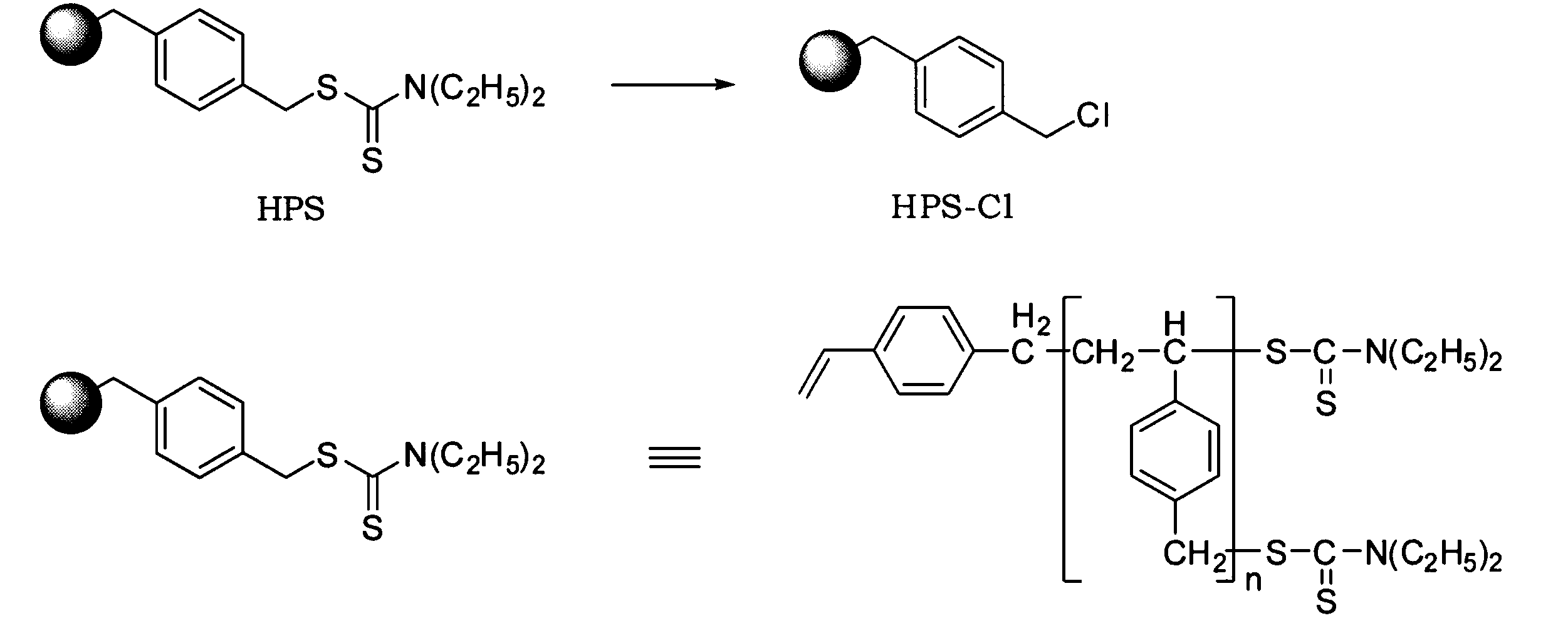
500mLの反応フラスコに、塩化スルフリル[キシダ化学(株)製]27g及びクロロホルム50gを仕込み、撹拌して均一に溶解させた。この溶液を窒素気流下0℃まで冷却した。
別の300mLの反応フラスコに、ジチオカルバメート基を分子末端に有するハイパーブランチポリマーHPS15g及びクロロホルム150gを仕込み、窒素気流下均一になるまで撹拌した。
前述の0℃に冷却されている塩化スルフリル/クロロホルム溶液中に、窒素気流下、HPS/クロロホルム溶液が仕込まれた前記300mLの反応フラスコから、送液ポンプを用いて、該溶液を反応液の温度が-5~5℃となるように60分間かけて加えた。添加終了後、反応液の温度を-5~5℃に保持しながら6時間撹拌した。
さらにこの反応液へ、シクロヘキセン[東京化成工業(株)製]16gをクロロホルム50gに溶かした溶液を、反応液の温度が-5~5℃となるように加えた。添加終了後、この反応液をIPA1,200gに添加してポリマーを沈殿させた。この沈殿をろ取して得られた白色粉末をクロロホルム100gに溶解し、これをIPA500gに添加してポリマーを再沈殿させた。この沈殿物を減圧ろ過し、真空乾燥して、塩素原子を分子末端に有するハイパーブランチポリマー(HPS-Cl)8.5gを白色粉末として得た(収率99%)。
得られたHPS-Clの1H NMRスペクトルを図1に示す。ジチオカルバメート基由来のピーク(4.0ppm、3.7ppm)が消失していることから、得られたHPS-Clは、HPS分子末端のジチオカルバメート基がほぼ全て塩素原子に置換されていることが明らかとなった。また、得られたHPS-ClのGPCによるポリスチレン換算で測定される重量平均分子量Mwは14,000、分散度Mw/Mnは2.9であった。
別の300mLの反応フラスコに、ジチオカルバメート基を分子末端に有するハイパーブランチポリマーHPS15g及びクロロホルム150gを仕込み、窒素気流下均一になるまで撹拌した。
前述の0℃に冷却されている塩化スルフリル/クロロホルム溶液中に、窒素気流下、HPS/クロロホルム溶液が仕込まれた前記300mLの反応フラスコから、送液ポンプを用いて、該溶液を反応液の温度が-5~5℃となるように60分間かけて加えた。添加終了後、反応液の温度を-5~5℃に保持しながら6時間撹拌した。
さらにこの反応液へ、シクロヘキセン[東京化成工業(株)製]16gをクロロホルム50gに溶かした溶液を、反応液の温度が-5~5℃となるように加えた。添加終了後、この反応液をIPA1,200gに添加してポリマーを沈殿させた。この沈殿をろ取して得られた白色粉末をクロロホルム100gに溶解し、これをIPA500gに添加してポリマーを再沈殿させた。この沈殿物を減圧ろ過し、真空乾燥して、塩素原子を分子末端に有するハイパーブランチポリマー(HPS-Cl)8.5gを白色粉末として得た(収率99%)。
得られたHPS-Clの1H NMRスペクトルを図1に示す。ジチオカルバメート基由来のピーク(4.0ppm、3.7ppm)が消失していることから、得られたHPS-Clは、HPS分子末端のジチオカルバメート基がほぼ全て塩素原子に置換されていることが明らかとなった。また、得られたHPS-ClのGPCによるポリスチレン換算で測定される重量平均分子量Mwは14,000、分散度Mw/Mnは2.9であった。
[合成例2]HPS-NBu3Clの製造

還流塔を付した50mLの反応フラスコに、合成例1で製造したHPS-Cl3.0g(20mmol)、トリブチルアミン[純正化学(株)製]3.7g(20mmol)及びクロロホルム/エタノール混合液(体積比2:1)30mLを仕込み、窒素置換した。この混合物を、撹拌しながら48時間加熱還流した。
液温30℃まで冷却後、溶媒を留去した。得られた残渣を、クロロホルム50mLに溶解し、これをIPE200mLに添加して再沈精製した。析出したポリマーを減圧ろ過し、40℃で真空乾燥して、トリブチルアンモニウム基を分子末端に有するハイパーブランチポリマー(HPS-NBu3Cl)5.8gを薄茶色粉末として得た。
得られたHPS-NBu3Clの13C NMRスペクトルを図2に示す。塩素原子が結合したメチレン基と、アンモニウム基が結合したメチレン基のピークから、得られたHPS-NBu3Clは、HPS-Cl分子末端の塩素原子の80%がアンモニウム基に置換されていることが明らかとなった。また、HPS-ClのMw(14,000)及びアンモニウム基導入率(80%)から算出されるHPS-NBu3Clの重量平均分子量Mwは28,000となった。
液温30℃まで冷却後、溶媒を留去した。得られた残渣を、クロロホルム50mLに溶解し、これをIPE200mLに添加して再沈精製した。析出したポリマーを減圧ろ過し、40℃で真空乾燥して、トリブチルアンモニウム基を分子末端に有するハイパーブランチポリマー(HPS-NBu3Cl)5.8gを薄茶色粉末として得た。
得られたHPS-NBu3Clの13C NMRスペクトルを図2に示す。塩素原子が結合したメチレン基と、アンモニウム基が結合したメチレン基のピークから、得られたHPS-NBu3Clは、HPS-Cl分子末端の塩素原子の80%がアンモニウム基に置換されていることが明らかとなった。また、HPS-ClのMw(14,000)及びアンモニウム基導入率(80%)から算出されるHPS-NBu3Clの重量平均分子量Mwは28,000となった。
[合成例3]Pd[HPS-NBu3Cl]の製造
50mLの二つ口フラスコに、合成例2で製造したHPS-NBu3Cl200mg、酢酸パラジウム[エヌ・イー ケムキャット(株)製]100mg及びクロロホルム/エタノール混合液(体積比2:1)10mLを仕込み、窒素置換した。この混合物を、撹拌しながら70℃で6時間撹拌した。
液温30℃まで冷却後、溶媒を留去した。得られた残渣をクロロホルム10mLに溶解し、これをIPE50mLに添加して再沈精製した。析出したポリマーを減圧ろ過し、60℃で真空乾燥して、アンモニウム基を分子末端に有するハイパーブランチポリマーとPd粒子の複合体(Pd[HPS-NBu3Cl])167mgを黒色粉末として得た。
ICP発光分析の結果から、得られたPd[HPS-NBu3Cl]のPd含有量は12質量%であった。
50mLの二つ口フラスコに、合成例2で製造したHPS-NBu3Cl200mg、酢酸パラジウム[エヌ・イー ケムキャット(株)製]100mg及びクロロホルム/エタノール混合液(体積比2:1)10mLを仕込み、窒素置換した。この混合物を、撹拌しながら70℃で6時間撹拌した。
液温30℃まで冷却後、溶媒を留去した。得られた残渣をクロロホルム10mLに溶解し、これをIPE50mLに添加して再沈精製した。析出したポリマーを減圧ろ過し、60℃で真空乾燥して、アンモニウム基を分子末端に有するハイパーブランチポリマーとPd粒子の複合体(Pd[HPS-NBu3Cl])167mgを黒色粉末として得た。
ICP発光分析の結果から、得られたPd[HPS-NBu3Cl]のPd含有量は12質量%であった。
[合成例4]HPS-NOct3Clの製造

還流塔を付した1Lの反応フラスコに、合成例1に従って製造したHPS-Cl30.4g(0.2mol)及びクロロホルム100gを仕込み、均一になるまで撹拌した。この溶液へ、トリオクチルアミン[広栄化学工業(株)製]77.8g(0.22mol)をクロロホルム50gに溶解させた溶液を、滴下ロートを使用して加えた。この滴下ロート内を、クロロホルム50g、続いてIPA50gを使用して前記反応フラスコへ洗い込んだ。この混合物を60℃で48時間撹拌した。
液温30℃まで冷却後、溶媒を留去した。得られた残渣を、THF200gに溶解し、0℃に冷却した。この溶液を0℃のIPE4,000gに添加して再沈精製した。析出したポリマーを減圧ろ過し、50℃で真空乾燥して、トリオクチルアンモニウム基を分子末端に有するハイパーブランチポリマー(HPS-NOct3Cl)79.9gを淡黄色粉末として得た。
得られたHPS-NOct3Clの13C NMRスペクトルを図3に示す。塩素原子が結合したメチレン基と、アンモニウム基が結合したメチレン基のピークから、得られたHPS-NOct3Clは、HPS-Cl分子末端の塩素原子の71%がアンモニウム基に置換されていることが明らかとなった。また、HPS-ClのMw(14,000)及びアンモニウム基導入率(71%)から算出されるHPS-NOct3Clの重量平均分子量Mwは37,000となった。
液温30℃まで冷却後、溶媒を留去した。得られた残渣を、THF200gに溶解し、0℃に冷却した。この溶液を0℃のIPE4,000gに添加して再沈精製した。析出したポリマーを減圧ろ過し、50℃で真空乾燥して、トリオクチルアンモニウム基を分子末端に有するハイパーブランチポリマー(HPS-NOct3Cl)79.9gを淡黄色粉末として得た。
得られたHPS-NOct3Clの13C NMRスペクトルを図3に示す。塩素原子が結合したメチレン基と、アンモニウム基が結合したメチレン基のピークから、得られたHPS-NOct3Clは、HPS-Cl分子末端の塩素原子の71%がアンモニウム基に置換されていることが明らかとなった。また、HPS-ClのMw(14,000)及びアンモニウム基導入率(71%)から算出されるHPS-NOct3Clの重量平均分子量Mwは37,000となった。
[合成例5]Pd[HPS-NOct3Cl]の製造
1Lの二つ口フラスコに、酢酸パラジウム[川研ファインケミカル(株)製]4.3g及びクロロホルム200gを仕込み、均一になるまで撹拌した。この溶液へ、合成例4で製造したHPS-NOct3Cl18.0gをクロロホルム200gに溶解させた溶液を、滴下ロートを使用して加えた。この滴下ロート内を、エタノール100gを使用して前記反応フラスコへ洗い込んだ。この混合物を60℃で17時間撹拌した。
液温30℃まで冷却後、溶媒を留去した。得られた残渣をTHF300gに溶解し、0℃に冷却した。この溶液を0℃のIPE6,000gに添加して再沈精製した。析出したポリマーを減圧ろ過し、60℃で真空乾燥して、アンモニウム基を分子末端に有するハイパーブランチポリマーとPd粒子の複合体(Pd[HPS-NOct3Cl])19.9gを黒色粉末として得た。
ICP発光分析の結果から、得られたPd[HPS-NOct3Cl]のPd含有量は11質量%であった。また、TEM(透過型電子顕微鏡)画像から、そのPd粒子径はおよそ2~4nmであった。
1Lの二つ口フラスコに、酢酸パラジウム[川研ファインケミカル(株)製]4.3g及びクロロホルム200gを仕込み、均一になるまで撹拌した。この溶液へ、合成例4で製造したHPS-NOct3Cl18.0gをクロロホルム200gに溶解させた溶液を、滴下ロートを使用して加えた。この滴下ロート内を、エタノール100gを使用して前記反応フラスコへ洗い込んだ。この混合物を60℃で17時間撹拌した。
液温30℃まで冷却後、溶媒を留去した。得られた残渣をTHF300gに溶解し、0℃に冷却した。この溶液を0℃のIPE6,000gに添加して再沈精製した。析出したポリマーを減圧ろ過し、60℃で真空乾燥して、アンモニウム基を分子末端に有するハイパーブランチポリマーとPd粒子の複合体(Pd[HPS-NOct3Cl])19.9gを黒色粉末として得た。
ICP発光分析の結果から、得られたPd[HPS-NOct3Cl]のPd含有量は11質量%であった。また、TEM(透過型電子顕微鏡)画像から、そのPd粒子径はおよそ2~4nmであった。
[参考例1]無電解ニッケルめっき液Aの調製
300mLのビーカーに、メルプレートNI-871 M1[メルテックス(株)製]12mL及びメルプレートNI-871 M2[メルテックス(株)製]20mLを仕込み、さらに純水を加えて溶液の総量を200mLとした。この溶液へ10体積%硫酸水溶液を加え、溶液のpHを4.5に調整した。この溶液を撹拌しながら90℃に加熱し、無電解めっき液Aとした。
300mLのビーカーに、メルプレートNI-871 M1[メルテックス(株)製]12mL及びメルプレートNI-871 M2[メルテックス(株)製]20mLを仕込み、さらに純水を加えて溶液の総量を200mLとした。この溶液へ10体積%硫酸水溶液を加え、溶液のpHを4.5に調整した。この溶液を撹拌しながら90℃に加熱し、無電解めっき液Aとした。
[参考例2]無電解ニッケルめっき液Bの調製
1Lのフラスコに、メルプレートNI-6522LF1[メルテックス(株)製]50mL、メルプレートNI-6522LF2[メルテックス(株)製]150mL及びメルプレートNI-6522LFアディティブ[メルテックス(株)製]5mLを仕込み、さらに純水を加えて溶液の総量を1Lとした。この溶液へ10体積%硫酸水溶液を加え、溶液のpHを4.6に調整した。この溶液を撹拌しながら80℃に加熱し、無電解めっき液Bとした。
1Lのフラスコに、メルプレートNI-6522LF1[メルテックス(株)製]50mL、メルプレートNI-6522LF2[メルテックス(株)製]150mL及びメルプレートNI-6522LFアディティブ[メルテックス(株)製]5mLを仕込み、さらに純水を加えて溶液の総量を1Lとした。この溶液へ10体積%硫酸水溶液を加え、溶液のpHを4.6に調整した。この溶液を撹拌しながら80℃に加熱し、無電解めっき液Bとした。
[参考例3]無電解ニッケルめっき液Cの調製
1Lのフラスコに、純水700mLを仕込み、続けてブルーシューマー[日本カニゼン(株)製]200mLをよく撹拌しながら加えた。この溶液に、さらに純水を加えて溶液の総量を1,000mLとした。このとき、この溶液のpHは6.0であった。この溶液を撹拌しながら80℃に加熱し、無電解めっき液Cとした。
1Lのフラスコに、純水700mLを仕込み、続けてブルーシューマー[日本カニゼン(株)製]200mLをよく撹拌しながら加えた。この溶液に、さらに純水を加えて溶液の総量を1,000mLとした。このとき、この溶液のpHは6.0であった。この溶液を撹拌しながら80℃に加熱し、無電解めっき液Cとした。
[実施例1]クエン酸を含む下地剤を用いたABS基板への無電解めっき
合成例3で製造したPd[HPS-NBu3Cl]10mg、及びクエン酸[東京化成工業(株)製]200mgを、IPA4.0gに溶解し、固形分濃度5質量%の無電解めっき下地剤を調製した。
予めエタノールで洗浄した25×25mmのABS基板[三菱樹脂(株)製]に、上記下地剤0.3mLを基板中央に滴下し、slope5秒、1,500rpm×30秒間、slope5秒でスピンコートした。この基板を、80℃のホットプレートで1時間乾燥し、基板上全面に下地層を具備したABS基板を得た。
得られた基板を、参考例1で調製した90℃の無電解めっき液A中に20秒間浸漬した。その後、取り出した基板を水洗し、1時間風乾した。
無電解めっき処理により、下地層を形成した基板上全面に金属光沢のある金属めっき膜が生じた。
得られためっき基板上の金属めっき膜部分に、幅18mmのセロテープ(登録商標)[ニチバン(株)製 CT-18S]を貼り、手の指で強く擦りつけてしっかり密着させた。その後、密着させたセロテープ(登録商標)を一気に剥がし、金属めっき膜の基板密着性を評価した。金属めっき膜の状態を目視で確認したところ、金属めっき膜は基板から剥がれることなく、基板上に密着したままであった。
また、下地剤塗布前基板表面、下地層(下地剤塗布膜)表面及び金属めっき膜表面の各ラフネスをAFMにより測定したところ、それぞれ4.1nm、3.3nm、2.9nmであった。
合成例3で製造したPd[HPS-NBu3Cl]10mg、及びクエン酸[東京化成工業(株)製]200mgを、IPA4.0gに溶解し、固形分濃度5質量%の無電解めっき下地剤を調製した。
予めエタノールで洗浄した25×25mmのABS基板[三菱樹脂(株)製]に、上記下地剤0.3mLを基板中央に滴下し、slope5秒、1,500rpm×30秒間、slope5秒でスピンコートした。この基板を、80℃のホットプレートで1時間乾燥し、基板上全面に下地層を具備したABS基板を得た。
得られた基板を、参考例1で調製した90℃の無電解めっき液A中に20秒間浸漬した。その後、取り出した基板を水洗し、1時間風乾した。
無電解めっき処理により、下地層を形成した基板上全面に金属光沢のある金属めっき膜が生じた。
得られためっき基板上の金属めっき膜部分に、幅18mmのセロテープ(登録商標)[ニチバン(株)製 CT-18S]を貼り、手の指で強く擦りつけてしっかり密着させた。その後、密着させたセロテープ(登録商標)を一気に剥がし、金属めっき膜の基板密着性を評価した。金属めっき膜の状態を目視で確認したところ、金属めっき膜は基板から剥がれることなく、基板上に密着したままであった。
また、下地剤塗布前基板表面、下地層(下地剤塗布膜)表面及び金属めっき膜表面の各ラフネスをAFMにより測定したところ、それぞれ4.1nm、3.3nm、2.9nmであった。
[実施例2]コハク酸を含む下地剤を用いたABS基板への無電解めっき
実施例1において、クエン酸に替えてコハク酸[東京化成工業(株)製]200mgを使用した以外は同様に操作したところ、無電解めっき処理により、下地層を形成した基板上全面に金属光沢のある金属めっき膜が生じた。
実施例1と同様の方法でめっき膜の基板密着性を評価したところ、金属めっき膜は基板から剥がれることなく、基板上に密着したままであった。
実施例1において、クエン酸に替えてコハク酸[東京化成工業(株)製]200mgを使用した以外は同様に操作したところ、無電解めっき処理により、下地層を形成した基板上全面に金属光沢のある金属めっき膜が生じた。
実施例1と同様の方法でめっき膜の基板密着性を評価したところ、金属めっき膜は基板から剥がれることなく、基板上に密着したままであった。
[実施例3]マレイン酸を含む下地剤を用いたABS基板への無電解めっき
実施例1において、クエン酸に替えてマレイン酸[和光純薬工業(株)製]200mgを使用した以外は同様に操作したところ、無電解めっき処理により、下地層を形成した基板上全面に金属光沢のある金属めっき膜が生じた。
実施例1と同様の方法でめっき膜の基板密着性を評価したところ、金属めっき膜は基板から剥がれることなく、基板上に密着したままであった。
実施例1において、クエン酸に替えてマレイン酸[和光純薬工業(株)製]200mgを使用した以外は同様に操作したところ、無電解めっき処理により、下地層を形成した基板上全面に金属光沢のある金属めっき膜が生じた。
実施例1と同様の方法でめっき膜の基板密着性を評価したところ、金属めっき膜は基板から剥がれることなく、基板上に密着したままであった。
[比較例1]有機酸を含まない下地剤を用いたABS基板への無電解めっき-1
実施例1において、クエン酸を添加しなかった以外は同様に操作したところ、無電解めっき処理により、下地層を形成した基板上全面に金属光沢のある金属めっき膜が生じた。
実施例1と同様の方法で金属めっき膜の基板密着性を評価したところ、金属めっき膜の大部分は基板から剥離し、セロテープ(登録商標)に付着した。
実施例1において、クエン酸を添加しなかった以外は同様に操作したところ、無電解めっき処理により、下地層を形成した基板上全面に金属光沢のある金属めっき膜が生じた。
実施例1と同様の方法で金属めっき膜の基板密着性を評価したところ、金属めっき膜の大部分は基板から剥離し、セロテープ(登録商標)に付着した。
[実施例4]PAAを含む下地剤を用いたABS基板への無電解めっき
合成例5で製造したPd[HPS-NOct3Cl]100mg、及びPAA7mgを、プロパノール3.46gに溶解し、固形分濃度3質量%の無電解めっき下地剤を調製した。
上記下地剤をベンコット(登録商標)M-1[旭化成せんい(株)製]に滲み込ませ、25×25mmのABS基板[三菱樹脂(株)製]全面に塗布した。この基板を、室温(およそ25℃)で1時間乾燥し、基板上全面に下地層を具備したABS基板を得た。
得られた基板を、参考例2で調製した80℃の無電解めっき液B中に60秒間浸漬した。その後、取り出した基板を水洗し、80℃のホットプレートで5分間乾燥した。
無電解めっき処理により、下地層を形成した基板上全面に金属光沢のある金属めっき膜が生じた。
得られた金属めっき膜の基板密着性を、実施例1と同様の方法により評価したところ、金属めっき膜は基板から剥がれることなく、基板上に密着したままであった。
合成例5で製造したPd[HPS-NOct3Cl]100mg、及びPAA7mgを、プロパノール3.46gに溶解し、固形分濃度3質量%の無電解めっき下地剤を調製した。
上記下地剤をベンコット(登録商標)M-1[旭化成せんい(株)製]に滲み込ませ、25×25mmのABS基板[三菱樹脂(株)製]全面に塗布した。この基板を、室温(およそ25℃)で1時間乾燥し、基板上全面に下地層を具備したABS基板を得た。
得られた基板を、参考例2で調製した80℃の無電解めっき液B中に60秒間浸漬した。その後、取り出した基板を水洗し、80℃のホットプレートで5分間乾燥した。
無電解めっき処理により、下地層を形成した基板上全面に金属光沢のある金属めっき膜が生じた。
得られた金属めっき膜の基板密着性を、実施例1と同様の方法により評価したところ、金属めっき膜は基板から剥がれることなく、基板上に密着したままであった。
[実施例5]PAAを含む下地剤を用いたPET基板への無電解めっき
実施例4において、ABS基板に替えてPET基板[日本ポリペンコ(株)製]を使用した以外は同様に操作したところ、無電解めっき処理により、下地層を形成した基板上全面に金属光沢のある金属めっき膜が生じた。
実施例1と同様の方法でめっき膜の基板密着性を評価したところ、金属めっき膜は基板から剥がれることなく、基板上に密着したままであった。
実施例4において、ABS基板に替えてPET基板[日本ポリペンコ(株)製]を使用した以外は同様に操作したところ、無電解めっき処理により、下地層を形成した基板上全面に金属光沢のある金属めっき膜が生じた。
実施例1と同様の方法でめっき膜の基板密着性を評価したところ、金属めっき膜は基板から剥がれることなく、基板上に密着したままであった。
[実施例6]PAAを含む下地剤を用いたPIフィルムへの無電解めっき-1
実施例4において、ABS基板に替えてPIフィルム[東レ・デュポン(株)製 カプトン(登録商標)200EN]を使用した以外は同様に操作したところ、無電解めっき処理により、下地層を形成したフィルム上全面に金属光沢のある金属めっき膜が生じた。
実施例1と同様の方法でめっき膜のフィルム密着性を評価したところ、金属めっき膜はフィルムから剥がれることなく、フィルム上に密着したままであった。
実施例4において、ABS基板に替えてPIフィルム[東レ・デュポン(株)製 カプトン(登録商標)200EN]を使用した以外は同様に操作したところ、無電解めっき処理により、下地層を形成したフィルム上全面に金属光沢のある金属めっき膜が生じた。
実施例1と同様の方法でめっき膜のフィルム密着性を評価したところ、金属めっき膜はフィルムから剥がれることなく、フィルム上に密着したままであった。
[実施例7]PAAを含む下地剤を用いたPVC基板への無電解めっき
実施例4において、ABS基板に替えてPVC基板[笠井産業(株)製 薄板硬質塩化ビニール板]を使用した以外は同様に操作したところ、無電解めっき処理により、下地層を形成した基板上全面に金属光沢のある金属めっき膜が生じた。
実施例1と同様の方法でめっき膜の基板密着性を評価したところ、金属めっき膜は基板から剥がれることなく、基板上に密着したままであった。
実施例4において、ABS基板に替えてPVC基板[笠井産業(株)製 薄板硬質塩化ビニール板]を使用した以外は同様に操作したところ、無電解めっき処理により、下地層を形成した基板上全面に金属光沢のある金属めっき膜が生じた。
実施例1と同様の方法でめっき膜の基板密着性を評価したところ、金属めっき膜は基板から剥がれることなく、基板上に密着したままであった。
[実施例8]PAAを含む下地剤を用いた6,6-ナイロン基板への無電解めっき
実施例4において、ABS基板に替えて6,6-ナイロン基板[旭化成(株)製]を使用した以外は同様に操作したところ、無電解めっき処理により、下地層を形成した基板上全面に金属光沢のある金属めっき膜が生じた。
実施例1と同様の方法でめっき膜の基板密着性を評価したところ、金属めっき膜は基板から剥がれることなく、基板上に密着したままであった。
実施例4において、ABS基板に替えて6,6-ナイロン基板[旭化成(株)製]を使用した以外は同様に操作したところ、無電解めっき処理により、下地層を形成した基板上全面に金属光沢のある金属めっき膜が生じた。
実施例1と同様の方法でめっき膜の基板密着性を評価したところ、金属めっき膜は基板から剥がれることなく、基板上に密着したままであった。
[実施例9]PAAを含む下地剤を用いたPC基板への無電解めっき
実施例4において、ABS基板に替えてPC基板[タキロン(株)製]を使用した以外は同様に操作したところ、無電解めっき処理により、下地層を形成した基板上全面に金属光沢のある金属めっき膜が生じた。
実施例1と同様の方法でめっき膜の基板密着性を評価したところ、金属めっき膜は基板から剥がれることなく、基板上に密着したままであった。
実施例4において、ABS基板に替えてPC基板[タキロン(株)製]を使用した以外は同様に操作したところ、無電解めっき処理により、下地層を形成した基板上全面に金属光沢のある金属めっき膜が生じた。
実施例1と同様の方法でめっき膜の基板密着性を評価したところ、金属めっき膜は基板から剥がれることなく、基板上に密着したままであった。
[比較例2]有機酸を含まない下地剤を用いたABS基板への無電解めっき-2
実施例4において、PAAを添加しなかった以外は同様に操作したところ、無電解めっき処理により、下地層を形成した基板上全面に金属光沢のある金属めっき膜が生じた。
実施例1と同様の方法で金属めっき膜の基板密着性を評価したところ、金属めっき膜の大部分は基板から剥離し、セロテープ(登録商標)に付着した。
実施例4において、PAAを添加しなかった以外は同様に操作したところ、無電解めっき処理により、下地層を形成した基板上全面に金属光沢のある金属めっき膜が生じた。
実施例1と同様の方法で金属めっき膜の基板密着性を評価したところ、金属めっき膜の大部分は基板から剥離し、セロテープ(登録商標)に付着した。
[比較例3]有機酸を含まない下地剤を用いたPET基板への無電解めっき
実施例4において、PAAを添加せず、ABS基板に替えてPET基板[日本ポリペンコ(株)製]を使用した以外は同様に操作したところ、無電解めっき処理により、下地層を形成した基板上全面に金属光沢のある金属めっき膜が生じた。
実施例1と同様の方法で金属めっき膜の基板密着性を評価したところ、金属めっき膜の大部分は基板から剥離し、セロテープ(登録商標)に付着した。
実施例4において、PAAを添加せず、ABS基板に替えてPET基板[日本ポリペンコ(株)製]を使用した以外は同様に操作したところ、無電解めっき処理により、下地層を形成した基板上全面に金属光沢のある金属めっき膜が生じた。
実施例1と同様の方法で金属めっき膜の基板密着性を評価したところ、金属めっき膜の大部分は基板から剥離し、セロテープ(登録商標)に付着した。
[比較例4]有機酸を含まない下地剤を用いたPIフィルムへの無電解めっき-1
実施例4において、PAAを添加せず、ABS基板に替えてPIフィルム[東レ・デュポン(株)製 カプトン(登録商標)200EN]を使用した以外は同様に操作したところ、無電解めっき処理により、下地層を形成したフィルム上全面に金属光沢のある金属めっき膜が生じた。
実施例1と同様の方法で金属めっき膜のフィルム密着性を評価したところ、金属めっき膜の大部分はフィルムから剥離し、セロテープ(登録商標)に付着した。
実施例4において、PAAを添加せず、ABS基板に替えてPIフィルム[東レ・デュポン(株)製 カプトン(登録商標)200EN]を使用した以外は同様に操作したところ、無電解めっき処理により、下地層を形成したフィルム上全面に金属光沢のある金属めっき膜が生じた。
実施例1と同様の方法で金属めっき膜のフィルム密着性を評価したところ、金属めっき膜の大部分はフィルムから剥離し、セロテープ(登録商標)に付着した。
[比較例5]有機酸を含まない下地剤を用いたPVC基板への無電解めっき
実施例4において、PAAを添加せず、ABS基板に替えてPVC基板[笠井産業(株)製 薄板硬質塩化ビニール板]を使用した以外は同様に操作したところ、無電解めっき処理により、下地層を形成した基板上全面に金属光沢のある金属めっき膜が生じた。
実施例1と同様の方法で金属めっき膜の基板密着性を評価したところ、金属めっき膜の大部分は基板から剥離し、セロテープ(登録商標)に付着した。
実施例4において、PAAを添加せず、ABS基板に替えてPVC基板[笠井産業(株)製 薄板硬質塩化ビニール板]を使用した以外は同様に操作したところ、無電解めっき処理により、下地層を形成した基板上全面に金属光沢のある金属めっき膜が生じた。
実施例1と同様の方法で金属めっき膜の基板密着性を評価したところ、金属めっき膜の大部分は基板から剥離し、セロテープ(登録商標)に付着した。
[比較例6]有機酸を含まない下地剤を用いた6,6-ナイロン基板への無電解めっき
実施例4において、PAAを添加せず、ABS基板に替えて6,6-ナイロン基板[旭化成(株)製]を使用した以外は同様に操作したところ、無電解めっき処理により、下地層を形成した基板上全面に金属光沢のある金属めっき膜が生じた。
実施例1と同様の方法で金属めっき膜の基板密着性を評価したところ、金属めっき膜の大部分は基板から剥離し、セロテープ(登録商標)に付着した。
実施例4において、PAAを添加せず、ABS基板に替えて6,6-ナイロン基板[旭化成(株)製]を使用した以外は同様に操作したところ、無電解めっき処理により、下地層を形成した基板上全面に金属光沢のある金属めっき膜が生じた。
実施例1と同様の方法で金属めっき膜の基板密着性を評価したところ、金属めっき膜の大部分は基板から剥離し、セロテープ(登録商標)に付着した。
[比較例7]有機酸を含まない下地剤を用いたPC基板への無電解めっき
実施例4において、PAAを添加せず、ABS基板に替えてPC基板[タキロン(株)製]を使用した以外は同様に操作したところ、無電解めっき処理により、下地層を形成した基板上全面に金属光沢のある金属めっき膜が生じた。
実施例1と同様の方法で金属めっき膜の基板密着性を評価したところ、金属めっき膜の大部分は基板から剥離し、セロテープ(登録商標)に付着した。
実施例4において、PAAを添加せず、ABS基板に替えてPC基板[タキロン(株)製]を使用した以外は同様に操作したところ、無電解めっき処理により、下地層を形成した基板上全面に金属光沢のある金属めっき膜が生じた。
実施例1と同様の方法で金属めっき膜の基板密着性を評価したところ、金属めっき膜の大部分は基板から剥離し、セロテープ(登録商標)に付着した。
[実施例10]PAAを含む下地剤を用いたPIフィルムへの無電解めっき-2
合成例5で製造したPd[HPS-NOct3Cl]100mg、及びPAA50mgを、プロパノール4.85gに溶解し、固形分濃度3質量%の無電解めっき下地剤を調製した。
上記下地剤をベンコット(登録商標)M-1[旭化成せんい(株)製]に滲み込ませ、25×25mmのPIフィルム[東レ・デュポン(株)製 カプトン(登録商標)200EN]全面に塗布した。このフィルムを、室温(およそ25℃)で1時間乾燥し、フィルム上全面に下地層を具備したPIフィルムを得た。
得られたフィルムを、参考例3で調製した80℃の無電解めっき液C中に60秒間浸漬した。その後、取り出したフィルムを水洗し、80℃のホットプレートで5分間乾燥した。
無電解めっき処理により、下地層を形成したフィルム上全面に金属光沢のある金属めっき膜が生じた。
得られた金属めっき膜のフィルム密着性を、実施例1と同様の方法により評価したところ、金属めっき膜はフィルムから剥がれることなく、フィルム上に密着したままであった。
合成例5で製造したPd[HPS-NOct3Cl]100mg、及びPAA50mgを、プロパノール4.85gに溶解し、固形分濃度3質量%の無電解めっき下地剤を調製した。
上記下地剤をベンコット(登録商標)M-1[旭化成せんい(株)製]に滲み込ませ、25×25mmのPIフィルム[東レ・デュポン(株)製 カプトン(登録商標)200EN]全面に塗布した。このフィルムを、室温(およそ25℃)で1時間乾燥し、フィルム上全面に下地層を具備したPIフィルムを得た。
得られたフィルムを、参考例3で調製した80℃の無電解めっき液C中に60秒間浸漬した。その後、取り出したフィルムを水洗し、80℃のホットプレートで5分間乾燥した。
無電解めっき処理により、下地層を形成したフィルム上全面に金属光沢のある金属めっき膜が生じた。
得られた金属めっき膜のフィルム密着性を、実施例1と同様の方法により評価したところ、金属めっき膜はフィルムから剥がれることなく、フィルム上に密着したままであった。
[比較例8]有機酸を含まない下地剤を用いたPIフィルムへの無電解めっき-2
実施例10において、PAAを添加しなかった以外は同様に操作したところ、無電解めっき処理により、下地層を形成したフィルム上全面に金属光沢のある金属めっき膜が生じた。
実施例1と同様の方法で金属めっき膜のフィルム密着性を評価したところ、金属めっき膜の大部分はフィルムから剥離し、セロテープ(登録商標)に付着した。
実施例10において、PAAを添加しなかった以外は同様に操作したところ、無電解めっき処理により、下地層を形成したフィルム上全面に金属光沢のある金属めっき膜が生じた。
実施例1と同様の方法で金属めっき膜のフィルム密着性を評価したところ、金属めっき膜の大部分はフィルムから剥離し、セロテープ(登録商標)に付着した。
[実施例11]PAAを含む下地剤を用いたITO付PET基板への無電解めっき
実施例4において、ABS基板に替えてITO付PET基板を使用した以外は同様に操作したところ、無電解めっき処理により、下地層を形成したITO膜上全面に金属光沢のある金属めっき膜が生じた。
実施例4において、ABS基板に替えてITO付PET基板を使用した以外は同様に操作したところ、無電解めっき処理により、下地層を形成したITO膜上全面に金属光沢のある金属めっき膜が生じた。
上記実施例1乃至10及び比較例1乃至8で得られた、各金属めっき膜の均一性及び基板(又はフィルム)密着性を表1に併せて示す。なお、表中、有機酸添加量は、ハイパーブランチポリマーと金属微粒子の複合体1質量部に対する添加量[質量部]を表し、均一性及び密着性は以下の基準に従って目視により評価した。
<均一性評価>
○:基材全面がムラ無く完全に被覆
×:基材露出部があり被覆が不完全
<密着性評価>
○:めっき膜の基材からの剥離が確認できない
×:めっき膜の基材からの剥離が確認できる
○:基材全面がムラ無く完全に被覆
×:基材露出部があり被覆が不完全
<密着性評価>
○:めっき膜の基材からの剥離が確認できない
×:めっき膜の基材からの剥離が確認できる
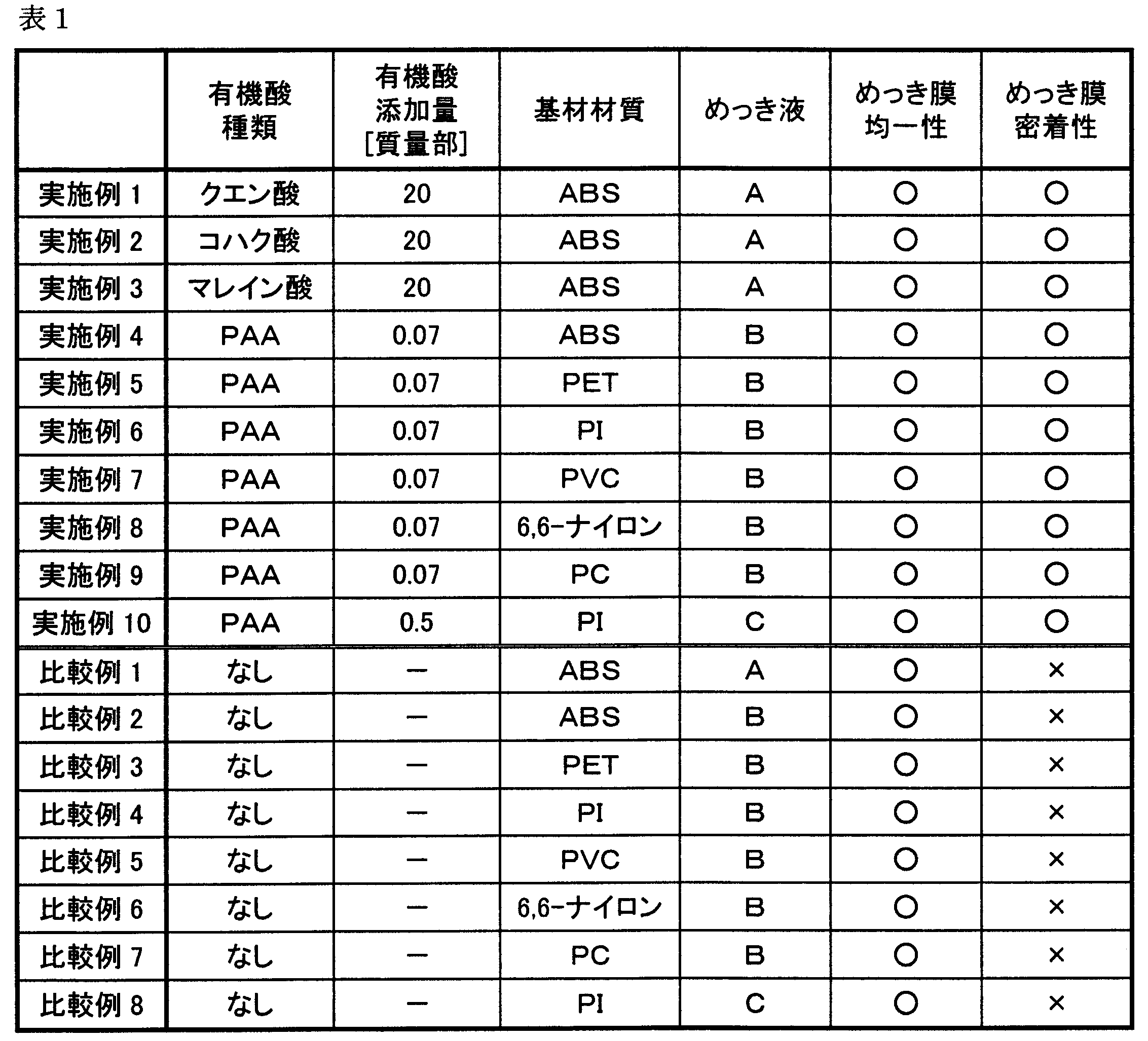
表1に示されるように、有機酸を添加しない下地剤を使用した無電解めっき膜が各種基材に対し何れも密着性が低いのに対し(比較例1乃至8)、本発明の有機酸を添加した下地剤を使用した場合では、テープ剥離試験に耐えうる密着性が発現することが明らかとなった(実施例1乃至10)。また、有機酸としてPAAを添加した場合には、極めて少量の有機酸の添加で密着性が向上した(実施例4乃至10)。
Claims (19)
- 基材上に無電解めっき処理により金属めっき膜を形成するための下地剤であって、アンモニウム基を分子末端に有し且つ重量平均分子量が500乃至5,000,000であるハイパーブランチポリマー、金属微粒子及び有機酸を含む下地剤。
- 前記金属微粒子に、前記ハイパーブランチポリマーのアンモニウム基が付着して複合体を形成している、請求項1に記載の下地剤。
- 前記有機酸が、酢酸、プロピオン酸、(メタ)アクリル酸、酪酸、乳酸、シュウ酸、マロン酸、コハク酸、グルタル酸、アジピン酸、マレイン酸、フマル酸、リンゴ酸、酒石酸、クエン酸、ポリ(メタ)アクリル酸、安息香酸、サリチル酸、3-ヒドロキシ安息香酸、4-ヒドロキシ安息香酸、2,6-ジヒドロキシ安息香酸、3,5-ジヒドロキシ安息香酸、フタル酸、イソフタル酸、テレフタル酸、トリメリット酸及びピロメリット酸からなる群から選択される、請求項1又は請求項2に記載の下地剤。
- 前記有機酸が、コハク酸、マレイン酸、クエン酸又はポリ(メタ)アクリル酸である、請求項3に記載の下地剤。
- 前記ハイパーブランチポリマーが、式[1]で表されるハイパーブランチポリマーである、請求項1乃至請求項4のうち何れか一項に記載の下地剤。


- 前記ハイパーブランチポリマーが、式[3]で表されるハイパーブランチポリマーである、請求項5に記載の下地剤。
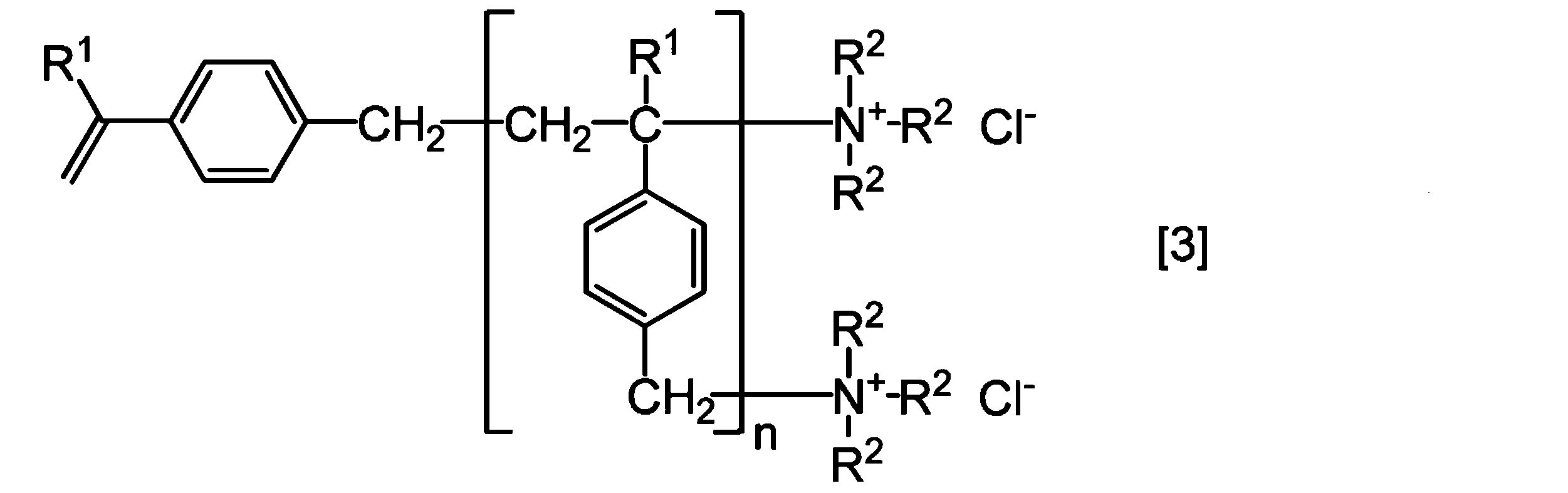
- 前記金属微粒子が、鉄(Fe)、コバルト(Co)、ニッケル(Ni)、銅(Cu)、パラジウム(Pd)、銀(Ag)、スズ(Sn)、白金(Pt)及び金(Au)からなる群より選択される少なくとも一種の微粒子である、請求項1乃至請求項6のうち何れか一項に記載の下地剤。
- 前記金属微粒子が、パラジウム微粒子である、請求項7に記載の下地剤。
- 前記金属微粒子が、1乃至100nmの平均粒径を有する微粒子である、請求項7又は請求項8に記載の下地剤。
- 非導電性基材上に無電解めっき処理により金属めっき膜を形成するための下地剤である、請求項1乃至請求項9のうち何れか一項に記載の下地剤。
- 導電性基材上に無電解めっき処理により金属めっき膜を形成するための下地剤である、請求項1乃至請求項9のうち何れか一項に記載の下地剤。
- 請求項1乃至請求項11のうち何れか一項に記載の下地剤を層形成して得られる、無電解めっき下地層。
- 請求項12に記載の無電解めっき下地層に無電解めっきすることにより該下地層上に形成される、金属めっき膜。
- 基材と、該基材上に形成された請求項12に記載の無電解めっき下地層と、該無電解めっき下地層上に形成された請求項13に記載の金属めっき膜とを具備する、金属被膜基材。
- 前記基材が非導電性基材である、請求項14に記載の金属被膜基材。
- 前記基材が導電性基材である、請求項14に記載の金属被膜基材。
- 下記A工程及びB工程を含む、金属被膜基材の製造方法。
A工程:請求項1乃至請求項11のうち何れか一項に記載の下地剤を基材上に塗布し、下地層を形成する工程
B工程:下地層を具備した基材を無電解めっき浴に浸漬し、金属めっき膜を形成する工程。 - 前記基材が非導電性基材である、請求項17に記載の製造方法。
- 前記基材が導電性基材である、請求項17に記載の製造方法。
Priority Applications (1)
| Application Number | Priority Date | Filing Date | Title |
|---|---|---|---|
| JP2013509946A JP6021804B2 (ja) | 2011-04-12 | 2012-04-11 | ハイパーブランチポリマー、金属微粒子及び有機酸を含む無電解めっき下地剤 |
Applications Claiming Priority (2)
| Application Number | Priority Date | Filing Date | Title |
|---|---|---|---|
| JP2011-088601 | 2011-04-12 | ||
| JP2011088601 | 2011-04-12 |
Publications (1)
| Publication Number | Publication Date |
|---|---|
| WO2012141216A1 true WO2012141216A1 (ja) | 2012-10-18 |
Family
ID=47009383
Family Applications (1)
| Application Number | Title | Priority Date | Filing Date |
|---|---|---|---|
| PCT/JP2012/059907 Ceased WO2012141216A1 (ja) | 2011-04-12 | 2012-04-11 | ハイパーブランチポリマー、金属微粒子及び有機酸を含む無電解めっき下地剤 |
Country Status (2)
| Country | Link |
|---|---|
| JP (1) | JP6021804B2 (ja) |
| WO (1) | WO2012141216A1 (ja) |
Cited By (10)
| Publication number | Priority date | Publication date | Assignee | Title |
|---|---|---|---|---|
| WO2013157420A1 (ja) * | 2012-04-18 | 2013-10-24 | コニカミノルタ株式会社 | 透光性導電パターン部材及びこれを用いた透光性電磁遮蔽・アンテナ部材 |
| JP2014159620A (ja) * | 2013-02-20 | 2014-09-04 | Nissan Chem Ind Ltd | スクリーン印刷用触媒インク |
| JP2015229788A (ja) * | 2014-06-05 | 2015-12-21 | 奥野製薬工業株式会社 | 無電解めっき下地層形成用組成物 |
| WO2016017625A1 (ja) * | 2014-07-30 | 2016-02-04 | 日産化学工業株式会社 | ハイパーブランチポリマー、金属微粒子及び樹脂プライマーを含む無電解めっき下地剤 |
| WO2016035897A1 (ja) * | 2014-09-05 | 2016-03-10 | 日産化学工業株式会社 | 感光性無電解めっき下地剤 |
| WO2016035896A1 (ja) * | 2014-09-05 | 2016-03-10 | 日産化学工業株式会社 | 光硬化性無電解めっき下地剤 |
| WO2016158949A1 (ja) * | 2015-03-31 | 2016-10-06 | 日産化学工業株式会社 | 感光性無電解めっき下地剤 |
| WO2017142022A1 (ja) * | 2016-02-19 | 2017-08-24 | 日産化学工業株式会社 | 高分岐高分子及び金属微粒子を含む無電解めっき下地剤 |
| WO2017154919A1 (ja) * | 2016-03-09 | 2017-09-14 | 日産化学工業株式会社 | 高分岐高分子及び金属微粒子を含む無電解めっき下地剤 |
| WO2019022151A1 (ja) * | 2017-07-25 | 2019-01-31 | 日産化学株式会社 | 金属微粒子複合体の製造方法 |
Citations (4)
| Publication number | Priority date | Publication date | Assignee | Title |
|---|---|---|---|---|
| JP2004091708A (ja) * | 2002-09-02 | 2004-03-25 | Fuji Photo Film Co Ltd | ナノコンポジット組成物及びガスバリア層 |
| JP2008007849A (ja) * | 2006-06-01 | 2008-01-17 | Nippon Paint Co Ltd | 無電解めっき用プライマー組成物及び無電解めっき方法 |
| WO2009031594A1 (ja) * | 2007-09-03 | 2009-03-12 | Nissan Chemical Industries, Ltd. | ジチオカルバメート基を有する高分子化合物からなる金属微粒子分散剤 |
| WO2010021386A1 (ja) * | 2008-08-22 | 2010-02-25 | 日産化学工業株式会社 | アンモニウム基を有する分岐高分子化合物からなる金属微粒子分散剤 |
Family Cites Families (2)
| Publication number | Priority date | Publication date | Assignee | Title |
|---|---|---|---|---|
| JPS60162793A (ja) * | 1984-02-01 | 1985-08-24 | Mitsubishi Rayon Co Ltd | 金属表面被覆処理方法 |
| JP2008527169A (ja) * | 2005-01-10 | 2008-07-24 | イシウム リサーチ デベロップメント カンパニー オブ ザ ヘブリュー ユニバーシティー オブ イエルサレム | 金属ナノ粒子の水系分散物 |
-
2012
- 2012-04-11 JP JP2013509946A patent/JP6021804B2/ja active Active
- 2012-04-11 WO PCT/JP2012/059907 patent/WO2012141216A1/ja not_active Ceased
Patent Citations (4)
| Publication number | Priority date | Publication date | Assignee | Title |
|---|---|---|---|---|
| JP2004091708A (ja) * | 2002-09-02 | 2004-03-25 | Fuji Photo Film Co Ltd | ナノコンポジット組成物及びガスバリア層 |
| JP2008007849A (ja) * | 2006-06-01 | 2008-01-17 | Nippon Paint Co Ltd | 無電解めっき用プライマー組成物及び無電解めっき方法 |
| WO2009031594A1 (ja) * | 2007-09-03 | 2009-03-12 | Nissan Chemical Industries, Ltd. | ジチオカルバメート基を有する高分子化合物からなる金属微粒子分散剤 |
| WO2010021386A1 (ja) * | 2008-08-22 | 2010-02-25 | 日産化学工業株式会社 | アンモニウム基を有する分岐高分子化合物からなる金属微粒子分散剤 |
Cited By (24)
| Publication number | Priority date | Publication date | Assignee | Title |
|---|---|---|---|---|
| WO2013157420A1 (ja) * | 2012-04-18 | 2013-10-24 | コニカミノルタ株式会社 | 透光性導電パターン部材及びこれを用いた透光性電磁遮蔽・アンテナ部材 |
| JP2014159620A (ja) * | 2013-02-20 | 2014-09-04 | Nissan Chem Ind Ltd | スクリーン印刷用触媒インク |
| JP2015229788A (ja) * | 2014-06-05 | 2015-12-21 | 奥野製薬工業株式会社 | 無電解めっき下地層形成用組成物 |
| WO2016017625A1 (ja) * | 2014-07-30 | 2016-02-04 | 日産化学工業株式会社 | ハイパーブランチポリマー、金属微粒子及び樹脂プライマーを含む無電解めっき下地剤 |
| EP3187622A4 (en) * | 2014-07-30 | 2018-02-07 | Nissan Chemical Industries, Ltd. | Electroless plating undercoat agent containing hyperbranched polymer, fine metal particles, and resin primer |
| JPWO2016017625A1 (ja) * | 2014-07-30 | 2017-04-27 | 日産化学工業株式会社 | ハイパーブランチポリマー、金属微粒子及び樹脂プライマーを含む無電解めっき下地剤 |
| CN107532301A (zh) * | 2014-07-30 | 2018-01-02 | 日产化学工业株式会社 | 包含超支化聚合物、金属微粒和树脂底涂剂的非电解镀基底剂 |
| WO2016035897A1 (ja) * | 2014-09-05 | 2016-03-10 | 日産化学工業株式会社 | 感光性無電解めっき下地剤 |
| WO2016035896A1 (ja) * | 2014-09-05 | 2016-03-10 | 日産化学工業株式会社 | 光硬化性無電解めっき下地剤 |
| CN106687619A (zh) * | 2014-09-05 | 2017-05-17 | 日产化学工业株式会社 | 光固化性非电解镀基底剂 |
| JPWO2016035896A1 (ja) * | 2014-09-05 | 2017-06-29 | 日産化学工業株式会社 | 光硬化性無電解めっき下地剤 |
| KR20170132804A (ko) * | 2015-03-31 | 2017-12-04 | 닛산 가가쿠 고교 가부시키 가이샤 | 감광성 무전해도금 하지제 |
| CN107532302A (zh) * | 2015-03-31 | 2018-01-02 | 日产化学工业株式会社 | 感光性非电解镀基底剂 |
| JPWO2016158949A1 (ja) * | 2015-03-31 | 2018-01-25 | 日産化学工業株式会社 | 感光性無電解めっき下地剤 |
| WO2016158949A1 (ja) * | 2015-03-31 | 2016-10-06 | 日産化学工業株式会社 | 感光性無電解めっき下地剤 |
| CN107532302B (zh) * | 2015-03-31 | 2019-10-08 | 日产化学工业株式会社 | 感光性非电解镀基底剂 |
| KR102558400B1 (ko) | 2015-03-31 | 2023-07-24 | 닛산 가가쿠 가부시키가이샤 | 감광성 무전해도금 하지제 |
| WO2017142022A1 (ja) * | 2016-02-19 | 2017-08-24 | 日産化学工業株式会社 | 高分岐高分子及び金属微粒子を含む無電解めっき下地剤 |
| CN108699694A (zh) * | 2016-02-19 | 2018-10-23 | 日产化学株式会社 | 包含高支化高分子和金属微粒的非电解镀基底剂 |
| JPWO2017142022A1 (ja) * | 2016-02-19 | 2018-12-13 | 日産化学株式会社 | 高分岐高分子及び金属微粒子を含む無電解めっき下地剤 |
| WO2017154919A1 (ja) * | 2016-03-09 | 2017-09-14 | 日産化学工業株式会社 | 高分岐高分子及び金属微粒子を含む無電解めっき下地剤 |
| JPWO2017154919A1 (ja) * | 2016-03-09 | 2019-01-10 | 日産化学株式会社 | 高分岐高分子及び金属微粒子を含む無電解めっき下地剤 |
| WO2019022151A1 (ja) * | 2017-07-25 | 2019-01-31 | 日産化学株式会社 | 金属微粒子複合体の製造方法 |
| JPWO2019022151A1 (ja) * | 2017-07-25 | 2020-07-09 | 日産化学株式会社 | 金属微粒子複合体の製造方法 |
Also Published As
| Publication number | Publication date |
|---|---|
| JPWO2012141216A1 (ja) | 2014-07-28 |
| JP6021804B2 (ja) | 2016-11-09 |
Similar Documents
| Publication | Publication Date | Title |
|---|---|---|
| JP6304512B2 (ja) | ハイパーブランチポリマー及び金属微粒子を含む無電解めっき下地剤 | |
| JP6021804B2 (ja) | ハイパーブランチポリマー、金属微粒子及び有機酸を含む無電解めっき下地剤 | |
| JP6354950B2 (ja) | 無電解めっき下地剤 | |
| JP6108079B2 (ja) | スクリーン印刷用触媒インク | |
| JP6631806B2 (ja) | ハイパーブランチポリマー、金属微粒子及び樹脂プライマーを含む無電解めっき下地剤 | |
| CN106662812B (zh) | 感光性非电解镀基底剂 | |
| TW201623467A (zh) | 光硬化性無電解鍍敷底塗劑 | |
| JP6649609B2 (ja) | インクジェット印刷用触媒インク | |
| TWI801512B (zh) | 含有高分子及金屬微粒子之無電解鍍敷基底劑 | |
| KR20220143007A (ko) | 고분자 및 금속미립자를 포함하는 무전해 도금 하지제 |
Legal Events
| Date | Code | Title | Description |
|---|---|---|---|
| 121 | Ep: the epo has been informed by wipo that ep was designated in this application |
Ref document number: 12771267 Country of ref document: EP Kind code of ref document: A1 |
|
| ENP | Entry into the national phase |
Ref document number: 2013509946 Country of ref document: JP Kind code of ref document: A |
|
| NENP | Non-entry into the national phase |
Ref country code: DE |
|
| 122 | Ep: pct application non-entry in european phase |
Ref document number: 12771267 Country of ref document: EP Kind code of ref document: A1 |