WO2012133370A1 - 熱線遮蔽性積層体及びそのフィルムロール - Google Patents
熱線遮蔽性積層体及びそのフィルムロール Download PDFInfo
- Publication number
- WO2012133370A1 WO2012133370A1 PCT/JP2012/057864 JP2012057864W WO2012133370A1 WO 2012133370 A1 WO2012133370 A1 WO 2012133370A1 JP 2012057864 W JP2012057864 W JP 2012057864W WO 2012133370 A1 WO2012133370 A1 WO 2012133370A1
- Authority
- WO
- WIPO (PCT)
- Prior art keywords
- heat ray
- ray shielding
- layer
- ethylene
- glass
- Prior art date
- Legal status (The legal status is an assumption and is not a legal conclusion. Google has not performed a legal analysis and makes no representation as to the accuracy of the status listed.)
- Ceased
Links
Images



Classifications
-
- G—PHYSICS
- G02—OPTICS
- G02B—OPTICAL ELEMENTS, SYSTEMS OR APPARATUS
- G02B5/00—Optical elements other than lenses
- G02B5/20—Filters
- G02B5/208—Filters for use with infrared or ultraviolet radiation, e.g. for separating visible light from infrared and/or ultraviolet radiation
-
- B—PERFORMING OPERATIONS; TRANSPORTING
- B32—LAYERED PRODUCTS
- B32B—LAYERED PRODUCTS, i.e. PRODUCTS BUILT-UP OF STRATA OF FLAT OR NON-FLAT, e.g. CELLULAR OR HONEYCOMB, FORM
- B32B17/00—Layered products essentially comprising sheet glass, or glass, slag, or like fibres
- B32B17/06—Layered products essentially comprising sheet glass, or glass, slag, or like fibres comprising glass as the main or only constituent of a layer, next to another layer of a specific material
- B32B17/10—Layered products essentially comprising sheet glass, or glass, slag, or like fibres comprising glass as the main or only constituent of a layer, next to another layer of a specific material of synthetic resin
- B32B17/10005—Layered products essentially comprising sheet glass, or glass, slag, or like fibres comprising glass as the main or only constituent of a layer, next to another layer of a specific material of synthetic resin laminated safety glass or glazing
- B32B17/10009—Layered products essentially comprising sheet glass, or glass, slag, or like fibres comprising glass as the main or only constituent of a layer, next to another layer of a specific material of synthetic resin laminated safety glass or glazing characterized by the number, the constitution or treatment of glass sheets
- B32B17/10036—Layered products essentially comprising sheet glass, or glass, slag, or like fibres comprising glass as the main or only constituent of a layer, next to another layer of a specific material of synthetic resin laminated safety glass or glazing characterized by the number, the constitution or treatment of glass sheets comprising two outer glass sheets
-
- B—PERFORMING OPERATIONS; TRANSPORTING
- B32—LAYERED PRODUCTS
- B32B—LAYERED PRODUCTS, i.e. PRODUCTS BUILT-UP OF STRATA OF FLAT OR NON-FLAT, e.g. CELLULAR OR HONEYCOMB, FORM
- B32B17/00—Layered products essentially comprising sheet glass, or glass, slag, or like fibres
- B32B17/06—Layered products essentially comprising sheet glass, or glass, slag, or like fibres comprising glass as the main or only constituent of a layer, next to another layer of a specific material
- B32B17/10—Layered products essentially comprising sheet glass, or glass, slag, or like fibres comprising glass as the main or only constituent of a layer, next to another layer of a specific material of synthetic resin
- B32B17/10005—Layered products essentially comprising sheet glass, or glass, slag, or like fibres comprising glass as the main or only constituent of a layer, next to another layer of a specific material of synthetic resin laminated safety glass or glazing
- B32B17/10009—Layered products essentially comprising sheet glass, or glass, slag, or like fibres comprising glass as the main or only constituent of a layer, next to another layer of a specific material of synthetic resin laminated safety glass or glazing characterized by the number, the constitution or treatment of glass sheets
- B32B17/10018—Layered products essentially comprising sheet glass, or glass, slag, or like fibres comprising glass as the main or only constituent of a layer, next to another layer of a specific material of synthetic resin laminated safety glass or glazing characterized by the number, the constitution or treatment of glass sheets comprising only one glass sheet
-
- B—PERFORMING OPERATIONS; TRANSPORTING
- B32—LAYERED PRODUCTS
- B32B—LAYERED PRODUCTS, i.e. PRODUCTS BUILT-UP OF STRATA OF FLAT OR NON-FLAT, e.g. CELLULAR OR HONEYCOMB, FORM
- B32B17/00—Layered products essentially comprising sheet glass, or glass, slag, or like fibres
- B32B17/06—Layered products essentially comprising sheet glass, or glass, slag, or like fibres comprising glass as the main or only constituent of a layer, next to another layer of a specific material
- B32B17/10—Layered products essentially comprising sheet glass, or glass, slag, or like fibres comprising glass as the main or only constituent of a layer, next to another layer of a specific material of synthetic resin
- B32B17/10005—Layered products essentially comprising sheet glass, or glass, slag, or like fibres comprising glass as the main or only constituent of a layer, next to another layer of a specific material of synthetic resin laminated safety glass or glazing
- B32B17/1055—Layered products essentially comprising sheet glass, or glass, slag, or like fibres comprising glass as the main or only constituent of a layer, next to another layer of a specific material of synthetic resin laminated safety glass or glazing characterized by the resin layer, i.e. interlayer
- B32B17/10614—Layered products essentially comprising sheet glass, or glass, slag, or like fibres comprising glass as the main or only constituent of a layer, next to another layer of a specific material of synthetic resin laminated safety glass or glazing characterized by the resin layer, i.e. interlayer comprising particles for purposes other than dyeing
- B32B17/10633—Infrared radiation absorbing or reflecting agents
-
- B—PERFORMING OPERATIONS; TRANSPORTING
- B32—LAYERED PRODUCTS
- B32B—LAYERED PRODUCTS, i.e. PRODUCTS BUILT-UP OF STRATA OF FLAT OR NON-FLAT, e.g. CELLULAR OR HONEYCOMB, FORM
- B32B17/00—Layered products essentially comprising sheet glass, or glass, slag, or like fibres
- B32B17/06—Layered products essentially comprising sheet glass, or glass, slag, or like fibres comprising glass as the main or only constituent of a layer, next to another layer of a specific material
- B32B17/10—Layered products essentially comprising sheet glass, or glass, slag, or like fibres comprising glass as the main or only constituent of a layer, next to another layer of a specific material of synthetic resin
- B32B17/10005—Layered products essentially comprising sheet glass, or glass, slag, or like fibres comprising glass as the main or only constituent of a layer, next to another layer of a specific material of synthetic resin laminated safety glass or glazing
- B32B17/1055—Layered products essentially comprising sheet glass, or glass, slag, or like fibres comprising glass as the main or only constituent of a layer, next to another layer of a specific material of synthetic resin laminated safety glass or glazing characterized by the resin layer, i.e. interlayer
- B32B17/10788—Layered products essentially comprising sheet glass, or glass, slag, or like fibres comprising glass as the main or only constituent of a layer, next to another layer of a specific material of synthetic resin laminated safety glass or glazing characterized by the resin layer, i.e. interlayer containing ethylene vinylacetate
-
- B—PERFORMING OPERATIONS; TRANSPORTING
- B32—LAYERED PRODUCTS
- B32B—LAYERED PRODUCTS, i.e. PRODUCTS BUILT-UP OF STRATA OF FLAT OR NON-FLAT, e.g. CELLULAR OR HONEYCOMB, FORM
- B32B27/00—Layered products comprising a layer of synthetic resin
- B32B27/06—Layered products comprising a layer of synthetic resin as the main or only constituent of a layer, which is next to another layer of the same or of a different material
- B32B27/08—Layered products comprising a layer of synthetic resin as the main or only constituent of a layer, which is next to another layer of the same or of a different material of synthetic resin
-
- B—PERFORMING OPERATIONS; TRANSPORTING
- B32—LAYERED PRODUCTS
- B32B—LAYERED PRODUCTS, i.e. PRODUCTS BUILT-UP OF STRATA OF FLAT OR NON-FLAT, e.g. CELLULAR OR HONEYCOMB, FORM
- B32B27/00—Layered products comprising a layer of synthetic resin
- B32B27/18—Layered products comprising a layer of synthetic resin characterised by the use of special additives
-
- B—PERFORMING OPERATIONS; TRANSPORTING
- B32—LAYERED PRODUCTS
- B32B—LAYERED PRODUCTS, i.e. PRODUCTS BUILT-UP OF STRATA OF FLAT OR NON-FLAT, e.g. CELLULAR OR HONEYCOMB, FORM
- B32B27/00—Layered products comprising a layer of synthetic resin
- B32B27/30—Layered products comprising a layer of synthetic resin comprising vinyl (co)polymers; comprising acrylic (co)polymers
- B32B27/306—Layered products comprising a layer of synthetic resin comprising vinyl (co)polymers; comprising acrylic (co)polymers comprising vinyl acetate or vinyl alcohol (co)polymers
-
- B—PERFORMING OPERATIONS; TRANSPORTING
- B32—LAYERED PRODUCTS
- B32B—LAYERED PRODUCTS, i.e. PRODUCTS BUILT-UP OF STRATA OF FLAT OR NON-FLAT, e.g. CELLULAR OR HONEYCOMB, FORM
- B32B27/00—Layered products comprising a layer of synthetic resin
- B32B27/36—Layered products comprising a layer of synthetic resin comprising polyesters
-
- B—PERFORMING OPERATIONS; TRANSPORTING
- B32—LAYERED PRODUCTS
- B32B—LAYERED PRODUCTS, i.e. PRODUCTS BUILT-UP OF STRATA OF FLAT OR NON-FLAT, e.g. CELLULAR OR HONEYCOMB, FORM
- B32B2255/00—Coating on the layer surface
- B32B2255/10—Coating on the layer surface on synthetic resin layer or on natural or synthetic rubber layer
-
- B—PERFORMING OPERATIONS; TRANSPORTING
- B32—LAYERED PRODUCTS
- B32B—LAYERED PRODUCTS, i.e. PRODUCTS BUILT-UP OF STRATA OF FLAT OR NON-FLAT, e.g. CELLULAR OR HONEYCOMB, FORM
- B32B2255/00—Coating on the layer surface
- B32B2255/26—Polymeric coating
-
- B—PERFORMING OPERATIONS; TRANSPORTING
- B32—LAYERED PRODUCTS
- B32B—LAYERED PRODUCTS, i.e. PRODUCTS BUILT-UP OF STRATA OF FLAT OR NON-FLAT, e.g. CELLULAR OR HONEYCOMB, FORM
- B32B2307/00—Properties of the layers or laminate
- B32B2307/30—Properties of the layers or laminate having particular thermal properties
- B32B2307/304—Insulating
-
- Y—GENERAL TAGGING OF NEW TECHNOLOGICAL DEVELOPMENTS; GENERAL TAGGING OF CROSS-SECTIONAL TECHNOLOGIES SPANNING OVER SEVERAL SECTIONS OF THE IPC; TECHNICAL SUBJECTS COVERED BY FORMER USPC CROSS-REFERENCE ART COLLECTIONS [XRACs] AND DIGESTS
- Y10—TECHNICAL SUBJECTS COVERED BY FORMER USPC
- Y10T—TECHNICAL SUBJECTS COVERED BY FORMER US CLASSIFICATION
- Y10T428/00—Stock material or miscellaneous articles
- Y10T428/31504—Composite [nonstructural laminate]
- Y10T428/3154—Of fluorinated addition polymer from unsaturated monomers
Definitions
- the present invention relates to a heat ray shielding laminate capable of long-term storage and a film roll thereof.
- heat ray shielding glass that shields near infrared rays (heat rays) in sunlight on these windows
- the heat ray shielding glass is manufactured by adhering a film laminate having heat ray shielding properties to a glass plate.
- a heat ray shielding layer is provided on one surface of a plastic film. Is formed by laminating an adhesive resin layer for adhering to the glass plate on the other surface of the plastic film or the heat ray shielding layer.
- a heat ray shielding laminated glass in which an interlayer film for laminated glass composed of a heat ray shielding layer, an adhesive resin layer, or the like is sandwiched between two glass plates is also known (Patent Document 2).
- the adhesive resin for such an adhesive resin layer ethylene-vinyl acetate copolymer (EVA) is generally used, and the adhesiveness is improved by adding a silane coupling agent thereto.
- the heat ray shielding layer is formed by dispersing tungsten oxide as a heat ray shielding agent in a binder resin, and applying and drying on a plastic film.
- a fluororesin is particularly used because it is excellent in preventing blue discoloration caused by tungsten oxide.
- Such heat ray shielding glass and laminated glass are generally transported to a heat ray shielding glass manufacturer after the plastic film and the adhesive resin layer (EVA sheet) on which the heat ray shielding layer is formed are produced by the film manufacturer. It is manufactured by bonding and integrating with glass.
- EVA sheet adhesive resin layer
- the adhesive performance of the EVA layer may deteriorate over time. Therefore, when integrating with glass, after manufacturing as a film laminate, it is integrated with glass within a short period of time, or after each film is stored separately, each film and glass are bonded and integrated. Therefore, it was difficult to efficiently produce the heat ray shielding glass.
- Patent Document 2 discloses a laminate in which a fluororesin layer and an EVA layer are adjacent to each other, and this laminate is provided with a first EVA layer that substantially does not contain a silane coupling agent on the fluororesin layer. Furthermore, by providing a second EVA layer containing a silane coupling agent on the other surface of the first EVA layer, the adhesiveness of the EVA layer is improved. The problem of lowering the adhesive strength when the laminate is stored for a long time is not particularly described, and the structure of the laminate is also complicated.
- an object of the present invention is a heat ray shielding laminate having an ethylene-vinyl acetate copolymer layer containing a silane coupling agent and a fluororesin layer containing tungsten oxide and / or composite tungsten oxide,
- An object of the present invention is to provide a heat ray shielding laminate capable of suppressing a decrease in adhesiveness of an EVA layer which may occur when the laminate is stored for a long period of time.
- an object of the present invention is to provide an intermediate film for heat ray shielding laminated glass including the above heat ray shielding laminate capable of long-term storage.
- the objective of this invention is providing the film roll formed by winding the said heat ray shielding laminated body suitable for a long-term preservation
- the deterioration of the adhesiveness of the EVA layer over time in the state adjacent to the fluororesin layer is caused by the condensation reaction of the silane coupling agent contained in the EVA bleed out on the surface of the EVA layer, and the product adheres.
- the cause is thought to be inhibition.
- the present inventors have found that when a silane coupling agent having an alkoxy group having 2 to 5 carbon atoms as a hydrolyzable group is used, a product that inhibits the above-mentioned adhesion is obtained. It has been found that it is less likely to occur and a decrease in adhesiveness during long-term storage can be suppressed, and the present invention has been achieved.
- the object is a heat ray shielding laminate comprising an ethylene-vinyl acetate copolymer layer containing a silane coupling agent and a fluororesin layer containing tungsten oxide and / or composite tungsten oxide,
- the ethylene-vinyl acetate copolymer layer and the fluororesin layer are adjacent to each other or in outermost layers facing each other;
- the silane coupling agent has the following formula (I) R 2 —Si (OR 1 ) 3 (I) (However, R 1 is an alkyl group having 2 to 5 carbon atoms, and R 2 is an ethylenically unsaturated group or a group having an ethylenically unsaturated group.)
- a silane coupling agent represented by The heat-shielding laminate is characterized in that the content of the silane coupling agent is 0.1 to 2.5 parts by mass with respect to 100 parts by mass of the ethylene-vinyl acetate copolymer.
- R 1 is an ethyl group.
- the laminate is left for 6 months in an environment of a temperature of 30 ° C. and a humidity of 80% RH in a state where the ethylene-vinyl acetate copolymer layer and the fluororesin layer are adjacent to each other, and then the ethylene- Crosslinking and curing in a state where glass is laminated on the vinyl acetate copolymer layer, and the adhesive strength of the ethylene-vinyl acetate copolymer layer after crosslinking and curing to the glass is measured in accordance with JIS K 6854-2. And it is 3 N / cm or more.
- a transparent plastic film is included.
- an intermediate film for heat ray shielding laminated glass characterized by including the laminate of the present invention.
- the above object is achieved by a film roll obtained by winding the laminate of the present invention or the interlayer film for laminated glass of the present invention into a roll.
- the heat ray shielding laminate and the heat ray shielding laminated glass interlayer film can be stored for a long period of time. Therefore, after producing the heat ray-shielding laminate and the interlayer film for laminated glass, it can be stocked in large quantities, and can be used for transportation, production of heat ray shielding glass, etc. when necessary, thus improving the production efficiency. It is done.
- the ethylene-vinyl acetate copolymer layer (EVA layer) and the fluororesin layer are adjacent to each other or in the outermost layer facing each other.
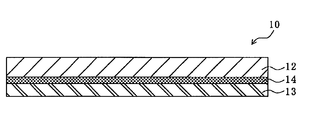
- a heat ray-shielding laminate in which an EVA layer and a fluororesin layer are adjacent for example, as shown in FIG. 1, a laminate in which an EVA layer 12 is laminated on a fluororesin layer 14 formed on a transparent plastic film 13 The body is mentioned.
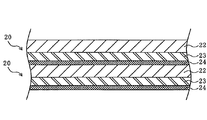
- a fluororesin layer 24 is formed on one surface of a transparent plastic film 23.
- a laminate in which the EVA layer 22 is laminated on the other surface of the plastic film 23 is mentioned.
- the silane coupling agent contained in the ethylene-vinyl acetate copolymer layer has the following formula (I): R 2 —Si (OR 1 ) 3 (I) (However, R 1 is an alkyl group having 2 to 5 carbon atoms, and R 2 is an ethylenically unsaturated group or a group having an ethylenically unsaturated group.)
- the alkyl group has 6 or more carbon atoms, the reactivity is poor and sufficient adhesive strength may not be obtained.
- R ⁇ 2 > is group represented by the said definition, high adhesiveness can be obtained.
- the ethylenically unsaturated group for R 2 include a vinyl group, a methacryloxy (methacryloyloxy) group, an acryloxy (acryloyloxy) group, and the like.
- Specific examples of R 2 include a vinyl group, ⁇ -methacryloxypropyl group, ⁇ -acryloxypropyl group, ⁇ -methacryloxyethyl group, ⁇ -methacryloxymethyl group and the like.
- Preferred specific examples of the silane coupling agent represented by the formula (I) include ⁇ -methacryloxypropyltriethoxysilane, ⁇ -methacryloxypropyltripropoxysilane, ⁇ -methacryloxypropyltributoxysilane, ⁇ -methacryloxypropyltri Pentoxysilane, vinyltriethoxysilane, vinyltripropoxysilane, vinyltributoxysilane, vinyltripentoxysilane, and the like.
- ⁇ -methacryloxypropyltriethoxysilane and vinyltriethoxysilane, in which R 1 is an ethyl group are particularly preferable.
- the silane coupling agent is 0.1 to 2.5 parts by weight, preferably 0.1 to 2.0 parts by weight, and particularly preferably 0 to 100 parts by weight of the ethylene-vinyl acetate copolymer. Add in an amount of 5 to 2.0 parts by weight. If the amount is less than 0.1 parts by mass, sufficient adhesive strength may not be obtained. If the amount is more than 2.5 parts by mass, bleeding out may occur.
- the content of vinyl acetate in the ethylene-vinyl acetate copolymer is 20 to 35% by mass, more preferably 22 to 30% by mass, especially 24 to 28% by mass, based on the ethylene-vinyl acetate copolymer. It is preferable to do this.
- the content of vinyl acetate is less than 20% by mass, the transparency of the film obtained when crosslinked and cured at a high temperature may not be sufficient, and when it exceeds 35% by mass, carboxylic acid, alcohol, amine, etc. There is a risk that foaming is likely to occur at the interface with the adjacent layer.
- the EVA layer of the present invention uses, in addition to the ethylene-vinyl acetate copolymer, a polyvinyl acetal resin (for example, polyvinyl formal, polyvinyl butyral (PVB resin), modified PVB), or a vinyl chloride resin as a secondary agent. May be. In that case, PVB is particularly preferable. Further, the melt flow index (MFR) of EVA is preferably 4.0 to 30.0 g / 10 minutes, and particularly preferably 8.0 to 18.0 g / 10 minutes.
- MFR melt flow index
- the EVA layer preferably contains a cross-linking agent. Thereby, the crosslinking density of EVA can be improved and the outstanding adhesive force can be expressed.
- a crosslinking agent it is preferable to use an organic peroxide.
- Any organic peroxide may be used as long as it decomposes at a temperature of 100 ° C. or higher and generates radicals.
- the organic peroxide is generally selected in consideration of the film formation temperature, the adjustment conditions of the composition, the curing (bonding) temperature, the heat resistance of the adherend, and the storage stability. In particular, those having a decomposition temperature of 70 hours or more with a half-life of 10 hours are preferred.
- this organic peroxide examples include t-butylperoxy-2-ethylhexyl carbonate, 2,5-dimethylhexane-2,5-dihydroperoxide, 2,5-dimethyl-2,5-di (t -Butylperoxy) hexane-3-di-t-butyl peroxide, t-butylcumyl peroxide, 2,5-dimethyl-2,5-di (t-butylperoxy) hexane, dicumyl peroxide, ⁇ , ⁇ '-bis (t-butylperoxyisopropyl) benzene, n-butyl-4,4-bis (t-butylperoxy) valerate, 1,1-bis (t-butylperoxy) cyclohexane, 1,1 -Bis (t-butylperoxy) -3,3,5-trimethylcyclohexane, t-butylperoxybenzoate,
- the content of the organic peroxide in the EVA layer is preferably 1 to 10 parts by mass, particularly 1 to 5 parts by mass with respect to 100 parts by mass of EVA.
- the EVA layer preferably contains a crosslinking aid.
- the crosslinking aid can improve the crosslinking density of the ethylene-vinyl acetate copolymer and improve the adhesion and durability of the EVA layer.
- the cross-linking aid is preferably used in an amount of 0.1 to 3.0 parts by mass, more preferably 0.1 to 2.5 parts by mass with respect to 100 parts by mass of EVA. With such a content of the crosslinking aid, there is no generation of gas due to the addition of the crosslinking aid, and the crosslinking density of the ethylene-vinyl acetate copolymer can be improved.
- crosslinking aid compound having a radical polymerizable group as a functional group
- examples of the crosslinking aid include trifunctional crosslinking aids such as triallyl cyanurate and triallyl isocyanurate, and (meth) acrylic esters (eg, NK ester) ) Monofunctional or bifunctional crosslinking aids.
- trifunctional crosslinking aids such as triallyl cyanurate and triallyl isocyanurate, and (meth) acrylic esters (eg, NK ester) ) Monofunctional or bifunctional crosslinking aids.
- triallyl cyanurate and triallyl isocyanurate are preferable, and triallyl isocyanurate is particularly preferable.
- the fluororesin layer may be a fluororesin layer formed on a suitable substrate (for example, a plastic film) or a fluororesin sheet itself.
- fluororesins include, for example, polytetrafluoroethylene (PTFE), tetrafluoroethylene / hexafluoropropylene copolymer (FEP), tetrafluoroethylene / perfluoroalkyl vinyl ether copolymer (PFA), and polyvinylidene fluoride.
- PVDF polychlorotrifluoroethylene
- EFE tetrafluoroethylene / ethylene copolymer
- FEVE fluoroethylene vinyl ether
- ECTFE ethylene chlorotrifluoroethylene copolymer
- the polymer A which has this can be mentioned.
- the polymer A and fluoroethylene vinyl ether (FEVE) are preferable.
- These (co) polymers further have functional groups (eg, alkoxysilyl groups, hydroxyl groups, amino groups, imino groups, (meth) acryloyloxy groups, epoxy groups, carboxyl groups, sulfonyl groups, acrylate type isocyanurate groups, sulfuric acid groups. Base).
- Preferred examples of commercially available fluororesins include CYTOP (Asahi Glass Co., Ltd.), Zeffle (Daikin Chemical Co., Ltd.), and OPTOOL (Daikin Chemical Co., Ltd.).
- These are thermoplastic, thermosetting, or light (generally UV) curable resins.
- a curing agent and a crosslinking agent it is preferable to use a curing agent and a crosslinking agent as appropriate.
- the fluororesin layer contains tungsten oxide and / or composite tungsten oxide.
- Tungsten oxide is an oxide represented by the general formula WyOz (where W is tungsten, O is oxygen, 2.2 ⁇ z / y ⁇ 2.999).
- the composite tungsten oxide is the same as the above tungsten oxide, except that the element M (where M is H, He, alkali metal, alkaline earth metal, rare earth element, Mg, Zr, Cr, Mn, Fe, Ru, Co , Rh, Ir, Ni, Pd, Pt, Cu, Ag, Au, Zn, Cd, Al, Ga, In, Tl, Si, Ge, Sn, Pb, Sb, B, F, P, S, Se, Br , Te, Ti, Nb, V, Mo, Ta, Re, Be, Hf, Os, Bi, and I).
- M is H, He, alkali metal, alkaline earth metal, rare earth element, Mg, Zr, Cr, Mn, Fe, Ru, Co , Rh, Ir, Ni, Pd, Pt, Cu, Ag, Au
- composite tungsten oxide is preferable.
- tungsten oxide represented by the general formula WyOz (W is tungsten, O is oxygen, 2.2 ⁇ z / y ⁇ 2.999), a preferable composition range of tungsten and oxygen is oxygen with respect to tungsten.
- the infrared shielding material is described as WyOz, 2.2 ⁇ z / y ⁇ 2.999. If the value of z / y is 2.2 or more, it is possible to avoid the appearance of a crystal phase of WO 2 which is not intended in the infrared shielding material and to obtain chemical stability as a material. Therefore, it can be applied as an effective infrared shielding material. On the other hand, if the value of z / y is 2.999 or less, a required amount of free electrons is generated and an efficient infrared shielding material can be obtained.
- the composite tungsten oxide is generally MxWyOz (where M is H, He, alkali metal, alkaline earth metal, rare earth element, Mg, Zr, Cr, Mn, Fe, Ru, Co, Rh, Ir, Ni, Pd, Pt, Cu, Ag, Au, Zn, Cd, Al, Ga, In, Tl, Si, Ge, Sn, Pb, Sb, B, F, P, S, Se, Br, One or more elements selected from Te, Ti, Nb, V, Mo, Ta, Re, Be, Hf, Os, Bi, I, W is tungsten, O is oxygen, (0.001 ⁇ x / y ⁇ 1, 2.2 ⁇ z / y ⁇ 3)
- the alkali metal is a periodic table group 1 element excluding hydrogen
- the alkaline earth metal is a periodic table group 2 element.
- Rare earth elements are Sc, Y and lanthanoid elements
- the M element is one or more of Cs, Rb, K, Tl, In, Ba, Li, Ca, Sr, Fe, and Sn. Is preferred.
- the composite tungsten oxide is preferably treated with a silane coupling agent. Excellent dispersibility is obtained, and an excellent infrared cut function and transparency are obtained.
- the value of x / y indicating the amount of element M added is greater than 0.001, a sufficient amount of free electrons is generated, and a sufficient infrared shielding effect can be obtained.
- the value of x / y is saturated at about 1.
- the value of x / y is smaller than 1, it is preferable because an impurity phase can be prevented from being generated in the fluororesin layer.
- the composite tungsten oxide has a hexagonal crystal structure, the transmission of the oxide in the visible light region is improved and the absorption in the near infrared region is improved.
- the cation of the element M When the cation of the element M is added to the hexagonal void, the transmission in the visible light region is improved and the absorption in the near infrared region is improved.
- the element M having a large ionic radius when added, the hexagonal crystal is formed.
- other elements may be added as long as the additive element M exists in the hexagonal void formed by the WO 6 unit, and is not limited to the above elements.
- the addition amount of the additive element M is preferably 0.2 or more and 0.5 or less in terms of x / y, more preferably 0.8. 33.
- the value of x / y is 0.33, it is considered that the additive element M is arranged in all of the hexagonal voids.
- tetragonal and cubic tungsten bronzes also have an infrared shielding effect. These crystal structures tend to change the absorption position in the near infrared region, and the absorption position tends to move to the longer wavelength side in the order of cubic ⁇ tetragonal ⁇ hexagonal. Further, the accompanying absorption in the visible light region is small in the order of hexagonal crystal ⁇ tetragonal crystal ⁇ cubic crystal. For this reason, it is preferable to use hexagonal tungsten bronze for applications that transmit light in the visible light region and shield light in the infrared region.
- the average particle diameter of the tungsten oxide and / or composite tungsten oxide used in the present invention is preferably 10 to 800 nm, particularly preferably 10 to 400 nm from the viewpoint of maintaining transparency. This is because particles smaller than 800 nm do not completely block light due to scattering, can maintain visibility in the visible light region, and at the same time can efficiently maintain transparency. In particular, when importance is attached to transparency in the visible light region, it is preferable to further consider scattering by particles. When importance is attached to the reduction of scattering by the particles, the average particle diameter is preferably 20 to 200 nm, particularly preferably 20 to 100 nm.
- the average particle diameter of tungsten oxide and / or composite tungsten oxide is measured by observing the cross section of the fluororesin layer with a transmission electron microscope at a magnification of about 1,000,000, and at least 100 tungsten oxides and / or composite tungsten. The number average value of the area equivalent circle diameter of the oxide is determined.
- the composite tungsten oxide is manufactured as follows, for example.
- the tungsten oxide represented by the general formula WyOz and / or the composite tungsten oxide represented by MxWyOz can be obtained by heat-treating a tungsten compound starting material in an inert gas atmosphere or a reducing gas atmosphere. .
- the tungsten compound starting material is obtained by dissolving tungsten trioxide powder, tungsten oxide hydrate, tungsten hexachloride powder, ammonium tungstate powder, or tungsten hexachloride in alcohol and then drying.
- tungsten oxide hydrate powder or tungsten compound powder obtained by drying ammonium tungstate aqueous solution from the viewpoint of ease of production process.
- tungsten oxide hydrate powder or tungsten compound powder obtained by drying ammonium tungstate aqueous solution from the viewpoint of ease of production process.
- an aqueous ammonium tungstate solution or a tungsten hexachloride solution from the viewpoint that each element can be easily and uniformly mixed when the starting material is a solution.
- the composite tungsten oxide represented by the general formula MxWyOz containing the element M is the same as the tungsten compound starting material of the tungsten oxide represented by the general formula WyOz described above.
- a tungsten compound contained in the form of a compound is used as a starting material.
- the tungsten compound starting material containing the element M is dissolved in a solvent such as water or an organic solvent.
- a solvent such as water or an organic solvent.
- examples thereof include tungstate, chloride, nitrate, sulfate, oxalate, oxide, and the like containing element M, but are not limited to these and are preferably in the form of a solution.
- the heat treatment condition in the inert atmosphere is preferably 650 ° C. or higher.
- the starting material heat-treated at 650 ° C. or higher has a sufficient coloring power and is efficient as a heat ray shielding agent.
- an inert gas such as Ar or N 2 is preferably used.
- the heat treatment conditions in the reducing atmosphere first, the starting material is heat-treated at 100 to 650 ° C. in a reducing gas atmosphere, and then heat-treated at a temperature of 650 to 1200 ° C. in an inert gas atmosphere. .
- the reducing gas at this time is not particularly limited, but H 2 is preferable.
- H 2 is used as the reducing gas
- the volume ratio of H 2 is preferably 0.1% or more, more preferably 2% or more, as the composition of the reducing atmosphere. If it is 0.1% or more, the reduction can proceed efficiently.
- the raw material powder reduced with hydrogen contains a magnetic phase, exhibits good infrared shielding properties, and can be used as a heat ray shielding agent in this state.
- hydrogen contained in tungsten oxide is unstable, application may be limited in terms of weather resistance. Therefore, a more stable heat ray shielding agent can be obtained by heat-treating the tungsten oxide compound containing hydrogen at 650 ° C. or higher in an inert atmosphere.
- the atmosphere during the heat treatment at 650 ° C. or higher is not particularly limited, but N 2 and Ar are preferable from an industrial viewpoint.
- the composite tungsten oxide is preferably surface-treated with a coupling agent such as a silane coupling agent, a titanate coupling agent, or an aluminum coupling agent.
- a coupling agent such as a silane coupling agent, a titanate coupling agent, or an aluminum coupling agent.
- Silane coupling agents are preferred.
- the affinity with the binder resin is improved, and various physical properties are improved in addition to transparency and heat ray cutting property.
- the fluororesin layer preferably contains 10 to 500 parts by mass, more preferably 20 to 500 parts by mass, especially 30 to 300 parts by mass of the above tungsten oxide and / or composite tungsten oxide with respect to 100 parts by mass of the fluororesin. .
- the EVA layer containing a silane coupling agent and the fluororesin layer containing tungsten oxide and / or composite tungsten oxide are adjacent to each other or opposed to each other. It is a laminate in the outermost layer.
- the EVA layer is prepared by kneading the composition containing each component described above in addition to EVA with a roll mill or the like while heating as necessary, and the resulting mixture is subjected to extrusion molding, calendar molding (calendering), or the like.
- a method of forming into a sheet shape is used.
- the mixture is dissolved in a suitable solvent to form a solution, and this solution is applied on a suitable support using a coater such as a roll coater, knife coater or doctor blade, and dried to form a sheet.
- a molding method can be used.
- the heating temperature during film formation is preferably 40 to 90 ° C., particularly 50 to 80 ° C.
- the thickness of the EVA layer is not particularly limited, but is, for example, 50 ⁇ m to 2 mm, particularly 300 ⁇ m to 1 mm.
- the fluororesin layer is formed by applying a coating solution in which fine particles of tungsten oxide and / or composite tungsten oxide are dispersed in a fluororesin on a transparent plastic film and drying it (if necessary, further curing with light or the like). Can be obtained).
- a coating solution in which fine particles of tungsten oxide and / or composite tungsten oxide are dispersed in a fluororesin on a transparent plastic film and drying it (if necessary, further curing with light or the like). Can be obtained).
- a roll mill, a sand mill, an attritor or the like is used in advance.
- the thickness of the fluororesin layer is generally 0.1 to 50 ⁇ m, preferably 0.1 to 10 ⁇ m, particularly preferably 0.1 to 5 ⁇ m.
- the transparent plastic film examples include a polyethylene terephthalate (PET) film, a polyethylene aphthalate (PEN) film, and a polyethylene butyrate film, and a PET film is preferred.
- PET polyethylene terephthalate
- PEN polyethylene aphthalate
- the thickness of the transparent plastic film is preferably 10 to 400 ⁇ m, particularly 20 to 300 ⁇ m.
- a fluororesin layer 14 is formed on one surface of the transparent plastic film 13, and this fluorine A laminate in which the EVA layer 12 is laminated on the resin layer 14 may be mentioned.
- the heat ray shielding laminate in which the EVA layer and the fluororesin layer are the outermost layers facing each other for example, as shown in FIG.
- stacked the EVA layer 22 on the other surface of the transparent plastic film 23 is mentioned.
- the EVA layer 22 and the fluororesin layer 24 are not adjacent to each other.
- the laminate 20 is formed into a roll shape during storage or the like, as shown in FIG. 22 and the fluororesin layer 24 are adjacent to each other.
- the present invention can suppress a decrease in the adhesiveness of the EVA layer 22 even when the laminate having such a configuration is stored for a long period of time.
- the present invention also provides an intermediate film for heat ray shielding laminated glass comprising the heat ray shielding laminate according to the present invention.
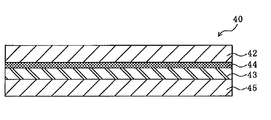
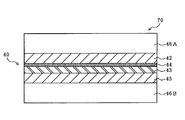
- an intermediate film for heat ray shielding laminated glass according to the present invention for example, an EVA layer 42 is laminated on a fluororesin layer 44 formed on a transparent plastic film 43 as shown in FIG.
- An intermediate film 40 in which an adhesive resin layer 45 (for example, an EVA sheet) is laminated on the other surface is mentioned.
- the heat ray shielding laminate or the interlayer film for laminated glass shown in FIGS. 1, 2 and 4 can be produced by laminating each layer as described above and then pressure bonding.
- the laminating temperature is, for example, 80 to 110 ° C.
- the EVA layers 12, 22, and 42 have a function as an adhesive resin layer
- the fluororesin layers 14, 24, and 44 have a function as a heat ray shielding layer.
- the heat ray shielding laminated body and intermediate film of this invention can be preserve
- the long term means 3 months or more, preferably 6 months or more, particularly 6 months to 2 years.
- the film roll for an interlayer film of the present invention can be produced by laminating each layer as described above and then winding the film roll by a known method such as a surface winding method (surface winding method). By making it into a roll, it is possible to improve handling during storage and transportation.
- FIG. 5 is a schematic cross-sectional view showing an example of a heat ray shielding glass 50 using the laminate 10 shown in FIG. It can be manufactured by laminating and integrating the glass plate 16 on the other surface of the EVA layer 12 of the heat ray shielding laminate 10.
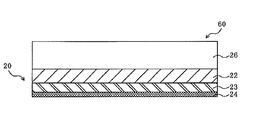
- FIG. 6 is a schematic cross-sectional view showing an example of a heat ray shielding glass 60 using the laminate 20 shown in FIG. It can be manufactured by laminating and integrating the glass plate 26 on the other surface of the EVA layer 22 of the heat ray shielding laminate 20.
- FIG. 7 is a schematic cross-sectional view showing an example of a laminated glass 70 using the laminated glass interlayer film 40 shown in FIG. It can be manufactured by providing the glass plate 46A on the other surface of the EVA layer 42 and providing the glass plate 46B on the other surface of the adhesive resin layer 45 and bonding and integrating them.
- the laminate of the present invention is left on the ethylene-vinyl acetate copolymer layer after being left standing for 6 months in an environment of a temperature of 30 ° C. and a humidity of 80% RH with the EVA layer and the fluororesin layer adjacent to each other.
- 3N / cm or more as measured by JIS K 6854-2
- the adhesive strength of the ethylene-vinyl acetate copolymer layer after the cross-linking and curing is measured in accordance with JIS K 6854-2.
- a method of deaeration and pressing under heating after being laminated with glass as described above is used. These processes are performed using, for example, a vacuum bag method, a nip roll method, or the like. Thereby, each film and a glass plate can be bonded and integrated.
- a glass laminate is preliminarily pressure-bonded at a temperature of 80 to 120 ° C., and EVA is crosslinked by heating at 100 to 150 ° C. (especially around 130 ° C.) for 10 minutes to 1 hour.
- the heat treatment may be performed under pressure.
- the laminate is pressed while being pressurized at a pressure of 1.0 ⁇ 10 3 Pa to 5.0 ⁇ 10 7 Pa. Cooling after crosslinking is generally performed at room temperature, and in particular, the faster the cooling, the better.
- the glass plate in the present invention may be a transparent substrate, for example, a glass plate such as green glass, silicate glass, inorganic glass plate, non-colored transparent glass plate, polyethylene terephthalate (PET), polyethylene naphthalate (PEN). Alternatively, a plastic substrate or film such as polyethylene butyrate or polymethyl methacrylate (PMMA) may be used.
- a glass plate is preferable in terms of weather resistance, impact resistance and the like.
- the thickness of the glass plate is generally about 1 to 20 mm.
- the same glass plate may be used for each glass plate disposed on both sides of the laminated glass, or different substrates may be used in combination. The combination is determined in consideration of the strength of the base material and the use of the laminated glass.
- EVA sheet (EVA layer) containing silane coupling agent
- EVA sheet (EVA layer) containing silane coupling agent
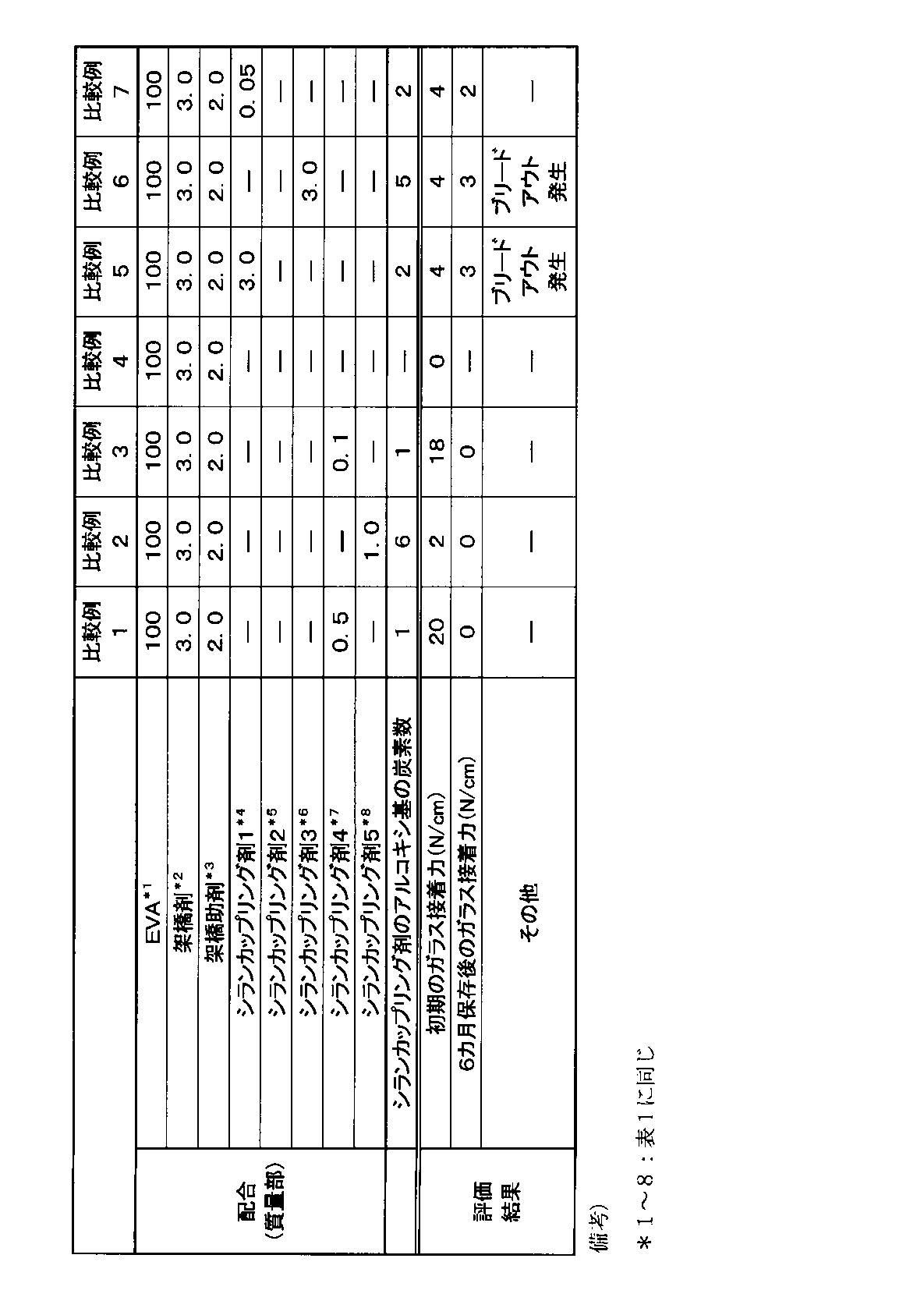
- Tables 1 and 2 Each material was supplied to a roll mill with the formulation shown in Tables 1 and 2, and kneaded at 70 ° C. to prepare an EVA sheet composition.
- the EVA sheet composition was calendered at 70 ° C. and allowed to cool to prepare an EVA sheet (thickness 0.4 mm).
- Comparative Examples 1 and 3 using a silane coupling agent having an alkoxy group having 1 carbon have a large decrease in adhesive strength after 6 months and use an alkoxy group having 6 carbon atoms. Comparative Example 2 was found to have low initial adhesive strength. Further, as shown in Comparative Examples 5 to 7, when the content of the silane coupling agent whose hydrolyzable group is an alkoxy group having 2 to 5 carbon atoms is 3.0 parts by mass, In the case of 0.05 part by mass, sufficient adhesion was not obtained.
- the production efficiency of the heat ray shielding glass and the heat ray shielding laminated glass can be improved.
Landscapes
- Physics & Mathematics (AREA)
- Health & Medical Sciences (AREA)
- Toxicology (AREA)
- General Physics & Mathematics (AREA)
- Optics & Photonics (AREA)
- Joining Of Glass To Other Materials (AREA)
- Laminated Bodies (AREA)
Abstract
Description
前記エチレン-酢酸ビニル共重合体層とフッ素樹脂層とが、隣接するか、又は互いに対向する最外層にあり、
前記シランカップリング剤が、下記式(I)
R2-Si(OR1)3 (I)
(但し、R1が炭素数2~5のアルキル基であり、R2がエチレン性不飽和基又はエチレン性不飽和基を有する基である。)
で表わされるシランカップリング剤であり、
該シランカップリング剤の含有量が、前記エチレン-酢酸ビニル共重合体100質量部に対して0.1~2.5質量部であることを特徴とする熱線遮蔽性積層体により達成される。
(1)R1がエチル基である。
(2)当該積層体を、前記エチレン-酢酸ビニル共重合体層と前記フッ素樹脂層とが隣接した状態で、温度30℃、湿度80%RHの環境下で6カ月放置した後、前記エチレン-酢酸ビニル共重合体層上にガラスを積層させた状態で架橋硬化させ、その架橋硬化後のエチレン-酢酸ビニル共重合体層のガラスとの接着力が、JIS K 6854-2に準拠して測定して、3N/cm以上である。
(3)更に、透明プラスチックフィルムを含む。
本発明においてエチレン-酢酸ビニル共重合体層に含まれるシランカップリング剤は、下記式(I)
R2-Si(OR1)3 (I)
(但し、R1が炭素数2~5のアルキル基であり、R2がエチレン性不飽和基又はエチレン性不飽和基を有する基である。)
で表わされるシランカップリング剤である。
本発明において、エチレン-酢酸ビニル共重合体における酢酸ビニルの含有量は、前記エチレン-酢酸ビニル共重合体に対して20~35質量%、さらに22~30質量%、特に24~28質量%とするのが好ましい。酢酸ビニルの含有量が、20質量%未満であると、高温で架橋硬化させる場合に得られるフィルムの透明性が充分でない恐れがあり、35質量%を超えると、カルボン酸、アルコール、アミン等が発生し隣接層との界面で発泡が生じ易くなる恐れがある。
本発明において、フッ素樹脂層は、適当な基板(例えば、プラスチックフィルム)上に形成したフッ素樹脂層でもよく、フッ素樹脂シートそれ自体でもよい。

を有する重合体Aを挙げることができる。これらの中で、上記重合体A、フルオロエチレンビニルエーテル(FEVE)が好ましい。これらの(共)重合体は、さらに官能基(例、アルコキシシリル基、ヒドロキシル基、アミノ基、イミノ基、(メタ)アクリロイロキシ基、エポキシ基、カルボキシル基、スルホニル基、アクリレート型イソシアヌレート基、硫酸塩基)を有していても良い。市販されているフッ素樹脂の好ましい例としては、サイトップ(旭硝子(株)製)、ゼッフル(ダイキン化学(株)製)、オプツール(ダイキン化学(株)製)を挙げることができる。これらは、熱可塑性、熱硬化型、又は光(一般に紫外線)硬化型の樹脂である。硬化させる際は、適宜硬化剤、架橋剤を使用することが好ましい。
フッ素樹脂層はタングステン酸化物及び/又は複合タングステン酸化物を含んでいる。
上述したように、本発明の熱線遮蔽性積層体は、シランカップリング剤を含むEVA層と、タングステン酸化物及び/又は複合タングステン酸化物を含むフッ素樹脂層とが隣接しているか、又は互いに対向する最外層にある積層体である。
本発明の熱線遮蔽ガラスは、上述した熱線遮蔽性積層体を有していればよい。図5は、図1に示す積層体10を用いた熱線遮蔽ガラス50の一例を示す概略断面図である。熱線遮蔽性積層体10のEVA層12の他方の面にガラス板16を積層して接着一体化することにより製造することができる。
1.シランカップリング剤を含むEVAシート(EVA層)の作製
表1及び2に示す配合で各材料をロールミルに供給し、70℃において混練してEVAシート用組成物を調製した。前記EVAシート用組成物を、70℃においてカレンダ成形し、放冷後、EVAシート(厚さ0.4mm)を作製した。
PETフィルム(200μm)上に、下記のフッ素樹脂層形成用塗布液をバーコータにより塗布し、80℃で30秒間乾燥し、厚さ1μmのフッ素樹脂層を形成した。
(配合)
・官能基含有フッ素樹脂(固形分15質量%、MIBK85質量%、オプツールAR-110(前記重合体A)、ダイキン工業(株)製)100質量部
・セシウムタングステン酸化物(Cs0.33WO3、固形分20質量%、MIBK80質量%)100質量部
上記EVAシートを、上記PETフィルム上に形成されたフッ素樹脂層上に積層し、真空ラミネーターにて100℃の温度で3分間圧着して、熱線遮蔽性積層体を得た。
(1)積層後6カ月後の貯蔵安定性
(i)初期のガラス接着力
上記積層体のEVA層上にガラス(3mm)を積層した後、真空ラミネーターにて100℃の温度で100分間仮圧着した後、オーブンに入れ、温度120℃の条件で90分架橋させて、接着一体化されたサンプルを得た。
上記積層体を6カ月間、温度30℃、湿度80%RHで放置した後、積層体のEVA層上にガラスを積層した後、真空ラミネーターにて100℃の温度で10分間仮圧着した後、オーブンに入れ、温度120℃の条件で90分架橋させた。このサンプルについて、上記と同様にガラス接着力を測定した。
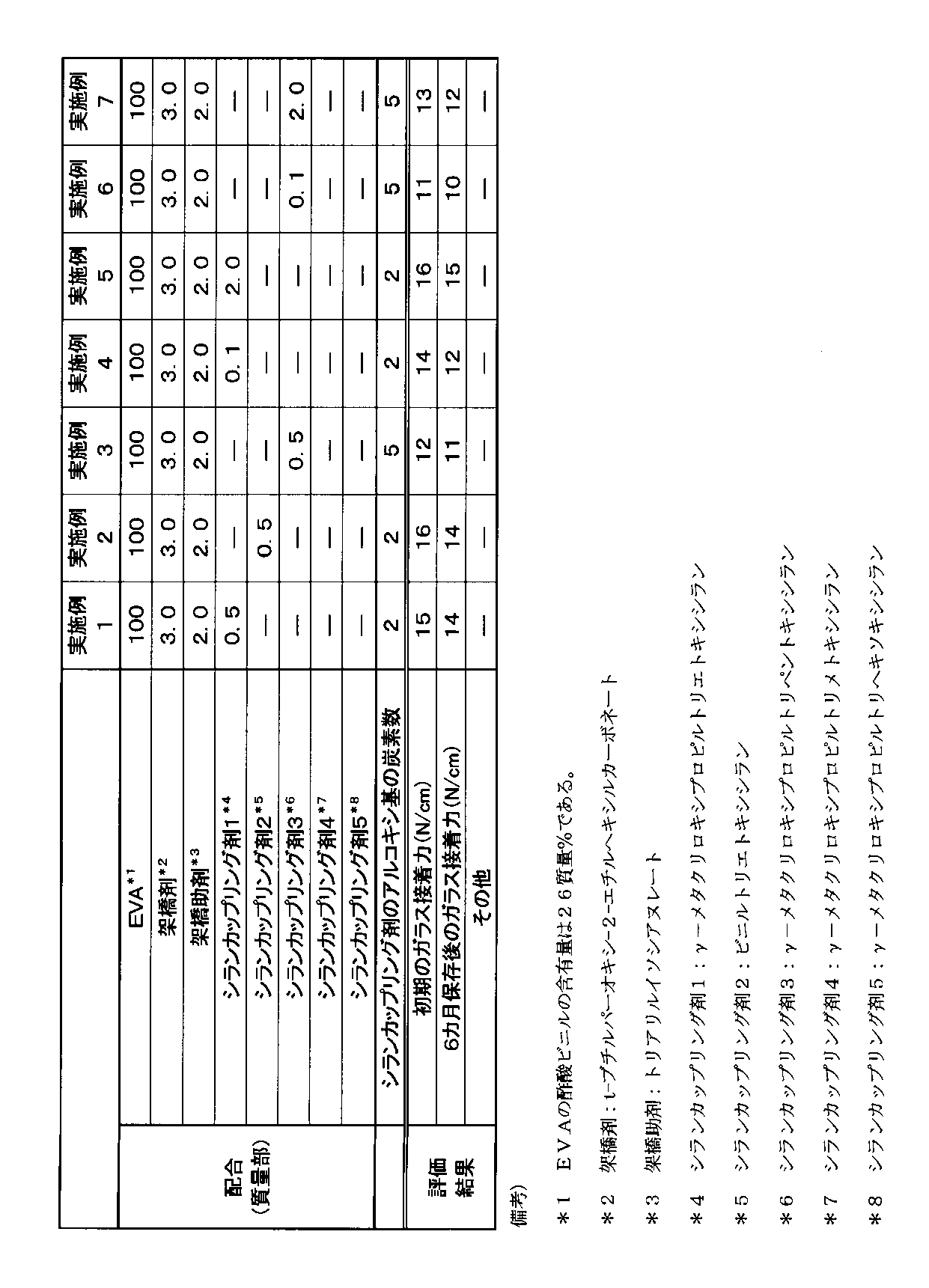
添加したシランカップリング剤の加水分解性基が炭素数2~5のアルコキシ基である実施例1~7(上記式(I)のR1が炭素数2~5のアルキル基の場合)は、初期接着力が高く、また6カ月後の接着力の低下が小さいことが認められた。
12、22、42 EVA層
13、23、43 透明プラスチックフィルム
14、24、44 フッ素樹脂層
45 接着樹脂層
16、26、46A、46B ガラス板
40 熱線遮蔽性合わせガラス用中間膜
50、60 熱線遮蔽ガラス
70 熱線遮蔽合わせガラス
Claims (8)
- シランカップリング剤を含むエチレン-酢酸ビニル共重合体層と、タングステン酸化物及び/又は複合タングステン酸化物を含むフッ素樹脂層とを含む熱線遮蔽性積層体であって、
前記エチレン-酢酸ビニル共重合体層とフッ素樹脂層とが、隣接するか、又は互いに対向する最外層にあり、
前記シランカップリング剤が、下記式(I)
R2-Si(OR1)3 (I)
(但し、R1が炭素数2~5のアルキル基であり、R2がエチレン性不飽和基又はエチレン性不飽和基を有する基である。)
で表わされるシランカップリング剤であり、
該シランカップリング剤の含有量が、前記エチレン-酢酸ビニル共重合体100質量部に対して0.1~2.5質量部であることを特徴とする熱線遮蔽性積層体。 - R1がエチル基であることを特徴とする請求項1に記載の熱線遮蔽性積層体。
- 当該積層体を、前記エチレン-酢酸ビニル共重合体層と前記フッ素樹脂層とが隣接した状態で、温度30℃、湿度80%RHの環境下で6カ月放置した後、前記エチレン-酢酸ビニル共重合体層上にガラスを積層させた状態で架橋硬化させ、その架橋硬化後のエチレン-酢酸ビニル共重合体層のガラスとの接着力が、JIS K 6854-2に準拠して測定して、3N/cm以上であることを特徴とする請求項1又は2に記載の熱線遮蔽性積層体。
- 更に、透明プラスチックフィルムを含むことを特徴とする請求項1~3の何れか1項に記載の熱線遮蔽性積層体。
- 請求項1~4の何れか1項に記載の熱線遮蔽性積層体を含むことを特徴とする熱線遮蔽合わせガラス用中間膜。
- 請求項1~4の何れか1項に記載の熱線遮蔽性積層体又は請求項5に記載の熱線遮蔽合わせガラス用中間膜をロール状に巻回させてなるフィルムロール。
- 請求項1~4の何れか1項に記載の熱線遮蔽性積層体を用いたことを特徴とする熱線遮蔽ガラス。
- 請求項5に記載の熱線遮蔽合わせガラス用中間膜を用いたことを特徴とする合わせガラス。
Priority Applications (3)
| Application Number | Priority Date | Filing Date | Title |
|---|---|---|---|
| US14/004,476 US20140017503A1 (en) | 2011-03-29 | 2012-03-27 | Heat ray-shielding laminate and film roll thereof |
| JP2013507586A JP5745034B2 (ja) | 2011-03-29 | 2012-03-27 | 熱線遮蔽性積層体及びそのフィルムロール |
| CN201280016653.8A CN103492178B (zh) | 2011-03-29 | 2012-03-27 | 热射线屏蔽性层压体及其膜卷 |
Applications Claiming Priority (2)
| Application Number | Priority Date | Filing Date | Title |
|---|---|---|---|
| JP2011-071437 | 2011-03-29 | ||
| JP2011071437 | 2011-03-29 |
Publications (1)
| Publication Number | Publication Date |
|---|---|
| WO2012133370A1 true WO2012133370A1 (ja) | 2012-10-04 |
Family
ID=46931087
Family Applications (1)
| Application Number | Title | Priority Date | Filing Date |
|---|---|---|---|
| PCT/JP2012/057864 Ceased WO2012133370A1 (ja) | 2011-03-29 | 2012-03-27 | 熱線遮蔽性積層体及びそのフィルムロール |
Country Status (4)
| Country | Link |
|---|---|
| US (1) | US20140017503A1 (ja) |
| JP (1) | JP5745034B2 (ja) |
| CN (1) | CN103492178B (ja) |
| WO (1) | WO2012133370A1 (ja) |
Cited By (1)
| Publication number | Priority date | Publication date | Assignee | Title |
|---|---|---|---|---|
| WO2016052606A1 (ja) * | 2014-09-30 | 2016-04-07 | 積水化学工業株式会社 | 合わせガラス用中間膜及び合わせガラス |
Families Citing this family (4)
| Publication number | Priority date | Publication date | Assignee | Title |
|---|---|---|---|---|
| US10730272B2 (en) * | 2015-06-30 | 2020-08-04 | Sumitomo Metal Mining Co., Ltd. | Heat-ray shielding film, heat-ray shielding laminated transparent substrate, automobile, building, dispersoid, mixed composition, method for manufacturing dispersoid, dispersion liquid, and method for manufacturing dispersion liquid |
| US11145851B2 (en) * | 2015-11-11 | 2021-10-12 | The Board Of Trustees Of The Leland Stanford Junior University | Composite lithium metal anodes for lithium batteries with reduced volumetric fluctuation during cycling and dendrite suppression |
| US10531555B1 (en) * | 2016-03-22 | 2020-01-07 | The United States Of America As Represented By The Secretary Of The Army | Tungsten oxide thermal shield |
| CN106353960A (zh) * | 2016-10-18 | 2017-01-25 | 孙绪刚 | 一种基于eva胶膜的透明防紫外投影屏及制备方法 |
Citations (3)
| Publication number | Priority date | Publication date | Assignee | Title |
|---|---|---|---|---|
| JP2009084127A (ja) * | 2007-10-02 | 2009-04-23 | Bridgestone Corp | 合わせガラス中間膜用エチレン−酢酸ビニル共重合体樹脂フィルムロールの製造方法、及びこれにより得られる合わせガラス中間膜用エチレン−酢酸ビニル共重合体樹脂フィルムロール |
| JP2010089452A (ja) * | 2008-10-10 | 2010-04-22 | Bridgestone Corp | 積層体、及びこれを用いた熱線遮蔽合わせガラス |
| JP2010275160A (ja) * | 2009-05-29 | 2010-12-09 | Bridgestone Corp | 熱線遮蔽合わせガラス用中間膜、及び熱線遮蔽合わせガラス |
Family Cites Families (2)
| Publication number | Priority date | Publication date | Assignee | Title |
|---|---|---|---|---|
| CN1239659C (zh) * | 1995-09-12 | 2006-02-01 | 三井化学株式会社 | 粘合的乙烯共聚物树脂组合物和含它的层压材料 |
| US20100220388A1 (en) * | 2007-06-08 | 2010-09-02 | Bridgestone Corporation | Near-infrared shielding material, laminate including the same, and optical filter for display including the same |
-
2012
- 2012-03-27 US US14/004,476 patent/US20140017503A1/en not_active Abandoned
- 2012-03-27 CN CN201280016653.8A patent/CN103492178B/zh not_active Expired - Fee Related
- 2012-03-27 JP JP2013507586A patent/JP5745034B2/ja not_active Expired - Fee Related
- 2012-03-27 WO PCT/JP2012/057864 patent/WO2012133370A1/ja not_active Ceased
Patent Citations (3)
| Publication number | Priority date | Publication date | Assignee | Title |
|---|---|---|---|---|
| JP2009084127A (ja) * | 2007-10-02 | 2009-04-23 | Bridgestone Corp | 合わせガラス中間膜用エチレン−酢酸ビニル共重合体樹脂フィルムロールの製造方法、及びこれにより得られる合わせガラス中間膜用エチレン−酢酸ビニル共重合体樹脂フィルムロール |
| JP2010089452A (ja) * | 2008-10-10 | 2010-04-22 | Bridgestone Corp | 積層体、及びこれを用いた熱線遮蔽合わせガラス |
| JP2010275160A (ja) * | 2009-05-29 | 2010-12-09 | Bridgestone Corp | 熱線遮蔽合わせガラス用中間膜、及び熱線遮蔽合わせガラス |
Cited By (2)
| Publication number | Priority date | Publication date | Assignee | Title |
|---|---|---|---|---|
| WO2016052606A1 (ja) * | 2014-09-30 | 2016-04-07 | 積水化学工業株式会社 | 合わせガラス用中間膜及び合わせガラス |
| JP5933139B1 (ja) * | 2014-09-30 | 2016-06-08 | 積水化学工業株式会社 | 合わせガラス用中間膜及び合わせガラス |
Also Published As
| Publication number | Publication date |
|---|---|
| CN103492178A (zh) | 2014-01-01 |
| JPWO2012133370A1 (ja) | 2014-07-28 |
| CN103492178B (zh) | 2015-09-23 |
| US20140017503A1 (en) | 2014-01-16 |
| JP5745034B2 (ja) | 2015-07-08 |
Similar Documents
| Publication | Publication Date | Title |
|---|---|---|
| JP5706314B2 (ja) | 熱線遮蔽性積層体、及びこれを用いた熱線遮蔽性合わせガラス | |
| CN102781868B (zh) | 热射线屏蔽多层玻璃 | |
| JP5248978B2 (ja) | 機能性フィルム | |
| JP5559483B2 (ja) | 熱線遮蔽ガラス、及びこれを用いた複層ガラス | |
| JP5112169B2 (ja) | 熱線遮蔽膜、及びこれを用いた熱線遮蔽性合わせガラス | |
| JP4942578B2 (ja) | 積層体 | |
| JP5264331B2 (ja) | 機能性フィルム | |
| CN104487397B (zh) | 热线遮蔽用夹层结构体 | |
| JP5840830B2 (ja) | 熱線遮蔽複層ガラス | |
| JP5775349B2 (ja) | 熱線遮蔽合わせガラス用中間膜、及び熱線遮蔽合わせガラス | |
| JP5745034B2 (ja) | 熱線遮蔽性積層体及びそのフィルムロール | |
| EP3318610B1 (en) | Heat-ray shielding film, heat-ray shielding laminated transparent base material, automobile, building, dispersion, mixed composition, dispersion production method, dispersion solution, and dispersion solution production method | |
| JP5559486B2 (ja) | 熱線遮蔽ガラス、及びこれを用いた複層ガラス | |
| JP5368881B2 (ja) | 熱線遮蔽合わせガラス用中間膜、及び熱線遮蔽合わせガラス | |
| JP5348991B2 (ja) | 積層体 | |
| JP5123047B2 (ja) | 合わせガラス及びその製造方法 | |
| JP2013091234A (ja) | 熱線遮蔽性調光ウインドウ | |
| JP5537845B2 (ja) | 熱線遮蔽ガラス、及びこれを用いた複層ガラス | |
| JP5683841B2 (ja) | 熱線遮蔽フィルム、これを用いた熱線遮蔽ガラス、及び複層ガラス | |
| JP5604048B2 (ja) | 熱線遮蔽ガラスルーバー、及びこれを含む窓構造 | |
| JP2010274585A (ja) | 熱線遮蔽性積層体、及び熱線遮蔽性合わせガラス | |
| JP2010089452A (ja) | 積層体、及びこれを用いた熱線遮蔽合わせガラス | |
| JP5215239B2 (ja) | 熱線遮蔽性積層体、及び熱線遮蔽合わせガラス | |
| JP2016046512A (ja) | 太陽電池モジュール用バックシートおよび太陽電池モジュール |
Legal Events
| Date | Code | Title | Description |
|---|---|---|---|
| 121 | Ep: the epo has been informed by wipo that ep was designated in this application |
Ref document number: 12763882 Country of ref document: EP Kind code of ref document: A1 |
|
| ENP | Entry into the national phase |
Ref document number: 2013507586 Country of ref document: JP Kind code of ref document: A |
|
| WWE | Wipo information: entry into national phase |
Ref document number: 14004476 Country of ref document: US |
|
| NENP | Non-entry into the national phase |
Ref country code: DE |
|
| 122 | Ep: pct application non-entry in european phase |
Ref document number: 12763882 Country of ref document: EP Kind code of ref document: A1 |