WO2012132642A1 - 情報処理装置、混雑度マップ生成装置、情報処理方法、プログラム、及び記録媒体 - Google Patents
情報処理装置、混雑度マップ生成装置、情報処理方法、プログラム、及び記録媒体 Download PDFInfo
- Publication number
- WO2012132642A1 WO2012132642A1 PCT/JP2012/054130 JP2012054130W WO2012132642A1 WO 2012132642 A1 WO2012132642 A1 WO 2012132642A1 JP 2012054130 W JP2012054130 W JP 2012054130W WO 2012132642 A1 WO2012132642 A1 WO 2012132642A1
- Authority
- WO
- WIPO (PCT)
- Prior art keywords
- congestion
- pitch
- unit
- information processing
- detection data
- Prior art date
- Legal status (The legal status is an assumption and is not a legal conclusion. Google has not performed a legal analysis and makes no representation as to the accuracy of the status listed.)
- Ceased
Links
Images







Classifications
-
- G—PHYSICS
- G01—MEASURING; TESTING
- G01C—MEASURING DISTANCES, LEVELS OR BEARINGS; SURVEYING; NAVIGATION; GYROSCOPIC INSTRUMENTS; PHOTOGRAMMETRY OR VIDEOGRAMMETRY
- G01C22/00—Measuring distance traversed on the ground by vehicles, persons, animals or other moving solid bodies, e.g. using odometers, using pedometers
- G01C22/006—Pedometers
-
- G—PHYSICS
- G08—SIGNALLING
- G08G—TRAFFIC CONTROL SYSTEMS
- G08G1/00—Traffic control systems for road vehicles
- G08G1/005—Traffic control systems for road vehicles including pedestrian guidance indicator
-
- G—PHYSICS
- G08—SIGNALLING
- G08G—TRAFFIC CONTROL SYSTEMS
- G08G1/00—Traffic control systems for road vehicles
- G08G1/01—Detecting movement of traffic to be counted or controlled
- G08G1/0104—Measuring and analyzing of parameters relative to traffic conditions
- G08G1/0108—Measuring and analyzing of parameters relative to traffic conditions based on the source of data
- G08G1/012—Measuring and analyzing of parameters relative to traffic conditions based on the source of data from other sources than vehicle or roadside beacons, e.g. mobile networks
-
- G—PHYSICS
- G08—SIGNALLING
- G08G—TRAFFIC CONTROL SYSTEMS
- G08G1/00—Traffic control systems for road vehicles
- G08G1/01—Detecting movement of traffic to be counted or controlled
- G08G1/0104—Measuring and analyzing of parameters relative to traffic conditions
- G08G1/0125—Traffic data processing
- G08G1/0133—Traffic data processing for classifying traffic situation
-
- G—PHYSICS
- G08—SIGNALLING
- G08G—TRAFFIC CONTROL SYSTEMS
- G08G1/00—Traffic control systems for road vehicles
- G08G1/01—Detecting movement of traffic to be counted or controlled
- G08G1/0104—Measuring and analyzing of parameters relative to traffic conditions
- G08G1/0137—Measuring and analyzing of parameters relative to traffic conditions for specific applications
- G08G1/0141—Measuring and analyzing of parameters relative to traffic conditions for specific applications for traffic information dissemination
-
- H—ELECTRICITY
- H04—ELECTRIC COMMUNICATION TECHNIQUE
- H04W—WIRELESS COMMUNICATION NETWORKS
- H04W4/00—Services specially adapted for wireless communication networks; Facilities therefor
- H04W4/02—Services making use of location information
- H04W4/025—Services making use of location information using location based information parameters
- H04W4/027—Services making use of location information using location based information parameters using movement velocity, acceleration information
-
- H—ELECTRICITY
- H04—ELECTRIC COMMUNICATION TECHNIQUE
- H04W—WIRELESS COMMUNICATION NETWORKS
- H04W4/00—Services specially adapted for wireless communication networks; Facilities therefor
- H04W4/20—Services signaling; Auxiliary data signalling, i.e. transmitting data via a non-traffic channel
- H04W4/21—Services signaling; Auxiliary data signalling, i.e. transmitting data via a non-traffic channel for social networking applications
Definitions
- the present disclosure relates to an information processing device, a congestion degree map generation device, an information processing method, a program, and a recording medium, and in particular, an information processing device that determines a user's state, a congestion degree map generation device, an information processing method, a program, and The present invention relates to a recording medium.
- Patent Literature 1 discloses a service that counts the number of people in an area based on position information and analyzes the degree of congestion based on the number of people.
- the difference between the acquisition unit that acquires the pitch of walking from the shake detection data, the pitch acquired by the acquisition unit, and the pitch during normal walking calculated based on past shake detection data And a congestion determination unit that determines the degree of congestion based on
- An acquisition unit that acquires position information of a user determined to be in a congested state, and a congestion degree map generation unit that generates a congestion degree map in which the position information acquired by the acquisition unit is superimposed on a map.
- a congestion map generation device is provided.
- the computer is configured to acquire the walking pitch from the shake detection data, the pitch acquired by the acquisition unit, and the normal walking time calculated based on the past shake detection data.
- a program for causing an information processing apparatus to function as an information processing apparatus having a congestion determination unit that determines a degree of congestion based on a difference from a pitch is provided.
- the computer is configured to acquire the walking pitch from the shake detection data, the pitch acquired by the acquisition unit, and the normal walking time calculated based on the past shake detection data.
- a computer-readable recording medium that records a program for causing an information processing apparatus to function as an information processing apparatus having a congestion determination unit that determines a congestion degree based on a difference from a pitch.
- the present disclosure it is possible to determine that the degree of congestion is high when the user is walking and the surrounding area is congested and the person is affected by the congestion.
- FIG. 7 is a block diagram illustrating a configuration example of a position information acquisition unit of a terminal device according to first to third embodiments of the present disclosure.
- FIG. 3 is a hardware configuration diagram of a terminal device according to first to third embodiments of the present disclosure.
- 6 is a flowchart illustrating an example of a congestion determination process according to an embodiment of the present disclosure. It is a flowchart which shows another example of the congestion determination process which concerns on the embodiment.
- 5 is a flowchart illustrating an operation of a terminal device according to the first embodiment of the present disclosure. It is a block diagram of the congestion information generation system which concerns on 2nd Embodiment of this indication.
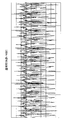
- FIG. 1 is an explanatory diagram illustrating an overview of a congestion state determination method according to an embodiment of the present disclosure.
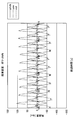
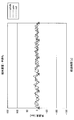
- FIG. 2 is a graph showing an example of normal vibration detection data.
- FIG. 3 is a graph showing an example of shaking detection data at the time of congestion.
- the congestion state determination method determines whether each user is in a congestion state based on shake detection data acquired by a terminal device carried by the user. At this time, the congestion state means that the user is actually difficult to move due to the influence of the congestion.
- the congestion state determination method determines the congestion state based on the distribution of the number of people in the area. For this reason, there is no distinction between those who are in line and those who pass by the line.
- the moving speed of the user when trying to detect the state of each user, for example, it is conceivable to use the moving speed of the user. However, if the user's speed is simply used to reduce the speed, it is determined that the user is congested. If the user is slowly moving on a moving sidewalk or escalator, the user may be erroneously determined to be congested.
- the congestion state determination method determines whether or not the user is in a congestion state based on the shake detection data acquired by the terminal device carried by the user.
- the shake detection data is acquired by a sensor (for example, an acceleration sensor, a gyro sensor, an atmospheric pressure sensor, etc.) that can detect a shake provided in the terminal device.
- the pitch at which the user walks differs between normal times and crowded times. Compared to the normal pitch, the pitch during congestion is slow.
- An example of the shake detection data at this time is shown in FIGS.
- the pitch at which the user appears in the phase of the shake detection data is slower in the crowded state than in the normal state.
- the amplitude of the shake detection data is also different between the normal time and the congestion time.
- a plurality of constituent elements having substantially the same functional configuration may be distinguished by adding different alphabets after the same reference numeral.
- the terminal device 100 is distinguished for each embodiment as a terminal device 100a, a terminal device 100b, and a terminal device 100c.
- the terminal device 100 when it is not necessary to particularly distinguish each of a plurality of constituent elements having substantially the same functional configuration, only the same reference numerals are given.
- the terminal device 100 when there is no need to particularly distinguish the terminal device 100a, the terminal device 100b, the terminal device 100c, and the like, they are simply referred to as the terminal device 100.
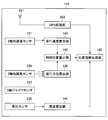
- FIG. 4 is a functional configuration diagram of the terminal device according to the first embodiment of the present disclosure.
- FIG. 5 is a block diagram illustrating a configuration example of the position information acquisition unit of the terminal device according to the first to third embodiments of the present disclosure.
- the terminal device 100a is an example of an information processing device that determines a congestion state.
- the terminal device 100a may be an information processing device such as a mobile phone, a notebook PC (Personal Computer), a PND (Personal Navigation Device), a portable music playback device, a portable video processing device, or a portable game device.
- the terminal device 100a includes a shake detection unit 101, a measurement unit 103, a normal walking learning unit 105, a congestion determination unit 107, a storage unit 109, a content providing unit 113, and a position information acquisition unit. 115.
- the shaking detection unit 101 is a sensor that detects shaking.
- the shake detection unit 101 may be an acceleration sensor, a gyro sensor, or an atmospheric pressure sensor.
- the shake detection unit 101 can supply the detected shake detection data to the measurement unit 103.
- the measurement unit 103 has a function of measuring the amplitude and pitch of the shake detection data acquired by the shake detection unit 101.
- the measurement unit 103 is an example of an acquisition unit that acquires the amplitude and pitch of the shake detection data.
- the measurement unit 103 can supply the measured amplitude and pitch to the normal walking learning unit 105 and the congestion determination unit 107.
- the normal walking learning unit 105 has a function of learning the amplitude and pitch of the shake detection data during the normal walking of the user of the terminal device 100a.
- the normal walking learning unit 105 calculates, for example, the average value of the amplitude and the pitch of the past shake detection data when it is determined that the normal walking is performed, thereby calculating the congestion and the pitch value during the normal walking. Can be supplied to.
- the congestion determination unit 107 includes amplitude and pitch values of the shake detection data supplied from the measurement unit 103, and amplitude and pitch values during normal walking calculated by the normal walking learning unit 105 based on past shake detection data. And a function of determining the degree of congestion on the basis of the difference.
- the congestion determination unit 107 may supply the determination result to the content providing unit 113 when the content providing unit 113 has a configuration for selecting content to be provided according to the determination result. Note that the congestion determination unit 107 may store the determination result in the storage unit 109 inside the terminal device 100a.
- the congestion determination unit 107 associates the determined time with the position information of the terminal device 100a supplied from the position information acquisition unit 115 in the storage unit 109, for example, when it is determined that the congestion state is present. It can be memorized.
- the congestion determination unit 107 can store the traveling direction of the user included in the position information as the congestion direction.
- the storage unit 109 is a device for storing data, such as a storage medium, a recording device that records data on the storage medium, a reading device that reads data from the storage medium, and a deletion device that deletes data recorded on the storage medium. Can be included.
- the storage medium for example, nonvolatile memory such as flash memory, MRAM (Magnetoresistive Random Access Memory), FeRAM (Ferroelectric Random Access Memory), PRAM (Phase change Random Access Memory), and EEPROM (Electronically Erasable and Programmable Read Only Memory).
- a magnetic recording medium such as HDD (Hard Disk Drive) may be used.
- the storage unit 109 can store the date and time determined as being congested as described above and the position information, for example. Moreover, you may memorize
- the content providing unit 113 has output functions such as a display unit and an audio output unit, and can provide content to the user.
- content refers to audio data such as music, lectures, and radio programs, video data such as movies, television programs, video programs, photos, documents, pictures, and diagrams, games and software, application launches and applications This is a concept that includes push notifications from.
- the content providing unit 113 is also an example of a selection unit that selects content based on the degree of congestion determined by the congestion determination unit 107.
- the content providing unit 113 may have a function of selecting content to be provided to the user based on the determination result by the congestion determination unit 107.
- the content providing unit 113 may select content that has an effect of reducing the user's stress when it is determined that the user is congested.
- the content providing unit 113 can also change the frequency of providing content to the user according to the degree of congestion. For example, there is a function to push notification of recommendation to the user or notification of arrival of information by an application or the like. Users in a crowded state are more likely to be interested in push notifications than when they are normally walking. For this reason, when it determines with it being in a congestion state, you may raise the frequency of a push notification rather than normal time. In particular, it is also effective to provide users with content used for so-called “killing time”.
- the content providing unit 113 may provide the user with content selected based on the current position information of the terminal device 100a.
- the content providing unit 115 may provide the user with content related to the vicinity of the current position when the congestion determining unit 107 determines that the state is congested. For example, when it is detected that the terminal device 100a is located in Shibuya based on the current position information, the content providing unit 113 may provide content related to Shibuya to the user. Or the content provision part 113 may provide the information regarding the said shop, when the shop in the tip of the queue where the user is located can be discriminated by the current position information.
- the position information acquisition unit 115 has a function of acquiring the current position information of the terminal device 100a.
- This location information acquisition unit 115 is, for example, location information based on GPS (Global Positioning System) positioning, location information based on Wi-Fi positioning, location information based on IMES (Indoor Messaging System) positioning, mobile base station
- GPS Global Positioning System
- Wi-Fi Wireless Fidelity
- IMES Indoor Messaging System
- mobile base station You may have a function which acquires the positional information based on a position, or the relative positional information based on the detection value of a sensor. Moreover, you may have a some function together among these positioning functions.
- FIG. 5 shows an example of a position information acquisition unit 115 having both a GPS positioning function and a function of relative position positioning by a sensor.
- the position information acquisition unit 115 includes a GPS antenna 221, a GPS processing unit 223, a 3-axis geomagnetic sensor 229, a 3-axis acceleration sensor 231, a 3-axis gyro sensor 233, a traveling direction calculation unit 139, and a walking speed calculation unit. 140, a relative position calculation unit 142, an atmospheric pressure sensor 235, an altitude calculation unit 144, and a position information generation unit 145.
- the GPS antenna 221 is an example of an antenna that receives a signal from a GPS satellite.
- the GPS antenna 221 can receive GPS signals from a plurality of GPS satellites, and inputs the received GPS signals to the GPS processing unit 221.
- the GPS processing unit 223 has a function of calculating position information based on a signal received from a GPS satellite.
- the GPS processing unit 223 calculates the current position information of the terminal device 200 based on a plurality of GPS signals input from the GPS antenna 221 and outputs the calculated position information. Specifically, the GPS processing unit 223 calculates the position of each GPS satellite from the orbit data of the GPS satellite, and based on the difference time between the transmission time and the reception time of the GPS signal, the terminal device 100 from each GPS satellite. Are calculated respectively. Then, the current three-dimensional position is calculated based on the calculated position of each GPS satellite and the distance from each GPS satellite to the terminal device 100.
- the orbit data of the GPS satellite may be included in the GPS signal.
- the GPS satellite orbit data may be data acquired from an external server via the communication unit.
- the triaxial geomagnetic sensor 229 is a sensor that detects geomagnetism as a voltage value.
- the triaxial geomagnetic sensor 229 detects geomagnetic data M x in the X-axis direction, geomagnetic data M y in the Y-axis direction, and geomagnetic data M z in the Z-axis direction, respectively.
- the X axis can be the longitudinal direction of the display screen of the terminal device 100
- the Y axis can be the short direction of the display screen
- the Z axis can be the direction orthogonal to the X and Y axes.
- the triaxial geomagnetic sensor 229 can supply the detected geomagnetic data to the traveling direction calculation unit 139.
- the triaxial acceleration sensor 231 is a sensor that detects acceleration as a voltage value.
- the triaxial acceleration sensor 231 detects an acceleration ⁇ x along the X axis direction, an acceleration ⁇ y along the Y axis direction, and an acceleration ⁇ z along the Z axis direction.
- the triaxial acceleration sensor 231 can supply the detected acceleration data to the traveling direction calculation unit 139 and the walking speed calculation unit 140.
- the three-axis gyro sensor 233 is a sensor that detects a speed at which the rotation angle changes (angular speed) as a voltage value.
- the triaxial gyro sensor 233 detects a roll rate ⁇ x that is an angular velocity around the X axis, a pitch rate ⁇ y that is an angular velocity around the Y axis, and a yaw rate ⁇ z that is an angular velocity around the Z axis.
- the triaxial gyro sensor 233 can supply the detected angular velocity data to the traveling direction calculation unit 139.
- the traveling direction calculation unit 139 has a function of calculating the traveling direction ⁇ from the vibration direction of acceleration during walking and the geomagnetic direction. At this time, the detection value of the triaxial geomagnetic sensor 229 includes an error depending on the magnetic field environment. For this reason, the traveling direction calculation unit 139 can appropriately correct the geomagnetic data detected by the triaxial geomagnetic sensor 229 using the angular velocity data detected by the triaxial gyro sensor 233.
- the walking speed calculation unit 140 has a function of calculating a moving distance by multiplying the number of steps and the step length, and calculating a walking speed V based on the moving distance and the time taken for the movement.
- the walking speed calculation unit 140 can supply the calculated walking speed V to the relative position calculation unit 142.
- the relative position calculation unit 142 calculates a change amount from the position at the previous calculation to the current position based on the speed V calculated by the walking speed calculation unit 140 and the travel direction ⁇ calculated by the travel direction calculation unit 139. Have The relative position calculation unit 142 can supply information on the relative position calculated here to the position information generation unit 145.
- the atmospheric pressure sensor 235 is a sensor having a function of detecting the ambient atmospheric pressure as a voltage value.
- the atmospheric pressure sensor 235 detects atmospheric pressure at a sampling frequency of 1 Hz, for example, and inputs the detected atmospheric pressure data to the altitude calculation unit 144.
- the altitude calculation unit 144 can calculate the current altitude of the terminal device 100 based on the atmospheric pressure data input from the atmospheric pressure sensor 235, and can supply the calculated altitude data to the position information generation unit 145.
- the position information generation unit 145 includes absolute position information by GPS positioning supplied from the GPS processing unit 223, the user's travel direction supplied from the travel direction calculation unit 139, the relative position information supplied from the relative position calculation unit 142, and Based on the altitude data supplied from the altitude calculation unit 144, it has a function of generating current position information of the terminal device 100. For example, when the absolute position information is supplied from the GPS processing unit 223, the position information generation unit 145 may use the absolute position information as the current position information. In addition, when the absolute position information is not supplied from the GPS processing unit 223, the position information generation unit 145 may use the position information based on the relative position supplied from the position calculation unit 142 as the current position information. Alternatively, the position information generation unit 145 can use a combination of absolute position information and relative position information as appropriate. The position information generated by the position information generation unit 145 may include the user's traveling direction and altitude data.
- each component described above may be configured using a general-purpose member or circuit, or may be configured by hardware specialized for the function of each component.
- the functions of each component such as a ROM (Read Only Memory) or a RAM (Random Access Memory) that stores a control program that describes a processing procedure for an arithmetic device such as a CPU (Central Processing Unit) to realize these functions, etc.
- the control program may be read from the storage medium, and the program may be interpreted and executed. Therefore, it is possible to appropriately change the configuration to be used according to the technical level at the time of carrying out the present embodiment.
- a computer program for realizing each function of the terminal device 100a according to the present embodiment as described above can be created and installed in a personal computer or the like.
- a computer-readable recording medium storing such a computer program can be provided.
- the recording medium is, for example, a magnetic disk, an optical disk, a magneto-optical disk, a flash memory, or the like.
- the above computer program may be distributed via a network, for example, without using a recording medium.
- FIG. 6 is a hardware configuration diagram of a terminal device according to the first to third embodiments of the present disclosure. Note that the hardware configuration described here is an example, and some of the components can be omitted and added. Moreover, the structure demonstrated here is applicable also to the terminal device 100b which concerns on 2nd Embodiment, and the terminal device 100c which concerns on 3rd Embodiment. For this reason, it demonstrates as a structure of the terminal device 100 here.
- the terminal device 100 includes, for example, a GPS antenna 221, a GPS processing unit 223, a communication antenna 225, a communication processing unit 227, a geomagnetic sensor 229, an acceleration sensor 231, a gyro sensor 233, an atmospheric pressure sensor 235, and A / D (Analog / Digital) conversion unit 237, CPU (Central Processing Unit) 239, ROM (Read Only Memory) 241, RAM (Random Access Memory) 243, operation unit 247, display unit 249, decoder 251, a speaker 253, an encoder 255, a microphone 257, and a storage unit 259.
- the GPS antenna 221 is an example of an antenna that receives a signal from a positioning satellite.
- the GPS antenna 221 can receive GPS signals from a plurality of GPS satellites, and inputs the received GPS signals to the GPS processing unit 223.
- the GPS processing unit 223 is an example of a calculation unit that calculates position information based on a signal received from a positioning satellite.
- the GPS processing unit 223 calculates current position information based on a plurality of GPS signals input from the GPS antenna 221 and outputs the calculated position information.
- the GPS processing unit 223 calculates the position of each GPS satellite from the orbit data of the GPS satellite, and based on the difference time between the transmission time and the reception time of the GPS signal, from each GPS satellite, the terminal device Each distance up to 100 is calculated. Based on the calculated position of each GPS satellite and the distance from each GPS satellite to the terminal device 100, the current three-dimensional position can be calculated.
- the orbit data of the GPS satellite used here may be included in, for example, a GPS signal.
- orbit data of GPS satellites may be acquired from an external server via the communication antenna 225.
- the communication antenna 225 is an antenna having a function of receiving a communication signal via a mobile communication network or a wireless LAN (Local Area Network) communication network, for example.
- the communication antenna 225 can supply the received signal to the communication processing unit 227.
- the communication processing unit 227 has a function of performing various signal processes on the signal supplied from the communication antenna 225.
- the communication processing unit 227 can supply a digital signal generated from the supplied analog signal to the CPU 239.
- the geomagnetic sensor 229 is a sensor that detects geomagnetism as a voltage value.
- the geomagnetic sensor 229 may be a triaxial geomagnetic sensor that detects geomagnetism in the X axis direction, the Y axis direction, and the Z axis direction.
- the X axis can be the longitudinal direction of the display screen of the terminal device 100
- the Y axis can be the short direction of the display screen
- the Z axis can be the direction orthogonal to the X and Y axes.
- the geomagnetic sensor 229 inputs the detected geomagnetic data to the A / D conversion unit 237.
- the acceleration sensor 231 is a sensor that detects acceleration as a voltage value.
- the acceleration sensor 231 may be a three-axis acceleration sensor that detects acceleration along the X-axis direction, acceleration along the Y-axis direction, and acceleration along the Z-axis direction.
- the acceleration sensor 231 inputs the detected acceleration data to the A / D conversion unit 237.
- the gyro sensor 233 is a kind of measuring instrument that detects the angle and angular velocity of an object.
- the gyro sensor 233 is preferably a three-axis gyro sensor that detects a speed (angular speed) at which the rotation angle around the X axis, the Y axis, and the Z axis changes as a voltage value.
- the gyro sensor 233 inputs the detected angular velocity data to the A / D conversion unit 237.
- the atmospheric pressure sensor 235 is a sensor that detects the ambient atmospheric pressure as a voltage value.
- the atmospheric pressure sensor 235 detects the atmospheric pressure at a predetermined sampling frequency, and inputs the detected atmospheric pressure data to the A / D conversion unit 237.
- the A / D conversion unit 237 has a function of converting an input analog signal into a digital signal and outputting the digital signal.
- the A / D conversion unit 237 is a conversion circuit that converts an analog signal into a digital signal, for example.
- the A / D converter 237 may be built in each sensor.
- the CPU 239 functions as an arithmetic processing device and a control device, and controls the overall operation in the terminal device 100 according to various programs.
- the CPU 239 may be a microprocessor.
- the CPU 239 can realize various functions according to various programs.
- the CPU 239 functions as an azimuth calculation unit that detects an attitude angle based on acceleration data detected by the acceleration sensor 231 and calculates an azimuth by using the attitude angle and the geomagnetic data detected by the geomagnetic sensor 229. can do.
- the CPU 239 can function as a speed calculation unit that calculates the speed of movement of the terminal device 100 based on the acceleration data detected by the acceleration sensor 231 and the angular velocity data detected by the gyro sensor 233.
- the CPU 239 can also function as an altitude calculation unit that calculates the altitude of the current position based on the atmospheric pressure data detected by the atmospheric pressure sensor 235.
- the ROM 241 can store programs used by the CPU 239, calculation parameters, and the like.
- the RAM 243 can temporarily store programs used in the execution of the CPU 239, parameters that change as appropriate during the execution, and the like.
- the operation unit 247 has a function of generating an input signal for a user to perform a desired operation.
- the operation unit 247 includes, for example, an input unit for a user to input information, such as a touch panel, a mouse, a keyboard, a button, a microphone, a switch, and a lever, and an input control that generates an input signal based on the input by the user and outputs the input signal to the CPU 239 It may be composed of a circuit or the like.
- the display unit 249 is an example of an output device, and may be a display device such as a liquid crystal display (LCD) device or an organic EL (OLED: Organic Light Emitting Diode) display device.
- the display unit 249 can provide information by displaying a screen to the user.
- the decoder 251 has a function of performing decoding and analog conversion of input data under the control of the CPU 239. For example, the decoder 251 performs decoding and analog conversion of audio data input via the communication antenna 225 and the communication processing unit 227 and outputs an audio signal to the speaker 253. The speaker 253 can output audio based on the audio signal supplied from the decoder 251.
- the encoder 255 has a function of performing digital conversion and encoding of input data in accordance with the control of the CPU 239.
- the encoder 255 can perform digital conversion and encoding of the audio signal input from the microphone 257 and output audio data.
- the microphone 257 can collect sound and output it as a sound signal.
- the storage unit 259 is a data storage device, and includes a storage medium, a recording device that records data on the storage medium, a reading device that reads data from the storage medium, and a deletion device that deletes data recorded on the storage medium. Can be included.
- the storage medium for example, nonvolatile memory such as flash memory, MRAM (Magnetoresistive Random Access Memory), FeRAM (Ferroelectric Random Access Memory), PRAM (Phase change Random Access Memory), and EEPROM (Electronically Erasable and Programmable Read Only Memory). Or a magnetic recording medium such as HDD (Hard Disk Drive) may be used.
- the storage unit 259 can store a map DB 261, for example.
- the map DB 263 can include various types of information associated with position information such as POI (Point Of Interest) information, altitude information, and road information.
- the map DB 263 is assumed to be included in the terminal device 100 here, but the present technology is not limited to such an example.
- the map DB 261 may be included in an external device.
- the terminal device 100 may be configured to be able to acquire various types of information associated with the location information by appropriately accessing the map DB 261 included in the external device.
- the map DB 261 may be configured to appropriately acquire map information around the current position from an external device.
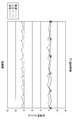
- FIG. 7 is a graph showing an example of normal vibration detection data (detected by an acceleration sensor) when the terminal device is carried in a pocket.
- FIG. 8 is a graph showing an example of normal vibration detection data (detected by an acceleration sensor) when the terminal device is carried by hand.
- FIG. 9 is a graph showing an example of shaking detection data (detected by an acceleration sensor) at the time of congestion.
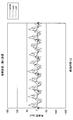
- FIG. 10 is a graph showing an example of normal vibration detection data (detected by a gyro sensor) when the terminal device is installed on the waist.
- FIG. 7 is a graph showing an example of normal vibration detection data (detected by an acceleration sensor) when the terminal device is carried in a pocket.
- FIG. 8 is a graph showing an example of normal vibration detection data (detected by an acceleration sensor) when the terminal device is carried by hand.
- FIG. 9 is a graph showing an example of shaking detection data (detected by an acceleration sensor) at the time of congestion.
- FIG. 10 is a graph
- FIG. 11 is a graph showing an example of normal shake detection data (detected by a gyro sensor) when the terminal device is carried in a pocket.
- FIG. 12 is a graph showing an example of normal shake detection data (detected by a gyro sensor) when the terminal device is carried by hand.
- the congestion determination unit 107 determines the congestion based on the amplitude and pitch values of the vertical shake detection data. .
- the congestion determination unit 107 performs the congestion determination using the pitch without using the amplitude of the vibration detection data when performing the congestion determination based on the vibration detection data detected using the gyro sensor. Is desirable.
- the congestion determination unit 107 preferably determines the congestion based on the pitch value of the shake detection data indicating the yaw angle.
- the shake detection data used for the congestion determination may be detected by an atmospheric pressure sensor.
- the resolution and sampling period of the current barometric pressure sensor are not yet sufficient for measuring the walking pitch.
- the shake detection data detected by the barometric sensor can be used for the congestion determination.
- a band for example, 1.5 to 3.5 Hz
- atmospheric pressure fluctuates greatly just by passing a car or opening and closing windows. For this reason, it is important to remove such noise components.
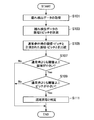
- FIG. 13 is a flowchart illustrating an example of a congestion determination process according to an embodiment of the present disclosure.
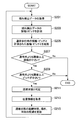
- FIG. 14 is a flowchart illustrating another example of the congestion determination process according to the embodiment.
- FIG. 15 is a flowchart illustrating an operation of the terminal device according to the first embodiment of the present disclosure.
- the shake detecting unit 101 acquires shake detection data (S101). Then, the shake detection unit 101 supplies the acquired shake detection data to the measurement unit 103.
- the measuring unit 103 measures the amplitude and pitch of the supplied shake detection data (S103).
- the measurement unit 103 supplies the amplitude and pitch of the shake detection data obtained by measurement to the congestion determination unit 107.
- the congestion determination unit 107 compares the current amplitude and pitch values supplied from the measurement unit 103 with the amplitude and pitch values during normal walking acquired from the normal walking learning unit 105 (S105).
- the congestion determination unit 107 determines whether the value supplied from the measurement unit 103 has a smaller amplitude than the normal value by a threshold value or more (S107). When the amplitude is smaller than the threshold value than normal, the congestion determination unit 107 determines whether the value supplied from the measurement unit 103 is smaller in pitch than the threshold value than normal (S109). . Then, when it is determined that the pitch is smaller than the threshold than the normal time, the congestion determination unit 107 determines that the congestion state is present (S111).
- the congestion determination unit 107 determines the degree of congestion by determining whether or not it is in a congestion state using a threshold value, but the present technology is not limited to such an example.
- the normal pitch and amplitude may be compared with the current pitch and amplitude, and the degree of congestion may be determined stepwise or continuously according to the difference value.
- the congestion determination unit 107 stores the normal fluctuation as a two-dimensional distribution of amplitude and pitch (for example, average value and variance), and the probability depends on how far the current fluctuation is from the normal distribution.
- the degree of congestion may be determined.
- the shake detection unit 101 acquires shake detection data (S201). Then, the shake detection unit 101 supplies the acquired shake detection data to the measurement unit 103.
- the measuring unit 103 measures the amplitude and pitch of the supplied shake detection data (S203).
- the measurement unit 103 supplies the amplitude and pitch of the shake detection data obtained by measurement to the congestion determination unit 107.
- the congestion determination unit 107 compares the current amplitude and pitch values supplied from the measurement unit 103 with the amplitude and pitch values obtained during normal walking acquired from the normal walking learning unit 105 (S205).
- the congestion determination unit 107 determines whether or not the value supplied from the measurement unit 103 has a smaller amplitude than the normal value by a threshold value or more (S207). When the amplitude is smaller than the threshold value than normal, the congestion determination unit 107 determines whether the value supplied from the measurement unit 103 is smaller in pitch than the threshold value than normal (S209). . Then, when it is determined that the pitch is smaller than the threshold than the normal time, the congestion determination unit 107 determines that the congestion state is present (S211).
- the congestion determination unit 107 determines that the user of the terminal device 100a is in a congested state, the congestion determination unit 107 causes the position information acquisition unit 115 to acquire the current position information (S213). Then, the congestion determination unit 107 updates the record of the location and time determined to be in the congestion state (S215). At this time, the congestion determination unit 107 may measure and record the duration of the state determined as the congestion state.
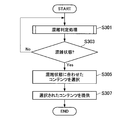
- the terminal device 100a may operate as in the flowchart shown in FIG. That is, the congestion determination process in step S301 may be the congestion determination process shown in FIG. 13 or the congestion determination process shown in FIG.
- the content providing unit 113 determines whether or not the determination result is a congestion state (S303).
- the content providing unit 113 selects the content according to the congested state (S305).
- the content providing unit 113 provides the selected content (S307).
- the content providing unit 113 may select content that reduces the user's stress.
- the content that reduces the user's stress may be music content or video content that is considered to be effective for stress relief by music tone analysis or video analysis.
- various algorithms for determining content attributes may be used for selecting content.
- the content providing unit 113 may provide content to the user by a push method when it is determined that the state is congested.
- the content providing unit 113 may change the frequency of providing content to the user by this push method according to the congestion state. The content providing unit 113 can provide content to the user more frequently than usual when the content providing unit 113 is congested.
- the content that matches the congestion state is selected only when the congestion state is determined, but the present technology is not limited to such an example. For example, even when it is determined that the state is not congested, the content may be selected according to the determination result.
- the terminal device 100a according to the first embodiment has been described above. According to such a configuration, based on the shake detection data acquired by the terminal device 100a owned by the user, the user's individual congestion state can be determined by comparing at least the walking pitch with that during normal walking. At this time, by detecting the walking pitch from the shake detection data, it is possible to detect that the user is walking and that the pace has decreased. For example, in the method of simply detecting that the speed has dropped, there is a possibility that it is erroneously determined that the vehicle is congested even when the speed is lowered while riding on a moving sidewalk or escalator. However, the terminal device 100a according to the present embodiment is not determined to be in a congested state when the vehicle is riding on a vehicle and the speed is decreasing, and can accurately determine that it is in a congested state when walking.
- the terminal device 100a performs the congestion determination based on the difference from the normal walking.
- the congestion is simply determined by a change in speed, an old man who is originally slow is always determined to be in a crowded state.
- the precision of congestion determination improves.
- the accuracy of the congestion determination is improved by using the amplitude of the shake detection data for the congestion determination.
- the stride is small for a tall person to go slowly. At this time, if the stride is reduced, the vertical movement of the body is reduced, so that the amplitude of the detected shake detection data is reduced. By using this change in stride for congestion determination, the accuracy of congestion determination is improved.
- this congestion determination it is possible to accurately determine the congestion during walking. For this reason, it is effective to use the congestion determination result for the timing of providing content to the user and the selection of the content to be provided. For example, during normal walking, even if the content providing unit 113 of the terminal device 100a makes a push notification, there is a high possibility that the user will not notice. However, when the user is congested, the user is moving at a low speed and proceeds in accordance with the surrounding movement, so that there is a very high possibility that the user can afford to look at the screen of the terminal device 100a. Therefore, when the push notification is performed in a crowded state, the user is more likely to be interested in the notified content than when the push notification is performed during normal walking.
- FIG. 16 is a configuration diagram of a congestion information generation system according to the second embodiment of the present disclosure.
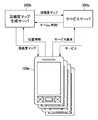
- the congestion information generation system 1 mainly includes a terminal device 100b, a congestion degree map generation server 200b, and a service server 300b.
- the congestion degree map generation server 200b and the service server 300b are separate servers, the present technology is not limited to such an example.
- the congestion degree map generation server 200b and the service server 300b may be configured as an integrated server.
- the terminal device 100b is an example of a congestion state determination device that determines the degree of congestion from shake detection data.
- the terminal device 100b acquires current position information and stores the position information in the congestion degree map generation server 200b. Upload.
- the terminal device 100b can acquire a congestion degree map from the congestion degree map generation server 200b. For example, a congestion degree map indicating the degree of congestion around the current position may be acquired based on the current position information. Further, the terminal device 100b may be able to acquire information by requesting the service server 300 to provide a service.
- the congestion level map generation server 200b has a function of generating a congestion level map by acquiring location information in a congested state from a plurality of terminal devices 100b.
- the congestion degree map may be obtained by superimposing the position of the terminal device 100b in the congestion state on the map.
- the congestion degree map generation server 200b may indicate the traveling direction of the terminal device 100b, that is, the direction of congestion on the congestion degree map.
- the service server 300b is a server that generates information to be provided to the user based on the congestion degree map. For example, the service server 300b can search and provide a route for the user to avoid congestion based on the congestion degree map. Alternatively, the service server 300b can predict and provide the terminal device 100b with the time until the congestion is eliminated based on the past congestion state duration.
- FIG. 17 is a functional configuration diagram of the terminal device according to the embodiment.
- the terminal device 100b includes a shake detection unit 101, a measurement unit 103, a normal walking learning unit 105, a congestion determination unit 107, a storage unit 109, a content provision unit 113, a position information acquisition unit 115, and a transmission / reception unit 117. And mainly.
- the terminal device 100b can acquire the congestion degree map from the congestion degree map generation server 200b via the transmission / reception unit 117.
- the congestion determination unit 107 may adjust a threshold used for the congestion determination based on the acquired information on the congestion degree map. For example, if it is found from the congestion degree map that the terminals around the terminal device 100b are determined to be in a congested state, the terminal device 100b is likely to be congested. For this reason, when the threshold value is not exceeded and the surroundings are in a congested state, it is desirable for the terminal device 100b to adjust the threshold value so as to be determined as a congested state at that time.
- the content providing unit 113 can provide the user with content acquired from an external server via the transmission / reception unit 117. For example, the content providing unit 113 may provide the user with the content acquired from the service server 300b.
- the congestion determination unit 107 can transmit the current position information to the congestion degree map generation server 200 via the transmission / reception unit 117 when it is determined that the congestion state is present.
- the current position information can include the direction of congestion calculated from the traveling direction of the user.
- the congestion determination unit 107 may transmit information for identifying the terminal device 100b to the congestion degree map generation server 200.
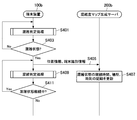
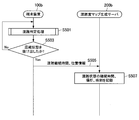
- FIG. 18 is a sequence diagram illustrating an example of the operation of the congestion information generation system according to the embodiment.
- FIG. 19 is a sequence diagram illustrating another example of the operation of the congestion information generation system according to the embodiment.
- the operation example in FIG. 18 and the operation example in FIG. 19 are different in the timing at which the terminal device 100b transmits information related to the congestion state to the congestion degree map generation server 200b.
- the terminal device 100b executes a congestion determination process (S401). Then, the congestion determination unit 107 determines whether or not it is determined that it is in a congestion state (S403). Information for identifying the device 100b is transmitted (S405).
- the congestion degree map generation server 200b that has received the current position information and the terminal identification information of the terminal device 100b updates the record of the congestion state duration, location, and time for the terminal device 100b (S407). .
- the terminal device 100b executes the congestion determination process again (S409). Then, the congestion determination unit 107 determines whether the congestion state is continuing (S411). When the congestion state is continuing, the congestion determination unit 107 transmits the current position information and information for identifying the terminal device 100b to the congestion degree map generation server 200b again. The processing from step S405 to step S411 is repeated until the terminal device 100b comes out of the congested state.
- the congestion determination process in steps S401 and S409 may be, for example, the congestion determination process shown in FIG.
- the congestion determination process in step S401 and step S409 may be the congestion determination process shown in FIG.
- the congestion information generation system may operate as shown in FIG.
- the terminal device 100b first executes a congestion determination process (S501).
- the congestion determination process in step S501 may be, for example, the congestion determination process shown in FIG.
- the congestion determination process in step S501 may be the congestion determination process shown in FIG.
- the congestion determination unit 107 determines whether or not the terminal device 100b has exited the congestion state (S503). Then, when the terminal device 100b exits the congestion state, the congestion determination unit 107 acquires the congestion state duration and the current position information, and transmits the acquired congestion state map generation server 200b (S505). The congestion level map generation server 200b records the duration, place, and time of the congestion state (S507).
- the congestion information generation system has been described above.
- the terminal device 100b can transmit information indicating that it is in a congestion state to the congestion degree map generation server 200b.
- the congestion degree map is used to adjust a threshold value used for congestion determination. Thereby, the accuracy of congestion determination improves.
- An example of the congestion degree map provided here and the service provided by the service server are common to the third embodiment described below, and will be described later as an application example.
- FIG. 20 is a configuration diagram of a congestion information generation system according to the third embodiment of the present disclosure.
- the congestion information generation system mainly includes a terminal device 100c, a congestion degree map generation server 200c, and a service server 300c.
- the terminal device 100 executes the congestion determination process.
- the shake detection data acquired by the terminal device 100c is transmitted to the congestion degree map generation server 200c, and the congestion determination process is performed in the congestion degree map generation server 200c.
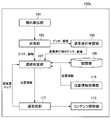
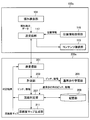
- FIG. 21 is a functional configuration diagram of the congestion information generation system according to the embodiment.
- the terminal device 100c mainly includes a shake detection unit 101, a content providing unit 113, a position information acquisition unit 115, and a transmission / reception unit 117.
- the transmission / reception unit 117 transmits the shake detection data detected by the shake detection unit 101 to the congestion degree map generation server 200c.
- the congestion level map generation device 200c mainly includes a transmission / reception unit 201, a measurement unit 203, a normal walking learning unit 205, a congestion determination unit 207, a storage unit 209, and a congestion level map generation unit 211.
- the measurement unit 203 has the same function as the measurement unit 103.
- the normal walking learning unit 205 has the same function as the normal walking learning unit 205.
- the congestion determination unit 207 has the same function as the congestion determination unit 107.
- the storage unit 209 has the same function as the storage unit 109.
- the storage unit 209 may store information on the congestion state together with information for identifying the terminal device 100c.
- the information for identifying the terminal device 100c only needs to be able to identify that the information is about the same terminal device 100c, and may not be information specifying the terminal device 100c or its user. In consideration of the privacy of the user, it may be preferable that the terminal device 100c or the information cannot identify the user.
- FIG. 22 is a sequence diagram showing an example of the operation of the congestion information generation system according to the embodiment.
- the shake detection unit 101 of the terminal device 100c acquires shake detection data (S601). Then, the position information acquisition unit 115 acquires the current position information of the terminal device 100c (S603). The terminal device 100c transmits the acquired shake detection data and position information to the congestion degree map generation server 200c via the transmission / reception unit 117 (S605). The congestion degree map generation server 200c that has received the shake detection data and the position information executes congestion determination and recording processing (S607). Note that the congestion determination and recording process in step S607 may be, for example, the process illustrated in FIG.
- the congestion determination process is executed on the server side. For this reason, there exists an effect that the processing load of the terminal device 100c becomes light. That is, the congestion determination process can be performed also for the terminal device 100c having a low processing capability.
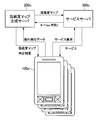
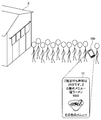
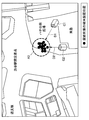
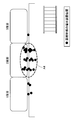
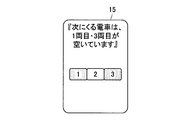
- FIGS. 23 to 28 are explanatory diagrams illustrating an example of congestion information provided by the congestion information generation system according to the second and third embodiments of the present disclosure.
- the congestion degree map generation server 200 may provide the congestion degree map shown in FIG. Here, it can be seen that congestion occurs in the vicinity of area A1 and area A2.
- the service server 300 may search for a route for avoiding the area A1 and the area A2 that are further congested in addition to the congestion degree map and provide the route to the user of the terminal device 100.
- the service server 300 may provide information on the estimated waiting time to the terminal devices 100 of the users who are lined up in a queue formed in the store S. For example, the service server 300 may estimate the waiting time from the information on the continuation time of the congestion state from the same position in the same time zone on the same day in the past, and provide it to the user. Further, the service server 300 may provide the user terminal device 100 with information on the store S at the end of the queue. For example, when the shop S is a restaurant, the service server 300 may provide menu information to the user. Alternatively, the service server 300 may provide recommended menu information to the user.
- this congestion information may be used to dispatch security guards to the area A3 where the terminal devices 100 determined to be in a crowded state are dense.
- the screen 13 shown in FIG. 26 by displaying a screen showing an area where the congested terminal devices 100 are crowded on the map on the display unit of the terminal device having the security guard, It can be properly placed where it is needed. For example, it can respond to sudden abnormal situations such as holding a guerrilla live.
- the service server 300 can specify the vehicle on which the user of each terminal device 100 gets in from the position of the terminal device 100 in a congested state. For example, the service server 300 may use this congestion information to guide a user to a vacant vehicle on the screen 15 shown in FIG.
- the congestion determination is performed based on the pitch and amplitude values of the shake detection data, but the present technology is not limited to such an example.
- the congestion determination may be performed based only on the pitch.
- the congestion determination may be performed based on the difference between the one-dimensional distribution of the pitch during normal walking calculated based on the past vibration detection data and the pitch acquired by the acquisition unit.
- the congestion determination may be performed based on a difference amount between the pitch acquired by the acquisition unit and the pitch during normal walking. For example, when the amplitude of the shake detection data is less dependent on how the terminal device 100 is held and the influence of the degree of congestion is easily reflected, it is desirable to determine the congestion using the amplitude value in addition to the pitch.
- the congestion map generation server that generates the congestion map executes the congestion determination process, but the present technology is not limited to such an example.
- a server separate from the congestion degree map generation server may execute the congestion determination process.
- the steps described in the flowcharts or sequence diagrams are not limited to the processes performed in chronological order in the described order, but are not necessarily processed in chronological order, either in parallel or individually. It also includes processing that is executed automatically. Further, it goes without saying that the order can be appropriately changed even in the steps processed in time series.
- this technique can also take the following structures.
- an acquisition unit for acquiring a walking pitch from the shake detection data A congestion determination unit that determines the degree of congestion based on the difference between the pitch acquired by the acquisition unit and the pitch during normal walking calculated based on past vibration detection data;
- An information processing apparatus comprising: (2) The information processing apparatus according to (1), wherein the congestion determination unit determines a congestion degree based on a difference between a pitch distribution during the normal walking and a pitch acquired by the acquisition unit. (3) The information processing apparatus according to (1), wherein the congestion determination unit determines a congestion degree based on a difference amount between the pitch acquired by the acquisition unit and the pitch during the normal walking.
- the acquisition unit further acquires the amplitude of the shake detection data
- the congestion determination unit determines the degree of congestion based on the difference between the amplitude acquired by the acquisition unit and the amplitude during normal walking calculated based on the past shake detection data.
- the congestion determination unit determines the degree of congestion based on a difference between the two-dimensional distribution of pitch and amplitude during normal walking and the pitch and amplitude acquired by the acquisition unit.
- the information processing apparatus described.
- the congestion determination unit includes a difference amount between the pitch acquired by the acquisition unit and the pitch during normal walking, and a difference amount between the amplitude acquired by the acquisition unit and the amplitude during normal walking, The information processing apparatus according to (4), wherein the degree of congestion is determined based on the information.
- the information processing apparatus according to any one of (1) to (6), wherein the acquisition unit acquires a walking pitch from vertical shake detection data.
- the congestion determination unit determines the congestion level using a threshold value adjusted based on a congestion level of surrounding users. .
- a selection unit that selects content based on the degree of congestion determined by the congestion determination unit; A content provider that provides the content selected by the selector;
- the information processing apparatus according to any one of (1) to (8), further including: (10) The information processing apparatus according to (9), wherein the selection unit changes the frequency of providing content to the user based on the degree of congestion determined by the congestion determination unit.
- the information processing apparatus (11) The information processing apparatus according to (10), wherein the selection unit increases a frequency of providing content to a user when the congestion determination unit determines that the state is congested. (12) When the congestion degree determination unit determines that the degree of congestion is high, the selection unit selects content that has an effect of reducing user stress, either (9) or (10) The information processing apparatus described in 1. (13) a position information acquisition unit that acquires current position information; Further comprising The information processing apparatus according to any one of (9) to (12), wherein the selection unit further selects content based on the current position information. (14) The information processing apparatus according to (13), wherein the selection unit selects content related to a store at the end of a queue where users are lined up based on the current position information.
- An acquisition unit for acquiring the position information of the user determined to be A congestion degree map generation unit that generates a congestion degree map in which the position information acquired by the acquisition unit is superimposed on a map;
- a congestion degree map generation device comprising: (16) obtaining a walking pitch from the shake detection data; Determining the degree of congestion based on the difference between the acquired pitch and the pitch during normal walking calculated based on past shake detection data; Including an information processing method.
- An acquisition unit for acquiring a walking pitch from the shake detection data A congestion determination unit that determines the degree of congestion based on the difference between the pitch acquired by the acquisition unit and the pitch during normal walking calculated based on past shake detection data; A program for causing an information processing apparatus to function.
- An acquisition unit for acquiring a walking pitch from the shake detection data A congestion determination unit that determines the degree of congestion based on the difference between the pitch acquired by the acquisition unit and the pitch during normal walking calculated based on past shake detection data;
- the computer-readable recording medium which recorded the program for functioning as an information processing apparatus provided with.
Landscapes
- General Physics & Mathematics (AREA)
- Physics & Mathematics (AREA)
- Engineering & Computer Science (AREA)
- Remote Sensing (AREA)
- Radar, Positioning & Navigation (AREA)
- Analytical Chemistry (AREA)
- Chemical & Material Sciences (AREA)
- Computer Networks & Wireless Communication (AREA)
- Signal Processing (AREA)
- Navigation (AREA)
- User Interface Of Digital Computer (AREA)
- Management, Administration, Business Operations System, And Electronic Commerce (AREA)
- Information Retrieval, Db Structures And Fs Structures Therefor (AREA)
- Telephone Function (AREA)
Priority Applications (2)
| Application Number | Priority Date | Filing Date | Title |
|---|---|---|---|
| CN201280014509.0A CN103649684B (zh) | 2011-03-31 | 2012-02-21 | 信息处理设备、拥挤度图生成设备、信息处理方法 |
| US14/006,000 US20140012539A1 (en) | 2011-03-31 | 2012-02-21 | Information processing apparatus, congestion degree map generating apparatus, information processing method, program, and recording medium |
Applications Claiming Priority (2)
| Application Number | Priority Date | Filing Date | Title |
|---|---|---|---|
| JP2011-078317 | 2011-03-31 | ||
| JP2011078317A JP5760601B2 (ja) | 2011-03-31 | 2011-03-31 | 情報処理装置、混雑度マップ生成装置、情報処理方法、プログラム、及び記録媒体 |
Publications (1)
| Publication Number | Publication Date |
|---|---|
| WO2012132642A1 true WO2012132642A1 (ja) | 2012-10-04 |
Family
ID=46930403
Family Applications (1)
| Application Number | Title | Priority Date | Filing Date |
|---|---|---|---|
| PCT/JP2012/054130 Ceased WO2012132642A1 (ja) | 2011-03-31 | 2012-02-21 | 情報処理装置、混雑度マップ生成装置、情報処理方法、プログラム、及び記録媒体 |
Country Status (4)
| Country | Link |
|---|---|
| US (1) | US20140012539A1 (enExample) |
| JP (1) | JP5760601B2 (enExample) |
| CN (1) | CN103649684B (enExample) |
| WO (1) | WO2012132642A1 (enExample) |
Families Citing this family (10)
| Publication number | Priority date | Publication date | Assignee | Title |
|---|---|---|---|---|
| JP6444582B2 (ja) * | 2013-03-19 | 2018-12-26 | カシオ計算機株式会社 | 情報表示制御装置、表示態様切替え処理プログラムおよび表示態様切替え処理システム |
| JP6064728B2 (ja) * | 2013-03-26 | 2017-01-25 | 東日本電信電話株式会社 | 情報提供システム、情報提供方法及びコンピュータプログラム |
| US10810530B2 (en) * | 2014-09-26 | 2020-10-20 | Hand Held Products, Inc. | System and method for workflow management |
| JP6532016B2 (ja) * | 2015-05-28 | 2019-06-19 | パナソニックIpマネジメント株式会社 | 混雑測定システムおよび混雑測定方法 |
| JP6674791B2 (ja) * | 2016-02-17 | 2020-04-01 | 株式会社Screenホールディングス | 混雑度推定方法、人数推定方法、混雑度推定プログラム、人数推定プログラム、および人数推定システム |
| US10691956B2 (en) * | 2017-05-12 | 2020-06-23 | Canon Kabushiki Kaisha | Information processing apparatus, information processing system, information processing method, and storage medium having determination areas corresponding to waiting line |
| JP7009250B2 (ja) * | 2017-05-12 | 2022-02-10 | キヤノン株式会社 | 情報処理装置、情報処理システム、情報処理方法及びプログラム |
| KR20200036811A (ko) | 2017-07-27 | 2020-04-07 | 소니 주식회사 | 정보 처리 시스템, 정보 처리 장치, 정보 처리 방법 및 기록 매체 |
| WO2021117185A1 (ja) * | 2019-12-12 | 2021-06-17 | 三菱電機株式会社 | 混雑度推定装置、混雑度推定方法及び混雑度推定プログラム |
| CN112183889B (zh) * | 2020-10-26 | 2023-06-06 | 中国联合网络通信集团有限公司 | 一种乘坐路线推荐方法及装置 |
Citations (3)
| Publication number | Priority date | Publication date | Assignee | Title |
|---|---|---|---|---|
| JP2002260162A (ja) * | 2001-03-02 | 2002-09-13 | Mitsubishi Heavy Ind Ltd | 交通情報提供システム |
| JP2003290175A (ja) * | 2002-03-29 | 2003-10-14 | Sony Corp | 体調検出装置およびプログラム |
| JP2008177684A (ja) * | 2007-01-16 | 2008-07-31 | Nec Corp | 混雑情報提供システム、移動体端末、サーバー、混雑情報提供方法およびプログラム |
Family Cites Families (3)
| Publication number | Priority date | Publication date | Assignee | Title |
|---|---|---|---|---|
| US8131500B2 (en) * | 2007-04-13 | 2012-03-06 | Seiko Instruments Inc. | Pedometer |
| CN101714293A (zh) * | 2009-12-16 | 2010-05-26 | 上海交通投资信息科技有限公司 | 基于立体视觉的公交客流拥挤度采集方法 |
| CN101950464B (zh) * | 2010-09-17 | 2012-10-17 | 中国科学院深圳先进技术研究院 | 跌倒监测与报警的方法和系统 |
-
2011
- 2011-03-31 JP JP2011078317A patent/JP5760601B2/ja active Active
-
2012
- 2012-02-21 CN CN201280014509.0A patent/CN103649684B/zh not_active Expired - Fee Related
- 2012-02-21 US US14/006,000 patent/US20140012539A1/en not_active Abandoned
- 2012-02-21 WO PCT/JP2012/054130 patent/WO2012132642A1/ja not_active Ceased
Patent Citations (3)
| Publication number | Priority date | Publication date | Assignee | Title |
|---|---|---|---|---|
| JP2002260162A (ja) * | 2001-03-02 | 2002-09-13 | Mitsubishi Heavy Ind Ltd | 交通情報提供システム |
| JP2003290175A (ja) * | 2002-03-29 | 2003-10-14 | Sony Corp | 体調検出装置およびプログラム |
| JP2008177684A (ja) * | 2007-01-16 | 2008-07-31 | Nec Corp | 混雑情報提供システム、移動体端末、サーバー、混雑情報提供方法およびプログラム |
Non-Patent Citations (1)
| Title |
|---|
| AKIFUMI GOTO: "Congestion Level Estimation for Pedestrians using Acceleration Sensor and Wireless LAN", PROCEEDINGS OF THE 2011 IEICE GENERAL CONFERENCE TSUSHIN 1, 28 February 2011 (2011-02-28), pages 593 * |
Also Published As
| Publication number | Publication date |
|---|---|
| CN103649684A (zh) | 2014-03-19 |
| CN103649684B (zh) | 2016-08-24 |
| US20140012539A1 (en) | 2014-01-09 |
| JP2012212365A (ja) | 2012-11-01 |
| JP5760601B2 (ja) | 2015-08-12 |
Similar Documents
| Publication | Publication Date | Title |
|---|---|---|
| JP5760601B2 (ja) | 情報処理装置、混雑度マップ生成装置、情報処理方法、プログラム、及び記録媒体 | |
| JP5779943B2 (ja) | 情報処理装置、情報処理方法、プログラム、及び記録媒体 | |
| US9851375B2 (en) | Detection of distribution based on position information | |
| JP5953677B2 (ja) | 情報処理装置、情報処理方法、プログラム、及び記録媒体 | |
| JP6674791B2 (ja) | 混雑度推定方法、人数推定方法、混雑度推定プログラム、人数推定プログラム、および人数推定システム | |
| JP5741115B2 (ja) | 測位装置、測位方法、プログラム、及び記録媒体 | |
| US20170083647A1 (en) | Venue-based real-time crowd modeling and forecasting | |
| JP5915803B2 (ja) | 情報処理装置、混雑度マップ生成装置、情報処理方法、プログラム、及び記録媒体 | |
| US9116002B2 (en) | Context determination to assist location determination accuracy | |
| JP5870817B2 (ja) | 情報処理装置、情報処理方法、及びプログラム | |
| AU2017328256A1 (en) | Method, system and software for navigation in global positioning system (GPS)-denied environments | |
| US20240405900A1 (en) | Waypoints for last known network connectivity | |
| TW201234323A (en) | Information processing apparatus, method, and non-transitory computer-readable medium | |
| EP3460504B1 (en) | Information processing device, information processing method and program | |
| JP6268951B2 (ja) | 移動情報処理方法、移動情報処理プログラム及び移動情報処理装置 | |
| WO2015025614A1 (ja) | 情報処理装置、情報処理方法および記録媒体 | |
| Ahn et al. | RescueMe: An indoor mobile augmented-reality evacuation system by personalized pedometry | |
| JP2012079035A (ja) | 情報処理装置、投稿情報評価システム、投稿情報評価方法、及びプログラム | |
| JP2013050308A (ja) | 情報処理装置、情報処理方法、プログラム、及び記録媒体 | |
| Ayub et al. | Sensor placement modes for smartphone based pedestrian dead reckoning | |
| KR20190065755A (ko) | 사용자 컨텍스트 기반 위치 트래킹 인터페이스 | |
| JP5920196B2 (ja) | 移動距離算出装置、位置管理装置、移動距離算出方法、及び位置管理方法 | |
| WO2024254196A1 (en) | Waypoints for last known network connectivity | |
| JP2013195195A (ja) | 磁気データ処理装置、磁気データ処理方法、プログラム、及び情報処理装置 |
Legal Events
| Date | Code | Title | Description |
|---|---|---|---|
| 121 | Ep: the epo has been informed by wipo that ep was designated in this application |
Ref document number: 12764973 Country of ref document: EP Kind code of ref document: A1 |
|
| WWE | Wipo information: entry into national phase |
Ref document number: 14006000 Country of ref document: US |
|
| NENP | Non-entry into the national phase |
Ref country code: DE |
|
| 122 | Ep: pct application non-entry in european phase |
Ref document number: 12764973 Country of ref document: EP Kind code of ref document: A1 |