WO2012128526A2 - 신규한 폴리아믹산, 감광성 수지 조성물, 드라이 필름 및 회로 기판 - Google Patents
신규한 폴리아믹산, 감광성 수지 조성물, 드라이 필름 및 회로 기판 Download PDFInfo
- Publication number
- WO2012128526A2 WO2012128526A2 PCT/KR2012/001963 KR2012001963W WO2012128526A2 WO 2012128526 A2 WO2012128526 A2 WO 2012128526A2 KR 2012001963 W KR2012001963 W KR 2012001963W WO 2012128526 A2 WO2012128526 A2 WO 2012128526A2
- Authority
- WO
- WIPO (PCT)
- Prior art keywords
- formula
- polyamic acid
- resin composition
- photosensitive resin
- group
- Prior art date
- Legal status (The legal status is an assumption and is not a legal conclusion. Google has not performed a legal analysis and makes no representation as to the accuracy of the status listed.)
- Ceased
Links
Classifications
-
- C—CHEMISTRY; METALLURGY
- C08—ORGANIC MACROMOLECULAR COMPOUNDS; THEIR PREPARATION OR CHEMICAL WORKING-UP; COMPOSITIONS BASED THEREON
- C08G—MACROMOLECULAR COMPOUNDS OBTAINED OTHERWISE THAN BY REACTIONS ONLY INVOLVING UNSATURATED CARBON-TO-CARBON BONDS
- C08G73/00—Macromolecular compounds obtained by reactions forming a linkage containing nitrogen with or without oxygen or carbon in the main chain of the macromolecule, not provided for in groups C08G12/00 - C08G71/00
- C08G73/06—Polycondensates having nitrogen-containing heterocyclic rings in the main chain of the macromolecule
- C08G73/10—Polyimides; Polyester-imides; Polyamide-imides; Polyamide acids or similar polyimide precursors
-
- H—ELECTRICITY
- H05—ELECTRIC TECHNIQUES NOT OTHERWISE PROVIDED FOR
- H05K—PRINTED CIRCUITS; CASINGS OR CONSTRUCTIONAL DETAILS OF ELECTRIC APPARATUS; MANUFACTURE OF ASSEMBLAGES OF ELECTRICAL COMPONENTS
- H05K3/00—Apparatus or processes for manufacturing printed circuits
- H05K3/0073—Masks not provided for in groups H05K3/02 - H05K3/46, e.g. for photomechanical production of patterned surfaces
- H05K3/0076—Masks not provided for in groups H05K3/02 - H05K3/46, e.g. for photomechanical production of patterned surfaces characterised by the composition of the mask
-
- C—CHEMISTRY; METALLURGY
- C08—ORGANIC MACROMOLECULAR COMPOUNDS; THEIR PREPARATION OR CHEMICAL WORKING-UP; COMPOSITIONS BASED THEREON
- C08G—MACROMOLECULAR COMPOUNDS OBTAINED OTHERWISE THAN BY REACTIONS ONLY INVOLVING UNSATURATED CARBON-TO-CARBON BONDS
- C08G73/00—Macromolecular compounds obtained by reactions forming a linkage containing nitrogen with or without oxygen or carbon in the main chain of the macromolecule, not provided for in groups C08G12/00 - C08G71/00
- C08G73/06—Polycondensates having nitrogen-containing heterocyclic rings in the main chain of the macromolecule
- C08G73/10—Polyimides; Polyester-imides; Polyamide-imides; Polyamide acids or similar polyimide precursors
- C08G73/1046—Polyimides containing oxygen in the form of ether bonds in the main chain
-
- C—CHEMISTRY; METALLURGY
- C08—ORGANIC MACROMOLECULAR COMPOUNDS; THEIR PREPARATION OR CHEMICAL WORKING-UP; COMPOSITIONS BASED THEREON
- C08G—MACROMOLECULAR COMPOUNDS OBTAINED OTHERWISE THAN BY REACTIONS ONLY INVOLVING UNSATURATED CARBON-TO-CARBON BONDS
- C08G73/00—Macromolecular compounds obtained by reactions forming a linkage containing nitrogen with or without oxygen or carbon in the main chain of the macromolecule, not provided for in groups C08G12/00 - C08G71/00
- C08G73/06—Polycondensates having nitrogen-containing heterocyclic rings in the main chain of the macromolecule
- C08G73/10—Polyimides; Polyester-imides; Polyamide-imides; Polyamide acids or similar polyimide precursors
- C08G73/1046—Polyimides containing oxygen in the form of ether bonds in the main chain
- C08G73/105—Polyimides containing oxygen in the form of ether bonds in the main chain with oxygen only in the diamino moiety
-
- C—CHEMISTRY; METALLURGY
- C08—ORGANIC MACROMOLECULAR COMPOUNDS; THEIR PREPARATION OR CHEMICAL WORKING-UP; COMPOSITIONS BASED THEREON
- C08J—WORKING-UP; GENERAL PROCESSES OF COMPOUNDING; AFTER-TREATMENT NOT COVERED BY SUBCLASSES C08B, C08C, C08F, C08G or C08H
- C08J5/00—Manufacture of articles or shaped materials containing macromolecular substances
- C08J5/18—Manufacture of films or sheets
-
- C—CHEMISTRY; METALLURGY
- C08—ORGANIC MACROMOLECULAR COMPOUNDS; THEIR PREPARATION OR CHEMICAL WORKING-UP; COMPOSITIONS BASED THEREON
- C08L—COMPOSITIONS OF MACROMOLECULAR COMPOUNDS
- C08L79/00—Compositions of macromolecular compounds obtained by reactions forming in the main chain of the macromolecule a linkage containing nitrogen with or without oxygen or carbon only, not provided for in groups C08L61/00 - C08L77/00
- C08L79/04—Polycondensates having nitrogen-containing heterocyclic rings in the main chain; Polyhydrazides; Polyamide acids or similar polyimide precursors
- C08L79/08—Polyimides; Polyester-imides; Polyamide-imides; Polyamide acids or similar polyimide precursors
-
- C—CHEMISTRY; METALLURGY
- C09—DYES; PAINTS; POLISHES; NATURAL RESINS; ADHESIVES; COMPOSITIONS NOT OTHERWISE PROVIDED FOR; APPLICATIONS OF MATERIALS NOT OTHERWISE PROVIDED FOR
- C09D—COATING COMPOSITIONS, e.g. PAINTS, VARNISHES OR LACQUERS; FILLING PASTES; CHEMICAL PAINT OR INK REMOVERS; INKS; CORRECTING FLUIDS; WOODSTAINS; PASTES OR SOLIDS FOR COLOURING OR PRINTING; USE OF MATERIALS THEREFOR
- C09D179/00—Coating compositions based on macromolecular compounds obtained by reactions forming in the main chain of the macromolecule a linkage containing nitrogen, with or without oxygen, or carbon only, not provided for in groups C09D161/00 - C09D177/00
- C09D179/04—Polycondensates having nitrogen-containing heterocyclic rings in the main chain; Polyhydrazides; Polyamide acids or similar polyimide precursors
- C09D179/08—Polyimides; Polyester-imides; Polyamide-imides; Polyamide acids or similar polyimide precursors
-
- G—PHYSICS
- G03—PHOTOGRAPHY; CINEMATOGRAPHY; ANALOGOUS TECHNIQUES USING WAVES OTHER THAN OPTICAL WAVES; ELECTROGRAPHY; HOLOGRAPHY
- G03F—PHOTOMECHANICAL PRODUCTION OF TEXTURED OR PATTERNED SURFACES, e.g. FOR PRINTING, FOR PROCESSING OF SEMICONDUCTOR DEVICES; MATERIALS THEREFOR; ORIGINALS THEREFOR; APPARATUS SPECIALLY ADAPTED THEREFOR
- G03F7/00—Photomechanical, e.g. photolithographic, production of textured or patterned surfaces, e.g. printing surfaces; Materials therefor, e.g. comprising photoresists; Apparatus specially adapted therefor
- G03F7/004—Photosensitive materials
- G03F7/027—Non-macromolecular photopolymerisable compounds having carbon-to-carbon double bonds, e.g. ethylenic compounds
- G03F7/028—Non-macromolecular photopolymerisable compounds having carbon-to-carbon double bonds, e.g. ethylenic compounds with photosensitivity-increasing substances, e.g. photoinitiators
-
- G—PHYSICS
- G03—PHOTOGRAPHY; CINEMATOGRAPHY; ANALOGOUS TECHNIQUES USING WAVES OTHER THAN OPTICAL WAVES; ELECTROGRAPHY; HOLOGRAPHY
- G03F—PHOTOMECHANICAL PRODUCTION OF TEXTURED OR PATTERNED SURFACES, e.g. FOR PRINTING, FOR PROCESSING OF SEMICONDUCTOR DEVICES; MATERIALS THEREFOR; ORIGINALS THEREFOR; APPARATUS SPECIALLY ADAPTED THEREFOR
- G03F7/00—Photomechanical, e.g. photolithographic, production of textured or patterned surfaces, e.g. printing surfaces; Materials therefor, e.g. comprising photoresists; Apparatus specially adapted therefor
- G03F7/004—Photosensitive materials
- G03F7/027—Non-macromolecular photopolymerisable compounds having carbon-to-carbon double bonds, e.g. ethylenic compounds
- G03F7/028—Non-macromolecular photopolymerisable compounds having carbon-to-carbon double bonds, e.g. ethylenic compounds with photosensitivity-increasing substances, e.g. photoinitiators
- G03F7/031—Organic compounds not covered by group G03F7/029
-
- G—PHYSICS
- G03—PHOTOGRAPHY; CINEMATOGRAPHY; ANALOGOUS TECHNIQUES USING WAVES OTHER THAN OPTICAL WAVES; ELECTROGRAPHY; HOLOGRAPHY
- G03F—PHOTOMECHANICAL PRODUCTION OF TEXTURED OR PATTERNED SURFACES, e.g. FOR PRINTING, FOR PROCESSING OF SEMICONDUCTOR DEVICES; MATERIALS THEREFOR; ORIGINALS THEREFOR; APPARATUS SPECIALLY ADAPTED THEREFOR
- G03F7/00—Photomechanical, e.g. photolithographic, production of textured or patterned surfaces, e.g. printing surfaces; Materials therefor, e.g. comprising photoresists; Apparatus specially adapted therefor
- G03F7/004—Photosensitive materials
- G03F7/027—Non-macromolecular photopolymerisable compounds having carbon-to-carbon double bonds, e.g. ethylenic compounds
- G03F7/032—Non-macromolecular photopolymerisable compounds having carbon-to-carbon double bonds, e.g. ethylenic compounds with binders
- G03F7/037—Non-macromolecular photopolymerisable compounds having carbon-to-carbon double bonds, e.g. ethylenic compounds with binders the binders being polyamides or polyimides
-
- H—ELECTRICITY
- H05—ELECTRIC TECHNIQUES NOT OTHERWISE PROVIDED FOR
- H05K—PRINTED CIRCUITS; CASINGS OR CONSTRUCTIONAL DETAILS OF ELECTRIC APPARATUS; MANUFACTURE OF ASSEMBLAGES OF ELECTRICAL COMPONENTS
- H05K1/00—Printed circuits
- H05K1/02—Details
- H05K1/03—Use of materials for the substrate
-
- H—ELECTRICITY
- H05—ELECTRIC TECHNIQUES NOT OTHERWISE PROVIDED FOR
- H05K—PRINTED CIRCUITS; CASINGS OR CONSTRUCTIONAL DETAILS OF ELECTRIC APPARATUS; MANUFACTURE OF ASSEMBLAGES OF ELECTRICAL COMPONENTS
- H05K3/00—Apparatus or processes for manufacturing printed circuits
- H05K3/22—Secondary treatment of printed circuits
- H05K3/28—Applying non-metallic protective coatings
- H05K3/285—Permanent coating compositions
- H05K3/287—Photosensitive compositions
Definitions
- Novel polyamic acid, photosensitive resin composition, dry film and circuit board Novel polyamic acid, photosensitive resin composition, dry film and circuit board
- the present invention relates to a novel polyamic acid, a photosensitive resin composition, a dry film and a circuit board. More specifically, it relates to a novel polyamic acid, a photosensitive resin composition containing the polyamic acid, a dry film obtained from the photosensitive resin composition, and a circuit board comprising the dry film.
- Polyimide and its precursors are actively used as a base film of a printed circuit board, a highly integrated semiconductor device or a cover film for a highly integrated multilayer wiring board based on excellent durability, heat resistance, flame retardancy, mechanical and electrical properties.
- the photolithography process improves the fineness of the circuit pattern and the positional accuracy, and also reduces the spring back phenomenon of the bent portion.
- Photosolder Resist is used.
- excellent durability, heat resistance, chemical resistance, plating resistance, mechanical and electrical properties, etc. are required.
- the photosensitive protective film for a circuit board is thermocompression-bonded a photosensitive resin composition in a liquid or film form on a circuit of CC Xopper Clad Laminate), and after UV exposure according to a pattern, developed with a developer, washed with water, dried and heat cured. Manufactured through the process, it is possible to precisely drill the fine holes required to connect the circuit to the desired position.
- a photosensitive protective film for a circuit board As such a photosensitive protective film for a circuit board, a photosensitive resin composition prepared by adding acrylate to an epoxy resin used in a conventional dry film is used. In this case, flame retardant properties and soldering heat resistance after curing are insufficient. This may cause discoloration of the resin during soldering or separation from the circuit. Lack of flexibility and flex resistance may require repeated grounding. It cannot be applied to a part, and it is limited to apply to the photosensitive protective film for circuit boards.
- the polyimide when used as a photosensitive resin, it is used in the form of polyamic acid, which is a precursor of polyimide, which is advantageous for molding. In this case, a high temperature of 35 CTC or more is required to polyimide the polyamic acid.
- the protective film is applied or bonded on the patterned copper circuit, and the process temperature is maintained at 200 ° C or less in consideration of the oxidation and deterioration of the copper circuit. Accordingly, the polyamic acid material that requires a high temperature curing process of 350 ° C or more has a certain limit in the PCB process application, a situation for reducing the temperature of the polyamic acid curing process is required, and to lower these curing temperatures Several methods are presented in the literature.
- polyamic acid which is a precursor of thermoplastic polyimide having a relatively low glass transition temperature (Tg)
- Tg glass transition temperature
- a soluble polyimide that is already imidized is used.
- the present invention is to provide a novel polyamic acid.
- the present invention is to provide a photosensitive resin composition capable of providing a photosensitive material that satisfies excellent flexibility and low stiffness characteristics and exhibits excellent heat resistance and plating resistance.
- this invention is providing the dry film obtained from the said photosensitive resin composition.
- the present invention is to provide a circuit board comprising the dry film.
- the present invention provides a polyamic acid comprising a repeating unit represented by the following Chemical Formula 1.
- 3 ⁇ 4 and 3 ⁇ 4 may be the same as or different from each other, each is a tetravalent organic group, and , 3 ⁇ 4 and R 4 may be the same as or different from each other, Each is a straight or branched chain alkylene group having 1 to 10 carbon atoms, wherein is a straight or branched chain alkyl group having 1 to 10 carbon atoms, x, y and z are each an integer of 1 or more, and n is an integer of 0 or more.
- the present invention is a polymer resin containing the polyamic acid; Crosslinking agent; Organic solvents; And it provides the photosensitive resin composition containing a photoinitiator. Moreover, this invention provides the dry film containing the hardened
- the present invention provides a circuit board including the dry film.
- a polyamic acid, a photosensitive resin composition, a dry film, and a circuit board according to specific embodiments of the present invention will be described in more detail.
- a polyamic acid including the repeating unit of Formula 1 may be provided.
- the present inventors newly synthesized a polyamic acid including the repeating unit of Chemical Formula 1 by reacting a specific polyfunctional aliphatic amine with tetracarboxylic acid dianhydride.
- a specific polyfunctional aliphatic amine with tetracarboxylic acid dianhydride.
- using the photosensitive resin composition to which the polyamic acid including the repeating unit of Formula 1 is applied satisfies excellent flexibility and low stiffness characteristics, and excellent heat resistance and plating resistance
- the photosensitive material which shows can be provided.
- 3 ⁇ 4 and R4 may be the same as or different from each other, each may be a linear or branched alkylene group having 1 to 10 carbon atoms, wherein is a linear or branched alkyl group having 1 to 10 carbon atoms
- X, y and z are each an integer of 1 or more
- n is an integer of 0 or more.
- X, y and z are each an integer of 1 or more
- n is an integer of 0 or more.
- n is an integer of 0 or more.
- X, y and z are each an integer of 1 or more
- n is an integer of 0 or more.
- X, y and z are each an integer of 1 or more
- n is an integer of 0 or more.
- an 'alkylene group' is selected from alkane.
- the novel polyamic acid may include a repeating unit of Formula 2 below.
- 3 ⁇ 4 and 3 ⁇ 4 may be the same as or different from each other, and each is a tetravalent organic group, and X, y and z are each 1 to 30, preferably 1 to 10, and more preferably 1 to 5 It may be an integer of.
- ⁇ is a single bond, -0-, -CO-, -S-, -S0 2- , -C (C3 ⁇ 4) 2- , -C (CF 3 ) 2- , -C0NH-, -C00 -, - (C3 ⁇ 4) nl - , -0 (CH 2) n2 0-, or - C00 (CH 2) n3 and 0C0-, wherein nl, n2 and n3 is an integer of 1 to 10, respectively.
- Y 2 and Y 3 may be the same as or different from each other, and each single bond, -0-, -CO-, -S-, -S0 2- , -C (C3 ⁇ 4) 2- , -C (CF 3) 2 -, -C0NH-, -C00-, - (C3 ⁇ 4) nl -, -0 (CH 2) n2 0-, or -C00 (CH 2) n3 and 0C0-, wherein nl, n2 and n3 are Each is an integer of 1 to 10.
- Y 4 , ⁇ 5 and ⁇ 6 may be the same as or different from each other, each of a single bond, —0-, -CO-, -S-, -S0 2- , -C (CH 3 ) 2- , -C (CF 3 ) 2- , — C0NH-,-
- the polyamic acid may further include a repeating unit of the formula (8) in addition to the repeating unit of the formula (1) or (2).
- 3 ⁇ 4 it is a tetravalent organic group, and R 7 is a 3 ⁇ 4 "may,” to each other the same or different are each a straight-chain or branched-chain alkylene group of a carbon number of 1 to 10, q is an integer of 1 or more.
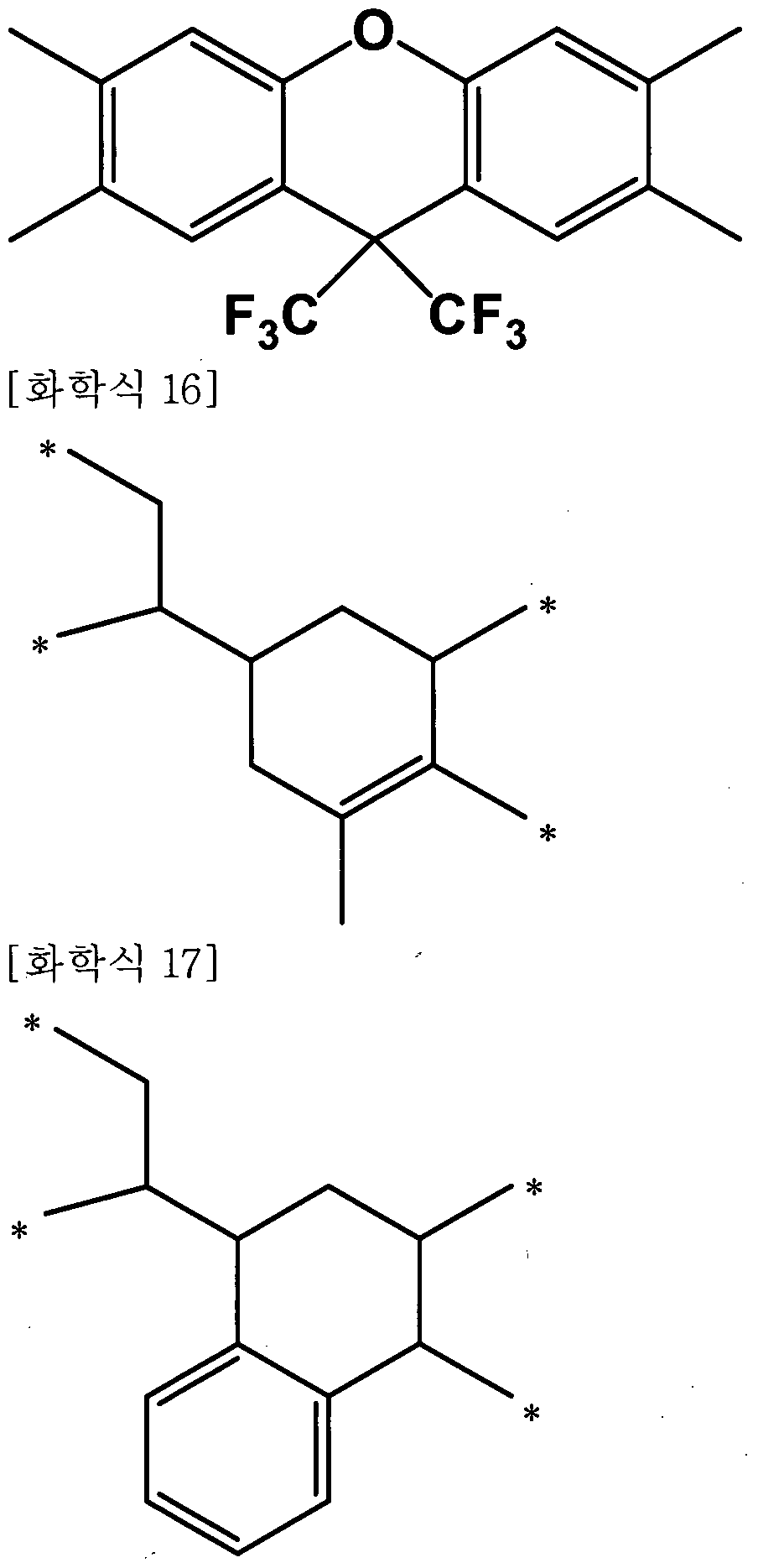
- the type of the tetravalent organic group that can be applied to 3 ⁇ 4 is not particularly limited, but it is preferable that one tetravalent organic group selected from the group consisting of Chemical Formulas 11 to 24 is applied to each of them independently.
- the polyamic acid further includes a repeating unit of Formula 8, that is, a repeating unit derived from alkylene oxide diamine
- compatibility with components such as a photocrosslinking agent may be further improved, and using the polyamic acid Flexibility and curl characteristics of the final product, such as a dry film to be produced can be improved.
- the polyamic acid may further include a repeating unit of a general polyamic acid, for example, a repeating unit of the following Formula 3, in addition to the repeating unit of Formula 1 or Formula 2 and the repeating unit of Formula 8.
- 3 ⁇ 4 is a tetravalent organic group
- X4 is a divalent organic group.
- the type of tetravalent organic group that can be applied to 3 ⁇ 4 is not particularly limited, but each tetravalent organic group independently selected from the group consisting of Formulas 11 to 24 is preferably applied.
- repeating Formula 3 The unit is preferably in terms of compatibility with the photocrosslinking agent having a structure or property that the glass transition temperature is 250 ° C. or less when the polyamic acid containing the polyimide.
- divalent organic group usable for X4 is not particularly limited, but it is preferable to use one divalent functional group independently selected from the group consisting of the following Chemical Formulas 30 to 47.
- c is an integer from 1 to 21
- R u , R 12, Ris and R 14 may be the same as or different from each other, an alkyl group having 1 to 5 carbon atoms or an aryl group having 6 to 10 carbon atoms, and R 15 and Ri 6 are each having 1 to 20 carbon atoms. It is a linear or branched alkylene group, m is an integer of 1 or more, n is an integer of 0 or more.
- Chemical Formula 48 is one of the functional groups represented by Chemical Formula 48-1.
- the polyamic acid is 0.1 to 30 mol of a repeating unit of Formula 1; And 2 to 50 mol% of the repeating unit of Formula 8 and 20 mol3 ⁇ 4> to 97.9 mol3 ⁇ 4> of the repeating unit of Formula 3.
- the polyamic acid is 0.3 to 20 mol% of the repeating unit of Formula 1; And 3 to 30 mol% of the repeating unit of Formula 8; And 50 mol of repeating unit of Formula 3 To 96.7 ⁇ ) 13 ⁇ 4.
- the content of the repeating unit of Formula 1 is too small, the crosslinking density of the photosensitive material obtained using the polyamic acid is too low to improve heat resistance, and when the content is too large, the molecular weight of the polyamic acid increases greatly. The increase in viscosity may occur rapidly, thereby reducing workability or physical properties, and degrading developability, flexibility, and stiffness characteristics.
- the polyamic acid may have a weight average molecular weight of 5, 000 to 200, 000, preferably a weight average molecular weight of 8,000 to 50,000. If the molecular weight of the polyamic acid is too small, if it is difficult to properly implement the role as the base resin of the photosensitive resin composition, if the molecular weight of the polyamic acid is too large, compatibility with other materials included in the photosensitive resin composition may be lowered. .
- polyamic acid containing a repeating unit of Formula 1 ⁇ may be prepared by applying a conventional organic synthesis method known in the art.
- the polyamic acid is a polyfunctional aliphatic amine compound represented by Formula 4 and optionally a diamine compound represented by Formula 5 in a solvent, and after adding tetracarboxylic acid dianhydride to the solution, reaction Can be prepared.
- R 2 , R 3 and 3 ⁇ 4 may be the same or different from each other And, each may be a linear or branched alkylene group of 1 to 10 carbon atoms, wherein R 5 may be a linear or branched alkyl group of 1 to 10 carbon atoms, wherein X, y and z are each an integer of 1 or more N is an integer of 0 or more.
- R3 and R4 are methylene group, ethylene group, n-propylene group, iso-propylene group, n-butylene group, isobutylene group, n-pentylene group, iso-pentylene group or neo, respectively. It may be a pentylene group, X, y and z may each be an integer of 1 to 30, more preferably 1 to 10, the n may be an integer of 0 to 10.
- X4 is a divalent organic group
- X4 is a divalent organic group
- specific examples are as described above.
- diamine compound of Formula 5 examples include p-PDA (p-phenylenediamine), m-PDA (m-phenylenediamine), 4,4'-0DA (4,4'-oxydianiline), 3, 4'-0DA (3,4'-oxydianiline), BAPP (2,2-bis (4- [4-aminophenoxy] -phenyl) propane), APB-
- TPE-Q (1,4-bis (4-aminophenoxy) benzene), and 1 ⁇ -8 ⁇ 3 (2,2-bis (4 ⁇ [3-aminophenoxy] phenyl) sulfone); It is not limited to these.
- tetracarboxylic acid dianhydride a compound represented by the following Chemical Formula 6 may be used.
- 3 ⁇ 4 is a tetravalent organic group
- 3 ⁇ 4 may be a tetravalent organic group
- the kind of usable tetravalent organic group is not particularly limited, but one selected from the group consisting of the following Chemical Formulas 11 to 24 Tetravalent organic groups It is preferable to apply. More details are as described above.
- tetracarboxylic dianhydride examples include pyromellitic dianhydride, 3,3 ', 4,4'-biphenyltetracarboxylic dianhydride,
- the diamine compound of Formula 9 is dissolved in a solvent together with the polyfunctional aliphatic amine compound of Formula 4 and optionally a diamine compound of Formula 5 , Tetracarboxylic acid dianhydride may be added to the solution, followed by reaction.
- R 7 may be the same as or different from each other, a linear or branched alkylene group having 1 to 10 carbon atoms, respectively, m is an integer of 1 or more.
- Examples of the diamine compound represented by Chemical Formula 9 include ethylene oxide diamine, propylene oxide diamine, ethylene oxide -propylene oxide diamine, and the like. Huntsman Corporation trade names D-230 and D-400. D-2000, D-4000, EDR-148, EDR-176, HK-511, ED-600, ED-900, ED-2003, etc. are mentioned. Polyfunctional aliphatic amine compound of Formula 4, Formula 5 or
- the reaction of the diamine compound of 9 and the tetracarboxylic dianhydride is preferably performed about 24 hours before starting reaction at 0 to 5 ° C and until the reaction is completed in the temperature range of 10 to 40 ° C. At this time, the sum of the polyfunctional aliphatic amine compound and the diamine compounds: tetracarboxylic acid
- the mixed molar ratio of dianhydride is preferably 1: 0.9 to 1: 1.1.
- the molecular weight of the polyamic acid to be produced may be out of an appropriate range and the mechanical properties of the resulting polyamic acid or polyimide may be lowered. have.
- NMP N-methylpyrrolidinone
- DMAc N, N-dimethylacetamide
- THF tetrahydrofuran
- DMF dimethylsulfoxide
- DMS0 dimethylsulfoxide
- cyclonucleic acid ((1 0 116 31), acetonitrile and one or more selected from the group consisting of a combination thereof
- a photosensitive resin composition comprising a polymer resin containing the novel polyamic acid, a photocrosslinking agent, an organic solvent, and a photopolymerization initiator.
- the present inventors when using the photosensitive resin composition to which the novel polyamic acid including the repeating unit of the formula (1) is applied, satisfies excellent flexibility and low stiffness characteristics, and excellent mechanical properties such as excellent heat resistance and plating resistance Experiments confirmed that it can provide a photosensitive material that can implement high developability and completed the invention.
- novel polyamic acid including the repeating unit of Formula 1 are as described above.
- specific details regarding the polyamic acid further including the repeating unit of Formula 3 or Formula 8 are also described above.
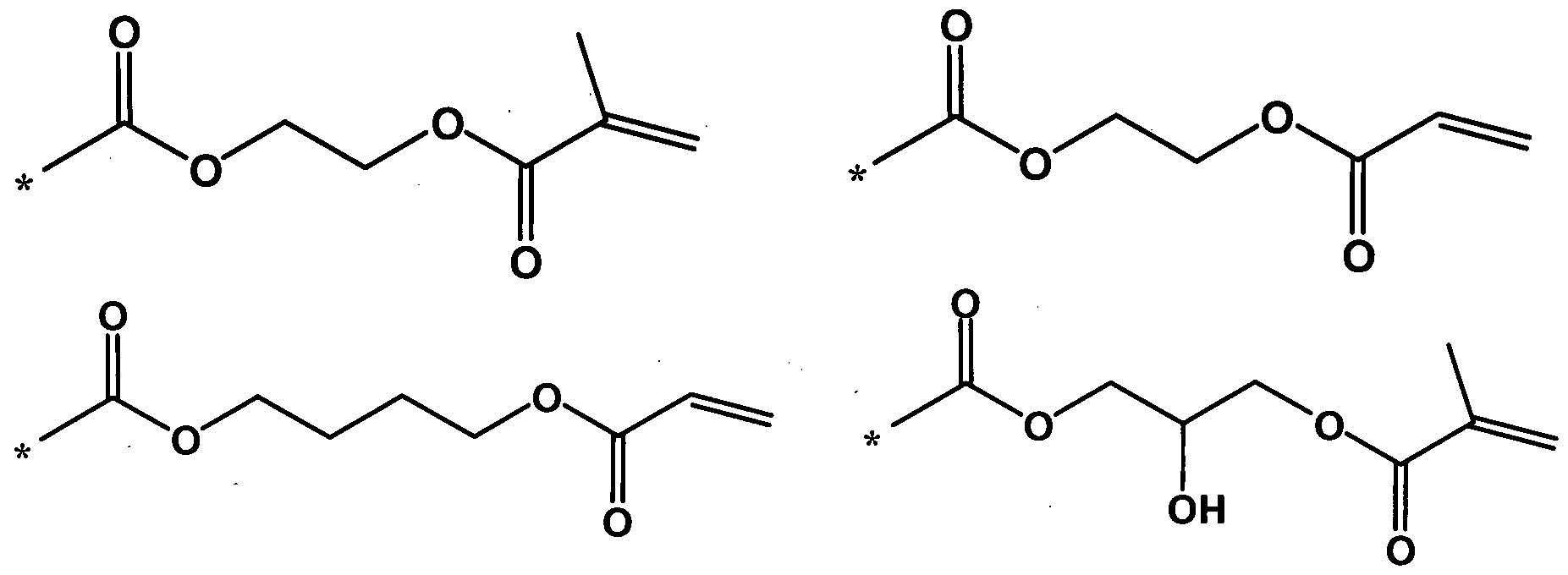
- the photocrosslinking agent may be used without any limitation as long as it is known to be commonly used in the photosensitive resin composition, but it is preferable to use a (meth) acrylate compound including a carbon-to-carbon double bond.
- (meth) acrylate is It means acrylate or methacrylate.
- the (meth) acrylate-based compound including the carbon-to-carbon double bond not only exhibits high compatibility with the polyamic acid, but also is included in the photosensitive resin composition to enable high developability and excellent photoresist for alkali solution.
- the photosensitive resin composition to which the (meth) acrylate-based compound including the carbon-to-carbon double bond is applied when processed into a dry film, modulus is lowered during heat processing and fluidity is imparted during thermal lamination, thereby filling the pattern with irregularities. It is possible to improve the properties, thereby enabling a thermal lamination process even at a relatively low temperature.
- optical crosslinking agent including a double bond between carbons
- Examples of the (meth) acrylate-based compound are not particularly limited, but for example, 2-ethylnuclear chamber (meth) acrylate, 2-hydroxyethyl (meth) acrylate, 2-hydroxypropyl (meth) acrylic Rate, phenoxyethyl acrylate, stearyl acrylate, lauryl acrylate, glycidyl (meth) acrylate, triethylene glycol diacrylate, 1,3-butanediol diacrylate, diethylene glycol diacrylate, Neopentylglycol diacrylate, 1,6-nucleic acid diol diacrylate, 3-methyl-1,5-pentanediol diacrylate, 2-butyl-2-ethyl-1, 3-propanediol acrylate, 1, 9-nonanediol diacrylate, 1,6-nucleic acid diol epoxy acrylate, pentaerythritol tri (meth) acrylate,
- Polyester acrylate, urethane acrylate, a pentaerythri tetra (meth) acrylate, etc. are mentioned, You may use these in mixture of 2 or more types.
- the photocrosslinking agent preferably includes a part of the compound represented by the following Chemical Formula 7.
- R1 is an aromatic having a benzene ring in the molecule
- R2 is an ethylene oxide or propylene oxide group
- R3 is a hydrogen or methyl group
- 0 and p are each an integer of 2 or more and o + p value is 50 It may be an integer below, preferably an integer below 30.
- Examples of the compound belonging to Chemical Formula 7 include bisphenols such as A—BPE-10, A-BPE 20, A-BPE-30, BPE-500, BPE-900, Shin-Nakamura Chemical Co.
- Specific examples of the compound include ethylene oxide modified bisphenol A di (meth) acrylate, propylene oxide modified bisphenol A di (meth) acrylate, ethylene oxide-propylene oxide modified bisphenol A di (meth) acrylate, and ethylene oxide.
- the photopolymerization initiator may include an acetophenone compound, a biimidazole compound, a triazine compound, an oxime compound, or a mixture thereof.
- photopolymerization initiator examples include 2-hydroxy-2-methyl-1-phenylpropane-1-one, 1- (4-isopropylphenyl) -2-hydroxy-2-methylpropane-1-one, 4 — (2—hydroxyethoxy) -phenyl- (2-hydroxy-2-propyl) ketone, 1-hydroxycyclohexylphenylketone, benzoinmethyl ether, benzoinethyl ether, benzoin isobutyl ether, benzo Inbutyl ether, 2, 2-dimethec-2--2-phenylacetophenone,.
- an organic solvent may be used for the purpose of dissolving a component of the photosensitive resin composition and imparting an appropriate level of viscosity to apply the composition.
- the organic solvent may be used without any limitation as long as it is known to be used in the photosensitive resin composition.
- ketones such as methyl ethyl ketone and cyclonucleanone
- Aromatic hydrocarbons such as toluene, xylene and tetramethylbenzene
- Ethylene glycol monoethyl ether ethylene glycol monomethyl ether, ethylene glycol monobutyl ether, diethylene glycol monoethyl ether, diethylene glycol monomethyl ether, diethylene glycol monobutyl ether, propylene glycol monomethyl ether, propylene glycol monoethyl ether , Dipropylene glycol diethyl ether
- Glycol ethers such as triethylene glycol monoethyl ether
- Acetate esters such as dipropylene glycol monomethyl ether acetate
- Alcohols such as ethanol, propanol, ethylene glycol, propylene glycol and carbyl
- Aliphatic hydrocarbons such as octane and decane
- Petroleum solvents such as petroleum ether, petroleum naphtha, hydrogenated petroleum naphtha and solvent naphtha
- Amides such as dimethyl acetamide (DMAc) and dimethylformamide (DMF), etc. are mentioned.
- the son solvent can be used alone or as a mixture of two or more thereof.
- Solid content concentration of the polymer resin containing the polyamic acid may be appropriately selected in consideration of the final product, for example, a dry film, such as molecular weight, viscosity, volatility, and the like of the polyamic acid including the repeating unit of Formula 1 have.
- the solid content concentration of the polymer resin including the polyamic acid may be 20 to 90% by weight based on the total weight of the photosensitive resin composition.
- the photosensitive resin composition 5 to 300 parts by weight of a crosslinking agent based on 100 parts by weight of the polymer resin composition; 100 to 700 parts by weight of the organic solvent; And it may include 0.3 to 10 parts by weight of the photopolymerization initiator.
- the cross-linking agent is included in too small content, the developing characteristics of the photosensitive resin may be lowered, and if it is included in an excessive amount, physical properties such as heat resistance or plating resistance may be lowered.
- the photocuring participation rate of the polymer resin including the crosslinking agent or the polyamic acid including the repeating unit of Formula 1 may be reduced. Unsuccessful radicals may lower the physical properties of the final product, for example dry film.
- the viscosity of the photosensitive resin composition may be excessively high, thereby decreasing the coating property, and the content may be too high.
- the drying of the photosensitive resin composition may not be easy, and mechanical properties of the film to be produced may be lowered.
- the photosensitive resin composition may further include a thermal crosslinking agent, a curing accelerator, a photocrosslinking sensitizer, a curing accelerator, a phosphorus-based flame retardant, an antifoaming agent, a leveling agent, a gel inhibitor, or a mixture thereof.
- a thermal crosslinking agent e.g., a thermal crosslinking agent, a curing accelerator, a photocrosslinking sensitizer, a curing accelerator, a phosphorus-based flame retardant, an antifoaming agent, a leveling agent, a gel inhibitor, or a mixture thereof.
- Such additives may be used without limitation as long as they are known to be used in the photosensitive resin composition, and may be used in an appropriate amount in consideration of physical properties of the photosensitive resin composition or the film obtained therefrom.
- a dry film including the cured product of the photosensitive resin composition may be provided.
- a photosensitive material that satisfies excellent flexibility and low stiffness characteristics and exhibits excellent heat resistance and plating resistance may be provided. Can be.
- the said dry film can be manufactured by apply
- the support include polyethylene terephthalate, polyethylene naphthalate, polypropylene, polyethylene, cellulose triacetate, cellulose diacetate, poly (meth) acrylic acid alkyl ester, poly (meth) acrylic acid ester copolymer, poly Polyvinyl chloride, polyvinyl alcohol, polycarbonate, polystyrene, cellophane, polyvinylidene chloride copolymer, polyamide, polyimide, vinyl chloride ⁇ vinyl acetate copolymer, polytetrafluoroethylene, and polytrifluoroethylene
- the plastic film of the is mentioned.
- the composite material which consists of these 2 or more types can also be used,
- the polyethylene terephthalate film excellent in the light transmittance is especially preferable.
- the thickness of the support is preferably 5 to 150 ⁇ , more preferably 10 to 50 GPa.
- the coating method of the said photosensitive resin composition is not specifically limited, For example, a spray method, a coating method, a rotary coating method, a slit coating method, an extrusion coating method, a curtain coating method, a die coating method, a wire bar coating method or a knife coating method can be used. Drying of the photosensitive resin composition is preferably carried out for 30 seconds to 15 minutes at 60 to 100 ° C, depending on each component or type of organic solvent, and content ratio.
- the film thickness of the dry film after drying and hardening is 5-95 urn, More preferably, it is 10-50. If the film thickness of the dry film is 5 urn or less, the insulation is not good, if it exceeds 95 zm, the resolution may be reduced.
- the dry film may be used for a protective film for a circuit board, a base film of a circuit board, an insulating layer of a circuit board, an interlayer insulating film of a semiconductor, or a solder resist. Meanwhile, according to another embodiment of the present invention, a circuit board including the dry film may be provided.
- the circuit board may include a multilayer printed wiring board, a fusible circuit board, or a flexible circuit board.
- the dry film may be used in a circuit board, and the dry film may be used as a protective film for a circuit board, a base film of a circuit board, an insulating layer of a circuit board, an interlayer insulating film or a solder resist of a semiconductor, and the like.
- the dry film included in the circuit board is meant to include a dry film or a workpiece of the dry film, for example, a workpiece or a light reflective material laminated on a predetermined substrate.
- the dry film is pre-laminated at a temperature of 20 to 50 ° C by a method such as plane pressing or pressing on a circuit forming surface, and then vacuum lamination at 60 to 90 ° C.
- a film can be formed.
- the dry film is capable of forming a pattern by exposing using a photomask to form a fine configuration or a fine width line.
- the exposure dose is appropriately determined according to the type of light source used for UV exposure and the thickness of the film film. It can be adjusted, for example 100 to 1200 m / cuf is preferred, 100 to 500 m / cin 2 is more preferred.
- the active rays examples include electron beams, ultraviolet rays, X-rays, and the like, and preferably ultraviolet rays.
- a light source a high pressure mercury lamp, a low pressure mercury lamp or a halogen lamp can be used as the light source.
- a spray method is generally used, and the photosensitive resin composition is developed using an aqueous alkali solution such as an aqueous sodium carbonate solution and washed with water. Then, when the polyamic acid is changed to polyimide according to the pattern obtained by the development through the heat treatment process, the heat treatment temperature may be 100 to 250 ° C required for imidization.
- the heating temperature is effective to continuously increase the temperature over 2 to 4 steps with an appropriate temperature profile, may be cured at a constant temperature in some cases.
- novel polyamic acid A photosensitive resin composition capable of providing a photosensitive material that satisfies excellent flexibility and low stiffness characteristics and exhibits excellent heat resistance and plating resistance; A dry film obtained from the photosensitive resin composition and a circuit board including the dry film may be provided.
- Nitrogen was flown into a four-necked back-floor flask equipped with a thermometer, stirrer, nitrogen inlet and powder dispensing funnel, 88.78 g of 1,3-bis (3-aminophenoxy) benzene (APB-N) and 31.55 g of alkylene oxide diamine (brand name JEFFAMINE D-400; Huntsman) and trifunctional polyetheramine (brand name JEFFAMINE T-403: Hunts) 455 g of N, N-dimethylformamide (DMF) was added to 4.77 g of the mixture, and the mixture was stirred to dissolve completely. 119.9 g of 4,4′-oxydiphthalic anhydride (0DPA) was slowly added while cooling the solution to 15 ° C. or lower, thereby obtaining a polyamic acid varnish having a solid content of 35%.
- DPA 4,4′-oxydiphthalic anhydride
- BPDA biphenyltetracarboxylic dianhydride
- DPA 4,4'-oxydiphthalic anhydride
- TPE-R 1,3-bis (4-aminophenoxy) benzene
- D-400 9.05g and D.2000 30.18g as alkylene oxide diamine, T-403 7.60 as trifunctional polyetheramine g was used.
- Polya was prepared in the same manner as in Preparation Example 4, except that 24.17 g of pyromellitic dianhydride (PMDA) and 80.27 g of 4,4'- oxydiphthalic anhydride (0DPA) were used as the dianhydride. Obtained a mixed acid varnish.
- PMDA pyromellitic dianhydride
- DPA 4,4'- oxydiphthalic anhydride
- the photosensitive resin composition was coated with a doctor blade on a PET film with 80, the coating was dried for 10 minutes in an oven at 80 ° C to prepare a dry film of 3 / m thickness.
- the coating was prepared in 3 ⁇ 4 tank for 10 minutes in an oven at 80 ° C to prepare a dry film of 38 m thick.
- the coating was dried in an oven at 80 ° C. for 10 minutes to prepare a dry film having a thickness of 38 mi.
- the photosensitive resin composition was coated with a doctor blade on a PET film, the coating was dried for 10 minutes in an obon of 80 ° C. to prepare a dry film having a thickness of 38.
- Example 1 Performance Evaluation of Dry Films According to Examples and Comparative Examples> The patterns of the dry films prepared in Examples 1 and 2 and Comparative Examples 1 and 2 were formed.
- the dry film of the comparative example made of a photosensitive resin composition containing a general polyamic acid, but may exhibit a certain level of developability, the lead heat resistance at high temperature was not sufficient.
- the polyfunctional (meth) acrylate is used in an excessive amount to increase the heat resistance of the bath, the stiffness value is high due to the high stiffness value (Comparative Example 2). It was confirmed that it was not suitable.
- the dry film of the comparative example exhibits a large change in the coefficient of thermal expansion at high temperature, and may result in the delamination of the dry film layer when applied to a field such as a printed wiring board or a circuit board.
- Example 2 Performance Evaluation of Dry Films According to Examples and Comparative Examples>
- the dry films prepared in Examples 3 to 5 and Comparative Examples 3 and 4 were placed on a copper foil surface of a patterned 2CCL product, and MVLP- Vacuum was applied at 70 ° C. for 20 seconds using a 500 vacuum laminator, and vacuum lamination was performed at a pressure of 0.7 Mpa for 40 seconds.
- UV irradiation at a light quantity of 300mJ / cm 2 spray development for 1 minute in an aqueous solution of sodium carbonate at lwt%, and cure for 90 minutes in an oven under a nitrogen atmosphere at 160 ° C., and then evaluate the physical properties as follows. The results are shown in Table 1 below.
- Experimental Example 2-1 Developability
Landscapes
- Chemical & Material Sciences (AREA)
- Engineering & Computer Science (AREA)
- Chemical Kinetics & Catalysis (AREA)
- Organic Chemistry (AREA)
- Physics & Mathematics (AREA)
- Medicinal Chemistry (AREA)
- Polymers & Plastics (AREA)
- Health & Medical Sciences (AREA)
- Manufacturing & Machinery (AREA)
- General Physics & Mathematics (AREA)
- Spectroscopy & Molecular Physics (AREA)
- Microelectronics & Electronic Packaging (AREA)
- Materials Engineering (AREA)
- Life Sciences & Earth Sciences (AREA)
- Wood Science & Technology (AREA)
- Macromolecular Compounds Obtained By Forming Nitrogen-Containing Linkages In General (AREA)
- Materials For Photolithography (AREA)
- Polymerisation Methods In General (AREA)
- Non-Metallic Protective Coatings For Printed Circuits (AREA)
Abstract
Description








Claims


Priority Applications (3)
| Application Number | Priority Date | Filing Date | Title |
|---|---|---|---|
| CN201280014215.8A CN103429639B (zh) | 2011-03-18 | 2012-03-19 | 聚酰胺酸、光敏树脂组合物、干燥膜及电路板 |
| US14/006,062 US9049778B2 (en) | 2011-03-18 | 2012-03-19 | Polyamic acid, photosensitive resin composition, dry film and circuit board |
| JP2014500991A JP5878621B2 (ja) | 2011-03-18 | 2012-03-19 | 新規なポリアミック酸、感光性樹脂組成物、ドライフィルムおよび回路基板 |
Applications Claiming Priority (4)
| Application Number | Priority Date | Filing Date | Title |
|---|---|---|---|
| KR10-2011-0024523 | 2011-03-18 | ||
| KR20110024523 | 2011-03-18 | ||
| KR20110038030 | 2011-04-22 | ||
| KR10-2011-0038030 | 2011-04-22 |
Publications (2)
| Publication Number | Publication Date |
|---|---|
| WO2012128526A2 true WO2012128526A2 (ko) | 2012-09-27 |
| WO2012128526A3 WO2012128526A3 (ko) | 2012-12-27 |
Family
ID=46879882
Family Applications (1)
| Application Number | Title | Priority Date | Filing Date |
|---|---|---|---|
| PCT/KR2012/001963 Ceased WO2012128526A2 (ko) | 2011-03-18 | 2012-03-19 | 신규한 폴리아믹산, 감광성 수지 조성물, 드라이 필름 및 회로 기판 |
Country Status (6)
| Country | Link |
|---|---|
| US (1) | US9049778B2 (ko) |
| JP (1) | JP5878621B2 (ko) |
| KR (1) | KR101238408B1 (ko) |
| CN (1) | CN103429639B (ko) |
| TW (1) | TWI464195B (ko) |
| WO (1) | WO2012128526A2 (ko) |
Families Citing this family (6)
| Publication number | Priority date | Publication date | Assignee | Title |
|---|---|---|---|---|
| US9040604B2 (en) * | 2012-12-13 | 2015-05-26 | Chung Shan Institute Of Science And Technology, Armaments Bureau, M. N. D | Multifunctional hyperbranched organic intercalating agent, method for its manufacture and its use |
| TWI462672B (zh) * | 2013-02-08 | 2014-11-21 | Ichia Tech Inc | 前驅基板、軟性印刷電路板及其製造方法 |
| EP3172762B1 (en) * | 2014-07-22 | 2021-04-21 | Brewer Science, Inc. | Temporary substrate bonding method using a polyimide release layer and substrate stack including said polyimide release layer |
| TWI704418B (zh) * | 2015-06-30 | 2020-09-11 | 日商富士軟片股份有限公司 | 負型感光性樹脂組成物、硬化膜、硬化膜的製造方法及半導體元件 |
| CN112071796B (zh) * | 2020-09-03 | 2023-06-02 | 深圳市华星光电半导体显示技术有限公司 | 柔性基板及其制作方法、柔性显示装置 |
| TWI789796B (zh) * | 2021-06-23 | 2023-01-11 | 律勝科技股份有限公司 | 聚合物及其應用 |
Family Cites Families (12)
| Publication number | Priority date | Publication date | Assignee | Title |
|---|---|---|---|---|
| US4892901A (en) | 1987-12-31 | 1990-01-09 | General Electric Company | Polyetherimide ester elastomer |
| US5411829A (en) | 1994-05-31 | 1995-05-02 | Xerox Corporation | Polyimide toner compositions |
| US5552254A (en) * | 1995-02-27 | 1996-09-03 | Xerox Corporation | Amic acid based toner compositions |
| US5512401A (en) * | 1995-02-27 | 1996-04-30 | Xerox Corporation | Polyimide-amic acid toner compositions |
| US7524617B2 (en) | 2004-11-23 | 2009-04-28 | E.I. Du Pont De Nemours And Company | Low-temperature curable photosensitive compositions |
| KR100963376B1 (ko) | 2007-02-09 | 2010-06-14 | 주식회사 엘지화학 | 폴리이미드 제조방법 및 이에 의하여 제조된 폴리이미드 |
| JP2008239802A (ja) | 2007-03-27 | 2008-10-09 | Hitachi Chem Co Ltd | 感光性接着剤組成物、及び、基板の接着方法 |
| JP2009048170A (ja) | 2007-07-24 | 2009-03-05 | Kaneka Corp | 感光性ドライフィルムレジスト、これを用いたプリント配線板、及び、プリント配線板の製造方法 |
| CN101675386B (zh) * | 2007-08-20 | 2013-03-06 | Lg化学株式会社 | 碱可显影的光敏树脂组合物及由其制备的干膜 |
| TWI445765B (zh) | 2009-06-09 | 2014-07-21 | Asahi Kasei E Materials Corp | A resin composition, a cured product, and a circuit substrate using the same |
| KR101010036B1 (ko) | 2009-08-28 | 2011-01-21 | 주식회사 엘지화학 | 신규한 폴리아믹산, 이를 포함하는 감광성 수지 조성물 및 이로부터 제조된 드라이 필름 |
| CN102317862B (zh) * | 2009-08-28 | 2013-08-14 | 株式会社Lg化学 | 可低温固化的光敏树脂组合物和用该组合物制备的干膜 |
-
2012
- 2012-03-19 US US14/006,062 patent/US9049778B2/en active Active
- 2012-03-19 CN CN201280014215.8A patent/CN103429639B/zh not_active Expired - Fee Related
- 2012-03-19 WO PCT/KR2012/001963 patent/WO2012128526A2/ko not_active Ceased
- 2012-03-19 JP JP2014500991A patent/JP5878621B2/ja not_active Expired - Fee Related
- 2012-03-19 TW TW101109448A patent/TWI464195B/zh not_active IP Right Cessation
- 2012-03-19 KR KR1020120027874A patent/KR101238408B1/ko not_active Expired - Fee Related
Also Published As
| Publication number | Publication date |
|---|---|
| KR20120106661A (ko) | 2012-09-26 |
| CN103429639A (zh) | 2013-12-04 |
| TWI464195B (zh) | 2014-12-11 |
| KR101238408B1 (ko) | 2013-02-28 |
| CN103429639B (zh) | 2015-08-19 |
| TW201300441A (zh) | 2013-01-01 |
| JP5878621B2 (ja) | 2016-03-08 |
| US9049778B2 (en) | 2015-06-02 |
| US20140011905A1 (en) | 2014-01-09 |
| WO2012128526A3 (ko) | 2012-12-27 |
| JP2014511909A (ja) | 2014-05-19 |
Similar Documents
| Publication | Publication Date | Title |
|---|---|---|
| KR101021947B1 (ko) | 저온 경화성 감광성 수지 조성물 및 이를 이용하여 제조된 드라이 필름 | |
| US20120012366A1 (en) | Polyamic acid, polyimide, photosensitive resin composition comprising the same, and dry film manufactured from the same | |
| JP5788096B2 (ja) | 新規なポリアミック酸、感光性樹脂組成物、ドライフィルムおよび回路基板 | |
| TWI861118B (zh) | 感光性樹脂組成物、及其硬化膜 | |
| KR101238408B1 (ko) | 신규한 폴리아믹산, 감광성 수지 조성물, 드라이 필름 및 회로 기판 | |
| KR20180131344A (ko) | 폴리이미드 전구체 조성물 및 그의 용도 | |
| JP4663720B2 (ja) | ポジ型感光性樹脂組成物およびパターン形成方法 | |
| KR101548702B1 (ko) | 신규한 폴리아믹산, 감광성 수지 조성물, 드라이 필름 및 회로 기판 | |
| JP2011202097A (ja) | 光導波路用樹脂組成物の製造方法 | |
| WO2013165211A1 (ko) | 신규한 폴리아믹산, 감광성 수지 조성물, 드라이 필름 및 회로 기판 | |
| JP2002241468A (ja) | 樹脂組成物、ソルダーレジスト樹脂組成物及びこれらの硬化物 |
Legal Events
| Date | Code | Title | Description |
|---|---|---|---|
| 121 | Ep: the epo has been informed by wipo that ep was designated in this application |
Ref document number: 12759900 Country of ref document: EP Kind code of ref document: A2 |
|
| ENP | Entry into the national phase |
Ref document number: 2014500991 Country of ref document: JP Kind code of ref document: A |
|
| NENP | Non-entry into the national phase |
Ref country code: DE |
|
| WWE | Wipo information: entry into national phase |
Ref document number: 14006062 Country of ref document: US |
|
| 122 | Ep: pct application non-entry in european phase |
Ref document number: 12759900 Country of ref document: EP Kind code of ref document: A2 |