WO2012117910A1 - 蓄電デバイス電極用スラリー、蓄電デバイス電極、および蓄電デバイス - Google Patents
蓄電デバイス電極用スラリー、蓄電デバイス電極、および蓄電デバイス Download PDFInfo
- Publication number
- WO2012117910A1 WO2012117910A1 PCT/JP2012/054242 JP2012054242W WO2012117910A1 WO 2012117910 A1 WO2012117910 A1 WO 2012117910A1 JP 2012054242 W JP2012054242 W JP 2012054242W WO 2012117910 A1 WO2012117910 A1 WO 2012117910A1
- Authority
- WO
- WIPO (PCT)
- Prior art keywords
- storage device
- slurry
- electricity storage
- mass
- electrode
- Prior art date
- Legal status (The legal status is an assumption and is not a legal conclusion. Google has not performed a legal analysis and makes no representation as to the accuracy of the status listed.)
- Ceased
Links
Classifications
-
- H—ELECTRICITY
- H01—ELECTRIC ELEMENTS
- H01M—PROCESSES OR MEANS, e.g. BATTERIES, FOR THE DIRECT CONVERSION OF CHEMICAL ENERGY INTO ELECTRICAL ENERGY
- H01M4/00—Electrodes
- H01M4/02—Electrodes composed of, or comprising, active material
- H01M4/62—Selection of inactive substances as ingredients for active masses, e.g. binders, fillers
- H01M4/621—Binders
- H01M4/622—Binders being polymers
-
- H—ELECTRICITY
- H01—ELECTRIC ELEMENTS
- H01M—PROCESSES OR MEANS, e.g. BATTERIES, FOR THE DIRECT CONVERSION OF CHEMICAL ENERGY INTO ELECTRICAL ENERGY
- H01M4/00—Electrodes
- H01M4/02—Electrodes composed of, or comprising, active material
- H01M4/62—Selection of inactive substances as ingredients for active masses, e.g. binders, fillers
-
- H—ELECTRICITY
- H01—ELECTRIC ELEMENTS
- H01G—CAPACITORS; CAPACITORS, RECTIFIERS, DETECTORS, SWITCHING DEVICES, LIGHT-SENSITIVE OR TEMPERATURE-SENSITIVE DEVICES OF THE ELECTROLYTIC TYPE
- H01G11/00—Hybrid capacitors, i.e. capacitors having different positive and negative electrodes; Electric double-layer [EDL] capacitors; Processes for the manufacture thereof or of parts thereof
- H01G11/22—Electrodes
-
- H—ELECTRICITY
- H01—ELECTRIC ELEMENTS
- H01G—CAPACITORS; CAPACITORS, RECTIFIERS, DETECTORS, SWITCHING DEVICES, LIGHT-SENSITIVE OR TEMPERATURE-SENSITIVE DEVICES OF THE ELECTROLYTIC TYPE
- H01G11/00—Hybrid capacitors, i.e. capacitors having different positive and negative electrodes; Electric double-layer [EDL] capacitors; Processes for the manufacture thereof or of parts thereof
- H01G11/22—Electrodes
- H01G11/30—Electrodes characterised by their material
-
- H—ELECTRICITY
- H01—ELECTRIC ELEMENTS
- H01G—CAPACITORS; CAPACITORS, RECTIFIERS, DETECTORS, SWITCHING DEVICES, LIGHT-SENSITIVE OR TEMPERATURE-SENSITIVE DEVICES OF THE ELECTROLYTIC TYPE
- H01G11/00—Hybrid capacitors, i.e. capacitors having different positive and negative electrodes; Electric double-layer [EDL] capacitors; Processes for the manufacture thereof or of parts thereof
- H01G11/22—Electrodes
- H01G11/30—Electrodes characterised by their material
- H01G11/46—Metal oxides
-
- H—ELECTRICITY
- H01—ELECTRIC ELEMENTS
- H01G—CAPACITORS; CAPACITORS, RECTIFIERS, DETECTORS, SWITCHING DEVICES, LIGHT-SENSITIVE OR TEMPERATURE-SENSITIVE DEVICES OF THE ELECTROLYTIC TYPE
- H01G11/00—Hybrid capacitors, i.e. capacitors having different positive and negative electrodes; Electric double-layer [EDL] capacitors; Processes for the manufacture thereof or of parts thereof
- H01G11/22—Electrodes
- H01G11/30—Electrodes characterised by their material
- H01G11/48—Conductive polymers
-
- H—ELECTRICITY
- H01—ELECTRIC ELEMENTS
- H01G—CAPACITORS; CAPACITORS, RECTIFIERS, DETECTORS, SWITCHING DEVICES, LIGHT-SENSITIVE OR TEMPERATURE-SENSITIVE DEVICES OF THE ELECTROLYTIC TYPE
- H01G11/00—Hybrid capacitors, i.e. capacitors having different positive and negative electrodes; Electric double-layer [EDL] capacitors; Processes for the manufacture thereof or of parts thereof
- H01G11/22—Electrodes
- H01G11/30—Electrodes characterised by their material
- H01G11/50—Electrodes characterised by their material specially adapted for lithium-ion capacitors, e.g. for lithium-doping or for intercalation
-
- H—ELECTRICITY
- H01—ELECTRIC ELEMENTS
- H01M—PROCESSES OR MEANS, e.g. BATTERIES, FOR THE DIRECT CONVERSION OF CHEMICAL ENERGY INTO ELECTRICAL ENERGY
- H01M4/00—Electrodes
- H01M4/02—Electrodes composed of, or comprising, active material
- H01M4/13—Electrodes for accumulators with non-aqueous electrolyte, e.g. for lithium-accumulators; Processes of manufacture thereof
-
- H—ELECTRICITY
- H01—ELECTRIC ELEMENTS
- H01M—PROCESSES OR MEANS, e.g. BATTERIES, FOR THE DIRECT CONVERSION OF CHEMICAL ENERGY INTO ELECTRICAL ENERGY
- H01M4/00—Electrodes
- H01M4/02—Electrodes composed of, or comprising, active material
- H01M4/13—Electrodes for accumulators with non-aqueous electrolyte, e.g. for lithium-accumulators; Processes of manufacture thereof
- H01M4/131—Electrodes based on mixed oxides or hydroxides, or on mixtures of oxides or hydroxides, e.g. LiCoOx
-
- H—ELECTRICITY
- H01—ELECTRIC ELEMENTS
- H01M—PROCESSES OR MEANS, e.g. BATTERIES, FOR THE DIRECT CONVERSION OF CHEMICAL ENERGY INTO ELECTRICAL ENERGY
- H01M4/00—Electrodes
- H01M4/02—Electrodes composed of, or comprising, active material
- H01M4/13—Electrodes for accumulators with non-aqueous electrolyte, e.g. for lithium-accumulators; Processes of manufacture thereof
- H01M4/139—Processes of manufacture
- H01M4/1391—Processes of manufacture of electrodes based on mixed oxides or hydroxides, or on mixtures of oxides or hydroxides, e.g. LiCoOx
-
- H—ELECTRICITY
- H01—ELECTRIC ELEMENTS
- H01M—PROCESSES OR MEANS, e.g. BATTERIES, FOR THE DIRECT CONVERSION OF CHEMICAL ENERGY INTO ELECTRICAL ENERGY
- H01M4/00—Electrodes
- H01M4/02—Electrodes composed of, or comprising, active material
- H01M4/36—Selection of substances as active materials, active masses, active liquids
- H01M4/48—Selection of substances as active materials, active masses, active liquids of inorganic oxides or hydroxides
- H01M4/52—Selection of substances as active materials, active masses, active liquids of inorganic oxides or hydroxides of nickel, cobalt or iron
- H01M4/525—Selection of substances as active materials, active masses, active liquids of inorganic oxides or hydroxides of nickel, cobalt or iron of mixed oxides or hydroxides containing iron, cobalt or nickel for inserting or intercalating light metals, e.g. LiNiO2, LiCoO2 or LiCoOxFy
-
- Y—GENERAL TAGGING OF NEW TECHNOLOGICAL DEVELOPMENTS; GENERAL TAGGING OF CROSS-SECTIONAL TECHNOLOGIES SPANNING OVER SEVERAL SECTIONS OF THE IPC; TECHNICAL SUBJECTS COVERED BY FORMER USPC CROSS-REFERENCE ART COLLECTIONS [XRACs] AND DIGESTS
- Y02—TECHNOLOGIES OR APPLICATIONS FOR MITIGATION OR ADAPTATION AGAINST CLIMATE CHANGE
- Y02E—REDUCTION OF GREENHOUSE GAS [GHG] EMISSIONS, RELATED TO ENERGY GENERATION, TRANSMISSION OR DISTRIBUTION
- Y02E60/00—Enabling technologies; Technologies with a potential or indirect contribution to GHG emissions mitigation
- Y02E60/10—Energy storage using batteries
Definitions
- the present invention relates to a slurry for an electricity storage device electrode, an electricity storage device electrode produced using the slurry, and an electricity storage device provided with the electricity storage device electrode.
- lithium ion batteries and lithium ion capacitors are expected as power storage devices having high voltage and high energy density.
- An electrode used in such an electricity storage device is composed of a binder composition in which polymer particles serving as a binder are dispersed or dissolved in a liquid medium, an electrode active material (hereinafter also simply referred to as “active material”), and as necessary.
- the electrode slurry is prepared by mixing a conductive agent such as conductive carbon, and the electrode slurry is applied to a current collector and dried.
- Such an electrode slurry often uses water as a dispersion medium from the viewpoint of manufacturing cost, process safety, and environmental load.
- a paste containing water as an active material, a conductive agent, a binder, and a dispersion medium is prepared, applied to a current collector, and then dried.
- a method for manufacturing a positive electrode plate is disclosed.
- a lithium-containing nickel composite oxide that is promising as an active material for improving the characteristics of an electricity storage device such as a lithium ion battery or a lithium ion capacitor is water as described in International Publication No. 1996/12764. It was unstable with respect to water and tended to be altered by mixing with water. For this reason, when an electrode slurry is produced using lithium-containing nickel composite oxide as an active material and water as a dispersion medium to produce an electricity storage device, the characteristics inherent to the lithium-containing nickel composite oxide may not be sufficiently exhibited. It was. Moreover, the eluate generated with the alteration of the lithium-containing nickel composite oxide may cause corrosion of the current collector.
- the present invention solve the above-described problems, and suppress deterioration of the lithium-containing nickel composite oxide in an electrode slurry using lithium-containing nickel composite oxide as an active material and water as a dispersion medium.
- the present invention provides a slurry for an electricity storage device electrode capable of producing an electricity storage device having a high battery capacity and excellent charge / discharge rate characteristics, or an electricity storage device electrode produced using the slurry.
- the present invention has been made to solve at least a part of the above-described problems, and can be realized as the following aspects or application examples.
- a slurry for an electricity storage device electrode for producing an electrode used for an electricity storage device comprising (A) polymer particles, (C) lithium-containing nickel composite oxide particles, and (D) water.
- the polymer constituting the polymer particles (A) has a repeating unit derived from an unsaturated carboxylic acid, and the total content of sodium and potassium is less than 0.02% by mass in 100% by mass of the electrode slurry. It is characterized by being.
- the power storage device electrode slurry of Application Example 1 may further contain (B) an onium salt.
- the onium salt (B) may be an organic acid onium salt.
- the organic acid onium salt may be an onium salt of a cellulose compound.
- the content ratio of the component (B) is 0.1 parts by mass or more and 10 parts by mass with respect to 100 parts by mass of the component (C).
- the content ratio of the component (A) is 0.1 parts by mass or more and 10 parts by mass with respect to 100 parts by mass of the component (C).
- the pH may be 8 or more and 10 or less.
- the (A) polymer particle is a repeating unit derived from a fluorine-containing ethylene monomer and a repeating derived from an unsaturated carboxylic ester. And a polymer particle further having a unit.
- the content ratio of the repeating unit derived from the fluorine-containing ethylene monomer may be 1 to 50 parts by mass in 100 parts by mass of the polymer particle (A). .
- One aspect of the electricity storage device electrode according to the present invention is: The active material layer formed using the slurry for electrical storage device electrodes of any one of the application examples 1 thru
- Application Example 11 One aspect of the electricity storage device according to the present invention is: The power storage device electrode according to Application Example 10 is provided.
- the slurry for an electricity storage device electrode according to the present invention since the alteration of the lithium-containing nickel composite oxide in the presence of water can be suppressed, an electricity storage device having a high battery capacity and excellent charge / discharge rate characteristics can be produced. it can.
- (meth) acrylic acid is a concept encompassing both “acrylic acid” and “methacrylic acid”.
- the storage device electrode slurry according to the present embodiment (hereinafter also simply referred to as “electrode slurry”) is (A) polymer particles (hereinafter simply referred to as “binder” or “(A) component”). (C) lithium-containing nickel composite oxide particles (hereinafter also simply referred to as “component (C)”), and (D) water (hereinafter also referred to simply as “(D) component”).
- the total content of sodium and potassium is less than 0.02% by mass in 100% by mass of the electrode slurry.
- the electrode slurry according to the present embodiment is used for producing an electrode used in a power storage device such as a lithium ion secondary battery or a lithium ion capacitor.
- an electrode in which component (C), which is an active material, is bound to a current collector through a binder can be produced by applying an electrode slurry to the surface of the current collector and drying it.
- the electrode slurry according to the present embodiment is an aqueous dispersion in which (A) polymer particles and (C) lithium-containing nickel composite oxide particles are dispersed in (D) water.
- the total content of sodium and potassium is less than 0.02% by mass, and 0.000005 to 0.018% by mass. It is preferably 0.0001 to 0.015% by mass, and most preferably 0.0007 to 0.006% by mass.
- Alkali metals such as sodium and potassium cannot be removed in the step of applying the electrode slurry to the current collector and drying it, and remain in the active material layer after application.
- the accumulation of inactive oxides that cannot gradually contribute to charge / discharge by reacting with the active material due to the gradual acceleration of the current collector's corrosion caused by repeated charge / discharge of the electricity storage device There are many problems such as promoting.
- the total content of sodium and potassium is within the above range, good charge / discharge characteristics can be exhibited.
- the component (C) tends to be altered in the electrode slurry, and the pH of the electrode slurry tends to increase.
- the corrosion of the current collector is promoted, and the electrical characteristics such as increase in the internal resistance value of the electricity storage device are remarkably deteriorated.
- the sodium content and the potassium content contained in the electrode slurry are determined by measuring the supernatant obtained by centrifuging the electrode slurry by ICP emission spectrometry (ICP-AES) or ICP mass spectrometry ( ICP-MS) is a value quantified.
- ICP emission analyzer for example, “ICPE-9000 (manufactured by Shimadzu Corporation)” or the like can be used.
- ICP mass spectrometer for example, “ICPM-8500 (manufactured by Shimadzu Corporation)”, “ELAN DRC PLUS (manufactured by Perkin Elmer)”, etc. can be used.
- content of sodium and potassium described in this specification is the mass% of sodium and potassium in 100 mass% of slurry for electrodes.
- the components contained in the electrode slurry according to the present embodiment will be described in detail.
- the electrode slurry according to the present embodiment contains (A) polymer particles.
- the polymer constituting the polymer particle (A) has a repeating unit derived from an unsaturated carboxylic acid, and at least a part of the repeating unit is preferably a carboxylic acid onium salt.
- the repeating unit derived from the unsaturated carboxylic acid is a carboxylic acid onium salt.
- elution of Ni ion etc. which arises with alteration of (C) component in the slurry for electrodes is controlled.
- the pH drop of the electrode slurry can be suppressed, and further, corrosion of the current collector is also suppressed, so that an active material layer having both better electrical properties and adhesion is formed on the surface of the current collector. can do.
- the repeating unit derived from the unsaturated carboxylic acid is an alkali metal salt
- the component (C) tends to be altered in the electrode slurry, and the pH of the electrode slurry tends to decrease.
- the corrosion of the current collector is promoted, and as a result, the electrical characteristics are significantly reduced.
- the alkali metal cannot be removed in the step of applying the electrode slurry to the current collector and drying it, and remains in the active material layer after application.
- the accumulation of inactive oxides that cannot gradually contribute to charge / discharge by reacting with the active material due to the gradual acceleration of the current collector's corrosion caused by repeated charge / discharge of the electricity storage device There are many problems such as promoting.
- the polymer particle obtained by methods such as emulsion polymerization, seeding emulsion polymerization, suspension polymerization, seeding suspension polymerization, and solution precipitation polymerization (henceforth " An aqueous dispersion of “untreated polymer particles”) can be used as it is.
- An aqueous solution such as ammonia or an organic amine compound (ethanolamine, diethylamine, etc.) may be added to the aqueous dispersion to form a salt.
- the alteration of the active material and the corrosion of the current collector can be effectively suppressed, and the storage characteristics can be further improved.
- all or a part of the ammonium salt may be decomposed and removed by controlling the drying temperature in the step of applying the electrode slurry to the current collector and drying it. it can.
- the electric characteristics of the active material layer after application can be fine-tuned according to the characteristics of the electricity storage device.
- a solution dispersion method in which the polymer is dissolved or swollen in a solvent, stirred and mixed in a medium incompatible with the solvent, and then desolvated is also possible.
- the polymer particles obtained by these methods may be subjected to chemical modification or physical modification such as electron beam irradiation.
- the polymerizable unsaturated monomer for obtaining said untreated polymer particle is not particularly limited.
- Specific examples of such monomers include methyl (meth) acrylate, ethyl (meth) acrylate, propyl (meth) acrylate, butyl (meth) acrylate, 2-ethylhexyl (meth) acrylate, (meth) Unsaturation such as 2-hydroxyethyl acrylate, ethoxyethyl (meth) acrylate, n-decyl (meth) methacrylate, isoamyl crotonic acid, n-hexyl crotonic acid, dimethylaminoethyl (meth) acrylate, monomethyl maleate, etc.
- Carboxylic acid esters Vinylidene fluoride, ethylene tetrafluoride, propylene hexafluoride, ethylene trifluoride chloride, perfluoroalkyl vinyl ether, tetrafluoroethyl (meth) acrylate, hexafluoroisopropyl (meth) acrylate, (meth) acrylic acid 3 [ Fluorine-containing ethylene monomers such as 4 [1-trifluoromethyl-2,2-bis [bis (trifluoromethyl) fluoromethyl] ethynyloxy] benzooxy] 2-hydroxypropyl; 1,3-butadiene, 1,3-pentadiene, 2,3-pentadiene, isoprene, 1,3-hexadiene, 2,3-dimethyl-1,3-butadiene, 2-ethyl-1,3-butadiene, 1, Conjugated diene compounds such as 3-heptadiene; Aromatic vinyl compounds such as
- (A) polymer particle is a polymer particle which has a repeating unit derived from the said fluorine-containing ethylene-type monomer, and a repeating unit derived from the said unsaturated carboxylic ester.
- the content of the repeating unit derived from the fluorine-containing ethylene monomer is preferably 1 to 50 parts by mass, more preferably 2 to 20 parts by mass in 100 parts by mass of the polymer particles (A). .
- the content of the repeating unit derived from the unsaturated carboxylic acid ester is preferably 50 to 90 parts by mass, more preferably 65 to 85 parts by mass in 100 parts by mass of the polymer particles (A). .
- the polymerizable unsaturated monomer for introducing the repeating unit derived from the unsaturated carboxylic acid into the untreated polymer particles is not particularly limited.
- Specific examples of such monomers include ethylenically unsaturated carboxylic acid compounds such as acrylic acid, methacrylic acid, crotonic acid, itaconic acid, maleic acid and maleic anhydride.
- acrylic acid, methacrylic acid and itaconic acid is preferable.
- These monomers can be used alone or in combination of two or more.
- the content of the repeating unit derived from the unsaturated carboxylic acid in the polymer particles (A) is preferably 0.1 to 15 parts by mass or less when the total repeating unit is 100 parts by mass, More preferably, it is 10 parts by mass.
- the content ratio of the repeating unit derived from the unsaturated carboxylic acid is within the above range, the above-described operational effects can be obtained more effectively. Further, an increase in slurry viscosity over time can be suppressed.
- the polymer particles are dispersed in a dispersion medium or an electrolytic solution. It is preferable because it is difficult to dissolve in the solution.
- crosslinkable monomers examples include divinyl compounds such as divinylbenzene; polyfunctional dimethacrylates such as diethylene glycol dimethacrylate and ethylene glycol dimethacrylate; polyfunctional trimethacrylates such as trimethylolpropane trimethacrylate; And polyfunctional diacrylates such as polyethylene glycol diacrylate and 1,3-butylene glycol diacrylate; and polyfunctional triacrylates such as trimethylolpropane triacrylate.
- the crosslinkable monomer is usually used in a proportion of 0.1 to 20% by mass, preferably 0.5 to 15% by mass, based on the entire polymerizable monomer.
- an unsaturated carboxylic acid such as a (meth) acrylic acid ester copolymer or a styrene- (meth) acrylic acid ester copolymer is used.
- the acid ester copolymer may be hydrolyzed.
- the content of the component (A) is preferably 0.1 parts by mass or more and 10 parts by mass or less, and 0.2 parts by mass or more and 5 parts by mass or less with respect to 100 parts by mass of the component (C) described later. It is more preferable, and it is especially preferable that they are 0.3 mass part or more and 4 mass parts or less.
- the content of the component (A) is in the above range, the alteration of the component (C) can be effectively suppressed, and the component (A) does not inhibit the movement of ions and electrons between the components (C). Therefore, an electricity storage device having favorable electricity storage characteristics can be manufactured.
- the electrode slurry according to the present embodiment can contain (B) an onium salt (hereinafter also simply referred to as “component (B)”).
- component (B) an onium salt
- the electrode slurry according to the present embodiment contains the component (B)
- the dispersibility of the component (C) described later becomes better, and an electrode having a uniform active material layer on the surface of the current collector is obtained. Can be produced.
- an electricity storage device having better electricity storage characteristics can be obtained. Further, in the electrode slurry, even when onium ions are exchanged with the component (A), the characteristics of the component (A) are not impaired.
- the onium salt is preferably a compound represented by the following general formula (1).
- Z ⁇ ⁇ [XR m ] + (1) (In the formula (1), X represents at least one atom selected from boron, nitrogen, aluminum, silicon, phosphorus and arsenic. A plurality of R's each independently represents a hydrogen atom or an alkyl group.
- Z represents a residue obtained by removing a hydrogen ion from an organic acid, and m represents an integer of 3 to 6.
- X represents at least one atom selected from boron, nitrogen, aluminum, silicon, phosphorus, and arsenic, and can be appropriately selected as necessary for the electricity storage device. From the viewpoint of the stability of charge and discharge of the electrode produced from the electrode slurry according to the embodiment, X is preferably a nitrogen atom.
- a plurality of Rs each independently represents a hydrogen atom or an alkyl group, and an optimum one for an electricity storage device can be selected as appropriate.
- R is a hydrogen atom from a viewpoint of the stability of charging / discharging of the electrode produced from the slurry for electrodes which concerns on this Embodiment.
- Z represents a residue obtained by removing hydrogen ions from an organic acid, and an element necessary for an electricity storage device can be appropriately selected.
- R is preferably a carboxylic acid residue (—COO ⁇ ).
- an onium ion ([NR m ] + , a plurality of Rs independently formed by reaction of an organic acid, ammonia, an organic amine compound (ethanolamine, diethylamine, etc.), etc. It is preferably an onium salt containing a hydrogen atom or an alkyl group, and more preferably an onium salt of the same kind as the carboxylic acid onium salt of the component (A).
- a salt produced by a reaction between an organic acid, ammonia, an organic amine compound (ethanolamine, diethylamine, etc.), etc. is also referred to as an “organic acid onium salt”.
- an organic acid onium salt is used as the component (B)
- the component derived from the organic acid onium salt can be easily decomposed and removed by heating the active material layer during electrode production.
- organic acid onium salts include ammonium salts of cellulose compounds (such as carboxyalkyl cellulose); ammonium salts of polycarboxylic acid compounds (such as poly (meth) acrylic acid and modified poly (meth) acrylic acid) A water-soluble polymer is mentioned.
- cellulose compounds such as carboxyalkyl cellulose
- ammonium salts of polycarboxylic acid compounds such as poly (meth) acrylic acid and modified poly (meth) acrylic acid
- a water-soluble polymer is mentioned.
- the drying temperature is controlled to control all or a part of the carboxymethyl cellulose.
- the ammonium salt can also be decomposed and removed.
- the electrical characteristics of the active material layer after coating can be strictly controlled according to the characteristics of the electricity storage device, which is preferable.
- the content of the component (B) is preferably 0.1 parts by mass or more and 10 parts by mass or less, and 0.2 parts by mass or more and 5 parts by mass or less with respect to 100 parts by mass of the component (C). More preferably, it is 0.3 to 4 parts by mass.
- the content of the component (B) is in the above range, the dispersibility of the component (C) in the electrode slurry is further improved, and a uniform active material layer is easily formed on the surface of the current collector.
- alkali metal salts and the like exist as neutralized salts of organic acids. Rather, alkali metal salts are more versatile.
- the component (C) is easily altered in the electrode slurry, and the pH of the electrode slurry tends to increase. As a result, the corrosion of the current collector is promoted, and as a result, the electrical characteristics are significantly reduced.
- the alkali metal cannot be removed in the step of applying the electrode slurry to the current collector and drying it, and remains in the active material layer after application. As a result, the accumulation of inactive oxides that cannot gradually contribute to charge / discharge by reacting with the active material due to the gradual acceleration of the current collector's corrosion caused by repeated charge / discharge of the electricity storage device There are many problems such as promoting.
- (C) Lithium-containing nickel composite oxide particles contains (C) lithium-containing nickel composite oxide particles.
- “oxide” is a concept that means a compound or salt composed of oxygen and an element having an electronegativity lower than that of oxygen. In addition to metal oxide, metal phosphate, nitrate, halogen It is a concept including oxo acid salts, sulfonic acid salts and the like.
- a component will not be specifically limited if it is an active material generally used for an electrical storage device.
- the electrode slurry according to the present embodiment can suppress deterioration of the component (C) in the electrode slurry by improving the stability of the component (C) with respect to water. Accordingly, even the component (C) that is highly reactive with water and easily changes in quality can be suitably used in the present embodiment.
- the complex metal oxide represented, for example by following General formula (2) is mentioned.
- M 1 is at least one metal atom selected from the group consisting of Co and Mn
- M 2 is at least one metal atom selected from the group consisting of Al and Sn
- O is an oxygen atom
- p, q1, q2 and r are numbers in the range of 0.10 ⁇ p ⁇ 0, 4.00 ⁇ q1 ⁇ 0.85, 4.00 ⁇ q2 ⁇ 0.85 and 2.00 ⁇ r ⁇ 0, respectively. It is. )
- LiNi 1/2 Co 1/5 Mn 3/10 O 2 is particularly preferably used for a high-capacity lithium ion secondary battery.
- the number average particle diameter (Db) of the active material is preferably in the range of 0.4 to 20 ⁇ m and more preferably in the range of 0.5 to 15 ⁇ m for the positive electrode.
- Db The number average particle diameter of the active material is within the above range, the diffusion distance of lithium in the active material is shortened, so that the resistance associated with lithium insertion / extraction during charging / discharging can be reduced, and as a result, Charge / discharge characteristics are further improved.
- the electrode slurry contains a conductivity-imparting agent described later, the contact area between the active material and the conductivity-imparting agent can be sufficiently ensured by having the number average particle diameter of the active material within the above range. Thus, the electron conductivity of the electrode is improved and the electrode resistance is further reduced.
- the number average particle diameter (Db) of the active material is the accumulation of the number of particles when the particle size distribution is measured using a particle size distribution measuring apparatus based on a laser diffraction method and the particles are accumulated from small particles. This is the value of the particle diameter (D50) at which the frequency is 50%.
- a laser diffraction particle size distribution measuring apparatus examples include HORIBA LA-300 series, HORIBA LA-920 series (above, manufactured by Horiba, Ltd.), and the like. This particle size distribution measuring apparatus does not only evaluate primary particles of the active material, but also evaluates secondary particles formed by aggregation of the primary particles.
- the number average particle diameter (Db) obtained by this particle size distribution measuring apparatus can be used as an indicator of the dispersion state of the active material contained in the electrode slurry.
- the average particle size (Db) of the active material is obtained by centrifuging the electrode slurry to settle the active material, then removing the supernatant and measuring the precipitated electrode active material by the above method. Can also be measured.
- the electrode slurry according to the present embodiment contains (D) water as a dispersion medium.
- a mixed medium of water and a dispersion medium other than water can be used according to the types of the component (A) and the component (C).
- the content of water is preferably 80% by mass or more, and more preferably 90% by mass or more in 100% by mass of the dispersion medium.
- a non-aqueous medium having a normal boiling point of 80 to 350 ° C. is preferable.
- non-aqueous media include N-methylpyrrolidone; hydrocarbons such as toluene, xylene, n-dodecane and tetralin; alcohols such as 2-ethyl-1-hexanol, 1-nonanol and lauryl alcohol; methyl ethyl ketone Ketones such as cyclohexanone, phorone, acetophenone and isophorone; esters such as benzyl acetate, isopentyl butyrate, methyl lactate, ethyl lactate and butyl lactate; amines such as o-toluidine, m-toluidine and p-toluidine; N, Examples include amides such as N-dimethylacetamide
- a conductivity-imparting agent can be added to the electrode slurry according to the present embodiment as necessary.
- the conductivity imparting agent include carbon such as graphite and activated carbon.
- Examples of carbon include acetylene black, furnace black, graphite, carbon fiber, and fullerenes. Of these, acetylene black and furnace black are preferable.
- the amount of the conductivity-imparting agent used is usually 1 to 20 parts by mass, preferably 2 to 10 parts by mass with respect to 100 parts by mass of the active material.
- the pH of the electrode slurry according to the present embodiment is preferably 8 or more and 10 or less, more preferably 8.5 or more and 9.5 or less.
- the pH is in the above range, the deterioration of the component (C) due to water can be effectively suppressed, and the dispersion stability of the slurry can be further improved.
- the electrode slurry according to the present embodiment is composed of the components (A), (C) and (D), and if necessary, the component (B) as a stirrer, defoamer, bead mill, high-pressure homogenizer, etc. It can produce by mixing using.
- the preparation of the electrode slurry is preferably performed under reduced pressure. Thereby, it can prevent that a bubble arises in the electrode layer obtained.
- a mixer capable of stirring to such an extent that no agglomerates of the active material remain in the slurry and, if necessary, sufficient dispersion conditions.
- the degree of dispersion can be measured with a particle gauge, but should be mixed and dispersed so that there are no aggregates larger than at least 100 ⁇ m.
- the mixer include a ball mill, a sand mill, a pigment disperser, a crusher, an ultrasonic disperser, a homogenizer, a planetary mixer, and a Hobart mixer.
- the electric storage device electrode according to the present embodiment (hereinafter, also simply referred to as “electrode”) is formed by applying the electrode slurry to the surface of a current collector such as a metal foil and drying the binder and An active material layer containing an active material and a conductivity-imparting agent added as necessary is bound. According to the electrode according to the present embodiment, since the active material layer formed from the above-described electrode slurry is formed on the surface of the current collector, an electricity storage device having a high battery capacity and excellent charge / discharge rate characteristics is manufactured. can do.
- the current collector include metal foil, etching metal foil, and expanded metal.
- Specific examples of the material constituting the current collector include metal materials such as aluminum, copper, nickel, tantalum, stainless steel, and titanium, which can be appropriately selected and used.
- the thickness of the current collector is preferably 5 to 50 ⁇ m, more preferably 10 to 30 ⁇ m.
- Electrode preparation methods Specific examples of means for applying electrode slurry to a current collector include a doctor blade method, a reverse roll method, a comma bar method, a gravure method, and an air knife method. Specific examples of the method for drying the electrode slurry coating film include drying with warm air, hot air, low-humidity air, vacuum drying, and drying by irradiation with (far) infrared rays or electron beams. The drying speed is usually adjusted so that the liquid medium can be removed as quickly as possible within a speed range in which the active material layer does not crack due to stress concentration or the active material layer does not peel from the current collector.
- the drying temperature is preferably 20 to 250 ° C, more preferably 50 to 150 ° C.
- the drying time is preferably 1 to 120 minutes, more preferably 5 to 60 minutes.
- the pressing means include a high pressure super press, a soft calender, a 1-ton press machine, and the like.
- the conditions for press working are appropriately set according to the processing machine to be used.
- the active material layer thus formed has a thickness of 40 to 100 ⁇ m and a density of 1.3 to 2.0 g / cm 3 .
- the electrode thus obtained can be suitably used as an electrode for a lithium ion secondary battery, an electric double layer capacitor, a lithium ion capacitor, or the like.
- the power storage device includes the above-described electrode, and further includes an electrolytic solution and is manufactured according to a conventional method using components such as a separator.
- a negative electrode and a positive electrode are overlapped via a separator, and this is wound into a battery container according to a battery shape, put into a battery container, an electrolyte is injected into the battery container, and sealing is performed.
- the method of doing is mentioned.
- the shape of the battery may be any of a coin shape, a button shape, a sheet shape, a cylindrical shape, a square shape, a flat shape, and the like.
- the electrolytic solution may be liquid or gel as long as it is used for a normal power storage device, and may be selected from those exhibiting a function as a battery according to the type of the negative electrode active material and the positive electrode active material.
- any conventionally known lithium salts can be used, LiClO 4, LiBF 4, LiI , LiPF 6, LiCF 3 SO 3, LiAsF 6, LiSbF 6, LiAlCl 4 , LiCl, LiBr, LiB (C 2 H 5 ) 4 , LiCH 3 SO 3 , LiC 4 F 9 SO 3 , Li (CF 3 SO 2 ) 2 N, and the like.
- the solvent for dissolving this electrolyte include carbonates such as propylene carbonate, ethylene carbonate, butylene carbonate, dimethyl carbonate, diethyl carbonate, and methyl ethyl carbonate; lactones such as ⁇ -butyrolactone; trimethoxysilane, 1 Ethers such as 1,2-dimethoxyethane, diethyl ether, 2-ethoxyethane, tetrahydrofuran and 2-methyltetrahydrofuran; sulfoxides such as dimethyl sulfoxide; oxolanes such as 1,3-dioxolane and 4-methyl-1,3-dioxolane Nitrogen-containing compounds such as acetonitrile and nitromethane; esters such as methyl formate, methyl acetate, butyl acetate, methyl propionate, ethyl propionate and phosphate triester; Glymes such as dimethyl, triglyme and
- ⁇ Second stage reaction> Into a 2 liter separable flask whose interior was sufficiently nitrogen-substituted, charged with 120 parts of water (aqueous medium) and 11 parts of a fluoropolymer latex obtained in the first stage reaction (in terms of solid content) Thorough nitrogen substitution was performed. On the other hand, in another container, 45 parts of water, ether sulfate type emulsifier (made by ADEKA Co., Ltd., trade name “ADEKA rear soap SR1025”) as an emulsifier is 0.9 parts in terms of solid content, 11 parts of ethyl acrylate, and 20 parts of acrylonitrile.
- ether sulfate type emulsifier made by ADEKA Co., Ltd., trade name “ADEKA rear soap SR1025”
- an aqueous dispersion of polymer particles B was obtained in the same manner as in the above synthesis method except that the reaction in the second stage was changed to 10 parts of acrylonitrile and 15 parts of methyl methacrylate.
- an aqueous dispersion of polymer particles C was obtained in the same manner as in the above synthesis method except that the reaction in the second step was changed to 0 part of acrylonitrile and 25 parts of methyl methacrylate.
- an aqueous dispersion of polymer particles D was obtained in the same manner as in the above synthesis method except that a sodium hydroxide aqueous solution was used in place of the ammonia aqueous solution in the second stage reaction.
- an aqueous dispersion of polymer particles E was obtained in the same manner as in the above synthesis method except that an aqueous potassium hydroxide solution was used instead of the aqueous ammonia solution in the second stage reaction.
- the polymer particles G were prepared in the same manner as in the above synthesis method except that 11 parts of hexafluoroisopropyl acrylate was used instead of 11 parts of ethyl acrylate. An aqueous dispersion was obtained.
- Example 1 A biaxial planetary mixer (product name “TK Hibismix 2P-03” manufactured by PRIMIX Co., Ltd.) and ammonium CMC (product number “DN-800H” manufactured by Daicel Chemical Industries, Ltd.) as component (B) (solid) Converted as a 4% by weight aqueous solution), LiC 1/3 Co 1/3 Mn 1/3 O 2 100 parts (solid content) as component (C), and 5 parts of acetylene black (solid content) as a conductivity-imparting agent Conversion), and the total amount of water was 25 parts, and the mixture was stirred at 60 rpm for 1 hour. Thereafter, 2 parts (in terms of solid content) of polymer particles A prepared in “4.1.
- (A) Synthesis of polymer particles” were added as component (A), and the mixture was further stirred for 1 hour to obtain a paste. After adding 10 parts of water to the obtained paste, using a stirring defoamer (product name “Awatori Nertaro” manufactured by Shinky Co., Ltd.) for 2 minutes at 200 rpm, then 5 minutes at 1,800 rpm, Furthermore, the slurry for electrodes which concerns on Example 1 was obtained by stirring and mixing for 1.5 minutes at 1,800 rpm on vacuum conditions.
- a stirring defoamer product name “Awatori Nertaro” manufactured by Shinky Co., Ltd.
- the supernatant was collected by centrifuging the electrode slurry thus obtained, and the contents of sodium and potassium were measured using ICP-MS (manufactured by Perkin Elmer, model number “ELAN DRC PLUS”). .
- ICP-MS manufactured by Perkin Elmer, model number “ELAN DRC PLUS”.
- the (B) onium salts shown in Tables 1 to 5 are trade names “CMC Daicel” manufactured by Daicel Chemical Industries, Ltd., and each product number has the following characteristics.
- DN-800H (carboxymethyl cellulose ammonium, 1% aqueous solution viscosity: 700 to 1000 mPa ⁇ s)
- DN-400H (carboxymethylcellulose ammonium, 1% aqueous solution viscosity: 400 to 600 mPa ⁇ s)
- DN-100L carbboxymethyl cellulose ammonium, 1% aqueous solution viscosity: 100 to 300 mPa ⁇ s
- DN-10L (carboxymethyl cellulose ammonium, 1% aqueous solution viscosity: 10 to 50 mPa ⁇ s)
- 1390 shown in Tables 3 and 5 is a trade name “CMC Daicel” manufactured by Daicel Chemical Industries, Ltd., and is a sodium salt having the following characteristics. 1390 (Carboxymethylcellulose sodium, 1% aqueous solution viscosity: 2500-4500 mPa ⁇ s)
- Examples 10 to 15 and Comparative Examples 6 to 9> The electrode slurry shown in Tables 4 to 5 prepared above was uniformly applied to the surface of the current collector made of aluminum foil by the doctor blade method so that the film thickness after drying was 110 ⁇ m. Dry for 20 minutes. Then, the lithium ion secondary battery positive electrode was obtained by pressing using a roll press machine so that the density of an electrode layer may be 3.4 g / cm ⁇ 3 >.
- the slurry for electrodes was prepared by stirring and mixing under 1,800 rpm for 1.5 minutes.
- the prepared electrode slurry was uniformly applied to the surface of a current collector made of copper foil by a doctor blade method so that the film thickness after drying was 150 ⁇ m, and dried at 120 ° C. for 20 minutes.
- the lithium ion secondary battery negative electrode was obtained by pressing using a roll-press machine so that the density of an electrode layer might be 1.8 g / cm ⁇ 3 >.
- 1C in the measurement condition indicates a current value at which discharge is completed in one hour after constant-current discharge of a cell having a certain electric capacity.
- 0.1 C is a current value at which discharge is completed over 10 hours
- 10 C is a current value at which discharge is completed over 0.1 hours.
- a graph was created with the applied current value (A) as the horizontal axis and the voltage value (V) as the vertical axis, and the slope value of the straight line connecting the plot points was calculated at each charge / discharge time.
- the gradient values were defined as internal DC resistance values (DC-IR) during charging and discharging, respectively.
- DOD indicates the ratio of the discharge capacity to the charge capacity. For example, “charging to DOD 50%” indicates charging with a capacity of 50% when the total capacity is 100%.
- lithium ion secondary batteries including electrodes prepared using the electrode slurries of Examples 1 to 15 were prepared using the electrode slurries of Comparative Examples 1 to 9. It is clear that it has better electrical properties than lithium ion secondary batteries with electrodes.
- the present invention includes substantially the same configuration (for example, a configuration having the same function, method, and result, or a configuration having the same purpose and effect) as the configuration described in the embodiment.
- the invention includes a configuration in which a non-essential part of the configuration described in the embodiment is replaced.
- the present invention includes a configuration that achieves the same effect as the configuration described in the embodiment or a configuration that can achieve the same object.
- the invention includes a configuration in which a known technique is added to the configuration described in the embodiment.
Landscapes
- Engineering & Computer Science (AREA)
- Chemical & Material Sciences (AREA)
- Power Engineering (AREA)
- Materials Engineering (AREA)
- Microelectronics & Electronic Packaging (AREA)
- Chemical Kinetics & Catalysis (AREA)
- Electrochemistry (AREA)
- General Chemical & Material Sciences (AREA)
- Manufacturing & Machinery (AREA)
- Battery Electrode And Active Subsutance (AREA)
- Electric Double-Layer Capacitors Or The Like (AREA)
Abstract
Description
本発明に係る蓄電デバイス電極用スラリーの一態様は、
蓄電デバイスに使用される電極を作製するための蓄電デバイス電極用スラリーであって、(A)重合体粒子と、(C)リチウム含有ニッケル複合酸化物粒子と、(D)水と、を含有し、前記(A)重合体粒子を構成する重合体が不飽和カルボン酸に由来する繰り返し単位を有し、前記電極用スラリー100質量%中、ナトリウムおよびカリウムの合計含有量が0.02質量%未満であることを特徴とする。
適用例1の蓄電デバイス電極用スラリーにおいて、(B)オニウム塩をさらに含有することができる。
適用例2の蓄電デバイス電極用スラリーにおいて、前記(B)オニウム塩が有機酸オニウム塩であることができる。
適用例3の蓄電デバイス電極用スラリーにおいて、前記有機酸オニウム塩がセルロース系化合物のオニウム塩であることができる。
適用例2ないし適用例4のいずれか一例の蓄電デバイス電極用スラリーにおいて、前記(B)成分の含有割合が、前記(C)成分100質量部に対して、0.1質量部以上10質量部以下であることができる。
適用例1ないし適用例5のいずれか一例の蓄電デバイス電極用スラリーにおいて、前記(A)成分の含有割合が、前記(C)成分100質量部に対して、0.1質量部以上10質量部以下であることができる。
適用例1ないし適用例6のいずれか一例の蓄電デバイス電極用スラリーにおいて、pHが8以上10以下であることができる。
適用例1ないし適用例7のいずれか一例の蓄電デバイス電極用スラリーにおいて、前記(A)重合体粒子が、含フッ素エチレン系単量体に由来する繰り返し単位と、不飽和カルボンエステルに由来する繰り返し単位と、をさらに有する重合体粒子であることができる。
適用例8の蓄電デバイス電極用スラリーにおいて、前記含フッ素エチレン系単量体に由来する繰り返し単位の含有割合が、前記(A)重合体粒子100質量部中1~50質量部であることができる。
本発明に係る蓄電デバイス電極の一態様は、
集電体の表面上に適用例1ないし適用例9のいずれか一例の蓄電デバイス電極用スラリーを用いて形成された活物質層を備えることを特徴とする。
本発明に係る蓄電デバイスの一態様は、
適用例10の蓄電デバイス電極を備えることを特徴とする。
本実施の形態に係る蓄電デバイス電極用スラリー(以下、単に「電極用スラリー」ともいう)は、(A)重合体粒子(以下、単に「バインダー」または「(A)成分」ともいう)と、(C)リチウム含有ニッケル複合酸化物粒子(以下、単に「(C)成分」ともいう)と、(D)水(以下、単に「(D)成分」ともいう)と、を含有し、前記電極用スラリー100質量%中、ナトリウムおよびカリウムの合計含有量が0.02質量%未満である。本実施の形態に係る電極用スラリーは、リチウムイオン二次電池やリチウムイオンキャパシタ等の蓄電デバイスに用いられる電極を作製する用途に用いられる。具体的には、電極用スラリーを集電体表面に塗布して乾燥させることにより、活物質である(C)成分がバインダーを介して集電体に結着された電極を作製することができる。本実施の形態に係る電極用スラリーは、(D)水中に(A)重合体粒子と(C)リチウム含有ニッケル複合酸化物粒子とが分散している状態で存在する水系分散液である。
本実施の形態に係る電極用スラリーは(A)重合体粒子を含有する。この(A)重合体粒子を構成する重合体は、不飽和カルボン酸に由来する繰り返し単位を有するが、該繰り返し単位のうち少なくとも一部がカルボン酸オニウム塩であることが好ましい。不飽和カルボン酸に由来する繰り返し単位のうち少なくとも一部がカルボン酸オニウム塩であることにより、後述する(C)成分の水との混合による変質を効果的に抑制することができる。これにより、電極用スラリー中で(C)成分の変質に伴って生じるNiイオン等の溶出が抑制される。その結果、電極用スラリーのpH低下を抑制でき、さらには集電体の腐食も抑制されるため、より良好な電気特性と密着性とが両立された活物質層を集電体の表面に形成することができる。
フッ化ビニリデン、四フッ化エチレン、六フッ化プロピレン、三フッ化塩化エチレン、パーフルオロアルキルビニルエーテル、(メタ)アクリル酸テトラフルオロエチル、(メタ)アクリル酸ヘキサフルオロイソプロピル、(メタ)アクリル酸3[4〔1-トリフルオロメチル-2,2-ビス〔ビス(トリフルオロメチル)フルオロメチル〕エチニルオキシ〕ベンゾオキシ]2-ヒドロキシプロピル等の含フッ素エチレン系単量体;
1,3-ブタジエン、1,3-ペンタジエン、2,3-ペンタジエン、イソプレン、1,3-ヘキサジエン、2,3-ジメチル-1,3-ブタジエン、2-エチル-1,3-ブタジエン、1,3-ヘプタジエン等の共役ジエン化合物;
スチレン、α-メチルスチレン、2,4-ジメチルスチレン、エチルスチレン、ビニルナフタレン等の芳香族ビニル化合物;
アクリロニトリル、メタクリロニトリル等のシアノ基含有ビニル化合物;
酢酸ビニル、プロピオン酸ビニル等のビニルエステル化合物;
エチルビニルエーテル、セチルビニルエーテル、ヒドロキシブチルビニルエーテル等のビニルエーテル化合物等が挙げられる。これらの単量体は、一種単独または二種以上組み合わせて使用することができる。
本実施の形態に係る電極用スラリーは、(B)オニウム塩(以下、単に「(B)成分」ともいう)を含有することができる。本実施の形態に係る電極用スラリーが(B)成分を含有することにより、後述する(C)成分の分散性がより良好となり、集電体の表面上に均一な活物質層を有する電極を作製することができる。この電極を備えることで、より良好な蓄電特性を有する蓄電デバイスが得られる。また、電極用スラリーにおいて、上記(A)成分との間でオニウムイオンの交換が発生した場合でも(A)成分の特性は損なわれない。
Z-・[XRm]+ ・・・・・(1)
(式(1)中、Xはホウ素、窒素、アルミニウム、ケイ素、リンおよび砒素から選択される少なくとも1種の原子を表す。複数存在するRはそれぞれ独立に、水素原子またはアルキル基を表す。Zは有機酸から水素イオンを除いた残基を表す。mは3~6の整数を表す。)
本実施の形態に係る電極用スラリーは、(C)リチウム含有ニッケル複合酸化物粒子を含有する。ここで「酸化物」とは、酸素と、酸素よりも電気陰性度の小さい元素と、からなる化合物または塩を意味する概念であり、金属酸化物のほか、金属のリン酸塩、硝酸塩、ハロゲンオキソ酸塩、スルホン酸塩などをも包含する概念である。(C)成分は、一般に蓄電デバイスに使用される活物質であれば特に限定されない。本実施の形態に係る電極用スラリーは、(C)成分の水に対する安定性を向上させることにより、電極用スラリー中における(C)成分の変質を抑制できる。したがって、水との反応性に富み、変質しやすい(C)成分であっても、本実施の形態では好適に使用することができる。
Li1+pNiq1M1 q2M2 rO2 ・・・・・(2)
(式(2)中、M1はCoおよびMnよりなる群から選択される少なくとも1種の金属原子であり;
M2はAlおよびSnよりなる群から選択される少なくとも1種の金属原子であり;
Oは酸素原子であり;
p、q1、q2およびrは、それぞれ、0.10≧p≧0、4.00≧q1≧0.85、4.00≧q2≧0.85および2.00≧r≧0の範囲の数である。)
本実施の形態に係る電極用スラリーは、分散媒体として(D)水を含有する。本実施の形態に係る電極用スラリーは、(A)成分や(C)成分の種類に応じて、水と水以外の分散媒体との混合媒体を使用することもできる。水と水以外の分散媒体との混合媒体を使用する場合、分散媒体100質量%中、水の含有量は80質量%以上が好ましく、90質量%以上がより好ましい。
本実施の形態に係る電極用スラリーには、必要に応じて導電付与剤を添加することができる。導電付与剤としては、グラファイト、活性炭等のカーボンが挙げられる。カーボンとしては、たとえばアセチレンブラック、ファーネスブラック、黒鉛、炭素繊維、フラーレン類等が挙げられる。中でも、アセチレンブラック、ファーネスブラックが好ましい。導電付与剤の使用量は、通常活物質100質量部に対して1~20質量部、好ましくは2~10質量部である。
本実施の形態に係る電極用スラリーのpHは、好ましくは8以上10以下であり、より好ましくは8.5以上9.5以下である。pHが前記範囲にあると、前記(C)成分の水による変質を効果的に抑制することができ、さらにスラリーの分散安定性を向上させることができる。
本実施の形態に係る電極用スラリーは、(A)成分、(C)成分および(D)成分、さらに必要に応じて(B)成分を撹拌機、脱泡機、ビーズミル、高圧ホモジナイザー等を利用して混合することにより作製することができる。また、電極用スラリーの調製は、減圧下で行うことが好ましい。これにより、得られる電極層内に気泡が生じることを防止することができる。
本実施の形態に係る蓄電デバイス電極(以下、単に「電極」ともいう)は、金属箔等の集電体の表面に、上述した電極用スラリーを塗布し乾燥させることにより、バインダーおよび活物質、さらに必要に応じて添加した導電付与剤等を含有する活物質層が結着されてなるものである。本実施の形態に係る電極によれば、集電体の表面に上述した電極用スラリーから形成された活物質層を有するため、電池容量が高く、かつ充放電レート特性に優れた蓄電デバイスを作製することができる。
集電体の具体例としては、金属箔、エッチング金属箔、エキスパンドメタル等が挙げられる。集電体を構成する材料の具体例としては、アルミニウム、銅、ニッケル、タンタル、ステンレス、チタン等の金属材料が挙げられ、適宜選択して用いることができる。集電体の厚みは、5~50μmであることが好ましく、10~30μmであることがより好ましい。
電極用スラリーを集電体へ塗布する手段の具体例としては、ドクターブレード法、リバースロール法、コンマバー法、グラビア法、エアーナイフ法等が挙げられる。また、電極用スラリー塗布膜の乾燥処理方法の具体例としては、温風、熱風、低湿風による乾燥、真空乾燥、(遠)赤外線や電子線等の照射による乾燥法が挙げられる。乾燥速度は、通常は応力集中によって活物質層に亀裂が入ったり、活物質層が集電体から剥離したりしない程度の速度範囲の中で、できるだけ速く液状媒体が除去できるように調整する。乾燥温度は20~250℃であることが好ましく、50~150℃であることがより好ましい。また、乾燥時間は1~120分間であることが好ましく、5~60分間であることがより好ましい。
本実施の形態に係る蓄電デバイスは、上述した電極を備えたものであり、さらに電解液を含み、セパレータ等の部品を用いて、常法に従って製造されるものである。具体的な製造方法としては、たとえば、負極と正極とをセパレータを介して重ね合わせ、これを電池形状に応じて巻く、折るなどして電池容器に入れ、電池容器に電解液を注入して封口する方法が挙げられる。電池の形状は、コイン型、ボタン型、シート型、円筒型、角形、扁平型など何れであってもよい。
以下、本発明を実施例に基いて具体的に説明するが、本発明はこれらの実施例に限定されるものではない。なお、実施例、比較例中の「部」および「%」は、特に断らない限り質量基準である。
<一段階目の反応>
電磁式撹拌機を備えた内容積約6リットルのオートクレーブの内部を十分に窒素置換した後、脱酸素した純水2.5リットル、および乳化剤としてパーフルオロデカン酸アンモニウム25gを仕込み、350rpmで撹拌しながら60℃まで昇温した。次いで、フッ化ビニリデン(VDF(登録商標))44.2%、および六フッ化プロピレン(HFP)55.8%からなる混合ガスを、内圧が20kg/cm2Gに達するまで仕込んだ。その後、重合開始剤としてジイソプロピルパーオキシジカーボネートを20%含有するフロン113溶液25gを、窒素ガスを使用して圧入し、重合を開始させた。重合中はVDF60.2%、及びHFP39.8%からなる混合ガスを逐次圧入して、圧力を20kg/cm2Gに維持した。また、重合の進行とともに重合速度が低下するため、3時間経過後に、先と同量の重合開始剤を、窒素ガスを使用して圧入して、更に3時間反応を継続させた。反応液を冷却するとともに撹拌を停止し、未反応単量体を放出して反応を停止させ、フッ素重合体のラテックスを得た。
内部を十分に窒素置換した容量2リットルのセパラブルフラスコに水(水性媒体)120部、一段階目の反応にて得られたフッ素重合体のラテックス11部(固形分換算)を仕込み、内部を十分に窒素置換した。一方、別の容器に、水45部、乳化剤としてエーテルサルフェート型乳化剤(株式会社ADEKA製、商品名「アデカリアソープSR1025」)を固形分換算で0.9部、エチルアクリレート11部、アクリロニトリル20部、2-エチルヘキシルアクリレート59部、メチルメタクリレート5部およびメタクリル酸5部を加え、十分に攪拌することで上記各モノマーを含むモノマー乳化液を作製した。その後、上記フラスコ内部の昇温を開始し、60℃に到達したところで、重合開始剤として過硫酸アンモニウム0.24部を加え、更に70℃に到達した時点でモノマー乳化液の添加を開始した。反応温度を70℃に維持したままモノマー乳化液を3時間かけて投入し、更に80℃にて2時間反応させた。冷却して反応を停止させた後、アンモニウム水溶液でpHを7.6に調整して、重合体粒子Aの水性分散液を得た。
4.2.1.実施例1
二軸型プラネタリーミキサー(プライミクス社製、商品名「TKハイビスミックス 2P-03」)に、(B)成分としてアンモニウムCMC(ダイセル化学工業株式会社製、品番「DN-800H」)1部(固形分換算、4質量%の水溶液として添加)、(C)成分としてLiNi1/3Co1/3Mn1/3O2100部(固形分換算)、導電付与剤としてアセチレンブラック5部(固形分換算)、および水の総量が25部となるように投入し、60rpmで1時間撹拌を行った。その後、(A)成分として前記「4.1.(A)重合体粒子の合成」で作製された重合体粒子A2部(固形分換算)を加え、更に1時間撹拌しペーストを得た。得られたペーストに水10部を投入した後、撹拌脱泡機(株式会社シンキー製、製品名「あわとり練太郎」)を使用して、200rpmで2分間、次いで1,800rpmで5分間、更に真空条件下1,800rpmで1.5分間撹拌・混合することにより、実施例1に係る電極用スラリーを得た。
表1~表5にそれぞれ示す組成とした以外は、実施例1と同様にして、実施例2~15、比較例1~9に係る電極用スラリーを得た。なお、比較例9に係る電極用スラリーは、実施例1において重合体粒子Aの水性分散液の代わりにPTFE水性分散体(旭硝子製、商品名「Fluon(R) PTFE ディスパージョン、AD938L」)を5部(固形分換算)使用した以外は、実施例1と同様にして電極用スラリーを得た。また、得られた各電極用スラリーについて、実施例1と同様にしてナトリウムおよびカリウムの合計含有量を測定した。その結果を表1~表5に併せて示す。
・DN-800H(カルボキシメチルセルロースアンモニウム、1%水溶液粘度:700~1000mPa・s)
・DN-400H(カルボキシメチルセルロースアンモニウム、1%水溶液粘度:400~600mPa・s)
・DN-100L(カルボキシメチルセルロースアンモニウム、1%水溶液粘度:100~300mPa・s)
・DN-10L(カルボキシメチルセルロースアンモニウム、1%水溶液粘度:10~50mPa・s)
・1390(カルボキシメチルセルロースナトリウム、1%水溶液粘度:2500~4500mPa・s)
4.3.1.リチウムイオン二次電池正極の作製
<実施例1~9、比較例1~5>
アルミ箔からなる集電体の表面に、上記で調製した表1~表3に記載の電極用スラリーをそれぞれ乾燥後の膜厚が90μmとなるようにドクターブレード法によって均一に塗布し、120℃で20分間乾燥させた。その後、電極層の密度が1.7g/cm3となるようにロールプレス機を使用してプレス加工することにより、リチウムイオン二次電池正極を得た。
アルミ箔からなる集電体の表面に、上記で調製した表4~5に記載の電極用スラリーをそれぞれ乾燥後の膜厚が110μmとなるようにドクターブレード法によって均一に塗布し、120℃で20分間乾燥させた。その後、電極層の密度が3.4g/cm3となるようにロールプレス機を使用してプレス加工することにより、リチウムイオン二次電池正極を得た。
二軸型プラネタリーミキサー(プライミクス社製、商品名「TKハイビスミックス 2P-03」)に、PVDF(ポリフッ化ビニリデン)4部(固形分換算)、負極活物質としてグラファイト100部(固形分換算)、NMP(N-メチルピロリドン)80部を投入し、60rpmで1時間撹拌を行った。その後、更にNMP20部を投入した後、撹拌脱泡機(株式会社シンキー製、製品名「あわとり練太郎」)を使用して、200rpmで2分間、次いで1,800rpmで5分間、更に真空条件下1,800rpmで1.5分間撹拌・混合することにより、電極用スラリーを調製した。銅箔からなる集電体の表面に、調製した電極用スラリーを、乾燥後の膜厚が150μmとなるようにドクターブレード法によって均一に塗布し、120℃で20分間乾燥させた。その後、電極層の密度が1.8g/cm3となるようにロールプレス機を使用してプレス加工することにより、リチウムイオン二次電池負極を得た。
露点が-80℃以下となるようAr置換されたグローブボックス内で、2極式コインセル(宝泉株式会社製、商品名「HSフラットセル」)に、上記「4.3.2.リチウムイオン二次電池負極の作製」にて作製した負極を直径15.95mmに打ち抜き成型したものを載置した。次いで、直径24mmに打ち抜いたポリプロピレン製多孔膜からなるセパレータ(セルガード株式会社製、商品名「セルガード#2400」)を載置し、さらに、空気が入らないように電解液を500μL注入した。その後、上記「4.3.1.リチウムイオン二次電池正極の作製」にて作製した正極を直径16.16mmに打ち抜き成型したものを載置し、前記2極式コインセルの外装ボディーをネジで閉めて封止することによりリチウムイオン二次電池を作製した。なお、使用した電解液は、エチレンカーボネート/エチルメチルカーボネート/ジエチルカーボネート=1/1/1の溶媒に、LiPF6を1モル/リットルの濃度で溶解した溶液である。
上記「4.3.3.リチウムイオン電池セルの組立て」にて作製したセルを、充放電測定装置(北斗電工株式会社製、型番「HJ1001SM8A」、電池セル常温下)に接続して以下に示す充放電特性の評価を行った。その結果を表1~表5に併せて示す。
まず、定電流(0.2C)にて充電を開始し、電圧が4.2Vになった時点で引き続き定電圧(4.2V)にて充電を続行し、電流値が0.01Cとなった時点を充電完了(カットオフ)とした。その後、定電流(0.2C)にて放電を開始し、電圧が2.5Vになった時点を放電完了(カットオフ)とした。
上記「4.4.1.充電レート特性」の評価後に、同じセルを定電流(0.2C)にて50%DOD(3.8V)まで充電した。その後、定電流(0.5C)にて10秒間充電を行った際の電圧変化を読み取り、1分間休止した後、さらに定電流(0.5C)にて10秒間放電を行った際の電圧変化を読み取った。電流値を0.5Cから1.0C、2.0C、3.0C、5.0Cに変更した以外は同様の方法で充放電時の電圧を読み取った。
上記「4.4.2.内部直流抵抗値(DC-IR)」の評価後に、同じセルを定電流(0.2C)にて充電を開始し、電圧が4.2Vになった時点で引き続き定電圧(4.2V)にて充電を続行し、電流値が0.01Cとなった時点を充電完了(カットオフ)とした。その後、定電流(3.0C)にて放電を開始し、電圧が2.7Vになった時点を放電完了(カットオフ)とした。このようにして測定した3.0Cでの放電容量を、「4.4.1.充電レート特性」にて測定した0.2Cでの放電容量で割った値を3.0Cの放電容量維持率(%)とした。3.0Cの放電容量維持率が60%以上である場合、高速放電時の抵抗が低いと判定できるため、良好と判断できる。
上記「4.3.3.リチウムイオン電池セルの組立て」にて作製したセルを、定電流(1.0C)にて充電を開始し、電圧が4.2Vになった時点で引き続き定電圧(4.2V)にて充電を続行し、電流値が0.01Cとなった時点を充電完了(カットオフ)とした。その後、定電流(1.0C)にて放電を開始し、電圧が3.0Vになった時点を放電完了(カットオフ)とし、1サイクル目の放電容量を算出した。このようにして10回充放電を繰り返し、100サイクル目の放電容量を算出した。このようにして測定した100サイクル目の放電容量を、1サイクル目の放電容量で割った値を100サイクル放電維持率(%)とした。100サイクル目の放電容量維持率が50%以上である場合、充放電サイクルで起こる電極の劣化が抑制されており良好と判断できる。

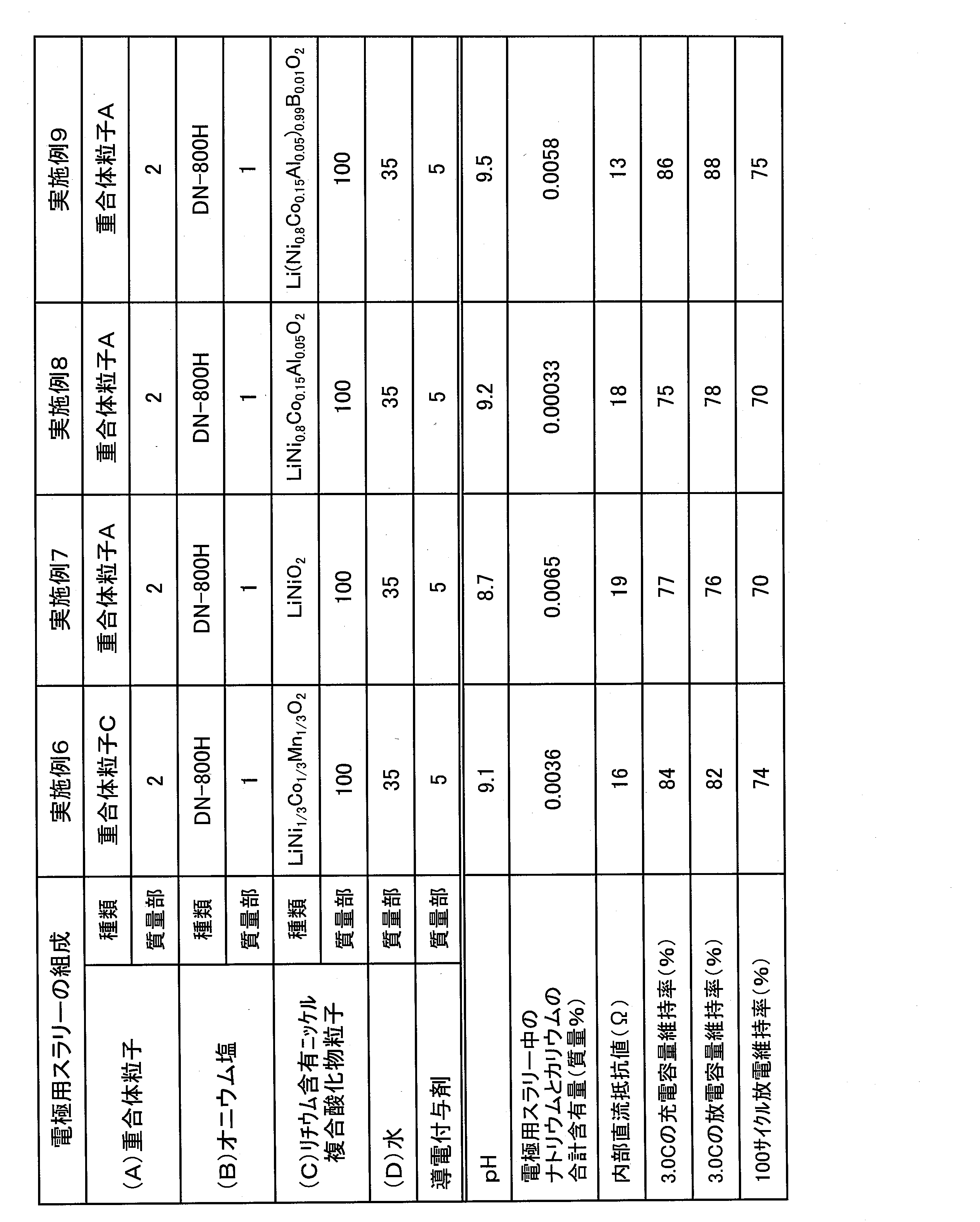
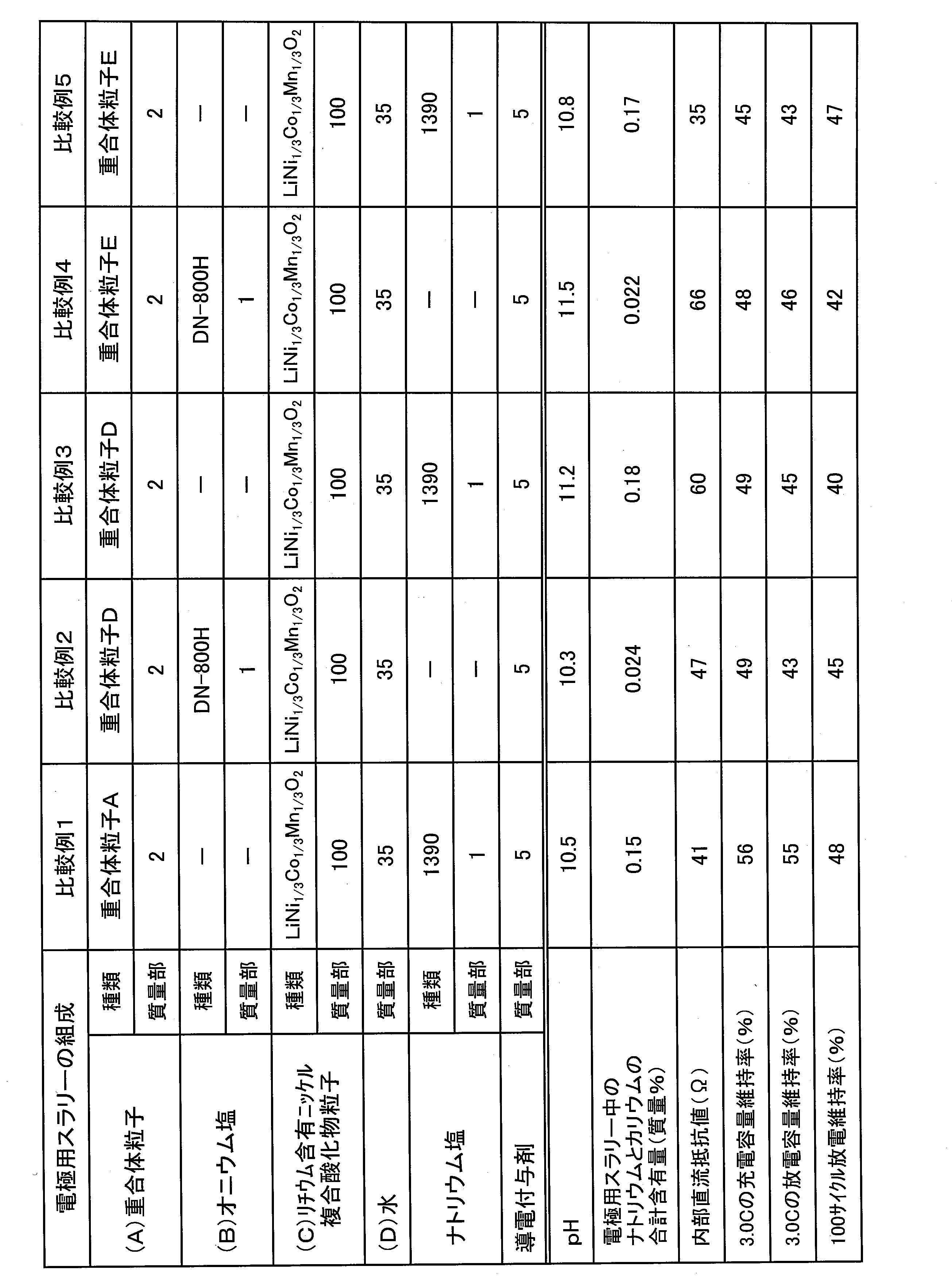
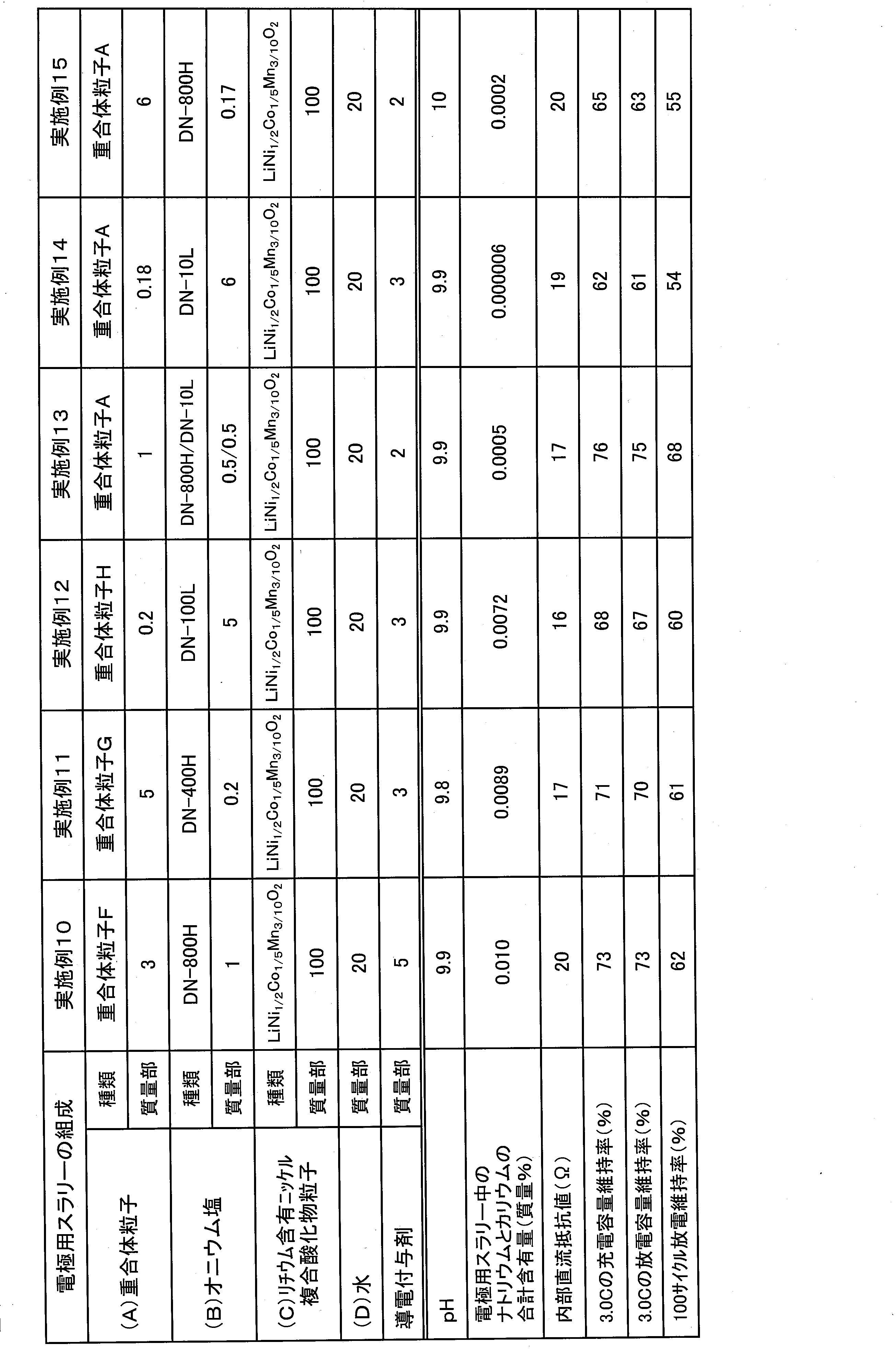
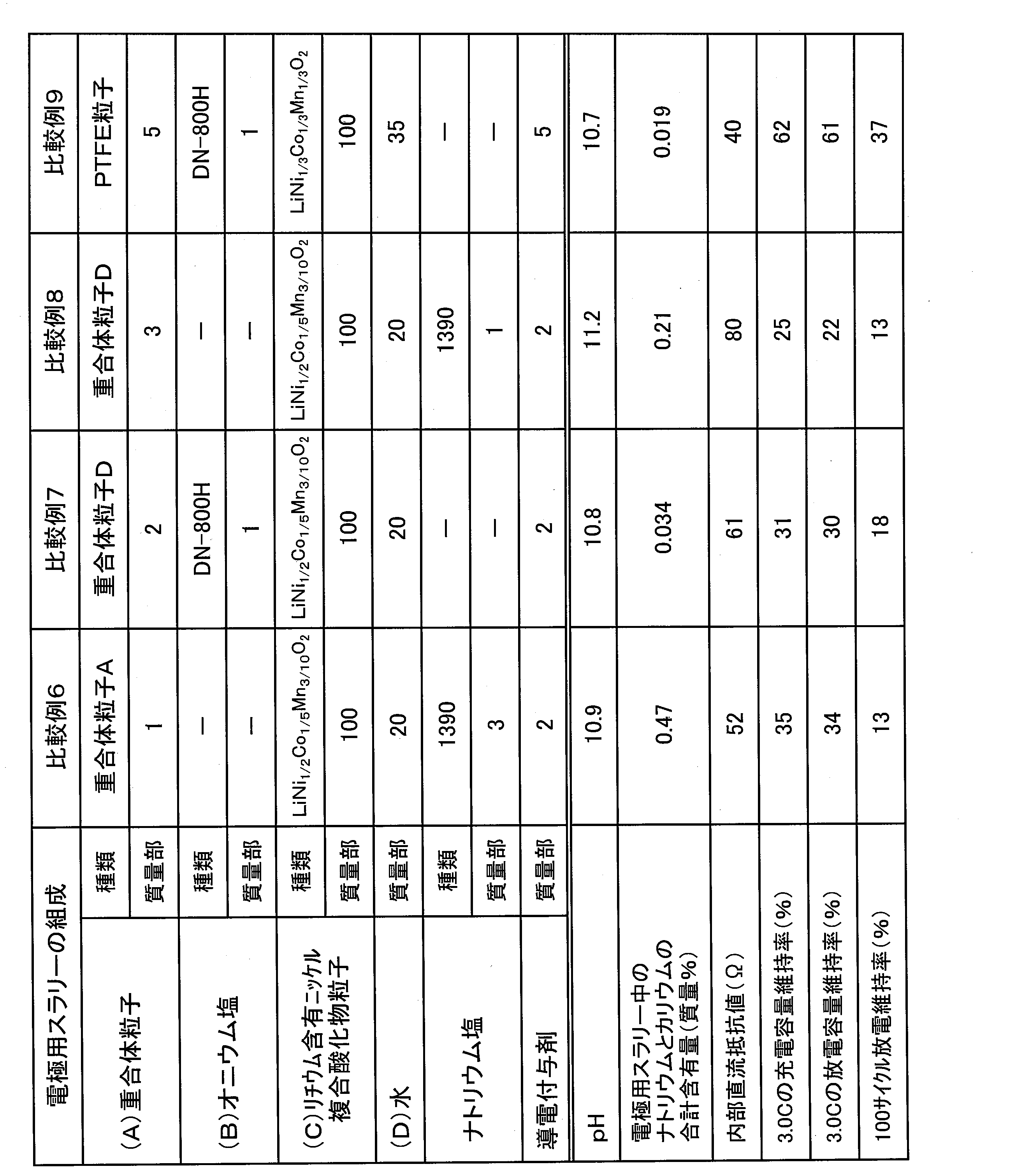
表1~表5に示すように、実施例1~15の電極用スラリーを用いて作製した電極を備えるリチウムイオン二次電池は、比較例1~9の電極用スラリーを用いて作製した電極を備えるリチウムイオン二次電池よりも優れた電気特性を有することが明らかである。
Claims (11)
- 蓄電デバイスに使用される電極を作製するための蓄電デバイス電極用スラリーであって、
(A)重合体粒子と、(C)リチウム含有ニッケル複合酸化物粒子と、(D)水と、を含有し、
前記(A)重合体粒子を構成する重合体が不飽和カルボン酸に由来する繰り返し単位を有し、
前記電極用スラリー100質量%中、ナトリウムおよびカリウムの合計含有量が0.02質量%未満である、蓄電デバイス電極用スラリー。 - (B)オニウム塩をさらに含有する、請求項1に記載の蓄電デバイス電極用スラリー。
- 前記(B)オニウム塩が、有機酸オニウム塩である、請求項2に記載の蓄電デバイス電極用スラリー。
- 前記有機酸オニウム塩が、セルロース系化合物のオニウム塩である、請求項3に記載の蓄電デバイス電極用スラリー。
- 前記(B)成分の含有割合が、前記(C)成分100質量部に対して、0.1質量部以上10質量部以下である、請求項2ないし請求項4のいずれか一項に記載の蓄電デバイス電極用スラリー。
- 前記(A)成分の含有割合が、前記(C)成分100質量部に対して、0.1質量部以上10質量部以下である、請求項1ないし請求項5のいずれか一項に記載の蓄電デバイス電極用スラリー。
- pHが8以上10以下である、請求項1ないし請求項6のいずれか一項に記載の蓄電デバイス電極用スラリー。
- 前記(A)重合体粒子が、
含フッ素エチレン系単量体に由来する繰り返し単位と、
不飽和カルボンエステルに由来する繰り返し単位と、
をさらに有する重合体粒子である、請求項1ないし請求項7のいずれか一項に記載の蓄電デバイス電極用スラリー。 - 前記含フッ素エチレン系単量体に由来する繰り返し単位の含有割合が、前記(A)重合体粒子100質量部中1~50質量部である、請求項8に記載の蓄電デバイス電極用スラリー。
- 集電体の表面上に請求項1ないし請求項9のいずれか一項に記載の蓄電デバイス電極用スラリーを用いて形成された活物質層を備えた、蓄電デバイス電極。
- 請求項10に記載の蓄電デバイス電極を備えた、蓄電デバイス。
Priority Applications (2)
| Application Number | Priority Date | Filing Date | Title |
|---|---|---|---|
| JP2013502256A JP5924501B2 (ja) | 2011-03-01 | 2012-02-22 | 蓄電デバイス電極用スラリー、蓄電デバイス電極および蓄電デバイスの製造方法 |
| KR1020137019017A KR20140017525A (ko) | 2011-03-01 | 2012-02-22 | 축전 디바이스 전극용 슬러리, 축전 디바이스 전극 및 축전 디바이스 |
Applications Claiming Priority (2)
| Application Number | Priority Date | Filing Date | Title |
|---|---|---|---|
| JP2011-043971 | 2011-03-01 | ||
| JP2011043971 | 2011-03-01 |
Publications (1)
| Publication Number | Publication Date |
|---|---|
| WO2012117910A1 true WO2012117910A1 (ja) | 2012-09-07 |
Family
ID=46757849
Family Applications (1)
| Application Number | Title | Priority Date | Filing Date |
|---|---|---|---|
| PCT/JP2012/054242 Ceased WO2012117910A1 (ja) | 2011-03-01 | 2012-02-22 | 蓄電デバイス電極用スラリー、蓄電デバイス電極、および蓄電デバイス |
Country Status (3)
| Country | Link |
|---|---|
| JP (1) | JP5924501B2 (ja) |
| KR (1) | KR20140017525A (ja) |
| WO (1) | WO2012117910A1 (ja) |
Cited By (2)
| Publication number | Priority date | Publication date | Assignee | Title |
|---|---|---|---|---|
| WO2016002564A1 (ja) * | 2014-07-01 | 2016-01-07 | 住友電気工業株式会社 | キャパシタ用正極およびキャパシタの製造方法 |
| JP2018172596A (ja) * | 2017-03-31 | 2018-11-08 | 株式会社クレハ | フッ化ビニリデン共重合体粒子及びその利用 |
Citations (3)
| Publication number | Priority date | Publication date | Assignee | Title |
|---|---|---|---|---|
| JP2010055972A (ja) * | 2008-08-29 | 2010-03-11 | Unitika Ltd | 二次電池電極用バインダー、それを用いてなる電極及び二次電池 |
| JP2010189632A (ja) * | 2009-01-21 | 2010-09-02 | Unitika Ltd | 酸変性ポリオレフィン樹脂水性分散体、二次電池電極用バインダー、電極および二次電池 |
| JP2011014254A (ja) * | 2009-06-30 | 2011-01-20 | Panasonic Corp | 非水電解質二次電池の製造方法 |
-
2012
- 2012-02-22 JP JP2013502256A patent/JP5924501B2/ja active Active
- 2012-02-22 KR KR1020137019017A patent/KR20140017525A/ko not_active Ceased
- 2012-02-22 WO PCT/JP2012/054242 patent/WO2012117910A1/ja not_active Ceased
Patent Citations (3)
| Publication number | Priority date | Publication date | Assignee | Title |
|---|---|---|---|---|
| JP2010055972A (ja) * | 2008-08-29 | 2010-03-11 | Unitika Ltd | 二次電池電極用バインダー、それを用いてなる電極及び二次電池 |
| JP2010189632A (ja) * | 2009-01-21 | 2010-09-02 | Unitika Ltd | 酸変性ポリオレフィン樹脂水性分散体、二次電池電極用バインダー、電極および二次電池 |
| JP2011014254A (ja) * | 2009-06-30 | 2011-01-20 | Panasonic Corp | 非水電解質二次電池の製造方法 |
Cited By (6)
| Publication number | Priority date | Publication date | Assignee | Title |
|---|---|---|---|---|
| WO2016002564A1 (ja) * | 2014-07-01 | 2016-01-07 | 住友電気工業株式会社 | キャパシタ用正極およびキャパシタの製造方法 |
| JP2018172596A (ja) * | 2017-03-31 | 2018-11-08 | 株式会社クレハ | フッ化ビニリデン共重合体粒子及びその利用 |
| CN110167976A (zh) * | 2017-03-31 | 2019-08-23 | 株式会社吴羽 | 偏氟乙烯共聚物粒子及其利用 |
| EP3604363A4 (en) * | 2017-03-31 | 2020-04-08 | Kureha Corporation | VINYLIDE FLUORIDE COPOLYMER PARTICLES AND USE THEREOF |
| EP3604363B1 (en) | 2017-03-31 | 2022-04-06 | Kureha Corporation | Vinylidene fluoride copolymer particles and use thereof |
| US11919983B2 (en) | 2017-03-31 | 2024-03-05 | Kureha Corporation | Vinylidene fluoride copolymer particles and use thereof |
Also Published As
| Publication number | Publication date |
|---|---|
| KR20140017525A (ko) | 2014-02-11 |
| JPWO2012117910A1 (ja) | 2014-07-07 |
| JP5924501B2 (ja) | 2016-05-25 |
Similar Documents
| Publication | Publication Date | Title |
|---|---|---|
| US10403896B2 (en) | Binder composition for storage device electrode, slurry for storage device electrode, storage device electrode, and storage device | |
| TWI542068B (zh) | A protective film and a composition for producing the same, a slurry, and a power storage device | |
| KR101460930B1 (ko) | 축전 디바이스용 전극, 전극용 슬러리, 전극용 바인더 조성물 및 축전 디바이스 | |
| JP5499951B2 (ja) | 二次電池用バインダー、製造方法、二次電池負極用組成物、及び二次電池 | |
| WO2018056083A1 (ja) | 非水系二次電池正極用スラリー組成物、非水系二次電池用正極、および非水系二次電池 | |
| WO2018168615A1 (ja) | 電気化学素子電極用導電材分散液、電気化学素子電極用スラリー組成物およびその製造方法、電気化学素子用電極、並びに、電気化学素子 | |
| KR20150135207A (ko) | 축전 디바이스용 결합제 조성물 | |
| KR20150032943A (ko) | 리튬 이온 이차 전지 부극용 슬러리, 리튬 이온 이차 전지용 전극 및 그 제조 방법, 그리고 리튬 이온 이차 전지 | |
| WO2014185072A1 (ja) | リチウムイオン二次電池正極用結着材組成物、リチウムイオン二次電池正極用スラリー組成物およびその製造方法、リチウムイオン二次電池用正極の製造方法、並びに、リチウムイオン二次電池 | |
| US20190148731A1 (en) | Binder for nonaqueous electrolyte secondary battery and use thereof | |
| JP2017069108A (ja) | リチウムイオン二次電池電極用スラリー組成物、リチウムイオン二次電池用電極およびリチウムイオン二次電池 | |
| WO2022045218A1 (ja) | 電気化学素子用導電材分散液、電気化学素子電極用スラリー、電気化学素子用電極及び電気化学素子 | |
| WO2016052048A1 (ja) | 正極用スラリー、蓄電デバイス正極、及び蓄電デバイス | |
| JP5904350B1 (ja) | 蓄電デバイス用バインダー組成物 | |
| JP2016072234A (ja) | 正極用スラリー、蓄電デバイス正極、蓄電デバイス正極の製造方法、蓄電デバイス、及び蓄電デバイスの製造方法 | |
| JP2014053168A (ja) | 蓄電デバイス電極用スラリー、蓄電デバイス電極および蓄電デバイス | |
| JP5924501B2 (ja) | 蓄電デバイス電極用スラリー、蓄電デバイス電極および蓄電デバイスの製造方法 | |
| JP5601476B2 (ja) | 電極用バインダー組成物 | |
| JP2018159059A (ja) | 炭素材料・樹脂複合材料 | |
| JP5835581B2 (ja) | 蓄電デバイスの電極用バインダー組成物 | |
| WO2024004724A1 (ja) | 電気化学素子用バインダー組成物、電気化学素子用導電材分散液、電気化学素子電極用スラリー、電気化学素子用電極及び電気化学素子 | |
| JP6379460B2 (ja) | 非水系二次電池電極用バインダ樹脂の製造方法、非水系二次電池電極用バインダ樹脂組成物の製造方法、電極スラリーの調製方法、非水系二次電池用電極の製造方法、およびリチウムイオン二次電池の製造方法 | |
| WO2025206220A1 (ja) | 非水系二次電池電極用バインダー組成物、非水系二次電池電極用スラリー組成物、非水系二次電池用電極、および非水系二次電池 | |
| WO2024018997A1 (ja) | 電気化学素子用導電材分散液、電気化学素子電極用スラリー、電気化学素子用電極及び電気化学素子 | |
| JP2014154231A (ja) | 蓄電デバイス電極用スラリー、蓄電デバイス電極、蓄電デバイス、および蓄電デバイス電極用バインダー組成物 |
Legal Events
| Date | Code | Title | Description |
|---|---|---|---|
| 121 | Ep: the epo has been informed by wipo that ep was designated in this application |
Ref document number: 12752094 Country of ref document: EP Kind code of ref document: A1 |
|
| ENP | Entry into the national phase |
Ref document number: 20137019017 Country of ref document: KR Kind code of ref document: A |
|
| ENP | Entry into the national phase |
Ref document number: 2013502256 Country of ref document: JP Kind code of ref document: A |
|
| NENP | Non-entry into the national phase |
Ref country code: DE |
|
| 122 | Ep: pct application non-entry in european phase |
Ref document number: 12752094 Country of ref document: EP Kind code of ref document: A1 |