WO2012117828A1 - 洗浄剤組成物 - Google Patents
洗浄剤組成物 Download PDFInfo
- Publication number
- WO2012117828A1 WO2012117828A1 PCT/JP2012/053088 JP2012053088W WO2012117828A1 WO 2012117828 A1 WO2012117828 A1 WO 2012117828A1 JP 2012053088 W JP2012053088 W JP 2012053088W WO 2012117828 A1 WO2012117828 A1 WO 2012117828A1
- Authority
- WO
- WIPO (PCT)
- Prior art keywords
- mass
- cleaning composition
- composition according
- ether
- viscosity
- Prior art date
- Legal status (The legal status is an assumption and is not a legal conclusion. Google has not performed a legal analysis and makes no representation as to the accuracy of the status listed.)
- Ceased
Links
Classifications
-
- C—CHEMISTRY; METALLURGY
- C11—ANIMAL OR VEGETABLE OILS, FATS, FATTY SUBSTANCES OR WAXES; FATTY ACIDS THEREFROM; DETERGENTS; CANDLES
- C11D—DETERGENT COMPOSITIONS; USE OF SINGLE SUBSTANCES AS DETERGENTS; SOAP OR SOAP-MAKING; RESIN SOAPS; RECOVERY OF GLYCEROL
- C11D1/00—Detergent compositions based essentially on surface-active compounds; Use of these compounds as a detergent
- C11D1/88—Ampholytes; Electroneutral compounds
- C11D1/94—Mixtures with anionic, cationic or non-ionic compounds
-
- A—HUMAN NECESSITIES
- A61—MEDICAL OR VETERINARY SCIENCE; HYGIENE
- A61K—PREPARATIONS FOR MEDICAL, DENTAL OR TOILETRY PURPOSES
- A61K8/00—Cosmetics or similar toiletry preparations
- A61K8/18—Cosmetics or similar toiletry preparations characterised by the composition
- A61K8/30—Cosmetics or similar toiletry preparations characterised by the composition containing organic compounds
- A61K8/33—Cosmetics or similar toiletry preparations characterised by the composition containing organic compounds containing oxygen
- A61K8/34—Alcohols
-
- A—HUMAN NECESSITIES
- A61—MEDICAL OR VETERINARY SCIENCE; HYGIENE
- A61K—PREPARATIONS FOR MEDICAL, DENTAL OR TOILETRY PURPOSES
- A61K8/00—Cosmetics or similar toiletry preparations
- A61K8/18—Cosmetics or similar toiletry preparations characterised by the composition
- A61K8/30—Cosmetics or similar toiletry preparations characterised by the composition containing organic compounds
- A61K8/33—Cosmetics or similar toiletry preparations characterised by the composition containing organic compounds containing oxygen
- A61K8/36—Carboxylic acids; Salts or anhydrides thereof
- A61K8/361—Carboxylic acids having more than seven carbon atoms in an unbroken chain; Salts or anhydrides thereof
-
- A—HUMAN NECESSITIES
- A61—MEDICAL OR VETERINARY SCIENCE; HYGIENE
- A61K—PREPARATIONS FOR MEDICAL, DENTAL OR TOILETRY PURPOSES
- A61K8/00—Cosmetics or similar toiletry preparations
- A61K8/18—Cosmetics or similar toiletry preparations characterised by the composition
- A61K8/30—Cosmetics or similar toiletry preparations characterised by the composition containing organic compounds
- A61K8/46—Cosmetics or similar toiletry preparations characterised by the composition containing organic compounds containing sulfur
-
- A—HUMAN NECESSITIES
- A61—MEDICAL OR VETERINARY SCIENCE; HYGIENE
- A61K—PREPARATIONS FOR MEDICAL, DENTAL OR TOILETRY PURPOSES
- A61K8/00—Cosmetics or similar toiletry preparations
- A61K8/18—Cosmetics or similar toiletry preparations characterised by the composition
- A61K8/72—Cosmetics or similar toiletry preparations characterised by the composition containing organic macromolecular compounds
- A61K8/84—Cosmetics or similar toiletry preparations characterised by the composition containing organic macromolecular compounds obtained by reactions otherwise than those involving only carbon-carbon unsaturated bonds
- A61K8/86—Polyethers
-
- A—HUMAN NECESSITIES
- A61—MEDICAL OR VETERINARY SCIENCE; HYGIENE
- A61K—PREPARATIONS FOR MEDICAL, DENTAL OR TOILETRY PURPOSES
- A61K8/00—Cosmetics or similar toiletry preparations
- A61K8/18—Cosmetics or similar toiletry preparations characterised by the composition
- A61K8/92—Oils, fats or waxes; Derivatives thereof, e.g. hydrogenation products thereof
- A61K8/922—Oils, fats or waxes; Derivatives thereof, e.g. hydrogenation products thereof of vegetable origin
-
- A—HUMAN NECESSITIES
- A61—MEDICAL OR VETERINARY SCIENCE; HYGIENE
- A61Q—SPECIFIC USE OF COSMETICS OR SIMILAR TOILETRY PREPARATIONS
- A61Q19/00—Preparations for care of the skin
- A61Q19/10—Washing or bathing preparations
-
- A—HUMAN NECESSITIES
- A61—MEDICAL OR VETERINARY SCIENCE; HYGIENE
- A61Q—SPECIFIC USE OF COSMETICS OR SIMILAR TOILETRY PREPARATIONS
- A61Q5/00—Preparations for care of the hair
- A61Q5/02—Preparations for cleaning the hair
-
- C—CHEMISTRY; METALLURGY
- C11—ANIMAL OR VEGETABLE OILS, FATS, FATTY SUBSTANCES OR WAXES; FATTY ACIDS THEREFROM; DETERGENTS; CANDLES
- C11D—DETERGENT COMPOSITIONS; USE OF SINGLE SUBSTANCES AS DETERGENTS; SOAP OR SOAP-MAKING; RESIN SOAPS; RECOVERY OF GLYCEROL
- C11D3/00—Other compounding ingredients of detergent compositions covered in group C11D1/00
- C11D3/16—Organic compounds
- C11D3/20—Organic compounds containing oxygen
-
- C—CHEMISTRY; METALLURGY
- C11—ANIMAL OR VEGETABLE OILS, FATS, FATTY SUBSTANCES OR WAXES; FATTY ACIDS THEREFROM; DETERGENTS; CANDLES
- C11D—DETERGENT COMPOSITIONS; USE OF SINGLE SUBSTANCES AS DETERGENTS; SOAP OR SOAP-MAKING; RESIN SOAPS; RECOVERY OF GLYCEROL
- C11D3/00—Other compounding ingredients of detergent compositions covered in group C11D1/00
- C11D3/16—Organic compounds
- C11D3/37—Polymers
-
- C—CHEMISTRY; METALLURGY
- C11—ANIMAL OR VEGETABLE OILS, FATS, FATTY SUBSTANCES OR WAXES; FATTY ACIDS THEREFROM; DETERGENTS; CANDLES
- C11D—DETERGENT COMPOSITIONS; USE OF SINGLE SUBSTANCES AS DETERGENTS; SOAP OR SOAP-MAKING; RESIN SOAPS; RECOVERY OF GLYCEROL
- C11D3/00—Other compounding ingredients of detergent compositions covered in group C11D1/00
- C11D3/50—Perfumes
Definitions
- the present invention relates to a cleaning composition particularly suitable for hair or skin.
- a clean and refreshing cleaning agent has long been preferred by men.
- a heat wave that has never existed in the past has continued, and there has been a greater demand for cleaners and cleaners for hair and skin.
- the development of a cleaner with a refreshing feeling is required.
- a refreshing agent such as menthol is blended, but the present inventors have a structural state created by active agents in the cleaning agent by blending a refreshing agent such as menthol. It has been found that there is a problem that the viscosity changes and the viscosity decreases, and that menthol precipitates at low temperatures and becomes unstable. For example, when the viscosity decreases, shampoo or body soap is taken into your hands and dripping down when applied to the hair or body, especially when considering use in an inverted container etc. Decrease in viscosity is a big problem.
- the present invention has been made in view of the above circumstances, and even in a system containing a refreshing agent such as menthol, a decrease in viscosity (hereinafter referred to as viscosity reduction and suppression of viscosity reduction is due to the addition of a refreshing agent such as menthol. It is an object of the present invention to provide a detergent composition with good usability that can provide a refreshing feeling without causing poor stability at low temperatures.
- (a-1) an anionic surfactant and (a-2) an amphoteric surfactant include (c) menthol and the like.
- the above-mentioned specific problem that occurs when a specific amount of a refreshing agent is blended can be solved by blending a specific amount of a specific multi-chain nonionic surfactant (b), giving a sufficient refreshing feeling, and the viscosity of the composition
- the inventors have found that a cleaning composition that suppresses the decrease and has excellent low-temperature stability can be obtained, and has led to the present invention.
- the present invention provides the following cleaning composition.
- A (a-1) an anionic surfactant, (A-2) amphoteric surfactant: the total amount of (a-1) and (a-2) is 4% by mass or more, (B) a multi-chain nonionic surfactant that is solid at room temperature: 0.01 to 5% by mass;
- C Menthol, menthone, camphor, borneol, cineole menthone, methyl salicylate, menthyl malonate, glycosyl-monomenthyl-O-acetate, 3-l-menthoxypropane-1,2-diol, l-menthyl-3-hydroxy
- a detergent composition comprising: a refreshing agent selected from the group consisting of butyrate, spearmint oil, peppermint oil, peppermint oil and eucalyptus oil: 0.01 to 5% by mass.
- component (b) is selected from a two-chain to four-chain ether-based and ester-based nonionic surfactant.
- Component (b) is composed of POE cetostearyl hydroxymyrstyrene ether, PEG glyceryl diisostearate, PEG distearate, PEG glyceryl triisostearate, PEG pentaerythrityl tetrastearate, POE sorbitol tetrastearate, and POE sorbitol hexastearate
- the cleaning composition according to ⁇ 2> which is selected.
- ⁇ 4> Any one of ⁇ 1> to ⁇ 3>, wherein the blending mass ratio of the anionic surfactant to the amphoteric surfactant represented by (a-1) / (a-2) is 50/1 to 1/5 The cleaning composition described in 1.
- (C) The cleaning composition according to any one of ⁇ 1> to ⁇ 4>, wherein the component is menthol.
- ⁇ 6> And (d) a pearlizing agent selected from the group consisting of ethylene glycol monofatty acid esters, ethylene glycol difatty acid esters, ethylene glycol monoalkyl ethers, and ethylene glycol dialkyl ethers.
- ⁇ 7> The cleaning composition according to any one of ⁇ 1> to ⁇ 6>, further comprising (e) a cationic polymer.
- ⁇ 8> The cleaning composition according to any one of ⁇ 1> to ⁇ 7>, further comprising (f) a silicone compound.
- ⁇ 9> The cleaning composition according to any one of ⁇ 1> to ⁇ 8>, wherein the viscosity is 0.5 to 50000 mPa ⁇ s.
- ⁇ 10> The cleaning composition according to any one of ⁇ 1> to ⁇ 9>, which is for hair or skin.
- a detergent containing a specific multi-chain nonionic surfactant which is excellent in reducing viscosity reduction and low-temperature stability, and also has a refreshing feeling due to the incorporation of a refreshing agent such as menthol.
- a composition can be provided. Further, by further adding (d) a pearling agent, a decrease in the viscosity of the composition can be further suppressed.
- the smoothness at the time of a rinse can be improved by mix
- the subject of Claim 6 is providing smoothness of a finish to hair etc., the smoothness after drying can be improved by mix
- the cleaning composition of the present invention comprises: (A) (a-1) an anionic surfactant, (A-2) amphoteric surfactant, (B) a multi-chain nonionic surfactant that is solid at room temperature; (C) It contains a cooling agent.
- the component (a) is used to maintain the viscosity of the composition by providing foaming when cleaning dirt such as the head, and a refreshing feeling after cleaning.
- the anionic surfactant include carboxylic acid type, sulfonic acid type, sulfuric acid type, and phosphoric acid type.
- ⁇ -olefin sulfonates are preferred for the sulfonic acid type, and alkyl sulfates and polyoxyalkylene alkyl ether sulfates are preferred for the sulfate type. These may be used alone or in combination of two or more.
- the ⁇ -olefin sulfonate is preferably an alkyl group having 10 to 18 carbon atoms, particularly tetradecene sulfonate having 14 carbon atoms.
- alkyl sulfate salts those having an alkyl group having 10 to 18 carbon atoms are preferred, and those having an alkyl group having 12 to 14 carbon atoms are particularly preferred.
- polyoxyalkylene alkyl ether sulfate ester salt an alkyl group having 10 to 18 carbon atoms is preferable, and an alkyl group having 10 to 14 carbon atoms is particularly preferable.
- the alkylene group portion is preferably a polyoxyethylene group or a polyoxypropylene group, and particularly preferably a polyoxyethylene group.
- the range of the total number of added moles of ethylene is preferably 1 to 5.
- These counter ions include alkali metal salts such as sodium and potassium; alkaline earth metal salts such as calcium and magnesium; ammonium salts; alkanolamine salts such as monoethanolamine, diethanolamine and triethanolamine.
- POE (1-5) sodium lauryl ether sulfate, fatty acid soap, lauroyl sarcosine sodium, lauroyl methyl taurine sodium and the like are preferably used.
- the number in () shows the average added mole number of ethylene oxide.
- the compounding amount of the anionic surfactant is 3.9 to 30% by mass, preferably 5 to 15% by mass, based on the whole composition, from the viewpoint of maintaining the viscosity of the composition, and providing foaming and refreshing feeling. If the amount is less than 3.9% by mass, the thickening effect and the refreshing feeling may be reduced and foaming may be deteriorated. If the amount exceeds 30% by mass, the low-temperature stability may be deteriorated.
- amphoteric surfactant (a-2) component is used in combination with the (a-1) anionic surfactant to form a network of these surfactants and increase the viscosity of the composition. Further, as with the component (a-1), it is blended in order to give foaming when cleaning dirt such as the head and a refreshing feeling after cleaning.
- amphoteric surfactant include surfactants such as carboxylic acid type including amino acid type and betaine type, sulfate ester type, sulfonic acid type, and phosphate ester type. Of these, betaine surfactants are preferred.
- betaine type amphoteric surfactants include alkyl betaine type activator, amide betaine type activator, sulfobetaine type activator, hydroxysulfobetaine type activator, amide sulfobetaine type activator, phosphobetaine type activator, imidazolium betaine.
- Type activators and the like include laurylaminoacetic acid betaine, 2-coconut oil fatty acid-N-carboxymethyl-N-hydroxyethylimidazolinium betaine, lauric acid amidopropyl betaine, and coconut oil fatty acid amidopropyl betaine. Among these, lauric acid amidopropyl betaine and coconut oil fatty acid amidopropyl betaine are preferable.
- the compounding amount of the amphoteric surfactant is preferably from 0.1 to 15% by mass, more preferably from 3 to 10% by mass, from the viewpoint of the effect of suppressing the viscosity reduction when used in combination with the anionic surfactant, foaming and refreshing feeling. It is. If the content is less than 0.1% by mass, a sufficient viscosity-inhibiting effect may not be obtained. If the content exceeds 15% by mass, the low-temperature stability may be deteriorated.
- the total amount of the components (a-1) and (a-2) is 4% by mass or more, preferably 40% by mass or less, more preferably 8% by mass or more and 30% by mass from the viewpoint of the thickening effect. Hereinafter, it is 25 mass% or less especially. If the amount is too small, the cleaning effect is low, so that a refreshing feeling is difficult to obtain, and the viscosity of the composition becomes low.
- the upper limit is not particularly limited, but the stability at low temperature may be reduced in the range exceeding 40% by mass. Further, from the viewpoint of foaming and refreshing feeling, 4 to 40% by mass is preferable, and 10 to 30% by mass is more preferable. If it is less than 4% by mass, sufficient foaming may not be obtained after cleaning. In the range exceeding 40% by mass, even if the amount is increased, it may not be possible to improve the effect of foaming and a refreshing feeling after washing.
- the viscosity of the detergent composition can be improved by the network structure of the both.
- the mass ratio of the anionic surfactant / amphoteric surfactant represented by (a-1) / (a-2) is preferably 50/1 to 1/5, more preferably 10/1 to 1/5. More preferably, it is 5/1 to 1/3. If this ratio is too small or too large, viscosity is difficult to obtain and the usability is inferior, and the low-temperature stability may decrease.
- the “multi-chain nonionic surfactant” used in the present invention has an ethylene glycol, propylene glycol, glycerin, sorbit or pentaerythritol skeleton, and an alkyl having 12 to 20 carbon atoms via an ethylene oxide group.
- “normal temperature” is defined as 15 to 25 ° C.
- “solid” is defined as a measurement time exceeding 90 seconds in a liquid confirmation test described later.
- Examples of such a multi-chain nonionic surfactant include ether-based and ester-based surfactants, and examples thereof include 2-chain to 4-chain types represented by the following general formula. ⁇ Double-stranded type> ⁇ Ether type Wherein R 1 is a monovalent alkyl or alkenyl group having 12 to 20 carbon atoms, R 2 is a monovalent alkyl or alkenyl group having 12 to 20 carbon atoms, and n is 40 to 100 (It is an integer.)
- X 1 to X 3 are —OH group or —OCOR 3
- R 3 is a monovalent alkyl group or alkenyl group having 12 to 20 carbon atoms
- two or more of X 1 to X 3 Is -OCOR 3.
- the sum of m1 + m2 + m3 is an integer from 40 to 100, in particular from 45 to 70.
- R 4 is a monovalent alkyl or alkenyl group having 12 to 20 carbon atoms
- R 5 is a monovalent alkyl or alkenyl group having 12 to 20 carbon atoms
- p is 1 to 3
- An integer and q is an integer of 100 to 200.
- R 8 is a monovalent alkyl group having 12 to 20 carbon atoms, and two or more of X 13 to X 16 , particularly 4 And -OCOR 8.
- s is an integer of 2 to 5
- the sum of t1 + t2 + t3 + t4 is an integer of 100 to 200, particularly 140 to 160.
- Examples of such a multi-chain nonionic surfactant include POE cetostearyl hydroxymyristyl ether, PEG glyceryl diisostearate, PEG distearate, PEG glyceryl triisostearate, PEG pentaerythrityl tetrastearate, POE sorbitol tetrastearate, Examples include hexastearic acid POE sorbit, and these can be used alone or in combination of two or more.
- POE cetostearyl hydroxymyristyl ether, PEG glyceryl triisostearate, and PEG pentaerythrityl tetrastearate are particularly preferred from the viewpoint of the effect of suppressing the decrease in viscosity and stability at low temperatures.
- the blending amount of the component (b) is 0.01 to 5% by mass, preferably 0.05 to 1% by mass, based on the whole composition, from the viewpoint of the effect of suppressing the viscosity reduction of the composition and the low temperature stability. If it is less than 0.01% by mass, sufficient reduction in viscosity reduction and low-temperature stability cannot be obtained. On the other hand, in the range exceeding 5% by mass, improvement in low-temperature stability cannot be obtained even if the amount is increased, and the refreshing feeling is also lowered.
- the refreshing agent used in the present invention is blended in order to give a refreshing feeling during use.
- Such refreshing agents include menthol, menthyl glyceryl ether, menthyl carboxamide, vanillyl butyl ether, menthone, camphor, borneol, cineole menthone, methyl salicylate, menthyl malonate, glycosyl-monomenthyl-O-acetate, 3-l-menthol Examples include xylpropane-1,2-diol, l-menthyl-3-hydroxybutyrate, spearmint oil, peppermint oil, mint oil and eucalyptus oil. These can be used individually by 1 type or in combination of 2 or more types.
- menthol menthyl glyceryl ether, menthyl carboxamide, vanillyl butyl ether, camphor, spearmint oil, peppermint oil, peppermint oil and eucalyptus oil are preferable, and menthol and peppermint oil are more preferable from the point of refreshing feeling at the time of use. Menthol is more preferable.
- the blending amount of the refreshing agent is 0.01 to 5% by mass, preferably 0.1 to 2% by mass, based on the entire composition. If it is less than 0.01% by mass, sufficient refreshing feeling cannot be obtained, and if it exceeds 5% by mass, the low temperature stability cannot be maintained.
- the composition of the present invention preferably further comprises (d) a pearlizing agent in order to further enhance the effect of suppressing the decrease in viscosity and to impart a pearl appearance to the composition.
- a pearlizing agent include ethylene glycol monofatty acid ester, ethylene glycol difatty acid ester, ethylene glycol monoalkyl ether and ethylene glycol dialkyl ether, and these may be used alone or in combination of two or more. Can be used. Of these, ethylene glycol monofatty acid ester and ethylene glycol difatty acid ester are particularly preferable.
- More specific examples include ethylene glycol distearate, ethylene glycol monostearate, ethylene glycol monostearyl ether, and ethylene glycol distearyl ether. More preferred are ethylene glycol distearate and ethylene glycol monostearate from the viewpoints of viscosity-inhibiting effect and pearl appearance.
- the blending amount of the pearlizing agent is preferably from 0.1 to 10% by mass, more preferably from 0.1 to 3% by mass, based on the whole composition, from the viewpoint of the effect of suppressing the decrease in viscosity and the appearance of pearl. If the amount is less than 0.1% by mass, a sufficient viscosity-inhibiting effect and imparting a pearl appearance may not be obtained. If the amount exceeds 10% by mass, low-temperature stability may not be maintained.
- composition of the present invention may further contain (e) a cationic polymer in order to impart smoothness during rinsing to hair or the like.
- Cationic polymers include cationized cellulose, cationized cellulose derivatives, cationized starch, cationized guar gum, cationized guar gum derivatives, homopolymers of diallyl quaternary ammonium salts, quaternized polyvinylpyrrolidone derivatives, polyglycol polyamines Condensate, dialkyldiallylammonium salt / acrylamide copolymer, vinylimidazolium trichloride / vinylpyrrolidone copolymer, hydroxyethylcellulose / dimethyldiallylammonium chloride copolymer, vinylpyrrolidone / quaternized dimethylaminoethyl methacrylate copolymer, Polyvinylpyrrolidone
- dialkyl diallylammonium salt / acrylamide copolymer cationized cellulose, cationized cellulose derivative, cationized guar gum, and cationized guar gum derivative are particularly preferred from the viewpoint of smoothness during rinsing.
- the weight average molecular weight is preferably 0.5 ⁇ 10 6 to 3 ⁇ 10 6 , particularly 1 ⁇ 10 6 to 2 ⁇ 10 6 from the viewpoint of smoothness at the time of rinsing.
- the weight average molecular weight is measured by a gel permeation chromatograph / multi-angle laser light scattering detector (GPC-MALLS).
- the degree of cationization is preferably in the range of 0.1 meq / g to 5.0 meq / g, more preferably 0.5 meq / g to 4.0 meq / g, from the viewpoint of smoothness during rinsing. If the degree of cationization is less than 0.1 meq / g, the finger passage when the foam is rinsed may be poor, and the hair after drying may feel dry. On the other hand, when the degree of cationization exceeds 5.0 meq / g, the detergent composition may have poor low-temperature stability.
- copolymer of dialkyl diallylammonium salt and acrylamide examples include Marcoat 550, Marcoat S, Marcoat 2200, CG-600 (above, trade name, manufactured by ONDEO NALCO), Kayaacryl Resin MN, Kayaacryl Resin. M50-A (above, trade name, manufactured by Nippon Kayaku Co., Ltd.).
- the cationized cellulose is obtained by adding a cationic functional group to cellulose.
- polyquaternium-10 which is O- [2-hydroxy-3- (trimethylammonio) propyl] hydroxyethylcellulose chloride is preferred.
- the degree of cationization of the cationized cellulose is preferably in the range of 0.1 meq / g to 3.0 meq / g, more preferably 0.5 meq / g to 1.7 meq / g, from the viewpoint of smoothness during rinsing. If the degree of cationization is less than 0.1 meq / g, the finger passage when the foam is rinsed may be poor, and the hair after drying may feel dry.
- the detergent composition when the degree of cationization exceeds 3.0 meq / g, the detergent composition may be inferior in low-temperature stability.
- the molecular weight of the cationized cellulose is preferably in the range of 100,000 to 3,000,000, more preferably 150,000 to 2,000,000 from the viewpoint of smoothness during rinsing. If it is less than 100,000, the finger passage when rinsing the foam may worsen, and the hair after drying may feel dry. On the other hand, if it exceeds 3 million, the low-temperature stability of the cleaning composition may be inferior, and dissolution in the cleaning composition may be difficult.
- cationized cellulose Commercially available products can be used as such cationized cellulose. Specific examples include Leogard LP, GP, MGP, KGP, XE-511K (trade name, manufactured by Lion Corporation), UCARE LR-30M. , JR-400, JR-30M (trade name, manufactured by Dow Chemical Japan Co., Ltd.), Katchinal HC-100 (trade name, manufactured by Toho Chemical Industry Co., Ltd.), and the like.
- the cationized guar gum is obtained by adding a cationic functional group to guar gum.
- the degree of cationization of the cationized guar gum varies depending on the degree of addition of the cationic group.
- the degree of cationization is preferably in the range of 0.1 meq / g to 3.0 meq / g, more preferably 0.5 meq / g to 3.0 meq / g, and still more preferably from the viewpoint of smoothness at the time of rinsing. 1.0 meq / g to 2.4 meq / g. If the degree of cationization is less than 0.1 meq / g, the finger passage when the foam is rinsed may be poor, and the hair after drying may feel dry.
- the detergent composition when the degree of cationization exceeds 3.0 meq / g, the detergent composition may be inferior in low-temperature stability.
- the molecular weight of the cationized guar gum is preferably in the range of 100,000 to 3,000,000, and more preferably in the range of 200,000 to 2,000,000 from the viewpoint of smoothness during rinsing. If it is less than 100,000, the finger passage when rinsing the foam may worsen, and the hair after drying may feel dry. On the other hand, if it exceeds 3 million, the low-temperature stability of the cleaning composition may be inferior, and dissolution in the cleaning composition may be difficult.
- a commercially available product can be used, and specific examples thereof include Lapole gum CG-M, CG-M7, CG-M8M (trade name, manufactured by Dainippon Pharmaceutical Co., Ltd.), N- Examples include Hance 3000 (trade name, manufactured by Hercules Japan), JAGUAR C-13S, C-14S, C-17, EXCEL (trade name, manufactured by Rhodia), and the like.
- raw materials obtained by evaporating water to form powders or granules can be used, and raw materials liquefied with a solvent such as water can also be used.
- the degree of cationization of the cationic polymer can be easily calculated if the chemical structure is clear, but even if the structure such as the monomer ratio is unknown, the measured value of N content such as Kjeldahl method can be used. Can be calculated.
- the degree of cationization used in the present invention is based on the Kjeldahl method. It is calculated based on the value measured by the nitrogen determination method No. 2 of the general test method of cosmetic raw material standards.
- meq / g which is a unit of the degree of cationization indicates the number of milliequivalents of N cation groups per 1 g of a sample.
- the molecular weight of the component can be measured by a method of comparison with a polymer having a known molecular weight by liquid chromatography using a general GPC column.
- the molecular weight of the cationized polymer shown in the present invention is a value measured using GPC-MALLS, and a sample solution diluted with a mobile phase having a pure polymer concentration of about 1,000 ppm is prepared from a TSK-GELA column (Tosoh ( The wavelength of about 633 nm was measured with a multi-angle light scattering detector using a 0.5 mol / L sodium perchlorate solution as a mobile phase.
- polyethylene glycol having a known molecular weight was used as a standard product.
- the blending amount of the cationic polymer is preferably 0.01 to 3% by mass, more preferably 0.05 to 1% by mass of the whole composition from the viewpoint of imparting smoothness to hair and the like during rinsing. . If the amount is less than 0.01% by mass, sufficient smoothness at the time of rinsing may not be imparted, and even if the amount exceeds 3% by mass, the smoothness at the time of rinsing may not be improved.
- the composition of the present invention can be blended with (f) a silicone compound from the viewpoint of imparting a smooth finish.
- a silicone compound include dimethylpolysiloxane (including highly polymerized dimethylpolysiloxane and silicone rubber), amino-modified silicone, methylphenylpolysiloxane, polyether-modified silicone, polyamino-modified silicone, betaine-modified silicone, Alcohol-modified silicone, fluorine-modified silicone, epoxy-modified silicone, mercapto-modified silicone, carboxy-modified silicone, fatty acid-modified silicone, silicone graft polymer, cyclic silicone, alkyl-modified silicone, aminoglycol-modified silicone, polyoxyalkylene / amino-modified silicone, trimethylsilyl group And terminal dimethylpolysiloxane, silanol-terminated dimethylpolysiloxane, and the like.
- dimethylpolysiloxane, polyether-modified silicone, and polyamino-modified silicone are particularly preferably used.
- the silicone compound an emulsion obtained by emulsifying the silicone compound with a surfactant can be used.
- dimethylpolysiloxane, amino-modified silicone, and polyoxyalkylene / amino-modified silicone having a kinematic viscosity of 100,000 cst / 25 ° C. or more can be preferably used.
- the blending amount of the silicone compound is preferably from 0.1 to 5% by mass, more preferably from 0.3 to 3% by mass, based on the smoothness after drying and a refreshing feeling. If it is less than 0.1% by mass, sufficient smoothness after drying may not be obtained, and if it exceeds 5% by mass, the refreshing feeling after washing may be inhibited.
- Nonionic surfactant other than component (b) and amphoteric surfactant other than component (a-2) in the present invention, a nonionic surfactant other than the component (b) can be blended in order to further improve the refreshing feeling.
- nonionic surfactants include polyglycerin fatty acid ester, POE (polyoxyethylene) hydrogenated castor oil, sorbitan fatty acid ester, POE sorbitan fatty acid ester propylene glycol fatty acid ester, glycerin fatty acid ester, POE / POP alkyl ether, monostearin Polyethylene glycol fatty acid esters such as polyethylene glycol acid, liquid POE glycerin fatty acid ester, POE sorbite fatty acid ester, POE alkyl ether, POE ethylene glycol fatty acid ester, POE propylene glycol fatty acid ester, POE glycerin fatty acid ester, POE sorbit Examples thereof include fatty acid esters
- amphoteric surfactants other than the component (a-2) include lauryl dimethylaminoacetic acid betaine, coconut oil fatty acid amidopropyldimethylaminoacetic acid betaine, N-coconut oil fatty acid acyl-N-carboxymethyl-N-hydroxyethylethylenediamine sodium, And N-coconut oil fatty acid acyl-N-carboxymethyl-N-hydroxyethylethylenediamine / sodium lauryl sulfate.
- polyglycerin fatty acid ester, POE (polyoxyethylene) hydrogenated castor oil, POE alkyl ether, and POE / POP alkyl ether are preferable. More specifically, polyglyceryl laurate, POE (10 to 60) hydrogenated castor oil, POE (30) POP (6) decyl tetradecyl ether and the like are preferable.
- the blending amount of the surfactant is preferably 0.1 to 10% by mass, more preferably 0.1 to 5% by mass based on the total composition from the viewpoint of improving the refreshing feeling. If it is less than 0.1% by mass, a refreshing feeling may not be obtained, and if it exceeds 10% by mass, a refreshing effect may not be obtained.
- components generally blended into the cleaning composition as desired for example, nonionic surfactants other than those described above, Other than the above, high molecular compounds, amino acids, protein hydrolysates, sequestering agents, thickeners, polyols, oils, UV absorbers, pH adjusters, antioxidants, oxidizing agents, reducing agents, alkaline agents, dyes , Antibacterial agents, propellants and the like.
- the fragrance and the fragrance composition described in JP-A-2003-95895 are used.
- the fragrance or the fragrance composition is blended in the cleaning composition of the present invention so as to be 0.00001 to 50% by mass with respect to the total amount of the cleaning composition of the present invention. More preferably, 0.0001 to 30% by mass is blended.
- the viscosity of the composition of the present invention is not particularly limited, but is preferably 0.5 to 50000 mPa ⁇ s, more preferably 50 to 50000 mPa ⁇ s, still more preferably 3000 to 30000 mPa ⁇ s, and particularly preferably 10,000. ⁇ 30000 mPa ⁇ s. If the viscosity is too low, it may spill out from the hand during use, and the head and hands may not be cleaned sufficiently, and a clean feeling may not be obtained. If the viscosity is too high, the detergent solution will not spread well and cannot be applied uniformly. In some cases, it cannot be washed sufficiently and a refreshing feeling cannot be obtained.
- the viscosity of the composition is a value measured with a BM viscometer at 25 ° C.
- the pH (25 ° C.) of the composition of the present invention is not particularly limited, but is preferably 2.5 to 10.0, more preferably 3.0 to 7.0.
- the measurement of pH is based on the method prescribed
- the shape and dosage form of the composition of the present invention are not particularly limited, and can be prepared and used in various shapes and dosage forms such as liquid, cream, lotion, gel, foam, aerosol, etc. , And can be prepared according to conventional methods for each dosage form.
- the present invention also provides a cleaning composition
- a cleaning composition comprising (a) (a-1) an anionic surfactant and (a-2) an amphoteric surfactant and (c) a refreshing agent, and (b) at room temperature.
- a solid nonionic surfactant By blending a solid nonionic surfactant, there is provided a method for suppressing a decrease in viscosity of the cleaning composition by blending the component (c).
- specific examples and blending amounts of the components (a) to (c) can be the same as those described for the cleaning composition.
- test article (component (b)) is liquid by the test procedure specified in (3) at the test site specified in (2) using the equipment specified in (1). It shall be confirmed whether or not.
- (1) Apparatus a) Constant-temperature water tank It is equipped with a stirrer, a heater, a thermometer, and an automatic temperature controller (that can control the temperature at ⁇ 0.1 ° C.) and has a depth of 150 mm or more.
- thermometer shall be one for freezing point measurement (SOP-58 scale range 20 to 50 ° C) as defined in JIS B 7410 (1982) “Petroleum test glass thermometer”.
- Rubber stoppers shall fit the mouth of the test tube (two), one of which shall have a hole in the center of the stopper to support the thermometer.
- Test place The test place shall be a place under atmospheric pressure with a temperature of 20 ⁇ 5 ° C.
- test tube is sealed with a rubber plug (hereinafter referred to as a “liquid determination test tube”), and the other test tube is sealed with a rubber plug with a thermometer (hereinafter referred to as a “temperature measurement test tube”). ).
- the thermometer is immersed 30 mm and is placed upright on the test tube.
- test tube After 10 minutes, take the test tube for liquid judgment from the thermostatic bath in an upright position on a horizontal table and immediately lay it horizontally on the table. D) Measure the time from when the test tube is tilted down until the tip of the liquid surface of the test article passes through line B. E) The test article measured in step d) exceeding 90 seconds shall be solid at the confirmation temperature.
Landscapes
- Life Sciences & Earth Sciences (AREA)
- Health & Medical Sciences (AREA)
- Chemical & Material Sciences (AREA)
- Public Health (AREA)
- Veterinary Medicine (AREA)
- Animal Behavior & Ethology (AREA)
- General Health & Medical Sciences (AREA)
- Epidemiology (AREA)
- Birds (AREA)
- Oil, Petroleum & Natural Gas (AREA)
- Engineering & Computer Science (AREA)
- Chemical Kinetics & Catalysis (AREA)
- Wood Science & Technology (AREA)
- Organic Chemistry (AREA)
- Emergency Medicine (AREA)
- Dermatology (AREA)
- Cosmetics (AREA)
- Detergent Compositions (AREA)
Abstract
Description
本発明は、上記事情に鑑みなされたものであり、メントール等の清涼剤を配合した系においても、粘度の低下(以下、粘度低下及び減粘抑制は、メントール等の清涼剤の配合によるものをいう。)や、低温での安定性不良が生じることなく、スッキリ感の得られる使用性のよい洗浄剤組成物を提供することを目的とする。
〈1〉
(a)(a-1)アニオン界面活性剤、
(a-2)両性界面活性剤:(a-1)及び(a-2)の総量で4質量%以上と、
(b)常温で固体の多鎖型ノニオン界面活性剤:0.01~5質量%と、
(c)メントール、メントン、カンファー、ボルネオール、シネオールメントン、サリチル酸メチル、マロン酸メンチル、グリコシル-モノメンチル-O-アセテート、3-l-メントキシプロパン-1,2-ジオール、l-メンチル-3-ヒドロキシブチレート、スペアミント油、ペパーミント油、ハッカ油及びユーカリプタス油からなる群より選ばれる清涼剤:0.01~5質量%と
を含有することを特徴とする洗浄剤組成物。
〈2〉
(b)成分が、二鎖~四鎖型のエーテル系及びエステル系ノニオン界面活性剤から選ばれるものである〈1〉記載の洗浄剤組成物。
〈3〉
(b)成分が、POEセトステアリルヒドロキシミリスチレンエーテル、ジイソステアリン酸PEGグリセリル、ジステアリン酸PEG、トリイソステアリン酸PEGグリセリル、テトラステアリン酸PEGペンタエリスリチル、テトラステアリン酸POEソルビット、及びヘキサステアリン酸POEソルビットから選ばれるものである〈2〉記載の洗浄剤組成物。
〈4〉
(a-1)/(a-2)で表される、アニオン界面活性剤と両性界面活性剤との配合質量比が50/1~1/5である〈1〉~〈3〉のいずれかに記載の洗浄剤組成物。
〈5〉
(c)成分が、メントールである〈1〉~〈4〉のいずれかに記載の洗浄剤組成物。
〈6〉
更に、(d)エチレングリコールモノ脂肪酸エステル、エチレングリコールジ脂肪酸エステル、エチレングリコールモノアルキルエーテル及びエチレングリコールジアルキルエーテルからなる群より選ばれるパール化剤を含有する〈1〉~〈5〉のいずれかに記載の洗浄剤組成物。
〈7〉
更に、(e)カチオン性ポリマーを含有する〈1〉~〈6〉のいずれかに記載の洗浄剤組成物。
〈8〉
更に、(f)シリコーン化合物を含有する〈1〉~〈7〉のいずれかに記載の洗浄剤組成物。
〈9〉
粘度が0.5~50000mPa・sである〈1〉~〈8〉のいずれかに記載の洗浄剤組成物。
〈10〉
毛髪又は皮膚用である〈1〉~〈9〉のいずれかに記載の洗浄剤組成物。
更に、請求項6の課題は、毛髪等に仕上がりのなめらかさを付与することであるが、(f)シリコーン化合物を配合することで、乾燥後のなめらかさを向上させることができる。
(a)(a-1)アニオン界面活性剤、
(a-2)両性界面活性剤、
(b)常温で固体の多鎖型ノニオン界面活性剤、
(c)清涼剤
を含有するものである。
(a-1)アニオン界面活性剤
本発明において、(a)成分は、頭部等の汚れを洗浄する際の泡立ちや、洗浄後のスッキリ感を付与し、組成物の粘度を維持するために配合する。
アニオン界面活性剤としては、カルボン酸型、スルホン酸型、硫酸型、リン酸型が挙げられるが、脂肪酸石鹸、アルキルエーテルカルボン酸、N-アシルサルコシン塩、N-アシルグルタミン酸塩、N-アシルタウリン塩等のカルボン酸型;直鎖アルキルベンゼンスルホン酸塩、α-スルホ脂肪酸メチルエステル塩、α-オレフィンスルホン酸塩、アルカンスルホン酸塩等のスルホン酸型;アルキル硫酸エステル塩、ポリオキシアルキレンアルキルエーテル硫酸エステル塩等の硫酸型;アルキルエーテルリン酸等のリン酸型が好ましい。
これらの中でも、スルホン酸型ではα-オレフィンスルホン酸塩が、硫酸型ではアルキル硫酸エステル塩、ポリオキシアルキレンアルキルエーテル硫酸エステル塩が好ましい。これらは1種単独でも2種以上を組み合わせて用いてもよい。
アルキル硫酸エステル塩では、炭素数10~18のアルキル基のものが好ましく、特に炭素数12~14のアルキル基のものが好ましい。
ポリオキシアルキレンアルキルエーテル硫酸エステル塩では、アルキル基の炭素数10~18のものが好ましく、特に炭素数10~14のアルキル基のものが好ましい。また、アルキレン基部分は、ポリオキシエチレン基、ポリオキシプロピレン基が好ましく、特にポリオキシエチレン基が好ましい。また、そのエチレン総平均付加モル数の範囲は、1~5が好ましい。
これらの対イオンとしては、ナトリウム、カリウム等のアルカリ金属塩;カルシウム、マグネシウム等のアルカリ土類金属塩;アンモニウム塩;モノエタノールアミン、ジエタノールアミン、トリエタノールアミン等のアルカノールアミン塩等が挙げられる。
(a-2)成分は、(a-1)アニオン界面活性剤と併用することで、これら界面活性剤のネットワークが形成され、組成物の粘度が上がる。また、(a-1)成分と同様に、頭部等の汚れを洗浄する際の泡立ちや、洗浄後のスッキリ感を付与するために配合する。
両性界面活性剤としては、アミノ酸型とベタイン型を含むカルボン酸型、硫酸エステル型、スルホン酸型、リン酸エステル型等の界面活性剤が挙げられる。これらのうちでも、ベタイン型界面活性剤が好ましい。
具体的には、ラウリルアミノ酢酸ベタイン、2-ヤシ油脂肪酸-N-カルボキシメチル-N-ヒドロキシエチルイミダゾリニウムベタイン、ラウリン酸アミドプロピルベタイン、ヤシ油脂肪酸アミドプロピルベタイン等が挙げられる。
これらのなかでも、ラウリン酸アミドプロピルベタイン、ヤシ油脂肪酸アミドプロピルベタインが好ましい。
また、泡立ち、スッキリ感の点からは、4~40質量%が好ましく、より好ましくは10~30質量%である。4質量%未満では十分な泡立ち、洗浄後のスッキリ感が得られない場合がある。40質量%を超える範囲では、増量しても泡立ちや、洗浄後のスッキリ感の効果向上が得られない場合がある。
粘性を向上する目的のためには、アニオン界面活性剤5~15質量%、両性界面活性剤の配合量は3~10質量%の範囲で組み合わせることが好ましい。また、(a-1)/(a-2)で表される、アニオン界面活性剤/両性界面活性剤の質量比は、50/1~1/5が好ましく、10/1~1/5がより好ましく、更に好ましくは5/1~1/3である。この比率が小さすぎても、大きすぎても粘性が得られにくく使用性に劣り、低温安定性が低下する場合がある。
本発明においては、(b)成分を配合することで、(c)成分を配合することによる粘度の低下が抑制されると共に、良好な低温安定性を得ることができる。そのメカニズムは不明であるが、(b)成分は多鎖型の構造をとることで、(a-1),(a-2)成分の界面活性剤がつくるネットワークと相互作用し、(c)成分を配合したときの組成物の粘度低下を抑制する働きをするものと推測することができる。
ここで、本発明で用いる「多鎖型ノニオン界面活性剤」とは、エチレングリコール、プロピレングリコール、グリセリン、ソルビット又はペンタエリスリトール骨格を有し、エチレンオキサイド基を介して、炭素数12~20のアルキル基を2個以上、好ましくは2~4個を配したノニオン界面活性剤である。なお、本発明において、「常温」とは、15~25℃であるものと規定する。また、本発明において、「固体」とは、後述する液状確認試験での測定時間が90秒を超えるものと規定する。
〈二鎖型〉
・エーテル系

(式中、R1は炭素数12~20の1価のアルキル基又はアルケニル基であり、R2は炭素数12~20の1価のアルキル基又はアルケニル基であり、nは40~100の整数である。)

(式中、X1~X3は-OH基もしくは-OCOR3である。R3は炭素数12~20の1価のアルキル基又はアルケニル基であり、X1~X3のうち2つ以上は-OCOR3である。m1+m2+m3の合計は40~100、特に45~70の整数である。)

(式中、R4は炭素数12~20の1価のアルキル基又はアルケニル基であり、R5は炭素数12~20の1価のアルキル基又はアルケニル基である。pは1~3の整数であり、qは100~200の整数である。)
・エステル系
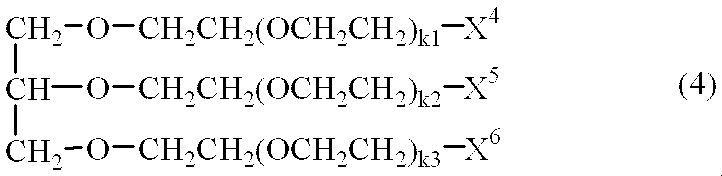
(式中、X4~X6は-OH基もしくは-OCOR6である。R6は炭素数12~20の1価のアルキル基又はアルケニル基であり、X4~X6のうち2つ以上、特に3つが-OCOR6である。k1+k2+k3の合計は40~100、特に45~70の整数である。)
・エステル系
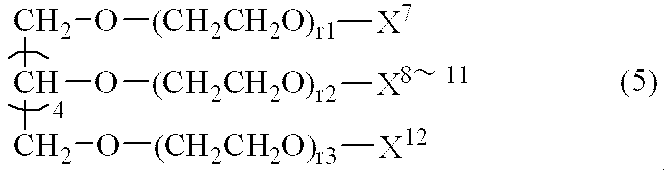
(式中、X7~X12は-Hもしくは-COR7である。R7は炭素数12~20の1価のアルキル基でありX7~X12のうち2つ以上、特に4つが-COR7である。r1+r2+r3の合計は40~100、特に50~70の整数である。)
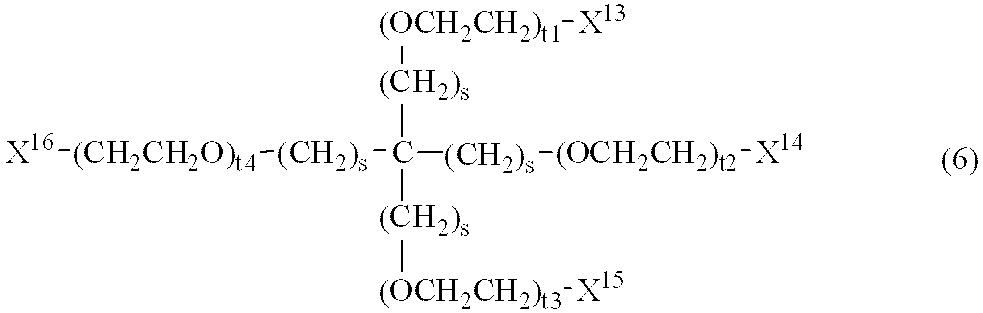
(式中、X13~X16は-OH基もしくは-OCOR8である。R8は炭素数12~20の1価のアルキル基であり、X13~X16のうち2つ以上、特に4つが-OCOR8である。sは2~5の整数であり、t1+t2+t3+t4の合計は100~200、特に140~160の整数である。)
これらのなかでも特に、減粘抑制効果、低温安定性の点から、POEセトステアリルヒドロキシミリスチレンエーテル、トリイソステアリン酸PEGグリセリル、テトラステアリン酸PEGペンタエリスリチルが好ましい。
・POEセトステアリルヒドロキシミリスチレンエーテル(60E.O.)

・ジイソステアリン酸PEG60グリセリル

・ジステアリン酸PEG150

・トリイソステアリン酸PEG60グリセリル

・テトラステアリン酸POE(60)ソルビット

・テトラステアリン酸PEG150ペンタエリスリチル
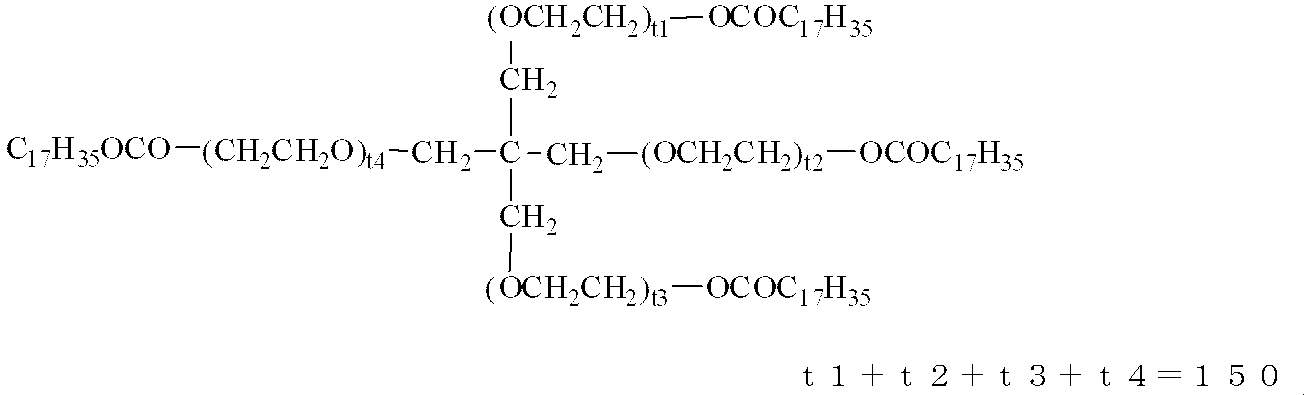
本発明で用いられる清涼剤は、使用時のスッキリ感を付与するために配合する。このような清涼剤としては、メントール、メンチルグリセリルエーテル、メンチルカルボキサミド、バニリルブチルエーテル、メントン、カンファー、ボルネオール、シネオールメントン、サリチル酸メチル、マロン酸メンチル、グリコシル-モノメンチル-O-アセテート、3-l-メントキシプロパン-1,2-ジオール、l-メンチル-3-ヒドロキシブチレート、スペアミント油、ペパーミント油、ハッカ油及びユーカリプタス油が挙げられる。これらは1種単独で又は2種以上を組み合わせて使用することができる。
これらのなかでも、使用時のスッキリ感の点から、メントール、メンチルグリセリルエーテル、メンチルカルボキサミド、バニリルブチルエーテル、カンファー、スペアミント油、ペパーミント油、ハッカ油及びユーカリプタス油が好ましく、メントール、ハッカ油がより好ましく、メントールが更に好ましい。
本発明の組成物には、減粘抑制効果をより高めるため、また組成物にパール外観を付与する点から、更に(d)パール化剤を配合することが好ましい。(d)パール化剤の具体例としては、エチレングリコールモノ脂肪酸エステル、エチレングリコールジ脂肪酸エステル、エチレングリコールモノアルキルエーテル及びエチレングリコールジアルキルエーテルが挙げられ、これらは1種単独で又は2種以上を組み合わせて使用することができる。これらのなかでも特に、エチレングリコールモノ脂肪酸エステル、エチレングリコールジ脂肪酸エステルが好ましい。より具体的には、ジステアリン酸エチレングリコール、モノステアリン酸エチレングリコール、エチレングリコールモノステアリルエーテル、エチレングリコールジステアリルエーテルが挙げられる。より好ましくは、減粘抑制効果、パール外観の点から、ジステアリン酸エチレングリコール、モノステアリン酸エチレングリコールである。
また、本発明の組成物は、更にすすぎ時のなめらかさを毛髪等に付与するために、(e)カチオン性ポリマーを含有することができる。(e)カチオン性ポリマーとしては、カチオン化セルロース、カチオン化セルロース誘導体、カチオン化澱粉、カチオン化グアーガム、カチオン化グアーガム誘導体、ジアリル四級アンモニウム塩のホモポリマー、四級化ポリビニルピロリドン誘導体、ポリグリコールポリアミン縮合物、ジアルキルジアリルアンモニウム塩/アクリルアミド共重合体、ビニルイミダゾリウムトリクロライド/ビニルピロリドン共重合体、ヒドロキシエチルセルロース/ジメチルジアリルアンモニウムクロライド共重合体、ビニルピロリドン/四級化ジメチルアミノエチルメタクリレート共重合体、ポリビニルピロリドン/アルキルアミノアクリレート共重合体、ポリビニルピロリドン/アルキルアミノアクリレート/ビニルカプロラクタム共重合体、ビニルピロリドン/メタクリルアミドプロピル塩化トリメチルアンモニウム共重合体、アルキルアクリルアミド/アクリレート/アルキルアミノアルキルアクリルアミド/ポリエチレングリコールメタクリレート共重合体、アジピン酸/ジメチルアミノヒドロキシプロピルエチレントリアミン共重合体(米国サンドス社製カルタレチン)や、特開昭53-139734号公報及び特開昭60-36407号公報に記載されているカチオン性ポリマー等が挙げられる。これらは1種単独で又は2種以上を組み合わせて使用することができる。
これらのなかでも特に、すすぎ時のなめらかさの点から、ジアルキルジアリルアンモニウム塩/アクリルアミド共重合体、カチオン化セルロース、カチオン化セルロース誘導体、カチオン化グアーガム、カチオン化グアーガム誘導体が好ましい。
本発明の組成物には、仕上がりのなめらかさを付与する点から、(f)シリコーン化合物を配合することができる。(f)シリコーン化合物の具体例としては、ジメチルポリシロキサン(高重合ジメチルポリシロキサン、シリコーンゴムを含む)、アミノ変性シリコーン、メチルフェニルポリシロキサン、ポリエーテル変性シリコーン、ポリアミノ変性シリコーン、べタイン変性シリコーン、アルコール変性シリコーン、フッ素変性シリコーン、エポキシ変性シリコーン、メルカプト変性シリコーン、カルボキシ変性シリコーン、脂肪酸変性シリコーン、シリコーングラフトポリマー、環状シリコーン、アルキル変性シリコーン、アミノグリコール変性シリコーン、ポリオキシアルキレン・アミノ変性シリコーン、トリメチルシリル基末端ジメチルポリシロキサン、シラノール基末端ジメチルポリシロキサン等を挙げることができ、これらは1種単独で又は2種以上を適宜組み合わせて使用することができる。これらの中でも、ジメチルポリシロキサン、ポリエーテル変性シリコーン、ポリアミノ変性シリコーンが特に好適に使用される。また、上記シリコーン化合物としては、上記シリコーン化合物を界面活性剤により乳化し、エマルション化したものも使用することができる。なお、このようなエマルションは、乳化剤や乳化方法に特に制限はなく、種々使用することができる。本発明においては、とりわけ動粘度が10万cst/25℃以上のジメチルポリシロキサン、アミノ変性シリコーン、ポリオキシアルキレン・アミノ変性シリコーンを好適に用いることができる。
本発明においては、スッキリ感をより向上させるために、(b)成分以外のノニオン界面活性剤を配合することができる。このようなノニオン界面活性剤としては、ポリグリセリン脂肪酸エステル、POE(ポリオキシエチレン)硬化ヒマシ油、ソルビタン脂肪酸エステル、POEソルビタン脂肪酸エステルプロピレングリコール脂肪酸エステル及びグリセリン脂肪酸エステル、POE・POPアルキルエーテル、モノステアリン酸ポリエチレングリコール等のポリエチレングリコール脂肪酸エステル、また、常温で液状であるPOEグリセリン脂肪酸エステル、POEソルビット脂肪酸エステル、POEアルキルエーテル、POEエチレングリコール脂肪酸エステル、POEプロピレングリコール脂肪酸エステル、POEグリセリン脂肪酸エステル、POEソルビット脂肪酸エステル又はPOEペンタエリスリトール脂肪酸エステル等が挙げられる。(a-2)成分以外の両性界面活性剤としては、ラウリルジメチルアミノ酢酸ベタイン、ヤシ油脂肪酸アミドプロピルジメチルアミノ酢酸ベタイン、N-ヤシ油脂肪酸アシル-N-カルボキシメチル-N-ヒドロキシエチルエチレンジアミンナトリウム、N-ヤシ油脂肪酸アシル-N-カルボキシメチル-N-ヒドロキシエチルエチレンジアミン・ラウリル硫酸ナトリウム等が挙げられる。
これらのうちでも、ポリグリセリン脂肪酸エステル、POE(ポリオキシエチレン)硬化ヒマシ油、POEアルキルエーテル、POE・POPアルキルエーテルが好ましい。
より具体的には、ラウリン酸ポリグリセリル、POE(10~60)硬化ヒマシ油、POE(30)POP(6)デシルテトラデシルエーテル等が好ましい。
本発明の洗浄剤組成物には、上記成分以外にも、本発明の効果を損なわない範囲で、所望により洗浄剤組成物に一般に配合される成分、例えば、上記以外のノニオン界面活性剤、上述した以外の高分子化合物、アミノ酸類、蛋白加水分解物、金属封鎖剤、増粘剤、ポリオール類、油剤、紫外線吸収剤、pH調整剤、酸化防止剤、酸化剤、還元剤、アルカリ剤、色素、抗菌剤、噴射剤等を含むことができる。
固体の確認方法は、(1)に規定する装置を用い、(2)に規定する試験場所において、(3)に規定する試験の実施手順により試験物品((b)成分)が液状であるか否かを確認するものとする。
(1) 装置
ア) 恒温水槽
撹拌機、ヒーター、温度計、自動温度調節器(±0.1℃で温度制御が可能なもの)を備えたもので深さ150mm以上のものとする。
イ) 試験管
内径30mm、高さ120mmの平底円筒型透明ガラス製のもので、管底から55mm及び85mmの高さのところに標線(以下「A線」及び「B線」という。)を付したものとする(2本)。
ウ) 温度計
JISB7410(1982)「石油類試験用ガラス製温度計」に規定する凝固点測定用のもの(SOP-58 目盛範囲20~50℃)とする。
エ) ゴム栓
試験管の口に合うものとし(2個)、そのうち1個は、栓の中央に温度計を支える孔をあけたものとする。
(2) 試験場所
試験場所は、温度20±5℃の大気圧下の場所とする。
(3)試験の実施手順
ア) 試験物品を2本の試験管のA線までとる。一方の試験管はゴム栓で密栓し(以下「液状判断用試験管」という。)、もう一方の試験管は温度計をつけたゴム栓で密栓する(以下「温度測定用試験管」という。)。温度計は、没浸30mmとし、試験管に直立させる。
イ) 2本の試験管を確認温度(試験物品が液状であるか否かを確認する温度。以下に同じ。)±0.1℃に保った恒温水槽中にB線が液面下に没するよう直立させて静置する。温度測定用試験管中の試験物品が試験温度に達してから10分間その状態を保持する。
ウ) 10分後、液状判断用試験管を恒温水槽から水平な台上に直立状態のまま取り出し、直ちに台の上に水平に倒す。
エ) 試験管を倒してから試験物品の液面の先端がB線を通過するまでの時間を測定する。
オ) エ)で測定された時間が90秒を超える試験物品は確認温度において固体であるものとする。
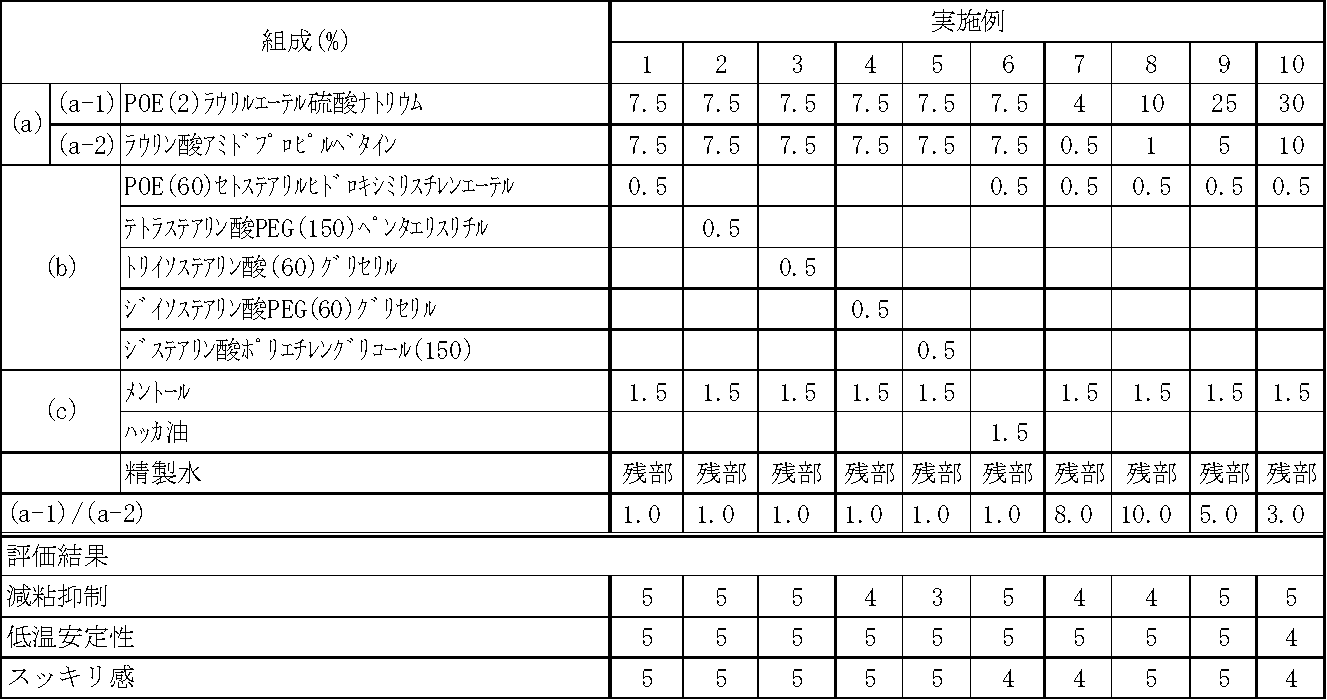
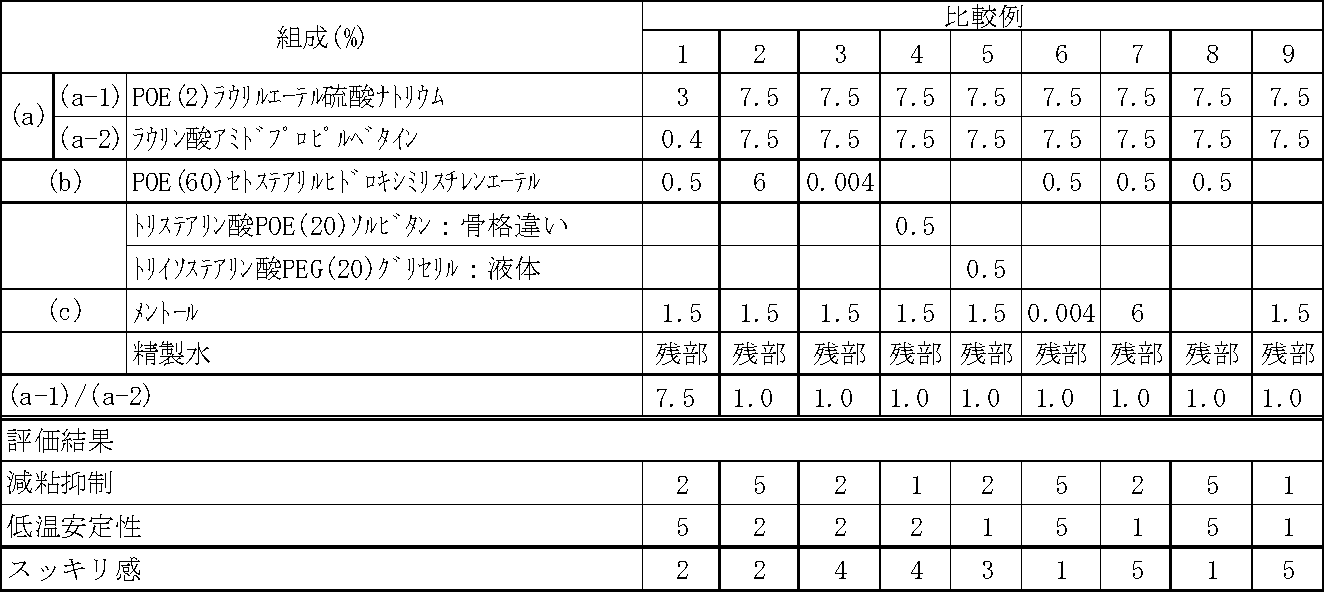
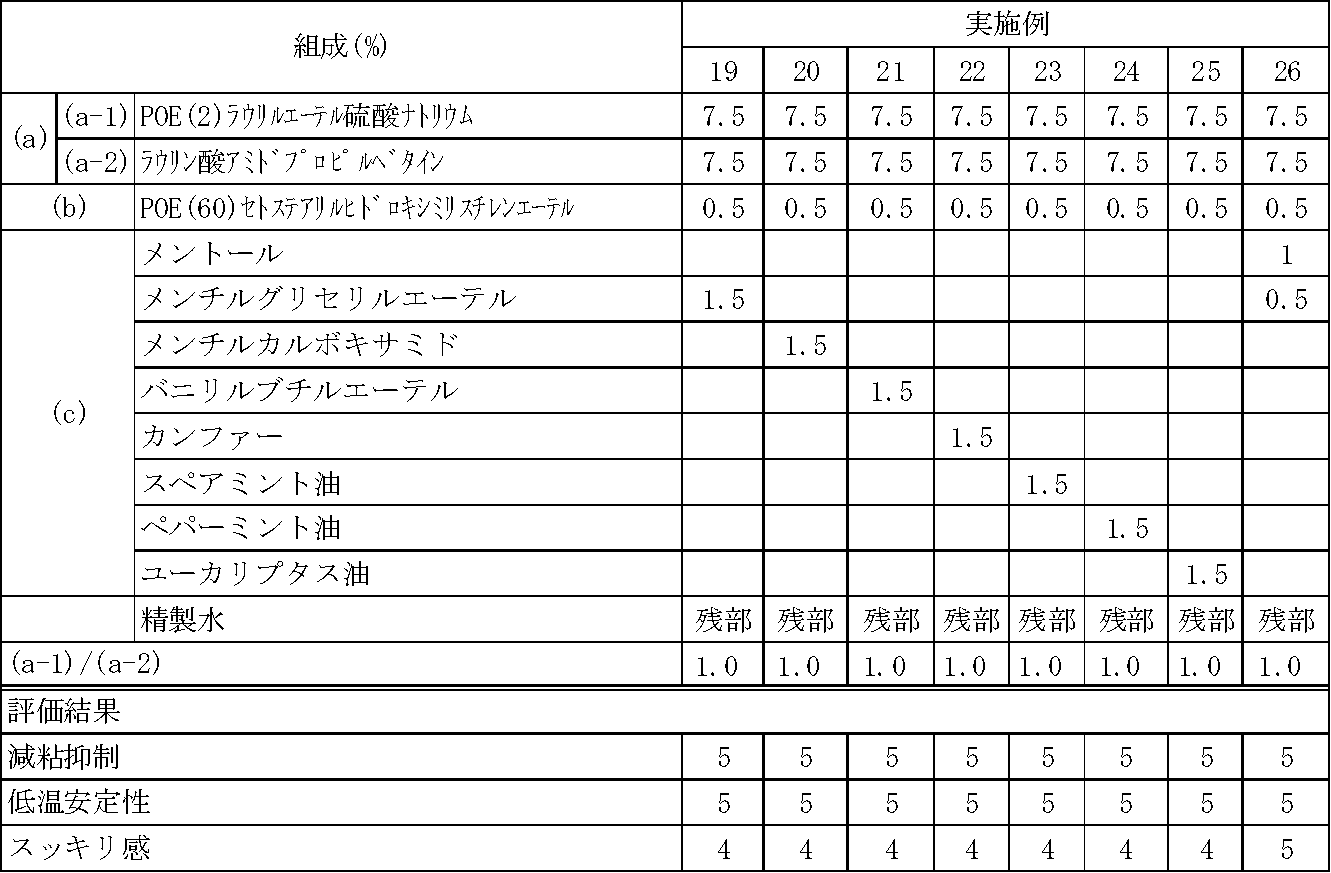
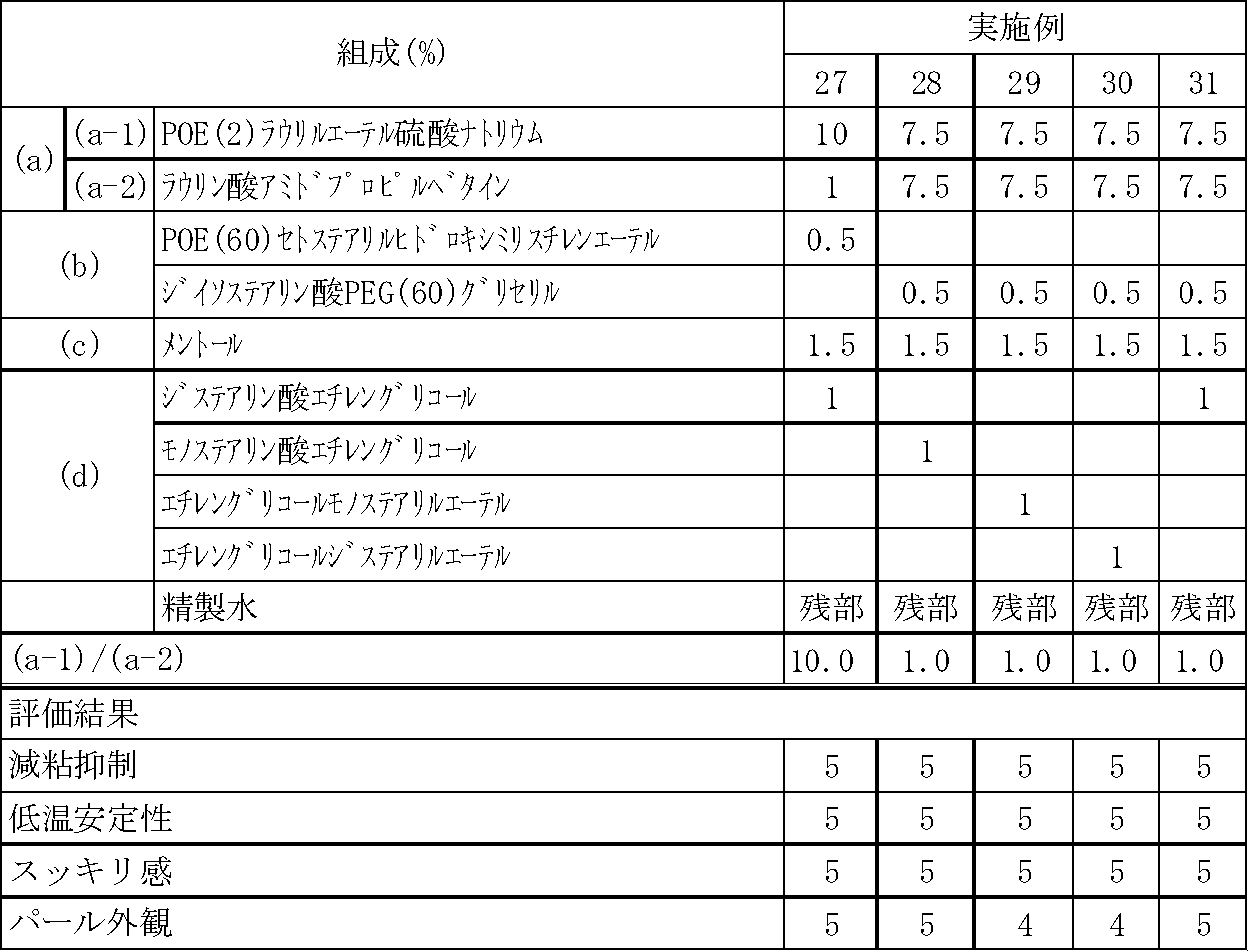
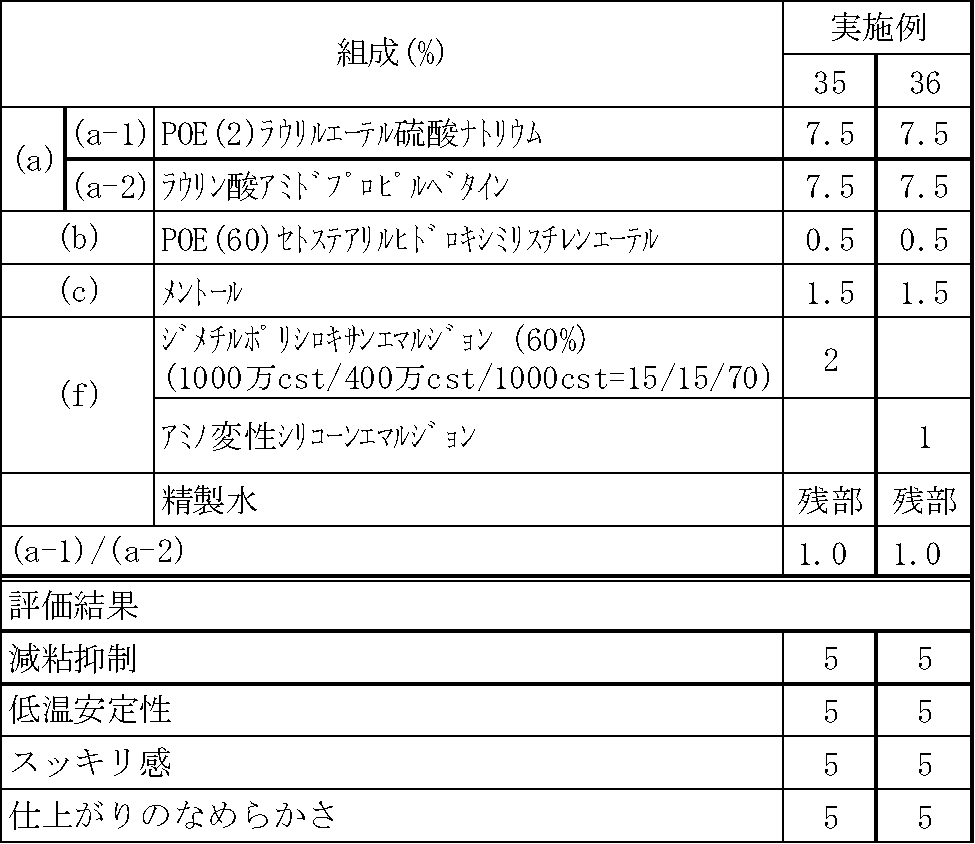
表1~7に示す組成の洗浄剤組成物を常法により調製し、以下の官能評価基準に従い、下記方法で評価した。結果を表中に併記する。
官能評価基準
5点:よい
4点:ややよい
3点:どちらともいえない
2点:ややよくない
1点:よくない
標準品と比較して、25℃での粘度の増加程度を評価した。標準品としては、実施例及び比較例のそれぞれの組成から(b)成分を除いたものを用いた。この場合、例えば、比較例9は粘度10Pa・sであった。また、実施例1~36の組成物の粘度は、0.5~40000mPa・sの範囲であった。
粘度の測定方法
粘度の測定は、25℃でBM型粘度計を用い、必要に応じてローターNo.1~4を用い、30回転/1分にて測定を行った。
評価基準
5点:標準品と比較して1.5倍以上の粘度増加があった
4点:標準品と比較して1.3倍以上1.5倍未満の粘度増加があった
3点:標準品と比較して1.1倍以上1.3倍未満の粘度増加があった
2点:変わらなかった(標準品の0.9倍~1.1倍未満)
1点:粘度が下がった(標準品の0.9倍未満)
サンプルを50mLのガラス瓶に入れ、-5℃の恒温槽で1ヶ月間保存したときの、液の外観を評価した。
評価基準
5点:析出物がなく、保存前と変化がなかった
4点:析出物がなかったが、やや保存前と変化があった
3点:析出物は見られたが、常温に戻すと溶解した
2点:析出物が見られ、常温に戻しても溶解しなかった
1点:析出物が多量に見られ、常温に戻しても溶解しなかった
女性5名、男性5名について、それぞれ洗浄剤サンプルを5mL用いて、頭部の洗浄を行った。洗髪直後のスッキリ感を以下の評価基準で評価し、10名分の評価結果を平均した。
評価基準
5: 4.5点以上~5点
4: 4点~4.5点未満
3: 3点以上~4点未満
2: 2点以上~3点未満
1: ~2点未満
サンプルを50mLのガラス瓶に入れ、(d)パール剤未配合サンプル(実施例1)と比較して、液のパール外観を評価した。
評価基準
5点:美麗なパール感が認められる
4点:パール感が認められる
3点:パール感がやや薄い
2点:パール感が薄い
1点:パール感が認知できない
女性5名、男性5名について、それぞれ洗浄剤サンプルを5mL用いて、頭部の洗浄を行った。洗髪中の髪のなめらかさを以下の評価基準で評価し、10名分の評価結果を平均した。
評価基準
5: 4.5点以上~5点
4: 4点~4.5点未満
3: 3点以上~4点未満
2: 2点以上~3点未満
1: ~2点未満
女性5名、男性5名について、それぞれ洗浄剤サンプルを5mL用いて、頭部の洗浄を行った。洗髪後、乾燥した髪についてなめらかさを以下の評価基準で評価し、10名分の評価結果を平均した。
評価基準
5: 4.5点以上~5点
4: 4点~4.5点未満
3: 3点以上~4点未満
2: 2点以上~3点未満
1: ~2点未満


成分 配合量(%)
(a-1)ラウリン酸カリウム※ 3.0
(a-1)ミリスチン酸カリウム※ 7.0
(a-2)ラウリルジメチルアミノ酢酸ベタイン 4.0
(b)POE(60)セトステアリルヒドロキシミリスチレンエーテル
0.3
(c)L-メントール 1.0
(e)カチオン化セルロース 0.2
POE(11)ステアリルエーテル 1.0
プロピレングリコール 10.0
エデト酸 0.2
水酸化カリウム(pHが10.6になるように調整) 適量
精製水 残部
合計 100.0
※予め水酸化カリウムと脂肪酸を混合し調製した。
(a-1)/(a-2)質量比=2.5
減粘抑制 5点
低温安定性 5点
スッキリ感 5点
成分 配合量(%)
ゼラニウムオイル 0.2
(a-1)POE(2)ラウリルエーテル硫酸ナトリウム
10.0
(a-2)ラウリン酸アミドプロピルベタイン 3.0
(b)テトラステアリン酸PEG150ペンタエリスリチル
0.3
(c)ハッカ油 0.5
(c)メンチルグリセリルエーテル 0.5
(e)カチオン化グァーガム 0.3
POE(11)ステアリルエーテル 1.0
プロピレングリコール 5.0
エデト酸 0.2
水酸化カリウム(pHが10.0になるように調整) 適量
精製水 残部
合計 100.0
(a-1)/(a-2)質量比=3.3
減粘抑制 5点
低温安定性 5点
スッキリ感 5点
成分 配合量(%)
(a-1)ラウリン酸カリウム※ 12
(a-1)ミリスチン酸カリウム※ 6
(a-2)ラウリルジメチルアミノ酢酸ベタイン 4.0
(b)テトラステアリン酸PEG150ペンタエリスリチル
0.3
(c)L-メントール 0.5
(c)メンチルグリセリルエーテル 0.5
(e)カチオン化グァーガム 0.5
モノエタノールアミン 0.5
POE(11)ステアリルエーテル 0.2
ヒドロキシプロピルメチルセルロース 1.2
イソプロピルメチルフェノール 0.1
トリクロサン 0.1
ラウリルジメチルアミンオキシド 1
プロピレングリコール 15
ソルビット 5
エデト酸四ナトリウム四水塩 0.2
ヒドロキシエタンジホスホン酸 0.1
スチレン重合体エマルジョン 0.7
ローズマリーエキス 0.1
青色1号 0.00001
香料 0.4
水酸化カリウム pH10に調整量
精製水 残部
合計 100.0
※予め水酸化カリウムと脂肪酸を混合し調製した。
(a-1)/(a-2)質量比=4.5
減粘抑制 5点
低温安定性 5点
スッキリ感 5点

Claims (10)
- (a)(a-1)アニオン界面活性剤、
(a-2)両性界面活性剤:(a-1)及び(a-2)の総量で4質量%以上と、
(b)常温で固体の多鎖型ノニオン界面活性剤:0.01~5質量%と、
(c)メントール、メントン、カンファー、ボルネオール、シネオールメントン、サリチル酸メチル、マロン酸メンチル、グリコシル-モノメンチル-O-アセテート、3-l-メントキシプロパン-1,2-ジオール、l-メンチル-3-ヒドロキシブチレート、スペアミント油、ペパーミント油、ハッカ油及びユーカリプタス油からなる群より選ばれる清涼剤:0.01~5質量%と
を含有することを特徴とする洗浄剤組成物。 - (b)成分が、二鎖~四鎖型のエーテル系及びエステル系ノニオン界面活性剤から選ばれるものである請求項1記載の洗浄剤組成物。
- (b)成分が、POEセトステアリルヒドロキシミリスチレンエーテル、ジイソステアリン酸PEGグリセリル、ジステアリン酸PEG、トリイソステアリン酸PEGグリセリル、テトラステアリン酸PEGペンタエリスリチル、テトラステアリン酸POEソルビット、及びヘキサステアリン酸POEソルビットから選ばれるものである請求項2記載の洗浄剤組成物。
- (a-1)/(a-2)で表される、アニオン界面活性剤と両性界面活性剤との配合質量比が50/1~1/5である請求項1~3のいずれか1項記載の洗浄剤組成物。
- (c)成分が、メントールである請求項1~4のいずれか1項記載の洗浄剤組成物。
- 更に、(d)エチレングリコールモノ脂肪酸エステル、エチレングリコールジ脂肪酸エステル、エチレングリコールモノアルキルエーテル及びエチレングリコールジアルキルエーテルからなる群より選ばれるパール化剤を含有する請求項1~5のいずれか1項記載の洗浄剤組成物。
- 更に、(e)カチオン性ポリマーを含有する請求項1~6のいずれか1項記載の洗浄剤組成物。
- 更に、(f)シリコーン化合物を含有する請求項1~7のいずれか1項記載の洗浄剤組成物。
- 粘度が0.5~50000mPa・sである請求項1~8のいずれか1項記載の洗浄剤組成物。
- 毛髪又は皮膚用である請求項1~9のいずれか1項記載の洗浄剤組成物。
Priority Applications (2)
| Application Number | Priority Date | Filing Date | Title |
|---|---|---|---|
| PH1/2013/501774A PH12013501774A1 (en) | 2011-02-28 | 2012-02-10 | Cleaning agent composition |
| KR1020137019873A KR101858291B1 (ko) | 2011-02-28 | 2012-02-10 | 세정제 조성물 |
Applications Claiming Priority (2)
| Application Number | Priority Date | Filing Date | Title |
|---|---|---|---|
| JP2011-042004 | 2011-02-28 | ||
| JP2011042004A JP5703840B2 (ja) | 2011-02-28 | 2011-02-28 | 洗浄剤組成物 |
Publications (1)
| Publication Number | Publication Date |
|---|---|
| WO2012117828A1 true WO2012117828A1 (ja) | 2012-09-07 |
Family
ID=46757767
Family Applications (1)
| Application Number | Title | Priority Date | Filing Date |
|---|---|---|---|
| PCT/JP2012/053088 Ceased WO2012117828A1 (ja) | 2011-02-28 | 2012-02-10 | 洗浄剤組成物 |
Country Status (5)
| Country | Link |
|---|---|
| JP (1) | JP5703840B2 (ja) |
| KR (1) | KR101858291B1 (ja) |
| MY (1) | MY162460A (ja) |
| PH (1) | PH12013501774A1 (ja) |
| WO (1) | WO2012117828A1 (ja) |
Cited By (5)
| Publication number | Priority date | Publication date | Assignee | Title |
|---|---|---|---|---|
| JPWO2014148245A1 (ja) * | 2013-03-21 | 2017-02-16 | ライオン株式会社 | シャンプー組成物 |
| WO2020044956A1 (ja) * | 2018-08-29 | 2020-03-05 | 株式会社 資生堂 | 化粧料および洗浄料 |
| JP2022504965A (ja) * | 2018-10-25 | 2022-01-13 | ザ プロクター アンド ギャンブル カンパニー | 界面活性剤可溶性抗ふけ剤の付着を増強した組成物 |
| CN115397387A (zh) * | 2020-04-14 | 2022-11-25 | 东洋美妆株式会社 | 身体清洁剂 |
| JP2023095290A (ja) * | 2021-12-24 | 2023-07-06 | 株式会社 資生堂 | 洗浄料 |
Families Citing this family (6)
| Publication number | Priority date | Publication date | Assignee | Title |
|---|---|---|---|---|
| WO2014128922A1 (ja) * | 2013-02-22 | 2014-08-28 | 株式会社コーセー | 粘性洗浄剤組成物 |
| CN103110557B (zh) * | 2013-03-21 | 2015-03-25 | 白继良 | 具有清爽止汗作用的洗浴搓茶及其制备方法 |
| EP3114203B1 (en) * | 2014-03-07 | 2019-08-14 | The Procter and Gamble Company | Compositions comprising a pungent agent |
| JP6602119B2 (ja) * | 2015-09-04 | 2019-11-06 | 株式会社マンダム | 皮膚洗浄剤 |
| JP6649910B2 (ja) * | 2017-03-02 | 2020-02-19 | 花王株式会社 | 皮膚洗浄剤組成物 |
| JP7406235B2 (ja) * | 2019-12-06 | 2023-12-27 | 株式会社ダリヤ | カラーシャンプー組成物 |
Citations (4)
| Publication number | Priority date | Publication date | Assignee | Title |
|---|---|---|---|---|
| JPH10310790A (ja) * | 1997-05-09 | 1998-11-24 | Kose Corp | 洗浄剤組成物 |
| JP2005213209A (ja) * | 2004-01-30 | 2005-08-11 | Kawaken Fine Chem Co Ltd | 染色毛髪用シャンプー組成物 |
| JP2009035520A (ja) * | 2007-08-03 | 2009-02-19 | Kao Corp | 洗浄剤組成物 |
| JP2010138105A (ja) * | 2008-12-11 | 2010-06-24 | Sunstar Inc | 透明洗浄剤組成物 |
-
2011
- 2011-02-28 JP JP2011042004A patent/JP5703840B2/ja active Active
-
2012
- 2012-02-10 MY MYPI2013003051A patent/MY162460A/en unknown
- 2012-02-10 PH PH1/2013/501774A patent/PH12013501774A1/en unknown
- 2012-02-10 KR KR1020137019873A patent/KR101858291B1/ko not_active Expired - Fee Related
- 2012-02-10 WO PCT/JP2012/053088 patent/WO2012117828A1/ja not_active Ceased
Patent Citations (4)
| Publication number | Priority date | Publication date | Assignee | Title |
|---|---|---|---|---|
| JPH10310790A (ja) * | 1997-05-09 | 1998-11-24 | Kose Corp | 洗浄剤組成物 |
| JP2005213209A (ja) * | 2004-01-30 | 2005-08-11 | Kawaken Fine Chem Co Ltd | 染色毛髪用シャンプー組成物 |
| JP2009035520A (ja) * | 2007-08-03 | 2009-02-19 | Kao Corp | 洗浄剤組成物 |
| JP2010138105A (ja) * | 2008-12-11 | 2010-06-24 | Sunstar Inc | 透明洗浄剤組成物 |
Cited By (11)
| Publication number | Priority date | Publication date | Assignee | Title |
|---|---|---|---|---|
| JPWO2014148245A1 (ja) * | 2013-03-21 | 2017-02-16 | ライオン株式会社 | シャンプー組成物 |
| WO2020044956A1 (ja) * | 2018-08-29 | 2020-03-05 | 株式会社 資生堂 | 化粧料および洗浄料 |
| JP2020033297A (ja) * | 2018-08-29 | 2020-03-05 | 株式会社 資生堂 | 化粧料および洗浄料 |
| CN112638355A (zh) * | 2018-08-29 | 2021-04-09 | 株式会社资生堂 | 化妆品和清洁品 |
| JP7191593B2 (ja) | 2018-08-29 | 2022-12-19 | 株式会社 資生堂 | 化粧料および洗浄料 |
| JP2022504965A (ja) * | 2018-10-25 | 2022-01-13 | ザ プロクター アンド ギャンブル カンパニー | 界面活性剤可溶性抗ふけ剤の付着を増強した組成物 |
| US12226505B2 (en) | 2018-10-25 | 2025-02-18 | The Procter & Gamble Company | Compositions having enhanced deposition of surfactant-soluble anti-dandruff agents |
| JP7758567B2 (ja) | 2018-10-25 | 2025-10-22 | ザ プロクター アンド ギャンブル カンパニー | 界面活性剤可溶性抗ふけ剤の付着を増強した組成物 |
| CN115397387A (zh) * | 2020-04-14 | 2022-11-25 | 东洋美妆株式会社 | 身体清洁剂 |
| JP2023095290A (ja) * | 2021-12-24 | 2023-07-06 | 株式会社 資生堂 | 洗浄料 |
| JP7793363B2 (ja) | 2021-12-24 | 2026-01-05 | 株式会社 資生堂 | 洗浄料 |
Also Published As
| Publication number | Publication date |
|---|---|
| JP2012180384A (ja) | 2012-09-20 |
| MY162460A (en) | 2017-06-15 |
| PH12013501774A1 (en) | 2013-10-14 |
| JP5703840B2 (ja) | 2015-04-22 |
| KR101858291B1 (ko) | 2018-05-15 |
| KR20130141654A (ko) | 2013-12-26 |
Similar Documents
| Publication | Publication Date | Title |
|---|---|---|
| JP5703840B2 (ja) | 洗浄剤組成物 | |
| JP7280265B2 (ja) | シリコーンポリマーを含有する透明なシャンプー組成物 | |
| TWI415935B (zh) | 洗淨劑組成物 | |
| JP5041894B2 (ja) | 洗浄剤組成物 | |
| JP5968692B2 (ja) | 液体洗浄剤組成物 | |
| TWI605831B (zh) | Detergent composition | |
| WO2016103892A1 (ja) | 液体皮膚洗浄剤組成物 | |
| KR20190089844A (ko) | 액체 피부 세정제 조성물 | |
| JP5873328B2 (ja) | シャンプー | |
| WO2011043226A1 (ja) | 液体皮膚洗浄剤組成物 | |
| JP2021183591A (ja) | 液状皮膚洗浄用組成物 | |
| JP2008137904A (ja) | 液体皮膚洗浄剤組成物 | |
| JP4294628B2 (ja) | 泡沫洗浄剤用組成物及び泡沫洗浄剤 | |
| JP2018052924A (ja) | 液体皮膚洗浄剤組成物 | |
| JP5191026B2 (ja) | 洗浄剤組成物 | |
| JP3524735B2 (ja) | 洗浄剤組成物 | |
| JP5654197B2 (ja) | シャンプー組成物 | |
| JP5192871B2 (ja) | 洗浄剤組成物 | |
| JPWO2019225238A1 (ja) | 皮膚洗浄剤組成物 | |
| KR102539780B1 (ko) | 모발 세정제 조성물 | |
| JP6463627B2 (ja) | 洗浄剤組成物 | |
| JP6497935B2 (ja) | 毛髪洗浄剤 | |
| JP6388801B2 (ja) | 洗浄剤組成物 | |
| JP7602859B2 (ja) | 皮膚洗浄料組成物 | |
| JP2021091665A (ja) | 毛髪化粧料組成物 |
Legal Events
| Date | Code | Title | Description |
|---|---|---|---|
| 121 | Ep: the epo has been informed by wipo that ep was designated in this application |
Ref document number: 12751857 Country of ref document: EP Kind code of ref document: A1 |
|
| ENP | Entry into the national phase |
Ref document number: 20137019873 Country of ref document: KR Kind code of ref document: A |
|
| NENP | Non-entry into the national phase |
Ref country code: DE |
|
| WWE | Wipo information: entry into national phase |
Ref document number: 1301004779 Country of ref document: TH Ref document number: 12013501774 Country of ref document: PH |
|
| 122 | Ep: pct application non-entry in european phase |
Ref document number: 12751857 Country of ref document: EP Kind code of ref document: A1 |