WO2012114939A1 - プロトン性極性溶媒に対して応答性を有するポリカーボネートおよびその製造方法 - Google Patents
プロトン性極性溶媒に対して応答性を有するポリカーボネートおよびその製造方法 Download PDFInfo
- Publication number
- WO2012114939A1 WO2012114939A1 PCT/JP2012/053389 JP2012053389W WO2012114939A1 WO 2012114939 A1 WO2012114939 A1 WO 2012114939A1 JP 2012053389 W JP2012053389 W JP 2012053389W WO 2012114939 A1 WO2012114939 A1 WO 2012114939A1
- Authority
- WO
- WIPO (PCT)
- Prior art keywords
- group
- ethoxy
- substituted
- polycarbonate
- polar solvent
- Prior art date
- Legal status (The legal status is an assumption and is not a legal conclusion. Google has not performed a legal analysis and makes no representation as to the accuracy of the status listed.)
- Ceased
Links
- OFNCDRMHMJSSII-UHFFFAOYSA-N C[ClH]CC1OC1 Chemical compound C[ClH]CC1OC1 OFNCDRMHMJSSII-UHFFFAOYSA-N 0.000 description 1
Classifications
-
- C—CHEMISTRY; METALLURGY
- C08—ORGANIC MACROMOLECULAR COMPOUNDS; THEIR PREPARATION OR CHEMICAL WORKING-UP; COMPOSITIONS BASED THEREON
- C08G—MACROMOLECULAR COMPOUNDS OBTAINED OTHERWISE THAN BY REACTIONS ONLY INVOLVING UNSATURATED CARBON-TO-CARBON BONDS
- C08G64/00—Macromolecular compounds obtained by reactions forming a carbonic ester link in the main chain of the macromolecule
- C08G64/20—General preparatory processes
- C08G64/32—General preparatory processes using carbon dioxide
- C08G64/34—General preparatory processes using carbon dioxide and cyclic ethers
-
- C—CHEMISTRY; METALLURGY
- C08—ORGANIC MACROMOLECULAR COMPOUNDS; THEIR PREPARATION OR CHEMICAL WORKING-UP; COMPOSITIONS BASED THEREON
- C08G—MACROMOLECULAR COMPOUNDS OBTAINED OTHERWISE THAN BY REACTIONS ONLY INVOLVING UNSATURATED CARBON-TO-CARBON BONDS
- C08G64/00—Macromolecular compounds obtained by reactions forming a carbonic ester link in the main chain of the macromolecule
- C08G64/02—Aliphatic polycarbonates
- C08G64/0208—Aliphatic polycarbonates saturated
Definitions
- the present invention relates to a polycarbonate having responsiveness to protic polar solvents such as water, alcohol and amine, and a method for producing the same.
- Global warming is caused by the increase in greenhouse gases such as carbon dioxide, chlorofluorocarbons and methane in the atmosphere, so reducing the atmospheric concentration of carbon dioxide, which has a high contribution to global warming, It is extremely important, and various studies such as emission regulations and immobilization are being carried out on a global scale.
- Non-patent Document 1 Non-patent Document 1
- Polycarbonate is transparent and completely decomposes when heated to a predetermined temperature or higher, so it can be used for applications such as general moldings, films, and fibers, as well as optical materials such as optical fibers and optical disks, or ceramic molding It can also be used as a thermally decomposable material such as a binder and lost foam casting.
- polycarbonate is degradable in vivo, it can be applied as a medical material such as sustained-release drug capsules, an additive for biodegradable resin, or a main component of biodegradable resin.
- Ceramic binder is a component necessary for the production of ceramics. Ceramics, particularly ceramics called fine ceramics, new ceramics, etc., are generally produced by producing, molding and sintering a slurry containing ceramic powder and a ceramic molding binder. Examples of the resin contained in the ceramic molding binder include polyvinyl butyral (PVB), methyl cellulose (MC), carboxymethyl cellulose (CMC), polyvinyl alcohol (PVA), and acrylic polymers as described in Non-Patent Document 2. Water-soluble resins are widely used. However, these conventional water-soluble resins have insufficient thermal decomposability, such as not being completely decomposed by heating.
- Polycarbonate completely decomposes when heated to a predetermined temperature or higher, and therefore has more preferable thermal decomposition characteristics as compared with a resin conventionally known as a ceramic molding binder resin.
- a resin conventionally known as a ceramic molding binder resin As a method for producing ceramics, spray drying is known. Since water or alcohol is used as a solvent, it is necessary to partially dissolve in water or alcohol as a molding binder resin. However, since the conventional polycarbonate does not have solubility in water or alcohol, its application has been greatly limited.
- the present invention provides a protic polar solvent containing water, alcohol, amine, etc. for the purpose of not only imparting solubility in water and alcohol to polycarbonate having excellent thermal decomposability, but also expanding the application range of polycarbonate.
- the present invention provides a polycarbonate having a response that completely or partially dissolves or swells with respect to the resin, and a method for producing the same.
- the present invention relates to the following aspects.
- R 1 and R 2 may be the same or different and each represents a hydrogen atom, an alkyl group, an alkoxy group, an alkanoyl group, a carbamoyl group, a cyano group, or a group composed of a glycol unit. Any one of 1 and R 2 is a group composed of glycol units.
- a binder comprising a polycarbonate responsive to the protic polar solvent according to any one of embodiments 1 to 3.
- a polycarbonate having responsiveness to a protic polar solvent can be obtained.
- the polycarbonate having responsiveness to the protic polar solvent according to the present invention can be produced by polymerizing carbon dioxide and epoxide in the presence of a catalyst.
- “having responsiveness to a protic polar solvent” means that the polycarbonate does not respond to the protic polar solvent at all and does not change its form. Therefore, in addition to the case where the polycarbonate is completely dissolved in the protic polar solvent, when a part of the polycarbonate is dissolved in the protic polar solvent, the polycarbonate is not dissolved in the protic polar solvent, but it is not dissolved. It also includes the case where it does not swell.
- the “protic polar solvent” is generally a solvent having a proton-donating property, specifically water; one having 1 to 10 carbon atoms such as methanol, ethanol, isopropyl alcohol, 1-decanol and the like.
- Polyhydric alcohols such as ethylene glycol and propylene glycol; and amines such as triisopropanolamine.
- the polycarbonate having responsiveness to the protic polar solvent according to the present invention has the general formula (1):
- R 1 and R 2 may be the same or different and each represents a hydrogen atom, an alkyl group, an alkoxy group, an alkanoyl group, a carbamoyl group, a cyano group, or a group composed of a glycol unit.
- One of R 1 and R 2 is a group composed of glycol units).
- the glycol unit means two hydrogen atoms from a diol compound in which each of two carbon atoms of a substituted or unsubstituted linear or branched aliphatic hydrocarbon is substituted with one hydroxyl group. Means a divalent residue extracted.
- the diol compound from which the glycol unit is derived includes, but is not limited to, for example, ethylene glycol, propylene glycol, butylene glycol and the like.
- substituent on the glycol unit examples include alkyl groups such as methyl, ethyl, n-butyl and n-decyl, alkoxy such as methoxy and ethoxy, alkanoyl such as methanoyl and ethanoyl, carbamoyl Group or a cyano group.
- the polycarbonate having responsiveness to the protic polar solvent according to the present invention is (i) when any one of R 1 and R 2 is a group composed of glycol units, and the epoxide is a structural unit ( ii) When R 1 and R 2 are groups composed of glycol units, the epoxide is a structural unit, and (iii) Both types (i) and (ii) of the epoxide are a structural unit. There is.
- either one of R 1 and R 2 is a hydrogen atom, a methyl group, an ethyl group, an n-butyl group, an n-decyl group or the like alkyl group, a methoxy group, and An alkoxy group such as an ethoxy group, an alkanoyl group such as a methanoyl group and an ethanoyl group, a carbamoyl group, or a cyano group, but a hydrogen atom is preferably used from the viewpoint of excellent responsiveness to the protic polar solvent of the obtained polycarbonate. .
- R 1 and R 2 in the epoxide as a structural unit may be the same or different, and are groups composed of glycol units independently of each other.
- the epoxide of the type (i) and the epoxide of the type (ii) are used in an arbitrary mixing ratio to form a structural unit.
- the number of repeating glycol units n is 1 to 50 times, preferably 1 to 30 times, more preferably 1 to 15 times from the viewpoint of high reactivity. It is.
- the glycol chain composed of this glycol unit is a site that contributes to the response to the protic polar solvent, and the proportion of the glycol chain structure is sufficiently large relative to the epoxide molecular structure of one unit Even if other substituents are present, it is considered that the same effect is obtained.
- the epoxide represented by (i) is, for example, a method using epichlorohydrin and glycols such as ethylene glycol monomethyl ether, diethylene glycol monomethyl ether, and triethylene glycol monomethyl ether as shown in the following formula (Journalnof Organic Chemistry 1983, 48, p. 1117).
- epoxide represented by (i) include 2- (2-hydroxyethoxy) methyloxirane, 2- (2- (2-hydroxyethoxy) ethoxy) methyloxirane, and 2- (2-methoxyethoxy).
- 2- (2- (2-methoxyethoxy) ethoxy) methyloxirane and 2- (2- (2- (2-methoxyethoxy) ethoxy) methyloxirane are preferable from the viewpoint of high reactivity. Used for.
- epoxide represented by (ii) for example, 1,4-dichloro-2,3-epoxybutane is used in place of epichlorohydrin, and R 1 and R 2 are unsubstituted. It is possible to introduce a group composed of ethylene glycol units.
- epoxide represented by (ii) include 2,3-bis ((2-hydroxyethoxy) methyl) oxirane, 2,3-bis ((2- (2-hydroxyethoxy) ethoxy) methyl) Oxirane, 2,3-bis ((2-methoxyethoxy) methyl) oxirane, 2,3-bis ((2- (2-methoxyethoxy) ethoxy) methyl) oxirane, 2,3-bis ((2- (2-(2-methoxyethoxy) ethoxy) ethoxy) methyl) oxirane, 2,3-bis ((2- (2- (2- (2-methoxyethoxy) ethoxy) ethoxy) methyl) oxirane, 2,3- Bis ((2- (2- (2- (2- (2-methoxyethoxy) ethoxy) ethoxy) methyl) oxirane, 2,3- Bis ((2- (2- (2- (2- (2-methoxyethoxy) ethoxy) eth
- 2,3-bis ((2- (2-methoxyethoxy) ethoxy) methyl) oxirane and 2,3-bis ((2- (2- (2-methoxyethoxy ) Ethoxy) ethoxy) methyl) oxirane is preferably used.
- carbon dioxide is introduced into the reaction vessel as a gas and used for the reaction.
- the pressure of carbon dioxide in the reaction vessel is preferably 0.01 to 6 MPa, and more preferably 0.1 to 3.0 MPa.
- the molar ratio of epoxide to carbon dioxide used in the reaction is typically 1: 0.1 to 1:10, but is preferably 1: 0.5 to 1: 3.0, more preferably 1: 1. 0 to 1: 2.0.
- the general epoxide is not particularly limited, and examples thereof include ethylene oxide, propylene oxide, 1-butene oxide, 2-butene oxide, isobutylene oxide, 1-pentene oxide, 2-pentene oxide and 1-hexene oxide.
- the amount of the general epoxide used is not particularly limited as long as the resulting polycarbonate has responsiveness to the protic polar solvent, but is based on 1 mol of the epoxide represented by the general formula (1). Generally, it can be 20 mol or less, preferably 10 mol or less, more preferably 5 mol or less.
- R 3 and R 4 may be the same or different, and independently of each other, a hydrogen atom, a substituted or unsubstituted alkyl group, a substituted or unsubstituted aromatic group, or a substituted or unsubstituted group; It may be an aromatic heterocyclic group, or two R 3 or two R 4 may be bonded to each other to form a substituted or unsubstituted saturated or unsaturated aliphatic ring, and R 5 , R 6 and R 7 are each independently a hydrogen atom, a substituted or unsubstituted alkyl group, a substituted or unsubstituted alkenyl group, a substituted or unsubstituted aromatic group, a substituted or unsubstituted aromatic heterocyclic group, substituted or unsubstituted Unsubstituted alkoxy group, substituted or unsubstituted acyl group, substituted or unsubstituted alkoxycarbonyl
- the cobalt complex is represented by the general formula (4):
- R 3 and R 4 may be the same or different, and independently of each other, a hydrogen atom, a substituted or unsubstituted alkyl group, a substituted or unsubstituted aromatic group, or a substituted or unsubstituted group;
- R 3 and R 4 may be the same or different, and independently of each other, a hydrogen atom, a substituted or unsubstituted alkyl group, a substituted or unsubstituted aromatic group, or a substituted or unsubstituted group;
- An aromatic heterocyclic group, or two R 3 or two R 4 may be bonded to each other to form a substituted or unsubstituted saturated or unsaturated aliphatic ring, and a plurality of R 5
- the substituted or unsubstituted alkyl group represented by R 3 and R 4 is preferably a linear or branched substituted or unsubstituted alkyl group having 1 to 10 carbon atoms, such as a methyl group, an ethyl group, or n-propyl. Group, isopropyl group, n-butyl group, isobutyl group, sec-butyl group, tert-butyl group and the like.
- the alkyl group is substituted with one or more substituents selected from, for example, a hydroxy group, amino group, carboxyl group, sulfanyl group, cyano group, sulfo group, formyl group, halogen atom, aromatic group and the like. May be.
- the substituted or unsubstituted aromatic group for R 3 and R 4 is preferably a substituted or unsubstituted aromatic group having 6 to 10 carbon atoms, for example, a substituted or unsubstituted aromatic group such as a phenyl group or a naphthyl group.
- a hydrocarbon group is mentioned.
- the aromatic group include methyl groups, ethyl groups, n-propyl groups, isopropyl groups, n-butyl groups, isobutyl groups, sec-butyl groups, tert-butyl groups and other alkyl groups, phenyl groups, naphthyl groups, and the like. It may be substituted with one or two or more substituents selected from the following aromatic groups.
- the substituted or unsubstituted aromatic heterocyclic group for R 3 and R 4 is preferably a substituted or unsubstituted aromatic heterocyclic group having 5 to 10 carbon atoms, such as a furyl group, a thienyl group, a pyridyl group, pyrrolyl.
- substituted or unsubstituted aromatic heterocyclic groups such as a group, oxazolyl group, isoxazolyl group, thiazolyl group, isothiazolyl group, imidazolyl group, pyrazolyl group, pyrimidyl group, pyridazinyl group, pyralidinyl group, quinolyl group and isoquinolyl group.
- the aromatic heterocyclic group includes, for example, an alkyl group such as methyl group, ethyl group, n-propyl group, isopropyl group, n-butyl group, isobutyl group, sec-butyl group, tert-butyl group, phenyl group, naphthyl group, etc. It may be substituted with one or more substituents selected from aromatic groups and the like.
- two R 3 s or two R 4 s may be bonded to each other to form a substituted or unsubstituted aliphatic ring or aromatic ring, preferably a substituted or non-substituted group having 4 to 10 carbon atoms.
- a substituted aliphatic ring may be formed.
- R 3 and R 4 are bonded to each other via — (CH 2 ) 4 —, a cyclohexane ring is formed.
- the ring thus formed is, for example, an alkyl group such as methyl group, ethyl group, n-propyl group, isopropyl group, n-butyl group, isobutyl group, sec-butyl group, tert-butyl group, phenyl group, It may be substituted with one or more substituents selected from aromatics such as naphthyl groups.
- R 5 , R 6 and R 7 may be the same or different and each represents a hydrogen atom, a substituted or unsubstituted alkyl group, a substituted or unsubstituted alkenyl group, a substituted or unsubstituted aromatic group, substituted or unsubstituted An unsubstituted aromatic heterocyclic group, a substituted or unsubstituted alkoxy group, an acyl group, a substituted or unsubstituted alkoxycarbonyl group, a substituted or unsubstituted aromatic oxycarbonyl group, or a substituted or unsubstituted aralkyloxycarbonyl group It is.
- the substituted or unsubstituted alkyl group for R 5 , R 6 and R 7 is preferably a linear or branched substituted or unsubstituted alkyl group having 1 to 10 carbon atoms, more preferably 1 to 6 carbon atoms.
- a linear or branched substituted or unsubstituted alkyl group such as methyl, ethyl, n-propyl, isopropyl, n-butyl, isobutyl, sec-butyl, tert-butyl, etc. Is mentioned.
- the alkyl group is substituted with one or more substituents selected from, for example, a hydroxy group, an amino group, a carboxyl group, a sulfanyl group, a cyano group, a sulfo group, a formyl group, a halogen atom, and an aromatic group. Also good.
- the substituted or unsubstituted alkenyl group for R 5 , R 6 and R 7 is preferably a linear or branched alkenyl group having 2 to 10 carbon atoms, more preferably a linear or branched group having 2 to 6 carbon atoms. Examples thereof include a chain alkenyl group such as a vinyl group and a 2-propenyl group.
- the alkenyl group is substituted with one or more substituents selected from, for example, a hydroxy group, an amino group, a carboxyl group, a sulfanyl group, a cyano group, a sulfo group, a formyl group, a halogen atom, and an aromatic group. Also good.
- the aromatic group for R 5 , R 6 and R 7 is preferably a substituted or unsubstituted aromatic group having 6 to 10 carbon atoms, such as a substituted or unsubstituted aromatic hydrocarbon such as a phenyl group or a naphthyl group.
- a substituted or unsubstituted aromatic hydrocarbon such as a phenyl group or a naphthyl group.
- Groups. Examples of the aromatic group include methyl groups, ethyl groups, n-propyl groups, isopropyl groups, n-butyl groups, isobutyl groups, sec-butyl groups, tert-butyl groups and other alkyl groups, phenyl groups, naphthyl groups, and the like. It may be substituted with one or two or more substituents selected from the following aromatic groups.
- the substituted or unsubstituted aromatic heterocyclic group for R 5 , R 6 and R 7 is preferably a substituted or unsubstituted aromatic heterocyclic group having 5 to 10 carbon atoms, such as a furyl group, a thienyl group, a pyridyl group.
- a substituted or unsubstituted aromatic heterocyclic group such as a group, pyrrolyl group, oxazolyl group, isoxazolyl group, thiazolyl group, isothiazolyl group, imidazolyl group, pyrazolyl group, pyrimidyl group, pyridazinyl group, pyralidinyl group, quinolyl group, isoquinolyl group, etc.
- the aromatic heterocyclic group may be substituted with one or more substituents selected from, for example, an alkyl group, an alkoxy group, a halogen atom group, a nitro group, a cyano group, and the like.
- a substituted or unsubstituted alkoxy group having 1 to 20 carbon atoms is preferable.
- a methoxy group, an ethoxy group, an n-butoxy group, t- Examples include butoxy group, n-octyloxy group, cyclopentyloxy group, cyclohexyloxy group, and adamantyloxy group.
- the alkoxy group may be substituted with one or more substituents selected from an alkoxy group, amino group, carboxyl group, sulfanyl group, cyano group, sulfo group, formyl group, halogen atom, aromatic and the like. .
- the acyl group of R 5 , R 6 and R 7 is preferably an acyl group having 1 to 20 carbon atoms, such as formyl group, acetyl group, trifluoroacetyl group, propionyl group, butyryl group, isobutyryl group, pivaloyl group, etc.
- Aliphatic acyl group benzoyl group, 3,5-dimethylbenzoyl group, 2,4,6-trimethylbenzoyl group, 2,6-dimethoxybenzoyl group, 2,4,6-trimethoxybenzoyl group, 2,6- Examples thereof include aromatic acyl groups such as diisopropoxybenzoyl group, 1-naphthylcarbonyl group, 2-naphthylcarbonyl group, and 9-anthrylcarbonyl group.
- the substituted or unsubstituted alkoxycarbonyl group for R 5 , R 6 and R 7 is preferably a substituted or unsubstituted alkoxycarbonyl group having 2 to 20 carbon atoms, such as a methoxycarbonyl group, an ethoxycarbonyl group, n-butoxy group.
- Examples include carbonyl group, n-octyloxycarbonyl group, cyclopentyloxycarbonyl group, cyclohexyloxycarbonyl group, cyclooctyloxycarbonyl group, adamantyloxycarbonyl group, and tert-butoxycarbonyl group.
- the alkoxycarbonyl group is substituted with one or more substituents selected from, for example, a hydroxy group, an amino group, a carboxyl group, a sulfanyl group, a cyano group, a sulfo group, a formyl group, a halogen atom, and an aromatic group. It may be.
- the substituted or unsubstituted aromatic oxycarbonyl group for R 5 , R 6 and R 7 is preferably a substituted or unsubstituted aromatic oxycarbonyl group having 7 to 20 carbon atoms, and examples thereof include a phenoxycarbonyl group.
- the aromatic oxycarbonyl group includes, for example, an alkyl group such as a methyl group and an ethyl group, an alkoxy group such as a methoxy group, an ethoxy group, an n-propoxy group, and an isopropoxy group, a halogen atom group, a nitro group, and a cyano group. It may be substituted with one or more selected substituents.
- the substituted or unsubstituted aralkyloxycarbonyl group for R 5 , R 6 and R 7 is preferably an aralkyloxycarbonyl group having 7 to 20 carbon atoms, and examples thereof include a benzyloxycarbonyl group and a phenethyloxycarbonyl group.
- the aralkyloxycarbonyl group is selected from, for example, hydroxy group, amino group, carboxyl group, sulfanyl group, cyano group, sulfo group, formyl group, halogen atom, aromatic group, alkoxyalkyleneoxy group, such as methoxyethyleneoxy group Optionally substituted with one or more substituents.
- R 6 and R 7 may be bonded to each other to form a ring, and may preferably form a substituted or unsubstituted aliphatic ring or aromatic ring having 4 to 10 carbon atoms.
- R 6 and R 7 when R 6 and R 7 are bonded to each other via — (CH 2 ) 4 —, a cyclohexane ring is formed.
- R 6 and R 7 may be bonded via 4 carbon atoms to form a benzene ring.
- the ring thus formed is, for example, an alkyl group such as methyl group, ethyl group, n-propyl group, isopropyl group, n-butyl group, isobutyl group, sec-butyl group, tert-butyl group, phenyl group, It may be substituted with one or more substituents selected from aromatic groups such as a naphthyl group.
- Z represents F ⁇ , Cl ⁇ , Br ⁇ , I ⁇ , N 3 ⁇ , CF 3 SO 3 ⁇ , p-CH 3 C 6 H 4 SO 3 ⁇ , BF 4 ⁇ , NO 2 ⁇ , NO 3 ⁇ , OH ⁇ . , PF 6 ⁇ , BPh 4 ⁇ , SbF 6 ⁇ , ClO 4 ⁇ , OTf ⁇ , OTs ⁇ , anionic coordination selected from the group consisting of aliphatic carboxylates, aromatic carboxylates, alkoxides, and aromatic oxides It is a child.
- Z include F ⁇ , Cl ⁇ , Br ⁇ , I ⁇ , N 3 ⁇ , CF 3 SO 3 ⁇ , p—CH 3 C 6 H 4 SO 3 ⁇ , BF 4 ⁇ , NO 2 ⁇ and NO.
- R 8 in the formula examples include methyl group, ethyl group, n-propyl group, isopropyl group, n-butyl group, isobutyl group, sec-butyl group, t-butyl group and other alkyl groups, methoxy group, ethoxy group, Examples thereof include alkoxy groups such as n-propoxy group and isopropoxy group, aromatic groups such as phenyl group and naphthyl group, F, Cl, Br and I.
- R 9 in the above in addition to the alkyl group, alkenyl group, aromatic group, aromatic heterocyclic group and alkoxy group as described in R 5 , R 6 and R 7 , aromatics having 6 to 20 carbon atoms Group oxy groups such as a phenoxy group, aralkyloxy groups having 6 to 20 carbon atoms, such as a benzyloxy group and a phenethyloxy group. Further, when R 5 and R 9 on adjacent carbon atoms are bonded to each other to form an aliphatic ring, an oxocyclopentene ring, an oxocyclohexene ring, or the like is obtained.
- cobalt ketoiminato complexes represented by the general formula (5) include those represented by the following formulas (5-1) to (5-8).
- the ratio of the catalyst used is preferably 0.05 mol or less, more preferably 0.01 mol or less, per 1 mol of epoxide. Moreover, since reaction time becomes long, it is preferable that it is 0.00001 mol or more, and it is more preferable that it is 0.00002 mol or more.
- a cocatalyst can be further used.
- the co-catalyst used is bis (triphenylphosphoranylidene) ammonium chloride (PPNCl), piperidine, bis (triphenylphosphoranylidene) ammonium fluoride (PPNF), bis (triphenylphosphoranylidene) ammonium Pentafluorobenzoate (PPNOBzF 5 ), tetra-n-butylammonium chloride (nBu 4 NCl), tetra-n-butylammonium bromide (nBu 4 NBr), tetra-n-butylammonium iodide (nBu 4 NI), tetra- n- butylammonium acetate (nBu 4 nOAc), tetra -n- butylammonium nitrate (nBu 4 NO 3), triethylphosphine (Et 3 P), tri -n- butylphospho
- the proportion of the cocatalyst used as necessary is preferably 0.1 to 10 mol, more preferably 0.3 to 5 mol, relative to 1 mol of the catalyst, Even more preferred is ⁇ 1.5 moles.
- a solvent can be used as necessary.
- the solvent used is not particularly limited as long as it does not react with the epoxide, carbon dioxide, catalyst and cocatalyst used.
- hydrocarbons, ethers, esters, ketones, halogenated hydrocarbons Etc for example, hydrocarbons, ethers, esters, ketones, halogenated hydrocarbons Etc.
- ethers and halogenated hydrocarbons are preferred because of their high solubility, and 1,2-dimethoxyethane and methylene chloride are particularly preferred.
- These solvents may be used alone or in combination of two or more.
- the amount used is preferably 50 to 10,000 parts by mass, more preferably 100 to 5000 parts by mass with respect to 100 parts by mass of the epoxide.
- the polymerization can be performed using a known polymerization reactor capable of being pressurized, for example, an autoclave.
- the polymerization reaction temperature is preferably 0 ° C. to 100 ° C. from the viewpoint of suppressing the formation reaction of the by-product cyclic carbonate and shortening the reaction time, and preferably 10 ° C. to 90 ° C. More preferably, the temperature is 20 to 60 ° C.
- the reaction time varies depending on the reaction conditions, but is usually 1 to 100 hours.
- the polymerization is preferably carried out in an inert atmosphere in order to eliminate the influence of oxygen and the like.
- the polycarbonate having responsiveness to the protic polar solvent thus obtained can be isolated by concentrating and drying by a conventional method after completion of the reaction. Further, the polycarbonate having responsiveness to the protic polar solvent may be further purified using a known means such as column chromatography.
- the molecular weight of the polycarbonate responsive to the protic polar solvent obtained by the polymerization is, for example, 1000 to 2 in a typical number average molecular weight (Mn) measured by gel permeation chromatography (GPC; polystyrene conversion). It is 1,000,000, preferably 2,000 to 1,000,000, and more preferably 3,000 to 100,000.
- the polycarbonate having responsiveness to the protic polar solvent obtained by the polymerization may have a relatively narrow molecular weight distribution (Mw / Mn). Specifically, for example, it is 4 or less, preferably 2.5 or less, and more preferably 1.0 to 1.6.
- the polycarbonate having responsiveness to the protic polar solvent thus obtained has a side chain composed of ethylene glycol units and is not only responsive to water but also methanol, ethanol, isopropyl alcohol, 1-decanol. Responsiveness to alcohols such as ethylene glycol and propylene glycol and amines such as triisolpanolamine is remarkably improved.
- the polycarbonate having responsiveness to the protic polar solvent according to the present invention can be used as a ceramic molding binder called ceramics, particularly fine ceramics, new ceramics and the like.
- the “binder” includes a polycarbonate having responsiveness to a protic polar solvent, and may contain a dispersion medium, a dispersant, a plasticizer, and the like as desired.
- the ceramic powder can be used without particular limitation as long as it is a ceramic powder usually used in this technical field.
- the ceramic powder is selected from, for example, metal or metalloid oxides, carbides, nitrides, borides or fluorides, or combinations thereof.
- examples of the metal include Al, Mg, Zr, Ti, Pb, Mn, Fe, Co, Ni, Cu, Zn, and Cd.
- examples of the metal include Al, Mg, Zr, Ti, Pb, Mn, Fe, Co, Ni, Cu, Zn, and Cd.
- Si, Ge, Se, Te etc. can be mentioned as a semimetal.
- Ceramics include, for example, mullite (3Al 2 O 3 .2SiO 2 to 2Al 2 O 3 .SiO 2 ) powder, alumina (Al 2 O 3 ) powder, zirconia (ZrO 2 ) powder, barium titanate (BaTiO 3 ).
- a dispersion medium in addition to the polycarbonate and the ceramic powder having responsiveness to the protic polar solvent, a dispersion medium, a desired dispersant, a plasticizer, and the like can be used in combination.
- the dispersion medium is not particularly limited, but water; alcohol-based dispersion media such as methanol, ethanol, isopropyl alcohol; ketone-based dispersion media such as acetone and methyl ethyl ketone; ester-based dispersion media such as ethyl acetate and butyl carbitol acetate; And ether dispersion media such as dibutyl carbitol, aromatic dispersion media such as toluene and xylene, and heterocyclic dispersion media such as pyrrolidone and 1-methyl-2-pyrrolidone.
- water and isopropyl alcohol with low environmental impact are preferable, and water that can be handled more safely is particularly preferable. These can be used alone or in admixture of two or more.
- dispersant examples include polyhydric alcohol esters such as glycerin and sorbitan, polyether polyols, amines such as polyethyleneimine, polymer electrolytes such as polyacrylic acid, and copolymers of isobutylene or styrene and maleic anhydride. And amine salts thereof can be used.
- plasticizer polyethylene glycol derivatives, phthalate esters and the like are used.
- the method for producing the sintered ceramics is not particularly limited, and ceramic powder, binder, and optionally, a dispersion medium, a dispersant, a plasticizer, etc. are filled in a device such as a mill filled with ceramic balls. After preparing a slurry by rotating, vibrating, etc., a molded body is formed using the slurry.
- the slurry is granulated into granules with a device such as a spray dryer, which usually uses an aqueous slurry, and subjected to cold isostatic pressing, pressing, extrusion, tape molding, injection / casting. It is molded using insert molding.
- a device such as a spray dryer, which usually uses an aqueous slurry, and subjected to cold isostatic pressing, pressing, extrusion, tape molding, injection / casting. It is molded using insert molding.
- the molded body can be heated to decompose the polycarbonate having responsiveness to the protic polar solvent and to sinter the ceramic powder to obtain a sintered ceramic.
- the heating during sintering varies depending on the ceramic produced, but is generally performed in a temperature range of 600 ° C. or higher, preferably 800 ° C. or higher, and 2,300 ° C. or lower, preferably 2,200 ° C. or lower. Is called.
- the polycarbonate having responsiveness to the protic polar solvent can also be used as an optical material such as an optical fiber and an optical disk, in addition to being used for applications such as a film and a fiber.
- the number average molecular weight (Mn) and molecular weight distribution (Mw / Mn) of the polycarbonate having responsiveness to the protic polar solvent obtained in this example and the like are determined by gel permeation chromatography (manufactured by GL Sciences, Inc.). Using a liquid chromatography system DG660B / PU713 / UV702 / RI631A), measurement was performed in THF at 40 ° C., and calculation was performed based on standard polystyrene.
- Epoxides having a glycol unit were synthesized according to the method described in the previous report (Journal, of Organic, Chemistry, 1983, 48, p. 1117). Further, the cobalt salen complex (4-3) was synthesized according to the method described in US-B2-7677483 (p. 6).
- Example 1 A 500 mL stainless steel autoclave was charged with 0.407 g (0.5 mmol) of cobalt salen complex (4-3) and 0.287 g (0.5 mmol) of PPNCl, and the atmosphere was replaced with nitrogen.
- Example 2 A 50 mL stainless steel autoclave was charged with 8.1 mg (0.01 mmol) of cobalt-salen complex (4-3) and 5.7 mg (0.01 mmol) of PPNCl, and the atmosphere was replaced with nitrogen, and then 2- (2- ( 2.2 g (10 mmol) of 2- (2-methoxyethoxy) ethoxy) ethoxy) methyloxirane (MEEEMO) was added, carbon dioxide was injected to 0.7 MPa, and the mixture was stirred at 25 ° C. for 24 hours.
- 2- (2- ( 2.2 g (10 mmol) of 2- (2-methoxyethoxy) ethoxy) ethoxy) methyloxirane (MEEEMO) 2- (2- ( 2.2 g (10 mmol) of 2- (2-methoxyethoxy) ethoxy) methyloxirane (MEEEMO) was added, carbon dioxide was injected to 0.7 MPa, and the mixture was stirred at 25 ° C. for 24 hours.
- Example 3 The monomer was 2- (2- (2- (2- (2- (2- (2- (2- (2- (2- (2- (2- (2- (2- (2-methoxyethoxy) ethoxy) ethoxy) ethoxy) ethoxy) methyloxirane (manufactured by Advanced Polymer Materials, The product was polymerized in the same manner as in Example 2 except that the product name was changed to 4.07 g (10 mmol) of the product name mPEG350) and the polymerization time was changed to 30 hours to obtain 4.25 g of a colorless oily polymer (yield 90%) ).
- Example 4 A 50 mL stainless steel autoclave was charged with 5.7 mg (0.01 mmol) of ketoiminatocobalt benzoate complex (5-3) and 5.7 mg (0.01 mmol) of PPNCl, and replaced with a nitrogen atmosphere, and then 1.70 g of MEEMO. (10 mmol) was added, carbon dioxide was injected to 0.7 MPa, and the mixture was stirred at 25 ° C. for 24 hours. After returning to normal pressure, the contents were dissolved in methylene chloride, washed twice with 1M hydrochloric acid, volatiles were concentrated, and the residue was washed twice with diethyl ether. Then, it vacuum-dried at 80 degreeC for 5 hours, and obtained 1.5g of colorless rubber-like polymers (yield 70%).
- Example 5 A 50 mL stainless steel autoclave was charged with 4.5 mg (5.5 ⁇ mol) of cobalt-salen complex (4-3) and 3.2 mg (5.5 ⁇ mol) of PPNCl and replaced with a nitrogen atmosphere, and then 325 mg of propylene oxide (5. 6 mmol) and 2.50 g (11.2 mmol) of MEEMO were added, carbon dioxide was injected to 0.7 MPa, and the mixture was stirred at 25 ° C. for 24 hours. After returning to normal pressure, the contents are dissolved in methylene chloride, washed several times with 1M hydrochloric acid, volatiles are concentrated, and then vacuum dried at 80 ° C. for 5 hours to obtain a colorless rubbery polymer. 2.57 g was obtained (yield 71%).
- the PPC content in the copolymer was 42%.
Landscapes
- Chemical & Material Sciences (AREA)
- Health & Medical Sciences (AREA)
- Chemical Kinetics & Catalysis (AREA)
- Medicinal Chemistry (AREA)
- Polymers & Plastics (AREA)
- Organic Chemistry (AREA)
- Polyesters Or Polycarbonates (AREA)
Abstract
本発明は、プロトン性極性溶媒に対して応答性を有するポリカーボネートおよびその製造方法を提供する。より詳しくは、グリコール単位より構成される基で修飾されたエポキシドを構成単位とするポリカーボネートを製造する。
Description
本発明は、水、アルコール、アミン等のプロトン性極性溶媒に対して応答性を有するポリカーボネートおよびその製造方法に関する。
地球温暖化は、大気中の二酸化炭素、フロンやメタンといった温室効果ガスが増加したことが原因とされることから、地球温暖化への寄与率の高い二酸化炭素の大気中濃度を減少させることは極めて重要であり、この排出規制や固定化等の様々な研究が世界規模で行われている。
中でも、井上らによって見出された二酸化炭素とエポキシドとの共重合によるポリカーボネートの製造は、地球温暖化問題の解決を担うものとして期待されており、化学的な二酸化炭素の固定といった観点だけでなく、炭素資源としての二酸化炭素の利用といった観点からも盛んに研究されている(非特許文献1)。
ポリカーボネートは、透明性を有し、かつ所定温度以上に加熱すると完全に分解するため、一般成形物、フィルム、ファイバー等の用途に使用できることに加えて、光ファイバー、光ディスク等の光学材料、あるいはセラミックス成形用バインダー、ロストフォームキャスティング等の熱分解性材料として利用することも可能である。
さらに、ポリカーボネートは、生体内で分解可能であるため、徐放性の薬剤カプセル等の医用材料、生分解性樹脂の添加剤、または生分解性樹脂の主成分として応用できる。
セラミックス成形用バインダーは、セラミックスの製造に必要な成分である。セラミックス、特にファインセラミックス、ニューセラミックス等と称されるセラミックスは、一般的に、セラミックス粉末と、セラミックス成形用バインダーとを含むスラリーを製造し、成型し、そして焼結させることにより製造されている。セラミックス成形用バインダーに含まれる樹脂としては、非特許文献2に記載されるような、ポリビニルブチラール(PVB)、メチルセルロース(MC)、カルボキシメチルセルロース(CMC)、ポリビニルアルコール(PVA)、アクリル系ポリマー等の水溶性樹脂が広く用いられている。しかしながら、これらの従来の水溶性樹脂は、加熱により完全に分解しない等、熱分解性が不充分であった。
ポリカーボネートは、所定温度以上に加熱すると完全に分解するため、セラミックス成形用バインダー樹脂として従来知られている樹脂と比較して、より好ましい熱分解特性を有している。セラミックス成形の製造方法としては、噴霧乾燥が知られており、水やアルコールを溶媒として使用するため、成形用バインダー樹脂として、水やアルコールに部分的にでも溶解する必要がある。しかしながら、従来のポリカーボネートは、水やアルコールに対する溶解性を有していないため、その適用に大きな制限を受けていた。
したがって、熱分解性に優れたポリカーボネートに水やアルコールに対する溶解性を付与することが非常に有用である。
Macromolecular Syntheses,Vol.7,p.87 (1969)
工業調査会編集部編、「最新 ファインセラミック技術」株式会社工業調査会 1983年10月、9~15頁
本発明は、熱分解性に優れたポリカーボネートに水やアルコールに対する溶解性を付与することのみならず、ポリカーボネートの適用範囲を拡大することを目的に、水、アルコール、アミン等を含むプロトン性極性溶媒に対して完全にもしくは部分的に溶解し、または、膨潤する応答性を有するポリカーボネートおよびその製造方法を提供する。
本発明者らは、上記課題を解決するために鋭意検討した結果、特定の構造を有するポリカーボネートがプロトン性極性溶媒に対して応答性を有することを見出し、本発明を完成するに至った。
具体的には、本発明は以下の態様に関する。
[態様1]
一般式(1):
一般式(1):
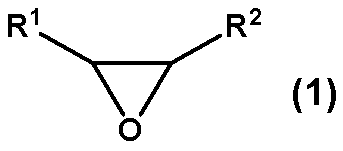
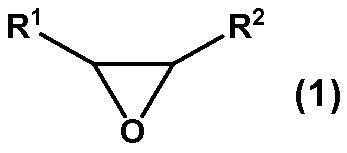
(式中、R1およびR2は、同一または異なっていてもよく、水素原子、アルキル基、アルコキシ基、アルカノイル基、カルバモイル基、シアノ基またはグリコール単位より構成される基を示す。ただし、R1およびR2のいずれか一方はグリコール単位より構成される基である。)で表されるエポキシドと二酸化炭素を構成単位として含む、プロトン性極性溶媒に対して応答性を有するポリカーボネート。
[態様2]
前記グリコール単位がエチレングリコール単位である、態様1に記載のプロトン性極性溶媒に対する応答性を有するポリカーボネート。
前記グリコール単位がエチレングリコール単位である、態様1に記載のプロトン性極性溶媒に対する応答性を有するポリカーボネート。
[態様3]
前記プロトン性極性溶媒が、水、アルコールおよびアミンよりなる群から選択される溶媒である、態様1または2に記載のプロトン性極性溶媒に対する応答性を有するポリカーボネート。
前記プロトン性極性溶媒が、水、アルコールおよびアミンよりなる群から選択される溶媒である、態様1または2に記載のプロトン性極性溶媒に対する応答性を有するポリカーボネート。
[態様4]
態様1~3いずれかに記載のプロトン性極性溶媒に対して応答性を有するポリカーボネートを含むバインダー。
態様1~3いずれかに記載のプロトン性極性溶媒に対して応答性を有するポリカーボネートを含むバインダー。
本発明によると、プロトン性極性溶媒に対して応答性を有するポリカーボネートを得ることができる。
本発明にかかるプロトン性極性溶媒に対して応答性を有するポリカーボネートおよびその製造方法について、以下、詳細に説明する。
本発明にかかるプロトン性極性溶媒に対して応答性を有するポリカーボネートは、二酸化炭素とエポキシドとを触媒存在下で重合することにより製造することができる。
本発明において、「プロトン性極性溶媒に対して応答性を有する」とは、ポリカーボネートがプロトン性極性溶媒に全く応答せず、その形態を変化させない場合以外であることを意味する。従って、ポリカーボネートがプロトン性極性溶媒に完全に溶解する場合の他、ポリカーボネートの一部がプロトン性極性溶媒に溶解する場合、ポリカーボネートがプロトン性極性溶媒に溶解するわけではないが溶解しないとまではいえない膨潤する場合も含まれる。
本発明において、「プロトン性極性溶媒」とは、一般に、プロトン供与性を有する溶媒であり、具体的には、水;メタノール、エタノール、イソプロピルアルコール、1-デカノール等の炭素数1~10の一価アルコール;エチレングリコール、プロピレングリコール等の多価アルコール;およびトリイソプロパノールアミン等のアミンが含まれる。
本発明にかかるプロトン性極性溶媒に対して応答性を有するポリカーボネートは、一般式(1):

(式中、R1およびR2は、同一または異なっていてもよく、水素原子、アルキル基、アルコキシ基、アルカノイル基、カルバモイル基、シアノ基またはグリコール単位より構成される基を示す。ただし、R1およびR2のいずれか一方はグリコール単位より構成される基である。)で表されるエポキシドと二酸化炭素を構成単位として含む。
本明細書において、グリコール単位とは、置換もしくは非置換の直鎖状または分枝鎖状の脂肪族炭化水素の2つの炭素原子のそれぞれが一つの水酸基で置換されたジオール化合物から2つの水素原子が引き抜かれた二価の残基を意味する。得られるポリカーボネートがプロトン性極性溶媒に対して応答性である限り、グリコール単位の由来となるジオール化合物として、限定されないが、例えば、エチレングリコール、プロピレングリコール、ブチレングリコール等を含む。
グリコール単位への置換基としては、メチル基、エチル基、n-ブチル基およびn-デシル基等のアルキル基、メトキシ基およびエトキシ基等のアルコキシ基、メタノイル基およびエタノイル基等のアルカノイル基、カルバモイル基またはシアノ基等が挙げられる。
本発明にかかるプロトン性極性溶媒に対して応答性を有するポリカーボネートは、(i)R1およびR2のいずれか一方がグリコール単位より構成される基である、エポキシドを構成単位とする場合、(ii)R1およびR2の両方がグリコール単位より構成される基である、エポキシドを構成単位とする場合ならびに(iii)前記(i)および(ii)の両タイプのエポキシドを構成単位とする場合がある。
前記(i)の場合、構成単位とするエポキシドにおいてR1およびR2のいずれか一方は、水素原子、メチル基、エチル基、n-ブチル基およびn-デシル基等のアルキル基、メトキシ基およびエトキシ基等のアルコキシ基、メタノイル基およびエタノイル基等のアルカノイル基、カルバモイル基またはシアノ基等であるが、得られるポリカーボネートのプロトン性極性溶媒に対する応答性が優れる観点から、水素原子が好適に用いられる。
前記(ii)の場合、構成単位とするエポキシドにおいてR1およびR2は、同一でも異なっていてもよく、互いに独立して、グリコール単位より構成される基である。
前記(iii)の場合、前記(i)のタイプのエポキシドおよび前記(ii)のタイプのエポキシドを任意の混合比率で用いて、構成単位とする。
前記(i)、(ii)および(iii)において、グリコール単位の繰り返し回数nは、1~50回、好ましくは、1~30回、より好ましくは、高い反応性を有する観点から1~15回である。
本発明では、このグリコール単位により構成されるグリコール鎖がプロトン性極性溶媒に対する応答に寄与している部位であり、一ユニットのエポキシド分子構造に対し、グルコール鎖の構造が占める割合が十分に大きい場合、それ以外の置換基が存在しても同様の効果を奏すると考えられる。
前記(i)で表されるエポキシドは、例えば、下式に示すように、エピクロロヒドリンとエチレングリコールモノメチルエーテル、ジエチレングリコールモノメチルエーテル、トリエチレングリコールモノメチルエーテル等のグリコール類とを用いる方法(Journal of Organic Chemistry 1983, 48, p.1117)により製造することができる。

前記(i)で表されるエポキシドの具体例としては、2-(2-ヒドロキシエトキシ)メチルオキシラン、2-(2-(2-ヒドロキシエトキシ)エトキシ)メチルオキシラン、2-(2-メトキシエトキシ)メチルオキシラン、2-(2-(2-メトキシエトキシ)エトキシ)メチルオキシラン、2-(2-ヒドロキシエトキシ)メチル-3-メチルオキシラン、2-(2-(2-ヒドロキシエトキシ)エトキシ)メチル-3-メチルオキシラン、2-(2-メトキシエトキシ)メチル-3-メチルオキシラン、2-(2-(2-メトキシエトキシ)エトキシ)メチル-3-メチルオキシラン、2-(2-(2-(2-メトキシエトキシ)エトキシ)エトキシ)メチルオキシラン、2-(2-(2-(2-(2-メトキシエトキシ)エトキシ)エトキシ)エトキシ)メチルオキシラン、2-(2-(2-(2-(2-(2-メトキシエトキシ)エトキシ)エトキシ)エトキシ)エトキシ)メチルオキシラン、2-(2-(2-(2-(2-(2-(2-メトキシエトキシ)エトキシ)エトキシ)エトキシ)エトキシ)エトキシ)メチルオキシラン、2-(2-(2-(2-(2-(2-(2-(2-メトキシエトキシ)エトキシ)エトキシ)エトキシ)エトキシ)エトキシ)エトキシ)メチルオキシラン、2-(2-(2-(2-(2-(2-(2-(2-(2-メトキシエトキシ)エトキシ)エトキシ)エトキシ)エトキシ)エトキシ)エトキシ)エトキシ)メチルオキシラン、2-(2-(2-(2-(2-(2-(2-(2-(2-(2-メトキシエトキシ)エトキシ)エトキシ)エトキシ)エトキシ)エトキシ)エトキシ)エトキシ)エトキシ)メチルオキシラン、2-(2-(2-(2-(2-(2-(2-(2-(2-(2-(2-メトキシエトキシ)エトキシ)エトキシ)エトキシ)エトキシ)エトキシ)エトキシ)エトキシ)エトキシ)エトキシ)メチルオキシラン、2-(2-(2-(2-(2-(2-(2-(2-(2-(2-(2-(2-メトキシエトキシ)エトキシ)エトキシ)エトキシ)エトキシ)エトキシ)エトキシ)エトキシ)エトキシ)エトキシ)エトキシ)メチルオキシラン、2-(2-(2-(2-(2-(2-(2-(2-(2-(2-(2-(2-(2-メトキシエトキシ)エトキシ)エトキシ)エトキシ)エトキシ)エトキシ)エトキシ)エトキシ)エトキシ)エトキシ)エトキシ)エトキシ)メチルオキシラン等が挙げられる。
これらの中でも、高い反応性を有する観点から、2-(2-(2-メトキシエトキシ)エトキシ)メチルオキシランおよび2-(2-(2-(2-メトキシエトキシ)エトキシ)エトキシ)メチルオキシランが好適に用いられる。
前記(ii)で表されるエポキシドは、例えば、エピクロロヒドリンに代えて、1,4-ジクロロ-2,3-エポキシブタンを用いて、同様にして、R1およびR2に、非置換のエチレングリコール単位より構成される基を導入することができる。
前記(ii)で表されるエポキシドの具体例としては、2,3-ビス((2-ヒドロキシエトキシ)メチル)オキシラン、2,3-ビス((2-(2-ヒドロキシエトキシ)エトキシ)メチル)オキシラン、2,3-ビス((2-メトキシエトキシ)メチル)オキシラン、2,3-ビス((2-(2-メトキシエトキシ)エトキシ)メチル)オキシラン、2,3-ビス((2-(2-(2-メトキシエトキシ)エトキシ)エトキシ)メチル)オキシラン、2,3-ビス((2-(2-(2-(2-メトキシエトキシ)エトキシ)エトキシ)エトキシ)メチル)オキシラン、2,3-ビス((2-(2-(2-(2-(2-メトキシエトキシ)エトキシ)エトキシ)エトキシ)エトキシ)メチル)オキシラン、2,3-ビス((2-(2-(2-(2-(2-(2-メトキシエトキシ)エトキシ)エトキシ)エトキシ)エトキシ)エトキシ)メチル)オキシラン、2,3-ビス((2-(2-(2-(2-(2-(2-(2-メトキシエトキシ)エトキシ)エトキシ)エトキシ)エトキシ)エトキシ)エトキシ)メチル)オキシラン、2,3-ビス((2-(2-(2-(2-(2-(2-(2-(2-メトキシエトキシ)エトキシ)エトキシ)エトキシ)エトキシ)エトキシ)エトキシ)エトキシ)メチル)オキシラン、2,3-ビス((2-(2-(2-(2-(2-(2-(2-(2-(2-メトキシエトキシ)エトキシ)エトキシ)エトキシ)エトキシ)エトキシ)エトキシ)エトキシ)エトキシ)メチル)オキシラン、2,3-ビス((2-(2-(2-(2-(2-(2-(2-(2-(2-(2-メトキシエトキシ)エトキシ)エトキシ)エトキシ)エトキシ)エトキシ)エトキシ)エトキシ)エトキシ)エトキシ)メチル)オキシラン、2,3-ビス((2-(2-(2-(2-(2-(2-(2-(2-(2-(2-(2-メトキシエトキシ)エトキシ)エトキシ)エトキシ)エトキシ)エトキシ)エトキシ)エトキシ)エトキシ)エトキシ)エトキシ)メチル)オキシラン、2,3-ビス((2-(2-(2-(2-(2-(2-(2-(2-(2-(2-(2-(2-メトキシエトキシ)エトキシ)エトキシ)エトキシ)エトキシ)エトキシ)エトキシ)エトキシ)エトキシ)エトキシ)エトキシ)エトキシ)メチル)オキシラン等が挙げられる。
これらの中でも、高い反応性を有する観点から、2,3-ビス((2-(2-メトキシエトキシ)エトキシ)メチル)オキシランおよび2,3-ビス((2-(2-(2-メトキシエトキシ)エトキシ)エトキシ)メチル)オキシランが好適に用いられる。
一方、二酸化炭素は、気体のまま反応容器に導入して反応に使用する。反応容器内の二酸化炭素の圧力は、0.01~6MPaであることが好ましく、より好ましくは、0.1~3.0MPaである。反応に使用するエポキシドと二酸化炭素のモル比は、典型的には1:0.1~1:10であるが、好ましくは1:0.5~1:3.0、より好ましくは1:1.0~1:2.0である。
なお、本発明にかかるプロトン性極性溶媒に対して応答性を有するポリカーボネートを製造する際に、以下に記載の一般的なエポキシドをモノマーとして加えても良い。
一般的なエポキシドとしては、特に限定されるものではないが、例えば、エチレンオキシド、プロピレンオキシド、1-ブテンオキシド、2-ブテンオキシド、イソブチレンオキシド、1-ペンテンオキシド、2-ペンテンオキシド、1-ヘキセンオキシド、1-オクテンオキシド、1-ドデセンオキシド、シクロペンテンオキシド、シクロヘキセンオキシド、スチレンオキシド、ビニルシクロヘキサンオキシド、3-フェニルプロピレンオキシド、3,3,3-トリフルオロプロピレンオキシド、3-ナフチルプロピレンオキシド、3-フェノキシプロピレンオキシド、3-ナフトキシプロピレンオキシド、ブタジエンモノオキシド、3-ビニルオキシプロピレンオキシドおよび3-トリメチルシリルオキシプロピレンオキシド等が挙げられる。中でも、高い反応性を有する観点から、エチレンオキシドおよびプロピレンオキシドが特に好ましい。
一般的なエポキシドの使用量としては、得られるポリカーボネートがプロトン性極性溶媒に対して応答性を有する限り、特に限定されるものではないが、一般式(1)で表されるエポキシド1モルに対して、一般に20モル以下とすることができ、10モル以下であることが好ましく、5モル以下であることがより好ましい。
前記重合で用いられる触媒としては、例えば、特開2010-1443号公報記載のような、特定の置換基を有した、下記式(2):
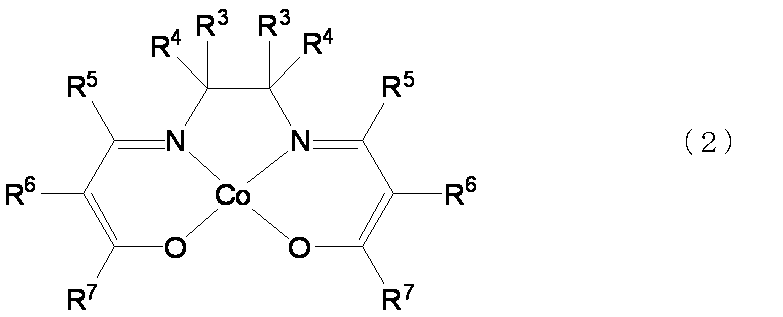
または下記式(3):
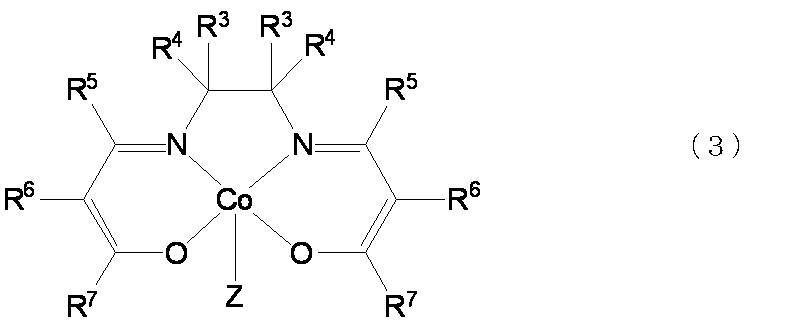
(式中、R3およびR4は、同一でも異なっていてもよく、互いに独立して、水素原子、置換もしくは非置換のアルキル基、置換もしくは非置換の芳香族基、または置換もしくは非置換の芳香族複素環基であるか、または2個のR3もしくは2個のR4が互いに結合して置換もしくは非置換の飽和もしくは不飽和の脂肪族環を形成してもよく、R5、R6およびR7はそれぞれ独立して水素原子、置換もしくは非置換のアルキル基、置換もしくは非置換のアルケニル基、置換もしくは非置換の芳香族基、置換もしくは非置換の芳香族複素環基、置換もしくは非置換のアルコキシ基、置換もしくは非置換のアシル基、置換もしくは非置換のアルコキシカルボニル二ル基、置換もしくは非置換の芳香族オキシカルボニル基、置換もしくは非置換のアラルキルオキシカルボニル基であるか、または隣り合う炭素原子上のR6とR7とが互いに結合して置換もしくは非置換の脂肪族環または芳香環を形成してもよく、ZはF-、Cl-、Br-、I-、N3
-、CF3SO3
-、p-CH3C6H4SO3
-、BF4
-、NO2
-、NO3
-、OH-、PF6
-、BPh4
-、SbF6
-、ClO4
-、OTf-、OTs-、脂肪族カルボキシラート、芳香族カルボキシラート、アルコキシド、および芳香族オキシドからなる群より選択されるアニオン性配位子である。)で表されるコバルト錯体を用いることができる。
より具体的には、前記コバルト錯体が、一般式(4):
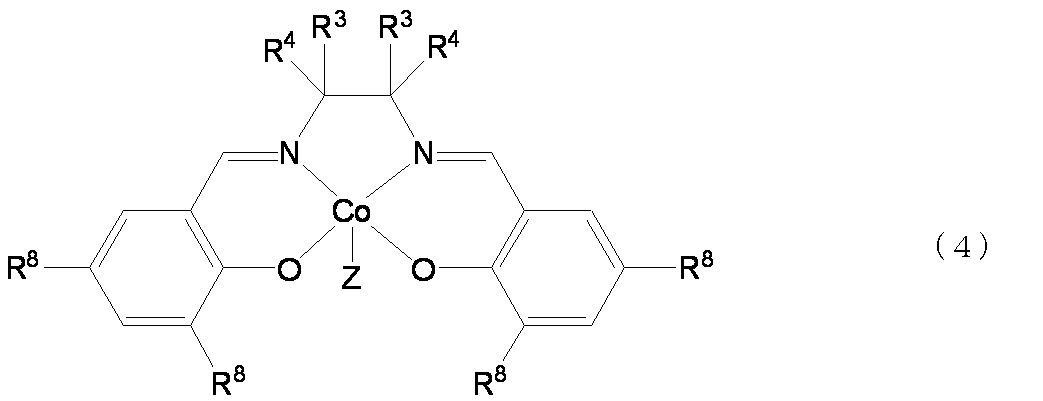
(式中、R3およびR4は、同一でも異なっていてもよく、互いに独立して、水素原子、置換もしくは非置換のアルキル基、置換もしくは非置換の芳香族基、または置換もしくは非置換の芳香族複素環基であるか、または2個のR3もしくは2個のR4が互いに結合して置換もしくは非置換の飽和もしくは不飽和の脂肪族環を形成してもよく、複数のR8は、それぞれ独立して、水素原子、炭素数1~6のアルキル基、炭素数1~6のアルコキシ基、置換もしくは非置換の芳香族基、ハロゲン原子から選択され、ZはF-、Cl-、Br-、I-、N3
-、CF3SO3
-、p-CH3C6H4SO3
-、BF4
-、NO2
-、NO3
-、OH-、PF6
-、BPh4
-、SbF6
-、ClO4
-、OTf-、OTs-、脂肪族カルボキシラート、芳香族カルボキシラート、アルコキシド、および芳香族オキシドからなる群から選択されるアニオン性配位子である。)
または一般式(5):
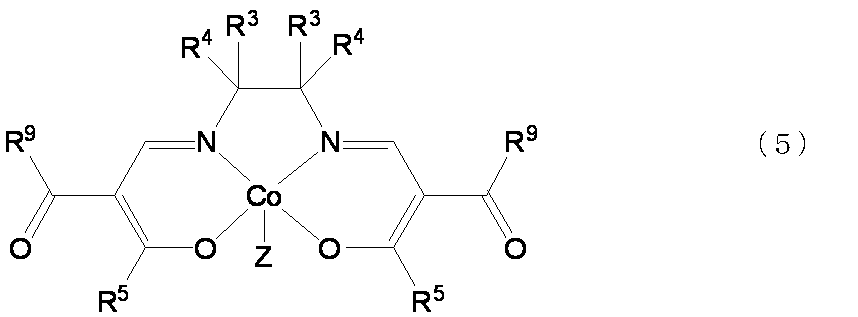
(式中、R3およびR4は、同一でも異なっていてもよく、互いに独立して、水素原子、置換もしくは非置換のアルキル基、置換もしくは非置換の芳香族基、または置換もしくは非置換の芳香族複素環基であるか、または2個のR3もしくは2個のR4が互いに結合して置換もしくは非置換の飽和もしくは不飽和の脂肪族環を形成してもよく、複数のR5は、それぞれ独立して水素原子、置換もしくは非置換のアルキル基、置換もしくは非置換のアルケニル基、置換もしくは非置換の芳香族基、置換もしくは非置換の芳香族複素環基、置換もしくは非置換のアルコキシ基、置換もしくは非置換のアシル基、置換もしくは非置換のアルコキシカルボニル基、置換もしくは非置換の芳香族オキシカルボニル基、置換もしくは非置換のアラルキルオキシカルボニル基であり、複数のR9は、それぞれ独立して、置換もしくは非置換のアルキル基、置換もしくは非置換のアルケニル基、置換もしくは非置換の芳香族基、置換もしくは非置換の芳香族複素環基、置換もしくは非置換のアルコキシ基、置換もしくは非置換の芳香族オキシ基、または置換もしくは非置換のアラルキルオキシ基であるか、あるいは隣り合う炭素原子上のR5とR7とが互いに結合して置換もしくは非置換の脂肪族環を形成してもよく、ZはF-、Cl-、Br-、I-、N3
-、CF3SO3
-、p-CH3C6H4SO3
-、BF4
-、NO2
-、NO3
-、OH-、PF6
-、BPh4
-、SbF6
-、ClO4
-、OTf-、OTs-、脂肪族カルボキシラート、芳香族カルボキシラート、アルコキシド、および芳香族オキシドからなる群から選択されるアニオン性配位子である。)で表される。
R3およびR4の置換もしくは非置換のアルキル基としては、炭素数1~10の直鎖または分岐鎖状の置換または非置換のアルキル基が好ましく、例えば、メチル基、エチル基、n-プロピル基、イソプロピル基、n-ブチル基、イソブチル基、sec-ブチル基、tert-ブチル基等が挙げられる。該アルキル基は、例えば、ヒドロキシ基、アミノ基、カルボキシル基、スルファニル基、シアノ基、スルホ基、ホルミル基、ハロゲン原子、芳香族基等から選択される1または2以上の置換基で置換されていてもよい。
R3およびR4の置換または非置換の芳香族基としては、炭素数6~10の置換または非置換の芳香族基が好ましく、例えば、フェニル基、ナフチル基等の置換または非置換の芳香族炭化水素基が挙げられる。該芳香族基は、例えば、メチル基、エチル基、n-プロピル基、イソプロピル基、n-ブチル基、イソブチル基、sec-ブチル基、tert-ブチル基等のアルキル基、フェニル基、ナフチル基等の芳香族基等から選択される1または2以上の置換基で置換されていてもよい。
R3およびR4の置換または非置換の芳香族複素環基としては、炭素数5~10の置換または非置換の芳香族複素環基が好ましく、例えば、フリル基、チエニル基、ピリジル基、ピロリル基、オキサゾリル基、イソオキサゾリル基、チアゾリル基、イソチアゾリル基、イミダゾリル基、ピラゾリル基、ピリミジル基、ピリダジニル基、ピラリジニル基、キノリル基、イソキノリル基等の置換または非置換の芳香族複素環基が挙げられる。該芳香族複素環基は、例えば、メチル基、エチル基、n-プロピル基、イソプロピル基、n-ブチル基、イソブチル基、sec-ブチル基、tert-ブチル基等のアルキル基、フェニル基、ナフチル基等の芳香族等から選択される1または2以上の置換基で置換されていてもよい。
また、2個のR3同士または2個のR4同士は、互いに結合して置換または非置換の脂肪族環または芳香環を形成してもよく、好ましくは炭素数4~10の置換または非置換の脂肪族環を形成してもよい。例えば、R3およびR4が-(CH2)4-を介して互いに結合した場合、シクロヘキサン環を形成する。このように形成された環は、例えば、メチル基、エチル基、n-プロピル基、イソプロピル基、n-ブチル基、イソブチル基、sec-ブチル基、tert-ブチル基等のアルキル基、フェニル基、ナフチル基等の芳香族等から選択される1または2以上の置換基で置換されていてもよい。
さらに、R5、R6およびR7は、同一でも異なっていてもよく、水素原子、置換もしくは非置換のアルキル基、置換もしくは非置換のアルケニル基、置換もしくは非置換の芳香族基、置換もしくは非置換の芳香族複素環基、置換もしくは非置換のアルコキシ基、アシル基、置換もしくは非置換のアルコキシカルボニル基、置換もしくは非置換の芳香族オキシカルボニル基、または置換もしくは非置換のアラルキルオキシカルボニル基である。
R5、R6およびR7の置換または非置換のアルキル基としては、炭素数1~10の直鎖または分岐鎖状の置換または非置換のアルキル基が好ましく、より好ましくは炭素数1~6の直鎖または分岐鎖状の置換または非置換のアルキル基、例えば、メチル基、エチル基、n-プロピル基、イソプロピル基、n-ブチル基、イソブチル基、sec-ブチル基、tert-ブチル基等が挙げられる。該アルキル基は、例えば、ヒドロキシ基、アミノ基、カルボキシル基、スルファニル基、シアノ基、スルホ基、ホルミル基、ハロゲン原子、芳香族等から選択される1または2以上の置換基で置換されていてもよい。
R5、R6およびR7の置換または非置換のアルケニル基としては、炭素数2~10の直鎖または分岐鎖状のアルケニル基が好ましく、より好ましくは炭素数2~6の直鎖または分岐鎖状のアルケニル基、例えば、ビニル基、2-プロペニル基等が挙げられる。該アルケニル基は、例えば、ヒドロキシ基、アミノ基、カルボキシル基、スルファニル基、シアノ基、スルホ基、ホルミル基、ハロゲン原子、芳香族等から選択される1または2以上の置換基で置換されていてもよい。
R5、R6およびR7の芳香族基としては、炭素数6~10の置換または非置換の芳香族基が好ましく、例えば、フェニル基、ナフチル基等の置換または非置換の芳香族炭化水素基が挙げられる。該芳香族基は、例えば、メチル基、エチル基、n-プロピル基、イソプロピル基、n-ブチル基、イソブチル基、sec-ブチル基、tert-ブチル基等のアルキル基、フェニル基、ナフチル基等の芳香族基等から選択される1または2以上の置換基で置換されていてもよい。
R5、R6およびR7の置換または非置換の芳香族複素環基としては、炭素数5~10の置換または非置換の芳香族複素環基が好ましく、例えば、フリル基、チエニル基、ピリジル基、ピロリル基、オキサゾリル基、イソオキサゾリル基、チアゾリル基、イソチアゾリル基、イミダゾリル基、ピラゾリル基、ピリミジル基、ピリダジニル基、ピラリジニル基、キノリル基、イソキノリル基等の置換または非置換の芳香族複素環基が挙げられる。該芳香族複素環基は、例えば、アルキル基、アルコキシ基、ハロゲン原子基、ニトロ基、シアノ基等から選択される1または2以上の置換基で置換されていてもよい。
R5、R6およびR7の置換または非置換のアルコキシ基としては、炭素数1~20の置換または非置換のアルコキシ基が好ましく、例えば、メトキシ基、エトキシ基、n-ブトキシ基、t-ブトキシ基、n-オクチルオキシ基、シクロペンチルオキシ基、シクロヘキシルオキシ基、アダマンチルオキシ基が挙げられる。該アルコキシ基は、アルコキシ基、アミノ基、カルボキシル基、スルファニル基、シアノ基、スルホ基、ホルミル基、ハロゲン原子、芳香族等から選択される1または2以上の置換基で置換されていてもよい。
R5、R6およびR7のアシル基としては、炭素数1~20のアシル基が好ましく、例えば、ホルミル基、アセチル基、トリフルオロアセチル基、プロピオニル基、ブチリル基、イソブチリル基、ピバロイル基等の脂肪族アシル基、ベンゾイル基、3,5-ジメチルベンゾイル基、2,4,6-トリメチルベンゾイル基、2,6-ジメトキシベンゾイル基、2,4,6-トリメトキシベンゾイル基、2,6-ジイソプロポキシベンゾイル基、1-ナフチルカルボニル基、2-ナフチルカルボニル基、9-アントリルカルボニル基等の芳香族アシル基等が挙げられる。
R5、R6およびR7の置換または非置換のアルコキシカルボニル基としては、炭素数2~20の置換または非置換のアルコキシカルボニル基が好ましく、例えば、メトキシカルボニル基、エトキシカルボニル基、n-ブトキシカルボニル基、n-オクチルオキシカルボニル基、シクロペンチルオキシカルボニル基、シクロヘキシルオキシカルボニル基、シクロオクチルオキシカルボニル基、アダマンチルオキシカルボニル基、tert-ブトキシカルボニル基が挙げられる。該アルコキシカルボニル基は、例えば、ヒドロキシ基、アミノ基、カルボキシル基、スルファニル基、シアノ基、スルホ基、ホルミル基、ハロゲン原子、芳香族基等から選択される1または2以上の置換基で置換されていてもよい。
R5、R6およびR7の置換または非置換の芳香族オキシカルボニル基としては、炭素数7~20の置換または非置換の芳香族オキシカルボニル基が好ましく、例えば、フェノキシカルボニル基が挙げられる。該芳香族オキシカルボニル基は、例えば、メチル基、エチル基等のアルキル基、メトキシ基、エトキシ基、n-プロポキシ基、イソプロポキシ基等のアルコキシ基、ハロゲン原子基、ニトロ基、シアノ基等から選択される1または2以上の置換基で置換されていてもよい。
R5、R6およびR7の置換または非置換のアラルキルオキシカルボニル基としては、炭素数7~20のアラルキルオキシカルボニル基が好ましく、例えば、ベンジルオキシカルボニル基、フェネチルオキシカルボニル基等が挙げられる。該アラルキルオキシカルボニル基は、例えば、ヒドロキシ基、アミノ基、カルボキシル基、スルファニル基、シアノ基、スルホ基、ホルミル基、ハロゲン原子、芳香族基、アルコキシアルキレンオキシ基、例えばメトキシエチレンオキシ基等から選択される1または2以上の置換基で置換されていてもよい。
さらに、R6およびR7は、互いに結合して環を形成してもよく、好ましくは炭素数4~10の置換または非置換の脂肪族環または芳香族環を形成してもよい。例えば、R6およびR7が-(CH2)4-を介して互いに結合した場合、シクロヘキサン環を形成する。R6およびR7が4個の炭素原子を介して結合し、ベンゼン環を形成してもよい。このように形成された環は、例えば、メチル基、エチル基、n-プロピル基、イソプロピル基、n-ブチル基、イソブチル基、sec-ブチル基、tert-ブチル基等のアルキル基、フェニル基、ナフチル基等の芳香族基等から選択される1または2以上の置換基で置換されていてもよい。
ZはF-、Cl-、Br-、I-、N3
-、CF3SO3
-、p-CH3C6H4SO3
-、BF4
-、NO2
-、NO3
-、OH-、PF6
-、BPh4
-、SbF6
-、ClO4
-、OTf-、OTs-、脂肪族カルボキシラート、芳香族カルボキシラート、アルコキシド、および芳香族オキシドからなる群から選択されるアニオン性配位子である。Zの具体例としては、F-、Cl-、Br-、I-、N3
-、CF3SO3
-、p-CH3C6H4SO3
-、BF4
-、NO2
-、NO3
-、OH-、PF6
-、BPh4
-、SbF6
-、ClO4
-、OTf-、OTs-、CF3CO2
-、CH3CO2
-、OBz-、OBzF5
-、OBz(3,5CF3)-、OBz(3,5Cl)-、OBz(4Me2N)-、OBz(4tBu)-等が挙げられ、好ましくOBzF5
-、OBz-、NO3
-、OCOCF3
-、またはI-である。
一般式(4):

におけるR8の具体例として、メチル基、エチル基、n-プロピル基、イソプロピル基、n-ブチル基、イソブチル基、sec―ブチル基、t-ブチル基等のアルキル基、メトキシ基、エトキシ基、n-プロポキシ基、イソプロポキシ基等のアルコキシ基、フェニル基、ナフチル基等の芳香族基、F、Cl、Br、I等が挙げられる。
一般式(4)で表されるコバルト錯体の中で特に好ましいものの具体例としては、次の式(4-1)~(4-5)のものが挙げられる。
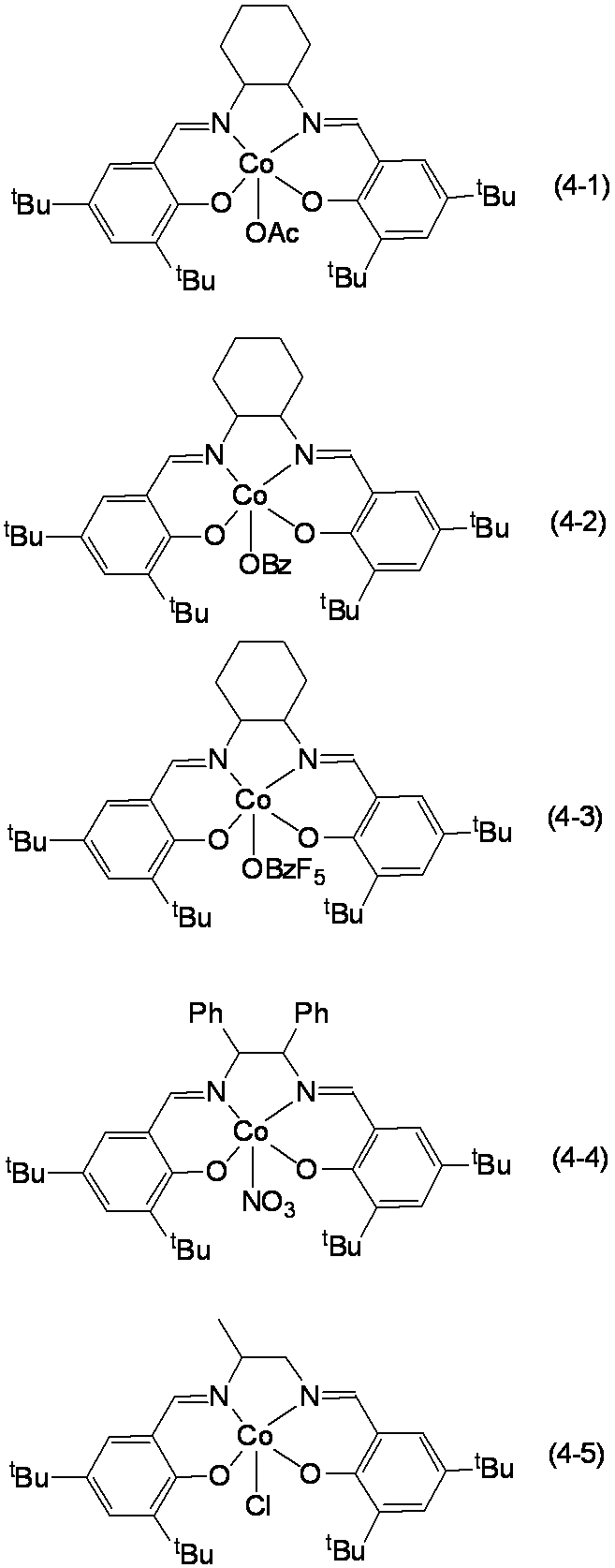
また、一般式(5):

におけるR9の具体例として、R5,R6,R7で説明したようなアルキル基、アルケニル基、芳香族基、芳香族複素環基およびアルコキシ基に加えて、炭素数6~20の芳香族オキシ基、例えばフェノキシ基、炭素数6~20のアラルキルオキシ基、例えばベンジルオキシ基フェネチルオキシ基等が挙げられる。また、隣り合う炭素原子上のR5とR9とが互いに結合して脂肪族環を形成すると、オキソシクロペンテン環、オキソシクロヘキセン環等になる。
一般式(5)で表されるコバルトケトイミナト錯体の中で特に好ましいものの具体例としては、次の式(5-1)~(5-8)のものが挙げられる。
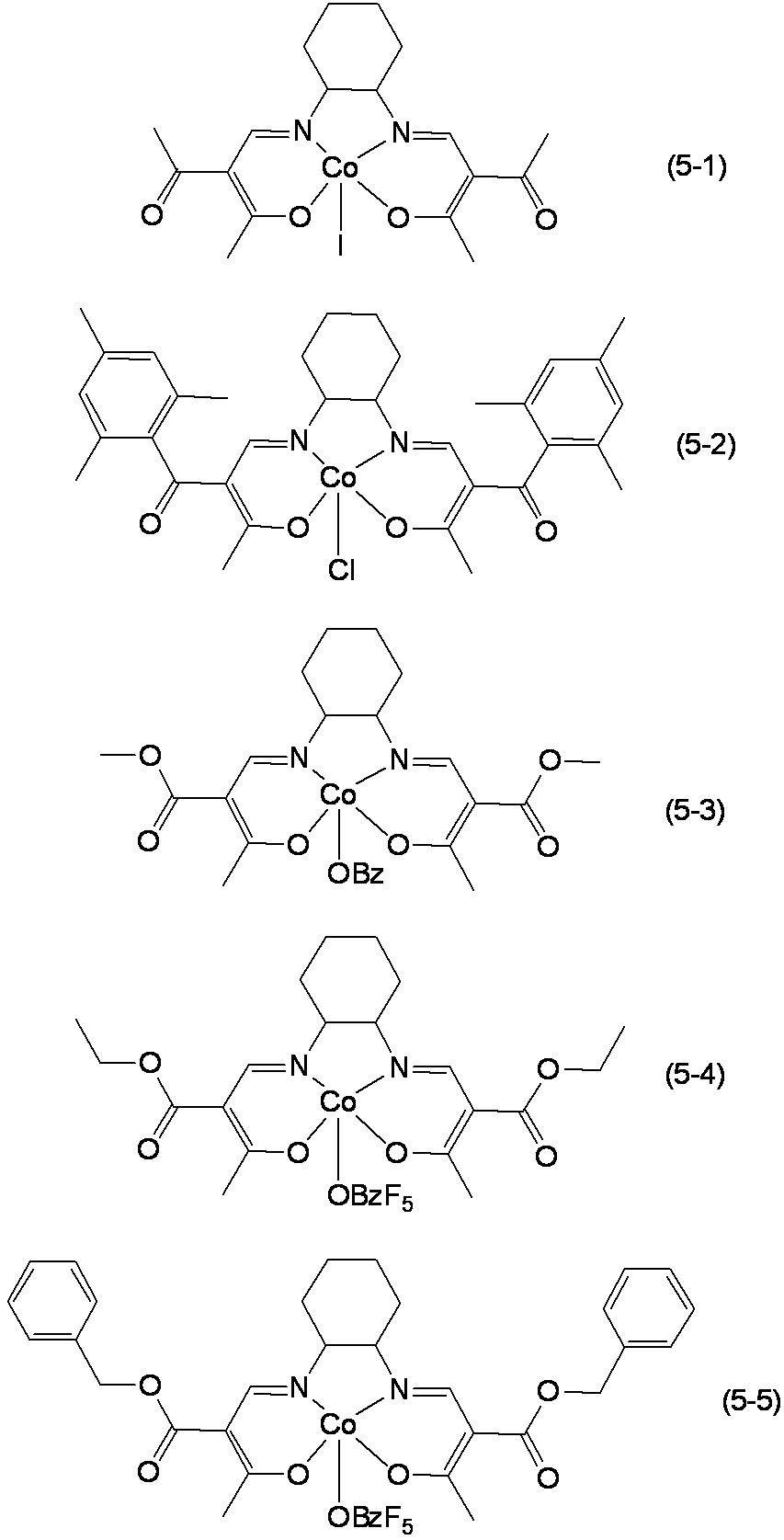

触媒の使用割合は、エポキシド1モルに対して、0.05モル以下であることが好ましく、0.01モル以下であることがより好ましい。また、反応時間が長くなることから、0.00001モル以上であることが好ましく、0.00002モル以上であることがより好ましい。
前記重合において、さらに助触媒を使用することができる。用いられる助触媒としては、ビス(トリフェニルホスフォラニリデン)アンモニウムクロリド(PPNCl)、ピペリジン、ビス(トリフェニルホスフォラニリデン)アンモニウムフルオリド(PPNF)、ビス(トリフェニルホスフォラニリデン)アンモニウムペンタフルオロベンゾエート(PPNOBzF5)、テトラ-n-ブチルアンモニウムクロライド(nBu4NCl)、テトラ-n-ブチルアンモニウムブロマイド(nBu4NBr)、テトラ-n-ブチルアンモニウムアイオダイド(nBu4NI)、テトラ-n-ブチルアンモニウムアセテート(nBu4NOAc)、テトラ-n-ブチルアンモニウムナイトレート(nBu4NO3)、トリエチルホスフィン(Et3P)、トリ-n-ブチルホスフィン(nBu3P)、トリフェニルホスフィン(Ph3P)、ピリジン、4-メチルピリジン、4-ホルミルピリジン、4-(N,N-ジメチルアミノ)ピリジン、N-メチルイミダゾール、N-エチルイミダゾール、N-プロピルイミダゾール等が挙げられ、好ましくはPPNCl、PPNF、PPNOBzF5およびnBu4NClであり、より好ましくは、高い反応活性を有する観点からPPNClおよびPPNFである。
必要に応じて使用される助触媒の使用割合は、前記触媒1モルに対して、0.1~10モルであることが好ましく、0.3~5モルであることがより好ましく、0.5~1.5モルであることがさらにより好ましい。
前記重合において、必要に応じて溶媒を使用することができる。用いられる溶媒としては、使用されるエポキシド、二酸化炭素、触媒および助触媒と反応しないものであれば特に制限はなく、例えば、炭化水素類、エーテル類、エステル類、ケトン類、ハロゲン化炭化水素類等が挙げられる。具体的には、ヘキサン、ベンゼン、トルエン、キシレン、シクロヘキサン、1,2-ジメトキシエタン、ジブチルエーテル、テトラヒドロフラン、1,4-ジオキサン、酢酸メチル、酢酸エチル、酢酸プロピル、メチルエチルケトン、メチルイソブチルケトン、ジエチルケトン、塩化メチレン、クロロホルム、ジクロロエタン、トリクロロエタン、クロロベンゼン等が挙げられる。中でも、溶解性が高いことからエーテル類およびハロゲン化炭化水素類が好ましく、特に、1,2-ジメトキシエタンおよび塩化メチレンである。これら溶媒は単独で用いても、2種以上を組み合わせて用いてもよい。
溶媒を使用する場合の使用量としては、前記エポキシド100質量部に対して50~10000質量部であることが好ましく、100~5000質量部であることがより好ましい。
前記重合は、加圧可能な公知の重合反応装置、例えば、オートクレーブを用いて行うことができる。重合の反応温度は、副生成物である環状カーボネートの生成反応を抑制する観点、および反応時間を短縮する観点から、0℃~100℃であることが好ましく、10℃~90℃であることがより好ましく、20℃~60℃であることがさらにより好ましい。
反応時間は、反応条件により異なるが、通常、1~100時間である。
前記重合は、酸素等の影響を排除するために不活性雰囲気下で実施することが好ましい。
かくして得られるプロトン性極性溶媒に対して応答性を有するポリカーボネートは、前記反応終了後、常法により濃縮、乾燥して単離することができる。また、カラムクロマトグラフィー等の周知の手段を用いて、前記プロトン性極性溶媒に対して応答性を有するポリカーボネートをさらに精製してもよい。
前記重合により得られるプロトン性極性溶媒に対して応答性を有するポリカーボネートの分子量は、ゲルパーミエーションクロマトグラフィー(GPC;ポリスチレン換算)によって測定した典型的な数平均分子量(Mn)では、例えば1000~2,000,000、好ましくは2,000~1,000,000であり、より好ましくは3,000~100,000である。
また、前記重合により得られるプロトン性極性溶媒に対して応答性を有するポリカーボネートは、比較的狭い分子量分布(Mw/Mn)を有し得る。具体的には、例えば4以下であり、好ましくは2.5以下であり、より好ましくは、1.0~1.6である。
かくして得られるプロトン性極性溶媒に対して応答性を有するポリカーボネートは、エチレングリコール単位より構成される側鎖を有しており、水に対する応答性のみならず、メタノール、エタノール、イソプロピルアルコール、1-デカノール、エチレングリコール、プロピレングリコール等のアルコール、およびトリイソルパノールアミン等のアミンに対する応答性が著しく向上する。
本発明にかかるプロトン性極性溶媒に対して応答性を有するポリカーボネートは、セラミックス、特にファインセラミックス、ニューセラミックス等と称されるセラミックス成形用のバインダーとして使用することもできる。
本明細書において、「バインダー」とは、プロトン性極性溶媒に対して応答性を有するポリカーボネートを含んだもので、所望により、分散媒、分散剤、可塑剤等が含まれていても良い。
セラミックス粉末は、当技術分野で通常用いられているセラミックス粉末であれば、特に制限されず用いることができる。上記セラミックス粉末としては、例えば、金属又は半金属の酸化物、炭化物、窒化物、ホウ化物又はフッ化物、あるいはそれらの組み合わせから選択される。
ここで、上記金属としては、例えば、Al、Mg、Zr、Ti、Pb、Mn、Fe、Co、Ni、Cu、Zn、Cd等を挙げることができる。また、半金属としては、Si、Ge、Se、Te等を挙げることができる。
セラミックスの具体例としては、例えば、ムライト(3Al2O3・2SiO2~2Al2O3・SiO2)粉末、アルミナ(Al2O3)粉末、ジルコニア(ZrO2)粉末、チタン酸バリウム(BaTiO3)粉末、チタン酸ジルコン酸鉛(Pb(Zr,Ti)O3)粉末、コーディエライト(2MgO・2Al2O3・5SiO2)粉末、硼珪酸塩バリウム粉末、珪酸鉄粉末、ルチル(TiO2)、スピネル(Al2O3・MgO)、シリマナイト(Al2O・SiO4)、マグネシア(MgO)、ジルコン(ZrO2・SiO2)、ステアタイト(MgO・SiO2)、フォルステライト(2MgO・SiO2)、フェライト(M2+O・Fe2O3、M=Mn,Fe,Co,Ni,Cu,Zn,Mg,Cd等)、AlN、Si3N4、SiCおよびガラスセラミックス材料粉末を挙げることができる。
セラミックスの成形において、プロトン性極性溶媒に対して応答性を有するポリカーボネートおよびセラミックス粉末の他に、分散媒、ならびに所望による分散剤、可塑剤等を併用することができる。
上記分散媒としては、特に制限されないが、水;メタノール、エタノール、イソプロピルアルコール等のアルコール系分散媒;アセトン、メチルエチルケトン等のケトン系分散媒;酢酸エチル、ブチルカルビトールアセテート等のエステル系分散媒;ジブチルカルビトール等のエーテル系分散媒、トルエン、キシレン等の芳香族系分散媒;ピロリドン、1-メチル-2-ピロリドン等の複素環系分散媒等が挙げられる。中でも、環境負荷の少ない水およびイソプロピルアルコールが好ましく、特に、より安全に取り扱うことが可能な水が好ましい。これらは、単独あるいは2種以上を混合して用いることができる。
上記分散剤としては、グリセリン、ソルビタン等の多価アルコールエステル系、ポリエーテルポリオール系、ポリエチレンイミン等のアミン系、ポリアクリル酸等の高分子電解質、イソブチレン又はスチレンと無水マレイン酸との共重合体およびそのアミン塩等を用いることができる。
上記可塑剤としては、ポリエチレングリコールの誘導体、フタル酸エステル系等が用いられる。
焼結セラミックスの製造方法としては、特に限定されないが、セラミック粉末、バインダー、所望により、分散媒、分散剤、可塑剤等を、セラミックボールが充填されたミル等の装置に充填し、当該装置を回転、振動等させることによりスラリーを調製した後、前記スラリーを用いて成形体を成形する。
具体的には、上記スラリーを、通常は水系スラリーを使用するスプレードライヤー等の装置で顆粒体に造粒し、冷間静水圧加圧成形、加圧成形、押し出し成形、テープ成形、射出・鋳込成形等を用いて成形される。
次に、上記成形体を、加熱することにより上記プロトン性極性溶媒に対して応答性を有するポリカーボネートを分解させ、かつ上記セラミックス粉末を焼結させることによって、焼結セラミックスを得ることができる。
焼結の際の加熱は、生成されるセラミックスにより異なるが、一般的には、600℃以上、好ましくは800℃以上、そして2,300℃以下、好ましくは2,200℃以下の温度範囲で行われる。
前記プロトン性極性溶媒に対して応答性を有するポリカーボネートは、また、フィルム、ファイバー等の用途に使用できることに加えて、光ファイバー、光ディスク等の光学材料として用いることも可能である。
以下に実施例を示すが、本発明はこれらに限定されるものではない。
なお、本実施例等で得られたプロトン性極性溶媒に対して応答性を有するポリカーボネートの数平均分子量(Mn)および分子量分布(Mw/Mn)は、ゲルパーミエーションクロマトグラフィー(ジーエルサイエンス社製高速液体クロマトグラフィーシステムDG660B・PU713・UV702・RI631A)を用いて、THF中40℃にて測定し、標準ポリスチレンを基準にして算出した。
また、本実施例等で得られたプロトン性極性溶媒に対して応答性を有するポリカーボネートの1H NMRスペクトルの測定は、JEOL社製JNM-ECP500(500MHz)を用いて行った。
グリコール単位を有するエポキシドは、既報(Journal of Organic Chemistry 1983, 48, p.1117)記載の方法に従って合成した。また、コバルトサレン錯体(4-3)は、US-B2-7674873(p.6)記載の方法に従って合成した。
[合成例1]
ケトイミナトコバルトベンゾエート錯体(5-3)は、以下の方法に従って合成した。
ケトイミナトコバルトベンゾエート錯体(5-3)は、以下の方法に従って合成した。

アルゴン雰囲気下、100mL容のシュレンク管にアセト酢酸メチル(1.16g,10mmol)、N,N-ジメチルホルムアミドジメチルアセタール(1.19g,10mmol)を入れ、80℃で4時間撹拌した。減圧下で揮発分を除き、残留した橙色オイルにメタノール(20mL)、trans-1,2-ジアミノシクロヘキサン(0.57g,5mmol)を加え、室温で2時間撹拌した。減圧下で揮発分を除き、残留物をろ過し、ろ液を濃縮して無色固体を3.22g得た(収率88%)。
1H-NMR(CDCl3)δ:10.98(s,2H),7.71(s,2H),3.72(s,6H),3.10-2.93(m,2H),2.43(s,6H),2.14-2.10(m,2H),1.86-1.74(m,2H),1.57-1.48(m,2H)ppm.
アルゴン雰囲気下、20mL容のシュレンク管に上記で得た無色固体(0.322g,1mmol)、脱水メタノール(10mL)を入れ、50℃で4時間攪拌した。そこに、トリエチルアミン(0.28mL,2.2mmol)を加え、さらに、50℃で30分間撹拌した。その後、無水塩化コバルト(0.143g,1.1mmol)を加え、25℃に戻るまで撹拌した。水(10mL)を加え、生じた沈殿をろ過して回収し、50℃で4時間真空乾燥した。
アルゴン雰囲気下、50mL容のシュレンク管に上記固体(0.366g,1.0mmmol)、塩化メチレン(20mL)を入れて溶液を得た後、安息香酸銀(0.251g、1.1mmol)加え、25℃、暗所で12時間撹拌した。生じた沈殿をろ過して除去し、ろ液を濃縮したところ、緑色粉末を0.51g得た(収率94%)。
1H-NMR(DMSO-d6)δ:7.72(s,2H),7.31-7.21(m,3H),7.18-7.11(m,2H),3.70(s,6H),3.00-2.90(m,2H),2.47(s,6H),2.00-1.85(m,2H),1.80-1.69(m,2H),1.55-1.40(m,2H)ppm.
[実施例1]
500mL容のステンレス製オートクレーブに、コバルトサレン錯体(4-3)0.407g(0.5mmol)、PPNCl 0.287g(0.5mmol)を仕込み、窒素雰囲気に置換した後、2-(2-(2-メトキシエトキシ)エトキシ)メチルオキシラン(MEEMO)88.1g(0.5mol)を加え、二酸化炭素を0.7MPaまで圧入して、圧力を一定に保ちながら25℃で24時間撹拌した。常圧に戻した後、内容物を塩化メチレンに溶解させ、1M塩酸で2回洗浄した後、揮発分を濃縮し、残留物をジエチルエーテルで2回洗浄した。その後、80℃で5時間真空乾燥を行い、無色ゴム状のポリマーを97g得た(収率90%)。
500mL容のステンレス製オートクレーブに、コバルトサレン錯体(4-3)0.407g(0.5mmol)、PPNCl 0.287g(0.5mmol)を仕込み、窒素雰囲気に置換した後、2-(2-(2-メトキシエトキシ)エトキシ)メチルオキシラン(MEEMO)88.1g(0.5mol)を加え、二酸化炭素を0.7MPaまで圧入して、圧力を一定に保ちながら25℃で24時間撹拌した。常圧に戻した後、内容物を塩化メチレンに溶解させ、1M塩酸で2回洗浄した後、揮発分を濃縮し、残留物をジエチルエーテルで2回洗浄した。その後、80℃で5時間真空乾燥を行い、無色ゴム状のポリマーを97g得た(収率90%)。
Mn=72,400,Mw/Mn=2.03
1H―NMR(CDCl3)δ 5.03(br,1H,CH),4.50-4.25(br,2H,CH2CH),3.70-3.61(m,8H,CH2CH2O),3.54-3.43(m,2H,CH2OCH2CH2),3.37(s,3H,CH2CH2OCH3)ppm.
1H―NMR(CDCl3)δ 5.03(br,1H,CH),4.50-4.25(br,2H,CH2CH),3.70-3.61(m,8H,CH2CH2O),3.54-3.43(m,2H,CH2OCH2CH2),3.37(s,3H,CH2CH2OCH3)ppm.
[実施例2]
50mL容のステンレス製オートクレーブに、コバルトサレン錯体(4-3)8.1mg(0.01mmol)、PPNCl 5.7mg(0.01mmol)を仕込み、窒素雰囲気に置換した後、2-(2-(2-(2-メトキシエトキシ)エトキシ)エトキシ)メチルオキシラン(MEEEMO)2.2g(10mmol)を加え、二酸化炭素を0.7MPaまで圧入して、25℃で24時間撹拌した。常圧に戻した後、内容物を塩化メチレンに溶解させ、1M塩酸で2回洗浄した後、揮発分を濃縮し、残留物をジエチルエーテルで2回洗浄した。その後、80℃で5時間、真空乾燥を行い、無色ゴム状のポリマーを2.21g得た(収率84%)。
50mL容のステンレス製オートクレーブに、コバルトサレン錯体(4-3)8.1mg(0.01mmol)、PPNCl 5.7mg(0.01mmol)を仕込み、窒素雰囲気に置換した後、2-(2-(2-(2-メトキシエトキシ)エトキシ)エトキシ)メチルオキシラン(MEEEMO)2.2g(10mmol)を加え、二酸化炭素を0.7MPaまで圧入して、25℃で24時間撹拌した。常圧に戻した後、内容物を塩化メチレンに溶解させ、1M塩酸で2回洗浄した後、揮発分を濃縮し、残留物をジエチルエーテルで2回洗浄した。その後、80℃で5時間、真空乾燥を行い、無色ゴム状のポリマーを2.21g得た(収率84%)。
Mn=41,500,Mw/Mn=1.82,
1H―NMR(CDCl3)δ 5.04(br,1H,CH),4.50-4.25(br,2H,CH2CH),3.70-3.59(m,12H,CH2CH2O),3.54-3.43(m,2H,CH2OCH2CH2),3.37(s,3H,CH2CH2OCH3)ppm.
1H―NMR(CDCl3)δ 5.04(br,1H,CH),4.50-4.25(br,2H,CH2CH),3.70-3.59(m,12H,CH2CH2O),3.54-3.43(m,2H,CH2OCH2CH2),3.37(s,3H,CH2CH2OCH3)ppm.
[実施例3]
モノマーを、2-(2-(2-(2-(2-(2-(2-(2-メトキシエトキシ)エトキシ)エトキシ)エトキシ)エトキシ)エトキシ)エトキシ)メチルオキシラン(Advanced Polymer Materials社製、商品名 mPEG350)4.07g(10mmol)に変え、重合時間を30時間にした以外は、実施例2と同様の方法で重合を行い、無色オイル状ポリマーを4.25g得た(収率90%)。
モノマーを、2-(2-(2-(2-(2-(2-(2-(2-メトキシエトキシ)エトキシ)エトキシ)エトキシ)エトキシ)エトキシ)エトキシ)メチルオキシラン(Advanced Polymer Materials社製、商品名 mPEG350)4.07g(10mmol)に変え、重合時間を30時間にした以外は、実施例2と同様の方法で重合を行い、無色オイル状ポリマーを4.25g得た(収率90%)。
Mn=25,500,Mw/Mn=1.35,
1H―NMR(CDCl3)δ:5.00(br,1H,CH),4.45-4.15(br,2H,CH2CH),3.70-3.60(m,28H,CH2CH2O),3.54-3.50(m,2H,CH2OCH2CH2),3.34(s,3H,CH2CH2OCH3)ppm.
1H―NMR(CDCl3)δ:5.00(br,1H,CH),4.45-4.15(br,2H,CH2CH),3.70-3.60(m,28H,CH2CH2O),3.54-3.50(m,2H,CH2OCH2CH2),3.34(s,3H,CH2CH2OCH3)ppm.
[実施例4]
50mL容のステンレス製オートクレーブに、ケトイミナトコバルトベンゾエート錯体(5-3)5.7mg(0.01mmol)、PPNCl 5.7mg(0.01mmol)を仕込み、窒素雰囲気に置換した後、MEEMO 1.70g(10mmol)を加え、二酸化炭素を0.7MPaまで圧入して、25℃で24時間撹拌した。常圧に戻した後、内容物を塩化メチレンに溶解させ、1M塩酸で2回洗浄した後、揮発分を濃縮し、残留物をジエチルエーテルで2回洗浄した。その後、80℃で5時間、真空乾燥を行い、無色ゴム状のポリマーを1.5g得た(収率70%)。
50mL容のステンレス製オートクレーブに、ケトイミナトコバルトベンゾエート錯体(5-3)5.7mg(0.01mmol)、PPNCl 5.7mg(0.01mmol)を仕込み、窒素雰囲気に置換した後、MEEMO 1.70g(10mmol)を加え、二酸化炭素を0.7MPaまで圧入して、25℃で24時間撹拌した。常圧に戻した後、内容物を塩化メチレンに溶解させ、1M塩酸で2回洗浄した後、揮発分を濃縮し、残留物をジエチルエーテルで2回洗浄した。その後、80℃で5時間、真空乾燥を行い、無色ゴム状のポリマーを1.5g得た(収率70%)。
Mn=51,600,Mw/Mn=1.77,
1H―NMR(CDCl3)δ 5.03(br,1H,CH),4.50-4.25(br,2H,CH2CH),3.70-3.61(m,8H,CH2CH2O),3.54-3.43(m,2H,CH2OCH2CH2),3.37(s,3H,CH2CH2OCH3)ppm.
1H―NMR(CDCl3)δ 5.03(br,1H,CH),4.50-4.25(br,2H,CH2CH),3.70-3.61(m,8H,CH2CH2O),3.54-3.43(m,2H,CH2OCH2CH2),3.37(s,3H,CH2CH2OCH3)ppm.
[実施例5]
50mL容のステンレス製オートクレーブに、コバルトサレン錯体(4-3)4.5mg(5.5μmol)、PPNCl 3.2mg(5.5μmol)を仕込み、窒素雰囲気に置換した後、プロピレンオキシド325mg(5.6mmol)、MEEMO 2.50g(11.2mmol)を加え、二酸化炭素を0.7MPaまで圧入して、25℃で24時間撹拌した。常圧に戻した後、内容物を塩化メチレンに溶解させ、1M塩酸で数回洗浄した後、揮発分を濃縮し、その後、80℃で5時間、真空乾燥を行い、無色ゴム状のポリマーを2.57g得た(収率71%)。
50mL容のステンレス製オートクレーブに、コバルトサレン錯体(4-3)4.5mg(5.5μmol)、PPNCl 3.2mg(5.5μmol)を仕込み、窒素雰囲気に置換した後、プロピレンオキシド325mg(5.6mmol)、MEEMO 2.50g(11.2mmol)を加え、二酸化炭素を0.7MPaまで圧入して、25℃で24時間撹拌した。常圧に戻した後、内容物を塩化メチレンに溶解させ、1M塩酸で数回洗浄した後、揮発分を濃縮し、その後、80℃で5時間、真空乾燥を行い、無色ゴム状のポリマーを2.57g得た(収率71%)。
Mn=14,200,Mw/Mn=2.36
1H―NMR(CDCl3)δ:5.00(br,1H,CH of PPC and P(MEEM)C ),4.48-3.93(br,2H,CH2CH of PPC and P(MEEM)C),3.70-3.59(m,8H,CH2CH2O of P(MEEM)C),3.54-3.43(m,2H,CH2OCH2CH2 of P(MEEM)C),3.37(s,3H,CH2CH2OCH3 of P(MEEM)C),1.32(s,3H,CHCH3 of PPC)ppm.
1H―NMR(CDCl3)δ:5.00(br,1H,CH of PPC and P(MEEM)C ),4.48-3.93(br,2H,CH2CH of PPC and P(MEEM)C),3.70-3.59(m,8H,CH2CH2O of P(MEEM)C),3.54-3.43(m,2H,CH2OCH2CH2 of P(MEEM)C),3.37(s,3H,CH2CH2OCH3 of P(MEEM)C),1.32(s,3H,CHCH3 of PPC)ppm.
コポリマー中のPPC含有率は42%であった。
[比較例1]
500mL容のステンレス製オートクレーブにコバルトサレン錯体(4-3)0.407g(0.5mmol)、PPNCl 0.287g(0.5mmol)を仕込み、窒素雰囲気に置換した後、プロピレンオキシド58.0g(1.0mol)を加え、二酸化炭素を1.4MPaまで圧入して、圧力を一定に保ちながら25℃で24時間撹拌した。常圧に戻した後、内容物を塩化メチレンに溶解させ、1M塩酸で2回洗浄した後、揮発分を濃縮し、残留物をメタノールに注ぎ、ポリマーを析出させた。その後、80℃で5時間真空乾燥を行い、白色のプロピレンオキシドのホモポリマーを34g得た(収率33%)。
500mL容のステンレス製オートクレーブにコバルトサレン錯体(4-3)0.407g(0.5mmol)、PPNCl 0.287g(0.5mmol)を仕込み、窒素雰囲気に置換した後、プロピレンオキシド58.0g(1.0mol)を加え、二酸化炭素を1.4MPaまで圧入して、圧力を一定に保ちながら25℃で24時間撹拌した。常圧に戻した後、内容物を塩化メチレンに溶解させ、1M塩酸で2回洗浄した後、揮発分を濃縮し、残留物をメタノールに注ぎ、ポリマーを析出させた。その後、80℃で5時間真空乾燥を行い、白色のプロピレンオキシドのホモポリマーを34g得た(収率33%)。
Mn=34,000,Mw/Mn=1.11
1H―NMR(CDCl3)δ:5.00(br,1H,CH ),4.30-4.09(br,2H,CH2CH),1.32(s,3H,CHCH3)ppm.
1H―NMR(CDCl3)δ:5.00(br,1H,CH ),4.30-4.09(br,2H,CH2CH),1.32(s,3H,CHCH3)ppm.
[応答性の評価]
本発明で得たポリマーおよび合成例で得たポリプロピレンカーボネートについて、各溶媒に対する応答性を評価した。各溶媒に対して、それぞれの樹脂濃度が10質量%となるように混合して、25℃にて24時間攪拌した後、溶液の状態を目視で観察した。なお、評価基準は、樹脂が完全に溶解した場合を◎、樹脂が部分的に溶解した場合を○、樹脂が膨潤した場合を△、樹脂が溶解しない場合を×とした。これらの結果を表1に示す。
本発明で得たポリマーおよび合成例で得たポリプロピレンカーボネートについて、各溶媒に対する応答性を評価した。各溶媒に対して、それぞれの樹脂濃度が10質量%となるように混合して、25℃にて24時間攪拌した後、溶液の状態を目視で観察した。なお、評価基準は、樹脂が完全に溶解した場合を◎、樹脂が部分的に溶解した場合を○、樹脂が膨潤した場合を△、樹脂が溶解しない場合を×とした。これらの結果を表1に示す。

表1に示された結果から、実施例1~5で得られたポリカーボネートは、比較例1で得られたプロピレンオキシドのホモポリマーと比較して、水およびアルコールに対する応答性が著しく向上することがわかる。
かくして、本発明によれば、透明性を有し、かつ、所定温度以上に加熱すると完全に分解するポリカーボネートに、プロトン性極性溶媒に対する応答性を付与することができる。
Claims (4)
- 一般式(1):
- 前記グリコール単位がエチレングリコール単位である、請求項1に記載のプロトン性極性溶媒に対する応答性を有するポリカーボネート。
- 前記プロトン性極性溶媒が、水、アルコールおよびアミンよりなる群から選択される溶媒である、請求項1または2に記載のプロトン性極性溶媒に対する応答性を有するポリカーボネート。
- 請求項1~3いずれかに記載のプロトン性極性溶媒に対する応答性を有するポリカーボネートを含むバインダー。
Priority Applications (1)
| Application Number | Priority Date | Filing Date | Title |
|---|---|---|---|
| JP2013500970A JP6050744B2 (ja) | 2011-02-23 | 2012-02-14 | プロトン性極性溶媒に対して応答性を有するポリカーボネートおよびその製造方法 |
Applications Claiming Priority (2)
| Application Number | Priority Date | Filing Date | Title |
|---|---|---|---|
| JP2011037237 | 2011-02-23 | ||
| JP2011-037237 | 2011-02-23 |
Publications (1)
| Publication Number | Publication Date |
|---|---|
| WO2012114939A1 true WO2012114939A1 (ja) | 2012-08-30 |
Family
ID=46720721
Family Applications (1)
| Application Number | Title | Priority Date | Filing Date |
|---|---|---|---|
| PCT/JP2012/053389 Ceased WO2012114939A1 (ja) | 2011-02-23 | 2012-02-14 | プロトン性極性溶媒に対して応答性を有するポリカーボネートおよびその製造方法 |
Country Status (2)
| Country | Link |
|---|---|
| JP (1) | JP6050744B2 (ja) |
| WO (1) | WO2012114939A1 (ja) |
Cited By (2)
| Publication number | Priority date | Publication date | Assignee | Title |
|---|---|---|---|---|
| JP2013155213A (ja) * | 2012-01-26 | 2013-08-15 | Sumitomo Seika Chem Co Ltd | 高分子固体電解質および高分子固体電解質フィルム |
| CN119505213A (zh) * | 2024-11-25 | 2025-02-25 | 吉林大学 | 一种聚碳酸酯聚合物及其制备方法、纳米佐剂和疫苗 |
Citations (4)
| Publication number | Priority date | Publication date | Assignee | Title |
|---|---|---|---|---|
| JP2001011170A (ja) * | 1999-06-28 | 2001-01-16 | Kao Corp | ポリカーボネートの製法 |
| JP2010287563A (ja) * | 2009-05-11 | 2010-12-24 | Tokyo Univ Of Agriculture & Technology | 固体高分子電解質、固体高分子電解質フィルム、固体高分子電解質フィルムの製造方法及び脂肪族ポリカーボネート |
| JP2011020916A (ja) * | 2009-06-18 | 2011-02-03 | Toudai Tlo Ltd | 焼結セラミックス成形用組成物、焼結セラミックスの製法、及びセラミックス |
| JP2011195637A (ja) * | 2010-03-17 | 2011-10-06 | Univ Of Tokyo | ポリカルボナート組成物 |
Family Cites Families (1)
| Publication number | Priority date | Publication date | Assignee | Title |
|---|---|---|---|---|
| WO2010147237A1 (ja) * | 2009-06-18 | 2010-12-23 | 学校法人 慶應義塾 | 多元系脂肪族ポリカルボナートの製造方法 |
-
2012
- 2012-02-14 WO PCT/JP2012/053389 patent/WO2012114939A1/ja not_active Ceased
- 2012-02-14 JP JP2013500970A patent/JP6050744B2/ja not_active Expired - Fee Related
Patent Citations (4)
| Publication number | Priority date | Publication date | Assignee | Title |
|---|---|---|---|---|
| JP2001011170A (ja) * | 1999-06-28 | 2001-01-16 | Kao Corp | ポリカーボネートの製法 |
| JP2010287563A (ja) * | 2009-05-11 | 2010-12-24 | Tokyo Univ Of Agriculture & Technology | 固体高分子電解質、固体高分子電解質フィルム、固体高分子電解質フィルムの製造方法及び脂肪族ポリカーボネート |
| JP2011020916A (ja) * | 2009-06-18 | 2011-02-03 | Toudai Tlo Ltd | 焼結セラミックス成形用組成物、焼結セラミックスの製法、及びセラミックス |
| JP2011195637A (ja) * | 2010-03-17 | 2011-10-06 | Univ Of Tokyo | ポリカルボナート組成物 |
Cited By (3)
| Publication number | Priority date | Publication date | Assignee | Title |
|---|---|---|---|---|
| JP2013155213A (ja) * | 2012-01-26 | 2013-08-15 | Sumitomo Seika Chem Co Ltd | 高分子固体電解質および高分子固体電解質フィルム |
| CN119505213A (zh) * | 2024-11-25 | 2025-02-25 | 吉林大学 | 一种聚碳酸酯聚合物及其制备方法、纳米佐剂和疫苗 |
| CN119505213B (zh) * | 2024-11-25 | 2025-12-09 | 吉林大学 | 一种聚碳酸酯聚合物及其制备方法、纳米佐剂和疫苗 |
Also Published As
| Publication number | Publication date |
|---|---|
| JPWO2012114939A1 (ja) | 2014-07-07 |
| JP6050744B2 (ja) | 2016-12-21 |
Similar Documents
| Publication | Publication Date | Title |
|---|---|---|
| JP5505920B2 (ja) | ブロック共重合体の製造方法 | |
| JP2009215529A (ja) | ポリカーボネート樹脂の製造方法 | |
| JP2011020916A (ja) | 焼結セラミックス成形用組成物、焼結セラミックスの製法、及びセラミックス | |
| CN111032729A (zh) | 新型脂肪族聚碳酸酯 | |
| CN114269806A (zh) | 可降解聚醚 | |
| Chuang et al. | Facilely synthesized benzotriazole phenolate zirconium complexes as versatile catalysts for copolymerization of carbon dioxide with cyclohexene oxide and lactide polymerization | |
| JPWO2017170079A1 (ja) | 熱分解性バインダー | |
| JP6050744B2 (ja) | プロトン性極性溶媒に対して応答性を有するポリカーボネートおよびその製造方法 | |
| JPWO2010147237A1 (ja) | 多元系脂肪族ポリカルボナートの製造方法 | |
| Daneshmand et al. | Catalytic-site-mediated chain-end control in the polymerization of rac-lactide with copper iminopyrrolide complexes | |
| KR20190028420A (ko) | 신규 지방족 폴리카보네이트 및 해당 폴리카보네이트를 포함하는 바인더 수지 조성물 | |
| CN114478635A (zh) | 一种铬化合物、其制备方法与多嵌段聚酯材料的制备方法 | |
| JP2003192783A (ja) | 脂肪族オリゴカーボネートの調製における触媒の使用 | |
| EP2711385A1 (en) | Process for preparing poly(ether carbonate) | |
| CN113330050A (zh) | 脂肪族聚碳酸酯 | |
| Katharina Reitz et al. | The use of stable carbene‐CO2 adducts for the polymerization of trimethylene carbonate | |
| KR102833474B1 (ko) | 폴리우레탄 경질폼용 폴리에테르 카보네이트 폴리올의 제조방법 및 이로부터 제조된 폴리에테르 카보네이트 폴리올 | |
| EP2514782A2 (en) | Polylactide resin, a production method for the same and a polylactide resin composition comprising the same | |
| KR101374568B1 (ko) | 종이 코팅용 조성물 | |
| Yu et al. | Titanium, zirconium and hafnium complexes bearing amino-benzotriazole phenolate ligands as efficient catalysts for ring-opening polymerization of lactides | |
| CN100383152C (zh) | 一类烷氧基稀土簇合物的合成方法 | |
| KR101210976B1 (ko) | 폴리락타이드 수지 제조용 유기금속 촉매, 상기 유기금속 촉매를 이용한 폴리락타이드 수지의 제조 방법, 및 이에 의해 제조된 폴리락타이드 수지 | |
| JP2019119873A (ja) | ポリカーボネートポリオールの製造方法、およびポリカーボネートポリオールを含有する組成物 | |
| JP7603009B2 (ja) | グラフト共重合体、グラフト共重合体の製造方法及びその用途 | |
| KR101196416B1 (ko) | 유기주석 화합물 |
Legal Events
| Date | Code | Title | Description |
|---|---|---|---|
| 121 | Ep: the epo has been informed by wipo that ep was designated in this application |
Ref document number: 12749989 Country of ref document: EP Kind code of ref document: A1 |
|
| ENP | Entry into the national phase |
Ref document number: 2013500970 Country of ref document: JP Kind code of ref document: A |
|
| NENP | Non-entry into the national phase |
Ref country code: DE |
|
| 122 | Ep: pct application non-entry in european phase |
Ref document number: 12749989 Country of ref document: EP Kind code of ref document: A1 |