WO2012105608A1 - ポリプロピレン系樹脂発泡粒子およびポリプロピレン系樹脂型内発泡成形体 - Google Patents
ポリプロピレン系樹脂発泡粒子およびポリプロピレン系樹脂型内発泡成形体 Download PDFInfo
- Publication number
- WO2012105608A1 WO2012105608A1 PCT/JP2012/052280 JP2012052280W WO2012105608A1 WO 2012105608 A1 WO2012105608 A1 WO 2012105608A1 JP 2012052280 W JP2012052280 W JP 2012052280W WO 2012105608 A1 WO2012105608 A1 WO 2012105608A1
- Authority
- WO
- WIPO (PCT)
- Prior art keywords
- polypropylene resin
- resin
- temperature
- polypropylene
- expanded
- Prior art date
- Legal status (The legal status is an assumption and is not a legal conclusion. Google has not performed a legal analysis and makes no representation as to the accuracy of the status listed.)
- Ceased
Links
Images

Classifications
-
- C—CHEMISTRY; METALLURGY
- C08—ORGANIC MACROMOLECULAR COMPOUNDS; THEIR PREPARATION OR CHEMICAL WORKING-UP; COMPOSITIONS BASED THEREON
- C08F—MACROMOLECULAR COMPOUNDS OBTAINED BY REACTIONS ONLY INVOLVING CARBON-TO-CARBON UNSATURATED BONDS
- C08F210/00—Copolymers of unsaturated aliphatic hydrocarbons having only one carbon-to-carbon double bond
- C08F210/04—Monomers containing three or four carbon atoms
- C08F210/06—Propene
-
- C—CHEMISTRY; METALLURGY
- C08—ORGANIC MACROMOLECULAR COMPOUNDS; THEIR PREPARATION OR CHEMICAL WORKING-UP; COMPOSITIONS BASED THEREON
- C08F—MACROMOLECULAR COMPOUNDS OBTAINED BY REACTIONS ONLY INVOLVING CARBON-TO-CARBON UNSATURATED BONDS
- C08F10/00—Homopolymers and copolymers of unsaturated aliphatic hydrocarbons having only one carbon-to-carbon double bond
- C08F10/04—Monomers containing three or four carbon atoms
- C08F10/06—Propene
-
- C—CHEMISTRY; METALLURGY
- C08—ORGANIC MACROMOLECULAR COMPOUNDS; THEIR PREPARATION OR CHEMICAL WORKING-UP; COMPOSITIONS BASED THEREON
- C08J—WORKING-UP; GENERAL PROCESSES OF COMPOUNDING; AFTER-TREATMENT NOT COVERED BY SUBCLASSES C08B, C08C, C08F, C08G or C08H
- C08J9/00—Working-up of macromolecular substances to porous or cellular articles or materials; After-treatment thereof
- C08J9/22—After-treatment of expandable particles; Forming foamed products
- C08J9/228—Forming foamed products
- C08J9/232—Forming foamed products by sintering expandable particles
-
- C—CHEMISTRY; METALLURGY
- C08—ORGANIC MACROMOLECULAR COMPOUNDS; THEIR PREPARATION OR CHEMICAL WORKING-UP; COMPOSITIONS BASED THEREON
- C08L—COMPOSITIONS OF MACROMOLECULAR COMPOUNDS
- C08L23/00—Compositions of homopolymers or copolymers of unsaturated aliphatic hydrocarbons having only one carbon-to-carbon double bond; Compositions of derivatives of such polymers
- C08L23/02—Compositions of homopolymers or copolymers of unsaturated aliphatic hydrocarbons having only one carbon-to-carbon double bond; Compositions of derivatives of such polymers not modified by chemical after-treatment
- C08L23/10—Homopolymers or copolymers of propene
-
- C—CHEMISTRY; METALLURGY
- C08—ORGANIC MACROMOLECULAR COMPOUNDS; THEIR PREPARATION OR CHEMICAL WORKING-UP; COMPOSITIONS BASED THEREON
- C08F—MACROMOLECULAR COMPOUNDS OBTAINED BY REACTIONS ONLY INVOLVING CARBON-TO-CARBON UNSATURATED BONDS
- C08F4/00—Polymerisation catalysts
- C08F4/42—Metals; Metal hydrides; Metallo-organic compounds; Use thereof as catalyst precursors
- C08F4/44—Metals; Metal hydrides; Metallo-organic compounds; Use thereof as catalyst precursors selected from light metals, zinc, cadmium, mercury, copper, silver, gold, boron, gallium, indium, thallium, rare earths or actinides
- C08F4/60—Metals; Metal hydrides; Metallo-organic compounds; Use thereof as catalyst precursors selected from light metals, zinc, cadmium, mercury, copper, silver, gold, boron, gallium, indium, thallium, rare earths or actinides together with refractory metals, iron group metals, platinum group metals, manganese, rhenium technetium or compounds thereof
- C08F4/62—Refractory metals or compounds thereof
- C08F4/64—Titanium, zirconium, hafnium or compounds thereof
- C08F4/659—Component covered by group C08F4/64 containing a transition metal-carbon bond
- C08F4/65912—Component covered by group C08F4/64 containing a transition metal-carbon bond in combination with an organoaluminium compound
-
- C—CHEMISTRY; METALLURGY
- C08—ORGANIC MACROMOLECULAR COMPOUNDS; THEIR PREPARATION OR CHEMICAL WORKING-UP; COMPOSITIONS BASED THEREON
- C08F—MACROMOLECULAR COMPOUNDS OBTAINED BY REACTIONS ONLY INVOLVING CARBON-TO-CARBON UNSATURATED BONDS
- C08F4/00—Polymerisation catalysts
- C08F4/42—Metals; Metal hydrides; Metallo-organic compounds; Use thereof as catalyst precursors
- C08F4/44—Metals; Metal hydrides; Metallo-organic compounds; Use thereof as catalyst precursors selected from light metals, zinc, cadmium, mercury, copper, silver, gold, boron, gallium, indium, thallium, rare earths or actinides
- C08F4/60—Metals; Metal hydrides; Metallo-organic compounds; Use thereof as catalyst precursors selected from light metals, zinc, cadmium, mercury, copper, silver, gold, boron, gallium, indium, thallium, rare earths or actinides together with refractory metals, iron group metals, platinum group metals, manganese, rhenium technetium or compounds thereof
- C08F4/62—Refractory metals or compounds thereof
- C08F4/64—Titanium, zirconium, hafnium or compounds thereof
- C08F4/659—Component covered by group C08F4/64 containing a transition metal-carbon bond
- C08F4/65916—Component covered by group C08F4/64 containing a transition metal-carbon bond supported on a carrier, e.g. silica, MgCl2, polymer
-
- C—CHEMISTRY; METALLURGY
- C08—ORGANIC MACROMOLECULAR COMPOUNDS; THEIR PREPARATION OR CHEMICAL WORKING-UP; COMPOSITIONS BASED THEREON
- C08J—WORKING-UP; GENERAL PROCESSES OF COMPOUNDING; AFTER-TREATMENT NOT COVERED BY SUBCLASSES C08B, C08C, C08F, C08G or C08H
- C08J2323/00—Characterised by the use of homopolymers or copolymers of unsaturated aliphatic hydrocarbons having only one carbon-to-carbon double bond; Derivatives of such polymers
- C08J2323/02—Characterised by the use of homopolymers or copolymers of unsaturated aliphatic hydrocarbons having only one carbon-to-carbon double bond; Derivatives of such polymers not modified by chemical after treatment
- C08J2323/10—Homopolymers or copolymers of propene
- C08J2323/12—Polypropene
-
- Y—GENERAL TAGGING OF NEW TECHNOLOGICAL DEVELOPMENTS; GENERAL TAGGING OF CROSS-SECTIONAL TECHNOLOGIES SPANNING OVER SEVERAL SECTIONS OF THE IPC; TECHNICAL SUBJECTS COVERED BY FORMER USPC CROSS-REFERENCE ART COLLECTIONS [XRACs] AND DIGESTS
- Y10—TECHNICAL SUBJECTS COVERED BY FORMER USPC
- Y10S—TECHNICAL SUBJECTS COVERED BY FORMER USPC CROSS-REFERENCE ART COLLECTIONS [XRACs] AND DIGESTS
- Y10S526/00—Synthetic resins or natural rubbers -- part of the class 520 series
- Y10S526/943—Polymerization with metallocene catalysts
Definitions
- the present invention relates to polypropylene resin foamed particles. More specifically, a polypropylene resin foamed particle that can be suitably used as a raw material for an in-mold foamed molded article, has a small variation in the foamed particle DSC ratio corresponding to the variation in the foaming temperature, can be molded at low temperature, and has a wide range of molded heating steam pressure. It is about.
- In-mold foam moldings obtained by filling polypropylene resin foam particles in molds and heat-molding with water vapor are the advantages of in-mold foam moldings, such as shape flexibility, lightness, and heat insulation. have.
- in-mold foam moldings using similar synthetic resin foam particles compared with in-mold foam moldings obtained using polystyrene resin foam particles, chemical resistance, heat resistance, strain recovery after compression The dimensional accuracy, heat resistance, and compressive strength are excellent as compared with an in-mold foam molded article using polyethylene resin expanded particles. Due to these characteristics, in-mold foam molded articles obtained using polypropylene resin foam particles are used in various applications such as heat insulating materials, shock-absorbing packaging materials, automobile interior members, and automobile bumper core materials.
- Polypropylene resin foam particles used for in-mold foam molding use a resin having a characteristic that can cope with this, and generally a propylene random copolymer having a melting point of about 140 to 150 ° C. is used.
- molding heating condition width a wider range of molding heating water vapor pressure width (hereinafter sometimes referred to as “molding heating condition width”) than that of the prior art is also expected.
- a method for producing polypropylene resin expanded particles is to disperse polypropylene resin particles in water together with a dispersant in the presence of a foaming agent in a pressure-resistant container, and heat the foaming agent to a predetermined foaming temperature under pressure.
- the mainstream is a method of discharging and foaming in a low-pressure region after impregnating with.
- polypropylene resin particles are semi-melted at a foaming temperature that is close to the melting point of the resin, thereby measuring two melting points in the differential scanning calorimeter (hereinafter sometimes abbreviated as “DSC”) of the foamed particles.
- DSC differential scanning calorimeter
- Expanded particles having a peak are obtained, and the in-mold moldability of uncrosslinked polypropylene resin expanded particles is improved. Due to fluctuations in the foaming temperature in the pressure vessel at this time, the DSC ratio of foamed particles having two melting peaks [the ratio of the high temperature peak heat quantity to the total heat of fusion, QH / (QH + QL) ⁇ 100 (%) described later] Fluctuated, and it was difficult to obtain expanded particles showing stable moldability.
- a propylene / 1-butene random copolymer using a Ziegler-based polymerization catalyst as a resin having a low resin melting point and a high resin rigidity compared to the melting point in order to solve the problem of high molding heating water vapor pressure or Propylene / ethylene / 1-butene random terpolymers see Patent Document 1 or Patent Document 2
- PP homopolymers using metallocene polymerization catalysts, or propylene / ethylene random copolymers have been proposed. Yes.
- a propylene random copolymer containing a 1-butene comonomer obtained using a Ziegler polymerization catalyst has a limit in lowering the melting point, and the melting point of a commercially available one is about 130 ° C.
- the propylene / ethylene random copolymer obtained using the metallocene polymerization catalyst can have a lower melting point, and can have a lower melting point of 130 ° C. or lower.
- Patent Documents In order to realize in-mold foam molding at a low heating temperature, polypropylene resin foam particles composed of a polypropylene resin having a resin melting point of 115 to 135 ° C. and an Orzen bending elastic modulus of 500 MPa or more have been proposed (Patent Documents). 3). However, some of the resins used in Patent Document 3 are propylene / ethylene / 1-butene random terpolymers, and most are propylene / ethylene random copolymers produced using a metallocene polymerization catalyst. It is a coalescence.
- the polypropylene resin used in Patent Document 3 has indeed achieved in-mold foam molding at a low heating temperature. Improvement is required in terms of the width of the molding heating water vapor pressure up to a high temperature.
- Patent Document 4 As a technique for expanding the range of the molding heating water vapor pressure, there has been proposed a polypropylene resin pre-expanded particle in which two types of polypropylene resins having a temperature difference between resin melting points of 15 ° C. or more and 30 ° C. or less are mixed (Patent Document 4). reference).
- the molding heating temperature in Patent Document 4 needs to be 140 ° C. or higher, which is not a low temperature molding.
- the polypropylene resin particles are annealed in a pressure resistant container, or the resin melting point is It is proposed to use a polypropylene resin with a large difference between the melting point of the resin blended with two or more types of polypropylene resins that do not differ greatly and the melting end temperature, or to blend two or more types of polypropylene resins with significantly different resin melting points.
- the minimum molding heating pressure in Patent Document 5 is 0.20 MPa (G) (about 135 ° C.), which is not so low temperature molding.
- the polypropylene resin used in Patent Document 6 is a low melting point propylene / ethylene random copolymer produced using a metallocene polymerization catalyst and a propylene homopolymer produced using a Ziegler polymerization catalyst.
- a melting point resin is mixed. According to the examples in the specification, it is described that a good in-mold foam molded article can be obtained with a heating steam pressure lower than 0.2 MPa ⁇ G, which is lower than that of conventional polypropylene resin foamed particles.
- the melting point difference between the two component resins is too large, it is assumed that the cell structure of the foamed particles is disturbed and easily formed into open cells.
- the object of the present invention is that the foamed particle DSC ratio corresponding to the foaming temperature fluctuation is small, and it is possible to produce an in-mold foam molded product with a very low molding heating steam pressure. Low shrinkage, wide molding heating condition range, good moldability even when using complicated molds, large molds, etc., and reduced physical properties such as compression strength when used as in-mold foam molded products
- An object of the present invention is to provide expanded polypropylene-based resin particles having a low content.
- the present inventor has produced a polypropylene resin foam particle having a specific polypropylene resin as a base resin and exhibiting a DSC characteristic at a specific first temperature rise.
- the fluctuation of the DSC ratio of the foamed particles corresponding to the fluctuation of the foaming temperature at the time of foaming becomes small, in-mold foam molding is possible with extremely low molding heating steam pressure, and the molding heating steam pressure is increased.
- it has a wide range of molding and heating conditions with little deformation / shrinkage, and shows a good moldability even when using complicated molds, large molds, etc.
- the present inventors have found that an in-resin foam molded article can be obtained, and have completed the present invention.
- this invention consists of the following structures.
- Polypropylene resin expanded particles obtained using a polypropylene resin as a base resin The polypropylene resin is It has at least two melting peaks as a melting peak in the DSC curve at the second temperature increase measured using a thermal flow rate differential scanning calorimeter (DSC) at a temperature increase rate of 10 ° C./min. Having the lowest melting peak at 130 ° C. or lower and the highest melting peak at 140 ° C. or higher and 160 ° C.
- DSC thermal flow rate differential scanning calorimeter
- the polypropylene resin expanded particles have two melting peaks in the DSC measurement at the first temperature increase at a temperature increase rate of 10 ° C./min, and the melting peak temperature on the low temperature side is 100 ° C. or higher and 130 ° C. or lower.
- the polypropylene resin includes a polypropylene random copolymer resin polymerized using a metallocene polymerization catalyst and a polypropylene homopolymer polymerized using a metallocene polymerization catalyst.
- expanded polypropylene resin particles [2] expanded polypropylene resin particles.
- R 1 , R 2 , R 3 , R 4 , R 5 , R 6 , R 7 , R 8 , R 9 , R 10 , R 11 , R 12 , R 13 , R 14 are hydrogen.
- a hydrocarbon group and a silicon-containing group, which may be the same or different from each other M is a Group 4 transition metal
- Y is a carbon atom or a silicon atom
- Q is a halogen, a hydrocarbon group, an anion
- the ligands or neutral ligands capable of coordinating with a lone pair may be selected in the same or different combinations
- j is an integer of 1 to 4.
- the expanded polypropylene resin particles of the present invention have a small variation in the DSC ratio of the expanded particles corresponding to the variation in the foaming temperature, can produce a polypropylene resin in-mold foam molded product with a very low molding heating steam pressure, and molding heating steam. Even if the pressure is increased, deformation and shrinkage are small, the range of molding heating conditions is wide, and even when using complicated molds, large molds, etc., good moldability is shown, and in-mold foam molded products It has the characteristic that there is little deterioration in physical properties such as compression strength.
- the high temperature side melting peak heat quantity QH which is the amount of heat surrounded by the tangent to the melting end baseline from the local maximum point between the low temperature side peak and the high temperature side peak.
- the DSC melting point of the raw material resin, the DSC ratio change rate of the raw material resin, and the expanded particle DSC ratio are determined by the following methods.
- a temperature that is 5 to 10 ° C. higher than the DSC melting point of polypropylene resin (or the temperature near the center of all peaks when there are multiple melting peaks) is temporarily set as the heat treatment temperature A (° C.).
- the heat treatment temperature A (° C.).
- the polypropylene resin particles 4-6 mg were heated at a rate of 5 ° C / min between 40 ° C and 50 ° C. The temperature was raised at a rate of 3 ° C./min between 50 ° C.
- the DSC ratio is the low-temperature side melting, which is the amount of heat in the portion surrounded by the low-temperature side peak and the tangent line by drawing a tangent line from the maximum point between the low-temperature side melting peak and the low-temperature side peak to the high-temperature side peak.
- the peak heat quantity QL and the high temperature side melting peak heat quantity QH which is the heat quantity of the portion surrounded by the high temperature side peak and the tangent line, drawn from the maximum point between the high temperature side melting peak and the low temperature side peak of the DSC curve to the melting end baseline It can be calculated from (2) Similarly, measure 4 to 6 points by changing the heat treatment temperature A (° C.) so that the DSC ratio is approximately between 10% and 50%.
- the resin DSC ratio change rate obtained by this measurement method substantially corresponds to the actual foamed particle DSC ratio change rate of the expanded particles.
- Example 1 since the resin is plasticized by the foaming agent in the actual foaming, the temperature showing the same DSC ratio is lowered, but the change in the DSC ratio with respect to the temperature change is The resin DSC ratio change rate is almost the same. Therefore, when the resin DSC ratio change rate is small, the variation in the expanded particle DSC ratio due to the variation in the foaming temperature is small.
- the polypropylene resin used as the base resin for the expanded polypropylene resin particles is a resin mainly composed of propylene as a monomer.
- the polypropylene resin is a copolymer with an ⁇ -olefin such as ethylene, 1-butene and pentene, such as propylene / ethylene random copolymer, propylene / 1-butene random copolymer, propylene.
- ⁇ -olefin such as ethylene, 1-butene and pentene
- propylene / ethylene random copolymer propylene / 1-butene random copolymer
- propylene propylene / 1-butene random copolymer
- propylene propylene / 1-butene random copolymer
- the polypropylene resin used as the base resin for the expanded polypropylene resin particles is preferably a low-melting-point resin having a high content of copolymer components such as ethylene and 1-butene from the viewpoint of low molding water vapor pressure.
- the ethylene content in the copolymer is preferably 3.0% by weight or more and 8.0% by weight or less, and 3.5% by weight or more and 7.0% by weight or less. The following is more preferable.
- the upper limit of the ethylene content in the manufacturable copolymer is about 5% by weight.
- the metallocene polymerization catalyst is used, the ethylene content is 8% by weight. It is possible to produce copolymers to the extent.
- the ethylene content in the polypropylene resin can be measured by a method described in JP-A-2009-84377 using carbon nuclear magnetic resonance analysis (C 13 -NMR).
- Examples of the polypropylene resin used in the present invention include a polypropylene resin polymerized using a metallocene polymerization catalyst, a polypropylene resin polymerized using a Ziegler catalyst, and the like.
- a polypropylene resin polymerized using a metallocene polymerization catalyst is preferable because the melting point can be lowered.
- a polypropylene resin polymerized using a conventional Ziegler polymerization catalyst has a limit in lowering the melting point, and a commercially available melting point has a lower limit of about 130 ° C.
- a polypropylene resin polymerized using a metallocene polymerization catalyst can have a low melting point of 130 ° C. or lower, and further a low melting point of 120 ° C. or lower. This low melting point is a low melting point comparable to that of polyethylene resin.
- a propylene / ethylene random copolymer is particularly preferable from the viewpoint of versatility.
- the change in crystal melting amount with respect to temperature change in order to obtain expanded particles having a small variation in expanded particle DSC ratio, stable molded product quality, and a wide range of molding heating conditions, the change in crystal melting amount with respect to temperature change.
- a small polypropylene-based resin as a base resin and to obtain expanded particles having a large difference between two DSC peak temperatures in the expanded particle DSC.
- a polypropylene resin-based foamed resin a polypropylene resin having a small resin DSC ratio change rate calculated by the above measurement method using a thermal flow rate differential scanning calorimeter (DSC) is used as a base resin.
- DSC thermal flow rate differential scanning calorimeter
- the raw material polypropylene resin used in the present invention has a resin DSC ratio change rate calculated by the above measurement method using a thermal flow rate differential scanning calorimeter (DSC) in the range of 0.5 to 3.0% / ° C. It is preferable that it exists in. If the rate of change in the DSC ratio of the raw material polypropylene resin is less than 0.5% / ° C, the change in the DSC ratio is too small even if the foaming temperature is changed greatly. Therefore, the desired foamed particle DSC ratio can be adjusted by adjusting the foaming temperature. Tend to be difficult to obtain. When the resin DSC ratio change rate exceeds 3.0% / ° C., the DSC ratio fluctuation of the expanded particles tends to increase corresponding to the fluctuation of the foaming temperature during foaming.
- DSC thermal flow rate differential scanning calorimeter
- a low melting point polypropylene resin and a high melting point polypropylene resin are extruders.
- a method obtained by melt mixing using a kneader, a Banbury mixer, a roll or the like or a method of mixing simultaneously with polymerization at the time of polymerization of polypropylene by multistage polymerization.
- a polypropylene resin obtained by multistage polymerization it is preferable to use a polypropylene resin obtained by multistage polymerization.
- polymerization also from the point from which the bubble diameter in the obtained foamed resin particle becomes more uniform.
- the raw material polypropylene resin used in the present invention has at least two melting peaks in the DSC melting point measurement at the second temperature rise, has the lowest melting peak at 100 ° C. or more and 130 ° C. or less, and 140 It is preferable that it is a polypropylene-type resin which has the highest melting peak in a range of from °C to 160 °C.
- the molding temperature can be lowered as the melting point of the component constituting the lowest melting peak in the resin DSC during the second temperature increase is lower.
- the component constituting the lowest melting peak at 100 ° C. or more and 130 ° C. or less in the resin DSC at the second temperature rise is generally difficult to produce using a normal Ziegler catalyst, It is preferably derived from a polypropylene resin that is polymerized using a metallocene polymerization catalyst.
- the melting point of the component constituting the highest melting peak in the resin DSC at the second temperature rise is less than 140 ° C., the temperature difference between the low melting point component and the high melting point component becomes small, and the resin DSC ratio change rate becomes too large. Tend. Moreover, when the melting point of the component constituting the highest melting peak exceeds 160 ° C., the cell structure of the expanded particles at the time of foaming tends to be disturbed, and it tends to be easy to form continuous cells.
- the foaming temperature and the molding temperature tend to increase as the melting point of the component constituting the highest melting peak increases and as the ratio increases. Therefore, if the difference in melting point between the component constituting the coldest melting peak and the component constituting the hottest melting peak is too large, or the ratio of the component constituting the hottest melting peak is too large, the foaming temperature becomes higher. As a result, the crystals of the low melting point component are completely melted or the melt viscosity becomes too low, and the foam structure of the obtained foamed particles tends to be non-uniform or become open-celled.
- the component constituting the highest melting peak at 140 ° C. or higher and 160 ° C. or lower in the resin DSC at the second temperature rise is a polypropylene homopolymer obtained by polymerization using a metallocene polymerization catalyst, or a metallocene polymerization catalyst It is selected from polypropylene resins such as a propylene random copolymer obtained by polymerization using a propylene and a propylene random copolymer obtained by polymerization using a Ziegler polymerization catalyst.
- the component constituting the highest melting peak at 140 ° C. or higher and 160 ° C. or lower in the resin DSC at the second temperature rise is obtained by polymerization using a metallocene polymerization catalyst from the viewpoint of high resin rigidity at the same melting point. It is preferably derived from a polypropylene resin, and more preferably derived from a polypropylene homopolymer obtained by polymerization using a metallocene polymerization catalyst.
- the component constituting the lowest temperature melting peak is derived from a polypropylene random copolymer resin having a resin melting point of 100 ° C. or higher and 130 ° C. or lower polymerized using a metallocene polymerization catalyst, and has the highest temperature.
- the component constituting the melting peak is derived from a polypropylene homopolymer having a melting point of 140 ° C. or higher and 160 ° C. or lower that is polymerized using a metallocene polymerization catalyst, the cell structure of the obtained expanded particles is uniform and open-celled
- the molding temperature can be made extremely low, and the resin rigidity is high, so that the compressive strength of the foam is increased, which is most preferable.
- the ratio of the low melting point component constituting the lowest melting peak in the resin DSC at the second temperature rise in the raw material polypropylene resin preferably occupies 60 wt% or more and 95 wt% or less.
- the amount of the low melting point component constituting the lowest temperature melting peak is less than 60% by weight, the molding temperature of the obtained expanded particles tends to be high, and when it exceeds 95% by weight, the melting peak on the high temperature side is constituted. There exists a tendency for a component to decrease too much and for resin DSC ratio change rate to become high.
- the production process includes prepolymerization (P-1), prepolymerization (P-2) and main polymerization (P-3). Through the process. These steps are preferably carried out sequentially in the presence of a metallocene polymerization catalyst.
- Prepolymerization step (P-1) This is a step for producing a prepolymer by polymerizing ethylene, and the polymerization catalyst can be stabilized by adding a small amount of ethylene prepolymer.
- Prepolymerization step (P-2) This is a step for producing a prepolymer by polymerizing propylene in the presence of a prepolymer.
- Main polymerization step (P-3) A step of producing a propylene copolymer by copolymerizing propylene and ethylene and / or an ⁇ -olefin having 4 or more carbon atoms in the presence of a prepolymer.
- a metallocene polymerization catalyst containing a metallocene compound represented by the following (Chemical Formula 1) is preferably used.
- R 1 , R 2 , R 3 , R 4 , R 5 , R 6 , R 7 , R 8 , R 9 , R 10 , R 11 , R 12 , R 13 , R 14 are hydrogen.
- a hydrocarbon group and a silicon-containing group, which may be the same or different from each other M is a Group 4 transition metal
- Y is a carbon atom or a silicon atom
- Q is a halogen, a hydrocarbon group, an anion
- the ligands or neutral ligands capable of coordinating with a lone pair may be selected in the same or different combinations
- j is an integer of 1 to 4.
- the total amount of heterogeneous bonds of 2,1-insertion and 1,3-insertion can be reduced to 0.2 mol% or less.
- the melt flow rate (hereinafter abbreviated as “MFR”) of the polypropylene resin used in the present invention is preferably 2 g / 10 min to 50 g / 10 min, and more preferably 5 g / 10 min to 40 g / 10 min. .
- MFR melt flow rate
- the MFR of the polypropylene resin is less than 2 g / 10 minutes, the foamability tends to deteriorate.
- the MFR exceeds 50 g / 10 minutes the bubbles of the polypropylene resin foamed particles tend to be broken and open cells tend to be formed. is there.
- the measurement of MFR uses the MFR measuring instrument described in JIS-K7210, and the conditions of orifice 2.0959 ⁇ 0.005 mm ⁇ , orifice length 8.000 ⁇ 0.025 mm, load 2160 g, 230 ⁇ 0.2 ° C. It is the value when measured below.
- the MFR of the polypropylene resin that is polymerized using the metallocene polymerization catalyst in the present invention is higher than the MFR of the polypropylene resin that is polymerized using the Ziegler polymerization catalyst. From the point of obtaining.
- polypropylene resin used in the present invention examples include other thermoplastic resins that can be mixed with the polypropylene resin (for example, low density polyethylene, linear low density polyethylene, polystyrene, polybutene, ionomer, etc.) and polypropylene. Mixtures may be used as long as the characteristics of the resin are not lost.
- the polypropylene-based resin is usually melted in advance using an extruder, kneader, Banbury mixer, roll, etc. so as to be easily used for producing foamed particles, and is cylindrical, elliptical, spherical, or cubic. It is preferable to process into a desired particle shape such as a rectangular parallelepiped shape.
- the size of the polypropylene resin particles in the present invention is preferably 0.1 to 30 mg / particle, more preferably 0.3 to 10 mg / particle.
- the particle weight of the resin particles is an average resin particle weight obtained by collecting 100 random polypropylene resin particles, measuring the weight, and averaging the particles.
- polypropylene resin particles used in the present invention when a hydrocarbon foaming agent such as propane, normal butane, isobutane, normal pentane, isopentane, hexane is used as the foaming agent, talc, silica, calcium carbonate, etc. It is preferable to add 0.005 parts by weight or more and 0.5 parts by weight or less of an inorganic substance serving as a cell nucleating agent with respect to 100 parts by weight of the polypropylene resin.
- a hydrocarbon foaming agent such as propane, normal butane, isobutane, normal pentane, isopentane, hexane
- talc silica, calcium carbonate, etc.
- the foaming agent such as air, nitrogen, carbon dioxide gas, or water
- the water-absorbing substance means that when the substance is added to polypropylene resin particles, the polypropylene resin particles are brought into contact with water, or when the foaming agent is impregnated with an aqueous dispersion.
- water-absorbing substance used in the present invention include water-soluble inorganic substances such as sodium chloride, calcium chloride, magnesium chloride, borax, and zinc borate; special block type using polyethylene glycol and polyether as hydrophilic segments.
- Polymer manufactured by Sanyo Chemical Co., Ltd., trade name: Pelestat], alkali metal salt of ethylene (meth) acrylic acid copolymer, alkali metal salt of butadiene (meth) acrylic acid copolymer, alkali metal of carboxylated nitrile rubber Salts, hydrophilic polymers such as alkali metal salts of isobutylene-maleic anhydride copolymer and alkali metal salts of poly (meth) acrylic acid; polyhydric alcohols such as ethylene glycol, glycerin, pentaerythritol, isocyanuric acid, melamine, Etc.
- These water-soluble inorganic substances, hydrophilic polymers, polyhydric alcohols and the like may be
- the amount of water-absorbing substance added in the present invention varies depending on the target foaming ratio, the foaming agent used, and the type of water-absorbing substance used, and cannot be generally described.
- the amount is preferably 0.01 parts by weight or more and 2 parts by weight or less with respect to 100 parts by weight of the polypropylene resin, and when using a hydrophilic polymer, the polypropylene resin It is preferable that it is 0.05 to 5 weight part with respect to 100 weight part.
- additives such as an antistatic agent, a pigment, a flame retardant improver, and a conductivity improver may be added to the polypropylene resin as necessary. In that case, it is usually preferable to add these additives into the molten resin during the production process of the resin particles.
- the method for producing the polypropylene resin expanded particles of the present invention is not particularly limited, For example, in a pressure-resistant container, polypropylene resin particles are dispersed in water together with a dispersant in the presence of a foaming agent, heated to a predetermined foaming temperature under pressure, and after impregnating the foaming agent with resin particles, A method in which the dispersion containing the polypropylene resin particles in the pressure resistant container is released and foamed in a low pressure region while maintaining the temperature and pressure at a constant is preferable (in contrast to the two-stage foaming method described later, this method is referred to as “ It may be referred to as “one-stage foaming method”).
- the foaming temperature in the pressure vessel when discharging the dispersion from the pressure vessel to the low pressure region is the melting peak temperature on the low temperature side and the melting peak temperature on the high temperature side in the resin DSC at the second temperature rise in the raw material polypropylene resin.
- intermediate temperature Based on It is preferably between (the intermediate temperature ⁇ 15) ° C. and (the intermediate temperature + 15) ° C.
- foaming agent impregnated into the polypropylene resin particles used in the present invention examples include hydrocarbon foaming agents such as propane, normal butane, isobutane, normal pentane, isopentane, hexane; air, nitrogen, carbon dioxide gas, water, and the like. Inorganic foaming agents, and the like. These foaming agents may be used alone or in combination of two or more. Among these foaming agents, carbon dioxide, water, and isobutane capable of foaming at a higher magnification are preferable.
- the amount of the foaming agent used in the present invention varies depending on the resin to be used, the foaming agent, and the desired expansion ratio, but may be appropriately used depending on the desired expansion ratio of the polypropylene resin expanded particles.
- the amount of the foaming agent used is preferably 1 part by weight or more and 60 parts by weight or less with respect to 100 parts by weight of the polypropylene resin particles.
- the foaming ratio in the first stage foaming may be relatively low.
- the foaming agent such as air, nitrogen, carbon dioxide, or water
- the foaming ratio in the first stage foaming may be relatively low.
- the expanded particles are impregnated with an inert gas such as air.
- a method of heating and further foaming a so-called “two-stage foaming method” may be employed.
- pressure vessel used in the production of polypropylene resin expanded particles there is no particular limitation on the pressure vessel used in the production of polypropylene resin expanded particles, and any pressure vessel that can withstand the pressure and temperature in the vessel at the time of producing polypropylene resin expanded particles may be used.
- an autoclave type pressure vessel Can be given.
- Examples of the dispersant used in the present invention include tricalcium phosphate, tribasic magnesium phosphate, basic magnesium carbonate, calcium carbonate, basic zinc carbonate, aluminum oxide, iron oxide, titanium oxide, aluminosilicate, and sulfuric acid.
- examples thereof include inorganic dispersants such as barium and kaolin.
- a dispersion aid may be used together with the dispersant.
- the dispersion aid used include surfactants such as sodium dodecylbenzenesulfonate, sodium n-paraffinsulfonate, sodium ⁇ -olefinsulfonate. Agents and the like. Among these, it is preferable to use a combination of tricalcium phosphate and sodium sodium n-paraffin sulfonate as the dispersant and the dispersion aid.
- the amount of dispersant and dispersion aid used varies depending on the type and the type and amount of polypropylene resin used.
- the amount of dispersant used is 0.1 to 5 parts by weight with respect to 100 parts by weight of water.
- the use amount of 0.001 part by weight or more and 0.1 part by weight or less ensures dispersion stability, makes it difficult for the dispersant to adhere to the surface of the obtained foamed particles, and melts the foamed particles together during in-mold foam molding. This is preferable because it does not inhibit the wearing.
- the expanded polypropylene resin particles of the present invention preferably have two melting peaks in the DSC curve obtained by the first temperature rise measurement with a thermal flow rate differential scanning calorimeter (DSC).
- DSC thermal flow rate differential scanning calorimeter
- the difference between the melting peak temperature on the low temperature side and the melting peak temperature on the high temperature side, which appears in the DSC curve during the first temperature increase of the expanded particles is 25% in order to realize a wide range of molding heating conditions. It is preferable that it is 40 degreeC or more, and it is more preferable that it is 30 degreeC or more and 40 degrees C or less. If the difference between the lowest melting peak temperature and the highest melting peak temperature in the DSC curve at the first temperature rise of polypropylene resin foamed particles is less than 25 ° C, use a complex shaped mold, large mold, etc. When performing in-mold foam molding, the molding heating condition width tends to be insufficient.
- the foaming temperature becomes too high, and the resulting polypropylene type
- the cell structure of the foamed resin particles is disturbed and non-uniform cells are generated, making it easy to form continuous cells.
- a depression is generated on the surface of the foamed molded product in the polypropylene resin mold, or the foamed molded product in the polypropylene resin mold is greatly shrunk. It tends to be easy.
- the high melting point component of the base resin contains a polypropylene resin having a melting point exceeding 160 ° C., for example, a polypropylene homopolymer polymerized using a Ziegler polymerization catalyst, 1 of the polypropylene resin expanded particles The difference between the lowest melting peak temperature and the highest melting peak temperature in the DSC curve during the second temperature rise tends to exceed 40 ° C.
- the DSC ratio of the expanded particles is less than 10%, the closed cell ratio of the polypropylene resin expanded particles is low, and the deformation rate of the molded body of the expanded polypropylene resin mold tends to increase.
- the DSC ratio of the foamed particles exceeds 50%, there may be a case where the secondary foaming force at the time of in-mold foam molding of the polypropylene resin foamed particles cannot be obtained sufficiently, and the fusion between the foamed particles is inferior and inferior. In some cases, a polypropylene resin-in-mold foam-molded product is obtained.
- the average cell diameter of the expanded polypropylene resin particles of the present invention is preferably 30 ⁇ m or more and 1000 ⁇ m or less, more preferably 50 ⁇ m or more and 500 ⁇ m or less, and further preferably 100 ⁇ m or more and 350 ⁇ m or less.
- the average cell diameter of the polypropylene resin foamed particles is less than 30 ⁇ m, the shrinkage rate may be increased or the surface beauty may be deteriorated when the foamed molded product in the polypropylene resin mold is used. If the average cell diameter exceeds 1000 ⁇ m, the cell diameter tends to be non-uniform, and the variation in the magnification of the polypropylene resin expanded particles tends to increase.
- the polypropylene resin expanded particles of the present invention are subjected to in-mold foam molding to obtain a polypropylene resin in-mold foam molded body.
- polypropylene resin foamed particles for in-mold foam molding
- C) Conventionally known methods such as a method of filling and molding a mold in a state where the foamed particles are compressed to increase the internal pressure of the particles can be used.
- air is pressurized in a pressure-resistant container in advance, air is press-fitted into the polypropylene resin expanded particles, and the expanded pressure is imparted by setting the expanded particle internal pressure to about 0.12 to 0.3 MPa.
- the foamed particles imparted with foaming ability are filled in a mold that can be closed but cannot be sealed, and steam is used as a heating medium at a heating steam pressure of about 0.1 to 0.4 MPa ⁇ G for 3 to 30 seconds.
- the mold After molding with a heating time of about a degree and fusing the polypropylene resin foamed particles together, the mold is cooled by water cooling to such an extent that deformation of the in-mold foam molding after taking out the in-mold foam molding can be suppressed.
- a foamed molded product in a polypropylene resin mold can be obtained.
- the expansion ratio of the expanded polypropylene resin mold is preferably 3 to 100 times, more preferably 6 to 60 times.
- the density of the expanded foam in the polypropylene resin mold is preferably 9 g / L or more and 300 g / L or less, more preferably 15 g / L or more and 150 g / L or less.
- ⁇ Method for measuring ethylene content in polypropylene resin The ethylene content in the polypropylene resin was measured by carbon nuclear magnetic resonance analysis (C 13 -NMR) according to the method described in columns [0076] to [0079] of JP-A-2009-84377.
- the homo PP content (polypropylene homopolymer content) was calculated from the area of the high temperature side peak in the peak curve of the polypropylene resin measured by the temperature rising elution fractionation method (TREF).
- Homo PP content (area of high-temperature peak / total area) ⁇ 100 (%)
- the measurement by the temperature rising elution fractionation method (TREF) was carried out with the following apparatus and measurement conditions.
- the temperature reduction rate from 135 ° C. to 0 ° C. is 1 ° C./T at the TREF part.
- the sample was crystallized in the TREF section by cooling in minutes.
- the sample was sequentially eluted at the following elution segment temperature, led from the TREF part to the GPC column, and the GPC chromatogram ( Molecular weight distribution).
- the obtained GPC chromatogram is processed using the analysis software attached to the apparatus, and an integral curve (cumulative elution amount curve with respect to the elution temperature) is created from the peak area at each elution temperature, and the integral curve is differentiated, An elution curve is obtained.
- a temperature that is 5 to 10 ° C. higher than the DSC melting point of polypropylene resin (or the temperature near the center of all peaks when there are multiple melting peaks) is temporarily set as the heat treatment temperature A (° C.).
- the heat treatment temperature A (° C.).
- the polypropylene resin particles 4-6 mg were heated at a rate of 5 ° C / min between 40 ° C and 50 ° C. The temperature was raised at a rate of 3 ° C./min between 50 ° C.
- the DSC ratio is the low-temperature side melting, which is the amount of heat in the portion surrounded by the low-temperature side peak and the tangent line by drawing a tangent line from the maximum point between the low-temperature side melting peak and the low-temperature side peak to the high-temperature side peak.
- the peak heat quantity QL and the high temperature side melting peak heat quantity QH which is the heat quantity of the portion surrounded by the high temperature side peak and the tangent line, drawn from the maximum point between the high temperature side melting peak and the low temperature side peak of the DSC curve to the melting end baseline It can be calculated from (2) Similarly, measure 4 to 6 points by changing the heat treatment temperature A (° C.) so that the DSC ratio is approximately between 10% and 50%.
- a test piece having a length of 50 mm, a width of 50 mm, and a thickness of 25 mm is cut out from a foamed molded product in a polypropylene resin mold and compressed at a rate of 10 mm / min in accordance with NDZ-Z0504.
- the density of the foamed molded product is 20 g / L, and the 50% compression strength is 0.12 MPa or more.
- X 20 g / L foam molded body density, less than 0.12 MPa.
- ⁇ Molded body evaluation> In the molding evaluation, a polyolefin foam molding machine [KD-345, manufactured by Daisen Co., Ltd.] was used, and a mold heating steam pressure 0.09 to 0.30 MPa (gauge pressure) using a mold having a length of 400 mm ⁇ width of 300 mm ⁇ thickness of 50 mm. ) In-mold foam molding was carried out. The obtained foamed molded product in a polypropylene resin mold was allowed to stand at room temperature for 1 hour, then cured and dried in a thermostatic chamber at 75 ° C. for 15 hours, taken out again to room temperature, and then allowed to stand at room temperature for 4 hours.
- KD-345 manufactured by Daisen Co., Ltd.
- Molding heating condition width is 0.05 or more and less than 0.1 MPa.
- X The molding heating condition width is less than 0.05 MPa.
- Pass Wrinkles, small intergranularity, beautiful. Fail: There are wrinkles and sink marks and poor appearance.
- (3) Dimensional Shrinkage The vertical dimension (upper side in the vertical direction) of the obtained polypropylene-based resin foam molded article was measured, and the shrinkage ratio with respect to the mold vertical dimension (400 mm) was calculated and determined as follows. Pass: The shrinkage ratio of the vertical dimension is less than 5%. Fail: The shrinkage ratio of the vertical dimension is 5% or more.
- (4) Deformation degree The thickness (average value of the partial thickness of 30 mm from the central part in the longitudinal direction, the right side and the left side) of the obtained polypropylene-based resin foam molded article is measured, and the shrinkage ratio with respect to the mold thickness dimension (50 mm) is calculated. The following judgment was made. Pass: Shrinkage in the thickness direction is less than 7%. Fail: Shrinkage in the thickness direction is 7% or more.
- Example 1 [Production of propylene / ethylene random copolymer using metallocene polymerization catalyst] (1) Production of solid catalyst support 300 g of SiO 2 [manufactured by Dokai Chemical Co., Ltd.] was weighed in a 1 L branch flask, and 800 mL of toluene was put into a slurry. Next, the obtained slurry was transferred to a 5 L four-necked flask, 260 mL of toluene was added, and 2830 mL of a methylaluminoxane (hereinafter abbreviated as “MAO”) toluene solution (Albemarle, 10 wt% solution) was introduced. Stir at room temperature for 30 minutes.
- MAO methylaluminoxane
- the flask was taken out of the glove box, 0.46 L of toluene and 1.4 L of MAO / SiO 2 / toluene slurry prepared by the method (1) were added under nitrogen, and the mixture was stirred for 30 minutes to carry.
- the resulting diphenylmethylene (3-tert-butyl-5-methylcyclopentadienyl) (2,7-di-tert-butylfluorenyl) zirconium dichloride / MAO / SiO 2 toluene slurry was prepared using n-heptane. 99% substitution was performed and the final slurry volume was 4.5L. This operation was performed at room temperature.
- the obtained prepolymer was resuspended in purified n-heptane and adjusted with n-heptane so that the solid catalyst component concentration was 2 g / L. A part was sampled and the prepolymer was analyzed. The obtained prepolymer contained 10 g of polyethylene per 1 g of the solid catalyst component.
- (4) Prepolymerization P-2 In a tubular polymerizer having an internal volume of 58 L, propylene is 57 kg / hr, hydrogen is 4 NL / hr, the catalyst slurry of the prepolymer prepared in the above (3) is 7.1 g / hr as a solid catalyst component, and triethylaluminum is 4.0 mL / hr.
- the obtained slurry was sent to a vessel polymerization vessel equipped with a stirrer having an internal volume of 500 L and further polymerized.
- propylene was supplied at 11 kg / hr
- ethylene was supplied at 1.1 kg / hr
- hydrogen was supplied so that the hydrogen concentration in the gas phase was 0.39 mol%.
- Polymerization was performed at a polymerization temperature of 59 ° C. and a pressure of 2.4 MPa (G). After vaporizing the resulting slurry, gas-solid separation was performed to obtain a propylene / ethylene random copolymer.
- the resulting propylene copolymer was vacuum dried at 80 ° C.
- the resulting propylene / ethylene random copolymer was obtained by DSC melting point measurement using a thermal flow rate differential scanning calorimeter with an ethylene content of 5.2% by weight, a homo PP content (polypropylene homopolymer content) of 15% by weight.
- the lowest melting peak temperature was 107 ° C.
- the highest melting peak temperature was 148 ° C.
- the MFR was 12 g / 10 minutes.
- the resulting single-stage expanded particle has an expansion ratio of 11 times, a DSC ratio of 29%, and shows two melting peaks in the first DSC measurement of the expanded particles.
- the lowest melting peak temperature is 110 ° C., the highest melting peak.
- the temperature was 145.5 ° C. (FIG. 3).
- the obtained single-stage expanded particles were impregnated with an internal pressure of 0.32 MPa by air impregnation, and heated with 0.02 MPa (G) steam to obtain expanded particles with an expansion ratio of 27 times.
- the obtained in-mold foamed molded product was allowed to stand at room temperature for 1 hour, then cured and dried in a thermostatic chamber at 75 ° C. for 15 hours, taken out again to room temperature, and then allowed to stand at room temperature for 4 hours.
- the molding heating condition width was evaluated from the wearability, surface property, dimensional shrinkage, and degree of deformation. The results are shown in Table 1.
- Example 2 [Production of propylene / ethylene random copolymer using metallocene polymerization catalyst]
- hydrogen was supplied in a 1000 L vessel polymerizer so that the hydrogen concentration in the gas phase was 0.45 mol%, and hydrogen was supplied in the gas phase in the 500 L vessel polymerizer.
- a propylene / ethylene random copolymer was obtained in the same manner as in Example 1 except that the concentration was 0.45 mol%.
- the obtained propylene / ethylene random copolymer was obtained by measuring the DSC melting point with a thermal flow rate differential scanning calorimeter, with an ethylene content of 5.2% by weight, a homo PP content (polypropylene homopolymer content) of 15% by weight.
- Example 3 [Production of propylene / ethylene random copolymer using metallocene polymerization catalyst]
- hydrogen was supplied in a 1000 L vessel polymerizer so that the hydrogen concentration in the gas phase was 0.52 mol%, and hydrogen was supplied in the gas phase in the 500 L vessel polymerizer.
- a propylene / ethylene random copolymer was obtained in the same manner as in Example 1 except that the concentration was 0.52 mol%.
- the obtained propylene / ethylene random copolymer was obtained by measuring the melting point with a thermal flow rate differential scanning calorimeter, with an ethylene content of 5.2% by weight, a homo PP content (polypropylene homopolymer content) of 15% by weight.
- Example 4 [Production of propylene / ethylene random copolymer using metallocene polymerization catalyst]
- ethylene was supplied at 1.4 kg / hr and hydrogen was supplied so that the hydrogen concentration in the gas phase became 0.44 mol%
- a 500 L vessel polymerizer in a 1000 L vessel polymerizer.
- a propylene / ethylene random copolymer was obtained in the same manner as in Example 1 except that ethylene was supplied at 1.0 kg / hr and hydrogen was supplied so that the hydrogen concentration in the gas phase became 0.44 mol%.
- the obtained propylene / ethylene random copolymer was obtained by measuring the melting point with a thermal flow rate differential scanning calorimeter, with an ethylene content of 4.6% by weight, a homo PP content (polypropylene homopolymer content) of 25% by weight.
- the lowest melting peak temperature was 107 ° C.
- the highest melting peak temperature was 148 ° C.
- the MFR was 16 g / 10 minutes.
- the resulting propylene / ethylene random copolymer has an ethylene content of 5.1% by weight, a homo PP content (polypropylene homopolymer content) of 0%, and the lowest temperature obtained by melting point measurement using a differential scanning calorimeter. The melting peak temperature was 107 ° C. and the MFR was 7 g / 10 minutes.
- resin particles, foamed particles, and in-mold foam molded articles were obtained by the same operation as in Example 1, and the molded articles were evaluated. The results are shown in Table 1.
- the obtained propylene / ethylene random copolymer had the ethylene content of 3.8% by weight, the homo PP content (polypropylene homopolymer content) of 0%, and the most obtained by the melting point measurement with a thermal flow rate differential scanning calorimeter.
- the low melting peak temperature was 117 ° C. and the MFR was 20 g / 10 min.
- resin particles, foamed particles, and in-mold foam molded articles were obtained by the same operation as in Example 1, and the molded articles were evaluated. The results are shown in Table 1.
- the minimum molding heating water vapor pressure is 0.12 MPa to 0.15 MPa, which is extremely low, comparable to the molding heating water vapor pressure of the polyethylene resin, and the molding heating condition width is 0.10 MPa or more. wide.
- the minimum molding heating water vapor pressure is as low as 0.12 MPa and 0.18 MPa, but the molding heating condition width is narrow as 0.02 MPa and 0.04 MPa.
- the resin melting point is 133 to 134 ° C.
- the results are shown in Table 1.
- the obtained expanded particles have a non-uniform cell structure, and the open cell ratio is as high as 14.5% (usually less than about 5%).
- the minimum molding heating vapor pressure is 0.15 MPa. Although it was low, when the molding heating vapor pressure was increased, deformation and shrinkage were large, and the molding heating condition width was extremely narrow.
Landscapes
- Chemical & Material Sciences (AREA)
- Polymers & Plastics (AREA)
- Health & Medical Sciences (AREA)
- Chemical Kinetics & Catalysis (AREA)
- Medicinal Chemistry (AREA)
- Organic Chemistry (AREA)
- Materials Engineering (AREA)
- Engineering & Computer Science (AREA)
- Manufacture Of Porous Articles, And Recovery And Treatment Of Waste Products (AREA)
- Compositions Of Macromolecular Compounds (AREA)
- Addition Polymer Or Copolymer, Post-Treatments, Or Chemical Modifications (AREA)
- Transition And Organic Metals Composition Catalysts For Addition Polymerization (AREA)
- Crystallography & Structural Chemistry (AREA)
Abstract
Description
耐圧容器内でポリプロピレン系樹脂粒子を樹脂融点近傍である発泡温度にて半融解させることにより、発泡粒子の示差走査熱量計(以降、「DSC」と略す場合がある。)測定において、2つの融解ピークを有する発泡粒子が得られ、無架橋のポリプロピレン系樹脂発泡粒子の型内成形性が向上する。この際の耐圧容器内での発泡温度の変動により、2つの融解ピークを有する発泡粒子DSC比[全融解熱量に対する高温ピーク熱量の割合であり、後述するQH/(QH+QL)×100(%)]が変動し、安定した成形性を示す発泡粒子が得られにくいという問題があった。
これに対して、メタロセン系重合触媒用いて得られるプロピレン・エチレンランダム共重合体は、より低融点化が可能であり、130℃以下の低融点化が可能である。
しかしながら、特許文献3で使用されている樹脂は、一部がプロピレン・エチレン・1-ブテンランダム3元共重合体で、大部分はメタロセン系重合触媒を用いて製造されたプロピレン・エチレンランダム共重合体である。明細書中の実施例での樹脂融点は120~134℃である為、特許文献3で使用されているポリプロピレン系樹脂は、確かに低い加熱温度での型内発泡成形を実現しているが、高温までの成形加熱水蒸気圧の幅という点で改善を要するものである。
しかしながら、特許文献4における成形加熱温度としては、140℃以上が必要であり、低温成形といえるものではなかった。
しかしながら、特許文献5における最低成形加熱圧力は0.20MPa(G)(約135℃)で、それほど低温成形といえるものではない。
特許文献6で用いられているポリプロピレン系樹脂は、メタロセン系重合触媒を用いて製造された低融点のプロピレン・エチレンランダム共重合体とチーグラー系重合触媒で製造されたプロピレン単独重合体のような高融点樹脂を混合するものである。明細書中の実施例によれば、従来のポリプロピレン系樹脂発泡粒子に比べて低い、0.2MPa・G未満の加熱スチーム圧力で良好な型内発泡成形体が得られると記載されている。
しかしながら、特許文献6の技術では、2つの成分樹脂の融点差が大きすぎる為、発泡粒子のセル構造が乱れ、連続気泡化しやすいことが想定される。
[1] ポリプロピレン系樹脂を基材樹脂として用いて得られるポリプロピレン系樹脂発泡粒子であって、
前記ポリプロピレン系樹脂が、
熱流速示差走査熱量計(DSC)を用いて昇温速度10℃/分にて測定される2回目の昇温時のDSC曲線における融解ピークとして、少なくとも2つの融解ピークを有し、100℃以上130℃以下に最も低温の融解ピークを有し、かつ140℃以上160℃以下に最も高温の融解ピークを有し、
かつ、樹脂DSC比変化率が0.5~3.0%/℃であり、さらに、
該ポリプロピレン系樹脂発泡粒子が、昇温速度10℃/分での1回目昇温時のDSC測定において、2つの融解ピークを有し、低温側の融解ピーク温度が100℃以上130℃以下であり、高温側の融解ピーク温度が140℃以上160℃以下であることを特徴とする、ポリプロピレン系樹脂発泡粒子。
[2] 前記ポリプロピレン系樹脂が、メタロセン系重合触媒を用いて重合されてなるポリプロピレン系ランダム共重合体樹脂を含むことを特徴とする、[1]記載のポリプロピレン系樹脂発泡粒子。
[3] 前記ポリプロピレン系樹脂が、メタロセン系重合触媒を用いて重合されてなるポリプロピレン系ランダム共重合体樹脂、およびメタロセン系重合触媒を用いて重合されてなるポリプロピレン単独重合体を含むことを特徴とする、[2]のポリプロピレン系樹脂発泡粒子。
[4] 前記ポリプロピレン系樹脂が、メタロセン系重合触媒を用いる多段重合で製造されてなるものであることを特徴とする、[2]または[3]に記載のポリプロピレン系樹脂発泡粒子。
[5] 前記メタロセン系重合触媒が、下記(化1)で表されるメタロセン化合物を含むことを特徴とする、[2]~[4]のいずれかに記載のポリプロピレン系樹脂発泡粒子。

[6] [1]~[5]のいずれかに記載のポリプロピレン系樹脂発泡粒子を、型内発泡成形してなる、ポリプロピレン系樹脂型内発泡成形体。
熱流速示差走査熱量計[セイコーインスツルメンツ(株)製、DSC6200型]を用いて、ポリプロピレン系樹脂粒子4~6mgを、10℃/分の昇温速度で40℃~210℃の間を昇温した後、10℃/分の降温速度で210℃~40℃の間を降温し、さらに、10℃/分の昇温速度で40℃~210℃の間を昇温した際に、2回目昇温時のDSC曲線の融解ピーク温度を、DSC融点とする。
なお、DSC曲線において複数の融解ピークが現れる場合、ポリプロピレン系樹脂粒子は複数の融点を有することになる。
(1)まず、ポリプロピレン系樹脂のDSC融点(融解ピークが複数存在する場合は、全ピークの中央付近の温度)に対して5~10℃高い温度を、熱処理温度A(℃)として仮に設定する。
熱流速示差走査熱量計(DSC)[セイコーインスツルメンツ(株)製、DSC6200型]を用いて、当該ポリプロピレン系樹脂粒子4~6mgを、40℃~50℃の間は5℃/分の昇温速度で、50℃~(A―10)℃の間は3℃/分の昇温速度で、(A-10)℃~A℃の間は0.5℃/分の昇温速度で昇温した後、A℃で30分間保持した後、A℃~40℃の間を35℃/分の降温速度で降温した後、40℃~210℃の間を10℃/分の昇温速度で昇温して、2つの融解ピークを有するDSC曲線を取得する。
得られたDSC曲線から、高温側の融解ピーク熱量の比率[=QH/(QH+QL)×100(%)](以下、「樹脂DSC比」と称する。)を算出する。すなわち、DSC比は、低温側の融解ピークと低温側ピークと高温側ピークの間の極大点から融解開始ベースラインへ接線を引き低温側ピークと接線で囲まれる部分の熱量である低温側の融解ピーク熱量QLと、DSC曲線の高温側の融解ピークと低温側ピークの間の極大点から融解終了ベースラインへ接線を引き高温側ピークと接線で囲まれる部分の熱量である高温側融解ピーク熱量QHから算出できる。
(2)同様に、DSC比の値がおおよそ10%~50%の間に入るように、熱処理温度A(℃)を変更して4~6点の測定を行う。
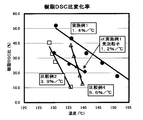
(3)図1に示すように、熱処理温度A(℃)がX軸、樹脂DSC比(%)がY軸となるよう、4~6点の値をプロットして、直線近似にて相関直線を描く。
原料樹脂の1℃当たりの樹脂DSC比変化率(%/℃)は、得られた相関直線の勾配として求められる。
したがって、樹脂DSC比変化率が小さい場合、発泡温度の変動による発泡粒子DSC比の変動が小さくなる。
熱流速示差走査熱量計[セイコーインスツルメンツ(株)製、DSC6200型]を用いて、ポリプロピレン系樹脂発泡粒子4~6mgを、40℃~210℃の間を10℃/分の昇温速度で昇温した際に得られるDSC曲線を取得する。
得られた1回目昇温時のDSC曲線から、上記と同様にして高温側の融解ピーク熱量の比率[=QH/(QH+QL)×100(%)](発泡粒子DSC比)を算出する。
ところで、重合触媒としてチーグラー系重合触媒を用いる場合、製造可能な共重合体中のエチレン含有率は5重量%程度が上限であるが、メタロセン系重合触媒を用いる場合、エチレン含有率が8重量%程度までの共重合体の製造が可能である。
従来のチーグラー系重合触媒を用いて重合されたポリプロピレン系樹脂では、低融点化に限界があり、市販されているものの融点は、130℃程度が下限であった。これに対して、メタロセン系重合触媒を用いて重合されたポリプロピレン系樹脂では、130℃以下の低融点化が可能で、さらには、120℃以下の低融点化も可能である。この低融点は、ポリエチレン系樹脂の融点に匹敵する低い融点である。
具体的には、ポリプロピレン系樹脂系発泡樹脂としては、熱流速示差走査熱量計(DSC)を用いて上記測定方法により算出される樹脂DSC比変化率が小さいポリプロピレン系樹脂を基材樹脂として用いて、かつ、発泡粒子の1回目昇温時のDSC測定において、2つの融解ピークを有し、低温側の融解ピーク温度が100℃以上130℃以下の低温であるものが好ましい。
原料ポリプロピレン系樹脂の樹脂DSC比変化率が0.5%/℃未満では、発泡温度を大きく変えてもDSC比の変化が小さすぎる為、発泡温度を調整することにより所望の発泡粒子DSC比を得ることが難しくなる傾向がある。樹脂DSC比変化率が3.0%/℃を超えると、発泡時の発泡温度の変動に対応する発泡粒子のDSC比の変動が大きくなる傾向がある。
ポリプロピレン系樹脂同士の混合の良好さという点からは、多段重合によって得られるポリプロピレン系樹脂を使用することが好ましい。また、得られる発泡樹脂粒子中の気泡径がより均一になる点からも、重合と同時に混合される多段重合によって得られるポリプロピレン系樹脂を使用することが好ましい。
また、最も低温の融解ピークを構成する成分の融点が130℃を超えると、成形温度が高くなる傾向がある。
そのため、最も低温の融解ピークを構成する成分と最も高温の融解ピークを構成する成分の融点差が大きすぎたり、最も高温の融解ピークを構成する成分の比率が多すぎると、発泡温度が高温側になり、低融点成分の結晶が全融解したり、溶融粘度が低くなりすぎて、得られる発泡粒子の気泡構造が不均一になったり、連続気泡化する傾向がある。
最も低温の融解ピークを構成する低融点成分の量が60重量%未満では、得られた発泡粒子の成形温度が高くなる傾向があり、95重量%を超えると、高温側の融解ピークを構成する成分が少なくなりすぎ、樹脂DSC比変化率が高くなる傾向がある。
前重合工程(P-1):エチレンを重合して前重合体を製造する工程であり、微量のエチレン前重合体を添加することにより、重合触媒を安定化させることができる。
予重合工程(P-2):前重合体の存在下で、プロピレンを重合して予重合体を製造する工程である。
本重合工程(P-3):予重合体の存在下で、プロピレン並びに、エチレンおよび/または炭素数4以上のα-オレフィンを共重合してプロピレン系共重合体を製造する工程である。

ポリプロピレン系樹脂のMFRが2g/10分未満では、発泡性が悪くなる傾向があり、MFRが50g/10分を超えると、ポリプロピレン系樹脂発泡粒子の気泡が破壊されて連続気泡ができ易い傾向がある。
そのため、本発明におけるメタロセン系重合触媒を用いて重合されるポリプロピレン系樹脂のMFRとしては、チーグラー系重合触媒を用いて重合されるポリプロピレン系樹脂のMFRに比べて、高くすることが良好な発泡性を得る点から、好ましい。
ここで、樹脂粒子の粒重量は、ポリプロピレン系樹脂粒子をランダムに100粒採取し、重量を測定し、1粒あたりに平均して得られた平均樹脂粒子重量である。
これら水溶性無機物、親水性ポリマー、多価アルコール類等は、単独で使用してもよいし、2種以上併用してもよい。
水溶性無機物、多価アルコール類を使用する場合、ポリプロピレン系樹脂100重量部に対して、0.01重量部以上2重量部以下であることが好ましく、親水性ポリマーを使用する場合、ポリプロピレン系樹脂100重量部に対して、0.05重量部以上5重量部以下であることが好ましい。
例えば、耐圧容器内にポリプロピレン系樹脂粒子を発泡剤存在下、分散剤等と共に水中に分散させ、加圧下で所定の発泡温度まで加熱すると共に、発泡剤を樹脂粒子に含浸させた後、容器内の温度、圧力を一定に保持しながら、耐圧容器内のポリプロピレン系樹脂粒子を含む分散物を低圧域に放出・発泡させる方法が好ましい(後述する二段発泡法と対比して、この方法を「一段発泡法」と称する場合がある。)。
(該中間温度-15)℃~(該中間温度+15)℃の間であることが好ましい。
これらの発泡剤のうちでも、炭酸ガス、水や、より高倍率での発泡が可能となるイソブタンが好ましい。
この際、より高発泡倍率の発泡粒子を得る為に、前記方法(一段発泡法)にて一旦ポリプロピレン系樹脂発泡粒子を得た後、該発泡粒子に空気等の不活性ガスを含浸させて発泡力を付与した後、加熱を行って更に発泡させる方法、いわゆる「二段発泡法」を採用してもよい。
これらの中でも、分散剤と分散助剤としては、第三リン酸カルシウムとn-パラフィンスルホン酸ソナトリウムを組み合わせて使用することが好ましい。
ポリプロピレン系樹脂発泡粒子の1回目昇温時のDSC曲線における最も低温の融解ピーク温度と最も高温の融解ピーク温度との差が25℃未満では、複雑な形状の金型、大きな金型等を使用して型内発泡成形を行う際、成形加熱条件幅が不十分となる傾向がある。
発泡粒子のDSC比が10%未満では、ポリプロピレン系樹脂発泡粒子の独立気泡率が低く、ポリプロピレン系樹脂型内発泡成形体の成形体変形率が大きくなる傾向にある。発泡粒子のDSC比が50%を超えると、ポリプロピレン系樹脂発泡粒子の型内発泡成形する際の2次発泡力が十分得られない場合があり、粟おこし状で発泡粒子同士の融着の劣るポリプロピレン系樹脂型内発泡成形体が得られる場合がある。
ポリプロピレン系樹脂発泡粒子の平均気泡径が30μm未満では、ポリプロピレン系樹脂型内発泡成形体としたときに収縮率が大きくなったり、表面美麗性が低下する場合がある。また、平均気泡径が1000μmを超えると、気泡径が不均一になり易く、ポリプロピレン系樹脂発泡粒子の倍率ばらつきも大きくなり易い傾向がある。
ここで、ポリプロピレン系樹脂型内発泡成形体の発泡倍率は、発泡成形体の乾燥重量(W:g)とエタノール水没体積(V:cm3)から、(発泡成形体の発泡倍率)=1/(W/V)×0.9(0.9はポリプロピレン系樹脂の樹脂密度)で求められる。
ポリプロピレン系樹脂中のエチレン含有率は、炭素核磁気共鳴分析(C13-NMR)にて、特開2009-84377号公報の[0076]~[0079]欄に記載の方法で測定した。
ポリプロピレン系樹脂を、昇温溶離分別法(TREF)にて測定したピーク曲線の中で、高温側ピークの面積から、ホモPP含有量(ポリプロピレン単独重合体含有量)を算出した。
ホモPP含有量=(高温側ピークの面積/全面積)×100(%)
なお、昇温溶離分別法(TREF)による測定は、以下の装置および測定条件にて、実施した。
詳しくは、試料溶液(ポリプロピレン系ランダム共重合体樹脂のo-ジクロロベンゼン溶液)を、135℃の試料溶液注入部に注入した後、TREF部にて、135℃から0℃まで降温速度1℃/分にて冷却することにより、試料をTREF部内で結晶化させた。次いで、TREF部温度を、0℃にて60分間保持した後、下記の溶出区分温度において順次、試料を溶出してTREF部からGPCカラムに導き、赤外検出器を用いて、GPCクロマトグラム(分子量分布)を得る。
得られたGPCクロマトグラムは、装置付属の解析ソフトを用いて処理され、各溶出温度でのピーク面積から積分曲線(溶出温度に対する累積溶出量曲線)を作成し、積分曲線を微分することにより、溶出曲線が得られる。
装置 :クロス分別クロマトグラフ CFC2(Polymer ChAR社製)
検出器 :赤外分光光度計 IR4型 (Polymer ChAR社製)
検出波長 :3.42μm
GPCカラム:Shodex AT-806MS×3本(昭和電工社製)
カラム温度 :135℃
カラム較正 :単分散ポリスチレン(東ソー社製)
分子量較正法:汎用較正/ポリエチレン換算
溶離液 :o-ジクロロベンゼン
流速 :1.0mL/min
試料濃度 :60mg/20mL
注入量 :500μL
降温時間 :135分(135→0℃)、結晶化速度 1℃/分、その後60分間保持溶出区分 :0、20、40、50、60、70、75、80、83、86、89、92、95、98、101、104、106、108、110、112、114、116、118、120、122、124、126、130、135℃(29分画)
熱流速示差走査熱量計[セイコーインスツルメンツ(株)製、DSC6200型]を用いて、ポリプロピレン系樹脂粒子4~6mgを、10℃/分の昇温速度で40℃~210℃の間を昇温した後、10℃/分で210℃~40℃の間を降温し、さらに、10℃/分で40℃~210℃の間を昇温した際に、2回目の昇温時のDSC曲線の融解ピーク温度を、DSC融点とする。なお、複数の融解ピークが現れる場合、ポリプロピレン系樹脂粒子は複数の融点を有することになる。
(1)まず、ポリプロピレン系樹脂のDSC融点(融解ピークが複数存在する場合は、全ピークの中央付近の温度)に対して5~10℃高い温度を、熱処理温度A(℃)として仮に設定する。
熱流速示差走査熱量計(DSC)[セイコーインスツルメンツ(株)製、DSC6200型]を用いて、当該ポリプロピレン系樹脂粒子4~6mgを、40℃~50℃の間は5℃/分の昇温速度で、50℃~(A―10)℃の間は3℃/分の昇温速度で、(A-10)℃~A℃の間は0.5℃/分の昇温速度で昇温した後、A℃で30分間保持した後、A℃~40℃の間を35℃/分の降温速度で降温した後、40℃~210℃の間を10℃/分の昇温速度で昇温して、2つの融解ピークを有するDSC曲線を取得する。
得られたDSC曲線から、高温側の融解ピーク熱量の比率[=QH/(QH+QL)×100(%)](以下、「樹脂DSC比」と称する。)を算出する。すなわち、DSC比は、低温側の融解ピークと低温側ピークと高温側ピークの間の極大点から融解開始ベースラインへ接線を引き低温側ピークと接線で囲まれる部分の熱量である低温側の融解ピーク熱量QLと、DSC曲線の高温側の融解ピークと低温側ピークの間の極大点から融解終了ベースラインへ接線を引き高温側ピークと接線で囲まれる部分の熱量である高温側融解ピーク熱量QHから算出できる。
(2)同様に、DSC比の値がおおよそ10%~50%の間に入るように、熱処理温度A(℃)を変更して4~6点の測定を行う。
(3)図1に示すように、熱処理温度A(℃)がX軸、樹脂DSC比(%)がY軸となるよう、4~6点の値をプロットして、直線近似にて相関直線を描く。
原料樹脂の1℃当たりの樹脂DSC比変化率(%/℃)は、得られた相関直線の勾配として求められる。
熱流速示差走査熱量計[セイコーインスツルメンツ(株)製、DSC6200型]を用いて、ポリプロピレン系樹脂発泡粒子4~6mgを、40℃~210℃の間を10℃/分の昇温速度で昇温した際に得られるDSC曲線を取得する。
得られたDSC曲線から、上記と同様にして高温側の融解ピーク熱量の比率[=(QH/(QH+QL)×100(%)](発泡粒子DSC比)を算出する。
嵩体積約50cm3のポリプロピレン系樹脂発泡粒子の重量W(g)およびエタノール水没体積V(cm3)を求め、発泡前のポリプロピレン系樹脂粒子の密度d(g/cm3)から次式により求めた。
発泡倍率=d×V/W
得られた発泡粒子をランダムに10個サンプリングし、各発泡粒子を両刃カミソリを用いて、気泡膜を破壊しないように十分注意して2等分に切断した気泡断面を、顕微鏡[キーエンス社製、マイクロスコープVHX-100]を用いて、倍率100倍にて観察した。得られた画像において、中央部2mm(2000μm)の線上を横切る気泡の個数をカウントし、気泡径(μm)=2000/気泡の個数により、各発泡粒子の気泡径算出した。10個の発泡粒子において得られた気泡径の平均値を、平均気泡径とした。
ポリプロピレン系樹脂型内発泡成形体密度は、型内発泡成形体の乾燥重量(W:g)とエタノール水没体積(V:cm3)から、次式により求めた。
型内発泡成形体の密度(g/L)=(W/V)×1000
ポリプロピレン系樹脂型内発泡成形体から縦50mm×横50mm×厚み25mmのテストピースを切り出し、NDZ-Z0504に準拠し、10mm/分の速度で圧縮した際の50%圧縮時の圧縮応力(MPa)を測定し、以下の基準にて評価した。
○:20g/Lの発泡成形体密度で、50%圧縮強度が0.12MPa以上。
×:20g/Lの発泡成形体密度で、0.12MPa未満。
成形評価では、ポリオレフィン発泡成形機[ダイセン株式会社製、KD-345]を用い、縦400mm×横300mm×厚み50mmの金型を用いて、成形加熱水蒸気圧0.09~0.30MPa(ゲージ圧)で型内発泡成形を実施した。
得られたポリプロピレン系樹脂型内発泡成形体は1時間室温で放置した後、75℃の恒温室内で15時間養生乾燥を行い、再び室温に取出してから室温で4時間放置した後、発泡粒子間の(1)融着性、型内発泡成形体の(2)表面性、(3)寸法収縮率、(4)変形度合いを評価して、成形加熱条件幅を評価した。
すなわち、成形加熱水蒸気圧を変化させて作製したポリプロピレン系樹脂型内発泡成形体において、上記(1)~(4)の評価が全て(すなわち、融着性、表面性、寸法収縮率、変形度合いの全て)が合格となる最低の成形加熱水蒸気圧および最高の成形加熱水蒸気圧を求め、その成形加熱水蒸気圧の差を「成形加熱条件幅」とし、以下の基準にて判定した。
○:成形加熱条件幅が0.1MPa以上。
△:成形加熱条件幅が0.05以上、0.1MPa未満。
×:成形加熱条件幅が0.05MPa未満。
(1)融着性評価
得られたポリプロピレン系樹脂型内発泡成形体を、カッターナイフで型内発泡成形体の厚み方向に約5~10mmの切り込みを入れた後、手で切り込み部から型内発泡成形体を破断し、破断面を観察して、粒子界面ではなく、粒子が破断している割合(融着率)を求めて、以下の基準にて判定とした。
合格: 融着率が60%以上。
不合格:融着率が60%未満。
(2)表面性評価
型内発泡成形体の表面状態を目視観察し、以下の基準で評価した。
合格: しわ、粒間が少なく、美麗。
不合格:しわ、ヒケがあり、外観不良。
(3)寸法収縮率
得られたポリプロピレン系樹脂発泡成形体の縦寸法(縦方向上辺部)を測定し、金型縦寸法(400mm)に対する収縮率を算出して以下の判定とした。
合格: 縦寸法の収縮率が5%未満。
不合格:縦寸法の収縮率が5%以上。
(4)変形度合い
得られたポリプロピレン系樹脂発泡成形体の厚み(縦方向中央部、右辺および左辺から30mmの部分厚みの平均値)を測定し、金型厚み寸法(50mm)に対する収縮率を算出して以下の判定とした。
合格: 厚み方向の収縮率が7%未満。
不合格:厚み方向の収縮率が7%以上。
[メタロセン系重合触媒によるプロピレン・エチレンランダム共重合体の製造]
(1)固体触媒担体の製造
1L枝付フラスコにSiO2[洞海化学社製]300gを秤取し、トルエン800mLを入れスラリー化した。次に、得られたスラリーを5L四つ口フラスコへ移液し、トルエン260mLを加え、メチルアルミノキサン(以下、「MAO」と略す)トルエン溶液(アルベマール社製、10wt%溶液)を2830mL導入し、室温下で30分間撹拌した。1時間かけて110℃まで昇温し、同温度で4時間撹拌処理を行った。撹拌終了後、室温まで冷却した。冷却後、上澄みトルエンを抜き出し、フレッシュなトルエンで置換し、置換率が95%になるまで置換を行った。
(2)固体触媒成分の製造(担体への金属触媒成分の担持)
グローブボックス内にて、5L四つ口フラスコにジフェニルメチレン(3-tert-ブチル-5-メチルシクロペンタジエニル)(2,7-ジ-tert-ブチルフルオレニル)ジルコニウムジクロリドを2.0g秤取した。フラスコをグローブボックス外へ出し、トルエン0.46Lと(1)の方法で調製したMAO/SiO2/トルエンスラリー1.4Lを窒素下で加え、30分間撹拌して担持を行った。
得られたジフェニルメチレン(3-tert-ブチル-5-メチルシクロペンタジエニル)(2,7-ジ-tert-ブチルフルオレニル)ジルコニウムジクロリド/MAO/SiO2トルエンスラリーは、n-ヘプタンにて99%置換を行い、最終的なスラリー量を4.5Lとした。この操作は、室温で行った。
(3)前重合P-1
前記(2)で調製した固体触媒成分202g、トリエチルアルミニウム109mL、n-ヘプタン100Lを内容量200Lの攪拌機付きオートクレーブに挿入し、内温15~20℃に保ちエチレンを2020g挿入し、180分間攪拌しながら反応させた。
重合終了後、固体成分を沈降させ、上澄み液の除去およびn-ヘプタンによる洗浄を2回行った。投入した溶媒(n-ヘプタン)量および回収された溶媒量から計算される触媒洗浄率は99%であった。
得られた前重合体を精製n-ヘプタンに再懸濁して、固体触媒成分濃度で2g/Lとなるよう、n-ヘプタンにより調整を行った。一部、サンプリングを行い、前重合体の分析を行った。得られた前重合体は固体触媒成分1g当りポリエチレンを10g含んでいた。
(4)予重合P-2
内容量58Lの管状重合器にプロピレンを57kg/hr、水素を4NL/hr、前記(3)で調製した前重合体の触媒スラリーを固体触媒成分として7.1g/hr、トリエチルアルミニウム4.0mL/hrを連続的に供給し、気相の存在しない満液の状態にて重合した。管状反応器の温度は30℃であり、圧力は2.6MPa(G)であった。
(5)本重合P-3
前記の(4)予重合で得られたスラリーを内容量1000Lの攪拌機付きベッセル重合器へ送り、更に重合を行った。重合器へは、プロピレンを50kg/hr、エチレンを1.6kg/hr、水素を気相部の水素濃度が0.39mol%になるように供給した。重合温度60℃、圧力2.5MPa(G)で重合を行った。
得られたスラリーを内容量500Lの攪拌機付きベッセル重合器へ送り、更に重合を行った。重合器へは、プロピレンを11kg/hr、エチレンを1.1kg/hr、水素を気相部の水素濃度が0.39mol%になるように供給した。重合温度59℃、圧力2.4MPa(G)で重合を行った。
得られたスラリーを気化後、気固分離を行い、プロピレン・エチレン系ランダム共重合体を得た。得られたプロピレン共重合体は、80℃で真空乾燥を行った。
得られたプロピレン・エチレンランダム共重合体は、エチレン含有量5.2重量%、ホモPP含有量(ポリプロピレン単独重合体含有量)15重量%、熱流速示差走査熱量計によるDSC融点測定で得られた最も低温の融解ピーク温度107℃、最も高温の融解ピーク温度148℃、MFR12g/10分であった。
得られたプロピレン・エチレンランダム共重合体100重量部に対して、セル造核剤としてタルク[林化成製、PKS]0.1重量部、吸水剤としてポリエチレングリコール[ライオン(株)製、PEG#300]0.5重量部をブレンドした後、50mm単軸押出機[大阪精機工作(株)製20VSE-50-28型]内で溶融混練した。得られた溶融混練樹脂を円形ダイよりストランド状に押出し、水冷後、ペレタイザーで切断し、一粒の重量が1.2mg/粒のポリプロピレン系樹脂粒子を得た。
得られたポリプロピレン系樹脂粒子100重量部、水200重量部、分散剤として第3リン酸カルネシウム0.5重量部、分散助剤としてn-パラフィンスルホン酸ナトリウム0.05重量部を容量10Lの耐圧オートクレーブ中に仕込み、撹拌下、発泡剤として炭酸ガスを6.25重量部添加した。オートクレーブ内容物を昇温し、134℃の発泡温度まで加熱した後、さらに炭酸ガスを追加してオートクレーブ内圧を3.0MPa(G)とした。その後、30分間保持した後、オートクレーブ下部のバルブを開き、4.0mmφの開口オリフィスを通して、オートクレーブ内容物を大気圧下に放出して一段発泡粒子を得た。
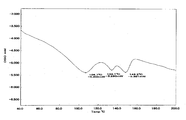
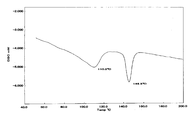
得られた一段発泡粒子の発泡倍率は11倍、DSC比は29%、発泡粒子の1回目のDSC測定において2つの融解ピークを示し、最も低温の融解ピーク温度は110℃、最も高温の融解ピーク温度は145.5℃であった(図3)。得られた一段発泡粒子内に空気含浸により0.32MPaの内圧を付与し、0.02MPa(G)の蒸気により加熱し、発泡倍率27倍の発泡粒子を得た。
得られたポリプロピレン系樹脂発泡粒子を、pH=1の塩酸水溶液で洗浄した後水洗し、75℃で乾燥し、耐圧容器にて加圧空気を含浸して粒子内圧を0.2MPaとした後、ダイセン株式会社製ポリオレフィン発泡成形機KD-345を用い、縦400mm×横300mm×厚み50mmの金型を用いて、加熱水蒸気圧力0.09~0.30MPa・Gで型内発泡成形を実施した。
得られた型内発泡成形体は、1時間室温で放置した後、75℃の恒温室内で15時間養生乾燥を行い、再び室温に取出してから室温で4時間放置した後の、粒子間の融着性、表面性、寸法収縮率、変形度合いから、成形加熱条件幅を評価した。
結果を表1に示す。
[メタロセン系重合触媒によるプロピレン・エチレンランダム共重合体の製造]
本重合(5)において、1000Lのベッセル重合器にて、水素を気相部の水素濃度が0.45mol%になるように供給し、500Lのベッセル重合器にて、水素を気相部の水素濃度が0.45mol%になるように供給した以外は、実施例1と同様にして、プロピレン・エチレンランダム共重合体を得た。
得られたプロピレン・エチレンランダム共重合体は、エチレン含有量5.2重量%、ホモPP含有量(ポリプロピレン単独重合体含有量)15重量%、熱流速示差走査熱量計によるDSC融点測定で得られた最も低温の融解ピーク温度107℃、最も高温の融解ピーク温度148℃、MFR17g/10分であった。
[樹脂粒子、発泡粒子および型内発泡成形体の製造]
得られたプロピレン・エチレンランダム共重合体を用いた以外は、実施例1と同様の操作により、樹脂粒子、発泡粒子、型内発泡成形体を得、成形体評価を行った。結果を表1に示す。
[メタロセン系重合触媒によるプロピレン・エチレンランダム共重合体の製造]
本重合(5)において、1000Lのベッセル重合器にて、水素を気相部の水素濃度が0.52mol%になるように供給し、500Lのベッセル重合器にて、水素を気相部の水素濃度が0.52mol%になるように供給した以外は、実施例1と同様にして、プロピレン・エチレンランダム共重合体を得た。
得られたプロピレン・エチレンランダム共重合体は、エチレン含有量5.2重量%、ホモPP含有量(ポリプロピレン単独重合体含有量)15重量%、熱流速示差走査熱量計による融点測定で得られた最も低温の融解ピーク温度108℃、最も高温の融解ピーク温度148℃、MFR24g/10分であった。
[樹脂粒子、発泡粒子および型内発泡成形体の製造]
得られたプロピレン・エチレンランダム共重合体を用いた以外は、実施例1と同様の操作により、樹脂粒子、発泡粒子、型内発泡成形体を得、成形体評価を行った。結果を表1に示す。
[メタロセン系重合触媒によるプロピレン・エチレンランダム共重合体の製造]
本重合(5)において、1000Lのベッセル重合器にて、エチレンを1.4kg/hr、水素を気相部の水素濃度が0.44mol%になるように供給し、500Lのベッセル重合器にて、エチレンを1.0kg/hr、水素を気相部の水素濃度が0.44mol%になるように供給した以外は、実施例1と同様にして、プロピレン・エチレンランダム共重合体を得た。
得られたプロピレン・エチレンランダム共重合体は、エチレン含有量4.6重量%、ホモPP含有量(ポリプロピレン単独重合体含有量)25重量%、熱流速示差走査熱量計による融点測定で得られた最も低温の融解ピーク温度107℃、最も高温の融解ピーク温度148℃、MFR16g/10分であった。
[樹脂粒子、発泡粒子および型内発泡成形体の製造]
得られたプロピレン・エチレンランダム共重合体を用いた以外は、実施例1と同様の操作により、樹脂粒子、発泡粒子、型内発泡成形体を得、成形体評価を行った。結果を表1に示す。
[メタロセン系重合触媒によるプロピレン・エチレンランダム共重合体の製造]
予重合(4)を行わず、本重合(5)において、1000Lのベッセル重合器にて、エチレンを1.6kg/hr、水素を気相部の水素濃度が0.31mol%になるように供給し、500Lのベッセル重合器にて、エチレンを1.1kg/hr、水素を気相部の水素濃度が0.31mol%になるように供給した以外は、実施例1と同様にして、プロピレン・エチレンランダム共重合体を得た。
得られたプロピレン・エチレンランダム共重合体は、エチレン含有量5.1重量%、ホモPP含有量(ポリプロピレン単独重合体含有量)0%、示差走査熱量計による融点測定で得られた最も低温の融解ピーク温度107℃、MFR7g/10分であった。
[発泡粒子および型内発泡成形体の製造]
得られたプロピレン・エチレンランダム共重合体を用いた以外は、実施例1と同様の操作により、樹脂粒子、発泡粒子、型内発泡成形体を得、成形体評価を行った。結果を表1に示す。
[メタロセン系重合触媒によるプロピレン・エチレンランダム共重合体の製造]
予重合(4)を行わず、本重合(5)において、1000Lのベッセル重合器にて、エチレンを1.2kg/hr、水素を気相部の水素濃度が0.48mol%になるように供給し、500Lのベッセル重合器にて、エチレンを0.8kg/hr、水素を気相部の水素濃度が0.48mol%になるように供給した以外は、実施例1と同様にして、プロピレン・エチレンランダム共重合体を得た。
得られたプロピレン・エチレンランダム共重合体は、エチレン含有量3.8重量%、ホモPP含有量(ポリプロピレン単独重合体含有量)0%、熱流速示差走査熱量計による融点測定で得られた最も低温の融解ピーク温度117℃、MFR20g/10分でであった。
[樹脂粒子、発泡粒子および型内発泡成形体の製造]
得られたプロピレン・エチレンランダム共重合体を用いた以外は、実施例1と同様の操作により、樹脂粒子、発泡粒子、型内発泡成形体を得、成形体評価を行った。結果を表1に示す。
[樹脂粒子、発泡粒子および型内発泡成形体の製造]
ポリプロピレン系樹脂として、チーグラー系重合触媒で重合された、エチレン含有量4.1重量%、熱流速示差走査熱量計による融点測定で得られた単一の融解ピーク温度134℃、MFR7g/10分であるプロピレン・エチレンランダム共重合体(プライムポリマー社製 F744NP)を用いた以外は、実施例1と同様の操作により、樹脂粒子、発泡粒子、型内発泡成形体を得、成形体評価を行った。結果を表1に示す。
[樹脂粒子、発泡粒子および型内発泡成形体の製造]
ポリプロピレン系樹脂として、チーグラー系重合触媒で重合して得られた、エチレン含有量2.4重量%、1-ブテン含有量3.7重量%、熱流速示差走査熱量計による融点測定で得られた単一の融解ピーク温度133℃、MFR7g/10分であるプロピレン・エチレン・1-ブテンランダム共重合体(プライムポリマー社製 F337D)を用いた以外は、実施例1と同様の操作により、樹脂粒子、発泡粒子、型内発泡成形体を得、成形体評価を行った。結果を表1に示す。
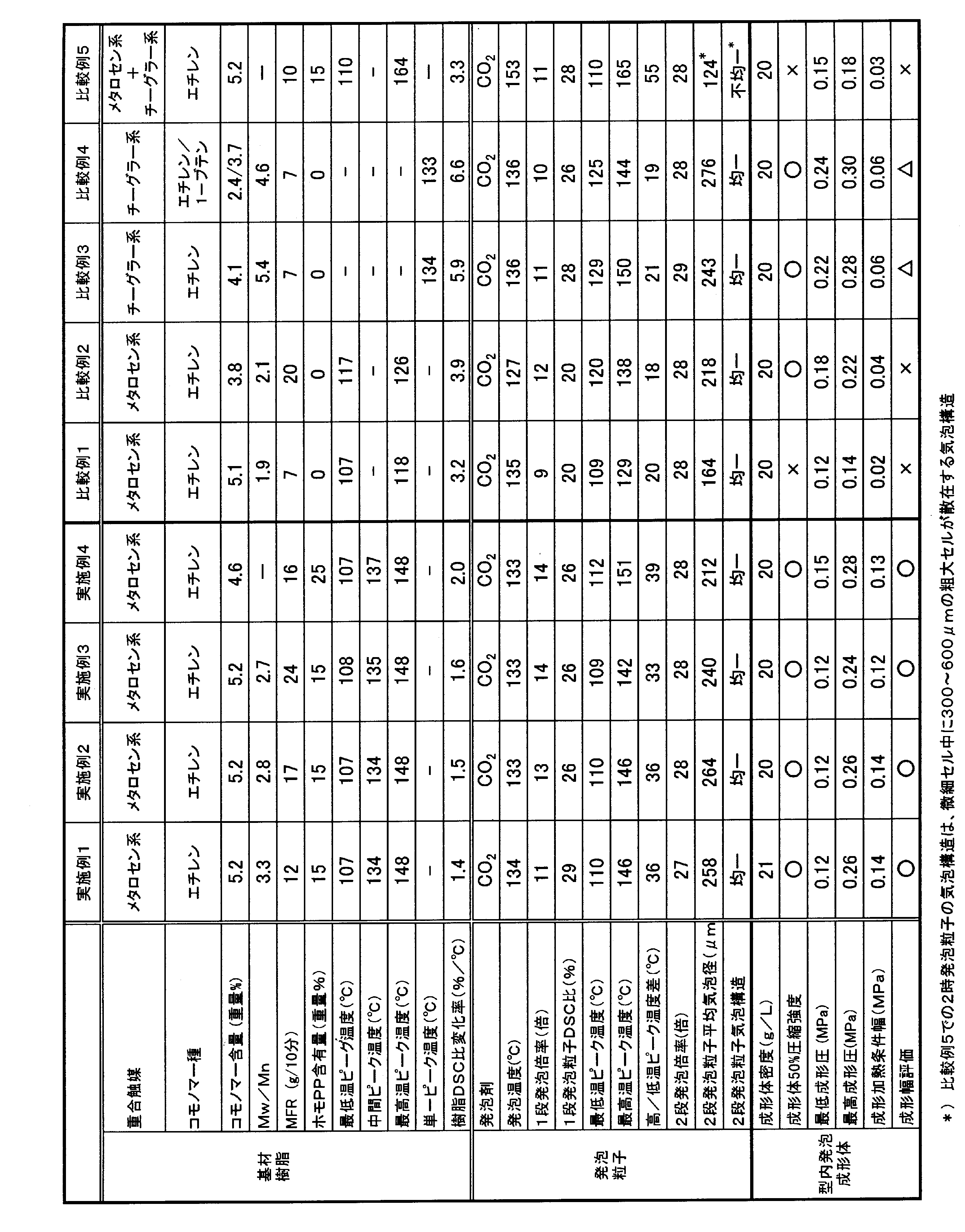
チーグラー系重合触媒で重合した樹脂を用いた比較例3、4では、樹脂融点はチーグラー系重合触媒で重合した樹脂としては低い133~134℃であるが、最低成形加熱水蒸気圧は0.22MPa~0.24MPaと高くなり、成形加熱条件幅も0.06MPaと△の評価であった。
[基材樹脂の製造]
ポリプロピレン系樹脂として、比較例1で用いたメタロセン系触媒で重合したプロピレン・エチレンランダム共重合体85重量%と、チーグラー系重合触媒で重合したポリプロピレンホモポリマー(融点165℃、MFR8.0g/10分)15重量%を2軸押出機でブレンドして、ブレンド樹脂を得た。
[樹脂粒子、発泡粒子および型内発泡成形体の製造]
得られたブレンド樹脂を用いた以外は、実施例1と同様の操作により、樹脂粒子、発泡粒子、型内発泡体を得、成形体評価を行った。結果を表1に示す。
得られた発泡粒子は、不均一な気泡構造であり、連続気泡率が14.5%と高く(通常は5%未満程度)、型内発泡成形において、最低成形加熱蒸気圧は0.15MPaと低かったが、成形加熱蒸気圧を上げると、変形、収縮が大きく、成形加熱条件幅は極めて狭いものであった。
Claims (6)
- ポリプロピレン系樹脂を基材樹脂として用いて得られるポリプロピレン系樹脂発泡粒子であって、
前記プロピレン系樹脂が、
熱流速示差走査熱量計(DSC)を用いて昇温速度10℃/分にて測定される2回目の昇温時のDSC曲線における融解ピークとして、少なくとも2つの融解ピークを有し、100℃以上130℃以下に最も低温の融解ピークを有し、かつ140℃以上160℃以下に最も高温の融解ピークを有し、
かつ、樹脂DSC比変化率が0.5~3.0%/℃であり、さらに、
前記発泡粒子が、昇温速度10℃/分での1回目昇温時のDSC測定において、2つの融解ピークを有し、
低温側の融解ピーク温度が100℃以上130℃以下であり、高温側の融解ピーク温度が140℃以上160℃以下であることを特徴とする、ポリプロピレン系樹脂発泡粒子。 - 前記ポリプロピレン系樹脂が、メタロセン系重合触媒を用いて重合されたポリプロピレン系ランダム共重合体樹脂を含むことを特徴とする、請求項1記載のポリプロピレン系樹脂発泡粒子。
- 前記ポリプロピレン系樹脂が、メタロセン系重合触媒を用いて重合されたポリプロピレン系ランダム共重合体樹脂、および、メタロセン系重合触媒を用いて重合されたポリプロピレン単独重合体を含むことを特徴とする、請求項2記載のポリプロピレン系樹脂発泡粒子。
- 前記ポリプロピレン系樹脂が、メタロセン系重合触媒を用いる多段重合で製造されてなるものであることを特徴とする、請求項2または3に記載のポリプロピレン系樹脂発泡粒子。
- 前記メタロセン系重合触媒が、下記(化1)で表されるメタロセン化合物を含むことを特徴とする、請求項2~4のいずれかに記載のポリプロピレン系樹脂発泡粒子。

- 請求項1~5のいずれか一項に記載のポリプロピレン系樹脂発泡粒子を、型内発泡成形してなる、ポリプロピレン系樹脂型内発泡成形体。
Priority Applications (2)
| Application Number | Priority Date | Filing Date | Title |
|---|---|---|---|
| US13/982,783 US8889750B2 (en) | 2011-02-02 | 2012-02-01 | Expanded polypropylene resin particles, and polypropylene resin in-mold-expanded molding |
| JP2012555930A JP5841076B2 (ja) | 2011-02-02 | 2012-02-01 | ポリプロピレン系樹脂発泡粒子およびポリプロピレン系樹脂型内発泡成形体 |
Applications Claiming Priority (2)
| Application Number | Priority Date | Filing Date | Title |
|---|---|---|---|
| JP2011-021181 | 2011-02-02 | ||
| JP2011021181 | 2011-02-02 |
Publications (1)
| Publication Number | Publication Date |
|---|---|
| WO2012105608A1 true WO2012105608A1 (ja) | 2012-08-09 |
Family
ID=46602815
Family Applications (1)
| Application Number | Title | Priority Date | Filing Date |
|---|---|---|---|
| PCT/JP2012/052280 Ceased WO2012105608A1 (ja) | 2011-02-02 | 2012-02-01 | ポリプロピレン系樹脂発泡粒子およびポリプロピレン系樹脂型内発泡成形体 |
Country Status (3)
| Country | Link |
|---|---|
| US (1) | US8889750B2 (ja) |
| JP (1) | JP5841076B2 (ja) |
| WO (1) | WO2012105608A1 (ja) |
Cited By (6)
| Publication number | Priority date | Publication date | Assignee | Title |
|---|---|---|---|---|
| US9040599B2 (en) | 2009-10-06 | 2015-05-26 | Kaneka Corporation | Polypropylene resin expanded particles and polypropylene resin in-mold foaming molded body |
| WO2016147919A1 (ja) * | 2015-03-13 | 2016-09-22 | 株式会社カネカ | ポリプロピレン系樹脂発泡粒子およびその製造方法 |
| CN110885499A (zh) * | 2018-09-07 | 2020-03-17 | 李长荣化学工业股份有限公司 | 制备聚丙烯发泡体的组合物、微粒及工艺 |
| CN115678167A (zh) * | 2021-07-29 | 2023-02-03 | 株式会社Jsp | 聚丙烯类树脂发泡粒子及其制造方法 |
| CN117430736A (zh) * | 2022-07-13 | 2024-01-23 | 中国石油化工股份有限公司 | 一种聚丙烯及其制备方法和应用 |
| WO2025205816A1 (ja) * | 2024-03-26 | 2025-10-02 | 株式会社カネカ | ポリプロピレン系樹脂発泡粒子、ポリプロピレン系樹脂発泡成形体およびポリプロピレン系樹脂発泡粒子の製造方法 |
Citations (6)
| Publication number | Priority date | Publication date | Assignee | Title |
|---|---|---|---|---|
| JP2001341151A (ja) * | 2000-06-05 | 2001-12-11 | Sekisui Plastics Co Ltd | ポリプロピレン系樹脂発泡成形体およびその製造方法 |
| JP2005200450A (ja) * | 2004-01-13 | 2005-07-28 | Mitsui Chemicals Inc | α−オレフィン(共)重合体の製造方法 |
| JP2006096805A (ja) * | 2004-09-28 | 2006-04-13 | Kaneka Corp | ポリプロピレン系樹脂予備発泡粒子および型内発泡成形体 |
| WO2009001626A1 (ja) * | 2007-06-22 | 2008-12-31 | Jsp Corporation | ポリプロピレン系樹脂発泡粒子及びその成型体 |
| JP2009084304A (ja) * | 2007-09-27 | 2009-04-23 | Mitsui Chemicals Inc | 軟質発泡体用プロピレン系樹脂組成物およびその用途 |
| WO2011043032A1 (ja) * | 2009-10-06 | 2011-04-14 | 株式会社カネカ | ポリプロピレン系樹脂発泡粒子およびポリプロピレン系樹脂型内発泡成形体 |
Family Cites Families (7)
| Publication number | Priority date | Publication date | Assignee | Title |
|---|---|---|---|---|
| US4908393A (en) | 1988-03-24 | 1990-03-13 | Mitsubishi Yuka Badische Co., Ltd. | Propylene resin foamed particles and foamed mold article |
| JPH0768402B2 (ja) | 1988-03-24 | 1995-07-26 | 三菱化学ビーエーエスエフ株式会社 | プロピレン系樹脂発泡粒子および発泡成形体 |
| JP3436968B2 (ja) | 1994-03-23 | 2003-08-18 | 株式会社ジエイエスピー | ポリプロピレン系樹脂発泡粒子成形体 |
| KR100807763B1 (ko) * | 2003-08-22 | 2008-02-28 | 미쓰이 가가쿠 가부시키가이샤 | 프로필렌계 랜덤 공중합체 및 그 용도 |
| JP4712891B2 (ja) | 2007-05-15 | 2011-06-29 | 株式会社有沢製作所 | 携帯式卓上スクリーン及びプロジェクタユニット |
| WO2009051035A1 (ja) | 2007-10-16 | 2009-04-23 | Kaneka Corporation | ポリプロピレン系樹脂予備発泡粒子および該予備発泡粒子から得られる型内発泡成形体 |
| EP2385080B1 (en) * | 2009-01-27 | 2021-01-06 | Kaneka Corporation | Polypropylene resin pre-foamed particle and method for producing same, and polypropylene resin in-mold foaming molded article |
-
2012
- 2012-02-01 JP JP2012555930A patent/JP5841076B2/ja active Active
- 2012-02-01 US US13/982,783 patent/US8889750B2/en active Active
- 2012-02-01 WO PCT/JP2012/052280 patent/WO2012105608A1/ja not_active Ceased
Patent Citations (6)
| Publication number | Priority date | Publication date | Assignee | Title |
|---|---|---|---|---|
| JP2001341151A (ja) * | 2000-06-05 | 2001-12-11 | Sekisui Plastics Co Ltd | ポリプロピレン系樹脂発泡成形体およびその製造方法 |
| JP2005200450A (ja) * | 2004-01-13 | 2005-07-28 | Mitsui Chemicals Inc | α−オレフィン(共)重合体の製造方法 |
| JP2006096805A (ja) * | 2004-09-28 | 2006-04-13 | Kaneka Corp | ポリプロピレン系樹脂予備発泡粒子および型内発泡成形体 |
| WO2009001626A1 (ja) * | 2007-06-22 | 2008-12-31 | Jsp Corporation | ポリプロピレン系樹脂発泡粒子及びその成型体 |
| JP2009084304A (ja) * | 2007-09-27 | 2009-04-23 | Mitsui Chemicals Inc | 軟質発泡体用プロピレン系樹脂組成物およびその用途 |
| WO2011043032A1 (ja) * | 2009-10-06 | 2011-04-14 | 株式会社カネカ | ポリプロピレン系樹脂発泡粒子およびポリプロピレン系樹脂型内発泡成形体 |
Cited By (11)
| Publication number | Priority date | Publication date | Assignee | Title |
|---|---|---|---|---|
| US9040599B2 (en) | 2009-10-06 | 2015-05-26 | Kaneka Corporation | Polypropylene resin expanded particles and polypropylene resin in-mold foaming molded body |
| JP5732399B2 (ja) * | 2009-10-06 | 2015-06-10 | 株式会社カネカ | ポリプロピレン系樹脂発泡粒子およびポリプロピレン系樹脂型内発泡成形体 |
| WO2016147919A1 (ja) * | 2015-03-13 | 2016-09-22 | 株式会社カネカ | ポリプロピレン系樹脂発泡粒子およびその製造方法 |
| JPWO2016147919A1 (ja) * | 2015-03-13 | 2017-12-28 | 株式会社カネカ | ポリプロピレン系樹脂発泡粒子およびその製造方法 |
| US10017619B2 (en) | 2015-03-13 | 2018-07-10 | Kaneka Corporation | Polypropylene resin foamed particles and method for producing same |
| CN110885499A (zh) * | 2018-09-07 | 2020-03-17 | 李长荣化学工业股份有限公司 | 制备聚丙烯发泡体的组合物、微粒及工艺 |
| CN115678167A (zh) * | 2021-07-29 | 2023-02-03 | 株式会社Jsp | 聚丙烯类树脂发泡粒子及其制造方法 |
| JP2023019516A (ja) * | 2021-07-29 | 2023-02-09 | 株式会社ジェイエスピー | ポリプロピレン系樹脂発泡粒子およびその製造方法 |
| JP7664786B2 (ja) | 2021-07-29 | 2025-04-18 | 株式会社ジェイエスピー | ポリプロピレン系樹脂発泡粒子およびその製造方法 |
| CN117430736A (zh) * | 2022-07-13 | 2024-01-23 | 中国石油化工股份有限公司 | 一种聚丙烯及其制备方法和应用 |
| WO2025205816A1 (ja) * | 2024-03-26 | 2025-10-02 | 株式会社カネカ | ポリプロピレン系樹脂発泡粒子、ポリプロピレン系樹脂発泡成形体およびポリプロピレン系樹脂発泡粒子の製造方法 |
Also Published As
| Publication number | Publication date |
|---|---|
| US20130310476A1 (en) | 2013-11-21 |
| JP5841076B2 (ja) | 2016-01-06 |
| JPWO2012105608A1 (ja) | 2014-07-03 |
| US8889750B2 (en) | 2014-11-18 |
Similar Documents
| Publication | Publication Date | Title |
|---|---|---|
| JP6421165B2 (ja) | ポリプロピレン系樹脂発泡粒子およびポリプロピレン系樹脂発泡粒子の製造方法 | |
| JP6447494B2 (ja) | ポリプロピレン系樹脂発泡粒子の製造方法 | |
| JP5107692B2 (ja) | ポリプロピレン系樹脂発泡粒子、及びその発泡粒子成形体 | |
| JP5587867B2 (ja) | ポリプロピレン系共重合体樹脂発泡粒子 | |
| JP5841076B2 (ja) | ポリプロピレン系樹脂発泡粒子およびポリプロピレン系樹脂型内発泡成形体 | |
| JP5666918B2 (ja) | ポリプロピレン系樹脂予備発泡粒子とその製造方法、及びポリプロピレン系樹脂型内発泡成形体 | |
| JP6637903B2 (ja) | ポリプロピレン系樹脂発泡粒子 | |
| JP5749039B2 (ja) | ポリプロピレン系樹脂発泡粒子、ポリプロピレン系樹脂型内発泡成形体、およびポリプロピレン系樹脂発泡粒子の製造方法 | |
| JP6093604B2 (ja) | ポリプロピレン系樹脂発泡粒子およびその成形体 | |
| WO2010119883A1 (ja) | プロピレン重合体樹脂組成物 | |
| JPWO2016147919A1 (ja) | ポリプロピレン系樹脂発泡粒子およびその製造方法 | |
| JP2004115785A (ja) | ポリプロピレン系樹脂発泡粒子およびこれを用いた型内成形体 | |
| JP4282439B2 (ja) | ポリプロピレン系樹脂発泡粒子およびこれを用いた型内成形体 | |
| JP5460227B2 (ja) | ポリプロピレン系樹脂型内発泡成形体 | |
| WO2015137353A1 (ja) | 複合樹脂粒子、発泡性粒子、予備発泡粒子及び発泡成形体 | |
| JP6211958B2 (ja) | 複合樹脂粒子、発泡性粒子、予備発泡粒子及び発泡成形体 | |
| JP2004143451A (ja) | ポリプロピレン系樹脂組成物,ポリプロピレン系樹脂発泡粒子及びこれを用いた型内成形体 | |
| JP2011162731A (ja) | 発泡用abs樹脂組成物および発泡成形体 | |
| JP2010013606A (ja) | ポリプロピレン系樹脂予備発泡粒子、及びポリプロピレン系樹脂型内発泡成形体 |
Legal Events
| Date | Code | Title | Description |
|---|---|---|---|
| 121 | Ep: the epo has been informed by wipo that ep was designated in this application |
Ref document number: 12741894 Country of ref document: EP Kind code of ref document: A1 |
|
| ENP | Entry into the national phase |
Ref document number: 2012555930 Country of ref document: JP Kind code of ref document: A |
|
| WWE | Wipo information: entry into national phase |
Ref document number: 13982783 Country of ref document: US |
|
| NENP | Non-entry into the national phase |
Ref country code: DE |
|
| 122 | Ep: pct application non-entry in european phase |
Ref document number: 12741894 Country of ref document: EP Kind code of ref document: A1 |