WO2012104788A2 - Composes anti-angiogeniques, compositions pharmaceutiques les comprenant, et leur utilisation - Google Patents
Composes anti-angiogeniques, compositions pharmaceutiques les comprenant, et leur utilisation Download PDFInfo
- Publication number
- WO2012104788A2 WO2012104788A2 PCT/IB2012/050452 IB2012050452W WO2012104788A2 WO 2012104788 A2 WO2012104788 A2 WO 2012104788A2 IB 2012050452 W IB2012050452 W IB 2012050452W WO 2012104788 A2 WO2012104788 A2 WO 2012104788A2
- Authority
- WO
- WIPO (PCT)
- Prior art keywords
- group
- alkyl
- group chosen
- chosen
- propyl
- Prior art date
- Legal status (The legal status is an assumption and is not a legal conclusion. Google has not performed a legal analysis and makes no representation as to the accuracy of the status listed.)
- Ceased
Links
- ZLMGQAYGXIZZMF-UHFFFAOYSA-N CC(C)(C)OC(NCCCN1CCN(CCCNC(c2ccccc2)=O)CC1)=O Chemical compound CC(C)(C)OC(NCCCN1CCN(CCCNC(c2ccccc2)=O)CC1)=O ZLMGQAYGXIZZMF-UHFFFAOYSA-N 0.000 description 1
- JBFATKWIECXGQY-UHFFFAOYSA-N CC(C)(C)OC(NCCCNS(c1cccc2c1cccc2N(C)C)(=O)=O)=O Chemical compound CC(C)(C)OC(NCCCNS(c1cccc2c1cccc2N(C)C)(=O)=O)=O JBFATKWIECXGQY-UHFFFAOYSA-N 0.000 description 1
- AFBPFSWMIHJQDM-UHFFFAOYSA-N CNc1ccccc1 Chemical compound CNc1ccccc1 AFBPFSWMIHJQDM-UHFFFAOYSA-N 0.000 description 1
Classifications
-
- C—CHEMISTRY; METALLURGY
- C07—ORGANIC CHEMISTRY
- C07D—HETEROCYCLIC COMPOUNDS
- C07D221/00—Heterocyclic compounds containing six-membered rings having one nitrogen atom as the only ring hetero atom, not provided for by groups C07D211/00 - C07D219/00
- C07D221/02—Heterocyclic compounds containing six-membered rings having one nitrogen atom as the only ring hetero atom, not provided for by groups C07D211/00 - C07D219/00 condensed with carbocyclic rings or ring systems
- C07D221/04—Ortho- or peri-condensed ring systems
- C07D221/06—Ring systems of three rings
- C07D221/14—Aza-phenalenes, e.g. 1,8-naphthalimide
-
- A—HUMAN NECESSITIES
- A61—MEDICAL OR VETERINARY SCIENCE; HYGIENE
- A61K—PREPARATIONS FOR MEDICAL, DENTAL OR TOILETRY PURPOSES
- A61K31/00—Medicinal preparations containing organic active ingredients
- A61K31/16—Amides, e.g. hydroxamic acids
- A61K31/18—Sulfonamides
-
- A—HUMAN NECESSITIES
- A61—MEDICAL OR VETERINARY SCIENCE; HYGIENE
- A61K—PREPARATIONS FOR MEDICAL, DENTAL OR TOILETRY PURPOSES
- A61K31/00—Medicinal preparations containing organic active ingredients
- A61K31/33—Heterocyclic compounds
- A61K31/395—Heterocyclic compounds having nitrogen as a ring hetero atom, e.g. guanethidine or rifamycins
- A61K31/435—Heterocyclic compounds having nitrogen as a ring hetero atom, e.g. guanethidine or rifamycins having six-membered rings with one nitrogen as the only ring hetero atom
- A61K31/47—Quinolines; Isoquinolines
- A61K31/473—Quinolines; Isoquinolines ortho- or peri-condensed with carbocyclic ring systems, e.g. acridines, phenanthridines
-
- A—HUMAN NECESSITIES
- A61—MEDICAL OR VETERINARY SCIENCE; HYGIENE
- A61K—PREPARATIONS FOR MEDICAL, DENTAL OR TOILETRY PURPOSES
- A61K31/00—Medicinal preparations containing organic active ingredients
- A61K31/33—Heterocyclic compounds
- A61K31/395—Heterocyclic compounds having nitrogen as a ring hetero atom, e.g. guanethidine or rifamycins
- A61K31/495—Heterocyclic compounds having nitrogen as a ring hetero atom, e.g. guanethidine or rifamycins having six-membered rings with two or more nitrogen atoms as the only ring heteroatoms, e.g. piperazine or tetrazines
-
- A—HUMAN NECESSITIES
- A61—MEDICAL OR VETERINARY SCIENCE; HYGIENE
- A61K—PREPARATIONS FOR MEDICAL, DENTAL OR TOILETRY PURPOSES
- A61K31/00—Medicinal preparations containing organic active ingredients
- A61K31/33—Heterocyclic compounds
- A61K31/395—Heterocyclic compounds having nitrogen as a ring hetero atom, e.g. guanethidine or rifamycins
- A61K31/495—Heterocyclic compounds having nitrogen as a ring hetero atom, e.g. guanethidine or rifamycins having six-membered rings with two or more nitrogen atoms as the only ring heteroatoms, e.g. piperazine or tetrazines
- A61K31/496—Non-condensed piperazines containing further heterocyclic rings, e.g. rifampin, thiothixene or sparfloxacin
-
- A—HUMAN NECESSITIES
- A61—MEDICAL OR VETERINARY SCIENCE; HYGIENE
- A61P—SPECIFIC THERAPEUTIC ACTIVITY OF CHEMICAL COMPOUNDS OR MEDICINAL PREPARATIONS
- A61P19/00—Drugs for skeletal disorders
- A61P19/02—Drugs for skeletal disorders for joint disorders, e.g. arthritis, arthrosis
-
- A—HUMAN NECESSITIES
- A61—MEDICAL OR VETERINARY SCIENCE; HYGIENE
- A61P—SPECIFIC THERAPEUTIC ACTIVITY OF CHEMICAL COMPOUNDS OR MEDICINAL PREPARATIONS
- A61P27/00—Drugs for disorders of the senses
- A61P27/02—Ophthalmic agents
-
- A—HUMAN NECESSITIES
- A61—MEDICAL OR VETERINARY SCIENCE; HYGIENE
- A61P—SPECIFIC THERAPEUTIC ACTIVITY OF CHEMICAL COMPOUNDS OR MEDICINAL PREPARATIONS
- A61P35/00—Antineoplastic agents
-
- C—CHEMISTRY; METALLURGY
- C07—ORGANIC CHEMISTRY
- C07D—HETEROCYCLIC COMPOUNDS
- C07D295/00—Heterocyclic compounds containing polymethylene-imine rings with at least five ring members, 3-azabicyclo [3.2.2] nonane, piperazine, morpholine or thiomorpholine rings, having only hydrogen atoms directly attached to the ring carbon atoms
- C07D295/04—Heterocyclic compounds containing polymethylene-imine rings with at least five ring members, 3-azabicyclo [3.2.2] nonane, piperazine, morpholine or thiomorpholine rings, having only hydrogen atoms directly attached to the ring carbon atoms with substituted hydrocarbon radicals attached to ring nitrogen atoms
- C07D295/12—Heterocyclic compounds containing polymethylene-imine rings with at least five ring members, 3-azabicyclo [3.2.2] nonane, piperazine, morpholine or thiomorpholine rings, having only hydrogen atoms directly attached to the ring carbon atoms with substituted hydrocarbon radicals attached to ring nitrogen atoms substituted by singly or doubly bound nitrogen atoms
- C07D295/125—Heterocyclic compounds containing polymethylene-imine rings with at least five ring members, 3-azabicyclo [3.2.2] nonane, piperazine, morpholine or thiomorpholine rings, having only hydrogen atoms directly attached to the ring carbon atoms with substituted hydrocarbon radicals attached to ring nitrogen atoms substituted by singly or doubly bound nitrogen atoms with the ring nitrogen atoms and the substituent nitrogen atoms attached to the same carbon chain, which is not interrupted by carbocyclic rings
- C07D295/13—Heterocyclic compounds containing polymethylene-imine rings with at least five ring members, 3-azabicyclo [3.2.2] nonane, piperazine, morpholine or thiomorpholine rings, having only hydrogen atoms directly attached to the ring carbon atoms with substituted hydrocarbon radicals attached to ring nitrogen atoms substituted by singly or doubly bound nitrogen atoms with the ring nitrogen atoms and the substituent nitrogen atoms attached to the same carbon chain, which is not interrupted by carbocyclic rings to an acyclic saturated chain
-
- C—CHEMISTRY; METALLURGY
- C07—ORGANIC CHEMISTRY
- C07D—HETEROCYCLIC COMPOUNDS
- C07D295/00—Heterocyclic compounds containing polymethylene-imine rings with at least five ring members, 3-azabicyclo [3.2.2] nonane, piperazine, morpholine or thiomorpholine rings, having only hydrogen atoms directly attached to the ring carbon atoms
- C07D295/16—Heterocyclic compounds containing polymethylene-imine rings with at least five ring members, 3-azabicyclo [3.2.2] nonane, piperazine, morpholine or thiomorpholine rings, having only hydrogen atoms directly attached to the ring carbon atoms acylated on ring nitrogen atoms
- C07D295/18—Heterocyclic compounds containing polymethylene-imine rings with at least five ring members, 3-azabicyclo [3.2.2] nonane, piperazine, morpholine or thiomorpholine rings, having only hydrogen atoms directly attached to the ring carbon atoms acylated on ring nitrogen atoms by radicals derived from carboxylic acids, or sulfur or nitrogen analogues thereof
- C07D295/182—Radicals derived from carboxylic acids
- C07D295/192—Radicals derived from carboxylic acids from aromatic carboxylic acids
Definitions
- the present invention relates to compounds having anti-angiogenic and / or antitumor activity, the pharmaceutical compositions comprising them and their use in the treatment of cancer.
- Angiogenesis is a process of growing new blood capillaries from preexisting vessels. Three particular phenomena are at the base of this process: proliferation, migration and differentiation (tubulogenesis) of endothelial cells.
- Angiogenesis is activated by certain growth factors, called angiogenic factors, such as VEGF (Vascular Endothelial Growth Factor), FGF-1 (Fibroblast Growth Factor 1), or Fibroblast Growth Factor 1.
- FGF-2 Fibroblast Growth Factor 2, growth factor of fibroblasts 2).
- angiogenesis is mainly restricted to the endocrine organs (ovary, uterus, placenta) and the healing process of wounds.
- angiogenesis is also involved in many pathological cases, such as diabetic retinopathy, psoriasis, rheumatoid arthritis, age-related macular degeneration, and cancers. Indeed, in the latter case it has been shown that tumor growth was greatly favored by the appearance within these tumors of blood neovascularization resulting in particular from the secretion by tumors of angiogenic factors.
- Bevacizumab (Avastatin ®), a humanized anti-VEGF monoclonal antibody, was the first approved anti-angiogenic drug and is currently used in the therapeutic treatment of cancers of the metastatic colon, lung, metastatic breast and soon the kidney. This drug, combined with chemotherapy treatment, improves the survival of patients with aggressive cancerous tumors.
- a number of problems have emerged such as undesirable side effects (slowed healing, high blood pressure, bleeding) or lack of response to treatment of an unpredictable fraction of treated patients.
- small molecules capable of inhibiting the ATP binding site of tyrosine kinases such as erlotinib 1, gefitinib 2, have recently been approved for the treatment of lung cancer.
- these molecules pose problems of resistance.
- molecules capable of inhibiting several tyrosine kinase receptors, sorafenib 3 and sunitinib 4 have also been approved as a drug for the treatment of kidney cancer.
- these multiple inhibitors are more likely to induce side effects.
- sorafenib and sunitinib have been reported to be cardiotoxic.
- the invention relates to compounds of formula (I) for their use for inhibiting angiogenesis:
- NR a R b represents a group chosen from NHAr, or a group Ar 0:
- R at each occurrence, independently represents a group selected from H, Cl, Br, I, F, N0 2 , NR J0 R i, N 3 , ORi 2 ;
- Ar represents a group chosen from Ari or Ar 2
- R 1, R 2 which are identical or different, are chosen from H, Cl, Br, alkyl
- R 3 , R 4 which may be identical or different, independently represent a group chosen from H or C 1 -C 6 alkyl;
- A represents a group selected from a bond, an NH- (CH 2 ) n - group, or a group Het - (CH 2 ) n -, the group Het denoting a 5- to 7-membered heterocycle group;
- R ° represents a group chosen from OR 5 or NR 6 R 7 ;
- R 6 , R 7, which may be identical or different, independently represent a group chosen from H, C 1 -C 6 alkyl, C 1 -C 5 OR 5, SO 2 R 9, it being understood that when Ar is Al, R 7 can not represent H,
- R 6 , R 7 together form a group Ar 0 ;
- R 8 represents a group selected from H or Ci-C 6 alkyl
- Rio, Ru which are identical or different, represent a group chosen from H, C 1 -C 6 alkyl or C 6 -C 10 aryl, it being understood that when NR a R b represents a group Ar 0 , Rio is not a group alkyl-C 6
- R13, R14 are identical or different, each independently represent a group selected from H, Ci -C 6 alkyl, C 6 -C 0;
- n is an integer of 1 to 6;
- n is an integer of 1 to 6;
- p is an integer of 1 to 4; or a pharmaceutically acceptable salt thereof.
- the invention relates in particular to compounds of formula (I) for their use for inhibiting angiogenesis:
- NR to R represents a NHAr g armi, or Ai3 ⁇ 4 group
- R represents a group chosen from H, Cl, Br, I, F, N0 2 , NRioRn,
- Ar represents a group chosen from Ari
- Rt, R 2 which may be identical or different, are chosen from H, Cl, Br, C 1 -C 6 alkyl, N0 2 , NR 3 4 , OR 13 ;
- R 3 which may be identical or different, independently represent a group chosen from H or C 1 -C 6 alkyl;
- A represents a group chosen from a bond or a group Het - (O3 ⁇ 4) ⁇ -, the group Het denoting a 5- to 7-membered heterocycle group;
- R c represents a group chosen from OR 5 or NR 6 R 7 ;
- R 5 represents a group chosen from H, - (CH 2 ) p -OH, alkyl in d-
- R s represents a group selected from H or CrC 6 alkyl;
- R 9 represents a group chosen from C 6 -C 10 aryl optionally substituted with one or more R 1 groups;
- R 10 , R 11 which may be identical or different, represent a group chosen from H, C 1 -C 6 alkyl, or C 6 -C 10 aryl, or Rio and Ru together with the nitrogen atom to which they are attached a cyclic amine;
- R12, R13, R] 4 are identical or different, each independently represent a group selected from H, alkyl-C 6 aryl, C 6 -Cio;
- n is an integer of 1 to 6;
- n is an integer of 1 to 6;
- p is an integer of 1 to 4.
- the present invention also relates to compounds of formula (I) for their use in the treatment and / or prevention of angiogenesis-related diseases, such as cancers, age-related macular degeneration, diabetic retinopathy, psoriasis or rheumatoid arthritis.
- angiogenesis-related diseases such as cancers, age-related macular degeneration, diabetic retinopathy, psoriasis or rheumatoid arthritis.
- angiogenesis refers to the phenomenon of formation of new blood vessels from preexisting vessels. This phenomenon allows tumor growth in particular. Angiogenesis is dependent on angiogenic factors such as VEGF and FGF-2, for example.
- the anti-angiogenic activity of chemical compounds can be demonstrated in vitro by demonstrating, for example, the inhibition of both the proliferation, migration and tubulogenesis of endothelial cells by the compounds of the invention.
- Measurement of inhibition of endothelial cell proliferation can be achieved by culturing endothelial cells in the presence of compounds whose activity is to be evaluated.
- Measurement of inhibition of endothelial cell migration can be accomplished by "waving" on a monolayer of endothelial cells and then incubating the cells in the presence of test compounds. The rate of closure of the wound is then measured.
- Measurement of inhibition of endothelial cell tubulogenesis can be performed by measuring the length of buds formed by gel-grown endothelial cells in the presence of the test compound.
- anti-tumor activity is meant an activity that makes it possible to inhibit tumor growth and / or to induce the regression or even the disappearance of tumors. This activity may for example be demonstrated in vivo by measuring the mass of tumors, which has been induced in mice by injection of tumor cells, in the presence and absence of administration of the compounds of the invention.
- a subgroup of the invention is composed of compounds for which Ar is a group Ari, in particular a group Arj a :
- Another subgroup of the invention consists of compounds for which Li is a group -SO 2 -.
- Another subgroup of the invention consists of compounds for which R 1 is NR 3 R 4 , preferably N (CH 3 ) 2.
- Another subgroup of the invention consists of the compounds for which NR a R b represents an Ar 0 group.
- another subgroup of the invention is composed of compounds for which NR a R b represents an Ar 0 group, and A is an NH- (CH 2 ) n - group, in particular NH- (CH 2 ) 3 -.
- NR a R b represents an Ar 0 group
- R c is a NR 6 R 7, R O and R 7 do not form a group Ar 0.
- Another subgroup of the invention is compounds for which R is chosen from N0 2 and N (CH 3 ) 2 .
- Another subgroup of the invention consists of the compounds for which A is a group Het- (CH 2 ) n -, especially a group a cyclic amine, in particular a group
- Another subgroup of the invention consists of the compounds for which R c is NR 6 R 7 .
- N- (3-aminopropyl) -1,8-naphthalimide hydrochloride (cob 226) N- ⁇ 3- [4- (3-aminopropyl) piperazin-1-ylpropyl ⁇ hydrochloride
- the compounds of formula (I) are administered in mono- or co-therapy, with one or more other known active ingredients. to treat the disease related to the desired angiogenesis.
- anti-cancer therapies such as surgery, radiotherapy, hormone therapy or chemotherapy may be combined with the compounds according to the invention.
- the compounds according to the invention may be co-administered with one or more other known anticancer agents, such as taxol, paclitaxel and others.
- the invention relates to pharmaceutical compositions comprising a compound of formula (I) as defined above, in combination with one or more pharmaceutically acceptable excipients.
- the pharmaceutical compositions comprise a compound of formula (I):
- NR to R represent hoisi among NHAr, or a group Ar 0
- R at each occurrence, independently represents a group selected from H, Cl, Br, I, F, NO 2 , NR 10 R n, N 3 , OR t 2 ;
- Ar represents a g among Arj
- t is selected from H, Cl, Br, alkyl Ci-Ce, N0 2, NR 3 R 4, OR i3;
- R 3 , R 4 which may be identical or different, independently represent a group chosen from H or C 1 -C 6 alkyl;
- A represents a group selected from a bond, an NH- (CH 2 ) n - group, or a group Het - (CH 2 ) n -, the group Het denoting a 5- to 7-membered heterocycle group;
- R ° represents a group chosen from OR5, or NR 6 R;
- R 5 represents a group selected from H, - (CH 2 ) p-OH, C 1-6 alkyl,
- R 8 represents a group selected from H or Ci-C 6 alkyl
- R 9 represents a group chosen from C 6 -C 10 aryl optionally substituted with one or more R 1 groups;
- R 1 which are identical or different, represent a group chosen from H, C 1 -C 6 alkyl, or C 6 -C 10 aryl, it being understood that when NR a R b represents a group Ar 0 , Rio is not not alkyl, Ci-C 6
- R12, R13, R] 4 are identical or different, each independently represent a group selected from H, alkyl Ci-aryl, C 6 -C 0;
- n is an integer of 1 to 6;
- n is an integer of 1 to 6;
- p is an integer of 1 to 4.
- the invention provides a method for inhibiting angiogenesis, including a method for preventing and / or treating angiogenesis-related diseases, comprising administering a therapeutically effective amount of a compound of formula (I) to a patient who needs it.
- the subject of the invention is compounds of formula
- R a , R b , R c , A and m being as defined above,
- the subject of the invention is in particular the compounds of formula (I) smvante
- NR a R b represents an i NHAr, or a group Ar 0
- R at each occurrence, independently represents a group selected from H, Cl, Br, I, F, NO 2 , NR 1 R n , N 3 , OR ] 2 ;
- Ar represents a group chosen from Ari or Ar 2
- R 1, R 2 which may be identical or different, are chosen from H, Br, C 1 -C 4 alkyl,
- R 3 , R 4 which may be identical or different, independently represent a group chosen from H or C 1 -C 6 alkyl;
- A represents a group chosen from an NH- (CH 2 ) n - group, or a Het - (3 ⁇ 4) ⁇ - group, the Het group denoting a 5- to 7-membered heterocyclyl group;
- R c represents a group chosen from OR 5 or NR 6 R 7 ;
- R 5 represents a group selected from H, - (CH 2) -OH, Cr alkyl
- Rs represents a group selected from H or Ci-C 6 alkyl, it being understood that when NR a R b is Ar 0 , R 3 ⁇ 4 is H;
- R 9 represents a group chosen from C 6 -C 10 aryl optionally substituted with one or more R 1 groups;
- RJO, Rn identical or different, represent a group chosen from H, C 1 -C 6 alkyl, or C 6 -C 10 aryl, it being understood that when NR a R b represents a group Ar 0 , Rio is not a alkyl Ci-C 6
- R12, R13, R14 are identical or different, each independently represent a group selected from H, alkyl-C 6 aryl, C 6 -C] o;
- n is an integer of 1 to 6;
- n is an integer of 1 to 6;
- p is an integer of 1 to 4.
- the compounds of formula (I) may exist in the form of bases or of addition salts, in particular acids. Such addition salts are part of the invention.
- salts are advantageously prepared with pharmaceutically acceptable acids, but the salts of other acids that are useful, for example, for the purification or the isolation of the compounds of formula (I) are also part of the invention.
- the compounds of general formula (I) may be prepared by application or adaptation of any method known per se and / or to those skilled in the art, in particular those described by Larock in Comprehensive Organic Transformations, VCH Pub., 1989 or by application or adaptation of the methods described in the examples which follow.
- the "alkyl” radicals represent saturated hydrocarbon radicals, in straight or branched chain, of 1 to 6 carbon atoms, preferably of 1 to 4 carbon atoms.
- alkyl radicals When they are linear, mention may in particular be made of methyl, ethyl, propyl, butyl, pentyl and hexyl radicals.
- alkyl radicals When they are branched or substituted by one or more alkyl radicals, mention may be made especially of the isopropyl, tert-butyl, 2-methylbutyl and 2-methylpentyl radicals, and 1-methylpentyl.
- heterocycloalkyl denotes a saturated ring system comprising at least one heteroatom chosen from O, N or S.
- a heterocycloalkyl group mention may be made especially of pyrrolidinyl, pyrrolinyl, imidazolidinyl, imidazolinyl, pirazolidinyl and pirazolinyl groups, pyrazalinyls, piperidyls, or piperazinyls.
- Aryl denotes a hydrocarbon aromatic system, mono or bicyclic of 6 to 10 carbon atoms.
- aryl radicals there may be mentioned the phenyl or naphthyl radical.
- heteroaryl denotes an aromatic hydrocarbon system, mono- or bicyclic comprising from 5 to 10 members, in particular from 5 to 7 members.
- heterocycle groups include heteroaryl and heterocycloalkyl groups.
- cyclic amines represent heterocycle groups as defined above, comprising a nitrogen atom.
- pharmaceutically acceptable salts refers to the relatively non-toxic, inorganic and organic acid addition salts, and base addition salts, of the compounds of the present invention. These salts can be prepared in situ during the final isolation and purification of the compounds.
- the acid addition salts can be prepared by separately reacting the purified compound in its purified form with an organic or inorganic acid and isolating the salt thus formed.
- acid addition salts are inorganic acid addition salts such as hydrobromide, hydrochloride, sulfate, bisulphate, phosphate, nitrate, as well as organic acid addition salts such as acetate, oxalate, valerate, oleate, palmitate, stearate, laurate, borate, benzoate, lactate, phosphate, tosylate, citrate, maleate, fumarate, succinate, tartrate, naphthylate, mesylate, glucoheptanate, lactobionate, sulfamates, malonates, salicylates, propionates and the like.
- inorganic acid addition salts such as hydrobromide, hydrochloride, sulfate, bisulphate, phosphate, nitrate
- organic acid addition salts such as acetate, oxalate, valerate, oleate, palmitate, stearate, laurate, borate, benzoate,
- the basic addition salts include salts derived from inorganic bases such as ammonium and alkali metal or alkaline earth metal hydroxides, carbonates, or bicarbonates as well as salts derived from organic bases such as aliphatic and aromatic amines, aliphatic diamines and hydroxyalkylamines.
- bases useful for preparing basic addition salts include ammonium hydroxide, potassium carbonate, sodium bicarbonate, calcium hydroxide, methylamine, diethylamine, ethylene and the like. diamine or ethanolamine.
- Figure 1 In vitro inhibition of the formation of endothelial buds in HMEC-1 cells as spheroids by the compounds COB 223 and 05-06-L-Fl 1 in the presence of serum.
- Figure 2 In vitro inhibition of endothelial bud formation in HMEC-1 cells as spheroids by COB 223 and 05-06-L-F1 compounds in the presence of FGF-2.
- Figure 3 In vitro inhibition of endothelial bud formation in embryonic stem cells by COB 223 and 05-06-L-Fl.
- Figure 4 In vivo inhibition of the growth of TS / A tumors by the compound COB 223.
- Figure 5 Study of the in vivo effect of the CQB223 molecule (dose-response) on an LLC tumor model.
- Figure 6 COB-223 inhibition of MAPK phosphorylation induced by FGF-2 and VEGF-A.
- HMEC-1 cells were provided by the Center for Disease Control and Prevention (Atlanta, GA, USA).
- the HMEC-1 and NIH-3T3 cells were maintained in the DMEM containing 1 g / l of glucose (Invitrogen, Cergy Pontoise, France) to which was added 10% fetal calf serum (FCS) (Biowest, Abcys, Paris). , France).
- FCS fetal calf serum
- Human dermal microvascular endothelial cells HMVEC-d, LONZA, Basel, Switzerland
- ECM-2-MV endothelial growth medium
- FCS fetal calf serum
- CJ7 embryonic stem cells (Swiatek PJ, 1993, Gene Dev) were cultured on gelatin coated dishes in Iscove-modified Dulbecco's medium (Invitrogen, Carlsbad, CA) to which 15% FCS, 1% was added. non-essential amino acids, 1% ATAM, 150 ⁇ M monothioglycerol and 1000 U / mL Leukemia Inhibition Factor (ESGRO®, Chemicon, Temecula, CA). The TS / A-luc cells were generously donated by Dr.
- HMEC-1 or NIH-3T3 cells were infected with a defective retrovirus encoding eGPF protein (Enhanced Green Fluorescent Protein).
- eGPF protein Enhanced Green Fluorescent Protein
- a construct containing eGFP under the control of the herpesvirus human cytomegalo virus promoter (hCMV) was subcloned into the pLNCX vector. This construct was introduced into PT67 cells by transfection with Effectene (Qiagen, Hilden, Germany). The supernatant of the PT67 cells was filtered to recover the particles viral infections to infect HMEC-1 and 3T3 cells.
- Clones expressing eGFP were selected by neomycin selection. Resistant clones were isolated by limiting dilution and amplified in independent cell lines. These cell lines stably expressing the eGFP protein were named HMEC-i-GFP and 3T3-GFP.
- CJ7 cells 1000 cells / well, 12-well untreated culture plates were differentiated in collagen gels in Iscove medium containing Glutamax (Iscove-modified Dulbecco Medium) to which 1, 2 was added.
- Iscove medium containing Glutamax (Iscove-modified Dulbecco Medium)
- Glutamax Iscove-modified Dulbecco Medium
- 1, 2 was added.
- mg / mL collagen I (BD Biosciences, Bedford, MA)
- 15% fetal calf serum Invitrogen
- 450 ⁇ monothioglycerol Sigma-Aldrich
- 10 ⁇ g / mL insulin Roche Diagnostics, Basel, Switzerland
- 50 U / mL penicillin and 50 ⁇ g / mL streptomycin Invitrogen
- a mixture of growth factors was also added containing 50 ng / mL human VEGF-A (AbCys), 100 ng / mL human bFGF (Dr. A. Baird, Whittier Institute, La Jolla, CA) (Vittet D, Prandini MH, Berthier R, Schweitzer A, Martin S-isteron H, Uzan G, Dejana E. Embryonic stem cells differentiate in vitro to endothelial cells through successive maturation steps, Blood 88: 3424-31 (1996).).
- Collagen gels containing embryonic (EB) bodies were dehydrated using Kimwipes® Lite wipes (Kimberly Clark, Nanterre, France) and a nylon membrane, and then fixed with paraformaldehyde for 15 min at room temperature.
- the embryonic bodies were incubated for 1 hour with a rat monoclonal antibody directed against the adhesion molecule of endothelial cells or mouse platelets (PECAM) / CD31 (clone MEC-13.3, donated by Dr. A.
- HMEC-GFP cells were grown as spheroids in Iscove-modified Dulbecco's medium containing 0.2% methylcellulose in 96-well round bottom plates. Two days later, the spheroids were collected and invasion was allowed in Iscove-modified Dulbecco's medium (IMDM), to which 1.2 mg of type I collagen, 50 U / mL of penicillin, 50 ⁇ g was added. / ml of streptomycin.
- IMDM Iscove-modified Dulbecco's medium
- the compounds of formula (I) (in solution in DMSO) or bFGF (in the presence of the same amount of DMSO) were added to the preparation before the gelation of collagen.
- HMVECd cells were serum-free for 48 h, and then treated with compounds of formula (I) in final medium (10% FCS). After 24 hours. cells were trypsinized and pooled with conditioned media. The nuclei were then stained with propidium iodide using the "Cycle Test Plus DNA” kit according to the manufacturer's instructions (Becton Dickinson). The cell extracts were analyzed using the FACScalibur flow cytometer (Becton Dickinson).
- This model was chosen because of its rapid growth and its dependence on angiogenesis in standard nude mice. This model was used to study the in vivo effects of the COB 223 compound.
- the TS A / Luc cells (2 ⁇ 10 6 cells in 100 ⁇ l of Matrigel 50% in the DMEM) were injected subcutaneously into the right flank. of nu / nu mouse. Seven days after inoculation of the tumor, the mice were injected intraperitoneally (ip) with either the solvent-based vehicle (4% DMSO) or 0.5 mg COB 223 and similar injections were made every 48 hours . The size of the tumor was measured with calipers and the volume was calculated by applying the formula [L x 1 2 x 0.5], where L and 1 represent length and width respectively.
- mice All mice were euthanized 18 days after inoculation with the tumor. At day 15, the tumors were visualized as an image in an IVIS Lumina bioluminescence imaging device (Caliper Life Sciences, Hopkinton, MA, USA). The mice were visualized 15 minutes after ip injection of luciferin. Chemical synthesis of compounds of formula (I)
- acyl chlorides used according to this general protocol are carboxylic acid chlorides (benzoyl chloride), sulphonic acid chlorides (tosyl, naphthalene sulphonic acid, and dansyl chlorides and chloroformates ( para-nitrobenzyloxycarbonyl chloride).
- the alkylamines used as starting material may contain different functional groups (alcohol, ether, amine, carbamate).
- Monodansylcadaverine, 1,2-ethylenediamine, 1,3-diaminopropane, 1,4-diaminobutane compounds were provided by Sigma-Aldrich (St. Louis).
- Example 1 tert-butyl 3- (4- (3- (5- (dimethylamino) naphthalene-1-sulfonamido) propyl) piperazin-1-yl) propylcarbamate (cob 223)
- the Cob 223 compound was prepared according to the general protocol above, from dansyl chloride and 3- [4- (3-tert-butoxycarbonylaminopropyl) -piperazin-1-yl] propylamine. This was prepared according to Ryckebusch et al., Bioorg Med Chem Lett, 2003, 13, 3783.
- Cob 235 was prepared according to the above general procedure from naphthalene sulfonic acid chloride and 3- [4- (3-tert-butoxycarbonylaminopropyl) piperazin-1-yl] propylamine. This was prepared according to Ryckebusch et al., Bioorg Med C
- Cob 237 was prepared according to the general procedure from benzoyl chloride and 3- [4- (3-tert-butoxycarbonylaminopropyl) piperazin-1-yl] propylamine. This was prepared according to Ryckebusch et al., Bioorg Med Chem Lett, 2003, 13, 3783.
- Cob 236 was prepared according to the above general procedure from para-toluenesulfonic acid chloride and 3- [4- (3-tert-butoxycarbonylaminopropyl) piperazin-1-yl] propylamine. This was prepared according to Ryckebusch et al., Bioorg M
- Cob 238 was prepared according to the general protocol above, from para-nitrobenzyl chloroformate and 3- [4- (3-tert-butoxycarbonylaminopropyl) piperazin-1-yl] propylamine. This was prepared according to Ryckebusch et al., Bioorg Med Chem Lett, 2003, 13, 3783.
- RM ⁇ 300Hz CDC1 3): ⁇ 8.49 to 8.52 (m, IH), 8.28 to 8.31 (m, IH), 8,21- 8.23 (m, IH), 7, 49-7.56 (m, 2H), 7.16 (d, 1H), 2.95 (t, 2H), 2.87 (s, 6H), 2.21 (t, 2H), 2.16; ( ⁇ , 6H), 1, 55 (quint, 2H)
- the compound Cob 220 was prepared according to the general protocol, from dansyl chloride and 3-hydroxp.
- Example 8 2- (2- ⁇ 4- [5- (Dimethylamino) naphthalene-1-sulfonyl] piperazin-1-yl ⁇ hexoxy) ethan-1-ol (cob 224)
- the compound Cob 224 was prepared according to the general protocol from dansyl chloride and 1- [2- (2-hydroxyethoxy) ethyl] piperazine (Aldrich).
- Cob 225 was prepared according to the general protocol from dansyl chloride and 2- (2-aminoethoxy) ethanol (Aldrich).
- Example 10 N- ⁇ 3- [4- (3-tert-butoxycarbonylaminopropyl) piperazin-1-yl] propyl ⁇ -1,8-naphthalimide (cob 227)
- the compound Cob 227 was prepared according to the general protocol from naphthalic anhydride and 3- [4- (3-tert-butoxycarbonylaminopropyl) -piperazin-1-yl] propylamine. This was prepared according to Ryckebusch et al., Bioorg Med Chem Lett, 2003, 13, 3783.
- Cob 228 was prepared from naphthalic anhydride and a large excess of bis (3-aminopropyl) piperazine (Aldrich).
- Example 13 1,3-bis [5- (dimethylamino) naphthalene-1-sulfonamido] diaminopropane (05-06-L-F11)
- Compound 05-06-L-F1 1 was prepared according to the general protocol from dansyl chloride and 1,3-diaminopropane (Aldrich).
- Example 16 N- (5- (Dimethylamino) naphthalene-1-sulfonamido) -N '- (tert-butoxycarbonyl) -1,3-diaminopropane (05-102-L-B09)
- Compound 05-102-L-B09 was prepared according to the general protocol from dansyl chloride and tert-butyl 3-aminopropylcarbamate (Aldrich).
- the 1,8-naphthalic anhydride derivative (1 mmol) and the mono-protected polyamine chain (1.25 mmol) are dissolved in ethanol (8 ml) and the mixture is refluxed for 24 hours. The solvent is then evaporated under reduced pressure and the residue is taken up in ethyl acetate (2 ml). Diethyl ether is then added until a precipitate forms which is filtered and washed with diethyl ether.
- Cob 280 is prepared from 3-nitro-1,8-naphthalic anhydride (1 mmol) and 3- [4- (3-tert-butoxycarbonylaminopropyl) piperazin-1-yl] propylamine (1.25 mmol) prepared according to Ryckebusch et al., Bioorg Med Chem Lett, 2003, 13, 3783
- Cob 281 prepared from 3-nitro-1,8-naphthalic anhydride (1 mmol) and tert-butyl 3 - [(3-aminopropyl) amino] propyl carbamate (1.25 mmol) prepared according to Fixon-Owoo et al. , Phytochemistry, 2003, 63, 315
- Example 17c 6-N, N-dimethylamino) -2- [3 - ((3-tert-butoxycarbonylaminopropyl) amino) propyl] benzo [de] isoquinoline-1,3-dione Cob275 Cob 275 prepared from 4-dimethylamino-1,8-naphthalic anhydride (1 mmol) prepared according to Lollar et al., J. Photochem. Photobiol. A, 2005, 170, 151, and tert-butyl 3 - [(3-aminopropyl) amino] propyl carbamate (1.25 mmol) prepared according to Fixon-Owoo et al, Phytochemistry, 2003, 63, 315.
- Example 17d Bis- [3- (1,3-dioxo-5-nitrobenzo [de] isoquinolin-2-yl) propyl] amine cob278
- Cob 278 prepared from 3-nitro-1,8-naphthalic anhydride (1.25 mmol) and bis (aminopropyl) amine (0.57 mmol) (Aldrich).
- Example 18 Screening of anti-angiogenic molecules from a library
- a microvascular endothelial cell fluorescent line was generated by infection of a defective retrovirus encoding eGFP (Enhanced Green Fluorescent Protein) in the immortalized HMEC-1 cell line.
- eGFP Enhanced Green Fluorescent Protein
- a fluorescent fibroblast cell line was also generated by performing retro viral transduction of the eGFP gene in mouse 3T3 fibroblasts.
- HMEC-1 cells were cultured as spheroids, transferred to a collagen gel, and then allowed to grow in the presence of either their serum (Figure 2) or FGF-2 ( Figure 3). . It has been observed that the two molecules significantly inhibit endothelial cell growth at a concentration of 10 ⁇ , regardless of the stimulating factor present.
- Table 2 Cell cycle analysis on HMVEC-d cells treated with compounds 05-06-L-F1 1 or COB 223.
- Example 20 Effects of COB 223 on tumor formation in vivo Since the growth of many tumors in vivo depends on angiogenesis, it was verified whether the anti-angiogenic molecule COB 223 was able to reduce the growth of the tumor. tumor.
- the inventors used TS / A cells, mouse mammary tumor cells expressing luciferase, which they injected into nude mice subcutaneously. 5 mg COB 223 or vehicle (4% DMSO in PBS) were injected ip daily into TS / A-luc tumor-bearing mice from day 7 to day 18. As shown in FIG.
- COB 223 injection significantly reduced the growth of TSA tumors as measured by the total tumor size and the amount of live tumor cells measured at day 15 by non-invasive bioluminescence imaging.
- the difference in tumor size is statistically significant (p ⁇ 0.05) from day 9 to day 17.
- Example 21 Study of the in vivo effect of the COB223 molecule (dose-response) on an LLC tumor model.
- mice were injected intraperitoneally (ip) every 48 h either vehicle (4% DMSO) (black circles), or 0.4 mg COB 223 in 4% DMSO ( white squares), ie 0.1 mg COB 223 in 4% DMSO (black triangles) of COB223 ⁇ Cf. Figure 5).
- results show a reduction in tumor growth in the presence of COB223.
- results are similar for the two doses injected.
- Example 22 COB -223 inhibition of phosphorylation of MAPK induced var FGF-2 and VEGF-A.
- HUVEC cells human umbilical vascular endothelial cells
- the angiogenic factors FGF-2 100ng / mL and VEGF-A 50ng / mL
- the cells were then lysed in RIPA buffer and the protein extracts were separated by 10% SDS-PAGE. After transfer to PVDF membrane, the total or phosphorylated forms of p42 / p44 MAP kinase (MAPK) were revealed by Western blotting (see Figure 6).
Landscapes
- Health & Medical Sciences (AREA)
- Chemical & Material Sciences (AREA)
- Organic Chemistry (AREA)
- Public Health (AREA)
- Veterinary Medicine (AREA)
- Medicinal Chemistry (AREA)
- Pharmacology & Pharmacy (AREA)
- Life Sciences & Earth Sciences (AREA)
- Animal Behavior & Ethology (AREA)
- General Health & Medical Sciences (AREA)
- Epidemiology (AREA)
- Nuclear Medicine, Radiotherapy & Molecular Imaging (AREA)
- General Chemical & Material Sciences (AREA)
- Chemical Kinetics & Catalysis (AREA)
- Engineering & Computer Science (AREA)
- Bioinformatics & Cheminformatics (AREA)
- Ophthalmology & Optometry (AREA)
- Immunology (AREA)
- Orthopedic Medicine & Surgery (AREA)
- Rheumatology (AREA)
- Physical Education & Sports Medicine (AREA)
- Pharmaceuticals Containing Other Organic And Inorganic Compounds (AREA)
Abstract
La présente invention concerne des composés ayant une activité anti-angiogénique et/ou antitumorale, les compositions pharmaceutiques les comprenant et leur utilisation dans le traitement du cancer.
Description
COMPOSES ANTI-ANGIOGENIQUES, COMPOSITIONS PHARMACEUTIQUES LES COMPRENANT, ET LEUR UTILISATION
La présente invention concerne des composés ayant une activité anti- angiogénique et/ou antitumorale, les compositions pharmaceutiques les comprenant et leur utilisation dans le traitement du cancer.
L'angiogenèse est un processus de croissance de nouveaux capillaires sanguins à partir de vaisseaux préexistants. Trois phénomènes particuliers sont notamment à la base de ce processus : la prolifération, la migration et la différenciation (la tubulogenèse) des cellules endothéliales. L'angiogenèse est activée par certains facteurs de croissances, dits facteurs angiogéniques, tels que le VEGF (Vascular Endothelial Growth Factor, facteur de croissance endothélial vasculaire), le FGF-1 (Fibroblast Growth Factor 1 , facteur de croissance des fibroblastes 1) ou le FGF-2 (Fibroblast Growth Factor 2, facteur de croissance des fibroblastes 2).
Au stade adulte, l'angiogenèse est essentiellement restreinte aux organes endocrines (ovaire, utérus, placenta) et au processus de cicatrisation des plaies. Cependant, l'angiogenèse est également impliquée dans de nombreux cas pathologiques, tels que la rétinopathie diabétique, le psoriasis, arthrite rhumatoïde, la dégénérescence maculaire liée à l'âge, et les cancers. En effet, dans ce dernier cas il a été montré que la croissance tumorale était grandement favorisée par l'apparition au sein de ces tumeurs d'une néo- vascularisation sanguine résultant en particulier de la sécrétion par les tumeurs de facteurs angiogéniques.
De nombreuses molécules à activité anti-angiogéniques ont été développées ces dernières années. Parmi elles, le Bevacizumab (Avastatin ®), un anticorps monoclonal anti-VEGF humanisé, a été le premier médicament anti-angiogénique approuvé et est actuellement utilisé dans le traitement thérapeutique des cancers du colon métastatique, du poumon, du sein métastatique et bientôt du rein. Ce médicament, combiné à un traitement par chimiothérapie, permet d'améliorer la survie des patients porteurs de tumeurs cancéreuses agressives. Toutefois, un certain nombre de problèmes sont apparus tels que des effets secondaires indésirables (cicatrisation ralentie, hypertension artérielle, saignements) ou une absence de réponse au traitement d'une fraction imprédictible des patients traités.
D'autres molécules, bloquant le même processus d'angiogenèse tumorale, mais visant d'autres cibles moléculaires ont été développées.
Ainsi, de petites molécules capables d'inhiber le site de liaison de l'ATP des tyrosines kinase, telles que l'erlotinib 1, le gefitinib 2, ont récemment été approuvées dans le traitement du cancer du poumon. Toutefois, ces molécules posent des problèmes de
résistance. Par ailleurs, des molécules capables d'inhiber plusieurs récepteurs de tyrosine kinase, le sorafenib 3 et le sunitinib 4, ont également été approuvées comme médicament pour le traitement du cancer du rein. Toutefois, ces inhibiteurs multiples sont davantage susceptibles d'induire des effets secondaires. En outre, le sorafenib et le sunitinib ont été rapportés comme étant cardiotoxiques.

1 , Er nib

La présente invention a pour objet de fournir de nouveaux composés possédant une activité anti-angiogénique et/ou antitumorale pour le traitement et/ou la prévention de maladies liées à l'angiogenèse.
Ainsi, selon un premier aspect, l'invention concerne des composés de formule (I) pour leur utilisation pour inhiber l'angiogenèse :
Ra
\
N-(CH2)m-A R
R
(I)
dans laquelle :
NRaRb représente un groupement choisi parmi NHAr, ou un groupe Ar0 :

R, à chaque occurrence, représente indépendamment un groupement choisi parmi H, Cl, Br, I, F, N02, NRJ0Ri i, N3, ORi2 ;
Ar représente un groupement choisi parmi Ari ou Ar2

Ar, Ar2
Li, L2, identiques ou différents, représentent indépendamment un groupement choisi parmi -S02-, -CH2-OC(=0)-, -NHC(=0)-, -OC(=0)-, C(=0)-, -NH- C(=S)-.;
Ri, R2, identiques ou différents, sont choisis parmi H, Cl, Br, alkyle en
C,-C6, N02, NR3R4, OR!3 ;
R3, R4, identiques ou différents, représentent indépendamment un groupement choisi parmi H ou alkyle en Ci -Ce ;
A représente un groupement choisi parmi une liaison, un groupe NH- (CH2)n-, ou un groupe Het -(CH2)n-, le groupe Het désignant un groupement hétérocycle de 5 à 7 chaînons ;
R° représente un groupement choisi parmi OR5, ou NR6R7 ;
R5 représente un groupement choisi parmi H, ~(CH2)p-OH, alkyle en Ci- Ce, C(=0)R,4 ;
R6, R7, identiques ou différents, représentent indépendamment un groupement choisi parmi H, alkyle en Cj-Ce, C^C^ORs, SO2R9, étant entendu que lorsque Ar est Ai], R7 ne peut représenter H,
ou bien
R6, R7 forment ensemble un groupe Ar0 ;
R8 représente un groupement choisi parmi H ou Ci-C6 alkyle ;
9 représente un groupement choisi parmi aryle en C6-Cio éventuellement substitué par un ou plusieurs groupes Ri ;
Rio, Ru , identiques ou différents, représentent un groupement choisi parmi H, alkyle en Ci-C6, ou aryle en Cg-Cio, étant entendu que lorsque NRaRb représente un groupe Ar0, Rio n'est pas un groupe alkyle en Ci-C6
ou bien
Rio et Ru forment ensemble, avec l'atome d'azote auxquels ils sont attachés, une aminé cyclique ;
R] 2, R13, R14 identiques ou différents, représentent chacun indépendamment un groupement choisi parmi H, alkyle en Ci -C6, aryle en C6-Ci0 ;
m est un entier de 1 à 6 ;
n est un entier de 1 à 6 ;
p est un entier de 1 à 4 ;
ou un sel pharmaceutiquement acceptable de celui-ci.
L'invention concerne en particulier des composés de formule (I) pour leur utilisation pour inhiber l'angiogenèse :
R
N-(CH2)m-A R'
Rb
(I)
dans laquelle :
NRaR représente un g armi NHAr, ou un groupe Ai¾

R représente un groupement choisi parmi H, Cl, Br, I, F, N02, NRioRn ,
N3, O 12 ;
Ar représente un groupement choisi parmi Ari

Ar1 Ar2
Lj, L2, identiques ou différents, représentent indépendamment un groupement choisi parmi -S02-, -CH2-OC(=OJ-, -NHC(=0)-, -OC(=0)-, C(=0)-, NH(C=S)- ;
Rt, R2, identiques ou différents, sont choisis parmi H, Cl, Br, alkyle en C, -C6, N02, NR3 4, OR13 ;
R3) R-t, identiques ou différents, représentent indépendamment un groupement choisi parmi H ou alkyle en Ci-C6 ;
A représente un groupement choisi parmi une liaison ou un groupe Het - (0¾)η-, le groupe Het désignant un groupement hétérocycle de 5 à 7 chaînons ;
Rc représente un groupement choisi parmi OR5, ou NR6R7 ;
R5 représente un groupement choisi parmi H, -(CH2)p-OH, alkyle en d-
C6, C(=0)R14 ;
R6, R7, identiques ou différents, représentent indépendamment un groupement choisi parmi H, alkyle en Ci-C6, C(=0)OR8, S02R9 ;
Rs représente un groupement choisi parmi H ou CrC6 alkyle ;
R9 représente un groupement choisi parmi aryle en C6-C10 éventuellement substitué par un ou plusieurs groupes Ri ;
Rio, Rn, identiques ou différents, représentent un groupement choisi parmi H, alkyle en Cj-C6, ou aryle en C6-Ci0, ou bien Rio et Ru forment ensemble, avec l'atome d'azote auxquels ils sont attachés, une aminé cyclique ;
R12, R13, R]4 identiques ou différents, représentent chacun indépendamment un groupement choisi parmi H, alkyle en Ci-C6, aryle en C6-Cio ;
m est un entier de 1 à 6 ;
n est un entier de 1 à 6 ;
p est un entier de 1 à 4 ;
ou un sel pharmaceutiquement acceptable de celui-ci.
La présente invention concerne également des composés de formule (I) pour leur utilisation dans le traitement et/ou la prévention des maladies liées à l'angiogenèse, telles que les cancers, la dégénérescence maculaire liée à l'âge, la rétinopathie diabétique, le psoriasis ou Γ arthrite rhumatoïde.
On désigne par « angiogenèse » le phénomène de formation de nouveaux vaisseaux sanguins à partir de vaisseaux préexistants. Ce phénomène permet notamment la croissance tumorale. L'angiogenèse se trouve sous la dépendance de facteurs angiogéniques tels que les facteurs VEGF et FGF-2 par exemple.
L'activité anti-angiogénique de composés chimiques peut être mise en évidence in vitro en démontrant par exemple l'inhibition à la fois de la prolifération, de la migration et de la tubulogenèse, de cellules endothéliales par les composés de l'invention. La mesure de l'inhibition de la prolifération des cellules endothéliales peut être réalisée en cultivant des cellules endothéliales en présence des composés dont on souhaite évaluer l'activité.
La mesure de l'inhibition de la migration des cellules endothéliales peut être réalisée en effectuant une « blessure » sur une monocouche de cellules endothéliales et en incubant ensuite les cellules en présence des composés à tester. On mesure alors le taux de fermeture de la blessure. La mesure de l'inhibition de la tubulogenèse des cellules endothéliales peut être réalisée en mesurant la longueur des bourgeons formés par des cellules endothéliales cultivées sur gel en présence du composé à tester.
On désigne par activité anti-tumorale, une activité permettant d'inhiber la croissance tumorale et/ou d'induire la régression voire la disparition de tumeurs. Cette activité peut être par exemple mise en évidence in vivo en mesurant la masse de tumeurs, dont on a induit le développement chez la souris par injection de cellules tumorales, en présence et en absence d'administration des composés de l'invention.
Parmi les composés de formule (I), un sous-groupe de l'invention est constitué des composés pour lesquels Ar est un groupe Ari , notamment un groupe Arja :

Ar1 a
Parmi les composés de formule (I), un autre sous-groupe de l'invention est constitué des composés pour lesquels Li est un groupe -S02-.
Parmi les composés de formule (I), un autre sous-groupe de l'invention est constitué des composés pour lesquels Ri est NR3R4, de préférence N(CH3)2.
Parmi les composés de formule (I), un autre sous-groupe de l'invention est constitué des composés pour lesquels Rj représente indépendamment un groupement choisi parmi alkyle en C]-C6, C(=0)OR8, SO2R9.
Parmi les composés de formule (I), un autre sous-groupe de l'invention est constitué des composés de formule (la)

{la)
Parmi les composés de formule (I), un autre sous-groupe de l'invention est constitué des composés de formule (Ib) :

(tb)
Parmi les composés de formule (I), un autre sous-groupe de l'invention est constitué des composés pour lesquels NRaRb représente un groupe Ar0.
Parmi les composés de formule (I), un autre sous-groupe de l'invention est constitué des composés pour lesquels NRaRb représente un groupe Ar0, et A est un groupe NH-(CH2)n-, en particulier NH-(CH2)3-.
Parmi les composés de formule (I), un autre sous-groupe de l'invention est constitué des composés pour lesquels NRaRb représente un groupe Ar0, et Rc est un
groupe NR6R7, RÔ et R7 ne formant pas un groupe Ar0. De préférence, NR6R7 représente un groupe -NHC(=0)C(CH3)3.
Parmi les composés de formule (I), un autre sous-groupe de l'invention est consitué des composés pour lesquels R est choisi parmi N02 et N(CH3)2.
Parmi les composés de formule (I), un autre sous-groupe de l'invention est constitué des composés pour lesquels m=3.
Parmi les composés de formule (I), un autre sous-groupe de l'invention est constitué des composés pour lesquels A est un groupe Het-(CH2)n-, notamment un groupe une aminé cyclique, en particulier un groupe

Parmi les composés de formule (I), un autre sous-groupe de l'invention est constitué des composés pour lesquels n=3.
Parmi les composés de formule (I), un autre sous-groupe de l'invention est constitué des composés pour lesquels Rc est NR6R7.
Parmi les composés de formule (I), un autre sous-groupe de l'invention est constitué des composés pour lesquels NR6R7 est NHC(=0)OR8, notamment NHC(=0)OC(CH3)3.
Parmi les composés de formule (I), les composés suivants peuvent être cités (nomenclature IUPAC générée par le logiciel AutoNom) : tert-butyl 3-(4-(3-(5- (diméthylamino)naphthalène- 1 -sulfonamido)propyl)pipérazin- 1 -yl)propylcarbamate (cob 223)
tert-butyl 3-(4-(3-(naphthalène- 1 -sulfonamido)propyl)pipérazin- 1 - yl)propyl carbamate (cob 235)
tert-butyl 3-(4-(3-phénylamidopropyl)pipérazin-l - yl)propylcarbamate (cob 237)
tert-butyl 3-(4-(3-(4-méthylphénylsulfonamido)propyl)pipérazin- 1 - yl)propylcarbamate (cob 236)
- 4-nitrobenzyl N-[3-(4-{3-[(tert- butoxycarbonyl)amino]propyl}pipérazin-l -yl)propyl] carbamate (cob 238)
- 5-(diméthylamino)-N-[3-(dÎméthylamino)propyl]naphthalène- 1 - sulfonamide (cob 221)
5-(diméthylamino)-N-[3-hydroxypropyl]naphthalène- 1 -sulfonamide
(cob 220)
2-(2-{4-[5-(diméthylamino)naphthalène-l -sulfonyl]pipérazin-l - yl } éthoxy)éthan- 1 -ol (cob 224)
2- { 2- [5 -(diméthylamino)naphthalène- 1 -sulfonamido] éthoxy } éthan- l -ol (cob 225)
N- { 3 - [4-(3 -tert-butoxycarbonylaminopropyl)pipérazin- 1 -yl]propyl } -
1 ,8-naphtalimide (cob 227)
Chlorhydrate de N-(3-aminopropyl)-l ,8-naphtalimide (cob 226) Chlorhydrate de N-{3-[4-(3-aminopropyl)pipérazin-l -yljpropyl}-
1 ,8-naphtalimide (cob 228)
1.3- bis(5-(diméthylamino)naphthalène- 1 -sulfonamido)- propane
(05-06-L-F1 1)
1.4- bis[(5-(diméthylamino)naphthalène- 1 - sulfonamido)propyi]pipérazine (Cob 222)
- 6-(N,N-dimethylamino)-2-[3-((3-tei-i- butoxycarbonylaminopropyl)amino)propyl]benzo[de]isoquinoline- 1 ,3-dione (Cob275)
Bis- [3 -( 1 ,3 -dioxo-5 -nitrobenzo [de] isoquinolin-2-yl)propyl] aminé
(Cob278)
5- Nitro-2-[3-(4-(3-tert-butoxycarbonylaminopropyl)piperazin-l- yl)propyl]benzo[de]isoquinoline-l ,3-dione (Cob280)
- 5-Nitro-2-[3-((3-/É?r/
butoxycarbonylaminopropyl)amino)propyl]benzo[de]isoquinoline-l,3-dione (Cob281)
Parmi ceux-ci, les composés suivants sont particulièrement préférés : tert-butyl 3-(4-(3-(5-(diméthylamino)naphthalène-l- sulfonamido)propyl)pipérazin-l-yl)propylcarbamate (cob 223)
N- { 3 - [4-(3 -tert-butoxycarbonylaminopropyI)pipérazin- 1 -yl]propyl } - 1 ,8-naphtalimide (cob 227)
1 ,3-bis [5-(diméthylamino)naphthalène-l -sulfonamido]
diaminopropane (05-06-L-F1 1)
N-(5-(diméthylamino)naphthaiène- 1 -sulfonamido)-N' -(tert- butoxycarbonyl)- 1 ,3 -diamino-propane (05-102-L-B09)
6- (N,N-dimethyl amino) -2- [3 -((3 - fôr - butoxycarbonylaminopropyl)amino)propyl]benzo[de]isoquinoline- 1 ,3-dione (Cob275)
Bis- [3 -( 1 ,3 -dioxo-5 -nitrobenzo [de] isoquinolin-2-yl)propyl] aminé
(Cob278)
5-Nitro-2-[3-(4-(3-ter/-butoxycarbonylaminopropyl)piperazin-l- yl)propy 1 ] benzo [de] i soquinoline- 1 , 3 -dione (Cob280)
- 5-Nitro-2-[3-((3-/eri
butoxycarbonylaminopropyl)amino)propyl]benzo[de]isoquinoline-l,3-dione (Cob281)
Selon un mode de réalisation, les composés de formule (I) sont administrés en mono- ou en co-thérapie, avec un ou plusieurs autres principes actifs connus
pouf traiter la maladie liée à l'angiogenèse souhaitée. Ainsi, les thérapies anti-cancer telles que la chirurgie, la radiothérapie, Phormonothérapie ou la chimiothérapie peuvent être combinées avec les composés selon invention. A titre d'exemple, les composés selon l'invention peuvent être co-administrés avec un ou plusieurs autres agents anticancéreux connus, comme le taxol, le paclitaxel et autres.
Selon un autre aspect, l'invention a pour objet les compositions pharmaceutiques comprenant un composé de formule (I) tel que défini ci-dessus, en association avec un ou plusieurs excipients pharmaceutiquement acceptables.
Selon un mode de réalisation, les compositions pharmaceutiques comprennent un composé de formule (I) :
R3
,N-(CH2)m-A '
R
(I)
dans laquelle :
NRaR représ hoisi parmi NHAr, ou un groupe Ar0

R, à chaque occurrence, représente indépendamment un groupement choisi parmi H, Cl, Br, I, F, N02, NR10Rn, N3, ORt2 ;
Ar représente un g parmi Arj

L] représente un groupement choisi parmi -S02-, -CH -OC(=0)-, - NHC(=0)-, -OC(=0)-, C(=0)-, -NH-C(=S)-.
t est choisi parmi H, Cl, Br, alkyle en Ci-Ce, N02, NR3R4, ORi3 ;
R3, R4, identiques ou différents, représentent indépendamment un groupement choisi parmi H ou alkyle en Ci -Ce ;
A représente un groupement choisi parmi une liaison, un groupe NH- (CH2)n-, ou un groupe Het -(CH2)n-, le groupe Het désignant un groupement hétérocycle de 5 à 7 chaînons ;
R° représente un groupement choisi parmi OR5, ou NR6R ;
R5 représente un groupement choisi parmi H, -(CH2)p-OH, alkyle en Ci-

R6 représente un groupement choisi parmi H, alkyle en Ci-Ce, C(=0)OR8, SO2R9 ;
R7 représente un groupement choisi parmi alkyle en C[-C6, C(=0)ORg,
R8 représente un groupement choisi parmi H ou Ci-C6 alkyle ;
R9 représente un groupement choisi parmi aryle en C6-Cio éventuellement substitué par un ou plusieurs groupes Ri ;
Rio, R] 1 , identiques ou différents, représentent un groupement choisi parmi H, alkyle en Ci-C6, ou aryle en C6-Cio, étant entendu que lorsque NRaRb représente un groupe Ar0, Rio n'est pas un groupe alkyle en Ci-C6
ou bien
Rio et Ru forment ensemble, avec l'atome d'azote auxquels ils sont attachés, une aminé cyclique ;
R12, R13, R]4 identiques ou différents, représentent chacun indépendamment un groupement choisi parmi H, alkyle en Ci-Ce, aryle en C6-Ci0 ;
m est un entier de 1 à 6 ;
n est un entier de 1 à 6 ;
p est un entier de 1 à 4 ;
ou un sel pharmaceutiquement acceptable de celui-ci.
Selon un autre aspect, l'invention a pour objet une méthode pour inhiber l'angiogenèse, notamment une méthode de prévention et/ou de traitement des maladies liées à l'angiogenèse, comprenant l'administration d'une quantité thérapeutiquement efficace d'un composé de formule (I) à un patient qui en a besoin.
Selon un autre aspect, l'invention a pour objet les composés de formule
(I)
N-(CH2)
Dans laquelle
Ra, Rb, Rc, A et m étant tels que définis ci-dessus,
A l'exclusion des composés :
N-(5-(diméthylamino)naphthalène- l-sulfonyl)-N'-(tert- butoxycarbonyl)-l,3-diamino-propane (05-102-L-B09)
N-(5 -(diméthylamino)naphthalène- 1 -sulfonamido)- 1,3- propylamine (05-06-L-D03)
6-(5-chloro-naphthalène-l-sulfonamido)hexylamine (W7)
1 ,4-bis[(5-(diméthylamino)naphthalène- 1 - sulfonamido)propyl]pipérazine (Cob 222)
5-(diméthylarnino)-N-[3-(diméthylarnino)propyl]naphthalène-l - sulfonamide (cob 221)
5-(diméthylamino)-N-[3-hydroxypropyl]naphthalène- 1 -sulfonamide
(cob 220)
1 ,3-bis(5-(diméthylamino)naphthaIène- 1 -sulfonamido)-propane (05-
06-L-F1 1)
- Dansylcadavérine
L'invention a notamment pour objet les composés de formule (I) smvante
N-(CH2)m-A R<
Rb
il)
dans laquelle :
NRaRb représente un i NHAr, ou un groupe Ar0

R, à chaque occurrence, représente indépendamment un groupement choisi parmi H, Cl, Br, I, F, N02, NRi0Rn, N3, OR]2 ;
Ar représente un groupement choisi parmi Ari ou Ar2

Li, L2, identiques ou différents, représentent indépendamment un groupement choisi parmi ~S02-, -CH2-OC(=0 -, -NHC(=0)-, -OC(=0)-, C(=0)-, -NH-
C(=S)-.;
Rj, R2, identiques ou différents, sont choisis parmi H, Br, alkyle en Cj-

R3, R4, identiques ou différents, représentent indépendamment un groupement choisi parmi H ou alkyle en Ci-C6 ;
A représente un groupement choisi parmi un groupe NH-(CH2)n-, ou un groupe Het -( ¾)η-, le groupe Het désignant un groupement hétérocyclyle de 5 à 7 chaînons ;
Rc représente un groupement choisi parmi OR5, ou NR6R7 ;
R5 représente un groupement choisi parmi H, -(CH2) -OH, alkyle en Cr
C6, C(=0)R,4 ;
R6 représente un groupement choisi parmi H, alkyle en Ci-C6, C(=0)OR8, SO2R9 ;
R7 représente un groupement choisi parmi alkyle en C]-C6, C(=0)ORg, SO2R9 ;
Rs représente un groupement choisi parmi H ou Ci-C6 alkyle étant entendu que lorsque NRaRb est Ar0, R¾ est H ;
R9 représente un groupement choisi parmi aryle en C6-Cio éventuellement substitué par un ou plusieurs groupes Ri ;
RJO, Rn, identiques ou différents, représentent un groupement choisi parmi H, alkyle en Cj-C6, ou aryle en C6-Cio, étant entendu que lorsque NRaRb représente un groupe Ar0, Rio n'est pas un groupe alkyle en Ci-C6
ou bien
Rio et Ru forment ensemble, avec l'atome d'azote auxquels ils sont attachés, une aminé cyclique ;
R12, R13, R14 identiques ou différents, représentent chacun indépendamment un groupement choisi parmi H, alkyle en Ci-C6, aryle en C6-C]o ;
m est un entier de 1 à 6 ;
n est un entier de 1 à 6 ;
p est un entier de 1 à 4 ;
ou un sel pharmaceutiquement acceptable de celui-ci.
Parmi les composés de formule (I), les composés suivants peuvent être plus particulièrement cités :
- tert-butyl 3-(4-(3-(5-(diméthylamino)naphthalène-l- sulfonamido)propyl)pipérazin-l-yl)propylcarbamate (cob 223)
- 4-nitrobenzyl N-[3-(4-{3-[(tert- butoxycarbonyl)amino]propyl}pipérazin-l-yl)propyl] carbamate (cob 238)
tert-butyl 3-(4-(3-(naphthalène-l -sulfonamido)propyl)pipérazin- 1 - yl)propylcarbamate (cob 235)
tert-butyl 3 -(4-(3 -(4-méthylphénylsulfonamido)propyl)pipérazin- 1 - yl)propylcarbamate (cob 236)
N-{3-[4-(3-tert-butoxycarbonylaminopropyl)pipérazin-l-yl]propyl}- 1,8-naphtalimide (cob 227)
Chlorhydrate de N-{3-[4-(3-aminopropyl)pipérazin-l-yl]propyl}- 1 ,8-naphtalimide (cob 228)
- 6-(N,N-dimethylamino)-2-[3-((3-fér/- butoxycarbonylaminopropyl)amino)propyl]benzo[de]isoquinoline-l,3-dione (Cob275)
Bis- [3 -( 1 ,3 -dioxo-5 -nitrobenzo [de] isoquinolin-2-yl)propyl] aminé
(Cob278)
5-Nitro-2-[3-(4-(3-t(? i-butoxycarbonylaminopropyl)piperazin- 1 - yl)propyl]benzo[de]isoquinoline-l ,3-dione (Cob280)
- 5-Nitro-2-[3-((3-fôri
butoxycarbonyIaminopropyl)amino)propyl]benzo[de]isoquinoIine-l ,3-dione (Cob281)
Les composés de formule (I) peuvent exister à l'état de bases ou de sels d'addition, notamment à des acides. De tels sels d'addition font partie de l'invention.
Ces sels sont avantageusement préparés avec des acides pharmaceutiquement acceptables, mais les sels d'autres acides utiles, par exemple, pour la purification ou l'isolement des composés de formule (I) font également partie de l'invention.
Les composés de formule générale (I) peuvent être préparés par application ou adaptation de toute méthode connue en soi de et/ou à la portée de l'homme du métier, notamment celles décrites par Larock dans Comprehensive Organic Transformations, VCH Pub., 1989, ou par application ou adaptation des procédés décrits dans les exemples qui suivent.
Définitions
Selon la présente invention, les radicaux « alkyle » représentent des radicaux hydrocarbonés saturés, en chaîne droite ou ramifiée, de 1 à 6 atomes de carbone, de préférence de 1 à 4 atomes de carbone. On peut notamment citer, lorsqu'ils sont linéaires, les radicaux méthyle, éthyle, propyle, butyle, pentyle, hexyle. On peut notamment citer, lorsqu'ils sont ramifiés ou substitués par un ou plusieurs radicaux alkyles, les radicaux isopropyle, tert-butyl, 2-méthylbutyle, 2-méthylpentyle, et le 1-méthylpentyle.
Selon la présente description, « hétérocycloalkyle » désigne un système cyclique saturé comprenant au moins un hétéroatome choisi parmi O, N ou S. Comme exemple de groupe hétérocycloalkyle, on peut notamment citer les groupes pyrrolidinyles, pyrrolinyles, imidazolidinyles, imidazolinyles, pirazolidinyles, pirazolinyles, pyrazalinyles, pipéridyles, ou pipérazinyles.
« Aryle » désigne un système aromatique hydrocarboné, mono ou bicyclique de 6 à 10 atomes de carbone. Parmi les radicaux aryles, on peut notamment citer le radical phényle ou naphtyle.
Selon la présente description, « hétéroaryle » désigne un système hydrocarboné aromatique, mono ou bicyclique comprenant de 5 à 10 chaînons, notamment de 5 à 7 chaînons.
Selon la présente description, les groupes « hétérocycles » comprennent les groupes hétéroaryles et hétérocycloalkyles.
Selon la présente description, les « aminés cycliques » représentent des groupes hétérocycles tels que définis ci-dessus, comprenant un atome d'azote.
L'expression « sels pharmaceutiquement acceptables » fait référence aux sels d'addition acide relativement non toxiques, inorganiques et organiques, et les sels d'addition de base, des composés de la présente invention. Ces sels peuvent être préparés in situ pendant l'isolement final et la purification des composés. En particulier, les sels d'addition acide peuvent être préparés en faisant réagir séparément le composé purifié sous sa forme épurée avec un acide organique ou inorganique et en isolant le sel ainsi formé.
Parmi les exemples de sels d'addition acide, on trouve les sels d'addition d'acide inorganique tels que bromhydrate, chlorhydrate, sulfate, bisulfate, phosphate, nitrate, ainsi que les sels d'addition d'acide organique tels que acétate, oxalate, valérate, oléate, palmitate, stéarate, laurate, borate, benzoate, lactate, phosphate, tosylate, citrate, maléate, fumarate, succinate, tartrate, naphthylate, mésylate, glucoheptanate, lactobionate, sulfamates, malonates, salicylates, propionates et analogues. (Voir par exemple S. M. Berge et al. « Pharmaceutical Salts » J. Pharm. Sci, 66 :p.1-19 (1977)).
Les sels d'addition basique comprennent des sels dérivés de bases inorganiques telles que les hydroxydes d'ammonium et de métal alcalin ou alcalino- terreux, les carbonates, ou bicarbonates ainsi que les sels dérivés de bases organiques telles que les aminés aliphatiques et aromatiques, les diamines aliphatiques et les hydroxyalkylamines. Comme exemple de bases utiles pour préparer des sels d'addition basique, on peut citer notamment l'hydroxyde d'ammonium, le carbonate de potassium, le bicarbonate de sodium, l'hydroxyde de calcium, la méthylamine, la diéthylamine, l'éthylène diamine ou l'éthanolamine.
Les exemples qui suivent sont décrits à titre illustratif et non limitatif.
FIGURES
Figure 1 : Inhibition in vitro de la formation de bourgeons endothéliaux dans des cellules HMEC-1 sous forme de sphéroïdes par les composés COB 223 et 05-06- L-Fl 1 en présence de sérum.
Figure 2 : Inhibition in vitro de la formation de bourgeons endothéliaux dans des cellules HMEC-1 sous forme de sphéroïdes par les composés COB 223 et 05-06- L-Fl 1 en présence de FGF-2.
Figure 3 : Inhibition in vitro de la formation de bourgeons endothéliauxdans des cellules souches embryonnaires par les composés COB 223 et 05-06- L-Fl .
Figure 4 : Inhibition in vivo de la croissance de tumeurs TS/A par le composé COB 223.
Figure 5 : Etude de l'effet in vivo de la molécule CQB223 (dose-réponse) sur un modèle de tumeur LLC.
Figure 6 : Inhibition par COB-223 de la phosphorylation des MAPK induite par FGF-2 et VEGF-A.
EXEMPLES
Matériels et Méthodes
Culture cellulaire et réactifs
Les cellules HMEC-1 ont été fournies par le Centre de Contrôle et de Prévention des maladies (Center for Disease Control and Prévention) (Atlanta, GA, USA). Les cellules HMEC-1 et NIH-3T3 ont été maintenues dans le DMEM contenant 1 g/1 de glucose (Invitrogen, Cergy Pontoise, France) auquel ont été ajoutés 10% de sérum fœtal de veau (FCS) (Biowest, Abcys, Paris, France). Des cellules endothéliales microvasculaires de derme humain (HMVEC-d, LONZA, Bâle, Suisse) ont été maintenues dans un milieu de croissance endothéliale (EGM-2-MV, Cambrex) auquel ont été ajoutés 5% de FCS, ainsi que des additifs recommandés par le fabricant. Les cellules souches embryonnaires CJ7 (Swiatek PJ, 1993, Gene Dev) ont été cultivées sur des boîtes recouvertes de gélatine dans un milieu de Dulbecco modifié par Iscove (Invitrogen, Carlsbad, CA,) auquel ont été ajoutés 15 % de FCS, 1% d'acides aminés non essentiels, 1% d'ATAM, 150 μΜ de monothioglycérol et 1000 U/mL de Facteur d'Inhibition de la Leucémie (ESGRO®, Chemicon, Temecula, CA). Les cellules TS/A-luc ont été généreusement offertes par Dr Jean-Luc Coll (INSERM U823) (Sancey L, Dufort S, Josserand V, Keramidas M, Righini C, Rome C, Faure AC, Foillard S, Roux S, Boturyn D, Tillement O, Koenig A, Boutet J, Rizo P, Dumy P, Coll JL. Drug development in oncology assisted by noninvasive optical imaging. Int JPharm. 379: 309-16. (2009)).
Préparation de lignées cellulaires fluorescentes
Les cellules HMEC-1 ou NIH-3T3 ont été infectées par un rétrovirus défectif codant pour la protéine eGPF (Enhanced Green Fluorescent Protein). Une construction contenant eGFP, sous contrôle du promoteur du cytomégalo virus humain herpétique (hCMV) a été sous-cloné dans le vecteur pLNCX. Cette construction a été introduite dans les cellules PT67 par transfection avec Effectène (Qiagen, Hilden, Allemagne). Le surnageant des cellules PT67 a été filtré pour récupérer les particules
virales, afin d'infecter les cellules HMEC-1 et 3T3. Les clones exprimant eGFP ont été choisis par sélection à la néomycine. Les clones résistants ont été isolés par dilution limite et amplifiés dans des lignées cellulaires indépendantes. Ces lignées cellulaires exprimant de façon stable la protéine eGFP ont été nommées HMEC-i-GFP et 3T3-GFP.
Test de la "blessure "
Des monocouches de cellules confiuentes ont été blessées avec la pointe d'une pipette plastique, lavées délicatement avec un tampon phosphate (PBS) et traitées avec des milieux finaux contenant des composés de formule (I). Les cellules ont été placées à 37°C dans l'incubateur et photographiées aux temps indiqués. La quantification de la fermeture de la blessure dans la monocouche a été réalisée en utilisant le programme Image J (NIH). Les résultats sont exprimés en pourcentage de blessure fermée à T24 comparée à la blessure initiale à T0. Différenciation des cellules souches embryonnaires (ESC) dans le lignage endothélial
Les cellules CJ7 (1000 cellules/puits ; plaques de culture non traitées 12- puits) ont été soumises à une différenciation dans des gels de collagène dans un milieu Iscove contenant du Glutamax (Milieu Dulbecco modifié par Iscove) auquel ont été ajoutés 1 ,2 mg/mL de collagène I (BD Biosciences, Bedford, MA), 15% de sérum fœtal de veau (Invitrogen), 450 μΜ monothioglycérol (Sigma- Aldrich), 10 μg/mL d'insuline (Roche Diagnostics, Bâle, Suisse), 50 U/mL de pénicilline et 50 pg/mL streptomycine (Invitrogen), tel que précédemment décrit. Un mélange de facteurs de croissance a également été ajouté contenant 50 ng/mL de VEGF-A humain (AbCys), 100 ng/mL de bFGF humain (Dr. A. Baird, Whittier Institute, La Jolla, CA) (Vittet D, Prandini MH, Berthier R, Schweitzer A, Martin- S isteron H, Uzan G, Dejana E. Embryonic stem cells differentiate in vitro to endothélial cells through successive maturation steps. Blood 88:3424-31 (1996).). Au jour 6, les composés de formule (I) (solutions dans le DMSO) ont été ajoutés aux concentrations indiquées avec un nouvel ajout de 50 ng/mL de VEGF-A humain et 100 ng/mL de FGF-2 humain. La différenciation a été réalisée pendant 1 1 jours.
Immunocytochimie de corps embryonnaires
Les gels de collagène contenant des corps embryonnaires (EB) ont été deshydratés en utilisant des lingettes Kimwipes® Lite (Kimberly Clark, Nanterre, France) et une membrane en nylon, puis fixés par du paraformaldéhyde pendant 15 min à température ambiante. Les corps embryonnaires ont été incubés 1 h avec un anticorps monoclonal de rat dirigé contre la molécule d'adhésion des cellules endothéliales ou plaquettes de souris (PECAM)/CD31 (clone MEC-13.3, un don de Dr A. Vecchi, Milan,
Italie) tel que précédemment décrit (Vittet et al. P AS, 1997), puis incubés avec un anticoips d'âne anti-rat marqué avec une cyanine-3 (Jackson Immunoresearch Laboratories, West Grove, PA). Les corps embryonnaires ont ensuite été examinés avec un microscope de fluorescence. Pour quantifier les bourgeons endothéliaux, les images ont été prises avec un appareil photographique et la longueur totale des bourgeons endothéliaux a été réalisée par analyse morphométrique en utilisant le logiciel Metamorph (Molecular Devices, Downington, PA).
Invasion de sphéroïdes HMEC-GFP dans la matrice collagène
Les cellules HMEC-GFP ont été développées sous forme de sphéroïdes dans un milieu Dulbecco modifié par Iscove contenant 0,2% de méthylcellulose dans des plaques 96 puits à fond rond. Deux jours après, les sphéroïdes ont été recueillis et l'invasion a été permise dans un milieu Dulbecco modifié par Iscove (IMDM), auquel ont été ajoutés 1 ,2 mg de collagène de type I, 50 U/mL de pénicilline, 50 μg/mL de streptomycine. Les composés de formule (I) (en solution dans le DMSO) ou bFGF (en présence de la même quantité de DMSO) ont été ajoutés dans la préparation avant la gélification du collagène.
Analyse du cycle cellulaire
Les cellules HMVECd ont été privées de sérum pendant 48h, et ont ensuite été traitées avec des composés de formule (I) dans le milieu final (FCS 10%). Après 24 h. les cellules ont été trypsinisées et rassemblées avec les milieux conditionnés. Les noyaux ont ensuite été colorés avec l'iodure de propidium en utilisant le kit « Cycle Test Plus DNA» selon les instructions du fabricant (Becton Dickinson). Les extraits cellulaires ont été analysés en utilisant le cytomètre de flux FACScalibur (Becton Dickinson).
Modèle de tumeur -TS/A de souris
Ce modèle a été choisi du fait de sa croissance rapide et de sa dépendance à l'angiogenèse dans des souris nude standards. Ce modèle a été utilisé pour étudier les effets in vivo du composé COB 223. Les cellules TS A/Luc (2 x 10⁶ cellules dans 100 μL de Matrigel 50% dans le DMEM) ont été injectées en sous-cutanée dans le flanc droit de souris nu/nu. Sept jours après inoculation de la tumeur, les souris ont subi une injection intrapéritonéale (i.p.) soit du véhicule à base de solvant (4 % DMSO) ou de 0,5 mg de COB 223 et des injections similaires ont été réalisées toutes les 48 heures. La taille de la tumeur a été mesurée avec un pied à coulisse et le volume a été calculé en appliquant la formule [L x l2 x 0,5], dans laquelle L et 1 représentent la longueur et la largeur respectivement. Toutes les souris ont été euthanasiées 18 jours après inoculation de
la tumeur. Au jour 15, les tumeurs ont été visualisées sous forme d'image dans un appareil d'imagerie par bioluminescence IVIS Lumina (Caliper Life Sciences, Hopkinton, MA, USA). Les souris ont été visualisées 15 minutes après injection ip de la luciférine. Synthèse chimique des composés de formule (I)
Protocole général
Des quantités stoechiométriques (0,65 mmol) de chlorure d'acyle et d'alkylamine (RN¾) sont mélangées dans le dichlorométhane (3 mL) et la solution obtenue est agitée 15h à température ambiante. Une solution aqueuse (1M) de carbonate de sodium (3 mL) est ajoutée et le mélange obtenu est agité vigoureusement pendant 1 heure. On laisse ensuite décanter le mélange jusqu'à séparation nette de deux phases.
La phase organique est séparée, lavée plusieurs fois avec de l'eau, puis avec une solution de Brine. Elle est ensuite séchée sur du sulfate de magnésium, filtrée puis concentrée sous pression réduite. La plupart des composés de formule (I) obtenus sont isolés sous forme d'huiles.
La pureté des composés a ensuite été vérifiée par HPLC (Chromatographie Liquide à Haute Performance), et les structures chimiques confirmées par analyse RM .
Les chlorures d'acyle mis en oeuvre selon ce protocole général sont des chlorures d'acide carboxyliques (chlorure de benzoyle), les chlorures d'acide sulfonique (les chlorures de tosyle, d'acide naphtalène sulfonique, et de dansyle et des chloroformâtes (chlorure de para-nitrobenzyloxycarbonyle).
Les alkylamines mises en oeuvre comme produit de départ peuvent contenir différent groupes fonctionnels (alcool, éther, aminé, carbamate).
Les composés monodansylcadaverine, 1 ,2-éthylènediamine, 1,3- diaminopropane, 1,4-diaminobutane ont été fournis par Sigma- Aldrich (St Louis).
Résultats
Exemple 1 : tert-butyl 3-(4-(3-(5-(diméthylamino)naphthalène-l- sulfonamido)propyl)pipérazin-l-yl)propylcarbamate (cob 223)
Le composé Cob 223 a été préparé selon le protocole général ci-dessus, à partir du chlorure de dansyle et du 3-[4-(3-tert-butoxycarbonylaminopropyl)-pipérazin-l- yljpropylamine. Celle-ci a été préparée selon Ryckebusch et al, Bioorg Med Chem Lett, 2003, 13, 3783.

RM Ή (CDCI3) δ 8,51 (d, IH), 8,31 (d, I H), 8,23 (m, IH), 7,47-7,53 (m, 2H), 7,16 (d, IH), 5,35 (large s, NH), 3,16-3,22 (m, 2H), 2,94 (t, 2H), 2,3-2,5 (large m, 8H), 1 ,57-1,66 (m, 4H), 1,43 (s, 9H).
Exemple 2 : tert-butyl 3-(4-(3-(naphthalène-l - sulfonamido)propyl)pipérazin-l-yl)propylcarbamate (cob 235)
Le composé Cob 235 a été préparé selon le protocole général ci-dessus à partir de chlorure d'acide naphthalène sulfonique et de 3-[4-(3-tert- butoxycarbonylaminopropyl)-pipérazin-l-yl]propylamine. Celle-ci a été préparée selon Ryckebusch et al, Bioorg Med C

RMN Ή (CDCI3) δ 8,59-8,62 (m, IH), 8,15-8,17 (m, I H), 7,95-7,97 (m, IH), 7,85-7,87 (m, IH), 7,43-7,54 (m, 3H), 5,37 (broad s, IH), 5,21 (large s), 3,1 1-3,13, (m, 2H), 2,87 (t, 2H), 2,21 -2,39 (large m, 8H), 1,50-1 ,62 (m, 4H), 1,48 (s, 9H)
Exemple 3 : tert-butyl 3-(4-(3-phénylamidopropyl)pipérazin-l- yl)propylcarbamate (cob 237)
Le composé Cob 237 a été préparé selon le protocole général à partir de chlorure de benzoyle et de 3-[4-(3-tert-butoxycarbonylaminopropyl)-pipérazin-l- yljpropylamine. Celle-ci a été préparée selon Ryckebusch et al, Bioorg Med Chem Lett, 2003, 13, 3783.

Le composé Cob 236 a été préparé selon le protocole général ci-dessus à partir de chlorure d'acide para-toluène sulfonique et de 3-[4-(3-tert- butoxycarbonylaminopropyl)-pipérazin-l -yl]propylamine. Celle-ci a été préparée selon Ryckebusch et al, Bioorg M

RMN lH (CDC13) δ 7,71 (d, 2H), 7,28 (d, 2H), 5,4 (large s, 1H), 3,14- 3,20 (m, 2H), 3,03 (t, 2H), 2,36-2,44 (m, 13H), 1 ,56-1 ,68 (m, 4H), 1,42 (s, 9H) Exemple 5 : 4-nitrobenzyl N-[3-(4-{3-[(îert- butoxycarbonyl)amino]propyl}pipérazin-l-yl)propyl] carbamate (cob 238)
Le composé Cob 238 a été préparé selon le protocole général ci-dessus, à partir de chloroformiate de para-nitrobenzyle et de de 3-[4-(3-tert- butoxycarbonylaminopropyl)-pipérazin-l-yl]propylamine. Celle-ci a été préparée selon Ryckebusch et al, Bioorg Med Chem Lett, 2003, 13, 3783.

RMN Ή (300Hz CDCI3) : δ 8,19 (d, 2H), 7,48 (d, 2H), 6,16 (large s, NH), 5,36 (large s, NH), 5,17 (s, 2H), 3,28 (quad, 2H), 3,13-3,19 (m, 2H), 2,37-2,46 (m, 8H), 1,59-1,72 (m, 4H), 1,42 (s, 9H).
Exemple 6 : 5-(diméthylamino)-N-[3- (diméthylamino)propyl]naphthalène-l-sulfonamide (cob 221)
Le composé Cob 221 préparé selon le protocole général à partir de chlorure de dansyle et de Ν,Ν-diméthylaminopropyl aminé (Aldrich),
2!

RM Ή (300Hz CDC13) : δ 8,49-8,52 (m, IH), 8,28-8,31 (m, IH), 8,21- 8,23 (m, IH), 7,49-7,56 (m, 2H), 7,16 (d, IH), 2,95 (t, 2H), 2,87 (s, 6H), 2,21 (t, 2H), 2,16 (ΐ, 6H), 1 ,55 (quint, 2H)
Exemple 7 : 5-(diméthylamino)-N-[3-hydroxypropyl]naphthalène-l- sulfonamide (cob 220)
Le composé Cob 220 a été préparé selon le protocole général, à partir de chlorure de dansyle et de 3-hydroxp .

RMN Ή (300Hz CDCI3) : δ 8,56 (d, I H), 8,24-8,31 (m, 2H), 7,50-7,60 (m, 2H), 7,20 (d, IH), 5,20 (m, IH), 3,66 (large m, 2H), 3,06 (quad, 2H), 2,80 (s, 6H), 1,64 (quint, 2H)
Exemple 8 : 2-(2-{4-[5-(diméthylamino)naphthalène-I- sulfonyl]pipérazin-l-yl}éîhoxy)éthan-l-ol (cob 224)
Le composé Cob 224 a été préparé selon le protocole général à partir de chlorure de dansyle et de l-[2-(2-Hydroxyethoxy)ethyl]pipérazine (Aldrich).

RMN H (300Hz CDC13) : δ 8,55 (d, IH), 8,41 (d, IH), 8,17 (d, IH), 7,48-7,54 (m, 2H), 7,16, (d, IH), 3,49-3,62 (m, 6H), 3,22-3,25 (m, 4H), 2,87 (s, 6H), 2,53- 2,57 (m, 6H)
Exemple 9 : 2-{2-[5-(diméthylamino)naphthalène-î- sulfonamido] éthoxy}éthan-l -ol (cob 225)
Le composé Cob 225 a été préparé selon le protocole général à partir de chlorure de dansyle et de 2-(2-Aminoethoxy)ethanol (Aldrich).

RMN Ή (300Hz CDC13) : δ 8,57 (d, 1H), 8,25-8,32 (m, 2H), 7,5-7,6 (m,
2H), 7,21 (d, 1H), 5,25 (m, 1H, NH), 3,57 (t, 2H), 3,39 (t, 2H), 3,31 (t, 2H), 3,13, (m, 2H), 2,91 (s, 6H).
Exemple 10 : N-{3-[ 4-(3 -tert-butoxycarbonylaminopropyl)pipérazïn-l - yl]propyl}-l ,8-naphtalimide (cob 227)
Le composé Cob 227 a été préparé selon le protocole général à partir d'anhydride naphthalique et de 3-[4-(3-tert-butoxycarbonylaminopropyl)-pipérazin-l- yl]propylamine. Celle-ci a été préparée selon Ryckebusch et al, Bioorg Med Chem Lett, 2003, 13, 3783.

Tfus=196-198°C
RMN ]U (300Hz CDC13) : δ 8,60-8,63 (m, 2H), 8,21-8,24 (m, 2H), 7,75- 7,80 (m, 2H), 5,44 (s, 1H, NH), 4,42-4,30 (m, 2H), 3,15-3,10 (m, 2H), 2,50-2,57 (m, 8H), 2,38-2,41 (m, 4H), 1,92-2,06 (m, 2H), 1,60-1,69 (m, 2H), 1,44 (s, 9H)

RMN ]H (300Hz DMSO): δ 8,49-8,52 (m,2H), 7,96 (large s), 8,46-8,49 (m,2H), 7,86-7,91 (m,2H), 4, 10-4,15 (m, 2H), 2,79-3,04 (m, 2H), 1,94-2,03 (quint, 2H).
Exemple 12 : Chlorhydrate de N-{3-[4-(3-aminopropyl)pipérazin-l- yl]propyl}-î ,8-naphtalîmide hydrochloride (cob 228)
Le composé Cob 228 a été préparé à partir d'anhydride naphthalique et d'un large excès de bis(3-aminopropyl)pipérazine (Aldrich).

RMN Ή (300Hz DMSO): δ 8,46-8,52 (m, 4H), 8,12 (broad s), 7,86-7,91 (m, 2H), 4,12-4,16 (t, 2H), 3,2-3,6 (broad m, 14H), 2,14-2,16 (m, 2H), 1 ,98-2,00 (m, 2H)
Exemple 13 : 1,3-bis [5-(diméthylamino)naphthalène-l-sulfonamido] diaminopropane (05-06-L-F11)
Le composé 05-06-L-F1 1 a été préparé selon le protocole général à partir de chlorure de dansyle et de 1 ,3-diaminopropane (Aldrich).

RMN Ή (200Hz CDC13): 5 8,40-7,00 (m, 12H), 4,80 (t, 2H), 2,80 (: 16H), 1,35 (quint, 2H).
Exemple 16 : N-(5-(diméthylamino)naphthalène-l-sulfonamido)-N'-(tert- butoxycarbonyl)-l,3-diamino-propane (05-102-L-B09)
Le composé 05-102-L-B09 a été préparé selon le protocole général à partir de chlorure de dansyle et de tert-butyl 3-aminopropylcarbamate (Aldrich).

Synthèse des composés pour lesquels NRaRb est Arp :
Le dérivé d'anhydride 1 ,8-naphthalique (1 mmol) et la chaîne polyaminée mono protégée (1.25 mmol) sont dissous dans l'éthanol (8 ml) et le mélange est chauffé à reflux pendant 24h. Le solvant est ensuite évaporé sous pression réduite et le résidu est repris dans l'acétate d'éthyle (2 ml). De l'éther diéthylique est ensuite ajouté jusqu'à formation d'un précipité qui est filtré et lavé à l'éther diéthylique.
Exemple 17a : 5-Nitro-2-[3-(4-(3-tert- b toxycarbonylaminopropyl)piperazin-l~yl)propyllbenzo[de]isoquinoline-l, 3-dione cob280
Cob 280 est préparé à partir d'anhydride 3-nitro-l ,8-naphthalique (1 mmol) et de 3-[4-(3-tert-butoxycarbonylaminopropyl)-pipérazin-l-yl]propylamine (1.25 mmol) préparée selon Ryckebusch et al, Bioorg Med Chem Lett, 2003, 13, 3783
Rdt: 93%
Ή-RMN (300Hz CDCI3): 9.30 (d,lH), 9.12 (d,lH), 8.77 (dd, IH), 8.43 (d, IH), 7.94 (m, IH), 5.42 (s, I H), 4.27 (t, 2H), 3.14 (quat, 2H), 2.2-2.6 (8H), 2.28 (t, 4H), 1.96 (quint, 2H), 1.58 (quint, 2H), 1.42 (s, CH3).
MS : 526.3 [M+U]
Exemple 17b : 5-Nitro-2-[3-((3-tert- butoxycarbonylaminopropyl)amino)propyl]benzo[ de Jisoquinoline-1, 3-dione Cob281
Cob 281 préparé à partir d'anhydride 3 -nitro-1 ,8-naphthalique (1 mmol) et de tert-butyl 3-[(3-aminopropyI)-amino]propyl carbamate (1.25 mmol) préparé selon Fixon-Owoo et al, Phytochemistry, 2003, 63, 315
Rdt: 51.5%
1H-RMN(300Hz D SO): 9.45 (d,lH), 8.94 (d,lH), 8.76 (d, IH), 8.67 (d, IH), 8.05 (m, IH), 6.74 (s, I H), 4.1 1 (t, 2H), 2.92 (quat, 2H), 2.3-2.6 (m, 4H), 1.77 (quint, 2H), 1.46 (quint, 2H), 1.35 (s, 9H).
MS : 457.3 [ +H]
Exemple 17c : 6-fN,N-dimeîhylamino)-2-[3-((3-tert- butoxycarbonylaminopropyl)amino)propyl]benzo[de]isoquinoline-l, 3-dione Cob275
Cob 275 préparé à partir d'anhydride 4-dimethylamino-l,8-naphthalique (1 mmol) préparé selon Lollar et al, J. Photochem. Photobiol. A, 2005, 170, 151 , et de tert- butyl 3-[(3-aminopropyl)-amino]propyl carbamate (1.25 mmol) préparé selon Fixon-Owoo et al, Phytochemistry, 2003, 63, 315.
Rdt: 81%
Ή-RMN (300Hz CDC13): 8.56 (dd,lH), 8.43-8.49 (m, 2H), 7.63-7.69 (m, 1H), 7.1 1 (d, 1 H), 5.45 (s, IH, NH), 4.29 (t, 2H), 3.28 (quat, 2H,), 3.12 (s, 6H), 2.81 (m, 4H), 2.13 (quint, 2H), 1.85 (quint, 2H), 1.43 (s, 9H).
MS : 455.3 [ +H]
Exemple 17 d : Bis-[3-(l,3-dioxo-5-nitrobenzo[de]isoquinolin-2- yl)propyl] aminé cob278
Cob 278 préparé à partir d'anhydride 3-nitro-l,8-naphthalique (1.25 mmol) et de bis(aminopropyl)amine (0.57 mmol) (Aldrich).
Rdt: 72%
Ή-RMN (300Hz D SO): δ 9.4 (d,2H), 8.94 (d,2H), 8.71 (d,2H), 8.61 (dd, 2H), 8.01 (m, 2H), 4.06 (t, 4H), 2.58 (t, 4H), 1.74 (quint, 4H),
MS : 582.2[ +H], 604.2[ +Na]
Exemple 18 : Criblage de molécules anti-angiogéniques à partir d'une bibliothèque
La bibliothèque de composés chimiques du Département de Chimie Moléculaire (CNRS UMR 5250, University Joseph Fourier Grenoble) composée de 1360 molécules a été criblée au moyen d'un test cellulaire d'angiogenèse adapté.
La plupart des molécules antiangiogéniques ont la capacité d'inhiber la fermeture spontanée d'une blessure réalisée en griffant une monocouche de cellules endothéliales avec la pointe d'une pipette. Afin d'adapter ce test de « fermeture de blessure » à la contrainte d'un criblage à grande échelle, une lignée fluorescente de cellules endothéliales microvasculaires a été générée par infection d'un rétrovirus défectif codant eGFP (enhanced Green Fluorescent Protein) dans la lignée cellulaire HMEC-1 immortalisée. Afin de sélectionner les molécules qui affecteront sélectivement la migration cellulaire endothéliale et d'exclure les molécules qui interfèrent avec les mécanismes généraux de la migration cellulaire dans tout type de cellule, une lignée cellulaire de fibroblastes fluorescents a également été générée en réalisant une transduction rétro virale du gène eGFP dans les fibroblastes 3T3 de souris. Toutes les molécules ont ensuite été testées en triple sur des cellules à une concentration de 25 μΜ dans des plaques 96 puits. Les molécules inhibant la fermeture de la blessure ont ensuite été testées à nouveau dans des conditions similaires sur des cellules 3T3. Les résultats sont rapportés sur le tableau 1
ci-dessous. La molécule la plus efficace, COB 223, inhibe la migration des cellules endothéliales avec un EC50 de 5 μΜ tandis que son EC50 est de 25 μΜ sur la fermeture de blessure de cellules 3T3. De façon intéressante, certaines molécules telles que COB 227 apparaissent moins actives sur des cellules endothéliales (EC50 = 18 μΜ) mais beaucoup lus spécifiques (EC50 pour des cellules 3T3 = 250 μΜ).

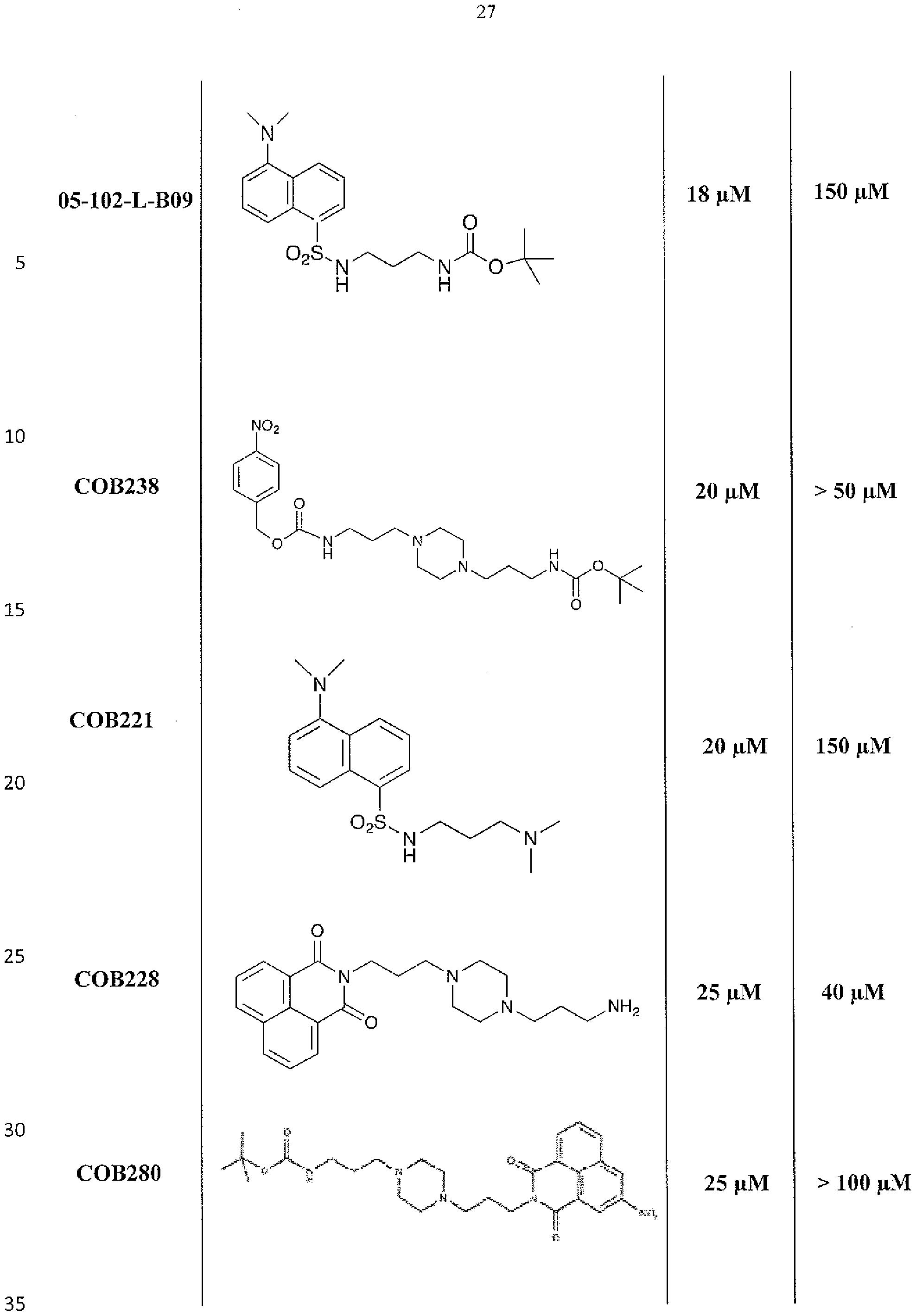

Tableau 1
Exemple 19 : Effet de COB 223 dans différents tests d'angiogenèses in vitro
L'activité du composé COB 223 et du composé 05-06-F1 1, le deuxième analogue le plus efficace, a ensuite été testée dans une série de tests d' angiogenèse in vitro. En premier lieu, les cellules HMEC-1 ont été cultivées sous forme de sphéroïdes, transférées dans un gel de collagène, puis on a laissé croître ces cellules en présence soit de leur sérum (Figure 2) soit de FGF-2 (Figure 3). Il a été observé que les deux molécules inhibent de façon importante la croissance cellulaire endothéliale à une concentration de 10 μΜ, quelque soit le facteur stimulant en présence.
Un autre test développé dans le laboratoire des inventeurs, utilisant la capacité des cellules souches embryonnaires murines de se différencier en cellules de la lignée endothéliale (vasculogénèse) et de former des bourgeons endothéliaux (angiogenèse) lorsqu'elles sont cultivées en tant que corps embryonnaires dans des gels de collagène tri-dimensionnels. Comme il apparaît sur la Figure 3, COB 223 et 05-06-L-F1 1
n'affectent pas la différenciation endothéliale des cellules ES mais bloque complètement la formation des bourgeons endothéliaux (CD31 -positif).
L'effet des composés 05-06-F1 1 et COB 223 sur la prolifération des cellules endothéliales à travers l'analyse du cycle cellulaire par cytométrie de flux à fluorescence (FACS) a également été étudié. Afin d'évaluer tout effet pro-apoptotique potentiel, les cellules adhérentes et en suspension ont été analysées. Les cellules endothéliales cultivées en l'absence de sérum ont été stimulées avec 10% de sérum de veau fœtal en l'absence et en présence des composés (cf. Tableau 2). Aucun changement n'a été observé dans le pourcentage de cellules apoptotiques ou nécrotiques (pre-Gl ) tandis que les deux composés diminuent très fortement le nombre de cellules engagées dans la phase S (de 20 % à moins de 8%). Ces composés apparaissent ainsi comme étant des agents antiprolifératifs pour les cellules HMVECds.

Tableau 2 : Analyse du cycle cellulaire sur des cellules HMVEC-d traitées avec les composés 05-06-L-F1 1 ou COB 223.
Exemple 20 : Effets du COB 223 sur la formation de la tumeur in vivo Dans la mesure où la croissance de nombreuses tumeurs in vivo dépend de Tangiogenèse, il a été vérifié si la molécule anti-angiogénique COB 223 était capable de réduire la croissance de la tumeur. Les inventeurs ont utilisé des cellules TS/A, des cellules de tumeurs mammaires murines exprimant la luciférase, qu'ils ont injectées à des souris nude par voie sous-cutanée. 5 mg de COB 223 ou de son véhicule (4% de DMSO dans le PBS) ont été injectés ip chaque jour à des souris porteuses de tumeurs TS/A-luc du jour 7 jusqu'au jour 18. Comme il apparaît sur la Figure 4, l'injection de COB 223 réduit significativement la croissance de tumeurs TSA comme mesuré par la taille totale des tumeurs et la quantité de cellules tumorales vivantes mesurées au jour 15 par imagerie par bioluminescence non-invasive. La différence dans la taille des tumeurs est statistiquement significative (p<0,05) du jour 9 jusqu'au jour 17.
Exemple 21 : Etude de l 'effet in vivo de la molécule COB223 (dose- réponse) sur un modèle de tumeur LLC.
106 cellules LLC-luc (cellules dans 100 μΐ. de matrigel 50% dans le PBS) ont été suspendues dans 100 ΐ, de matrigel (50% dans PBS) et implantées en position sous-cutanée dans le flanc droit de souris nu/nu. La croissance des tumeurs a été mesurée au pied à coulisse et le volume tumoral a été déterminé selon la formule O.SxLxP (L= longueur; 1= largeur). Lorsque la taille des tumeurs a atteint 50 mm , les souris ont subi une injection intra-péritonéale (i.p) toutes les 48 h soit du véhicule (4% DMSO) (ronds noirs), soit de 0.4 mg COB 223 dans 4% DMSO (carrés blancs), soit de 0.1 mg de COB 223 dans 4% DMSO (triangles noirs) de COB223 {Cf. Figure 5).
Contrôle n=6; COB223 0.4 mg/injection n=5; COB223 0.1 mg/injection n=5
Les analyses statistiques ont été réalisées à l'aide du test de Kruskal & Wallis et considérées comme significatives quand p<0.05 (*) ou pO.Ol (* *).
Les résultats montrent une réduction de la croissance tumorale en présence de COB223. Les résultats sont similaires pour les deux doses injectées.
Exemple 22 : Inhibition par COB -223 de la phosphorylation des MAPK induite var FGF-2 et VEGF-A.
Les cellules HUVEC (human umbilical vascular endothelial cells) ont été privées de sérum pendant 4 heures. Les facteurs angiogènes (FGF-2 100ng/mL et VEGF-A 50ng/mL) ont été ajoutés pendant 5 à 30 minutes en présence ou en absence de COB223 (100 μΜ) . Les cellules ont ensuite été lysées dans du tampon RIPA et les extraits protéiques ont été séparées par SDS-PAGE 10%. Après transfert sur membrane PVDF, les formes totales ou phosphorylées de p42/p44 MAP kinase (MAPK) ont été révélées par Western blot (Cf. Figure 6).
Les résultats montrent qu'un traitement par COB223 inhibe la phosphorylation des MAP kinases induite par le FGF-2 et dans une moindre mesure par le VEGF. ïl peut être avancé sur la base de ce résultat, que COB223 agit, au moins en partie, via une inhibition des récepteurs de ces deux facteurs pro-angiogéniques.
Claims
1. Composé de formule (I) pour son utilisation pour inhiber l'angiogenèse
FT
-(CH2)m-A R
R
(I)
dans laquelle :
NRaR représente un groupement choisi parmi NHAr, ou un groupe Ar0

R, à chaque occurrence, représente indépendamment un groupement choisi parmi H, Cl, Br, I, F, N02, NRi0Ri i, N3, ORi2 ;
Ar représente un groupement choisi parmi Ari

L] représente un groupement choisi parmi -S02-, -CH2-OC(=0)-, - NHC(=0)-, -OC(=0 , C(=0)-, -NH-C(=S)-.
Ri est choisi parmi H, Cl, Br, alkyle en Ci-C6, N02, NR3R , OR]3 ;
R3, R4, identiques ou différents, représentent indépendamment un groupement choisi parmi H ou alkyle en Ci-C6 ;
A représente un groupement choisi parmi une liaison, un groupe NH- (CH2)n-, ou un groupe Het -(CH2)n-, le groupe Het désignant un groupement hétérocycle de 5 à 7 chaînons ;
R° représente un groupement choisi parmi OR5, ou NR R7 ;
R5 représente un groupement choisi parmi H, -(CH2)p-OH, alkyle en Ci-
C6, C(=0)R14 ;
R6, R7, identiques ou différents, représentent indépendamment un groupement choisi parmi H, alkyle en Ci-C6, C(=0)ORs, SO2R9, étant entendu que lorsque Ar est Ari, R7 ne peut représenter H,
ou bien
R.6, R7 forment ensemble un groupe Ar0 ;
R8 représente un groupement choisi parmi H ou Ci-C6 alkyle ;
Rg représente un groupement choisi parmi aryle en C6-CJO éventuellement substitué par un ou plusieurs groupes Ri ;
Rio, RU , identiques ou différents, représentent un groupement choisi parmi H, alkyle en C;-C6, ou aryle en CÔ-CJO, étant entendu que lorsque NR3Rb représente un groupe Ar0, io n'est pas un groupe alkyle en Ci-C6
ou bien
Rio et Ru forment ensemble, avec l'atome d'azote auxquels ils sont attachés, une aminé cyclique ;
R-!2, i3, Ri4 identiques ou différents, représentent chacun indépendamment un groupement choisi parmi H, alkyle en C C6, aryle en C6-Ci0 ;
m est un entier de 1 à 6 ;
n est un entier de 3 à 6 ;
p est un entier de 1 à 4 ;
ou un sel pharmaceutiquement acceptable de celui-ci.
2. Composé de formule (I) pour son utilisation selon la revendication 1, dans le traitement et/ou la prévention des cancers, la dégénérescence maculaire liée à l'âge, la rétinopathie diabétique, le psoriasis ou l'arthrite rhumatoïde.
3. Composé de formule (I) pour son utilisation selon l'une des revendications précédentes, dans laquelle Ar est un groupe Arj.
4. Composé de formule (I) pour son utilisation selon la revendication 3, dans laquelle L] est un groupe -S02-,
5. Composé de formule (I) pour son utilisation selon l'une des revendications précédentes, dans laquelle R; est NR3R4, de préférence N(CH3)2.
6. Composé de formule (I) pour son utilisation selon l'une des revendications précédentes, dans laquelle R7 représente indépendamment un groupement choisi parmi alkyle en Ci-C6, C(=0)OR8, SO2R9.
7. Composé de formule (I) pour son utilisation selon l'une des revendications précédentes, dans laquelle NRaRb représente un groupe Ar0.
8. Composé de formule (I) pour son utilisation selon l'une des revendications précédentes, dans laquelle R est choisi parmi N02 et N(CH3)2.
9. Composé de formule (I) pour son utilisation selon l'une des revendications précédentes, dans laquelle m=3.
10. Composé de formule (I) pour son utilisation selon l'une des revendications précédentes, dans laquelle n=3.
11. Composé de formule (I) pour son utilisation selon l'une des revendications précédentes choisi parmi :
tert-butyl 3-(4-(3-(5-(diméthylamino)naphthalène-l- sulfonamido)propyl)pipérazin-l-yl)propylcarbamate
tert-butyl 3-(4-(3-(naphthalène- 1 -sulfonamido)propyl)pipérazin-l - yl)propylcarbamate
tert-butyl 3-(4-(3-phénylamidopropyl)pipérazin-l - yl)propylcarbamate
tert-butyl 3-(4-(3-(4-méthylphénylsulfonamido)propyl)pipérazin-l - yl)propylcarbamate
- 4-nitrobenzyI N-[3-(4-{3-[(tert- butoxycarbonyl)amino]propyl}pipérazin-l -yl)propyl] carbamate
5-(diméthylamino)-N-[3-(diméthylamino)propyl]naphthaIène- 1 - sulfonamide
5- (diméthylamino)-N-[3-hydroxypropyl]naphthalène-l-sulfonamide 2-(2-{4-[5-(diméthylamino)naphthalène-l-sulfonyl]pipérazin-l- yl } éthoxy)éthan- 1 -ol
2- {2-[5-(diméthylamino)naphthalène-l -sulfonamido]éthoxy}éthan- l-ol
N- { 3 - [4-(3 -tert-butoxycarbonylaminopropyl)pipérazin- 1 -yîjpropyl } -
1 ,8-naphtalimide
Chlorhydrate de N-(3-aminopropyl)- 1 ,8-naphtalimide
Chlorhydrate de N-{3-[4-(3-aminopropyl)pipérazin-l-yl]propyl}-
1,8-naphtalimide
1.3- bis(5-(diméthylamino)naphthalène-l-sulfonamido)- propane N- (5 -(diméthy lamino)naphthalène- 1 - sulfony 1)-N' - (tert- butoxycarbonyl)- 1 ,3 -diamiopropane
3- (5-(diméthylamino)naphthalène-l -sulfonamido)-propy lamine Dansylcadavérine
6- (5-chloro-naphthalène-l -sulfonamido)hexylamine
1.4- bis[(5-(diméthylamino)naphthalène-l- sulfonamido)propyl]pipérazine
- 6-(N,N-dimethylamino)-2-[3-((3-/err- butoxycarbonylaminopropyl)amino)propyl]benzo[de]isoquinoline-l,3-dione
Bis-[3-(l,3-dioxo-5-nitrobenzo[de]isoquinolin-2-yl)propyl]amine 5-Nitro-2-[3-(4-(3-/e /-butoxycarbonylaminopropyl)piperazin- 1 - yl)propyl]benzo[de]isoquinoline-l,3-dione
- 5-Nitro-2-[3-((3-fôrt
butoxycarbonylaminopropyl)amino)propyl]benzo[de]isoquinoline-l ,3-dione
12. Composition pharmaceutique comprenant, en association avec un ou plusieurs excipients pharmaceutiquement acceptable, .un composé de formule (I) dans laquelle :
RA
N-(CH2)m-A R'
RB
(i)
dans laquelle :
NRaRb représente un groupement choisi parmi NHAr, ou un groupe Aro

R, à chaque occurrence, représente indépendamment un groupement choisi parmi H, Cl, Br, I, F, N02, NR,0Rn, N3î OR]2 ;
Ar représente un groupement choisi parmi Ari

Ar-,
L] représente un groupement choisi parmi -S02-,
 - NHC(=0)-, -OC(=0)-, C(=0)-, -NH-C(=S)-.;
Ri est choisi parmi H, Cl, Br, alkyle en CpC6, N02, NR3R , O 13 ;
R3, j, identiques ou différents, représentent indépendamment un groupement choisi parmi H ou alkyle en Ci-C6 ;
A représente un groupement choisi parmi une liaison, un groupe NH- (CH2V, ou un groupe Het -(CH2)n-, le groupe Het désignant un groupement hétérocycle de 5 à 7 chaînons ;
Rc représente un groupement choisi parmi OR5, ou NR6R7 ;
R5 représente un groupement choisi parmi H, -(CH2)p-OH, alkyle en Cj-
C6, C(=0)R[4 ;
R6 représente un groupement choisi parmi H, alkyle en Ci-C6,

R7 représente un groupement choisi parmi alkyle en Ci-C6; C(=0)OR8,
S02R9,
R8 représente un groupement choisi parmi H ou Ci-C6 alkyle ;
R représente un groupement choisi parmi aryle en C6-Cio éventuellement substitué par un ou plusieurs groupes Ri ;
Rio, Ru, identiques ou différents, représentent un groupement choisi parmi H, alkyle en Ci-C6, ou aryle en Ce-Cio, étant entendu que lorsque NRaR représente un groupe Ar0, Rio n'est pas un groupe alkyle en Ci-C6
ou bien
Rio et Rn forment ensemble, avec l'atome d'azote auxquels ils sont attachés, une aminé cyclique ;
Ri2, R-13, ]4 identiques ou différents, représentent chacun indépendamment un groupement choisi parmi H, alkyle en C3-C6, aryle en CÔ-C S O ;
m est un entier de 1 à 6 ;
n est un entier de 1 à 6 ;
p est un entier de 1 à 4 ;
ou un sel pharmaceutiquement acceptable de celui-ci.
13. Composé de formule (I) :
RA
N-(CH2)M-A RC
RB
(!)
Ra, Rb, Rc, A et m étant tels que définis dans l'une quelconque des revendications 1 à 1 1 ,
R3
-(CH2)M A R'
RB
(I)
dans laquelle :
NR Rb représente un i NHAr, ou un groupe Ar0

R, à chaque occurrence, représente indépendamment un groupement choisi parmi H, Cl, Br, I, F, N02, NR10Ri 1 , N3, OR]2 ;
Ar représente un groupement choisi parmi Ari

Li, représente un groupement choisi parmi -SO2-, -CH2-OC(=0)-, - NHC(=0)-, -OC(=0>, C(=0)-, -NH-C(=S)-.;
Rj est choisi parmi H, Br, alkyle en Ci-C6, N02, NR3R4, OR13 ;
R3, R4, identiques ou différents, représentent indépendamment un groupement choisi parmi H ou alkyle en C] -C6 ;
A représente un groupement choisi parmi un groupe NH-(CH2)n-, ou un groupe Het -(CH2)n-, le groupe Het désignant un groupement hétérocycle de 5 à 7 chaînons ;
R° représente un groupement choisi parmi OR5, ou NR6R7 ;
R5 représente un groupement choisi parmi H, -(CH2)p-OH, alkyle en C s-
C6, C(=0)R14 ;
R6 représente un groupement choisi parmi H, alkyle en C] -C6,
C(=0)ORg, SO2R9 ;
R7 représente un groupement choisi parmi alkyle en Ci -Ce, C(=0)ORg,
SO2R9 ;
R8 représente un groupement choisi parmi H ou C[-C6 alkyle, étant entendu que lorsque NRaRb est Aro, R8 est H ;
R9 représente un groupement choisi parmi aryle en C6-Ci0 éventuellement substitué par un ou plusieurs groupes Ri ;
Rio, Ru, identiques ou différents, représentent un groupement choisi parmi H, alkyle en Cj-C6, ou aryle en C6-Cio, étant entendu que lorsque NRaR représente un groupe Aro, Rio n'est pas un groupe alkyle en Ci -C6
ou bien
Rio et u forment ensemble, avec l'atome d'azote auxquels ils sont attachés, une aminé cyclique ;
R12, R13, s4 identiques ou différents, représentent chacun indépendamment un groupement choisi parmi H, alkyle en C[-C6, aryle en C6-Cio ;
m est un entier de 1 à 6 ;
n est un entier de 1 à 6 ;
p est un entier de 1 à 4 ;
ou un sel pharmaceutiquement acceptable de celui-ci.
Applications Claiming Priority (2)
| Application Number | Priority Date | Filing Date | Title |
|---|---|---|---|
| FR1100277 | 2011-01-31 | ||
| FR1100277A FR2970965A1 (fr) | 2011-01-31 | 2011-01-31 | Composes anti-angiogeniques, compositions pharmaceutiques les comprenant, et leur utilisation |
Publications (2)
| Publication Number | Publication Date |
|---|---|
| WO2012104788A2 true WO2012104788A2 (fr) | 2012-08-09 |
| WO2012104788A3 WO2012104788A3 (fr) | 2013-04-11 |
Family
ID=43881047
Family Applications (1)
| Application Number | Title | Priority Date | Filing Date |
|---|---|---|---|
| PCT/IB2012/050452 Ceased WO2012104788A2 (fr) | 2011-01-31 | 2012-01-31 | Composes anti-angiogeniques, compositions pharmaceutiques les comprenant, et leur utilisation |
Country Status (2)
| Country | Link |
|---|---|
| FR (1) | FR2970965A1 (fr) |
| WO (1) | WO2012104788A2 (fr) |
Cited By (6)
| Publication number | Priority date | Publication date | Assignee | Title |
|---|---|---|---|---|
| CN105646348A (zh) * | 2016-02-25 | 2016-06-08 | 青岛科技大学 | 一种萘二甲酰胺基萘乙酰基硫脲类化合物及其用途 |
| CN105669549A (zh) * | 2016-02-25 | 2016-06-15 | 青岛科技大学 | 一种萘二甲酰胺基乙基萘乙酸酯类化合物及其应用 |
| CN105669550A (zh) * | 2016-02-25 | 2016-06-15 | 青岛科技大学 | 一种萘二甲酰胺基乙基己酸酯类化合物及其应用 |
| WO2022073445A1 (fr) * | 2020-10-10 | 2022-04-14 | 广州新创意生物医药有限公司 | Dérivé de diimide cyclique condensé, son procédé de préparation et son utilisation |
| WO2023179205A1 (fr) | 2022-03-23 | 2023-09-28 | 湘北威尔曼制药股份有限公司 | Dérivé de diimide, son procédé de préparation et son utilisation |
| RU2846573C2 (ru) * | 2022-03-23 | 2025-09-09 | Гуандун Хэнцинь Синьчуани Биофармацевтикал Ко., Лтд. | Диимидное производное и способ его получения и его применение |
Family Cites Families (16)
| Publication number | Priority date | Publication date | Assignee | Title |
|---|---|---|---|---|
| BE789125A (fr) * | 1971-09-24 | 1973-03-22 | Toms River Chemical Corp | Colorants substantifs disazoiques pour papier |
| DE2601376A1 (de) * | 1976-01-15 | 1977-07-21 | Bayer Ag | Phenoxycarbonsaeure-aryloxy(thio)carbonylaminomethylester, verfahren zu ihrer herstellung sowie ihre verwendung zur regulierung des pflanzenwachstums |
| ZA885929B (en) * | 1987-08-25 | 1989-04-26 | Oxi Gene Inc | Agents for use in tumor or cancer cell killing therapy |
| JPH10316649A (ja) * | 1997-05-20 | 1998-12-02 | Hiroyoshi Hidaka | ナフタレンスルホンアミド誘導体及びこれを含有する医薬 |
| CA2309204A1 (fr) * | 1997-11-26 | 1999-06-03 | Dupont Pharmaceuticals Company | 1,3,4-thiadiazoles et 1,3,4-oxadiazoles utilises comme antagonistes de .alpha.v.beta.3 |
| AU4823999A (en) * | 1998-06-17 | 2000-01-05 | Yeda Research And Development Co. Ltd. | Methods and compositions for treating diseases mediated by transglutaminase activity |
| CA2318004A1 (fr) * | 1999-09-15 | 2001-03-15 | Oridigm Corporation | Analogues de polyamines nouveaux utilises comme agents therapeutiques et diagnostiques |
| JP2001172257A (ja) * | 1999-10-05 | 2001-06-26 | Fujisawa Pharmaceut Co Ltd | 有機スルホンアミド化合物 |
| GB0011013D0 (en) * | 2000-05-09 | 2000-06-28 | Astrazeneca Ab | Chemical compounds |
| EP1787679A1 (fr) * | 2005-07-29 | 2007-05-23 | Laboratorios Del Dr. Esteve, S.A. | Utilisation des composés attachés au sigma recepteur pour le traitement de la douleur associée avec diabète |
| WO2007076055A2 (fr) * | 2005-12-22 | 2007-07-05 | Entremed, Inc. | Compositions et methodes comprenant l'utilisation d'antagonistes du recepteur active par des proteases |
| WO2008063760A2 (fr) * | 2006-10-18 | 2008-05-29 | The University Of Texas M.D. Anderson Cancer Center | Méthodes de traitement de cancer ciblant la transglutaminase |
| WO2008075955A2 (fr) * | 2006-12-21 | 2008-06-26 | Stichting Voor De Technische Wetenschappen | Procédé de préparation de triazoles trisubstitués en 1,4,5 et de triazoles trisubstitués en 3,4,5 |
| WO2009089537A2 (fr) * | 2008-01-11 | 2009-07-16 | Northwestern University | Composés anticancéreux |
| WO2009114729A2 (fr) * | 2008-03-14 | 2009-09-17 | Irm Llc | Composés, compositions et procédés de traitement des maladies et des troubles liés au stockage lysosomal |
| ES2331783B1 (es) * | 2008-05-20 | 2010-10-27 | Universidad De Granada | Compuesto para el etiquetado de biomoleculas basado en vinilsulfona, preparacion y usos. |
-
2011
- 2011-01-31 FR FR1100277A patent/FR2970965A1/fr not_active Withdrawn
-
2012
- 2012-01-31 WO PCT/IB2012/050452 patent/WO2012104788A2/fr not_active Ceased
Non-Patent Citations (8)
| Title |
|---|
| FIXON-OWOO ET AL., PHYTOCHEMISTRY, vol. 63, 2003, pages 315 |
| LOLLAR ET AL., J. PHOTOCHEM. PHOTOBIOL. A, vol. 170, 2005, pages 151 |
| RYCKEBUSCH ET AL., BIOORG MED CHEM LETT, vol. 13, 2003, pages 3783 |
| S.M. BERGE ET AL.: "Pharmaceutical Salts", J. PHARM. SCI, vol. 66, 1977, pages 1 - 19, XP002675560, DOI: doi:10.1002/jps.2600660104 |
| SANCEY L; DUFORT S; JOSSERAND V; KERAMIDAS M; RIGHINI C; ROME C; FAURE AC; FOILLARD S; ROUX S; BOTURYN D: "Drug development in oncology assisted by noninvasive optical imaging", INT J PHARM., vol. 379, 2009, pages 309 - 16, XP026519364, DOI: doi:10.1016/j.ijpharm.2009.05.034 |
| SWIATEK PJ, GENE DEV, 1993 |
| VITTET D; PRANDINI MH; BERTHIER R; SCHWEITZER A; MARTIN-SISTERON H; UZAN G; DEJANA E: "Embryonic stem cells differentiate in vitro to endothelial cells through successive maturation steps", BLOOD, vol. 88, 1996, pages 3424 - 31, XP002919232 |
| VITTET ET AL., PNAS, 1997 |
Cited By (12)
| Publication number | Priority date | Publication date | Assignee | Title |
|---|---|---|---|---|
| CN105646348A (zh) * | 2016-02-25 | 2016-06-08 | 青岛科技大学 | 一种萘二甲酰胺基萘乙酰基硫脲类化合物及其用途 |
| CN105669549A (zh) * | 2016-02-25 | 2016-06-15 | 青岛科技大学 | 一种萘二甲酰胺基乙基萘乙酸酯类化合物及其应用 |
| CN105669550A (zh) * | 2016-02-25 | 2016-06-15 | 青岛科技大学 | 一种萘二甲酰胺基乙基己酸酯类化合物及其应用 |
| WO2022073445A1 (fr) * | 2020-10-10 | 2022-04-14 | 广州新创意生物医药有限公司 | Dérivé de diimide cyclique condensé, son procédé de préparation et son utilisation |
| CN116323584A (zh) * | 2020-10-10 | 2023-06-23 | 湘北威尔曼制药股份有限公司 | 一种稠环二酰亚胺衍生物、其制备方法和应用 |
| US20230373929A1 (en) * | 2020-10-10 | 2023-11-23 | Xiangbei Welman Pharmaceutical Co., Ltd. | Fused ring diimide derivative, preparation method and use thereof |
| CN116323584B (zh) * | 2020-10-10 | 2025-11-07 | 湘北威尔曼制药股份有限公司 | 一种稠环二酰亚胺衍生物、其制备方法和应用 |
| WO2023179205A1 (fr) | 2022-03-23 | 2023-09-28 | 湘北威尔曼制药股份有限公司 | Dérivé de diimide, son procédé de préparation et son utilisation |
| JP2025502475A (ja) * | 2022-03-23 | 2025-01-24 | 湘北威爾曼制薬股▲ふん▼有限公司 | ジイミド誘導体、その調製方法、及び使用 |
| EP4467532A4 (fr) * | 2022-03-23 | 2025-05-21 | Xiangbei Welman Pharmaceutical Co., Ltd | Dérivé de diimide, son procédé de préparation et son utilisation |
| RU2846573C2 (ru) * | 2022-03-23 | 2025-09-09 | Гуандун Хэнцинь Синьчуани Биофармацевтикал Ко., Лтд. | Диимидное производное и способ его получения и его применение |
| AU2023239896B2 (en) * | 2022-03-23 | 2025-12-04 | Guangzhou Xin Chuang Yi New Drug R&D Co., Ltd | Diimide derivative, and preparation method therefor and use thereof |
Also Published As
| Publication number | Publication date |
|---|---|
| FR2970965A1 (fr) | 2012-08-03 |
| WO2012104788A3 (fr) | 2013-04-11 |
Similar Documents
| Publication | Publication Date | Title |
|---|---|---|
| DK2694072T3 (en) | COMBINATION OF ACT-INHIBITOR RELATIONSHIP AND ABIRATERON FOR USE IN THERAPEUTIC TREATMENTS | |
| JP6440212B2 (ja) | メトホルミン及びジヒドロケルセチンを含む組み合わせ医薬、及びがんの治療のための使用 | |
| AU2014204831B2 (en) | Benzylideneguanidine derivatives and therapeutic use for the treatment of protein misfolding diseases | |
| KR20120046099A (ko) | 섬유화를 억제하고 섬유화 질병을 치료하는 방법 | |
| JP2004534846A (ja) | タキソール増強剤化合物 | |
| JP2017125036A (ja) | アンドロゲン受容体調節薬のエステル誘導体およびそれらの使用のための方法 | |
| WO2012104788A2 (fr) | Composes anti-angiogeniques, compositions pharmaceutiques les comprenant, et leur utilisation | |
| TWI757726B (zh) | 4(1h)-奎諾酮衍生物及其用途 | |
| JP2013512248A (ja) | 転写因子阻害剤および関連する組成物、製剤および方法 | |
| AU2021250199B2 (en) | Deuterated oxophenylarsine compound and use thereof | |
| JP2022512826A (ja) | MetAP2阻害剤のバイオマーカーとその応用 | |
| KR20180011890A (ko) | 절단된 선종성 결장 폴립증 (apc) 단백질을 타겟화하는 치료제 | |
| KR20190018486A (ko) | 암의 예방 및/또는 치료를 위한 화합물, 조성물 및 방법 | |
| AU2014262764B2 (en) | Radiomitigating pharmaceutical formulations | |
| CN104755084B (zh) | 抑制缺氧诱导型转录因子复合体的活性的组合物和方法及其治疗肿瘤的用途 | |
| WO2014183673A1 (fr) | Utilisation antitumorale de l'anagrélide et de dérivés de ce composé | |
| JP2023550402A (ja) | ビグアニジンの二量体及びその治療的使用 | |
| JP2021527692A (ja) | Oat3の阻害剤を用いた神経変性に関連する状態の処置方法 | |
| WO2022201162A1 (fr) | Composés ciblant rnf4 et leurs utilisations | |
| JP5330377B2 (ja) | 3,4−ジヒドロキナゾリン誘導体 | |
| US20240391880A1 (en) | KCa3.1 INHIBITORS FOR PODOCYTE PROTECTION | |
| US10487054B2 (en) | Therapeutic compounds | |
| JP2017178941A (ja) | アンドロゲン依存性又は非依存性前立腺癌細胞の抑制用の組成物及びそれを含有する前立腺癌の医薬製剤 | |
| JP2019001812A (ja) | 強皮症/全身性硬化症を抑制又は治療するための組成物 | |
| JP7323238B2 (ja) | アミノキシ酸系抗がん幹細胞化合物およびその方法 |
Legal Events
| Date | Code | Title | Description |
|---|---|---|---|
| 121 | Ep: the epo has been informed by wipo that ep was designated in this application |
Ref document number: 12728775 Country of ref document: EP Kind code of ref document: A2 |
|
| NENP | Non-entry into the national phase |
Ref country code: DE |
|
| 122 | Ep: pct application non-entry in european phase |
Ref document number: 12728775 Country of ref document: EP Kind code of ref document: A2 |