WO2012073601A1 - 歯周病原因菌の歯面付着抑制剤、口腔バイオフィルム形成抑制剤及び口腔用組成物 - Google Patents
歯周病原因菌の歯面付着抑制剤、口腔バイオフィルム形成抑制剤及び口腔用組成物 Download PDFInfo
- Publication number
- WO2012073601A1 WO2012073601A1 PCT/JP2011/073612 JP2011073612W WO2012073601A1 WO 2012073601 A1 WO2012073601 A1 WO 2012073601A1 JP 2011073612 W JP2011073612 W JP 2011073612W WO 2012073601 A1 WO2012073601 A1 WO 2012073601A1
- Authority
- WO
- WIPO (PCT)
- Prior art keywords
- oral
- propylene glycol
- composition
- inhibitor
- biofilm
- Prior art date
- Legal status (The legal status is an assumption and is not a legal conclusion. Google has not performed a legal analysis and makes no representation as to the accuracy of the status listed.)
- Ceased
Links
Classifications
-
- A—HUMAN NECESSITIES
- A61—MEDICAL OR VETERINARY SCIENCE; HYGIENE
- A61K—PREPARATIONS FOR MEDICAL, DENTAL OR TOILETRY PURPOSES
- A61K31/00—Medicinal preparations containing organic active ingredients
- A61K31/045—Hydroxy compounds, e.g. alcohols; Salts thereof, e.g. alcoholates
- A61K31/05—Phenols
-
- A—HUMAN NECESSITIES
- A61—MEDICAL OR VETERINARY SCIENCE; HYGIENE
- A61K—PREPARATIONS FOR MEDICAL, DENTAL OR TOILETRY PURPOSES
- A61K31/00—Medicinal preparations containing organic active ingredients
- A61K31/70—Carbohydrates; Sugars; Derivatives thereof
- A61K31/715—Polysaccharides, i.e. having more than five saccharide radicals attached to each other by glycosidic linkages; Derivatives thereof, e.g. ethers, esters
- A61K31/734—Alginic acid
-
- A—HUMAN NECESSITIES
- A61—MEDICAL OR VETERINARY SCIENCE; HYGIENE
- A61K—PREPARATIONS FOR MEDICAL, DENTAL OR TOILETRY PURPOSES
- A61K47/00—Medicinal preparations characterised by the non-active ingredients used, e.g. carriers or inert additives; Targeting or modifying agents chemically bound to the active ingredient
- A61K47/06—Organic compounds, e.g. natural or synthetic hydrocarbons, polyolefins, mineral oil, petrolatum or ozokerite
- A61K47/20—Organic compounds, e.g. natural or synthetic hydrocarbons, polyolefins, mineral oil, petrolatum or ozokerite containing sulfur, e.g. dimethyl sulfoxide [DMSO], docusate, sodium lauryl sulfate or aminosulfonic acids
-
- A—HUMAN NECESSITIES
- A61—MEDICAL OR VETERINARY SCIENCE; HYGIENE
- A61K—PREPARATIONS FOR MEDICAL, DENTAL OR TOILETRY PURPOSES
- A61K8/00—Cosmetics or similar toiletry preparations
- A61K8/18—Cosmetics or similar toiletry preparations characterised by the composition
- A61K8/30—Cosmetics or similar toiletry preparations characterised by the composition containing organic compounds
- A61K8/33—Cosmetics or similar toiletry preparations characterised by the composition containing organic compounds containing oxygen
- A61K8/34—Alcohols
- A61K8/347—Phenols
-
- A—HUMAN NECESSITIES
- A61—MEDICAL OR VETERINARY SCIENCE; HYGIENE
- A61K—PREPARATIONS FOR MEDICAL, DENTAL OR TOILETRY PURPOSES
- A61K8/00—Cosmetics or similar toiletry preparations
- A61K8/18—Cosmetics or similar toiletry preparations characterised by the composition
- A61K8/72—Cosmetics or similar toiletry preparations characterised by the composition containing organic macromolecular compounds
- A61K8/73—Polysaccharides
- A61K8/733—Alginic acid; Salts thereof
-
- A—HUMAN NECESSITIES
- A61—MEDICAL OR VETERINARY SCIENCE; HYGIENE
- A61P—SPECIFIC THERAPEUTIC ACTIVITY OF CHEMICAL COMPOUNDS OR MEDICINAL PREPARATIONS
- A61P1/00—Drugs for disorders of the alimentary tract or the digestive system
- A61P1/02—Stomatological preparations, e.g. drugs for caries, aphtae, periodontitis
-
- A—HUMAN NECESSITIES
- A61—MEDICAL OR VETERINARY SCIENCE; HYGIENE
- A61Q—SPECIFIC USE OF COSMETICS OR SIMILAR TOILETRY PREPARATIONS
- A61Q11/00—Preparations for care of the teeth, of the oral cavity or of dentures; Dentifrices, e.g. toothpastes; Mouth rinses
-
- A—HUMAN NECESSITIES
- A61—MEDICAL OR VETERINARY SCIENCE; HYGIENE
- A61Q—SPECIFIC USE OF COSMETICS OR SIMILAR TOILETRY PREPARATIONS
- A61Q17/00—Barrier preparations; Preparations brought into direct contact with the skin for affording protection against external influences, e.g. sunlight, X-rays or other harmful rays, corrosive materials, bacteria or insect stings
- A61Q17/005—Antimicrobial preparations
Definitions
- the present invention relates to a tooth surface adhesion inhibitor of periodontal disease-causing bacteria excellent in the effect of suppressing periodontal disease-causing bacteria in the oral cavity, and the effect of inhibiting periodontal disease-causing bacteria in the oral cavity and biofilm.
- the present invention relates to an oral biofilm formation inhibitor and a composition for oral cavity, which have a high bactericidal effect and are effective in preventing and improving periodontal diseases.
- Periodontal disease is considered to be an infectious disease caused by colonization of pathogenic bacteria in the oral cavity, and it is important to eliminate infected pathogenic bacteria for the prevention and improvement of periodontal disease. For this reason, various bactericides and antibiotics are used, but pathogenic bacteria that cause periodontal disease form biofilms and are known to be resistant to bactericides and antibiotics. Therefore, isopropylmethylphenol, a nonionic bactericidal agent that penetrates into the biofilm and sterilizes it, has been developed as a technology that has a high biofilm suppression effect that causes periodontal disease. There was room for.
- propylene glycol alginate is known as a binder for oral compositions, and has been disclosed to have an effect of improving liquid separation of dentifrice (Patent Document 1) and an effect of adjusting viscosity with time (Patent Document). 2, 3). Moreover, it is disclosed that it can be mix
- Patent Document 7 discloses a combination of propylene glycol alginate and triclosan, but the biofilm bactericidal effect is not sufficient and improved. There was room for. Furthermore, it is disclosed that propylene glycol alginate has an effect of masking the taste derived from essential oils, specifically, a masking action of thymol having an antibacterial action (Patent Document 8).
- the present invention has been made in view of the above circumstances, and the tooth surface adhesion inhibitor of the periodontal disease-causing bacteria and the tooth surface adhesion-inhibiting effect of the periodontal disease-causing bacteria, which are excellent in the tooth surface adhesion-inhibiting effect of the periodontal disease-causing bacteria. It is an object of the present invention to provide an oral biofilm formation inhibitor and an oral composition that are excellent in aging and exhibit a high biofilm bactericidal effect.
- propylene glycol alginate is effective as a tooth surface adhesion inhibitor for periodontal disease-causing bacteria.
- the present inventors have combined the use of propylene glycol alginate and isopropylmethylphenol, and by blending these two components in the oral composition, it is excellent in the effect of suppressing periodontal disease causative bacteria. And it discovered that the high bactericidal effect with respect to an oral biofilm was exhibited, and the formulation excellent in the formation inhibitory effect of an oral biofilm was obtained.
- the bactericidal effect with respect to the said oral biofilm could be further strengthened by mix
- the dentifrice composition containing a poorly water-soluble disinfectant such as isopropylmethylphenol has a bactericidal effect on the oral biofilm, the effect is still not a sufficient level and there is room for improvement, In addition, bacteria remain in the oral cavity even after brushing, and the bacteria may adversely affect the periodontal tissue by attaching and multiplying in the oral cavity again.
- the present inventors examined non-bactericidal plaque control means, and added alginic acid propylene glycol ester to the tooth surface of periodontal disease-causing bacteria, particularly Porphyromonas gingivalis. It has been found that there is a previously unknown effect of suppressing adhesion and it is useful for plaque control.
- the mechanism of action is not clear, but both components act synergistically, and can suppress the initial adhesion of periodontopathic bacteria, which is the initial stage of formation of periodontopathic biofilm.
- the preparation is coated on the tooth surface and isopropylmethylphenol is sufficiently retained, and the biofilm permeability of isopropylmethylphenol is further improved. This prevents the remaining in the interdental and gingival margins where cleaning is not possible. It is presumed to exert an excellent bactericidal effect even on periodontopathic biofilms with high drug barrier performance.
- propylene glycol alginate has an effect of suppressing periodontal disease-causing adhesion to the tooth surface and enhances the biofilm bactericidal effect.
- the present invention provides the following preparation and oral composition.
- An oral biofilm formation inhibitor comprising (A) propylene glycol alginate and (B) isopropylmethylphenol.
- An oral composition comprising (A) propylene glycol alginate and (B) isopropylmethylphenol.
- a tooth surface adhesion inhibitor for periodontal disease-causing bacteria that effectively suppresses the adhesion of periodontal disease-causing bacteria to the tooth surface.
- an oral biofilm formation inhibitor and an oral composition that are excellent in the effect of suppressing adhesion of periodontal disease-causing bacteria to the oral cavity and the biofilm bactericidal effect and can suppress the formation of biofilms are provided. it can. These preparations are effective in preventing and improving periodontal diseases.
- the present invention relates to (A) a tooth surface adhesion inhibitor of periodontal disease-causing bacteria containing propylene glycol alginate as an active ingredient, and (A) oral biotechnology containing propylene glycol alginate and (B) isopropylmethylphenol as active ingredients.
- propylene glycol alginate is a tooth surface adhesion inhibitor of periodontal disease-causing bacteria.
- Propylene glycol ester of alginic acid is obtained by esterifying propylene glycol to a carboxyl group constituting alginic acid in order to enhance acid resistance and salt resistance of alginic acid.
- Duckroid manufactured by Food Chemifa Co., Ltd. A product commercialized under a trade name such as kelp acid can be used.
- Alginic acid propylene glycol ester is a quantitative ratio of ⁇ -D-mannuronic acid (M) and ⁇ -L-guluronic acid (G) constituting alginic acid (M / G ratio, molar ratio, hereinafter the same), sequence order, number (Molecular weight) and the molecular structure differing in the degree of esterification of the carboxyl group and the like, and the viscosity of the aqueous solution due to the difference in the molecular structure can take various values.
- the propylene glycol alginate used in the present invention is not limited to these molecular structures and viscosities.
- the constituent ratio of ⁇ -D-mannuronic acid (M) and ⁇ -L-guluronic acid (G) (M / (G ratio) is preferably greater than 1.0, particularly preferably greater than 1.0 and 2 or less.
- the degree of esterification of the carboxyl group is preferably 40% or more, particularly preferably 70 to 95%. The higher the degree of esterification, the higher the effect. If the degree of esterification is less than 40%, there is a possibility that sufficient antifouling effect of periodontal disease-causing bacteria and enhanced biofilm bactericidal effect cannot be obtained. There is nothing in the market that exceeds 95%.
- the viscosity at 20 ° C. (hereinafter the same) of an aqueous solution of 1% (mass%, hereinafter the same) by a BL type viscometer described later is 10 to 1,300 mPa ⁇ s, particularly 10 to 200 mPa. -It is preferable that it is the range of s. Those having a viscosity of less than 10 mPa ⁇ s are not commercially available. If the viscosity exceeds 1,300 mPa ⁇ s, there is a possibility that the adhesion suppressing effect of periodontal disease-causing bacteria and the enhancement effect of the biofilm bactericidal effect cannot be sufficiently obtained. .
- the component (A) for example, the following commercially available products can be used.
- Kimiloid LV 1% aqueous solution viscosity 90 mPa ⁇ s (rotor No.
- the viscosity is a value measured by a BL type viscometer Specifically, it is a measured value by the following method. Further, the propylene glycol alginate can be used alone or in combination of two or more depending on the type of product.
- Viscosity measurement method (Duck Lloyd, Food Chemifa Corporation) 4 g of propylene glycol alginate is collected and placed in a 600 mL beaker, and 396 g of purified water is added little by little while stirring with a stir bar. First, dissolve well with a small amount of water. Thereafter, the mixture is allowed to swell for 1 hour, and after 1 hour, the mixture is stirred for 1 minute at 12,000 rpm with a high-speed stirrer (homomixer). This solution is put into a 300 mL tall beaker and allowed to stand in a 20 ° C. water bath. When the foam rises and the beaker solution is clear, remove the foam with a spoon.
- thermometer is put in a beaker to confirm that the test solution has reached 20 ° C., and the viscosity is measured.
- Viscometer Tokyo Keiki BL type viscometer rotor: No. 1 Rotation speed: 60rpm Measurement time: 1 minute
- Viscosity measurement method (Kimiloid, Kimlicum, Kimika Co., Ltd.) Take 297 g of purified water in a 300 mL tall beaker and add 3.0 g of alginate propylene glycol ester with stirring with a stirrer or three-one motor to completely dissolve. Next, after standing for 1 hour in a 20 ° C. constant temperature water bath (confirm that the aqueous solution of propylene glycol alginate reached 20 ° C.), a BL type viscometer (manufactured by Tokyo Keiki Co., Ltd.) was used for exactly 1 minute later. Measure the viscosity. The rotor used and the number of rotations were changed according to the viscosity range shown below.
- Rotor No. 1 Rotation speed 60rpm When the viscosity is more than 80 mPa ⁇ s and not more than 160 mPa ⁇ s: Rotor No. 1, rotation speed 30rpm When the viscosity is more than 160 mPa ⁇ s and not more than 400 mPa ⁇ s: Rotor No. 2, rotation speed 60rpm When the viscosity exceeds 400 mPa ⁇ s and is 800 mPa ⁇ s or less: Rotor No. 2, rotation speed 30rpm When the viscosity exceeds 800 mPa ⁇ s and is 1,600 mPa ⁇ s or less: Rotor No. 3, rotation speed 60rpm
- component (B) isopropylmethylphenol used in combination with alginate propylene glycol ester is a nonionic fungicide with a broad antibacterial spectrum, and Takasago Fragrance Co., Ltd., Ogawa Fragrance Co., Osaka Kasei Co., Ltd., Sumitomo Pharmaceutical Co., Ltd. Products that have been commercialized by companies can be used.
- the mass ratio of the component (A) / component (B) in the combination system is not particularly limited, but is preferably 0.4 to 20, particularly 1 to 10. If the mass ratio of the component (A) / component (B) is less than 0.4 or exceeds 20, the adhesion inhibitory effect of periodontal disease-causing bacteria and the biofilm bactericidal effect may not be sufficiently exhibited.
- composition for oral cavity of the present invention contains a combination system of the above-mentioned (A) propylene glycol alginate and (B) isopropylmethylphenol as active ingredients.
- the blending amount of propylene glycol alginate is not particularly limited, but is preferably 0.02 to 1%, particularly preferably 0.05 to 0.5% of the whole oral composition. If the blending amount is less than 0.02%, there is a possibility that sufficient adhesion inhibitory effect of periodontal disease-causing bacteria and enhancement effect of biofilm sterilization by isopropylmethylphenol may not be obtained. If it exceeds 1%, the adhesion inhibitory effect of periodontal disease-causing bacteria is saturated, so that the improvement of the adhesion inhibitory effect cannot be expected, and the enhancement effect of biofilm sterilization by isopropylmethylphenol may be reduced.
- the blending amount of isopropylmethylphenol is not particularly limited, but is preferably 0.005 to 0.1%, particularly 0.01 to 0.1% of the entire composition. If the blending amount is less than 0.005%, the bactericidal effect on the biofilm may not be sufficiently exhibited. If it exceeds 0.1%, the solubility of isopropylmethylphenol itself is poor, so that the biofilm sterilization effect may be reduced by precipitation.
- the mass ratio of the component (A) / (B) is the same as described above.
- the oral composition of the present invention may further contain at least one anionic surfactant selected from alkyl sulfates and acyl sarcosinates as component (C).
- component (C) is not particularly limited, but as the alkyl sulfate salt, an alkali metal salt of a higher alkyl sulfate ester having 8 to 18 carbon atoms, and as the acyl sarcosine salt, the acyl group has a carbon number of acyl group. 8 to 18 acyl sarcosine salts can be used, and sodium lauryl sulfate and / or sodium lauroyl sarcosine are particularly preferably used.
- the blending amount of the anionic surfactant is not particularly limited, but is preferably 0.05 to 3%, particularly preferably 0.1 to 2.0% of the whole composition. If the blending amount is less than 0.05%, the biofilm sterilization effect may not be improved, and if it exceeds 3%, the enhancement effect of periodontopathic biofilm sterilization effect is saturated, and more biofilms There is a possibility that the bactericidal effect cannot be obtained, and the adhesion surface of the periodontal disease-causing bacteria is affected, and the periodontal disease-causing bacteria adhesion suppressing effect may be reduced.
- the oral composition of the present invention is in the form of liquid, paste, gel, etc., and is used for toothpastes such as toothpaste, toothpaste, liquid toothpaste, mouthwash, gel, ointment, mouth freshener, gargle Can be prepared in various dosage forms such as tablets for oral use, pasta for oral cavity, gum, etc., and known ingredients other than the above ingredients are blended within a range that does not impair the effects of the present invention, and prepared by ordinary methods. Can do.
- various abrasives, wetting agents, binders, surfactants, sweeteners, coloring agents, preservatives, fragrances, pH adjusters, and other active ingredients are included as optional components. it can.
- abrasives precipitated silica, silica gel, aluminosilicate, zeolite, zirconosilicate, dicalcium phosphate dihydrate and anhydride, calcium pyrophosphate, calcium carbonate, aluminum hydroxide, alumina, magnesium carbonate, tertiary phosphorus
- examples thereof include magnesium oxide, insoluble sodium metaphosphate, insoluble potassium metaphosphate, titanium oxide, hydroxyapatite, and synthetic resin-based abrasive (mixing amount: usually 5 to 50%).
- wetting agent examples include glycerin, sorbitol, propylene glycol, polyethylene glycol, 1,3-butylene glycol, erythritol, xylit, maltite, lactit, trehalose, tornale and the like (blending amount: usually 0 to 50%, especially 5 ⁇ 45%).
- Binders include carrageenan, sodium carboxymethylcellulose, sodium alginate, polyacrylic acid, sodium polyacrylate, carboxyvinyl polymer, polyvinyl alcohol, polyvinylpyrrolidone, xanthan gum, tara gum, guar gum, locust bean gum, gellan gum, gelatin, curdlan , Gum arabic, agar, pectin, pullulan, etc. (blending amount: usually 0.1 to 5%).
- surfactant examples include anionic surfactants other than the component (C), nonionic surfactants, cationic surfactants, and amphoteric surfactants, and one or more of these are used. Also good.
- anionic surfactant include lauroylmethyl taurine, acylamino acid salts, sodium dodecylbenzenesulfonate, ⁇ -sulfo fatty acid alkyl ester / sodium, and alkyl phosphate ester salts.
- nonionic surfactant examples include polyoxyethylene sorbitan fatty acid ester, sucrose fatty acid ester, sorbitan fatty acid ester, polyoxyethylene polyoxypropylene block copolymer type activator, polyoxyethylene fatty acid ester, fatty acid monoglyceride and the like.
- Amphoteric surfactants include betaine acetate-type amphoteric surfactants such as alkyldimethylaminoacetic acid betaines and fatty acid amidopropyldimethylaminoacetic acid betaines, and imidazoline types such as N-fatty acid acyl-N-carboxymethyl-N-hydroxyethylethylenediamine salts.
- amphoteric surfactants examples include amphoteric surfactants and amino acid type surfactants such as N-fatty acid acyl-L-alginate salts.
- amino acid type surfactants such as N-fatty acid acyl-L-alginate salts.
- cationic surfactant examples include alkylammonium and alkylbenzylammonium salts (blending amount: usually 0.1 to 5%).
- sweetener examples include saccharin, saccharin sodium, stevioside, stevia extract, paramethoxycinnamic aldehyde, neohesperidyl hydrochalcone, perilartine, xylitol, maltitol, sucralose, reduced palatinose, erythritol, aspartame and the like.
- colorant examples include blue No. 1, yellow No. 4, titanium dioxide and the like.
- preservative examples include sodium benzoate, p-hydroxybenzoate ester, alkyldiaminoethylglycine hydrochloride, potassium sorbate and the like.
- Perfumes include natural oils such as peppermint oil, spearmint oil, eucalyptus oil, wintergreen oil, clove oil, thyme oil, sage oil, cardamom oil, rosemary oil, marjoram oil, lemon oil, nutmeg oil, lavender oil, paracres oil, etc.
- pH adjusting agents examples include phthalic acid, phosphoric acid, citric acid, succinic acid, acetic acid, fumaric acid, malic acid, carbonic acid and their potassium salts, sodium salts or ammonium salts, ribonucleic acid and salts thereof, sodium hydroxide, etc. 1 type (s) or 2 or more types can be used.
- active ingredients include cetylpyridinium chloride, benzethonium chloride, benzalkonium chloride, chlorhexidine hydrochloride, alkyldiaminoethylglycine hydrochloride, hinokitiol, and other fungicides, tranexamic acid, epsilon-aminocaproic acid, azulene, allantoin, allantochlorohydroxyaluminum, Allantoin dihydroxyaluminum, glycyrrhetin salts, glycyrrhetinic acid, dihydrocholesterol, hydrocholesterol and other anti-inflammatory agents, dextranase, lysozyme chloride, amylase, protease, mutanase, lytic enzyme, lytechenzyme, etc., sodium fluoride, monofluorolin Sodium fluoride, fluorides such as stannous fluoride, vitamins such as ascorbate and tocophe
- the blending amount is mass%.
- Alginic acid propylene glycol ester-1 Product name: Kimiroid BF Viscosity 20 mPa ⁇ s (rotor No. 1, 60 rpm) M / G ratio 1.3, degree of esterification 80% Alginic acid propylene glycol ester-2
- Kimiloid NLS-K Viscosity 55 mPa ⁇ s (rotor No. 1, 60 rpm) M / G ratio 1.3
- degree of esterification 80% Alginic acid propylene glycol ester-3 Product name: Kimiroid MV, manufactured by Kimika Co., Ltd. Viscosity: 148 mPa ⁇ s (rotor No.
- a solution suspended in anaerobic conditions 80 vol% nitrogen, 10 vol% carbon dioxide, 10 vol% hydrogen
- PBS manufactured by Wako Pure Chemical Industries, Ltd.
- the adherent carrier was immersed in human unstimulated saliva filtered with a 0.45 ⁇ m filter for 1 hour (37 ° C.) using a hydroxyapatite (HA) plate (manufactured by Asahi Optical Co., Ltd.) having a diameter of 7 mm and a thickness of 3.5 mm.
- the HA surface was coated with saliva components and subjected to the test.
- the saliva-coated HA plate was washed once with PBS (manufactured by Wako Pure Chemical Industries, Ltd.) and then immersed in 2 mL of a test composition having the composition shown in Tables 1 to 3 for 5 minutes. After the treatment, the plate was washed once with PBS, and then the HA plate was immersed in the aforementioned Porphyromonas gingivalis solution for 30 minutes (37 ° C.). Thereafter, the HA plate was washed three times with 1 mL of PBS, and then the adhered bacteria were dispersed by sonication (200 ⁇ A, 10 seconds) in 4 mL of PBS, and 10-fold serial dilution was performed using PBS.
- PBS manufactured by Wako Pure Chemical Industries, Ltd.
- Adhesion inhibition rate (%) ((number of adherent bacteria in control ⁇ number of adherent bacteria in test composition) / (number of adherent bacteria in control)) ⁇ 100
- Adhesion inhibition rate is 80% or more and 100% or less
- Adhesion inhibition rate is 60% or more and less than 80%
- Adhesion suppression rate is 0% or more and less than 40%
- THBHM Composition of THBHM: Expressed by mass in 1 liter.
- Todd Hewitt Broth Becton and Dickinson: 30g / L Hemin (Sigma Aldrich): 5mg / L Menadion (Wako Pure Chemical Industries, Ltd.): 1mg / L Distilled water: Residue (Med up so that the total amount becomes 1 L, and autoclaved at 121 ° C. for 20 minutes.)
- alginic acid propylene glycol ester exhibits an excellent effect of suppressing adhesion of periodontal disease-causing bacteria.
- model biofilm What was treated for 4 hours with human unstimulated saliva obtained by filtering a hydroxyapatite (HA) plate (manufactured by Asahi Optical Co., Ltd.) having a diameter of 7 mm and a thickness of 3.5 mm with a 0.45 ⁇ m filter.
- a basal medium mucin culture solution (BMM) * 3 was used as a model biofilm carrier and a culture solution.
- the strains used to make the model biofilms are Actinomyces viscosus ATCC 43146, Veilonella parvula ATCC17745, and VEC. (Porphyromonas gingivalis) ATCC 33277 was used.
- model biofilm was transferred to a 24-well multiplate (manufactured by Sumitomo Bakelite Co., Ltd.), added with 2 mL of the test composition shown in Tables 2 and 3, and immersed for 3 minutes. After washing 6 times with 1 mL of Kojunkaku Kogyo Co., Ltd., it was dispersed by sonication (200 ⁇ A, 10 seconds) in a test tube (diameter 13 mm ⁇ 100 mm) to which 4 mL of the same buffer was added.
- Bactericidal rate of periodontal disease bacteria is 1,000 or more ⁇ : Bactericidal rate of periodontal disease bacteria is 100 or more and less than 1,000 ⁇ : Bactericidal rate of periodontal disease bacteria is 10 or more and 100 Less than: ⁇ : Bactericidal rate of periodontal disease bacteria is 1 or more and less than 10 ⁇ : Bactericidal rate of periodontal disease bacteria is less than 1
- alginic acid propylene glycol ester exhibits an excellent effect of suppressing adhesion of periodontal disease-causing bacteria.
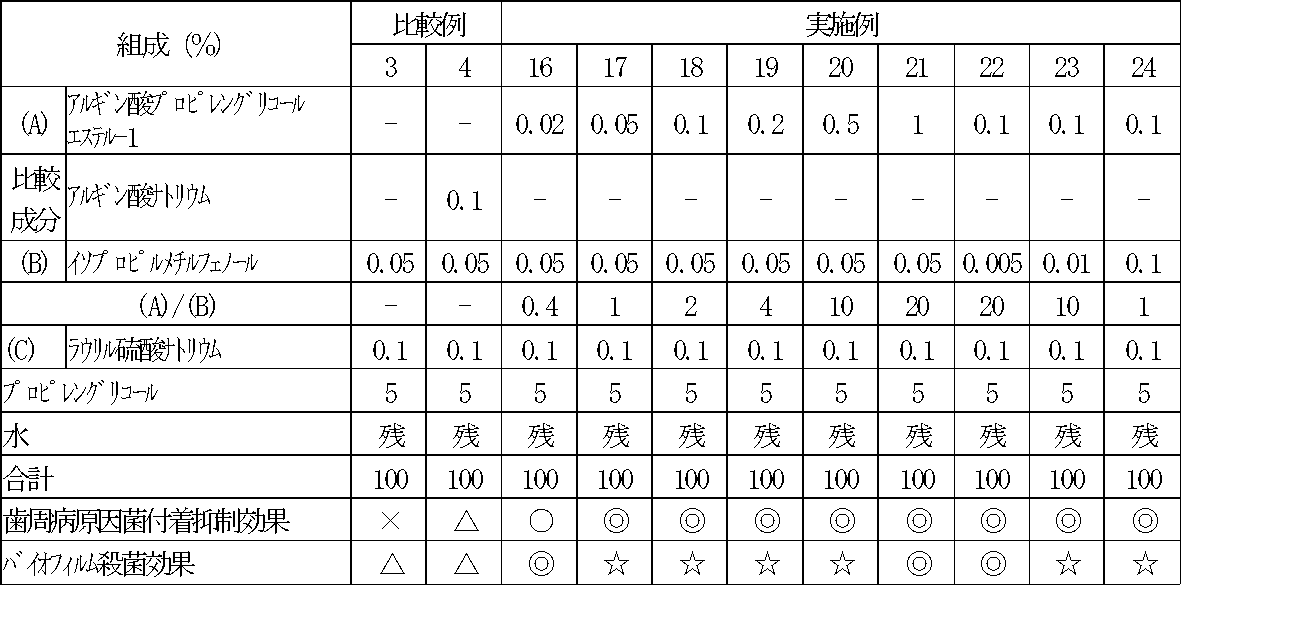
- the combined use of propylene glycol alginate and isopropylmethylphenol is superior in the effect of suppressing the adhesion of periodontal disease-causing bacteria and improves the biofilm bactericidal effect. From this, it was confirmed that the combined system has an excellent effect of suppressing the formation of oral biofilm.
- composition for oral cavity of the following prescription example was prepared by a conventional method.
- the raw materials used were the same as described above, and the propylene glycol alginate used was Kimika Co., Ltd., trade name: Kimiloid BF.
- Kimika Co., Ltd. trade name: Kimiloid BF.
Landscapes
- Health & Medical Sciences (AREA)
- Life Sciences & Earth Sciences (AREA)
- Veterinary Medicine (AREA)
- Public Health (AREA)
- General Health & Medical Sciences (AREA)
- Animal Behavior & Ethology (AREA)
- Epidemiology (AREA)
- Chemical & Material Sciences (AREA)
- Medicinal Chemistry (AREA)
- Pharmacology & Pharmacy (AREA)
- Birds (AREA)
- Chemical Kinetics & Catalysis (AREA)
- Engineering & Computer Science (AREA)
- General Chemical & Material Sciences (AREA)
- Bioinformatics & Cheminformatics (AREA)
- Oral & Maxillofacial Surgery (AREA)
- Molecular Biology (AREA)
- Nuclear Medicine, Radiotherapy & Molecular Imaging (AREA)
- Emergency Medicine (AREA)
- Organic Chemistry (AREA)
- Dermatology (AREA)
- Oil, Petroleum & Natural Gas (AREA)
- Cosmetics (AREA)
- Medicinal Preparation (AREA)
- Pharmaceuticals Containing Other Organic And Inorganic Compounds (AREA)
- Acyclic And Carbocyclic Compounds In Medicinal Compositions (AREA)
Abstract
Description
更に、アルギン酸プロピレングリコールが、精油由来の味覚をマスキングする効果、具体的には抗菌作用のあるチモールのマスキング作用を有することが開示されている(特許文献8)。
これに対して、本発明者らは、非殺菌的なプラークコントロール手段を検討した中で、アルギン酸プロピレングリコールエステルに、歯周病原因菌、特にポルフィロモナス ジンジバリス(Porphyromonas gingivalis)の歯面への付着を抑制する従来知られていない効果があり、プラークコントロールに有用であることを見出した。更に、このアルギン酸プロピレングリコールエステルを、難水溶性殺菌剤のイソプロピルメチルフェノールと組み合わせて配合した場合、これら両成分が相乗的に作用し、口腔内細菌の歯面付着抑制効果に優れると共に歯周病原性バイオフィルムへの高い殺菌効果が発揮され、よって、歯周病原性バイオフィルムの形成を抑制する高い効果を奏することを見出した。
なお、従来の技術から、アルギン酸プロピレングリコールエステルに歯周病原因菌の歯面付着抑制効果がありバイオフィルム殺菌効果の亢進作用を奏することは予測できない。
〔1〕
(A)アルギン酸プロピレングリコールエステルと(B)イソプロピルメチルフェノールとからなる口腔バイオフィルム形成抑制剤。
〔2〕
(A)成分と(B)成分との配合比率が、(A)/(B)の質量比として0.4~20である〔1〕記載の口腔バイオフィルム形成抑制剤。
〔3〕
(A)アルギン酸プロピレングリコールエステルと(B)イソプロピルメチルフェノールとを含有してなることを特徴とする口腔用組成物。
〔4〕
(A)成分と(B)成分との配合比率が、(A)/(B)の質量比として0.4~20である〔3〕記載の口腔用組成物。
〔5〕
(A)成分を0.02~1質量%、(B)成分を0.005~0.1質量%含有する〔3〕又は〔4〕記載の口腔用組成物。
〔6〕
更に、(C)アルキル硫酸塩、アシルサルコシン酸塩から選ばれる少なくとも1種のアニオン性界面活性剤を含有する〔3〕、〔4〕又は〔5〕記載の口腔用組成物。
〔7〕
(A)アルギン酸プロピレングリコールエステルからなる歯周病原因菌の歯面付着抑制剤。
〔8〕
口腔バイオフィルム形成抑制剤を製造するための(A)アルギン酸プロピレングリコールエステルと(B)イソプロピルメチルフェノールの使用。
アルギン酸プロピレングリコールエステルは、アルギン酸の耐酸性、耐塩性を高めるためアルギン酸を構成するカルボキシル基にプロピレングリコールをエステル化したもので、(株)フードケミファ製のダックロイド、(株)キミカ製のキミロイド、昆布酸などの商品名で商品化されているもの等を使用できる。
アルギン酸プロピレングリコールエステル
商品名 昆布酸503:
1%水溶液粘度18mPa・s(ローターNo.1、60rpm)、M/G比=1.3、エステル化度=80%/(株)キミカ製
商品名 キミロイドBF:
1%水溶液粘度20mPa・s(ローターNo.1、60rpm)、M/G比=1.3、エステル化度=80%/(株)キミカ製
商品名 キミロイドLLV:
1%水溶液粘度24mPa・s(ローターNo.1、60rpm)、M/G比=1.3、エステル化度=80%/(株)キミカ製
商品名 キミロイドNLS-K:
1%水溶液粘度55mPa・s(ローターNo.1、60rpm)、M/G比=1.3、エステル化度=80%/(株)キミカ製
商品名 キミロイドLV:
1%水溶液粘度90mPa・s(ローターNo.1、30rpm)、M/G比=1.3、エステル化度=80%/(株)キミカ製
商品名 キミロイドMV:
1%水溶液粘度148mPa・s(ローターNo.1、30rpm)、M/G比=1.3、エステル化度=80%/(株)キミカ製
商品名 昆布酸542:
1%水溶液粘度1,280mPa・s(ローターNo.3、60rpm)、M/G比1.3、エステル化度=40% (株)キミカ製
商品名 ダックロイドLF:
1%水溶液粘度21mPa・s(ローターNo.1、60rpm)、M/G比=0.8、エステル化度=75%/(株)フードケミファ製
商品名 ダックロイドPF:
1%水溶液粘度51mPa・s(ローターNo.1、60rpm)、M/G比=0.8、エステル化度=75%/(株)フードケミファ製
上記粘度は、BL型粘度計により測定した値であり、具体的には下記方法による測定値である。
また、アルギン酸プロピレングリコールエステルは、製品の種類に応じて1種又は2種以上併用して使用できる。
アルギン酸プロピレングリコールを4g採取し600mL容量のビーカーに入れ、そこに攪拌棒で攪拌しながら精製水396gを少しずつ加える。初めに少量の水でよく溶解し、ある程度溶けたら全量の水を入れる。その後1時間膨潤させ、1時間後、高速攪拌機(ホモミキサー)により12,000回転/分で1分間攪拌する。この溶液を300mLトールビーカーに入れて、20℃水槽に静置させておく。泡が上に上がり、ビーカーの溶液の色が透明になったら、上の泡を薬さじ等で取り除く。温度計をビーカーの中に入れて検液が20℃に達したことを確認し、粘度測定を行う。
粘度計:東京計器 BL型粘度計
ローター:No.1
回転数:60rpm
測定時間:1分
300mLトールビーカーに精製水297gをとり、スターラー又はスリーワンモーターで攪拌しながらアルギン酸プロピレングリコールエステルを3.0g加えて完全に溶解する。次に、20℃恒温水槽に1時間静置後(アルギン酸プロピレングリコールエステル水溶液が20℃に達したことを確認する)、BL型粘度計(東京計器社製)を用いて正確に1分後の粘度を測定する。なお、下記に示す粘度範囲に応じて使用するローター、回転数を変えた。
粘度が10mPa・sを超えて80mPa・s以下の場合:ローターNo.1、回転数 60rpm
粘度が80mPa・sを超えて160mPa・s以下の場合:ローターNo.1、回転数 30rpm
粘度が160mPa・sを超えて400mPa・s以下の場合:ローターNo.2、回転数 60rpm
粘度が400mPa・sを超えて800mPa・s以下の場合:ローターNo.2、回転数 30rpm
粘度が800mPa・sを超えて1,600mPa・s以下の場合:ローターNo.3、回転数 60rpm
アニオン性界面活性剤としては、ラウロイルメチルタウリン、アシルアミノ酸塩、ドデシルベンゼンスルホン酸ナトリウム、α-スルホ脂肪酸アルキルエステル・ナトリウム、アルキルリン酸エステル塩等が挙げられる。非イオン性界面活性剤としては、ポリオキシエチレンソルビタン脂肪酸エステル、ショ糖脂肪酸エステル、ソルビタン脂肪酸エステル、ポリオキシエチレンポリオキシプロピレンブロックコポリマー型活性剤、ポリオキシエチレン脂肪酸エステル、脂肪酸モノグリセライドなどが挙げられる。両性界面活性剤としては、アルキルジメチルアミノ酢酸ベタイン、脂肪酸アミドプロピルジメチルアミノ酢酸ベタインなどの酢酸ベタイン型両性界面活性剤、N-脂肪酸アシル-N-カルボキシメチル-N-ヒドロキシエチルエチレンジアミン塩などのイミダゾリン型両性界面活性剤、N-脂肪酸アシル-L-アルギネート塩等のアミノ酸型界面活性剤が挙げられる。カチオン性界面活性剤としては、アルキルアンモニウム、アルキルベンジルアンモニウム塩等が挙げられる(配合量;通常、0.1~5%)。
着色剤としては、青色1号、黄色4号、二酸化チタン等が挙げられる。
防腐剤としては、安息香酸ナトリウム、パラオキシ安息香酸エステル、塩酸アルキルジアミノエチルグリシン、ソルビン酸カリウム等が挙げられる。
アルギン酸プロピレングリコールエステル-1
(株)キミカ製、商品名:キミロイドBF
粘度20mPa・s(ローターNo.1、60rpm)
M/G比1.3、エステル化度80%
アルギン酸プロピレングリコールエステル-2
(株)キミカ製、商品名:キミロイドNLS-K
粘度55mPa・s(ローターNo.1、60rpm)
M/G比1.3、エステル化度80%
アルギン酸プロピレングリコールエステル-3
(株)キミカ製、商品名:キミロイドMV
粘度148mPa・s(ローターNo.1、30rpm)
M/G比1.3、エステル化度80%
アルギン酸プロピレングリコールエステル-4
(株)キミカ製、商品名:昆布酸501
粘度181mPa・s(ローターNo.2、60rpm)
M/G比1.3、エステル化度80%
アルギン酸プロピレングリコールエステル-5
(株)キミカ製、商品名:昆布酸542
粘度1,280mPa・s(ローターNo.3、60rpm)
M/G比1.3、エステル化度40%
アルギン酸ナトリウム:フードケミファ社製
イソプロピルメチルフェノール:大阪化成社製
ラウリル硫酸ナトリウム:東邦化学工業社製
ラウロイルサルコシンナトリウム:川研ファインケミカル社製
なお、アルギン酸プロピレングリコールエステルの粘度は、上述の製造メーカ毎に指定された方法で測定した値を示した(BL型粘度計、20℃、1%水溶液、測定時間1分、ローター及び回転数は個別に記載)。
表1に示す組成の試験組成物について、下記方法で歯周病原因菌の付着抑制効果を評価した。結果を表1に示す。
歯周病原因菌は、アメリカン タイプ カルチャー コレクション(ATCC)より購入したポルフィロモナス ジンジバリス(Porphyromonas gingivalis)ATCC33277株を用い、ヘミン及びメナジオンを含むトッドへーウィットブロース培養液(THBHM*1)により37℃で嫌気的条件下(80vol%窒素、10vol%二酸化炭素、10vol%水素)で定常状態まで培養し、550nmにおける吸光度が1.0になるようPBS(和光純薬工業社製)に懸濁した液を試験に供した。
付着担体は、直径7mm×厚さ3.5mmのハイドロキシアパタイト(HA)板(旭光学社製)を用い、0.45μmのフィルターでろ過したヒト無刺激唾液に1時間(37℃)浸漬し、HA表面を唾液成分でコートし試験に供した。
唾液コートしたHA板をPBS(和光純薬工業社製)で1回洗浄した後、表1~3に示す組成の試験組成物2mLに5分間浸漬した。処置後、PBSで1回洗浄後、HA板を前述したポルフィロモナス ジンジバリス菌液に30分間(37℃)浸漬した。その後、HA板はPBS 1mLで3回洗浄した後、PBS 4mL中で超音波処理(200μA、10秒間)により付着した細菌を分散し、PBSを用いて10倍段階希釈を施した。このものを10%綿羊脱繊血含有血液寒天平板*2に50μL塗沫し、嫌気性条件下で約2週間培養した。生育したコロニー数よりHA板に付着したポルフィロモナス ジンジバリスの菌数を求め、付着菌数をcfu(colony forming unit)/HA板として算出した。コントロールの付着菌数に対する試験組成物の付着抑制率を下記式により求め、下記基準に則り、歯周病原因菌付着抑制効果を判定した。
付着抑制率(%)=((コントロールの付着菌数-試験組成物の付着菌数)/(コントロールの付着菌数))×100
◎:付着抑制率が80%以上100%以下
○:付着抑制率が60%以上80%未満
△:付着抑制率が40%以上60%未満
×:付着抑制率が0%以上40%未満
トッドへーウィットブロース
(Becton and Dickinson社製): 30g/L
ヘミン(シグマ アルドリッチ社製): 5mg/L
メナジオン(和光純薬工業社製): 1mg/L
蒸留水: 残
(全量が1Lになるようにメスアップし、121℃で20分間オートクレーブした。)
トッドへーウィットブロース
(Becton and Dickinson社製): 30g/L
寒天(Becton and Dickinson社製):15g/L
ヘミン(シグマ アルドリッチ社製): 5mg/L
ビタミンK(和光純薬工業社製): 1mg/L
蒸留水: 残
(全量が1Lになるようにメスアップし、121℃で20分間オートクレーブした。)
綿羊脱繊血(日本バイオテスト研究所製) 100mL

表2、3に示す組成の試験組成物について、上記方法で歯周病原因菌の付着抑制効果を評価し、また、下記方法でモデルバイオフィルムに対する浸透殺菌効果を評価した。結果を表2,3に示す。
直径7mm×厚さ3.5mmのハイドロキシアパタイト(HA)板(旭光学社製)を0.45μmのフィルターでろ過したヒト無刺激唾液で4時間処理したものをモデルバイオフィルム作製の担体に用い、培養液には、ベイサルメディウムムチン培養液(BMM)*3を用いた。モデルバイオフィルムを作製するために使用した菌株は、American Type Culture Collectionより購入したアクチノマイセス ヴィスコサス(Actinomyces viscosus)ATCC43146、ベイヨネラ パルビュラ(Veillonella parvula)ATCC17745、フゾバクテリウム ヌクレアタム(Fusobacterium nucleatum)ATCC10953、ポルフィロモナス ジンジバリス(Porphyromonas gingivalis)ATCC33277を用いた。これら4菌株は予めBMM3,000mLを入れたRotating Disk Rector(培養槽)にそれぞれ1×10⁷cfu/mL(cfu:colony forming units)になるように接種し、唾液処理したHA担体と共に37℃、嫌気的条件下(5vol%炭酸ガス、95vol%窒素)で24時間培養した。その後、同条件でBMM培地を置換率5vol%/時間の割合で連続的に供給し10日間培養を行い、HA表面に4菌種混合のモデルバイオフィルムを形成させた。
形成させたモデルバイオフィルムは24穴マルチプレート(住友ベークライト社製)に移し、表2、3に示した試験組成物2mLを加え3分間浸漬し、PBS(和光純薬工業社製)1mLで6回洗浄した後、同バッファー4mLを添加した試験管(直径13mm×100mm)内で超音波処理(200μA、10秒間)により分散した。この分散液をPBSで10倍段階希釈を施し、硫酸カナマイシン含有血液寒天平板*4に50μL塗沫し、嫌気的条件下で培養した。生育したコロニー数を計測し、モデルバイオフィルムあたりの歯周病細菌(ポルフィロモナス ジンジバリス)の生菌数(cfu/Biofilm)を求めた。
試験組成物のバイオフィルム殺菌効果は、下式によりコントロールに対する歯周病細菌の殺菌率を求め、この殺菌率から、下記基準に則りバイオフィルム殺菌効果を判定した。
歯周病細菌の殺菌率=コントロールの歯周病細菌数(cfu/Biofilm)/試験製剤の歯周病細菌数(cfu/Biofilm)
☆:歯周病細菌の殺菌率が1,000以上
◎:歯周病細菌の殺菌率が100以上1,000未満
○:歯周病細菌の殺菌率が10以上100未満
△:歯周病細菌の殺菌率が1以上10未満
×:歯周病細菌の殺菌率が1未満
プロテオースペプトン
(Becton and Dickinson社製):4g/L
トリプトン(Becton and Dickinson社製):
2g/L
イーストエキス(Becton and Dickinson社製):
2g/L
ムチン(Sigma社製): 5g/L
ヘミン(Sigma社製): 2.5mg/L
ビタミンK(和光純薬工業社製): 0.5mg/L
KCl(和光純薬工業社製): 1g/L
システイン(和光純薬工業社製): 0.2g/L
蒸留水: 残
(全量が1Lになるようにメスアップし、121℃で20分間オートクレーブした。)
トリプチケースソイ寒天培地
(Becton and Dickinson社製):
40g/L
ヘミン(Sigma社製): 5mg/L
ビタミンK(和光純薬工業社製): 1mg/L
硫酸カナマイシン(明治製菓社製): 200mg/L
蒸留水: 残
(全量が1Lになるようにメスアップし、121℃で20分間オートクレーブした。)
綿羊脱繊血(日本バイオテスト研究所製) 100mL


アルギン酸プロピレングリコールエステル 0.1%
イソプロピルメチルフェノール 0.05%
ラウリル硫酸ナトリウム 1.5%
ラウロイルサルコシンナトリウム 0.1%
ポリオキシエチレン(20)ソルビタンモノステアリン酸エステル
0.6%
70%ソルビット液 40%
プロピレングリコール 3%
カルボキシビニルポリマー 0.6%
キサンタンガム 0.6%
サッカリンナトリウム 0.2%
フッ化ナトリウム 0.21%
水酸化ナトリウム 0.15%
無水ケイ酸 22%
香料 1.2%
水 バランス
計 100%
アルギン酸プロピレングリコールエステル 0.1%
イソプロピルメチルフェノール 0.05%
ラウリル硫酸ナトリウム 1.3%
ラウロイルサルコシンナトリウム 0.1%
トリクロサン 0.02%
ポリオキシエチレン(20)ソルビタンモノステアリン酸エステル
0.6%
70%ソルビット液 40%
プロピレングリコール 3%
カルボキシメチルセルロースナトリウム 1.1%
ポリアクリル酸ナトリウム 0.5%
サッカリンナトリウム 0.2%
フッ化ナトリウム 0.21%
リン酸カルシウム 25%
無水ケイ酸 5.0%
香料 1.2%
水 バランス
計 100%
アルギン酸プロピレングリコールエステル 0.3%
イソプロピルメチルフェノール 0.1%
モノステアリン酸ソルビタン 1.0%
グリセリン 10%
流動パラフィン 15%
香料 1.0%
白色ワセリン バランス
計 100%
アルギン酸プロピレングリコールエステル 0.15%
イソプロピルメチルフェノール 0.05%
ラウロイルサルコシンナトリウム 0.1%
ショ糖ラウリン酸エステル 0.5%
キサンタンガム 1.5%
ポリエチレングリコール4000 15%
香料 0.9%
水 バランス
計 100%
アルギン酸プロピレングリコールエステル 0.1%
イソプロピルメチルフェノール 0.05%
ラウロイルサルコシンナトリウム 0.1%
エタノール 10%
70%ソルビトール 5%
キシリトール 5%
ショ糖ラウリン酸エステル 0.5%
サッカリンナトリウム 0.2%
香料 0.8%
水 バランス
計 100%
アルギン酸プロピレングリコールエステル 0.2%
イソプロピルメチルフェノール 0.02%
ガムベース 20%
香料 1%
水飴 20%
粉糖 10%
70%ソルビトール 15%
キシリトール 10%
水 バランス
計 100%
Claims (8)
- (A)アルギン酸プロピレングリコールエステルと(B)イソプロピルメチルフェノールとからなる口腔バイオフィルム形成抑制剤。
- (A)成分と(B)成分との配合比率が、(A)/(B)の質量比として0.4~20である請求項1記載の口腔バイオフィルム形成抑制剤。
- (A)アルギン酸プロピレングリコールエステルと(B)イソプロピルメチルフェノールとを含有してなることを特徴とする口腔用組成物。
- (A)成分と(B)成分との配合比率が、(A)/(B)の質量比として0.4~20である請求項3記載の口腔用組成物。
- (A)成分を0.02~1質量%、(B)成分を0.005~0.1質量%含有する請求項3又は4記載の口腔用組成物。
- 更に、(C)アルキル硫酸塩、アシルサルコシン酸塩から選ばれる少なくとも1種のアニオン性界面活性剤を含有する請求項3、4又は5記載の口腔用組成物。
- (A)アルギン酸プロピレングリコールエステルからなる歯周病原因菌の歯面付着抑制剤。
- 口腔バイオフィルム形成抑制剤を製造するための(A)アルギン酸プロピレングリコールエステルと(B)イソプロピルメチルフェノールの使用。
Priority Applications (3)
| Application Number | Priority Date | Filing Date | Title |
|---|---|---|---|
| JP2012546732A JP5729391B2 (ja) | 2010-11-30 | 2011-10-14 | 歯周病原因菌の歯面付着抑制剤、口腔バイオフィルム形成抑制剤及び口腔用組成物 |
| CN201180057620.3A CN103237538B (zh) | 2010-11-30 | 2011-10-14 | 牙周病原菌的齿面附着抑制剂、口腔生物膜形成抑制剂及口腔用组合物 |
| KR1020137014630A KR101820192B1 (ko) | 2010-11-30 | 2011-10-14 | 치주병 원인균의 치면 부착 억제제, 구강 바이오필름 형성 억제제 및 구강용 조성물 |
Applications Claiming Priority (2)
| Application Number | Priority Date | Filing Date | Title |
|---|---|---|---|
| JP2010266002 | 2010-11-30 | ||
| JP2010-266002 | 2010-11-30 |
Publications (1)
| Publication Number | Publication Date |
|---|---|
| WO2012073601A1 true WO2012073601A1 (ja) | 2012-06-07 |
Family
ID=46171553
Family Applications (1)
| Application Number | Title | Priority Date | Filing Date |
|---|---|---|---|
| PCT/JP2011/073612 Ceased WO2012073601A1 (ja) | 2010-11-30 | 2011-10-14 | 歯周病原因菌の歯面付着抑制剤、口腔バイオフィルム形成抑制剤及び口腔用組成物 |
Country Status (5)
| Country | Link |
|---|---|
| JP (1) | JP5729391B2 (ja) |
| KR (1) | KR101820192B1 (ja) |
| CN (1) | CN103237538B (ja) |
| MY (1) | MY162054A (ja) |
| WO (1) | WO2012073601A1 (ja) |
Cited By (3)
| Publication number | Priority date | Publication date | Assignee | Title |
|---|---|---|---|---|
| JPWO2014157547A1 (ja) * | 2013-03-27 | 2017-02-16 | ライオン株式会社 | 口腔用組成物 |
| JP2017119639A (ja) * | 2015-12-28 | 2017-07-06 | 花王株式会社 | Trpv4活性化剤 |
| JP2021175714A (ja) * | 2020-05-01 | 2021-11-04 | サンスター株式会社 | 口腔用組成物 |
Families Citing this family (3)
| Publication number | Priority date | Publication date | Assignee | Title |
|---|---|---|---|---|
| MX2018008569A (es) | 2016-01-28 | 2018-08-16 | Kimberly Clark Co | Composicion antiadherente contra virus de acido desoxirribonucleico (adn) y metodo para inhibir la adherencia de virus de acido desoxirribonucleico (adn) a una superficie. |
| US11168287B2 (en) | 2016-05-26 | 2021-11-09 | Kimberly-Clark Worldwide, Inc. | Anti-adherent compositions and methods of inhibiting the adherence of microbes to a surface |
| MY201288A (en) * | 2017-11-30 | 2024-02-15 | Lion Corp | Oral biofilm formation inhibitor and oral-use composition |
Citations (8)
| Publication number | Priority date | Publication date | Assignee | Title |
|---|---|---|---|---|
| JPH04139118A (ja) * | 1990-10-01 | 1992-05-13 | Lion Corp | 口腔用組成物 |
| JPH1171251A (ja) * | 1997-08-29 | 1999-03-16 | Lion Corp | 口腔用組成物 |
| JPH1171250A (ja) * | 1997-08-29 | 1999-03-16 | Lion Corp | 口腔用組成物 |
| JP2006176479A (ja) * | 2004-12-24 | 2006-07-06 | Lion Corp | 歯磨剤組成物 |
| JP2008156309A (ja) * | 2006-12-26 | 2008-07-10 | Lion Corp | 口腔用組成物 |
| JP2009520802A (ja) * | 2005-12-21 | 2009-05-28 | マクニール−ピーピーシー・インコーポレーテツド | 親水コロイドを用いた、精油の味覚マスキング |
| JP2009149535A (ja) * | 2007-12-19 | 2009-07-09 | Lion Corp | 口腔用組成物 |
| JP2009155271A (ja) * | 2007-12-27 | 2009-07-16 | Lion Corp | 口腔用組成物 |
Family Cites Families (1)
| Publication number | Priority date | Publication date | Assignee | Title |
|---|---|---|---|---|
| JP4763441B2 (ja) * | 2004-12-10 | 2011-08-31 | 花王株式会社 | 歯垢形成抑制剤並びにそれを含む口腔剤組成物及び食品 |
-
2011
- 2011-10-14 CN CN201180057620.3A patent/CN103237538B/zh active Active
- 2011-10-14 WO PCT/JP2011/073612 patent/WO2012073601A1/ja not_active Ceased
- 2011-10-14 JP JP2012546732A patent/JP5729391B2/ja active Active
- 2011-10-14 KR KR1020137014630A patent/KR101820192B1/ko active Active
- 2011-10-14 MY MYPI2013001753A patent/MY162054A/en unknown
Patent Citations (8)
| Publication number | Priority date | Publication date | Assignee | Title |
|---|---|---|---|---|
| JPH04139118A (ja) * | 1990-10-01 | 1992-05-13 | Lion Corp | 口腔用組成物 |
| JPH1171251A (ja) * | 1997-08-29 | 1999-03-16 | Lion Corp | 口腔用組成物 |
| JPH1171250A (ja) * | 1997-08-29 | 1999-03-16 | Lion Corp | 口腔用組成物 |
| JP2006176479A (ja) * | 2004-12-24 | 2006-07-06 | Lion Corp | 歯磨剤組成物 |
| JP2009520802A (ja) * | 2005-12-21 | 2009-05-28 | マクニール−ピーピーシー・インコーポレーテツド | 親水コロイドを用いた、精油の味覚マスキング |
| JP2008156309A (ja) * | 2006-12-26 | 2008-07-10 | Lion Corp | 口腔用組成物 |
| JP2009149535A (ja) * | 2007-12-19 | 2009-07-09 | Lion Corp | 口腔用組成物 |
| JP2009155271A (ja) * | 2007-12-27 | 2009-07-16 | Lion Corp | 口腔用組成物 |
Cited By (4)
| Publication number | Priority date | Publication date | Assignee | Title |
|---|---|---|---|---|
| JPWO2014157547A1 (ja) * | 2013-03-27 | 2017-02-16 | ライオン株式会社 | 口腔用組成物 |
| JP2017119639A (ja) * | 2015-12-28 | 2017-07-06 | 花王株式会社 | Trpv4活性化剤 |
| JP2021175714A (ja) * | 2020-05-01 | 2021-11-04 | サンスター株式会社 | 口腔用組成物 |
| JP7630917B2 (ja) | 2020-05-01 | 2025-02-18 | サンスター株式会社 | 口腔用組成物 |
Also Published As
| Publication number | Publication date |
|---|---|
| KR101820192B1 (ko) | 2018-01-18 |
| KR20140000267A (ko) | 2014-01-02 |
| CN103237538B (zh) | 2016-01-20 |
| MY162054A (en) | 2017-05-31 |
| JP5729391B2 (ja) | 2015-06-03 |
| JPWO2012073601A1 (ja) | 2014-05-19 |
| CN103237538A (zh) | 2013-08-07 |
Similar Documents
| Publication | Publication Date | Title |
|---|---|---|
| JP5729252B2 (ja) | 口腔用組成物 | |
| CN107875031B (zh) | 口腔生物膜除去剂以及口腔用组合物 | |
| JP7167938B2 (ja) | 口腔バイオフィルム形成抑制剤及び口腔用組成物 | |
| JP5552725B2 (ja) | 口腔用組成物及び口腔バイオフィルム殺菌剤 | |
| JP5729391B2 (ja) | 歯周病原因菌の歯面付着抑制剤、口腔バイオフィルム形成抑制剤及び口腔用組成物 | |
| JP5853387B2 (ja) | 液体口腔用組成物及び該組成物へ成分を安定化配合する方法 | |
| JP5359546B2 (ja) | 液体口腔用組成物 | |
| WO2018194111A1 (ja) | 口腔バイオフィルム除去剤及び口腔用組成物 | |
| JP5682264B2 (ja) | 口腔用組成物及び歯周病原因菌の歯面付着抑制剤 | |
| JP5682283B2 (ja) | 液体口腔用組成物 | |
| JP4957882B2 (ja) | エタノール無配合洗口剤組成物 | |
| JP4873154B2 (ja) | 液体口腔用組成物 | |
| WO2011077847A1 (ja) | 乳化型液体口腔用組成物及びその製造方法 | |
| JP5720697B2 (ja) | 歯磨剤組成物 | |
| JP2014070046A (ja) | Pgaイオンコンプレックスを含有する歯科口腔用組成物 | |
| JP7815617B2 (ja) | 液体口腔用組成物 | |
| CN120053300A (zh) | 口腔用组合物 |
Legal Events
| Date | Code | Title | Description |
|---|---|---|---|
| 121 | Ep: the epo has been informed by wipo that ep was designated in this application |
Ref document number: 11845408 Country of ref document: EP Kind code of ref document: A1 |
|
| ENP | Entry into the national phase |
Ref document number: 2012546732 Country of ref document: JP Kind code of ref document: A |
|
| NENP | Non-entry into the national phase |
Ref country code: DE |
|
| ENP | Entry into the national phase |
Ref document number: 20137014630 Country of ref document: KR Kind code of ref document: A |
|
| 122 | Ep: pct application non-entry in european phase |
Ref document number: 11845408 Country of ref document: EP Kind code of ref document: A1 |