WO2012053522A1 - 封止用樹脂組成物及び電子部品装置 - Google Patents
封止用樹脂組成物及び電子部品装置 Download PDFInfo
- Publication number
- WO2012053522A1 WO2012053522A1 PCT/JP2011/073963 JP2011073963W WO2012053522A1 WO 2012053522 A1 WO2012053522 A1 WO 2012053522A1 JP 2011073963 W JP2011073963 W JP 2011073963W WO 2012053522 A1 WO2012053522 A1 WO 2012053522A1
- Authority
- WO
- WIPO (PCT)
- Prior art keywords
- group
- resin composition
- curing agent
- resin
- general formula
- Prior art date
- Legal status (The legal status is an assumption and is not a legal conclusion. Google has not performed a legal analysis and makes no representation as to the accuracy of the status listed.)
- Ceased
Links
Images


Classifications
-
- C—CHEMISTRY; METALLURGY
- C08—ORGANIC MACROMOLECULAR COMPOUNDS; THEIR PREPARATION OR CHEMICAL WORKING-UP; COMPOSITIONS BASED THEREON
- C08G—MACROMOLECULAR COMPOUNDS OBTAINED OTHERWISE THAN BY REACTIONS ONLY INVOLVING UNSATURATED CARBON-TO-CARBON BONDS
- C08G59/00—Polycondensates containing more than one epoxy group per molecule; Macromolecules obtained by polymerising compounds containing more than one epoxy group per molecule using curing agents or catalysts which react with the epoxy groups
- C08G59/18—Macromolecules obtained by polymerising compounds containing more than one epoxy group per molecule using curing agents or catalysts which react with the epoxy groups ; e.g. general methods of curing
- C08G59/40—Macromolecules obtained by polymerising compounds containing more than one epoxy group per molecule using curing agents or catalysts which react with the epoxy groups ; e.g. general methods of curing characterised by the curing agents used
- C08G59/62—Alcohols or phenols
- C08G59/621—Phenols
-
- H—ELECTRICITY
- H01—ELECTRIC ELEMENTS
- H01B—CABLES; CONDUCTORS; INSULATORS; SELECTION OF MATERIALS FOR THEIR CONDUCTIVE, INSULATING OR DIELECTRIC PROPERTIES
- H01B3/00—Insulators or insulating bodies characterised by the insulating materials; Selection of materials for their insulating or dielectric properties
- H01B3/18—Insulators or insulating bodies characterised by the insulating materials; Selection of materials for their insulating or dielectric properties mainly consisting of organic substances
- H01B3/30—Insulators or insulating bodies characterised by the insulating materials; Selection of materials for their insulating or dielectric properties mainly consisting of organic substances plastics; resins; waxes
- H01B3/40—Insulators or insulating bodies characterised by the insulating materials; Selection of materials for their insulating or dielectric properties mainly consisting of organic substances plastics; resins; waxes epoxy resins
-
- H—ELECTRICITY
- H10—SEMICONDUCTOR DEVICES; ELECTRIC SOLID-STATE DEVICES NOT OTHERWISE PROVIDED FOR
- H10W—GENERIC PACKAGES, INTERCONNECTIONS, CONNECTORS OR OTHER CONSTRUCTIONAL DETAILS OF DEVICES COVERED BY CLASS H10
- H10W70/00—Package substrates; Interposers; Redistribution layers [RDL]
- H10W70/40—Leadframes
- H10W70/456—Materials
- H10W70/457—Materials of metallic layers on leadframes
-
- H—ELECTRICITY
- H10—SEMICONDUCTOR DEVICES; ELECTRIC SOLID-STATE DEVICES NOT OTHERWISE PROVIDED FOR
- H10W—GENERIC PACKAGES, INTERCONNECTIONS, CONNECTORS OR OTHER CONSTRUCTIONAL DETAILS OF DEVICES COVERED BY CLASS H10
- H10W70/00—Package substrates; Interposers; Redistribution layers [RDL]
- H10W70/60—Insulating or insulated package substrates; Interposers; Redistribution layers
-
- H—ELECTRICITY
- H10—SEMICONDUCTOR DEVICES; ELECTRIC SOLID-STATE DEVICES NOT OTHERWISE PROVIDED FOR
- H10W—GENERIC PACKAGES, INTERCONNECTIONS, CONNECTORS OR OTHER CONSTRUCTIONAL DETAILS OF DEVICES COVERED BY CLASS H10
- H10W72/00—Interconnections or connectors in packages
- H10W72/851—Dispositions of multiple connectors or interconnections
-
- H—ELECTRICITY
- H10—SEMICONDUCTOR DEVICES; ELECTRIC SOLID-STATE DEVICES NOT OTHERWISE PROVIDED FOR
- H10W—GENERIC PACKAGES, INTERCONNECTIONS, CONNECTORS OR OTHER CONSTRUCTIONAL DETAILS OF DEVICES COVERED BY CLASS H10
- H10W74/00—Encapsulations, e.g. protective coatings
- H10W74/10—Encapsulations, e.g. protective coatings characterised by their shape or disposition
- H10W74/111—Encapsulations, e.g. protective coatings characterised by their shape or disposition the semiconductor body being completely enclosed
-
- H—ELECTRICITY
- H10—SEMICONDUCTOR DEVICES; ELECTRIC SOLID-STATE DEVICES NOT OTHERWISE PROVIDED FOR
- H10W—GENERIC PACKAGES, INTERCONNECTIONS, CONNECTORS OR OTHER CONSTRUCTIONAL DETAILS OF DEVICES COVERED BY CLASS H10
- H10W74/00—Encapsulations, e.g. protective coatings
- H10W74/10—Encapsulations, e.g. protective coatings characterised by their shape or disposition
- H10W74/111—Encapsulations, e.g. protective coatings characterised by their shape or disposition the semiconductor body being completely enclosed
- H10W74/114—Encapsulations, e.g. protective coatings characterised by their shape or disposition the semiconductor body being completely enclosed by a substrate and the encapsulations
- H10W74/117—Encapsulations, e.g. protective coatings characterised by their shape or disposition the semiconductor body being completely enclosed by a substrate and the encapsulations the substrate having spherical bumps for external connection
-
- H—ELECTRICITY
- H10—SEMICONDUCTOR DEVICES; ELECTRIC SOLID-STATE DEVICES NOT OTHERWISE PROVIDED FOR
- H10W—GENERIC PACKAGES, INTERCONNECTIONS, CONNECTORS OR OTHER CONSTRUCTIONAL DETAILS OF DEVICES COVERED BY CLASS H10
- H10W74/00—Encapsulations, e.g. protective coatings
- H10W74/40—Encapsulations, e.g. protective coatings characterised by their materials
- H10W74/47—Encapsulations, e.g. protective coatings characterised by their materials comprising organic materials, e.g. plastics or resins
- H10W74/473—Encapsulations, e.g. protective coatings characterised by their materials comprising organic materials, e.g. plastics or resins containing a filler
-
- H—ELECTRICITY
- H10—SEMICONDUCTOR DEVICES; ELECTRIC SOLID-STATE DEVICES NOT OTHERWISE PROVIDED FOR
- H10W—GENERIC PACKAGES, INTERCONNECTIONS, CONNECTORS OR OTHER CONSTRUCTIONAL DETAILS OF DEVICES COVERED BY CLASS H10
- H10W72/00—Interconnections or connectors in packages
- H10W72/50—Bond wires
- H10W72/551—Materials of bond wires
- H10W72/552—Materials of bond wires comprising metals or metalloids, e.g. silver
- H10W72/5522—Materials of bond wires comprising metals or metalloids, e.g. silver comprising gold [Au]
-
- H—ELECTRICITY
- H10—SEMICONDUCTOR DEVICES; ELECTRIC SOLID-STATE DEVICES NOT OTHERWISE PROVIDED FOR
- H10W—GENERIC PACKAGES, INTERCONNECTIONS, CONNECTORS OR OTHER CONSTRUCTIONAL DETAILS OF DEVICES COVERED BY CLASS H10
- H10W72/00—Interconnections or connectors in packages
- H10W72/851—Dispositions of multiple connectors or interconnections
- H10W72/874—On different surfaces
- H10W72/884—Die-attach connectors and bond wires
-
- H—ELECTRICITY
- H10—SEMICONDUCTOR DEVICES; ELECTRIC SOLID-STATE DEVICES NOT OTHERWISE PROVIDED FOR
- H10W—GENERIC PACKAGES, INTERCONNECTIONS, CONNECTORS OR OTHER CONSTRUCTIONAL DETAILS OF DEVICES COVERED BY CLASS H10
- H10W74/00—Encapsulations, e.g. protective coatings
-
- H—ELECTRICITY
- H10—SEMICONDUCTOR DEVICES; ELECTRIC SOLID-STATE DEVICES NOT OTHERWISE PROVIDED FOR
- H10W—GENERIC PACKAGES, INTERCONNECTIONS, CONNECTORS OR OTHER CONSTRUCTIONAL DETAILS OF DEVICES COVERED BY CLASS H10
- H10W90/00—Package configurations
- H10W90/701—Package configurations characterised by the relative positions of pads or connectors relative to package parts
- H10W90/731—Package configurations characterised by the relative positions of pads or connectors relative to package parts of die-attach connectors
- H10W90/734—Package configurations characterised by the relative positions of pads or connectors relative to package parts of die-attach connectors between a chip and a stacked insulating package substrate, interposer or RDL
-
- H—ELECTRICITY
- H10—SEMICONDUCTOR DEVICES; ELECTRIC SOLID-STATE DEVICES NOT OTHERWISE PROVIDED FOR
- H10W—GENERIC PACKAGES, INTERCONNECTIONS, CONNECTORS OR OTHER CONSTRUCTIONAL DETAILS OF DEVICES COVERED BY CLASS H10
- H10W90/00—Package configurations
- H10W90/701—Package configurations characterised by the relative positions of pads or connectors relative to package parts
- H10W90/731—Package configurations characterised by the relative positions of pads or connectors relative to package parts of die-attach connectors
- H10W90/736—Package configurations characterised by the relative positions of pads or connectors relative to package parts of die-attach connectors between a chip and a stacked lead frame, conducting package substrate or heat sink
-
- H—ELECTRICITY
- H10—SEMICONDUCTOR DEVICES; ELECTRIC SOLID-STATE DEVICES NOT OTHERWISE PROVIDED FOR
- H10W—GENERIC PACKAGES, INTERCONNECTIONS, CONNECTORS OR OTHER CONSTRUCTIONAL DETAILS OF DEVICES COVERED BY CLASS H10
- H10W90/00—Package configurations
- H10W90/701—Package configurations characterised by the relative positions of pads or connectors relative to package parts
- H10W90/751—Package configurations characterised by the relative positions of pads or connectors relative to package parts of bond wires
- H10W90/754—Package configurations characterised by the relative positions of pads or connectors relative to package parts of bond wires between a chip and a stacked insulating package substrate, interposer or RDL
-
- H—ELECTRICITY
- H10—SEMICONDUCTOR DEVICES; ELECTRIC SOLID-STATE DEVICES NOT OTHERWISE PROVIDED FOR
- H10W—GENERIC PACKAGES, INTERCONNECTIONS, CONNECTORS OR OTHER CONSTRUCTIONAL DETAILS OF DEVICES COVERED BY CLASS H10
- H10W90/00—Package configurations
- H10W90/701—Package configurations characterised by the relative positions of pads or connectors relative to package parts
- H10W90/751—Package configurations characterised by the relative positions of pads or connectors relative to package parts of bond wires
- H10W90/756—Package configurations characterised by the relative positions of pads or connectors relative to package parts of bond wires between a chip and a stacked lead frame, conducting package substrate or heat sink
Definitions
- the present invention relates to a sealing resin composition and an electronic component device.
- solder resistance has become one of the important technical issues for sealing resin compositions.
- Patent Documents 4 and 5 Although methods for enhancing high-temperature storage characteristics and flame resistance by compounding have been proposed (see, for example, Patent Documents 4 and 5), these have a sufficient balance of flame resistance, continuous formability, and solder resistance. It was difficult to say. As described above, in miniaturization and widespread use of in-vehicle electronic devices, it has become an important issue to satisfy a good balance between flame resistance, solder resistance, high temperature storage characteristics, and continuous formability.
- the present invention provides a resin composition for sealing having a good balance of solder resistance, flame retardancy, continuous moldability, flow characteristics and high-temperature storage characteristics, and reliability obtained by sealing an element with a cured product thereof. It provides an excellent electronic component device economically.
- R1 and R2 are each independently a hydrocarbon group having 1 to 5 carbon atoms
- R3 is independently a hydrocarbon group having 1 to 10 carbon atoms
- R4 and R5 are independently of each other hydrogen or a hydrocarbon group having 1 to 10 carbon atoms
- a is an integer of 0 to 3
- b is an integer of 2 to 4
- c is an integer of 0 to 2
- d is An integer of 0 to 4.
- k and m are each independently an integer of 0 to 10, and k + m ⁇ 2.k repeating units having a substituted or unsubstituted monovalent hydroxyphenylene structure;
- the m repeating units having a polyvalent hydroxyphenylene structure may be arranged consecutively or may be arranged alternately or randomly, but a substituted or unsubstituted biphenylene group must be present between them.
- a phenol resin-based curing agent (A) including one or more polymers having a structure represented by formula (A), an epoxy resin (B), and an inorganic filler (C), and the phenol resin-based curing agent (A ) Is an essential component of the polymer component (A-1) in which k ⁇ 1 and m ⁇ 1 in the general formula (1) and the polymer component (A-2) in which k 0 and m ⁇ 2
- the total relative strength of the polymer component (A-1) with k ⁇ 1 and m ⁇ 1 in the general formula (1) as measured by field desorption mass spectrometry is the phenol resin-based curing agent (A ) 5% or more with respect to the total of the relative strength of the whole.
- the total relative strength of (A-2) may be 75% or less with respect to the total relative strength of the entire phenol resin-based curing agent (A).
- the sealing resin composition of the present invention is a polymer component in which the phenol resin-based curing agent (A) is k ⁇ 1 and m ⁇ 1 in the general formula (1) as measured by field desorption mass spectrometry.
- the total relative strength of the polymer component (A-2) may be 20% or more and 75% or less with respect to the total relative strength of the entire phenol resin curing agent (A).
- the phenol resin-based curing agent (A) has an average value k0 of the number of repeating monovalent hydroxyphenylene structural units k in the general formula (1) and a polyvalent hydroxyphenylene structure.
- the ratio of the unit repetition number m to the average value m0 can be 18/82 to 82/18.
- the phenol resin-based curing agent (A) has an average value k0 of the repeating number k of monovalent hydroxyphenylene structural units in the general formula (1) of 0.5 to 2. It can be zero.
- the phenol resin curing agent (A) has an average value m0 of the repeating number m of the polyvalent hydroxyphenylene structural unit in the general formula (1) of 0.4-2. 4 can be assumed.
- the content of the inorganic filler (C) may be 70% by mass or more and 93% by mass or less with respect to the total resin composition.
- the sealing resin composition of the present invention may further contain a coupling agent (F).
- the sealing resin composition of the present invention may include a silane coupling agent in which the coupling agent (F) has a secondary amine structure.
- the phenol resin curing agent (A) may have a hydroxyl group equivalent of 123 g / eq or more and 190 g / eq or less.
- the epoxy resin (B) is at least one selected from the group consisting of a crystalline epoxy resin, a polyfunctional epoxy resin, a phenolphthalein type epoxy resin, and a phenol aralkyl type epoxy resin. It may contain a kind of epoxy resin.
- the sealing resin composition of the present invention may further contain a curing accelerator (D).
- the curing accelerator (D) comprises a tetra-substituted phosphonium compound, a phosphobetaine compound, an adduct of a phosphine compound and a quinone compound, or an adduct of a phosphonium compound and a silane compound. It may contain at least one curing accelerator selected from the group.
- the encapsulating resin composition of the present invention may further contain a compound (E) in which a hydroxyl group is bonded to each of two or more adjacent carbon atoms constituting an aromatic ring.
- the sealing resin composition of the present invention may further contain an inorganic flame retardant (G).
- G inorganic flame retardant
- the inorganic flame retardant (G) may contain a metal hydroxide or a composite metal hydroxide.
- the electronic component device of the present invention is obtained by sealing an element with a cured product obtained by curing the above-described sealing resin composition.
- the sealing resin composition having an excellent balance of solder resistance, flame retardancy, continuous moldability, flow characteristics and high-temperature storage characteristics, and reliability obtained by sealing the element with the cured product
- An excellent electronic component device can be obtained economically.
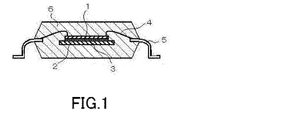
- FIG. 1 is a diagram showing a cross-sectional structure of an example of an electronic component device using a sealing resin composition according to the present invention.
- FIG. 2 is a view showing a cross-sectional structure of an example of a single-side sealed electronic component device using the sealing resin composition according to the present invention.
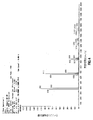
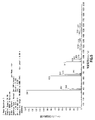
- FIG. 3 is an FD-MS chart of the phenol resin curing agent 1 used in the examples.
- FIG. 4 is an FD-MS chart of the phenol resin curing agent 2 used in the examples.
- FIG. 5 is an FD-MS chart of the phenol resin curing agent 3 used in the examples.
- the total strength is 5% or more with respect to the total relative strength of the entire phenol resin-based curing agent (A).
- the resin composition for sealing excellent in the balance of solder resistance, a flame retardance, continuous moldability, a flow characteristic, and a high temperature storage characteristic can be obtained.
- the electronic component device of the present invention is obtained by sealing an element with a cured product of the above-described sealing resin composition. Thereby, the electronic component apparatus excellent in reliability can be obtained economically.
- the present invention will be described in detail.
- the numerical range represented by “to” includes both the upper limit value and the lower limit value.
- the total relative strength of the polymer component (A-1) satisfying k ⁇ 1 and m ⁇ 1 is preferably 5% or more with respect to the total relative strength of the entire phenol resin-based curing agent (A). .
- R1 and R2 are each independently a hydrocarbon group having 1 to 5 carbon atoms
- R3 is independently a hydrocarbon group having 1 to 10 carbon atoms
- R4 and R5 are independently of each other hydrogen or a hydrocarbon group having 1 to 10 carbon atoms
- a is an integer of 0 to 3
- b is an integer of 2 to 4
- c is an integer of 0 to 2
- d is An integer of 0 to 4.
- k and m are each independently an integer of 0 to 10, and k + m ⁇ 2.k repeating units having a substituted or unsubstituted monovalent hydroxyphenylene structure;
- the m repeating units having a polyvalent hydroxyphenylene structure may be arranged consecutively or may be arranged alternately or randomly, but a substituted or unsubstituted biphenylene group must be present between them.
- the substituted or unsubstituted monovalent hydroxyphenylene structure is the k repeating unit structure in the general formula (1), which has one hydroxyl group and has a substituent other than this hydroxyl group, or has This means a phenylene structure that does not.
- the polyvalent hydroxyphenylene structure is m repeating unit structures in the general formula (1), has 2 to 4 hydroxyl groups, and has no substituent other than these hydroxyl groups. Means.
- k + m ⁇ 1 repeating units having a structure containing a substituted or unsubstituted biphenylene group are k repeating units having a substituted or unsubstituted monovalent hydroxyphenylene structure, and / or Alternatively, it is a linking group that links m repeating units having a polyvalent hydroxyphenylene structure.
- the repeating unit of the substituted or unsubstituted monovalent hydroxyphenylene structure and the repeating unit of the polyvalent hydroxyphenylene structure are located at the terminal of the polymer, either one of the divalent groups Is blocked with hydrogen.
- Examples of the structure in which k repeating units which are substituted or unsubstituted monovalent hydroxyphenylene structures are alternately arranged via a structure containing a substituted or unsubstituted biphenylene group include, for example, a phenol aralkyl type having a biphenylene group.
- a polymer can be mentioned, and the resin composition exhibits excellent flame resistance, low water absorption, and solder resistance. These characteristics are considered to be the effects of a substituted or unsubstituted biphenylene group.
- the phenol resin-based curing agent (A) used in the present invention has a polyvalent hydroxyphenylene structure in addition to the substituted or unsubstituted monovalent hydroxyphenylene structure of the above-mentioned phenol aralkyl type polymer having a biphenylene group. Contains some m repeating units. Due to the presence of this polyhydric hydroxyphenylene structure, the density of phenolic hydroxyl groups is increased. As a result, the reactivity, curability, heat resistance, heat hardness of the resin composition, and high-temperature storage characteristics in electronic component devices such as semiconductor devices are improved. Can be improved.
- the use of the phenol resin-based curing agent (A) suppresses the problem that minute defects of the resin cured product occur in the air vent portion of the mold during continuous molding, and has an effect of improving continuous moldability. . This is because a monovalent hydroxyphenylene group and a polyvalent hydroxyphenylene group coexist in one molecule, resulting in a density of cross-linking points formed by reaction with an epoxy group, which is good at a mold molding temperature. This is presumed to exhibit a high toughness.
- the phenol resin-based curing agent (A) includes k repeating units having a substituted or unsubstituted monovalent hydroxyphenylene structure and m repeating units having a polyvalent hydroxyphenylene structure,
- k repeating units having a substituted or unsubstituted monovalent hydroxyphenylene structure and m repeating units having a polyvalent hydroxyphenylene structure,
- a resin composition with an excellent balance of flow characteristics, solder resistance, flame resistance, heat resistance, high-temperature storage characteristics, and continuous moldability is economical. Can be obtained.
- the phenol resin-based curing agent (A) of the sealing resin composition includes one or more polymers having a structure represented by the general formula (1), and k ⁇ 1, m in the general formula (1).
- the present invention can be preferably applied to various packages including the above-described package for mounting an SiC device or an automotive application, or a package such as TO-220 mounted with a power element such as a power transistor.
- the phenol resin-based curing agent (A) includes a monovalent hydroxyphenylene structural unit represented by a repeating number k and a polyvalent hydroxyphenylene structural unit represented by a repeating number m in the general formula (1).
- FD-MS field desorption mass spectrometry
- the phenol resin-based curing agent (A) has a total relative strength of the polymer component (A-1) in which k ⁇ 1 and m ⁇ 1 in the general formula (1), and the phenol resin-based curing agent (A) as a whole.
- the total relative strength is preferably 5% or more, more preferably 10% or more, and particularly preferably 15% or more. If the total relative strength of the polymer component (A-1) is not less than the above lower limit, the resulting resin composition is excellent in heat resistance and high-temperature storage characteristics, and has sufficient toughness at the molding temperature. It can be excellent in continuous formability.
- the upper limit value of the content ratio of the polymer component (A-1) where k ⁇ 1 and m ⁇ 1 in the general formula (1) is not particularly limited, but the total relative strength is the phenol resin-based curing.
- the total relative strength of the entire agent (A) is preferably 80% or less, more preferably 60% or less, and particularly preferably 45% or less. If the sum of the relative strengths of the polymer component (A-1) is not more than the above upper limit value, it can be excellent in solder resistance.
- the total relative strength is preferably 75% or less, and more preferably 70% or less. If the total relative strength of the polymer component (A-2) is not more than the above upper limit, the resulting resin composition is excellent in flow characteristics and solder resistance, and has sufficient toughness at the molding temperature. It can be excellent in continuous formability.
- the total relative strength of the agent (A) is preferably 20% or more, and more preferably 25% or more. If the total relative strength of the polymer component (A-2) is not less than the above lower limit value, it can be excellent in high temperature storage characteristics.
- the total relative strength of the polymer component (A-3) is not more than the above upper limit, the resulting resin composition can be excellent in heat resistance, high temperature storage characteristics and continuous moldability.
- the total relative strength of the polymer component (A-2) is not less than the above lower limit, solder resistance and fluidity can be improved.
- a sealing resin composition having an excellent balance between characteristics and continuous moldability can be obtained.
- the average value k0 of the repeating number k of the monovalent hydroxyphenylene structural unit and the average value m0 of the repeating number m of the polyvalent hydroxyphenylene structural unit indicate the detection intensity of each polymer in the mass spectrum
- the value obtained by dividing the total detected intensity of the resin-based curing agent (A) by the mass ratio is calculated by dividing the mass ratio by the molecular weight of each polymer to calculate the molar ratio, and the monovalent hydroxy contained in each polymer.
- the values obtained by multiplying the repeating number k of the phenylene structural unit by the repeating number m of the polyvalent hydroxyphenylene structural unit to obtain the total value of k and m are k0 and m0, respectively.
- the ratio between the average value k0 of the repeating number k of monovalent hydroxyphenylene structural units and the average value m0 of the repeating number m of polyvalent hydroxyphenylene structural units (as described above)
- the ratio of the percentage values obtained by k0 / (k0 + m0) * 100 and m0 / (k0 + m0) * 100 using the calculated k0 and m0 but it is 18/82 to 82/18. It is preferably 20/80 to 80/20, more preferably 25/75 to 75/25.
- Resin composition excellent in balance of flow characteristics, solder resistance, flame resistance, heat resistance, high-temperature storage characteristics, and continuous moldability when the ratio of the average number of repeating units of both structural units is in the above range. Can be obtained economically. If k0 / m0 is not more than the above upper limit value, the resulting resin composition has excellent heat resistance and high-temperature storage characteristics, and has sufficient hardness at the molding temperature, and therefore has excellent continuous moldability. Can do. If k0 / m0 is not less than the above lower limit, the resulting resin composition is excellent in flame resistance and fluidity, and has sufficient toughness at the molding temperature, so that it is excellent in continuous moldability. it can.
- the value of k0 is preferably 0.5 to 2.0, more preferably 0.6 to 1.9, still more preferably 0.7 to 1.8.
- the value of m0 is preferably 0.4 to 2.4, more preferably 0.6 to 2.0, and still more preferably 0.7 to 1.9. If the value of k0 is not less than the above lower limit value, the resulting resin composition can be excellent in flame resistance and fluidity. If the value of k0 is not more than the above upper limit value, the resulting resin composition can be excellent in heat resistance, high-temperature storage characteristics and continuous moldability.
- the resulting resin composition is excellent in heat resistance and high-temperature storage characteristics and has sufficient hardness at the molding temperature, so that it can be excellent in continuous moldability. . If the value of m0 is less than or equal to the above upper limit value, the resulting resin composition is excellent in flame resistance and fluidity, and has sufficient toughness at the molding temperature, so that it can be excellent in continuous moldability.
- the total of the average values of k0 and m0 is preferably 2.0 to 3.5, more preferably 2.2 to 2.7, and the total value of the average values of k and m is not less than the above lower limit value. If present, the resulting resin composition can be excellent in heat resistance, continuous moldability, and high-temperature storage characteristics. If the total value of the average values of k and m is not more than the above upper limit value, the resulting resin composition can be excellent in flow characteristics.
- the values of k and m can be obtained by arithmetic calculation considering the relative intensity ratio of FD-MS analysis as a mass ratio, and can also be obtained by H-NMR or C-NMR measurement.
- H-NMR the ratio of (k0 + m0 ⁇ b) to (2k0 + 2m0-1) is determined from the ratio of the signal derived from the hydrogen atom in the hydroxyl group to the signal derived from the hydrogen atom in the aromatic.
- b when the value of b is unknown here, it can obtain
- the values of k0 and m0 can also be obtained by calculating the relative intensity ratio of the FD-MS analysis as a mass ratio.
- R1 and R2 in the phenol resin-based curing agent (A) having the structure represented by the general formula (1) are hydrocarbon groups having 1 to 5 carbon atoms, and may be the same or different from each other. .
- R1 and R2 in the general formula (1) are not particularly limited as long as they have 1 to 5 carbon atoms. If the carbon number of R1 and R2 is 5 or less, the reactivity of the resulting resin composition for sealing is reduced, and there is little fear that moldability is impaired.
- substituents R1 and R2 include methyl, ethyl, propyl, n-butyl, isobutyl, t-butyl, n-pentyl, 2-methylbutyl, 3-methylbutyl, and t-pentyl.
- substituents R1 and R2 are methyl groups, it is preferable in that the balance between curability and hydrophobicity of the resin composition for encapsulating electronic components is excellent.
- A represents the number of substituents R1 bonded on the same benzene ring, and a is an integer of 0 to 3 independently of each other. More preferably, a is 0 to 1.
- c represents the number of substituents R2 bonded to the same benzene ring, and c is an integer of 0 to 2 independently of each other. More preferably, c is 0 to 1.
- B represents the number of hydroxyl groups bonded on the same benzene ring structure, and b is an integer of 2 to 4 independently of each other. More preferably, b is 2 to 3. More preferably, it is 2.
- R3 in the phenol resin-based curing agent (A) having a structure represented by the general formula (1) is a hydrocarbon group having 1 to 10 carbon atoms and may be the same or different from each other. If the number of carbon atoms of the hydrocarbon group is 10 or less, the melt viscosity of the resin composition for encapsulating electronic components is increased, and there is little risk of a decrease in fluidity.
- R3 in the general formula (1) is not particularly limited as long as it has 1 to 10 carbon atoms.
- D
- R4 and R5 in the phenol resin curing agent (A) having the structure represented by the general formula (1) are hydrogen or a hydrocarbon group having 1 to 10 carbon atoms, and may be the same or different from each other. Also good.
- R4 and R5 are hydrocarbon groups, if the number of carbon atoms is 10 or less, the melt viscosity of the resin composition for encapsulating electronic components is increased, and there is little possibility that the fluidity is lowered.
- R4 and R5 in the general formula (1) are hydrocarbon groups, the number of carbon atoms is not particularly limited as long as it is 1 to 10.
- X represents a hydroxyl group, a halogen atom, or an alkoxy group having 1 to 6 carbon atoms.
- R3, R4, R5, and d conform to the description of general formula (1).
- R6 and R7 are each independently hydrogen or a hydrocarbon group having 1 to 9 carbon atoms, and the total carbon number of R6 and R7 is 0 to 9.
- R3, R4 And d are based on the description of the general formula (1).
- examples of the halogen atom include a fluorine atom, a chlorine atom, a bromine atom, and an iodine atom.
- alkoxy group having 1 to 6 carbon atoms examples include methoxy group, ethoxy group, propoxy group, n-butoxy group, isobutoxy group, t-butoxy group, n-pentoxy group, 2-methylbutoxy group, 3-methylbutoxy group, t-pentoxy group, n-hexoxy group, 1-methylpentoxy group, 2-methylpentoxy group, 3-methylpentoxy group, 4-methylpentoxy group, 2,2-dimethylbutoxy group, 2,3- Dimethylbutoxy group, 2,4-dimethylbutoxy group, 3,3-dimethylbutoxy group, 3,4-dimethylbutoxy group, 4,4-dimethylbutoxy group, 2-ethylbutoxy group, 1-ethylbutoxy group, etc. Can be mentioned.
- CR6R7 alkylidene group in the compound represented by the general formula (3) used for the production of the phenol resin-based curing agent (A) includes a methylidene group, an ethylidene group, a propylidene group, an n-butylidene group, and an isobutylidene group.
- T-butylidene group T-butylidene group, n-pentylidene group, 2-methylbutylidene group, 3-methylbutylidene group, t-pentylidene group, n-hexylidene group, 1-methylpentylidene group, 2-methylpentylidene group, 3 -Methylpentylidene group, 4-methylpentylidene group, 2,2-dimethylbutylidene group, 2,3-dimethylbutylidene group, 2,4-dimethylbutylidene group, 3,3-dimethylbutylidene group, 3 , 4-dimethylbutylidene group, 4,4-dimethylbutylidene group, 2-ethylbutylidene group, 1-ethylbutylidene group, and cycl Hexylidene group, and the like.
- the biphenylene compound used for the production of the phenol resin-based curing agent (A) is not particularly limited as long as it is a chemical structure represented by the general formula (2) or (3).
- Le-4,4'-bis-methoxymethyl-biphenyl and the like, but not limited thereto. These may be used alone or in combination of two or more. Among these, 4-bismethoxymethylbiphenyl is preferred from the viewpoint that synthesis is possible at a relatively low temperature, and reaction by-products are easily distilled off and handled, and is generated due to the presence of a small amount of moisture. 4,4′-bischloromethylbiphenyl is preferred in that the hydrogen halide to be used can be used as an acid catalyst.
- the monohydric phenol compound used in the production of the phenol resin-based curing agent (A) is not particularly limited as long as it has a chemical structure represented by the general formula (4).
- phenol, o-cresol, p-cresol , M-cresol phenylphenol, ethylphenol, n-propylphenol, isopropylphenol, t-butylphenol, xylenol, methylpropylphenol, methylbutylphenol, dipropylphenol, dibutylphenol, nonylphenol, mesitol, 2,3,5-trimethyl
- Examples include phenol, 2,3,6-trimethylphenol, but are not limited thereto. These may be used alone or in combination of two or more.
- phenol and o-cresol are preferable, and phenol is more preferable from the viewpoint of reactivity with the epoxy resin.
- these phenol compounds may be used alone or in combination of two or more.
- curing agent (A) is not specifically limited, For example, resorcinol, catechol, hydroquinone, phloroglucinol, pyrogallol, 1, 2 , 4-benzenetriol, and the like. These may be used alone or in combination of two or more. These may be used alone or in combination of two or more. Among these, resorcinol and hydroquinone are more preferable from the viewpoint of the reactivity of the resin composition, and resorcinol is more preferable from the viewpoint that the phenol resin-based curing agent (A) can be synthesized at a relatively low temperature.
- the acidic catalyst used for the production of the phenol resin curing agent (A) is not particularly limited.
- X and Y in the compound represented by the general formula (2) are halogen atoms, the hydrogen halide produced as a by-product during the reaction acts as an acidic catalyst. There is no need to add, and the reaction can be started quickly by adding a small amount of water.
- the method for synthesizing the phenol resin curing agent (A) used in the present invention is not particularly limited.
- the biphenylene compound is 0.05 to 0 per 1 mol of the total of the monohydric phenol compound and polyhydric phenol compound. 8 mol, 0.01 to 0.05 mol of acidic catalyst at a temperature of 80 to 170 ° C., reacting for 1 to 20 hours while discharging the generated gas and moisture out of the system by nitrogen flow, and remains after completion of the reaction It can be obtained by distilling off unreacted monomers (for example, benzyl compound or dihydroxynaphthalene compound), reaction by-products (for example, hydrogen halide, methanol) and catalyst by a method such as vacuum distillation or steam distillation.
- unreacted monomers for example, benzyl compound or dihydroxynaphthalene compound
- reaction by-products for example, hydrogen halide, methanol
- the monohydric phenol compound is preferably 15 to 85 mol% with respect to the total amount of the monohydric phenol compound and polyhydric phenol compound being 100 mol%, more
- the content is preferably 20 to 80%, and more preferably 25 to 75 mol%. If the blending ratio of the monohydric phenol compound is not more than the above upper limit value, the resulting resin composition is excellent in heat resistance and high-temperature storage characteristics and has sufficient hardness at the molding temperature, and therefore has excellent continuous moldability. can do.
- the blending ratio of the monohydric phenol compound is not less than the above lower limit value, an increase in raw material cost can be suppressed, and the resulting resin composition has excellent flow characteristics, solder resistance and flame resistance, and is sufficient at the molding temperature. Since it has toughness, it can be excellent in continuous formability. Sealing with excellent balance of flow characteristics, solder resistance, flame resistance, heat resistance, high-temperature storage characteristics, and continuous moldability by adjusting the blending ratio of the two phenol compounds as described above. The resin composition for use can be obtained economically.
- the average value (k0, m0) of k and m, the ratio, and the total value can be adjusted as follows.
- the average value (k0, m0) of k and m of the phenol resin curing agent (A) reflects the blending ratio of the monohydric phenol compound and polyhydric phenol compound used in the synthesis, so the blending ratio at the time of synthesis is By adjusting, the ratio of the average values (k0, m0) of k and m can be adjusted.
- the compounding quantity of a biphenylene compound is increased, an acidic catalyst is increased, reaction temperature is raised, etc.
- the total value of the average values (k0, m0) of k and m can be increased.
- the average value (k0, m0) of k and m can be adjusted by appropriately combining the above adjustment methods.
- the blending amount of the biphenylene compound is reduced, the blending amount of the acid catalyst is reduced, and when hydrogen halide gas is generated, this is replaced with nitrogen.
- a method of reducing the production of high molecular weight components by a method such as expelling out of the system quickly by an air flow or lowering the reaction temperature can be used.
- the progress of the reaction is caused by the generation of hydrogen halide or alcohol gas produced as a by-product in the reaction of the general formula (2) with the monohydric phenol compound and / or polyhydric phenol compound, or the product during the reaction.
- the molecular weight can be confirmed by gel permeation chromatography.
- the lower limit of the hydroxyl equivalent of the phenol resin-based curing agent (A) is not particularly limited, but is preferably 90 g / eq or more, more preferably 100 g / eq or more. If it is more than the said lower limit, the resin composition obtained shall be excellent in continuous moldability and heat resistance.
- the upper limit of the hydroxyl group equivalent of the phenol resin-based curing agent (A) is preferably 190 g / eq or less, more preferably 180 g / eq or less, and still more preferably 170 g / eq or less. If it is below the said upper limit, the resin composition obtained will be excellent in heat resistance, a high temperature storage characteristic, and continuous moldability.
- the upper limit of the softening point of the phenol resin-based curing agent (A) is not particularly limited, but is preferably 110 ° C. or lower, and more preferably 105 ° C. or lower. If it is below the said upper limit, the resin composition obtained can be heat-melted rapidly at the time of manufacture of a resin composition, and shall be excellent in productivity.
- curing agent (A) 55 degreeC or more is preferable and 60 degreeC or more is more preferable. If it is more than the said lower limit, the obtained resin composition cannot be blocked easily and can be excellent in continuous moldability.
- curing agent (A) it is preferable that it is 0.5 mass% or more and 10 mass% or less with respect to all the resin compositions, and it is 2 mass% or more and 8 mass% or less. Is more preferably 4% by mass or more and 7.5% by mass or less. If it is in the said range, the resin composition obtained shall be excellent in balance of sclerosis
- the resin composition for semiconductor encapsulation of the present invention can be used in combination with other curing agents as long as the effect of using the phenol resin curing agent (A) is not impaired.
- curing agent which can be used together,
- curing agent etc. can be mentioned.
- polyaddition type curing agent examples include aliphatic polyamines such as diethylenetriamine, triethylenetetramine, and metaxylenediamine, aromatic polyamines such as diaminodiphenylmethane, m-phenylenediamine, and diaminodiphenylsulfone, dicyandiamide, and organic acid dihydrazide.
- aliphatic polyamines such as diethylenetriamine, triethylenetetramine, and metaxylenediamine
- aromatic polyamines such as diaminodiphenylmethane, m-phenylenediamine, and diaminodiphenylsulfone, dicyandiamide, and organic acid dihydrazide.
- Polyamine compounds including: Acids including alicyclic acid anhydrides such as hexahydrophthalic anhydride and methyltetrahydrophthalic anhydride, aromatic acid anhydrides such as trimellitic anhydride, pyromellitic anhydride, and benzophenonetetracarboxylic acid Anhydrides; Polyphenol compounds such as novolak-type phenol resins and phenol polymers; Polymercaptan compounds such as polysulfides, thioesters and thioethers; Isocyanate compounds such as isocyanate; and organic acids such as carboxylic acid-containing polyester resins.
- Acids including alicyclic acid anhydrides such as hexahydrophthalic anhydride and methyltetrahydrophthalic anhydride, aromatic acid anhydrides such as trimellitic anhydride, pyromellitic anhydride, and benzophenonetetracarboxylic acid Anhydrides; Polyphenol compounds such as novolak-type phenol resins and
- catalyst-type curing agent examples include tertiary amine compounds such as benzyldimethylamine and 2,4,6-trisdimethylaminomethylphenol; imidazole compounds such as 2-methylimidazole and 2-ethyl-4-methylimidazole; Examples include Lewis acids such as BF 3 complex.
- condensation type curing agent examples include phenolic resin-based curing agents such as novolak type phenolic resin and resol type phenolic resin; urea resin such as methylol group-containing urea resin; melamine resin such as methylol group-containing melamine resin, and the like. Can be mentioned.
- a phenol resin-based curing agent is preferable from the viewpoint of balance of flame resistance, moisture resistance, electrical characteristics, curability, storage stability, and the like.
- the phenol resin-based curing agent is a monomer, oligomer, or polymer in general having two or more phenolic hydroxyl groups in one molecule, and its molecular weight and molecular structure are not particularly limited.
- phenol novolak resin cresol novolak Resin, novolak resin such as naphthol novolak resin; polyfunctional phenol resin such as triphenolmethane phenol resin; modified phenol resin such as terpene modified phenol resin and dicyclopentadiene modified phenol resin; phenylene skeleton and / or biphenylene skeleton
- Aralkyl resins such as phenol aralkyl resins having phenylene and / or naphthol aralkyl resins having a biphenylene skeleton; bisphenol compounds such as bisphenol A and bisphenol F
- the hydroxyl equivalent is preferably 90 g / eq or more and 250 g / eq or less from the viewpoint of curability.
- the blending ratio of the phenol resin curing agent (A) is preferably 25% by mass or more and 35% by mass or more with respect to the total curing agent. It is more preferable, and it is especially preferable that it is 45 mass% or more. When the blending ratio is within the above range, it is possible to obtain the effect of improving the flame resistance and high temperature storage characteristics while maintaining good continuous formability.
- the lower limit of the blending ratio of the entire curing agent is not particularly limited, but is preferably 0.8% by mass or more and more preferably 1.5% by mass or more in the entire resin composition. When the lower limit value of the blending ratio is within the above range, sufficient fluidity can be obtained.
- the upper limit of the blending ratio of the entire curing agent is not particularly limited, but is preferably 10% by mass or less, and more preferably 8% by mass or less in the entire resin composition. When the upper limit of the blending ratio is within the above range, good solder resistance can be obtained.
- the epoxy resin (B) used in the resin composition for encapsulating a semiconductor of the present invention has a function of curing the resin composition by cross-linking them with a phenol resin curing agent (A).
- a phenol resin curing agent (A) examples include crystalline epoxy resins such as biphenyl type epoxy resins, bisphenol type epoxy resins, stilbene type epoxy resins, sulfide type epoxy resins, dihydroxyanthracene type epoxy resins; and methoxynaphthalene skeleton-containing novolaks.
- Type epoxy resin phenol novolac type epoxy resin, cresol novolak type epoxy resin, and other novolak type epoxy resins; resins obtained by condensing aromatic hydrocarbons with formaldehyde are modified with phenol and then epoxidized.
- Aromatic hydrocarbon-formaldehyde resin type epoxy resin triphenolmethane type epoxy resin, alkyl-modified triphenolmethane type epoxy resin, tetrakishydroxyphenylethane type epoxy resin
- Polyfunctional epoxy resins such as resins; phenol aralkyl type epoxy resins having a phenylene skeleton, aralkyl type epoxy resins such as a phenol aralkyl type epoxy resin having a biphenylene skeleton; dihydroxynaphthalene type epoxy resin, dihydroxy naphthalene dimer is glycidyl etherified Naphthol type epoxy resins such as epoxy resins obtained; triazine nucleus-containing epoxy resins such as triglycidyl
- a crystalline epoxy resin is preferable in terms of excellent fluidity, and a polyfunctional epoxy resin is preferable in terms of good high temperature storage characteristics (HTSL) and slight contamination of the mold in continuous molding, and a phenolphthalein type epoxy resin. Is preferable in terms of excellent balance of flame resistance, high temperature storage characteristics (HTSL), and solder resistance even when the inorganic filler content is low.
- Epoxy resins such as aralkyl epoxy resins such as epoxy resins and phenol-modified aromatic hydrocarbon-formaldehyde resin epoxy resins are preferred because of their excellent solder resistance.
- Naphthol epoxy resins and methoxynaphthalene skeleton-containing novolak epoxy resins Naphthale in molecules such as Epoxy resins having a skeleton is preferable from the viewpoint of excellent balance of flame resistance and high-temperature storage characteristics (HTSC).
- the epoxy resin (B) may contain a polymer represented by the following general formula (B1) as one kind of a phenol aralkyl type epoxy resin having a biphenylene skeleton.
- the epoxy group density is improved by including p repeating units that are monovalent glycidylated phenylene structures and q repeating units that are polyvalent glycidylated phenylene structures. Can do. Therefore, the crosslink density of the hardened
- Tg glass transition temperature
- R1 and R2 are each independently a hydrocarbon group having 1 to 5 carbon atoms
- R3 is independently a hydrocarbon group having 1 to 10 carbon atoms
- R4 and R5 are independently of each other hydrogen or a hydrocarbon group having 1 to 10 carbon atoms
- a is an integer of 0 to 3
- b is an integer of 2 to 4
- c is an integer of 0 to 2
- d is An integer of 0 to 4.
- p and q are each independently an integer of 0 to 10 and p + q ⁇ 2.
- q repeating units of a polyglycidylated phenylene structure may be arranged consecutively or alternately or randomly, but each must be substituted or unsubstituted biphenylene.
- R1 and R2 each independently represent a hydrogen atom or a hydrocarbon group having 1 to 5 carbon atoms.
- R1 and R2 are hydrocarbon groups, if the number of carbons is 5 or less, it is possible to reliably prevent the reactivity of the resulting resin composition from decreasing and moldability from being impaired. .
- examples of the substituents R1 and R2 include a methyl group, an ethyl group, a propyl group, an n-butyl group, an isobutyl group, a t-butyl group, an n-pentyl group, a 2-methylbutyl group, and 3-methylbutyl.
- Group, t-pentyl group and the like are preferable. Thereby, the balance between curability and hydrophobicity of the resin composition can be made particularly excellent.
- A represents the number of substituents R1 bonded on the same benzene ring, and a is an integer of 0 to 3 independently of each other. More preferably, a is 0 to 1.
- c represents the number of substituents R2 bonded to the same benzene ring, and c is an integer of 0 to 2 independently of each other. More preferably, c is 0 to 1.
- B represents the number of glycidyl ether groups bonded on the same benzene ring structure, and b is an integer of 2 to 4 independently of each other. More preferably, b is 2 to 3. More preferably, it is 2.
- R3 is a hydrocarbon group having 1 to 10 carbon atoms, which may be the same as or different from each other.
- the number of carbon atoms of the hydrocarbon group is 10 or less, the melt viscosity of the encapsulating resin composition is increased, and there is little fear that the fluidity is lowered.
- R3 in the general formula (1) is not particularly limited as long as it has 1 to 10 carbon atoms.
- D
- R4 and R5 are hydrogen or a hydrocarbon group having 1 to 10 carbon atoms and may be the same or different from each other.
- R4 and R5 are hydrocarbon groups, if the carbon number is 10 or less, the melt viscosity of the encapsulating resin composition becomes high, and there is little fear of lowering the fluidity.
- R4 and R5 in the general formula (1) are hydrocarbon groups, the number of carbon atoms is not particularly limited as long as it is 1 to 10.
- the epoxy resin (B) represented by the general formula (B1) includes a glycidylated phenyl group having one glycidyl ether group and a glycidylated phenyl group having a plurality of glycidyl ether groups. Yes.
- the resin composition has excellent flame retardancy, low water absorption, and solder resistance by having a glycidylated phenyl group having one glycidyl ether group. be able to.
- the density of the glycidyl ether group can be increased by including a glycidyl phenyl group having a plurality of glycidyl ether groups, and as a result, a cured product of the resin composition. (Tg) increases.
- increasing the density of the glycidyl ether group generally tends to deteriorate the weight reduction rate.
- the cross-linked product of the phenol resin-based curing agent (A) and the epoxy resin (B) represented by the general formula (B1) has a methylene group portion linking the biphenyl skeleton and the monovalent or divalent phenol. Since it is presumed to be protected by the bulkiness, it is relatively difficult to undergo thermal decomposition, and it is considered that the weight reduction rate is difficult to deteriorate as Tg increases.
- p which is the number of glycidylated phenyl groups having one glycidyl ether group, is preferably such that the average value p0 of p of each polymer is 0 or more and 2.0 or less. It is more preferably 5 or more and 1.8 or less, and further preferably 0.6 or more and 1.6 or less. If the value of p0 is more than the said lower limit, the resin composition obtained can be made excellent in flame retardancy and fluidity. If the value of p0 is not more than the above upper limit value, the obtained resin composition can be excellent in heat resistance and moldability.
- q which is the number of glycidylated phenyl groups having a plurality of glycidyl ether groups, is preferably such that the average value q0 of q of each polymer is 0.4 or more and 3.6 or less, It is more preferably 0.6 or more and 2.0 or less, and further preferably 0.8 or more and 1.9 or less. If the value of q0 is not less than the above lower limit value, the resulting resin composition is excellent in heat resistance and has sufficient hardness at the molding temperature, so that it can be excellent in moldability. If the value of q0 is less than or equal to the above upper limit value, the resulting resin composition is excellent in flame retardancy and fluidity, and has sufficient toughness at the molding temperature, so that it can be excellent in moldability.
- p0 / q0 which is a value of the ratio of p0 and q0 is preferably 0/100 to 82/18, more preferably 20/80 to 80/20, and 25/75 to 75/25. More preferably.
- p0 / q0 is in the above range, a resin composition having an excellent balance of flow characteristics, solder resistance, flame retardancy, heat resistance and moldability can be obtained economically.
- p0 / q0 is below the said upper limit, since the obtained resin composition is excellent in heat resistance and has sufficient hardness at a molding temperature, it can be excellent in moldability.
- the sum of p0 and q0 is preferably 2.0 or more and 3.6 or less, and more preferably 2.2 or more and 2.7 or less. If (p0 + q0) is not less than the above lower limit, the resulting resin composition can be excellent in heat resistance and moldability. If (p0 + q0) is not more than the above upper limit value, the resulting resin composition can be made excellent in flow characteristics.
- the values of p and q can be obtained by calculating the relative intensity ratio measured by FD-MS analysis as a mass ratio. Furthermore, it can be determined by H-NMR or C-NMR measurement.
- the epoxy resin represented by the general formula (B1) as described above can be produced, for example, as follows.
- the phenol resin-based curing agent (A) represented by the general formula (1) is prepared, and the hydroxyl group included in the phenol resin-based curing agent (A) is reacted with epichlorohydrin to replace the glycidyl ether group.
- the method of obtaining the epoxy resin represented by the said general formula (B1) by this is mentioned.
- an excess of epichlorohydrin is added to the phenol resin curing agent (A) represented by the general formula (1).
- the temperature is preferably 50 to 150 ° C., more preferably 60 to 120 ° C., and preferably about 1 to 10 hours. React.
- excess epichlorohydrin is distilled off, the residue is dissolved in an organic solvent such as methyl isobutyl ketone, filtered, washed with water to remove inorganic salts, and then the epoxy resin is distilled off. The method of obtaining is mentioned.
- the amount of epichlorohydrin added is preferably set to about 2 to 15 times mol, more preferably about 2 to 10 times mol, based on the hydroxyl equivalent of the phenol resin-based curing agent.
- the addition amount of the alkali metal hydroxide is preferably set to about 0.8 to 1.2 times mol with respect to the hydroxyl group equivalent of the phenol resin curing agent, preferably 0.9 to 1.1 times. More preferably, it is set to about a mole.
- the upper limit value and the lower limit value of the epoxy equivalent of the epoxy resin (B) represented by the general formula (B1) are the hydroxyl groups of the phenol resin-based curing agent (A) represented by the general formula (1).
- a value derived from a theoretical value in the case of substitution with an ether group is preferable, but when epoxidation is partially unreacted, the effect of the present invention can be exhibited if it is 85% or more of the theoretical value. It is.
- the lower limit value of the epoxy equivalent of the epoxy resin represented by the general formula (B1) is preferably set to 150 g / eq or more, more preferably 170 g / eq or more.
- the upper limit of the epoxy equivalent is preferably 290 g / eq or less, more preferably 260 g / eq or less, and still more preferably 240 g / eq or less.
- Na ions and Cl ions as ionic impurities are not contained as much as possible.
- the compounding amount of the epoxy resin (B) in the resin composition for semiconductor encapsulation is preferably 2% by mass or more, more preferably 4% by mass or more, based on the total mass of the resin composition for semiconductor encapsulation. is there.
- the resulting resin composition has good fluidity.
- the amount of the epoxy resin in the resin composition for semiconductor encapsulation is preferably 15% by mass or less, more preferably 13% by mass or less, with respect to the total mass of the resin composition for semiconductor encapsulation.
- the upper limit is within the above range, the resulting resin composition has good solder resistance.
- the phenol resin curing agent and the epoxy resin have an equivalent ratio (EP) / (OH) of the number of epoxy groups (EP) of all epoxy resins and the number of phenolic hydroxyl groups (OH) of all phenol resin curing agents. , 0.8 or more and 1.3 or less are preferable. When the equivalent ratio is within the above range, sufficient curing characteristics can be obtained when the resulting resin composition is molded.
- inorganic filler (C) As the inorganic filler (C) used in the sealing resin composition of the present invention, inorganic fillers generally used in the field can be used. Examples thereof include fused silica, spherical silica, crystalline silica, alumina, silicon nitride, and aluminum nitride.
- the particle size of the inorganic filler (C) is desirably 0.01 ⁇ m or more and 150 ⁇ m or less from the viewpoint of filling properties in the mold cavity.
- the lower limit of the amount of the inorganic filler (C) in the sealing resin composition is preferably 70% by mass or more, more preferably 78% by mass or more, with respect to the total mass of the sealing resin composition. More preferably, it is 81 mass% or more.
- the lower limit is within the above range, an increase in moisture absorption and a decrease in strength due to curing of the resulting resin composition can be reduced, and thus a cured product having good solder crack resistance can be obtained. In addition, there is little risk of causing molding defects due to resin clogging on the mold gate side during continuous molding.
- the upper limit of the amount of the inorganic filler (C) in the sealing resin composition is preferably 93% by mass or less, more preferably 91% by mass with respect to the total mass of the sealing resin composition. % Or less, and more preferably 90% by mass or less.
- the upper limit is within the above range, the resulting resin composition has good fluidity and good moldability.
- inorganic flame retardants such as metal hydroxides such as aluminum hydroxide and magnesium hydroxide, zinc borate, zinc molybdate and antimony trioxide described later, these inorganic flame retardants and the above It is desirable that the total amount of the inorganic filler is within the above range.
- the stopping resin composition of the present invention may contain a curing accelerator (D).
- the curing accelerator (D) may be any one that accelerates the reaction between the epoxy group of the epoxy resin (B) and the hydroxyl group of the phenol resin curing agent (A), and a generally used curing accelerator may be used. it can.
- the curing accelerator (D) include phosphorus atom-containing compounds such as organic phosphines, tetra-substituted phosphonium compounds, phosphobetaine compounds, adducts of phosphine compounds and quinone compounds, and adducts of phosphonium compounds and silane compounds; And nitrogen atom-containing compounds such as 1,8-diazabicyclo (5,4,0) undecene-7, benzyldimethylamine and 2-methylimidazole.
- phosphorus atom-containing compounds such as organic phosphines, tetra-substituted phosphonium compounds, phosphobetaine compounds, adducts of phosphine compounds and quinone compounds, and adducts of phosphonium compounds and silane compounds
- nitrogen atom-containing compounds such as 1,8-diazabicyclo (5,4,0) undecene-7, benzyldimethylamine and 2-methylimidazole.
- a phosphorus atom-containing compound is preferable from the viewpoint of curability, and an adduct of a phosphobetaine compound and a phosphine compound and a quinone compound is particularly preferable from the viewpoint of solder resistance and fluidity.
- Phosphorus atom-containing compounds such as tetra-substituted phosphonium compounds and adducts of phosphonium compounds and silane compounds, are particularly preferred in that they are mildly contaminated.
- Examples of the organic phosphine that can be used in the sealing resin composition of the present invention include a first phosphine such as ethylphosphine and phenylphosphine; a second phosphine such as dimethylphosphine and diphenylphosphine; trimethylphosphine, triethylphosphine, and tributylphosphine. And a third phosphine such as triphenylphosphine.
- Examples of the tetra-substituted phosphonium compound that can be used in the sealing resin composition of the present invention include compounds represented by the following general formula (6).
- P represents a phosphorus atom.
- R8, R9, R10, and R11 represent an aromatic group or an alkyl group.
- A is a functional group chosen from a hydroxyl group, a carboxyl group, and a thiol group.
- X and y are integers of 1 to 3
- z is an integer of 0 to 3
- x y.
- the compound represented by the general formula (6) is obtained, for example, as follows, but is not limited thereto. First, a tetra-substituted phosphonium halide, an aromatic organic acid and a base are mixed in an organic solvent and mixed uniformly to generate an aromatic organic acid anion in the solution system. Then, when water is added, the compound represented by the general formula (6) can be precipitated.
- R7, R8, R9 and R10 bonded to the phosphorus atom are phenyl groups
- AH is a compound having a hydroxyl group in an aromatic ring, that is, phenols
- the phenols include monocyclic phenols such as phenol, cresol, resorcin, and catechol, condensed polycyclic phenols such as naphthol, dihydroxynaphthalene, and anthraquinol, and bisphenols such as bisphenol A, bisphenol F, and bisphenol S. And polycyclic phenols such as phenylphenol and biphenol.
- Examples of the phosphobetaine compound that can be used in the encapsulating resin composition of the present invention include compounds represented by the following general formula (7).
- X1 represents an alkyl group having 1 to 3 carbon atoms
- Y1 represents a hydroxyl group
- e is an integer of 0 to 5
- f is an integer of 0 to 3.
- the compound represented by the general formula (7) is obtained, for example, as follows. First, it is obtained through a step of bringing a triaromatic substituted phosphine, which is a third phosphine, into contact with a diazonium salt and replacing the triaromatic substituted phosphine with a diazonium group of the diazonium salt.
- a triaromatic substituted phosphine which is a third phosphine
- the present invention is not limited to this.
- Examples of the adduct of a phosphine compound and a quinone compound that can be used in the sealing resin composition of the present invention include compounds represented by the following general formula (8).
- P represents a phosphorus atom.
- R12, R13 and R14 represent an alkyl group having 1 to 12 carbon atoms or an aryl group having 6 to 12 carbon atoms, and may be the same as each other
- R15, R16 and R17 each represent a hydrogen atom or a hydrocarbon group having 1 to 12 carbon atoms, and may be the same or different from each other, and R15 and R16 are bonded to form a cyclic structure. May be.
- Examples of the phosphine compound used as an adduct of a phosphine compound and a quinone compound include an aromatic ring such as triphenylphosphine, tris (alkylphenyl) phosphine, tris (alkoxyphenyl) phosphine, trinaphthylphosphine, and tris (benzyl) phosphine.
- aromatic ring such as triphenylphosphine, tris (alkylphenyl) phosphine, tris (alkoxyphenyl) phosphine, trinaphthylphosphine, and tris (benzyl) phosphine.
- Those having a substituent or a substituent such as an alkyl group or an alkoxyl group are preferred.
- Examples of the substituent such as an alkyl group and an alkoxyl group include those having 1 to 6 carbon atoms. From the viewpoint of availability, tripheny
- examples of the quinone compound used for the adduct of the phosphine compound and the quinone compound include o-benzoquinone, p-benzoquinone and anthraquinones, and among them, p-benzoquinone is preferable from the viewpoint of storage stability.
- the adduct can be obtained by contacting and mixing in a solvent capable of dissolving both organic tertiary phosphine and benzoquinone.
- the solvent is preferably a ketone such as acetone or methyl ethyl ketone, which has low solubility in the adduct.
- the present invention is not limited to this.
- R11, R12 and R13 bonded to the phosphorus atom are phenyl groups, and R14, R15 and R16 are hydrogen atoms, that is, 1,4-benzoquinone and triphenyl
- R11, R12 and R13 bonded to the phosphorus atom are phenyl groups
- R14, R15 and R16 are hydrogen atoms, that is, 1,4-benzoquinone and triphenyl
- a compound to which phosphine has been added is preferred in that it reduces the thermal modulus of the cured product of the encapsulating resin composition.
- Examples of the adduct of a phosphonium compound and a silane compound that can be used in the sealing resin composition of the present invention include compounds represented by the following general formula (9).
- P represents a phosphorus atom and Si represents a silicon atom.
- R18, R19, R20 and R21 are each an organic group having an aromatic ring or a heterocyclic ring, or an aliphatic group.
- X2 is an organic group bonded to the groups Y2 and Y3, where X3 is an organic group bonded to the groups Y4 and Y5.
- Y3 represent a group formed by releasing a proton from a proton donating group, and groups Y2 and Y3 in the same molecule are bonded to a silicon atom to form a chelate structure, and Y4 and Y5 are proton donating groups.
- the group represents a group formed by releasing a proton, and the groups Y4 and Y5 in the same molecule are bonded to a silicon atom to form a chelate structure.
- X2 and X3 are the same or different from each other.
- Well Y2, Y3, Y4, and Y5 is .Z1 which may be the same or different from each other is an organic group or an aliphatic group, an aromatic ring or a heterocyclic ring.
- R18, R19, R20 and R21 for example, phenyl group, methylphenyl group, methoxyphenyl group, hydroxyphenyl group, naphthyl group, hydroxynaphthyl group, benzyl group, methyl group, ethyl group, n-butyl group, n-octyl group, cyclohexyl group, and the like.
- an aromatic group having a substituent such as phenyl group, methylphenyl group, methoxyphenyl group, hydroxyphenyl group, hydroxynaphthyl group, or the like.
- a substituted aromatic group is more preferred.
- X2 is an organic group that binds to Y2 and Y3.
- X3 is an organic group bonded to the groups Y4 and Y5.
- Y2 and Y3 are groups formed by proton-donating groups releasing protons, and groups Y2 and Y3 in the same molecule are combined with a silicon atom to form a chelate structure.
- Y4 and Y5 are groups formed by proton-donating groups releasing protons, and groups Y4 and Y5 in the same molecule are combined with a silicon atom to form a chelate structure.
- the groups X2 and X3 may be the same or different from each other, and the groups Y2, Y3, Y4, and Y5 may be the same or different from each other.
- the groups represented by -Y2-X2-Y3- and -Y4-X3-Y5- in general formula (9) are composed of groups in which a proton donor releases two protons.
- a proton donor an organic acid having at least two carboxyl groups or hydroxyl groups in the molecule is preferable, and further an aromatic having at least two carboxyl groups or hydroxyl groups on the carbon constituting the adjacent aromatic ring.
- Aromatic compounds are preferred, and aromatic compounds having at least two hydroxyl groups on the carbon constituting the aromatic ring are more preferred.
- catechol pyrogallol, 1,2-dihydroxynaphthalene, 2,3-dihydroxynaphthalene, 2,2′- Biphenol, 1,1'-bi-2-naphthol, salicylic acid, 1-hydroxy-2-naphthoic acid, 3-hydroxy-2-naphth
- examples include ethanoic acid, chloranilic acid, tannic acid, 2-hydroxybenzyl alcohol, 1,2-cyclohexanediol, 1,2-propanediol and glycerin.
- catechol, 1,2-dihydroxynaphthalene, 2 1,3-dihydroxynaphthalene is more preferred.
- Z1 in the general formula (9) represents an organic group or an aliphatic group having an aromatic ring or a heterocyclic ring. Specific examples thereof include a methyl group, an ethyl group, a propyl group, a butyl group, and a hexyl group.
- Reactions such as aliphatic hydrocarbon groups such as octyl group and aromatic hydrocarbon groups such as phenyl group, benzyl group, naphthyl group and biphenyl group, glycidyloxypropyl group, mercaptopropyl group, aminopropyl group and vinyl group Among them, a methyl group, an ethyl group, a phenyl group, a naphthyl group, and a biphenyl group are more preferable from the viewpoint of thermal stability.
- a silane compound such as phenyltrimethoxysilane and a proton donor such as 2,3-dihydroxynaphthalene are added to a flask containing methanol, and then dissolved.
- Sodium methoxide-methanol solution is added dropwise with stirring.
- crystals are precipitated. The precipitated crystals are filtered, washed with water, and vacuum dried to obtain an adduct of a phosphonium compound and a silane compound.
- the blending ratio of the curing accelerator (D) that can be used in the sealing resin composition of the present invention is more preferably 0.1% by mass or more and 1% by mass or less in the total resin composition.
- the blending ratio of the curing accelerator (D) is within the above range, sufficient curability can be obtained.
- liquidity can be obtained as the mixture ratio of a hardening accelerator (D) exists in the said range.
- a compound (E) in which a hydroxyl group is bonded to each of two or more adjacent carbon atoms constituting an aromatic ring can be used.
- this compound (E) hereinafter also referred to as “compound (E)” in which a hydroxyl group is bonded to two or more adjacent carbon atoms constituting the aromatic ring
- a phenol resin-based curing agent Even when a phosphorus atom-containing curing accelerator having no latency is used as a curing accelerator for promoting the crosslinking reaction between A) and the epoxy resin (B), the reaction during the melt-kneading of the resin composition Can be suppressed.
- the compound (E) has the effect of lowering the melt viscosity of the encapsulating resin composition and improving the fluidity, and also has the effect of improving the solder resistance, although the detailed mechanism is unknown.
- a monocyclic compound represented by the following general formula (10) or a polycyclic compound represented by the following general formula (11) can be used. It may have a substituent.
- one of R22 and R26 is a hydroxyl group, and when one is a hydroxyl group, the other is a hydrogen atom, a hydroxyl group or a substituent other than a hydroxyl group.
- R23, R24 and R25 are hydrogen. An atom, a hydroxyl group or a substituent other than a hydroxyl group.
- R27 and R33 are hydroxyl group, and when one is a hydroxyl group, the other is a hydrogen atom, a hydroxyl group or a substituent other than a hydroxyl group.
- R28, R29, R30, R31 is a hydrogen atom, a hydroxyl group or a substituent other than a hydroxyl group.
- the monocyclic compound represented by the general formula (10) include catechol, pyrogallol, gallic acid, gallic acid ester, and derivatives thereof.
- Specific examples of the polycyclic compound represented by the general formula (11) include 1,2-dihydroxynaphthalene, 2,3-dihydroxynaphthalene and derivatives thereof.
- a compound in which a hydroxyl group is bonded to each of two adjacent carbon atoms constituting an aromatic ring is preferable because of easy control of fluidity and curability.
- the mother nucleus is a compound having a low volatility and a highly stable weighing naphthalene ring.
- the compound (E) can be a compound having a naphthalene ring such as 1,2-dihydroxynaphthalene, 2,3-dihydroxynaphthalene and derivatives thereof.
- These compounds (E) may be used individually by 1 type, or may use 2 or more types together.
- the compounding ratio of the compound (E) is preferably 0.01% by mass or more and 1% by mass or less, more preferably 0.03% by mass or more and 0.8% by mass in the total sealing resin composition. % Or less, particularly preferably 0.05% by mass or more and 0.5% by mass or less.
- the lower limit value of the compounding ratio of the compound (E) is within the above range, a sufficient viscosity reduction and fluidity improvement effect of the encapsulating resin composition can be obtained.
- a coupling agent (F) such as a silane coupling agent may be added in order to improve the adhesion between the epoxy resin (B) and the inorganic filler (C). it can.
- the phenol resin-based curing agent (A) containing one or more polymers having a structure represented by the general formula (1) Although it is effective to increase the average repeating number m0 of the valent hydroxyphenylene structure, the flow characteristics of the resin composition or the solder resistance of an electronic component device using a metal lead frame may be lowered.
- the fluidity and solder resistance of the resin composition can be improved by using aminosilane as the coupling agent (F).
- the aminosilane used in the present invention is not particularly limited.
- aminosilane is excellent in adhesiveness, it reacts and bonds with the inorganic filler in the resin composition and the epoxy group of the epoxy resin at a relatively low temperature, so that there are cases where the metal surface cannot be sufficiently adhered and bonded.
- a silane coupling agent having a secondary amine structure is used as the coupling agent (F)
- fluidity and solder resistance can be balanced at a higher level.
- the polyhydric hydroxyphenylene structure in the phenolic resin-based curing agent (A) is acidic, and therefore, a silane coupling agent having a secondary amine structure which is a secondary amine having a higher basicity, and When used in combination, it is presumed that an acid-base interaction is formed and both of them exhibit a capping effect. That is, due to this capping effect, the reaction between the silane coupling agent having a secondary amine structure and the epoxy resin, and the phenol resin curing agent (A) and the epoxy group is delayed, and the apparent fluidity of the resin composition is reduced. It is considered that the improved silane coupling agent having one secondary amine structure can be more adsorbed and bonded to the metal surface.
- the silane coupling agent having a secondary amine structure used in the present invention is not particularly limited.
- N- ⁇ (aminoethyl) ⁇ -aminopropyltrimethoxysilane N- ⁇ (aminoethyl) ⁇ -Aminopropylmethyldimethoxysilane
- N-phenyl ⁇ -aminopropyltriethoxysilane N-phenyl ⁇ -aminopropyltrimethoxysilane
- N- ⁇ (aminoethyl) ⁇ -aminopropyltriethoxysilane N-6- (amino Hexyl) 3-aminopropyltrimethoxysilane
- N- (3- (trimethoxysilylpropyl) -1,3-benzenedimethanamine etc.
- N-phenyl ⁇ -aminopropyltriethoxysilane N-phenyl ⁇ -aminopropyltrimethoxysilane, N- (3- (trimetho Silane coupling agents having a phenyl group and a secondary amine structure such as (cysilylpropyl) -1,3-benzenedimethanamine are preferable in that they have excellent fluidity and light mold contamination during continuous molding.
- these coupling agents (F) the above aminosilanes may be used alone, in combination of two or more, or in combination with other silane coupling agents.
- silane coupling agents include, but are not limited to, epoxy silane, amino silane, ureido silane, mercapto silane, etc., but between epoxy resin (B) and inorganic filler (C). That improve the interfacial strength between the epoxy resin (B) and the inorganic filler (C), and the silane coupling agent is used in combination with the compound (E). By doing so, the effect of the compound (E) of lowering the melt viscosity of the resin composition and improving the fluidity can be enhanced.
- Examples of the epoxy silane include ⁇ -glycidoxypropyltriethoxysilane, ⁇ -glycidoxypropyltrimethoxysilane, ⁇ -glycidoxypropylmethyldimethoxysilane, and ⁇ - (3,4 epoxycyclohexyl) ethyltrimethoxysilane.
- Examples of ureidosilanes include ⁇ -ureidopropyltriethoxysilane and hexamethyldisilazane.
- Examples of mercaptosilane include ⁇ -mercaptopropyltrimethoxysilane, 3-mercaptopropylmethyldimethoxysilane, bis (3-triethoxysilylpropyl) tetrasulfide, and bis (3-triethoxysilylpropyl) disulfide.
- a silane coupling agent that exhibits the same function as the mercaptosilane coupling agent by such thermal decomposition may be used. These silane coupling agents may be blended in advance with a hydrolysis reaction. These silane coupling agents may be used alone or in combination of two or more.
- epoxysilane is preferred from the viewpoint of adhesion to organic members such as polyimide on the silicon chip surface and solder resist on the substrate surface, and mercaptosilane is preferred from the viewpoint of continuous moldability. preferable.
- the lower limit of the blending ratio of the coupling agent (F) such as a silane coupling agent that can be used in the sealing resin composition of the present invention is preferably 0.01% by mass or more in the total resin composition. Preferably it is 0.05 mass% or more, Most preferably, it is 0.1 mass% or more. If the lower limit of the blending ratio of the coupling agent (F) such as a silane coupling agent is within the above range, the interface strength between the epoxy resin (B) and the inorganic filler (C) does not decrease, and the electrons Good solder crack resistance in the component device can be obtained.
- the mixture ratio of coupling agents (F), such as a silane coupling agent 1 mass% or less is preferable in all the resin compositions, More preferably, it is 0.8 mass% or less, Most preferably, it is 0.8. 6% by mass or less. If the upper limit of the blending ratio of the coupling agent (F) such as a silane coupling agent is within the above range, the interface strength between the epoxy resin (B) and the inorganic filler (C) does not decrease, and the apparatus Good solder crack resistance can be obtained.
- the blending ratio of the coupling agent (F) such as a silane coupling agent is within the above range, the water absorption of the cured product of the resin composition will not increase, and good solder crack resistance in the electronic component device Sex can be obtained.
- an inorganic flame retardant (G) can be added in order to improve flame retardancy.
- a metal hydroxide or a composite metal hydroxide that inhibits the combustion reaction by dehydrating and absorbing heat during combustion is preferable in that the combustion time can be shortened.
- the metal hydroxide include aluminum hydroxide, magnesium hydroxide, calcium hydroxide, barium hydroxide, and zirconia hydroxide.
- the composite metal hydroxide is a hydrotalcite compound containing two or more metal elements, wherein at least one metal element is magnesium, and the other metal elements are calcium, aluminum, tin, titanium, iron Any metal element selected from cobalt, nickel, copper, or zinc may be used, and as such a composite metal hydroxide, a magnesium hydroxide / zinc solid solution is easily available on the market.
- aluminum hydroxide and magnesium hydroxide / zinc solid solution are preferable from the viewpoint of the balance between solder resistance and continuous moldability.
- An inorganic flame retardant (G) may be used independently or may be used 2 or more types. Further, for the purpose of reducing the influence on the continuous moldability, a surface treatment may be performed with a silicon compound such as a silane coupling agent or an aliphatic compound such as wax.
- colorants such as carbon black, bengara and titanium oxide; natural wax such as carnauba wax; synthetic wax such as polyethylene wax; stearic acid and zinc stearate; A higher fatty acid and a metal salt thereof or a mold release agent such as paraffin; a low stress additive such as silicone oil or silicone rubber may be appropriately blended.
- the sealing resin composition of the present invention uses a phenol resin-based curing agent (A), an epoxy resin (B), an inorganic filler (C), and other additives as described above, for example, using a mixer or the like. Mix uniformly at room temperature, and then melt-knead using a kneader such as a heating roll, kneader or extruder, if necessary, and then cool and pulverize as necessary. It can be adjusted to fluidity.
- a kneader such as a heating roll, kneader or extruder
- the electronic component device of the present invention As a method for producing an electronic component device using the sealing resin composition of the present invention, for example, after a lead frame or a circuit board on which an element is mounted is placed in a mold cavity, the sealing resin composition There is a method of sealing this element by molding and curing by a molding method such as transfer molding, compression molding, injection molding or the like.
- Examples of the element to be sealed include, but are not limited to, for example, an integrated circuit, a large-scale integrated circuit, a transistor, a thyristor, a diode, a solid-state imaging element, and the like.
- Examples of the integrated circuit, large-scale integrated circuit, transistor, thyristor, diode, solid-state imaging device and the like for automobile use, and those using SiC (silicon carbide) or GaN (gallium nitride) are exemplified.
- the material of the lead frame is not particularly limited, and copper, copper alloy, 42 alloy (Fe-42% Ni alloy) or the like can be used.
- the surface of the lead frame is plated with, for example, pure copper strike plating, silver plating (mainly the wire joint at the tip of the inner lead), or nickel / palladium / gold multi-layer plating (PPF (Palladium Pre-Plated Frame)). May be.
- PPF nickel / palladium / gold multi-layer plating
- DIP dual in-line package
- PLCC chip carrier with plastic lead
- QFP quad flat package
- LQFP low profile quad flat package
- SOP Small Outline Package
- SOJ Small Outline J Lead Package
- TSOP Thin Small Outline Package
- TQFP Thin Quad Flat Package
- TCP Tape Carrier Package
- BGA ball grid array
- CSP chip size package
- MABGA matrix array package ball grid array
- An electronic component device in which an element is sealed by a molding method such as transfer molding of a sealing resin composition is used as it is or at a temperature of about 80 ° C. to 200 ° C. for about 10 minutes to 10 hours. After completely curing the resin composition, it is mounted on an electronic device or the like.
- FIG. 1 is a diagram showing a cross-sectional structure of a semiconductor device which is an example of an electronic component device using the sealing resin composition according to the present invention.
- the semiconductor element 1 is fixed on the die pad 3 via the die bond material cured body 2.
- the electrode pad of the semiconductor element 1 and the lead frame 5 are connected by a wire 4.
- the semiconductor element 1 is sealed with a cured body 6 of a semiconductor sealing resin composition.
- FIG. 2 is a diagram showing a cross-sectional structure of a single-side sealed semiconductor device which is an example of an electronic component device using the sealing resin composition according to the present invention.
- the semiconductor element 1 is fixed on the substrate 8 via the solder resist 7 and the die bond material cured body 2.
- the electrode pads of the semiconductor element 1 and the electrode pads on the substrate 8 are connected by wires 4. Only the single side
- the electrode pads on the substrate 8 are bonded to the solder balls 9 on the non-sealing surface side on the substrate 8 inside.
- Such a semiconductor device is economically obtained because the semiconductor element 1 is encapsulated with the resin composition for encapsulating a semiconductor according to the present invention, so that the semiconductor device is excellent in reliability and productivity.
- the ICI viscosity at 150 ° C. of various epoxy resins and phenol resin curing agents is S. tea. It was measured by Engineering Co., Ltd., high temperature ICI type cone plate type rotational viscometer (plate temperature set at 150 ° C., using 5P cone).
- the reaction was carried out for 3 hours while maintaining the system temperature in the range of 110 to 130 ° C., and then heated and reacted for 3 hours while maintaining the temperature in the range of 140 to 160 ° C.
- the hydrochloric acid gas generated in the system by the above reaction was discharged out of the system by a nitrogen stream.
- unreacted components were distilled off under reduced pressure conditions of 150 ° C. and 2 mmHg.
- washing was carried out to neutralize the washing water.
- the oil layer is subjected to a vacuum treatment at 125 ° C. to distill off volatile components such as toluene and residual unreacted components, and includes one or more polymers having a structure represented by the following formula (12)
- the k repeating units having a monovalent hydroxyphenylene structure and the m repeating units having a divalent hydroxyphenylene structure may be arranged continuously or alternately or randomly.
- each A phenol resin-based curing agent 1 (hydroxyl equivalent: 126, ICI viscosity at 150 ° C .: 8.7 dPa ⁇ s, softening point: 101 ° C., structure connected by k + m ⁇ 1 repeating units, which is a structure always containing a biphenylene group. Both ends of the formula were hydrogen atoms).
- k ⁇ 1 and m ⁇ 1 in the general formula (1) as measured by Field Desorption Mass Spectrometry (FD-MS).
- the average value k0 of the number of repeating monovalent hydroxyphenylene structural units k obtained by calculating the relative intensity ratio of FD-MS analysis as the mass ratio, the number of repeating m of the polyvalent hydroxyphenylene structural units m
- the average value m0 and the ratio k0 / m0 were 0.78, 1.77, and 30.5 / 69.5, respectively.
- a phenol resin curing agent containing one or more polymers having a structure represented by the general formula (12), wherein k ⁇ 1, m ⁇ 1 in the general formula (1) Including the polymer component (A-1) and the polymer component (A-2) where k 0 and m ⁇ 2, k repeating units having a monovalent hydroxyphenylene structure and m number having a divalent hydroxyphenylene structure These repeating units may be arranged in succession, or may be alternately or randomly arranged with each other, but there is always a k + m ⁇ 1 repeating structure having a biphenylene group between them. Phenol resin-based curing agents 2 to 6 linked in units were obtained (both ends of the structural formula were hydrogen atoms.
- FIG. 3 shows an FD-MS chart of the phenol resin curing agent 1
- FIG. 4 shows an FD-MS chart of the phenol resin curing agent 2
- FIG. 5 shows an FD-MS chart of the phenol resin curing agent 3.
- the total relative strength of the polymer component (A-1) with k ⁇ 1 and m ⁇ 1 in the general formula (1) is phenol.
- the FD-MS measurement of the phenol resin curing agents 1 to 6 was performed under the following conditions.
- the FD-MS system uses an MS-FD15A manufactured by JEOL Ltd. as the ionization unit and an MS-700 model name double-focusing mass spectrometer manufactured by JEOL Ltd. as the detector. Measurement was performed in a detection mass range (m / z) of 50 to 2000.
- DMSO solvent dimethyl sulfoxide
- Phenol resin-based curing agent 6 Phenol aralkyl resin having a biphenylene skeleton (Maywa Kasei Co., Ltd., MEH-7851SS. Hydroxyl equivalent: 203 g / eq, ICI viscosity at 150 ° C .: 0.68 dPa ⁇ sec, softening point: 67 ° C.)
- Epoxy resin (B) the following epoxy resins 1 to 15 were used.
- Epoxy resin 1 biphenyl type epoxy resin (Mitsubishi Chemical Co., Ltd., YX4000K, epoxy equivalent 185, melting point 107 ° C., ICI viscosity 0.1 dPa ⁇ s at 150 ° C.)
- Epoxy resin 2 bisphenol F type epoxy resin (manufactured by Toto Kasei Co., Ltd., YSLV-80XY, epoxy equivalent 190, melting point 80 ° C., ICI viscosity 0.03 dPa ⁇ s at 150 ° C.)
- Epoxy resin 3 bisphenol A type epoxy resin (manufactured by Mitsubishi Chemical Corporation, YL6810, epoxy equivalent 172, melting point 45 ° C., ICI viscosity 0.03 dPa ⁇ s at 150 ° C.)
- Epoxy resin 4 sulfide type epoxy resin represented by general formula (13) (manufactured by N
- Epoxy resin 5 A separable flask equipped with a stirrer, thermometer, reflux condenser, and nitrogen inlet, phenolphthalein (Tokyo Chemical Industry Co., Ltd.) 100 parts by mass, epichlorohydrin (Tokyo Chemical Industry Co., Ltd.) ) Weigh 350 parts by mass and dissolve it by heating to 90 ° C, then gradually add 50 parts by mass of sodium hydroxide (solid fine particles, purity 99% reagent) over 4 hours, and further increase to 100 ° C The reaction was allowed to warm for 3 hours.
- Epoxy resin 5 containing the compound represented (epoxy equivalent 235 g / eq, softening point 67 ° C., ICI viscosity 1.1 dPa ⁇ sec at 150 ° C.) was obtained.
- Epoxy resin 6 dihydroxyanthracene type epoxy resin (manufactured by Mitsubishi Chemical Corporation, YX8800, epoxy equivalent 181, melting point 110 ° C., ICI viscosity 0.11 dPa ⁇ s at 150 ° C.)
- Epoxy resin 7 Triphenylmethane type epoxy resin (manufactured by Mitsubishi Chemical Corporation, 1032H-60, epoxy equivalent 171, softening point 60 ° C., ICI viscosity 1.3 dPa ⁇ s at 150 ° C.)
- Epoxy resin 8 tetrakisphenylethane type epoxy resin (manufactured by Mitsubishi Chemical Corporation, 1031S, epoxy equivalent 196, softening point 92 ° C., ICI viscosity 1150 dPa ⁇ s at 150 ° C.)
- Epoxy resin 9 polyfunctional naphthalene type epoxy resin (manufactured by DIC Corporation, HP-4770, epoxy equivalent 205, softening point 72 ° C
- Epoxy resin 13 Novolak type epoxy resin containing methoxynaphthalene skeleton (manufactured by DIC Corporation, EXA-7320). Epoxy equivalent 251, softening point 58 ° C., ICI viscosity at 150 ° C. 0.85 dPa ⁇ s.
- Epoxy resin 14 Orthocresol novolak type epoxy resin (manufactured by DIC Corporation, N660. Epoxy equivalent 210, softening point 62 ° C., ICI viscosity at 150 ° C. 2.34 dPa ⁇ s.
- Epoxy resin 15 A separable flask equipped with a stirrer, a thermometer, a reflux condenser, and a nitrogen inlet, 100 parts by mass of the aforementioned phenol resin-based curing agent 2, and epichlorohydrin (manufactured by Tokyo Chemical Industry Co., Ltd.) 400 mass After parts were weighed and heated to 100 ° C. to dissolve, 60 parts by mass of sodium hydroxide (solid fine particles, purity 99% reagent) was gradually added over 4 hours, followed by further reaction for 3 hours.
- sodium hydroxide solid fine particles, purity 99% reagent
- inorganic filler (C) 100 parts by mass of fused spherical silica FB560 (average particle size 30 ⁇ m) manufactured by Denki Kagaku Kogyo Co., Ltd., synthetic spherical silica SO-C2 (average particle size 0.5 ⁇ m) manufactured by Admatechs Co., Ltd.
- Curing accelerator 1 Curing accelerator represented by the following formula (16)
- Curing accelerator 2 Curing accelerator represented by the following formula (17)
- Curing accelerator 3 Curing accelerator represented by the following formula (18)
- Curing accelerator 4 Curing accelerator represented by the following formula (19)
- Curing accelerator 5 Triphenylphosphine
- silane coupling agent (F) the following silane coupling agents 1 to 3 were used.
- Silane coupling agent 1 ⁇ -mercaptopropyltrimethoxysilane (manufactured by Shin-Etsu Chemical Co., Ltd., KBM-803)
- Silane coupling agent 2 ⁇ -glycidoxypropyltrimethoxysilane (manufactured by Shin-Etsu Chemical Co., Ltd., KBM-403)
- Silane coupling agent 3 N-phenyl-3-aminopropyltrimethoxysilane (manufactured by Shin-Etsu Chemical Co., Ltd., KBM-573)
- inorganic flame retardant 1 Aluminum hydroxide (CL-303, manufactured by Sumitomo Chemical Co., Ltd.).
- Metal hydroxide-1 inorganic flame retardant 2 Magnesium hydroxide / zinc hydroxide solid solution composite metal hydroxide (Etegomag Z-10, manufactured by Tateho Chemical Co., Ltd.).
- As the release agent carnauba wax (Nikko carnauba, melting point 83 ° C.) manufactured by Nikko Fine Co., Ltd. was used.
- DIP dual in-line package
- SOP small outline package
- SOJ small outline J lead package
- PLCC chip carrier
- QFP quad flat package
- LQFP low profile quad flat package
- TSOP thin small outline Package
- TQFP Thin Quad Flat Package
- TCP Tape Carrier Package
- BGA Ball Grid Array
- CSP Chip Size Package
- MABGA Matrix Array Package Ball grid array
- Flame resistance Resin composition using a low-pressure transfer molding machine (KTS-30, manufactured by Kotaki Seiki Co., Ltd.) under conditions of a mold temperature of 175 ° C., an injection time of 15 seconds, a curing time of 120 seconds, and an injection pressure of 9.8 MPa.
- KTS-30 low-pressure transfer molding machine
- the product was injection molded to produce a 3.2 mm thick flame resistant test piece.
- the flame resistance test was done according to the specification of UL94 vertical method.
- the table shows ⁇ F, Fmax and the fire resistance rank (class) after determination.
- the obtained resin composition was adjusted with a powder molding press (S-20-A, manufactured by Tamagawa Machinery Co., Ltd.) to a weight of 15 g, size ⁇ 18 mm ⁇ height about 30 mm, and tableting Tablets were obtained by tableting at a pressure of 600 Pa.
- a tablet supply magazine loaded with the obtained tablet was set in the molding apparatus.
- a low pressure transfer automatic molding machine (GP-ELF, manufactured by Daiichi Seiko Co., Ltd.) is used as a molding device, under conditions of a mold temperature of 175 ° C., a molding pressure of 9.8 MPa, and a curing time of 120 seconds.
- a silicon chip or the like is sealed with the composition, and an 80-pin QFP (Cu lead frame, package outer dimension: 14 mm ⁇ 20 mm ⁇ 2.0 mm thickness, pad size: 8.0 mm ⁇ 8.0 mm, chip size 7.0 mm ⁇ 7.0 mm ⁇ 0.35 mm thickness) was continuously performed up to 400 shots.
- the state of the mold surface and the package molding state (whether or not unfilled) are checked every 25 shots, and the number of shots in which the mold has been confirmed for the first time, and no mold contamination has occurred. If there is no filling, mark the ⁇ mark in the “Mould stain” section of the table, the number of shots that were initially unfilled, or if no filling occurred, Each is described in the section.
- the surface contamination of the mold may be transferred to the surface of the molded semiconductor device or may be an unfilled precursor, which is not preferable.
- the tablets to be used were in a standby state in the magazine of the molding apparatus until they were actually used for molding, and were in a state in which a maximum of 13 tablets were stacked vertically at a surface temperature of about 30 ° C.
- the tablet is fed and transported in the molding device by raising the push-up pin from the bottom of the magazine, so that the top tablet is pushed out from the top of the magazine and lifted by the mechanical arm to the transfer molding pot. Be transported. At this time, if the tablet sticks up and down during standby in the magazine, a conveyance failure occurs. In the section of “conveyance failure” in the table, the number of shots in which the conveyance failure was first confirmed, or a circle mark when no conveyance failure occurred.
- Solder resistance test 1 Resin composition using a low-pressure transfer molding machine (Daiichi Seiko Co., Ltd., GP-ELF) under conditions of a mold temperature of 180 ° C., an injection pressure of 7.4 MPa, and a curing time of 120 seconds.
- the lead frame on which the semiconductor element (silicon chip) is mounted is sealed and molded, and 80-pin QFP (Cu lead frame with Cu strike plating on the surface, size is 14 ⁇ 20 mm ⁇ thickness 2.
- 12 semiconductor devices having a size of 00 mm, a semiconductor element of 7 ⁇ 7 mm ⁇ thickness of 0.35 mm, and a semiconductor element and an inner lead portion of a lead frame are bonded by a gold wire with a diameter of 25 ⁇ m) were produced.
- Solder resistance test 2 A test was performed in the same manner as the solder resistance test 1 except that the above-described solder resistance test 1 was performed and the humidification conditions were 85 ° C., relative humidity 85%, and 120 hours. When the number of defects was 3/12 or less, it was judged as a good result.
- High temperature storage characteristics (High Temperature Storage Life / HTSL): Using a low pressure transfer molding machine (Daiichi Seiko Co., Ltd., GP-ELF), mold temperature 180 ° C., injection pressure 6.9 ⁇ 0.17 MPa, 90 seconds Under such conditions, a semiconductor encapsulating resin composition is injected and a lead frame on which a semiconductor element (silicon chip) is mounted is encapsulated to form a 16-pin DIP (Dual Inline Package, 42 alloy lead frame, size) 7 mm x 11.5 mm x thickness 1.8 mm, semiconductor element 5 x 9 mm x thickness 0.35 mm
- the semiconductor element has an oxide layer with a thickness of 5 ⁇ m formed on the surface, and further has a line and space of 10 ⁇ m thereon.
- the aluminum wiring pattern is formed, and the aluminum wiring pad on the element and the lead To prepare a semiconductor device in which has) been bonded with gold wires of 25 ⁇ m diameter and Mupaddo portion.
- the initial resistance value of 20 semiconductor devices heat-treated at 175 ° C. for 4 hours as a post cure was measured, and a high temperature storage treatment at 185 ° C. for 1000 hours was performed.
- the resistance value of the semiconductor device was measured after the high temperature treatment, and the semiconductor device having 125% of the initial resistance value was regarded as defective.
- the number of defective semiconductor devices was n, it was displayed as n / 20.
- the number of defects was 2/20 or less, it was judged as a good result.
- each component was mixed at room temperature using a mixer in accordance with the blending amounts shown in Table 2, Table 3, and Table 4, melt-kneaded with a heating roll at 80 ° C. to 100 ° C., and then cooled. Subsequently, it was pulverized to obtain a sealing resin composition. Said measurement and evaluation were performed using the obtained resin composition for sealing. The results are shown in Tables 1 and 2.
- the k repeating units and the m repeating units having a divalent hydroxyphenylene structure may be arranged continuously or alternately or randomly, but there is always a gap between them.
- a sealing resin composition comprising a phenol resin-based curing agent (A), an epoxy resin (B), and an inorganic filler (C) that are linked in a returning unit, and a phenol resin-based curing agent (A ) Type, epoxy resin (B) type changed, inorganic filler (C) compounding amount changed, curing accelerator (D) type changed, compound (E ), Modified coupling agent (F), and inorganic flame retardant (G), etc., all of which include fluidity (spiral flow) and flame resistance. Excellent results were obtained in a balance of continuous formability (mold contamination, filling property, transportability), solder resistance, and high-temperature storage characteristics.
- Examples 1 to 24 since the phenol resin-based curing agent (A) is used as the curing agent, it is combined with a specific epoxy resin (B), a curing accelerator (D), a compound (E), and It turned out that the effect as shown below is acquired as an effect by using it in combination with a coupling agent (F).
- a specific epoxy resin B
- a curing accelerator D
- a compound E
- F coupling agent
- the epoxy resins 10 to 12 which are aralkyl type epoxy resins and phenol-modified aromatic hydrocarbon-formaldehyde resin type epoxy resins are used as the epoxy resin (B), particularly excellent solder resistance results was gotten.
- Example 8 using epoxy resins 6, 9, and 13 that are epoxy resins having a naphthalene skeleton or an anthracene skeleton as the epoxy resin (B), particularly flame resistance and high temperature storage characteristics. Excellent results were obtained.
- the epoxy resin 15 which is an epoxy resin represented by the said general formula (B1) as an epoxy resin (B)
- cured material is 230 degreeC, and implemented. Since the Tg of Examples 1 to 24 was 150 ° C. to 190 ° C., a higher Tg was obtained.
- Examples 20 to 21 using the compound (E) are good despite using the curing accelerator 5 which is a phosphorus atom-containing curing accelerator having no latent property as the curing accelerator (D). The fluidity was excellent and continuous moldability was excellent.
- Example 6 using the silane coupling agent 3 which is a silane coupling agent having a secondary amine structure as the coupling agent (F), other examples are the same except for the coupling agent (F). Compared with (Example 24), particularly excellent results in fluidity and solder resistance were obtained.
- the results were poor in fluidity, flame resistance, continuous formability, and solder resistance.
- the total relative strength of the polymer component (A-1) where k ⁇ 1 and m ⁇ 1 in the general formula (1) is the phenol resin-based curing agent ( A)
- the results were inferior in continuous moldability and high-temperature storage characteristics. Also, the solder resistance was inferior when the conditions were severe.
- Comparative Example 5 characterized by high Tg, although high Tg is obtained in comparison with Example 25, the flame resistance is not sufficient, and the weight loss at a high temperature such as 200 ° C. for 1000 hours is large. As a result, the flame resistance and heat resistance were not sufficient for applications and package applications equipped with SiC elements.
- the device is sealed with a sealing resin composition excellent in balance of solder resistance, flame retardancy, continuous moldability, flow characteristics and high temperature storage characteristics, and heat resistance, and a cured product thereof. Therefore, it is required to have operational reliability in more severe environments such as industrial resin-sealed electronic component devices, especially in-vehicle electronic devices. It can be suitably used for manufacturing a resin-sealed electronic component device. Therefore, it has industrial applicability.
Landscapes
- Chemical & Material Sciences (AREA)
- Physics & Mathematics (AREA)
- Spectroscopy & Molecular Physics (AREA)
- Health & Medical Sciences (AREA)
- Chemical Kinetics & Catalysis (AREA)
- Medicinal Chemistry (AREA)
- Polymers & Plastics (AREA)
- Organic Chemistry (AREA)
- Epoxy Resins (AREA)
- Structures Or Materials For Encapsulating Or Coating Semiconductor Devices Or Solid State Devices (AREA)
- Compositions Of Macromolecular Compounds (AREA)
Abstract
Description
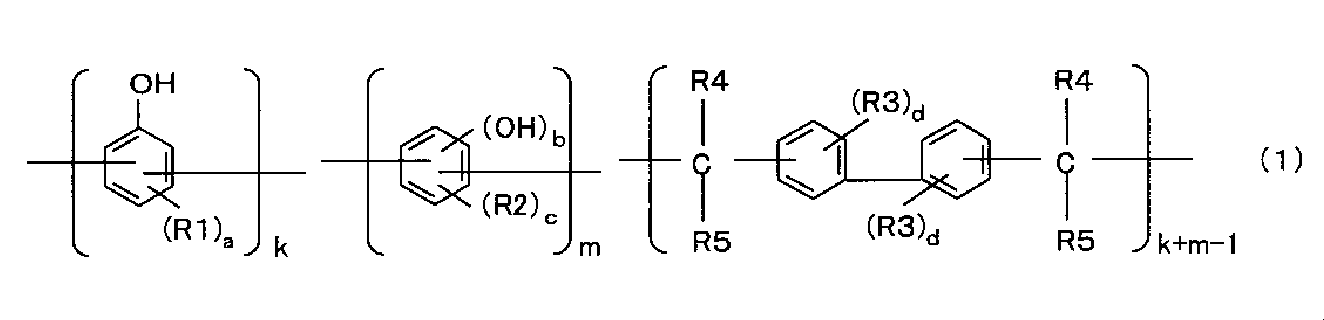
で表される構造を有する1以上の重合体を含むフェノール樹脂系硬化剤(A)と、エポキシ樹脂(B)と、無機充填剤(C)と、を含み、前記フェノール樹脂系硬化剤(A)は、上記一般式(1)においてk≧1、m≧1である重合体成分(A-1)と、k=0、m≧2である重合体成分(A-2)とを必須成分とし、電界脱離質量分析による測定で、上記一般式(1)においてk≧1、m≧1である重合体成分(A-1)の相対強度の合計が、該フェノール樹脂系硬化剤(A)全体の相対強度の合計に対して5%以上である、ことを特徴とする。
本発明に用いられるフェノール樹脂系硬化剤(A)は、下記一般式(1)で表される構造を有する1以上の重合体を含み、下記一般式(1)においてk≧1、m≧1である重合体成分(A-1)と、k=0、m≧2である重合体成分(A-2)とを必須成分とし、電界脱離質量分析による測定で、下記一般式(1)においてk≧1、m≧1である重合体成分(A-1)の相対強度の合計が、フェノール樹脂系硬化剤(A)全体の相対強度の合計に対して5%以上であることが好ましい。また、フェノール樹脂系硬化剤(A)は、電界脱離質量分析による測定で、下記一般式(1)においてk=0、m≧2である重合体成分(A-2)の相対強度の合計が、フェノール樹脂系硬化剤(A)全体の相対強度の合計に対して75%以下であることがより好ましい。さらに、フェノール樹脂系硬化剤(A)は、電界脱離質量分析による測定で、下記一般式(1)においてk≧1、m≧1である重合体成分(A-1)の相対強度の合計が、フェノール樹脂系硬化剤(A)全体の相対強度の合計に対して5%以上、80%以下であり、かつk=0、m≧2である重合体成分(A-2)の相対強度の合計が、フェノール樹脂系硬化剤(A)全体の相対強度の合計に対して20%以上、75%以下であることが特に好ましい。
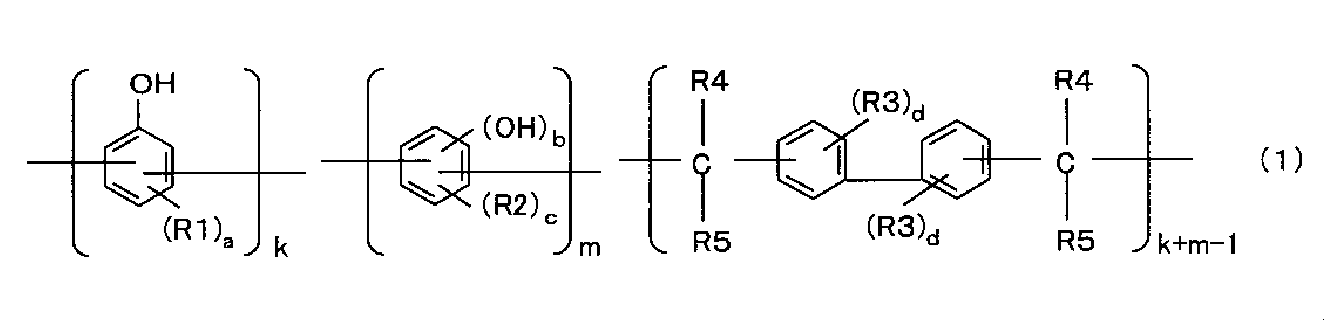
なお、一般式(1)において、前記置換もしくは無置換の一価ヒドロキシフェニレン構造の繰り返し単位、および多価ヒドロキシフェニレン構造の繰り返し単位が重合体の末端に位置する場合は2価基のいずれか一方は水素で封鎖されている。
本発明に用いるフェノール樹脂系硬化剤(A)における、一価ヒドロキシフェニレン構造単位の繰り返し数kの平均値k0と、多価ヒドロキシフェニレン構造単位の繰り返し数mの平均値m0との比(前記で算出したk0、m0を用いてk0/(k0+m0)*100、m0/(k0+m0)*100により求めた各々のパーセント値の比)には、特に制限は無いが、18/82~82/18であることが好ましく、20/80~80/20であることがより好ましく、25/75~75/25であることが特に好ましい。両構造単位の繰返し数の平均値での比が上記範囲にあることにより、流動特性、耐半田性、難燃性、耐熱性、高温保管特性、及び連続成形性のバランスに優れた樹脂組成物を、経済的に得ることができる。k0/m0が上記上限値以下であれば、得られる樹脂組成物が、耐熱性、高温保管特性に優れ、また、成形温度において充分な硬度を有するため、連続成形性に優れたものとすることができる。k0/m0が上記下限値以上であれば、得られる樹脂組成物が、耐燃性、流動性に優れ、また、成形温度において充分な靭性を有するため、連続成形性に優れたものとすることができる。
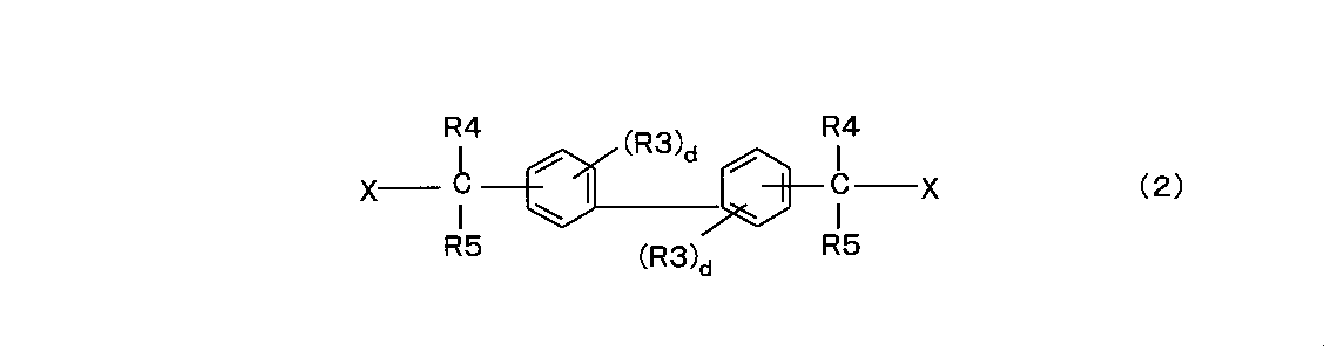



このようなエポキシ樹脂(B)としては、例えば、ビフェニル型エポキシ樹脂、ビスフェノール型エポキシ樹脂、スチルベン型エポキシ樹脂、スルフィド型エポキシ樹脂、ジヒドロキシアントラセン型エポキシ樹脂などの結晶性エポキシ樹脂;メトキシナフタレン骨格含有ノボラック型エポキシ樹脂、フェノールノボラック型エポキシ樹脂、クレゾールノボラック型エポキシ樹脂などのノボラック型エポキシ樹脂;芳香族炭化水素とホルムアルデヒドとを縮合して得た樹脂をフェノールで変性し、さらにエポキシ化して得られるフェノール変性芳香族炭化水素-ホルムアルデヒド樹脂型エポキシ樹脂;トリフェノールメタン型エポキシ樹脂、アルキル変性トリフェノールメタン型エポキシ樹脂、テトラキスヒドロキシフェニルエタン型エポキシ樹脂などの多官能エポキシ樹脂;フェニレン骨格を有するフェノールアラルキル型エポキシ樹脂、ビフェニレン骨格を有するフェノールアラルキル型エポキシ樹脂などのアラルキル型エポキシ樹脂;ジヒドロキシナフタレン型エポキシ樹脂、ジヒドロキシナフタレンの2量体をグリシジルエーテル化して得られるエポキシ樹脂などのナフトール型エポキシ樹脂;トリグリシジルイソシアヌレート、モノアリルジグリシジルイソシアヌレートなどのトリアジン核含有エポキシ樹脂;ジシクロペンタジエン変性フェノール型エポキシ樹脂などの有橋環状炭化水素化合物変性フェノール型エポキシ樹脂;フェノールフタレインとエピクロルヒドリンとを反応して得られるフェノールフタレイン型エポキシ樹脂が挙げられるが、これらに限定されない。結晶性エポキシ樹脂は、流動性に優れる点で好ましく、多官能エポキシ樹脂は、良好な高温保管特性(HTSL)と連続成形における金型の汚染が軽度である点で好ましく、フェノールフタレイン型エポキシ樹脂は、無機充填剤含有率が低い場合でも優れた耐燃性、高温保管特性(HTSL)、耐半田性のバランスに優れる点で好ましく、フェニレン骨格を有するフェノールアラルキル型エポキシ樹脂、ビフェニレン骨格を有するフェノールアラルキル型エポキシ樹脂などのアラルキル型エポキシ樹脂、フェノール変性芳香族炭化水素-ホルムアルデヒド樹脂型エポキシ樹脂等のエポキシ樹脂は、耐半田性に優れる点で好ましく、ナフトール型エポキシ樹脂及びメトキシナフタレン骨格含有ノボラック型エポキシ樹脂などの分子中にナフタレン骨格を有するエポキシ樹脂は、耐燃性と高温保管特性(HTSL)のバランスに優れる点で好ましい。
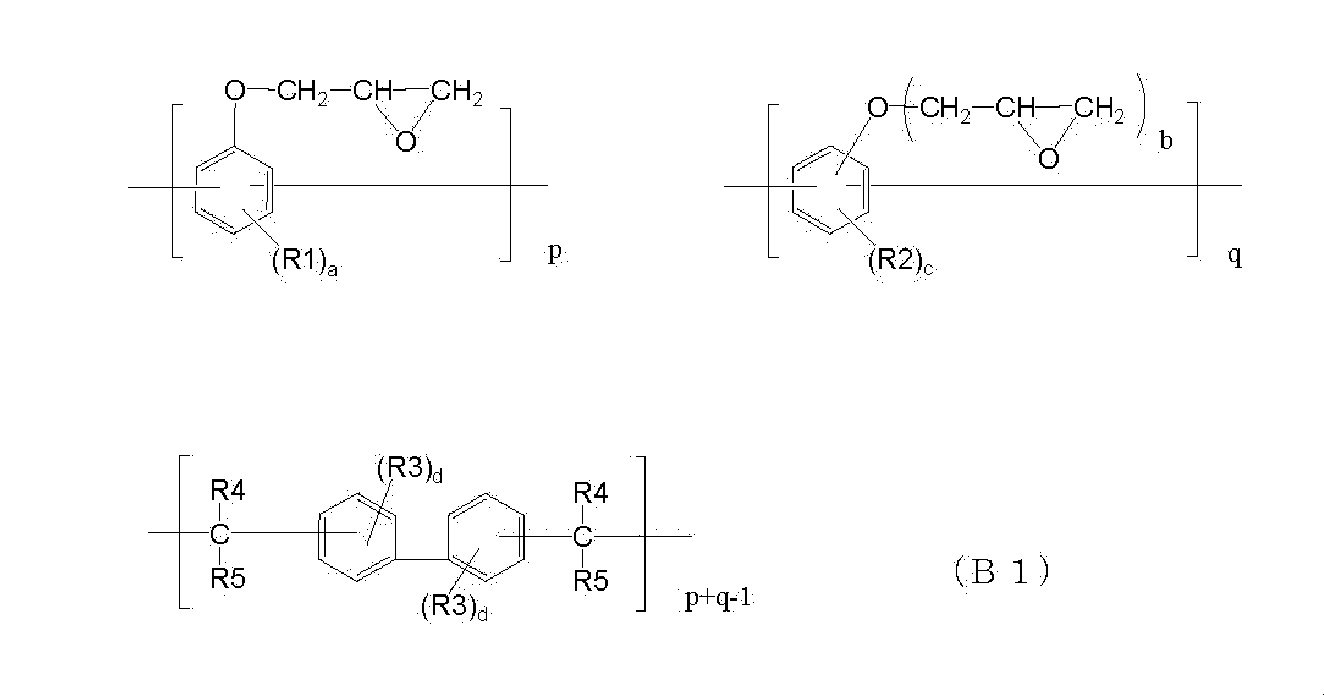
なお、フェノール樹脂系硬化剤とエポキシ樹脂とは、全エポキシ樹脂のエポキシ基数(EP)と、全フェノール樹脂系硬化剤のフェノール性水酸基数(OH)との当量比(EP)/(OH)が、0.8以上、1.3以下となるように配合することが好ましい。当量比が上記範囲内であると、得られる樹脂組成物を成形する際、充分な硬化特性を得ることができる。
本発明の封止用樹脂組成物に用いられる無機充填剤(C)としては、当該分野で一般的に用いられる無機充填剤を使用することができる。例えば、溶融シリカ、球状シリカ、結晶シリカ、アルミナ、窒化珪素、窒化アルミ等が挙げられる。無機充填剤(C)の粒径は、金型キャビティへの充填性の観点から、0.01μm以上、150μm以下であることが望ましい。
本発明の止用樹脂組成物は、硬化促進剤(D)を含んでもよい。硬化促進剤(D)は、エポキシ樹脂(B)のエポキシ基とフェノール樹脂系硬化剤(A)の水酸基との反応を促進するものであればよく、一般に使用される硬化促進剤を用いることができる。


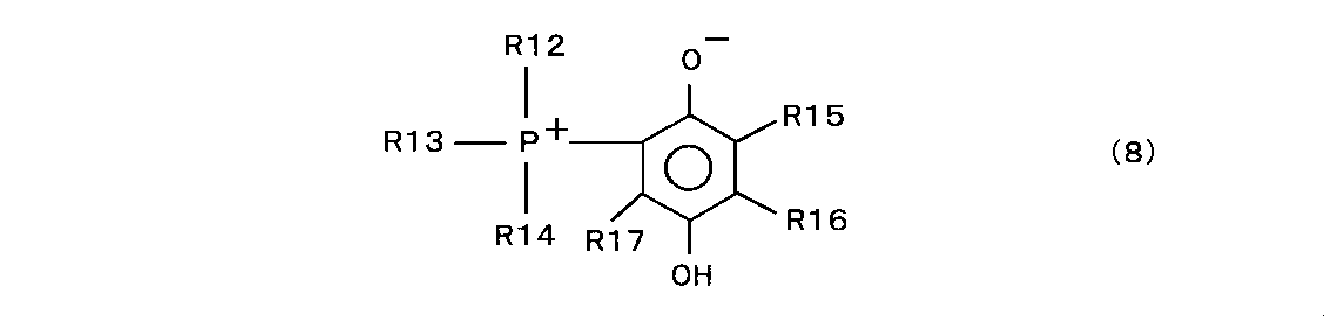


次に、本発明の電子部品装置について説明する。本発明の封止用樹脂組成物を用いて電子部品装置を製造する方法としては、例えば、素子を搭載したリードフレーム又は回路基板等を金型キャビティ内に設置した後、封止用樹脂組成物をトランスファーモールド、コンプレッションモールド、インジェクションモールド等の成形方法で成形、硬化させることにより、この素子を封止する方法が挙げられる。
なお、各種エポキシ樹脂及びフェノール樹脂系硬化剤の150℃におけるICI粘度は、エム.エス.ティー.エンジニアリング(株)製、高温用ICI型コーンプレート型回転粘度計(プレート温度150℃設定、5Pコーンを使用)により測定した。
セパラブルフラスコに撹拌装置、温度計、還流冷却器、窒素導入口を装着し、1,3-ジヒドロキシベンゼン(東京化成工業製レゾルシノール、融点111℃、分子量110、純度99.4%)504質量部、フェノール(関東化学(株)製特級試薬、フェノール、融点41℃、分子量94、純度99.3%)141質量部、あらかじめ粒状に砕いた4,4’-ビスクロロメチルビフェニル(和光純薬工業(株)製、4,4’-ビスクロロメチルビフェニル、融点126℃、純度95%、分子量251)251質量部を、セパラブルフラスコに秤量し、窒素置換しながら加熱し、フェノールの溶融の開始に併せて攪拌を開始した。系内温度を110~130℃の範囲に維持しながら3時間反応させた後、加熱し、140~160℃の範囲に維持しながら3時間反応させた。上記の反応によって系内に発生した塩酸ガスは、窒素気流によって系外へ排出した。反応終了後、150℃2mmHgの減圧条件で未反応成分を留去した。ついでトルエン400質量部を添加し、均一溶解させた後、分液漏斗に移し、蒸留水150質量部を加えて振とうした後に、水層を棄却する操作(水洗)を洗浄水が中性になるまで繰り返し行った後、油層を125℃減圧処理することによってトルエン、残留未反応成分などの揮発成分を留去し、下記式(12)で表される構造を有する1以上の重合体を含むフェノール樹脂系硬化剤であって、一般式(1)におけるk≧1、m≧1である重合体成分(A-1)及びk=0、m≧2である重合体成分(A-2)を含み、一価ヒドロキシフェニレン構造であるk個の繰り返し単位と2価ヒドロキシフェニレン構造であるm個の繰り返し単位とは、それぞれが連続で並んでいても、お互いが交互もしくはランダムに並んでいてもよいが、それぞれの間は必ずビフェニレン基を含む構造であるk+m-1個の繰り返し単位で連結されているフェノール樹脂系硬化剤1(水酸基当量126、150℃におけるICI粘度8.7dPa・s、軟化点101℃。構造式の両末端は水素原子)を得た。なお、電界脱離質量分析(Field Desorption Mass Spectrometry;FD-MS)による測定で、一般式(1)においてk≧1、m≧1である重合体成分(A-1)に相当する成分の相対強度の合計、k=0、m≧2である重合体成分(A-2)に相当する成分の相対強度の合計、k≧2、m=0である重合体成分(A-3)に相当する成分の相対強度の合計をフェノール樹脂系硬化剤1全体の相対強度の合計で除することで求めた相対強度の割合は、それぞれ、38%、58%、4%であった。また、FD-MS分析の相対強度比を質量比とみなして算術計算することにより得られた、一価ヒドロキシフェニレン構造単位の繰り返し数kの平均値k0、多価ヒドロキシフェニレン構造単位の繰り返し数mの平均値m0、及びそれらの比k0/m0は、それぞれ、0.78、1.77、30.5/69.5であった。
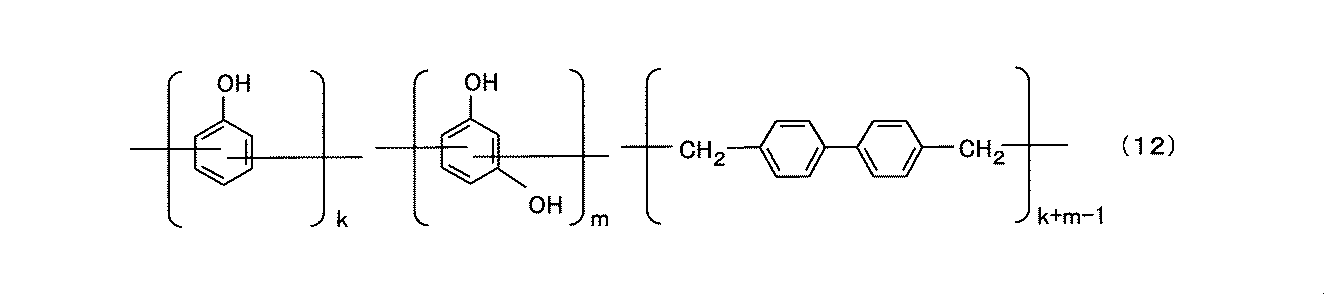
フェノール樹脂系硬化剤1の合成において、1,3-ジヒドロキシベンゼン、フェノール及び4,4’-ビスクロロメチルビフェニルの配合量を表1のように変更した以外は、フェノール樹脂系硬化剤1と同様の合成操作を行い、一般式(12)で表される構造を有する1以上の重合体を含むフェノール樹脂系硬化剤であって、一般式(1)におけるk≧1、m≧1である重合体成分(A-1)及びk=0、m≧2である重合体成分(A-2)を含み、一価ヒドロキシフェニレン構造であるk個の繰り返し単位と2価ヒドロキシフェニレン構造であるm個の繰り返し単位とは、それぞれが連続で並んでいても、お互いが交互もしくはランダムに並んでいてもよいが、それぞれの間は必ずビフェニレン基を含む構造であるk+m-1個の繰り返し単位で連結されているフェノール樹脂系硬化剤2~6を得た(構造式の両末端は水素原子。ただし、フェノール樹脂系硬化剤4については、k=0、m≧2である重合体成分(A-2)のみからなる)。得られたフェノール樹脂系硬化剤2~6の水酸基当量、150℃におけるICI粘度、軟化点、FD-MS測定による測定から算出された、重合体成分(A-1)、(A-2)、(A-3)に相当する成分の相対強度の合計の割合、ならびに、FD-MS分析の相対強度比を質量比とみなして、算術計算することにより得られた、一価ヒドロキシフェニレン構造単位の繰り返し数kの平均値k0、多価ヒドロキシフェニレン構造単位の繰り返し数mの平均値m0、及びそれらの比k0/m0を表1に示した。
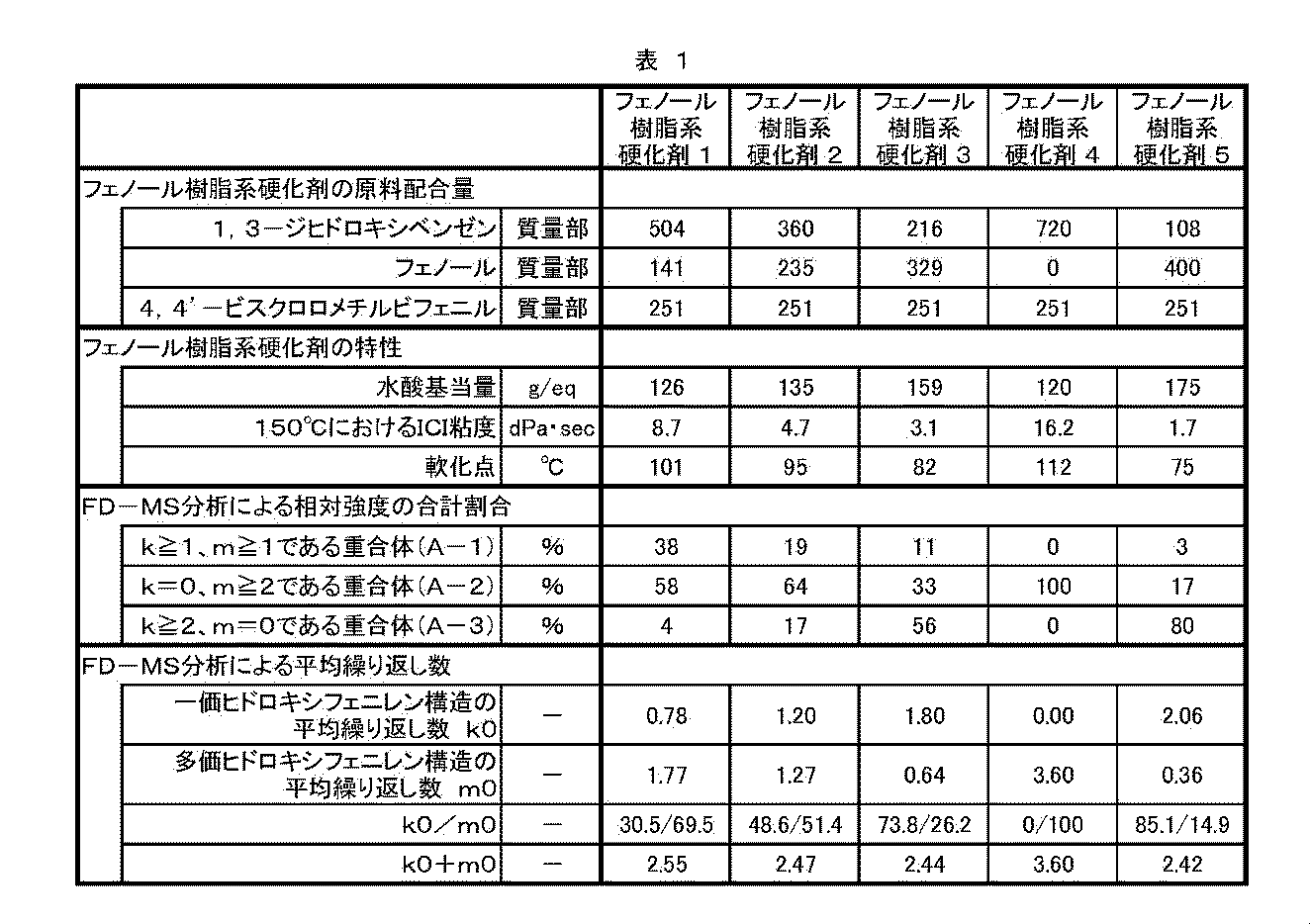
フェノール樹脂系硬化剤6:ビフェニレン骨格を有するフェノールアラルキル樹脂(明和化成株式会社製、MEH-7851SS。水酸基当量203g/eq、150℃におけるICI粘度0.68dPa・sec、軟化点67℃)。フェノール樹脂系硬化剤6は、一般式(1)においてk≧2、m=0である重合体成分(A-3)のみからなるフェノール樹脂に相当する。
エポキシ樹脂1:ビフェニル型エポキシ樹脂(三菱化学(株)製、YX4000K、エポキシ当量185、融点107℃、150℃におけるICI粘度0.1dPa・s)
エポキシ樹脂2:ビスフェノールF型エポキシ樹脂(東都化成(株)製、YSLV-80XY、エポキシ当量190、融点80℃、150℃におけるICI粘度0.03dPa・s。)
エポキシ樹脂3:ビスフェノールA型エポキシ樹脂(三菱化学(株)製、YL6810、エポキシ当量172、融点45℃、150℃におけるICI粘度0.03dPa・s)
エポキシ樹脂4:一般式(13)で表されるスルフィド型エポキシ樹脂(新日鐵化学(株)製、YSLV-120TE、エポキシ当量240、融点120℃、150℃におけるICI粘度0.2dPa・s)。


エポキシ樹脂7:トリフェニルメタン型エポキシ樹脂(三菱化学(株)製、1032H-60、エポキシ当量171、軟化点60℃、150℃におけるICI粘度1.3dPa・s)
エポキシ樹脂8:テトラキスフェニルエタン型エポキシ樹脂(三菱化学(株)製、1031S、エポキシ当量196、軟化点92℃、150℃におけるICI粘度11.0dPa・s)
エポキシ樹脂9:多官能ナフタレン型エポキシ樹脂(DIC(株)製、HP-4770、エポキシ当量205、軟化点72℃、150℃におけるICI粘度0.9dPa・s。)
エポキシ樹脂10:ビフェニレン骨格を有するフェノールアラルキル型エポキシ樹脂(日本化薬(株)製、NC3000。エポキシ当量276、軟化点58℃、150℃におけるICI粘度1.1dPa・s)
エポキシ樹脂11:フェニレン骨格を有するフェノールアラルキル型エポキシ樹脂(日本化薬(株)製、NC2000。エポキシ当量238、軟化点52℃、150℃におけるICI粘度1.2dPa・s)
エポキシ樹脂12:エポキシ樹脂5の合成において、フェノールフタレインに替わり、フェノール変性キシレン-ホルムアルデヒド樹脂(フドー株式会社製、ザイスターGP-90。水酸基当量197、軟化点86℃。)100質量部に、エピクロルヒドリンの配合量を290質量部に、変更した以外は、エポキシ樹脂4と同様の合成操作を行い、式(15)に示すエポキシ樹脂12(エポキシ当量262、軟化点67℃、150℃におけるICI粘度2.4Pa・s。)を得た。

エポキシ樹脂14:オルソクレゾールノボラック型エポキシ樹脂(DIC(株)製、N660。エポキシ当量210、軟化点62℃、150℃におけるICI粘度2.34dPa・s。
エポキシ樹脂15:セパラブルフラスコに撹拌装置、温度計、還流冷却器、窒素導入口を装着し、前述のフェノール樹脂系硬化剤2を100質量部、エピクロルヒドリン(東京化成工業(株)製)400質量部を秤量し、100℃に加熱して溶解させた後、水酸化ナトリウム(固形細粒状、純度99%試薬)60質量部を4時間かけて徐々に添加し、さらに3時間反応させた。次にトルエン200質量部を加えて溶解させた後、蒸留水150質量部を加えて振とうし、水層を棄却する操作(水洗)を洗浄水が中性になるまで繰り返し行った後、油層を125℃2mmHgの減圧条件でエピクロルヒドリンを留去した。得られた固形物にメチルイソブチルケトン300質量部を加えて溶解し、70℃に加熱し、30質量%水酸化ナトリウム水溶液13質量部を1時間かけて添加し、さらに1時間反応した後、静置し、水層を棄却した。油層に蒸留水150質量部を加えて水洗操作を行い、洗浄水が中性になるまで同様の水洗操作を繰り返し行った後、加熱減圧によってメチルイソブチルケトンを留去し、前記フェノール樹脂系硬化剤1の水酸基がグリシジルエーテル基に置換されたエポキシ樹脂15(エポキシ当量190g/eq)を得た。
硬化促進剤1:下記式(16)で表される硬化促進剤



シランカップリング剤1:γ-メルカプトプロピルトリメトキシシラン(信越化学工業(株)製、KBM-803)
シランカップリング剤2:γ-グリシドキシプロピルトリメトキシシラン(信越化学工業(株)製、KBM-403)
シランカップリング剤3:N-フェニル-3-アミノプロピルトリメトキシシラン(信越化学工業(株)製、KBM-573)
無機難燃剤1:水酸化アルミニウム(住友化学(株)製、CL-303)。
金属水酸化物-1無機難燃剤2:水酸化マグネシウム・水酸化亜鉛固溶体複合金属水酸化物(タテホ化学工業(株)製、エコーマグZ-10)。
離型剤は、日興ファイン(株)製のカルナバワックス(ニッコウカルナバ、融点83℃)を使用した。
(評価項目)
スパイラルフロー:低圧トランスファー成形機(コータキ精機(株)製、KTS-15)を用いて、ANSI/ASTM D 3123-72に準じたスパイラルフロー測定用金型に、175℃、注入圧力6.9MPa、保圧時間120秒の条件で樹脂組成物を注入し、流動長を測定した。スパイラルフローは、流動性のパラメータであり、数値が大きい方が流動性が良好である。単位はcm。デュアル・インライン・パッケージ(DIP)、スモール・アウトライン・パッケージ(SOP)、スモール・アウトライン・Jリード・パッケージ(SOJ)への適用を考慮した場合は、60cm以上であることが好ましく、プラスチック・リード付きチップ・キャリヤ(PLCC)、クワッド・フラット・パッケージ(QFP)、ロー・プロファイル・クワッド・フラット・パッケージ(LQFP)への適用を考慮した場合は、80cm以上であることが好ましく、薄型スモール・アウトライン・パッケージ(TSOP)、薄型クワッド・フラット・パッケージ(TQFP)、テープ・キャリア・パッケージ(TCP)、ボール・グリッド・アレイ(BGA)、チップ・サイズ・パッケージ(CSP)、マトリクス・アレイ・パッケージ・ボール・グリッド・アレイ(MAPBGA)、チップ・スタックド・チップ・サイズ・パッケージへの適用を考慮した場合は110cm以上であることが好ましい。


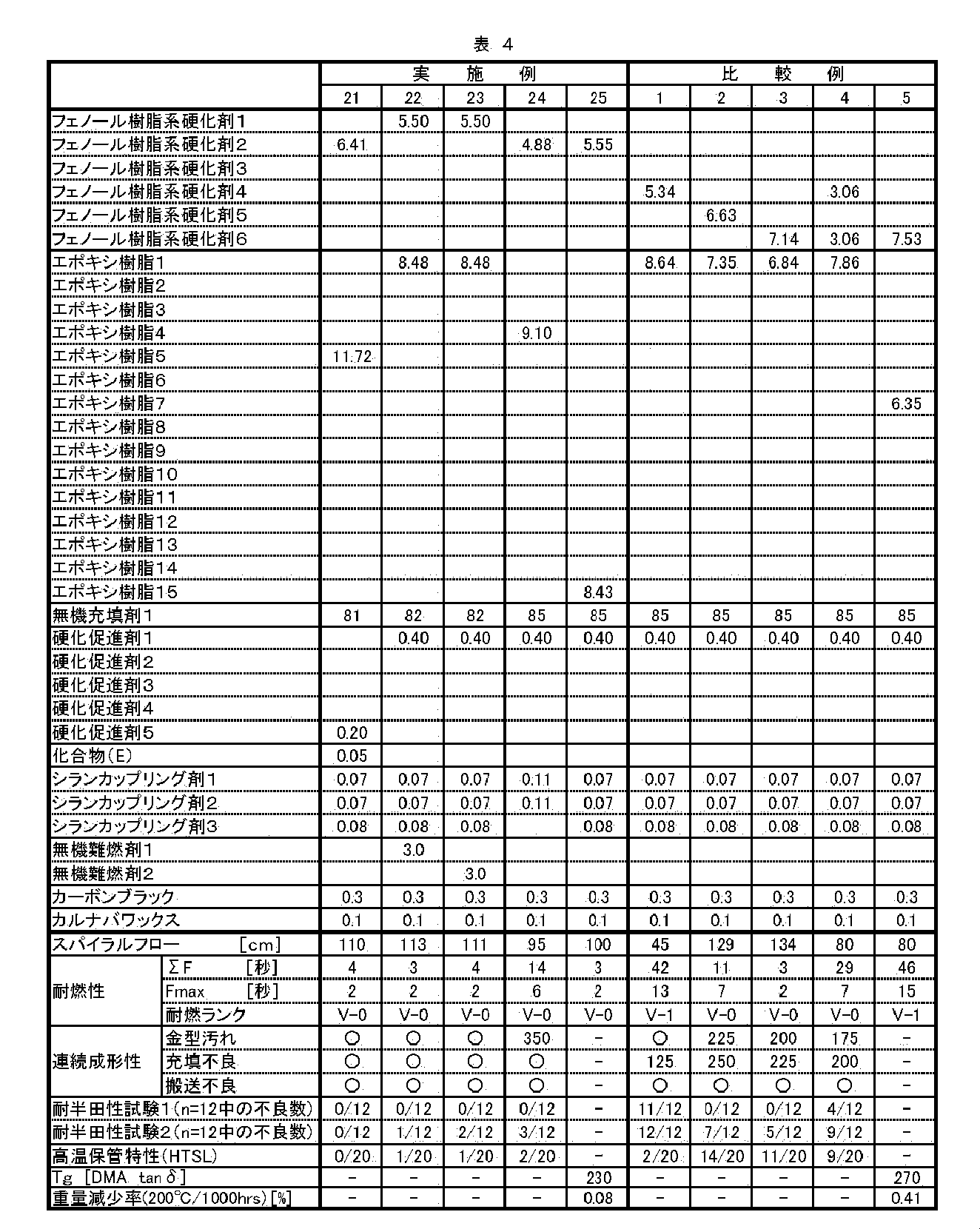
エポキシ樹脂(B)として、結晶性エポキシ樹脂であるエポキシ樹脂1~4、6のみを用いた実施例1~6、8、17~20では、特に流動性に優れる結果が得られた。
また、エポキシ樹脂(B)として、多官能エポキシ樹脂であるエポキシ樹脂7~9を用いた実施例9~11では、特に高温保管特性に優れる結果が得られた。
また、エポキシ樹脂(B)として、フェノールフタレイン型エポキシ樹脂であるエポキシ樹脂5を用いた実施例7、21では、無機充填剤含有率が低い場合も含めて、耐燃性、高温保管特性、耐半田性、連続成形性に優れる結果が得られた。
また、エポキシ樹脂(B)として、アラルキル型エポキシ樹脂、フェノール変性芳香族炭化水素-ホルムアルデヒド樹脂型エポキシ樹脂であるエポキシ樹脂10~12を用いた実施例12~14では、特に耐半田性に優れる結果が得られた。
また、エポキシ樹脂(B)として、ナフタレン骨格又はアントラセン骨格を有するエポキシ樹脂であるエポキシ樹脂6、9、13を用いた実施例8、11、15、17~20では、特に耐燃性、高温保管特性に優れる結果が得られた。
また、エポキシ樹脂(B)として、前記一般式(B1)で表されるエポキシ樹脂であるエポキシ樹脂15を用いた実施例25では、硬化物のガラス転移温度(Tg)が230℃であり、実施例1~24のTgが150℃~190℃であったことからより高いTgが得られ、さらに、高いTgを示した比較例5に対して極めて小さい重量減少率であったことから硬化物の耐燃性および流動性の特性を維持しつつ、硬化物のガラス転移温度(Tg)の向上および重量減少率の低減の双方を実現する結果が得られた。
また、硬化促進剤(D)として、テトラ置換ホスホニウム化合物、ホスホニウム化合物とシラン化合物との付加物である硬化促進剤1、2を用いた実施例8、17では、硬化促進剤(D)以外は同一である他の実施例(実施例18、19)と比較して、特に連続成形性に優れる結果が得られた。
また、硬化促進剤(D)として、ホスホベタイン化合物、ホスフィン化合物とキノン化合物である硬化促進剤3、4を用いた実施例18、19では、硬化促進剤(D)以外は同一である他の実施例(実施例8、17)と比較して、特に流動性、耐半田性に優れる結果が得られた。
また、化合物(E)を用いた実施例20~21は、硬化促進剤(D)として潜伏性を有しないリン原子含有硬化促進剤である硬化促進剤5を用いているにもかかわらず、良好な流動性を示し、かつ連続成形性に優れる結果が得られた。
また、カップリング剤(F)として第二級アミン構造を有するシランカップリング剤であるシランカップリング剤3を用いた実施例6では、カップリング剤(F)以外は同一である他の実施例(実施例24)と比較して、特に流動性、耐半田性に優れる結果が得られた。
また、フェノール樹脂系硬化剤(A)の代わりに、一般式(1)においてk≧1、m≧1である重合体成分(A-1)の相対強度の合計が、フェノール樹脂系硬化剤(A)全体の相対強度の合計に対して5%未満であるフェノール樹脂系硬化剤5を用いた比較例2では、連続成形性、高温保管特性に劣る結果となった。また、耐半田性についても、条件が厳しい場合には劣る結果となった。
また、フェノール樹脂系硬化剤(A)の代わりに、一般式(1)においてk≧2、m=0である重合体成分(A-3)のみからなるフェノール樹脂に相当する、ビフェニレン骨格を有するフェノールアラルキル樹脂であるフェノール樹脂系硬化剤6を用いた比較例3では、連続成形性、高温保管特性に劣る結果となった。また、耐半田性についても、条件が厳しい場合には劣る結果となった。
さらに、フェノール樹脂系硬化剤(A)の代わりに、一般式(1)においてk=0、かつm≧2である重合体成分(A-2)のみからなるフェノール樹脂系硬化剤4と、一般式(1)においてk≧2、m=0である重合体成分(A-3)のみからなるフェノール樹脂に相当する、ビフェニレン骨格を有するフェノールアラルキル樹脂であるフェノール樹脂系硬化剤6とを併用した比較例4においても、連続成形性、耐半田性、高温保管特性に劣る結果となった。
高いTgに特徴を有する比較例5については、実施例25との比較において、高いTgが得られるものの、耐燃性が十分でなく、200℃1000時間のような高温での重量減少が大きく、自動車用途やSiC素子を搭載したパッケージ用途には耐燃性、耐熱性が十分でないという結果となった。
2 ダイボンド材硬化体
3 ダイパッド
4 ワイヤ
5 リードフレーム
6 封止用樹脂組成物の硬化体
7 ソルダーレジスト
8 基板
9 半田ボール
Claims (18)
- 下記一般式(1):

で表される構造を有する1以上の重合体を含むフェノール樹脂系硬化剤(A)と、エポキシ樹脂(B)と、無機充填剤(C)と、を含み、
前記フェノール樹脂系硬化剤(A)は、上記一般式(1)においてk≧1、m≧1である重合体成分(A-1)と、k=0、m≧2である重合体成分(A-2)とを必須成分とし、電界脱離質量分析による測定で、上記一般式(1)においてk≧1、m≧1である重合体成分(A-1)の相対強度の合計が、該フェノール樹脂系硬化剤(A)全体の相対強度の合計に対して5%以上である、
ことを特徴とする封止用樹脂組成物。 - 前記フェノール樹脂系硬化剤(A)は、電界脱離質量分析による測定で、上記一般式(1)においてk=0、m≧2である重合体成分(A-2)の相対強度の合計が、該フェノール樹脂系硬化剤(A)全体の相対強度の合計に対して75%以下である、
ことを特徴とする請求項1に記載の封止用樹脂組成物。 - 前記フェノール樹脂系硬化剤(A)は、電界脱離質量分析による測定で、上記一般式(1)においてk≧1、m≧1である重合体成分(A-1)の相対強度の合計が、該フェノール樹脂系硬化剤(A)全体の相対強度の合計に対して5%以上、80%以下であり、かつk=0、m≧2である重合体成分(A-2)の相対強度の合計が、該フェノール樹脂系硬化剤(A)全体の相対強度の合計に対して20%以上、75%以下である、
ことを特徴とする請求項1又は2に記載の封止用樹脂組成物。 - 前記フェノール樹脂系硬化剤(A)は、前記一般式(1)において一価ヒドロキシフェニレン構造単位の繰り返し数kの平均値k0と、多価ヒドロキシフェニレン構造単位の繰り返し数mの平均値m0との比が、18/82~82/18であることを特徴とする請求項1から3のいずれか1項に記載の封止用樹脂組成物。
- 前記フェノール樹脂系硬化剤(A)は、前記一般式(1)において一価ヒドロキシフェニレン構造単位の繰り返し数kの平均値k0が0.5~2.0であることを特徴とする請求項1から4のいずれか1項に記載の封止用樹脂組成物。
- 前記フェノール樹脂系硬化剤(A)は、前記一般式(1)において多価ヒドロキシフェニレン構造単位の繰り返し数mの平均値m0が0.4~2.4であることを特徴とする請求項1から5のいずれか1項に記載の封止用樹脂組成物。
- 前記無機充填剤(C)の含有量が全樹脂組成物に対して70質量%以上、93質量%以下であることを特徴とする請求項1から6のいずれか1項に記載の封止用樹脂組成物。
- カップリング剤(F)をさらに含むことを特徴とする請求項1から7のいずれか1項に記載の封止用樹脂組成物。
- 前記カップリング剤(F)が第二級アミン構造を有するシランカップリング剤を含むことを特徴とする請求項8に記載の封止用樹脂組成物。
- 前記フェノール樹脂系硬化剤(A)の水酸基当量が90g/eq以上、190g/eq以下であることを特徴とする請求項1から9のいずれか1項に記載の封止用樹脂組成物。下限90に変えた。
- 前記エポキシ樹脂(B)が、結晶性エポキシ樹脂、多官能エポキシ樹脂、フェノールフタレイン型エポキシ樹脂、フェノールアラルキル型エポキシ樹脂からなる群から選択される少なくとも1種のエポキシ樹脂を含むことを特徴とする請求項1から10のいずれか1項に記載の封止用樹脂組成物。
- 前記エポキシ樹脂(B)が、下記一般式(B1)で表されるエポキシ樹脂を含むことを特徴とする請求項1から10のいずれか1項に記載の封止用樹脂組成物。
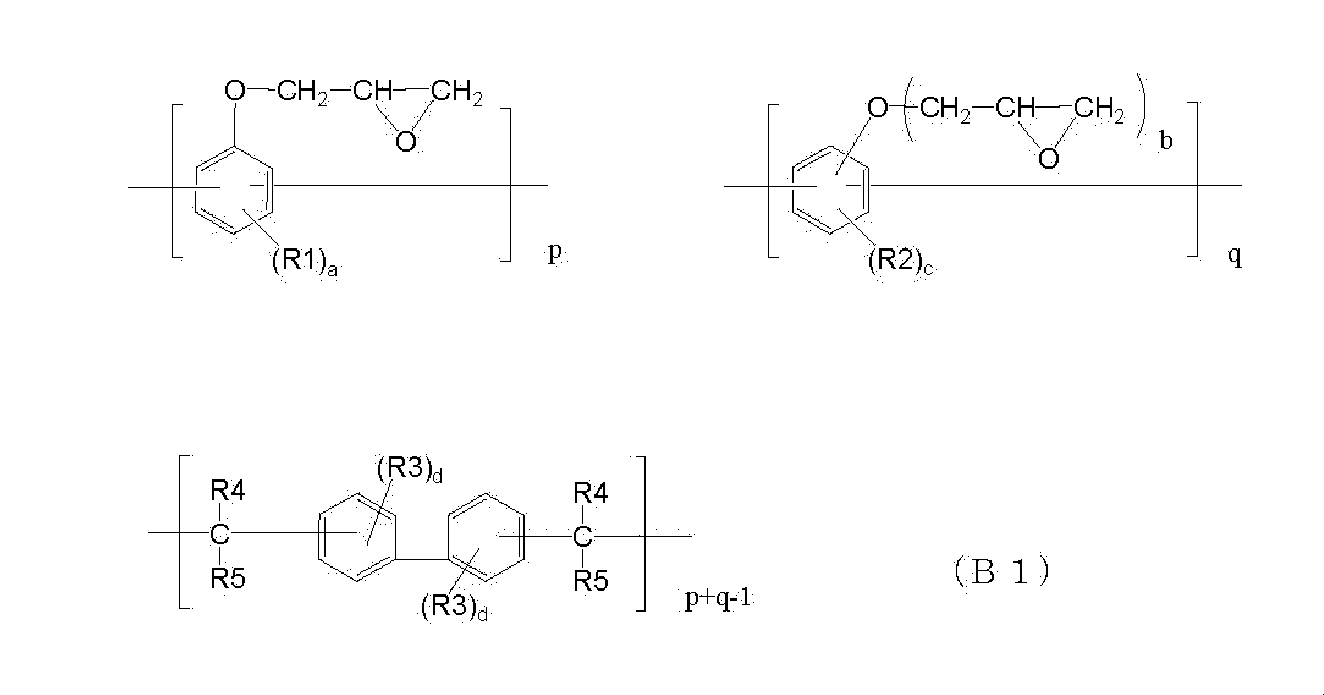
- 硬化促進剤(D)をさらに含むことを特徴とする請求項1から12のいずれか1項に記載の封止用樹脂組成物。
- 前記硬化促進剤(D)が、テトラ置換ホスホニウム化合物、ホスホベタイン化合物、ホスフィン化合物とキノン化合物との付加物、ホスホニウム化合物とシラン化合物との付加物からなる群から選択される少なくとも1種の硬化促進剤を含むことを特徴とする請求項13に記載の封止用樹脂組成物。
- 芳香環を構成する2個以上の隣接する炭素原子にそれぞれ水酸基が結合した化合物(E)をさらに含むことを特徴とする請求項1から14のいずれか1項に記載の封止用樹脂組成物。
- 無機難燃剤(G)をさらに含むことを特徴とする請求項1から15のいずれか1項に記載の封止用樹脂組成物。
- 前記無機難燃剤(G)が金属水酸化物、又は複合金属水酸化物を含むことを特徴とする請求項1から16のいずれか1項に記載の封止用樹脂組成物。
- 請求項1から17のいずれか1項に記載の封止用樹脂組成物を硬化させた硬化物で素子を封止して得られることを特徴とする電子部品装置。
Priority Applications (5)
| Application Number | Priority Date | Filing Date | Title |
|---|---|---|---|
| JP2012539737A JP5920219B2 (ja) | 2010-10-19 | 2011-10-18 | 封止用樹脂組成物及び電子部品装置 |
| US13/880,186 US20130289187A1 (en) | 2010-10-19 | 2011-10-18 | Resin composition for encapsulation and electronic component device |
| CN201180050118.XA CN103168061B (zh) | 2010-10-19 | 2011-10-18 | 密封用树脂组合物和电子部件装置 |
| SG2013028626A SG189911A1 (en) | 2010-10-19 | 2011-10-18 | Resin composition for encapsulation and electronic component device |
| KR1020137012381A KR101803127B1 (ko) | 2010-10-19 | 2011-10-18 | 밀봉용 수지 조성물 및 전자 부품 장치 |
Applications Claiming Priority (2)
| Application Number | Priority Date | Filing Date | Title |
|---|---|---|---|
| JP2010234182 | 2010-10-19 | ||
| JP2010-234182 | 2010-10-19 |
Publications (1)
| Publication Number | Publication Date |
|---|---|
| WO2012053522A1 true WO2012053522A1 (ja) | 2012-04-26 |
Family
ID=45975233
Family Applications (1)
| Application Number | Title | Priority Date | Filing Date |
|---|---|---|---|
| PCT/JP2011/073963 Ceased WO2012053522A1 (ja) | 2010-10-19 | 2011-10-18 | 封止用樹脂組成物及び電子部品装置 |
Country Status (7)
| Country | Link |
|---|---|
| US (1) | US20130289187A1 (ja) |
| JP (2) | JP5920219B2 (ja) |
| KR (1) | KR101803127B1 (ja) |
| CN (1) | CN103168061B (ja) |
| SG (1) | SG189911A1 (ja) |
| TW (1) | TWI506051B (ja) |
| WO (1) | WO2012053522A1 (ja) |
Cited By (11)
| Publication number | Priority date | Publication date | Assignee | Title |
|---|---|---|---|---|
| JP2014025042A (ja) * | 2012-07-30 | 2014-02-06 | Hitachi Chemical Co Ltd | 硬化促進剤、エポキシ樹脂組成物及び電子部品装置 |
| JP2014152189A (ja) * | 2013-02-05 | 2014-08-25 | Kyocera Chemical Corp | 封止用エポキシ樹脂組成物及びそれを用いた半導体装置 |
| KR20150026857A (ko) * | 2013-08-29 | 2015-03-11 | 신에쓰 가가꾸 고교 가부시끼가이샤 | 반도체 밀봉용 수지조성물 및 그 경화물을 구비한 반도체 장치 |
| JP2015044963A (ja) * | 2013-08-29 | 2015-03-12 | 信越化学工業株式会社 | 半導体封止用樹脂組成物及びその硬化物を備えた半導体装置 |
| JP2015048422A (ja) * | 2013-09-02 | 2015-03-16 | 信越化学工業株式会社 | 半導体封止用樹脂組成物及びその硬化物を備えた半導体装置 |
| JP2015048434A (ja) * | 2013-09-03 | 2015-03-16 | 信越化学工業株式会社 | 半導体封止用樹脂組成物及びその硬化物を備えた半導体装置 |
| JP2016084413A (ja) * | 2014-10-27 | 2016-05-19 | 味の素株式会社 | 樹脂組成物 |
| JP2016160317A (ja) * | 2015-02-27 | 2016-09-05 | 信越化学工業株式会社 | 半導体封止用樹脂組成物及び半導体装置 |
| JP2016204420A (ja) * | 2015-04-15 | 2016-12-08 | 京セラ株式会社 | 封止用エポキシ樹脂成形材料及び電子部品 |
| JP2017111455A (ja) * | 2011-12-09 | 2017-06-22 | 旭化成株式会社 | 感光性樹脂組成物、硬化レリーフパターンの製造方法、半導体装置及び表示体装置 |
| JP2018104603A (ja) * | 2016-12-27 | 2018-07-05 | 日立化成株式会社 | 硬化性樹脂組成物及び電子部品装置 |
Families Citing this family (11)
| Publication number | Priority date | Publication date | Assignee | Title |
|---|---|---|---|---|
| SG189911A1 (en) * | 2010-10-19 | 2013-06-28 | Sumitomo Bakelite Co | Resin composition for encapsulation and electronic component device |
| JP2015174874A (ja) * | 2014-03-13 | 2015-10-05 | 信越化学工業株式会社 | 半導体封止用樹脂組成物及び半導体装置 |
| WO2015146816A1 (ja) * | 2014-03-25 | 2015-10-01 | 住友ベークライト株式会社 | エポキシ樹脂組成物および静電容量型指紋センサー |
| US10056363B2 (en) * | 2015-11-10 | 2018-08-21 | Marvell World Trade Ltd. | Methods and systems to improve yield in multiple chips integration processes |
| CN107254142A (zh) * | 2016-07-21 | 2017-10-17 | 广东广山新材料股份有限公司 | 一种阻燃树脂组合物、热固性树脂组合物、复合金属基板及阻燃电子材料 |
| JP7091618B2 (ja) * | 2016-09-27 | 2022-06-28 | 住友ベークライト株式会社 | 静電容量型センサ封止用樹脂組成物および静電容量型センサ |
| JP7172019B2 (ja) * | 2017-02-01 | 2022-11-16 | 昭和電工マテリアルズ株式会社 | 封止用樹脂組成物及び半導体装置 |
| JP6489263B2 (ja) * | 2018-04-12 | 2019-03-27 | 住友ベークライト株式会社 | 封止用樹脂組成物及び電子部品装置 |
| WO2020129248A1 (ja) * | 2018-12-21 | 2020-06-25 | 日立化成株式会社 | 封止用樹脂組成物及び電子部品装置 |
| CN115490993B (zh) * | 2022-10-28 | 2024-03-01 | 西安西电电工材料有限责任公司 | 一种环氧树脂组合物、制备方法及环氧玻璃布层压板 |
| CN117887016A (zh) * | 2024-01-15 | 2024-04-16 | 同宇新材料(广东)股份有限公司 | 一种多联苯酚醛树脂及其制备方法和应用 |
Citations (4)
| Publication number | Priority date | Publication date | Assignee | Title |
|---|---|---|---|---|
| JPH07292066A (ja) * | 1994-04-28 | 1995-11-07 | Nippon Kayaku Co Ltd | エポキシ樹脂、エポキシ樹脂組成物及びその硬化物 |
| JP2006274217A (ja) * | 2005-03-30 | 2006-10-12 | Sumitomo Bakelite Co Ltd | エポキシ樹脂組成物および半導体封止用エポキシ樹脂 |
| WO2007007827A1 (ja) * | 2005-07-13 | 2007-01-18 | Ube Industries, Ltd. | ビフェニレン架橋フェノールノボラック樹脂ならびにその用途 |
| JP2008266647A (ja) * | 2007-04-23 | 2008-11-06 | Chang Chun Plastics Co Ltd | 難燃性樹脂組成物 |
Family Cites Families (4)
| Publication number | Priority date | Publication date | Assignee | Title |
|---|---|---|---|---|
| JP5228496B2 (ja) * | 2008-01-16 | 2013-07-03 | 住友ベークライト株式会社 | 半導体封止用エポキシ樹脂組成物及び半導体装置 |
| CN102112517B (zh) * | 2008-08-01 | 2013-03-27 | 住友电木株式会社 | 半导体封装用树脂组合物、以及使用该组合物的半导体装置 |
| SG189911A1 (en) * | 2010-10-19 | 2013-06-28 | Sumitomo Bakelite Co | Resin composition for encapsulation and electronic component device |
| US9136194B2 (en) * | 2012-03-16 | 2015-09-15 | Sumitomo Bakelite Co., Ltd. | Resin composition for encapsulation and electronic device using the same |
-
2011
- 2011-10-18 SG SG2013028626A patent/SG189911A1/en unknown
- 2011-10-18 JP JP2012539737A patent/JP5920219B2/ja not_active Expired - Fee Related
- 2011-10-18 CN CN201180050118.XA patent/CN103168061B/zh not_active Expired - Fee Related
- 2011-10-18 US US13/880,186 patent/US20130289187A1/en not_active Abandoned
- 2011-10-18 KR KR1020137012381A patent/KR101803127B1/ko not_active Expired - Fee Related
- 2011-10-18 WO PCT/JP2011/073963 patent/WO2012053522A1/ja not_active Ceased
- 2011-10-19 TW TW100137864A patent/TWI506051B/zh not_active IP Right Cessation
-
2016
- 2016-01-19 JP JP2016008319A patent/JP6202114B2/ja not_active Expired - Fee Related
Patent Citations (4)
| Publication number | Priority date | Publication date | Assignee | Title |
|---|---|---|---|---|
| JPH07292066A (ja) * | 1994-04-28 | 1995-11-07 | Nippon Kayaku Co Ltd | エポキシ樹脂、エポキシ樹脂組成物及びその硬化物 |
| JP2006274217A (ja) * | 2005-03-30 | 2006-10-12 | Sumitomo Bakelite Co Ltd | エポキシ樹脂組成物および半導体封止用エポキシ樹脂 |
| WO2007007827A1 (ja) * | 2005-07-13 | 2007-01-18 | Ube Industries, Ltd. | ビフェニレン架橋フェノールノボラック樹脂ならびにその用途 |
| JP2008266647A (ja) * | 2007-04-23 | 2008-11-06 | Chang Chun Plastics Co Ltd | 難燃性樹脂組成物 |
Cited By (13)
| Publication number | Priority date | Publication date | Assignee | Title |
|---|---|---|---|---|
| JP2017111455A (ja) * | 2011-12-09 | 2017-06-22 | 旭化成株式会社 | 感光性樹脂組成物、硬化レリーフパターンの製造方法、半導体装置及び表示体装置 |
| JP2014025042A (ja) * | 2012-07-30 | 2014-02-06 | Hitachi Chemical Co Ltd | 硬化促進剤、エポキシ樹脂組成物及び電子部品装置 |
| JP2014152189A (ja) * | 2013-02-05 | 2014-08-25 | Kyocera Chemical Corp | 封止用エポキシ樹脂組成物及びそれを用いた半導体装置 |
| KR20150026857A (ko) * | 2013-08-29 | 2015-03-11 | 신에쓰 가가꾸 고교 가부시끼가이샤 | 반도체 밀봉용 수지조성물 및 그 경화물을 구비한 반도체 장치 |
| JP2015044963A (ja) * | 2013-08-29 | 2015-03-12 | 信越化学工業株式会社 | 半導体封止用樹脂組成物及びその硬化物を備えた半導体装置 |
| KR102219584B1 (ko) * | 2013-08-29 | 2021-02-23 | 신에쓰 가가꾸 고교 가부시끼가이샤 | 반도체 밀봉용 수지조성물 및 그 경화물을 구비한 반도체 장치 |
| JP2015048422A (ja) * | 2013-09-02 | 2015-03-16 | 信越化学工業株式会社 | 半導体封止用樹脂組成物及びその硬化物を備えた半導体装置 |
| JP2015048434A (ja) * | 2013-09-03 | 2015-03-16 | 信越化学工業株式会社 | 半導体封止用樹脂組成物及びその硬化物を備えた半導体装置 |
| JP2016084413A (ja) * | 2014-10-27 | 2016-05-19 | 味の素株式会社 | 樹脂組成物 |
| KR20160105323A (ko) | 2015-02-27 | 2016-09-06 | 신에쓰 가가꾸 고교 가부시끼가이샤 | 반도체 밀봉용 수지 조성물 및 반도체 장치 |
| JP2016160317A (ja) * | 2015-02-27 | 2016-09-05 | 信越化学工業株式会社 | 半導体封止用樹脂組成物及び半導体装置 |
| JP2016204420A (ja) * | 2015-04-15 | 2016-12-08 | 京セラ株式会社 | 封止用エポキシ樹脂成形材料及び電子部品 |
| JP2018104603A (ja) * | 2016-12-27 | 2018-07-05 | 日立化成株式会社 | 硬化性樹脂組成物及び電子部品装置 |
Also Published As
| Publication number | Publication date |
|---|---|
| KR20140009185A (ko) | 2014-01-22 |
| CN103168061A (zh) | 2013-06-19 |
| JP5920219B2 (ja) | 2016-05-18 |
| US20130289187A1 (en) | 2013-10-31 |
| CN103168061B (zh) | 2016-08-31 |
| KR101803127B1 (ko) | 2017-11-29 |
| JP2016065257A (ja) | 2016-04-28 |
| JP6202114B2 (ja) | 2017-09-27 |
| TWI506051B (zh) | 2015-11-01 |
| TW201229079A (en) | 2012-07-16 |
| SG189911A1 (en) | 2013-06-28 |
| JPWO2012053522A1 (ja) | 2014-02-24 |
Similar Documents
| Publication | Publication Date | Title |
|---|---|---|
| JP6202114B2 (ja) | 封止用樹脂組成物及び電子部品装置 | |
| JP6102913B2 (ja) | 封止用樹脂組成物およびこれを用いた電子装置 | |
| JP5708486B2 (ja) | 半導体封止用樹脂組成物及び半導体装置 | |
| JP5842995B2 (ja) | 封止用樹脂組成物およびこれを用いる電子装置 | |
| CN102666642A (zh) | 半导体封装用树脂组合物及使用其的半导体装置 | |
| JP6056315B2 (ja) | 樹脂組成物および電子部品装置 | |
| JP5413127B2 (ja) | 半導体封止用樹脂組成物、これを用いる半導体装置及び半導体封止用樹脂組成物の製造方法 | |
| JP5494137B2 (ja) | 半導体封止用樹脂組成物および半導体装置 | |
| JP6008107B2 (ja) | 樹脂組成物および電子部品装置 | |
| JP5672947B2 (ja) | 封止用樹脂組成物及び電子部品装置 | |
| JP2012077152A (ja) | 電子部品封止用樹脂組成物及び電子部品装置 | |
| JP5651968B2 (ja) | 半導体封止用樹脂組成物及び半導体装置 | |
| JP2012246472A (ja) | 封止用樹脂組成物及び電子部品装置 | |
| JP5353636B2 (ja) | 半導体封止用樹脂組成物及びこれを用いる半導体装置 | |
| JP5573344B2 (ja) | 封止用樹脂組成物及び電子部品装置 | |
| JP5868573B2 (ja) | 半導体封止用樹脂組成物及び半導体装置 | |
| JP5673237B2 (ja) | 封止用樹脂組成物及び電子部品装置 | |
| JP2011187892A (ja) | 半導体封止用樹脂組成物、およびその硬化物を用いた半導体装置 |
Legal Events
| Date | Code | Title | Description |
|---|---|---|---|
| 121 | Ep: the epo has been informed by wipo that ep was designated in this application |
Ref document number: 11834361 Country of ref document: EP Kind code of ref document: A1 |
|
| WWE | Wipo information: entry into national phase |
Ref document number: 2012539737 Country of ref document: JP |
|
| WWE | Wipo information: entry into national phase |
Ref document number: 13880186 Country of ref document: US |
|
| NENP | Non-entry into the national phase |
Ref country code: DE |
|
| ENP | Entry into the national phase |
Ref document number: 20137012381 Country of ref document: KR Kind code of ref document: A |
|
| 122 | Ep: pct application non-entry in european phase |
Ref document number: 11834361 Country of ref document: EP Kind code of ref document: A1 |