WO2012018007A1 - メタノールの分離方法 - Google Patents
メタノールの分離方法 Download PDFInfo
- Publication number
- WO2012018007A1 WO2012018007A1 PCT/JP2011/067666 JP2011067666W WO2012018007A1 WO 2012018007 A1 WO2012018007 A1 WO 2012018007A1 JP 2011067666 W JP2011067666 W JP 2011067666W WO 2012018007 A1 WO2012018007 A1 WO 2012018007A1
- Authority
- WO
- WIPO (PCT)
- Prior art keywords
- methanol
- zeolite membrane
- carbon atoms
- methyl
- mass
- Prior art date
- Legal status (The legal status is an assumption and is not a legal conclusion. Google has not performed a legal analysis and makes no representation as to the accuracy of the status listed.)
- Ceased
Links
Images

Classifications
-
- C—CHEMISTRY; METALLURGY
- C07—ORGANIC CHEMISTRY
- C07C—ACYCLIC OR CARBOCYCLIC COMPOUNDS
- C07C29/00—Preparation of compounds having hydroxy or O-metal groups bound to a carbon atom not belonging to a six-membered aromatic ring
- C07C29/74—Separation; Purification; Use of additives, e.g. for stabilisation
- C07C29/76—Separation; Purification; Use of additives, e.g. for stabilisation by physical treatment
-
- B—PERFORMING OPERATIONS; TRANSPORTING
- B01—PHYSICAL OR CHEMICAL PROCESSES OR APPARATUS IN GENERAL
- B01D—SEPARATION
- B01D61/00—Processes of separation using semi-permeable membranes, e.g. dialysis, osmosis or ultrafiltration; Apparatus, accessories or auxiliary operations specially adapted therefor
- B01D61/36—Pervaporation; Membrane distillation; Liquid permeation
- B01D61/362—Pervaporation
-
- B—PERFORMING OPERATIONS; TRANSPORTING
- B01—PHYSICAL OR CHEMICAL PROCESSES OR APPARATUS IN GENERAL
- B01D—SEPARATION
- B01D71/00—Semi-permeable membranes for separation processes or apparatus characterised by the material; Manufacturing processes specially adapted therefor
- B01D71/02—Inorganic material
- B01D71/028—Molecular sieves
- B01D71/0281—Zeolites
Definitions
- the present invention relates to a method for efficiently separating methanol.
- esters are used for many purposes.
- phthalic acid esters are used as plasticizers
- acrylic acid esters or methacrylic acid esters are used as monomers for producing polymers, and the resulting polymers are used as molding materials, paints, adhesives, and the like.
- dimethyl terephthalate is used as a raw material for producing polyester.
- propionic acid ester, butyric acid ester, isovaleric acid ester, caproic acid ester, caprylic acid ester, benzoic acid ester, phenylacetic acid ester, cinnamic acid ester, and salicylic acid ester are used as synthetic fragrances.
- methyl acrylate and methyl methacrylate are sometimes collectively referred to as methyl (meth) acrylate.
- monohydric alcohol esters having 4 or more carbon atoms are produced by transesterification with methyl esters.
- an alcohol having 2 or more carbon atoms may be referred to as a higher alcohol
- an ester of an alcohol having 2 or more carbon atoms may be referred to as a higher ester.
- the advantages of the transesterification reaction using methyl ester as a raw material include methyl ester and higher alcohol as raw materials. It is easy to obtain a high-concentration product and is easy to handle, and the only by-product is methanol.
- the transesterification reaction is an equilibrium reaction, and methyl ester or higher alcohol is usually used in an excess molar amount in order to obtain a higher ester efficiently.
- Methyl ester may be used in excess moles relative to the higher alcohol, but if the boiling point of the methyl ester is higher than that of the higher alcohol or if the methyl ester is more valuable than the higher alcohol, the higher alcohol is in excess of the methyl ester. Mole is often used. Therefore, the reaction solution at the end of the reaction is a mixture of methanol as a reaction by-product, higher unreacted alcohol and higher ester as a reaction product. Among these, the higher ester which is a reaction product has a large boiling point difference from methanol and higher alcohol, so that separation by distillation is relatively easy, and a mixture of methanol and higher alcohol excluding the higher ester can be obtained. .
- the reaction solution is heated to a temperature equal to or higher than the boiling point of methanol of 64.7 ° C. (under atmospheric pressure).
- the methanol produced may be removed from the reaction solution by evaporation.
- the higher alcohol is used in an excess molar amount relative to the methyl ester, the composition of the reaction solution at the initial stage of the reaction is low in methanol and high in high alcohol. Steam is obtained.
- Non-Patent Document 1 when methyl ester that forms an azeotrope with methanol is a raw material, a vapor of a mixture of methanol, a higher alcohol, and methyl ester can be obtained by heating the reaction solution.
- the methyl esters that form such an azeotrope are shown in Table 1 (Non-Patent Document 1).
- a higher alcohol can be separated and recovered at a high concentration from a mixture of methanol and a higher alcohol or a mixture of methanol, a higher alcohol and a methyl ester, it can be reused as a raw material for transesterification.
- methanol can be recovered at a high concentration, methanol can be used for other purposes. In this case, it is desirable that the concentration of other components contained in the recovered component is as low as possible.
- Distillation is usually used to separate methanol and higher alcohols.
- distillation is a process that consumes a great deal of heat energy.
- the boiling point of the higher alcohol is close to that of methanol, if high concentrations of methanol and higher alcohol are to be obtained, precise separation by a multistage distillation column is required, and more heat energy is consumed. become.
- extraction by addition of a solvent may be used to separate methanol and higher alcohol.
- water is used as the solvent, only methanol can be dissolved in water, and if a nonpolar solvent such as hexane is used, only higher alcohols can be dissolved in the nonpolar solvent.
- a high-purity higher alcohol is to be obtained when a nonpolar solvent is used, the nonpolar solvent and the higher alcohol must be separated by some method, which complicates the process. Further, when water is used, it is difficult to separate higher alcohol and methanol, which have a high solubility in water.
- a separation method using a membrane for separating a mixture has been proposed. Separation using a membrane is superior in terms of consumption of heat energy compared to separation by distillation alone.
- membranes used for separation include organic polyvinyl alcohol membranes, polyimide membranes, and inorganic zeolite membranes.
- Organic membranes are superior in terms of productivity compared to inorganic membranes, and inorganic membranes are superior in terms of separability, heat resistance, and chemical resistance.
- Patent Document 1 As a separation method using a membrane for separation of the mixture, for example, vapor of a mixture obtained by transesterification using ethanol and methyl methacrylate as raw materials using a special polyimide hollow fiber membrane having chemical resistance, or 1 -A method for selectively separating methanol from the vapor of a mixture obtained by transesterification using butanol and methyl (meth) acrylate as raw materials has been proposed (Patent Document 1).
- methanol having a higher concentration than the azeotropic composition of methanol and methyl (meth) acrylate can be obtained.
- the composition of the raw material does not describe a composition in which methyl (meth) acrylate is excessive, higher alcohol is excessive, and vapor of a mixture composed of methanol and a monohydric alcohol having 4 or more carbon atoms is generated.
- water, methanol, or ethanol can be efficiently separated at a relatively high concentration from the exemplified azeotropic mixture.
- a mixture to be separated is a mixture of water / alcohol solvent, alcohol solvent / hydrocarbon solvent, alcohol solvent / ether solvent, which has methanol and 4 or more carbon atoms. Mixtures consisting of monohydric alcohols are not described.
- Patent Document 4 a method for separating methanol and methyl acetate, which are azeotropic mixtures, using a Y-type zeolite membrane has been proposed.
- methanol and methyl acetate having a higher concentration than the azeotropic composition can be obtained with less heat energy than the multistage distillation column.
- what is exemplified as a mixture to be separated does not describe a mixture of methanol and a monohydric alcohol having 4 or more carbon atoms.
- JP 2007-63171 A Japanese Patent Laid-Open No. 10-212117 JP-A-8-257301 JP 2006-306762 A
- An object of the present invention is to efficiently separate high-concentration methanol from a mixture containing methanol and a monohydric alcohol having 4 or more carbon atoms.
- the present invention is a method for separating methanol from a mixture containing methanol and a monohydric alcohol having 4 or more carbon atoms using a zeolite membrane having a FAU type crystal structure.
- the present invention performs a transesterification reaction between a monohydric alcohol having 4 or more carbon atoms and a methyl ester derived from a carboxylic acid having 3 or more carbon atoms. From the obtained reaction solution, a FAU type crystal structure is obtained. This is a method for separating methanol using a zeolite membrane having
- the present invention performs a transesterification reaction between a monohydric alcohol having 4 or more carbon atoms and a methyl ester derived from a carboxylic acid having 3 or more carbon atoms. From the resultant reaction solution, a FAU type crystal structure is obtained.
- This is a method for producing a transesterification product in which methanol is separated using a zeolite membrane having the following.
- high-concentration methanol can be efficiently separated from a mixture containing methanol and a monohydric alcohol having 4 or more carbon atoms.
- a zeolite membrane having a FAU type crystal structure that is, an X-type zeolite membrane or a Y-type zeolite membrane is used from the viewpoint of separability, heat resistance, and chemical resistance.
- a Y-type zeolite membrane is preferable.
- X-type zeolite membrane and Y-type zeolite membrane can be formed by depositing NaX-type zeolite crystals and NaY-type zeolite crystals on the surface of a porous tubular support containing an inorganic compound as a component.
- an inorganic compound that is a component of the porous tubular support ⁇ -alumina, mullite, and stainless steel are preferable in view of membrane separation performance.
- a heating method a method using hot water of high temperature and high pressure, a so-called hydrothermal synthesis method is preferable.
- heating can be performed with a heat medium such as oil, hot air, microwaves, or the like.
- a heat medium such as oil, hot air, microwaves, or the like.
- the temperature is preferably 100 to 140 ° C.
- the heating time is preferably 3 to 27 hours for the X-type zeolite membrane, and preferably 2 to 6 hours for the Y-type zeolite membrane. .
- the temperature is set to 120 to 140 ° C. for 1 to 2 hours, and then the temperature is set to 100 ° C. or more and less than 120 ° C. Heating for ⁇ 4 hours is preferred.
- 2450 MHz which can be utilized with a household microwave oven is preferable as a frequency.
- the silica / alumina molar ratio of the aluminosilicate gel is 2 to 10 in the case of the X-type zeolite membrane. Is preferred.
- components other than silica and alumina constituting the alumina silicate gel include sodium oxide and water.
- the molar ratio of the sodium oxide / silica is preferably 1 to 3, and the molar ratio of water / sodium oxide is preferably 20 to 50.
- the silica / alumina molar ratio of the aluminosilicate gel is preferably 20 or more, and more preferably 25 or more.
- the upper limit of the silica / alumina molar ratio is preferably 50 or less.
- components other than silica and alumina constituting the alumina silicate gel include sodium oxide and water.
- the molar ratio of sodium oxide / silica is preferably 0.6 to 1.2, and the molar ratio of water / sodium oxide is preferably 40 to 100.
- the aging of the aluminosilicate gel is preferably 15 to 21 hours at 20 to 40 ° C.
- the thus obtained Y-type zeolite membrane has a silicon / aluminum molar ratio of the zeolite constituting the membrane of 2.5 or more, and a membrane having high separation performance and high permeation flux can be obtained. It is preferable that the molar ratio of silicon / aluminum of the zeolite constituting the Y-type zeolite membrane is 2.7 or more. When the silicon / aluminum molar ratio of the zeolite constituting the Y-type zeolite membrane is 4.0 or less, an increase in silicon content lost in the aluminosilicate gel can be suppressed and defects such as pinholes are generated. It is preferable that a Y-type zeolite membrane can be produced without any problems.
- a mixture having a methanol concentration of 10% by mass and a 1-butanol concentration of 90% by mass is used as a feed liquid, and the temperature is 60 ° C.
- the monohydric alcohol having 4 or more carbon atoms which is a component of the mixture with methanol to be separated in the present invention, is not particularly limited.
- 1-butanol, 2-butanol (sec-butyl alcohol), 2-methyl-1-propanol (isobutyl alcohol), 2-methyl are relatively close in boiling point to methanol and difficult to separate by simple distillation.
- -2-propanol (t-butyl alcohol), 3-buten-1-ol, 3-buten-2-ol, methallyl alcohol, 2-pentanol, 3-pentanol, 2-methyl-2-butanol (t -Amyl alcohol), 3-methyl-2-butanol, 2,2-dimethyl-1-propanol, 4-penten-2-ol, 1-penten-3-ol, 3-methyl-1-penten-3-ol Or 2-methyl-3-buten-2-ol is preferred.
- ethanol which is an alcohol with 2 carbon atoms
- composition of the mixture of methanol and monohydric alcohol having 4 or more carbon atoms used in the present invention is not particularly limited, but in order to obtain a high-concentration methanol of 90% by mass or higher at a temperature of 40 ° C. or higher,
- the methanol concentration is preferably 5% by mass or more.
- Membrane separation can be performed even if the mixture of methanol and a monohydric alcohol having 4 or more carbon atoms contains a methyl ester derived from a carboxylic acid having 3 or more carbon atoms.
- the methyl ester derived from a carboxylic acid having 3 or more carbon atoms is not particularly limited.
- methyl ester derived from a carboxylic acid having 3 or more carbon atoms methyl propionate or methyl (meth) acrylate is difficult to separate by distillation by forming an azeotrope with methanol, In particular, it is preferable from the viewpoint that membrane separation is effective.
- Methyl esters derived from carboxylic acids having 2 or less carbon atoms such as methyl formate and methyl acetate, are more selective for separation by zeolite membranes than methyl esters derived from carboxylic acids having 3 or more carbon atoms. There is a low tendency.
- a mixture of methanol, a monohydric alcohol having 4 or more carbon atoms, and a methyl ester derived from a carboxylic acid having 3 or more carbon atoms is further composed of a carboxylic acid having 3 or more carbon atoms and a monohydric alcohol having 4 or more carbon atoms.
- Membrane separation can be carried out even if it contains an induced ester.
- Such a mixture containing methanol and a monohydric alcohol having 4 or more carbon atoms can be obtained by a transesterification reaction.
- a catalyst By adding a catalyst to a monohydric alcohol having 4 or more carbon atoms and a methyl ester derived from a carboxylic acid having 3 or more carbon atoms to cause a transesterification reaction, a monohydric alcohol having 4 or more carbon atoms as a raw material, In addition to a methyl ester derived from a carboxylic acid having 3 or more carbon atoms, a catalyst, a mixture containing methanol as a product, and an ester derived from a carboxylic acid having 3 or more carbon atoms and a monohydric alcohol having 4 or more carbon atoms A reaction solution is obtained.
- the catalyst that can be used in the transesterification reaction is not particularly limited, but a metal complex catalyst such as titanium tetraalkoxide and dialkyltin oxide and a basic catalyst such as calcium oxide are preferable. Acidic catalysts such as sulfuric acid and paratoluene sulfonic acid may dissolve the membrane when contacted with the zeolite membrane.
- polymerization inhibitors include N-oxy radical compounds such as 4-hydroxy-2,2,6,6-tetramethylpiperidine-N-oxyl, phenol compounds such as p-methoxyphenol, and quinone compounds such as hydroquinone. And amine compounds such as phenothiazine. These can be used alone or in admixture of two or more.
- methanol is selectively permeated and monovalent alcohol having 4 or more carbon atoms is hardly permeated.
- the high-concentration methanol when permeated in the vapor state is preferably cooled to a liquid state.
- a method of separating a mixture containing methanol and a monohydric alcohol having 4 or more carbon atoms in the present invention by a zeolite membrane having a FAU type crystal structure a liquid state (pervaporation method) or a vapor state (vapor) And a method of separation by a permeation method).
- the pervaporation method is preferable in that the apparatus can be made compact, and the vapor permeation method is preferable in that the consumption of heat energy can be reduced without causing a phase change.
- use in combination with distillation is preferable from the viewpoint of reducing the selectivity of separation and the consumption of heat energy.
- a difference in methanol concentration between the permeation side and the supply side with respect to the membrane.
- Specific means for providing the concentration difference include applying a large differential pressure between the permeate side and the supply side, or flowing a gas other than methanol so that methanol does not stay on the permeate side.
- the supply side In order to apply a large differential pressure, the supply side must be pressurized or the permeate side must be depressurized.
- the pressure on the supply side is preferably 50 to 470 kPa
- the pressure on the transmission side is preferably 0.5 kPa or less
- the pressure on the supply side is atmospheric pressure
- the pressure side on the transmission side is 0.1 kPa or less. More preferred.
- gas other than methanol flowing so that methanol does not stay on the permeate side air, nitrogen, and argon are preferable in consideration of inertness that does not react with methanol and availability.
- the temperature of the mixture on the supply side in the separation is preferably 0 to 200 ° C. in view of ease of realization, and preferably 30 to 180 ° C. in consideration of the permeation amount of methanol, and the selectivity of membrane separation and the heat consumed. Considering energy, 50 to 150 ° C. is more preferable.
- the mixture is supplied in a vapor state by the vapor permeation method, the vapor can be superheated before the membrane separation in order to increase the permeation amount of methanol.
- methanol can be efficiently separated from a mixture containing methanol and a monohydric alcohol having 4 or more carbon atoms.
- methanol can be efficiently separated from the obtained reaction solution, and thus the transesterified product can be efficiently obtained.
- Porous mullite support made by Nikkato Corporation, trade name: PM tube, outer diameter
- NaY-type zeolite powder (trade name: HSZ-320NAA, manufactured by Tosoh Corporation) 12 mm, an inner diameter of 9 mm, an average pore diameter of 1.3 ⁇ m, a porosity of 45%, and a total length of 100 mm) were applied with fingers until the zeolite powder precipitated.
- Aluminosilicate gel was charged into an autoclave having a capacity of 0.5 L, and the support coated with the above-mentioned zeolite powder was immersed therein.
- the autoclave was sealed and hydrothermal synthesis was performed at 100 ° C. for 6 hours.
- the produced Y-type zeolite membrane (Y-type-1) is washed with water, dried, and using an X-ray analyzer (XRD-6100, manufactured by Shimadzu Corporation), the light source: Cu-K ⁇ , An X-ray diffraction spectrum was measured at a measurement point interval of 0.1 degree and a measurement range of 5 to 45 degree, and it was confirmed that a peak of NaY type zeolite crystal appeared.
- a zeolite membrane was formed under the same conditions, and the zeolite membrane was accelerated using SEM / EDS (with a scanning electron microscope JSM6060A manufactured by JEOL Ltd./minicup type EDS detector manufactured by JEOL Ltd.): As a result of measurement at 20 kV, spot size (filament current): 60 mA, measurement time: 300 seconds, working distance: 10 mm, the silicon / aluminum molar ratio was 2.5.
- Aluminosilicate gel is charged into an autoclave, the support coated with zeolite powder is immersed, the autoclave is sealed, and hydrothermal synthesis is performed at 100 ° C. for 6 hours. Then, the aluminosilicate gel is charged into a Pyrex (registered trademark) container. Then, a support coated with zeolite powder is immersed, and microwaves are continuously applied to a Pyrex (registered trademark) container using a microwave reactor (manufactured by Shikoku Keiki Kogyo Co., Ltd., microwave frequency 2450 ⁇ 50 MHz, output 1 kW).
- a microwave reactor manufactured by Shikoku Keiki Kogyo Co., Ltd., microwave frequency 2450 ⁇ 50 MHz, output 1 kW.
- the Y-type zeolite membrane (Y) was prepared in the same manner as in Production Example 1 except that the temperature in the container was changed to 100 ° C. by irradiation and the microwave was intermittently irradiated to change the treatment to 100 ° C. for 4 hours.
- a mold-2) was produced.
- a zeolite membrane was formed under the same conditions, and the zeolite membrane was manufactured using SEM / EDS (with scanning electron microscope JSM6060A manufactured by JEOL Ltd./minicup type EDS detector manufactured by JEOL Ltd.). As a result of measurement under the same conditions as in Example 1, the molar ratio of silicon / aluminum was 2.7.
- a zeolite membrane was formed under the same conditions, and the zeolite membrane was manufactured using SEM / EDS (with scanning electron microscope JSM6060A manufactured by JEOL Ltd./minicup type EDS detector manufactured by JEOL Ltd.). As a result of measurement under the same conditions as in Example 1, the silicon / aluminum molar ratio was 2.3.
- a Y-type zeolite membrane As an aluminosilicate gel, a Y-type zeolite membrane (Y-type -8) was produced in the same manner as in Production Example 1 except that the process of aging at 30 ° C. for 17 hours was changed to the process of aging at 30 ° C. for 12 hours. .
- a Y-type zeolite membrane (Y-type-9) was prepared in the same manner as in Production Example 1, except that the treatment was aged at 30 ° C. for 17 hours and the treatment was aged at 30 ° C. for 24 hours. .
- NaX-type zeolite powder (Sigma Aldrich Japan Co., Ltd., Molecular Sieves 13X powder) was added to the surface of the porous mullite support with a finger until the zeolite powder was precipitated. .
- Silica / alumina / sodium oxide / water 3.6 / 1 / 5.04 / 252 (molar ratio) was prepared, and the mixture was stirred at room temperature for 4 hours to obtain an aluminosilicate gel. Obtained.
- Aluminosilicate gel was charged into an autoclave having a capacity of 0.5 L, and the support coated with the above-mentioned zeolite powder was immersed therein.
- the autoclave was sealed and hydrothermal synthesis was performed at 100 ° C. for 24 hours.
- the produced X-type zeolite membrane (X-type-1) is washed with water, dried, and using an X-ray analyzer (XRD-6100 manufactured by Shimadzu Corporation), the light source: Cu-K ⁇ , An X-ray diffraction spectrum was measured at a measurement point interval of 0.1 degree and a measurement range of 5 to 45 degree, and it was confirmed that a peak of NaX type zeolite crystal appeared.
- a zeolite membrane was formed under the same conditions, and the zeolite membrane was manufactured using SEM / EDS (with scanning electron microscope JSM6060A manufactured by JEOL Ltd./minicup type EDS detector manufactured by JEOL Ltd.). As a result of measurement under the same conditions as in Example 1, the silicon / aluminum molar ratio was 2.5.
- Example 1 Among the zeolite membranes produced as described above, the separation performance by pervaporation of those prepared on the porous support was measured.
- a Y-type zeolite membrane was attached to the apparatus shown in FIG. More specifically, a supply liquid container (2) having a capacity of 0.3 L is installed inside the constant temperature water tank (1), and the temperature of the supply liquid in the supply liquid container (2) is kept constant. did.
- the feed solution was filled with 0.25 L of a mixture of methanol and 1-butanol.
- a Dimroth condenser was attached to the supply liquid container (2) to suppress volatilization of the supply liquid.
- the Y-type zeolite membrane (3) was immersed in the supply liquid, one end was sealed, and the other end was connected to the glass vacuum line (5) via the silicone tube (4).
- the glass decompression line (5) was branched by a switching cock (6), and each line was connected to a vacuum pump (9) via a trap pipe (7).
- the components of the feed liquid permeate the Y-type zeolite membrane (3) in the form of steam, and the permeated steam is cooled by liquid nitrogen filled in the Dewar bottle (8). It collected with the trap pipe
- the mass and composition of the liquid (permeate) collected in the trap tube (7) were measured by operating the cock (6) for switching every 0.5 hour.
- the permeate was added to the feed solution so that the mass and composition of the feed solution did not change.
- the measurement was terminated when the mass and composition of the permeate were stable and almost no change was observed three times in succession, and the average was determined as the amount of permeate (kg) and methanol concentration (% by mass). Normally, the mass and composition of the permeate became stable after 1 to 1.5 hours had passed from the start of permeation, and the measurement was completed when 2.5 to 3 hours had elapsed.
- the effective membrane area of the Y-type zeolite membrane (3) formed on the porous support was 18.84 cm from the fact that the 50 mm long portion of the 100 mm long porous mullite support was exposed. It was 2.
- the pressure reduction degree of the apparatus under measurement was kept at 0.1 kPa or less.
- the composition of the permeate was measured with a gas chromatograph.
- a feed solution which is a methanol / 1-butanol mixture with a methanol concentration of 9.80% by mass is prepared from methanol (special grade manufactured by Kanto Chemical Co., Ltd.) and 1-butanol (special grade manufactured by Kanto Chemical Co., Ltd.).
- the obtained zeolite membrane (Y-type-1) was immersed, and pervaporation experiment was conducted at a temperature of 60 ° C. When the mass and composition of the permeate were stabilized, the permeate methanol concentration was 95.70% by mass, the separation factor ⁇ was 210, and the permeation flux Q was 0.60 kg / (m 2 ⁇ h). The results are shown in Table 2. Note that the effective membrane area of the zeolite membrane in the pervaporation experiment was 18.84 cm 2 .
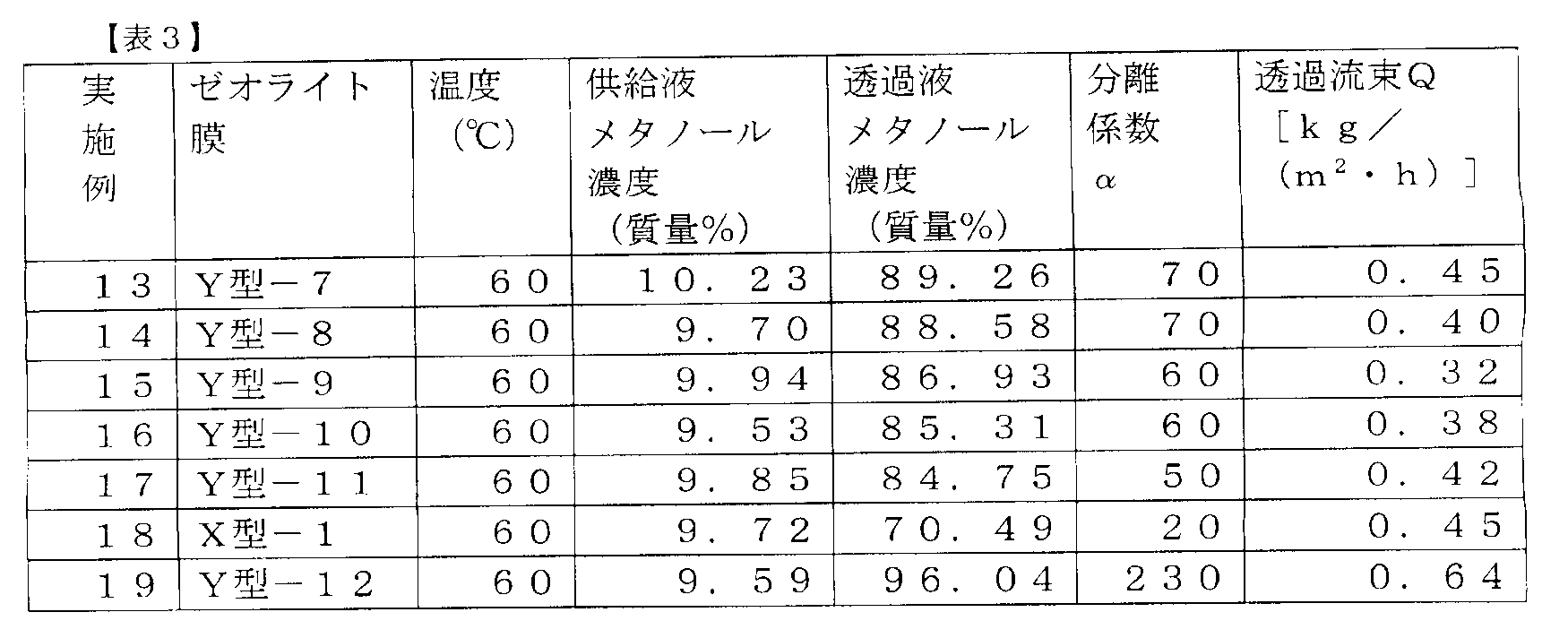
- Examples 2 to 19 The pervaporation experiment of methanol / 1-butanol mixture using a zeolite membrane was performed in the same manner as in Example 1 except that the methanol concentration of the feed solution and the zeolite membrane were changed as shown in Tables 2 and 3. The results of the examples are shown in Tables 2 and 3.
- the effective membrane area of the zeolite membrane in the pervaporation separation experiment was 18.84 cm 2
- the effective membrane area of only the zeolite membrane (Y-type-6) prepared in Production Example 6 was 15.70 cm 2 .
- Example 20 The feed solution was changed from a methanol / 1.-butanol mixture with a methanol concentration of 9.80% by mass to a methanol / 2-butanol (sec-butyl alcohol, manufactured by Kanto Chemical Co., Inc.) mixture with a methanol concentration of 9.32% by mass. Except for the above, the pervaporation experiment was conducted at a temperature of 60 ° C. in the same manner as in Example 1. When the mass and composition of the permeate were stabilized, the permeate methanol concentration was 93.00% by mass, the separation factor ⁇ was 130, and the permeation flux Q was 0.80 kg / (m 2 ⁇ h).
- Example 21 The feed solution was changed from a methanol / 1-butanol mixture having a methanol concentration of 9.80% by mass to a methanol / 2-methyl-1-propanol (isobutyl alcohol, special grade manufactured by Kanto Chemical Co., Ltd.) having a methanol concentration of 9.83% by mass.
- the pervaporation experiment was performed at a temperature of 60 ° C. in the same manner as in Example 1 except that the change was made.
- the permeate methanol concentration was 93.29% by mass
- the separation factor ⁇ was 130
- the permeation flux Q was 0.74 kg / (m 2 ⁇ h).
- Example 22 The feed solution was changed from a methanol / 1-butanol mixture having a methanol concentration of 9.80% by mass to methanol / 2-methyl-2-propanol having a methanol concentration of 9.04% by mass (t-butyl alcohol, manufactured by Kanto Chemical Co., Ltd. ) Pervaporation experiment was conducted at a temperature of 60 ° C. in the same manner as in Example 1 except that the mixture was changed.
- the permeate methanol concentration was 97.40% by mass
- the separation factor ⁇ was 380
- the permeation flux Q was 0.76 kg / (m 2 ⁇ h).
- the pervaporation experiment was carried out at a temperature of 60 ° C. in the same manner as in Example 1 except that the mixture was changed to a mixture of 50.66.
- the pervaporation experiment was conducted at a temperature of 60 ° C. in the same manner as in Example 1 except that the mixture was changed to a mixture of /20.09/29.83/40.05.
- Example 25 The supply liquid container (2) in FIG. 1 is replaced with a container having a volume of 0.1 L, and 0.0371 kg of 1-butanol, 0.0501 kg of methyl methacrylate, titanium tetra-n-butoxide ( 0.00085 kg (manufactured by Kanto Chemical Co., Inc.) and 0.00007 kg of p-methoxyphenol (special grade manufactured by Kanto Chemical Co., Ltd.) were charged and stirred until uniform. A zeolite membrane (Y-type-1) was immersed in this solution and connected to a glass vacuum line (5). The temperature of the supply liquid was kept constant at 80 ° C. by the constant temperature water bath (1), and pressure reduction in the apparatus was started when the temperature reached 80 ° C.
- Example 2 Example except that the Y-type zeolite membrane was replaced with a commercially available T-type zeolite membrane (Mitsui Engineering & Shipbuilding Co., Ltd., outer diameter 12 mm, total length 100 mm, exposed portion length 50 mm, effective membrane area 18.84 cm 2 )
- T-type zeolite membrane Mitsubishi Chemical Company LLC.
- pervaporation separation experiments were conducted at a temperature of 60 ° C. However, the permeate did not distill after 3 hours from the start of permeation.
- a mixture of methanol and a monohydric alcohol having 4 or more carbon atoms can be efficiently separated.
- a raw material can be recovered and reused at a high concentration in a transesterification reaction. Can do.
Landscapes
- Chemical & Material Sciences (AREA)
- Chemical Kinetics & Catalysis (AREA)
- Engineering & Computer Science (AREA)
- Water Supply & Treatment (AREA)
- Organic Chemistry (AREA)
- Life Sciences & Earth Sciences (AREA)
- Geology (AREA)
- Inorganic Chemistry (AREA)
- Separation Using Semi-Permeable Membranes (AREA)
- Organic Low-Molecular-Weight Compounds And Preparation Thereof (AREA)
Abstract
メタノールと、炭素数4以上の1価アルコールとを含む混合物から、メタノールを効率よく分離する方法を提供する。メタノールと、炭素数4以上の1価アルコールとを含む混合物から、FAU型の結晶構造を持つゼオライト膜を用いてメタノールを分離する方法。炭素数4以上の1価アルコールと、炭素数3以上のカルボン酸から誘導されるメチルエステルとの間でエステル交換反応を行い、得られた反応液から、FAU型の結晶構造を持つゼオライト膜を用いてメタノールを分離する方法。
Description
本発明は、メタノールを効率よく分離する方法に関する。
工業的に生産されるエステルは多くの用途に使用されている。例えば、フタル酸エステルは可塑剤として、アクリル酸エステル又はメタクリル酸エステルはポリマーを製造するためのモノマーとして使用され、得られたポリマーは成形材料、塗料、接着剤などとして使用されている。また、テレフタル酸ジメチルはポリエステルの製造原料として使用されている。この他、プロピオン酸エステル、酪酸エステル、イソ吉草酸エステル、カプロン酸エステル、カプリル酸エステル、安息香酸エステル、フェニル酢酸エステル、桂皮酸エステル、サリチル酸エステルは合成香料として使用されている。なお、以後、アクリル酸メチルとメタクリル酸メチルをあわせて(メタ)アクリル酸メチルと呼ぶこともある。
一般に、炭素数4以上の1価アルコールのエステルは、メチルエステルとのエステル交換反応によって製造されている。なお、以後、炭素数2以上のアルコールを高級アルコール、炭素数2以上のアルコールのエステルを高級エステルと呼ぶこともある。
カルボン酸、カルボン酸無水物、カルボン酸ハライドなどのカルボン酸誘導体を原料としたエステルの製造方法に対し、メチルエステルを原料とするエステル交換反応の長所としては、原料であるメチルエステルと高級アルコールが、高濃度のものを入手しやすく、取扱いも容易である点、副生成物がメタノールだけである点が挙げられる。エステル交換反応は平衡反応であり、効率よく高級エステルを得るために、通常、メチルエステル、あるいは高級アルコールが過剰モル使用される。メチルエステルが高級アルコールに対し過剰モル使用される場合もあるが、メチルエステルの沸点が高級アルコールより高い場合や、メチルエステルが高級アルコールより貴重な場合などは、高級アルコールがメチルエステルに対し、過剰モル使用される場合が多い。したがって反応終了時の反応液は、反応副生成物であるメタノール、未反応の高級アルコールおよび反応生成物である高級エステルの混合物となる。このうち、反応生成物である高級エステルは、メタノール、高級アルコールとの沸点差が大きいので、蒸留による分離が比較的容易であり、高級エステルを除いたメタノールと高級アルコールの混合物を得ることができる。
メチルエステルを原料としたエステル交換反応の平衡を、より多くの高級エステルが得られるように傾けるために、反応液を加熱し、メタノールの沸点である64.7℃(大気圧下)以上の温度とすることで、生成するメタノールを蒸発させて反応液から除くことが行なわれることもある。高級アルコールがメチルエステルに対し、過剰モル使用される場合、反応初期の反応液の組成は、メタノールが少なく、高級アルコールが多いため、メタノールを蒸発させようとすれば、メタノールと高級アルコールの混合物の蒸気が得られる。
また、メタノールと共沸混合物を形成するメチルエステルが原料である場合、反応液を加熱すれば、メタノールと高級アルコールとメチルエステルとの混合物の蒸気が得られる。このような共沸混合物を形成するメチルエステルを表1に示す(非特許文献1)。

メタノールと高級アルコールの分離には、通常蒸留が用いられている。しかし、蒸留は熱エネルギーを非常に多く消費するプロセスである。さらに、高級アルコールの沸点がメタノールの沸点と近い場合に、メタノールと高級アルコールをそれぞれ高濃度で得ようとすれば、多段蒸留塔による精密な分離が必要となり、いっそう多くの熱エネルギーを消費することになる。
なお、メタノールと高級アルコールと、メタノールと共沸混合物を形成するメチルエステルとの混合物を通常の蒸留によりそれぞれの成分に分離しようとすると、共沸混合物を形成するため、メタノールとメチルエステルを共沸組成以上に分離することはできず、高濃度のメタノールを得ることはできない。
蒸留以外の方法として、メタノールと高級アルコールの分離に、溶剤の添加による抽出が用いられることがある。溶剤として、水を用いればメタノールのみを水に溶解させることができ、ヘキサンなどの非極性溶媒を用いれば高級アルコールのみを非極性溶媒に溶解させることができる。しかし、非極性溶媒を用いた場合に高純度の高級アルコールを得ようとすれば、非極性溶媒と高級アルコールを何らかの方法により分離しなければならず、プロセスが複雑化する。また、水を用いる場合は、水に大きな溶解性を示す高級アルコールとメタノールの分離は困難である。
一方、最近、混合物、特に共沸混合物の分離に膜を用いる分離方法が提案されている。膜を用いる分離は、蒸留のみによる分離と比較して、熱エネルギーの消費量の点で優れている。分離に使用する膜としては、有機系のポリビニルアルコール膜、ポリイミド膜や無機系のゼオライト膜がある。有機系の膜は、無機系の膜と比較して生産性の点で優れ、無機系の膜は、分離性、耐熱性、耐薬品性の点で優れている。
混合物の分離に膜を用いる分離方法としては、例えば、耐薬品性を有する特殊なポリイミド中空糸膜を用いて、エタノールとメタクリル酸メチルを原料とするエステル交換反応で得られる混合物の蒸気、あるいは1-ブタノールと(メタ)アクリル酸メチルを原料とするエステル交換反応で得られる混合物の蒸気からメタノールを選択的に分離する方法が提案されている(特許文献1)。
この方法によれば、メタノールと(メタ)アクリル酸メチルの共沸組成より高濃度のメタノールを得ることができる。しかし、原料の組成は、(メタ)アクリル酸メチルが過剰であり、高級アルコールが過剰でメタノールと炭素数4以上の1価アルコールからなる混合物の蒸気が発生する組成については記載されていない。
一方、無機系の膜では、FAU型の結晶構造を持つX型ゼオライト膜、Y型ゼオライト膜を用いて、共沸混合物である水とエタノール、エタノールとシクロヘキサン、エタノールとベンゼン、メタノールとベンゼン、メタノールとメチル-t-ブチルエーテルを分離する方法が提案されている(特許文献2、3)。
この方法によれば、例示された共沸混合物中から水、メタノール、あるいはエタノールを比較的高濃度で効率よく分離することができる。しかし、分離の対象となる混合物として例示されているものは、水/アルコール系溶剤、アルコール系溶剤/炭化水素系溶剤、アルコール系溶剤/エーテル系溶剤の混合物であり、メタノールと炭素数4以上の1価アルコールとからなる混合物は記載されていない。
また、Y型ゼオライト膜を用いて、共沸混合物であるメタノールと酢酸メチルを分離する方法が提案されている(特許文献4)。
この方法によれば、多段蒸留塔より少ない熱エネルギーで、共沸組成より高濃度のメタノールと酢酸メチルとを得ることができる。しかし、分離の対象となる混合物として例示されているものには、メタノールと炭素数4以上の1価アルコールからなる混合物は記載されていない。
Ullmann’s Encyclopedia of Industrial Chemistry A16巻 「Methanol」、VCH、1990年、pp465-486
本発明は、メタノールと、炭素数4以上の1価アルコールとを含む混合物から、高濃度のメタノールを効率よく分離することを目的とする。
すなわち、本発明は、メタノールと、炭素数4以上の1価アルコールとを含む混合物から、FAU型の結晶構造を持つゼオライト膜を用いてメタノールを分離する方法である。
また本発明は、炭素数4以上の1価アルコールと、炭素数3以上のカルボン酸から誘導されるメチルエステルとの間でエステル交換反応を行い、得られた反応液から、FAU型の結晶構造を持つゼオライト膜を用いてメタノールを分離する方法である。
さらに本発明は、炭素数4以上の1価アルコールと、炭素数3以上のカルボン酸から誘導されるメチルエステルとの間でエステル交換反応を行い、得られた反応液から、FAU型の結晶構造を持つゼオライト膜を用いてメタノールを分離するエステル交換物の製造方法である。
本発明によれば、メタノールと、炭素数4以上の1価アルコールとを含む混合物から、高濃度のメタノールを効率よく分離することができる。
本発明で使用される膜としては、分離性、耐熱性、耐薬品性の観点からFAU型の結晶構造を持つゼオライト膜、すなわちX型ゼオライト膜、Y型ゼオライト膜を用いる。製膜の容易さを考慮すれば、Y型ゼオライト膜が好ましい。
X型ゼオライト膜、Y型ゼオライト膜は、無機化合物を成分とする多孔質管状支持体の表面にNaX型ゼオライト結晶、NaY型ゼオライト結晶を析出させることで製膜することができる。多孔質管状支持体の成分である無機化合物としては、膜の分離性能を考慮すれば、α-アルミナ、ムライト、ステンレスが好ましい。多孔質管状支持体の表面にゼオライト結晶を析出させるには、支持体表面にゼオライトの種結晶を塗布し、アルミノシリケートゲルに浸漬して加熱することが好ましい。加熱する方法としては高温高圧の熱水を用いる方法、いわゆる水熱合成法が好ましい。
水熱合成法では、オイルなどの熱媒、熱風、マイクロ波等によって加熱することができる。ゼオライトの結晶化速度を考慮すると、温度は100~140℃が好ましく、加熱する時間は、X型ゼオライト膜の場合は3~27時間が好ましく、Y型ゼオライト膜の場合は2~6時間が好ましい。Y型ゼオライト膜で透過性能の優れた膜を得るには、温度を一定とするよりも、温度を120~140℃で1~2時間加熱し、次に温度を100℃以上120℃未満として1~4時間加熱することが好ましい。なお、マイクロ波を用いて加熱する場合、周波数としては家庭用電子レンジで利用できる2450MHzが好ましい。
メタノールと、炭素数4以上の1価アルコールとを含む混合物から効率よくメタノールを分離するためには、X型ゼオライト膜の場合、アルミノシリケートゲルのシリカ/アルミナのモル比が2~10であることが好ましい。アルミナシリケートゲルを構成するシリカ、アルミナ以外の成分としては酸化ナトリウムと水が挙げられる。それら酸化ナトリウム/シリカの組成モル比は1~3であることが好ましく、水/酸化ナトリウムのモル比は20~50であることが好ましい。Y型ゼオライト膜の場合、アルミノシリケートゲルのシリカ/アルミナのモル比が20以上であることが好ましく、25以上であることがより好ましい。シリカ/アルミナのモル比の上限は50以下であることが好ましい。アルミナシリケートゲルを構成するシリカ、アルミナ以外の成分としては酸化ナトリウムと水が挙げられる。酸化ナトリウム/シリカのモル比は0.6~1.2であることが好ましく、水/酸化ナトリウムのモル比は40~100であることが好ましい。
また、X型ゼオライト膜の場合はアルミノシリケートゲルのエージングの必要はなく、Y型ゼオライト膜の場合はアルミノシリケートゲルのエージングは20~40℃で15~21時間であることが好ましい。
このようにして得られたY型ゼオライト膜は、膜を構成するゼオライトのケイ素/アルミニウムのモル比が2.5以上となり、高い分離性能と高い透過流束とを有する膜が得られる。Y型ゼオライト膜を構成するゼオライトのケイ素/アルミニウムのモル比が2.7以上であることが好ましい。Y型ゼオライト膜を構成するゼオライトのケイ素/アルミニウムのモル比が4.0以下であると、アルミノシリケートゲル中で損失するケイ素分の増大を抑制することができて、ピンホールなどの欠陥を生じることなくY型ゼオライト膜を製造することができて好ましい。メタノールと、炭素数4以上の1価アルコールとを含む混合物からメタノールを分離する際には、メタノール濃度10質量%、1-ブタノール濃度90質量%の混合物を供給液とし、温度60℃、減圧度0.1kPa以下を保つように浸透気化分離した際の、透過液のメタノール濃度が95質量%以上、透過流束が0.6[kg/(m2・h)]以上となるY型ゼオライト膜を用いることが好ましい。
本発明で分離の対象となるメタノールとの混合物の成分である、炭素数4以上の1価アルコールとしては、特に制限はないが、例えば、1-ブタノール、2-ブタノール(sec-ブチルアルコール)、2-メチル-1-プロパノール(イソブチルアルコール)、2-メチル-2-プロパノール(t-ブチルアルコール)、3-ブテン-1-オール、3-ブテン-2-オール、メタリルアルコール、1-ペンタノール、2-ペンタノール、3-ペンタノール、2-メチル-1-ブタノール、3-メチル-1-ブタノール(イソアミルアルコール)、2-メチル-2-ブタノール(t-アミルアルコール)、3-メチル-2-ブタノール、2,2-ジメチル-1-プロパノール、2-ペンテン-1-オール、4-ペンテン-1-オール、3-ペンテン-2-オール、4-ペンテン-2-オール、1-ペンテン-3-オール、2-メチル-3-ブテン-1-オール、2-メチル-3-ブテン-2-オール、3-メチル-2-ブテン-1-オール、3-メチル-3-ブテン-1-オール、シクロペンタノール、1-ヘキサノール、3-メチル-1-ペンテン-3-オール、シクロヘキサノール、フェノール、ベンジルアルコール、1-オクタノール、2-エチルヘキサノール、1-ドデカノール、1-トリデカノール、1-オクタデカノール、テトラヒドロフルフリルアルコール、2-エトキシエタノール、ジメチルアミノエタノール、ジエチルアミノエタノールなどが挙げられる。これらは一種のみを用いてもよく、二種以上を併用してもよい。中でも、メタノールと比較的沸点が近く、単純な蒸留による分離が困難な点で、1-ブタノール、2-ブタノール(sec-ブチルアルコール)、2-メチル-1-プロパノール(イソブチルアルコール)、2-メチル-2-プロパノール(t-ブチルアルコール)、3-ブテン-1-オール、3-ブテン-2-オール、メタリルアルコール、2-ペンタノール、3-ペンタノール、2-メチル-2-ブタノール(t-アミルアルコール)、3-メチル-2-ブタノール、2,2-ジメチル-1-プロパノール、4-ペンテン-2-オール、1-ペンテン-3-オール、3-メチル-1-ペンテン-3-オール、又は2-メチル-3-ブテン-2-オールが好ましい。炭素数2のアルコールであるエタノールや炭素数3のアルコールである1-プロパノール、2-プロパノール(イソプロピルアルコール)、アリルアルコールなどは、炭素数4以上の1価アルコールと比較して、ゼオライト膜による分離の選択性、透過流束が低い傾向がある。
本発明で使用されるメタノールと、炭素数4以上の1価アルコールとの混合物の組成は、特に限定されないが、温度40℃以上で90質量%以上の高濃度のメタノールを得るためには混合物のメタノール濃度が5質量%以上であることが好ましい。
メタノールと、炭素数4以上の1価アルコールとの混合物には、さらに炭素数3以上のカルボン酸から誘導されるメチルエステルを含んでいても膜分離を行うことができる。炭素数3以上のカルボン酸から誘導されるメチルエステルとしては、特に制限はないが、例えば、プロピオン酸メチル、(メタ)アクリル酸メチル、酪酸メチル、イソ酪酸メチル、イソ吉草酸メチル、カプロン酸メチル、カプリル酸メチル、安息香酸メチル、フェニル酢酸メチル、桂皮酸メチル、サリチル酸メチル、テレフタル酸ジメチルなどが挙げられる。これらは一種のみを用いてもよく、二種以上を併用してもよい。
中でも、炭素数3以上のカルボン酸から誘導されるメチルエステルとしては、プロピオン酸メチル又は(メタ)アクリル酸メチルであることが、メタノールと共沸混合物を形成して蒸留による分離が困難であり、特に膜分離が有効である観点から好ましい。炭素数2以下のカルボン酸から誘導されるメチルエステル、例えば、ぎ酸メチル、酢酸メチルは、炭素数3以上のカルボン酸より誘導されるメチルエステルと比較して、ゼオライト膜による分離の選択性が低い傾向がある。
メタノールと、炭素数4以上の1価アルコールと、炭素数3以上のカルボン酸から誘導されるメチルエステルとの混合物には、さらに炭素数3以上のカルボン酸及び炭素数4以上の1価アルコールから誘導されるエステルを含んでいても膜分離を行うことができる。このようなメタノールと炭素数4以上の1価アルコールなどを含む混合物は、エステル交換反応で得ることができる。
炭素数4以上の1価アルコールと、炭素数3以上のカルボン酸から誘導されるメチルエステルとに触媒を添加してエステル交換反応させることで、原料である炭素数4以上の1価アルコールと、炭素数3以上のカルボン酸から誘導されるメチルエステル、触媒に加えて、生成物であるメタノールと、炭素数3以上のカルボン酸及び炭素数4以上の1価アルコールから誘導されるエステルも含む混合物である反応液が得られる。
エステル交換反応に用いることができる触媒は、特に制限はないが、チタニウムテトラアルコキシド、ジアルキルスズオキシドなどの金属錯体触媒や酸化カルシウムなどの塩基性触媒が好ましい。硫酸やパラトルエンスルホン酸などの酸性触媒は、ゼオライト膜と接触すると膜を溶解する場合がある。
(メタ)アクリル酸エステルを製造するエステル交換反応では、(メタ)アクリル酸エステルの重合を防止するために、重合防止剤を使用することが好ましい。重合防止剤としては、4-ヒドロキシ-2,2,6,6-テトラメチルピペリジン-N-オキシルなどのN-オキシラジカル系化合物、p-メトキシフェノールなどのフェノール系化合物、ハイドロキノンなどのキノン系化合物、フェノチアジンなどのアミン系化合物を挙げることができる。これらは、それぞれ単独でまたは2種類以上を混合して用いることができる。
メタノールと、炭素数4以上の1価アルコールとを含む混合物のFAU型の結晶構造を持つゼオライト膜による分離では、メタノールが選択的に透過され、炭素数4以上の1価アルコールはほとんど透過されない。蒸気の状態で透過された場合の高濃度メタノールは冷却して液体の状態にすることが好ましい。
本発明におけるメタノールと、炭素数4以上の1価アルコールとを含む混合物をFAU型の結晶構造を持つゼオライト膜により分離する方法としては、液体の状態(浸透気化法)、又は蒸気の状態(蒸気透過法)で分離する方法を挙げることができる。装置をコンパクト化できる点では浸透気化法が好ましく、相変化を伴わず熱エネルギーの消費を低減できる点では蒸気透過法が好ましい。蒸気透過法の場合には、蒸留と組み合わせて使用することが、分離の選択性、熱エネルギーの消費を低減する点から好ましい。
メタノールの効率的な膜分離を実現するために、膜に対する透過側と供給側でメタノールの濃度差を設けることが好ましい。濃度差を設ける具体的な手段としては、透過側と供給側で大きな差圧をつけるか、あるいは透過側にメタノールが滞留しないようにメタノール以外の気体を流すことが挙げられる。大きな差圧をつけるためには、供給側を加圧するか、あるいは透過側を減圧にしなければならない。実現の容易さと透過性を考慮すれば、供給側の圧力は50~470kPa、透過側の圧力は0.5kPa以下が好ましく、供給側の圧力は大気圧、透過の圧力側は0.1kPa以下がより好ましい。透過側にメタノールが滞留しないように流すメタノール以外の気体としては、メタノールと反応せず不活性で、入手の容易なことを考慮すれば、空気、窒素、アルゴンが好ましい。
分離における供給側の混合物の温度は、実現の容易さを考慮すれば0~200℃が好ましく、メタノールの透過量を考慮すれば、30~180℃が好ましく、膜分離の選択性と消費する熱エネルギーを考慮すれば、50~150℃がより好ましい。蒸気透過法により、混合物を蒸気の状態で供給する場合には、メタノールの透過量を多くするために、膜分離の前に蒸気を過熱して供給することもできる。
以上のように、本発明の分離方法によれば、メタノールと、炭素数4以上の1価アルコールを含む混合物からメタノールを効率よく分離することができる。また、本発明のエステル交換物の製造方法によれば、得られた反応液からメタノールを効率よく分離することができるため、効率よくエステル交換物を得ることができる。
以下に本発明の実施例を説明するが、本発明はこれらの実施例に何ら限定されるものではない。
<FAU型の結晶構造を持つゼオライト膜の製造>
(製造例1)
ゼオライト膜は機械強度に欠けるため、多孔質管状支持体上に膜を析出させることで調製した。NaY型ゼオライト粉末(東ソー株式会社製、商品名:HSZ-320NAA)に同じ質量の水を加えてペースト状にしたものを多孔質ムライト支持体(株式会社ニッカトー製、商品名:PMチューブ、外径12mm、内径9mm、平均細孔径1.3μm、気孔率45%、全長100mm)の表面に、ゼオライト粉末が析出するまで指で塗布した。
(製造例1)
ゼオライト膜は機械強度に欠けるため、多孔質管状支持体上に膜を析出させることで調製した。NaY型ゼオライト粉末(東ソー株式会社製、商品名:HSZ-320NAA)に同じ質量の水を加えてペースト状にしたものを多孔質ムライト支持体(株式会社ニッカトー製、商品名:PMチューブ、外径12mm、内径9mm、平均細孔径1.3μm、気孔率45%、全長100mm)の表面に、ゼオライト粉末が析出するまで指で塗布した。
アルミン酸ナトリウム(和光純薬工業株式会社製一級)2.598g、水酸化ナトリウム(和光純薬工業株式会社製特級)12.688g、水ガラス(シグマアルドリッチジャパン株式会社製)80g、蒸留水211.7gを混合した。このとき、シリカ/アルミナ/酸化ナトリウム/水=25/1/22/990(モル比)となった。その混合液を室温で4時間撹拌し、30℃で17時間エージングすることでアルミノシリケートゲル307gを得た。
容量0.5Lのオートクレーブ中にアルミノシリケートゲルを仕込み、前述のゼオライト粉末を塗布した支持体を浸漬した。オートクレーブを密閉して100℃で6時間水熱合成した。水熱合成終了後、作製したY型ゼオライト膜(Y型-1)を水洗し、乾燥して、X線解析装置(株式会社島津製作所製XRD-6100)を用いて、光源:Cu-Kα、測定点間隔:0.1度、測定範囲:5~45度にてX線回折スペクトルを測定し、NaY型ゼオライト結晶のピークが出現していることを確認した。
なお、多孔質支持体上に形成されたY型ゼオライト膜の有効膜面積は、全長100mmの多孔質ムライト支持体のうち、長さ50mmの部分が露出していたことから1.20×3.14×5.00=18.84cm2であった。
別途、同一条件にてゼオライト膜を形成し、そのゼオライト膜についてSEM/EDS(日本電子株式会社製走査型電子顕微鏡JSM6060A/日本電子株式会社製ミニカップ型EDS検出器付き)を用いて加速電圧:20kV、スポットサイズ(フィラメント電流):60mA、測定時間:300秒、作動距離:10mmにて測定した結果、ケイ素/アルミニウムのモル比は2.5であった。
(製造例2)
オートクレーブ中にアルミノシリケートゲルを仕込み、ゼオライト粉末を塗布した支持体を浸漬し、オートクレーブを密閉して100℃で6時間水熱合成する処理から、パイレックス(登録商標)容器内にアルミノシリケートゲルを仕込み、ゼオライト粉末を塗布した支持体を浸漬し、マイクロ波反応装置(四国計測工業株式会社製、マイクロ波周波数2450±50MHz、出力1kW)を用いてパイレックス(登録商標)容器にマイクロ波を連続的に照射して容器内の温度を100℃にし、以後はマイクロ波を間欠的に照射することで100℃を4時間保つ処理に替えたこと以外は、製造例1と同様にY型ゼオライト膜(Y型-2)を作製した。
オートクレーブ中にアルミノシリケートゲルを仕込み、ゼオライト粉末を塗布した支持体を浸漬し、オートクレーブを密閉して100℃で6時間水熱合成する処理から、パイレックス(登録商標)容器内にアルミノシリケートゲルを仕込み、ゼオライト粉末を塗布した支持体を浸漬し、マイクロ波反応装置(四国計測工業株式会社製、マイクロ波周波数2450±50MHz、出力1kW)を用いてパイレックス(登録商標)容器にマイクロ波を連続的に照射して容器内の温度を100℃にし、以後はマイクロ波を間欠的に照射することで100℃を4時間保つ処理に替えたこと以外は、製造例1と同様にY型ゼオライト膜(Y型-2)を作製した。
(製造例3)
アルミノシリケートゲルとして、シリカ/アルミナ/酸化ナトリウム/水=25/1/22/990(モル比)となるように混合液を調製する処理から、シリカ/アルミナ/酸化ナトリウム/水=40/1/22/990(モル比)となるように混合液を調製する処理に替えたこと以外は製造例1と同様にY型ゼオライト膜(Y型-3)を作製した。
アルミノシリケートゲルとして、シリカ/アルミナ/酸化ナトリウム/水=25/1/22/990(モル比)となるように混合液を調製する処理から、シリカ/アルミナ/酸化ナトリウム/水=40/1/22/990(モル比)となるように混合液を調製する処理に替えたこと以外は製造例1と同様にY型ゼオライト膜(Y型-3)を作製した。
別途、同一条件にてゼオライト膜を形成し、そのゼオライト膜についてSEM/EDS(日本電子株式会社製走査型電子顕微鏡JSM6060A/日本電子株式会社製ミニカップ型EDS検出器付き)を用いて製造例1と同じ条件にて測定した結果、ケイ素/アルミニウムのモル比は2.7であった。
(製造例4)
オートクレーブを密閉して100℃で6時間水熱合成する処理から、オートクレーブを密閉して130℃で1時間、100℃で3.5時間水熱合成するする処理に替えたこと以外は製造例1と同様にY型ゼオライト膜(Y型-4)を作製した。
オートクレーブを密閉して100℃で6時間水熱合成する処理から、オートクレーブを密閉して130℃で1時間、100℃で3.5時間水熱合成するする処理に替えたこと以外は製造例1と同様にY型ゼオライト膜(Y型-4)を作製した。
(製造例5)
パイレックス(登録商標)容器にマイクロ波を連続的に照射して容器内の温度を100℃にし、以後はマイクロ波を間欠的に照射することで100℃を4時間保つ処理から、容器にマイクロ波を連続的に照射して容器内の温度を130℃にし、以後はマイクロ波を間欠的に照射することで130℃を1時間、100℃を2時間保つ処理に替えたこと以外は、製造例2と同様にY型ゼオライト膜(Y型-5)を作製した。
パイレックス(登録商標)容器にマイクロ波を連続的に照射して容器内の温度を100℃にし、以後はマイクロ波を間欠的に照射することで100℃を4時間保つ処理から、容器にマイクロ波を連続的に照射して容器内の温度を130℃にし、以後はマイクロ波を間欠的に照射することで130℃を1時間、100℃を2時間保つ処理に替えたこと以外は、製造例2と同様にY型ゼオライト膜(Y型-5)を作製した。
(製造例6)
多孔質管状支持体を、多孔質ムライト支持体から、75℃で16時間硝酸処理した多孔質ステンレス支持体(マイクロフィルター株式会社製、外径10mm、内径8.3mm、平均細孔径1.0μm、気孔率30%、全長100mm)に替えたこと以外は製造例1と同様にY型ゼオライト膜(Y型-6)を作製した。有効膜面積は(支持体の直径)×(円周率)×(露出部分の長さ)=1.00×3.14×5.00=15.70cm2であった。
多孔質管状支持体を、多孔質ムライト支持体から、75℃で16時間硝酸処理した多孔質ステンレス支持体(マイクロフィルター株式会社製、外径10mm、内径8.3mm、平均細孔径1.0μm、気孔率30%、全長100mm)に替えたこと以外は製造例1と同様にY型ゼオライト膜(Y型-6)を作製した。有効膜面積は(支持体の直径)×(円周率)×(露出部分の長さ)=1.00×3.14×5.00=15.70cm2であった。
(製造例7)
アルミノシリケートゲルとして、シリカ/アルミナ/酸化ナトリウム/水=25/1/22/990(モル比)となるように混合液を調製する処理から、シリカ/アルミナ/酸化ナトリウム/水=15/1/13.5/990(モル比)となるように混合液を調製する処理に替えたこと以外は製造例1と同様にY型ゼオライト膜(Y型-7)を作製した。
アルミノシリケートゲルとして、シリカ/アルミナ/酸化ナトリウム/水=25/1/22/990(モル比)となるように混合液を調製する処理から、シリカ/アルミナ/酸化ナトリウム/水=15/1/13.5/990(モル比)となるように混合液を調製する処理に替えたこと以外は製造例1と同様にY型ゼオライト膜(Y型-7)を作製した。
別途、同一条件にてゼオライト膜を形成し、そのゼオライト膜についてSEM/EDS(日本電子株式会社製走査型電子顕微鏡JSM6060A/日本電子株式会社製ミニカップ型EDS検出器付き)を用いて製造例1と同じ条件にて測定した結果、ケイ素/アルミニウムのモル比は2.3であった。
(製造例8)
アルミノシリケートゲルとして、30℃で17時間エージングをする処理から、30℃で12時間エージングをする処理に替えたこと以外は製造例1と同様にY型ゼオライト膜(Y型-8)を作製した。
アルミノシリケートゲルとして、30℃で17時間エージングをする処理から、30℃で12時間エージングをする処理に替えたこと以外は製造例1と同様にY型ゼオライト膜(Y型-8)を作製した。
(製造例9)
アルミノシリケートゲルとして、30℃で17時間エージングをする処理から、30℃で24時間エージングをする処理に替えたこと以外は製造例1と同様にY型ゼオライト膜(Y型-9)を作製した。
アルミノシリケートゲルとして、30℃で17時間エージングをする処理から、30℃で24時間エージングをする処理に替えたこと以外は製造例1と同様にY型ゼオライト膜(Y型-9)を作製した。
(製造例10)
オートクレーブを密閉して100℃で6時間水熱合成する処理から、オートクレーブを密閉して100℃で3時間、150℃で1.5時間水熱合成する処理に替えたこと以外は製造例1と同様にY型ゼオライト膜(Y型-10)を作製した。
オートクレーブを密閉して100℃で6時間水熱合成する処理から、オートクレーブを密閉して100℃で3時間、150℃で1.5時間水熱合成する処理に替えたこと以外は製造例1と同様にY型ゼオライト膜(Y型-10)を作製した。
(製造例11)
アルミノシリケートゲルとして、シリカ/アルミナ/酸化ナトリウム/水=25/1/22/990(モル比)となるように混合液を調製する処理から、シリカ/アルミナ/酸化ナトリウム/水=10/1/14/800(モル比)となるように混合液を調製する処理に替え、エージング時間を12時間とし、オートクレーブを密閉して100℃で6時間水熱合成する処理から、オートクレーブを密閉して90℃で5時間水熱合成する処理に替えたこと以外は製造例1と同様にY型ゼオライト膜(Y型-11)を作製した。
アルミノシリケートゲルとして、シリカ/アルミナ/酸化ナトリウム/水=25/1/22/990(モル比)となるように混合液を調製する処理から、シリカ/アルミナ/酸化ナトリウム/水=10/1/14/800(モル比)となるように混合液を調製する処理に替え、エージング時間を12時間とし、オートクレーブを密閉して100℃で6時間水熱合成する処理から、オートクレーブを密閉して90℃で5時間水熱合成する処理に替えたこと以外は製造例1と同様にY型ゼオライト膜(Y型-11)を作製した。
(製造例12)
NaX型ゼオライト粉末(シグマアルドリッチジャパン株式会社製モレキュラーシーブス13X粉末)に同じ質量の水を加えてペースト状にしたものを、多孔質ムライト支持体の表面に、ゼオライト粉末が析出するまで指で塗布した。シリカ/アルミナ/酸化ナトリウム/水=3.6/1/5.04/252(モル比)となるように混合液を調製し、その混合液を室温で4時間撹拌することでアルミノシリケートゲルを得た。
NaX型ゼオライト粉末(シグマアルドリッチジャパン株式会社製モレキュラーシーブス13X粉末)に同じ質量の水を加えてペースト状にしたものを、多孔質ムライト支持体の表面に、ゼオライト粉末が析出するまで指で塗布した。シリカ/アルミナ/酸化ナトリウム/水=3.6/1/5.04/252(モル比)となるように混合液を調製し、その混合液を室温で4時間撹拌することでアルミノシリケートゲルを得た。
容量0.5Lのオートクレーブ中にアルミノシリケートゲルを仕込み、前述のゼオライト粉末を塗布した支持体を浸漬した。オートクレーブを密閉して100℃で24時間水熱合成した。水熱合成終了後、作製したX型ゼオライト膜(X型-1)を水洗し、乾燥して、X線解析装置(株式会社島津製作所製XRD-6100)を用いて、光源:Cu-Kα、測定点間隔:0.1度、測定範囲:5~45度にてX線回折スペクトルを測定し、NaX型ゼオライト結晶のピークが出現していることを確認した。
(製造例13)
アルミノシリケートゲルとして、シリカ/アルミナ/酸化ナトリウム/水=25/1/22/990(モル比)となるように混合液を調製する処理から、シリカ/アルミナ/酸化ナトリウム/水=30/1/25/990(モル比)となるように混合液を調製する処理に替えたこと以外は製造例1と同様にY型ゼオライト膜(Y型-12)を作製した。
アルミノシリケートゲルとして、シリカ/アルミナ/酸化ナトリウム/水=25/1/22/990(モル比)となるように混合液を調製する処理から、シリカ/アルミナ/酸化ナトリウム/水=30/1/25/990(モル比)となるように混合液を調製する処理に替えたこと以外は製造例1と同様にY型ゼオライト膜(Y型-12)を作製した。
別途、同一条件にてゼオライト膜を形成し、そのゼオライト膜についてSEM/EDS(日本電子株式会社製走査型電子顕微鏡JSM6060A/日本電子株式会社製ミニカップ型EDS検出器付き)を用いて製造例1と同じ条件にて測定した結果、ケイ素/アルミニウムのモル比は2.5であった。
<分離性能の測定>
(実施例1)
以上のようにして作製したゼオライト膜のうち、多孔質支持体上に調製したものの浸透気化による分離性能を測定した。Y型ゼオライト膜を図1に示す装置に取り付けた。具体的に説明すると、恒温水槽(1)の内部に容量0.3Lの供給液用容器(2)を設置し、供給液用容器(2)の中の供給液の温度を一定に保つようにした。供給液として、メタノールと1-ブタノールの混合物0.25Lを満たした。供給液の温度が高く、蒸発量が多い場合には、供給液用容器(2)にジムロート冷却管を取り付けて、供給液の揮発を抑制した。供給液にY型ゼオライト膜(3)を浸漬し、その片末端を封止し、残りの末端をシリコーンチューブ(4)を介してガラス減圧ライン(5)に接続した。ガラス減圧ライン(5)は切替え用コック(6)で枝分かれし、それぞれのラインをトラップ管(7)を経由して真空ポンプ(9)に連結した。装置内を減圧にすることで供給液の成分がY型ゼオライト膜(3)を蒸気の形態で透過するようにし、透過した蒸気を、デュワー瓶(8)に満たした液体窒素により冷却して、トラップ管(7)で捕集した。0.5時間経過ごとに切替え用コック(6)を操作することでトラップ管(7)に捕集した液体(透過液)の質量と組成を測定した。測定後、透過液を供給液に加え、供給液の質量と組成が変化しないようにした。透過液の質量と組成が安定し、3回連続してほとんど変化がなくなった時点で測定を終了し、その平均を透過物質量(kg)とメタノール濃度(質量%)として求めた。通常は、透過を開始して1~1.5時間経過すると、透過液の質量と組成は安定し、2.5~3時間経過した時点で測定を終了した。なお、多孔質支持体上に形成されたY型ゼオライト膜(3)の有効膜面積は、全長100mmの多孔質ムライト支持体のうち、長さ50mmの部分が露出していたことから18.84cm2であった。
(実施例1)
以上のようにして作製したゼオライト膜のうち、多孔質支持体上に調製したものの浸透気化による分離性能を測定した。Y型ゼオライト膜を図1に示す装置に取り付けた。具体的に説明すると、恒温水槽(1)の内部に容量0.3Lの供給液用容器(2)を設置し、供給液用容器(2)の中の供給液の温度を一定に保つようにした。供給液として、メタノールと1-ブタノールの混合物0.25Lを満たした。供給液の温度が高く、蒸発量が多い場合には、供給液用容器(2)にジムロート冷却管を取り付けて、供給液の揮発を抑制した。供給液にY型ゼオライト膜(3)を浸漬し、その片末端を封止し、残りの末端をシリコーンチューブ(4)を介してガラス減圧ライン(5)に接続した。ガラス減圧ライン(5)は切替え用コック(6)で枝分かれし、それぞれのラインをトラップ管(7)を経由して真空ポンプ(9)に連結した。装置内を減圧にすることで供給液の成分がY型ゼオライト膜(3)を蒸気の形態で透過するようにし、透過した蒸気を、デュワー瓶(8)に満たした液体窒素により冷却して、トラップ管(7)で捕集した。0.5時間経過ごとに切替え用コック(6)を操作することでトラップ管(7)に捕集した液体(透過液)の質量と組成を測定した。測定後、透過液を供給液に加え、供給液の質量と組成が変化しないようにした。透過液の質量と組成が安定し、3回連続してほとんど変化がなくなった時点で測定を終了し、その平均を透過物質量(kg)とメタノール濃度(質量%)として求めた。通常は、透過を開始して1~1.5時間経過すると、透過液の質量と組成は安定し、2.5~3時間経過した時点で測定を終了した。なお、多孔質支持体上に形成されたY型ゼオライト膜(3)の有効膜面積は、全長100mmの多孔質ムライト支持体のうち、長さ50mmの部分が露出していたことから18.84cm2であった。
測定中の装置の減圧度は0.1kPa以下を保つようにした。また、透過液の組成はガスクロマトグラフにより測定した。
ゼオライト膜の透過性能は、透過液中に含まれるメタノールの濃度と、次の式で示される分離係数α、
α=[Y/(100-Y)]/[X/(100-X)]
X:供給液のメタノールの濃度(質量%)
100-X:供給液のメタノール以外の成分の濃度(質量%)
Y:透過液のメタノールの濃度(質量%)
100-Y:透過液のメタノール以外の成分の濃度(質量%)
透過流束Q[kg/(m2・h)]、
Q=w/(A×t)
w:透過物質量(kg)
A:有効膜面積(m2)
t:透過時間(h)
で評価した。
α=[Y/(100-Y)]/[X/(100-X)]
X:供給液のメタノールの濃度(質量%)
100-X:供給液のメタノール以外の成分の濃度(質量%)
Y:透過液のメタノールの濃度(質量%)
100-Y:透過液のメタノール以外の成分の濃度(質量%)
透過流束Q[kg/(m2・h)]、
Q=w/(A×t)
w:透過物質量(kg)
A:有効膜面積(m2)
t:透過時間(h)
で評価した。
メタノール(関東化学株式会社製特級)と1-ブタノール(関東化学株式会社製特級)から、メタノール濃度9.80質量%のメタノール/1-ブタノール混合物である供給液を調製し、製造例1で作製したゼオライト膜(Y型-1)を浸漬して、温度60℃で浸透気化分離実験を行った。透過液の質量と組成が安定したとき、透過液メタノール濃度は95.70質量%、分離係数αは210、透過流束Qは0.60kg/(m2・h)となった。結果を表2に示す。なお、浸透気化分離実験におけるゼオライト膜の有効膜面積は18.84cm2であった。
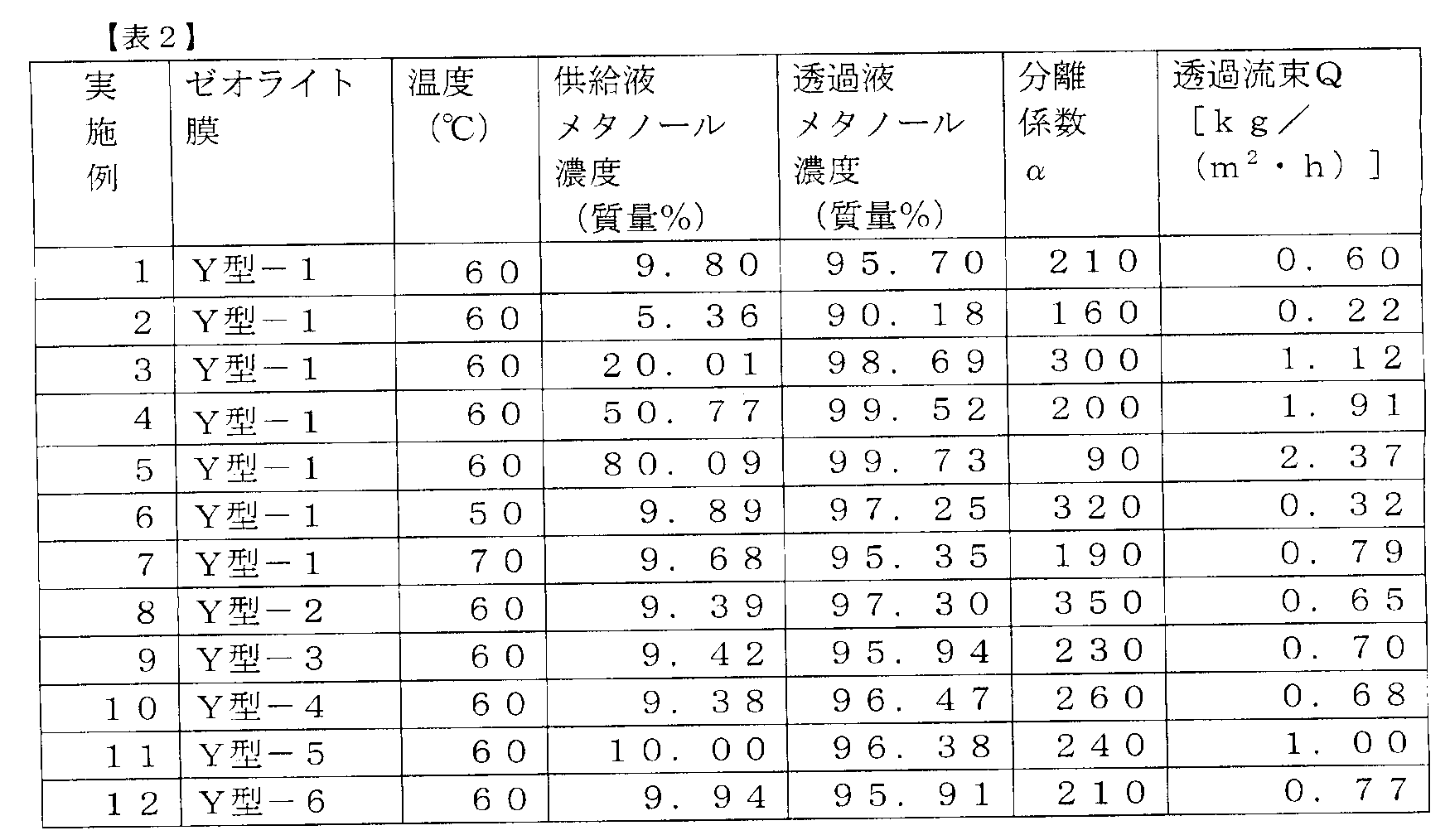
供給液のメタノール濃度やゼオライト膜を表2及び表3に示すように替えたこと以外は、実施例1と同様にゼオライト膜によるメタノール/1-ブタノール混合物の浸透気化分離実験を行った。実施例の結果を表2及び表3に示す。なお、浸透気化分離実験におけるゼオライト膜の有効膜面積は18.84cm2であり、製造例6で作成したゼオライト膜(Y型-6)のみ有効膜面積は15.70cm2であった。
供給液を、メタノール濃度9.80質量%のメタノール/1-ブタノール混合物から、メタノール濃度9.32質量%のメタノール/2-ブタノール(sec-ブチルアルコール、関東化学株式会社製)混合物に替えたこと以外は実施例1と同様に温度60℃で浸透気化分離実験を行った。透過液の質量と組成が安定したとき、透過液メタノール濃度は93.00質量%、分離係数αは130、透過流束Qは0.80kg/(m2・h)となった。
(実施例21)
供給液を、メタノール濃度9.80質量%のメタノール/1-ブタノール混合物から、メタノール濃度9.83質量%のメタノール/2-メチル-1-プロパノール(イソブチルアルコール、関東化学株式会社製特級)混合物に替えたこと以外は実施例1と同様に温度60℃で浸透気化分離実験を行った。透過液の質量と組成が安定したとき、透過液メタノール濃度は93.29質量%、分離係数αは130、透過流束Qは0.74kg/(m2・h)となった。
供給液を、メタノール濃度9.80質量%のメタノール/1-ブタノール混合物から、メタノール濃度9.83質量%のメタノール/2-メチル-1-プロパノール(イソブチルアルコール、関東化学株式会社製特級)混合物に替えたこと以外は実施例1と同様に温度60℃で浸透気化分離実験を行った。透過液の質量と組成が安定したとき、透過液メタノール濃度は93.29質量%、分離係数αは130、透過流束Qは0.74kg/(m2・h)となった。
(実施例22)
供給液を、メタノール濃度9.80質量%のメタノール/1-ブタノール混合物から、メタノール濃度9.04質量%のメタノール/2-メチル-2-プロパノール(t-ブチルアルコール、関東化学株式会社製鹿特級)混合物に替えたこと以外は実施例1と同様に温度60℃で浸透気化分離実験を行った。透過液の質量と組成が安定したとき、透過液メタノール濃度は97.40質量%、分離係数αは380、透過流束Qは0.76kg/(m2・h)となった。
供給液を、メタノール濃度9.80質量%のメタノール/1-ブタノール混合物から、メタノール濃度9.04質量%のメタノール/2-メチル-2-プロパノール(t-ブチルアルコール、関東化学株式会社製鹿特級)混合物に替えたこと以外は実施例1と同様に温度60℃で浸透気化分離実験を行った。透過液の質量と組成が安定したとき、透過液メタノール濃度は97.40質量%、分離係数αは380、透過流束Qは0.76kg/(m2・h)となった。
(実施例23)
供給液を、メタノール濃度9.80質量%のメタノール/1-ブタノール混合物から、質量比がメタノール/1-ブタノール/メタクリル酸メチル(三菱レイヨン株式会社製アクリエステルM)=13.27/36.07/50.66の混合物に替えたこと以外は実施例1と同様に温度60℃で浸透気化分離実験を行った。透過液の質量と組成が安定したとき、透過液の質量比はメタノール/1-ブタノール/メタクリル酸メチル=97.69/1.50/0.81、透過流束Qは2.03kg/(m2・h)となった。
供給液を、メタノール濃度9.80質量%のメタノール/1-ブタノール混合物から、質量比がメタノール/1-ブタノール/メタクリル酸メチル(三菱レイヨン株式会社製アクリエステルM)=13.27/36.07/50.66の混合物に替えたこと以外は実施例1と同様に温度60℃で浸透気化分離実験を行った。透過液の質量と組成が安定したとき、透過液の質量比はメタノール/1-ブタノール/メタクリル酸メチル=97.69/1.50/0.81、透過流束Qは2.03kg/(m2・h)となった。
(実施例24)
供給液を、メタノール濃度9.80質量%のメタノール/1-ブタノール混合物から、質量比がメタノール/1-ブタノール/メタクリル酸メチル/メタクリル酸ブチル(三菱レイヨン株式会社製アクリエステルB)=10.03/20.09/29.83/40.05の混合物に替えたこと以外は実施例1と同様に温度60℃で浸透気化分離実験を行った。透過液の質量と組成が安定したとき、透過液の質量比はメタノール/1-ブタノール/メタクリル酸メチル=98.00/1.37/0.63%、透過流束Qは1.69kg/(m2・h)となった。
供給液を、メタノール濃度9.80質量%のメタノール/1-ブタノール混合物から、質量比がメタノール/1-ブタノール/メタクリル酸メチル/メタクリル酸ブチル(三菱レイヨン株式会社製アクリエステルB)=10.03/20.09/29.83/40.05の混合物に替えたこと以外は実施例1と同様に温度60℃で浸透気化分離実験を行った。透過液の質量と組成が安定したとき、透過液の質量比はメタノール/1-ブタノール/メタクリル酸メチル=98.00/1.37/0.63%、透過流束Qは1.69kg/(m2・h)となった。
(実施例25)
図1の供給液用容器(2)を容積0.1Lのものに替え、供給液用容器(2)に、1-ブタノール0.0371kg、メタクリル酸メチル0.0501kg、チタニウムテトラ-n-ブトキシド(関東化学株式会社製)0.00085kg、p-メトキシフェノール(関東化学株式会社製鹿特級)0.00007kgを仕込み、均一になるまで撹拌した。この液にゼオライト膜(Y型-1)を浸漬して、ガラス真空ライン(5)に接続した。恒温水槽(1)により供給液の温度を80℃で一定に保つようにし、80℃になった時点から装置内の減圧を開始した。以後は実施例1と同様に装置を操作して、0.5時間経過ごとに切替えながらトラップ管(7)で透過液を捕集した。6時間経過後、それまでに捕集した透過液を全て合わせたものの質量は0.0170kgであり、質量比はメタノール/1-ブタノール/メタクリル酸メチル=94.12/3.97/1.91質量%となった。6時間経過後の残液の質量は0.0711kgで、質量比は1-ブタノール/メタクリル酸メチル/メタクリル酸ブチル=0.42/1.39/98.19であり、仕込んだ1-ブタノールを基準とするメタクリル酸ブチルの収率は97.4%だった。
図1の供給液用容器(2)を容積0.1Lのものに替え、供給液用容器(2)に、1-ブタノール0.0371kg、メタクリル酸メチル0.0501kg、チタニウムテトラ-n-ブトキシド(関東化学株式会社製)0.00085kg、p-メトキシフェノール(関東化学株式会社製鹿特級)0.00007kgを仕込み、均一になるまで撹拌した。この液にゼオライト膜(Y型-1)を浸漬して、ガラス真空ライン(5)に接続した。恒温水槽(1)により供給液の温度を80℃で一定に保つようにし、80℃になった時点から装置内の減圧を開始した。以後は実施例1と同様に装置を操作して、0.5時間経過ごとに切替えながらトラップ管(7)で透過液を捕集した。6時間経過後、それまでに捕集した透過液を全て合わせたものの質量は0.0170kgであり、質量比はメタノール/1-ブタノール/メタクリル酸メチル=94.12/3.97/1.91質量%となった。6時間経過後の残液の質量は0.0711kgで、質量比は1-ブタノール/メタクリル酸メチル/メタクリル酸ブチル=0.42/1.39/98.19であり、仕込んだ1-ブタノールを基準とするメタクリル酸ブチルの収率は97.4%だった。
(比較例1)
Y型ゼオライト膜を、市販されているA型ゼオライト膜(三井造船株式会社製、外径12mm、全長100mm、露出部分長さ50mm、有効膜面積18.84cm2)に替えたこと以外は実施例1と同様に温度60℃で浸透気化分離実験を行った。しかしながら、透過を開始して3時間が経過しても透過液は留出しなかった。
Y型ゼオライト膜を、市販されているA型ゼオライト膜(三井造船株式会社製、外径12mm、全長100mm、露出部分長さ50mm、有効膜面積18.84cm2)に替えたこと以外は実施例1と同様に温度60℃で浸透気化分離実験を行った。しかしながら、透過を開始して3時間が経過しても透過液は留出しなかった。
(比較例2)
Y型ゼオライト膜を、市販されているT型ゼオライト膜(三井造船株式会社製、外径12mm、全長100mm、露出部分長さ50mm、有効膜面積18.84cm2)に替えたこと以外は実施例1と同様に温度60℃で浸透気化分離実験を行った。しかしながら、透過を開始して3時間が経過しても透過液は留出しなかった。
Y型ゼオライト膜を、市販されているT型ゼオライト膜(三井造船株式会社製、外径12mm、全長100mm、露出部分長さ50mm、有効膜面積18.84cm2)に替えたこと以外は実施例1と同様に温度60℃で浸透気化分離実験を行った。しかしながら、透過を開始して3時間が経過しても透過液は留出しなかった。
(比較例3)
供給液を、メタノール濃度9.80質量%のメタノール/1-ブタノール混合物から、メタノール濃度9.44質量%のメタノール/1-プロパノール(関東化学株式会社製特級)混合物に替えたこと以外は実施例1と同様に温度60℃で浸透気化分離実験を行った。透過液の質量と組成が安定したとき、透過液メタノール濃度は69.40質量%、分離係数αは20、透過流束Qは0.19kg/(m2・h)となった。
供給液を、メタノール濃度9.80質量%のメタノール/1-ブタノール混合物から、メタノール濃度9.44質量%のメタノール/1-プロパノール(関東化学株式会社製特級)混合物に替えたこと以外は実施例1と同様に温度60℃で浸透気化分離実験を行った。透過液の質量と組成が安定したとき、透過液メタノール濃度は69.40質量%、分離係数αは20、透過流束Qは0.19kg/(m2・h)となった。
(比較例4)
供給液を、メタノール濃度9.80質量%のメタノール/1-ブタノール混合物から、メタノール濃度9.61質量%のメタノール/2-プロパノール(イソプロピルアルコール、関東化学株式会社製特級)混合物に替えたこと以外は実施例1と同様に温度60℃で浸透気化分離実験を行った。透過液の質量と組成が安定したとき、透過液メタノール濃度は77.10質量%、分離係数αは30、透過流束Qは0.25kg/(m2・h)となった。
供給液を、メタノール濃度9.80質量%のメタノール/1-ブタノール混合物から、メタノール濃度9.61質量%のメタノール/2-プロパノール(イソプロピルアルコール、関東化学株式会社製特級)混合物に替えたこと以外は実施例1と同様に温度60℃で浸透気化分離実験を行った。透過液の質量と組成が安定したとき、透過液メタノール濃度は77.10質量%、分離係数αは30、透過流束Qは0.25kg/(m2・h)となった。
本発明の分離方法によれば、メタノールと、炭素数4以上の1価アルコールとの混合物を効率よく分離することができ、例えば、エステル交換反応において高濃度で原料を回収し、再利用することができる。
1 恒温水槽
2 供給液用容器
3 Y型ゼオライト膜
4 シリコーンチューブ
5 ガラス減圧ライン
6 切替え用コック
7 トラップ管
8 デュワー瓶
9 真空ポンプ
2 供給液用容器
3 Y型ゼオライト膜
4 シリコーンチューブ
5 ガラス減圧ライン
6 切替え用コック
7 トラップ管
8 デュワー瓶
9 真空ポンプ
Claims (11)
- メタノールと、炭素数4以上の1価アルコールとを含む混合物から、FAU型の結晶構造を持つゼオライト膜を用いてメタノールを分離する方法。
- 混合物が、さらに炭素数3以上のカルボン酸から誘導されるメチルエステルを含む混合物である請求項1に記載の方法。
- 混合物が、さらに炭素数3以上のカルボン酸及び炭素数4以上の1価アルコールから誘導されるエステルを含む混合物である請求項2に記載の方法。
- 炭素数4以上の1価アルコールと、炭素数3以上のカルボン酸から誘導されるメチルエステルとの間でエステル交換反応を行い、得られた反応液から、FAU型の結晶構造を持つゼオライト膜を用いてメタノールを分離する方法。
- 炭素数3以上のカルボン酸から誘導されるメチルエステルが、プロピオン酸メチル、アクリル酸メチル又はメタクリル酸メチルである請求項2~4のいずれか1項に記載の方法。
- 浸透気化法で分離する請求項1~5のいずれか1項に記載の方法。
- ゼオライト膜がY型ゼオライト膜である請求項1~6のいずれか1項に記載の方法。
- ゼオライト膜がY型ゼオライト膜であり、Y型ゼオライト膜を構成するゼオライトのケイ素/アルミニウムのモル比が2.5以上4.0以下である請求項1~7のいずれか1項に記載の方法。
- ゼオライト膜が、メタノール濃度10質量%、1-ブタノール濃度90質量%の混合物を供給液とし、温度60℃、減圧度0.1kPa以下を保つように浸透気化分離した際の、透過液のメタノール濃度が95質量%以上、透過流束が0.6[kg/(m2・h)]以上となるY型ゼオライト膜である、請求項1~8のいずれか1項に記載の方法。
- ゼオライト膜が、NaY型ゼオライトを種結晶として、シリカ/アルミナのモル比が20~50であって、20~40℃で15~21時間エージングされたアルミノシリケートゲルを用いて、水熱合成によって製造されたY型ゼオライト膜である請求項1~9のいずれか1項に記載の方法。
- 炭素数4以上の1価アルコールと、炭素数3以上のカルボン酸から誘導されるメチルエステルとの間でエステル交換反応を行い、得られた反応液から、FAU型の結晶構造を持つゼオライト膜を用いてメタノールを分離するエステル交換物の製造方法。
Priority Applications (1)
| Application Number | Priority Date | Filing Date | Title |
|---|---|---|---|
| JP2011536645A JPWO2012018007A1 (ja) | 2010-08-03 | 2011-08-02 | メタノールの分離方法 |
Applications Claiming Priority (2)
| Application Number | Priority Date | Filing Date | Title |
|---|---|---|---|
| JP2010174092 | 2010-08-03 | ||
| JP2010-174092 | 2010-08-03 |
Publications (1)
| Publication Number | Publication Date |
|---|---|
| WO2012018007A1 true WO2012018007A1 (ja) | 2012-02-09 |
Family
ID=45559504
Family Applications (1)
| Application Number | Title | Priority Date | Filing Date |
|---|---|---|---|
| PCT/JP2011/067666 Ceased WO2012018007A1 (ja) | 2010-08-03 | 2011-08-02 | メタノールの分離方法 |
Country Status (2)
| Country | Link |
|---|---|
| JP (1) | JPWO2012018007A1 (ja) |
| WO (1) | WO2012018007A1 (ja) |
Cited By (8)
| Publication number | Priority date | Publication date | Assignee | Title |
|---|---|---|---|---|
| CN109851502A (zh) * | 2018-12-06 | 2019-06-07 | 沈阳化工大学 | 一种通过酯醇交换制备丙酸酯的方法 |
| JP2020040003A (ja) * | 2018-09-07 | 2020-03-19 | 学校法人 関西大学 | ろ過膜 |
| WO2020175247A1 (ja) * | 2019-02-28 | 2020-09-03 | 日本ゼオン株式会社 | 分離膜製造方法 |
| JP2020143050A (ja) * | 2019-02-28 | 2020-09-10 | 三菱ケミカル株式会社 | メタノールの分離方法 |
| KR20200130244A (ko) * | 2019-05-09 | 2020-11-18 | 가부시키가이샤 미쯔이 이앤에스 머시너리 | 제올라이트 막에 제공하는 피처리 유체의 처리방법 |
| JP2021186811A (ja) * | 2020-05-29 | 2021-12-13 | 国立研究開発法人産業技術総合研究所 | 膜型反応器およびそれを用いた目的生成物の製造方法 |
| JP7389295B1 (ja) | 2023-04-28 | 2023-11-29 | 住友化学株式会社 | 組成物、重合体、硬化物、成形体及びポリメタクリル酸メチルの製造方法 |
| JPWO2024095957A1 (ja) * | 2022-10-31 | 2024-05-10 |
Citations (4)
| Publication number | Priority date | Publication date | Assignee | Title |
|---|---|---|---|---|
| JPH08257301A (ja) * | 1995-03-23 | 1996-10-08 | Mitsui Eng & Shipbuild Co Ltd | Y型ゼオライト膜製造法及び液体混合物分離膜 |
| JPH10212117A (ja) * | 1997-01-30 | 1998-08-11 | Mitsui Eng & Shipbuild Co Ltd | NaX型ゼオライト膜の製膜法 |
| JP2007063171A (ja) * | 2005-08-30 | 2007-03-15 | Ube Ind Ltd | アクリル酸高級アルコールエステルおよびメタクリル酸高級アルコールエステルの製造方法 |
| JP2011051975A (ja) * | 2009-08-06 | 2011-03-17 | Mitsubishi Rayon Co Ltd | 膜分離操作によりメタノールとメチルエステルを分離する方法 |
-
2011
- 2011-08-02 JP JP2011536645A patent/JPWO2012018007A1/ja not_active Withdrawn
- 2011-08-02 WO PCT/JP2011/067666 patent/WO2012018007A1/ja not_active Ceased
Patent Citations (4)
| Publication number | Priority date | Publication date | Assignee | Title |
|---|---|---|---|---|
| JPH08257301A (ja) * | 1995-03-23 | 1996-10-08 | Mitsui Eng & Shipbuild Co Ltd | Y型ゼオライト膜製造法及び液体混合物分離膜 |
| JPH10212117A (ja) * | 1997-01-30 | 1998-08-11 | Mitsui Eng & Shipbuild Co Ltd | NaX型ゼオライト膜の製膜法 |
| JP2007063171A (ja) * | 2005-08-30 | 2007-03-15 | Ube Ind Ltd | アクリル酸高級アルコールエステルおよびメタクリル酸高級アルコールエステルの製造方法 |
| JP2011051975A (ja) * | 2009-08-06 | 2011-03-17 | Mitsubishi Rayon Co Ltd | 膜分離操作によりメタノールとメチルエステルを分離する方法 |
Non-Patent Citations (7)
| Title |
|---|
| HIDETOSHI KITA ET AL.: "FAU-gata Zeolite-maku ni yoru Yuki Ekitai Kongobutsu no Bunri", ABSTRACTS OF ANNUAL MEETING OF THE SOCIETY OF CHEMICAL ENGINEERS, vol. 74, 2009, JAPAN, pages E315 * |
| HIDETOSHI KITA ET AL.: "Faujasite-maku no Methanol/MTBE Oyobi Benzene/Cyclohexane Bunri eno Oyo", SEKIYU - SEKIYU KAGAKU TORONKAI KOEN YOSHI, vol. 29, 1999, pages 338 - 339 * |
| HIDETOSHI KITA ET AL.: "Y-gata Zeolite-maku ni yoru Shinto Kika Bunri", CSJ: THE CHEMICAL SOCIETY OF JAPAN KOEN YOKOSHU, vol. 70, 1996, pages 740 * |
| HIDETOSHI KITA ET AL.: "Zeolite-maku ni yoru Yuki Ekitai/Mizu Oyobi Yuki Ekitai/Yuki Ekitai no Bunri", KAGAKU KOGAKU SYMPOSIUM SERIES, vol. 71, 2000, pages 33 - 36 * |
| HIDETOSHI KITA: "Kokomade Susunda Zeolite Bunri Maku", KAGAKU KOGYO, vol. 53, no. 9, 2002, pages 704 - 708 * |
| HIDETOSHI KITA: "Microwave Kanetsu ni yoru Zeolite-maku no Seimaku", CHEMICAL ENGINEERING, vol. 45, no. 6, 2000, pages 446 - 451 * |
| KAZUNOBU FUCHIDA ET AL.: "''Y-gata Zeolite-maku ni yoru Yuki Ekitai Kongobutsu no Bunri'', Abstracts of Annual Meeting of the Society of Chemical Engineers", vol. 65, 2000, JAPAN, pages 638 * |
Cited By (19)
| Publication number | Priority date | Publication date | Assignee | Title |
|---|---|---|---|---|
| JP7219440B2 (ja) | 2018-09-07 | 2023-02-08 | 学校法人 関西大学 | ろ過膜 |
| JP2020040003A (ja) * | 2018-09-07 | 2020-03-19 | 学校法人 関西大学 | ろ過膜 |
| CN109851502A (zh) * | 2018-12-06 | 2019-06-07 | 沈阳化工大学 | 一种通过酯醇交换制备丙酸酯的方法 |
| JP7464037B2 (ja) | 2019-02-28 | 2024-04-09 | 日本ゼオン株式会社 | 分離膜製造方法 |
| JPWO2020175247A1 (ja) * | 2019-02-28 | 2020-09-03 | ||
| US11969692B2 (en) | 2019-02-28 | 2024-04-30 | Zeon Corporation | Method of producing separation membrane |
| WO2020175247A1 (ja) * | 2019-02-28 | 2020-09-03 | 日本ゼオン株式会社 | 分離膜製造方法 |
| JP2020143050A (ja) * | 2019-02-28 | 2020-09-10 | 三菱ケミカル株式会社 | メタノールの分離方法 |
| JP7463761B2 (ja) | 2019-02-28 | 2024-04-09 | 三菱ケミカル株式会社 | メタノールの分離方法 |
| US11090618B1 (en) | 2019-05-09 | 2021-08-17 | Mitsui E&S Machinery Co., Ltd. | Treatment method of fluid to be treated by zeolite membrane |
| KR102267831B1 (ko) * | 2019-05-09 | 2021-06-21 | 가부시키가이샤 미쯔이 이앤에스 머시너리 | 제올라이트 막에 제공하는 피처리 유체의 처리방법 |
| KR20200130244A (ko) * | 2019-05-09 | 2020-11-18 | 가부시키가이샤 미쯔이 이앤에스 머시너리 | 제올라이트 막에 제공하는 피처리 유체의 처리방법 |
| JP2021186811A (ja) * | 2020-05-29 | 2021-12-13 | 国立研究開発法人産業技術総合研究所 | 膜型反応器およびそれを用いた目的生成物の製造方法 |
| JP7766319B2 (ja) | 2020-05-29 | 2025-11-10 | 国立研究開発法人産業技術総合研究所 | 膜型反応器を用いた目的生成物の製造方法 |
| JPWO2024095957A1 (ja) * | 2022-10-31 | 2024-05-10 | ||
| WO2024095957A1 (ja) * | 2022-10-31 | 2024-05-10 | 三菱ケミカル株式会社 | エステル化合物含有組成物及びその製造方法、重合性組成物、(メタ)アクリル系重合体及びその製造方法 |
| JP7389295B1 (ja) | 2023-04-28 | 2023-11-29 | 住友化学株式会社 | 組成物、重合体、硬化物、成形体及びポリメタクリル酸メチルの製造方法 |
| WO2024224922A1 (ja) * | 2023-04-28 | 2024-10-31 | 住友化学株式会社 | 組成物、重合体、硬化物、成形体及びポリメタクリル酸メチルの製造方法 |
| JP2024159293A (ja) * | 2023-04-28 | 2024-11-08 | 住友化学株式会社 | 組成物、重合体、硬化物、成形体及びポリメタクリル酸メチルの製造方法 |
Also Published As
| Publication number | Publication date |
|---|---|
| JPWO2012018007A1 (ja) | 2013-10-03 |
Similar Documents
| Publication | Publication Date | Title |
|---|---|---|
| WO2012018007A1 (ja) | メタノールの分離方法 | |
| JP7016366B2 (ja) | (メタ)アクリル酸の精製方法におけるポリマーの析出防止方法 | |
| JP2017165754A (ja) | (メタ)アクリル酸の製造方法、及び、親水性樹脂の製造方法 | |
| JP6391744B2 (ja) | ホルムアルデヒドの水含有供給源の脱水、およびエチレン性不飽和カルボン酸エステルを生成するための方法 | |
| Kumakiri et al. | Application of FAU zeolite membranes to alcohol/acrylate mixture systems | |
| JP2011051975A (ja) | 膜分離操作によりメタノールとメチルエステルを分離する方法 | |
| JP2018507893A (ja) | (メタ)アクリル酸の改良された製造方法 | |
| EP2546228A1 (en) | Method for removal of organic compounds from waste water streams in a process for production of (meth)acrylic acid | |
| CN105980343B (zh) | 用于制备生物来源的丙烯酸的方法 | |
| JP6271405B2 (ja) | ゼオライト膜を用いた脱水方法 | |
| JP7766319B2 (ja) | 膜型反応器を用いた目的生成物の製造方法 | |
| Peng et al. | Zeolite membrane-assisted preparation of high fatty esters | |
| JP2015506908A (ja) | ホルムアルデヒドの水含有供給源の脱水、およびエチレン性不飽和カルボン酸エステルを生成するための方法 | |
| WO2016203283A1 (en) | Use of molybdenum and vanadium mixed oxides as catalysts for the oxidation of unsaturated alcohols into unsaturated carboxylic acids | |
| JP6193010B2 (ja) | (メタ)アクリル酸の製造方法、及び、親水性樹脂の製造方法 | |
| CN103755549B (zh) | 在罐车或油轮的罐中运输一种取自储存容器的液体单体相的方法 | |
| JP2016041418A (ja) | 分離方法及び分離装置 | |
| JP2015067567A (ja) | (メタ)アクリル酸の製造方法、及び、親水性樹脂の製造方法 | |
| JP2767309B2 (ja) | 3―メトキシ―1―アセトキシブタンの製造方法 | |
| JP2011079763A (ja) | 含フッ素アルキルブロマイドの製造方法 | |
| JP2004089883A (ja) | 反応装置及び化合物の製造方法 | |
| JP2014156450A (ja) | (メタ)アクリル酸の製造方法、及び、親水性樹脂の製造方法 | |
| JP2012214387A (ja) | エステルの製造方法 | |
| Ramli et al. | Reactivity and Reusability of Mesoporous Alumina Nanoparticles Modified with Sulfuric Acid and Niobic Acid in the Alkylation of Resorcinol |
Legal Events
| Date | Code | Title | Description |
|---|---|---|---|
| WWE | Wipo information: entry into national phase |
Ref document number: 2011536645 Country of ref document: JP |
|
| 121 | Ep: the epo has been informed by wipo that ep was designated in this application |
Ref document number: 11814632 Country of ref document: EP Kind code of ref document: A1 |
|
| NENP | Non-entry into the national phase |
Ref country code: DE |
|
| 122 | Ep: pct application non-entry in european phase |
Ref document number: 11814632 Country of ref document: EP Kind code of ref document: A1 |