WO2012008533A1 - アントラピリドン化合物又はその塩、マゼンタインク組成物及び着色体 - Google Patents
アントラピリドン化合物又はその塩、マゼンタインク組成物及び着色体 Download PDFInfo
- Publication number
- WO2012008533A1 WO2012008533A1 PCT/JP2011/066110 JP2011066110W WO2012008533A1 WO 2012008533 A1 WO2012008533 A1 WO 2012008533A1 JP 2011066110 W JP2011066110 W JP 2011066110W WO 2012008533 A1 WO2012008533 A1 WO 2012008533A1
- Authority
- WO
- WIPO (PCT)
- Prior art keywords
- salt
- ink composition
- compound
- ink
- anthrapyridone compound
- Prior art date
- Legal status (The legal status is an assumption and is not a legal conclusion. Google has not performed a legal analysis and makes no representation as to the accuracy of the status listed.)
- Ceased
Links
- 0 CC*(C1)C(*)C(*)*(CC)(CC(O2)=O)[Cn]2(C)OC1=O Chemical compound CC*(C1)C(*)C(*)*(CC)(CC(O2)=O)[Cn]2(C)OC1=O 0.000 description 1
Classifications
-
- C—CHEMISTRY; METALLURGY
- C09—DYES; PAINTS; POLISHES; NATURAL RESINS; ADHESIVES; COMPOSITIONS NOT OTHERWISE PROVIDED FOR; APPLICATIONS OF MATERIALS NOT OTHERWISE PROVIDED FOR
- C09B—ORGANIC DYES OR CLOSELY-RELATED COMPOUNDS FOR PRODUCING DYES, e.g. PIGMENTS; MORDANTS; LAKES
- C09B5/00—Dyes with an anthracene nucleus condensed with one or more heterocyclic rings with or without carbocyclic rings
- C09B5/02—Dyes with an anthracene nucleus condensed with one or more heterocyclic rings with or without carbocyclic rings the heterocyclic ring being only condensed in peri position
- C09B5/14—Benz-azabenzanthrones (anthrapyridones)
-
- C—CHEMISTRY; METALLURGY
- C09—DYES; PAINTS; POLISHES; NATURAL RESINS; ADHESIVES; COMPOSITIONS NOT OTHERWISE PROVIDED FOR; APPLICATIONS OF MATERIALS NOT OTHERWISE PROVIDED FOR
- C09D—COATING COMPOSITIONS, e.g. PAINTS, VARNISHES OR LACQUERS; FILLING PASTES; CHEMICAL PAINT OR INK REMOVERS; INKS; CORRECTING FLUIDS; WOODSTAINS; PASTES OR SOLIDS FOR COLOURING OR PRINTING; USE OF MATERIALS THEREFOR
- C09D11/00—Inks
- C09D11/30—Inkjet printing inks
- C09D11/32—Inkjet printing inks characterised by colouring agents
- C09D11/328—Inkjet printing inks characterised by colouring agents characterised by dyes
Definitions
- the present invention relates to a novel anthrapyridone compound, a magenta ink composition containing the anthrapyridone compound as a pigment, and a colored product colored with these.
- water-based inks in which water-soluble dyes are dissolved in water-based media have been used as inks such as fountain pens and felt-tip pens and inks for inkjet recording.
- a water-soluble organic solvent is generally added to prevent clogging of the ink at the pen tip or the ink discharge nozzle.
- a recording image with sufficient density is provided, the clogging of the pen tip and the nozzle does not occur, the drying property on the recording material is good, the bleeding is small, and the storage stability.
- the recorded image is required to have fastness such as water resistance, light resistance and moisture resistance.
- a method for recording image or character information on a color display of a computer in color by an ink jet printer generally four colors of yellow (Y), magenta (M), cyan (C), and black (K) are used.
- each of Y, M, and C is as much as possible. It is desirable to have a hue close to that of the standard and to be clear.
- the ink used for the ink is required to be stable for long-term storage, to have a high density of recorded images, and to be excellent in fastness such as water resistance, light resistance and gas resistance.
- inkjet printers have been expanded from small OA printers to large industrial printers, and image robustness such as water resistance, moisture resistance, light resistance, and gas resistance is required more than ever. Yes.
- organic or inorganic fine particles such as porous silica, cationic polymer, alumina sol, and special ceramics are coated on the surface of paper together with PVA resin and an ink receiving layer is provided on the recording material.
- Moisture resistance refers to the resistance to the phenomenon that the dye on the recording material or in the recording material oozes around the colored image when the colored recording material is stored in a high humidity atmosphere. is there. When the bleeding of the pigment occurs, the image quality is remarkably deteriorated particularly in the high-definition image quality of the photographic tone.
- ozone gas is considered to be a major causative substance that promotes the discoloration and fading phenomenon of ink jet recorded images. Since this discoloration phenomenon is characteristic of ink jet recorded images, it is resistant to ozone gas. Improvement is also an important issue.
- magenta dyes used in water-based inkjet inks are xanthene dyes and azo dyes using H acid (1-amino-8-hydroxy-naphthalene-3,6-disulfonic acid).
- the former is extremely excellent in hue and sharpness but very inferior in light resistance.
- the latter is good in terms of hue and water resistance, but is inferior in light resistance and ozone gas resistance.
- metal complexes of azo dyes aimed at improving light resistance have been proposed, but the sharpness and ozone gas resistance are extremely poor.
- Magenta dyes with excellent clarity and light resistance have also been developed for azo dyes, but light resistance is still higher than cyan dyes represented by copper phthalocyanine dyes; yellow dyes, etc. Inferior level.
- An object of the present invention is to provide a magenta dye (anthrapyridone compound) excellent in light resistance and an ink composition containing the same, particularly an ink composition for ink jet recording.
- an anthrapyridone compound represented by a specific formula can solve the above-mentioned problems, and have completed the present invention.
- anthrapyridone compound represented by the following formula (1) or a salt thereof [In Formula (1), R 1 represents a hydrogen atom, a C1-C5 alkyl group, a hydroxy C1-C5 alkyl group, a cyclohexyl group, or a cyano C1-C5 alkyl group, X is a group represented by the following formula (2). ] [In Formula (2), * Represents a binding site with two amide groups, R 2 and R 3 each independently represent a hydrogen atom or a C1-C5 alkyl group, R 2 and R 3 may combine to form a C5-C10 cycloalkylene ring with the two carbon atoms that they each replace. ]
- R 2 and R 3 are each independently a hydrogen atom or a methyl group, or R 2 and R 3 are bonded to each other to form a cyclohexylene ring together with two carbon atoms to be substituted.
- An anthrapyridone compound or a salt thereof 3) The anthrapyridone compound or a salt thereof according to 1) or 2) above, wherein R 1 is a hydrogen atom or a methyl group, 4) R 1 is a hydrogen atom or a methyl group, The anthrapyridone compound or the salt thereof according to 1), wherein R 2 and R 3 are hydrogen atoms; 5) An ink composition containing the anthrapyridone compound or a salt thereof according to any one of 1) to 4) as a pigment; 6) The ink composition according to 5) above, comprising water and a water-soluble organic solvent; 7) The ink composition according to 6), which is used for inkjet recording, 8) The content of the inorganic impurities contained in the
- magenta dye compound
- an ink composition containing the same particularly an ink composition for inkjet recording.
- anthrapyridone “compound” of the present invention is simplified, including both of the “anthrapyridone” “compound or salt thereof”, unless otherwise specified. In the following, it means both “compound or salt thereof”.
- the compound of the present invention is represented by the above formula (1).
- examples of the C1-C5 alkyl group for R 1 include linear or branched ones. Specific examples include linear chains such as methyl, ethyl, n-propyl, n-butyl, and n-pentyl; branched chains such as isopropyl, isobutyl, sec-butyl, tert-butyl, isopentyl, and tert-pentyl. And the like. Preferable specific examples include methyl and ethyl, and methyl is particularly preferable.
- the hydroxy C1-C5 alkyl group in R 1, include those hydroxy groups at any of the carbon atoms in the "C1-C5 alkyl group for R 1" are substituted, the hydroxy group and the nitrogen atom to the same carbon atom Those which are not substituted are preferred.
- Specific examples include straight-chain C1-C5 alkyl moieties such as 2-hydroxyethyl, 2-hydroxypropyl, 3-hydroxypropyl, 3-hydroxybutyl, 4-hydroxybutyl, etc .; 1-hydroxy-2-propyl, C1-C5 alkyl moieties such as 1-hydroxy-2-butyl, 1-hydroxy-3-butyl, 2-hydroxy-3-pentyl, 2-hydroxy-1,1-dimethylethyl, etc. are branched; It is done.
- a preferred specific example is 2-hydroxyethyl.
- the cyano C1-C5 alkyl group for R 1, a cyano group to any carbon atom in the "C1-C5 alkyl group for R 1" can be exemplified those obtained by substituting.
- Specific examples include straight-chain C1-C5 alkyl moieties such as 2-cyanoethyl, 2-cyanopropyl, 3-cyanopropyl, 3-cyanobutyl, 4-cyanobutyl, etc .; 1-cyano-2-propyl, 1-cyano And the like, wherein the C1-C5 alkyl moiety such as -2-butyl, 1-cyano-3-butyl, 2-cyano-3-pentyl, 2-cyano-1,1-dimethylethyl or the like is branched.
- a preferred specific example is 2-cyanoethyl.
- R 1 includes a hydrogen atom and a C1-C5 alkyl group (particularly methyl), and the latter is more preferable.
- examples of the C1-C5 alkyl group for R 2 and R 3 include the same ones as described above for “C1-C5 alkyl group for R 1 ”, including preferable ones.
- Examples of the C5-C10 cycloalkylene ring formed by combining R 2 and R 3 include cyclopentylene, cyclohexylene, cycloheptylene, and cyclooctylene.
- the range of carbon number is usually C5-C10, preferably C5-C8, more preferably C5-C7, and particularly preferably C6.
- a preferred specific example is cyclohexylene.
- R 2 and R 3 include a hydrogen atom, a methyl group, or cyclohexylene in which R 2 and R 3 are bonded, more preferably a hydrogen atom and methyl, and particularly preferably a hydrogen atom.
- R 1 has the same meaning as in formula (1)
- R 2 and R 3 have the same meanings as in formula (2).
- the salt of the compound of the above formula (1) is a salt formed with an inorganic or organic cation.
- Preferred examples of the salt formed with the inorganic cation include alkali metal salts such as lithium salts, sodium salts, potassium salts; ammonium salts.
- Preferred examples of the salt formed with the organic cation include a salt formed with quaternary ammonium represented by the following formula (3).
- Z 1 to Z 4 each independently represent a hydrogen atom, an alkyl group, a hydroxyalkyl group, or a hydroxyalkoxyalkyl group, and at least one of Z 1 to Z 4 is other than a hydrogen atom It is the basis of.
- Z 1 to Z 4 include C1-C6 alkyl groups (preferably C1-C4 alkyl groups) such as methyl, ethyl, and butyl; hydroxymethyl, 2-hydroxyethyl, 3-hydroxy Hydroxy C1-C6 alkyl groups (preferably hydroxy C1-C4 alkyl groups) such as propyl, 2-hydroxypropyl, 4-hydroxybutyl, 3-hydroxybutyl, 2-hydroxybutyl; hydroxyethoxymethyl, 2-hydroxyethoxyethyl, And hydroxy C1-C6 alkoxy C1-C6 alkyl groups (preferably hydroxy C1-C4 alkoxy C1-C4 alkyl groups) such as 3-hydroxyethoxypropyl, 3-hydroxyethoxybutyl and 2-hydroxyethoxybutyl.
- C1-C6 alkyl groups preferably C1-C4 alkyl groups
- salts formed with sodium, potassium, lithium, monoethanolamine, diethanolamine, triethanolamine, monoisopropanolamine, diisopropanolamine, triisopropanolamine, ammonium and the like are particularly preferred.
- a method for producing the above salt is described.
- the reaction solution, wet cake, or dry product containing the compound of the above formula (1) is dissolved in water, sodium chloride is added thereto for salting out, and the precipitated solid is separated by filtration to obtain the formula (1
- the sodium salt of the compound can be obtained as a wet cake.
- the obtained wet cake is dissolved again in water, and a solid acid obtained by adding a mineral acid such as hydrochloric acid to adjust the pH to strongly acidic (usually pH 1 or lower) is separated by filtration to obtain the formula (1).
- the free acid of the compound represented by can be obtained as a wet cake.
- each salt is formed by adding, for example, potassium hydroxide, lithium hydroxide, ammonia water, a quaternary ammonium salt corresponding to the above formula (3) or the like to the wet cake of the above free acid in water.
- potassium salts, lithium salts, ammonium salts, quaternary ammonium salts and the like can also be obtained.
- a wet cake of a mixture of a free acid and, for example, a sodium salt is used, and by adding potassium hydroxide, a mixed salt of the sodium salt and the potassium salt, or a sodium salt, a potassium salt, and a free acid. It is also possible to obtain a mixture or the like.
- anthrapyridone compound represented by the above formula (1) of the present invention is shown in Table 1 below, but the present invention is not limited to these specific examples.
- Table 1 No. 11 and no.
- the “cyclohexylene ring” in 12 means a cyclohexylene ring formed together with two carbon atoms that R 2 and R 3 are bonded to each other in the above formula (1).
- R 1 to R 3 have the same meaning as in the above formula (1).
- the anthrapyridone compound of the present invention is produced, for example, by the following method. That is, a compound represented by the following formula (7) can be obtained by synthesizing according to a known method described in Patent Document 3 or the like, or according to the method.
- aqueous solution containing the compound of formula (7) after neutralization it is preferable to use it for the next reaction after drying to obtain a solid containing the compound of formula (7).
- an aprotic solvent for example, amides.
- Z is a group represented by the following formula (10).
- * represents a bonding site with two amide groups.
- alkali metal carbonates eg, lithium carbonate, sodium carbonate, potassium carbonate, etc.
- alkali metal hydroxides eg, lithium hydroxide, hydroxide
- Sodium, potassium hydroxide, etc. are preferred.
- the compound of the above formula (1) can be obtained in a free acid form or a salt form thereof.
- the compound of the present invention can be used as a free acid or a salt thereof derived from, for example, an alkali metal salt, alkaline earth metal salt, alkylamine salt, alkanolamine salt, ammonium salt or the like.
- the production method leading from various salts to the free acid, the production method leading from the free acid to various salts or various mixed salts, or a mixture of free acid and salt are as described above.
- the compound represented by the above formula (1) is an inorganic impurity such as a metal cation chloride (such as sodium chloride) or sulfate (such as sodium sulfate) contained as an impurity in the total mass of the compound. It is preferable to use a small amount.
- the standard of the content is, for example, about 1% by mass or less.
- Examples of the method for producing the compound of the present invention with a small amount of inorganic impurities include a known method using a reverse osmosis membrane; a method of suspension purification using a C1-C4 alcohol (or the water-containing alcohol in some cases) and the like; or Examples include a known method using an anion and a cation exchange resin as appropriate;
- the ink composition of the present invention is obtained by dissolving the compound represented by the above formula (1) as a pigment component and water or an aqueous solvent (water containing a water-soluble organic solvent described later).
- a reaction liquid containing a compound represented by the above formula (1) can be used directly in the production of the ink composition.
- the target product can be isolated from the reaction solution by, for example, crystallization; spray drying; and the like, dried, and then used in the ink composition.
- the ink composition of the present invention usually contains 0.1 to 20% by mass, preferably 1 to 15% by mass, more preferably 2 to 10% by mass of the compound represented by the above formula (1).
- the ink composition of the present invention may contain 0 to 30% by mass, preferably 5 to 20% by mass of a water-soluble organic solvent; 0 to 10% by mass of an ink preparation agent; It is preferable to contain.
- water-soluble organic solvents examples include C1-C4 alkanols such as methanol, ethanol, n-propanol, isopropanol, n-butanol, isobutanol, sec-butanol, and tert-butanol ( Alcohol); carboxylic acid amides such as N, N-dimethylformamide and N, N-dimethylacetamide; 2-pyrrolidone, N-methyl-2-pyrrolidone, 1,3-dimethylimidazolidin-2-one, 1,3- Heterocyclic ureas such as dimethylhexahydropyrimido-2-one; ketones or ketoalcohols such as acetone, methyl ethyl ketone, 2-methyl-2-hydroxypentan-4-one; cyclic ethers such as tetrahydrofuran, dioxane; ethylene glycol 1,2- or 1,3-propylene
- isopropanol preferred are isopropanol, glycerin, mono-, di- or triethylene glycol, dipropylene glycol, 2-pyrrolidone, N-methyl-2-pyrrolidone, butyl carbitol, and more preferred is isopropanol, glycerin. Butyl carbitol, 2-pyrrolidone, and N-methyl-2-pyrrolidone. These water-soluble organic solvents are used alone or in combination.
- an ink preparation agent that can be used in preparing the ink composition of the present invention will be described.
- the ink preparation agent include antiseptic / antifungal agents, pH adjusting agents, chelating reagents, rust preventive agents, water-soluble ultraviolet absorbers, water-soluble polymer compounds, dye solubilizers, and surfactants.
- antiseptic / antifungal agents examples include organic sulfur, organic nitrogen sulfur, organic halogen, haloallylsulfone, iodopropargyl, N-haloalkylthio, nitrile, pyridine, 8-oxyquinoline, Benzothiazole, isothiazoline, dithiol, pyridine oxide, nitropropane, organotin, phenol, quaternary ammonium salt, triazine, thiadiazine, anilide, adamantane, dithiocarbamate, brominated indanone And benzyl bromacetate compounds.
- An example of the organic halogen compound is sodium pentachlorophenol.
- Examples of pyridine oxide compounds include sodium 2-pyridinethiol-1-oxide.
- Examples of the isothiazoline compounds include 1,2-benzisothiazolin-3-one, 2-n-octyl-4-isothiazolin-3-one, 5-chloro-2-methyl-4-isothiazolin-3-one, 5 -Chloro-2-methyl-4-isothiazolin-3-one magnesium chloride, 5-chloro-2-methyl-4-isothiazolin-3-one calcium chloride, 2-methyl-4-isothiazolin-3-one calcium chloride, etc. Can be mentioned.
- antiseptic / antifungal agents include sodium sorbate, sodium benzoate, anhydrous sodium acetate, trade names Proxel RTM GXL (S) and Proxel RTM XL-2 (S) manufactured by Avecia.
- RTM means a registered trademark.
- any substance can be used as long as it can control the pH of the ink in the range of 7.5 to 11.0 without adversely affecting the prepared ink.
- alkanolamines such as diethanolamine and triethanolamine
- alkali metal hydroxides such as lithium hydroxide, sodium hydroxide and potassium hydroxide
- ammonium hydroxide ammonia water
- lithium carbonate, sodium carbonate and potassium carbonate Alkali metal carbonates and the like.
- chelating reagent examples include sodium ethylenediaminetetraacetate, sodium nitrilotriacetate, sodium hydroxyethylethylenediaminetriacetate, sodium diethylenetriaminepentaacetate, sodium uracil diacetate and the like.
- rust preventive agent examples include acidic sulfite, sodium thiosulfate, ammonium thioglycolate, diisopropylammonium nitrite, pentaerythritol tetranitrate, dicyclohexylammonium nitrite and the like.
- water-soluble ultraviolet absorber examples include sulfonated benzophenone and sulfonated benzotriazole.
- water-soluble polymer compound examples include polyvinyl alcohol, cellulose derivatives, polyamines and polyimines.
- dye solubilizer examples include urea, ⁇ -caprolactam, ethylene carbonate, and the like.
- surfactant examples include an anionic surfactant, an amphoteric surfactant, a cationic surfactant, and a nonionic surfactant.
- anionic surfactants include alkyl sulfocarboxylates, ⁇ -olefin sulfonates, polyoxyethylene alkyl ether acetates, N-acyl amino acids and salts thereof, N-acyl methyl taurate, alkyl sulfate polyoxyalkyl ethers Sulfate, alkyl sulfate polyoxyethylene alkyl ether phosphate, rosin acid soap, castor oil sulfate ester, lauryl alcohol sulfate ester, alkylphenol type phosphate ester, alkyl type phosphate ester, alkyl aryl sulfonate, diethyl sulfosuccinate Salts, diethylhexylsylsulfosuccinate, dioctylsulfosuccinate and the like.
- Examples of the cationic surfactant include 2-vinylpyridine derivatives and poly-4-vinylpyridine derivatives.
- Amphoteric surfactants include lauryldimethylaminoacetic acid betaine, 2-alkyl-N-carboxymethyl-N-hydroxyethylimidazolinium betaine, coconut oil fatty acid amidopropyldimethylaminoacetic acid betaine, polyoctylpolyaminoethylglycine, imidazoline derivatives, etc. Is mentioned.
- Nonionic surfactants include ethers such as polyoxyethylene nonylphenyl ether, polyoxyethylene octylphenyl ether, polyoxyethylene dodecylphenyl ether, polyoxyethylene oleyl ether, polyoxyethylene lauryl ether, polyoxyethylene alkyl ether; Ester systems such as polyoxyethylene oleate, polyoxyethylene distearate, sorbitan laurate, sorbitan monostearate, sorbitan monooleate, sorbitan sesquioleate, polyoxyethylene monooleate, polyoxyethylene stearate; 2,4,7,9-tetramethyl-5-decyne-4,7-diol, 3,6-dimethyl-4-octyne-3,6-diol, 3,5-dimethyl -1-hexyne-3-acetylene alcohol such as ol; and the like.
- Other specific examples include trade name Surfinol RTM 104E, 104PG
- the ink composition of the present invention is a water-based ink composition, wherein the compound represented by the formula (1) is added to water or the water-based solvent (water containing a water-soluble organic solvent), and the ink preparation agent as necessary. It can be manufactured by dissolving together with the above.
- the order in which the components are dissolved is not particularly limited.
- the compound of the present invention may be dissolved in water or the aqueous solvent in advance and the ink preparation agent may be added, or the aqueous solvent and the ink preparation agent may be added after the compound is dissolved in water. Further, the order may be different. Further, a reaction solution after completion of the final step in the synthesis reaction of the compound of the present invention; or an aqueous solution obtained by subjecting the compound of the present invention to a desalting treatment with a reverse osmosis membrane, a water-soluble organic solvent and an ink preparation. An ink composition may be produced by adding a preparation or the like.
- the water used for the preparation of the ink composition is preferably water with few impurities such as ion exchange water and distilled water.
- the ink composition thus prepared may be subjected to microfiltration using a membrane filter or the like as necessary to remove impurities.
- microfiltration is preferably performed.
- the pore diameter of the filter for performing microfiltration is usually 1 to 0.1 ⁇ m, preferably 0.8 to 0.2 ⁇ m.
- Examples of the recording material (media) to which the ink jet recording method of the present invention can be applied include information transmission sheets such as paper and film, fibers, and leather.
- the information transmission sheet is preferably a surface-treated sheet, specifically a substrate, for example, a sheet provided with an ink receiving layer on the recording material.
- the ink-receiving layer may be impregnated or coated with a cationic polymer on a base material; porous white inorganic substance capable of adsorbing pigment in ink such as porous silica, alumina sol, special ceramics, polyvinyl alcohol, polyvinyl pyrrolidone, etc.
- Such an ink-receiving layer is usually called inkjet paper (film), glossy paper (film), etc., for example, manufactured by Pictorico Co., Ltd., trade name Pictorico Pro; manufactured by Canon Inc., trade name professional Photo paper, super photo paper, matte photo paper; manufactured by Epson Corporation, trade name Krispia RTM , photo paper (gloss), photo matte paper, Superfine gloss film; Nippon Hewlett Packard Co., Ltd., trade name Advanced Photo Paper, premium plus photo paper, premium gloss film, photo paper; manufactured by Konica Minolta Photo Imaging Co., Ltd., trade name Photo-like QP; Of course, it is also possible to use an information transmission sheet not provided with an ink receiving layer, such as plain paper.
- the discoloration caused by ozone gas in an image recorded on a recording material coated with a porous white inorganic substance on the surface is particularly large. Since the water-based magenta ink composition of the present invention is excellent in gas resistance including ozone gas, it is particularly effective when recording on such a recording material.
- porous white inorganic substance examples include calcium carbonate, kaolin, talc, clay, diatomaceous earth, synthetic amorphous silica, aluminum silicate, magnesium silicate, calcium silicate, aluminum hydroxide, alumina, lithopone, zeolite, barium sulfate, calcium sulfate. , Titanium dioxide, zinc sulfide, zinc carbonate and the like.
- a container containing the ink composition of the present invention is loaded in a predetermined position of an ink jet printer, and (small) droplets of the ink composition are ejected according to a recording signal to be recorded.
- This is a method for recording on a material.
- the ink composition of the present invention can be used alone as a magenta ink. For example, yellow, cyan, green, orange, blue (or violet), and black as necessary
- a full-color recorded image can be obtained by using the ink composition of each color together.
- the containers each containing an ink composition appropriately selected from the above-described colors may be loaded and used at predetermined positions of the ink jet printer.
- Examples of the discharge method of the ink jet printer include a piezo method using mechanical vibration; a bubble jet (registered trademark) method using bubbles generated by heating; and the like.
- the ink composition of the present invention can be used in any of these ejection methods.
- the colored body of the present invention means a substance colored by the compound of the present invention or an ink composition containing the compound.
- the substance to be colored is not particularly limited, and examples thereof include, but are not limited to, paper, fiber, cloth (cellulose, nylon, wool, etc.), leather, and a color filter substrate.
- Examples of the coloring method include a dip dyeing method, a textile printing method, a printing method such as screen printing, and an ink jet recording method.
- the colored body of the present invention is preferably a colored body colored by the inkjet recording method of the present invention.
- the ink composition of the present invention has a clear magenta color, has a clear hue especially on glossy paper, and has high fastness of recorded images. Moreover, it is highly safe for humans.
- the ink composition of the present invention can be used for various recording and printing applications such as printing, copying, marking, writing, drawing, stamping and the like, and is particularly suitably used as an ink for inkjet recording.
- the ink composition of the present invention can be used for recording on plain paper, but has a high print density of an image recorded on special inkjet paper or glossy paper, and has a hue suitable for inkjet recording. Further, the recorded image has characteristics such as various fastnesses such as water resistance, light resistance, friction resistance and moisture resistance, in particular, extremely high light resistance.
- the ink composition of the present invention does not precipitate or separate during storage, and has extremely high storage stability.
- the compound of the present invention is excellent in water solubility, when the ink composition of the present invention containing the compound is used for ink jet recording, solid precipitation due to drying of the ink composition in the vicinity of the nozzle is very unlikely to occur.
- the container (ink head) is not blocked.
- the ink composition of the present invention exhibits a change in physical properties even in a use environment such as use in a continuous ink jet printer under constant recirculation for a relatively long time; intermittent use in an on-demand ink jet printer; Do not wake up.
- Example 1 (Process 1) 97.5 parts of a wet cake of a compound of the following formula (11) obtained by following the method described in Patent Document 3 was added to 70 parts of water (purity 45.9% by diazotization value analysis), and further 25% water. An aqueous solution of pH 7 was obtained by adding an aqueous sodium oxide solution. The obtained aqueous solution was dried with a hot air dryer at 80 ° C. to obtain a solid containing the compound of the formula (11).
- Example 2 (A) Preparation of ink By using the compound obtained in Example 1 as a pigment, the ink composition of the present invention having the composition shown in Table 2 below was prepared, and further filtered through a 0.45 ⁇ m membrane filter. An ink for inkjet recording was obtained. In preparing the ink, ion-exchanged water was used as water. The pH of the ink composition was adjusted with a 25% aqueous sodium hydroxide solution so that the pH was 8 to 10, and water was added so that the total amount was 100 parts. Preparation of an ink using the compound obtained in Example 1 is referred to as Example 2. In Table 2 below, as the “surfactant”, trade name Surfinol RTM 104PG50 manufactured by Nissin Chemical Co., Ltd. was used.
- surfactant trade name Surfinol RTM 104PG50 manufactured by Nissin Chemical Co., Ltd. was used.
- Comparative Example 1 A comparative ink was prepared in the same manner as in Example 2 except that the compound disclosed in Example 3 of Patent Document 1 was used instead of the compound obtained in Example 1. This is referred to as Comparative Example 1.
- a comparative ink was prepared in the same manner as in Example 2 except that the compound disclosed in Example 1 of Patent Document 3 was used instead of the compound obtained in Example 1. This is referred to as Comparative Example 2.
- a comparative ink was prepared in the same manner as in Example 2 except that the compound of Example 1 of Patent Document 4 was used instead of the compound obtained in Example 1. This is referred to as Comparative Example 3.
- the structural formulas of the compounds used in Comparative Examples 1 to 3 are shown in the following formulas (12) to (14), respectively.
- an image pattern was prepared so as to obtain a print density with several gradations, and a recorded matter was prepared.
- the recorded material was used as a test piece, and the following xenon light resistance test was performed.
- the reflection density of each test piece was measured for the two gradations closest to the reflection density D value of 1.0 and 0.5.
- a colorimetry system (trade name: SpectroEye RTM , manufactured by X-Light) was used. Colorimetry was performed under the conditions of a density standard of DIN, a viewing angle of 2 degrees, and a light source of D65. The test method of the light resistance test and the evaluation method of the test result are described below.
- the examples show excellent results over the glossy papers at both the D value of 1.0 and the D value of 0.5 compared to the comparative examples, and are extremely useful as magenta dyes for ink jet recording. .
- the anthrapyridone compound of the present invention and an ink composition containing the compound are suitably used for magenta inks for various recordings such as writing utensils, particularly for inkjet recording.
Landscapes
- Chemical & Material Sciences (AREA)
- Organic Chemistry (AREA)
- Life Sciences & Earth Sciences (AREA)
- Engineering & Computer Science (AREA)
- Materials Engineering (AREA)
- Wood Science & Technology (AREA)
- Inks, Pencil-Leads, Or Crayons (AREA)
- Ink Jet Recording Methods And Recording Media Thereof (AREA)
- Ink Jet (AREA)
Abstract
インクジェット記録に適する鮮明性をもつ色相を有し、且つ記録物の堅牢性、特に耐光性が強く、また保存安定性が優れたマゼンタ色素として、下記式(1)で表されるアントラピリドン化合物又はその塩を提供する。また、該アントラピリドン化合物又はその塩を色素として含有するインク組成物を提供する。式(1)中、R1は水素原子、C1-C5アルキル基等を表し、Xは下記式(2)で表される基である。式(2)中、R2及びR3は水素原子又はC1-C5アルキル基等を表し、R2とR3とは結合して、これらがそれぞれ置換する2つの炭素原子とともにC5-C10シクロアルキレン環を形成してもよい。
Description
本発明は新規なアントラピリドン化合物、そのアントラピリドン化合物を色素として含有するマゼンタインク組成物、及びこれらにより着色された着色体に関する。
各種カラー記録方法の中で、その代表的方法の1つであるインクジェットプリンタによる記録方法、すなわちインクジェット記録方法においては、インクの各種吐出方式が開発されている。これらはいずれもインクの(小)液滴を発生させ、これを種々の被記録材(紙、フィルム、布帛等)に付着させ記録を行うものである。この方法は、記録ヘッドと被記録材とが接触しないため、音の発生が殆どなく静かである。また、小型化、高速化、カラー化が容易であるという特長を有するため、近年急速に普及しつつあり、今後も大きな伸長が期待されている。
従来、万年筆、フェルトペン等のインク及びインクジェット記録用のインクとしては、水溶性染料を水性媒体に溶解した水性インクが使用されてきた。これらの水性インクにおいては、ペン先やインク吐出ノズルでのインクの目詰まりを防止すべく、一般に水溶性有機溶剤が添加されている。これらの従来のインクにおいては、十分な濃度の記録画像を与えること、ペン先やノズルの目詰まりを生じないこと、被記録材上での乾燥性がよいこと、滲みが少ないこと、保存安定性に優れること等が要求され、また記録画像には、耐水性、耐光性、耐湿性等の堅牢性が求められる。
従来、万年筆、フェルトペン等のインク及びインクジェット記録用のインクとしては、水溶性染料を水性媒体に溶解した水性インクが使用されてきた。これらの水性インクにおいては、ペン先やインク吐出ノズルでのインクの目詰まりを防止すべく、一般に水溶性有機溶剤が添加されている。これらの従来のインクにおいては、十分な濃度の記録画像を与えること、ペン先やノズルの目詰まりを生じないこと、被記録材上での乾燥性がよいこと、滲みが少ないこと、保存安定性に優れること等が要求され、また記録画像には、耐水性、耐光性、耐湿性等の堅牢性が求められる。
一方、コンピュータのカラーディスプレイ上の画像又は文字情報を、インクジェットプリンタによりカラーで記録する方法としては、一般にはイエロー(Y)、マゼンタ(M)、シアン(C)、ブラック(K)の4色のインクによる減法混色で記録する方法が挙げられる。CRTディスプレイ等のレッド(R)、グリーン(G)、ブルー(B)による加法混色画像の色相を、できるだけ忠実に減法混色画像により再現するためには、Y、M、Cのそれぞれが、できるだけそれぞれの標準に近い色相を有し且つ鮮明であることが望まれる。また、それに使用されるインクは長期の保存に対し安定であり、記録画像の濃度が高く、しかも耐水性、耐光性、耐ガス性等の堅牢性に優れることが求められる。
インクジェットプリンタの用途は、OA用小型プリンタから産業用の大型プリンタにまで拡大されてきており、耐水性、耐湿性、耐光性、耐ガス性等の画像の堅牢性がこれまで以上に求められている。
耐水性については、多孔質シリカ、カチオン系ポリマー、アルミナゾル、特殊セラミック等の有機又は無機の微粒子を、PVA樹脂等とともに紙の表面にコーティングして被記録材にインク受容層を設けること等により大幅に改良されてきている。
耐湿性とは、着色された被記録材を高湿度の雰囲気下に保存した際に、被記録材上又は被記録材中の色素が着色画像の周囲に滲んでくるという現象に対する耐性のことである。色素の滲みが生じると、特に写真調の高精細な画質においては著しく画像品質が低下するため、できるだけこのような滲みを少なくすることが重要である。
耐光性を大幅に改良する技術は未だ確立されておらず、特にY、M、C、Kの4原色のうちマゼンタの色素はもともと耐光性の弱いものが多いため、その改良が重要な課題の1つとなっている。
また、デジタルカメラの浸透に伴い、銀塩写真の代わりとして、一般家庭においてもインクジェットプリンタを使用して写真を記録(印刷)する機会が増している。この写真画質の記録物が、空気中のオゾンガスや窒素酸化物等の酸化性ガスにより、長期保管の際に変退色することも問題視されている。酸化性ガスは、被記録材上又は被記録材中で色素と反応し、記録画像を変退色させる性質を有している。酸化性ガスの中でも、オゾンガスはインクジェット記録画像の変退色現象を促進させる主要な原因物質とされており、また、この変退色現象はインクジェット記録画像に特徴的なものであるため、耐オゾンガス性の向上も重要な課題の1つとなっている。
耐水性については、多孔質シリカ、カチオン系ポリマー、アルミナゾル、特殊セラミック等の有機又は無機の微粒子を、PVA樹脂等とともに紙の表面にコーティングして被記録材にインク受容層を設けること等により大幅に改良されてきている。
耐湿性とは、着色された被記録材を高湿度の雰囲気下に保存した際に、被記録材上又は被記録材中の色素が着色画像の周囲に滲んでくるという現象に対する耐性のことである。色素の滲みが生じると、特に写真調の高精細な画質においては著しく画像品質が低下するため、できるだけこのような滲みを少なくすることが重要である。
耐光性を大幅に改良する技術は未だ確立されておらず、特にY、M、C、Kの4原色のうちマゼンタの色素はもともと耐光性の弱いものが多いため、その改良が重要な課題の1つとなっている。
また、デジタルカメラの浸透に伴い、銀塩写真の代わりとして、一般家庭においてもインクジェットプリンタを使用して写真を記録(印刷)する機会が増している。この写真画質の記録物が、空気中のオゾンガスや窒素酸化物等の酸化性ガスにより、長期保管の際に変退色することも問題視されている。酸化性ガスは、被記録材上又は被記録材中で色素と反応し、記録画像を変退色させる性質を有している。酸化性ガスの中でも、オゾンガスはインクジェット記録画像の変退色現象を促進させる主要な原因物質とされており、また、この変退色現象はインクジェット記録画像に特徴的なものであるため、耐オゾンガス性の向上も重要な課題の1つとなっている。
水性インクジェットインクに用いられるマゼンタ色素としては、キサンテン系色素と、H酸(1-アミノ-8-ヒドロキシ-ナフタレン-3,6-ジスルホン酸)を用いたアゾ系色素とが代表的である。しかし、前者は色相及び鮮明性は非常に優れるが耐光性が非常に劣る。また、後者は色相及び耐水性の点ではよいものがあるが、耐光性及び耐オゾンガス性が劣る。また、耐光性の向上を目的としたアゾ系色素の金属錯体も提案されているが、鮮明性及び耐オゾンガス性が極めて劣る。アゾ系色素では鮮明性及び耐光性の優れたマゼンタ染料も開発されているが、銅フタロシアニン系色素に代表されるシアン染料;イエロー染料;等の、他の色相の染料に比べると耐光性は依然劣る水準である。
鮮明性及び耐光性の優れるマゼンタ色素としてはアントラピリドン系色素(例えば、特許文献1~5参照)が挙げられるが、色相、鮮明性、耐光性、耐水性、耐ガス性、及び溶解安定性の全てを満足させるものは得られていない。
本発明は、耐光性に優れたマゼンタ色素(アントラピリドン化合物)及びそれを含有するインク組成物、特にインクジェット記録用のインク組成物を提供することを目的とする。
本発明者等は上記課題を解決すべく、鋭意検討の結果、特定の式で表されるアントラピリドン化合物が上記課題を解決するものであることを見出し、本発明を完成させた。
すなわち、本発明は、
1)
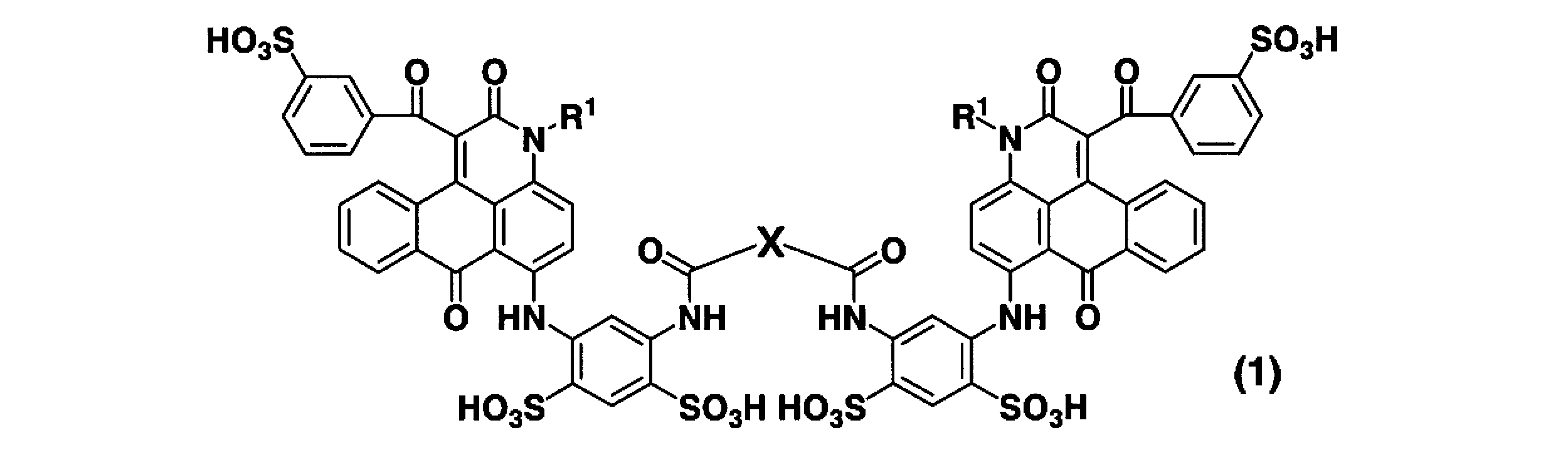
下記式(1)で表されるアントラピリドン化合物又はその塩、

[式(1)中、
R1は、水素原子、C1-C5アルキル基、ヒドロキシC1-C5アルキル基、シクロヘキシル基、又はシアノC1-C5アルキル基を表し、
Xは、下記式(2)で表される基である。]

[式(2)中、
*は、2つのアミド基との結合部位をそれぞれ表し、
R2及びR3は、それぞれ独立に水素原子又はC1-C5アルキル基を表し、
R2とR3とは結合して、これらがそれぞれ置換する2つの炭素原子とともにC5-C10シクロアルキレン環を形成してもよい。]
1)
下記式(1)で表されるアントラピリドン化合物又はその塩、
R1は、水素原子、C1-C5アルキル基、ヒドロキシC1-C5アルキル基、シクロヘキシル基、又はシアノC1-C5アルキル基を表し、
Xは、下記式(2)で表される基である。]
*は、2つのアミド基との結合部位をそれぞれ表し、
R2及びR3は、それぞれ独立に水素原子又はC1-C5アルキル基を表し、
R2とR3とは結合して、これらがそれぞれ置換する2つの炭素原子とともにC5-C10シクロアルキレン環を形成してもよい。]
2)
R2及びR3がそれぞれ独立に水素原子若しくはメチル基であり、又はR2とR3とが結合して、これらがそれぞれ置換する2つの炭素原子とともにシクロヘキシレン環を形成する、上記1)に記載のアントラピリドン化合物又はその塩、
3)
R1が水素原子又はメチル基である、上記1)又は2)に記載のアントラピリドン化合物又はその塩、
4)
R1が水素原子又はメチル基であり、
R2及びR3が水素原子である、上記1)に記載のアントラピリドン化合物又はその塩、
5)
上記1)から4)のいずれか一項に記載のアントラピリドン化合物又はその塩を色素として含有するインク組成物、
6)
水及び水溶性有機溶剤を含有する、上記5)に記載のインク組成物、
7)
インクジェット記録に用いる、上記6)に記載のインク組成物、
8)
色素として含有する上記1)から4)のいずれか一項に記載のアントラピリドン化合物又はその塩の総質量中に含まれる無機不純物の含有量が、該アントラピリドン化合物又はその塩の総質量に対して1質量%以下である、上記5)から7)のいずれか一項に記載のインク組成物、
9)
色素として含有する上記1)から4)のいずれか一項に記載のアントラピリドン化合物又はその塩の含有量が0.1~20質量%である、上記5)から8)のいずれか一項に記載のインク組成物、
10)
上記5)から9)のいずれか一項に記載のインク組成物の液滴を、記録信号に応じて吐出させて被記録材に付着させ、記録を行うインクジェット記録方法、
11)
上記被記録材が情報伝達用シートである、上記10)に記載のインクジェット記録方法、
12)
上記情報伝達用シートが多孔性白色無機物を含有するインク受容層を有するシートである、上記11)に記載のインクジェット記録方法、
13)
上記5)から9)のいずれか一項に記載のインク組成物で着色された着色体、
14)
上記10)に記載のインクジェット記録方法により着色された着色体、
15)
上記5)から9)のいずれか一項に記載のインク組成物を含む容器が装填されたインクジェットプリンタ、
に関する。
R2及びR3がそれぞれ独立に水素原子若しくはメチル基であり、又はR2とR3とが結合して、これらがそれぞれ置換する2つの炭素原子とともにシクロヘキシレン環を形成する、上記1)に記載のアントラピリドン化合物又はその塩、
3)
R1が水素原子又はメチル基である、上記1)又は2)に記載のアントラピリドン化合物又はその塩、
4)
R1が水素原子又はメチル基であり、
R2及びR3が水素原子である、上記1)に記載のアントラピリドン化合物又はその塩、
5)
上記1)から4)のいずれか一項に記載のアントラピリドン化合物又はその塩を色素として含有するインク組成物、
6)
水及び水溶性有機溶剤を含有する、上記5)に記載のインク組成物、
7)
インクジェット記録に用いる、上記6)に記載のインク組成物、
8)
色素として含有する上記1)から4)のいずれか一項に記載のアントラピリドン化合物又はその塩の総質量中に含まれる無機不純物の含有量が、該アントラピリドン化合物又はその塩の総質量に対して1質量%以下である、上記5)から7)のいずれか一項に記載のインク組成物、
9)
色素として含有する上記1)から4)のいずれか一項に記載のアントラピリドン化合物又はその塩の含有量が0.1~20質量%である、上記5)から8)のいずれか一項に記載のインク組成物、
10)
上記5)から9)のいずれか一項に記載のインク組成物の液滴を、記録信号に応じて吐出させて被記録材に付着させ、記録を行うインクジェット記録方法、
11)
上記被記録材が情報伝達用シートである、上記10)に記載のインクジェット記録方法、
12)
上記情報伝達用シートが多孔性白色無機物を含有するインク受容層を有するシートである、上記11)に記載のインクジェット記録方法、
13)
上記5)から9)のいずれか一項に記載のインク組成物で着色された着色体、
14)
上記10)に記載のインクジェット記録方法により着色された着色体、
15)
上記5)から9)のいずれか一項に記載のインク組成物を含む容器が装填されたインクジェットプリンタ、
に関する。
本発明により、耐光性に優れたマゼンタ色素(化合物)及びそれを含有するインク組成物、特にインクジェット記録用のインク組成物を提供することができる。
本発明を詳細に説明する。
本明細書においては煩雑さを避けるため、特に断りがない限り、本発明の(アントラピリドン)「化合物又はその塩」の両者を含めて、単に本発明の(アントラピリドン)「化合物」と簡略化して以下記載し、「化合物又はその塩」の両者を意味するものとする。
本明細書においては煩雑さを避けるため、特に断りがない限り、本発明の(アントラピリドン)「化合物又はその塩」の両者を含めて、単に本発明の(アントラピリドン)「化合物」と簡略化して以下記載し、「化合物又はその塩」の両者を意味するものとする。
本発明の化合物は、上記式(1)で表される。
式(1)中、R1におけるC1-C5アルキル基としては、直鎖又は分岐鎖のものが挙げられる。具体例としては、メチル、エチル、n-プロピル、n-ブチル、n-ペンチル等の直鎖のもの;イソプロピル、イソブチル、sec-ブチル、tert-ブチル、イソペンチル、tert-ペンチル等の分岐鎖のもの;等が挙げられる。好ましい具体例としては、メチル、エチルが挙げられ、メチルが特に好ましい。
R1におけるヒドロキシC1-C5アルキル基としては、上記「R1におけるC1-C5アルキル基」における任意の炭素原子にヒドロキシ基が置換したものが挙げられ、同一の炭素原子に該ヒドロキシ基と窒素原子との両者が置換しないものが好ましい。具体例としては、2-ヒドロキシエチル、2-ヒドロキシプロピル、3-ヒドロキシプロピル、3-ヒドロキシブチル、4-ヒドロキシブチル等のC1-C5アルキル部分が直鎖のもの;1-ヒドロキシ-2-プロピル、1-ヒドロキシ-2-ブチル、1-ヒドロキシ-3-ブチル、2-ヒドロキシ-3-ペンチル、2-ヒドロキシ-1,1-ジメチルエチル等のC1-C5アルキル部分が分岐鎖のもの;等が挙げられる。好ましい具体例としては、2-ヒドロキシエチルが挙げられる。
R1におけるシアノC1-C5アルキル基としては、上記「R1におけるC1-C5アルキル基」における任意の炭素原子にシアノ基が置換したものが挙げられる。具体例としては、2-シアノエチル、2-シアノプロピル、3-シアノプロピル、3-シアノブチル、4-シアノブチル等のC1-C5アルキル部分が直鎖のもの;1-シアノ-2-プロピル、1-シアノ-2-ブチル、1-シアノ-3-ブチル、2-シアノ-3-ペンチル、2-シアノ-1,1-ジメチルエチル等のC1-C5アルキル部分が分岐鎖のもの;等が挙げられる。好ましい具体例としては、2-シアノエチルが挙げられる。
上記のうち、好ましいR1としては、水素原子、C1-C5アルキル基(特にメチル)が挙げられ、後者がより好ましい。
式(1)中、R2及びR3におけるC1-C5アルキル基としては、上記「R1におけるC1-C5アルキル基」に記載のものと、好ましいもの等を含めて同じものが挙げられる。
R2とR3とが結合して形成するC5-C10シクロアルキレン環としては、シクロペンチレン、シクロヘキシレン、シクロヘプチレン、シクロオクチレン等が挙げられる。
炭素数の範囲としては、通常C5-C10、好ましくはC5-C8、より好ましくはC5-C7の範囲が挙げられ、特に好ましくはC6である。
好ましい具体例としてはシクロヘキシレンが挙げられる。
炭素数の範囲としては、通常C5-C10、好ましくはC5-C8、より好ましくはC5-C7の範囲が挙げられ、特に好ましくはC6である。
好ましい具体例としてはシクロヘキシレンが挙げられる。
好ましいR2及びR3としては、水素原子、メチル基、又はR2とR3とが結合したシクロヘキシレンが挙げられ、水素原子及びメチルがより好ましく、水素原子が特に好ましい。
上記式(1)で表される化合物におけるXとして、具体的に式(2)で表される基を記載したものが下記式(4)で表される化合物である。すなわち、上記式(1)で表される化合物と、下記式(4)で表される化合物とは同じ化合物である。

上記式(4)中、R1は式(1)におけるのと、またR2及びR3は式(2)におけるのと、それぞれ好ましいもの等を含めて同じ意味を表す。
上記式(1)(又は式(4)、以下同様)におけるR1乃至R3について、好ましいもの同士を組み合わせた化合物はより好ましく、より好ましいもの同士を組み合わせたものはさらに好ましい。好ましいものとより好ましいものとの組み合わせ等についても同様である。
上記式(1)の化合物の塩は、無機又は有機陽イオンと形成する塩である。無機陽イオンと形成する塩としては、アルカリ金属塩等、例えばリチウム塩、ナトリウム塩、カリウム塩;アンモニウム塩;等が好ましく挙げられる。有機陽イオンと形成する塩としては、下記式(3)で表される4級アンモニウムと形成する塩等が好ましく挙げられる。

上記式(3)中、Z1乃至Z4は、それぞれ独立に水素原子、アルキル基、ヒドロキシアルキル基、又はヒドロキシアルコキシアルキル基を表し、Z1乃至Z4の少なくともいずれか1つは水素原子以外の基である。
式(3)中、Z1乃至Z4における具体例としては、メチル、エチル、ブチル等のC1-C6アルキル基(好ましくはC1-C4アルキル基);ヒドロキシメチル、2-ヒドロキシエチル、3-ヒドロキシプロピル、2-ヒドロキシプロピル、4-ヒドロキシブチル、3-ヒドロキシブチル、2-ヒドロキシブチル等のヒドロキシC1-C6アルキル基(好ましくはヒドロキシC1-C4アルキル基);ヒドロキシエトキシメチル、2-ヒドロキシエトキシエチル、3-ヒドロキシエトキシプロピル、3-ヒドロキシエトキシブチル、2-ヒドロキシエトキシブチル等のヒドロキシC1-C6アルコキシC1-C6アルキル基(好ましくはヒドロキシC1-C4アルコキシC1-C4アルキル基);等が挙げられる。
これらのうちより好ましいものとしては、ナトリウム、カリウム、リチウム、モノエタノールアミン、ジエタノールアミン、トリエタノールアミン、モノイソプロパノールアミン、ジイソプロパノールアミン、トリイソプロパノールアミン、アンモニウム等と形成する各塩が挙げられる。これらのうち、リチウム、アンモニウム、及びナトリウムと形成する各塩が特に好ましく挙げられる。
上記の塩の製造方法を記載する。
例えば、上記式(1)の化合物を含む反応液、ウェットケーキ、又は乾燥品を水に溶解し、これに塩化ナトリウムを加えて塩析し、析出固体を濾過分取することにより、式(1)の化合物のナトリウム塩をウェットケーキとして得ることができる。また、得られたウェットケーキを再び水に溶解後、塩酸等の鉱酸を加えてpHを強酸性(通常pH1以下)に調整して得られる固体を濾過分取することにより、式(1)で表される化合物の遊離酸をウェットケーキとして得ることができる。この際に、pHを適宜調整することにより、ナトリウム塩と遊離酸との混合物を望みの比率で得ること等も可能である。さらに、水中で上記の遊離酸のウェットケーキに、例えば、水酸化カリウム、水酸化リチウム、アンモニア水、上記式(3)に相当する4級アンモニウム塩等を添加して造塩することにより、各々相当するカリウム塩、リチウム塩、アンモニウム塩、4級アンモニウム塩等を得ることもできる。この際に遊離酸と、例えばナトリウム塩との混合物のウェットケーキを使用し、水酸化カリウムを添加することにより、ナトリウム塩とカリウム塩との混塩、又はナトリウム塩、カリウム塩、及び遊離酸の混合物等を得ることも同様に可能である。
例えば、上記式(1)の化合物を含む反応液、ウェットケーキ、又は乾燥品を水に溶解し、これに塩化ナトリウムを加えて塩析し、析出固体を濾過分取することにより、式(1)の化合物のナトリウム塩をウェットケーキとして得ることができる。また、得られたウェットケーキを再び水に溶解後、塩酸等の鉱酸を加えてpHを強酸性(通常pH1以下)に調整して得られる固体を濾過分取することにより、式(1)で表される化合物の遊離酸をウェットケーキとして得ることができる。この際に、pHを適宜調整することにより、ナトリウム塩と遊離酸との混合物を望みの比率で得ること等も可能である。さらに、水中で上記の遊離酸のウェットケーキに、例えば、水酸化カリウム、水酸化リチウム、アンモニア水、上記式(3)に相当する4級アンモニウム塩等を添加して造塩することにより、各々相当するカリウム塩、リチウム塩、アンモニウム塩、4級アンモニウム塩等を得ることもできる。この際に遊離酸と、例えばナトリウム塩との混合物のウェットケーキを使用し、水酸化カリウムを添加することにより、ナトリウム塩とカリウム塩との混塩、又はナトリウム塩、カリウム塩、及び遊離酸の混合物等を得ることも同様に可能である。
本発明の上記式(1)で示されるアントラピリドン化合物の具体例を下記表1に示すが、本発明はこれらの具体例に限定されるものではない。
なお、表1中、No.11及びNo.12における「シクロヘキシレン環」は、上記式(1)において、R2とR3とが結合して、これらがそれぞれ置換する2つの炭素原子とともに形成したシクロヘキシレン環を意味する。
なお、表1中、No.11及びNo.12における「シクロヘキシレン環」は、上記式(1)において、R2とR3とが結合して、これらがそれぞれ置換する2つの炭素原子とともに形成したシクロヘキシレン環を意味する。

以下に本発明の化合物の製造方法を記載する。なお、下記式(7)~(10)中に記載のR1~R3は、上記式(1)におけるのと同じ意味を表す。
本発明のアントラピリドン化合物は、例えば次の方法により製造される。すなわち、上記の特許文献3等に記載の公知の方法、又はその方法に準じて合成を行うことにより、下記式(7)の化合物が得られる。
本発明のアントラピリドン化合物は、例えば次の方法により製造される。すなわち、上記の特許文献3等に記載の公知の方法、又はその方法に準じて合成を行うことにより、下記式(7)の化合物が得られる。

次いで得られた上記式(7)の化合物1モルに、水酸化ナトリウム水溶液等を加えてpH7の水溶液として中和した後、水;メタノール、エタノール、エチレングリコール等のアルコールやポリオール類;N,N-ジメチルホルムアミド、N,N-ジメチルアセトアミド、N-メチルピロリドン等のアミド類;等の溶媒中、下記式(8)の化合物0.5モルと30~100℃で反応させることにより、下記式(9)の化合物が得られる。なお、中和後の式(7)の化合物を含む水溶液はそのまま使用するよりも、乾燥させて式(7)の化合物を含む固体とした後、次の反応に使用する方が好ましい。また、上記の溶媒としては、非プロトン性溶媒(例えばアミド類)を使用する方が好ましい。

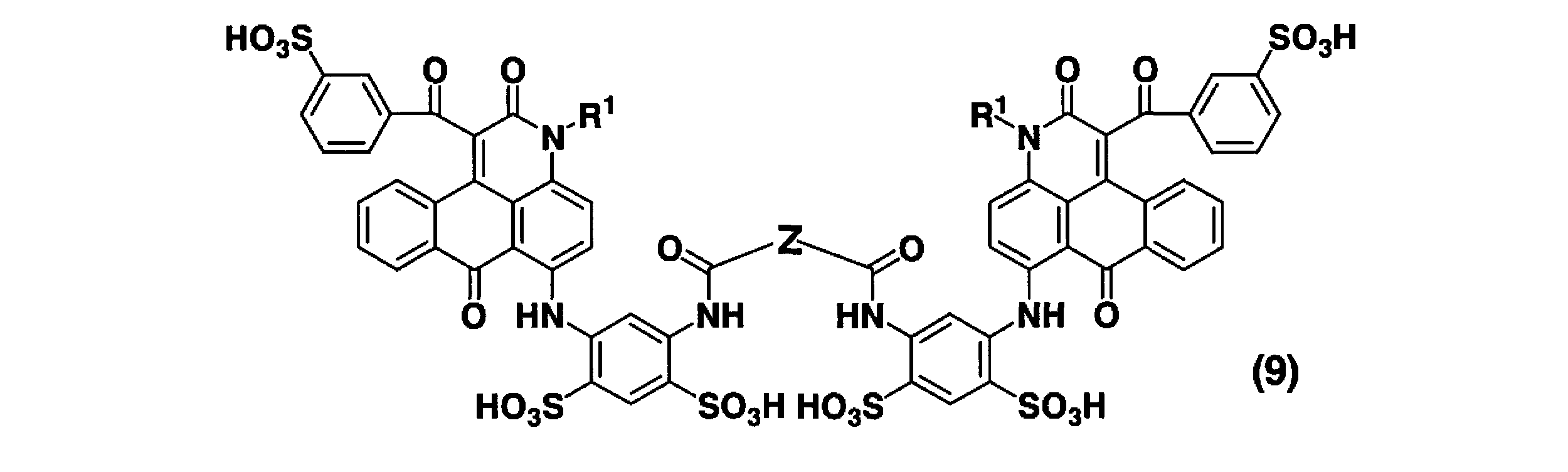
上記式(9)中、Zは下記式(10)で表される基である。

上記式(10)中、*は2つのアミド基との結合部位をそれぞれ表す。
次いで、得られた上記式(9)の化合物1モルと、酢酸銅、硫酸銅、ハロゲン化銅(例えば塩化銅、ヨウ化銅等)等の銅化合物1モルとを、水;メタノール、エタノール、エチレングリコール等のアルコールやポリオール類;N,N-ジメチルホルムアミド、N,N-ジメチルアセトアミド、N-メチルピロリドン等のアミド類;等の溶媒中、pH5~9、10~100℃で反応させることにより、上記式(1)のアントラピリドン化合物が得られる。
なお、この反応におけるpHの調整には任意の塩基が使用できるが、アルカリ金属の炭酸塩(例えば炭酸リチウム、炭酸ナトリウム、炭酸カリウム等)、アルカリ金属の水酸化物(例えば水酸化リチウム、水酸化ナトリウム、水酸化カリウム等)等が好ましく挙げられる。
なお、この反応におけるpHの調整には任意の塩基が使用できるが、アルカリ金属の炭酸塩(例えば炭酸リチウム、炭酸ナトリウム、炭酸カリウム等)、アルカリ金属の水酸化物(例えば水酸化リチウム、水酸化ナトリウム、水酸化カリウム等)等が好ましく挙げられる。
上記式(1)の化合物は遊離酸の形で、あるいはその塩の形で得ることが可能である。本発明の化合物は遊離酸又はその塩として、例えばアルカリ金属塩、アルカリ土類金属塩、アルキルアミン塩、アルカノールアミン塩、アンモニウム塩等に誘導して使用できる。各種の塩から遊離酸へ導く製造方法、遊離酸から各種の塩又は各種の混塩又は遊離酸と塩との混合物等へ導く製造方法については上記したとおりである。
上記式(1)で表される化合物は、該化合物の総質量中に不純物として含有される金属陽イオンの塩化物(例えば塩化ナトリウム等)、硫酸塩(例えば硫酸ナトリウム等)等の無機不純物の少ないものを用いるのが好ましい。その含有量の目安は例えば1質量%以下程度である。無機不純物の少ない本発明の化合物を製造する方法としては、例えば逆浸透膜を用いる公知の方法;C1-C4アルコール(又は場合により含水の該アルコール)等を用いて懸濁精製する方法;又は、陰及び陽イオン交換樹脂を適宜用いる公知の方法;等により脱塩処理する方法が挙げられる。
本発明のインク組成物は、上記式(1)で表される化合物を色素成分とし、該化合物を水又は水性溶媒(後記する水溶性有機溶剤を含有する水)に溶解したものである。本発明のインク組成物は、例えば上記式(1)で表される化合物を含む反応液等を、インク組成物の製造に直接使用することが出来る。また、上記反応液から目的物を例えば晶析;スプレー乾燥;等の操作により単離し、これを乾燥させた後、インク組成物に使用することもできる。
本発明のインク組成物は、上記式(1)で表される化合物を通常0.1~20質量%、好ましくは1~15質量%、さらに好ましくは2~10質量%含有する。本発明のインク組成物は、水溶性有機溶剤を0~30質量%、好ましくは5~20質量%;またインク調製剤を0~10質量%;それぞれ含有してもよく、水溶性有機溶剤は含有する方が好ましい。
本発明のインク組成物は、上記式(1)で表される化合物を通常0.1~20質量%、好ましくは1~15質量%、さらに好ましくは2~10質量%含有する。本発明のインク組成物は、水溶性有機溶剤を0~30質量%、好ましくは5~20質量%;またインク調製剤を0~10質量%;それぞれ含有してもよく、水溶性有機溶剤は含有する方が好ましい。
本発明のインク組成物に使用し得る水溶性有機溶剤としては、例えば、メタノール、エタノール、n-プロパノール、イソプロパノール、n-ブタノール、イソブタノール、第二ブタノール、第三ブタノール等のC1-C4アルカノール(アルコール);N,N-ジメチルホルムアミド、N,N-ジメチルアセトアミド等のカルボン酸アミド;2-ピロリドン、N-メチル-2-ピロリドン、1,3-ジメチルイミダゾリジン-2-オン、1,3-ジメチルヘキサヒドロピリミド-2-オン等の複素環式尿素類;アセトン、メチルエチルケトン、2-メチル-2-ヒドロキシペンタン-4-オン等のケトン又はケトアルコール;テトラヒドロフラン、ジオキサン等の環状エーテル;エチレングリコール、1,2-又は1,3-プロピレングリコール、1,2-又は1,4-ブチレングリコール、1,6-ヘキシレングリコール、ジエチレングリコール、トリエチレングリコール、テトラエチレングリコール、ジプロピレングリコール、チオジグリコール、ポリエチレングリコール、ポリプロピレングリコール等のC2-C6アルキレン単位を有するモノ、オリゴ、若しくはポリアルキレングリコール又はチオグリコール;グリセリン、ヘキサン-1,2,6-トリオール等のポリオール(好ましくはトリオール);エチレングリコールモノメチルエーテル又はエチレングリコールモノエチルエーテル、ジエチレングリコールモノメチルエーテル、ジエチレングリコールモノエチルエーテル、ジエチレングリコールモノブチルエーテル(ブチルカルビトール)、トリエチレングリコールモノメチルエーテル、トリエチレングリコールモノエチルエーテル等の多価アルコールのC1-C4アルキルエーテル;γ-ブチロラクトン;ジメチルスルホキシド;等が挙げられる。
上記のうち好ましいものとしては、イソプロパノール、グリセリン、モノ、ジ、又はトリエチレングリコール、ジプロピレングリコール、2-ピロリドン、N-メチル-2-ピロリドン、ブチルカルビトールが挙げられ、より好ましくはイソプロパノール、グリセリン、ブチルカルビトール、2-ピロリドン、N-メチル-2-ピロリドンが挙げられる。
これらの水溶性有機溶剤は、単独又は混合して用いられる。
これらの水溶性有機溶剤は、単独又は混合して用いられる。
以下、本発明のインク組成物を調製する際に使用し得るインク調製剤について説明する。インク調製剤としては、例えば、防腐防黴剤、pH調整剤、キレート試薬、防錆剤、水溶性紫外線吸収剤、水溶性高分子化合物、染料溶解剤、界面活性剤等が挙げられる。
防腐防黴剤としては、例えば、有機硫黄系、有機窒素硫黄系、有機ハロゲン系、ハロアリルスルホン系、ヨードプロパギル系、N-ハロアルキルチオ系、ニトリル系、ピリジン系、8-オキシキノリン系、ベンゾチアゾール系、イソチアゾリン系、ジチオール系、ピリジンオキシド系、ニトロプロパン系、有機スズ系、フェノール系、第4アンモニウム塩系、トリアジン系、チアジアジン系、アニリド系、アダマンタン系、ジチオカーバメイト系、ブロム化インダノン系、ベンジルブロムアセテート系等の化合物が挙げられる。
有機ハロゲン系化合物としては、例えばペンタクロロフェノールナトリウムが挙げられる。
ピリジンオキシド系化合物としては、例えば2-ピリジンチオール-1-オキシドナトリウムが挙げられる。
イソチアゾリン系化合物としては、例えば、1,2-ベンゾイソチアゾリン-3-オン、2-n-オクチル-4-イソチアゾリン-3-オン、5-クロロ-2-メチル-4-イソチアゾリン-3-オン、5-クロロ-2-メチル-4-イソチアゾリン-3-オンマグネシウムクロライド、5-クロロ-2-メチル-4-イソチアゾリン-3-オンカルシウムクロライド、2-メチル-4-イソチアゾリン-3-オンカルシウムクロライド等が挙げられる。
その他の防腐防黴剤としては、ソルビン酸ソーダ、安息香酸ナトリウム、無水酢酸ソーダ、アベシア社製の商品名プロクセルRTMGXL(S)、及びプロクセルRTMXL-2(S)等が挙げられる。
なお、本明細書において、上付きの「RTM」は登録商標を意味する。
有機ハロゲン系化合物としては、例えばペンタクロロフェノールナトリウムが挙げられる。
ピリジンオキシド系化合物としては、例えば2-ピリジンチオール-1-オキシドナトリウムが挙げられる。
イソチアゾリン系化合物としては、例えば、1,2-ベンゾイソチアゾリン-3-オン、2-n-オクチル-4-イソチアゾリン-3-オン、5-クロロ-2-メチル-4-イソチアゾリン-3-オン、5-クロロ-2-メチル-4-イソチアゾリン-3-オンマグネシウムクロライド、5-クロロ-2-メチル-4-イソチアゾリン-3-オンカルシウムクロライド、2-メチル-4-イソチアゾリン-3-オンカルシウムクロライド等が挙げられる。
その他の防腐防黴剤としては、ソルビン酸ソーダ、安息香酸ナトリウム、無水酢酸ソーダ、アベシア社製の商品名プロクセルRTMGXL(S)、及びプロクセルRTMXL-2(S)等が挙げられる。
なお、本明細書において、上付きの「RTM」は登録商標を意味する。
pH調整剤としては、調製されるインクに悪影響を及ぼさずに、インクのpHを7.5~11.0の範囲に制御できるものであれば任意の物質を使用することができる。例えば、ジエタノールアミン、トリエタノールアミン等のアルカノールアミン;水酸化リチウム、水酸化ナトリウム、水酸化カリウム等のアルカリ金属の水酸化物;水酸化アンモニウム(アンモニア水);炭酸リチウム、炭酸ナトリウム、炭酸カリウム等のアルカリ金属の炭酸塩;等が挙げられる。
キレート試薬としては、例えば、エチレンジアミン四酢酸ナトリウム、ニトリロ三酢酸ナトリウム、ヒドロキシエチルエチレンジアミン三酢酸ナトリウム、ジエチレントリアミン五酢酸ナトリウム、ウラシル二酢酸ナトリウム等が挙げられる。
防錆剤としては、例えば、酸性亜硫酸塩、チオ硫酸ナトリウム、チオグリコール酸アンモニウム、ジイソプロピルアンモニウムナイトライト、四硝酸ペンタエリスリトール、ジシクロヘキシルアンモニウムナイトライト等が挙げられる。
水溶性紫外線吸収剤としては、例えば、スルホン化されたベンゾフェノン、スルホン化されたベンゾトリアゾール等が挙げられる。
水溶性高分子化合物としては、例えば、ポリビニルアルコール、セルロース誘導体、ポリアミン、ポリイミン等が挙げられる。
染料溶解剤としては、例えば、尿素、ε-カプロラクタム、エチレンカーボネート等が挙げられる。
界面活性剤としては、例えば、アニオン界面活性剤、両性界面活性剤、カチオン界面活性剤、ノニオン界面活性剤等が挙げられる。
アニオン界面活性剤としては、アルキルスルホカルボン酸塩、α-オレフィンスルホン酸塩、ポリオキシエチレンアルキルエーテル酢酸塩、N-アシルアミノ酸及びその塩、N-アシルメチルタウリン塩、アルキル硫酸塩ポリオキシアルキルエーテル硫酸塩、アルキル硫酸塩ポリオキシエチレンアルキルエーテル燐酸塩、ロジン酸石鹸、ヒマシ油硫酸エステル塩、ラウリルアルコール硫酸エステル塩、アルキルフェノール型燐酸エステル、アルキル型燐酸エステル、アルキルアリールスルホン酸塩、ジエチルスルホ琥珀酸塩、ジエチルヘキルシルスルホ琥珀酸、ジオクチルスルホ琥珀酸塩等が挙げられる。
カチオン界面活性剤としては、2-ビニルピリジン誘導体、ポリ4-ビニルピリジン誘導体等が挙げられる。
両性界面活性剤としては、ラウリルジメチルアミノ酢酸ベタイン、2-アルキル-N-カルボキシメチル-N-ヒドロキシエチルイミダゾリニウムベタイン、ヤシ油脂肪酸アミドプロピルジメチルアミノ酢酸ベタイン、ポリオクチルポリアミノエチルグリシン、イミダゾリン誘導体等が挙げられる。
ノニオン界面活性剤としては、ポリオキシエチレンノニルフェニルエーテル、ポリオキシエチレンオクチルフェニルエーテル、ポリオキシエチレンドデシルフェニルエーテル、ポリオキシエチレンオレイルエーテル、ポリオキシエチレンラウリルエーテル、ポリオキシエチレンアルキルエーテル等のエーテル系;ポリオキシエチレンオレイン酸エステル、ポリオキシエチレンジステアリン酸エステル、ソルビタンラウレート、ソルビタンモノステアレート、ソルビタンモノオレエート、ソルビタンセスキオレエート、ポリオキシエチレンモノオレエート、ポリオキシエチレンステアレート等のエステル系;2,4,7,9-テトラメチル-5-デシン-4,7-ジオール、3,6-ジメチル-4-オクチン-3,6-ジオール、3,5-ジメチル-1-ヘキシン-3-オール等のアセチレンアルコール系;等が挙げられる。その他の具体例としては、日信化学社製の商品名サーフィノールRTM104E、同104PG50、同82、同465、オルフィンRTMSTG等;等が挙げられる。
これらのインク調製剤は、単独又は混合して用いられる。
これらのインク調製剤は、単独又は混合して用いられる。
本発明のインク組成物は水性インク組成物であり、上記式(1)で表される化合物を水又は上記水性溶媒(水溶性有機溶剤を含有する水)に、必要に応じて上記インク調製剤等とともに溶解させることによって製造できる。
本発明のインク組成物の製造方法において、各成分を溶解させる順序には特に制限はない。あらかじめ水又は上記水性溶媒に本発明の化合物を溶解させ、インク調製剤を添加してもよいし、該化合物を水に溶解させた後、水性溶媒、インク調製剤を添加してもよい。また、これと順序が異なっていてもよい。さらに、本発明の化合物の合成反応における最終工程終了後の反応液;又は本発明の化合物に対して逆浸透膜による脱塩処理を行うことにより得られた水溶液に、水溶性有機溶剤、インク調製剤等を添加してインク組成物を製造してもよい。
インク組成物の調製に用いる水は、イオン交換水、蒸留水等の不純物の少ないものが好ましい。このようにして調製されたインク組成物は、必要に応じてメンブランフィルタ等を用いた精密濾過を行って夾雑物を除いてもよい。該インク組成物をインクジェット記録に用いるときは、精密濾過を行うことが好ましい。精密濾過を行うフィルタの孔径は通常1~0.1μm、好ましくは0.8~0.2μmである。
インク組成物の調製に用いる水は、イオン交換水、蒸留水等の不純物の少ないものが好ましい。このようにして調製されたインク組成物は、必要に応じてメンブランフィルタ等を用いた精密濾過を行って夾雑物を除いてもよい。該インク組成物をインクジェット記録に用いるときは、精密濾過を行うことが好ましい。精密濾過を行うフィルタの孔径は通常1~0.1μm、好ましくは0.8~0.2μmである。
本発明のインクジェット記録方法を適用し得る被記録材(メディア)としては、例えば、紙、フィルム等の情報伝達用シート、繊維、皮革等が挙げられる。情報伝達用シートについては、表面処理されたもの、具体的には基材、例えば上記の被記録材にインク受容層を設けたもの、等が好ましい。インク受容層は、例えば基材にカチオンポリマーを含浸あるいは塗工すること;多孔質シリカ、アルミナゾル、特殊セラミックス等のインク中の色素を吸着し得る多孔性白色無機物を、ポリビニルアルコールやポリビニールピロリドン等の親水性ポリマーとともに基材表面に塗工すること;等により設けられる。このようなインク受容層を設けたものは、通常インクジェット専用紙(フィルム)や光沢紙(フィルム)等と呼ばれ、例えば、(株)ピクトリコ製、商品名ピクトリコプロ;キヤノン社製、商品名プロフェッショナルフォトペーパー、スーパーフォトペーパー、マットフォトペーパー;エプソン(株)製、商品名クリスピアRTM、写真用紙(光沢)、フォトマット紙、スーパーファイン専用光沢フィルム;日本ヒューレットパッカード(株)製、商品名アドバンスフォトペーパー、プレミアムプラスフォト用紙、プレミアム光沢フィルム、フォト用紙;コニカミノルタフォトイメージング(株)製、商品名フォトライクQP;等が挙げられる。
なお、インク受容層を特に設けていない情報伝達用シート、例えば普通紙を利用することも当然可能である。
なお、インク受容層を特に設けていない情報伝達用シート、例えば普通紙を利用することも当然可能である。
これらのうち、多孔性白色無機物を表面に塗工した被記録材に記録した画像のオゾンガスによる変退色は、特に大きくなることが知られている。本発明の水性マゼンタインク組成物はオゾンガスを含めたガス耐性にも優れているため、このような被記録材への記録の際に特に大きな効果を発揮する。
上記の多孔性白色無機物としては、炭酸カルシウム、カオリン、タルク、クレー、珪藻土、合成非晶質シリカ、珪酸アルミニウム、珪酸マグネシウム、珪酸カルシウム、水酸化アルミニウム、アルミナ、リトポン、ゼオライト、硫酸バリウム、硫酸カルシウム、二酸化チタン、硫化亜鉛、炭酸亜鉛等が挙げられる。
本発明のインクジェット記録方法は、本発明のインク組成物を含有する容器をインクジェットプリンタの所定の位置に装填し、該インク組成物の(小)液滴を記録信号に応じて吐出させて被記録材に付着させ、記録を行う方法である。本発明のインクジェット記録方法は、本発明のインク組成物をマゼンタインクとして単独で使用することもできるが、例えばイエロー、シアン、グリーン、オレンジ、ブルー(又はバイオレット)、及び必要に応じてブラック等の各色のインク組成物とを併用し、フルカラーの記録画像を得ることもできる。この際には、上記の各色から適宜選択されるインク組成物をそれぞれ含有する容器を、インクジェットプリンタの所定の位置にそれぞれ装填して使用すればよい。
インクジェットプリンタの吐出方式としては、例えば機械的振動を利用したピエゾ方式;加熱により生じる泡を利用したバブルジェット(登録商標)方式;等が挙げられる。本発明のインク組成物は、これらのいずれの吐出方式においても使用することが可能である。
インクジェットプリンタの吐出方式としては、例えば機械的振動を利用したピエゾ方式;加熱により生じる泡を利用したバブルジェット(登録商標)方式;等が挙げられる。本発明のインク組成物は、これらのいずれの吐出方式においても使用することが可能である。
本発明の着色体とは、本発明の化合物、又は該化合物を含有するインク組成物により着色された物質を意味する。着色される物質には特に制限はなく、例えば紙、繊維や布(セルロース、ナイロン、羊毛等)、皮革、カラーフィルター用基材等が挙げられるが、これらに限定されない。
着色方法としては、例えば浸染法、捺染法、スクリーン印刷等の印刷法、インクジェット記録方法等が挙げられる。本発明の着色体としては、本発明のインクジェット記録方法により着色された着色体が好ましい。
着色方法としては、例えば浸染法、捺染法、スクリーン印刷等の印刷法、インクジェット記録方法等が挙げられる。本発明の着色体としては、本発明のインクジェット記録方法により着色された着色体が好ましい。
本発明のインク組成物は、鮮明なマゼンタ色であり、特に光沢紙において鮮明性の高い色相を有し、記録画像の堅牢性も高い。また、人に対する安全性も高い。
本発明のインク組成物は、例えば印捺、複写、マーキング、筆記、製図、スタンピング等の各種の記録や印刷用途に用いることが可能であり、特にインクジェット記録用インクとして好適に用いられる。本発明のインク組成物は、普通紙への記録にも使用できるが、特にインクジェット専用紙や光沢紙に記録した画像の印字濃度が高く、インクジェット記録に適した色相を有する。
また、その記録画像の耐水性、耐光性、耐摩擦性、耐湿性等の各種堅牢性、特に耐光性が非常に高いという特徴を有する。
本発明のインク組成物は貯蔵中に沈殿、分離することがなく、保存安定性が極めて高い。また、本発明の化合物は水溶解性に優れるため、これを含有する本発明のインク組成物をインクジェット記録に使用した場合、ノズル付近におけるインク組成物の乾燥による固体析出は非常に起こりにくく、噴射器(インクヘッド)を閉塞することもない。本発明のインク組成物は、連続式インクジェットプリンタにおける比較的長時間の一定の再循環下での使用;オンデマンド式インクジェットプリンタにおける断続的な使用;等の使用環境においても物理的性質の変化を起こさない。
また、その記録画像の耐水性、耐光性、耐摩擦性、耐湿性等の各種堅牢性、特に耐光性が非常に高いという特徴を有する。
本発明のインク組成物は貯蔵中に沈殿、分離することがなく、保存安定性が極めて高い。また、本発明の化合物は水溶解性に優れるため、これを含有する本発明のインク組成物をインクジェット記録に使用した場合、ノズル付近におけるインク組成物の乾燥による固体析出は非常に起こりにくく、噴射器(インクヘッド)を閉塞することもない。本発明のインク組成物は、連続式インクジェットプリンタにおける比較的長時間の一定の再循環下での使用;オンデマンド式インクジェットプリンタにおける断続的な使用;等の使用環境においても物理的性質の変化を起こさない。
以下に本発明を実施例によりさらに具体的に説明する。実施例中「部」及び「%」とあるのは、特別の記載のない限り質量基準である。また、各反応、晶析等の操作は、特に断りのない限り、撹拌下に行った。
また、実施例中の化合物の最大吸収波長(λmax)は、特に断りのない限り、pH5~8の水溶液中での測定値を記載した。
また、実施例中の化合物の最大吸収波長(λmax)は、特に断りのない限り、pH5~8の水溶液中での測定値を記載した。
[実施例1]
(工程1)
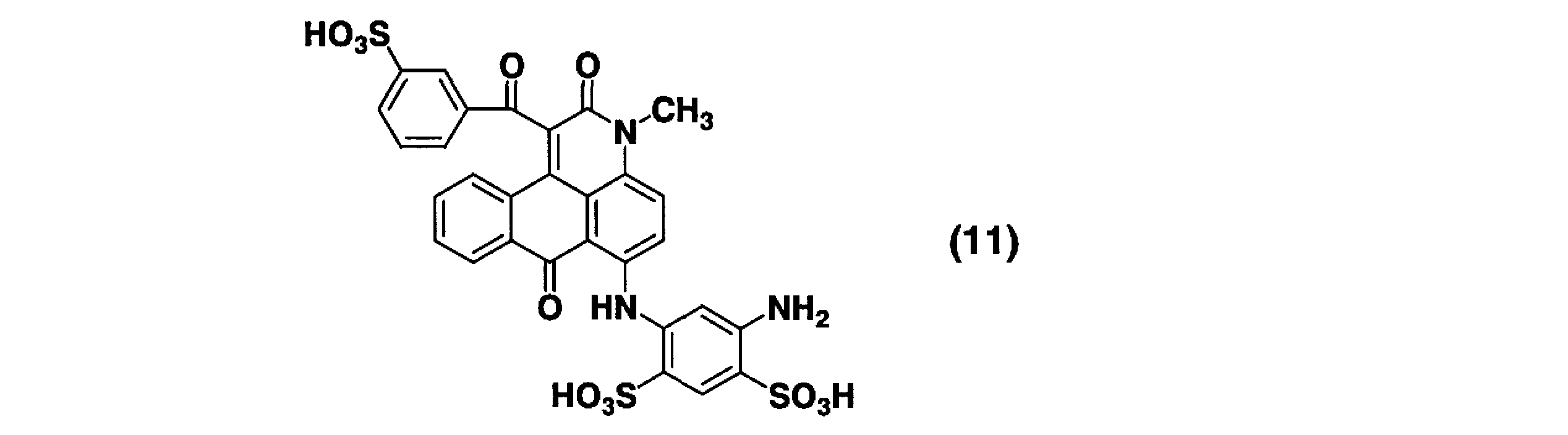
水70部に特許文献3記載の方法を追試することによって得た下記式(11)の化合物のウェットケーキ97.5部(ジアゾ化値分析による純度45.9%)を加え、さらに25%水酸化ナトリウム水溶液を加えることによりpH7の水溶液を得た。得られた水溶液を80℃の熱風乾燥機で乾燥させ、式(11)の化合物を含有する固体を得た。
(工程1)
水70部に特許文献3記載の方法を追試することによって得た下記式(11)の化合物のウェットケーキ97.5部(ジアゾ化値分析による純度45.9%)を加え、さらに25%水酸化ナトリウム水溶液を加えることによりpH7の水溶液を得た。得られた水溶液を80℃の熱風乾燥機で乾燥させ、式(11)の化合物を含有する固体を得た。
(工程2)
N-メチルピロリドン320部に、実施例1(工程1)で得た式(11)の化合物の全量及びエチレンジアミン四酢酸二無水物7.8部を加え、75~85℃に加熱して6時間反応させた。得られた反応液を濾過することにより不溶物を除去し、濾液に2-プロパノール400部を加えて析出した固体を濾過分取した。得られた固体を2-プロパノール120部で懸濁精製することにより、上記式(9)におけるR1がメチル、R2及びR3が水素原子である化合物のウェットケーキ220部を得た。
N-メチルピロリドン320部に、実施例1(工程1)で得た式(11)の化合物の全量及びエチレンジアミン四酢酸二無水物7.8部を加え、75~85℃に加熱して6時間反応させた。得られた反応液を濾過することにより不溶物を除去し、濾液に2-プロパノール400部を加えて析出した固体を濾過分取した。得られた固体を2-プロパノール120部で懸濁精製することにより、上記式(9)におけるR1がメチル、R2及びR3が水素原子である化合物のウェットケーキ220部を得た。
(工程3)
水300部に実施例1(工程2)で得た式(9)の化合物のウェットケーキ220部及び酢酸銅(II)一水和物6.6部を加えて溶液とした後、15%炭酸ナトリウム水溶液を適宜加えて反応液のpHを6.5~7.5に保持しながら、室温で10時間反応させた。得られた反応液に、メタノール300部及び2-プロパノール300部を加えて析出した固体を濾過分取し、ウェットケーキを得た。得られたウェットケーキをイオン交換水300部に加えて溶液とし、ここに陰イオン交換樹脂ダイアイオンRTMSA10AOH75部及び陽イオン交換樹脂ダイアイオンRTMSK1BH26部(いずれも三菱化学社製)を適宜添加して、液のpHを6~8に保持しながら、液温20~30℃で2時間撹拌することにより脱塩を行った。得られた液を濾過することによりイオン交換樹脂を除去した後、濾液にエタノール400部及び2-プロパノール800部を加えて15時間撹拌した。この液から析出した固体を濾過分取し、乾燥することにより、上記式(1)におけるR1がメチル、式(2)中のR2及びR3が水素原子である本発明の化合物47.8部を得た。λmax:513nm。
水300部に実施例1(工程2)で得た式(9)の化合物のウェットケーキ220部及び酢酸銅(II)一水和物6.6部を加えて溶液とした後、15%炭酸ナトリウム水溶液を適宜加えて反応液のpHを6.5~7.5に保持しながら、室温で10時間反応させた。得られた反応液に、メタノール300部及び2-プロパノール300部を加えて析出した固体を濾過分取し、ウェットケーキを得た。得られたウェットケーキをイオン交換水300部に加えて溶液とし、ここに陰イオン交換樹脂ダイアイオンRTMSA10AOH75部及び陽イオン交換樹脂ダイアイオンRTMSK1BH26部(いずれも三菱化学社製)を適宜添加して、液のpHを6~8に保持しながら、液温20~30℃で2時間撹拌することにより脱塩を行った。得られた液を濾過することによりイオン交換樹脂を除去した後、濾液にエタノール400部及び2-プロパノール800部を加えて15時間撹拌した。この液から析出した固体を濾過分取し、乾燥することにより、上記式(1)におけるR1がメチル、式(2)中のR2及びR3が水素原子である本発明の化合物47.8部を得た。λmax:513nm。
[実施例2]
(A)インクの調製
実施例1で得られた化合物を色素として用い、下記表2に示した組成の本発明のインク組成物を調製し、さらに0.45μmのメンブランフィルタで濾過することにより、インクジェット記録用のインクを得た。インクの調製に際し、水としてはイオン交換水を使用した。なお、インク組成物のpHが8~10になるように25%水酸化ナトリウム水溶液で調整し、総量100部になるように水を加えた。実施例1で得られた化合物を用いたインクの調製を実施例2とする。
なお、下記表2中、「界面活性剤」としては、日信化学社製の商品名サーフィノールRTM104PG50を使用した。
(A)インクの調製
実施例1で得られた化合物を色素として用い、下記表2に示した組成の本発明のインク組成物を調製し、さらに0.45μmのメンブランフィルタで濾過することにより、インクジェット記録用のインクを得た。インクの調製に際し、水としてはイオン交換水を使用した。なお、インク組成物のpHが8~10になるように25%水酸化ナトリウム水溶液で調整し、総量100部になるように水を加えた。実施例1で得られた化合物を用いたインクの調製を実施例2とする。
なお、下記表2中、「界面活性剤」としては、日信化学社製の商品名サーフィノールRTM104PG50を使用した。

[比較例1乃至3]
実施例1で得られた化合物の代わりに特許文献1の実施例3に開示された化合物を用いる以外は、実施例2と同様にして比較用のインクを調製した。これを比較例1とする。
また、実施例1で得られた化合物の代わりに特許文献3の実施例1に開示された化合物を用いる以外は、実施例2と同様にして比較用のインクを調製した。これを比較例2とする。
また、実施例1で得られた化合物の代わりに特許文献4の実施例1の化合物を用いる以外は、実施例2と同様にして比較用のインクを調製した。これを比較例3とする。
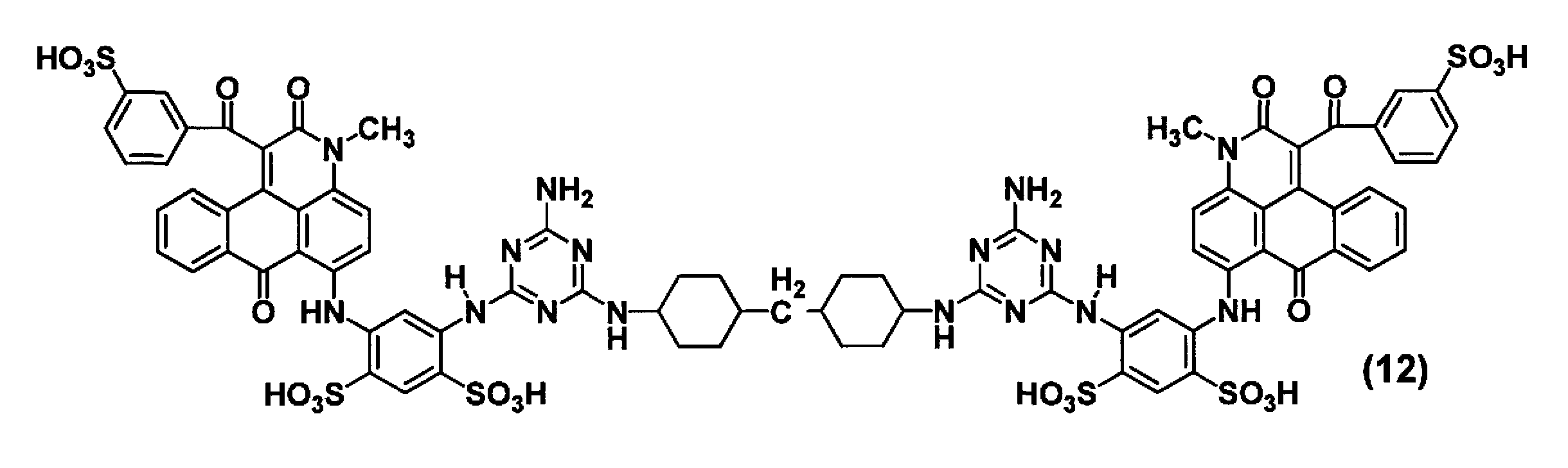
比較例1乃至3にそれぞれ使用した化合物の構造式を、下記式(12)乃至式(14)にそれぞれ示す。
実施例1で得られた化合物の代わりに特許文献1の実施例3に開示された化合物を用いる以外は、実施例2と同様にして比較用のインクを調製した。これを比較例1とする。
また、実施例1で得られた化合物の代わりに特許文献3の実施例1に開示された化合物を用いる以外は、実施例2と同様にして比較用のインクを調製した。これを比較例2とする。
また、実施例1で得られた化合物の代わりに特許文献4の実施例1の化合物を用いる以外は、実施例2と同様にして比較用のインクを調製した。これを比較例3とする。
比較例1乃至3にそれぞれ使用した化合物の構造式を、下記式(12)乃至式(14)にそれぞれ示す。


(B)インクジェット記録
インクジェットプリンタ(キヤノン社製、商品名:PixusRTMiP4500)を用いて、多孔性白色無機物を含有するインク受容層を有するインクジェット専用紙である2種の被記録材にインクジェット記録を行った。この2種の光沢紙を、それぞれ光沢紙1及び光沢紙2とする。
光沢紙1:セイコーエプソン社製、商品名:写真用紙クリスピアRTM(高光沢)
光沢紙2:ブラザー工業社製、商品名:写真光沢紙BP71G
インクジェットプリンタ(キヤノン社製、商品名:PixusRTMiP4500)を用いて、多孔性白色無機物を含有するインク受容層を有するインクジェット専用紙である2種の被記録材にインクジェット記録を行った。この2種の光沢紙を、それぞれ光沢紙1及び光沢紙2とする。
光沢紙1:セイコーエプソン社製、商品名:写真用紙クリスピアRTM(高光沢)
光沢紙2:ブラザー工業社製、商品名:写真光沢紙BP71G
インクジェット記録の際、数段階の階調で印刷濃度が得られるように画像パターンを作り、記録物を作成した。該記録物を試験片として用い、下記するキセノン耐光試験を行った。
キセノン耐光性試験は、各試験片における試験前の反射濃度D値が1.0及び0.5に最も近い2階調の部分について反射濃度の測定を行った。反射濃度の測定には、測色システム(商品名SpectroEyeRTM、X-Light社製)を使用した。測色は、濃度基準がDIN、視野角が2度、光源がD65の条件で行った。
耐光性試験の試験方法及び試験結果の評価方法を以下に記載する。
キセノン耐光性試験は、各試験片における試験前の反射濃度D値が1.0及び0.5に最も近い2階調の部分について反射濃度の測定を行った。反射濃度の測定には、測色システム(商品名SpectroEyeRTM、X-Light社製)を使用した。測色は、濃度基準がDIN、視野角が2度、光源がD65の条件で行った。
耐光性試験の試験方法及び試験結果の評価方法を以下に記載する。
(D)キセノン耐光性試験
各試験片をホルダーに設置して、キセノンウェザオメータXL75[スガ試験機(株)社製]を用い、温度24℃、湿度60%RH、100klux照度で168時間照射した。試験後の各試験片の反射濃度を上記測色システムにより測色し、色素残存率を(試験後の反射濃度/試験前の反射濃度)×100(%)で計算して求めた。結果を下記表3に示す。
各試験片をホルダーに設置して、キセノンウェザオメータXL75[スガ試験機(株)社製]を用い、温度24℃、湿度60%RH、100klux照度で168時間照射した。試験後の各試験片の反射濃度を上記測色システムにより測色し、色素残存率を(試験後の反射濃度/試験前の反射濃度)×100(%)で計算して求めた。結果を下記表3に示す。

表3より明らかなように、実施例は各光沢紙において、D値1.0及びD値0.5のいずれにおいても各比較例より優れる結果を示し、インクジェット記録用マゼンタ色素として極めて有用である。
本発明のアントラピリドン化合物及びこれを含有するインク組成物は、筆記用具等の各種記録用、特にインクジェット記録用のマゼンタインクに好適に用いられる。
Claims (15)
- 下記式(1)で表されるアントラピリドン化合物又はその塩。
R1は、水素原子、C1-C5アルキル基、ヒドロキシC1-C5アルキル基、シクロヘキシル基、又はシアノC1-C5アルキル基を表し、
Xは、下記式(2)で表される基である。]

*は、2つのアミド基との結合部位をそれぞれ表し、
R2及びR3は、それぞれ独立に水素原子又はC1-C5アルキル基を表し、
R2とR3とは結合して、これらがそれぞれ置換する2つの炭素原子とともにC5-C10シクロアルキレン環を形成してもよい。] - R2及びR3がそれぞれ独立に水素原子若しくはメチル基であり、又はR2とR3とが結合して、これらがそれぞれ置換する2つの炭素原子とともにシクロヘキシレン環を形成する、請求項1に記載のアントラピリドン化合物又はその塩。
- R1が水素原子又はメチル基である、請求項1又は2に記載のアントラピリドン化合物又はその塩。
- R1が水素原子又はメチル基であり、
R2及びR3が水素原子である、請求項1に記載のアントラピリドン化合物又はその塩。 - 請求項1から4のいずれか一項に記載のアントラピリドン化合物又はその塩を色素として含有するインク組成物。
- 水及び水溶性有機溶剤を含有する、請求項5に記載のインク組成物。
- インクジェット記録に用いる、請求項6に記載のインク組成物。
- 色素として含有するアントラピリドン化合物又はその塩の総質量中に含まれる無機不純物の含有量が、該アントラピリドン化合物又はその塩の総質量に対して1質量%以下である、請求項5から7のいずれか一項に記載のインク組成物。
- 色素として含有するアントラピリドン化合物又はその塩の含有量が0.1~20質量%である、請求項5から8のいずれか一項に記載のインク組成物。
- 請求項5から9のいずれか一項に記載のインク組成物の液滴を、記録信号に応じて吐出させて被記録材に付着させ、記録を行うインクジェット記録方法。
- 前記被記録材が情報伝達用シートである、請求項10に記載のインクジェット記録方法。
- 前記情報伝達用シートが多孔性白色無機物を含有するインク受容層を有するシートである、請求項11に記載のインクジェット記録方法。
- 請求項5から9のいずれか一項に記載のインク組成物で着色された着色体。
- 請求項10に記載のインクジェット記録方法により着色された着色体。
- 請求項5から9のいずれか一項に記載のインク組成物を含む容器が装填されたインクジェットプリンタ。
Priority Applications (1)
| Application Number | Priority Date | Filing Date | Title |
|---|---|---|---|
| JP2012524590A JPWO2012008533A1 (ja) | 2010-07-14 | 2011-07-14 | アントラピリドン化合物又はその塩、マゼンタインク組成物及び着色体 |
Applications Claiming Priority (2)
| Application Number | Priority Date | Filing Date | Title |
|---|---|---|---|
| JP2010-159445 | 2010-07-14 | ||
| JP2010159445 | 2010-07-14 |
Publications (1)
| Publication Number | Publication Date |
|---|---|
| WO2012008533A1 true WO2012008533A1 (ja) | 2012-01-19 |
Family
ID=45469528
Family Applications (1)
| Application Number | Title | Priority Date | Filing Date |
|---|---|---|---|
| PCT/JP2011/066110 Ceased WO2012008533A1 (ja) | 2010-07-14 | 2011-07-14 | アントラピリドン化合物又はその塩、マゼンタインク組成物及び着色体 |
Country Status (2)
| Country | Link |
|---|---|
| JP (1) | JPWO2012008533A1 (ja) |
| WO (1) | WO2012008533A1 (ja) |
Citations (4)
| Publication number | Priority date | Publication date | Assignee | Title |
|---|---|---|---|---|
| JP2006083330A (ja) * | 2004-09-17 | 2006-03-30 | Konica Minolta Holdings Inc | インクセットとそれを用いた画像形成方法 |
| JP2008280467A (ja) * | 2007-05-11 | 2008-11-20 | Nippon Kayaku Co Ltd | 水溶性アントラピリドン化合物又はその塩、インク組成物及び着色体 |
| JP2010006969A (ja) * | 2008-06-27 | 2010-01-14 | Nippon Kayaku Co Ltd | アントラピリドン化合物又はその塩、そのアントラピリドン化合物を含有するマゼンタインク組成物及び着色体 |
| JP2010116565A (ja) * | 2009-12-18 | 2010-05-27 | Seiko Epson Corp | インクセット、インクカートリッジ、インクジェット記録方法及び記録物 |
-
2011
- 2011-07-14 JP JP2012524590A patent/JPWO2012008533A1/ja not_active Withdrawn
- 2011-07-14 WO PCT/JP2011/066110 patent/WO2012008533A1/ja not_active Ceased
Patent Citations (4)
| Publication number | Priority date | Publication date | Assignee | Title |
|---|---|---|---|---|
| JP2006083330A (ja) * | 2004-09-17 | 2006-03-30 | Konica Minolta Holdings Inc | インクセットとそれを用いた画像形成方法 |
| JP2008280467A (ja) * | 2007-05-11 | 2008-11-20 | Nippon Kayaku Co Ltd | 水溶性アントラピリドン化合物又はその塩、インク組成物及び着色体 |
| JP2010006969A (ja) * | 2008-06-27 | 2010-01-14 | Nippon Kayaku Co Ltd | アントラピリドン化合物又はその塩、そのアントラピリドン化合物を含有するマゼンタインク組成物及び着色体 |
| JP2010116565A (ja) * | 2009-12-18 | 2010-05-27 | Seiko Epson Corp | インクセット、インクカートリッジ、インクジェット記録方法及び記録物 |
Also Published As
| Publication number | Publication date |
|---|---|
| JPWO2012008533A1 (ja) | 2013-09-09 |
Similar Documents
| Publication | Publication Date | Title |
|---|---|---|
| JP5145243B2 (ja) | アントラピリドン化合物、その塩、それを含有するマゼンタインク組成物及び着色体 | |
| JP5107258B2 (ja) | アントラピリドン化合物、その塩、マゼンタインク組成物及び着色体 | |
| JPWO2009060654A1 (ja) | アントラピリドン化合物又はその塩、マゼンタインク組成物及び着色体 | |
| JP4989975B2 (ja) | アントラピリドン化合物、マゼンタインク組成物及び着色体 | |
| JPWO2008056699A1 (ja) | アントラピリドン化合物又はその塩、マゼンタインク組成物及び着色体 | |
| JP5560265B2 (ja) | 水溶性アゾ化合物又はその塩、インク組成物及び着色体 | |
| JP2014234497A (ja) | 水溶性アゾ化合物又はその塩、インク組成物及び着色体 | |
| JP2013018849A (ja) | 水溶性アゾ化合物又はその塩、インク組成物及び着色体 | |
| WO2010146994A1 (ja) | 水溶性アゾ化合物又はその塩、インク組成物及び着色体 | |
| JP2014234499A (ja) | 水溶性アゾ化合物又はその塩、インク組成物及び着色体 | |
| JP5229795B2 (ja) | アントラピリドン化合物又はその塩、そのアントラピリドン化合物を含有するマゼンタインク組成物及び着色体 | |
| JP2016098278A (ja) | 水溶性アゾ化合物又はその塩、インク組成物及び着色体 | |
| WO2014192932A1 (ja) | 水溶性アゾ化合物又はその塩、インク組成物及び着色体 | |
| JP2016098276A (ja) | 水溶性アゾ化合物又はその塩、インク組成物及び着色体 | |
| JP2011068795A (ja) | アントラピリドン化合物又はその塩、マゼンタインク組成物及び着色体 | |
| JP4905928B2 (ja) | アントラピリドン化合物又はその塩、そのアントラピリドン化合物を含有するマゼンタインク組成物及び着色体 | |
| JP2010254861A (ja) | アントラピリドン化合物又はその塩、マゼンタインク組成物及び着色体 | |
| WO2010047262A1 (ja) | アントラピリドン色素又はその塩、インク組成物及び着色体 | |
| JPWO2012008533A1 (ja) | アントラピリドン化合物又はその塩、マゼンタインク組成物及び着色体 | |
| JP2016098277A (ja) | 水溶性アゾ化合物又はその塩、インク組成物及び着色体 | |
| JP2012236912A (ja) | アントラピリドン化合物又はその塩、インクジェット記録方法及び着色体 | |
| WO2010084740A1 (ja) | アントラピリドン化合物又はその塩、マゼンタインク組成物及び着色体 | |
| JP2013203871A (ja) | 水溶性アゾ化合物又はその塩、インク組成物及び着色体 | |
| JP2012246342A (ja) | 水溶性アゾ化合物又はその塩、インク組成物及び着色体 | |
| JP2012158712A (ja) | インク組成物、インクジェット記録方法及び着色体 |
Legal Events
| Date | Code | Title | Description |
|---|---|---|---|
| 121 | Ep: the epo has been informed by wipo that ep was designated in this application |
Ref document number: 11806863 Country of ref document: EP Kind code of ref document: A1 |
|
| WWE | Wipo information: entry into national phase |
Ref document number: 2012524590 Country of ref document: JP |
|
| NENP | Non-entry into the national phase |
Ref country code: DE |
|
| 122 | Ep: pct application non-entry in european phase |
Ref document number: 11806863 Country of ref document: EP Kind code of ref document: A1 |